Category: Finance

The last thing Europe needs: another Greek debt crisis
No Comments

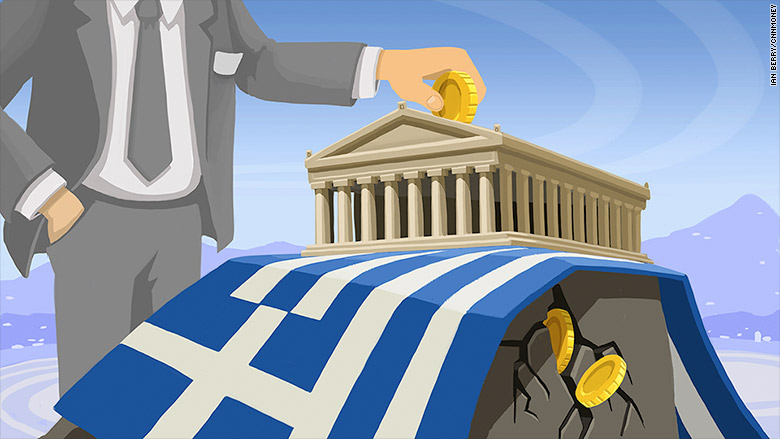
How’s this for déjà vu? Another debt crisis is brewing in Europe.

Greece needs European creditors to release cash from a bailout agreed in 2015 so it can make debt repayments, but officials are at loggerheads. Investors are starting to worry, demanding higher returns on Greek debt.

Adding to the confusion is a warning from the International Monetary Fund that Greece’s debt is unsustainable and on an “explosive” path, an assessment that prevents the fund from participating in a rescue.

The timing could hardly be worse. European leaders have a lot on their plate. Elections are looming in the Netherlands, France and Germany. Brexit negotiations will begin within weeks.

Yet the threat of Greece tumbling out of the euro demands attention. Here’s why the next few weeks will be key:

Hammer to fall

Greece is running out of cash, but it needs to make repayments to creditors including the European Central Bank. Major bills are coming due in July.

If Greece cannot make the payments, it will default on its debt and spiral out of the eurozone.

Meanwhile, its latest bailout — the third since 2010 — is effectively frozen. The negotiating positions of major players are further apart than at any point since the bailout was agreed in June, 2015.

There is even disagreement over the size of the problem facing Greece.

“The IMF’s latest review of Greece’s debt position was surprisingly pessimistic,” said Jeroen Dijsselbloem, the Dutch finance minister who chairs meetings of top eurozone finance officials. “It’s surprising because Greece is already doing better than that report describes.”

I want it all

The IMF, Greece and creditors led by Germany all have very different priorities. Here’s what each wants:

The IMF has called on Greece to make more ambitious changes to its economy, including labor market reforms. The IMF didn’t join the third bailout when first agreed in 2015 because it did not view Greece’s debt as being sustainable. It still maintains that Greece cannot be self sustaining without major debt relief.

Greece’s main creditors agree that Athens should implement the reforms proposed by the IMF. However, they have categorically ruled out any debt relief, a position reiterated by eurozone finance officials on Tuesday.

Greek Prime Minister Alexis Tsipras, meanwhile, shows no sign of yielding to demands for additional reforms. He insists that debt relief is needed before any new concessions are made.

It’s a classic standoff and investors are watching to see which party blinks first.

Put out the fire

The next major milestone is a meeting of eurozone finance ministers on Feb. 20 — the last before elections start muddying Europe’s political waters. Agreeing yet more financial aid for Greece will become even harder once voters start casting their ballots.

After that, bills will start coming due. Greece faces a payment to the ECB of roughly €1.4 billion in late April and another €4.1 billion in July.

The stake are high.

The unemployment rate in Greece is expected to run above 21% in 2017. Investment is down by more than 60% and output has contracted by more than 25% since the financial crisis. The country’s social fabric is fraying.

If European creditors refuse further help, Greece’s debt will spiral out of control no matter how quickly its economy grows, according to the IMF.

That will leave only one option — abandoning the euro.

Ted Malloch, President Trump’s expected choice for U.S. ambassador to the EU, told Greek television on Tuesday that the eurozone’s future would be decided in the next 18 months.

“Certainly there will be a Europe, whether the eurozone survives, I think it’s very much a question that is on the agenda,” he said. “I think this time I would have to say that the odds are higher that Greece itself will break out of the euro.”

CNNMoney (London) First published February 8, 2017: 12:27 PM ET
Trump isn’t killing the bull market. Here’s why

No Comments

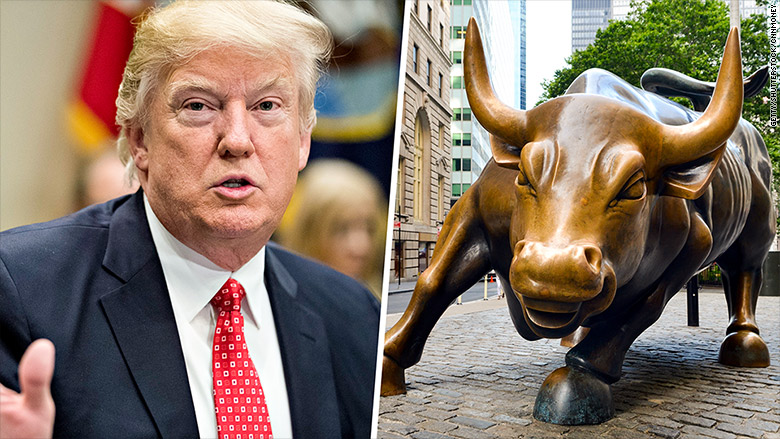
More and more business leaders and Wall Street strategists are expressing their worries about what President Donald Trump’s protectionist policies and unpredictable nature might do to the markets and economy.

But we all know that action speaks louder than words. What investors are actually doing is in stark contrast to what people are saying. The Dow, S&P 500 and Nasdaq hit all-time highs again on Friday.

And the Russell 2000, an index of small company stocks that tend to do most of their business in the U.S., is now just a few points away from the all-time high it hit last December in the wake of Trump market euphoria.

What’s more, the VIX (VIX), a measure of volatility known as Wall Street’s fear gauge, is down nearly 25% this year as well. If investors were really scared of Trump, the VIX should be much higher.

And CNNMoney’s own Fear & Greed Index, which looks at the VIX and six other measures of investor sentiment, is showing signs of Greed and is not far from Extreme Greed levels.

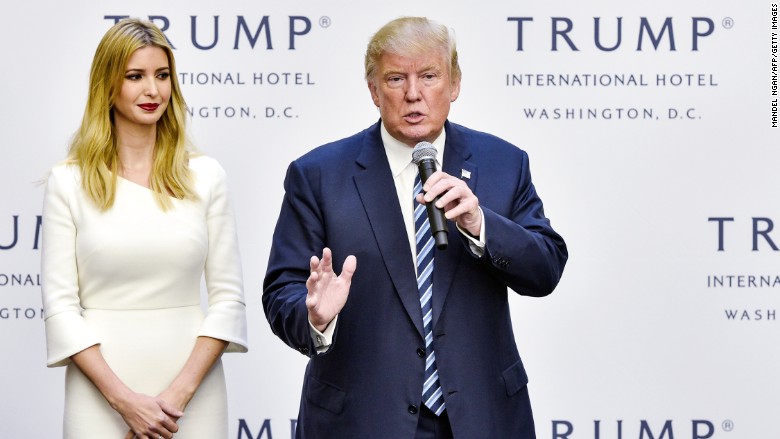
Of course, Trump still can’t seem to help himself from tweeting about things that, let’s be honest, won’t do anything to help the economy — although Nordstrom investors are richer despite Trump attacking them for dumping his daughter Ivanka’s brand.

But to give credit where it’s due, it looks like the main reason that stocks have taken off again lately is because Trump has promised to unveil a “phenomenal” tax plan soon.

Related: Rare streak for U.S. stocks: Long stretch without a 1% dive

Trump also pledged again to invest more on infrastructure when he met with airline CEOs on Thursday.

That’s what the market wants to hear.

“We still expect fiscal stimulus, lower taxes and less regulation,” said Matt Lockridge, manager of the Westwood Small Cap Value Fund. “The timing is the big question, but it’s coming.”

Lockridge thinks that many companies that generate a majority of their revenues from America should benefit if Trump stimulus winds up kicking the economy into a higher gear.

He likes stocks in a variety of industries, such as movie theater owner Masco (MAS), snack food firm J & J (JJSF) and aerospace equipment company Kaman (KAMN).

Another money manager said he’s also still bullish on small U.S. stocks that could get a lift from Trump policies.

Related: Wall Street has powerful seat at Trump’s table

Barry James, president and CEO of James Investment Research, said he bought the iShares Russell 2000 ETF (IWM) the day after the election because he’s confident Trump’s stimulus plan will boost growth for U.S small businesses.

“When Trump said America first, I really think that’s what he means,” James said, adding that he thinks Internet phone service Vonage (VG), rent-to-own retailer Aaron’s (AAN) and discount chain Big Lots (BIG) could all thrive if Trump’s proposals go through.

But there’s another reason why the U.S. markets are near all-time highs. Despite all of the uncertainty in Washington, the U.S. is still viewed as a paragon of relative stability compared to other parts of the world.

Europe’s economy is still a big wild card thanks to Brexit, the rise of populism in France leading to worries about a so-called Frexit and more worries about the problem that never seems to go away — Greece’s debt woes.

Japan’s economy remains stagnant as well. We’re talking about more than just a lost decade now. It’s plural. And China’s economy is slowing down too.

Bond fund manager Bill Gross has often joked that America is like what Johnny Cash and Kris Kristofferson sang about in “Sunday Morning Coming Down” — the “cleanest dirty shirt.”

To that end, analysts at bond rating firm Fitch wrote in a report Friday that “elements of President Trump’s economic agenda would be positive for growth,” but added that “the present balance of risks points toward a less benign global outcome.”

Of course, there are two sides to that coin. Trump’s bombast could come back to haunt him.

Related: Oreo make is worried about rise of populism

His continued penchant for reprimanding companies that he disagrees with on Twitter could dent investor confidence.

And while his proposed travel ban on immigrants from seven mostly Muslim countries has been overturned by the U.S. court system for now, the president has vowed to fight for its reinstatement.

Even if he loses that battle, it’s still clear that Trump is serious on turning more inward, with plans for tariffs and border-adjusted taxes that could ignite trade wars with Mexico, China and Japan. That could hurt big U.S. multinational firms and lead to job cuts.

But investors still seem to believe/hope that the merits of Trump’s pro-growth stimulus plans and tax cuts will outweigh the impact of isolationism. Let’s hope they’re right.

Investors may be holding their noses, closing their eyes and stuffing cotton in their ears to drown out the president. But they are still buying stocks.

CNNMoney (New York) First published February 10, 2017: 11:55 AM ET

Visa crackdown puts these rural doctors at risk

No Comments

At his pediatrics practice in Sioux Falls, South Dakota, Dr. Alaa Al Nofal sees up to 10 patients a day. He’s known some of them since they were born. Others, he still treats after they’ve graduated from high school.

“I treat these children for Type 1 diabetes, thyroid problems, thyroid cancer, puberty disorders and adrenal gland diseases,” he said.

Al Nofal’s expertise is critical. He is one of just five full-time pediatric endocrinologists in a 150,000 square-mile area that covers both South and North Dakota.

Like most of rural America, it’s a region plagued by a shortage of doctors.

“We’re very lucky to have Dr. Al Nofal here. We can’t afford to lose someone with his specialization,” said Cindy Morrison, chief marketing officer for Sanford Health, a non-profit health care system based in Sioux Falls that runs 300 hospitals and clinics in predominantly rural communities.

Related: Visa ban could make doctor shortage in rural America even worse

Yet, Sanford Health may lose Al Nofal and several other doctors who are crucial to its health care network.

dr nofal patient
Dr. Alaa Al Nofal [here with a patient] is one of just five pediatric endocrinoloists in South and North Dakota combined.

A Syrian citizen, Al Nofal is in Sioux Falls through a special workforce development program called the Conrad 30 visa waiver — which basically waives the requirement that doctors who complete their residency on a J-1 exchange visitor visa must return to their country of origin for two years before applying for another American visa. The Conrad 30 waiver allows him to stay in the U.S. for a maximum of three years as long as he commits to practicing in an area where there is a doctor shortage.

After President Donald Trump issued a temporary immigration ban restricting people from seven Muslim-majority countries — including Syria — from entering the U.S., Al Nofal is unsure about his future in America.

“We agree that something more has to be done to protect the country, but this executive order will have a negative effect on physicians from these countries who are badly needed across America,” said Al Nofal. “They may no longer want to practice in the United States.” The action is currently in legal limbo after a federal appeals court temporarily halted the ban.

Related: Trump furious after court upholds block on travel ban

Over the last 15 years, the Conrad 30 visa waiver has funneled 15,000 foreign physicians into underserved communities.

Sanford Health has 75 physicians in total on these visa waivers and seven are from the countries listed in the executive order. “If we lost Dr. Al Nofal and our other J-1 physicians, we would be unable to fill critical gaps in access to health care for rural families,” said Sanford Health’s Morrison.

And the ban could hurt the pipeline of new doctors, too. The Conrad 30 visa waiver program is fed by medical school graduates holding J-1 non-immigrant visas who have completed their residencies in the U.S.

south dakota rural
Cows in a field just outside of Sioux Falls.

More than 6,000 medical trainees from foreign countries enroll every year in U.S. residency programs through J-1 visas. About 1,000 of these trainees are from countries caught up in the ban, according to the American Association of Medical Colleges. J-1 visa holders who were out of the country when the ban went into effect were prohibited from entering the U.S. and unable to start or finish school as long as the ban is in place.

The State Department told CNNMoney that the government may issue J-1 visas to people who are from one of the blocked countries if it is of “national interest,” but would not confirm whether a doctor shortage would qualify for such consideration.

“The stress and concern generated by the short-term executive order could have long-term implications, with fewer physicians choosing training programs in the states and subsequently magnifying the deficit in providers willing to practice in underserved and rural areas,” said Dr. Larry Dial, vice dean for clinical affairs at Marshall University’s school of medicine in Huntington, West Virginia.

Related: Obamacare’s impact on this Alaska town with only one doctor’s office

Al Nofal went to medical school in Damascus, Syria’s capital, and completed his residency at the University of Texas on a J-1 visa. He proceeded to a fellowship at the Mayo Clinic and then applied for a J-1 waiver, which placed him in Sioux Falls.

Nineteen months into his three-year commitment, Al Nofal is either directly treating or serving as a consulting physician to more than 400 pediatric patients a month on average.

He sees most of his patients at the Sanford Children’s Specialty Clinic in Sioux Falls, where families often drive hours for an appointment. Once a month, he flies in a small plane to see patients in a clinic in Aberdeen, about 200 miles away.

sanford childrens
Many of Dr. Al Nofal’s patients drive hours to see him at the Sanford Children’s Clinic in Sioux Falls.
aberdeen hospital
Once a month Dr. Nofal flies to Aberdeen, S.D. to see patients at an outreach clinic.

“It’s not easy being a doctor in this setting,” said Al Nofal, citing the long hours and South Dakota’s famously frigid winters. “But as a physician, I’m trained to help people whatever the circumstances and I’m proud of it.”

It’s one of the reasons why Al Nofal and his American wife Alyssa have struggled to come to terms with the visa ban.

“I have a 10-month old baby and I can’t travel to Syria now. My family in Syria can’t come here,” he said. “Now my family can’t meet their first grandson.”

“I know if we leave I probably can never come back,” he said. Neither does he want to travel anywhere in the country right now. “I’m afraid of how I will be treated,” he said. He’s also afraid he will be stopped at the airport — even if he’s traveling to another state.

Related: Trump travel ban and what you need to know

Almatmed Abdelsalam, who’s from Benghazi, Libya, had planned to start practicing as a family physician in Macon, Georgia, through the visa waiver program after he completed his residency at the University of Central Florida’s College of Medicine in July.

Everything was going smoothly. Abdelsalam, who treats hospital patients and veterans, applied for the visa waiver and was accepted. He signed an employment contract with Magna Care, which provides physicians to three hospitals in the Macon area and he had started looking at houses to relocate himself, his wife and their two young kids over the summer.

almatmed abdelsalam
Dr. Almatmed Adbelsalam with his family.

But there was one last step. For his J-1 waiver application to be fully completed, it needs to get final approval from the State Department and the United States Citizenship and Immigration Services.

“The executive order came in the middle of that process, stalling my application at the State Department,” he said.

Because he’s a Libyan citizen (Libya is also subject to the visa ban), Abdelsalam is fearful of the outcome.

“The hospital in Macon urgently needs doctors. Even though they’ve hired me, I’m not sure how long they can wait for me,” he said.

“No one can argue it’s necessary to keep the country safe, but we should also keep the country healthy,” he said. “Doctors like me, trained in the U.S. at some of the best schools, are an asset not a liability.”

CNNMoney (New York) First published February 10, 2017: 7:47 PM ET

LeBron, Serena and other Nike stars champion ‘Equality’

No Comments

Nike says it’s time to stand up for equality in a new ad campaign.

The company on Sunday launched a star-studded short film titled “Equality” to mark Black History Month.

The ad features Nike-sponsored athletes LeBron James, Serena Williams, Kevin Durant, Gabby Douglas, among others, “amplifying their voices in an effort to uplift, open eyes and bring the positive values that sport can represent into wider focus,” the company said.

Actor Michael B. Jordan voices the film, and singer Alicia Keys performs a rendition of Sam Cooke’s “A Change is Gonna Come.”

“Is this the land history promised?” Jordan says. “Here, within these lines, on this concrete court, this patch of turf, here, you’re defined by your actions — not your looks or beliefs.”

Nike will feature ads from the campaign on social media, billboards and posters throughout cities in the United States and Canada. It will also sell “Equality” branded T-shirts and shoes as part of its annual Black History Month collection.

Apparel from the campaign will be worn by Nike athletes during NBA All-Star weekend.

Nike said it is donating $5 million this year to organizations like MENTOR and PeacePlayers, which it says “advance equality in communities” across the country.

Related: Pro-Trump boycott calls follow Super Bowl ads

Nike’s new campaign comes one week after numerous companies launched ads about inclusion and acceptance during the Super Bowl.

Budweiser, 84 Lumber, Coca-Cola (COKE), Airbnb, Kia and Tiffany (TIF) were among the brands that features messages about immigration, equality and environmentalism.

— CNNMoney’s Ahiza Garcia contributed to this story.

CNNMoney (New York) First published February 12, 2017: 12:51 PM ET

Apple CEO Tim Cook calls for “massive campaign” against fake news

No Comments

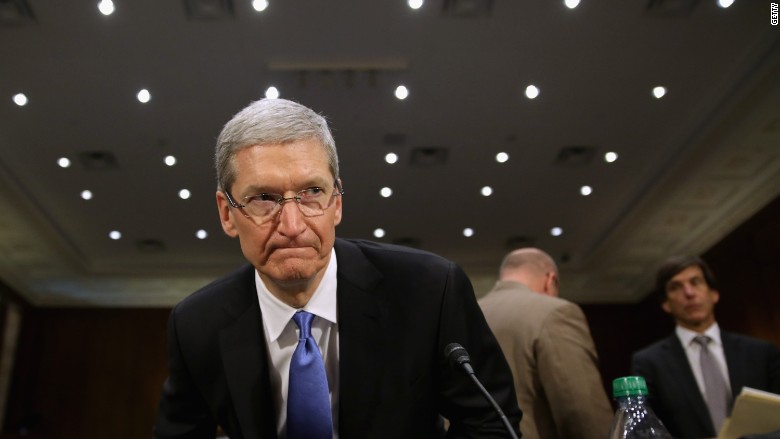
Apple CEO Tim Cook wants the tech industry to take action against “fake news” stories that are polluting the web.

“There has to be a massive campaign. We have to think through every demographic,” Cook said in a rare interview.

Speaking with The Daily Telegraph newspaper, Cook also said “all of us technology companies need to create some tools that help diminish the volume of fake news.”

Other leading tech company CEOs, like Facebook boss Mark Zuckerberg, have spoken about the problem in recent months. But Cook’s comments were much more frank.

According to the Telegraph, he said made-up stories and hoaxes are “killing people’s minds.”

And he called the “fake news” plague “a big problem in a lot of the world.”

The term “fake news” was originally coined to describe online stories that are designed to deceive readers. Often times these stories are shared on Facebook and other social networking sites to generate profits for the creators. Other times the stories are essentially propaganda made up for political purposes.

These kinds of stories received widespread attention before and after the American election. Fictional stories with titles like “Pope Francis shocks world, endorses Donald Trump for president” won millions of clicks.

It can be very difficult for web surfers to tell the difference between legitimate news sources and fakes.

That’s where companies like Apple come in.

In the Telegraph interview — part of a multi-day European trip — Cook said “too many of us are just in the complain category right now and haven’t figured out what to do.”

He urged both technological and intellectual solutions.

“We need the modern version of a public-service announcement campaign. It can be done quickly if there is a will,” Cook told the newspaper.

What he described is music to the ears of media literacy advocates.

“It’s almost as if a new course is required for the modern kid, for the digital kid,” Cook said.

There are scattered efforts in some schools to teach media literacy, with a focus on digital skills, but it is by no means universal.

When asked if Apple would commit to funding a PSA campaign, an Apple spokesman said the company had no further comment on Cook’s interview.

The Apple CEO also suggested that tech companies can help weed out fake stories, though he added, “We must try to squeeze this without stepping on freedom of speech and of the press.”

Apple’s own Apple News app has been credited with being a relatively reliable place to find information.

The company “reviews publishers who join Apple News,” BuzzFeed noted last December.

And the app has a “report-a-concern function where users can flag fake news or hate speech.”

Facebook recently started working with fact-checkers to test “warning labels” that show up when users share made-up stories.

Cook, in the newspaper interview, expressed optimism that the “fake news” plague is a “short-term thing — I don’t believe that people want that at the end of the day.”

CNNMoney (New York) First published February 11, 2017: 8:00 PM ET

‘Lego Batman’ producer today. Treasury secretary tomorrow?

No Comments

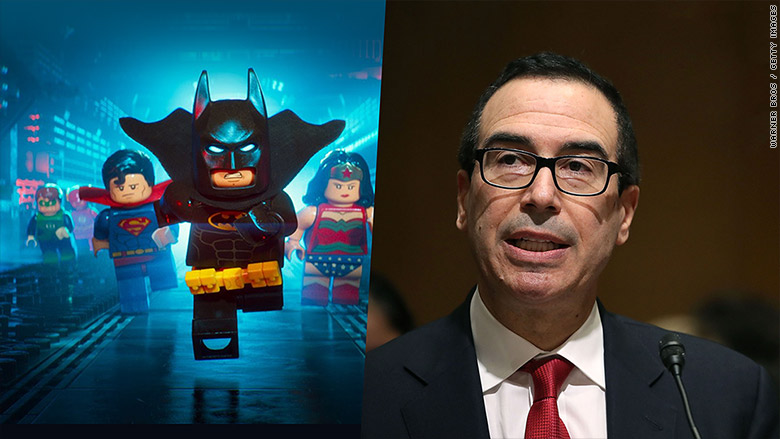
Steven Mnuchin had a pretty good weekend.

First the treasury secretary pick advanced a step closer toward confirmation on Friday.

Then his latest movie claimed the top spot at the box office.

Mnuchin is an executive producer on Warner Bros.’ “The Lego Batman Movie,” which pulled in an estimated $55.6 million from U.S. audiences during its opening weekend.

CNN, like Warner Bros., is owned by Time Warner.

The kid-friendly spinoff of 2014’s “The Lego Movie” handily beat its raunchy competitor, Universal’s “Fifty Shades Darker.”

The sequel to 2015’s “Fifty Shades of Grey,” based on a best-selling series of romance novels, debuted at $46.8 million in the United States.

Related: Possible pick for Treasury secretary makes his film debut

Mnuchin is listed as a producer or executive producer on 34 films in recent years, including last summer’s “Suicide Squad,” which brought in $786 million worldwide.

He also produced “The Lego Ninjago Movie,” another Lego franchise spinoff that will hit screens this fall.

Mnuchin is widely expected to be serving as Treasury secretary by then.

Following a 53-46 vote last Friday to break a Democratic filibuster, Mnuchin is scheduled for a final vote before the full Senate at 7 p.m. Monday.

–CNNMoney’s Frank Pallotta and CNN’s Ashley Killough contributed to this story.

CNNMoney (New York) First published February 12, 2017: 5:39 PM ET

This Thai company makes food packaging out of bamboo to cut down on trash

No Comments

To tackle Thailand’s mounting trash problem, one company is turning to the country’s plant life.

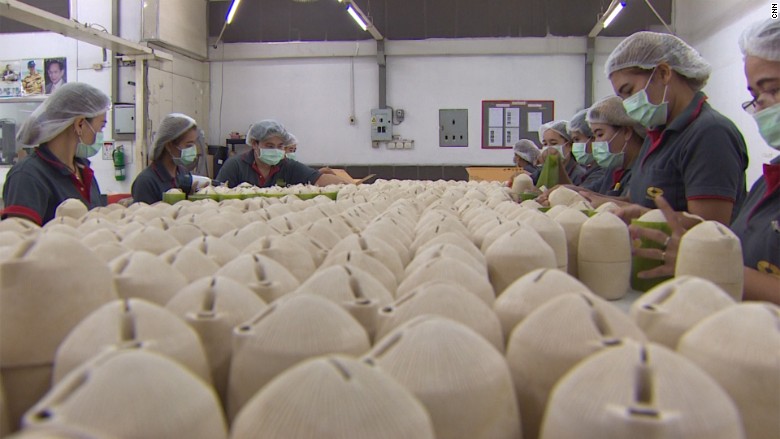
Universal Biopack makes packaging that it sells to restaurants and manufacturers. But rather than plastic, it uses a mixture of bamboo and cassava, crops that are widely found across the country.

After growing rapidly in recent decades, Thailand has become one of Asia’s biggest economies. But like many other countries in the region, it’s been slow to try to combat the millions of tons of trash produced each year.

“Waste management is a big problem everywhere,” said Universal Biopack’s managing director, Vara-Anong Vichakyothin.

Related: The company turning 4 billion plastic bottles into clothes

The company is using a technology devised at a Bangkok university to make its zero-waste packaging. It hopes it will eventually replace many of the Styrofoam boxes and plastic bags that end up in huge garbage dumps across Thailand and other Southeast Asian countries.

Its eco-friendly formula took five years to develop and is so adaptable it could end up being used to package things like furniture and even phones. The bamboo it uses comes from leftover scraps from the chopstick manufacturing process.

UB Pack 3

In the cities of Bangkok and Chiang Mai, where takeout drink containers and noodle packets line the sidewalks, the company supplies restaurants, organic farmers and other businesses in the food and drink industry.

But finding new clients can be tricky.

Takeout food vendors in Thailand want to keep costs down in a competitive business with thin margins. Asking them to spend more on packaging for environmental reasons is a tough sell.

“The local economy still does not support [this technology]” said Universal Biopack’s founder, Suthep Vichakyothin.

UB Pack 2

But that hasn’t stopping other companies from entering the sustainable packaging market in Thailand. Like Universal Biopack, they’re betting on growing environmental awareness eventually leading to an increase in demand.

To become more competitive, Suthep’s company is investing. It’s aiming to ramp up production by building a partially automated assembly line at its factory near Bangkok and doubling its staffing from 50 people to 100.

The goal is to increase monthly capacity from 300,000 units to one million.

Related: A startup that makes pencils that grow into vegetables

A lot of the demand comes from overseas. One of its customers uses the natural packaging for coconut water it exports.

Universal Biopack says it’s also getting interest in its products from other countries, particularly in Scandinavia.

CNNMoney (Hong Kong) First published February 12, 2017: 9:08 PM ET

我應該在外匯交易平台中尋找哪些功能?

No Comments

我應該在外匯交易平台

一個好的引言段落首先是主題的總體概述(第 1 句)。然後它縮小到論文陳述或論文中將具體討論的主題的一部分(第 2 句)。例如,初學者應該尋找一個具有直覺介面和教育資源的平台。其中包括涵蓋外匯基礎知識和市場分析的文章、網路研討會和課程。

外匯交易平台應提供直覺且易於導航的使用者友善介面。它還應該提供一系列功能,使交易者能夠做出明智的交易決策,包括先進的圖表工具和技術分析指標。該平台應支援廣泛的交易工具,包括主要和次要貨幣對、商品和指數。它還應該具有強大的行動交易功能,允許交易者監控他們的帳戶並隨時隨地執行交易。

外匯交易平台

一個好的平台也應該優先考慮安全性,利用強大的加密協議和雙重認證來保護個人資訊和資金。此外,還應遵守嚴格的監管標準。考慮平台提供的客戶支援程度也很重要,因為它可以幫助您快速有效地解決問題。尋找提供多種支援管道(例如即時聊天、電子郵件和電話)的平台。例如,eToro 提供全天候的強大客戶支援服務。

外匯交易平台應提供先進的圖表工具和指標,以幫助您識別市場趨勢並做出明智的交易決策。尋找可自訂的技術指標和繪圖工具以及一系列訂單類型等功能。找到一個提供強大風險管理工具以減輕損失並確保利潤的平台也很重要。

我應該在外匯交易平台中尋找哪些功能?

一些經紀商提供額外的工具和功能來協助基本面分析,包括存取可能影響貨幣價格的動態消息和經濟報告。例如,eToro 為交易者提供了一個名為 CopyTrader 的功能,讓他們可以追蹤並複製表現最好的交易者的策略。

一些平台還允許用戶創建「收藏夾」窗口,顯示其最常交易的貨幣的報價。這使得他們可以更輕鬆地快速存取所需的資訊和工具。其他有用的功能包括進階回溯測試、自動圖表模式識別和外匯計算器。例如,cTrader 附帶超過 65 個預裝技術指標和物件。

一個好的外匯交易平台應該提供一系列自動交易功能。其中包括停損和止盈訂單等風險管理工具,以及部位規模計算器。這可以幫助交易者最小化損失並最大化利潤。一些平台還允許用戶創建自己的自動交易系統,他們可以將其與經紀帳戶一起使用。這需要網路連接和對一系列市場資料來源的存取。在進入真實市場之前,交易者應該能夠使用歷史資料對其係統進行回溯測試。

一些平台還提供額外的交易相關功能,例如教育資源和有關金融市場趨勢的專家意見。這對於想要了解該行業並改進交易策略的初學者來說非常有用。其他功能,例如 eToro 的 CopyTrader 功能,甚至可以允許使用者複製表現最好的交易者的交易決策和策略。這是無需投資任何資金即可開始外匯交易的絕佳方式。

一個好的外匯交易平台應該提供市場新聞、見解和分析。這可以幫助交易者發現機會並做出明智的交易決策。此外,該平台應該具有各種有助於技術分析的圖表工具和指標。

許多經紀商提供自己的交易平台,透過客製化功能增強用戶體驗。例如,受到零售交易者廣泛歡迎的 MT4 提供了直覺的介面和強大的功能。此外,除了外匯之外,MT5 還擴展了其支援股票和差價合約交易的功能。

對交易者來說另一個重要的功能是風險管理工具。這些可以透過限制損失和保護他們的投資來保護他們的利潤。例如,止損訂單可以在預定水平自動平倉。此外,追蹤停損可以隨著價格變動調整停損,幫助交易者保護利潤。最後,一個好的平台應該有負擔得起且透明的費用。交易者應仔細評估這些成本,確保它們符合他們的交易目標和策略。

Verizon is bringing back unlimited data

No Comments

Verizon (VZ) is bringing back an unlimited data plan.

Starting Monday, Verizon customers can get unlimited data, talk and text for $80.

The company says the new introductory plan also includes up to 10 GB of mobile hotspot usage, as well as calling and texting to Mexico and Canada. It will also allow customers to stream unlimited HD video, thumbing its nose at T-Mobile’s controversial practice of lowering video quality for some of its unlimited data customers.

Although the new Verizon plan promises “fast LTE speeds,” those using a lot of data may suffer. The company said that after a customer uses 22 gb of data on a line during any billing cycle, it “may prioritize usage behind other customers in the event of network congestion.” That has become standard practice on all networks that offer unlimited data plans.

Related: T-Mobile and Sprint offer new ‘unlimited’ data plans — sort of

Verizon first eliminated its version of an unlimited usage plan in 2011, following similar decisions by other major wireless carriers.

But companies have been steadily reviving such plans.

Verizon first overhauled its data-usage plans last summer when it introduced a new “Safety Mode” plan. That technically gave customers access to unlimited data, but they were subjected to slow-as-molasses speeds after they went over their allotted data.

AT&T similarly eliminated overage fees for customers in September. Like Verizon, AT&T throttles customers speeds once they reach the data limit on their plans. The company brought back unlimited plans earlier last year, but it is only available for homes with both AT&T’s wireless phone service and either DirecTV or U-Verse TV.

Meanwhile, competitors T-Mobile (TMUS) and Sprint (S) made their own bids to attract customers looking for “unlimited data” plans.

Nearly all NYC subways get cell service

Last August, Sprint began offering a plan to give customers unlimited talk, text and high-speed data for $60 for the first line, $40 for the next, and $30 for each additional up to 10.

The T-Mobile plan, announced the same day as Sprint’s, charged $70 a month for the first line, the second at $50 and additional lines are only $20, up to eight lines.

CNNMoney (New York) First published February 12, 2017: 7:03 PM ET

Indian rival slams Uber’s business model

No Comments

Uber’s top rival in India has some unsolicited advice for the U.S. startup: Go local.

“They have a very cookie-cutter approach in terms of what the model is and how [to] force feed it into any geography,” Pranay Jivrajka, a top executive at Ola Cabs, said on the sidelines of CNN’s Asia Business Forum in Bangalore.

Jivrajka, who until recently served as Ola’s COO, said that Uber should ditch its one-size-fits-all approach and instead try to understand “local nuances” that would help it to identify services that “users and drivers actually want.”

Uber declined to comment on Jivrajka’s remarks.

Uber and Ola have for years waged a bitter battle for supremacy in India, a market with 1.3 billion potential customers. The country has taken on increased significance for Uber after a series of recent setbacks elsewhere in Asia.

The San Francisco-based company suspended its operations in Taiwan last week, six months after it sold its operations in China to local rival Didi Chuxing. Didi, which is taking the fight to Uber in key foreign markets, is one of Ola’s investors.

In India, Uber has often found itself playing catch-up with its Bangalore-based rival. Its most recent local product offering — allowing Indian users to book a car for an entire day — is already offered by Ola in 85 cities.

Ola also lets users book one of India’s ubiquitous three-wheeled auto rickshaws, a service Uber started but then discontinued in 2015.

“What has helped us is having an ear to the ground in terms of understanding what the users want,” said Jivrajka.

Related: Uber’s rivals are teaming up in Asia

Uber CEO Travis Kalanick insists that his company is not prepared to leave India.

“We are losing, but we see a path towards profitability,” Kalanick said during a December visit to Delhi. “We see ourselves being here in the long run.”

Related: Uber suspends its service in Taiwan as fines mount

India isn’t always a straightforward market for either company — tens of thousands of drivers representing both Uber and Ola went on strike in Delhi this week, demanding better pay and benefits. The Delhi government has offered to mediate the dispute.

Jivrajka did not comment on the protests, but said that Ola’s main focus remains bringing more drivers onto its platform.

“We need more drivers because the pace at which demand is increasing is way higher than the way supply is getting aggregated,” he said.

Related: Uber CEO drops out of Trump’s business advisory council

Jivrajka also had some advice for another Silicon Valley giant hoping to enter India: electric automaker Tesla.

“There are no rules on the Indian roads,” Jivrajka said. “One thing a lot of people say is that if you can drive in India, you can drive anywhere.”

— Manveena Suri contributed reporting

CNNMoney (Bangalore, India) First published February 13, 2017: 8:48 AM ET

Oil prices have doubled in a year. Here’s why

No Comments

It’s a good day for OPEC.

Data published Monday by the oil cartel show its members have largely complied with an agreement to slash production.

The confirmation caps a remarkable year for OPEC, which was forced to devise a plan to boost prices after they fell to $26 per barrel in February 2016.

The price collapse — to levels not seen since 2003 — was caused by months of growing oversupply, slowing demand from China and a decision by Western powers to lift Iran’s nuclear sanctions.

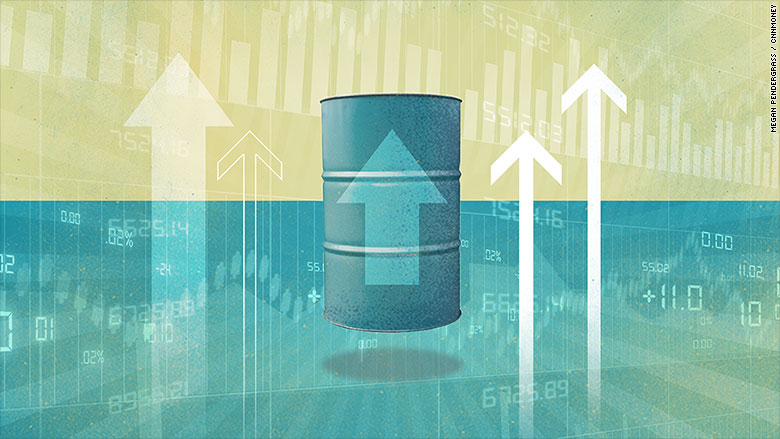
Since then, the market has mounted a stunning turnaround, with crude prices doubling to trade at $53.50 per barrel.

Here’s how major oil producers worked together to push prices higher:

OPEC deal

OPEC agreed major production cuts in November, hoping to tame the global oil oversupply and support prices.

The news of the deal immediately boosted prices by 9%.

Investors cheered even more after several non-OPEC producers, including Russia, Mexico and Kazakhstan, joined the effort to restrain supply.

Crucially, the deal has stuck. The OPEC report published Monday showed that its members have — for the most part — fulfilled their pledges to slash production. The International Energy Agency agrees: It estimated OPEC compliance for January at 90%.

UAE energy minister Suhail Al Mazrouei told CNNMoney on Monday that the results were even better than he had expected.

The production cuts total 1.8 million barrels per day and are scheduled to run for six months.

Related: OPEC has pulled off one of its ‘deepest’ production cuts

election2016 markets oil up

Investors upbeat

The OPEC deal took months to negotiate, and investors really, really like it. The number of hedge funds and other institutional investors that are betting on higher prices hit a record in January, according to OPEC.

The widespread optimism is helping to fuel price increases.

Higher demand

The latest data from OPEC and the IEA show that global demand for oil was higher than expected in 2016, thanks to stronger economic growth, higher vehicle sales and colder than expected weather in the final quarter of the year.

Demand is set to grow further in 2017 to an average of 95.8 million barrels a day, compared 94.6 million barrels per day in 2016.

The IEA said that if OPEC sticks to its agreement, the global oil glut that has plagued markets for three years will finally disappear in 2017.

Saudi oil minister: I don’t lose sleep over shale

What’s next?

Despite the stunning growth, analysts caution that prices may not go much higher.

That’s because higher oil prices are likely to lure American shale producers back into the market. The total number of active oil rigs in the U.S. stood at 591 last week, according to data from Baker Hughes. That’s 152 more than a year ago.

U.S. crude stockpiles swelled in January to nearly 200 million barrels above their five-year average, according to the OPEC report.

“This vast increase in inventories is a result of a strong supply response from the U.S. shale producers, who were not involved in the OPEC agreement and who have instead been using the resultant price rally to increase output,” said Fiona Cincotta, an analyst at City Index.

More supply could once again put OPEC under pressure.

CNNMoney (London) First published February 13, 2017: 9:13 AM ET

Swiss voters reject corporate tax overhaul

No Comments

Voters in Switzerland have shocked the political establishment by rejecting a reform plan that would have brought the country’s corporate tax system in line with international norms.

The tax reforms, which were widely supported by the business community, would have removed a set of special low-tax privileges that had encouraged many multinational companies to set up shop in Switzerland.

Experts say the future of Switzerland’s tax system is now unclear. The vote result could create headaches for firms that had been banking on their implementation, and deter companies who had been considering a move to the country.

“They do not know what [tax] measures will be available… That is not a very solid basis for making investment decisions,” Peter Uebelhart, head of tax at KPMG in Switzerland, said in a video statement.

Switzerland has come under intense pressure from G20 and OECD nations in recent years to clean up its tax system. The country runs the risk of being “blacklisted” by other nations if it doesn’t change its tax system by 2019.

Many voters rejected the tax reform package over fears it might reduce the amount of revenue collected by the government, according to Stefan Kuhn, head of corporate tax at KPMG in Switzerland. That might have lead to tax hikes on the middle class.

The current tax system gives preferential treatment to some companies with large foreign operations. International tax authorities say the rules amount to unfair corporate subsidies.

Martin Naville, head of the Swiss-American Chamber of Commerce, said it’s possible that voters didn’t understand the complexities of the reforms. The measures were rejected by 59% of voters.

“I think it’s a very bad day for Switzerland,” Naville said. “Clearly, the uncertainty and the credibility in the Swiss [system] has taken a massive hit.”

Related: How Europe’s elections could be hacked

Swiss authorities say they will move quickly to create a modified tax reform proposal. Naville said he hopes new rules are devised within the next few months.

“All stakeholders now have to take responsibility to develop an acceptable competitive tax system, and to regain credibility regarding the famed political stability which gave Switzerland such an advantageous position,” he said in a statement.

Naville hinted that potential tax reforms in the U.S. and U.K. could tempt Swiss-based companies to relocate, putting more pressure on Switzerland’s tax base.

CNNMoney (London) First published February 13, 2017: 10:10 AM ET

Trump brand takes another hit: Sears and Kmart

No Comments

Nordstrom. Neiman Marcus. TJ Maxx. And now, Sears and Kmart.

Sears Holdings, the company that owns retail stores Sears and Kmart, reportedly said this weekend that it would remove 31 Trump-branded items from its website.

The company pulled the products as part of a plan to focus on its “most profitable items,” Sears spokesman Brian Hanover told Reuters.

Hanover told the news organization that items in the Trump Home line of furnishings were removed from the company’s website, although they could still be purchased through third-party vendors online. Neither store carried the items in their physical stores, he said.

Searches of the Sears and KMart websites did not turn up Trump Home products, except for those sold by third-party vendors.

In a statement Monday, spokesman Chris Brathwaite distanced Sears from any political controversy and reiterated that many Trump-branded products are still available through third-party sellers.

“In this case, certain products were removed from our websites that included a very small number of Trump products,” he said. “The headlines do not do justice to our business or this specific brand of products that we offer through our marketplace sellers.”

Brathwaite added that the company prefers to focus on its business and “leave the politics to others.”

Related: Is Ivanka Trump’s brand losing its bling?

The move makes Sears the latest to ditch products bearing the Trump name.

Earlier this month, Nordstrom (JWN) cited brand “performance,” not politics, as the reason why it decided to stop carrying Ivanka Trump’s clothing and accessories label.

President Trump knocked the department store on Twitter in retaliation. Nordstrom stock jumped 7% in the first two days following the tweet.

Other stores have also sought to distance themselves from Ivanka Trump’s brand.

Neiman Marcus removed the brand landing page from its website, and declined to tell CNNMoney whether it intended to keep Ivanka Trump products in stores or resume online sales in the future.

TJX Companies (TJX), the company that owns TJ Maxx and Marshalls, also said that it had recently told workers not to highlight the first daughter’s brand in stores.

And retailer Belk said last week that it planned to pull Ivanka Trump’s products from its website, but would continue to offer the line in its flagship stores.

Ivanka Trump’s clothing and accessories line has taken a hit in recent months.

Online sales of her brand dipped 26% in January compared to a year earlier, according to Slice Intelligence, a retail analysis firm. Slice studied the brand’s sales on five online stores: Nordstrom, Amazon, Zappos, Macy’s and Bloomingdale’s.

Online sales of Ivanka’s brand had surged in late 2015, and last month’s numbers appear to be more of a “return to reality,” according to Taylor Stanton, Slice’s marketing and communications manager. The brand’s dip in performance was abnormal in light of an uptick in 2016 online sales in the apparel and accessories category, said Jack Beckwythe, a Slice analyst.

Related: Kellyanne Conway unrepentant for Ivanka Trump plug

The Ivanka Trump brand has defended its performance.

Rosemary Young, senior director of marketing at Ivanka Trump, told CNNMoney last week that the brand was growing and experienced “significant year-over-year revenue growth in 2016.”

“We believe that the strength of a brand is measured not only by the profits it generates, but the integrity it maintains,” Young said.

Retailers like Bloomingdale’s, Amazon (AMZN), Lord & Taylor, Macy’s (M) and Zappos all still carry Ivanka Trump products.

Ivanka Trump has taken a leave of absence from her namesake company since her father won the presidency. She has no formal role in the administration but is expected to have a voice on issues such as women’s empowerment and child care.

–CNNMoney’s Jackie Wattles contributed to this story.

CNNMoney (New York) First published February 12, 2017: 3:35 PM ET

Tesla is going to sell electric cars in the Middle East

No Comments

Tesla is bringing its electric cars to the heart of the oil producing world.

The automaker announced Monday that its first official venture in the Middle East will be in the United Arab Emirates.

The first cars — the Model S and Model X — will hit the road this summer.

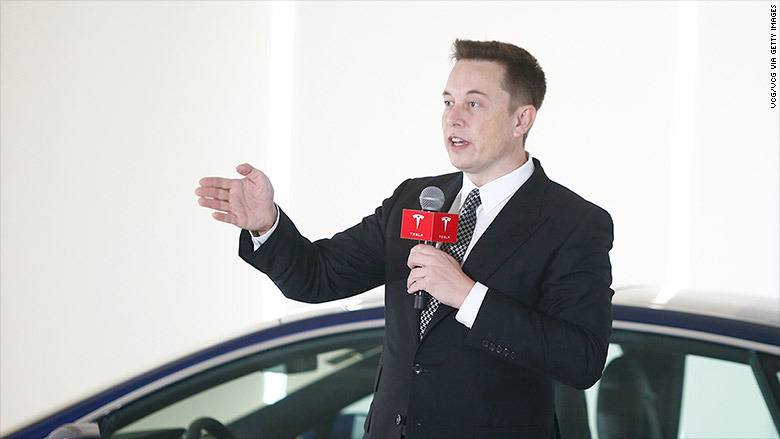
“Timing seems to be good to really make a significant debut in this region starting in Dubai,” Tesla (TSLA) CEO Elon Musk said at the World Government Summit in Dubai.

Tesla owners will have access to two existing supercharging stations in the UAE, and Telsa plans to open five more by the end of the year.

Despite sitting on huge oil and gas reserves, the UAE has ambitious plans to go green. Last month it said it will invest $163 billion to boost alternative energy use over the next three decades.

Related: Tesla reveals what it will charge for a charge

It’s the latest in a series of expansion announcements for Tesla. Last week, Musk hinted that Tesla may soon come to India.

Musk has also teased plans to build “heavy-duty trucks and high passenger-density urban transport” as well developing a ride-hailing network, which could be similar to Uber.

Speaking in Dubai, the entrepreneur expounded on the future of robotics.

“We will see autonomy and artificial intelligence advance tremendously,” Musk said. “In probably 10 years, it will be very unusual for cars to be built that are not fully autonomous.”

Related: Elon Musk’s surprising secret weapon: Trump?

But he also warned of the “disruptive” nature of autonomous vehicles.

“That disruption I’m talking about will take place over about 20 years. Still, 20 years is a short period of time to have something like 12% to 15% of the workforce be unemployed.”

Musk said governments must pay close attention to artificial intelligence, create sustainable transport and be wary of mass unemployment.

“This will be a massive social challenge. Ultimately, we need to think about universal basic income. I don’t think we have a choice,” he said. “There will be fewer and fewer jobs that a robot cannot do better.”

— Seth Fiegerman contributed reporting.

CNNMoney (Dubai) First published February 13, 2017: 11:06 AM ET

Verizon’s new plan: Consumers win, investors lose

No Comments

Verizon has brought back its unlimited data plan. That’s great if you’re a Verizon customer. But it is terrible news for its investors.

Verizon (VZ) stock fell nearly 1.5% in early trading Monday. It’s now down about 10% so far this year, making it the Dow’s worst performer of 2017.

Verizon’s move is a clear sign the company has to pull out all the stops to remain competitive with wireless rivals AT&T (T), Sprint (S) and T-Mobile (TMUS).

“In recent months, both T-Mobile and Sprint had some success taking additional share from Verizon by virtue of their unlimited offerings,” wrote Morgan Stanley analysts in a report Monday morning.

That may explain why shares of T-Mobile and Sprint, which is now controlled by Japanese tech conglomerate SoftBank, are both up this year while Verizon is down. T-Mobile and Sprint have also been perennially linked as possible merger partners.

But the new telecom price war isn’t the only problem for Verizon.

AT&T recently acquired satellite broadcast provider DirecTV, a move that makes Ma Bell more competitive against Verizon in the battle to control people’s living rooms. Verizon offers its own FiOS broadband TV service.

Related: Verizon brings back unlimited data plans

And AT&T is also making a much bigger bet on content, with plans to purchase CNN’s parent company Time Warner (TWX). Verizon already owns AOL and is looking to buy the core assets of Yahoo to bolster its own digital content offerings.

But the Yahoo (YHOO) deal could fall apart in the wake of revelations of massive data breaches at Yahoo over the past few years.

Yahoo recently said it hopes that the deal with Verizon will close in the second quarter of this year. It was originally supposed to be finalized by the first quarter.

However, in its latest earnings release, Verizon simply said that it “continues to work with Yahoo to assess the impact of data breaches” — not that it expected the deal to close anytime soon.

Verizon has a lot on its plate, which could be making investors nervous. In addition to the Yahoo deal, the company is also in the process of buying the fiber optic network of XO Communications. And it’s selling its data center business to Equinix (EQIX).

There also have been rumors in the past few weeks that Verizon might even consider buying cable provider Charter Communications (CHTR).

That may be more than Verizon can realistically handle right now. But nothing may be off the table for Verizon given how competitive the wireless world is these days.

Anything that could give Verizon a leg up on AT&T, Sprint and T-Mobile might be possible.

Related: Charter shares popped on report of possible Verizon takeover

Still, it’s worth noting that shares of AT&T are lower this year too, down about 5%. And Verizon and A&T have something in common that Sprint and T-Mobile lack — Verizon and AT&T pay gigantic dividends.

Companies that have big dividend yields haven’t fared as well since Donald Trump was elected. Investors are betting on a sizable stimulus package from him and the Republican Congress, which may be fueled in part by debt.

That’s caused bond yields to rise — and that makes shares of big dividend payers like Verizon a lot less attractive.

The Federal Reserve is expected to raise interest rates a few times this year too. That could push bond yields even higher.

So Verizon faces many big challenges that could hurt its stock this year.

That’s why Verizon, nicknamed Big Red because of its logo’s crimson hue, may see its stock in the red for the foreseeable future.

CNNMoney (New York) First published February 13, 2017: 11:27 AM ET

America’s NAFTA nemesis: Canada, not Mexico

No Comments

America and Canada have one of the world’s biggest trade relationships.

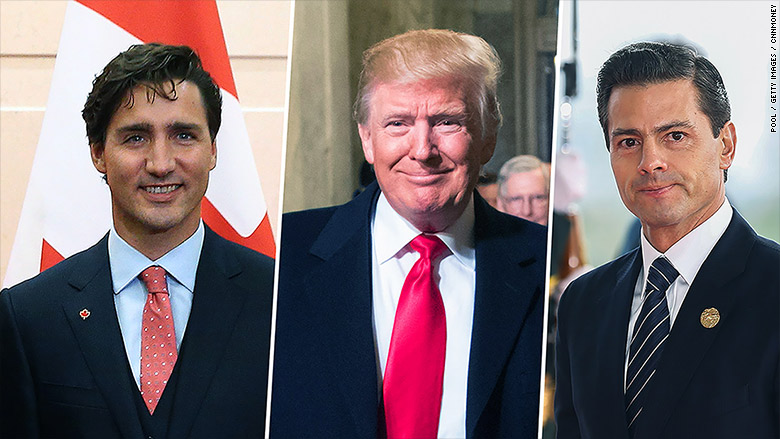
President Donald Trump met for the first time Monday with Canada’s Prime Minister Justin Trudeau.

“We have a very outstanding trade relationship with Canada,” Trump said at the news conference.

But the U.S.-Canada trade relationship over the years has not been as smooth as you might think. There have been trade wars, acts of retaliation, allegations of dumping and jobs lost.

“Our trading relationship obviously is strong…but the relationship has been rocky, despite the agreements we have in place,” says Stuart Trew, an editor at the Canadian Centre for Policy Alternatives, a research group in Ottawa, Canada’s capital.

Trump has often slammed Mexico and NAFTA, the trade agreement between the U.S., Mexico and Canada. But Canada is rarely mentioned.

Yet, there have been more NAFTA dispute claims against Canada — almost all by U.S. companies — than against Mexico. Even today, Canada has stiff tariffs against the United States and the two sides only recently resolved a bitter dispute over meat.

Most leaders and experts stress that trade ties between the two nations are strong and mostly positive. But Canada and America have had plenty of battles along the way.

Now Trump wants to renegotiate NAFTA, which will be on the top of the agenda for his meeting with Trudeau.

1. Canada gets in more NAFTA trouble than Mexico

Listening to Trump, you might think Mexico is the bad actor of NAFTA. But since NAFTA’s inception in 1994, there have been 39 complaints brought against Canada, almost all by U.S. companies. Known in the industry as the investor state dispute settlements, it allows companies to resolve cases under a special panel of NAFTA judges instead of local courts in Mexico, Canada, or the U.S.

There’s only been 23 complaints against Mexico. (By comparison, companies from both Mexico and Canada have filed a total of 21 complaints against the U.S.)

And increasingly, Canada is the target of American complaints. Since 2005, Canada has been hit with 70% of the NAFTA dispute claims, according to CCPA, a Canadian research firm.

2. The U.S. – Canada lumber battle

NAFTA isn’t the only sore area. In 2002, the U.S. slapped a roughly 30% tariff on Canadian lumber, alleging that Canada was “dumping” its wood on the U.S. market. Canada rejected the claim and argued the tariff cost its lumber companies 30,000 jobs.

“It was a very sour point in Canadian – American relations for quite a while,” says Tom Velk, an economics professor at McGill University in Montreal.

The dispute had its origins in the 1980s, when American lumber companies said their Canadian counterparts weren’t playing fair.

Whether Canada actually broke the rules is a matter of dispute.

Canadian officials deny that the government is subsidizing softwood lumber companies in Canada. American lumber companies still allege that it does, and a U.S. Commerce Department report found that Canada was providing subsidies to lumber companies in 2004. It didn’t say whether the subsidies were ongoing.

According to the allegations, Canada subsidized lumber companies because the government owns many of the lands where the wood comes from. That subsidy — on top of Canada’s huge lumber supply — allowed Canada to price its lumber below what U.S. companies can charge.

The World Trade Organization ultimately sided with Canada, denying America’s claim and the two sides came to an agreement in 2006 to end the tariff.

However, that agreement and its ensuing grace period expired in October, and the two sides are back at it again. The Obama and Trudeau administrations couldn’t reach a compromise before Obama left office and it remains a contentious trade issue with U.S. lumber companies calling once again for tariffs.

Related: ‘Without NAFTA’ we’d be out of business

3. Smoot-Hawley triggers U.S. – Canada trade war

Things got even worse during the Great Depression. In 1930, Congress wanted to protect U.S. jobs from global trade. So the U.S. slapped tariffs on all countries that shipped goods to America in an effort to shield workers.

It was called the Smoot-Hawley Act. Today, it is widely accepted that this law made the Great Depression worse than it was.

Canada was furious, and retaliated more than any other country against the U.S., sparking a trade war.

“Canada was so incensed that…they raised their own tariff on certain products to match the new U.S. tariff,” according to Doug Irwin, a Dartmouth Professor and author of “Peddling Protectionism: Smoot-Hawley and the Great Depression.”

For example, the U.S. increased a tariff on eggs from 8 cents to 10 cents (these are 1930s prices, after all). Canada retaliated by also increasing its tariff from 3 cents to 10 cents — a threefold increase.

Exports dwindled sharply: in 1929, the U.S. exported nearly 920,000 eggs to Canada. Three years later, it only shipped about 14,000 eggs, according to Irwin.

Related: Remember Smoot-Hawley: America’s last major trade war

4. Canada’s sky high tariffs on U.S. eggs, poultry, milk

Fast forward to today. Smoot-Hawley is long gone, but Canada continues to charge steep tariffs on U.S. imports of eggs, chicken and milk.

For instance, some tariffs on eggs are as high as 238% per dozen, according to Canada’s Agriculture Department. Some milk imports, depending on the fat content, are as high as 292%.

“They’re so onerous that you can’t bring it across. There’s no American eggs in Quebec,” says Velk.

According to Canada’s Embassy in the U.S., reality is much different. Its officials say that despite some stiff tariffs, Canada is one of the top export markets for American milk, poultry and eggs.

The U.S. does have tariffs on some goods coming from all countries, but they are not nearly as high as Canada’s.

Experts say these tariffs continue to irk some U.S. dairy and poultry farmers, some of whom are challenged to sell into the Canadian market. But they doubt much will change since the tariffs have been in place for decades now.

Related: Those Reagan tariffs Trump loves to talk about

5. COOLer heads and the future of NAFTA

Despite all these disputes, experts stress this trade relationship is still one of the best in the world.

In fact, the two countries are so interconnected now, when trade disputes erupt sometimes American companies will side with Canadian companies and against U.S. lawmakers.

For example, Canadian meat producers disputed a U.S. law that required them to label where the cattle was born, raised and slaughtered. Canadians said the law discriminated against its meat from being sold in the U.S. and took the case to the WTO.

The WTO sided with Canada, and last December, Congress repealed the country-of-origin-labeling law. American meat producers — whose business is intertwined with Canada — actually supported their counterparts in Canada, arguing the regulation was too burdensome.

As for Trump’s proposal of tearing up NAFTA, many American and Canadian experts say that it’s not worth it to renegotiate or end the agreement. The three countries that are part of the agreement are so enmeshed with each other that untangling all that integration would be detrimental to trade and economic growth.

–Editor’s note: This story was originally published on August 11, 2016. We have since updated it.

CNNMoney (New York) First published February 13, 2017: 11:11 AM ET

Apple stock nears record high

No Comments

Apple has found its groove again.

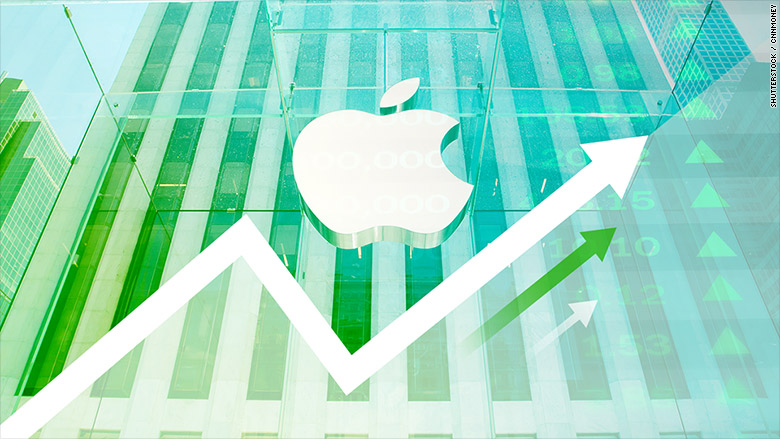
The iPhone maker’s stock hit $133.82 in early trading Monday, putting Apple less than $1 away from its intraday trading high of $134.54, reached in April 2015. Apple’s stock ended the day at $133.29, beating its previous record closing price of $133, set in February 2015.

The stock surge, pushing Apple (AAPL) to a $700 billion market cap, comes amid renewed optimism for the iPhone.

Goldman Sachs raised its price target for the stock on Monday, citing the likelihood of “major new features” like “3D sensing” being added to the next iPhone model, according to an investor note provided to CNNMoney.

Apple’s previous high was set six months after it released the redesigned iPhone 6 and 6 Plus, kicking off what CEO Tim Cook described as the “mother of all upgrades.”

Since then, however, Apple has bucked its tradition of overhauling the iPhone every other year. The newest models on the market today look nearly identical to the iPhones available in late 2014.

The long wait, combined with this year marking the iPhone’s tenth anniversary, has only raised expectations that Apple is about to significantly overhaul its smartphone and reignite demand.

Related: Tim Cook: ‘Apple would not exist without immigration’

Apple’s annual sales fell in the 2016 fiscal year for the first time since 2001 as iPhone sales, still the majority of its business, declined in three consecutive quarters.

Apple even cut its CEO’s pay by 15% due to the company’s failure to meet its performance goals for both sales and profits.

But that losing streak just ended.

Apple sales started growing again in the December quarter, driven by stronger demand for the iPhone — particularly for the larger and more expensive iPhone 7 Plus.

The company sold 78.3 million iPhones for the quarter, setting a new record. At least some of that may be due to the Samsung’s smartphone recall woes.

Mark Moskowitz, an analyst with William Blair, wrote in an investor note this month, “Samsung’s Note 7 struggles likely helped.”

The iPhone isn’t the only reason Wall Street is excited about Apple. There’s also President Trump.

Despite Trump clashing with Apple during the campaign, investors are now optimistic Apple will benefit from at least one Trump proposal: cutting taxes on cash that U.S. businesses bring back from their overseas accounts.

Apple currently has $230 billion in cash held in foreign accounts. If Trump and Congress make it cheaper for Apple to bring that money back, it could be used for acquisitions and buybacks.

CNNMoney (New York) First published February 13, 2017: 12:24 PM ET

Stocks hit record again. But is Trump the reason?

No Comments

The Dow, S&P 500, Nasdaq and Russell 2000 each hit new all-time highs Monday.

Investors are giddy with excitement and they clearly believe that both big blue chip multinationals and smaller companies that do most of their business in the U.S. will continue to thrive.

So is this the Donald Trump rally? Or the Janet Yellen rally?

Some strategists believe Trump’s stimulus plans and talk of killing many burdensome regulations are the reasons stocks are soaring.

Or perhaps this is better characterized as a continuation of the Barack Obama rally instead?

You could argue that POTUS 44 has dealt POTUS 45 a pretty good hand.

The solid job market and overall economy that Trump inherited may be the reason consumers and businesses are so confident.

But investors (and financial journalists) are often quick to give the president more credit — and blame — than they probably deserve for the performance of the stock market.

RBC strategist Jonathan Golub pointed this out in a report on Monday, one that was aptly titled “Message to Market: It’s Not All About Donald.”

Related: Trump isn’t killing the bull market

Golub noted that the S&P 500 rose nearly 7% from late June through Election Day — a time when most polls were predicting that Hillary Clinton would be the next president.

But stocks have continued to rally since then, rising another 8% since Trump pulled off the upset (at least to the mainstream media and Wall Street) victory.

You can’t have it both ways. It makes no logical sense to suggest that stocks rallied because investors believed Trump would lose and that they continued to rally because Trump didn’t lose.

Bond yields have also been rising since Trump won, a phenomenon that many investors have attributed to the likelihood of stimulus from the president and Republican Congress.

Yet Golub points out that the yield on the 10-year U.S. Treasury was going up during the late summer as well.

Of course, many investors were expecting stimulus from Clinton too.

Yet once again, many investors are claiming that Trump is the catalyst for something that not only was going on before he was elected, but was happening because many thought he would lose.

Related: Stocks have avoided a 1% dive for an unusually long period of time

So it’s odd that Trump is being cited as the main reason for a market rally that began months before anyone felt he could win.

What’s really going on? The one constant during the past few months is the Federal Reserve.

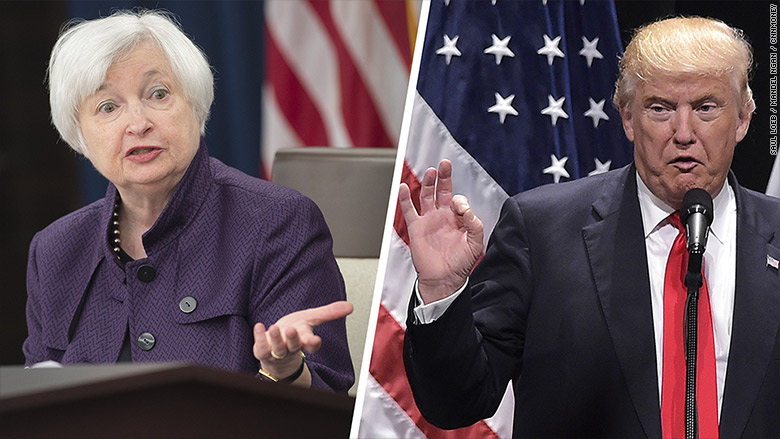
Yes. the markets are reacting to Washington. But they are paying closer attention to Janet Yellen, not the White House.

The Fed made it crystal clear before the election that it would probably raise interest rates in December and do so a few more times in 2017 regardless of who won the race for president.

The good news for investors is that the U.S. economy seems to be growing steadily, but does not appear to be at risk of overheating.

Related: Here’s why the world’s largest money manager is worried

The most recent jobs report showed that wages grew at a decent rate of 2.5% annually. But that’s not nearly high enough to spark fears of runaway inflation and lead the Fed to aggressively raise rates.

Even if Yellen and the Fed hike rates three times this year, they are likely to do so by just a quarter point every time. That would push the Fed’s key short-term rate to a range of 1.25% to 1.5%.

That’s still extremely low. At those levels, stocks would still be more attractive than bonds. Corporate earnings should be able to keep rising at a healthy clip. And consumers would probably keep spending.

So investors would be wise to keep a close eye on Yellen and not just have a myopic focus on the president,

With that in mind, Yellen is set to testify in front of Congress on Tuesday and Wednesday. And what she says about the timing and magnitude of future rate hikes could wind up keeping the rally going full steam ahead — or stopping it dead in its tracks.

CNNMoney (New York) First published February 13, 2017: 12:30 PM ET

Mexico ready to retaliate by hurting American corn farmers

No Comments

Mexico is ready to hit the U.S. where it hurts: Corn.

Mexico is one of the top buyers of American corn in the world today. And Mexican senator Armando Rios Piter, who leads a congressional committee on foreign relations, says he will introduce a bill this week where Mexico will buy corn from Brazil and Argentina instead of the United States.

It’s one of the first signs of potential concrete action from Mexico in response to President Trump’s threats against the country.

“I’m going to send a bill for the corn that we are buying in the Midwest and…change to Brazil or Argentina,” Rios Piter, 43, told told CNN’s Leyla Santiago on Sunday at an anti-Trump protest in Mexico City.

He added: It’s a “good way to tell them that this hostile relationship has consequences, hope that it changes.”

American corn goes into a lot of the country’s food. In Mexico City, from fine dining restaurants to taco stands on the street, corn-based favorites like tacos can be found everywhere.

Related: Mexican farmer’s daughter: NAFTA destroyed us

America is also the world’s largest producer and exporter of corn. American corn shipments to Mexico have catapulted since NAFTA, a free trade deal signed between Mexico, America and Canada.

American farmers sent $2.4 billion of corn to Mexico in 2015, the most recent year of available data. In 1995, the year after NAFTA became law, corn exports to Mexico were a mere $391 million.

Experts say such a bill would be very costly to U.S. farmers.

“If we do indeed see a trade war where Mexico starts buying from Brazil…we’re going to see it affect the corn market and ripple out to the rest of the ag economy,” says Darin Newsom, senior analyst at DTN, an agricultural management firm.

Rios Piter’s bill is another sign of Mexico’s willingness to respond to Trump’s threats. Trump wants to make Mexico pay for a wall on the border, and he’s threatened taxes on Mexican imports ranging from 20% to 35%.

Trump also wants to renegotiate NAFTA. He blames it for a flood of manufacturing jobs to Mexico. A nonpartisan congressional research report found that not to be true.

Related: Mexico doubles down on Trump ‘contingency plan’

Still, Trump says he wants a better trade deal for the American worker — though he hasn’t said what a better deal looks like.

All sides signaled two weeks ago that negotiations would begin in May after a 90-day consultation period.

But Trump says if negotiations don’t bear the deal he wants, he threatens to withdraw from NAFTA.

Such tough talk isn’t received well by Mexican leaders like Rios Piter. He’s not alone. Mexico’s economy minister, Ildefonso Guajardo, said in January Mexico would respond “immediately” to any tariffs from Trump.

“It’s very clear that we have to be prepared to immediately be able to neutralize the impact of a measure of that nature,” Guajardo said Jan. 13 on a Mexican news show.

–Shasta Darlington contributed reporting to this story

CNNMoney (Mexico City) First published February 13, 2017: 12:06 PM ET

‘America First’ could turn into ‘India First’

No Comments

America is great because of its willingness to accept talented immigrants.

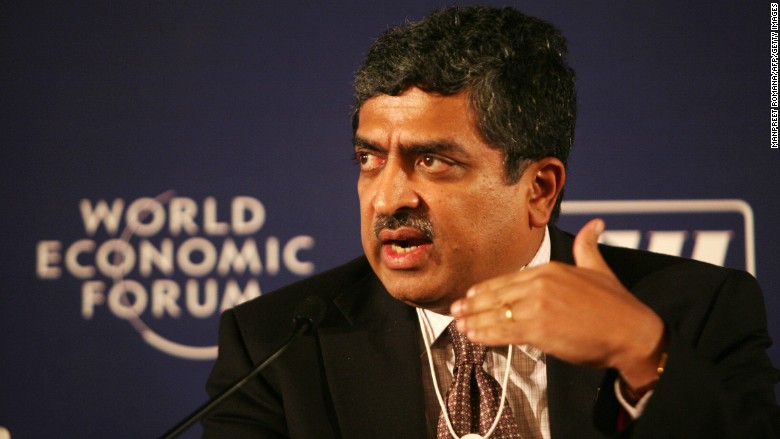
That’s what Nandan Nilekani, the billionaire co-founder of Infosys Technologies, would tell President Trump if he had the opportunity.

“If you really want to keep the U.S. … globally competitive, you should be open to overseas talent,” Nilekani said on the sidelines of CNN’s Asia Business Forum in Bangalore.

Infosys (INFY) is India’s second-largest outsourcing firm, and a major recipient of U.S. H-1B visas. The documents allow the tech firm to employ a huge number of Indians in U.S. jobs.

The Trump administration is now considering significant changes to the visa program. Press Secretary Sean Spicer said in January that Trump will continue to talk about reforming the H-1B program, among others, as part of a larger push for immigration reform.

Curbs on the visas could hit Indian workers hardest.

India is the top source of high-skilled labor for the U.S. tech industry. According to U.S. government data, 70% of the hugely popular H-1B visas go to Indians.

Shares in several Indian tech companies — including Infosys — plunged spectacularly two weeks ago amid reports of an impending work visa crackdown.

Related: Tech industry braces for Trump’s visa reform

Nilekani said it would be a mistake for the administration to follow through.

“Indian companies have done a great deal to help U.S. companies become more competitive, and I think that should continue,” Nilekani said. “If you look at the Silicon Valley … most of the companies have an immigrant founder.”

India’s contribution to the industry — especially at top levels — has been outsized. The current CEOs of Google (GOOG) and Microsoft (MSFT), for example, were both born in India.

Related: India freaks out over U.S. plans to change high-skilled visas

But Nilekani, who is also the architect of India’s ambitious biometric ID program, suggested that India would ultimately benefit from any new restrictions put in place under Trump’s “America First” plan. If talented engineers can’t go to the U.S., they will stay in India.

“This issue of visas has always come up in the U.S. every few years, especially during election season,” he said. “It’s actually accelerated the development work [in India], because … people are investing more to do the work here.”

Nilekani cited his own projects for the Indian government as an example.

The Bangalore-born entrepreneur left Infosys in 2009 to run India’s massive social security program, which is known as Aadhaar. As a result of the initiative, the vast majority of India’s 1.3 billion citizens now have a biometric ID number that allows them to receive government services, execute bank transactions and even make biometric payments.

“It was built by extremely talented and committed Indians,” Nilekani said. “Many of them had global experience, but they brought that talent and experience to solve India’s problems.”

Nilekani said the country’s massive youth population is increasingly choosing to stay home and pitch in.

“It’s India first,” he said.

CNNMoney (Bangalore, India) First published February 13, 2017: 2:19 PM ET

Will the iPhone 8 charge wirelessly?

No Comments

You may never have to plug in your iPhone again.

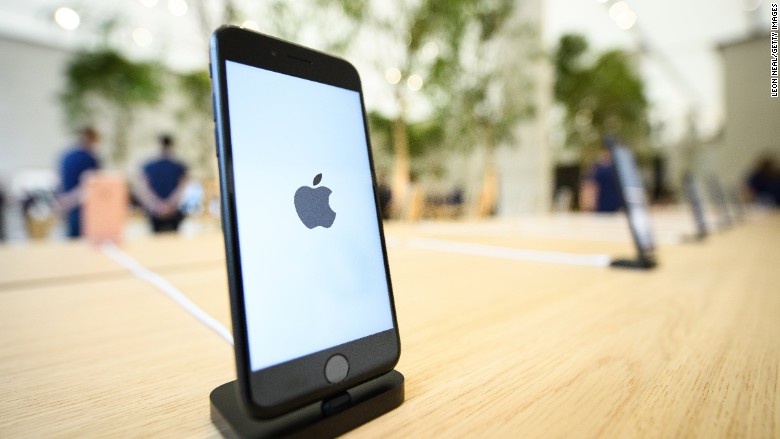
Apple has joined an industry group devoted to wireless charging, strengthening existing rumors that the next iPhone will charge without a cord. The Wireless Power Consortium, which is made up of some 200 organizations that promote a single wireless charging standard, confirmed to CNNTech that Apple joined the group last week.

IPhone rumors swirl months before each new version is announced, and hype around the so-called ‘iPhone 8″ is particularly high: Apple (AAPL) is expected to unveil a major redesign of the this fall to mark the 10-year anniversary of the smartphone.

The company has already shown interest in doing away with cumbersome cords. The Apple Watch charges wirelessly, provided consumers spend $79 on a magnetic charging dock. And the latest MacBook now comes with only one USB port.

Related: Apple stock nears a record high

Apple would also create another iPhone revenue stream by selling a wireless charging station separately. The feature would simplify charging for smartphone owners. Rather than plugging in one’s phone, a user would only need to place it on the charging dock.

Apple said in a statement Monday it was joining the Wireless Power Consortium to contribute its ideas as wireless charging standards are developed.

As for the speculated possible features of the next iPhone, other rumors include an edge-to-edge display, a glass body and the removal of the home button.

CNNMoney (Washington) First published February 13, 2017: 2:42 PM ET

Can Andrea Orcel, Europe’s star banker, create a super-bank?

No Comments

The career of Andrea Orcel vividly encapsulates the recent history of European banking. At Merrill Lynch, now part of Bank of America, Mr Orcel advised on deals that formed part of the wave of mergers that crested in 2007, when a pan-European troika bought ABN AMRO, a Dutch lender. After the financial crisis of 2007-09, grand cross-border ambitions were ditched. Mr Orcel’s next job was to run the investment-banking arm of UBS, a Swiss champion.

Xi Jinping’s belated stimulus has reset the mood in Chinese markets

No Comments

If Chinese retail investors had their way they would forgo the seven-day National Day holiday that ends on October 7th. An aggressive stimulus package, announced in Beijing on September 24th, has unleashed the biggest stockmarket rally the country has witnessed in more than 15 years. Major indices have soared more than 25%; the Shanghai stock exchange has suffered glitches under the volume of buying activity. The prospect of halting for a full week has made netizens anxious: “We must keep trading; we must cancel National Day,” one young investor screamed into a video widely shared on WeChat, a social-media platform.

The house-price supercycle is just getting going

No Comments

After THE financial crisis of 2007-09, global house prices fell by 6% in real terms. But, before long, they picked up again, and sailed past their pre-crisis peak. When covid-19 struck, economists reckoned a property crash was on the way. In fact there was a boom, with mask-wearing house-hunters fighting over desirable nests. And then from 2021 onwards, as central banks raised interest rates to defeat inflation, fears mounted of a house-price horror show. In fact, real prices fell by just 5.6%—and now they are rising fast again. Housing seems to have a remarkable ability to keep appreciating, whatever the weather. It will probably defy gravity even more insolently in the coming years.

Why is Canada’s economy falling behind America’s?

No Comments

CANADA AND America’s economies are joined at the hip. Some $2bn of trade and 400,000 people cross their 9,000km of shared border every day. Canadians on the west coast do more day trips to nearby Seattle than to distant Toronto. No wonder, then, that the two economies have largely moved in lockstep in recent decades: between 2009 and 2019 America’s GDP grew by 27%; Canada’s expanded by 25%.

How lower American interest rates will boost Africa

No Comments

Egypt is gearing up to return to international debt markets for the first time in three years. Last week Ahmed Kouchouk, the country’s finance minister, is reported to have told investors that his government is hoping to raise around $3bn in external debt over the coming months. Much of this borrowing will take the form of so-called Eurobonds, one of the world’s worst-named financial instruments.

At last, China pulls the trigger on a bold stimulus package

No Comments

TWO GUT instincts have distinguished the macroeconomic policies of Xi Jinping, China’s ruler since 2012. He has disdained consumer handouts, which he thinks breed laziness. And he has refrained from bold economic stimulus, the kind of fiscal and monetary “bazooka” that China’s previous leaders fired in November 2008 during the global financial crisis. Both of Mr Xi’s convictions have been tested by China’s economic woes over the past year. And this week, shortly before the 75th anniversary of the People’s Republic of China, he appears to have set his qualms aside, permitting China’s most attention-grabbing stimulus since 2008. Chinese stocks posted their best week in 16 years; Hong Kong’s surged at a pace unseen since 1998. Some analysts have even used the b-word.

Why the Federal Reserve is split on the future of interest rates

No Comments

A single dissent on the Federal Reserve’s interest-rate committee garnered plenty of attention last week. Understandably so. It marked the first time since 2005 that a Fed governor had opposed a rate decision. Michelle Bowman’s disagreement highlighted concerns that a half-percentage-point cut might be excessive for an economy yet to vanquish inflation. Nevertheless, her 11 other voting colleagues all supported the cut—an indication of near-total unanimity on where the Fed should set rates today.

China’s central bank tries to save the economy

No Comments

As China’s economy has descended into deflation, the central bank’s lack of urgency has been a source of frustration. Officials at the People’s Bank of China (PBoC) at first expressed confidence that deflation was, so to speak, transitory. When it persisted, they worried less about falling prices than about the side-effects of fighting them. They were reluctant to ease monetary policy decisively as China’s currency was too weak, banks’ profit margins too slim and bond yields too low.

Can Israel’s economy survive an all-out war with Hizbullah?

No Comments

Israel’s economy should have been trundling towards recovery. After all, many of the 300,000 workers who left their jobs to fight have now returned to offices, factories and farms. Instead, a difficult situation is becoming ever more acute. GDP growth came to just 0.7% between April and June, on an annualised basis, some 5.2 percentage points below economists’ expectations, according to Bloomberg, a news agency. On September 16th Bezalel Smotrich, Israel’s finance minister, was forced to ask legislators to approve an emergency deficit increase. It was the second time he had made such a request this year.

China’s central bank tries to save the economy—and the stockmarket

No Comments

As China’s economy has descended into deflation, the central bank’s lack of urgency has been a source of frustration. Officials at the People’s Bank of China (PBoC) at first expressed confidence that deflation was, so to speak, transitory. When it persisted, they worried less about falling prices than about the side-effects of fighting them. They were reluctant to ease monetary policy decisively as China’s currency was too weak, banks’ profit margins too slim and bond yields too low.

Governments are bigger than ever. They are also more useless

No Comments

You may sense that governments are not as competent as they once were. Upon entering the White House in 2021, President Joe Biden promised to revitalise American infrastructure. In fact, spending on things like roads and rail has fallen. A flagship plan to expand access to fast broadband for rural Americans has so far helped precisely no one. Britain’s National Health Service soaks up ever more money, and provides ever worse care. Germany mothballed its last three nuclear plants last year, despite uncertain energy supplies. The country’s trains, once a source of national pride, are now always late.

European regulators are about to become more political

No Comments

Europe’s tough competition policy is something of a historical accident. After the second world war Germany wanted to contain cartels, which it viewed as a threat to its young democracy and market economy. France, meanwhile, saw cracking down on big firms as a way to promote its economic interests. Messy negotiations ended up handing lots of power to the European Commission, where it resides to this day—much to the dismay of many in Silicon Valley. In recent years Brussels has launched a series of regulatory investigations into America’s tech giants, including Apple, Google and Meta.

Why the Federal Reserve has gambled on a big interest-rate cut

No Comments

The Federal Reserve’s decision to lower interest rates by half a percentage point, announced on September 18th, is momentous for two reasons. As the first cut by America’s central bank since it lifted rates to quell inflation, it marks the start of a monetary-easing cycle. It also represents a bet by the Fed that inflation will soon be yesterday’s problem and that action is needed to support the labour market. For the first time since 2005, one of the Fed’s governors in Washington, DC, dissented from the decision. Michelle Bowman preferred to cut rates by a quarter-point.

The Federal Reserve’s interest-rate cuts may disappoint investors

No Comments

The longed-for moment is almost here. For two and a half years, ever since America’s Federal Reserve embarked on its fastest series of interest-rate rises since the 1980s, investors have been desperate for any hint of when it would reverse course. Now it would be a huge surprise if Jerome Powell, the central bank’s chair, did not announce the first such reduction after its rate-setting committee meets on September 18th. Indeed, among traders, the debate is no longer “whether” but “how much”. Market pricing implies roughly a 40% chance that officials will cut their policy rate, currently between 5.25% and 5.5%, by 0.25 percentage points, and a 60% chance that they will instead opt for 0.5.

How China’s communists fell in love with privatisation

No Comments

On a recent visit to his hometown of Laixi, in eastern China, Guo Ping received a shock: the local government had sold off a number of state-owned assets, including two reservoirs. The small city’s finances, as well as those in the neighbouring port of Qingdao, were under strain, forcing officials to come up with new sources of revenue. This meant hawking even large bits of regional infrastructure. The sales seemed to be part of what Mr Guo, who asked to use a pseudonym, views as a gradual economic deterioration.

China’s government is surprisingly redistributive

No Comments

When China’s ruler, Xi Jinping, began calling for “common prosperity” in 2021, he made investors nervous. The stated goal was to reduce inequality. But the term became wrapped up with something edgier: a morale-destroying campaign to browbeat billionaires into displays of charity, tighten regulations on big tech firms and curb what Mr Xi called the “disorderly expansion of capital”.

Why orange juice has never been more expensive

No Comments

Mimosas have a simple recipe: one part champagne, one part orange juice. Soon, though, the tipple may be even less affordable—and not because sparkling wine is ever more expensive. Concentrate orange-juice futures in New York, which soft-drink producers use to hedge against price swings, have quadrupled since late 2021. They hit an intraday high of $5.80 a pound on September 9th, their fifth record in a week.

An American sovereign-wealth fund is a risky idea

No Comments

Not long ago America’s main concern with sovereign-wealth funds was how to regulate these large pools of money controlled by foreign governments. Now, seemingly overnight, the hot new idea in Washington, DC, is that America should join the club. It is easy to understand the allure. A well-managed SWF can, in theory, let the government direct more cash towards its strategic aims, without—if returns are strong—the need to raise taxes. In practice, achieving this balance is difficult. In America a SWF looks like a risky solution to a problem that does not truly exist.

Strangely, America’s companies will soon face higher interest rates

No Comments

Between early 2022 and mid-2023 the Federal Reserve tightened monetary policy at the fastest pace since the early 1980s, lifting America’s policy interest rate from 0-0.25% to 5.25-5%. When the central bank’s policymakers next meet on September 17th and 18th, they will almost certainly start cutting rates. Investors even wonder whether they will begin with a 0.5-percentage-point reduction, in response to cooler-than-expected economic data.

Can anything spark Europe’s economy back to life?

No Comments

Europe has at last realised it has a problem with economic growth. Duh. Can it now find a solution? A report published on September 9th by Mario Draghi, a former president of the European Central Bank and prime minister of Italy, and the continent’s unofficial chief technocrat, is an attempt to do just that. Over almost 400 pages, Mr Draghi outlines a plan to overhaul Europe’s economy. Ursula von der Leyen, the recently re-elected head of the European Commission, is keen to act on his advice. Even Elon Musk, owner of Tesla and X, as well as a frequent opponent of the EU, has applauded his “critique”.

Why Oasis fans should welcome price-gouging

No Comments

The hotly anticipated comeback of a 1990s British legend sold out fast. Fans took to social media to complain. “Poor effort and a load of hype,” wrote one. “What a shitshow,” added another. “Anyone else loving the chaos?” asked an amused onlooker. To celebrate its 30th birthday, St. John, a restaurant that pioneered modern British cooking, brought back its menu from 1994, along with prices from 1994. As punters rushed to take advantage, tables were booked up in seconds—leaving most empty-handed.

China is suffering from a crisis of confidence

No Comments

China’s leaders have ambitious plans for the country’s economy, spanning one, five and even 15 years. In order to fulfil their goals, they know they will have to drum up prodigious amounts of manpower, materials and technology. But there is one vital input China’s leaders have recently struggled to procure: confidence.

As stock prices fall, investors prepare for an autumn chill

No Comments

Investors returning from summer holidays might feel dispirited upon checking their portfolios. Stocks have had a poor start to September. America’s benchmark S&P 500 index dropped by 2% on its first day of trading. European shares followed suit on September 4th; those in Japan have fallen by even more. It is a striking change from the calm that had settled over markets before Labor Day. American share prices ended August less than a hundredth of a percentage point below an all-time high reached in July, European ones fared similarly and Japanese stocks were just a few percentage points below their peak. Adding to the good vibes, rich-world inflation had continued to cool, setting the scene for the Federal Reserve to begin cutting interest rates when its policymakers next meet on September 17th and 18th.

Will the Fed factor turbocharge commodity prices?

No Comments

When commodity prices move in tandem, it is usually because real-world events jolt markets. China is the world’s biggest consumer of raw materials, so its economic leaps and stumbles matter. Russia’s invasion of Ukraine hindered the trade of fuels and grains, causing prices to surge. But every once in a while it is news in the financial sphere that prompts traders to act. And the most common source of such news is America’s Federal Reserve.

Vast government debts are riskier than they appear

No Comments

At the annual gathering of central bankers in Jackson Hole, Wyoming, attendees enjoy R&R: research and recreation. The latter usually involves a pleasant hike by the lake, but last year a rainstorm soaked the assembled economists. When they returned on August 23rd a remarkably accurate weather forecast helped them dodge a shower and enjoy some sun. This was apt. A year ago inflation was still too high and investors were placing bets that interest rates would have to stay “higher for longer”, the economic equivalent of a drenching. This year inflation looks all but subdued and central bankers—whose optimistic prognostications have also come to pass—have started cutting interest rates.

How Vladimir Putin hopes to transform Russian trade

No Comments

Vladimir Putin is spending big on his war in Ukraine. The Russian president has disbursed over $200bn, or 10% of GDP, on the invasion, according to America’s Department of Defence. He now plans to invest heavily in infrastructure that will enable his country’s economy to flourish even while cut off from the West. Over the next decade, the Russian state expects to funnel $70bn into the construction of transport routes to connect the country to trade partners in Asia and the Middle East. Russia’s far east and high north will receive the lion’s share; a smaller sum will go on the International North-South Transport Corridor (INSTC), a project designed to link Russia and the Indian Ocean via Iran. Officials promise growth in traffic along all non-Western trade routes.

The plasma trade is becoming ever-more hypocritical

No Comments

An unusual sort of business will soon open in Shelby, North Carolina. It will take over premises previously run by a flooring company, tucked in beside shops selling clothes, paint and fast food. But it will not sell anything itself. Instead, willing donors, paid around $40 a pop, will sit connected to an apheresis machine. Over the course of an hour, the machine will extract their blood, siphon out plasma and recirculate the remaining fluid. The plasma will then be made into medicines, such as clotting factors for haemophiliacs and intravenous immunoglobulins for those suffering from autoimmune diseases.

America’s recession signals are flashing red. Don’t believe them

No Comments

An early-warning system for recessions would be worth trillions of dollars. Governments could dole out stimulus at just the right time; investors could turn a nice profit. Unfortunately, the process for calling a recession is too slow to be useful. America’s arbiter, the National Bureau of Economic Research, can take months to decide. Other countries simply look at gdp data, which emerge with a lag.

Jerome Powell (almost) declares victory over inflation

No Comments

For economists and investors accustomed to staring at charts, the jagged peaks of the Teton mountains possess more than a passing resemblance to financial trend lines. They also form the backdrop to one of the year’s most keenly awaited central-bank speeches: annual reflections by the chair of the Federal Reserve at a conference hall in Jackson Hole, located in the valley below the Teton range. On August 23rd Jerome Powell did not disappoint. He made clear that having raised interest rates as sharply as any of the slopes in the distance, the central bank was now ready to begin the descent.

Investors should avoid a new generation of rip-off ETFs

No Comments

John Bogle, founder of the Vanguard Group and pioneer of index funds, may have saved investors more money than anyone else in history. By some estimates, his crusade to drive down fees has, over the past five decades, left them with more than $1trn that would otherwise have gone to fund managers. Index funds, through which speculators can invest in the stockmarket as a whole, cut out the middlemen. In doing so, they have transformed the world of investing.

Why don’t women use artificial intelligence?

No Comments

Be more productive. That is how ChatGPT, a generative-artificial-intelligence tool from OpenAI, sells itself to workers. But despite industry hopes that the technology will boost productivity across the workforce, not everyone is on board. According to two recent studies, women use ChatGPT between 16 and 20 percentage points less than their male peers, even when they are employed in the same jobs or read the same subject.

Kamala Harris’s cost-of-living plan will end in failure

No Comments

It is easy enough to understand what is motivating Kamala Harris’s economic strategy. Poll after poll demonstrates that many Americans consider the cost of living to be their main concern heading into the election in November, and Ms Harris starts on the back foot, having served as vice-president during a time when inflation soared to a four-decade high. Rather than gloss over this ugly reality, she is trying to confront it. “Lower costs for American families” is the centrepiece of her economic agenda, a message she is likely to deliver again on August 22nd, in a speech to the Democratic National Convention.

Artificial intelligence is losing hype

No Comments

Silicon Valley’s tech bros are having a difficult few weeks. A growing number of investors worry that artificial intelligence (AI) will not deliver the vast profits they seek. Since peaking last month the share prices of Western firms driving the ai revolution have dropped by 15%. A growing number of observers now question the limitations of large language models, which power services such as ChatGPT. Big tech firms have spent tens of billions of dollars on ai models, with even more extravagant promises of future outlays. Yet according to the latest data from the Census Bureau, only 4.8% of American companies use ai to produce goods and services, down from a high of 5.4% early this year. Roughly the same share intend to do so within the next year.

Why companies get inflation wrong

No Comments

Over the past year-and-a-half inflation has fallen sharply across the rich world. Although some central banks have now begun to cut interest rates, few are yet ready to pat themselves on the back for a job well done. In many countries the core rate of inflation, excluding volatile energy and food prices, remains uncomfortably high—at 3.2% in America and 2.9% across the euro zone—even as underlying economies show signs of slowing and financial markets become increasingly jittery. The marathon task of returning price growth to more normal levels is not quite finished. And the last mile, as so often, is proving the toughest.

How vulnerable is Israel to sanctions?

No Comments

The outcry was immediate. On August 11th Itamar Ben-Gvir, Israel’s minister of national security, said that his country could permanently occupy the Gaza Strip. “Sanctions,” Josep Borrell, the EU’s foreign-policy chief, hit back, “must be on the agenda”. It was unclear whether Mr Borrell meant they would be placed on Mr Ben-Gvir or Israel itself; either way, European support for measures targeting Israel is growing. A few months ago Micheál Martin, Ireland’s foreign minister, and a supporter of sanctions, said that his colleagues were beginning to consider the question of “what if” they went for them.

Europe’s economic growth is extremely fragile

No Comments

When an economy contracts for two consecutive quarters, it is often considered to be in recession. European policymakers will be hoping that two consecutive quarters of growth are equally notable. Data released on August 14th showed that, in the second quarter of the year, the EU’s economy once again grew by 0.3% against the previous quarter. Although nothing to write home about by American standards, such growth is a relief after more than a year of stagnation.

What is behind China’s perplexing bond-market intervention?

No Comments

Many governments live in fear of bond-market “vigilantes”, investors who punish errant policies by aggressively selling the sovereign’s debt, driving down its price and thereby pushing up its yield. Financial regulators also worry about bond-market malfunctions, such as unsettled trades, when one party to a transaction fails to honour its promises. These mishaps can send ripples of anxiety through an entire financial system.

How to invest in chaotic markets

No Comments

Just ignore it. That, in short, is the advice given to retail investors when stockmarkets convulse, as plenty have over the past few weeks. Watching hard-earned savings disappear in a flash tends not to promote a cool head. So do not check your portfolio, do not tot up your losses and, above all, do not decide that now is the time to overhaul your entire investment strategy. Simply wait for the storm to pass and for share prices to resume their long march upwards.

Vladimir Putin spends big—and sends Russia’s economy soaring

No Comments

Across the world worries are mounting about the economy. In America and Canada unemployment is rising, while consumer sentiment remains depressed. Europe continues to flirt with recession. Don’t even mention China. Yet there is one place where the mood is quite different. Despite fierce sanctions and pariah status, Russia’s economy is growing strongly. It turns out that bacchanalian spending, at a time of war, really juices an economy.

How Chinese shoppers downgraded their ambition

No Comments

“Even those born poor fear the heat.” This slogan, printed on a lemonade from Mixue, a drinks-and-ice-cream chain, says a lot about Chinese consumption. The beverage has been a wild success during a heatwave sweeping the country, less for its tart, refreshing properties than for its price. A cup sells for as little as 3.6 yuan ($0.50), compared with 15 yuan for milk tea. Its popularity, bloggers speculate, reflects darkening consumer sentiment and growing stinginess. Consumers are rapidly trading down, from higher-cost goods to cheap substitutes, and many want to squeeze out every last drop of their spending power.

Why Warren Buffett has built a mighty cash mountain

No Comments

No investor commands attention quite like Warren Buffett. As boss of Berkshire Hathaway, an investment firm that he has run for almost six decades, Mr Buffett’s every movement is scrutinised. When he shifts in his seat, investors large and small ponder what it might mean for their portfolios.

Africa’s two most populous economies brave tough reforms 

No Comments

When times are tough, politicians reach for metaphors. In Ethiopia, which floated its currency and entered a $3.4bn IMF programme on July 29th, the prime minister Abiy Ahmed (pictured) compared reform to “the pain of surgery, endured for healing”. In Nigeria Bola Tinubu, the president, has defended two devaluations, saying the old system was “a noose around the economic jugular of our nation”. Both want to head towards orthodox policy, however much it hurts.

A global recession is not in prospect

No Comments

A weak jobs report in America has raised fears that the world’s largest economy is heading for recession. America’s stockmarkets have tumbled, with fear spreading to other countries. Japan’s Topix index is 15% off its recent high; Germany’s main index is down by 7%. When America sneezes, everywhere catches a cold.

The stockmarket rout may not be over

No Comments

For a while on August 5th things were looking awful. During the Asian trading session Japan’s benchmark Topix share index had fallen by 12%, marking its worst day since 1987. Stock prices in South Korea and Taiwan had tanked by 9% and 8% respectively, and European markets were falling. Before trading began in America, the VIX index, which measures how wildly traders expect share prices to swing, was at a level it had only reached early in the covid-19 pandemic and after Lehman Brothers collapsed in 2008. Ominously, though gold is usually a hedge against chaos, its price was falling—suggesting that investors might be selling assets they would rather hold on to in order to stay afloat. The previous week’s rout in global markets seemed to be spiralling into a full-blown crisis.

Why Japanese stocks are on a rollercoaster ride

No Comments

As fears of an American recession spread, stockmarkets around the world have been jittery. The moves have been the wildest of all in Japan. On August 5th the Topix plunged by 12% in its worst performance since 1987; the yen had climbed from its weakest point in 37 years. The next day, stocks swung back, rising by 9%, as investors snapped up stocks that had plunged in value. The sharp moves carry implications not just for Japanese investors and firms. The country’s financial heft means that they could become a source of further volatility in nervous global markets.

Why Japanese markets have plummeted

No Comments

As fears of an American recession spread, stockmarkets around the world have suffered. But none has taken as severe a beating as Japan’s. On August 5th the Topix plunged by 12% in its worst performance since 1987, compared with falls of 2-3% in America, Britain and Europe. The index is now almost a quarter below its peak, reached barely a month ago. The yen, meanwhile, is snapping back: it is up 13% from less than a month ago, when it was at its weakest in 37 years. These sharp moves carry implications not just for Japanese investors and firms. The country’s financial heft means that they could become a source of further volatility in nervous global markets.

Can Kamala Harris win on the economy?

No Comments

Kamala Harris has all but erased Donald Trump’s polling lead in America’s six swing states, which is testament to the excitement generated by her late entrance into the presidential race. On August 6th she will speak at a rally in Pennsylvania, the most crucial of the swing states, alongside her new running-mate, who may well be Josh Shapiro, the state’s governor. Judging by her past speeches, she will warn that Mr Trump wants to ban abortion, is a threat to democracy and only cares about the rich. Underlying it all will be another message—that the American economy is the world’s strongest, and that the country remains a place of opportunity.

EU handouts have long been wasteful. Now they must be fixed

No Comments

Budget talks in the European Union are a game of 27-dimensional chess. Members play simultaneously against one another, negotiating over many spending items at any one time. Countries are already preparing for the contest that starts next year, which is likely to be particularly dramatic. The world around the EU has shifted, owing to the war in Ukraine, the continent’s increasingly difficult relationship with China and the growing urgency of climate change. That necessitates what Mario Draghi, a former president of the European Central Bank and prime minister of Italy, has called “radical change”. Yet the bloc’s biggest contributors, including Germany and the Netherlands, will be reluctant to stump up more cash. New outgoings for climate change and defence will have to be funded by cuts elsewhere.

Gary Gensler is the most controversial man in American finance

No Comments

How many Securities and Exchange Commission chairs can you name? Even in Washington it is hard to imagine a passer-by being able to come up with more than one. Perhaps the best known is Joe Kennedy, the sec’s first chairman, who took office during the Depression when Americans had lost faith in markets and were clamouring for protection against conmen and fraudsters. And he is most famous for fathering a president.

Why fear is sweeping markets everywhere

No Comments

How quickly the mood turns. Barely a fortnight ago stockmarkets were on a seemingly unstoppable bull run, after months of hitting new all-time highs. Now they are in free fall. America’s Nasdaq 100 index, dominated by the tech giants that were at the heart of the boom, has fallen by more than 10% since a peak in mid-July. Japan’s benchmark Topix index has clocked losses well into the double digits, dropping by 6% on August 2nd alone—its worst day since 2016 and, following a 3% decline on August 1st, its worst two-day streak since 2011. Share prices elsewhere have not been bludgeoned quite so badly, but panic is sweeping through markets (see chart 1). Wall Street’s “fear gauge”, the VIX index, which measures expected volatility through the prices traders pay to protect themselves from it, has rocketed to its highest since America’s regional-banking crisis last year (see chart 2).

Which cities have the worst overtourism problem?

No Comments

Cities everywhere are busy implementing measures to deter excess tourism. But most people agree holidaymakers offer an economic bounty. So what would the ideal tourist market look like? Residents would probably prefer a small number of high-spending visitors, to minimise disturbance and maximise revenues. Figures compiled by The Economist rank 20 popular destinations on their appeal to international travellers, and provide a sense of which cities are nearest to—and furthest from—this ideal.

new business, finance and economics interns

No Comments

We are seeking promising journalists and would-be journalists to apply for our Marjorie Deane internship. Successful candidates will spend six months with us in London writing about finance and economics or business, and will be paid. We are looking to hire at least two interns over the next year. The start date is flexible and no previous experience is required.

We ask applicants to send a CV and an original article of no more than 600 words suitable for publication in either the Business or the Finance & economics section. These should be sent to [email protected] by September 30th.

India’s economic policy will not make it rich

No Comments

The developing world has fallen back in love with economic planning. As protectionism sweeps the West, poor countries are no longer afraid of industrial policy—or bold ambition. India’s government declares that manufacturing will propel the country to high-income status by 2047. Indonesia wants to get there by 2050, with growth driven by green commodities. Vietnam is aiming for annual gdp growth of 7% until 2030. By the same time, South Africa wants to have more than doubled its income per person from 2021. Surely economies everywhere are about to accelerate.

China’s last boomtowns show rapid growth is still possible

No Comments

China’s economic miracle emerged from dozens of industrial entrepots. Dongguan, famous for producing furniture and toys, as well as its many brothels, witnessed GDP growth of 21% in 2004. Hohhot, a town on the edge of the Mongolian steppe, posted nominal growth of 18% in 2006 as it scarred its mineral-rich terrain with mines. Shanghai, the country’s commercial hub, achieved 15% growth the next year as it churned out everything from machinery and textiles to cargo ships and steel, minting millionaires in the process.

The war on tourism is often self-harming

No Comments

Cooling off is easy in Barcelona. Swim in the sea, sip sangria—or just hang about looking like a holidaymaker. Recently residents have taken part in anti-tourist protests, some firing at guests with water pistols. Other rallies calling for an end to mass tourism have taken place across the Balearic and Canary Islands. And it is not just Spaniards. Locals in Athens have held funerals for their dead neighbourhoods. Authorities in Japan have put up a fence to spoil a popular view of Mount Fuji and prevent tourists gathering. Soon there will be a 5pm curfew for visitors to a historic neighbourhood in Seoul.

Revisiting the work of Donald Harris, father of Kamala

No Comments

In a video clip that has gone viral recently, Kamala Harris quotes her mother asking her whether she thought she had just fallen out of a coconut tree. The probable Democratic nominee for president breaks into a laugh at the turn of phrase before explaining, somewhat philosophically, the message of the story: “you exist in the context of all in which you live and what came before you.” For Ms Harris some of that context is esoteric economic theory. Her father, Donald, is an 85-year-old, Jamaican-born economist, formerly a professor at Stanford University.

Why investors are unwise to bet on elections

No Comments

To meet the world’s biggest news junkies, head not to Washington or Westminster. Instead, make your way to a trading floor, where information from every corner of the globe must be parsed the instant it emerges. Whatever the news, from coups to company-earnings reports, it probably affects the price of something. This year, amid a seemingly never-ending series of elections, the addicts are not short of a fix. Electorates representing most of the world’s population are heading to polling booths, and not just market-makers but investors everywhere face the tantalising prospect of trading on the results.

How Vladimir Putin created a housing bubble

No Comments

Mortgages used to be a tough sell in Russia. Decades of Soviet propaganda, which denounced credit as an unbearable burden, had an effect. Even after the end of communism, Russians still referred to mortgages as “debt slavery”, preferring to save until they could buy their homes outright. Vladimir Putin, the country’s president, has spent two decades trying to convince his citizens to take a different view. In 2003, during his first term, he explained that mortgages might help solve “the acute problem of housing” facing Russians. His plea fell on deaf ears.

He is now having more success—and all it took was a heavy dose of statism, as well as the invasion of a peaceful neighbour. Over the past few years, the number of Russians taking out mortgages has soared, owing to a generous programme of state subsidies for buyers of new-builds. Mr Putin may have got more than he bargained for, however. The state’s subsidy binge has stoked an ultra-hot property market, sending house prices soaring. As such, the Kremlin has found itself picking up a giant and fast-growing bill.

The rich world revolts against sky-high immigration

No Comments

Immigrants are increasingly unwelcome. Over half of Americans favour “deporting all immigrants living in the US illegally back to their home country”, up from a third in 2016. Just 10% of Australians favour more immigration, a sharp fall from a few years ago. Sir Keir Starmer, Britain’s new centre-left prime minister, wants Britain to be “less reliant on migration by training more UK workers”. Anthony Albanese, Australia’s slightly longer-serving centre-left prime minister, recently said his country’s migration system “wasn’t working properly” and wants to cut net migration in half. And that is before you get to Donald Trump, who pledges mass deportations if he wins America’s presidential election—an example populist parties across Europe hope to follow.

Why investors have fallen in love with small American firms

No Comments

Believe it or not, corporate America still makes room for the little guy. Around half of working Americans are employed by a firm with less than 500 workers. Nine in ten banks are community institutions that hold less than $10bn in assets. This rather parochial picture, however, is not reflected in the country’s stockmarket, where the falling number of public companies and extreme concentration of value are a concern. Among America’s 3,000 largest public firms, the biggest 1,000 account for 95% of total value. The next 2,000, which form the Russell 2000 index, are collectively worth less than Apple, the world’s most valuable company.

YIMBY cities show how to build homes and contain rents

No Comments

Houses in Bouldin Creek, a neighbourhood in Austin, Texas, are cavernous, but occupy only a small portion of their plots. Rules known as the “McMansion ordinance”, intended to preserve the area’s character, ensure there is plenty of space between them. Architects must squeeze the design of any new home into an imaginary tent rising five metres from the plot’s edge, then angling in at 45 degrees. The rules seek to prevent sprawling developments from replacing small houses. Instead, the cost of complying with them has ensured that only large, expensive homes are viable.

YIMBY cities show how to build homes and lower rents

No Comments

Houses in Bouldin Creek, a neighbourhood in Austin, Texas, are cavernous, but occupy only a small portion of their plots. Rules known as the “McMansion ordinance”, intended to preserve the area’s character, ensure there is plenty of space between them. Architects must squeeze the design of any new home into an imaginary tent rising five metres from the plot’s edge, then angling in at 45 degrees. The rules seek to prevent sprawling developments from replacing small houses. Instead, the cost of complying with them has ensured that only large, expensive homes are viable.

Things are now starting to change. Alongside Auckland in New Zealand, Austin has become a test case for housing deregulation. For YIMBYs, activists who say “yes in my backyard” to development, reforms in the cities are shining examples to be followed elsewhere. There are signs such campaigners are winning the debate in the anglosphere. Britain’s new Labour government has made “getting Britain building again” a central aim; a push for affordable housing is core to the appeal of Canada’s opposition Conservative party. As case studies for the effectiveness of YIMBY reforms, both Austin and Auckland show signs of success. Yet they also show that changes are slow to take effect and may, on their own, have a modest impact.

Stocks are on an astonishing run. Yet threats lurk

No Comments

All around the world, stockmarkets have been rising at a breakneck pace. Whether you are in America, Europe, Japan or India, share prices listed on a bourse near you have spent most of this year setting fresh records, only to break them again straight away (see chart 1). America’s S&P 500 index of large companies has rocketed by nearly 60% since a trough in 2022. True, Chinese investors are in a funk. But they cut lonely figures: exclude China from MSCI’s index of emerging-market shares, and the remainder have been clocking rapid gains, too.

Chart: The Economist

To a certain extent, this record-smashing is to be expected. Dump the losers periodically, as benchmark indices tend to, and the history of equities is one long (albeit frequently interrupted) march upwards. Bear markets and crashes abound, but once prices recover to set one new high, a stream of others usually follows. This has led global stocks to deliver an annualised real return of 5.1% since 1900, and American ones of 6.5%. Worry all you like that the narratives being spun around today’s boom—from techno-euphoria in America to a corporate-governance revolution in Japan—are overblown, and that a reversal is coming. Those seeking riches should simply set aside such concerns and invest for the long run.

China’s leaders face miserable economic-growth figures

No Comments

The Jingxi Hotel in Beijing is known for its home-made yogurt—and for hosting some of the most important meetings in the history of the Chinese Communist Party. They include the “third plenum” of 1978, which confirmed Deng Xiaoping’s rise to power and the opening of the Chinese economy. The country’s leaders are now gathering for another “third plenum” in this closely guarded venue from July 15th-18th. They should savour their yogurt. Because outside the hotel walls, the economy is turning sour again.

Figures released on the opening day of the meeting showed that the economy grew by 4.7% in the second quarter, compared with a year earlier. The number was both weaker than expected and slower than the previous quarter’s figure, when growth seemed to be stabilising. It puts the government’s official growth target for this year—around 5%—in doubt.

Beneath the headline figure, the data were even worse. Nominal GDP, which makes no adjustment for inflation, again grew more slowly than the price-adjusted figure. The gap implies that prices across the economy continue to fall. In fact, by this measure, China has suffered its fifth quarter of deflation in a row (see chart).

China’s banks have a bad-debt problem

No Comments

Bank of Jiujiang, a mid-tier lender from a southern Chinese river town, imparted some bad news on March 19th. In a rare disclosure, it told investors profits for 2023 might fall by 30%, because of poorly performing loans. This is just the sort of information Chinese banks are normally reluctant to reveal. Indeed, they often go to great lengths to avoid doing so.

Typically, the subterfuge works as follows: the bank lends to an asset-management company (AMC) that in return purchases its toxic loans. The contracts drawn up between the two parties include stipulations that enable the AMC to avoid the credit risks of the bad loans they are buying. Confidentiality clauses keep these arrangements from being disclosed, sometimes even to courts.

To regulators it may seem as if banks involved in such transactions are solving their bad-debt problems; in reality, they are concealing them. As Ben Charoenwong and Ruan Tianyue of the National University of Singapore Business School, and Meng Miao of Renmin University, have noted, over time these troubled loans accumulate. For hundreds of banks across the country, they represent a ticking bomb.

How Xi Jinping plans to overtake America

No Comments

Last year Xi Jinping, China’s president, paid a visit to Heilongjiang in the country’s north-east. This province, part of the industrial rustbelt, exemplifies the problems besetting China’s economy. Its birth rate is the lowest in the country. House prices in its biggest city are falling. The province’s GDP grew by only 2.6% in 2023. Worse, its nominal GDP, before adjusting for inflation, barely grew at all, suggesting it is in the grip of deep deflation.

Daniel Kahneman was a master of teasing questions

No Comments

Winners of the Nobel prize in economics tend to sprinkle their papers with equations. Daniel Kahneman, who died on March 27th, populated his best-known work with characters and conundrums. Early readers encountered a schoolchild with an IQ of 150 in a city where the average was 100. Later they pondered the unfortunate Mr Tees, who arrived at the airport 30 minutes after his flight’s scheduled departure, and must have felt even worse when he discovered the plane had left 25 minutes late. In the 1970s readers had to evaluate ways to fight a disease that threatened to kill 600 people. In 1983 they were asked to guess the job of Linda, an outspoken, single 31-year-old philosophy graduate.

Kahneman used such vignettes to expose the seductive mental shortcuts that can warp people’s thoughts and decisions. Many people, for example, think it more likely that Linda is a feminist bank-teller than a bank-teller of any kind. Presented with two responses to the disease, most choose one that saves 200 people for certain, over a chancier alternative that has a one-third chance of saving everyone and a two-thirds chance of saving no one. But if the choice is reframed, the decision is often different. Choose the first option, after all, and 400 people die for sure. Choose the second and nobody dies with a one-third probability.

Will FTX’s customers be repaid?

No Comments

In the days after the fall of his crypto exchange, Sam Bankman-Fried opened a Google Doc and began to type. Beneath the title “probably bad ideas” he listed potential strategies, which included coming out as a Republican and arguing that “SBF died for our sins”. Mr Bankman-Fried ultimately decided against both, but there is one fiction he never let die. He has always claimed FTX was, in fact, solvent and could repay the $10.6bn it owed customers.

Mr Bankman-Fried lost his empire in November 2022, but it was not until March 28th that he learned his fate: 25 years in prison. FTX’s customers-turned-creditors are still waiting. The bankruptcy is messy, extending to over 100 entities with assets lawyers say are “hopelessly” mingled. So it was surprising to possibly everybody except Mr Bankman-Fried himself when FTX told a court in January that it should be able to repay its 36,000 customers in full.

Trumponomics would not be as bad as most expect

No Comments

In markets it is known as the “Trump trade”, a bet that Donald Trump’s return to the White House would herald more inflation and higher interest rates. Many of Mr Trump’s core policies push in this direction: tariffs would add to import costs, deportations of immigrants could push up wages and deficit-financed tax cuts would juice the economy. Amid mounting inflation, the Federal Reserve would have little choice but to opt for higher rates.

In the wake of Joe Biden’s calamitous debate on June 27th, a preview of the trade played out. As investors grappled with the likelihood that Mr Trump would romp to the presidency, they sold off Treasuries, which led to a brief surge in yields. The big fear is that much worse would come to pass. If Mr Trump fought the Fed on rates, he might sow doubts about the central bank’s independence, undermining confidence in America’s markets and the dollar. That is the economic nightmare scenario for a second Trump administration.

But as with any nightmare, the bogeyman of Trumponomics may be more terrible than its reality. Mr Trump and his advisers have many rotten ideas. They also have some decent ones. And their ability to implement damaging policies will be constrained, with Congress, America’s institutions and markets all serving as checks.

Betting markets are useful when politics is chaotic

No Comments

In the early 20th century, for brief periods, the most frenetic American trading pits were not the raucous markets in which stocks were traded, nor the venues where bonds were exchanged. The real action was in the market for betting on the next president. “Crowds formed in the financial district…and brokers would call out bid and ask odds as if trading securities,” write Paul Rhode and Koleman Strumpf, two economists. Markets were deep, liquid and smart: in 15 presidential elections from 1884 to 1940, the favourite won 11 times and three races were essentially tied (in odds and result). Only once did markets miss the mark.

Chart: The Economist

Europe prepares for a mighty trade war

No Comments

“We cannot carry on trade without war, nor war without trade,” wrote Jan Pieterszoon Coen, a brutal governor-general of the Dutch East India Company, to shareholders in 1614. Four centuries later, things sound a bit different. “Let’s make no mistake: assertiveness is a prerequisite for keeping our markets open,” says Sabine Weyand, the EU’s top trade negotiator. After decades during which America supported the global rules-based trade order and European commerce thrived, the bloc now has to learn how to do business in a fractious world.

Electric vehicles (EVs) from China are the EU’s latest target. On July 5th the European Commission started to apply provisional tariffs to them. These differ by firm, from 17% for BYD to 38% for SAIC, based on subsidies they have received from the Chinese state and their co-operation with the EU’s investigation. The commission’s logic for applying levies on top of an existing 10% tariff on car imports is that Chinese carmakers have an unfair advantage owing to favoured treatment at home—a justification that allows the levies to fall within the World Trade Organisation’s (WTO) rules. The move nevertheless illustrates the tightrope European officials must walk. They want to uphold the rules-based order, from which the continent benefits enormously, while ensuring that they are not bullied by more protectionist rivals.

The dangerous rise of pension nationalism

No Comments

Rachel Reeves, Britain’s new chancellor, says that she has inherited the worst fiscal circumstances since the second world war. An exaggeration, perhaps, but only a small one. To address the squeeze, Ms Reeves will seek the help of Britain’s retirement savings. On July 8th she said that she wants the country’s pension funds “to drive investment in homegrown businesses and deliver greater returns to pension savers”.

Details of Ms Reeves’s plans are still to emerge. Her predecessor, Jeremy Hunt, set the ball rolling by mandating that defined-contribution pension funds will have to disclose the scale of domestic investments by 2027. Other countries are joining in. Stephen Poloz, a former governor of the Bank of Canada, is looking at how to increase pension-fund investment in domestic assets on behalf of the Canadian government. Enrico Letta, a former Italian prime minister, recently argued in favour of an EU-wide auto-enrolment pension scheme that could be funnelled into green transport and energy infrastructure.

Xi Jinping really is unshakeably committed to the private sector

No Comments

China’s paramount leader, Xi Jinping, contains multitudes. His economic philosophy touts both self-reliance and openness. His vision of policymaking embraces top-down design, but also bottom-up experimentation. During the covid-19 pandemic, he urged local officials to eliminate infections (which often required lockdowns) and promote growth (which required mobility). His recent call to cultivate “new productive forces” entails championing cutting-edge technologies, but without neglecting traditional industries. Communists are taught to believe in the power of contradictory forces, as Trivium, a consultancy, once put it. So Mr Xi “will expect his comrades to cope”.

For others, Mr Xi’s priorities can be baffling. Take the “two unshakeables”, one of his favourite slogans, which has been heard a lot in the past year or so. This refers to the Communist Party’s unshakeable commitment to both the state-owned economy and private enterprise. The pledge, sometimes translated as the “two unswervings” or the “two unwaverings”, first appeared under Mr Xi’s predecessors. It was reaffirmed in 2013 when his party promised to “unwaveringly encourage, support and guide the development of the non-public sector”. And it will no doubt feature at the forthcoming “third plenum”, a twice-a-decade meeting devoted to long-term reforms, which will take place from July 15th-18th.

But what does the formula mean? At first blush, each unshakeable seems to be in contradiction with the other. Almost 867,000 firms in China have some degree of state ownership, according to Franklin Allen of Imperial College London and co-authors. Real resources, unlike party slogans, are scarce. Any land, labour or capital used by China’s state-owned enterprises (SOEs) ceases to be available to scrappier private firms. A commitment to one form of ownership must surely come at the expense of the other.

How to build a global currency

No Comments

Seventy years ago the Indian rupee was often found a long way from home. After India gained independence from Britain, the currency remained in use in sheikhdoms across the Arabian Sea. Until as late as 1970, some employed the Gulf rupee, a currency issued by India’s central bank.

What will humans do if technology solves everything?

No Comments

In “Permutation City”, a novel by Greg Egan, the character Peer, having achieved immortality within a virtual reality over which he has total control, finds himself terribly bored. So he engineers himself to have new passions. One moment he is pushing the boundaries of higher mathematics; the next he is writing operas. “He’d even been interested in the Elysians [the afterlife], once. No longer. He preferred to think about table legs.” Peer’s fickleness relates to a deeper point. When technology has solved humanity’s deepest problems, what is left to do?

China’s state is eating the private property market

No Comments

At an upmarket housing development in Wuhan, sales agents want to make clear that their state-owned firm has severed all its ties to the private sector. The firm had at first partnered with Sunac, a private developer, until it defaulted in 2022. A saleswoman explains that the firm’s owner also controls the city’s waterworks and electricity provider. If this type of firm collapses, she says with a grin, “then the whole country has no hope”.

More than three years into China’s property crisis, the biggest private builders are folding under the strain of enormous debts. New-home sales in 30 large cities fell by 47% in March, year on year. Revenues for the 100 biggest developers were down 46% in the same month. Housing investment dropped to 8.4trn yuan ($1.2trn), a quarter below its peak in 2021. Although millions of families are waiting for developers to finish building their flats, it would take 3.6 years to sell China’s glut of inventory, including homes still under construction, reckon analysts at ANZ, a bank.

How strongmen abuse tools for fighting financial crime

No Comments

In May 27 members of the Community Empowerment Resource Network (CERNET), a Philippine charity, were charged with bankrolling communist rebels. Straight away the case looked strange. A social-media post by police claimed they had jailed Estrella Flores-Catarata, one of CERNET’s associates, who received an award from the UN for her work with indigenous people last year. She has no criminal record and was set free after paying bail. Other charities that support small-scale farmers and help people after natural disasters have also had their top brass charged and accounts frozen for allegedly breaching the Philippines’ Anti-Terrorism Act, a draconian law passed in 2020.

Their ordeal is an example of how strongmen are weaponising rules intended to stop dirty-money flows, both at home and abroad. LexisNexis, a data firm, lists 130,000 entities alleged, either by governments or media, to have laundered money. Some 30,000 have had their assets frozen, up from 24,000 last year—the biggest rise in at least nine years. Although some of this increase reflects genuine crime-fighting, international directives create opportunities for large-scale abuse. And evidence suggests that strongmen are becoming increasingly creative in how they wield their tools of financial suppression.

How fast is India’s economy really growing?

No Comments

Optimism about India tends to spike now and again. In 1996, a few years after the country opened to foreign capital, the price of property in Mumbai, India’s financial hub, soared to the highest of any global city, according to one account. In 2007 the country’s economy grew at an annual rate of 9%, leading many to speculate that it might hit double digits. Yet after each of these booms, hopes were dashed. The late-2000s surge made way for financial turbulence in the 2010s.

Today India again appears to be at the start of an upswing. In the year to the fourth quarter of 2023, GDP growth roared at 8.4%. But such figures tend to be treated with a pinch of salt. Economists inside and outside the government are debating just how fast the economy is growing—a question that has particular piquancy ahead of a general election that begins on April 19th. So what is India’s actual growth rate? And is the economy accelerating?

What China’s central bank and Costco shoppers have in common

No Comments

Gold has always held an allure. The earliest civilisations used it for jewellery; the first forms of money were forged from it. For centuries kings clamoured to get their hands on the stuff. Charlemagne conquered much of Europe after plundering vast amounts of gold from the Avars. When King Ferdinand of Spain sent explorers to the new world in 1511, he told them to “get gold, humanely if you can, but all hazards, get gold.” Ordinary men also clamoured for it after James Marshall, a labourer, found a flake of gold while constructing a saw mill in Sacramento, California, in 1848.

People are once again spending big on the precious metal. On April 9th its spot price hit a record of $2,364 an ounce, having risen by 15% since the start of March. That gold is surging makes a certain degree of sense: the metal is seen to be a hedge against calamity and economic hardship. It tends to rally when countries are at war, economies are uncertain and inflation is rampant.

But only a certain degree. After all, why is it surging precisely now? Inflation was worse a year ago. The Ukraine war has arrived at something of a stalemate. In the month after Hamas’s attack on Israel on October 7th, the price of gold rose by just 7%—half the size of its more recent rally. Moreover, investors had only recently appeared to have gone off the stuff. Those who thought gold would act as a hedge against inflation were proven sorely wrong in 2022 when prices slipped even as inflation spiralled out of control. Cryptocurrencies like bitcoin—often viewed as a substitute for gold—have gained popularity. Longtime gold analysts are puzzled by its ascent.

Generation Z is unprecedentedly rich

No Comments

Generation Z is taking over. In the rich world there are at least 250m people born between 1997 and 2012. About half are now in a job. In the average American workplace, the number of Gen Z-ers (sometimes also known as “Zoomers”) working full-time is about to surpass the number of full-time baby-boomers, those born from 1945 to 1964, whose careers are winding down (see chart 1). America now has more than 6,000 Zoomer chief executives and 1,000 Zoomer politicians. As the generation becomes more influential, companies, governments and investors need to understand it.

Chart: The Economist

America’s banks are more exposed to a downturn than they appear

No Comments

The earliest depiction of the ouroboros—a serpent coiled in a circle, eating its own tail—was found in the tomb of Tutankhamun, a pharaoh who ruled Egypt around 1320BC. It was used in his funerary texts to depict the infinite nature of time, and later cropped up all over the place. In Ancient Rome it signified the seasonal cycle of the calendar year; in Norse mythology the snake was large enough to encircle the world. The idea is also an allegory for the modern financial system. It depicts how credit risk has been cycled out of banks, only to be gobbled up by them once more.

After the global financial crisis of 2007-09, lawmakers in America and Europe penned new rules to govern finance. These had two aims. First, to force banks to hold more capital against their assets, so as to cushion losses. Second, to curb the risky activities in which banks had indulged. Some, such as proprietary trading, were prohibited; others were simply discouraged, sometimes by assigning higher “risk weights” to spicier assets. Both aims are measured by “common equity tier 1 capital” or cet1, which divides bank equity by asset value, adjusted for risk weights.

How much cash should be removed from the financial system?

No Comments

The world is still, in a sense, swimming in cash. Or at least the electronic equivalent: central-bank reserves. The Bank for International Settlements (BIS), a club of central banks, estimates that the balance-sheets of rich-country central banks amount to roughly 50% of collective GDP. That is down from 70% in 2021—a reduction which reflects quantitative tightening (QT), or the offloading of assets acquired while easing—but is still far above the pre-global-financial-crisis norm of around 10%.

Qt is intended to enhance the disinflationary effect of raising interest rates. As assets roll off a central bank’s balance-sheet, the corresponding reserves are extinguished. The process should, in the words of Janet Yellen, America’s treasury secretary and a former chair of the Federal Reserve, be as interesting as watching paint dry. Yet if reserves are to return to anything like their earlier 10% level, that may not be the case. Some worry such a reduction would prompt nasty surprises in the financial system. Hawkish types nevertheless argue that central banks ought to ensure reserves once again become “scarce”. They suggest that the “abundant” era created by quantitative easing has been destabilising, since banks no longer need to economise on their holdings or rely on the disciplining effects of money markets.

How Starbucks caffeinates local economies

No Comments

Starbucks offers endless opportunities for innovation. Parts of social media delight in hacking the chain’s menu to create highly instagrammable drinks. Fancy a “cake batter Frappuccino”? Simply order a “vanilla bean crème Frappuccino”, add a pump of hazelnut syrup and ask the barista to put a cake pop in the blender. How about some “liquid cocaine”? That involves four shots of espresso with four pumps of white-chocolate syrup, served over ice.

A new working paper suggests the purveyor of coffee-based milkshakes offers other innovation, too. Choi Jinkyong, Jorge Guzman and Mario Small, all of Columbia University, find that a new Starbucks in an American neighbourhood without a coffee shop leads to the creation of between 1.1 and 3.5 new companies a year over the next seven years. That, the authors argue, owes to the café’s role as a “third place”—somewhere people can gather without a purpose. Branches “help entrepreneurs form and mobilise networks”, they write.

Why Chinese banks are now vanishing

No Comments

The savings and loan (S&L) crisis terrorised America’s banks for years. Starting in the mid-1980s, a mix of aggressive lending growth, poor risk controls and a property downturn contributed to the collapse or consolidation of over 1,000 small lending institutions. China’s smallest banks are now suffering from many of the same ailments. But until recently few have collapsed or merged with others.

That is starting to change. In the week ending June 24th, 40 Chinese banks vanished as they were absorbed into bigger ones. Not even at the height of the S&L crisis did lenders disappear at such a clip.

Citigroup, Wall Street’s biggest loser, is at last on the up

No Comments

Unmanageable and uninvestible. That is how investors have long considered Citigroup. For over a decade the bank, which was once the largest and most valuable in America, has been a basket case. It trades at half the value it did in 2006, making it the only big American bank to fetch a valuation lower than its peak before the global financial crisis. Pick any measure and Citi is invariably dead last compared with its rivals. The firm has more staff than Bank of America, yet makes only a third of the profit.

Its prize for this miserable drubbing is not a participation trophy, but a consent order from regulators instructing it to improve internal oversight and change how it measures risk. The firm became the laughing-stock of Wall Street in 2020 when it accidentally wired $894m to creditors of Revlon, a failing company. That Jane Fraser became the first woman to run a Wall Street bank following the mess attached an asterisk to her appointment. “Glass cliff” is a term used to describe the phenomenon of women being appointed to top jobs at companies in deep crisis.

Is inflation morally wrong?

No Comments

Where other historians saw a mob of hungry peasants, E.P. Thompson saw resistance to capitalism. Studying England’s 18th-century food riots, the Marxist historian coined the term “moral economy”. The rioters, he argued, were not motivated purely by empty bellies, but by a belief that the bakers, farmers and millers had violated paternalist customs, which suggested they should limit their profit, sell locally and not hold back grain. Gradually, Thompson argued, the moral economy was being displaced by a market economy, in which prices follow the amoral logic of supply and demand, rather than ideas of what would be a “fair price” in times of scarcity.

Americans may not be rioting over bread prices, but they are angry. President Joe Biden now faces a tight race for re-election. Swing voters are particularly annoyed about inflation, as the price level has risen by a cumulative 19% since Mr Biden’s inauguration. Yet this frustrates many left-wing economists, who see the tight labour market and rising real wages in America as a great success. To them, inflation is an irritating—and now stubborn—by-product of the mixture of fiscal stimulus and industrial policy pursued by Mr Biden. It is not the main story.

What happened to the artificial-intelligence revolution?

No Comments

Move to San Francisco and it is hard not to be swept up by mania over artificial intelligence (AI). Advertisements tell you about how the tech will revolutionise your workplace. In bars people speculate about when the world will “get AGI”, or when machines will become more advanced than humans. The five big tech firms—Alphabet, Amazon, Apple, Meta and Microsoft, all of which have either headquarters or outposts nearby—are investing vast sums. This year they are budgeting an estimated $400bn for capital expenditures, mostly on AI-related hardware, and for research and development.

In the world’s tech capital it is taken as read that AI will transform the global economy. But for ai to fulfil its potential, firms everywhere need to buy big tech’s AI, shape it to their needs and become more productive as a result. Investors have added $2trn to the market value of the five big tech firms in the past year—in effect projecting an additional $300bn-400bn in annual revenues according to our rough estimates, about the same as another Apple’s worth of annual sales. For now, though, the tech titans are miles from such results. Even bullish analysts think Microsoft will only make about $10bn from generative-AI-related sales this year. Beyond America’s west coast, there is little sign AI is having much of an effect on anything.

Don’t like your job? Quit for a rival firm

No Comments

A fifth of American workers have a non-compete clause in their contract, barring them from leaving to join a rival. Owing to a new rule issued by the Federal Trade Commission on April 23rd, these clauses may soon be voided. Advocates hope this will inject dynamism into the American economy and lead to stronger wages; critics warn it will stifle investment.

The debate about non-compete clauses is an old one, dating back to Europe in the 1400s. Courts generally came down on the side of apprentices trying to escape the clutches of their mentors. In the Industrial Revolution, though, views shifted. The main argument in support of non-compete clauses—then and now—is that they protect firms with an understandable interest in defending trade secrets. With them in place, companies become more willing to make hefty investments and train up workers, confident that they will reap the benefits from both. A recently published study by Jessica Jeffers of HEC Paris found that when American states make non-competes easier to enforce, firms increase their physical investments by as much as 39%.

Chinese authorities are now addicted to traffic fines

No Comments

Ma Yijiayi was locked up in November. She did not stand in a square demanding political rights. Nor did she steal from state coffers. Instead, her crime was to ask a deadbeat debtor to pay her back. The local government in Liupanshui, a city in the province of Guizhou, owes Ms Ma, who is a contractor, 220m yuan ($30m) for building schools. Officials had offered her a mere 12m yuan. She refused.

Chinese citizens and business owners are increasingly victims of unscrupulous attempts by local governments to shore up their finances. An investigation in January found that almost all the traffic fines issued last year by police officers in Hebei province rested on bogus claims. In a neighbouring region, truck drivers allege that officials are putting their fingers on the scale, issuing excessive penalties for overweight loads. Jacked-up parking fees and stricter inspection of restaurants have also become municipal money-spinners.

Why any estimate of the cost of climate change will be flawed

No Comments

When William Nordhaus, who would later win a Nobel prize in economics, modelled the interaction between the economy and the atmosphere he represented the “damage function”—an estimate of harm done by an extra unit of warming—as a wiggly line. So little was known about the costs of climate change that he called it “terra incognita”, unknown land, compared with the “terra infirma”, shaky ground, of the costs of preventing it. Eventually, a rough calculation gave him an estimate that 1-2% of global GDP would be lost from a 3°C rise in temperature. This was no more than an “informed hunch”, he wrote in 1991.

A new working paper puts the damage far higher. Diego Känzig of Northwestern University and Adrien Bilal of Harvard University use past changes in temperatures caused by volcanic eruptions, as well as El Niño, a years-long increase in heat released by the Pacific Ocean, to model the impact of a warmer planet. Employing long-term data on global economic growth and average annual temperature, they find that an additional 1°C of warming will lead to a 12% fall in GDP. A climate-change scenario with more than 3°C of warming would be, according to their estimates, an equivalent blow to fighting a permanent war.

Ukraine has a month to avoid default

No Comments

War is still exacting a heavy toll on Ukraine’s economy. The country’s GDP is a quarter smaller than on the eve of Vladimir Putin’s invasion, the central bank is tearing through foreign reserves and Russia’s recent attacks on critical infrastructure have depressed growth forecasts. “Strong armies,” warned Sergii Marchenko, Ukraine’s finance minister, on June 17th, “must be underpinned by strong economies.”

Following American lawmakers’ decision in April to belatedly approve a funding package worth $60bn, Ukraine is not about to run out of weapons. In time, the state’s finances will also be bolstered by G7 plans, announced on June 13th, to use Russian central-bank assets frozen in Western financial institutions to lend another $50bn. The problem is that Ukraine faces a cash crunch—and soon.

Foreign investors are rejecting Indian stocks

No Comments

How to explain the disparity? India’s economy is growing astonishingly fast, Bangalore and Mumbai have become destinations for bosses of global financial firms and Narendra Modi trumpets the country’s appeal in his electoral campaign. Given the enthusiasm, surely foreign money is flooding into the country.

Not quite. In April foreign investors dumped $1bn-worth of Indian shares. In May they dumped another $4.2bn. This is a sliver of the roughly $900bn of Indian shares in foreign hands, but it is a striking move given the mood music—and one that has pushed the share of the Indian stockmarket held by foreigners to just 18%, its lowest in a dozen years.

American stocks are consuming global markets

No Comments

Sixteen years ago American stockmarkets reached their modern nadir. During the early 2000s European and emerging-market equities went on a bull run. By March 2008 America had entered recession and its financial crisis was under way. The country’s stocks accounted for less than 40% of the world’s total stockmarket capitalisation.

Fast-forward to today and things look rather different. America’s share of the world’s stockmarket capitalisation has climbed pretty consistently over the past decade and a half, and sharply this year. It now stands at 61%. That is astonishing dominance for a country which accounts for just over a quarter of global GDP. The extent of market concentration is all the more extreme given what is happening within the American stockmarket itself. Just three companies—Apple, Microsoft and Nvidia—make up a tenth of the market value of global stocks.

How Chinese goods dodge American tariffs

No Comments

Queues of idle trucks trying to enter America are standard fare at Mexico’s border. Recently, however, vehicles at the Otay Mesa crossing, which separates California and the city of Tijuana, have been lining up to get into Mexico. The trucks do not travel far—they offload their shipping containers in newly built warehouses just 15km south of the border. The goods are then separated into thousands of small packages and driven back to America. Although such imports are made in China and purchased in America, no tariffs are paid. Call it the Tijuana two-step.

Chart: The Economist

Is coal the new gold?

No Comments

From some angles it seems as if thermal coal, the world’s dirtiest fuel, is having a tough year. Prices are down a bit. China, which gobbles up over half the world’s supply, is in economic trouble; a surge in hydropower generation there is squeezing out the fuel. In May G7 members agreed to phase out coal plants, where emissions are not captured, by 2035. Mining stocks are trading at a huge discount.

Chart: The Economist

The economics of the tennis v pickleball contest

No Comments

Which is the greatest rivalry in tennis? Older players might reminisce about the “fire and ice” contests between the cool-headed Bjorn Borg and the tempestuous John McEnroe; those a generation younger might rave about the all-American duels between Andre Agassi and Pete Sampras. After a two-decade-long era dominated by rivalries between Roger Federer, Rafael Nadal and Novak Djokovic, younger players are at last starting to shine. Carlos Alcaraz and Jannik Sinner, aged just 21 and 22, respectively, produce electric tennis—and have claimed four grand-slam titles between them since 2022. Do not be surprised if they meet again at Wimbledon, which starts on July 1st.

Yet these matchups look tame in comparison with the all-out war being waged between recreational players of tennis and those of pickleball—a sport that has gained widespread popularity in recent years, and which can be played on the same surface. In 2022 police in San Diego, California, had to be called to mediate a dispute when some pickleballers staged a takeover of a local tennis club. In Arlington, Virginia, a group called “Team Pickle-nah” leafleted the area around tennis courts due to be converted into pickleball ones, accusing pickleballers of hijacking courts, bullying children and urinating in public.

Young collectors are fuelling a boom in Basquiat-backed loans

No Comments

Buying art can be a nerve-racking experience. But investors have long been able to console themselves with the thought that, if their purchase plummets in value, they will at least have something nice on their wall. Now they can also console themselves that they will have something to borrow against.

That is because there has been a boom in “art-secured lending”. Until recently this was only available to the wealthiest clients of private banks. In the past five years, though, auction houses and boutique lenders have become more involved. Deloitte, a consultancy, reckons that such outfits increased their lending by 119% over the period, compared with a 31% rise at banks. Last year non-banks doled out as much as $8bn against art and collectibles, or 23% of all such loans, up from 15% in 2019.

what a price war means for inflation

No Comments

In the cartoon “SpongeBob SquarePants”, Mr Krabs, purveyor of krabby patty hamburgers, is a frequent and ruthless price-gouger. He can get away with it since he has no competition, save for the unappetising Chum Bucket. McDonald’s, a fast-food chain that flips real-world hamburgers, can only dream of Mr Krabs’s pricing power. It has been forced into a fast-food price war.

Since June 25th Americans hungry for a deal have been able to get a sandwich, fries, chicken nuggets and soft drink under the golden arches for just $5. Burger King, a rival fast-food chain, is matching the offer with a $5 meal deal of its own. The two are following in the footsteps of Wendy’s, which is temporarily adding an ice cream to its long-standing Biggie Bag combo. Starbucks, seemingly determined to protect its reputation for high mark-ups, is pricing a sandwich and a coffee at $6. McDonald’s calls this the “summer of value”; economists call it deflation. However labelled, the development is heartening for both consumers and Federal Reserve officials, who hope to reduce interest rates before the year is out.

When to sell your stocks

No Comments

Watch professionals play poker, and one of the first things to strike you is how often they fold when the game has barely begun. Rounds of Texas Hold’em, a popular variant, start with each player being dealt two cards and then deciding whether to bet on them. Amateurs are more likely to proceed than not, while pros fold immediately up to 85% of the time. Naturally this does not mean that high-stakes casinos are frequented by the timid. It is simply that most hands are too likely to lose to be worth betting on, and the pros are better at judging when this is the case.

Investors usually dislike gambling comparisons. Yet at a recent conference held by Norges Bank Investment Management, which oversees Norway’s oil fund of $1.6trn, a packed hall sought to learn from a former poker pro. Annie Duke was there to talk about quitting decisions, a topic on which she wrote the book (“Quit: The Power of Knowing When to Walk Away”). Ms Duke argued that many factors stack the deck against people considering quitting, pushing them to act irrationally. That applies to poker players wondering whether or not to fold—and also to investors considering whether to exit a position.

China’s economic model retains a dangerous allure

No Comments

Twenty years ago Joshua Cooper Ramo, a consultant, first wrote about the “Beijing consensus”. The Washington consensus of financial liberalisation, floating currencies and openness to foreign capital was, he posited, a damaged brand. China was pioneering its own approach to development based on principles of equality, innovation and a relentless focus on sovereignty and national security. This would appeal to lots of developing countries.

In the years since, China’s leaders have mostly denied any ambition to export a state-led model of development. But they are sometimes more brazen. Last year, for instance, Xi Jinping argued in a speech to Communist Party officials that the country’s economic model “breaks the myth that modernisation equals Westernisation”, and that its growth was expanding “choices for developing countries”. Leaders past and present in the developing world—from Pakistan’s Imran Khan and Malaysia’s Mahathir Mohamad to Brazil’s Luiz Inácio Lula da Silva and South Africa’s Cyril Ramaphosa—have expounded the benefits of at least some aspects of the model. And since Mr Cooper Ramo first wrote about the Beijing consensus, the Chinese economy has quadrupled in size in real dollar terms, boosting the country’s diplomatic and military sway.

Will services make the world rich?

No Comments

In April a New York fried-chicken shop went viral. It was not the food at Sansan Chicken East Village that captured the world’s imagination, but the service. Diners found an assistant from the Philippines running the till via video link.

The service is provided by Happy Cashier, which connects American firms with Filipino workers. Chi Zhang set up the business after his restaurant failed during the covid-19 pandemic. He says that overseas workers also answer phone calls and monitor security-camera footage—doing so at a fraction of the cost of locals.

Is America’s economy heading for a consumer crunch?

No Comments

Nothing has been able to stop American consumers. At first they splashed covid-19 savings on home-exercise bicycles; now they are more likely to plump for beachside holidays. Predictions made by bank bosses last summer that households would be squeezed by inflation have been confounded. Instead, their outlays have powered American GDP ever higher, at a pace beyond the country’s G7 peers.

But are the predictions at last coming true? Monthly consumer-spending growth fell from 0.7% in March to just 0.2% in April. Overall spending shrank in real terms. Retail sales have weakened, with brands from McDonald’s, a burger purveyor, to 3M, a maker of sticky tape, warning that customers are closing their wallets. The recent spending data, released on May 31st, helped wipe almost a percentage point off the prediction of annual gdp growth from the Atlanta branch of the Federal Reserve, cutting its “nowcast” for the second quarter of the year to 1.8%.

Why global GDP might be $7trn bigger than everyone thought

No Comments

Many people have experienced the joy of finding some spare change down the back of the sofa. On May 30th the World Bank experienced something similar, if on a grander scale. After rooting around in 176 countries, it discovered almost $7trn in extra global GDP—equivalent to an extra France and a Mexico.

In fact, there may be a better analogy. What the World Bank discovered was not additional money to spend, but the equivalent of a discount voucher, which cuts 4% off the price of every good and service the world buys in a year. That means global spending can stretch further than previously thought.

European banks are making heady profits in Russia

No Comments

Days after Vladimir Putin’s invasion of Ukraine, Raiffeisen, an Austrian bank, said it was considering selling its business in Russia. Twenty-seven months later, the lender’s unit in the country is doing rather well. Its staff has grown to nearly 10,000, a 7% rise since 2022. Last year its profit reached €1.8bn ($2bn)—more than any of the bank’s other subsidiaries and a tripling since 2021. Raiffeisen is one of a dozen lenders that Russia deems “systemically” important to its economy. The bank also matters to the Kremlin’s own finances, since it paid the equivalent of half a billion dollars in tax last year.

Raiffeisen is the biggest Western bank in Russia, but not the only one. The combined profits of the five EU banks with the largest Russian operations have tripled, reaching nearly €3bn in 2023. Success makes the banks a target. In May America threatened to curb Raiffeisen’s access to its financial system because of the bank’s Russian dealings. On June 10th, in an attempt to placate critics, the lender plans to stop making dollar transfers out of the country. Russia, for its part, is starting to seize the assets of Western banks it deems “unfriendly”. Western lenders’ Russian paper profits are at risk of turning to ash.

Want to avoid woke stockmarket rules? List in Texas

No Comments

“Equities in Dallas,” cried the traders in “Liar’s Poker”, an account by Michael Lewis of his life as a junior banker in the late 1980s. Demotion from New York to the backwater of Texas would be a humiliation. Who wants to sling shares to yokels?

Times may be changing. On June 4th an upstart Texas Stock Exchange (TxSE) said it had received $120m in funding from financial giants including BlackRock, a fund manager, and Citadel Securities, a marketmaker. The TxsE will, its boss wrote, be the best-capitalised challenger to the New York Stock Exchange.

Europe faces an unusual problem: ultra-cheap energy

No Comments

Owing to the rapid spread of solar power, Spanish energy is increasingly cheap. Between 11am and 7pm, the sunniest hours in a sunny country, prices often loiter near zero on wholesale markets (see chart). Even in Germany, which by no reasonable definition is a sunny country, but which has plenty of wind, wholesale prices were negative in 301 of the 8,760 tradable hours last year.

As solar panels and wind farms take over Europe, the question facing the continent’s policymakers is what to do with all the power they produce. Ultra-low—and indeed negative—prices suggest that it is not being put to good use at present, reflecting failures in both infrastructure and regulation. There are three main ways that firms and regulators could establish a more efficient market: sending energy to areas where there is no surplus, shifting demand to hours when energy is plentiful, and storing energy as electricity, fuel or heat.

Indian state capitalism looks to be in trouble

No Comments

India’s stockmarket swooned upon the news that Narendra Modi, the country’s business-friendly prime minister, would return to power diminished and in a coalition after a recent general election. One benchmark, though, fell especially sharply and has yet to recover: the Bombay Stock Exchange’s index for Public Sector Undertakings (BSE PSU). It comprises 56 companies that have some private ownership but remain mostly owned, and entirely controlled, by the state.

This curious corporate structure dates back to India’s independence from Britain in 1947 and the country’s subsequent embrace of state planning, which was extended to encompass, in the Marxist-infused language of the time, “the commanding heights of the economy”. This came to include companies in everything from aviation and insurance to artificial limbs and banking. Only when India’s economy opened to the world in the 1990s did the approach change. Since then, politicians have tried, with varying degrees of enthusiasm, to put firms under private control.

America’s rich never sell their assets. How should they be taxed?

No Comments

Editor’s note (June 20th 2024): The Supreme Court has ruled in Moore v United States, upholding the tax at issue (the “mandatory repatriation tax”). The court declined to weigh in on the constitutionality of a tax on unrealised gains.

What is income, really? Ask an economist and they might describe “Haig-Simons” income—the value of a person’s consumption of goods and services, plus the change in their net worth over a certain period. A lawyer might refer to Section 61(a) of the IRS Code 26, which defines “gross” income as “all income from whatever source derived”, including but not limited to commission, interest, property deals and wages. An accountant might talk about how to reduce that gross income, via deductions or carve-outs, to a skinnier “taxable income base”.

Is America approaching peak tip?

No Comments

Things are big in America. That is true of houses, cars and food portions. Perhaps most shocking of all is the size of tips. In much of the rest of the world, gratuities are a small gesture for good service. In American restaurants they are de rigueur. And they are becoming more generous and more common. For workers who already get them, tips are growing; for those who do not get them, tips may be coming their way. But this cannot go on for ever. Look closer at the tipflation gripping America and a surprising conclusion emerges: the country may be approaching peak tip.

As with so much these days, Donald Trump has a hand in this. At a recent rally in Las Vegas, he casually inserted a radical proposal about halfway through his speech. “For those hotel workers and people that get tips, you’re going to be very happy. Because when I get to office we are going to not charge taxes on tips,” he said. It was, he argued, only right to stop the government from going after the earnings of people who provide good service.

China is distorting its stockmarket by trying to prop it up

No Comments

Investors in China’s stockmarket have been doing handsomely this year. The Shanghai composite index has risen by 12% from a multi-year low in February, notwithstanding a recent drop. Equity analysts and state media alike are cheering. For Xi Jinping, China’s leader, the rally was a relief, since retail investors own at least 80% of the market. A previous rout hurt them badly, adding to anxieties about the country’s future. To many, the recovery reflected good governance and fortune.

Part of the rally came from the purchase of tens of billions of dollars’ worth of shares by the “national team”, a group of state-owned institutions that ride to the rescue when China’s markets wobble. For Mr Xi, the bill may appear worth it. But the state has also tinkered with the market in other, more destructive ways. In an effort to boost share prices, it has put an end to a bonanza in initial public offerings (IPOs). With fewer exit opportunities for private investors, state capital has become more dominant. The danger is that these distortions will crimp the growth of China’s most innovative firms.

Think Nvidia looks dear? American shares could get pricier still

No Comments

How can you tell it’s time to get out of the market? In 1929 Joseph Kennedy, an American businessman and politician, supposedly realised the party was over upon hearing a shoe-shine boy dispensing stock tips. In 2000 the exit doors beckoned after 17 “dotcom” firms paid millions of dollars each for brief advertising slots during the Super Bowl, an American football extravaganza.

And so to a sell signal fit for 2024: Keith Gill is back on social media. Mr Gill was an architect of the meme-stock frenzy of 2021, exhorting retail traders to buy shares in GameStop, a struggling chain of video-game shops. After a three-year absence he is posting once again, now apparently in possession of a stake in the firm worth a few hundred million dollars. GameStop’s share price has resumed a gut-churning rollercoaster ride and is up by more than 40% since Mr Gill’s return; the ailing company has made use of the excitement to issue some $3bn-worth of new shares. If you are looking for signs of speculative excess in markets, this is Exhibit A.

How bad could things get in France?

No Comments

It was a French politician, Valéry Giscard d’Estaing, who coined the term “exorbitant privilege” in the 1960s. He was referring to the benefits received by America as issuer of the world’s reserve currency—namely, the ability to run high deficits comfortably. These days France is reminded that it has no such privilege. Ahead of parliamentary elections on June 30th and July 7th, its hefty deficit and growing debt are central to the campaign. On June 19th the European Commission is expected to put France into an excessive-deficit procedure (EDP), the EU’s fiscal torture chamber, meaning that the country’s politicians will have to come up with a plan to fix things.

The commission’s officials have good reason to do so. France has an American-style deficit of 5% of GDP, which its central bank and the IMF expect to come down only slowly. The country’s debt-to-GDP ratio of 111% is similar to Italy’s before the euro crisis in the early 2010s, and is set to rise. S&P Global, a ratings agency, downgraded the French government’s sovereign-debt rating from AA to AA– on May 31st—before Emmanuel Macron, France’s president, gambled on snap elections that may bring the hard-right National Rally (RN) or the left-wing New Popular Front (NPF) to power, under his continuing presidency.

France’s next prime minister faces a brutal fiscal crunch

No Comments

It was a French politician, Valéry Giscard d’Estaing, who coined the term “exorbitant privilege” in the 1960s. He was referring to the benefits received by America as issuer of the world’s reserve currency—namely, the ability to run high deficits comfortably. These days France is reminded that it has no such privilege. Ahead of parliamentary elections on June 30th and July 7th, its hefty deficit and growing debt are central to the campaign. On June 19th the European Commission is expected to put France into an excessive-deficit procedure (EDP), the EU’s fiscal torture chamber, meaning that the country’s politicians will have to come up with a plan to fix things.

The commission’s officials have good reason to do so. France has an American-style deficit of 5% of GDP, which its central bank and the IMF expect to come down only slowly. The country’s debt-to-GDP ratio of 111% is similar to Italy’s before the euro crisis in the early 2010s, and is set to rise. S&P Global, a ratings agency, downgraded the French government’s sovereign-debt rating from AA to AA– on May 31st—before Emmanuel Macron, France’s president, gambled on snap elections that may bring the hard-right National Rally (RN) or the left-wing New Popular Front (NPF) to power, under his continuing presidency.

Donald Trump’s trade hawk is plotting behind bars

No Comments

Ahead of America’s election in November, company bosses, financiers and diplomats are busy calling on Donald Trump’s allies, trying to divine the economic policies the former president will pursue if he is re-elected. But there is one man in Mr Trump’s orbit who holds more sway than most and who, for now, is virtually inaccessible. That is because he is inmate number 04370-510 in the Federal Correctional Institution of Miami.

Peter Navarro, a leading economic adviser in Mr Trump’s first administration, is more than halfway through a four-month sentence for contempt of Congress. He bristles with indignation at the justice system, disdains Joe Biden’s record and longs to steer America towards hardline protectionism. In written correspondence with The Economist, Mr Navarro has laid out how he thinks Mr Trump should approach trade—from turning up the heat on China to slapping tariffs on just about everyone else. It is a dark, angry vision for the global economy. As polls stand, it is one Mr Navarro may shortly be able to promote from inside the White House.

Has private credit’s golden age already ended?

No Comments

The HISTORY of leveraged finance—the business of lending to risky, indebted companies—is best told in three acts. High-yield (or “junk”) bonds were the subject of the first. That ended in 1990 when Michael Milken, the godfather of this sort of debt, was sent to prison for fraud. In the second act, the extraordinary growth of private equity was financed by both junk bonds and leveraged loans, which require companies to pay a floating rate of interest rather than the fixed coupons on most bonds. Private-credit investors are now supplying the third wave of money. Since 2020 such firms, which often also run private-equity funds, have raised more than $1trn. When interest rates rose in 2022 and banks stopped underwriting new risky loans, private credit became the only game in town. Wall Street chattered that its “golden age” had begun.

America’s $4trn leveraged-finance market now comprises junk bonds, leveraged loans and assets managed by private-credit firms, in roughly equal proportions. Yet owing to fierce competition to refinance debt and fund scarce new deals, private credit’s prospects may no longer dazzle. The industry’s fondness for ancient Greece (two big lenders are called Apollo and Ares) seems not to extend to the work of Hesiod. If it did, fund managers would know that what follows a golden age is not a platinum one, as with American Express cards, but the descent into a grim iron age.

Does motherhood hurt women’s pay?

No Comments

Returning from his paternity leave last week, your columnist was keen to get writing. After all, numerous studies say parents’ careers can suffer after they have children. Best to immediately dispel any notion that his might do so. But then he remembered that he is a man, and went to get a coffee. For the child penalty, as the career hit is known by economists, is commonly believed to affect mothers alone.

In fact, it might be that women returning to work after childbirth can afford to relax, too. It is true that their immediate earnings are likely to fall, and perhaps infuriating that those of new fathers are not. Yet two new studies suggest that, in the long run, compared with women who do not have children, the motherhood penalty may vanish—or even turn into a premium.

Why house prices are surging once again

No Comments

Is a fresh housing boom under way? In April a house-price index for the world, excluding China, rose by more than 3% year on year (see chart 1). American house prices are 6.5% higher than a year ago, Australian ones are up by 5% and Portuguese ones are soaring. In other countries, the market looks surprisingly strong given years of high interest rates (see chart 2).

Chart: The Economist

Rumours of the trade deal’s death are greatly exaggerated

No Comments

In some parts of the world, not least America’s capital, “trade” is a dirty word. Both Donald Trump and Joe Biden now champion protectionism, and neither president signed a single new trade deal. The World Trade Organisation (WTO) is a shell of its former self. So you might think that trade deals are history—but in fact, from South Asia to Latin America, dealmaking continues apace.

To understand the new landscape, start with the birth of the modern trade deal. The first half of the 20th century saw escalating tariffs and two world wars. Then, in 1948, the General Agreement on Tariffs and Trade (GATT) was signed in an effort to temper zero-sum competition. The construction of the World Trade Organisation (WTO), which formalised continuous negotiations, followed in 1995. One of its core principles is the “most-favoured nation” clause: if you change tariffs on one country, you must do so for all the others, too.

The cracks in America’s ultra-strong labour market

No Comments

It is the million-person mystery, and its solution will help determine just how strong American growth truly is. According to an official survey of employers, America’s economy has added 1.2m jobs in net terms since the start of the year. But a separate survey of households paints a completely different picture: that the country has in fact shed about 100,000 jobs over the same time period.

Slight discrepancies between the two closely watched surveys are normal, but rarely has the gap been so wide. One suggests a robust economy that is coping just fine with high interest rates; the other, that growth is rapidly decelerating.

China’s currency is not as influential as once imagined

No Comments

Chinese officials seem pleased with the yuan’s recent progress as a global currency. The international monetary system is diversifying at an accelerating pace, said Pan Gongsheng, the governor of China’s central bank, in March. The yuan has become the fourth-most active currency in global payments, he noted. In trade finance, it now ranks third. And according to the central bank’s data, about half of China’s transactions with the rest of the world (for financial assets, as well as goods) are now settled in yuan.

Despite these gains, the yuan’s global position still looks modest compared with past expectations. In the wake of the financial crisis of 2007-09 it was easy to imagine a bigger role. In 2008 Fred Hu, then of Goldman Sachs, predicted the yuan would account for 15-20% of foreign-exchange reserves by 2020. More memorably, “Super Sad True Love Story”, a novel written by Gary Shteyngart and published in 2010, imagined a dystopian future in which a tottering America had pegged the crumpled dollar to the mighty yuan.

China’s economic model retains a dangerous allure

No Comments

Twenty years ago Joshua Cooper Ramo, a consultant, first wrote about the “Beijing consensus”. The Washington consensus of financial liberalisation, floating currencies and openness to foreign capital was, he posited, a damaged brand. China was pioneering its own approach to development based on principles of equality, innovation and a relentless focus on sovereignty and national security. This would appeal to lots of developing countries.

In the years since, China’s leaders have mostly denied any ambition to export a state-led model of development. But they are sometimes more brazen. Last year, for instance, Xi Jinping argued in a speech to Communist Party officials that the country’s economic model “breaks the myth that modernisation equals Westernisation”, and that its growth was expanding “choices for developing countries”. Leaders past and present in the developing world—from Pakistan’s Imran Khan and Malaysia’s Mahathir Mohamad to Brazil’s Luiz Inácio Lula da Silva and South Africa’s Cyril Ramaphosa—have expounded the benefits of at least some aspects of the model. And since Mr Cooper Ramo first wrote about the Beijing consensus, the Chinese economy has quadrupled in size in real dollar terms, boosting the country’s diplomatic and military sway.

OPEC heavyweights are cheating on their targets

No Comments

The Organisation of the Petroleum Exporting Countries (OPEC) and its allies, a group that produces 40% of the world’s crude, wants to keep oil prices high and stable. Lately they have certainly been stable, even if not that high. Despite the recent death of Iran’s president and the escalating war in Gaza, prices of Brent crude, the global benchmark, have stayed within $2 of $82 a barrel since the start of May.

Part of the reason why OPEC is failing to keep prices high is because its members are failing to keep to their output targets. In March the group’s leaders and Russia extended production cuts, vowing a reduction of 2.2m barrels a day (b/d), or 2% of global supply, until the end of June, on top of 3.7m b/d of previously agreed cuts for 2024. Yet the cartel is now overproducing so much that its daily output in 2024 is little changed from the last quarter of 2023. This will create tensions when members get together to decide their strategy at OPEC’s ministerial meeting on June 2nd.

Baby-boomers are loaded. Why are they so stingy?

No Comments

Baby-boomers were born between 1946 and 1964—and are the luckiest generation in history. Most of the cohort, which numbers 270m across the rich world, have not fought wars. Some got to see the Beatles live. They grew up during strong economic growth. Not all are rich, but in aggregate they have amassed great wealth, owing to a combination of falling interest rates, declining housebuilding and strong earnings. American baby-boomers, who make up 20% of the country’s population, own 52% of its net wealth, worth $76trn (see chart 1).

Now the generation is moving into retirement, what are they going to do with their money? The question matters for more than just suppliers of cruises and golf clubs. Since they have deep pockets, boomers’ spending choices will exert a huge influence on global economic growth, inflation and interest rates. And it turns out boomers are remarkably stingy—not just in America but across the rich world. They are not spending their wealth, but trying to preserve or even increase it. The issue for the economy in the 2020s and 2030s will not be why boomers are spending so much, as many had anticipated. It will be why they are spending so little.

How the Chinese state aims to calm the property market

No Comments

Three decades ago much of the housing in China’s cities belonged to state-owned enterprises, which provided homes to workers at low rents. A lot has changed since then. China is now blessed, if that is the right word, with a sprawling commercial property market, which has produced vast numbers of flats and equal amounts of drama. Since the height of the last boom in 2020, sales have dropped by more than half. To try to put a floor under the market, China’s government has turned to a new, old solution. It wants state-owned enterprises to step in to buy unsold property and turn it into affordable housing.

The policy was announced on May 17th after an unusual video conference by He Lifeng, China’s economic tsar. The country’s central bank will offer cheap loans worth up to 300bn yuan ($42bn) to 21 banks, which will in turn lend to eligible enterprises owned by city governments. These firms will use the money to buy finished but unsold flats from property developers, including private-sector ones. The flats can then be either sold or rented at below-market rates to low-income buyers.

Brazil, India and Mexico are taking on China’s exports

No Comments

At last, it seemed time for a manufacturing take-off. Having struggled to compete with China’s industrial might, other emerging markets stood ready to benefit as their rival’s labour costs surged and rising tensions between it and the West pushed firms to look for new factory locations. Last year foreign direct investment into China fell to a 30-year low.

But China has started to fight back. To reverse an economic slowdown and cement its control over global supply chains, its leaders have launched an investment spree in high-tech goods, such as batteries, electric vehicles and other green devices. Weak domestic demand for traditional products, such as cars, chemicals and steel, mean they are also flooding global markets. The average price of Chinese manufactured exports fell by nearly 10% from 2022 to 2023. China’s export volumes have surged to near-record levels.

Whoever wins, closed-end funds lose

No Comments

As one of the leaders of the passive-investing revolution, BlackRock is usually a disruptive force in the financial world. But the asset-management giant’s battle with Saba Capital, an activist fund, has cast it in an unfamiliar role: as besieged incumbent. Ten of BlackRock’s investment vehicles, known as closed-end funds, are in Saba’s sights.

The funds—worth nearly $10bn based on current share prices—run at a steep discount to the value of the assets in their portfolios. Like publicly listed firms, closed-end funds sell shares in an initial public offering and trade on secondary markets. Since they do not offer new shares to incoming investors, as mutual and exchange-traded funds do, their share prices are able to drift far from the value of their assets. Boaz Weinstein, Saba’s founder, wants BlackRock’s funds to offer to buy back shares from investors, pointing to a history of poor returns. He argues that if investors could exit at the full value of their assets, some $1.4bn in value would be unlocked. Saba is also promoting a slate of nominees to the funds’ boards at shareholder meetings scheduled across the second half of June. These representatives will, it says, negotiate for lower fees.

Shrinking populations mean a poorer, more fractious world

No Comments

If current forecasts are accurate, 2064 will be the first year in centuries when fewer babies are born than people die. Birth rates in India will fall to below the level seen in America last year. Even with immigration and successful pro-natal policies, America’s population will only have a little bit of growth left. By 2100 there will be many fewer migrants left to attract. The world’s fertility rate will hit 1.7. Just two Pacific islands and four African countries will manage to reproduce above replacement level.

Sooner or later, therefore, every big economy will collide with a demographic wall. The bill from pensions and hospitals will pile on fiscal pressure. Sapped of workers and ideas, economic growth could collapse while public debt balloons. Just how catastrophic the situation becomes depends on whether policymakers maintain budgetary discipline, withstand pressure from angry older voters and, crucially, are willing to inflict pain on populations now in order to save future generations from more later on.

At long last, Europe’s economy is starting to grow

No Comments

There is only one problem with the chatter about Europe’s “soft landing”: its economy never truly flew. While America’s growth has consistently amazed, Europe’s has been miserable. Exclude Ireland, where national statistics are distorted by multinational companies minimising their tax bills, and the EU’s GDP has risen by about 3% since 2019, compared with a 9% increase in America.

Yet Europe’s economic outlook is undoubtedly improving. Data published on May 15th showed that the euro zone grew by 0.3% in the first quarter of this year against the previous quarter. Although a modest rise, this was the first significant growth in six consecutive quarters and enough for the currency bloc to emerge from a recession. The same day the European Commission upgraded its forecasts of EU growth for 2024. “We believe we have turned a corner,” cheered Paolo Gentiloni, a commission official.

How Jim Simons revolutionised investing

No Comments

Great investors are often known by a signature style. Warren Buffett made it big by investing in companies he thought cheap and holding on for many years. George Soros bet on macroeconomic events, at one point almost breaking the Bank of England. Jim Simons, who died on May 10th at the age of 86, was more mysterious. He plumbed the quantitative depths in often unexplainable ways.

He may also have been the best of the lot. “There is one GOAT [greatest of all time]. His name was Jim Simons,” as Clifford Asness, co-founder of AQR, a hedge fund, put it to the Wall Street Journal. The flagship Medallion fund of Renaissance Technologies, Mr Simons’s firm, generated a whopping $100bn in trading profits over the three decades to 2018. Its 66% average annual return was even more astounding. No other big fund came close.

Diego Maradona offers central bankers enduring lessons

No Comments

Speaking in 2005, Mervyn King, then governor of the Bank of England, outlined his “Maradona theory of interest rates”. The great Argentine footballer’s performance at a World Cup match against England in 1986, Lord King argued, was the perfect illustration of how central bankers ought to conduct monetary policy. Running 60 yards from inside his own half, Maradona skipped past five opponents, including England’s goalkeeper, before slotting the ball home. Even more astonishing, he mostly ran in a straight line. By duping defenders into thinking he would change direction, he scored while scarcely having to do so. To Lord King, the lesson for central bankers was clear. Guide investors’ expectations of future interest rates deftly enough, and an inflation target can be met without changing the official rate at all.

For much of the intervening period, the Maradona theory has reigned supreme. After the global financial crisis of 2007-09, and again during the covid-19 pandemic, central banks’ policy rates spent long spells close to zero, as officials sought to stimulate their economies. Unable to force short-term interest rates much lower, many plumped for a Maradona-esque solution: assuring investors that they had no intention of raising policy rates any time soon. Quantitative easing (QE) programmes, which bought large volumes of bonds with newly created reserves, reinforced this signal by ensuring central banks (or the governments indemnifying them) would take heavy losses if they raised rates. The ball hit the net, and long-term yields dropped to historic lows.

Narendra Modi’s flagship growth scheme is off to a sluggish start

No Comments

In the early 1990s India abandoned the principles of swadeshi, or self-sufficiency, that had guided its policies since independence. Subsidies were scrapped; import levies tumbled. By 2014 the average tariff had fallen to 13%, from 125% in 1991. Over the same period, exports soared.

Yet the country’s exports remain a little lopsided for the tastes of Narendra Modi, who is currently seeking (and likely to obtain) a third term as prime minister. Although India is a services superpower, it plays only a small role in global manufacturing supply-chains, including for generic drugs and phones. Indeed, over the past decade, its share of global goods exports has stagnated at around 1.8%.

The property firm that could break China’s back

No Comments

Land in Shenzhen, China’s southern technology hub, is scarce. Plots in years past have grabbed sky-high prices. But when Vanke, one of the country’s largest property firms, puts 19,000 square metres of land up for sale on May 18th, it will do so at a discount of 900m yuan ($125m), or 29%, on the price it paid seven years ago. The sale reeks of desperation. Vanke has been forced to flog its assets to pay its mounting debts. The company’s struggles are another sign of the worsening situation in China’s property industry.

Four years into the crisis, the potential collapse of another Chinese real-estate giant may seem unremarkable. Evergrande, the world’s most indebted homebuilder, fell in 2021. Country Garden, once China’s biggest developer, followed suit in 2023. Yet Vanke is different. Shenzhen Metro, a state-owned firm, holds about a quarter of its shares. This has given it greater access to state funds than its purely private peers. Late last year it was also included on a list of “high-quality” developers to which the government encouraged bank lending. And still the firm is short on funds to pay down debts.

How Ukrainian farmers are using the cover of war to escape taxes

No Comments

Since Russia began its invasion in 2022, Ukraine’s economy has shrunk by a quarter. But the ravages of war are not the only reason for the government’s reduced tax take. Businesses are also making use of the chaos to dodge paying their fair share. This is particularly true in agriculture, which before the war was responsible for 40% or so of Ukraine’s exports by income. The sector has been transformed by a scramble to find export routes safe from Russian attack. As Taras Kachka, Ukraine’s deputy minister for agriculture, notes, this disturbance has provided plenty of opportunity for farmers to “optimise taxes”.

Around 6.5m Ukrainians—or 15% of the country’s pre-war population—have escaped the country, shrinking the domestic food market. At the same time, Russia is targeting transport infrastructure, grain silos and other agricultural equipment, which has driven up costs. Many workers have been recruited by the armed forces, and are at the front. “If you can drive a tractor, you can drive a tank,” notes Mr Kachka. Farmers therefore not only have new opportunities to evade taxes, they are also increasingly desperate. The result is that two of every five tonnes of grain harvests now avoid contributing to state coffers, according to Mr Kachka’s estimates.

Biden outdoes Trump with ultra-high China tariffs

No Comments

Just over six years ago, when Donald Trump first announced tariffs on Chinese goods, it was as if a bomb had gone off. American stocks fell sharply at the prospect of a trade war, businesses warned of blowback and economists lined up to decry the move. Such is the protectionist mood in Washington now that Joe Biden’s announcement of new measures has been met with rather less panic—even though it concerns significantly higher tariffs.

On May 14th, following a policy review, the White House decided to raise tariffs on, among other things, Chinese semiconductors and solar cells from 25% to 50%, syringes and needles from 0% to 50% and lithium-ion batteries from 7.5% to 25%. It hit electric vehicles with the biggest increase of all, quadrupling the tariff rate on China-made electric vehicles (EVs) from 25% to 100%. Lael Brainard of the National Economic Council said the actions would create “a level playing-field in industries that are vital to our future”. Yet it is American consumers who will pay the price.

What would get China’s consumers spending?

No Comments

On a regular Tuesday morning, a large crowd has gathered outside a grocery store in Xuchang, a city of 4m people. Visit Pangdonglai at the weekend and things are even busier. Thousands, some having travelled hundreds of kilometres, arrive before dawn to take their place in a queue that snakes back and forth in front of the store’s entrance. At a time when China’s ritziest shopping centres are often desolate, and the country’s economy is struggling, the success of Pangdonglai’s 13 outlets is captivating executives who want to understand consumer sentiment.

The latest economic data make the queues still more intriguing. Retail spending grew by just 3.1% in March year on year—well below expectations. In the same month, listed retail firms revised down their expected earnings by an average of 7%. In Shanghai, where per-person consumer spending is three times higher than in Pangdonglai’s home province, high-end grocers are closing down. One such chain, CityShop, announced in April that it would shut its doors for good after 29 years. Pangdonglai’s success contains lessons about both what may be needed to revive China’s economy and the shape that such a revival might take.

What Xi Jinping gets wrong about China’s economy

No Comments

The EU is no stranger to overcapacity. Its economic landscape once featured butter mountains, milk lakes and other landmarks of excess production—the surreal results of its common agricultural policy, which guaranteed high prices to dairy farmers. Thus the president of the European Commission, Ursula von der Leyen, knew what she was talking about when she warned Xi Jinping, China’s ruler, about his country’s “structural overcapacities” at a recent meeting in Paris.

Her concern was not farming but manufacturing. Europe is worried about a flood of electric vehicles and steel from China, which could displace cherished industries and jobs in the union. China’s steel exports, measured in tonnes, increased by more than 28% in the first three months of this year, compared with a year earlier. Its exports of new-energy vehicles increased by almost 24%. In response, the EU is considering “countervailing” tariffs to offset the subsidies that have assisted the growth of China’s industry.

Why the global cocoa market is melting down

No Comments

BARRY CALLEBAUT, the world’s largest maker of bulk chocolate, is full of beans. Its share price has jumped by 20% since April, when it reported higher sales volumes despite a steep rise in the cost of cocoa. Peter Feld, its boss, told investors not to worry about expensive ingredients: “What goes up fast comes down fast.”

Chart: The Economist

America is in the midst of an extraordinary startup boom

No Comments

Pearls, it is said, represent purity. They may soon stand for something else: business dynamism. In Greenville, South Carolina, two locals have created earrings that look like jewels, but contain a cluster of microelectronics to track body temperature, heart rate and even the wearer’s menstrual cycle. Incora Health was established in 2022. It plans to start selling its earrings, currently in clinical trials, in a few months. “We’re first-time founders in a small city trying to change women’s health care, and that’s not lost on us,” says Theresa Gevaert, a co-founder. But the audacious young firm is part of a wave of startups that have been launched in America over the past few years. Many will fail. Some will succeed. Together they suggest profound change is afoot.

Although America has a deserved reputation as a country at the cutting-edge of innovation, fuelled by entrepreneurial vim, in recent years some economists have worried that this reputation no longer holds true. Startups have formed a smaller and smaller portion of the business landscape: in 1982 some 38% of American firms were less than five years old; by 2018, 29% were that young. The share of Americans working for startups likewise fell. Silicon Valley sizzled with high-tech wizardry, but its giant companies hoarded the best researchers, leading to a slower spread of new ideas throughout the country. Researchers, including at the Federal Reserve, pointed to this decline in dynamism as a cause of weaker productivity growth.

Against expectations, European banks are thriving

No Comments

In 2020, when BBVA and Sabadell abandoned merger discussions, it was difficult to find investors with anything positive to say about European banks. A decade of near-zero interest rates, stiff regulation and anaemic economic growth had made them unprofitable and unattractive. The two Spanish lenders were no exception. BBVA had a market value of €26bn ($32bn), less than 40% of its 2007 peak. At €2bn, Sabadell was worth only a fifth of the accounting (“book”) value of its equity.

Chart: The Economist

Banks, at least, are making money from a turbulent world

No Comments

Working on a trading desk is perhaps the closest an office job can get to a sport. Focus and reflexes matter. On the other side of every trill of the phone or ding from a computer is a client who wants to trade. If ignored, they will hang up and call a competitor. Everyone is sweating, owing to the heat wafting up from stacks of computers whirring at capacity. On a busy day, it is impossible to leave the desk—making the job a feat of endurance. Just as sports teams use code to communicate their tactics, so do traders: “cable, a yard, mine, Geneva,” translates to “Brevan Howard, a hedge fund, is buying £1bn and selling dollars.” Mistakes cause swearing, shouting and sometimes the smashing of equipment.

Or at least that is how it was a couple of decades ago, in the good old days. Following the global financial crisis of 2007-09, life sapped from the trading floor. Stringent new rules curbed profits. High-frequency traders ate banks’ lunches, especially in stockmarkets. For its part, the global economy was in a stupor, having been tranquillised by low interest rates. Markets moved linearly, with equities drifting up and bond yields slipping down. There were fireworks—the Brexit vote or the election of Donald Trump—but they were rare. This placid world provided investors with little reason to trade in and out of positions. Revenues were slim; returns sagged. Drama on trading floors featured lay-offs, rather than market moves.

Could America and its allies club together to weaken the dollar?

No Comments

The Plaza Hotel has New York glamour in spades. Sitting at a corner of Central Park, it was the setting for “Home Alone 2”, a film that came out in 1992 in which a child finds himself lost in the metropolis. He takes up residence in one of the hotel’s suites, thanks to his father’s credit card, and briefly lives a life of luxury. Donald Trump, the hotel’s owner at the time, has a walk-on part, which was the outcome of a hard bargain. According to the film’s director, he demanded to appear as a condition for giving the filmmakers access to the hotel. This was not the first deal in which the venue had played a part. Seven years earlier it hosted negotiators for the Plaza Accord, which was agreed on by America, Britain, France, Japan and West Germany, and aimed for a depreciation of the dollar against the yen and the Deutschmark.

Echoes of the period can be heard today. In the mid-1980s America was booming. Ronald Reagan’s tax cuts had led to a wide fiscal deficit and the Federal Reserve had raised interest rates to bring inflation to heel. As a consequence, the dollar soared. American policymakers worried about a loss of competitiveness to an up-and-coming Asian economy (Japan then, China today). The Plaza Accord was designed to address what officials saw as the persistent mispricing of the dollar. Robert Lighthizer, Mr Trump’s trade adviser, has mulled a repeat. The accord set a precedent for “significant negotiation between America’s allies to address unfair global practices”, he wrote in “No Trade is Free”, a book published last year. Mr Trump’s team is reportedly considering options to devalue the dollar if the former president returns to office.

Russia’s gas business will never recover from the war in Ukraine

No Comments

When Russia’s leaders stopped most of the country’s gas deliveries to the EU in 2022, they thought themselves smart. Prices instantly shot up, enabling Russia to earn more despite lower export volumes. Meanwhile, Europe, which bought 40% of its gas from Russia in 2021, braced itself for inflation and blackouts. Yet two years later, owing to mild winters and enormous imports of liquefied natural gas (LNG) from America, Europe’s gas tanks are fuller than ever. And Gazprom, Russia’s state-owned gas giant, is unable to make any profits.

Russia was always going to struggle to redirect the 180bn cubic metres (bcm) of gas, worth 80% of its total exports of the fuel in 2021, that it once sold to Europe. The country has no equivalent to Nord Stream, a conduit to Germany, that allows it to pipe gas to customers elsewhere. It also lacks plants to chill fuel to -160°C and the specialised tankers required to ship LNG. Until recently, this was only a minor annoyance. Between 2018 and 2023 just 20% of the total contribution of hydrocarbon exports to the Russian budget came from gas, and despite sanctions Russia continues to sell lots of oil at a good price.

Hedge funds make billions as India’s options market goes ballistic

No Comments

Hedge funds take great pains to hide their inner workings. So a recent court case in which Jane Street sued two former employees and Millennium Management, another fund to which they had jumped ship, was immensely pleasing to the firm’s rivals, since it offered a rare view into one of the industry’s giants. Among the revelations: Jane Street’s “most profitable strategy” did not play out on Wall Street, but in the unglamorous Indian options business, where the firm last year earned $1bn.

This news has drawn attention to India’s options market, which is staggeringly large. According to the Futures Industry Association (FIA), a trade body, the country accounted for 84% of all equity option contracts traded globally last year, up from 15% a decade ago. The volume of contracts last year touched 85bn and has more than doubled every year since 2020 (see chart). Most of the frenzy is focused on the National Stock Exchange (NSE), which handles more than 93% of the transactions.

What campus protesters get wrong about divestment

No Comments

One-third of Ivy League graduates end up working in finance or consulting. So perhaps it is unsurprising that campus protesters are providing investment advice: they want university endowments to get rid of assets linked to Israel. At Columbia University, for instance, a coalition of more than 100 student organisations is demanding that administrators divest from companies that “publicly or privately fund or invest in the perpetuation of Israeli apartheid and war crimes”. Another longer-running campaign by green types hopes to push fossil fuels out of portfolios.

Divesting from something has obvious symbolic value. But many protesters hope to have a real-world impact, too. Divestment campaigns may exert influence by starving their targets of capital. Scare enough investors from an industry or country and, so the argument goes, companies will find it harder to raise or borrow money, which will force them to change their behaviour. If enough Israeli firms begin to suffer, perhaps Binyamin Netanyahu will rethink his campaign in Gaza. How likely is this to work?

Working from home and the US-Europe divide

No Comments

When it comes to economic growth, America comfortably beats Europe. Many factors have fed America’s outperformance, from tech innovation to vast oil reserves. But there is one explanation that seems almost too simplistic: that “Americans just work harder”, as the head of Norway’s oil fund put it in an interview with the Financial Times on April 24th.

The numbers do in fact bear out this assertion—a rare case of national stereotypes being empirically provable. On average Americans work 1,811 hours per year, according to data from the OECD, a club of mostly rich countries. That is 15% more than in the EU, where the average is 1,571 hours. And it is not just that Europeans spend a few extra weeks on the beach. The typical working day in Britain, France and Germany is half an hour shorter than in America, according to the International Labour Organisation.

How American politics has infected investing

No Comments

The hedge fund’s branding is a clue. 1789 Capital was set up last year and named for the year Congress proposed America’s bill of rights. It offers investors the chance to put money into what it says are three key themes: a parallel conservative economy catering to consumers who want to avoid being bombarded with liberal ideas; the shift away from free trade; and firms that have been penalised by the environment, social and governance (ESG) investment trend. Its founder, Omeed Malik, a former banker, has hosted fundraisers for Robert Kennedy junior, an anti-vaccination, long-shot presidential candidate.

1789 Capital is part of an increasingly important trend: American politics is infecting investing. A gap has opened up between how Democrats and Republicans view the world; many Americans want to express their political identities by any means possible; and others see their money as a way to sway business behaviour. All of this is influencing investment decisions. The amount of money invested in, say, novelty exchange-traded funds (ETFs), such as those tracking the portfolios of certain politicians, is small, but other developments are more significant. Some $13bn has been withdrawn from BlackRock’s accounts, for instance, as red states boycott asset managers that support ESG. A bitterly fought rematch between Donald Trump and Joe Biden will most likely supercharge the trend.

Chart: The Economist

According to a forthcoming paper by Elena Pikulina of the University of British Columbia and co-authors, the portfolios of Democrat and Republican retail investors began to diverge half-way through Barack Obama’s presidency, before consistently widening. By combining data from investment advisers with county-level election results, the researchers show that investors in Republican-leaning counties shun stocks from firms where the chief executive has made donations to the Democrats, while those in Democrat-leaning counties are less likely to invest in a firm when there are concerns about its treatment of workers. Voters also indirectly influence decisions made by their political representatives, as can be seen with the ESG boycotts.

What motivates this behaviour? One possibility is that Democrats and Republicans simply disagree about the direction of the economy and, as a result, about which investments will perform best. Under this reading, rather than being the result of investors trying to achieve political outcomes, the divide is a product of politically inflected views of the world. Indeed, a paper by Maarten Meeuwis of Washington University in St Louis and colleagues finds that the risk appetite of American investors shifts according to who is in the White House. After the presidential election in 2016 some Democrat-leaning investors sold stocks and bought bonds—a sign they were worried about the future. Republicans did the opposite. Although only a relatively small number of people made such moves, those who did typically shifted more than a quarter of their holdings.

The authors argue this reflects differing interpretations of economic data. After all, it mirrors a divide between Democrats and Republicans when it comes to consumer confidence. Both are more confident about the economy when the president is from their own party, controlling for inflation and unemployment. A consumer-sentiment survey by the University of Michigan finds a significant divergence along political lines—bigger than that along lines of age or income. During Mr Biden’s time in office, Republicans have on average expected 2.4 percentage points more inflation in the year ahead than Democrats.

Yet different world views do not entirely explain the trend. It seems partisans are buying shares as an expression of support, too, much as they might put up a candidate’s poster. Truth Social, Mr Trump’s social-media holding firm, surged when it listed on the Nasdaq in March, as supporters rushed to buy the stock. After Mr Trump’s win in 2016, punters in Democrat-leaning counties invested more in clean-energy firms, even though the result was likely to be bad news for such businesses. To these investors, returns matter less than identification with the cause, says Stephen Siegel of the University of Washington, one of Ms Pikulina’s co-authors.

Partisan investors also hope to change business behaviour. Since red states began to pull money from BlackRock, the firm’s boss, Larry Fink, has begun to shy away from referring to esg. So have other prominent asset managers and bankers. Meanwhile, a study by Matthew Kahn of the University of Southern California and colleagues finds that when an American state’s pension fund becomes more Democrat-aligned—say, when a new governor comes in—the firms it is invested in reduce their carbon emissions more quickly.

Partisan investing is both problem and opportunity for financiers. The rise of ESG investing at first allowed asset managers to distinguish themselves from rivals. Around $120bn flowed into such funds in 2021. But in the final quarter of 2023 they saw net outflows for the first time. The difficulty now is to sell to both sides without annoying either—a task that is becoming increasingly hard as new topics are dragged into the fray. In October Ron DeSantis, governor of Florida, gave Morningstar Sustainalytics, a financial-data firm, 90 days to either “clarify its business practices or cease its boycott of Israel”. He argued that its ESG metrics classified companies as a risk for having invested in Israel. An independent report commissioned by Morningstar recommended dropping a specific tag for companies that operate in “occupied territories”—advice that the firm intends to follow. Florida has since removed Morningstar from the warning list.

It is not just conservatives making a fuss. Vanguard, an asset manager, has been targeted by activists for quitting the Net Zero Asset Managers Initiative, an industry body. In January the Sunrise Project, a campaign group, began running advertisements in Pennsylvania, the firm’s home state, accusing it of giving in to bullies.

At the same time, smaller firms can indulge partisans. There have long been funds that apply a liberal lens to investment decisions, such as Parnassus Investments, which was established in 1984. They are being joined by right-wing ones. As well as 1789 Capital, there is Strive Asset Management, set up in 2022 by Vivek Ramaswamy, an ertswhile Republican presidential candidate, which offers investors an American energy etf that focuses on fossil fuels and has the ticker DRLL.

Taking a stand can be expensive. Researchers at the Federal Reserve and the University of Pennsylvania have found that anti-ESG boycotts raised the cost of borrowing for Texan municipalities by $300m-500m as banks with ESG policies withdrew from underwriting bond sales. Democrats who shifted out of stocks when Mr Trump won in 2016 would have lost out on a post-election rally. In the year after the vote, the S&P 500 rose by 21%.

Markets thrive on differences of opinion: every seller needs a buyer and every buyer needs a seller. Funds that offer investors a chance to express those opinions are not necessarily a bad thing. But American capitalism has been built on the pursuit of profit at all costs. In recent decades, investors have flocked to index funds, which track the market, offering diversification and low fees. To the extent that partisan investors are trying to reshape the economy to align with their values, rather than betting on beliefs about the economy, they are going to pay for it. 

Would America dare to bring down a Chinese bank?

No Comments

If any politician has the demeanour to ease tensions with Beijing, it is Janet Yellen. America’s treasury secretary comes across as a twinkly eyed professor, rather than a foreign-policy hawk. Sure enough, she used a recent trip to China, which ended on April 9th, to praise the “stronger footing” that Sino-American relations are now on compared with a year ago. Ms Yellen was not merely there to extend an olive branch, however. She also carried a warning for China’s banks: those that help “channel military or dual-use goods to Russia’s defence-industrial base expose themselves to the risk of US sanctions”.

Ms Yellen’s warning marks the latest escalation in America’s financial war with Russia. Since Vladimir Putin’s invasion of Ukraine in February 2022, lawmakers in Washington have issued sanctions on nearly 3,600 Russian targets, according to Castellum.AI, a compliance firm. Allies, especially in Europe, have issued many more. Central-bank reserves have been frozen and exports of military goods banned. SWIFT, a messaging service used by 11,500 banks to make around $35trn-worth of cross-border payments a day, has banned some of Russia’s biggest banks. Yet none of this has stopped Russia from outproducing the West in artillery shells, holding its frontline and gearing up for a big push.

One reason Russia’s defence industry has held firm is that, although America and allies have tried to cripple it, others have not. Many countries, including big ones such as China and India, and financial hubs such as the United Arab Emirates, want to stay out of the fight. Hence the weapon Ms Yellen is now brandishing: sanctions on not just Russian firms, but banks anywhere in the world that aid them.

Such measures can be devastatingly effective. In 2018 America’s Treasury announced it was considering designating ABLV Bank in Latvia a money-laundering concern for helping North Korea to dodge sanctions. Out of fear of being designated similarly, other institutions began withdrawing funds from ABLV en masse, and the bank collapsed within days. Milder secondary sanctions have been used to cut Iranian firms out of the global financial system, by levelling huge fines against foreign banks that deal with them.

America owes this extraterritorial reach to the role its currency, and hence its banking system, plays in international finance. The ultimate threat against foreign banks that refuse to comply is that they lose the ability to clear dollar transactions, which must eventually be processed by those with accounts at the Federal Reserve. Such is the dollar’s dominance in trade, cross-border payments and capital markets that this in effect banishes the victim from the global financial system.

And so America can get foreign banks to enforce its sanctions, even if their own governments do not. Its efforts to do so are far from perfect: private outfits that are friendly to Iran, for instance, might be happy to risk losing access to dollars in return for the chance to carry on doing business there. But even they—or, say, a small Chinese bank—might think twice about risking the same treatment as ABLV. Since the White House issued an executive order in December authorising the Treasury to go after those aiding Russian defence firms, Chinese banks have reportedly been pruning their relationships with such clients.

The trouble is that America’s allies loathe this sort of behaviour. Its reimposition of secondary sanctions on Iran in 2018 annoyed European Union officials so much they started searching for ways to keep financial channels open without recourse to the dollar. For the Treasury to throw its weight around similarly in Beijing, where politicians are rather less friendly, is a much greater provocation—especially given the “no limits” partnership China declared with Russia in February 2022.

Europe’s response in 2018 highlights the graver problem with secondary sanctions: they prompt other countries to devise workarounds that ultimately erode America’s influence. The eu’s attempt was a damp squib, but since 2015 China has been promoting CIPS, an alternative payment network to SWIFT that lies beyond the Treasury’s reach and now has more than 1,500 members. That figure has doubled since 2018 and, according to LeaveRussia, a Ukrainian campaign group, includes around 30 Russian banks.

Banishment from the dollar clearing system, in other words, is less of a punishment than it once was. And it seems Ms Yellen’s emollient tone in Beijing could only do so much. As she prepared to leave, another visitor was arriving. It was Sergei Lavrov, Russia’s foreign minister—to discuss, among other things, Eurasian security and how to oppose hegemonism. 

When will Americans see those interest-rate cuts?

No Comments

Perhaps it was always too good to be true. The big economic story of 2023 was the seemingly painless disinflation in America, with consumer price pressures receding even as growth remained resilient, which underpinned surging stock prices. Alas, the story thus far in 2024 is not quite so cheerful. Growth has remained robust but, partly as a result, inflation is looking stickier. The Federal Reserve faces a dilemma about whether to start cutting interest rates; investors must grapple with the reality that monetary policy will almost certainly remain tighter for longer than they had anticipated a few months ago.

Chart: The Economist

The latest troublesome data came from higher-than-expected inflation for March, which was released on April 10th. Analysts had thought that the core consumer price index (CPI), which strips out food and energy costs, would rise by 0.3% month on month. Instead, it rose by 0.4%. Although that may not sound like much of an overshoot, it was the third straight month of CPI readings exceeding forecasts. If continued, the current pace would entrench inflation at over 4% year on year, double the Fed’s target—based on a slightly different inflation gauge—of 2% (see chart 1).

Back in December, at the peak of optimism, most investors had priced in six or seven rate cuts this year. They have since dialled back those expectations. Within minutes of the latest inflation figures, market pricing shifted to implying just one or two cuts this year—a dramatic change (see chart 2). It is now possible that the Fed may not cut rates before the presidential election in November, which would be a blow to the incumbent, Joe Biden.

Jerome Powell, the Fed’s chairman, has remained consistent. He has always insisted that the central bank will take a data-dependent approach to setting monetary policy. But rather than bouncing up and down in reaction to fresh figures, he has also counselled patience. At the start of this year, even after six straight months of largely benign price movements, he said the Fed wanted more confidence that inflation was going lower before starting to cut rates. Such caution risked seeming excessive. Today it looks utterly appropriate.

The volatility of market pricing has also changed the Fed’s positioning relative to the market. At the end of last year, when investors foresaw as many as seven rate cuts this year, officials had pencilled in just three, appearing hawkish. In their more recent projections, published less than a month ago, officials still pencilled in three cuts, which now appears doveish. The Fed will next update its projections in June.

In the meantime the Fed will be watching more than the CPI. Its preferred measure for inflation, the core personal consumption expenditures price index (PCE), will be released in a few weeks, and is expected to come closer to 0.3% month on month in March. Several of the items that drove up CPI, particularly motor-vehicle insurance and medical services, are defined differently in PCE calculations. The Fed may also be comforted by data showing wage growth has continued to moderate.

Nevertheless, trying to explain away uncomfortable numbers by pointing to this or that data quirk is redolent of 2021, when inflation denialists thought that fast-rising prices were merely a transitory phenomenon. The general conclusion today is that although growth has remained impressively strong, it now appears to be bumping up against the economy’s supply limits, and is therefore translating into persistent inflationary pressure. That calls for tight, not loose, monetary policy. The Fed, already cautious about cutting rates when inflation figures were more co-operative, is likely to be even more wary now.