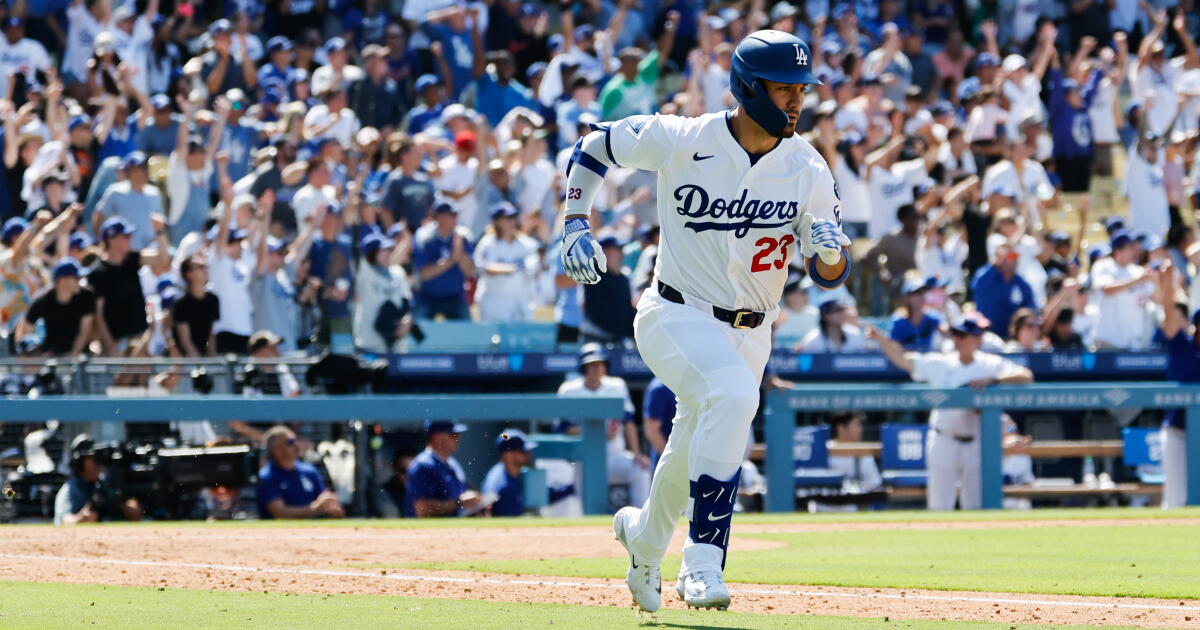
If only it hadn’t come with such disastrous consequences.
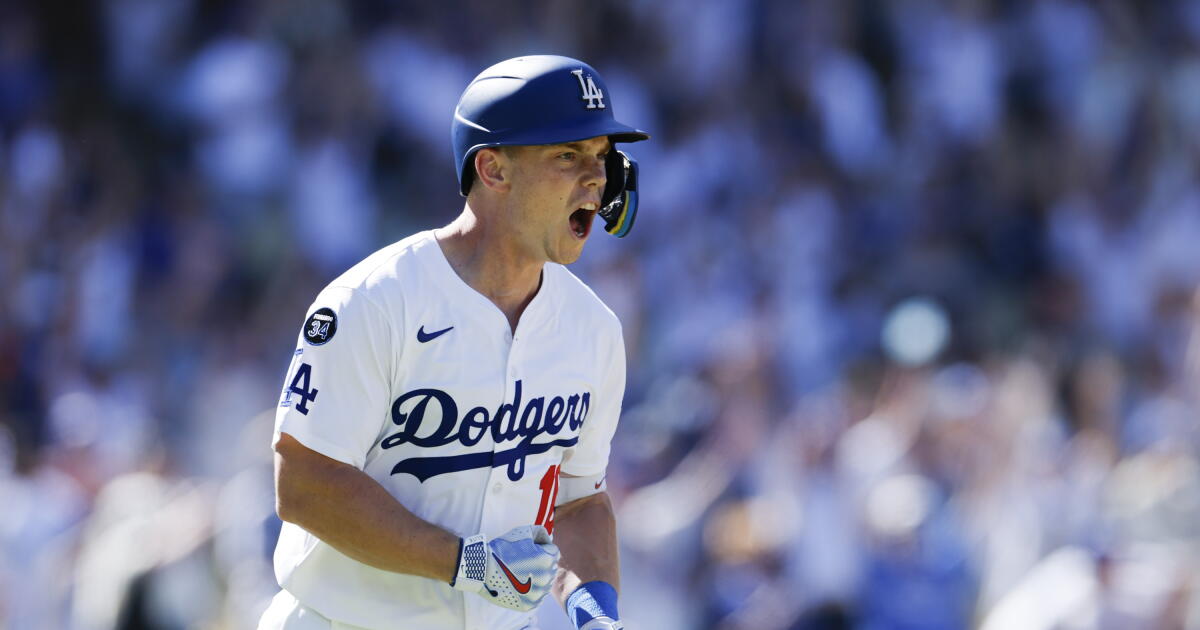
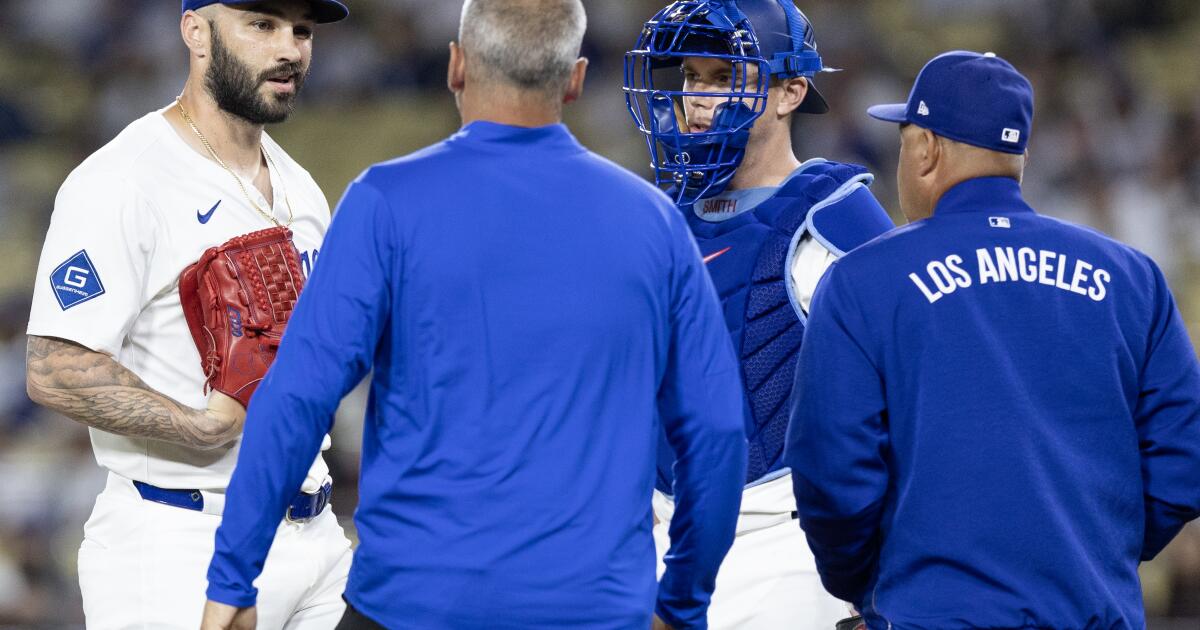
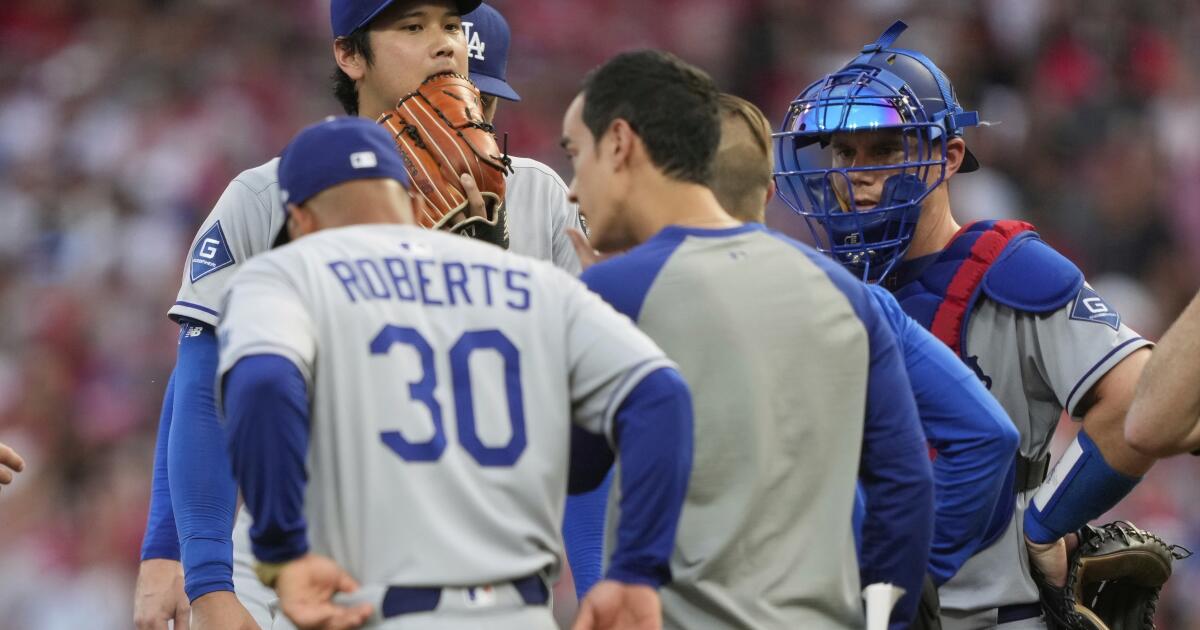
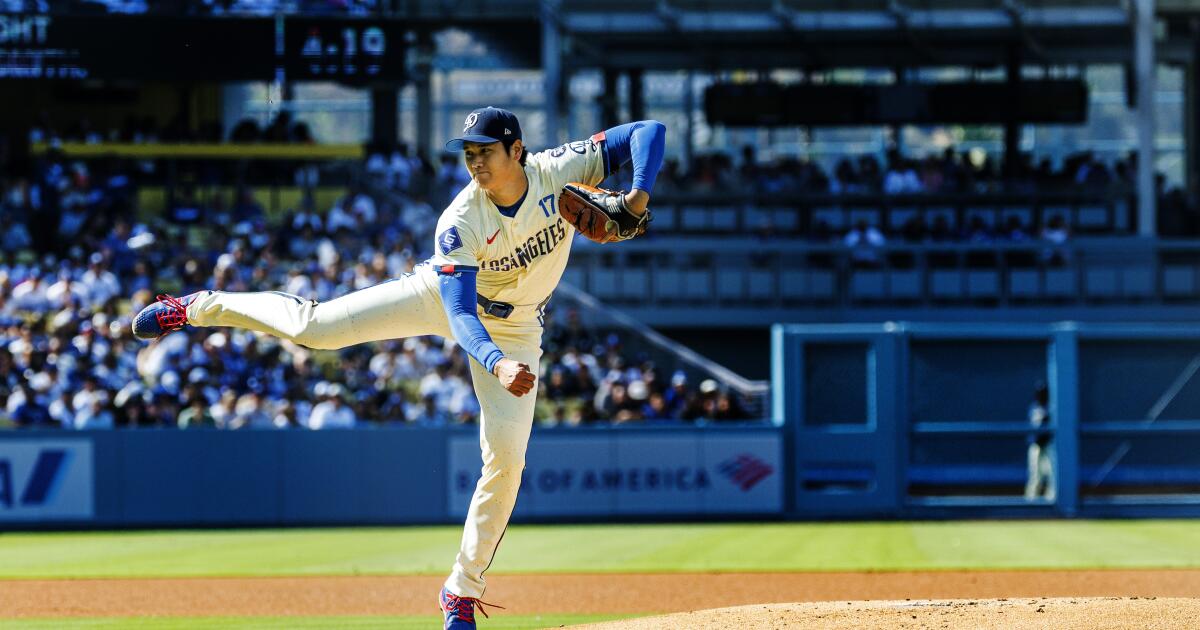
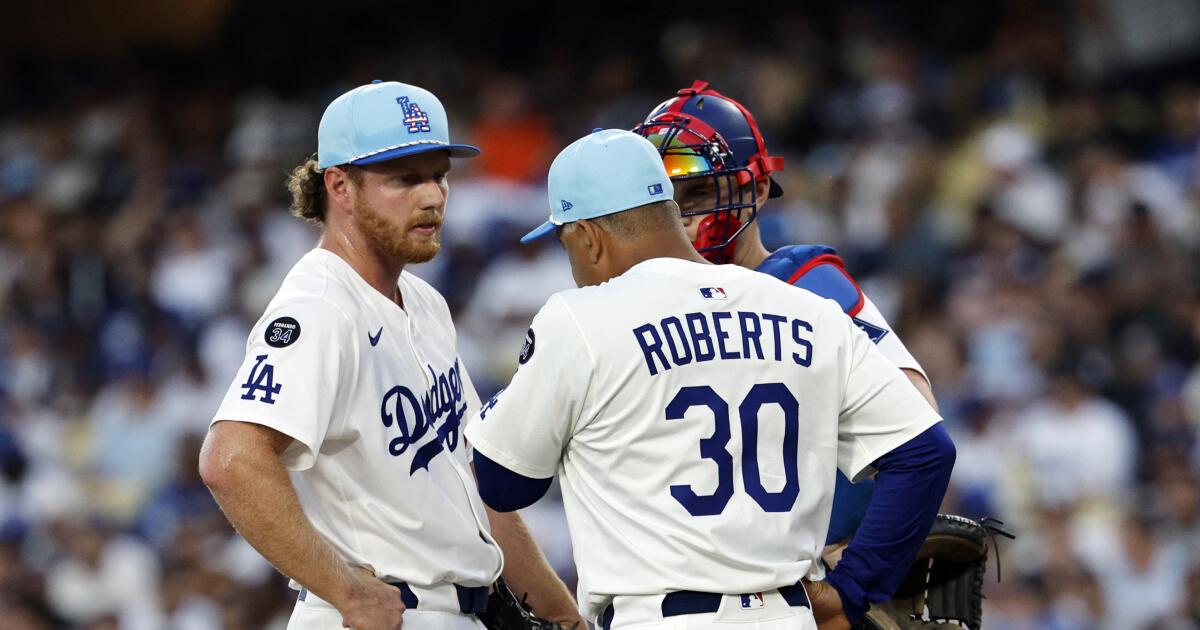
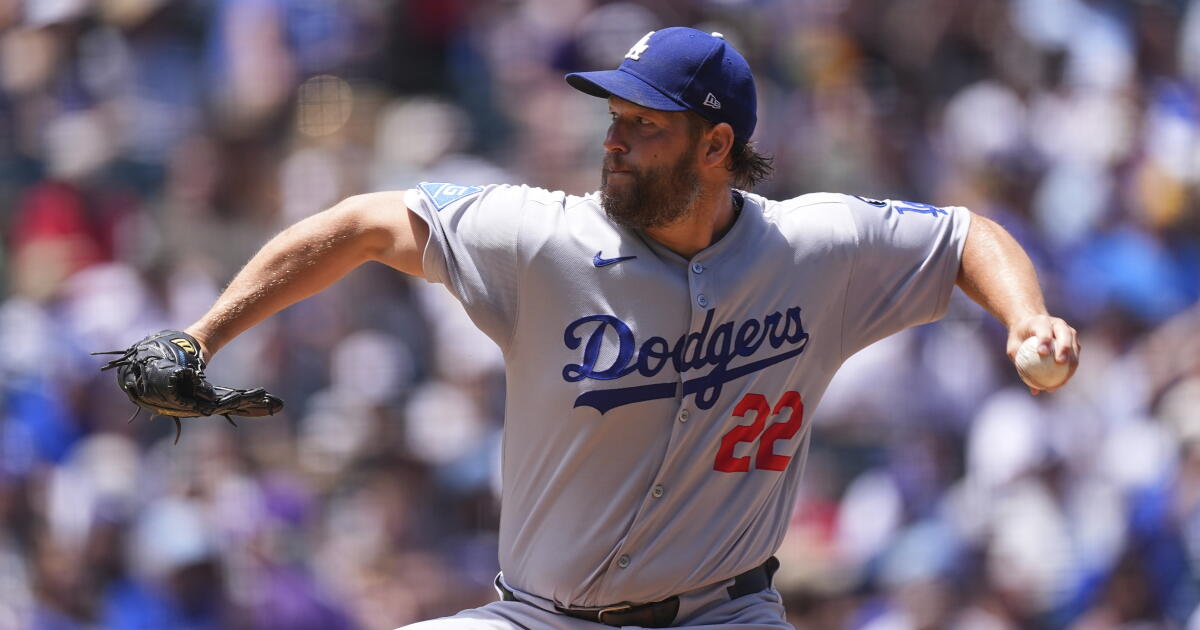
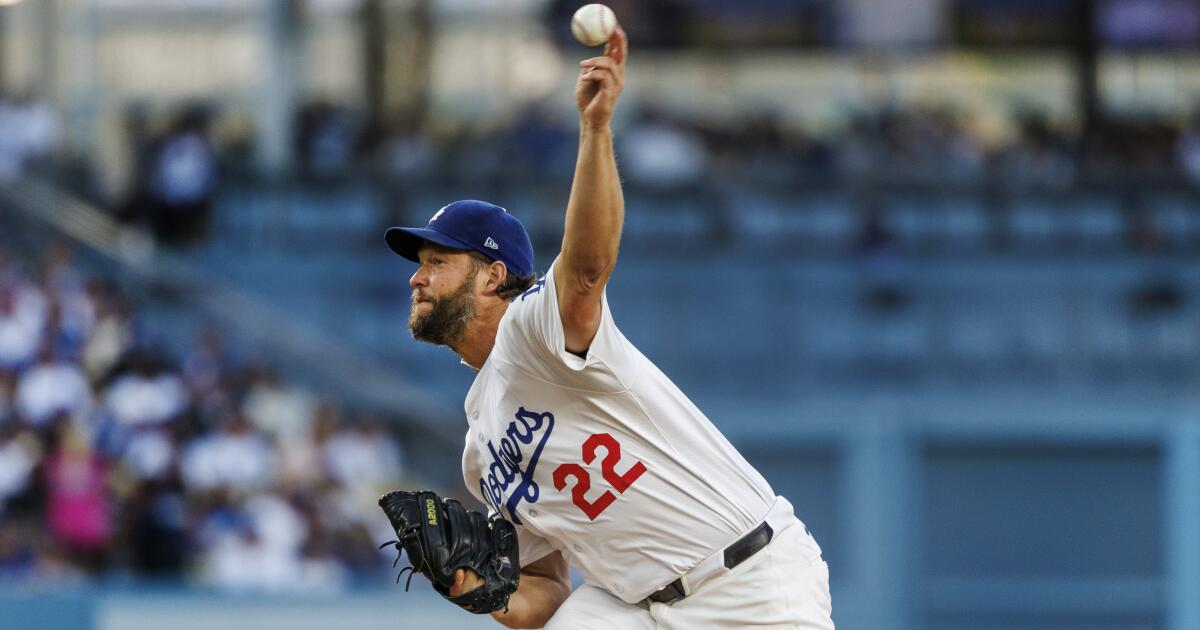
In the middle of the fifth inning Tuesday night, Shohei Ohtani returned to the Dodgers’ dugout after a clean inning of work on the mound. Waiting for him at the top step was manager Dave Roberts, wanting to ask how he felt after only his second five-inning start of the season.
With any other pitcher, what happened next would have been simple.
Over his five innings against the Philadelphia Phillies, Ohtani had not given up a hit. He had thrown only 68 pitches. And he was flashing the kind of dominance that would have made a no-hitter feel like a real possibility.
With any other pitcher, Roberts would have extended the leash.
Ohtani, however, is not like any other pitcher.
He is a two-way star, coming off a second career Tommy John surgery, who has been managed with kid gloves and bubblewrap in his return to pitching duties this year. He started his comeback by pitching one inning, then two, then so on until he built up to five. Weeks ago, the team — in consultation with team doctors, Ohtani’s agent and the reigning MVP himself — decided to avoid pushing him past the five-inning mark until at least October.
His health, both on the bump and at the plate, remains the priority.
Thus, while Ohtani told Roberts he still felt good, Roberts said he never had any thought of sending him out for the sixth. His question, he later explained, was only to ascertain information for future decision-making over Ohtani’s workload. As far as Tuesday was concerned?
“He wasn’t gonna go back out,” Roberts said.
By not sending Ohtani back out, of course, the Dodgers rolled the dice with their ever-faulty bullpen. And in one of the group’s worst performances this year, they yielded nine runs over the next four innings in a gut-punch of a 9-6 defeat.
“We’ve been very steadfast in every situation as far as innings for [Ohtani’s] usage — from one inning to two innings to three to four to five. We haven’t deviated from that,” Roberts said.
“I was trying to get his pulse for going forward, where he’s at, continuing to go to the sixth inning. And he says, ‘Feel OK.’ So that was good. But I’m not gonna have a plan for five innings, and then he pitches well and say, ‘Hey, now you’re gonna go six innings.’ He’s too important. And if something happens, then that’s on me for changing it, and we haven’t done that all year.”
After pulling Ohtani with a four-run lead, the Dodgers watched their relief corps melt down in predictable, reminiscent fashion. Justin Wrobleski gave up five consecutive hits with one out in the sixth, including a three-run home run to Brandon Marsh that broke open the inning. Edgardo Henriquez made matters worse, replacing Wrobleski — amid a chorus of boos directed at Roberts — later in the inning only to give up another long ball to Max Kepler.
By the time it was over, the Phillies had scored six runs to take the lead. And though the Dodgers would battle back to tie the score in the eighth, the bullpen faltered again in the ninth, when Blake Treinen gave up a decisive three-run, two-out home run to Rafael Marchán in the Phillies’ eventual 9-6 win.
For the five innings Tuesday, Ohtani displayed utter dominance against the only team to have already clinched a division title.
His fastball was playing up, eclipsing 100 mph seven times and topping out at 101.7 mph. His secondary stuff was electric, a mix of sliders and sweepers and curveballs and splitters that kept the Phillies off balance and able to make only benign contact.
After a two-out walk to Bryce Harper in the first inning, Ohtani retired the final 13 he faced. He got only six total whiffs, but was more pitch-efficient because of it, with his 68 throws coming in 19 shy of his previous season-high (he threw 87 pitches in his only other full five-inning start on Aug. 27).
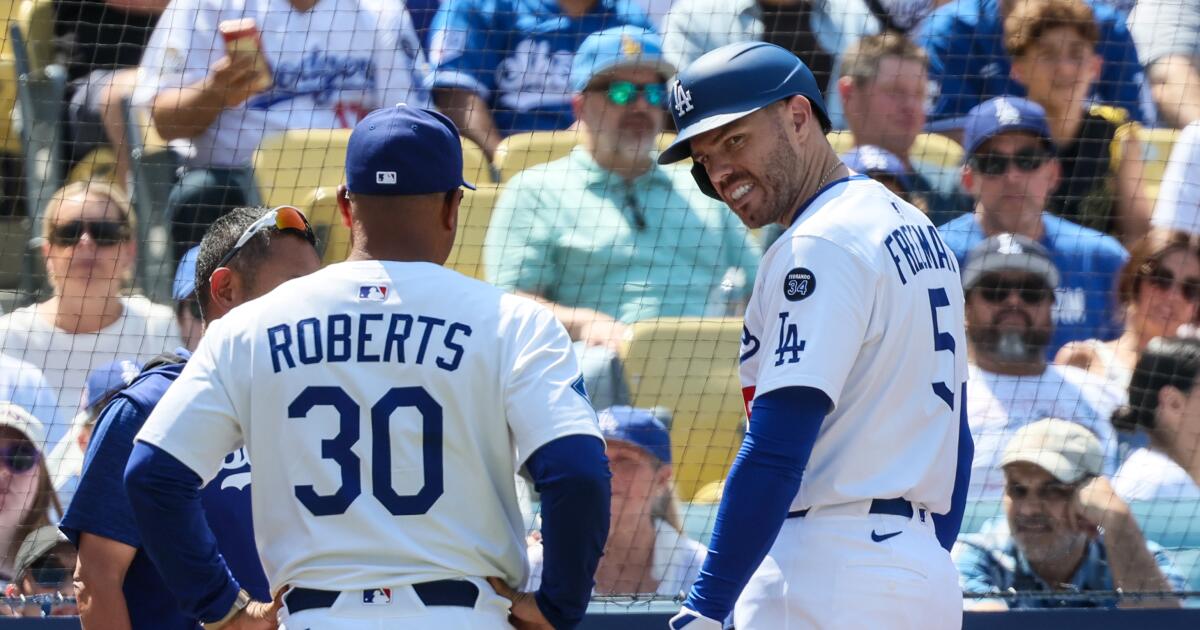
That’s why, once Ohtani raced back toward the dugout to transition from pitcher to hitter in the middle of the fifth, his removal wasn’t a foregone conclusion. Why, after Roberts conversed with Ohtani from the top step, he found first baseman Freddie Freeman laughing at him back on the bench, sensing the stressfulness of his manager’s decision (which represented the ninth time in Roberts’ Dodgers tenure he had pulled a pitcher from a no-hitter in the fifth inning or later).
By that point, of course, the game shouldn’t have been in danger either way.
The Dodgers had scored three runs in the second inning on home runs from Alex Call and Kiké Hernández. They added another in the fourth off Phillies left-hander Cristopher Sánchez, handing the Cy Young contender just his fourth start this season of more than three earned runs.
But then, a bullpen that had been burned repeatedly in recent weeks (including in a 10-inning loss in the opening game of this series Monday night) played with fire again.
Wrobleski, a rookie left-hander who had been one of the Dodgers’ better relievers of late, had Rafael Marchán break up the no-no with a one-out single, Harrison Bader and Kyle Schwarber to load the bases with two more hits after that, Harper to gap a double that brought two runs across, and Marsh to go deep on a hanging 0-2 slider for a go-ahead three-run shot.
Henriquez, another rookie who had been sharp in limited action this year, yielded another home run to Kepler two batters later.
Just like that, it was 6-4 Phillies.
Ohtani helped the Dodgers get back in the game with his bat. In the eighth, he clobbered a leadoff home run deep to right field for his 50th long ball of the season, making him just the sixth player in MLB history with consecutive 50-homer campaigns.
The Dodgers kept the rally going after that, loading the bases for Call to hit a tying sacrifice fly.
Alas, the Dodgers’ bullpen did what it does best once more in the ninth, coming unglued at the worst possible moment.
After getting two quick outs to start the inning, Treinen gave up a double to Weston Wilson (the No. 7 hitter who entered with a .202 average). He fell behind 3-and-0 to Bryson Stott (the No. 8 hitter) to trigger an intentional walk. Then, in a 3-and-1 count to Marchán (the No. 9 hitter and backup catcher for the Phillies), he served up an inside cutter that Marchán pulled down the line, getting just enough behind it to send it bouncing off the top of the short right-field wall.
Nine painful runs, in four miserable innings of Dodgers relief.
Another loss, that wasted Ohtani’s no-hit (but short-lived) masterpiece.
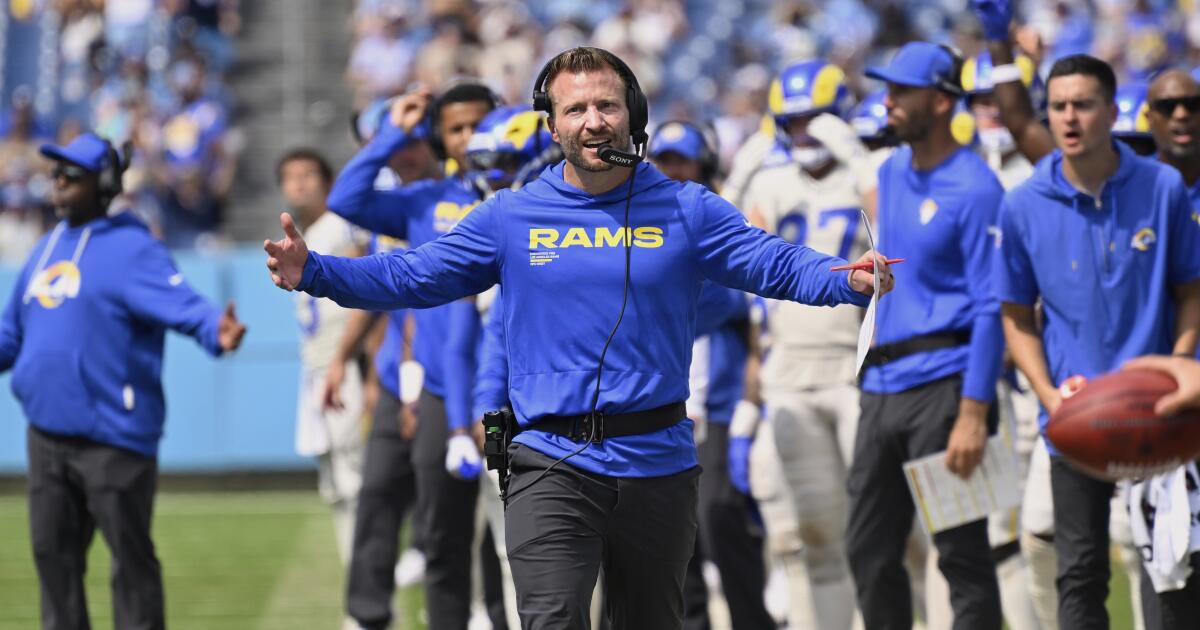
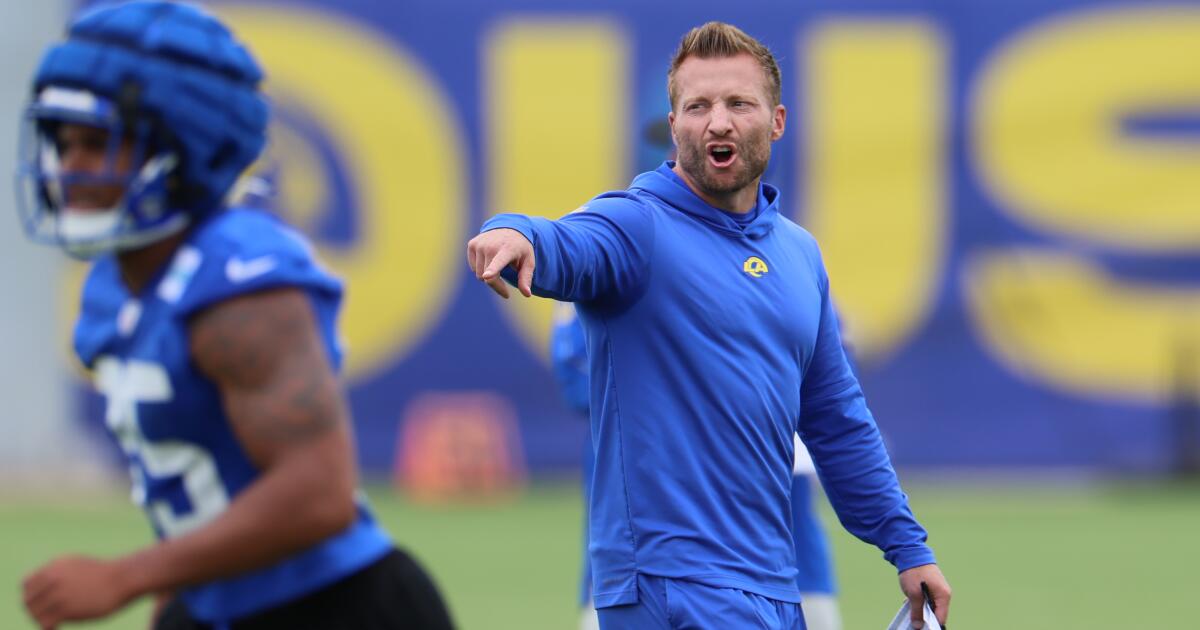
Rams coach Sean McVay is not expected to appear on the team’s injury report this week as they prepare for Sunday’s game against the defending Super Bowl-champion Philadelphia Eagles.
But McVay sustained a foot injury during last week’s victory over the Tennessee Titans in Nashville.
During the Rams’ produced “Sean McVay Show,” McVay said he suffered a torn plantar fascia.
“I was being dramatic limping around toward the end of the game,” McVay said, adding, “The good news is I’m not playing, so I’m just on the sidelines watching. So if I have a little cool limp to add some swag, then you’ll know why.”
McVay, 39, is in his ninth season with the Rams, who opened the season with victories over the Houston Texans and the Titans.
The Eagles are also 2-0 after victories over the Dallas Cowboys and Kansas City Chiefs.
Rams sign cornerback Tre Brown
Tre Brown warms up before a preseason game between the San Francisco 49ers and Denver Broncos in August.
(Kelley L Cox / Associated Press)
With starting cornerback Ahkello Witherspoon on injured reserve, the Rams added depth to the secondary on Tuesday by signing cornerback Tre Brown.
Brown, who will turn 28 next week, played four seasons for the Seattle Seahawks before signing with the San Francisco 49ers last March. But Brown suffered a heel injury during training camp, was placed on injured reserve and was ultimately released.
Brown, 5 feet, 10 inches and 185 pounds, played in 39 games for the Seahawks, starting 13. He intercepted two passes.
Brown joins a cornerback group that includes Cobie Durant, Emmanuel Forbes Jr. and Darious Williams. Witherspoon, who suffered a broken clavicle during the Rams’ victory over the Tennessee Titans last Sunday, is expected to be sidelined for 12 weeks, McVay said.
The Rams play the defending Super Bowl-champion Philadelphia Eagles on Sunday at Lincoln Financial Field in Philadelphia.
Philadelphia came to Los Angeles having already clinched a playoff berth. With Monday’s 6–5 extra-inning win over the Dodgers they added a division title to that collection, one they celebrated in the center of the Dodger Stadium infield, then with champagne in the tiny visitors’ clubhouse.
The Dodgers are zeroing in on a playoff berth and division title of their own. So the chances are high the teams will meet again in the postseason, which makes this week’s series a great opportunity to do a little scouting.
“We try to gather as much information as we can,” infielder Miguel Rojas said. “They’re doing the same thing.”
That’s not the main objective though. Because if the Dodgers are closing in the postseason, they aren’t there yet. And they have even more work to do after Monday’s game, which ended with Philadelphia’s J.T. Realmuto’s 10th-inning sacrifice fly scoring ghost runner Harrison Bader from third with the winning run.
Dodgers third base Max Muncy reacts to grounding out in the 10th inning, sealing the Philles’ win Monday at Dodger Stadium.
(Carlin Stiehl/Los Angeles Times)
“With where we’re at, I’m trying to win every game,” said manager Dave Roberts, whose team fought back from deficits three times before losing. “And where it falls out is where it falls out.”
One of the things that both sides surely learned Monday is that the Dodger bullpen is still far from being playoff ready. Because after Emmet Sheehan held the Phillies to one hit over 5⅔ innings, striking out seven, he watched a quartet of relievers combine to give up four runs — three on homer runs — over the next four.
“It’s frustrating, just from a team perspective,” third baseman Max Muncy said of a bullpen that has blown 24 saves and ranks fourth in the National League with 30 losses.
It’s unlikely to cost the Dodgers another trip to the postseason. Even with Monday’s loss, they are two games in front of idle San Diego in the National League West with 12 games to play and their magic number for clinching an 11th division title in 12 seasons is 10.
The magic number to clinch a wild-card berth is six.
The Dodgers have also been eyeing the No. 2 seed in the postseason tournament, however, a spot Philadelphia holds and one that brings with it a bye in the first round. It’s a break Roberts’ battered roster could use, but it’s one that may now be impossible to grasp: Monday’s win pushed the Phillies’ lead to 5½ games in the race for No. 2, a deficit the Dodgers have less than two weeks to make up.
“It’s really hard to not face these games down the stretch like a playoff game,” Rojas said. “We’ve been doing this for almost two weeks now. That’s the way that we have to look at it if we want to be prepared for October.”
Those preparations were uneven at best Monday. At the plate, the Dodgers fought back from deficits three times to send the game to extra innings on Andy Pages’ solo homer with one out in the ninth. But they also went 0 for 8 with runners in scoring position and, after Muncy grounded out with the bases loaded in the 10th, they left nine men on base. That erased a big game from Mookie Betts, who drove in three runs on two sacrifice flies and a game-tying homer in the seventh.
Dodgers shortstop Mookie Betts hits a home run in the bottom of the seventh inning against the Phillies at Dodger Stadium Monday.
(Carlin Stiehl/Los Angeles Times)
That gave him 19 RBIs in September and his 78 for the season, three better than his total from all of last year. But that wasn’t enough to overcome another bullpen meltdown.
Sheehan followed opener Anthony Banda to the mound, taking the ball three batters in the game with the Phillies already leading 1-0 on Kyle Schwarber’s league-leading 53rd home run. Sheehan left with a 3-1 lead after giving up his only hit, a leadoff double to Otto Kemp in the seventh. But three batters later the Phillies had a 4-3 lead after Weston Wilson, the Phillies No. 9 hitter, homered off Jack Dreyer.
The Dodgers rallied to tie the game twice after that but each time the bullpen gave the lead back, the final run coming in the 10th on Realmuto’s game-winning fly ball to right off right-hander Blake Treinen (1-5).
Asked if the series will show the Dodgers anything that can use if they face the Phillies again next month, Muncy shook his head.
“Personally, I don’t necessarily think so,” said Muncy, who third-inning homer, his first since returning from the injured list as week ago, opened the Dodgers’ scoring. “We’ve done that in the past. We’ve played teams right before we’ve seen them in the postseason and usually they do everything complete[ly] opposite.
“Right now, you’re just trying to win a game. You’re not really worried about what’s ahead.”
Notes
Reliever Brock Stewart, the Dodgers’ most-celebrated acquisition at the trade deadline, left Monday to join Oklahoma City for a two-game rehab assignment. Stewart, on the injured list since Aug. 12 with right shoulder inflammation, is expected to pitch Tuesday and Thursday in Triple A before returning to Dodger Stadium.
“If all goes well, then we have a conversation over the weekend,” Roberts said of Stewart’s availability. “We’ve just got to make sure he’s healthy. If he’s right, then it could be very additive.”
For the second straight year Betts has been chosen as the Dodgers’ nominee for the Roberto Clemente Award, baseball’s most prestigious off-the-field prize, in recognition for his wide-ranging charity work.
In January, Betts’ 5050 Foundation donated more than $30,000 of Nike clothing to victims of the Southern California wildfires. A few weeks later, in partnership with the Los Angeles Dodgers Foundation (LADF), he donated more than $160,000 to the Brotherhood Crusade to help fight hunger and homelessness in Los Angeles.
Also this season the 5050 Foundation partnered with the Obama Foundation at Hyde Park Academy to donate youth sports equipment and other supplies while also funding the Mookie Betts Metro Baseball Tournament in Nashville.
LAS VEGAS — Saúl “Canelo” Álvarez walked alongside his wife and one of his daughters to the makeshift stage in a giant tent a few feet from Allegiant Stadium, the venue where he had just lost for the third time in his professional career.
Visibly affected by more than just the marks left on his face, Álvarez acknowledged that Terence Crawford was superior to him. He made no excuses, but he seemed to be signaling that his body was telling him that his time as a boxer was running out.
During the final rounds, Álvarez’s frustration was evident. He lowered his hands, shook his head and on several occasions appeared resigned. Despite having had a great training camp, his 35 years of age, 20 of them as a professional, were evident.
Yes, Crawford is 37, but Álvarez completed 26 more fights than Crawford entering their bout Saturday night.
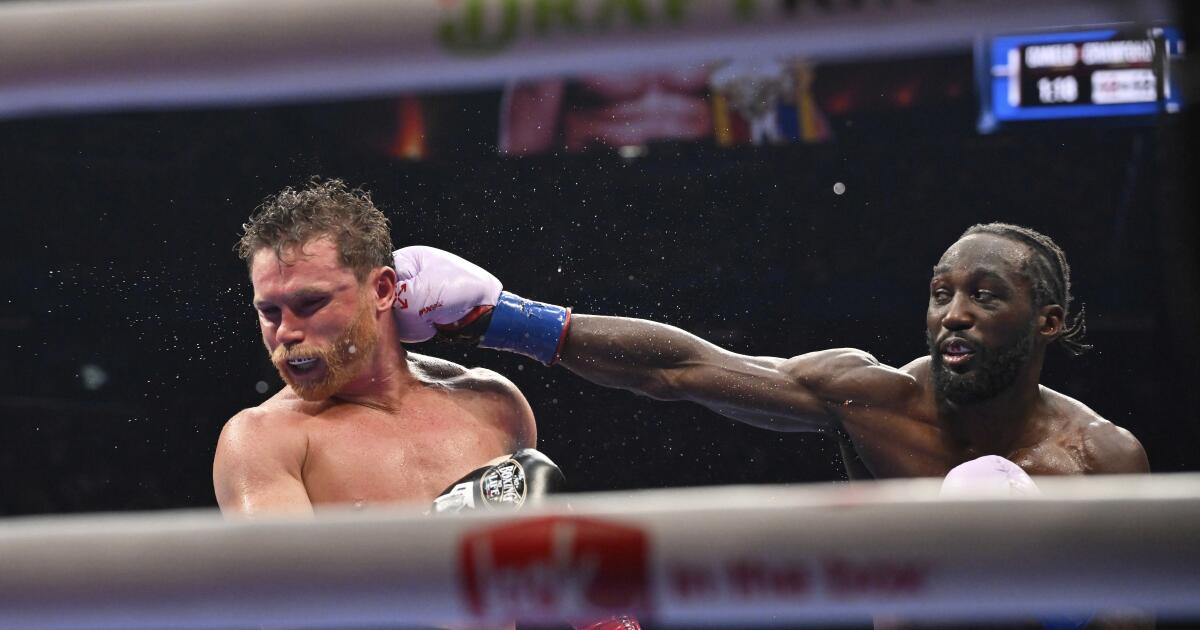
Terence Crawford punches Canelo Álvarez during an undisputed super middleweight championship boxing match in Las Vegas Saturday.
(David Becker / Associated Press)
“Sometimes you try and your body just can’t take it anymore,” Álvarez said. “That’s my frustration. Maybe I can’t understand Crawford, but my body just can’t take it anymore. I tried, but it just wouldn’t let me continue. And you have to accept that.”
Álvarez lost the super middleweight title bout by unanimous decision, with the judges scoring it 116-112, 115-113 and 115-113 before a record announced crowd of 70,482.
Álvarez acknowledged that he landed blows on his opponent, but none with the cleanliness and power that would have changed the course of the fight.
“I hit Crawford, but I didn’t land any clean blows with all my strength,” lamented Álvarez.
Despite his difficulty, the Guadalajara native reiterated that he never gave up in the ring.
Is this the beginning of the end for Álvarez? Perhaps. But early retirement seems unlikely … especially when he continues to be a box office magnet. The latest proof is in the $47,231,887 in gross revenue generated by ticket sales at Allegiant Stadium, according Live Gate.
The Canelo-Crawford fight became the biggest box office draw in the history of the Las Vegas venue, and with 70,482 fans in attendance, it was the most attended boxing event in U.S. history, surpassing Ali-Spinks II.
Crawford stripped Álvarez of his World Boxing Council (WBC), World Boxing Assn. (WBA), International Boxing Federation (IBF) and World Boxing Organization (WBO) belts.
After the fight, Álvarez raised his right arm in triumph. But he didn’t declare himself the winner as he did following his loss to Dmitry Bivol in 2022.
Álvarez accepted his defeat against a vastly superior opponent who made his win look easy.
Canelo Álvarez punches Terence Crawford during an undisputed super middleweight championship boxing match in Las Vegas Saturday.
(David Becker / Associated Press)
On the other hand, upon hearing the verdict, Crawford knelt in the ring before raising his arms to celebrate the victory.
“I knew I had won when the final bell rang. This is not my plan, it is God’s plan. I am just carrying out his mission,” Crawford said.
Emotional, he remembered his team and the people who have accompanied him.
“When they doubt me, they doubt my team. They thought they couldn’t take me where I wanted to go because they’re not from a big city and they don’t have recognition,” Crawford said. “But here we are, making history. I’m at the forefront, and behind me comes a new generation.”
Although he celebrated intensely, Crawford did not belittle Álvarez, acknowledging the quality of the former champion.
The win is a milestone for Crawford. He is now the first male boxer to be the undisputed champion in three different divisions in the era of four belts. With an undefeated record of 42-0 and 31 knockouts, he stands at the top of his generation.
“It wasn’t easy. It just looked that way, but it wasn’t. He’s definitely the best opponent I’ve ever faced,” Crawford said.
After confirming his third defeat, Álvarez’s gaze was not that of a man who knew he would receive more than $100 million for stepping onto the canvas at Allegiant Stadium. His gaze was that of someone whose body had reminded him that the end of a celebrated career was closer than he thought.
Terence Crawford reacts after the final bell of his fight with Canelo Álvarez, not pictured, in their undisputed super middleweight title fight Saturday in Las Vegas.
(Steve Marcus / Getty Images)
He appeared with the serenity of a man who, although hurt, knew how to recognize the greatness of his opponent.
“I tried everything I could and trained very hard, and he deserves all the credit. Tonight I gave it my all, but I can’t understand his style,” Álvarez said.
Crawford saw Álvarez’s frustration firsthand. Around the sixth round, Crawford knew he had to take another step to completely control the fight because he felt Álvarez adapting to the bout’s rhythm, so he pressed his style harder and overwhelmed Álvarez.
Everything he did was part of the plan he developed during his training camp. Although Crawford wanted to be more active, his coaches reminded him to be disciplined and patient.
Much was said about the difficulties he might face in moving up two weight classes, but the American insisted that he did not feel physically disadvantaged against Álvarez.
“People exaggerated that. He and I are practically the same size,” Crawford said. “I’m a little taller, my arms are longer. The difference is minimal. So when they said, ‘Canelo is huge,’ it seemed disrespectful to me. Tonight you could see that we were evenly matched.”
When asked if what complicated things most for him was Crawford’s speed, movement, or power, Álvarez responded: “Everything. He has it all.”
For the first time since 2018, Álvarez is no longer a world champion.
“I feel like a champion no matter what happens. Win or lose, I still feel like a champion,” Álvarez said. “You have to accept defeat and accept everything. I’m going to keep going.”
When asked whether Floyd Mayweather Jr., who handed him his first professional defeat in 2013, was better than Crawford, Álvarez responded no.
“I think Crawford is much better than Floyd Mayweather,” Álvarez said.
Álvarez recounted gathering his family in the locker room to explain the importance of accepting both victory and defeat.
Canelo Álvarez kisses his wife, Fernanda Gomez, after losing to Terence Crawford (not pictured) in their undisputed super middleweight title fight on Saturday in Las Vegas.
(Steve Marcus / Getty Images)
“My children and my wife were a little sad, but I told them that’s the way it is. It’s not a defeat, it’s a lesson,” Álvarez said. “You have to accept both sides of the coin. That’s what I want to teach them, that you learn as much when you win as when you lose.”
Visibly moved, he spoke of his newborn daughter, just 1 month old, who was waiting for him at their hotel.
Álvarez avoided giving clear details about his next steps and gave himself time to reflect. His future decisions will involve his family, who accompany him in victory and defeat.
The loss to Crawford won’t trigger Álvarez’s immediate retirement, as he has a four-fight contract worth around $400 million with Turki Alalshikh and Riyadh Season, but he could change his strategy in scheduling opponents.
“I want to see what happens in the future. There will definitely be good things,“ Álvarez said. ”I won just by being here.”
Although his legacy is already assured with a career spanning more than 20 years, multiple titles in different divisions and victories over big names, this loss marks a turning point. The question will be how he reacts, whether he will seek immediate revenge or takes another path.
The victory places Crawford on a historic pedestal alongside Mayweather and Manny Pacquiao, becoming the third linear champion in four divisions and the second boxer to achieve undisputed status in three categories, something only Henry Armstrong had achieved in 1938 in a different era of boxing.
“It means a lot because they always said I fought nobodies. Well, what can they say now? I did everything I said I was going to do,” Crawford said. “I moved up two divisions, faced the undisputed champion, and took all his titles. That’s greatness.”
When asked to compare himself to Mayweather, Crawford was respectful.
“Floyd was the best of his era. I am the best of mine. There is no need to compare us,” Crawford said.
The event was attended mostly by Mexican fans who hoped to see Álvarez further cement his legacy. But they left having witnessed a great performance by Álvarez’s opponent.
The fans booed Crawford, who made his walk to the ring dressed in an outfit inspired by the 1995 film “Desperado,” starring Antonio Banderas and Salma Hayek, accompanied by live music and guitar in hand.
At the end of the fight, the same fans applauded him, recognizing his great performance against the defeated champion.
Terence Crawford displays his title belts after defeating Canelo Álvarez (not pictured) in an undisputed super middleweight title fight by unanimous decision.
(Harry How / Getty Images for Netflix)
“It was part of my outfit. The outfit was inspired by the movie ‘Desperado.’ As you can see, I had the guitar and everything,” Crawford said. “My great childhood friend, Jacinto Robles, was the one who performed a song and acted tonight. … As I said, I also have Mexicans and Latinos on my side. It’s been a beautiful night.”
Unlike many other fighters, Crawford says little, is reserved but intense when he goes after his opponent, avoids theatrics and gets straight to the point. Defeating Álvarez in front of his fans, dominating most of the rounds and becoming just the third person to defeat Álvarez is more than enough to shout about with pride, but he didn’t.
Crawford waited until the end of Álvarez’s media appearance in the giant tent to return the Mexican’s belts handed to him in the ring. He could have done this privately in the locker room, but he did it in front of media and the Álvarez family as a sign of respect, extending his hand to his rival.
“When I signed the contract, I already knew I was going to beat him,” Crawford said. “It’s no surprise to me. It’s a surprise to all of you because you don’t believe me. But I always knew I could do it.”
This article first appeared in Spanish via L.A. Times en Español.
SAN FRANCISCO — This is the time to bring on the rivals. The Dodgers are used to taking on challengers down the pennant stretch: the San Francisco Giants and San Diego Padres — and, in a previous version of the National League West, the Atlanta Braves and Cincinnati Reds.
The final two weeks of the regular season are upon us. The Dodgers have one remaining head-to-head matchup that really matters — and that series starts Monday at Dodger Stadium, against the Philadelphia Phillies.
The Phillies?
The Phillies have not been realigned into the NL West. However, although the three division champions automatically qualify for the playoffs, the two with the best records earn a bye into the division series. The division champion with the third-best record — right now, that would be the Dodgers — must play in the first round.
The Milwaukee Brewers, the presumed champions of the NL Central, boast the best record in baseball. The Phillies, the presumed champions of the NL East, lead the Dodgers by 4 ½ games. The Dodgers have 13 games to play.
The Dodgers got a bye and lost in the division series in 2022. They got a bye and lost in the division series in 2023. They got a bye and came within one game of elimination in the division series in 2024. Would they be better off not getting a bye and playing in the first round?
“There is not a question in my mind that that does not make sense,” Andrew Friedman, the Dodgers’ president of baseball operations, told me last week. “It is better for your World Series odds to not play those three games.”
The five days off that come with a bye can disrupt the timing of hitters. They also can allow time for injured and weary players to recover — that could be critical for Dodgers catcher Will Smith, in particular — and for the Dodgers to arrange their starting rotation just the way they might like it. And, of course, you can’t be eliminated in the first round if you don’t play in it.
“We have made our life more difficult to this point,” Friedman said, “but I still think we have a really good run in us, and we’ll make it competitive. So obviously these three games against Philly are really important in that.”
What if the three games against the Phillies go poorly?
Even if they don’t, the Dodgers might not win the division. The Padres are closer to the Dodgers than the Dodgers are to the Phillies.
San Diego trails the Dodgers by 2½ games in the NL West.
If the Padres win the NL West, how much would that hurt the Dodgers’ chances of a lengthy postseason run?
Not much, if at all. Both teams almost certainly would end up in the wild-card round.
The NL West champion would play the last team into the NL field, most likely the Giants or New York Mets and maybe even the Reds or Arizona Diamondbacks, with the chance the opponent exhausted its pitching just to get into the playoffs. The other team would play the Chicago Cubs, and would avoid the possibility of facing the surging Phillies until the NLCS.
If the NL West comes down to the last day or two, the Dodgers would have to determine whether to use their best starters on that final weekend or line them up for the wild-card series.
In that scenario, what might be the decisive factor in the Dodgers’ calculus?
The NL West champion would play all three games of the wild-card round at home; the runner-up likely would play all three games on the road. The Dodgers are 48-26 at home, 36-39 on the road. (The Padres are 47-28 at home, 35-40 on the road.)
Would there be any precedent for the Dodgers not minding if the Padres won the NL West?
In 1996, the Dodgers and Padres were tied for the NL West lead heading into the final day of the regular season, with the two teams facing one another. Both teams were guaranteed a playoff spot.
In Game 162, the Dodgers started Ramon Martinez — undefeated in his previous nine starts — then removed him after one inning.
The Padres won the game, and with it the division. The Dodgers started Martinez in their playoff opener three days later. They lost that game, and they were swept in the series by the Braves. The winning pitchers in that series, in order: John Smoltz, Greg Maddux and Tom Glavine.
How many games are the Dodgers on pace to win?
Ninety-one.
In Friedman’s previous 10 seasons running the Dodgers, what is the fewest number of games they have won?
Ninety-one, in 2016.
How did the Dodgers do that October?
They earned a bye into the division series, in which they beat the Washington Nationals. They lost to the Chicago Cubs in the league championship series.
Well, it is starting to appear that we are on the way to another in a series of mediocre football seasons at my alma mater UCLA.
I am now officially in the “I don’t care about UCLA Football anymore” camp. I graduated from UCLA in 1975 and while every once in a while UCLA will have a somewhat successful season, the best they seem to be able to do is be invited to a second-tier bowl game. The College Football Playoff? Forget about it.
Coach DeShaun Foster is very clearly in way over his head. I predict he will be gone after this season.
Bruce Dunklin Thousand Oaks
It has to be painfully obvious that the DeShaun Foster experiment at head coach is a dismal failure. The loss to UNLV was not just embarrassing but shameful. It was once said that Foster was Karl Dorrell 2.0, but that is unfair. Dorrell had a 10-win season and beat USC. Coach “We’re Close” Foster is in way over his head. His team is undisciplined and unprepared. This clueless performance will lead to a completely empty Rose Bowl and eventual desertion of NIL sponsors. What is the athletic department going to do when we lose to New Mexico and go 0-12 for the year?
Thomas Auyong Diamond Bar
DeShaun Foster has to be the worst head coach in UCLA history. If a team is a reflection of their coach, then this is the worst UCLA team every. Does the team have a weight program? They are getting pushed around out there and it’s only going to get uglier. We are going to lose 100-0 to Ohio State.
Ed Villanueva Chino Hills
UCLA fell for the third consecutive game to open the season, with their drubbing at the hands of New Mexico. Maybe it’s time for AD Martin Jarmond to consider dropping the football program to a lower division, or just dropping football completely (the latter might help balance the athletic budget). Either way, coach DeShaun Foster and the Bruins are in for a long season.
Chris Sorce Fountain Valley
My 98-year-old father and I are 25-year UCLA football season-ticket holders. We love our Bruin football, but let’s face facts. When our AD, Martin Jarmond, hired coach DeShaun Foster, he looked at us with a straight face and told us that they had interviewed upward of 40 candidates for the head coaching position and that Foster was the best of the group. A man with no offensive, defensive or head-coaching experience.
It sadly is now painfully obvious that Jarmond and Foster should be replaced with more experienced and qualified candidates.
Demare Dezeurn intercepted three passes, returning the last 78 yards for the clinching touchdown as Palisades prevailed 49-34 to snap host Brentwood’s three-game winning streak Friday night in the annual “Sunset Showdown” between the Westside schools located six miles apart.
Dezeurn, one of the fastest sprinters in California, had a career-high four touchdown catches in the Dolphins’ season opener and this time established a career-best for takeaways in a game. He picked off a pass in the first quarter and another in the second that he returned 45 yards for a touchdown but it was called back on a penalty. The last came after a tipped ball with the Eagles (2-2) on the move with 43 seconds left.
“It was a tipped ball, I broke outside and took it all the way,” said the junior transfer from Bishop Alemany, who committed to Oklahoma on Tuesday. “After the first two, I knew I had to get one more.”
In last year’s game, Brentwood quarterback Ben Mikail scrambled nine yards for the winning touchdown in double overtime. This time he tried to run for a tying two-point conversion but was tackled short of the goal line by free safety Tavian Talbert with 2:51 left.
“I saw that it was a broken play and the dude I was supposed to guard wasn’t running a route so I spied on the quarterback and slammed him to the ground,” said Talbert, who recovered the ensuing onside kick. “It feels good to beat them on their home field because last year they beat us on ours.”
Jack Thomas passed for 797 yards and 11 touchdowns in Palisades’ first two games and tossed three more Friday — two to King Demethris and one to Malachi Ross — while Harrison Carter ran for a touchdown and returned a kickoff 85 yards for another score for the Dolphins (3-0), ranked third in the City Section by The Times.
Mikail threw touchdown passes to Dean Pretlow and Kaymon Jackson, Robert Sullivan and Enzo Longhi each ran for a score, and Kruz Jackson scored on a punt return for Brentwood, which leads 4-3 in a rivalry that began in 2018.
Palisades, which reached the City Division I final last season but is vying for the Open Division this fall, led 21-7 at halftime.
To Andrew Friedman, something like this was a virtual impossibility.
“If you had said that we would have a six-week stretch where our offense would rank 30th in baseball, I would have said there was a zero percent chance,” the Dodgers president of baseball operations said last month.
“I would have been wrong,” he quickly added.
Over a five-week stretch from July 4 to Aug. 4, the Dodgers inexplicably ranked 30th (out of 30 clubs) in scoring. And though they’ve been slightly better in the five weeks since, questions about their supposed juggernaut lineup still abound.
In the first half of the season, the Dodgers boasted the best offense in the majors, leading the majors in scoring (5.61 runs per game), batting average (.262), OPS (.796) and hitting with runners in scoring position (.300) and went 56-32 over their first 88 games.
Since then, however, everything has flipped.
It started with a July slump that was as stunning as it was unforeseen, with the Dodgers averaging just 3.36 runs in a 25-game stretch commencing with Independence Day. Since then, there have been only marginal improvements, with the Dodgers entering Friday ranked 24th in scoring (4.21 runs per game), 25th in batting average (.237), 18th in OPS (.718) and 22nd in hitting with runners in scoring position (.245) over their last 58 games — a stretch in which they’ve gone 26-32.
“Not scoring runs,” first baseman Freddie Freeman said last week, “it’s just not who we are.”
On the surface, the root causes seemed rather obvious. Much of their lineup was either on the injured list or scuffling in the wake of previous, nagging injuries. Healthy superstars were grinding through flaws with their swings. What little depth they had failed to compensate.
To that end, the team is hopeful it has turned the page.
Shohei Ohtani, after a midseason lull, is back to his MVP-caliber norms. Mookie Betts is back to looking like himself at the end of an otherwise career-worst season. Max Muncy and Tommy Edman have returned from injuries, providing the batting order with much-needed length. Significant playing time is no longer going to the likes of Buddy Kennedy, Alex Freeland, Estuery Ruiz or any of the other anonymous faces that populated the clubhouse during the campaign’s darkest days.
“Our lineup, our team, looks more whole,” manager Dave Roberts said this week. “I think that we’ve all been waiting for our guys to come back to health, and see what we look like as the ballclub that we had all envisioned.”
Still, when asked whether the Dodgers’ second-half slump could just be pinned on personnel issues, Roberts and his players said it wasn’t that simple.
The Dodgers might not have been whole. But they weren’t doing fundamental things — like stressing opposing pitchers, driving up pitch counts, or executing in leverage situations — either.
“We’d lost sight of playing the game the way we’re capable of playing,” Roberts acknowledged.
“For a little while,” Betts added, “we were having just some bad at-bats.”
This is the dynamic the Dodgers have honed in on fixing, hoping to turn their summer-long frustrations into a valuable learning experience as October nears.
In recent days, a renewed and deliberate emphasis has been placed on the importance of competitiveness at the plate. Daily hitters’ meetings have included film sessions reviewing situational at-bats from the previous night. In-game dugout conversations have centered on a more basic message.
“It’s more about your approach, your plan,” Freeman said. “That’s been the focus.”
This week, the team took what it hopes are important first steps, ambushing the Rockies with seven- and nine-run performances in which they advanced baserunners, capitalized on scoring opportunities and built the kind of big innings that been missing over the two months beforehand.
“We said a few games ago, ‘This needs to be like how we focus for the playoffs,’” Freeman said. “Focus on the little things that help win games.”
The Dodgers, of course, have seen what a broken offense looks like before.
And they know what happens when it doesn’t get rectified before the playoffs.
Late in 2022, as co-hitting coach Aaron Bates recalled this week, the team slipped into bad habits while nursing a massive National League West lead: “It felt like that whole month of September was swing camp, or spring training,” he said, “in the sense of guys working on their swings individually too much, as opposed to playing the game in front of them.”
The results then were costly: A four-game NL Division Series elimination to the San Diego Padres in which the Dodgers repeatedly failed with runners in scoring position.
The next year was more of the same: The team losing its identity while coasting down the stretch, before being swept by the Arizona Diamondbacks in three listless games.
Last season, the Dodgers finally avoided such pitfalls. They batted .278 with runners in scoring position during their postseason run to the World Series. Their tying and go-ahead runs in the Fall Classic clincher came on a pair of productive at-bats in the form of sacrifice flies.
The Dodgers’ Shohei Ohtani has showed his MVP form in recent games, homering twice in Sunday’s win against the Baltimore Orioles.
(Eric Thayer / For The Times)
But this summer, after a first-half outburst that met every lofty expectation of their $400-million roster, more troubling patterns began to resurface again.
Betts’ slow start devolved into a career-worst slump, bottoming out with a .205 average during July. Freeman began to fade right alongside him, with his .374 season average at the end of May plummeting to .292 less than two months later. Edman and Teoscar Hernández struggled after returning from first-half injuries. Michael Conforto never found his footing while Andy Pages endured an extended sophomore slide.
When coupled with Muncy’s prolonged absence — he missed 48 of 56 games because of a knee injury and oblique strain — the Dodgers suddenly had a lineup of players either grinding to rediscover their swing, or struggling to make up for the firepower they were missing.
And as easy scoring dried up, their inability to work consistent “team at-bats” quickly became magnified.
“It happened incrementally, every day, little by little,” Bates said. “Where it’s like, you’re a little off, you want to see what’s wrong with your swing, and you don’t realize that it snowballs. Before you know it, you’re thinking so much about your swing, you’re off of the situations out there.”
It was a problem, Bates insisted, borne of good intentions. Most of the roster was battling swing flaws. Too much daily energy was spent on players trying to individually get their mechanics right.
It led to mindless swings that were wasted on bad pitches. It caused scoring opportunities to carelessly, and repeatedly, go frustatingly by the wayside.
“Guys just got so internal with their mechanics,” Bates said, “they weren’t able to shift their focus once the game starts to just competing in the box.”
Bates started sensing the trend while watching the team from afar, gaining a different perspective during a two-week medical absence in early August to address blood clots in his leg.
In the clubhouse, players began voicing similar observations after particularly puzzling offensive performances in recent weeks.
“I feel like a lot of swings that we took today weren’t really good swings to get on base,” veteran infielder Miguel Rojas said after the Dodgers managed only one hit in six innings against Padres left-hander Nestor Cortes on Aug. 23. “We know we’re more than capable of putting up better at-bats and more hits together to create some traffic.”
“We individually are trying to find ways on our own to make sure that we’re just hitting better than we are,” Ohtani echoed, through an interpreter, after the Dodgers’ one-run performance in a series-opener in Baltimore last weekend. “But I think the side effect of that is, we’re a little too eager, and putting too much pressure on ourselves.”
Thus, this week, the team endeavored to make changes.
In their daily pregame hitters’ meetings, the club has started holding what fellow co-hitting coach Robert Van Scoyoc described to SportsNet LA as “NFL-style” film sessions; in which players were asked to review situational at-bats from the night before, and analyze their ability to execute their plan of attack.
“The game rewards you for having those ‘team at-bats,’ ” Bates said. “So you just preach to them by holding each other accountable, talking about them after the fact, not shying away from it.”
Freeman added that, in the dugout, players have also made an effort to emphasize that message among themselves.
“Don’t get upset because your swing didn’t feel good,” he said. “Like, if you go 0-for-four but move a runner over four times, that’s a great game for us. It might not be for your stats. But you gotta throw that out the window. That’s what we’ve been trying to clean up.”
The hope is that this renewed focus will naturally help hitters sync up their swings.
On Monday night, for example, Betts moved a runner to third base with a fly ball in the sixth inning, before coming back to the plate and roping a tie-breaking two-run single with two outs in the eighth.
“He said it in the hitter’s meeting [the next day],” Freeman relayed, “how that little positive thing of moving [a runner] over helped him build confidence going into his next at-bat.”
Little moments like that, the Dodgers hope, will help kick-start their offense as they come up on the playoffs. They might not have been able to envision the struggles of the last two months. But now, between better health and improving at-bat quality, they finally see a way to fix their ailing offense.
“Now, we’re at least having good at-bats, getting a walk, extending innings, finding ways to manufacture runs,” Betts said.
“I do think that presently, the guys are engaged,” Roberts added. “Guys are playing as one right now.”
Thursday marks the 24th anniversary of the Sept. 11, 2001 terrorist attacks that saw two planes flown into the Twin Towers in New York, killing nearly 3,000.
Kevin Danni was there. The St. Francis High graduate and father of Golden Knights linebacker Luke Danni reflects back every anniversary on how he escaped from the 61st floor of the South Tower.
“I’m so lucky there were so many who sacrificed to save me,” he said.
Danni told his story to a rapt audience earlier this week at a meeting of the YMCA of the Foothills QB Club, where he is president.
He was 22 years old, a recent graduate of Occidental College and had been sent to Morgan Stanley in New York to begin training at the Twin Towers on Sept. 10, 2001. The next morning, a training meeting ended up being 15 minutes late because a speaker went too long, so during a break, he decided not to go to the observation deck on the 107th floor.
Instead, he looked out a window and saw what he thought was confetti flying around, It was papers from the aftermath of a plane running into the North Tower. Soon he saw a fire. At first, evacuation from the South Tower was not recommended. But Danni said the head of security, Rick Rescorla, overrode orders and told everyone to leave.
When Danni reached the 55th floor walking down the stairs, he heard an explosion. “The walls cracked,” he said.
It was a plane hitting the South Tower.
“I knew it was a terrorist attack,” he said. “I started to descend and passed firefighters going up the stairs. It took 45 minutes to evacuate.”
When he went outside, he said, “I saw both on fire.”
He went to find a pay phone so he could call his loved ones and tell them he was OK. Then the towers started to collapse.
“I heard a rumble,” he said. “It was 57 minutes since the plane hit. I saw the dust cloud. I turned and ran.”
Danni said he learned the security man, Rescorla, after escorting employees outside, went back up to make sure all had been evacuated from the office. The security man and 343 firefighters perished trying to help others.
“I got to see so many acts of heroism,” Danni said.
He was dating his future wife, Helena, at the time. They eventually married and their son, Luke, was born. This week he’ll be having fun watching Luke play quarterback for St. Francis on Friday night against Muir.
“Every 9/11, he says, ‘Dad, I’m glad you’re here,’” Kevin said.
This is a daily look at the positive happenings in high school sports. To submit any news, please email [email protected].
At some point, the Dodgers hope, they will be able to field a fully healthy lineup.
A late scratch on Wednesday to catcher Will Smith, however, meant it would have to wait at least a couple more days.
Despite activating Tommy Edman from the injured list pregame, and proceeding to sweep the Colorado Rockies with a 9-0 win that stretched their National League West lead to three games, the Dodgers were left dealing with another injury headache Wednesday, removing Smith from the starting lineup minutes before first pitch because of lingering issues with the bone bruise on his right hand.
Smith’s absence hardly hampered the Dodgers in their fourth straight win.
Their lineup exploded for four runs in the second inning and five in the eighth behind a huge night from Mookie Betts, who continued his recent tear with a four-for-five, five-RBI performance that included a run-scoring double early and a grand slam to put things away late. Betts is now on a 16-game on-base streak, has multiple RBIs in five-straight contests, and is batting .352 with seven home runs and 26 RBIs over his last 32 games.
Behind the plate, Ben Rortvedt filled in to catch Blake Snell’s scoreless six-inning, 11-strikeout start, which continued a dominant run from a Dodgers’ rotation that now has a 1.18 ERA over the last six games.
And thanks to a loss earlier in the day by the San Diego Padres, the team grew its lead atop the division for a second day in a row, effectively taking a 3-½ game NL West lead (when accounting for its head-to-head tiebreaker over San Diego) with 16 games to play.
Still, after activating Max Muncy off the injured list Monday, and welcoming Edman back into the fold Wednesday afternoon, the Dodgers were finally on the verge of having a full-strength squad for the first time since early July.
Instead, they were reminded of the tenuous reality of their oft-injured roster — and the difficulty of trying to manage Smith’s hand in particular.
It had only been a week since Smith first got hurt, when a foul ball in Pittsburgh ricocheted off his dangling throwing hand behind the plate and left him with a bone bruise that sidelined him until Tuesday — though didn’t require an injured list stint. Smith had looked OK in his return to action that night, lining a double in his first at-bat while helping Emmet Sheehan carry a no-hitter into the sixth. He was back in the original lineup the Dodgers posted Wednesday, as they sought a series sweep over the 106-loss Rockies.
The issue, it appeared, might be behind instead.
Instead, when the Dodgers emerged from the dugout, it was Rortvedt who went to squat behind home plate. Manager Dave Roberts told SportsNet LA that Smith’s hand had flared up pregame. His quote from last week — acknowledging how Smith’s injury could continue to bother him the rest of the season — became resoundingly clear.
The severity of this latest setback wasn’t clear.
Smith’s hand won’t be the only injury the Dodgers (82-64) will have to manage the rest of this season.
While Edman returned from an ankle injury that had plagued him all year, and sidelined him since its own flare-up on Aug. 3, Roberts said pregame he was still curious to see how the utilityman looked.
Edman slotted in center field on Wednesday — where he tracked down a fly ball on the game’s first pitch — and will likely see most of his playing time there for at least the foreseeable future. Roberts noted that, unlike earlier this year when Edman was mainly limited to infield duties, the quick reactions required at second base might be tougher on his ankle now.
“Getting off the ball is something I’m going to be really mindful of watching,” Roberts said of Edman. “Once he gets to full speed, it’s a lot easier [to decide what he can handle].”
With Edman in center, the Dodgers also ran out a new outfield alignment, with Andy Pages moving to left field and Michael Conforto dropping to the bench.
Roberts said Conforto will still see playing time against right-handed pitchers (the Rockies started left-hander Kyle Freeland on Wednesday). He also didn’t close the door on eventually flipping Pages (who had three hits Wednesday, including an RBI double in the second to open the scoring) and Teoscar Hernández (who went deep in the eighth for his third home run in the last two nights) in the corners, though noted he is keeping Hernández in right for now thanks to his improved defensive play in recent weeks.
“Teo played the season last year in left field, so we’ve shown that we can win a championship with him in left field,” Roberts said. “Not quite there yet, but thinking about it.”
Despite the moving pieces, it all brought the Dodgers closer to the lineup they envisioned having at the start of this season, the one they’ve floundered with offensively (entering the night ranked just 26th in the majors in scoring since July 4) while playing without.
“I think that we’ve all been waiting for our guys to come back to health and see what we look like,” Roberts said.
Still, they won’t be at full strength again until Smith is. Wednesday was a reminder that his health remains in doubt.
Next steps for Sasaki
After his much-improved rehab outing with triple-A Oklahoma City on Tuesday, Roki Sasaki was en route back to Los Angeles on Wednesday to meet with club officials about what his next steps will be.
Roberts said that could include finding the rookie right-hander, who finally rediscovered his 100-mph fastball Tuesday after lacking velocity and battling a shoulder injury previously this year, an opportunity to start a big-league game for the first time since April. Or, potentially pitching out of the bullpen, which is how the 23-year-old would likely be used if he were to be included on the postseason roster.
Before that latter scenario could become reality, of course, the Dodgers will need to see Sasaki have some sort of success back in the majors, where he had a 4.72 ERA in eight starts at the beginning of the season before going on the IL.
Nonetheless, Roberts described Sasaki’s rehab outing on Tuesday as “great for the Dodgers, great for Roki’s confidence, great for the organization.
“Mostly it was great for Roki,” Roberts added. “Just to really let it eat, let it fly, have some success and know that he can be the guy that he’s known to be.”
RENO, Nevada — The history of Mexican boxing features names that transcend generations. From Julio César Chávez, recognized as the pinnacle of Mexican boxing, to legendary figures such as Juan Manuel Márquez, Rubén ‘Púas’ Olivares, Salvador Sánchez, Ricardo ‘Finito’ López and Carlos ‘Cañas’ Zárate — all have proudly carried the name of Mexican flag to the peak of the boxing world.
The tradition of Aztec dominance has been continued in a big way by Saúl “Canelo” Álvarez, who on Oct. 29 will celebrate a historic 20-year professional career that began when he was just 15 years old, when he made his professional debut against Abraham González. Two decades later, with a legacy built on titles and big stages, Álvarez paused to reflect on his development from red-headed teenager who dreamed of being the best in the world to the current king of Mexican boxing with 63 victories.
Canelo Álvarez, left; UFC CEO Dana White, center; and Terence Crawford, right, speak during a news conference at at T-Mobile Arena on June 27.
(David Becker / Getty Images for Netflix)
“I’ve achieved everything in boxing, imagine how satisfying that is for me,” Álvarez told L.A. Times en Español during his training camp in Reno, Nev.
The celebration has already been planned and, like everything else involving Álvarez, it will be private but “on a grand scale.” The magnitude will likely depend on whether he emerges victorious when he defends his four belts against the undefeated Terence Crawford (41-0, 31 KOs) Saturday (6 p.m., Netflix), at Allegiant Stadium in Las Vegas.
“I think I’ve done some really good things in boxing and I’m very proud of that kid who started out with the dream of being the best in the world,” said the 35-year-old from Jalisco.
That kid, as his brother, Ricardo, recalls, was no different from any other teen in Guadalajara, except for an unusual obsession: to succeed in a brutal and demanding sport. His journey began in local gyms, under the tutelage of Chepo Reynoso and his son, Eddy, who saw extraordinary potential. It was there that Canelo Álvarez heard the words that would forever mark his destiny.
Boxer Canelo Álvarez, center, poses alongside his trainers Chepo Reynoso, left, and Eddy Reynoso, right, at MGM Grand in Las Vegas in 2018.
(Ethan Miller / Getty Images)
“‘With the talent you have, you’ll get wherever you want to go,’ is what they always told me, and it stuck in my mind,” Canelo said, recalling his early days with Chepo, his trainer since he was 14 years old.
Two decades later, Canelo says that advice is still the message he would repeat to himself if he could travel back in time. Because those words not only fueled his hunger, they gave him conviction.
“I would just tell that kid what he already knows, that ‘you’re going to get wherever you want to go,’” Canelo said.
Two decades later, that kid not only fulfilled his promise, but exceeded it. He became a champion in multiple divisions, a global icon and, above all, a man who continues to look ahead.
The story of Canelo Álvarez is not just that of a boxer, but of a dream fulfilled through discipline, sacrifice and faith. And yet, as Ricardo often says, “he still has a long way to go.”
Canelo’s journey has not been improvised or meteoric, but rather a project shaped by patience and discipline. Eddy, who has also been Canelo’s trainer since adolescence, recalls constantly learning alongside Canelo.
“In 2000, I started training boxers with my dad — first amateurs and then professionals. We formed a group of kids and teenagers, and that’s where Saúl came from,” Eddy said.
That connection, forged in the gyms of Jalisco, was the beginning of one of the most successful partnerships in boxing history. Eddy was inspired by figures such as Julián Magdaleno and Rafael Mendoza, coaches who instilled in him the ambition to be someone great in the sport.
Canelo Alvarez celebrates with his family after defeating John Ryder at Akron Stadium in 2023 in Zapopan, Mexico.
(Hector Vivas / Getty Images)
“I always imagined myself being someone important in boxing,” Eddy said. “And with Saúl, we’ve achieved that.”
In his two-decade career, Canelo has moved up in weight class, stage and demand. He has done so by facing Miguel Cotto, Floyd Mayweather Jr. and Gennady Golovkin, against whom he fought a memorable trilogy.
Although he suffered his first career defeat in 2013 against Mayweather, it was the fight that paved the way for his success not only as a champion, but also as an entrepreneur and businessman.
However, it is the second fight against Golovkin in September 2018 that holds a special place in Canelo’s heart.
“It was very emotional for me because of many things surrounding the fight,” Canelo said. “Confirming that I was better than him, everything that had been said. [It] was a very special moment.”
Eddy agrees that that night was a high point.
“I saw him very happy when he beat Golovkin in the second round. Also, when he beat Miguel Cotto, or even in his early four-round fights. Every win has had meaning, but that victory over ‘GGG’ was special.”
Little by little, Canelo learned from his mistakes and cleared his path to become the economic and sporting powerhouse he is today. Along the way, he fell out with Golden Boy Promotions and Oscar De La Hoya in 2020, with whom he first became a superstar, and made a miscalculation by moving up to light heavyweight and losing for the second time in his career, this time to Dmitry Bivol in 2022.
The darkest moment of his career came in 2018 when he was suspended for six months by the Nevada Athletic Commission for testing positive for the banned substance clenbuterol. According to Canelo’s team, this was because of contaminated meat he ate during a visit to Mexico. Clenbuterol is sometimes used in cattle feed to increase muscle mass.
Beyond the belts, the million-dollar purses and the fame, Canelo’s career has been supported by his unwavering family, particularly during the difficult times.
“It’s been a long 20-year career,” said Ricardo, one of Canelo’s six older brothers. “We’ve always been united in supporting him. He’s become the star of boxing, the face of boxing. We’re very proud of him, and he’s very proud of what he’s achieved and what he still has to achieve. He was born for this, I’ve always told him, he was born for this.”
The family has celebrated every victory and accompanied him through every obstacle. For them, the fight against Crawford is not just a sporting challenge, it’s also a family reunion.
“We are going to celebrate with great happiness, with the family, more than anything else united, with friends and team. All together, as always,” said Ricardo.
Canelo Alvarez hits Jaime Munguia during a super middleweight title fight on May 4, 2024, in Las Vegas.
(John Locher / Associated Press)
In the Álvarez family’s memory, there are moments that define their history, anecdotes that serve as symbols of everything that was to come. Ricardo remembered one of them with particular clarity: the night they went to the movies to see “Cinderella Man,” the 2005 film about James J. Braddock, the boxer who persevered during the Great Depression and fought for a world title.
As they left the room, Ricardo asked his younger brother, “Can you imagine fighting on a stage like that one day?”
Canelo recalled telling his brother: “I wanted to succeed like that boxer, but with a different ending, fighting in world championships on the biggest stages.”
With a career that has taken Canelo to Madison Square Garden, the MGM Grand and T-Mobile Arena in Las Vegas, Canelo recognizes he made the goal come true.
“Now that we’ve talked about it after all these years, he says to me, ‘And what do you think? I’ve already fought on the best stages.’ And yes, he’s achieved everything,” Ricardo said.
Canelo Álvarez, left, with brother, Ricardo.
(HANDOUT / INSTAGRAM)
Saturday’s setting will once again be monumental: Allegiant Stadium in Las Vegas. Awaiting him there will be Crawford, who is considered by many to be the best pound-for-pound fighter today.
For Eddy, this fight represents a clash of styles and power.
“A huge fight is coming between two of the world’s greatest powerhouses, Mexico and the United States. We’re going to show that the Mexican school is the best,” Eddy said.
Ricardo also recognizes the magnitude of the challenge: “[Canelo] has had big fights, with Cotto, Golovkin, Mayweather. But you can feel what this fight means in the atmosphere. It’s the biggest fight today, and I’m sure it’s going to surprise people.”
Canelo, for his part, takes it in stride.
“It means a lot to me to continue fighting in big fights, in a stadium as important as Allegiant,” he said. “I’m happy and excited to be there.”
It’s still unclear how exactly Canelo will celebrate Oct. 29 and his two decades of boxing.
Eddy envisions joining the celebration with a resounding victory.
“We’re going to win this fight by knockout,” Eddy promises, “and then we’re going to have a big party in Mexico.”
This article first appeared in Spanish via L.A. Times en Español.
It was team picture day at Dodger Stadium on Tuesday, one of those quaint baseball traditions that has endured long past its usefulness.
So the team set up three rows of aluminum risers in shallow center field and the players, wearing impossibly bright white uniforms, filed out of the clubhouse just before 3 p.m., passing up batting practice to pose for the cameras. For a sport that thrives on routine, the afternoon had a unique last-day-of-school vibe.
“It’s a weird day,” manager Dave Roberts agreed.
But picture day also serves to bring the end of the season into focus since it usually happens in the final three weeks. And the players who climb those risers are the ones who will decide the team’s postseason fate.
That was especially true for the Dodgers, who rode another splendid pitching performance — this one from Emmet Sheehan — to a 7-2 victory over the Colorado Rockies. The win was the team’s third in a row, one victory short of matching its best streak of the second half.
And that result, combined with San Diego’s loss to Cincinnati, expanded the Dodgers’ lead in the National League West to two games over the second-place Padres with just 17 left to play.
“It’s getting down to the wire,” Roberts said.
The pitching rotation is certainly in postseason form, posting a 1.41 ERA over the last five games. On Tuesday it was Sheehan’s turn on the mound and he set down the first 15 Rockies in order, becoming the third Dodger starter in four games to take a no-hitter into the sixth inning.
He wound up scattering three hits and a walk over seven innings, striking out nine to earn his fourth victory in five decisions. The win was also Sheehan’s fourth victory in as many appearances against Colorado.
The hitters? Not so much.
The Dodgers entered Tuesday second to last in the majors with an average of 3.14 runs a game in September. But against Colorado starter Germán Márquez (3-13), whose ERA (6.31) looks more like a mortgage rate, they needed less than four innings to top that number.
Will Smith gave the Dodgers the lead for good in the second, doubling to left in his first at-bat since taking a foul ball off his right hand six days earlier. He took third on a fly out, then scored on a wild pitch.
An inning later Shohei Ohtani walked with two out and Mookie Betts followed with a home run, upping the lead to 3-0 and running his streak of reaching base safely to 15 straight games. Teoscar Hernández’s solo homer on a full-count pitch — his first homer since Aug. 20 — made it 4-0 in the fourth and Ohtani’s bad-hop single past first baseman Michael Toglia scored Andy Pages to made it 5-0 an inning later.
Márquez’s night was over three batters later.
By then the game had been decided and the focus turned to Sheehan, who needed just 59 pitches to cruise through five perfect innings, striking out five. But the suspense — and the perfect game — ended quickly when Kyle Karros lined Sheehan’s first pitch of the sixth inning over a leaping Max Muncy at third for a single.
Two more singles brought Karros around to score, ending the shutout as well.
Sheehan (6-3) did not come out for the eighth, with Roberts calling on Alex Vesia and Kirby Yates to close out the game. Vesia, pitching for the first time since going on the injury list with an oblique strain last month, threw a perfect eighth, striking out two, while Yates gave up a two-out solo homer to Hunter Goodman, his 30th of the season, in the ninth.
Eighth-inning solo homers from Freddie Freeman and Hernández accounted for the Dodgers’ final two runs.
A Philadelphia Phillies fan secured a home run ball hit by Harrison Bader and proudly placed it in the glove of his 9-year-old son Lincoln.
Moments later, the same fan removed the ball from his son’s glove and gave it to a woman who claimed that it rightfully belonged to her.
Days after the now-viral incident occurred during the fourth inning of the Phillies’ 9-3 win over the Marlins on Friday in Miami, Drew Feltwell explained to NBC-10 in Philadelphia that he decided in the moment to “be Dad and show him how to de-escalate the situation” — something he determined was more important than providing Lincoln with a really cool game souvenir.
“We were there to get a home run ball,” said Feltwell, a Florida resident whose wife and daughter were also at the game. “So I thought I had accomplished this great thing. And putting it in his glove meant a lot. She was just so adamant and loud and yelling and persistent, and I just didn’t want to deal with it anymore.
“There was hundreds of people just staring. And like I said, she was very, very, very close, and I’m Dad of the family, so I didn’t want to do something I’d regret. And that was the choice I made, just hand the ball back and tell her go away.”
Feltwell said he was the first to get to the ball after it landed in an empty seat “down a couple seats” to his right. He said he was starting to walk away with the ball when other people, including the woman who eventually confronted him, started grabbing for it.
“I guess she just thought that that was her ball, because it was in front of her,” Feltwell said. “That’s fine, but she was too slow.”
Lincoln didn’t leave the game empty-handed though. A Marlins representative visited the family at their seats and presented the boy with a bag full of souvenirs. Then a Phillies representative invited the family to meet Bader outside the team clubhouse after the game. There, the nine-year veteran who was acquired from the Minnesota Twins at the trade deadline signed a bat for Lincoln and posed for pictures with the group.
Lincoln told NBC-10 that although he was unhappy to have to give away the home run ball, “I’m happy that I got to get something else.”
And, he added, “it was very, very fun getting to meet Bader.”
Feltwell said he holds no ill will toward the so-called Phillies Karen who ended up with the home run ball.
“I don’t wish any harm to her. I would love to have that particular ball to put on the wall next to his bat, and got about 500 promises that they’re going to get the ball.”
Even so, he said, “I hope nobody does anything stupid to get it.”
Issues accessing tickets from the MLB app caused problems at the entry gates for some fans trying to enter Dodger Stadium before Monday’s game between the Dodgers and Colorado Rockies.
It’s unclear how many fans were affected, but the problem wasn’t confined to Dodger Stadium — the issue has been ongoing since at least last weekend at MLB ballparks across the country.
“MLB’s ticketing system TDC is experiencing difficulties across multiple venues for retrieving tickets and fan entry,” the Dodgers said in a statement. “The league is working with the Dodgers and other franchises to address the issues.”
The Dodgers notified season ticket holders Monday about the situation, urging them to reset their passwords on the MLB website. They instructed them to contact the team’s member services department if they were unable to access their tickets or couldn’t reset their passwords.
An MLB representative did not immediately respond to a request for comment.
Staff writer Kevin Baxter contributed to this report.
You can’t say Redondo Union girls’ volleyball coach Tommy Chaffins is playing a cupcake schedule. On the contrary, he’s having his team face one top opponent after another in nonleague matches.
Last week, the Sea Hawks (12-1) handed Marymount its first defeat, then beat defending Southern Section champion Mater Dei. Next up is a Tuesday showdown at home against Sierra Canyon, considered this year’s Division 1 favorite once the Trailblazers get their sit-out period transfer players eligible on Saturday.
Abby Zimmerman, a four-year starter for Redondo Union, continues to provide leadership while delivering top performances in big matches. She had 26 kills in the win over Marymount.
In the City Section, Venice won the Gold Division title in its own tournament by handing league rival Palisades its first defeat in the championship match.
This is a daily look at the positive happenings in high school sports. To submit any news, please email [email protected].
UCLA backup quarterback Pierce Clarkson was arrested Friday on unspecified felony charges and has been suspended indefinitely from the team pending the outcome of legal proceedings.
The arresting agency was the Los Angeles Police Department’s Southwest Division and bail was set at $30,000, according to the Los Angeles County Sheriff’s Department website. Clarkson’s first court hearing is set for Oct. 3.
“We are aware of the charges against Pierce Clarkson,” a UCLA athletic department spokesperson said in a statement. “He has been indefinitely suspended from all team activity pending the outcome of the legal process. This situation will be evaluated by the UCLA Office of Student Conduct and any further action taken will be in accordance with that evaluation and University policy.”
One of the top backups to starting quarterback Nico Iamaleava, Clarkson was not spotted on the field before the Bruins lost to Nevada Las Vegas 30-23 on Saturday at Allegiant Stadium in Las Vegas.
The son of quarterback guru Steve Clarkson, Pierce Clarkson joined the Bruins this offseason after having spent last spring at Mississippi. The former St. John Bosco High standout had played sparingly in two seasons at Louisville.
Seven-hundred fifty-five yards are a lot of yards.
That’s how much USC gained during its 59-20 victory over Georgia Southern on Saturday.
One-hundred thirty-two points are a lot of points.
USC receiver Ja’Kobi Lane evades Georgia Southern defensive back Tracy Hill Jr. during the Trojans’ win Saturday at the Coliseum.
(Carlin Stiehl / Los Angeles Times)
That’s how much USC has scored in its two games this season, including its blowout victory over Missouri State the week before.
If you want to believe the Trojans are better than they were in their previous two seasons, there are developments that could further convince you that you’re right. If you want to believe Lincoln Riley has elevated his team from mediocrity, there are statistics you could cite to support your observations.
There is also evidence to the contrary, of course.
The two games USC has played this season were more or less Rorschach tests.
The only indisputable truth to emerge was that Trojans receivers Makai Lemon and Ja’Kobi Lane would be serious problems for every one of their opponents.
Everything else remained up for debate.
When you watched the Trojans trample over former Clay Helton’s Eagles at the Coliseum, were you encouraged by how quarterback Jayden Maiava threw for 412 yards or concerned how badly he misfired on some of the handful of passes he didn’t complete?
Was your breath taken away by how Waymond Jordan changed direction in his 167-yard performance or did you gasp in horror when he fumbled on the opening drive?
Were you heartened by how USC scored every time it was in the red zone or alarmed by its three separate illegal-use-of-hands penalties on defense?
Did you see the 39-point margin of victory as an indication the Trojans are ready to take on the big boys or Georgia Southern’s four consecutive drives into their territory in the first half as a sign they will encounter trouble when the level of competition improves?
Riley was more measured in praising his team than he was a week ago.
“Definitely a lot of positives to take out of it,” Riley said.
However …
“Several things we have to clean up,” he said. “We had a couple of errors, I thought, especially with penalties where we have to be better as a football team, more disciplined as a football team.”
Riley warned his team of the consequences of failing to improve.
“It’s like I told the guys last night, there were plays we made last week that some weeks where if we’re not cleaner when we play more talented teams, the results are going to look like that,” he said. “And, so, we have to look at it through the lens of, ‘Did we do our best?’ We’re still a long ways off our best. That’s the No. 1 thing that showed up.”
Riley has sounded tone deaf at times during his three-plus years at USC, but this wasn’t one of them.
Mistakes could be punished by Michigan State, which will present the Trojans with their first real test on Sept. 20.
Mistakes could be punished by Illinois and Notre Dame and Oregon.
USC coach Lincoln Riley directs his team from the sideline during the Trojans’ win over Georgia Southern on Saturday.
(Carlin Stiehl / Los Angeles Times)
Mistakes probably won’t be punished by UCLA, which has been turned into a complete Dumpster fire by athletic director Martin Jarmond, but that’s another story for another day.
For what it’s worth, Georgia Southern’s coach offered an optimistic view of USC’s ceiling. Helton was the Trojans’ head coach for five-plus seasons and still follows the program.
“I’ll tell you what, it’s a better personnel team than last year, especially, I think, offensively,” Helton said.
He pointed specifically to receivers Lemon and Lane, and running backs Jordan and Eli Sanders.
“And the quarterback [Maiava] is playing really, really within himself. You can see reps and experience matter,” Helton continued. “I’ve always thought that, and the experience he had last year, you see his growth.
“They’ve got a good situation here. You can see the changes that have been made from last year’s personnel group to this year’s personnel group, and talking with Coach Riley, I know he’s happy. He’s getting the opportunity to coach a lot more, he said, and you can see it. You can see it on tape.”
Helton still considers himself a champion of USC, and what he saw the Trojans do against his team on Saturday night gave him hope for what they might be able to accomplish this season.
It was a subtle gesture. A nod of respect from USC to a football coach who spent a dozen years in the building before an unceremonious exit. But as the public address announcer took the rare step of reading Clay Helton’s name aloud, the frustration from his final few years at USC came pouring out in a chorus of boos from all corners of the Coliseum.
Turns out, even four years after his firing, Helton could still conjure complicated feelings among the Trojan faithful. What he couldn’t do Saturday is stop the Trojans from taking those feelings out on his football team in a 59-20 beatdown.
A reunion that began with courtesy quickly turned to catharsis, as the USC offense piled up yards and points at will for the second week in a row.
After tallying 597 yards in its Week 1 blowout of Missouri State, USC moved the ball even more efficiently in Week 2, racking up 755 yards, the most at USC in two decades. They averaged 12 yards per play and ripped off a dozen big plays of 20-plus yards.
USC receiver Ja’Kobi Lane stretches out to pull in a touchdown pass with one hand against Georgia Southern on Saturday at the Coliseum.
(Carlin Stiehl / Los Angeles Times)
And just like last week, junior quarterback Jayden Maiava was content to sit back and pick apart an inferior defense. He threw four touchdowns Saturday, while his 412 passing yards shattered his career high before the fourth quarter even began.
By that point, the Trojans were once again trotting out their backups for a full quarter’s worth of reps.
Ja’Kobi Lane and Makai Lemon, USC’s top two receivers, didn’t catch any passes after halftime … because they didn’t have to. And Maiava through two games has had to play just five quarters, and still has 707 passing yards and seven touchdowns to show for it.
USC’s rushing attack didn’t face much resistance either on Saturday. The Trojans racked up 309 yards on the ground alone, the most of the Lincoln Riley era by a wide margin. Waymond Jordan had five runs of 10 yards or more on just 16 carries as he finished with 167 yards. Eli Sanders added 55 more and even walk-on King Miller broke away for another big touchdown run, his second in as many weeks.
It wasn’t, however, a banner day for USC’s defense, which allowed Georgia Southern to move the ball. The secondary had several breakdowns that led to big plays for the Eagles.
But on a day like Saturday, when USC’s offense could do whatever it wanted, it didn’t much matter.
Which is funny, considering how the Trojans opened the game. Riley couldn’t have drawn up a sloppier start. Jordan, on his second carry of the day, fumbled. Then a bad offsides penalty kept Georgia Southern’s drive alive and the Eagles connected on a 32-yard touchdown pass on the next play.
Still, Riley went right back to Jordan on the next possession and the running back delivered, as USC rolled down the field on a scoring drive behind 41 yards from the junior.
Lane punctuated the drive as Maiava lofted a pass in his direction toward the end zone. Tangled up with a Georgia Southern defender, Lane needed just a single outstretched arm to pull down the Trojans’ first score.
USC’s offense caught fire from there. The Trojans used two plays on their next possession to find the end zone. Then three plays on the drive after that. Both possessions ended with Lemon sprinting free for touchdowns.
The first saw Lemon slip two tackles before weaving his way through the Georgia Southern secondary for a 62-yard touchdown. The second, Lemon simply turned on the jets and blew past the Eagles’ defense with ease for a 74-yard score.
It seemed USC might leave Georgia Southern in the dust after that, similar to how it piled up points a week ago against Missouri State. But Helton’s team kept hanging around. They led four straight drives into USC territory, only to come up short on three of them.
The Trojans’ firepower was simply too much to handle. USC led another quick scoring drive, this time needing just four plays before tight end Walker Lyons trotted in for a touchdown.
By halftime, USC already had 415 yards, more than it tallied in six games last season, while Maiava had more than 300 passing yards and four touchdowns.
It only got more lopsided after half. Jordan broke away for a 36-yard touchdown scamper. Sanders scored twice in 10 minutes of game time. Miller even got in on the fun.
Soon enough, Helton was left to walk back up the tunnel with a 39-point loss, while Riley had plenty to smile about in the wake of another seamless win, this time over his predecessor.
The Slye brothers at Salesian High, Jordan Jr., a sophomore defensive back/receiver, and Marty, a freshman quarterback, certainly have the genes to succeed.
Their mother, Dena, a counselor at the school, was a softball standout at Washington. Their father, Jordan, was a receiver at Washington.
Now the boys have helped Salesian to a 2-1 start. Jordan Jr. is a 6-foot-1 cornerback with big-time potential. Marty got the size in the family at 6-4 and 235 pounds. He’s been the starting quarterback in three games, asked to contribute immediately as a freshman.
Jordan Jr. said it’s fun playing together on the same team. Jordan caught a touchdown pass from Marty on Thursday night against Bishop Alemany, but it was called back because of a penalty.
“It’s amazing having them, and a third one is on the way,” coach Anthony Atkins said.
Yes, a third Slye brother, Michael, will be a freshman next fall, so prepare for the era of the Slye brothers at Salesian.
This is a daily look at the positive happenings in high school sports. To submit any news, please email [email protected].
SÃO PAULO, Brazil — The social-media influencers showed up in droves Friday for the marquee matchup between the Chargers and Kansas City Chiefs, only the NFL’s second regular-season game played in the Southern Hemisphere.
They snapped selfies, did dances, tried to top each other with eye-catching outfits and elbowed for the spotlight.
As for Justin Herbert? He was Mr. Beast.
The Chargers quarterback dissected the Chiefs with surgical precision, throwing for 318 yards and three touchdown passes in a 27-21 toppling of the defending AFC champions — a franchise the Chargers hadn’t beaten since 2021.
Two of those touchdown passes went to Quentin Johnston.
“He makes my job so much easier,” Herbert said. “He just makes plays.”
Seven of the previous eight meetings between these AFC West foes were decided by one score, and the Chiefs won six of those.
Assisted by a smothering defense, Herbert upstaged Chiefs quarterback Patrick Mahomes before a worldwide audience. It marked the first time the NFL streamed a regular-season game for free on YouTube, with previous games streamed on subscription-only sites or behind a paywall.
Chargers safety Derwin James Jr. celebrates after beating the Chiefs in Brazil on Friday night.
(Doug Benc / Associated Press)
The league was breaking new ground and so were the Chargers, who had lost seven in a row to Kansas City and had waited for months to wash away the taste of a bitter first-round playoff loss to Houston.
But no lead is safe with the Chiefs, who led the league with 11 come-from-behind victories last season and had won an NFL-record 17 one-score games in a row.
Even when Kansas City struggled mightily in the first half, the Chiefs showed their quick-strike ability when they scrambled with the precision of a NASCAR pit crew and came away with a 59-yard field goal as the clock expired.
Just as the Chargers wanted to put their disappointing playoff performance behind them, the Chiefs wanted to get out from under the dark cloud of a blowout Super Bowl loss to Philadelphia.
Kansas City didn’t just lose the game but also lost speedy receiver Xavier Worthy on the third snap of the game when he left with a shoulder injury, towel draped over his head. He was hurt when he collided with teammate Travis Kelce.
Rumors were rampant heading into the game that Kelce’s fiancee, pop star Taylor Swift, would attend the game. There was no indication she was on site.
There’s already two games in the books for some high school football players, so let’s take a look at the impressive two-game statistical performances.
Quarterback Deshawn Laporte of Burbank has nine touchdown passes with one interception. Ditto for quarterback Cooper Berry of Maranatha. Quarterback Caden Jones of Crean Lutheran has passed for 601 yards with five touchdowns and one interception.
Quentin Pacelli of Garden Grove is averaging 11.2 yards per carry with 584 yards rushing and seven touchdowns.
Blake Wong of Norco has six touchdown receptions among his 18 catches. Mahseiah Banks of La Palma Kennedy has caught eight touchdowns.
Kane Casani of Loyola has been credited with 31 tackles in two games. Samu Moala of Leuzinger has 5 1/2 sacks with Khary Wilder of Gardena Serra has five sacks. King Butler of Norte Vista has four interceptions. Ernest Nunley of Western and Tareq Abdul of L.A. University have three interceptions.
Aaron Rivera of El Monte is five of six on field-goals attempts. Parker Wilson of San Marino has six punts with a 49.7-yard average.
This is a daily look at the positive happenings in high school sports. To submit any news, please email [email protected].
At the heart of the uproar over allegations that Kawhi Leonard of the Los Angeles Clippers received millions in undisclosed payments from a tree-planting startup is a National Basketball Association rule that caps the the total annual payroll for teams.
According to a report by Pablo Torre of the Athletic, bankruptcy documents show that the tree-planting startup Aspiration Partners paid Leonard $21 million — and still owes him another $7 million — after agreeing to a $28 million contract for endorsement and marketing work at the company.
The report claims there is no evidence to show that Leonard did anything for Aspiration Partners, whose initial funding came in large part from Clippers owner Steve Ballmer. Torre alleges that the payment to Leonard was a way to skirt the NBA salary cap and pad his contract.
The Clippers have forcefully denied that they or Ballmer “circumvented the salary cap or engaged in any misconduct related to Aspiration.”
Still, the NBA said it was launching an investigation into the matter.
The salary cap is a dollar amount that limits what teams can spend on player payroll. The number is determined based on a percentage of projected income for the upcoming year. In 2024-25, the salary cap was $140.6 million.
The purpose of the cap is to ensure parity, preventing the wealthiest teams from outspending smaller markets to acquire the best players. Teams that exceed the cap must pay luxury tax penalties that grow increasingly severe. Revenues from the tax penalties are then distributed in part to smaller-market teams and in part to teams that do not exceed the salary cap.
The cap was implemented before the 1984-85 season at a mere $3.6 million. Ten years later, it was $15.9 million, and 10 years after that it had risen to $43.9 million. By the 2014-15 season it was $63.1 million.
The biggest spike came before the 2016-2017 season when it jumped to $94 million because of an influx of revenue from a new nine-year, $24 billion media rights deal with ESPN and TNT.
Salary cap rules negotiated between the NBA and the players’ union are spelled out in the Collective Bargaining Agreement (CBA). Proven incidents of teams circumventing the cap are few, with a violation by the Minnesota Timberwolves in 2000 serving as the most egregious.
The Timberwolves made a secret agreement with free agent and former No. 1 overall draft pick Joe Smith, signing him to a succession of below-market one-year deals in order to enable the team to go over the cap with a huge contract ahead of the 2001-2002 season.
The NBA voided his contract, fined the Timberwolves $3.5 million, and stripped them of five first-round draft picks — two of which were later returned. Also, owner Glen Taylor and general manager Kevin McHale were suspended.
Then-NBA commissioner David Stern told the Minnesota Star-Tribune at the time: “What was done here was a fraud of major proportions. There were no fewer than five undisclosed contracts tightly tucked away, in the hope that they would never see the light of day. … The magnitude of this offense was shocking.”
Current commissioner Adam Silver is just as adamant as Stern when it comes to enforcing salary cap rules, although the current CBA limits punishment.
According to Article 13 of the CBA, if the Clippers were found to have circumvented the cap, it would be a first offense punishable by a $4.5 million fine, the loss of one first-round draft pick, and voiding of Leonard’s contract. However, the Clippers don’t have a first-round pick until 2027.
Leonard, one of the Clippers stars, is extremely well compensated. He will have been paid $375,772,011 by NBA teams through the upcoming season, according to industry expert spotrac.com.
A former Aspiration finance department employee whose voice was disguised on Torre’s podcast said that when they noticed the shockingly large fee paid to Leonard, they were told that, “If I had any questions about it, essentially don’t, because it was to circumvent the salary cap, LOL. There was lots of LOL when things were shared.”
Aspiration Partners was a digital bank that promoted socially responsible spending and investments that, at one point, brought in a star-filled roster of investors that included Drake, Robert Downey Jr., and Leonardo DiCaprio. Founded in 2013, it offered investments in “conscious coalition” companies and offered carbon credits to businesses. The company was valued at $2.3 million at one point.
But in August, the company’s co-founder, Joseph Sanberg, agreed to plead guilty to charges that he defrauded investors and lenders. Federal prosecutors accused Sanberg of causing more than $248 million in losses, calling him a “fraudster.”
Prosecutors alleged that Sanberg and another member of the company’s board, Ibrahim AlHusseini, fraudulently obtained $145 million in loans by promising shares from Sanberg’s stock in the company. AlHusseini allegedly falsified records to inflate his assets to obtain the loans, and Sanberg concealed from investigators that he was the source for revenue that was recognized by the company.
Sanberg had also recruited companies and individuals to claim they would be paying tens of thousands of dollars to have trees planted, but instead Sanberg used legal entities under his control to hide that he was making these payments, not the customers. Aspiration filed for bankruptcy in March.
The company was expected to pay more than $300 million over two decades as a sponsor for the Clippers’ Intuit Dome, which opened in August 2024. But before the new arena opened, the Clippers said Aspiration was no longer a sponsor, just as the Justice Department and Commodity Futures Trading Commission began looking into allegations that Aspiration had misled customers and investors.
During Aspiration’s bankruptcy proceedings, documents emerged citing KL2 Aspire as a creditor owed $7 million, one of four yearly payments of that amount agreed upon in a 2022 contract. KL2 is a limited liability company that names Leonard — whose jersey number is 2 — as its manager.
Aspiration was partially funded by a $50-million investment from Ballmer. It is not known whether Ballmer was aware of or played a role in facilitating the employment agreement between Aspiration and Leonard.
The Clippers issued a lengthy statement Thursday, attempting to explain why Leonard being paid by Aspiration was unrelated to his contract with the Clippers.
“There is nothing unusual or untoward about team sponsors doing endorsement deals with players on the same team,” the statement said in part. “Neither Steve nor the Clippers organization had any oversight of Kawhi’s independent endorsement agreement with Aspiration. To say otherwise is flat-out wrong.”
“The Clippers take NBA compliance extremely seriously, fully respect the league’s rules, and welcome its investigation related to Aspiration.”
In his reporting, Torre noted that Leonard’s contract with Aspiration included an unusual clause that said the company could terminate the endorsement agreement if Leonard was no longer a member of the Clippers.
Mark Cuban, part owner of the Dallas Mavericks, took to X.com to suggest that Torre’s reporting was faulty.
‘I’m on Team Ballmer,” Cuban wrote. “As much as I wish they circumvented the salary cap, First Steve isn’t that dumb. If he did try to feed KL money, knowing what was at stake for him personally, and his team, do you think he would let the company go bankrupt ? “
A look at this week’s top high school football games in the Southland.
FRIDAY
Baltimore St. Frances (1-0) at St. John Bosco (2-0), 7 p.m.
Two nationally ranked powerhouses meet to keep their mythical national championship hopes alive. St. John Bosco coach Jason Negro said St. Frances has as much talent as any team in the country. The Braves have an impressive group of six linebackers that willl try to use their speed to deal with St. Frances’ big-play weapons. It’s another opportunity for sophomore quarterback Koa Malau’ulu to get the ball to his prolific group of receivers. The pick: St. John Bosco.
Folsom (2-0) at Mission Viejo (2-0), 7 p.m.
One of Northern California’s top teams is led by Brigham Young-bound quarterback Ryder Lyons. Mission Viejo counters with Ohio State-bound quarterback Luke Fahey. It should be an offensive slugfest. The pick: Mission Viejo.
Four Marine League football coaches who had their teams forfeit games against Narbonne last season in protest of the City Section and Los Angeles Unified School District failing to investigate alleged rule violations in the Gauchos’ program are feeling a bit of vindication after a Narbonne booster said he paid parents of players to transfer to the Harbor City school.
They believe their actions were warranted to highlight the issues seen off the field in high school football despite receiving criticism from some. An LAUSD investigation eventually determined a group of Narbonne players were ineligible, and the City Section imposed a three-year playoff ban on Narbonne for rule violations.
Mike Christensen, the former Carson football coach, said he’s “sad” that the booster Brett Steigh has admitted involvement in the ongoing Bishop Montgomery football scandal that has resulted in the team’s season coming to an end. Steigh also helped finance St. Bernard’s football program, which shut down its team in 2021, 2022 and 2023 following the resignation of coach Manuel Douglas, a former Narbonne coach.
Christensen said coaches who participated in the forfeits last year faced repercussions from school district personnel, “but it needed to be done.”
“My relationship with my principal was never the same,” Christensen said.
Perhaps the coach under the most pressure was former Banning coach Raymond Grajeda, who was the first to forfeit his league game to Narbonne. Then the three others followed.
“We got punished hard from the district office,” Grajeda said. “It was one of the reasons for me quitting.”
He said all the rumors about money changing hands and school officials declining to investigate without evidence was motivation to the coaches as a unit to try to stop the rule violations.
“Everything was true,” Grajeda said. “We live in the community. Some of those deals that went down, they were in our backyard. If you’re going to do the transfer thing, do it right. I feel some sense of relief. The future of football in this area, we want to be competitive and fair.”
Former Gardena coach Monty Gilbreath said, “I think it turned out to be good because we were able to bring attention what was going on and caused the City Section to take a closer look. We knew as coaches it was a fact. We didn’t have the means to prove it.”
Christensen retired, Gilbreath resigned as did Grajeda, who now spends his time watching his freshman daughter play flag football for Banning.
Only San Pedro coach Corey Walsh kept coaching this season.
“I do not care at all,” Walsh said of the reaction to the booster accepting responsibility for the illegal payments. “We’re playing Great Oak this week. I was trying to see the bigger picture. I knew where this was headed if something didn’t change.”
Christensen said last January he was attending a coaches’ convention when several coaches came up to him and thanked him for taking a stand last fall.
It was as startling as seeing a bear swimming in a backyard pool.
Travis Russell, the 40-year-old Jesuit priest who’s president at Verbum Dei High, was carrying around a Craftsman tool box as if he were the school’s handyman. He pulled out a hammer to demonstrate he knows what he’s doing.
Verbum Dei president Father Travis Russell finally got around to putting up a photo of new Pope Leo XIV.
(Eric Sondheimer / Los Angeles Times)
“I had to hang up a picture of the new pope,” he said.
It’s all hands on deck at “The Verb,” a beacon of hope for many in South Los Angeles. With an enrollment of 310 students, the all-boys Catholic school in Watts has a tuition of just $4,000, with most families paying $1,200 thanks to assistance from a corporate work study program and other Catholic scholarship funds.
Once a powerhouse in basketball in the 1970s with the likes of Raymond Lewis, David Greenwood and Roy Hamilton, the school canceled its football season after four games in 2024 because of a lack of players. It was a decision made by Russell, who believed his school needed to start over.
He hired as head coach Gary Parks, who was an assistant for Verbum Dei’s 2005 championship football team and is a Verbum Dei grad. Russell hired another Verbum Dei grad, Darius Spates, to be athletic director. Parks hired five assistants who are Verbum Dei grads. Everyone decided to return to football slowly, so the team won’t play its first game this season until Oct. 19 against Belmont, then host its first home game in more than 20 years on a new grass field against Locke the following week.
The school is undergoing a $30-million reconstruction project.
“The assignment is rebuilding the legacy and tradition of Verbum Dei,” said Parks, a Baptist pastor who spent four years as head coach at Maya Angelou High until being called back to duty at The Verb.
Russell has made it clear that despite some Catholic schools using a strategy to fix sports programs quickly by turning to transfers and promises of financial breaks and other perks, he wants none of that.
“When you build for a community rather than just a school, loyalty and long-term success follow,” Russell said.
Parks wants to build with each freshman class.
“That’s what we did at Angelou,” he said. “We want you to come because Verbum Dei is a great educational institution. Football is a byproduct.”
All students participate in a corporate work study program that requires them once a week to get real work experience. Some have to show up wearing a suit and tie. They are balancing work, sports participation and school as 15-, 16- and 17-year-olds, something that prepares them for college and adulthood.
“It’s definitely going better,” said 250-pound Geovanny Gutierrez. “Last year there was no motivation to play.”
They’ve been using a synthetic turf field built by the Rams at nearby Nickerson Gardens while waiting for their new field to be finished next month. Otherwise, they work out in their weight room or asphalt next to the school parking lot.
“We’re going to make it work,” Parks said. “That’s why we don’t mind practicing on blacktop. We know what we could be.”
The program now has 26 players, including 12 freshmen. This is a program building step by step, focusing on academics during the day, study halls, then sports in the afternoon.
Adrian Alvarado was on the team last year but almost didn’t come out this year after last season’s abrupt halt.
“I felt disappointed,” he said. “I like the idea we’re starting slow. We’ve been able to recruit more students. I just want to get a game in already.”
It’s a refreshing and inspiring scene to see an administration and coaching staff on the same page by using sports to teach life lessons while not looking for shortcuts in order to win first.
Russell has never shied away from a challenge, and getting the football program back led him to say he might make a call to the Vatican with a message for Pope Leo XIV, who’s a sports fan.
“I’ll invite him to a game here,” he said.
Welcome to the new Verbum Dei, full of hope, full of dreams, full of respect for its families and community.
As a young man, he stood next to Martin Luther King Jr. as he delivered his “I Have A Dream” speech. As a college basketball coach, he blazed a trail for Black coaches and players. As an executive, he was instrumental in signing Michael Jordan to his groundbreaking endorsement deal with Nike.
George Raveling had an impact that stretched far beyond basketball, the sport which he last coached three decades ago at USC. He became a revered figure in the game, not for the number of wins he accumulated over his career, but for his role as a mentor to many.
Raveling, 88, died Monday after a battle with cancer, his family announced.
“There are no words to fully capture what George meant to his family, friends, colleagues, former players, and assistants — and to the world,” the family said in a statement. “He will be profoundly missed, yet his aura, energy, divine presence, and timeless wisdom live on in all those he touched and transformed.”
Raveling coached at USC from 1986 to 1994, the first Black coach to take the helm of the Trojans basketball program. Over his first four seasons at the school, Raveling didn’t experience much success, winning just 38 of USC’s 116 games over that stretch.
Raveling found his stride in the second half of his tenure, taking the Trojans to two straight NCAA tournaments and two NITs after that. But his overall record at USC never broke .500 (115-118). In September 1994, Raveling was in a serious car accident that eventually led him to retire. He suffered nine broken ribs and a collapsed lung and fractured his pelvis and collarbone.
After his coaching career, Raveling joined Nike as the director of grassroots basketball, later rising to the role of director of international basketball.
But his biggest contribution at Nike came out of his relationship with Jordan, whom Raveling had coached as an assistant with the U.S. national team at the 1984 Olympics. Jordan, whose deal with Nike sent the brand into a new stratosphere, credited Raveling for making it happen. In the foreword for Raveling’s book, Jordan called him “a mentor”.
“If not for George, there would be no Air Jordan,” Jordan wrote.
Across the basketball world, similar plaudits came pouring in Tuesday in light of Raveling’s death.
Eric Musselman, USC’s current basketball coach, said Raveling was “not only a Hall of Fame basketball mind but a tremendous person who paved the way on and off the court.”
Former Villanova coach Jay Wright wrote on social media that Raveling was “the finest human being, inspiring mentor, most loyal alum and a thoughtful loving friend.”
Raveling grew up in Washington D.C., during a time of segregation and hardship. His family lived in a two-room apartment above a grocery store, where they shared a bathroom with four other families on the same floor. His father died suddenly when he was 9. His mother suffered a mental health crisis a few years later and spent most of her remaining years in a psychiatric hospital. Raveling left home at 14 to attend a boarding school.
It was at St. Michaels, a mostly white boarding school in Pennsylvania, that Raveling first started playing basketball. He earned a scholarship at Villanova, where he became a captain and later an assistant coach.
But the college experience, he later said, had an even more profound impact on Raveling.
“I’ve always felt like a sprinter who’d slipped at the starting box and was 20 yards behind everybody — I’ve been in a mad dash to catch up with everybody ever since,” Raveling told The Times in 1994. “My mom worked two jobs when I was a kid. There were no books in our house. Nobody envisioned that I’d graduate from college. No one even encouraged me to go to college.”
He’d spend the rest of his life, it seems, trying to make up for lost time.
Raveling was standing just a few feet away from King on the National Mall in Washington D.C. in 1963 as he delivered his famed “I Have A Dream” speech. King actually handed Raveling his copy of the historic speech immediately after he finished.
For decades, Raveling kept it tucked inside of a book, before recounting the story to a journalist. According to Sports Illustrated, a collector later offered Raveling $3 million for his copy of the speech. But he declined and donated it instead to Villanova.
George Raveling was inducted into the Naismith Memorial Basketball Hall of Fame in Springfield, Mass., in 2015.
(Charles Krupa / Associated Press)
Raveling pioneered a path that few Black coaches ever had through his career. He was the first Black coach in the history of the Atlantic Coast Conference when he started as an assistant in 1969. Three years later, at Washington State, he became the first Black coach to lead a Pac-8 (now Pac-12) Conference basketball team.
He coached at Iowa from 1983-86 before being hired at USC. At the time, the Trojans had a roster that included Hank Gathers and Bo Kimble, who were coming off their freshman season. Raveling gave the players a firm deadline to tell him if they planned to remain on the team and when they didn’t he revoked their scholarships. Both went on to star at Loyola Marymount.
Raveling was inducted into the Naismith Basketball Hall of Fame in 2015. But as a “contributor”, not as a coach. Even while he was coaching, Raveling seemed to understand that his role meant more than that.
“Winning basketball games just helps you keep your job,” he told The Times in 1994. “But keeping your job helps you work with these kids about the real challenges of life, which all happen away from the court. I know there’s an enormous demand around here to win. But I don’t want someone to ask me what I accomplished in my life and for me to say that I won this amount of games or took a team to some tournament.
“If all I can say is that I taught a kid how to shoot a jump shot, well, that’s not good enough. These kids come out of underprivileged, inner-city areas, and I’m just wasting my time if I haven’t put something of substance into their lives.”
All good things come in threes — including reliability.
Anchored by kicker Cameron Dicker, punter JK Scott and long snapper Josh Harris, the Chargers’ specialists have been a bedrock of stability the past three seasons. That steadiness seemed in jeopardy when Scott’s contract expired this offseason.
Like a rock band losing its guitarist, it looked as though the group might have played its final tour together. But for Scott — whose bond with Dicker and Harris runs deeper than football — staying in L.A. felt like divine intervention.
“Truly, it was something me and my wife made a decision together from a place of prayer,” Scott said of re-signing. “We felt like we were supposed to be here. The relationships that we have here, we just felt like this was the right fit.”
Assembled by special teams coordinator Ryan Ficken, the unit thrives on contrast. Dicker is the lively free spirit. Scott brings a reserved, thoughtful presence. Harris, 36, is the seasoned veteran.
“They’re like big brothers,” Dicker, the youngest of the group, said. “It’s been really cool to have them in my life and helping with things on the field, off the field. Leading me through it all, and just going through the journey of life coming out of college, it’s nice to have those guys.”
The three specialists, along with Ficken, are holdovers from the previous regime. Ficken, one of the few coaches retained when Jim Harbaugh was hired as head coach, engineered the transformation.
Before his arrival, the Chargers ranked near the bottom in special teams DVOA, or defense-adjusted value over average — 32nd in 2020 and 28th in 2021. With Harris and Scott’s offseason signing and Dicker’s arrival midseason, the unit rose to sixth by the end of 2022 and second in 2023.
“The way they approach the game and how they respect one another and they understand that each other’s success is going to help all of us,” Ficken said. “Having all three of them back another year just continues to allow us to grow.”
Under Ficken’s guidance, Dicker has become one of the league’s most accurate, converting 89 of 95 kicks since 2022. He had a franchise-record 150 points last season with 39 field goals and 33 extra points.
Chargers special teams coordinator Ryan Ficken, left, works with long snapper Josh Harris before a game against the Buffalo Bills in December 2023.
(Kyusung Gong / Associated Press)
Scott finished top 10 in downed punts inside the 20-yard line and posted the second-highest hang time in the league at 4.65 seconds last season.
“Selfishly, I’m going to say we have the best room in the league,” Harris said. “Getting to come to work with JK, Dick and Fick, we really work well together. … There’s nobody else that I’d rather go out there with.”
When the Jacksonville Jaguars cut Scott early in the 2021 season and he went unsigned for the rest of the year, Ficken advocated bringing him to the Chargers.
“He called me and told me he wanted to have me as his punter for a while,” Scott said. “I attribute a lot of just me being here to him. So I’m grateful for him. Really, really love that guy.”
And when there was a chance the trio could drift apart, Ficken acted as the glue keeping them together. His faith in Scott ultimately factored into Scott’s decision to re-sign.
“He really believes in me, believes in Josh and Cameron,” Scott said. “He always expressed that, and it’s crazy, the power of when you have people believing in you, it helps you believe in yourself more.”
The group is guaranteed to stay together for at least one more year.
Scott signed a two-year, $6-million contract in March. Dicker secured a four-year, $22-million extension last season, making him among the highest-paid kickers. Harris, however, is in the final year of his contract and will miss at least the first four games after being placed on injured reserve with a shoulder injury. Rick Lovato will take over until Harris returns.
While the turnaround of a once-abysmal special teams unit is the measurement of success, the playful off-field moments define their time together.
Sometimes it’s Harris offering Scott smelling salts — a practice Dicker, who is naturally amped, skips. Or it’s Harris snapping a photo of Dicker, Scott and Ficken next to the Dicker’s famous fair-catch kick cleats on display at the Pro Football Hall of Fame.
Then there’s Scott, who asked Harris a loaded question during a recent news conference: “Who do you like more, JK Scott or Cameron Dicker?”
“I can’t answer,” Harris said with a chuckle. “You guys are the best, but you’re sitting in here, so I guess I’ll have to go with my guy right now, showing support.”
Running back Najee Harris addressed reporters for the first time since being involved in a Fourth of July fireworks accident — his eyes hidden by Chargers-colored sunglasses.
“It’s a humbling experience,” Harris said about the accident that left him with an eye injury. “It still hasn’t really shaken. I’m still going through it in a way. Just the whole situation [can] show you how things could change at just a snap of a finger.”
Harris declined to describe the accident in detail, but said he feels blessed the incident wasn’t worse. He said his vision wasn’t affected, reiterating that the injury was superficial.
“I’m just happy that everybody’s safe and we’re alive,” Harris said.
Cleared for contact Monday after wearing a non-contact jersey last week, Harris took another step toward suiting up for the season opener in São Paulo, Brazil, against the Kansas City Chiefs on Friday.
Harris has been wearing a tinted visor — a new look compared with his days with the Steelers — and keeping sunglasses on off the field since the accident, which has fueled online speculation about the severity of his injury. However, he brushed off the chatter.
“It’s not my job to care what other people think,” Harris said. “It’s my job to do what I got to do, so they can write what they want to, say what they want to.”
Harris has never missed an NFL game, starting in 68 straight contests over four seasons in Pittsburgh, but that streak could be in jeopardy. He said he expects to play as his workload ramps up.
“We’ll see where it takes us. … I’m just recovering, getting in shape,” Harris said. “Just trying to stay on top of the playbook. I was on [the non-football injury list], so [that] makes things a little more difficult.”
Coach Jim Harbaugh, typically tight-lipped on injuries, said there is “a possibility” Harris will play against the Chiefs. Since being cleared to practice, Harris has looked “really, really good,” Harbaugh said.
Whether Harris is ready before the team boards its 12-hour flight or becomes a game-time decision remains uncertain.
In Harris’ absence, rookie Omarion Hampton has handled most of the carries in camp but welcomed his teammate’s return. The pair is expected to share duties in offensive coordinator Greg Roman’s system.
“It’s been amazing, he’s my guy,” Hampton said. “We talk all the time. He helps me out on reads. I help him out seeing what we see, how we see it.”
Kami Miner, an All-American volleyball player at Redondo Union and Stanford, dropped by her alma mater’s match last week before heading to Italy to play pro volleyball.
Coach Tommy Chaffins knew what to do.
“Hey, you want to come into the team room?” he asked.
“‘I’d love to,” Miner said.
Redondo Union players got a good pep talk before a win over Long Beach Poly.
“She loves Redondo,” Chaffins said.
Redondo Union is 13-1 heading into a competitive home match on Tuesday against Marymount, followed by a showdown against Mater Dei on the road.
Abby Zimmerman, a four-year starter and captain headed to Cal, has been leading the Sea Hawks.
This is a daily look at the positive happenings in high school sports. To submit any news, please email [email protected].
A day where, as a clearly frustrated Dave Roberts put it before the game, the team needed to “not get embarrassed” in the face of a potential three-game sweep by the Arizona Diamondbacks, and play with a level of “pride” that had been missing the previous two nights.
“Whatever it is, we’ve got to do it right now,” the manager said. “We’ve got to win today. We’ve got to play better baseball. … There’s more in there. There just is.”
Whatever Roberts was looking for, the Dodgers provided just enough Sunday.
Despite blowing a three-run lead that tied the game going into the ninth, the Dodgers prevailed on Will Smith’s pinch-hit, walk-off home run, beating the Diamondbacks 5-4 to move two games up in the National League West standings after the San Diego Padres’ rubber-match loss to the Minnesota Twins earlier in the day.
The win should have been simpler.
Yoshinobu Yamamoto delivered a seven-inning, one-run gem, tying his career-high with 10 strikeouts while also not allowing a walk. The Dodgers lineup, meanwhile, wore down Arizona starter Brandon Pfaadt, scoring twice in the first and again in the fourth and fifth to chase him from the game early.
Tanner Scott almost wasted those efforts. In the eighth, he gave up a pair of two-out singles before Corbin Carroll took him deep for a tying three-run blast. Scott was booed off the mound, his earned-run average rising to 4.44 in a disastrous debut season in Los Angeles.
Dodgers pitcher Yoshinobu Yamamoto delivers during the fourth inning Sunday against the Diamondbacks.
(Carlin Stiehl / Los Angeles Times)
Smith, however, saved the day, coming off the bench and hitting the second pitch he saw into the left-field pavilion to ensure the Dodgers didn’t come out of this weekend empty-handed.
Of course, any feeling of progress from the Dodgers will remain tempered for now.
Friday and Saturday, after all, produced the kind of maddening performances from the club that have dogged them throughout the second half of the season.
The team looked lifeless at the plate both nights, scoring one run off Arizona’s beleaguered pitching staff in 18 total innings. They committed fundamental miscues on the bases and on defense, lapses Roberts boiled down to a simple lack of focus. And, as has become a recurring theme during their 22-27 rut since the Fourth of July, they once again played down to a level their $400-million roster simply shouldn’t.
“There has to be a point where that has to be sharpened,” Roberts said. “And that’s where, I feel, the time is now.”
Given the roller-coaster nature of the season, it’s impossible to know if — and when — the next drop is coming.
The Dodgers (78-59) have shown flashes of improvement at times in the last two months — like when they swept the Reds to start this homestand, or swept the Padres at the end of the previous one — only to quickly revert to a lesser version of themselves again.
1
2
3
1.Dodgers catcher Will Smith celebrates after hitting a walk-off home run in the ninth inning Sunday.2.Freddie Freeman, left, and Alex Call, center, and other Dodgers players celebrate with Will Smith, right, as he crosses home plate.3.Will Smith, left, celebrates with Alex Call, right, and his Dodgers teammates.(Carlin Stiehl / Los Angeles Times)
Asked why that has been the case pregame, Roberts struggled to find an answer.
He alluded to a potential World Series hangover, noting that “when you’re playing a long season, you’re defending champions, people are coming after you — which we know and understand — it’s just hard to keep that dialed-in focus every single night. That’s just reality.”
He highlighted the lack of consistent production from veteran players — coinciding with his decision Sunday to leave Teoscar Hernández on the bench, in favor of Alex Call in right field, amid a recent three-for-27 slump that has been compounded by persistently shaky defense.
“He’s an everyday guy,” Roberts said of Hernández, whom the team hopes will benefit from a “two-day reset” between Sunday’s day off and Monday’s travel day. “But I do think that where we’re at, you’ve got to perform too, to warrant being out there every single day.”
Dodgers reliever Tanner Scott pitches in the eighth inning Sunday.
(Carlin Stiehl / Los Angeles Times)
Roberts said that mindset applies to the rest of the roster as a whole, from left field (where Michael Conforto has been better of late, but is still batting under .200) to other superstars at the top of the lineup.
“No one is going to be exempt,” Roberts said. “We’ve got to ramp it up and we’ve got to be better. If some other guys deserve more opportunities, then they’re going to get them. That’s just the way it should be.”
It all reflected what Roberts hopes will be a switch-flipping moment from his club; that disaster-averting wins like Sunday outnumber the kind of clunkers they had on Friday and Saturday.
“I do think that a flip can be switched,” Roberts said. “Each day should be equally important. Every little play, pitch, should be equally important. ‘How you do anything is how you do everything,’ that kind of adage, I believe in that. When you’re playing a long season, it’s hard to be that locked in every single pitch. But I’m not going to not try to ask our guys to do that, though.”
E.C. Robinson turned 80 earlier this month. He was head coach at Locke High when Darian Hagen and Sirr Parker were standout City Section football players in the 1980s and 1990s. Then he went to coach at University.
Now one of his sons, Bryan, is head coach at University, with another son, Jason, the offensive coordinator, and he’s serving as a proud “consultant.”
Together, they’re trying to resurrect a University program that was down to less than 25 players three years ago. The roster has increased to more than 70, with the return of a junior varsity team, and the Robinsons are committed to “restoring pride” in the program.
University coach Bryan Robinson (left) and brother Jason Robinson, an assistant, with their father, 80-year-old EC Robinson, a former Locke and University coach.
(Eric Sondheimer / Los Angeles Times)
It’s a true Los Angeles story, with Bryan calling it “about homecoming, mentorship and generational impact.”
Like his father, Bryan became a teacher. He has been making frequent visits to Emerson Middle School, the feeder school for University, trying to convince students to come out for football.
When he was playing some 20 years ago, most of his classmates started in youth football. These days he must teach from scratch, showing kids how to put on shoulder pads, block and tackle.
“It’s not a lot of guys who’ve played,” he said. “It’s fun but also challenging. I get to instill all our football knowledge while they are raw.”
Bruce Davis, a former UCLA All-American linebacker who went on to win the Super Bowl with the Pittsburgh Steelers, is also on the coaching staff.
“My brother, coach Davis and I are big on development,” Bryan said. “We’re not just herding them out there. We’re really spending time fine-tuning these athletes, really developing them so they can compete on a higher level.
University quarterback Jeremy Pacheco (left) and defensive back Tareq Abdul.
(Eric Sondheimer / Los Angeles Times)
The team won its opening game against Lincoln 21-19, with junior Tareq Abdul making two interceptions and sophomore linebacker D’Elliott Jones contributing 12 tackles. Quarterback Jeremy Pacheco returned from a knee injury in 2024 to throw a touchdown pass.
This past week, University improved to 2-0 with a 19-8 win over Fremont. Abdul had another interception, returning it for a touchdown.
EC Robinson said the game has changed since the 1980s, when the focus was on running the football. Now passing is prominent, even in youth football.
He largely stays in the background, observing and offering advice when needed.
“I did a lot when they first got the job a couple years ago,” he said. “I wanted to make sure they were doing the right things with the kids. Paperwork is a big issue, making sure the kids are cleared. During the game, I monitor when you call a timeout. I’m trying to make sure they learn practice structure.”
It’s pretty fun when your father is serving as a mentor and is close by to answer questions about a game he has taught for decades.
As Bryan said, “We’re not just building a team — we’re restoring pride in a program with deep roots in Los Angeles football history.”
Moyo Odebunmi, a junior running back at Cleveland High and native of Nigeria who had never played varsity football until this season, is quickly adjusting to the speed of the game.
On Thursday night against Arleta, his first three carries resulted in touchdown runs of 68, 85 and 59 yards. He also caught a touchdown and had a 99-yard kickoff return in Cleveland’s 70-37 win. He finished with 303 yards rushing.
Odebunmi, who is 5-foot-7 and 155 pounds, didn’t play football as a freshman, came out last season and learned the game on junior varsity. Now coach Mario Guzman can’t find enough spots to use him.
“We had him all over the field,” Guzman said. “He’s just an athlete we have to have out there.”
Another big contributor for Cleveland was soccer athlete Samael Cerritos, who was 10 for 10 on PATs.
This is a daily look at the positive happenings in high school sports. To submit any news, please email [email protected].
Frank McCourt will have to pursue his proposed Dodger Stadium gondola without legislation that would have limited potential legal challenges to the project.
After The Times reported on the legislation, Los Angeles Mayor Karen Bass and the City Council publicly opposed it, asking a state Assembly committee to strip the language that would have benefited the gondola project or kill the bill entirely.
On Friday, the committee stripped the language and moved ahead with the remainder of the bill, which is designed to expedite transit projects in California. Under the now-removed language, future legal challenges to certain Los Angeles transit projects would have been limited to 12 months.
The language of the bill did not cite any specific project, but a staff report called the gondola proposal “one project that would benefit.”
A court fight over Metro’s approval of the environmental impact report for the project is at 17 months and counting.
In a letter to state legislators in which she shared the council resolution opposing the language in question, City Councilwoman Eunisses Hernandez said the language would amount to “carve outs” from a worthy bill in order to ease challenges to “a billionaire’s private project.”
McCourt, the former Dodgers owner, first proposed a gondola from Union Station to Dodger Stadium in 2018. The project requires approvals from four public agencies, including the City Council, which is expected to consider the gondola after the completion of a city-commissioned Dodger Stadium traffic study next year.
Crespi High remains the only football team in San Fernando Valley history to win a Southern Section Division 1 championship. It happened in 1986 when a sophomore running back named Russell White lifted the Celts to victory in the championship game over St. john Bosco.
Crespi coach Brad Vonnahme was hired in December 2022 after an 0-10 season. Then came seasons of 2-8 and 5-6.
Last week, the Celts, under the leadership and skills of sophomore quarterback Chase Curren, defeated Gardena 34-0. He passed for 236 yards and three touchdowns.
“Chase has a very talented arm,” Vonnahme said. “He did some really good things in the first game. He’s on the right track.”
Next up is Golden Valley on Friday in the Celts’ home opener.
“I believe we’re headed in the right direction,” Vonnahme said. “As a coach, you’re always evaluating. We’re headed where we want to be. I’m hoping when the season is done, it’s another leap forward.”
A combination of promising sophomores and some talented seniors has Crespi hoping for more improvement this season. Senior defensive linemen James Moffat and Somto Nwude started last week with dominant performances.
This is a daily look at the positive happenings in high school sports. To submit any news, please email [email protected].
Slide over, Steve Garvey. It appears another former Major League Baseball slugger with Southland ties will run for political office.
Mark Teixeira, who batted a robust .358 in a two-month stint with the Angels in 2008 before signing a longterm lucrative contract with the New York Yankees, announced his campaign for Texas’ 21st Congressional District in the U.S. House on Wednesday.
Teixeira, an avowed conservative who has lived in or near Dallas much of his adult life, said he is “ready to help defend President Trump’s America First agenda, Texas families, and individual liberty.”
Garvey is also a Republican, and he lost in a landslide to Democrat Adam Schiff for California’s open seat in the U.S. Senate last November. Despite being a beloved former Dodgers great, Garvey, 75, held few public events and struggled to gain traction with voters in a state that has not elected a Republican to statewide office in nearly two decades.
Unlike Garvey, Teixeira, 45, is running in a heavily Republican district that Chip Roy won by 26% of the vote in November. Teixeira’s announcement follows Roy’s decision not to seek re-election because he is running for the office of the Texas Attorney General.
Teixeira, a former first baseman, played 14 seasons for four MLB teams — the Texas Rangers, Atlanta Braves, Angels and Yankees. He retired after the 2016 season with 409 career home runs.
The Angels acquired him from the Braves in a trade late in the 2008 season, and he helped them to the only 100-win season in franchise history by hitting 13 home runs and driving in 43 runs while batting .358 in 54 games.
Teixeira also performed well in the American League Division Series, batting .467 with a .550 on-base percentage, although the Angels fell in four games to the Boston Red Sox. He was a free agent after the season and Angels owner Arte Moreno offered him $160 million over eight years before retracting the offer two weeks later.
Several other teams made similar if not more lucrative offers, and Teixeira signed with the Yankees for $180 million over eight years. The slugging switch-hitter helped New York to the 2009 World Series championship, leading the AL with 39 homers and 122 runs batted in.
The Yankees defeated the Angels in the AL Championship Series before beating the Philadelphia Phillies in the World Series. The following season, Teixeira spoke highly of the Angels despite leaving Anaheim for the greener pastures of New York.
“I hope there are no hard feelings between Arte and myself,” Teixeira told The Times’ Mike DiGiovanna. “I loved that organization. Arte, [Manager Mike] Scioscia, it’s first class, top to bottom. But your wife and kids being happy is more important than your personal desires.”
Coming off an 0-10 football season, Westlake High unveiled a new look, a new coach and a freshman quarterback in a 38-14 win over Golden Valley in the Warriors’ season opener.
Most impressive was the play of freshman quarterback Ford Green, who moved here from South Carolina. He’s also a baseball player and A student. He started with an A game, completing 15 of 18 passes for 218 yards and four touchdowns.
First-year Westlake coach Rick Clausen, who played quarterback in college along with brothers Casey and Jimmy, said of Green: “Me, Casey and even Jimmy weren’t doing the stuff we were asking him to do, making checks at the line, getting people in places. He managed the game well. He did a really good job getting us in and out of the huddle. The game was not too fast for him.”
Clausen had been an assistant for 14 years, so it was his first win as a head coach. But he was more focused on getting his players to experience success for the first time in a long time.
“Kids were happy. Kids were excited,” he said. “It’s really important for them to get confidence.”
Next up is a road game against Agoura on Friday night.
This is a daily look at the positive happenings in high school sports. To submit any news, please email [email protected].
Gilbert Arenas and Skip Bayless have made news lately for reasons they would rather forget. Now, they will attempt to put an entertaining spin on NFL news in a digital program launching Tuesday and airing three times a week.
Arenas, a Van Nuys Grant High product who played 11 seasons in the NBA, will rebrand his current channel. Bayless, who had long runs on ESPN’s “First Take” and FS1’s “Undisputed,” will be featured on “The Arena: Gridiron” along with former NFL coach Jay Gruden and former NFL cornerback Aqib Talib.
Arenas was arrested July 30 and charged along with five others with conspiracy for allegedly running illegal poker games at his Encino mansion, court records show. Arenas, 43, rented out the mansion “for the purposes of hosting high-stakes illegal poker games,” according to a news release issued by the U.S. attorney’s office in Los Angeles.
The three-time All-Star guard — who went by the nickname “Agent Zero” according to federal authorities — was charged with conspiracy to operate an illegal gambling business, operating an illegal gambling business and making false statements to federal investigators.
Among the others charged was Yevgeni Gershman, 49, a.k.a. “Giora,” of Woodland Hills, who the U.S. attorney’s office described as “a suspected organized crime figure from Israel.” Arenas pleaded not guilty and was released on a $50,000 bond.
Bayless has also been sifting through court filings. He is a defendant along with Fox Sports, broadcaster Joy Taylor and executive Charlie Dixon in a lawsuit by former FS1 hairstylist Noushin Faraji, who alleged that Bayless offered her $1.5 million for sex.
Faraji filed a request to dismiss the lawsuit this month in L.A. Superior Court, which legal experts said is an indication that a settlement has been reached.
Bayless told the Athletic that he isn’t bothered by the criminal charges against Arenas.
“I’ve talked to Gil,” he said. “He has no concerns. I mean, he’s obviously concerned, but he believes he did nothing at all wrong, except rent out his space, and I believe in him.”
Underdog, a five-year-old gaming and media firm, will own and produce the show. Arenas’ two digital basketball programs under “Gil’s Arena” have become one of Underdog’s biggest draws.
Shifting to football prompted the addition of Bayless, whose spirited back-and-forth on social media with Arenas grew into a professional relationship.
“I’m back in the saddle in the debate arena,” Bayless said. “I live for this. I love this.”
There was a large trash can obstructing the view of a Narbonne Gaucho sign on the gym wall, so King’leon Sheard simply picked up the container and moved it out of the way in an impressive display of strength like a WWE wrestler flicking away an annoying opponent.
At 6 feet 2 and 220 pounds, Sheard had two sacks in last year’s City Section Open Division championship football game against San Pedro. On Friday night, he had two sacks in Narbonne’s 42-6 loss to Los Osos. The fact he’s still walking around Narbonne’s campus in his senior year is a story itself.
After the program was placed on probation and banned from the playoffs for three years for rules violations, there was an exodus of players and coaches. This also happened after the 2019 season when Narbonne was punished for similar circumstances — an ineligible player.
“Now it’s been two rebuilds since I’ve been here,” he said, remembering a 2-9 season in 2022 when he arrived as a freshman.
Sheard is either a glutton for punishment or determined to prove his worth no matter how many times Narbonne has to start over.
“At the root of it, it’s not just about football,” the outside linebacker said. “I made a lot of connections here. I built a nice family here. At the end of the day, it was more about my story, not what everyone else was doing. I always knew I could prevail.”
Football is what Sheard wants to do in college if he gets a chance. Yet academics has been his focus, with a dream of becoming a lawyer.
“I want to go into law,” he said. “It’s always been one of those things I’ve been interested in since I can remember.”
Sheard clearly knows how to investigate facts and make a judgment call. That’s what he did in deciding to stay at Narbonne with four other holdovers.
“I kept my head down,” he said. “My parents stayed out of it. They knew if I stayed, I’d be able to make it. I started here and was going to finish here.”
Not that Sheard didn’t consider leaving. He said he discussed leaving with several coaches. Their big selling point was having a postseason. But Sherard is guaranteed more games this season without playoffs (10) than he had all last season (eight) because of a coaches’ boycott during league play.
“I will admit I had conversations with other coaches when I heard the news that our coaches wouldn’t be with us,” he said. said. “The main talking point was, ‘We have playoffs, we have playoffs.’ You lose one game in the playoffs, you’re out anyways. I was more concerned how as coaches would you be able to help me make it to the collegiate level. How would you be able to develop me as a player.”
Enter Narbonne’s new coach, Doug Bledsoe, who’s been head coach at North Hollywood, Dorsey, Pasadena and L.A. University. Sheard placed his trust in Bledsoe and his staff.
“I formed a good relationship with coach Bledsoe and the position coaches,” he said.
Said Bledsoe: “He’s got real tenacity to get to the quarterback and a quick first step.”
Bledsoe is using a 3-4 defensive front with Sheard scheduled to be his “mini-Lawrence Taylor,” the NFL Hall of Fame linebacker known for sacking quarterbacks.
There could be tough times for the Gauchos, a team with little varsity experience and some tough early-season games.
Since this is his second rebuild he’s experienced, Sheard was asked how is it supposed to go?
“It’s not up to me,” he said. “Most I can do as a player is keep my brothers close to me and tell them, ‘It will be fine. We can do this.’”
With a new coach and new principal, perhaps Narbonne can rebuild the right way — following City Section rules. Good behavior could lead to a reduction in sanctions.
Clearly, it’s a big change because at this time last season, the Gauchos had 27 transfers in the program. This season the number is zero.
Sheard is just glad he can play four Marine League games this season so he’ll have film to show college recruiters. Last year’s league games were forfeits because schools refused to play the Gauchos.
“I felt a little slighted,” he said. “Outside of everything happening, I didn’t care. It was still my season. It was my opportunity to get stuff on film. I feel it was taken away and I had no control. I kept working.”
When it comes to gaining maturity and learning hard lessons, Sheard and his small group of fellow seniors who stayed are in for a challenging season with no playoffs allowed.
It’s a reminder of the line, “When the going gets tough, the tough get going.”
“Ten games are guaranteed,” he said. “Compared to last year, it’s a blessing.”
With a sudden burst, Donovan Dent accelerated toward the basket for a layup while absorbing contact that sent him tumbling to the baseline.
With an outstretched hand, Dent blocked a shot to trigger a fast break that he ended with his own long jumper.
With a flick of the wrist, Dent made almost every three-pointer he took.
Everything UCLA’s point guard did Tuesday during a roughly 80-minute summer workout open to reporters showed his ability to elevate his new team.
“It just changes things,” coach Mick Cronin said of having the veteran transfer from New Mexico, “and it makes life easier on his teammates.”
It could also quicken the pace of Bruins basketball.
UCLA point guard Donovan Dent says of his ability to make no-look passes to teammates: “Everyone’s starting to recognize that.”
(Jan Kim Lim / UCLA Athletics)
Dent said part of Cronin’s recruiting pitch after he entered the transfer portal was playing faster, helping the team convert turnovers into transition points.
“He felt like I could fit right into that system and he just needed someone he could trust with the ball in their hand,” Dent said, “and I feel like that was what I could bring to the table. So we talked about that, we talked about playing a lot of pick and rolls, and he’s been doing that a lot in practice. So I’m excited to see what we’re gonna get going during the season.”
One of the primary beneficiaries of playing alongside Dent on Tuesday was small forward Eric Dailey Jr., who routinely found himself receiving passes that he turned into points. Almost everyone on the roster has had the joy of being set up for easy baskets depending on how the team is divided on a given day.
“I don’t have to work a lot on offense,” Dailey said of playing with Dent. “I can just cut, I can spot up, in transition I can run and be his finisher.”
Dent said his strong showing was preceded by a frustrating session Monday that drew Cronin’s wrath, something that was again on display a day later when the coach told forward Tyler Bilodeau that he would be playing in Uruguay if he didn’t learn to set a satisfactory screen.
“I got hollered at pretty bad,” Dent said, “because I would make some silly plays, sloppy turnovers. So I wanted to respond the right way and I think I did that today. So seeing it firsthand, being a part of it, I think it does nothing but better the players.”
Reducing mistakes will be an emphasis for the 6-foot-2 senior who averaged 20.4 points, 6.4 assists and 3.1 turnovers last season on the way to becoming the Mountain West Conference player of the year and an honorable mention All-American. Dent said his new teammates are still learning that they need to be ready to receive a pass at all times.
“I may not be looking at you,” Dent said, “but it might still come to you, so everyone’s starting to recognize that.”
Cronin said Dent’s shooting — the reason he was not recruited by any Pac-12 Conference schools coming out of Corona Centennial High — continued to improve after he made a career-high 40.9% of his three-pointers last season at New Mexico.
A faster offense is just one anticipated change with the season opener against Eastern Washington on Nov. 3 a little more than two months away. Bilodeau has moved from center to power forward and Dailey from power forward to small forward in moves that could help maximize their skills.
“I think I can get to the glass a little easier not fending off bigger guys, just space the floor more, can post up smaller four men,” the 6-9 Bilodeau said, “so I think it’s going to be good.”
Dent is one of five veteran transfers, joining redshirt senior center Steven Jamerson II, junior center Xavier Booker, redshirt senior guard Jamar Brown and redshirt senior forward Anthony Peoples Jr. Cronin identified Jamerson, a transfer from the University of San Diego who previously played for coach Steve Lavin, as “a huge steal for us” based on what he’s shown in summer workouts.
An early positive evaluation by assistant coach Darren Savino was supported by Cronin’s conversations with Saint Mary’s coach Randy Bennett, who regularly faced Jamerson in the West Coast Conference and called him the most underrated big man on the West Coast.
“He can screen, he can defend, he can rebound,” Cronin said. “And he’s got legitimate size — he’s every bit of 6-10.”
Jamerson showed good instincts around the basket Tuesday, something Booker is still learning as part of his transition from being more of a wing player during his two seasons at Michigan State. Playing alongside Dent will undoubtedly help in his bid to become more of a rim-running post player.
“We’re trying to figure out some stuff for lobs and all that,” Dent said, “but we’re getting it down a lot.”
During an interview that will be aired on Thursday for “Friday Night Live” on The Times’ X account, Kennedy All-City quarterback Diego Montes was asked about players in the City Section being overlooked.
That produced a response, “Do not sleep on the City Section.”
“I can’t afford to play for a private school,” he said. “I don’t think where you play should matter that great. You’re telling me if I play for a private school, that makes me any better than I am now? No. There’s talent in the City Section.”
The complete interview can be seen at 5 p.m. Thursday via X at LATSondheimer.
Montes accounted for seven touchdowns (four running) in a 56-51 win over Eagle Rock last week.
This is a daily look at the positive happenings in high school sports. To submit any news, please email [email protected].
Daniil Medvedev reacts next to chair umpire Greg Allensworth after a photographer ran onto the court Sunday in New York.
(Adam Hunger / Associated Press)
The rematch initially appeared as if it was going to be a quicker upset than the first time around. Bonzi won the first two sets and was up 5-4 and serving for match point in the third … when all hell broke loose.
Bonzi missed on his first serve and was preparing for his second when he was interrupted. A photographer who apparently thought the match was over had stepped onto the court and was immediately reprimanded over the loudspeaker by chair umpire Greg Allensworth.
Allensworth then announced that Bonzi would be given another chance at his first serve “because of the delay caused by an outside interference.”
The decision appears to be based on a USTA tournament regulation which states that if there is a delay between the first and second serves, “the server gets two serves if the delay was caused by the receiver or if there was outside interference.”
The announcement drew a negative response from the crowd, which Medvedev encouraged by using arm gestures. He then started berating Allensworth, seeming to ask him, “Are you a man?” more than once before leaning into the microphone behind the chair to address the crowd.
“He wants to go home, guys,” Medvedev said. “He doesn’t like to be here. He gets paid by the match, not by the hour.”
He also yelled, “What did Reilly Opelka say?” at least three times, in reference to the U.S. player who was fined by the ATP Tour earlier this year after referring to Allensworth as the “worst ump on tour. ”
Medvedev later told reporters that he was upset with Allensworth’s ruling because he didn’t think the photographer had caused enough of a delay to warrant a repeat first serve.
As he returned to the court, Medvedev continued to motion for the crowd to voice its displeasure. Many of the fans complied, with TV footage showing a lot of them appearing to be more amused than enraged by the situation.
After about two minutes, Allensworth asked for order so Bonzi could serve. When that didn’t work, Medvedev started motioning for the spectators to quiet down. They didn’t, and Medvedev appeared to enjoy the lengthy disruption, at one point blowing kisses toward the stands.
“I just expressed my emotions, my unhappiness with the decision,” Medvedev said later. “And then the crowd did what they did without me, without me asking them too much. And it was fun to witness.”
Bonzi appeared to be on the verge of serving several times before stopping because of the noise.
“Every time I went on the line to serve and every time I did that, everyone was booing. I felt I didn’t do anything bad in the match to, like, receive this treatment, and I didn’t want to serve in those conditions,” Bonzi said. “So I was waiting.”
After a delay of roughly six minutes, Bonzi finally served — and missed again, much to the audible delight of the crowd. He got the second serve over the net but lost the point after a lengthy volley.
1. BIRMINGHAM (1-0). Jimmy Renteria caught a touchdown pass and scored on a fake punt, and quarterback Kevin Hawkins rushed for 150 yards in a win over Hart.
2027 @ChrisFieldsIII takes command and shows he is a true Dual Threat QB. Efficient and effective. 65% completion rating going 15/23 for 195 yards 2 TDs, 8 carries for 78 yards. Coaches this young man is a program changer. 6’1.5 190 lbs with a 4.0 gpa!!!! @CoachWLowe… https://t.co/fvrtmrbeuA
SAN DIEGO — Dave Roberts sought the best of both worlds from his slumping Dodgers offense Sunday.
More competitive at-bats, a more disciplined two-strike approach, and a renewed team-first mindset at the plate on the one hand.
But also, amid a two-month funk that dropped them to second place in the National League West, to not abandon the slugging prowess that makes them who they are.
“I want my cake, and [to] eat it as well,” the Dodgers manager quipped.
“I’d be shocked,” he added, “if we don’t see a different offensive output from here forward, starting today.”
Indeed, everything the Dodgers were missing in their first two games against the San Diego Padres this weekend — when they combined for just two runs and five hits to relinquish their place atop the division standings — came roaring suddenly back when the club needed it most.
In a sweep-evading 8-2 win over the Padres at Petco Park on Sunday, the Dodgers got back to working better at-bats, manufacturing consistent baserunners, then pouncing on mistakes with their lineup’s trademark pop.
The biggest swings came in a five-run seventh inning, when Dalton Rushing broke a 2-2 tie with a three-run home run to right and Freddie Freeman hit his second long ball of the day to put the score out of reach.
But all along, they displayed the progress Roberts had promised in his pregame address with reporters; following up two of their worst offensive displays of the season, with a nine-hit, four-walk, eight -run outburst that drew them back into a first-place tie with the Padres (74-57).
Freddie Freeman, right, is congratulated by third base coach Dino Ebel after hitting a home run in the sixth inning Sunday.
(Derrick Tuskan / Associated Press)
In their losses on Friday and Saturday, the Dodgers’ problems had been simple. They didn’t adjust to a Padres pitching staff that attacked them carefully. They didn’t grind with two strikes, or shorten up their swings, or do enough little things to unlock their long-scuffling offense (which led the majors in scoring through June, but had ranked 24th in the two months since).
“We haven’t really been in-sync,” Roberts said. “It’s been disjointed a lot, as far as the offense.”
When asked if that meant his team needed to adopt more of a small-ball mentality, however, Roberts pushed back.
“I think it’s a fair question,” he said. “But I couldn’t disagree more.”
After all, his team is still stocked full of All-Stars, MVPs and future Hall of Famers. At their core, they are a team built to bludgeon opponents — not slap singles and drop down sacrifice bunts.
“Slugging is still a part of it,” he said. “I definitely don’t want guys to hit like I did.”
Around the margins, though, there were ways they could better position themselves to do that. Such as trying to work better counts, stay alive with two strikes when needed, and striking a better balance between patience and aggression.
“When you can kind of play, knowing you have people around you, where your goal is just to win — versus, my goal is just to be good myself individually, that’s pressure,” he said. “But when you feel like [you are doing] whatever little thing I can do to help a team, an offensive unit, that’s freeing. So that was some of the conversations that I’ve had with the guys, trying to relay that message.”
The change started in the first inning, with the Dodgers putting Padres starter Nick Pivetta under immediate stress.
Shohei Ohtani drew a five-pitch leadoff walk. Mookie Betts shortened up his swing on an 0-and-2 slider to line a single up the middle. Freddie Freeman loaded the bases by grinding out a full-count free pass.
It was a string of small victories that provided cleanup hitter Teoscar Hernández the perfect chance to slug.
Hernández tried to, getting a fastball over the plate in a 3-and-1 count and launching a deep flyball that seemed destined to be a grand slam. The drive, however, hung up just enough for Ramón Laureano to rob it at the wall.
The sacrifice fly brought in the Dodgers’ only run of the inning — giving them a 1-0 lead that would soon be erased on Elias Díaz’s two-run homer in the third off Yoshinobu Yamamoto (the only runs he gave up in a six-inning start).
Dodgers starting pitcher Yoshinobu Yamamoto delivers against the Padres in the first inning Sunday.
(Sean M. Haffey / Getty Images)
But it set the tone for a flurry of offense that would follow later in the afternoon, when a weekend of non-existent offense finally started to turn.
In the sixth, Freeman hit his first home run, crushing another center-cut fastball from Pivetta to right-center for a tying blast.
Then, against Padres reliever Jeremiah Estrada in the seventh, the club put all the pieces together in a five-run rally.
Andy Pages rolled a single through the left side to lead off. Michael Conforto came up next, fouled off a full-count slider, then took a borderline fastball at the top of the zone for a stress-inducing walk.
Miguel Rojas couldn’t get a bunt down after that, eventually swinging away for a flyout to center.
But, in what was easily his best moment of a trying rookie season, Rushing delivered the decisive blow seven pitches later — fouling off his own two-strike slider before clobbering another to right for a go-ahead three-run shot.
Freeman tacked on two more insurance runs before the inning was through, landing his second long ball of the day into the Petco Porch down the right-field line. Ohtani got in on the action in the ninth, belting his 45th homer to right to put the game — and another weekend of offensive frustration — to bed.
It’s year No. 49 covering high school sports in Southern California. Let me tell you how it started.
Cut from the Madison Junior High basketball team, I discovered writing for the school newspaper offered more power and influence than sitting on a bench. Everyone likes to see their name mentioned, so now I knew I had a big responsibility going forward.
It was the time of Watergate and new heroes such as journalists Bob Woodward and Carl Bernstein uncovering corruption at the highest level, inspiring future journalists. While attending Poly High in Sun Valley, Pete Kokon, the sports editor of the San Fernando Sun, offered to pay me $15 a week to write a story about high school sports. It was the first lesson of a sportswriter — don’t worry about the money, bask in the spotlight of having your name appear in a byline.
Kokon was the most entertaining character I’ve ever met. He owned an apartment building in Sherman Oaks and lived in his “penthouse,” which consisted of entering a screen door that was never locked and seeing a small room on the top floor. He’d leave his keys in his unlocked car under a mat. He used to cuss out Ronald Reagan whenever his name was mentioned. He taught me how to bet at the race track, saying, “Give me a dollar,” before going to the window to place a $2 bet.
Eric Sondheimer giving a speech in 1989 at the National Football Foundation and College Hall of Fame at Knollwood Country Club.
(Bob Messina Photography)
He taught me how to play golf, inviting me to Woodland Hills Country Club and shouting out his club ID number to pay for everything from food to shirts to drinks. He’d write all his stories on an ancient Royal typewriter. He smoked cigars and once was a boxing promoter. Two of his best friends were Hall of Famers Don Drysdale and Bob Waterfield, fellow Van Nuys High graduates. Everyone knew him, appreciated him and feared him whenever he got angry.
Pete Kokon covered high school sports in the San Fernando Valley for more than 60 years.
(Valley Times)
For more than 60 years, he covered high school sports. I never thought I’d challenge his record. But after becoming a stringer for the Daily News in 1976 and being hired full time in 1980 after turning down the job of sports information director at Cal State Northridge, I learned there was a need to cover local sports and it became my passion to make a difference. Yes, I’ve covered the Super Bowl, the NBA Finals, the 1984 Olympic Games, the World Series, the Rose Bowl, the Breeders’ Cup, the Little League World Series, but nothing has provided more satisfaction than telling the stories of teenagers rising up in the face of adversity or overcoming doubts from peers to succeed.
There have been tough stories through the years. I’ll never forget staying awake until 11:30 p.m. to see the lead story on ESPN SportsCenter detailing possible NCAA rule violations by the University of Kentucky after a package sent to a high school basketball star in Los Angeles had money inside. That was a story helped by others at the Daily News.
A young Paul Skenes at El Toro High. In Southern California, you never know when the teenager you’re talking to is a future Hall of Famer. pic.twitter.com/8CJWbIyZja
I’ve always treated high school sports as different than college or pros. These are teenagers, with criticism of coaches and athletes mostly off limits. But times are changing. Players are getting paid. Coaches are engaging in ethical lapses. It’s a growing challenge. I will continue to respect the tradition of high school sports being about having fun but insist on rules being followed.
Eric Sondheimer interviews Corona Centennial’s Eric Freeny at the end of the state championship in Sacramento in March 2022. Freeny is now a freshman at UCLA.
(Nick Koza)
There are so many stories of coaches getting mad. Sometimes it takes time for them to understand I’m just trying to do my job as a fair, dedicated journalist who understands my responsibilities and remembers my role.
Let me give an example. At one point years ago, Sylmar basketball coach Bort Escorto stopped reporting scores. Maybe it had something to do with writing about transfers. Maybe not. But today, he always answers my calls, “I didn’t do it.”
Let me be blunt. I don’t write about players simply because they have stars next to their name. I write about people who are good players, good students, good teammates, good citizens. That’s my mission.
You know you’ve won any argument when someone claims your bias for one school over another. That used to be the weekly debate years ago among Crespi and Notre Dame fans. Signs were made, barbs were shouted. It made me laugh. Now it’s about sharing selfies.
What keeps me coming back every season are the many new stories to tell. No area has a larger, more diverse collection of top athletes from a variety of sports than Southern California.
Eric Sondheimer interviews sophomore Tajh Ariza after a basketball game in 2022.
(Nick Koza)
There was a time more than a year ago that I got frustrated with the negativity going on in the world. I needed to do something to change my perspective. That’s when I vowed to write something positive every day about high school sports. Prep Talk was created to help inspire me and hopefully others that a positive message can break through in an era of social media nonsense.
To the readers through the years, you’ve helped me stay employed and stay dedicated to telling stories that resonate around the Southland. Newspapers are in trouble, but I can only control what I can control, so thank you for being loyal customers at a time of upheaval.
Eric Sondheimer interviews coach Ed Azzam of Westchester in 2020.
(Nick Koza)
Through the years as technology changed, I’ve adapted, such as sprinting from games to find a rotary telephone in a locked P.E. office or driving to a phone booth to call in a story under deadline pressure. I’ve climbed fences after being locked in as the last person in a stadium. I’ve sat on a gym floor in darkness writing a story. One night at Bishop Alemany, I lost my cellphone on the football field. I was ready to throw up in embarrassment. The athletic director, Randy Thompson, found it. My story was saved. I’ve learned to take videos and shoot photos and speak in front of audiences (thank you to speech class 101 at CSUN).
Today’s world for high school sports reporters is about not getting kicked out by security after games when everyone has left and staying calm when security doesn’t want to let you in before games or on a sideline with a press pass to do your job. Common sense is disappearing in the name of following orders.
I already have gold passes from the Southern Section and City Section, which means if I step away, I’ll still be able to attend events.
When and how this ends has yet to be decided. Pete Kokon died at age 85 in 1998 when he was found with his TV on and the channel tuned to ESPN in his penthouse apartment.
As long as a level of professionalism remains among stakeholders, I will continue to do my best to tell stories. My job is about serving the public, not myself, and that will be my mission forever.
Ferguson, a second-round draft pick from Oregon, made his debut after sitting out the first two preseason games because of a hamstring injury.
Ferguson was quiet the first quarter, but in the second he got a chance to show why the Rams selected him to be the heir apparent to veteran tight end Tyler Higbee.
Lining up in the left slot, the 6-foot-5, 247-pound Ferguson broke toward the sideline and made an over-the-shoulder catch for a 33-yard gain. Ferguson, not realizing he slid out of bounds, got to his feet and ran to the end zone.
“It was a big thing for me to have that first catch and be able to stretch the field a little bit, showcase some vertical speed,” Ferguson said during the television broadcast.
A few plays later, Ferguson lined up in the right slot, caught a short pass and turned it into a 15-yard gain.
That was all coach Sean McVay and his staff needed to see.
“You feel him,” McVay told reporters in Cleveland after the game. “He’s just got a nice pace to his game. Thought it was great to be able to get him out there.”
Ferguson showed he will be a factor in a tight end group that also includes Colby Parkinson and Davis Allen.
For all the warnings, lectures and advice given to high school football players before their first game of the season to hydrate so they can avoid cramping, it still happens. For whatever reason, the pain begins, gets even more painful, then walking off the field becomes a chore.
“Game 1, for some reason in football, they cramp,” said Loyola High athletic trainer Tim Moscicki, in his 37th year. “Whether it’s lactic acid building up, anxiety or excitement, I’ve seen it for years.”
North Hollywood players were cramping repeatedly in their opening game on Thursday night against Granada Hills. Certainly hot weather doesn’t help, but everyone seemingly has a different strategy for dealing with cramps. There are so many supplements people could try a different one each day of the week.
“Once they start to cramp, it’s usually an uphill battle,” Moscicki said. “I don’t think it’s just the weather. I’ve seen cramps in cold weather, hot weather, in rain. Everyone has their own list how to treat — coconut water, bananas, pickle juice, mustard, Gatorade.”
St. John Bosco is using a supplement added to water called Lytening Hydration during its trip to Florida to help with cramping.
Let’s see how the Trinity League does this weekend. No easy games. Santa Margarita vs. Mission Viejo St. John Bosco vs. Florida Manatee JSerra vs. Sierra Canyon Servite vs. Corona Centennial Orange Lutheran vs. Florida Northwestern Mater Dei vs. Florida St. Thomas Aquinas
Ron Turcotte, who rode Secretariat during his Triple Crown year in 1973 and electrified the sport, died Friday at his home near Grand Falls, New Brunswick, Canada. He was 84. According to his longtime friend and business partner Leonard Lusky, his death was due to natural causes.
Turcotte, who despite being in a wheelchair since 1978 after a riding accident left him paralyzed from the waist down, often showed up at big races to sign autographs, pose for pictures and act as an ambassador for the sport.
During his almost two-decade career, beginning in 1961, Turcotte won 3,023 races with lifetime earnings of more than $28 million. He was forced to retire in 1978 when, at 36, he suffered career-ending injuries in a spill at Belmont Park.
Turcotte’s accomplishments earned him a spot in six different Halls of Fame, including the National Racing Hall of Fame in 1979 and the Canadian Sports Hall of Fame in 1980. He won the George Woolf Memorial Jockey Award, presented at Santa Anita, the Avelino Gomez Memorial Award, given in Canada, and the Turf Publicists Big Sport of Turfdom Award.
He spent much of his later years bringing attention to the Permanently Disabled Jockeys Fund, or PDJF.
Of all his more than 3,000 wins, he will most be remembered for his ride aboard Secretariat winning the Triple Crown and Belmont Stakes by an unheard of 31 lengths.
“I couldn’t hear the announcer all the time, saying how far I was in front,” Turcotte told The Times in 2023, to mark the 50th anniversary of Secretariat winning the Triple Crown. “I knew I was quite a ways in front because I couldn’t hear any other horses hitting the ground behind me. When I got the quarter pole I looked and I could barely see them and I looked at the clock and saw 1:59 on the board, which was faster than we ran the Derby.”
The family plans a private funeral and asks that in lieu of flowers donations be made to the PDJF. Turcotte is survived by his wife of almost 60 years, Gaetane, and their four daughters: Tina, Ann, Lynn and Tammy.
When it comes to athletes who deserve to be welcomed on a red carpet walk each time they show up for classes, the name of John Michael Flint of Bishop Diego High comes to mind.
He’s 6 feet 2 and 180 pounds, was the league player of the year in volleyball, has a 38-inch vertical leap that allows him to dunk a basketball or kill a volleyball at the blink of an eye, and starts for the football team at receiver and safety. He’s also an A student and the backup quarterback.
“We’re talking to him about doing some kicking,” football coach Tom Crawford said. “He can pretty much do anything you ask. He’s the complete student-athlete.”
He’s going to be a captain for the football team and also helps out with campus ministry.
“He’s mature beyond most high school kids’ years in terms of decisions he makes and how he relates to coaches and peers,” Crawford said. “I just like him because he has a great, quiet confidence and poise about him.”
He’s expected to also play basketball this coming season after not playing last season.
So get ready for the year of John Michael Flint showing the way at Bishop Diego.
This is a daily look at the positive happenings in high school sports. To submit any news, please email [email protected].
DENVER — When the Dodgers arrived in Colorado on Sunday night they had a golden opportunity to pad their narrow division lead against with the worst team in the majors.
The best the Dodgers could do was stay in sole possession of first place, needing Thursday’s 9-5 win over the Rockies to earn a split of the four-game series and send them on to San Diego for this weekend’s crucial series with the second-place Padres only a game in front.
The Dodgers, who scored 20 runs on 30 hits in their two wins at Coors Field and six runs on 14 hits in their two losses, struck early in Thursday’s matinee, with Mookie Betts opening the game by walking on five pitches. Freddie Freeman followed with a two-run homer run, his 16th of the season, to center field.
The Rockies got one of those back runs in the bottom on the inning. Leadoff hitter Tyler Freeman was credited with a single when second baseman Miguel Rojas lost his popup in the high midday sky, was sacrificed to second, took third on a balk, then scored on Hunter Goodman’s ground out
Colorado would get no closer.
The Dodgers extended their lead in the second when Andy Pages doubled with one out and continued to third when Freeman let the ball get by him in the right-field corner. After a walk to Alex Call, Rojas reached on a bunt, scoring Pages. A Betts single then loaded the bases and an out later Will Smith was hit by a pitch, forcing in a run.
By the time the inning ended, the Dodgers led 4-1 and Colorado starter Chase Dollander had thrown 58 pitches. But the Dodgers were far from done, adding a run in the third and two in the fourth to end the afternoon for Dollander (2-10).
Alex Freeland started the third with his first career triple before scoring on Call’s two-out, two-strike single to left while singles by Betts and Freeman, a scoring fly ball from Michael Conforto and an RBI double from Freeland pushed the led to 7-1.
Pages continued the Dodgers’ streak of scoring in each of the first five innings, driving reliever Nick Anderson’s first pitch of the fifth into the left-field bleachers for his 21st homer of the season. Smith then closed out his team’s scoring in the eighth, driving in Buddy Kennedy with a two-out single.
Dodgers starter Clayton Kershaw, meanwhile, hit just a couple of bumps in winning for the eighth time in 10 decisions. In the fourth he gave up a run on a one-out single by Goodman, a double by Jordan Beck and Brenton Doyle’s sacrifice fly. And in the sixth, a two-out walk to Goodman and consecutive singles by Beck and Doyle drove him from the game.
It was his earliest exit of the month. In his last four outings, all wins, Kershaw has allowed five runs over 23 2/3 innings.
Colorado tacked on two runs off reliever Matt Sauer in the eighth on a lead-out single from pinch hitter Yanquiel Fernández’s and Doyle’s 13th home run of the season an out later.
Four Dodgers finished with multiple hits led by Freeland, who was a season-best three for five with a run scored and another driven in. Freeland had six hits in the final three games in Denver.
Betts was two for three with two walks and two runs scored while Freeman, who was two for five, upped his season average to .303 and is hitting .328 for August. Shohei Ohtani, who sat out Thursday’s game, is the only Dodger with a better average this month.
Fans applaud as Dodgers pitcher Clayton Kershaw heads to the dugout after being pulled from the mound in the sixth inning Thursday.
(David Zalubowski / Associated Press)
Roki Sasaki update
Dodger manager Dave Roberts said right-hander Roki Sasaki made progress in his second rehab start Wednesday, going 3 1/3 innings and giving up two runs (one earned) on three hits. He walked three and struck out two before leaving after 60 pitches.
“He got into the fourth inning, and it was certainly better than his first one,” Roberts said.
Sasaki will make another rehab start next week before the Dodgers make any decision on his role in September. The team had talked about using Sasaki in a relief role.
Hours after making his Dodger debut, right-hander Paul Gervase was optioned to make room on the roster for right-hander Sauer. Gervase pitched two innings against Colorado on Thursday, allowing a run on two hits with two strikeouts. He was acquired on July 31 from the Tampa Bay Rays in the three-team trade. Sauer, 26, returns for his fifth stint with the team.
There’s already a surprise team emerging in girls’ volleyball.
Harvard-Westlake, under first-year coach Morgan Wijay, is 7-0 and won its division of the Lakewood tournament last week. Wijay left Bishop Alemany to take over a Wolverines program that went 13-15 last season and 2-8 in league. The Wolverines have a showdown match with 3-0 Marymount on Thursday at Marymount.
Maya Stillwell, a 6-foot-4 senior middle blocker who has committed to Northwestern, gives Harvard-Westlake a force in the middle. Another middle blocker is Penn commit Lauryn Lewis, the daughter of former Laker Larry Lewis. Junior opposite hitter Sophia Cotter is committed to Princeton. Outside hitter Kylie Parker is another top player. …
The Palisades football team’s game against Dymally this week was canceled because Dymally did not have enough players, but the Dolphins were able to schedule a game against El Camino Real on Sept. 19.
This is a daily look at the positive happenings in high school sports. To submit any news, please email [email protected].
DENVER — Edgardo Henriquez has a gift. He can throw a baseball faster than all but a few humans in history.
Yet he prefers to think of it as something he and God created together, not something that was just given to him.
“We’ve worked for that,” said Henriquez, who frequently uses the plural pronoun when talking about himself. “All the work, the effort, the physics. And God’s reward, most of all.”
Wherever the lightning in his right arm came from, he’s making good use of it. Of the 83 pitches he’s thrown this season entering Wednesday’s game, 28 have topped 101 miles per hour. The fastest hit 103.3 on the radar gun last Saturday, making it the hardest-thrown pitch by a Dodger since Statcast began tracking speed in 2015 and likely the fastest pitch in franchise history.
Henriquez, 23, shrugs and smiles at the numbers.
“Now we have to stay consistent,” he said in Spanish. “Even growing up in Venezuela, I always threw hard.”
What he didn’t do in Venezuela was pitch because when he signed as a 16-year-old in 2018, Henriquez was a catcher. The Dodgers moved him to the other side of the plate a year later, when they got him to their Dominican academy.
The process was not a smooth one. The right-hander allowed 22 runs in 30 innings in his first season then, after sitting out the summer of 2020 because of the coronavirus pandemic, he came to the U.S. a year later and went 2-3 with a 4.93 ERA in 13 games split between the Arizona Complex League and Single A Rancho Cucamonga.
The Dodgers projected him as a starter but after Henriquez missed the 2023 season to Tommy John surgery, he came back throwing gas and the team moved him to the bullpen. The results were spectacular, with Henriquez climbing four levels, from Low A Rancho Cucamonga to the majors, in six months to make his big-league debut in the final week of the regular season.
And he announced his presence with authority, topping 101 mph twice to earn the save in his third game.
Henriquez grew up in Cumaná, a historic beach city of about half a million people wedged between the Manzanares Rivers and Venezuela’s Caribbean coast, 250 miles east of Caracas. The oldest continuously-inhabited Spanish settlement in South America, it has been the birthplace and poets and presidents. But baseball players? Not so much.
Pitcher Armando Galarraga, who was robbed of a perfect game by an umpire’s call in 2010, is probably the best known of Cumaná’s big-leagues while Maracay, on the other end of the country, has produced more than two dozen players, among them all-stars Bobby Abreu, Miguel Cabrera and Elvis Andrus.
“Maracay, yes. They say that is the birthplace of baseball in Venezuela,” Henriquez said. “But the truth is it’s Cumaná.”
Henriquez took to the game at an early age, playing on local fields and sandlots. And because he was among the biggest of the neighborhood kids, he was put behind the plate. The Dodgers liked his size — he looks much bigger than the 6-foot-4 and 200 pounds he’s credited with on the roster — and arm so they offered him $80,000 to sign as an international free agent with the intention of making him a pitcher.
Before the elbow-reconstruction surgery, Henriquez touched 101 mph with this fastball but he came back throwing even harder, averaging 99 mph and reaching 104 in the minors last summer. That earned him a September promotion and a spot on the roster for the Dodgers’ first two postseason series.
He was also in line for a spot on the opening day roster this season before a metatarsal injury in his left foot landed him in a walking boot, sidelining him for most of spring training.
Neither the Dodgers nor Henriquez will talk about how the injury happened.
“I’d rather keep that to myself,” the pitcher said this week.
Yet that setback proved just another obstacle for Henriquez to overcome, and after striking out 36 batters in 23 2/3 innings for Triple A Oklahoma City, he was summoned back to the Dodgers a month ago.
In some ways, he was a different pitcher.
“He looks much more confident,” manager Dave Roberts said. “I think he was confident last year, but there was like a fake confidence, understandably. He knows his stuff plays here, so it’s good to see.”
His record-setting pitch came in his sixth of seven scoreless appearances when he struck out pinch-hitter Ryan O’Hearn out on a four-seam fastball in the seventh inning of a win over the San Diego Padres.
His parents, Edgar and Erika, where visiting from Venezuela and in the stands at Dodger Stadium for the pitch to O’Hearn, one that has generated a lot of attention on social media. As a result Roberts said pitching coach Mark Prior and bullpen coach Josh Bard are making sure Henriquez understands there’s more to pitching that just lighting up the radar gun.
As good as the four-seamer is, however, it may not be Henriquez’s best pitch. His cutter, which sits in the mid-90s, can be all but unhitable and he also has a devastating slider. He’ll need every bit of that repertoire to succeed in the majors, said Chris Forbes, the senior director of player development for the Colorado Rockies, because the number of hard-throwers is growing.
“If there isn’t deception, there isn’t ride, [hitters] can catch up if you don’t have something else that they can think about,” he said.
So far the hitters aren’t catching up: In seven innings this summer entering Wednesday, Henriquez has allowed just three hits and walked one while striking out four. Opponents are hitting .120 against him.
It’s been a rapid rise for Henriquez, who has gone from teenage catcher to big-league reliever, surviving a global pandemic, Tommy John surgery and a fractured bone in his foot to pitch for a World Series champion. But there’s still one goal left, albeit one he talks about only grudgingly.
On a team without set bullpen roles, Henriquez wants to be a closer, using his blazing fastball not just to demoralize hitters but to shut down games as well.
“Whatever God has in store for me. We’ll work wherever and keep going,” he said. “But yes, I’d like to be a closer.”
Maybe it’s knowing the beach is a short walk from their high school campus, but the special teams trio of punter Jackson Shevin, long snapper Jackson Reach and kicker Nico Talbott are feeling relaxed, comfortable and confident for Mira Costa High‘s football team.
Early in the season, fans sometimes need to close their eyes and pray when there’s a punt or PAT attempt. The special teams play can be that bad.
At Mira Costa, this coming season should be a good one for the special teams. The two Jacksons, Shevin and Reach, did their roles last season. Shevin is also a holder on field goals. Talbott assumes the No. 1 role for kicking. And Reach rarely leaves the field, because he’s also the team’s standout linebacker.
On any football team, it’s always intriguing to see how the special teams players blend in. Many are soccer players trying to learn the football culture.
The Mira Costa trio work well together, and it helps with their versatility. Mira Costa opens its season Aug. 29 against St. Francis. …
This is a daily look at the positive happenings in high school sports. To submit any news, please email [email protected].
DENVER — Mookie Betts was back at shortstop and Teoscar Hernández remained in right field for the Dodgers on Tuesday, a day after two questionable fielding plays in the outfield led to two runs in a 4-3 walk-off loss to the last-place Colorado Rockies.
Hernández’s defense has increasingly become a matter of concern for manager Dave Roberts and Monday’s loss was followed by a meeting involving Roberts; Andrew Friedman, the Dodgers president of baseball operations; and Betts, who has expressed a willingness to move back to right field where he was a six-time Gold Glove winner.
Hernández is ranked 64th among National League right fielders with a defensive WAR of -0.4 and his two errors are tied for fourth-most in the league.
“He’s got to get better out there. There’s just no way to put it,” Roberts said after Monday’s game of Hernández. “It’s not a lack of effort. But, you know, we’ve just got to kind of get better. We do.”
Betts, meanwhile, twice led the American League in fielding average and putouts as the Boston Red Sox’s right fielder. But he’s played shortstop full-time this season.
“Defense is a big part of postseason baseball and winning baseball,” Roberts said.
Betts’ move to the infield has arguably weakened the Dodgers in two ways: Hernández’s defense and Betts’ offense. Playing the infield, especially shortstop, is far more taxing mentally than playing in the outfield and Betts is slashing a career-low .242/.312/.370 this season.
Moving Betts back to right field would likely mean using Alex Freeland or Miguel Rojas at shortstop, at least in the short term. Freeland played nearly 300 games at shortstop in the minors while Rojas has played more than 940 games there in the majors.
Hernández, second on the team with 74 RBIs and tied for second with 20 home runs, would then move to left field — a less-demanding position defensively than right field — in place of Michael Conforto, whose .190 batting average is the worst in the majors among players with at least 300 at-bats.
Moving Betts back to the outfield could be easier for Roberts when utility players Tommy Edman, Hyeseong Kim and Kiké Hernández return from the injured list, giving the manager more depth and flexibility. Kim, who will begin a rehab assignment this week, is the furthest along and could be back by early next week.
With the high school sports season resuming, it can’t be stressed enough about the importance of schools having athletic trainers to help keep athletes safe when emergencies happen.
That was never more evident than last spring during a track and field meet at Culver City High.
At the end of a 400-meters freshman race, a runner dropped to the ground on his chest near the finish line. The initial impression by most observers was just another exhausted athlete from a grueling race.
Culver City first-year athletic trainer Jonathan Rivas, fresh out of graduating from Cal State Northridge, was immediately on the scene to evaluate. That’s when things got serious.
“He didn’t have a pulse,” Rivas said.
He determined the athlete from Inglewood High was in full cardiac arrest.
He instructed one of his assistants to call 911 and the other to retrieve the AED defibrillator. He started compressions. He hooked up the unresponsive athlete to the automatic defibrillator. It advised one shock. Rivas pushed the button. It worked. The shock brought the athlete back.
Paramedics arrived within five minutes to take over and transport him to the hospital. The athlete would learn he needed a pacemaker. The quick action by the athletic trainer helped save him.
Athletic trainer Jonathan Rivas of Culver City.
(George Laase)
“This was my first cardiac arrest,” the 28-year-old Rivas said. “I was super stressful. Honestly, I went on auto pilot. My main goal was to get this kid help as fast as possible.”
The majority of high schools don’t have athletic trainers. In the City Section, there’s only 12 out of 71 that have 11-man football teams.
Adam Cady, an athletic trainer for Kaiser Permanente, has started a nonprofit trying to help athletes gain access to trainers.
“It’s super important,” Rivas said of schools having an athletic trainer.
This is a daily look at the positive happenings in high school sports. To submit any news, please email [email protected].
Stafford, sidelined since the start of training camp because of a back issue, practiced Monday for the first time.
That qualified as an unexpected and momentous development for the Rams as they prepare for their Sept. 7 opener against the Houston Texans at SoFi Stadium.
Stafford, 37, went through individual and team drills with the first-team offense. The 17th-year pro was a full participant, but he did not speak to reporters afterward.
“It was good to be able to have Matthew out there,” Rams coach Sean McVay said. “There are no updates. We’re going to take it a day, a week at a time.“
Stafford looked sharp and had no noticeable limitations during the one-hour practice. The Rams typically go through fast-paced, energetic workouts.
But there was a heightened, palpable sense of excitement from other players when Stafford went into the huddle for the first 11-on-11 period.
“That certainly was something that guys felt good about,” McVay said. “This represents a great opportunity that he wanted to be out there and do what he did … and we’ll see what [Tuesday] entails.”
Based on what he saw of Stafford, how confident is McVay that Stafford will be ready for the opener?
“I think that would be putting the cart way before the horse,” McVay said.
McVay used his post-practice news conference to pull back the reins on himself.
Rams quarterback Matthew Stafford passes during practice in Woodland Hills on Aug. 18, 2025.
(Los Angeles Rams)
From the start of training camp, McVay publicly set target dates for Stafford to begin practicing or go through individual workouts. Many of those dates came and went with Stafford still sidelined.
Questions followed.
“There was lot of things that we had talked about at the beginning, and it’s kind of gone a little bit differently than what we had planned,” McVay said.
On Monday, McVay repeatedly said there were no updates on Stafford’s situation — “We’re trying to get our hands on it” — and that the Rams would proceed a day at a time.
“I’m not going to pigeonhole myself into any plans,” McVay said. “And so we’re just really seeing how he feels.”
Until Monday, Stafford’s only active on-field work occurred Aug. 9, when McVay said Stafford threw more than 60 passes encompassing short, medium and long routes. Stafford was scheduled to practice two days later but was not able to do so.
Last Saturday, before the Rams played the Chargers, Stafford was scheduled to go through another workout. But when asked to confirm whether Stafford did so, the Rams on Saturday night declined to comment, sending the NFL world abuzz with speculation about Stafford’s health.
On Monday, the Rams confirmed that Stafford did not go through the Saturday session.
And Stafford looked eager and energized during the practice.
Stafford and quarterbacks Jimmy Garoppolo, Stetson Bennett and Dresser Winn began by taking snaps from centers. They moved on to executing roll-out passes, stretched with the team and then did hand-off drills with running backs.
When they gathered for 11-on-11 drills, Stafford connected with receiver Davante Adams on his first pass. On the next play, he scrambled forward out of the pocket and attempted a short pass that fell incomplete, moving with no obvious hindrance or signs of discomfort.
Those were positive signs for a Rams team aiming to return to the Super Bowl for the first time since the 2021 season.
But McVay was not allowing himself to get too excited or look too far ahead.
“My job is to make sure you stay steady and even-keeled — No. 1 for Matthew but for our group,” he said. “Of course you want him to feel as good as possible and be able to lead the way.
“But if the circumstances don’t allow that, then we have a lot of confidence in Jimmy and Stetson and our group as a whole.”
Those pesky rivals from down south staggered away from their weekend stay at Dodger Stadium Sunday with spirits bruised, egos bloodied and Manny Machado flattened.
Canned Diego.
Arriving here shortly after stealing first place, little brother spent the next three days giving it back to a Dodger team that met the moment while the Padres recoiled from it.
Fanned Diego.
It was a sweeping sweep of a sweep, the Dodgers winning their third consecutive game from the Padres Sunday by a 5-4 margin that does not begin to elucidate the difference between these two teams.
The Dodgers now lead the National League West by two games, but it feels like 20. Both teams have 38 games remaining in the season, including three next weekend in San Diego, but any sort of real challenge by the Padres feels fabricated.
The Dodgers are the deeper team. The Dodgers are the more focused team. The Dodgers are the better team.
The final weekend blow was an eighth-inning, game-winning drive into the left-field pavilion by Mookie Betts, but this series wasn’t nearly that close.
The Dodgers did everything right, and the Padres did everything dumb.
The Dodgers charged, and the Padres choked.
“Didn’t play as well as we’d like to have, and the series didn’t go like we wanted it to,” Padres manager Mike Shildt said. “But … this team is more than in a great place.”
That would nonetheless currently be second place, which, after this weekend, seems like an appropriate spot.
Meanwhile, for one of the few stretches in this curious summer, the Dodgers behaved like the first-place tenants they are.
“I don’t think anyone in that clubhouse doubted our abilities and how good we can be,” Dodgers manager Dave Roberts said. “Honestly, it was just good to play a really good series, start to finish.”
Truly, from start to finish. The injury-prone Dodgers starters allowed just three runs in 17 innings, the much-maligned Dodger bullpen finished with just three allowed runs in 10 innings, and the Padres were bad enough that nothing else mattered.
On Friday, Machado gave the Dodgers a run when he botched a bunt, and later hastily popped out on the first pitch in the eighth inning with two out and the tying and go-ahead runs on base.
On Saturday, the Padres were thrown out attempting to steal three times in the first two innings while center fielder Jackson Merrill added to the madness by dropping a fly ball that cost them two runs.
Then on Sunday, the Padres outhit the Dodgers 10-6 but couldn’t get out of their own way long enough to ever pose a real threat.
In the third inning, Freddy Fermín ran into an out on a single to right-center, Andy Pages nailing him by a mile. Then, with a runner on third and two out, Machado swung at the second pitch and grounded out to first.
Two innings later, Machado stranded two more runners with a groundout, but his humiliation was just beginning. In the seventh, Machado threw his bat and walked toward first on a strike call. After sheepishly returning to home plate amid a taunting roar from the hostile Dodger Stadium crowd, he flied out with a runner on second.
San Diego’s Manny Machado reacts to a called strike in the seventh inning Sunday against the Dodgers.
(Carlin Stiehl / Los Angeles Times)
Machado wasn’t done yet. Appropriately, he was the final out of the game, swinging wildly at an Alex Vesia fastball for a strikeout on a foul tip that left the former Dodger one for 12 for the weekend.
“We can blink, and I’m pretty confident within a week or so, we’ll be talking and be like, ‘Man, Manny’s got eight RBIs in the last five days,’ so we’re not concerned about it,” said Shildt, who claimed his star was stung by bad calls by home plate umpire Jeremie Rehak. “Unfortunately, some pitches that are outside the strike zone got called on him. Which, again, is unfortunate when they’re not trying to throw strikes all the time to him. They’re taking their chances and to get rewarded on balls that are outside the zone is a little frustrating.”
Before the series, in the wake of four consecutive dispiriting losses, Roberts called on his team to show more focus and urgency. Their final answer, on a day they could have easily shrugged off after winning the first two games of the series, came quickly and dramatically.
Tyler Glasnow, pitching in his biggest game as a Dodger, struck out three in the top of the first en route to eight strikeouts in five innings.
Freddie Freeman, right, celebrates with Shohei Ohtani after hitting a three-run home run in the first inning Sunday against the Padres.
(Carlin Stiehl / Los Angeles Times)
Then, in the bottom of the first against the Padres’ Yu Darvish, Shohei Ohtani singled, Betts walked and Freddie Freeman blasted a home run over the right-center field fence. One out later, Pages homered to left and the tone had been set.
“I think we all know who we are in here, in this team and how good we can be,” said Freeman. “We just gotta play good baseball like we did this weekend … we know who we are inside. And gotta keep it going.”
Roberts was as good as any of them, doing a masterful job all weekend handling his outmanned bullpen, succeeding again Sunday by listening to his most reliable reliever.
After finishing up an eighth inning during which the Padres tied the game on a Jose Iglesias grounder, Vesia was promptly told he was done for the day, as Justin Wrobleski was scheduled to pitch the ninth.
But Vesia had a better idea. He told Roberts he wanted the ball if the Dodgers took the lead in the eighth, and when Betts homered, Vesia was ready.
“So I told Doc, I walked up to him and said, ‘Hey, like, if we’re up, I want it.’” Vesia recalled. “He was like, ‘OK, you got it.’ Sure enough, Mook, bang, homers. Sweet, let’s go.”
Sweet indeed. Vesia’s hitless ninth was symbolic of a bullpen that spent the weekend making every big pitch … while the Padres missed every big pitch.
“It’s the dawg, right?” said Vesia. “We still have that. That doesn’t just go away. Every single one of us, we’re leaning on each other. And we know as a group how good we are.”
There were some breakdowns before UCLA broke training camp.
Don’t worry, these were the poignant, bring-everyone-together kind.
As part of coach DeShaun Foster’s efforts to connect a team featuring 55 new players and eight new assistant coaches, everyone participated in a series of brotherhood meetings over the last two weeks at the team hotel in Costa Mesa.
Coaches stood before the entire team, sharing anecdotes about their experiences in the game. Players told their stories in more intimate position-group settings run by a coach from a different position.
“A lot of tears,” Foster said Saturday before his team’s final camp session. “So I just like that the players were being vulnerable and letting their guard down because they saw the coaches do it. So, you know, I just think that really brought us together and we’re gonna see if it worked.”
One of the more stirring stories came from tight ends coach Jerry Neuheisel, the former Bruins quarterback. Neuheisel talked about his anxiety after leading UCLA to a come-from-behind 20-17 road victory over Texas in 2014. He had come off the bench to replace injured starter Brett Hundley.
Foster said Neuheisel relayed how he was “kind of nervous just for another opportunity to happen and not being as successful the next time, you know? So that was huge because you would have never thought that with Jerry with how he is as a person.”
Offensive line coach Andy Kwon told players that regardless of the situation, they needed to finish what they started.
“Nobody cares if you’re tired, nobody cares if you’re hurting, nobody cares if you have an injury that’s pushable,” guard Julian Armella said. “Like, you can keep going, therefore you have to have a mentality each and every single day that you know that there’s going to be somebody that lines up across from you that wants your position, that wants to take the food off your family’s plate to be able to go and provide for theirs.
“So, I think just having that mentality of being able to finish, come out each day — whether it be recovery, whether it be in the classroom, off the classroom, on the field — all of these things build up in order to have that finish mentality.”
Offensive coordinator Tino Sunseri’s message — stop thinking about what other people think about you and focus on yourself — resonated with veteran tight end Hudson Habermehl.
“You don’t want to let others’ input affect you,” Habermehl said, “because at the end of the day, all we have is each other.”
The collective mindset has resulted in a new motto for 2025: We over me.
Back at it
UCLA tight end Hudson Habermehl smiles after a touchdown catch against Boise State in the L.A. Bowl in December 2023.
(Ryan Sun / Associated Press)
As soon as he went down in the spring of 2024, his anguished screams carrying across the practice field, Habermehl had one thought running through his mind.
Am I going to be able to play again?
His coach running over to check on the player who had just torn his anterior cruciate ligament, Habermehl repeatedly yelled five words that reflected his love for the game.
“I just want to play!” he said. “I just want to play!”
Some 15 months later, a rehabilitation that included plenty of doubts and a second surgery to clean up debris in his knee finished, Habermehl is on the verge of completing his comeback.
“It really made me step back and think,” Habermehl said, “how bad do I really want it?”
A lot, it turned out.
Along the way, he had more than a little help from his friends. Teammates and coaches constantly checked in on him and drove him to rehabilitation appointments at a time when he couldn’t put any weight on his leg for two months. Former UCLA linebacker Josh Woods, who persevered through his own devastating knee injury, was especially helpful in offering advice, telling Habermehl that he would learn a lot about himself during his recovery.
A symbolic change came over winter break when Habermehl trimmed his long, flowing locks, leading to a much more streamlined look. Foster had to check with another coach to ask who Habermehl was after walking past him in the weight room.
“He comes up and he’s like, ‘Huddy?’ ” Habermehl said. “And I was like, ‘What up?’ He’s like, ‘I didn’t even recognize you. I thought you were an alum.’ ”
Calling his new hairstyle “aerodynamic,” Habermehl looked incredibly sleek while making one of the highlight plays of camp when he sprinted to the corner of the end zone to make a leaping catch. He figures to be the team’s top tight end during a final college season that will also make him possibly the most educated player on the team.
Having completed a bachelor’s degree in geography and environmental studies, he’s also earned master’s degrees in legal studies and transformative coaching and leadership. This fall he’s taking extension classes in project management, though he conceded maybe he’s lost an opportunity.
“If you had told me I was going to be here this long, I would have started the doctorate right away,” Habermehl quipped. “You could call me Dr. Habermehl.”
Etc.
Safety Key Lawrence returned to individual practice drills Saturday, one week after suffering an apparent right leg injury. Foster said Lawrence would be eased back into practices. … UCLA will hold a mock game open to the public on Aug. 23 at the Rose Bowl. Foster said it was intended to help the team’s newcomers experience the logistics of a game one week before the season opener against Utah. … Foster confirmed that the team’s new grass practice field would not be ready for the resumption of on-campus practices next week, forcing it to use Drake Stadium. The team will shift to the intramural fields, which feature artificial turf, ahead of its Sept. 6 game at Nevada Las Vegas to prepare for the same playing surface inside Allegiant Stadium. … UCLA’s weight room renovations have been completed, Foster said, providing more modern equipment and better spacing.
It was football media day for six West Valley League teams on Saturday at Granada Hills, and as a unit, the coaches and players are convinced they have a chance to be the best league in the City Section in terms of competition.
While defending league champion Birmingham has an overall 49-game winning streak against City Section opponents, Cleveland, Granada Hills, Chatsworth, Taft and El Camino Real hope to be factors in the playoffs.
Cleveland is making strides to challenge for second place with a group of talented juniors, including two Nigerian-born players, running back Moyosoreoluwa Odebunmi and linebacker Oluwafemi Okeola.
Odebunmi, in his first varsity carry in a scrimmage against Van Nuys on Thursday, ran for a touchdown.
“When I scored, I was like, ‘Oh wow,’” he said. “But I know it’s not going to be easy.”
Birmingham has an offensive line filled with 300 pounders, and when 6-foot-5, 260-pound quarterback Kevin Hawkins plays tight end, the Patriots are truly giants up front. Coach Jim Rose said of Hawkins running the ball: “It’s like tackling a lineman. He’s a huge guy out there.”
Birmingham held a pizza eating contest this past week, and the winner was lineman Pablo Granados, who ate 10 slices in seven minutes. Hawkins was runner-up with seven.
Chatsworth offensive lineman Pablo Escobedo is known for riding his horse in his Chatsworth neighborhood. “It’s pretty cool,” he said.
Chatsworth should have one of the league’s best running backs in junior Devin Del Toro, who has been playing running back and linebacker since his freshman season. Coach Shawn Johnson said he has made “a huge jump.”
There are two players in the league who are outstanding two-sport athletes in football and baseball. That’s Taft quarterback/catcher Nathan Swinson and El Camino Real defensive back/center fielder Shane Bogacz.
Both try to find time to hit the batting cages to stay sharp during football season.
Granada Hills will continue to run the double-wing attack, focusing on running the ball, but the midseason availability of transfer quarterback Taiyo Dorio from Crescenta Valley could cause coach Bucky Brooks to try a pass or two.
Wingback Myles Cross drew laughter when he said, “I caught a pass.”
Brooks offered praise to all coaches and players in the City Section.
“I applaud all those who opted to stay in the neighborhood and play for neighborhood schools,” he said. “I want to salute everyone. I love the competitiveness.”
When the Dodgers are reeling and roiling and losing their grip on a long hot summer, who is the one player who can stop the fall and calm the nerves and, oh yeah, kick some San Diego Padre butt?
Still, still, still, Clayton Kershaw.
He’s 37 with a battered 18-season body and a fastball the speed of a Zamboni and yet there he was Friday night, carrying an entire worried Dodger nation on his weary shoulders into the opener of a three-game series against the cocky rivals who had just stolen first place.
Final score: Dodgers 3, Padres 2
Final line: Six innings, two hits, one run.
Final verdict: He’s still All That.
“We had the right guy on the mound tonight, I think we all know that,” said manager Dave Roberts, smiling for what seemed like the first time in a week. “What he did for us tonight, not only just the compete, but the stuff … getting us through six innings was huge, setting us up for the rest of the series … Clayton set the tone … big, big outing by him.”
It was a blast from the past, only it’s been happening in the present, Kershaw behaving like the staff’s second-best starter, improving his record to 7-2 while lowering his ERA to 3.01 and, as crazy as this once sounded, making an early case for inclusion in the postseason rotation.
“It was a good night,” Kershaw said.
Understated as usual. For all this game meant, it was a great night.
Since July 4 the Dodgers had been worse than even the Colorado Rockies, with a 12-21 record while losing 10 games in the standings to the Padres in a span of 40 days, surrendering first place just two days ago, and set to play the Padres six times in the next two weeks.
They desperately needed somebody to stop the bleeding. And before the game, Roberts claimed that Kershaw was “the perfect guy” to do it.
Perfect prediction. Almost perfect performance.
There was Kershaw, spinning and steering and surfing the ball past the Padre bats with apparent ease, his only mistake a hanging curve that Ramón Laureano hit 400 feet.
There was Kershaw, deftly making plays from the mound, demonstrably pleading for every close strike call, proudly stalking from the mound into a dugout filled with hugs and high-fives.
And there was Kershaw, after his maligned bullpen danced through danger and barely survived, admitting that maybe this game meant a little more.
“When you play everyday, things can spiral pretty quick,” he said. “So maybe just coming home, having an off day to reset, and playing good games … it just takes one to get going. Hopefully this was it tonight for us.”
Before the game, Roberts acknowledged that the Dodgers just play harder, and with more urgency, when Kershaw is pitching.
“He had a way of elevating people’s focus and play,” Roberts said.
Dodgers pitcher Clayton Kershaw turns to walk back to the dugout after the Dodgers completed a double play against the Padres in the sixth inning Friday.
(Gina Ferazzi / Los Angeles Times)
Sure enough, a team that had seemingly forgotten to do the little things did every little thing, from great defensive plays at the corners from Alex Freeland and Freddie Freeman to the eighth-inning sweeper from Blake Treinen that fooled Manny Machado into stranding two runners with a popout.
This is a team that devoutly follows Kershaw … when they’re not sitting back and admiring him.
“He’s built for these big moments,” said Teoscar Hernández, whose seventh inning homer eventually proved to be the difference. “He is a legend.”
Kershaw was at his best when the Dodgers’ best was needed, and in doing so he brought sanity back to the National League West and old-fashioned hardball back to a series that had become cheap and unseemly.
In these two teams’ seven previous meetings this season, the Padres Fernando Tatis Jr. was hit three times, Shohei Ohtani was hit twice, and Roberts and Padres manager Mike Shildt engaged in a brief shoving and shouting match.
The stage was set for more bad blood, but Kershaw, who entered with a career 23-11 record and 2.19 ERA against the Padres, quickly put an end to that. He retired the Padres on a three-up-three-down first inning and efficiently dominated them from there.
“It’s a game in August, obviously, it’s not that huge a deal,” Kershaw said. “But the way we were going, it felt like a big game for us and, thankful that we got a win.”
The only possible controversy emerged when Kershaw was removed from the game after just 76 pitches, surprising fans who didn’t have time to give him the proper standing ovation while leaving the game in the shaky hands of the bullpen.
Get used to it. The Dodgers are smartly going to protect the midseason Kershaw in hopes of maximizing the October Kershaw.
“I just think we’ve got to take care of him,” Roberts said. “For Clayton to give us six strong innings of one-run baseball, he did his job, there was no reason to push him more.”
Before the game, Roberts was asked if his struggling team held a players-only meeting. He said that, no, the transparent results of the next week would be the equivalent of any meeting.
“I don’t like to be embarrassed, I don’t think our players do, so this series I’m expecting high intensity and high performance,” Roberts said. “I think in itself, the schedule over the next week, will suffice in lieu of a meeting.”
In an opener that pulled the two teams into a first-place tie, the early results were clear.
Rams coach Sean McVay will evaluate roster hopefuls on Saturday when the Rams play the Chargers in a preseason game at SoFi Stadium.
But as was the case last week when the Rams played the Dallas Cowboys, the most important evaluation will occur hours before kickoff at the Rams’ Woodland Hills training facility.
Star quarterback Matthew Stafford, who has yet to practice because of a back issue, is scheduled to go through another workout.
And McVay and the Rams are hopeful that the aftermath of the session will be better than the last.
According to McVay, during Stafford’s first throwing session, the 17th-year pro looked “awesome.”
That’s not how Stafford — or the Rams — felt in the days that followed: Stafford did not begin practicing as scheduled.
There are still three weeks remaining before the Sept. 7 opener against the Houston Texans at SoFi Stadium. So there is still plenty of time for one of the NFL’s most experienced players to prepare for the opener and the 16 games that will follow.
A painless recovery from Saturday’s workout would be a start.
Here are five things to watch for when the Rams face the Chargers in a preseason game at SoFi Stadium on Saturday at 4 p.m. PDT (ABC, CBS).
When it comes to the Dodgers and the San Diego Padres, late Padres owner Peter Seidler framed the dynamic best.
“The Dodgers are the dragon up the freeway we’re trying to slay,” Seidler said back in August 2022, during an in-game interview with ESPN as the two teams played a Sunday Night Baseball game at Chavez Ravine.
“We have a lot of respect for them, obviously. But our goal, and San Diego knows this as well, is to win a championship.”
And from that pursuit, one of baseball’s most heated modern rivalries has sprouted.
To the rest of the baseball world, the Padres have been a plucky feel-good story over the last half-decade. They’re a small-market team that has become an annual postseason contender. They have an aggressive front office, a roster full of big personalities, and an ever-pulsing current of emotion and intensity reverberating from the dugout through their frenzied home crowds.
In Los Angeles, however, the perspective couldn’t be more different. The Dodgers have long been the ruling power in the National League West, champions of the division 11 times in the last 12 years. The Padres, on the other hand, are the rebels who won’t surrender, the barbarians at the door trying to steal away their crown.
“I just think that it starts with them wanting to overtake us,” manager Dave Roberts said this week, ahead of the Padres’ latest visit to Dodger Stadium on Friday. “I think that we’ve clearly dominated the division in the last decade … But I think that they’re trying to overtake us. I think that with that, that certainly brings out emotion.”
While the Dodgers have quelled similar challenges during their decade-long reign in the division, the Padres have proved to be a different kind of foil — coupling a contrast in style and culture with enough staying power to fuel increasingly contentious bouts.
“It’s just two contrasting styles,” third baseman Max Muncy said, “that have just grown into this beast.”
There was the Dodgers’ sweep of the Padres in the 2020 NL Division Series, then the Padres’ payback in a postseason upset two years later. Last fall, a tight division race came down to the last week of the season. When their paths again crossed in October, yet another NLDS went all the way to a decisive fifth game.
This year, more tinder has been added to the fire, thanks to a flurry of hit batters and a benches-clearing melee during a series at Dodger Stadium in June.
And this week, ahead of a 10-day stretch in which the clubs will play their final two regular-season series, the Padres provided another plot twist, erasing what once felt like an insurmountable nine-game deficit in the standings to arrive in Los Angeles with a stunning NL West lead.
The dragon, of course, hasn’t been slayed yet. The Dodgers are still the defending World Series champions, even if their recent middling form has complicated their title defense.
Still, the conquest that Seidler — who died after the 2023 season at age 63 — long envisioned has never seemed so attainable.
The threat posed by the Padres has never felt so real.
“I feel like we’ve just been facing each other in [a lot of] big spots,” infielder Miguel Rojas said. “Ever since that [playoff] series in ‘22, this team took it a little bit personal over the next couple years. Obviously last year, going through them to go all the way to the World Series was a big part [of our run]. But it feels every time we face each other, even in the regular season, it’s a big spot.”
While the Dodgers and Padres have shared a division ever since the latter’s founding in 1969, much of their co-existence featured very little shared history.
For most of the Padres’ first half-century, the club was mired in perpetual mediocrity. Before 2020, they’d made the playoffs only five times. Where the Dodgers boast eight World Series titles, the Padres own the distinction of the league’s oldest team to have never won it once.
There was one close division race between the clubs in 1996, when the Padres swept the Dodgers in the final series of the season to claim the NL West by one game. In 2006, they tied atop the standings but both flamed out in the playoffs.
After that, the Dodgers ascended to annual contender status. The Padres, meanwhile, searched for an identity amid a 13-year playoff drought.
At the start of 2019, one finally arrived.
While Manny Machado was productive during his brief Dodgers tenure at the end of 2018, helping the club win a second straight NL pennant, his style of play was an awkward fit with the team. He wouldn’t always hustle, and wouldn’t always apologize for it. He burnished his reputation as an occasionally dirty player, and never seemed too interested in trying to change it.
The Dodgers never really planned to bring him back as a free agent. But they also didn’t expect him to wind up in San Diego, where he signed a $300-million deal with the Padres ahead of the 2019 season.
“It’s about bringing a championship to San Diego,” Padres general manager AJ Preller said the day Machado was introduced. “A lot of people over the last few years have been very patient as we’ve tried to build something that’s going to stand up long term. Obviously, it’s an exclamation point here today with the signing of Manny.”
And in the six years since, the Padres have been crafted in his fiery image; built around similarly unabashed stars like Fernando Tatis Jr., Jackson Merrill, Jurickson Profar and Joe Musgrove.
The Padres’ Manny Machado follows through on a two-run home run in Game 1 of the 2024 NLDS against the Dodgers.
(Robert Gauthier / Los Angeles Times)
That ascent began in 2020. The Padres embraced their “Slam Diego” moniker, adopting a noticeable, fiery edge. They weren’t afraid to flip bats or talk smack or taunt fans. Their brand of baseball, at least in the eyes of that dragon up the freeway, was rooted in their persona as much as anything; a sharp juxtaposition to the Dodgers’ more subdued, even-keeled approach.
“When you look at what the Padres have become, it’s a team that plays with very high energy, very high emotion. And they’ve created an atmosphere down there that drives off that,” Muncy said. “We are almost the opposite. We play on very little emotion. And I just think those two styles contrast very differently. You started seeing that in the games.”
The Dodgers’ perpetual perch atop the standings stoked San Diego, too, making the Padres’ performance in the long-dormant rivalry a manifestation of their championship ambitions.
“When I was there, we always wanted to beat the Dodgers,” said Blake Snell, who played for San Diego from 2021 to 2023 and will face them for the first time since joining the Dodgers on Saturday in Los Angeles. “Because that’s the team you gotta go through to get to the World Series.”
That dynamic was evident in the 2022 playoffs, when the underdog Padres conjured an intensity the Dodgers couldn’t match.
It was at the forefront of last year’s October rematch, too, when the Padres ran away with a Game 2 victory punctuated by Machado throwing a ball toward Roberts in the Dodgers’ dugout, and the Chavez Ravine crowd showering trash near Padres players on the field.
“What I got out of it was a bunch of dudes that showed up in front of a big, hostile crowd with stuff being thrown at them and said, ‘We’re going to talk with our play; we’re not going to back down,’” Padres manager Mike Shildt said that night.
“That is kind of part of their game,” Muncy countered ahead of Game 3. “Trying to get under your skin and trying to have the emotion come out and get you to do something that you’re not normally doing.”
This time, the Dodgers responded, prevailing in a five-game series that Roberts compared to a “street fight.” On the verge of a potential slaying, his team instead breathed fire back.
“I just felt last year, where they were going, how they were kind of feeling, and our mindset and psyche, we needed to kind of match their intensity,” Roberts said.
The fight is no longer confined to press conference taunts. This year, the rivalry boiled over into physical clashes. And at the center were the two respective managers.
Over the years, there’s been plenty of pettiness imbued into Dodgers-Padres games, from a scoreboard graphic of a crying Clayton Kershaw at Petco Park, to Will Smith’s description of the since-departed Profar as “kind of irrelevant” last year.
But this June, the antagonism was ratcheted up, after the teams combined for 11 hit batters — and not-so-veiled accusations of intentionality — over seven games played in a 11-day stretch.
The Padres took exception to three different plunkings of Tatis. The Dodgers were dubious of two balls that pelted Shohei Ohtani. By the time Tatis was hit in the hand in the final game of the latter series, Shildt had seen enough, shouting in Roberts’ direction as he walked onto the field to check on his star player.
Roberts responded in kind, racing out to meet Shildt with a slight, but nonetheless surprising, shove. Suddenly, the benches had cleared. Roberts and Shildt continued jawing through it all.
Dodgers manager Dave Roberts yells at San Diego Padres manager Mike Shildt after benches clear in the ninth inning of a June 19 game at Dodger Stadium.
(Gina Ferazzi / Los Angeles Times)
“After a while, enough’s enough,” Shildt said afterward. “Intentional, unintentional, the fact of the matter is we took exception with it. I responded.”
“I felt that he was trying to make it personal with me,” Roberts countered in his postgame press conference. “Which then, I take it personal.”
Machado delivered the most memorable quote of the night, cautioning the Dodgers to “set a little candle up for Tati” and “pray” he hadn’t suffered a serious injury (X-rays on Tatis’ hand came back negative).
But in the aftermath, all the attention centered on Roberts and Shildt, who were each suspended by the league for one game.
“It’s ultimately about the defense of our team,” Shildt said the next day when asked about Roberts. “And anybody that is going to take the steps that I feel are inappropriate against our team, then I will take action. I’m not a personal guy. I’m not a grudge guy. But I am a foxhole guy.”
Roberts snapped back when asked about Shildt (whom he said he has spoken with since the incident) this week.
“It definitely added to the intensity of the series, when you’ve got two managers going at it,” Roberts said. “And I never want to make it about me, I really don’t. I just took offense to his response towards me. I thought it was directed at me. But for me, I just want to go out and play good baseball. That’s kind of where my head’s at.”
Given the Dodgers’ struggles of late, simply stacking wins has never been a bigger priority. Over the next week and a half, they could reclaim a division lead they have so clumsily squandered, or enter the final month of the season with substantial ground to make up.
“We can’t make it more than what it is,” Mookie Betts said. “It’s another series in August. Obviously, we all know it’s big and X, Y and Z, but we can’t make it that way. We have to just look at it as the same game as today and play our game and not try to get too high or too low.”
“I’m not a grudge guy. But I am a foxhole guy,” said San Diego Padres manager Mike Shildt, walking with Dodgers outfielder Teoscar Hernandez and utilityman Kike Hernandez after a bench clearing in the ninth inning of a June 19 game.
(Gina Ferazzi / Los Angeles Times)
Still, the Dodgers won’t feign passivity this time. Not as long as the Padres continue to lean into their trademark intensity.
“They told me right away, obviously, we don’t like those guys a whole lot,” newly-acquired Padres reliever Mason Miller said on Foul Territory last week, of the message he received from his new teammates upon being traded to San Diego at the deadline. “I haven’t really [experienced] a rivalry to that extent.”
Roberts wasn’t surprised to hear it.
“We think about whoever we’re playing,” he said. “I do think it’s one of those things where, they’re very hyper-focused on us. But I guess it’s a compliment. Still, we’ve got to match their intensity. Because they want to beat us more than anything.”
The Pierce College cross-country course in Woodland Hills, used by thousands of runners since the 1960s, has been closed and will be unavailable to host the City Section finals and other high school meets this fall.
At a meeting last week attended by officials from the City Section and West Valley Eagles youth organization, Pierce College officials informed them that a new grass soccer field will be constructed in the area where races have previously started and which was also used as a warm-up area for runners.
Officials also told Jack Dawson of the Eagles and City Section commissioner Vicky Lagos they would revamp the whole course. They have already smoothed out path areas on the hilly course and fixed fencing.
A water truck and construction materials were seen in the area of the flat surface on Wednesday. Few people were made aware a soccer field would be built on a much beloved area used by runners. The school has a men’s and women’s soccer team. A school security officer said he was unaware of the plans, and he would be directly affected since security is hired weekly whenever a high school meet is held.
Dawson said, “The course is going to be beautiful. It’s, how are we going to use it?”
Either revisions have to be done on the soccer field or a new starting point for races has to be created.
Dawson and Lagos said they were informed that there would be no permits issued this year for the course. High schools that previously used the course are scrambling to find alternatives.
Monroe coach Leo Hernandez said his league is investigating using Woodley Park in the Sepulveda Basin as a possible replacement. Birmingham High once set up a course on its campus when Pierce College was unavailable because of heavy rains and could be used by the City Section for the finals.
Pierce College is also being used as a site to take in large animals during wildfires, so developing another course on campus this year is unlikely considering the uncertainty of the weather this fall.
In a year that has been so improbable, the impossible has happened.
The Dodgers have dropped out of first place.
The team that was expected to win 120 games has fallen a game behind the San Diego Padres in the National League West, and who knows how much further baseball’s most expensive collection of players could plummet?
The geniuses in the front office improved the farm system more than they did the obviously problematic bullpen at the trade deadline, resulting in blown lead after blown lead after blown lead.
Dodgers pitcher Shohei Ohtani delivers the ball from the mound against the Angles on Wednesday at Angel Stadium.
(Gina Ferazzi/Los Angeles Times)
Games have become “Choose Your Own Adventure” books in which every choice available to manager Dave Roberts ends in disaster, with relievers giving up leads in four of the team’s last seven games.
The recent activation of Tyler Glasnow and Blake Snell have made the starting pitching whole, but what does it matter if the bullpen can’t close out games?
Mookie Betts has started hitting and the offense has picked up, but what does it matter if the relievers give the runs right back?
President of baseball operations Andrew Friedman told reporters the other day the look of the bullpen could significantly change by the time the playoffs start because of the anticipated returns of the likes of Tanner Scott, Kirby Yates and Michael Kopech. He could be right.
However, there’s no chance of that transformation occurring in the next 10 days, which could be the most important 10 days of the regular season. The Dodgers will play the Padres six times over that period — three times at Dodger Stadium this weekend and three times at Petco Park in San Diego next weekend.
The Padres have won 14 of their last 17 games to overtake the Dodgers, who were nine games ahead of them on July 3. Whereas the Dodgers were relatively inactive at the trade deadline, the Padres fortified a lineup powered by Manny Machado and Fernando Tatis Jr. They bolstered the league’s No. 1 bullpen with the addition of Mason Miller, the best reliever on the market.
The Dodgers also have momentum — but an entirely different kind. When their starting pitcher departs a game, a collapse feels inevitable.
That was certainly the case on Wednesday when Ohtani was taken out of the game against the Angels with a 5-4 advantage. Why wouldn’t there be a sense of impending doom in a game in which Roberts was forced to place the game in the hands of Justin Wrobleski and Edgardo Henriquez?
Dodgers pitcher Edgardo Henriquez bites his glove as he walks off the mound after giving up the go-ahead run against the Angels on Wednesday at Angel Stadium.
(Gina Ferazzi/Los Angeles Times)
Wrobleski and Henriquez combined to give up two runs in the eighth inning, and the Angels went on to complete their three-game sweep of the Dodgers.
If they had protected the lead, who would have pitched the ninth inning?
Roberts: “Umm …”
The manager eventually came up with a name: , whom the Cincinnati Reds demoted to the minor leagues before trading him to the Dodgers.
Roberts explained that Blake Treinen was unavailable because he’d pitched in three of the last five games. Another potential consideration Roberts didn’t mention: Treinen, who was activated from the injured list about two weeks ago, has a 4.26 earned-run average.
The blown lead on Wednesday was the second by the Dodgers in as many days. A worn-down-looking Alex Vesia gave up a tying run in the ninth inning and Ben Casparius lost the game in the 10th.
“It’s something that we’re really not accustomed to, to be quite honest,” Roberts said.
The bullpen played a major role in the championship the Dodgers won last year. That seems like a remote possibility this year. Even if Scott and Yates return, what are the chances of them pitching well when the high-price free-agent pickups haven’t pitched well for the majority of the season?
And, say, the bullpen comes together as Friedman envisions. Where will the Dodgers be in the standings? The Dodgers have the fifth-best record in the NL. Only two teams receive first-round byes.
In the wake of the loss on Wednesday night, Roberts sat in the visiting manager’s office at Angel Stadium. A bottle of wine was on the desk in front of him.
“It’s a gift,” Roberts said. “I haven’t opened it yet.”
He didn’t discount the possibility of doing so, however. Asked if he could drink the entire bottle that night, Roberts forced a smile.
A decade ago, the languishing St. Louis Rams were ranked dead last in the NFL with a franchise valuation of $930 million.
Faced with an unappealing stadium lease and dwindling prospects in St. Louis, the Rams turned their attention westward, toward their Los Angeles roots. Quietly, they acquired two parcels of land at the former Hollywood Park racetrack in Inglewood, where they would eventually build SoFi Stadium, a state-of-the-art venue that would redefine the franchise and reshape the NFL’s footprint in Los Angeles.
This valuation comes a month after CNBC ranked Stan Kroenke’s portfolio of teams — the Rams, the NBA’s Denver Nuggets, NHL’s Colorado Avalanche and Premier League’s Arsenal — the most valuable in sports at $21.2 billion.
Cowboys chief operating officer Stephen Jones, Cowboys owner Jerry Jones and Rams owner Stan Kroenke talk before a preseason game at SoFi Stadium Saturday. The Cowboys and Rams are the two most valuable NFL franchises, according to a new Sportico report.
(Allen J. Schaben/Los Angeles Times)
The Rams join the Lakers as the city’s second sports franchise with a valuation of at least $10 billion. The latter was based on an actual sale. In June, the Buss family entered into an agreement to sell majority ownership of the Lakers to Dodgers owner Mark Walter for a franchise valuation of approximately $10 billion.
The Chargers, who are tenants at Kroenke’s stadium, are 21st on the Sportico list at $6.2 billion, one spot up from last year.
The valuations are based on the team itself, along with any businesses and real estate holdings related to the team.
David Carter, principal at The Sports Business Group and adjunct professor of sports business at USC, said teams are usually valued based on a multiple of their annual revenue, and that valuation also takes into account the likelihood of future revenue growth.
“For Kroenke and the Rams, this has always meant monetizing SoFi in as many ways possible, while simultaneously positioning the venue as a global leader in sports and entertainment,” he wrote in an email to the Times. “Having accomplished this, and with the team’s strong fan bases – both traditional and corporate – the recipe is in place to continue to achieve high valuations, especially when you also consider the team’s competitiveness of late.”
Attaching a number to these teams is largely an academic exercise, because the only true test comes when they are sold — and those sales are rare.
Three NFL franchises have changed hands in the past 10 years: the Washington Commanders (2023), Denver Broncos (2022) and Carolina Panthers (2018).
Writes Sportico’s Kurt Badenhausen: “Scarcity is a major driver in pushing team values higher, as more billionaires are minted each year and franchises are rarely added.”
Carter said the NFL franchise valuations published by Sportico and others aren’t entirely accurate because they don’t fully reflect the supply and demand for teams at any given time.
“The ultimate price, should a team be sold, will be determined by factors in real time,” he wrote, “such as how many bidders there are and how many teams are for sale at the time. This typically results in franchises being sold for more than the reported value calculated by the trade press. Nonetheless, these valuations serve as an important data point to those in the industry.”
As for the Rams, their valuation matters more directionally than numerically, reflecting success and stability in Los Angeles more than a specific price tag.
“As we enter our 10th season back in Los Angeles, Stan Kroenke’s vision to create the world’s greatest sports and entertainment district at Hollywood Park – and to build one of the NFL’s greatest stadiums – continues to help build the profile of the Rams and the NFL,” said Kevin Demoff, president of team and media operations for Kroenke Sports and Entertainment.
“While these rankings may reflect that, the focus remains on building great teams and a district that Angelenos can enjoy, more than focusing on valuations.”
A storybook ending. A cathartic late-game breakthrough. The kind of dramatic, momentum-shifting triumph to finally give the Dodgers some much-needed life.
In the top of the ninth inning at Angel Stadium on Tuesday night, Shohei Ohtani lifted the team to the verge of a narrative-changing victory, breaking a tie score with the kind of swing that could have catapulted them into the season’s closing stretch.
With former Dodgers closer Kenley Jansen on the mound, and a split crowd in Anaheim rising to its feet, Ohtani blasted a go-ahead home run deep to right field. He flipped his bat and emphatically smacked his hands together. He screamed toward a euphoric Dodgers dugout that was going raucously wild.
So often in recent weeks, the team had been on the other end of scenes like this. Blowing late leads. Squandering comeback chances. And watching their division lead dwindle amid one of the worst extended stretches in the club’s recent history.
Now, at long last, they had their own breakthrough moment.
Three more outs, and their mounting frustrations might finally subside.
“Big hit right there,” manager Dave Roberts said. “Obviously, you felt it in the dugout.”
What the Dodgers felt next, however, might last much longer.
On a night they could have resuscitated their season, they instead found a new way to crumble. In the kind of collapse that has become all too common of late, they let yet another winnable game go meekly by the wayside.
Shohei Ohtani reacts after hitting a go-ahead solo homer in the ninth.
(Gina Ferazzi / Los Angeles Times)
In the bottom of the ninth, the Dodgers blew their one-run lead after Alex Vesia gave up a leadoff single, a walk and an eventual Nolan Schanuel sacrifice fly.
In the bottom of the 10th, they dropped their fifth-straight game against the Angels this season when Jo Adell sent a high-chopping, three-hopping, walk-off RBI single over the head of drawn-in third baseman Max Muncy.
The state of the Dodgers’ season: Somehow finding a way to continue to spiral.
“I think you can sense the frustration,” first baseman Freddie Freeman said in a somber postgame clubhouse.
“You look at the standings,” Roberts added, “and we just got to play better baseball.”
Indeed, in the most consequential twist of the Dodgers’ stunning midseason meltdown, the team has seen its once-comfortable lead in the National League West vanish in barely a month.
Entering play on July 4, the Dodgers were nine games clear of the San Diego Padres, and had a 98% likelihood in Fangraphs’ computer models of winning the division for a fourth-straight time.
But since then, the Dodgers have gone 12-20. The Padres, with the help of significant roster upgrades at the trade deadline, are 22-12. And now, with a pair of series between the clubs looming in each of the next two weekends, the teams are tied for first place at 68-52.
“It’s a new season,” Roberts acknowledged postgame.
Teammates swarm Jo Adell after his walk-off hit.
(Gina Ferazzi / Los Angeles Times)
And the final step in getting there could have hardly wrought any more hurt.
Entering Tuesday, the Angels were scrambling. Projected veteran starter Tyler Anderson was scratched with back tightness. Rookie right-hander Victor Mederos was called up for his MLB debut on just three days’ rest. And in the first inning, the Dodgers took the lead in the span of four at-bats, with Ohtani drawing a walk, Mookie Betts getting hit by a pitch and Teoscar Hernández (fresh off an off day on Monday) opening the scoring with an RBI single to left.
But then, in a predictable turn, the team quickly started to spring leaks.
Max Muncy lined into a double play to end the first, with Hernández getting doubled off at the bag at first. Emmet Sheehan gave up three runs in the bottom of the frame, then two more over the third and fourth innings after Dalton Rushing tied things with a two-run homer in the second. And even though the Dodgers pulled level again with a two-out rally in the fifth, Michael Conforto struck out swinging to leave the bases loaded (dropping him to 3-for-30 since his brief resurgence in July).
“There’s just certain things that you can kind of manage and control, and I don’t think we’re doing a good enough job with that,” Roberts said. “These last three weeks or whatever it’s been, we just haven’t stacked clean, good, solid baseball games together. And once we feel like we do, then we don’t. So I know we’re all frustrated.”
Those frustrations came to a head in the sixth.
Miguel Rojas led off with a pinch-hit single. Rushing followed in the nine-hole with his second hit of the night. And as Ohtani came to the plate, an opportunity arose to get the ship righted.
Instead…
Ohtani hit a line drive to shortstop Zach Neto, who then beat Rojas back to the bag at second, before firing to first where Rushing was caught too far off the bag.
Bing, bang, boom.
One out, then two, then three for a head-spinning, inning-ending, rally-killing triple-play.
“That’s how it’s [been] going,” Roberts quipped. “But again, you got to make your own breaks.”
Instead…
What had been a strong night from the Dodgers’ bullpen — which got scoreless frames from Jack Dreyer, Edgardo Henriquez and Blake Treinen in the sixth, seventh and eighth — came unraveled with Vesia’s blown save in the ninth.
“Tonight was by far one of my worst outings of the year,” said Vesia, who had been the Dodgers’ most dependable reliever this year before allowing runs in each of his last three outings. “Super frustrating. I’m kind of at a loss for words.”
And though Ben Casparius got the game to extras by wiggling out of a bases-loaded threat later in the inning — with the help of a generous strike call on what could have been a walk-off walk — the Dodgers went down quietly in the top of the 10th inning to set up the season’s latest gut punch.
On a night so close to being so celebratory, the team instead suffered another calamity.
THOUSAND OAKS, California — Jaime Jaquez Jr., who is preparing for his third season in the NBA with the Miami Heat, and his sister Gabriela Jaquez, a standout player for the UCLA Bruins and the Mexican national basketball team, set aside their own workouts to lead others through some familiar drills.
The siblings recently hosted a summer camp for about 180 participants ages 6 to 16 at the Sports Academy facilities in Thousand Oaks. The three-hour camp aimed to promote basketball skills, discipline and a passion for the sport among children and teens. Some participants traveled from other states to attend the camp.
“It’s good to come back and give something back to the community, especially in a place where we grew up. Being able to do this is special,” said Jaime, who grew up in Camarillo, shone for four years at UCLA and has represented Mexico in international tournaments.
Gabriela Jaquez teaches camp participants how to shoot a basket.
(Nash Boorman, Courtesy of Electrolit)
During the event, Jaime recalled his childhood playing basketball “from dawn to dusk” on the local courts in his hometown.
The camp was also a source of inspiration for families.
“It’s exciting to see Latino players succeed, one in the NBA and another possibly in the WNBA,” said Armando Castillas of Oxnard, who attended the camp with his children, Logan, 6, and Emma, 10.
In addition to leading the camp, the Jaquez siblings are focused on their upcoming professional challenges.
Jaime is looking for a season of redemption after a difficult year with the Heat, having been named to the all-rookie team 2023–24.
“It has always been my goal to win championships,” said Jaime, who noted that he preferred to focus entirely on improving with the Heat before making any commitments to the Mexican national team.
For her part, Gabriela recently returned from competing in the 2025 FIBA AmeriCup in Chile with the Mexican national team. In the tournament, Mexico faced the United States, Brazil, Colombia, Puerto Rico, Chile, and the Dominican Republic. Gabriela averaged 12 points per game, ranking as the 10th-best scorer in the tournament, and was recognized as the Rising Star of the competition. She had previously played for Mexico, which also helped her adapt to FIBA’s physical style of play and perform better with UCLA.
“It was an excellent opportunity. Playing at that level helped me a lot, especially physically,” said the 6-foot guard, who looks forward to her third season with the Bruins.
“I’m extremely proud to see her play for Mexico. I hope she can continue on that path and keep growing,” Jaime said of his sister.
Both players are now preparing for their respective seasons with clear goals: Jaime is looking to take the Heat further in the playoffs, while Gabriela has her sights set on a national championship with UCLA.
A group of children with Jaime Jaquez Jr. and Gabriela Jaquez during the UCLA siblings’ camp.
(Nash Boorman, Courtesy of Electrolit)
“The goal is to win championships with UCLA,” Gabriela said. “We’ve already made it to the Final Four, and I think we have the talent to go even further.”
This article first appeared in Spanish via L.A. Times en Español.
On the first day of spring training, at a Camelback Ranch facility adorned with ever-present reminders of the team’s 2024 World Series title, a Dodgers staff member took in the scene, then chuckled while reflecting on the club’s trek to a championship.
“Last year was not a fun year,” the staff member said. “At least, not until the end.”
Indeed, in the afterglow of the franchise’s first full-season title in more than three decades, the turbulent path getting there became easy to forget.
Last season’s Dodgers dealt with a wave of injuries to the pitching staff, inconsistencies in the lineup, and the club’s lowest full regular-season win total (98) in six years.
Fast-forward six months, and this year’s Dodgers find themselves in a similar place.
They are again navigating absences on the mound and in the bullpen over the last several weeks. Their offense has gone from leading the majors in scoring over the first half of the season, to suddenly sputtering over the last month and a half.
And after a 7-4 loss to the Angels on Monday, in the opener of a three-game Freeway Series at Angel Stadium, they are on pace for only 92 victories with a 68-51 record, clinging to what has dwindled to just a one-game lead in the National League West over the San Diego Padres.
Little fun. Lots of frustration.
“It’s not going well for us right now,” third baseman Max Muncy said. “We got to find a way to snap out of it. No one’s going to feel sorry for us. So it’s on us to find our way out of it, and we need to do it.”
Monday’s game was a lost cause from the start.
Despite getting an extra day of rest this week, after flipping places in the rotation with Tyler Glasnow for Sunday’s loss against the Toronto Blue Jays, Yoshinobu Yamamoto turned in one of his worst starts in the majors.
He gave up a home run to Zach Neto on his first pitch of the night, and another run later in the first inning after two walks (one of them on a missed third strike call from home plate umpire Dan Iassogna) and a Yoán Moncada single.
Then, in the fifth, his outing completely fell apart. Five of the first seven batters of the inning reached base (four singles and a hit by pitch). Four runs crossed the plate (including two on a Mike Trout single). And after Yamamoto walked his fifth batter with two outs, manager Dave Roberts was forced into an early hook, removing Yamamoto after 4⅔ innings and six runs (the most Yamamoto has yielded in his 41-game MLB career).
“[The early runs] kind of threw me off rhythm,” Yamamoto, whose earned-run average rose to a season-high 2.84, through interpreter Yoshihiro Sonoda. “As the game went on, I was trying to make a few adjustments. But unfortunately, I didn’t make them.”
The Dodgers’ lineup didn’t do much better.
Over the first six innings, they failed to figure out Angels right-hander José Soriano and his upper-90s mph sinker, managing just two hits while striking out six times.
Angels shortstop Zach Neto celebrates with teammates after hitting a home run in the sixth inning Monday against the Dodgers.
(Carlin Stiehl / Los Angeles Times)
By the time they finally put a runner in scoring position in the seventh, the deficit had grown to 7-0 on Neto’s second home run of the night (this time off Alexis Diaz). And even then, they came up empty, with Alex Freeland grounding into an inning-ending double-play against former Dodgers reliever Luis García with the bases loaded.
Eighth-inning home runs from Shohei Ohtani (his 42nd of the season, and the 100th of his career at his old home stadium in Anaheim) and Muncy (a three-run drive inside the right-field foul pole) put the Dodgers on the board at long last.
But it was far too little, much too late — allowing the Angels (57-62) to improve to 4-0 against the Dodgers this season after sweeping a series at Chavez Ravine back in May.
“This was a bad loss for us,” Muncy said. “There’s not really a way of getting around that.”
Dodgers manager Dave Roberts walks off the field after pulling Yoshinobu Yamamoto from the game in the fifth inning Monday.
(Carlin Stiehl / Los Angeles Times)
When coupled with Sunday’s maddening defeat to Toronto (a defeat that left Roberts outwardly perturbed in his postgame news conference), the last 48 hours have represented another backward step in a Dodgers’ campaign that is quickly growing full of them.
It has zapped whatever momentum was building after the team’s two series-opening victories against the AL East-leading Blue Jays last weekend. It has dropped the club to 12-19 since the Fourth of July, the fifth-worst record in the majors over that span. And, most consequentially, it has opened the door for the Padres (who were 8½ games back of the Dodgers as recently as July 2) to inch closer to the division lead ahead of their visit to Dodger Stadium on Friday.
“You hate to say that yesterday’s loss carried over to tonight, and you got to give credit to Soriano and the way he threw the baseball,” Roberts said. “But, yeah, I mean, you win yesterday, and you feel even better about coming into today. But now you’re looking at losing two games in a row.
“There definitely has to be some urgency. I don’t think anyone is blind to the fact that the standings are the standings. It’s gotten a lot more interesting. So we’ve got to go out there and play good baseball. I definitely feel that our guys are starting to feel that urgency. It’s been long enough of middling baseball — as far as overall team wins and losses.”
The only silver lining: The Dodgers overcame similar struggles last year, doing just enough down the stretch to win the division and march all the way to an unlikely championship.
But they were hoping to avoid such headaches this year, and mount a more enjoyable title defense.
With less than two months remaining in the season, that dream has come and gone.
The Dodgers can still win another World Series. But the road to this point has been anything but a breeze.
An 18-year-old man has been arrested after the sex toy he allegedly threw during a WNBA game in Phoenix hit a man and possibly a young girl sitting in front of him.
It is one of at least five recent incidents of such objects being thrown by fans at a WNBA game and the second so far to result in an arrest.
Waddell, Ariz., resident Kaden Lopez was booked on suspicion of one felony count of public display of obscene materials and two misdemeanor counts of assault and disorderly conduct. He appeared in court Wednesday and was released on his own recognizance, with his next court appearance scheduled for Aug. 21.
According to a probable cause statement filed by the arresting officer from the Phoenix Police Department and viewed by The Times, Lopez was attending the Mercury’s game against the Connecticut Sun at PHX Arena on Tuesday when he “threw a green dildo towards the seats in front of him.”
The statement initially indicates that the object allegedly struck an “adult male victim as well as the victims 9 year old niece.” The document later states that the “male victim” told officers that the object hit him on the back and “then fell to the ground next to them.”
Lopez then attempted to leave the arena, the statement reads, but an arena volunteer who witnessed the alleged incident followed him, tackled him and waited for authorities to arrive.
According to the statement, Lopez told the arresting officers that he bought the toy the previous day to take with him to the game but had not intended for it to “hit anyone” or “fall next to a child.”
“Lopez stated he was very sorry, that it was just a stupid prank that was trending on social media,” the statement added.
The trend of throwing sex toys — seemingly always colored green — at WNBA games appears to have started July 29, when one of the objects was tossed onto the court while the Golden State Valkyries played the Atlanta Dream at Gateway Center Arena. The WNBA announced Saturday that “the subject involved in the incident in Atlanta has been arrested.”
According to an ESPN report, 23-year-old Delbert Carver was arrested on Saturday by College Park, Ga., police in connection with that incident. Carver allegedly told police that the stunt was meant as a joke to go viral.
Court records show that Carver faces counts of criminal trespass, disorderly conduct and public indecency. He was released on bond for an undisclosed amount on Sunday and was scheduled to appear in court the following day.
On Aug. 1, a sex toy was tossed under the basket during a game between the Valkyries and the Chicago Sky. Then, during the Sparks’ win over the Indiana Fever at Crypto.com Arena on Tuesday, another such object landed in the paint near Fever guard Sophie Cunningham with 2:05 remaining in the first half.
“We are working with arena personnel to identify the individual responsible and ensure appropriate action is taken,” the Sparks said Thursday in a statement emailed to The Times. “Fan conduct that disrupts the game or compromises the safety of anyone in the arena will not be tolerated.”
A fan video also appeared to show one of the objects being thrown toward the court and nearly hitting a child while the Dallas Wings played the New York Liberty at Barclays Center on Tuesday.
According to a USA Today report Thursday, a cryptocurrency group is claiming responsibility for some of the incidents, although it says neither Lopez nor Carver is affiliated with the group. The “pranks” are part of a protest against the “toxic” environment in the crypto world, according to the report, and more such stunts have allegedly been planned.
The WNBA declined to comment for this article and instead referred The Times to a statement it released Saturday.
“The safety and well-being of everyone in our arenas is a top priority for our league,” the league stated. “Objects of any kind thrown onto the court or in the seating area can pose a safety risk for players, game officials, and fans. In line with WNBA Arena Security Standards, any fan who intentionally throws an object onto the court will be immediately ejected and face a minimum one-year ban in addition to being subject to arrest and prosecution by local authorities.”
When is AI not artificial intelligence? When it refers to ammonia inhalants, aka smelling salts.
When are these AIs in the news? When it was reported that the NFL banned their use, San Francisco 49ers star George Kittle protested, and the NFL walked back the ban a day later. The league’s players association clarified that players can still use AIs as long as teams don’t provide them.
Got it?
The NFLPA sent a memo to players on Wednesday saying that the ban only prohibits team employees from distributing AIs during games.
That must have pleased Kittle, who when under the impression that AIs were banned completely, grabbed a microphone on an NFL Network broadcast to say, “I honestly just came up here to air a grievance. Our team got a memo today that smelling salts and ammonia packets were made illegal in the NFL, and I’ve been distraught all day.”
The five-time All-Pro tight end said he used the substances for an energy boost before every offensive drive and joked that upon learning of the ban he “considered retirement.”
Except that it isn’t a ban. Kittle will just have to bring his own AI stash to ballgames.
“To clarify, this policy does not prohibit player use of these substances, but rather it restricts clubs from providing or supplying them in any form,” the NFLPA memo said. “The NFL has confirmed this to us.”
The use of AIs by NFL players has been under the radar despite apparently being a common practice. Their primary use is to prevent and treat fainting, with the Federal Aviation Administration requiring U.S. airlines to carry them in the event a pilot feels faint.
The ammonia gas irritates the nasal membranes, causing a reflex that increases breathing and heart rate. That can keep a person from fainting, and apparently can also help a person block and tackle.
In short, an AI — which has been described as smelling like cat urine — is a performance-enhancing substance.
The NFL, however, cited a warning from the FDA that AIs can mask symptoms of a concussion and have not been proven to be safe or effective simply to increase energy.
“In 2024, the FDA issued a warning to companies that produce commercially available ammonia inhalants (AIs), as well as to consumers about the purchase and use of AIs, regarding the lack of evidence supporting the safety or efficacy of AIs marketed for improving mental alertness or boosting energy,” the NFL memo to teams stated. “The FDA noted potential negative effects from AI use.
“AIs also have the potential to mask certain neurological signs and symptoms, including some potential signs of concussion. As a result, the NFL Head, Neck, and Spine Committee recommended prohibiting the use of AIs for any purpose during play in the NFL.”
Tampa Bay Buccaneers quarterback Baker Mayfield — who says he uses AIs — said the logic behind the NFL no longer supplying them is convoluted.
“I think the reasoning was that it masked concussion symptoms,” Mayfield said on “Up and Adams.” “But if you get knocked out, which is the whole purpose of smelling salts — to wake you up — you’re not allowed back in the game.
“I think it was a quick trigger to ban them, just to kind of CYA [cover your ass].”
Maybe NFL officials figure that by no longer supplying AIs and forcing players to bring their own batch to games, their liability in case of concussions or other medical complications is reduced.
“You just got to bring your own juice to the party, got to wake up ready to go,” Mayfield said.
That’s the best way to describe identical twins Liam and Luke Meeker, football players at Mira Costa High.
Liam is the quarterback and Luke the receiver. They’ve been teaming up their whole life.
“Twin telepathy,” they joke.
Their father, George, who was a member of Edison’s surf team during his high school days, taught them to surf when they were 9. Luke claims to be the best, but it’s football where they are making their presence felt.
Both are 6 feet 2 and 200 pounds. Liam can throw and run. Luke can be physical and protective of his brother. They’re loyal and best friends.
“He’s a great quarterback,” Luke said.
“I know where he is on the field,” Liam said.
With Mira Costa returning eight starters on defense and key skill position players such as the Meekers and standout running back AJ McBean, the Mustangs have a chance to be competitive in a tough Bay League that also has Palos Verdes, Inglewood, Leuzinger, Culver City and Lawndale.
Coach Don Morrow, in his 33rd season, likes the togetherness of his players. There’s good leaders, like linebacker/long snapper Jackson Reach, who’s been a standout since his sophomore season.
On Wednesday afternoon, it was a pleasant 77 degrees, with drums, flutes and cymbals being heard around the Manhattan Beach campus as band members practiced. Cheerleaders also worked on their routines. Then football players took the field to continue preparation for an Aug. 29 opener against St. Francis.
Afterward, anyone could take a walk to the beach and surf. The Meekers have been spending summers in Australia, where their mother was born and raised on a farm. They’ve gotten stronger with all the chores they do each summer.
When it comes to surfing, they know the lingo and the fun.
Mookie Betts offered a new perspective Tuesday afternoon on his season-long slump, which is that it wasn’t a season-long slump.
In his view, it actually extended back to last season.
“I really haven’t been right since I came back from my hand last year,” Betts said.
Betts fractured his left hand in mid-June last season when he was struck by a 98-mph fastball. He was sidelined for almost two months.
Dodgers shortstop Mookie Betts stares down at his batting gloves after flying out in the ninth inning against the Minnesota Twins at Dodger Stadium on July 22.
(Gina Ferazzi/Los Angeles Times)
“Think about it,” Betts said. “Go and look at it. I haven’t been right since.”
Betts was an MVP candidate when he went down, hitting .304 at the time. He batted .263 after his return, including .185 over the final 17 games of the regular season.
The troubles from last year have carried into this year, in which he’s batting a career-worst .236.
Betts wanted to clarify the point he was trying to make.
“I wasn’t blaming it on my hand or anything,” he said. “I was just saying since coming back, I haven’t done anything. It’s not just this season.”
Betts even went out of his way to downplay the severity of the injury or how it has affected him since.
“It wasn’t like I obliterated my hand,” he said. “It was a fracture.”
Betts pointed to how his grip strength was measured in spring training. The readings showed his grip was stronger than he was the previous year.
Dodgers shortstop Mookie Betts makes a play during a game against the St. Louis Cardinals at Dodger Stadium on Aug. 4.
(Luke Johnson/Los Angeles Times)
“There’s no correlation to anything,” he said. “I wish I could blame it on something, but nah.”
My visit to Dodger Stadium on Tuesday was prompted by what Betts told reporters after a weekend series in Tampa. The remarks in question were made when Betts was hitless in his last four games; the streak extended to a career-high five after another hitless game on Monday against the St. Louis Cardinals.
“I’ve done everything I can possibly do,” Betts told reporters. “It’s up to God at this point.”
In print, at least, he sounded defeated. His quotes, I told him, were depressing.
“I don’t know if you’re watching what’s going on, but it is depressing,” Betts said with a smile.
So he still had a sense of humor.
Which isn’t to say he’s not baffled or frustrated by his lack of production.
“It’s unexplainable,” Betts said. “I don’t know. It sucks. You know how in Space Jam, they take your superpowers away? Kind of what it feels like. I’ve never been there, never done that, so to have that happen, I don’t know how to get out of it.”
Without any specific answers, he’s doubled down on the general philosophy that made him one of baseball’s greatest players.
He’s worked.
“That’s the only thing I can do,” he said. “The only thing I can control is my effort and my attitude.”
When Betts says he’s done everything he could do to recapture his old magic, what he’s really saying is that he’s doing everything he can.
“I hit for three or four hours a day,” he said. “At some point, your body breaks down, but I’d rather break down than not give the effort.”
Betts showed up at Dodger Stadium before 1:30 p.m. on Monday for the series opener against the Cardinals, which started at 7:10. He hit in the batting cages, worked on his defense on the field, and participated in batting practice. He returned to the batting cages at around 4:30 and stayed there until 6:15.
“Just trying to relearn, going to the basics, relearning myself,” he said. “I had to go back and think about what I used to do in the minor leagues, [those] types of things.”
Betts might not have yet figured out the adjustments required from him to break out of his slump, but he’s also not out of ideas. He acknowledged he’s purposely sounded more clueless than he actually is in order to avoid discussing changes he’s trying to implement.
“There’s a bunch of stuff that I’m working on,” he said. “That’s stuff that, no offense to you guys, but you guys wouldn’t understand.”
The former right fielder didn’t think the workload at shortstop was the source of his problems, and he didn’t think his bat speed had declined in the last couple of years, as data from baseball’s tracking system had indicated.
“I haven’t hit the ball solid,” Betts said. “Naturally, you slow down because you try to hit the ball solid.”
While the experiment of deploying Betts as a leadoff hitter ended after only two weeks, manager Dave Roberts said he was committed to batting him near the top of the lineup.
“If that’s not confidence from a manager to a player,” Roberts said, “I don’t know what is.”
Betts rewarded Roberts’ faith on Tuesday in a 12-6 victory over the Cardinals on Tuesday, as he was three for four with a double, a walk and three runs. The three-hit game was his first in almost two months.
Betts refused to read too much into the performance.
“It’s good to get the results, but it’s one game,” he said. “Every time we talk about [a good game], I go 0 for 20 after. So we’ll see about tomorrow.”
He departed the stadium uncertain of what the results would be the next day, but he knew what the process would be. He would continue to work and continue to search for answers.
Between now and October, the Dodgers will be evaluating their increasingly healthy pitching staff, trying to identify the best 13 arms for their World Series push.
And for now, they remain hopeful that rookie right-hander Roki Sasaki could be part of that mix; writing an unexpected end to what once seemed like a lost 2025 campaign.
After being one of the biggest stories of the Dodgers’ offseason this winter, Sasaki has become more of an afterthought in the eight months since.
Back in January, the Dodgers’ acquisition of the Japanese phenom felt like a coup. The 23-year-old right-hander was billed as a future star in the making. He came advertised with a 100-mph fastball, devastating splitter and seemingly limitless potential as an ace-caliber pitcher. Most of all, he was a bargain addition financially, requiring only a $6.5-million signing bonus (for six years of team control) after making a rare early career jump from Japan.
The reality, to this point, has been nowhere near the expectation.
At the start of the season, Sasaki made eight underwhelming starts — with wild command and declining fastball velocity contributing to a 4.72 ERA — before being sidelined by a shoulder impingement.
Since then, he has sat on the injured list and largely faded into the background. An important piece of the Dodgers’ long-term plans, sure. But a wild card, at best, to contribute to their World Series defense this fall.
Lately, however, the narrative has started to shift again.
Over the last month, Sasaki has finally started progressing in a throwing program, twice facing hitters in recent live batting practice sessions. He has another three-inning simulated game scheduled for Friday, after which he could go out on a minor-league rehab assignment.
And after his early-season struggles to locate pitches or reach triple-digit velocities, the Dodgers have been encouraged with the changes he has made to his delivery and pitch mix. In a bullpen session Tuesday, Sasaki hit 96 mph with his four-seam fastball while also showcasing a two-seamer he has added during his time injured.
“I’m expecting to see pounding of the strike zone, conviction behind the throws, and just a better performer,” manager Dave Roberts said of Sasaki, who could rejoin the active roster near the end of August.
“At the end of the day, I just think that Roki has got to believe that his stuff plays here, which we all believe it does.”
The team’s title chances, of course, don’t exactly hinge on Sasaki. If their current rotation stays healthy, they should have more than enough starting pitching depth to navigate another deep October run.
But getting Sasaki back would provide some welcome pitching insurance.
He could also be a candidate to eventually shift to the bullpen, with Roberts leaving open the possibility of using him as a hard-throwing reliever come the end of the season (even though they intend to stretch him out to six innings as starter for now).
“We’re gonna take the 13 best pitchers [into the playoffs],” Roberts said. “If Roki is a part of that in some capacity, then that would be great. And if he’s not, then he won’t be.”
For much of the summer, it seemed like a long shot the Dodgers would be having such conversations about Sasaki at this point.
For all the hype that accompanied his arrival, the results made him look like more a long-term project.
In his eight early-season starts, his fastball averaged only 96 mph, and was punished by opposing hitters for its flat, relatively easy-to-hit shape. His slider was a work-in-progress, leaving him without a reliable third pitch.
His go-to splitter did induce the occasional awkward swing from opponents, and garnered much praise from teammates. But Sasaki failed to consistently use it to generate chase out of the strike zone.
As a result, he pitched from behind in the count too often (evidenced by his 24-to-22 strikeout-to-walk ratio). He seemingly lacked confidence to attack opposing hitters over the plate (and gave up six home runs in just 34 ⅓ innings when he did). And once he went down with his shoulder injury (which was similar to one that had bothered him during his Japanese career), the early stages of his rehab did not go smoothly, with Sasaki requiring a pain-relieving injection in June almost two months after initially going on the IL.
Since then, though, Sasaki has finally turned a corner.
He told reporters Tuesday that he now has “no pain” and is feeling “better about being able to throw harder” upon his return.
He has used his recent ramp-up as an opportunity to reset his mechanics, and clean up an arm path that Dodgers personnel believed was affected by his shoulder problems at the start of the season.
“What we saw early on is probably not indicative of what everybody expects and has seen from him in the past when he’s been 100%,” pitching coach Mark Prior said.
While out injured, Sasaki has also had an opportunity to sit back and watch big-league games up close, something Roberts and Prior insisted would be beneficial for a young pitcher who came to the majors with only 394 career innings over four seasons in Japan’s Nippon Professional Baseball league.
“He’s down there in that [dugout] stairwell when we’re at home pretty much all nine innings,” Prior said. “You can’t not learn by just watching and at least having some experience … I think he understands now the importance of, ‘I’ve got to be ahead. I’ve got to attack the strike zone.’ He doesn’t necessarily need it to be executed precisely, but it’s got to be in the strike zone. You can’t be living behind in counts.”
There may be no bigger sign of growth than Sasaki’s embrace of the two-seam fastball.
Before he got hurt, it was a pitch that people within the organization thought could help keep hitters off his diminished four-seam heater. Prior said that, before Sasaki was shut down, the coaching staff had initiated a conversation about adding it to his repotoire.
“Clearly, everybody would love a fast, high-riding four-seam,” Prior said. “But even that being said, these [hitters] have gotten a lot better and know how to attack those things. So just giving them different looks and stuff to lean into and keeping the righties honest, just gives him some flexibilities and some options.”
The hope is that it will help Sasaki be more competitive when he returns, and complement the rest of his highly-touted arsenal.
That, when coupled with improved health and refined mechanics, will trigger a late-season resurgence capable of making him an option for the postseason roster.
“My every intention is to get back on the major league mound and pitch again,” Sasaki said through interpreter Will Ireton. “With that being said, I do need to fight for the opportunity too. I don’t think that I’ll just be given the opportunity right away.”
Shaun Ilten had a problem. The senior director of turf and grounds for the Galaxy and Dignity Health Sports Park had 26 full-size practice fields, two game fields and a warm-up pitch to line ahead of last winter’s Coachella Valley soccer tournament. And he had less than five days to do it.
Since it takes three people nearly two hours to lay out and paint boundary lines on just one field, the math said Ilten wasn’t going to make it.
“It’s just not possible to do it all by hand,” he said.
So he decided to skip the hand part and give the task to a couple of robots, who were able to square out and paint each field in about a quarter the time human hands would have needed. Without the robots, the largest preseason professional soccer event in the U.S. would have necessarily been a lot smaller.
“There would just be no way that it would be humanly possible,” Ilten said.
Share via
What made it possible was Turf Tank, a GPS-linked machine about the size of large beach cooler that can paint athletic fields of any size for any sport. It was the brainchild of Jason Aldridge, an Atlanta-based entrepreneur with a long history of using technology to innovate workplaces, from restaurants and telecommunications to shipping and sports.
The idea of using technology and robotics to relieve groundskeepers of the drudgery of striping athletic fields came to Aldridge about nine years ago, while he was watching business-reality TV show “Shark Tank” with his son. It was, he said, an ancient ritual that needed a modern solution.
“Even back to the Olympics in ancient Greece, they used to line the lanes to run the sprints,” he said.
A look at the Turf Tank robot for painting field lines.
(Courtesy of Turf Tank)
Months later he partnered with Denmark developers, who four years earlier had designed a prototype robot based on a similar concept, and in 2017, he said, he sold his first two Turf Tanks to the Sozo Sports Complex in Yakima, Wash., and the Commonwealth Soccer Club in Lexington, Ky.
Since then Turf Tank has grown into a company with more than 200 employees, tens of millions of dollars in annual sales and 5,000 clients, among them San Diego FC, the Galaxy, LAFC, Angel City, eight NFL teams and hundreds of colleges, including Pepperdine, California, UC Santa Barbara and Loyola Marymount. Turf Tank also drew the stylized on-field logo for last month’s MLB All-Star Game in Atlanta.
Two other Danish companies — Traqnology and TinyMobileRobots, whose robots have marked more than 2 million fields worldwide, the company says — offer similar services, as does the Swiss company Swozi and Singapore’s FJDynamics. But Turf Tank claims to be the dominant force in the U.S. market.
The Turf Tank robots, which weight up to 132 pounds and can hold 5.3 gallons of paint, are controlled by a computer tablet and guided by GPS technology linked to a portable base station, which acts as a reference point. All a user has to do is enter the dimensions of the field — the length of the sidelines, the width of the field — into a tablet and the robot does the rest in as little as 24 minutes.
Still the concept of autonomous robots was a tough sell for people who are used to doing things by hand and not on a keyboard. Although it sounded like a good idea, most groundskeepers had to be convinced of the accuracy and reliability of the robots.
Aldridge tried to sell the University of Alabama on the technology for Bryant-Denny Stadium on a scorching July day. The Turf Tank drew the horizontal and vertical lines without issue but the grounds crew director was certain it couldn’t match the precision and accuracy needed to paint hash marks down the center of the football field. So Aldridge took him to lunch and when they returned there was 160 perfect hash marks, each four inches wide, two feet long and 60 feet from the sidelines.
The University of Alabama, Aldridge said, now has three robots, two for athletics and one for intramural fields.
Ilten also had more doubt than conviction at first.
“I was skeptical when they first reached out to me, just because of how it works. It’s all GPS. If something gets in its way, is it going to go rogue?” he said. “But they brought it out, did a demo and I measured the lines after it was done and they were within a centimeter.”
That was 2019 and Ilten now has three robots at Dignity Health Sports Park which he uses to line the main stadium field for football, rugby and lacrosse and the surrounding practice fields for soccer. (For Galaxy games he prefers to mark the pitch the old-fashioned way, with a wheel-to-wheeler roller, which allows him to use a thicker and brighter paint.)
“It just makes everything a little bit more efficient,” said Ilten, who manages a staff of 20. “Instead of having two or three guys take an hour and half to line a field, I can send one guy out and it takes 35-40 minutes.”
But the bulk of Turf Tank’s customers don’t come from pro or major college teams. The time-saving the robots bring can be life-changing for high school groundskeepers and local park directors, who often must line multiple fields in a day.
“It was a pain point,” said Aldridge, 48. “They go to school to learn how to grow grass. Painting a field has kind of been that part of the job that wasn’t what they really wanted to do, but it was a huge necessity.
“It’s like the icing on the cake, right? Building a beautiful field, that’s kind of where our robots come in.”
⚽ You have read the latest installment of On Soccer with Kevin Baxter. The weekly column takes you behind the scenes and shines a spotlight on unique stories. Listen to Baxter on this week’s episode of the “Corner of the Galaxy” podcast.
WASHINGTON — President Trump will order the establishment of a White House task force on Tuesday focused on security for the Olympics Games in Los Angeles in 2028.
Karoline Leavitt, the White House press secretary, said the president plans on creating the task force by executive order on Tuesday, telling The Times that Trump “considers it a great honor to oversee this global sporting spectacle.”
“During his first term, President Trump was instrumental in securing America’s bid to host the 2028 Summer Olympics in Los Angeles,” Leavitt said. “Sports is one of President Trump’s greatest passions, and his athletic expertise, combined with his unmatched hospitality experience will make these Olympic events the most exciting and memorable in history.”
It is unclear whether the executive order will provide relief as city leaders and the Los Angeles Organizing Committee for the 2028 Olympic and Paralympic Games, the privately funded nonprofit organization known as LA28 that is planning the Games, negotiate key issues including security costs.
The executive order follows on Trump’s signature legislation, referred to by the president as the “Big Beautiful Bill,” securing $1 billion for security, planning and other costs for the L.A. Games.
Casey Wasserman, chairperson and president of LA28, thanked the Trump administration in a statement “for their leadership and unwavering support as we prepare to deliver the largest and most ambitious Olympic and Paralympic Games ever hosted in the United States.”
“Since we secured this historic opportunity in 2017, President Trump has consistently recognized the magnitude of our responsibility in welcoming the world to Los Angeles,” Wasserman said. “The creation of this task force marks an important step forward in our planning efforts and reflects our shared commitment to delivering not just the biggest, but the greatest Games the world has ever seen in the summer of 2028.”
Los Angeles leaders are in negotiations with LA28 for the use of the city’s police, traffic officers and other employees during the Olympics and Paralympics.
Security, trash removal, traffic control, paramedics and more will be needed during the 17-day Olympics and the two-week Paralympics the following month.
Under the 2021 Games agreement between LA28 and the city, LA28 must reimburse the city for any services that go beyond what the city would provide on a normal day. The two parties must agree by Oct. 1, 2025, on “enhanced services” — additional city services needed for the Games, beyond that normal level — and determine rates, repayment timelines, audit rights and other processes.
Overtime for Los Angeles police officers, and any other major expenses, would be acutely felt by a city government that recently closed a nearly $1-billion budget deficit, in part by slowing police hiring.
Times staff writer Dakota Smith contributed to this report.
TAMPA, Fla. — Scoring runs at Steinbrenner Field should not be as hard as the Dodgers made it look this weekend.
The spring training ballpark, which is doubling as the Tampa Bay Rays’ temporary home this season after Tropicana Field was shredded in an offseason hurricane, has small Yankee Stadium-inspired dimensions that played even shorter in this weekend’s sweltering Florida summer heat.
Yet, for 18 innings, from the top of the sixth on Friday night to the end of the fifth on Sunday afternoon, the Dodgers put nothing but zeros on the scoreboard.
They couldn’t capitalize on the short porch in right field. They didn’t run into any cheap home runs amid conditions that should have helped the ball fly.
During a 3-0 win over the Rays on Sunday, the Dodgers manufactured offense in different kinds of ways instead.
In the top of the sixth, third base coach Dino Ebel decided to wave his arm on an aggressive send of Freddie Freeman, who chugged to the plate and just beat out a tag to score on Andy Pages’ RBI single to left.
“When he sent me, I was like, ‘Oh man, I gotta make this,’” Freeman said. “[After] not scoring any runs yesterday, I get it. We gotta be aggressive.”
In the seventh, the Dodgers (65-47) needed a swinging-bunt single from Shohei Ohtani, a one-out walk from Mookie Betts and a double-steal from both players to set up Freeman for another RBI single.
“As much as we want to hit home runs every time, score 10 runs, we got to win games like this,” Freeman added. “It’s a good sign for us.”
Indeed, in the ninth, the Dodgers sewed up the victory after Betts grinded out a 10-pitch at-bat that ended with an insurance-run-scoring sacrifice fly to center.
Dodgers pitcher Yoshinobu Yamamoto throws during the first inning of a win over the Rays in Tampa, Fla.
(Jason Behnken / Associated Press)
Such results will do little to quell the concerns about the team’s slumping lineup, which has seen a brutal performance in July (when they scored the third-fewest runs in the majors) continue into the start of August.
But on a day Yoshinobu Yamamoto delivered 5 ⅔ scoreless innings (in which he struck out six batters without issuing a walk) and the Dodgers’ bullpen completed a second shutout of the Rays (55-58) in three games (despite a bases-loaded scare in the bottom of the ninth against Blake Treinen), it was nonetheless enough to ensure the team returned home from this nine-game road trip with a winning 5-4 record. And, given their recent struggles, a little bit of momentum.
“We finally built some innings, situational hitting was good, and we got some key hits,” manager Dave Roberts said. “This is the last one of these long [road trips]. … But 5-4, I’ll take it.”
The Dodgers’ ongoing search for offense included another twist on Sunday morning. Two weeks after flipping Ohtani and Betts at the top of the batting order, Roberts reversed course by returning Ohtani to the top spot and dropping Betts — who has remained mired in his season-long slump — into the two-hole.
Early on, the results weren’t promising.
Betts grounded into a double-play in the first inning, immediately after Ohtani had led off with a walk.
In the fifth, the Rays intentionally walked Ohtani to put two aboard in front of Betts. But he flied out to center to end the inning, extending his recent hitless streak to 16 at-bats.
“It’s kind of just trying to figure out what’s best short term,” Roberts said of the lineup adjustment, while remaining undecided on how the batting order will look in the coming days. “With [Teoscar Hernández, who got an off day] not being in there, this was the best lineup for today.”
Roberts hinted that more tinkering could happen once Max Muncy returns from the injured list, which could happen as soon as Monday — especially after infielder Tommy Edman left Sunday’s game with a sprained right ankle, which will likely land him on the injured list as he continues to battle season-long ankle troubles.
“I’m just trying to play the game hard, take advantage of certain situations,” said Edman, who immediately winced in pain after rounding first base on a single in the fifth inning. “But it’s tough to do that when I don’t feel I have the stability I need. That is frustrating and it kind of takes away a part of my game.”
With Betts, Roberts also left open the possibility of dropping him further down the batting order, as he continues to search for answers to his career-low .233 batting average.
“I’ve thought about it,” Roberts said. “I think it’s a totally fair question. I’m just trying to figure out what would be best for him, for the team. But yeah, I’ve thought about it.”
For now, however, the Dodgers are clinging to what positives they can.
Ohtani entered Sunday in a recent skid that included 20 strikeouts in his last 10 games, but managed to reach base four total times to go along with two steals.
Freeman stayed hot with his second three-hit performance of the trip, raising his batting average (which had slipped to .292 just a week ago) back up to .306. Only teammate Will Smith’s .324 mark is better this season in the National League.
And by the end of the day, even Betts had pitched in with some much-needed contributions.
His seventh-inning walk was one of five the Dodgers drew, in a reversal of their walk-less performance in Saturday’s shutout loss.
Then in the ninth, Betts took one of his best at-bats of the entire road trip, fouling off four consecutive two-strike pitches from Rays reliever Griffin Jax before lifting a 372-foot drive to center for his sacrifice fly.
“No real results,” Betts said after yet another hitless day. “But I’m just glad I helped the team.”
Sean McVay won’t have to worry about Matthew Stafford catching a twice-tipped pass and stumbling over the goal line during a joint practice with the Dallas Cowboys.
That anxiety-inducing event occurred last year when the Rams practiced against the Cowboys.
On Tuesday, the Rams again travel to Oxnard to practice against the Cowboys before Saturday’s preseason game at SoFi Stadium.
But the back issue that sidelined Stafford throughout training camp will keep him off the field.
When the Rams go through a jogthrough on Monday, Stafford will continue to work out on his own, McVay said Sunday after the final public workout at Loyola Marymount.
“He is able to do a little bit more, which is good, and things are progressing well,” McVay said. “But he won’t take part in the jogthrough because he’ll be doing some other stuff during that time.”
McVay said Stafford’s workouts with trainers have included some static throwing exercises, running on a treadmill, light cardio and core work.
“It’s more just functional strength surrounding the area while making sure that you don’t do anything to set yourself back, based on the trajectory that he’s doing,” McVay said. “But we are looking forward to getting him and easing him back to football hopefully in the near future.”
Quarterback Jimmy Garoppolo will lead the first-team offense against the Cowboys, Stetson Bennett the second.
McVay does not play starters or other significant players during preseason games. Joint practices with the Cowboys and next week with the Chargers will enable Rams starters to get snaps heading into the Sept. 7 opener against the Houston Texans.
“It’s really beneficial for us to be able to get our starters what would be close to the equivalent of a game,” McVay said.
Last year, at least three minor skirmishes broke out between the Cowboys offense and the Rams defense. None interrupted the workout for more than a few moments.
After two weeks of training camp workouts, offensive guard Kevin Dotson welcomes the opportunity to go “full out” against another team, “knowing you’re not going to hurt your team by going hard.”
“Really want to see how I’m stacking up against high-caliber players and people from other teams,” Dotson said.
During the practice, which features no tackling, the Rams and Cowboys will work on regular down-and-distance, third downs, series from inside the 20-yard line, two-minute drills and other situations, McVay said.
“That’s beneficial, to be able to get what inevitably does come up in the majority of the games,” he said, adding, “They’ve been a group that we’ve worked with before that’s gone really well.”
Etc.
Safety Quentin Lake intercepted another pass, giving him three interceptions during training camp. … Tight end Davis Allen made the catch of the day, an acrobatic grab on a mid-range pass from Garoppolo for a touchdown. … Running back Blake Corum broke free for another long touchdown run, and running back Kyren Williams had several impressive runs, including one for a short touchdown. … Receiver Davante Adams got another rest day. … Defensive lineman Kobie Turner (back) did not practice.
For Chargers rookie Tre’ Harris, the opportunity to see the Pro Football Hall of Fame in Canton, Ohio, proved to be an eye-opening experience — a moment of validation for his budding NFL career.
“Being able to go to the Hall of Fame, seeing all of the busts, all the players and the history of the game, just tells you, ‘You made it to the NFL,’” Harris said.
Getting the chance to play in the Chargers’ 34-7 win over the Detroit Lions in the Hall of Fame Game fulfilled a childhood dream for the Lafayette, La., native. But the Hall of Fame week experience left him with a clearer understanding of what it takes to be a legend in the sport.
“Being able to see all those players, those legends who’ve done it at the very pinnacle of the game — it really shows how much work you have to put in to be as good as them, or even really sniff their sneakers,” Harris said.
His path to greatness began quietly: zero catches on just one target against the Lions. Still, offensive coordinator Greg Roman said Harris looked comfortable in the passing game despite limited opportunities.
Harris has turned heads in camp with his sharp route running and big-play potential. Motivated to prove what he can offer an offense desperate for receiving weapons to support Justin Herbert, the second-round pick is focused on two things: learning plays and speed.
“[I’m] making sure that I’m comfortable in this playbook and I’m playing fast,” Harris said. “We want to play fast and be decisive. … Whenever I go out there, that’s really the main goal. … I’m not really worried about what the defense is doing — just worried about, how can I get myself open?”
Despite starting camp a few days later than other rookies because of a contract holdout, Harris is competing for a starting role in the wake of Mike Williams’ sudden retirement.
Harris, who agreed to a $7.8-million deal with the Chargers, said the only thing that bothered him about his holdout was missing time with his teammates.
Over the first few months, Harris has leaned heavily on the support of rookie receiver and roommate KeAndre Lambert-Smith. The two have built a bond since first meeting at the NFL scouting combine in February.
Chargers wide receiver KeAndre Lambert-Smith, right, celebrates with wide receiver Tre’ Harris after making a touchdown catch against the Lions in the Hall of Fame Game on Thursday.
(Nick Cammett / Getty Images)
That bond has sparked an iron-sharpening-iron dynamic, with both standing out in camp so far. Harris has impressed, but Lambert-Smith has emerged as a hidden gem, consistently making downfield grabs and winning one-on-one battles with crisp route running.
“It’s almost like college in a way, just having that guy you’re always with,” Harris said. “It’s been good to bounce ideas off, and we always talk to each other about the practice, game, everyday life.”
Harris also has embraced a subtle, but meaningful change in his life. He recently added an apostrophe to his first name, now stylized as “Tre’.” The update reflects family and cultural history, he said.
Harris’ father, who spent a decade working offshore in Brazil, learned to speak some Portuguese during that time. Harris was born Cleveland Harris III, but his father shortened the name to tres — Portuguese for “three.” Somewhere along the way, the “s” was dropped, and “Tre’” came to be.
With the Chargers set to open the regular season in São Paulo, Brazil, Harris said his dad is already making plans, telling him he has “some friends back there who are super excited to see me play.”
Rams quarterback Matthew Stafford, who has not practiced because of a back issue, will not participate in Tuesday’s joint practice with the Dallas Cowboys, and his availability for a joint practice with the Chargers the following week will be determined, coach Sean McVay said Saturday.
Stafford, 37, saw back specialist Dr. Steven Watkins again on Saturday, McVay said.
McVay said Stafford would “probably not” practice on Sunday during the Rams final training camp workout at Loyola Marymount. He reiterated that Stafford was “week to week.”
“What I don’t want to do is set a timeline,” McVay said. “I know he’s making good progress. He saw Dr. Watkins again. … Everything is in good shape.”
Jimmy Garoppolo continues to take first-team reps in Stafford’s place, and Stetson Bennett is directing the second-unit offense as the Rams prepare for their Sept. 7 opener against the Houston Texans at SoFi Stadium.
Stafford was one of several players who did not practice Saturday.
Rookie tight end Terrance Ferguson (groin) and defensive lineman Kobie Turner (back) sat out. Linebacker Nate Landman (calf) left practice as a precautionary measure, McVay said.
The self-confident, stay-as-they-are Dodgers did right by not panicking at the trade deadline and keeping the roster pretty much intact. This is still the same group of guys picked by most baseball experts to win a second straight championship.
The slumps will pass. The injuries will go away. Mookie Betts, Freddie Freeman, Shohei Ohtani and the gang will be there at the end when it counts most.
Marty Zweben Palos Verdes Estates
Though I don’t agree with his breathless, sky-is-falling sense of urgency, I do think Bill Plaschke is right that the Dodgers should have been more aggressive at the trade deadline. It’s a reasonable gamble to believe that their pitchers will stay healthy enough, their hitters will get untracked and Max Muncy will return and pick up where he left off. But it’s a gamble nonetheless. And if you’ve already sunk $400 million into your payroll, what’s another $10 million to $20 million for a playoff insurance policy: a proven closer and a better outfielder?
John Merryman Redondo Beach
On Wednesday against the Reds, James Outman attempted to do his best Denzel Clarke-Cedric Mullins imitation by attempting to rob a homer. Unfortunately this last great effort typified Outman’s career with the Dodgers, as it was another case of “so close, but yet so far,” as the ball landed off the heel of Outman’s glove for a two-run triple.
The NL rookie of the month in April 2023 is a great athlete, but it was understandable why the Dodgers traded him.
Ken Feldman Tarzana
A few hours before baseball’s trade deadline Thursday, MLB Network dived into how well top minor league prospects across baseball have succeeded in the major leagues over the years, and it’s a pretty dismal percentage. Very few go on to successful big league careers, most just pop back and forth between the minors and majors, move from team to team, while many just fizzle out. They concluded that given the opportunity to garner a quality major league player, let alone an All-Star by just using your draft capital is a no-brainer. The Padres are one team that firmly believes in this while the Dodgers always seem hesitant to do so.
They pointed to the Dodgers with an aging Mookie Betts, Freddie Freeman, Max Muncy and a 31-year-old, currently healthy Shohei Ohtani that the time to win is now and that holding onto all their draft capital when it could be used to immediately bolster the roster doesn’t historically or statistically make much sense.
Jerry Leibowitz Culver City
Well the trade deadline passed without much movement from the Dodgers. With their deep pockets, I thought they might have become the first organization in MLB history to trade for an entire team.
TAMPA, Fla. — First, the meme made Freddie Freeman laugh.
Then, in a serendipitous twist, it gave him a lightning-bulb epiphany about his recently ailing swing.
At the end of a long day during last week’s homestand — when Freeman was hit by a pitch on July 20, immediately removed from the game to get an X-ray, then informed he somehow hadn’t sustained serious injury — manager Dave Roberts shared with the first baseman a comical video edit he had received from a friend. A light reprieve at the end of a stressful day.
In it, the swing of Freeman’s walk-off grand slam in last year’s World Series was incorporated into a spin-off of the viral Coldplay kiss-cam video (yes, that Coldplay kiss-cam).
Freeman got a chuckle out of the clip.
But, while rewatching his Fall Classic moment, he also made an observation about his iconic swing.
On that night last October, Freeman noticed, “I’m more in my front ankle,” he later said — a subtle, but profound, contrast to how he had been swinging the bat amid a two-month cold spell he was mired in at the time.
So, for the rest of that night, Freeman thought about the difference. He went into the Dodgers’ batting cages the next afternoon focused on making a change.
“It’s a different thought of being in your legs when you’re hitting,” said Freeman, who had started the season batting .371 over his first 38 games, before slumping to a .232 mark over his next 49 contests. “It’s just more [about leaning] into my front ankle. It’s helping me be on time and on top [of the ball].”
“We’ll see,” he added with a chuckle, “how it goes in the game.”
Ten games later, it seems to be going pretty well.
Since making the tweak on July 21, Freeman is 14 for 39 (.359 average) with two home runs, four extra base hits, 10 RBIs and (most importantly) a renewed confidence at the plate.
After collecting his first three-hit game in a month Tuesday in Cincinnati, then his first home run in all of July the next evening, he stayed hot in the Dodgers’ series-opening 5-0 defeat of the Tampa Bay Rays on Friday, whacking a two-run double in the first inning and a solo home run in the fifth in front of a crowd of 10,046 at Steinbrenner Field (the New York Yankees’ spring training park serving as the Rays’ temporary home).
“That visual helped him kind of tap into something,” Roberts laughed recently of Freeman’s post-meme swing adjustment. “He is early, for a change. Versus being late, chasing.”
Freeman’s turnaround is something the Dodgers — who also got six scoreless innings out of Clayton Kershaw on Friday, lowering his season earned-run average to 3.29 in 13 starts — need out of several superstar sluggers over the final two months of the season.
Dodgers pitcher Clayton Kershaw delivers during a 5-0 win over the Tampa Bay Rays on Friday.
(Jason Behnken / Associated Press)
During Thursday’s trade deadline, the team didn’t splurge on big-name acquisitions. The only addition they made to their recently slumping lineup (which ranked 28th in the majors in scoring during July) was versatile outfielder Alex Call from the Washington Nationals.
Instead, both Roberts and club executives have preached of late, the team is banking on players like Mookie Betts (who is batting .237), Teoscar Hernández (who has hit .215 since returning from an adductor strain in May), Tommy Edman (who has hit .210 since returning from an ankle injury in May) and even Shohei Ohtani (who leads the National League in home runs, but is batting only .221 since resuming pitching duties in June) to play up to their typical, potent standards.
“I think if you look at it from the offensive side, as far as our guys, they’ll be the first to tell you they’ve got to perform better and more consistently,” Roberts said. “That’s something that we’re all counting on.”
For much of the summer, Freeman had been squarely in that group, as well.
His recent Coldplay-inspired rebound, the club hopes, will be one of many that spark an offensive surge down the stretch this year.
Shakira Austin didn’t realize how important fashion would become when she entered the WNBA in 2022.
Her introduction to game-day tunnel fashion began at the University of Mississippi in 2020.
“My school started doing their own tunnel fits,” she said. “It was cute, but I definitely didn’t know [the WNBA tunnel walk was] as popping and as big as it is now.”
During the last few years, college and WNBA social media teams have photographed players walking into arenas and to their locker rooms on game day. Tunnel walk fashion now quickly spreads on social media on game days.
The Chicago Sky’s Angel Reese poses on the orange carpet during WNBA All Star Game week in Indianapolis.
(Darron Cummings / Associated Press)
What started as a social media trend that fans enjoyed has become a high-profile chance for WNBA players to show off their personal style and potentially land endorsement deals. A Vogue article published last season declared that “The WNBA Tunnel Is Officially a Fashion Destination.”
Austin has adapted to the spotlight and says she enjoys expressing herself through clothing.
“It gives a little bit of a model essence,” Austin said. “You go through, you pick out your fit for the day, and all cameras are on you, so it’s definitely a nice little highlight off the court before you start to lock in for the game.”
Now in her fourth year with the Washington Mystics, Austin’s sense of style is fully her own.
Without much styling advice from teammates as a rookie, she leaned on her passion for creativity and beauty to guide her looks.
“I’ve just always liked to express myself through beauty — from either masculine or feminine looks,” she said.
At 6 foot 5, Austin has had to work with limited clothing options.
“Being that I am a tall girl, it’s kind of hard to find clothes, so repeating stuff is a big deal for me,” she said. “Also, just making [the outfit] a different vibe each time.”
The Dallas Wings’ Paige Bueckers poses on the orange carpet during a WNBA All-Star Game event in Indianapolis.
(Darron Cummings / Associated Press)
Connecticut Sun center Olivia Nelson-Ododa didn’t get comfortable until she partnered with stylist Kristine Anigwe, a former WNBA player and owner of KA Creative Consulting.
“Figuring out, ‘OK, this is my style, this is what I actually like and enjoy wearing. How can I put it together in something that is comfortable and makes me feel confident?’” Nelson-Ododa said.
She describes being a “serial pieces repeater,” choosing to mix and match rather than follow trends.
“Honestly, it’s fashion, there’s like no rules to it.”
Off the court, fashion is now a way for her to show different sides of herself beyond her basketball identity.
“We already have an amazing job like this, and being able to add on by showing ourselves in a different light is super fun,” she said.
Although she doesn’t have the biggest interest in fashion, Sparks center Azura Stevens has seen tunnel fashion evolve into something much bigger.
The Sparks’ Rickea Jackson poses on the orange carpet during a WNBA All-Star Game event in Indianapolis.
(Darron Cummings / Associated Press)
“It’s cool to put together different fits, kind of show your personality through style,” she said. “I am kind of used to it now — it’s just a part of the game-day routine.”
During her time in the league, fashion has become a natural part of the culture.
“It has become a really big thing for it to be like runways almost before the game. It’s a part of the culture now of the [league],” she said.
Stevens’ teammate, veteran forward Dearica Hamby, has had a career full of fashion transitions since she entered the league in 2015 when fashion wasn’t a major part of the WNBA culture.
“Mine has changed over the course of the years,” she said. “For me, I’m sometimes business-like, but overall just really well put together.”
Hamby credits her time with the Las Vegas Aces as the moment she saw the shift.
“I kind of feel like my time in Vegas is when it really took off. We had a really talented photographer who was able to capture our fits,” she said.
Hamby is still learning what works best for her style. One thing she’s noticed: how an outfit looks in a photo matters.
“Sometimes things don’t photograph well, and that’s what I am starting to learn,” she said. “It could look good in person, but it doesn’t necessarily photograph well, so you wanna wear things that are cut and crisp.”
As tunnel walk content grows on social media, so can critiques of players and their outfit choices.
“I’ve definitely gotten flamed before for certain outfits,” Nelson-Ododa said. “Some people are not fans and some people are fans. I really don’t care, as long as it feels good on me, I’m fine.”
“You definitely know that eyes are going to see, and you’re going to be talked about — whether it’s a positive view or negative view,” Hamby said.
What matters most to Hamby is the feeling behind the fit: “Just remind yourself that if you feel good and you feel like you look good in it, that’s all that matters.”
In the slang, “mid” means disappointingly mediocre, forgettable, uninspiring. On TikTok, a classic rant starts: “It’s called the Midwest because everything in it is mid! Skyline Chili? Mid! Your Cincinnati Reds, who haven’t won a World Series since 1990? M-M-M-Mid!!!”
Today, the Reds are five games over .500, and one of four teams that appear to be competing for the three National League wild-card spots. They added a starting pitcher, an elite defensive third baseman and a veteran utilityman batting .298 ahead of Thursday’s trade deadline.
The Angels are mid.
They are three games under .500, four games out in the American League wild-card race, with four teams to pass, hoping to end baseball’s longest playoff drought at 10 years.
The Seattle Mariners, tied with the Texas Rangers for the final wild-card spot, traded for middle-of-the-lineup corner infielders in third baseman Eugenio Suárez and first baseman Josh Naylor. The Rangers acquired Merrill Kelly to supplement Jacob deGrom and Nathan Eovaldi atop the starting rotation.
The Angels made two trades, picking up two veteran setup men and an infielder batting .152 for three lightly regarded minor leaguers.
Why lightly bolster a team with a 1.3% chance of making the playoffs, as projected by Baseball Prospectus before Thursday’s trades, when you could start building the 2026 roster in the many areas needing improvement?
“Giving them a chance to play this thing out, relative to what was presented [in trade talks], made a lot of sense,” Angels general manager Perry Minasian said.
In large part, he said, this was about the young players.
“The development of our core is obviously very, very, very important,” Minasian said. “Being competitive in August and September is really, really important for this group, not only for the now but for the future — playing meaningful games, understanding there is an expectation to win, showing up to the ballpark every day feeling like you have a chance to win over a six-month period.
“It’s hard to quantify, but I felt like it was very important for this group to go through that, to see what playing in August demands, what playing in September is like.”
Does he see the 2025 Angels playing meaningful games in October?
“I don’t make predictions,” he said.
Beyond shortstop Zach Neto, no one on the Angels’ current roster was likely to command an elite prospect in return.
Yet the Angels could have traded soon-to-be free agents such as pitchers Kenley Jansen and Tyler Anderson, or infielders Yoan Moncada and Luis Rengifo, to fill 2026 needs: a back-end starter, bullpen help, a utility infielder, a defense-first outfielder, upper-level depth in the minor leagues.
Maybe Oswald Peraza, the once-hyped New York Yankees prospect with the .152 average, starts at third base next year, or secures that utility job. Minasian called him “a classic change-of-scenery guy.”
To get him, however, the Angels surrendered $73,766 in international bonus pool money that could have been better used to sign Latin American prospects. Minasian said the Angels had used what they needed of their $6,261,600 pool they needed this year — and the better prospects cost much more than $73,766 — but they cannot afford to close any avenues for talent acquisition.
But the Dodgers spend whatever they need, and then some, on deep and talented rosters of players, coaches and executives, and on player development and player acquisition.
It’s not all about money. It’s about creativity too. The Dodgers inserted themselves into a three-team trade Wednesday to bolster their farm system by trading a surplus minor league catcher for two minor league pitchers. The Dodgers last year inserted themselves into another three-team trade to grab reliever Michael Kopech, then-injured Tommy Edman for a depth bat and two minor leaguers.
The last time the Angels were a party to a three-team deal, Dodgers president of baseball operations Andrew Friedman facilitated that too. The Dodgers got four players from the Miami Marlins, then swapped pitcher Andrew Heaney to the Angels for infielder Howie Kendrick. That was in 2014.
The Angels these days do not spend as much, or as well, on free agents. They do not distinguish themselves in scouting, analytics, player development or international signings.
That forces them to narrow their focus to drafting college players who race through the minor leagues. A weak draft class hurts far more in Anaheim than it does in L.A.
The Angels have their kids, but the optimism inherent in their talk of a young core obscures the fact they are about to have to pay the kids — and, money aside, they are running out of time.
Shortstop Zach Neto has emerged as a young star for the Angels, who are fighting for a wild-card playoff spot this season.
(Mark J. Terrill / Associated Press)
Neto, the lone star to emerge so far from the young core, is eligible for salary arbitration this winter. The Angels control him for only three more seasons — maybe less, if some or all of the 2027 season is lost to a collective bargaining war.
Catcher Logan O’Hoppe and pitcher José Soriano also are eligible for arbitration this winter. First baseman Nolan Schanuel is eligible next winter.
In the big picture, nothing much changed Thursday. The plan today is the same as it was in spring training: hope enough young players blossom that, when Anthony Rendon’s contract expires next fall, Minasian can persuade owner Arte Moreno that spending big on one or two players in free agency could make the difference. If playing meaningful games this August makes those young players that much better, perhaps this trade deadline was worth it.
Moreno resists rebuilding, as an advocate for fans he believes deserve to see a competitive team. No one in Orange County has to watch what something akin to what the Colorado Rockies are offering — or what the Houston Astros were offering before their ongoing run of success. Rebuilding could mean 100-loss seasons and an even greater drop in attendance; competing could mean sneaking into the playoffs with 84 victories.
The Angels could do that this year. It could work. However, it has not worked over the last decade, and in the meantime the Angels have become an unwitting poster child for a players’ union fighting against a salary cap to say, “Market size is not destiny. Look at the Angels.”
You can say the game plan is to contend every year, in the interest of the fans, but you should not try to win every year on a wing and a prayer.
Your most dedicated fans — represented by the hundreds that decorated themselves in wings and halos at Wednesday’s game, flapping their arms as angels in the outfield — were not shy about letting their feelings be known.
You could hear them loud and clear, at the game and on the television broadcast, “Sell the team!”
With the City Section now having more girls flag football teams (93) than 11-man teams (71), the growing popularity of the sport is clear. But the sport faces a huge challenge when official action begins on Aug. 8 — rule changes.
Confusion among all the stakeholders — coaches, players, officials, parents — is certain to take place in the early games.
That was evident during a meeting on Wednesday. City Section coaches received a briefing from Nelson Bae, the section’s rules interpreter. There were so many questions that City Section commissioner Vicky Lagos had to halt them or the meeting would have lasted for hours. Coaches were told to submit their questions later.
A national rulebook was established by the National Federation of State High School Assns. and some of the changes are massive, such as the addition of punting and screen blocking.
“Crazy stuff is going to happen,” Bae told the coaches. “All of us are going to have to adjust. I’ve already seen some things, ‘This is going to be a problem.’”
Screen blocking could be a vocal point of confusion because, as Bae said, penalties could be called on every play similar to holding in 11-man football. No contact is allowed when blocking but deciding who made the contact and who receives the penalty will be the judgment call that could have parents yelling in the bleachers if they don’t understand the correct interpretation.
Coaches are having to train players not to use their hands and rushers can’t run into moving screens or a penalty is supposed to be called.
“Go around,” Bae advised.
It will be confusing in early games, particularly until everyone adjusts.
There will be four playoff divisions, up from three last season, as the sport enters its third season in the City Section.
Coaches have been seeking out soccer players to serve as punters. Prepare for the unexpected this fall.
CINCINNATI — The Dodgers lost the game Wednesday night.
What was more important, however, was that they didn’t lose their two-way star.
In the Dodgers’ 5-2 defeat to the Cincinnati Reds at Great American Ball Park, Shohei Ohtani left the mound alongside a trainer in the fourth inning with what the team later said was only cramping — a worrying scene in the moment, quickly alleviated by a seemingly benign injury announcement.
Ohtani remained in the game as a designated hitter, going 0-for-5 on the night.
The rest of the Dodgers’ lineup didn’t do much better, with Freddie Freeman’s two-run home run in the top of the fourth inning representing their only scoring.
It was a half-inning later that Ohtani’s injury scare occurred.
After giving up just one run in his first three frames on a hot, humid 90-degree night in Cincinnati, Ohtani lost his command and looked noticeably uncomfortable following a leadoff single in the fourth.
He walked Tyler Stephenson on four pitches, two of which missed so badly they got past catcher Will Smith for wild pitches.
He started his next batter, Spencer Steer, with two more balls.
That prompted manager Dave Roberts, head athletic trainer Thomas Albert and interpreter Will Ireton to come to the mound, where the four talked as the rest of the infield gathered around them.
After a few moments, Ohtani then headed to the dugout, but not the clubhouse, to end his outing after a season-high 51 pitches.
According to SportsNet LA sideline reporter Kirsten Watson, Ohtani was seen stretching out his lower half in the tunnel behind the dugout after leaving the mound.
Then, in the top of the fifth, he stepped out on deck as his spot in the batting order neared.
Tuesday was only the seventh pitching start of the season for Ohtani, who was limited to DH duties for the first two and a half months of the season while completing his recovery from a second career Tommy John surgery he had near the end of the 2023 campaign.
It was also the two-way star’s first time pitching into the fourth inning, after throwing one inning in each of his first two outings, two innings in the next two, and two more in his last pair of appearances.
Alex Freeland is hit by a pitch in the ninth inning.
(Carolyn Kaster / Associated Press)
Early in Tuesday’s game, Ohtani wasn’t using his 100-mph fastball as often as normal, opting instead for sweepers on more than half of his throws. It didn’t seem to have much of an effect on his results. After Gavin Lux doubled to lead off the game, and Elly De La Cruz drove him home with a single, Ohtani posted zeros in both the second and third innings, retiring eight of his next 10 batters while racking up four strikeouts.
After exiting in the fourth, the Reds scored one of the inherited runners Ohtani left behind, giving him a final line of three-plus inning, two runs, five hits, two walks and four strikeouts. His season ERA is now 2.40 in 15 innings.
The score remained tied 2-2 until the bottom of the eighth, when Steer hit a go-ahead two-run triple off reliever Emmet Sheehan. In the 11-pitch, two-out at-bat, Steer stayed alive after Andy Pages dropped a fly ball up against the left-field wall in foul territory. Then, Steer whacked a 403-foot drive to center, where James Outman climbed the wall for a near home-run-robbery but failed to secure the catch for what would’ve been the inning’s final out.
The loss prevented the Dodgers (63-46) from completing what would’ve been their first series sweep since the start of July. It ended a disappointing month that saw the team go just 10-14, narrowing their lead in the National League West to just three games.
Still, given the concern that initially accompanied Ohtani’s early exit as a pitcher, the day could’ve been so much worse.
The Dodgers now enter trade deadline day still in need of a right-handed reliever, and potentially another hitter to round out their lineup — but also knowing their two-way star appears to be OK.
CANTON, Ohio — What Antonio Gates did as a Chargers tight end was remarkable.
But what he didn’t do was just as impressive.
Gates, who will be enshrined Saturday in the Pro Football Hall of Fame, is the only player to reach that pinnacle without a single snap of college football. He was a basketball star at Kent State, a half-hour up the road from Canton, Ohio, and never seemed to give football a second thought, even though he was a two-sport high school phenom in his hometown of Detroit.
“I never in a million years when he was playing basketball at Kent State thought he would be a professional football player,” said Steve Sefner, the school’s play-by-play announcer when the 6-foot-4 power forward was routinely dominating taller opponents.
Kent State’s Antonio Gates drives over Indiana’s A. J. Moye during the 2002 NCAA tournament.
(Doug Pensinger / Getty Images)
“Tone” was his nickname. Tone was what he set.
“He had an elite first step, point-guard skills, making reads, passing,” recalled Anthony Wilkins, now a basketball assistant coach at the University of Nevada Las Vegas, and then Kent State’s co-captain with Gates. “We could put the ball in Tone’s hands and literally run the offense through him.”
Considering how polished he was as an NFL player, it’s mind-boggling he achieved what he did without the practice and polish of college football. It’s worth noting that not everyone with a bronze bust had a distinguished college career.
Old-timey Cleveland end Dante Lavelli, nicknamed “Gluefingers,” played only three games at Ohio State, and kicker Jan Stenerud was a competitive skier who only played in his senior year at Montana State. Another one-and-done was cornerback Dick “Night Train” Lane, who only played a single season at Scottsbluff Junior College in Nebraska.
Inductees Tim Mara and Joe Carr didn’t play college football, but Mara was the founding owner of the New York Giants and Carr was president of the NFL for 19 seasons in the 1920s and ‘30s.
But Gates played in an era when making an NFL roster meant devoting virtually every waking hour to becoming a better football player.
That said, football wasn’t unfamiliar to Gates. He was an outstanding linebacker at Detroit Central High and one of the state’s top tight end prospects. Basketball was his first love, but his football prowess was undeniable.
“Football was something I did so natural, I never really cared,” he told ESPN in 2010. “I stepped foot on the football field, and it was like, `That’s the best player.’ It was one of those things that was so natural that I didn’t go to practice. I didn’t do the offseason stuff, and I would walk out and catch the first two or three [passes] and take it to the house. And it was like, ‘Wow, and he missed all those days — just imagine if he applied himself.’
“And that’s where the football thing started rolling. I was like, ‘Whatever.’ I was in the gym, shooting basketballs every day, working on my game.”
Not surprisingly, he got all kinds of scholarship offers from top-notch football programs but only nibbles from big-time basketball schools. Most of that interest came from mid-majors. A dream offer did come together, however. Nick Saban recruited him to play football at Michigan State, and Tom Izzo had a spot for him on the basketball team. Gates committed to the Spartans in 1997.
Gates arrived on campus in the summer of ’98 as a Prop 48 academic qualifier, meaning he initially had to sit out of competition. He had some challenges in the classroom in his first semester, leading to Saban rescinding his permission to let Gates play basketball in addition to football. Gates said he felt blindsided by that and wound up leaving the school.
He wound up transferring to Eastern Michigan to play basketball in the Mid-American Conference but failed to focus enough on the classroom. That led to him leaving for a community college in California, specifically College of the Sequoias in Visalia, with the goal of getting some good grades under his belt.
All that paved his path to Kent State, where he made an impression the moment he stepped onto campus.
“He had a pair of Cartier glasses, that Detroit swag and a confidence,” Wilkins said. “He carried himself like, ‘This isn’t too big for me.’”
Chargers tight end Antonio Gates, right, runs after making a catch against the Arizona Cardinals in November 2018.
(Kelvin Kuo / Associated Press)
And the stage wasn’t too big. He typically was the best player on the court.
“Man, I’d just get caught watching him,” said teammate Deandre Haynes, a former Kent State point guard and now a Marquette assistant. “He could cross you up, dunk on you, shoot the three, everything.”
Haynes was four years younger but also grew up in Detroit, so he knew all about Gates the high school football star.
“He actually put my brother in the hospital, he hit him so hard,” Haynes said. “Tone cracked him. He used to punish people in high school.”
All that seemed like a distant memory when Gates decided to go out for spring football at Kent State and lasted… one day.
Recalled Kent State basketball teammate Eric Haut: “He came back after one practice saying, ‘Man, I hate football.’”
Haut, now an assistant coach at Utah State, frequently finds himself telling his players about Gates.
“He was one of the best teammates I ever played with,” Haut said. “Everybody knew Tone was a step above the rest of us, but he never acted that way.”
It wasn’t uncommon for NFL scouts to show up at his basketball games. Gates still held out NBA hopes, but he was a tweener at that size, too small to play forward at the next level. He suffered a sprained ankle in the pre-draft process, dimming any bit of spotlight he commanded.
The effects of that sprained ankle lingered when he tried out for a couple of NFL scouts. (He hadn’t been invited to the combine.) One of those evaluators was Tim Brewster of the San Diego Chargers, who knew about the ankle problems so he didn’t put a lot of stock in Gates’ plodding, 4.8-second 40-yard dash.
Antonio Gates holds up a customized Chargers jacket as he is inducted into the Chargers Hall of Fame during a halftime ceremony at SoFi Stadium on Dec. 10, 2023.
(Ryan Sun / Associated Press)
No one selected Gates in the draft, but the Chargers gave him a $7,000 bonus to sign as a rookie free agent. That set in motion one of the NFL’s unlikeliest stories.
He caught 116 touchdown passes, the most by any tight end in league history.
“Being a competitor means putting your best on the line with no guarantees, and Tone embodied that,” Wilkins said.
“I told him when he got in [the Hall of Fame]: ‘The greatest blessing I’ve had has been seeing life through your eyes. And you deserve every bit of it.’”
Marcus Morris Sr. was denied bond during a hearing Tuesday morning in Florida’s Broward County two days after the former NBA player was arrested at the Fort Lauderdale-Hollywood International Airport on felony fraud charges out of Nevada.
The judge denied Morris’ motion to set bond, saying that she did not have the jurisdiction to make such a ruling for an out-of-state case.
Footage from Tuesday’s hearing, posted online by TMZ, shows Morris in attendance, wearing a jail-issued beige jumpsuit and handcuffs. NBA free agent Markieff Morris also attended in support of his twin brother.
Records from the Las Vegas Township Justice Court indicate that warrants were issued earlier this year, one in March and the other in June, for Morris’ arrest. The Boca Raton, Fla., resident faces the same two felony counts in each case — drawing or passing a check for $1,200 or more with the intent to defraud and theft valued at $100,000 or more.
Yony Noy, an agent for Morris, has maintained on social media that Morris’ legal troubles stem from an outstanding marker with a casino.
During the proceedings, the prosecuting attorney representing the state of Florida, confirmed that there are two warrants for Morris’ arrest in Nevada and both are for outstanding markers for more than $100,000 each.
The prosecuting attorney also indicated that although Nevada is looking to extradite Morris, it is also willing to consider dismissing the charges if Morris’ debts are paid in full. An attorney representing Morris said that “a large payment” had already been sent via wire in an effort to resolve the issue.
Morris made more than $100 million in salary during an 11-year NBA career that included four seasons with the Clippers.
UCLA offensive lineman Garrett DiGiorgio takes part in practice in April 2024.
(Meg Oliphant / Los Angeles Times)
Maybe Garrett DiGiorgio & Co. can land an NIL deal with STP oil treatment or the Stone Temple Pilots.
That’s because the offensive line has a new motto — STP, standing for “Something To Prove” — that would fit either brand.
It’s certainly an accurate assessment given the offensive line gave up 34 sacks last season and was part of a running game that averaged just 86.6 yards, ranking No. 131 out of 133 major college football teams.
“I think that’s very true,” DiGiorgio said of the motto, “because we do have something to prove as a unit.”
DiGiorgio split time between right tackle and left guard in spring practice as part of new offensive line coach Andy Kwon’s bid to get his best five players on the field. When DiGiorgio played left guard, Reuben Unije slotted in at right tackle.
Kentucky transfer Courtland Ford appears the front-runner to start at left tackle alongside DiGiorgio or Oluwafunto Akinshilo at left guard, Sam Yoon at center, Julian Armella at right guard and DiGiorgio or Reuben Unije at right tackle.
Armella’s story is similar to many of the new transfers on the roster. A widely heralded prospect who never fulfilled the hype in three seasons at Florida State, Armella is seeking a breakthrough with the Bruins.
Kwon’s strategy for improvement goes beyond catchphrases. DiGiorgio said there’s been a new emphasis on sustaining blocks instead of just making an initial block and releasing the defender.
CINCINNATI — Yoshinobu Yamamoto’s season can be divided into three distinct parts so far.
The thrilling opening act, when the second-year Japanese star started the season with a 4-2 record and 0.90 earned-run average in his first seven starts.
A shaky middle stanza, when the 26-year-old right-hander stumbled with a 2-4 mark and 4.43 ERA over his next eight outings from May 8 to June 19.
And lately, a (what he and the Dodgers at least hope is) a sustained midseason revival, with Yamamoto rounding back into Cy Young-caliber form again with a 3-1 record and 1.71 ERA over his last six trips to the mound bump.
In a 5-2 win over the Cincinnati Reds on Monday, Yamamoto delivered another master class for the Dodgers at Great American Ball Park, giving up just one run on four hits while striking out nine over seven superb innings.
It was Yamamoto once again at his best. Filling up the strike zone. Working ahead in counts. And getting almost nothing but empty swings and soft contact after allowing his lone run in the first.
Using every bit of his full six-pitch mix, Yamamoto got 17 whiffs, gave up just two balls hit harder than 95 mph (MLB’s threshold for “hard hit” contact) and largely cruised against a Reds team battling for a National League wild-card spot.
His only trouble came early, when the Reds (56-51) loaded the bases on two singles and a walk in the first before scoring on a ground ball from former Dodgers infielder Gavin Lux.
After that, only one other baserunner even reached scoring position in what was Yamamoto’s fifth start this season of at least seven innings and no more than one run. At one point, he retired 11 hitters in a row. And at no point did the game ever appear in doubt, not after the Dodgers broke open an early 1-1 tie with two runs in the fifth and two more in the seventh.
Monday was the start of what the Dodgers (62-45) envision as a week-long stretch of strong starting pitching.
On Tuesday, Tyler Glasnow will take the mound. On Wednesday, it will be Shohei Ohtani, who was pushed back a few days in order to pitch ahead of an off-day. And after Clayton Kershaw goes on Friday in a series-opener in Tampa Bay, marquee offseason signing Blake Snell will make his long-awaited return from a shoulder injury later in the weekend.
That’s the kind of star power the Dodgers hope to have for the rest of their season, crossing their fingers that the star-studded group will stay healthy and intact through the campaign’s final two months.
Still, while Snell and Glasnow have missed significant time with injury, and Ohtani has been ever-methodically built up, it is Yamamoto who has helped carry the starting staff this season, improving to 9-7 on the year with a 2.48 ERA (third-best in the National League).
The year has challenged the $325-million signing in ways he didn’t experience last season, when he battled his own injuries and inconsistent performance as an MLB rookie who at times appeared to lack confidence.
From the outset, he embraced the expectations that accompanied his stellar opening month-plus. In May and June, he ground through occasionally faulty command and a pair of rough outings in which he yielded five runs.
But ever since a scoreless, rain-shortened five-inning start in Colorado at the end of June, Yamamoto has rediscovered his early-season dominance.
The week after that, he held the Chicago White Sox to one run in seven innings. Then, after porous defense and questionable pitch calling contributed to a one-inning, five-run (three earned) disaster against the Milwaukee Brewers, he answered right back with seven scoreless innings against the San Francisco Giants heading into the All-Star break.
On Monday, Yamamoto got plenty of help from his offense.
Mookie Betts led the game off with a double on his hardest-hit ball (103.8 mph) in almost a month, before scoring on Teoscar Hernández’s RBI single. In the fifth, Ohtani put the Dodgers in front with a two-run double to center. In the seventh, Hernández and Freddie Freeman each singled home insurance runs.
The scoring was nice for a Dodgers offense coming off two frustrating losses full of missed chances over this past weekend in Boston.
But in the big picture, it’s Yamamoto and the pitching staff that might be most important in the team’s title defense — with Monday serving as another reminder of the firepower he, and they, possess.
California horse racing, struggling to stay afloat, got a stark reminder how uphill its battle is to add a new form of supplemental income this month when state Atty. Gen. Rob Bonta ruled against daily fantasy sweepstakes.
The decision underscored the power of Indigenous tribes when it comes to gambling in California.
Bonta’s ruling upholding tribal sovereignty, in conjunction with rare public comments from an influential tribal leader, puts the idea of Southern California getting Historical Horse Racing machines to bolster purses in worse shape.
The sport has been in decline nationally.
A woman plays an electronic historical horse racing game at the Nash Casino in Nashua, N.H. The machines are loosely related to horse racing but closely resemble slot machines.
(Boston Globe via Getty Images)
Dwindling foal crops, shrinking purses and a stagnant and aging fan base has pointed to California racing being on the edge of extinction. Mutuel handle, the amount of money bet, at Santa Anita this past meeting was marginally up mostly because the track’s parent company killed its northern California track, Golden Gate Fields, and the California Horse Racing Board (CHRB) in conjunction with the Thoroughbred Owners of California, facilitated the end of fair racing in Northern California.
The idea was that the money normally bet in Northern California, or acquired through simulcast wagering, would then be redirected to the south, so that Santa Anita and Del Mar could increase its daily purses.
The solution to these problems was identified a few years ago: The sport needs to get Historical Horse Racing, which looks, feels and sounds like a slot machine, so that revenue generated by the machines could be put into purses that would attract more trainers and owners to California.
The question everyone keeps asking is: What is the industry doing to get Historical Horse Racing?
In February, The Times outlined five pathways to adding Historical Horse Racing in California. Now only one or two seem viable.
The group that is running point on adding the machines is made up of former CHRB chair and Santa Anita official Keith Brackpool, now a consultant; Aidan Butler, president of 1/ST Racing, also known as The Stronach Group (TSG); Scott Daruty, a senior executive at TSG; Josh Rubinstein, president of the Del Mar Turf Club; and Bill Nader, president and chief executive of the Thoroughbred Owners of California.
The options earlier this year were: work a deal with the tribes; roll out a limited number of machines at the tracks and ask for permission later; install up to 1,000 machines at the tracks without permission; seek legislative or ballot initiative help; or negotiate with a single tribe instead of all of them.
The tribal nation’s control of California gaming is solid both legally and culturally. In 1988, Congress passed the Indian Gaming Regulatory Act and ceded all authority over gaming on tribal lands to the states in which they reside.
California passed laws that allowed only five types of gambling: American Indian casinos, which are allowed to have Las Vegas-style table games (except roulette) and slot machines; card clubs; charitable gambling (church bingo); the state lottery and pari-mutuel wagering connected to horse racing.
In 2000, voters passed Proposition 1A, which exclusively gave the right to use slot machines to the tribes.
In 2004, a state ballot initiative that would have allowed the expansion of non-tribal gambling was defeated 84% to 16%.
And Bonta ruled against daily fantasy sweepstakes, reiterating the state’s position on gaming.
“While the California Nations [Indian] Gaming Assn. commends Atty. Gen. Rob Bonta for standing up for the rule of law in California, it is also very clear that California has long turned a blind eye to illegal gambling — at the direct expense of tribal governments,” association chairman James Siva said. “Untold millions if not billions have been illegally wagered over the past decade. Where is the enforcement? Where is the accountability?”
Journalism (1), with Umberto Rispoli aboard, wins the Grade I $500,000 Santa Anita Derby horse race on April 5 at Santa Anita Park in Arcadia.
(Associated Press)
This is not the ideal moment for the tracks and tribes to work out a deal.
“The chances of horse racing ramming something past the tribes is slim and none,” said Victor Rocha, conference chair of the Indian Gaming Assn.
Rocha spoke to The Times as owner and publisher of Pechanga.net, a website designed to give tribal members the latest news on politics and gaming, rather than as chair of the IGA because the IGA has a separate spokesperson.
“There are times that we work together [with the tracks,] but then there are groups like The Stronach Group who try and push things through, which is the definition of a fool’s errand,” Rocha said.
“Let’s just say they are very ambitious,” he said. “But I would say they don’t have enough juice or enough power. They don’t have enough people who care. The average age of a horse player is decomposing. This would be a desperate act by a desperate company.”
The Stronach Group did not respond to The Times’ requests for comment. There were no responses to multiple requests to interview Brackpool, Daruty and the attorney general.
Rocha questions the value of negotiating with horse racing leaders.
“The whole argument that [Historical Horse Racing machines] will save horse racing is false,” Rocha said. “The only thing that can save horse racing is the second coming. Can anything save horse racing? The answer is no. If you look across the country and the modern day racino [a casino and race track with shared financial interest on the same property], you see it’s not about the horses. It’s about the bottom line of the owners.
“It is a dying industry. They are going to have to get a ballot initiative or go through the tribes. The tribes have exclusivity for Class 3 gaming in California. And we will protect our exclusivity. The attitude is, if they go down that path [without us,] there will be a fight.”
Historical Horse Racing machines are generally set up with an 8% takeout, the money that is kept by the operators and not returned to the bettors. Rocha was asked about a scenario in which 1% goes to the California breeders, 3% to racing purses and the tribes keep the remaining 4%.
“I don’t know if there is a deal to be made,” Rocha replied.
Adding to the frustration of the horsemen and horse players is the lack of information coming from the tracks on how they plan to address this issue and secure their future.
Rocha, who checked with others in tribal groups before answering the question, said he is unaware of any contact between the tribes and the group put together to secure Historical Horse Racing.
His account conflicts with what Butler, president of The Stronach Group, told The Times in May.
“I believe there are a lot of ongoing talks with industry partners,” Butler said. He added there have been conversations with a few of the tribes about the issue.
Butler attributed the lack of information coming out of his working group to the sensitivity of the topic.
“You can’t litigate or negotiate in the media,” Butler said. “Some of the these are very, very delicate. You’ve got casinos, you’ve got tribal interests, you’ve got big gaming interests. Anything you do has to be so tactfully thought through. You’d love to say we’re doing this or we’re doing that, but the bottom line is anytime you put a statement out there, it’s dangerous to the overall strategy. Context is everything. You don’t want to say anything that a potential future partner or non-partner could get the wrong idea.”
The Times talked to almost two dozen people working in the horse racing industry in search of more details about the group’s actions, and none could provide insight. All members of the working group have signed a nondisclosure agreement.
The CHRB is not involved in the discussions but would be the regulator that oversees Historical Horse Racing should it ever come to fruition.
A little talked about option would be for a track to put forth an agenda item about adding the machines, and the CHRB could mostly rubber stamp it.
In 1983, state Atty. Gen. John K. Van de Kamp, who went on to lead the Thoroughbred Owners of California, issued an opinion that said: “The Legislature’s delegation of authority to the Board covering all aspects of horseracing has been upheld by the Supreme Court.”
The opinion referenced was the 1961 Supreme Court decision in the Flores vs. Los Angeles Turf Club. At issue was not HHR, which hadn’t been invented, but the ability of tracks to offer horizontal wagers such as the Pick Six and not have it viewed as a “sweepstakes,” which would not be legal.
A woman plays an electronic racing game at Nash Casino in Nashua, N.H.
(Boston Globe via Getty Images)
“I think given this opinion, [the CHRB could authorize it] if it is done right,” said I. Nelson Rose, a professor, attorney and author considered one of the world’s leading experts on gambling and gambling law. “One provision is you would have to have a race meet taking place and a few other technicalities. Politically, that’s really going to be difficult because the tribes have such power in the Legislature. They’ve got huge power.
”The tracks just can’t compete politically with the tribes,” he said.” But they do have enough political juice to keep the tribes from getting some things they may want.”
The CHRB recently stirred the hornet’s nest of adding Historical Horse Racing. In November, CHRB Chairman Greg Ferraro told the New York Times that he expected Historical Horse Racing machines to be in California race tracks in the near future.
Nine months later, the only Historical Horse Racing machines that were rolled out were on the third floor grandstand at Santa Anita, but not usable by the public. The Times asked Butler about it at the time. He then ordered the machines to be shut off and put back in storage.
“The Northern California contraction has taken an inordinate amount of time and resources, but with that behind us some effort for purse supplements could start up again,” said Scott Chaney, executive director of the CHRB. “The CHRB is very much in favor of a purse supplement and will aid in seeking that.”
Chaney would not talk about Historical Horse Racing, only the need for supplementing purses.
“We would need a few more regulations in place,” he said. “It’s a lot more complicated than just putting machines in. There is a lot of regulation no one wants to talk about.”
There could be another problem.
Brackpool, who came to California after pleading guilty to criminal charges relating to securities trading in Britain, headed a group called Cadiz, which wanted to mine the water under the Mojave Desert and sell it to Los Angeles water interests.
The leaders of the Chemehuevi tribe, or Nuwu, opposed the project because of the aquifer’s potential connection to Bonanza Spring. The spring is part of the Nuwuvi Salt Song Trail, which is considered an ancient ceremonial loop in the desert. The Salt Songs are considered sacred and are used at many ceremonies to celebrate cultural revitalization and spiritual bond.
Brackpool and his company were viewed as opposing the tribes.
“If the guy comes in with baggage and if they think they want an Indian fighter, then they will get an Indian fight,” Rocha said. “Make that a failed Indian fighter. Bring him on. … The tribes are undefeated for 25 years.”
The Stronach Group and Del Mar also opposed the tribes during a meeting with Bonta in Sacramento late last year during which they asked the attorney general to oppose the tribes and get on board for Historical Horse Racing. It didn’t happen.
Bonta’s office previously met with Kentucky operators to try to find out if there was a legal path for Historical Horse Racing machines. His office concluded that the machines were not legal under California law, according to a person with knowledge of the meetings not authorized to speak publicly about it because of the sensitivity of the matter.
Others support Rocha’s contention that horse racing needs more than Historical Horse Racing to survive.
“The problem is we don’t have enough bettors, enough gambling dollars going into racing,” said Marshall Gramm, chair of the economics department at Rhodes College in Memphis, Tenn., where he teaches a class on the economics of gambling. He is also a horse owner and gambler. “If the current economic model is that we need outside revenue, then it is unsustainable. [People could ask] if racing is supported [by state subsidies], why isn’t that money going to the local mill that is closing.
“I’m very worried about The Stronach Group’s commitment to racing overall,” he said. “Is there going to be someone to fill their void if they leave the business? TSG is extremely unpredictable. Tomorrow they could do something great for racing or they could do nothing.
“I would love see racing in a position of surviving without external sources of revenue.”
Racing could pull a last-minute rabbit out of its hat. But it has to start with conversations with those who can help the sport.
The idea of negotiating with just one tribe is still on the table, although it would likely cause problems with the other tribes.
“Even if they make a deal with one tribe, it better be the right deal,” Rocha said. “The tribes see it as the camel’s nose under the tent.
“The way to get it done is through the [attorney general]. It’s the state of California that decides,” he said. “If it’s illegal, the tribes will take it to court. It took pressure from the tribes to get Bonta to make his [latest] ruling. The tribes are very protective of their exclusivity.”
Most people interviewed for this article said the outlook for adding Historical Horse Racing machines in California is grim.
“The race tracks’ influence is declining, but they have 70 years of history with the state legislature,” said Rose, the gambling expert. “[The state] doesn’t really care about the industries, but they do care about the taxes.”
BOSTON — On a day the Dodgers were facing one of their former longtime starters, Dustin May faced the prospect of potentially soon having the same distinction.
In the last week, trade rumors have started to swirl around May, the oft-injured right-hander who is finally healthy this season — but also having an up-and-down campaign in his final year before free agency.
It’s an idea that, on several levels, makes sense to explore: The Dodgers will soon have to demote someone from the rotation (likely May or Emmet Sheehan) to make room for Blake Snell’s return next weekend. And there are few foreseeable scenarios in which May would pitch big innings in the postseason, given his 4.85 earned-run average and the fact that, in his return from a 2023 elbow surgery this year, he is already past his previous career-high for innings pitched.
May hardly seemed surprised to see his name mentioned as possible trade bait in multiple reports this week; having long ago grown accustomed to such speculation during his rise as a top pitching prospect.
“Shocker,” he quipped earlier this weekend. “It’s there every year. It’s not anything new.”
While it’s doubtful he alone would net much of a significant return as a rental player who has posted below-league-average production, potential Dodgers trade partners have dedicated scouting attention to him recently, according to a person with knowledge of the situation not authorized to speak publicly.
And given the number of teams still in relative no-man’s-land in the standings (looking to offload some pieces, but still within an arm’s length of a potential wild card spot) the Dodgers could find some interest in him ahead of the Thursday 3 p.m. PDT deadline.
It all made Sunday’s start, against former Dodgers rotation-mate and current Boston Red Sox right-hander Walker Buehler, a pivotal one for the 27-year-old May — providing him one last chance to try and stay in the rotation, and the Dodgers’ front office one more data point to evaluate in the coming week.
The result: An at-times impressive, but ultimately disappointing, effort in which May yielded four runs over five innings in the Dodgers’ 4-3 loss against the Red Sox, largely cruising through the first four innings before getting ambushed in a three-run fifth.
Dodgers starting pitcher Dustin May reacts after retiring the final Boston batter of the fourth inning Sunday.
(Jim Davis / Associated Press)
“It’s been like that for a lot of my outings,” May said afterward. “I feel like I get to a good spot then I can’t get through one inning. One-inning blowup. It’s not a fun feeling.”
What comes next remains wholly unclear.
Before the game, manager Dave Roberts said the team would “push” its decision on who to remove from the rotation “down the line a little bit.”
“In all honesty,” Roberts added, “things seem to change a lot each week. So I think that right now I don’t want to put anyone into a corner. We’ll just kind of read and react after this start.”
When May was asked after the game if he felt like he was pitching for his spot in the rotation, he responded, simply, “no.”
“I think in totality he threw the baseball well,” Roberts said. “The line score doesn’t show that.”
For a while on a gloomy Sunday afternoon that started with a 40-minute rain delay, May out-pitched Buehler in the latter’s first start against his old team.
Buehler issued three walks in the third, including one to Freddie Freeman with the bases loaded to score a run. He gave up a home run to Michael Conforto (who also had two doubles, but two misplays in left field) to lead off the fourth, before later walking Miguel Rojas (who reached base all four times he came up) and giving up an RBI single to Mookie Betts (making his first start of the weekend at his old home stadium).
May, meanwhile, settled down after giving up a quick run in the first, retiring nine in a row — including five on strikeouts — between the second and fifth innings.
“I felt good in the middle part [of the game],” May said. “Mechanics were in a good spot.”
But with one out in the fifth, Abraham Toro singled, Roman Anthony hit an RBI triple on a shallow fly ball that ricocheted off the Green Monster, and Alex Bregman flipped the game with a two-run homer on a hanging sweeper down the middle, turning the Red Sox’s 3-1 deficit to the Dodgers into a sudden 4-3 lead.
“I know that there’s good stuff is in there,” May said. “It’s just a matter of eliminating the one bad inning.”
From there, the Dodgers (61-45) squandered every chance they had to answer back against Boston (57-50). Rojas and Conforto (twice) were stranded after doubles in the fifth, sixth and seventh innings. They saw a two-on, one-out threat in the eighth extinguish when Teoscar Hernández lined into an inning-ending double-play at second base, where Ceddanne Rafaela stretched to make the catch before beating pinch-runner Hyeseong Kim to the bag with a dive. They again had a runner at second in the ninth, only to again come up empty on a day they finished one-for-11 with runners in scoring position and left 13 men on base.
“We created opportunities, which was good,” Roberts said. “But we just couldn’t finish off innings today.”
As a result, May was left on the hook for the loss, dropping him to 6-7.
Whether or not it will be his last start in the rotation, or final outing of any kind in a Dodger uniform, will remain in question in the days ahead.
Blake Treinen returns
More than three months after sustaining a forearm injury, key reliever Blake Treinen rejoined the Dodgers on Sunday after recently completing a minor-league rehab assignment. The Dodgers also called up Justin Wrobleski in an effort to freshen their bullpen, and optioned Will Klein and Edgardo Henriquez to the minors.
Frankie Muniz may be the only actor who has been nominated for an Emmy award and driven in a NASCAR event at Daytona. But if Muniz had been old enough to get a driver’s license before he moved to Hollywood, there may never have been a “Malcolm in the Middle.”
“When I’m in that race car and I put my visor down and I drive out of that pit lane, I feel like I’m exactly where I’m supposed to be,” he said. “That’s what I’m supposed to do and that’s what I’m doing.”
And acting?
“I don’t feel like I’m a good actor,” he said. “I know I can act. But when I look at good acting, I go ‘dang, I could never do that’.”
That’s not true, of course. Muniz, who started acting when he was 12, has been credited in 26 films and 37 TV shows, including the title role in “Malcolm in the Middle,” which earned him two Golden Globe nominations and one Emmy nod during its seven-year run on Fox.
But acting was a profession. Racing is a passion.
“Excitement and all the emotions. That’s what I love about racing,” he said. “The highs are so high and the lows are unbelievably low. It’s awesome.”
Muniz placed 28th in the NASCAR Craftsman Truck Series race at Indianapolis Raceway Park on Friday. He is 23rd among the 64 drivers listed in the series points standings, with his one top-10 finish coming in the season opener at Daytona.
Muniz, 39, isn’t the first actor to try racing. Paul Newman was a four-time SCCA national champion who finished second in the 24 Hours of Le Mans in 1979 while Patrick Dempsey (“Grey’s Anatomy,” “Can’t Buy Me Love”) has driven sports cars at Le Mans and in the Rolex 24 at Daytona, in addition to other series.
Frankie Muniz qualifies at Daytona International Speedway in February.
(Phelan M. Ebenhack / Associated Press)
But driving isn’t a side hustle for Muniz, who last October signed with North Carolina-based Reaume Brothers Racing to be the full-time driver of the team’s No. 33 Ford in the truck series. Muniz also raced twice last year in the NASCAR Xfinity Series.
“When I originally started racing, I was kind of at the height of my [acting] career. I had tons of offers to do movies and shows and all that,” said Muniz, who made his stock-car debut in the fall of 2021 in Bakersfield, then accepted an offer to drive full time in the ARCA Menards Series in 2023. “Very easily could have stayed in that business. But I wanted to give racing a try. And to compete at the top level, you have to put in the time and effort that professional race car drivers are doing, right? You can’t do it halfway.”
Muniz was into racing before he even thought about acting. Growing up in North Carolina, he remembers waking early on the weekend to watch IndyCar and NASCAR races on TV. No one else in his family shared his interest in motorsports, so when his parents divorced shortly after Muniz was discovered acting in a talent show at age 8, his mother moved to Burbank, where he made his film debut alongside Louis Gossett Jr. in 1997’s “To Dance With Olivia.”
Two years later he was cast as the gifted middle child of a dysfunctional working-class family in the successful sitcom “Malcolm in the Middle.” Motorsports continued to tug at him so after running in a few celebrity events, Muniz twice put his acting career on hold to race, first in 2007 — shortly after “Malcolm” ended after seven seasons and 151 episodes — when he started a three-season run in the open-wheel Atlantic Championship series.
Still, Muniz, who lives with his wife Paige and 4-year-old son Mauz in Scottsdale, Ariz., is dogged by criticism he is little more than a weekend warrior who is using his substantial Hollywood reputation and earnings to live out his racing fantasies.
“I don’t spend any of my money going racing,” he said. “I made a promise to my wife that I would not do that. So I can kill that rumor right there.”
But those whispers persist partly because Muniz hasn’t completely cut ties with acting. Because the truck series doesn’t run every weekend, racing 25 times between Valentine’s Day and Halloween, Muniz had time to tape a “Malcolm in the Middle” reunion miniseries that is scheduled to air on Disney+ in December.
He has also appeared in two other TV projects and two films since turning to racing full time. But his focus, he insists, is on driving.
“If I wanted to go racing for fun,” he said, “I would not be racing in the truck series. I’d be racing at my local track or I’d be racing some SCCA club events. I want to be one of the top drivers there are. I want to make it as high up in NASCAR as I can. And I’m doing everything I can to do that.”
Fame outside of racing can be a double-edged sword in the high-cost world of NASCAR. It can open doors to a ride and sponsorships others can’t get, but it can also cause jealousy in the garage, with drivers crediting that fame and not talent for a rival’s success. And Muniz isn’t the only rookie driver who has had to deal with that.
Toni Breidinger, who finished 27th in Friday’s race and is one place and eight points ahead of Muniz in the season standings with nine races left, is a model who has posed for Victoria’s Secret and been featured in the pages of Glamour, GQ and Sports Illustrated’s swimsuit edition. She’s also a good driver who has been going fast on a racetrack far longer than she’s been walking slowly down a catwalk.
Toni Breidinger prepares for NASCAR Craftsman Truck Series practice at Lucas Oil Indianapolis Raceway Park on Friday.
(Justin Casterline / Getty Images)
“I was definitely a racer before anything. That was definitely my passion,” said Breidinger, who started driving go-karts in Northern California when she was 9. “I’ve been lucky enough to be able to do modeling to help support that passion. But at the end of the day, I definitely consider myself a racer. That’s what I grew up doing and that’s the career I’ve always wanted do to.”
Still, she sees the two pursuits as being complementary. When Breidinger appears on a red carpet, as she did before this month’s ESPY Awards in Los Angeles, it helps her modeling career while at the same time giving the sponsors of her racing team — which includes 818 Tequila, Dave & Buster’s and the fashion brand Coach — added value.
“It’s all part of the business. It all goes back into my racing,” said Breidinger, 26, who is of German and Lebanese descent. “The side hustles, I like to call them. I don’t think that takes away from me being a race car driver.”
Breidinger, who won the USAC western asphalt midget series title as a teenager, raced in the ARCA Menards Series for five years before stepping up to truck series in 2021, making NASCAR history in 2023 when she finished 15th in her first race, the best-ever debut by a female driver. That helped her land a full-time ride this season with Tricon Garage, Toyota’s flagship team in the truck series.
Like Muniz, Breidinger sees the truck series, the third tier of NASCAR’s national racing series, as a steppingstone to a seat in a Cup car.
“I want to climb the national ladder. That’s what I’m here to do,” she said. “I wouldn’t be doing this if I didn’t have long-term plans and long-term goals. I’m a very competitive person, especially with myself.”
Kyle Larson, who climbed to the top of that ladder, running his first NASCAR national series race in a truck in 2012, then winning the 2021 Cup championship nine years later, said the path he took — and the one Muniz and Breidinger are following — is a well-worn one.
“Anybody racing in any of the three series has talent and ability enough to be there,” he said.
Funding, Larson said, and not talent and ability, often determines how fast a driver can make that climb and that might be a problem for Muniz since Josh Reaume, the owner of the small three-truck team Muniz drives for, has complained about the price of racing. It can cost more than $3.5 million a year to field one competitive truck in the 25-race series — and that cost is rising, threatening to price many out of the sport.
But having drivers like Muniz and Breidinger in NASCAR will help everyone in the series, Larson said, because it will bring in fans and sponsors that might not have been attracted to the sport otherwise.
“I just hope that he can get into a situation someday where you can really see his talent from being in a car or a truck that is better equipped to go run towards the front,” Larson said of Muniz. “You want to see him succeed because if he does succeed, it’s only going to do good things for our sport.”
And if it works out the way Muniz hopes, perhaps he’ll someday be the answer to another trivia question: Name the NASCAR champion who once worked in Hollywood.
BOSTON — Garrett Crochet got out of his jams on Saturday night. Clayton Kershaw failed to do the same.
In the Dodgers’ 4-2 loss to the Boston Red Sox, that was the difference — with Crochet, an in-his-prime Cy Young candidate with a heavy fastball and premium all-around stuff, frustrating the Dodgers by stranding baserunners and working out of trouble; and Kershaw, an aging left-hander who battled command in the early going, too often failing to escape danger unscathed.
Making his first career regular-season start at Fenway Park (he had only previously pitched here in the 2018 World Series), Kershaw appeared to be battling his mechanics from the start. He delivered a first-pitch strike to only five of his first 14 batters. Even worse, he couldn’t put guys away when he got to two-strike counts.
It culminated in a three-run second inning from the Red Sox (56-50), after Trevor Story worked a leadoff walk, Carlos Narváez belted a double off the Green Monster, and Jarren Duran laced a line drive to center that got over Andy Pages’ head for a triple (Duran had another triple and a double later in the night).
It led to more stress for the 37-year-old Kershaw in the third, when he yielded a pair of singles to lead off the inning before getting a double-play and fanning Story with a slider.
After that, Kershaw started to settle down. He rediscovered his command, getting ahead of each of the final seven batters he faced. He found the kind of rhythm that has keyed his surprisingly strong 18th season, retiring seven consecutive batters while working into the fifth.
But with two outs in that fifth inning, star Red Sox slugger Alex Bregman outlasted Kershaw in a 10-pitch at-bat, finally prevailing on a single through the infield. Then, rookie starlet Roman Anthony drove him home with a double, Bregman able to score on a bang-bang play at the plate after the ball ricocheted off the Monster and bounced past Pages in left center.
Kershaw’s night ended there, a 4-⅔ inning, four-run start (which tied the second most earned runs he has allowed this year) that raised his earned-run average to 3.62.
And while Crochet faced similar levels of duress, he never let the Dodgers (61-44) break open an inning.
The closest the Dodgers came was in the first. Shohei Ohtani started things off with a home run to deep center, his National League-leading 38th of the season and 10th to lead off a game. Teoscar Hernández followed with another solo shot two batters later, clearing the Monster in left field to continue his recent surge at the plate.
Dodgers star Shohei Ohtani runs the bases after hitting a home run in the first inning Saturday.
(Steven Senne / Associated Press)
After that, however, Crochet kept the Dodgers in the ballpark, and stranded each of the eight other batters who reached base.
Unlike Kershaw, who failed to limit damage with his diminished velocity and inconsistent execution of breaking pitches, Crochet overpowered the Dodgers in each leverage situation, preventing any further scoring with the help of 10 strikeouts — giving him an MLB-leading 175 on the season.
The Dodgers didn’t help their cause along the way.
After the first-inning home runs, a later first-inning rally fizzled when Freddie Freeman was thrown out trying to go from first to third base on a Pages single (the Dodgers challenged, with manager Dave Roberts applauding Freeman’s aggressiveness from the dugout, but the call was upheld).
1
2
1.Dodgers pitcher Clayton Kershaw delivers in the first inning Saturday.2.Boston starting pitcher Garrett Crochet delivers in the first inning Saturday.(Steven Senne / Associated Press)
The Dodgers had two other innings end with outs on the bases. Hernández was caught stealing for the final out of the fifth (on a close play that the Dodgers might have challenged had they not burned it earlier in the game). Will Smith was gunned down trying to turn a single into a double in the seventh, after Crochet’s exit.
But the most deflating moments came with Ohtani at the plate. In both the second and fourth, No. 9 hitter Hyeseong Kim managed to single off Crochet (surprising results given Kim’s recent struggles and a seemingly poor left-on-left matchup against the Red Sox ace). But both times, Ohtani followed with inning-ending strikeouts, part of an evening that saw him go down swinging three total times.
The Dodgers gave themselves one late chance against Red Sox closer Aroldis Chapman, bringing the tying run to the plate after a two-out walk in the ninth from Esteury Ruiz.
The batter representing that tying run: Mookie Betts, who was out of the starting lineup for a second-straight game after spending this week back home in Nashville following a death in his family.
But, making just his second trip back to Fenway Park since being dealt from the Red Sox to the Dodgers in 2020, the former MVP brought a night of missed chances to a frustratingly fitting conclusion, getting rung up on a called third strike to set up a series rubber match Sunday.
Kenley Jansen signed his first professional contract with the Dodgers 21 years ago. He was Clayton Kershaw’s catcher in rookie ball. He has been honored as an All-Star four times. He has saved more games than all but three men in major league history, all of them Hall of Famers. He won a World Series with the Dodgers.
For all that Jansen has accomplished in his two decades in pro ball, there is one thing he has not experienced: He never has been traded.
That could happen in the coming days, with baseball’s trade deadline next Thursday. As we talked about that possibility Friday at Angel Stadium, and about how the sport can be a cold business at times, he dropped 11 words that stood out.
“I thought,” he said, “I would play my whole career with the Dodgers.”
Maybe you can go home again.
The Dodgers are urgently shopping for right-handed relievers. In Anaheim, Jansen is enjoying a season that by some measures is his best since 2021, his last season with the Dodgers.
First things first: Jansen did not sign with the Angels just to rack up saves. He is 36 saves shy of 500, a milestone reached only by Mariano Rivera and Trevor Hoffman.
“I came here with one goal in mind,” Jansen said, “and the goal was to help this team turn around, to end that playoff drought. That’s what I’m here for.
“If they move me, I’d definitely feel disappointed we didn’t accomplish it.”
But let’s be real: The longest playoff drought in the majors is likely to hit 11 years. The Angels are 4-1/2 games out of a postseason berth, but they would have to pass six teams to sneak into the last wild-card spot in the American League playoffs. Baseball Prospectus projects their chance of making the playoffs at 2%.
The Angels demoted their fifth starter this month. They have been running bullpen games because they had no one in their farm system ready to fill the vacancy. They only have two starters you could pencil into their 2026 rotation.
They need pitching depth, and it would be organizational malpractice not to get some by trading their pending free agents, Jansen included.
Kenley Jansen pitches for the Dodgers against the Atlanta Braves in Game 3 of the NLCS on Oct. 19, 2021.
(Robert Gauthier / Los Angeles Times)
For the Angels, the optimal outcome would be a team desperate for a closer overpaying to get Jansen.
However, such a team would be more likely to overpay for the marquee names on the market, including Jhoan Duran of the Minnesota Twins, Emmanuel Clase of the Cleveland Guardians and Felix Bautista of the Baltimore Orioles, with a second tier led by David Bednar of the Pittsburgh Pirates and Ryan Helsley of the St. Louis Cardinals.
The Dodgers hate to overpay.
Jansen has 17 saves and one blown save, with a 1.00 earned-run average in save situations and a 3.19 ERA overall. The latter is his lowest ERA since 2021. By ERA+, a statistic that accounts for league and ballpark factors, Jansen is at 133 — or 33% better than league average.
The only Dodgers relievers with an ERA+ above 133: left-handers Alex Vesia and Jack Dreyer.
Dodgers relievers have thrown 49.1% of the team’s innings pitched; the highest percentage of any major league team. Vesia, Anthony Banda and the injured Tanner Scott rank among the top 20 in appearances. Ben Casparius, who earned his first major league save Friday, ranked second among major league relievers in innings pitched.
Phillips is out for the season. Treinen could return from the injured list next week, with Kopech possibly to follow next month and Graterol in September, but it is risky to count on injured players to return healthy and effective.
In a major league career that started in 2010, Jansen never has been on the injured list because of an elbow or forearm issue, and his two stints for shoulder inflammation were brief.
The Dodgers could drop Jansen into their mix of high-leverage right-handers. They would not want Jansen if he would want to be the unquestioned closer.
He is getting the job done as a closer, and he is getting closer to 500 saves. But the Dodgers’ analysts would probably take note of his career highs in exit velocity and hard-hit balls, and a .774 OPS against left-handers that compares unfavorably to his .600 career mark, and might want to spot him against a run of right-handers. Could be the sixth inning, could be the ninth.
Whether it’s the Dodgers or any other contending team, would Jansen consider a role outside the ninth inning?
“At that point, it’s just about getting rings,” Jansen said. “My goal is to win. You play for that, always. I understand there is a milestone I am close to. But, at the end of the day, it’s what you play for. You play to win. You play to win a World Series.
“If I have to go throw the sixth, seventh, eighth, I would do it. I’m a professional. I would do what I do best, and that is pitch.”
Jansen said he hasn’t given up on this Angels team, or this Angels season. He would love to win in Anaheim. The Angels could help him do that: Trade him for another pitching piece that could help them next year, then sign Jansen again over the winter.
Basketball usually took a backseat in early conversations between Eric Musselman and prized recruit Alijah Arenas.
On one side was a teenage phenom navigating an early jump to college. On another was a USC men’s basketball coach seemingly more interested in other aspects of Arenas’ life, including his mood, when he woke up and how he made sense of the people and the world around him.
So when USC’s coach stood in front of the Galen Center’s vibrant new scoreboard Friday morning — two days after it was announced that Arenas would miss six to eight months with a knee injury — Musselman found himself stammering, stitching together the words to encapsulate what the freshman meant to him.
“I probably feel closer to him than anybody that I’ve coached in a two-month span since he’s been on campus,” Musselman said.
The bond has already weathered more than most would in four years.
First came the reclassification — Arenas skipped his senior year of high school to join USC. Then came the rush course into collegiate basketball as he prepared spring practice. Then, on April 25, Arenas was in a serious car crash that led to him being placed into a coma.
After recovering from his injuries, Arenas was barely two weeks back from being medically cleared to practice when he sustained a slight meniscus tear and bone bruise.
But even in those 14 days — and just one full practice with Musselman present — Arenas proved enough to be the centerpiece of his coach’s vision for USC.
“We built the roster around some of the stuff that he could do, and knowing that he could play the one and the two, and when he played the one, would have great length,” Musselman said. “And I told people from the beginning of the recruiting process what a great passer he was.”
At 6 feet 7, Arenas averaged 30.9 points and 7.8 rebounds per game at Chatsworth High before landing 13th in ESPN’s Class of 2025.
In Arenas’ absence, Musselman said he has weighed adding a 14th player to the roster, but would do so only if it “could help us.” The bigger hurdle, the coach added, would be revenue-sharing limits.
Arenas will still be traveling, learning and rehabbing alongside USC. And he’ll continue to shadow Musselman in a role the coach never had to explain to him.
“To some people during the recruiting process, you call them and you can’t wait to get off the phone, and you’re just kind of calling them to try to develop a relationship,” Musselman said. “The reason that Alijah and I are in such a good spot is because he picked up the phone when I called him.
He added: “We already had a built-in trust before he got here.”
Etc.
Musselman said Friday that Terrance Williams II (wrist), whose injury he called “one of the weirdest injuries I’ve seen,” will return Aug. 25 when the Trojans report for practice on the first day of the academic year. … Musselman noted that Jordan Marsh has been the team’s “biggest surprise” of the summer, while Rodney Rice will take over as the Trojans’ primary ball handler.
As City Section 11-man football coaches prepare for the official start of practices on Monday, there’s a noticeable change under way.
They’re not fighting one another. Rather, they are uniting as a group, understanding and embracing their similar challenges while trying to create environments to keep the players and their parents invested in the future.
They still gripe and complain, but it’s part of working in the Los Angeles Unified School District. They are sacrificing, many as walk-on coaches, for “little” victories that inspire them to keep coaching.
Whether they realize it or not, this is the only way forward — helping kids develop as players and students first. Worry about on-field wins and losses later.
All they want is a fair and equitable playing field, though sometimes even that can’t be achieved.
Coaches have had to put themselves out on a limb. There was courage displayed last season when the head coaches at San Pedro, Gardena, Carson and Banning decided to forfeit games against Narbonne while demanding an investigation by LAUSD into alleged rule violations. Families were not happy at losing the opportunity to play games. Purists who believe forfeiting is never acceptable were aghast. Coaches involved received strong criticism by some.
It forced an investigation, resulting in players being declared ineligible and Narbonne vacating its City title and being declared ineligible for the 2025, 2026 and 2027 playoffs.
Every coach who signed on to the protest ended up resigning except for San Pedro’s Corey Walsh. They helped clean up a mess that shouldn’t had been allowed to fester.
When City Section coaches gathered for their annual meeting last month to discuss the season ahead, there were many hugs, handshakes and discussions of identical challenges (academic eligibility, increasing roster numbers, finding assistant coaches, concerns about federal immigration raids). The warmth was real because many of the older coaches have been mentors. Hamilton’s Elijah Asante used to coach L.A. Jordan first-year coach James Boyd.
So many families have left. The days when Carson, Banning, Dorsey and Crenshaw could compete against and beat the best of the Southern Section teams are gone. Remember when Crenshaw played De La Salle in the CIF Open Division state championship game in 2009? Coach Robert Garrett is still around with 290 career victories, but the Cougars’ roster hovers around 25 players with no JV team.
It doesn’t mean the former powers can’t rise again as champions within the City Section. Those who have stayed, from coaches to players, deserve praise for taking on an adventure that can be daunting. There are good, loyal people determined to help along the way.
New facilities have opened. All-weather fields and new grass fields are multiplying. Garfield, Roosevelt and Hamilton debut new stadiums this fall. A strong collection of City Section quarterbacks are ready to let the ball fly, from Eagle Rock’s Liam Pasten to Carson’s Chris Fields. There is no certain dominant team, though the usual contenders — Birmingham, Carson, San Pedro — are teams to watch. So far, 71 schools are playing 11-man football.
There’s a story line certain to provide inspiration — Palisades High trying to rise again after its campus was damaged during the Palisades fire. Even though its football field was largely untouched, the team is starting the season not allowed to play on the field and will be playing at Santa Monica College. Students have yet to return to the campus. TV cameras will be out en force to capture the drama if the Dolphins can put together a dream season.
Southern Section teams also begin practices on Monday. If you think you’re watching the movie “Groundhog Day,” you are correct. Every Division 1 title since 2016 has been won by Mater Dei or St. John Bosco. It’s almost certain to happen again in 2025.
It doesn’t mean there shouldn’t be some outstanding games in the Southern Section, starting with the Aug. 22 matchup of Santa Margarita and new coach Carson Palmer taking on Mission Viejo at Trabuco Hills.
There’s always excitement and intrigue when the pads first come on next week. Teaching kids who have never worn shoulder pads is both comedy and memorable. It will be just one more responsibility for City Section coaches who receive a $5,622 stipend over four months and are expected to be Superman every day.
To all coaches, thank you for your sacrifice and for providing teenagers the guidance, discipline and structure that will be needed when their playing careers are finished.
Hulk Hogan, who died Thursday at 71, was a star in pro wrestling, perhaps the star, through its two biggest popularity booms in the mid 1980s and the late 1990s. But after being the biggest star in, there was a lot of controversy along the way and his career ended in a hail of boos.
Hogan burst onto the scene in the 1982 movie “Rocky III,” where he played a pro wrestler called Thunderlips, who was taking on Rocky Balboa in a match for charity. He appeared on “The Tonight Show starring Johnny Carson” and caught the eye of Vince McMahon, who was planning on buying the then-World Wrestling Federation from his father and taking it nationwide, He was looking for a star to build the promotion around. Hogan was wrestling for the American Wrestling Assn. and was growing frustrated that they never gave him the promotion’s championship, which usually led to making more money.
McMahon bought the WWF and started poaching talent from around the country. Hogan signed in late 1983, breaking his AWA contract and no-showing several dates. McMahon quickly put the championship on Hogan, who came into the ring to the song “Real American,” tore off his T-shirt, told his fans to “train, say your prayers and take your vitamins,” and vowed to defeat the heel of the month because “Whatcha gonna do, King Kong Bundy or Paul Orndorff or Kamala or Roddy Piper, when Hulk Hogan and Hulkamania run wild on you.”
It was a formula for success for many years, lifting pro wrestling to the mainstream with appearances on MTV and NBC, where WWF filled in for “Saturday Night Live” every six weeks and drew better ratings, all with Hogan headlining.
In 1989, Hogan tried to branch off into movies, produced by McMahon. They all flopped. “No Holds Barred.” “Suburban Commando.” “Mr. Nanny.” The persona that worked so well in the ring did not translate onto the big screen like it later did for wrestling stars such as Dwayne Johnson and Dave Bautista.
In 1991, Dr. George Zahorian III was convicted of illegally supplying anabolic steroids. Zahorian also served as the ringside doctor for WWF matches in Pennsylvania. At his trial, it was revealed that Zahorian had supplied steroids to the WWF and its wrestlers. Hogan, hoping to end discussion that he was on steroids, appeared on “Arsenio Hall” in 1992 and said that he has only used steroids on three occasions, all under doctor’s care to rehabilitate muscle injuries.
The outcry was immediate, with wrestlers coming out to says Hogan was lying. Fans, who could see how well-built these stars were, were disillusioned that Hogan would lie. His popularity began to wane and he began to get booed at some appearances. Hogan took a leave of absence from the company.
A much-smaller Hogan returned in 1993 to team with his friend Brutus Beefcake to take on Ted DiBiase and Irwin R. Schyster at WrestleMania in Las Vegas. Little did fans know that the plan was for Hogan to end the show as champion once again. When Hogan came out to aid Bret Hart, who had just lost his title to Yokozuna due to having salt thrown in his eyes, Yokozuna’s manager, Mr. Fuji, made an impromptu challenge to Hogan to wrestle him for the title “right now.” Hogan won the title in about one minute.
However, Hogan and McMahon has miscalculated the public’s desire to see Hogan again, especially in the top spot. The reaction was lukewarm at best and Hogan made sporadic appearances until losing the title to Yokozuna that summer. Hogan left WWF and started wrestling in Japan.
In 1994, Hogan signed with the now-World Wrestling Entertainment’s main rival, World Championship Wrestling. He lifted the profile of the company and drew several strong pay-per-view buy rates, but at live shows, fans seemed to be tiring of the trademark red and yellow gear and Hulkamania. WCW’s popularity was on the decline again when it was time for something no one thought they would ever see.
Kevin Nash and Scott Hall, two of WWE’s biggest stars, had signed with WCW and presented themselves as “invaders from a big wrestling company up north.” Fans had been dying to see a feud between WWE and WCW, and Nash and Hall, under the guidance of booker Eric Bischoff, were hinting that that was happening. They promised to unveil a mystery third man at the July 1996 “Bash at the Beach” show.
Nash and Hall came to the ring without the third man at that event, promising their ally would be along soon. They started wrestling Sting, Lex Luger and Randy Savage and cheated to get the upper hand, knocking Luger out and injuring Sting. They were about to destroy Savage, when Hogan walked out in the red and yellow gear. Here to save the day again.
Hulk Hogan and Dennis Rodman were briefly aligned after Hogan turned heel and started the New World Order.
(Paula Illingworth / Associated Press)
The crowd was shocked when Hogan turned on Savage and announced himself as the third man. He told the fans they could go to hell. Fans began pelting the ring with garbage as Hogan announced the formation of the New World Order.
The next week, Hogan, now wearing black and white, got pelted with garbage again. But the heel turn worked. WCW began beating WWE in the ratings for the first time. Pro wrestling was on another hot streak, being watched by more people each week (around 13 million) than at any time in history.
The hot streak lasted until 1998, when fans grew tied of the NWO. Hogan left WCW in 2000. He returned to WWE briefly and had a memorable WrestleMania match with The Rock, before leaving again in a money dispute.
Hogan made appearances with other wrestling companies after that, and even returned to WWE to be inducted into their Hall of Fame in 2005 and had what turned out to be his final match for WWE in 2007. He was signed by the TNA promotion after that to put them on the map, but never really gained any traction there.
In July 2015, many media outlets ran excerpt of racial slurs made by Hogan on a leaked sex tape recorded in 2007. In the recording, he is heard expressing disgust if his daughter ever dated a Black man, hoping that he would at least be a basketball player worth millions, dropped a racial slur toward Black people repeatedly and said he was “a racist, to a point.”
Once the recordings went public, the outrage was immediate. Hogan apologized, saying he used “language that is offensive and inconsistent with my own beliefs.” WWE removed him from its Hall of Fame and terminated the legends contract with him, though Hogan always maintained he resigned. Mattel stopped production of all toys featuring Hogan. His public appearances were few and far between and not well-received. Hogan gave an interview on ABC in which he asked for forgiveness, saying his racism was learned from his neighborhood while growing up in Tampa, Fla., and that racial slurs were commonly used there. Not many believed him.
Three years later, Hogan appeared backstage at a WWE event to give an apology to the wrestlers for his remarks. Afterward, several wrestlers expressed disappointment with Hogan, saying he didn’t apologize for the remarks but warned them instead to be careful what they say because someone could be taping them without their knowledge. The WWE reinstated him to the Hall of Fame.
Hogan began appearing on WWE shows again, but there were almost always pretaped appearances. He hosted WrestleMania 37 in 2021, and was booed. His final live appearance was Jan. 6 this year, when he appeared on the first “Monday Night Raw” on Netflix. It was at the Inuit Dome, and when Hogan came out, he was booed strongly by the crowd. Hogan seemed caught off guard, and after plugging his new beer, went backstage. He blamed the booing on his support for Donald Trump, even though others on the show who also support Trump weren’t booed when they appeared.
It was a sad ending for a man who make pro wrestling what it is today. What will Hulk Hogan be remembered for 50 years from now? It would be interesting to hop in a time machine and find out.
Naturally, he speaks through force on the field — a relentless pass rusher with a patented spin move that is disruptive to most offenses. Yet the third-year edge rusher for the Chargers remains reserved and soft-spoken in the locker room, still growing into his presence.
“He’s a quiet dude,” said Khalil Mack. “But when he speaks up, everybody listens.”
In the past, the homegrown talent — a Lawndale High product who played just 10 minutes from the Chargers’ facility — identified himself as an “underdog.” Now, he’s coming into his own vocally, stepping out of that label and doing it so convincingly that Mack, a future Hall of Famer, wants even more from him.
“When we’re on the field, signals being called on the sidelines, he kind of calls it,” Mack added. “He’s always been that guy anyway. Just to hear him speak in the room and speak in a group, amongst the defense, everybody hears him loud and clear.”
Since his rookie year, Tuipulotu has filled in as a spot starter. But with franchise stalwart Joey Bosa’s departure to Buffalo in the offseason, Tuipulotu could be primed for a breakout season, becoming a central piece in what was the top-ranked defense last season.
Even with more snaps and higher expectations, his standard hasn’t changed.
“I’ve been starting since my rookie year, and if that’s my role this year, then it’s going to feel the same,” Tuipulotu said. “I don’t think it’s anything different from what I’ve been doing.”
What has changed is Tuipulotu’s role as a leader.
“That comes with credibility,” he said. “You can’t just talk and not have stuff to back you up. I wouldn’t say I’ve been talking too much, but I’ve been talking enough.”
Last season, Tuipulotu boosted his credibility by filling in for Mack, who missed time because of an injury, and Bosa, who could never get fully healthy when trying to return from injury.
Despite starting just nine games, Tuipulotu logged 732 defensive snaps — a heavy workload that showcased his rising potential. He led the Chargers with 8½ sacks and emerged as a key piece of a defense that ranked top seven in total sacks (46).
The conversation now shifts to Tuipulotu’s ceiling. With Bosa gone, he’ll take over a starting role and see a major uptick in snaps. Still, defensive coordinator Jesse Minter and veterans such as Mack remain measured — careful not to pile too much pressure or expectation on the 22-year-old.
Chargers linebacker Tuli Tuipulotu (45) pursues Bengals running back Chase Brown (30) last season at SoFi Stadium.
(Robert Gauthier / Los Angeles Times)
“You wish you could clone and have a bunch of him.”
— Ryan Ficken, Chargers special teams coach, on Tuli Tuipulotu
Even so, those around him can’t help but be impressed by his playmaking ability and growing comfort in Year 2 of Minter’s system.
“The really good players — can they do what you want them to do, but also have that little magic where sometimes they go outside of their realm and make a play?” Minter said. “They’ve always been that way, and he can be that.”
Opposite him on the edge, Mack says he is “taking all the steps and is playing all the different roles — inside, outside, dropping [into coverage]. He does it all.”
“I want to see him ball and make plays this year,” Mack added. “Not putting too much on him. I know what I expect from him this year … [It’s] just letting it happen naturally, just putting the action to it and not speaking on it too much.”
Early in his career, Tuipulotu’s versatility kept him on the field, particularly on special teams — a role that might now take a back seat despite his influence.
As a backup, he logged 339 snaps on kickoff and field-goal units, second most on the team. While Tuipulotu stays willing to contribute wherever needed, his coaches remain cautious, careful not to overextend him or slow his defensive development.
“You wish you could clone and have a bunch of him,” special teams coach Ryan Ficken said. “But there’s some give and take. Now you gotta take [his starting role] into consideration. … He wants to do it all. He wants to play on all those phases, and it’s just going to depend on the situation.”
Those around Tuipulotu are noticing his growing confidence — through his actions on the field and his voice off it. Building that confidence has been a key focus early in training camp, and he aims to carry it through the season.
With his elevated responsibilities, confidence will be key to his success as he steps into a new position that comes with leadership expectations and greater demands. For now, though, he isn’t making it bigger than it needs to be.
“It’s a game,” Tuipulotu said, nonchalantly. “It’s not hard to go out there and do your best. This is what we do. This is what we love to do.”
Seventh in a series of stories profiling top high school football players by position. Today, Tristan Phillips, Ventura linebacker.
It’s lunch time, and standout linebacker Tristan Phillips has arrived in his truck at a private training facility near Ventura High for a workout. When he starts his stretching exercises, you can’t miss his bulging biceps or the intense focus on his face.
“He’s obsessed with working to be the best possible version of himself,” coach Tim Garcia said.
At 6 feet 3 1/2 and 215 pounds, Phillips’ size alone makes him someone running backs and quarterbacks want to avoid. Add his work ethic to keep getting stronger, his instincts to figure out where the ball is going and his passion to finish plays, and you have a linebacker with all the qualities to be successful.
“I’m very obsessed with the process,” the 17-year-old said.
Last season as a junior, Phillips recorded 80 tackles, including nine for losses. At first, the recruiting process was slow, then came a point when he was getting constant phone calls and texts. He’s committed to Oregon and has offered a lesson to those just beginning to understand the changes taking place. He stressed it needs to be a “balancing act.”
“At first, it was hard to navigate through and frustrating when I wasn’t getting the attention I thought I deserved,” he said. “When I got a couple offers, I felt it was amazing. I realized how stressful it gets coaches calling you and texting you. It can be a lot for a 17-year-old kid.”
Phillips has been helped by the background of his father, Brett, who used to coach at Rio Mesa, Oxnard Pacifica and Channel Islands. His late grandfather was the principal and former coach at Rio Mesa. He has lived in Ventura all his life and has grown up with quarterback Derek Garcia. They’d carpooled since youth days, Phillips asking questions of Garcia’s dad hoping to prepare to play high school football.
“He’s always had support of his parents with understanding what athletics does for younger generation and to be productive on a daily basis,” Tim Garcia said. “Watching his growth as not just as an athlete but a human being is special. Tristan was always asking the right questions. ‘What’s going on with Ventura? What about this player? What do you think of this?’’ From an early age, he had his mind set what he wanted to do.”
Linebacker Tristan Phillips of Ventura prepares for a workout with a stretching exercise.
(Eric Sondheimer / Los Angeles Times)
So what makes people excited about Phillips as a linebacker?
“His ability to make plays directly at him and away from him are spectacular to watch,” Garcia said.
Said Phillips: “Whether blocking or hitting on defense, I want to make sure I’m putting you in the ground and you’re feeling it.”
Tristan Phillips of Ventura is one of the top returning linebackers in California.
(Eric Sondheimer / Los Angeles Times)
Much of Phillips’ preparation comes from his belief that magical things can happen in the weight room. During the spring, he was lifting in the morning, then in the afternoon, but also recognizing he needs time to recover and not to overdo it.
“On a football team, it all starts in the weight room,” he said. “You have to be sturdy, strong, fast, move side to side, keep yourself healthy. There’s a lot of things you can do in the weight room to prevent injury and improve.”
Phillips’ competitiveness comes through in workouts and executing little things, such as stretching. It’s all part of the process he embraces trying to get better every day.
“I’ll admit I’m a sore loser,” he said. “I put so much time into it. I know you’re not going to win every battle but just making the most of every opportunity really matters.”
Tuesday: Palos Verdes defensive back Jalen Flowers.
Linebackers to watch
Taven Epps, Tustin, 6-4, 225, Jr: Lots of talent and potential
Dash Fifita, Santa Margarita, 5-9, 190, Sr.: Arizona commit is All-Trinity League selection
Taylor Johnson, Cajon, 6-1, 200, Sr.: USC commit averaged 14 tackles last season
Isaiah Leilua, Servite, 6-0, 220, Jr.: Toughness and aggressiveness come through
Jonathan McKinley, Corona Centennial, 6-2, 225, Sr.: Cal commit makes plays
Samu Moala, Leuzinger, 6-4, 225, Sr.: Texas A&M commit will be used all over field
Matthew Muasau, St. John Bosco, 6-1, 225, Sr.: UCLA commit
Isaiah Phelps, Oxnard Pacifica, 6-1, 200, Jr.: Has quickness, instincts
Ever since she visited Los Angeles with her national team three years ago, Sveindís Jane Jónsdóttir knew she wanted to play in the National Women’s Soccer League one day.
When the opportunity to play for Angel City presented itself, Jónsdóttir was eager to join the league and play for new Angel City coach Alexander Straus.
“When Angel City came up, I was just really excited about it,” she said. “I know Alex. I played against him when he was at Bayern and so I knew he was a great coach.”
Three new players have joined Angel City (4-3-6) during the past few months, delivering an infusion talent for a team that sits in 11th place in the 14-team NWSL standings. The league’s top eight teams advance to the playoffs.
Jónsdóttir, a forward with Icelandic national team experience, signed with Angel City on May 21. After finishing her stint with Frauen-Bundesliga club VfL Wolfsburg, Jónsdóttir joined her first Angel City practice on Tuesday afternoon.
Midfielder Evelyn Shores, who most recently played for the University of North Carolina, signed with Angel City on July 10. She has played for the U-23 U.S. women’s national team.
Goalkeeper Hannah Seabert, who was Sporting Clube de Portugal’s captain earlier this year, signed with Angel City on May 30 and has been training with the team for three weeks.
Seabert, a Riverside native and Pepperdine alum, spent most of her career playing abroad and wanted to return to the United States.
Angel City goalkeeper Hannah Seabert kicks the ball during a friendly against Bay FC on July 19 at PayPal Park in San Jose.
(Icon Sportswire / Icon Sportswire via Getty Images)
“As soon as Angel City opened up several years back, I just knew it was a team I wanted to be a part of,” she said of the franchise that began play in 2023.
When Seabert’s contract with Sporting CP expired, she pursued her goal of joining Angel City.
“When I came and visited here a couple weeks ago, it felt like a home away from home,” she said. “The facilities are amazing and the girls were so welcoming. It just felt right when I came here.”
Angel City sporting director Mark Parsons said the new players earned contracts because they aligned with the vision for the future of the club: winning.
“Who are the players that we believe represent where we’re going and can play for Angel City when we’re fighting for trophies,” Parsons said, referring to the question Angel City leaders asked before signing any new players.
While the new players present an infusion of fresh talent, Angel City also is benefiting from the return of a familiar face.
Forward Jun Endo, who tore her ACL in February 2024, played for the first time in 18 months during a friendly against Bay FC on Saturday. Endo was on the pitch for 30 minutes and scored the only goal of the game.
“If you’re missing a player like Jun Endo for as much time as Angel City has been missing her, of course it affects [the game] because you cannot replace a player like that,” said Straus, the team’s coach.
Angel City’s Jun Endo dribbles the ball during a friendly against Bay FC on July 19 at PayPal Park in San Jose.
(Icon Sportswire / Icon Sportswire via Getty Images)
Straus said he expects Angel City to evolve and move closer to achieving its long-term championship goals with the new signees and Endo available to play.
Angel City, which is in the midst of an international break, plays a friendly Saturday against Carolina Ascent FC and resumes NWSL competition on Aug. 1 at Seattle Reign FC.
“Its not just about filling a roster,” Straus said. “We need quality. We need people who can make a difference for us and so we hope they will do this for us.
“We will be good now, but we will be better in January.”
The Dodgers still want, and need, to acquire a reliever in the next nine days.
But, at some point after July 31 trade deadline, they are hopeful of adding Tanner Scott back into the bullpen mix too.
In what could be the latest bullet the Dodgers have dodged on the injury front recently, Scott was put on the injured list Tuesday with what was initially described as “elbow inflammation” — preserving hope that his season might not be over after exiting Monday’s game with a “stinging sensation” in his forearm.
As of Tuesday afternoon, manager Dave Roberts and general manager Brandon Gomes said the club was awaiting its medical staff to fully review the results of an MRI exam that Scott had earlier in the day.
But both noted that Scott, who turned 31 on Tuesday, reported improvement in his elbow compared to how he felt Monday, when he walked off the mound flexing his throwing arm after spiking a slider in the dirt during the ninth inning of the Dodgers’ series-opening win over the Minnesota Twins.
“Tanner came in feeling pretty good,” Gomes said, “so we’ll wait to see the full report and go from there.”
“I’m still hopeful that we’ll get Tanner back at some point,” Roberts added.
Scott has underwhelmed in the first season of his four-year, $72-million contract with the team, posting a 4.14 ERA in 47 outings with only 19 saves in 26 opportunities.
However, losing him for the season would have been a significant blow to a Dodgers team that has already seen key reliever Evan Phillips undergo Tommy John surgery, and navigated around long-term injuries to Blake Treinen (who is nearing the completion of a rehab assignment), Michael Kopech (who is hopeful of returning from the 60-day IL when eligible in late August) and Brusdar Graterol (who is still expected back from an offseason shoulder surgery that has sidelined him all year).
“He’s not throwing the baseball as well as he’s gonna be throwing the baseball,” Roberts said, maintaining hope not only that Scott will return but also flash improved form down the stretch this year. “But just to have somebody that’s there, that takes the baseball, has been huge.”
Of course, Scott’s troubles (along with similar scuffles from fellow offseason signing Kirby Yates) have highlighted the need for the Dodgers to target another high-leverage reliever at this year’s deadline and bolster a bullpen that ranks 24th in ERA and a far-and-away first in innings pitched.
Before Scott’s injury Monday, president of baseball operations Andrew Friedman said “any time a needle-moving player is available, we’re gonna get involved,” when asked how aggressive the team will be in addressing its bullpen need.
To that end, there should be no shortage of attractive options, with as many as nine top relievers expected to be available to some degree — from Minnesota Twins flamethrower Jhoan Durán, to multi-time All-Stars such as Emmanuel Clase of the Cleveland Guardians and David Bednar of the Pittsburgh Pirates, to established veteran closers such as the Tampa Bay Rays’ Pete Fairbanks and Baltimore Orioles’ Félix Bautista, and maybe even young Athletics star Mason Miller.
Outside of St. Louis Cardinals right-hander Ryan Helsley, however, almost all of this year’s biggest relief targets are under team control beyond this season.
That means acquisition costs will be high, at least in the eyes of a Dodgers’ front office that has long been wary of overspending on relievers at the deadline.
“The prices are always crazy come the deadline,” Gomes said. “That’s why we did everything we could this offseason to not have to be in the position to buy.”
The Dodgers do have internal depth they like.
This week, the team called up Edgardo Henriquez, a hard-throwing right-hander who missed the start of the year with a broken foot, and Alexis Diaz, the former All-Star closer for the Cincinnati Reds.
Friedman also suggested that, with Blake Snell and Roki Sasaki working toward returns from injury, there could be surplus starting pitchers who eventually get moved into the bullpen later this year.
“We feel like we’re gonna get to a place where we’re not gonna have enough starting pitcher spots for our starting pitching,” Friedman said. “So there could be some spillover of that into the bullpen.”
However, adding another high-leverage arm to the back end of the group remains a priority.
Had Scott been lost for the year, that burden only would’ve grown.
“Once we get Dr. [Neal] ElAttrache’s take on it, we’ll obviously have more clarity,” said Roberts, who plans to go closer-by-committee in Scott’s absence. “But right now, him talking to the training staff, we feel good about it.”
There are more important things than the results of a soccer game. Even when that soccer game is between bitter rivals whose supporters would rather bust one another’s heads than shake hands.
The El Tráfico match between LAFC and the Galaxy is one of those proper rivalries. In just eight seasons, it has blossomed into the most intense, meaningful and emotional rivalry in MLS. And at times, especially in the derby’s early years, that emotion went largely unchecked, with some fans seeing their nights end in handcuffs or a hospital emergency room.
Last Saturday was different. Well, at least it started differently before ending with the same wild raucousness that has come to define El Tráfico. More about that in a bit.
But first, some background.
More than six weeks ago, masked federal agents, soon to be backed by National Guard troops and U.S. Marines, began invading neighborhoods across Southern California during immigration raids that The Times reported increased fear while leading to more than 2,700 arrests. More than two-thirds of those arrested had never been convicted of a crime and 57% had never been charged with a crime.
And this is where the story becomes a soccer one.
Soccer, by custom and breeding, is an immigrant sport. Like pizza, sushi and Halloween, soccer was imported to the U.S. by immigrants and was popularized in immigrant neighborhoods before spreading to the culture at large. So for many soccer fans, the violent raids, which upended families and communities, were personal.
Angel City FC, Los Angeles’ National Women’s Soccer League team, and LAFC reacted immediately. Within hours of the first raids, both teams issued statements of support of their fans.
“When so many in our city are feeling fear and uncertainty,” the LAFC statement read in part, “LAFC stands shoulder to shoulder with all members of our community.”
The Galaxy and its parent company, AEG, like the rest of MLS, have so far been silent — a silence that has been deafening to so many of its supporters, they began boycotting the team and its activities. Longtime season-ticket holders have canceled their orders and at Saturday’s El Tráfico at BMO Stadium the three sections in the upper deck reserved for fans of the visiting team were nearly half empty for the first time.
So LAFC’s supporters’ union stepped into the void, delivering the message Galaxy fans have yet to get from their club: we have your back. Just before kickoff LAFC fans in the north stand unfurled a massive banner that read: “Los Angeles Unidos Jamás Será Vencido” (“Los Angeles, united, will never be defeated.”)
LAFC fans show their support before the team’s rivalry game against the Galaxy at BMO Stadium on Saturday.
(Luke Johnson / Los Angeles Times)
The message is a take on a revolutionary slogan that begins “the people united.” It originated in Chile in the 1970s but has long been popular with grassroots movements throughout Latin America because its meaning transcends political — and soccer — affiliations to deliver a universal truth about unity and justice.
In this fight, the LAFC supporters were saying, the two local MLS teams were on the same side. It wasn’t exactly joining hands with Galaxy supporters and singing “Kumbaya.” But it was close.
Given soccer’s history and heritage, it’s both sad and revealing that LAFC remains the only MLS organization that has spoken out about the fear and frustration the immigration raids have caused. This isn’t a political issue, after all; LAFC’s brief 49-word statement, which a league source not authorized to speak publicly said was approved by MLS, never mentions politics or immigration. Instead, it celebrates the importance of diversity.
Yet no other team, in a league that owes its very existence to immigrants, has had the courage to take even that tepid a step. Rolling Stone, citing league and team sources, said there is worry taking any kind of stand would lead the Trump administration, which launched the raids, to retaliate. They cite the example of the Dodgers, who were sued by a Trump-aligned conservative legal group, after pledging to give $1 million to support immigrant families.
A league executive, not authorized to speak on the record, pushed back on that.
The closest the league has come to making a formal policy declaration about such matters, the executive said, is a two-decade-old fan code of conduct that “prohibits fans from displaying signs, symbols, or images used for commercial purposes or to advocate for or against any political candidate, party, legislative issue, or government action.”
The league may tacitly have encouraged teams to stay silent, but its policies don’t expressly prohibit the Galaxy, or any other team, from supporting immigrants and opposing the arrests of legal residents. Yet LAFC — and Angel City and the Chicago Red Stars in the NWSL — are the only top-tier soccer teams that have yet done so.
So it’s fallen to the fans to take action, with MLS supporters in Seattle, San Diego, Chicago, Nashville, Austin and elsewhere waving banners and staging boycotts.
But if ICE is a common enemy, it’s not the only one. After the Galaxy rallied twice from two-goal deficits Saturday to tie LAFC on the final touch of the game — a game marred by a mini-brawl involving as many as 10 players early in stoppage time — the rivalry was back on, with LAFC fans pelting the referees with beer and trash and arguing with Galaxy supporters in the parking lots.
Solidarity, it seems, has its limits.
⚽ You have read the latest installment of On Soccer with Kevin Baxter. The weekly column takes you behind the scenes and shines a spotlight on unique stories. Listen to Baxter on this week’s episode of the “Corner of the Galaxy” podcast.
The brother of late NFL star and U.S. Army Ranger Pat Tillman is being held in custody in connection with a vehicle driven into a Northern California post office.
The San José Police Department said in an email to The Times on Monday that 44-year-old resident Richard Tillman was booked on charges of arson after he allegedly drove a car into the Almaden Valley Station Post Office at around 3 a.m. Sunday and caused the box lobby area to catch fire.
The fire was extinguished and no injuries were reported.
According to the Santa Clara County Sheriff Office’s inmate locator, Richard Tillman is being held on a $60,000 bond and has a court hearing scheduled for Wednesday.
“The motive and circumstances are still under investigation,” the SJPD said.
The U.S. Postal Inspection Service, which is leading the investigation, said in a statement emailed to The Times that it is looking into the incident “as a potentially intentional act.”
NBC Bay Area reported that the suspect told officers on the scene that he is Pat Tillman’s brother. The station also reports that the suspect live-streamed the incident on social media.
A third Tillman brother, Kevin, released a statement Monday.
“Our family is aware that my brother Richard has been arrested. First and foremost, we are relieved that no one was physically harmed,” Kevin Tillman stated. “We have limited information at this time but we are in communication with local authorities and are providing as much background and context as we can.
“To be clear, it’s no secret that Richard has been battling severe mental health issues for many years. He has been livestreaming, what I’ll call, his altered self on social media for anyone to witness. Unfortunately, securing the proper care and support for him has proven incredibly difficult — or rather, impossible. As a result, none of this is as shocking as it should be.”
In the aftermath of the Sept. 11, 2001, terrorist attacks on the United States, Pat Tillman famously walked away from a three-year, $3.6-million contract offer from the Arizona Cardinals to enlist in the Army, along with Kevin.
On April 22, 2004, Pat Tillman was killed by friendly fire in the province of Khost, Afghanistan. Richard Tillman spoke at his brother’s public memorial service on May 4, 2004, at the San José Municipal Rose Garden.
Last week, the San Francisco Chronicle reports, Richard Tillman had posted an 11-minute video onto YouTube in which he stated he would “take down the system,” including the U.S. government. His YouTube channel has since been removed, the Chronicle reports, but previously contained several videos “posted in recent months documenting his own apparent unraveling.”
They lost a cherished teammate hours before they started training camp. But the Chargers receivers knew just what to do when they heard of Mike Williams’ sudden retirement.
“At this point [we’re] just treating it like the next man up,” receiver Quentin Johnston said. “Him leaving was unexpected, but at the same time, we just gotta fill in the blank and keep moving.”
Williams’ sudden departure has left an already questionable receiver group with even more to prove. The 6-foot-4 receiver was coming off one of the worst seasons of his career but was still expected to add a familiar, trustworthy face for quarterback Justin Herbert. When it came to winning 50-50 balls, Williams was one of the best ever, offensive coordinator Greg Roman said.
And in a group that was led by a standout rookie last year, the 30-year-old Williams was a much-needed veteran presence.
“It’s not easily replaceable,” Roman said. “But we like where everybody’s going. We like the guys we have, we just gotta work, keep getting better.”
Star receiver Ladd McConkey is already leading the way. Despite a record-setting rookie season, McConkey has already tweaked small details that could result in big improvements in his second season, Roman said. The former Georgia star’s work ethic already sets the tone: Roman walked by the receivers room at the Chargers’ practice facility Saturday morning and saw McConkey sitting alone studying Friday’s practice film.
But who will step up after McConkey? After his drop-plagued 2023 rookie season, Johnston improved drastically last year when he caught 55 passes for 711 yards receiving and a team-high eight touchdowns. But even the jump in production hasn’t quieted some critics who remain disappointed in the former first-round pick.
With Williams’ departure, Johnston could take an even bigger leap. Encouraged by the support of his teammates and coaches, he said his confidence is at an all-time high.
“I got what it takes to still be here,” Johnston said. “I just gotta go out there and prove that every day.”
Rookie Tre’ Harris can push Johnston on the outside. The 6-foot-3 Mississippi alumnus delivers some of the same traits as Williams, but Roman has started Harris in a role that more mirrors how former Chargers receiver Joshua Palmer played. Palmer, who signed with the Buffalo Bills in free agency, had 584 yards receiving and one touchdown on 39 catches last season.
Harris, who caught 114 passes for 2,015 yards receiving and 15 touchdowns in two seasons at Mississippi after beginning his career at Louisiana Tech, insists to coaches he can play any position. But Roman is mindful to not overload the second-round pick, especially after he missed several days of training camp because of a contract dispute.
Harris reported to training camp Friday, one day after the whole team, but nearly a week behind quarterbacks and other rookies who reported July 12.
“It was music to my ears when I heard that he signed and he was getting in,” Roman said. “It’s so important for young receivers to be in camp. There’s been so many different adjustments, it’s just a different game. So far he’s been outstanding. A really smart guy. On top of everything. … Attention to detail, technique, really excited for him. So far, so good.”
Harris was a focal point of his first practice Friday, becoming a frequent target in team and seven-on-seven periods. Receiver Jalen Reagor kept a close eye on the rookie as the sixth-year, former first-round pick shouted instructions on which routes to run. They often huddled on the sideline after plays.
Reagor is on his third team after the Philadelphia Eagles drafted him in 2020. Not only is he the Chargers’ most experienced receiver, he remains a reliable option outside with his versatility and speed.
Chargers wide receiver Jalen Reagor celebrates after making a catch against the New Orleans Saints in October.
(Allen J. Schaben / Los Angeles Times)
“He does everything really well,” Herbert said. “I think he’s one of those guys, whether it’s the quick game, whether it’s the intermediate stuff or the deep balls like that, he’s definitely fast enough to be able to take the top off and he’s such a great route runner. He’s able to beat man coverage and another guy that you feel comfortable going to whether it’s zone or man, just finds a way to get open.”
Rookie KeAndre Lambert-Smith sustained an undisclosed injury during the spring, but is back to full speed for training camp, Roman said.
The Chargers loaded up on offensive firepower during the draft, adding two rookie receivers and tight end Oronde Gadsden, a converted wide receiver who could add more lift to the passing offense. The additions appeared to be a signal from the front office that Johnston had to take another step forward in his career to maintain his place on the team.
But like the leaping touchdown pass he caught over his shoulder during Friday’s practice, Johnston took it all in stride.
“Water off a duck’s back,” wide receivers coach Sanjay Lal said during the spring. “I haven’t seen anything. I told him he’s a starter because he is and he’s operating that way.”
Etc.
Left tackle Rashawn Slater took a rest day during Saturday’s practice, Roman said. With right guard Mekhi Becton still celebrating his Super Bowl ring, right tackle Joe Alt shifted to the left in place of Slater, Trey Pipkins III subbed in at right tackle and Jamaree Salyer stepped in at right guard. Despite starting at right guard last year, Pipkins isn’t a top contender for a starting spot at left guard, where Bradley Bozeman and Zion Johnson have rotated during the offseason. Pipkins instead will be a swing tackle option off the bench, coach Jim Harbaugh said. … Running back Raheim Sanders missed a second consecutive day of practice Saturday.
The Dodgers held their annual Family Day on the field at Dodger Stadium on Sunday, rolling food trucks, bounce houses and a climbing wall onto the warning track in left field. Few of the players seemed to be in a festive mood, however.
That’s because the Dodgers warmed up for Family Day with a 6-5 loss to the Milwaukee Brewers, the team’s fourth straight loss and the 10th in 12 games in which they’ve been outscored 71-36. It’s the team’s worst 12-game skid since 2018.
The loss was also the sixth in as many tries against the Brewers in the last two weeks, making Milwaukee the first team to sweep a season series of more than four games from the Dodgers in 20 years.
“Guys are getting frustrated,” manager Dave Roberts said. “You see kind of more emotion coming in. We just haven’t played good baseball.”
But it gets worse: the Dodgers might have lost first baseman Freddie Freeman for a spell. Freeman, who is among the team leaders in batting average (.292) and is third in runs (47) and hits (95), sustained a left wrist contusion after being hit by a José Quintana pitch in the sixth inning. Roberts said X-rays on Freeman’s wrist were negative and the first baseman is considered day to day.
“That one, I held my breath,” Roberts said. “I think we all did, because, you know, when you’re scuffling and to potentially lose a guy for four-to-six weeks is obviously very scary.”
In Freeman’s absence, catcher Dalton Rushing could play at first base.
As for the rest of what ails the Dodgers, that could be a lot harder to fix.
On Sunday they made three errors, leading to two unearned runs. They gave up the lead twice and Mookie Betts lined out to center with the bases loaded to end the game.
“We’ve got to figure it out. We’ve got to play better,” Betts whispered in an empty clubhouse after going one for five, leaving him with a .189 average in July and as many strikeouts as hits.
Across the room Clayton Kershaw cut short a scrum with reporters. He pitched well enough Sunday, but his day was undone in a three-run Milwaukee fourth in which a Tommy Edman throwing error and a fielding error by Andy Pages gave the Brewers two runs and forced Kershaw to throw 29 pitches.
Dodgers pitcher Clayton Kershaw delivers in the fifth inning Sunday against the Brewers.
(Robert Gauthier / Los Angeles Times)
“I’m frustrated. We’re all frustrated. I don’t know how else to say it,” said Kershaw, who was visibly angry after being pulled from the game in the fifth inning. “We didn’t win a game. No excuses. We’ve just got to play better.
“I don’t have much to say,” he added. “I’m going to get myself in trouble. So let’s just call it.”
The Dodgers gave Kershaw an early lead with a three-run third inning, the big blow a two-run homer by Shohei Ohtani, his 34th of the season. The defense gave all three runs back in the fourth, however.
Hyeseong Kim slides safely into first, beating the tag of Milwaukee Brewers first baseman Andrew Vaughn on a pickoff attempt in the sixth inning Sunday.
(Robert Gauthier / Los Angeles Times)
“It’s frustrating,” Roberts repeated. “That’s the word everyone uses when things aren’t going well, but you also have to make your own breaks. And when things are tough, you can’t do things to sabotage yourself. Today, specifically, it was the defense.”
Esteury Ruiz’s first home run for the Dodgers put them back in front in the fifth, but the Brewers (59-40) went in front to stay in the sixth, scoring three times off relievers Alex Vesia and Lou Trivino (3-1) on a double, three singles and a walk.
The Dodgers’ bullpen earned-run average of 4.39 ranks 12th in the National League. The team hasn’t gotten a scoreless game from its bullpen since July 3.
“You’ve got to kind of find a way to reset,” Roberts said before heading back up the dugout steps for Family Day. “Come back fresh tomorrow and play good baseball.”
Snell and Treinen continue rehab
Pitchers Blake Snell and Blake Treinen made rehab appearances for triple-A Oklahoma City on Sunday.
Snell, who has been on the injured list since April 6 because of left shoulder inflammation, made 58 pitches over four innings, giving up a run on four hits while striking out six. It was his third rehab appearance.
Treinen, out since April 19 with a forearm strain, followed with a perfect fifth inning in which he struck out two. He could return to the Dodgers’ roster this week.
Tommy John surgery was never supposed to go this far.
It was once a cross-your-fingers-and-pray fix for a career-ending injury. Now, MLB teams cycle through as many as 40-plus pitchers a year, knowing that surgery is a phone call away.
Just ask John himself, a left-hander who never threw all that hard, only reaching the mid-80s on his sinking fastball. The soft-throwing lefty was having his best year as a Dodgers starting pitcher in 1974.
He didn’t have the strikeout acumen of teammate Andy Messersmith, or the ace makeup of future Hall of Famer Don Sutton. But what John did have was consistency. John consistently pitched late into games, and sent opposing hitters back to the dugout without reaching first base.
“The game of baseball is 27 outs,” said John, now 82. “It wasn’t about throwing hard. It’s, how do I get you out?”
He was the first to go under the knife. The first to lead pitchers through a dangerous cycle of throwing as hard as possible, knowing the safeguard is surgery.
“I threw one pitch and boom, the ligament exploded,” John said.
John’s arm injury left a sensation akin to what an amputee feels after losing a limb. In 1978, he told Sports Illustrated, “It felt as if I had left my arm someplace else.” He didn’t feel pain. He felt loss. His left arm was his career. It was the direct cause for his toeing the Dodger Stadium mound in the first place. Then, John went on to pitch another 15 years in MLB.
It’s the same loss that Hall of Fame Dodgers left-hander Sandy Koufax felt when he retired at age 30 after numerous arm injuries, which could have likely been fixed if current elbow and shoulder surgeries had existed in 1966.
It’s the same loss that Texas Rangers team physician Keith Meister sees walking daily into his office.
Today, Meister can view MRI scans of elbow tears and can tell pitchers where and how they hold the baseball. The tear patterns are emblematic of the pitches being thrown in the first place. The solution — Tommy John surgery, a once-revolutionary elbow operation — replaces a torn or partially damaged ulnar collateral ligament in the elbow with a tendon from somewhere else in the body. The operation is no quick fix. It requires a 13- to 14-month recovery period, although Meister said some pitchers may require just 12 months — and some up to 18.
Meister, who is currently tallying data and researching the issue, wants to be part of the change. Midway through an October phone interview, he bluntly stopped in his tracks and asked a question.
“What is the average length of a major-league career for a major-league pitcher?” he said.
Meister explained that the average career for an MLB pitcher is just 2.6 years. Along with numerous other interviewees, he compared the epidemic to another sport’s longevity problem: the National Football League running back.
“People say to me, ‘Well, that sounds like a running back in football,’” Meister said. “Think about potentially the money that gets saved with not having to even get to arbitration, as long as organizations feel like they can just recycle and, you know, next man up, right?”
Orthopedic surgeon Keith Meister, in his TMI Sports Medicine & Orthopedic Surgery office in Arlington, Texas, in 2024, has advocated for changes to mitigate pitching injuries.
(Tom Fox / The Dallas Morning News)
Financial ramifications play close to home between pitchers and running backs as well. Lower durability and impact have led to decreasing running-back salaries. If pitchers continue to have shorter careers, as Meister puts it, MLB franchises might be happy to cycle through minimum-salary pitchers instead of shelling out large salaries for players who remain on the injured list rather than in the bullpen.
The Dodgers and the Tampa Bay Rays have shuffled through pitchers at league extremes over the last five years. In the modern era — since 1901 — only the Rays and Dodgers have used more than 38 pitchers in a season three times each. Tampa used 40-plus pitchers each year from 2021 to 2023.
Last year, the Dodgers used 40 pitchers. Only the Miami Marlins tasked more with 45.
The Dodgers have already used 35 pitchers this season, second-most in baseball. The Rays tallied just 30 in 2024 and have dispatched just 23 on the mound so far this season. What gives?
Meister says the Rays may have changed their pitcher philosophy. Early proponents of sweepers and other high-movement pitches, the Rays now rank near the bottom of the league (29th with just 284 thrown) in sweeper usage entering Saturday’s action, according to Baseball Savant. Two years ago, the Rays threw the seventh most.
Tampa is rising to the top of MLB in two-seam fastball usage, Meister said, a pitch he says creates potentially much less stress on the elbow. Their starting pitchers are second in baseball in the number of innings, and they’ve used just six starting pitchers all season.
“It’s equated to endurance for their pitchers, because you know why? They’re healthy, they’re able to pitch, they’re able to post and they’re able to go deeper into games,” Meister said. “Maybe teams will see this and they’ll be like, ‘Wait a minute, look what these guys won with. Look how they won. We don’t need to do all this crap anymore.’”
The Dodgers, on the other hand, rank ninth in sweeper usage (1,280 thrown through Friday) and have used 16 starting pitchers (14 in traditional starting roles). Meanwhile, their starting pitchers have compiled the fewest innings in MLB. Rob Hill, the Dodgers’ director of pitching, began his career at Driveline Baseball. The Dodgers hired him in 2020. Since then, the franchise has churned out top pitching prospect after top pitching prospect, many of whom throw devastating sweepers and change-ups.
As of Saturday, the Dodgers have 10 pitchers on the injured list, six of whom underwent an elbow or shoulder operation — and since 2021, the team leads MLB in injury list stints for pitchers.
“There are only probably two teams in baseball that can just sit there and say, ‘Well, if I get 15 to 20 starts out of my starting pitchers, it doesn’t matter, because I’ll replace them with somebody else I can buy,’” Meister said. “That’s the Yankees and the Dodgers.”
He continued: “Everybody else, they’ve got to figure out, wait a minute, this isn’t working, and we need to preserve our commodity, our pitchers.”
Outside of organizational strategy changes, like the Rays have made, Meister has expressed rule changes to MLB. He’s suggested rethinking how the foul ball works or toying with the pitch clock to give a slightly longer break to pitchers. He said pitchers don’t get a break on the field the same way hitters do in the batter’s box.
“Part of the problem here is that a hitter has an ability to step out of the box and take a timeout,” Meister said. “He has to go cover a foul ball and run over to first base and run back to the mound. He should have an opportunity take a break and take a blow.”
Meister hopes to discuss reintroducing “tack” — a banned sticky substance that helps a pitcher’s grip on the ball — to the rulebook, something that pitchers such as Max Scherzer and Tyler Glasnow have called a factor in injuries. Meister has fellow leading experts on his side too.
“Myself and Dr. [Neal] ElAttrache are very good friends, and we talk at length about this,” said Meister.
Meister explained that the lack of stickiness on the baseball causes pitchers to squeeze the ball as hard as possible. The “death grip on the ball,” Meister said, causes the muscles on the inner side of the elbow to contract in the arm and then extend when the ball is released. The extension of the inner elbow muscles is called an eccentric load, which can create injury patterns.
The harder the grip, the more violent the eccentric load becomes when a sweeper pitch, for example, is thrown, he said.
“Just let guys use a little bit of pine tar on their fingertips,” Meister said, adding that the pitchers already have to adjust to an inconsistent baseball, one that changes from season to season. “Not, put it on the baseball, not glob the baseball with it, but put a little pine tar on their fingertips and give them a little better adherence to the baseball.”
According to the New Yorker, MLB is exploring heavier or larger baseballs to slow pitchers’ arm movements, potentially reducing strain on the UCL during maximum-effort pitches.
Meister, however, said there does not seem to be a sense of urgency to fix the game, with a years-long process to make any fixes.
In short, Meister is ready to try anything.
For a man who has made a career off baseball players nervously sitting in his office waiting room, awaiting news that could alter their careers forever, Meister wants MLB to help him stop players from ever scheduling that first appointment.
“To me, it’s not about the surgery any more as much as it is, what can we do to prevent, and what can we do to alter, the approach that the game now takes?” Meister said.
It took just one game coming out of the All-Star break for Dave Roberts to know Mookie Betts still wasn’t right.
A week ago, Roberts was hopeful that Betts — coming off his first missed All-Star Game in a decade — would return from the break refocused and rejuvenated; ready to snap out of a career-worst start to his season and rediscover a swing that has eluded him for much of the campaign.
Instead, in the Dodgers’ second-half opener Friday night, Betts went 0 for 4 with two strikeouts. His batting average dipped to .241 (more than 20 points worse than he has ever posted in a full season) while his OPS fell to .688 (the worst it has been all year). And, as has been the case for most of the summer, his signs of frustration were abundantly clear, with the 32-year-old looking lost at the plate.
Thus, when Roberts set his team’s lineup for Saturday, the manager made a surprise decision to leave Betts out of it, giving his superstar shortstop an unplanned day off after calling Betts on Saturday morning to discuss the state of his game.
“Talking to him, seeing where his head is at, seeing where he’s at mechanically, I just thought tonight was a night where I felt he needed to be down,” Roberts said hours later, ahead of the Dodgers’ game against the Milwaukee Brewers.
“He was more than willing and wanted to be out there. But for me, I wanted to take it out of his hands [so he could] have a day. I’ve talked about this before, just having players watch a baseball game. And I understand we just had four days off at the break. But still showing up at the ballpark, and not participating, watching, that’s a different mindset, psyche than being at home. So for him to come here, show up, not play, know he’s not going to play, I feel good about the work he’s going to put in today. Also, I think, for the mind it will be beneficial.”
Betts did not talk to reporters Saturday, but did go through his normal set of pregame infield drills at shortstop — further confirming that, indeed, his absence from the lineup had nothing to do with any sort of injury-related issue.
While Roberts said his “expectation” is that Betts will be back in action Sunday, he left the door open to giving Betts another day off for the series finale.
“It’s going to be a day-to-day thing,” Roberts said. “It’s going to be my decision on how I feel he is mentally to take on that night’s starter.”
There was no specific moment from Friday’s game that convinced Roberts such a break was warranted. Instead, it was the fact that so little had seemingly changed from where Betts was before the All-Star break, when he reached the midway mark in a three-for-24 slump and batting just .185 over his previous 31 games.
“He’s not used to struggling like this,” Roberts said of Betts, who also has only 11 home runs and a .377 slugging percentage. “There’s a part of it where you feel like you’re letting people down, letting the team down. That weight that is just natural for him to carry is there. That’s a little bit from last night, just seeing him.”
Betts has struggled to identify the cause of his decline — one so stark, he has a below-league-average mark of 95 in the all-encompassing OPS+ metric (effectively meaning he has been 5% less productive than a league average hitter).
In an interview before Friday’s game, he said he has cycled through various “feels” with his swing in hopes of getting his mechanics realigned. Hitting coach Robert Van Scoyoc pointed to inefficiencies in the way Betts “loads” his arms and hands, which he believes have impacted the slugger’s bat path and swing sequence.
“There’s no exact [fix], where you can do this, this and this,” Van Scoyoc said, “because he has to find something for him that works organically that gets him lined up.”
To that end, Roberts’ hope is that Saturday’s day off will help.
That it comes just two days into the second half signals how urgent Betts’ struggles have become.
“He understood,” Roberts said. “He’s a guy that wants to be out there every single day. But I think he understood that it was my decision and I think it’s best for him, I think it’s best for our ball club. He’ll be ready when called upon.”
In his return to boxing after four years without a fight, Manny Pacquiao says he has more “passion and determination” than ever.
The 46-year-old Filipino star says his disciplined training regimen will help him shine in the ring Saturday and defeat World Boxing Council (WBC) welterweight champion Mario Barrios — a fighter 16 years Pacquiao’s junior — in the main event at the MGM Grand in Las Vegas (5 p.m. PDT, Prime Video).
The 30-year-old champion Barrios is known for his effective counter-punching and is in the prime of his career. But the most important opponent for “Pacman” will be weathering Father Time. The last time Pacquiao was in a competitive fight was when he lost in late 2021 by unanimous decision to Cuba’s Yordenis Ugas, throwing a lot of punches, but connecting on few.
“It’s my passion, and the fire in my heart, in my mind is still there,” Pacquiao (62-8-2, 39 KOs) said in an interview with The Times at the Wild Card Gym in Hollywood. “I can still work hard in training and I can still fight.”
Manny Pacquiao, center, and WBC welterweight champion Mario Barrios pose at a news conference in Los Angeles on June 3.
(Greg Beacham / Associated Press)
If he wins, Pacquiao would make history in many categories: he would become the second oldest champion in boxing history, after Bernard Hopkins became the oldest world champion at 46 years and 126 days by beating Jean Pascal in 2011. He would also be the oldest oldest champion in a division below light heavyweight and the only active champion to be part of the Boxing Hall of Fame.
Pacquiao noted that one of his goals in his return to boxing is to become the oldest fighter in boxing alongside trainer Freddie Roach, extending an illustrious career in which he has won titles in eight different divisions. The Filipino is the only boxer to conquer and retain titles during each of the past four decades.
“He’s having very good combinations, his power is still there,” said Roach, who first met Pacquiao in 2001.
“My goal is to be the oldest champion and retire as champion,” said Pacquiao, who expects to participate in two or three more fights, including some exhibition bouts. Prior to this fight against Barrios, Pacquiao held two exhibition fights against South Korean DK Yoo in 2022 and kickboxer Rukiya Anpo in 2024.
Pacquiao said that despite going four years without fighting competitively, he maintained a strict training regimen for this contest.
“Sometimes my trainers ask me to stop,” Pacquiao acknowledged. “They don’t want me to overtrain. They want me to give my body time to rest, give me time to recover.”
Pacquiao received a lot of criticism for being a direct contender for a world title after such a long break and being given a shot at the world championship without any recent bouts.
“All I can say is, like, I’m different than fighters to prepare for a fight. When I prepare for a fight like this, I’m seriously 100% disciplined and I work hard,” Pacquiao noted.
Barrios, known as “El Azteca,” is not only 16 years younger than Pacquiao, he also has a seven-inch height advantage. The Mexican-American won his title by defeating Ugas by unanimous decision in 2023 after knocking him down twice. He defended his crown twice in 2024 by beating Fabian Maidana and recently had a draw with Abel Ramos on the same bill as the Jake Paul-Mike Tyson showdown in November.
WBC welterweight champion Mario Barrios poses on the scale at a ceremonial weigh in on Friday in Las Vegas.
(John Locher / Associated Press)
“I’ve been working with the mindset that I’m facing a legend. At the end of the day, it’s another man trying to take my title. I respect what he’s done in the sport and the person he is, but come fight night, that respect won’t be there,” Barrios said at his camp in Las Vegas. “When they proposed the fight to me, I didn’t know whether to take it as disrespect or respect because he wanted me. But it doesn’t matter, I’m the champion for a reason and I’m going to show why I have the WBC belt.”
Also on the bill, Pacquiao’s eldest son, Emmanuel, 24, will be making his professional debut, despite having limited amateur experience. According to Pacquiao, Emmanuel’s arrival in professional boxing by sharing an evening with him is a “blessing from God.”
“My advice to him is to work hard, look at my training, the way I prepare, the way I punish myself, the way I focus on training,” Pacquiao said.
The Las Vegas card will also feature WBC super welterweight world champion Sebastian “The Towering Inferno” Fundora taking on Australian Tim Tszyu in a rematch of the 2024 bout won by Fundora. Former world champion Isaac Cruz will now square off against Omar Salcido Gamez in a 12-round super lightweight bout after Angel Fierro withdrew from the event on Friday due to health concerns. Also, former two-division world champion Brandon Figueroa will battle Joet Gonzalez in a 10-round featherweight showdown.
This article was first published in Spanish via L.A. Times en Español.
LAS VEGAS — The Clippers signed guard Bradley Beal on Friday after the final two years of his contract were bought out by the Phoenix Suns earlier this week and he cleared waivers.
Beal, 32, is a three-time All-Star and 13-year NBA veteran. He signed a two-year contract worth $11 million, with a player option for 2026-27, according to his agent, Mark Bartelstein.
Beal averaged 17 points, 3.7 assists, 3.3 rebounds and 32.1 minutes while starting 38 of 53 games for the Suns last season. Beal shot 50% from the floor, 39% from 3-point range and 80% from the foul line.
Beal joins a veteran Clippers roster led by Kawhi Leonard and James Harden. Beal will get a chance to move past his two disappointing, injury-riddled seasons in Phoenix.
“Players of this caliber are very rare, and they’re hard to come by,” Clippers coach Tyronn Lue said in a statement. “He’s been the best player on his team. You can put him in so many different spots and he’ll find ways to score: out of pick-and-roll, coming off screens, catch-and-shoot. He can create his own or he can play off the ball. He’s a great cutter. He’s also a great playmaker who is going to make everybody else better.”
First loss of summer for the Clippers
The Clippers’ bid to remain unbeaten in NBA Summer League play was derailed by a slow start Thursday night against the Denver Nuggets.
After scoring only 11 points in the first quarter while falling behind by double digits, the Clippers eventually trailed by 25 late in the third quarter only to see a furious fourth-quarter rally fall short in an 81-76 loss.
Jordan Miller had a game-high 23 points with 14 rebounds for the Clippers. Patrick Baldwin Jr. and Cam Christie each scored 16 while Trentyn Flowers had 12 points for L.A.
The Clippers (3-1) shot only 36% from the field and 23.7% from three-point range. Christie and Flowers shot a combined four of 21 from deep.
The Nuggets (1-3) did not fare much better, shooting 38.7% from the field and 30% from three-point range.
DaRon Holmes III led the Nuggets with 19 points and a game-high 17 rebounds. Spencer Jones contributed 17 points and six rebounds in the win.
The Clippers will play in a consolation game against the Memphis Grizzlies at 5 p.m. Sunday.
Lakers fall to Celtics
Bronny James scored a game-high 18 points and had five assists in an 87-78 loss to the Boston Celtics on Thursday night in Las Vegas.
The Lakers (1-3), who led 26-21 after the first quarter, committed 21 turnovers that led to 24 points for the Celtics, who outscored L.A. 19-9 in the second quarter. Boston opened a 15-point lead midway through the fourth quarter.
DJ Steward contributed 14 points and five assists for the Lakers while Christian Koloko and Cole Swider each scored 12.
Boston was led by Jordan Walsh’s 17 points and six rebounds. Hugo Gonzalez scored 13 for the Celtics.
The Lakers shot 44.3% from the field but only 21.4% (six of 28) from three-point range. The Nuggets shot 38.7% from the field and 31.8% from deep.
The Lakers completed Summer League play against the Denver Nuggets in the Friday nightcap.
Tournament time
Six teams went unbeaten in four games in Las Vegas, with the Toronto Raptors, Oklahoma City Thunder, Charlotte Hornets and Sacramento Kings advancing to a two-day tournament to determine a champion.
The Atlanta Hawks and Minnesota Timberwolves also went unbeaten but did not advance to the tournament based on tiebreakers, the first of which is point differential.
Toronto was seeded first and will play No. 4 Sacramento at 1 p.m. Saturday in the first semifinal while No. 2 Oklahoma City plays No. 3 Charlotte at 4 p.m. The winners will play at 7 p.m. Sunday for the title.
Etc.
New Orleans rookie Derik Queen is likely to miss at least the start of training camp after having surgery to repair a torn ligament in his left wrist. He was injured Tuesday during a Summer League game and the team said he will be evaluated again in approximately 12 weeks.
LAS VEGAS — Yanic Konan Niederhauser received the pass near the half-court line from a Clippers teammate who had just stolen the basketball. The 6-foot-11 center maneuvered down the court, his long strides allowing him to use just two dribbles before he took flight outside the circle and threw down a thunderous dunk over helpless Lakers defender Cole Swider.
The crowd inside Thomas & Mack Center went into a frenzy, including Clippers owner Steve Ballmer, who leaped out of his courtside seat, pumped his fists and yelled.
At that moment Monday night, Niederhauser displayed his agility, speed and ballhandling skills. It was another step taken in his progress while playing in the NBA Summer League on the campus of UNLV.
The Clippers had used the 30th and last pick in the first round of the NBA draft to select Niederhauser out of Penn State because they saw potential.
That exciting, and in many ways unexpected, play was an encouraging sign for the Clippers.
“I didn’t see Mr. Ballmer because I was in the moment,” Niederhauser, laughing, said late Monday night. “That’s the guard skills I was talking about and I had a couple of fast breaks these last few days and I passed the ball away. Now I said, ‘Naw, man. I can go up by myself.’ I told myself I was going to dunk it and I did.”
In his first three games in the NBA Summer League, Niederhauser has shown different skills.
It was his defense and rebounding in the first game, against the Houston Rockets in which he blocked four shots and collected 10 rebounds. Though he missed all four of his shots and scored just one point, Niederhauser found other ways to contribute.
It was a little bit of everything in his second game, against the Milwaukee Bucks in which he had two points, three rebounds, two steals and one block.
It was his offense in the third game against the Lakers in which he scored 10 points, grabbed two rebounds and had two steals.
“He just sticks with it,” Clippers assistant and Summer League coach Jeremy Castleberry said. “No matter if it’s going good or bad, he sticks with it. He’s trying his best to do everything we ask him to do. And just like I said after the last game, he continues to get better. From the last game [against the Bucks] to this game [against the Lakers], he was a little bit better than he was last game. He’s getting the dunks, catching the basketball, finishing it, being a rim-protector, consistently running the floor. Like, you can see the progress.”
Niederhauser was born in Bern, Switzerland, a town of about 135,000 an hour from Zurich. Even so, at 15, the Clippers’ international scouts became aware of Niederhauser when he played on the under-16 Switzerland national team. At that time, he was a 6-1 guard.
Niederhauser had a growth spurt at 17 that pushed him into playing center position. He said he was 6-5 when he broke his knee and was forced to sit out for a year.
Clippers center Yanic Konan Niederhauser elevates for a shot over Lakers center Christian Koloko during a Summer League game in Las Vegas.
(Garrett Ellwood / NBAE via Getty Images)
“I was like out for a whole year and once I came back, after a whole year of sitting out and I get back on the court, now I’m 6-11,” he said. “Yeah, in one year, I had to change my whole game from being like a forward/guard to being a center. So, yeah, I had guard skills. That’s why sometimes I be dribbling the ball.”
Niederhauser laughed, agreeing those guard skills helped him make that electric dunk against the Lakers.
His size, weight (242 pounds) and youth (22) are all part of the package the Clippers like.
“We think there’s plenty of upside,” Clippers general manager Trent Redden said. “You know, the famous draft word, obviously. But for a guy that’s his age, he’s still learning and growing into his frame that he hasn’t really had his whole life. We just haven’t had a guy that size at that position in a backup role that’s young that we can feed into and give to our developmental staff.”
As a kid growing up in Switzerland, Niederhauser learned to speak four languages — Swiss, German, French and English.
His parents, Dominique and Nadege Niederhauser, made sure their son was well-versed.
“Since I was a baby, I was speaking all those languages,” Niederhauser said. “My mom, she speaks French. She’s from the Ivory Coast and that’s where I learned French, and my dad speaks mostly German and so that’s how I learned my German.”
Now that Niederhauser is with the Clippers, he’ll have tutors to teach how the NBA game is played.
He will be able to learn from centers Ivica Zubac and Brook Lopez.
Lopez is 37 and a 17-year veteran who signed with the Clippers this summer.
He mentioned how he played with great players like Kevin Garnett, Paul Pierce and Giannis Antetokounmpo. Now it’s up to him to pass on knowledge to Niederhauser like others passed on to him.
“I’m absolutely ready to get on the court, help him out and help him adjust and become a great player in this league,” Lopez said.
Niederhauser is soaking it all in while in Las Vegas, from the games to the practices to the conversations he’s had with Clippers coach Tyronn Lue.
“He’s been giving me advice. I can just tell that he has a lot of knowledge,” Niederhauser said. “I’m loving this. I’m in a great situation with experienced players to learn from. I’m just taking time to learn and get my experience. Everything is new to me so I’m just trying my best to soak everything in and just get better every day.”
Minnesota Vikings receiver Jordan Addison will avoid jail time for his 2024 DUI citation after pleading no contest to a lesser charge Thursday in Los Angeles Superior Court.
The former USC standout was arrested in July 2024 when a California Highway Patrol officer found him sleeping behind the wheel of a Rolls-Royce that was blocking traffic near Los Angeles International Airport.
Addison pleaded not guilty to two misdemeanor drunk-driving charges in December; those charges were dismissed Thursday after Addison entered a no-contest plea to the charge of “wet reckless driving upon a highway.”
“While Mr. Addison’s case would have made for a great trial, I admire him for taking responsibility by accepting the City Attorney’s ‘wet reckless’ offer,” Addison’s attorney, Jacqueline Sparagna, said in a statement. “Now he can put this incident behind him and solely focus on his promising career.”
Addison was sentenced to 12 months’ probation and is required to pay a $390 fine and complete two online courses. In a statement posted to X, Addison’s agent Tim Younger said the expectation was that “his probation will be terminated early in six months.”
“Over the past year, he voluntarily participated in MADD events and programs and, after reflection, decided to enter this plea understanding the ramifications of this decision,” Younger wrote. “He has kept the organization apprised throughout these legal proceedings, and will continue in his full commitment to being a valuable member of his team.”
Had Addison been convicted on the charges of driving under the influence of alcohol and driving with 0.08% blood-alcohol level, he could have faced up to six months in jail, been fined up to $1,000 and had his license suspended for as long as 10 months.
According to the NFL’s policy and program on substances of abuse, Addison still could face a three-game suspension without pay, with some “aggravating circumstances” allowing for a harsher penalty. The league said in a statement Thursday that the matter “remains under review.”
Addison spent the first two years of his college career at the University of Pittsburgh, winning the Fred Biletnikoff Award for best receiver in the country after catching 100 passes for 1,593 yards and 17 touchdowns during the 2021 season.
After catching 59 passes for 875 yards and eight touchdowns at USC the following season, Addison was selected by Minnesota at No. 23 overall in the 2023 draft. He has 133 catches for 1,786 yards and 19 touchdowns in two seasons with the Vikings.
It was a summer day in June, but Daiyan Henley was dressed for a prime-time moment. Fitted with long socks, white pants and a sleeve on his elbow, the Chargers linebacker’s practice jersey was complete with game-ready lightning bolts on each shoulder.
Other team’s practice jerseys are plain. They’re looser. They’re more breathable.
“But this is us,” Henley said, running his fingertips over his crisp blue jersey. “This is clean.”
“This,” he added, “is the Harbaugh way.”
Entering his second season at the helm as training camp begins Thursday, Jim Harbaugh is firmly woven into the fabric of the Chargers organization. The coach responsible for the franchise’s best single-season turnaround in 20 years was the mastermind behind the team’s new practice jersey patches. Already outfitted with their elevated practice jerseys, players now wear their biggest accomplishments on their chest with patches that celebrate personal victories while pushing for collective success.
The patches represent eight accomplishments: Playoff wins, Chargers records, NFL records, All-Pro seasons, seasons as a team captain, Walter Payton Man of the Year, the NFL’s Ed Block Courage Award, and the block of granite award determined by the Chargers strength and conditioning staff.
Chargers safety Derwin James Jr. talks about the patches on his practice jersey during a news conference in June.
(Michael Gonzalez / Los Angeles Chargers)
The only player who has at least one of each is Derwin James Jr.
The four-time team captain’s right chest is plastered with three playoff appearances, three Chargers records, three NFL records, two nominations for man of the year, four All-Pro honors and one each of the courage and block of granite awards. He wants to collect enough patches to reach down to his ribs.
“At the end of the day, we’re all professionals, this is a professional league, but [the patches] kind of keep us connected and get a little bragging rights in the locker room,” James said. “Guys want to compete for their jersey to look like that too.”
At Michigan, Harbaugh used helmet stickers to symbolize each player’s accomplishments. The jersey patches remind the coach of the stripes on a general’s uniform.
“Some day, they’ll be able to put that jersey up in a frame, put it on a wall, say something really good about themselves,” Harbaugh said. “It’ll be what they accomplished as a pro football player.”
The patches are Harbaugh’s latest culture-setting innovation. He outfitted the locker room with personalized locker name tags that list each player’s hometown, college, high school and recruiting ranking to promote team bonding. The coach handed out metal lunch pails and blue-collar work shirts customized with embroidered name tags to symbolize the team’s hard-working mentality. Hoodies celebrated major victories such as the team’s thriller against the Cincinnati Bengals, a late-season Thursday night victory over the Denver Broncos and the playoff-clinching win over the New England Patriots.
“He wants it to be close-knit, in house,” Henley said. “Everything is love and football and family, and that’s how we go about our business. Now that we have another year under our belt, we’ve had bad games and good games and we’ve gone the distance and also didn’t accomplish what we wanted to, all of that wrapped into one, is what’s motivating us and pushing us forward.”
After going 11-6 in Harbaugh’s first regular season, the Chargers won’t be a sleeper playoff contender again. With momentum from a successful start to the Harbaugh era, the team hopes to make consecutive playoff appearances for the first time since 2009.
“We’re far ahead of where we were last year, but there’s still a lot of work to do,” quarterback Justin Herbert said during minicamp. “I think guys have done a great job this offseason of showing up mentally prepared and being focused day in and day out.”
Herbert’s jersey patches require multiple rows of lightning bolt tally marks to display his numerous NFL and Chargers records. Yet the quarterback is missing a playoff win mark.
Not only is he 0-2 in the postseason, both losses came in spectacular disasters. The Chargers blew a 27-point lead against Jacksonville in a 2022 wild-card game. He threw four interceptions against the Houston Texans last year.
Despite Herbert’s elite athleticism and arm talent, the 27-year-old will remain an afterthought in the quarterback hierarchy until he finds the playoff success that follows contemporaries Patrick Mahomes, Josh Allen, Joe Burrow and Lamar Jackson.
The prize they’re all chasing is worth much more than a new jersey patch.
Etc.
The Chargers placed five players on the physically unable to perform list before training camp: S Elijah Molden, WR Mike Williams, WR Jaylen Johnson, LB Del’Shawn Phillips and T Savion Washington. Molden, who signed a three-year extension in February, underwent offseason knee surgery and missed all of the offseason program. He said in April that he expected to be ready for training camp.
Chargers running back Najee Harris likely will begin training camp on the non-football injury list, general manager Joe Hortiz said Wednesday, after the running back suffered a minor eye injury during a fireworks incident on July 4.
As veteran teammates reported for camp Wednesday morning, Harris was still getting evaluated by doctors in the Bay Area and was expected to join the team later in the day.
“Everything that’s been relayed to us has been positive,” Hortiz said.
Harris suffered a “superficial” eye injury in a holiday weekend fireworks accident, according to a statement from his agent, Doug Hendrickson, and was “fully expected to be ready for the upcoming NFL season.”
The Chargers’ medical team has remained in contact with Harris and his local doctors, said Hortiz, who reported Harris was in good spirits and more worried for a friend who was more severely injured. While the general manager wanted to save final judgment on Harris’ availability until the prized free-agent acquisition could be seen in person by the Chargers staff, Hortiz didn’t anticipate that Harris would be sidelined for long.
“We’ll let him get himself ready and then he’ll get out there,” Hortiz said.
The Chargers will begin training camp Thursday with five players on the physically unable to perform list, including receiver Mike Williams and safety Elijah Molden. Both key players could return to practice soon, Hortiz said.
Molden missed the offseason program after undergoing knee surgery to repair a torn meniscus, but told reporters in April he was prepared to return fully for training camp.
Williams, who is two years removed from tearing his anterior cruciate ligament, is not sidelined because of a pre-existing injury, Hortiz said, and is working back from an injury suffered during the spring after the 30-year-old returned to the team as a free agent.
“Just working through something small,” Hortiz said, “and he could be out there any day.”
The Chargers, who open the preseason on July 31 in the Hall of Fame Game, are the first team to report to training camp. The early arrival put rookie Tre’ Harris in a precarious position as he became the first holdout in a log-jam of 30 unsigned second-round picks.
The receiver who was picked 23rd in the second round (55th overall) had not reported to training camp yet, Hortiz said Wednesday, four days after fellow Chargers rookies arrived.
As NFL training camps begin soon, the league is in a standoff that began when the Houston Texans signed the second pick of the second round, receiver Jayden Higgins, to a four-year, $11.7-million, fully guaranteed contract in May. It was the first time a pick outside of the first round had inked a fully guaranteed deal. The Browns, who picked linebacker Carson Schwesinger one slot ahead of Higgins in the second round, then followed suit with another fully guaranteed contract.
Now teams, agents and the remaining 30 second-round picks are left waiting for the next domino to fall.
“I wish I could put a crystal ball on it,” Hortiz said when asked of his prediction on when Tre’ Harris’ deal could be done. “I hope it’s done soon. I hope he gets out here in practice. Practice is vital for everyone. Not just him, everybody. There’s a reason we come to camp and you want to hit the ground running Week 1.”
Offensive tackle Rashawn Slater reported for training camp Wednesday amid his own contract negotiations as the star left tackle is in line for a lucrative extension. Coming off his second Pro Bowl appearance, the 26-year-old Slater is due to make $19 million in the last year of his contract, the sixth-highest salary among left tackles this season, according to overthecap.com. He did not join the team for voluntary workouts this offseason, but returned for mandatory minicamp. Hortiz expects Slater to participate in training camp while contract talks progress.
“We’re working through it,” Hortiz said. “Like any high-level negotiation … they just take time. But every conversation’s been great. Both sides, we’re making progress. We’re feeling good about it.”
The home run swing-off to end Tuesday’s All-Star Game was great. Whether you embrace it as a revelation or dismiss it as a gimmick, baseball needs more of that kind of imagination on the national stage. On the morning after the game, it’s what you’re talking about.
But baseball cannot count on a tie score every summer.
The All-Star Game cannot live off old glories. The All-Star Game cannot thrive simply because the NFL turned the Pro Bowl into a flag football game and skills competition while the NBA turned its All-Star Game into a week of parties and 48 minutes of a defense-free scrimmages.
Baseball can say its All-Star Game is the best, but the bar is as low as the final round of a limbo competition. Baseball needs the best players, not the best available players, in the game. And, in an era dominated by social media and short attention spans, baseball needs innovation in the Home Run Derby — not just in an All-Star Game tiebreaker, but in the actual Home Run Derby that is its own Major Television Event on the night before the game.
The first suggestion, from Brent Rooker, the Athletics’ All-Star designated hitter: “I had the idea that we would just stick PCA (the Cubs’ Pete Crow-Armstrong) and (the Athletics’) Denzel Clarke in the outfield during the Home Run Derby and just let them run down balls. That’s a fun idea that popped into our clubhouse a few weeks ago.”
An all-in-one Home Run Derby and skills competition of outfielders contorting their bodies in all directions to make highlight-worthy catches? That’s a cool thought.
Bat flips would be better.
The bat flip, once scorned as an instrument of disrespect, is now celebrated by the league itself. It naturally lends itself to the “Did you see it?” reels young fans share on Instagram and Snapchat.
The first round of Monday’s Home Run Derby was exhausting. It took nearly two hours, and what little flash there was felt forced. Besides, the sluggers you most wanted to see — Shohei Ohtani and Aaron Judge — declined to participate.
“I already did it,” Judge said Tuesday. “I don’t know what else you want from me. I think it’s time for somebody else to step up and do their thing and have fun with it. I love seeing new faces in the game go out and do their thing.”
Said Dodgers pitcher and Hall-of-Famer-in-waiting Clayton Kershaw: “It’s a lot of swings, man. It’s not easy to do. When I used to hit, I was tired after taking six swings. I can’t imagine doing that for three straight hours.
“If Shohei and Aaron Judge and those guys, if they had them all in there, it would be awesome. You can’t expect those guys to do it every single year.”
So keep the eight-man field but split it into two groups: four players in the traditional format, and four players in a one-round competition judged not only by how many home runs you hit but with how much flair you toss your bat after each one.
Dodgers veteran pitcher Clayton Kershaw, tapping gloves with teammate Will Smith after pitching in the second inning during the All-Star Game.
(Daniel Shirey / MLB Photos via Getty Images)
The creative and outrageous dunks in the NBA‘s slam dunk competition go viral. The All-Star bat flips would too.
“With respect to an event like the Home Run Derby, we should continue to innovate,” Commissioner Rob Manfred said. “It’s fundamentally an entertainment product.”
There’s an idea, Rob. Run with it.
“The game piece of it? Fundamentally, I believe in the game,” Manfred said. “I think what we have to do is continue to work with our very best players to make sure that they’re here and showcasing themselves in front of a fan base that is really, really important to us over the long haul.”
Right now, all the very best players are not here. When MLB announced the All-Star rosters, the league selected 65 players. By game time, with all the replacements for players that withdrew, the All-Star count was up to 81.
That meant that, for every four players announced as an All-Star, one chose not to play.
“Usually, when you think All-Star Game, you think probably the best at the time in the game right now are going to be playing,” Phillies All-Star designated hitter Kyle Schwarber said.
Sometimes they are: On Tuesday, Schwarber was the most valuable player, with the winning swings in the swing-off.
Schwarber and Kershaw noted that, for the most part, the position players are here, and the pitchers dominated the list of missing stars. Pitchers throw harder these days. They need time to recover. Tony Clark, the executive director of the players’ union, talked about the need for players to find “opportunities on the calendar to take a breather.”
And, frankly, the All-Star Game does not mean nearly as much to players as it did before interleague play started 28 years ago. Winning one for the National League used to actually mean something.
“The All-Star Game then and the All-Star Game now are two completely different things,” Clark said. “The requirements for players, the travel and logistics for their family and support, the day to day of a 162-game season is more complex and it’s more challenging than it’s ever been.”
Yet in 1980, when the All-Star Game was played at Dodger Stadium, players had one free day before resuming the schedule. Today, players have two days.
And, in 1980, fans got to see the players they wanted to see. Should each team have an All-Star representative? Yes. Should managers feel compelled to use every one of those players? No way.
On Tuesday, the National League used 13 pitchers and the American League 11.
In 1980, each league used five pitchers. Steve Stone and Bob Welch each pitched (gasp) three innings. The top four batters in the American League lineup — Willie Randolph, Fred Lynn, Rod Carew and Reggie Jackson — each batted at least three times.
Today’s pitchers are reluctant to work even one inning in the All-Star Game if they pitched on the final weekend of the first half. So move the All-Star Game back one day to Wednesday, and move the Home Run Derby back one day to Tuesday. No longer would players have to scramble for Sunday night private jets to get to the All-Star Game by Monday morning.
As a bonus, MLB could play the Futures Game on Monday, when no other games are being played, instead of in relative invisibility because the league insists on putting what it says is a showcase event up against a full schedule of regular-season games.
“It would be great,” Clark said, “to just have a conversation around the All-Star Game and talk about the All-Star Game and the great players that we have, doing so in a way that truly highlights the Midsummer Classic and truly puts players in a position where they are sprinting to come to the game.”
ATLANTA — In 2021, Times columnist Bill Plaschke incurred the wrath of Atlanta by blaspheming the entertainment district surrounding the Braves’ ballpark as a “sterile shopping mall.” The district, called The Battery, prefers the grand descriptor of “the South’s preeminent lifestyle destination.”
Let’s take a walk around The Battery, so you can understand why it could become one of the flash points in the coming holy war between owners and players.
If you leave the ballpark through the right-field gates, you are in The Battery. You’ll see a plaza in front of you, and around you places to ride a mechanical bull, go bowling, navigate an escape room or take in a concert.
You can eat, drink, shop, dance, stay in a hotel. You can live here, in apartments above the storefronts. You can work here, in office towers housing corporate giants.
“To create an environment where you can spend eight, nine hours at The Battery and the field, and still feel like you have all the time in the world, I think they’ve done a wonderful job building this place,” Dodgers and former Braves All-Star first baseman Freddie Freeman said.
Truist Park, home of the Atlanta Braves, is part of The Battery, a mixed-use area designed to be profitable for the team well beyond the MLB season.
The Braves built all this, not only to lure fans to come early and stay late on game days but to make money from the property 365 days a year rather than 81. On that front, it is a spectacular success: Nine million people come here each year, and the Braves generated $67 million in revenue from The Battery last year.
This, according to major league officials, is the template for the modern team. The Angels had planned a ballpark village twice as large as The Battery. Imagine what the Dodgers could build, and how much revenue they could generate, on property twice as large as the Angel Stadium site.
And, speaking of revenue, Rob Manfred has something he likes to say to players about it. The MLB commissioner spoke at the Braves’ Investor Day last month and said he tells players that their share of the sport’s revenue has dropped from 63% in 2002 to 47% today.
Baseball is the only major sport in America without a salary cap system, in which owners agree to spend a designated percentage of revenue on player salaries.
“If we had made a deal 10 years ago to share 50-50, you would’ve made $2.5 billion more than you made,” Manfred said he has told players, in comments first reported by Sports Business Journal.
The players and their union rolled their collective eyes at those comments. It is no secret that many owners want a salary cap, and the cost certainty that comes with it.
“It’s all tactics,” Dodgers All-Star catcher Will Smith said. “It’s all early negotiating stuff.”
Said Arizona Diamondbacks All-Star outfielder Corbin Carroll: “Owners don’t want to put money in our pockets. For them to emphasize how we need this so much, there’s a reason for that.”
Tony Clark, the union’s executive director, said the revenue numbers the league shares with the union are not consistent with Manfred’s statements. And, when you consider a percentage of revenue, you have to define what counts as revenue: What goes into the pool to be shared with players?
Tony Clark, executive director of the MLB players’ union.
(Brynn Anderson / Associated Press)
So let’s go back to The Battery, and to the revenue opportunities that such ballpark villages create for teams.
A report released in April by Klutch Sports, the Los Angeles-based agency, called such villages “the sports industry’s $100+ billion growth engine,” particularly as media revenue wanes. Within the pitch to team owners: Those villages “generate attractive financial returns that stand outside of league revenue sharing requirements.”
Translation: You can make all these millions without sharing any of it with the players.
The Braves are building here because the team plays here. That is the new issue looming over the next round of collective bargaining: If a team builds around its ballpark, should that revenue be shared with players?
“Oh yeah,” Athletics All-Star designated hitter Brent Rooker said. “Revenue is just any dollar that teams bring in that ultimately could be turned around and used to put a better product on the field. It’s got to include tickets, TV, concessions, all the things around the stadium. It’s got to include all of it.”
Is the money a team makes from renting office space outside the ballpark really relevant to the team?
Here’s what Braves president and chief executive Derek Schiller told ESPN about The Battery: “You’ve got a whole other set of revenues from the real estate development that can then be deployed for the baseball team.”
I asked Clark whether, if negotiations turn to the possibility of revenue sharing along the lines Manfred discussed, the money from ballpark villages needs to be part of the conversation.
“Yes,” Clark said.
He declined to elaborate. Understand this about Clark: He can filibuster a yes or no question into a 45-second monologue without actually answering yes or no. That he would say a clear “yes” and nothing else leaves no doubt about his position.
If the players do ask that owners share revenue from such ballpark villages, the response would be predictable: First, we share baseball revenue from baseball operations, and real estate developments are not baseball operations. Second, if you want to share in the revenue, you can share in the risk too, by helping to fund construction of the ballpark village, say, or by assuming some of the losses when a tenant drops its lease and leaves storefronts or office buildings unoccupied.
Said Carroll: “I think that’s a conversation that won’t need to happen, because it won’t get to that point. A salary cap is a nonstarter from the union’s perspective.”
Enjoy the All-Star Game Tuesday, because this summer is one of relative peace. The collective bargaining agreement expires after next season, which means the rhetoric between players and owners ought to be flying this time next year. If the owners insist on pushing a salary cap, a lockout almost certainly would follow.
And, if the owners push revenue sharing, The Battery could provide the push for the players’ pushback.
LAS VEGAS — The Clippers team Brook Lopez grew up watching as a young kid in Southern California is not that same franchise anymore.
These Clippers are about putting a winning product on the court and about putting together the right talent to win games — and that is what sold Lopez on signing with them.
“It’s crazy to see, but it’s very cool — seeing the climb, the ascent,” Lopez said Monday afternoon at a news conference hours before the Clippers and Lakers played each other in an NBA Summer League game at Nevada Las Vegas. “I’m a Cali boy. I grew up in the Valley, in North Hollywood. Obviously things were very different back then and to see where the Clippers have come now, it’s just astonishing, it’s beautiful. I’m glad to be a part of it and hopefully I can help take them even further up.”
Lopez decided not to return to the Bucks after seven seasons in Milwaukee and opted not to sign with the Lakers, joining the Clippers on a two-year, $18-million deal.
He liked the idea of playing with Kawhi Leonard, James Harden and Ivica Zubac, a former teammate when they played on the Lakers in 2017-18, and for Clippers coach Tyronn Lue. Lopez also had a connection with Lawrence Frank, the Clippers’ president of basketball operations. Frank was the coach of the New Jersey Nets when Lopez was there.
“Looking at my options, I was just thrilled the Clippers reached out and were one of them,” Lopez said. “They’ve been a great team for quite a while now. They have a ton of great players, obviously Hall of Famers, All-Stars, great young players. My guy Zubi! And there is a great chance to win a championship here.”
Clippers center Ivica Zubac, right, blocks a shot by Denver Nuggets guard Jamal Murray in Game 3 of the first round of the NBA playoffs on April 26.
(Allen J. Schaben/Los Angeles Times)
Over the course of his career, Lopez has been a starting center. He played in 80 games last season with the Bucks, averaging 31.8 minutes per game. And he was still productive at 37, averaging 13 points, 5.0 rebounds, 1.8 assists, 1.9 blocks, while shooting 50.9% from the floor and 37.3% from three-point range.
But Zubac has emerged as one of the top centers in the NBA, even making the NBA’s All-Defensive second team.
Out of the 1,105 regular-season games Lopez has played, he has started in 1,064. With the Clippers, however, he’ll likely come off the bench.
“I’m just trying to come in and help the team win,” Lopez said. “Whatever that may look like, that’s what I’m here to do. Wherever my minutes may come from when I’m on the court, the beginning of the game, middle of the game, end of the game, I’m trying to be out there trying to help my team win and beat the other team on the court.”
Because he can stretch the floor with his outside shooting, the 7-foot-1 Lopez can see a world in which he and 7-0 Zubac are on the court playing together.
“I think we complement each other extremely well,” Lopez said. “Obviously, we’ll be very big. I think we’ll be great defensively, just dominating the paint, sealing the paint off. And then offensively, we complement each other there as well. I’ll spread the floor for him, give him all the room in the paint to go wild.”
When the Bucks visited the Clippers last season, Lopez got to see the Intuit Dome.
He was impressed by the arena that Clippers owner Steve Ballmer built and that also played a role in his decision.
“He texted me right away, (saying) how excited he was to have me on the team,” Lopez said. “I told him the same thing back. I’m excited to win and I think that’s what we’re all here for and it’s going to be so much fun.”
SAN FRANCISCO — The Dodgers’ first two picks in this year’s MLB draft came consecutively at Nos. 40 and 41 overall.
Turns out, their two selections came from the same school, as well, with the team taking left-handed pitcher Zach Root and contact-hitting outfielder Charles Davalan out of the University of Arkansas.
Root, a junior for the Razorbacks this year, went at No. 40. A transfer from East Carolina, he had a 3.62 earned-run average this season with 126 strikeouts in 99⅓ innings. Scouting reports lauded his versatile pitch mix, which includes a slider, curveball and changeup from a funky low arm-slot delivery.
Davalan, a sophomore who was draft-eligible, also transferred into Arkansas last year after one season at Florida Gulf Coast. He hit .346 for the Razorbacks with 14 home runs, 60 RBIs and more walks (35) than strikeouts (27).
Both players were part of an Arkansas team that won 50 games and reached the College World Series.
Both figure to be key pieces of the Dodgers’ future, as well.
Though the Dodgers once again were boxed out of a high draft pick — picking outside the top 30 for the third time in the last four years because of competitive balance tax penalties — the team did acquire an extra selection in what is known as “Competitive Balance Round A,” securing the No. 41 overall selection as part of the trade that sent Gavin Lux to the Cincinnati Reds.
That meant, for the first time since 2019, the Dodgers made two top-50 selections.
And when their selections were on the clock, they identified the pair of Southeastern Conference teammates.
Root is a Fort Myers, Fla., native who was the No. 31-ranked recruit in the state coming out of high school, according to Perfect Game.
After starting his college career at East Carolina, where he had a 9-5 record and 4.43 ERA in two seasons, he found immediate success upon joining Arkansas, earning first-team All-SEC honors and second- and third-team All-American nods.
Though he grew up in Florida, Root said he was a childhood Dodgers fan — thanks in large part to another certain left-handed pitcher.
“Growing up, my dad always made me watch [Clayton] Kershaw and learn to pitch like him,” Root said. “So I’ve just been watching Dodger baseball ever since I can remember, because of Kershaw.”
Davalan took a decidedly more circuitous route to the Dodgers.
Arkansas batter Charles Davalan runs to first base during a game against Arkansas State on April 8.
(Michael Woods / Associated Press)
Originally a childhood hockey player from Quebec, Canada, Davalan moved to Florida when he was in high school during the COVID-19 pandemic, enrolling in a specialized high school that allowed him to spend much of his days training as a baseball player.
“With COVID, a lot got shut down in Canada,” Davalan said. “So decided to go live in Florida, where the restrictions [weren’t there] and you could play 12 months of the year.”
From there, the undersized Davalan — who is listed at 5-foot-9 and 190 pounds — got one D-I offer from FGCU, impressed enough there to transfer to Arkansas, and then blossomed into “one of the best hitters in the draft class, I think,” Root said of his teammate. “Getting him at pick 41 is just a big steal for the Dodgers.”
Davalan offered similar praise about Root, calling him “kind of an old-school pitcher” who “really filled the zones up good, but can still get his punchouts when he needs to get out of the jam.”
“Old-school” was also an adjective Davalan used to describe himself.
“I like to win. I like to play hard,” he said. “So that’s what I’m going to try to do. And I’m sure that knowing the organization, it’s filled of players like that, so I’m super excited just to get to meet new people.”
And, of course, be reacquainted with one from his recent past.
“He’s one of my best friends because of Arkansas,” Root said. “He’s a really great dude.”
“I guess I’m going to have to live with him in a couple more years,” Davalan joked. “He’s awesome.”
It was the kind of offense they’d been chasing all season.
Cuts darted through closing doors, warping the Connecticut’s defense into knots, and the Sparks’ monster frontcourt threw its weight around and pounded out a 57-point stampede.
Rickea Jackson, with her wiry strength and burst, knifed past defenders as Dearica Hamby mixed bruising post work with feather-soft finishes and Azurá Stevens — the most versatile of the bunch — filled every gap. And as Jackson and Hamby created real estate down low, the Sparks’ backcourt dished out 22 assists.
Kelsey Plum even caught a groove in the third. Rae Burrell clawed her way into the lane for jabs that jolted her Sparks back to life.
With touches flowing from sideline to baseline, the Sparks kept their half of the scoreboard flashing in a wire-to-wire 92-88 victory over a flailing Sun squad.
There wasn’t much time to breathe at Crypto.com Arena on Sunday afternoon, whether decked out in white and purple or black and orange.
Not when every possession felt like a pendulum swing — the Sparks (6-14) surging and the Sun (3-18) countering with Bria Hartley’s steady hand on the perimeter and Saniya Rivers’ muscle inside.
Clinging to a fragile five-point lead, Julie Allemand elevated what could’ve been the dagger with 48 seconds left — a shot that would’ve ballooned the lead to eight.
Instead, it went to a jump ball, Jackson got charged for a personal, and Rivers went to the free-throw line. Drowned in the noise of a frenzied Crypto.com Arena, the rookie scored on only one of her two shots, keeping it a two-possession game.
Hamby could only find iron on the next possession.
Coming out of a Connecticut timeout, Stevens rebounded a 26-foot heave from Hartley that clanged off the rim. Hartley fouled Stevens.
True to her steady hand, Stevens buried both free throws to secure the win.
The former “King of the Beach” kept his crown tucked away Saturday night.
Clad in denim jeans and a plain white shirt, Sinjin Smith hovered on the sidelines of the sand.
When Hagen Smith — the son and spitting image of Sinjin — sailed a serve too far, Sinjin craned his neck back and clenched his jaws.
“On the court, he tells me to serve short, and I never listen,” Hagen said.
Perhaps the match of the tournament as Logan Webber and Hagen Smith of the LA Launch escape a nail-biting three-setter, in which two sets went into extra points, to maintain their perfect record and put down the Palm Beach Passion featuring legend Phil Dalhausser.@latimessportspic.twitter.com/F9AmPH0AAK
And when Hagen — a UCLA alum like his father — uncorked a spike that thudded into the sand untouched, Sinjin’s arm sliced the air as a grin stretched across his face and his applause echoed.
“I wasn’t disguising anything,” Sinjin said.
Anonymity didn’t stand a chance as Sinjin watched Hagen and Logan Webber locked in a razor-edged three-setter against the Palm Beach Passion that twice spilled past regulation.
But as Sinjin rode every rally, Hagen and Webber eked out a narrow victory, going 13-15, 18-16 and 18-16. The L.A. men’s duo remains undefeated through five weeks of AVP play, helping offset the L.A. Launch female duo’s first loss of the year earlier Saturday. Their combined records will determine whether they win the AVP League regular season crown.
L.A. Launch’s Hagen Smith spikes the ball as Logan Webber watches during their win over Palm Beach Passion’s Phil Dalhausser and Trevor Crabb at the Intuit Dome on Saturday.
(Allen J. Schaben/Los Angeles Times)
Two dozen years removed from his final outing on the sand, Sinjin carved his career on the chaos of close calls. But Friday, with his son trading kills in a battle that felt like it refused to end, Sinjin was dodging heart attacks.
As the crowd learned in, Sinjin leaned back.
“It’s nerve wracking to watch him — you couldn’t get a better match for the fans, but I hated it,” Sinjin said. “I want to win in two and go home.”
While Sinjin might’ve winced through every extra-point rally, Hagen soaked it all in — steady under pressure.. He may be “trying his best to live up to” his father, but to hear Sinjin tell it, Hagen had already surpassed the myth.
Sinjin Smith competes in the AVP Santa Barbara Open on 18 Aug. 18, 2001, in Santa Barbara.
(Icon Sportswire / Icon Sportswire via Getty Images)
“He’s an unbelievable resource to me. I’ll ask him at like, midnight, ‘Hey, can you come out in the morning and coach me?’ He’s there,” Hagen said of Sinjin. “I’ve modeled my game after him, through and through. If I can be as anything like him as a player, I’m honored.”
Sinjin marveled at Hagen with the awe of a fan.
“He’s his own person. He’s playing for himself, trust me,” Sinjin said. “He may be wanting to prove something to me, I don’t know, but he’s done so much more than I ever expected. He’s so fun to watch — the fact that he’s my son, that’s just icing on the cake.”
Sinjin, the UCLA and International Volleyball Hall of Famer, tapped his temple twice when asked where he and his son aligned on the sand. The resemblance, he said, lives in the mind — because Hagen’s style has taken on its own shape, forged far from his father’s shadow.
“He jumps and he’s powerful and he moves in the sand,” Sinjin said. “I did everything pretty well, which was my strength, but he really excels in — for one, attacking the ball, he hits the ball harder and more explosively when he attacks than I ever was.”
For as long as Hagen could remember, Pauley Pavilion was the lighthouse in the distance — the promised land of his childhood dreams. And when he finally walked into the arena, his eyes fixed to a familiar face.
There was Sinjin, featured on the walls around the Bruins’ home.
“Getting to see that, it’s like, ‘Ah, this is home to me. I’ve got dad helping me out, I’ve got dad watching over me. Luckily I got to wear his number that was retired and that felt awesome,” said Hagen, who wore his father’s No. 22 jersey in college.
Sinjin played under Al Scates — the architect of UCLA’s volleyball dynasty and the winningest coach in NCAA men’s volleyball history. Under Scates and his 19 national titles, winning was the annual expectation.
And under Scates’ tutelage, Sinjin bookended his career with national glory, and flooded his cabinets with individual accolades — two All-American recognitions, a Most Outstanding Player distinction at the 1979 national championship and a stalwart of the historic undefeated 1979 squad.
L.A. Launch’s Hagen Smith, left, and Logan Webber, right, celebrate with L.A. Launch teammate Terese Cannon after Smith and Webber beat Palm Beach Passion’s Phil Dalhausser and Trevor Crabb during AVP League play at the Intuit Dome in Inglewood Saturday.
(Allen J. Schaben/Los Angeles Times)
“[Scates] was the best coach of all time in the United States,” Sinjin said. “Al had a knack for picking players that had more than just a physical game. They had a mental game as well. … There’s so many of them that Al trained and went on to be the best of the very best in either beach or indoors.”
Decades later, Hagen was coached by Scates’ protege John Speraw.
After rattling off the names of former teammates and sand-side partners, Sinjin paused, seemingly struck by a pattern he couldn’t ignore: “God,” he said, “there’s a lot of UCLA legends going around.”
Two of those share the same last name.
“[Sinjin] tried to get me into tennis,” Hagen said, “and I was like, ‘Dad, I just want to play volleyball. I just want to be like you.’”
Other AVP results
In other AVP action Saturday, Palm Beach Passion’s Melissa Humana-Paredes and Brandie Wilkerson handed L.A. Launch’s Terese Cannon and Megan Kraft their first loss, winning 12-15, 15-6, 15-10.
San Diego Smash’s Devon Newberry and Geena Urango defeated Miami Mayhem’s Kelly Cheng and Molly Shaw 15-10, 15-11.
And San Diego Smash’s Chase Budinger and Miles Evans beat Miami Mayhem’s Chaim Schalk and James Shaw 11-15, 15-11, 15-13.
ATLANTA — The center fielder for the Dodgers’ Class A Great Lakes affiliate is a former first-round draft pick. The other two outfielders were selected for the Futures Game.
Who’s the best outfielder on the team?
“We’re all good, brother,” said the left fielder, Josue De Paula. “We’ve all got talent. We all excel somewhere.
“Us together? It’s a dream squad. I don’t feel like you see that much talent that often.”
De Paula flashed his considerable talent Saturday, hitting a three-run homer that decided the National League’s 4-2 victory over the American League and earned him the Futures Game most valuable player award.
The only other Dodgers prospect to win that award: infielder Chin-Lung Hu, in 2007.
“This is definitely motivating for me,” De Paula said. “Mentally, it was a big moment, to prove, especially to myself, who I really am.”
De Paula’s home run traveled 416 feet, triggering a round of fireworks in the sky and a lump in De Paula’s throat as he crossed home plate.
“I was overtaken by emotion,” he said, “especially doing it in front of my dad.”
His father lives in New York City. The Midwest League is far away.
Perhaps the major leagues are not so far away. De Paula is 20, but he is in his fourth pro season. The Dodgers signed him out of the Dominican Republic, but he was born in New York City and he is a second cousin of former NBA All-Star Stephon Marbury.
“Baseball called me,” De Paula said. “I fell in love with it at a young age.”
Zyhir Hope, the Great Lakes right fielder, also appeared in the Futures Game. He singled ahead of De Paula and scored on the home run, so he was waiting at home plate to congratulate De Paula.
“We do it often,” De Paula said, smiling.
Hope, also 20, smiled when asked what he liked about De Paula’s game.
“Everything,” he said. “He takes it easily. He’s calm, relaxed and laid back, but he works hard. He’s a great dude.”
Before the season, Baseball Prospectus ranked De Paula and Hope among the top 10 prospects in baseball. Currently, MLB Pipeline ranks both among the top 40.
De Paula offers power, speed, and advanced plate discipline, although scouts wonder whether he can stick in left field or might need to try first base or designated hitter. Hope has advanced from a good-fielding prospect with uncertain hitting skills in the Chicago Cubs’ system — the Dodgers got him in the Michael Busch trade — to a gap hitter with speed.
This is the time of year, of course, where contenders trade prospects to fill major league needs. Andrew Friedman, the Dodgers’ president of baseball operations, rarely trades his top prospects, and De Paula ranks No. 1 in the Dodgers’ farm system. On the other hand, the Dodgers need pitching help.
“I do want to get to L.A. I hope that’s in God’s plans,” De Paula said. “At the end of the day, we never make the decisions. We’ve just got to focus on what we need to do on the field and whatever happens, happens.
“But I really do hope I become a Dodger and I stay there for a very long time.”
Lately, while watching the Dodgers play, losing streak and all, I am reminded of something the great Benoit Benjamin once said: “Bad team, man. Bad [bleeping] team.”
Brian Lipson Beverly Hills
The signing of closer Tanner Scott will go down as the worst in Dodgers history. It’s even worse than the signing of outfielder Michael Conforto. Scott has already blown six saves, has two losses and has an ERA creeping up to 4.00. He is the third-highest paid relief pitcher in history. What makes his signing far worse than Conforto’s is the fact the Dodgers are stuck with him for four seasons.
Geno Apicella Placentia
After beating up on cupcakes — Colorado, Kansas City, Chicago White Sox — in the previous nine games, the Houston Astros came to town and showed the Dodgers how a good team plays. Even more disturbing was manager Dave Roberts’ continued mismanagement of his pitching staff. On top of his inept pitching decisions, Roberts actually sought to have the weak-hitting Michael Conforto pinch-hit on Saturday.
Roberts is too prone to cede games when his team falls behind by allowing clearly ineffective pitchers to stay on the mound. Enough already. Replace Roberts with a manager who actually understands the nuances of the game. With their prodigious talent, the Dodgers should not be swept in a series. And they certainly shouldn’t be outscored 29-6 over three games.
Brian Gura Redondo Beach
Ten runs in six games! That must be a new low for the Dodgers. Although Shohei Ohtani is leading the league in home runs, he is not even in the top 10 in RBIs. This is what comes from having him hit leadoff. It makes no sense. Did any of the great home run hitters ever hit leadoff?
Mike Schaller Temple City
Messed-up Mookie
Regarding “He’s (Ohtani) swinging to get his balance back.” What about Mookie Betts? His offensive production is way off since he switched to the more physically demanding position of shortstop. Why not move Mookie back to right field (where he won multiple gold gloves) to get his offensive output back to his lofty standards? Play Tommy Edmon at shortstop, Hyeseong Kim at second, with Miguel Rojas as backup. Now you have three great arms in the outfield while improving the infield defense. Just a thought.
Michael N. Antonoplis Sherman Oaks
Mookie Betts’ bat has suffered since he has struggled to adapt to playing shortstop. It’s time to move him back to right field, where he will be more comfortable in the field and at the plate.
Harris J. Levey Venice
One last pitch
Can you stand one more letter about the Sandy Koufax-Clayton Kershaw “greatest” controversy? Koufax pitched with an arthritic arm that he soaked in ice for hours after every game. He did not have 21st century medical technology, which could have extended his career.
Carolyn Rothberg Tarzana
Ganging up on the Jameses
Are you laboring under a misconception that there’s a Bronny James fan club out there somewhere? You seem to work him into every story, whether he plays or not. In the story about the Lakers’ win over the Spurs on Tuesday, you rightly credited Darius Bazley with leading the team with 27 points, with Dalton Knecht adding 25.
Then you felt the need to add, “Bronny James, still working to ramp up his conditioning, played just over five minutes and scored two points.” Who cares? Other than his parents, whom do you presume is clamoring for stats on a bench warmer?
Steve Rutledge Beaumont
A week after signing a $52-million option for next season, LeBron James still owns the acronym of GOAT, only the descriptor has changed slightly: Greediest Of All Time.
Ron Ovadia Irvin
Talking like a winner
I enjoyed Broderick Turner’s article on Deandre Ayton coming to the Lakers. I liked Ayton a lot at the beginning of his career. I thought Ayton had a lot of potential. I hope that LeBron James and Luka Doncic, with their assist skills, can bring that potential out of Ayton this season. I liked that during the course of Turner’s article, Ayton was quoted 15 times using “win” as part of a word, like “wins,” “winning,” “winner,” etc. We will have to see if Ayton can convert his words to deeds and be a winner for the Lakers this season.
Vaughn Hardenberg Westwood
Practice squaring up
Thank you for the article on the Angels interim manager Ron Montgomery. I have one bit of advice for him. Practice bunting. There are a bunch of games the Angels have lost in extra innings because they (along with most of the other major league teams) don’t bunt the player on second base over to third with no outs. So much easier to score a run if the runner is at third base.
Steve Shaevel Woodland Hills
Title says it all
USC eliminated the position of executive senior associate athletic director. The fact that a position with such a convoluted title even existed tells you all you need to know about administrative bloat in the Trojans’ athletic department.
Gerry Swider Sherman Oaks
The Los Angeles Times welcomes expressions of all views. Letters should be brief and become the property of The Times. They may be edited and republished in any format. Each must include a valid mailing address and telephone number. Pseudonyms will not be used.
LONDON — First, Carlos Alcaraz did his part to set up The Grand Slam Rematch the Tennis World Wanted, barely averting a fifth set and getting past Taylor Fritz 6-4, 5-7, 6-3, 7-6 (6) in the semifinals Friday to move within a victory of a third consecutive Wimbledon championship.
Then it was Jannik Sinner’s turn to keep up his end of the bargain, and he overwhelmed a not-fully-fit Novak Djokovic 6-3, 6-3, 6-4 to get to the final at the All England Club for the first time.
So get ready for Sunday: No. 1 Sinner vs. No. 2 Alcaraz for the title on the grass courts of Wimbledon, exactly four weeks after their riveting and remarkable final on the red clay of the French Open.
Sinner grabbed a two-set lead in that one, then held a trio of match points, before Alcaraz came all the way back to win after 5 hours, 29 minutes filled with brilliance from both.
Alcaraz and Sinner pushed each other in Paris.
Asked to reflect on what happened in Paris, Alcaraz began by saying, “Probably the best,” then cut himself off.
“I mean, ‘probably,’ no. It was the best match that I have ever played so far. I’m not surprised he just pushed me to the limit. I expect that on Sunday — just to be in the limit, to be on the line. Just going to be a great day, a great final. I’m just excited about it,” Alcaraz said, speaking for anybody who might have paid any attention to that classic at Roland-Garros.
“I just hope not to be 51/2 hours on court again,” he added with a smile. “If I have to, I will. But I think it’s going to be great.”
Who wouldn’t expect this one to be?
“Hopefully it’s going to be a good match, like the last one,” Sinner said. “I don’t know if it’ll get better, because I don’t think it’s possible.”
No. 1 Sinner and No. 2 Alcaraz rule men’s tennis.
Sinner, a 23-year-old Italian, and Alcaraz, a 22-year-old Spaniard, are far and away the leaders of men’s tennis — and are at the height of their powers right now.
This will be the seventh straight major tournament won by one or the other.
Alcaraz is 5-0 in Grand Slam finals. Sinner owns three major trophies.
“The things we are doing right now are great for tennis,” Alcaraz said.
He takes a career-best 24-match winning streak into Sunday.
Sinner will be in his fourth Grand Slam final in a row, after winning the U.S. Open last September and the Australian Open in January.
Alcaraz has won five matches in a row against Sinner.
Alcaraz also leads their head-to-head matchup 8-4, taking the last five.
He doesn’t think what happened in their most recent meeting will have a carryover effect on Sinner this time.
“He’s going to be better physically. He’s going to be better mentally. He’s going to be prepared on Sunday to give his 100%,” said Alcaraz, who trailed the fifth-seeded Fritz 6-4 in the fourth-set tiebreaker before winning the next four points to end it.
Sinner and Alcaraz have taken over the sport as the so-called Big Three of Djokovic, Roger Federer and Rafael Nadal ceded center stage.
Federer and Nadal are retired.
For the 38-year-old Djokovic, who was diminished two days after a “nasty” and “awkward” fall in the last game of his quarterfinal victory, his lopsided loss brought an end to his latest bid for an eighth Wimbledon title and an unprecedented 25th major.
With five-time Wimbledon champion Bjorn Borg and celebrities such as Anna Wintour and Leonardo DiCaprio looking on Friday, Alcaraz produced his usual brand of magic, marking some shots against U.S. Open runner-up Fritz with a shout of “Vamos!” or a raised index finger.
The temperature topped 85 degrees, with no clouds interrupting the blue sky overhead to offer protection from the sun.
For the second consecutive day, spectators had trouble in the heat.
The pop of a champagne cork could be heard in the stands just before the start, and Alcaraz burst out of the gate, breaking for a 1-0 lead. The first point was illustrative: He returned a 135-mph serve, then capped a 10-stroke exchange with a delicate drop shot.
To be clear, Fritz played quite well for stretches, conjuring a quality with his neon-orange racket frame that would have been enough to overcome most foes on grass. As anyone paying attention — including Sinner — knows, Alcaraz is not just any foe.
“He has so many different ways to win,” Fritz said.
Djokovic wants Wimbledon encore
Djokovic wanted to make this much clear after losing to Sinner: This was not a farewell performance. Djokovic intends to compete again at the All England Club.
“I’m not planning to finish my Wimbledon career today,” Djokovic said, who had reached the past six finals, winning four and finishing as runner-up to Alcaraz in 2023 and 2024.
“I’m planning to come back definitely — at least one more time.”
His loss at Centre Court against the top-ranked Sinner put an end to Djokovic’s latest attempt to tie Federer’s men’s record of eight championships at Wimbledon.
Djokovic was not fully able to compete at his best level, two days after taking the bad fall in the last game of his quarterfinal victory.
“I don’t want to talk in details about my injury and just whine about not managing to play my best,” Djokovic said Friday. “I do feel disappointed that I just wasn’t able to move as well as I thought or hoped that I would.”
Mertens’ team in doubles final
Elise Mertens, 29, reached the final of the women’s doubles for the fourth time in her career.
Mertens and Veronika Kudermetova of Russia beat Olivia Gadecki of Australia and Desirae Krawczyk of Palm Desert 3-6, 6-0, 6-3 in a two-hour match.
On Sunday, they will face Hsieh Su-wei and Jelena Ostapenko, who beat Katerina Siniakova and Taylor Townsend, the reigning champions, 7-5, 6-4.
Belgian star Mertens won Wimbledon in 2021 with Hsieh. She was runner-up in 2022 with Zheng Shuai and in 2023 with Storm Hunter. Last year, she and Hsieh lost in the semifinals.
Mertens has four doubles Slam titles, winning the Australian twice and the U.S. Open once.
In Sacramento, the Athletics are mired in last place, struggling to fill the minor league ballpark they call home. That does not mean our state capitol is lacking for some serious hardball.
California legislators, meet our old friend, Frank McCourt.
McCourt, the former Dodgers owner, first pitched a gondola from Union Station to Dodger Stadium in 2018. The most recent development, from May: An appellate court ordered a redo of the environmental impact report, citing two defects that needed to be remedied.
At the time, a project spokesman categorized those defects as “minor, technical matters” and said they could be “addressed quickly.”
In the event of another lawsuit challenging the gondola project on environmental grounds, McCourt and his team want to guarantee any such suit would be addressed quickly.
On Monday, state legislators are scheduled to consider a bill designed in part to put a 12-month limit on court proceedings related to environmental challenges to certain transit projects. The current challenge to the gondola project is 16 months old and counting.
The bill, in all its legislative prose, does not cite any specific project. However, a state senate analysis calls the gondola proposal “one project that would benefit.”
Sen. Scott Wiener (D-San Francisco), the bill’s author, said he had not met with any of the lobbyists from the McCourt entities registered to do so. Wiener said he included the gondola-related language in the bill at the request of legislators from the Los Angeles area.
“To me, it was a no-brainer,” Wiener told me.
A rendering of the proposed gondola that would transport fans from Union Station to Dodger Stadium.
(LA Aerial Rapid Transit)
The larger purpose of the bill: cutting red tape for buses, bikes, trains, ferries and any other mode of transit that might get you out of your car. If a gondola can do that, he said, bring it on.
“We need more sustainable transit options in California,” he said. “We need to make it easier for people to get around without having to drive.
“When you get cars off the road, it benefits the people who don’t have to drive, but it also benefits drivers, because it means there are fewer drivers on the road.”
The Senate analysis listed 52 organizations in support of Wiener’s bill, none opposed. Weiner told me he had not heard from anyone in opposition.
That was concerning to Jon Christensen of the L.A. Parks Alliance, one of the two groups that filed the long-running environmental lawsuit against the gondola project.
Christensen, whose coalition recently scrambled to hire its own Sacramento lobbyists, said he has no problem with expediting legal proceedings. What he has a problem with, he said, is a bill that “singles out one billionaire’s project for favoritism.”
Nathan Click, the spokesman for Zero Emissions Transit (ZET), the nonprofit charged with building and operating the gondola, said the bill simply extends a provision of previous legislation.
“The vast majority of Angelenos want and deserve zero emission transit solutions that reduce traffic and cut harmful greenhouse gas emissions,” Click said.
Click declined to say why project proponents felt compelled to pursue inclusion in this legislation if the environmental challenge already had been reduced to what he had called “minor, technical matters” two months ago. Project opponents maintain ridership estimates for the gondola are overly optimistic.
In the end, what happens in Sacramento might not matter much.
The gondola project still requires approvals from the City Council, Caltrans, Metro and the state parks agency. The latest target for a grand opening — 2028, in time for the Olympic baseball tournament at Dodger Stadium — likely would require construction to begin next spring. No financing commitment has been announced for a project estimated to cost $385 million to $500 million — and that estimate undoubtedly has risen in the two years since it was shared publicly.
There is nothing improper or unusual about lobbyists advocating for the interests of big business, but it’s not cheap. Over the past five years, according to state records, McCourt’s gondola company has spent more than $500,000 to do so.
Kobe Bryant was in a great mood as the Lakers assembled in El Segundo for their 2009 media day.
And for good reason. The Lakers had just won their 15th NBA title a few months earlier and were favored to win No. 16 at the conclusion of the upcoming season (spoiler alert: they did).
The Times’ article covering that preseason kickoff event described Bryant as “beaming” as he posed for photos and filmed various promotional videos, including one intended for use at Dodger Stadium.
At one point, Bryant stood with a baseball bat ready to take a swing. At another, he placed an oversized, blue foam finger over his hand. Throughout the process, the reigning Finals MVP wore his full Lakers uniform.
“Let’s go Dodgers!” he said into the camera.
On Thursday, the Dodgers unveiled a Bryant bobblehead that seems to have been inspired by that day nearly 16 years ago. The late Lakers legend is wearing his basketball uniform, holding a bat and standing in a batter’s stance.
And he is beaming.
The Dodgers will be giving away the bobblehead to the first 40,000 ticketed fans when they play the Toronto Blue Jays on Aug. 8 at Dodger Stadium.
Bryant and daughter Gianna were among the nine people who died in a Jan. 26, 2020, helicopter crash in Calabasas. During a pregame ceremony honoring Bryant on his birthday (Aug. 23) that year, every Dodgers player and coach took the foul line wearing a gold Lakers jersey featuring either No. 8 or No. 24, the two numbers he wore during his Hall of Fame career.
The team also honored Bryant by giving fans special Dodgers jerseys designed in his honor at one game each in 2023 and 2024.
For fans, parents and sportswriters,Edison’s seven-on-seven passing tournament, known as the Battle at the Beach, on Saturday is a key moment in the summer passing season, leading to the start of official football practice at the end of the month.
It’s not about wins and losses on Saturday but seeing which teams and players have made progress in the offseason and getting a first look at transfer students to see how they might fit in. It’s also a sensitive time for coaches trying to keep players happy so they don’t transfer to another school just as the season is about to begin.
The opportunity to see top skill-position players performing for their teams before pads come on next month is always the attraction of the well-run Edison tournament. The 9 a.m. games offer perhaps the best matchups of the day: Edison vs. Santa Margarita, Cathedral vs. St. John Bosco and Servite vs. Mission Viejo. One of those teams almost certainly will be crowned champion by the end of the day.
Edison coach Jeff Grady understands players are fresh and focused at the start of a long day, so that’s the time you learn the most about a team.
4 more days away from our annual Battle at the Beach Tournament as the Pool Play and Bracket Schedules are officially set
— Edison Football ⚡️ (@EdisonChargerFB) July 9, 2025
Mission Viejo, having beaten Mater Dei to win its own tournament last month, gets the favorite’s role behind quarterback Luke Fahey, an Ohio State commit. Santa Margarita will receive lots of attention in its first appearance since Heisman Trophy winner Carson Palmer was named head coach. There will be lots of focus on quarterbacks, from St. John Bosco’s Koa Malau’ulu to Palos Verdes’ Ryan Rakowski.
Coaches invited to this event know their players are expected to act classy with no fights. The officials use the event to get into shape for the season ahead and try out new officials. Players get to high-five their friends after intense competitions knowing they’re still friends, win or lose.
No one wins an 11-man championship based on seven-on-seven success (linemen are important), but there are so many good receivers and defensive backs in this tournament that it‘s always entertaining to watch and check out if any new players are ready to make an impact.
Former UFC champion Randy Couture suffered severe burns and other injuries Tuesday when he crashed the car he was driving during practice rides at a racetrack near Kansas City, Mo.
The 62-year-old retired fighter and former Army drill sergeant was airlifted to a burn center and remained there as of Wednesday morning. He is expected to recover.
“If you know anything about Randy — he’s a freak of nature and will survive this like everything else,” Couture’s longtime manager and attorney Samuel Spira said in an email Wednesday afternoon.
No further updates on Couture’s condition will be issued until Thursday, Spira said.
TMZ was the first to report about Couture’s crash and his injuries, which include first- and second-degree burns, trauma injuries and smoke inhalation. The car he was driving was completely wrecked, TMZ reported, and it is unclear what caused the accident.
A state champion wrestler at Lynnwood High School in Washington state, Couture continued in the sport while in the Army in 1982-88 and at Oklahoma State, finishing second in the NCAA Division I championships in 1991 and 1992. He was an alternate for the U.S. Olympic team three times (1988, 1992 and 1996) and a semifinalist at the 2000 Olympic Trials.
Couture went on to become a mixed martial arts superstar, becoming a six-time UFC champion in the heavyweight and light heavyweight divisions and was inducted into the organization’s Hall of Fame in 2006.
More recently, Couture has become involved with hot rod racing. Scag Racing announced in April that Couture would drive for the team in the NHRA’s Pro Mod program starting later this year.
When Harvard-Westlake grads Max Fried of the New York Yankees and Pete Crow-Armstrong of the Chicago Cubs are introduced on July 15 at the MLB All-Star Game in Atlanta, their former high school coaches, Matt LaCour and Jared Halpert, will be in the stands celebrating the historic moment.
“We’re all proud on campus,” said LaCour, now the school’s athletic director and former coach of Fried.
“It’s kind of everyone wins if Max faces Pete,” Halpert said.
Harvard-Westlake has received attention for its success sending pitchers to the majors with Fried, Lucas Giolito and Jack Flaherty, all of whom were members of the 2012 team and first-round draft picks.
Chicago Cubs’ Pete Crow-Armstrong.
(Nam Y. Huh / Associated Press)
Crow-Armstrong, a first-round draft pick in 2020 who was selected by the fans to start in center field, is a breakthrough hitter for the Cubs.
“We’ve got a couple hitters coming through, so maybe we’ll change the pitching narrative,” LaCour said.
But who will the coaches root for if Fried is on the mound and Crow-Armstrong is at the plate?
“That definitely would be cool,” LaCour said. “I’ll root for Max and Jared will root for Pete.”
LaCour is in Atlanta this week coaching a youth team and will stay an extra two days to watch the All-Star Game. Halpert is flying out next Tuesday morning, then taking a rideshare to the ballpark.
They shouldn’t have any trouble getting tickets because they know an all-star.
But that hasn’t stopped his name — Dennis Rodman — from coming up during coverage of the prestigious tennis tournament, which she has been attending in support of her boyfriend, Ben Shelton.
On Monday, after Shelton defeated Italy’s Lorenzo Sonego 3-6, 6-1, 7-6 (1), 7-5 to advance to the Wimbledon quarterfinals for the first time, Rodman took to her Instagram Story to express her frustration about the matter.
“For Ben’s matches he has his family there as his support system, which includes his dad,” wrote Rodman, who is often shown on the broadcast sitting in the stands with Shelton’s parents and his sister, Emma. “my dads not even in MY life no need to bring him up during HIS matches when I don’t even want him talked about during mine. It’s him and his loved ones’ moment. Thank you.”
Named the NWSL rookie of the year in 2021, Rodman helped the Washington Spirit win its first league championship the same season. She also has made a name for herself with the U.S. women’s national team, scoring three goals during the squad’s run to Olympic gold last year in Paris.
Rodman has made no secret of the fact that her father — a five-time NBA champion and basketball Hall of Famer — has not been a constant presence in her life. She spoke before the Olympics about his pattern of showing up occasionally — as he did for a 2021 NWSL playoff game — and then disappearing once again from her everyday life.
“Like I’ve said before, I’ve gotten closure with it all,” Rodman said at the time. “I know he’s proud of me. I truly do. He has his own things to deal with, but at the end of the day, he’s communicated to me that he knows I was going to be here, and that’s all I need.”
In December, Rodman spoke more about her complicated relationship with her father and the “anger” she often feels toward him.
“He’s not a dad,” Rodman said. “Maybe by blood but nothing else.”
The U.S. was thoroughly outplayed by Mexico in Sunday’s CONCACAF Gold Cup final. It was outshot, outpassed, outpossessed and arguably out of its league.
Which, surprisingly, was partly the way coach Mauricio Pochettino wanted it. Because the monthlong tournament was never really about results for the U.S. It was about finding heart, grit, determination and dedication. It was about taking the pulse of his player pool a year before soccer’s biggest event returns to North America.
And those are things not easily measured by results alone.
So while Mexico deservedly won Sunday’s battle 2-1, the larger war, Pochettino believes, rages on.
U.S. defender Chris Richards celebrates with Alex Freeman, Patrick Agyemang, Malik Tillman and Diego Luna after Richards scored against Mexico in the Gold Cup final Sunday.
(Ashley Landis / Associated Press)
“That,” he said after Sunday’s final, “is the way we want to build our journey into the World Cup.”
When Pochettino gathered his team for the tournament in early June, it was missing as many as six first-choice starters for a variety of reasons. Some had club duties, some were injured. Others preferred rest over the honor of playing for their country.
So Pochettino called up a roster that averaged just 25 years of age and 14 players with fewer than five international caps and challenged them to prove they belonged. That was the team that rolled into Sunday’s final unbeaten (barely) in five Gold Cup games. That was the team that entered the final 15 minutes against a veteran Mexico squad even on the scoreboard.
If this was Pochettino’s “C” team, nobody bothered to tell the players.
“It’s an honor,” midfielder Diego Luna, who had played for the U.S. just four times before the Gold Cup, told reporters about wearing the crest. “I think every single one of these players thinks about it the same way I do. It’s the No. 1 dream that we’ve had as kids and we’re going to fight for this to have as many chances to wear it was we can.”
Credit Pochettino for taking the lemons he was handed and turning them into lemonade. After the USMNT’s listless and uninspired performance in last March’s Nations League final four, where it scored just once in back-to-back losses to Panama and Canada, the coach learned the majority of his first-choice lineup planned to pass up the Gold Cup, the team’s final competition matches before the World Cup.
If the U.S. had lost its identity, had lost its way, by the end of the Nations League, the absences of veterans Yunus Musah, Gio Reyna, Christian Pulisic and Weston McKennie this summer gave Pochettino an unexpected opportunity to redefine what it meant to be a national team player. He pushed his young, inexperienced roster of fringe national team players to show how much they cared, to show they really wanted to be part of the program.
And it worked.
United States players pose for a team photo before the team’s CONCACAF Gold Cup final soccer match against Mexico in Houston on Sunday.
(David J. Phillip / Associated Press)
Luna thrust himself into contention for a World Cup roster spot through grit and hunger alone. Others such as goalkeeper Matt Freese, midfielders Sebastian Berhalter and Malik Tillman and forward Patrick Agyemang also shone brightly enough that the coach said his roster for his team’s September friendlies with South Korea and Japan, much less the World Cup, is wide open.
“All the American players have the possibility for September to be on the roster,” he said Sunday. “It’s still one year from the World Cup. But now we need to build a roster for September. We need to analyze every single player, see the circumstances, the situations, performance, fitness level.
“Don’t worry. We are people that are very open, and not closed. And who deserves to be [there] will be [there.]”
Pochettino’s message is that desire and national pride are as much a requirement to play for the national team as talent. It’s partly a bluff, of course. He won’t go far in the World Cup with Luna and Berhalter playing in place of Pulisic and McKennie because all the star-spangled celebrations in the world can’t hide the fact the team Pochettino fielded this summer was deeply flawed.
It prepared for the Gold Cup by getting outscored 6-1 in losses to Turkey and Switzerland, running the team’s losing streak to four games, its longest since 2007. The U.S. rebounded with narrow wins over Saudi Arabia and Haiti to advance out of the tournament’s group stage and in the knockout stage it beat Costa Rica on penalty kicks, then had to hold off Guatemala for a one-goal win to reach the final.
Of those six opponents, only Switzerland ranks in the world’s top 20, according to FIFA. Guatemala isn’t even in the top 100. And the loss to Mexico was the fifth in as many games against top 30 teams since Pochettino took over nine months ago.
That won’t get it done in the World Cup.
If heart, effort and belief really do matter, so does talent. That makes Pochettino’s task during the next year a simple one: he must find a way mesh the intangibles developed this summer with the talent he’ll need to win next summer.
As the players shuffled out of Houston’s NRG Stadium after Sunday’s loss, that fusion was already taking place.
“There’s a few non-negotiables now,” defender Chris Richards told reporters. “This was kind of a game-changer. … When the guys come back, these are some things that we have to hold each other accountable for. And hopefully moving forward we can add a little bit more quality to it, as well, and we’re going to be a really tough team to beat.”
⚽ You have read the latest installment of On Soccer with Kevin Baxter. The weekly column takes you behind the scenes and shines a spotlight on unique stories. Listen to Baxter on this week’s episode of the “Corner of the Galaxy” podcast.
MILWAUKEE — Clayton Kershaw has been an All-Star 10 times before.
But no selection surprised him quite like this year’s.
Included on the National League All-Star team as a “Legend Pick” by Commissioner Rob Manfred in recognition of his career accomplishments, Kershaw did not get any advance warning from Manfred or anyone in the league office that he would be in the “Midsummer Classic.”
When manager Dave Roberts gathered his Dodgers team to announce the club’s All-Star selections on Sunday, Kershaw forgot that the “Legend Pick” — which has been used in the past for players such as Albert Pujols and Miguel Cabrera — was even a thing.
Thus, when Roberts announced Kershaw’s name, the 37-year-old was caught more than a little off-guard — having made just nine starts this season since returning from offseason toe and knee surgeries.
“Obviously, I don’t deserve to get to go this season, haven’t pitched very much,” he deadpanned. “I don’t know if Doc was going for the surprise factor or not. But I had no idea until he said it.”
But by Monday, the meaningfulness of what he described as a “tremendous honor” had also set in, with Kershaw expressing gratitude for what will be his 11th career selection, tied for the most among active players with Mike Trout.
“You never take for granted getting to go to an All-Star Game, regardless of the circumstances,” Kershaw said. “At the end of the day, it’s weird but cool, so I’m just going to enjoy it.”
While Kershaw’s limited workload would normally not warrant an All-Star selection, his stats haven’t been too far off that pace this year: A 4-0 record, 3.43 ERA and 1.254 WHIP in what is the 18th season of his future Hall of Fame career.
“I think there’s some good and some bad,” Kershaw said of his season so far. “I wouldn’t say happy, but I wouldn’t say disappointed either. I would say kind of right in the middle.”
The highlight of the campaign, of course, came in Kershaw’s last start, when he became the 20th pitcher in MLB history to record 3,000 career strikeouts.
But at this stage of his career, Kershaw’s real satisfaction has been with his health — finally past the various back, elbow, shoulder, knee and toe injuries that had plagued him over the last several seasons.
“I think the biggest thing is just the mental toll [that takes on you],” Kershaw said. “Anyone that has been dealing with stuff, I think it’s always in the back of your head. You wake up and you test it and you move around and you test it to see if it hurts, see how bad it hurts. [Now], instead of wondering if you can pitch, it’s just a matter of how you’re going to pitch. I don’t think I took into appreciation the mental toll that takes over time. So to just worry about pitching is nice, for sure.”
It has also allowed Kershaw “to get the reps and go back out and be able to feel OK in between starts to work on some stuff,” he said. “Figure out some different things mechanically and pitch-wise and stuff.”
Long-term, Kershaw still hasn’t decided if this will be his final season.
“I don’t know what is going to happen in the future,” he said. “I really have no idea when it comes to the years beyond this one. So I’m just trying to enjoy it, be part of a really good team this year.”
When it comes to next week’s All-Star Game, he isn’t even sure if he’ll pitch in the showcase exhibition, which will be held at Truist Park in Atlanta.
“I’d love to pitch but I don’t want to take an inning away from somebody who’s never done it before or this is their first year or whatever,” he said. “I’ll enjoy just to hang or pitch or whatever.”
On Monday, Kershaw’s focus was instead on his final start of the first half: A scheduled Tuesday outing against the Milwaukee Brewers and their 23-year-old rookie starlet, Jacob Misiorowski.
Kershaw, 14 years Misiorowski’s senior, laughed when asked what it’s like to be the elder statesman in such high-profile matchups now.
“I saw a couple highlights [of him], know he throws hard,” Kershaw said. “But so does everybody. Except me.”
What would a baseball team in Los Angeles want from a retired artist and designer in New York?
Janet Bennett wasn’t sure.
Generations of Angelenos are familiar with her signature project. You probably have walked right past it. Those colorful tile mosaics that decorate the long corridors toward baggage claim in five terminals at Los Angeles International Airport? She designed them.
You might have memorized the trivia: When you passed the red tiles, you were halfway down the corridor. “Red means halfway” was shorthand for locals in the know, just like “E Ticket” or “the #19 sandwich.”
“It just says L.A. in so many ways,” said Janet Marie Smith, the Dodgers’ executive vice president of planning and development.
For the clubhouse walkway, Dodgers executive vice president of planning and development Janet Marie Smith and architect Brenda Levin opted for multiple shades of blue tiles.
(Robert Gauthier / Los Angeles Times)
The Dodgers wanted to get in touch with Bennett because they were about to install a similar tile wall at Dodger Stadium. Smith could not find Bennett, but she reached out to someone who had liked an article about Bennett that had been posted on LinkedIn. Same last name, same spelling. Smith crossed her fingers.
Turned out to be a relative of Bennett. The Dodgers sent some sketches of their project and asked Bennett for her thoughts.
“I was a little disappointed I didn’t work the project,” Bennett said over the telephone, chuckling, “but I don’t think I could have done it at this stage.”
“Once we got tile in our head, how could you not think of the LAX walls?” said Janet Marie Smith, the Dodgers’ executive vice president of planning and development.
(Robert Gauthier / Los Angeles Times)
Bennett is 96, happily living one block from Central Park. The LAX project was completed in 1961 — the year before Dodger Stadium opened.
What the Dodgers really were offering was the recognition denied to Bennett six decades ago.
“I realized they just wanted my blessing,” Bennett said. “They wanted the connection. And that was very satisfying.”
And, yes, she had some thoughts for the Dodgers. She wrote them a letter by hand, the old-fashioned way. The letter got lost in the old-fashioned mail, but Bennett’s daughter had thought to take a picture of the letter, and she sent it to the Dodgers via email.
Bennett’s advice for the colors of the tiles?
“Don’t limit it,” she wrote, “to the Dodger blue.”
On game days, Dodgers players take an elevator to the lowest level of Dodger Stadium. As they exit, they look to their right to see the Dodgers’ World Series championship trophies and most valuable player awards, to their left to see the Gold Glove awards.
When they turn toward the clubhouse, they see Cy Young and Silver Slugger and manager of the year awards on the right, rookie of the year awards and then the Dodgers’ retired numbers on the left.
“It’s meant to be uplifting and motivating, and a reminder to everyone — our players included, who take that path — of what a storied franchise this is,” Smith said.
The fans in the fanciest seats, the ones you see on television right behind home plate, can take that path too — but only until they reach the double doors, the ones with “DODGERS CLUBHOUSE” painted above them.
Pass through those doors, and you used to see a gray wall decorated with signage pulled from storage — signs from events held at Dodger Stadium long ago, and others commemorating milestone seasons. As part of the clubhouse renovations last winter, Smith and her team imagined how to freshen up that walkway.
“We wanted to try to get it out of its funk of just being a concrete wall,” she said. “And, once we got tile in our head, how could you not think of the LAX walls?”
Tile mosaic wall designs line departure halls in various LAX terminals.
(Robert Gauthier / Los Angeles Times)
The Dodgers’ clubhouse features a tile wall “in the hydrotherapy area,” Smith said. The tiles there are all Dodger blue.
For the clubhouse walkway, Smith and architect Brenda Levin opted for multiple shades of blue tiles, interspersed with white tiles — a decision reinforced when they received Bennett’s suggestion to go beyond Dodger blue. The wall includes more than 714,000 individual tiles, Smith said.
“I think they did an excellent job,” Bennett said. “They got the rhythm of vertical stripes, which has a very athletic look.”
To Smith, a fierce advocate of sports venues reflecting their host cities, the tile wall reflects home.
“In many ways, that is a symbol: not just of L.A., but of ‘Welcome to L.A.’ ” she said. “That felt right to us.
“It’s not screaming at you. But, if you know, you know. We’ve always wanted that area to feel like a ‘Welcome to L.A.’ to our players.”
If you know, you know, but the players may not know. Dave Roberts, the Dodgers’ manager, said he did not know the story behind the wall until Smith explained it to him.
“It’s a great little touch,” Roberts said.
Smith said players and team executives have asked about the wall. Many of them did not know about the LAX walls, but she understood why.
“They don’t fly commercial,” she said.
If you merit an obituary in the newspaper, the first sentence generally includes your claim to fame. In 2007, The Times published an obituary with this first sentence: “Charles D. Kratka, an interior designer and graphic artist whose Modernist projects included the mosaic walls in tunnels at Los Angeles International Airport, has died.”
Said Bennett: “I just about freaked out.”
After Bennett had finished the LAX mosaics, she left town. By the time the airport unveiled them, she said, she was in Latin America. Until she saw that Times obituary, it had not occurred to her that anyone else might have gotten the credit for the LAX project.
In the obituary, the airport historian credited Kratka with the design, and so did the director of volunteers at the airport museum. In 2017, so did an official LAX document: “Completed in 1961, Charles Kratka’s mosaic murals have become iconic symbols of Los Angeles International Airport.”
At the start of the Jet Age, when airplane travel was a glamorous affair and even passengers in the cheaper seats enjoyed in-flight meals served with silverware, Bennett said the murals were designed to evoke the wonder of a cross-country trip: blue for the ocean at each end of the corridor, and in between green for the forests, and yellows, oranges and browns for farmland, prairies and deserts.
Tile mosaic wall designs line departure halls in various LAX terminals.
(Robert Gauthier / Los Angeles Times)
Bennett freely admits that Kratka was involved in the project. The city hired Pereira and Luckman as architects for the LAX expansion, and Kratka was the firm’s head of interior design.
“He was my boss,” Bennett said.
Bennett said the mosaic design was hers, although she said she did not recall whether she had chosen to use glass for the tiles.
“Everything from that point on was mine,” she said.
Bennett and her family have pushed for LAX to recognize her as the designer. Airport officials acknowledge Bennett’s participation in the project but, amid a search for records from six decades ago and without Kratka to provide his version of events, they believe a conclusive determination would be difficult. And, back in the day, credit was more commonly attributed to a firm rather than to an individual designer.
When I asked for a statement saying whom LAX currently credits with the design, an airport spokeswoman said, “LAX has no official comment.”
At LAX, there is no sign crediting anyone — not Bennett, not Kratka, not Pereira and Luckman, not anyone else — for the murals. However, the Dodgers have given Bennett her due at Dodger Stadium, on a sign directly across from their tile wall.
“This mosaic wall draws inspiration from architect Janet Bennett’s iconic mosaic murals at Los Angeles International Airport,” the text begins, “that transformed a transit space into a work of art.”
Clayton Kershaw was named to his 11th All-Star Game on Sunday by Commissioner Rob Manfred, who used his “Legend Pick” to select the Dodgers’ left-hander. Kershaw (4-0) is one of just 20 pitchers in baseball history to strike out 3,000 batters.
He’ll be joined on the N.L. team by right-hander Yoshinobu Yamamoto, who leads the Dodgers in wins (8), strikeouts (109), innings (96 2/3) and ERA (2.51). The Dodgers declined to make either Kershaw or Yamamoto available to the media after their selections.
First baseman Freddie Freeman, catcher Will Smith and designated hitter Shohei Ohtani were chosen as NL starters last week. The All-Star Game will be played July 15 in Atlanta.
Injury update
The Dodgers’ injury-battered pitching staff could soon be getting healthier. Right-hander Tyler Glasnow threw a bullpen Sunday in preparation for what Roberts will be a return to the rotation during the Dodgers’ six-game roadtrip. Glasnow has been out sine April 28 with shoulder discomfort. He had a 4.50 ERA in five starts before going on the IL.
Left-hander Blake Snell and reliever Blake Treinen are both scheduled to make minor-league rehab assignments this week in advance for their return to the roster. Snell, a two-time Cy Young winner, as been sidelined since April 2 with a shoulder injury, is expected to pitch for Class A Rancho Cucamonga. Treinen, who last pitched in mid-April, is expected to make a one-inning outing with Triple A Oklahoma City. He is recovering from a right forearm strain.
The Dodgers’ starting pitcher had no problems on Saturday afternoon.
It was the bulk guy who followed him who ran into issues.
In a 6-4 loss to the Houston Astros at Dodger Stadium, Shohei Ohtani showed more encouraging signs as a pitcher, throwing two scoreless innings that included a double play in the first and a strikeout of the side in the second.
But, in a reminder of the still-tenuous pitching depth the Dodgers have relied on for much of this first half, long man Justin Wrobleski came back down to earth in a five-run, 4 ⅔-inning outing thereafter, sending the team to a defeat that clinched a series loss to the Astros.
Dodgers shortstop Mookie Betts is tagged out by Houston third baseman Isaac Paredes while trying to stretch a double into a triple at Dodger Stadium on Saturday.
(Gina Ferazzi / Los Angeles Times)
“It’s a good club over there,” manager Dave Roberts said. “Now we got to find a way to circle up, regroup and salvage this series.”
In the big picture, this weekend has offered hope for the Dodgers’ long-term pitching plans.
On Friday, manager Dave Roberts said injured $136.5-million right-hander Tyler Glasnow is on track to return from his shoulder problem during next week’s road trip.
Before Saturday’s game, injured $182-million left-hander Blake Snell threw his second live batting practice of the week, striking out four of the eight hitters he faced in what is expected to be his final simulated session before going on a minor-league rehab assignment. Both he and injured reliever Blake Treinen, who also threw an inning of live batting practice Saturday, are lined up to be activated from the IL “at some point in time shortly after the All-Star break,” per Roberts.
Then there was Ohtani, who despite once again being limited to a short workload in his fourth pitching start of the season, was also once again dominant in a 31-pitch display.
After Isaac Paredes singled to lead off the game, Ohtani broke Cam Smith’s bat on a 96-mph fastball for a double-play grounder to second. In the second inning, Ohtani fanned Christian Walker with a slider, then Victor Caratini and Yainer Díaz on a pair of big-breaking sweepers — all while also touching 101 mph on the radar gun.
“I think the stuff continues to get better, the command, the feel for making pitches,” Roberts said of Ohtani, who also celebrated his 31st birthday Saturday. “Really impressed how he’s continuing to get better and better each time out.”
In his six total innings this year, Ohtani has given up just one run, one walk and four hits while striking out six batters.
And though it remains unclear exactly when he’ll be fully stretched out in his return from a second career Tommy John surgery — Roberts called it “feasible” to eventually get him up to five or six innings if needed — the Dodgers are inching steadily closer to having the rotation they envisioned this year: One with Ohtani, Snell and Glasnow joining likely All-Star Yoshinobu Yamamoto in a star-studded quartet the club has spent lavishly the last two offseasons to build.
“We can see a little squint of light,” Roberts said. “It’s taken a little longer than we’ve all expected or hoped for, as far as getting our guys together. So we haven’t gotten there yet. But we’re hopeful and excited.”
In the short term, however, the Astros have put a dent in the optimism the club had clung to among its stable of young pitching depth.
After Ben Casparius was knocked around in a historic blowout on Friday night, Wrobleski suffered a similar fate against Houston’s surging lineup. Upon entering the game at the start of the third, he quickly blew an early 2-0 Dodgers lead, giving up a leadoff single to Cooper Hummel and back-to-back two-strike doubles to Mauricio Dubón (who fouled off fastball after fastball before whacking a full-count heater the other way) and Zack Short (who got three-straight off-speed pitches, pulling the last one down the third-base line to score two runs).
Miguel Rojas, tapped to play third base Saturday in place of the recently injured Max Muncy, made matters worse by misfiring on a tough throw to first on a soft ground ball from Smith with one out, allowing a run to score. Then Walker, an unlikely Dodgers killer over his career, lined a two-out single to right to make it a four-run inning and a 4-2 Astros lead.
“I just think my mechanics were a touch off there those first couple innings,” Wrobleski said. “It was just kind of a matter of finding them, getting back into a rhythm, getting ahead in counts, which overall, didn’t do a great job of today.”
Wrobleski, who had a 2.73 ERA in an impressive June before Saturday’s regression, did eventually settle down, but not before Díaz homered at the start of the third to put the Astros up there.
Astros catcher Yainer Diaz greets second baseman Mauricio Dubon (14) at home plate after hitting a solo homer off Dodgers pitcher Justin Wrobleski in the fourth inning at Dodger Stadium on Saturday.
(Gina Ferazzi / Los Angeles Times)
That deficit proved insurmountable for the Dodgers. They made it 5-4 when Rojas homered in the fourth (he also had an RBI single in the second inning, and drew a walk in the fifth) but stranded a string of opportunities down the stretch, finishing the day one-for-five with runners in scoring position and with nine men left on base.
The biggest blunder came in the seventh. Having already homered in the first inning, Mookie Betts flashed another encouraging sign in the seventh, lacing a line drive that got all the way to the wall after left fielder Cooper Hummel came up empty on an over-aggressive diving attempt. As Hummel recovered the ball, however, Betts made an ill-advised decision of his own, trying to stretch a double into a triple as Hummel retrieved the ball and threw to the cutoff man.
The relay beat Betts to third in plenty of time. Afterward, Betts acknowledged he made a bad read after seeing the ball thrown to the shortstop.
“When I was running, I was like, if he throws it and I see it not going toward third base — because it was more toward shortstop — that’s why I just kept going,” Betts said. “So a misread for sure.”
From there, the Dodgers fizzled, stranding two runners in the eighth and another in the ninth against Astros closer Josh Hader.
“I think that we gave ourselves an opportunity to get back in the game, to win the game,” Roberts said, “and just couldn’t cash in.”
In time, a healthier Dodgers pitching staff could render such mistakes mute. But on Saturday, they led to the team’s first series defeat in almost a month, and another day of waiting on their full stable of arms to be fully available again.
“We gotta finish [the season] healthy,” Betts said. “We’ve only been healthy for like a week. So we’ll see.”
EUGENE, Ore. — Kenyans Faith Kipyegon and Beatrice Chebet set world records and American Melissa Jefferson-Wooden won a star-studded women’s 100 meters Saturday as the Prefontaine Classic celebrated its 50th anniversary.
Kipyegon finished the 1,500 in 3 minutes, 48.68 seconds, besting her record of 3:49.04 in the event set last year.
Chebet became the first women to run under 14 minutes in the 5,000, finishing in 13:58.06 to surpass Ethiopian Gudaf Tsegay’s 2023 mark of 14:00.21 set at the Prefontaine Classic.
“When I was coming here to Eugene, I was coming to prepare to run a world record, and I said I have to try. I said, ‘If Faith is trying, why not me?’” Chebet said about her good friend. “And today, I’m so happy because I’ve achieved being the first woman to run under 14. I’m so happy for myself.”
The day’s most anticipated race was the 100, which featured the top three finishers from the Paris Olympics.
Jefferson-Wooden, who took the bronze medal last summer, finished in 10.75 seconds. Gold medalist Julien Alfred of Saint Lucia was second in 10.77,and Marie Josée Ta Lou-Smith of Ivory Coast was third in 10.90.
Sha’Carri Richardson, the silver medalist in Paris, finished last in the nine-runner field. It was just the second outdoor 100 of the year for Richardson, who said she struggled with an unspecified injury in February.
“The only motivation that I had today was having a healthy race and the fact that I executed a healthy race knowing that now I have the time, because I do have that by being the reigning world champion, and all I have to do is just keep pushing and focusing in our practice, so I’m super excited to just finish,” said Richardson, who has her attention on September’s world championships in Tokyo.
Jamaica’s Kishane Thompson won the men’s 100 in 9.86 seconds, ahead of British runner-up Zharnel Hughes. Thompson, who finished second to Noah Lyles at last summer’s Olympics, went into the Pre with the world’s best time this year at 9.75.
Sydney McLaughlin-Levrone, who set the world record in the 400 hurdles in Paris, easily won the flat 400 in 49.43.
“It’s a long year, so I’m really just taking it day by day, taking it slow, building and seeing which direction you want to go in by the end of it,” McLaughlin-Levrone said.
Ethiopian Tsige Duguma, the silver medalist at last year’s Olympics, won the 800 in 1:57.10.
Rudy Winkler set an American record in the hammer throw with a hurl of 272 feet, 10 inches. Canadian Camryn Rogers won on the women’s side.
“My training this week was very bad, so I kind of came into this like zero expectations of like ‘Whatever I throw, I throw,’ so I was super surprised by that today,” said Winkler.
In the other field events, American Chase Jackson won the women’s shot put at 68-8 1/2. Lithuanian Mikolas Alekna took the discus at 232-10.
Tara Davis-Woodhall won the long jump with leap of 23-2 1/2 inches. Pole vaulter Armand Duplantis, who set a world record in Stockholm last month, cleared 19-8 1/4 at the Pre.
Biniam Mehary of Ethiopia ran the 10,000 in 26:43.82, a world best this year. Jamaican Ackera Nugent won the 100 hurdles in 12:32.
Alison dos Santos of Jamaica, the bronze medalist in both the Tokyo and Paris Games, won the men’s 400 hurdles in 46.65. Olympic gold medalist Letsile Tebogo of Botswana won the 200 in 19.76. British sprinter Matthew Hudson-Smith held on to win the flat 400 in 44.10.
Niels Laros of the Netherlands won the Bowerman Mile, an event unique to the Prefontaine, in 3:45.93.
The Prefontaine Classic is named for Steve Prefontaine, the Oregon track star who died in a car accident in 1975. The event is the lone U.S. stop on the Diamond League series.
The Dodgers are counting on Max Muncy to be ready to produce in October.
As they should.
Muncy is expected to be sidelined for six weeks with a bone bruise in his left knee but that won’t push them into the market for another third baseman between now and the July 31 trade deadline.
“I don’t think that changes much, knowing the certainty of Max coming back at some point,” manager Dave Roberts said.
The faith in Muncy is justified by his track record, the former All-Star missing three months last year but setting an all-time playoff record by reaching base in 12 consecutive plate appearances on the team’s World Series run.
This doesn’t mean the Dodgers shouldn’t be looking to strike a major deal over the next three-plus weeks.
They still have to address their greatest obstacle to become their sport’s repeat champions in 25 years. They still have to address their starting pitching.
Every sign points to the Dodgers taking a passive approach in dealing with the issue, as they continue to point to the anticipated returns of Tyler Glasnow and Blake Snell.
Glasnow pitched 4 ⅓ innings for triple-A Oklahoma City on Thursday and Roberts said he expected the 6-foot-8 right-hander to rejoin the rotation on the Dodgers’ upcoming trip to Milwaukee and San Francisco.
Dodgers pitcher Tyler Glasnow throws in the outfield before a game against the New York Mets at Dodger Stadium on June 4.
(Gina Ferazzi/Los Angeles Times)
Snell pitched to hitters in live batting practice on Wednesday and is scheduled to do so again on Saturday. The left-hander could be on a minor-league rehabilitation assignment by next week.
Glasnow and Snell are former All-Stars, but how much can the Dodgers rely on them?
Unironically nicknamed “Glass,” Glasnow hasn’t pitched since April. The $136.5-million man has never pitched more than the 134 innings he pitched last year, and even then, he wasn’t unavailable for the playoffs.
Snell made just 20 starts last year with the San Francisco Giants but was signed by the Dodgers to a five-year, $182-million contract over the winter. He made only two starts for them before he was placed on the injured list with shoulder inflammation.
Dodgers pitcher Blake Snell throws the ball against the Atlanta Braves at Dodger Stadium on April 2.
(Robert Gauthier/Los Angeles Times)
Ideally, the Dodgers’ postseason rotation would consist of Yoshinobu Yamamoto, Snell, Glasnow and Shohei Ohtani. There’s no guarantee that will materialize, considering that Yamamoto and Ohtani have their own complicated medical histories.
Yamamoto pitched heroically in the playoffs last year but only after missing three months in the regular season. Ohtani returned from his second elbow reconstruction last month but has been used as an opener so far. Ohtani is expected to pitch two innings on Saturday against the Houston Astros, and the team doesn’t envision using him for more than four or five innings at a time in the playoffs.
Every pitcher is an injury risk, and the Dodgers know that. But just because they won the World Series last year with three starting pitchers — they resorted to bullpen games when Yamamoto, Jack Flaherty and Walker Buehler couldn’t pitch — doesn’t mean they can lean as heavily on their relievers and expect the same results. The approach has resulted in more postseason disappointments than championships, so much so that when Ohtani was being recruited by the Dodgers before last season, Mark Walter told him he considered his previous 12 years of ownership to be a failure.
Ohtani will celebrate his 31st birthday on Saturday. He might not be showing his age yet, but Freddie Freeman and Mookie Betts have. Freeman will be 36 in September and Betts 33 in October. The window in which the Dodgers have three MVP-caliber players in the lineup is closing, which should inspire a sense of urgency.
The front office’s reluctance to shop in a seller’s market is understandable, considering the most attractive possibilities are by no means sure things. Chris Sale of the Atlanta Braves is on the 60-day injured list with a fractured rib. Sandy Alcantara of the Miami Marlins has been up and down in his return from Tommy John surgery. Then again, the Dodgers made a smart buy in Flaherty last year and the gamble resulted in a World Series.
At this point, it’s up to Glasnow and Snell to perform well enough to convince the Dodgers they don’t need any more pitching. Until Glasnow and Snell do that, the team should operate as if it has to do something.
Bronny James stood with his back to the wall with both hands buried in his workout shorts, his practice with the Lakers summer league team complete, his voice sounding more confident now that he’s entering his second season in the NBA.
He had to endure the outsized pressure and criticism of playing last season with his superstar father, LeBron James, a season in which Bronny and his dad made history by becoming the first father-son duo to play together in an NBA game.
Now, Bronny is more assured about his talents and he’ll get to showcase what he’s worked on when the Lakers play the Golden State Warriors in the California Classic on Saturday in San Francisco.
The Lakers will play three games there and then head to Las Vegas for the NBA Summer League.
That is where the most anticipated summer game could take place because the Lakers open the action against Cooper Flagg, the No. 1 overall pick in the June draft, and the Dallas Mavericks on July 10.
Like all last season, James knows a lot of people will pay attention to that game — to him, still, and to Flagg.
“Last year it was a crazy environment for me to step in and produce right off the rip, like being nervous too,” Bronny said. “So, I feel like this year, I’ll be able to go out and play freely and know what I’m gonna go out and do for me and my teammates. So, yeah, I’m just really excited to be able to play nervous-free.”
Dalton Knecht got some extra shots up after practice Wednesday, his stroke looking just as impressive as it did last season when he shot 37.6% from three-point range during his rookie season with the Lakers.
Knecht, too, is especially looking forward to playing in Las Vegas.
“I feel like all of us didn’t care who we played [last summer],” Knecht said. “It was just go out there and play. Our fans always show up. We go out there all the time and it’s pretty much Laker fans that sell out that arena and show us so much love. We’re just trying to go out there and try to put on a show no matter who we are playing.”
Lakers rookie Adou Thiero, their second-round pick (36th overall) out of Arkansas whom they acquired in a trade with the Timberwolves, is dealing with a left knee injury and will not play this summer. The Lakers said Thiero is in the final stages of his return to play and expected to be fully cleared for training camp.
For James, one year of playing in the NBA has made a difference as he approaches this summer.
He appeared in 27 games last season, starting once, and averaged 2.3 points per game on 31.3% shooting, 28.1% from three-point range.
“Yeah, it’s definitely some more excitement than nervousness, for sure,” James said. “I’m just ready to go out there and play and be better than I was the last time I was playing. Just having that mindset of being ready to play and ready for whatever’s thrown at me, no matter the role, what I gotta do on defense, offense, everything. Being a good teammate for my new summer league team, stuff like that.”
Besides skill work, James said his plan for the summer is to be in “elite condition” and to “be disruptive on the defensive end.”
“So that’s my main focus, probably why I’m getting a little leaner,” he said. “But I still got 215 [pounds] on me still. So, I’m just running a lot, getting a lot of conditioning in. And then just staying on top of my diet, eating healthy, being a professional. It’s just Year 2, so I gotta lock in on the things that I didn’t know before my rookie year and being better and excel with that. Yeah, my main focus is this year, or this summer, has been being in elite condition. That’s what I’ve been talking to my coaches about.”
Knecht played in 78 games last season, averaging 9.1 points over 19.2 minutes per game.
As the season progressed, Knecht said the game slowed down for him and that allowed him to improve.
When the Lakers were eliminated from the playoffs by the Timberwolves, Knecht said he went to work right away. In his eyes, there was no time to waste.
“Right after the [playoff] loss, I pretty much started right away. Didn’t take much time off,” he said. “So I was getting in the gym, starting at 6 a.m., going with the guys at 10 and then coming back later at night just to get as many shots as I can, just working on my game and my cuts.”
As if the Garfield vs. Roosevelt sports rivalry needed any more incentive to excite its fans, both schools are preparing to unveil their new football stadiums and fields this fall after having no home games last season while construction took place.
Final work could be finished by the end of this month. The Los Angeles Unified School District paid for improvements as part of campus modernization projects paid for by bonds.
The vew of Roosevelt’s new football stadium and grass field.
(Crystal Powell)
The stadium has new bleachers, press box, concession stands, scoreboard, all-weather track and grass field.
“To all the seniors, it’s going to be a blessing to play at home,” coach Ernesto Ceja said.
Roosevelt got an a new stadium, with new bleachers, press box, scoreboard, concession stands and grass field.
(Crystal Powell)
Roosevelt is scheduled to have five home football games and open the stadium against Lawndale on Aug. 28.
The new Garfield scoreboard.
(Garfield HS)
Garfield’s $8 million stadium project includes a new all-weather field, track, scoreboard, goal posts and concrete home bleachers.
Garfield had some memorable mud games on its dirt and grass field through the years. The first home game will be against Bakersfield on Aug. 28.
Despite the new fields, the annual Garfield vs. Roosevelt football game that usually draws the largest crowd in the Southland will once again be played at a neutral site on Oct. 24. Last year’s game was at SoFi Stadium. This year’s game site has yet to be decided. It’s been played at East L.A. College for years.
Hamilton also has a new stadium set to be unveiled this fall with a new press box and bleachers.
The Lakers and free-agent center Jaxson Hayes have agreed up on a one-year contract for him to return to the team, according to people not authorized to speak publicly on the matter.
With Hayes, the Lakers now have a backup center after they agreed to a two-year deal with Deandre Ayton.
Hayes became the Lakers’ starting center when Anthony Davis was part of a trade that sent him to the Dallas Mavericks for Luka Doncic.
Despite shooting a career-high 72.2% from the field as a lob threat for the Lakers during the regular season, he struggled in the playoffs. He started the first four games against the Minnesota Timberwolves in the first-round series but was so ineffective that he didn’t play more than 10 minutes in any game as the Lakers lost 4-1. He did not play at all in Game 5.
In 56 games during the regular season, Hayes averaged 6.8 points and 4.8 rebounds.
Little wonder the Portland Trail Blazers officially gave up on Ayton during the weekend by buying out his contract, opening the door for the Lakers to pick him up at a bargain price.
The Lakers are wagering they can do what the Trail Blazers, and the Phoenix Suns before them, couldn’t.
They are betting they can start the engine inside of Ayton and keep it roaring.
From a physical and technical standpoint, Ayton is capable of being the player the Lakers need him to be. However, most athletes who don’t already have something burning inside of them at 26 don’t suddenly discover fire at 27, which is how old Ayton will be later this month.
Which is why the Lakers should be grateful they still have LeBron James.
Who better to show a chronic underachiever how to maximize his gifts than a player preparing for a record 23rd season? Conversely, the NBA’s all-time leading scorer can’t inspire Ayton, who or what will?
The 40-year-old James will give the Lakers a chance to reach Ayton, which, in turn, will give them a chance to contend for another championship.
With their current roster, the Lakers clearly remain behind the NBA champion Oklahoma City Thunder, Houston Rockets, Denver Nuggets and Minnesota Timberwolves.
The Lakers belong with the next tier of Western Conference teams, alongside the Golden State Warriors and Clippers. That’s more or less where they were last season.
The Lakers are still looking for shooters. They still have to figure out how they’re going to stop anyone. They also need Ayton to be more than the player he was in his first seven NBA seasons, even with his respectable career averages of 16.4 points and 10.5 rebounds per game.
James will lead by example. He will model the work habits required to be a consistent performer. He will display an attention to detail that will make Ayton recalibrate how he thinks of the game.
Reaves has benefited from his proximity to James. So has Rui Hachimura. Then again, Reaves and Hachimura were open to such guidance. Is Ayton?
Rewiring Ayton’s 27-year-old brain might feel like a longshot, but consider this: Ayton was at his best when he played alongside a strong veteran presence.
Ayton was a third-year player on the Suns when they acquired a 35-year-old Chris Paul before the 2020-21 season. With Ayton playing a starring role, the Suns went on to reach the NBA finals, where they lost to the Milwaukee Bucks.
Phoenix Suns guard Chris Paul, center, talks with center Deandre Ayton, left, during a playoff game against the Clippers in April 2023.
(Matt York / Associated Press)
The postseason run offered an example of how Ayton could respond positively to experienced leadership, as well as how he could be best deployed on the court.
The mobile Ayton was a dangerous threat for Paul, and he should be a dangerous lob threat for Luka Doncic. The ability of Ayton to knock down midrange jumpers spaced the floor for the Suns, and that skill will undoubtedly be exploited by coach JJ Redick.
The X’s and O’s won’t matter if Ayton doesn’t show up to play every night, however. Ayton presumably agreed to the buyout of his contract because he wanted to change the narrative of his career. This is his chance. He will have a playmaker in Doncic, a team with championship aspirations in the Lakers. Perhaps most important, he will have a teacher in James.
Poised to set a record for player popularity and elite production, the Dodgers had eight finalists for the National League starting lineup in the 2025 All-Star Game as voted by fans.
Voters had 48 hours to choose between the two players at each position who had accumulated the most votes over the last month in what MLB called Phase 1. Dodgers designated hitter Shohei Ohtani already was in the starting lineup because he led NL players in Phase 1 votes.
Who in Blue would join him after Phase 2?
MLB announced the winners Wednesday afternoon, and Dodgers catcher Will Smith and first baseman Freddie Freeman will start along with Ohtani. The other five Dodgers finalists — second baseman Tommy Edman, shortstop Mookie Betts, third baseman Max Muncy and outfielders Teoscar Hernández and Andy Pages — were outvoted and won’t start.
The record of five starting players held by the 1976 Cincinnati Reds, the 1956 and 1957 Cincinnati Redlegs, and the 1939 New York Yankees still stands. The Dodgers fell short, despite the bevy of finalists.
It is the ninth All-Star berth for Freeman, who is batting .308 with 21 doubles, and the third for Smith, who leads the NL with a .320 batting average and .419 on-base percentage. Both players have 10 home runs.
Eleven-time All-Star Mike Trout was the only Angels player among the American League finalists, and he did not finish among the top three outfielders in Phase 2. Thousand Oaks High product and Athletics rookie Jacob Wilson was voted the AL starter at shortstop, beating out Bobby Witt Jr.
Finalists not voted as starters have no guarantee of making the All-Star Game as a reserve. Pitchers and reserves for the 32-man rosters will be determined by a vote of MLB players and the commissioner’s office.
Complete rosters of 20 position players and 12 pitchers will be announced at 2 p.m. PDT Sunday on ESPN. The All-Star Game will take place July 15 at Truist Park in Atlanta. Managers Dave Roberts of the Dodgers and Aaron Boone of the Yankees have no say in the selections.
The teams that boasted five starters included Hall of Famers and also lesser-known players.
The ’39 Yankees had All-Star starters Joe DiMaggio, George Selkirk, Bill Dickey, Red Rolfe and Joe Gordon. Red Ruffing was named the starting pitcher by manager Joe McCarthy, making the ’39 Yankees the only team with six starting players.
The most recent team to land five All-Star starters was the ’76 Cincinnati Reds, known as the Big Red Machine, led by future Hall of Famers Johnny Bench and Joe Morgan. Pete Rose, Dave Concepción and George Foster also started.
The Reds were called the Redlegs from 1953 to 1959 because of a period of intense anti-communism in the U.S. To distance themselves from the Red Scare, the Reds temporarily changed their name.
Cincinnati fans loved their team by any name, casting a deluge of last-minute votes two years in a row that eventually required intervention from MLB commissioner Ford Frick and caused MLB to eliminate fan voting for more than a decade.
Frick stood by the voting in ’56 despite complaints that five Redlegs were voted in, saying, “Everybody had a chance to vote, so there should be no squawks.”
A year later he changed his tune when last-minute voting — remember, all votes were handwritten and manually tabulated — resulted in an all-Redlegs lineup. Frick swiftly stepped in and replaced three Redlegs with future Hall of Famers Stan Musial, Willie Mays and Hank Aaron.
Redlegs fans were incensed, some making an effigy of the commissioner and driving it through Cincinnati tied to a truck. The reaction from players was more muted, with Redlegs center fielder Gus Bell saying, “I’m not exactly burned up about being replaced by Willie.”
Yoshinobu Yamamoto (8-6, 2.51 earned-run average) of the Dodgers is a strong candidate to make the NL pitching staff. At least one Angels player must be chosen as a reserve or pitcher, and the nod could go to Trout, who has 13 home runs but is batting .230.
Other possibilities for the resurgent Angels are catcher Logan O’Hoppe (17 home runs), shortstop Zach Neto (12 home runs, team-high 2.7 WAR), outfielder Jo Adell (18 homers, 44 runs batted in) and starting pitcher Yusei Kikuchi (2.79 ERA in 96.2 innings).
MLB All-Star Starting Lineups
National League C: Will Smith, Dodgers 1B: Freddie Freeman, Dodgers 2B: Ketel Marte, Diamondbacks SS: Francisco Lindor, Mets 3B: Manny Machado, Padres OF: Pete Crow-Armstrong, Cubs OF: Kyle Tucker, Cubs OF: Ronald Acuña Jr., Atlanta Braves DH: Shohei Ohtani, Dodgers
American League C: Cal Raleigh, Mariners 1B: Vladimir Guerrero Jr., Blue Jays 2B: Gleyber Torres, Tigers SS: Jacob Wilson, Athletics 3B: Jose Ramirez, Guardians OF: Aaron Judge, Yankees OF: Riley Greene, Tigers OF: Javier Baez, Tigers DH: Ryan O’Hearn, Orioles
The Savannah Bananas, the team that went viral playing a hilarious brand of baseball, are coming this Sunday to a streamer near you.
Could there be a more exciting Fourth of July weekend, America? No. No, there could not be.
Sunday at 12:30 p.m. local time, 3:30 p.m. Eastern, the Bananas have a rematch against the Firefighters, the team they played at Anaheim Stadium at the end of May. That game will go down at Boston’s Fenway Park, home of the Red Sox, and will be streamed live on the Roku Channel.
“We can’t wait to bring the fast-paced game of Banana Ball to new fans all over the country on Roku!” Savannah Bananas owner Jesse Cole said in a news release. “And you better believe that we’ve got some surprises in store for Fenway!”
Guess there’s little or no reason, except maybe having no internet access, to wait until the CW does its own broadcast of the Bananas playing the Texas Tailgaters on July 27 at Citizens Bank Park in Philadelphia.
“Banana Ball” — for those who don’t have TikTok, Instagram, Facebook Reels, X or any Bananas-loving real-world friends — incorporates humor, gymnastics, lip-syncs and snappy dance choreography in an exhibition baseball game with rules that definitely don’t match those of Major League Baseball (though many of the players once had MLB aspirations).
The Savannah Bananas, a minor league baseball club, went on their first ever “World Tour” this year, taking their unique brand of baseball to various cities across America.
Only the Bananas deliver baby races, a dancing umpire and backflips before balls are caught in the outfield. Can’t get that in Oklahoma City. Plus the games are limited to two hours max, something even the much-loved MLB pitch clock can’t deliver.
This year, the team has sold out 18 major league ballparks, plus three football stadiums with capacities of more than 70,000.
Tickets typically are available only through a lottery — and last time we checked the wait-list for that lottery, it was more than 3 million names long. Try to join it now and the Bananas website will tell you sure, go ahead, but be prepared to hold your horses till next season, my friend. Last season’s games drew a million fans total.
“There is truly no sports experience with the same action as a Savannah Bananas game,” said Joe Franzetta, the head of Roku Media’s sports division, in the news release. “We look forward to using the power of our platform to amplify the game directly to both die-hard audiences and millions of new fans about to discover something special.”
As owner Cole told The Times back in 2022, “We’ve always been very clear about our goal. We exist to make baseball fun.”
Folks with a Roku TV or who stream through a Roku device should be good to go for Sunday’s free broadcast. The Roku Channel can also be accessed online at TheRokuChannel.com and on iOS and Android devices and various and sundry smart TVs.
And remember to set your DVR to record the CW on July 27.
Former Times reporting fellow Anthony De Leon contributed to this report.
Christian Pulisic was supposed to be in St. Louis on Tuesday, preparing to play in the national soccer team’s Gold Cup semifinal with Guatemala. Instead he was standing under a freeway overpass in Culver City playing with a bunch of kids.
“This is kind of what I was, you know, born to do,” the former and perhaps future captain of the national team said. “Having this platform and being here to inspire, hopefully, the next generation and do this for kids, it’s special.”
Pulisic, 26, isn’t far removed from being a kid himself, one who grew up learning the game on mini fields not too different from the one he was opening Tuesday. But for Pulisic soccer is no longer a child’s game, it’s a business. And that has taken a lot of fun out of it.
So when Pulisic, the national team’s active leader in both appearances (78) and goals (35), decided to pass up this summer’s Gold Cup, the last major competition before next year’s World Cup, he was widely pilloried as selfish and egotistical by former national team players including Clint Dempsey, Tim Howard and Landon Donovan.
American Christian Pulisic is grabbed by Bolivia’s Hector Cuellar as they chase the ball during a Copa America match in Arlington, Texas, on June 23, 2024.
(Julio Cortez / Associated Press)
“I just can’t fathom turning down the privilege of representing my country,” added Alexi Lalas, who played on two World Cup teams for the U.S.
However, Pulisic says he was simply exhausted.
He played a career-high 3,650 minutes in all competition for AC Milan last season, leading the team with 11 goals and nine assists in Serie A play while appearing in 118 games for club and country in the last 22 months. He needed a break to rest both body and mind before the World Cup, when he’ll be the focus of a U.S. team playing the tournament at home for the first time in 32 years.
So after consulting with U.S. Soccer and national team coach Mauricio Pochettino, he took it, offering to play in two June friendlies — an offer Pochettino declined — but turning down an invitation to play in the Gold Cup.
The reaction was swift and hurtful, with many critics accusing Pulisic of turning his back on his country.
“To question my commitment, especially towards the national team, in my opinion that’s way out of line,” Pulisic said in his defense on a Golazo Network podcast last month.
“I don’t regret my decision. I think it’s the right thing for me.”
AC Milan’s Christian Pulisic celebrates with teammate Tijjani Reijnders after Reijnders scored against Como in Milan, Italy, on March 15.
(Antonio Calanni / Associated Press)
Given a chance to expand on that Tuesday, Pulisic declined.
“I said what I needed to say. I don’t think it’s something that I want to harp on,” he said.
But events like Tuesday’s clearly rekindle his passion for soccer by reminding him of what the game still looks like through a child’s eyes.
“To see the joy that it brings to kids’ faces and to give them a free space to just come and play and enjoy the game like I used to when I was a kid, that’s what it’s all about,” he said. “When I was around their age, that’s when I really grew the love for the game.”
His father, Mark, was a former indoor soccer player and longtime coach, so Pulisic spent much of his childhood in places just like the one in Culver City. Getting back to those basics after what has been one of the most trying months of his professional career has been a breath of fresh air and it showed because Pulisic, whose smiles are rare and generally sarcastic, was wearing a wide and sincere one Tuesday.
The play space he was visiting is the second Christian Pulisic Stomping Grounds facility in the U.S., one developed in conjunction with the global sports brand Puma. The first Stomping Ground opened two years ago in Miami and there are plans to build a third in Texas.
Wedged into an industrial area crowded with storage facilities and warehouses beneath an on-ramp to the 405 Freeway, the space, home to the Culver City Football Club, was refurbished to include mini indoor and outdoor turf fields, a putting green and a life-size chess set.
The costly update was nice, said Krist Colocho, president and chief executive of the Culver City Football Club. But having the captain of the men’s national team come to christen the site, then engage some three dozen players, ages 9 to 13, in training drills, was priceless.
“There’s no words for it,” he said. “The top player in the U.S.? It’s amazing. To get to play with him? That’s a cherry on top.”
The nonprofit club, Colocho said, is dedicated to ending the pay-for-play model that has made soccer too expensive for many kids. The Pulisic-Puma partnership will help with that.
“This is a start,” he said. “Coming from a background where soccer is difficult to afford, this is going to be one of those stepping [stones] that we work with.”
AC Milan’s Christian Pulisic celebrates after scoring against Cagliari in Milan, Italy, on May 11, 2024.
(Antonio Calanni / Associated Press)
Outside Pulisic backed toward a mini goal as 6-year-old Arih Akwafei charged forward, pushed the ball around Pulisic and tucked it into the net, then celebrated as only a 6-year-old can.
“It was fun doing everything and using our bodies to try to play soccer with him to see if he was good or not,” Arih said, gulping air between words in an effort to control her excitement. “I scored on him.”
Cameron Carr, 9, agreed.
“It’s a very big deal,” he said of Pulisic’s visit.
Asked whether he’d be happier if Pulisic was in St. Louis practicing with the national team, as so many critics had demanded, Cameron grew confused. To him the answer was as obvious as the question was stupid.
“I’m very happy that he’s taking his time to meet with us kids when he could be training,” he said.
The Galaxy continued to stumble through their terrible, horrible, no good, very bad season last week, taking just a point from two games against teams on the fringe of the playoff race.
That left the reigning MLS champions with just one win and nine points from 20 games. If they continue at this pace, they’ll set modern-era league records for most losses and fewest points while shattering virtually every team record for futility.
The team has done little to help itself off the pitch either. While LAFC and Angel City, Southern California’s two other pro soccer teams, were quick to issue statements standing with fans during last month’s heavy-handed immigration raids, the Galaxy’s silence was deafening.
That timidity angered two of the team’s main supporters groups, who canceled viewing parties, travel to road matches and other game-related events. The average attendance of 21,594, according to worldfootball.net, is off more than 17% from last year and is the Galaxy’s lowest for a non-COVID season since 2014.
Then there’s the coach, Greg Vanney, who took the team to a title after one of the worst seasons in franchise history in 2023, but is digging well below those depths this season.
It’s a plunge from grace with just one precedent in the history of U.S. pro sports: the 1998 Florida Marlins, who won just a third of their games and finished a distant last a year after winning their first World Series. Yet in many ways the Galaxy’s demise is much worse.
In 1998, the Marlins surrendered before the season started, returning just two starters from their championship team. The Galaxy still have 10 of the 14 players they used in December’s MLS Cup final.
The Galaxy have offered various excuses…er, explanations…for their humiliating demise, none of which hold much water.
Before the season had ever started, the team was saying bonuses and other costs associated with the championship had made the price of victory too high under the stingy MLS salary cap. To get under the cap, the Galaxy had to trade MLS Cup MVP Gastón Brugman, midfielder Mark Delgado, defender Jalen Neal and forward Dejan Joveljic, the leading scorer in the playoffs.
But every MLS Cup winner has had to make similar changes and three of the previous eight champions returned to the title game the following year. All but one of the eight posted a winning record.
Next the Galaxy blamed injuries, especially the torn anterior cruciate ligament that has kept midfielder Riqui Puig, the team’s best player, out all season. But Puig was injured in last November’s Western Conference final and the team won the MLS Cup without him. The Galaxy also had the whole offseason to replace him.
It’s true that a rash of injuries early in the season sidelined more than half a dozen starters at one time or another. But other teams had injuries too and even when the Galaxy have been at full strength, as they have been for most of the schedule, they haven’t won.
So when went wrong and how can it be fixed? The first question is easier to answer than the second.
The Galaxy had a magical year in 2024, going unbeaten at Dignity Health Sports Park and matching a modern-era franchise records for wins with 19. Every key player had arguably the best season of his career. Four of them — Joveljic, Puig, Gabriel Pec and Joseph Paintsil — finished in double digits for goals. That had never happened in MLS.
Nor had it ever happened for two of the four players. Before last season, only Paintsil and Joveljic had scored more than eight goals in a season. In fact, Pec’s 16 goals in 2024 was double his previous best and his 12 assists were three times better.
This season Pec and Paintsil have combined for four scores and three assists, as many goals as they scored together in one playoff game last fall.
And they weren’t the only ones far exceeding expectations.
Captain Maya Yoshida started all 39 MLS matches, including playoffs, last year and led the league in minutes played. Both figures were career highs; he’s missed five starts already this season.
Goalkeeper John McCarthy started a career-high 37 games, stopped nearly 74% of the shots he faced — his best mark in a season with more than 11 MLS starts — and had a 1.41 goals-against average.
He’s lost his starting job this season.
It’s not unusual for a championship team to see multiple players have breakout seasons at the same time. What is unusual is the Galaxy have seen multiple important players have career-worst seasons at the same time.
McCarthy’s save percentage is under 60% for the first time in a decade and his goals-against average of 2.36 is a career worst. Pec and Paintsil are on pace for their fewest goal contributions since 2021-22. And Colombian center back Emiro Garcés has become more a liability than an asset.
As a result, the team has the fewest wins, has given up the most goals and has the worst goal differential in the league.
Then there’s Vanney. A defender on the Galaxy’s original team in 1996, Vanney coached Toronto FC to the only treble in MLS history in 2017, then returned to L.A. in 2021 charged with reviving a team that had made one playoff appearance in five seasons. Instead he has a losing record in four-plus seasons and in 2023 he had the worst full season for a Galaxy coach, winning just eight games, a record he figures to shatter this season.
Yet the team rewarded him with a multiyear contract extension in mid-May, when the Galaxy were 0-10-3. It’s hard to imagine another team in a first-tier league anywhere in the world giving a coach with a winless record a three-year contract extension.
In many ways this season is reminiscent of 2023, when the supporters organized boycotts and paid to have banners flown over the stadium calling for the sacking of president Chris Klein and technical director Jovan Kirovski. Amid the turmoil, the Galaxy matched a full-season franchise low in wins but they also replaced Klein and Kirovski with general manager Will Kuntz, who won an MLS Cup in his first full season with the club. It was the biggest one-season turnaround in MLS history.
So what can be done to fix that this time? Apparently very little because Kuntz has much less room to maneuver now than he did then.
The Galaxy payroll of $22.9 million is fifth-highest in MLS and all three of his designated players — Puig, Pec and Paintsil — are signed through the 2027 season, as is Julian Aude, an under-22 initiative signing.
The Galaxy are hoping Puig’s expected return late this summer sparks at least a modest revival but that won’t be enough since Paintsil increasingly seems lost, his confidence shattered, and newcomers Matheus Nascimento and Lucas Sanabria have so far failed to live up to their promise.
If the Galaxy had a magic season in 2024, this one has been cursed. And it’s a spell that shows no sign of lifting.
The Clippers got the backup center they have yearned for when Brook Lopez agreed to a two-year, $18-million deal, according to people not authorized to speak publicly on the matter.
Lopez, who spent the last seven seasons with Milwaukee, averaged 13 points, 5.0 rebounds and shot 37.3% from three-point range.
Lopez will be the backup to starting center Ivica Zubac, and he gives the Clippers depth and experience at the position.
The 7-1 Lopez still is a good rim-protector, averaging 1.9 blocks per game last season. Lopez has won an NBA championship with the Bucks.
On a day the Sparks retired the jersey of the superstar whose departure has coincided with their five-year funk, Candace Parker nearly missed her pregame news conference.
With a room full of media types eager to write that rare positive Sparks story, Parker got caught in convention traffic and was so late that the game was starting and she took just five minutes’ worth of questions.
The Candace Curse struck late.
In the fourth quarter against the Chicago Sky at Crypto.com Arena, in front of a crowd waving yellow Candace Parker T-shirts, the Sparks did something they’ve been doing in bunches since Parker skipped town after the 2020 season.
They lost.
A dreary Sky team missing star Kamilla Cardoso still managed to beat a Sparks team filled with Parker inspiration, winning 92-85 with a fourth-quarter rally and turning what should have been the best day of the year into the worst loss of the season.
“It’s tough,” said the Sparks’ Emma Cannon.
Tough to play, tougher to watch, this being the Sparks’ 12th loss in 17 games as they spiral toward their familiar spot in the bottom of the WNBA standings.
This was once a special franchise, as the classy halftime jersey retirement ceremony for Parker reminded everyone, with Lisa Leslie introducing and Parker embracing and the standing crowd a little teary.
This is now a blight of a franchise, as the surrounding 40 minutes of basketball reminded everyone, the Sparks playing hard but sorely lacking in talent, direction and any sort of playoff future.
In the final five of Parker’s 13 seasons here, the team went 108-50 and reached the Finals twice while winning their third championship.
In the five years since then, they are 55-110 and haven’t reached the playoffs.
If that’s not a curse, it’s a mighty powerful coincidence.
History shows that it could have been, and should have been, so much different.
Parker, a two-time MVP and seven-time All-Star, should have played her entire career here. She never should have left as a free agent. Like Leslie, she should have been a Spark forever.
“No idea how they let her get away,” said Leslie to The Times’ Anthony De Leon.
The jersey of former Sparks player Candace Parker is displayed during her jersey retirement ceremony.
(Jessie Alcheh / Associated Press)
She left because of problems with then-coach Derek Fisher, because of the Penny Toler postgame-tirade controversy, because the organization had already begun its downward spiral.
If the Mark Walter-led ownership group had been paying attention, she would have stayed a Spark. If owners put the same effort they put into running the Dodgers, the issues would have been handled and Parker would have been prioritized. She was not, and then she was gone.
“The culture was toxic…I was part of that culture and had been absorbed in that toxicity,” Parker wrote in her book, “The Can-do Mindset.”
She also left because she wanted to play near her Chicago-area hometown, and she later bolted there for Las Vegas, and won titles in both places when she should have been winning them here. Here’s guessing she would have rather won them here, as Sunday she acknowledged Los Angeles had become her home.
“L.A. isn’t just about ball,” she told the crowd during the halftime ceremony. “For me anymore, it’s now where we call home and we will forever call home. So thank you so much, I love you all, I’m so appreciative, and I can’t believe it. Thank you all. Thank you.”
One can’t blame her if she no longer recognizes her former team. The Sparks no longer have a superstar, a deep bench, a championship hope in hell.
Full disclosure: I am a Sparks honk. I’m such a fan that my daughter MC and I have partial season tickets.
Also full disclosure: When picking our seats for this season, we had a choice to sit behind either bench, so we took the ones behind the visiting bench. The visitors always have more stars, the visitors are always more fun.
Certainly, these Sparks have some shining moments. Kelsey Plum works as hard as any star in any local sport, Azurá Stevens is one of the league’s underrated forces and Dearica Hamby is solid.
But a series of lousy draft picks and a lack of an attractive infrastructure — that imaginary permanent practice facility is being built any day now! — have kept them from acquiring the sort of superstars that carry teams in crunch time, the kind of difference-makers this town deserves.
“I feel like we’re right there,” Plum told me before Sunday’s game. “We’re young, we lack depth and cohesion, those things take time, I have faith that throughout the season we’ll continue to build.”
Plum has been an outstanding addition since coming here last winter in a trade, she works harder in pregame warmups than some players during the entire game, but what she’s saying, we’ve heard before.
Candace Parker was a two-time MVP, rookie of the year and led the Sparks to the 2016 title in her 13 seasons with the team.
(Associated Press)
The latest spin is that the Sparks’ No. 2 overall draft pick Cameron Brink will make a big difference when she returns from knee surgery later this summer. But she didn’t make a huge difference early last season when she played. Their other top draft pick from last season, Rickea Jackson, scored six points Sunday and has basically been a bust.
Barring the signing of a major free agent — who wants to play on a team with no permanent home? — there’s not much help coming next year because they’ve traded their first-round pick.
So their motto should be…Waiting for JuJu?
It’s all so depressing, especially on a day that should have been so uplifting.
Before the game, new coach Lynne Roberts — her honeymoon is already over — called this a “must-win.”
Since the Candace Curse, that has meant, “About to lose.”
Clippers executives were serious when they said they had not soured on James Harden’s future with the franchise after an underwhelming postseason performance.
Harden declined his player option for $36 million with the Clippers on Sunday and intends to sign a two-year deal with the team for $81.5 million, league sources with knowledge of the deal not authorized to discuss it publicly said. The second year is a player option and is partially guaranteed.
The deal gave Harden a raise and the Clippers some salary flexibility going forward.
“He’s our No. 1 priority,” Lawrence Frank, the Clippers’ president of basketball operations, told the media after the first round of the draft Wednesday night. “We’re super hopeful that James is here and he’s here for a long time. He has a player-option, so he can opt-in … or he can opt-out and hopefully we can do a deal that makes sense for both sides. But James, as you guys know, was phenomenal and we hope to continue to see his play.”
Though the Clippers drafted a center in the first round with the 30th pick, getting Yanic Konan Niederhauser of Penn State, Frank said his team “probably will have at least three centers.”
The Clippers can use their non-taxpayer mid-level exception that’s projected to be about $14.1 million on a player or two, and perhaps even find a center.
Harden played in 79 games this past season, played the fifth-most total minutes in the NBA (2,789), was fifth in the league in assists (8.7), averaged 22.8 points per game and was the only player with 1,500 points, 500 assists, 100 steals and 50 blocks.
Harden, however, struggled during the postseason, averaging 18.7 points per game in the series the Clippers lost to the Nuggets. He scored just 33 points combined in Games 4, 5 and 7 losses, including seven points in Game 7.
Clippers guard James Harden looks to shoot during the team’s win over San Antonio Spurs on April 8 at Intuit Dome.
(Carrie Giordano / Associated Press)
Harden turns 36 in August and was not made available to speak with media during traditional exit interviews every team typically hosts to close out a season.
“When it was James this year with no Kawhi, with Norm [Powell] and [Ivica] Zubac and the rest of the group, we really asked James to do a lot,” Frank said shortly after the Clippers were eliminated from the playoffs.
“And at his age to deliver what he did…[He played in] 79 games, and he does that time and time and time again. We have a deep appreciation for that sort of availability and to be able to deliver and do what he did…We have a great level of appreciation for what James did this year.”
Now that you’re the majority owner of the Lakers, everyone is expecting you to whack their two most prominent leaders in hopes of transforming the basketball team into your baseball team, but you should instead initially act in terms your Dodgers would understand.
Take a pitch.
Keep Rob Pelinka and JJ Redick in their jobs … for now.
Agreed, this might be a tough call, and certainly there could be temptation to immediately can the two Lakers employees who most epitomize the incestuous decisions that have dragged the once-shining championship organization into dull mediocrity.
Pelinka, the president of basketball operations and general manager, was hired eight years ago because he was the agent and confidant of Kobe Bryant.
Redick, the head coach, was hired last summer because he was LeBron James’ podcast bro.
Neither man came to their current positions with strong qualifications. Both men were beneficiaries of a post-Jerry Buss culture in which daughter Jeanie would surround herself with friends and family.
It is a culture that led to outsized decision-making roles for the likes of Linda and Kurt Rambis. It is a culture that is diametrically opposed to the meritocracy that has made this town’s other glamour team so great.
Now that the Dodgers have basically swallowed the Lakers whole, it might be a foregone conclusion that Pelinka and Redick would be among the first to disappear.
Memo to Mark Walter:
Mark Walter, the controlling owner of the Dodgers, recently became a majority stakeholder in the Lakers.
(Emma McIntyre / Getty Images)
Hold up rounding third.
Both Pelinka and Redick have earned a chance to show their strengths in a new system in which there will certainly be increased scouting, advanced analytics and a new professionalism for an infrastructure that had been difficult for any official to succeed.
Ned Colletti was the Dodgers’ general manager when Walter’s group bought the team in the spring of 2012. He lasted two more seasons, Guggenheim Partners pouring money into the team and giving him every chance to succeed before firing him.
Pelinka deserves at least half that chance.
Don Mattingly was the manager when Walter bought the team. He lasted four more seasons, finally parting ways after the 2015 season.
Redick deserves at least a portion of that leash.
Although both men have been viewed as overmatched both in this space and by NBA insiders across the landscape, each has done well enough to not be summarily beheaded the minute Walter walks through the door.
Start with Pelinka. You do know he has an NBA championship on his resume, right? While Alex Caruso dismissed the 2020 title as phony last week after he won another ring with Oklahoma City, that first one still counts, and Pelinka still deserves credit for overseeing it.
Yes, Pelinka is the villain who ruined everything by letting Caruso walk while gutting the title team to acquire Russell Westbrook. But he’s also perhaps the only executive in NBA history to acquire three players the likes of LeBron James, Luka Doncic and Anthony Davis.
He had lots of help there — Magic Johnson recruited James, and James recruited Davis, and Nico Harrison handed him Doncic — but still, he was the final cog in making it happen.
Pelinka also engineered the splendid undrafted free agent signing that was Austin Reaves, which led to the Lakers finishing this season as the third seed in the West.
You don’t fire a decision-maker the same year his rebuilt team finishes third in basketball’s most competitive neighborhood. You don’t fire a decision-maker two years after his team reached the Western Conference finals. And you certainly don’t fire a decision-maker until you know what’s happening with his best employee.
It seems clear that James is going to opt in to his $52.6 million contract this week and remain with the team — and son Bronny — for at least one more season. If that’s the case, then Pelinka should get the chance to add the rim protector he’s been seeking to maximize Doncic and give James one more opportunity at a ring.
However, if James unexpectedly turns down the money to seek better title opportunities elsewhere — not a bad decision for the Lakers, honestly — then the ensuing roster chaos will not be the right time to make a change at the top.
Either way, the situation is fluid enough that Pelinka should be allowed to see it through.
The same goes for Redick, who did an admirable job in his first regular season before melting down in the playoffs.
Granted, some would consider his first-round series game management against the Minnesota Timberwolves a fireable offense, particularly in Game 4 when he used the same five players for an entire second half. He didn’t do himself any favors when he later reacted to criticism of that decision by bristling at a reporter’s question before stalking away from a pregame news conference.
During the most important moments of the season, Redick was in over his head. But as he admitted, he’ll learn, he’ll grow, he’ll get better, and he did well enough during the regular season to believe him.
Redick coached one team before the arrival of Doncic and the departure of Davis. He coached another team afterward. He deftly handled both of those teams while smartly disarming the potentially divisive distraction that was Bronny. Redick also empowered Reaves to become a legitimate third threat before Reaves joined his coach in a playoff disappearing act.
All of which brings this surprisingly sugary piece to this upcoming week, the start of the NBA’s summer madness, and the pressure is on.
Like it or not, Pelinka and Redick are a pair now, a tandem joined by the appearance of a new owner with new expectations.
Pelinka needs to find a big man who can help carry them deep into the playoffs. No matter who Pelinka acquires, Redick has to scheme around Doncic and make it all work.
They won’t get many chances under a new Dodger regime that demands sustained success, but they deserve at least one chance to take advantage of the massive changes that this new ownership group will surely create in returning basketball’s greatest franchise to new glories.
Memo to Mark Walter:
Keep Pelinka‘s and Redick’s names in the lineup card.
Mission Viejo High’s offense is Luke Fahey’s now — and it might be one that’s hard to stop if Saturday was a sneak peak of what’s to come.
A drive into Mission Viejo’s first pool game of the 30th edition of its seven-on-seven passing tournament, the senior quarterback wasn’t satisfied. Mission Viejo failed to score against Oceanside, a drop causing Fahey, wearing a relaxed-fit shirt and shorts, to yell toward his team.
“Offense, over here,” Fahey called out to his teammates as he hustled off to the sidelines.
The next five drives ended in the same way, the budding college football prospect — holding offers from Ohio State, Stanford and Indiana — dotting passes to his younger wide receivers on the regular, a trend that would continue throughout Saturday on Mission Viejo’s way to a 35-23 tournament final victory over Mater Dei.
Fahey is ready to take the next step. He split reps with Drai Trudeau two seasons in a row, and learned how to become a leader sitting behind Kadin Semonza as a freshman. Mission Viejo coach Chad Johnson said playcalling was up to Fahey, who picked up on his successes and helped his teammates through their mistakes.
“It’s his turn to take over,” Johnson said. “He’s the leader of our team. Every single break we have is led by him. He’s another coach on the field.”
Fahey pulled over a freshman teammate to the side midway through a game Saturday, helping explain to him the intricacies of routes so that he’d better understand what to do in a game. With standout wide receiver Vance Spafford unavailable, Johnson said, it was Fahey’s turn to teach.
After passing for 17 touchdowns and 1,638 yards as a junior, Fahey could be set for a big senior year for the Diablos.
“When we come out here, we want to be the best,” Fahey said. “We want to do everything right, 100%, no matter what it is, no matter who we play.”
Saturday, Fahey and Mission Viejo were the best — but he was not the only quarterback to showcase his skill in seven-on-seven action.
Mater Dei, with Dash Beierly out of the picture, primarily split the series between JSerra senior transfer Ryan Hopkins and junior Furian Inferrera (Beierly’s backup in 2024).
Hopkins, more of a prototypical pocket passer, seemed to have a strong connection with star tight end Mark Bowman — a passing display between the duo that was featured early in Mater Dei’s contests. Mater Dei coach Raul Lara said that Hopkins, a Wisconsin commit, and Inferrera, a Minnesota commit, are battling for the starting position.
“The two kids that are battling out for the first spot at quarterback, I just love their competitiveness,” Lara said. “They’re both buddies. It’s neat to see.”
Crean Lutheran quarterback Lucas Wong.
(Benjamin Royer / Los Angeles Times)
Among younger quarterbacks, Crean Lutheran freshman Lucas Wong emerged poised and controlled in the pocket — enjoying a standout moment Saturday when he tossed a 30-plus yard touchdown pass on the last play of regulation to defeat Huntington Beach 21-19 in one of its five games.
“We saw a lot of confidence in him,” Crean Lutheran coach Rick Curtis said, adding that expected starting quarterback Caden Jones was out for the tournament. “We said, ‘Hey, let’s put his feet for the fire, and we’ll see what he can do.’ He’s doing a great job today.”
Huntington Beach quarterback Brady Edmunds, listed at 6-foot-5 and 215 pounds despite being two years from fulfilling his current Ohio State commitment, was far and away the most physically imposing quarterback in the tournament.
Edmunds’ touch on his passes was hit or miss Saturday — Huntington Beach scoring the third-fewest points in pool play — but his power behind every throw kept the Oilers in every contest.
La Habra quarterback DJ Mitchell.
(Benjamin Royer / Los Angeles Times)
One of the sneakier standout back-and-forth games ended in a tie — thanks to La Habra junior DJ Mitchell and Oaks Christian sophomore Treyvone Towns Jr. matching each other blow for blow.
Mitchell ended the dueling programs’ pool-play game with a touchdown pass and two-point conversion as the time limit expired to secure a split.
“We practice it every day,” Mitchell said. “Two-minute drill — I know how to execute, make my reads and just hit it. Hit a touchdown.”
Both Mitchell and Towns appear primed for breakout years as they grow into their respective frames.
Etc.
Corona Centennial primarily used Dominick Catalano as its quarterback in Mission Viejo. Catalano backed up Husan Longstreet — now at USC — last year. …
Corona Centennial quarterback Dominick Catalano at the Mission Viejo passing tournament on Saturday.
(Benjamin Royer / Los Angeles Times)
San Juan Hills senior quarterback Timmy Herr, one of a couple southpaws at Mission Viejo, was accurate and controlled, much like he was last year for the Stallions and coach Rob Frith. Mater Dei third-string quarterback Trevor Scott is a left-hander standing 6–foot-4, whose skill set showed rawness as well as potential. Lara said the seven-on-seven tournament was a perfect place for Scott to get his feet wet against Southern Section competition. …
San Clemente won the St. John Bosco passing tournament, defeating the hosts in the final. … Junior quarterback Deshawn Laporte led Burbank to the title at the Simi Valley tournament, defeating the hosts in the final and taking down Sierra Canyon and Chaminade along the way.
The Lakers and Clippers put in the work during the NBA’s two-day draft that was completed Thursday night and now they will turn their attention to shaping their rosters.
The first key dates are Sunday, when LeBron James and Dorian Finney-Smith have to inform the Lakers and when James Harden has to inform the Clippers of their decisions to opt in or out of their contracts, and Monday, when the NBA free-agency period begins.
James has a player option for $52.6 million and Finney-Smith has one for $15.3 million.
“At that point, we’ll know the tools we have to go out into free agency and fill out the roster with the draft ending tonight,” Rob Pelinka, the Lakers’ president of basketball operations, told Spectrum SportsNet after the second round of the draft Thursday. “The work for that has already begun, but the focus now will turn from draft focus to free agency and we won’t rest until we get it right.”
Harden, who has a player option of $36.3 million, also has the same day to let the Clippers know his desires.
“He’s our No. 1 priority,” Lawrence Frank, the Clippers’ president of basketball operations, told the media after the first round of the draft Wednesday night. “We’re super hopeful that James is here and he’s here for a long time. He has a player-option, so he can opt-in … or he can opt-out and hopefully we can do a deal that makes sense for both sides. But James, as you guys know, was phenomenal and we hope to continue to see his play.”
The Lakers were able to add an athletic wing player when they acquired Adou Thiero in a trade with the Minnesota Timberwolves, who picked him with the 36th pick of the second round.
The most pressing need for the Lakers remains a center, and they’ll have to look into free agency or via trade to acquire one.
The top big men are Indiana’s Myles Turner, Milwaukee’s Brook Lopez and Atlanta’s Clint Capela.
Turner, who made $19.9 million last season, is probably headed back to the Pacers and will do so at a price the Lakers can’t offer him. The Lakers have the taxpayer mid-level exception of about $5.65 million to spend.
“As I said at the end of the year, we know one of the things we have to address is the center position and that’s clearly going to be one of our focuses as we begin the free-agency period,” Pelinka said on the Lakers’ TV show. “And that’s right around the corner.
“So, we’re looking forward to just putting in the hard work and making sure we take care of all the needs on the roster to give [Lakers coach] JJ [Redick] the tools he needs for this team to be great next season.”
Though the Clippers drafted a center in the first round with the 30th pick, getting Yanic Konan Niederhausher of Penn State, Frank said his team “probably will have at least three centers.”
The Clippers can use their non-taxpayer mid-level exception that’s projected to be about $14.1 million on a player or two, and perhaps even find a center.
They will also perform due diligence by calling other teams to see about trade opportunities.
“You’re always in constant contact with all the teams,” Frank said. “You have a good sense of the things that you can be involved with and other things that you’re not.”
Free agency begins Monday at 3 p.m. PDT, but players can’t sign contracts until July 6.
Also, Clippers wing Norman Powell is eligible for a contract extension. He has one year left on his deal that pays him $20.4 million next season.
“At the appropriate time, we’ll sit with Norm and his representatives to talk about what kind of an extension and what it would look like and how it would fit in the bigger picture,” Frank said.
San Francisco 49ers defensive back Deommodore Lenoir was arrested Thursday afternoon in South Los Angeles. He was charged with delaying and resisting a peace officer, a misdemeanor.
Another man, apparently a companion of Lenoir’s, was arrested for possession of a concealed firearm in a vehicle, which is a felony.
According to the Los Angeles Police Department, the incident occurred around 5:30 p.m. on the 4500 block of South Wilton Place. Officers spotted 25-year-old Marcus Cunningham “frantically reaching” into a gray Cadillac Escalade. He then “locked the vehicle and walked away, appearing to conceal contraband.”
Cunningham threw the keys behind a gate when approached by officers, the LAPD told The Times via email, then “Lenoir retrieved the keys, refused to give them back, and passed them to an unknown male who fled.”
After additional officers located the keys on a nearby porch, the police opened the car and found “a loaded semi-automatic firearm in the center compartment, a loaded Glock in an open compartment and narcotics,” the LAPD said.
According to the L.A. County Sheriff Department’s inmate information center, Lenoir was released on his own recognizance at 1:18 a.m. Friday and is due to appear in L.A. Superior Court on July 25. No release or court information was available for Cunningham.
The 49ers released a statement Friday saying that they’re aware of the matter and “are in the process of gathering further information.”
Lenoir, a former standout at Los Angeles Salesian High who played four seasons at Oregon, was selected by the 49ers in the fifth round of the 2021 draft. He signed a five-year, $88-million contract extension before the 2024 season.
Saturday is one of those busy days in summer passing competitions for fans to get a sneak peek of the high school football season.
Mission Viejo is hosting a seven-on-seven passing tournament that includes Mater Dei, which will then take its mandatory two-week dead period immediately after the tournament. A matchup of Mission Viejo and quarterback Luke Fahey against Mater Dei’s outstanding defensive backs will be something that’s likely to take place.
Santa Margarita has pulled out from participating in the Mission Viejo tournament and will be replaced by Schurr, which won a tournament earlier this month.
There’s also an eight-team passing tournament at St. John Bosco featuring the Braves, Servite and Gardena Serra, among others. Salinas pulled out and has been replaced by La Sierra in Riverside.
Simi Valley, Redondo Union and Baldwin Park are also hosting tournaments this weekend.
After Saturday, the next big day for passing tournaments is July 12, featuring Huntington Beach Edison’s Battle at the Beach, along with tournaments at Ocean View and Huntington Beach.
DENVER — Clayton Kershaw got to the precipice of history on Thursday afternoon. And now, when he inevitably crosses the 3,000 career strikeout milepost, it will almost certainly happen on his home mound.
In the Dodgers’ 3-1 win against the Colorado Rockies, Kershaw struck out five batters over a six-inning, one-run start to move to 2,997 punchouts for his career.
For a moment, it seemed as if Kershaw might be able to eclipse the threshold on Thursday. At the end of the sixth inning, he had thrown only 69 pitches while mowing through a free-swinging Rockies lineup.
Alas, manager Dave Roberts gave his 37-year-old left-hander an early hook, turning a narrow late-game lead over to his bullpen — and preserving the opportunity for Kershaw’s milestone moment to happen back at Dodger Stadium during next week’s homestand.
“I would argue there might be a temptation to take him out [today] and let him go for it in front of the home fans,” Roberts said pregame, when asked if he would consider extending Kershaw’s leash to let him chase his 3,000th strikeout on Thursday. “I’m not going to force anything.”
Ever since Kershaw returned from offseason foot and knee surgeries in May, and showed an ability to produce even with a diminished fastball and increasing mileage on his arm, his pursuit of 3,000 strikeouts has felt less like an “if” than a “when.”
Entering Thursday, his career total was up to 2,992, leaving him just eight shy of becoming the 20th pitcher in MLB history, and only the fourth left-hander, to join the prestigious 3K club.
“I guess ultimately the last box he needs to check for his future Hall of Fame career is that 3,000-strikeout threshold,” Roberts said. “We’re all waiting in anticipation.”
More impressively, though, Kershaw has been winning games and limiting runs for the Dodgers (51-31), improving to 4-0 with a 3.03 earned-run average through eight starts this season.
“I think there’s good days and bad days, good pitches and bad pitches,” Kershaw said. “Not as consistent, not as perfect as I would want. But the results have been OK. And at the end of the day, we’re winning games that I’ve been on the mound. So I’m thankful for that. Just a product of being on a great team.”
Kershaw wasn’t exactly expecting to reach the 3,000 mark Thursday, acknowledging that “eight in Colorado is never going to be easy to do.”
Over his first two innings, however, he quickly inched closer. Thairo Estrada whiffed on a curveball in the first inning. And though Brenton Doyle hit a solo homer in the second, Kershaw set Michael Toglia and Orlando Arcia both down swinging with a slider and curveball, respectively.
“I just love that edge that he gives each start day,” Roberts said. “We certainly feed off that.”
Kershaw didn’t get another strikeout until the end of the fifth, retiring the side with a slider that froze Braxton Fulford for a called third strike. An inning before that, he was bailed out by his defense after his lone walk, when Miguel Rojas turned a spinning double-play up the line at third base to erase the free pass.
“It could’ve been one run in, runner on second, nobody out,” Kershaw said. “So to turn that double-play there was kind of a game-changer. … Biggest play of the day.”
Still, in the sixth, all eyes returned to Kershaw’s strikeout total after Tyler Freeman was rung up on a generous outside strike call to finish off an eight-pitch at-bat.
Though it would have required striking out the side, Kershaw was as little as one inning away from No. 3,000.
Instead, Roberts decided to end his day, ensuring that the next time Kershaw takes the mound — likely to be next Wednesday at home against the Chicago White Sox — he will need only three more strikeouts to do something only two pitchers before have ever done: Have a 3,000-strikeout career while playing for only one team.
“It would be very special,” Kershaw said of potentially reaching the milestone at Dodger Stadium. “It would be.”
Ohtani to pitch Saturday
While Kershaw mowed through the Rockies (18-63), Shohei Ohtani delivered the biggest swing of the day for the Dodgers, padding what was only a 2-1 lead in the seventh with a solo home run to right, his NL-leading 28th of the year.
The blast came hours after the other big news of the day, with Roberts confirming pregame that the two-way star will make his next start as a pitcher on Saturday against the Kansas City Royals.
That game will mark Ohtani’s third pitching outing of the season and could be his first in which he goes beyond the first inning. Last week, Roberts hinted at the possibility of Ohtani — who is still building up in his return from Tommy John surgery — pitching into the second inning, but he has continued to leave any final decisions open-ended.
Dodgers controlling owner Mark Walter, through his TWG Global company, agreed to purchase a majority ownership stake in the Lakers last week and released information about the sale on Wednesday in a statement announcing the deal would be completed later this year.
When news broke that Walter would take controlling interest of the Lakers from the Buss family at a valuation of $10 billion, we reached out to Magic Johnson about his thoughts on the matter. Speaking from a yacht off the coast of Croatia, here’s what the Lakers legend had to say about Walter, Jeanie Buss and the sale:
About Walter’s approach
“Mark is a man who cares and loves winning and will always care about investing the money in making not only the team better but the organization better. He’s somebody who is family-driven. He’s a great man.
“You saw what happened to the Dodgers once Mark and all of us took over.”
On the Buss family selling to Walter
“One thing that Jeanie [Buss] was going to do is put [the franchise] in the right hands. If she was going to sell, it had to be the right person, and Mark Walter is the right person to take over and lead us for the next 30, 40 years. So, this is the best news that could have happened for all Laker fans across the world. Mark has had his eye on the Lakers for a long time. That’s why he bought [Philip] Anschutz’s [minority ownership] piece first and then he was sitting there, and Jeanie knew this.
“If she ever wanted to sell, he wanted to be the one that bought the team. And they formed a friendship, because that had to happen first. Jeanie had to know that he was going to do just like her father [Dr. Jerry Buss] did and just like she did and that was to make sure that he would do great things in the community as well, like both her father and her have been able to do and also educate him on how much the Lakers mean to not only the Laker fans but to the NBA and to the world.”
On the sale of the team
“I think the [Buss] boys were ready before. I think they wanted to cash out. We’re seeing this happening all around sports. ‘Sometimes, let somebody else have it.’ We saw Mark Cuban do it. Boston did it. So, you are seeing it happen and maybe they [Buss family] said, ‘We just want the money and go on and live out our lives.’”
“Mark loves being a part of Los Angeles and now he’s got the premier baseball team and now the premier basketball team.”
On Walter’s success
“The one thing great about Mark is that he’ll hire the best people. He will always have really good people around him to help him bring back championships to Los Angeles and to Lakers fans. I’m excited. This couldn’t have gone any better for Laker fans and the Buss family and the NBA. The NBA knows Mark. It couldn’t have gone better for the Buss family because Mark is a caretaker. You got to be a caretaker, a great caretaker.
“What did Mark do for the Dodgers? He’s been a great caretaker of the brand and of the team. How much money he put into Dodger Stadium. He’s always willing to make the big and bold moves to win. But Mark is a visionary. So, he’s probably already got a vision for the Laker organization and for the team. So, that’s the great thing about him.
“The funny thing is, his personality is just like Jeanie. You won’t see him out front a lot, just like now he’s not out in front of the Dodgers. So, people need to understand that. That’s not his personality. Just like Jeanie’s personality. She hasn’t been out front.”
About Jeanie Buss and the sale
“You saw Mark let Jeanie stay on the Board of Governors. That was smart. One thing that is smart about Jeanie is she was never going to say, ‘Oh, the Lakers are up for sale! Anybody can own them.’ That’s not who she is. She wasn’t going to put it in anybody’s hands.
“And I think because of the success of the Dodgers and how he has run the organization, now it’s easy for the fans. We already know him. We’ve seen his work already. We’ve seen what he’s been able to do, led us to a couple of World Series [wins] and going to the World Series four times. That’s success right there. That’s what Laker fans are looking for.
“He’s got a track record. This is what Laker fans would want, somebody that they can trust, just like they trusted Dr. Buss. They trusted Jeanie because of her father saying, ‘This is who I want in charge.’ So, this is beautiful for all Laker fans.”
Upon hearing the news
“I’m going crazy too. I was screaming all over this yacht, because I know how great Mark is and how great of a man he is and how smart he is. He’s got a big heart.”
Arizona second baseman Ketel Marte was in tears after a heckler made comments about his late mother during the Diamondbacks’ game against the Chicago White Sox on Tuesday night at Rate Field.
That fan has been banned indefinitely from all MLB parks, The Times learned Wednesday morning.
Diamondbacks manager Torey Lovullo put his arm around Marte during a pitching change in the bottom of the seventh inning in an effort to comfort the two-time All Star. According to the Diamondbacks broadcast, Marte had also been crying while kneeling behind second base.
Lovullo later said on the Diamondbacks broadcast that he told Marte in that moment: “I love you and I’m with you, and we’re all together, and you’re not alone. And no matter what happens, no matter what was said or what you heard, that guy’s an idiot and shouldn’t have an impact on you.”
According to the Arizona Republic, Lovullo said he heard the comments made toward Marte during the player’s at-bat during the top of the seventh inning and that he and bench coach Jeff Banister asked for the responsible fan to be removed.
MLB confirmed that the heckler had been ejected from the stadium.
“We commend the White Sox for taking immediate action in removing the fan,” the league said in a statement emailed to The Times.
The Diamondbacks and White Sox did not immediately respond to requests for comments from The Times.
Marte is in his 11th MLB season. He played the first two years with the Seattle Mariners and has been with the Diamondbacks since 2017. His mother, Elpidia Valdez, died in a car accident in the Dominican Republic the same year.
Marte did not speak to reporters after the Diamondbacks’ 4-1 win, during which he went two for four with a solo home run in the first inning.
“I’ve known Ketel for nine years, and he’s had some unbelievable, unbelievably great moments, and some hardships as well, and some really, really tough moments in his life, and I know those,” said Lovullo, who has been the Diamondbacks manager since 2017. “And the end of the day, we’re human beings, and we have emotions, and I saw him hurting, and I wanted to protect him.”
The most pressing need the Lakers have is finding a rim-running, shot-blocking young center to put alongside Luka Doncic for the present and future.
But the Lakers don’t have a first-round pick to use in Wednesday night’s NBA draft, and when they do make their choice in the second round at No. 55 on Thursday night in the two-day event, that’s probably not where they are going to find that sort of talent.
So, the Lakers will look for the proverbial “best player available” and look to develop him and most likely have him play for the South Bay Lakers, their G League team.
The big news for the Lakers will be the contract status of Doncic, LeBron James, Austin Reaves and Dorian Finney-Smith.
The Clippers, on the other hand, have the last pick in the first round of the draft, at No. 30. They also have the 51st overall pick in the second round.
And they too will be looking for the best player available with those selections.
With the unlikelihood of the draft providing them a rotation player, the Lakers will continue to build their team in other ways, from free agency to trades.
James, 40, has a player option for next season at $52.6 million and he has to let the Lakers know of his decision by June 29. He can opt-in to his deal with an extension or opt-out and sign a new contract.
James averaged 24.4 points, 7.8 rebounds, 8.2 assists and shot 51.3% from the field per game last season, and he was named to the All-NBA second team.
Doncic can sign an extension with the Lakers starting on Aug. 2. He will earn $45.9 million next season and $48.9 million for the 2026-27 season if he exercises his option.
He can sign a four-year extension for $229 million, with the $51-million first-year of that deal replacing his player option from 2026-27. Or Doncic could sign a three-year extension for $165 million, and that would include a player option for the third season.
Reaves is eligible to sign an extension off his $13.9-million salary for next season starting July 6. Reaves can sign a four-year deal for $89.2 million.
Finney-Smith has a player option that will pay him $15.3 million, and he too is looking for an extension.
Lawrence Frank, the president of basketball operations for the Clippers, talked in May about the team’s needs in the draft.
Frank said the Clippers could use some frontcourt help, a playmaker and some shooting.
Several NBA mock drafts have the Clippers taking Noah Penda at No. 30. He’s a 6-foot-8 forward from France. Penda, 20, played last season at Le Mans, where he averaged 10.9 points and 6.1 rebounds.
“In the draft, typically you’re always going for the best available, especially if it’s a younger player,” Frank told the media in May after the team had been eliminated from the first round of the playoffs by the Denver Nuggets. “Because by the time that player hits his prime, our team will be completely different. … So, you are drafting best available, but we have certain characteristics that we really prioritize.
“Positional size is important to us. Basketball IQ and processing is important to us. The ability to pass, dribble and shoot is important to us. And then the DNA, the makeup, the toughness, the competitiveness, examples of where they are really shown resiliency, grit. So, there’s a lot of things into it, but those typically are kind of in general of how we look at it.”
Clippers veterans James Harden, Nicolas Batum and Norman Powell also have contract decisions to make.
Harden has a player option for $36.3 million and he has to inform the Clippers of his decision by June 29. The consensus around the NBA is that Harden will opt out and seek a two-year extension from the Clippers.
Harden, 35, who averaged 22.8 points, 8.7 assists and 5.8 rebounds, made the All-Star team and was All-NBA third team.
Batum, a favorite of his teammates and Clippers coach Tyronn Lue, has a player option for next season that pays him $4.9 million and he has to let the team know by June 29 of his decision.
Powell, 32, has one more year on his deal that pays him $20.4 million next season. Powell, who averaged a career-high 21.8 points per game, also is likely looking for an extension.
Looks like we won’t have Aaron Rodgers to kick around much longer.
The four-time league MVP said Tuesday on “The Pat McAfee Show” that he’s “pretty sure” the upcoming NFL season — his first as quarterback of the Pittsburgh Steelers and 21st overall — will be his last.
And after that, Rodgers said, he won’t be seen or heard from ever again.
“When this is all done, it’s Keyser Söze. You won’t see me,” Rodgers said, referring to the elusive villain in “The Usual Suspects.” “I won’t be in the public. I don’t want to live a public life. … I’m not going to be in the public eye. When this is done, I’m done, and you won’t see me. And I’m looking forward to that.”
It might seem a tad difficult to imagine Rodgers willingly disappearing from public consciousness for any significant period of time. In addition to being one of the all-time greats at quarterback, Rodgers has kept a pretty high profile in popular culture over the last two decades.
He’s been in countless commercials. He filled in as host of “Jeopardy.” He made the short list of possible running mates during Robert Kennedy Jr.’s presidential bid (that spot ultimately went to Nicole Shanahan). He was in romantic relationships with such famous women as Olivia Munn, Danica Patrick and Shailene Woodley.
In recent years, Rodgers also has become known for his sometimes controversial opinions that he has been more than willing to share during his regular appearances on McAfee’s show and other platforms.
But, Rodgers insisted Tuesday, “I don’t want the attention,” although he acknowledged, “I know that’s a narrative out there.”
After 18 seasons with the Green Bay Packers and two with the New York Jets, Rodgers signed a one-year deal with the Steelers as a free agent this summer. At minicamp this month, the Super Bowl XLV MVP told reporters that he had recently gotten married. He has not publicly revealed his wife’s name.
On Tuesday, Rodgers spoke for nearly four minutes about perceived invasions of his and his wife’s privacy. He accused paparazzi of “stalking” the two of them and asserted that unnamed media outlets had been either publishing sensitive information about the couple or just making things up about them.
“What happened to common decency about security and a personal life that we now have to dive into your details of where you live and what you’re doing and who you’re with and who your wife is and if you even have a wife,” Rodgers said. “Because my wife is a private person, doesn’t have social media, hasn’t been a public person, doesn’t want to be a public person. But now that somehow is a weird thing?”
He added: “My private life is my private life, and it’s going to stay that way. And I’m with somebody who wants to be private, and if and when she wants to be out, and there’s a picture, she’ll choose that. And she deserves the right to that.
“But the entitlement to information about my private life is so … ridiculous and embarrassing. Like, hey, do what you got to do. But just try and leave me out of a conversation, Sports World, for a month. Try and just leave me out, my personal life, my professional life. Try not to talk about me. … Just see if you can do that.”
Walker Buehler owned our city. When the Dodgers ran out of arms last fall, he instantly reimagined himself as a closer and slayed the mighty New York Yankees in the final inning of the World Series. In the championship parade, he donned the jersey of fellow Fall Classic hero Orel Hershiser. He and catcher Will Smith auctioned the ball used for the final out and donated the $414,000 in proceeds toward wildfire relief.
From the day he arrived at Dodger Stadium as a rookie in 2017, Buehler exuded confidence. Tommy Lasorda had to goad Hershiser into becoming a bulldog. Buehler always had been one.
That made it shocking, frankly, to hear Buehler talk after the Angels dazed him in a five-run first inning Monday at Angel Stadium. They beat him, he beat himself, whatever.
But among the words uttered by the one-time Dodgers ace with the supreme confidence were these: “I think I can still pitch in the major leagues.”
Buehler’s earned-run average is 6.29, the highest of any American League pitcher with at least 60 innings.
That leaves the Red Sox with this unsettling dilemma: They are a game and a half out of an American League wild card — and only a game ahead of the Angels — so can they afford to keep Buehler in their starting rotation?
“We’ll talk about it,” Boston manager Alex Cora said.
Boston Red Sox starting pitcher Walker Buehler tosses his glove and cap into the dugout as he leaves the field after giving up five runs in the first inning of a 9-5 loss to the Angels at Angel Stadium on Monday.
(Jayne Kamin-Oncea / Associated Press)
Buehler does not shy from accountability, or from the question of whether he worries that the Red Sox might move him to the bullpen, at least for a spell.
“Yeah, I think you have to,” he said. “At some point, there are 26 guys that are going to help this team hopefully make the playoffs.
“If you’re not one of them, I don’t really think it matters what you’ve done in years past.”
In his previous start, Cora noted before the game, Buehler had failed to retire eight batters with two-strike counts.
In this game, after the Red Sox handed him a 3-0 lead, Zach Neto hit Buehler’s first pitch over the center-field fence. The Angels scored the remaining four runs with two outs. In all, the Angels scored five runs on two hits, two hit batters and four walks.
Buehler hit the Angels’ No. 7 batter with two strikes, walked the No. 8 batter with two strikes, and walked the No. 9 batter with two strikes. Then he hit Neto to force home a run.
“It’s embarrassing,” Buehler said. “It’s just not who I want to be as a baseball player. Obviously, I’d rather get whacked around than do that.
“Somehow, this year, I’ve managed to do all the negative things you can. I’ll keep working. It’s just tough to let down our team, especially with the first inning that we had.”
The Dodgers signed Blake Snell and Roki Sasaki to replace Buehler and Jack Flaherty in their rotation. Snell and Sasaki are on the injured list. Flaherty has a 4.83 ERA and an AL-high eight losses for the team with the best record in the majors, the Detroit Tigers.
Buehler has started 13 games, more than anyone on the Red Sox except Garrett Crochet and more than anyone on the Dodgers except Yoshinobu Yamamoto and Dustin May. Buehler’s ERA in seven games since returning from an injured list stint for what the Red Sox called shoulder bursitis: 8.59.
Cora insists that Buehler’s stuff and velocity are fine, and that mechanics and execution are the issues. Buehler walked a career-high seven in his four innings on Monday, more than he walked in 15 innings in the 2024 postseason. Opposing batters have an OPS over 1.000 against his four-seam fastball.
“Honestly, his stuff is good. It’s really good,” Cora said before the game. “The one thing we always talk about is the misses. If you look at his four-seamer, when he goes up, it’s actually a non-competitive pitch.
“If we can tighten that up — and that’s with more repetitions, of course — he’s going to be OK. Hopefully, it starts soon.”
After the game, Cora said he is “100%” sure Buehler is not pitching hurt. Buehler, asked if he is pitching through anything, said: “I don’t want to talk about it.”
Buehler is in his first full season after his second Tommy John surgery. The track record for pitchers returning to their previous performance level after a second such surgery is not encouraging. Shohei Ohtani is trying the same thing this season.
For the Dodgers last October, after returning for an abbreviated season, Buehler threw 10 shutout innings in the league championship series and the World Series. I asked him whether the comeback might be harder over the course of a full season. That was the context for volunteering his remark about his ability to pitch in the majors.
“I think, in all honesty, it’s a lot easier to stay good than to get good,” he said. “The guys on the other side of the field from me drive nice cars, get paid a lot of money to be really good at what they do. Outside of a couple swings, I think largely I beat myself, which is just not something that you can do here.
“I think it’s in there. I think my arm still moves good. I think I can still make the ball move. I think I can still pitch in the major leagues.
“At some point, the belief, it gets hard to keep tricking yourself. At some point, I have got to put some results up there, for myself, but also for this organization.”
Walker Buehler sits in the dugout after being pulled in the fourth inning against the Seattle Mariners on June 17.
(John Froschauer / Associated Press)
That is the reality, and the reason for the talk about whether the Red Sox might remove him from their rotation.
“I’m a guy open to doing whatever needs to be done,” he said.
“I’m a starting pitcher. I’ve been a starting pitcher my whole life. I don’t necessarily think that changing that is going to somehow magically fix everything.”
Something’s gotta give. Could be his results, could be his role. Whatever the case, he’ll always have last October.
Of course, Caruso already had a ring before he and the Oklahoma City Thunder closed out the Indiana Pacers in Game 7 of the NBA Finals on Sunday night. His first one came with the Lakers after the slightly shortened 2020 season and a postseason played entirely in the NBA bubble in Orlando during the COVID-19 pandemic.
“Now I got a real one,” Caruso told reporters following the Thunder’s 103-91 victory over the Pacers. “Now nobody can say anything.”
He was joking, of course, making reference to the trolls who try to diminish the Lakers’ title from five years ago because of the unique circumstances under which it was won.
That Lakers team had an average age of nearly 29 and was led by LeBron James, who was 35 years old upon winning his fourth NBA championship.
This Thunder team is led by league MVP Shai Gilgeous-Alexander, who is 26 and — like the rest of his Oklahoma City teammates, except for Caruso — hadn’t won an NBA title until now. Their average age is 25.68 years, making them the youngest NBA champion team since the 1977 Portland Trail Blazers.
“I think just because of the way the team is constructed now versus the team I had in 2020, it was much harder with this team just because of the experience [level],” Caruso, 31, said. “… I think through the playoffs, this team grew up and learned on the fly. Most teams have to learn through losses and learn though defeat, and I think this team learned through success. And it’s a unique capability to be able to do that for 21- to 27-year-old kids.
“For me, I’ve seen greats do it, so I knew the way, I knew the mindset. But to see these guys do it, man, it’s really cool to see it in person, and I’m so happy for the guys just to be able to figure it out and be able to get this done.”
Caruso was a valuable player off the bench en route to both of his NBA championships, averaging 6.5 points per game in 2020 and 9.2 this season. He scored 20 points in three different games during the 2025 season, including twice during the Finals; his high score during the 2020 campaign was 16 points.
He signed with the Chicago Bulls as a free agent during the 2021 offseason and was traded to Oklahoma City for guard Josh Giddey last summer. Caruso’s previous championship experience was also valuable after Sunday’s game, when Caruso had to give his teammates a crash course on popping champagne to celebrate the victory.
“We didn’t do it all at the same time until like the third try,” Caruso said of popping the corks. “I tried my best when we got in there, I was like, ‘All right, let’s get a head count, let’s make sure everyone’s here before we do the first one.’ And through the learning experience of taking the foil off, undoing the metal and having the cork ready, there was like three or four guys that popped their corks. And then it happened again. …
“We went through the process a couple times and eventually we got everybody on the same page. But, yeah, it was a good first try. We’ll get some rest, reset, try to go again next year and see if we can do it again, and we’ll be better.”
For Thieb Delaporte-Richard, the Parisian cafe within walking distance of his home in Santa Monica was the best spot for an early-morning chat.
While standing in line, the aroma of baking croissants wafted, and the buzzing of espresso machines reverberated off the skeletal remains of an old church that now houses the café.
“This kind of feels like home, to be honest, and I think that’s the reason I like this place,” Delaporte-Richard said of both the cafe and Santa Monica.
Born in Strasbourg, France, Delaporte-Richard spent much of his childhood bouncing around — from eastern France to Paris to French Guiana in South America — never living in one place for more than a few years and never quite sure how to answer when asked which place he truly called home.
“Every city, everywhere, you can see the sunset. But here, it’s so unique — with no clouds and those colors,” French artist Thieb Delaporte-Richard says. “For some reason, it feels like I only see those colors here.”
(Los Angeles World Cup 2026 host committee)
He eventually returned to Paris to attend Gobelins design school. While there, he had the opportunity to travel to the U.S. for a three-month internship in Santa Monica — his first taste of the beachside city, where he says he “had this vision of Hollywood, palm trees, the sunset,” and wanted to have the “California experience.”
A decade later, Delaporte-Richard, 30, wouldn’t want to be anywhere else. Every day, he’s still drawn to the Santa Monica Pier, Pacific Coast Highway, the Santa Monica Mountains and the iconic seaside sunsets.
“Every city, everywhere, you can see the sunset,” he said. “But here, it’s so unique — with no clouds and those colors. For some reason, it feels like I only see those colors here. The way it bounces — it’s so red at the bottom, then you see hues of orange, purple and then blue, nothing to hide it. That makes it so unique.”
In a year’s time, when teams and fans arrive in Los Angeles for the 2026 World Cup — with Los Angeles set to host opening stage matches and quarterfinals at SoFi Stadium — Delaporte-Richard’s interpretation of that sunset will blanket Southern California. From walls to billboards to screens, the striking visual will serve as the focal point of the official L.A. poster for the tournament.
Delaporte-Richard’s pièce de résistance.
Like many in L.A. County, Delaporte-Richard is a transplant drawn to the area in pursuit of a dream. For him, that dream is art, and the region city welcomed him. His L.A.-centric poster stands as a love letter to the place he adores.
“My story is L.A.,” Delaporte-Richard said. “Moving here, I realized how much deeper it is — how L.A. is also all of the stories that people told me. That really changed my vision and made me realize it’s much more than what I thought. When I moved here, it was just supposed to be for a short time. And I realized, well, I love this place.”
Delaporte-Richard didn’t want his poster to be just a checklist of landmarks or symbols — his initial instinct was to include every aspect of the city. But once he scrapped that idea, he focused on subtlety: a careful balance between representation and cliché, aiming to capture an authentic L.A. feel.
He settled on the concept of a silhouetted footballer mid-strike — a composite inspired by countless goal-scoring moments, including one by his childhood hero, Ronaldinho — launching a left-footed shot against the setting sun over the downtown skyline. The city’s signature palm trees stand tall, while Easter eggs like the sweeping searchlights of a Hollywood premiere reveal themselves on a second glance. The player’s outline remains ambiguous enough to let viewers imagine their favorite star in the scene.
“A lot of people reached out to tell me, ‘Oh, it truly captures the spirit of L.A.,’” Delaporte-Richard said. “There is nothing more meaningful to me than people who’ve lived here their entire lives, for generations, telling me it feels like home. A poster like that is not just a marketing visual. To me, it’s a piece of culture. It becomes part of the history.”
The chance to showcase his art, however, nearly slipped away. Delaporte-Richard learned about the contest close to the submission deadline. Pressed for time, he put together a storyboard in a few hours in his apartment. During the next few days, he feverishly sketched and digitally painted the piece. By the end of the week, he finished the project and submitted it with just two hours to spare.
“I knew I wouldn’t have much time,” Delaporte-Richard said, shuffling through his black notebook filled with original sketches and concept art explaining his goal of capturing the energy and motion soccer brings. “I searched for an idea that would work and created that connection between soccer and Los Angeles.”
When Delaporte-Richard hit send on his submission, he wasn’t sure what to expect. At first, all he received was an automated message thanking him and highlighting that more than 900 people had entered the poster contest.
Then came the waiting game. In December, he was notified that he was one of 16 finalists whose work was getting evaluated by five Los Angeles County experts in public art and cultural exhibitions. Several months later, Jason Krutzsch of the Los Angeles Sports and Entertainment Commission reached out with a message.
“I received an email that said, ‘Congratulations, your poster has been selected,’” Delaporte-Richard said. “I had to send an email just asking, ‘Is it for real? Is it literal? You’re not joking?’ And he was like, ‘I’m dead serious.’”
It took a phone call for it to finally hit Delaporte-Richard — he won. It was a big moment he shared with his wife, who moved to California with him from France, and with friends and family back home in Paris.
For the first time, the soft-spoken, introverted Delaporte-Richard found himself in the spotlight, with his first major project now available for the world to purchase — unfamiliar territory for him. Initially, the poster’s release left him anxious, unsure of how people would react.
Would they love it? Would they hate it? The weight felt heavier because of how deeply personal the project was.
Delaporte-Richard’s decision to enter the contest comes from a lifelong love of soccer that began in his youth in France, where he first learned to kick a ball. To him, Brazilian legends Ronaldo and Ronaldinho, Argentine star Lionel Messi and French hero Zinedine Zidane were magicians devoted to their craft, inspiring Delaporte-Richard to follow his path.
When he was 16, his first designs were soccer banners and photoshopped graphics. A chance to celebrate soccer sparked his love of art.
Having never been to a World Cup, Delaporte-Richard says it is an honor to now have his work be part of the games. He plans to attend matches at SoFi Stadium, the venue he passed through a months ago when his artwork was first put on display by the L.A. World Cup host committee.
“If you ask the person who’s got into design, creating football banners, about doing the World Cup poster, 15 years later, I would not believe it,” Delaporte-Richard said. “I wouldn’t believe it at all. So this experience in L.A. and in the U.S. made it a reality.”
Upstaging Shohei Ohtani, especially on a day he pitches, is no easy feat.
But at Dodger Stadium on Sunday afternoon, teammate Max Muncy did it twice — hitting two home runs and matching a career high with seven RBIs to lift the Dodgers to a 13-7 defeat of the Washington Nationals, and make Ohtani more of the sideshow in his second pitching start of the season.
Despite two strikeouts over a scoreless first inning from Ohtani to begin the day, Dodger Stadium had sat in relative silence for the next five innings.
Ben Casparius, who replaced the still workload-restricted Ohtani on the mound in the second, gave up a three-run home run in the third, when a flyball deflected off Hyeseong Kim’s glove at the wall before hitting a fan reaching over the barrier.
Michael Soroka, the former All-Star turned inconsistent journeyman, held the Dodgers hitless into the fifth, racking up a career-high 10 strikeouts while protecting the 3-0 lead.
In the bottom of the sixth, however, an opportunity for the Dodgers finally arose.
Dalton Rushing led off with a slicing ground-rule double down the left-field line. Ohtani drew a walk with the help of two favorable ball-strike calls. Badly slumping Freddie Freeman was bailed out of an 0-and-2 count on a wild slurve from Soroka that hit his foot.
And suddenly, the Nationals had to go to the bullpen, summoning left-hander Jose A. Ferrer to face Muncy with the bases loaded.
After just three pitches to Muncy, Ferrer called out the grounds crew to rake the mound and smooth out his landing area on the downslope.
But at the plate, it gave Muncy time to think about his at-bat against Ferrer the night before, mentally lock in on what to expect, and catch his breath in the biggest moment of the game.
“When he’s ready, he’s ready,” Muncy said he told himself. “And let’s get a swing off.”
Muncy did on each of the next two pitches, fouling off one center-cut sinker before lining the next deep to left for a script-flipping, deficit-erasing, go-ahead grand slam.
“I saw the guy last night, so had a good idea of what he was throwing in there and how to approach it,” Muncy said. “I was trying to keep the ball off the ground, get something in the air, get at least one run in. Just trying to do a job. And I got a good swing off and got the ball in a good spot.”
Ohtani started the day as the main attraction.
Dodgers pitcher Shohei Ohtani delivers in the first inning against the Nationals on Sunday.
(Luke Johnson / Los Angeles Times)
The two-way star drew a crowd as he came onto the field for pregame warm-ups and got loose in the left-field bullpen — prompting fans even up in the upper reserve-level deck to lean over railings and get a look at his dual-role talents.
And once the game began, Ohtani climbed atop the mound and showed progress from his season debut as a pitcher six days before.
“I thought he was considerably better today,” manager Dave Roberts said. “The stuff, the life of the fastball, the command of his pitches — much better.”
Ohtani’s scoreless inning included strikeouts of Luis Garcia Jr. on a sweeper and Nathaniel Lowe on a cutter, representing his first strikeouts since returning from Tommy John surgery. He worked around a dropped infield pop-up from Mookie Betts in an otherwise efficient 18-pitch, 12-strike outing. He hit 99 mph with his fastball while mixing in a healthy dose of sweepers, cutters and splitters to complement it.
Dodgers star Shohei Ohtani hits a home run in the eighth inning Sunday against the Nationals.
(Luke Johnson / Los Angeles Times)
“Overall, I was able to relax much better compared to my last outing,” said Ohtani, who noted that the plan for Sunday’s start was to once again be limited to only one inning.
“I think that it’s just more of just trying to get the foundation, the building blocks as he’s taking at-bats,” Roberts added. “Getting an inning here, an inning there, and then just gradually progress.”
Ohtani also quieted recent questions about whether his return to pitching was affecting his bat.
After entering the day two-for-19 in five games since resuming two-way duties, Ohtani helped the Dodgers (48-31) pull away late. In the seventh, he laced a bases-loaded, three-run triple past the first base bag, turning a narrow one-run lead into a comfortable four-score cushion over the Nationals (32-46). In the eighth, he added more insurance, belting a two-run homer to left-center field for his National League-leading 26th long ball.
“When he’s going to the big part of the field, I think he’s really, really good,” Roberts said. “So today was good. And hopefully it quiets the noise a little bit with the days that he pitches.”
Not to be outdone, however, Muncy raised the ante himself in the latter innings, following Ohtani’s seventh-inning triple with a three-run home run to right three batters later.
“You look at the last 30 days, I think he’s been our best hitter,” Roberts said. “We never wavered in our confidence, and we’ve shown that, and he’s proven us all right.”
Indeed, Sunday continued a stunning mid-season turnaround for Muncy — giving him a .305 average with 10 home runs and 38 RBIs over his last 39 games; compared to a .177 average, one home run and seven RBIs in his first 35 contests.
It moved him into third place among National League third basemen this season with an .815 OPS — making a player who once seemed bound for trade rumors this summer unexpectedly on the fringes of the All-Star conversation.
And, it somehow managed to top the all-around production Ohtani displayed in his two-way encore, lifting the Dodgers to a weekend series win and 7-3 record overall on this 10-game homestand.
“It’s definitely a snowball effect,” Muncy said. “Confidence is high right now.”
Ben Howland planned it like this. Of course he did.
This was a coach so engrossed in details that he would grumble about the room temperature at news conferences and call a timeout when his team was in the middle of a big run just so that he could set up his defense.
So it should come as no surprise that before his 10-year run as UCLA’s basketball coach ended in 2013, Howland had schemed for his dream retirement.
In 2011, he bought a four-bedroom, ranch-style house in his native Santa Barbara close to so many old friends and family, knowing the full remodel job would take years. The Howlands moved in three years ago, after the coach’s final season at Mississippi State.
The home is now his departure point for frequent trips to see another old friend — the program he guided to back-to-back-to-back Final Fours from 2006-08. Howland likes to leave many hours before tipoff, arranging his schedule so that he can visit friends or fit in a doctor’s appointment.
He recently learned that he was only one day younger than former Bruins star forward David Greenwood, who died earlier this month from cancer.
“It’s sobering, you know? Sixty-eight now seems young,” Howland said between bites of a Tuscan chicken sandwich inside the Luskin Center on the campus that once served as his basketball home. “But there’s always something. You’ve got to make sure you’re on top of your colon and your prostate, and that’s one of the reasons I come to UCLA for all my doctor appointments.”
The old coach remains close to several retired doctors he’s known for many years, including Jean B. DeKernion, the former longtime chair of UCLA’s urology department, and Bennett Roth, the gastroenterologist who established the school’s endoscopy unit.
Perhaps nobody at the school can put a smile on his face like the current basketball coach. Mick Cronin and Howland have known one another since the former helped run Sonny Vaccaro’s ABCD Camp in the 1990s, going on to forge a friendship rooted in mutual respect.
UCLA coach Ben Howland celebrates after a basket by Malcolm Lee against Michigan State in the 2011 NCAA tournament.
(Wally Skalij / Los Angeles Times)
There’s so many similarities between the coaches, from their demanding practices to their relentless defenses to their wry senses of humor to their lack of hair to their admiration for things that are difficult but worthwhile.
“Coaching’s changed and I can still appreciate Mick because he comes from the old school and what he’s doing is no different than what [Bob] Huggins and [Rick] Pitino did as he’s working for them and watching these guys, who are both Hall of Famers, two of the greatest coaches ever,” Howland said.
“And because you’re demanding — I mean, I think my players always knew at the end of the day that I loved them and was trying to get the most out of them, I’m trying to push them to be their very best, but as long as they know that you really love them and care about them and you want what’s best for them most of all, then they respect that and I think he does that.”
A regular at UCLA practices and games, Howland sometimes comes alone and other times brings his wife, Kim, and some combination of children Meredith and Adam and grandsons Benjamin, Elijah, Asher and Abraham.
“I really enjoy it,” Howland said of coming to games at Pauley Pavilion. “I mean, I’m a fan too. I was yelling like crazy during that Wisconsin win. I’m telling you, I was so pumped up; that was such a great win, really, really exciting because they were good and you knew how important that game was. The same thing with the Michigan State win, that was an incredible win.”
During his first year of retirement, Howland received a standing ovation during a timeout when he stepped onto the court as an honorary captain. Fans who recognize him during games shower him with appreciation, telling him that he did a great job or they really love him or they treasured his decade-long run at UCLA that was the longest by any Bruins coach since John Wooden’s 27-year reign ended in 1975.
Legendary basketball coach John Wooden, right, sits next to then-UCLA coach Ben Howland during a news conference at Honda Center in December 2006.
(Christine Cotter / Los Angeles Times)
Howland said he agreed with those who believe the school should honor its Final Four teams with a banner inside Pauley Pavilion alongside those that recognize national championships.
“I mean, in this day and age, it’s incredibly difficult to, No. 1, get to the Final Four,” Howland said, “and we can’t be arrogant to where we don’t recognize that.”
Maybe the game that gets mentioned most in any conversation with Howland is the comeback from 17 points down against Gonzaga in the Sweet 16 of the 2006 NCAA tournament. In the final seconds, with his team trailing by only one, Howland could be seen in front of the UCLA bench mimicking the defense he wanted his players to apply, waving his arms wildly.
Cedric Bozeman and Jordan Farmar complied, trapping J.P. Batista in the backcourt before Bozeman knocked the ball loose. Farmar grabbed the ball and threw a lob to teammate Luc Richard Mbah a Moute, whose layup put UCLA ahead with 9.2 seconds left. In an even more remarkable display, Mbah a Moute tackled the ball at midcourt to force a jump ball, giving the Bruins possession on the way to an eventual 73-71 triumph.
“That’s incredible — I’ve never seen that,” Howland said of Mbah a Moute’s heroic defense. “The best thing about it was the whole idea that you never stop, you keep fighting the entire time until the clock is at 0:00.”
The clock ran out on Howland’s time at UCLA after a season in which the Bruins won the Pac-12’s regular-season title but lost in the first round of the NCAA tournament. The coach whose admiration for UCLA went back to watching Wooden’s first national championship in 1964, held a farewell news conference to convey his gratitude.
“It was a real blessing to be here,” Howland said, “and I wanted to leave taking the high road, doing it the right way.”
By that point, a narrative had emerged that Howland had changed his ways, forgoing the sort of grinders such as Mbah a Moute and Lorenzo Mata-Real who had fueled his early success in favor of more prolific scorers. Howland disagreed, pointing out that he left replacement Steve Alford with five eventual NBA players — Zach LaVine, Norman Powell, Kyle Anderson, Travis Wear and Jordan Adams — upon his departure.
UCLA coach Ben Howland prepares to talk to his players during a timeout against Washington in December 2010.
(Katie Falkenberg / For the Times)
Having been offered a job by a Big Ten school — he won’t say which one — during his second-to-last-year at UCLA, Howland remained a coveted coach. He agreed to go to Mississippi State in 2015, ringing a cowbell at his introductory news conference and getting to know quirky football coach Mike Leach. (“He loved the microphone, loved to be on camera, very funny,” Howland said of the late Leach.)
Yet the recruiting challenges in rural Starkville, Miss., made winning far more difficult than it was in Westwood.
“Kids aren’t growing up saying, ‘I always wanted to be a Mississippi State Bulldog’ like they do a Bruin,” Howland said.
The Bulldogs went to one NCAA tournament in Howland’s seven seasons, losing in the first round, though they were on the bubble during a COVID-19-shortened 2019-20 season that ended after they had secured a double bye in the Southeastern Conference tournament. The school dismissed him in March 2022.
The timing proved fortuitous in that it allowed Howland to come home and spend two years with his mother before she passed away. Other family remains nearby. Howland’s son, Adam, is a deputy district attorney based in Santa Barbara and his daughter, Meredith, is a nurse who lives in Valencia. A granddaughter is expected to arrive in October.
Howland said he misses the relationships with his players and assistants, not to mention the practices and games. But old friends abound. He recently went to a Dodgers game with Mata-Real, and several links to his time at UCLA remain on campus. Doug Erickson is the do-everything director of basketball administration, Chris Carlson an associate athletic director, Kenny Donaldson a senior associate athletic director and Alex Timiraos the director of athletic communications.
“I hired Kenny as our academic coordinator,” Howland said. “Now he’s [athletic director] Martin Jarmond’s right-hand guy, along with Chris.”
The current UCLA players might as well be Howland’s given his glowing praise. Consider his takes:
On transfer point guard Donovan Dent: “Boy, to have him coming in here as the point guard next season, it’s such a critical element.”
Donovan Dent is among the new players on coach Mick Cronin’s UCLA roster for the 2025-26 season.
(David Richard / Associated Press)
On transfer big man Xavier Booker: “I watched him in our game here [against Michigan State]; I was like, who’s that guy? I liked the way he moved, I liked his athleticism. He just needs minutes. I think Mick will get a lot out of him to help his team.”
On returning forward Eric Dailey Jr.: “He had big games in big games. He’s just got to consistently bring that, but he’s only a junior.”
Howland acknowledged being “heartbroken” that center Aday Mara transferred to Michigan on the cusp of a huge season after two years of development under Cronin.
“They had done such a great job of bringing him along,” Howland said, “and he was finally going to really have the kind of year that he’s capable of this year. I think he’ll be heartbroken that he’s not here come this next season.”
One guy who can be counted on to be there at big games for the foreseeable future is a face familiar to a generation of UCLA fans, clapping wildly, his heart full, a Bruin until the end.
Clayton Kershaw’s first strikeout Friday night came on his “Cooperstown curveball” — a pitch that has dazzled since its first appearance at Dodger Stadium on May 25, 2008. Two strikeouts on sliders that dipped into the dirt like paper airplanes curtailing in the wind brought his chase to single digits.
The milestone is inevitable. Kershaw will all but certainly reach the 3,000-strikeout mark, etching his name on a list that features just 19 other pitchers. But he’ll have to wait a little while longer.
“There’s a few pitches tonight where it clicked,” Kershaw said, moving his earned-run average to 2.49 in the month of June. “It’s just not every one. So hopefully it’ll get there.”
Kershaw struck out four batters against the Nationals, tossing five innings and giving up two solo home runs as the Dodgers took the series opener 6-5.
“It’s really special knowing that he’s approaching 3,000,” said infielder Miguel Rojas, who played third base Friday like he did for Kershaw’s no-hitter in 2014. “Every pitch… every strikeout counts. But for him, I feel like it’s more important to win games, and for him to be 3-0 and with really good numbers overall, I’m happy for him — that he’s healthy, happy and able to contribute.”
Kershaw is just eight away from 3,000. Strikeout 3,000 could come Thursday in Colorado or Friday in Kansas City when he’s next expected to toe the mound.
“It’s hard not to appreciate how close he is to the 3,000 mark,” Dodgers manager Dave Roberts said. “My guess is that he just wants to get this thing over with as soon as possible, right? … He wants it over as quick as possible, I’m sure.”
Kershaw still doesn’t feel his sharpest in his seventh start of the season. He walked two and 33 of his 78 pitches were balls. His fastball was more than a tick down from his season average as he flailed with his command early.
And yet, Kershaw battled through five innings.
“I can still get people out,” Kershaw said. “I just want to do it a little bit better.”
Clayton Kershaw delivers in the third inning against the Washington Nationals on Friday night.
(Gina Ferazzi / Los Angeles Times)
If the Dodgers’ previous four-game series against the Padres had the energy and animosity of postseason baseball, then the Nationals coming to town felt like a true mid-June game. Coming off an 11-game losing streak — broken Thursday in Colorado — the Nationals (31-45) fell out of an early lead because of self-inflicted gaffes.
After the Dodgers knotted the score 1-1 when bench coach Danny Lehmann’s first successful challenge (stepping in at manager for the suspended Roberts) brought home a run after Mookie Betts was deemed safe at first on a fielder’s choice, Nationals shortstop CJ Abrams made what looked to be an inning-ending force play.
Abrams dove to his right on an infield single from Andy Pages, stabbed the ball and used his glove to flip to Amed Rosario at second base. The ball never reached Rosario, and Betts hustled home from second base without a throw.
Rojas extended the Dodgers’ lead to 6-2 in the bottom of the sixth when he hit his third home run of the season, a two-run shot, to score Kiké Hernández (two for three, two doubles). When the Nationals threatened in the top of the seventh — with runners on second and third, down by two — Michael Conforto came to the Dodgers’ rescue by making a diving catch to keep his team ahead.
“It’s a long season, and you’re going to receive more opportunities to contribute, and it’s nice to finally get one game like this where you feel part of it,” Rojas said, adding that he was glad to showcase his hitting against a left-hander such as Washington ace MacKenzie Gore.
Abrams homered in the ninth, but Dodgers closer Tanner Scott buckled down to secure his 15th save.
The Dodgers (47-30) will turn to right-hander Dustin May against the Nationals on Saturday as they attempt to clinch their fourth consecutive series. Neither Roberts nor Lehmann was made available to reporters after the game.
Miguel Rojas, left, is gets a hand slap from Dodgers first base coach Chris Woodward after hitting a two-run home run in the sixth inning against the Nationals on Friday night at Dodger Stadium.
(Gina Ferazzi / Los Angeles Times)
Etc.
Right-hander Tyler Glasnow (shoulder inflammation) is set to throw two innings in a rehabilitation assignment with triple-A Oklahoma City on Sunday, while left-hander Blake Snell (shoulder inflammation) is set to throw a bullpen in the next few days, Roberts said.
Roki Sasaki (right shoulder impingement), who stopped throwing after a recent flare up stymied his progression, threw in the outfield Friday afternoon.
“I don’t know if it was 60, 90 feet, with the baseball,” Roberts said of Sasaki, who was moved to the 60-day injured list Friday. “That was a bonus. That was a plus. Chatted with him briefly afterward. He was excited about it.”
On how Sasaki was feeling, Roberts said: “I would say pain-free. Now it’s just getting the build-up. But most important, he’s pain-free.”
The current incarnation of Dodger ownership is not your grandfather’s Dodgers. In lieu of private, family ownership, you have one behemoth corporation, the Guggenheim Group, predicated on maximizing profit potential, and not giving a twit regarding social or moral imperatives. Doing the “right thing” might threaten their bottom line. After all, in their way of thinking, the business of America is business.” ICE thugs terrorizing part of their fan base’s families is not on their radar. It’s all about money.
Bob Teigan Santa Susana
Why would Dylan Hernández be surprised by the Dodgers’ silence over the Trump Administration’s efforts to terrorize the Hispanic residents of greater Los Angeles? Never forget that Dodger Stadium stands on land acquired through similar tactics directed toward the Hispanic residents of Chavez Ravine.
BW Radley Mission Viejo
So let me get this right. Seven months ago the Los Angeles Times editorial section declined to endorse either one of the candidates running for president of the United States, but today, Dylan Hernández, a columnist (which means he gives his opinion about topics) slammed the Dodgers for not taking a political stance on the current events in Los Angeles. Mr. Hernández, the Dodgers are a pro sports franchise, not a political party. Maybe if you want to continue to write about politics you should transfer to the Op-Ed department and leave the sports section to sports
Russell Morgan Carson
Mr. Hernández’s diatribe in The Times is yet another example of his inability to comprehend legal from illegal status. He would have the Dodgers condemn the removal of those illegally in our country. The Dodgers ownership made the correct decision to remain silent. Do not reward the law breaker who was aware of the possible consequences from the beginning.
Bill Tewksbury Marion, Mont. .
Thank you, Kiké Hernández, for standing up for Angelenos while they are being targeted because of the color of their skin. There is no larger supporter of the Dodgers than the Mexican-American community. The Dodger ownership should show that support works both ways.
Dodgers manager Dave Roberts will serve a one-game suspension Friday night against the Nationals after Thursday’s benches-clearing altercation against the San Diego Padres.
In addition to the suspension, Major League Baseball announced Roberts was fined an undisclosed amount. Padres manager Mike Shildt also was suspended one game and fined, and Padres right-handed pitcher Robert Suarez was suspended three games and fined for “intentionally hitting” Shohei Ohtani with a pitch in the ninth inning.
“I support it. I think that obviously, I never want to make the game about the managers, it shouldn’t be,” Roberts said Friday. “It should be about the players and winning.”
He continued: “It unfortunately came to a point where we became the focus and that’s not the way it should be.”
Bench coach Danny Lehmann will manage the Dodgers against the Nationals.
The back-and-forth animosity on the field came to a peak Thursday when Dodgers relief pitcher Jack Little hit Fernando Tatis Jr. with a pitch in the ninth inning.
Shildt exited the dugout and pointed at Roberts, causing the Dodgers manager to charge toward home plate. Roberts bumped Shildt, causing the benches to clear and bullpens to empty. Both managers were ejected.
That was the prevailing feeling among the Rams this week as they ended their off season with a “Mauicamp,” a low-key event heavy on bonding and light on drills for a team expected to contend for a championship.
Star quarterback Matthew Stafford is under contract for another potential Super Bowl run.
The Rams also added star receiver Davante Adams, drafted tight end Terrance Ferguson and bolstered depth to an ascending defensive front.
The Rams, however, have areas of concern as they head into a break before reporting to training camp at Loyola Marymount in July.
Offensive tackle and cornerback could be vulnerabilities for a team aiming to improve upon last season’s 10-7 record and an NFC divisional round loss to the eventual Super Bowl champion Philadelphia Eagles.
Here’s how confident the Rams were in those positions going into free agency and the draft: They did not sign or select a player at either spot.
Whether that was wise is another matter.
Stafford, 37, remains the Rams’ most important player and — other than coach Sean McVay — their most valuable asset. So the tackles must foil edge rushers hellbent on hitting the quarterback while playing perhaps the most pressure-packed position other than Stafford’s.
With his play last season, Alaric Jackson convinced the Rams he was their longtime solution at left tackle. They awarded him a three-year contract that included $35 million in guarantees.
But uncertainty now reigns. Jackson sat out the final week of offseason workouts because he is dealing with blood-clot issues for the second time in his career. If, or when, he will be able to practice and play is unknown.
Rams quarterback Matthew Stafford passes during organized team activities on June 3.
(Allen J. Schaben / Los Angeles Times)
The Rams hurriedly signed D.J. Humphries, but the veteran is of late something of an unknown quantity. He played only two games last season for the Kansas City Chiefs after returning from major 2023 knee surgery and then suffering a hamstring injury.
Right tackle Rob Havenstein, 33, is entering his 11th season and the final year of his contract. He is coming off two shoulder surgeries.
Swing tackle Warren McClendon Jr. started five games last season, but he has not established himself as a frontline player. The Rams also recently signed eight-year pro David Quessenberry, who made 17 of his career 30 starts in 2021.
The Rams are confident in the secondary — in large part because of the defensive front.
A rush led by rookies Jared Verse and Braden Fiske helped the Rams rank 20th among 32 teams in pass defense last season. That rush is expected to improve with the addition of tackle Poona Ford and rookie edge rusher Josaiah Stewart.
So the Rams stood pat with the same defensive backs from last season.
Cornerback Darious Williams, 32, does not have salary guarantees beyond this season, according to Overthecap.com. Ahkello Witherspoon, 30, is playing on a one-year deal for the third consecutive season but was signed early enough this time to participate in offseason workouts.
Cobie Durant is in the final year of his rookie contract, and Emmanuel Forbes Jr. is trying to prove that the Washington Commanders erred by releasing the 2023 first-round pick last season.
Derion Kendrick, coming off a knee injury that forced him to sit out the 2024 season, was waived last week in a cost-cutting move and then re-signed with the Rams for a veteran-minimum contract. Josh Wallace and Charles Woods, undrafted free agents in 2024, also are on the roster.
McVay this week indicated that there were probably too many obstacles to trade for Miami Dolphins cornerback Jalen Ramsey, the three-time All-Pro who was an integral part of the Rams’ Super Bowl LVI championship team.
Two-time Pro Bowl cornerback Jaire Alexander was recently released by the Green Bay Packers, but McVay said last week that was “not a direction” the Rams would go. Alexander signed with the Baltimore Ravens, the Rams’ Week 6 opponent.
While the NFL largely shuts down until the start of training camp, general manager Les Snead in the past has added players before it opens and after it begins.
But for now, with their Hawaiian excursion behind them, the Rams appear ready to go with what they’ve got.
A line of unmarked white vans and SUVs at Dodger Stadium sparked a wave of speculation online about immigration enforcement at the stadium Thursday, but team officials say the agents were denied entry.
In photos posted on social media Thursday morning, the vehicles appeared to be staging near the downtown parking lot entrance to the stadium, which drew several dozen protesters to the area.
The group gathered downhill from the agents, who stood around three unmarked SUVs closer to the stadium’s entry gates but still outside the stadium parking lot.
Five agents — several covering their faces with gaiters and armed with pistols — stood between the vehicles. They did not wear identifying items or badges. When asked by a Times reporter which agency they were with, they said “DHS” and declined to comment further.
The scene sparked a wave of speculation online and among the protesters about where the white vans photographed hours earlier in the same spot had gone. Occasionally, a protester walked up to the agents to record their vehicles on video, only to be told to back away or face arrest.
Eventually, police came to the scene and the agents drove away. The crowd of several dozen dispersed by the afternoon.
Share via
According to a statement by the team, the agents were denied entry to the Dodger Stadium grounds when they attempted to enter the parking lots.
“This morning, ICE agents came to Dodger Stadium and requested permission to access the parking lots. They were denied entry to the grounds by the organization. Tonight’s game will be played as scheduled,” the statement said.
But both the Department of Homeland Security and its Immigration and Customs Enforcement officials took to social media to address Thursday’s events.
Responding to the team’s post on social media, ICE posted on X: “False. We were never there.”
The Department of Homeland Security, meanwhile, said it was Customs and Border Protection agents who were at the stadium, but not for an operation.
“This had nothing to do with the Dodgers. [U.S. Customs and Border Patrol] vehicles were in the stadium parking lot very briefly, unrelated to any operation or enforcement,” the agency said.
A Los Angeles Police Department source denied that the department received a request from the Dodgers to remove federal agents from the stadium grounds. Federal agents had gathered near the stadium to conduct a briefing, but had left by the time images of the gathering began circulating on social media, the source said.
The Dodgers did, however, ask police to intervene after a group of protesters showed up to the area, according to the source, who requested anonymity in order to discuss internal matters.
Among those outside the stadium were members of the Coalition for Humane Immigrant Rights, or CHIRLA.
“The fact that these raids continue is what we Angelenos should be very concerned about,” said CHIRLA member Jorge-Mario Cabrera, who was in contact with fellow members monitoring activity at the stadium Thursday. “Dodger stadium is a place where Angeleno families come and have fun.”
The parking lot is jointly owned by the Dodgers’ ownership group and the team’s former owner, billionaire Frank McCourt.
The Dodgers have been under pressure since the raids began this month to make a statement in support of immigrants. On Wednesday, the team said it intended to announce plans Thursday to assist the immigrant communities recently affected in Los Angeles.
Singer and social media personality Nezza sang a Spanish version of the national anthem at Dodger Stadium in an act of protest against the immigration raids, despite being asked by a team employee to sing in English.
Staff writers Libor Jany, Andrew Campa and Bill Shaikin contributed to this report.
WAILUKU, Hawaii — From the moment the Rams landed in Maui, Puka Nacua embraced the spotlight and provided sunshine vibes.
The star receiver, with several colorful leis draping his shoulders, turned heads upon arrival at a Monday night luau.
The next morning, flag football players excitedly buzzed “It’s Puka!” as he entered War Memorial Stadium for a Rams workout and clinic. That afternoon, autograph seekers lined up 100-deep for an exclusive afternoon Puka-centric event at a team pop-up store.
On Wednesday, several thousands of fans showed up to see the Rams’ public workout, dozens of them wearing Nacua jerseys.
Nacua, who is of Hawaiian, Samoan and Portuguese descent, welcomed the attention with open arms.
Rams wide receiver Puka Nacua signs autographs for fans after minicamp practice in Wailuku, Hawaii, on Tuesday.
(Gary Klein / Los Angeles Times)
“These are people who have similar backgrounds to me,” Nacua said this week. “This is how I was raised — to call everybody Auntie and Uncle, and to be with them and give hugs and kisses, and to eat a lot of food with them.
“This feels like home.”
Nacua, 24, is clearly comfortable in his role.
He is the latest Polynesian NFL star, joining players such as Detroit Lions offensive tackle Penei Sewell and Philadelphia Eagles tackle Jordan Mailata.
Nacua burst onto the NFL scene in 2023 with a record-setting rookie season. His boundless enthusiasm, physical style and daring athletic catches thrilled fans and showed Polynesian athletes that opportunity and success at a so-called skill position was in their grasp.
Linebacker Junior Seau, safety Troy Polamalu and center Kevin Mawae are Polynesian players enshrined in the Pro Football Hall of Fame.
Nacua is respectful of the players who paved the way for his opportunity, citing Marcus Mariota, JuJu Smith-Schuster and Polamalu as just a few of the many that led the way.
He aims to show that opportunity exists beyond “the trenches” for aspiring Polynesian athletes.
“It makes it super exciting,” he said, “because the skill positions are coming.”
The influence of Polynesian pro players dates to the 1940s, when offensive lineman Al Lolotai played for Washington. In the 1950s, offensive lineman Charlie Ane twice made the Pro Bowl and won two NFL championships with the Detroit Lions.
Ane returned to Hawaii and tutored a young offensive lineman named Norm Chow. Chow played at Utah and coached as an assistant at Brigham Young, North Carolina State, USC, the NFL’s Tennessee Titans, UCLA and Utah before Hawaii in 2011 made him the first Asian American head coach at a major college program.
Watching Nacua’s ascent has been gratifying for the Hawaiian-born Chow.
“It’s a cool deal,” Chow said. “He’s a tough guy.”
Rams wide receiver Puka Nacua, left, shares a laugh with linebacker Tony Fields II during organized team activities in Woodland Hills on June 3.
(Allen J. Schaben / Los Angeles Times)
Toughness was a hallmark for Polynesian players such as Jesse Sapolu, an interior lineman on four San Francisco 49ers Super Bowl-title teams. Sapolu was twice voted to the Pro Bowl during a career that spanned from 1983 to 1997.
In those days, Sapolu said a dearth of Polynesian players in the NFL led him to study the schedule each year and identify the teams that included Polynesians.
“I’d look five weeks down the line at the roster,” Sapolu said, “and put it in the back of my mind, ‘I can’t wait for that week so I can say hello to that person.’”
Sapolu is the co-founder and chairman of the Hawaii-based Polynesian Football Hall of Fame. He has known Nacua since 2019, when Nacua played in the organization’s annual high school All-Star game. As an ambassador for the 49ers, Sapolu was on the sideline at Levi’s Stadium in 2023 when Nacua broke the NFL record for catches and receiving yards by a rookie.
“This generation is looking at this picture with a broader lens,” Sapolu said. “We still have the top linemen … but now we’ve got the Puka Nacuas coming up that Polynesian kids can say ‘Hey, you know, not only can I be big and strong, I can also be skinny and fast and go out there and do things that Puka is doing.’”
Manti Te’o grew up in Hawaii. In 2009, he was one of the most highly recruited players in the U.S. before going on to star at linebacker for Notre Dame and playing eight NFL seasons.
Te’o, an NFL Network analyst, has a home in Utah. He recalls watching Nacua play at BYU, where he displayed tenacity, physicality and fearlessness that harked to Smith-Schuster, the former USC star who has played eight NFL seasons. Nacua’s humility and the way he represented his family and community also stood out, Te’o said.
Carolina Panthers wide receiver Tetairoa McMillan participates in a rookie minicamp on April 25. The former Servite High School standout was selected eighth overall in the 2025 NFL draft.
(Chris Carlson / Associated Press)
Nacua’s success might have helped pave the way for former Arizona receiver Tetairoa McMillan, selected by the Carolina Panthers with the eighth pick in the 2025 draft.
“They’re starting to believe that they can be more than just the typical O-lineman,” Te’o said. “It’s nice to see that transition and progression.”
Mariota helped lay the groundwork. He grew up in Hawaii, starred at quarterback for Oregon, became the first Polynesian player to win the Heisman Trophy and was selected by the Tennessee Titans with the second pick in the 2015 draft.
Mariota, who will begin his second season with the Washington Commanders, pointed to Jack “The Throwin’ Samoan” Thompson, Jason Gesser, Timmy Chang and Darnell Arceneaux as Samoan and Hawaiian-born quarterbacks who paved the way for him.
“I really value some of these guys that played before me, and what they were able to do, and what they went through to allow me to even have the chance to play quarterback,” Mariota said.
Rams wide receiver Puka Nacua runs a passing route at organized team activities on June 3.
(Allen J. Schaben / Los Angeles Times)
Tua Tagovailoa of the Miami Dolphins and Cleveland Browns rookie Dillon Gabriel followed Mariota to play quarterback in college and the NFL.
Now, Nacua is showing other Polynesian athletes that they don’t have to be “loopholed” to play as a lineman or linebacker, Mariota said.
“Guys like Puka and guys across the league are really taking this Polynesian generation to the next level,” Mariota said. “So, it’s cool to see him, and I’m excited to see what’s next because this is just the beginning.”
This fall, Jayden Maiava is expected to start at quarterback for USC, Nico Iamaleava for UCLA.
Maiava said Mariota and Tagovailoa “set the example and set the tone” for him as a quarterback.
Nacua’s example as a Rams receiver also inspires, he said.
“Just to wake up and hit that standard he sets every single day,” Maiava said. “It’s something to look up to and gives a young kid like me something to strive for, and one day hope we can get there.”
The Rams returned to Hawaii for the first time since 2019, when they played a preseason game against the Dallas Cowboys on Oahu.
In Maui, they opened a pop-up for five days in Wailea that featured merchandise designed by Aaron Kai, an Hawaiian artist who lives in Los Angeles.
Sales were brisk, but the main event was Nacua’s appearance.
Joshua Cabjuan traveled from Oahu to Maui to have Rams wide receiver Puka Nacua sign a replica of Nacua’s high school jersey.
(Gary Klein / Los Angeles Times)
Joshua Cabjuan, 21, of Oahu purchased caps, a hoodie and other items. He said he met Nacua at the Polynesian Bowl a few years ago, so he brought a replica of Nacua’s Orem (Utah) high school jersey to be signed.
“He was really excited, like, ‘Whoa, this is crazy — I haven’t seen this in so long,’” Cabjuan said.
Kristin Domingo of Maui had always been a Lakers and Dodgers fan. Becoming a Rams and Nacua fan, she said, naturally followed.
“We support anyone who comes from the islands or is of Hawaiian descent,” she said after Nacua signed a jersey.
And what does she like about Nacua?
“He’s an excellent wide receiver,” she said. “He kicks ass on the field.”
Kiara Nishimura, left, and Peyton Koerte of Kauai hold up jerseys autographed by Puka Nacua.
(Gary Klein / Los Angeles Times)
Peyton Koerte, 12, and Kiara Nishimura, 14, from Kauai each emerged with a signed Nacua jersey.
Why Nacua?
“We picked him for our draft in fantasy football,” Peyton said.
For decades the NFL’s Pro Bowl was played in Hawaii.
Te’o remembers watching players such as Rams stars Kurt Warner and Isaac Bruce in person.
“To see them play allowed me to dream big,” Te’o said.
Nacua hopes the Rams’ visit to Maui has a similar effect, and that it uplifts an island that was ravaged by the 2023 wildfire that destroyed much of Lahaina.
In remarks at the Rams welcome luau, Maui County Mayor Richard T. Bissen Jr. noted that the team donated more than $260,000 in initial relief and helped spur donations from other pro teams of $450,000 to the American Red Cross.
He also recalled attending a football camp in Maui overseen by former Rams quarterback Roman Gabriel in the 1970s.
“Thank you for what you’re going to do for our youth in the next couple of days, uplifting them and teaching them,” he said, adding that perhaps the next Puka Nacua might be among the attendees.
Rams wide receiver Puka Nacua shakes hands with a youth flag football player during a clinic drill at Rams minicamp on Tuesday.
(Gary Klein / Los Angeles Times)
Nacua was thankful to help play a role in healing.
“To know the support that you want to give to those people who are going through that issue, and to see how it can change and bring the community closer together in that time, I think our team has felt that,” Nacua said.
Nacua once looked up to players such as Mariota and Smith-Schuster. Now, young players are looking up to him.
“The discipline to have the consistency to go out there and perform very well, I feel like those are things that are staples in the Polynesian community,” he said.
Rams wide receiver Puka Nacua runs a drill at the team’s minicamp in Maui on Tuesday.
(Bryce Todd / Los Angeles Rams)
Nacua will return to Los Angeles and begin preparing for training camp and a season of high expectations. The Rams are regarded as potential Super Bowl contenders, with an offense that includes star quarterback Matthew Stafford and new star receiver Davante Adams.
But Nacua will not soon forget his time in Maui.
And he will have plenty of reminders.
“I’m sure I’m going to have 50 leis by the time I go home,” he said.
For 46 years it’s been a wonderful ride, the sweetest of sagas, the Buss family treating the Lakers like their precocious child, nurturing, embracing, empowering, transforming them into arguably this country’s most celebrated sports franchise.
But it’s time.
It’s time to give their baby to somebody who won’t be burdened by the family ties or deep friendships that have increasingly interfered with the chasing of championships.
It’s time to hand their beloved to somebody with enough money to keep it strong and enough vision to keep it relevant.
It’s time for the Lakers to… become the Dodgers?
Yes! It’s them! They’re here! Welcome, welcome, welcome! Come on in! Make yourself at home! History has been waiting for you!
This is really happening, the majority ownership of the Lakers is really being sold to Dodgers chairman Mark Walter and his TWC Global group at a franchise valuation of $10 billion, making it the richest transaction in sports history.
To Los Angeles sports fans, it’s worth even more.
For the future of professional sports in this city, it’s priceless.
This is the best thing to happen to the Southland’s sports landscape since, well, the last time Walter’s TWG Global group bought something this big.
It was 2012, and they bought the Dodgers, and just look what they’ve done with them.
Dodgers owner and chairman Mark Walter speaks in front of President Trump during the team’s World Series championship visit to the White House in April.
(Evan Vucci / Associated Press)
Since 2013, Walter’s team has been in the playoffs every year, won their division 11 of those 12 years, appeared in four World Series and won two of them.
Since 2013, the Lakers have won one title in their only Finals appearance during that period while making the playoffs only half the time.
Mad respect to the Buss family, who oversaw 11 championships while providing the stage for greats from Magic Johnson to Kobe Bryant to LeBron James. But since the death of patriarch Jerry Buss in 2013, the organization has lacked a sustained championship vision and effective championship culture.
Everybody loves Jeanie Buss, who will continue in her role as Lakers governor, but she has grown increasingly out of touch with the demands of the modern game.
Where contending teams are now led by analytics-driven minds, she would rely on old friends like Linda and Kurt Rambis and Rob Pelinka, who became part of the family by being Kobe Bryant’s agent.
Where contending teams increasingly relied on younger players, Buss’ Lakers were always tied to aging superstars, their title hopes crashing around a hobbled Bryant and now buckling under a slowly eroding James.
Lakers owner Jerry Buss, center, with his children in 1979.
(Gunther / mptvimages.com)
Since Jerry Buss’ death, the vision-less Lakers have wandered through the NBA desert in search of a strong leader who could build for sustained success.
In Walter’s group, they have that leader.
If the Dodgers are any indication, the Lakers are in for the sort of massive face lift that would make even a Beverly Hills plastic surgeon blush.
There will be money poured into the Lakers’ woefully small infrastructure, more money for coaches, more money for scouts, more money for trainers, more money for the amenities at Crypto.com Arena.
Who knows, maybe even more money for a new arena? Don’t scoff, the Dodgers spent more than $500 million just to put a shine on Dodger Stadium, they will dig deep for that fan experience. They will dig deep for everything.
If there’s an insanely expensive but wildly successful general manager candidate out there — former Golden State guru Bob Meyers comes to mind — the new Lakers will buy him.
Jeanie Buss attends a game between the Lakers and the Milwaukee Bucks at Crypto.com Arena on March 20.
(Allen J. Schaben / Los Angeles Times)
If there’s an experienced but costly head coaching candidate hanging around, the new Lakers will nab him.
Although they will be somewhat constrained by the salary cap, the new Lakers will go deep into any tax to buy the best players as long as they can retain their draft picks.
The Dodgers are about winning every year, not just the next year, so expect the new Lakers to covet the future as much as the present.
This is good news for young Luka Doncic. This is not such good news for James.
The Buss family always vowed to do whatever it takes to keep James happy and allow him to retire here. The new Lakers won’t be so sentimental. James hasn’t signed on for next season yet, and maybe this change of ownership changes what once appeared to be a slam dunk.
The new Lakers won’t have the rich heart of the old Lakers. But they also won’t have the old destructive loyalties.
The new Lakers will be only about winning, something Jerry Buss understood and amplified, something which has been sadly lost since his passing.
Lakers owner Jerry Buss celebrates with the Larry O’Brien Trophy after the team’s 1980 NBA championship victory.
(NBAE / Getty Images)
The Buss family was good for Los Angeles, and their stewardship of one of this city’s crown sports jewels should be celebrated.
But it’s time, and it’s perfect that their neighbors down the road have decided to be the ones to spruce up the place.
Before this sale, the only thing the Dodgers and Lakers shared occurred after victories, when both team’s sound systems would blare, “I Love L.A.”
Now they share a championship bank account, a championship vision, and a championship commitment
If you’re a major league team trying to move a $250-million contract, what other team would you likely call first?
The Dodgers, of course.
On Sunday, the Boston Red Sox traded Rafael Devers, a three-time All-Star two years shy of 30. Andrew Friedman said he never heard from them.
That made sense. The Red Sox were no longer using Devers as a third baseman, a decision backed by publicly available defensive metrics and the presence of Alex Bregman. The San Francisco Giants, the team that acquired Devers, say they’ll use him as a first baseman and designated hitter, and the Dodgers are more than covered there by Freddie Freeman and Shohei Ohtani.
But, in the wake of the biggest trade so far this season, I thought back to the mission statement the Dodgers’ president of baseball operations put upon himself last winter. Here we are two weeks from July, and here was that Friedman statement from December: “I do not want to buy in July.”
What Friedman does not want might not matter a month from now. He could see a pretty picture, or he could need a pretty pitcher.
For all the scrutiny of their shortcomings, the first-place Dodgers are in a pretty good spot. They lead the majors in runs, home runs and OPS.
They have won six of their past eight games, all against the teams immediately below them in the National League West standings: the Giants and the San Diego Padres. The Dodgers lead the toughest division in the majors by a season-high 3½ games over San Francisco, 5 games over San Diego.
After the Padres leave town Thursday, the Dodgers play 12 consecutive games against teams with losing records, including the team with the worst record in the NL and the worst record in the American League — the Colorado Rockies and the Chicago White Sox, respectively.
Friedman would rather not trade in July because the cost in prospects tends to be high. However, for the Dodgers, the annual expectation of winning the World Series trumps that.
“It’s been our goal the last three or four years not to buy in July,” Friedman said Tuesday. “It hasn’t necessarily played out according to plan.”
Dodgers manager Dave Roberts chats with outfielder Michael Conforto during batting practice before a game against the Pirates in May.
(Gina Ferazzi / Los Angeles Times)
On offense, the lone hole is glaring. The only starting position player not performing above league average on offense is left fielder Michael Conforto, who is batting .168 with a .277 slugging percentage and a negative WAR. The Dodgers do have Hyeseong Kim as a wild card on the bench, and on a roster loaded with positional flexibility.
“To date, obviously, Michael hasn’t performed up to what he expected or we expected,” Friedman said. “But, watching the way he is working, watching the progress being made, I would bet that his next two months are way better than his last two months.
“Obviously, like we will with all of our players, we will continue to assess where they are. The important thing is, if we have an injury or (poor) performance, do we feel like we have different ways to maneuver? We do.”
Is there a possibility of trading for a left fielder?
“Never say never,” Friedman said, “but I think we would hold a very high bar and find it very unlikely.”
By the middle of July, the Dodgers would like their starting rotation to include Yoshinobu Yamamoto, the recently returned duo of Ohtani and Clayton Kershaw, and the rehabilitating duo of Tyler Glasnow and Blake Snell.
On paper, that would be a pretty sweet rotation.
On the field, Yamamoto has a 5.65 earned-run average this month. It is unlikely the perennially cautious Dodgers would let Ohtani and Kershaw make every start from now through the end of the season, even if the two stayed healthy. And it is uncertain whether Glasnow and Snell can return healthy and effective by the time Friedman would have to decide whether to trade prospects for a starting pitcher.
No buy in July?
“I’m still optimistic,” Friedman said. “It requires guys coming back on or close to the timelines that we have penciled out.
“We have shown that, if we’re not in position to do that, we’ll be aggressive to add. But our strong desire is not to.”
It is not that the Dodgers consider a bullpen game some sort of failure, or last resort. The Dodgers ran a bullpen game in an elimination game last October. They won that game, and another bullpen game in which they clinched the NL championship.
They have run bullpen games in each of their past four games against San Diego, and they have won three. They’ll essentially run another one Wednesday, since Emmet Sheehan will be activated after four triple-A starts, none of which lasted more than 3⅓ innings.
So far, so good. But the Dodgers are about October, and getting there may not be painless with Jack Dreyer making one fewer start than Glasnow, and twice as many as Snell.
WAILUKU, Hawaii — A Rams-Jalen Ramsey reunion might not be in the offing.
Coach Sean McVay on Tuesday reiterated his respect for the star cornerback who helped the Rams win Super Bowl LVI, but for the first time he indicated that there might be too many “obstacles” to making a trade with the Miami Dolphins for the three-time All-Pro.
Ramsey is due to earn $24.3 million this season, and his salary-cap number will increase substantially over the next few seasons, according to Overthecap.com.
“Usually, those are scenarios and situations that you have to have plans in place prior to executing some of the decisions that have occurred,” McVay said, perhaps referencing the contract adjustment quarterback Matthew Stafford received and the signing of free-agent receiver Davante Adams. “Definitely don’t want to rule anything out… but there would be some obstacles that are real that are in the place of maybe preventing that from occurring.”
The Rams are set to open the season with a cornerback group that includes returning starters Darious Williams and Ahkello Witherspoon, with Cobie Durant, Emmanuel Forbes Jr., Josh Wallace and Derion Kendrick also competing for playing time.
The Rams recently waived Kendrick, who was due to earn $3.4 million in the final year of his rookie contract, but re-signed him Tuesday, probably for a one-year veteran minimum contract.
Kendrick is in Maui for the Rams minicamp, which featured a 30-minute jog through Tuesday.
“It was really just kind of a financial business deal,” McVay said, adding that he, general manager Les Snead and defensive backs coach Aubrey Pleasant had communicated with Kendrick their desire to keep him in the fold before he was waived.
McVay did indicate that talks with running back Kyren Williams’ agent regarding a possible extension were progressing.
“We’re getting closer to hopefully finding a conclusion to this,” McVay said. “Now, until that’s actually agreed upon from both sides, we’re really in the same boat. … So, we’re trying to be able to solve that, and if we’re able to land that we’ll be excited about that.”
Neither left tackle Alaric Jackson nor newly signed tackle D.J. Humphries are with the team in Maui.
The Rams signed Humphries last week because Jackson is dealing with blood-clot issues for the second time in his pro career. In March, Jackson signed a three-year contract that includes $35 million in guarantees.
“He was able to communicate that he was feeling some things in his lower leg, and he ends up going and getting a scan and it revealed that was the case,” McVay said. “You pray for him to be able to have a healthy, safe recovery, and we’re really just taking it a day at a time with him.
“What we did want to be able to do in the meantime was be proactive about a contingency plan. … D.J.’s a guy that we’ve got a lot of respect for. Obviously, familiarity with him just playing against him and he’s a veteran. Felt like that was definitely the right move for our team in the meantime.”
Etc.
The Rams conclude their minicamp Wednesday with a public workout at War Memorial Stadium … Rams veterans on Tuesday helped coach in a flag football camp for high school students. Rookies worked with Habitat for Humanity to rebuild homes in Lahaina that were lost to wildfires in 2023.
Chargers offensive linemen Savion Washington, left, Mekhi Becton and center Bradley Bozeman (75) participate in drills in May.
(Jayne Kamin-Oncea / Associated Press)
Looking for answers on the offensive line, Zion Johnson and returning starting center Bradley Bozeman alternated days at center and left guard during offseason sessions. When left tackle Rashawn Slater joined the team for minicamp, the potential starting offensive line looked significantly different than the one that got steamrolled in the playoffs.
While Bozeman and Johnson continue to jockey at center and left guard, key free-agent signing Mekhi Becton has solidified the right guard position. The 6-foot-7 Super Bowl champion and 6-foot-8 tackle Joe Alt have the potential to be a dominant right-side duo.
Coaches mentioned Jamaree Salyer as someone who could still battle for a major role on the inside with Bozeman and Johnson, along with free-agent addition Andre James, who was a starting center for three seasons with the Las Vegas Raiders. After starting last season as the team’s No. 1 right guard, Trey Pipkins III’s role remains unclear.
Considering both a player’s contribution at an individual position and how well a specific combination works together, Harbaugh said he hopes to set the starting lineup around eight to 10 days into training camp.
“It’s always who’s playing the best [and] best combination,” Harbaugh said. “How do we know that? They play the best. It’s really that simple.”
ATLANTA — LAFC’s first foray into the FIFA Club World Cup was competitive, but ultimately a defeat.
LAFC hung around against English powerhouse Chelsea at Mercedes-Benz Stadium and had the match still in striking distance nearly the entire way, but lost 2-0 in its first of three group stage matches.
“Chelsea won, deservingly so,” LAFC coach Steve Cherundolo said. “I think we kind of clawed our way back into the game; I think we played a little better in the second half and maybe had the odd chance here or there to get the equalizer.”
The first competitive fixture between English and American clubs featured the mostly expected run of play, with Chelsea carrying most of the action and carving out nearly all of the afternoon’s clear-cut scoring opportunities. It was one-way traffic, and Chelsea broke through in the 34th minute when Pedro Neto beat LAFC goalkeeper Hugo Lloris at his near post following a quick turn inside around defender Ryan Hollingshead.
LAFC soaked up the pressure as long as it could and defended well against continuous pressure for most of the game, a tangible positive for Cherundolo’s team to build on.
“I was quite happy with the way the team performed defensively,” he said. “I think out of the run of play we didn’t concede too much. I think we had things mostly under control, but conceded two transition goals which we didn’t look good on.”
Although it never really dictated terms, LAFC did create a few opportunities in the second half. Denis Bouanga forced a good save from Chelsea goalkeeper Robert Sanchez into a close-range save in the 57th minute, but a tight Chelsea defense held the fort long enough for Enzo Fernandez put the match away with a 79th-minute goal after taking down a Liam Delap cross and gliding it past Lloris.
“The higher up you go, the less opportunities you do get,” Cherundolo said. “You need to make sure those opportunities you do get are taken advantage of, or at least you’re making teams defend properly. I think a little bit of carelessness with the ball in the final third and the opponent’s half hurt us.”
Chelsea’s Liam Delap, right, and LAFC’s Aaron Long battle for the ball during Monday’s match.
(Mike Stewart / Associated Press)
In the big picture, this was as much a feeling out process as anything. Not just for LAFC in its first of at least three matches in this tournament, but for this tournament as a whole acting as something of a dress rehearsal for host cities before the 2026 FIFA World Cup.
The crowd itself was certainly not inspiring, just 22,167 in a cavernous stadium set to host five more matches in this tournament and eight next summer. It was a stark contrast from the 80,000 who filled the Rose Bowl for yesterday’s Paris Saint-Germain-Atlético Madrid match, and at times felt more like a preseason exhibition than a major competition despite sturdy efforts from a healthy LAFC’s 3252 supporter group camped behind one goal.
“I don’t know,” Cherundolo said. “I don’t know if there’s just more fans in Los Angeles that are into this tournament than here, or if it’s the pairing tonight, there’s a lot of things I just can’t answer.”
The sample size is small, though, with the sparse Atlanta crowd coming in just the sixth of 63 total matches in the event.
“I don’t think we should be talking about this right now,” he continued. “I think we should be waiting until the end of the tournament to make a more complete summary of what was going on and opinion on it as a whole, as opposed to right now and one game.”
One injury note did come out of the match when LAFC forward Nathan Ordaz left play in the 38th minute after Chelsea captain Reece James took him down with a hard foul on the left wing. James received a yellow card, and Ordaz went into concussion protocol.
“After that happened he just wasn’t quite himself,” Cherundolo said. “We’ll hope that he has a speedy recovery. As more information comes in I can give you more, but right now I don’t have an update.”
The setback broke LAFC’s run of 10 consecutive undefeated matches in all competitions, but it will have opportunities to regroup quickly. Group play continues Friday in Nashville against Tunisian club Espérance Sportive de Tunis before finishing out on June 24 with a match against Brazil’s Flamengo in Orlando, Fla.
On the field, he’s produced the first 50-50 season in baseball history and won a World Series. Off it, he’s sold everything from unsweetened green tea to skin-care products.
As it was, it felt as if Shohei Ohtani was everywhere. In reality, this was just half of the package.
The Dodgers are finally about to have the complete version of Ohtani, the right-handed pitcher with a 100-mph fastball who also launches 470-foot homers as a left-handed hitter.
Two-Way Shohei is back.
Ohtani will pitch his first game for the Dodgers on Monday, the team naming him as its starter for the opening game of a four-game series against the San Diego Padres at Dodger Stadium.
What was already a one-of-a-kind show will evolve into something that might never be seen again after Ohtani retires — not at Dodger Stadium, not at any other major league stadium, not anywhere in the world.
The news of Ohtani’s mound return became a source of anticipation in the Dodgers’ clubhouse, with Clayton Kershaw describing himself as “super excited.”
“I think we all are,” Kershaw said. “I think as fans of the game and just seeing him day in and day out get ready to pitch and do both, it’s going to be really fun, whether it’s one inning or whatever it is.”
The Dodgers plan to deploy Ohtani for an inning or two as an opener.
For most of this season, the Dodgers operated under the assumption that Ohtani wouldn’t pitch until after the All-Star break. The change of plans doesn’t represent a speeding up of a timeline as much as it does a modification of the route that will be taken to a final destination.
Ohtani last pitched in 2023 when he was still playing for the Angels, and he didn’t pitch in his first season for the Dodgers last year as he recovered from his second Tommy John surgery.
Shohei Ohtani pitches in the bullpen at Dodger Stadium on June 4.
(Gina Ferazzi / Los Angeles Times)
In recent weeks, he prepared for his mound return by pitching to hitters in live batting practice. He threw 44 pitches in three innings in his third and most recent session.
However, throwing live batting practice and taking four or five at-bats in an actual game as a designated hitter was like “playing a doubleheader for him,” Roberts said.
To eliminate the exhausting cycle of warming up to throw, cooling down after, and warming up again to play a game, the Dodgers figured they could build up Ohtani’s arm in games. Whatever modest Ohtani’s contributions can make from the mound, the Dodgers will take them. With multiple starters on the injured list, the bullpen has shouldered a disproportionate share of the pitching load.
Because Ohtani wouldn’t take up an extra roster spot, Kershaw pointed out, “We don’t have to lose a pitcher or anything, so if he throws an inning a week, it’s great.”
Ohtani will likely pitch about once a week, with every start expected to be about an inning longer than the previous one. Theoretically, he could pitch four times before the All-Star break, which would stretch him out to be ready to pitch five innings when the Dodgers resume play.
While Ohtani remains in a ramp-up phase and his fastball has sat in the 94-95 mph range in his live bullpen sessions, still not at the 98-99 mph he once averaged. However, team officials believe he is ready to compete at the major league level because of the movement of his pitches.
Ohtani evidently thinks so as well.
“I think I’m approaching a level that is sufficient to pitch in games,” Ohtani said in Japanese on Saturday night.
His 25 homers are the most in the National League. He is also batting .297 with 41 runs batted in. The Dodgers’ leadoff hitter, he’s also stolen 11 bases.
Ohtani said didn’t think his offensive production would be diminished by pitching.
“I played as just a DH last year,” he said, “but to do both at the same time is my usual style.”
Ohtani played six seasons with the Angels, and he was a two-way player in four of them. His last three seasons with them made up what was arguably the greatest three-year stretch in the history of the sport, as he won two MVP awards and would have won a third if not for a 62-home season by Aaron Judge.
He has an opportunity now to match, or even surpass, that. Only this time, he will do so on a team that has a chance to reward him for his unprecedented achievements with the postseason glory he craves.
Two men showed up at Adrien Frier’s Beverly Hills home Thursday afternoon and carried an unusual package onto the backyard patio, where a white-clothed table waited.
Frier, France’s consul general in Los Angeles, was preparing to host a party and the 25-pound sterling silver objet d’art was the guest of honor. Standing next to the replica of the UEFA Champions League trophy, the second-most prestigious prize in the sport and one which bestows upon its owner the title of best club team in the world, was the closest Frier had come to such soccer greatness.
“What I really want to do right now,” Frier whispered, “is take it and bring it upstairs.”
That wasn’t going to happen. Paris Saint-Germain, the French club that owns both the real and replica Champions League trophies for the next year, had made winning them a quintessential quest. Now that they have the trophies, they intend to make good use of them.
After an evening with the consul general, the trophy was carried a couple of miles east to a PSG pop-up store on Melrose, where it posed for more selfies than Taylor Swift. Later it will follow the team to Seattle, then perhaps Philadelphia or Atlanta.
Only five clubs in the world sold more jerseys than PSG last year. Touring the U.S. with the Champions League trophy during the monthlong FIFA Club World Cup this summer figures to give those sales a boost while raising the team’s profile in one of the world’s fastest-growing soccer markets.
“Now it’s all about capitalizing,” said Jerry Newman, PSG’s chief digital and innovation officer. “It just accelerates our growth in terms of where we go, in terms of growing the club.”
Paris Saint-Germain returned to the field Sunday, beating Spain’s Atlético Madrid 4-0 before a sun-baked Rose Bowl crowd of 80,619 in a first-round game of the Club World Cup. It was PSG’s first game since routing Inter Milan in last month’s Champions League final.
“It’s difficult to win it,” said Victoriano Melero, PSG’s chief executive officer, as the Champions League trophy peeked over his shoulder from its perch on Frier’s patio. “To stay at the top, that’s the most difficult.”
Winning the trophy once, Melero said was not “the ultimate goal. It was the first goal.”
That’s a bit of revisionist history because one of the first things Nasser Al-Khelaifi did after taking over the club in 2011 was put together a five-year plan that was supposed to end with PSG hoisting the Champions League prize.
At first he threw money at the problem, signing Zlatan Ibrahimovic. When Ibrahimovic moved on, Al-Khelaifi replaced him with Neymar, Kylian Mbappe and finally Lionel Messi, spending nearly a third of an unsustainable $842-million payroll on those three alone in 2021-22. Yet for all that spending, the team made it to the Champions League final just once.
So when Mbappe followed Neymar and Messi out of Paris last summer, the team doubled down on a plan to develop players rather than simply buying them. The centerpiece of that plan was a $385-million training base in the western suburbs of Paris that included training, education and accommodation facilities for 140 academy players.
PSG is still spending; it’s wage bill last season was estimated at more than $600 million by the Football Business Journal. And the Athletic reported the team has spent more than $2.6 billion on new players in 14 years under Al-Khelaifi.
The emphasis now, however, is on the team and not on any individuals. And it appears to be working. With a roster that averaged less than 24 years of age, PSG won every competition it entered this season, rolled through the knockout stages of the Champions League, then beat Inter Milan 5-0 in the most one-sided final in history, becoming the second-youngest European champion ever.
Paris Saint-Germain celebrates its Champions League title victory over Inter Milan last month.
(Martin Meissner / Associated Press)
“The change the chairman made, saying the star needs to be the club and not the players, that’s what happened on the pitch,” said Fabien Allègre, the club’s chief brand officer.
Four players — three of them French — scored at least 15 goals in all competition last season; only one was older than 23. Five players finished in double digits for assists; the top two were under 22. And the philosophy of egalite and fraternite wasn’t just reserved for the people in uniform. When PSG made the Champions League final, Al-Khelaifi flew all 600 team employees to Munich and bought them tickets to the game.
“We all contribute to the success of the club,” Melero said. “The French mentality, they don’t very much like when it’s bling-bling, when it’s shine. But when it’s solidarity, it’s collective, they love it.
“We’re really a family.”
But PSG is also a business, one that has to profit off its success. For years Allègre has partnered with fashion, music and sportswear companies in an effort to make PSG a lifestyle brand connected to a soccer club rather than the other way around. The team’s new emphasis on youth will help with that.
“Our focus is really to stand for being the club of the new generation, to understand the code of the new generation of fans or sport, not only football,” Allègre said. “We built our brand. Now we have the statement when it comes to the pitch.”
“The brand itself is already attractive,” Melero added. But being the best club team in the world “is like a launch pad. It’s just incredible the exposure you’ve got.”
Fabián Ruiz gave PSG the only goal it would need Sunday, beating Atlético keeper Jan Oblak from the top of the box in the 20th minute. Vitinha doubled the lead in first-half stoppage time with a low right-footed shot between two defenders from the center of the penalty area.
Teenager Senny Mayulu, who scored the final goal in the Champions League final, made it 3-0 in the 87th minute, 11 minutes after Clement Lenglet’s second yellow card left Atlético to finish the game short-handed. Kang-in Lee closed out the scoring on the final touch of the game, converting a penalty kick seven minutes into stoppage time.
Across town, fans who had gathered for a watch party at PSG House on Melrose celebrated with all the hardware PSG won this season, including a Champions League trophy that is only beginning to show its shine.
Years from now, when Seth Hernandez is pitching in the major leagues and pro baseball commentators are debating just how good he might become, those who saw him throw during his two years of high school baseball at Corona High will gladly offer their fondest memories.
The statistics are impressive enough: In 53 1/3 innings this season, he struck out 105, gave up 19 hits and three earned runs for an ERA of 0.39. The most impressive statistic was walking only seven batters while using a 99-mph fastball. It showed his pinpoint control and how much he had improved over his junior season, when he walked 15 in 56 innings.
“That was his goal,” coach Andy Wise said. “What are we going to do to get better?”
His pitching mechanics became more consistent, generating the kind of power and accuracy to cause people to repeatedly use the word “special” in describing him on the mound. There also was the time he hit two three-run homers in the Panthers’ Southern Section Division 1 playoff victory over Los Osos.
Seth Hernandez of Corona.
(Nick Koza)
He wasn’t perfect, though, losing 2-0 to St. John Bosco in the Division 1 semifinals, finishing his high school career with an 18-1 pitching record for two seasons. He didn’t mope. He didn’t make excuses afterward. He knew there would be more challenges ahead.
“I’m still a kid,” he said.
For a season of excellence, Hernandez has been named The Times’ baseball player of the year for the second consecutive season. He’s expected to be a high pick in next month’s amateur draft. He also was named the Gatorade national player of the year.
One of his strengths for years has been his ability to perform while being watched by scouts, fans and opponents. He’s comfortable in his environment, used to the attention and is particularly ready to begin his pro career and keep on a path toward pitching in the big leagues.
With Southern California having produced first-round draft picks such as Paul Skenes (El Toro), Gerrit Cole (Orange Lutheran), Trevor Bauer (Hart), Max Fried (Harvard-Westlake) and Jack Flaherty (Harvard-Westlake) in recent years, it’s pretty clear that Hernandez’s resume fits in well and offers confidence in his abilities.
He’s also glad he decided to play high school baseball after being home-schooled.
“At the end of the day, I have brothers for life and I’ll never forget the memories I spent with them,” he said of his high school days.
OMAHA, Neb. — The warm wind was blowing into Charles Schwab Field and UCLA freshman Wylan Moss threw a changeup. Dean West knew he could make a play on that pitch.
Sure enough, Murray State’s Dominic Decker sent a liner to shallow left. West got a jump on it and anticipated. With the wind knocking the ball down, the sophomore outfielder dove and extended his glove. He slid across the manicured outfield grass and held up his glove to show Omaha he stranded two runners and ended the rally.
At that point Murray State scored its first run of the game but still trailed UCLA by five runs. The Cinderella fourth seed kept scrapping runs together, forcing the Bruins to use six pitchers. Their lead narrowed up until closer Easton Hawk came in the ninth and shut the door. UCLA held on to a 6-4 win on Saturday afternoon in its first College World Series appearance in 12 years.
The Bruins will play the winner of Saturday night’s game between Louisiana State and Arkansas.
“It wasn’t an easy victory,” UCLA coach John Savage said. “We pitched out of some problems today.”
Bruins starter Michael Barnett threw 28 pitches in the first inning. Three of the first four batters he faced worked full counts. But he worked through 4⅔ innings without yielding a run until Moss came on in relief. Barnett finished with three hits, four walks and four strikeouts.
UCLA celebrates its 6-4 win against Murray State at the College World Series on Saturday.
(Cory Eads / Associated Press)
Moss gave up two hits and one run with West’s diving catch as his only out recorded. Ian May stepped in with a runner on to start the sixth and conceded one hit. Jack O’Connor stepped in to pitch two-hit ball in 2/3 of an inning. Freshman righty August Souza got the call and gave up two runs on a hit and a walk in the eighth.
“O’Connor got in trouble. Moss got in trouble. Souza got in trouble. Really the only one who didn’t get in trouble is Hawk,” Savage recited after the game. “It’s baseball. It’s Omaha. You expect trouble.”
Murray State’s four runs came on nine hits — same as UCLA — with nine left on base. The Racers didn’t score until the fifth inning. Then one in the sixth and two in the eighth. A slow bleed of runs that could have mounted if not for defensive plays such as West’s diving snag or multiple stops by UCLA second baseman Phoenix Call.
“I thought we put a lot of pressure on. Just a couple of breaks didn’t go our way,” Murray State senior center fielder Jonathan Hogart said. “They made some phenomenal plays. Again, those plays were phenomenal and killed momentum.”
UCLA’s Mulivai Levu runs to first base against Murray State on Saturday.
(Cory Eads / Associated Press)
UCLA sophomore third baseman Roman Martin said: “We knew it was going to be tough and defense is really a separator, especially in these big games.”
Martin also supplied some of UCLA’s offensive firepower. He was one of two Bruins with multiple RBIs, including the bases loaded walk with no outs in the bottom of the first. But that one run is all the Bruins could manage in the opening inning.
West, one of two Bruins with multiple hits on Saturday, sent a line drive over the first baseman’s glove in the second inning to score one. But instead of settling at first, he rounded the bag too much and got thrown out trying to get back.
The left fielder scored his second hit in the fourth inning to put runners on the corners with superstar Roch Cholowsky stepping to the plate.
Savage made it clear afterward that he didn’t tell Cholowsky to bunt. A Murray State assistant told coach Dan Skirka the shortstop wouldn’t lay one down. The Bruins’ leader in hits, runs, doubles, home runs and slugging percentage squared on the first pitch of the at bat. The ball sluggishly rolled to the pitcher on the third-base side, forcing Nic Schutte to throw across his body to get the out at first and not at home plate.
“It led to four runs, kind of the difference in the game,” Savage said.
Martin followed Cholowsky with an RBI single and AJ Salgado emptied the bases with a two-run double before the fourth inning ended. UCLA led 6-0 and those six runs were all the Bruins needed.
Bill Plaschke, thank you for your very informative column about Parkinson’s disease and your boxing exercise program. I was diagnosed with Parkinson’s about five years ago and joined Rock Steady boxing in Burbank six months ago. We do Tai Chi, dancing, speech, the gym machines and boxing. We also work on stretching and floor exercises. My family has noticed a difference in my gait and my endurance. I hope that everyone with Parkinson’s will take heed and find an exercise program specific to their needs. I never had a right jab before, but I have a good one now.
Sandy Kaufman North Hollywood
I’m often in the mood to punch him after reading one of Plaschke’s columns, but after reading Sunday’s column I wanted nothing more than to give him a hug. It reminds me that everyone is fighting a battle none of us can see. Be kind.
Bill Hokans Santa Ana
Years of using Bill Plaschke’s notoriously incorrect Super Bowl predictions for betting guidance has led me to believe that Bill owes me, as well as his many devoted readers, a significant debt. His brave and inspiring column revealing his ongoing battle with Parkinson’s disease repays that debt, and then some.
Rob Fleishman Placentia
Don’t mind admitting I was in tears reading about Bill Plaschke’s advancing Parkinson’s and the therapy that might slow the “motion-melting nightmare” down. A 78-year-old former rugby player with arthritis and a bum knee, I’m fortunate in not having to face the dreaded Parky (yet?). If it happens, I know where to go.
Rock on, Bill, and your truly inspiring gym mates. Kudos, also, to staff photographer Robert Gauthier … every picture, indeed, tells a story.
John D.B. Grimshaw Lake Forest
I too am living with Parkinson’s disease. Plaschke’s column helped to remind me that I am not alone and this dreaded disease indeed takes no prisoners no matter who you are. I wanted to thank Bill for his column bringing awareness, insight and hope to those of us diagnosed with Parkinson’s. Bill’s humanitarian columns with a tie-in to the world of sports showcase his best writing. Bill, your observations as a Parkinson’s suffer truly hit the mark and deeply resonated with me. I wish you, and all of us afflicted with this condition, the willingness and determination to move forward and to use the power of sport and exercise to combat this devastating disease.
Mike Feix Chino Hills
Champion Bill Plaschke goes toe to toe against challenger “Parky!” Plaschke delivers a vicious uppercut to his opponent. “Down goes Parky, Down goes Parky!”
The Rams made a move in their secondary, but it was not an addition.
Cornerback Derion Kendrick, sidelined last season after sustaining a torn anterior cruciate ligament during training camp, was waived, the team announced Friday.
Kendrick, a sixth-round draft pick in 2022, participated in the Rams’ offseason program and organized team activities. He was scheduled to earn $3.4 million this season, according to Overthecap.com.
The secondary is something of a question mark for a Rams team that is regarded as a potential Super Bowl contender.
After finishing 10-7 and advancing to the NFC divisional round last season, the Rams neither signed a cornerback during free agency nor drafted one.
Veterans Darious Williams, 32, and Ahkello Witherspoon, 32, are the projected starting cornerbacks. Cobie Durant, Emmanuel Forbes Jr. and Josh Wallace are among others expected to play.
When asked, coach Sean McVay has not ruled out the possibility of trading for Miami Dolphins cornerback Jalen Ramsey, who helped the Rams win Super Bowl LVI. But Ramsey is due to earn $24.2 million this season and will have a salary-cap number of at least $25 million in the following three seasons, according to Overthecap.com. McVay has repeatedly pointed to “a lot of layers” that would have to be addressed for a reunion with Ramsey to take place.
Two-time Pro Bowl cornerback Jaire Alexander was recently released by the Green Bay Packers.
“Nothing but respect for the player but I don’t know if that’s a direction we would go,” McVay said this week about Alexander.
Kendrick played in 32 games for the Rams. He started six games as a rookie and 12 in 2023. He intercepted one pass.
The winter wails of “Are the Dodgers ruining baseball?” pretty much established the Dodgers as the team other major league owners love to hate. If there is one thing most owners love more than winning, it is cost control. That is why they covet a salary cap.
The team other owners love? It might just be the Angels.
For owners, costs go beyond the salaries of major league players. In 2021, Major League Baseball eliminated 43 minor league teams affiliated with MLB organizations. Why, owners wondered, should we continue to pay two dozen entry-level players to fill out a roster when only two of them might be legitimate prospects?
And what could be more efficient than turning over player development to colleges? The NFL has no minor league. The NBA has one. Even after those 2021 cuts, MLB teams remain affiliated with 14 minor leagues.
That brings us to the Angels. In football and basketball, a first-round draft pick almost always goes from college one year to the NFL and the NBA the next. In baseball, even a first-round draft pick can spend several years in the minor leagues.
The Angels just called up second baseman Christian Moore, who could make his major league debut Friday in Baltimore, and pitcher Sam Bachman. That means the Angels’ roster now includes eight of their first-round picks — including each of their past five, all 25 or younger.
None of them spent even 100 games in the minor leagues, and almost all of that limited time was spent at the highest levels of the minors. This time last year, Moore was preparing for the College World Series with eventual national champion Tennessee. The Angels gave him 20 games at triple-A Salt Lake, in which he hit .350 with a .999 OPS, and summoned him to the majors.
Of the nine players likely to take the field for the Angels on Friday, the team drafted six in the first round: Moore (2024), first baseman Nolan Schanuel (2023), shortstop Zach Neto (2022), and outfielders Jo Adell (2017), Taylor Ward (2015) and Mike Trout (2009). The bullpen would include Bachman (2021) and Reid Detmers (2020).
Angels shortstop Zach Neto walks through the dugout during a game against the Miami Marlins on May 24.
(Gina Ferazzi / Los Angeles Times)
This is not the only way to win. None of the Dodgers’ past five top draft picks are even in the major leagues, and the team’s current roster includes only two Dodgers’ first-round draft picks: catcher Will Smith (2016) and pitcher Clayton Kershaw (2006).
No matter, of course, because the team’s current roster also includes Shohei Ohtani, Mookie Betts, Freddie Freeman and Yoshinobu Yamamoto. Total cost for that quartet: $1.6 billion. Total signing bonuses for the eight Angels first-round picks: $30 million.
And there is no evidence to show what we might call the Angels Way — drafting polished college stars capable of getting to the majors in a hurry — is a way to win. The Angels are trying to rebuild without investing heavily in scouting and player development. They have not posted a winning season in 10 years.
As the Angels open play Friday, they are one game under .500. They played .360 ball in April and .500 ball in May, and they have played .700 ball so far in June. They are 4 ½ games out of first place in what appears to be baseball’s weakest division, the American League West.
What the Angels are trying means you absolutely cannot miss on your top draft picks. Although each of their first-rounders this decade now has made the majors, to this point only Neto has displayed star potential. It’s still early, of course, and a team that learned that Ohtani and Trout alone cannot deliver October is hoping to develop a broader base of talent.
The Angels will try again in a few weeks. They have the second overall pick in the July draft. They could aim to fill their Anthony Rendon-sized third-base hole with Oregon State’s Aiva Arquette. On Thursday, prospect analyst Keith Law of The Athletic projected the Angels would take Tennessee left-hander Liam Doyle.
“Everyone expects the Angels to take Doyle or (LSU left-hander) Kade Anderson,” Law wrote, “and then put whoever they select in the majors before the ink is dry on the contract.”
That would make nine first-rounders on the major league roster. That, certainly, would be efficient. Negotiations for a new collective bargaining agreement start next year, and the Angels Way could embolden owners to eliminate even more minor league teams.
The fans might be rooting for the star-studded Dodgers. The cost-conscious owners are rooting for the Angels.
OMAHA, Neb. — An NCAA communications official apologized to UCLA baseball coach John Savage before he could join two of his players on the stage for Thursday’s news conference. They hadn’t printed all the nameplates for the coaches yet.
The coach then sat next to star shortstop Roch Cholowsky and outfielder Dean West at the microphone, finished typing into his phone and leaned forward for his opening statement.
“Well, I think you can see by nameplate, you can tell that they weren’t expecting us,” Savage deadpanned.
He admitted he was teasing before acknowledging the Bruins’ circumstances heading into their Men’s College World Series opener against Murray State on Saturday at 11 a.m. PDT (ESPN).
UCLA hasn’t been to the College World Series since winning it all in 2013. The Bruins were the No. 1 national seed in 2015 and 2018. Neither team survived the regional and super regional gauntlet to be one of the last eight teams standing.
Savage felt good about his team in 2020 before the pandemic shut down the season. He liked their resilience in the following seasons.
Then came the Bruins’ 19-win campaign last year. It was a humbling experience for their touted sophomore class that’s led a drastic turnaround.
“It’s really special,” Cholowsky said. “We’ve got a special group of guys. We’ve dealt with a lot of adversity through the year. Just getting back to Omaha, where the Bruins should be, is special to us.”
No team in this year’s CWS field played in last year’s tournament — the first time that’s happened since 1957. But the Bruins set themselves apart from the field because they have played at Charles Schwab Field this year.
Omaha hosted last month’s Big Ten tournament. The Bruins won their first three games in the tournament before falling 5-0 to Nebraska in the conference title game.
“Coach made a good point after the game that we can use this game and that weekend out in Omaha in the Big Ten tournament, and it’s only going to be useful if we make it useful,” Cholowsky said. “So just understanding the park, getting a taste for what Omaha is and just being hungry to get back here was the main thing.”
Savage believes that week-long tournament helped the Bruins get a feel for the ballpark. They know the downtown streets, the hotels and the practice schedule. But he doesn’t want the team to get too comfortable. He wants them to keep the edge they’ve developed since being shutout.
That loss is the team’s only blemish in the last 14 games. The Bruins composed themselves to sweep their regional and super regional to win something that had eluded them for more than a decade.
Savage knew months ago that this team could be the one to get back to Omaha. The Bruins were locked out of Jackie Robinson Field on Sept. 26, forcing them to scramble to different high school fields in L.A. traffic. On Thursday, Savage equated it to the Colts leaving Baltimore in Mayflower trucks over 40 years ago. U.S. District Judge David O. Carter has since restored access to the team’s access to its home stadium, providing stability they needed during the season.
“It felt, at the end of the fall, I knew we potentially had something special,” Savage said. “I was just hoping … that we had enough talent. The makeup was there, the character, the loyalty, the toughness. That’s great to have all that, but you’ve got to have talent at this level.”
This talented team will likely play its CWS opener in a hostile environment. Fans at Omaha typically cling to underdog stories and regional fourth seed Murray State certainly fits that bill. Savage assured everyone that he’s taking the Racers seriously because of their path. They’ve won 44 games with regional wins over Ole Miss and Georgia Tech before taking two games off Duke.
Helping the Bruins go forward in the tournament is a boost to its pitching staff. Cody Delvecchio is with the team in Omaha and academically eligible to play. Delvecchio has pitched simulated games and live at bats recently, but Savage acknowledged the situation is like calling someone up from triple-A to the MLB playoff roster.
The right hander bolsters the Bruins’ bullpen going into a two-week stretch every college player dreams about. And something everyone in the program has longed for.
“We want to come back here, put our name back out there on the map and show everyone what West Coast baseball has to offer,” West said.
SAN DIEGO — Dave Roberts wasn’t pretending to be calm. He was calm.
None of this was new to him, the depleted starting rotation, the fatigued bullpen, the division rivals within striking distance.
Under similar circumstances in past seasons, Roberts pointed out, “We’ve gotten to the other side.”
The Dodgers won a World Series like this last year. They have won the National League West in 12 of the last 13 seasons.
They usually reach “the other side.”
So rather than panic, Roberts waits. He waits for the end of a particularly difficult 26-game stretch, and when Shohei Ohtani, Tyler Glasnow and Blake Snell can pitch again.
Roberts won’t say this publicly, but the Dodgers just have to tread water until they are whole.
They claimed a 5-2 victory over the San Diego Padres on Wednesday to win for the second time in their three-game series at Petco Park, preserving their lead in the NL West.
The Dodgers host the second-place San Francisco Giants in a three-game series that starts Friday and the third-place Padres in a four-game series that opens Monday, after which their schedule will become noticeably softer.
Their remaining opponents before the All-Star break: the Washington Nationals, Colorado Rockies, Kansas City Royals, Chicago White Sox, Houston Astros and Milwaukee Brewers. The post-All-Star Game schedule is extremely manageable as well.
Provided a couple of their starting pitchers return as anticipated, the Dodgers should be able to not just win their division but also secure a top-two seed in the NL, which would give them a first-round bye in the playoffs. As it is, the Dodgers are 41-27, only ½ game behind the Chicago Cubs, the league’s current No. 2 team.
Dodgers players have taken on Roberts’ understated confidence and make-do-with-what-you-have approach, which explains how the team has survived a 19-game stretch in which every opponent had a winning record. The Dodgers were 10-9 in those games.
“Character,” Roberts said.
Roberts specifically pointed to Teoscar Hernández, who broke out of a slump Wednesday to hit a key three-run home run; to Freddie Freeman, who he revealed is now dealing with a quadriceps injury in addition to his ankle problems; to Mookie Betts, who has continued to play high-level shortstop while playing with a broken toe.
“Guys are not running from the middle part of the season, the stretch we’re going through,” Roberts said. “We’re just finding ways to win.”
Teoscar Hernández circles the bases after his three-run homer.
(Derrick Tuskan / Associated Press)
The series win against the Padres was also a credit to Roberts’ ability, and willingness, to play the long game.
With Tony Gonsolin put on the injured list last week, the Dodgers were forced to schedule two bullpen games in San Diego. By punting on the first and refraining from using any of his go-to relievers in a loss, Roberts ensured his team would be positioned to win the series finale.
Again, this was nothing new, as Roberts basically forfeited games in both the NL Championship Series and World Series last year with the remainder of the series in mind.
Roberts elected to send opener Ben Casparius back to the mound to pitch a fourth inning on Wednesday rather than replace him with Jack Dreyer, whom Roberts has grown to trust. The extra inning made a difference. Lou Trivino pitched to the bottom of the Padres’ lineup in the fifth inning, allowing Roberts to deploy Dreyer against the heart of the order in the sixth.
When Michael Kopech walked the bases loaded in the seventh inning, Roberts responded with the necessary degree of urgency rather than allow the recently activated Kopech to try to pitch his way out of trouble. Roberts summoned Anthony Banda, who retired Luis Arráez and Manny Machado to maintain the Dodgers’ 4-2 advantage.
“The bullpen has certainly been used and pushed,” Roberts said. “I just think it speaks to the character.”
And it says something about the manager as well.
Roberts is now in his 10th season as the manager of the Dodgers. He has managed 1,426 games for them in the regular season and another 100 in the postseason. At this point, there’s not much he hasn’t seen, including what the team is dealing with now.
The Department of Homeland Security said border patrol agents will provide security for Saturday’s FIFA Club World Cup opener between Inter Miami and Egyptian club Al Ahly at Hard Rock Stadium in Miami Gardens, Fla.
“Let the games begin,” U.S. Customs and Border Protection wrote in a social media post Tuesday. “The first FIFA Club World Cup games start on June 14 in Miami, FL at the Hard Rock Stadium. CBP will be suited and booted ready to provide security for the first round of games.”
The post has since been deleted. But it included a reference to “the first round of games,” suggesting immigration agents were not limiting their presence to the opening match. The month-long 32-team tournament includes six first-round games at the Rose Bowl in Pasadena, beginning with Sunday’s match between Champions League winner Paris Saint-Germain and Spain’s Atlético Madrid.
CPB agents, who operate under the umbrella of the Department of Homeland Security, do not primarily provide security at stadiums the same way local police or private security firms do, but they are often involved in security operations in the lead-up to major events, monitoring airspace or assisting with rapid response to emergencies. ICE officers, which also operate under the DHS umbrella, are primarily tasked with identifying and arresting individuals who violate U.S. immigration law.
So the possibility that federal immigration officials will be on site at a major international soccer match less than a year before the World Cup returns to the U.S. figures to inflame an already tense situation.
FIFA said it is collaborating with the Rose Bowl on security issues and the presence of CPB and ICE agents, while not anticipated, could not be ruled out.
“FIFA is working in collaboration with the stadium authorities and relevant government government agencies — be it local, federal and state — to implement a detailed safety and security plan for the stadiums involved in the Club World Cup,” said a FIFA source familiar with the situation who was not authorized to discuss it publicly.
Three other international matches will also be played in Southern California during the next five days in Inglewood and Carson, but officials at both those stadiums said federal agents will not be present.
The CONCACAF Gold Cup will also kick off Saturday with Mexico playing the Dominican Republic at SoFi Stadium, but officials there said they have not changed their normal security procedures. A Gold Cup doubleheader involving Panama, Guadeloupe, Jamaica and Guatemala will follow at Dignity Health Sports Park in Carson on June 16 and a stadium spokesperson said they will also be using their regular protocols, in addition to providing a public protest area on the stadium grounds.
The civil unrest in Southern California was sparked by masked ICE officers executing immigration raids across the region. The ensuing protests led the Trump administration to send thousands of national guard troops and hundreds of U.S. Marines into city streets over the objections of L.A. mayor Karen Bass, California Gov. Gavin Newsom and other local elected officials.
No one at SoFi Stadium would speak on the record about security preparations for Saturday’s CONCACAF Gold Cup opener featuring Mexico, which is expected to draw a crowd of more than 50,000. But one official with knowledge of the situation said the stadium is following “normal procedures” and “ICE is not part of those protocols.”
SoFi Stadium’s security and crowd management duties have traditionally been handled by local law enforcement authorities and Contemporary Services Corporation, a private security company whose yellow- and blue-clad workers have become ubiquitous at sports and entertainments across the country.
The Mexican team was originally slated to stay in a downtown hotel ahead of the match in Inglewood, but it moved to Long Beach because of security concerns.
Asked about the presence of ICE agents at Saturday’s Club World Cup match at Hard Rock Stadium, where last year’s Copa América final was delayed more than an hour by fans rushing the entrances, FIFA president Gianni Infantino said he did not see a problem with it despite the fact it figures to depress attendance for a game that was already struggling to sell tickets.
“We are very attentive on any security question,” Infantino said. “Of course, the most important [thing] for us is to guarantee security for all the fans who come to the games. This is our priority. This is the priority of all the authorities who are here.
“And we want everyone who comes to the games to pass a good moment.”
Think of the World Cup as a big dinner party. Only instead of asking over family, neighbors and some folks from the office, the whole planet has been invited.
Many of those people will be coming to Southern California, and with Wednesday marking the one-year countdown to the tournament’s kickoff, Larry Freedman, co-chair of the Los Angeles World Cup host committee, acknowledges there’s still a lot of tidying up that has to be done before the guests arrive.
“As with any event of this magnitude, there are a tremendous number of moving pieces,” he said. “Nobody is ready, 100%, a year out. When we signed up for this, we knew we would be working to the end to get ready.”
The 2026 World Cup will be the largest and most complex sporting event in history, with 48 national teams playing 104 games in 16 cities spread across the U.S., Mexico and Canada over 39 days. Eight games will be played at SoFi Stadium in Inglewood.
With more than 6 million fans expected to attend matches and another 6 billion engaging globally, FIFA, the World Cup’s organizer, says the economic impact to the three countries could top $40 billion. But the number of obstacles host cities will have to negotiate are almost as large and complex as the tournament itself.
“Transportation, communications, ticketing, security, the fan fest,” Freedman said. “You name it.”
Hovering over it all like a black cloud are uncertainties over visas, which about half the fans coming to the U.S. for the tournament will need in order to enter the country.
Last week, the Trump administration reneged on a pledge to host an open World Cup by issuing a travel ban on people from 12 countries, including Iran, which has already qualified for the World Cup. Citizens of seven other countries face severe restrictions in obtaining visas.
Before that, the State Department, which is charge of visa issuance, announced plans to close 10 embassies and 17 consulates and reduce its work force by 3,400 at a time when the average wait for a visa application appointment in some countries is more than a year.
And Southern California, which will host the U.S. national team’s first game, has experienced days of civil unrest sparked by widespread immigration raids. After protesters shut down freeways, burned cars and vandalized businesses, the national guard was deployed.
The turmoil could threaten the success of an event that Kathryn Schloessman, president and chief executive of the L.A. Sports & Entertainment Commission, considers both a unique opportunity and a major responsibility.
“The thing that keeps me awake at night is how quickly this has been,” she said. “We started in 2017 on this bid and it just always seemed like it was a long way away. Then, all of sudden, poof, we’re at one year out.”
“I want to make a positive impact on people and their memories,” she continued. “That, to me, is the biggest responsibility here because we’re not going to have this event here again in my lifetime. So this is the one opportunity of the world’s biggest event to really do some good in L.A.”
This is already the second World Cup played in the U.S. in Schloessman’s lifetime. The first, in 1994, was the most successful in history, setting records for average and overall attendance and returning a record $50-million profit to its organizing committee, headed by Alan Rothenberg.
A year out from that tournament, Rothenberg had far different concerns. The U.S. didn’t have a first-division soccer league then and its national team had played in just one World Cup since 1950. As a result, soccer was so foreign to most Americans, many of the nine stadiums selected to host games didn’t have fields wide enough to meet FIFA standards.
“We had a keen sense of confidence and yet, at the same time, total apprehension. Because nobody had ever done it before,” Rothenberg said.
“We were reasonably confident about how ticket sales were going to go. A lot was riding on the success of the [U.S.] team. If the team was an embarrassment it would be a real downcast over the entire operation.”
Instead, the U.S. drew Switzerland, beat Colombia and advanced to the knockout round, where it played eventual champion Brazil even for 70 minutes.
That World Cup also introduced a number of features that have since become common, such as fan fests and group-play victories counting for three points instead of two. It was also the first World Cup in which a temporary grass carpet was laid over an artificial-turf field; next summer eight of the 16 stadiums will do that.
Rothenberg even planned a halftime show for the final at the Rose Bowl, signing Whitney Houston to perform. FIFA nixed the idea then but has revived it for 2026.
“Everything we did was like a first, other than the actual playing of the matches,” Rothenberg said.
“I think it really took ‘94 to let the rest of the soccer world accept the fact that ‘OK, the U.S. can be part of our club.’ We were doing some unusual things. We were using celebrities and doing all kinds of entertainment events to build public interest. We had our legacy tour where we were going to city after city, basically traveling the country to get people interested.”
Fans pack the Rose Bowl during a World Cup match between Brazil and Italy on July 17, 1994.
(Lois Bernstein / Associated Press)
And Rothenberg could do that because, as president of U.S. Soccer and chairman of the World Cup organizing committee, he was in charge of the entire tournament. That has changed. FIFA now runs the show, overseeing each of the 16 World Cup cities, who are acting independently of one another.
The financial agreements between FIFA and the World Cup hosts have also changed, which is why it’s highly unlikely any future tournament will be as profitable for the host country as Rothenberg’s was for the U.S. In 1994, FIFA shared some of its earnings with local organizers, who were also allowed to cut their own sponsorship deals. That led to a $50 million surplus that funded the U.S. Soccer Foundation.
This time around FIFA is taking virtually all tournament-related revenue from ticket sales, sponsorships and broadcasting, even at the local level, while leaving host cities on the hook for public services, security and stadium operations. The relationship is so one-sided that Chicago, where the World Cup opened in 1994, backed out of the 2026 tournament citing the costs to the public.
Los Angeles threatened to pass on the tournament as well until a privately funded host committee made up of nearly a dozen local sports and civic organizations agreed to cover much of the risks to taxpayers.
In return, a report by Micronomics Economic Research and Consulting estimates Southern California will receive $594 million in economic impact from the tournament, including $343 million in direct spending on hotels, meals, transportation and other services from the estimated 180,000 out-of-town World Cup visitors.
But that’s assuming those visitors show up. According to the State Department website, wait times for a non-immigrant B1/B2 visa — the one World Cup visitors who do not qualify for a visa waiver will need to enter the U.S. — topped a year in Colombia, Honduras and several cities in Mexico.
And things may be getting worse.
“Based on our experience, the approval rate for B1/B2 tourist and/or temporary business visas in Colombia has changed,” said Pamela Monroy, a paralegal who helps prospective U.S. visitors through the immigration process. “There has been a considerable increase in the denial rate for this visa category. We believe this is a result of the ongoing policies and changes in immigration matters being implemented by the Donald Trump administration.”
Those kinds of stories worry Rep. Sydney Kamlager-Dove (D-Los Angeles), whose district borders SoFi Stadium. Last month Kamlager-Dove sent a letter, signed by a bipartisan group of more than 50 congressional representatives, to Secretary of State Marco Rubio asking him to “ensure expeditious and secure visa processing” for the World Cup.
In testimony before the House Foreign Affairs Committee, of which Kamlager-Dove is a member, Rubio promised he would. But the congresswoman has yet to see proof.
“Show me what that looks like,” she said Monday. “We’re not going to wait too long. We’re all unified, Republicans and Democrats. We want these games to be successful, want them to get their act together and are willing to work with one another to push the State Department to follow through on their commitment.”
The White House, meanwhile, has sent mixed messages. Last month, President Trump opened the first meeting of a task force on the World Cup by saying that “everyone who wants to come here to enjoy, to have fun and to celebrate the game will be able to do that.”
A month later he signed the travel ban, effectively limiting the definition of “everyone.”
President Trump signs a soccer ball as Qatar’s Emir Sheikh Tamim bin Hamad Al Thani, right, and FIFA President Gianni Infantino look on at Lusail Palace in Doha, Qatar, on May 14.
(Alex Brandon / Associated Press)
At that same White House meeting in May, Vice President JD Vance, the co-chair of the task force, warned World Cup visitors that they would have to leave immediately after the tournament. “Otherwise,” he said “they will have to talk to Secretary Noem,” referring to Homeland Security secretary Kristi Noem, whose agency has detained and interrogated people with approved immigration documents at U.S. points of entry.
The last two World Cup hosts — Russia in 2018 and Qatar in 2022 — allowed visitors to enter their countries with a game ticket essentially doubling as their visa. Both governments also performed background checks on all visitors coming to the tournament.
Trump’s travel ban, which took effect Monday, bars travel to the U.S. for people in 12 countries and severely limits access to people from seven others. In addition to Iran, which has already assured itself a place in the 2026 tournament, those 19 countries include Sudan, Haiti, Cuba and Venezuela, whose teams still have a chance to earn World Cup bids via regional qualifying tournaments.
An exception to the travel ban will allow athletes, coaches and support staff into the U.S. but not fans, directly contradicting FIFA president Gianni Infantino, who told delegates at last month’s FIFA Congress that “the world is welcome in America … but definitely also all the fans.”
Infantino has built a relationship with Trump, attending the president’s inauguration in January. If the administration’s seemingly contradictory actions caught the FIFA leader by surprise, it also might have convinced some foreign soccer fans to not attend games in the U.S.
Marcel Ott, a 30-year-old software consultant from Leipzig, Germany, has long been saving for a trip to the World Cup but reports of German tourists being detained, some for weeks, at U.S. airports has led him to reconsider.
“Now I’m not so sure because of the political developments in the U.S.,” he said in German. “I don’t know if it’s worth the risk of getting stopped and detained at the airport and risk being deporting back to Germany.”
Germany is one of 42 countries whose citizens are eligible for the visa waiver program, which generally allows them to enter the U.S. for visits of up to 90 days without a visa. However, they must obtain Electronic System for Travel Authorization (ESTA) approval prior to travel and can be turned away at any point of entry by Customs and Border Protection officers.
Ott, who has attended two World Cups, said he may fly to Canada and try to enter the U.S. from there.
“If I get sent back at the border crossing to Canada, I won’t have to fly back to Germany right away,” he said. “I’m thinking the guards at the border to Canada might be a little more relaxed. And there are World Cup games in Canada, too, so it wouldn’t be so bad if I get sent back at the Canadian border.
“To be honest, I am still not sure what to do next year.”
A 21-member FIFA delegation visits SoFi Stadium in 2021.
(Los Angeles World Cup Host Committee)
Marlene, 33, who declined to give her last name, is also uncertain. A city government employee in Berlin, she attended the last two World Cups in Russia and Qatar and planned to travel to the U.S. next summer “but the general events and U.S. politics put me off. I think it would be better for me not to travel to the USA.”
But Volker Heun, who worked as a bank executive in the U.S. and once golfed with Trump, said those fears are misplaced, citing the nearly two million Germans who visited America without issue last year.
“This whole issue is being totally overblown in the German media,” said Heun, who plans to enter a World Cup lottery for tickets to multiple games. “The atmosphere is going to be great.”
In South Korea, Jo Ho-tae, who helps manage the Red Devils, a supporter group that recently followed the country’s national team to a qualifying match in Jordan, said he will rely on government officials to warn of potential problems.
“I haven’t thought too much about Trump’s immigration policy yet,” he said. “But who even knows if our matches will be held in the U.S. and not in Canada or Mexico?”
The White House could always reverse its immigration policy, as it has done repeatedly with tariffs, and prioritize visa requests for World Cup travelers. That’s the solution Freedman, L.A. organizing committee co-chair, is betting on.
“They are looking at this as a showcase event for the country and the host cities. And they understand, it seems, how important it is to welcome the world,” he said. “I am hopeful that it all gets sorted out in a good way.”
Many close observers of World Cup preparations share Freedman’s optimism.
Whether that cautious optimism is justified may soon be known. Tickets for the tournament are expected to go on sale this summer and the draw to determine matchups and venues for the group-play stage of the tournament will be held this winter. Those two events could go a long way toward determining how the World Cup plays out, said Travis Murphy, a former U.S. diplomat who is founder and chief executive of Jetr Global Sports + Entertainment, a Washington-based firm that works to solve visa and immigrant issues for athletes and sports franchises.
“There’s kind of this stopwatch that begins the moment the draw is complete to figure out [training] camps and logistics and visas and travel arrangements,” he said.
“I do think they’ll make it happen. Is that to say there won’t be any issues? Of course not. There was never going to be a scenario where there’s not significant challenges to get all these people into the country.
“There are times when the rhetoric seems to run contrary to what’s happening on the ground. But it does, at least for the moment, seem like they’re implementing changes that are ultimately going to be helpful.”
Baxter reported from Los Angeles, special correspondent Kirschbaum from Berlin and staff writer Max Kim from Seoul.
When the CONCACAF Gold Cup was launched, it was intended to be the confederation’s version of UEFA’s European Championships or CONMEBOL’s Copa América.
And for more than a generation it sufficed.
But as Mexico and the U.S. got better, playing group-play matches against the likes of Saint Kitts and Nevis or Martinique every other year ceased to be a challenge. So twice in the past decade the confederation brought South America’s championship tournament to North America just to make things interesting.
However, this summer the Gold Cup, which kicks off Saturday with Mexico, the reigning champion, facing the Dominican Republic at SoFi Stadium, has gotten its groove back. (The U.S. opens play Sunday in San José against Trinidad and Tobago.)
It’s not that the tournament has gotten more competitive; if anything, it may be worse. In addition to the Dominican Republic, 139th in the FIFA rankings, the 16-team tournament includes seven other teams outside the world’s top 80.
But the fact that the Gold Cup comes less than a year before the World Cup returns to North America has made it noteworthy.
Because the World Cup will be played in the U.S., Mexico and Canada, those countries have been spared an arduous qualifying competition — tense games that would have steeled them for the tournament ahead. And with no qualifiers, the fixture calendar for all three teams are wide open between the Gold Cup and the World Cup.
That’s not a good thing.
The U.S. has friendlies with South Korea and Japan scheduled for September, but with qualifying competitions in South America running through the end of the summer and tournaments in the rest of the world spilling over into 2026, it will be difficult to schedule more games with a World Cup-caliber opponent until early next year.
In fact, after this summer there will be just four FIFA match windows — short ones that leave time for three or four training days and a couple of games — before World Cup rosters are called up.
That makes the Gold Cup, a three-week tournament with group play and a single-elimination knockout stage, an important preparatory test for the three hosts even if the field is less than stellar. But only Mexico will have its first-choice team this summer.
Canada will be without winger Alphonso Davies, who tore his anterior cruciate ligament in the Nations League semifinals in March, and defender Moise Bombito. The U.S. is missing eight potential starters in captain Christian Pulisic, midfielders Weston McKennie and Gio Reyna, defender Antonee Robinson and forwards Tim Weah, Yunus Musah, Folarin Balogun and Josh Sargent, who are out because of injury, personal reasons or commitments to the FIFA Club World Cup.
Because the Gold Cup is held outside a FIFA international match window, clubs are not obligated to release players for the tournament. And many didn’t. As a result, 15 of the players on the Americans’ 26-man training camp roster play in MLS. Not an ideal way for a team that lost to Canada and Panama in March — with its best players — to prepare for the World Cup.
Still, U.S. coach Mauricio Pochettino, whose team warmed up for the World Cup with a 2-1 loss to Turkey last weekend, seemed unconcerned.
“Many people can say it’s really important for us to be all together for the last time before the World Cup,” said Pochettino, the first U.S. coach with a three-game losing streak in his first 10 games since Manfred Schellscheidt in 1975, according to statistician Paul Carr.
“Sometimes we give too much importance to be[ing] together.”
In the Gold Cup, the U.S. will follow Trinidad with games against Saudi Arabia and Haiti, giving it a low bar to clear to get out of group play. Mexico will play Suriname and Costa Rica after its opener with the Dominican Republic. With two teams advancing to the quarterfinals from each of the four four-team groups, Mexico is virtually assured of moving on as well.
Whether any of that helps the teams prepare for the World Cup won’t be known for a year. But there may be an omen there because there have been links between the World Cup and Gold Cup since the first CONCACAF tournament was played in 1991.
That came just a year after the U.S. returned to the World Cup, ending a four-decade absence, and three years before the country hosted the tournament for the first time. It was important then because, without it, the U.S. would have played just 11 games that year, hardly enough to prepare for a World Cup.
The inaugural Gold Cup was also the first tournament for new coach Bora Milutinovic and marked the first time the U.S. would play in the Rose Bowl, where they drew 18,435 fans for a game with Trinidad. The stadium and the coach would reunite three years later when Milutinovic coached the U.S. in a World Cup game with Romania that drew a crowd of 93,869, still the largest for the men’s national team game at home.
The tournament also included a 2-0 U.S. victory over Mexico, just the second win over El Tri in 54 years and a scoreline that has been repeated nine times since.
Then there’s 2002, when the U.S. won the tournament on its way to the World Cup quarterfinals for the only time in the modern era.
But if the Gold Cup provided a challenge then, it really doesn’t anymore. The U.S. and Mexico have combined to win every tournament this century — and have met in the final seven times.
All of which that brings up an idea: If the U.S., Mexico and Canada — the only other country to win a Gold Cup title — can’t find anyone to play while the rest of the world is busy with qualifying, maybe they should just play one another.
That’s probably how the Gold Cup is going to end up anyway.
⚽ You have read the latest installment of On Soccer with Kevin Baxter. The weekly column takes you behind the scenes and shines a spotlight on unique stories. Listen to Baxter on this week’s episode of the “Corner of the Galaxy” podcast.
The City Section held its annual football coaches meeting Monday in the Rams’ locker room at SoFi Stadium, and the newest head coach was introduced. It’s 33-year-old James Boyd, who was a star quarterback and four-sport athlete at L.A. Jordan during his high school days, signed with USC as a defensive end and is returning to take over his alma mater.
His high school coach at Jordan, Elijah Asante, is now head coach at Hamilton and said he expects Boyd to do a good job inspiring Jordan players because of his own success story.
A lot of news came out of the meeting.
View Park Prep dropped its football program for the 2025 season. That might help nearby Crenshaw, which has struggled to fill its football roster.
Terrence Williams has replaced Monty Gilbreath as the football coach at Gardena, which means the Marine League will have new coaches at Gardena, Banning, Carson and Narbonne. The only returning coach is Corey Walsh at San Pedro.
After 13 years of trying, the Los Angeles Unified School District has approved schools to use student body funds to pay for HUDL, which helps coaches handle videos of players and games. Previously, coaches had to write checks, use personal credit cards or seek help from booster clubs.
San Fernando and Sylmar have agreed to play their Valley Mission League game at the Coliseum on Oct. 17. There also will be a girls’ flag football game and JV game.
The City Section has changed its mercy rule. If a team leads by 42 or more points at halftime, a running clock will begin. Also, if a team leads by 35 or more points in the fourth quarter, that leads to a running clock.
Coaches and adults are facing increased penalties if they are ejected from games for unsportsmanlike behavior. Coaches are expected to receive a three-game suspension for being ejected. Parents who are ejected from a game will receive a three-game ban.
The City Section sit-out period for transferring without moving ends on Thursday, Sept. 25. More teams have been playing on Thursdays because of an officials shortage, so this helps teams that would be at a disadvantage if the date was on a Friday.
Official practice begins on July 28.
Schools must exchange rosters before games.
There was a discussion about adding boys’ flag football, but there was no consensus on what part of the school year would be viable and concerns were raised about whether it would further deteriorate 11-man rosters.
Crenshaw coach Robert Garrett will start the season this fall with 290 career victories.
Ron Washington took a page out of the characterized version of himself from the 2011 film “Moneyball” when asked about how difficult it would be to revive the Angels’ sputtering offense.
“It’s hard,” the Angels manager said Friday. “It’s very hard.”
His response probably sounds familiar to “Moneyball” fans. In the film, the version of Washington, played by actor Brett Jennings, visits Scott Hatteberg — portrayed by Chris Pratt — at his home. Billy Beane — played by Brad Pitt — and Washington try to sell Hatteberg, a free-agent catcher with the yips, on playing first base.
“You don’t know how to play first base,” Beane says.
“That’s right,” Hatteberg replies.
“It’s not that hard, Scott. Tell em, Wash,” Beane quips.
“It’s incredibly hard,” Washington responds.
Finding ways to improve the Angels’ productivity at the plate could prove even more daunting. They have the second-most strikeouts (622) and second-fewest walks (163) in MLB. Washington understands it’s a problem, but acknowledges the solution isn’t easily attainable.
“Adjustments is something in the game of baseball that’s never ending, so we just got to keep making adjustments,” Washington said. “That’s it. If I knew, if anybody knew the adjustment to make to get an offense going, you would never see offense putter. That’s baseball. You just got to keep adjusting, readjusting, adjusting, readjusting, adjusting, readjusting, adjusting, readjusting.”
The Angels held the third-worst batting average (.229) and fourth-worst on-base percentage (.301) in MLB a year ago. Three months into the 2025 season, they’ve regressed. The team’s batting average stands at .225 heading into Monday and the team’s on-base percentage is considerably lower over last year at .287.
During the Angels’ eight-game winning streak in May, it seemed as if hitting coach Johnny Washington — in his second year with the team — discovered something to help the offense click. They tallied a .291 batting average and averaged almost eight runs a game.
The Angels then lost five consecutive games and entered Monday having lost nine of their last 14.
“I think it’s come down to guys just continuing the process with trying to simplify guys’ approaches, keeping it with their strengths, giving these guys the best chance to succeed versus a given pitcher, and continue the game plan,” Johnny Washington said. “Been doing it all year. There are some youth, but there’s a ton of growth taking place. I know it hasn’t been pretty at certain times, but it’s a great group.”
Angels manager Ron Washington talks to Chris Taylor during a win over the Mariners on Friday.
(Eric Thayer / Associated Press)
In their last two series against Boston and Seattle, there were encouraging signs on offense. The Angels scored five or more runs in four of the six games, and cut down on their strikeout totals, with seven or fewer strikeouts coming in four games.
Chris Taylor, who struggled at the plate since signing with the team on May 26, began making hard contact — going two for three in two of three games against the Mariners, homering for the first time this season on Saturday.
Sunday, however, proved to be much different. In the Angels’ 3-2 loss to the Mariners, the lineup struck out a season-high 18 times.
“I think it’s kind of just like snapping out of it,” said first baseman Nolan Schanuel on Friday, a day after the Angels returned from a six-game trip in which they averaged more than five runs a game. “We had a good stretch, got cold for a little bit, and snapped out of it and started to hit again.”
Infielder Kevin Newman, who has a team-low .200 on-base percentage and a .186 batting average (minimum 50 at-bats) added: “We’re pretty streaky, probably more streaky than we’d like to be. We’d like to definitely find some consistency, especially here at home.”
It’s no coincidence that the Angels are finding a little more success at the plate with Mike Trout back in the lineup.
Activated off the injured list on May 30, Trout has played as if he wasn’t out for a month with a bone bruise in his knee. He hit .476 across six games against Cleveland and Boston and has gotten on base in nearly half of his at-bats this month (.429 on-base percentage). On June 2 against Boston, the 33-year-old carried the Angels to victory with a three-hit, three-RBI game — hitting his second home run since returning from injury.
“It’s good to be able to at least hit and contribute,” Trout said, adding that his time on the injured list over the last two seasons had been frustrating.
Trout’s impact isn’t lost on teammate Taylor Ward.
“Having Mike back is — I mean, unbelievable, right,” Ward said. “A guy that can carry the offense.”
Taylor Ward, right, is congratulated by Mike Trout, left, after hitting a two-run home run against the Mariners on Sunday.
(Mark J. Terrill / Associated Press)
Schanuel said he has watched Trout’s daily regimen closely since joining Angels two seasons ago. Ron Washington, who became the Angels’ manager last year, said he has marveled at how the three-time MVP prepares and trains. But even he was surprised at how quickly Trout began to contribute coming off injury.
“He still does things that other people on the baseball field can’t do,” Ron Washington said. “No doubt about it. You can get a 70% Mike Trout and it’d be 100% of a lot of players in this league. So hey, I was surprised, but then again, I’m not — because we are talking about Mike Trout.”
Even with Trout back, the Angels still have room for improvement. Although he’s hitting .241 with 14 home runs and 31 RBIs entering Monday, Logan O’Hoppe has walked just eight times, leading to a .273 on-base percentage. Luis Rengifo holds the second-lowest on-base percentage in the league at .242.
Will Trout’s return continue to rejuvenate the Angels’ offense and help them close the 5½-game gap to the first-place Houston Astros in the AL West? Time will tell.
“One of the greatest players of our generation,” Johnny Washington said about Trout. “He’s been a huge help to our offensive group, to us as coaches and as well to the players”
ST. LOUIS — Growing up on the western tip of Cuba, Andy Pages excelled at every sport he played.
He was good at soccer and volleyball, arguably better at basketball. But he loved baseball for reasons that weren’t necessarily limited to the game.
Pages’ father, Liban, a carpenter who had a job repairing wooden boats, helped make his son’s first bats by hand, using leftover lumber given to him by friends. Soon baseball became the boy’s favorite pastime.
“When I was starting to play baseball in Cuba, when things were really bad, there were no bats. There weren’t things like that,” Pages said in Spanish. “So he always tried to make me a bat so I could play.
“I became more motivated, and from that point on, we’ve been playing baseball.”
The sport eventually proved to be a way off the island for Pages, who has emerged as one of the Dodgers’ brightest stars in just his second season with the team.
He entered the start of a three-game series Monday in San Diego hitting .288 with 12 home runs and 39 RBIs, trailing only Shohei Ohtani in homers and matching Ohtani for third on the team in RBIs. He’s also tied for second in stolen bases with six and has yet to be thrown out.
If he can stay consistent, he has a chance to become the first Dodger center fielder to hit better than .250 with 25 homers since Matt Kemp in 2011.
Although Pages never played in Cuba’s elite Serie Nacional, the proving ground for stars such as Yuli Gurriel, Yunel Escobar and Orlando “El Duque” Hernández, he became one of the country’s top prospects after hitting .364/.484/.581 in a under-15 league.
Dodgers outfielder Andy Pages rifles the ball to second base to prevent Arizona’s Ketel Marte from advancing on a single at Dodger Stadium on May 20.
(Gina Ferazzi/Los Angeles Times)
That convinced Pages (pronounced PAH-hays) he had a chance to be a big leaguer some day. So at 16, the Athletic reported, he arranged to be spirited off the island alongside Jairo Pomares, another young Cuban star, traveling through Guyana, Curacao and Haiti before crossing in the Dominican Republic. He then waited eight months before the Dodgers signed him as an international free agent in March 2018, giving him a $300,000 bonus, more than 1,500 times the average annual wage in Cuba, according to CiberCuba.
Pomares signed with the San Francisco Giants at about the same time, but while he remains in the minors, Pages’ climb to the majors was steady. He reached triple A by the start the 2024 season. He didn’t stay at Oklahoma City long, however, hitting .371/.452/.694 with 15 RBIs in 15 games to earn a call-up to the Dodgers.
Before his rookie season was over, Pages was a World Series champion. He paid a heavy price for that though, going seven years without seeing his family in person.
“It was emotional since I hadn’t seen them for a long time,” said Pages, 24, who returned to Cuba for the first time the winter before his big-league debut.
His sister, Elaine, a child when he left “was already a full-grown woman.”
“So those memories came back to me, and they were quite — how should I say it? — quite strong for me,” said Pages, who brought his father a few of the machine-made bats he used in the minor leagues.
But if his father provided the spark that made his son a baseball player, teammate Teoscar Hernández provided the help, guidance and mentoring that made Pages an everyday major leaguer.
“He’s played in the major leagues for a long time now,” Pages said of Hernández, a 10-year veteran who signed with the Dodgers months before Pages made his big-league debut. “He’s been through a lot of bad times. I went through that at the beginning of the season, for example, and last year too. And he’s given me advice that’s helped me a lot to get through that time.”
With Pages’ family still in Cuba, Hernández has become a big brother as well as a teammate, taking him out for dinner on off days or just getting together to play video games.
Andy Pages runs the bases after hitting a solo home run against the Athletics at Dodger Stadium on May 14.
(Gina Ferazzi/Los Angeles Times)
“Getting through bad times is sometimes a little difficult when you’re alone, when you don’t have anyone to help you, to give you good advice, and to make you understand that sometimes things don’t happen when you want them to,” Pages said.
And that’s worked out well for Pages. Three games after Hernández returned from a rehab assignment last month, Pages started a streak that would see him hit in 13 of his next 14 starts, including 11 in a row, raising his average 24 points to .293. He’s batting .379 with a team-high 11 hits in seven games this month.
“We try to go out to my house. We go out to a restaurant with my wife, his wife. Just so we can get together, have time to enjoy and not think about baseball,” Hernández said.
Pages isn’t the first player to benefit from Hernández’s mentorship. During his six seasons in Toronto, Hernández took another talented rookie, fellow Dominican Vladimir Guerrero Jr., under his wing. Guerrero is now a four-time All-Star.
Hernández is still so respected in Toronto when the Dodgers played there last season, some Blue Jays players wore his old uniform number during batting practice. Earlier this year Guerrero offered to buy him a $300,000 Richard Mille watch; Hernández joked he’d rather have money instead.
As the quiet Pages has grown more confident and comfortable with the Dodgers, his play has improved. A speedy outfielder with a plus arm, he also can play all three positions.
And while he left Cuba, he never fully left it behind, having expressed interest in representing the country in next year’s World Baseball Classic. The decision to go to the Dominican Republic as a teenager, after all, was a business one, not a personal one.
Pages would also like to bring his family to U.S. some day, though that dream was dealt a setback last week when President Trump signed an executive order restricting access to Cubans hoping to come to the U.S.
“Hope is always there,” said Pages, who has beaten impossibly long odds once. “But you have to follow the rules, get the papers, do whatever it takes to make sure everything’s OK. And then get here and stay here.
Since coming to Westwood, Roch Cholowsky has had Omaha on his mind.
The Big Ten Player of the Year — a projected No. 1 overall pick in the 2026 MLB draft by some analysts — turned Charles Schwab Field in Omaha into a playground during the Big Ten tournament, winning player of the tournament honors despite UCLA not claiming the championship.
So far, in the NCAA tournament, Cholowsky had been uncharacteristically quiet for his standards. He still made hard plays look easy as a “premium shortstop” — as UCLA coach John Savage glowed about his defensive skills — but his bat wasn’t making its usual noise.
Lagging behind for Cholowsky isn’t the same for the rest of Division I baseball. The Arizona-raised team captain was still hitting .333 through the regionals and super regionals entering Sunday. A big swing, however, had yet to come — Cholowsky flying out to the deep outfield on numerous occasions across the last two weeks.
“He’s just trying to do too much, probably,” Savage reasoned after Game 1 of the Los Angeles super regional on Saturday. “All he cares about is winning. That’s all what these guys all care about. We like an average Roch. Average Roch is pretty good.”
Cholowsky finally had his moment Sunday. He did a little too much, as Savage said, trying to catch Texas San Antonio’s defense sleeping and got picked off at third base in the fifth. But his big swing finally arrived — a swing that helped deliver the Bruins to Omaha.
“I ran out and told [starting pitcher Conor Myles] not to throw a strike to Roch,” said Pat Hallmark, Texas San Antonio coach. “He threw him a strike.”
Cholowsky’s RBI single off that strike in the fifth, a part of his two-for-five day, clinched UCLA’s spot in the Men’s College World Series with a 7-0 victory over Texas San Antonio . The two-game sweep of the Roadrunners gave the Bruins their sixth berth to Omaha and first since 2013, when they won it all.
UCLA players celebrate after defeating Texas San Antonio to win the L.A. Super Regional on Sunday to advance to the Men’s College World Series.
(Ross Turteltaub / UCLA Athletics)
“It’s not easy, but I think we have the right cast of characters in terms of just people, great people on this team, people that want to represent UCLA,” Savage said.
Cholowsky, whose trip to Omaha as a high school senior convinced him of going to UCLA rather than becoming a likely first-round MLB draft selection, will now get his wish. The shortstop fell to the ground as Phoenix Call caught the final out in shallow right field, holding his head to the dirt. Cholowsky then leapt up, his teammates already celebrating at the center of the diamond. He joined them, jumping in glee; his dreams, realized.
“This is surreal to me,” Cholowsky said. “It’s just something that I’ve dreamed of for as long as I can remember, and then just getting back there and getting to go experience that a couple years ago just added that much more fire to the dream. I haven’t wrapped my head around it.”
Savage said UCLA being able to live a full week in Omaha during the Big Ten tournament last month gave the Bruins an idea of what the College World Series environment will be like.
“I think it’s huge for us,” Cholowsky said. “Using that next week I feel like going to help us. Same ballpark, same everything.”
Whereas Cholowsky may be one of the most well-known Bruins baseball players in recent memory, it was a little-playing junior who broke a scoreless game. Outfielder Toussaint Bythewood, a Harvard-Westlake alumnus, dunk a soft line drive into right field for a two-out RBI single against Myles.
UCLA sophomore infielder Roman Martin follows through on a hit against Texas San Antonio on Sunday.
(Ross Turteltaub / UCLA Athletics)
Bythewood, who had started twice all season and taken just 12 at bats entering the game, provided the Bruins with their winning swing. UCLA added two insurance runs in the eighth and three in the ninth to build enough distance for its arms to pitch a little more comfortably as the Roadrunners ran out of outs.
“Toussaint’s been really consistent in practice,” Savage said. “He should have had more opportunities at the end of the day. He was ready for that opportunity — hadn’t come up with a huge hit. So happy for Toussaint.”
A UTSA offense that was dominant in an Austin Regional sweep a week ago, exited with a whimper, rallying just four hits against UCLA’s pitching staff. Starting pitcher Landon Stump couldn’t get through the fifth, but the Bruins’ relief pitchers carried the brunt of the battle to shut out the Roadrunners.
Left-hander Chris Grothues tied a career high with 2 ⅔ scoreless innings, striking out two and making a nifty play to catch a popped-up bunt to end the sixth. Righties Cal Randall and August Souza bridged the gap to the ninth, where freshman closer Easton Hawk shut the door.
“They pounded a zone pretty good,” Savage said. “We walked two guys in two games, and it just seemed like we were very competitive. … Today, just a lot of contributions from a lot of different guys.”
Across the final five innings, the Bruins’ bullpen no-hit the Roadrunners.
Savage, who is in the 12th and final year of the contract extension that UCLA rewarded him with after winning the 2013 national championship, will get his long-awaited chance to revisit old memories and create new ones as the Bruins attempt to win their second national championship beginning next weekend in Omaha.
“It just tells you one thing — how difficult it is to get there,” Savage said about finally returning to Omaha after 12 years. “It’s great to be back and looking forward to the challenge.”
What advice does Savage have for his team at the Men’s College World Series?
“Enjoy the moment, enjoy the process, enjoy the journey,” he said.
They pull giant boxing gloves over aging, sometimes shaking hands.
They approach a black punching bag on weary, sometimes wobbly feet.
Then they wail.
Lord, do they wail.
They hit the bag with a left-handed jab, a right-handed reverse, a hook, another hook, an uppercut, another jab, bam, bam, bam.
They end the flurry with kicks, side kicks, thrust kicks, wild kicks, their legs suddenly strong and purposeful and fueled by a strength that once seemed impossible.
Outside of this small gym in a nondescript office park in Monrovia, they are elderly people dealing with the motion-melting nightmare that is Parkinson’s disease.
But inside the walls of Kaizen Martial Arts & Fitness, in a program known as Kaizen Kinetics, they are heavyweight champs.
Ranging in age from 50 to 90, spanning the spectrum of swift strides to wheelchairs, they are the most courageous athletes I’ve met.
They show up here every couple of days hoping that they’ll move enough to keep the evil Parky at bay. They’re trying to punch him out, kick him off, scare him away, and they’ll endure more than an hour of sometimes painful exercise to make this happen.
They are frail women screaming, “Jab!” and shaky men screaming, “Hook!” and everyone counting with clenched teeth through 75 minutes that stretch the shrinking muscles and test the weary optimism.
Bill Plaschke participates in a boxing class for people with Parkinson’s disease at Kaizen Martial Arts Studio.
(Robert Gauthier / Los Angeles Times)
I am in awe of them, perhaps because I am one of them.
I, too, am living with Parkinson’s disease.
The irony, huh? I’ve spent my entire career writing triumphant stories about athletes overcoming illness and adversity, only to reach the home stretch struggling to find a similar triumph in a story about me.
It’s not easy. Now I know what all those subjects of all those feel-good stories understood about the truth behind my positive prose. Degenerative disease sucks beyond any inspirational adjective. Incurable illness stinks beyond any hopeful headline.
I’ve got Parkinson’s, and it hurts to even say it. I’m still mobile, still active, I don’t have the trademark tremors that distinguish the famously afflicted Michael J. Fox or the late Muhammad Ali but, damn it, I’ve got it.
I was diagnosed four years ago after complaining of weakness in my right arm. That weakness has disappeared, but it’s a constant struggle to keep everything else from slowly going to hell.
Every day it feels like I’ve just run a marathon. I move well, my balance is fine, but I’m always tight, always creaking. The amount of medication required to keep me active is so immense, my pills come in gallon jugs and I spend entire Dodger games trying to discreetly swallow them in the press box.
I move slower now. My fiancee Roxana qualifies for sainthood because whenever we go out, she must patiently wait for me to get dressed, which takes forever and is accompanied by the unholy sounds of struggle.
I don’t smile as much now. It’s harder to smile when afflicted with the trademark Parkinson’s masked face. When I FaceTime with my darling Daisy, I worry she won’t see past my dour expression and never know how much her granddaddy loves her.
Until now, my condition has only been known to my family. Not even my bosses knew. I didn’t look like Parky, I didn’t act like Parky, so why should I publicly reveal something so personal and embarrassing?
Yeah, I was embarrassed. I felt humiliated in a way that made no sense and total sense. To me, Parkinson’s implies frailty, Parkinson’s implies weakness.
But let me tell you, a 72-year-old woman pounding the living hell out of a punching bag ain’t weak.
And that’s why I’m writing about this today.
If my boxing classmates can have the strength to sweat through their tremors and wallop through their fears, then I can certainly have the strength to celebrate them without worrying what sort of light it casts on me.
I’m proud to be one of them, and the purpose of this column is to reflect that pride and perhaps make it easier for other folks afflicted with Parkinson’s to come out swinging.
Alan Shankin is assisted by Azusa Pacific University physical therapy student Desiree Alvarado as he participates in a boxing class for people with Parkinson’s disease at Kaizen Martial Arts Studio.
(Robert Gauthier / Los Angeles Times)
Officially, Parkinson’s is a neurodegenerative disease impacting both motor and non-motor systems. Translated, the brain slowly stops producing dopamine, which is crucial for movement, and the loss of this neuro-transmitter affects everything from your stride to your speech.
Roughly one million people in the United States have it, and there’s no cure for it, and it generally gets worse as one gets older. As Michael J. Fox himself once said, it’s the gift that keeps on taking.
You don’t die from it, but it can be hard to live with it, yet there is one thing that unquestionably helps slow its progression.
Exercise. Movement. Pull your achy body off the couch every day and work those quivering muscles, stretch those tight joints, perhaps join one of the many Parkinson’s programs in town that involve everything from dancing to hiking.
“For people living with Parkinson’s disease, regular exercise can reduce symptoms, help treatments work better and potentially even slow the disease progression,” Rachel Dolhun, principal medical advisor at the Michael J. Fox Foundation, wrote in an e-mail. “For some, exercise can look like participating in boxing classes. For others, it’s water aerobics, dancing or playing pickleball. Just remember that any type of and amount of exercise can positively support your journey.”
If you’re like me and you just want to punch Parky in the face, boxing works best. The 83 tough souls who t pay $179 a month to battle in the Kaizen Kinetics program agree.
“I hit the bag really hard like I’m hitting Parkinson’s,” said Rich Pumilia, 66, a lawyer from Monrovia. “Hitting it back for what it’s doing to me.”
I became aware of Jody Hould’s program, which she leads with the help of husband Tom, son Zac and Anthony Rutherford, shortly after I was diagnosed. I kept seeing their pamphlets in doctors offices and rehab centers. At the time, they were part of the popular Parkinson’s-battling Rock Steady Boxing program that has several locations through southern California. By the time I worked up the courage to fully face my illness and call the number on the pamphlet two years ago, Kaizen had become an independent program with a similar focus on boxing.
”Boxing is balancing, posture, turning, pivoting, extension, range of motion, using your core, everything that’s important to fighting the disease,” said Hould, who started the program nine years ago in memory of her late mother, Julie, who died of complications from Parkinson’s. “Plus, it’s fun to punch something.”
Hould and her team run a fast-moving program, barking out a series of punches and kicks while offering gentle reminders to those who hook when they should jab.
“Parkinson’s doesn’t take any vacations, it doesn’t take any days off, we have to be on top of our game, we have to be proactive in our fight,” Hould said. “Not only is it good for the spirit, it’s good for the mind.”
But it can be tough on the ego, as I quickly learned when a frail white-haired woman out-punched me one day while screaming at the bag. Another time an aging man with tremors and shuffled steps pounded the bag so hard it skidded into my feet.
I once showed up with a cut on my left hand and informed Hould that I would not be boxing that day.
“You still have your right hand, don’t you?” she said. “So you box one-handed.”
Bill Plaschke, right, and Paul Tellstrom team up during a boxing class for people with Parkinson’s disease at Kaizen Martial Arts Studio.
(Robert Gauthier / Los Angeles Times)
The 75-minute sessions are hard. Every exercise and maneuver are seemingly designed to do something I now have difficulty doing. Sometimes it hurts. Sometimes you want to be anywhere else.
But it works. It can’t kill Parky, but it can quiet him. Hould never promises a cure, but she sees some relief in those who join the battle. There was one boxer who eventually abandoned her walker. Others have seen a reduction in their tremors. Throughout the windowless gym there is real hope that this disease can be slowed.
Pumilia is convinced his condition has improved after attending classes for eight weeks.
“When I was diagnosed, my doctor said you have five good years left before your life is going to be impacted,” said Pumilia. “Now my doctor is basically saying, ‘I don’t know what you’re doing, but keep doing it.’”
Sharon Michaud, 65, a retired insurance executive who has also come to class for eight years, agrees.
“Without a doubt, it’s helped me,” said Michaud, who is noticeable in the class because she moves like a gymnast. “With Parkinson’s it’s easy to get into a funk and get depressed. You come here and it’s nice to know there are other people like you. I’m amazed more people don’t know there’s places like this out here.”
Maybe this story will shed some light on that. Maybe this story will inform a closeted Parkinson’s patient about programs like Kaizen Kinetics and empower them to pick up the phone and join.
If you decide to come to Monrovia, I’ll be the breathless guy in the back still unable to deliver a knockout punch but continually inspired by fellow fighters to keep trading blows with my hardest of truths.
I leave that gym sweaty and sore but uplifted with the reminder that I am blessed to still lead a wonderful active life filled with family and friends and work and travel and so, so much hope.
I have Parkinson’s. But, by God, it doesn’t have me.
ST. LOUIS — Eighteen innings and 19 hits into their weekend series in St. Louis, the Dodgers have scored just once.
On a wild pitch.
As a result, what began as a mild slump has grown into a full-blown five-alarm crisis for the World Series champions. Yet if manager Dave Roberts is concerned, he was hiding it well after Saturday’s 2-1 loss, his team’s third in four games and fifth in seven tries this month.
“It kind of goes in waves. And you can’t ride the emotional waves,” he said. “There’s certainly no angst or panic. Frustration certainly. Because you don’t like losing and not driving in runs when you have opportunities.
“We are getting hits. We are getting guys on base. We’re just not cashing in.”
Here’s how bad things have gotten for the Dodgers: the totality of their scoring this weekend came on a Freddie Freeman strikeout in the ninth inning. The ball got away from catcher Pedro Pagés, allowing Shohei Ohtani to score from third to tie it.
If you blinked, you might have missed that. For the rest of the weekend, the Dodgers went one for 25 with men in scoring position and stranded 21 runners.
They loaded the bases in the third inning and could not score. They got the first two batters on base in the sixth and could not score. They got two of the first three hitters on in the seventh and could not score. They got two runners on in the eighth and would not score then either.
Could not. Would not. Did not.
The Dodgers came to St. Louis leading the majors in runs and as the only team hitting better than .300 with runners in scoring position. Both those numbers have taken a hit with the Dodgers scoring one or fewer runs in three of their last four games, dropping their average to .232 in June.
“We have to have a better team approach, especially with the guys in scoring position,” said shortstop Mookie Betts, who had his second consecutive three-hit game. “But again, that’s part of the game. Early on, we did great.”
“The way things are going right now, our margin is small,” Roberts added. “We’ve got to find a way to capitalize on whatever opportunities we do get. Recently we haven’t.”
As a result they wasted a splendid outing from starter Yoshinobu Yamamoto, who deserved better after scattering four hits and striking out nine in six scoreless innings, lowering his ERA to 2.20.
“That’s part of game,” Yamamoto said through an interpreter. “Sometimes they have my back and then sometimes they struggle and I try to give what I’ve got for them, for the team.”
The Cardinals appeared to have won the game in the eighth when Alec Burleson’s two-out comebacker ricocheted off reliever Ben Casparius to the right of the mound. Casparius (4-1) scrambled after the ball and made a hurried throw to first that pulled Freeman off the bag, allowing Masyn Winn to race home from second.
The Dodgers tied the score in the ninth on the wild pitch but the Cardinals wasted no time getting that run back in the bottom of the inning.
Nolan Gorman led off with a ground-rule double to right, then left for pinch-runner Jose Barrero. When Pagés followed with a sacrifice bunt, Casparius again fielded the ball off to the right of the mound and made another poor throw.
“I kind of checked at third, bobbled a little bit. And then got sped up on that throw,” Casparius said. “Ultimately I should have held on to the ball.”
Instead St. Louis had runners at the corner and nobody out when pinch-hitter Nolan Arenado stepped in. The Dodgers stacked the infield with five players, leaving left field open — and that’s where Arenado hit the ball, dropping it just inside the foul line to score Barrero.
The Dodgers have one more chance to get it right Sunday in St. Louis before flying to San Diego for a crucial three-game series with the Padres, who entered their game in Milwaukee late Saturday trailing the Dodgers by a half-game in the National League West.
“We’re in a position to try to salvage the series tomorrow,” Roberts said. “We’ve got Clayton [Kershaw] on the mound and I feel good about the guys behind him.”
But the way those guys are hitting, Kershaw will have to be nearly perfect to have a chance.
During his days as an All-City quarterback at San Fernando High during the 1980s, Michael Wynn was considered one of the best athletes in the San Fernando Valley.
Now his son, Michael Jr., enters his senior year at St. Genevieve hoping to show everyone he can play quarterback as well as his father once did and perhaps be an even better passer.
The younger Wynn is coming off a junior season in which the Valiants switched to using four receivers to take advantage of his athleticism. He passed for 2,014 yards and 24 touchdowns with just one interception. Aided by a year’s experience running the offense, look for Wynn to be even better this fall. He had seven touchdowns running, so he’s got some of his father’s speed.
St. Genevieve coach Billy Parra is expecting big things from Wynn, who’s 6 feet, 200 pounds and gaining in confidence. …
June is a big month for seven-on-seven passing competitions. Western in Anaheim is hosting an event on Saturday that includes defending Southen Section Division 1 champion Mater Dei. Simi Valley is also hosting a competition for mainly Ventura County schools. …
Championship games in baseball and softball will be played on Saturday at home sites to determine Southern California regional champions. Here’s the schedule.
This is a daily look at the positive happenings in high school sports. To submit any news, please email [email protected].
Anyone who is a fan of the Indiana Pacers or just a basketball enthusiast in general (minus those with a rooting interest in the Oklahoma City Thunder) has probably already watched Tyrese Haliburton‘s latest miracle shot from Thursday’s Game 1 of the NBA Finals many, many times.
Get ready to watch it many, many more times.
The NBA has posted video to social media of Haliburton’s game-winning jumper from South Korea’s broadcast of the game on SPOTV, and the announcers’ call of the magical moment is insane.
Simply put, they lose their minds.
Check it out. Don’t worry if you don’t speak the language — the unbridled enthusiasm coming from what sounds like a two-man broadcast booth requires no translation.
Seriously, the only other person who has ever screamed in such a manner was the Who’s Roger Daltry in the epic climax to the 1971 classic “Won’t Get Fooled Again.”
The NBA also posted a clip of the clutch shot from ABC/ESPN’s coverage of the game. Play-by-play announcer Mike Breen captured the excitement of the moment as well, although with a slightly less epic delivery than his South Korean counterparts.
The Pacers hadn’t led the entire game and trailed the heavily favored Thunder by nine points after Oklahoma City star and league MVP Shai Gilgeous-Alexander hit a pair of free throws with 2:52 remaining in the fourth quarter. But Indiana clawed back behind five points by Andrew Nembhard down the stretch to set up Haliburton’s shot that lifted his team to a 111-110 win.
It was the fourth time during these playoffs that Haliburton hit a shot in the final two seconds of regulation to either win the game or send it into overtime.
“This group never gives up,” Haliburton said after Game 1. “We never believe that the game is over until it hits zero, and that’s just the God’s honest truth. That’s just the confidence that we have as a group, and I think that’s a big reason why this is going on.”
Julio Frenk does not appear to be a university administrator content to watch his school’s athletic program from the sidelines.
In his last stop before becoming UCLA’s chancellor, Frenk led an overhaul of the University of Miami’s athletic department, bringing in a new athletic director and football coach after the Hurricanes were criticized for not making football a priority under Frenk’s leadership.
That shakeup resulted in coach Mario Cristobal leading his team to a 10-3 season in 2024 that represented the Hurricanes’ best finish in nearly a decade.
Can UCLA fans expect a similar level of involvement in athletics from their new chancellor?
In a word, yes.
During a recent interview with The Times, Frenk indicated that he would be hands-on with UCLA athletics because of its importance to the university as a whole.
“I am [going to be involved] because I think athletics plays a very central role,” Frenk said. “It is, first, an avenue for recruiting very talented students. Secondly, it benefits the other students. It enriches the student experience of everyone. But let me tell you, when we talk about the contribution to society, part of the reason many universities have a deficit, it’s not because of football. Football actually has a positive cash flow for the university.
“What we do in the United States that no other country that I know of does, is that universities are the place where we train Olympians, Olympic competitors, competitors who go to the Olympic Games. That function — just like the research function — has been delegated to universities and we are investing in having Olympic athletes. In most of the other countries, it’s government-run high-performance centers.
“But here the federal government doesn’t have to worry about that because universities do that and they fund that. And when we have the Olympics every four years, everyone is very proud to see the United States top the medal chart. That work starts in universities and that’s why we also fund that. It’s an intrinsic part of education. It enriches everyone’s experience. It builds community. It also produces the best performing Olympic teams in the world.”
Frenk’s comments would seem to suggest that he is not considering any cuts to UCLA’s Olympic sports even at a time when the school’s athletic department has run up a $219.5-million deficit over the last six fiscal years. That deficit would be even higher had the university not agreed to provide $30 million to its athletic department as part of its most recent fiscal budget.
Frenk also said that federal legislation was needed “to create a much more predictable model” for football and men’s basketball, controlling expenses while propping up the rest of an athletic department.
UCLA chancellor Julio Frenk speaks during his inauguration ceremony at Royce Hall on June 5.
(Luke Johnson / Los Angeles Times)
“I acknowledge this costs money,” Frenk said of allocating resources to the revenue sports, “but the money goes to be able to have all the other disciplines that do not generate money. The most direct way to do that would be to find other sources of funding. Right now, we use the revenue from football and that requires investments to fund the entire athletic operation.
“It is time to have a conversation and create a legal framework that doesn’t leave it to each institution or each state to find their own way in this. We’re part of an ecosystem. I think the move to the Big Ten has been very positive in that respect. And those are the conversations we are having. How do we generate other sources of revenue — mostly to be able not just to maintain the excellence of the sports that are widely followed by the public, but also all the other sports, including, very importantly, the Olympic sports, which are such a source of pride?”
Frenk has shown he will not tolerate failure in high-profile sports — or the perception that he is not doing everything he can to help his teams.
As Miami’s president, he led an upheaval of the school’s athletic department after ESPN analyst Kirk Herbstreit criticized the Hurricanes during a September 2021 broadcast, mentioning a Miami Herald article stating that football was not a priority for Frenk. Herbstreit went on to say that Miami’s athletic director, football coach and president were not in alignment about team needs like other powerhouse programs.
Five days later, Frenk issued a statement saying that he wanted “to make clear that the board of trustees and I, as president, recognize the essential part of our brand and reputation derived from athletics and we are fully committed to building championship-caliber teams at the U.” Frenk added that he would have his chief of staff and senior advisor engage with the athletic department to enhance his own commitment to sustain winning teams.
With the football team headed for a 7-5 finish that fell far short of preseason expectations, athletic director James Blake was fired before the end of the season and football coach Manny Diaz was dismissed a little more than a week after the final game. The Hurricanes then gave Cristobal a 10-year, $80-million contract, with Frenk attending the introductory news conference and calling his new coach’s selection “a bold vision for the future.”
UCLA football went 5-7 last season under first-year coach DeShaun Foster.
(Genaro Molina / Los Angeles Times)
Last month, while making his first public remarks about UCLA athletics at a UC regents meeting, Frenk referenced the role athletics played in the school’s institutional identity, mentioning legendary basketball coach John Wooden and the Bruins’ dominance in Olympic sports with the school set to host the athlete village for the 2028 Olympics.
Frenk also mentioned how UCLA’s recent move to the Big Ten Conference was made with “the goal of stabilizing the program and positioning it for long-term success.” The chancellor referenced the school’s national championship in men’s water polo, a Final Four appearance in women’s basketball and a national runner-up finish in women’s gymnastics as part of a haul that also included six team and four individual conference titles, the most of any Big Ten team.
Ultimately, an athletic department is only as healthy as its highest-profile sports. UCLA’s football team needs to fully capitalize on the recent buzz created by the arrival of transfer quarterback Nico Iamaleava after finishing 5-7 in coach DeShaun Foster‘s debut season. The men’s basketball team must maximize the ability of transfer point guard Donovan Dent to make everyone around him better if it hopes to make it to the second weekend of the NCAA tournament for the first time since 2023.
Going forward, every UCLA team seems assured of one thing: Their new chancellor will be watching.
It was supposed to be a day off for Freddie Freeman.
Dodgers manager Dave Roberts quipped before the game that the 35-year-old veteran first baseman had begun to understand the value of an off day as he’s dealt with discomfort in his ankle this season.
But with the go-ahead run on second base in the eighth inning, Roberts summoned Freeman off the bench. Was it time for another magical, Freddie Freeman moment at Chavez Ravine?
Not so fast. Mets manager Carlos Mendoza called for an intentional walk, and up walked Michael Conforto. The 46,364 fans at Dodger Stadium already booed the struggling outfielder after his third-inning strikeout. Hitting .165 entering the game, he was one of the unlikeliest to lead the Dodgers to a comeback victory. He’d yet to come through.
But all Conforto needed was one hit, one chance. And he delivered.
Against Mets setup man Reed Garrett, Conforto ripped a go-ahead RBI single into left field, helping the Dodgers complete a three-run comeback to defeat the Mets 6-5 and salvage a series split against a potential NL playoff opponent.
Conforto’s first hit with runners in scoring position since March 31 — and his first hit this season with runners in scoring position with two outs — put the Dodgers two games ahead of the Padres in the NL West after their 3-2 loss to the Giants on Thursday.
Mets southpaw David Peterson had made things difficult before the eighth. He struck out six and gave up three runs across seven innings.
The longevity the Mets got from Peterson, however, was the opposite of what the Dodgers received from right-hander Landon Knack.
Knack had turned a corner across his last two outings. Against both New York teams, he twirled a career-high-tying six innings and gave up just one earned run in each start. Dodgers pitching coach Mark Prior paid close attention to Knack’s adjustments, praising his rise from early-season appearances in which he was bounced from games, giving up five runs against the Nationals and Athletics.
“His ability is to be able to throw multiple pitches in any count, in any situation, and that was a little bit off early on,” Prior said, “but now I think he’s starting to finally get into the groove and kind of get back to where he was throwing the ball last year.”
Prior noted what Knack could do when he’s on — mixing pitches and speeds, making for off-balance at-bats. But he also explained what happens when Knack is off — leaving pitches in the middle zone, while falling behind in counts.
Pete Alonso slides past Dodgers catcher Will Smith to score a run for the Mets in the third inning Thursday.
(Gina Ferazzi / Los Angeles Times)
Knack was at his least effective Thursday. He gave up four runs — including three home runs — leaving fastballs over the plate to Pete Alonso and Starling Marte in the first and third innings. He also walked five across 3 ⅓ innings.
Roberts had to lean on his bullpen. Jack Dreyer took the ball through the middle of the fifth and José Ureña — who signed with the Dodgers on Tuesday — pitched 2 ⅓ innings to help save bullpen arms ahead of a six-game trip starting Friday in St. Louis.
Roberts, who said before the game that he was still deciding whether Friday would feature a spot start or a bullpen game, might have had his hand forced toward the former after Knack’s short outing.
Southpaw Justin Wrobleski’s turn in the rotation is up in triple-A Oklahoma City and would be a likely choice should the Dodgers turn to a spot start. Wrobleski gave up five runs in four innings during his last triple-A appearance.
Dodgers pitcher Tanner Scott, right, celebrates Will Smith after closing out a 6-5 win over the Mets on Thursday.
(Gina Ferazzi / Los Angeles Times)
Etc.
Roberts said right-handed relief pitchers Kirby Yates (right hamstring strain) and Michael Kopech (right shoulder impingement) have a “good possibility” of being activated off the injured list during the weekend series in St. Louis.
Likely candidates to be removed from the 26-man roster over the next few days are Ryan Loutos (five earned runs in three innings with the Dodgers) — who gave up a three-run home run in Wednesday’s 6-1 loss to the Mets — and Ureña.
Outfielders James Outman and Esteury Ruiz both had lockers in the Dodgers clubhouse Thursday. Roberts said the duo were on the taxi squad — as insurance for Hyeseong Kim and Tommy Edman — and would likely be headed back to triple-A later in the day.
Roberts gave clean bills of health to Edman (right ankle) and Kim (fouled a ball off his foot). Edman returned to the Dodgers’ lineup after two days off and hit sixth at second base.
“Looks like we’re out of the clear with those two active guys,” Roberts said.
If there were an MVP of the Southern Section baseball playoffs, Jack Champlin of St. John Bosco High would be the runaway winner.
In 8 1/3 scoreless innings of relief pitching over five playoff games, he has struck out nine and earned two wins and three saves. He starts at third base until the Braves send him to the mound.
The junior began the season as a starting pitcher, was injured and returned in a closing role that he has come to cherish.
“I like closing way more than starting,” he said.
He has helped Division 1 champion St. John Bosco move into Thursday’s semifinals of the regional playoffs with a home game against Villa Park. He hopes to celebrate his 17th birthday playing for a regional championship on Saturday.
Opponents better find a way to get the lead before Champlin comes in because he says he has no blown saves this season. He has a 4.1 grade-point average, too.
“I throw the ball and they don’t hit it,” he said as any true closer would say.
This is a daily look at the positive happenings in high school sports. To submit any news, please email [email protected].
During his rookie season, Rams edge rusher Jared Verse established himself as one of the NFL’s most boisterous players — and also a force to be reckoned with ala former Rams star Aaron Donald.
So it should be no surprise that Verse, the NFL defensive rookie of the year, unabashedly if not kiddingly sounded Wednesday as if he was challenging Donald, a future Hall of Famer and legendary training maven, to a workout duel.
During an appearance on the “Adam Schefter Podcast,” Verse was asked if he could work out with Donald during the offseason.
“No, he don’t want that,” Verse said. “He’s not ready for that.”
Verse did not stop.
“That little 500 bench he had. He’s not ready for that,” Verse said. “Hey, I’ll be moving weight. I’ll be moving weight.”
So Donald can’t keep up with you right now? Schefter asked.
“Hey, whenever he’s ready for a workout,” Verse said. “Man, I’ll be seeing his little Instagram posts, the benches, the dumbbell benches. Hey, he can get me whenever he’s ready.”
Donald playfully responded in a video on social media.
“Somebody put the word out,” Donald said. “I’m looking for you, Verse. I’m looking for you. Come to the house. I just want to talk. I just want to talk, that’s it.
“Nothing much, big dog. That’s it. Just a little conversation. Put in a little weights. Do a little cardio. You know, the old-man retirement workout. Let’s put you through it. See what you can do. I just want to talk. Come on, I just want to talk.”