German Shepherd puppies are known for their intelligence, energy, and working ability, making proper exercise a crucial part of their growth and development. Whether you are raising a family pet, a personal protection dog, or a serious guard dog, ensuring that your German Shepherd puppies receive adequate physical and mental stimulation is essential. Working Line German Shepherd puppies, bred from world-class WUSV champion winners and top IPO/IGP 3 titled stud dogs, possess high energy levels and a strong drive to work. This means that their exercise needs go beyond simple playtime, requiring structured activities to keep them healthy, well-behaved, and mentally sharp.
During the early months, German Shepherd puppies should not be over-exercised, as their developing bones and joints are still growing. Moderate exercise, such as short walks and gentle play sessions, is ideal for puppies under three months old. Over-exercising at this stage can lead to joint issues later in life, so it’s important to keep activities appropriate for their age. As they grow older, their stamina increases, and their exercise routines should be gradually intensified to match their energy levels. By the time they reach six months, they can handle longer walks, light running, and interactive games that challenge their intelligence.
Since German Shepherd puppies are highly intelligent, they require more than just physical exercise. Mental stimulation is equally important to keep them engaged and prevent boredom-related behaviors such as excessive barking, chewing, or digging. Training exercises, such as basic obedience drills, scent work, and puzzle games, help channel their intelligence and working instincts productively. These activities not only provide exercise but also build a strong bond between you and your puppy while reinforcing good behavior. Incorporating structured training sessions into their daily routine ensures that they develop discipline and focus, traits that are essential for any well-trained German Shepherd.
What are the exercise needs of a German Shepherd puppies?
Socialization is another important aspect of exercising German Shepherd puppies. Exposing them to different environments, people, and other animals helps them develop confidence and reduces the chances of fear-based aggression. Taking them on controlled outings, such as visits to dog-friendly parks or obedience classes, allows them to interact with new surroundings while getting the necessary exercise. Working Line German Shepherd puppies, bred for their exceptional temperament and work ethic, benefit greatly from early and consistent socialization to ensure they grow into well-balanced adults.
As they approach adulthood, German Shepherd puppies require more rigorous exercise routines to keep up with their energy levels. Activities like agility training, fetch, swimming, and hiking provide excellent physical exertion while also stimulating their natural instincts. Since Working Line German Shepherd puppies are bred from champion bloodlines with a strong work drive, they thrive in structured exercise programs that include advanced obedience, protection training, and even competitive dog sports. Meeting their exercise needs not only keeps them physically fit but also enhances their mental well-being and overall happiness.
Providing the right balance of physical exercise, mental stimulation, and socialization ensures that your German Shepherd puppies grow into well-adjusted and obedient companions. Whether your goal is to raise a loyal family pet, a protective guardian, or a highly trained working dog, investing time in their exercise routine will lead to a healthy and well-behaved German Shepherd.
The information is current and up-to-date in accordance with the latest veterinarian research.
Learn more »
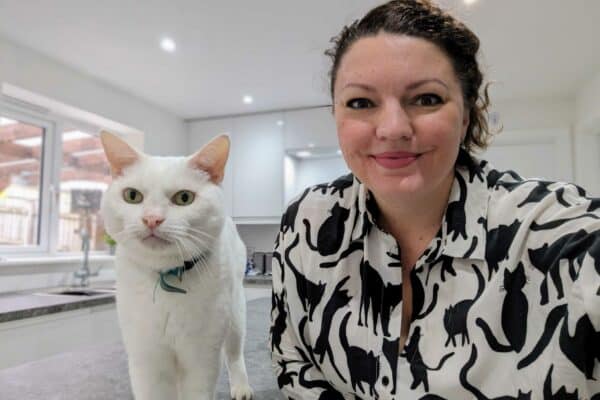
Hi, I’m Dr. Karyn! Read my introduction to learn more about me and meet my five hilarious cats: Clutch, Cyril, Alex, Zelda, and Zazzles.
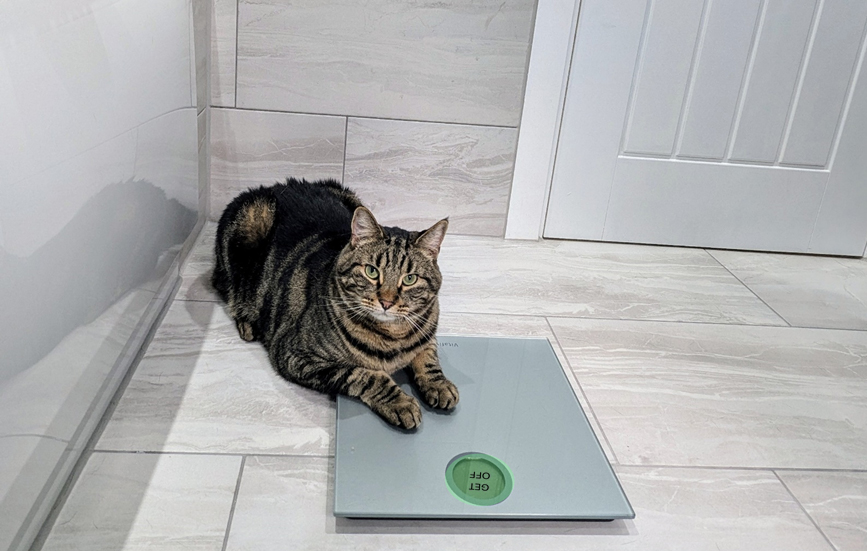
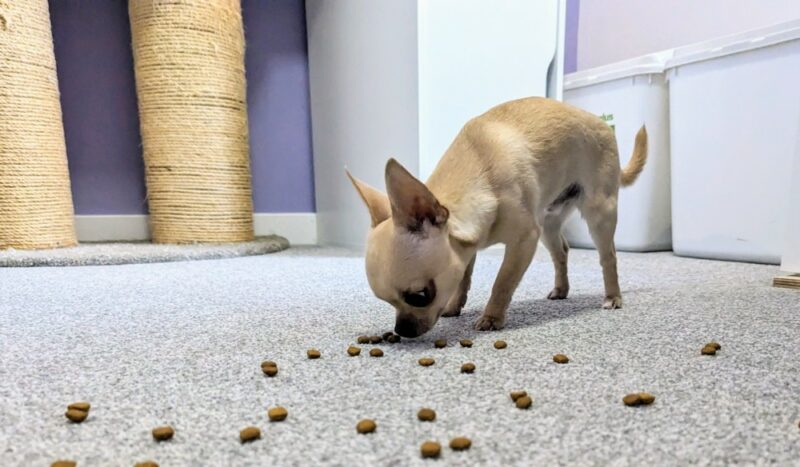
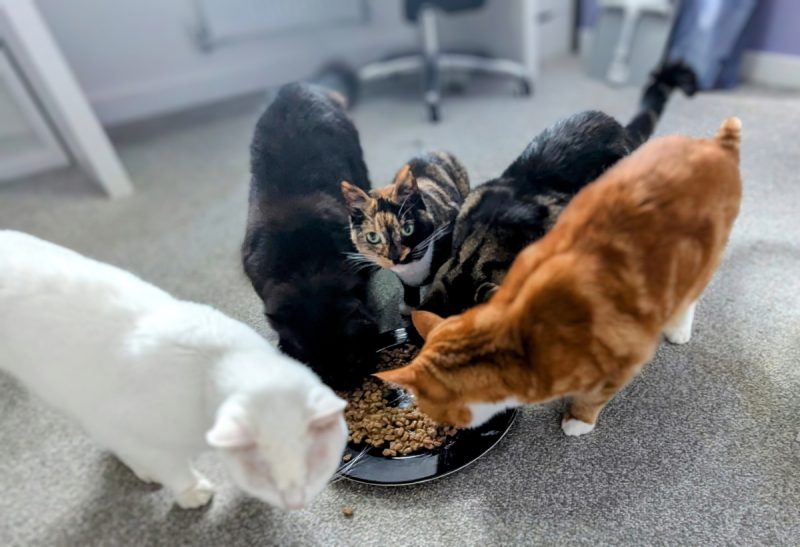
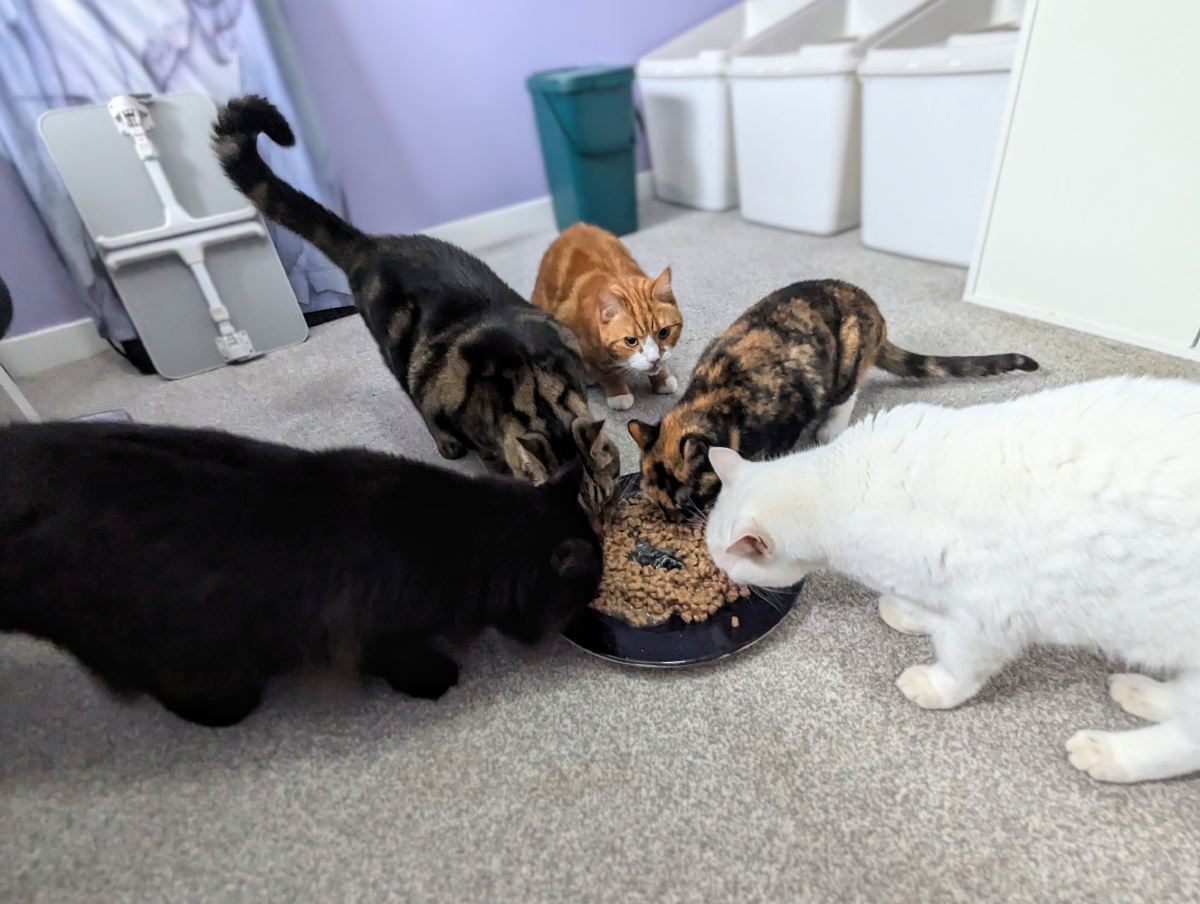
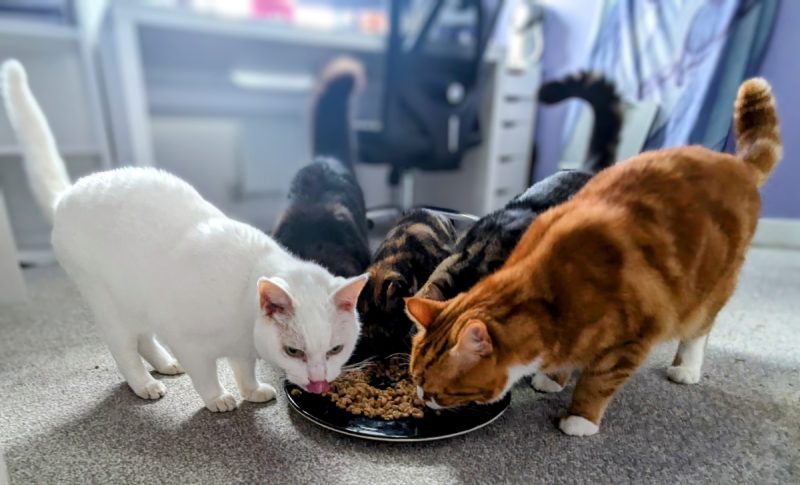
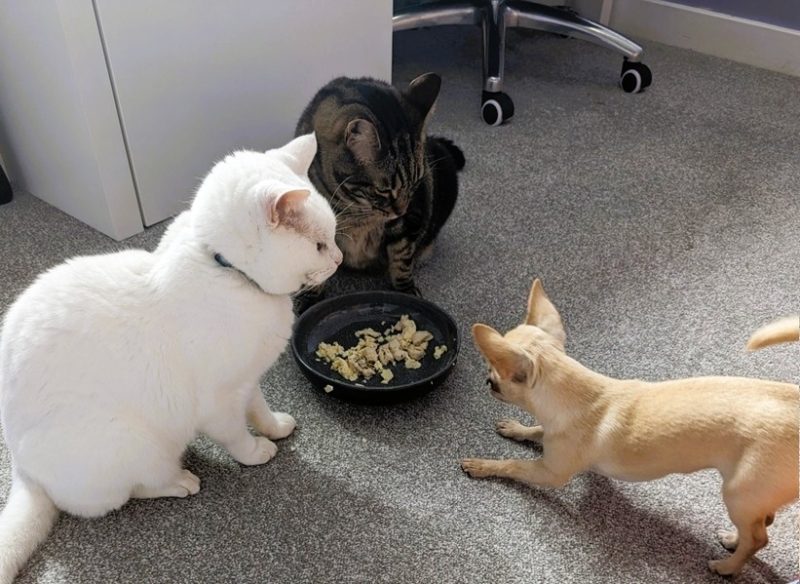
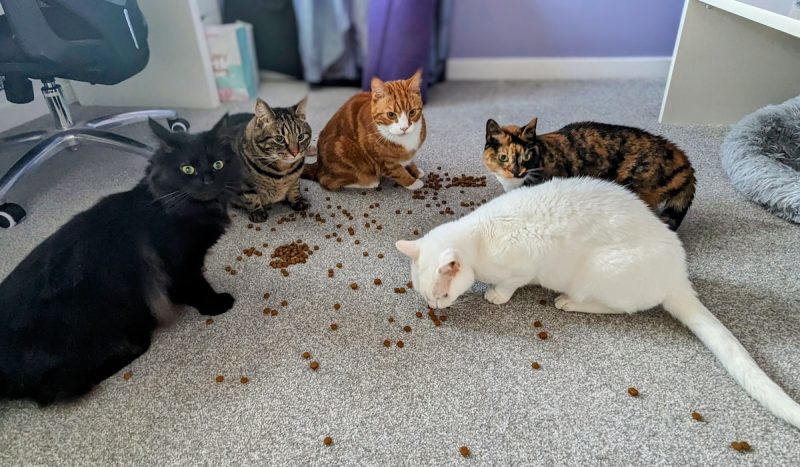
It’s been the longest 6 weeks of Cyril’s life, but we have finally made it to our first weigh-in of his weight loss journey. While I knew that Cyril must have been getting more than his fair share of the food at meal times, it has become clear just how much of a food hog he is! I never leave food down for more than half an hour because this encourages the cats to graze and subsequently eat more than they actually need to, so at the end of each meal, I allow a couple of canine helpers in to clear up any leftovers – not that there were many of those. Well, Cyril might not be too impressed with his confinement at meal times, but Ned and Fred have been delighted! Even after reducing the amount of food scattered for the other four cats, there was still quite a lot left over at the end. Unfortunately for my greedy clean-up crew, I have now adjusted the daily portions accordingly.
Ned the Chihuahua cleanup crew for scatter feeding
Clutch, Alex, Zelda and Zazzles are all in good condition, have not lost any weight, and have not been begging for food, which tells me that they are all eating exactly what they need, while Cyril had been eating whatever he could get his paws on.
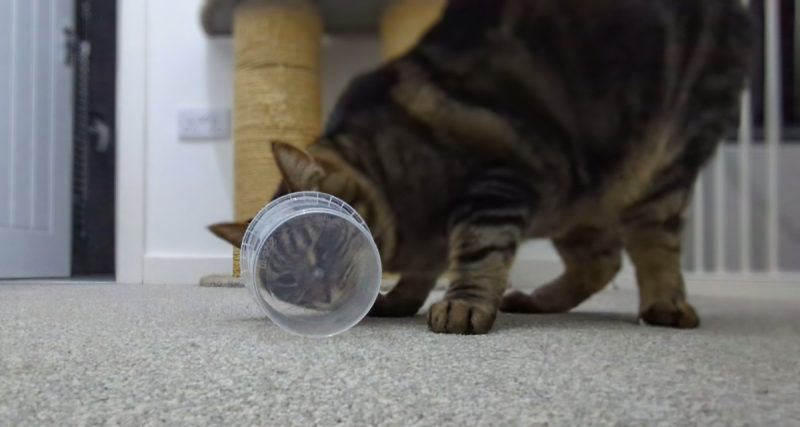
Leaving no empty container unchecked
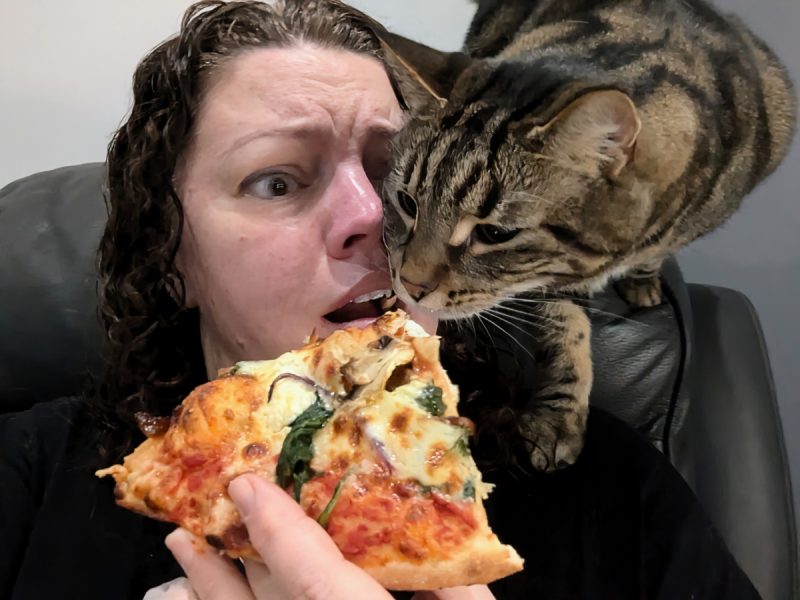
For the past 6 weeks, Cyril has been shut in a separate room for breakfast and dinner until the rest of the cats have finished eating. Most days, he has been quite good at accepting his change in circumstances, but there have been plenty of times when the temptation of food has caused him to abandon any sense of self-control or respect. This has been particularly evident on nights when we have indulged in one of our (and Cyril’s) favorite treats: pizza.
It’s not been all smooth sailing
At the start of this journey, Cyril weighed in at 6.6kg (14 1⁄2 lbs), with a Body Condition Score (BCS) hovering around 7-8. Being a large-framed feline, he should ideally weigh between 4.5kg and 5kg (10-11 lbs), but this is a long-term target. In the first 6 weeks, I would ideally hope to see a loss of approximately 10% of his body weight.
And now, the moment we have all been waiting for…
Cyril now weighs 5.95kg (13 lbs)! That’s a loss of 650g, or 9.8% of his original weight!
I have to admit, I was not feeling all that confident before getting him on the scales, but despite trying to steal food and hunt pizza, he has (almost) hit his target! I am thrilled with how much he has lost, but we’ve still got a long way to go.
Now, how do I tell him that the diet continues…?
This article is a part of Dr. Karyn’s series with her five hilarious cats.
The post Catster Photo Contest: Cats of the Week Winners (Feb 20, 2025) by Catster Editorial Team appeared first on Catster. Copying over entire articles infringes on copyright laws. You may not be aware of it, but all of these articles were assigned, contracted and paid for, so they aren’t considered public domain. However, we appreciate that you like the article and would love it if you continued sharing just the first paragraph of an article, then linking out to the rest of the piece on Catster.com.
Hercules is a unique cat as he can watch Birds and Squirrels by standing on his hind legs and positioning himself to pounce (at the TV). He is a big ham and always flipping over for a belly rub. He plays hard and makes sure he gets a lot of attention. He is loved at TICA and waiting for championship. He will beg for treats and has big gold eyes that just are intriguing. He is little by mighty
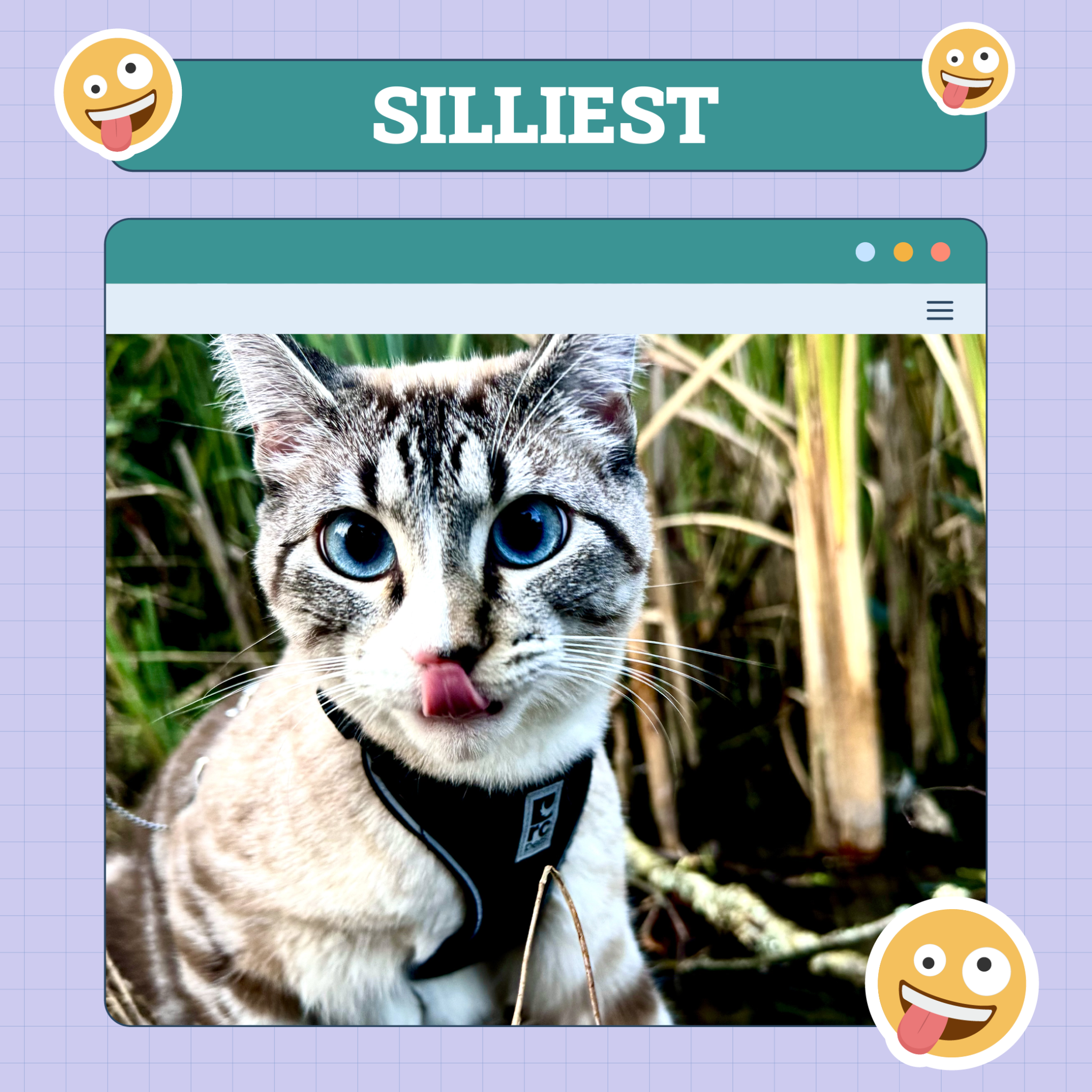
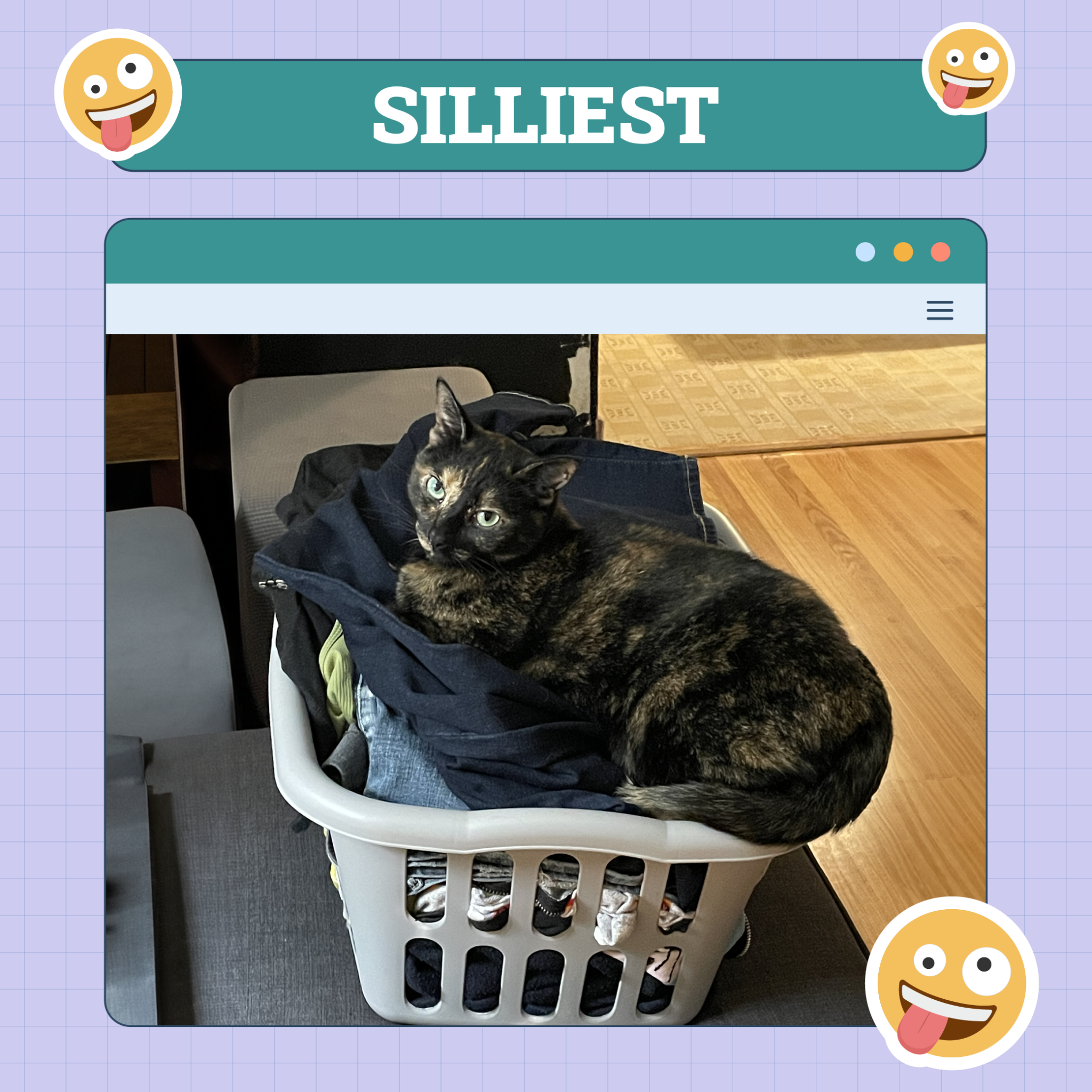
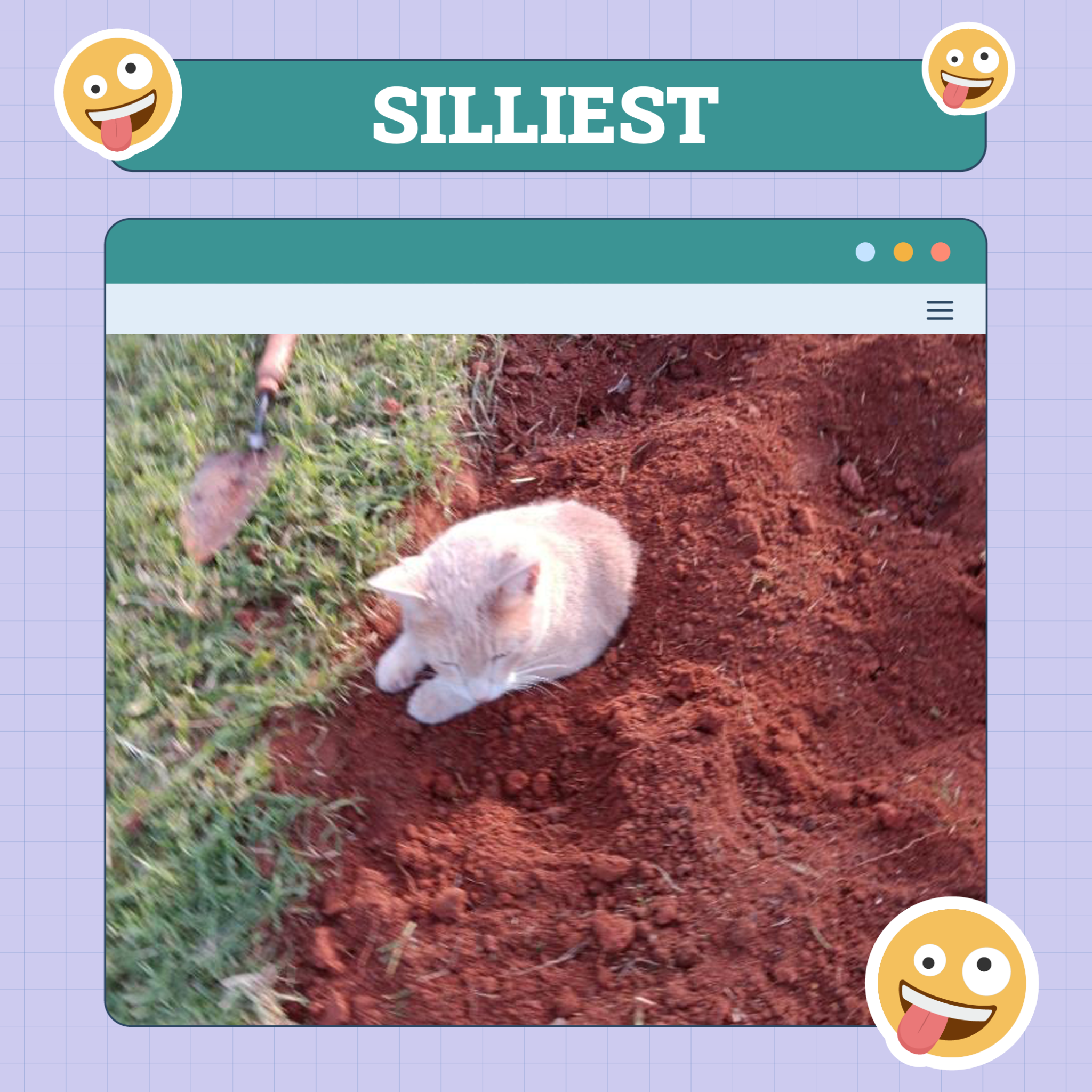
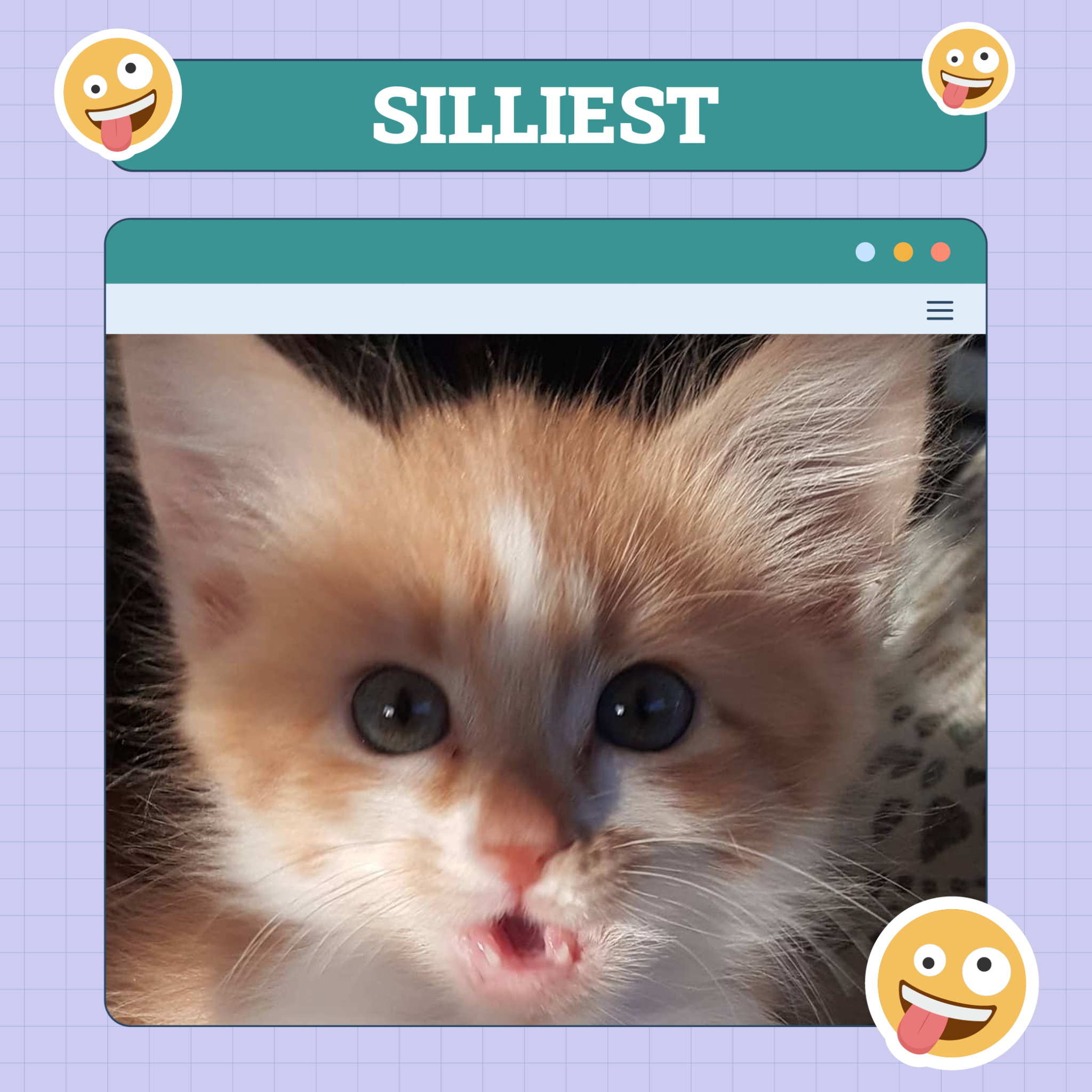
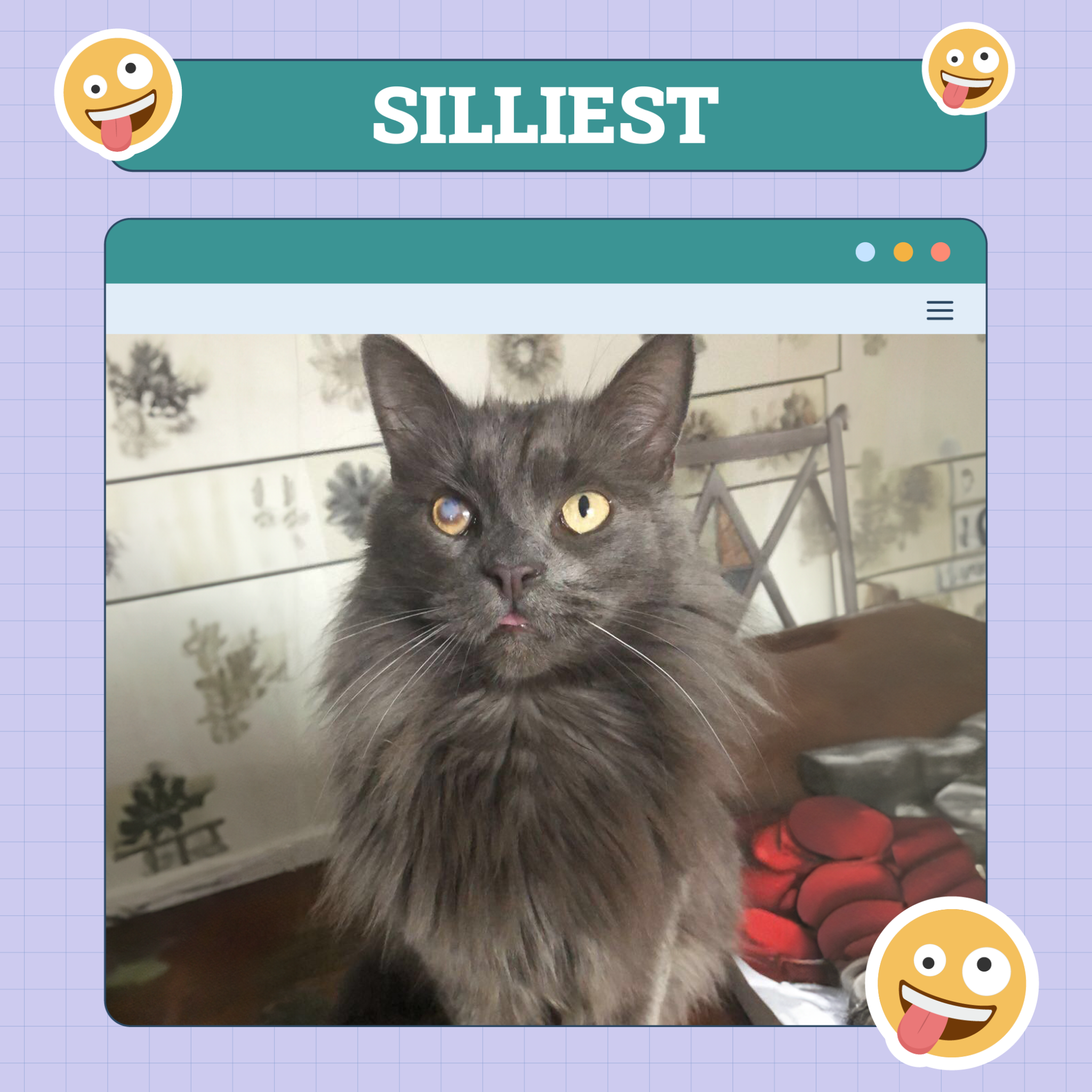
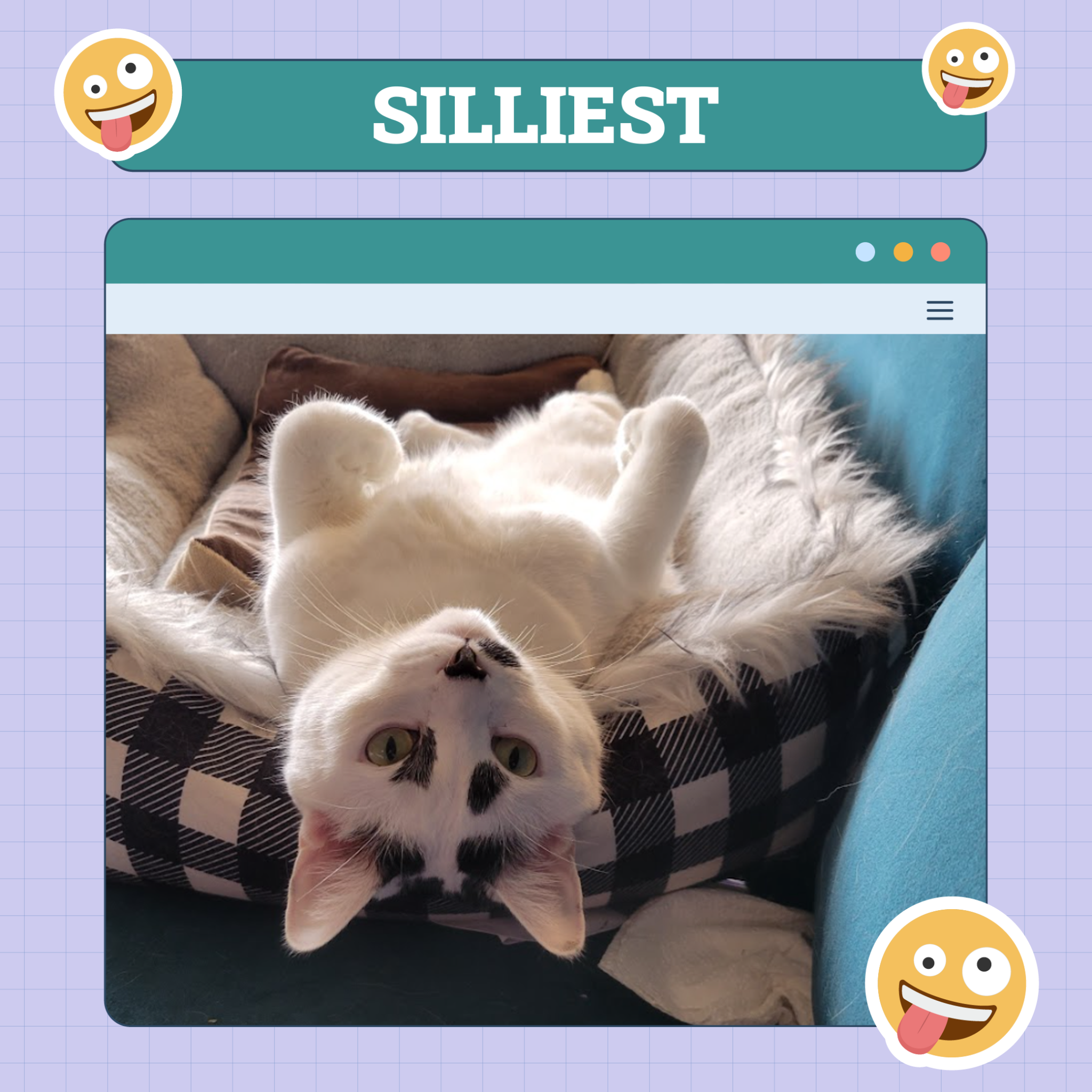
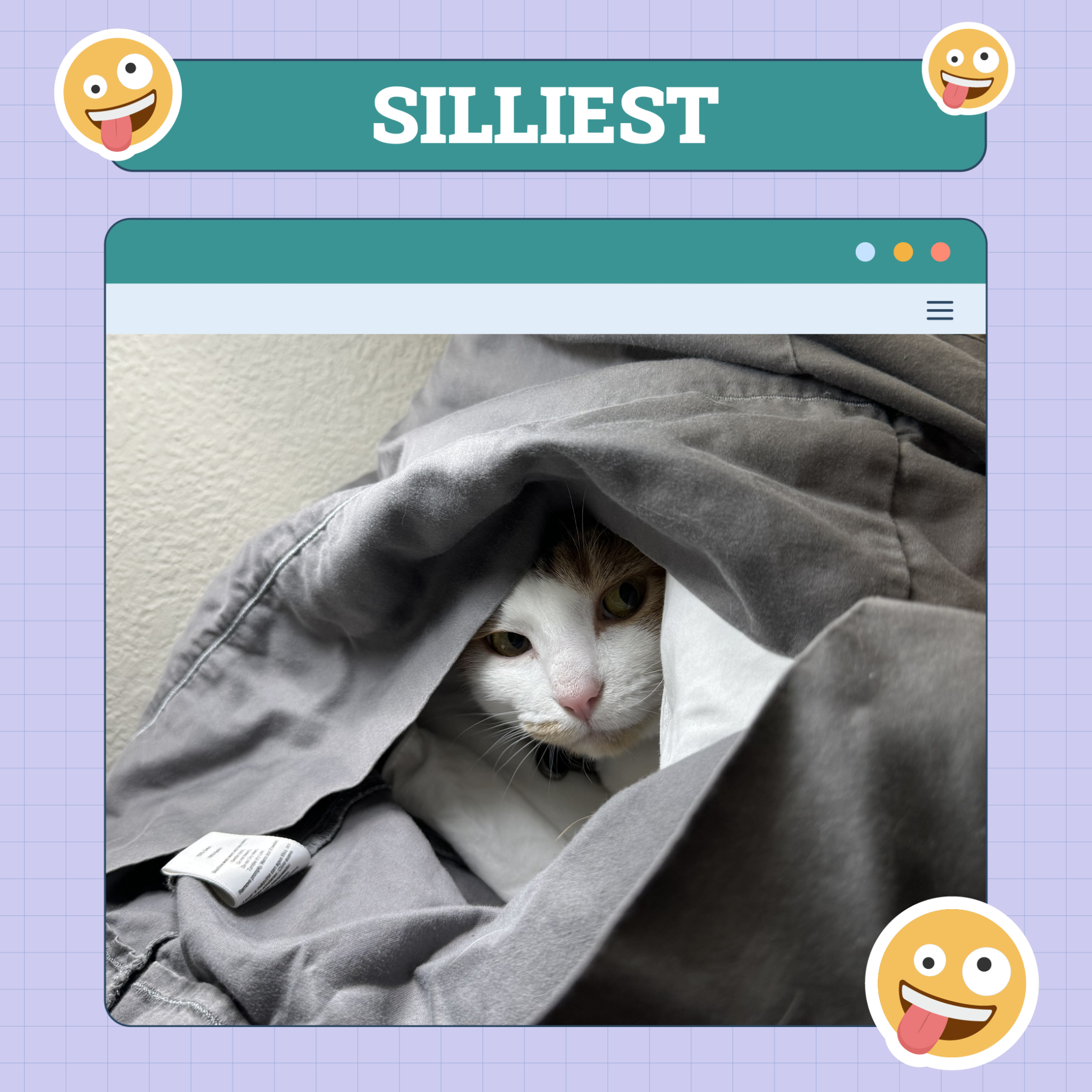
Silliest
Name:
Yue
Breed:
Bangle tabby
Fun Fact:
Miss yue is my adventure kitty she goes camping and likes to take long walks on the river
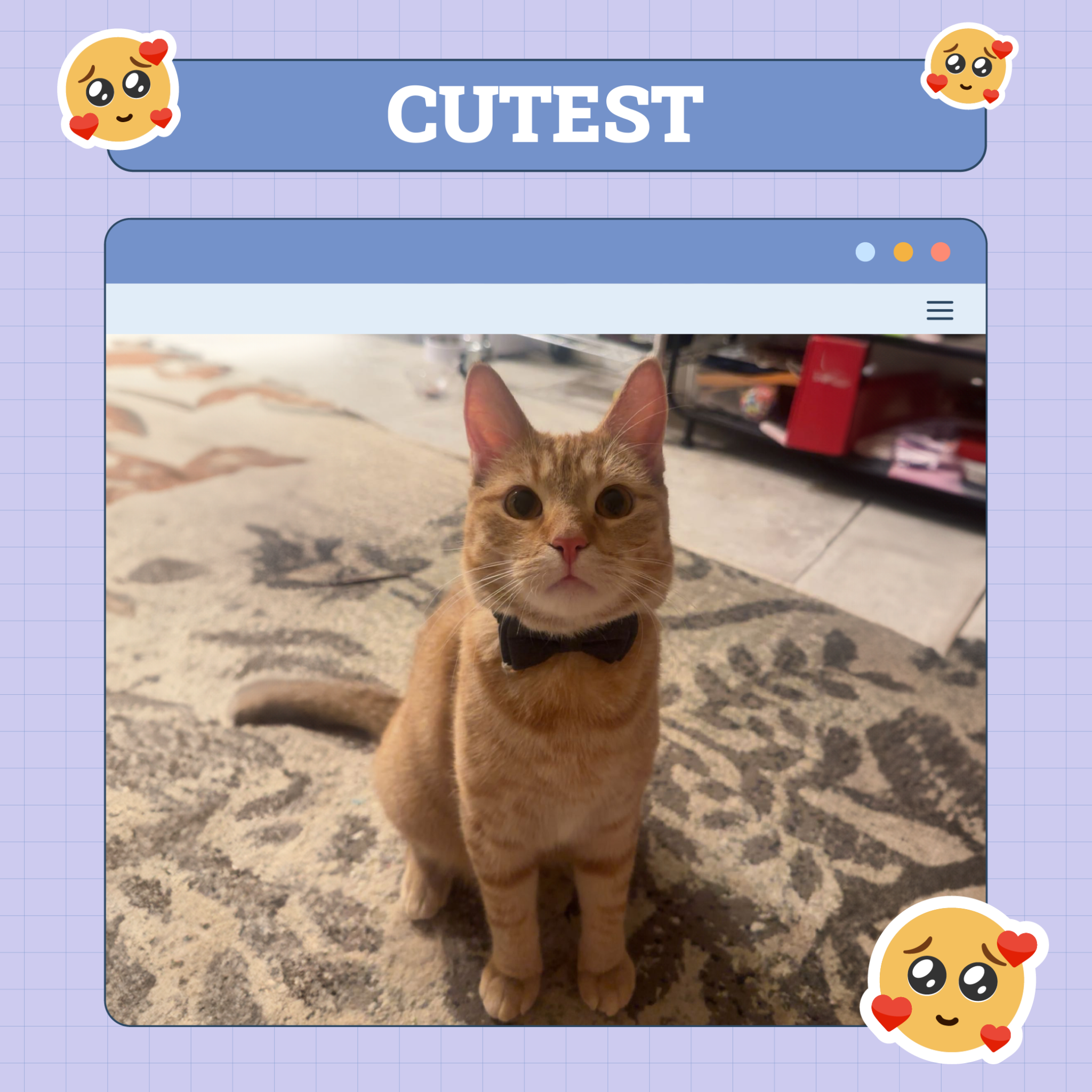
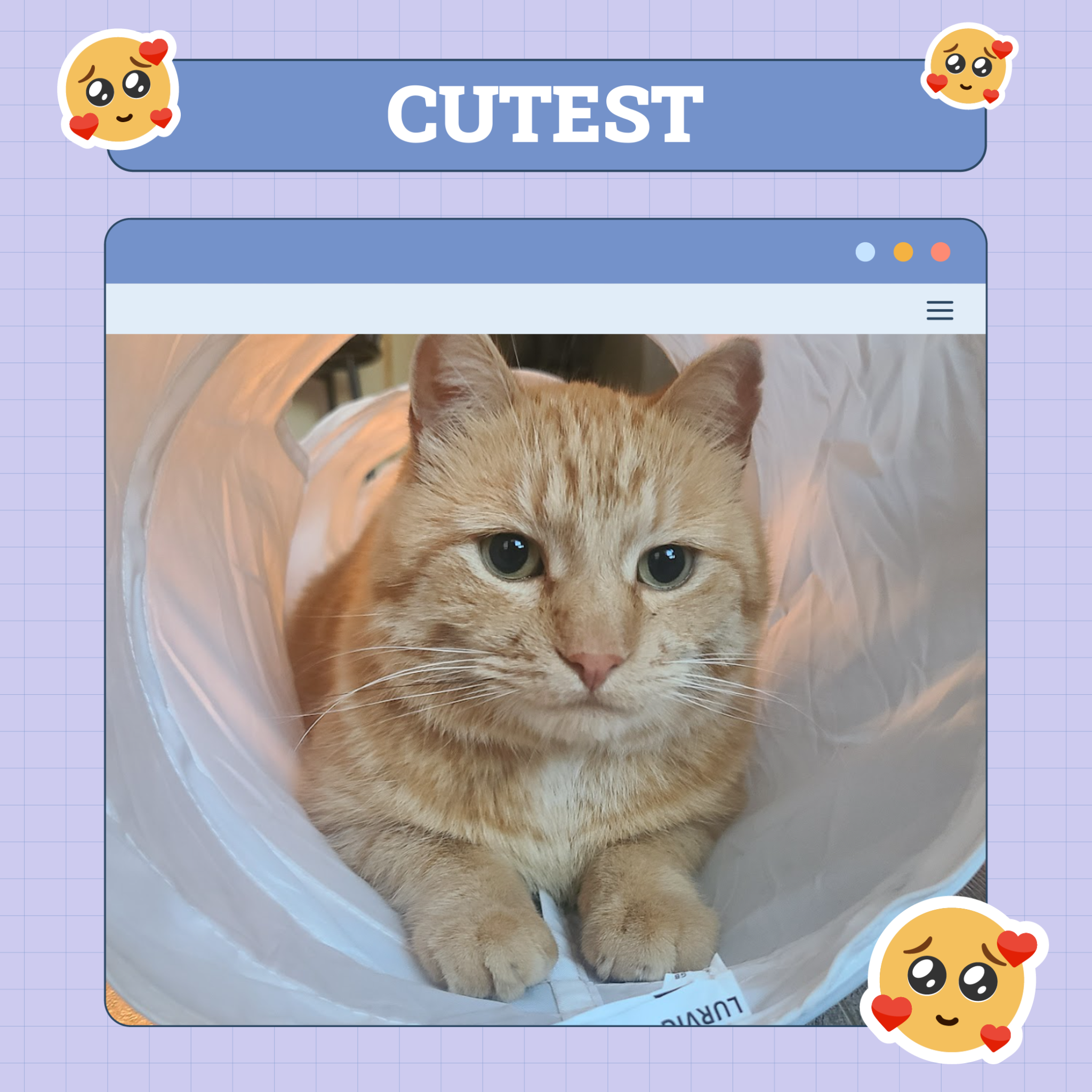
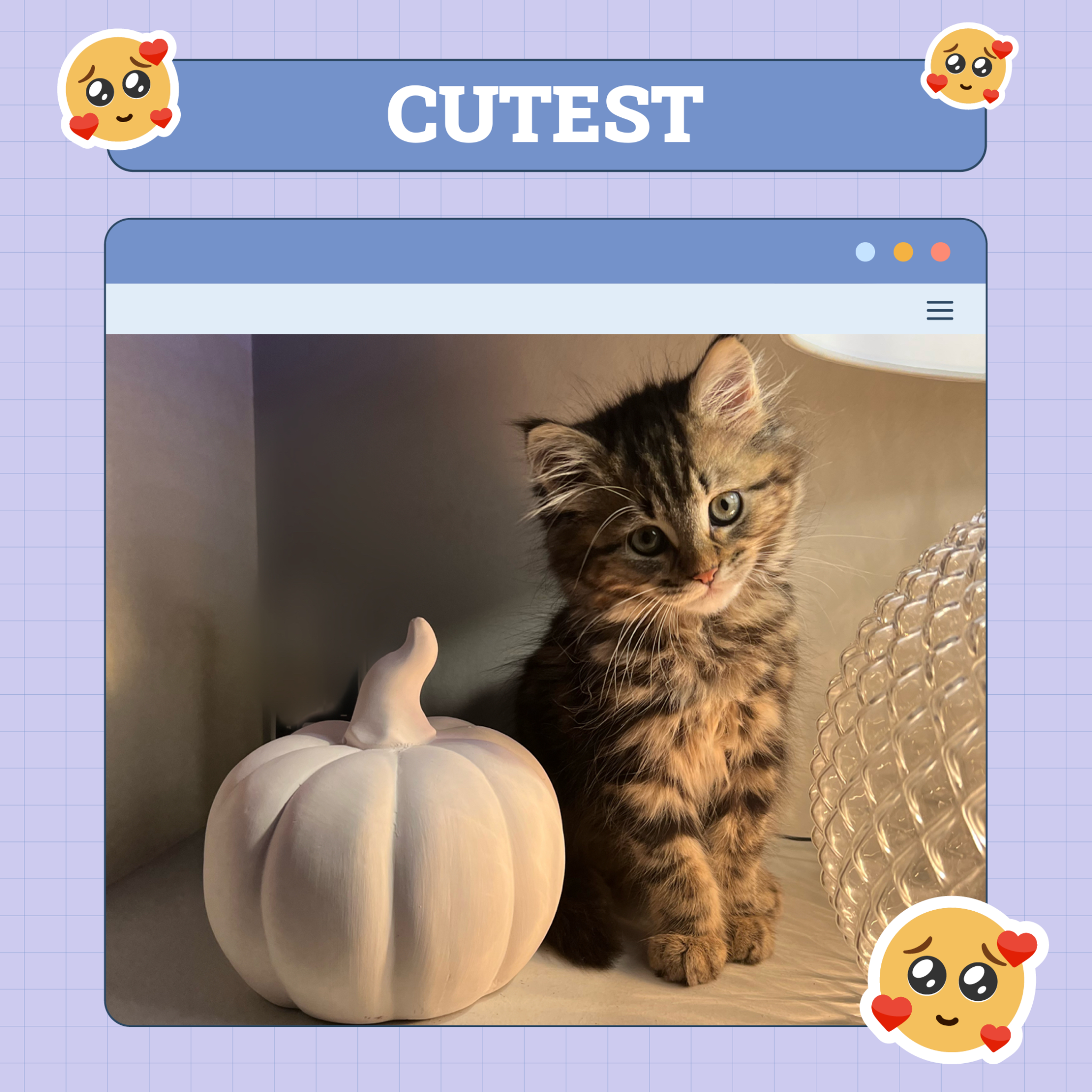
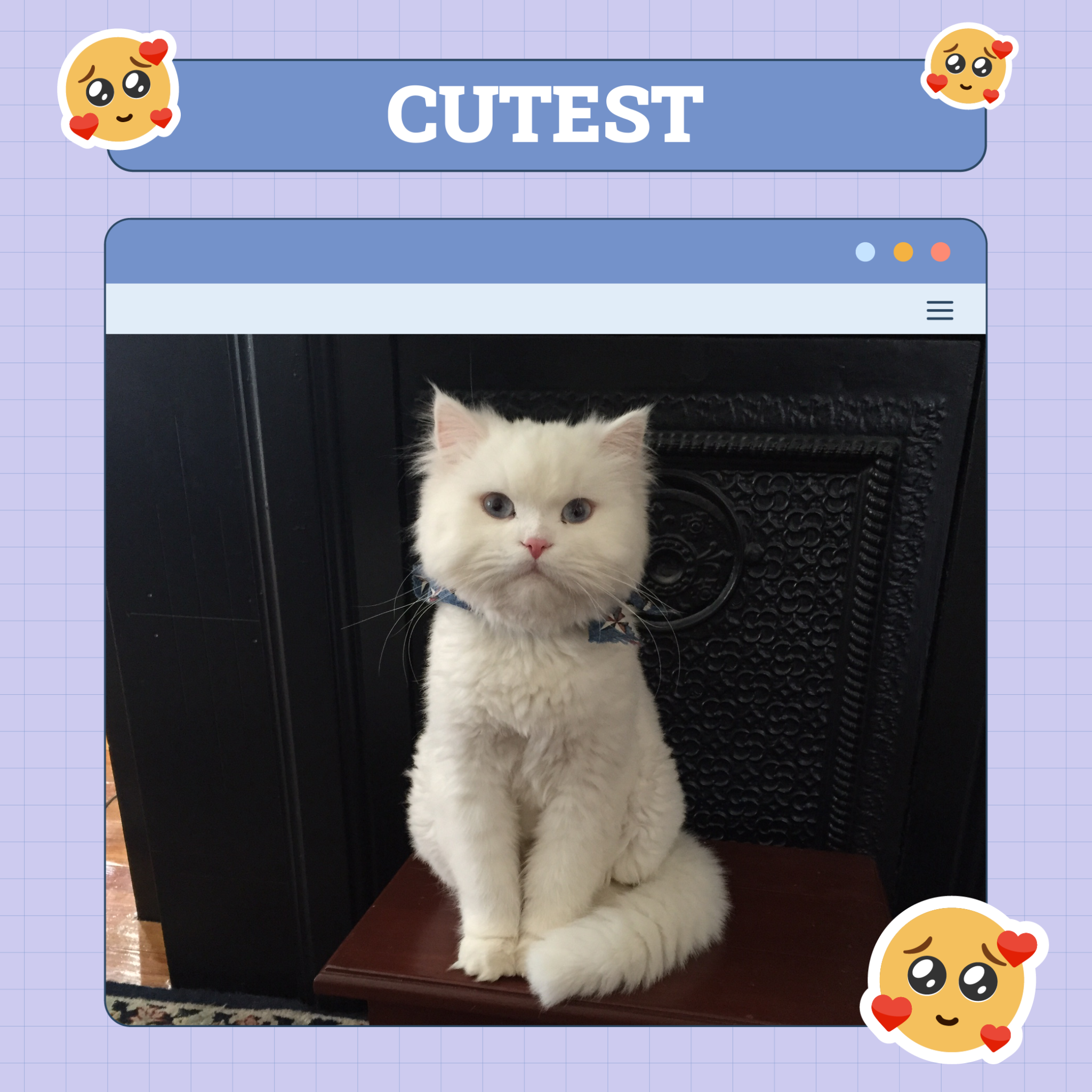
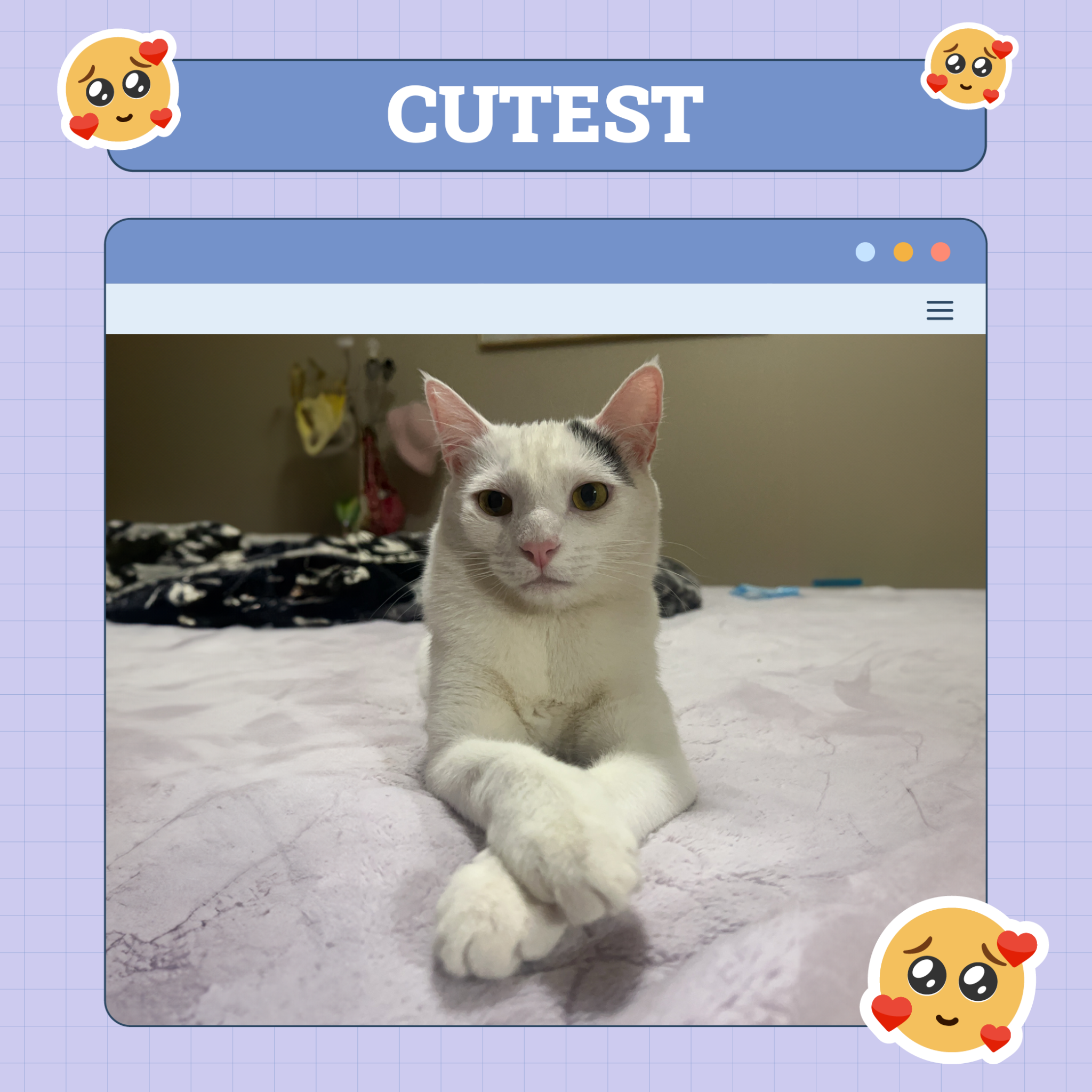
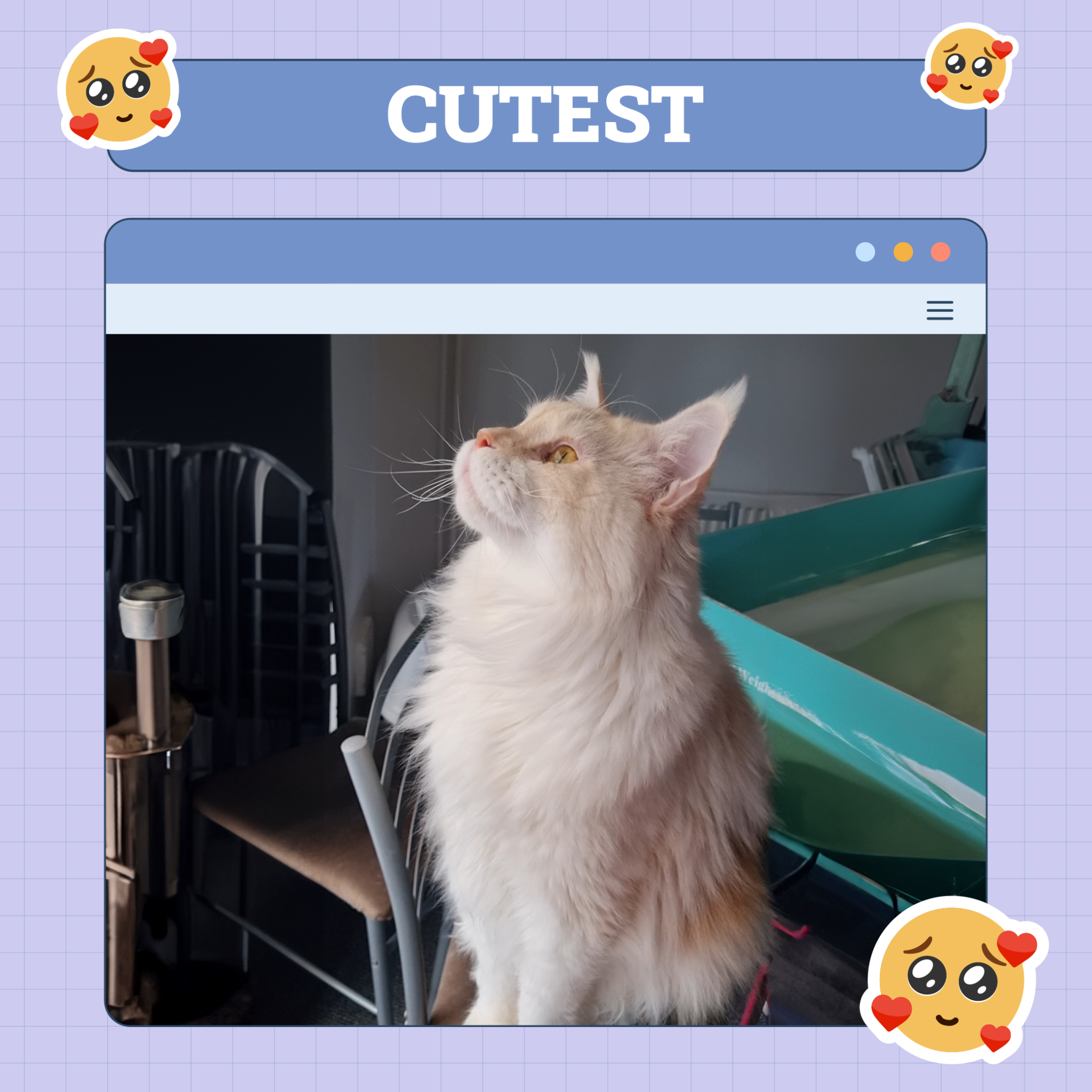
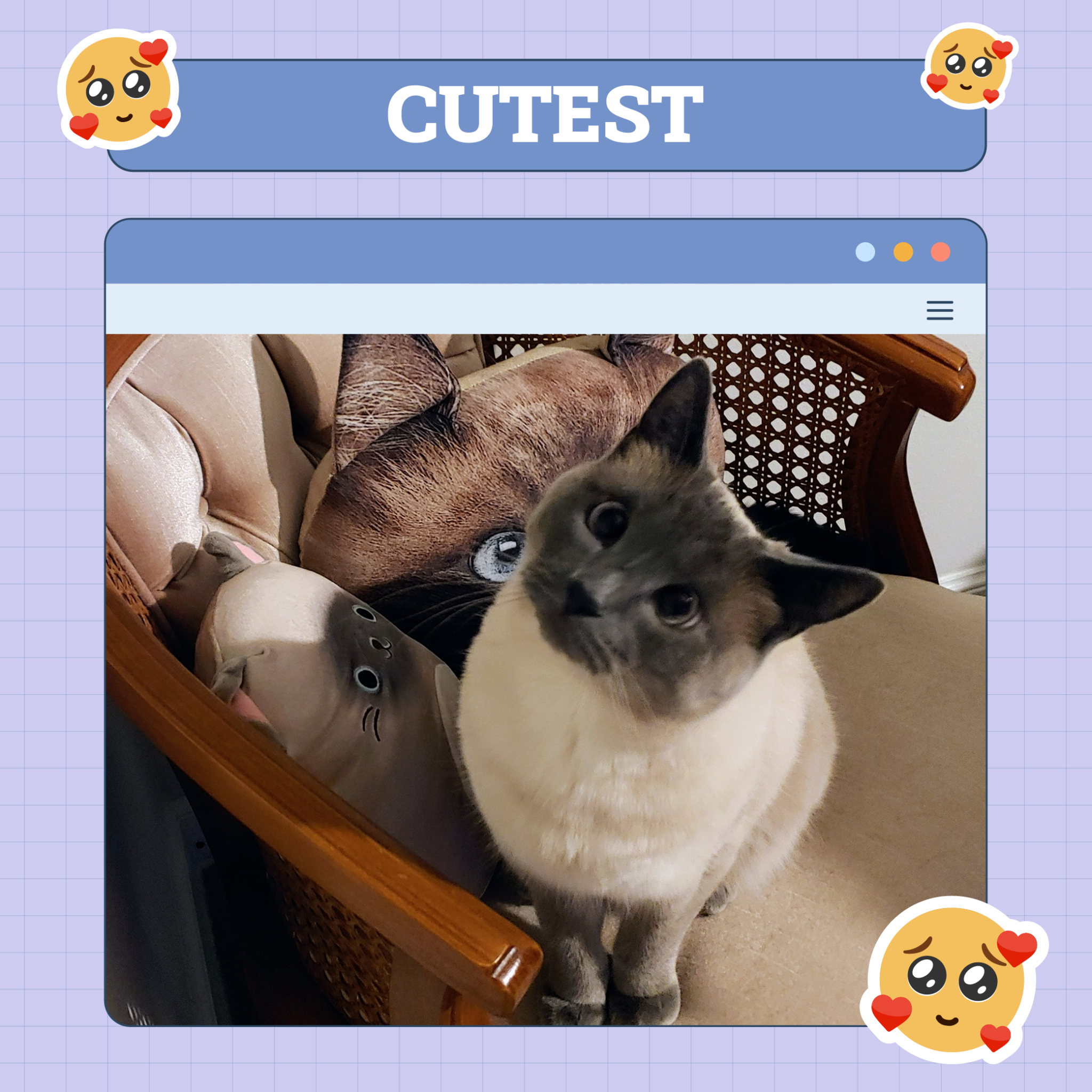
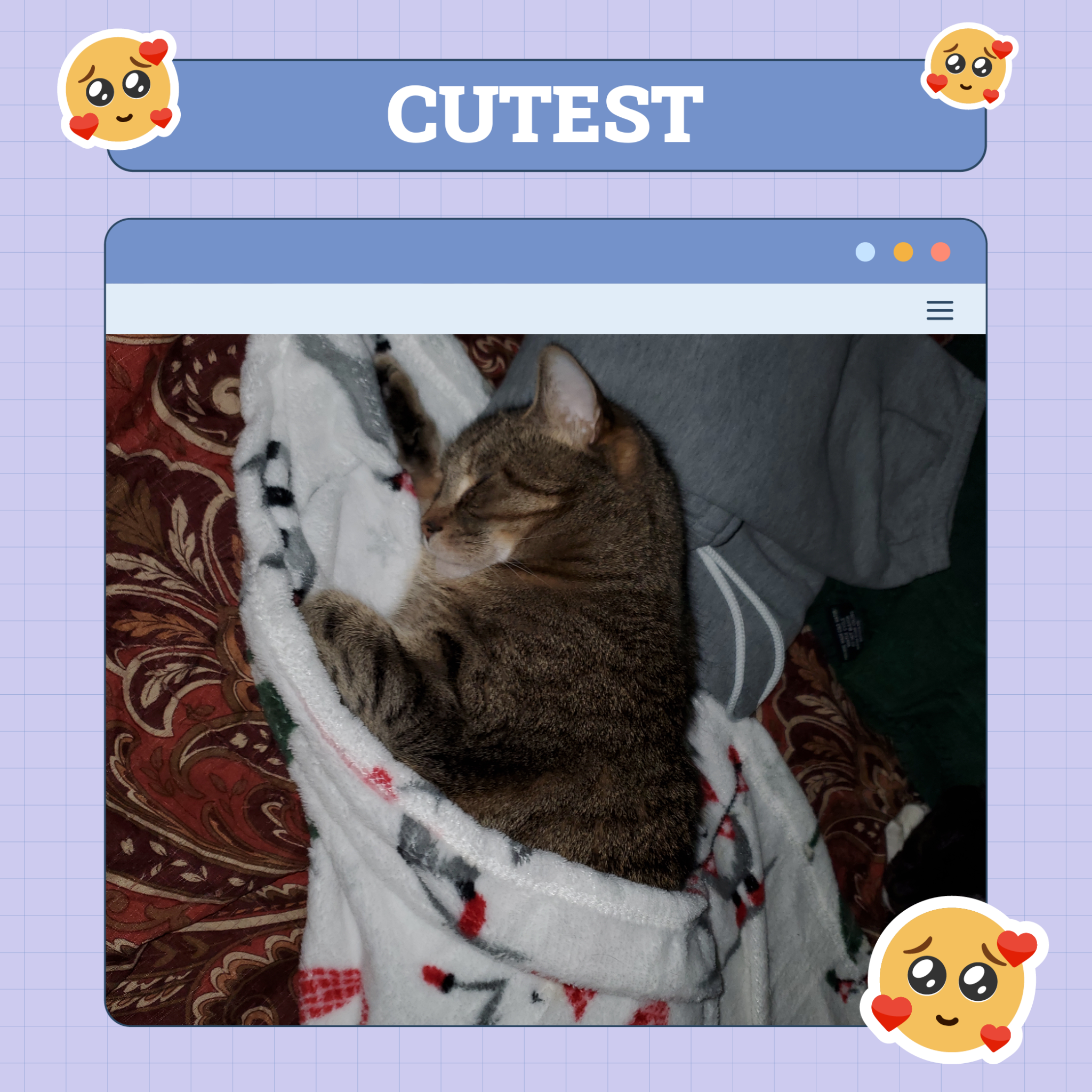
Cutest
Name:
Tortellini
Breed:
Domestic Shorthair
Facts:
He absolutely loves cuddling and being held like a baby. He’s a catnip addict and a huge chatterbox! In the photo submitted he is showing off his little bow tie and looking like a dapper young gentleman.
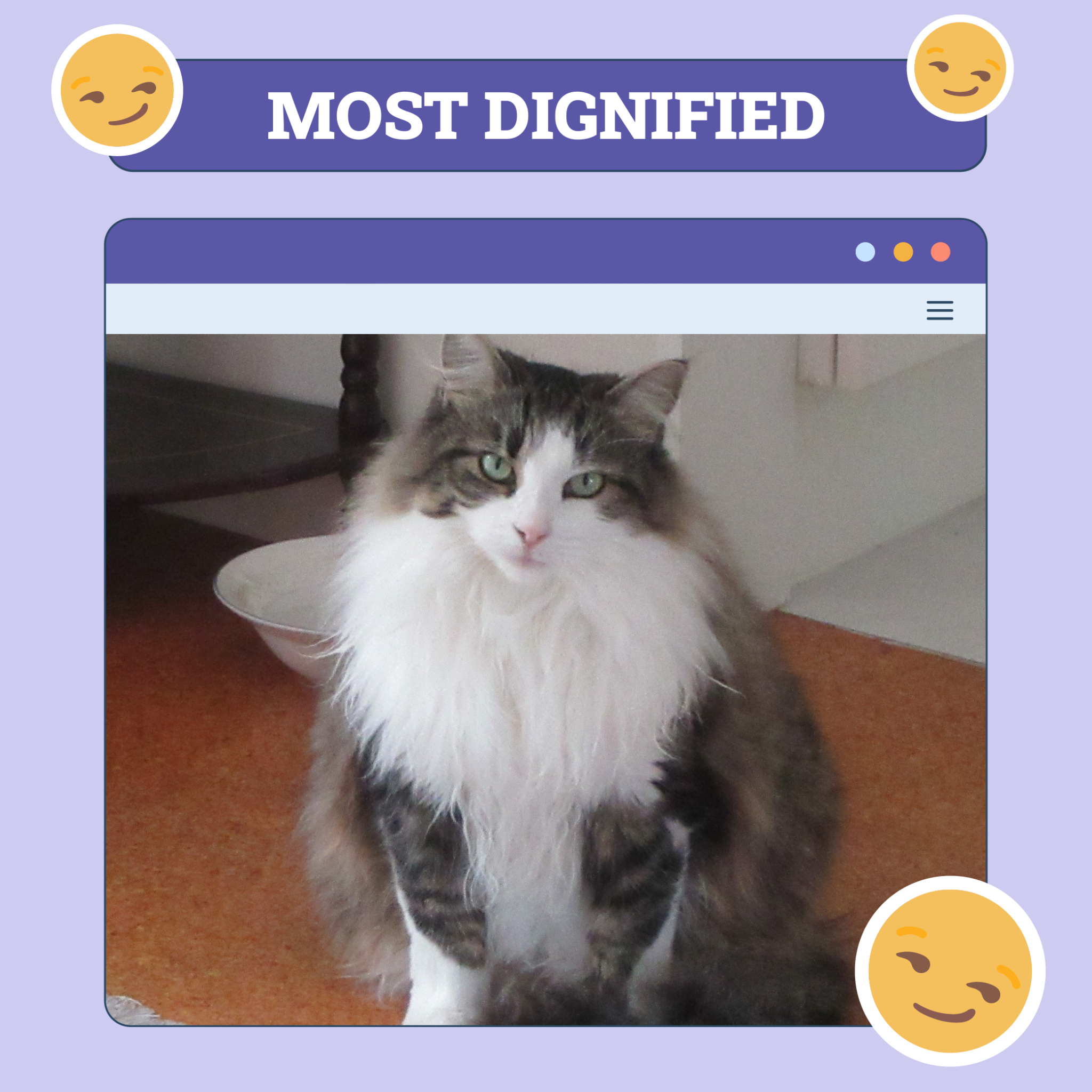
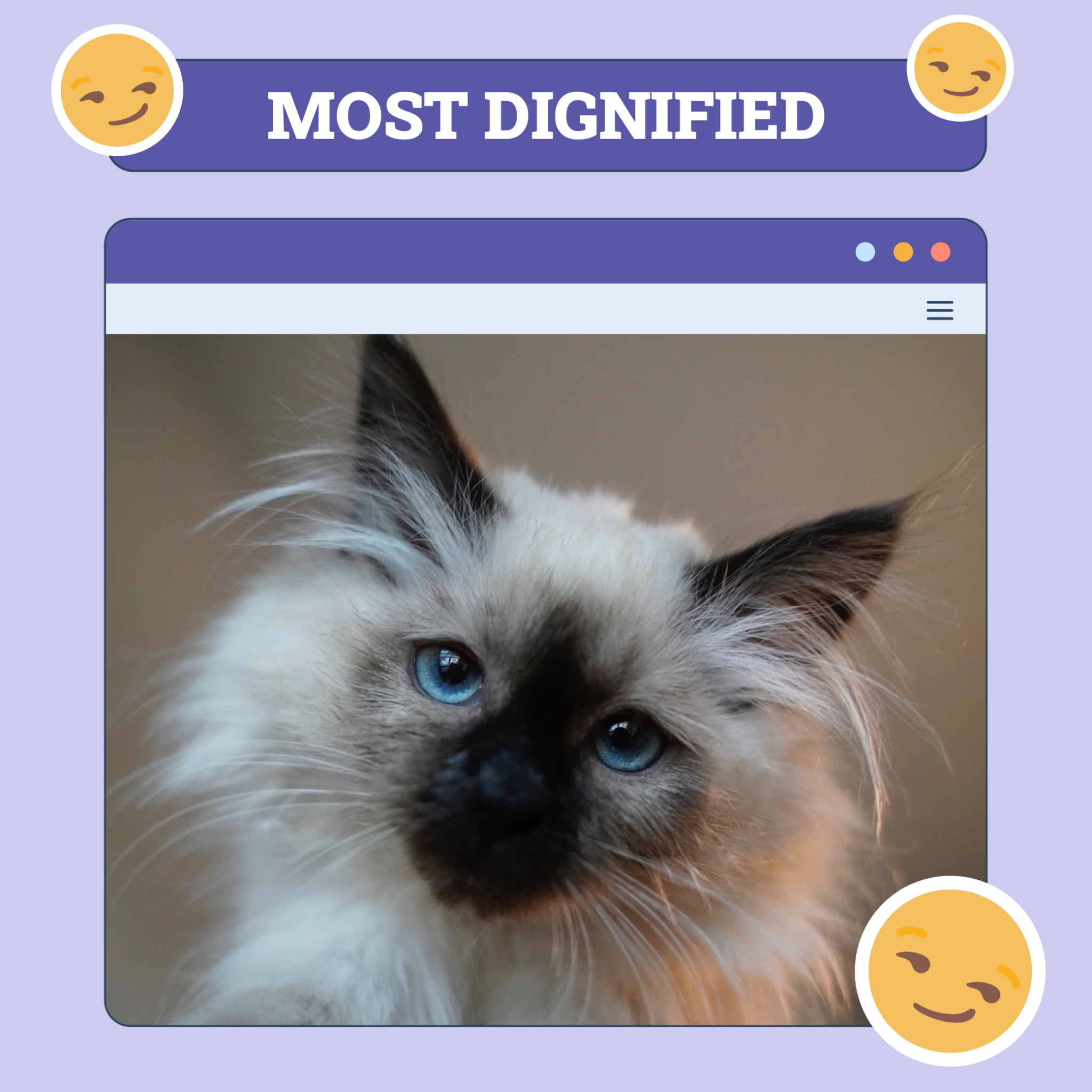
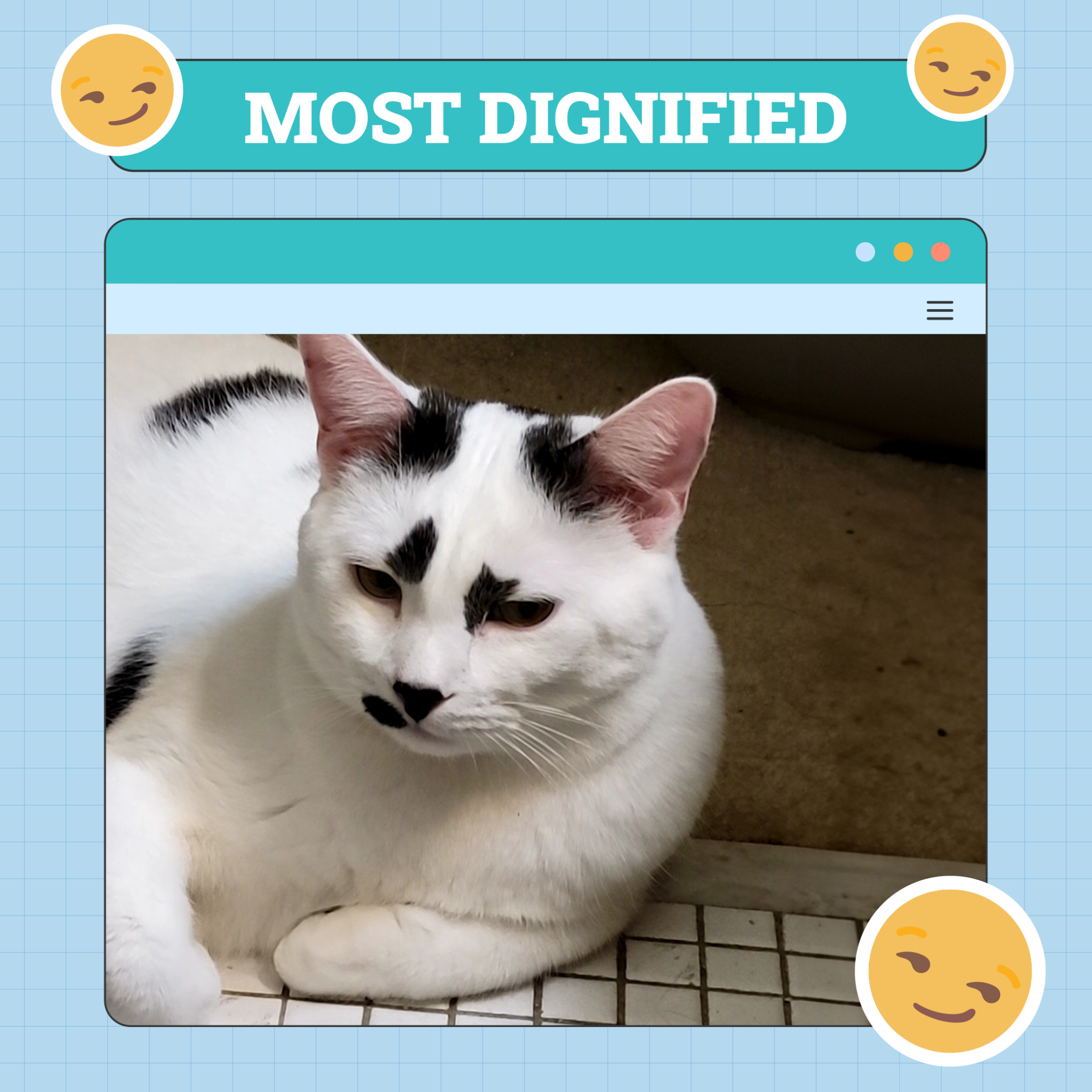
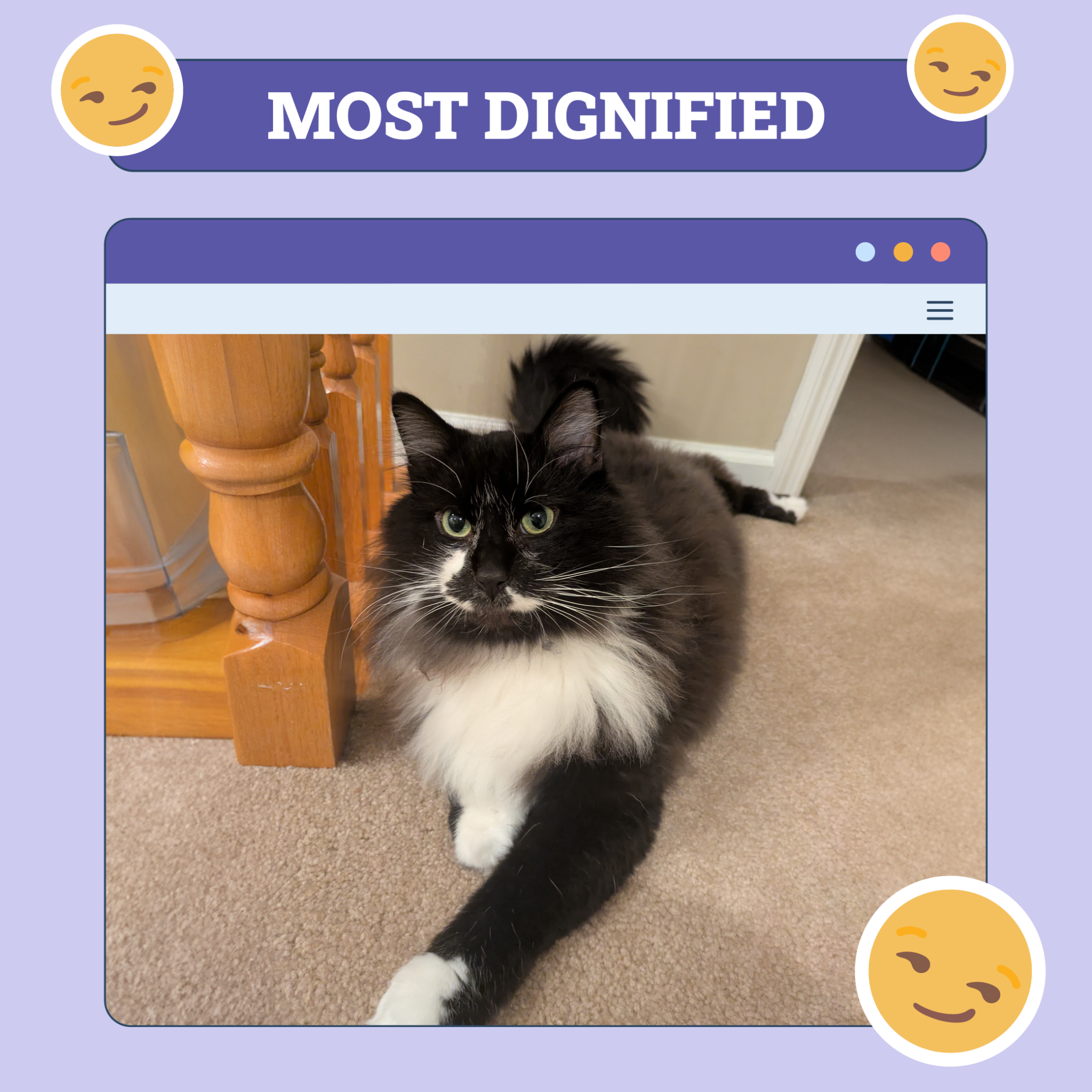
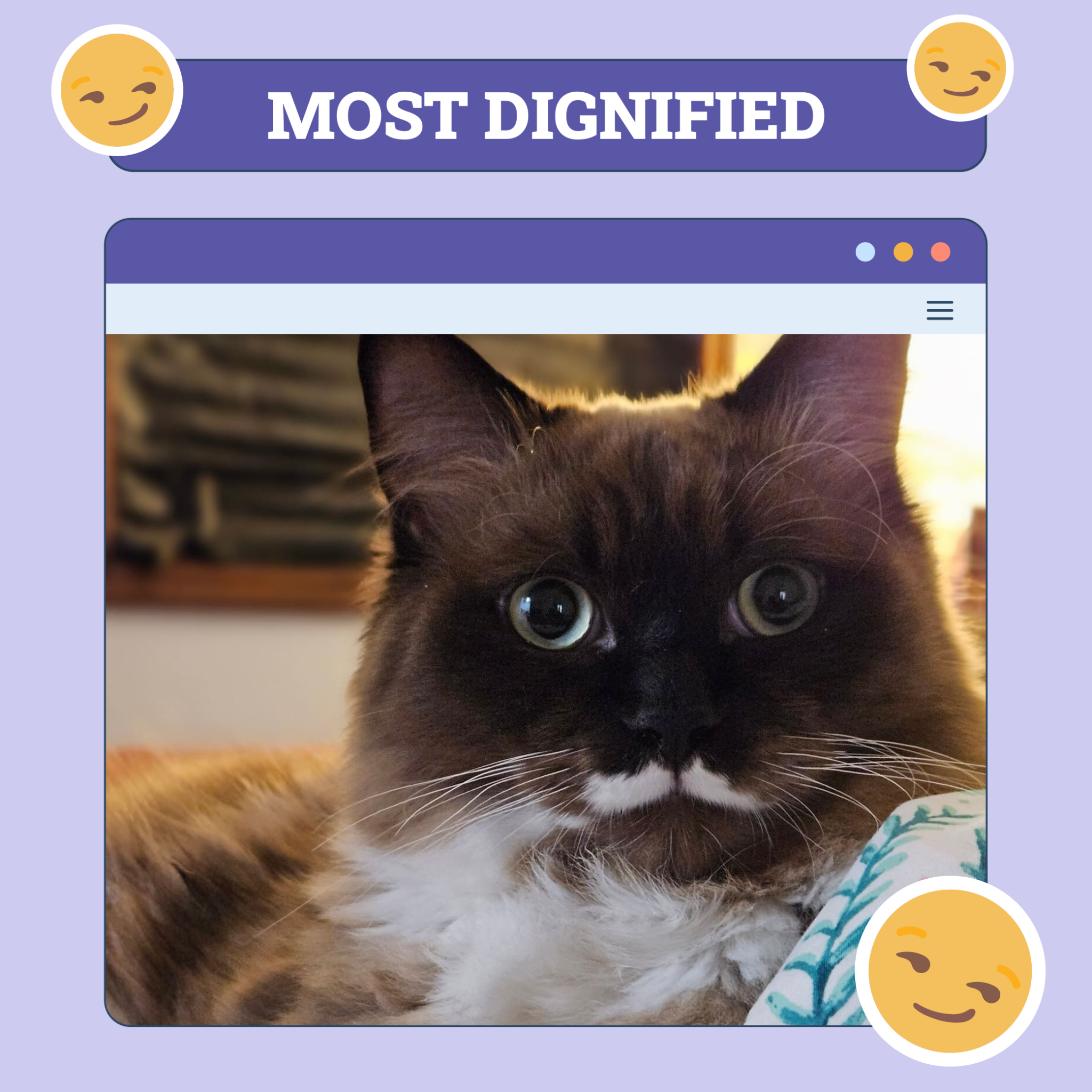
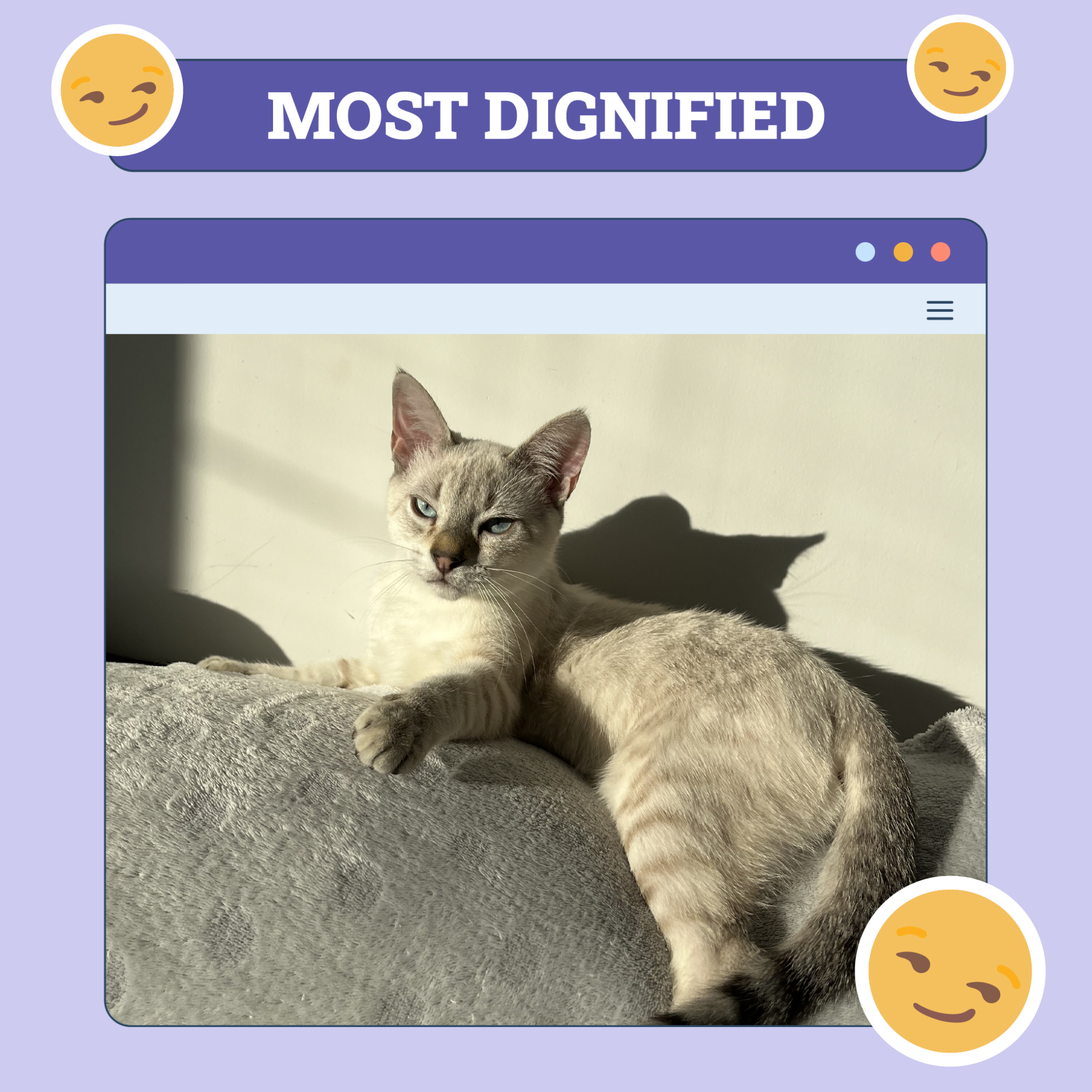
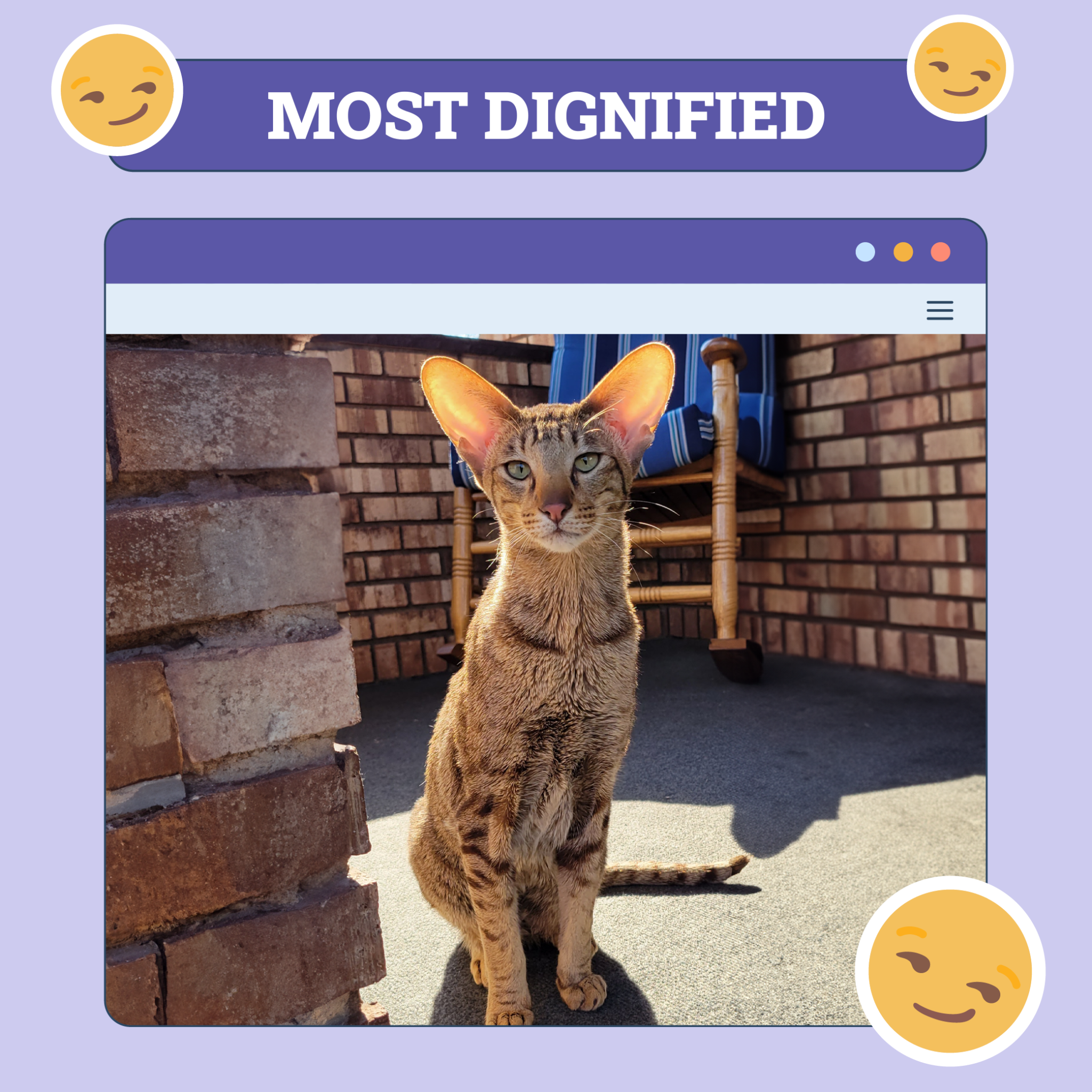
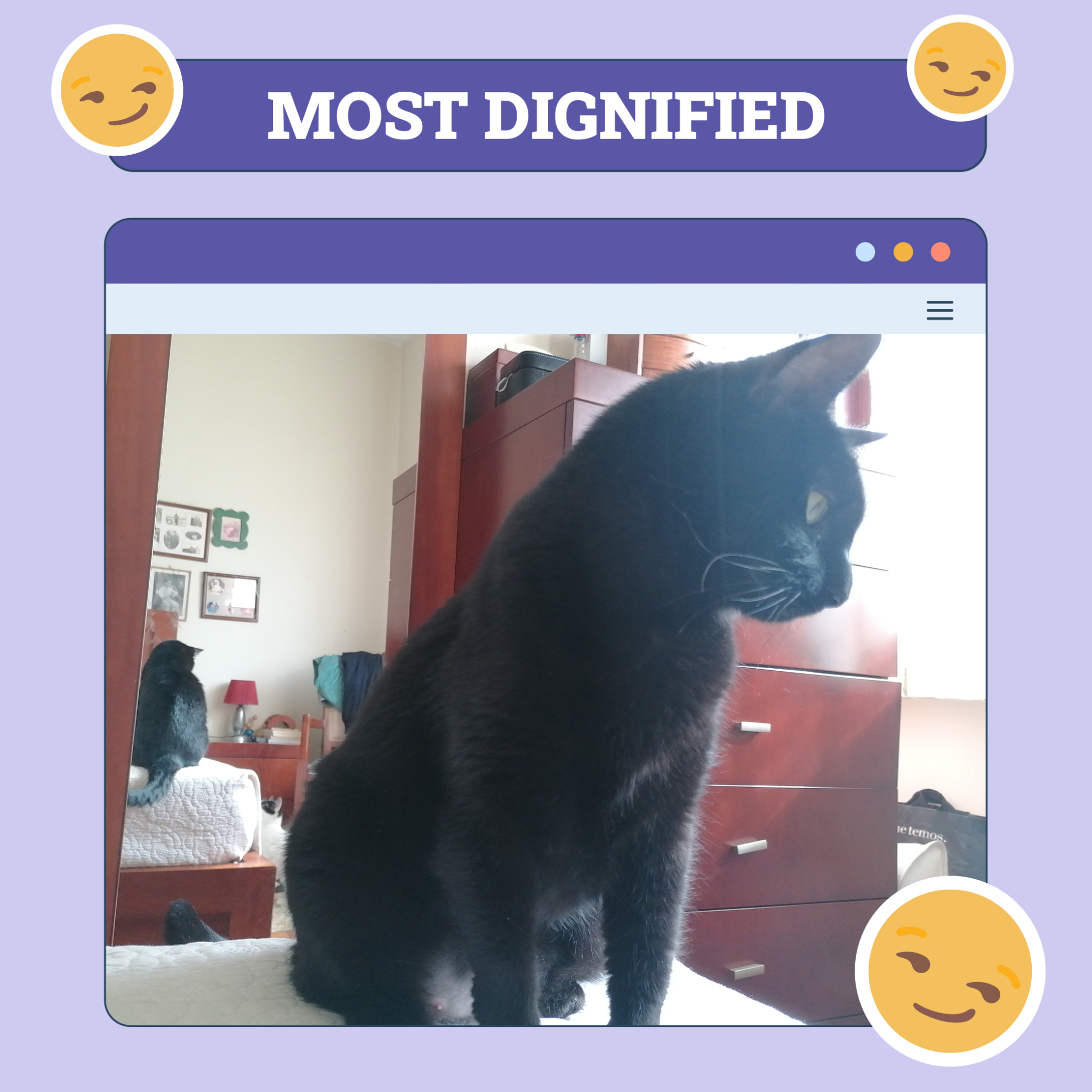
Most Dignified
Name:
Talulah
Breed:
Maine coon
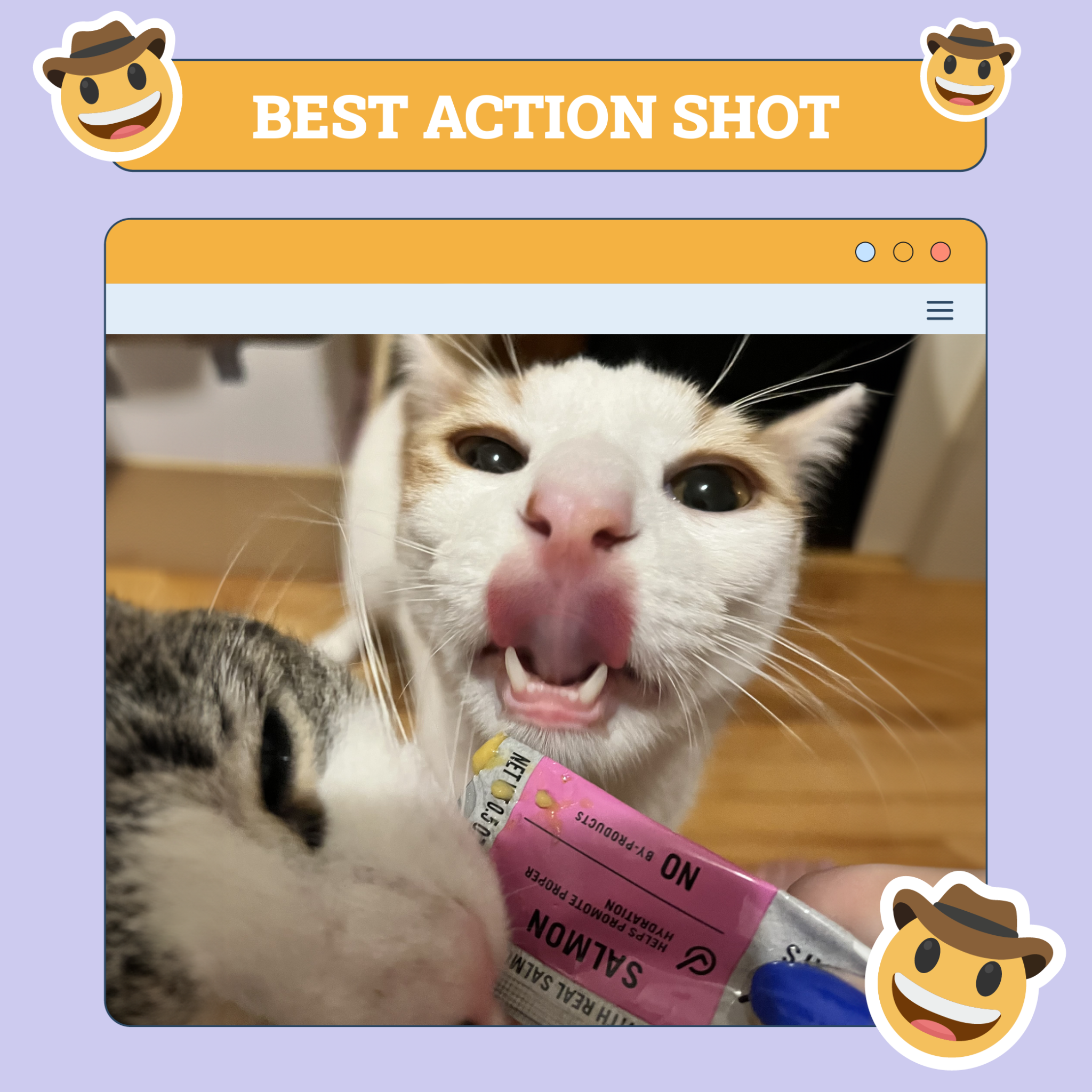
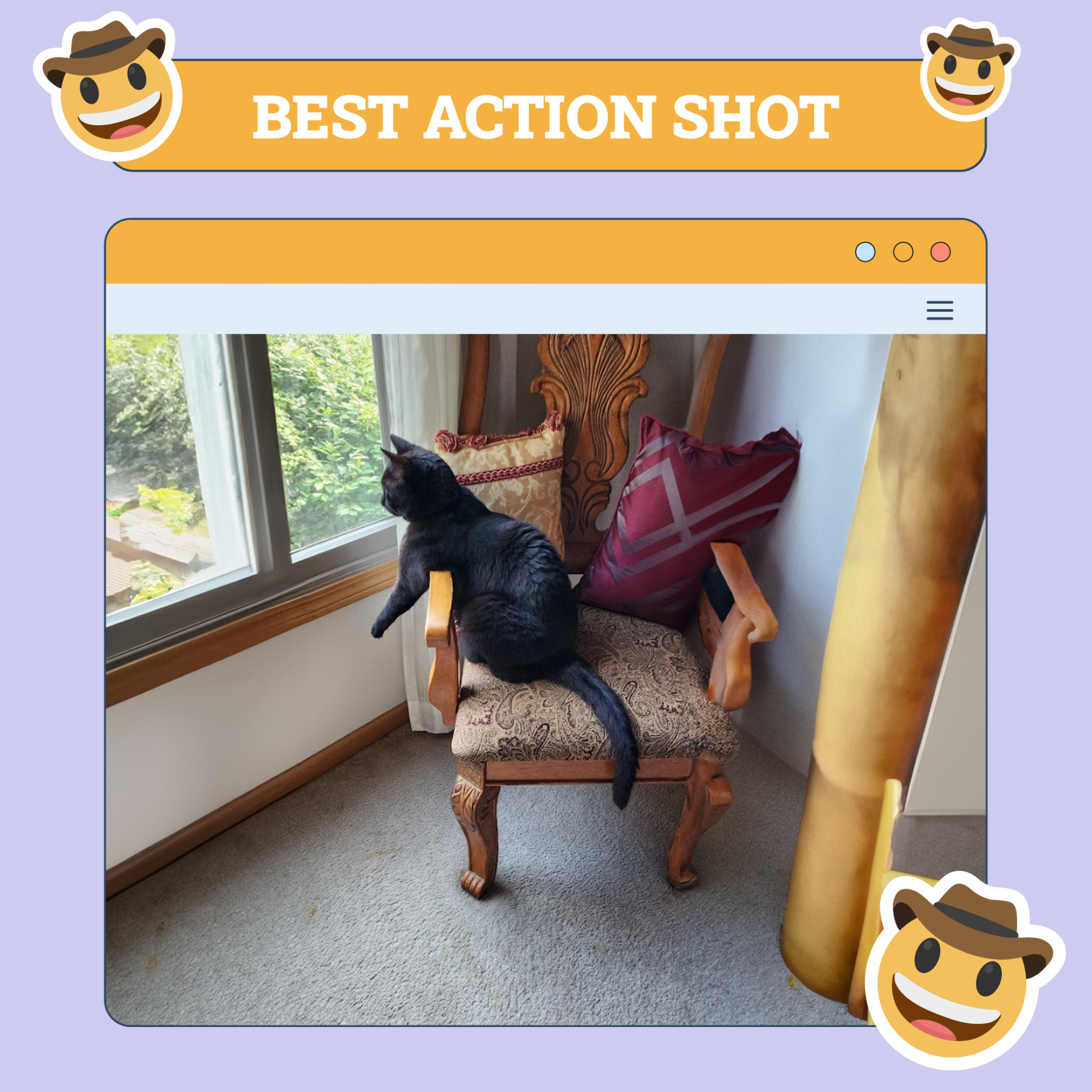
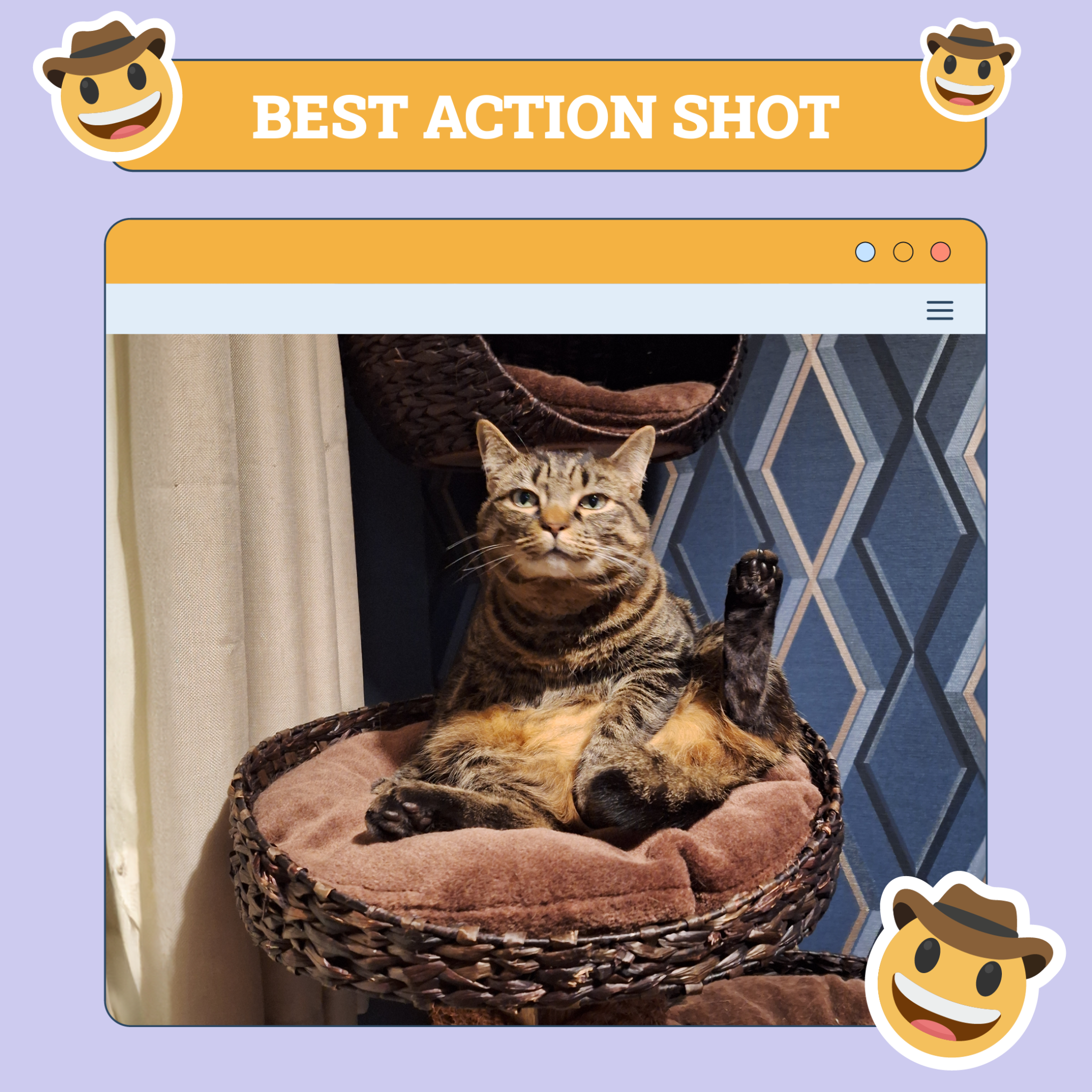
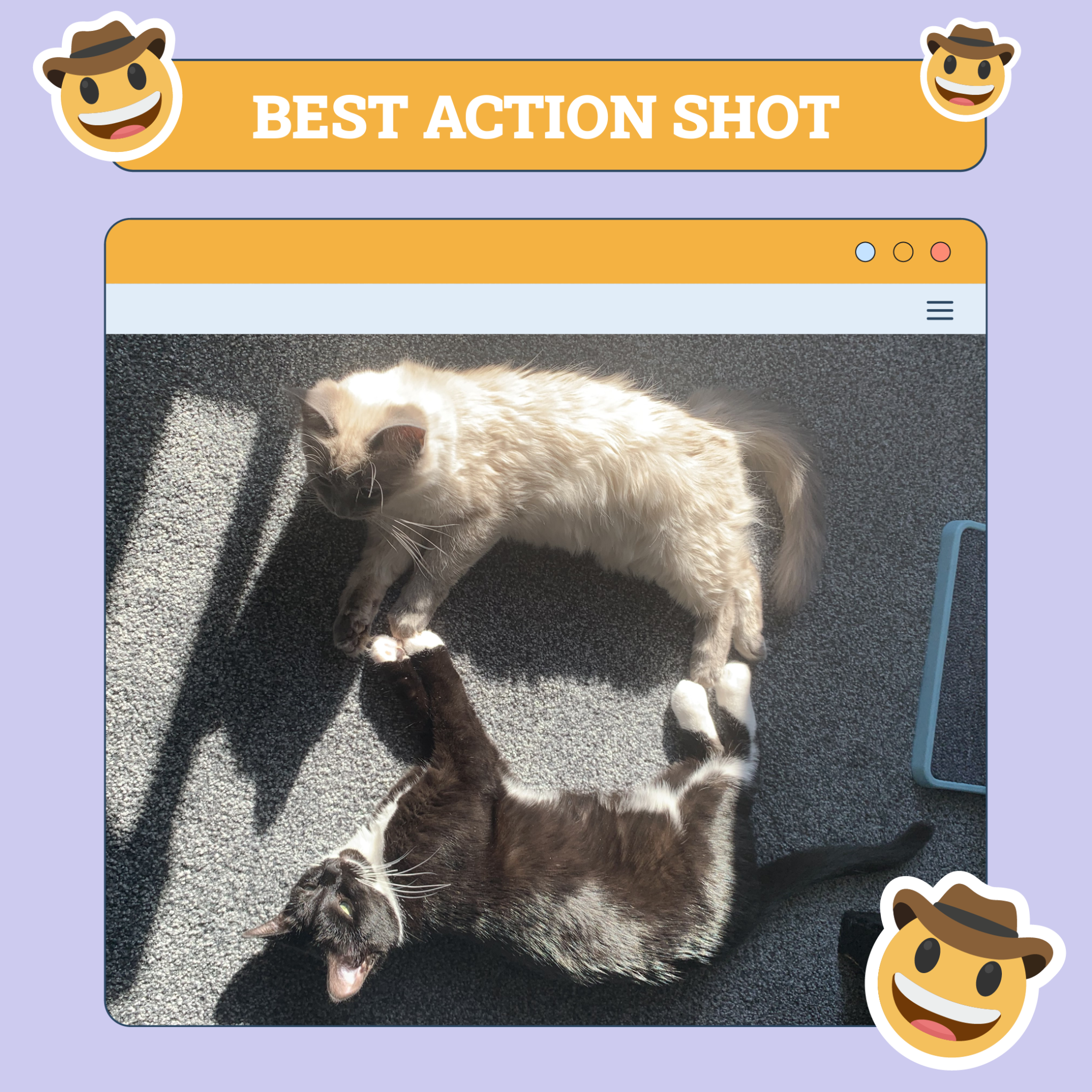
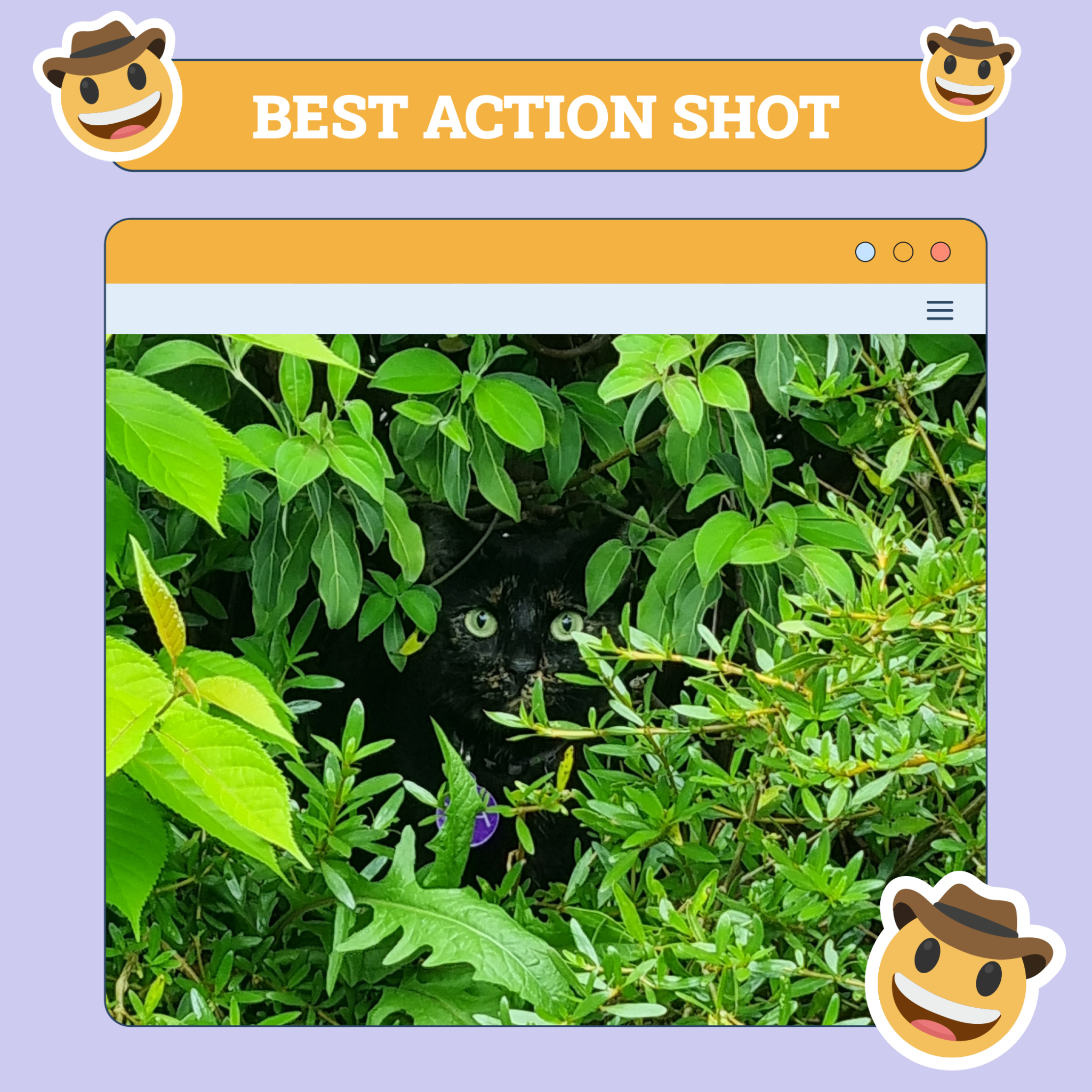
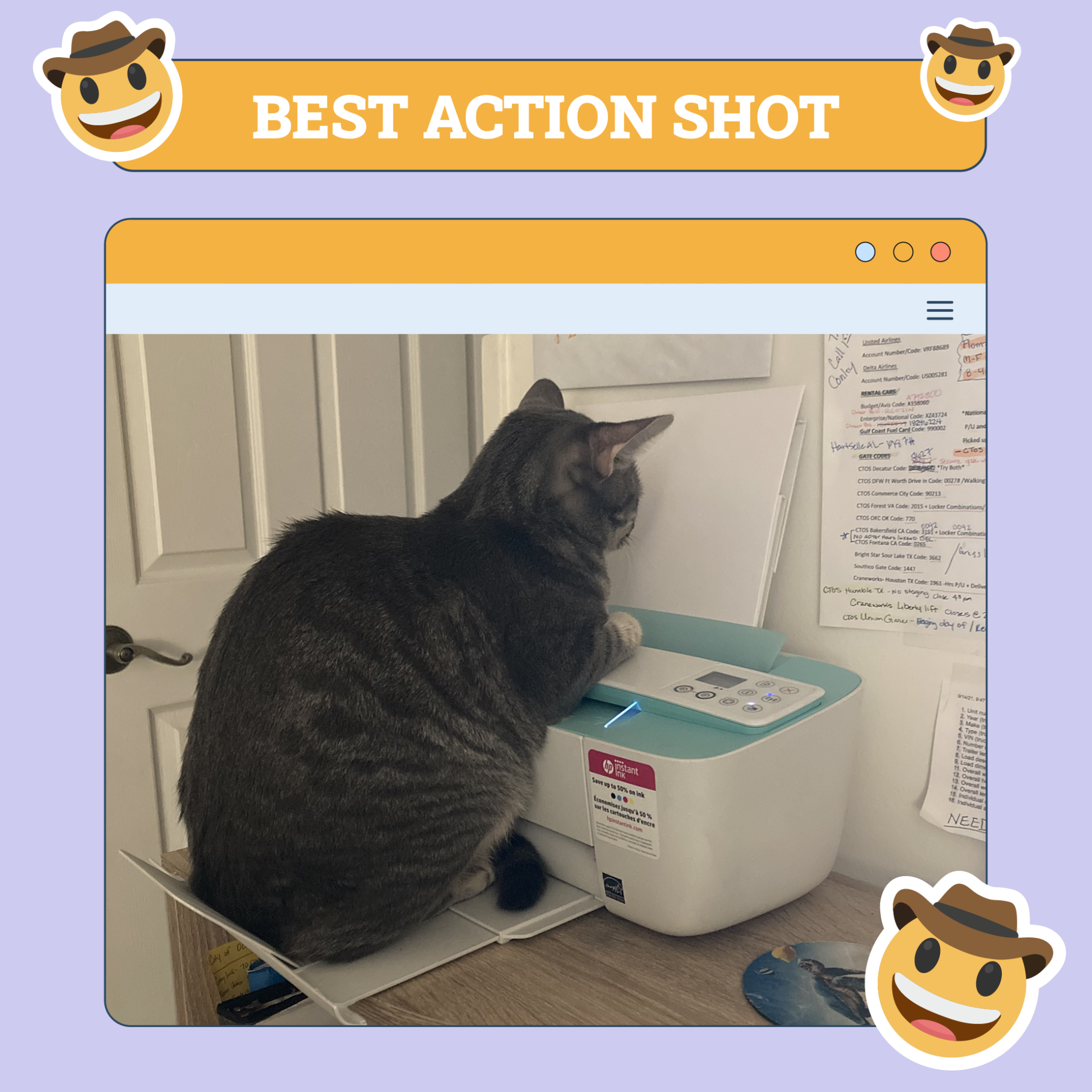
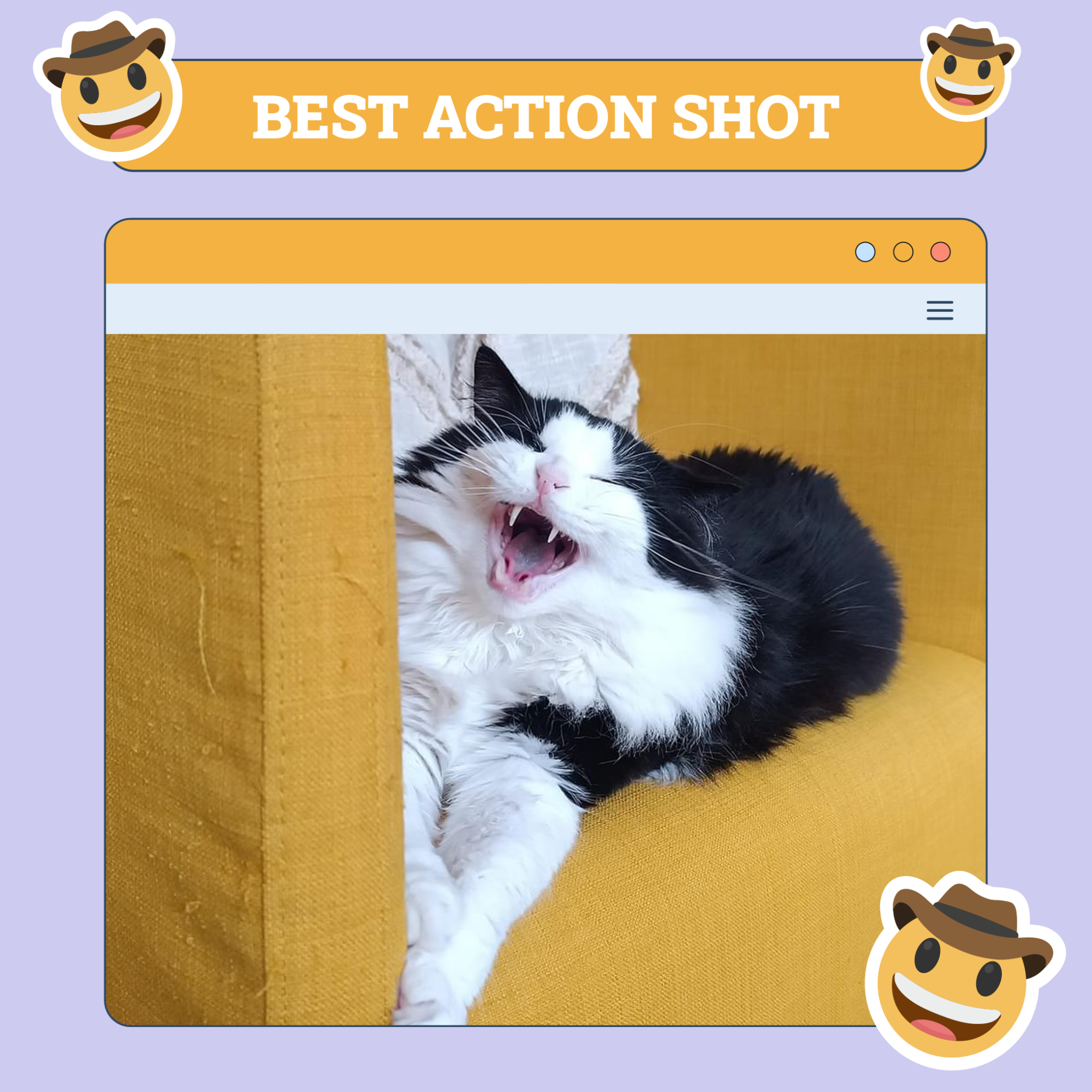
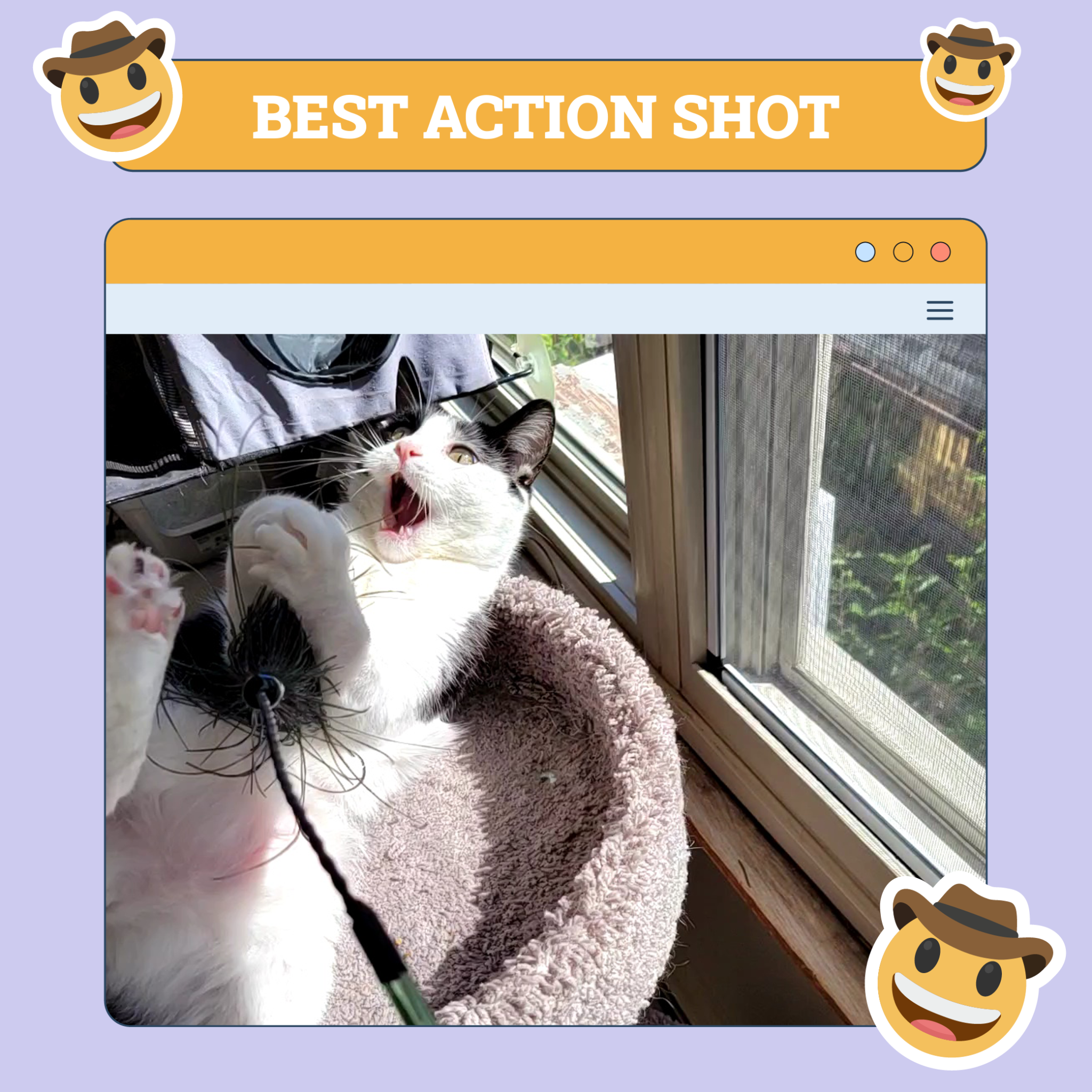
Best Action Shot
Name:
Colby Jack Cheese (CJ, for short)
Breed:
Domestic Short Hair
Fun Fact:
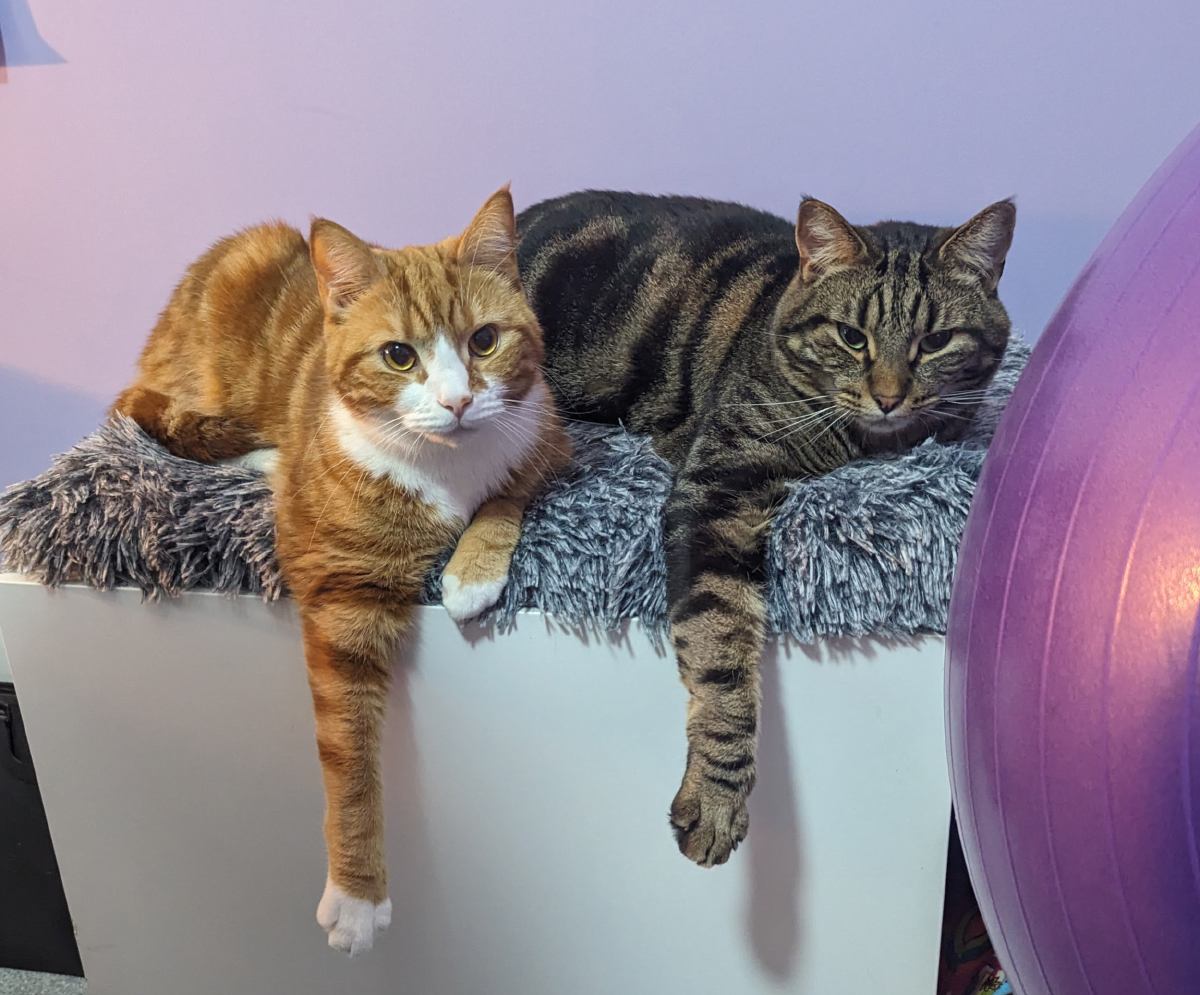
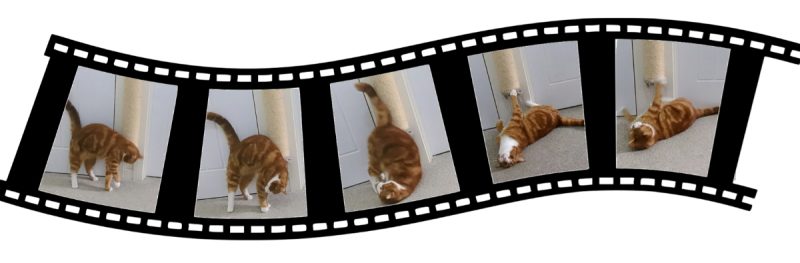
Colby Jack was adopted on December 4th 2023. He is 2 years old, knows how to sit, and is working on his recall. He is the smartest orange cat I know, and he is a menace. He can open doors, parkours off of every surface he can, and has 100% manipulated me to gain food/attention. My partner and I swear he understands English. He is pictured here with his older brother, Harry (5, adopted September 2022) who has heterochromia, one green eye and one blue. Harry is much better behaved. Sometimes when both boys are good I will give them a churu to share. I think they enjoy it.
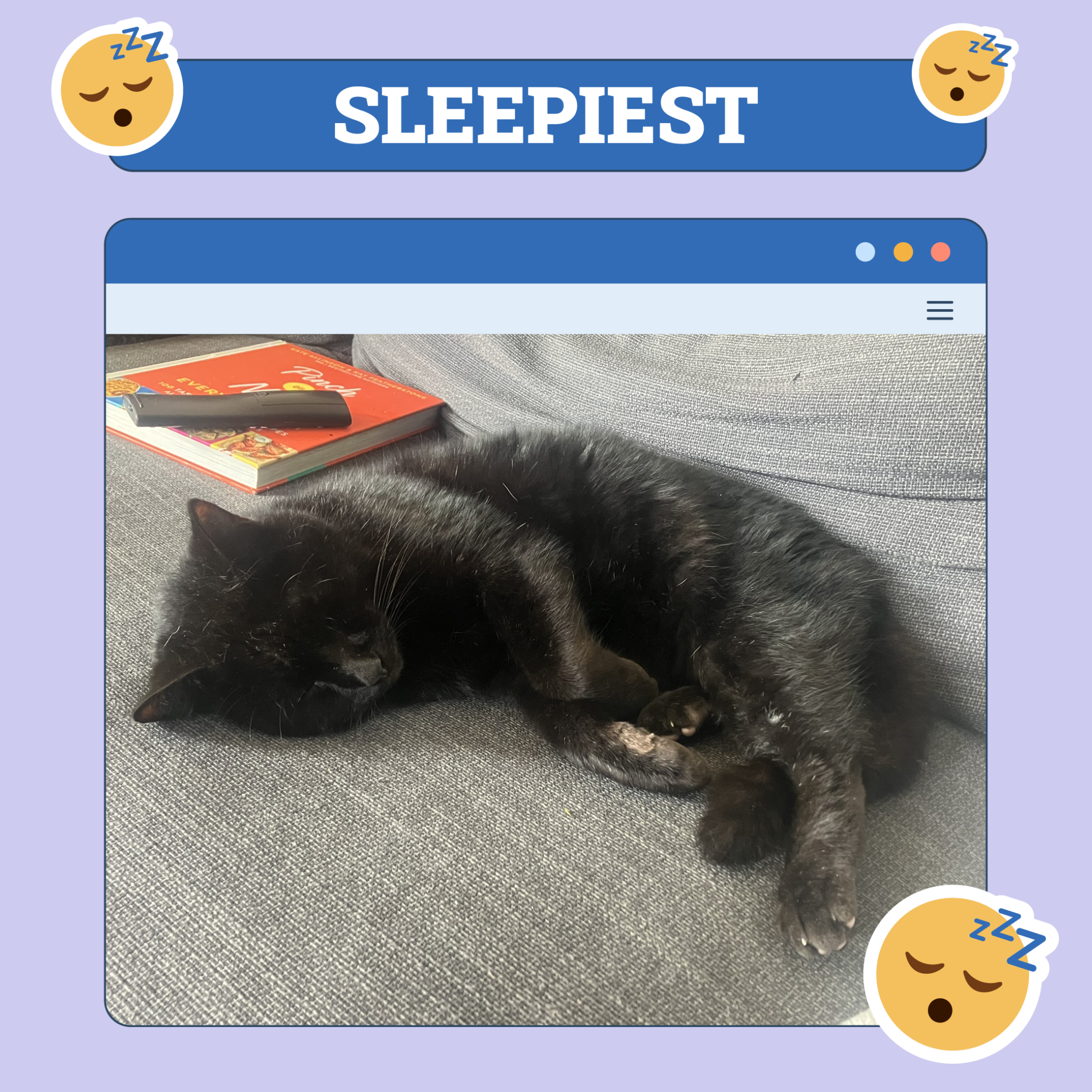
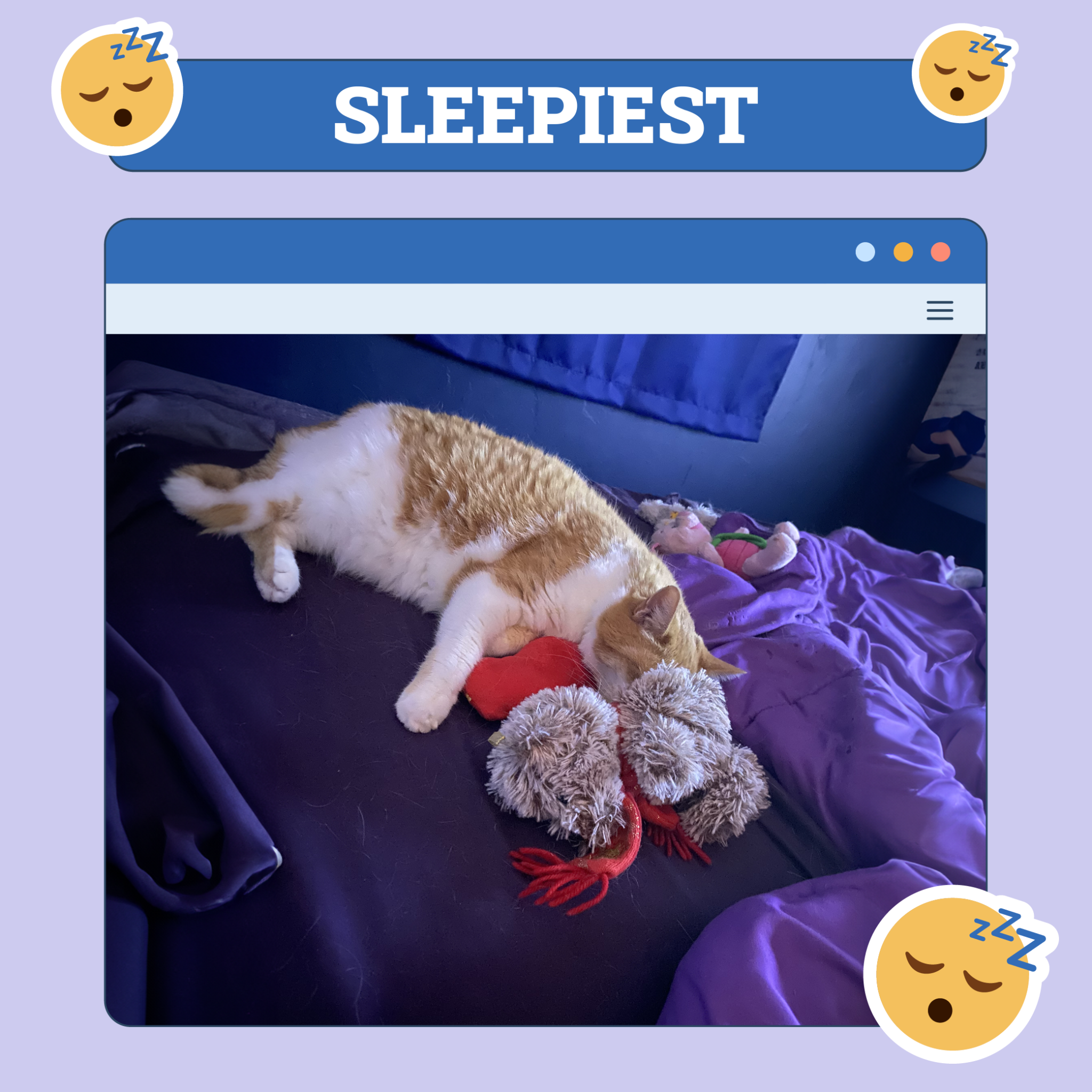
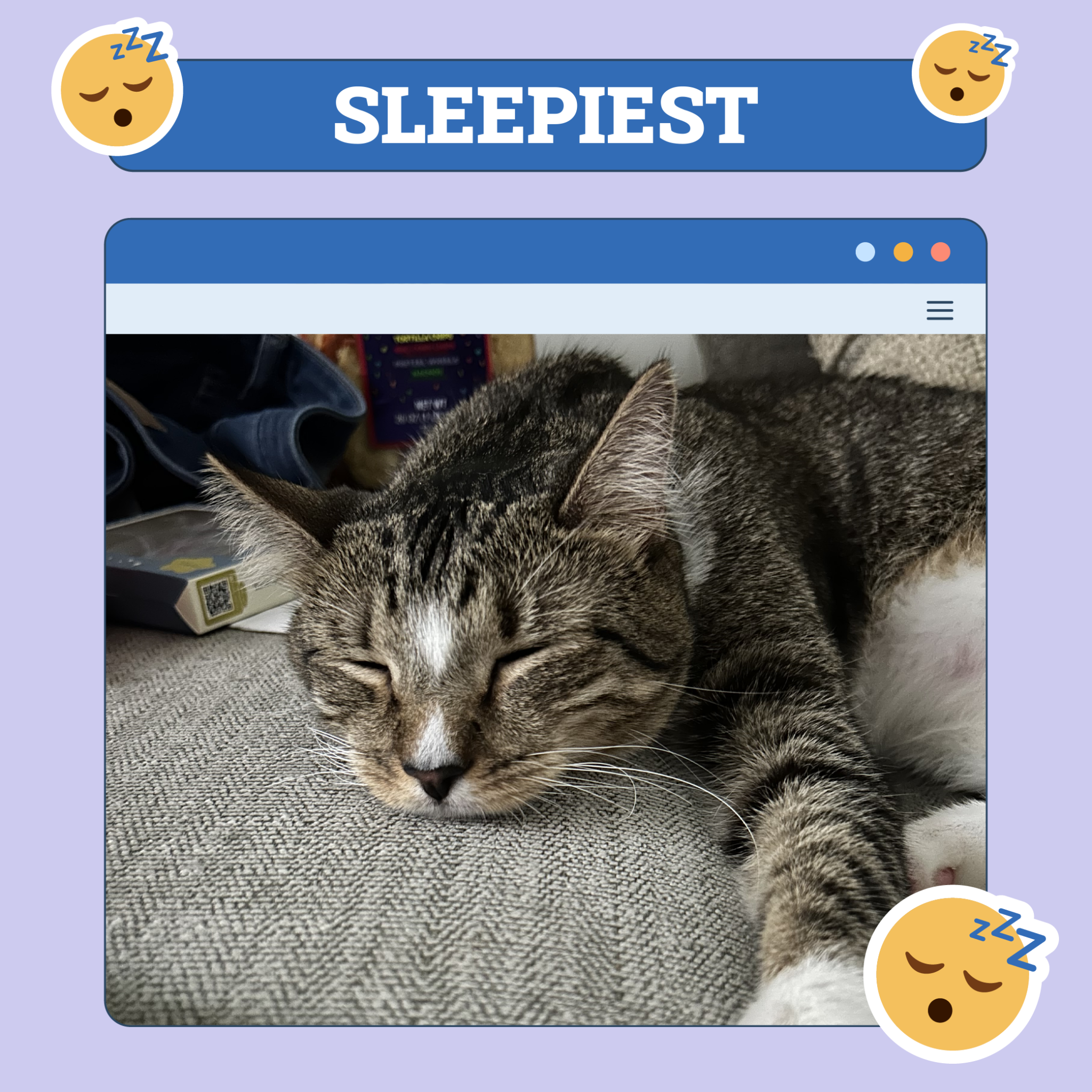
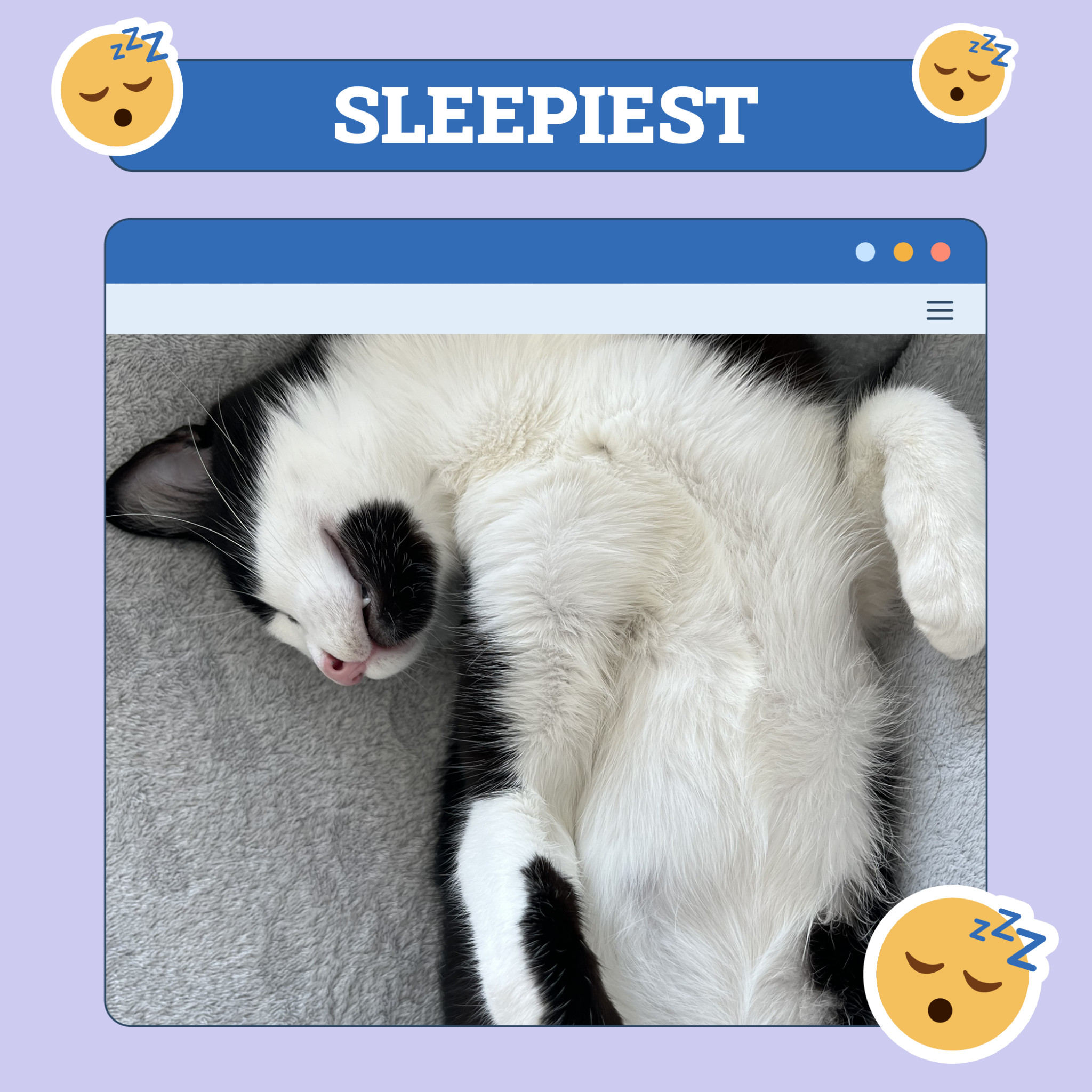
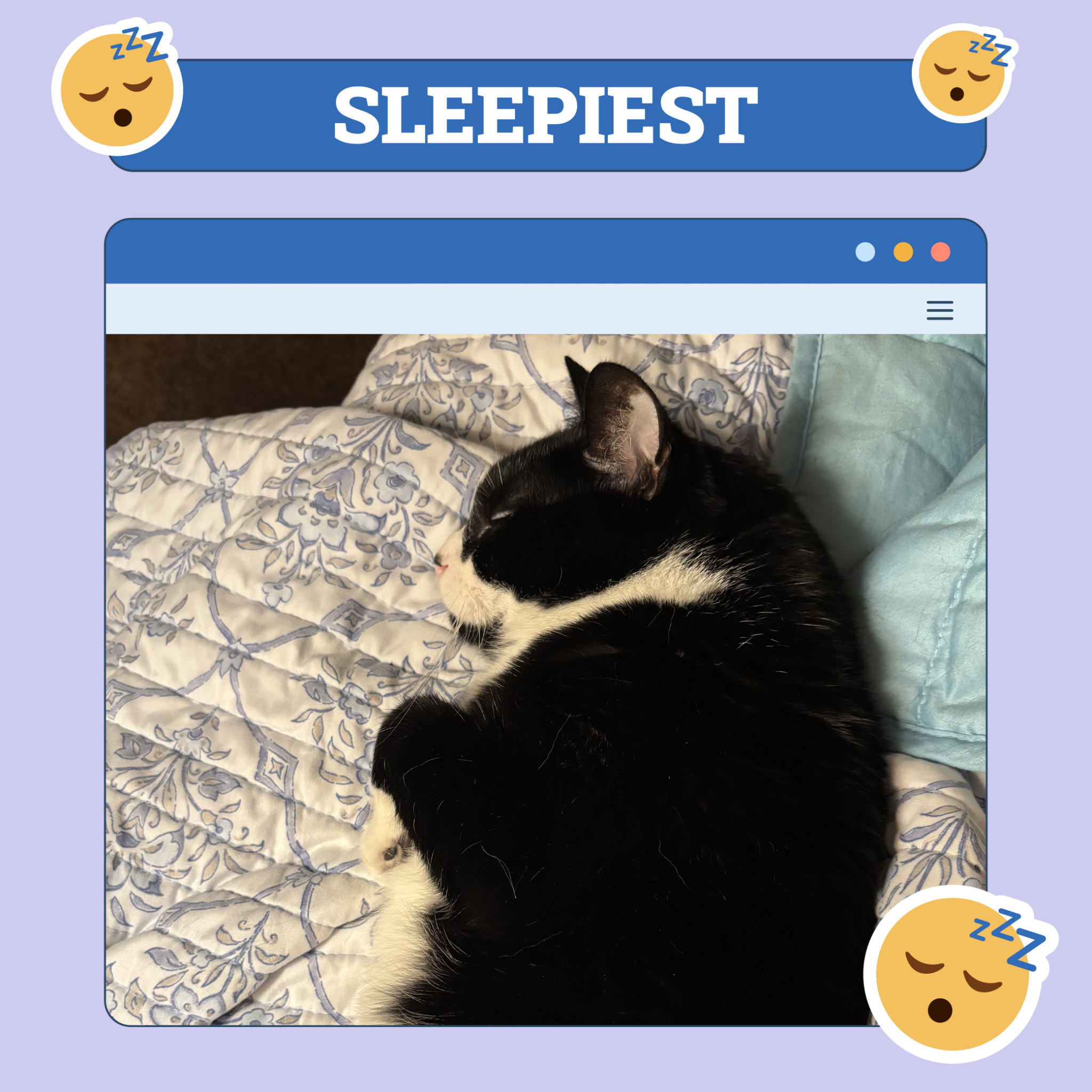
Sleepiest
Name:
Sooty
Breed:
N/A
Fun Fact:
Me and my cat have the same birthday
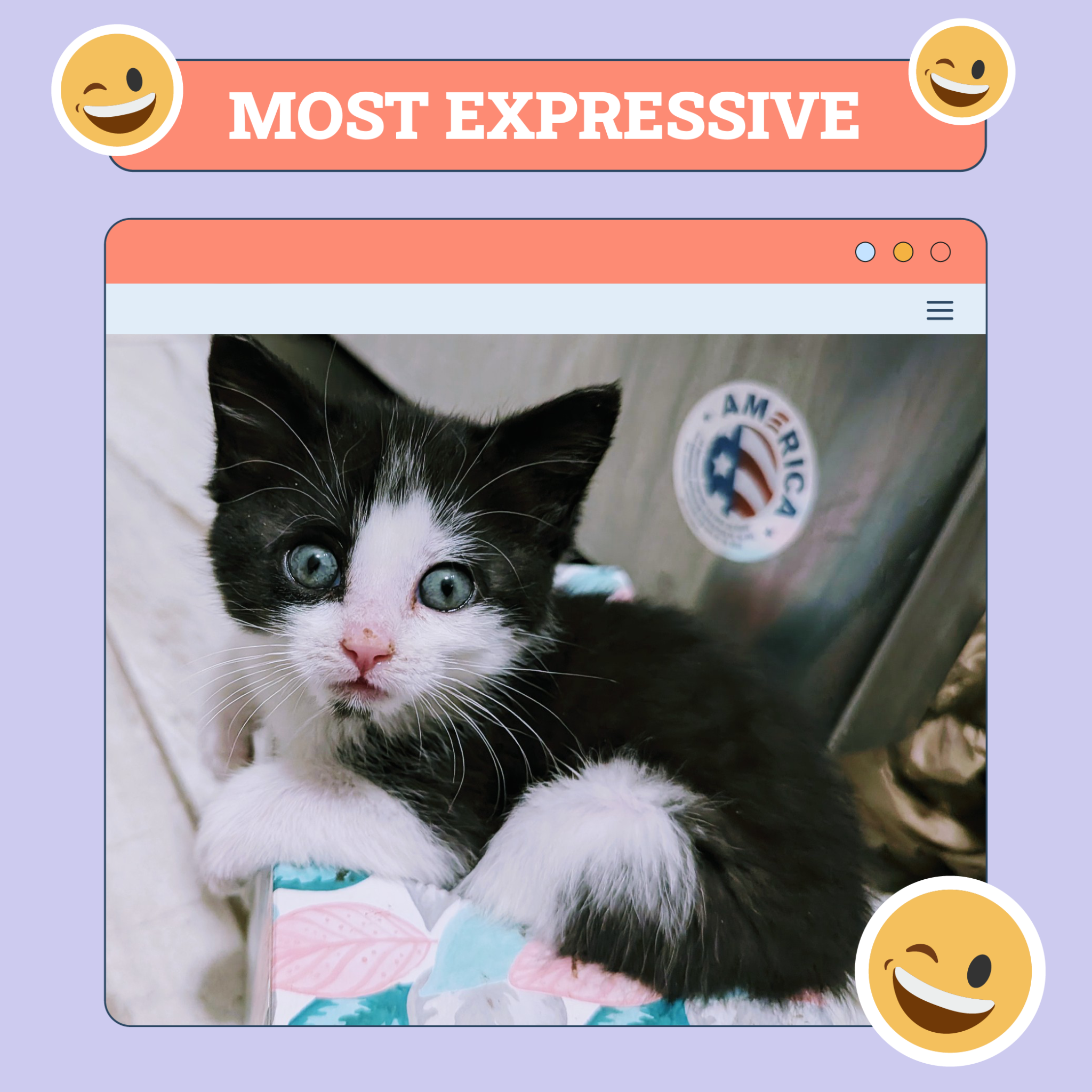
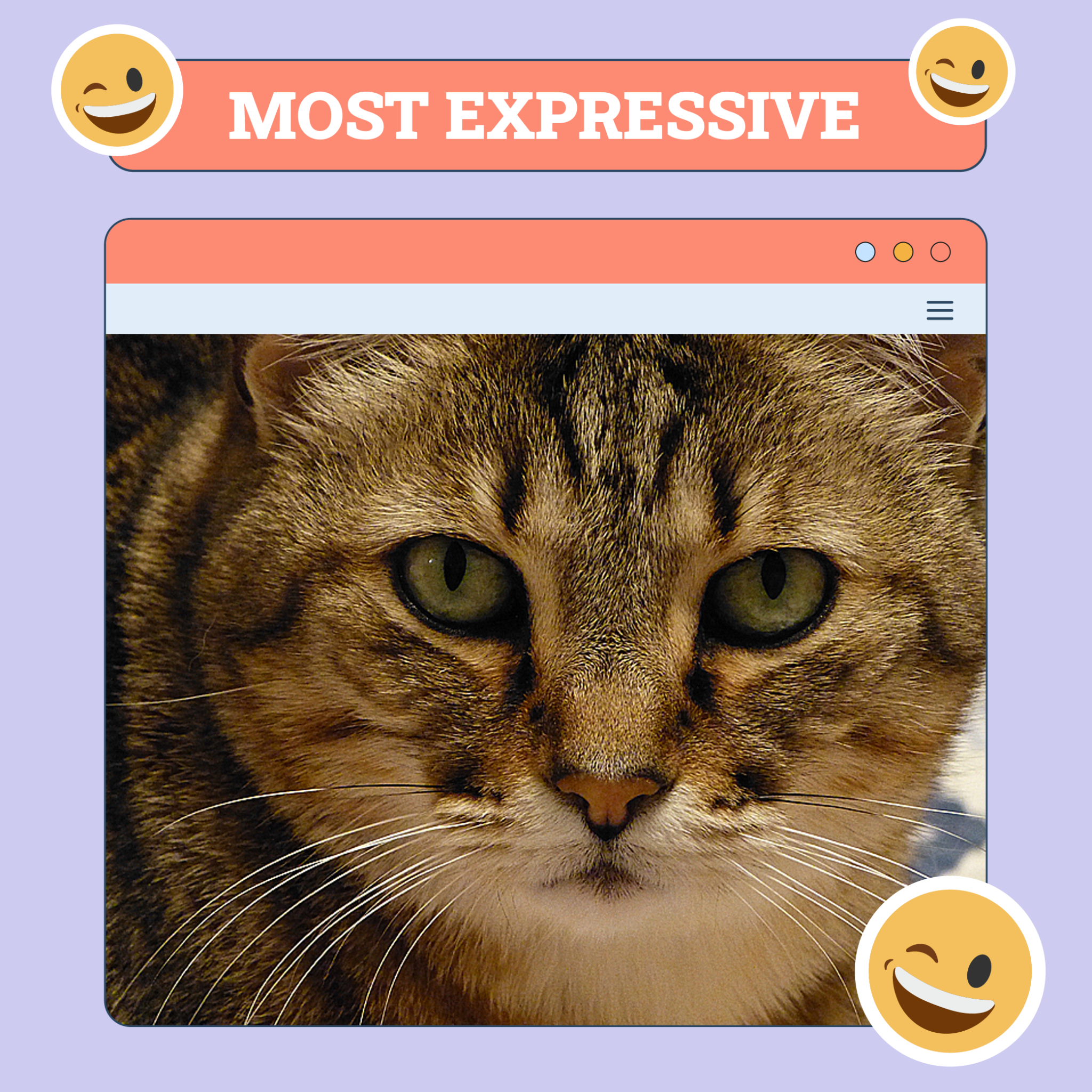
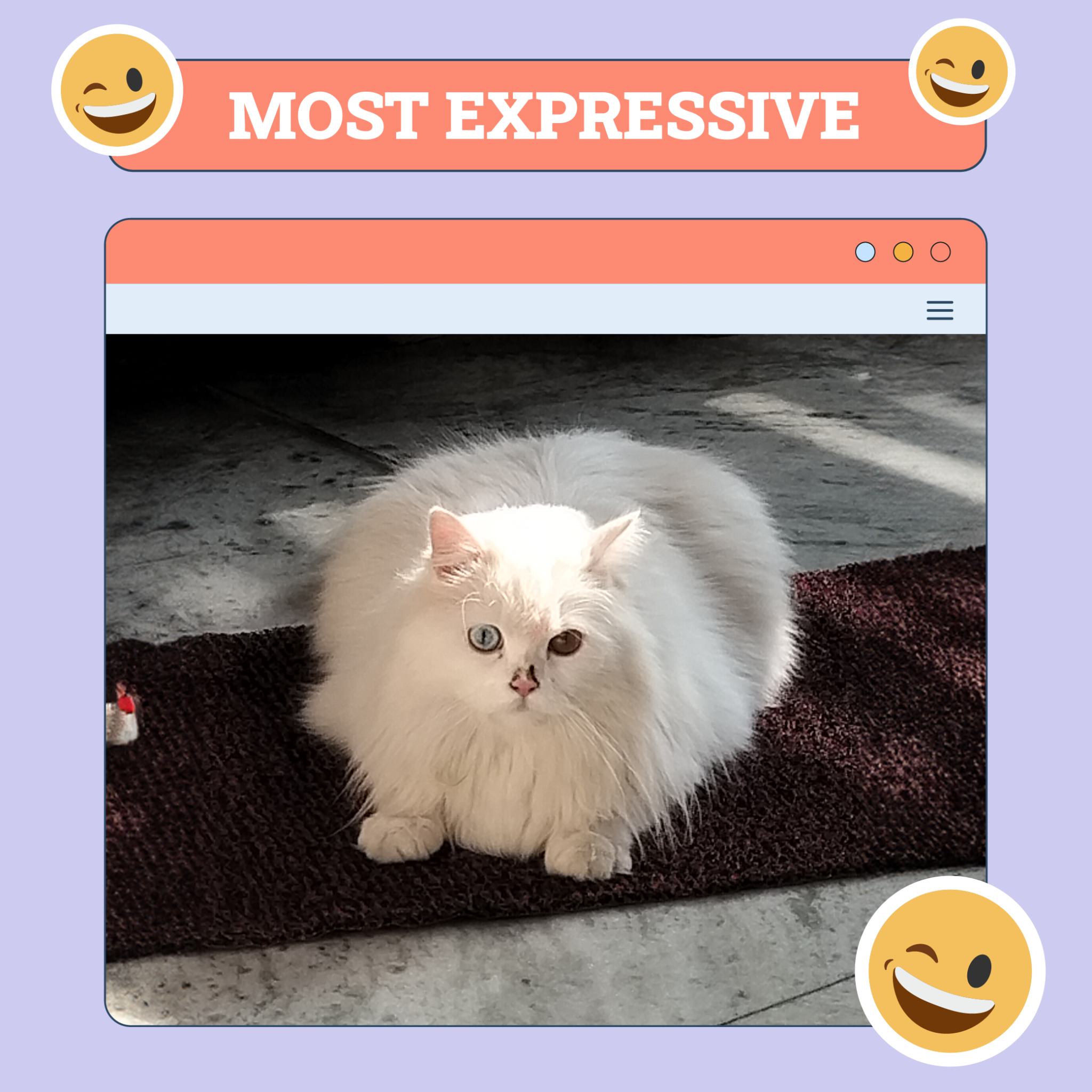
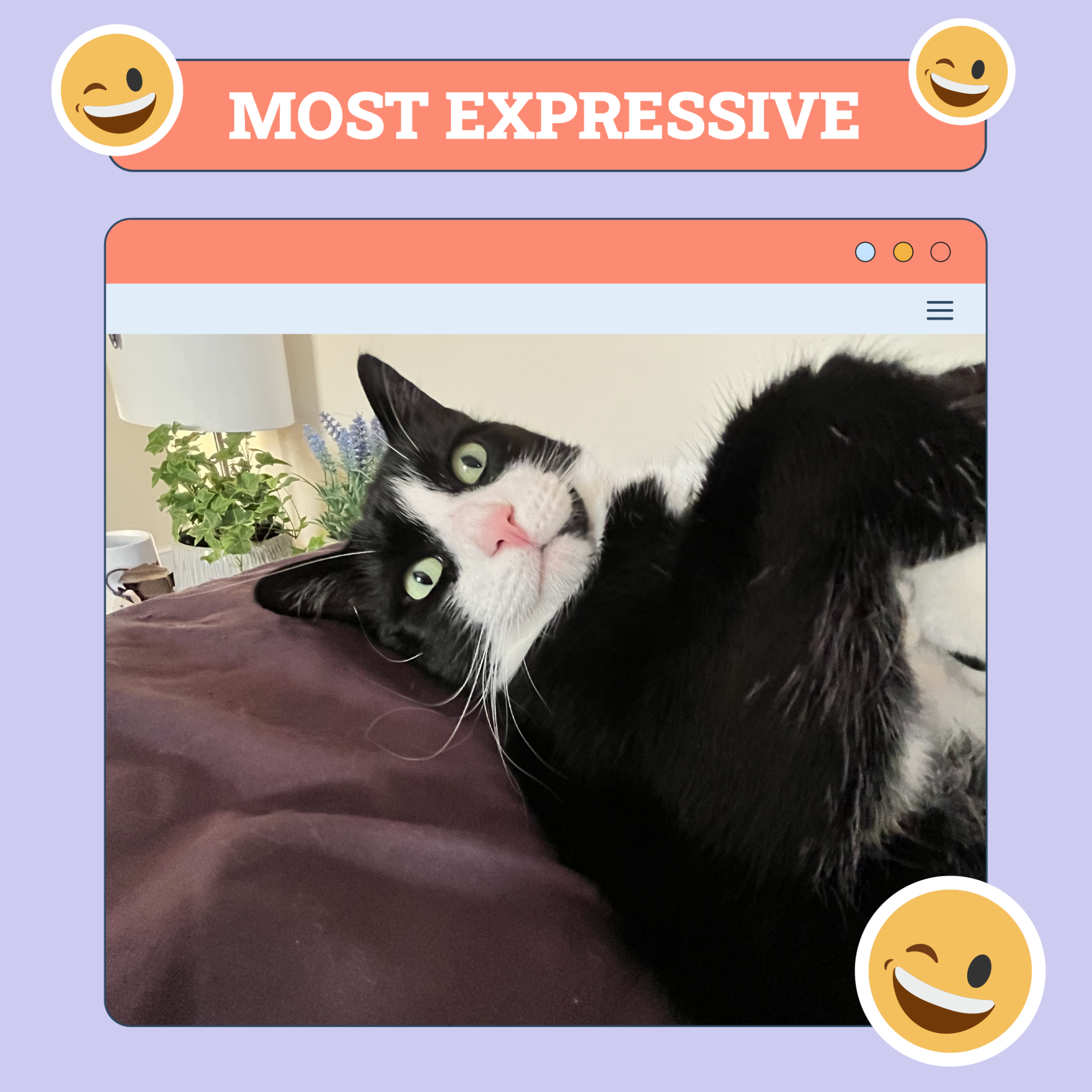
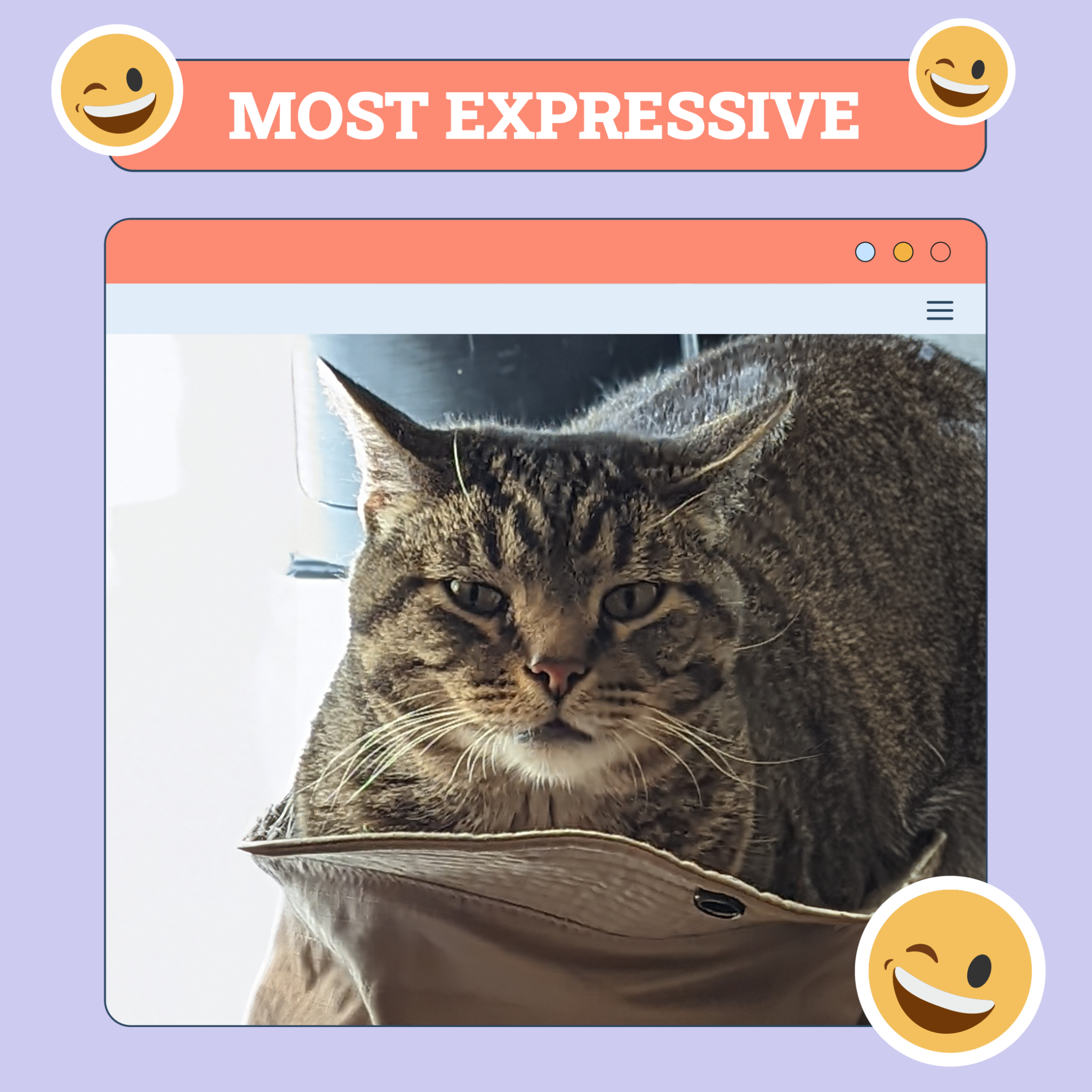
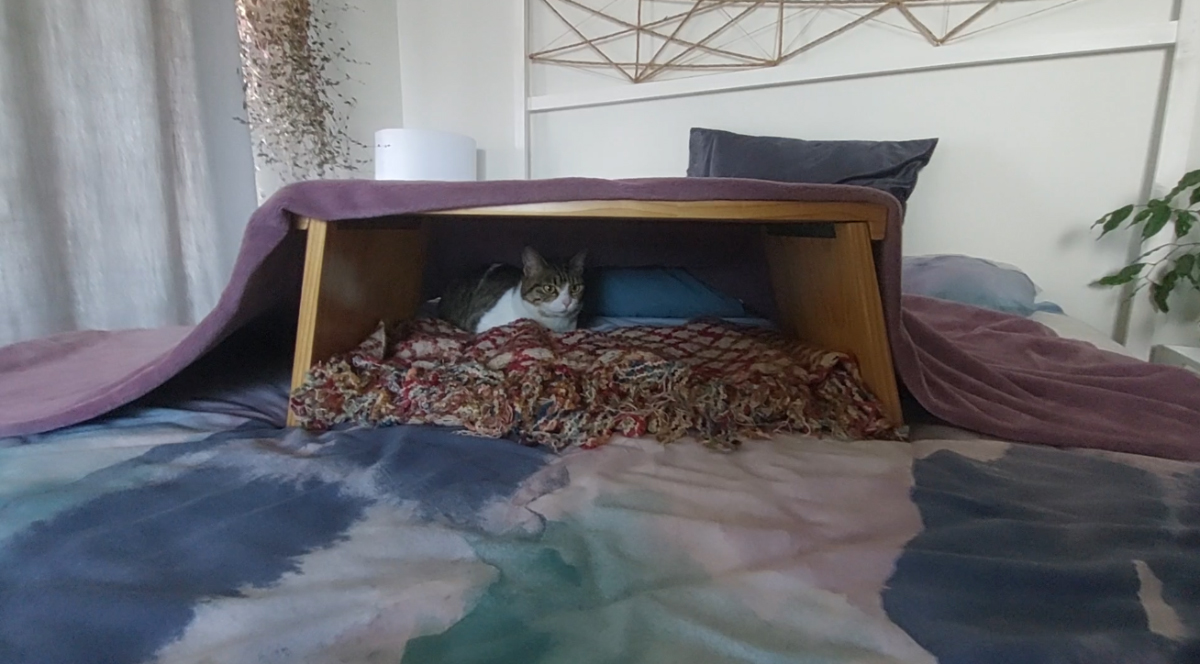
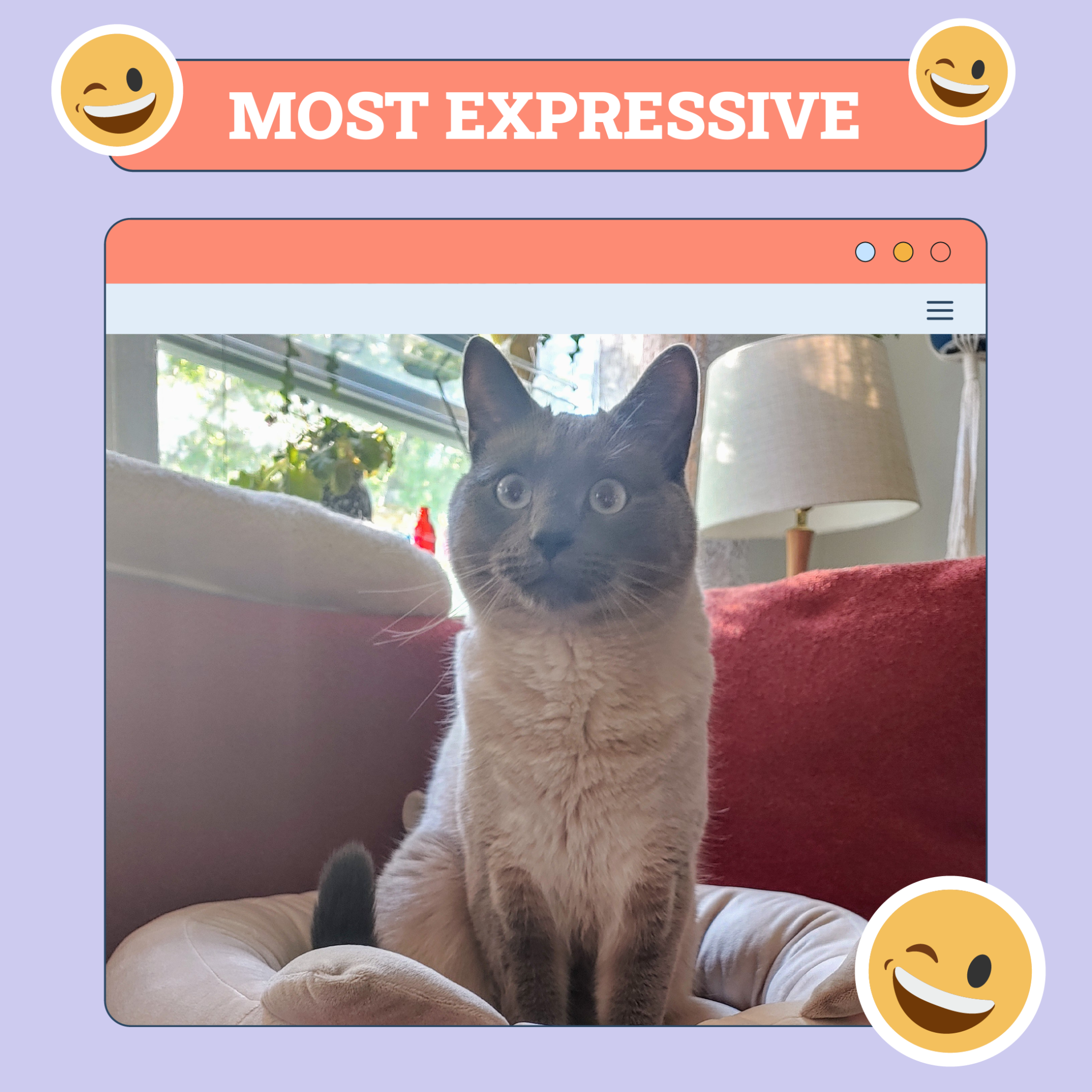
Most Expressive
Name:
Pengi
Breed:
N/A
Fun Fact:
“What’s goin’ on…my bed…it’s shrinking
Pengi – rescued at 3 weeks old (now 8 weeks) and she can’t get over how small her fav bed is getting – she keeps digging out the Kleenex but alas…”
Enter Your Cat
Submit your kitty for a chance to be featured! Click here
This article is a part of our Weekly Photo Contest
View our previous week’s winners here: February 13, 2025
Click here to view our full list of past winners
The post Catster Photo Contest: Cats of the Week Winners (Feb 20, 2025) by Catster Editorial Team appeared first on Catster. Copying over entire articles infringes on copyright laws. You may not be aware of it, but all of these articles were assigned, contracted and paid for, so they aren’t considered public domain. However, we appreciate that you like the article and would love it if you continued sharing just the first paragraph of an article, then linking out to the rest of the piece on Catster.com.
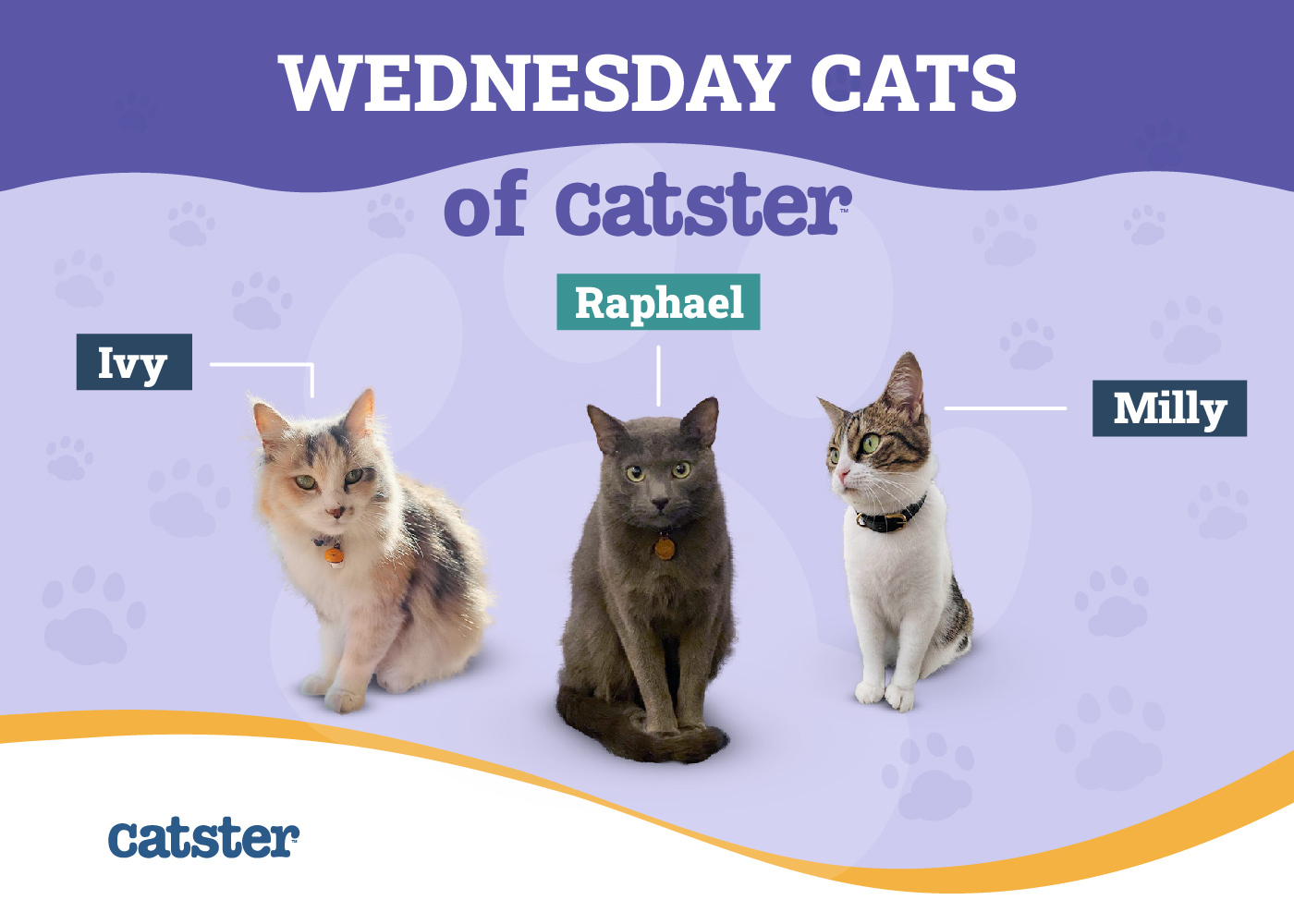
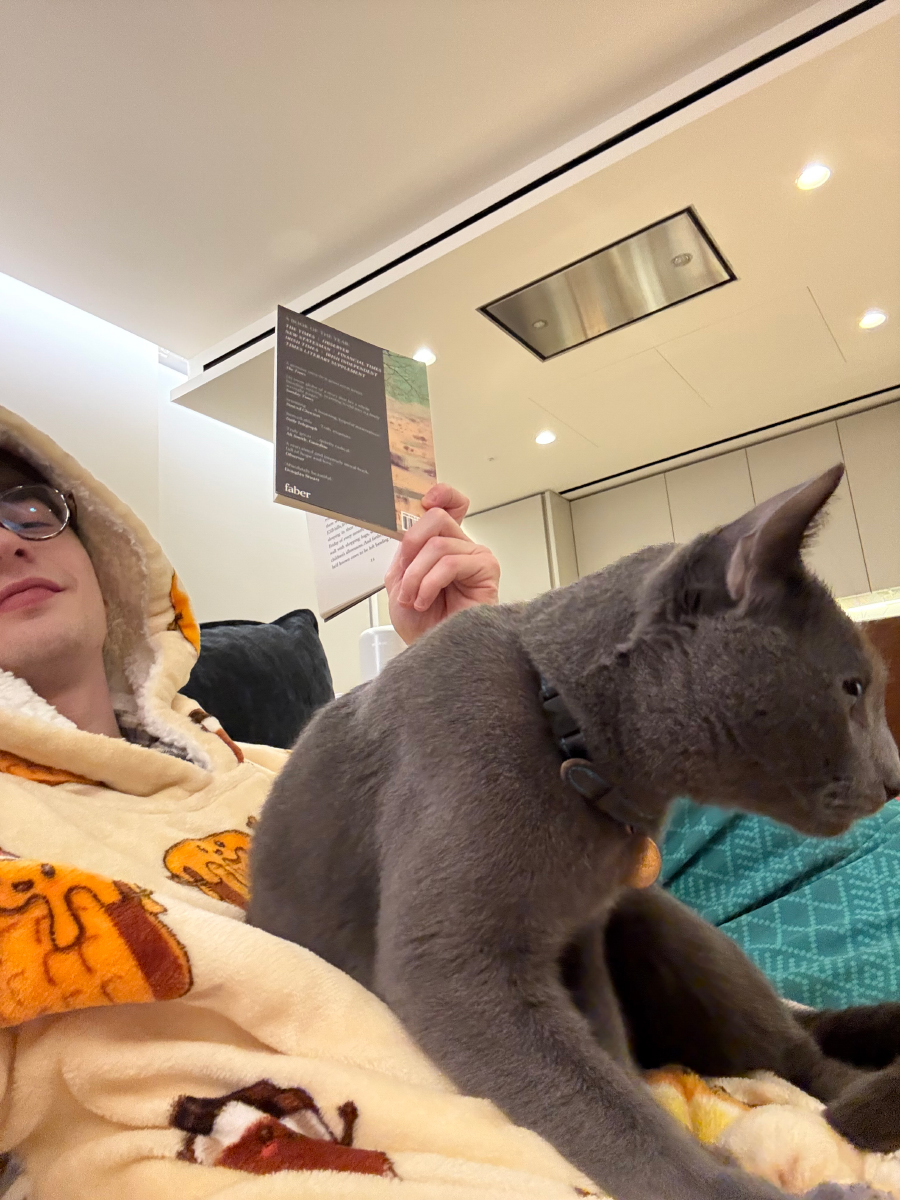
Welcome to the Wednesday Cats of Catster! Every week, we share a story from one of our cat-loving Catsters. This week is about Wes and his fiercely cuddly Russian Blue, Raphael.
There it was, in bright red letters. They weren’t ashamed to tell me that I was allergic to Raphael.
In many ways, it was something I should have already known. Although getting him was one of the best things I’ve ever done, it did come with its challenges. Why did I always seem to have a blocked nose these days? Why was I crying when no romantic comedy was on the TV today? These were the questions I asked myself as I worked through boxes and boxes of tissues, my grocery order becoming laden with more and more items for sneeze collection.
But I couldn’t admit the truth to myself or anyone else. “Maybe you’re allergic?” “Impossible,” I’d retort, with bloodshot eyes and a nose twice its normal size.
Two things though started to make me feel like I needed an answer. First, any time I went away and Raphael was at home, my problematic nose would suddenly become….not so. Second, I was diagnosed with Asthma last year (perhaps as a result of a few unfortunate Covid collections). My doctor informed me that if I was allergic and didn’t know it, that could be exacerbating any symptoms I might be struggling with.
Getting Dander Under Our Bed
That was it. I had to know. Even though I knew. I had to know.
And now I know.
A few vials of blood, a few pages of paper, and a phone call were all it took to turn someone’s cat world upside down.
They informed me that it was sufficiently severe that I shouldn’t:
“Cuddle Raphael”
“Kiss Raphael”
“Even approach a cat you do not know”
This was worse than when the dentist told me sparkling water was bad for your teeth (“Now they’re even trying to take water away from me?! What’s left?!”). Were they trying to kill me? To tear out my heart? Apparently they weren’t trying to kill me, but my cat might be.
I told them in no uncertain terms that although I could just about restrain myself from petting an unknown cat, I simply could not resist snuggling, cuddling, hand-holding, kissing, petting and generally nuisance-ing my little boy, Raphael. Otherwise, what is life for?
Getting Dander On My “Oodie”
Despite the heartache I felt, I don’t regret getting the tests done. It’s always better to know than to live in doubt, and it’s helped me make some significant changes to ease the burden:
Perhaps the most significant is that I now take a daily (or every other day) antihistamine. For my level of allergy, I’ve found this to be quite effective at reducing any problems I face, and it’s made cuddling with Raphy considerably easier.
I try to clean the floors more than I did. Previously we’d go over them a few days a week, and mop them once a week. Now to lift the dander out, we throw the windows open and try to give the floors a going over once a day. It’s hard to tell what difference this has made, honestly. But perhaps the very act itself makes my brain feel better.
Finally, I now only cuddle Raphael once a day and give him a kiss every other day…
Ok, you caught me on that one, obviously not. I kiss him as often as I can and cuddle him as much as he’ll let me. If anything, sometimes he seems more allergic to me than I am to him!
Getting Dander On Our Clothes
I think having a pet is a privilege, not a right. Life changes, and throws things at you, and you have to roll with it. I’d never judge anyone for making a decision that they feel they need to make, but my relationship with Raphy won’t change one bit simply because I know that he makes me sick. I won’t allow it to. Because it isn’t his fault, and he wouldn’t do it if he could help it. Hopefully, somewhere in that lovely brain of his, he knows how much he means to us and that nothing could stop us from loving him.
Now, I’d love to know, has anything unexpected happened after you got a cat that tried to stand in the way of your love? Did you discover some nasty allergies, or was something else the culprit?
P.S. If you’re reading this after reading an announcement on the website that I have died from anaphylactic shock, please get a tiny pair of handcuffs and arrest that criminal cat!
This article features Wes and Raphael in our Wednesday Cats of Catster series.
We give Applaws Limited Ingredient Wet Food an overall rating of 4.5 out of 5 stars.
Quality: 4.5/5
Variety: 4/5
Ingredients: 4.5/5
Value: 4.5/5
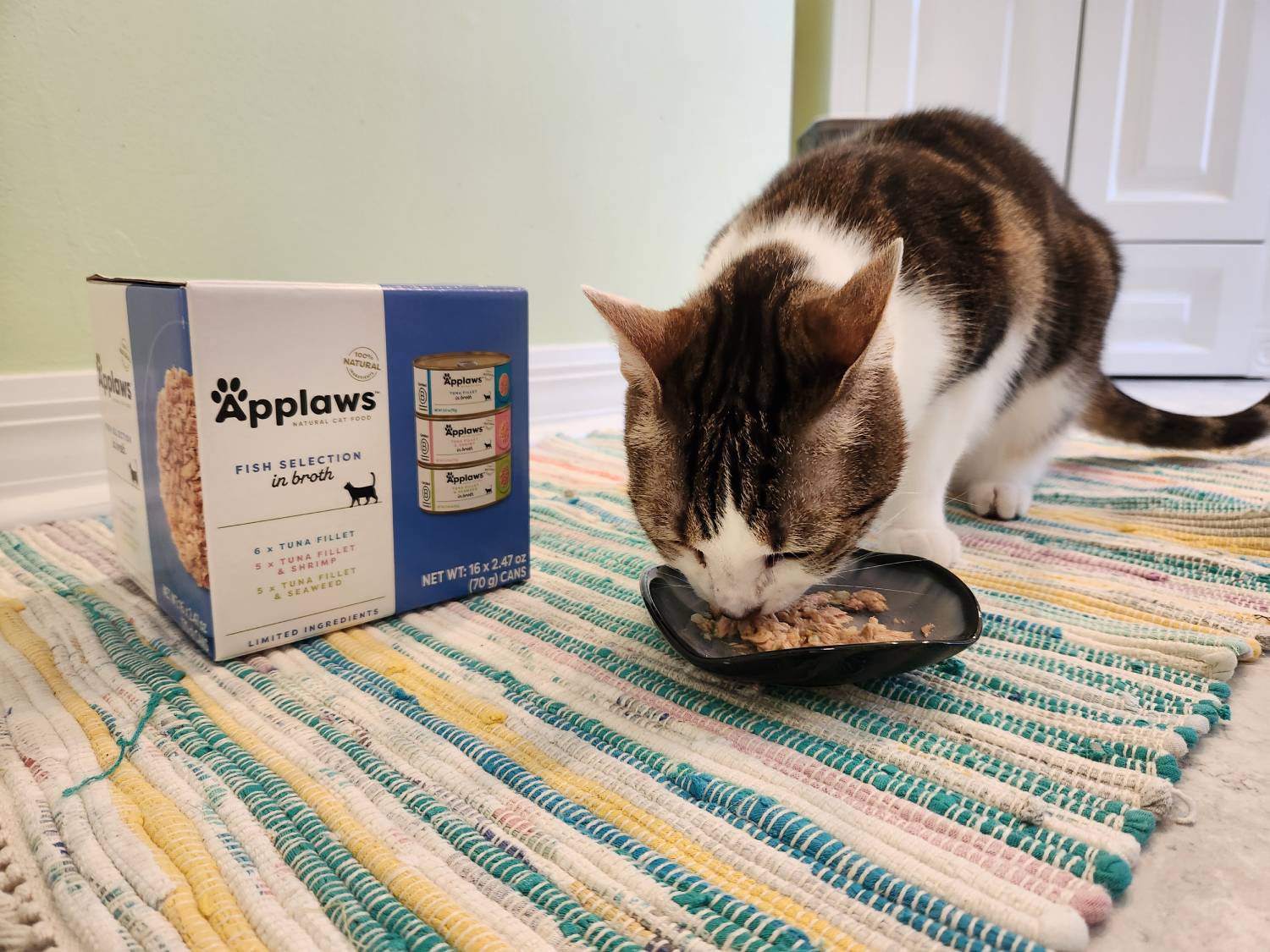
Any dedicated cat owner likely knows that their house cat does not drink enough water. Whether they were told by their vet, noticed the market explosion of cat water fountains, or simply observed that their cat’s water dish rarely needs filling, most cat guardians understand the importance of adding moisture into their kitty’s diet. This is where the cat food brand Applaws comes in. They offer wet food toppers in addition to their complete wet and dry cat foods, which can quench the thirst of beloved cats everywhere through their limited-ingredient wet foods. My cat Luna loved the Applaws Fish Selection variety pack we received and seemed to be a big fan of both the flavor and texture of this supplemental wet food.
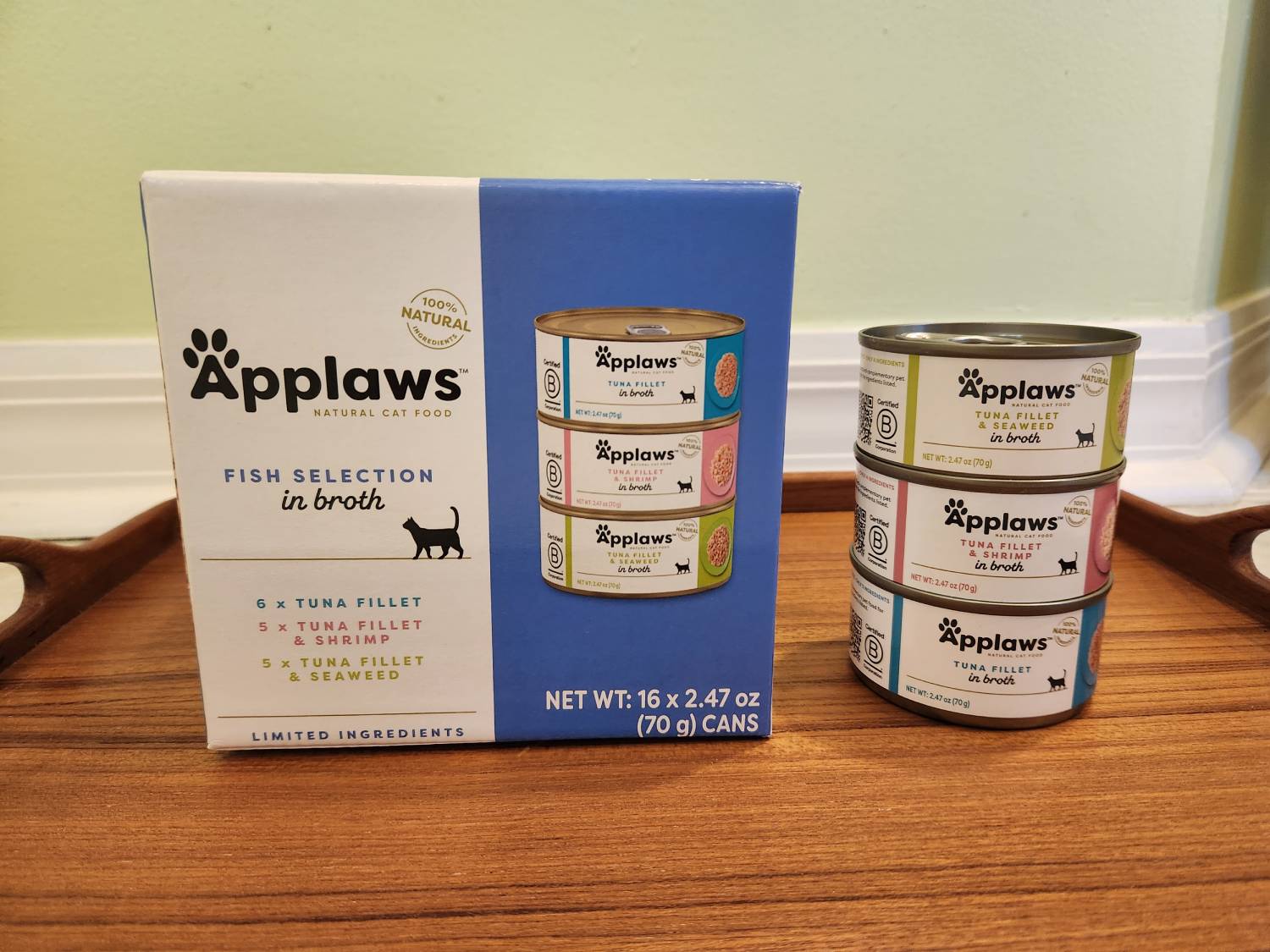
At a Glance: What We Received
About Applaws
Who Makes Applaws and Where is it Produced?
Applaws was founded in 2006 in the United Kingdom under a parent company known as MPM (Making Pet Food Matters), which was a collaboration between co-founders Roger Wood, Roger Coleman, and Jon Kinsey. Their mission was to enrich the lives of pets and their owners through visibly better pet food, and they set out to do this by avoiding fillers and additives. After early popularity in the UK and Australia, Applaws eventually expanded to the United States starting in 2014. Today their product line includes nutritionally complete wet and dry cat foods, as well as some wet foods the brand describes as “complementary,” more commonly known in the pet food market as toppers. Ingredients are globally and ethically sourced, and production takes place in human-grade facilities, with wet food options manufactured specifically in Thailand. Applaws is a certified B-Corporation for their positive social and environmental impact, and all factories are GFSI-accredited for food safety. The brand’s goal is to surpass global standards of food production, sustainability, and nutrition.
Which Types of Pets Are Applaws Complementary Foods Best Suited For?
Because the limited ingredient wet foods from Applaws are labeled as “complementary,” they should not be used as the only food source. However, they are a great addition to a balanced diet for cats and kittens over 12 weeks of age. These canned food options are recommended for intermittent or supplemental feeding only, so aside from providing extra moisture, Applaws complementary wet foods make a great topper or treat. This limited-ingredient food is also a great supplement for cats with food allergies or sensitive stomachs, and those that might benefit from extra calories or nutrition. Any cat should appreciate some Applaws wet food added to their bowl.
Key Features
Applaws limited ingredient wet food for cats is a healthy yet decadent treat for the special kitty in your household. It’s a wet food with only the good stuff—no additives or harmful fillers—and a great way to keep your cat hydrated and their appetite satiated.
Ingredients
The limited ingredient wet foods from Applaws all adhere to a meat-first recipe. This means that real meat is the number one ingredient, generally chicken or tuna, which is species appropriate for the carnivorous cat. There are also no questionable meat by-products added. Each recipe generally only includes one or two plant ingredients, which may be potato starch, rice, or guar gum, for example. A notable benefit of keeping the ingredient list small is that it makes it easier to avoid those ingredients your individual cat may be sensitive to.
Package Options
The limited ingredient wet foods from Applaws come in a variety of packaging types and sizes. Cans come in either 2.47 oz or 5.5 oz. Plastic cups with a peel-off top come in 2.12 oz. And pouches come in either 2.47 oz or 5.3 oz. There are also variety packs of the cans and cups, so there are plenty of options to fit every pet parent’s needs and budget.
Flavors
Applaws offers a variety of fish- or chicken-based recipes that are high in protein and highly appealing to a cat’s taste buds. Some of their plant-based ingredient options include seaweed, pumpkin, and green beans, which enhance the recipe flavors and add fiber. For a really decadent flavor profile, there are even some recipes with cheese added.
Macronutrient Breakdown
These limited-ingredient wet foods are higher in protein than your average premium wet food with the crude protein percentage of the fish varieties we tried coming in at a whopping 12-14% (other brands I researched hover around 8-10%). Applaws also appears to be lower in fat and higher in moisture than much of the competition. These supplemental foods are a bit higher in fiber than the other brands I checked, with our Applaws samples labeled with 2% crude fiber, and other brands typically containing 1-1.5%.
Where to Buy
Applaws cat food can be purchased at many popular retail chain stores, like Petco and PetSmart, but are also available online via Chewy, Amazon, and Instacart. Other purchase options are listed on the Applaws website.
Frequently Asked Questions
Why does Applaws refer to this food as complementary?
The limited ingredient wet food from Applaws is considered complementary because it should only be fed in addition to an already balanced diet. Although it utilizes only healthy ingredients, it is not considered nutritionally complete and should be offered in moderation, particularly as overfeeding this food could lead to weight gain.
How much should I feed my cat?
The feeding recommendation for Applaws complementary wet food, depending on the recipe, is 1-2 cans daily. Be aware though, if this is the first time supplementing your cat’s normal diet, you will likely need to decrease the amount of other foods you are feeding to avoid an overweight cat. A general rule of thumb is that indoor cats can have around 200 calories per day, so be mindful of this when deciding how much of this food you feed in a day compared to the rest of your cat’s diet.
Why should I feed Applaws complementary wet food?
This tasty wet food is a great way to get extra moisture into your cat, which is important for long-term health. It encourages calorie intake in underweight kitties and can also be used simply as a treat to show your cat how much you love them! And because each can only contain 3-5 ingredients, it’s a suitable option if your cat has a sensitive stomach or food allergies.
Does Applaws offer any nutritionally complete wet food?
Yes, the Vitality line of Applaws wet cat food is considered nutritionally complete.
Has this brand ever had any of their products recalled?
Applaws recalled its UK-manufactured dry food in 2021. This was a voluntary recall by the food’s producer, Fold Hill Foods, and included several other pet food brands as well. The recall occurred due to an outbreak of feline pancytopenia in the UK, a rare and potentially fatal condition. There has not been an Applaws recall since, and there has not been a recall of their wet food.
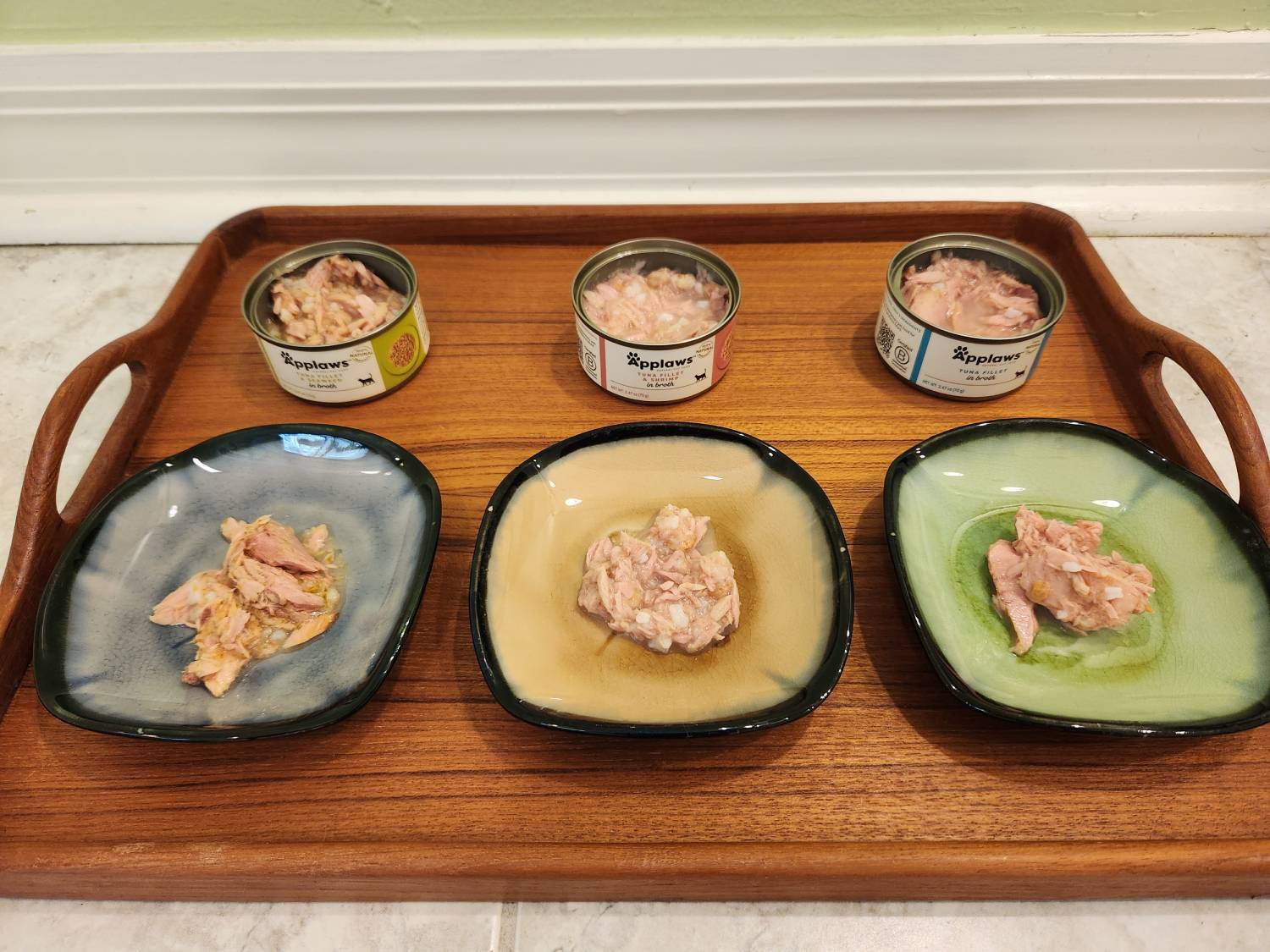
Our Reviews of the 3 Applaws Fish Recipes
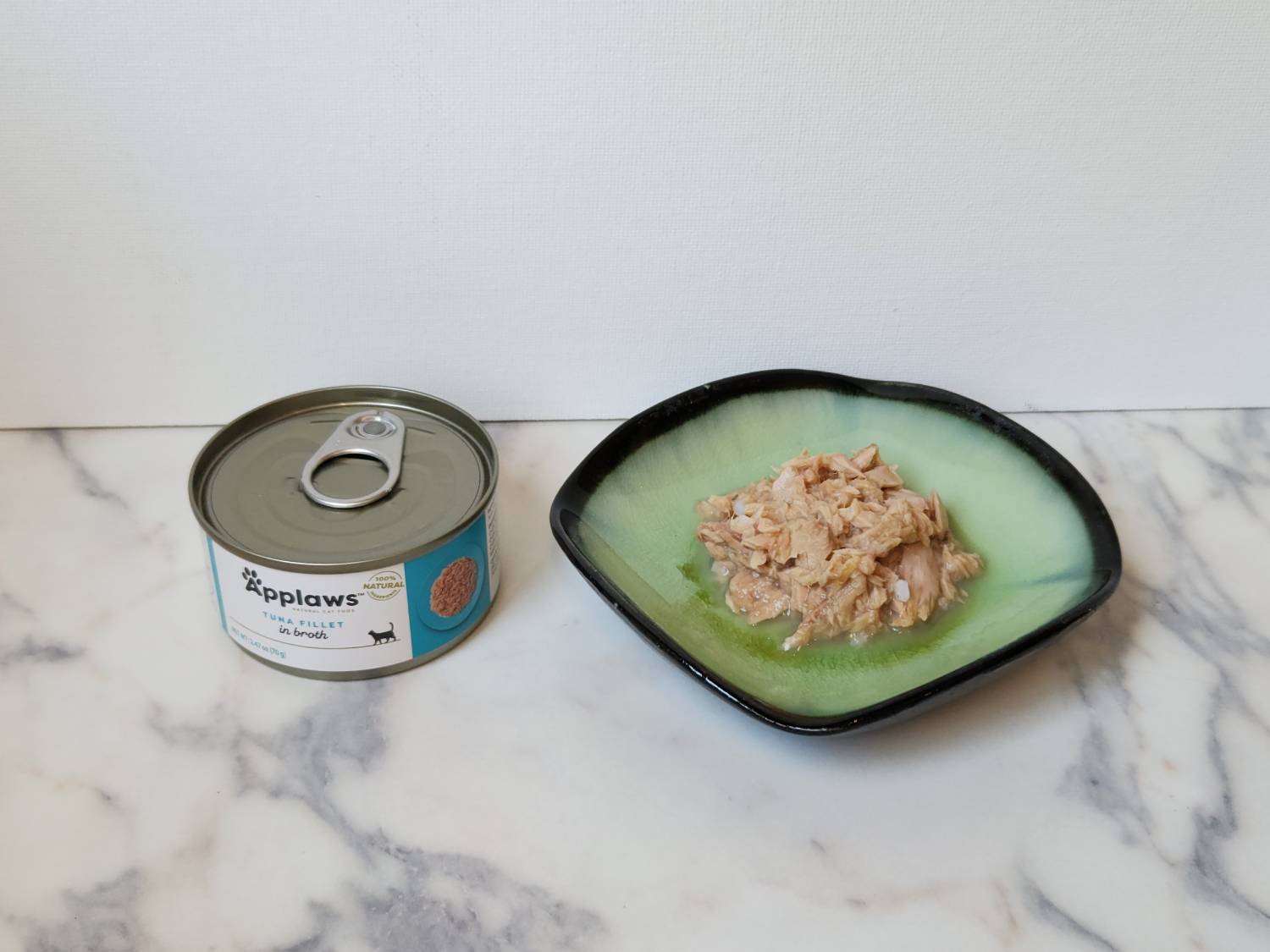
1. Tuna Fillet
Ingredients:
Tuna Fillet, Fish Broth, Rice
Calories Per Can:
49.8 kcal
Crude Protein:
14%
Crude Fat:
0.1%
Crude Fiber:
2%
Moisture:
86%
The Tuna Fillet in broth from Applaws is about as basic as it gets. With hefty chunks of real tuna, hydrating fish broth, and a small amount of rice to bulk up the meal, this is a supplemental food you can feel good about feeding. Whether your cat needs a little extra moisture in their diet, extra calories, or just likes a daily treat of wet food, this recipe should please both you and your cat.
My cat Luna sure liked it, and I liked how few ingredients it contained. Furthermore, I always worry about the extra stuff other brands put in their foods, like the potentially harmful thickening agent carrageenan, or the artificial colors I don’t like to see on my own plate. Applaws leaves these things out, as well as harmful preservatives and meat by-products from questionable sources. The only way Applaws could improve this recipe, in my opinion, is to swap the starchy rice grain for an easy-to-digest vegetable like carrots.
Pros
Only 3 ingredients
Real tuna chunks
Great for food sensitivities
High in protein
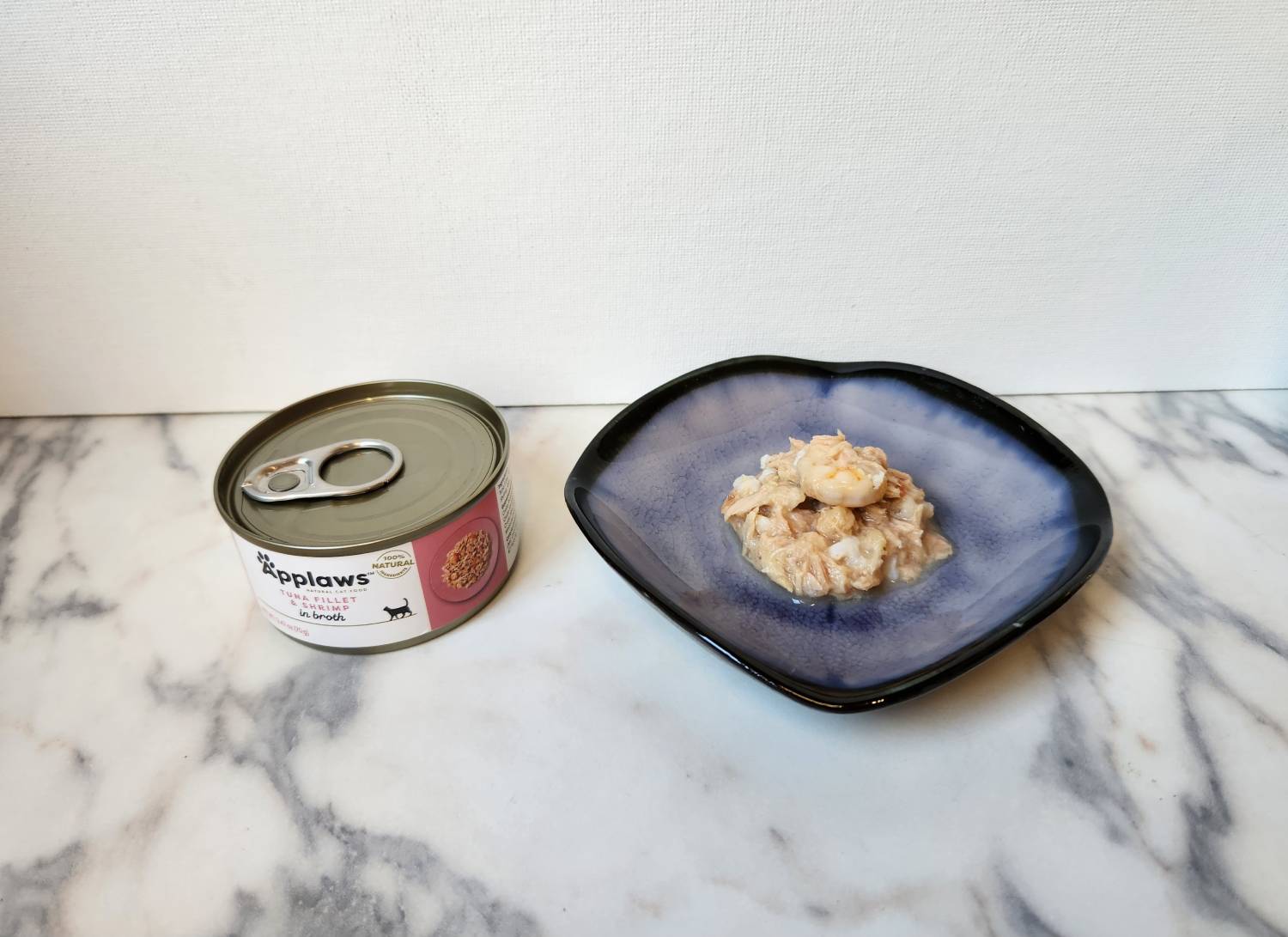
2. Tuna Fillet & Shrimp
Ingredients:
Tuna Fillet, Fish Broth, Shrimp, Rice
Calories Per Can:
47.4 kcal
Crude Protein:
12%
Crude Fat:
0.1%
Crude Fiber:
2%
Moisture:
88%
The Tuna Fillet & Shrimp recipe from Applaws utilizes their basic tuna recipe with the addition of whole shrimp. The shrimp used are small though, perfect for our cats’ dainty mouths, and add a little extra excitement when it comes to mealtime. Shrimp is also high in protein, low in fat, and packed with vitamin B12, iron, Omega-3 fatty acids, taurine, and zinc. If your cat needs some extra nutrients, this is a great supplemental option. Once again though, it would be great if Applaws would omit the rice and instead use a low-starch vegetable to bulk up the meal. Luna loved this food and really loved those chunks of shrimp!
Pros
Two nutritious protein sources
Low calorie
High in B12
High in iron
Cons
Carb source not biologically appropriate
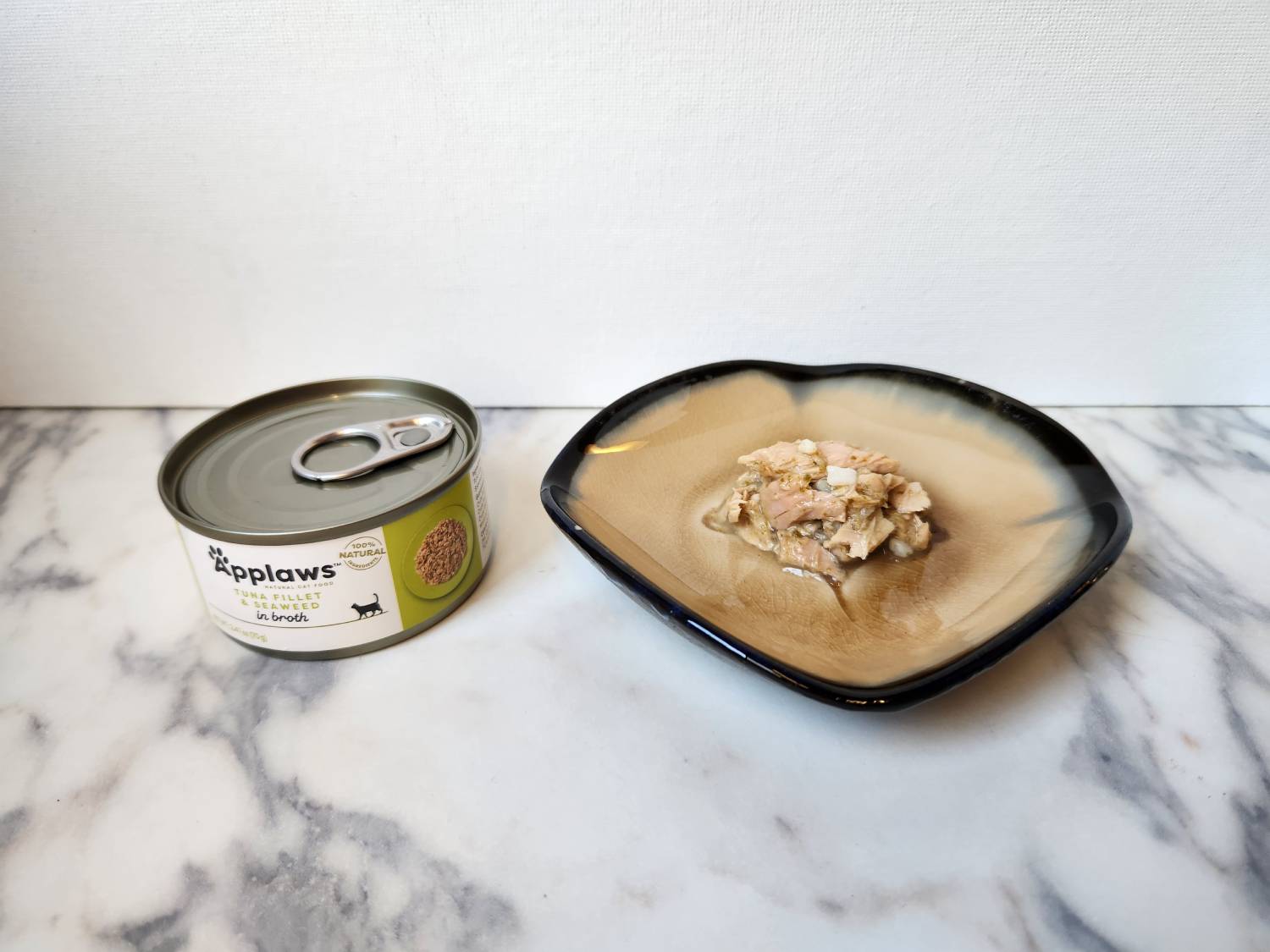
3. Tuna Fillet & Seaweed
Ingredients:
Tuna Fillet, Fish Broth, Dried Seaweed, Rice
Calories Per Can:
49.8 kcal
Crude Protein:
14%
Crude Fat:
0.1%
Crude Fiber:
2%
Moisture:
86%
The third and final recipe in our variety pack contained something unexpected – dried seaweed meal. After a little research, I learned seaweed can offer many beneficial nutrients for our cats, like iodine, magnesium, potassium, and calcium, as well as vitamins B12, A, C, and E. But several online evaluations I came across indicated it is not a natural part of a cat’s diet and should be fed in extreme moderation. For this reason, I wouldn’t recommend this recipe as the only one you supplement your cat’s diet with, as it is probably safer when offered only once a week as a special treat. I also learned that while the prebiotics in seaweed may be beneficial to gut health, the extra fiber content (along with the starchy rice in this recipe) might actually have a negative impact on cats with digestive issues—another reason to feed this recipe in extreme moderation. Finally, seaweed is rich in antioxidants, which are important to immune function, so this food can also give our kitties a little boost in that department.
Pros
Contains antioxidants for immune support
Rich in iodine for healthy thyroid function
Provides beneficial vitamins
May alleviate gut issues
Cons
May contains too much fiber for some cats
Our Experience With Applaws
What I liked
My cat Luna loves wet food, and I know she needs the extra hydration. But I also like our automatic feeder that dispenses a measured amount of kibble three times a day. That’s why Applaws limited-ingredient wet foods, designed to be fed as a supplement to a balanced diet, are perfect for our household.
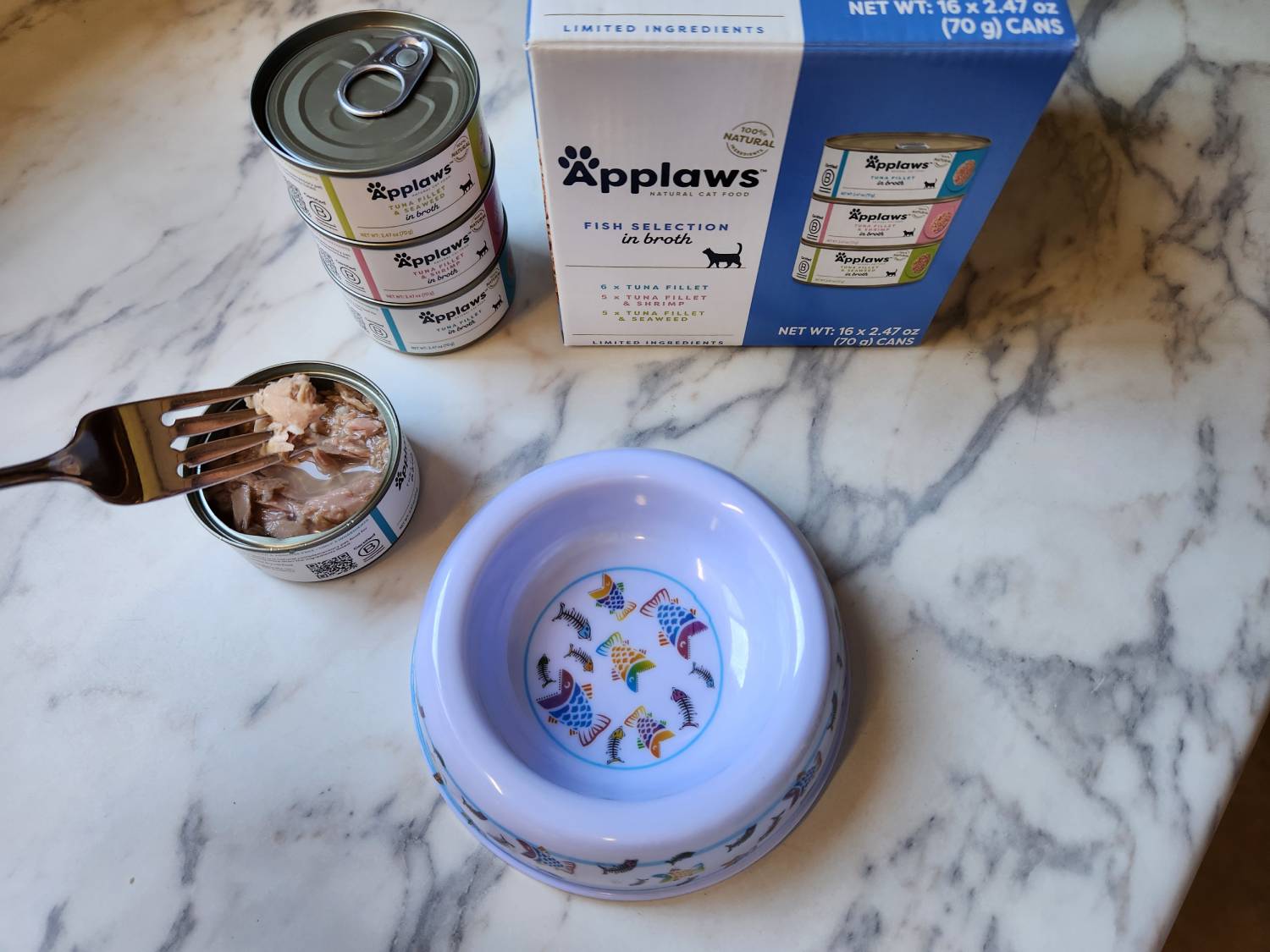
We recently tested the Applaws limited-ingredient fish selection in broth—this included the tuna fillet recipe, tuna fillet & shrimp, and tuna fillet and seaweed. All three recipes were over 85% moisture with a crude protein content of 12-14%, and all three came in under 50 kcal per can. The can size was 2.47 oz, which is small, but due to the calorie content, I knew I could not offer too much of this food anyway without seriously adjusting Luna’s dry food allowance. So, she received half a can in the morning and half a can in the evening.
The thing I liked best about these recipes was the short ingredient lists. With 3-4 ingredients in each recipe we tried, there was no worry about what I was feeding Luna. And the fact that the tuna in each can is in chunk form is further assurance that this food provides only wholesome, natural ingredients with no junk added. That’s more than I can say for other wet foods we’ve tried!
Where There’s Room for Improvement
I liked this food for Luna very much (and she loved it), but there are a few things Applaws could do to make this a more well-rounded product. Rice is a grain and not biologically appropriate for our carnivorous kitties, so limiting or omitting this from their recipes would be a good start. Cats get all the energy they need from eating meat and are well-equipped to digest protein and fat.
The second is making the label a bit more clear and user-friendly. At first glance, this looks like a regular wet food. It is only when you study the fine print on the back of the can that you read “Intended for intermittent or supplemental feeding only.” This product is not meant to be a complete and balanced cat food. However, if you know what you’re getting, this is fine to feed your cat, either as a treat or as supplemental moisture.
Conclusion
The Applaws brand makes a variety of cat food products, including nutritionally complete dry and wet foods, as well as limited ingredient wet foods for supplemental feeding. These complementary foods are designed with simplicity in mind and contain only natural, healthy ingredients with no harmful by-products or chemicals added.
Whether you’re looking to add moisture to your cat’s diet or just want to offer them a special treat, this is a great option. And because it’s easy to see what ingredients are in this product, it can be a great choice for kitties with food sensitivities. Whatever your cat’s nutritional needs are, Applaws has a product for you.
Veterinarians, vet technicians, practice managers, rescuers, behaviorists, nutritionists, trainers, volunteers, and other animal professionals are the backbone of pet ownership. Helping pets and their families live in harmony and health together.
Catster wants to highlight some of these underrated champions of the animal world. Who we like to refer to as Heroes of The Pet World.
We plan to interview some of the most inspiring vet clinics, animal hospitals, animal shelters, and rehabilitation organizations worldwide to share their wonderful and often harsh experiences while working to help, heal, guide, revitalize, and protect our furry family members.
These are the stories of unsung animal superheroes!
Let’s get to know Sploot Veterinary Care!
Mission
In your own words, what is Sploot Veterinary Care’s mission and purpose?
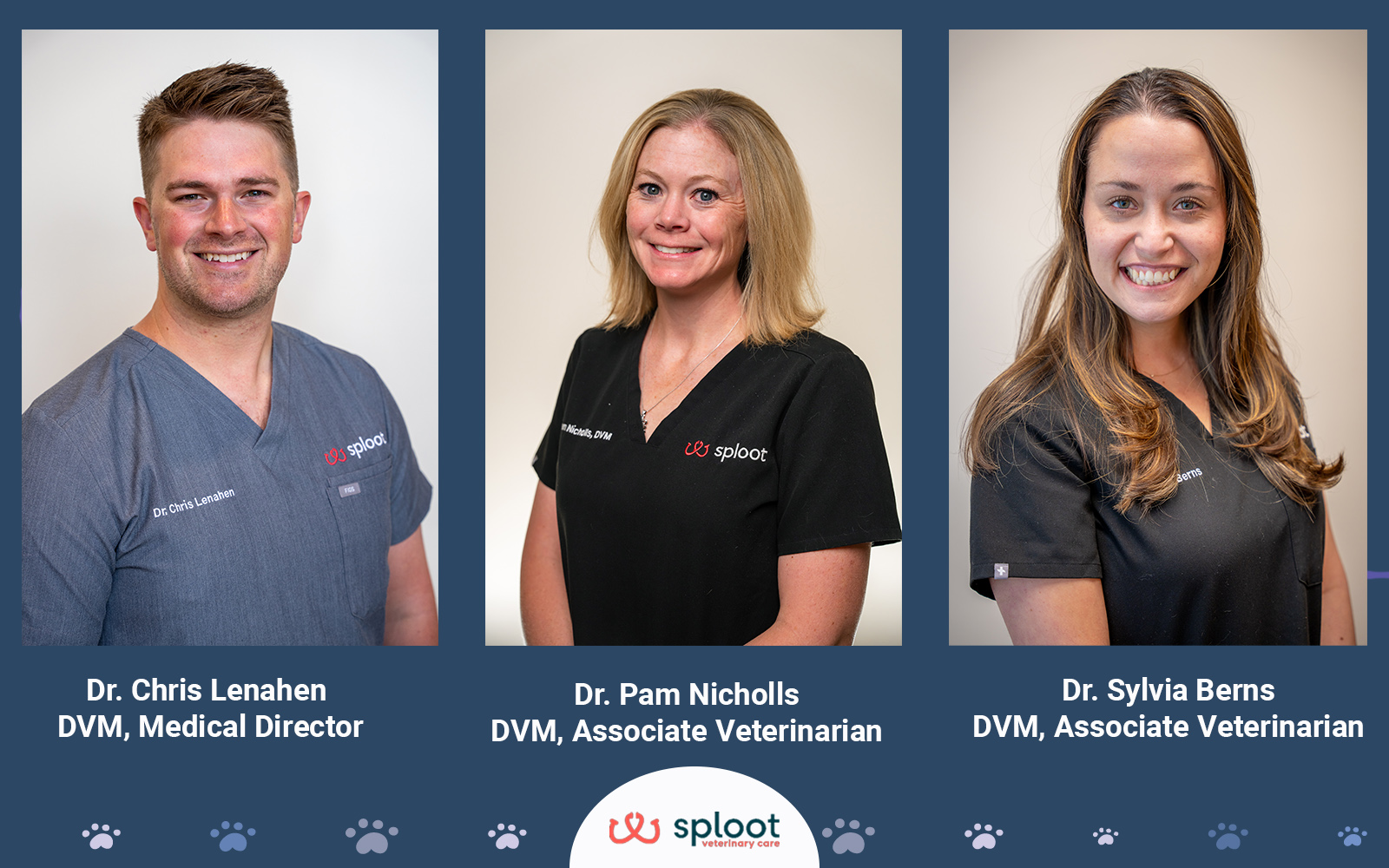
“Sploot Veterinary Care’s mission and purpose is to provide personalized and compassionate care to all of our patients and pet parents—while maintaining the highest quality of medicine and contributing positively to our community. Our next-level care blends expertise with compassion to keep pets thriving.” Dr. Sylvia Berns, DVM, Associate Veterinarian, Sploot Veterinary Care
“To provide pets and their parents with the best veterinary experience by fostering a supportive and positive work environment for caregivers. With same or next-day appointments every day, we make care easy and accessible when you need it. ” Dr. Pam Nicholls, DVM, Associate Veterinarian, Sploot Veterinary Care
What is your individual mission or goal, as a vet professional and as a person?
“If I can go home at night knowing that I helped even just one person feel that because of the care they received from me, they feel more at ease with their pet, then I know that I have done my job.” Dr. Chris Lenahen, DVM, Medical Director, Sploot Veterinary Care
“My individual mission or goal as a pet care professional is to make sure that pets are healthy and taken care of throughout their life. This allows them to carry on their strong bond with their pet parent for as long as possible.” Dr. Sylvia Berns, DVM, Associate Veterinarian, Sploot Veterinary Care
“My goal is to provide each pet and their parent(s) with a veterinary visit tailored to their needs, goals, and budget while maintaining the highest quality of care.” Dr. Pam Nicholls, DVM, Associate Veterinarian, Sploot Veterinary Care
Day-to-Day Experience
What is it like being a vet professional in Denver/ Chicago, and at Sploot?
“I come to work with the sole purpose of being able to lead my team and provide an exemplary standard of care for pets and their owners in our community. Being able to work for a company that reciprocates and takes care of me makes this a mutually rewarding job.” Dr. Chris Lenahen, DVM, Medical Director, Sploot Veterinary Care
“I am given autonomy on how to practice medicine, while maintaining the gold standard of care. I am supported by a company that puts importance on work-life balance, maintaining a healthy and safe work environment in addition to allowing me to mentor the next generation of amazing veterinarians.” Dr. Sylvia Berns, DVM, Associate Veterinarian, Sploot Veterinary Care
“Every day is a different day! I feel very supported at Sploot and have had the opportunity to expand my skills to include laparoscopic surgery and further mentorship of new and recent graduates. Although veterinary medicine is not without challenges, it is a very rewarding profession and I am lucky to be a part of it.” Dr. Pam Nicholls, DVM, Associate Veterinarian, Sploot Veterinary Care
How big is your team?
“I am the Clinic Medical Director of the first Sploot clinic in the Highlands neighborhood in Denver with a team of 6 doctors and 10 nurses. I am also the Clinic Medical Director of one of our newest clinics in the Belmar neighborhood in Lakewood with 3 doctors and a budding team of 4-6 veterinary nurses.” Dr. Chris Lenahen, DVM, Medical Director, Sploot Veterinary Care
“I work in multiple areas including as a veterinarian associate on the clinic floor – where we have about 4-5 doctors on staff, with about 2-3 on a given day, and about 15-20 support staff team members per clinic. When I am working as CAMP (Coaching and Mentorship Program) Director, I am in the headquarters office where we have at least 20-30 team members working in HQ. ” Dr. Sylvia Berns, DVM, Associate Veterinarian, Sploot Veterinary Care
“On any given day, I typically work with two to three skilled veterinary assistants or technicians. Each clinic is staffed with one to three doctors, so our clinic team can range from four people all the way up to 12-15.” Dr. Pam Nicholls, DVM, Associate Veterinarian, Sploot Veterinary Care
Do you have staffing shortages and how do you deal with them?
“Our clinics in each city operate as a tightly connected ‘hive’ allowing us to seamlessly support one another when staffing shortages arise. Doctors and nurses alike need time for themselves or if they get sick, and being able to be supported through an ops team to fill those shifts is quite helpful.” Dr. Chris Lenahen, DVM, Medical Director, Sploot Veterinary Care
“Our clinics work as a unified team, with a core staff at each location and centralized staffing to ensure seamless support across sister clinics and uninterrupted care. Attracting top talent is key to this approach – we focus on building a strong, engaged team by fostering a great work environment and ensuring Sploot is one of the best places in the veterinary field to work.” Dr. Sylvia Berns, DVM, Associate Veterinarian, Sploot Veterinary Care
How many animals on average do you help on a weekly basis?
“I personally see approximately 30-45 patients per week.” Dr. Chris Lenahen, DVM, Medical Director, Sploot Veterinary Care
“If my week is primarily surgery days, I will see 12 to 20 patients. If my week is primarily appointments, I will see 40-55 patients. “ Dr. Pam Nicholls, DVM, Associate Veterinarian, Sploot Veterinary Care
Challenges and Rewards
What is the hardest part of your job?
“The hardest part of my job is being able to pour out 100% of my mental and emotional capacity into my job but still be able to come home and provide that same level of dedication and support to my family and even myself. Many people outside of this field in particular are not aware of the challenges that many of us face despite seeming well and fine at work.” Dr. Chris Lenahen, DVM, Medical Director, Sploot Veterinary Care
“The most challenging part of being a veterinarian, for me, is striking a balance between my job being my passion but still needing to recharge outside of work. I think that, for many veterinarians, we dream of becoming a veterinarian from a young age, but then when we’ve met that goal, we don’t know how to separate our profession from our personal life. So in short, work-life balance is a huge challenge for me.” Dr. Pam Nicholls, DVM, Associate Veterinarian, Sploot Veterinary Care
What are some of the biggest challenges that your organization faces?
“This is a challenging profession with support staff that are relentless workers. Despite the love for animals, it is a profession that faces a lot of burnout and staff turnover.” Dr. Chris Lenahen, DVM, Medical Director, Sploot Veterinary Care
“I would say right now it’s the amount of support staff – the Sploot word has gotten out so our clinics are continuing to be built and stay busy. We just have to keep up with the demand which I think we do a good job of, but this continues to remain a challenge. In such a demanding field, support staff (nurses) can also have high turnover rates with people exploring different career options.” Dr. Sylvia Berns, DVM, Associate Veterinarian, Sploot Veterinary Care
What is the most rewarding part of doing what you guys do?
“No matter how many sick pets we see day in and day out, I will always remember the cases where, because of our hard work and actions, we helped save a pet’s life. It is an indescribable feeling seeing the joy of the pet owner as well as watching the pet live to see another day with their family.” Dr. Chris Lenahen, DVM, Medical Director, Sploot Veterinary Care
“Seeing the bond between pet parents and their pets, and being able to support them in times of happiness, sadness, fear, anxiety, and more. Pets bring so much joy to so many of us that being able to play a big role in this is really like no other feeling.” Dr. Sylvia Berns, DVM, Associate Veterinarian, Sploot Veterinary Care
“I am able to help pets and provide comfort and guidance to their parents on a daily basis, which is very rewarding and humbling. “ Dr. Pam Nicholls, DVM, Associate Veterinarian, Sploot Veterinary Care
What are some of the accomplishments or specific animals that have made a big impact on you as a person or on your team?
“It brings me great joy to help elevate others and provide mentorship and leadership to my team and colleagues. Being a part of CAMP (Coaching and Mentorship Program) as well as being Clinic Medical Director of two busy clinics is rewarding and gives me a sense of pride in what I do.” Dr. Chris Lenahen, DVM, Medical Director, Sploot Veterinary Care
“Becoming the CAMP (Coaching and Mentorship Program) Director has been a huge accomplishment of mine as quality mentorship is often lacking and difficult to find in the veterinarian field once you graduate from veterinary school. Being able to coach New Grads on not only the medicine but also on how to be compassionate to pet parents, how to make self-care a priority to maintain a healthy work-life balance, and so much more has been my greatest accomplishment.” Dr. Sylvia Berns, DVM, Associate Veterinarian, Sploot Veterinary Care
“What I saw my career looking like and what it looks like now are a stark contrast, and I’m so happy to be able to say that. I started as one of two clinicians in a very rural, mixed animal practice, and my quality of life and quality of medicine have improved so much since that time. I am now able to provide doctors with the support and mentorship that I lacked in the early years of my career. In summary, my previous experiences and past jobs have impacted me heavily both personally and professionally, and I’m happy to be able to promote positivity, support, and encouragement and foster healthier environments for doctors and staff members.” Dr. Pam Nicholls, DVM, Associate Veterinarian, Sploot Veterinary Care
Future
What are Sploot Veterinary Care’s main goals for the future?
“To continue to elevate the profession while providing the highest standard of care for the communities it serves.” Dr. Chris Lenahen, DVM, Medical Director, Sploot Veterinary Care
“To continue to provide personalized high-quality care to our patients and continue to support the community. “ Dr. Sylvia Berns, DVM, Associate Veterinarian, Sploot Veterinary Care
“To provide greater access to high-quality veterinary care through promotion and expansion while supporting healthy teams.” Dr. Pam Nicholls, DVM, Associate Veterinarian, Sploot Veterinary Care
How can the general public help make your lives easier?
“Recognizing that by following up with their veterinarian on an annual basis for wellness health checks, they can ensure that if issues arise, we are able to intervene earlier and quicker than if the problem is already advanced and their pet is sick.” Dr. Chris Lenahen, DVM, Medical Director, Sploot Veterinary Care
“They can purchase insurance for their pets – a lot of the time there are financial concerns, which is completely understandable as I know veterinary care is not cheap, however, this limits how well the veterinarian can diagnose and treat your pet. If pet parents have pet insurance, then they don’t need to think twice about giving their pet the best care possible. Also, increased empathy and respect for the veterinarian field and those who work in it – we have a tough job and it is often not full of rainbows, puppies, and kittens like many think it is.” Dr. Sylvia Berns, DVM, Associate Veterinarian, Sploot Veterinary Care
“Communicating respectfully and being assertive in expressing their goals and needs for their pets is always incredibly helpful in establishing a plan that is beneficial to pets, their parents, and veterinary staff. And calling in refill requests before they’re out of medications!” Dr. Pam Nicholls, DVM, Associate Veterinarian, Sploot Veterinary Care
Stories
What are some of the funniest or most outrageous pet names you’ve encountered?
“Bill Pickle Murray, Captain Spaghetti, Ike Chocolate Daddy, Catrick Swayze → (one of my favorites!)” Dr. Sylvia Berns, DVM, Associate Veterinarian, Sploot Veterinary Care
“A pair of French Bulldogs named Eddie Murphy and Kevin Bacon are the most memorable ones I can think of right now.” Dr. Pam Nicholls, DVM, Associate Veterinarian, Sploot Veterinary Care
How to Help
If someone wants to visit, join, support, or volunteer at your organization, where can they find more information and get in touch?
“I would encourage them to reach out to our People Operations department or our Talent Acquisition team for those interested in an externship or employment at Sploot. If you are a prospective veterinarian or veterinary technician in high school or college, consider volunteering at your local animal shelter or consider supporting a local animal rescue in your community as well.” Dr. Chris Lenahen, DVM, Medical Director, Sploot Veterinary Care
Anything else you’d like to tell the cat community?
“Cats may hide their feelings and not tell us a lot at home, but many times they are telling us more than we could ever think when they are less social, are hiding, or stop eating. If you see changes in your cat’s day-to-day behavior, reach out to our veterinary team and we can help determine if there is anything to be concerned with.” Dr. Chris Lenahen, DVM, Medical Director, Sploot Veterinary Care
“Cats are in need of veterinary care just as much as dogs are. Annual exams are extremely important, in addition to routine screening of bloodwork and urine as the sooner we can detect a disease or abnormality, the faster we can treat/attend to it resulting in better outcomes. Also, dental disease is real, and at-home dental care along with regular COHATs (Comprehensive Oral Health Assessment and Treatment) are very important in keeping your cat’s teeth as beautiful and healthy as possible.”” Dr. Sylvia Berns, DVM, Associate Veterinarian, Sploot Veterinary Care
“Common problems for cats include dental disease, heart disease, and kidney disease, all of which can be detected early with annual to semi-annual examinations. We recommend comprehensive bloodwork and urinalysis annually, at minimum. Additionally, we have many options for stress management to make feline visits less traumatic for both cats and their owners, so feel free to call ahead to discuss these options!” Dr. Pam Nicholls, DVM, Associate Veterinarian, Sploot Veterinary Care
The information is current and up-to-date in accordance with the latest veterinarian research.
Learn more »
Hi, I’m Dr. Karyn! Read my introduction to learn more about me and meet my five hilarious cats: Clutch, Cyril, Alex, Zelda, and Zazzles.
In the winter of 2019, for some reason that remains known only to him, Husband decided that four cats were not quite enough and that our already rather busy household was in need of a ginger. Enter Alex, named in memory of another little ginger cat called Axel, who was sadly struck by a car several years prior, which is just one more reason why we go against the ‘norm’ here in the UK and keep our cats indoors.
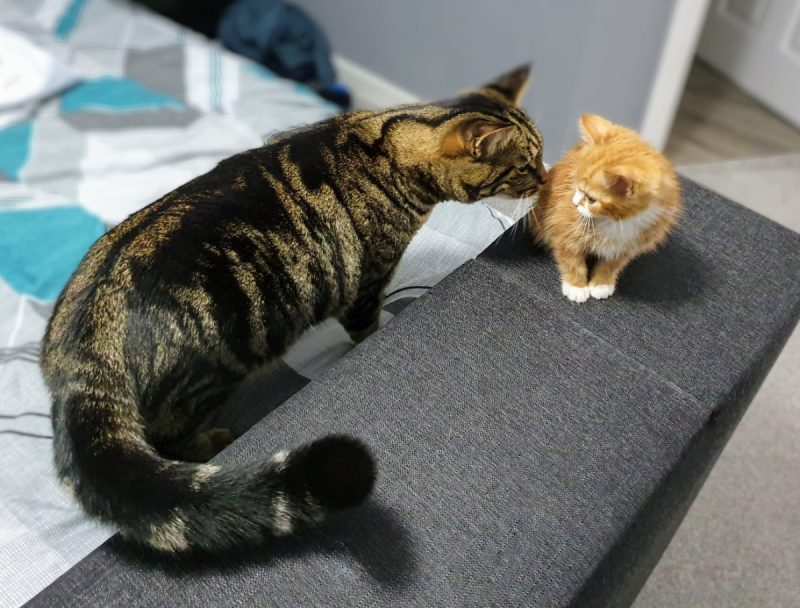
As you would expect, the other cats were a bit wary at first. Well, except Clutch, because we are yet to find anything that phases him. While it took our female felines, Zelda and Zazzles, a little longer to warm up, Cyril had decided by the end of day one that Alex was to be his squishy, to be loved and cherished from that day on.
Cyril was wary at first
Shared Interests
Before long, Cyril and Alex discovered that they had many things in common, including a deep affection for food, a worrying addiction to catnip, and a shared propensity for lying in weird positions.
Then It Gets A Little Weird…
Firstly, let me be clear; I am not one to cast judgment on anyone’s gender, orientation, or who they choose to love (providing both are consenting adults, of course). But Alex and Cyril’s relationship has evolved over time from one of paternal or brotherly love to something a little bit different. Almost every night, they engage in a game of chase and wrestling, which invariably ends up with one gripping the scruff of the other and engaging in some behaviors that would ordinarily result in the creation of kittens. Of course, with two neutered male cats, this is highly unlikely to eventuate.
Now, it’s not unusual for cats of either sex, neutered or entire, to hump one another from time to time. It may be a form of gratification, but in most cases, it is a display of dominance. What I find strange about Alex and Cyril’s little trysts is that they do not show any other signs of dominance conflict and that this is a nightly event, typically culminating in a squishy cuddle. Quite frankly, I’ve occasionally felt inclined to offer them a post-coital cigarette.
But hey, love is love, and on this Valentine’s Day, we should be grateful for love in all its many shapes and forms.
This article is a part of Dr. Karyn’s series with her five hilarious cats.
The information is current and up-to-date in accordance with the latest veterinarian research.
Learn more »
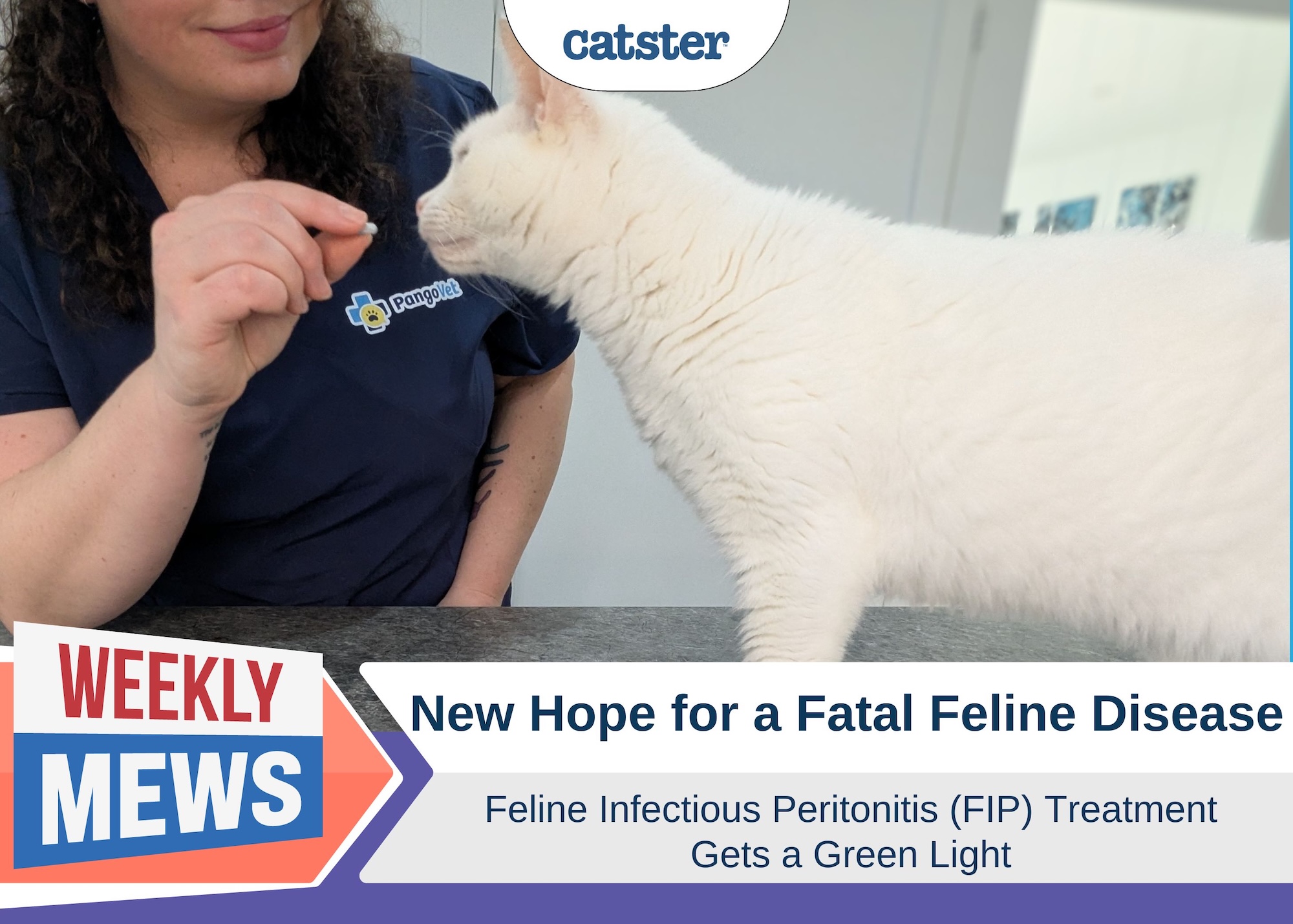
Until very recently, a diagnosis of the disease Feline Infectious Peritonitis, better known as FIP, was an automatic death sentence. An aggressive inflammatory disease, FIP is a mutation of a relatively benign form of feline coronavirus, a distant relation to COVID-19.
Interestingly, it was the human coronavirus pandemic that accelerated the development of the first effective treatment for FIP, Remdesivir. This injectable antiviral medication had been in development before COVID-19 struck, but the sudden need for human treatments sent the research and development teams at Gilead into overdrive. While this was good news for those suffering from severe forms of COVID-19, it was great news for vets and cat owners, whose options when faced with FIP patients in the past had been palliation and euthanasia.
Image Credit: felipe caparros, Shutterstock
In 2021, Remdesivir was being rolled out in Australia, the UK, and parts of Europe, with promising results. Although not a guaranteed cure, vets were finally seeing FIP patients improving and going home. However, a lack of FDA approval in the US meant that this potentially life-saving treatment was still out of reach for many. Desperate cat owners were even turning to ‘black market’ sources to obtain the drug.
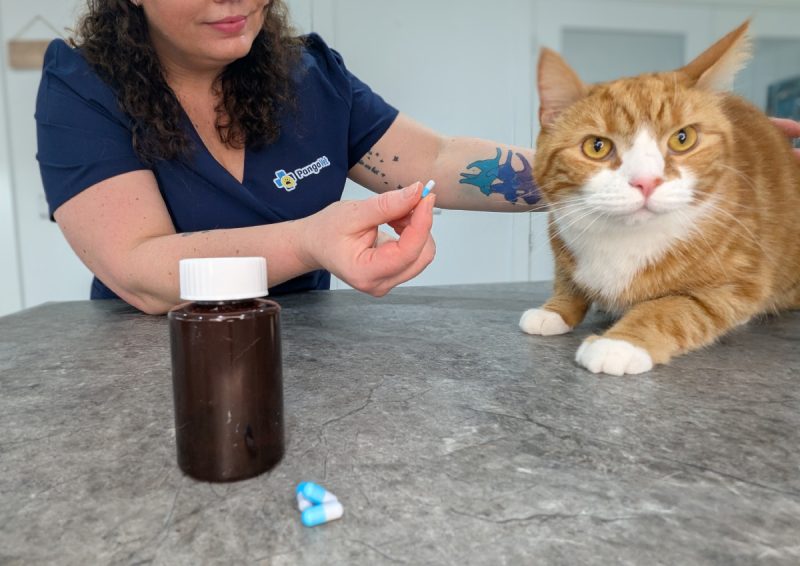
Three years after its initial release, the FDA has tentatively cleared the path for an alternative form of Remdesivir, a tablet known only as GS-441524, for use in the US. In a recent statement, the FDA wished to:
remind compounding pharmacies, veterinarians, and pet owners that animal drugs compounded from bulk drug substances are unapproved drugs and are not, in fact, legal. However, the FDA has described certain conditions where the agency does not intend to take enforcement actions for compounded products for use in animals.” Heat treatments have been shown to be effective for inactivating H5N1 in meat, milk, and egg products. We recommend that consumers follow the USDA guidelines for handling and thorough cooking of raw meat before feeding. Animals should also be kept from hunting and consuming wild birds.
In other words, we haven’t approved it, but we know you’re going to use it, and we’re not going to try to stop you. What a clever way to magnanimously allow treatment to proceed without the risk of shouldering any blame if things go wrong!
Studies indicate that the efficacy of the oral medication is comparable to that of the injection, but a combination of the two forms may be even more effective. Case studies have reported a range of responses, including remission, relapse, and death, but with only 4 years’ worth of real-world cases, it will be some time before we can evaluate long-term outcomes. For now, it is enough to say that cats diagnosed with FIP are finally being given the chance to have a long-term outcome.
Next item on the list: come up with a name a little more marketable than GS-441524!
The post Catster Photo Contest: Cats of the Week Winners (Feb 13, 2025) by Catster Editorial Team appeared first on Catster. Copying over entire articles infringes on copyright laws. You may not be aware of it, but all of these articles were assigned, contracted and paid for, so they aren’t considered public domain. However, we appreciate that you like the article and would love it if you continued sharing just the first paragraph of an article, then linking out to the rest of the piece on Catster.com.
This is Teddy he was found outside sick and hungry. After getting him well he became part of the family
Silliest
Name:
Olivia
Breed:
Domestic Shorthair
Fun Fact:
Olivia is a very happy and grateful rescue kitty. She is very loving and likes to be carried over my shoulder like a baby. She is named after the actress Olivia de Havilland.
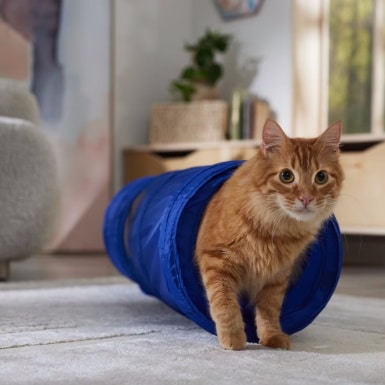
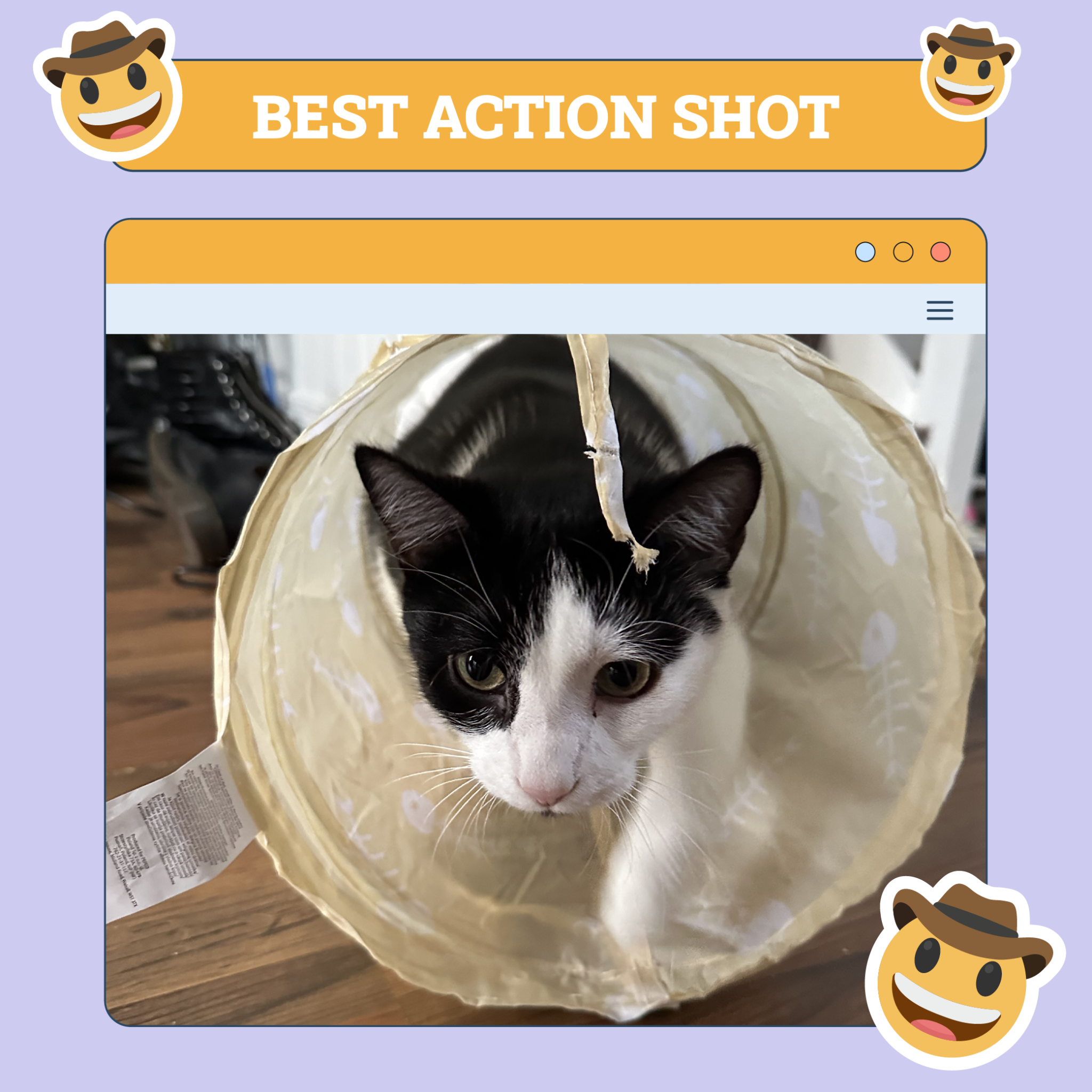
Mango is very affectionate and playful. He loves this tunnel and will race through it at top speed!
Most Dignified
Name:
Theo
Breed:
Siberian
Fun Fact:
Theo is a 4 year old Neva Masquerade Siberian. He is the silliest and most loving boy.
Best Action Shot
Name:
Purrrple Rain
Breed:
N/A
Fun Fact:
Rain loves the outdoors and doesn’t mind wearing a harness and leash while taking daily walks. He is mostly an indoor kitty so, when he can’t be outside, he loves to watch “Rain TV” from his thrown in the master bedroom.
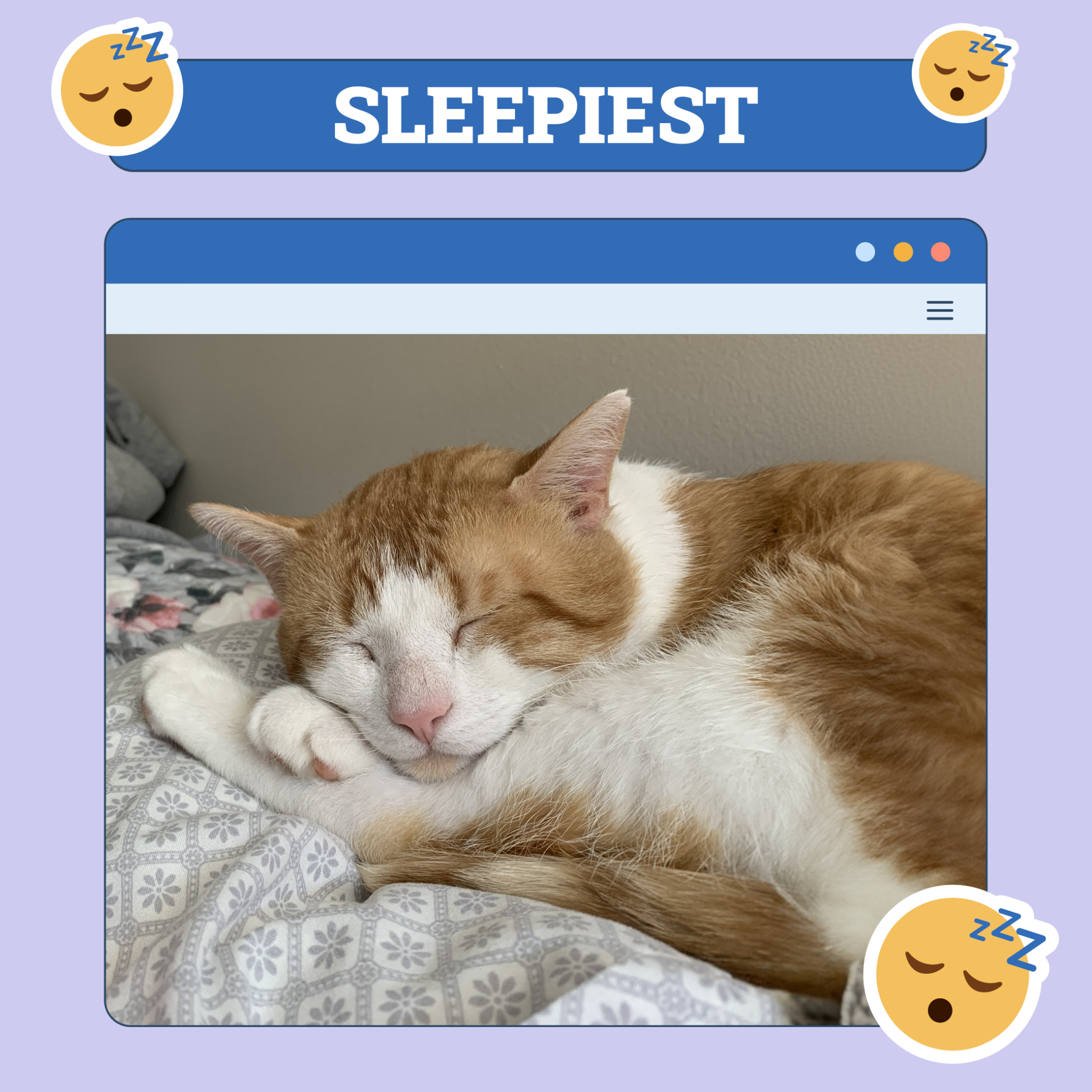
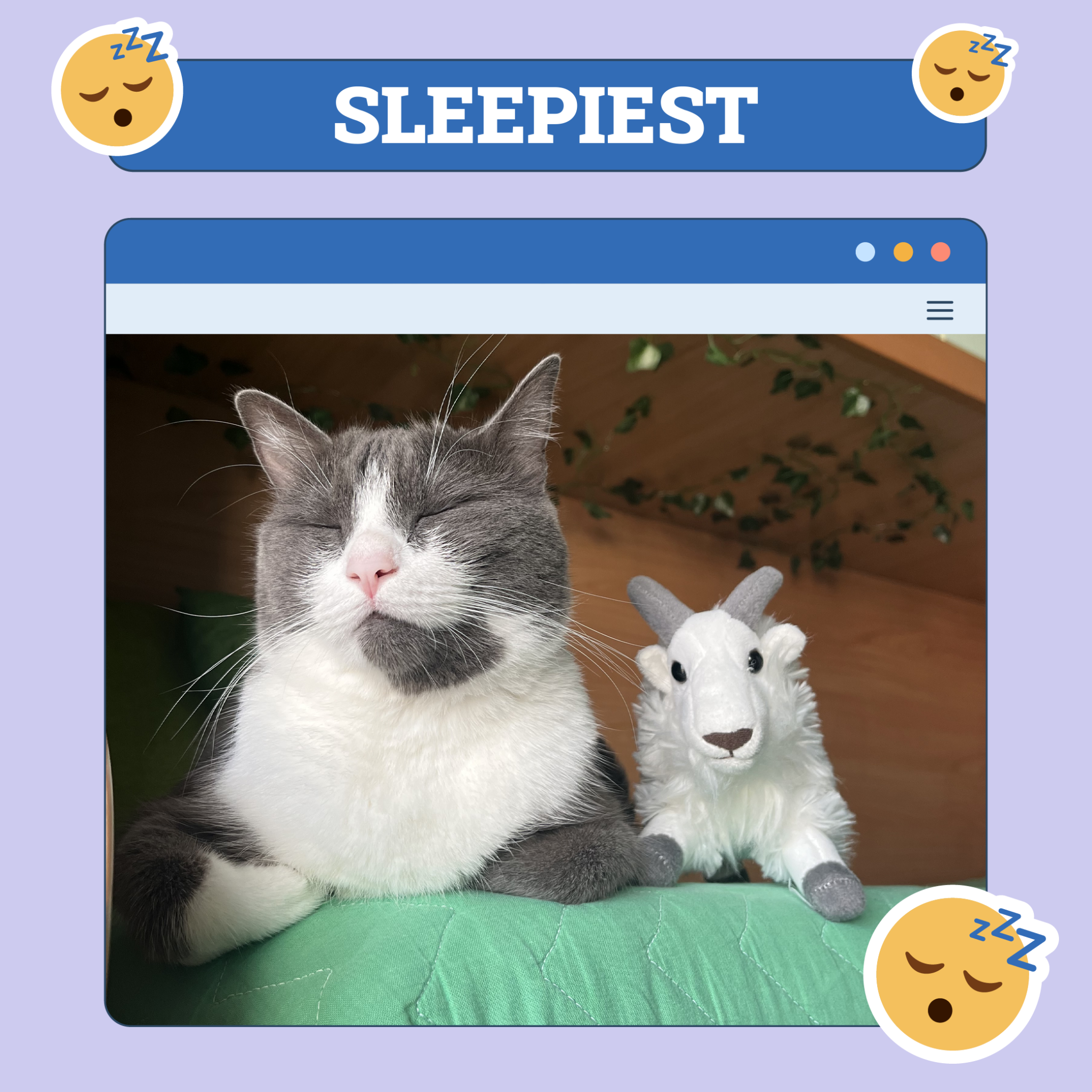
Sleepiest
Name:
Pumpkin pie
Breed:
Domestic short hair
Fun Fact:
This is him in his sleepy happy draw with all of his toys on my bed. He spends most of his day sleeping. He is a senior cat
Most Expressive
Name:
Shilah
Breed:
Brown Tabby / American Shorthair
Fun Fact:
Feral cat that’s “loved to love the indoors”
Enter Your Cat
Submit your kitty for a chance to be featured! Click here
This article is a part of our Weekly Photo Contest
View our previous week’s winners here: February 6, 2025
Click here to view our full list of past winners
The post Catster Photo Contest: Cats of the Week Winners (Feb 13, 2025) by Catster Editorial Team appeared first on Catster. Copying over entire articles infringes on copyright laws. You may not be aware of it, but all of these articles were assigned, contracted and paid for, so they aren’t considered public domain. However, we appreciate that you like the article and would love it if you continued sharing just the first paragraph of an article, then linking out to the rest of the piece on Catster.com.
It seems like Valentine’s Day sneaks up on us every year, which can make finding the perfect gifts for your loved ones difficult. If you’re looking for a present shortly before the holiday, try to place any orders at least a week in advance, just to ensure that the gift arrives on time. If you’re planning a present months in advance, you’ll walk into the holiday well-prepared.
If you’re in the market for a gift for a friend whose Valentine is their cat, you’re in luck. We compiled a list of the best Valentine’s Day gifts that you can get for your cat-loving friend, regardless of your budget. There’s a gift here for everyone!
Top 11 Valentine’s Day Gifts
Cat Supplies
1. Cat Beds
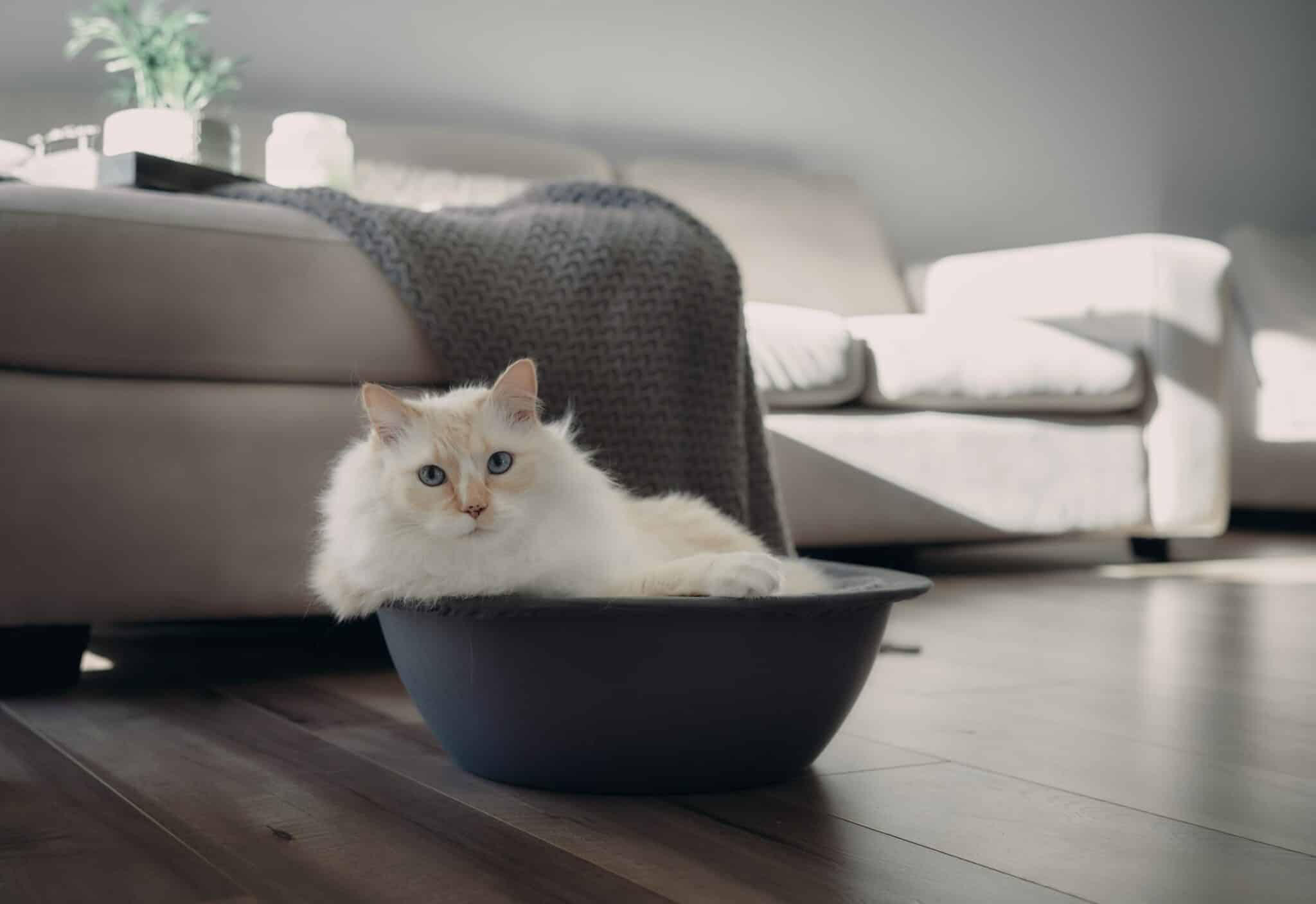
We all know that cats love to snuggle into bowls, baskets, and boxes, and the Hepper Nest Bed is perfectly designed to appease cats. This bowl-shaped cat bed has a Sherpa fleece lining that can be removed and washed. The material of the bed itself is a soft-touch molded foam that is covered with fabric on both sides, so it’s sturdy but also cozy. The wide lip of the bed provides the perfect spot for a cat to rest their head and still keep an eye on things in the room. This Valentine’s Day, this bed will be the perfect gift for your cat or for a cat-loving friend’s cat.
2. Cat Trees
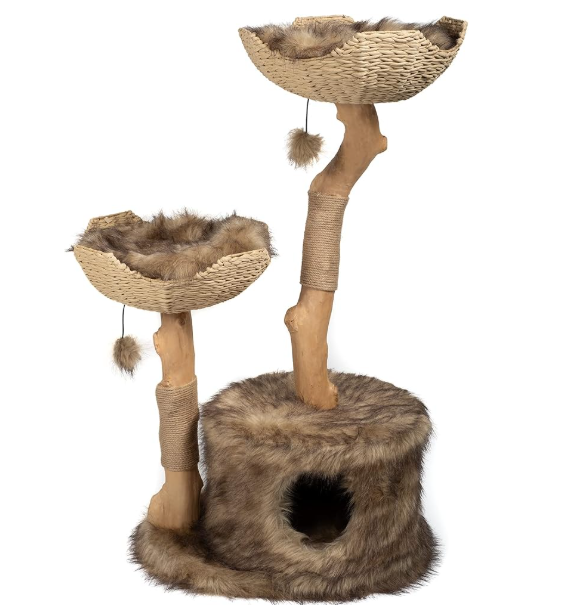
Consider giving your friend a gift that will please their cat while improving the look of their home. The Mau Lifestyle Cento 46-in Modern Wooden Cat Tree & Condo is the perfect Valentine’s gift for this purpose. This attractive cat tree is made with a modern, minimalistic design and unique accents, like real tree branches, woven baskets, and a cat condo covered in faux fur. The cushions inside the baskets are cozy but also washable. It also includes two dangling pom-poms and both tree branch posts have a section covered in jute for scratching.
3. Scratching Pad
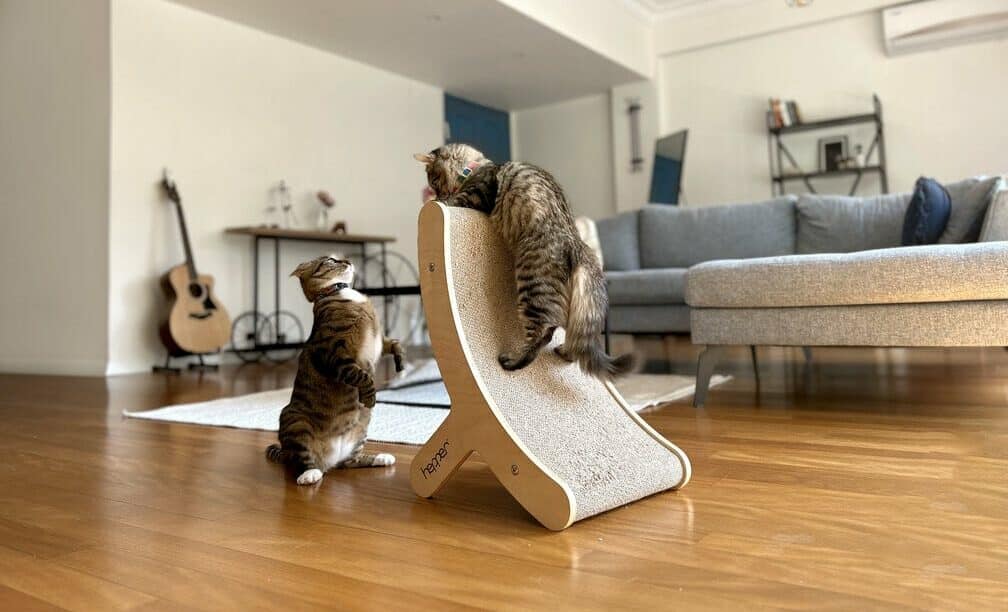
The Hepper Hi-Lo Scratcher is the perfect Valentine’s gift for anyone with a kitty that likes to scratch up the furniture. This extremely durable cat scratcher will help prevent damage to carpets, curtains, and other items in your giftee’s home, and it will give their pet a way to stretch and maintain their claws without making a huge mess, which everyone will appreciate. It has an attractive minimalist design that will look great anywhere, and it has an incredibly durable plywood frame with a non-toxic gloss finish.
The extra-thick cardboard scratching surface will stand up to even the most aggressive cats, and the scratcher can be put into multiple positions for vertical and horizontal scratching to help make it more enticing. Changing positions can also help extend the lifespan of the surface, and replacement cardboard can be bought if it ever wears out.
At Catster, we’ve admired Hepper for many years and decided to take a controlling ownership interest so that we could benefit from the outstanding designs of this cool cat company!
Home Items
4. Hand Towels
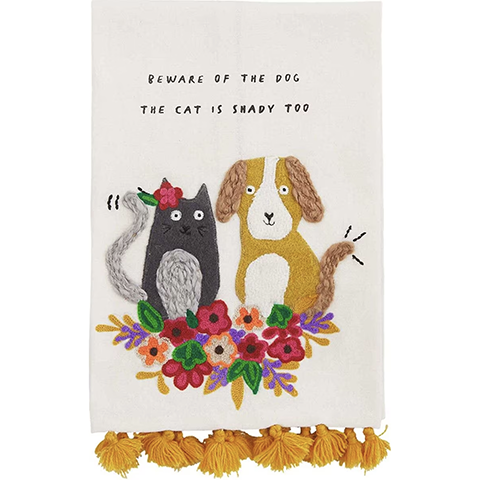
For a friend with a cat and a dog, they’ll love the Mud Pie Funny Beware Embroidered Tea Towel for Valentine’s Day. This colorful and cute tea towel features an embroidered cat and dog, as well as beautiful flowers and tassels. It also has a funny quote that your friend will love: “Beware of the Dog. The Cat is Shady Too.”
This 14” x 21” tea towel is made from cream-colored natural cotton, giving it an organic look and feel. If you’re looking for a silly but pretty gift that makes a statement, this is the perfect option to liven up your Valentine’s home.
5. Candles
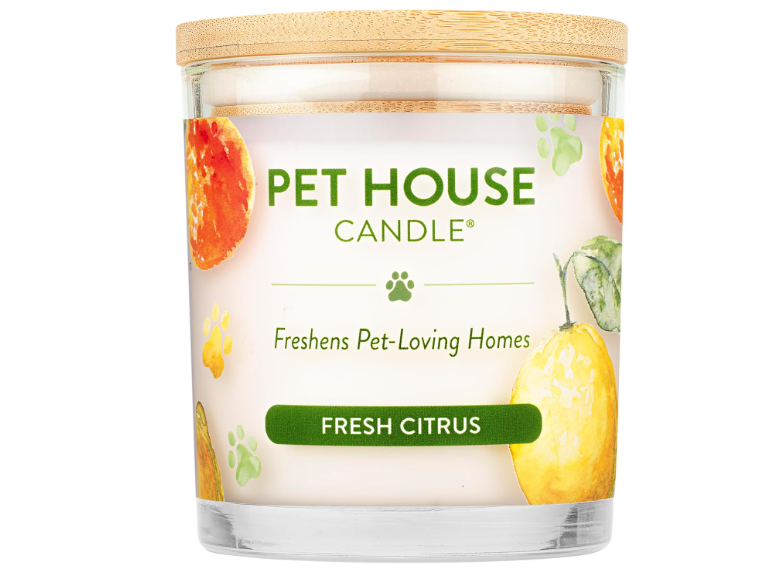
There are few things that pet owners love more than a house that smells good, especially cat owners who are constantly having to deal with litter boxes. If your Valentine loves a fresh-smelling home, the Pet House Fresh Citrus Candle will brighten their day.
This bright-smelling candle radiates the scents of oranges and lemons, as well as a hint of vanilla sugar. These candles are hand-poured in the U.S.A., and they’re made with plant-based wax and a cotton wick, giving them a clean burn. They’re free of dyes, paraffin, phthalates, parabens, and formaldehyde. Your friend can expect to get up to 60 hours of burn time from their new gift.
6. Signs and Pictures
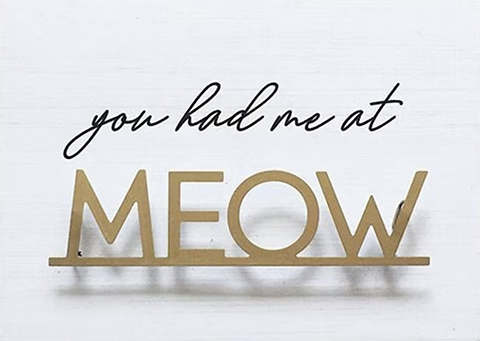
One of the home décor items that has become very popular in the last few years has been signs of all kinds. For your Valentine who loves cats, the New View Had Me at Meow Box Sign is a lovely home décor gift. This sign has a white, wooden backing with the words, “You had me at meow,” on it. The word “meow” is brought into full focus through large, all-capital lettering in matte gold. It’s made to be freestanding, so it can be placed on any surface instead of requiring wall space and holes.
7. Coasters
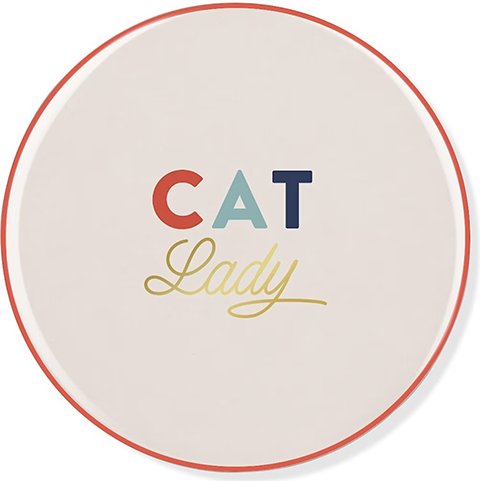
While being a cat lady was an insult for many years, many people have begun to playfully embrace the phrase, happily claiming it to show their love for their cats. The Pet Shop by Fringe Studio Cat Lady Ceramic Coaster is a great Valentine’s Day gift for your friend who proudly considers themselves a cat lady. This ceramic coaster has an off-white background with red trim around the edges of the circle. On the inside are the word “cat” in bright, big lettering and the word “lady” in vibrant gold.
8. Books
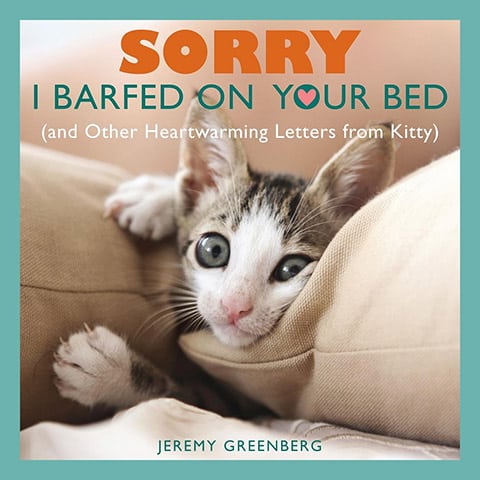
Life with cats can be less than glamorous sometimes, and the book, “Sorry I Barfed on Your Bed (and Other Heartwarming Letters from Kitty)” is a fun way to celebrate the ups and downs of cat ownership. This book includes fun letters written “by” cats to their owners, as well as tons of full-color photographs, all to give you a “cat’s eye view” of the world. This may not sound like a very romantic Valentine’s Day gift—probably because it’s not—but this is a fantastic gift to give to a friend with a great sense of humor.
9. Coffee Mugs
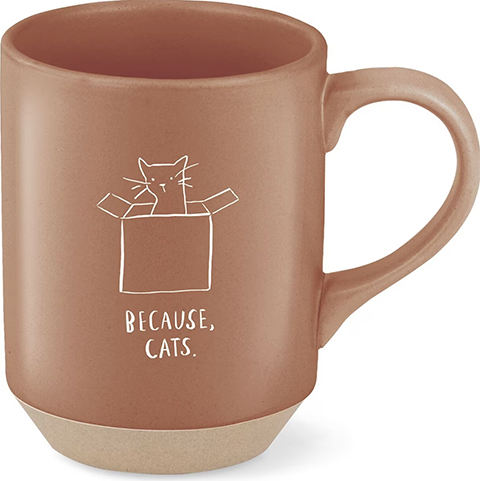
Most people love a nice cup of coffee in the morning, and the Fringe Studio Stoneware Mug is a gift that is the perfect combination of functional and fun to give to your Valentine. This mug features a glossy color glaze across most of the mug, while the lower portion of the mug is exposed stoneware. The design on the mug features a cat sitting in a box with the phrase, “Because, cats” underneath it. This one is pretty self-explanatory to people with cats since sometimes cats do odd things simply because, well, they’re cats.
Apparel
10. Jewelry
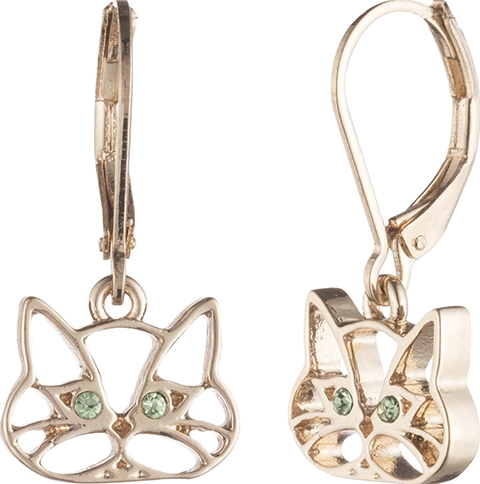
Gaudy earrings aren’t the best Valentine’s Day gift for everyone, but the Pet Friends Cutout Cat Drop Earrings will make a great gift for your friend who loves statement jewelry. These gold earrings are shaped to look like cat faces, with small, green stones as the cats’ eyes. They have a drop design, and they’re a great way to finish off an outfit, whether your friend is going to the park or to work. The lever back makes these earrings easy to get on and off, making them a convenient staple for your Valentine.
11. Clothing
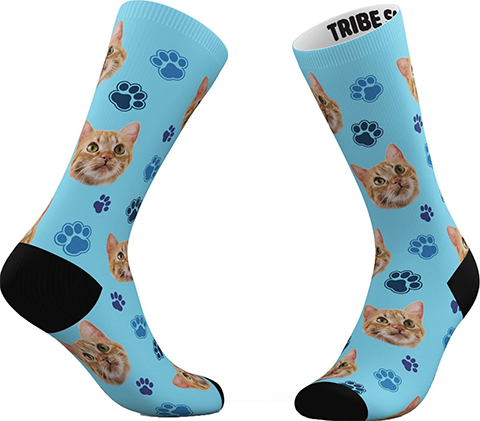
The Tribe Personalized Socks are available in pink and blue, and they’re made to fit up to a man’s size 11 foot. They can be customized with a photo of a pet, so you can get your Valentine a pair of socks that will show off their favorite feline. Tribe will crop the photo you send in to only feature a face, so make sure to send in a clear picture of your friend’s cat’s face. Pictures will be edited for best lighting and are printed in high resolution, ensuring the picture on the socks is high quality. These socks are extremely soft and comfy, and they’re made from recycled plastic bottles, so they’re sustainable as well.
Conclusion
While there may not be very many romantic gifts on this list to win over your crush, if you’ve got a friend or family member who loves their cat above all else, there’s definitely something fun for them here. Many of these gifts are functional on top of being fun, so you don’t have to worry about adding to your friend’s clutter. Just remember to place your order at least a few days in advance of the holiday to ensure your friend’s gift arrives on time!
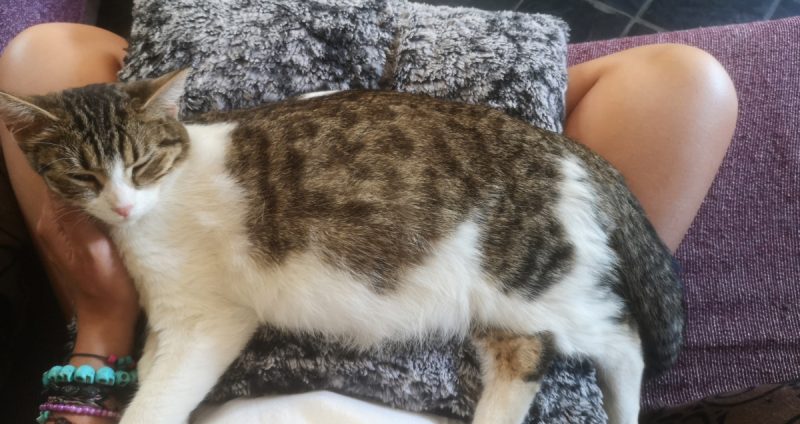
Welcome to the Wednesday Cats of Catster! Every week, we share a story from one of our cat-loving Catsters. This week is about Isabel and her sassy rescue, Milly.
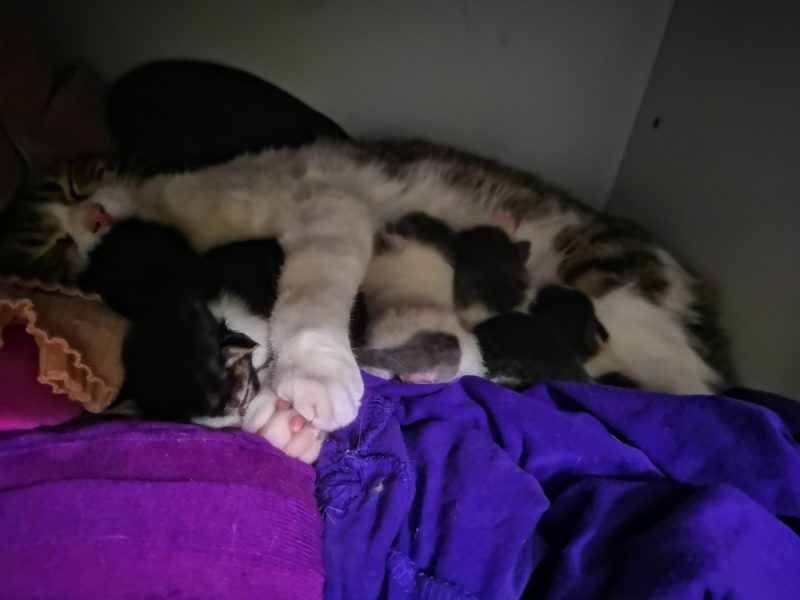
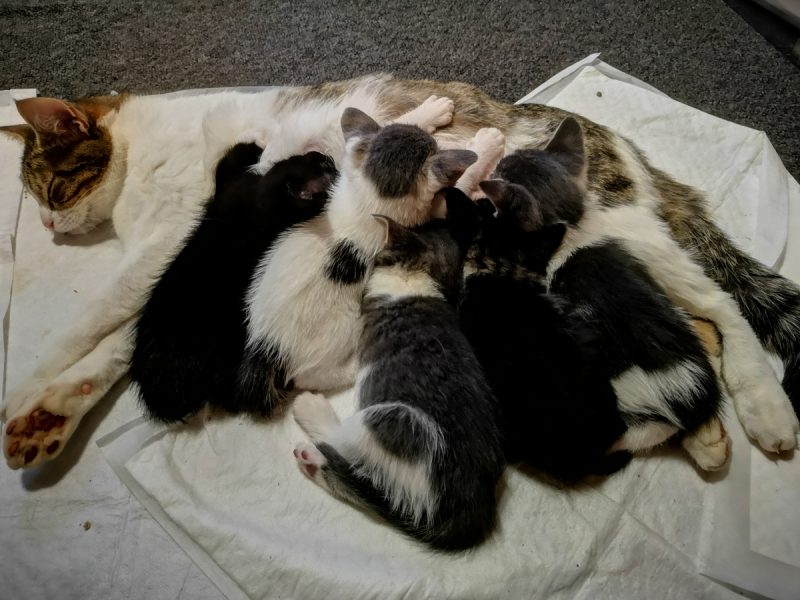
Helping Milly bring new life into this world was probably one of the most stressful and beautiful experiences I’ve had in all my years of being a cat owner. And having 5 adorable, energetic little furballs around while on a nationwide lockdown during the COVID-19 global pandemic turned out to be an absolute life-saver!
I’m a firm believer in “everything happens for a reason.” Although Milly’s pregnancy was totally unexpected and definitely unplanned, it turned out to be such an incredible chapter of our lives. One I cannot imagine not having.
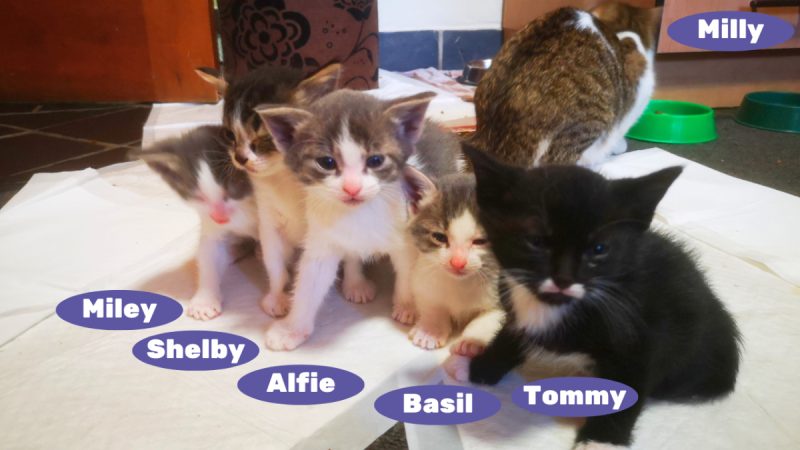
Now let me tell you a bit more about the night Milly became a teen mom and I became a grandmother to Tommy, Shelby, Alfie, Basil, and Miley.
As you can see, it’s very hard to guess what series I watched, the foods I ate, and the music I listened to back then!
Accidental Impregnation
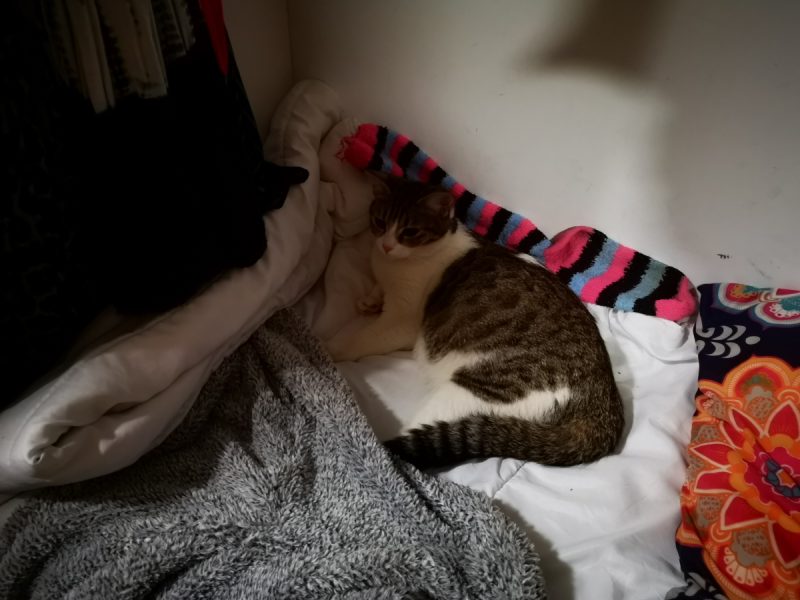
Pre-pregnant Milly
“So, how did Milly get pregnant?” you ask. Well, it was right after I graduated from University and Milly and I moved back home with my family to Johannesburg at the end of 2019. Milly came with me when I visited home as a student, so she was used to the space and knew everyone, including our 7 other cats, Chicky, Winsey, Smokle, Lulie, Nibby, Pumy, and Mimi. All of whom were spayed or neutered.
That December, I went to visit my fiance who was visiting his parents in Stellenbosch, Cape Town. Milly was around 9 months old at the time and still a little baby in my eyes. I knew a lot about cats at the time, but I definitely wasn’t the cat expert I am today. I wasn’t fully aware of how early you should spay or neuter cats. Ideally, one can start spaying female cats between 5 and 6 months of age.
I had just finished college, moved back home, and was planning on going on a well-deserved vacation. So, I just didn’t think of spaying her at that time. I told myself that I’d take her for a check-up and book the sterilization in the new year once I came back from holiday.
Too little, too late.
Sometime during that December, she snuck out (all our cats were outdoor/indoor cats, including her) and went and got herself pregnant with an unknown gentleman in the area. Most likely a stray cat. My parents live very close to a shopping center and there are apparently stray cats living in or around the parking lot.
A week or two later, my sister called and said Milly was acting unusually loveable and affectionate and they did see her come running across the street from the shopping center’s side a couple of nights. We obviously knew it was risky allowing her to roam freely while intact, so we did worry that she might have gotten pregnant, but I just really didn’t think she’d be that determined and eager to get pregnant within 2 weeks of being home and while not spayed.
Nonetheless, it was totally my fault. I should’ve been a more responsible cat owner in that scenario and should’ve spayed her much sooner. However, everything worked out fine in the end. No use in crying over spilled milk!
The Pregnant Cat Experience
1st trimester
So, after my sister phoned me, we were about 60% sure she might be pregnant. By the time I got home from holiday, we were certain. Milly was definitely pregnant.
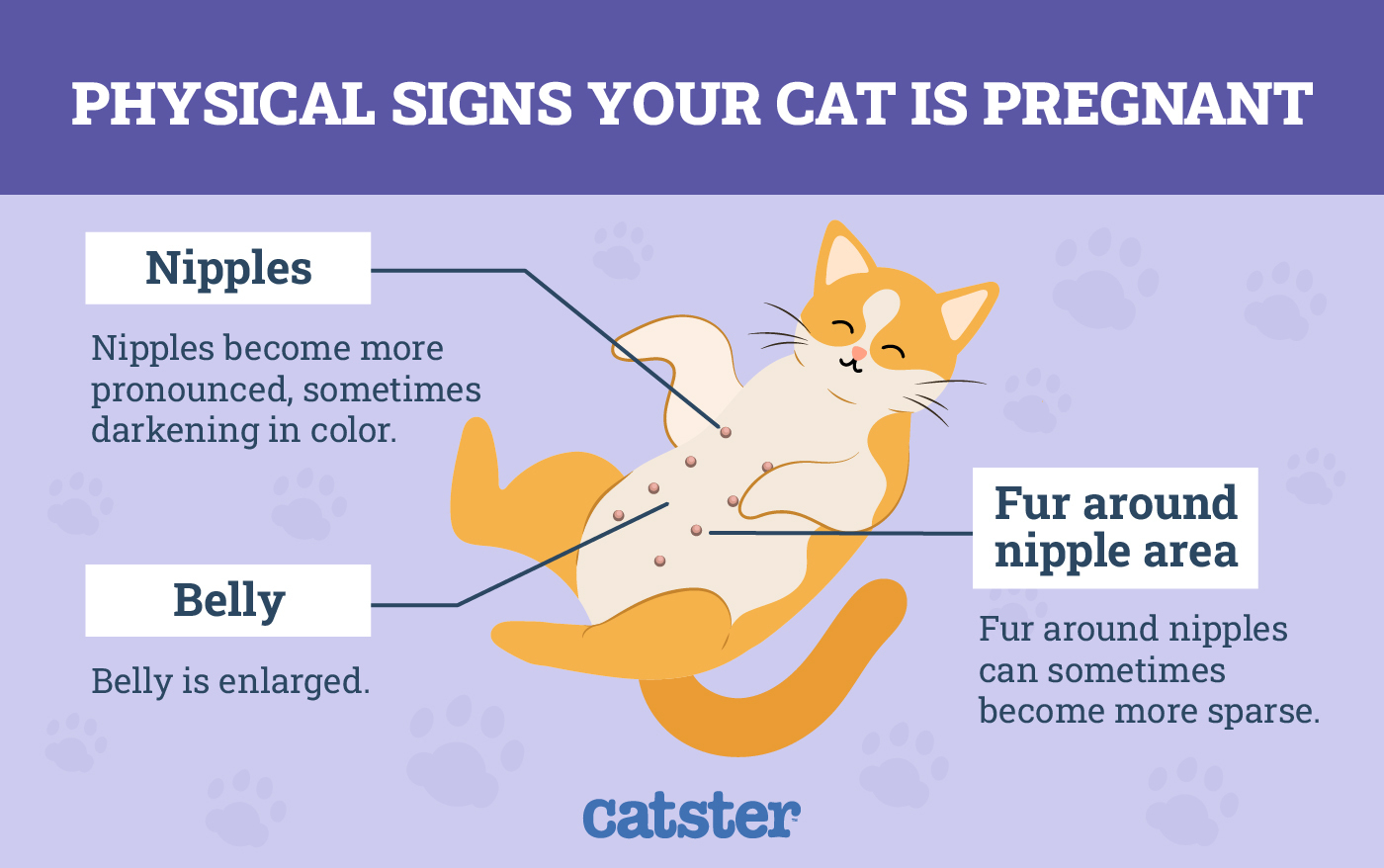
It was hard to be sad or worried because she was the cutest little pregnant gal there ever was! Almost like she was on a pregnancy high. Her belly started to show and it looked so adorable. And her nipples were more prominent and pink. You could easily tell she was in her nesting era. She was so chilled and lovable. Milly isn’t the most affectionate cat, so it was such a blessing to have her be super cuddly and cutesy.
She also had an increased appetite and thirst and lower energy levels than usual, and she played less with all the other cats and wanted to be by my side the whole time. You don’t need to know me very well to know that it was a dream for me! And she looked really happy and healthy as well.
You are free to use this image but we do require you to link back to Catster.com for credit
As you’ll see in the video, nearing the 3rd trimester, fetal movements were clearly visible and you could see the kittens moving and pawing around in her belly. We began to get really excited to bring mini-Millys into the world!
As time went on, she started looking for cozy spots around the house. She inspected every cupboard and drawer in every room in search of the perfect spot to have her babies. I helped her browse. My motherly instincts also went into overdrive seeing my little girl all pregnant and motherly. I wanted to make her as comfortable and content as possible! I think she definitely knew and realized quickly that she could rely on us to help her do this thing and we were going to be there for her every step of the way.
Getting Ready to Pop
Around mid-February 2020, many things were about to change. Milly was very pregnant at this point, I had to decide between getting a job or continuing my studies to become a clinical psychologist, and panic started spreading across the world about the coronavirus outbreak and a possible global pandemic looming.
We had a bet going and everyone guessed the due dates. I think I said 19 February if I remember correctly. I missed it by one day. On the 20th of February 2020, Milly went into labor in the afternoon. I knew because she was acting differently. She went from super pregnant and lazy to a girl on a mission real quick. She was pacing and focused and I just had a feeling that today was the day.
Ready to pop
Naturally, I was in a much bigger tizzy than anyone else in the house, including Milly, the pregnant queen herself. I was pacing up and down, too. Looking for boxes, blankets, towels, and other supplies that we were going to need to ensure a smooth home birth.
My sister and I were self-appointed midwives and we took our job very seriously, although neither of us had ever helped a cat give birth, nor seen any cats give birth, so this was very new to both of us. Luckily, my dad is a dentist with a military medicine background, so having someone around with medical knowledge made us feel a little bit more at ease.
We were ready.
Milly Giving Birth: The Wildest Experience of My Life
First night with the babies
Around 18:00, Milly was restless. Eventually, we found her in one of the several nesting spots we made for her. It was in my sister’s home office, so we decided to close it off, especially since the other cats were curious and we didn’t want anything to stress Milly out. It went from home office to feline birthing ward within the hour.
Between me and my sister talking, overthinking, worrying, asking hundreds of unanswered questions, and faffing over Milly’s comfort, and Milly pacing from one nest to the next, I’m sure no other person would have been able to be in that room with us. It was controlled chaos. Me, the most dramatic person in the family, my sister, basically a calmer but equally passionate version of me, and my teen mom-cat giving birth on a Friday night.
Around 20:00 she was having contractions, and that’s when things got a little intense. Milly is a small cat in general and she was still young. She looked at us like, “I don’t know what I’m doing here, please help!” but we weren’t sure how much she wanted us to intervene or when helping turns into disrupting. It’s a natural process driven by instincts and we didn’t want to overwhelm, distract, or annoy her, so that made things hard because she did look like she really wasn’t sure what to do or how to do it. Of course, to no one’s surprise, I was in full panic mode.
1 Kitten… 2 Kittens… 5 Kittens?!
Milly’s kitten’s names
After about 15 minutes of Milly having contractions and looking quite uncomfortable, we noticed a little cat paw sticking out of her. We were expecting them to be delivered head-first so we were a little worried, but turns out it’s quite normal. However, this was still a hectic start to the birthing process because it took a little long, and Milly paced up and down and vocalized while pushing the first kitten out, so emotions were high. We were worried and Milly was stressed. Still, we didn’t interfere too much or touch her, until we were forced to.
After another 15-20min, Milly was still struggling to get the first kitten out. The way she looked at us, I think she wanted us to help. With a clean glove on, my sister gently pulled Shelby out of the birth canal and into the world. Perfect, healthy, and cute as a button.
Another 20 minutes later came Tommy. Milly was also pacing around while delivering him, and she looked a little bit strained, but she pulled through and he was born. The placenta chewing was unusual to see but Milly didn’t have any problem with it; she did it like she knew exactly what must happen. I was like, “Wow, girl, how do you know how to do that?”
At this point we were like, okay, maybe there’s just two? Nope. Along came Alfie; he was a big boy. But by now Milly understood the assignment. She popped him out in the nesting cupboard this time (the first two were outside the cupboard, on the floor). Then some more time went by and Basil and Miley came out directly after each other. We like to think that they’re twins.
We waited another 30-40 minutes to see if there were more kittens coming, but thankfully, 5 was the lucky number. Milly delivered five beautiful, healthy kittens, and I was the proudest cat grandma ever. It truly was an unforgettable experience and I’m happy my sister and I shared it with Milly. So special!
Tips for Helping a Cat with a Home Birth
Morning of the birth
Prepare a Comfortable Birthing Area
Know the Signs of Labor
Nesting behavior (your cat may start seeking out a spot of her own)
Increased affection or withdrawal from people
Restlessness, pacing, or excessive grooming, especially around the belly
Decreased appetite and possible vomiting
Visible contractions and panting
Support Without Interfering As Far As You Can
Cats are instinctive mothers and usually don’t need help, but be nearby in case of complications
Speak in a calm, reassuring voice and avoid excessive handling
If a kitten is stuck, you can gently assist by grasping it with a clean towel or glove and pulling very gently in the direction of delivery
Going into labor
Watch for Normal Birth Patterns
Kittens usually arrive within 20-40 minutes of each other.
Mom will break the amniotic sac, clean the kittens, and eat the placenta and umbilical cord
If she doesn’t, you may need to step in by gently breaking the sac and rubbing the kitten with a warm towel
Be Ready for Emergencies
If over 40 minutes pass between kittens or she struggles for more than 10 minutes to pass one kitten, call your veterinarian
Excessive bleeding, severe distress, or unresponsiveness in the mother requires urgent attention
If a kitten isn’t breathing, try rubbing it gently with a warm towel to stimulate breathing
Post-Birth Care
Ensure all kittens are nursing within the first couple of hours
Keep the nesting area warm (around 85°F/29°C for the first few days)
Watch for any signs of illness in mom or kittens (lethargy, refusal to eat, abnormal discharge, bleeding, etc.)
Milly nursing the kittens
Tune in next time as I share a little bit more about the wild and wonderful journey of raising kittens during lockdown, watching Milly be the cutest mom, the difficult decision of putting two kittens up for adoption (together), and going through the heart-breaking experience of losing Tommy at the hands of a reckless driver when he was about 2 years old.
Till then,
Cheers vir eers!
(Cheers for now)
This article features Isabel and Milly in our Wednesday Cats of Catster series.
Searching for gifts for someone can be challenging and stressful and often wastes time and money, with the other person getting little use out of your gift. Fortunately, it’s much easier if they have a cat because they will probably appreciate anything that brings their pet to mind. Here’s a list of several perfect gifts for the cat guy in your life, to help make your holiday shopping a bit easier.
Top 16 Great Cat Gifts for Him
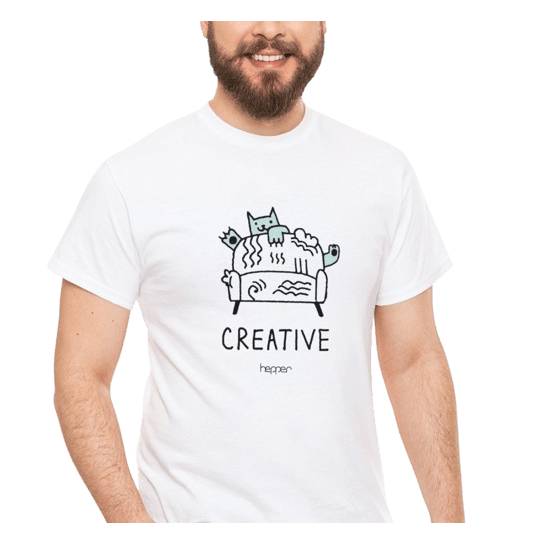
1. Hepper Creative T-Shirt
We love the overall versatility of this shirt. It comes in almost any size, from Small to 5XL. It is considered a unisex T-shirt made of heavy cotton. It has a classic fit, so it looks great on virtually anybody.
Our favorite thing is that the graphic reads “creative” featuring a cat clawing a couch. If your cat guy can relate, they might get a kick out of this shirt. Plus, who doesn’t love a good T-shirt to add to the collection?
We think this shirt is well made and a great way to support a fantastic business that puts the well-being of pets first.
At Catster, we’ve admired Hepper for many years and decided to take a controlling ownership interest so that we could benefit from the outstanding designs of this cool cat company!
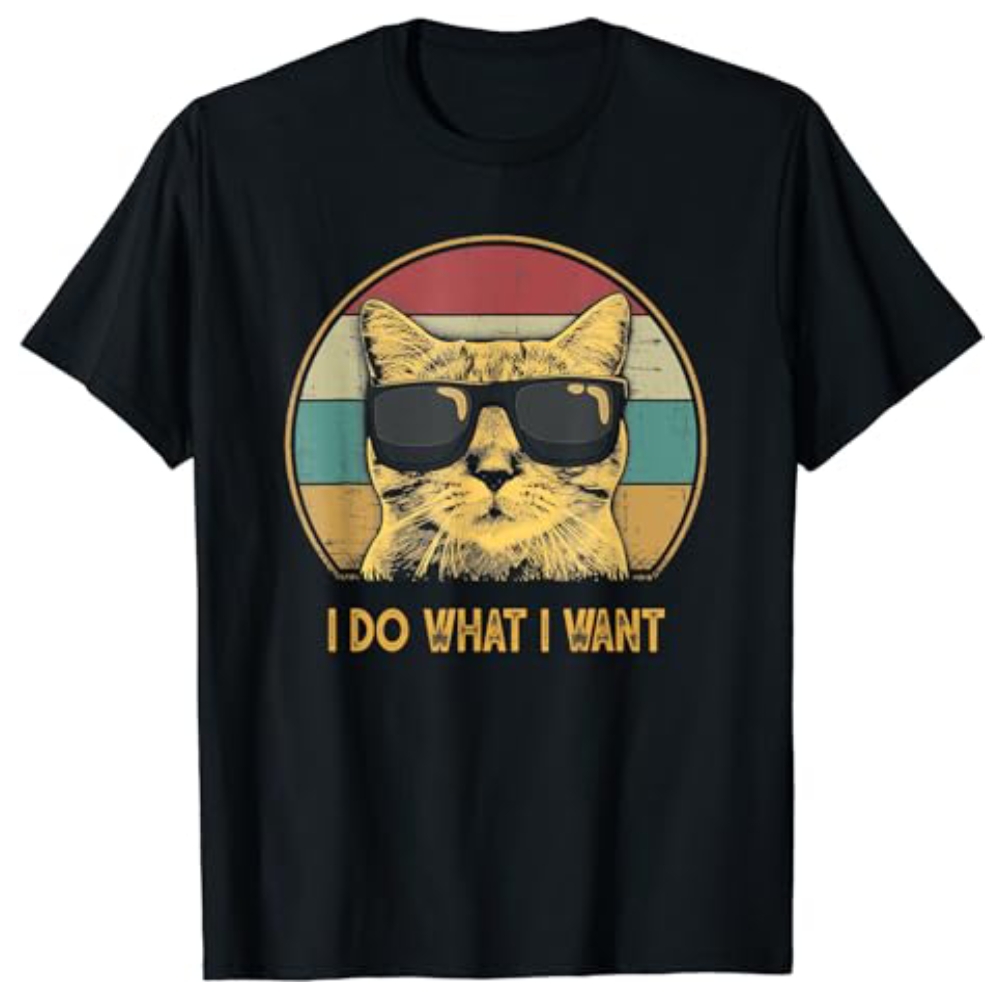
2. Retro Cat T-Shirt
This funny T-shirt is perfect for the man who doesn’t like to follow a tight schedule and prefers a similar trait in their cat. The retro look is also quite popular right now, so this is the perfect gift for any occasion.
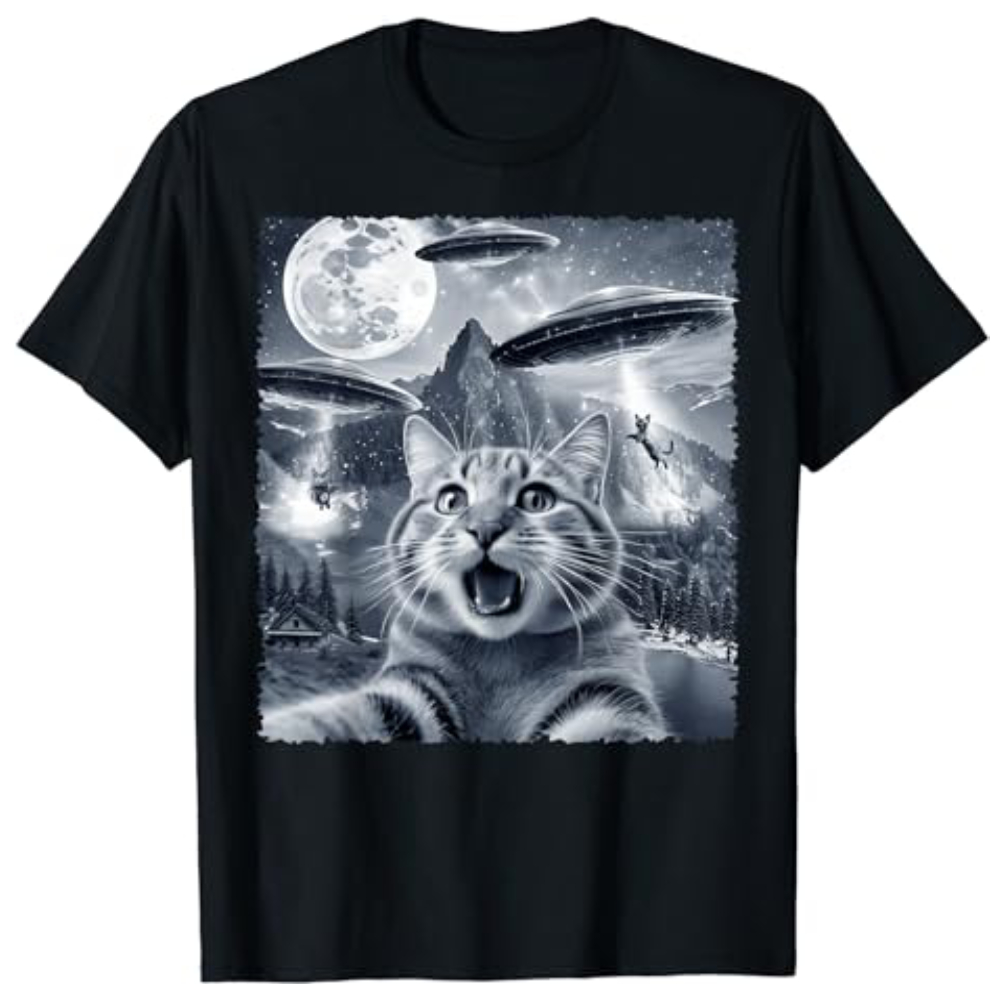
3. Alien Cat Selfie T-Shirt
The Alien Cat Selfie T-Shirt is perfect for any cat lover who also loves UFOs. It has an image of an adorable cat taking a selfie of themselves as aliens abduct them and a bunch of other cats. It’s a high-quality shirt that will get plenty of attention.
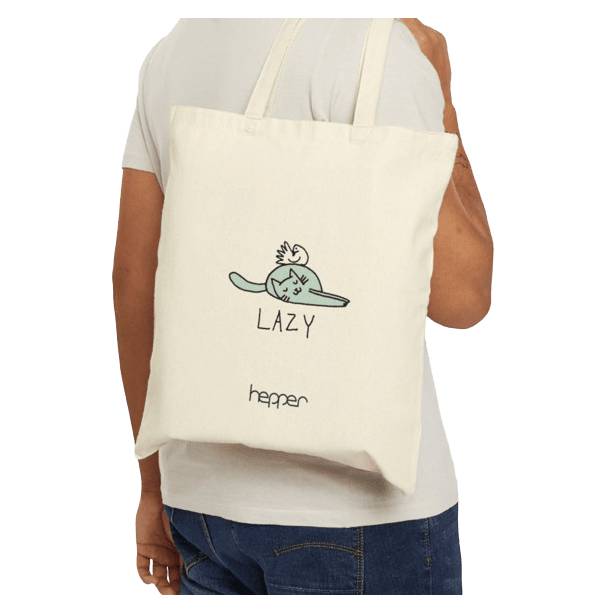
4. Hepper Lazy Tote Bag
The Hepper Lazy Tote Bag is a perfect bag which you can store all of your essentials in. It’s perfect for overnight stays, books, shopping, and all sorts of other activities. We think that the design is simple, well-made, and adorable.
Anything made by Hepper is going to be very high quality. This particular tote bag is made of 100% cotton canvas. You can easily pop it in the washing machine to get it clean and it should sustain just fine with regular use.
We think it’s a perfect travel bag, and who can’t use an extra tote? If you are a cat guy who’s frequently carrying objects and needs a little help, it’s certainly a better alternative to a purse.
At Catster, we’ve admired Hepper for many years and decided to take a controlling ownership interest so that we could benefit from the outstanding designs of this cool cat company!
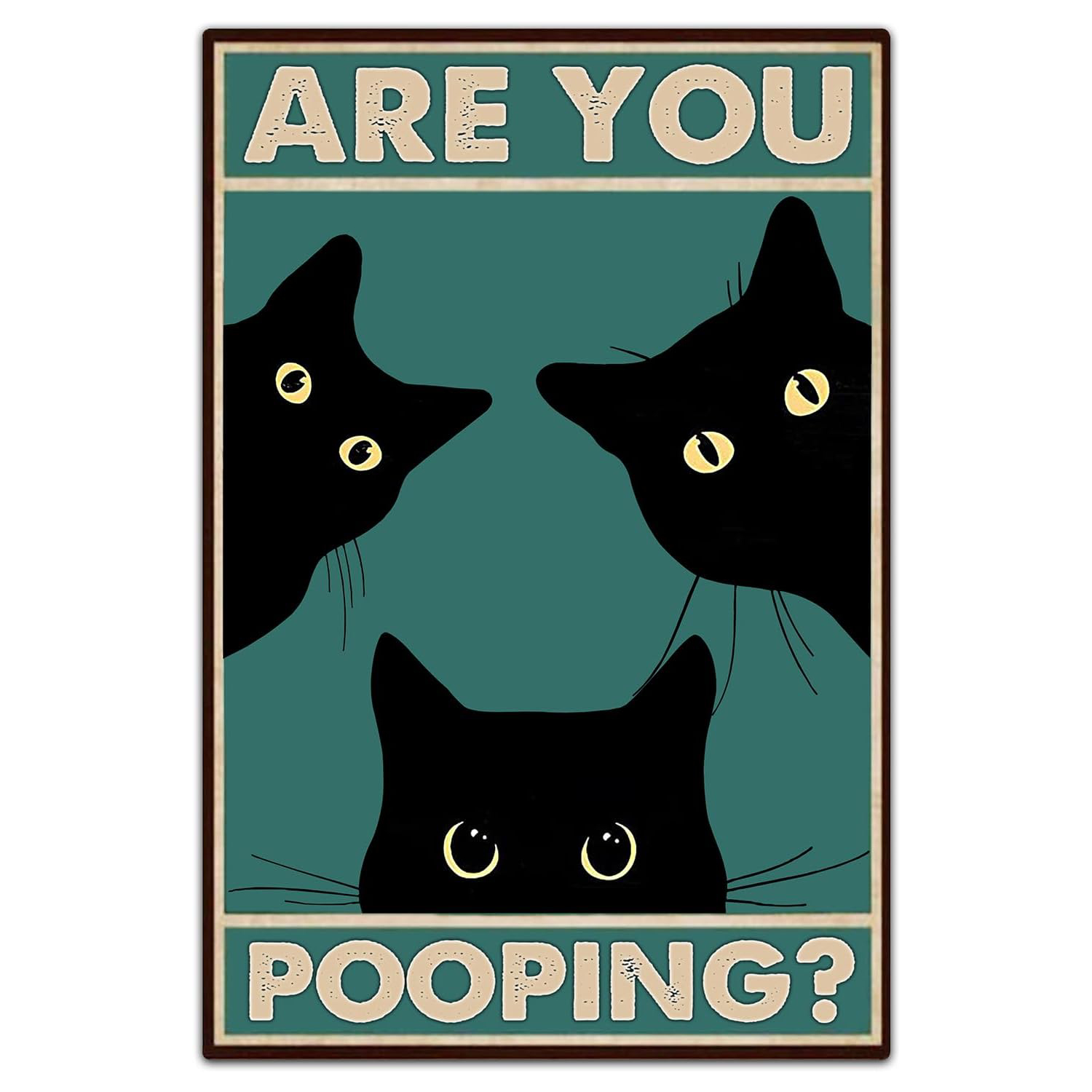
5. Are You Pooping? Funny Tin Sign
It doesn’t get much funnier than the Are You Pooping Funny Tin Sign. It’s sure to get laughs, and any cat-loving man will understand the deeper meaning behind this wonderful gift: Cats always have to stare at you when you do your business.
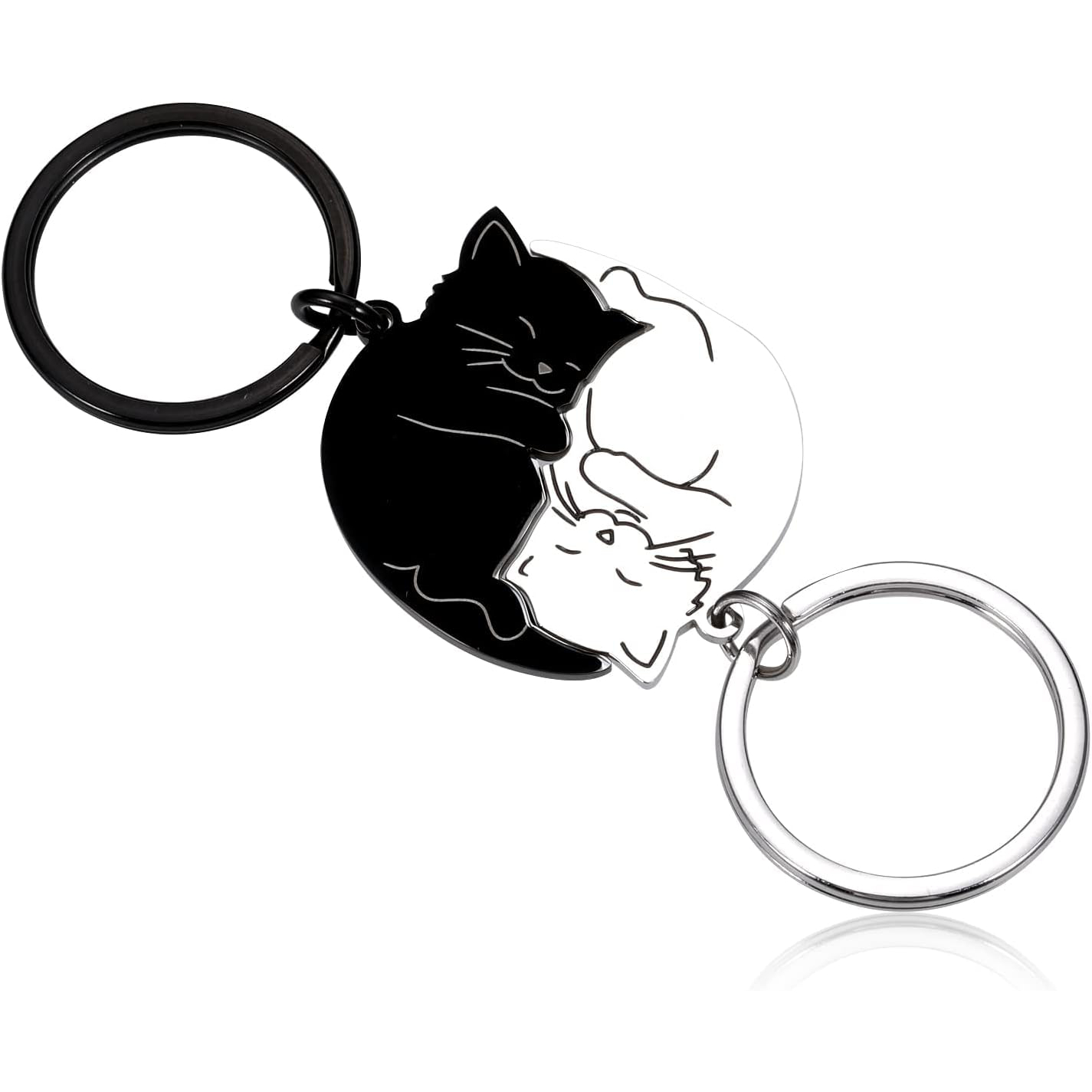
6. Couple Gift Keychain Cute Valentine’s Day Gift
Any couple will be glad to get this adorable keychain featuring two cats that fit together perfectly, each holding a set of keys. It makes a great Valentine’s Day gift and is the perfect way to let him know that you are about to spend more time together.
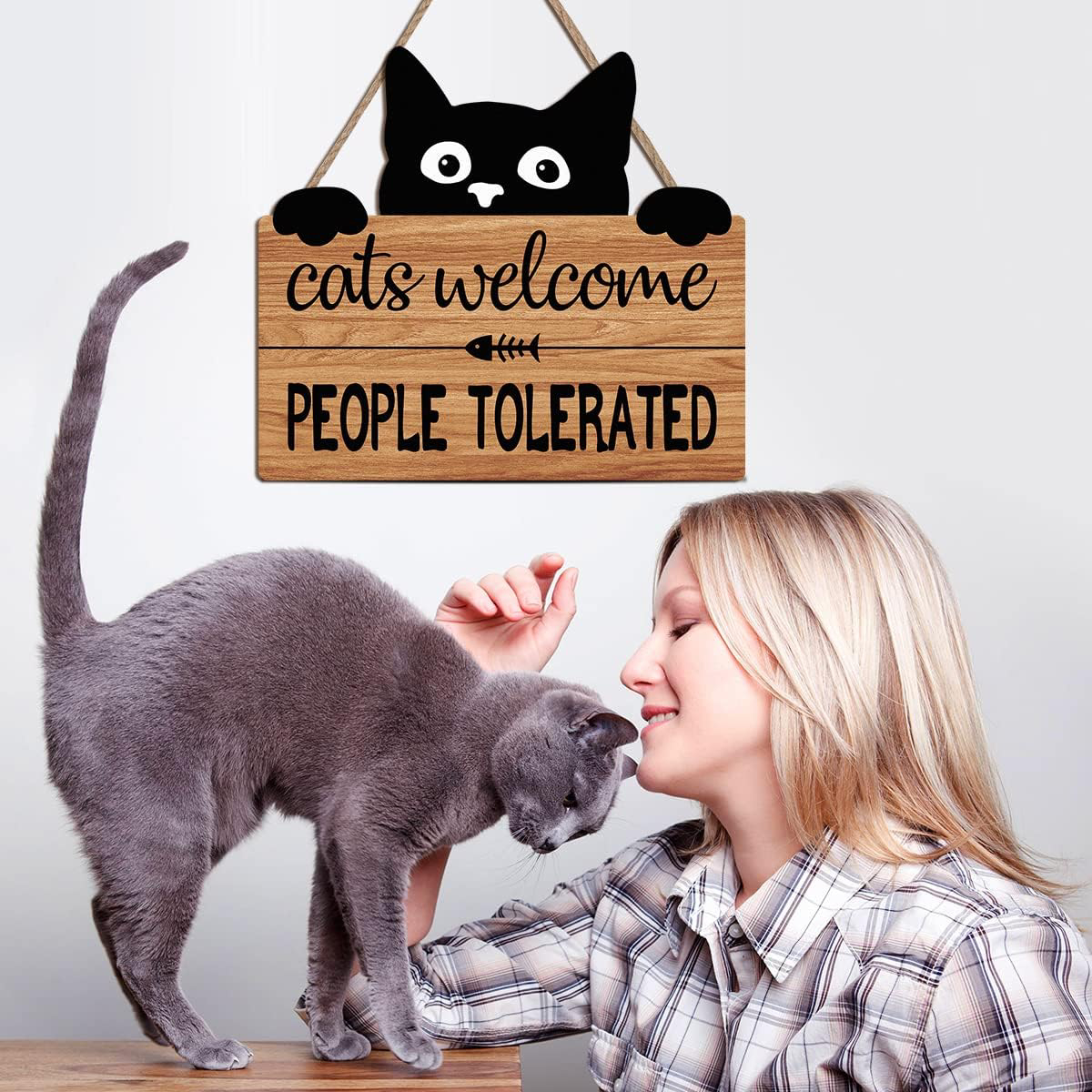
7. Funny Cat Welcome Sign
The Funny Cat Welcome Sign is the perfect gift for the cat-loving recluse. This durable and attractive sign hangs on your front door and makes it clear that the resident prefers cats to humans.
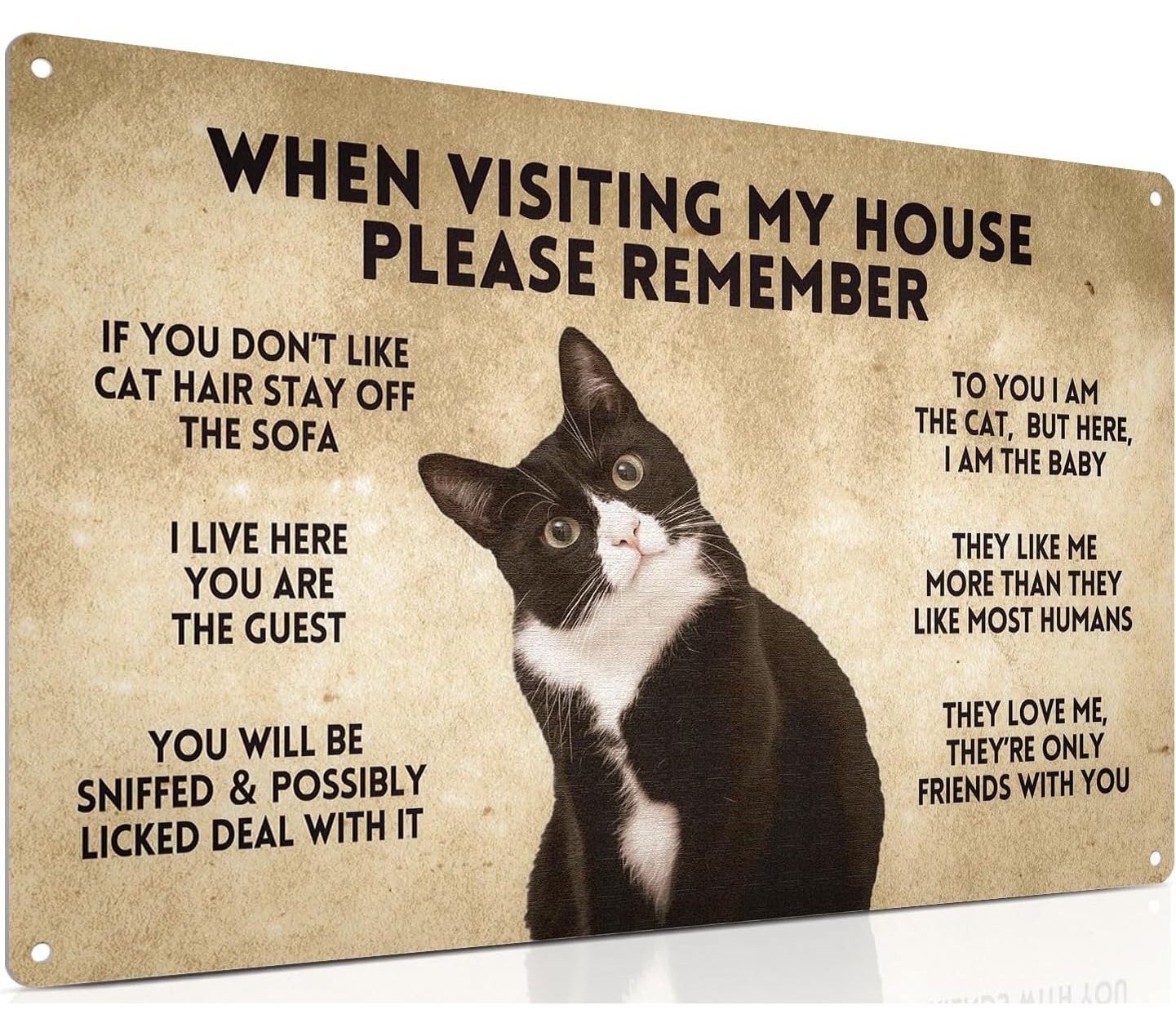
8. Funny Tuxedo Cat-Themed Sign
While the previous entry was perfect for outside the house, this funny cat sign is perfect for when you immediately enter. It features an adorable tuxedo cat informing everyone of all the household rules, which include that the cat is more important than you are.
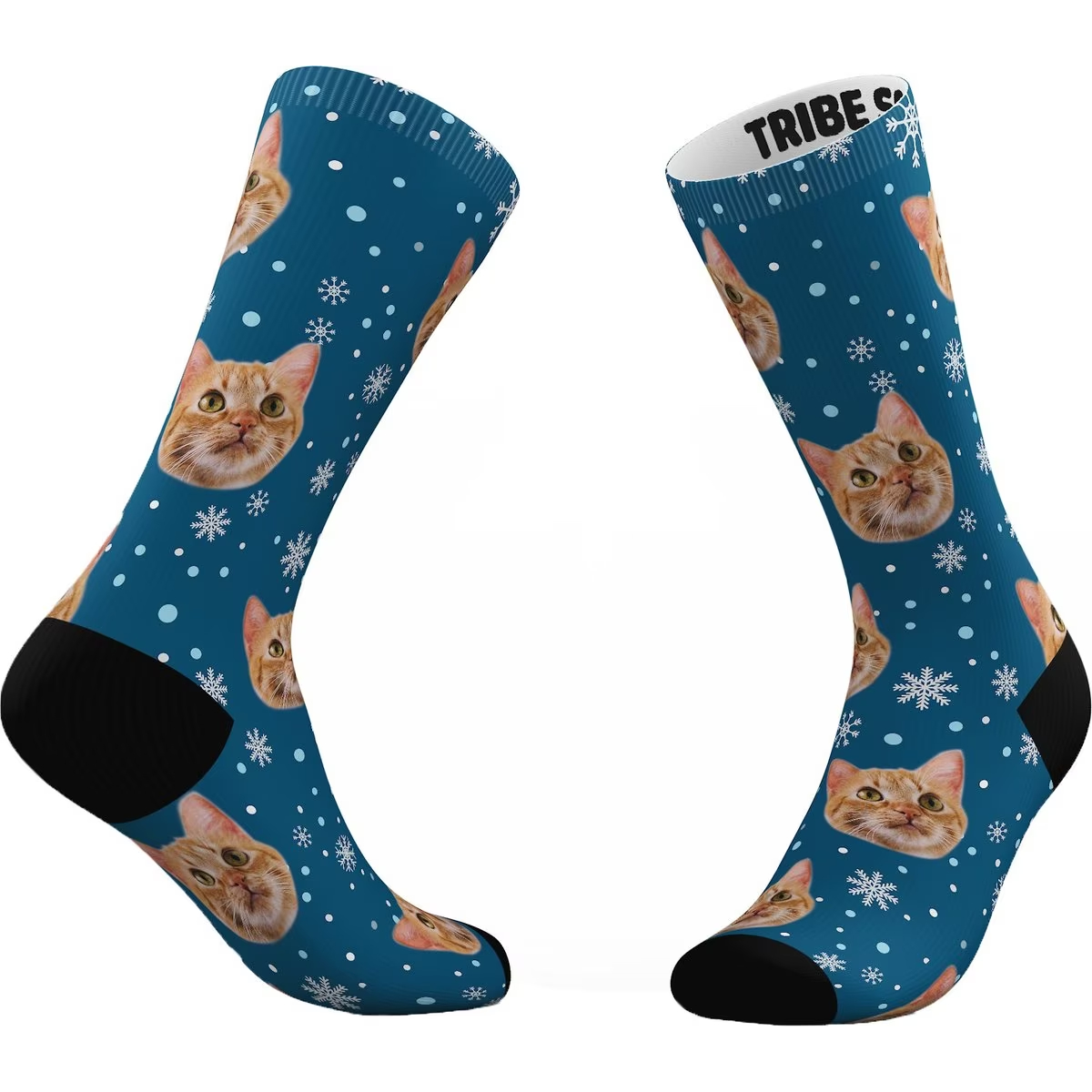
9. Tribe Socks Personalized Holiday Pet Face Socks
These personalized socks enable you to have your giftee’s cat’s face printed on them, making for a fun and heartwarming gift. These have a winter theme, making them a great choice for the holidays.
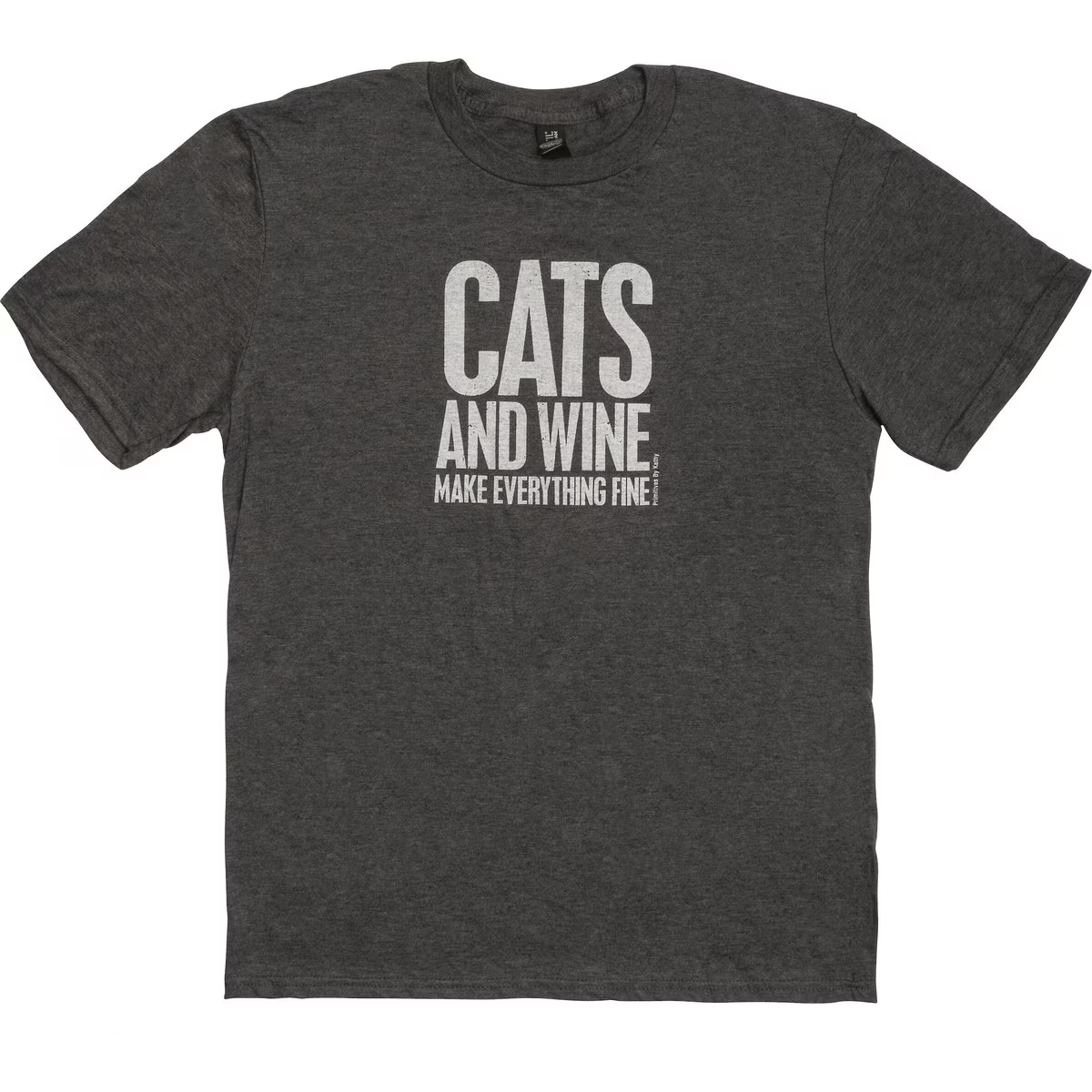
10. Primitives by Kathy Cats & Wine T-Shirt
The Primitives by Kathy Cats & Wine T-Shirt is a great choice for those who enjoy the finer things in life: cats and wine. It’s a medium-sized, comfortable shirt perfect for casual outings or relaxing at home, and it makes a great gift any time of the year.
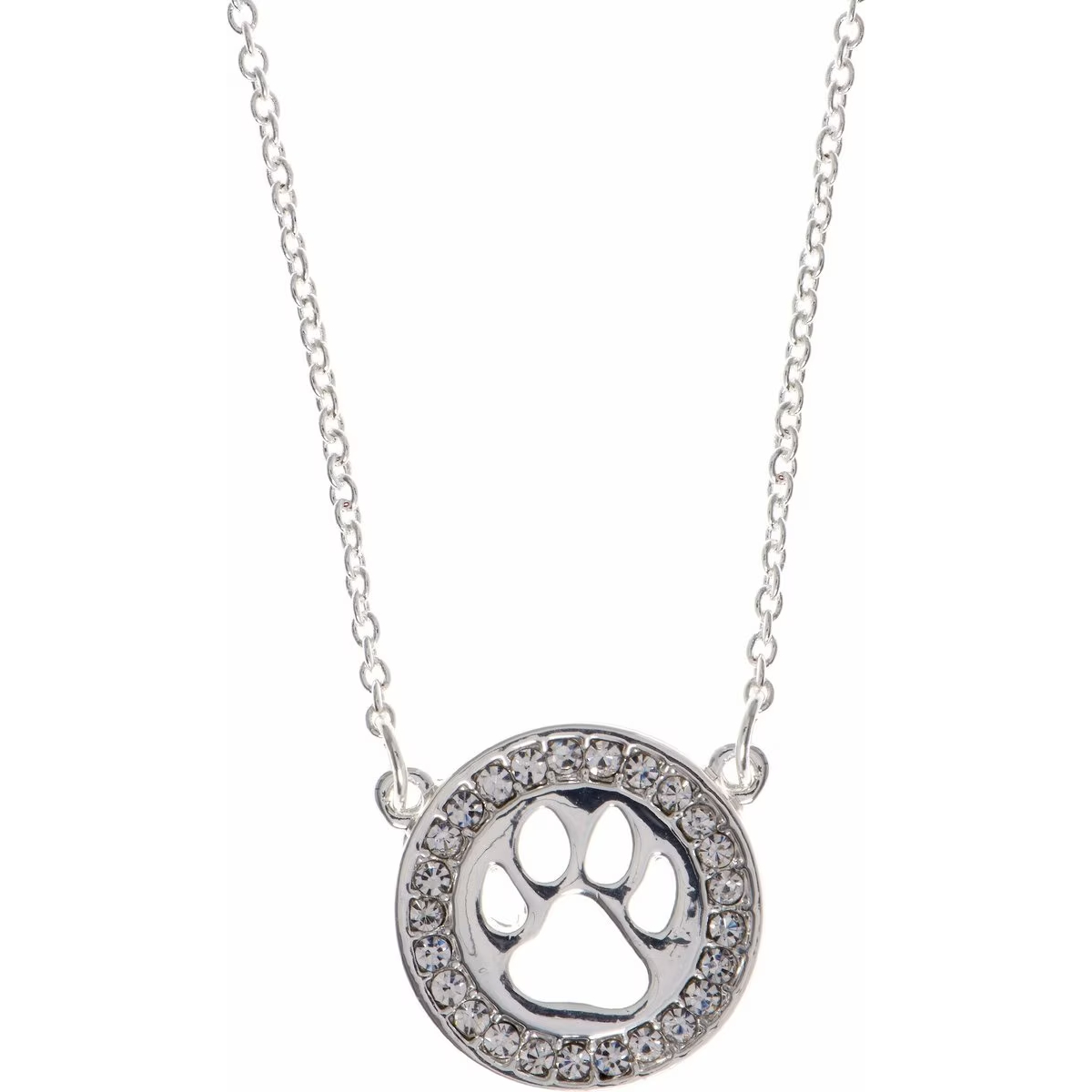
11. Pet Friends Pave Paw Cutout Pendant Necklace
The Pet Friends Pave Paw Cutout Pendant Necklace features a paw cutout design for men who like to express their love for their cats. It’s a versatile accessory that they can wear with casual and formal attire, and it’s one of the few pieces of jewelry on this list.
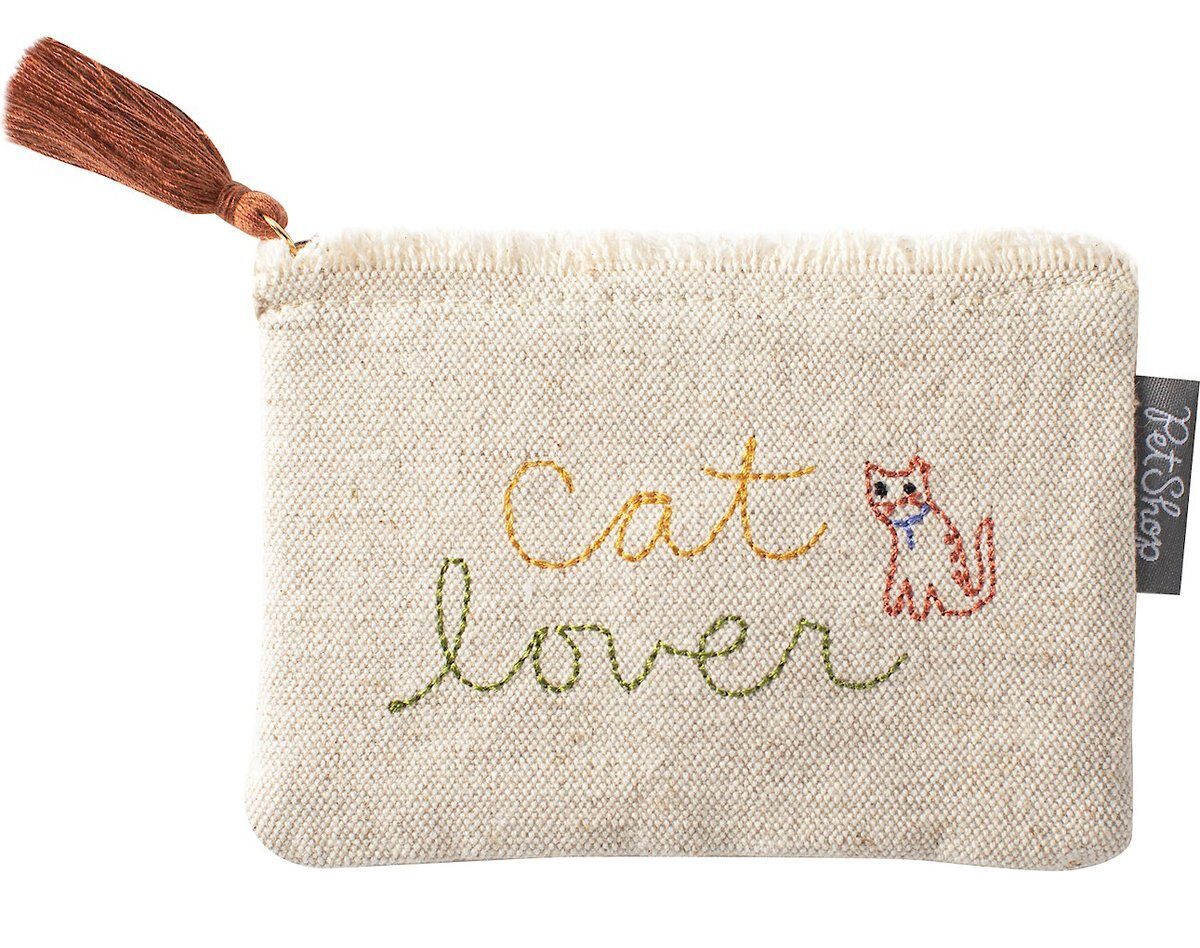
12. Fringe Studio Stitched “Cat Lover” Canvas Pouch
The Fringe Studio Stitched “Cat Lover” Canvas Pouch is a practical and stylish pouch for the cat lover who likes to stay organized. This canvas pouch is perfect for storing small items like coins and shows off the person’s status as a proud cat dad. It’s durable and has attractive stitching.
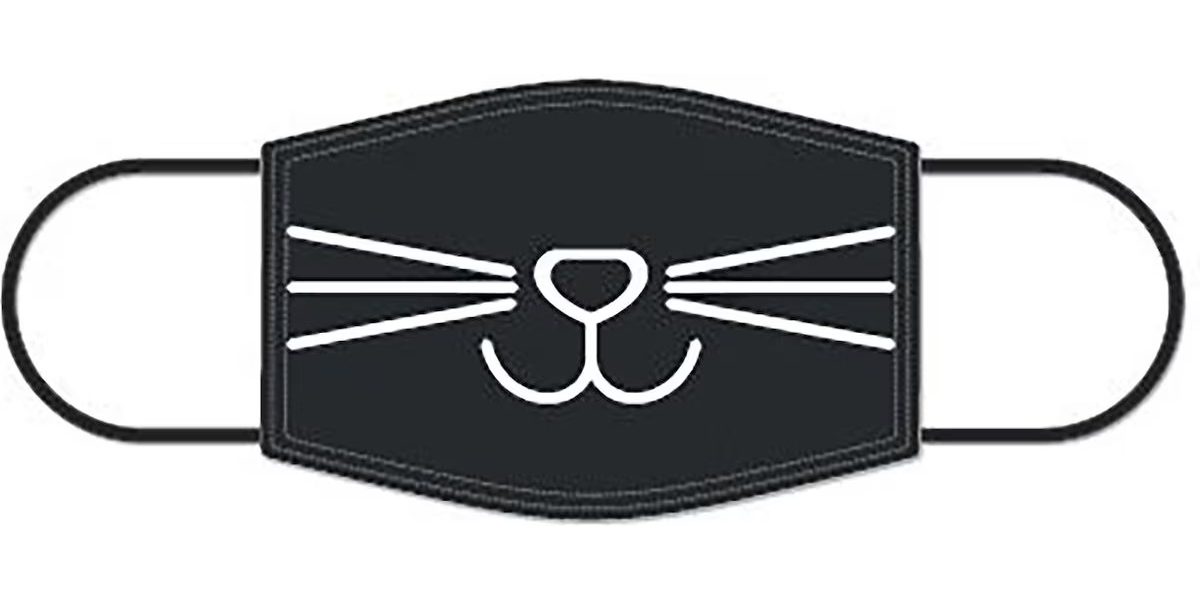
13. Natural Blue Cat Print Face Mask
A face mask is a necessity when you’re sick, and the Natural Blue Cat Print Face Mask, with its cat face print, is both functional and fashionable. It’s a great way for cat lovers to stay safe while showcasing their love for their pets, and it’s the perfect gift any time of the year.
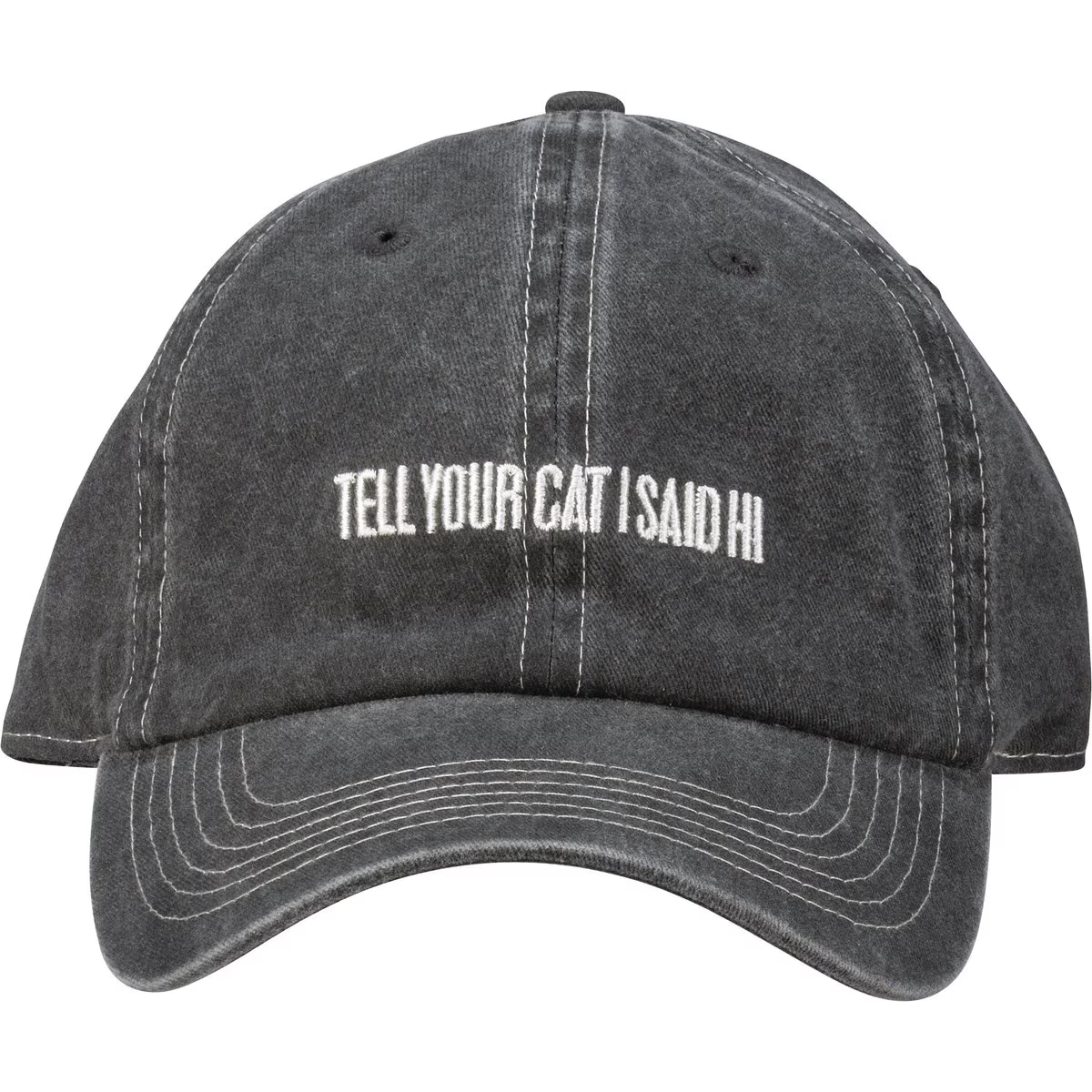
14. Primitives by Kathy Cat Baseball Cap
The Primitives By Kathy Cat Baseball Cap is ideal for casual outings or sunny days and makes a perfect gift for a cat dad. It’s a practical and stylish way to show off your love for your pet, and it’s suitable for any time of the year.
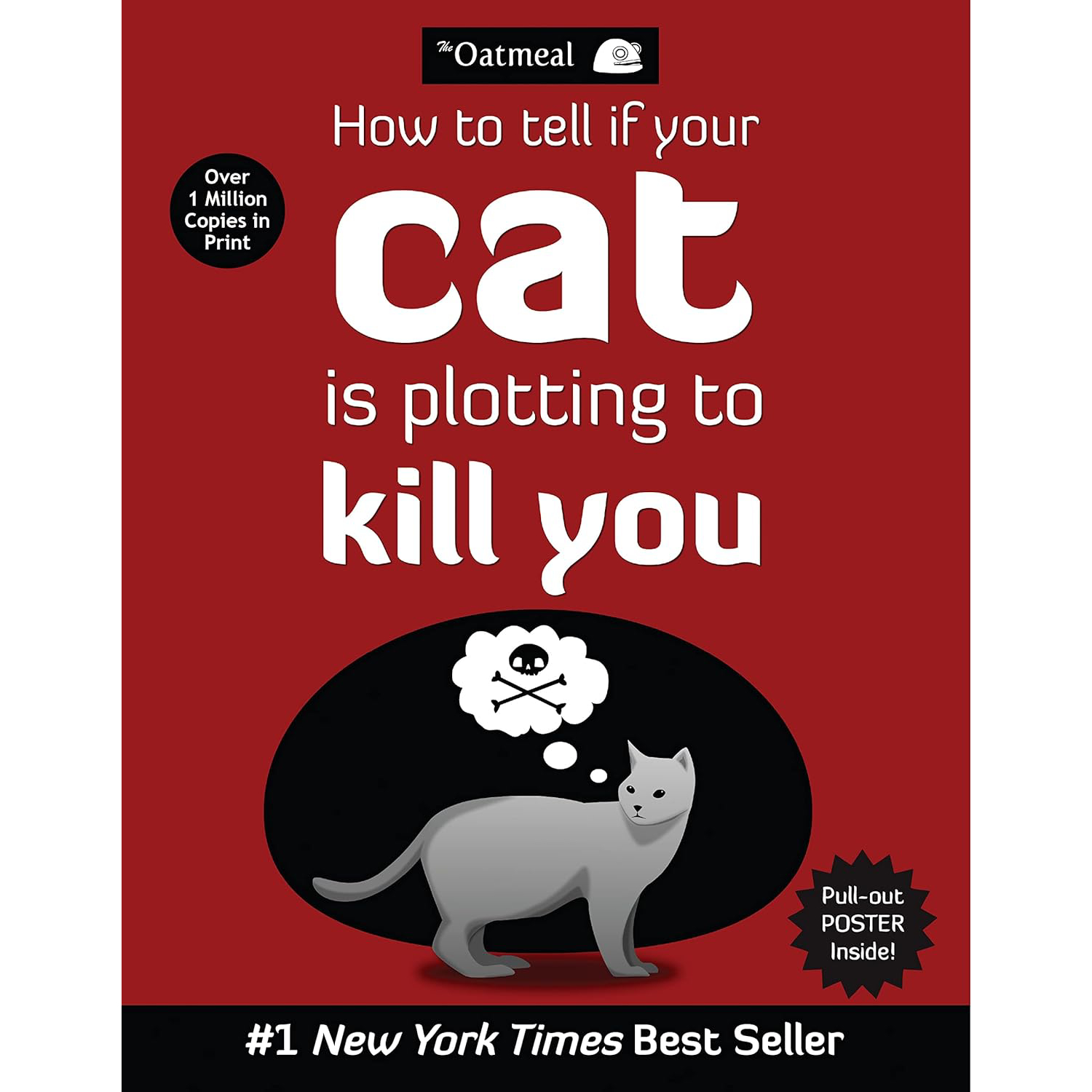
15. How to Tell If Your Cat Is Plotting to Kill You (The Oatmeal)
The CatFather Whiskey Glasses are a perfect gift for the cat-loving man who also loves “The Godfather” films. The 11-ounce capacity is sure to help them relax after a long day so they can focus on their pets.
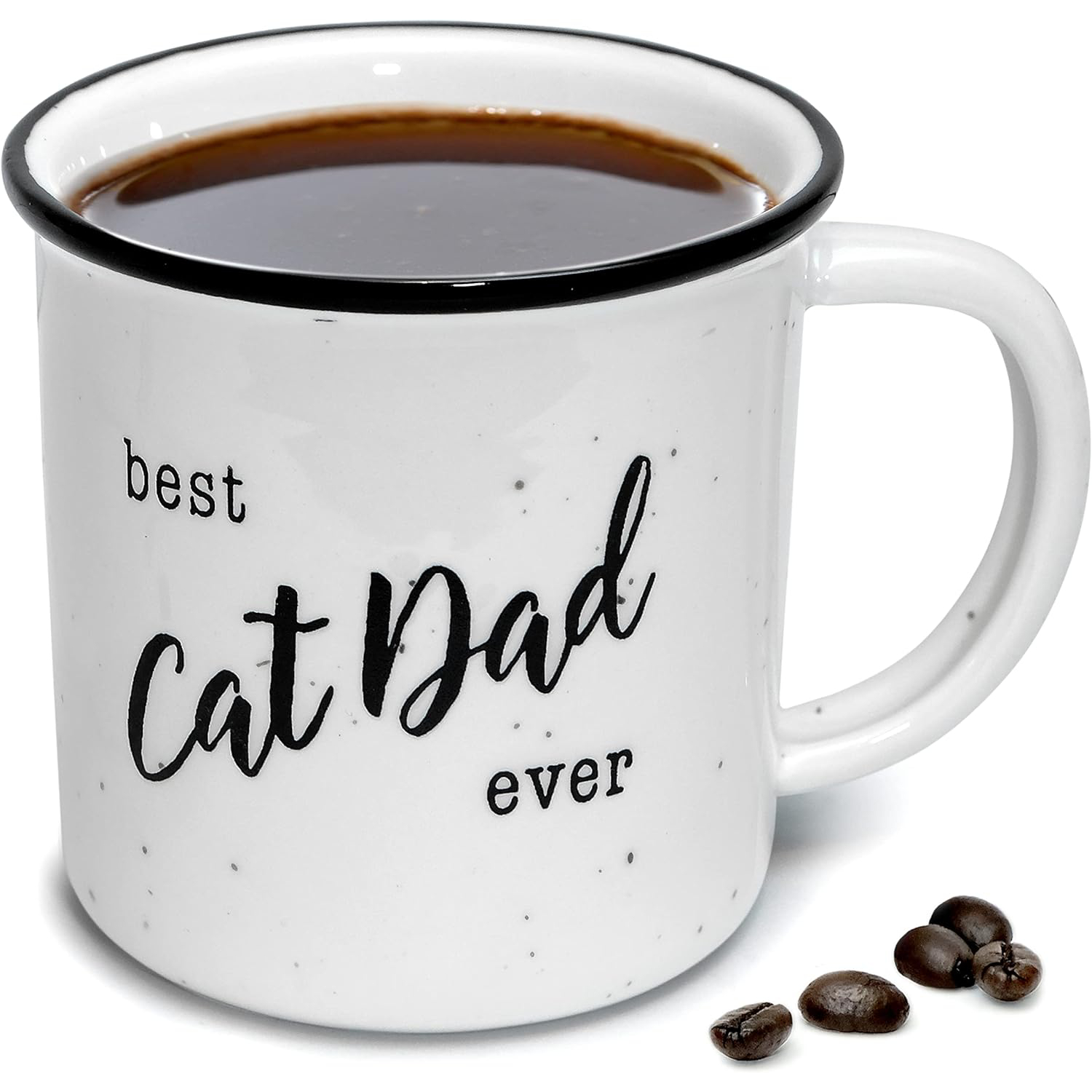
17. MAINEVENT Best Cat Dad Ever Mug
The MAINEVENT Best Cat Dad Ever Mug is a great gift for any cat dad, and it shows that you notice how much effort they put into caring for their pet. It’s also fairly inexpensive and works for any occasion.
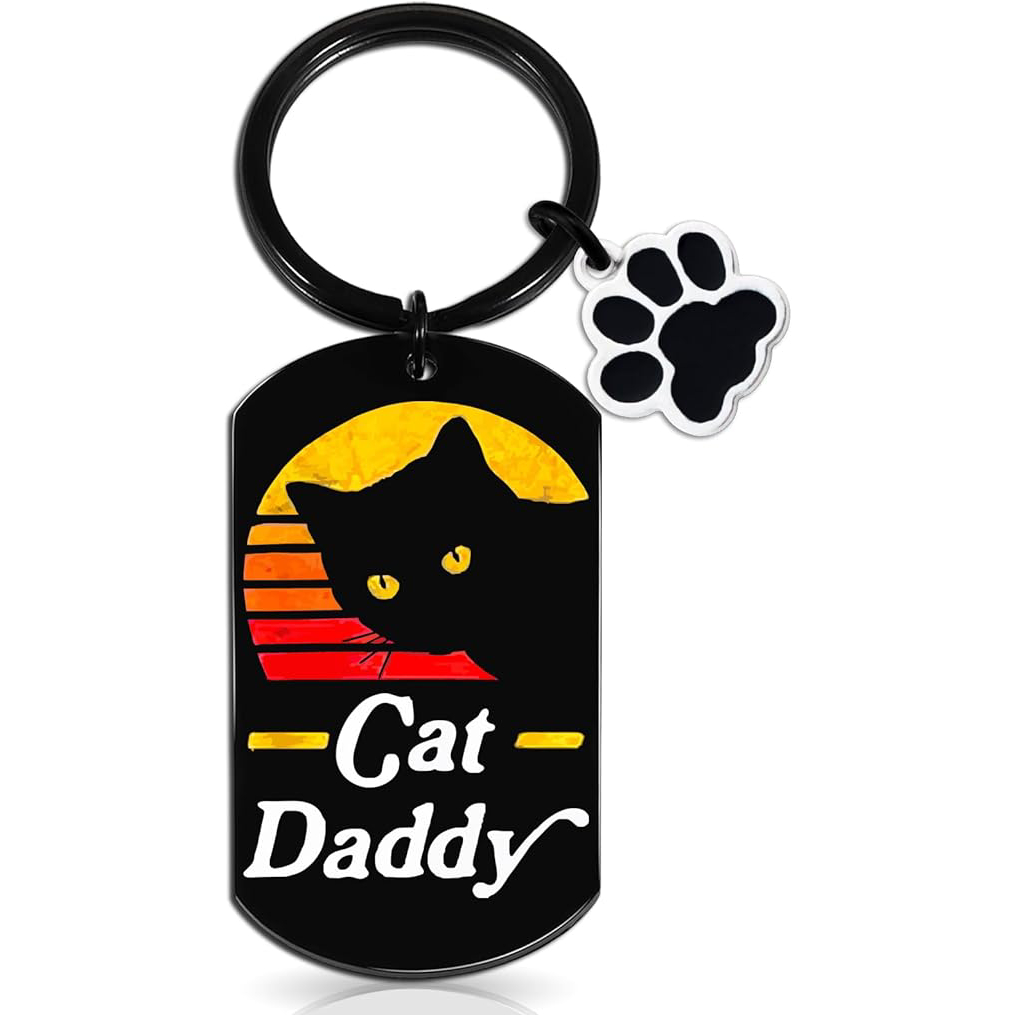
18. Cat Parents Gifts Keychain
The Cat Parents Gifts Keychain is the perfect gift for any stylish cat dad. It looks fantastic, and reviewers report that it’s quite durable. It even comes with a paw pendant for extra flair.
The information is current and up-to-date in accordance with the latest veterinarian research.
Learn more »
Very few cat owners around the planet would dare utter the possibility that their cat can’t feel love. After all, what are all of the head bunts and purrs all about if your cats can’t feel that you love them and that they don’t love you back?
If you’re wondering from a scientific standpoint if cats can feel love, we’re going to go over everything that we know about cats and affection—but we’re pretty confident that if you’ve encountered an awesome cat, you already know that cats can indeed feel love.
Cats Can Feel Love
Unfortunately, very little is known scientifically about the way that cats operate on the inside. It’s interesting that despite the closeness between us and our kitty companions, there’s still so much that’s unknown.
However, we as observers can see that our cats do feel love to some capacity, even if it’s not the same way that we typically experience it. Here is what we know for sure and how we can use this information to determine if cats can feel love:
Cats are fabulous mothers: You can’t beat a mother cat when it comes to the love they show their kittens. They are always transporting, moving, rescuing, and carrying their kittens around. They keep track of them, groom them, and look after them so well!
Cats enjoy the companionship of owners: It’s clear that our cats love us and want to be around us—and it’s not always just because we fill the food bowl! Cats often go out of their way to give owners love and attention.
Cats show affection toward other animals: Some cats bond quite well with other animals—and not just cats! You can find tons of videos online alone proving this point. Cats love cuddling, grooming, and napping with just about any fuzzy same-size-or-bigger companions—but not so much prey animals!
Image Credit: Alena A, Shutterstock
Cat Personality: The Five Types
According to behavior professionals, cats have five different personality types. These personality types can greatly impact the way that our cats interact with us and the way that they display affection.
Skittishness
Extroversion
Dominance
Impulsiveness
Friendliness
Each of these personality types shows that cats will respond differently to stimuli in their environment depending on their overall character.
Signs of Affection in Cats
Every cat responds to humans a little differently. They all seem to have their own special love language. Here are some of the ways that cats show pleasure and affection amongst each other and towards humans.
Purring
Purring is usually a direct sign that a cat is happy. They often purr when they are comfortable and content with their surroundings, so you must be doing something right! Kitties use purring when they are feeling the highest forms of pleasure, so that has to count for something!
Did you know that a cat’s purr is not only a sign of affection but also that of healing? The cat’s purr resonates between 25 and 50 Hertz. This frequency range has been shown to aid in the healing of broken bones and wounds and repair tendons and joints.
Image Credit: islam zarat, Shutterstock
Sleeping
Cats need to be extremely relaxed when it’s time for them to go to sleep. They need to make sure that their surroundings are free of any danger. If your cat is sleeping beside or on you, you can assure yourself that they know they are completely safe with their human counterpart.
Safety is a surefire way to know that they are experiencing some form of affection or love towards you as a consequence. Keeping a cozy cat bed nearby ensures they have a warm and comforting place to hunker in while still being close to you.
Is there anything better than a happy cat? We don’t think so—that’s where the Hepper Nest Bed comes in.
This product was designed with both your and your kitty’s happiness in mind. While the comfortable bowl shape and wide lip to rest their heads on are ideal for sleepy kitties, you’ll appreciate the removable and machine-washable fleece liner for easy cleaning. It doesn’t get any better than this! Click here to try it out.
At Catster, we’ve admired Hepper for many years and decided to take a controlling ownership interest so that we could benefit from the outstanding designs of this cool cat company!
Following You Around
A lovable cat absolutely thrives on being under the foot of the people they adore. If a cat is following you around and demanding attention or being nosy, this is a sign that they probably love you.
They might not be feeling active love at that moment, but they know they are safe and comfortable with you, and love being around you! Cats are also curious little critters who want to know exactly what is going on with their family at all times.
Bunting
Bunting is an adorable little bump that says, “You’re mine.” While they are rubbing themselves on you for pleasure, they’re also using the scent glands on their chin, head, and paws to imprint their personal perfume onto you.
That way, every other cat around knows that you belong to them! After all, we all know that we are really the ones that are owned by our cats and not the other way around.
Image Credit: Kristi Blokhin, Shutterstock
Demanding
Our lovable little cats can be quite bossy from time to time. They always strut their stuff, claiming to know everything that’s going on without caring much about anyone else’s opinion. We are exaggerating, but they really can be furry creatures with only-child syndrome.
The way that they scream and squeal for your attention is a surefire way that they trust that their needs will be met with you. This kind of bond secures a sense of safety and love!
Exposure of Their Belly
Cats are predatory creatures who also know all too well the position of prey. They certainly don’t want to be on that side of it! Most vital organs lie in the abdomen, so for a cat to show anyone their belly is a sign of vulnerability and trust.
So, if your cat rolls over and exposes their belly to you, just know that this is a very vulnerable state for them and a solid indication that they must care about you and trust you a lot. Granted, some cats are a little more free with their body than others.
You might have a cat that just loves winning over the neighbors by flopping down in front of them and rolling around like a real show-off! But cats are generally extremely selective about who they engage with in that way.
Image Credit: FotoMirta, Shutterstock
Gifts
Just like people, some cats give gifts as a form of affection. They might see that you haven’t had your fair share of field mice lately so they leave you one on your stoop. After all, you’re just a dumb human that can’t even feed yourself.
What better way for your cat to show you affection than to give you something to stuff in your gullet? This might not be your idea of a good time, but your cat certainly seems to think you could benefit from it.
No matter how disgusting you might think it is, you have to admit it’s sweet, so acknowledge the gesture, and move on about your day.
What Can Influence Cat Behavior?
Lots of different factors can influence cats’ behavior and the way that they bond with you. Some of them will be a little more aloof or standoffish than others and some will not leave you alone, no matter what you do.
Personality plays the biggest role in all of this, as some cats are naturally prone to being more outward than others. Personality is formed by both genetics and a cat’s environment, including past and present experiences. So, if a cat is a little more standoffish, it could be that they’ve had not-so-positive previous experiences or it could be ingrained in their DNA.
Image Credit: Mirahybrid, Shutterstock
Conclusion
Now you understand that cats are very capable of feeling love. It’s likely that they feel the same love and affection for you that you do for them, although they may have different ways of showing it. Cats can also show affection for other animals, including their young ones.
Remember, cats are not less loving than dogs, they are just more independent so they seem to show it less! Learning how all our pets are unique and different is so interesting.
The information is current and up-to-date in accordance with the latest veterinarian research.
Learn more »
If you’ve ever stopped to read the ingredients list on your cat’s food – which you absolutely should – you may have spotted something called ‘guar gum.’ Your first thought is likely to have been what on earth is guar gum? shortly followed by is guar gum safe for my cat?
The very short story is that guar gum is a thickening agent, and yes, it is safe for your cat. But, as you might have guessed, there’s a little more to the story than that. Keep reading to learn a little more about what guar gum is, how it’s used, and why it’s a safe but not ideal ingredient for our cats.
What Is Guar Gum?
Guar gum is a polysaccharide (a carbohydrate made from multiple bonded sugar particles) extracted from the seeds of the guar, or cluster bean, plant (Cyamopsis tetragonoloba). It is commonly used as an emulsifier (something to help bind ingredients together), stabilizer, and thickener in food products.
Although you’re unlikely to see guar gum on the front of a pack, or even high up in an ingredients list, you might be surprised at how often it is included in many products we use (and eat) every day. Here are just a few of the myriad ways in which guar gum is used:
thickening agent in food
prevents ice crystal formation when making ice cream
vegan/vegetarian alternative to gelatin
cosmetics, moisturizers, soaps
binding agent in clumping cat litter
In addition to these domestic applications, there have been promising results in studies using drug-infused guar gum to target certain cancers, particularly colon cancer.
And of course, it is often included in wet cat food as a thickening or gelling agent and source of fiber.
Is Guar Gum Safe For Cats?
Guar gum is perfectly safe for cats. Although it is a sugar-based ingredient, which is unnecessary in a cat’s diet, the amount in cat food is not enough to pose any significant risk or calorie increase. It is not toxic, and in most cases will be a benign, though largely unnecessary, ingredient. Most processed cat foods contain one form of thickening agent or another, such as guar gum, cassia gum, carrageenan, or xanthan gum.
Image Credit: Dmitry Strizhakov, Shutterstock
Is Guar Gum Bad For Cats?
Some humans, particularly those with celiac disease, show similar gastrointestinal reactions (bloating, diarrhea, cramping) when consuming foods that contain guar gum, despite its lack of gluten. Similarly, some cats, particularly those with a history of inflammatory bowel disease, are quite sensitive to the thickening agent.
Another problematic feature of guar gum for cats is that research has shown that it can block the absorption of protein from the large intestine. Therefore, the net result of a food containing guar gum is that your cat may be getting less protein from their food than what is indicated on the pack, as well as ingesting unnecessary sugar and fiber.
Why Is Guar Gum Used in Cat Food?
When we look at the nutritional requirement of cats, we can see that they need a diet that contains approximately:
Energy:
400 kcal
Protein:
25-40 g
Fat:
5-10 g
Carbohydrates:
0 g
This is per 100 g of dry matter. You will notice that cats do not actually need to consume carbohydrates, although fiber is usually included in the diet of domestic cats to compensate for their less active lifestyles; guar gum is one such ingredient. However, the main reason guar gum is used in cat food is to mask how much of a food is composed of water.
Imagine opening a can or sachet of cat food to find something that more closely resembles soup than casserole, milkshake than meatloaf. Without the addition of a thickener like guar gum, that is what many wet foods would look like.
This isn’t necessarily unhealthy, but one could argue that it is a little bit dishonest. Let’s look at some comparisons:
NOTE: The values included here are on an ‘as fed’ basis for these foods. The dry matter values will be 4-5 times these figures.
You can probably imagine what a food comprised of 87% moisture would look like without the addition of a thickening agent. Essentially, thickening agents like guar gum are included to mask the shortcomings of these foods, making them appear more nutrient-dense.
Image Credit: AB-7272, Shutterstock
Should I Avoid Guar Gum?
If your cat has digestive issues such as inflammatory bowel disease or intestinal lymphoma, their ideal diet should consist of high-quality, highly digestible ingredients, with minimal unnecessary additives. You should always discuss your cat’s specific dietary needs with your vet, as they may vary from case to case.
When it comes to feeding your cat, the aim should always be to feed them the best food you can afford that is right for your cat. The reality is that we can’t all afford top-quality, human-grade, fresh cat food, particularly if you have more than one cat. What we should all be doing, however, is taking a closer look at the ingredients on the back of the pack so we know what it is we are buying. Expensive doesn’t always equal excellent, and you might be surprised to find that some of the best cat foods often come with a modest price tag, so it pays to spend some time reading the fine print.
Most wet cat foods will contain some form of thickening agent, and guar gum is not harmful or toxic for your cat. Just remember that you should judge the quality of your cat’s food by what’s written in the small print rather than how it looks in their bowl.
Final Thoughts
Guar gum is a natural product, extracted from the seeds of the guar plant. It has a multitude of applications, including exciting potential in treating cancer.
Guar gum is a common and safe inclusion in many wet cat foods. It is not a necessary component, nor will it contribute any value to your cat’s diet. It is used as a gelling agent to help bind the ingredients together and mask how much water is in the food. Although some cats, particularly those with IBD, may be quite sensitive to guar gum (and other thickeners, such as xanthan gum), it is not harmful or toxic for your cat. However, it can reduce the absorption of essential nutrients, particularly protein.
Always read the ingredients list on your cat’s food to know what you are paying for and what your cat is going to get out of it.
The information is current and up-to-date in accordance with the latest veterinarian research.
Learn more »
Hi, I’m Dr. Karyn! Read my introduction to learn more about me and meet my five hilarious cats: Clutch, Cyril, Alex, Zelda, and Zazzles.
Among Alex’s adorable features – of which there are many – are his quirky and expressive front legs. The first couple of times I noticed him sitting with his little feet daintily crossed, I didn’t think much of it. But then it happened again, and again, and again. Considering I have only photographed this funny little pose a fraction of the times I’ve witnessed it (and these aren’t all the photos I have!), you can only imagine how often he assumes this position.
In fact, I would venture to say that he sits with his front paws crossed more often than he doesn’t.
And when he’s not keeping his delicate little tootsies crossed, he’s often found hanging them off ledges.
The most important part of my role here at Catster is helping you, our lovely readers, to understand the hows, whys, and wherefores of all things feline, and I would love to share with you the reasons behind Alex’s peculiar paw positioning. Unfortunately, I have no idea why he does it! But considering that we’re talking about the cat who brought us The Somersault of Happiness, I’m not sure that the answers will be found in any logical places!
Ready for Anything
When he’s not happily tumbling about or stretching his body from wall to wall, Alex can be a bit flighty, especially when there are visitors in the house. Perhaps by keeping his front legs crossed, he is ready to turn and run in any direction…but I think that I might be reaching. Speaking of reaching, are the extended legs another way of staying poised and ready to make a quick escape?
Maybe I’m just trying to find logic where there is none! After all, what chance did Alex have of normalcy with Cyril as his role model?
Cyril
When faced with a choice between normal and weird, I’m going to pick weird every time. Which is fortunate, because with my quirky cats and oddball dogs, there is very little chance of life being normal in our house!
I love hearing stories about the wacky, zany, and kooky habits of cats, so if your feline family member has some eccentric behaviors, drop me a message in the comments below.
This article is a part of Dr. Karyn’s series with her five hilarious cats.
The post Catster Photo Contest: Cats of the Week Winners (Feb 6, 2025) by Catster Editorial Team appeared first on Catster. Copying over entire articles infringes on copyright laws. You may not be aware of it, but all of these articles were assigned, contracted and paid for, so they aren’t considered public domain. However, we appreciate that you like the article and would love it if you continued sharing just the first paragraph of an article, then linking out to the rest of the piece on Catster.com.
Sunny is about 5 years old and she is the weirdest cat I’ve ever seen. She loves dirt to the point that first thing she does is rub her face into the dirt when she goes outback. I was digging a garden when she let me cover half of her in dirt. Also she once was found in my mom’s bathroom hugging the really nasty part of the toilet in her sleep.
Cutest
Name:
Boo
Breed:
Maine Coon
Most Dignified
Name:
Jambu
Breed:
DSH
Fun Fact:
This is Jambu’s impression of the distinguished and debonair Dos Equis beer guy. Who does it better? (My vote goes to Jambu, of course…)
Flint is a whole mood of his own, we call his quirks Flinting! His 4th birthday is 8th November
Sleepiest
Name:
Madge
Breed:
DSH
Fun Fact:
Madge is a ~7 year old rescue (a former feral and retired momma of three, and now a pampered and cherished indoor cat), and this was her response to my turning on the bedroom light at 5 this morning.
Enter Your Cat
Submit your kitty for a chance to be featured! Click here
This article is a part of our Weekly Photo Contest
View our previous week’s winners here: January 30, 2025
Click here to view our full list of past winners
The post Catster Photo Contest: Cats of the Week Winners (Feb 6, 2025) by Catster Editorial Team appeared first on Catster. Copying over entire articles infringes on copyright laws. You may not be aware of it, but all of these articles were assigned, contracted and paid for, so they aren’t considered public domain. However, we appreciate that you like the article and would love it if you continued sharing just the first paragraph of an article, then linking out to the rest of the piece on Catster.com.
Welcome to the Wednesday Cats of Catster! Every week, we share a story from one of our cat-loving Catsters. This week is about Crystal and her soul cat, Ivy.
Hi Catsters!
The last time we spoke, I touched on the dreaded F-word: Fleas! I sincerely hope that everyone who read that story checked their cat for fleas after that, or was at least reminded of the importance of being consistent with flea medication.
This week, we’re talking about moving! I’ll be sharing a couple of things that really helped Ivy – and me.
After about a year of living in our first complex, we decided it was time to move. After a LOT of searching, calling, and emailing with agents, we finally found the perfect fit! A little hidden gem of a complex, surrounded by greenery, gardens, and trees.
The moving preparation was in full swing, and moving day arrived quicker than I thought it would. I was extremely nervous about how Ivy would handle the move – it was my first time moving with her and to be honest, I didn’t really know what to do or where to start to make sure the transition would be as easy as possible for her.
Luckily, Catster has a ton of resources with tips for moving with your cat, and they really helped when it came to preparing and setting my mind at ease.
There were a few things that we did that I think made a big difference in keeping her calm and making the situation the best we could.
1. Keeping ourselves calm
Let’s face it: moving is stressful. And wow, I was stressed! I was stressed out about the moving preparation, the actual moving, and the aftermath of the moving. However, I tried my best to stay calm, stick to our regular routine, and act like it was no big deal that basically all of our things were in boxes ready to be moved to their new destination. I think I did a good job at staying calm – don’t ask anyone else, though!
All of these boxes…for me?!
2. The calming collar
I was very skeptical of calming collars – for no real reason, I just was! However, I decided to purchase one anyway. There’s no real way to tell for sure, but I think the calming collar did make a difference. I put the calming collar on a few days before the move when we started packing.
As we all know, most cats can sense when change is coming, and with basically our entire house being packed into boxes, I for sure thought she would know something was up. With the collar on, it seemed like she didn’t have a care in the world, and of course, she loved all of the boxes!
The calming collar also helped with the actual moving. Usually, she hates being in a carrier, and being in a car, since that usually means she’s going to the dreaded veterinarian. But she was surprisingly chilled being subjected to both of those things – luckily, it was only a short 30-minute drive.
With her calming collar
3. Creating a safe room
Our new townhouse had two bedrooms, and we made her a comfy, safe spot in one of the rooms with all of her things. Her cat tree, litter boxes, toys, food bowls, and scratchers were all placed in the room before her arrival. We kept her in the room until all of our things were in the house and all of the strangers were out of the house!
4. Allowing her to explore
When the extremely long moving day finally came to an end, it was time for her to explore her new space! Her curiosity was at an all-time high, with new nooks and crannies and rooms to explore. I wondered what she was thinking. The views from the windows were different, the layout of the house was different, well, everything was different! After a couple of days, we moved her things to their new designated spots. We also made sure to put an item with her scent in each room. In my mind, this would make her feel like she’s been there before.
5. Sticking to the regular routine
We made sure that she still got fed at the same time and got treats on her cat tree perch each morning. What made this process even easier, I think, was the fact that I get to work from home. In essence, nothing changed except the space we were in.
Still coworking!
Although these things helped Ivy and us a lot, I also think that she is a very adaptable kitty. She wasn’t hiding, or skittish, or unsure of herself. She was her normal, confident self. Within a few days, she was running around the house like she owned the place, and it seemed as though she had lived there her entire life.
All settled in!
Ivy really amazed me and honestly made me think to myself, if she can have her entire little life uprooted, moved, and settle in within a matter of days, why can’t I? Instead of me helping her through the move and adjustment period, she ended up helping me even more.
Our moving experience isn’t nearly as stressful as some others I’ve read or heard about, and for that, I am extremely grateful!
I’m curious to know: If you could give someone one piece of advice about moving with a cat, what would it be?
Thanks for reading, Catsters! Until next time.
This article features Crystal and Ivy in our Wednesday Cats of Catster series.
The information is current and up-to-date in accordance with the latest veterinarian research.
Learn more »
Hi, I’m Dr. Karyn! Read my introduction to learn more about me and meet my five hilarious cats: Clutch, Cyril, Alex, Zelda, and Zazzles.
Let’s face it, video calls were one of the best technological advancements of the last century. Working from home has taken on a whole new look, and for people like me who live half a world away from friends and family, it has allowed us to be right there in the room, even when you’re on the other side of the planet. I try to get a video call in with my parents once a week, although it can get a little tricky with the time difference. My schedule isn’t too bad, but as my Dad likes to say, “retirement is a full-time job.”
Apart from my Dad’s sharp wit, one thing I can always rely on during our weekly video chats is that Mum will try to talk to the cats. Usually, it’s Clutch, because he’s always hanging around downstairs with the dogs. Despite the fact that Clutch has never – not once in 10 years – given the slightest reaction to her waving, calling his name, and insistent calls of “puss, puss, puss,” she is completely undeterred. And in case you’re thinking that he might have some sort of personal vendetta against my mother, he is equally rude to anyone who tries to get his attention through the computer screen.
Screen Blind?
Transfixed
Clutch’s unwavering ignorance of this particular mode of communication got me wondering – is he somehow blind and deaf to digital images and sounds? Obviously, I had some experimenting to do. Naturally, I am completely opposed to testing on animals, but in this case, exposing my cat to a range of sights and sounds on the laptop and television screen seems pretty harmless!
Side by side, Clutch and Cyril both came running when called. However, when I played a recording of me calling them, I got nothing. Nada. But then I play one of those wildlife videos on YouTube that are designed to entertain cats – have you seen them? Chirping birds flying and squirrels and chipmunks darting about the place – and I have clear evidence that my felines can both see and hear things on a screen.
Almost As Good As the Real Thing
Spartacus also enjoyed a spot of tennis
I once worked with another vet who had adopted a lovely cat she named Spartacus, who had been brought into our practice with horrible burns all over his back. After weeks of nursing, Sparta made a full recovery with just a few scars and became a most loving and devoted indoor kitty. He also loved nature documentaries. The fast-moving images really grabbed his attention, and no matter where he was in the apartment, when he heard the opening theme music for David Attenborough’s Blue Planet, he would come running and perch himself in front of the TV.
He would occasionally paw or jump at the fish as they darted across the screen, but for the most part, he just sat, transfixed, for the whole hour. Clearly it ignited some of his hunting instincts, but it also seemed like he simply enjoyed watching the images without feeling the need to interact with them. He also enjoyed a spot of tennis!
Maybe This Time
Clutch could not be less interested in video me
It’s clear that cats – including Clutch – can see, hear, and understand digital images to some extent. Their behavior suggests that they aren’t under the impression that there are actually birds or fish inside the television, but are simply enjoying watching and playing with the fast-moving images on the screen, much like they enjoy chasing a laser pointer. Perhaps it is this understanding that leads Clutch to ignore the people in the computer – because he knows they’re not real.
Despite this, I know that Mum will still call out to Clutch at our next video catch-up. Who knows, maybe this time he’ll react!
Do any of your cats like to watch TV? Or perhaps you have a feline that is happy to interact with friends online. Let me know in the comments below.
This article is a part of Dr. Karyn’s series with her five hilarious cats.
We give Sound Oasis Pet Sound Therapy System a rating of 4.9 out of 5 stars.
Build Quality: 5/5
Sound Options: 5/5
Features: 4.9/5
Value: 4.8/5
If you have an anxious kitty, sound therapy can help. This relaxation method has been scientifically proven to be effective in cats, humans, and many other animals that live with us. When considering a sound therapy system for your cat, why not look at one of the leading sleep and sound therapy companies in the world?
Sound Oasis has dozens of products to help people relax and find their way to better sleep. But their solutions don’t stop at two-leggers. The Sound Oasis Pet Sound Therapy System is a quality sound machine with some impressive features and is made just for pets.
I had a chance to try out this sound therapy system for my hyperactive and trouble-making one-year-old Domestic Shorthair, Makoa, and have seen some impressive results. Find out how it has helped and why I recommend it in my full Sound Oasis Pet Sound Therapy System review below.
Overview
Product Type:
Sound machine
Best Suited For:
New kittens, cats with fear or sleep issues, or that struggle to relax
Price Range:
Very reasonable
Contents:
Sleep machine, charging cord, info booklet, quick setup guide
Specs:
2.22” x 2.44” x 2.44” and 7.27 ounces
Options:
Black
Features:
Bluetooth connectivity, removable sound card, rechargeable battery
Sounds Included:
20 unique sounds, including instrumentals, purring, and heartbeat
App:
Customizable mixing with the free Sound Oasis app
Our Experience
My first experience using noise therapy with animals was when I was in college and working at a boarding kennel. For the first few years I was there, we would leave the radio on overnight for the dogs. Then, one day, someone sent us a CD of songs composed specifically to help dogs relax.
From that point on, we would play the CD on repeat every night. It had a clear effect on the dogs. The second we turned it on, the barkers would settle down and, in the morning, the building was always quiet when we talked in.
So, when I heard the same noise therapy benefits were available in a compact, portable Bluetooth speaker, I jumped at the opportunity to get it for my cat, Makoa.
Makoa is an adolescent Domestic Shorthair. He isn’t an anxious cat, exactly, but he is hyperactive and will eat non-edible objects, which can be a sign of anxiety. I wanted to try Sound Oasis’ Sound Oasis Pet Sound Therapy System on him to see if it could help calm him down a bit.
When I got it out of the package and turned it on, he about jumped out of the skin at the sound. It wasn’t so much that the speaker was loud, but more that it manages a deep bass tone that travels straight to the chest.
Once Makoa realized that this sound was nothing to fear, he was excited to investigate. I scrolled to one of the classical music songs and let it play. After about ten minutes, Makoa was curled up on the couch snoozing beside my two dogs.
Since then, I’ve used it overnight in his sleeping room, trying out a different tune each time. So far, the Heartbeat with Purring and Woodlands tracks seem to be his favorites, though all have a noticeable effect. He settles down quicker in the evening after I shut him in his room and is less likely to wake up in the middle of the night when I use the Sound Oasis Pet Sound Therapy System.
Features-wise, there is a lot to love about this thing. My favorite is the rechargeable battery.
As with most cats, Makoa loves to knock things off of things. With limited plugs in his sleeping room, there is no safe place to put it while it’s plugged in. So instead, I charge it all day and then set it high out of his reach at night, which works well.
The manual says the battery lasts for 4 to 5 hours, but mine routinely lasts through the night. In fact, I’ve let it run for over 14 hours without it dying.
I’m also a big fan of the app. I like how the tracks on it all have the heartbeat and purring sounds integrated into them since Makoa seems to react most to those noises. I do wish I could control the unit through the app, but using it as a simple speaker works well enough.
Overall, I am very impressed with the quality of this unit, both in terms of the sound and the build. It is easy to operate, has plenty of tracks to choose from, and the portability is amazing.
Pros & Cons
Pros
Well-built
Pet-specific soundtrack
4+ hours of battery
Bluetooth connectivity
20+ tracks
Great sound quality
Cons
No direct connection to app
Key Features
Proven Effectiveness
Research into sound therapy in cats has shown that both cat-specific sounds (purring, cats eating, etc.) and classical music have relaxing effects on felines in stressful situations. Instrumental music that produces sound within the same frequencies as common cat communication seems to have the most profound effect on cats’ stress levels (1, 2).
The Sound Oasis Pet Sound Therapy System was created with these findings in mind. The track list, which includes 20 tracks, each 8 hours long, features multiple classical music-inspired instrumentals. Some of these are tailored to dogs and include low-frequency music, while others have tones and rhythms to mimic cat communication.
The tracklist also includes a heartbeat sound and a heartbeat-plus-purring sound. Both of these have been proven to appeal to cats and lower their stress levels.
Pet-Friendly Features
The ST-80-20P Pet Sound Therapy System includes many useful features that make it a great option for cats.
For one, this sound machine is rechargeable, which makes it highly portable and easy to use in many situations. Once fully charged, it will run for over four hours on battery. This makes it easy to bring sound therapy to your cat, whether they’re in their favorite bed or hiding in the crawlspace.
This machine is also Bluetooth-compatible. This means that you can stream your cat’s favorite Spotify playlist for them or connect to the Sound Oasis app for added features.
Through this app, you can play 15 pet-specific tracks and mix each of these tracks by adjusting sound levels for different frequencies. Each of these pet tracks includes a purring and heartbeat overlay that can be adjusted or silenced as desired. It’s worth noting, though, that the speaker does not connect directly to the app, but can be used to play the noise from the app.
The 20 tracks included on the Sound Oasis Pet Sound Therapy System are:
Calm
Tranquil Moments
Soothe
Relax
Peaceful
Unwind
Rest Time
Slumber
Slowdown
Daydream
Heartbeat
Brown Noise
Rain
Ocean Surf with White Noise
Music with Purring
Heartbeat with Purring
Woodlands
Waterfall
Stream
Pet Yoga
Each purchase of a Sound Oasis Pet Sound Therapy System comes with a free informational booklet with educational info on pet sound therapy, pet noise phobia, and more.
Well-Built for Lasting Quality
The quality of this little sound machine is apparent from the moment you pick it up. It is heavier than similar sound machines I have purchased for myself and is made predominantly of powder-coated aluminum, not plastic, making it more durable.
It also features a simplified control panel with just three buttons to control the mode, volume, and track being played. This means fewer components that can break.
The battery is also very impressive. It takes about 2 to 3 hours to charge and will run over 4 hours on a single charge. My unit has always lasted through the night and well into the morning.
Alternatively, you can use the machine while plugged in for uninterrupted sound.
The speaker itself is also very impressive. It produces clear sounds and has a notable ability to project bass frequencies.
Even at a lower volume, you can “feel” many of the noises it puts out. I imagine the ability to feel the heartbeat and other low-frequency noises probably has much to do with this product’s effectiveness in calming people and animals.
Like most Sound Oasis products, this one comes with a 1-year limited warranty for peace of mind.
About Sound Oasis
Sound Oasis has been manufacturing quality, effective sleep and relaxation products since 1993.
Manufacturing:
China, shipped from the USA.
Warranty:
1-year limited warranty
Shipping:
Free shipping within the US
Is the Sound Oasis Pet Sound Therapy System a Good Value?
Pet sound therapy machines range from around $30 to well over $100. The Sound Oasis Pet Sound Therapy System from Sound Oasis sits surprisingly close to that lower end.
I say “surprisingly” because this is a well-made machine with many useful functions. Considering it can double as a sound machine for people and a wireless Bluetooth speaker, I say it is more than worth the money.
How We Tested
To test this sound machine, I enlisted the help of my cat Makoa.
I used it both around the house during the day and in Makoa’s sleeping room overnight.
During the day, I took notes on how Makoa responded to the sound machine and the different tracks on it. Overnight, I relied on my catbox camera and sounds registering through the shared wall to track his sleeping patterns and restlessness to determine changes in his behavior and routine when the sound machine was in use.
I also tracked Makoa’s stress levels and restfulness during the week I tested this machine and compared those to his baselines when not using this product.
Frequently Asked Questions (FAQ)
How loud does this speaker get?
With the adjustable volume, the speaker puts out up to 80dB of sound.
Can I play my own sounds through this pet speaker?
Yes! You can play your own sounds and music for your cat using the Bluetooth function or by purchasing a Sound Oasis Custom Sound Card.
Can the speaker be controlled by the Sound Oasis Pet App?
No, the speaker does not connect directly to the Sound Oasis Pet App. Rather, the customizable tracks from the app can be played through the speaker using the Bluetooth function.
Does the speaker have a timer function?
No, but if you use the app, you can set the tracks to go off after a specified amount of time.
Conclusion
If you’re considering getting a sound therapy system for your pet, why not get one of the best available?
The Sound Oasis Pet Sound Therapy System from Sound Oasis is a well-built, compact, portable speaker with a multitude of features for pets. It comes with 20 preloaded pet sound tracks including Heartbeat with Purring, which has been proven to soothe anxious kittens and cats. It also has a long battery life and a powerful speaker and can connect via Bluetooth to your phone and to the Sound Oasis Pet app.
The best part? This useful little speaker won’t cost you nearly as much as the competition while offering better quality and more versatility.
Welcome to the Wednesday Cats of Catster! Every month, we ask our cat-loving Catsters to weigh in on a new topic. This week, we asked them to tell us what their cat hates! Here’s what they had to say:
Crystal & Ivy
Ivy is a sassy kitty, and she will absolutely let us know when she doesn’t like something.
She does this by hissing, biting, scratching, loudly meowing, or yowling. A kitty of many talents, you may say!
One of her top hates has to be getting a bath! Since she is a long-haired kitty, she does need occasional baths – especially to clean up around the booty area. My fellow long-haired cat parents will understand this!
Interestingly, she loves looking at the bathtub as the water is running. It’s worth mentioning that neither my fiance nor myself take baths, so the only time we use the bath is when it’s for her! Honestly, it’s like she forgets this.
Interested vs Furious!
Nevertheless, as soon as the bathroom door gets closed and her collar is taken off, it’s time to cue the kitty opera. And let me tell you, this opera is a loud, long one. She will meow and yowl for the entire duration of the bath. Sometimes, I’m worried about what our neighbors might think.
Another one of her strong dislikes is getting picked up, sadly. She used to love it as a kitten, but now, not so much. I can kind of understand this one. Imagine you’re on your way somewhere, and suddenly get swooped up by a giant only to be cuddled and kissed, with no means of escaping since you’re so tiny. Terrible, right? (Honestly, it does sound quite scary!)
Only look, no picking up!
A little lower on the list would be her semi-new-found sibling, an orange fella named ‘Toast.’ More on him in the weeks to come! But in short, he’s roughly around the same age as Ivy, and they were introduced to each other when my sister moved in with us. I’d say they now have a love-hate relationship, but initially, it was just hate. Hissing, swatting, scratching, the works!
It’s gotten a whole lot better, and they can now tolerate being in the same room together at the same time.
He’s behind me, isn’t he?
He does still get the occasional hiss-and-swat, especially when it’s food time. I always have to remind her that in all her time of being with us, I have never, ever, not even once, not given her food. That usually doesn’t work.
So there you have it, Catsters! Ivy’s top hates: baths, being picked up, and her orange brother.
What’s something your cat absolutely cannot stand?
Catch you next time!
Isabel & Milly
Milly hates many things.
Like when her dry food isn’t topped with fresh food every hour. Or when I leave the house for any amount of time. Or when we need to drive 6 minutes (in total) to the vet. She also despises dogs and water and she can’t take it when I don’t immediately start petting her when she checks in on me while I’m working.
Cats know what they want and even more so, what they don’t want. Sometimes, it can be challenging when our cats express disapproval towards certain things, especially when our feelings are involved. Of course, cats are allowed to express to us as their caretakers when they don’t like something, but in some cases, our cats just have irrational fears!
For example, Milly has a burning hatred for round brushes, hairdryers (curl diffusers especially), hair straighteners, and most of all, the dreaded vacuum cleaner. I’m not sure why she detests hair-styling items, because her hair always looks fabulous!
The vacuum, on the other hand, is a well-known sworn enemy of the cat-kind… The hairdryer is probably loathed for the same reasons – loud, obnoxious things! But believe it or not… Some cats love vacuums. You may have read about Clutch, Dr. Karyn’s white rescue cat, who thoroughly enjoys being vacuumed. It’s a must-read (and must-see!)
The brushes and hair dryer diffusers are disliked probably because they’re spikey and look like they could hurt. Although, she’s usually more curious and cautious than scared.
Milly inspecting the strange spikey creature.
Sometimes I slowly present it to her, then her eyes widen and her body goes on high alert. She always moves in slow motion, picking up her dominant paw and stretching it out ever so gently to softly feel the texture of the brush. She does the cutest little pitter-patters with her paw!
I have to watch my moves because any sudden movements could send her jumping 2m high and having the fright of her life! So, I just slowly back away and put the brush in the drawer and then she loses interest.
Is your cat afraid of anything unusual or funny? Does anyone share any fears with Milly?
Check back next time for another cat parent adventure from Milly and I.
Cheers vir eers!
(Cheers for now!)
Wes & Raphael
Raphael, as you all know, is an easy-to-please little gentleman. Especially when it comes to food. As I’ve mentioned before, he is incredibly food-motivated and will meow until he’s blue in the face for us to place another crumb in his bowl.
But there is one food group that we simply cannot consistently crack – fish.
Now, I’m not talking about a beautiful, buttery, flaky piece of seabass that has just come out of the air fryer…that was a painful (and hunger-inducing) lesson to learn. No, he won’t eat any fish when it’s a real mealtime.
Turkey, chicken, beef, lamb. All the tasty treats of his world will be gobbled up with abandon, but fish is a “no canned do.”
I know what you’re thinking: “But what about a balanced diet?” Well, we add some Omega 3 supplements to his meat feast. But it’s just not the same. I still hope that one day, we’ll crack the code in that cute little mind and have him eating the fish packets we buy for him.
This article features all of our Wednesday Cats of Catster.
The information is current and up-to-date in accordance with the latest veterinarian research.
Learn more »
Hi, I’m Dr. Karyn! Read my introduction to learn more about me and meet my five hilarious cats: Clutch, Cyril, Alex, Zelda, and Zazzles.
One really common complaint I hear from cat lovers is that their cats don’t seem to reciprocate their love as enthusiastically as they would like. It is also the reason why some people claim to ‘hate’ cats – better to reject them than be rejected! The irony that many cat lovers will also be familiar with is that the people who don’t want or try to attract the affection of a feline are invariably the ones who receive it. Another classic ‘cat-ism’ is that your cat will want to shower you with love and snuggles at exactly the time it is least convenient.
Case in point: Zelda
Zelda was adopted by Husband as an older kitten; one that had been poorly socialized. Her daily routine generally consisted of eating, sleeping, hiding, and destroying. She had no interest in playing with toys or engaging with any of the other pets or humans that shared her home; her sole focus was shredding the kitchen sponge or loaves of bread. It was only when she was finally caught in the act that Husband realized that the source of all the kitchen confetti was the lightning-fast, black-haired demon that lurked in the shadows of the wardrobe.
Husband is most appealing when busy
Of course, Husband learned to keep the bread in the pantry and hide the sponge under the sink, but accidents and oversights occasionally occurred, and his frustration was nearing the point of explosion. Much as he hated it, his interactions with Zelda had been reduced to silence, frustrated sighs, and delivering & retrieving food bowls. Then, about six months into this rather dismal relationship, it was like someone had flicked a switch in Zelda, and she stopped her reign of destruction and started following Husband wherever he went, jumping into his lap and showering him in love whenever he sat down. She also turned her affections towards Bailey, the gentle yellow Labrador, who, for the most part, ignored Zelda’s loving demonstrations.
Bailey: One of Zelda’s Two Favorite People
Fast forward a few years, and Zelda’s home has become a little more crowded, with the addition of me, a few more cats, and several more dogs. Although she isn’t trotting behind Husband all day, every day, she still loves to sit on his lap and rub herself all over him – honestly, this cat has no shame.
And when is she most insistent about demonstrating her love? It is always when Husband is using a laptop, phone, or PlayStation console. If he is looking busy—Bam!—Here comes Zelda, and this fairy princess is not easily ignored.
Of course, just because this foundation of avoidance and growing resentment has resulted in a relationship of love and affection, it doesn’t mean that this is the method to follow. However…
Reverse Psychology
Unlike dogs, whose threshold for attention and affection has not yet been discovered, and likely doesn’t exist, cats appear to have a definite limit. Each cat’s limit is different and also may differ depending on whom the attention and affection is coming from. That limit seems to exist on the edge of a very sharp drop, and if you exceed your allowance, you are rejected harshly, either with violence or a look of revulsion that makes you wish you’d never been born.
Cats like to be in control. There is a reason why we often say that humans do not own cats, but are owned by them. We laugh about it, but it’s a hollow laugh, built on shame. Deep down we know that if cats had opposable thumbs, the world would be a vastly different place…
Back to reverse psychology!
If you are to have any chance of winning the love and adoration of a cat, you need to make it appear as though it is all their choice; they control when and how much. We are merely here to do their bidding and be damned grateful for the job. If a cat does not feel that they have control of the situation, they are likely to bolt.
So if we want to feel the love of a cat, we must let them come to us. Be disinterested, standoffish, and even walk away. I’m not going as far as to recommend the “treat ‘em mean, keep ‘em keen” philosophy of misogynistic dating, but it is closer to the mark than a love-bombing approach. Perhaps, ‘treat ‘em with indifference’ would be more apt, as negativity and punishment are just as isolating as an aggressively affectionate approach.
Never forget that their comfort comes first
Cats Don’t Need Friends
In the wild, most felines are solitary by nature, meeting up only for reproductive purposes. They are not social beasts and are quite content in their own company. As they tamed humans over the last 10,000 years, they have become more tolerant of company, even seeming to enjoy it. But the point is, they don’t need it, and that’s why cats have the upper hand. We are prepared to do whatever it takes to be deemed worthy of the attention of a cat, but if they’re not happy, they just walk away without a backward glance. Essentially, cats have got us right where they want us.
Cats Are Loyal Friends
So here’s the good news. Once you’ve broken through into the feline friend zone, you aren’t required to constantly maintain your facade of stoic nonchalance. You can lean in for a smooch, or offer up a cuddle, just don’t get too carried away. But if a cat has decided that you are worthy of their time, they aren’t likely to go back on that decision; that would be admitting a mistake!
If this sounds like I resent cats, then I am saying it wrong. I admire them. They have us providing food, warmth, shelter, and safety, and they haven’t compromised their integrity to do it. All they ask is that we follow their lead, and be cool, calm, and composed in the face of feline attention. Don’t beg, chase, capture, or smother; be patient, and let them come to you. But whatever you do, don’t you dare get up when they’re on your lap!
The Best Solution
Clutch the day he came to live with me
If you want to be almost 100% certain of winning a cat’s love, rescue an adult. When you bring home and shower love on a kitten, they often take you for granted! But if you offer your home to an adult cat that has been living rough or neglected, the hard work’s already been done, and you will have a grateful feline friend for life. Just ask Clutch.
This article is a part of Dr. Karyn’s series with her five hilarious cats.
The post Catster Photo Contest: Cats of the Week Winners (Jan 23, 2025) by Catster Editorial Team appeared first on Catster. Copying over entire articles infringes on copyright laws. You may not be aware of it, but all of these articles were assigned, contracted and paid for, so they aren’t considered public domain. However, we appreciate that you like the article and would love it if you continued sharing just the first paragraph of an article, then linking out to the rest of the piece on Catster.com.
“His front teeth can be always seen clearly like a little vampire, and he drools when he’s sleeping.”
Cutest
Name:
Caspurr
Breed:
Persian
Fun Fact:
“Caspurr is the sweetest cat, who talks quite often. Each morning he will call you to the bathroom sink to turn on the water so he can have a drink.”
Most Dignified
Name:
Easel
Breed:
Domestic long hair
Fun Fact:
“Hard to tell from the picture, but a bit clearer in The video, easel is a tripawd(and thus the name) but he doesn’t let that stop him from being a handsome menace who loves Churu.”
Most Expressive
Name:
Tiger
Breed:
Percian
Fun Fact:
Always remain ready to play and make very cute faces if you denied.
Best Action Shot
Name:
Mr. Pibbles/Shegwa
Breed:
N/a
Fun Fact:
They were playing and ended up falling asleep like this
Sleepiest
Name:
Maurie
Breed:
Domestic Shorthair
Enter Your Cat
Submit your kitty for a chance to be featured! Click here
This article is a part of our Weekly Photo Contest
View our previous week’s winners here: January 16, 2025
Click here to view our full list of past winners
The post Catster Photo Contest: Cats of the Week Winners (Jan 23, 2025) by Catster Editorial Team appeared first on Catster. Copying over entire articles infringes on copyright laws. You may not be aware of it, but all of these articles were assigned, contracted and paid for, so they aren’t considered public domain. However, we appreciate that you like the article and would love it if you continued sharing just the first paragraph of an article, then linking out to the rest of the piece on Catster.com.
Welcome to the Wednesday Cats of Catster! Every week, we share a story from one of our cat-loving Catsters. This week is about Wes and his fiercely cuddly Russian Blue, Raphael.
The Danes get a lot of things right—whether it’s bikes, herring in curry sauce, or minimalist design—they really know how to do it. But there’s one thing above all they excel at: Hygge.
‘What is Hygge?’ you might ask. Well, Meik Wiking, author of The Little Book of Hygge, writes that it is:
“about an atmosphere and an experience, rather than about things. It is about being with the people we love. A feeling of home. A feeling that we are safe, that we are shielded from the world and allow ourselves to let our guard down. You may be having an endless conversation about the small or big things in life—or just be comfortable in each other’s silent company—or simply just be by yourself enjoying a cup of tea.”
In simpler terms: it is those small pieces of domestic bliss that collectively create the highest form of happiness: general contentment.
The other day I curled up on the sofa, the lights were down low, a pot of food was cooking slowly, a candle was lit, I had a soft hoodie on, and I’d cracked the spine on Small Things Like These by Claire Keegan. Perfectly on cue, Raphael came to me and started the most vigorous session of biscuit preparation I have ever encountered. I was unsure if a little cat was upon me, or a pneumatic drill. Before I knew it, he was snoozing away on my lap while I learned the fate of Bill Furlong and his five daughters from the pages before me.
And then it struck me:
I can’t get up.
Even if I wanted to.
How could I possibly turf this little bundle of fur from my lap? With his delicate chest rising and falling, my legs were his suspended hammock. A safety net above the harsh, hard floor. I was his protector, and at that moment, I would not fail my task.
Even reaching for my cup of Chinese tea was like laser dodging in a heist film.
As I sat there, immobilized, it caused me to reflect on what a calming effect cats can have. For all the energy they provide, cats are extremely sedate, and they cast this effect around like a warm net. If walking next to them on the sofa, they’ll cast a look your way, as if to ask, “Don’t you fancy a rest too?” And who can resist that little face and its considerate request?
Not me, that’s for sure.
Before you know what they’re doing, your legs have positioned themselves in front of the aforementioned sofa. Despite any mental protestations, you’re now next to that feline siren. Then, one single stroke on their soft fur turns to two, and like a dam breaking, your hand has been lost to time, sedated on a bed of purring fur. Pure bliss for you both.
But this impact is not imagined. According to Purina US, these cat interactions release serotonin, dopamine, and oxytocin. The last on that list is associated with a decreased heart rate. The “stress hormone” cortisol has also been shown to decrease in the presence of cats, improving blood pressure, cholesterol, and hypertension.
But really, Hygge is about so much more than these cold, calculated facts. It’s an emotion, a feeling, and one that I contend cannot be truly appreciated by a non-pet owner. No number of candles, blankets, or cold snowy mornings will ever be able to replicate the feeling in your heart of a cat resting on you. To have their trust and love is an individual treasure, one that lifts all the worries of the day from our brains and, for that period of time, allows us to simply exist. If that isn’t Hygge, then I’m not sure I know what is. The next time you need a rest, reach for the treats before the candle.
Incidentally, ‘Hepper’ was not only named after its founding cat, but it’s also a Danish word. I suppose they get everything right, really…
How do you like to relax with your cat? Are you a sofa person or a bed-dweller? Do you practice Hygge? Or are you far too practical for such endeavors? I’d love to know if others have had similar revelations to me!
This article features Wes and Raphael in our Wednesday Cats of Catster series.
As we step into 2025, it’s the perfect time to reflect on the stories that captured the most attention and sparked meaningful conversations in 2024. From expert insights to general advice, our top 5 most-read articles of the past year not only informed our readers but entertained them, too. Some of these articles provided lighthearted commentary to bring smiles, while others offered valuable insights focused on enhancing the health and well-being of your beloved cats.
Let’s revisit the highlights that defined the year and see why they resonated so strongly with our readers. Whether you missed them or are eager for a recap, these articles offer valuable takeaways to carry into the new year.
Coming in first place, this article about Tabby cat colors and patterns likely became popular because it combines educational content with visually appealing descriptions, which resonates with a wide audience of cat lovers. It explains the unique features that define Tabby cats, such as their “M” forehead markings and agouti hairs, offering a detailed overview of what makes these cats so special.
By categorizing and describing the 9 different Tabby patterns and colors—from the iconic Classic Tabby to the more exotic Spotted Tabby—it appeals to both cat enthusiasts looking to identify different types of Tabbies and those curious about how these variations occur.
Additionally, the article provides insight into the breeds most likely to display these patterns, bridging the gap between genetics, breed identification, and cat care. Whether readers were drawn in by their love for cats or by curiosity about these distinctive patterns, this article answered many questions and provided visual clarity, making it a favorite for many.
2. What Breed Is My Cat? Vet Approved Identification Guide (With Pictures)
Figuring out your cat’s breed can be both a fun challenge and a rewarding experience, especially for pet owners who adopt mixed breeds or rescues. While there are over 70 recognized cat breeds, many cats don’t come with a specific breed label, but there are several traits you can look for—like size, face shape, coat texture, and temperament—that can give you clues about their lineage.
This post has proven popular because it taps into the curiosity of cat lovers, providing useful tips to help identify common and distinct cat breeds. From the size of a Maine Coon to the unique hairless look of a Sphynx, the post delves into recognizable features like ear shape and coat patterns, offering a playful and informative approach to uncovering your feline’s origins.
Its popularity likely stems from the fact that many cat owners enjoy connecting with their pets more deeply, and knowing their breed can enhance that bond. It also addresses the mystery behind those ‘unique-looking’ cats that don’t seem to fit into a recognizable mold, giving readers a sense of satisfaction in identifying their furry friend’s breed without the need for genetic testing.
The popularity of the Maine Coon has been increasing over the past few years and they are one of the most commonly found pure-bred house cats. They are well-known for their impressive size, making them one of the largest domestic cat breeds. Their rugged origin in Maine, USA, where they had to endure harsh winters, contributed to their physical prowess. This fascinating mix of size and survival instinct, along with record-breaking cats like Ludo—who held the title of longest cat in 2015—has sparked curiosity in cat lovers.
This post likely became popular due to its combination of intriguing facts and visual comparisons. People who were seeking the Maine Coon for their family could get an insight into the breed in this post, and those who were just interested in learning more were also in the right place. The article not only informs but also taps into the fascination with extraordinary cats.
Another article about cat colors and patterns in our top five suggests that our readers love to look at adorable and educational photos of cats while learning more about their different appearances to better understand the breed. Ragdolls are known for their striking, soft coats and affectionate, docile personalities, which make them beloved by cat enthusiasts. The variety of color patterns, including colorpoint, mitted, and bicolor, adds to their charm and creates interest for potential pet owners and breeders alike.
This article appeals to a wide audience, from those who are considering adopting a Ragdoll to breeders looking to understand genetics and pattern variations. The combination of visual appeal and educational value is engaging for readers. With Ragdolls being one of the most popular breeds in the world, an in-depth look at their different colors and patterns provides both informative and captivating content for cat lovers.
5. Where Do Outdoor Cats Sleep? 7 Places They Like to Curl Up (Vet-Reviewed)
Image Credit: caligari77, Pixabay
This article seems to have attracted a lot of attention due to its insightful look into the behavior and needs of outdoor felines. Outdoor cats often choose sleep spots that offer safety, comfort, and shelter from the elements, making this information relevant to cat owners who allow their pets outdoor access. Additionally, readers are likely curious about how outdoor cats find and select these spaces, from open garages and abandoned buildings to more natural hideaways like hollow logs. The inclusion of safety concerns—such as the risks associated with outdoor living—also draws in readers concerned about their cats’ well-being, while raising awareness of the environmental impacts of outdoor cats on wildlife.
We love to educate readers about the habits of their cats and provide practical advice on how to protect them, so it’s great to see that cat parents and enthusiasts found this content helpful and relatable in 2024.
Conclusion
While these are just a snapshot of all of the helpful articles we shared with you last year, they give us insights into what our readers enjoy. To learn more about different breeds, different colors and patterns, and feline behaviors are some of the most popular reasons people read our articles. We always aim to provide the most accurate, up-to-date, helpful information to ensure our readers bond and care for their cats as best as they can.
Featured Image Credit: Konstantin Aksenov, Shutterstock
The information is current and up-to-date in accordance with the latest veterinarian research.
Learn more »
Choosing a cat bowl might seem as simple as picking the first cute dish you find—but any cat parent knows that finding the one is a serious and specific business. Is your feline a dainty sipper, a spill-prone splasher, or a high-speed snacker who gobbles like it’s a race?
From whisker-friendly designs to bowls that recognize your cat’s microchip, picking the perfect bowl can be a jungle—but the following reviews of our favorite cat bowls will meet your cat’s quirkiest mealtime needs. Get ready to elevate your kitty’s dining experience and maybe, just maybe, reduce a little cleanup, too!
Note: The information about the products presented in this article has been verified by a veterinarian. However, the products themselves are not selections made by the veterinarian.
A Quick Comparison of Our Favorites in 2025
The 10 Best Cat Bowls of 2025
1. Hepper NomNom Cat Bowl – Best Overall
The Hepper NomNom Cat Bowl is without a doubt our favorite cat bowl. The Hepper team designed the NomNom bowl to be both functional and stylish, offering your cat an all-around fabulous mealtime experience.
The bowl features two shallow stainless steel dishes, perfect for holding food and water, and its elevated edge prevents spills. This makes it ideal for cats that like to push their food around (which is most of them, right?). The shallow design is also whisker-friendly, ensuring that your cat eats without their whiskers touching the bowl’s edges.
The NomNom Bowl is also made from BPA-free materials. It’s safe, looks great, cats love it, and it’s easy to clean, making it a favorite for cats and their parents.
At Catster, we’ve admired Hepper for many years and decided to take a controlling ownership interest so that we could benefit from the outstanding designs of this cool cat company!
Pros
Whisker-friendly design
Stylish modern design
Elevated lip prevents spills
Easy to clean and dishwasher safe
Cons
Currently only ships through the mainland US from the Hepper site (although you can order internationally from Amazon)
2. Van Ness EcoWare Cat Dish – Budget Buy
The Van Ness EcoWare Cat Dish offers an eco-friendly, budget-conscious choice for cat owners who want a safe, durable dish.
This bowl is made from renewable bamboo, making it lightweight yet durable. It features a non-skid base to prevent sliding, which is great for cats who tend to push their bowls around (again, most of them, right?).
This bowl is microwave-safe and free from harmful chemicals like BPA and phthalates. For smaller cats at this price, it’s hard to beat, making it an excellent everyday dish that doesn’t compromise on quality.
The Necoichi Tilted Stress-Free Raised Cat Food Bowl is ideal for cats who prefer to eat in a more elevated position. Raised at an angle, it allows your cat to eat without bending down too much, reducing the strain on their necks. This feature is potentially useful for older cats or those with arthritis.
Made from high-quality ceramic, it’s also microwave and dishwasher-safe, and its wide design is appealing to pet parents. The cute paw-print design is a bonus for pet owners who like aesthetic appeal.
Pros
Ergonomic, raised design
Whisker-friendly shape
Durable, microwave and dishwasher-safe
Cons
Heavier than plastic bowls
Breakable if dropped
4. Dr. Catsby’s Whisker Relief Bowl
Dr. Catsby’s Whisker Relief Bowl is a stainless steel option specifically designed for cats who enjoy eating out of wide bowls instead of narrower ones. The bowl (which looks like something out of a sci-fi movie), is wide and shallow, ensuring that your cat’s whiskers don’t brush against the sides while eating.
As a bonus, this bowl is also non-skid, making it stable for even the most enthusiastic eaters. The high-quality, food-grade stainless steel is resistant to bacteria and easy to clean. However, some users have noted that it may scratch easily, and soupy foods can spill over the shallow edge.
Sometimes we want funky over clunky, and the PetRageous bowl gives us exactly that. This ceramic bowl is a solid choice for cat owners who want something both functional and decorative.
The hand-painted designs add a playful touch to any home, and the sturdy ceramic construction ensures durability. The bowl is microwave- and dishwasher-safe, making it convenient for feeding and cleaning. Its oval shape makes it more appealing for cats that enjoy eating from wider dishes, preventing any discomfort during mealtime. However, it can be a bit heavy, and like all ceramic products, it’s prone to breakage if dropped.
Pros
Cute, hand-painted design
Durable ceramic material
Whisker-friendly design
Cons
Heavier than plastic bowls
Prone to breaking
6. IRIS Slow Feeding Cat Bowl
Have a cat who likes to hoover down their food? The IRIS Slow Feeding Cat Bowl is a potential choice for cats that eat too quickly.
It features raised bumps and grooves within the bowl that encourage your pet to slow down while eating, reducing the risk of bloating and improving digestion. The bowl is made from BPA-free plastic and features a non-slip base to keep it secure during mealtime. This is especially useful for cats that are prone to scarfing down their food. However, it’s made from plastic, so it may not be as durable or long-lasting as other materials.
In addition, do note that rapid eating can be associated with some underlying issues in pet cats (such as hormonal diseases). While a slow-feeding bowl may circumstantially help such cats, you should definitely have your cat looked over by a vet if you suspect that they do indeed eat very rapidly, as a bowl alone will not curb underlying health issues.
Pros
Encourages slower eating
BPA-free
Non-slip base
Cons
Made from plastic, which may not be as durable
Harder to clean than stainless steel
Should not be used as a replacement for a veterinary assessment of your cat’s eating pace
7. Neater Feeder Deluxe Cat Bowl
The Neater Feeder Deluxe is perfect for cats who like to decorate the kitchen while they eat. For messy eaters, this two-tiered design catches spilled food and water, preventing messes on your floor.
The elevated bowls also promote better digestion, making it a great option for older cats or those with health issues. With its anti-tipping design, this bowl is built for stability. However, it takes up more space than a traditional bowl and may be overkill for neat eaters.
For those cats who prefer eating from an elevated surface, these bowls feature an ergonomic, 15-degree tilted design that reduces neck strain and helps with digestion. Made from dishwasher-safe and rust-resistant stainless steel, they are durable and easy to clean. The anti-slip base ensures stability, even for enthusiastic eaters. The modern design makes it a great fit for any home, and since launch, Petkit has increased the size of these bowls which some users are finding may be too big for smaller cats.
Pros
Ergonomic, tilted design
BPA-free and durable
Anti-slip base
Cons
Some users report bowls can be too big for smaller cats
9. SureFeed Microchip Pet Feeder
Perfect for multi-cat households, the SureFeed Microchip Pet Feeder ensures that each cat only eats their allotted food. It uses your cat’s microchip or an RFID tag to open, preventing food theft and ensuring correct portion sizes.
This feeder is ideal for cats on special diets or in homes with food competition or aggression. However, it’s more expensive and requires batteries for operation. In addition, do note that inter-cat aggression may still ensue once the food is dispensed!
Pros
Ensures proper portions
Prevents food theft
Ideal for multi-cat homes
Cons
Expensive
Requires batteries
May not completely curb inter-cat aggression
10. PetSafe Healthy Pet Water Station
For cats that need a constant supply of fresh water, the PetSafe Healthy Pet Water Station is a top pick. It features a large, gravity-fed reservoir that automatically dispenses water as needed. The stainless steel bowl is durable and easy to clean, and the large capacity means fewer refills. It’s perfect for busy pet owners or multi-cat households, though it takes up more space than a standard bowl and there are reports of rambunctious cats tipping the water reservoir over.
Pros
Gravity-fed for constant water supply
Large capacity
Easy to clean
Cons
Takes up more space
Plastic reservoir may discolor over time
Water reservoir may tip with overly enthusiastic cats
Buyer’s Guide: Choosing the Best Cat Bowl
Choosing the right cat bowl may not seem like a monumental task, but for pet parents, it’s akin to finding the Holy Grail of pet supplies. Cats can be… well, you know… difficult at times. They have unique eating and drinking habits, and selecting the perfect bowl can streamline the entire mealtime experience while (hopefully) keeping your home mess-free.
In this guide, we’ll explore the factors to consider when choosing a cat bowl and provide insights into various options available in the market.
Image Credit: PhotodriveStudio, Shutterstock
Important Considerations When Choosing a Cat Bowl
When shopping for a cat bowl, consider the following factors to find the perfect match for your furry friend:
Material
Cat bowls come in various materials, including plastic, ceramic, and stainless steel. Each has its pros and cons. For instance, while plastic bowls are lightweight and affordable, they can scratch easily and as such they may harbor bacteria. Ceramic bowls are more durable and stylish but can break if dropped. Stainless steel bowls are rust-resistant and easy to clean, making them a popular choice.
Size and Capacity
The size of the bowl should match your cat’s needs. A small bowl may not hold enough food or water for larger cats or multiple pets, while an overly large bowl may be cumbersome for smaller cats.
Shape and Design
The shape of the bowl can affect how comfortable your cat is while eating. Most (but not all) cats prefer shallow, wider bowls. Likewise, elevated designs may be the preference of other cats. The design can also enhance your living space with sleek and modern bowls or can add a bit of cute, kitschiness if that’s what you’re looking for.
Image Credit: zebronit, Shutterstock
Cleaning and Maintenance
By choosing a bowl that’s easy to clean and dishwasher-safe you can make mealtime less stressful for all. Bacteria can accumulate in hard-to-reach areas, so smooth surfaces are preferable. Bowls that are designed for easy cleaning ensure your cat’s feeding area remains hygienic.
Non-Slip Features
If your cat tends to push their bowl around, look for non-slip options. Alternatively, you can buy non-slip mats to put your cat’s bowl on if you’re set on a design that doesn’t offer non-slip features. This feature helps keep the bowl in place and reduces mess during mealtime.
What Makes a Good Cat Bowl?
A good cat bowl balances functionality, comfort, and aesthetics. Key characteristics include:
Acceptance by your feline: Above all, if your cat doesn’t enjoy the bowl, it would be money spent in futility! Some kitties do have a preference for a specific type of bowl or dish, and finding one that suits your cat’s preferences should be your top priority.
Durability: A good bowl should withstand wear and tear. Stainless steel bowls are often the most durable, while ceramic can also be very sturdy when handled with care.
Ease of Use: The design should make it easy for your cat to access their food and water. Consider elevated bowls for older cats or those with health issues, as they can reduce strain while eating.
What About Whisker Stress?
A growing concern among many pet parents is that their cats would experience discomfort when their whiskers touch the side of a narrow bowl while eating. This concern is often referred to as “whisker-stress”. In recent years, many products have flooded the market claiming to help combat or prevent this condition.
This is a new and controversial topic, as there is not currently enough research into the claims to support or negate the validity of the condition. However, in one study that had cats purposefully tested for the potential of whisker stress, it was found that when given the choice, most cats tended to prefer wider dishes over narrower ones.
As such, we recommend accounting for possible whisker fatigue or stress. Whether a documented condition or not, it’s true that a cat’s whiskers are sensitive, so erring on the side of caution and comfort will not cause your cat any harm. But, if your cat prefers a narrow bowl, then using such a bowl would be perfectly safe for their whiskers.
Image Credit: Roman Samsonov, Shutterstock
Evolution of Cat Bowls
Cat bowls have evolved significantly over the years. Early models were often basic and utilitarian, lacking thoughtful design elements. Modern bowls now feature innovative designs, materials, and technology to cater to various feline needs (like using microchip recognition to prevent food theft or overeating among multiple pets). This advancement not only improves convenience but also ensures that each cat gets the appropriate food they need.
Design Choices and Their Effects
The design of a cat bowl can greatly impact user experience. For example, shallow shapes may help minimize the risk of mess. However, do note that kittens are notoriously bad at using shallow bowls or dishes and often crawl into the entire dish while eating, usually ending with cat food stuck all over their bellies! Elevated heights of bowls may anecdotally help reduce strain for older cats, making mealtime more comfortable.
The quest for the perfect cat bowl involves considering material, size, design, and your cat’s unique habits. With options like our top pick leading the pack for its stylish design and practicality, you’re sure to find the right fit that enhances both your cat’s dining experience and your home decor. After all, every cat deserves a dining experience that’s as special as they are!
How We Selected Our List of the Best Cat Bowls
Catster has an experienced, expert team of writers, editors, and veterinarians who carefully consider a wide range of parameters when choosing the cat bowls. This includes but is not limited to customer reviews, brand reputation, veterinary experience, hands-on testing, and of course, our cats have a say in the process too! We aim to select and review only the best products available, to help you make the best possible choice and most informed decision for your and your cat’s needs.
Why Trust Catster?
A trusted online brand since 2001, Catster has a lot of experience with cat bowls. Our team of cat-loving writers, editors, and veterinarians is dedicated to helping you make the best decision for your precious cats. Our aim is to provide the best information available for cat owners to help cats live their best life possible. To do this, we scour reviews from the most trusted sources available and this, combined with our veterinary team’s experience and expertise, helps us gather the best options available to readers. Our team is deeply invested in the health and welfare of cats the world over, and believes that expert knowledge and veterinary guidance will help you make the right choices—for you and your cats!
Conclusion
Our top five picks for cat bowls include the Hepper NomNom Bowl for its stylish and mess-free design, as well as its whisker-friendly shape, the Van Ness EcoWare Cat Dish as a budget-friendly eco option, and the Necoichi Raised Cat Food Bowl for its ergonomic benefits. The Dr. Catsby’s Whisker Relief Bowl is likely to be popular with cats who prefer wider bowls, while the PetSafe Healthy Pet Water Station ensures a constant supply of fresh water. These products, highlighted in our reviews, cater to diverse needs, making mealtime enjoyable and stress-free for both you and your furry friend.
The information is current and up-to-date in accordance with the latest veterinarian research.
Learn more »
Hi, I’m Dr. Karyn! Read my introduction to learn more about me and meet my five hilarious cats: Clutch, Cyril, Alex, Zelda, and Zazzles.
I may be opening a can of worms here, but I’m never one to shy away from a controversial topic. I will also preface this by saying that there is no scientific data that can prove or deny my view, but it does come from my experience with many, many, cats over the years. In fact, I can’t remember a time in my life when we didn’t have at least one cat.
So before we get into it, I’m going to give you my verdict, and it is one that my feminist soul hates to admit, but I have found that for me, males seem to make the best pets. Of course, that very much depends on the type of companion you are looking for!
Let’s get into it.
The Cats I Have Lived With
Including Quincy, my parents’ Siamese, who was there before I was born, I have shared my home with eleven cats in total. And with the exception of Quincy, they have all been moggies, and interestingly, quite an even spread of both male and female. I can’t tell you how many I have known and worked with, but it would be in the thousands.
Name
Sex
1. Quincy
♂️
2. Bindi
♀️
3. Tiger
♂️
4. Muffin
♂️
5. Gilbert
♀️
6. Sullivan (Sully)
♀️
7. Clutch
♂️
8. Zazzles
♀️
9. Zelda
♀️
10. Cyril
♂️
11. Alex
♂️
Quincy and I weren’t the best of friends. When I was 4 years old, I tried to ‘help’ him when he was fighting the neighbor’s cat. As a result, he turned on me, leaving me rather bloody and scarred! Interestingly, this traumatic event did not put me off cats, but my relationship with Quincy never recovered!
Sadly, Bindi was not with us long enough to make a huge impression on 5-year-old me, as she met her end at a very young age after trying to cross the road towards the alluring smell of KFC. Fortunately, my parents decided that allowing cats outside was no longer the way to go after this.
I won’t go into a detailed history of every cat, but over the years, I have definitely seen some patterns.
Behavior Trends
Zelda is hopelessly devoted to Husband
Speaking only in generalities, I have personally found that male cats tend to be more outgoing, friendly to all, and generally more confident. By comparison, female cats seem to be more reserved, taking more time to assess the situation, and tend to latch onto one individual as ‘their person.’
That doesn’t mean that male cats are never skittish, or female cats are always selective with their affection, but these are characteristics that I have seen in my pets, my patients, and other cats I have known or heard about.
When you think about feline social structure, it does make sense.
It is the prerogative of the male to get out and sow his oats; the further he can range, the better his chances of fathering many kittens. As cats became domesticated over the last few thousand years, it would have served the Tom cats well to stay on the good side of humans to avoid being chased off with a broom. Courage and daring would be favored traits, allowing these lads to venture further.
For females, on the other hand, caution and wariness are the skills needed to keep yourself and your kittens safe. Befriending one or two humans may be useful, but you don’t want the whole village turning up when you’re trying to raise a family.
So Which Is the Better Pet?
The lads always like to be in the thick of things
There are no guarantees when it comes to the temperament or personality of a cat, and the more you try to shape them in one way, the more likely you are to get the opposite result. But, if there are particular traits that you would prefer in a feline companion, choosing the sex that suits your personality may get you one step closer to a perfect match.
Let’s lay it out with a pros and cons list:
♂️
♀️
Pros
Friendly towards groups More playful and confident More tolerant of other pets
Snuggly and attached to their ‘person’ Less chaotic once adults Observant and emotionally intelligent
Cons
Not as loyal Less respectful of sleep Can be demanding of affection
Often more flighty Wary of strangers More prone to stress
I like a bomb-proof cat with boatloads of personality who doesn’t mind having a houseful of animals and people. Sure, the boys will quickly abandon you for the comfiest-looking lap, but I also love seeing people enjoying my cats’ company, particularly one as convincingly friendly as Clutch!
But if you want a quiet and loyal cat who will shadow you and shower you – and only you – with affection, a female cat may be just what you need. She may not be so tolerant of noisy dogs or children, and a busy house might send her into hiding, but when everything has quietened down, you may get to experience the joy of being chosen by a cat.
Decide For Yourself
I have been chosen…whether I like it or not!
Your experience may be completely different to mine, and I’d love to hear about it! I certainly wouldn’t recommend choosing a cat based purely on my point of view. One of the best ways to ensure feline compatibility is to visit an animal shelter and meet an older kitten or adult cat. That way, you get a much better idea of their fully-formed personalities, with the added bonus that many shelter cats are so grateful for being given a loving home!
Want to weigh in? Drop me a line in the comments section below!
This article is a part of Dr. Karyn’s series with her five hilarious cats.
The information is current and up-to-date in accordance with the latest veterinarian research.
Learn more »
Ensuring your cat is hydrated is incredibly important for its overall well-being. Cats need to intake around 1–2 milliliters of water per kilogram of weight every hour, which for a 10-pound cat means an average of one cup of water daily.
Read more in the article below to learn how to monitor your cat’s water drinking habits, encourage them, and notice any signs of insufficient water intake in cats.
How Much Water Should a Cat Drink?
When thinking about the ideal amount of water your cat should drink, an easy general rule of thumb is that cats should drink around half a cup of water per 5 pounds of body weight, every day.1 This will vary depending on your cat’s activity levels, and whether they eat dry or wet food.
Image Credit: AnnaStills, Shutterstock
How to Make Sure Your Cat Is Drinking Water
Most cat parents know what it’s like to worry about their cat’s drinking habits, and there are ways you can increase the amount of water they drink during the day. Placing several water bowls around the house is a great way to promote better hydration in your cat.
You should always ensure the water is fresh, cool, and free of dust or hair particles. The best areas to place the water bowls are quiet corners around the house, where your cat will feel safest. Remember that cats adore living by a routine, so once they learn the places of the water bowls, try not to change them and move them around.
You can also add a cat water fountain in your home because moving water is more likely to attract your cat’s attention.2
The Importance of Proper Hydration
Water is vital for our pets as much as it is for us. Water affects your cat’s whole body, ensuring healthy organ function, digestion, circulation, and proper nutrient transportation. Drinking enough water daily also ensures your cat’s kidneys run properly, flushing out toxins from the body.
Poor hydration carries many health issues with it, including urinary issues, low blood pressure, and even an increased risk for constipation.
Our Favorite Cat Water Fountain
Making sure your cat drinks enough water can require a little creativity and the right fountain choice! A nicely made product like Hepper’s Stainless Steel Cat Water Fountain will encourage your cat to stay hydrated by providing fresh, flowing water. We particularly like this model because it’s easy to clean and offers excellent triple filtration, multiple flow modes, and a large capacity.
Premium 304-Grade Stainless Steel – This metal cat water fountain is hygienic, with superior…
Serene & Healthy Cat Drinking Fountain Experience – With whisper-quiet pumping & an advanced…
Say Goodbye to Dehydration – Provide your cat with a constant source of flowing water with this…
At Catster, we’ve admired Hepper for many years and decided to take a controlling ownership interest so that we could benefit from the outstanding designs of this cool cat company!
Signs Your Cat is Not Drinking Enough Water
It can be challenging to notice whether your cat drinks enough water daily. Cats tend to find other sources of water not only in your house but in the garden and the neighborhood. This can trick pet parents into believing their cat is not staying hydrated enough and become a serious cause of worry. The best way to know that your cat is not staying hydrated is to look for any minor signs of dehydration in cats.
Your cat’s appearance can tell you a lot about its hydration levels. Sunken eyes and dry pale gums can mean your cat is not drinking enough water, and another sign to look out for is “skin tenting.” The best way to check this is to take the skin on the back of your cat’s neck, just between the shoulder blades, pull it gently upward, and let go.
The skin should return quickly in normal conditions, but if your cat is dehydrated, the skin will likely remain tented.
Other signs of dehydration include:
Final Thoughts
Hydration is a significant factor in any living creature’s life. Just like humans, our pets need to stay hydrated, too, to function normally and stay healthy. Because proper hydration affects your cat’s entire life, including their physical and mental well-being, you may worry a lot about it. While we can’t know if our cats are staying hydrated enough during the day, there are ways we can promote their water-drinking habits.
We can also look out for minor signs of dehydration, such as loss of skin elasticity and dry gums and mouth. Make sure to provide your cat with enough water and ensure proper hydration before any of the more severe dehydration signs appear.
The information is current and up-to-date in accordance with the latest veterinarian research.
Learn more »
We all know that cats need fresh water daily, but if you have a larger bowl that they don’t empty each day, how often do you need to change it out? The truth is that you need to give your cat fresh water every day, and if they don’t drink it all, you need to dump it out, clean the bowl, and then give them fresh water again.
But why do you need to swap out the water every day, and what can happen if you don’t?
How Often Should You Clean Your Cat’s Water and Food Bowls?
While you might not think much about your cat’s food and water bowls, that doesn’t keep bacteria from forming on them. Just like you don’t want to use a dirty bowl or cup for your meals, you shouldn’t expect your cat to use one either.
Because of this, you should clean their food and water bowls every single day. It might seem a little excessive, but there’s a reason you wash your dishes after each use, and your cat deserves the same thing!
Image Credit: PicksArt, Shutterstock
How Much Water Should Your Cat Drink?
The amount of water a cat drinks out of a traditional water bowl depends on the size of your cat and the type of cat food you feed them. If you feed your cat wet cat food, it contains 70 to 80% moisture, meaning it can give your cat a lot of the fluids that they need.
Overall, your cat needs about 4 ounces for every 5 pounds of body weight, meaning a 10-pound cat needs 8 ounces of water each day. But since your cat can get their water from their food or their water bowl, sometimes it can be hard to measure just how much water they’re getting.
Cats can be very particular about many things, including the water they drink. The right water fountain can provide your cat with clean, fresh water.
Premium 304-Grade Stainless Steel – This metal cat water fountain is hygienic, with superior…
Serene & Healthy Cat Drinking Fountain Experience – With whisper-quiet pumping & an advanced…
Say Goodbye to Dehydration – Provide your cat with a constant source of flowing water with this…
We recommend Hepper’s Stainless Steel Cat Water Fountain, an easy-to-clean model with three different flow modes, a large capacity, and effective triple filtration. This minimalist fountain runs quietly and will fit right into your home.
At Catster, we’ve admired Hepper for many years and decided to take a controlling ownership interest so that we could benefit from the outstanding designs of this cool cat company!
What Could Happen if You Don’t Change/Clean the Bowl Enough?
You need to take the time to clean your cat’s water bowl daily, and the reason for this all comes down to the inevitable contamination with food particles, dust and bacteria. If you’re not cleaning the bowl enough, your cat may become unwell from drinking water contaminated with bacteria.
Cats are also very fussy about the water they drink. If the water smells or tastes funky because it is not clean and fresh, they may drink less or not drink it at all. Not drinking enough water can also cause problems, for example putting cats at an increased risk of urinary tract issues.
How Often Should You Clean a Cat Water Fountain?
While you need to clean a traditional cat water bowl each day, if you have a fancier cat water fountain-style bowl, you likely don’t need to clean it quite as often as the water is moving and they generally contain filters. However, you still need to follow the manufacturer’s guidelines and on average clean it and replace the water at least once a week, but often every 3 to 4 days, even if the water in the bowl lasts longer than that.
These fountain-style bowls don’t collect bacteria as quickly as traditional bowls, but they don’t stay clean forever. When cleaning the bowl, dump out any water that’s still in the bowl and give them fresh water to prevent bacterial buildup. Be sure to follow guidance on how often to change and replace filters as well, which is usually every 4 weeks.
Conclusion
Now that you know a little more about how often you should change your cat’s water bowl and why it’s so important, all that’s left is for you to take the time to clean it. It can be a pain to adjust to at first if you don’t normally clean them that often, but once you get into a rhythm, it only takes a few minutes each day, and it goes a long way in keeping your cat healthy and safe!
Welcome to the Wednesday Cats of Catster! Every week, we share a story from one of our cat-loving Catsters. This week is about Isabel and her sassy rescue, Milly.
Getting a tattoo should never be an impulsive decision. Getting a portrait tattoo is even more so a decision that should be thought through long and hard. Why? Because if the face on your skin doesn’t end up looking like the face on the reference photo, you just end up having a random face on your skin… Forever.
It’s no secret that tattoos are permanent (yet so many people make the same impulsive mistake) and the tattoo removal process is a lot more painful and complicated than getting the actual tattoo, which is already a pretty hefty endurance.
I decided to get a portrait tattoo of Milly because she is my soul animal. The bond between Milly and me is something that I haven’t experienced before. I’ve formed many beautiful bonds with cats and other animals in the past. I’ve had the pleasure of knowing and growing up with around 17 cats, 9 dogs, and around 20 bunnies (not all at once), but what Milly and I have is magical.
I think it’s because it was the first time it was my decision alone to be an animal’s guardian, with no parental guidance. As some of you may recall, our paths crossed while I was a student. She was born in the back of my favorite bar, Die Mystic Boer (The mystic farmer). You can read that whole story here.
Flower friends – Milly and Isabel with floral crowns
Also just having her around as a kitten while being a student was a blast. She lifted every gloomy cloud and comforted me while I was away from home and navigating becoming an adult. Being her caretaker, protector, and companion helped me in many ways. I will cherish those memories forever.
I can go on and on about how much I love Milly but that’s not why we’re here today. Let’s get back to the tatts.
The design
The first step is to research and visualize your design. Are you going for a realistic or artistic portrait? Or maybe you just want something more abstract like their paws or an animated outline of a unique feature or their fur pattern. Whatever it is you’re going for, make sure to get lots of inspiration and ideas that you like for the tattoo artist to create your design.
I wanted to get a semi-realistic portrait of Milly that reflected her personality and aura. She’s graceful yet quirky, wise but lazy, and a phenomenal hunter of flies and small defenseless animals. She is soft yet fierce, adorable yet sassy, and just downright mystical. She comes from the streets, so you definitely don’t want to mess with her, but she is also fully aware of how exquisite she is. Oh, and she doesn’t care about your problems.
Isabels’s Inspiration for Millys Tribute Tattoo
My inspiration came from an AI-generated image we used for a cat star signs video on YouTube. Although Milly is technically a Purries (Aries), it was the Scorpurrio (Scorpio) image that caught my eye. I was mesmerized. The moment it jumped out on my screen I thought, “It’s giving Milly”. And the idea for the tattoo was planted!
The reference photo
The reference photo is very important. It has to encapsulate your cat perfectly. It truly needs to be the picture that speaks a thousand words.
I went through multiple photos every day trying to look for the right photo of Milly that would capture the right vibe. After careful consideration, I found it. It was a gorgeous photo that Milly’s dad took of her. It was perfect.
The size
Next up, pick your size. I can’t really help with anything here. This is 100% up to you. But remember, the smaller the tattoo, the less detail will be able to fit in. Tattoo lines have a natural tendency to thicken slightly over time so tattoo artists (good ones, anyway) will recommend the right detail-to-size ratio for your design.
Mine is 12.5 cm or just below 5 inches from top to bottom and 9cm or about 3.5 inches across.
The placement
Once you have your size you can start thinking about placement. This is low-key one of the most important steps. A bad placement can ruin a good tattoo. Also, there are other factors to consider: does your work allow visible tattoos, are you planning on getting pregnant soon (if yes, avoid tattoos on your stomach or back where the skin is prone to stretching, etc.).
Milly Chillin’ like a Villian
Since it’s a tattoo of your beloved cat, I would imagine that you’d want it in a spot where you can see it and admire it frequently. You didn’t spend all that time, money, and pain management to not see it, right?! However, something else to consider here is the tattoo pain chart. Some types of skin and parts of the body are more sensitive and therefore more painful to get tattooed.
I got mine on the top outer part of my right arm, just below my shoulder. It took about 3 and a half hours to complete and the pain was (for me) like a 5.7/10 overall. Of course, some parts were more painful than others like the little umbrella that is over the beginning of my shoulder bone (very painful) and the shading of the darker parts like the eyes was also more painful because it needed to be “colored in” technically.
I have other tattoos so I knew what to expect but if this is your first tattoo, it’s hard to know how you’ll experience it. Some people have a higher pain tolerance than others, but overall it will be sore to some degree. It is little needles penetrating the skin over and over again at top speed for prolonged periods. It ain’t gonna be a walk in the park. But you’ll be fine!
The tattoo artist
The not-so-low-key most important part of this process.
Research, research, research. If you’re going with a portrait, look for someone who specializes in portraits, or more specifically, pet portraits. If you’re doing something more symbolic or abstract, you can just look for an experienced artist that matches the vibe you’re going for. Tattooing is an art form and it takes a lot of practice to become really good, especially with everyone’s skin texture being unique. Make sure the artist you choose has at least a couple of years behind the belt.
Lounging time with Milly
You’ll want to inspect their portfolios and past work carefully. Take your time here. Go through at least 5-10 different tattoo artists’ portfolios. Today, many artist’s work can be found online.
Once you’ve found your artist, contact them and express your interest. Have all your info on hand:
Tattoo idea
Reference photos and inspiration
Size and placement
Black and white or color
The price
The price is subjective to what you think it’s worth at the end of the day. Some tattoo artists charge by the hour. This will vary from artist to artist but in most cases, it’ll be around the $100-$300 mark for a “good” artist. Some still rock it old school with pricing based on size and detail requirements.
For small tattoos, you’d probably be looking at $50-$300. For medium-sized tattoos, you can expect to pay anywhere from $300-$600 and for large tattoos (of course, depending on exactly how large you’re talking about) it can be anywhere from $600-$1000 and upwards.
Keep in mind, that these are rough estimates and your price will depend greatly on the location, artist, and design.
Milly as a kitten
Final thoughts
I hope you find a good artist that can bring your ideas to life. Please share your tattoos with us if you do! We’d love to see your pet tatts and the stories behind them!
I’m incredibly happy with my tattoo of Milly. I literally couldn’t have asked for a better Milly portrait from Micheal Angelo himself. I love looking down my shoulder and seeing her little face. It brings back so many fond memories and reminds me of all the beautiful times we’ve had the pleasure of sharing.
I also boop her little nose to send air kisses to her when I’m on holiday and she’s with the sitter.
May your pet tattoo bring you as much joy as mine does to me! I’m so happy to have an eternal tribute to Milly, the Thunderkitten. I will lovingly carry her with me until the end of my days.
Catch you next month with another exciting cat parenting story. You don’t want to miss this one.
Spoiler: I’m sharing the story of when Milly accidentally got pregnant and had 5 little Milly’s during lockdown. It was wild and amazing.
Cheers vir eers! (Cheers for now)
This article features Isabel and Milly in our Wednesday Cats of Catster series.
For the first time in its history, the Oregon Humane Society’s (OHS) Behavior Modification Program for cats and kittens has surpassed 100 annual adoptions, with 102 cats finding loving homes in 2024. This groundbreaking program is specifically designed for pets who require specialized training and care before they are ready for adoption.
Behavior Modification Training for Cats
Cats at the OHS often face unique challenges. Many are extremely shy and fearful, while others struggle with overstimulation, frustration, or specific behavioral issues that make it difficult for them to adapt to life in a home. This is where the Behavior Modification Program comes in.
“When people think of behavior modification and training, dogs are often who comes to mind,” says Tanya Roberts, OHS Director of Training and Behavior. “But this program is having an extraordinary, lifesaving impact on cats and kittens.”
Take, for example, a 5-month-old kitten named John. On December 24, John became the 100th feline to be adopted through the Behavior Modification Program in 2024. John came to OHS from an overwhelmed pet owner struggling to care for too many animals. His adoption represents a major milestone for a program that has seen significant growth since moving to its purpose-built Behavior and Rescue Center in late 2022.
Erika Sims, the OHS Feline Behavior Modification Manager, explains that “cats and kittens are getting ready for adoption almost 50% faster than they did when we were doing this work in the main shelter. This means we can help even more cats because we are truly a lifeline and often the last option for most of the felines who come through our program.”
The success of the Behavior Modification Program lies in its individualized approach. Every cat entering the program receives a customized plan tailored to their specific needs.
“Working with a shy, fearful cat is a slow process of building trust,” says Erika. “While a cat who gets overstimulated and frustrated needs time to decompress before we can start changing their behavior.”
Patience is key to addressing behavioral challenges in cats. The process is often gradual, but the outcomes are profound.
“Progress is measured in small increments, but the results are life-changing, and lifesaving,” Erika adds. “We are changing stereotypes and showing that cats have an incredible capacity to learn and change.”
A Lasting Impact
Pet parents who welcome these special cats into their homes receive additional support and guidance to ensure a smooth transition and a successful match. This extra level of care helps create lasting bonds between the cats and their new families.
As the program continues to grow, so does its impact. The milestone reached in 2024 is a testament to the dedication of the OHS team and the transformative power of behavior modification. By addressing the unique needs of each cat, OHS is not only giving them a second chance at life but also changing the way people view feline behavior and training.
With every success story, the OHS Behavior Modification Program is proving that even the most challenging cats deserve a chance to thrive—and that with patience, compassion, and expertise, they can find their place in a loving home.
About the Oregon Humane Society
Founded in 1868, the Oregon Humane Society is one of the most respected animal welfare organizations in the United States. Through their mission of Creating a More Humane Society, they are working toward their vision of a world where all animals are treated with compassion, kindness, and respect. With campuses in Portland and Salem, OHS is an Oregon-based nonprofit that relies on donor support for its adoption, education, medical, and humane law enforcement programs. Visit oregonhumane.org for more information.
Images provided to Catster by Oregon Humane Society
The post Catster Photo Contest: Cats of the Week Winners (Jan 9, 2025) by Catster Editorial Team appeared first on Catster. Copying over entire articles infringes on copyright laws. You may not be aware of it, but all of these articles were assigned, contracted and paid for, so they aren’t considered public domain. However, we appreciate that you like the article and would love it if you continued sharing just the first paragraph of an article, then linking out to the rest of the piece on Catster.com.
She was a street kitty who was saved and fostered along with her brother who is her calming counterpart. She was very spicy in her youth but has turned into the sweetest lap cat in her teen years.
Silliest
Name:
Piper
Breed:
Domestic long hair
Fun Fact:
N/A
Cutest
Name:
Muffin
Breed:
N/A
Fun Fact:
Muffin loves to snack (his favorite treats are bonkers but any treat will do), take naps, and roll in the dirt. He also loves to fight with his sister and slap people when in a bad mood
Most Dignified
Name:
ARTEMIS
Breed:
Ragdoll
Fun Fact:
He is kind,gentle and loves kids.
Most Expressive
Name:
Odin
Breed:
Tuxedo
Fun Fact:
Odin loves to smile!! He is always so happy and is very expressive! He often talks back when you speak to him and likes to stretch himself out on the wall to get your attention 🙂
Best Action Shot
Name:
Ika
Breed:
Tortie
Fun Fact:
Ika loves to hide in this bush, she will jump out and follow me home from here.
Sleepiest
Name:
Grey
Breed:
Tabby stray
Fun Fact:
Grey loves taking naps on his windowsill seat and playing all day long!
Enter Your Cat
Submit your kitty for a chance to be featured! Click here
This article is a part of our Weekly Photo Contest
View our previous week’s winners here: January 2, 2025
Click here to view our full list of past winners
The post Catster Photo Contest: Cats of the Week Winners (Jan 9, 2025) by Catster Editorial Team appeared first on Catster. Copying over entire articles infringes on copyright laws. You may not be aware of it, but all of these articles were assigned, contracted and paid for, so they aren’t considered public domain. However, we appreciate that you like the article and would love it if you continued sharing just the first paragraph of an article, then linking out to the rest of the piece on Catster.com.
The information is current and up-to-date in accordance with the latest veterinarian research.
Learn more »
Hi, I’m Dr. Karyn! Read my introduction to learn more about me and meet my five hilarious cats: Clutch, Cyril, Alex, Zelda, and Zazzles.
You may have heard people say that white cats are often deaf, and if you’ve seen my video about my white cat’s love of being vacuumed, you’d be forgiven for assuming that he was at least hard of hearing. However, not all white cats are deaf, and Clutch definitely isn’t either.
Clutch is one of the most laid-back, unflappable cats I’ve ever known. Our shepherd, Kodah, can stand beside him, barking like mad at a delivery person, and Clutch will barely even open an eye. Not only does he enjoy being vacuumed, but he will come running when I am using it, meowing until I stop mid-clean to give him a quick going over.
Clutch also doesn’t follow the feline edict that cats must immediately jump off your lap if you so much as lean in the wrong direction. He is so stubborn about being removed from his comfy position that I will almost be standing up completely before he reluctantly dismounts, and when I come back, he returns to his position before my bum even hits the seat.
He is everything that cats usually aren’t.
Clutch loves a good vacuum
It’s In the Genes
You’ll notice that Clutch’s eyes are a light green color, which is less common than yellow or amber but not as unusual as blue, copper, or orange eyes. The gene that determines traits like eye and coat color is located on the feline chromosome B1, with the exception of orange coat color, which is found on the female X chromosome. The location of the blue-eyed allele on the gene means that it can sometimes affect the development of hearing, particularly when paired with the allele that blocks pigment expression, resulting in a white coat.
This is why white cats with blue eyes are often deaf, while cats like Clutch have no hearing impairment at all.
Not Deaf, Just Unflappable
Super chilled Clutch
Clutch usually prefers the company of our dogs, despite the fact that they aren’t always the gentlest of companions. Even when the ever-boisterous Kodah tries to engage Clutch in play by jumping at him, the biggest reaction he’ll receive is a slightly grumpy meow.
Because Clutch came to us as a stray when he was around 12 months old, we have no way of knowing what his early kittenhood was like, but I have to imagine that it must have been noisy, chaotic, and full of dogs to have shaped Clutch into the chilled out, relaxed feline we all know and love.
It’s Not All In the Genes
Handsome and unflappable Clutch
I recently did some research into the cloning of pet dogs and cats, and my verdict was that it would most likely result in a very expensive ($50k +) disappointment. In fact, because the expression of coat pigment and pattern are affected by the kitten’s development in the womb, the first cloned cat didn’t even look like her ‘mother’!
If I could be sure that personality and temperament were all down to genetics, I would consider taking out a second mortgage to be able to have a lifetime worth of Clutch. Unfortunately, his unique character and quirks are far more likely to be the result of his life experiences, and only partly influenced by his genetic makeup.
And so, I must relish every moment I have with my dear – not deaf – white feline, for as long as I am lucky enough to have him.
This article is a part of Dr. Karyn’s series with her five hilarious cats.
We give Catlink Scooper SE a rating of 4.5 out of 5 stars.
Ease of Setup: 4/5
App Ergonomics: 4/5
Effeciency: 4/5
Odor Control: 5/5
Owner Benefits: 5/5
Value: 5/5
Self-cleaning litter boxes for indoor cats have been around for a few decades, but the technology has improved over the years. The rake system of the old days became a rotating globe to improve efficiency. Noisy moving parts became quieter. And improved safety features were implemented. But it was only within the last five years that “smart” litter boxes hit the market. These new devices provide a level of intelligent technology that not only simplifies the lives of pet owners, but also provides important insights into the health of our kitty companions.
The Scooper SE by Catlink is one such product that I recently tested with my own cat Luna. It has proven efficient, quiet, and capable of delivering valuable information directly to my phone. Not only does this smart litter box remove the daily hassle of litter scooping from my life, but it also keeps track of my cat’s weight and the frequency and duration of her litter box visits – all important things to know for owners that like to stay on top of their pets’ health.
Overview
Product Type:
Automated litter box with phone app
Best Suited For:
Older kittens, cats accustomed to enclosed litter boxes, cats with mobility issues
Price Range:
Moderately priced
Contents:
Scooper SE litter box, power adapter, 1 roll of trash liners, 1 deodorizing disc, instruction manual, quick-start card, stickers, alternative litter screen
Specs:
24.25 lbs; 21.46” high x 23.58” wide x 20.98” deep exterior; 9.45″ high x 8.38″ wide entrance
Options:
One size in white only; must use clumping, tofu, or mixed litter only
Assembly:
Arrives assembled except for deodorizing component; Must pair with Catlink app
Cleaning:
Disposable trash liners; removable globe for thorough washing; wipe base with damp cloth
Warranty:
One-year complimentary warranty
Returns:
90-day return policy, customer pays return shipping, cleaning fee may apply
Our Experience
Since I got baby Luna in 2020, we have only used one type of litter box – the standard plastic tray. No special technology, just “get in and go.” That has worked for us, but cleaning the litter box has always been unpleasant. That’s why I decided to finally give a “smart” litter box a try.
I have to say, setting this device up was far from easy due to the process of pairing the device to the phone app. Each failed attempt produced an alert on my phone suggesting I might be using a 5g internet bandwidth and informing me the device is only compatible with 2.4g. As an experiment, I took the Scooper SE to a family member’s house and attempted the pairing process again. When the device connected to my phone right away using their internet, I knew my bandwidth was the problem and began Googling. After a couple days of reading tech articles, I finally solved the problem by logging into my router via my laptop (which I have never had to do before) and disabling the 5g bandwidth in two different screens so that the router only produces a 2.4g band output. At long last, when I attempted the pairing process again – success!
Since introducing the Scooper SE to Luna, she has decided that an enclosed litter box is not so bad, but she still sometimes prefers her basic plastic tray. I like that she has the option, but I appreciate it when she uses the Scooper SE because it means less work for me! I also like being able to keep track of her weight. And the new litter box does a great job of odor control by containing the waste in an air-tight compartment as well as continuously deodorizing the globe.
Sometimes waste does slip under the screen at the back of the globe during rotation and does not get deposited in the waste bag. Also, the instruction manual is unclear on the correct disassembly process to clean the globe while offering no guidance on how to change the trash liner. The manual doesn’t offer any insight into how to use the app either. But some of this can be overcome by watching the array of YouTube videos available about this device.
Some things I really like about the Scooper SE is that it reduces airborne litter dust in the room, you can use any trash bag that fits the ring in the waste compartment, and I can opt for the manual mode which allows me to visually keep track of my cat’s stool consistency and urine output. And while it doesn’t alert me when I need to add more litter, the device does alert when the waste bag is full. So, although setup was an annoyance for me personally, everything is working smoothly now, and Luna and I are happy to have this intelligent litter box as an option in our household.
Pros & Cons
Pros
Low entry point
Double odor control
Recognizes multiple cats
Manual mode option
Real-time monitoring
Remote controlled by app
Cons
Incompatible with 5g internet
User Manual lacks detail
Key Features
Phone App
Catlink provides a free app for Apple or Android users that manages any of their smart products, which includes litter boxes, feeders, and water fountains. The app and their devices are not compatible with 5g internet bandwidth, but rather must be paired using 2.4g, which could be a hurdle to overcome depending on your internet provider and router. The Scooper SE can function in manual mode without pairing to the Catlink phone app, but using it without the app reduces the device’s benefits for both you and your cat.
Once the Scooper SE is paired to the phone app, you can set up a profile for one cat or multiple cats and will be notified every time a cat uses the litter box and the duration of their visit, which can let you know early on if your cat is experiencing a urinary or bowel issue. The app also keeps track of your cat’s weight, another valuable health insight. And because of Scooper SE’s sensitive weighing components, it can differentiate between multiple cats that share the same box. Another plus when using the app is the ability to operate the device remotely from your phone, adjust certain settings, and even order accessories.
Cleaning Modes
The Scooper SE has a manual mode, which can work with or without the app. This mode allows you to clean the litter box at any time and is recommended when you first introduce this device to your cat in order to avoid startling them. There is also an auto mode, which allows the litter box to self-clean after it detects your cat has visited. The delay between when the cat exits the globe and the device begins rotating is set by default to 5 minutes, but can be adjusted through the app to as little as 1 minute or as much as 30 minutes. Finally, there is a scheduled mode if you prefer to have the box self-clean up to four times a day at set times.
Safety Features
Catlink litter boxes are made of non-toxic materials that do not leech or off-gas harmful chemicals into your kitty’s environment. They are also equipped with multiple sensors to prevent injury to your cat. These sensors – which include gravity sensors, anti-pinch sensors, microwave sensors, and infrared sensors – stop the device from rotating the instant a cat is detected inside the globe or even at the entryway. By implementing multiple safety features to prevent trapped or pinched cats, Catlink has ensured that their litter box is one of the safest on the market.
About Catlink
Manufacturing:
Produced in and shipped from China
Product Variety:
Litter boxes, feeders, water fountains, and accessories
Warranty/Returns:
One-year warranty and 90-day return policy (does not include accessories)
Shipping:
Free shipping on all US orders
Catlink was founded in 2017 by a group of techies led by Zhang Xiaolin, an entrepreneur with over a decade of experience in the pet industry. Eager to bring intelligent pet products to market, they launched their Shanghai-based brand globally in 2019, and quickly found success.
By 2023, Catlink ranked as the #1 seller on Amazon Prime Day and the company was also featured on the Forbes Chinese Emerging Brand list. What started as a smart litter box line has since expanded to include smart feeders and smart water fountains. Through technology, Catlink has solved many common problems faced by cat guardians, including travel complications, litter box cleanliness, and feeding hassles. But even more importantly, Catlink found a way to capture and communicate important data to pet parents who might not otherwise be aware of impending health concerns in their cats.
Is Catlink Scooper SE a Good Value?
The Scooper SE is priced similarly to comparable intelligent litter boxes on the market. It is not the most expensive, nor the cheapest, but it provides all the data you need about your cat’s litter box habits. This device also implements a range of impressive safety features to ensure no kitties are harmed while using this self-cleaning unit. For an ultra-safe litter box that cleans effectively while providing useful health data, the price of the Scooper SE is on point. But consider the complimentary 12-month warranty and superb customer service, and the value of this brand is easy to see.
How We Tested
After our struggle to set up this product and Luna’s notable initial curiosity, I was worried to discover she didn’t seem interested in actually using it. Sure, she would stick her head in and have a look around, but that was it. So after a few days of keeping the new device and the old litter box side-by-side, I removed the old litter box one evening at bedtime and shut Luna in the bathroom with her new throne – as a former veterinary professional who saw lots of litter box avoidance issues, I was fearful if she had the option to go pee under the stairs, she might take it rather than use the new Scooper SE. Fortunately, when I awoke the next morning, I had an app alert informing me Luna had visited the new litter box. It’s been a couple weeks now and Luna has both her old plastic tray and the new Scooper SE to choose from. She alternates her usage between the two, which I think is healthy behavior, and goes to show that in a multi-cat household, some cats might prefer this device over others.
Frequently Asked Questions (FAQ)
Is there a warranty?
Catlink provides a generous 1-year warranty with all their smart products. The warranty allows for free repairs of eligible devices, or a replacement if repair is not possible. Certain damages are not covered by the warranty, so it is important to take documenting photos and contact Catlink’s customer support as soon as possible if there is an issue.
How often will I have to change the waste bag?
This will vary depending on the cat, but Catlink indicates the waste bag should need changing approximately every 14 days. This length of time will obviously be decreased if multiple cats are using the litter box.
What information will this litter box provide about my cat?
The Catlink Scooper SE records your cat’s weight each time they use the box. This is helpful to know, particularly in aged or ill kitties but also to ensure your cat is not becoming overweight, a common problem with house cats. The device will also notify you through the app each time your cat uses the litter box and how long they spend inside the globe. This data can be an indicator that your cat is constipated, suffering a urinary tract infection, or even experiencing a urinary blockage, which is an emergency requiring immediate veterinary attention.
Are there any size restrictions as to what cats can use this litter box?
While the Scooper SE can be used by most cats, it is not ideal for very small kittens or very large cats. Kittens or cats weighing less than 4 lbs may not be detectable by the unit’s safety sensors. If you have an animal this small, you must use the device in manual mode and will need to regularly check inside the globe to see if your pet has used the litter. While Catlink states that cats up to 22 lbs can use this device, cats that are this large might find the globe too cramped to feel comfortable using.
What if my cat won’t use this litter box?
Not all cats will take to this litter box right away, but there are steps the owner can take to increase the chance of success. Catlink recommends introducing the new smart litter box next to the old one, using some of the old litter in the new box, and allowing waste to build up in the old box, which should encourage the cat to use the cleaner litter in their new Scooper SE. It is also important to start out using the device in manual mode – that way your cat will not be startled if they are near the new litter box when it starts the self-cleaning process. But, if all else fails, there is a generous 90-day return policy on all of Catlink’s smart devices.
Conclusion
The Catlink Scooper SE proves a useful tool in caring for indoor cats. It not only improves the litter box experience for cat owners but provides important health insights that signal when critical veterinary care may be warranted. As with all emerging technology, this device does come with a learning curve, but once setup is complete, the Scooper SE simplifies litter box maintenance so you can spend more time enjoying your feline companions.
Have you heard of Veganuary? Each January, millions of people worldwide embrace vegan diets as part of the Veganuary campaign. In 2024, approximately 25 million people sought a fresh start for their health and the environment by adopting plant-based eating habits. While Veganuary has primarily focused on human participants since its inception in 2014, veterinary Professor Andrew Knight, a Veterinary Professor for Animal Welfare, is now advocating for an extension of the initiative to include pets.1
Potential Health Benefits of Vegan Diets for Cats and Dogs
In his recent article in The Conversation, Professor Knight highlights the potential health benefits of vegan diets for pets. “By late 2024, 11 studies in dogs, three in cats, and one systematic review covering both had all demonstrated that dogs and cats thrive on modern vegan or vegetarian diets,” he writes. According to Knight, consistent health benefits include “a reduction in obesity and of conditions that may be triggered by animal-sourced allergens, like itchy skin and ears and gastrointestinal problems.” However, he stresses that “all diets, including vegan diets, should be manufactured by reputable pet food companies which carefully formulate their food to be nutritionally sound.”
Image Credit: Guajillo studio, Shutterstock
Cats and the Nutritional Challenges
Despite these findings, transitioning cats to vegan diets remains controversial. Cats are obligate carnivores, meaning they require specific nutrients like taurine and arachidonic acid, typically derived from animal sources. Critics argue that even well-formulated vegan cat foods may not fully replicate the nutritional profile of a natural diet, potentially leading to deficiencies.
Supporters of vegan pet diets counter that modern advancements in pet food science can address these concerns. Synthetic versions of essential nutrients can now be added to vegan formulations, making them nutritionally complete. However, experts still emphasize the importance of consulting a veterinarian before making dietary changes, particularly for cats.
Environmental Impact of Pet Diets
Professor Knight’s most recent research sheds light on the environmental implications of pet food. In high pet ownership nations like the U.S., pet food accounts for around 20% of all land animals killed for food, as well as billions of fish and marine animals. Globally, this figure is approximately 9%, even after accounting for by-products of human food production.
The scale of this impact is staggering. According to Knight, feeding the world’s approximately 470 million pet dogs with nutritionally sound vegan food could save six billion land animals annually. Such a transition would also spare 0.57 gigatonnes of CO2-equivalent greenhouse gases each year—1.5 times the emissions of the UK in 2023.
While the environmental benefits are smaller for the world’s roughly 370 million pet cats, they remain significant. Knight estimates that a global shift to vegan cat food could save enough food energy to feed 70 million people annually, equivalent to the population of the UK.
Image Credit: Okssi, Shutterstock
Ethical Considerations and Controversies
As mentioned earlier, the idea of vegan cats sparks ethical and practical debates. On one hand, reducing the demand for animal-based pet foods aligns with broader environmental and ethical goals. “An average-sized dog can consume as much meat as a person,” notes Knight. “If you want better health and environmental outcomes in 2025, try Veganuary—and please don’t forget your pets!”
However, critics contend that imposing vegan diets on obligate carnivores like cats prioritizes human values over animal welfare. They caution against overlooking the physiological differences between species in the pursuit of sustainability. But if it can be done in a way that prioritizes animal welfare, as Professor Knight suggests, then it surely is a win-win.
Moving Forward with Informed Choices
For pet owners considering a vegan diet for their cats or dogs, Knight advises seeking professional guidance. Advice is available via his website.
The Veganuary campaign’s growing influence invites a broader conversation about the role pets play in sustainability efforts. Whether or not cats and dogs should embrace plant-based diets, the dialogue highlights the interconnectedness of human, animal, and environmental health. The choices we make—for ourselves and our pets—could shape a more sustainable future for us all.
What are your thoughts? Is this something you would like to adopt for your cat? In January, or long-term? We’d love to hear from you in the comment section below.
Welcome to the Wednesday Cats of Catster! Every week, we share a story from one of our cat-loving Catsters. This week is about Crystal and her soul cat, Ivy.
The last time we spoke, I shared some of my favorite memories of Ivy during her first couple of months with us.
This week, I wanted to touch on one of my not-so-favorite memories: Ivy’s flea infestation.
Have you ever seen one of those buggers up close in one of those extremely zoomed-in images? Those things are straight out of a nightmare! And, very difficult to get rid of.
Ivy is a rescue kitty, and seeing as though she was still a kitten when she was given up, she didn’t have any vaccinations and wasn’t spayed. As I’ve mentioned before, she got her vaccinations, and was fixed before I picked her up.
It honestly never occurred to me that her previous family wouldn’t have given her tick or flea medication, either, but it should have!
One morning, I awoke and had some cuddle time with Ivy in bed. She was sitting on my chest purring away, and all was well.
That’s when I spotted it. A tiny black fleck moved across her little white chest. I initially thought it was just a speck of dirt, but upon closer inspection, I saw that it was definitely moving. I parted her fur and surprise, surprise: there were more!
Also worth mentioning here is that since we got her, she was very energetic and did strange things. Some things in particular stood out and made more sense upon my flea discovery.
In the previous days, she would scratch herself against every surface in the house. She would be laying calmly, sleeping soundly, and then suddenly wake up, ferociously lick herself and start darting around. What seemed like normal, kitten behavior at first (which I’m sure some of it was), actually was her trying to rid herself of the itching the fleas caused. Knowing what signs to look out for when it comes to your cat having fleas is very important!
Panic mode ensued. She had been on every surface in the house by then, exploring and snoozing on the couch and in bed with us.
I immediately went to our local pet store and got the necessary supplies to get rid of these horrible little critters.
She got flea and tick medication, and within a couple of hours, the fleas were dying off. I could literally pick them out of her fur with a tweezer—which I did—and she was already acting calmer.
One of the culprits
It hadn’t occurred to me to check her fur when I first got her because I was just so overwhelmed by the excitement that the thought didn’t even cross my mind. I felt horrible for a while about it, knowing that she was probably extremely uncomfortable and itchy, and we didn’t do anything to help sooner.
After the flea-bus (Ivy) was treated, it was time to tackle the rest of the house. I put everything she had touched in the washing machine and disinfected all of the surfaces, including the couch and the bed. My skin was crawling at this point, and it felt like the fleas had infested me, too!
After scrubbing the house, myself, and medicating Ivy, things calmed down. For the next couple of days after that, Ivy had her fur parted and checked hundreds of times a day until, eventually, there were no more signs of fleas, including the poo and the dead ones.
It was also evident that she was much more comfortable, and she no longer jumped up when sleeping or scratched herself against surfaces as often. I told Ivy to please speak up next time something was wrong, and she replied with silence. As expected.
Tick-less and happy
PSA to all cat owners, new ones and seasoned ones: check your cat for fleas regularly, be consistent with their tick and flea medication, and don’t ignore behavior you think is even a little bit out of the ordinary.
If the fleas remain untreated, it can lead to serious health problems and even death for your kitty. Fleas can also be harmful to humans and carry some diseases.
In this case, it’s absolutely better to be safe than sorry.
Have you ever had to deal with a flea infestation? I sure hope not, but feel free to share your story with us if you have!
Thanks for reading, Catsters! We’ll catch you next time on Catster.com!
CHECK YOUR CAT FOR FLEAS!
Okay, bye!
This article features Crystal and Ivy in our Wednesday Cats of Catster series.
The information is current and up-to-date in accordance with the latest veterinarian research.
Learn more »
Welcome to our “Ask Dr. Paola” series, where every Monday we bring expert advice straight from Dr. Paola Cuevas (MVZ) to help our readers better understand their cat’s health and well-being.
Whether you’re a new pet parent or a seasoned cat lover, Dr. Paola is here to provide answers to your most pressing questions. From nutrition tips and preventive care to troubleshooting common behavioral issues, Dr. Paola is ready to offer insights that will keep your kitty happy, healthy, and feline fine. Stay tuned for expert guidance on a range of topics that matter most to you and your cat, so you can make informed decisions and provide the best possible care for your furry companion.
Have a question? Send it in here!
Help! I Have a Sneezy Cat!
“ I’ve noticed my cat Penny sneezes occasionally. I haven’t really been able to figure out the trigger yet, it’s maybe three sneezes/day on a bad day, but only one most days. Should I be worried about her being a little sneezy?” – Helen
Hi Helen,
There is no need to be concerned about Penny’s occasional sneezing. In most cases, infrequent sneezing in cats is normal and can be attributed to minor irritants like dust or mild allergens in the environment. Sneezing helps protect the respiratory system by getting rid of these small particles. However, if Penny’s sneezing becomes more frequent, or it is accompanied by other signs such as nasal or ocular discharge, coughing, or changes in activity levels or appetite, it would be best to consult with your veterinarian as those signs indicate health concerns. Kind regards!
Best wishes! Dr. Paola
Image Credit: luckat, Shutterstock
Help! My Cat Loves Licking Plastic Bags!
“My cat loves licking plastic bags, generally ones without food in them so it isn’t food that’s drawing her to them. I keep them away from her as best as I can but she is like a moth to a flame and if I ever leave one unattended for a second she finds it. Could this be related to something serious? And how can I stop her?” – Freddie
Hi Freddie, it is not uncommon for cats to be attached to plastic bags. It may be the sensation or the sounds, but your cat is not the only one. Some cats also present this suckling behavior where they “nurse” on their human’s finger or inanimate objects like blankets, clothing, or in your cat’s case, plastics. This behavior is often observed in kittens who were separated from their mothers too early and is more common in oriental breeds like Siamese and Burmese, which may have a genetic predisposition to it.
The main concern with your cat presenting this behavior would be the risk of asphyxiation or choking and the potential ingestion of the plastic bags, which might lead to dangerous obstructions that require emergency surgery. To manage this behavior, provide alternative activities like interactive toys to redirect their focus. You will also need to continue doing your best to keep the plastic bag out of her reach to avoid unnecessary risks.
Sincerely, Dr. Paola
Image Credit: SJ Allen, Shutterstock
Help! My Cat is a Clean Freak!
“Bernie has started giving himself extra-long grooming sessions, especially after I pet him. Is this him being a clean freak, or does he just think I’m messing up his fur-care routine?” – Tyler
Hey Tyler, petting Bernie can be a wonderful way to bond with him and show him your affection. However, it’s important to stroke him in the same direction the fur grows. Petting against the natural lay of the fur could cause discomfort and may lead to tangling or matting, especially if Bernie has long hair. Most cats prefer gentle strokes that follow the natural direction of their coat.
If you do not think that is the cause of the long grooming sessions, you must keep in mind that many cats have a short tolerance for getting handled and Bernie might just not appreciate the petting as much as you would like or assume. Don’t worry, though, there are many other ways to show Bernie how much you love him!
Grooming is a self-soothing behavior for cats, so please keep a close eye on him. Try to note if the extra-long grooming sessions are only triggered by your petting or if he is starting to develop a compulsive behavior due to other factors that might be causing him stress and anxiety. The main thing here is that you do not want this to turn into a habit and then a compulsion because cats can end up with inflamed skin that leads to infections and even alopecia. Overgrooming is the term we use to describe when cats well…overdo it. Good luck!
This article is a part of our weekly Ask Dr. Paola series
The information is current and up-to-date in accordance with the latest veterinarian research.
Learn more »
Hi, I’m Dr. Karyn! Read my introduction to learn more about me and meet my five hilarious cats: Clutch, Cyril, Alex, Zelda, and Zazzles.
I have to stop making excuses. Calling him squishy and cuddly does not change the fact that Cyril is overweight, and it’s up to me to do something about it. One could easily accuse me of being a pot calling the kettle fat, and they’d have a fair point, but this isn’t about me. It’s about Cyril and his love affair with food.
Cyril eying off my mother’s lunch
Cyril ❤️ Food
I get the impression that someone once told Cyril that being fat is what happens when you eat too much food and lounge around not exercising. So, from a very young age, he had a goal. He would become fat. No food could be left unattended, no cakes left out to cool, and our meals were eaten in a state of constant vigilance. It is because of Cyril’s voracious appetite that we came up with the idea of scatter feeding. If food was set out in bowls, Cyril would start on his, then steal mouthfuls from everyone else’s before returning to his own. Annoyingly, he had won the hearts of all the other cats and they just let him do it! Getting rid of the individual bowls and spreading their food over a larger surface stopped Cyril from being able to steal mouthfuls of food and kept all the cats at a similar eating speed.
This approach has been successful in maintaining the status quo, and Cyril hasn’t put on any more weight, but he certainly hasn’t lost any, either. At 6.6kg (14 1⁄2 lbs), and a Body Condition Score (BCS) hovering around 7-8, it is time for Cyril to shed some pounds – 4, to be exact. Being a larger-framed feline, he should ideally weigh between 4.5kg and 5kg (10-11 lbs). So now that we have a goal, we need to make a plan.
Cyril’s Weight Loss Plan
Showing Cyril the Hard Truth
Losing weight is all about being in a calorie deficit – burning more energy than you put in. Simple, right? The trouble is, just like with humans, what works for one doesn’t necessarily work for all. Take our ginger cat, Alex, for example. Alex is two years younger than Cyril, is of a similar body height and length, has very similar exercise habits, and shares Cyril’s love of food. However, Alex’s BCS is around 5-6. Genetics and individual variation in metabolic rate can have a significant impact on how the body uses, loses, and stores energy, so it’s not necessarily as simple as just feeding Cyril less; I have to feed him differently.
The majority of my cats’ diet is dry kibble, which I confess, is largely because it makes feeding five cats much easier and more affordable. One downside to scatter feeding is that I can’t be certain how much each cat is consuming. However, the amount put down is less than the overall daily recommended amount, so I know that Cyril can’t be consuming significantly more food than the others, and I’m not convinced that simply separating him and feeding him less food is the right approach. He already looks for extra food between meals, and this will only get worse if I reduce his portions.
It was time to switch things up a bit.
Cyril’s current food consists mostly of a veterinary brand food for gastrointestinal health and hairball reduction, and it contains more carbohydrates than he really needs. In theory, carnivores like cats don’t need to consume any carbs, but dry cat foods include it to:
improve stool quality and prevent constipation
reduce costs
For Cyril’s new and improved diet, I am switching him to wet and dry formulations of Wellness Core, which are lower in fat and carbohydrates and contain more ‘whole meat’ ingredients, with fewer fillers and by-products. And unsurprisingly, all the cats LOVE it!
To start with, I will be feeding Cyril the recommended portions for a 5kg cat, then reducing after 2 weeks to a 4kg cat. The plan will be to stick to that amount until we reach his goal weight, then maintain him on a 4.5kg portion long term, making adjustments if needed.
*Figures are based on ‘as fed’ values, not dry matter measurements
Zelda, Clutch, Cyril and Alex enjoy a meal, whilst Ned and Fred look on sadly
Exercise
As you probably already know, it’s really hard to make a cat exercise, particularly indoor cats. It’s easy to take your dog for a run or a swim but not as straightforward with cats. Even those cats that walk well on a harness are usually the ones setting the pace, not their humans. Although I try not to rely on laser toys, in Cyril’s case, I decided to make an exception. He enjoys chasing the little dot but doesn’t become obsessed. I had to lock Alex away as I didn’t want him falling off the wagon.
Cyril and I committed to a 5-minute session twice daily, which was just enough to get him really moving without running out of puff. After all, I didn’t want him to overdo it and injure himself!
Exercising, appropriately, in the exercise room
No Excuses
Now that we’ve told the world about Cyril’s weight loss plan, we are committed! And I am optimistic about our success. Check back in six weeks for an update on our progress.
This article is a part of Dr. Karyn’s series with her five hilarious cats.
The post Catster Photo Contest: Cats of the Week Winners (Jan 2, 2025) by Catster Editorial Team appeared first on Catster. Copying over entire articles infringes on copyright laws. You may not be aware of it, but all of these articles were assigned, contracted and paid for, so they aren’t considered public domain. However, we appreciate that you like the article and would love it if you continued sharing just the first paragraph of an article, then linking out to the rest of the piece on Catster.com.
My cat is the most grumpy, the most lovable, but the most demanding cat in the world.
Silliest
Name:
Oswald
Breed:
Medium Domestic Hair
Fun Fact:
“Partially blind!
Can let himself in from outside
Handsome!”
Cutest
Name:
Kimba
Breed:
Maine Coon
Fun Fact:
“Looking very majestic while bird watching.
Kimba had entropion as a kitten and had surgery at 8 weeks old, fully recovered now and you’d never know anything was wrong!”
Leo helps with printing projects and loves a good printer
Sleepiest
Name:
Roy
Breed:
Sphynx
Fun Fact:
Roy is a heat seeker. You’ll often find Roy basking in the sun, cozying up near a heater, or snuggled in his ramen bowl.
Enter Your Cat
Submit your kitty for a chance to be featured! Click here
This article is a part of our Weekly Photo Contest
View our previous week’s winners here: December 26, 2024
Click here to view our full list of past winners
The post Catster Photo Contest: Cats of the Week Winners (Jan 2, 2025) by Catster Editorial Team appeared first on Catster. Copying over entire articles infringes on copyright laws. You may not be aware of it, but all of these articles were assigned, contracted and paid for, so they aren’t considered public domain. However, we appreciate that you like the article and would love it if you continued sharing just the first paragraph of an article, then linking out to the rest of the piece on Catster.com.
Welcome to the Wednesday Cats of Catster! Every month, we ask our cat-loving Catsters to weigh in on a new topic. This week, we asked them about nicknames: What do you call your cat, other than their real name? Here’s what they had to say:
Crystal & Ivy
Giving your pet a nickname is serious business – nothing is off the table, and they need at least 3. Hey – I don’t make the rules!
Ivy is a kitty that goes by many names. Her original, full name is actually ‘Ivara’ – my fiance got to name her. However, she’s only called this when she’s been very naughty! Much like your parents only calling you by your full name when you’ve REALLY stuffed up!
Over the years, she’s accumulated quite a collection of nicknames!
Here are some personal favorites:
Kitty: Good for everyday use, always gets her attention.
Kissie: Derived from ‘Kitty.’ Used when she’s being especially cutesy.
Skarmunkel: Loosely translates to ‘scoundrel’ – used when she’s being cheeky, or slinking slyly around the house.
Klein Baba Ivy: Loosely translates to ‘Little Baby Ivy’ – because she is, in fact, just a little baby.
Skunky: She looks a bit like a skunk scurrying around at times.
Biskitty: Her beloved biscuits. It’s only fitting that she has a nickname honoring them.
Cookie: Used every day, ALWAYS gets her attention!
These are but a few of the nicknames we’ve made for her, and she reacts to all of them impressively!
Giving your kitty 50+ nicknames isn’t easy, but someone’s gotta do it! Does your cat have any especially unique nicknames?
Isabel & Milly
I very seldomly call Milly ‘Milly’. Only when referring to her in conversation. It’s ironic, isn’t it? We give our pets names only to name them everything but their chosen title. I think it happens because they are just too darn cute to have only one, socially acceptable name.
They need more. They deserve more. And it needs to be either humorously fitting or completely outrageous.
Pet nicknaming is an art form. One doesn’t actively try to think of a nickname for a pet. It just comes. It’s a beautiful process, really. Pet nicknames usually play on their characteristics or what makes them unique. They can also be completely random and 100% unrelated to them but still feel very fitting.
Allow me to take you through Milly’s nickname timeline.
Her first nickname as a kitten was “Milandrie,” a rather common female Afrikaans name. It just came to us while she was causing havoc in our student residence apartment. It felt very fitting because you feel like a mother scolding a child when saying it in Afrikaans – “Milandrie, klim nou van die balkonreling af! (Milandrie, get off the balcony railing now!)”
Since then, it has evolved into many different things:
“Mielie,” which is Afrikaans for corn. Totally unrelated. It just rolls off the tongue.
“Mielie-muis,” which isn’t an official word. In English, it would be “Corn-Mouse.” Again, completely unrelated – she just is, in fact, sometimes a “Mielie-Muis.”
Then it morphed into Mini-Muis (Mini-Mouse) because she sometimes looks like a small mouse. See photo above for reference. This is the most frequent one.
Then some more outrageous ones are used for special occasions like:
Pof-mielie (“pof” is like puffy or fluffy in English)
Pof-duif or Pofduifie (fluffy dove or small fluffy dove)
Hoender-nekkie (little chicken neck)
And the list goes on. Check in next month for more about Milly! And let us know in the comments below what you call your cat.
Cheers vir eers!
(Cheers for now)
Wes & Raphael
I’ve always thought pet nicknames are a humorous thing because, supposedly, we already chose the perfect name for them. Nevertheless, we can’t RESIST finding something that is shorter (or sometimes longer) and fits even better (or sometimes worse). Needless to say, I’ve also fallen victim to the curse of the nickname when it comes to Raphael. I thought I’d take you through just a few from the collection:
“Raphy” – an absolute classic. For when Raphael is going to take far too long to get out of the mouth.
“Beautiful boy” – not only the truth but very important that he knows it.
“Stinky boots” – probably the most heavily used in our place. Does he wear boots? Never. Does he smell? Often. Either he smells incredible or terrible; there is never an alternative.
“Rapha-smell” – a fantastic pun; see above for any further clarification required.
“Little scooch” – even if he could understand what this means, he wouldn’t get it because, frankly, I don’t either.
Based on the pictures you’ve seen of my beautiful boy, can you let me know your recommendations for a new nickname? I’m always open to suggestions!
This article features all of our Wednesday Cats of Catster.
Firstly, thank you for reading and being along for the journey in 2024. We can’t wait to share more feline adventures, news, care tips, and adorable photos with you in 2025.
As cat parents, you’ll know that any changes from the regular routine can throw your kitty out of balance. Parties at home, or even them watching you get dolled up to leave home, can be unnerving.
But one of the most common stressors during New Year’s celebrations is the beloved and dreaded fireworks displays. Cats can become anxious and overwhelmed by the noises that come with fireworks, so if you’re like us here at Catster, you’ll want to protect your kitty as best as you can during the celebrations tonight.
Each year, there are more calls to end fireworks displays in different communities and cities around the world. But we’re far from a complete ban on them, so there are things you can do to ensure your kitty is safe inside your home and that you both can enjoy ringing in the new year safely.
Image Credit: CC0 Public Domain, pxhere
The 5 Tips for Keeping Cats Safe During New Year’s Eve Fireworks
1. Keep Them Indoors
This is key! If your cat is usually roaming, we say: not on New Year’s Eve! Keep your cat indoors well before the fireworks start, and close all windows, doors, and curtains to block out the sights and sounds of the fireworks, preventing them from becoming startled or running away.
2. Ensure Their Identification is Up to Date
Ensure your cat’s collar and ID tags are secure and up to date, and that their microchip information is accurate. Even though you’ll be keeping them indoors, cats are Houdinis, so we recommend taking this extra precaution.
3. Create a Calm, Quiet Space
Set up a safe, quiet space where your cat can hide if they feel overwhelmed. This could be a cozy bed in a back room, a closet, or under furniture where they can feel secure and out of sight from the noise and lights.
4. Drown Out the Noise
Playing calming music or white noise can help mask the sound of fireworks. Keeping the TV or radio on a low volume with soft, soothing sounds can also help distract your cat and reduce anxiety.
5. Offer Comfort and Familiarity
Spend time with your cat to help calm them, offering cuddles, pets, or simply sitting near them in their safe space. A familiar blanket or piece of clothing with your scent can provide extra comfort during stressful moments.
You can read more ways to keep your cat safe during fireworks in our complete, vet-approved guide here.
There are many other hazards to keep an eye out for during holiday celebrations, like decorations, food, and unfamiliar people. If you think from your cat’s perspective tonight, though, you can better ensure a smooth transition into the new year for both of you.
What are your thoughts on banning fireworks to keep pets safe? Let us know in the comments below.
And of course, Happy New Year! See you in 2025! Thank you for reading.
The information is current and up-to-date in accordance with the latest veterinarian research.
Learn more »
Welcome to our “Ask Dr. Paola” series, where every Monday we bring expert advice straight from Dr. Paola Cuevas (MVZ) to help our readers better understand their cat’s health and well-being.
Whether you’re a new pet parent or a seasoned cat lover, Dr. Paola is here to provide answers to your most pressing questions. From nutrition tips and preventive care to troubleshooting common behavioral issues, Dr. Paola is ready to offer insights that will keep your kitty happy, healthy, and feline fine. Stay tuned for expert guidance on a range of topics that matter most to you and your cat, so you can make informed decisions and provide the best possible care for your furry companion.
Have a question? Send it in here!
Help! I Am Worried My Cat May Get Fleas!
“ Can you give a recommendation for flea treatments for Persian cats? My cat is mostly indoors but sometimes the neighbor’s outdoor cat comes around and I worry she will get fleas from him” – Flora (Mom to Lola)
Hi Flora, It’s great that you’re considering flea prevention for Lola, especially given the potential exposure from neighboring outdoor cats. Even indoor cats can be at risk of flea infestations, as fleas can enter homes on clothing or through open windows.
For Persian cats, with their luxurious long coats, topical treatments are often effective and straightforward to apply. These treatments typically offer protection against fleas for a month and should be reapplied promptly to maintain their efficacy.
Before initiating any flea treatment, it’s crucial to consult with your veterinarian. They can provide guidance tailored to Lola’s weight and specific health needs, ensuring the chosen product is both safe and effective for her.
Best wishes! Dr. Paola
Image Credit: Alexandra Morosanu, Shutterstock
Help! My Cat Doesn’t Like Her Food!
“We rescued our cat Dolly nearly six months ago and her eating habits are still a bit odd. She doesn’t seem to like much of what we offer her, and after about one week of success with a food, she changes her mind again. This happens with wet and dry food. What should we do? – Stephen
It’s not uncommon for rescued cats like Dolly to present behavioral problems, and many are very sensitive to environmental stimuli. All cats, but especially rescue cats, are sensitive to stress, so it’s important to identify and minimize potential stressors, such as noisy areas, unfamiliar scents, or disruptions in their routine, as these can affect their appetite. It’s also a great idea to take note of Dolly’s preferences for textures and flavors, such as pâté versus shredded or specific protein sources like chicken or fish, and consider offering high-quality, commercially available fresh cat foods.
These options are often more appealing due to their natural taste and aroma, and they are complete and balanced to meet her nutritional needs. You could also try to entice her appetite by mixing a little bit of species-appropriate foods into her diet, such as cat-safe bone broth or small portions of cooked chicken, turkey, or fish, which can be more enticing and nutritious. Cats who eat a variety of foods tend to adapt better and are less prone to becoming fixated on a single diet, which can be beneficial for their long-term health.
Gradually introduce new foods to avoid digestive upset and maintain a consistent feeding schedule in a calm, quiet space. If Dolly’s pickiness persists or she shows signs of digestive distress or weight loss, consult your veterinarian to run some tests and rule out any underlying medical issues affecting her appetite.
Sincerely, Dr. Paola
Image Credit: JackieLou DL, Pixabay
Help! My Cat Gets Hairballs!
“I have read that cats shouldn’t get hairballs, but it is often a stereotype I hear about cats, that they get hairballs. Why is this? And why do so many cats get them if they shouldn’t? My cat Kaley gets them every so often and I’m feeling a bit guilty when I read this is not normal” – Chris (Dad to Kaley)
Chris, please don’t feel guilty—just the fact that you’ve noticed Kaley’s hairball issue and are willing to address it shows how much you care for her, which is truly admirable. While it’s a common misconception that hairballs are normal for cats, they’re not something that should occur regularly. Cats naturally ingest hair while grooming, but their digestive systems are designed to pass it through their stool. Hairballs happen when excess hair accumulates in the stomach and can’t be expelled, often due to a diet lacking in moisture or fiber, excessive grooming, or even underlying issues like gastrointestinal motility problems. There are a few things you can try. The first and most helpful step for Kaley is to ensure she’s on a high-moisture diet, such as high-quality wet or fresh cat food, as this supports digestion and helps hair move smoothly through her system. You should also consider a water fountain. Regular brushing to remove loose fur and monitoring for stress or potential skin conditions that might cause over-grooming can also make a big difference. If hairballs become frequent or you notice other signs like vomiting, changes in appetite, or lethargy, consulting your veterinarian is the best way to rule out underlying causes and create a management plan tailored for her. You’re already doing so much just by being proactive—Kaley is lucky to have you!
Kind regards, Dr. Paola
This article is a part of our weekly Ask Dr. Paola series
The information is current and up-to-date in accordance with the latest veterinarian research.
Learn more »
Hi, I’m Dr. Karyn! Read my introduction to learn more about me and meet my five hilarious cats: Clutch, Cyril, Alex, Zelda, and Zazzles.
You know how every now and then a long-running TV series drops in a flashback episode, where the majority of scenes are from previous installments? You just know that the writers either ran out of ideas or just wanted an easy week. Well, seeing as it’s that weird and sleepy period between Christmas and New Year when no one seems to know what day it is or what they’re supposed to be doing, I thought it was the perfect time for some reflection on the past year. That’s right, this is my flashback post!
I’m just kidding, but I did think it was a great opportunity to recap some of my favourite posts from 2024 and allow you to catch up on some stories you may have missed.
Clutch and the Vacuum: A Love Story
Clutch loves a good vacuum
Read it here:Clutch and the Vacuum: A Love Story (With Video)
Technically, I’m cheating a little bit here, as this one actually came out at the end of 2023, but it is just too good not to include! The discovery that my very not-deaf cat, Clutch, is not just unphased by the handheld vacuum cleaner; he actually enjoys a nice grooming session with it! It’s a great way to get rid of his loose fur before it ends up all over my clothes and furniture, but he has started to get in my way when I’m actually trying to use the vacuum to clean the house. There aren’t too many cats (or dogs) out there that are happy to be in close proximity to a vacuum cleaner, let alone be groomed by one. Proof that Clutch is one unique feline.
How My Cats Help Me to Switch Off and Focus on the Now
Quality time with Alex and Cyril
Read it here: How My Cats Help Me To Switch Off and Focus on The Now
Despite the fact that cats are often the focus of social media, they don’t appreciate sharing your attention with it. Often when I find myself in a doom-scrolling spiral, it is the forceful affection of my cats – particularly Cyril – that drags me back. While I try not to read too much into my cats’ motivations, it does seem quite deliberate that, after spending a little too long staring at my screen, a cat will force their way between me and my phone. Reflecting on this has helped me to recognize when I have spent too much time in the clutches of the virtual world and bring my focus back to the wonderful creatures in my actual world.
What’s That Sound? The Melodious Tones of the Feline Upchuck
Clutch mid-upchuck
Read it here: What’s That Sound? The Melodious Tones of the Feline Upchuck
It might seem odd that one of my favorite articles is the one about vomiting, but what I liked about this one was that I knew it would help a lot of people understand what is and isn’t normal when it comes to feline digestive pyrotechnics, as well as be able to appreciate the difference between vomiting, regurgitation, and the “coughing” up of hairballs. We received a lot of positive feedback on this one, with people realizing that what they thought was a worrying respiratory problem was actually a sign of hairballs.
Sometimes I Scruff: When A Wrong Makes a Right
The dreaded scruff hold
Read it here: Sometimes I Scruff: Thoughts On a Controversial But Practical Technique
Well, this one definitely ruffled some feathers! Reflecting on this topic after the article went out made me realize how much a dominating opinion can sometimes be mistaken for the correct or only one. Over the past decade, the use of a scruff hold to restrain a cat has fallen out of favor, with many feline specialists insisting that it is a cruel and distressing method. I can tell you that it was a bit distressing trying to get a good photo of me using this hold on Cyril because he kept purring and trying to roll over and play with me.
Cyril recovering from the scruff hold
The fact is that we have no way of knowing with any certainty that a cat being restrained using a scruff hold is in pain or just upset because of whatever is transpiring that makes the scruff hold necessary. What I can tell you is that, with the exception of a few cats that simply resent being touched in this area, I have never observed any indication of pain from a cat restrained using a correct scruff hold method. What cats do resent and find stressful is being wrapped up and held tightly, and the less you restrict them, the calmer they are.
I believe in using well-executed techniques that are appropriate for the individual involved and the procedure being performed. Making blanket rulings and judgments based on human perception of such a technique might make some people feel better about themselves, but I’m not sure that it truly reflects the feline experience.
Rant over.
Alex and the Somersault of Happiness
The Somersault
Read it here: Alex and the Somersault of Happiness
Being able to share this special little maneuver with you all when Alex is so shy about sharing it with others brings me such joy.
He somersaults when he is happy – what more can I say?
Looking Ahead
Zazzles, the poser
As we say farewell to 2024, I am already looking forward to sharing more insights, quirks, and lessons from my life and work with cats. If there’s something (or someone) you’d like to know more about, get in touch using the comments section below, and I’ll see what the clowder and I can work out!
Wishing you all a safe and happy 2025 from Clutch, Alex, Cyril, Zelda, Zazzles and myself.
This article is a part of Dr. Karyn’s series with her five hilarious cats.
The post The Sadness of Leaving Your Cat For Christmas by Wesley Nelson appeared first on Catster. Copying over entire articles infringes on copyright laws. You may not be aware of it, but all of these articles were assigned, contracted and paid for, so they aren’t considered public domain. However, we appreciate that you like the article and would love it if you continued sharing just the first paragraph of an article, then linking out to the rest of the piece on Catster.com.
Welcome to the Wednesday Cats of Catster! Every week, we share a story from one of our cat-loving Catsters. This week is about Wes and his fiercely cuddly Russian Blue, Raphael.
For many, the festive period is a time for joy, for family, and for togetherness.
For me and Steph, though, it’s often bittersweet, and that togetherness with our family means we have to take Raphy to the cattery.
Her side of the family lives overseas. This means that not only do airlines not allow him in the cabin, but even if they did, we aren’t quite sure how he’d handle the travel. On my side of the family, a member of the family has medical conditions that can be fatal if exposed to pets for too long. When he last came to visit my home, he could only stand in the doorway for a few minutes before his chest started feeling uncomfortable.
When we initially discussed getting a cat, a key discussion for Steph and me was about understanding that it is a privilege and an obligation to look after an animal, not simply a right. For that reason, we now try to limit instances where we have to bring Raphy to a cattery. However, at certain times, it is inevitable. Here’s what we do, though, to make sure it is as comfortable for him as it can possibly be:
The 4 Things We Do to Make It Easier:
1. Only the best
We interviewed a number of catteries before settling on one we liked. To us, it was one of the most important decisions we could make for his safety and happiness. We looked at images online, read reviews, and then grilled them on any concerns we had. We considered not only what they said, but how they said it. For example, did they get back to us within a reasonable period of time? It’s surprising how many don’t! In the end, we found a fantastic cattery… about three hours away. To us, it’s a small price to pay to ensure he has fresh air, things to do, and nice people looking after him.
2. Consistency
When we were going through the process, we spoke to some vets who told us that there was nothing innately distressing about a cat moving from one place to another. However, for optimal happiness, it’s better for Raphy if he is familiar with each environment. That’s why we wanted to make the decision about a cattery once, and only once.
3. Communication
We stay in regular contact with our cattery, day or night. It doesn’t matter how small the issue is; they know they can contact us. Similarly, without annoying them or driving them wild, we ask for a photo/video every now and then, and a little description of how our little monster is doing.
These are some of the photos our cattery has sent.
4. Practice
Traveling there and back to the cattery was something that we built up with Raphy over time. We practiced taking him in the car for short periods of time (he was very interested in the world), and we practiced taking him on the train (he was more interested in napping). We made sure that there were lots of cuddles and treats throughout the journey so that he had a positive experience. We did this starting when he was extremely young, as we thought that as he aged, it would be tougher and tougher for him to accept travel without having tried it before. Now, though, whether it’s a car or a train, he’s as cool as can be the whole way there (and the whole way back).
Now, I have to be honest, we still worry. Every time we leave him, it is the worst feeling in the world, and we talk about him every day while he’s away. How he’s doing, what time he’ll be eating, and which of his toys he’s playing with. And of course, these discussions are accompanied by us flicking through the photographs on our phones of him in various states of mischief.
What do you think? Do you agree that sometimes there is no option but to leave a cat safely at home? Is it something that you have to do semi-regularly throughout the year, even though you feel bad about it? Is there anything you think we should be adding to our list as considerations for the future? Let me know because I’m always looking to make the experience kinder for Raphy and less emotional for us!
This article features Wes and Raphael in our Wednesday Cats of Catster series.
Read his previous article: Mr. Anxiety or: How I Learned to Stop Worrying and Trust the Cat
The post The Sadness of Leaving Your Cat For Christmas by Wesley Nelson appeared first on Catster. Copying over entire articles infringes on copyright laws. You may not be aware of it, but all of these articles were assigned, contracted and paid for, so they aren’t considered public domain. However, we appreciate that you like the article and would love it if you continued sharing just the first paragraph of an article, then linking out to the rest of the piece on Catster.com.
On Saturday, December 14, and Sunday, December 15, 2024, Nueva Gorgona, Panama’s coastal town hosted a spay and neuter event. Over two days, veterinarians and volunteers from Spay Panama and local communities sterilized 360 cats, making a major impact on the area’s stray and feral populations.
United Efforts To Control Local Overpopulation
Spay Panama has led animal welfare efforts in the country since 2001, completing over 350,000 spay and neuter procedures for dogs and cats. The organization focuses on reducing overpopulation in underserved areas by providing affordable and accessible sterilization services.
The roots of their presence in the region date back to 2020, when the local Panama Andy Dog Rescue and Sanctuary and Jeannine Nadeau from Mail Boxes Etc. began efforts to address the overwhelming number of stray cats and dogs in the area. They organized caravans to transport animals to distant regions where sterilization services were available. Their work gained recognition from Spay Panama, which started visiting the area in 2021 to host regular spay and neuter clinics. These visits have become an essential part of controlling the local animal population.
Setting A Pop-Up Clinic
Spay Panama’s mobile clinic—a specially outfitted bus—brought the veterinary team and equipment directly to Nueva Gorgona. Volunteers and vets transformed the casa comunal, a public space at the heart of the community, into a fully functioning clinic. Pet parents began arriving early, carrying their cats in crates, boxes, or even inside pillowcases. Some community members volunteered their vehicles to help transport animals to the clinic. The dedication from everyone involved reflected how much the community valued this opportunity.
The vets worked nonstop, performing surgeries with incredible focus, while volunteers managed paperwork, prepared animals for surgery, transported them from section to section, and monitored them during recovery. The conditions were hot and humid, and everyone was drenched with sweat, but no one slowed down. To obtain these high numbers things need to move similarly to an assembly line in a factory.
“The bus allows us to reach communities like Nueva Gorgona where resources are scarce,” said one team member. “We can sterilize hundreds of animals in a weekend, improving life for both the animals and the community.”
Why Spaying and Neutering Matters
Spaying and neutering are critical for preventing overpopulation. Without intervention, uncontrolled breeding leaves stray animals struggling with hunger, disease, and neglect. Sterilized cats avoid risky pregnancies, live healthier lives, and show fewer territorial behaviors like roaming and fighting.
The impact of leaving just one unspayed cat unchecked can be significant. According to the American Veterinary Medical Association (AVMA), a single female cat can produce up to 98 kittens in her lifetime, assuming two litters per year with an average of three kittens per litter. Factoring in offspring that reproduce, this number can grow exponentially. By sterilizing 360 cats during this event, Spay Panama and the Nueva Gorgona community made a meaningful step toward controlling the cycle of overpopulation.
A Shared Sense of Accomplishment
The weekend ended with 360 cats sterilized and an incredible sense of achievement. Volunteers, veterinarians, and pet parents all came together for the same purpose—to create lasting change for animals and the community. Yes, it was tiring, but it was worth every effort.
Spay Panama with the support of the local rescue groups and community members plans to continue this vital work, healding campaigns three times a year in the area and helping Nueva Gorgona tackle overpopulation. To support their mission or learn about upcoming events, visit Panama Andy Animal Rescue and Spay Panama’s official websites.
The information is current and up-to-date in accordance with the latest veterinarian research.
Learn more »
Welcome to our “Ask Dr. Paola” series, where every Monday we bring expert advice straight from Dr. Paola Cuevas (MVZ) to help our readers better understand their cat’s health and well-being.
Whether you’re a new pet parent or a seasoned cat lover, Dr. Paola is here to provide answers to your most pressing questions. From nutrition tips and preventive care to troubleshooting common behavioral issues, Dr. Paola is ready to offer insights that will keep your kitty happy, healthy, and feline fine. Stay tuned for expert guidance on a range of topics that matter most to you and your cat, so you can make informed decisions and provide the best possible care for your furry companion.
Have a question? Send it in here!
Help! My Cat Walks Bow-Legged!
“ Hello. My male 18-month-old tuxedo cat is like a limo (or dachshund of a cat). His brother is long too, but Onyx is abnormally long. And has the lowest tail I have ever seen as well. My question is, can his length cause him extra spinal issues? He kind of walks bow-legged. And he and his brother were running around several months ago. Onyx hit the dresser hard and since then, he has had a tiny bump near his back. I am assuming like a bruise. How long could a bruise like this last? I am also wondering what kind of cat has a very long length as he does so I can research. I have looked everywhere, but can’t seem to find a guy that looks like him. His face looks similar to a Bombay and he has very very sleek medium hair and talks constantly with the tiniest meow. ” – Cathie
Hi Cathie,
I have never heard of an extra-long cat. When we compare Dachshunds to the cat version, we are usually looking at Munchkin cats who have short legs due to an agenetic mutation known as achondroplasia or chondrodysplasia. Since you are not mentioning short legs but bow-leggedness, I am assuming Onyx’s legs are normal length. It sounds like Onyx has some physical abnormalities, but knowing exactly what from your description is unfortunately not possible.
However, you are right, pets with abnormally long spines are more susceptible to suffering from spinal issues, for example, intervertebral disc disease. If we consider Onyx’s long spine is combined with other anatomical variations like a low-set tail or bow-legged gait we can assume there is potential for additional stress on the spine and joints, which could lead to discomfort or mobility challenges over time.
Since you describe the accident that happened months ago and the bump is still there, the best thing you could do is get Onyx checked by a vet. They will need to do at least some X-rays and possibly even an MRI to diagnose what is going on. After examination, the vet may also be able to give you a diagnosis of his condition.
By your description, it sounds like he might be a mixed cat but if you want to be certain about his genetic makeup you can by performing a DNA test, and for this, you can get a kit and don’t even need to get the vet involved.
As an additional tip, I would recommend keeping a close eye on Onyx, paying special attention to his mobility, and reporting any changes in his activity levels to your vet. You could also do some modifications to your home environment to ensure there are no extremely high surfaces to jump from, adding ramps for him to easily climb on to couches or beds, add some soft landing areas, and perhaps even some secure playpens to minimize the risk of accidents and collisions.
Best wishes! Dr. Paola
Image Credit: P. Bunjongpol, Shutterstock
Help! My Cat has a Bald Spot!
“Maverick is getting a bald spot between his shoulder blades just below his neck, he’s acting normal but I’m a bit concerned” – Nicholas
Hi Nicholas, there are several reasons why Maverick could be getting a bald spot. The area you are describing is where pour-on anti-flea treatments are placed, so if he gets those, a reaction to them would be the first potential cause to rule out.
Additionally, you need to observe his behavior as there is a possibility that this is due to him rubbing this area against any surface. You should also note whether he may be causing the fur in this area to fall off due to excessive stretching. If that is the case, the area will also look red and irritated.
There could be many causes of itchy skin and secondary alopecia, with the most common ones including bacterial or fungal infections, fleas, and food or environmental allergies. A visit to the vet to collect samples is the best way to get a definitive diagnosis and provide appropriate treatment. Good luck!
Sincerely, Dr. Paola
Help! My Cat Loves to Bury All Her Toys!
“My cat loves to bury her toys in her bed or under a pile of blankets and then dig them out like it’s a treasure hunt. Is this normal?” – Deena (Mom of Sprinkles)
Hey Deena, it sounds like Sprinkles is playing. No need to be concerned, just enjoy the show!
This article is a part of our weekly Ask Dr. Paola series
The information is current and up-to-date in accordance with the latest veterinarian research.
Learn more »
Hi, I’m Dr. Karyn! Read my introduction to learn more about me and meet my five hilarious cats: Clutch, Cyril, Alex, Zelda, and Zazzles.
I’m not really into Christmas. That’s right, I said it. I don’t like Christmas.
Despite 12 years of Catholic education, Sunday morning sleep-ins ruined by enforced church attendance, and many a Christmas Eve spent yawning through Midnight Mass, I have emerged as a fairly well-rounded atheist. Of course, I have no objection to other peoples’ choice to subscribe to whichever religion speaks to them, provided I get to click ‘unsubscribe.’ Mind you, these days, the most recognized and celebrated Christmas traditions, like Santa Claus, overpriced gifts, cheesy Hallmark movies, and Mariah-bloody-Carey, have very little to do with religion! So it’s not that aspect that turns me into a Grinch.
For me, it’s just a lot of hassle and stress with a big mess to clean up at the end. But before you start hurling ‘Bah humbug’ in my direction, there are two Christmas traditions I do enjoy: watching Die Hard and my annual attempt to successfully wrap a cat.
Wrapping My Cats
Getting the measurements right
Ever since a rather entertaining video emerged several years ago of a very patient kitty being carefully measured, wrapped in paper, and topped with a ribbon, it has been my Christmas wish to recreate this wonder in my home. You would think that, with five possible candidates, I would have succeeded in my mission by now, but alas, my efforts have only ever resulted in torn wrapping paper and a mildly irritated feline.
The trouble with my mission is that I’m not going to force cooperation from any of my cats, which realistically whittles my list of likely participants from five to two: Clutch or Cyril.
Alex is far too intent on playing with the paper, Zelda too feisty, and Zazzles will either hide until everything is packed away or trollop around on top of it. Either way, she is impossible to wrap. Clutch tends to tolerate most things you can throw at him…as long as you don’t actually throw things, of course, while Cyril is a huge fan of any activity that involves inactivity. This was going to be my year. I felt it. The question was, did they?
Success! Sort of…
Alex was definitely more interested in playing than being wrapped
Rather surprisingly, Cyril was decidedly scared of sitting on paper, so he was out of the running immediately. Alex looked like a contender for a few minutes, but as predicted, preferred playing with the paper more than being wrapped in it.
Clutch took one for the team and was the most cooperative of the bunch. Initially, he made things a little challenging by lying on his side, then all of a sudden, he rolled back so he was lying on all fours, almost as though he understood the assignment. He was not, however, quite as tolerant as the cat from the video who inspired my dream; that one even allowed his tail to be wrapped separately!
Although my wrapping job was not particularly pretty, I did manage to get most of Clutch wrapped up for Christmas, including a festive bow on his head!
That’s A Wrap
That’s a wrap
Did I succeed? Sort of. Did I have fun? Not really! I’ve finally got the cat-wrapping challenge out of my system, but it wasn’t as fun or satisfying as I had hoped. But the cats thoroughly enjoyed playing with the wrapping paper at the end!
Whether you’re celebrating Christmas, Kwanza, Hanukkah, or just plain old celebrating, be sure to take care of each other, take care of yourself, and most importantly, take care of the cat!
And yes, Die Hard ISa Christmas movie!
This article is a part of Dr. Karyn’s series with her five hilarious cats.
A little Rag Doll, a little main coon, a little long hair
Fun Fact:
Rue is about 6 weeks old here. We found him all alone behind a dumpster. He immediately took a liking to us and is now about 1 year old. He was the cuddliest kitten and now the best cat! He’s the sweetest little punk. We love him!
Silliest
Name:
LilyRose
Breed:
Sphynx
Fun Fact:
LilyRose is a black Sphynx who loves her humans more than anything.1. People are her passion and she has never met one she didn’t like. 2. She is an advocate for kindness and laughs, loving yourself and preserving the human-animal bond by helping keep pets with their people through her human’s nonprofit Locks 4 Paws. 3. She grows ear “floofs” in the winter.
Romina is 3 years old. She loves treats, watching squirrels from the window, and sleeping under the blankets. She’s got lots of sass and energy!
Socials
rominathecalico
Most Dignified
Name:
Atticus
Breed:
DSH
Fun Fact:
Atticus is a gorgeous, affectionate 15 year old boy who is always looking very majestic 🙂
Most Expressive
Name:
Puuch
Breed:
Calico
Fun Fact:
Puuch used to fight with our stray cat (Billo), when we used to feed her. Little did se know, Puuch became a part of us, a part of me. She has no tail, and that’s what makes her the prettiest of all. This photo was taken on one of the happiest days we’ve spent together, we were playing outside, with her kittens. Puuch has my heart.
Best Action Shot
Name:
Taj
Breed:
European
Fun Fact:
It was the first time he went voluntarily on this armchair. I was looking for him in other usual places where he usually sleeps and then found him there and just had to take a picture.
Welcome to the Wednesday Cats of Catster! Every week, we share a story from one of our cat-loving Catsters. This week is about Isabel and her sassy rescue, Milly.
Dearest Catsters. I must apologize, I did everyone dirty and left you on a cliffhanger last month… Milly demanded my immediate attention as I missed dinner time by 33 seconds – a staggering new record. She was appalled, and I had to cut the story short. Forgive me.
Good news – I fed Milly on time today! She’s bathing in the sun, all fat and sassy, so I can continue sharing the story of my 10-stage, panic-infused travel journey with Milly from Johannesburg to Cape Town and how I helped her to settle into her new home.
If you missed the previous article, you’ll need to follow us on Instagram so you don’t miss another wild adventure story of me cat-parenting Milly, the cutest, sassiest cat in the southern hemisphere! You can also read it here.
As I Was Saying, Panic Mode 10 Ensued…
The flight was intense. For me, this was because I worried myself sick about Milly and ugly cried almost the entire duration of the flight. For her, this was because she was in the cargo hold of the plane and had no clue what was going on, where she was headed, how long the journey would be, or if she’d ever see the light of day again for 2 straight hours. That’s rough.
When I landed in Cape Town, we had a bit of a struggle to find the cargo department as it was outside the regular terminal and you needed to drive in between what felt like the underbelly of the airport. It made my anxiety worse because I kept thinking, “Milly is here somewhere! What?!”
Nonetheless, we found her, safe and sound. Someone from Global Paws took us to a back room that closed completely so we could transfer her to her other carrier safely. As expected, she was scared, confused, and a little hesitant to climb out once we opened the metal door of the airline carrier. She even seemed a bit lethargic, which indicated to me that she really didn’t have a nice time.
I felt extremely guilty and angry with myself for being the facilitator of this uncomfortable experience she had to endure. But at the end of the day, it was the right thing to do.
Mily’s First Few Days in Cape Town
Once we arrived home, we immediately took her to the dedicated nesting room (our bedroom), closed all the doors and windows, and shut the curtains so it was nice and dark. Milly’s dad lovingly prepared the room before our arrival so it was stocked with the Cat 101 necessities. I only realized a couple of days later that plastic bowls aren’t ideal as they harbor bacteria, and the litterbox was a tad too small at first, which deterred her from using it. So, make sure you get the right gear for your cat. Catster can help you with that!
The first day, she spent most of the time under the bed or in the cupboard; this is normal. Cats like dark, confined spaces as it makes them feel calm and secure. She didn’t eat or use the litterbox at all in the first 24 hours. She did, however, bake biscuits on our bed when we went to sleep, but then retreated back to the closet and slept in there. Which was totally okay, we just let her do her thing.
The next couple of days, we slowly introduced her to the rest of the house, letting her navigate the journey, moving at her own pace and what she felt comfortable with. We always kept the nesting room’s door open for her to retreat to when she heard something or got overwhelmed.
I’d say it took about 3 weeks for her to settle into the new space completely. There were many ups and downs and lots of learning throughout this whole process. I made a whole 21-day vlog if you’re curious to learn more and see how Milly settled in day-by-day. (Spoiler alert, everything worked out beautifully and she’s happier and healthier than ever before!)
Tips to Help Your Cat Settle Into Their New Space
Here are some quick tips on how to make the moving and settling-in process as comfortable for your cat as you can:
Always Allocate a Safe Space
Put yourself in your cat’s shoes and picture moving from their point of view. The unfamiliar smells, the new rooms, the sheer audacity of it all. Cats find change to be really hard and unsettling. Cats need a small, safe space to process the whole experience before they can really get comfortable and feel safe enough to explore the new home fully.
A safe space in a quiet area of the house is crucial. Make sure to stock it with all their basic needs and anything else that would help them feel at ease. Please be 100% sure that all points of entry are closed at all times in this room and be very careful when entering and exiting yourself (or other household members).
Let Your Cat Explore at Their Own Pace
Cats need to feel that they are in charge of their decisions and movements, it’s just part of their nature. They’ll tell you when they’re ready to explore beyond the borders of their safe nesting room by sitting in front of the door, being vocal in front of the door, following you to the door when you aim to pop out, etc.
Milly sat in front of the door nearing the end of the second day, so we decided to pick her up, open the door, and show her a brief peek into the living room. She looked with big, curious eyes and demanded to be put down at once. She wanted to explore on her terms.
She walked around a bit, peeped out the window, sniffed around the kitchen, and abruptly ran to her nesting room when a couple of kids ran up the stairs outside and she got a fright. I know, how rude. Nonetheless, it was a successful first step outside. Well, inside, but, outside her safe room.
Give Your Cat Plenty of Attention (But Not Too Much)
Milly loves attention, but she’s also a master of the art of “don’t touch me unless I ask for it.” So, I had to find the balance—giving her affection without overwhelming her.
I gave her a lot of love—when she wanted it. When Milly was seeking attention, I’d gladly offer pets, scratches behind the ears, some quality lap time, and of course, bum pats. But when she gave me “the look” or hid under the bed (her dramatic “leave me alone” signal), I respected her space.
Go with your cat’s flow – don’t be pushy!
Keep Their Routine as Normal as Possible
One of the most important things I learned was to keep Milly’s routine as consistent as possible. Cats thrive on routine, and Milly’s regular feeding schedule was not to be messed with. I didn’t change anything about her regular routine, even though everything else was new. I kept feeding her at the same times, and I made sure to spend time playing with her every evening. This consistency made Milly feel like at least *some* things in her world felt familiar.
Patience is Your Best Friend
This is the hardest one to admit: patience is key. The transition wasn’t instant. It took time. And Milly, being the queen she is, wasn’t in any rush to adjust. But slowly, I could see her becoming more comfortable. And that’s the thing—there’s no magic formula, just a lot of time and understanding.
I let Milly adjust at her own pace. I didn’t force her to explore, I didn’t push her to interact, and I definitely didn’t rush her into things. The best thing you can do is wait for your cat to feel ready.
Moving is tough, especially when you’re trying to make sure your cat feels comfortable during this process. Just remember, your cat will adjust in their own time. So, go ahead—give them their space, stick to their routine, and most importantly, *don’t mess with their dinner time.* Eventually, they’ll come around… and when they do, you’ll both be able to enjoy your new life together.
I hope this brings a smile and a bit of insight into your own moving adventures with your cat!
Catch me and Milly next month with another exhilarating cat parenthood story. Next up, everything you need to know about getting a tattoo of your cat! Yup, you read that right.
Cheers vir eers!
(cheers for now)
This article features Isabel and Milly in our Wednesday Cats of Catster series.
Hyper-realistic cats have the gaming community abuzz as Catly made its global debut at this year’s The Game Awards. The stunning trailer gave players their first glimpse into the interactive, charming, and delightfully mischievous open-world cat game. A love letter to felines everywhere, Catly promises to capture everything that makes cats the playful, graceful, and endlessly entertaining companions we know and love.
The trailer showcases an imaginative, technologically innovative world where cats are the undeniable stars. Developed for cat lovers by cat lovers, Catly is a celebration of cat mannerisms and quirks, from their cozy napping habits to their penchant for exploration—and, of course, a touch of chaos. Coming to Steam, Nintendo Switch, and even the Apple Watch, this game is ready to bring purrs of joy to players anywhere, anytime.
What Makes Catly Stand Out
Catly isn’t just another pet simulation game. It is an adventure-driven, open-world experience that empowers cats to accomplish feats that most humans can only dream of—while staying true to the authenticity of feline behavior. The game offers both solo and multiplayer quests filled with exploration, world-building, and charming interactions with stylish feline companions. Catly taps into the fantasy of living life as a cat—but with an imaginative and artistic twist.
Every cat in Catly is unique, offering endless possibilities for customization. Players will be able to accessorize their cats with stylish outfits, quirky accessories, and tailor-made environments to reflect their feline’s personality. The freedom to create one-of-a-kind companions ensures that no two cats—or gameplay experiences—will be alike. It’s a game that encourages creativity and connection, a space where cat lovers can design their dream feline friend and explore an enchanting world alongside them.
Cats, Anywhere and Anytime
One of Catly’s most exciting announcements is its release on the Apple Watch, a platform not typically associated with immersive gaming. This bold move ensures that cat lovers can have their virtual feline companions with them no matter where they are—whether checking in on their cat during a coffee break or completing quick challenges on the go. A little reminder of the Tamagotchi craze in the 1990s.
While Catly is set for more reveals in 2025, the debut trailer alone has proven it’s a game to watch. Its combination of technological innovation, feline charm, and creative freedom makes it a standout in the gaming world. Whether you’re a lifelong cat lover or just someone who appreciates a beautifully crafted experience, Catly promises an adventure full of heart, humor, and endless whisker-filled wonder.
Get ready to pounce into the future of cat gaming—one stylish paw at a time.
The information is current and up-to-date in accordance with the latest veterinarian research.
Learn more »
Welcome to our “Ask Dr. Paola” series, where every Monday we bring expert advice straight from Dr. Paola Cuevas (MVZ) to help our readers better understand their cat’s health and well-being.
Whether you’re a new pet parent or a seasoned cat lover, Dr. Paola is here to provide answers to your most pressing questions. From nutrition tips and preventive care to troubleshooting common behavioral issues, Dr. Paola is ready to offer insights that will keep your kitty happy, healthy, and feline fine. Stay tuned for expert guidance on a range of topics that matter most to you and your cat, so you can make informed decisions and provide the best possible care for your furry companion.
Have a question? Send it in here!
Help! My Cat Loves Sitting on My Laptop!
“ Why does my cat always sit on my laptop the second I open it? She could be asleep across the room but she hears it open, and she will wake up to lay on the keys. I feel bad moving her but I’d get no work done if I just let her win. What should I do? ” – Gia (Sunny’s Mom)
Dear Gia,
Sunny’s love for your laptop seems to be a mix of comfort, curiosity and learned behavior. Cats naturally seek warmth, and the laptop offers a cozy heated spot that Sunny might find irresistible. It is very likely that the sound of the laptop opening has become a cue or signal for her. Sunny learned that if she goes and sits on your laptop she will be able to grab your attention, immediately reinforcing her desire to do it. When you focus on the laptop, Sunny might see it as competition (for your attention) and to ensure she becomes your priority, she has found a way to take center stage. This behavior also reflects her territorial instincts, as she may be marking the laptop with her scent to claim it—and you—as hers.
You can try to redirect her focus, by placing a warm, inviting bed or blanket near your workspace, or a cat bed like the Hepper Nest that sits nicely anywhere (especially on desks!)—just make sure you reward her when she uses it. Interactive toys can also keep her engaged while you work. And remember, Sunny is just expressing her affection and connection with you, and since she likely got what she wanted, you will need to think about what she gets.
Operant conditioning based on positive reinforcement can help her develop new habits. And, you should not feel bad about moving her, as long as you do it gently it is perfectly ok. Just do not let this become a battle. If she insists, you might need to proceed to make it physically impossible for her to get there by closing a door. Over time, she will learn that jumping on the laptop does not get her what she wants. But, please do offer her more desirable alternatives.
Best wishes! Dr. Paola
Image Credit: Chan Deshpong, Shutterstock
Help! My Cat is a Drama Queen!
“Every time I walk in the front door, my cat Teega greets me with dramatic meows like I’ve been gone for years—even if I was only at the mailbox. Is she really that needy, or could something else be going on?” – Sara
Hi Sara,
Did you know that cats only meow to their mothers when they are kittens? As adults, they stop meowing at other cats and reserve this behavior exclusively for humans. Cats learn as kittens that meowing gets them attention, food, warmth, and other comforts from their mothers. When they grow up, they transfer this behavior to their humans to fulfill similar needs—attention, food, playtime, or cuddles.
As dramatic as it might seem, Teega’s meowing when you come home is her way of greeting you with a “Welcome home!” and signaling that she’s ready to engage. Teega is likely hoping for the usual attention, cuddles, or maybe even food that you provide. If this was a case of separation anxiety you would notice other signs, so it is important to be familiar with them. If Teggas behavior has suddenly changed, this could also be an indication that something is going on. But if this meowing is only a greeting it can easily be addressed: you can train Teega to stop by ignoring her every time she does it. Simply walk by without reacting and only give her attention once she stops meowing. Be patient—this will take time and consistency. If there are other people in the household, they need to follow the same approach to ensure success. Consistency is key when trying to modify behavior.
Sincerely, Dr. Paola
Image Credit: Melissa Sue, Shutterstock
Help! My Cat is Scratching All of My Furniture!
“My cat has a habit of scratching at the carpet and furniture, even though I’ve provided him with scratching posts. Is he marking his territory, or does he just think my couch looks more fun than his scratching post?” – Boots’ Dad, Levi
Hey Levi, you are not alone, cats are territorial and love to mark everything as theirs.
You have done the right thing by providing a scratching post but now you will need to make your furniture undesirable too: aluminum foil, stick tape, and deterrent sprays are some options to try. Since you mention Boots also scratches the carpet, you will need to provide a horizontal scratching surface as well, the same thing you will need to make it undesirable for him by trying a few tricks. We really like the Hepper Hi Lo Scratcher because it provides 3 heights and orientations for scratching, changed with ease, depending on the mood a cat is in.
Another clue point here is that Boots might have learned that by scratching certain stuff instead of others he gets attention, so these remote correction tricks should do their magic. The other part of the equation is to make the designated scratching areas more desirable: if Boots likes catnip, you can sprinkle some in there, and you should also be reinforcing Boots with a treat, cuddles, or the opportunity to play with a favorite toy every time he chooses the right places to scratch. It will take time, consistency, and repetition, but it is definitely possible.
This article is a part of our weekly Ask Dr. Paola series
The information is current and up-to-date in accordance with the latest veterinarian research.
Learn more »
Hi, I’m Dr. Karyn! Read my introduction to learn more about me and meet my five hilarious cats: Clutch, Cyril, Alex, Zelda, and Zazzles.
The one feature of feline behavior that everyone knows is that cats purr when they are happy and content. But during my career, I came to realize that some of my sickest feline patients would purr, sometimes energetically, almost aggressively! I knew these cats were in a bad way, and that despite the treatment and pain relief we were providing, they were almost certainly still suffering to a certain degree.
This led me to believe that these cats were purring as a method of self-soothing, and after a bit of research, I found that I wasn’t the only one to have reached this conclusion.
The Benefit of Hindsight
When my elderly cat, Sully, who had traveled all the way from Australia to the UK, passed away at home when we weren’t there, I was devastated. Although I was obviously very sad that she had died, I was particularly upset that we hadn’t seen it coming, and that she had been alone. She had seemed bright and well, her normal self, even on the morning of her passing, and I believe that her 16-year-old heart had just had enough, and she’d given no indication that anything was amiss. Or had she?
Knowing what I know now, I look back on her last few weeks and remember that she had been a little more affectionate, and a lot more purry. At the time, I interpreted this to mean that, after 18 months, she was finally starting to feel more settled in her new, colder home. Now I wonder if she was trying to make herself feel better, and unfortunately, I will never know the truth.
Sully’s snow day
Purring and Endorphins
Research has suggested that the vibrations produced when a cat purrs may release endorphins, a chemical produced by the body that provides pain relief, and in doing so, improves mood and contentment levels.
Don’t freak out and worry that every time your cat is purring it means they are in pain! This isn’t at all what I – or anyone else – is suggesting. The purring of a happy cat is just that, a natural response that enhances and sustains those feelings, as well as communicating them to others. Purring isn’t a clinical sign of pain or illness, but it can sometimes be a clue that pain or illness are present and severe.
This is not something I have seen in acutely injured cats, but I have seen it in cats recovering from surgery or those with a chronic or serious disease.
Despite having horrible wounds from viral skin infection, Molly was always purring.
The Terminal Purr
After experiencing the purring of extremely unwell, even dying, cats, I came up with a term to describe the phenomenon: the terminal purr. In many – but not all – cases, it became almost like a death knell, telling me that the end was near. What made it more difficult was that this end-stage purring would often give the cat’s family a glimmer of hope and optimism, as they understandably believed that the purring was a sign of recovery. Realizing that their cat’s purring was more of a ‘bad sign’ was always a crushing blow.
For cats who were suffering from a terminal illness, whose treatment options we had completely exhausted, I would often use the ‘terminal purr’ as an indication that it was time to consider euthanasia. As difficult as it may be to put a beloved cat to sleep when they are still purring, I would explain that the alternative was to wait until they no longer could, and that would mean that their endorphin supply had run out, too.
It is much like the tail wag of a dog that has reached the end of their life or treatment options; I always feel that it is better to say goodbye when they still have a little tail wag left than to leave it until they no longer can.
Little Angel enjoying a treat and the sun on her face before we said goodbye.
Don’t Fear the Purring
Again, please don’t start panicking whenever your cat starts up their rumbling engine – it does not mean they are dying! The ‘terminal purr’ is something I only associate with a cat that is actively experiencing illness or end of life. That being said, if your cat has started purring more often and/or at unusual times, or is acting out of character, a check-up with your vet is absolutely a good idea.
Would Sully have been with us a little longer if I had made the connection between her increased purring and a possible heart problem? Look, it’s possible. Do I blame myself for not realizing there was a problem? I don’t. I was devastated that I was not by her side when she passed away, but I also know that just a few hours before, she had been purring and eating, and enjoying a fuss, which was a pretty good goodbye, even if I didn’t know at the time that it was a goodbye.
What I do suggest you take from my experience is that if you have a cat that is very elderly or has a chronic illness, don’t dismiss a lot of purring as a sign that everything is okay. It could mean they need an adjustment of their medication, it could be that their time is coming, or it could just mean that they’re feeling particularly happy and content! But it’s up to us to look at the whole picture and listen to what our cats are trying to tell us.
Have you ever experienced the ‘terminal purr’? Share your story in the comments below.
This article is a part of Dr. Karyn’s series with her five hilarious cats.
Welcome to the Wednesday Cats of Catster! Every week, we share a story from one of our cat-loving Catsters. This week is about Crystal and her soul cat, Ivy.
Hi, Catsters!
The last time you heard from me, I discussed how I prepped for Ivy’s arrival and how much preparation actually goes into adopting a cat.
This week, I wanted to touch on Ivy’s first few weeks with us, and some of my favorite first memories with her.
Since Ivy was still a kitten when we got her (in my eyes, she’s still a little baby!), she was doing all of the things kittens usually do! Sleeping A LOT, zooming around nearly just as much, and doing a ton of exploring.
We lived in a duplex at that time, and even though it felt like a tiny-ish home for us humans, it obviously seemed a lot bigger to her. Everything had to be inspected – everything. No stone was left unturned, no cupboard left unsniffed, and no crevice or crack proved too small for her to fit into. This led to a lot of cat-proofing around the house.
The watcher on the stairway
She arrived during the summer months, and for those unfamiliar with South Africa and its weather: it was hot. Really hot. However, I had to keep all of the windows and doors shut at all times to ensure she didn’t escape and get lost. Of course, she was curious about the ‘big outside’ and sat by the windows frequently to have a peek at what was going on out there.
‘I am merely a prisoner in my own home’
At the time, I was also the person keeping our local ‘Garden Centre’ in business, coming home with at least 4 new plants every weekend. She took a liking to one plant in particular – and that plant paid the price dearly! Luckily, it was a True Bamboo plant and not toxic for her to munch on.
‘Wasn’t me’
Ivy figured out where we kept her dry food and treats in record time and tried to crack open the container multiple times a day until I finally shut it away behind closed doors. She was actually very clever when it came to this and was caught red-pawed one day! The container had been standing on the counter, and she was on top of the counter trying to knock it off so that the lid would pop off.
‘Nothing to see here…’
Of course, her cute pink bed was completely unused! Instead, much to my delight, she slept curled up next to my face or in my arms. She still does this to this day, and it never fails to melt my heart.
My favorite spot
Shower time was especially interesting, with her sitting on the shower mat or the toilet with a puzzled look, trying to figure out why the humans get into a big box to be sprayed with water. Kitty-nightmare, much?
Safeguarding the humans
After a while, I began noticing that she was bored. Seeing as she was an indoor cat, she needed a lot of enrichment. This was when she got her first proper cat tree, which she ‘helped’ to assemble.
Assisting cat tree assembly
As soon as the box arrived, she seemed to know it was for her! This cat tree is still with us and gets used daily!
My kingdom
These memories are but a drop in the ocean – we’ve gone through so much in our three years together, but I will treasure the first few months of her kittenhood forever!
What are some of your fondest memories with your kitty?
Catch us on Catster.com next month, where I’ll be talking about the dreaded F-word: FLEAS!
This article features Crystal and Ivy in our Wednesday Cats of Catster series.
Do you love watching cat videos online? If you’re reading this, chances are it’s one of your favorite pastimes, and you’re not alone. Over the past decade, cats have become the unofficial mascot of the internet, often leaving people wondering if the internet is good for much other than staring at cute and hilarious kitties.
CatVideoFest pairs an irresistible blend of adorable entertainment with a meaningful mission, to raise money for cats in need. It’s a globally celebrated 75-minute reel of the internet’s latest and greatest cat videos, from laugh-out-loud clips to heartwarming animations. The cause brings together the universal love for our feline friends in a joyous, communal experience—exclusively in theaters.
A Celebration of Cats with a Cause
Since its inception in 2019 by director Will Braden, CatVideoFest has raised over $150,000 for local animal shelters, charities, and welfare organizations. This incredible impact extends far beyond the screen, with its shows inspiring adoptions, fostering, and volunteer sign-ups worldwide. By partnering with local groups, the event ensures that proceeds directly benefit the communities hosting it, addressing the unique needs of cats in each area.
Braden shared that the 2024 season of CatVideoFest was the biggest year ever for the event and a step forward in its “quest to take over the world one cat video at a time.”
The Man Behind the Purr-tain
To bring this event to life, Braden meticulously sifts through more than 15,000 submissions, handpicking the best videos, animations, and internet memes from around the globe. The result is a family-friendly compilation that offers something for everyone, from the most dedicated cat enthusiasts to casual animal lovers.
Each year, they aim to make it bigger and better and reach more audiences, and the success of the 2024 event should propel them into a successful 2025 season.
Where Cats Rule the Screen
CatVideoFest can be shown almost anywhere, from theaters and museums to outdoor festivals. The reel’s wide demographic appeal has made it a favorite for community gatherings, bringing people together to laugh, share, and support a cause that truly matters.
Don’t Miss Out!
Most of CatVideoFest’s 2024 showings have concluded with the year coming to an end, but there are still a handful more in the USA (see the schedule here) and some in the UK in December.
This is more than just a film screening of cute cats—it’s a movement. Whether you’re a die-hard cat lover or simply enjoy a good laugh, attending CatVideoFest is a win-win: you’ll walk away smiling, and your ticket purchase will contribute to a brighter future for cats in need.
Get your tickets now and be part of this extraordinary feline celebration. Because when cats take center stage, everyone wins!
As a cat owner, it’s fun to shower your cat with goodies and treats, especially during the holidays. So, do you give your cats holiday gifts, regardless of if they are naughty or nice? If so, you may scratch your head trying to decide what gifts to give for the holiday season. After all, cats are family and deserve to join in on the fun.
Whether you’re a first-timer buying Christmas gifts for your cat or simply would like to add to your cat’s collection of toys, our list will give you 14 ideas for what to get your cat.
How to Buy Christmas Gifts for Your Cat
It can be fun shopping for Christmas gifts for your cat. But if you feel completely lost about what to buy, you might find yourself Googling “what to get my cat for Christmas” while in a panic. Don’t stress! Before going out and spending money on items you’re unsure your cat will like, focus on the things you know your cat already loves. For instance, does your cat love catnip? Plenty of toys have catnip tucked away inside, and these toys are generally inexpensive.
If you plan on spoiling your cat with lavish gifts, ensure they are things your cat will surely love, like a cat tree. You know your cat the best, so stick to items you already feel confident in. Of course, there’s nothing wrong with taking a chance on a new type of toy, either. However, don’t spend a ton of money on something you’re unsure of if you’re limited on funds.
Image Credit: GolubaPhoto, Shutterstock
The 14 Christmas Gift Ideas for Your Cat
1. Hepper Catnip Stick Toy
At Catster, we’ve admired Hepper for many years and decided to take a controlling ownership interest so that we could benefit from the outstanding designs of this cool cat company!
The Hepper Catnip Stick Toy will surely be a favorite with your beloved feline. This toy is filled with 100% organic catnip to get your kitty engaged and excited to play. The durable design is hand-stitched and made to last, with a double-lined exterior that your cat won’t be able to easily tear through in a couple of minutes like some other toys.
The simple shape is excellent for teething kittens and adult cats who love to bite and scratch. It comes in pretty colors, including cream, blue, and grey, and it’s made in the USA.
2. Goody Box
The name says it all. A Goody Box comes with a variety of, well, goodies! This particular Goody Box comes with 13 toys, which includes a track toy and a pack of 12 assorted toys, as well as two full-sized treats and a sample of Orijen’s dry kitten food. What’s more, you save up to 30% on all the treats and toys inside without having to purchase a subscription.
3. Hepper Hi-Lo Scratcher
At Catster, we’ve admired Hepper for many years and decided to take a controlling ownership interest so that we could benefit from the outstanding designs of this cool cat company!
The Hepper Hi-Lo Scratcher makes an excellent Christmas gift for your cat. Providing your cat with a scratching post is a must, and what’s unique about this particular scratcher is the modern look and feel, adding a nice décor touch to your home.
You can also adjust this scratcher with three different positions: high, low, and lower. By adjusting the position, your cat will stay engaged and it will keep them stimulated. The adjustments allow your cat to stretch out their body and work muscles for exercise.
Another excellent benefit of this scratcher is you can replace the cardboard once your cat has scratched it away, so there’s no need to throw out the sturdy plywood frame—you can keep it for life.
4. Frisco Holiday Gingerbread Cardboard Cat House
The Frisco Holiday Gingerbread Cat House gives your cat a cute, festive place to lounge and scratch. Plus, it looks adorable and is perfect for adding a touch of Christmas décor for the holidays. This gingerbread house is made of cardboard and comes with a cardboard scratchpad. The house opens on both sides and is easy to assemble. Better yet, it folds away for storage while not in use.
5. Teaser Wand
You will almost always have fun playing with your cat when using a teaser wand toy. These toys are excellent for engaging your cat to play with you, creating a bonding experience that will last a lifetime. The fabric ribbon is designed to encourage play, and your cat can leap, jump, bat, and pounce, all of which bring out your cat’s natural hunting instincts.
6. Cat Tree
Cat trees offer cats a place to retreat up high that they can call all their own. This Frisco cat tree encourages climbing and provides exercise to help your cat stay physically fit. It comes with three long scratching posts wrapped in sisal rope and built-in toys to bat. The faux fabric is machine-washable and comes with a built-in condo for your cat to take relaxing naps after playtime.
7. Christmas Stocking Stuffed With Cat Treats
There’s nothing cuter than seeing a pet Christmas stocking mixed with the rest of the family’s, and it’s fun to watch your cat check out their own personal one to see what goodies are inside. This cute Christmas stocking gives you enough room to stuff it with cat treats and toys, and it’s even festive with a cute reindeer face on top.
8. Hepper Nest Cat Bed
Cats want to feel safe and secure while they sleep, and providing your cat with a bowl-shaped, high-sided cat bed may be their next favorite thing in the world. This Hepper Nest Bed allows your cat to feel safe and secure while sleeping. The wide-lipped sides help your cat feel even more secure during naps, and it looks chic in any room. You can move this portable bed where ever cat prefers to sleep, and it’s lined with a removable, cozy, machine-washable fleece liner.
At Catster, we’ve admired Hepper for many years and decided to take a controlling ownership interest so that we could benefit from the outstanding designs of this cool cat company!
9. Interactive Toy
Interactive toys are excellent for providing your cat with mental and physical stimulation, which is vital to your cat’s overall health. Mental and physical exercise keeps your cat’s instinctive hunting skills sharp and also strengthens survival skills. This interactive toy will keep your cat busy, and they’ll enjoy batting the balls on the three-tiered track. There’s also a plush bee filled with catnip and a bouncy leaf for your cat to bat. It’s also skid-proof!
10. Window Perch
Cats love to look out the window to watch birds, squirrels, and other wildlife. Providing your cat with a window perch gives them a comfy place to lounge undisturbed, especially if you have doggies in the home. Cats love to bask in the sun, and the warmth from the window will appeal to your cat.
11. Cat Shelves
As we know, cats love to be in high places where they can look down from a safe distance and be on guard, an instinct carried over from their wild ancestors. Installing cat shelves on your wall gives your feline yet another place to retreat for some solitude and relaxation. This cat shelf is easy to install and adds cute yet usable décor to your home. It comes with a removable and washable cushion, and it has a sisal mat on the top for your cat’s scratching needs.
12. Harness and Leash
If you haven’t leash-trained your cat, now may be a good time. Training your cat to walk on a leash allows for outdoor time conducted in a safe and controlled manner. Going on walks with your cat also creates a bonding experience for both you and your cat to enjoy together. All you need is a harness, leash, and patience while your cat gets acclimated to the process.
13. New Collar
Why not spruce up your cat’s look with a new collar for Christmas? This festive collar adds some holiday cheer, and it looks as cute as a button on a cat. The ruffle design kicks it up a notch, and it’s easy to put on and take off. This collar also has bells on the end of the ruffles to add some jingles to your cat’s step. However, not all cats will like this, so it might be better for a cat that is used to bells being on their collar.
14. Cat Grass
Cat grass is something cats love to nibble on, providing them with vitamins and minerals that aid in hairball control and smooth digestion. Cat grass is different from catnip in that catnip is part of the mint family, and cat grass is normally grown from rye, oats, barley, or wheat seeds. Cat grass is also a safe alternative to having plants around in the home that may be poisonous to cats.
This cat grass kit comes with everything you need to start growing the grass, including a cute planter, organic seed mix, and organic soil to grow it in.
How to Buy Christmas Gifts on a Budget
Christmas can be hectic and stressful, and buying Christmas gifts for your cat may not be a priority when you have so many humans to buy for. However, you can always accumulate gifts throughout the year to give to your cat on Christmas. Typically, pet stores will mark the prices down on Christmas gifts after the season is over, and that is when you can snatch up some great deals.
Image Credit: 5 second Studio, Shutterstock
Conclusion
We hope our list of Christmas gifts helps you find the perfect gifts for your feline. You can’t go wrong with toys and treats, but if you want to kick it up a notch and have the funds to do so, the holidays are an excellent opportunity to replace that old cat bed and collar or even supply your cat with a cat tree. Remember that you know your cat the best, and if you’re on a budget, stick to items you know your cat will enjoy.
Featured Image Credit: tickcharoen04, Shutterstock
The holidays are the best time to spoil your kitty with something special in their Christmas stocking. Cats can’t have too many toys, especially the more intelligent ones. They need the entertainment that toys offer to keep them occupied during downtimes. You can always swap them out so that it seems like a new toy to them. Besides, manufacturers are constantly finding new ways to engage with cats.
Our round-up includes toys of all types. The interactive toys are our favorites. However, many cats can easily amuse themselves with the right stocking stuffer. We’ve even thrown a couple of treats on here, too! You’re sure to find something to please your pet.
The 10 Cat Stocking Stuffers
1. Fish & Chews Fish Cat Toy
Hepper’s Fish & Chews Fish Cat Toy is an excellent choice because it encourages interaction between you and your pet. Mental stimulation and enrichment are vital for your kitty’s well-being. Playtime is an essential part of pet ownership. We like this toy because it’s so well-made. Many products of this type have flimsy strings that break too easily. It’s also machine-washable.
The rod is 7 inches L, with a 31 to 33.4 inch-string, making it long enough for a serious game of catch. It also has an excellent hand feel. It is a bit spendy, but it’s worth it to us if it lasts.
Pros
Well-made
Decent size for active play
Good hand feel
2. Yeowww! Catnip Yellow Banana Cat Toy
The Yeowww! Catnip Yellow Banana Cat Toy is so darn cute. It had to be near the top of our list. It is a cat-safe product down to the dyes the manufacturer uses. It’s also USA-made, which we appreciate. The product is high-quality and made to last. It’s a decent size, making it an excellent choice for large felines. The catnip inside it is potent stuff that will attract most pets.
On the downside, you can’t wash it or refill it. Squeezing it seems to refresh the catnip scent to some degree. You can always sprinkle some loose leaves on the toy if your cat starts to lose interest.
Pros
Adorable
Good for large cats
Pet-safe construction
Cons
Can’t refill
Not machine-washable
3. Frisco Squirrel Plush Cat Toy with Refillable Catnip
The Frisco Squirrel Plush Cat Toy with Refillable Catnip solves the issue with usability by making the product refillable. It includes a small vial of the stuff to get the party going. The catnip goes inside the belly, which you can pinch closed. It does a decent job of keeping it inside the toy. However, some catnip falls out.
You can toss it in the wash and let it air dry between uses. The product is well-made to handle this care. The inside pouch doesn’t hold a lot of catnip. However, it’s one way to ensure the stuff inside is at its freshest.
Pros
Refillable
Cute design
Included catnip
4. SmartyKat Flicker Balls Electronic Light Ball Cat Toy
The SmartyKat Flicker Balls Electronic Light Ball Cat Toy is the product for you if your kitty is hard on toys. This one can handle the punishment without any issues. The design and material make it appropriate for use in any room, although we prefer to bring them out where they can’t get lost. It doesn’t take a lot to get them flashing and attract your kitty’s attention.
The lights stop relatively quickly if your pet stops playing with them to conserve the battery. Unfortunately, it’s not replaceable, which we guess is a compromise for keeping them child and cat-safe.
Pros
Durable design
Attention-getting
Smooth-rolling action
5. KONG Refillable Hummingbird Cat Toy
The KONG Refillable Hummingbird Cat Toy is well-made and well-designed, which is just what we’d expect from this manufacturer. They can handle a lot of playtime and be ready for more catnip. The product is a decent size with a generous pouch for a refill. It comes in 10 choices, all equally colorful and cute. Of course, the seller makes them to catch your attention. They vary in price, depending on the design. Some are pricey.
The toys are durable and worth the cost. Some, such as the ladybug, have small parts, making supervision a smart plan with them.
Pros
Durable design
Refillable
10 choices
6. Purina Friskies Party Mix Beachside Crunch Treats
Purina Friskies Party Mix Beachside Crunch Treats are an excellent choice for kitties that like seafood. The medley of tuna, crab, shrimp, and whitefish will please any feline. The size is also right to use them in interactive toys. However, limiting how many you give your pet with their relatively high-calorie count is essential.
The treats are slightly oily, but it’s what you get with fatty fish. Nutritional value is more important for ensuring your pet gets fatty acids.
Pros
Highly palatable
Convenient size
Affordably priced
7. Pastel Colored Catnip Infused Felted Balls
The Pastel Colored Catnip Infused Felted Balls are adorable and an excellent alternative to toys that make a lot of noise rolling around the floor. The seller offers four options that include a tin and catnip refill. The former is convenient for keeping everything sealed up to prevent spills. The design is right for kittens and adult cats.
While they’re well-made, overzealous felines might make short work of them. They’re also a bit spendy, but they are lovingly crafted, with the seller providing excellent customer service.
Pros
Cute design
Recharging tin
Cons
Easily torn by some cats
Expensive
8. Vitakraft PurrSticks
Vitakraft PurrSticks are a tasty treat for cats that love chicken and salmon. The product is appropriately named since that’s how your kitty will react when you offer one to them. You can give your cat one stick daily. They are segmented so that you can portion them for multiple treats. They are a bit stinky, but that’s not unexpected when dealing with fish.
The sticks are soft and easy to break apart. They are 70% meat without anything unnecessary. They even contain added taurine to boost their nutritional value.
Pros
Tasty treat
Segmented for easy portion control
Soft
9. Cat Dancer
The Cat Dancer couldn’t have a simpler design and entertain a pet so thoroughly. It’s just a metal ring with cardboard pieces that make it function like a wand toy. It’s affordably priced, making expensive products look like a waste of money. This one is cat-safe, with nothing to hurt your pet. We could even see our kitty playing with it on their own.
This toy is a classic that was the original interactive product. The design is spot-on for enticing even the pickiest pet. It has a limited number of paper rolls, but the price is so cheap that it doesn’t matter.
Pros
Entertaining
Affordably priced
Pet-safe
Cons
A limited number of paper rolls
10. Frisco Foldable Play Tunnel
The Frisco Foldable Play Tunnel is a fun toy for hiding treats for enrichment. It is lightweight and folds up neatly for storage. The sides are part mesh to ensure airflow and ease shy kitties to explore it. It only measures 33 inches long when fully extended. It’s purr-fect for kittens and adults up to medium size. It’s too snug for larger pets.
The product is relatively durable. However, cats with claws may damage the mesh if playtime gets too heated.
Pros
Easy storage
Lightweight
Small footprint
Conclusion
Sometimes, the best gifts are the little ones. They are just as thoughtful and appreciated by your pets. We like being able to test drive new toys and treats to ensure our cats like them. Of course, it’s always fun if your kitty has more than one gift to unwrap. These stocking stuffers fit the bill with small pleasures that go a long way.
The only thing better than spending a holiday with your feline companion is spending a holiday that lasts 8 days with your cat. Holidays are the time to celebrate with your friends and family, especially with your crazy cat sidekick. As any loving pet parent can tell you, the joy of getting little gifts for your cat is unforgettable. Please share the holiday spirit with your cat and include them in your holiday gift exchange.
Check out our list of gifts for you to share with your cat, one for each day of Hannukah. If you like to spoil your kitty, here are some reviews of eight of the best Hanukkah cat gifts you can get for your cat!
A Quick Comparison of Our Favorites in 2024
The 8 Best Hanukkah Gifts for Your Cat
1. Hepper Hi-Lo Scratcher — Best Overall
Materials:
Plywood, cardboard
Features:
Durable, replaceable scratching surface
Lifestage:
All life stages
The Hepper Hi-Lo Scratcher is the best overall Hanukkah cat gift. It has an extremely durable plywood frame that can take years of wear and tear, and it has a non-toxic glossy finish that will look great in any home. You can position it in different ways to change the angle of the scratching surface, as some cats like horizontal surfaces, like the carpet, while others prefer vertical surfaces, like furniture. Changing the position can also help extend the life of the extra-thick cardboard surface, but if it ever does wear out, replacement cardboard is available. It is more expensive than many other scratchers, but your cat is more likely to use it since you can adjust it to their preferences.
Scratching helps felines stretch and maintain their claws, but when they do it to furniture, it can cause a great deal of damage. Scratching pads and posts provide cats with a safe way to engage in this natural activity without it being a problem, and any kitty lover is sure to appreciate this gift.
At Catster, we’ve admired Hepper for many years and decided to take a controlling ownership interest so that we could benefit from the outstanding designs of this cool cat company!
Pros
Durable
Multiple scratching positions
Thick replaceable cardboard
2. Kong Active Feather Teaser – Best Value
Material:
Polyester
Features:
Catnip, interactive, feather, jump
Life Stage:
Adult
The best gift during the holiday is sometimes the gift that gives you the most bang for your buck. With a toy like Kong’s Feather Teaser, you’ll have the best Hanukkah cat gift for the money. While interactive cat toys are nice for your cat if they are often alone, Kong’s Feather Teaser brings you into the action and provides two gifts for the price of one: quality time and hilarious cat acrobatics. This toy is a perfect, budget-friendly choice for you and your active feline.
As with all wand-type toys, it’s best if your cat only plays with this toy while you are supervising.
Pros
Affordable
Interactive
Catnip infused for ultimate playtime
Cons
The cord can be too short for some
Some reviews report the toy breaking after a few uses
3. Hepper Plush Mouse Kicker Toy — Premium Choice
Materials:
Cotton, catnip
Features:
Large size, bell
Lifestage:
All life stages
The Hepper Plush Mouse Kicker Toy is a premium Hanukkah cat gift. It has a long shape that many cats love, and it can get them to do the cute rabbit kick that they tend to do when we try to rub their bellies. The toy is also light enough for a kitty to drag around the house and pounce on. It has an attractive embroidered face on durable, bite-resistant fabric, and it also has catnip filling and a jangly bell that will keep your cat’s attention for hours. Only a few users have complained that they have a hard time getting their pets to play with it.
Kicker toys are great for helping a cat get more exercise, and they also trigger their natural hunting instincts, making this a great gift.
At Catster, we’ve admired Hepper for many years and decided to take a controlling ownership interest so that we could benefit from the outstanding designs of this cool cat company!
Pros
Long shape
Bite-resistant fabric
Catnip filling
Bell
Cons
Some cats don’t like it
4. FurryFido Laser Cat Toy
Material:
Stainless Steel
Features:
Exercise, interactive
Life Stage:
All life stages
We’ve all seen videos of cats and kittens pouncing around the room chasing a laser beam. Maybe you’ve seen videos of a cat flying off a couch or running headfirst into a wall during their intense chase. Laser toys are a cat favorite, and with good reason.
Some cats may become frustrated with a laser toy, but if you combine this chase with treats or toys that your ferocious feline can actually catch, you are in for a rewarding playtime experience. Most cats adore a good old laser chase, and it is a perfect way for you to spend time playing with your cat. The best part of this durable, stainless-steel laser is that it is USB chargeable; you never have to worry about replacing the batteries in mid-chase.
Pros
Rechargeable with a USB port
Durable material
Multiple laser modes, including UV flashlight
Cons
Lasers are dangerous when pointed directly at eyes
Some users report it breaking after a few weeks
5. SmartyKat Skitter Critters
Material:
Polyester
Features:
Catnip, interactive
Life Stage:
All life stages
These little critters are perfect gifts for indoor cats. The SmartyKat Skitter Critters pack comes with 10 catnip-infused toys for your cat to chase around your home and satisfy their hunting instinct. Even if your cat loses one toy during the holiday buzz and mess of gifts, you can get them a quick replacement because of how many come in the value pack.
These mouse-shaped toys are infused with catnip to promote play and reduce your cat’s stress, which can skyrocket during the holidays with new people coming to visit. Your cat will have a happy Hannukah playing chase with these catnip critters!
Pros
Comes in a value pack of 10
Filled with catnip for increased stimulation
Promotes energetic play and satisfies hunting instincts
Cons
Can fall apart after aggressive play
Easy to lose under furniture
6. PetStages Tower of Tracks
Material:
Plastic
Features:
Interactive, exercise, hunting
Life Stage:
All life stages – especially senior cats
With its colorful spinning balls and three tracks, this three-tiered toy can entertain cats for hours. Watch your cat go crazy during the holidays as they spin and roll around the toy, trying to free the balls from the tracks. The best part about the PetStages Tower of Tracks is that the balls won’t leave the tracks, and your cat doesn’t have to chase them around your home.
Your furry friend can entertain themselves and stimulate their hunting instincts by trying to catch the fast-moving toys on their trips around the track. If your cat is really into it, they may even get all three balls rolling at once!
Pros
Durable
Nonstick skid pads on the bottom
Balls stay on the track
Cons
Not balanced if your cat climbs on the toy
Some say the tower breaks easily
7. Trixie Activity Center
Material:
Plastic
Features:
Food games, food pacer
Life Stage:
Adults
If you have a kitty motivated by food, this is the toy for you. The Trixie Activity Center is the perfect cat toy to encourage your cat to get active in order to feed. There are tunnels, tubes, pegs, and fishbowls for your cat to explore in the hunt for their kibble and treats. Food puzzles are an incredibly popular way to keep your cat’s mind and reflexes sharp. Sit back and watch your cat try to solve the different ways to catch, eat, and play during your holiday break. The best part of this toy is its nonslip rubber backing, helping it to stay in place as your cat goes wild on their quest for the hidden goodies.
Pros
Active feeder for exercise while eating
Non-slip rubber bottom
Dishwasher safe
Safe to use unsupervised
Cons
Can be more expensive than competitors
Might not work for cats with larger paws
8. Rainbow Cat Charmer Toy
Material:
Polycarbonate wand, fabric
Features:
Fabric chaser, interactive
Life Stage:
All life stages
If you own a cat, you’ve probably witnessed the power of your cat’s obsession with strings, ribbons, and shoelaces. Wrapping presents and tying your shoes in the morning can be a struggle, with a frisky feline attacking the strings and ribbons every chance they get, and this Rainbow Cat Charmer toy will be no different.
Giving a classic chase that both you and your cat can enjoy, the rainbow cat dancer is durable and features 4 feet of colorful ribbon to give your hands enough room to avoid excited paw swipes. The toy will keep your cat engaged and ready for the chase and the hunt for quite a while, and it’s a great way to keep your pet active. However, we do not recommend leaving the toy unsupervised, as it can lead to injury if your cat gets tangled.
Pros
Affordable
Durable
Interactive playtime for your cat during all life stages
Cons
Can be a choking hazard if unattended
Fully interactive toy
Buyer’s Guide: Choosing the Best Cat Toys for Hanukkah
Choosing the best gift for your cat during Hanukkah doesn’t have to be overwhelming and scary. Not only have we introduced you to some of our favorites, but we will answer your questions on how to choose the best possible toy for you and your kitty. Let’s get down to business and arm you with everything you need to select the best cat toy during the holidays.
What Features Should You Look for in a Cat Toy?
Not every cat likes the same toys, and not every cat likes to play the same way. Finding out what our cat loves the most is up to us, the owners. However, there are some basic features you should keep an eye out for regardless of the type of toy you are searching for.
Solo Play
While we may wish to be, it is not always possible for us to be around 100% of the time to play with our cat. Therefore, it is essential that you choose a toy suitable for solo play. You must ensure that any toy you choose will not become a safety hazard without your supervision. Toys made for solo play, like the ball track and feeding mat puzzles, would be better choices if you are not always home.
Benefits for Your Cat
When buying a toy for your furry friend, you want to consider the possible benefits they are getting from the toy. For example, some toys feature built-in scratchers to help your cat maintain their nails, and others have chewing pieces to encourage oral health. Most toys are designed to promote physical activity and use your cat’s natural hunting instincts to keep them stimulated and its muscles healthy. Some cat toys are even designed to reduce anxiety and promote relaxation. Choose a toy based on the benefits your cat needs.
Engagement
One of the biggest fears when buying a toy is whether or not your pet will use it. We recommend just sticking to purchasing toys you already know your cat enjoys. If you know your cat prefers catnip toys, choose catnip chasers or kickers. If you notice your cat is often enthralled by your shoelaces or ribbons, selecting a ribbon chaser or string toy would be a logical jump.
Our Best Hanukkah Cat Gifts Selection Process
Catster’s dedicated team of writers and editors collaborate with expert veterinarians, considering a wide range of factors when selecting the best hanukkah gifts for cats. These parameters include customer reviews, brand reputation, veterinary experience, and in some cases, hands-on testing. Of course, our cats have a say in the process, too! We strive to select and review the highest-quality products available, to help you choose the best possible product and make the most informed decision for your and your cat’s needs.
Why Trust Catster?
Catster has been a trusted online brand since 2001, so we know a thing or two about hanukkah gifts for cats. We’re a team of cat-loving writers, editors, and veterinarians dedicated to helping you make the most informed decision for your feline. We deeply believe in providing the best information for cat owners to help their cats live their best life possible. We look at reviews from the most trusted sources available, and this, combined with our veterinary team’s experience and expertise, helps us gather the best options on the market. Our team is invested in the welfare and health of cats around the world, and believe that expert knowledge is one of the best ways to achieve this.
Final Thoughts
Finding the perfect gifts for the 8 days of Hanukkah couldn’t be easier after following our list of top choices and reviews. If you want to share the spirit of Hanukkah with your cat, we can’t think of a better overall choice than the Hepper Hi-Lo Scratcher. For a more budget-friendly option, Kong’s Feather Teaser offers interactive playtime with your cat. Last but certainly not least, Hepper Plush Mouse Kicker Toy is the perfect premium choice for any pet parent who isn’t always home to give their cat attention during the day.
See also:
Featured Image Credit: 5 second Studio, Shutterstock
The information is current and up-to-date in accordance with the latest veterinarian research.
Learn more »
Welcome to our “Ask Dr. Paola” series, where every Monday we bring expert advice straight from Dr. Paola Cuevas (MVZ) to help our readers better understand their cat’s health and well-being.
Whether you’re a new pet parent or a seasoned cat lover, Dr. Paola is here to provide answers to your most pressing questions. From nutrition tips and preventive care to troubleshooting common behavioral issues, Dr. Paola is ready to offer insights that will keep your kitty happy, healthy, and feline fine. Stay tuned for expert guidance on a range of topics that matter most to you and your cat, so you can make informed decisions and provide the best possible care for your furry companion.
Have a question? Send it in here!
Help! My Cat Has Excessive Zoomies!
“ I know that all cats get the zoomies, but my cat Hera’s zoomies are starting to feel excessive. She is 14 and still has them 4-5 times/day, without catnip! Is there such a thing as too many zoomies? ” – Percy
Frenetic random activity periods (FRAP), most commonly known as “the zoomies”, is a natural behavior exhibited by most cats. However, if the behavior is happening too often we do not consider it to be normal. This behavior can signal Hera is feeling stressed or frustrated and chances are she needs more mental and physical stimulation. Indoor cats need to be provided with several opportunities to outlet their energy. This means adding some climbing options and vertical spaces, providing them with puzzle feeders, a variety of toys in a rotation, and even a running wheel. Playing with your cat at least 2 or 3 times a day to ensure they move around and release their energy is important. If you already do this using a laser pointer, this might actually be the reason behind Hera’s frequent FRAPing or zoomies.
While laser pointers are great tools to get cats going, they can also cause an incredible amount of frustration in cats as this light appeals to their predatory instincts, however, they never allow them to make a successful catch. In other words, they never win. There are certain laser pointer rules to follow that can help. Toss her a toy so that she can successfully paw and bite something tangible at the same time you turn the pointer off. Follow this with a yummy treat or even dinner, this allows her to complete her “hunting cycle” instead of leaving her hanging up.
Providing Hera with a calming environment using synthetic pheromones and several safe hiding opportunities can also help reduce her stress. These are just some options to consider, the general idea is to let her have healthy energy outlets and also provide her with a stress-free environment.
Best wishes! Dr. Paola
Image Credit: fcatus1, Pixabay
Help! I Think My Cat Can See Ghosts!
“Can cats see ghosts? My cat stares at the wall all the time as if someone is there but there isn’t. What should I do here?” ” – Daniela
There are a few possible reasons why cats might be staring at a wall. Their senses are different from ours, they can hear noises we can’t due to the frequency range and might also be smelling something you can not detect. In many cases, these are small animals hiding behind the walls. A cat would look interested and you might see their ears moving to follow the noise’s origin.
You did not mention the age but if your cat is a senior, senile dementia or age-related cognitive dysfunction is a possibility. Other possibilities include neurological problems such as partial or focal seizures. If you think this might be the case, be familiar with other signs and record as much information about it as possible including, when it happens, after what activity, how often, at what time, etc, if possible record a video. The more info you can bring to your vet, the better chances of a successful diagnosis; although a definitive diagnosis would need an electroencephalogram (EEG). These are the medical possibilities, and although many swear that cats have supernatural powers and can see ghosts, we have no reliable evidence to prove that.
Sincerely, Dr. Paola
Image Credit: Rovsky, Shutterstock
Help! We Want to Go On Holiday!
“My partner and I are thinking of going on a two-week holiday next year but we’ve never left our 3-year-old cat Jackson for more than 2 days before. We’re thinking of putting him into a cattery, but then also think a house sitter might be a better alternative. How do we decide what’s best for him?” – Gemma
Hi Gemma.
Cats are creatures of habit, they are solitary and territorial by nature. Their homes are their familiar territory. They spend time every day ensuring every piece of it is marked with their scent from facial pheromones, which give them a sense of familiarity or belonging and make them feel secure. Moving them to a completely different area with many other cats is oftentimes stressful for them. If you have the possibility, I would recommend you opt for the house sitter. Then, not only will Jackson be cared for, but your home will be too. I know that paying for a private sitter can get expensive, but there are some amazing services out there where you buy a yearly membership to the community, and then the house sitting is a free exchange based on trust! Then, you can enjoy your holiday more knowing that Jackson is comfortable.
Best of luck, and enjoy your holiday! Dr. Paola
This article is a part of our weekly Ask Dr. Paola series
The information is current and up-to-date in accordance with the latest veterinarian research.
Learn more »
Hi, I’m Dr. Karyn! Read my introduction to learn more about me and meet my five hilarious cats: Clutch, Cyril, Alex, Zelda, and Zazzles.
Just the other day I was working on an article for our canine counterpart, Dogster, called “How Do I Know If My Dog Is Healthy?” and it made me think about how I perform a basic health check on a cat. I had a flashback to the Covid lockdowns, and how we often relied on owners to examine their cats at home to help us decide if they needed to be brought into the vet clinic. In veterinary practice, these basic checks are something we do dozens of times a day, hundreds of times a week. But I started to think about how overwhelming it may be for someone who has never done one.
So, with the help of my somewhat willing volunteers, I am going to show you how to perform a basic physical examination of your cat at home using a checklist. This can be a useful tool for remote vet checks, but it’s also a great way to monitor health conditions and get a clearer idea of response to treatment.
Of course, a home health check is NOT a substitute for a complete veterinary examination, and there are limits to what we can measure outside the vet clinic. But feeling more confident about how to check your cat’s health at home can allow you to pick up potential problems sooner, which is particularly useful when dealing with a species that is notorious for hiding signs of illness and pain.
The Ten-Minute Health Check
Click here to download and print our health checklist!
You can use this checklist to help guide you through this basic examination and record what you find. It’s a good idea to fill out the checklist at, or just after, a check up at the vet. That way you will have an accurate weight measurement, and you can find out what your pet’s ideal weight is.
The only equipment you’re going to need is a watch/clock and a rectal thermometer, which you can purchase specifically or commandeer from your first aid supplies – just be sure to label it clearly and keep it separate from any human equipment!
TPR
Temperature, pulse, and respiration: the hallmark of examination, patient monitoring, and triage.
Heart Rate
We’re not using a stethoscope, and this does not replace a cardiac auscultation. We are simply measuring the heart rate. You can either take a reading over a full 60 seconds or for 15 seconds and multiply it by four. There are a few places that you can use to check your cat’s heart rate:
Respiratory Rate
This will fluctuate a lot when your cat is awake, so wait for them to be asleep to take this reading. Fortunately, that is very easy when it comes to cats!
Temperature
Clutch is now regretting volunteering
Most cats will strongly object to having their temperature taken, and it’s not something you should risk harming them or yourself over. If you can’t get a thermometer in for a rectal temperature, have a feel of their ears, nose, and paw pads. Although this won’t give you an accurate temperature measurement, it can give you an idea of whether they feel warm or cold, in relation to the ambient temperature. For example, warm ears on a cold day may indicate a fever.
Always take the temperature last, as pulse and respiratory rate are likely to go up once that thermometer gets near their bottom, and be sure to use a personal lubricant or Vaseline on the thermometer!
Gums
Healthy gums should be salmon pink and feel moist to the touch. Many cats have dark brown or black pigment on their gums, making this a little harder to assess, but you should be able to find an area without pigmentation to use.
CRT
Capillary refill time (CRT) can give us an indication of blood pressure, anemia, or blood loss. Find a pink area of the gum and carefully push your finger against the gum so that it blanches white. Measure how long it takes for the color to return.
Normal CRT is around 1-2 seconds.
Ocular Exam
We’re not going to get too complicated with this one. These checks will just give us an idea if there is any pain or vision loss.
Eyes
Are they of equal size and appearance? Is there any redness or discoloration?
Pupils
Are they the same size? Do they constrict (get smaller) in the light and dilate (get larger) in the dark?
Dazzle
If you flash a torch/bright light into the eyes, do they close their eyes?
Menace
Hold one hand over one eye, and with the other hand, quickly approach the open eye as if you are going to hit it, but stop about 8 inches from the face – does the eye close? Repeat on the other side.
Comfort
Do they mind if you push gently on the eye over the eyelid?
Gastrointestinal System
Some basic questions to answer are:
Has your cat’s appetite been normal? Increased? Decreased?
Has there been any vomiting or diarrhea?
Is their abdomen comfortable and soft if you push on it, or does it seem tense, painful, or bloated?
Skin
Skin problems can be quite involved, and if your cat has any obvious or significant skin issues, they will need a separate examination with your vet. In this situation, we’re just looking for any early or subtle signs of a problem (or lack of one!). Don’t forget to check the ears and feet.
You want to look for redness, greasy coat or skin, scabs, crusts, or bald patches. This is also a good time to feel over their body for any lumps or swellings. Use the diagram on the checklist to make notes of any lumps you find.
Musculoskeletal Exam
Flexing the shoulder
Cats are great at just getting on with their day, and this often results in owners getting the impression that they aren’t in any pain. The fact is that if your cat has any lameness or changes in how they walk (gait), it is a sign of pain or a neurological issue, so being able to check this at home can fast-track your cat to the treatment they need.
Be aware that cats aren’t always the most cooperative to this sort of examination, but do what you can!
Here are some things to look out for:
Gait
Is there any sign of lameness or unusual limb movements? Are they scraping the claws on any feet?
Neck
Carefully move your cat’s head to point up, down, left, and right, making note of any stiffness or pain.
Spine
Slowly run the palm of your hand over your cat’s back, using medium/firm pressure. Look for any flinching or turning of their head, and make notes on the diagram of any areas that seem to trigger a reaction.
Tail
Check for changes in position, pain, or swellings, and be sure to check upper and lower sides.
Gotta check the toe beans!
Limbs
Systematically work your way up from the toes to the shoulder and hip, gently squeezing along the limb, and flexing/extending each joint, watching your cat’s face as you do it. Most cats will growl if the pain is bad enough, but others may just turn their heads, tense their body, or hold their breath when you find an area of discomfort.
Make note of any suspect areas on the diagram. You might want to use a scale of 1-3 to rate reactions from mild to severe.
Conscious Proprioception (CP)
This is a quick way to get an idea of any neurological deficits/spinal issues affecting the hind legs. When you position the hind foot with the upper side of the toes facing the ground, the foot should reposition itself immediately. This is a postural reflex action. If there is a delay in the messages between the foot and the spine or the brain, this reflex can be delayed or absent. If there is a delay, try to measure how long it takes for the foot to return to its normal position.
And That’s It!
In less time than it would take to enjoy a cup of coffee, you’ve performed a basic health check on your cat. Perhaps it’s flagged up a problem you weren’t aware of, shown you how they are responding to some medication, or given you peace of mind that your pet is fighting fit.
Please remember this is just one part of monitoring your cat’s health, and is not a replacement for a check-up with your vet, but it may help to pinpoint a problem and help your vet decide what next steps are needed.
Happy health checking!
Don’t forget: Click here to download and print our health checklist!
This article is a part of Dr. Karyn’s series with her five hilarious cats.
The information is current and up-to-date in accordance with the latest veterinarian research.
Learn more »
Caracals are wild animals that should never be kept as pets for any reason. The only reason they should be in captivity is to preserve their lives, and only under professional care in zoos, wildlife rehabilitation conservation organizations, etc. These wild cats thrive in their natural environment and have no desire to be your pet cat. Even though they might look cute and cuddly, they are anything but.
People touting keeping these beautiful creatures of nature in a domestic setting should not be praised, as it is not in the animal’s best interest at all. There are many reasons why caracals should not be kept as pets, not least of which is the fact that, in most areas, it is against the law. Let’s take a closer look at why these beautiful creatures should be admired from afar, and not forced to live as a pet.
Caracals Are Wild Animals
Caracals (species name Caracal caracal) are felines ready for a fight. These beautiful creatures are fearsome carnivores who thrive in roles of hunting, and they tend to be very solitary in nature. Animals like this do not make good pets whatsoever. Even those that have been raised in zoos or alongside humans are not domesticated felines, but wild animals in captivity, which is an important distinction.
Caracals are a specialized species that have particular dietary and habitat requirements that cannot be met by a pet owner, and forcing them to live in the confines of a home or enclosure is unfair to them, and dangerous to the people who keep them. They might resemble our feline pets, but they are separated from cats by thousands of years of domestication.
Image Credit: slowmotiongli, Shutterstock
Why Do Some People Want to Keep Caracals as Pets?
People are people—we try to domesticate all sorts of things that we really have no business domesticating. From big cats like tigers to intelligent primates—we want to conquer all. Some people are even brave enough to have alligators living in their homes like dogs.
In theory, the ownership of wild animals seems fun, and even cool. But if we stop to think about it—what benefit does that have to the animal? You are taking the creature out of its natural habitat, and forcing it to try to be “tame” which is essentially making them something they are not.
Caracals are meant to be caracals—wild and free. They are meant to explore the great unknown and chase down prey. They are not meant to be bathed in a tub and marked with a collar and tags.
Some caracals might be in captivity due to injury, illness, or other means of rehabilitation. Sometimes, these creatures can be returned to the wild—other times, they cannot. Unless a person has a wildlife license and it is in the best interest of the animal’s health and safety, they really shouldn’t be kept in captivity or domesticated.
Legalities of Keeping a Caracal as a Pet
In most areas, you need a license to own one of these cats. Every state looks at wildlife ownership differently. Some ban the practice, others require hefty fees and licensure, and others have loose laws that don’t so much specify what is and isn’t allowed. It really just depends on where you live whether or not it is legal. However, even if it is technically legal, it still doesn’t mean it’s a good idea.
Some people feel that it is their right to own wild and exotic creatures like the caracal, but that doesn’t give much consideration to the rights of the caracal.
Image Credit: eumates, Shutterstock
The Exotic Pet Trade Is Horrendous
Many people buy exotic animals without understanding exactly where they came from. The exotic pet trade is by no means an ethical or moral trade, and the animal’s best interest certainly doesn’t come first.
Many of these animals are confiscated from the wild through illegal means and put into a trade where people are only looking to benefit from them financially. The exotic pet trade is a multi-million dollar industry and most of the animals die in transit before they ever even reach their destination. Often, in order to obtain young wild animals, the mother, or even the whole family group, will be killed to access their babies.
When we purchase these animals, we are only aiding in the continuance of this horrible practice. If you love animals, purchasing exotic pets with a sketchy back story certainly is not the way to show your adoration.
About the Caracal
If you need further reasons why a caracal is not a good pet, here’s a little bit about their lives in the wild that you likely wouldn’t be able to accommodate in your home.
A caracal is a stunning, medium-sized cat hailing from Africa, the Middle East, and Central Asia. They can also be found in areas of Pakistan and India. These cats go by other names, such as the Desert Lynx.
Image Credit: Stu Porter, Shutterstock
Diet
Caracals are extremely efficient carnivorous felines. They stalk and kill their prey and are known for being extremely efficient hunters. Their diet primarily consists of smaller animals such as rodents, birds, and baby antelope.
Habitat
Caracals are adapted to a variety of different habitats. Typically they live in scrub forests, woodlands, or savannahs, but avoid sandy deserts.
Social Behaviors
Caracals are nocturnal animals that are very solitary and secretive. When cornered or when necessary, they can be highly aggressive animals, with powerful and sharp teeth and claws. In their natural setting, they are hunted because they are problematic to farmers, so they now steer clear of most populated areas.
Caracals can make all sorts of odd vocalizations. If you have ever seen any videos on social media of caracals, you will notice that they hiss a lot! They also make an interesting number of other vocalizations and always appear to be alert and on the lookout. When placed in captive environments like zoos, they often engage in ‘stereotypic’ behaviors like pacing and are even less settled in home environments. Being solitary creatures by nature, they do not do well sharing their space with other creatures.
Conclusion
With their exotic looks, pointy black ears, and russet-colored coats, we can understand why some people may be tempted by the idea of bringing one home. Unfortunately, social media platforms have made it seem like a good idea, but we can assure you that it is not.
Domestic cats have undergone many changes over thousands of years in their behavior, physiology, and temperaments to make them well-adapted to living with humans. Placing a wild feline like the caracal, even one that has been raised in captivity, is nothing like keeping a pet cat. These beautiful creatures are born to live in the wild, and keeping them as pets is dangerous for humans and cruel for the animals.
By buying into the purchase and trade of wild animals, even if done so through legal channels, you are financing the illicit wildlife trade, which relies on the unethical actions of others to bring these wild animals into captive hands. If you’re looking for feline companionship, look no further than the domesticated Felis catus, and admire the wild Caracal from afar.
Welcome to the Wednesday Cats of Catster! Every month, we ask our cat-loving Catsters to weigh in on a new topic. This week, we asked them: How do you celebrate the holidays with your furry friend? Here’s what they had to say:
Crystal & Ivy
Hi Catsters!
Happy Holidays! It’s the most wonderful time of the year – and also the most treacherous, if you have a curious, skittish, or anxious kitty!
This will be our third Christmas with Ivy, and another year of figuring out how to set up the Christmas tree so that it won’t be destroyed on the daily.
Honestly though, since our first Christmas together, she has gotten better when it comes to leaving the tree alone.
Nevertheless, as soon as the Christmas tree comes out of the cupboard, there will be some investigating to be done! But that’s just cats, right? As soon as something new and shiny appears, all attention gets directed to said object, at least for the first couple of days. But I digress.
We celebrate Christmas with Ivy by giving her what she loves most: our undivided attention, and treats!
Last year, I got her the cutest kitty biscuit advent calendar, and as you may have read in the previous Wednesday Cats of Catster segment, Ivy goes crazy for Biskitty! Their advent calendar was no different.
Also on the food note, Ivy loves a bit of chicken! Occasionally, I’ll give her some shredded, cooked, unseasoned chicken breast. After that, she will not leave me alone!
Ivy loves eating chicken!
So it’s only fitting that she enjoys a bit of chicky on Christmas Eve. All of the other Christmas food gets hidden away, though! As innocent as her little face seems, she will definitely try her luck if given the chance, and I am not exactly thrilled about the idea of rushing to the vet in a state of panic if she ingests something she shouldn’t.
When it comes to the holidays, we also try to stick to our usual routines. Ivy (and many other kitties) don’t like their routines to be messed with. While this is also a time when we have off from work and have time to galavant around, we make sure not to stay away from home for too long.
New Year’s Eve brings along its own challenge: fireworks. Since we live in a complex, there are quite strict rules around setting off fireworks. But, there’s always that one person…
Each year after New Year’s Eve, I see countless social media posts of cats and dogs who have managed to escape their homes and gotten lost or injured in an attempt to escape the overwhelming sounds of fireworks.
This is why we ALWAYS celebrate New Year’s at home. Cats and loud noises seldom mix, and I would never put her in a situation where she would be alone, afraid, and possibly injure herself or get lost.
And there you have it, Catsters! Our holidays consist of togetherness, Biskitty, a bit of chicken, and lots of kitty-cuddles (when permitted, obviously).
Isabel & Milly
Milly enjoys a post-feast nap in her Hepper Nest
Every December, as the festive spirit fills the air and everyone gets ready to wind down, Milly and I prepare for what we like to call “Clawsome Christmas.” If you think cats and Christmas don’t mix, let me assure you—you’ve never met Milly.
Milly is not your average feline. While other cats might merely swat at ornaments or knock over a snow globe, Milly is a certified Christmas enthusiast. The moment the tree goes up, she’s there, inspecting every branch with the discerning eye of an interior designer. Her favorite pastime? Perching beneath the tree like a furry gift, only occasionally attempting to fight with the tinsel. (We’ve learned to tinsel-proof the lower branches.)
Christmas movie nights are another staple of our holiday season. Milly curls up on my lap, her purring synchronized to the soundtrack of Home Alone or Elf. She’s particularly fond of animated movies, though I suspect it’s less about the plot and more about the movement on the screen. Once, during a screening of The Grinch, she lunged at the screen during the roast beast scene. Clearly, she thought the Grinch had no business with that feast.
But the real highlight of our Christmas tradition is Milly’s three-course Christmas dinner. Yes, you read that right. While others may spend the day roasting turkeys or glazing hams, I’m in the kitchen preparing a feline-friendly feast. The appetizer is usually a small portion of chicken broth—warmed to perfection, of course. For the main course, Milly devours a tiny salmon filet, complete with a side of mashed sweet potato. Dessert is the pièce de résistance: a cat-safe pumpkin mousse, delicately served in a ramekin because Milly has standards.
Watching her eat is pure joy. She’ll delicately paw at her plate before diving in, as though she’s on MasterChef: Feline Edition. Afterward, she’ll stretch out on the couch, belly full, looking as smug as a cat can possibly look—which, let’s face it, is very.
Our Christmas day usually ends with Milly curled up in her Hepper Nest, while I sip hot cocoa and reflect on how lucky I am to have a holiday companion who’s equal parts mischievous and magical. Milly might not write Christmas cards or hang stockings, but she’s perfected the art of making the season bright. And isn’t that what Christmas is all about?
Wes & Raphy
For me, the holidays are always a bittersweet period. When the roasted vegetables have moved from the oven, to the plate, to my lips and stomach, my hunger might be satisfied and satiated, but you see, my heart is not.
That’s because I invariably have to travel for Christmas, and cannot bring Raphael. I am still of an age where staying at home is deemed “unsociable” by my family, and so I relent. Be it Hong Kong, where flights don’t allow cats, or the UK, where my family’s severe allergies prevent a cat paw from coming within metres of the place.
Poor Raphy, it is not his fault.
In a future Catster post, I will mention the sadness and difficulty of separating from Raphy at the cattery for prolonged periods. The lows, the lower, and lowest of it all.
Steph and I long for the day we are not required to venture beyond our door for the holidays and Raphael can run wild to his heart’s content, or eat as much turkey as his stomach will let him.
But alas, not yet. He has a few more visits to the cattery to do first.
Until then, we will celebrate the holidays through our mutual excitement of seeing him again!
This article features all of our Wednesday Cats of Catster.
Hi, I’m Christopher! Read my introduction to learn more about me and my silly Russian Blue cat, Olga.
Cats are survivors, and some almost seem invulnerable. Although they’re solitary hunters, like their ancestors, they can form small, feral colonies to survive life on the streets. The older adult males usually leave after mating, but the females and offspring stick together. It’s not unusual for a feral female to care for a mother’s kittens’ when she’s away.
Feline Health Concerns
Even though they have nine lives, pet cats, whether indoor or outdoor, are vulnerable to several diseases and infections. Some felines are more susceptible to severe health conditions, and it’s depressing when your cat is on the list of the “breeds most at risk.” I’m glad it’s much easier to find accurate information about my cat’s health, but I’m guilty of expecting the worst and obsessing over the details.
I had a more carefree attitude until my Siamese cat, who never had a problem until he was 17, was diagnosed with chronic kidney disease. He passed away two months before his 20th birthday, and several months later, I adopted Olga. After about a week, the rescue center called me and asked if Olga was feeling okay.
The “loaf” is my preferred position when I’m sitting on the couch.
Disturbing News
They said her sister had died after suffering from a gastrointestinal infection and wondered if she had diarrhea or was vomiting. Luckily, she was fine, but I didn’t sleep for a while, and I annoyed Olga by hovering over her; she wasn’t as friendly as a kitten and needed more alone time. She was treated for ear mites before I adopted her and has never had problems with them again, but she has had several ear infections.
Besides that, she was treated for a bad case of diarrhea and, more recently, idiopathic vomiting. A few weeks ago, Olga kept throwing up shortly after eating her food, but she didn’t display other worrying signs and seemed normal. The veterinarian examined her and ran several tests, including a comprehensive blood test, urinalysis, and radiograph to check for obstructions.
Yes, I’m giving you the evil eye!
Relief and Worry
I was relieved they said she was healthy, and all her results looked good, but the “idiopathic” part of the diagnosis doesn’t ease a worried mind. My memory of the phone call about her sister came flooding back, and I had trouble keeping kidney disease, liver disease, pancreatitis, cancer, and hyperthyroidism out of my mind.
Even with my veterinarian’s assurance and good blood test results, it took me a few days to become more optimistic about Olga’s health. She was back to normal, running around the house like a maniac, but I was anxious. In previous articles, I’ve criticized her odd behavior and violent ways, but I can’t ignore how much she has improved my life.
Whether she’s shredding the back of my legs or playing soccer with my contacts case, it’s hard for me to get upset. She cracks me up even when she attacks me, but when she’s sick, my brain is a useless mass. Eliminating or blocking the bad thoughts in my mind is difficult, but watching a few hours of Monty Python’s Flying Circus usually helps.
With so many social engagements, I relish the times I can relax on the floor.
This article is a part of Christopher and Olga’s series.
The information is current and up-to-date in accordance with the latest veterinarian research.
Learn more »
Hi, I’m Dr. Karyn! Read my introduction to learn more about me and meet my five hilarious cats: Clutch, Cyril, Alex, Zelda, and Zazzles.
Do you do that thing when you’re using a public bathroom where you just block out the thought of how many people have sat there before you? And then there’s that bonus when you’re first in line after the cleaner has just been in. There’s nothing worse than being greeted by the evidence of previous visitors; everyone wants a fresh bowl.
So I shouldn’t be that surprised that Alex, the youngest and most ginger of all my cats, also prefers to use a freshly cleaned toilet. What’s annoying for me is how he times things.
Alex also enjoys kneading the fluffy bed…but doesn’t sleep in it!
A Clean Litter Box Is Essential
Keeping your cat’s litter box clean is an essential part of keeping your feline family members happy, healthy, and stress-free. One of the main reasons cats develop stress-related cystitis or inappropriate toileting habits is a result of sharing a toilet with other cats, which is why we always recommend having at least one litter box per cat, plus an extra one. That way, each cat should always have an unused box available.
My cats are very unusual in that they will happily – I say happily, but I suppose they could just be content or satisfied – use a tray that has already been occupied. So much so that it often seems like they have quietly designated a box for 1’s and another for 2’s, often leaving the third barely touched. In theory, I should have at least 6 litter boxes for my 5 cats, but over time, this has whittled down to 3 – not an arrangement I would typically recommend. But when boxes were being consistently left unused, there was no point having them take up space! However, if we are going away overnight, we always put out extra trays.
Despite the fact that all our cats are unrelated and joined us at different times and life stages, we are extremely lucky that they all get along quite well, let alone share litter boxes between cleanings. It is a VERY unusual situation but appears to reflect that they consider themselves to be a family unit.
Alex likes to have first dibs on the toilet
To Go Where No Cat Has Gone Before
Although Alex does not appear averse to the sharing/caring approach to litter, he has shown a distinct preference for a freshly cleaned litter box. So much so that, much like Pavlov’s dogs, who became so conditioned to hearing a bell at mealtimes that the sound was enough to start them salivating, the sound of fresh litter being poured into the tray brings Alex running from anywhere in the house.
He has been outside in the catio and come galloping up the stairs, barely waiting for me to finish topping up the litter before christening it. No matter the time of day, it seems he always has a poop stored up for the occasion.
He’s not as motivated when I am just scooping out the trays; it is the freshly poured, untouched litter that attracts him.
It’s not that I blame him – when you share a bathroom with four other people, it’s got to be a real treat to be the first to dig around in the litter. To go where no cat has gone before. It’s just that cleaning out the trays and filling them with fresh cat litter, only to have someone drop a great…deposit in it before you even leave the room, can be a bit disheartening! It’s a bit like finally putting away your freshly cleaned clothes and seeing that the dirty laundry basket is already half full, or drying the last of the washing up and having someone bring in a pile of plates that have been hiding in a bedroom.
He doesn’t mind sharing a food bowl, but…
Small Victories and Trivial Pursuits
Of course, this is a me problem, not an Alex problem, and it’s one I have quickly adapted to. Instead of tying up the dirty litter bag at the end of a cleaning session, I just lay in wait for Alex’s inevitable appearance, and remove the evidence of his visit when he’s finished.
It might seem pretty trivial, but at least I get to walk out of the room knowing that the litter boxes are all clean and fresh…for a few minutes at least! It’s a very small victory, but I’ll take what I can get!
This article is a part of Dr. Karyn’s series with her five hilarious cats.
The post Catster Photo Contest: Cats of the Week Winners (November 28, 2024) by Catster Editorial Team appeared first on Catster. Copying over entire articles infringes on copyright laws. You may not be aware of it, but all of these articles were assigned, contracted and paid for, so they aren’t considered public domain. However, we appreciate that you like the article and would love it if you continued sharing just the first paragraph of an article, then linking out to the rest of the piece on Catster.com.
First name Marty, last name Marshmallow and he’s the biggest snuggle bug
Silliest
Name:
Jambu
Breed:
DSH
Fun Fact:
This is his favorite pose – seen often enough that it has been dubbed “Jambu style” in the after adoption group for the rescue where he was born. He’s one of my glorious little weirdos!
Cutest
Name:
Tove
Breed:
Blue point Siamese
Fun Fact:
Tove just turned 3 on October 1st, her favorite treat is ice cream and her favorite past time is soliciting belly rubs.
Most Dignified
Name:
Les
Breed:
Oriental shorthair
Fun Fact:
Les has the most beautiful soul i have ever come across. He has been through so much. He was diagnosed with large cell lymphoma at 10 months old which was most definitely a death sentence. Les has beaten the odds and his cancer and is now 5 years old. He has his own facebook page and his followers who adore him.
Most Expressive
Name:
Skadi
Breed:
n/a
Fun Fact:
Skadi was rescued from a feral gas station living situation, when he was about 6 months old. I, myself, am the one who caught him (I have the scars to prove it) and he is the sweetest and most loving boy (and most talkative). He loves to be held (he’s 22 lbs) and makes sure to scream to let us know when he needs more attention, which is 99% of the time.
Best Action Shot
Name:
James Connolly
Breed:
British Shorthair
Fun Fact:
I like to think my son is the silliest of all geese, but let’s do this first. He has two tunnels and 3 large bags. PARKOUR!
Submit your kitty for a chance to be featured! Click here
This article is a part of our Weekly Photo Contest
View our previous week’s winners here: November 21, 2024
Click here to view our full list of past winners
The post Catster Photo Contest: Cats of the Week Winners (November 28, 2024) by Catster Editorial Team appeared first on Catster. Copying over entire articles infringes on copyright laws. You may not be aware of it, but all of these articles were assigned, contracted and paid for, so they aren’t considered public domain. However, we appreciate that you like the article and would love it if you continued sharing just the first paragraph of an article, then linking out to the rest of the piece on Catster.com.
Black Friday is finally here! We’re here to help you find the best Black Friday deals for your kitty during the holiday season. Keep reading for valuable products that are featured this year. We’ve broken it down into sections so you can get the best Black Friday deals on cat supplies.
Biggest Chewy Deals
Find the best deals in toys, treats, food, gear and more in these amazing Chewy Deals running November 25-29, 2024.
For the best deals in pet health, check out these offers available November 25-29, 2024.
Check back to Catster to keep you informed about the latest Chewy Black Friday pet deals.
Best Black Friday Deals for Cats
1. 30% Off – Paint Your Life
* Use code CATSTER30 , valid November 22 – December 5, 2024.
2. 40% Off – PetFriendly Subscription Boxes
* Use code BF40 at checkout
3. Save Up to 30% – Fresh Step Clean Paws Multi-Cat Scented Clumping Cat Litter
4. 50% Off – Bocce’s Bakery Santa Claws Holiday Cat Box
5. Save 50% – Nobleza Cat Tunnel Bed for Play & Rest
4. 40% OFF – SMARTELF Automatic Self-Cleaning Litter Box for Multiple Cats
Best Cat Health & Care Black Friday Deals
1. 25% Off New Subscriptions – Honest Paws
* New subscriptions on all Honest Paws products will be 25% off – FOREVER. This means a 25% discount on the initial subscription purchase, and then 25% off every subsequent delivery, as long as the subscription isn’t cancelled. Customers can even pause or reschedule their subscription and still retain the discount. November 25 – December 5, 2024
35% OFF – Wisdom Panel Complete Cat DNA Test
2. Save 25% – Zesty Paws Wild Alaskan Salmon Oil
3. 50% OFF – ConairPRO Deshedding Starter Value Pack Cat & Dog Grooming Tool
Best Black Friday Pet Technology Deals
1. Save 40% – Tractive GPS Tracker & Health Monitoring for Cats
2. 38% OFF – PETLIBRO Automatic Cat Feeder
What We Saw Last Year
Last year, Chewy provided discounts on items across their entire store. There was something in practically every category that was discounted. Each category had its own discounted rate. For instance, food was 40% off, while treats were 50% off. However, each item had a specific discount as well.
While many items within each category did get discounted, not all of them did. In some cases, the more “premium” brands were not discounted. Some brands were completely left out of the sale.
Whether these brands were too expensive for Chewy to discount or whether they had a deal with the manufacturer is hard to say. However, if you feed your animals a rarer, premium food, there is a chance that it won’t get discounted during big e-commerce sales like Black Friday or Cyber Monday.
Medications generally aren’t discounted., but Chewy had a small discount on flea and tick medications. However, this was lower than other categories. Veterinary diets were discounted to 25%. But, again, this discount was less than other categories.
While we can’t promise that certain products will be discounted, some products from the most popular categories will likely be discounted. For instance, you can bet that at least some foods and treats will be discounted. Toys, beds, and other pet gear will also likely be discounted. Cat litter is a popular, discounted category. In fact, cat litter was one of the most discounted categories last year.
Unlike other online stores, Chewy usually does not have a limited number of items available. Of course, you cannot purchase out-of-stock items, which could happen during the shopping spree. However, they do not have a set number of products available like Amazon normally does, for instance.
Therefore, the item you’re looking for is more likely to be available. You won’t have to compete with other customers directly.
Image Credit: winni-design, Shutterstock
Conclusion
You can expect thousands of pet products to go on sale during Black Friday this year. Most common products like foods and toys are likely to be discounted. Chewy often provides sales on items throughout their store.
Usually, the discounts are around 50%. However, the maximum in each category varies. For instance, toys and pet gear are often discounted more than veterinary diets. Each item is also discounted by a specific percentage, which may or may not be around the maximum for that category.
While we don’t know which items will be discounted this year, we can make accurate guesses based on past sales. Stay on the lookout for this year’s official Black Friday advertisements, which will provide you with more accurate product examples.
Welcome to the Wednesday Cats of Catster! Every week, we share a story from one of our cat-loving Catsters. This week is about Wes and his fiercely cuddly Russian Blue, Raphael.
Parents get it wrong all the time. When we’re children, we assume they have all the answers. Then, as we grow, we assume they have none. Since becoming a cat parent, I’ve realized the dynamic is not exclusive to human relationships. Moving flats recently taught me to be less anxious and less intense, and to trust Raphael will be okay in the end.
I don’t think there is a single person in the world who actively enjoys moving. Now, not everyone feels negatively about moving; some are neutral. And most like the feeling of a new home, a new experience, but the move itself? It will be a long search for someone who enjoys one of those. Well, if that’s how we feel, imagine how poor Raphael must feel.
Steph and I recently needed to move flats in London, and it was a truly harrowing endeavor. I’ll leave aside the extraneous details because this is meant to be a relaxing chat about cat life and not a rant about DIY. Safe to say, though, what was meant to be a relatively simple set of tasks turned into a nightmare. From paint to floors and even plug sockets, everything that could go wrong found a way to inconveniently do so.
All of this is to say that by the time the move was “on,” after months of delay, we were wired into a frenzy of stress and anxiety (surely, moving companies have the most difficult customers in the world?). As you’ll be aware from our previous chats, Raphael is generally a very relaxed cat, but even he could sense the shared tension.
Of course, something that exacerbated the tension was my desire to make the process easier for Raphael.
Before the move, I read as much as possible on Catster.com regarding how to help Raphael move comfortably. In fact, in the run-up to the move, it was my main point of focus. A couple of the things I considered were:
Taking his favorite blankets and spreading them around the new flat a few days in advance to send his scent through the space.
Purchasing plug-in pheromone diffusers and allowing them to work for a day in advance.
Gently wiping his face with a cloth and then rubbing the cloth on surfaces in the new space at ‘cat height.’
While crouched down, rubbing his blankets on our brand-new floor, I did have a moment of self-doubt. However, I quieted that voice and pressed on. On the day of the move itself, we continued with our hard work:
We put him in his Hepper harness and a carrier, just in case anything went wrong.
We kept him in his safe space for as long as we feasibly could, right up until the landlord’s cleaners came to clear the space.
After moving, we initially isolated his available space, while he relaxed into the new environment.
And these are only the items I’m comfortable sharing…
Now, I have to admit something at this stage. Steph felt I was being too anxious. You’d be mistaken if you were under the impression she cares any less about Raphael than I do, but she believed that as a reasonably adventurous cat, and a calm one at that, he’d take to the move without a problem. However, I think the stress of the upcoming move had driven me into an anxious frenzy, and this was my outlet.
I hate to say it, dear reader. I think she was correct.
Once we released him from his carrier-shaped prison and allowed him to explore, he had a whale of a time. He was super relaxed, exploring and sniffing to his heart’s content. Trotting this way, and cantering that way. Climbing here, and hopping there. Totally and utterly in his element. In fact, he was more distressed at being in a different room from us while the unpacking was going on. Kept from the action, “benched” by the team managers at the most interesting part of the game.
With one raise of the eyebrow and a curl of her lip, I knew what Steph was trying to tell me, without saying it explicitly.
Now, my retort was quick as a flash. Prepared and professional. With a casual air, I retorted, “Well, of course, we don’t know the counterfactual. If I hadn’t bought those diffusers, I’m sure he’d be having a terrible time right now.”
As I watched him rolling around on the floor with his toy, did I believe my own words? I wouldn’t want to comment…
What I do know is this: it taught me that Raphael is far more capable, comfortable, and accomplished than I give him credit for. He’s always rolled with the punches before, and this was no exception. I think he became an outlet for my own anxieties, and that was a mistake. Did my efforts help him feel more comfortable? I’m sure they did, and do I regret trying? Definitely not. However, in the future, I’ll be a little more trusting of our calm companion.
To make me feel better, please tell me about a time you moved with a pet and felt too anxious!
This article features Wes and Raphael in our Wednesday Cats of Catster series.
The information is current and up-to-date in accordance with the latest veterinarian research.
Learn more »
Our relationship with our animal companions has evolved through the ages. When we once considered cats to be mere mousers, we’ve since invited them into our homes and lives. Perhaps this relationship was destined to be since we share 90% of our DNA with felines.1 They’ve even changed their vocal repertoire to include meows not typically heard in their wild counterparts.
Evidence of vocal and emotional recognition exists.2 However, there’s nothing sexual about a cat’s affection for their caregivers. Humans provide a sense of comfort to their pets that they recognize. After all, they depend on us for food, water, and shelter. Still, that doesn’t mean they’re sexually attracted to us.
The Human-Cat Bond
Research suggests the Ancient Egyptians changed our relationship with cats, with evidence pointing to them having a place in the home alongside humans.3 However, we’re still talking about an owner-pet or bond and not a sexual one. Undoubtedly, their role as mousers in Ancient Egypt still existed the same as it did when they were first domesticated, but the difference was probably the building of affection between people and cats.
Feline Reproductive Behavior
Of course, humans associate sexual attraction with reproduction. That’s where we find the strongest evidence that cats are not attracted to people in that way. Our pets are quite in touch with their wild roots. Domestication has changed only 13 genes in cats, which translates into a feline breeding season between mid-January and mid-October, triggered by longer daylight hours.4 This is likely related to producing young when there is lots of food available. Cats living inside can cycle at all times of the year due to exposure to artificial light.
Females undergo estrus or heat cycles every 21 days, on average. During this time, cats yowl to attract potential mates, while the males search for receptive females. Bonding doesn’t exist since they are polygynandrous, meaning females and males have multiple mating partners. Another biological factor is that felines have induced ovulation. The mating act triggers ovulation so the female has a high chance of pregnancy.
The cat embodies the theory that mating and reproduction have only a biological purpose. Males provide no parental investment in the offspring or love for the female after mating has occurred. Rearing of the young is done solely by the mother. The animal’s mating system is living proof of that assertion. Pair bonding in felines is not the usual sexual relationship between adult cats.
Image Credit: Nailia Schwarz, Shutterstock
Signs of Affection
Cats that are attached to their caregivers are often quite expressive. They may rub against your legs or give you head-butts. They may purr as you hold them or knead you. Interestingly, some of these behaviors are identical to those between the mother and kittens. They point to the love and affection that exists in these relationships.
You may wonder what your cat really thinks about you. We can make some inferences based on feline body language. When your kitty rubs against your leg, they are showing affection. This behavior is believed to be scent-marking the human as a member of their colony.
The fact that your pet has this physical contact with you is evidence of their affection. After all, they wouldn’t engage with another animal if they didn’t think they were friendly. Again, it’s not sexual but an acknowledgment of their attachment.
The Role of Oxytocin
Research into the hormone oxytocin provides additional insights. The body releases this chemical compound during pleasurable interactions often involving trust and the intimacy of maternal care. It can also reduce circulating stress hormones in humans and non-humans. While oxytocin is also associated with sex, it has an equivalent role in non-sexual affection.
While the research is limited, one study found that human-animal interactions can increase oxytocin release in dogs and humans. And, another study found that humans can release oxytocin when interacting with cats. It’s not a stretch to hypothesize the same effects can occur with cats. Scientists have already found that felines can be just as effective as canines for therapy animals. The action of oxytocin may explain the mechanism for how it happens and refine our understanding of how cats show affection.
Image Credit: Jaromir Chalabala, Shutterstock
Final Thoughts
Science has shed new light on cats and their behavior. Research proves ample evidence that felines bond with their owners and express it physically and vocally. However, sexual attraction is not a part of that mix, nor is it with mating. For cats, mating occurs for the biological purpose of making kittens and they usually do not form strong bonds with a mating partner. Nevertheless, affection and love are part of our lexicon to describe our relationship with our pets.
Featured Image Credit: larisa Stefanjuk, Shutterstock
Hi, I’m Christopher! Read my introduction to learn more about me and my silly Russian Blue cat, Olga.
Outdoor cats enjoy their freedom and aren’t as vulnerable to obesity as indoor felines. Although they must dodge speeding vehicles, avoid predators, and deny their urges to consume antifreeze and other toxic chemicals, they rarely get bored. The rodents and songbirds keep them entertained until they’re ready to nap on the roof of a car or a neighbor’s lawn chair.
Olga’s Origin
After Olga and her siblings were born, their owner dumped them in a ditch. I’m unsure if she was born outdoors or how long she stayed in the ditch before the Humane Society rescued her, but the experience may have affected her love of the natural world. She’s an indoor feline who has never attempted to run outside.
She runs to the front door when she hears the doorbell, naps on the windowsill, and stays glued to the windows near the bird feeder, but she doesn’t seem interested in venturing out. When the birds in my backyard get too close to the backdoor, Olga attacks the blinds and rubs her paws on the glass, which sounds like someone cleaning a windshield with a squeegee.
I didn’t know Black-eyed Juncos could tolerate our climate. Are they migratory birds?
Avoiding the Backyard
If I open the door, she runs away. I’m glad I don’t have to worry about her sneaking out, but it’s strange that she’s afraid of the backyard, even when it’s full of squawking birds. I like birds and wouldn’t encourage her to hunt them, but I’m more concerned about the anoles and skinks in my yard. They’re easier to hunt, and if Olga developed a taste for them, there would be fewer around to eat houseflies, gnats, mosquitos, and roaches.
Olga may also hesitate to step outdoors because of the large canine population in my neighborhood. However, she’s more alarmed by the sound of helicopters, hot air balloons, and garbage trucks than barking dogs. She doesn’t have much experience with canines and didn’t seem too concerned when a large stray somehow squeezed through a gap in my fence and happily defecated near her favorite bird feeder.
Christopher, you need to dust off the ceiling fan blades.
The Snow Day
A few years ago, I walked outside with Olga to see what she thought about the snow covering my yard. We were outside for less than a minute, but she couldn’t wait to get back inside. She jumped off my shoulder, walked cautiously toward the back door, and screamed at me to show her disapproval. I’m sure that didn’t improve her view of the outside world, but she’s just as reluctant to go outdoors when the grass is green and the wildlife is plentiful.
I don’t feel as guilty about depriving her of the fresh air when she seems content to play with tools and destroy the furniture. She stays in shape by running laps around the house and playing fetch, and while she lights up when she sees a bird in the yard, she doesn’t get anxious or depressed by her confinement. House cats may have predator DNA and the instincts to chase and pounce, but Olga is happy in her indoor world.
My ancestors may have loved the snow, but I don’t.
This article is a part of Christopher and Olga’s series.
We give Honest Paws Well CBD Oil Tincture for Cats a rating of 4.8 out of 5 stars.
Quality: 4.9/5
Effectiveness: 4.8/5
Ingredients: 5/5
Value: 4.6/5
Save 25% off a new subscription, or 12% off a one time purchase at Honest Paws with code CATSTER25!
Are you a cat owner who is CBD-curious? With so many pet CBD options out there—and most of them marketed for dogs—it can be overwhelming to find the right product for your cat.
Honest Paws, a company that has been producing quality pet CBD products since 2016, understands your pain. And that’s why they created their cat-specific Well CBD Oil Tincture. This certified organic, full-spectrum CBD oil is designed to support the sensitive system of felines while providing all the wonderful benefits of CBD for overall health.
Me and my kitty, Makoa, having been testing this CBD for the last three weeks and we’ve already seen some impressive results. Keep reading to find out if this cat CBD product is worth the purchase and to see my full Honest Paws Well CBD Oil Tincture for Cats review.
Overview
Product Type:
CBD oil
Best Suited For:
Cats of all ages and sizes
Price Range:
Higher end
Concentration:
4.2mg per ml
Oil type:
Full-spectrum organic hemp oil
Carrier oil:
MCT
Dose:
1 ml per day
Flavor:
Unflavored
Administration:
Direct, on treat, or in food
Our Experience
Save 25% off a new subscription, or 12% off a one time purchase at Honest Paws with code CATSTER25!
My one-year-old cat, Makoa, is no stranger to CBD oil. He has helped me test numerous CBD products over his short life. We’ve found plenty that helped calm him down and some good options for supporting his immune system.
I was excited to test this product from Honest Paws because, not only is it made just for cats, but it is marketed to support overall kitty health.
Makoa suffered from numerous respiratory infections when he was a kitten, leaving him with a goofy eye and a propensity for repeat infections. I was hopeful that the Well CBD Oil Tincture for Cats could help strengthen his immune system while reducing inflammation to keep these repeat episodes at bay.
For the last three weeks, I have been adding this tincture to his breakfast each day. In that time, I’ve noted many things I like about this product as well as a few downsides.
What I Like
As I researched this oil, I found a number of things to love about it.
For one, it is USDA-certified organic. The hemp they use comes from organic hemp farms in the USA, which means you don’t have to worry about exposing your cat to pesticides or other chemical impurities.
Another thing I like about Honest Paws is that they use full-spectrum hemp oil in their tinctures. Unlike CBD isolate, these oils have a host of helpful compounds that enhance the effects of CBD, including minor cannabinoids.
Of course, full-spectrum products also contain THC, which can be problematic for pets. Luckily, Honest Paws ensures all of their oils fall under the 0.3% max THC content that vets recommend. In fact, third-party lab tests have confirmed that their cat oil only contains about 0.011% THC.
All the great compounds in this product are protected by MCT oil. MCT is a great carrier oil option for cats because it is easy to digest and highly palatable thanks to its neutral flavor.
Given the pure, quality ingredients used in this product, I felt safe giving it to Makoa every day. He happily eats it up along with his breakfast each morning. Given the large dose recommended and the lack of added flavors, I didn’t even attempt to put this on a treat or give it to him directly.
I first noticed results about two weeks in. The discharge from his eyes seemed to decrease and has continued to improve over the last week. His temperament has also changed, with more cuddling sessions and fewer issues with sudden aggression, which he is prone to.
These benefits came without any drawbacks. The oil hasn’t caused any noticeable side effects and, despite his sensitive tummy, he hasn’t had any diarrhea or other digestive issues from the added oil.
Where I See Room for Improvement
There is plenty to like about this product, but I also encountered a few drawbacks.
First, the concentration of CBD is fairly low. There is only 4.2 mg of CBD per dropper. This means that, to get a therapeutic dose for a 10-pound cat, you would need to give more than one dropper full. Since cats can be finicky about eating oily things, this could cause some issues.
Even at the recommended dose of one dropper, you’re still adding a decent amount of oil to your cat’s diet. My cat had no problem eating it all when I mixed it with his food, but there is no way I could have dripped that much onto a treat if I needed something more enticing.
One minor complaint I have is that the pipet for this product is made of plastic. This isn’t horribly problematic, but oils like hemp can break down plastic over time. And, given the price point on this product and the quality of it, I would have it to have a glass dropper.
That said, plastic droppers are a safer option if you plan to squeeze the oil straight into your cat’s mouth. I would also point out that the low concentration of this product does make it an easier option to dose smaller cats and those who only require a minimal amount of CBD.
Overall, I’ve been very pleased with this product and the results I’ve seen so far. I think it’s an especially great option for owners looking to give a low daily dose of CBD to support their cat’s overall health.
Pros & Cons
Pros
USDA certified organic
US grown hemp
Full-spectrum with minor cannabinoids
Made for cats
Neutral flavor
Cons
Low concentration
Plastic dropper
Higher price point
Key Features
Save 25% off a new subscription, or 12% off a one time purchase at Honest Paws with code CATSTER25!
Full-Spectrum Oil
In addition to CBD, the full-spectrum hemp oil in Honest Paws Well CBD Oil Tincture for Cats contains many minor cannabinoids, including CBDV, CBDA, CBG, and CBC. The amount of additional cannabinoids in this product is impressively high compared to most of the oils I’ve tested in the past.
These lesser-known hemp compounds are beneficial for a few reasons. First, they help enhance the effects of CBD via the “entourage effect.” And secondly, they each have their own unique effects on the body.
For example, CBG has been shown to increase cognitive function and focus while helping the body relax. And CBC is a potent anti-inflammatory and may even be more effective than CBD in combating depression.
Pure Ingredients
In addition to full-spectrum hemp oil, the only other ingredient you’ll find in this product is organic MCT oil. Honest Paws doesn’t include any flavorings or other additives. Given how picky cats can be about what they eat, I believe this choice was intentional.
MCT oil has a nice neutral flavor that is easily overshadowed by the natural flavor of your cat’s food. This makes it very easy to add Well CBD Oil Tincture for Cats to your kitty’s meals without them noticing.
I’ve found that it blends especially well with canned food, but I’ve also successfully given it to my cat by mixing it with his dry kibble and a little water.
How to Use
To make dosing as easy as possible, Honest Paws crafted this tincture to have a low concentration. This makes it possible for them to recommend a simple one-dropper dose for cats of all sizes.
Each dropperful contains 4.2 mg of CBD. Most vets recommend a dose of 1 to 5 mg per 10 pounds, with the lower end considered a maintenance dose and the higher end a therapeutic dose.
You can certainly adjust the amount you give your cat depending on their size and needs. The dropper has measurement markers to help you accurately give the right amount. Although, these can be tricky to see since they are the same color as the pipette.
You can give this CBD oil directly to your cat or put it on their food.
About Honest Paws
Save 25% off a new subscription, or 12% off a one time purchase at Honest Paws with code CATSTER25!
Honest Paws has been providing daily well-being to pets by combining science and nature since 2016.
Manufacturing:
Made in the USA with offices in Boulder, Colorado
Sourcing:
US-grown hemp
Guarantee:
30-day money-back guarantee
Subscriptions:
15% discount plus free shipping
Other Products:
CBD treats, multivitamins, probiotics, and more
Is Honest Paws Well CBD Oil Tincture for Cats a Good Value?
This CBD oil is a bit higher priced than comparable products, considering the lower concentration of CBD. However, it does contain more minor cannabinoids than many products and is USDA-certified organic. Additionally, when you subscribe to receive auto-shipments, you’ll save 15% off every order, putting the price in line with the competition.
How We Tested
I used the same testing protocol for this CBD oil as I have on the dozen or so CBD products I have tested in the past.
I started by doing thorough research on the brand and the oil itself. I read through the third-party lab tests, noting the purity and concentrations of various compounds. I also spent time digging into the extraction processes and ingredient sourcing.
From there, I began my hands-on testing by adding this oil to my cat’s breakfast every day for the last 3 weeks. I noted how well he accepted the supplement, any negative reactions I saw, and changes in his behavior and health. I continued these notes through the full three-week test.
Frequently Asked Questions (FAQ)
What does this CBD oil help with?
This full-spectrum product is great for general wellness. It supports the immune system and cognitive health while promoting calm.
Is this just for cats?
The concentration of CBD and the ingredients used in this product make it a great choice for cats. Honest Paws also sells some dog-specific products with concentrations and ingredients tailored to their needs.
What if my cat won’t eat it?
If your cat won’t eat their food once this product is added, try reducing the dose and slowly increasing it as they get used to it. If this doesn’t work, you may be better off trying Honest Paws’ cat CBD soft chews.
This quality oil brings all the benefits of CBD in a package tailored to the needs and tastes of felines. It is made with only organic ingredients and contains a full spectrum of cannabinoids to support immune, cognitive, and overall health.
We give the Litter-Robot 4 a rating of 4.6 out of 5 stars.
Features: 5/5
Quality: 5/5
Variety: 4/5
Value: 4.5/5
Litter-Robot gives you the upper hand on cleaning cat litter. As a matter of fact, the Litter-Robot 4 takes your hands entirely out of the equation.
A multi-cat household like mine (and likely yours) calls for numerous trays to ensure each cat has a clean litter to use daily. As many cat parents know, cats and their litter habits can be a rather demanding job to keep up with. The cats will usually let you know your litter cleaning isn’t up to snuff with accidents elsewhere in the home.
The Litter-Robot 4 automatically empties the used litter into the sealed tray below, leveling clean litter for the next use. Beyond handling the least enticing portion of cat ownership, Litter-Robot by Whisker is a one-stop shop for all things litter and cat-related.
Their well-thought-out design, sleek presentation, spare parts, and cat care accessories make Litter-Robot by Whisker a leading robotic cat litter company in the industry. If you have cats or kittens or are considering adding a furry feline to your home, the Litter-Robot 4 will elevate your cat-owning experience.
About Whisker
Whisker began 20 years ago, in the same way many innovative and effective inventions started: out of necessity. When Founder Brad Baxter welcomed two cats into his home, he quickly realized that litter and all the associated cleaning, sweeping, litter tracking, smell, and other undesirable cons needed a solution.
Whisker, an American company, assembles the Litter-Robot 4 (and prior models) in Juneau, Wisconsin.
Litter trays and the accompanying mess are typically tucked away in a corner or spare bathroom in the home. The Litter-Robot 4 can be positioned in a central room without the common complaints associated with litter trays, so whether you’re in a spacious 4-bedroom home with multiple cats or a small 500 sqft. apartment housing one kitten, the Litter-Robot 4 fits comfortably into any space, just as Founder Brad Baxter had envisioned when he designed the product 20+ years ago.
Litter-Robot 4 Overview
We know the idea of never scooping litter again is enticing, but here is a list of some other relevant information before you purchase the Litter-Robot 4.
Shipping
The Litter-Robot 4 ships within 1-3 days from the warehouse to your door shortly after. Litter-Robot 4 ships within the USA, Canada, UK, Germany, France, Netherlands, Italy, and Ireland.
Set-Up
When the Litter-Robot 4 arrives at your door, the box contains the assembled Litter-Robot 4 with the power cord and manual inside. The plug inserts to the back of the Litter-Robot 4. Once the Litter is powered on, a step-by-step manual guides you through the App connect process. Fill the globe with your chosen litter, ensure the entire light feature is blue, and you’re all set!
Specs
The litter-robot as a whole 4 stands 75 cm (29.5”)
The base is 56 cm (22”)
The globe is 40 cm (15.7”) wide and 40 cm (15.7”) tall.
In Summary
Pros
Sleek, appealing design
Easy to clean
Odor trapping
Useable in multi-cat household
Safety sensors
Key Features
Litter-Robot 4 Available Accessories
LitterHopper – The Litter Robot removes the cleaning portion from your daily chore list. The LitterHopper attaches to the back of your Litter-Robot to ensure optimal litter levels – whether you’re home or away.
Litter-Robot LitterTrap Mat – The LitterTrap Mat is designed to fit the base of your Litter-Robot, and its sturdy mesh traps any rogue piece of tracked litter at the base before walking around your home.
OdorTrap Packs – The smell of the litter is substantially reduced due to the Litter-Robot’s design; however, to eliminate any wayward odor, Whisker offers OdorTrap packs to capture smells from the tray of your Litter-Robot.
Auto-sensing Pause When a Cat Enters
The Litter-Robot’s safety feature ensures cats are not stuck or jammed during the cleaning cycle. When a cat passes into the globe, the cycle will automatically pause. This includes a cat peeking their head in without stepping into the globe.
Litter Trapping Step
The Litter-Robot’s deep grooves on the step trap any stuck litter on the paws when the cat exits the globe after use. The step is quickly emptied when the tray is removed.
Is the Litter-Robot 4 a Good Value?
The Litter-Robot 4 carries a higher price tag but remains similar to others on the market. With any significant purchase, the cost-benefit ratio must lean toward benefit to make it reasonable.
The Litter-Robot 4’s design components, including the sealed litter tray, litter trapping step, easily removable bags, and available accessories, all make the Litter-Robot 4 a good value.
Payment plans are also available.
Frequently Asked Questions (FAQ)
What if I’m unhappy with the Litter-Robot 4 or my cat refuses to use it?
Whisker’s 90-day trial period takes the pressure off this purchase. If you or your cat aren’t satisfied with the Litter-Robot 4, clean the Litter-Robot and return it in its original packaging for a refund.
What if my Litter-Robot 4 breaks?
Each Litter-Robot comes with WhiskerCare Warranty, which covers your Litter from top to bottom for an entire year, with an extended warranty available for purchase.
Does the Litter-Robot 4 help with cats who spray high when peeing or track litter from regular trays?
Yes, to both! This is due to the globe’s design. When a cat enters the box, they turn to face the entrance, ensuring their pee is destined for the impenetrable lining in the globe. Tracking litter occurs when dirty litter sticks to a cat’s paws on their way out of the tray. The automatic cleaning function, globe shape for burying, and step remove the opportunity for most litter tracking opportunities.
Our Experience With The Litter-Robot 4 by Whisker
As a multi-cat household, often oscillating between kittens to adult cats, I have had my fair share of introducing newcomers to their litter trays. Usually, we set a separate litter tray in the main areas of our home to encourage regular use before transferring the trays into our basement out of sight. With Whisker’s Litter-Robot 4, the cat litter can remain accessible for all our cats year-round in our main area, which ultimately prevents any accidents around the home.
Each of my five cats, all introduced to this litter box as adults, have adjusted well to the Litter-Robot 4 and are phasing out of the litter trays in the basement. An interesting note: each cat, from my large fluff ball Toby to our sleek calico Annie, jumps into the Litter-Robot 4 from the ground but uses the step on the way out; this is fantastic for trapping any litter on paws. If you still find bits and pieces find their way onto your floor, Whisker also sells a catch mat for the front of your Litter-Robot.
When introducing my cats to the Litter-Robot 4, I stopped the automatic cycling to allow small bits of dirty litter to remain in the box, so each cat recognized this fancy robotic contraption as the new and improved litter option. I would encourage each new user to try this option while first introducing your cat to the Litter-Robot.
I have used other smart cat litter boxes, which the cats eventually got used to. However, I was shocked to see the Litter-Robot 4 was used after the first night. I suspect this is due to the tiny lights that automatically illuminate the bowl when it senses dim light or darkness. The small LEDs are pointed directly into the bowl with a soft yellow hue, so the lights would not be excessive even if the Litter-Robot 4 sat in a bedroom or bathroom.
So, we’ve determined it’s great for cats, but to give the Litter-Robot 4 another accolade, the auto-sensing cleaner, and sealed tray stop any wandering dog nose from finding itself submerged in kitty litter – a perk we are all thankful for.
The large light display (and light information guide that sits nearby) informs me at a glance when the Litter-Robot requires a cycle, has stopped mid-cycle, needs to be reconnected, or any other issue. With a busy household, this is easily my favorite function. If I miss the blinking lights, the Whisker App will also deliver important maintenance information directly to my smartphone – another win!
I find the Litter-Robot’s sleek design to be functional in most spaces around the home, keeping in mind that the bowl needs to rotate to clean, so keeping it away from the wall is a must.
Now that I’ve enjoyed not cleaning cat litter as much, I’ve had more time for snuggling the five felines who call my home their home. I won’t ever go back to conventional litter trays!
Conclusion
Litter-Robot’s thoughtful and constantly evolving design stands out in the robo-litter world.
The Litter-Robot 4’s top-selling advantage of never scooping litter again makes it an easy decision when determining whether to purchase an automatic cleaning litter box.
We should spend our time cuddling the furry friends who have purred their way into our hearts instead of cleaning dirty litter!
The information is current and up-to-date in accordance with the latest veterinarian research.
Learn more »
Hi, I’m Dr. Karyn! Read my introduction to learn more about me and meet my five hilarious cats: Clutch, Cyril, Alex, Zelda, and Zazzles.
After thirteen years of working 10-hour days in clinical practice, it has been an absolute treat to indulge my creative side through writing while still being able to help pets and their people navigate the fun and sometimes fraught world of pet ownership. Even more incredible is being able to work from the convenient location of my home, and it is an absolute joy to share my office with my cats.
But do you know what is also a real pain in the butt? Sharing my office with my cats!
Husband and I decided to sidestep the trials and tribulations of having babies, instead (over)filling our home with dependents of the four-legged variety. Sure, they’re always happy to see you, don’t throw tantrums (with the exception of my Chihuahua, Fred), or keep us up all night worrying about what sort of mischief they’re getting up to with their friends, but they also don’t help out with the cleaning, never pick up after themselves, and are always demanding attention.
Office/Cat Room
Who hasn’t had to deal with cat litter on their desk?
Because we have dogs and cats, we decided to turn our spare bedroom into a cat haven; somewhere the cats could go to eat, sleep, and poop, without fear of being harassed by inquisitive canines. When I started to do more work from home, this room also became my office.
Fortunately, neither the cats nor their worldly possessions take up a huge amount of space, so I was able to move my desk and computer in without too much complaint from the feline inhabitants, but I did need to make some adjustments to my preferred office setup. It has also meant getting used to a lot of intrusions, interruptions, and infiltrates in my workspace. And by infiltrates, I mean cat litter. In my keyboard.
Take Cyril, for example. For a large cat, he completely lacks spatial awareness or a sense of personal space. His constant need to be near, next to, or on me led to my first desktop alteration, with the purchase of a computer stand. Not for my computer, but to cover my keyboard as I typed, allowing him to roll about over my typing hands without disrupting my work.
Karyn and Cyril with keyboard platform
Adjusting Expectations
The next adjustment I needed to make was with regard to plants. I have always loved the idea of an indoor jungle, knowing how beneficial it is to work surrounded by oxygen-producing greenery. Of course, with pets in the home, one has to be extremely careful to select plants that are safe for cats. Unfortunately, several of my cats have acquired a penchant for chewing, shredding, and sometimes eating any form of flora that finds its way inside, so while I may not have to worry about toxicity, I still have to deal with the wanton destruction of my indoor vegetation.
Nothing says romance like a scattering of regurgitated rose petals on the bed.
Top image credit: Dikushin Dmitry, Shutterstock
And so, I have to satisfy my desire for an indoor jungle with artificial greenery, succulents, and cactus plants that are just thorny enough to deter inquisitive mouths, but not so sharp and pointy as to be dangerous. At least they are low maintenance!
Sharing an office with cats is also a great motivation for maintaining a clear and clutter-free workspace; if you don’t clear things off your desk, they will either knock them onto the floor, vomit on them, or both. And litter box hygiene is never a problem in our house, not when they are situated 4 ft behind me as I type! And even though I no longer have to worry about the daily detour to the coffee drive-thru, I still get to enjoy my morning caffeine fix from a travel mug…unless I don’t mind sharing.
Cyril lending a helping hand
I DO Love Sharing My Office
Don’t get me wrong, the joys and benefits of sharing my office with my cats FAR outweigh the negatives, and I consider myself extremely fortunate to have such friendly, cuddly, and mostly quiet coworkers who never steal my yogurt from the fridge and are always pleased to see me (even between feeding times!). But it would be great if they would learn to wipe the litter from their feet before walking across my desk!
This article is a part of Dr. Karyn’s series with her five hilarious cats.
We give PETKIT Purobot Ultra Litter Box a rating of 4.9 out of 5 stars
Features: 5/5
Odor Control: 5/5
Phone App: 4.8/5
Value: 4.8/5
Whether you have multiple cats and are looking for a better way to deal with litter odor or are worried your cat might be hiding their health problems, the PETKIT Purobot Ultra claims it can help.
This intelligent automatic kitty litter box has smart sensors, a camera with facial recognition, triple odor protection, and many more advanced features. All of them are meant to help you keep an eye on your cat’s health while taking the work out of litter box management.
For the last month and a half, I have been testing the PETKIT Purobot Ultra with the help of my eighteen-month-old Domestic Shorthair, Makoa. And I have to tell you, this litter box rules! Find out why and if it might be worth your purchase in my full PETKIT Purobot Ultra review.
Overview
Product Type:
Auto-empty litter box
Best Suited For:
Cats over 3.3lbs, single and multi-cat households
Price Range:
Premium
Contents:
Litter box components, 2 waste bag rings, 1 odor block, and stickers
Specs:
21” wide x 32.2” deep x 24” high, 32 pounds
Options:
White only
Assembly:
10 minutes
Waste Removal:
14+ days for one cat
Litter Type:
Clumping
Our Experience
I’ve tested a number of automatic litter boxes in my time. I’ve seen many wonderful features that make life with unpredictable kitties a little easier. But for the most part, I have been underwhelmed by the odor control these high-tech litter boxes offer.
That may be why the PETKIT Purobot Ultra took me by surprise. I’ve been using this new box for the last six weeks and have yet to smell even a hint of kitty litter. And that’s saying something because my cat, Makoa, is pretty famous for clearing the house with his stinky stools.
Yep, this litter box certainly has a lot to love, but there are also a few places where I see room for improvement.
What I Liked
This box has so many awesome features and functions, but topping my list of things to love is the odor control. I am all about natural litter without added chemicals or fragrances, which means odor control responsibilities in my house fall to litter box management.
Luckily, this box does all that managing itself. It automatically scoops the litter after each use, pushing the clumps of urine and feces into a special waste-bag-lined compartment that is sealed to trap 97.5% of odors. The housing over this compartment and the N60 odor-eliminating block inside remove the remaining odors.
Waste continues to collect in the waste bag until it fills up. The website says it can hold up to 20 days of waste for a single cat. I found that mine fills up about every 16 days or so, but that still translates to very little work on the part of the cat owner.
Once the waste bag is full, you have to initiate packing, which is as easy as pressing a button. The litter box seals the bag all by itself, which means, again, no smells escape. All you have to do is remove the bag and toss it in the trash.
Beyond odor control, this smart litter box has many features.
The attached camera records your cat while they use the bathroom and can be accessed live, swiveling 210 degrees so you can watch your kitty anytime they are near the box. Since my cat sleeps in the same room as his litter box, this has been a super useful feature.
In addition to tracking when and how long your cat uses the litter box, the camera also records the waste as it goes into the waste compartment. This is a huge benefit over most other automatic litter boxes that push clumps out of sight without giving you an opportunity to check for issues. With the PETKIT Purobot Ultra, you can go back and review every potty break to check for diarrhea and other stool and urine issues that might indicate a health problem.
These features helped me identify a period of constipation Makoa was experiencing and get him some relief.
The camera also features facial recognition. This, along with the weight sensors, helps track the potty habits of each cat in multi-cat households, even when they are similar in size.
All this potty data is compiled to track changes in average potty duration, potty times per day, and pet weight. Fluctuations in these metrics can help you identify potential health issues, including kidney stones, kidney disease, constipation, blockages, and more.
Personally, I rely on this data to track potential issues with Makoa’s pica. He has eaten inedible objects in the past that required surgery to remove. By tracking his bathroom habits, I get an early warning about potential blockages so I can take him to the vet before critical issues arise.
Where I Saw Room for Improvement
I have encountered very few issues with this cat box, but there are a couple of areas where I see room for improvement.
Like most cylindrical cat boxes, this one is difficult to fill with litter. You can’t just pour the litter straight from the box because the opening is too narrow.
I’ve had to resort to pouring the fresh litter into a small bowl and then dumping it in. Alternatively, you could pull the cylinder off, tip it up, and pour straight from the box.
The PETKIT Purobot Ultra also doesn’t provide any reminders or warnings about low litter levels. This means you have to track it yourself. This isn’t a big deal, but given how hands-off this litter box is, it can be easy to forget it even exists.
The app associated with this smart litter box is fairly intuitive, but it can take some time to find the many functions. And unlocking all those functions requires a subscription.
If you want all the advanced health trackers, you’ll need to pay a monthly fee. There are enough perks with the Premium and Premium+ subscriptions that I think they’re worth it if you have concerns about your cat’s health or potty habits. PETKIT also offers a cheaper Basic subscription and a free version.
I’ve tried the free and the Premium+ options. The free version provides enough features to get by on, but I can see the Premium+ being worth the expense, depending on your needs.
Overall, the things I love about this litterbox easily outshine the issues. For me, the odor control is so amazing that that feature alone makes it worth the purchase. Considering all the other functions the PETKIT Purobot Ultra offers, I would happily recommend this box to all the cat owners I know.
Pros & Cons
Pros
Unparalleled odor control
Cat facial recognition
Live rotating camera
Hands-free waste packing
Records waste for reviewing
Health insights
Cons
Litter filling is difficult
App could be easier to navigate
Pricier than other options
Key Features
Smart Camera
The smart camera attached to the PETKIT Purobot Ultra is the basis for many of its advanced features.
This camera notifies you each time your cat passes by the litter box and when they use it. The camera angle can be controlled via the app, allowing you to rotate it to view the larger room and keep an eye on your kitty. Each time your cat enters the litter box, the camera automatically adjusts to capture video of them pottying.
Uniquely, the camera will remain trained on the litter as it automatically cleans itself, capturing images of the waste before it’s collected. This is meant to help you identify issues with stool consistency and waste type before the waste is sealed away.
This smart camera also features facial detection to help keep track of each individual cat’s bathroom habits in multi-cat households.
Self-Sealing Waste Department
One of the most ingenious aspects of this litter box is the self-sealing waste compartment.
During cleaning, the box automatically dumps waste clumps into a bag-lined compartment on the back of the unit. This compartment features flaps that automatically seal after each cleaning cycle, locking in 97.5% of odors.
The included N60 deodorizer block removes the remaining odors to keep your house free of litter smells day after day.
This process works so well to contain odors that the litter box smells just as good on day one of a new waste bag as it does 16 days in. Considering how much waste each of these bags can hold, this is an impressive feat.
Hands-Off Operation
The PETKIT Purobot Ultra is one of the least labor-intensive litter boxes I have ever tested. In the last six-plus weeks of using it, I have done almost nothing to maintain it. I’ve added litter a few times and taken out the pre-sealed waste bags three times. Beyond that, I haven’t touched the unit itself.
Because the unit handles all the scooping itself and features a huge waste compartment, the only real labor required of you is to initiate the packing process when the waste bag is full. This literally involves pressing a single button twice.
From there, the PETKIT seals the bag with an internal heat sealer and then pops the compartment open so you can grab it. Once the bag is removed, the box will reset itself, engage a new waste bag from the internal bag ring, and continue maintaining the litter box without any input from you.
About PETKIT
PETKIT was started by twin brothers Weike and Weixue Guo in 2013. Today, it remains one of the most innovative pet technology companies in China with products available around the world.
Manufacturing:
Designed in Shanghai and manufactured in China
Warranty:
1 year
Shipping:
Free shipping on orders over $39
Other Products:
Smart feeders, water bowls, pet fitness trackers, and more
Is PETKIT Purobot Ultra a Good Value?
The PETKIT Purobot Ultra is more expensive than other automatic litter boxes out there, but it also has a lot more features than most. Included in this are some unique functions, like facial recognition and a self-sealing waste bin, that you just won’t find with the competition.
While this smart litter box may require more of an investment than others, we believe it is well worth the price.
How We Tested
I tested the PETKIT Purobot Ultra by using it as the only litter box in my house for six weeks. My cat, Makoa, helped with these tests.
I started by replacing his old litter box with this one, placing it in the same spot to reduce confusion and facilitate a seamless transition. From there, I kept records of his reaction to the box, his willingness to use it, and notes about odors, mess, and other common litter box issues.
I also spent quite a bit of time exploring the associated phone app and the many features available through the different subscription options. Each day during that first week, I compared the records created by the camera with my own notes on Makoa’s bathroom habits to test the unit’s accuracy.
Part of my testing also included keeping track of how often the unit required attention. I compared these notes with the information available on the website as well as with my previous experiences testing automatic litter boxes.
Frequently Asked Questions (FAQ)
Can I use any trash bag for the waste bin?
No, PETKIT utilizes a specially designed waste bag ring to supply up to 200 days’ worth of waste removal per cartridge. This bag ring is necessary to accommodate the automatic sealing and reloading process that makes this litter box so hands-off.
Is this litter box safe for kittens?
Because many of the safety sensors rely on weight, this box should not be used in households with cats under 3.3 pounds. Kittens over this weight can use the PETKIT Purobot Ultra, but it should be set to “kitten mode” for extra safety.
What type of cat litter is this box compatible with?
This litter box requires clumping litter. It comes with two screen sizes to accommodate granule and pellet-type litters. Any clumping litter with pieces shorter than 12 millimeters and skinnier than 3 millimeters will work.
Why is this litter box so big?
The PETKIT Purobot Ultra has a larger footprint than many auto litter boxes due to the enclosed, self-sealing, self-packing waste bin. This large compartment takes up extra space but also provides unparalleled odor control.
Conclusion
For protective cat parents who want to do everything they can to keep an eye on their cat’s health while also reducing odors and litter box maintenance, I cannot recommend the PETKIT Purobot Ultra automatic litter box enough.
This intelligent product takes the labor out of cleaning the litter box while eliminating odors like no other box I’ve tested before. And if that weren’t enough, it also comes with a host of smart features to help you track your cat’s potty behaviors and waste content to spot potential health issues early. Best of all, it can do all this even in multi-cat households.
The post Catster Photo Contest: Cats of the Week Winners (November 21, 2024) by Catster Editorial Team appeared first on Catster. Copying over entire articles infringes on copyright laws. You may not be aware of it, but all of these articles were assigned, contracted and paid for, so they aren’t considered public domain. However, we appreciate that you like the article and would love it if you continued sharing just the first paragraph of an article, then linking out to the rest of the piece on Catster.com.
Stiles is just shy of 3 years old and is named after a character from one of his mom’s favorite tv shows. He is loving, handsome and oh so mischievous!
Silliest
Name:
Cleo
Breed:
Calico
Fun Fact:
She loves to sleep underneath or in anything! She loves to bug hunt, and has a “freckle” on her paw!
Cutest
Name:
Clarence
Breed:
Domestic short hair
Fun Fact:
Clarence was abandoned in my neighborhood when his owners moved and left him when he was about 6 months old. He is now 7 years old. He is Mr Personality. Loves attention. He is also a blanket hog as you can see.
Most Dignified
Name:
Clarinha
Breed:
European domestic shorthair
Fun Fact:
Clarinha is a true Lady – beautiful, dignified, kind, adores children (and actually babysits my niece and nephew), but still keeps her indepence and sassy personality. I will always be in awe of her.
Most Expressive
Name:
Kai
Breed:
Blue point Siamese
Fun Fact:
Kai just turned 3 on October 1st. He rotates thru his sleeping spots but his “twin” bed is one of his favorites!
Best Action Shot
Name:
Madge
Breed:
DSH
Fun Fact:
Madge is 7 and still plays like a kitten. She delights in teasing her companion (Jambu) and is my original glorious little weirdo
Sleepiest
Name:
Violet
Breed:
Shorthair, unsure specifics since she was adopted but she’s a tuxedo!
Breed:
Violet is the sweetest girl. She loves to cuddle up with me when I get home. She gets so excited to see me! She sleeps next to me almost every night. She knows her name and other variants of it very well and she’s a great listener!
Enter Your Cat
Submit your kitty for a chance to be featured! Click here
This article is a part of our Weekly Photo Contest
View our previous week’s winners here: November 14, 2024
Click here to view our full list of past winners
The post Catster Photo Contest: Cats of the Week Winners (November 21, 2024) by Catster Editorial Team appeared first on Catster. Copying over entire articles infringes on copyright laws. You may not be aware of it, but all of these articles were assigned, contracted and paid for, so they aren’t considered public domain. However, we appreciate that you like the article and would love it if you continued sharing just the first paragraph of an article, then linking out to the rest of the piece on Catster.com.
The National Cat Awards, presented annually by Cats Protection, is a joyous celebration of the UK’s most extraordinary cats. This year’s ceremony was held on September 18 in London, hosted by best-selling author Dawn O’Porter, and shone a spotlight on incredible cats who bring warmth, support, and smiles to those around them.
National Cat of the Year 2024: Marley
Marley, a seven-year-old black-and-white moggy, was awarded the prestigious title of National Cat of the Year 2024 in the UK, and the Incredible Cats Category winner.
Residing at Caritas Bakhita House, a safe house for women who have endured exploitation, enslavement, and trafficking, Marley has become an anchor of solace for the 11 women from diverse backgrounds who call the house home. According to Karen, a representative from Bakhita House, Marley’s gentle nature offers the first sense of kindness that many guests experience upon arrival. Marley, who was adopted after a history of abuse himself, is particularly sensitive to the guests’ trauma, often reaching out with a gentle paw to comfort them.
One woman was in such distress when she arrived at the safe house that she couldn’t speak to any of the human supporters. But, she immediately trusted Marley, and over time, the team was able to build a bridge and help her, thanks to this incredible cat.
Beyond his emotional support role, Marley takes on various duties at Bakhita House as the “staff supervisor,” “security guard,” and “chief gardener”—though no one is allowed near his patch of daisies. His presence is so beloved that he even joins the residents at dinner each evening, earning his place as the heart of this resilient community.
“In art therapy, he’s a popular muse,” Karen explains. “One guest even composed a song for him.”
And, he’s no stranger to group dinners. When the staff sit down for their 7 pm meal, Marley joins them and makes it a family-style event each night.
“He’s the fluffy heart of our home.”
Meet the Other Finalists
Family Cats Category Finalist: Zara
Finalist of the Family Cats Category, 10-year-old Zara is more than just a pet to her family and the congregation at St John the Evangelist in Bexley. Adopted by vicar Edward Barlow and his wife, Kate, Zara has a deep bond with their autistic son, Elliot, offering him calmness and companionship. Zara’s sense of purpose extends beyond the family home as she consoles mourners at funerals, offers comfort at church services, and even attends choir practice.
“At church services, Zara heckles during my sermons then finds a comfy lap in the congregation to settle on,” Reverend Barlow shared. “Our services were live-streamed on the church’s Facebook page through the pandemic and always received far more views if Zara was on my shoulder. She loves to be in wedding photographs and chip in, very assertively, during meetings.”
Reverend Edward explained how Zara intuitively connects with people in need, a quality she displays both within her family and the wider church community. She seems to understand when people need her comfort and is always there to help.
“Zara is central to our family and the wider church family, she truly is a Godsend.”
Connected Cats Category Finalist: Cilla
The Connected Cats Category finalist is Cilla, a beloved school cat at Outwoods Primary in Warwickshire. Since she showed up at the school six years ago, she’s become a trusted companion to students, teachers, and even a community of 25,000 followers on X (Twitter).
Known for her calming presence, Cilla helps anxious students relax during exams and greets everyone in the mornings. Her social media stardom is so widespread that for her birthday, fans sent books worth £5,000 to Outwoods’ library.
“[Cilla] is the first name on our staff list, ahead of me,” says headteacher Sally Taylor. “Our pupils are very calm and that’s down to Cilla. They know school is a safe place because she chooses to live here.”
Senior Cats Category Finalist: Dave
The finalist for the Senior Cats Category, 21-year-old Dave—fondly known as Miss Dave Mittens—was celebrated for her loyalty and playful spirit. Owned by Tom Witney and his partner Greville Matthews, Dave has been part of their lives since she was a stray kitten with a broken leg.
“The secret of Dave’s long life, I think, is good moggy genes and how well she has trained Grev and me. The pitch of her meow is slightly higher when she wants food or a fuss and we respond to her demands immediately,” shares Tom.
Now a graceful senior, Dave is as adored as ever, even appearing in Tom’s PhD acknowledgments as a cherished study buddy. Tom and Greville credit Dave’s remarkable longevity to her “moggy genes” and the devoted care they provide.
About Cats Protection
Cats Protection is the UK’s largest feline welfare charity, helping an average of 157,000 cats and kittens every year. They have a network of over 210 volunteer-run branches and 34 centers that help make these numbers possible.
Founded in 1927, Cats Protection has championed the welfare and companionship of cats, rehoming over two million cats in nearly 100 years. With their network of volunteers and centers, they continue to spread their message of kindness and compassion across the UK, reminding us of the comfort and joy that feline friends bring to our lives.
Welcome to the Wednesday Cats of Catster! Every week, we share a story from one of our cat-loving Catsters. This week is about Isabel and her sassy rescue, Milly.
Flying is fun, exciting, and maybe a little bit nerve-wracking for some people. I mean, you are boarding a 442-ton metal contraption cruising through the sky at 580 mph roughly 40,000 feet off the ground – no biggy.
Flying can be really fear-inducing for some. I travel between Johannesburg and Cape Town quite often, so I’ve become used to it by now. Of course, I have my fears about traveling by air, but I wouldn’t say that I’m scared of flying. That was until I had to travel by air with Milly, my sassy rescue cat, while she was in the cargo hold…
Why Milly Had to Fly Cargo
Nothing quite stresses a cat owner out like discovering that at the time, all domestic airlines in South Africa didn’t allow cats to travel in the cabin of the aircraft, with the exception of service, psychiatric, or emotional support animals. I knew from the start that this would be an intense experience for the both of us, but discovering this information made me fully realize that this was going to be much more intense than I expected initially…
If you read last month’s article where I introduced myself and Milly, you’ll remember that I rescued Milly while I was a student in Potch (Potchefstroom) in 2018. This was in the North West Province, about 77 miles (124 km) from Johannesburg. We frequently drove to Joburg from Potch for the weekend to visit my family with Milly in the car. She eventually got used to that after multiple hellish trips, but that’s a story for another time.
Anyway, I graduated in 2019 and had to move back to Johannesburg with Milly. My partner (and Milly’s dad) lived in Cape Town, about 868 miles (1,396.7km) from Johannesburg. In 2020 (mid Covid-19 pandemic) I decided to move to Cape Town. I decided to go without Milly first, so I could find us a nice home and scope things out before bringing her over because I knew it wouldn’t be easy. So off I went.
Fast forward to 2022, I felt settled in and finally ready to import my little rescue cat from Joburg. I missed her terribly and although I went to visit her a couple of times during these two years in Cape Town, I longed to have her by my side and see her every day. Yes, I am obsessed.
I booked one ticket from Cape Town to Johannesburg and two tickets back to Cape Town, one for me and one for Milly. I used PetLounge, a division of BidAir Cargo. Their reviews were better than some of the other pet transport companies I researched and their prices didn’t make me want to cancel the whole mission completely, so I went with them. They were really friendly and caring and even offered me tissues when I cried hysterically throughout almost the whole process.
The Flight: A Tale of 10 Panic Modes
Our flight was around 8 am and it was recommended to arrive 2 hours prior. Milly, my father, and I arrived at the airport at 6 am. It was still dark and very quiet at Lanseria International Airport (it’s a smaller airport in Joburg). It was spooky being there so early, and we were the only people in front of the Pet Lounge. The consultant arrived a couple of minutes after us.
Oh, and Milly almost escaped from her carrier when we climbed out of the car, so we started off great! The crying commenced here. Panic mode activated. Luckily, she had her harness on. So when she succeeded in pushing the roof of the carrier just high enough for the little white door to jump out of its compartment and fling wide open, I could hold her close while I tried to MacGyver the carrier to hold until we got inside of the Pet Lounge. Thankfully, she isn’t a runner. But Milly in an open carrier in the dark, misty airport parking lot is enough to make me nearly pass out. Which thankfully I didn’t. Not even when I saw her get loaded into the cargo hold through the airport windows.
We managed to get both of us safely inside the Pet Lounge. My dad wasn’t allowed in because it was still Covid-19 and he forgot to grab his mask at home. (Do you remember the masks? It actually just feels like a fever dream now…)
Waiting in the pet lounge for our flight
Panic Mode: 5/10
Anyway, I proceeded to fill out all the forms, and we transferred Milly from her regular carrier into the aircraft-certified pet carrier so we could weigh the whole shebang. She was in mild distress during this whole process, which took about 45 minutes. I was in 5/10 panic mode at this point. The aircraft-certified carrier was nice and big with huge locks and things, so that made me feel a little more at ease. It was fitted with puppy pads and a bowl for water. No food.
Normal carrier and airplane carrier
Panic Mode: 6/10
After all the formalities, we got to chill in a closed-off, air-conditioned room with a couch and access to an outdoor area with grass. Cats also had a little room with litterboxes, which Milly had zero interest in. One of the consultants gave my dad a disposable mask so he could come inside and be with us. The guy probably saw me slowly moving into 6/10 panic mode and thought I could use the moral support.
At this point, Milly was just alternating between nervously pacing around the room, sitting underneath a table, and accompanying me on the couch for brief windows of time before starting to pace again. She also panted occasionally, which meant that she was very stressed. This, of course, made me very stressed, which made her more stressed because she sensed my stress, which then made me more stressed in return. Loads of fun.
Sitting on couch waiting for our flight
Panic Mode: 7/10
I tried to take her outside to see if she wanted to pee on the grass (she prefers grass over litter) but it was dark and gloomy and I saw some openings in the fence and I just decided it was a hard “NOPE.” Milly hadn’t done her business at this point. She was scared and confused, obviously. So, I was worried about that, too. It preluded panic mode 7/10 beautifully, just in time for the consultant to come into the room and announce that it was time to load Milly and get onboard.
Panic Mode: 8/10
Panic mode 8/10 came earlier than anticipated, and let me tell you why! I now had to leave Milly in a container with strangers and go board the flight. All I could think of was how scared, confused, and overwhelmed she must have been, especially when she didn’t see me outside the metal door anymore. Of course, every single worst scenario played out in detail in my head while I walked to my boarding gate, ugly crying all the way.
Airports are extremely loud places, and cats have a good sense of hearing. I just know Milly was going through the absolute most. I felt guilty and worried and annoyed at everyone gawking at me carrying an empty carrier (the one she arrived in and almost escaped from) and sobbing like a child.
I stood in the queue to board the plane and watched the cargo truck stop and offload a couple of items by the plane. Prams, wheelchairs, and Milly! I recognized the airline-certified carrier, and there weren’t any other pets on this flight. It was her. My pofhoendertjie (one of my many Afrikaans nicknames for her, which loosely translates to fuzzy chicken).
Panic Mode: 9/10
You guessed it, panic mode 9/10 activated. I couldn’t hold back my tears. A couple of people actually asked me if I was okay. Bless their hearts. I was, in fact, not okay. The flight wasn’t long, roughly 2 hours, which felt like seven. I just watched a reality show (my guilty pleasure) and tried my best not to make overly loud sobbing sounds while I gently cried throughout the entire flight.
Panic Mode: 10/10
Finally, we landed in Cape Town and my heart yearned for Milly. To hold her, comfort her, and see if she was okay. I basically sprinted off the plane and out of the arrival gates and met up with my partner. We now had to locate Milly somewhere in Cape Town International Airport. It was at the cargo department, where regular flyers seldomly go. You wouldn’t believe it, but panic mode 10/10 had actually made its way to the party during this search for Milly.
Seeing Milly after the flight
You’ll have to tune in next time to hear the rest of this story and how long it took for her to settle into a completely new home and life. If you’ve actually read this far, well done, and thank you! You can catch a new story from me and Milly every month on Catster.com.
Cheers vir eers!
(cheers for now)
This article features Isabel and Milly in our Wednesday Cats of Catster series.
Hi, I’m Christopher! Read my introduction to learn more about me and my silly Russian Blue cat, Olga.
Cats’ hunting instincts influence how they play with toys, but their play sessions involve more than evolutionary advancements. House cats are predators, and we often assume their behavior is predetermined by genetics. It’s hard to dispute that they love hunting and playing, but most cats are intelligent enough to distinguish between them.
Olga the Hunter
My cat has only hunted and killed insects in my home; a few years ago, she chased down an anole (Anolis carolinensis), pinned it to the floor, and prevented it from scurrying under my dryer. She didn’t bat it around or bite it in half. Olga is occasionally aggressive but doesn’t have a strong prey drive or desire to torture and eat a small lizard.
I’m not claiming that she’s more peaceful than most cats since I haven’t let her outside to chase birds or rodents. She could be a ruthless killer of small animals, but I’ll never know since I think her play behavior isn’t a good indicator of her hunting skills.
Olga hits her toys and attacks them, but she also snuggles up to them and sometimes falls into a deep trance. If I let her outside and she treated mice and birds the same way, the animals would injure her and possibly suffocate after she fell asleep on them.
Can you see the tag from the catnip mouse hiding in my belly fur?
The Toy-Induced Trance
When she’s purring and stretched out with a toy nestled against her head, I can rub her belly without getting my hand ripped up. She purrs louder when cuddling with her toys, and I think she enjoys it more than petting. Without a toy, she would latch on to my hand and sink her fangs into it. Except for the Siamese cat I owned, most felines hate it when anyone touches their gut.
I used to think that only her plastic plant holder sent her to another world. However, catnip mice, paper balls, and silvervine sticks also calm Olga down and make her less protective. She doesn’t always do it but seems to enjoy sleeping on her toys. In the morning, I sometimes see a paper ball or plush mouse at the foot of my bed.
You’re playing with fire, Christopher!
Olga’s Comfort Blanket
When she was younger, she used to drag her plant holder around the house and drop it at my feet to encourage me to play with it. She acted like Linus with his ragged blue blanket; like him, her favorite inedible object comforted her. When she’s in a toy trance, I can inspect her belly for parasites and bumps, but she eventually gets annoyed and doesn’t allow me to brush her.
After Olga’s dental surgery, I thought about giving her a toy to distract her while I squirted the antibiotic into her mouth with a syringe, but I decided against it. She wasn’t very cooperative when she saw the oral medication in my hand, but I didn’t want her to associate one of her toys with a traumatic experience. She’s happy when she’s in a trance, and since she’s generally a grumpy cat, I like seeing her in a good mood.
I can’t place this fragrance. Is it sandalwood?
This article is a part of Christopher and Olga’s series.
The information is current and up-to-date in accordance with the latest veterinarian research.
Learn more »
Hi, I’m Dr. Karyn! Read my introduction to learn more about me and meet my five hilarious cats: Clutch, Cyril, Alex, Zelda, and Zazzles.
One problem I’ve never had to deal with in my house is picky eaters. The most likely reason for this is competition. There was only one time that I had a single pet in the house, and that was Clutch, a cat that had come to me fresh from the mean streets of Clacton-on-Sea, Essex, UK, and a street cat is never going to pass up a meal!
Although it’s not always the case, most cats and dogs that are fussy eaters, or leave their food to come back to later, are only children. As soon as there is another mouth that might steal your food, you learn to eat what you are given when you are given it! The other reason many pets become picky is that they are in the process of training their humans.
Although it’s perfectly fine, and not at all dangerous, for a cat or dog to miss the occasional meal (as long as they’re not unwell or doing it on a regular basis), many owners will get quite worried if their pet refuses to eat their food. So what do they do? They race to the kitchen to find something more tempting, like some fresh chicken or fish, or some leftover rice pudding…you get where I’m going with this.
Animals aren’t silly, and once they realize that turning their nose up at their regular food will get them something even better, it’s only a matter of time before their cat or dog food is being replaced with a rotating smorgasbord of Michelin star-worthy meals. Fortunately, I have never fallen victim to this particular form of manipulation, and my cats remain unaware that things like cooked chicken pieces are anything but an ‘after-dinner digestif’.
However, they have managed to work out one way to manipulate their way into the occasional second breakfast or dinner.
My five Hobbits…I mean cats
Cats and Hobbits
Unless you’ve been living in a (Hobbit) hole, you’ll have heard of Lord of the Rings, and even those of you who haven’t watched the films (multiple times, in the extended versions, and with cast commentary) as I have, might have heard the quote from the mischievous Pippin:
We’ve had one breakfast, yes, but what about second breakfast?
Not to mention ‘elevenses, luncheon, and afternoon tea.’
We’ve established that my cats don’t shy away from a feed, and in fact, they can be downright greedy. But, they are also quite cunning.
Twice a day, all five cats gather together to meow and nag to make sure that Husband and I don’t forget to feed them. We never have, but obviously, they don’t want to leave anything to chance. If one of us has beaten the other home, or left for work early, we can usually tell if the cats have been fed by the enthusiasm of the group’s demands. On most days, one or two will come begging for some more later, but we are not going to be fooled by the food-loving Cyril into feeding them again.
Every now and then, maybe once or twice a month, I swear that the cats come together and agree to go for a second meal. They will come to either Husband or me, whichever one hasn’t already fed them, demanding, with all five voices, to be fed. It’s not until the food is down that a voice comes from downstairs, saying “I’ve already fed them!”
Sharing is caring
The Conspiracy Theory
You might be thinking that I’m reading too much into the behavior of a group of greedy cats, but here’s why I believe that this is a coordinated attack:
In order for their plea for ‘second breakfast’ (or elevenses, supper, etc) to work,
all five cats need to be in on it – if only a few (usually Cyril or Zelda) come begging, we can assume that they have all been fed, and that they are just hoping for second helpings.
they need to target the person who didn’t already feed them – for obvious reasons.
they can’t do it too often – if they were all begging for more food every day, we would never be fooled. It is because they only do this very occasionally that they manage to pull it off.
Everyone needs to be in on the plan
It might seem far-fetched to think that my cats are capable of such high-level espionage, but unless you can prove otherwise, I will continue to believe it!
Do your cats manipulate you? Tell me about it in the comments below.
This article is a part of Dr. Karyn’s series with her five hilarious cats.
The information is current and up-to-date in accordance with the latest veterinarian research.
Learn more »
As creatures of habit, cats dislike change. Something as simple as moving their litter box can cause them to get anxious and start acting out. Now imagine how having to wear a harness feels, let alone being pushed to walk while attached to a leash. Most cats would freak out or at the very least, refuse to move.
This doesn’t mean you can’t train a cat to walk on a harness, though, because you certainly can, and it’s worth a try! Harness training is a wonderful way to give your cat more freedom to explore the outside world.
But before the adventures can start, you need to invest time in helping your cat get used to wearing one. Keep reading for 10 easy tips to do just that!
Our 10 Tips for Getting Your Cat Used to a Harness
1. Introduce the Harness Slowly
We mean slowly. Start by placing the harness near their favorite sleeping or play area, allowing them to explore and become familiar with it over a few days. This helps transform the harness from a foreign object to a familiar and non-threatening item in their environment.
For example, if your cat loves sleeping in a specific corner or has a favorite toy, place the harness near these locations. Over time, you might find your cat sniffing or even playing with the harness, which indicates their curiosity and growing acceptance.
Image Credit: Sergio Canovas, Shutterstock
2. Reward and Praise Them
Positive reinforcement is key when helping your cat associate the harness with good things. Whenever they approach or investigate the harness, offer them treats and verbal praise.
Gradually increase the level of interaction with the harness, such as touching it to your cat’s body or draping it over their back. Shower them with attention and yummy morsels every single time. It won’t be long before they think harness = awesome.
3. Practice Touching the Cat’s Body With the Harness
Once your cat is desensitized to the harness’s presence, use it to touch different areas of their body, starting with the face, paws, and sides. Remember to pair the touching with a yummy treat. Take your time! Do not rush to put on the harness until your cat is perfectly comfortable with you touching them with it. Next, work on increasing the amount of time that you touch different areas of their body, such as for more than a couple of seconds, then proceed to practice putting on the harness.
4. Practice Putting on the Harness
For this part, choose a quiet spot to keep your cat relaxed and comfortable. This is exactly the mindset you want, so they don’t fight the harness as you’re putting it on.
Sit with them and let them sniff the harness again. Then slowly put the harness on, continuously praising and offering treats throughout the process. Remove the harness after a few seconds and repeat this exercise over several days to build positive associations with the harness.
Image Credit: Katerina Dalemans, Shutterstock
5. Keep Sessions Short
Avoid overwhelming your cat with lengthy harness training sessions. Begin with just a few minutes per day, and gradually increase the duration as they become more at ease with the harness.
Always end training sessions on a positive note, whether it’s with a treat, pets, or a play session, to maintain your cat’s interest and motivation.
6. Let Them Wear the Harness Indoors
Once your cat tolerates the harness, have them wear it around the house for short periods.
Encourage your cat to engage in normal activities like playing, eating, and sleeping with the harness on to further strengthen positive associations. The goal is to render the harness “invisible,” a normal part of their routine.
7. Attach the Leash
When your cat is comfortable wearing the harness indoors, start attaching the leash. Avoid pulling or tugging—let them explore and move around with the leash dragging behind them. This helps them get used to the extra weight and length of the leash.
Only put on the leash for a few minutes at a time, with several practice sessions throughout the day. Stay in this stage for about a week.
Taking your cat for a walk may sound challenging, but the right harness and leash can make all the difference! We recommend Hepper’s Cat Harness & Leash Set because it combines important safety features with stylish and comfortable design elements.
Escape Proof – Cat leashes and harnesses for walking aren’t all equally secure. Our double aluminium…
Superior Comfort – Our cat harnesses are lightweight, made with premium velvet fabric, breathable…
Free Extra Strength Leash – You don’t need to worry about your cat escaping this harness. This cat…
From the highly adjustable, machine-washable velvet harness to the sturdy nylon climbing rope leash, this set has everything you’ll need to start adventuring.
At Catster, we’ve admired Hepper for many years and decided to take a controlling ownership interest so that we could benefit from the outstanding designs of this cool cat company!
8. Practice Gentle Leash Control
Once your cat is comfortable wearing both the harness and the leash, you can begin guiding them around the house. Hold the leash gently, avoiding any dragging or forcing them in any direction.
Instead, use toys or treats to encourage your cat to move with you, helping them understand the concept of following your lead.
9. Transition to the Outdoors
Begin taking your cat outside by starting in a quiet, enclosed outdoor space, such as a backyard or balcony. Hold the leash, and let your cat explore at their own pace, offering treats and praise to make the experience enjoyable.
Image Credit: Teksa, Shutterstock
10. Gradually Increase Exposure
Over time, slowly introduce your cat to busier outdoor environments. Stay close to them and keep initial outings short. Be patient and attentive to their needs, monitoring their body language and reactions. If they seem scared or stressed, return inside and try again another day.
Again, don’t force them to stay on the leash longer than they like. Doing so can undo all your hard work! Let your cat dictate the pace, and respect their limits.
How to Pick the Right Harness for Your Cat
Don’t have a harness yet, or your current one doesn’t fit well? Follow these steps to pick out the perfect one.
1. Measure Your Cat
An ill-fitting harness isn’t just uncomfortable for your cat. It can also be dangerous because if it’s too loose, they may be able to escape the harness. If it’s too tight, it can irritate their skin or even cause injuries.
Don’t trust your best guess here! Get a tape measure for accuracy! Gently wrap it around your cat’s neck and chest, then note down the measurements. Be sure to measure snugly but not too tightly. If your cat is afraid of the measuring tape, try using a soft ribbon, and then measure the ribbon.
You are free to use this image but we do require you to link back to Catster.com for credit
2. Pick the Harness Type
There are different types of harnesses you can buy: vest, H-style, and figure-eight. Your choice will depend on what you plan to do with your cat.
For instance, if your cat is an escape artist, an H-style harness with a figure-eight design will prevent them from slipping out. If you’re planning to take your cat for long walks or a hike, a vest harness with a padded chest plate can provide extra support and comfort.
3. Think About the Material
The harness material will impact your cat’s comfort and safety. As an example, nylon and mesh are light and breathable, but leather is more durable.
4. Look For Safety Features
The more safety features your cat’s harness has, the better. Look for things like reflective material or bright colors that will make your cat more visible to drivers and pedestrians, especially at night.
A harness with a sturdy D-ring or buckle will prevent your cat from breaking free or escaping while on walks. Velcro straps will make it easier to take it on and off your cat, especially if yours is fussy.
Conclusion
Getting your cat used to wearing a harness takes patience and work, but the results are so worth it! Imagine being able to take your buddy on hikes, on a walk along the neighborhood, or to the corner cafe so you two can relax outside. It can literally expand your cat’s world.
Before you start training them, however, be careful about picking their harness. You want it to be comfy, secure, and packed with safety features. Don’t forget to buy tons of cat treats while you’re shopping for their harness. You’re going to need it!
Featured Image Credit: Laura Sanchez Ubanell, Shutterstock
EveryCat Health Foundation has been honored with the November 10th Donation Award from the Cat Writers’ Association, in conjunction with the CWA’s 30th anniversary. They will be this year’s beneficiary of the CWA’s fundraising efforts. Read on to find out more about the foundation and how you can help support feline health research and change cats’ lives around the planet.
EveryCat Health Foundation has supported medical and scientific breakthroughs in improving cat health and treating critical diseases since its founding in 1968. The CWA produced a video to highlight all of EveryCat’s contributions:
CWA President Lynn Maria Thompson shared how proud they are to raise funds for the EveryCat Health Foundation. “[Their] investment in feline health research has had a profound impact on the lives of millions of cats. Looking back at our 30 years of dedication to excellence in cat-centric written, visual, and audio media, and our shared love of cats, we feel that EveryCat is a perfect fit for our fundraiser.”
“We’re absolutely delighted to be honored by The Cat Writers Association in this way,” said EveryCat Executive Director Jackie Ott Jaakola. “We’re so impressed with their efforts to engage cat lovers everywhere and they’ve been equally supportive of our mission to help all cats everywhere. You can really see their excellence and dedication in the fabulous video they produced for the fundraiser.”
About EveryCat Health Foundation
Image Credit: Andy Gin, Shutterstock
EveryCat Health Foundation is the world’s only nonprofit focused solely on funding feline health studies and improving feline healthcare. With nearly 400 million companion cats bringing joy to their families across the world, and cat ownership growing, feline health research remains underfunded compared to many other animals.
Their mission is to advance feline health by supporting groundbreaking research and education. “Every cat, every day benefits from our foundation.”
Founded in 1968 by The Cat Fanciers’ Association, EveryCat Health Foundation awarded its first grant in 1971, and since then has awarded more than $10 million in grants for groundbreaking cat health research at more than 30 partner institutions worldwide. Through the support of dedicated donors and partners, this funding is made possible. Research supported by EveryCat Health Foundation helps veterinarians by providing educational resources that improve the treatment of common feline health problems and prevent many diseases. Grants are reviewed and awarded with the help of the foundation’s expert Scientific Review Committee.
They are still dedicated to their original vision of promoting the health and welfare of all cats, worldwide.
Grants from EveryCat have helped veterinarians improve the diagnosis and treatment of many diseases and conditions and evolved the practice of feline medicine. Some of the most notable advancements EveryCat-funded research has made possible include:
Finding a cure for feline infectious peritonitis
Linking dietary taurine deficiency to dilated cardiomyopathy
Discovering a second feline blood type
Linking several genetic defects to various diseases and developing DNA tests to identify carriers
Developing in-clinic testing to identify feline leukemia virus
Proving the safety of early-age spay/neuter
Creating a non-invasive method for measuring cortisol
Image Credit: David Herraez Calzada, Shutterstock
How Can I Help?
Individuals and organizations can donate to the fundraiser here. They are nearly halfway to their goal of $2500, but with the help of our Catsters, we’re sure we can help them exceed their goal, in the name of health for all cats!
To learn about the ways you can support the EveryCat Health Foundation outside of the fundraiser visit here.
As the world’s only nonprofit foundation with the sole mission of supporting feline health research, EveryCat Health Foundation’s collaborative work is made possible through the generosity of sponsors and donors.
Welcome to the Wednesday Cats of Catster! Every week, we share a story from one of our cat-loving Catsters. This week is about Crystal and her soul cat, Ivy.
Hi Catsters!
If you’ve read my introduction, you’ll know a bit about how I adopted Ivy and how unsure I was that I was ready to take on such a big responsibility.
Today, I’m going to be taking you through how I prepared for Ivy’s arrival.
Having never owned a pet on my own, saying that I was nervous is an understatement.
First Things First: The Cat Carrier
The carrier
After Ivy had to be taken away from her original family (storytime on that to come!), she was staying with a lady who had her own rescue shelter.
Ivy had to be vaccinated and spayed before I could pick her up – something that I wholeheartedly agree with.
I was asked if I had a cat carrier and, strangely enough, this was the last thing I had thought of. I’ve thought about cat food, bowls, beds, scratchers, litter boxes, but not the actual thing I would use to get her to my house. (This can tell you a lot about how I am as a person, haha!)
The lady expressed that the cat carrier is of utmost importance – it shouldn’t be one of those basic, plastic cat carriers that are found around every corner. It needed to be sturdy, ideally have a metal gate/door, and be able to lock securely. It would also be ideal if it couldn’t be opened from the top. All of this to make sure she wouldn’t escape during the 2-hour trip to my house.
This led me on a journey and a half of trying to locate a carrier that would tick all of these boxes, in a way that I could afford. I couldn’t believe the prices of these carriers in our local pet shops. I eventually ended up buying a second-hand, barely used cat carrier from a very sweet old lady. I thoroughly washed and sun-dried the carrier and got approval from Ivy’s temporary foster mom.
Cat carrier: check.
Next Up: The Bowls
The Basic Goods
Now this was way before I knew about cat whisker fatigue and their dislike for having their water right next to their food, so no judgment, please!
I settled for two basic metal bowls. Easy to clean and not needing as frequent replacing as plastic bowls.
Food and water bowls: check.
The Cat Bed
Working her magic on my fiance + her cute cat bed
So, I knew that cats had a reputation for not necessarily sleeping in their beds the same way dogs do. Everywhere in the house is fair game – including the sink!
But when I saw the cutest plaid, round, pink cat bed, it was a no-brainer. I thought about all of the cat snoozes she could take, curled up in her cute little bed. (Yeah, right. That was not the case at all.)
But nonetheless: cat bed, check.
The Litter Box and Litter
I had been doing a lot of research in the days leading up to her arrival, and honestly, it wasn’t enough.
I knew the litter box’s size was really important, but I didn’t really know how big/small she was. I settled on a very basic, standard litter box and non-clumping, highly absorbent, biodegradable cat litter. Litter box and litter: check.
Last Up: Toys & Accessories
On her DIY cat tree with one of the beloved boxes
I, once again, foolishly believed that she would love all of the toys widely available at every pet store. Little squeaky mice, light-up balls, and even a self-moving mouse.
I would later find out that no, she actually hates all of those.
Out of all of the toys I got for her, the only real winner was the wand toy! (Even though that interest didn’t last long.)
I also got her a collar and a nametag with her name and our number on, just in case.
Her first name tag
I also got her a cat tree made by yet another very sweet lady, who I found on one of our Facebook groups. Granted, it wasn’t the prettiest or the sturdiest, but it would have to do for the first couple of weeks. Oh, and we also kept every single box we had from purchasing our first kitchen appliances, as one does.
And that checked off the last on my list: toys & accessories.
This was the long and short of how I prepped for Ivy’s arrival! I was a little misinformed at the time, and my judgment may have been clouded by my excitement. But the basics got us through the first few weeks!
Since then, we’ve upgraded big time.
Ivy now has:
And this list keeps growing, every single week. Because honestly, she deserves it!
How did you prepare for your cat’s arrival? Are there some things you wish you knew beforehand? What are some things you’ve changed or acquired extra since then?
This article features Crystal and Ivy in our Wednesday Cats of Catster series.
We give TEEF for Life Protektin30™ a rating of 4.85 out of 5 stars.
Effectiveness: 4.8/5
Ingredients: 4.9/5
Ease of Use: 5/5
Value: 4.7/5
It’s a fact: Cats do not like having their teeth brushed. But it’s also true that poor dental health can dramatically shorten your cat’s lifespan. So what’s a kitty owner to do?
TEEF for Life says they have the solution. This innovative animal dental care company has created a powder that changes how mouth bacteria behave, thereby protecting teeth against plaque buildup and decay. And all you have to do is add a tiny amount of it to your cat’s water dish each day to see these amazing results.
I had a chance to try TEEF for Life’s Protektin30™ Prebiotic Dental Powder for Cats on my one-year-old Domestic Shorthair, Makoa. After three weeks of using this product, I can’t say enough about how easy it makes daily dental care. Find out what else I like about this product and where I found room for improvement in my full TEEF for Life review, below.
Overview
Product Type:
Oral care supplement
Best Suited For:
Cats of all ages regardless of dental health
Price Range:
Moderate investment
Contents:
Each kit includes a powder packet, jar, scoop, and desiccant pack
Kit Sizes:
1 packet, 2 packets, or 3 packets
Options:
Cat powder or All Pets powder
How to Use:
Add one scoop to water bowl daily
Storage:
Store only in the included jar with desiccant packet
Our Experience
I first discovered TEEF for Life when looking for oral care solutions for my senior dog with advanced periodontal disease. After a couple of months of use, I saw a dramatic improvement in her oral health.
My cat, Makoa, is still young enough that his teeth are in great shape but I know that won’t last if I don’t start caring for those teeth. And with this feisty feline, brushing is simply not an option, at least, if I want to keep all my fingers.
That’s why I decided to give TEEF for Life a try for him.
In addition to their dog-specific formula and their All Pet formula, they also have a cat-specific formula, and that’s the one I decided to use for Makoa.
After three weeks of using this product, I’ve found a lot to love about it and have very few complaints.
What I Liked
The thing I have always loved most about TEEF for Life is how easy it is to use. All you have to do is put a tiny spoonful of the powder in your cat’s bowl each day after you refresh the water. Give it a little stir after you’ve added the powder and that’s it!
This product works by changing how the bacteria in your cat’s mouth function. Bad bacteria eat sugar and starch and create plaque and acid—both very bad for teeth. This powder changes the bacteria’s metabolic pathways, causing them to switch to a diet of protein, instead.
One way these rewired bacteria get the protein and nutrients they need is to digest plaque instead of creating it. This new diet not only helps break down existing plaque but also reduces acid production to protect tooth enamel.
While TEEF for Life is sure to note that their product should be used along with a daily tooth care routine, using it alone is certainly better than doing nothing, which is the only other option most cat owners have.
As I mentioned, Makoa’s teeth are in good shape since he’s so young, so there isn’t much of an effect to note. However, I know from using this product on my dogs that it definitely helps reduce bad breath and plaque buildup. And I’m hopeful that by starting this product now, Makoa will never have to deal with these common dental issues.
Where I See Room for Improvement
When I first started adding this product to Makoa’s water bowl, I noticed that he seemed hesitant to drink. I reduced the amount to half a scoop and this seemed to help. After about a week, I slowly increased the amount to a full dose, which he tolerated well.
The taste may be off-putting to some cats. Luckily, this formula is effective even at low doses. For super-picky cats, the “All Pet” formula might be a better choice as it’s designed for sensitive systems and palates.
The only other issue I noticed is that the product causes some extra scum buildup in the water bowl. This isn’t a big issue, but it does mean I have to wipe out Makoa’s water bowl every day rather than just dumping and refilling it.
Aside from taking some time to get used to and requiring some extra bowl cleaning, this product has been super easy to use. And, from my past experience with it, I’m confident that it’s effective for promoting oral health.
One thing is for certain, it’s a lot easier than brushing those dagger kitty teeth! I would definitely recommend it to any cat owner looking to prevent or treat oral health issues.
Pros & Cons
Pros
Super easy to use
Effective in multiple ways
Scientifically proven
Multiple formulas available
Safe for multi-pet households
Cons
Taste can be off-putting
Need to wash bowl frequently
Key Features
Ingredients
Protektin30™ Prebiotic Dental Powder for Cats contains four ingredients:
Soluble Fiber – Stops bacteria from consuming sugar while reducing the production of acid and plaque.
L-arginine – This key amino acid affects how bacteria break down proteins to neutralize glycolytic acid production.
Vitamin B6 – This nutrient helps good bacteria effectively break down protein.
Chlorella – This freshwater green algae acts like a sponge, soaking up fungal toxins, especially those associated with stomatitis, a common feline oral ailment.
All these ingredients work together to reduce plaque and bad breath while supporting beneficial oral bacteria and overall oral health.
Kit Contents
When you first order TEEF for Life, you’ll want to choose the “Dental Kit” option. This kit includes pouches of Protektin powder, a reusable glass jar with a desiccant packet to keep the powder fresh, and a scoop for easy measuring. You can choose from 30, 90, or 180 servings.
When your kit arrives, simply pour the powder into the glass jar and add the desiccant packet to keep it safe and fresh. After your initial order, you can conveniently order refills of just the powder packets, or subscribe for ongoing savings.
What to Expect
Protektin works to improve your cat’s oral health gradually, delivering noticeable results at different stages:
Within 5 days: The balance of bacteria in your pet’s mouth will begin to shift, with beneficial bacteria increasing as harmful bacteria decrease.
Within 2 Weeks: Your pet’s breath will start to smell noticeably fresher.
Within 3 Weeks: Redness and swelling in the gums will be visibly reduced and continue improving.
Within 5 Weeks: Existing tartar will begin to break down, giving the teeth a whiter appearance.
After Week 5: Regular use will help maintain your pet’s oral health and continue to reverse signs of periodontal disease and reduce tartar buildup.
You should see full results after about 5 weeks, but consistency is key. To ensure effective use, add the powder to your cat’s water daily after you refresh the dish. This simple routine will help maximize the benefits of Protektin.
About TEEF for Life
TEEF for Life was started by Dr. Emily Stein, who also owns Daily Dental Health, a human oral hygiene company that has produced some very effective and easy-to-use people products.
Manufacturing:
TEEF for Life products are made in the USA
Ingredients:
Made from 100% human-grade ingredients
Satisfaction Guarantee:
100% satisfaction guarantee and 30-day return policy
Length:
Free shipping on orders over $85
Length:
Save up to 25% and get free shipping
Is TEEF for Life a Good Value?
TEEF for Life may be a bit more of an investment than a pet toothbrush and toothpaste, but the added benefits make it well worth it.
The 30-day starter kit is an affordable entry point, and for those looking to save, the 180-day kit offers a lower cost per dose, with additional savings for subscribers. Refill packets, each providing 30 servings, are also available individually, and there are significant discounts—up to 25%—when buying in bulk and subscribing.
How We Tested
I tested this product by enlisting the help of my cat, Makoa. After ordering the TEEF for Life starter kit, I began adding the powder to Makoa’s water bowl every day.
I kept notes on how well Makoa tolerated his dosed water as well as notes about his oral health over the next three weeks.
To get a full sense of this product’s usefulness, I added it in various amounts to the water dish to see how Makoa would react. While he first tolerated only partial doses, he eventually got used to the flavor and I was able to up the amount to a full dose without any issues.
Frequently Asked Questions (FAQ)
What is the daily dose of TEEF for Life?
The TEEF for Life dose is incredibly small at just 1/32nd of a teaspoon. This amount can be mixed with up to one gallon of water and still produce noticeable results.
How long should I use TEEF for Life?
For best results, TEEF for Life should be used—as the name indicates—for life! You can start the product as soon as your puppy or kitten is weaned and continue using it daily to maintain a healthy oral bacterial balance.
What if I have dogs too?
All of the TEEF for Life formulas are safe to use for all pets, though each formula is tailored to the specific needs and tastes of the species indicated. The “All Pets” formula is sodium-free and made for sensitive cats and dogs, making it a great choice for multi-pet households.
Conclusion
Whether you have a new kitten with shiny white kitten teeth or an ancient cat battling stomatitis, I highly recommend getting them on TEEF for Life sooner rather than later. This scientifically proven effective product does more than a toothbrush ever will and is so much easier to use.
I’ve seen remarkable results using this product on my senior dogs, and my cat happily laps up his TEEF water every day, which means I don’t have to worry about trying to brush his razor-sharp canines. While TEEF for Life is a bit of an investment that you’ll have to continue to make for the life of your cat, it’s a very simple and very effective way to improve their oral health for maximum longevity and better overall health.
Hi, I’m Christopher! Read my introduction to learn more about me and my silly Russian Blue cat, Olga.
Unlike their owners, most cats aren’t fascinated by television, which is probably good because the feline obesity problem would be much worse. Some indoor cats don’t get enough exercise, and if they are glued to the tube instead of chasing catnip mice and racing through their homes, they’ll gain weight. Olga isn’t too interested in watching TV, but sometimes she gets irritated by sound effects and soundtracks.
Young Olga’s Courage
As a kitten, Olga seemed fearless. She wasn’t easily frightened until the 4th of July, and she ordinarily ignored the stereo and television. If I was too focused on a film, she attacked my feet or climbed to the top of the chair to smack me in the head. Like many young cats, Olga only had two speeds: high gear and park (asleep).
Christopher, are you watching Monty Python without me?
Her First Response to TV
When I moved to a new house with more space, she was almost a year old. I set up a stereo with a powerful subwoofer, and the first movie I watched sent Olga running for cover. The volume was too loud, and the MGM lion’s roar made her hop in the air and run under the bed in the other room. She only reacted to the roar once and determined the sound was not coming from a giant, wild cat.
Some animal experts recommend leaving a TV or stereo on when you leave to comfort your pets. Since I’ve never filmed Olga when she’s alone in the house, I’m not sure a nature program or 24-hour feed of the world’s largest aviary would help her separation anxiety.
Turn the television off! It’s past your bedtime.
Adult Ambivalence
She doesn’t bat an ear when she hears bird calls or nature sounds on the television, which is strange since she looks confused and irritated when she hears Pink Floyd’s Several Species of Small Furry Animals Gathered Together in a Cave and Grooving With a Pick. It’s also odd that Olga doesn’t react to the sound of fireworks on television. She freezes in fear when she hears them going off in my neighborhood, but explosions and gunfire don’t phase her when they’re not real.
Please turn the volume on the stereo down. It’s disturbing my peace.
Deep Bass Annoyance
Sometimes, the sound effects from movies grab her attention but rarely make her run away. She doesn’t like the sound of the self-destruct siren at the end of Aliens or the screaming at the beginning of the original House on Haunted Hill with Vincent Price. However, the only sound that makes her move closer to the speaker and question her sanity is a low, rumbling bass.
David Lynch’s films often include a prolonged rumble to build suspense or lead up to a shocking scene, and Olga isn’t fond of his sound effects. I have to turn down the volume to prevent her from clawing up the subwoofer. As for the images on the television, nothing seems to interest Olga, whether there are songbirds chirping or rodents squeaking. Leaving the TV on may help some cats when their owners leave, but Olga prefers humans to flatscreens.
This article is a part of Christopher and Olga’s series.
The information is current and up-to-date in accordance with the latest veterinarian research.
Learn more »
Hi, I’m Dr. Karyn! Read my introduction to learn more about me and meet my five hilarious cats: Clutch, Cyril, Alex, Zelda, and Zazzles.
Living with five dogs and five cats does involve a fair amount of cleaning, and Husband and I take particular pride in the fact that people are often surprised when they find out just how many pets we have. That comes down to a combination of housework, a lack of human children, and maintaining a (relatively) stress-free household (when it comes to the animals, at least!).
Apart from the obvious pet hair overload, a big factor that will influence the sort of olfactory impression your home makes is pheromone levels. More specifically, cat pee. One of the most common complaints from multicat households is inappropriate urination, due to territorial spraying and marking or cats peeing outside the litter box as a result of stress-induced cystitis. As a general rule, cats that live together will try to avoid physical attacks, favoring more subtle methods of chemical warfare. Cats also don’t like to let on when they feel threatened or stressed, so the pressures of this sort of conflict get channeled through the bladder wall.
What does this have to do with home improvements? Well, not to brag (and I know I’m tempting fate by writing this), but in a modest-sized house with five unrelated cats, we have never had a case of cystitis or territorial urination. And I think that it’s largely due to some of the little home improvements we’ve made over the years. Admittedly, they’re not all minor things, like the cat enclosure, for example, but they are mostly inexpensive and easily implemented changes and additions that virtually anyone can make.
Shelving space for cats is a must
Height & Hiding Places
One thing that will stress out your indoor cat the most is feeling like they can’t get away, from each other, from people, or, in our case, from dogs. We have lots of different shelves, cupboards, and scratching posts that our cats can use to get up out of the way, and we allow them on our kitchen countertops as well – except when we’re cooking, of course.
We have beds tucked in various places, including my wardrobe, on window sills, and in the catio, so there are always plenty of quiet spots for making biscuits or having a quick snooze. The cats are lucky that Husband is quite handy (being the owner of a handyman business!) and has built a brilliant outdoor enclosure for them, with artificial grass, shelves, and a sneaky entrance into the house, located behind the sofa. It’s fun to watch the Chihuahuas, Ned and Fred, trying to figure out where the cats have magically appeared from!
Alex Making Biscuits
Places for Claws and Head Rubs
If you live with cats, expect that your carpet and furniture will suffer some damage, as it is unrealistic to think otherwise. Some feel that the preservation of their soft furnishings is enough to justify the mutilation of their pets, but declawing is not something that any cat should have to endure. By providing alternative scratching surfaces of different types, textures, heights, and locations, you can at least hope to minimize this damage.
Unfortunately, there’s always going to be some cat-induced damage.
These wall-mounted posts are a favorite of mine; they’re inexpensive and unobtrusive, and our cats absolutely love them. We have several of them placed around the house so that the cats have plenty of different places to scratch, and they are all showing signs of plenty of use.
Unobtrusive but very well used
Another pitfall of having multiple cats is the greasy marks that tend to accumulate on wall edges and door frames, where our cats love to rub their heads. They do this because it feels nice and allows them to leave a little pheromone calling card behind. Again, this isn’t something we can stop, but by installing a few of these little door frame brushes, we have been able to provide a more appealing option that the cats absolutely love to use.
Clutch loves the door brush
Dog-Free Zones
We are incredibly lucky that, by and large, there is little friction between the cats and dogs, but Kodah, our Malinois x Shepherd, does like to chase them from time to time. It’s important that the cats have somewhere that they know they won’t be disturbed by any canine intrusions, which is why my office doubles as the ‘cat room’ (or perhaps it is the cat room that doubles as my office).
We’ve put in a baby gate, another really cheap item (especially if you can pick one up from FB Marketplace!) that allows the cats to have a space that is completely dog-free, with the freedom to come and go as they please.
As Kodah still likes to use his crate as his chillout zone, we occasionally lock him in to give the cats some shepherd-free time in the whole house, too.
Pheromones and Cleaning
Another important (and affordable) part of keeping our house smelling great is using the right cleaning products. Because we allow the cats on the countertops, we always keep a powerful antibacterial cleaner under the sink, one that is strong enough to keep things clean but is also safe for use around pets. The other two items we try never to run out of are Febreze pet odor eliminator and an enzymatic cleaner like Hepper’s Bio-Enzyme Stain & Odor Remover. One of the biggest mistakes pet owners make is using a regular detergent to clean up pet mess, which usually just masks the smell. If you’re dealing with any sort of pet odor, particularly around litter boxes, or if you have a Chihuahua that is proving to be quite challenging to toilet train, you need to use an enzymatic cleaner that will actually break down the particles. This will keep your pet from feeling inclined to use the same spot and help avoid the build-up of animal smells over time.
Sorry, I didn’t mean to sound like an infomercial!
Having the right cleaning products is essential
Having a house full of pets can be wonderful, but it can be challenging, as well. If you share your home with cats, take some time to see your house through their eyes. Are there places to hide and jump onto? Do they have lots of places to scratch their claws, or are they expected to find one single cat tree? Do they have somewhere they can get away from people, kids, dogs, or other cats?
And if you’re worried that your home is not smelling its best, I recommend investing in a few bottles of an enzymatic cleaner to give the place a thorough de-stinking. Your nose, and your guests, will thank me.
This article is a part of Dr. Karyn’s series with her five hilarious cats.
We give HempLucid Organic Full-Spectrum CBD for Pets a rating of 4.8 out of 5 stars.
Effectiveness: 4.8/5
Ingredients: 4.9/5
Flavor: 4.6/5
Value: 5/5
Are you on the hunt for an affordable, quality pet CBD oil for your kitty? I just stumbled upon a product that fits that description and then some.
Organic Full-Spectrum CBD for Pets from HempLucid is a remarkably affordable pet CBD option. Even more remarkable? It’s USDA-certified organic, contains 10mg of CBD per dropper, and delivers the “entourage effect” thanks to full-spectrum oils and hemp seed oil as a carrier.
But does it actually work? I enlisted the help of my one-year-old cat Makoa to find out. Keep reading to see how well this oil worked to reign in his crazies and find out if it’s worth the purchase in my full HempLucid Organic Full-Spectrum CBD for Pets review, below.
My cat, Makoa, is a fairly healthy, very active one-year-old domestic shorthair. But he has a handful of issues that can all benefit from CBD therapy.
For one, his immune system isn’t the best thanks to multiple infections early on in life. While he’s not anxious, he does have pica, a condition that gets worse with any type of stress. And, as a young, formerly feral cat, he has his moments of “over-excitement” that often end with someone’s leg getting attacked.
I have used CBD oil in the past to help with these issues. But, given that both my senior dogs also get high doses of CBD, it’s not always in the budget to supplement Makoa, too. That’s why I was so excited when I came across this highly affordable CBD option from HempLucid.
Over the last three weeks, I have been adding it to Makoa’s food in the morning and have seen some pretty impressive results.
What I Liked
There is a lot to love about this product, but the most notable thing has to be the price. I have tried a lot of CBD oils over the years and have rarely found organic options under $40. And when I did, it was only because the concentration was so low that I needed to buy twice as many bottles to get the same dose as the competitors.
But that isn’t the case with HempLucid Organic Full-Spectrum CBD for Pets. This oil has a relatively high concentration of 10 mg CBD per milliliter. And it’s USDA-certified organic, GMP-certified, and third-party independent laboratory tested.
Even better, this oil is effective. After a couple of weeks of getting HempLucid once every day, I noticed that Makoa’s eyes had less discharge than normal. His behavior also improved, with fewer attack episodes and many more cuddle sessions each day than is typical for him.
Getting him to take the oil was pretty easy. I just dropped it onto his food each morning and he happily ate it up. Despite the added flavors, he wasn’t interested in lapping up this oil straight, but he never minded it when I gave it along with food or treats.
I also never noticed any digestive issues or side effects.
Where I Saw Room for Improvement
I only have one real gripe about this product and that’s that there are no measurement markers on the dropper.
At 10 mg of CBD per milliliter, this oil is perfectly concentrated for cats. Why? Because you can give even high doses of CBD without adding too much extra oil to their diet.
Makoa gets 3 mg of CBD per dose, which is equal to about ⅓ of a milliliter of this product. But, given that one milliliter is about ¾ of a dropper, this is a tough amount to eyeball. Having measurement markers on the glass pipette, as many brands do, would make giving the correct dose so much easier.
Of course, this is a small complaint compared to all the benefits this product offers. Not only is it very affordable, but I found it to be highly effective and easy enough to use. I would definitely recommend it to any cat owner looking for an affordable option to treat chronic conditions.
Pros & Cons
Pros
Certified organic ingredients
Full-spectrum with hemp seed oil
Perfect concentration for cats
Third-party lab tested
Very affordable
Flavored for better palatability
Cons
No measurement markers on dropper
No other flavor/concentration options
Key Features
High Quality
HempLucid Organic Full-Spectrum CBD for Pets blends USDA-certified organic hemp seed oil with full-spectrum CBD oil to promote overall wellness.
The hemp seed oil, rich in natural flavonoids and terpenes, serves as an excellent carrier to enhance CBD’s potency. Meanwhile, the full-spectrum CBD oil includes minor cannabinoids, such as CBDV, CBG, and CBC, that further amplify CBD’s benefits. With both oils being certified organic, you can trust that your cat is receiving a pure, pesticide-free product.
Consistent Results
HempLucid uses a unique approach to creating its products by relying on hemp clones. Rest assured, this isn’t about GMOs. Instead, they propagate their plants by rooting branches cut from a mature hemp plant.
This technique produces crops with identical levels of key compounds like CBD, ensuring consistent quality and effects in every bottle. So, if HempLucid works well for your cat, you can trust it will deliver the same reliable results time and again.
Well-Priced
This pet CBD oil stands out as one of the most budget-friendly choices I’ve found, with a price point that’s lower than many non-organic alternatives. For cats with chronic conditions requiring daily doses—like anxiety, pain, or neurological issues—HempLucid provides an effective and affordable solution that’s tough to match.
About HempLucid
A trusted name in CBD products since 2016, HempLucid has always delivered quality human and pet CBD products using only US-grown hemp.
Manufacturing:
All HempLucid products are made in the USA.
Sourcing:
Their hemp is sourced from organic Colorado farms.
USDA Organic:
They have maintained USDA-organic certification since 2020.
Testing:
All their products are third-party independent lab tested for purity and potency.
Quality Ingredients:
Hemp and CBD oil from organic, cloned hemp.
Is HempLucid Organic Full-Spectrum CBD for Pets a Good Value?
This product is notable for its great price, especially when compared to other high-quality organic brands. Surprisingly, it’s actually priced lower than many non-organic pet CBD oils. And with HempLucid’s subscription program, you can save an additional 5% on this already economical option.
How We Tested
I tested this CBD oil by giving it to my cat every day for over three weeks and carefully noted his health and behavior over that time.
I tried dosing this oil in many ways to see how readily Makoa would accept it. While he had no interest in eating it straight, he happily licked it up along with food or treats.
I first noticed a difference in his behavior at about the two-week mark, which is typical for how long it takes to see full results with CBD. He seemed calmer and much more cuddly than usual. This change continued through the rest of the testing period.
It was around this time that I noted an improvement in his chronic eye discharge. Throughout the three weeks, I didn’t note any side effects or issues. He seemed to handle the oil well and, despite his sensitive tummy, had no digestive issues.
Frequently Asked Questions (FAQ)
How long will this product take to start working?
When first starting CBD oil, it typically takes between 2 and 4 weeks of consistent use to see the full effect. However, you are likely to see some effect within 45 minutes after each dose.
Does this product contain THC?
Yes, as a full-spectrum product, this oil does contain trace amounts of THC. However, at about 0.05% THC, it is well under the maximum recommended for cats.
Is this product just for cats?
No, this pet CBD oil can also be used for dogs and other pets. Since different animals can be more sensitive to CBD and THC, always talk to your vet before starting any animal on CBD.
Are the added flavors organic?
The added chicken and bacon flavors are not listed as organic. However, the product is certified USDA organic.
This USDA-certified organic oil is not only effective but also costs less than many non-organic options. The added flavors make it easy to give to even the pickiest cats, it offers the perfect concentration of CBD for felines, and is made with quality ingredients designed to consistently support your cat’s wellness—whether for anxiety, discomfort, or overall health.
The information is current and up-to-date in accordance with the latest veterinarian research.
Learn more »
Vet visits have always been instrumental in promoting our pets’ health and longevity. But for most cats, the experience can be more stressful than anything. The strange setting and unwanted interactions with unfamiliar people make a perfect formula for anxiety, leading to aggression in many instances. Vets often can’t administer tests or treatments with uncooperative pets, making the experience frustrating and unfulfilling for the animal, the owner, and the veterinary staff.
Fear, anxiety, and stress (FAS) at the vet have come into the spotlight in recent decades, spurring the Fear Free movement. Fear Free is an organized effort to educate experts and owners looking to make vet visits more accommodating and calming so pets can get the care needed to thrive. Discover what Fear-free vets are and what they can offer to make your anxious cat remain calm and have more productive trips to the vet.
How Does Fear-Free Veterinary Medicine Work?
Fear Free focuses on the anxiety pets often suffer at the vet. It supports veterinarians, vet staff, and owners with resources to make the clinical experience less stressful and frightening. Collaborations of companion-animal vets, behaviorists, veterinary specialists, trainers, and other animal experts create courses and certification programs to keep professionals and clients updated on best practices. The goal is to reduce stress and optimize the care cats and other pets receive.
Veterinarians can become Fear Free-certified by registering for certification programs on the Fear Free website. Individuals and multi-member practices can sign up for certification. Fear Free separates programs for general vet professionals, avian specialists, and equine specialists.
Fear Free can help reduce anxiety for pets in any stressful situation, including non-clinical settings. Certification is available for trainers, groomers, pet sitters, and boarding and daycare facilities. Even owners and shelter staff can gain support from Fear Free. A growing collection of free articles, guides, podcasts, and videos show them how to keep their cats happy, healthy, and safe.
Image Credit: Ermolaev Alexander, Shutterstock
What Do Fear-Free Vets Do?
Fear-free vets adapt their processes to suit each patient’s unique needs. The following are some of the methods Fear Free practices may use to help cats relax during their visit:
Acclimating cats to the office environment before performing exams or treatments
Monitoring for signs of fear and stress and adjusting their methods accordingly
Providing toys, treats, petting, and other rewards to make the experience positive
Offering separate rooms for cats experiencing stress in the waiting room
Creating separate waiting areas for different animals
Using calm, soothing tones of voice
Minimizing ambient noises and stimulating scents
Employing touch gradient to reduce FAS during physical contact
Using atmospheric calming aids, such as pheromone diffusers, light dimmers, and music
Educating owners on preparing cats for vet visits
Applying mild sedatives or anti-anxiety medicines to ease anxiety when using restraints
How to Get Fear-Free Certification
Fear-Free certification entails a one-time signup fee for everyone receiving the training. After purchasing the membership, members complete certification programs consisting of several modules. They must also take online assessments and complete a virtual visit to see Fear-Free practices in action. By completing an extra 35 hours of CE (continuing education), professionals can earn an “Elite” status to showcase their commitment to advanced education.
Membership requires annual renewal, which comes with a fee. To maintain a Fear-Free certification, vets must complete 4 hours of Fear-Free CE annually.
Fear-Free members enjoy access to all certification programs. They can check out other CE courses and an expansive resource library of articles, podcasts, and webinars to stay updated on best practices. Additionally, Fear Free offers marketing materials and a toolbox. Vets can use these in their practices to advertise and implement their training. Members also earn a spot in the directory, helping them gain more clients looking for low-stress vet options.
Image Credit: PawelKacperek, Shutterstock
Why Is Fear-Free Important?
Fear Free began in 2016 when “America’s Veterinarian,” Dr. Marty Becker, sought to expand awareness of FAS and how pet professionals and owners can take action. Most cats experience some anxiety at the vet. A German study found over 88% of cats showed stress signs, while roughly 50% of owners likewise felt stress, often stemming from their pets’ anxiety.1
Cats have shown a white-coat effect similar to humans entering a doctor’s office.2 Blood pressure rises as cats feel stress from the clinical environment. While this may decrease with time, the effect often doesn’t disappear entirely.
Vet visits are stressful for many animals. The “fight or flight” response is an inherent survival trait cats can display when they feel pain or illness and must interact with a stranger in an uncomfortable environment. Poor experiences can make future visits more challenging as cats associate each step with stress, starting with getting in the carrier at home.
Overly anxious pets complicate routine exams and other procedures by being agitated and uncooperative. Many cats become aggressive, putting workers in harm’s way and limiting the quality of care. In some cases, more involved procedures are often challenging due to the reduced efficacy of sedation and anesthesia associated with stressed animals.
The challenges stress creates can make owners less likely to seek medical care. Over a quarter of cat owners limit their vet visits because they cause too much anxiety for their pets.3 By implementing Fear-free practices, veterinarians can create a calmer environment and offer more thorough and effective care. Clients subsequently gain more confidence in bringing their pets in for checkups.
Where Is It Used?
Since Fear Free began, thousands of professionals worldwide have taken advantage of its teachings. With programs for virtually any pet professional, Fear Free offers owners the chance to seek out groomers, dog walkers, pet sitters, and boarding facilities that use Fear Free techniques, ensuring the highest quality care wherever their cats go.
Image Credit: Stock-Asso, Shutterstock
Advantages of Fear-Free Vets
Fear Free empowers owners to give their cats the care they deserve regardless of their anxiety issues. Trained vets prioritize emotional and mental health by considering how they should assess and handle stressors. They monitor the pet’s body language, responding with grace and patience to ease stress as it appears and never forcing procedures on an unreceptive animal.
Fear Free practices offer numerous benefits for pets, owners, and vet staff, including:
Fewer stress-related physical effects, allowing for more accurate diagnostics, more effective care, and faster healing and recovery
Better emotional associations with going to the vet, making future visits smoother and faster
Improved safety and fewer injuries due to cat aggression
Greater compliance with routine care visits
Shorter, more productive visits, saving owners time and money
Higher job satisfaction for veterinary team members
Better bonds between owners and their cats
Disadvantages of Fear-Free Vets
The primary drawback to the Fear Free certification program is the cost. Upfront costs for certification run a couple of hundred dollars, and annual dues are needed to maintain membership. Some criticize it for pushing training that uncertified vets may already apply for. To them, Fear Free can seem like an unfair advantage reserved for those willing and able to spend money on the certification.
Frequently Asked Questions
How Is Fear Free Beneficial for the Veterinarian?
Fear-free certification supports success. By applying Fear-Free principles, vets can improve client experiences, build return business, and increase customer scores. The certification also helps with marketing, allowing vets to attract clients with anxiety-prone cats.
Meanwhile, the staff enjoys more efficient and positive client interactions. With burnout a growing industry concern, the reduced conflict that comes with Fear-Free philosophies can make veterinary work feel less stressful and more fulfilling for everyone in the clinic.
Image Credit: Stock-Asso, Shutterstock
How Can Owners Assist Fear-Free Vets?
Owners can start the process of calming their pets before they bring them to a Fear-Free clinic. While your vet can offer advice to manage your cat’s particular FAS struggles, the following are a few helpful steps to prepare your pet:
Provide soft, comfortable bedding in the cat carrier
Use pleasing scents and fun toys to comfort your cat in the carrier
Acclimate your cat to the carrier before taking them on a trip by letting them explore it and giving treats for using it
Contact your vet to discuss your cat’s stress before visiting a Fear Free clinic so they can plan and prepare for your pet’s needs. Clients can set their cats and the clinic for an efficient, more productive visit with these at-home steps.
Conclusion
The Fear-Free initiative centers on building trust and showing respect to pets as unique individuals with feelings that deserve recognition. Cats may enter the clinic stressed, but they’ll exit feeling calm, confident, and ready for their next appointment. Certified vets and animal experts provide critical peace of mind to owners, ensuring their pets get the care they need without sacrificing their mental or emotional well-being.
Featured Image Credit: Prostock-studio, Shutterstock
Welcome to the Wednesday Cats of Catster! Every month, we ask our cat-loving Catsters to weigh in on a new topic. This week, we asked them: What’s Your Favorite Thing About Your Cat? What Are Your Cat’s Favorite Things? Here’s what they had to say:
Crystal & Ivy
Just like we humans have our favorite things, our kitties do, too! Here are a few of Ivy’s all-time favorites.
As we all know, cats LOVE sleeping. And as they age, they spend even more time sleeping.
With this being said, Ivy is big on her sleep! She absolutely loves sleeping late in the mornings. Most days, I’m up and at ‘em by 08:00 am. Ivy only rolls out of bed around 11:00 am! During this time, she is not to be disturbed. As in, at all.
Sleeping Beauty
She also has two favorite spots on the bed – either on my face or between my legs. She’s definitely made me change how I sleep, but even if I’m uncomfortable, I love that she still sleeps with me. I thought this would be something she’d grow out of, but thankfully not! She also enjoys cuddling but, in typical cat fashion, only on her terms.
Another of Ivy’s absolute favorites is a treat called ‘Biskitty.’ My fiance started a morning ritual that involves Ivy jumping on her cat tree and then receiving a couple of bum pats – and, of course, a couple of Biskitty treats!
The ‘You Forgot My Biskitty’ Stare
Even on days when my fiance is away for work, she expects her bum pats and treats. She would get up from bed (eventually), run over to the cat tree, and meow – all whilst giving me the ‘death stare.’ Also, if I forget to put the treat container away, there’s a 100% chance that she will attempt to open it by knocking it over (she has succeeded a few times, resulting in the treat container now being kept out of cat-reach). Pretty sure she’d put one of her nine lives on the line for just a crumb of Biskitty!
She’s never really had much interest in traditional cat toys available at pet shops. After spending a rather questionable amount of money on tons of different toys, we discovered the fan favorite: ping pong balls!
Ivy waiting for her ping pong ball to be thrown.
Simply bouncing the ball on the floor is enough to get her full attention! We live in a double-story townhouse, with the second story being a loft. When we play together, we throw the ping pong ball up to the loft from the ground floor, resulting in a mad dash to the top from Ivy, to chase down the ping pong ball. On some nights when she’s feeling particularly wild, she would chase the ball around in the loft for what feels (and sounds) like hours! Very noisy, but very cute!
She’s a simple girl, really! Snoozing, treats, and ping pong balls are a very small price to pay for the unconditional love and laughs she gives us!
Isabel & Milly
Milly and I actually have a lot in common for two gals from different species. For example, Milly loves eating whenever she’s presented with a snack. I, too, have seldom turned down a food offering. Milly loves lying stretched out in the sun. She even knows which rooms get the best sun at specific times during the day.
Milly sunbathing
Similarly, I enjoy spending time in the sun, tanning, doing yoga, or gardening. We’re both sassy, independent, not big fans of crowds, love to Netflix and chill and we’re both obsessed with each other.
Let me tell you more about Milly’s other favorite things.
Milly’s favorite cat tree spot
Firstly, her favored nap spots. Her cat tree has this half-pipe, cylindrical spot which she has claimed as her favorite spot of all time. It’s positioned right by the front window with the most beautiful views of mountains, a golf course, large gardens with a walking path below which sees many a furry and human passerby, and a diverse collection of birds frolicking about.
A new, but strong contender for her favorite napping spot is her Hepper Nest bed conveniently positioned on my desk where I spend most of my day. She loves being by my side while I work, I even have a small duster on stand-by to sweep my desk 5-10 times a day because she prances around my setup around 5 out of the 8 hours a day I’m there.
Milly working with me in her Hepper Nest bed
She was really impressed when I placed the Nest on my desk. She gets to be close to me and petted while I work, and I get to actually see my screen without clouds of cat hair floating around. It’s a win-win.
My favorite thing about Milly is knowing she wants to be close to me even though she’s not the most affectionate or cuddly cat. She chooses me every day, and that’s an incredible honor.
Catch me and Milly next time to read more about her favorite things about being a cat and my favorite things about being a cat owner!
Wes & Raphy
My favorite thing about Raphy is his presence. Now, I don’t mean that in the way you might think. Raphy just LOVES being around us when we’re home, and I find it the most wonderful companionship. If I’m sitting on the floor, he’ll come and sit on the floor next to me. If I’m on the couch, he’ll curl up on the next seat. And if I’m in the bathroom…well…the less said, the better! Will he act disinterested? Sometimes. But I know deep down, just by him being there, that he loves me. Sometimes, when Raphael wakes from a lazy nap in the middle of the day and gets the urge to hang out with us, he won’t be able to find us.
Before you can slow-blink, suddenly he’ll be wailing:
“meow! “meow!”
Loosely translated, I think that means:
“Hey! Where is everyone?!”
We’ll shout back:
“Raphy, we’re in here!”
With a little “merp” of surprise, he’ll come speed-trotting in the direction of the directed directions.
As he joins me in whatever mundane task I’m whiling away the hours on at that moment in time, his presence always makes me reflect on the fact that we’re so lucky to have these silent (and sometimes not so silent), companions in our lives. Just happy to be a part of our day.
The Far North District of New Zealand (situated in, you guessed it, the far north of the country) is set to debate a significant change in animal regulations, with a proposed bylaw that would require all cats over the age of four months to be both microchipped and desexed.
The new rules, if adopted, would be the first animal regulations in the district since 2019, when the previous bylaw lapsed. As a result, pet management has become an increasing challenge, especially for cats, which are not covered by any current regulations. While the bylaw would regulate desexing, there would be no limit on the number of cats per household. The bylaw also proposes restrictions on other animals, including bans on roosters and pigs in urban areas.
New Zealand has been in the international news for its view on feral cats in the past when the announcement of a feral cat-hunting contest for kids went viral. The public anger led organizers to withdraw the event, though they maintained that the junior hunting tournament to kill feral cats was about “protecting native birds and other vulnerable species.”
So, where do feral cats fit in societies, especially in Island nations like New Zealand or Australia, where the expanding populations are threatening and endangering native animal species?
While house cats are popular and beloved in New Zealand, a country with only 5.2 million people, there are an estimated 2.4 million feral cats. Thus, seeing new bylaws proposed that are ‘fences at the top’ instead of ‘ambulances at the bottom’, like hunting competitions, could hopefully be the way of the future and give the cats and the public a chance to align.
The issue of feral cats has been a tense topic for many years between animal lovers and authorities globally, due to the impact they have on other wildlife. In New Zealand, one such species threatened by feral cats (but not limited to) is the kiwi, the country’s currently endangered national bird. Kiwi birds have an estimated population of 68,000, which is decreasing by 2% each year – roughly 20 kiwis per week.
A Gap in Pet Management
The lapse of the previous bylaw in 2019 left a regulatory gap, meaning the district has had no formal control over pet populations other than dogs, which are regulated under a separate bylaw. The absence of rules has made it difficult for the Far North District Council to respond effectively to residents’ complaints about nuisance or stray animals, and animal welfare organizations have been stretched incredibly thin trying to manage issues caused by the uncontrolled breeding of stray cats.
Under the proposed new bylaw, the council would gain tools to manage not only the behavior of pet owners but also the environmental and community impacts of unregulated animal populations.
Key Provisions for Cats
Image Credit: New Africa, Shutterstock
The proposed “chipping and snipping” requirement for cats over four months of age is one of the bylaw’s central features. This new rule is designed to tackle the growing population of stray and unowned cats, a pressing issue in the Far North District, which has a mild climate that enables nearly year-round breeding for cats.
Animal rescues, like Coast to Coast Cat Rescue based in Kerikeri, are flooded with kittens and stray cats. As of September 2024, Coast to Coast has taken in nearly 2,100 cats and kittens since 2021 alone. According to Sam Stewart, the founder of the organization, very few of these animals were desexed or microchipped when they arrived, and many were either strays or had been abandoned by their previous owners.
Microchipping and desexing are seen as crucial steps in both managing the cat population and ensuring the animals’ welfare. Microchipping provides a permanent form of identification, increasing the chances that lost or stray cats can be returned to their owners and reducing the number of unidentified strays ending up in rescues. Desexing helps reduce unwanted litters and inhumane treatment of them, which is especially important in regions where mild climates make for long breeding seasons.
Exceptions would be made for registered breeding cats or if a veterinarian certifies that desexing would be harmful to the cat’s health. In addition to microchipping and desexing, the bylaw leaves out a cap on the number of cats per household, under the reasoning that cat hoarding only becomes a problem if the animals are not managed responsibly.
Protecting Native Bird Populations
The flightless endangered national bird of New Zealand, the kiwi | Image by Roberto Dani, Shutterstock
With animal welfare in mind, one of the most urgent reasons for this bylaw is the impact of stray and feral cats on New Zealand’s native wildlife. Cats, whether owned or feral, are natural predators of birds, and they pose a serious threat to New Zealand’s unique bird species. With some species already endangered, hunting cats add significant pressure to these fragile populations. The tūī, kākā, fantail, and aforementioned kiwi are among the vulnerable species that roam or nest in areas frequented by cats. The hunting instinct of even well-fed domestic cats can harm native bird numbers, especially in regions like the Far North, where many birds are ground-dwelling and thus more accessible to predators.
Cats have been introduced to an environment where native species evolved without land-based mammalian predators, making them especially vulnerable. For example, the kiwi bird is flightless and nocturnal, aligning their wake time with the feral cat population. One of their main adapted defenses is ‘freezing’, which isn’t fine against predatory birds who use sight to hunt, but not so helpful against cats, who use scent.
In the video below you can see the kiwi ‘freezing’. The feral cat was too busy eating to worry about the kiwi on film.
The bylaw’s focus on desexing and managing stray cats could reduce these risks, helping to create safer environments for New Zealand’s birds and supporting broader conservation efforts.
Community Impact and Moving Toward Responsible Pet Ownership
Image Credit: Ivonne Wierink, Shutterstock
Those proposing the bylaw hope it will be a turning point and have a lasting positive impact on pet ownership behaviors in the Far North region, aiming to educate and encourage responsible pet ownership. By requiring basic steps like microchipping and desexing, the bylaw could help reduce the number of stray and unwanted animals and lead a cultural shift in how pets are managed.
The bylaw proposal excludes the need for a limit on the number of cats per household, as long as they are desexed, microchipped, and cared for responsibly (responsible care being the key phrase). Hoarding situations only become an issue when the number of animals a person keeps exceeds their ability to care for them responsibly, so those would still be addressed by the SPCA, mental health services, or council inspectors.
Consultation and Next Steps
The public has until November 18 to submit their views on the bylaw, with consultation open since September. If passed, the Far North District would join other districts in the country in enforcing compulsory microchipping and desexing to reduce cat overpopulation and its impacts.
What are your thoughts on compulsory chipping and desexing?
Do you believe this bylaw will help protect New Zealand’s native birds? How important is this for conservation?
We’d love to hear from you in the comment section below (beneath the feedback stars, keep scrolling down!).
Hi, I’m Christopher! Read my introduction to learn more about me and my silly Russian Blue cat, Olga.
Brushing your cat’s coat keeps it healthy, reduces shedding, redistributes the natural oil, and sometimes allows you to practice first-aid skills. Veterinarians and behavioral specialists recommend introducing grooming to cats when they’re kittens, and while I agree with their advice, Olga’s early experiences were more violent than beneficial.
Youthful Aggression
As a kitten, her oversized head and potbelly gave her a comical appearance, but underneath the cute exterior lay the soul of a psychopath. I let her examine the brush and left it on the couch for a few hours before attempting a grooming session, but my efforts were in vain. After sniffing it and hitting it a few times, she ignored it, which seemed promising since she didn’t consider it a threat.
However, when I tried to brush her, she curled into a ball and attacked my hand with her sharp teeth and claws. I made several attempts, but grooming a cat is challenging when she doesn’t allow you to touch her back, side, or belly. She only allowed petting on her neck and head, so I gave up trying to brush her until she became an adult and calmed down.
This is my special place where I go to get away from Christopher and his grooming brush.
Early Days of Grooming
She kept her coat clean as a kitten and never developed mats or tangles. After she was around a year old, I bought a softer brush that was gentler on her light coat. She didn’t attack me but kept trying to eat the brush. Then, I tried bribing her, a positive reinforcement classic, when she behaved after a grooming session.
I gave her a treat when she sat still for more than a few seconds, and it seemed to work. Subsequent sessions were more productive; eventually, I could brush 2/3rds of her coat without getting injured or frustrated.
This brush has an exquisite aroma; it smells like me!
Present-Day Grooming
Sometimes, I think rewarding for good behavior worked too well. When I brush her fur or trim her nails, she purrs, moves around, and tries to rub her head on my neck. I know purring sounds more appealing than scratching and biting, but at least when she attacked me, she generally stayed in one place.
She’s not as food-motivated as she was when she was younger, but she gets excited and more affectionate before her feeding times. I don’t give her treats after grooming or nail-trimming sessions, but she still expects them and continues to use manipulative love to convince me she’s malnourished.
Luckily, Olga’s thin coat doesn’t require frequent brushing, and her sound-barrier-breaking tongue handles most of the daily maintenance. She only resorts to violence after I trim her front claws and move on to the rear ones. I usually trim one and two before she screams and tries to hit me in the face. I considered buying a hockey mask and Kevlar sleeves to protect myself, but hydrogen peroxide and bandages are more affordable. Besides, she’s too relaxed sometimes, and I like seeing my miniature panther in attack mode. It takes me back to the days of her violent youth.
You’re right, Christopher. My coat looks smoother and shinier after you brush it.
This article is a part of Christopher and Olga’s series.
The information is current and up-to-date in accordance with the latest veterinarian research.
Learn more »
Hi, I’m Dr. Karyn! Read my introduction to learn more about me and meet my five hilarious cats: Clutch, Cyril, Alex, Zelda, and Zazzles.
Yesterday, my neighbor sent me a photo of Clutch peering over the fence from his custom-built catio (my cats aren’t spoiled at all!). The reason he’d spotted the furry little face in the dark was that Clutch had been singing, something he does on a daily basis.
His vocal gymnastics often follow a meal, as he stretches his legs on the kitchen countertops, walking off a delicious feast, but he can often be heard yodeling in the morning, evening, or in the middle of the day as he patrols his outdoor enclosure. To this day, I haven’t been able to work out the purpose or intended audience of these performances, and I’m starting to believe that Clutch sings for himself.
Clutch the Attention Seeker
Clutch’s Catalog of Sounds (Pun Intended!)
Like most cats, Clutch uses a wide variety of sounds, along with the classic ‘meow’ used to communicate with us. Apart from the occasional friendly chip or grumble of irritation, he doesn’t seem to engage in a lot of inter-feline conversation, generally preferring the company of dogs or humans. He uses one meow for a general declaration of hunger, but there is a more urgent, insistent bleating reserved for when he knows there is chicken in the fridge. The singing is something that evolved over time; he hasn’t always been a performer.
While no one would describe Clutch’s overtures as being classically musical, I have started to suspect that my use of the word ‘singing’ might not be too far off. There is one other time that Clutch belts out a banger, and that’s when I am, too.
Duet or Dissent?
I enjoy a good private performance, whether it be in the shower cubicle or kitchen, and I fancy myself to be moderately proficient at karaoke. For a long time, however, I thought that Clutch strongly disagreed. No sooner had I completed the first few bars of a song than Clutch would rush to my side, meowing plaintively. At first, I thought he was complaining, or worried that I was injured, but I’m starting to wonder if he wasn’t attempting to join in, Kenny to my Dolly, Elton to my Kiki Dee, Bradley to my Lady Gaga…
But perhaps I’m getting ahead of myself.
Clutch and Karyn: The Next Big Thing
Is Clutch Actually Singing?
I try not to anthropomorphize too much. Although it’s great to try to empathize with our pets and try to understand the whys and wherefores of their habits and behavior, the reality is that they are motivated by different things than us. However, by applying what we know about feline communication, I don’t think that it’s too farfetched to categorize Clutch’s vocal stylings as singing, and here’s why.
From what we understand, the classic feline meow, a vocalization used only by domestic cats, evolved alongside their domestication. The sounds typically exchanged between cats are usually a combination of yowls, purrs, chirps, growls, and hisses; they don’t tend to ‘meow’ at one another. From here, we believe that the meow is designed to communicate with us, their human servants, and while we are desperately trying to decipher the meaning behind their ‘words,’ it is far more likely that they are merely echoing back to us what our words sound like to them.
So if meowing is simply a form of mimicry, could Clutch actually have learned to sing from me? Part of me likes to believe that this is the case, while another part of me hopes that I can carry a tune better than he does! In any event, singing seems to make him happy, so I am happy, too.
We hope to have his debut album out by Christmas.
The Incomparable Clutch
This article is a part of Dr. Karyn’s series with her five hilarious cats.
The information is current and up-to-date in accordance with the latest veterinarian research.
Learn more »
Choosing a cat bowl might seem as simple as picking the first cute dish you find—but any cat parent knows that finding the one is a serious and specific business. Is your feline a dainty sipper, a spill-prone splasher, or a high-speed snacker who gobbles like it’s a race?
From whisker-friendly designs to bowls that recognize your cat’s microchip, picking the perfect bowl can be a jungle—but the following reviews of our favorite cat bowls will meet your cat’s quirkiest mealtime needs. Get ready to elevate your kitty’s dining experience and maybe, just maybe, reduce a little cleanup, too!
Note: The information about the products presented in this article has been verified by a veterinarian. However, the products themselves are not selections made by the veterinarian.
A Quick Comparison of Our Favorites in 2024
The 10 Best Cat Bowls of 2024
1. Hepper NomNom Cat Bowl – Best Overall
The Hepper NomNom Cat Bowl is without a doubt our favorite cat bowl. The Hepper team designed the NomNom bowl to be both functional and stylish, offering your cat an all-around fabulous mealtime experience.
The bowl features two shallow stainless steel dishes, perfect for holding food and water, and its elevated edge prevents spills. This makes it ideal for cats that like to push their food around (which is most of them, right?). The shallow design is also whisker-friendly, ensuring that your cat eats without their whiskers touching the bowl’s edges.
The NomNom Bowl is also made from BPA-free materials. It’s safe, looks great, cats love it, and it’s easy to clean, making it a favorite for cats and their parents.
At Catster, we’ve admired Hepper for many years and decided to take a controlling ownership interest so that we could benefit from the outstanding designs of this cool cat company!
Pros
“Whisker-friendly” design
Stylish modern design
Elevated lip prevents spills
Easy to clean and dishwasher safe
Cons
Currently only ships through the mainland US from the Hepper site (although you can order internationally from Amazon)
2. Van Ness EcoWare Cat Dish – Budget Buy
The Van Ness EcoWare Cat Dish offers an eco-friendly, budget-conscious choice for cat owners who want a safe, durable dish.
This bowl is made from renewable bamboo, making it lightweight yet durable. It features a non-skid base to prevent sliding, which is great for cats who tend to push their bowls around (again, most of them, right?).
This bowl is microwave-safe and free from harmful chemicals like BPA and phthalates. For smaller cats at this price, it’s hard to beat, making it an excellent everyday dish that doesn’t compromise on quality.
The Necoichi Tilted Stress-Free Raised Cat Food Bowl is ideal for cats who prefer to eat in a more elevated position. Raised at an angle, it allows your cat to eat without bending down too much, reducing the strain on their necks. This feature is potentially useful for older cats or those with arthritis.
Made from high-quality ceramic, it’s also microwave and dishwasher-safe, and its wide design is appealing to pet parents. The cute paw-print design is a bonus for pet owners who like aesthetic appeal.
Pros
Ergonomic, raised design
“Whisker-friendly” shape
Durable, microwave and dishwasher-safe
Cons
Heavier than plastic bowls
Breakable if dropped
4. Dr. Catsby’s Whisker Relief Bowl
Dr. Catsby’s Whisker Relief Bowl is a stainless steel option specifically designed for cats who enjoy eating out of wide bowls instead of narrower ones. The bowl (which looks like something out of a sci-fi movie), is wide and shallow, ensuring that your cat’s whiskers don’t brush against the sides while eating.
As a bonus, this bowl is also non-skid, making it stable for even the most enthusiastic eaters. The high-quality, food-grade stainless steel is resistant to bacteria and easy to clean. However, some users have noted that it may scratch easily, and soupy foods can spill over the shallow edge.
Sometimes we want funky over clunky, and the PetRageous bowl gives us exactly that. This ceramic bowl is a solid choice for cat owners who want something both functional and decorative.
The hand-painted designs add a playful touch to any home, and the sturdy ceramic construction ensures durability. The bowl is microwave- and dishwasher-safe, making it convenient for feeding and cleaning. Its oval shape makes it more appealing for cats that enjoy eating from wider dishes, preventing any discomfort during mealtime. However, it can be a bit heavy, and like all ceramic products, it’s prone to breakage if dropped.
Pros
Cute, hand-painted design
Durable ceramic material
“Whisker-friendly”
Cons
Heavier than plastic bowls
Prone to breaking
6. IRIS Slow Feeding Cat Bowl
Have a cat who likes to hoover down their food? The IRIS Slow Feeding Cat Bowl is a potential choice for cats that eat too quickly.
It features raised bumps and grooves within the bowl that encourage your pet to slow down while eating, reducing the risk of bloating and improving digestion. The bowl is made from BPA-free plastic and features a non-slip base to keep it secure during mealtime. This is especially useful for cats that are prone to scarfing down their food. However, it’s made from plastic, so it may not be as durable or long-lasting as other materials.
In addition, do note that rapid eating can be associated with some underlying issues in pet cats (such as hormonal diseases). While a slow-feeding bowl may circumstantially help such cats, you should definitely have your cat looked over by a vet if you suspect that they do indeed eat very rapidly, as a bowl alone will not curb underlying health issues.
Pros
Encourages slower eating
BPA-free
Non-slip base
Cons
Made from plastic, which may not be as durable
Harder to clean than stainless steel
Should not be used as a replacement for a veterinary assessment of your cat’s eating pace
7. Neater Feeder Deluxe Cat Bowl
The Neater Feeder Deluxe is perfect for cats who like to decorate the kitchen while they eat. For messy eaters, this two-tiered design catches spilled food and water, preventing messes on your floor.
The elevated bowls also promote better digestion, making it a great option for older cats or those with health issues. With its anti-tipping design, this bowl is built for stability. However, it takes up more space than a traditional bowl and may be overkill for neat eaters.
For those cats who prefer eating from an elevated surface, these bowls feature an ergonomic, 15-degree tilted design that reduces neck strain and helps with digestion. Made from dishwasher-safe and rust-resistant stainless steel, they are durable and easy to clean. The anti-slip base ensures stability, even for enthusiastic eaters. The modern design makes it a great fit for any home, and since launch, Petkit has increased the size of these bowls which some users are finding may be too big for smaller cats.
Pros
Ergonomic, tilted design
BPA-free and durable
Anti-slip base
Cons
Some users report bowls can be too big for smaller cats
9. SureFeed Microchip Pet Feeder
Perfect for multi-cat households, the SureFeed Microchip Pet Feeder ensures that each cat only eats their allotted food. It uses your cat’s microchip or an RFID tag to open, preventing food theft and ensuring correct portion sizes.
This feeder is ideal for cats on special diets or in homes with food competition or aggression. However, it’s more expensive and requires batteries for operation. In addition, do note that inter-cat aggression may still ensue once the food is dispensed!
Pros
Ensures proper portions
Prevents food theft
Ideal for multi-cat homes
Cons
Expensive
Requires batteries
May not completely curb inter-cat aggression
10. PetSafe Healthy Pet Water Station
For cats that need a constant supply of fresh water, the PetSafe Healthy Pet Water Station is a top pick. It features a large, gravity-fed reservoir that automatically dispenses water as needed. The stainless steel bowl is durable and easy to clean, and the large capacity means fewer refills. It’s perfect for busy pet owners or multi-cat households, though it takes up more space than a standard bowl and there are reports of rambunctious cats tipping the water reservoir over.
Pros
Gravity-fed for constant water supply
Large capacity
Easy to clean
Cons
Takes up more space
Plastic reservoir may discolor over time
Water reservoir may tip with overly enthusiastic cats
Buyer’s Guide: Choosing the Best Cat Bowl
Choosing the right cat bowl may not seem like a monumental task, but for pet parents, it’s akin to finding the Holy Grail of pet supplies. Cats can be… well, you know… difficult at times. They have unique eating and drinking habits, and selecting the perfect bowl can streamline the entire mealtime experience while (hopefully) keeping your home mess-free.
In this guide, we’ll explore the factors to consider when choosing a cat bowl and provide insights into various options available in the market.
NO MESS – The 360° tray on this cat food and water bowl set has a raised design to catch and…
WHISKER FRIENDLY – Shallow and wide metal containers with flat bottoms ensure your kitty can enjoy…
CHEW-SAFE MATERIALS – Kittens and cats love chewing on silicone and soft rubber – but it’s a choking…
At Catster, we’ve admired Hepper for many years, and decided to take a controlling ownership interest so that we could benefit from the outstanding products of this cool pet company!
Important Considerations When Choosing a Cat Bowl
When shopping for a cat bowl, consider the following factors to find the perfect match for your furry friend:
Material
Cat bowls come in various materials, including plastic, ceramic, and stainless steel. Each has its pros and cons. For instance, while plastic bowls are lightweight and affordable, they can scratch easily and as such they may harbor bacteria. Ceramic bowls are more durable and stylish but can break if dropped. Stainless steel bowls are rust-resistant and easy to clean, making them a popular choice.
Size and Capacity
The size of the bowl should match your cat’s needs. A small bowl may not hold enough food or water for larger cats or multiple pets, while an overly large bowl may be cumbersome for smaller cats.
Shape and Design
The shape of the bowl can affect how comfortable your cat is while eating. Most (but not all) cats prefer shallow, wider bowls. Likewise, elevated designs may be the preference of other cats. The design can also enhance your living space with sleek and modern bowls or can add a bit of cute, kitschiness if that’s what you’re looking for.
Image Credit: zebronit, Shutterstock
Cleaning and Maintenance
By choosing a bowl that’s easy to clean and dishwasher-safe you can make mealtime less stressful for all. Bacteria can accumulate in hard-to-reach areas, so smooth surfaces are preferable. Bowls that are designed for easy cleaning ensure your cat’s feeding area remains hygienic.
Non-Slip Features
If your cat tends to push their bowl around, look for non-slip options. Alternatively, you can buy non-slip mats to put your cat’s bowl on if you’re set on a design that doesn’t offer non-slip features. This feature helps keep the bowl in place and reduces mess during mealtime.
What Makes a Good Cat Bowl?
A good cat bowl balances functionality, comfort, and aesthetics. Key characteristics include:
Acceptance by your feline: Above all, if your cat doesn’t enjoy the bowl, it would be money spent in futility! Some kitties do have a preference for a specific type of bowl or dish, and finding one that suits your cat’s preferences should be your top priority.
Durability: A good bowl should withstand wear and tear. Stainless steel bowls are often the most durable, while ceramic can also be very sturdy when handled with care.
Ease of Use: The design should make it easy for your cat to access their food and water. Consider elevated bowls for older cats or those with health issues, as they can reduce strain while eating.
What About Whisker Stress?
A growing concern among many pet parents is that their cats would experience discomfort when their whiskers touch the side of a narrow bowl while eating. This concern is often referred to as “whisker-stress”. In recent years, many products have flooded the market claiming to help combat or prevent this condition.
As such, if your cat prefers a narrow bowl, then using such a bowl would be perfectly safe for their whiskers. On the other hand, if your cat just so happens to prefer a wider bowl, then you definitely shouldn’t encourage them to eat from a narrower bowl. Ultimately, it’s best to use a bowl that your cat prefers, as “whisker stress” seems to be a marketing term and isn’t an actual medical condition in cats.
Image Credit: Marina Demidiuk, Shutterstock
Evolution of Cat Bowls
Cat bowls have evolved significantly over the years. Early models were often basic and utilitarian, lacking thoughtful design elements. Modern bowls now feature innovative designs, materials, and technology to cater to various feline needs (like using microchip recognition to prevent food theft or overeating among multiple pets). This advancement not only improves convenience but also ensures that each cat gets the appropriate food they need.
Design Choices and Their Effects
The design of a cat bowl can greatly impact user experience. For example, shallow shapes may help minimize the risk of mess. However, do note that kittens are notoriously bad at using shallow bowls or dishes and often crawl into the entire dish while eating, usually ending with cat food stuck all over their bellies! Elevated heights of bowls may anecdotally help reduce strain for older cats, making mealtime more comfortable.
The quest for the perfect cat bowl involves considering material, size, design, and your cat’s unique habits. With options like our top pick leading the pack for its stylish design and practicality, you’re sure to find the right fit that enhances both your cat’s dining experience and your home decor. After all, every cat deserves a dining experience that’s as special as they are!
How We Selected Our List of the Best Cat Bowls
Catster has an experienced, expert team of writers, editors, and veterinarians who carefully consider a wide range of parameters when choosing the cat bowls. This includes but is not limited to customer reviews, brand reputation, veterinary experience, hands-on testing, and of course, our cats have a say in the process too! We aim to select and review only the best products available, to help you make the best possible choice and most informed decision for your and your cat’s needs.
Why Trust Catster?
A trusted online brand since 2001, Catster has a lot of experience with cat bowls. Our team of cat-loving writers, editors, and veterinarians is dedicated to helping you make the best decision for your precious cats. Our aim is to provide the best information available for cat owners to help cats live their best life possible. To do this, we scour reviews from the most trusted sources available and this, combined with our veterinary team’s experience and expertise, helps us gather the best options available to readers. Our team is deeply invested in the health and welfare of cats the world over, and believes that expert knowledge and veterinary guidance will help you make the right choices—for you and your cats!
Conclusion
Our top five picks for cat bowls include the Hepper NomNom Bowl for its stylish and mess-free design, as well as its whisker-friendly shape, the Van Ness EcoWare Cat Dish as a budget-friendly eco option, and the Necoichi Raised Cat Food Bowl for its ergonomic benefits. The Dr. Catsby’s Whisker Relief Bowl is likely to be popular with cats who prefer wider bowls, while the PetSafe Healthy Pet Water Station ensures a constant supply of fresh water. These products, highlighted in our reviews, cater to diverse needs, making mealtime enjoyable and stress-free for both you and your furry friend.
Featured Image Credit: Rimma Bondarenko, Shutterstock
The adorable feline phenomenon of ‘biscuit-making’ has taken social media by storm over the past few years, with some owners even going so far as dressing up their kitty in a baker’s hat and coat and filming them during their process. It’s adorable, and watching the cats go into their trance as they paw at blankets, couches, pillows, or stuffed animals (often shaped like baked goods), brings so much joy to parents and viewers alike.
Recently, it was discovered that this habit is not specific to our modern-day housecats. A 1200-year-old jug fragment was found in Jerusalem by archaeologists, that has an imprint of a small cat’s biscuit-making endeavors, making it the oldest evidence we have of this behavior.
The markings were noticed on the pottery fragment during post-excavation work in the laboratory by the lab director Gretchen Cotter.
Dr. Shimon Gibson, an archaeologist at the University of North Carolina at Charlotte, who co-directed the Mount Zion excavation that revealed the finding, shared that the team believes the print represents kneading rather than just a resting paw because the “claws were extended and left deep marks in the clay surface. We can only [imagine] that it was purring as it soaked up the Jerusalem sun.”1
It is suspected that the relaxed cat left its prints in a freshly made jug before it was kiln-fired and used to carry liquids such as water, wine, or olive oil. It appears that the jug’s surface was still wet and malleable at the time of the ‘biscuit-making’.
A Claw-some Discovery
An illustration of the kneading print. Image credit: Shimon Gibson, sourced from Live Science. All rights reserved to the copyright owners.
The jug fragment with the kitty print was recovered from near the summit of the traditional Mount Zion on the southwestern hill at a site of an ancient residential quarter. Dr. Gibson explained that the archaeologist team was able to roughly date the jug fragment to the ninth century based on other findings of pottery that they reliably dated to be from the Abbasid period (A.D. 750 to 1258).2 This is not the first time archaeologists in the area have found evidence of cats in their excavations. Feline remains have been discovered dating back over 9000 years, and they have even found sculptures of cats dating back 10,000 years.
“Pawprints exist in abundance,” said Dr. Gibson, “but not with evidence of claws and kneading.”
The archaeologists also discovered numerous small fingerprints on pottery fragments, likely left by the potter’s children, who often helped attach jar handles, at the Mount Zion site. The jug fragment bearing the cat’s kneading print is currently being processed and will soon be handed over to Israeli authorities for further decisions on its preservation and display.
Kneadless to Say, Humans Have Always Kneaded Their Kitty Companions
Image Credit: Anna Hoychuk, Shutterstock
There are many suggested reasons why a cat kneads, from comfort to showing love, with instinct generally being the top-inferred explanation. In discovering this 1200-year-old ancient paw print, we’re reminded that some of our favorite feline behaviors are in fact rooted in their history, transcending time and place. Kneading is more than just an adorable habit, it connects our beloved cats to their ancient ancestors and connects us to ours. Ultimately, these traces remind us of the timeless bond between humans and their biscuit-making kitty companions.
Featured Image Credit: Shimon Gibson/Mt Zion Expedition, Sourced from Live Science, All rights reserved to the copyright owners.
Choosing a cat bowl might seem as simple as picking the first cute dish you find—but any cat parent knows that finding the one is a serious and specific business. Is your feline a dainty sipper, a spill-prone splasher, or a high-speed snacker who gobbles like it’s a race?
From whisker-friendly designs to bowls that recognize your cat’s microchip, picking the perfect bowl can be a jungle—but the following reviews of our favorite bowls in 2024 will meet your cat’s quirkiest mealtime needs. Get ready to elevate your kitty’s dining experience and maybe, just maybe, reduce a little cleanup, too!
A Quick Comparison of Our Favorites
The 10 Best Cat Bowls of 2024
1. Hepper NomNom Cat Bowl – Best Overall
The Hepper NomNom Cat Bowl is without a doubt our favorite cat bowl. The Hepper team designed the NomNom bowl to be both functional and stylish, offering your cat an all-around fabulous mealtime experience.
The bowl features two shallow stainless steel dishes, perfect for holding food and water, and its elevated edge prevents spills. This makes it ideal for cats that like to push their food around (which is most of them, right?). The shallow design is also whisker-friendly, ensuring that your cat eats without any whisker fatigue or discomfort caused by their whiskers touching the bowl’s edges.
The NomNom Bowl is also made from BPA-free materials. It’s safe, looks great, cats love it, and it’s easy to clean, making it a favorite for cats and their parents.
Pros
Whisker-friendly design
Stylish modern design
Elevated lip prevents spills
Easy to clean and dishwasher safe
Cons
Currently only ships through the mainland US from the Hepper site (although you can order internationally from Amazon)
2. Van Ness EcoWare Cat Dish – Budget Buy
The Van Ness EcoWare Cat Dish offers an eco-friendly, budget-conscious choice for cat owners who want a safe, durable dish.
This bowl is made from renewable bamboo, making it lightweight yet durable. It features a non-skid base to prevent sliding, which is great for cats who tend to push their bowls around (again, most of them, right?).
This bowl is microwave-safe and free from harmful chemicals like BPA and phthalates. For smaller cats at this price, it’s hard to beat, making it an excellent everyday dish that doesn’t compromise on quality.
The Necoichi Tilted Stress-Free Raised Cat Food Bowl is ideal for cats who prefer to eat in a more elevated position. Raised at an angle, it allows your cat to eat without bending down too much, reducing the strain on their necks and aiding digestion. This is especially useful for older cats or those with arthritis.
Made from high-quality ceramic, it’s also microwave and dishwasher-safe, and its wide design minimizes whisker stress. The cute paw-print design is a bonus for pet owners who like aesthetic appeal.
Pros
Ergonomic, raised design
Whisker-friendly shape
Durable, microwave and dishwasher-safe
Cons
Heavier than plastic bowls
Breakable if dropped
4. Dr. Catsby’s Whisker Relief Bowl
Dr. Catsby’s Whisker Relief Bowl is a stainless steel option specifically designed to combat whisker fatigue. The bowl (which looks like something out of a sci-fi movie), is wide and shallow, ensuring that your cat’s whiskers don’t brush against the sides while eating.
As a bonus, this bowl is also non-skid, making it stable for even the most enthusiastic eaters. The high-quality, food-grade stainless steel is resistant to bacteria and easy to clean. However, some users have noted that it may scratch easily, and soupy foods can spill over the shallow edge.
Sometimes we want funky over clunky, and the PetRageous bowl gives us exactly that. This ceramic bowl is a solid choice for cat owners who want something both functional and decorative.
The hand-painted designs add a playful touch to any home, and the sturdy ceramic construction ensures durability. The bowl is microwave- and dishwasher-safe, making it convenient for feeding and cleaning. Its oval shape makes it whisker-friendly, preventing any discomfort during mealtime. However, it can be a bit heavy, and like all ceramic products, it’s prone to breakage if dropped.
Pros
Cute, hand-painted design
Durable ceramic material
Whisker-friendly
Cons
Heavier than plastic bowls
Prone to breaking
6. IRIS Slow Feeding Cat Bowl
Have a cat who likes to hoover down their food? The IRIS Slow Feeding Cat Bowl is an excellent choice for cats that eat too quickly.
It features raised bumps and grooves within the bowl that encourage your pet to slow down while eating, reducing the risk of bloating and improving digestion. The bowl is made from BPA-free plastic and features a non-slip base to keep it secure during mealtime. This is especially useful for cats that are prone to scarfing down their food. However, it’s made from plastic, so it may not be as durable or long-lasting as other materials.
Pros
Encourages slower eating
BPA-free
Non-slip base
Cons
Made from plastic, which may not be as durable
Harder to clean than stainless steel
7. Neater Feeder Deluxe Cat Bowl
The Neater Feeder Deluxe is perfect for cats who like to decorate the kitchen while they eat. For messy eaters, this two-tiered design catches spilled food and water, preventing messes on your floor.
The elevated bowls also promote better digestion, making it a great option for older cats or those with health issues. With its anti-tipping design, this bowl is built for stability. However, it takes up more space than a traditional bowl and may be overkill for neat eaters.
For those more senior cats, these bowls feature an ergonomic, 15-degree tilted design that reduces neck strain and helps with digestion. Made from dishwasher-safe and rust-resistant stainless steel, they are durable and easy to clean. The anti-slip base ensures stability, even for enthusiastic eaters. The modern design makes it a great fit for any home, and since launch, Petkit has increased the size of these bowls which some users are finding may be too big for smaller cats.
Pros
Ergonomic, tilted design
BPA-free and durable
Anti-slip base
Cons
Some users report bowls can be too big for smaller cats
9. SureFeed Microchip Pet Feeder
Perfect for multi-cat households, the SureFeed Microchip Pet Feeder ensures that each cat only eats its allotted food. It uses your cat’s microchip or an RFID tag to open, preventing food theft and ensuring correct portion sizes.
This feeder is ideal for cats on special diets or in homes with food competition or aggression. However, it’s more expensive and requires batteries for operation.
Pros
Ensures proper portions
Prevents food theft
Ideal for multi-cat homes
Cons
Expensive
Requires batteries
10. PetSafe Healthy Pet Water Station
For cats that need a constant supply of fresh water, the PetSafe Healthy Pet Water Station is a top pick. It features a large, gravity-fed reservoir that automatically dispenses water as needed. The stainless steel bowl is durable and easy to clean, and the large capacity means fewer refills. It’s perfect for busy pet owners or multi-cat households, though it takes up more space than a standard bowl and there are reports of rambunctious cats tipping the water reservoir over.
Pros
Gravity-fed for constant water supply
Large capacity
Easy to clean
Cons
Takes up more space
Plastic reservoir may discolor over time
Water reservoir may tip with overly enthusiastic cats
Buyer’s Guide: Choosing the Best Cat Bowl
Choosing the right cat bowl may not seem like a monumental task, but for pet parents, it’s akin to finding the Holy Grail of pet supplies. Cats can be… well, you know… difficult at times. They have unique eating and drinking habits, and selecting the perfect bowl can streamline the entire mealtime experience while (hopefully) keeping your home mess-free.
In this guide, we’ll explore the factors to consider when choosing a cat bowl and provide insights into various options available in the market.
Image Credit: PhotodriveStudio, Shutterstock
Important Considerations When Choosing a Cat Bowl
When shopping for a cat bowl, consider the following factors to find the perfect match for your furry friend:
Material
Cat bowls come in various materials, including plastic, ceramic, and stainless steel. Each has its pros and cons. For instance, while plastic bowls are lightweight and affordable, they can scratch easily and harbor bacteria. Ceramic bowls are more durable and stylish but can break if dropped. Stainless steel bowls are rust-resistant and easy to clean, making them a popular choice.
Size and Capacity
The size of the bowl should match your cat’s needs. A small bowl may not hold enough food or water for larger cats or multiple pets, while an overly large bowl may be cumbersome for smaller cats.
Shape and Design
The shape of the bowl can affect how comfortable your cat is while eating. Shallow, wide bowls help prevent whisker fatigue, while elevated designs can improve digestion and comfort for older or arthritic cats. The design can also enhance your living space with sleek and modern bowls or can add a bit of cute, kitschiness if that’s what you’re looking for.
Image Credit: zebronit, Shutterstock
Cleaning and Maintenance
By choosing a bowl that’s easy to clean and dishwasher-safe you can make mealtime less stressful for all. Bacteria can accumulate in hard-to-reach areas, so smooth surfaces are preferable. Bowls that are designed for easy cleaning ensure your cat’s feeding area remains hygienic.
Non-Slip Features
If your cat tends to push their bowl around, look for non-slip options. Alternatively, you can buy non-slip mats to put your cat’s bowl on if you’re set on a design that doesn’t offer non-slip features. This feature helps keep the bowl in place and reduces mess during mealtime.
What Makes a Good Cat Bowl?
A good cat bowl balances functionality, comfort, and aesthetics. Key characteristics include:
Whisker-friendly design: This is essential for preventing whisker fatigue, ensuring that your cat can eat comfortably.
Durability: A good bowl should withstand wear and tear. Stainless steel bowls are often the most durable, while ceramic can also be very sturdy when handled with care.
Ease of Use: The design should make it easy for your cat to access their food and water. Consider elevated bowls for older cats or those with health issues, as they can reduce strain while eating.
Tips When Buying a Cat Bowl
Assess Your Cat’s Eating Habits: If your cat is a fast eater, consider a slow-feeder bowl. This will encourage them to eat at a healthier pace.
Think About Your Space: If you have limited space, opt for a compact design.
Consider Your Cat’s Health Needs: Older cats or those with arthritis may benefit from raised bowls. Evaluate your cat’s specific needs before making a decision.
Image Credit: Marina Demidiuk, Shutterstock
Evolution of Cat Bowls
Cat bowls have evolved significantly over the years. Early models were often basic and utilitarian, lacking thoughtful design elements. Modern bowls now feature innovative designs, materials, and technology to cater to various feline needs (like using microchip recognition to prevent food theft or overeating among multiple pets). This advancement not only improves convenience but also ensures that each cat gets the appropriate food they need.
Design Choices and Their Effects
The design of a cat bowl can greatly impact user experience. For example, the shallow shapes can encourage natural eating behavior and minimize the risk of mess. Elevated heights of bowls can help reduce strain for older cats, making mealtime more comfortable.
The quest for the perfect cat bowl involves considering material, size, design, and your cat’s unique habits. With options like our top pick leading the pack for its stylish design and practicality, you’re sure to find the right fit that enhances both your cat’s dining experience and your home decor. After all, every cat deserves a dining experience that’s as special as they are!
Conclusion
Our top five picks for cat bowls include the Hepper NomNom Bowl for its stylish and mess-free design, as well as its whisker-friendly shape, the Van Ness EcoWare Cat Dish as a budget-friendly eco option, and the Necoichi Raised Cat Food Bowl for its ergonomic benefits. The Dr. Catsby’s Whisker Relief Bowl helps prevent whisker fatigue, while the PetSafe Healthy Pet Water Station ensures a constant supply of fresh water. These products, highlighted in our reviews, cater to diverse needs, making mealtime enjoyable and stress-free for both you and your furry friend.
Featured Image Credit: Roman Samsonov, Shutterstock
Hi, I’m Christopher! Read my introduction to learn more about me and my silly Russian Blue cat, Olga.
Cats fill our lives with joy, but they also tear up furniture, knock priceless items off shelves, bully other pets, and wake us up in the middle of the night. Miniature predators must entertain themselves, and most homes don’t simulate their natural environment. Handling an unruly feline is challenging, but disciplining them like you would a child is usually ineffective.
Disciplining Felines
I agree with veterinarians and behavioral experts that hitting or screaming at cats when they misbehave is cruel. However, shouting at the top of your lungs is much different than raising your voice, and it’s hard to utter gentle advice when your cat is being a jerk. I understand that cats have sensitive hearing, but I’ve raised my voice more than a few times when Olga misbehaves.
She enjoys diving into the blinds when she gets a sudden burst of energy, and I’m surprised she has never damaged them or broken a window. She also likes playing hockey with toiletries when she jumps on the bathroom vanity. Saying “No” or “Stop it” works temporarily, but unless I approach her, she’ll continue her mischief.
She runs away when I approach her, and it usually prompts her to engage in a game of hide and seek, which is preferable to the previous antics. I can also divert her attention with a ball of paper or a silver vine stick. That’s the extent of my disciplinary measures; anything else I do is futile. Even though I’ve lost a few pints of blood from Olga’s attacks and replaced a few items she destroyed, I don’t consider her a bad cat.
This is where I hide after I misbehave.
Ineffective Methods
I’ve observed other disciplinary techniques used by friends and acquaintances that aren’t cruel but are ineffective and slightly ridiculous. For example, I had a friend who used to put her cat in time-out when he misbehaved. She would grab him, carry him to her bedroom, and close the door. Then, she would lecture him with baby talk like he was a toddler.
I doubt he understood her unless he was more intelligent than I imagined. Cats don’t respond to paragraphs, and some don’t even come when you call their names. Treating them like little kids is cute, in a way, but also absurd. Distracting Olga and limiting her access to her favorite objects to destroy usually works, but sometimes, she finds a new way to irritate me.
Chris, thank you for allowing me to tear up this recliner.
Olga’s Thick Skin
She isn’t a needy cat or as affectionate as my Siamese cat, but she’s more forgiving. She doesn’t hold a grudge if I fuss at her or chase her away. After ending her destruction, she’ll still jump in my lap or nap by my feet. In contrast, My Siamese would turn away, try not to look at me, and scream as loud as he could after I criticized his bad behavior.
Olga doesn’t sulk or get stressed when I end her fun, probably because she knows I’m not a disciplinarian and that she can always attack the blinds another day.
This article is a part of Christopher and Olga’s series.
The information is current and up-to-date in accordance with the latest veterinarian research.
Learn more »
Hi, I’m Dr. Karyn! Read my introduction to learn more about me and meet my five hilarious cats: Clutch, Cyril, Alex, Zelda, and Zazzles.
Have you met Cyril? If you haven’t, you are missing out! He’s the squishiest, most chilled-out, laid-back cat I’ve ever known, and he often gives me lifestyle envy. He’s also living the plus-sized life, which is something we’re going to be tackling in a future post. For now, I’d like to tell you about another of his unique characteristics – his reaction to certain sounds.
Cyril is a cat with very few cares in the world.
Back in 2021, I picked up a little virus; you may have heard of it. Covid something? Anyway, I had a wee bit of a cough, which apparently did not please He who shall not miss breakfast. Every time I had the audacity to clear my throat or attempt to bring up a lung whilst in Cyril’s general vicinity, I would get an angry little chatter in return.
How do I know it was angry? Well, the truth is, I don’t; it was just the vibe he was giving. There was no hissing or snarling, no swishing of tail or gnashing of teeth, just that chattering sound cats unleash when they’ve spotted a bird, rodent, or in my ginger cat Alex’s case, a hot dog. And there was an attitude. If you live with cats, you’ll know what I’m talking about. That air of superiority that lets you know, without a shadow of a doubt, that you are, and always will be, inferior to the feline species. And that’s fine, I know my place in the household hierarchy, but Cyril is not usually one to be so haughty. I’m perfectly comfortable being judged by a cat, but being judged by Cyril is like being judged by a sweet, kindly old man, like Morgan Freeman or Tim Walz. The look in his eyes seemed to say “I’m not angry, I’m just disappointed.”
Don’t you want to know what I’m thinking?
Coughing Paranoia
It was difficult enough dealing with wary looks and suspicious glares when allergies or an inhaled drink set off a coughing fit during Covid, but now I was also dealing with cough-barrassment at home. Was nowhere safe?!
What’s even more worrying is that Cyril only cackles when I cough, never when my husband or anyone else does. It’s pretty hard not to take it personally. I almost had myself convinced that it was all down to Cyril’s love and concern for my health when he started to chatter at other noises as well.
First, it was the sneeze, but now the crinkling of an empty soda can has joined the clandestine cough on the list of sounds to be made only once I have established that I am in a Cyril-free zone. I cannot bear the idea of disrupting his snooze time; the poor cat is only managing 18, maybe 20 hours of sleep a day.
Cyril is not a fan of the can.
Why The Strange Reaction to Sounds?
Being an indoor kitty, one might theorize that Cyril’s chatter is nothing more than misplaced hunting sounds, but he will also make these vocalizations to birds spied on nearby rooftops.
I needed more information.
When researching the topic of cat chatter, I have found a number of different explanations for the sound, none of which were particularly surprising:
mimicking prey
excitement
anticipation of biting prey
and one that confirmed my worst fears:
expressing frustration with their humans.
Much like the quintessential meow, cats are rarely seen to chatter with other cats, meaning it is a sound reserved for specific occasions: hunting and telling people to shut up.
Cyril seems to mostly enjoy my company.
The Cat’s Meow
Feline-to-feline communication generally consists of chirps, hisses, growls, or yowls. The meow appears to have been developed as a way of trying to mimic the nonsensical sounds they hear coming from our mouths. Given that during my extensive history of meowing at cats, I don’t seem to have caused any offense, my assumption is that a cat’s meow is as decipherable a language to them as it is to us, in that, it isn’t. We think we’re being cute when we return their meow, when in fact, it is the cats that are humoring us by parroting our sounds.
So is Cyril annoyed at my coughing, or just confused by it? Is it a sign of his love and devotion to me that he persists in trying to communicate, even when my language has changed from coherent patterns to the strangled cry of a crushed Coke can? Are we doomed to stay locked in a cycle of indecipherable vocalizations until one of us gets bored and walks away (or in Cyril’s case, falls asleep)?
I think the answer is yes. Unless I manage to teach Cyril (and myself) morse code…
This article is a part of Dr. Karyn’s series with her five hilarious cats.
The information is current and up-to-date in accordance with the latest veterinarian research.
Learn more »
It’s not unusual to browse social media and see someone preparing an at-home meal for their beloved pets. For me, the fascination with these posts isn’t the meal in question, but rather how I almost always see comments that allude to the time commitment it would take to prepare such a meal for their pet every day.
Having recently been on a meal plan for myself (prepared by a licensed doctor and nutritionist, of course), I often find myself doing a great deal of meal prep on the weekend. This makes the task of figuring out what to eat daily very easy for me. In turn, this makes it more likely that I’ll stick to my meal plan.
While cooking up my weekly meals over the weekend, I coincidentally had a request from my client to offer her a very low-carbohydrate recipe that would work for her cat from Monday to Friday, without her having to prepare meals every evening. This was understandable, as we all know how loud our pet cats can become when they aren’t fed on time! Her cat, Ivy, prefers chicken. Therefore, I whipped up a recipe for Ivy that would last her an entire week!
Recipe of the Week – Low-Carb Chicken
Important!
This is a complete and balanced recipe that was made for a cat for whom I had a complete medical and nutritional history. It is considered complete and balanced for that cat only.
This recipe is safe for all healthy adult cats, but it may or may not be complete for your cat. As such, it’s very important to check every recipe with a veterinary nutritionist before offering it to your cat.
Homemade Low-Carb Chicken Cat Food Recipe
Dr. Luqman Javed DVM (Veterinarian)
Preparing meals for your cat doesn’t need to be a daily hassle in the kitchen. You can whip up this delicious low-carb chicken recipe over the weekend, ensuring your cat enjoys nutritious meals throughout the week.
328.5 g –11.06 ozChicken hearts
132 g –4.7 ozChicken eggs (whole)(approximately 3-4 medium-sized eggs)
65.7 g –2.3 ozChicken breast (no skin, no bone)
6.57 g –0.23 ozAdult Multivitamin/Multimineral (Brand: Centrum)
6.57 g – 0.23 ozSpirulina Powder
1.65 g –0.06 ozPsyllium Husk Powder
Preparation:
Begin by adding water to a pot large enough to boil eggs in and bringing this water to a boil.
With the water boiling, add your eggs to the water. Boil the eggs until they are hardboiled (approximately 4-5 minutes on high heat).
Remove the hardboiled eggs from the water and allow them to cool. Important: weigh the eggs once they are peeled to ensure they meet the recipe’s requirements!
In another pot or saucepan, bring some water to a very gentle heat – approximately 165 °F (73.9 °C). Ensure that this pot or saucepan has a lid.
Slice the chicken breast into portions roughly the size of the chicken hearts.
Add the chicken hearts and cut-up chicken breast pieces to this second pot and put on the lid.
Cook the chicken breasts and hearts for the least amount of time necessary for them to cook all the way through (usually around 3-4 minutes).
Once cooked, turn off the stove and remove the pan from the heat source. Gently scoop out the hearts and breast pieces from the water and transfer them to another bowl. Allow them to cool. Important: weigh the meat to ensure it matches the requirements for the recipe!
With all 3 ingredients cooked (eggs, hearts, and breast), slice, chop, mince, or dice all the components into similar-sized portions (depending on your cat’s preference).
Finely crush the multivitamin/multimineral supplement into a powder (hint: a food processor works wonderfully for this step!).
Add the spirulina powder, psyllium husk, and the powdered multivitamin/multimineral supplement to the bowl containing the other cooked ingredients. Ensure you sprinkle these evenly over the food. (Tip: If your cat prefers minced food, you can finely chop all the cooked ingredients in a food processor with the powders and supplement!)
Portion out the final mixture into meal-sized portions for your cat.
Enjoy!
Key Nutritional Information
Macronutrient
As Formulated
Dry Matter
%kcal
Protein
16.08 %
57.50 %
44.42 %
Fat
8.64 %
30.90 %
53.71 %
Moisture
72.04 %
–
–
Carbohydrates
0.68 %
2.42 %
1.87%
Fiber
0.35 %
1.26 %
–
Total recipe weight (grams): 500
Total recipe weight (oz): 17.6
Number of days: 5
Total kcal in recipe: 783.36
Kcal per gram: 1.45
Kcal per oz: 41.05
My client’s cat’s nutritional requirement per day: 156.58
Amount to feed per day (grams): 108.14 g
Amount to feed per day (oz): 3.81oz
Portioning and Storage
Cooked or raw recipes can be stored in the fridge for up to 72 hours (3 days). Food intended for periods after this should be portioned and frozen; it will stay viable for consumption for up to 3 months in the freezer. It should be slowly thawed the night before it is offered to your pet. Thawed food should not be re-frozen.
Upgrades (Optional)
Though my client was requesting a low-carbohydrate option, I did let her know that it was possible to add in another carbohydrate source for fiber in this diet if she was keen on it. Though not essential for a cat, fiber may offer them some health benefits (provided it is offered in reasonable amounts). In this case, I felt that a small amount of gently cooked carrots (around 65.7 grams) would be a good idea. Ivy, however, had different ideas and didn’t appreciate the carrots at all, so we decided to omit them.
In addition, my client was keen on a omega-3 fish oil for the recipe. While acceptable in small amounts (around 3 grams for this entire recipe), it’s important to note that any omega-3 or fish oils should only be added to a recipe when it’s being served to your pet. As such, I cautioned her against adding it to the base recipe.
Leftover Idea – “Mini” Hydration Treats
Another option with this recipe is to use the leftover water (in which the chicken hearts and breasts were cooked). Pour it into an ice-cube tray and freeze the water. The resulting ice cubes are a “protein” infused treat that you can melt and add to your cat’s meals as a form of extra hydration!
Spotlight Ingredient – It’s All In the Heart!
For most cat diets, nutritionists try to aim for a diet that comprises around 60-80% meat, fish, and eggs. Organs should typically only comprise around 10-30% of a diet. However, the heart is an exception to this rule.
Though an organ, the heart is a specialized muscle and doesn’t have to be offered in a restricted amount. In fact, it’s one of the best sources of taurine out there (an essential amino acid for cats), which is why this recipe features so much of this ingredient.
As far as organs (liver, gizzards, etc.) are concerned, the heart remains one of my absolute favorites for cats (and also dogs). I specifically enjoy using chicken hearts because their size makes them very manageable and easy to portion out for a diet. They also often end up costing less than the other parts of a chicken carcass and are therefore a more economical option.
Conclusion
Preparing meals for cats doesn’t have to be a daily grueling process in the kitchen. Indeed, it is possible to make multiple meals for your pet in a single cooking session – enough to last them for several days!
I hope this recipe helps highlight the point that though homemade diets do take some time and effort, there are still numerous ways you can make the process easy for yourself.
Welcome to the Wednesday Cats of Catster! Every week, we share a story from one of our cat-loving Catsters. This week is about Isabel and her sassy rescue, Milly.
Hi, Catsters! My name is Isabel Ludick and I’m the Marketing Director here at Catster. You may also recognize me from the Catster YouTube channel. I’m a certified cat lover and I’m so excited to share my experience as a lifelong cat owner with you all.
I’ve been a cat lover since I can remember. My family has always had cats, dogs, bunnies, and fish, and although I love all animals deeply, cats have always been my absolute favorite animal and pet. When I was a kid and adults asked me what I wanted to be when I grew up, I used to say, “A cat, of course!”
Now, please allow me to introduce my sassy rescue cat, Milly.
Milly is my beautiful, six-year-old white/tabby cat. She’s a domestic shorthair and her cuteness is unmatched. Let me tell you the story of how we met and instantly became best friends.
The year was 2018. I studied Psychology and English at the North West University in Potchefstroom, South Africa.1 Even though I’ve always had cats growing up, I’ve never had a cat of my own. As a student, living on my own for the first time, I thought this was the perfect opportunity to rescue a cat.
I asked my boyfriend (now fiance), “Can we please go to the shelter this weekend to play with the cats and maybe we can bring one home?” He, never having cats (or pets) growing up, said, “Sure, why not!” Such a keeper. We planned our shelter visit and we were both so excited! A couple of days before we were supposed to go, a friend of his called him and said that he rescued a litter of kittens that was born in the back of the bar where he worked. The bar was called Die Mystic Boer (the mystic farmer) and it just so happened to be my favorite bar in town!
The friend said that he had already found good homes for almost all of the kittens, but he had one left, and no one seemed interested in her because she wasn’t as pretty as the other kittens. What are the chances? In the same week I decided that I wanted a cat, a friend called us and said he had one. It was fate. I had to go meet this little unwanted kitten born in the back of my favorite bar.
We went to his house that day and walked into his enclosed room to find the smallest little kitten with the dirtiest little mouth hiding between his shoes in the closet. My heart instantly melted and I dropped to my knees. She was very scared and a little feral so I knew I had to take my time. Luckily, being well acquainted with cats, I knew how to introduce myself. It took about an hour until she finally sniffed my hand. From that moment we both knew we’d be best friends forever.
Baby Milly when I found her
I stood up, we drove to the nearest pet store and bought a cat carrier, a soft blanket, food and water bowls, a litterbox, and cat litter. We went back to the friend’s house, gently picked her up, and placed her in the carrier. She was coming home with me.
I couldn’t understand why no one would want her, she was the cutest, dirtiest little street cat I had ever laid eyes on. I named her Milly. I took her to the vet that next morning for a general checkup and to get her first vaccinations. The vet said she was about 4 weeks old and very malnourished. She probably only had bar scraps to eat in her first few weeks of life. We’re not sure if Milly was perhaps the runt of the litter and didn’t get any milk. The vet gave me everything I needed to nurse her back to health and that is exactly what I did.
Fast forward to today, six years later, she’s the happiest, healthiest, sassiest little cat in Cape Town and I love her more than life itself. All those people who turned her down can eat their hearts out because look at her! She’s so beautiful I can cry (and I do sometimes). Just kidding. I did cry many times in our journey together at the thought of us never meeting. Where would she have been today if I didn’t find her? I don’t even want to know.
All that matters is that we did find each other.
Milly sunbathing
I really do believe that fate brought us together and it brings me so much joy to share our story with my fellow Catsters! We have many more stories to share, of our journey getting to know each other in Potchefstroom, moving back home to Johannesburg after I graduated, meeting all our other cats, becoming a mom cat (by accident), moving cross country to Cape Town in an airplane, living on a golf course, becoming a YouTube star and so much more.
Pets Global, along with local college students, retailers, rescue organizations, and volunteers, have united and distributed over 120,000 lbs of donated cat and dog food to over 35 communities affected by Hurricane Helene and Hurricane Milton.
Ensuring that high-quality pet food is accessible to as many pet parents as possible is one of Pets Global Inc.’s main commitments, and as a part of this mission, they have stepped up in times of crisis, offering both hope and nourishment to animals in need.
Following the devastation caused by recent hurricanes across the Southeastern U.S., the company has partnered with rescue organizations, small businesses, and animal advocates to provide crucial relief to pet owners. They continue to support those still recovering from the storms’ aftermaths, with more than 120,000 pounds (over 60 tons) of premium pet food delivered to affected communities in North Carolina, Virginia, Tennessee, Kentucky, West Virginia, Georgia, and Florida.
Saving Lives and Providing Hope
Pets Global’s efforts are about much more than just food. They represent a lifeline for pet owners who are struggling to care for their beloved fur babies while trying to rebuild their lives. With the support of trusted partners such as Southeast Pet, Pet Source, and dedicated volunteers from Emory & Henry University, the company has managed to reach even the hardest-hit areas. By joining forces with local animal welfare organizations like the Smyth County Animal Shelter, Animal Shelter of Sullivan County, and Blue Ridge Humane, Pets Global has ensured that pet parents everywhere get the essential supplies they need to care for their furry companions.
The wake of these hurricanes has affected entire communities, and for many, pets have remained a constant source of love and comfort. “Our community has opened their hearts, wallets, and working hands to help us,” said Ericka Gamble of the Animal Shelter of Sullivan County, Tennessee (ASOSC). “This area was not prepared for the disaster that hit us. Many people lost everything, but this hurricane affected us all. For some people, their pet is all they have left.”
Pets Global understands the deep bond between pet owners and their animals, even more so during trying times. That’s why the company knew they needed to help. The sixty tons of pet food they provided included a variety of products for both dogs and cats, from kibble to wet canned food, and even treats. These came from some of their most trusted and limited-ingredient brands, including Zignature, Fussie Cat, Inception, and Essence.
A Giant Effort, From Coast to Coast and Across State Lines
The effort to distribute this food to the communities in need was no small task and required a coordinated effort between over 30 individuals across seven states. From its headquarters in Southern California, Pets Global worked tirelessly to ensure that these crucial supplies were transported and delivered efficiently.
“I am grateful that we at Pets Global are able to not only assist efforts in Western North Carolina but also the harder-to-reach rural towns in the Tri-Cities,” said Ellie Mosser, Community Relations Specialist at Pets Global and Emory & Henry alum. “We pride ourselves in supporting independent retailers, and assisting in local grassroots efforts is a natural extension of that commitment.”
For the independent, family-owned pet food company, the focus is always on helping people and pets thrive together. By providing relief to pet owners in these disaster-stricken areas, Pets Global is making sure that families can keep their pets safe and well-fed, even when times are tough. The hurricanes might have upended many lives, but the response from organizations like Pets Global has helped restore some normalcy and faith for pets and their parents in the affected regions.
About Pets Global Inc.
Pets Global Inc. is an independent, family-owned, holistic pet health company committed to pets and the people who love them, with a mission to help people help their beloved pets live longer and healthier lives. Founded on a passion for animal welfare, they aim to create the best possible foods and products for our furry companions.
Pets Global’s premium pet nutrition products are known internationally for providing accessible longevity. Learn more about their Zignature, Fussie Cat, Essence, and Inception brands by clicking on the names, or by visiting their main site at https://pets-global.com/.
Hi, I’m Christopher! Read my introduction to learn more about me and my silly Russian Blue cat, Olga.
Cats keep us entertained, and most cat owners are happy to share their homes with miniature, slightly psychotic predators. They’re friendlier and more intelligent than some give them credit for, but their behavior can get them into trouble and lead to rehoming or euthanization.
Aggression and inappropriate elimination are the most common reasons for booting a cat out of the house and sending them to a shelter, and while stalking may not be a justifiable reason, it affects how some people perceive felines.
Feline Stalking
Stalking isn’t an admirable quality in humans, but it’s part of a cat’s DNA and unlikely to be diminished by selective breeding. A sneak attack by a cat hiding in the dark may cause your heart to skip a beat or make you scream, and I’m sure some unethical owners have reacted violently. Unlike most cat parents, I’m proud of my cat when she takes me by surprise and impressed by her stealth.
I get irritated when she forgets to retract her claws before attacking my legs, but most of the time, she only uses her pads after a sneak attack. I’m her favorite target since she can’t go outside and only hunts insects in the summer.
Please turn off the lights. I’m ready to stalk you.
Olga’s Creepy Joy
The family of mockingbirds in my yard raiding my blueberry bushes are lucky Olga has to watch them from a windowsill and cannot engage in predatory stalking. It’s not only instinctual for cats to stalk and attack their owners but also entertaining. Olga is happiest when she jumps in front of me, hunches up her back, and attacks my calves with both paws.
She likes to be chased around the house and waits until my head is turned and I’m walking in the opposite direction to attack. Unlike the felines that surprise people in movies, Olga looks more energized than frightened.
Hollywood’s Feline Stalkers
Frightened cats often leap out and shriek when they scare people in horror films. It usually occurs when a character looks for a killer or creature in a creepy setting, like an abandoned warehouse, and jumps back when they find a cat instead.
In Alien, Jonesy (the cat) surprises Brett when he walks around the creepiest area of the ship and hisses to warn him that he’s about to be devoured by the extraterrestrial behind him. Since she’s not very vocal or protective, Olga would run before warning me of danger and wouldn’t use her stalking skills if frightened.
I’m not as crazy as I look, Christopher.
Young Olga’s Techniques
If she’s scared, she hides under a couch and doesn’t move, but stalking is a game to her. She has to be in a good mood, but when she was a kitten, she was more aggressive and craftier.
She surprised and attacked me when I took a shower, turned off the light to go to bed, and whenever I was half asleep in the recliner. When the recliner was in the upright position, she would claw her way up the back and hit me in the head. Olga’s not as creative with her stalking moves today, but she still attacks me when she’s hiding in the dark.
This article is a part of Christopher and Olga’s series.
Our beloved cats scratch for all sorts of reasons, so it makes perfect sense to make sure you have at least one type of cat scratcher in your home for your cat to enjoy. While many of us might think that our cats scratch to sharpen their claws, that’s not the case!
Cats use scratching as a way to release stress, to help stretch and flex their bodies, and to leave a scent and visual mark on their territory — a.k.a. your couch. Scratching also helps remove the outer layers of their claws, which once dead, need to be removed.
So, there are all sorts of reasons that your cat is going to feel like having a scratch, and as good cat parents, it’s up to us to provide opportunities that don’t involve ruining your soft furnishings.
A quick look at popular cat shopping sites will reveal a staggering number of options when it comes to cat scratchers. But how do you know which one is going to suit your cat? That’s where our reviews come in!
A Quick Comparison of Our Favorites in 2024
The 11 Best Cat Scratchers
1. Hepper Hi-Lo Modern Cat Scratcher – Best Overall
The Hepper Hi-Lo Cat Scratcher is a game-changer when it comes to cat scratchers. What makes it our pick for the best cat-scratching post? Well, for starters, it’s adjustable with three different positions. Your cat will never get bored because you can switch it up to keep them nimble and entertained. It also has a sleek and modern design that will look great in any room.
But it’s not just about being fancy; it’s built tough with solid birch plywood and a non-toxic gloss coating. The curved design is like a mini-gym for them, helping them stretch, exercise, and stay mentally sharp. And here’s the kicker: you can replace the cardboard part, so it lasts practically forever. It currently only comes in one color option, but it’s a great option in our opinion. So, if you’re looking to spoil your cat and give them the best scratching experience, the Hepper Hi-Lo Cat Scratcher is the way to go.
At Catster, we’ve admired Hepper for many years and decided to take a controlling ownership interest, so that we could benefit from the outstanding designs of this cool cat company!
Pros
Modern, stylish design
Affordable
Curved to encourage stretching and scratching
Replacement cardboard available
Sturdy and durable
Cons
Currently only comes in one color option
2. Petlinks Sea Ramp Cat Scratcher — Budget Buy
If you’re looking for the best budget cat scratcher, then we definitely recommend the Petlinks Sea Ramp Cat Scratcher. This offers amazing value for money but is also stylish and won’t look out of place in a modern home. If your cat has taken a liking to scratch seagrass baskets, then this is a great solution because it’s made with the same material!
The sloped surface is great for encouraging cats to stretch out to their full length while scratching, a feature that many vertical scratchers miss. It also comes with a sachet of catnip that you can sprinkle over the surface to encourage your cat to come and investigate this for the first time. The only issue we have with this cat scratcher is that it’s a little too small and lightweight for larger cat breeds.
To conclude, we think this is the best cheap cat scratcher you can find.
Pros
Great value for money
Stylish design
Sloped to encourage scratching
Includes catnip
Cons
Not heavyweight for larger cats
3. Scratch Lounge Cat Scratcher Lounge
The Scratch Lounge Original Cat Scratcher Lounge is our next cat scratcher on the list because it’s set to revolutionize the way that your cat scratches! The unique, three-sided design allows plenty of space for your cat to scratch horizontally, but it’s also designed to indulge your cat’s love of nesting into smaller spaces. This scratcher is made from recycled paper, meaning it’s not only great for your cat but also environmentally friendly!
This scratcher comes with a small sachet of catnip that you can sprinkle on the first few times your cat uses it. After that, it’s guaranteed to become a favorite toy. If the scratcher starts looking a bit worn, simply turn over the surfaces to reveal a brand-new side. The only reason this missed out on the top two places on this list is that it’s more expensive than some of the other cat scratchers out there. But the super durable and double-sided design means that you shouldn’t need to invest in another cat scratcher for quite some time!
If your cat loves to play as much as a scratch, then the K&H Pet Products Kitty Tippy Scratch n’ Track Cat Scratcher includes everything you need to keep them entertained for hours! Each side of this cat scratcher has an indentation for the included balls to sit in, meaning your cat can have plenty of fun batting them about. You can also add rockers to the base, so this scratcher will tip from one side to the other as your cat plays.
The large size is perfect for bigger breeds, as they’ll have plenty of space to stretch out when they want to scratch. Some cats can easily remove the balls from the runners, in which case, you’ll need to find and then replace them (only for your cats to knock them out again, of course!). This scratcher isn’t reversible, so once the top side has been scratched into oblivion, you’ll need to invest in another one.
Pros
Good for large cats
Plenty of interactive features
Includes catnip
Cons
Not reversible
Balls can pop out of runners
5. SmartyKat Scratch Scroll Cat Scratcher
The innovative shape of the SmartyKat Scratch Scroll Cat Scratcher is designed to allow your cat to use it as a toy at the same time — it even includes a dangly, removable feather to tempt them into playing. The neutral colors blend well into any home and include a combination of carpet and sisal to appeal to all cats!
Just be aware that if you have a larger cat, they probably won’t be able to stretch out to their full length using this scratcher, so while they might play with the toy, the original purpose of the scratcher might be missed! Some cats prefer to snuggle up on or under this scratcher for a nap, but it’s perfect for smaller cats and kittens.
Pros
Innovative shape
Different surfaces
Includes a toy
Cons
Cats can’t reach full stretch
Not carpeted underneath
Not large enough for big cats
6. K&H Pet Products Scratch Ramp Cat Scratcher
If you’re looking for the ultimate cat scratcher, then look no further than the K&H Pet Products Scratch Ramp Cat Scratcher. We awarded this our best overall category due to its clever combination of a scratching ramp and a toy — with catnip! Some cats need a little encouragement to start using their cat scratcher, and with this offering from K&H Pet Products, you get plenty of chances to tempt your cat.
The large cardboard area encourages scratching, while the two balls within a runner will keep your cat entertained and ready to get their claws out (making it the best cat scratcher to file nails). In fact, the only thing we didn’t like about this cat scratcher is that the included bag of catnip is small. You might find yourself wanting to supplement that with more, but of course, your cat might take an instant liking to this scratcher — no catnip required!
Pros
Great value for money
Includes toys and catnip
Long-lasting
Easy to assemble
Cons
The bag of catnip is small
7. Petstages Easy Life Scratch, Snuggle and Rest Cat Scratcher
If you’re looking for a colorful and eye-catching cat scratcher, then the Petstages Easy Life Scratch, Snuggle and Rest Cat Scratcher will suit you and your cats perfectly. The circular central cat scratcher forms a shallow bowl, which is inviting for scratching and is perfect for your small cat to curl into for a nap. As with many of the cat scratchers in our review, this product also includes a small sachet of catnip.
This cardboard scratcher can stand up well to smaller cats, but large cats might not be able to curl up in the central section and can knock the legs off after extended use. This can’t be refilled either, so once the cardboard on the top has been scratched to bits, it’ll be time to invest in a new cat scratcher.
Pros
Includes catnip
Curved scratching surface
Can also be used as a bed
Cons
Legs can come unstuck
Not large enough for big cats
Not refillable
8. Van Ness Cat Scratcher Pad
If you’re looking for a basic and budget cat scratcher pad, then the Van Ness Cat Scratcher Pad is going to do the job. This wide scratcher is made from 100% recycled corrugate cardboard that sits within a cardboard box. It also includes a sachet of USDA Certified Organic catnip that you can sprinkle over the surface.
The design of this scratcher is quite basic, so don’t expect any additional features like balls, rockers, or a slope. In fact, some cats don’t enjoy scratching on a horizontal feature, so you might find that your cat isn’t interested in this. Luckily enough, it is good value for money, so it’s certainly worth trying it out if you need to save your furniture from your cat’s claws!
Pros
Good value for money
Includes catnip
Cons
Basic design
Some cats don’t like a flat surface
Not reversible
9. K&H Pet Products EZ Mount Window Scratcher
The innovative design of this cat scratcher means you can mount it on your window for a double-purpose scratcher and window bed all in one! You can easily and securely fix this to your window using the included suction-cup-mounting system. When you want to pull your curtains or blinds, this can be folded up to sit vertically against the window.
While plenty of cats love sitting up high, they don’t always feel comfortable scratching while they’re up there! So, you might find that your cat loves this as a seat, but they might not use it for its intended purpose! If they do, though, you’ll need to keep a close eye on the integrity of the cardboard as they start to scratch through it. If it looks like it’s starting to weaken, then don’t hesitate to replace it!
Pros
Double-purpose design
Includes catnip
Cons
Expensive
Some cats won’t use it to scratch
Cords can get in the way
10. K&H Pet Products EZ Mount Window Cat Scratcher with Catnip
If you don’t have much floor space for a cat scratcher but still want to encourage your cat away from your furniture, then the K&H Pet Products EZ Mount Window Cat Scratcher with Catnip is probably your best bet. This vertical cardboard cat scratcher is designed to fix onto your window using strong suction cups at the top and base of the plastic holder.
It also comes with catnip, which you can sprinkle over it to encourage your cat to use it. But be warned that some cats simply don’t like vertical scratchers! It’s good that you can position this on different heights, but larger cats may be strong enough to pull this off your window, and then they may not use it at all.
Pros
Doesn’t take up floor space
Cons
Small
Expensive
Can get pulled off the window
Cats may not use it
11. K&H Pet Products Stretch n’ Scratch Cat Scratching Ramp
If you’re on the lookout for a cat scratcher that’s a touch removed from the standard designs, then the K&H Pet Products Stretch n’ Scratch Cat Scratcher is worth a second glance. This cardboard scratcher can be assembled in three different ways: as an upright large letter “A,” as a double-width ramp, or as a narrow up-and-down ramp.
While the versatility is great, this is still a little too small and lightweight for larger cats. They will easily be able to move this around and knock it over! The main issue is that they won’t actually be able to stretch out to full length, so they may not end up using it at all. It’s also expensive, so if you don’t mind taking a risk, this could be a good choice, but be prepared for the fact that your cat may just reject it entirely.
Cons
Too small for large cats
Lightweight design
Can topple over
Expensive
Buyer’s Guide: Finding the Best Cat Scratchers
Providing a cat scratcher is a great way to save your furniture from being attacked by your overenthusiastic cat. All cats have an instinctive urge to scratch, and this isn’t something that we should try and discourage them from doing, as it’s totally normal and healthy behavior. What we can do, though, is encourage our cats to scratch on an appropriate surface, instead of chair legs, couch arms, and door jambs!
Here are a few things to look out for when choosing the best scratcher to suit your cat:
This is logical, but the bigger your cat, the bigger the scratcher you’ll need! Cats love to be able to reach a full body stretch while scratching and may just ignore a scratcher that doesn’t allow them to do that. If you’re looking at horizontal or angled scratchers, aim for one that is at least the same length as your cat’s body, minus their tail.
Some cat scratchers, especially the cardboard types, can be easily knocked over. This only has to happen once or twice before your cat decides to ignore it and move on to something that feels more stable and secure under their paws.
All the cat scratchers in this review are made from cardboard, seagrass, carpet, or sisal. Some are made from a combination of materials. Most cats love cardboard scratchers, as they can feel the cardboard give under their claws, but plenty of cats also enjoy other materials. It may be a little bit of trial and error to find the combination that best suits your cat. Of course, the best solution is to provide a few different scratchers with different materials, but that isn’t always an option either financially or in terms of space available.
Cat scratching posts can be vertical, horizontal, or at an angle. Some cat scratchers allow you to place them at different angles, and others are fixed. Angled cat scratchers are usually a safe bet because your cat can get a full muscle stretch on them. Many cats also love both vertical and horizontal scratchers, so again, it might be a case of trying a few and seeing which they prefer. You can also make your own DIY cat scratching post and combine this with cheaper cardboard versions for a full collection of options.
It’s true that cardboard cat scratchers are inevitably going to be less durable than those made with materials like carpet or sisal. But the fact that cats just love cardboard scratchers is a good enough reason to invest in one, and they’re usually cheaper than other versions. Look for a cardboard scratcher with reversible sides, so as it wears out, you can flip the cardboard over and effectively double the time that it will last.
When it comes to teaching your cat to use their new scratching post rather than your furniture, catnip is a great hack! Many cat scratchers come with a small sachet of catnip. Simply sprinkle this over the scratcher, and encourage your cat to come and play. They might take a liking to their new scratcher straight away, or you may need to encourage them with a toy or treats as well. Most cats love the opportunity to explore and scratch a new surface.
You can place their new scratcher near where they already enjoy scratching, and you might find that your cat automatically starts to use the scratcher in place of the old surface. If they don’t, gently move them over to it when you see them using whatever surface they scratched before, and see if they’ll transfer that scratch onto what you want them to use instead!
Some cats get bored of scratching in one place or want to mark their territory somewhere different. In that case, it’s a good idea to have a few different scratchers around the house or to move the one scratcher that you do have when you notice that your cat is using it less. Refresh the catnip when you move it, and your cat should love using it afresh!
How We Selected Our List of Cat Scratchers
Catster has an experienced, expert team of writers, editors, and veterinarians who carefully consider a wide range of parameters when choosing the cat scratchers. This includes but is not limited to customer reviews, brand reputation, veterinary experience, hands-on testing, and of course, our cats have a say in the process too! We aim to select and review only the best products available, to help you make the best possible choice and most informed decision for your and your cat’s needs.
Why Trust Catster?
A trusted online brand since 2001, Catster has a lot of experience with cat scratchers. Our team of cat-loving writers, editors, and veterinarians is dedicated to helping you make the best decision for your precious cats. Our aim is to provide the best information available for cat owners to help cats live their best life possible. To do this, we scour reviews from the most trusted sources available and this, combined with our veterinary team’s experience and expertise, helps us gather the best options available to readers. Our team is deeply invested in the health and welfare of cats the world over, and believes that expert knowledge and veterinary guidance will help you make the right choices—for you and your cats!
Conclusion
For the overall best cat scratcher, we picked the Hepper Hi-Lo Modern Cat Scratcher. This scratcher has plenty of features that your cat will love, including the three-way setup and thick cardboard that is built to last.
If you’re looking for the best value cat scratcher, check out the Petlinks Sea Ramp Cat Scratcher instead. This long angled scratcher is perfect for larger cats to get a full stretch, and the minimalist style will suit most homes.
Allowing our cats to explore a full range of natural behaviors is a vital part of keeping your cat happy and healthy, not to mention keeping their nails in check. This applies even more so for indoor cats that have fewer opportunities to find their own place to scratch. So, if you haven’t yet invested in a cat scratcher, don’t delay. Our reviews of best cat scratchers and best cat scratching posts to file nails should have given you plenty of ideas to get started!
Featured Image Credit: Khairil Azhar Junos, Shutterstock
Regardless of whether you own a fluffy Persian or a smooth Siamese, daily brushing is essential to remove any shedding hair before it makes its way into your home. For cats with longer coats, daily brushing will help prevent any knotting and matting. Daily brushing will also encourage good hygiene and keep your cat looking and feeling great.
It is important to use a brush specifically designed for cats. A regular brush can be too harsh for your feline, whereas cat brushes are softer and gentler and won’t hurt your cat’s delicate skin. Plus, regular grooming is a great way to bond with your feline friend.
It can be difficult to find the right brush for your unique breed of cat, as they all have different needs. We put together this list of in-depth reviews of the best cat brushes to help you narrow down the options and find the best cat brush to suit your unique needs.
A Quick Comparison of Our Favorites in 2024
The 11 Best Cat Brushes
1. Hepper Cat Brush — Best Overall
Brushing cats has never been easier thanks to the Hepper Cat Brush, our overall favorite cat brush. The stainless-steel bristles have 60-degree angles to firmly remove dead hair while preventing scratches and pokes to your cat’s delicate skin. They also gently massage the skin to relax your cat and increase blood flow. The wide brush head covers large areas at once to significantly reduce grooming time. The comfort-grip handle lets you work through tangles and mats with ease. While you brush, the bristles grab loose hair along with dirt and dander, which can reduce symptoms in owners who suffer from pet allergies.
If your cat experiences dry skin, the Hepper Cat Brush will remove buildup around their hair follicles, enabling their natural oil glands to work properly. Regular brushing will help distribute these oils evenly, resulting in moisturized skin and soft, silky coats.
Once the loose hair is collected in the brush, there’s no need to spend time trying to dig it out of the bristles. Simply click the button on the back of the brush, and the hair is pushed off the bristles for easy disposal in one step.
The waterproof feature of this brush enables it to be used during baths to keep your cat’s coat tangle-free. Use it to apply your cat’s conditioner evenly before rinsing for optimal coat softness. It’s also available in three colors!
The only downside to this brush is that it is not an effective tool for loosening or combing out matted fur.
At Catster, we’ve admired Hepper for many years and decided to take a controlling ownership interest so that we could benefit from the outstanding designs of this cool cat company!
Our budget buy option is the Senses 2.0 Self Groomer from Catit. This unique brush can be mounted to a wall to allow your cat to self-groom whenever they feel the urge. The bristles will gently massage your cat’s skin and remove any loose hair to prevent hairballs and keep your house fur-free. The brush has an inner compartment that can be filled with catnip to further entice them into grooming and comes with an included sample. The brush has adhesive strips to easily attach to any flat surface.
That said, the included adhesive strips can easily be ripped off by an excited cat, so you will likely have to permanently attach it with screws. The catnip compartment has holes for the smell of the catnip to come through, but they are rather large, and the catnip easily falls through.
Pros
Wall-mounted for convenient self-grooming
Bristles gently massage your cat’s skin
Catnip compartment to encourage grooming
Included adhesive strips
Inexpensive
Cons
Adhesive strips are not that strong
Catnip compartment holes are too large
Not all cats respond favorably to catnip
3. Safari Self-Cleaning Slicker Brush
The Self-Cleaning Slicker brush from Safari is another great choice. At first glance, the brush looks like any other pet brush, but the pins on the brush head are retractable for quick and easy cleaning — the hair drops out with the simple push of a button! The stainless-steel pins are gentle on your cat’s skin yet will effectively remove any dead hair and knots. The rubber handle is comfortable to use and ensures a sturdy grip and the brush works well for both shorthaired and longhaired cats.
The bristles on the brush head are comparatively stiff and may hurt some cats. This also makes them prone to bending, which will stop the self-cleaning mechanism in its tracks. This brush is expensive too, keeping it from the top two positions on this list.
Pros
Self-cleaning mechanism
Stainless-steel pins effectively remove knots and dead hair
Rubber handle for a comfortable grip
Ideal for longhaired and short-haired cats
Cons
Bristles are fairly stiff
High price point
Bent bristles will keep the self-cleaning mechanism from working
4. JW Pet Gripsoft Cat Slicker Brush
The Gripsoft Cat Slicker Brush from JW Pet has a rubber-sheathed handle for optimum comfort and precision while brushing. The brush has angled pins to effectively untangle knots, even if your cat has sensitive skin. It’s designed to work on cats with any length of fur and will aid in the reduction of furballs and shedding around your home. The brush’s pins are made from flexible stainless steel that will effectively untangle while being hygienic and easy to clean.
Several customers report that the brush’s pins bend easily and are fairly sharp, which may hurt some cats. The bristles’ white tips may flake off after a few weeks of use, which your cats may end up ingesting.
Pros
Comfortable rubber-sheathed handle
Angled stainless-steel bristles
Works with any coat length
Easy to clean
Cons
Bristles bend easily
The bristles are sharp
Paint on the bristle-ends flakes easily
5. KONG Cat ZoomGroom Multi-Use Brush
The KONG Cat ZoomGroom cat brush doubles as both a massaging tool and a de-shedder, making it a great choice. The soft, rubber fingers will gently massage your cat while you brush, making the experience a far more enjoyable one. Loose hair will cling to these rubber fingers, which will also condition your cat’s skin and prevent hairball formation. The grip is comfortable and flexible, the brush is easy to clean, and the durable material will keep you brushing for years.
While the rubber fingers will soothingly massage your cat, they will not remove tangles as effectively as pin-style brushes. This will also result in the brush “pulling” at hair rather than moving through it, which may be an issue for long-haired cats.
Pros
Gently massages while brushing
Doubles as a de-shedder
Easy to clean
Comfortable grip
Cons
May not effectively remove knots
May pull on cat’s coats with longer fur
6. JW Pet Double-Sided Cat Brush
The Double-Sided Cat Brush from JW Pet doubles as an effective pin brush for removing knotting and matting, and the other side features a soft bristle brush for the finishing touch of a smooth and silky coat. The handle features grip-soft and non-slip technology for a comfortable and precise brushing experience. The wire bristles are rounded at the ends to ensure no irritation to your cat’s skin, while the bristle side will effectively remove dead hair and prevent hairballs. Both sides are quick and easy to clean.
The brush is large and bulky, making it difficult to use on smaller cats. Several customers report that the wire bristles are too hard and don’t work effectively for knots, while the opposite side will only give a superficial brushing at best.
Pros
Double-sided design
Comfortable grip-soft handle
Rounded wire bristles
Easy to clean
Cons
Large and bulky
May not effectively remove knots
7. Andis Steel Pet Comb
The Andis Steel Pet Comb is great for cat owners looking to remove tangles, mats, loose hair, and dirt. Its dual-ended design offers wide and narrow teeth, making it a great tool for cats (and dogs) of all shapes and sizes. The wider end is best on tangled mats and to give your kitty a fluffy finished look, while the finer side is ideal for thinner coats or around the sensitive areas of your pet’s body.
It is available in two sizes (7.5 inches or 10 inches), so you can pick the one that works best for your cat’s size. However, we recommend the smaller option if your cat is of average size and weight, as the tool may be too long otherwise.
The comb can be awkward to hold for long periods and lacks the ergonomics of some of the other options on our list. Additionally, it may not be as effective on shorter-haired cats as it doesn’t pick up the hair quite the same way it does for those with longer coats.
Pros
Dual-ended design
Two size options
Great for achieving a finished look
Can tackle mats
Cons
Can be awkward to hold
May be too big for some cats
Not as effective on shorter coats
8. ConairPRO Soft Slicker Cat Brush
The ConairPRO Soft Slicker Cat Brush has gentle pins that will safely and gently remove dead hair from your cat’s coat, as well as remove matting and knotting without hurting their sensitive skin. The brush tips are reinforced for extra protection and are safe to use on sensitive areas like the face and paws. The brush also has a memory grip gel handle for increased comfort and accuracy and is ergonomic and non-slip. No matter the breed and coat length of your cat, the ConairPRO is a worthy choice.
The brush head is really small, making it great for difficult areas but not ideal for your cat’s entire coat. The head doesn’t hold onto hair, so it can make quite a mess while you’re brushing. The bristles are stiff and spaced far apart, making them likely to pull on cats with longer fur.
Pros
Has gentle yet effective pins
Reinforced bristle ends
Memory grip gel handle
Suitable for any coat length
Cons
Small brush head
Doesn’t hold onto loose hair
Stiff and widely spaced bristles
9. Four Paws Gentle Slicker Wire Cat Brush
The Four Paws Gentle Slicker Wire Cat Brush has gentle and flexible wire bristles with a rubber under-pad that is guaranteed to never come loose. The wire bristles are effective at both removing any dead hair and keeping your cat free from matting and knotting. It has a comfortable rubber grip handle that is also non-slip for easy and precise brushing. The design of the brush allows you to effectively remove knots without pulling, which your cat is sure to appreciate, and the rubber under-pad keeps the loose, brushed fur from flying in all directions.
The brush head is fairly large, which is an issue for sensitive areas like the face and paws. The brush is difficult to clean, with hair easily getting stuck in the bristles. Some customers report that the brush doesn’t work well on cats with longer coats.
Pros
Gentle, flexible wire bristles
Soft, rubber under-pad to collect loose hair
Comfortable rubber grip handle
Brushes effectively without pulling
Cons
Large handle and brush head
Difficult to clean
May not work well with longer coats
10. JW Pet Gripsoft Cat Comb
The JW Pet Gripsoft Cat Comb is an ergonomic option featuring non-slip grips and a comfortable-to-hold handle to offer the most control while grooming. Designed with medium and long-haired cats in mind, this comb is a great way to prevent matting and the inevitable formation of hairballs in cats that ingest a lot of their loose hairs. This tool works best in conjunction with JW Pet’s Gripsoft Cat Brush but can be used on its own, too.
The comb may not work on all coat types. The teeth are quite far apart, which can make removing the fur difficult. As comfortable as the comb is to hold, it may be too bulky for folks with smaller hands.
Pros
Comfortable to hold
Can prevent mats
Can prevent hairballs
Sturdy design
Cons
Bulky design
Doesn’t work on all coat types
11. FURminator Dual Grooming Brush
The FURminator Dual Grooming Brush features a double-sided head to tackle any fur type. One side features durable, ball-end-protected metal bristles to detangle your cat’s hair and massage their skin, and the other side has stiff plastic bristles to smooth their topcoat and spread essential coat oils. It has a comfortable ergonomic handle for maximum control and comfort and is suitable for cats with any length coat.
The brush is poorly made, and plenty of users report the handle slipping off the brush easily. The soft bristle side of the brush is densely packed, making it difficult to properly brush your cat’s hair. The brush head attachments also easily come apart from the head, and bristles can fall out one by one due to the plastic disintegrating within a few weeks.
Pros
Double-sided design
Comfortable handle
Suitable for any coat length
Cons
Handle grip slips off easily
Bristles are too densely packed
Head attachments come off easily
Bristles fall out easily
Plastic parts made from inferior materials
Buyers Guide: Finding the Best Brushes for Cats
A grooming brush for cats is not a complicated item, and the simpler the brush is, the less chance of something going wrong. Still, some brushes have multiple applications and still do the job they were designed for effectively.
Here are a few factors to look for when purchasing a new cat brush:
You’ll likely be using your cat brush daily, so you’ll want it to be made from the most durable materials possible. Most good-quality brushes use stainless-steel pins, which can be prone to bending but are the most effective at detangling and preventing knots. Some use plastic bristles, but these are generally only effective for the topcoat and give only a superficial surface brushing. Many brushes feature a combination of the two, which are the most versatile options. Some brushes also feature a self-cleaning mechanism, which is a convenient added feature.
The brush should be comfortable not only for your cat but also for you. The handle should be non-slip and grippy, preferably made of rubber, so you can brush without hurting your hands or your cat’s sensitive skin.
Some brushes feature metal pin bristles, others plastic, and still other rubber, all of which have unique use. Brushes with rubber fingers will massage your cat’s skin, making them enjoy the essential brushing process. Some have short pins that will not reach your cat’s skin and cause irritation, which is ideal for cats with sensitive skin, and some have a combination of all three. The design that you choose to go with depends on your cat. Cats with longer fur will have different needs from cats with short coats. Some designs are also for self-grooming and can be attached to the wall to allow your cat the freedom to brush when they choose.
Benefits Of Using A Cat Brush
You may see your cat grooming and licking their fur all day long and wonder if a brush is even necessary.
Even if you have a cat with a short coat, there are numerous benefits to giving them a daily brush:
Knotting and matting. While it’s true that most cats constantly self-groom, you can assist them in this process and help avoid knotting and matting from getting out of hand.
Fur periodically falls off your cat’s coat, and daily brushing will allow you to collect it before it ends up strewn all over your home.
When your cat self-grooms, they are licking up and ingesting all the loose dead hair on their coats. This may cause hairballs, which is not fun for you nor your furry friend. Brushing can help avoid this dramatically.
Daily brushing will help stimulate the production and distribution of the natural oils on your cat’s coat, keeping their fur healthy and shiny.
A daily brush is a great way to encourage bonding with your feline friend. It also gets them used to being touched and handled, which is useful to prepare them for trips to the vet or grooming parlor.
Our Cat Brushes Selection Process
Catster’s dedicated team of writers and editors collaborate with expert veterinarians, considering a wide range of factors when selecting the best for cats. These parameters include customer reviews, brand reputation, veterinary experience, and in some cases, hands-on testing. Of course, our cats have a say in the process, too! We strive to select and review the highest-quality products available, to help you choose the best possible product and make the most informed decision for your and your cat’s needs.
Why Trust Catster?
Catster has been a trusted online brand since 2001, so we know a thing or two about cat brushes. We’re a team of cat-loving writers, editors, and veterinarians dedicated to helping you make the most informed decision for your feline. We deeply believe in providing the best information for cat owners to help their cats live their best life possible. We look at reviews from the most trusted sources available, and this, combined with our veterinary team’s experience and expertise, helps us gather the best options on the market. Our team is invested in the welfare and health of cats around the world, and believe that expert knowledge is one of the best ways to achieve this.
Final Thoughts
The Hepper Cat Brush is the top choice overall according to our tests. The double-action brush has soft, rubber fingers that will gently massage your cat while you brush, and any loose hair will cling to the rubber fingers for a furball-free feline. It also has a comfortable grip and is made from durable rubber, giving you a brush that will last for years to come.
Our budget-friendly choice is the Senses 2.0 Self-Groomer from Catit. The brush can be mounted to a wall via adhesive strips or screws to allow your cat to self-groom whenever they feel the urge. The plastic bristles will gently massage your cat’s skin, and it has an inner compartment that can be filled with catnip to further entice them into self-grooming. It comes at a highly affordable price.
There are a ton of different cat brushes on the market, each with their unique strengths and weaknesses. Hopefully, our in-depth reviews have helped you narrow down the options so you can find the perfect brush for your feline friend.
The information is current and up-to-date in accordance with the latest veterinarian research.
Learn more »
Let’s face facts: We would get dreadfully bored—and quite frankly, depressed—if we were forced to live the same day over and over again. The same can apply to our cats. Even though they can be creatures of habit, they need a little spice in their day-to-day life to keep things fun and exciting.
World Animal Enrichment Day is meant to remind pet owners of their responsibility to improve the health and happiness of their pets with enrichment. Every year on November 12, this special day shines a light on the importance of providing our pets with mental and physical stimulation to enhance their quality of life. Read on to learn more about World Animal Enrichment Day and what you can do to improve your kitty’s life.
What Is World Animal Enrichment Day?
World Animal Enrichment Day was started by an animal behavior expert named Sarah-Jane White. White established the holiday in 2016 to raise awareness about animal enrichment and to enhance our pets’ well-being through meaningful experiences with intrinsic values attached to them.
Enrichment isn’t just for our domesticated cats and dogs. All animals under human care can benefit from having enrichment in their environments. For example, animals kept in zoological collections are often provided with enrichment that mimics the experience of their natural habitat. Western Lowland Gorillas are brilliant beings, so their handlers may provide them with things like puzzle feeders to help them flex their problem-solving skills. Animals that cohabitate in the wild, like ostriches or zebras, are allowed to engage in their natural social behaviors by cohabitating in their enclosures too.
Image Credit: jessjeppe, Shutterstock
How Can I Recognize World Animal Enrichment Day?
The best way to recognize World Animal Enrichment Day is to spend some time looking at how you’re meeting your cat’s enrichment needs.
Although cats have been domesticated for thousands of years, they still retain many of the natural instincts of their ancestors. Proper feline enrichment ensures cats can act upon these natural behaviors, such as climbing, stretching, scratching, and hunting. So, while your pampered house cats will never have to hunt for their next meal, the instinct to do so is still ingrained in their DNA.
Enrichment is especially important for indoor cats, who have less opportunity to engage in these instinctual behaviors.
Types of Feline Enrichment
Social Enrichment
Although cats are commonly thought of as aloof, they’re very social animals. Most genuinely enjoy spending time with their humans and other furry family members. Social enrichment can look like setting aside time to play with them every day and figuring out different methods for including variability and excitement in their daily routines.
Image Credit: ANURAK PONGPATIMET, Shutterstock
Environmental Enrichment
Adjusting your cat’s environment can go a long way toward meeting their physical and mental needs. Making small changes to enhance their living quarters can allow them to act on their natural desires. This can look like growing cat-friendly plants (e.g., cat grass), providing places for them to scratch, providing vertical space, and even giving them the box from your latest Amazon order.
Image Credit: Claudia Luna Mtz, Shutterstock
Cognitive Enrichment
Cats are brilliant animals, so meeting their mental needs is just as important as meeting their physical needs. Cognitive enrichment centers on giving your kitty a good mental workout. You can achieve this by training them, providing food puzzles, and making or buying interactive toys. Even just hiding their treats around the room instead of giving them to your kitty outright can be a great way to meet their mental stimulation needs.
Image Credit: Axel Bueckert, Shutterstock
Sensorial Enrichment
Sensory exploration is deeply enriching and rewarding for kitties, so providing opportunities that enable them to exercise all five of their senses is essential. Things like window perches to watch outside, lick mats for their lickable treats, catnip for sniffing, and chirping toys are great options for increasing your kitty’s sensory enrichment.
Looking for toys that cater to the many needs of your cat? The Hepper Hi-lo Cat Scratcher is one of our favorite cat products. Its clever thee-angle design offers multiple ways for your cat to climb, stretch, and exercise. Made of a sturdy plywood base and a replacement cardboard insert, this scratcher is an option that can be enjoyed by cats for years to come. If your cat requires a little encouragement for self-play, the Hepper Plush Mouse Kicker is a fantastic choice. Equipped with bite and kick-resistant fabric, an enticing internal bell, and organic catnip, cats can satisfy their natural prey instincts while getting the physical activity they need to thrive.
At Catster, we’ve admired Hepper for many years, and decided to take a controlling ownership interest so that we could benefit from the outstanding designs of this cool cat company!
Final Thoughts
There’s no better time to take a look at your cat’s daily enrichment opportunities than on World Animal Enrichment Day on November 12. Although you should periodically examine the ways you’re enriching your pet’s life and always strive to add more activities that cater to your kitty’s natural behaviors, having a specific day every year to remind us to do so is helpful. So, mark your calendar with the repeating event on November 12, so you know you’ll be reminded at least annually to look at your cat’s environment to see how you can improve it.
The information is current and up-to-date in accordance with the latest veterinarian research.
Learn more »
Hi, I’m Dr. Karyn! Read my introduction to learn more about me and meet my five hilarious cats: Clutch, Cyril, Alex, Zelda, and Zazzles.
This is Zazzles. Zazzles is our most timid, quiet, and shy cat, and it is not unusual for us to go days without seeing her, apart from when she skulks out to grab a bite to eat. She is most often found hiding in my wardrobe.
Zazzles, hiding in the wardrobe
This is also Zazzles. She rolls around on our bed and sofa, meowing until she gets a fuss, loving a tummy tickle and back scratch. She will often be found sprawled out on my bed or soaking up the sunshine on a window sill.
The relaxed Zazzles
A Checkered Past
Zazzles was brought into the veterinary hospital where my (now) husband and I worked, and she was in quite a sorry state. Extremely thin and covered in fleas, she was desperately in need of flea and worming treatment and plenty of TLC. She limped on one of her back legs but didn’t show any signs of pain when it was manipulated. X-rays showed an old fracture that had healed incorrectly, resulting in a shortened limb. Repairing the old fracture would be difficult and painful, and amputation was a bit extreme. So although she walks with a limp, it doesn’t slow her down and she runs and jumps as well as any of our other cats.
For the first 2-3 years that she lived with us, we barely saw Zazzles. She would emerge for meals, then disappear back into one of her favorite hiding spots, and she certainly wouldn’t emerge if there were visitors in the house.
Hiding
After we moved to Cornwall, things started to change…
Traffic
Not long after we moved across the country, we started seeing more of our little Torti kitty. It was infrequent at first, but we started seeing her sunbathing on windowsills, spending time with our dogs, and even sitting on our laps demanding a fuss. She was like a completely different cat!
One explanation for her personality reboot is that our home in Cornwall is at the end of a quiet cul-de-sac, so the only traffic noise we hear is from cars slowly pulling into their driveways. Back in Essex, we lived on a fairly busy road, with the sound of cars zooming past a constant soundtrack to our lives.
This made us wonder if her previous injury was from being hit by a car. It would certainly explain the fractured femur and her timid nature in busy traffic areas.
Two Personalities
Although Zazzles was suddenly coming out and being social – even enjoying the laps of our houseguests – she retained her frightened, timid character as well. It’s as though she has two distinct personalities.
When she is confident and friendly, she is really confident and friendly! We sometimes have to force her off our laps when we need to get up, and we have even coined a term for her affectionate rubbing and rolling behavior: trolloping. She will roll and meow until you pay attention, and she’ll even meow to get our Shepherd, Kodah, to come and play with her.
‘Trolloping’
A few hours later, scared Zazzles is back, skulking away like she expects to be beaten, hiding in my wardrobe, and running if I try to pick her up. She even treats mealtimes with suspicion when she’s in this mode.
Disappearing into the wardrobe
We haven’t been able to identify any specific triggers to her regression, or if there is anything in particular that elevates her confidence. Instead of there being a gradual change to her whole character, It’s as though both personalities exist within this tiny cat, taking turns.
While I hope that eventually her confidence will win out, I am more than happy to love both Zazzles and Zazzles.
This article is a part of Dr. Karyn’s series with her five hilarious cats.
We might have moved away from the term ‘pussycat’ when referring to a feline, it went through the process of relating to cats, then relating to ladies, then becoming a 2000s girl band sensation!
But where did the terminology come from? We have a little 411 on this term so you can understand how it came to be what it is today.
Pussycat in Reference to Four-Legged Feline Friends
The term “pussy” might seem like a naughty word these days due to the offensive undertones. But did you know that it is a noun that actually means cat? The term “puss” was commonly used all the way back to the 1500s.
“Puss” comes from the Germanic root word for cat. So it quite literally translates to its intended purpose. How did the term evolve into pussycat? We don’t know. That’s just how language changes over time.
For example, it was argued in 1913 in Webster’s Revised Unabridged Dictionary that “pussy” was a version of “pursy”—meaning “short-winded” or “fat”. But traditionally speaking, this term was coined for cats. So, they are definitely the originators.
Pussycat in Slang
Pussycat is a very well known slang term. It began in the 17th century but rose in popularity in roughly the 1950s and is even still occasionally used today. Pussycat was simply a term used to describe young girls and women. Often, it signified modesty or gentleness.
However, there are other ways pussycat can be used—generally marking a sexually attractive woman back in the day. Men would use this term much like “doll” or “dame.”
Image Credit: Gunnar Rathbun, Shutterstock
Pop Bands
Don’t you wish your girlfriend was hot like me? The term Pussycat can easily be linked back to all the kids that grew up through the early 2000s. The Pussycat Dolls was a pop band of women whose songs will get stuck in your head in a New York minute. There was also the show Josie and the Pussycats that first aired in the 1970s about an all-girl rock band.
Other Animals
Interestingly enough, in both English and German, pussy was a word that also referred to rabbits or hares. In the 19th century, it was commonly referred to as anything that was soft or furry. Even the genus of tree called a pussy willow was named after its fluffiness.
Conclusion
Now you know a little more history on the term pussycat. While it was traditionally used for our furry feline friends for millennia, it has certainly taken on some interesting turns. This word has certainly made a mark on human history.
See Also:
Featured Image Credit: Ivanova Ksenia, Shutterstock
I’m Crystal. I work in the marketing department for Catster. You may have seen some of my posts on our social media and listened to some of my tales on our YouTube channel.
Growing up, we always had dogs. I considered myself to be a dog person! That was until I moved in with my fiance, had a place of my own, and met my soul cat, Ivy.
My fiance would have to leave town often for work, leaving me alone in a quiet house. One thing to know about me: I HATE being alone.
As we lived in a complex, it’d be unfair to have a dog in such a small space. The yard was teeny tiny, and with so many residents already complaining about other dogs in the complex, I had to look for other options to find companionship.
This was when I set my heart on adopting a cat. With so many beautiful kitties waiting for their forever homes in shelters, the most difficult part was convincing my fiance. I begged, I pleaded (I perhaps even cried) for weeks on end.
Eventually, he gave in. I already had so many adoption posters saved on social media, and I found it impossible to choose one. Why couldn’t I have all of them?
One day, I opened Facebook and saw this post:
I can’t explain it, but I knew this was meant to be my cat. I immediately called the number. The lady said that because this kitty has such a unique coat and is long-haired, there was a lot of interest already, but she would keep me updated.
Later that day, she gave me a call and let me know what I’d have to do in order for her to decide whether I was the best potential cat mom – I had to send through a video of our apartment, a pet approval document from our complex, and be prepared to pay an adoption fee of around $150. This would include her first vaccinations and spaying procedure.
Long story short, two days and a lot of preparation later, I was on the way to pick up my kitty after she had been spayed!
I knew I’d love her, of course, but I was so nervous. Would she love me? Would I be a good cat mom? Would she only be around when it was feeding time?
Just picked up!
All of those worries were put to bed pretty much immediately. She was friendly and affectionate and seemed truly grateful to have found a safe, loving home with us. Over time, with a lot of patience and reassurance (and treats), we built an amazing relationship.
2 snug love-bugs
The bond I have with my cat is unlike any other bond I’ve had with previous animals we’ve owned.
And yes, my fiance adores her – she stole his heart the moment he laid eyes on her and now accompanies him while he gets ready for work early in the mornings.
Fiance who ‘didn’t want a cat’
Of course, cat ownership doesn’t come without its own set of unique hurdles and challenges…
I’ll be sharing some more of my life with Ivy – the good, the bad, and the ugly – on Catster.com in the weeks to come!
Dealing with the smell of cat pee in your house is off-putting for everyone who lives there, let alone any visitors who want to come by. Luckily, you do not have to live with the smell of cat pee or expose your friends and family to the smell either. There are a few quick and easy ways to get a cat pee smell out of your carpet. These tactics typically work on fabrics of most types and furniture too. Later, discuss why cats might urinate on the carpet and what we can do about that smell when they do.
The 4 Methods to Get Cat Pee Smells and Stains Out of Carpets
Once your cat pees on your carpet, you will be left trying to figure out how to get rid of the smell that is permeating throughout your home. Here are quick, easy, and surefire options to try.
1. The Quick & Easy Solution
There are commercial products you can try that should help you get rid of the cat pee smell in your home’s carpets. Some are sprays and others are powders. Most are designed to be vacuumed up, just like the DIY options. Try them with or instead of homemade options until you are satisfied with the results.
Our Favorite Enzyme Cleaner
The Hepper Advanced Bio-Enzyme Pet Stain & Odor Eliminator Sprayis our favorite enzyme cleaner out there. It permanently removes even the very worst kitty stains and smells, leaving your home fresh and clean!Click here to learn more about this amazing product and get yourself a bottle.
ADVANCED ENZYMATIC CLEANER – Penetrates the most stubborn smells and stains at the deepest molecular…
FOR ANY MESS, ON ANY SURFACE – This pet odor eliminator cleans your carpets, floors, furniture,…
FRESH, NATURAL ODOR – Our unique formulation doesn’t rely on dangerous or unpleasant chemical…
At Catster, we’ve admired Hepper for many years, and decided to take a controlling ownership interest so that we could benefit from the outstanding products of this cool cat company!
2. Baking Soda
Baking soda is cheap and easy to use as a cleaner and deodorizer. Just sprinkle a liberal amount of baking soda on the affected area of your rug, and wait 5-10 minutes for the soda to soak up the cat’s urine. Then, use a cat comb, a broom, or an old brush to lightly scrub the baking soda into your carpet.
Sprinkle more baking soda on the affected carpet area, then massage it with the same tool. Wait about 5 minutes, then vacuum up the pee-soaked baking soda. Your carpets should be smelling fresh and clean within just a few minutes.
Image Credit: NatureFriend, Pixabay
3. Apple Cider Vinegar
Apple cider vinegar works wonders when it comes to getting rid of odors. Its antibacterial and antimicrobial properties will quickly kill the cat urine smell that has permeated your carpets. Pour raw, unfiltered apple cider vinegar into a spray bottle, then spray the affected rug areas until the area looks damp. After about 10 minutes, soak the vinegar up with paper towels. Spray the affected areas again, wait another 10 minutes or so, then vacuum the area up.
4. Hydrogen Peroxide
Hydrogen peroxide will sterilize the pee spots on your carpets and help neutralize the odor of the urine. Spray or rub the hydrogen peroxide on the affected carpet areas, and wait until the spaces dry before vacuuming. You may need to repeat the process one or two more times to get rid of the pee smell entirely.
Image Credit: sulit.photos, Shutterstock
The 4 Possible Reasons Why Your Cat Might Be Urinating on Your Carpets
When your cat first starts urinating out of the litter box and on your carpets, you may not notice at first. However, as your cat’s urine decomposes, you are sure to start smelling the acidic aroma of cat urine permeating throughout your home. There are a few different reasons that your cat might be peeing outside of their litter box.
1. A Dirty Litter Box
You may think that weekly cleaning of your cat’s litter box is sufficient. But what if your cat does not? Chances are that they will pee on your carpet if they do not feel like their cat litter box is clean enough for them. Therefore, the first thing you should do when you notice that your cat is peeing on your carpets is to start cleaning their litter box more often.
Also, the placement of the litter box might be a problem. If you have recently moved the litter box to a new location, your cat might be protesting by peeing on the carpet. Moving the box back to its original location or improving conditions in the new location may help keep your cat from peeing on the carpet.
Image Credit by: SURKED, Shutterstock
2. Anxiety and Stress
Unfortunately, cats suffer from anxiety and stress just as we humans do. If your cat gets too anxious or stressed out, they may choose to forego the cat litter box and opt for the carpet instead when they must pee. A change in residence can make your cat urinate on all the carpets in your new home. A new pet moving into the home can make your cat want to “mark” their territory, which typically equates to peeing on the carpet.
Different schedules for the human family members, a change in season, and even the mood in the household can affect your cat’s anxiety and stress levels. Spending extra time with your cat during stressful changes and situations can help control their anxiety and stress. Also, providing your cat with a protected, quiet space to spend their time (like in a kennel in a closet) can help calm their insecurities and make them feel empowered to use their nearby litter box as opposed to your carpet.
3. Domination
If your cat feels like they are being forced to live with an “adversary” in their eyes, they may pee on your carpets to create dominance and show that they are the king or queen of the castle. To avoid this behavior, you should introduce new pets to the household slowly. Make sure that your cat is comfortable with the new pet and that they have a secure place that they can call their own without worry of the new pet taking over. Supervising a few short introductions until the pets are well acquainted is advisable.
Image Credit: Africa Studio, Shutterstock
4. Health Problems
Certain health problems may be to blame for your cat peeing on your carpets. Gallbladder stones could cause your cat to urinate wherever they happen to be when the urge arises. Pancreatic problems could also be the cause of carpet peeing. Arthritis can make it tough for older cats to go in their litter box, so they might choose the carpet instead.
Old age can bring about memory problems just like for humans, so senior cats may end up peeing on the carpet often. A veterinarian can help you resolve or at least address any health problems that are present in your cat so they are less likely to pee on your carpet.
Final Thoughts
There are many ways to combat your cat pee carpet problems. A little forethought and prevention can go a long way, of course. But if prevention is not possible, getting rid of the cat pee smell from your carpets can be. Which odor-elimination option do you plan to try first? Let us know in the comments section.
Hi, I’m Christopher! Read my introduction to learn more about me and my silly Russian Blue cat, Olga.
Before a friend gave me a Siamese cat several years ago, I knew little about them and had no idea how vocal they were. I met several people who thought they were meaner and more devious than other breeds, which isn’t accurate, but I don’t think they formed their opinions from their personal experiences.
Cartoon Animals
When they were kids, they probably watched Lady and the Tramp and didn’t appreciate how Am and Si treated the dogs. Movies and television programs influence us more than we would like to admit, and Disney, in particular, has had a profound impact on our understanding of animals.
The writers and producers have good intentions, and it’s not their fault that we make assumptions based on the actions of animated cats and dogs. Some blame 101 Dalmatians for an increase in overbreeding and deafness in Dalmatians, but the film didn’t contain subliminal messages encouraging everyone to adopt and mistreat a high-energy breed.
Making Siamese look like manipulative fiends or portraying Dalmatians as pets any family can own doesn’t bother me. Cartoonists and writers have an artistic license to exaggerate; they’re not bound by breed standards or veterinary evidence. However, I don’t like seeing live-action movies with cats drinking milk.
What can I do for you, Christopher? I’m trying to relax!
Milk and Hollywood Cats
Most cats are lactose intolerant, but characters who find or rescue cats usually give them milk even in today’s shows and films. I understand that it is a staple in most homes, and unprepared, new owners are unlikely to have cat food. Because of the fat and protein, cats generally like drinking milk until they get stomach aches or diarrhea.
Since most cats don’t get seriously ill from milk, it’s better for them to drink it in films than eat a loaf of garlic bread or a bowl of raisins. Olga isn’t interested in dairy products and would ignore a bowl of milk if she escaped and was rescued by a thoughtful neighbor. She can be affectionate and playful but also displays the stereotypical behavior of “evil cats” in the movies.
This isn’t the time to take my picture. Dinnertime is precious to me.
Olga’s Similarity to Church
If she were resurrected like Church in Pet Sematary, Olga would probably toss a dead mouse into my bathtub. Even though Church, played by seven cats, was a British Shorthair, he’s one of the few movie cats that slightly resembles Olga. When he hisses in the film, he reminds me of her. Olga only hisses at me when I return from a trip, and I feel honored that I’m the only one who has seen her scary side.
She likes hiding in the dark, surprising me with quick attacks, and hovering over me when I sleep late, just like the fictional felines in films. She makes the stereotypes seem more plausible but is more manipulative and violent than my Siamese cat. Although Olga would be an excellent horror film cat, she wouldn’t enjoy being around strange people or shooting a movie away from home.
Films and television shows have portrayed cats as evil, insane, playful, indifferent, and ignorant, which isn’t a problem, but I’m surprised by how many people believe what they see on a screen.
I heard it’s better to sleep with your front paws elevated.
This article is a part of Christopher and Olga’s series.
Hey there, Catsters! Today, we’re introducing the new Wednesday Cats of Catster, a rotating series featuring three amazing cat-and-owner pairs. Scroll down to read more about Crystal & Ivy, Isabel & Milly, and Wes & Raphael. And stay tuned next Wednesday for more of their fun adventures!
Crystal & Ivy
Hi Catsters, I’m Crystal. I work in the marketing department for Catster. You may have seen some of my posts on our social media and listened to some of my tales on our YouTube channel.
I’ve always considered myself to be a dog person. However, there is no longer any doubt that I am, in fact, a cat person!
Adopting my first cat opened my eyes in so many ways and taught me the true meaning of having a soul connection with an animal.
I can‘t imagine my life without my kitty, Ivy, and her daily antics. It’s been a rough ride, but a beautiful one, and she has enriched my life in so many ways.
As every cat parent knows, cat ownership doesn’t come without its own set of unique hurdles and challenges…
I’ll be sharing some more of my life with Ivy – the good, the bad, and the ugly – on Catster.com in the weeks to come!
Isabel & Milly the Tabby Cat
Milly helping me study for finals
Hey Catsters, Isabel here, you might recognize me from the Catster YouTube channel! I’m the marketing director here at Catster.com and I look forward to writing some fun and interesting cat-human interest stories every month!
I will be sharing some of my experiences as a lifelong cat lover and owner and what it’s like to be the cat mom of a sassy little tabby cat called Milly, who you also may have seen on the YouTube channel. Milly is the apple of my eye, the source of my happiness, and even though she can make me very mad sometimes, I love her with all my heart.
She’s a 6-year-old white/tabby cat that I rescued as a 4-week-old, unwanted kitten in a very small town where I studied. She was born in a bar of all places! We became best friends the moment we met, even though it took a while for her to trust me because she was feral, she knew I was there to save her.
Baby Milly doing yoga with me
Since then, we’ve had some wild adventures together. We moved from Johannesburg to Cape Town, she flew in a plane, lived on a golf course, became a YouTube star, and even got her own designer jacket (which she refuses to wear). I look forward to sharing our beautiful little life with all you Catsters!
You can read more about how I met and rescued Milly in my full introduction post coming soon!
Wes & Raphael the Russian Blue
What do you call a cat-obsessive who spends all day working on solutions for cats of the world, and all evening cuddling with a cat of his own? Well, a Catster of course!
Howdy reader, my name’s Wes. By day, I’m Director of Hepper (Catster’s sister ecommerce brand). By night (and sometimes by lunch), I am the loving protector of a fierce monster called Raphael the Russian Blue. Ok, fair enough…he’s really MY protector, and truly, the only monster he’d count as is one of the ‘cuddle’ variety.
At this early stage, there are two things you need to know about Raphael. First, he is without a doubt, the hungriest cat you’ve ever encountered. There are rumours (as yet unconfirmed) that he entered an eating contest in the summer of ‘23, and bankrupted the company that put it on. When asked for comment on the scandal, he was reported to have responded “meow”.
The second thing to know about Raphael is that the only thing he loves as much as a hearty meal is a fulsome cuddle. Raphael will get on board the snuggle train when we’re on the sofa, in bed, working at the desk. In fact, dear reader, I hope it won’t concern you too much to know that toilet time is often intercepted with a cuddle break if the door is left open. All cats have different personalities, of course, but it doesn’t stop me from telling myself during every cuddle that it means I can’t be doing THAT badly at looking after him.
I always think the most interesting part of pet ownership is that it is both intensely communal and utterly individual. We all have exactly the same experiences and totally different ones. If you’d like to share your journey with Raphael and me, to laugh at his shenanigans, and smile at how he reminds you of your own loved ones, read and comment along. We’ll be waiting for you!
Microchipping is a common practice for pets in the UK and it helps ensure that lost or stolen cats are reunited with their owners sooner. Since June 2024, it has been a legal requirement for all cats to be microchipped by the time they reach 20 weeks of age. Non-compliance can lead to fines of up to £500.
Some breeders may chip their cats before selling them, but this isn’t always the case, and most new owners opt to have their cats chipped when they are being neutered as they will already be under anaesthetic. The procedure is minimally invasive, although it may cause some discomfort, and the chip should, except in very rare circumstances, last the lifetime of the cat.
The Importance of Microchipping
A microchip is placed directly underneath the cat’s skin, typically between the shoulder blades. If the cat gets lost, a vet, warden, or rescue centre, will be able to use a scanner to locate the chip and get a chip identifier. Details of the chip are registered on a central database and the person or group scanning the chip will be able to find contact details of the owner.
The primary benefit of having a cat microchipped is that lost cats are reunited with their owners. Rescues, shelters, and some other professionals have microchip scanners they can use to find owner details. In some cases, this means that owners who would not otherwise be found can be reunited with their lost cats, as cats do have a tendency to roam long distances if they escape or roam from their homes.
It can greatly reduce the amount of time that families are apart from their pets, and it also means that rescues and shelters do not need to care for the cats for long periods.
Since June 2024, it is now a legal requirement that all pet cats be microchipped. A cat must be chipped by the time it is 20 weeks old, and if a cat is found that isn’t microchipped, its owners could be fined up to £500 when they are reunited with the cat.
Image Credit: Lucky Business, Shutterstock
How Much Does Cat Chipping Cost?
The cost of chipping varies according to where you have it done, but it will usually cost between £20 and £30. The cat doesn’t require any anaesthetic and doesn’t need to stay at the vet’s, as the chip is applied by injecting it under the skin. As such, there are no other costs associated with the chipping procedure itself.
There may be minimal fees associated with updating the database of cat owner details, but these fees are typically only charged if you need to change owner details or address details. It is important that you keep those details up to date, however, including adding a recent phone number on which you can be called. The chip does not need removal and it should never need to be replaced, so there are no repeat costs either.
Some rescues will microchip any cats they take in that aren’t already chipped. They do this because it does help control the number of stray, feral, and lost cats. In these cases, the cost of microchipping is included in the adoption fee you pay.
Breeders do not typically chip their cats, although some may do so and, if your cat breeder does microchip your cat, this will again be included in the fee you pay. Some animal charities and organisations may offer free chipping. Again, this is done in the hope that it helps control the number of cats that get lost.
How Often Do You Need to Get a Cat Chipped?
A microchip does not need any power to operate, and the small device sits under the skin of the cat, which generally offers it protection. The chip will last for decades before it stops working, which means it will last the lifetime of your cat.
The cat should only need one microchip in its whole life, which means you don’t need to have it done again and won’t have to pay the fee again.
Image Credit: Lucky Business, Shutterstock
Is Chipping Painful?
Chipping a cat means injecting a small microchip under your cat’s skin. The needle is a little wider than a standard syringe because it needs to hold and deliver the microchip. As such, it can cause some discomfort during the procedure, and there may be some mild swelling and redness in the area after the chip has been inserted.
However, this discomfort is short-lived, and your cat should be fine after a minute or two. There are always some very minor risks associated with injections, so it is a good idea to keep an eye on your cat for a few hours after the procedure.
Where To Get Your Cat Chipped?
Although the procedure is simple, it does require inserting a microchip under your cat’s skin using a needle. The procedure is generally carried out by your vet, and many owners choose to have it done when a young cat is being neutered.
This way, the injection can be completed while the cat is under anaesthetic, minimising the discomfort. Speak to your local vet about having your cat microchipped.
What If Your Cat Gets Rehomed?
If you need to rehome your cat in the future, you will need to provide the new owner with details of the microchip. This includes the chip ID and the name of the database on which the cat is registered. The new owner will be able to speak to the company and change the details of the cat ownership, but the process will be easier with your involvement.
Image Credit: JW Design, Shutterstock
What If You Move?
Similarly, if you move property or you change your phone number, the database will need to be updated. It should always include up-to-date contact information so that a vet or other professional who scans your cat will be able to get in touch with you as quickly as possible.
There may be a small fee when you make changes to the cat’s details, but these shouldn’t be more than a few pounds, and some companies do not levy any charges at all.
Does Pet Insurance Cover Chipping?
Pet insurance does not typically cover chipping, although it might be considered a beneficial extra that is included with some policies. Insurance is usually used to pay for unexpected veterinary and recovery bills for cats that get ill or are involved in accidents, and not for preventive or care requirements.
Conclusion
It is a legal requirement that all pet cats in the UK are microchipped, and the procedure needs to be done by the time the cat is 20 weeks old. Failure to have a cat chipped can result in a fine of up to £500, but, worse still, it could also mean that you won’t be reunited with your cat if it goes missing, or it will take longer to get them home to you.
The procedure is mostly painless, takes a few minutes, and only needs to be completed once in the cat’s life. The cost is cheap, and while some companies do levy a small charge to change phone and address details, this isn’t always the case, so it is worth checking with the microchip database company you use.
Featured Image Credit: Ivonne Wierink, Shutterstock
The information is current and up-to-date in accordance with the latest veterinarian research.
Learn more »
Some cats are strictly indoor pets and prefer lounging on a bed, tower, or sofa. However, others split their time between being inside and outside. So, when it comes to finding a safe place to sleep outdoors, where do our furry felines like to curl up?
Outdoor cats sleep anywhere that is safe and relatively quiet. Preferably, food and water are close by. There are a few places that are relatively common for outdoor cats to sleep in though. Let’s go over them just below.
The 7 Likely Places Outdoor Cats Sleep
1. Open Garage
An open garage is, well, an open invitation for a place to sleep, particularly if the caregiver uses the space. The owner’s scent can calm the cat and give them a sense of security they couldn’t find elsewhere. Felines are olfactorily aware of their environment. They use several forms of nonverbal communication, including scent. Somewhere that smells like home is a haven for an outdoor animal. Plus, you can’t beat a sturdy shelter that protects you from the harsh outdoor elements. Garages also have plenty of nooks and crannies to hide and hunker down.=
Image Credit: DavidTB, Shutterstock
2. Abandoned Buildings
Feral or community cats will quickly learn the activity patterns in an area. That leaves them open to choosing abandoned buildings as places to sleep. They can explore these structures at their own pace to determine if they are safe. Once familiar with a building, it’ll likely become part of the feline’s rotation of suitable shelters.
3. Underneath Buildings or Porches
Small spaces underneath buildings or porches provide an ideal hidden spot to sleep and let down their guard. These areas often aren’t used much by people. Wildlife may avoid ones in inhabited places, leaving it free for an outdoor cat to use. The advantage of these types of hideouts is the shelter they provide, with walls all around and limited access in and out of the space.
Image Credit: Cheryl Ann Studio, Shutterstock
4. Sheltered Place in the Woods
Our feline companions are in touch with the wild side when it comes to instinctive behavior. That includes finding a place to hide wherever they are. Plenty of places exist in the woods where an outdoor cat can curl up for a nap. They can use an abandoned den, go underneath a fallen tree, or crawl inside a hollowed-out log.
5. Barns
Barns are a natural choice to sleep for outdoor cats. Agriculture helped bring humans and felines together, so it’s only fitting to return to these domestication roots for shelter. The same thing that attracted cats to them in the first place is likely still present in barns, namely, rodents. That means a readily available food source in addition to a comfy place to sleep.
Image Credit: mognev, Shutterstock
6. Box-Like Enclosure
The ideal place is anywhere a cat can feel secure. That’s one reason these animals like boxes so much. Surprisingly, it’s just the feeling of being enclosed that does the trick. Felines will even sit in an outline of a box, presumably with the same feelings of security. Anything an outdoor cat finds that seems reasonably safe and box-like in its shape will fit the bill.
7. Under Cars
Vets and animal welfare groups will tell you to watch out for cats sleeping under the hood or wheels of your car, especially in colder weather. The warmth of the car engine is attractive, but cats can be hurt when a car is started. That’s why you should scan the car and make some noise to alert any snoozing cats to move on before starting the engine.
Image Credit: Alan Marcel Braga Feitosa, Shutterstock
The Risks for Outdoor Cats
We’d be remiss if we didn’t mention the risks for outdoor cats, both to the pets and wildlife. While some may think outdoor access is vital for their pets, it also increases their risk of disease, predation, and road traffic accidents. Disease is particularly worrisome because some conditions, like rabies and internal parasites, are transmissible to people.
While many associate rabies with dogs, cat cases outnumbered canine ones sixfold at 216 in 2021. An infected feline may not show signs for up to a year, making it even more dangerous. It is 100% fatal once the infection is evident. Any mammal, including people, can get the disease, with an equally grim prognosis if left untreated.
The issue with cats involves predation on species that haven’t had time to adapt. It’s literally a case of shooting fish in a barrel. And these animals aren’t even the most successful predators, with a kill rate of only 32%. Imagine what the estimated 2.4 billion birds killed by felines would be if that percentage was higher.
Image Credit: Gunnar Rathbun, Shutterstock
Conclusion
Outdoor cats are opportunistic regarding finding a place to sleep. They aren’t picky. However, it must be safe and give the animal a sense of security. Covered spaces with an opening to keep track of the goings-on outside are ideal for them.
Above, we identified several common spots where you might find a snoozing feline taking a much-needed cat nap, although we’re sure there are plenty of others that our outdoor felines are keeping private!
The information is current and up-to-date in accordance with the latest veterinarian research.
Learn more »
Hi, I’m Dr. Karyn! Read my introduction to learn more about me and meet my five hilarious cats: Clutch, Cyril, Alex, Zelda, and Zazzles.
When looking at my ginger cat, Alex, it’s hard not to notice that he has remarkably long whiskers, particularly for a short-haired cat, and it made me wonder about some of the so-called ‘rules’ about whiskers. These are some of the claims made about whiskers, or as they are technically called, vibrissae:
Cats use whiskers to gauge the width of a gap to see if they can fit through it
Fatter cats have longer whiskers
A cat’s whiskers are proportionate to the width of their body
But when I look at the various sizes of my cats compared with their whisker length, these theories don’t quite seem to add up.
Whiskers As A Measuring Tool
Have you ever watched a cat squeeze, jump, or run through a narrow gap? How often do they stop to test the width with their whiskers? And, judging by the contortions they’re capable of to navigate such narrow openings, how much attention are they paying to this ‘whisker feedback’ anyway?
The whiskers might say no, but Clutch says yes.
Fatter Cats Have Longer Whiskers
One look at Cyril will tell you that this is simply not the case. As my squishy, huggable, resident fatty, Cyril is almost twice the size of our smallest feline, Zazzles. Even at a lean body weight, he is a large cat, but his whiskers are of quite a modest length.
Although whiskers fall out and are replaced like normal hair, they don’t grow longer if a cat puts on weight, so perhaps it’s a good thing that they’re not relying on them to suss out the accessibility of small spaces, or we’d be seeing a lot more tubby tabbies trapped in tiny openings!
Cyril – he doesn’t want to talk about his figure.
Whiskers Are Proportionate to Body Width
I took it upon myself to measure the width of each of my cats at the shoulders, which, with the exception of Cyril (who is going on a diet), is the widest part of a cat’s body. I then measured the overall width of their whiskers at the longest whisker to see how they compared.
To look at, Clutch’s whiskers appeared to be most proportionate to his body, while Zazzles’ seemed quite short, even when accounting for her petite frame. When I looked at the ratios of whisker length to body width, I noticed something particularly interesting – the ratio of Clutch’s whiskers to body is 1.6 : 1.
And that, my friends, is known as The Golden Ratio.
Whisker width
23
19
18
16
22
Shoulder width
14
11.5
16
12
15
Ratio
1.7 : 1
1.6 : 1
1.1 : 1
1.3 : 1
1.4 : 1
The Golden Ratio
Also known as ‘Phi’ and ‘The Divine Proportion’, this is a ratio that is seen in nature time and time again. Although physics scholars are quick to dismiss the significance of this ratio when seen in biological organisms, the idea that features displaying these proportions are considered to be examples of ‘perfect beauty’ is one that visionaries like Leonardo DaVinci subscribed to, as shown in his famous Vitruvian Man. Although it can easily be dismissed as coincidence or chance, there are many instances in nature and architecture where this divine ratio can be observed, from the spirals of a nautilus shell, the design of the pyramids, to the proportions of the human face. And now, in Clutch’s whiskers.
As I mentioned, when looking at the various features of my five cats, it was Clutch’s whiskers that seemed to be most in proportion with his face and body, so it’s interesting that his whisker-to-body width ratio is arguably divine!
The long-whiskered Alex’s ratio is an impressive 1.7 to 1, while Cyril’s is a somewhat embarrassing 1.1 to 1.
What Is The Purpose of Whiskers?
Many people will still claim that because they are far-sighted, cats use their whiskers to help navigate their surroundings. However, this seems neither logical nor practical. Waiting for those delicate hairs to come into contact with something before making their move does not exactly fit with smooth and stealthy feline motion.
Given the level of sensitivity of feline vibrissae, it is far more likely that they have evolved to detect changes in airflow created by the slightest movements of animals, allowing them to locate prey in the low light conditions of dusk and dawn, the most popular time for feline hunting. It would also explain why our cats tend to get quite agitated when windy weather wreaks havoc with their navigational instruments!
Does Whisker Length Matter?
Clutch – perfectly proportioned?
Is Clutch better equipped for hunting because his whiskers follow the golden ratio? Or does Alex’s far-reaching vibrissae give him a strategic advantage?
Being that my cats live indoors and are not required to catch their dinner, I can’t really judge them on their relative hunting skills, but my instincts tell me ‘no’. I think Cyril’s preference for lazing on his back over elevating his heart rate would impact his prey count far more than his short whiskers.
Has domestication and selective breeding altered the divine whisker proportions beyond what is ‘optimal’? Judging by the stubbly vibrissae of the Sphynx, or the Rapunzelesque whiskers of some long-haired breeds, I would have to say: yes. Extremely long whiskers are going to be more hindrance than help, while non-existent whiskers will be no help at all!
Alex and his long and winding whiskers.
The attractive length of Alex’s whiskers may give him a slight edge over the likes of Zazzles or Cyril, but once that ratio gets much higher than 1.7, you’re dealing with hairs that are more likely to get tangled than offer tactical advantage.
It would certainly be interesting, albeit challenging, to study the whisker:body width figures of feral cats and their larger relatives to find out if the golden ratio does dominate in nature – I’m looking at you, prospective PhD candidates!
This article is a part of Dr. Karyn’s series with her five hilarious cats.
The information is current and up-to-date in accordance with the latest veterinarian research.
Learn more »
Our pets are a wonderful source of affection, companionship, entertainment, and stress relief, but they can also make us worry. Despite the many steps we take and the measures we put in place to make sure we are giving our cats the very best care, there will always be illnesses that are completely out of our control, and cancer continues to be one of them.
There are several types of cancer that can affect our feline companions, and basal cell tumors are one of the most common skin tumors in cats. The good news is that more than 90% of these are benign.
Let’s take a closer look at basal cell tumors in cats, including how to recognize them and how they are treated.
What Is a Basal Cell Tumor?
A tumor is an abnormal growth of cells, with the type of tumor determined by the type of cells involved. Why tumors form is still not fully understood, but once they begin, the abnormal cells continue to grow and replicate. Some are limited to a single, contained area, also known as benign tumors. Meanwhile, malignant tumors (cancer) invade surrounding tissues and structures and may spread (metastasize) to different parts of the body through the blood or lymphatic system.
Basal cell tumors form from the basal cell layer of the epidermis. In most cases, these tumors are benign and do not grow beyond the basal cell layer in the area where they started. In approximately 10% of cases, the tumor will grow and replicate beyond the basal cell layer and into the surrounding tissues. This is known as malignant basal cell carcinoma (BCC).
Where Are the Signs of a Basal Cell Tumor?
Although basal cell tumors can grow anywhere on the skin, they are most common on the head, neck, and shoulders. They can range from 0.4 inches to over 4 inches in diameter and are usually firm, raised, hairless, or may develop from a stalk.
BCC lesions are not usually raised but appear as irritated, ulcerated lesions on the head, neck, or legs. Although BCCs will grow and spread into the surrounding skin, they do not tend to metastasize.
What Causes Basal Cell Tumors?
We do not fully understand how or why basal cell tumors form. There may be several predisposing factors, including viral infections, age, genetics, sun exposure, and breed. Long and medium-haired cats, such as Persians, Himalayan, and Angoras, have a higher incidence of basal cell tumors compared with other breeds.
Image Credit: Eleanor McDonie, Shutterstock
How Are Basal Cell Tumors Diagnosed?
Depending on the size and location of the growth, a diagnosis may be made using:
Fine-needle aspirate: A small number of cells are taken from the mass using a needle and examined under a microscope.
Incisional biopsy: A section of the tumor is removed using a scalpel or biopsy punch, and sent for histopathological examination (examining thin sections of tissue under a microscope).
Excisional biopsy: The entire tumor is removed surgically and sent for histopathological examination.
If the tumor is found to be a malignant BCC, your vet may recommend further investigations, such as blood tests, imaging, and lymph node biopsies, to check whether the tumor has spread.
How Is a Basal Cell Tumor Treated?
Small, benign basal cell tumors may be monitored and only removed if they undergo rapid growth or changes in appearance. Cryosurgery may be used to remove very small tumors.
Surgical removal is the treatment of choice for malignant basal cell carcinomas. If the BCC is in a location where surgical removal is not possible or likely to be successful, radiation therapy or chemotherapy can be used.
Basal cell carcinomas have a high treatment success rate.
Frequently Asked Questions
What Is the Prognosis for a Cat With Basal Cell Tumor or Carcinoma?
For cats with basal cell tumors, the prognosis is excellent. Even those with malignant BCC have a very good prognosis due to the low rate of malignancy of this type of tumor. However, left untreated, they can cause pain, suffering, and possibly spread, so removal of BCCs is always recommended.
Image Credit: Maria Sbytova, Shutterstock
What’s the Difference Between a Basal Cell Carcinoma and a Squamous Cell Carcinoma?
As the name suggests, squamous cell carcinoma (SCC) originates from the squamous layer of the epidermis, which is thicker and more superficial than the basal layer. Unlike BCC, SCC is an aggressive, invasive, and sometimes metastatic tumor. They commonly occur on the face and ears, particularly in white or light-pigmented skin. They are also a common oral tumor in cats. There is no recognized benign form of SCC in cats.
What Should I Do if My Cat Makes Their Basal Cell Tumor Bleed?
If your cat has a benign basal cell tumor, they may occasionally knock or scratch the lesion and make it bleed. While this is no immediate cause for concern, if this happens repeatedly, it can increase their risk of infection, and removal of the mass should be considered.
Conclusion
Basal cell tumors are the common skin tumors of cats and dogs, with less than 10% being malignant. In the case of basal cell carcinoma, early detection and treatment have a high success rate, so it is important to have any new lump, bump, or growth checked by your vet. The smaller the growth, the easier it is to remove.
Even the name Jellicle cat can spark that childlike curiosity. What on earth is a Jellicle cat and where can I get one? Unfortunately, you can only get one in your dreams or in your own imagination when reading literature—these cats are a human-crafted concept by the poet T.S. Eliot.
In this article, we will explain all you want to know about the Jellicle cat so you can brush up on your English history.
Where Was the Term “Jellicle Cat” Used?
In 1933, Jellicle cats were mentioned by T.S. Eliot in his poem “Five-Finger Exercises.” It was a short excerpt leaving readers to wonder more about what exactly a Jellicle cat is. It was later revisited when Eliot went further in the poem, “The Song of the Jellicles.”
So, T.S. Eliot gave birth to the idea that has lived on through the ages, becoming a classic of mass proportions.
Image Credit: ANURAK PONGPATIMET, Shutterstock
“The Song of the Jellicles” Poem by T.S. Eliot
Jellicle Cats come out tonight, Jellicle Cats come one come all: The Jellicle Moon is shining bright— Jellicles come to the Jellicle Ball.
Jellicle Cats are black and white, Jellicle Cats are rather small; Jellicle Cats are merry and bright, And pleasant to hear when they caterwaul. Jellicle Cats have cheerful faces, Jellicle Cats have bright black eyes; They like to practise their airs and graces And wait for the Jellicle Moon to rise.
Jellicle Cats develop slowly, Jellicle Cats are not too big; Jellicle Cats are roly-poly, They know how to dance a gavotte and a jig. Until the Jellicle Moon appears They make their toilette and take their repose: Jellicles wash behind their ears, Jellicles dry between their toes.
Jellicle Cats are white and black, Jellicle Cats are of moderate size; Jellicle Cats jump like a jumping-jack, Jellicle Cats have moonlit eyes. They’re quiet enough in the morning hours, They’re quiet enough in the afternoon, Reserving their terpsichorean powers To dance by the light of the Jellicle Moon.
Jellicle Cats are black and white, Jellicle Cats (as I said) are small; If it happens to be a stormy night They will practise a caper or two in the hall. If it happens the sun is shining bright You would say they had nothing to do at all: They are resting and saving themselves to be right For the Jellicle Moon and the Jellicle Ball.
Other Mentions of Jellicle Cats Throughout History
Jellicle cats were originally mentioned in the 1933 poem “Five-Finger Exercises.” In this, they were described as being black and white, scruffy, and friendly. The poem doesn’t leave out canines, either, with the mention of Pollicle Dogs.
Pollicle dogs are a play on “poor little dogs” and Jellicle cats are “dear little cats.”
Jellicle Cats might have originally come from T.S. Eliot’s imagination. However, they were adopted by the 1981 production of the musical Cats written by Andrew Lloyd Webber. In this production, they veer away from the traditional black and white and instead carry a variety of coat colors and personalities.
In 1986, the movie Logan’s Run features the purchase of Jellicle cats, interestingly enough.
Moving on to 2017, there was a published picture book by Faber and Faber featuring the “Song of the Jellicles” with the standalone poem therein.
Madame Tussauds New York features wax representations of Jellicle cats since 2019, including Grizabella—the theme song performer in Cats.
So, you can see how impactful the concept of Jellicle cats has been on pop culture.
The Jellicle Cat Rescue Foundation
There is a rescue foundation named after the infamous fictional Jellicle cats. Jellicle Cats Rescue Foundation is a 501c3 non-profit organization in Long Beach, California.
They perform TNR, which stands for trap, neuter, and release to cut down on the reproduction of homeless cats. They spread awareness about responsible pet ownership to cut down on the homelessness epidemic that is rampant in their county and across the world.
You can also adopt cats through this program. If you can’t, you can always gather resources and other information from the foundation.
There Is No Jellicle Cat Breed
Unfortunately, no cat breed has ever been named after the infamous Jellicle cat. It’s possible that one day in the future, a breed could develop adapting this name in memory of T.S. Eliot’s works. However, you can’t own a Jellicle cat for yourself in the present day.
Conclusion
Now you know more about these fictional historical cats. It really is a wonder how our domestic pets have inspired such creativity in human consciousness. Jellicle cats will live on through the writings, productions, teachings, and memories of folks familiar with the old works.
One thing is for sure—every cat lover wishes they could have their very own fictional Jellicle cat.
See Also:
Featured Image Credit: Impact Photography, Shutterstock
Large cats like lions are beautiful, but let’s face it, having a lion as a pet would be a terrible idea (and illegal). However, if you’re a fan of large felines, you can find domesticated kitties resembling the large cats you love. In particular, several cat breeds have a bit of a mane like a lion, so if lions are your thing, you’ll likely adore these breeds!
Which cat breeds have manes like a lion? Here are 11 cat breeds that resemble lions. All of them are adorable, and all of them would make excellent pets.
The 11 Cat Breeds With Manes Like a Lion
1. Himalayan
Image Credit: Animation and GD artist, Shutterstock
Origin:
United States
Lifespan:
9 to 15 years
Height:
10 to 11 inches
As snuggly as the Birman may be, if you’re looking for the ultimate cuddly buddy, the Himalayan is just that. These fabulous felines look like fluffy Siamese with a gorgeous mane and were created by mixing Siamese and Persian cats. This breed loves to lay around in their loved ones’ laps, so you can’t get much cuddlier than them! The Himalayan is also an interesting mix of laid-back and playful due to their parentage.
2. LaPerm
Image Credit: Linn Currie, Shutterstock
Origin:
United States
Lifespan:
10 to 15 years
Height:
6 to 10 inches
The LaPerm is one of the more fascinating breeds on this list as they were a natural occurrence and not the result of crossbreeding. They also have gorgeous curly coats that make the fur around their faces mane-like. This breed is known for being loyal, loving, affectionate, and friendly. They adore spending time with their preferred humans, especially when their people play with them. Because these kitties are intelligent and energetic, they love games and learning new tricks!
3. Maine Coon
Image Credit: Olga Korvinuss, Shutterstock
Origin:
Maine, United States
Lifespan:
12 to 15 years
Height:
10 to 16 inches
Maine Coons are one of the fluffiest felines around, so it should come as no surprise part of that fluff forms a lion’s mane. They’re also one of the larger cat breeds out there. These kitties make fantastic pets, as their hearts are as large as they are. Known for being playful, gentle, and affectionate, the breed is equally known for their “dog-like” behavior wherein they enjoy playing fetch and splashing in water. If you’ve been searching for a friendly, loving cat, the Maine Coon is a wonderful choice!
4. Norwegian Forest Cat
Image Credit: mariusz13, Shutterstock
Origin:
Norway
Lifespan:
15 to 20 years
Height:
9 to 11 inches
If you want a hardy feline who’s a little chonky and larger than life and has one of the loveliest manes around, we recommend the Norwegian Forest Cat. This breed is an ancient one and an absolute delight to have around. Because of their past as forest kitties, this breed loves to climb, so you’ll often find them in the highest places of your home, observing the world as it goes by. They won’t spend all their time hanging out up high, though; these felines have a playful, affectionate nature and are always up for adventure!
5. Persian
Image Credit: Krzysztof Niewolny, Pixabay
Origin:
Possibly Mesopotamia (later known as Persia, now known as Iran)
Lifespan:
10 to 13 years
Height:
10 to 15 inches
If you’ve seen a Persian cat, you know exactly how floofy these felines are, and all that floof makes for a fabulous mane! These felines have been around for eons (their likeness has even been found in hieroglyphics!), and the breed is one of the most popular worldwide. That popularity isn’t surprising; these cats are stunning, gentle, laid-back, and enjoy lounging around with their people, enjoying the quiet atmosphere. Persians also aren’t particularly demanding, which makes them an easy cat breed to care for.
6. Ragamuffin
Image Credit: Benjamin B, Shutterstock
Origin:
California, United States
Lifespan:
12 to 17 years
Height:
10 to 15 inches
Ragamuffins are named as such because they very much resemble raggedy muffins. They’re muffin-shaped and incredibly fluffy, giving them a fabulous lion-like mane. They can be on the larger side and are well-known for being “Velcro” kitties. So, expect to never be alone again with one of these cats around! Their sweet, chill personality has made them quite popular, as these felines love to curl up with you anywhere and anytime. Despite their Velcro-ness and laid-back personalities, the breed is fine being on their own during the day and loves to play!
7. Ragdoll
Image Credit: cristofordraghici, Shutterstock
Origin:
California, United States
Lifespan:
12 to 15 years
Height:
9 to 11 inches
It seems there’s a correlation between having a mane like a lion and being cuddly because the Ragdoll, like other felines on this list, is both of those things. These kitties are named after their tendency to simply melt into a flop when picked up and have fantastically gentle and docile personalities. They love to cuddle, and they love to follow their people every single place they go. These cats want to be doing whatever you’re doing, no matter what!
8. Siberian
Image Credit: fantom_rd, Shutterstock
Origin:
Russia
Lifespan:
11 to 18 years
Height:
17 to 25 inches
Siberian cats may be the largest breed on our list. These giant felines hail from Russia and are covered in fur, which is used to protect them from the cold. This means they sport an excellent mane like a lion. The breed is highly intelligent and excellent at solving problems, so you can keep them mentally stimulated by hiding treats and letting them figure out how to get to them. They’re also sweet, loyal, and affectionate, with a love of playing games.
9. Somali
Image Credit: Nataliya Kuznetsova, Shutterstock
Origin:
Unknown
Lifespan:
9 to 16 years
Height:
7 to 11 inches
You may be surprised to see the Somali on this list, but as long-haired felines, they can acquire a nice lion-like mane! A cousin to the Abyssinian, this cat isn’t suitable for those looking for a cuddle buddy. These felines are energetic, playful, inquisitive, and tons of fun to have around. They’re also the equivalent of having an actual child in your home. There will be no whiling away the hours napping on the sofa with the Somali. Instead, you can expect them to follow you around, seeking attention and getting into everything they can get their paws on. This feline breed isn’t right for everyone, but they make fantastic pets for the right people.
10. Turkish Angora
Image Credit: engin akyurt, Pixabay
Origin:
Turkey
Lifespan:
15 to 20 years
Height:
9 to 14 inches
These pretty kitties may be less familiar to you than others on our list, but you should get familiar with them and their lovely lion manes! These friendly, intelligent felines have unlimited energy, so they do best in active households. A sweet and affectionate breed, the Turkish Angora bonds closely with their people and doesn’t enjoy being left on their own for long periods. With their love of socializing and playing, they’re a perfect breed for homes with lots of people around.
11. Birman
Image Credit: Patrik Slezak, Shutterstock
Origin:
Burma (now Myanmar)
Lifespan:
12 to 16 years
Height:
8 to 10 inches
These cute kitties may be best known for their distinctive coat color, called Mink, and unique color points that make them somewhat resemble the Siamese cat. However, they also have beautiful, floofy manes around their face, making them look like lions. The Birman is also well-known for having a “dog-like” nature, which simply means this breed is incredibly social and affectionate. With one of these felines in your home, you’ll never walk alone because they will follow you wherever you go! If you’re seeking a cuddly mini-lion of your own, this is the breed for you!
Conclusion
You may not be able to own an actual lion, but you can certainly own a domesticated feline with a mane like a lion, and that’s pretty good. All the cats on this list make wonderful pets, as they’re all sweet and friendly. Many of them are extra cuddly if that’s what you’re looking for, but you can find a more active and playful lion-maned cat if that’s what you want. Whichever breed you choose, your home is sure to be brightened by any of these gorgeous felines!
Featured Image Credit: ANURAK PONGPATIMET, Shutterstock
Taylor Swift may be a billionaire entertainer with an incredible record-breaking world tour underway, but to her three cats, she’s just “Mom.” Taylor has never hesitated to make her love of cats a significant part of her personality, and that’s just made the Swifties love her even more.
If you’ve seen glimpses of Taylor’s cats on social media and wondered how many she has (three, by the way), what their names are, and how she acquired them, you’ll want to keep reading. Read on to learn everything you’ve ever wanted to know about Ms. Swift’s fur babies, including their breeds and origin stories.
How Many Cats Does Taylor Swift Have?
Taylor Swift’s fur family includes three cats: Meredith Grey, Olivia Benson, and Benjamin Button.
Meredith Gray, named after the character of the same name in Taylor’s favorite television show, Grey’s Anatomy, is the oldest of the three. Meredith was born on November 10, 2010, and Swift adopted her on Halloween the following year.
Her second cat—Olivia Benson—was named after a character on Law & Order: Special Victims Unit, another of Swift’s favorite TV shows. Olivia was born on January 23, 2014, and welcomed with open arms by Swift and Meredith in June of that same year.
The most recent adoptee into the Swift family is Benjamin Button, who was named after the main character in the 2008 film The Curious Case of Benjamin Button. Benjamin was born on December 18, 2018, and adopted in 2019.
What Breed Are Taylor Swift’s Cats?
Meredith Grey and Olivia Benson are both Scottish Folds. These beautiful cats, sometimes also known as “Lops,” are known for their adorably round appearance. This breed is very distinctive thanks to a natural dominant gene mutation that causes their ears to fold toward the front of their heads. Not all Scottish Folds have folded ears, but both Meredith and Olivia do.
Benjamin Button is a Ragdoll. These big, fluffy cats are known for their incredibly docile and calm nature. In fact, their breed name is a nod to the cat’s tendency to go entirely limp and relax whenever picked up.
Taylor’s Cats in the Media
Like their Mom, Taylor’s cats appear to be naturals in front of the camera.
Meredith is the shyest of all Taylor’s pets, though she and Olivia appear together in Taylor’s 2019 music video for “ME!” However, it’s not just the two Scottish Folds who appear in this video. Taylor actually first met Benjamin on the set.
In the music, Brendon Urie of the band Panic! at the Disco is seen gifting the kitten to Taylor’s character. She immediately fell in love with Benjamin and reportedly asked the handle, “Can I have him?” The handler replied with, “He is available,” and the rest is history.
Olivia is a bit of an overachiever, appearing in Taylor’s “Blank Space” music video and Taylor and Ice Spice’s single “Karma.” She was even nominated for six awards, including the iHeartRadio Music Awards’ Cutest Musician’s Pet award and the Nickelodeon’s Kids’ Choice Awards’ Favorite Pet award (which she won).
Benjamin also appears as a cat design on the wristwatch in Taylor’s “You Need to Calm Down” music video. He shared the TIME magazine cover with his Mom when she was awarded the “Person of the Year 2023” award.
Does Travis Kelce Have Pets?
Whether you consider yourself a Swiftie or not, you’ve undoubtedly heard about Taylor’s whirlwind romance with Kansas City Chiefs’ tight end Travis Kelce. But how does Travis fit into Taylor’s feline-centric family? Does he have pets of his own?
Travis has two dogs: a Pomsky (Pomeranian x Siberian Husky) named Chauncey and a Goldendoodle (Golden Retriever x Poodle) named Rambo.
Final Thoughts
Taylor Swift, the billionaire, might be unrelatable to much of the population, but her as a cat mom is something we can all identify with. Taylor clearly loves her pets, and we love seeing that glimpse of normalcy peek through when she shares them with her fans on social media and in her music videos.
Featured Image Credit: rock the stock, Shutterstock
The information is current and up-to-date in accordance with the latest veterinarian research.
Learn more »
Your cat is losing weight and withdrawn, so you schedule a veterinary appointment. Your veterinarian suggests several diagnostic tests that point to your cat having stomach cancer. Let’s look at stomach cancer in cats and the options available to treat it.
What Is Stomach Cancer in Cats?
Leiomyosarcoma is a cancer occurring in the stomach of cats and the intestines. It is not a common neoplasia (cancer), but it is aggressive and can metastasize or spread. Other possible cancers include lymphoma and adenocarcinoma.
Leiomyosarcoma specifically affects the smooth muscles throughout the gastrointestinal system, which use involuntary contractions to move food through the gut. Any cat can be affected by leiomyosarcoma, but it most commonly occurs in cats older than six years of age.
Image Credit: HelloRF Zcool, Shutterstock
What Are the Signs of Stomach Cancer in Cats?
If your cat has leiomyosarcoma, the most likely signs of this cancer involve the gastrointestinal tract. Some cats have vomiting or diarrhea. Most commonly, vomiting or diarrhea is chronic and may occur intermittently. You might notice visible blood in the stools (hematochezia) or dark, tarry stools (melena). They may start to lose weight despite your increasing feedings.
You might see less apparent signs associated with stomach cancer in cats. Your cat might develop flatulence (gas), even with no changes in food, and you might hear their stomach rumbling, also called borborygmus.
What Are the Causes of Stomach Cancer in Cats?
Unfortunately, we don’t know what causes cats to develop leiomyosarcoma, so more research is needed. As it is less common than other cancers like lymphoma, leiomyosarcoma is not well-studied in cats. Researchers know that certain viral infections, such as feline leukemia and feline immunodeficiency virus, are linked to lymphoma. Therefore, exposure to these viruses may increase the likelihood of your cat developing cancer.
Diagnosing Stomach Cancer in Your Cat
If your cat isn’t feeling well and exhibits signs such as vomiting and diarrhea, your veterinarian will start with a physical exam and take a thorough history. During the exam, your veterinarian will gently palpate your cat’s abdomen to see if anything feels out of the ordinary, such as lumps, thickened intestines, or abnormally large lymph nodes.
Your veterinarian might start with blood work and a fecal parasite screening test to rule out common causes of gastrointestinal distress, such as roundworms. Blood work may often be normal or reveal mild changes that don’t pinpoint a specific reason, but it is essential to rule out certain conditions. They will likely perform radiographs (X-rays) or an ultrasound, or they might refer your cat to a specialist who can perform diagnostic imaging. Endoscopy is another helpful tool, where your veterinarian can scope your cat’s stomach and take biopsy samples to evaluate for cancer cells.
Image Credit: Libre, Shutterstock
How Do I Care for a Cat With Stomach Cancer?
If your cat is a candidate for surgery, your veterinarian may recommend surgery to remove a localized mass. The vet might refer you to a surgical or oncology specialist to develop the best action plan.
Unfortunately, leiomyosarcoma can metastasize to other organs. Because of this, before surgery, your veterinarian will likely perform what Is commonly called a “met check” to look for evidence of metastasis. Typically, that involves radiographs (X-rays) and potentially an ultrasound to look for evidence of cancer spread to other organs.
Your cat’s post-operative recovery will likely be at least ten to fourteen days, where they will need an Elizabethan collar or bodysuit to keep your cat from licking or chewing at their incision.
In some cases, chemotherapy may be indicated. Your veterinarian and oncologist will work together to develop the best medication regimen for your cat.
Your cat will likely need supportive care while they are being treated, including:
Anti-nausea medications like Cerenia (maropitant) help reduce the risk of your cat vomiting.
Appetite stimulants like Elura (capromorelin)
Pain medication, which could be a non-steroidal anti-inflammatory drug like Onsior (robenacoxib) or a steroid like prednisolone as a potential adjunct to chemotherapy
Your cat will likely need a diet that is easily digestible. Some diets your veterinarian could recommend include:
Purina ProPlan Veterinary Diet EN
Hill’s Gastrointestinal Biome
Hill’s i/d
Frequently Asked Questions (FAQ)
How common is stomach cancer in cats?
Stomach cancer is considered much less common in cats than in dogs. In cases of reported neoplasia in cats, only 0.4% to 0.7% were cases of tumors associated with the stomach.
Image Credit: Natali _ Mis, Shutterstock
Are there other types of stomach cancer in cats?
Several other cancers can affect the stomach and other areas of the gastrointestinal tract. One cancer is adenocarcinoma, which starts in the glandular tissue of the stomach and can spread. Lymphoma is another intestinal cancer in cats. It develops in lymphatic tissue and can originate or spread throughout the body.
Is stomach cancer painful for cats?
Stomach cancer can be painful, so your veterinarian might look at options to treat your cat’s discomfort. Many chemotherapy protocols utilize prednisolone, a steroid, which can also relieve some discomfort and pain. You must not give a non-steroidal anti-inflammatory like Onsior or meloxicam if your cat takes a steroid due to the risk of gastric ulcers and other complications.
Signs that your cat could be in pain include:
Inappetance
Withdrawn behavior
Abnormal vocalizing
Excessive grooming leading to hair loss
Aggression
Conclusion
While stomach cancer is not common in cats, it is a potential cause of weight loss, vomiting, and diarrhea. Leiomyosarcoma is a cancer of the stomach and intestinal smooth muscles. Treatment typically involves surgical removal of the mass if it has not spread, although your veterinarian might recommend chemotherapy as an option, especially if there is evidence of cancer metastasis. Other treatments involve highly digestible diets and symptomatic treatment, such as anti-nausea medication, as needed.
The information is current and up-to-date in accordance with the latest veterinarian research.
Learn more »
Hi, I’m Dr. Karyn! Read my introduction to learn more about me and meet my five hilarious cats: Clutch, Cyril, Alex, Zelda, and Zazzles.
I saw something recently that made my blood boil. It was the emergence of a new ‘designer’ cat breed called the ‘Bully’ or ‘Dwelf’ Cat. Named for their elf-like features and genetic dwarfism, these pitiful creatures have the hairless mutation of the Sphynx, the limb deformity of the Munchkin Cat, and the turned up ears of the American Curl. I can’t fathom any reason why someone would deliberately set out to create such an unhealthy mix, apart from ignorance, cruelty, or greed.
Cruelty can take many different forms, and it’s not always as obvious as directly inflicting pain and suffering on an individual animal. Knowingly creating a cat that comes from two breeds with the most extreme feline appearances is irresponsible. And continuing to do so after being made aware of the health problems these cats will endure is cruel.
Most cat lovers out there will wholeheartedly agree with me on this, but there are obviously those who aren’t aware of the health problems and suffering these cats have in store. Many people trust breeders, sometimes more than they trust vets, and do not believe they would knowingly breed an unhealthy animal, and in some cases, that is true. However, much like the mentality behind animal poachers, if someone will buy them, someone will sell them.
Breeding and Mutation
Cyril
Picture a cat. A simple (yet awesome) tabby cat like Cyril. If allowed to breed without any human intervention, most feline populations would eventually look a lot like him. His features represent the dominant genes, so it is a statistical certainty that over time, these genes will dominate.
Any variation from standard genetics is caused by a mutation, whether it be a lack of fur, extra toes, or an unusual coat color. When we don’t intervene, those mutations tend to get diluted back into the population, rarely, if ever, to be seen again.
What happens with selective breeding is that we see those variations, and mate those individuals with others that have the same or similar mutations, producing a population of cats with a high incidence of that trait. Unfortunately, when humans first started doing this, they didn’t necessarily realize that those physical features may be linked to other genetic abnormalities or defects, like heart disease, kidney problems, or bone deformities.
People didn’t know that pairing white fur with blue eyes often resulted in deafness, or that the mutation that gives the Scottish Fold their trademark ears also causes a cartilage defect that can be painful and debilitating. But we do now. Yet, we have worrying breed mixes like the Scottish Fold x Munchkin, and now, the Dwelf. And there is no doubt in my mind that the people who are breeding these cats are hoping like hell that people stay in the dark about their health.
Image credit: Pet Foto, Pexels
The Trouble With Dwelves
Although generally a fairly robust cat, the genes that give the Sphynx cat their hairless appearance have also given them a predisposition to skin problems, heart disease, hereditary myopathy (a neuromuscular disorder), and poor thermoregulation.
The short stature of the Munchkin Cat is the result of a genetic mutation that stops the bones from growing normally. This mutation is so severe that embryos that inherit two copies of the munchkin gene will die in the womb.
I appreciate that not everyone is going to have a firm grasp of genetics, but how can anyone think that combining two breeds with such obvious genetic mutations could possibly be a good idea?
I have seen the claims from Dwelf and Bully Cat breeders that their kittens are happy and healthy. They might be happy, but they are by definition, not healthy. A cat that is born with three legs or missing its eyes might be ‘happy’, but does that mean we should start deliberately breeding three-legged or no-eyed cats? Of course not. But if people will pay money for something, people will provide it.
Be An Advocate for Cats
This is where I ask for your help, because I am just one voice, desperate to show people the cruelty inherent in creating ‘designer’ breeds like the Dwelf, with no thought or appreciation for the consequences of their actions. Tell your family, tell your friends, tell your followers – these cats are being deliberately bred to have genetic defects, but if no one will buy them, the breeders will stop exploiting them.
This article is a part of Dr. Karyn’s series with her five hilarious cats.
The information is current and up-to-date in accordance with the latest veterinarian research.
Learn more »
Have you ever noticed that your cat’s farts seem to smell like rotten eggs? Is there a way to prevent this unpleasant scent? That rotten egg odor is primarily due to sulfur compounds produced in the digestive process. When cats eat certain foods, especially those rich in fiber or specific types of carbohydrates, their digestion can lead to the production of gases that have a uniquely smelly odor.
Causes of Smelly Farts in Cats
Cats can have varying amounts of gas accumulate in their digestive systems, and certain factors can play a role in the production of odorous farts. Cats with sensitive digestive systems or food allergies can produce particularly stinky gas. Some cats may have difficulty digesting specific ingredients, leading to gastrointestinal distress and the production of gas.
Since cats are obligate carnivores, their digestive system is designed to efficiently process animal protein. So, dairy products, high amounts of carbohydrates or fiber, or low-quality ingredients can cause excess gas and smelly odors.
Many adult cats are lactose intolerant, meaning they have difficulty digesting lactose-containing foods properly. As a result, you may notice the unpleasant scent of rotten eggs. Sudden changes in your cat’s diet can lead to digestive upset, which can produce smelly farts. Eating spoiled food can also lead to a more prominent sulfur smell in their flatulence.
The microbes living in your cat’s intestinal system can impact the production of gases. A healthy microbiome can digest foods efficiently, thus producing less gas and pungent odor. Dysbiosis, or an imbalance of microbiomes, can produce smellier gas as a by-product of digestion, which is why you may notice a smell similar to that of rotten eggs. Medical conditions, such as infections, inflammatory bowel disease, or intestinal parasites, can upset normal digestion, leading to foul-smelling farts.
Other factors can influence flatulence, such as how fast your cat eats. Kitties that quickly gobble down their food can swallow air, which may lead to an excess of gas in their gastrointestinal tract.
Image Credit: Jihan Nafiaa Zahri, Shutterstock
How to Prevent Your Cat From Having Smelly Farts
If your cat’s farts continue to be particularly smelly or occur in addition to vomiting or diarrhea, a checkup with your veterinarian may be worthwhile in order to rule out any underlying medical conditions or dietary indiscretions. It can be particularly useful to help you manage your cat’s diet and ensure a healthy digestive tract.
Dietary changes to include more high-quality protein depending on your cat’s age, health, and lifestyle can reduce excessive gas. All new diets should be slowly transitioned over a period of 7 to 10 days to prevent digestive upset. The addition of a species-specific probiotic can contribute to a healthy microbiome. Serving smaller, more frequent meals daily can also help digestion more than a single large meal.
Play and exercise can help your cat’s digestive system move along more efficiently. Aim for two 15-minute sessions per day.
Image Credit: slawomir.gawryluk, Shutterstock
Conclusion
Farts with foul smells resembling rotten eggs in cats can be attributed to various factors, such as their dietary choices, food intolerances or allergies, the condition of their microbiome, and their eating habits. Once you understand these factors, you can take appropriate steps to reduce stinky and potentially embarrassing odors from your cat.
Featured Image Credit: Stanislaw Mikulski, Shutterstock
The information is current and up-to-date in accordance with the latest veterinarian research.
Learn more »
Our feline friends spend a good amount of their time grooming themselves, but even with all that work and attention, they occasionally get mats in their fur. This is especially true when it comes to the back, as matted fur along the spine is fairly common. But why does your cat’s fur get matted on their back?
The fur of a cat’s back can get matted for various reasons, which we’ll look at in detail below. We’ll also share why matted fur is bad for your cat and what you should do to help them, so keep reading!
The 10 Reasons That Your Cat’s Hair is Matted on His Back
1. Difficulty Grooming the Back
For some felines, the issue is that they simply can’t groom their backs very well. After all, the back is a difficult area for any cat to reach, and if there isn’t another cat around to help them groom that area, they can easily develop mats. Difficulty grooming the back is a more significant issue in cats who are overweight, as they may just have too much mass to reach around to get to that part of the body. Matted fur on the back can also be more likely to occur in felines experiencing pain that stops them from bending their spine to reach the back.
If you’ve noticed that your cat seems to be struggling with reaching their back for grooming, ascertain whether they’re showing any signs of being in pain or if they might be a little chunky. Take them to the vet if you believe they’re hurting, and if your cat is overweight, speak to your vet about how to help them shed a few pounds.
Image Credit: ErikGlez, Shutterstock
2. Age
As cats age, they often lose some flexibility, making it more challenging to reach their back to groom. So, if your cat is getting up there in years, there’s a good chance this is why the fur along their back has gotten matted. While it’s always important to brush your cat (particularly if they have longer fur), it’s vital to do so when your cat reaches an age where they can’t groom as much of themselves due to being less flexible.
3. Doesn’t Groom Often
Another reason the fur along the back can get matted is that some cats just don’t groom themselves as frequently. While this could be due to your cat being a little lazier than other felines in this area, it could also stem from some kind of oral problem. Dental disease, stomatitis, oral tumors, or a cut or sore in their mouth may make it so they won’t want to groom themselves. If your cat has always been a little lax in the grooming area, it just means you’ll need to brush them more often. But if your cat formerly enjoyed grooming but doesn’t groom often now, it could be due to an issue with their mouth.
Oral problems aside, a cat that isn’t feeling well for any reason may not groom themselves as much. So, if your kitty is showing any signs of illness, such as not eating, a change in behavior or litter box habits, a change in water consumption, or anything else that seems off, see your vet.
Image Credit: Zhuravlev Andrey, Shutterstock
4. Friction
Cats are constantly rubbing up against stuff—your legs, furniture, blankets, cat trees, and more. All that rubbing against things equals friction, which can make it more likely for fur to get knotted, tangled, and matted. So, if your kitty is fond of rubbing their back on things or enjoys rolling around on carpets, this could be why the fur is matted on their back.
5. Long Hair
Cats with long hair are gorgeous, but all that hair makes them more likely to develop mats. Whether they just have an overabundance of fur or a thick undercoat, longhaired feline breeds are more prone to mats, which could show up on their backs. If you have a longhaired feline, it’s vital that you brush them regularly to prevent mats from happening!
Image Credit: Esin Deniz, Shutterstock
6. Shedding
All cats shed. However, if a cat’s loose hair isn’t regularly removed from the rest of their haircoat, it can increase the chances of matting. Again, this is especially true for longhaired kitties because their lengthy locks are more apt to tangle.
7. Humidity
Interestingly, humidity can also cause a feline’s hair to mat on the back and in other areas. So, if you live in a particularly humid part of the country or your cat is often outside when humidity hits, this could be causing their mats.
Image Credit: Vasylchenko, Shutterstock
8. Foreign Objects
This reason is likelier for cats who spend time outdoors, but foreign objects can get tangled up in the fur and lead to matting. This could be anything, but the objects most prone to tangling include sticky substances, burrs, and twigs. Of course, foreign objects can get lodged in the hair of indoor felines, too, but if your pet is running around in the backyard, they run a bigger risk of getting something caught in their fur.
9. Skin Conditions
Has your cat been dealing with skin allergies, dermatitis, or another skin condition? If so, this could be why their fur is matted on their back. Skin conditions such as these can cause irritation and itchiness, which lead to excessive licking, scratching, and biting at the affected area. These behaviors can cause fur to become matted if they go on for too long.
Image Credit: sophiecat, Shutterstock
10. Stress
It may seem odd to think of our pets getting stressed, but they do. For cats, stress can be caused by significant life changes, such as a new baby in the home, moving, or the death of another pet. If your cat is experiencing stress, they could be grooming excessively or not at all. This could lead to the fur on their back becoming matted. If your feline is stressed, they may also show signs like lack of appetite and frequent hiding. You can try to help your pet with their stress or talk with your vet if it seems like what you’re doing isn’t helping.
Why Is Matted Fur Bad for Cats?
A few small mats here and there may not seem like a big deal, but matted fur is often uncomfortable for felines. Plus, if the fur gets incredibly matted or large areas are matted, the mats could cause pain for your pet. Worse than that, mats in a cat’s fur stop the skin underneath the mats from receiving fresh air, so skin can get hot, dry, itchy, flaky, or even infected. And there’s more—matted fur is the perfect place for parasites like fleas and ticks to hide; your cat might have these on them, and you’d never even know.
Keeping your kitty’s fur as mat-free as possible is vital to their health and well-being!
Image Credit: Mouse family, Shutterstock
How Can I Help My Cat With Their Mats?
If your cat’s fur is matted on the back, you can help them out a couple of different ways depending on the size and severity of the mats.
If the mats are small, you can use a metal mat comb to try to work them out (gently!) Hold the matted fur close to the skin while you comb with short strokes to decrease pulling on the skin. You may also want to try an oil-based detangler on your pet’s mats.
If mats are large, the comb probably won’t work on them. Instead, you can try pulling them apart (again gently!) with your fingers. If that doesn’t work, the mats will need to be cut out. Unless you’re experienced in grooming, you do not want to cut a mat out yourself. Feline skin is incredibly delicate and can easily be cut or nicked. Instead, take your pet to a groomer or your vet to have mats removed.
And if you want to prevent mats on your cat’s back, brush them regularly! Not only will this make kitty feel better, but it also offers the two of you an excellent opportunity to bond.
Conclusion
Cats can develop mats in the fur on their back for several reasons. This can occur when a cat ages and loses flexibility, has an issue with their mouth, isn’t feeling well, is stressed, and more. You can help prevent mats on your cat’s back by brushing them regularly, but if the cat already has mats, you can try gently detangling them with a comb or your fingers. If this doesn’t work, the mats will need to be cut out.
Veterinarians, vet technicians, practice managers, rescuers, behaviorists, nutritionists, trainers, volunteers, and other animal professionals are the backbone of pet ownership. Helping pets and their families live in harmony and health together.
Catster wants to highlight some of these underrated champions of the animal world—who we like to refer to as Heroes of The Pet World.
We will interview some of the most inspiring vet clinics, animal hospitals, animal shelters, and rehabilitation organizations around the world to share all the wonderful and oftentimes harsh experiences they face while working to help, heal, guide, revitalize, and protect our furry family members.
These are the stories of unsung animal superheroes!
Let’s get to know the Furball Farm Cat Sanctuary in Faribault, Minnesota!
Mission
In your own words, what is Furball Farm Cat Sanctuary’s mission and purpose?
FFCS’s mission is to provide a safe sanctuary for cats who were once looked at as unwanted pests and whose lives were in danger. We aim to take in homeless feral unsocialized cats (in imminent danger) that regular rescues cannot accept. We get these animals from professional trappers that we partner with only. After fully vetting them, they are allowed to live a comfortable life in our sanctuary. If possible, we socialize them so they can be adopted out into a forever home. We also teach the public about the importance of spaying and neutering outside feral cats they might be caring for around their own homes.
What is your individual mission or goal, as a vet professional and as a person?
My mission is to provide low-cost or no-cost spay and neuter surgeries so that the number of stray and suffering cats declines. This will result in less need for feral cat sanctuaries throughout the area and decrease the number of kittens born that rescue organizations are presently struggling to deal with.
Day-to-Day Experience
What is it like being a vet professional in Faribault, Minnesota, and at Furball Farm Cat Sanctuary?
It is very rewarding taking care of cats who have been living in survival mode and are now living a life of luxury. When a cat realizes they are safe and begins to accept human touch and love, it makes all of the hard emotional and physical work worth it.
How big is your team?
We have a team of 5 full-time employees, 2 part-time employees, and about 40 dedicated volunteers who rearrange their lives to care for the sanctuary cats.
Do you have staffing shortages and how do you deal with them?
When there is a shortage, our dedicated team members step up to help cover. Our volunteers are very passionate about the cats in our care.
How many animals on average do you help on a weekly basis?
That is a tricky question. We are contacted dozens of times every single day by people wanting us to take their “friendly” cats. These animals are not used to living in a colony environment and will not be happy in our sanctuary! If it is a dire emergency and a cat’s life is in jeopardy, we do our best to help them find a solution.
Challenges and Rewards
What is the hardest part of your job? How do you handle euthanasia and patient loss?
Saying “no” because we have to abide by our conditional use permit that limits the number of cats. That makes it extremely difficult emotionally. We try to help every cat in dire need and the pressure to stay within our allotted numbers is at times a factor in whether or not we can help a cat case. There is no animal control in our area so often that’s what we are for cat situations in Faribault and surrounding communities. Many times a call for help is a call with a case with 20+ cats needing a safe place and medical attention.
What are some of the biggest challenges that your organization faces?
Truly the biggest challenge is educating the public to be a part of the solution. If every person who fed an outside cat made sure to spay or neuter it, the amount of calls we get would be drastically reduced. We understand that cost is a huge factor, which is why our next chapter is to add a veterinary clinic on-site to help.
What is the most rewarding part of doing what you guys do?
Seeing our cats happy. Watching a former “feral” cat play like a kitten makes us know we are doing a great service for these cats. Also being able to adopt a formerly feral cat into a loving home is extremely rewarding. In 2023 alone, we had 367 successful adoptions!
What are some of the accomplishments or specific animals that have made a big impact on you as a person or on your team?
Sadly, it’s the cats that came to us as emaciated, sickly, unwanted pests that have fueled our fire and have made an impact on us. “Jonni” was a very sick intact stray female cat who was literally starving to death. She was eating sticks and rocks to survive! She came to us so frail that she couldn’t be spayed for months until she was healthy enough to go under anesthesia. Jonni learned to trust and love humans and we were able to place her in a loving forever home. Another example is “Fernando” and unfortunately, he came to us too late. He was far too emaciated and sick to survive and have any quality of life. He was euthanized on our veterinarian’s recommendation. Situations like this are fuel for our fire to stop the suffering of homeless cats.
Future
What are Furball Farm Cat Sanctuary’s main goals for the future?
We will continue to educate the public on how important it is to end the suffering of homeless cats through spaying and neutering. We have sterilized over a thousand cats since the inception of our “Spay it Forward” program which was started by Dr. Beverly Stephenson’s generous contribution in 2022. We recently received permission to add a veterinary clinic on-site where we will offer low-cost and no-cost spay and neuter surgeries to low-income residents and farmers.
How can the general public help make your lives easier?
Donating financially to our amazing organization helps make things less stressful. We are not supported by any government organization and survive solely on public donations. Taking care of over 350 cats AND funding a brand new vet clinic will be an enormous task. We are up for it because we know that we can make a huge difference.
Stories
What are some of the funniest or most outrageous pet names you’ve encountered?
Our current mascot Will, was an angry, crabby, scary, feral cat on intake. He would hide out in a cat tower and pop out and slap humans if they came too close. We lovingly referred to him as Oscar the Grouch, like he was popping out of a garbage can. It took a year to calm him down and now he is 100% petable and loves humans!
How to Help
If someone wants to visit, join, support, or volunteer at your organization, where can they find more information and get in touch?
You can find us on Facebook, Instagram, and YouTube, doing live videos with our cats throughout the day. You can also watch our cats for free on Twitch 24/7 at furball_farm for our form of cat therapy. Our website is FurballFarmCatSanctuary.com which has information about the sanctuary as well as our wish lists, our online shop with Furball merchandise, how you can volunteer, and various ways you can donate to our cause.
Our 14,000 square foot sanctuary is also open to visitors 365 days a year from 1:00 pm to 5:00 pm Central Standard Time so the public can help socialize the cats. We also have an Airbnb, Furball Farm Inn that hosts visitors from all over the world and is adjacent to the sanctuary. Everyone is welcome to come and enjoy the Furball experience!
Anything else you’d like to tell the cat community?
Please be a part of the solution to stop the suffering of outside cats. Feeding IS breeding…. Breeding is suffering. Find a way to spay and neuter homeless cats in your area, there are many options available if you reach out to rescue organizations in your location. We will be one for our area hopefully in 2025! Thank you!
Hi, I’m Christopher! Read my introduction to learn more about me and my silly Russian Blue cat, Olga.
Some companies allow employees to bring their dogs to work, but very few allow cats. Most remote workers, including my colleagues, enjoy having their felines around their home offices. Even though they leap on our keyboards, interrupt our video conferences, and attack inanimate objects, we’re lucky to spend the day with them.
Pros of Office Cats
Except for allergy sufferers, most office workers would benefit from their presence. Since cats can be unpredictable, they’ll make the workday more entertaining. Watching a cat disturb or attack everyone’s least favorite coworker will evoke laughter and improve morale.
It’s hard not to smile when you see a cat dive into the blinds or climb up a cubicle wall; you can’t have a bad day when cats run wild in the office. Sure, it might cause some to lose focus, but a few lost minutes are less detrimental to a business than a workforce of resentful, unhappy employees.
Relax, Christopher. I’ll get back to work after my catnip break.
Before they can enter an office, the cats must be vaccinated, groomed, sterilized, and free of parasites, but their temperament shouldn’t disqualify them. Having a couple of aggressive or hyperactive cats can only make the office environment more intriguing. Keeping the litter boxes clean and deciding who cleans may seem like a problem, but it’s simple to resolve.
The office manager or CEO can decide who cleans the litter boxes after they complete their employee evaluations. The worker with the lowest score can clean them every day and purchase more litter when needed. This will motivate them to work harder and eventually pass the litter scoop to another deserving caretaker.
Lastly, having cats in the office can be therapeutic. Before a big presentation, your nerves are shot, but all you need to do is grab one of the friendly cats and pet them. Their purring will relax you and give you the confidence to carry on.
I’ve calculated my paycheck. You owe me 45 pounds of wet food!
Cons of Office Cats
I could write a lengthy article about the disadvantages of allowing cats in the office, but I’m biased since Olga keeps me optimistic when I’m working. However, I’ll mention the less common reasons. Some cats enjoy attacking computer mice, and the vast number of mice in any modern office could lead to multiple injuries and worker’s comp claims.
The dress code would also cause problems. Cat owners who insist on dressing their cats up for work would eventually become resentful of the best-dressed felines, which could lead to more conflicts and meetings with the HR director. Employees may also get irritated when video chatting with clients and repeatedly hearing, “What a pretty kitty you have. What kind of cat is that?”
Sorry, I can’t write a review on this book. I don’t understand what’s going on, and the characters are out there, man.
I wouldn’t be employed for long if I brought Olga to the office. She sleeps a lot in the morning, but her hunger pains make her impatient in the afternoon. Her Tasmanian Devil-like behavior would not be amusing to everyone.
After knocking family pictures and coffee cups off the desks, sharpening her claws on employees’ legs, and defiling the break room, she would be exiled, and I would be terminated. Luckily, I work at home and can tolerate Olga’s mischief.
This article is a part of Christopher and Olga’s series.
The information is current and up-to-date in accordance with the latest veterinarian research.
Learn more »
Hi, I’m Dr. Karyn! Read my introduction to learn more about me and meet my five hilarious cats: Clutch, Cyril, Alex, Zelda, and Zazzles.
“Every day’s a school day”
This is something that seems to be more true the older I get. When I first graduated from vet school, I was petrified. Yesterday I was a student, today I am expected to be able to diagnose, treat, and operate on any creature that walks (or is carried) through the door. In reality, most newly graduated vets are allowed to paddle in the shallows for the first few months, but I know plenty that were thrown headfirst into the deep end, their bosses delighted to be able to hand over their night duties to their wide-eyed new employee.
After a few years, I was feeling more confident – perhaps too confident – acquiring the swagger of an experienced vet who’s seen it all, which of course, I hadn’t. Don’t get me wrong, I wasn’t some pompous, cocky clinician, but I did reach a point in my career where I felt like I could handle pretty much everything that came into the veterinary hospital; specialist cases being the exception.
In more recent years, I have reached a point where I feel comfortable enough in my experience to accept that I can’t possibly ‘know it all’, and there is always more to learn.
Every day’s a school day.
Corporate Control
Interestingly, it has only been since I started stepping back from clinical practice and into a role where I am providing information to a wider audience on a huge range of topics, that I have come to realize how much my patient diagnostics, treatment, and management options were guided or influenced from afar by the corporate giants that control a vast majority of the pet care industry. And this influence started back in vet school.
While I don’t feel that this has resulted in poor outcomes or suboptimal patient care, I have become more aware of how large companies have started to subtly steer the direction of certain aspects of veterinary care.
Lectures, training courses, and scientific studies sponsored by the companies that sell pet food, pharmaceuticals, and diagnostic tests, are common features of both veterinary education and practice, and it’s hard to believe that there was a complete lack of bias in the information they provided.
Does this product/drug/food/test/equipment give excellent results?
Are there other products/drugs/foods/tests/equipment that provide the same or better results?
Maybe, but we didn’t test those. We only included products in our study that we knew we could outperform.
I wasn’t exactly being misled, just…led.
Alex wonders if there is more to life than just dry food.
My Changing Views on Food
By far, the aspect of cat care that I have changed my opinion on the most, is food. Although the basics of feline nutrition are relatively unchanged, I have come to realize that I had allowed most of my nutritional decision-making to be steered by pet food companies.
For virtually every life stage, breed, size, weight, coat type, and health condition, there is a veterinary-approved cat food that’s been specifically designed for it. Don’t get me wrong, these are high-quality foods, they’re just not necessarily the best and only option out there.
Though I am loath to use the term ‘brainwashed’, I can’t help feeling like my dietary decisions had been dictated to me from on high, and heaven forbid I should entertain the idea of a *gasp* raw food diet.
For almost a decade, my cats were fed exclusively on a Royal Canin dry food for indoor cats prone to hairballs – a premium food by all accounts. My cats are healthy, their litter boxes smell about as good as a litter box can, and I had no reason to consider any alternatives. But now I am realizing that there are better, more natural ways to more than meet their needs, if I just remove the blinders I have been wearing since our vet school welcome day BBQ sponsored by Hills Pet Food.
Although I am still wary of the potential health risks of raw feeding, I can absolutely appreciate how our cats can benefit from a diet consisting of whole, unadulterated animal ingredients. When stored correctly, and formulated to meet nutritional requirements, there are some major benefits to raw feeding. And if raw isn’t your thing, fresh-frozen diets, that combine the benefits of raw food, the safety of gentle cooking, and the confidence of feeding a balanced diet, are a great, albeit pricey, option. Of course, the cynic in me suspects that it’s only a matter of time before these independent companies are engulfed by super-conglomerates like Mars, who already control a huge portion of the pet food industry.
Clutch, Cyril, Alex, and Zelda sampling some fresh-frozen food.
Alternative Treatments
Holistic therapy and Traditional Chinese Medicine are increasing in popularity in mainstream human medicine, and the veterinary industry isn’t far behind. A few years ago I underwent training in veterinary acupuncture and have been delighted in the results for both my patients and my own pets. I’m not recommending that we abandon modern medicine in favor of alternative therapies, but we are becoming increasingly aware of the very real and measurable benefits that certain therapies can have on our pets’ lives when used alongside proven methods and medications.
The aim of holistic therapy is to achieve greater results by assessing and treating the whole body and lifestyle, rather than just the problem at hand. The benefit is often a reduction in required drug doses and longer lasting results; great for patient health, but not so great for profit margins. Unsurprisingly, large corporations are rarely seen endorsing holistic practices.
Acupuncture can benefit humans, dogs, AND cats.
Never Stop Learning
If there is one thing that I have learned in the past few years of my veterinary career, it is that when we think we know it all, we deprive ourselves – and our patients – of the opportunities and benefits of exploring different options. There is rarely one single solution to a veterinary problem, so it’s worth being open to new ideas. I don’t want to give the impression that everything we are taught is tainted by corporate sponsorship; that simply isn’t the case. But I do encourage fellow vets and pet owners to check for bias before excluding new ideas and taking anything for granted.
This article is a part of Dr. Karyn’s series with her five hilarious cats.
We give the Messy Cats Interactive Slow Feeder a rating of 4.9 out of 5 stars.
Quality: 4.9/5
Effectiveness: 4.8/5
Durability: 4.8/5
Value: 5/5
If you have a tubby tabby or a food-obsessed Felix, you’ve probably considered using a slow feeder. But finding an effective, quality slow feeder that works for cats can be tricky. I know, I’ve been searching for one for my hungry house cat for months.
Thanks to Messy Mutts, I think I’ve finally found it.
The Messy Cats Interactive Slow Feeder is the perfect size for cat-sized meals and is made for the short snouts of felines. It is dishwasher safe and works just as well for canned food as it does for kibble. Most importantly, it’s durable and made to slow feeding without causing frustration.
Find out what I love about this product, how my cat feels about it, and more in my full Messy Mutts Messy Cats Interactive Slow Feeder review, below.
About Messy Mutts
Messy Mutts started with a simple vision: Create functional and fabulous-looking pet products that help reduce the mess while blending seamlessly into home decor. This vision grew from dog-centered grooming and feeding supplies to include an entire line of cat products.
This “Messy Cats” line includes cat feeders, litter box accessories, and food prep products.
Where Are Messy Mutt Products Produced?
Messy Mutts, which is owned by Jascor Housewares Inc., is operated out of Toronto, Canada. Most of their products are made in China using food-safe silicone, BPA-free plastic, and stainless steel.
Which Type of Cat Is the Messy Cat Interactive Slow Feeder Best Suited For?
The Messy Cat Interactive Slow Feeder is a great choice for cats who tend to snarf down their food so fast that they think they’re still hungry after. The bowl’s unique design forces cats to eat slower without causing frustration or confusion.
This isn’t a puzzle feeder that forces your cat to actively solve problems to get to their food. Rather, the high ridges prevent your cat from taking full bites, effectively prolonging the eating process. This helps cats avoid regurgitation and feel more satiated once they finish their meal.
Overview
Here is an overview of the Messy Cats Interactive Slow Feeder by Messy Mutts. We’ll look at the materials it’s made of, how it works, care instructions, and the technical specs.
Materials
The Messy Cat Interactive Slow Feeder bowl is made from food-safe silicone and BPA-free plastic.
The central portion, which is dark gray, is made of plastic and features ridges of various heights. This material is chew-resistant and hard enough to hold its shape, making your cat work to get to their food.
The light gray outer ring and base of this slow feeder bowl are made of silicone. This softer material around the feeder means there are no hard or sharp edges to worry about. Built into the bottom of this silicon shell are nine suction cups to help hold the feeder in place while it’s in use.
How It Works
This slow feeder bowl uses the same principles as most dog slow feeders. The raised ridges in the middle prevent cats from taking big bites of food. Instead, they must use their tongue and muzzle to move pieces until they can grab them, effectively slowing the eating process.
Unlike dog slow feeders, which tend to have deep ridges and narrow gaps to force dogs to use their long tongues, this feeder features shallower, wider areas. Since cats have shorter, less dexterous tongues and short muzzles, this feeder works much better for them than those made for canines.
This feeder can be used with both kibble, canned food, and raw food.
Care
Caring for this slow feeder bowl is easy. It’s dishwasher safe, which means you can pop it on the top rack whenever it gets dirty. The curved ridges don’t hold food like other puzzle feeders, making it easy enough to rinse off in between deeper cleanings.
You will occasionally need to rinse the bottom suction cups, as well. This is especially true if you feed kibble that leaves behind dust and grease.
The Messy Cats Interactive Slow Feeder is made to hold its shape and retain its color for years.
Specifications
This feeder is six inches in diameter, making it fairly small and compact. It can easily hold ¼ cup of dry food or about one 3-ounce can of wet food.
It is only available in one color, cool gray.
Like most other Messy Mutts products, this one comes with a one-year manufacturer warranty.
Pros & Cons
Pros
Easy to use
Dishwasher safe
Small and compact
Durable yet lightweight
Works for all kinds of food
Cons
Suction cups don’t stick long
Only one color available
Limited holding capacity
Key Features
Built For Cats
This slow feeder was made for the anatomical proportions of a cat. The ridges are relatively shallow and the areas between them are wider than most dog slow feeders. This allows cats to extract kibbles and tonguefuls of wet food without frustration while still significantly slowing their eating.
The small size and gripping suction cups are also tailored to the needs of cats and their owners.
Easy to Use and Care For
This slow feeder is super easy to use, even for novice kitties and their owners. It’s not a puzzle feeder, which means your cat doesn’t have to struggle to get their food out. Rather, they can approach eating the same way they normally would, but it will take them much longer to get the bowl clean.
As far as care goes, this slow feeder is super simple to maintain. It is easy to clean by hand thanks to the wide gaps and curved ridges. Or it can be tossed in the dishwasher for a thorough cleaning without the effort.
Works with All Kinds of Food
Whether you feed dry food, canned food, or something in between, this feeder is a great choice.
It can hold up to ¼ cup of dry, freeze-dried, or air-dried food or a small can of wet. For the latter, simply use a rubber spatula to push the wet food into the crevices. You can also use this feeder with raw diets, just be sure to wash it between each use.
Is the Messy Cats Interactive Slow Feeder a Good Value?
Yes, at just $10, this slow feeder is a great value. Most comparable feeders cost much more than this. And those that cost less tend to be made only of silicone, which is not nearly as durable as the plastic-silicone combination used for this bowl.
Frequently Asked Questions (FAQ)
Is this bowl easy to keep clean?
Yes. Unlike many slow feeders and puzzle feeders, there are no areas where kibble and wet food can get stuck in this feeder, making it easier to keep clean. It is super easy to rinse off and dishwasher safe.
Is this bowl a good choice for my cat who eats silicone?
The ridges and main bowl of this feeder are made of hard plastic while only the outer edge and bottom are made of silicone. My cat, who loves to eat silicone, has been using it without issue. However, I would recommend putting the bowl away between feedings.
Do the suction cups work on all surfaces?
You will need to use this bowl on a clean, smooth surface in order to engage the suction cups. It will work on smooth plastic or vinyl feeding mats but not the textured kind. It works best on granite, finished wood, and tile.
Our Experience With the Messy Cats Interactive Slow Feeder
I have been looking for a slow feeder for my hungry cat, Makoa, for ages. He is a big foodie and loves to gobble up his food as fast as possible and then claim that he’s still hungry.
This is an extra problem since he also has pica, which means he likes to eat non-food items as well. Because of this, it’s even more important that he feel full after he eats.
A slow feeder is the perfect solution for his issues because it prolongs the eating process (giving him a healthy activity to engage in) while helping him feel fuller once he has finished eating. The problem is, not only does Makoa eat silicone, which most cat slow feeders are made of, but he also can’t smell very well.
I have tried a variety of specialty feeder options for him. The puzzle feeders don’t work because he can’t smell the food well enough to seek it out. And the silicone ones just end up becoming food themselves.
Luckily, the Messy Cats Interactive Slow Feeder has the perfect combination of features to work for my special little guy.
While this feeder does have some silicone on the sides, the food contact points are made of hard plastic that not even Makoa can chew. And unlike plastic feeder bowls made for dogs, the ridges on this one are shallow, which means even my nose-blind kitty can get all the kibbles out with relative ease.
While this bowl doesn’t cause any frustration, it still does a great job of slowing him down. He used to finish a bowl of kibble in about three minutes. Now it takes him at least ten. And often, he’ll take breaks in between.
This helps stretch meals out for up to an hour. Not only does this help entertain him, but it also seems to help him feel more satiated by the time he finishes.
I’ve noticed a significant decrease in his food seeking behavior since he got this slow feeder.
On my end, I love that this thing is dishwasher-safe and super easy to rinse off between washings. All the ridges are smooth, so there are no corners for food to get stuck in. There isn’t even a gap between the plastic and silicone edge, which means food can’t accumulate there, either.
The size of this bowl is about perfect for the amount of food Makoa gets each meal. However, if he got any more, things would get messy fast.
Even with just feeding ¼ cup of dry food for dinner, a few kibbles end up on the counter around the feeder. This doesn’t bother me too much since it only adds to the time it takes him to eat everything, but owners trying to keep a cleaner home might see this as a downside.
But my biggest complaint about this dish has to do with the suction cups.
These cups are super strong and do a great job of keeping the bowl in place during feeding. This is especially true if you’re using it on a hard, smooth surface like granite or tile. But this suction doesn’t last long on any surface.
After about ten minutes, the suction cups release. This isn’t a huge deal since they also act as an effective anti-slip device. But for smart cats, it wouldn’t take much to lift the entire bowl up and dump the food out.
For me personally, not having the suction cups stay engaged means I have to be careful to put this bowl away between feedings so Makoa doesn’t carry it off and use it as a chew toy.
But overall, this slow feeder has been a big win for my household. I have been and will continue to use it for Makoa at every meal. He seems to enjoy the challenge of getting all the food out and I love that it gives him some quality enrichment while helping him feel fuller.
Conclusion
If your kitty needs some help slowing down at meal times, I highly recommend checking out the Messy Cats Interactive Slow Feeder from Messy Mutts.
This slow feeder was designed specifically for cats to help them eat slower so they can feel fuller while getting some much-needed enrichment. The design is perfect for those short muzzles and makes cleaning the feeder a breeze. Plus, this slow feeder is durable, affordable, and dishwasher-safe.
Veterinarians, vet technicians, practice managers, rescuers, behaviorists, nutritionists, trainers, volunteers, and other animal professionals are the backbone of pet ownership. Helping pets and their families live in harmony and health together.
Catster wants to highlight some of these underrated champions of the animal world—who we like to refer to as Heroes of The Pet World.
We will interview some of the most inspiring vet clinics, animal hospitals, animal shelters, and rehabilitation organizations around the world to share all the wonderful and oftentimes harsh experiences they face while working to help, heal, guide, revitalize, and protect our furry family members.
These are the stories of unsung animal superheroes!
Meet Dr. Cherry Choi, Lead Veterinarian at Sydney Veterinary Emergency & Specialists (SVES).
Mission
In your own words, what is the Sydney Veterinary Emergency & Specialists (SVES) mission and purpose?
Sydney Veterinary Emergency & Specialists (SVES) is dedicated to providing the highest level of emergency and specialist care to pets in need. Our mission is to offer compassionate, comprehensive, and the best medical recommendations and treatments to improve the lives of pets and support their families during critical times. We strive to be a trusted partner in the pet community, offering exceptional veterinary care around the clock.
What is your individual mission or goal, as a vet professional and as a person?
To me, ensuring they are comfortable and receiving the attention they need. Personally, I aim to continuously grow my skills, stay updated with the latest advancements in veterinary medicine, and advocate for animal welfare. My goal is to make a meaningful difference in the lives of pets and their owners, one case at a time.
Day-to-Day Experience
What is it like being a vet professional in Australia and at SVES?
Being a vet in Sydney, especially at SVES, is both challenging and rewarding. The fast-paced environment of emergency and specialist care keeps you on your toes, and you never know what might come through the door next. We are fortunate to work in a vibrant city with a strong community of pet lovers, and at SVES, we have access to cutting-edge technology and a skilled team that makes tackling even the toughest cases possible.
How big is your team?
Our team is quite extensive, including specialists in various fields, emergency vets, dedicated nurses, and support staff. We have a collaborative environment where everyone plays a crucial role in patient care. Altogether, our team comprises over 80 individuals who work together to ensure the best outcomes for our patients.
Do you have staffing shortages and how do you deal with them?
We are fortunate to have a solid and dedicated team. However, many veterinary practices sometimes face staffing shortages due to high demand for veterinary services, especially in emergency care. We manage this by prioritizing cases based on urgency, supporting each other as a team, and continuously recruiting skilled professionals who are passionate about veterinary medicine. We also emphasize work-life balance to retain our staff and maintain high morale.
How many animals on average do you help on a weekly basis?
We see hundreds of animals each week. Our emergency department is busy 24/7, and we also have scheduled appointments for specialist departments. The volume can vary, but our commitment to each patient’s well-being remains constant.
Challenges and Rewards
What is the hardest part of your job? How do you handle euthanasia and patient loss?
The hardest part of being a veterinarian is dealing with patient loss and providing compassionate support to pet owners when making the heart-wrenching decision to euthanize their beloved pets. It’s never easy, but I remind myself that euthanasia is also a “treatment option” to prevent further suffering. We support pet owners through this process, offering empathy and understanding. It’s essential to take time to process these moments, lean on our team for support, and focus on the positive impact we’ve made on the pets’ lives.
What are some of the biggest challenges that your organization faces?
Some of the biggest challenges include managing the high volume of cases, the emotional toll on staff, and staying ahead of advancements in veterinary medicine. Additionally, ensuring that pet owners are educated and prepared for emergencies can be challenging, but it’s something we continually work on.
What is the most rewarding part of doing what you guys do?
The most rewarding part is seeing a pet recover and go home with their family. Knowing that our work directly contributes to saving lives and making a difference for families is incredibly fulfilling. Every positive outcome, no matter how small, reminds us why we do what we do.
Future
What are Sydney Veterinary Emergency & Specialists’ main goals for the future?
Our main goals include expanding our services to reach more pets in need, continuing to invest in state-of-the-art equipment and training, and maintaining our standard of excellence in veterinary care. We also aim to foster a supportive environment for our staff and further engage with the community to promote pet health and education
Stories
What are some of the accomplishments or specific animals that have made a big impact on you as a person or on your team?
There are countless stories of animals that have touched our hearts. One that stands out is the case of a dog that came in after a severe accident and wasn’t expected to survive. Through intensive care and the combined efforts of three of our departments and day-and-night teams, he made a remarkable recovery and was able to go home with his family. Stories like these inspire us to keep pushing our limits and doing everything we can for our patients.
How to Help
How can the general public help make your lives easier?
The public can help by being proactive with their pets’ health, having regular check-ups with their local general practice vets, staying up-to-date with preventative care, understanding what constitutes an emergency, and reaching out for advice when needed.
If someone wants to visit, join, support, or volunteer at the Sydney Veterinary Emergency & Specialists (SVES) where can they find more information and get in touch?
The information is current and up-to-date in accordance with the latest veterinarian research.
Learn more »
Hi, I’m Dr. Karyn! Read my introduction to learn more about me and meet my five hilarious cats: Clutch, Cyril, Alex, Zelda, and Zazzles.
Disclaimer: The images used in this article are to demonstrate scruff-holding. The cats in the images have been handled carefully, spoiled rottenly, and given ridiculous amounts of chicken for agreeing to pose for me. They were given space and opportunity to leave whenever they had enough, and their welfare remains my top priority.
It wasn’t all that long ago that it was commonplace to see cats held, restrained, even carried by the scruff of their neck. We would see mother cats carrying their kittens in this way, so how could it possibly be harmful? And for the most part, our cats didn’t seem to mind…or did they?
In recent years, animal behaviorists have come to realize that rather than making them feel calm and relaxed, picking a cat up by the scruff may actually trigger feelings of fear, stress, and helplessness, resulting in the floppy reaction we often see. Sure, this might make them easier to handle, but does that make it okay?
There are a number of movements and organizations aiming to minimize or stop the use of the scruff hold in veterinary practice, and while this is an admirable goal, it is not always realistic or practical. Some animal workers have vowed to never scruff a cat, no matter the circumstances, which I often found challenging in practice. Even the International Cat Care organization acknowledges that using a scruff hold to restrain a cat is sometimes necessary, as described in their Scruff Free Campaign Pledge:
“International Cat Care’s ‘scruff-free’ campaign is focused on avoiding the routine use of scruffing as a means of restraining a cat, which unfortunately is still practised all too frequently. Our campaign refers specifically to the routine use of scruffing when handling cats. There may be exceptional circumstances in which there is a real and imminent risk of injury to a person where very brief heavy restraint, such as scruffing, may be necessary. However, these occasions should be rare and exceptional, never ever routine.”
What I often found frustrating was when I needed to quickly and safely perform a procedure, give an injection, or examine an injury on a fractious, aggressive cat, and my supporting staff would flat-out refuse to use a scruff hold. This would inevitably result in a more protracted, stressful, and dangerous approach to a problem that could have easily been addressed by briefly applying an effective form of restraint.
So although it may not be popular, I strongly believe that, in certain circumstances, a scruff hold is the best and safest form of restraint.
If you are going to hold the scruff, you need to have a full, firm grip.
The Lesser of Two Evils
I don’t necessarily believe that ‘the ends justifies the means’ when it comes to scruffing a cat, but I do believe that it is sometimes the ‘lesser of two evils’. Yes, scruffing a cat may be an unpleasant cause of stress, discomfort, and helplessness for a cat, but if the alternative means:
Getting the cat back in the following day after being given a sedative at home
Spending more time trying to towel wrap an already-distressed feline
Risking injury to cat or human
Using sedatives or general anesthetic for something that should take less than 30 seconds
Costing an owner hundreds of dollars to remove a thorn, remove a loose claw, or remove a small patch of matted fur
I will choose the option that causes the least amount of distress to all involved. And sometimes, that means I scruff.
When Is Scruffing Okay?
Rather than have a blanket rule of ‘no scruffing, ever’, I would much rather have some guidelines laid out so that people know when scruffing is and isn’t appropriate, and how to safely scruff hold a cat. So that’s what I’m going to do.
Do NOT Scruff
Consider Scruffing
If it is more convenient
For grooming or clipping claws
For anything taking longer than around 30 seconds
If the cat violently reacts to having the scruff area handled
If the cat is at risk of injuring itself or others
If the assessment or procedure will be very brief
If you need to quickly move the cat to a safe place (cage/carrier)
If all other methods of giving medication have failed
How To Correctly Scruff Hold A Cat
If you are not confident and swift in your approach, you are unlikely to be successful, so make sure that you are ready to hold your cat firmly, and ensure you have your next step already planned.
If possible, start by rubbing the cat’s scruff. This avoids startling them by just grabbing the scruff, and allows you to assess whether or not they are particularly sensitive in this area. If the cat resents being touched over their neck or shoulders, you should not attempt the scruff hold, as this will only make the situation worse.
If possible, gently rub the scruff area first.
For the scruff-hold to be effective, you need to have a firm grip of a handful of the scruff – do not pinch the skin, or just pick up a tiny section. This will be more painful, and will not give you any control.
There are three main positions you will then need:
The carry: Never lift a cat by the scruff without placing a hand under their chest or behind their bottom. If you can do so safely, cradle them against your body to give them some extra security.
IF you need to lift by the scruff, place a supporting hand under either the bottom or the chest.
The hold: This is when you are restraining the cat to allow someone to do or check something quickly or safely. Keep the head out of the way of the other person, and use your other hand to secure the front legs at the level of the elbow.
The medicate: Ideally, this should also be a 2-person maneuver, with the second person keeping the front legs from getting involved. Use your non-dominant hand to hold the scruff and tilt the head back as far as possible. This will make it easier to pull the lower jaw down and administer the medication.
As you tilt the head back, the lower jaw weakens, making it easier to give medications.
This method of medicating a cat should only be used for short-term or one-off treatments. If your cat is on long-term medication, scruffing them on a daily basis will only reinforce their resentment towards being medicated, so you need to find an alternative method.
Sometimes I Scruff
Not everyone will agree with me, and that’s okay. But I do think that sometimes we can cause more stress and harm by avoiding the scruff hold, when briefly using this unpopular technique is actually the best method.
I absolutely agree that it should not be used often, or to carry out lengthy procedures, but I do think that it is more practical and realistic to say avoid using the scruff hold, rather than saying never.
This article is a part of Dr. Karyn’s series with her five hilarious cats.
The information is current and up-to-date in accordance with the latest veterinarian research.
Learn more »
Hi, I’m Dr. Lauren! Read my introduction to learn more about me and my two adventurous cats, Pancake and Tiller.
On a recent hike/scramble up one of the tallest regional mountains, it was not exactly what I expected. But the first rule of the mountains is to expect the unexpected. And, to be fair, it was generally a wonderful experience.
It’s a great day, out in nature, with the elements. Being outdoors has been shown to improve blood pressure, mood, and generally be stress relieving. What’s not to enjoy?
But, too, the mountains can be unforgiving. Even a short hike can turn deadly. A lack of preparation can turn a day outing into something that quickly becomes all too real if weather conditions change, or a member of the group injures themselves. And that’s just for humans. But what about pets? Where do they fit into this equation?
Adventure Calls!
As more and more people are jumping onto social trends and getting their adventure cats and adventure pups outside, in many ways, it is to be applauded. The bond that is created, not to mention the exercise, are all very positive items that arise from getting your pet out and about. As a vet, I also have a secret evil pleasure in seeing the stigma of cats being indoor-only pets, or homebodies, absolutely vanquished.
But this recent hike really got me thinking: what are the limits on what we should ask pets to endure? In particular, this hike involved technical scrambles, white-out conditions, winds 50+ knots, and near-freezing temperatures. And did I mention the rain? The absolutely bone-chilling, strength-zapping, wind-driven rain? And if it is all for a social media image, or worse, pure ignorance of the severity of the conditions, why take the risk? We all love our pets, but surely that also means knowing when to say no, as well.
Pancake and Tiller enjoy being homebodies.
Know Your Limits
To put it bluntly, about 30 minutes from the summit, we encountered multiple adults and children literally yelling, sobbing, or both, that they could not go on. The conditions had taken their toll. These people were done, defeated. They knew their limits, and they were drawing the line in the sand. Yet, the number of animals I saw, going up the mountain, seemed unreal. Certainly a small number seemed to be enjoying the rather blustery outing. But most dogs looked wary, and uncertain, if not outright terrorized.
I get it, we love them. They are family. But just as not all people should be hiking tough climbs, nor should all animals. Pad cuts, dehydration, injuries- were these people prepared for first aid for their pets? Many barely had waterproofs and themselves were soaked through, looked miserable, and were ardently complaining. If that had been the prep they’d done for themselves, you had to wonder: what failsafes did they have for their pet?
Avoid the Risk
Just as we do a mountain risk assessment with ourselves, I strongly advocate that we need to do the same for our pets before we head outdoors. Even the risk they present to others—I saw more than one dog attempting to get away from the winds that could possibly blow them over the edge, and almost trip a number of hikers with their leash in the process. The decision to take these pets up a mountain in inclement weather was now putting multiple lives at risk.
In my opinion, very few, if any, pets (feline or otherwise) belong on a mountain. Instagram may make it look lovely, but the reality can be harsh, and both human and animal lives can be put at risk.
This article is a part of Dr. Lauren, Pancake, and Tiller’s series.
Veterinarians, vet technicians, practice managers, rescuers, behaviorists, nutritionists, trainers, volunteers, and other animal professionals are the backbone of pet ownership. Helping pets and their families live in harmony and health together.
Catster wants to highlight some of these underrated champions of the animal world—who we like to refer to as Heroes of The Pet World.
We will interview some of the most inspiring vet clinics, animal hospitals, animal shelters, and rehabilitation organizations around the world to share all the wonderful and oftentimes harsh experiences they face while working to help, heal, guide, revitalize, and protect our furry family members.
These are the stories of unsung animal superheroes!
Meet Professor Chris Tan, a Specialist in Surgery at SASH Alexandria and Hospital Director.
Mission
In your own words, what is the Small Animal Specialist Hospital’s mission and purpose?
SASH’s mission is to help pets and their families live their best life. This is achieved through our unique combination of multidisciplinary 24/7 emergency and specialist veterinary care, world-class facilities and total commitment to our patients and their families.
What is your individual mission or goal, as a vet professional and as a person?
I am passionate about all areas of veterinary surgery, especially orthopaedics and education. My goal is to develop the next generation of highly skilled specialist surgeons in Australia and across the world and to improve patient outcomes.
Day-to-Day Experience
What is it like being a vet professional in Australia and at the Small Animal Specialist Hospital?
Being a vet is something that I had always wanted to do and brings new challenges everyday. There is nothing quite like the feeling of seeing sick or injured patients being returned to their owners after making a full recovery. Here at SASH I feel very lucky to work alongside experts in a wide range of disciplines. So I feel comfortable that we are always providing the highest level of care possible.
How big is your team?
The SASH Alexandria team is almost 100 people strong. This includes our amazing veterinarians, nurses, client services, and support team members who work around the clock to make sure the hospital runs seamlessly.
Do you have staffing shortages and how do you deal with them?
In general the veterinary industry in Australia, and many parts of the world is experiencing staff shortages. However, we are fortunate at SASH Alexandria to be in a very strong position. We find that many talented people within the vet industry choose to work for SASH because of our reputation and proven track record of high quality of veterinary care.
How many animals on average do you help on a weekly basis?
We see between 100 and 200 cases per week at SASH Alexandria.
Challenges and Rewards
What is the hardest part of your job? How do you handle euthanasia and patient loss?
The hardest part of my job is balancing my busy schedule of being a Specialist Surgeon while also providing leadership, as Hospital Co-Director to an exceptionally high performing team. Euthanasia and patient loss is never easy. However, I am thankful that as a surgeon, outcomes in my field are generally positive.
What are some of the biggest challenges that your organization faces?
For a relatively new hospital like SASH Alexandria, our biggest challenge is awareness of our services. Lots of local pet owners don’t know we’re here 24/7.
What is the most rewarding part of doing what you guys do?
The most rewarding part of my job is sending home a mended patient to their loving family. We’re really fortunate to be able to work with some of the loveliest and very dedicated owners.
Future
What are SASH’s main goals for the future?
One of our goals is to always innovate and focus on ways to improve patient outcomes. This means investing in our people, facilities, and looking for opportunities for
How can the general public help make your lives easier?
We always recommend making sure your pet gets veterinary treatment in a timely manner. Delaying veterinarian care can be problematic, especially if you notice something isn’t quite right. Regular check ups with your local veterinarian are essential for picking up any issues that may be present and for keeping your pet up-to-date with preventative health. If you are concerned about something after-hours, a 24/7 facility like SASH Alexandria is always available to see your pet.
Stories
What are some of the funniest or most outrageous pet names you’ve encountered?
One day we had a “Harry Potter” and “Hagrid” in the hospital with us at the same time so it felt more like Hogwarts!
How to Support
If someone wants to visit, join, support, or volunteer at the SASH Australia, where can they find more information and get in touch?
If anyone needs emergency or specialist veterinary services, we are open 24/7, 365 days of the year. Our contact details can be found on www.sashvets.com. There, they can also find information about career opportunities within SASH.
Anything else you’d like to tell the pet community?
SASH Alexandria has been growing its services and offerings greatly since we first opened in 2023. We are now proud to offer 24/7 emergency & critical care, surgery, internal medicine, dermatology, oncology, and reproduction. Please feel free to get in touch if you would like to find out more about any of these specialist veterinary services.
Hi, I’m Christopher! Read my introduction to learn more about me and my silly Russian Blue cat, Olga.
Cats find creative ways to get our attention, but some of their techniques are more cunning than others. Although dogs are more famous for their begging skills than cats, Olga has developed a system that encourages me to feed her earlier than her usual dinnertime. It was unnecessary before I worked at home, and over the years, she’s modified her methods.
Most pet cats, even the affectionate ones, are somewhat manipulative. Their instincts influence their behavior, but their intelligence helps them discover new ways to irritate their owners. In the wild, they don’t need to beg or depend on humans for food or entertainment.
Please feed me. I’m famished.
They may devise a plan to steal a rodent’s carcass from a littermate, but most felines, except those in feral colonies, are solitary hunters. Wild cats don’t need to be manipulative, but housecats have learned to prey on our emotions.
They haven’t been domesticated for as long as dogs, but the recently discovered grave of an 8-month-old cat buried next to their owner in Cyprus suggests cats have been annoying humans for nearly 10,000 years. Like her ancestors, Olga knows how to influence people and makes Dale Carnegie proud.
If she wants to sit on the windowsill, she starts by grinding her claws on the wood molding. Then, she stands on her hind legs and hits the blinds. If I don’t open the blinds and let her sit down, she escalates her attack by jamming a paw into the blind and slamming it back and forth into the wall. If I shout or tell her to stop, she backs off momentarily before resuming the mischief.
I attacked the blinds; my work here is complete.
She knows I have a breaking point, and even if I chase her away from the window, she won’t relent until I pull the blinds up. Her begging routine is subtle at first, but as her hunger grows, she becomes more impatient and bolder. Her normal dinnertime is around 5 PM, but the subtle begging begins around 2:30. She wakes up from her 10th nap of the day, sits near the entrance to my office, and stares at me.
After an hour of ignoring her, she’ll move closer and sit on the windowsill since it’s to the left of my computer screen. I can see her glare in my peripheral vision when I’m typing, but I’ve learned to ignore her and avoid eye contact. She’ll grunt and stand up if I return her stare, and eventually, she’ll get tired of waiting and find other ways to grab my attention. She’ll run into the bathroom, jump in the bathtub, and howl.
I didn’t think cats were intelligent enough to understand the principles of acoustics, but Olga knows that her voice is amplified when she screams in the tub. Next, she jumps on the sink and knocks my toothpaste or contact lens case on the floor. I respect her for trying the gentle approach before resorting to violence, and while I don’t like to be manipulated by humans, I don’t mind when Olga is devious.
This article is a part of Christopher and Olga’s series.
The information is current and up-to-date in accordance with the latest veterinarian research.
Learn more »
Cat owners love their cats; there’s no denying that. But not one has ever remarked how much they love the smell associated with owning cats.
There’s nothing worse than the scent of cat litter taking over your home. If your cat’s litter box stinks up your spaces, you need to reevaluate the litter box system, placement, and cleaning regimen you have in place. Read on to find nine helpful tips and tricks for ensuring your home doesn’t smell like cats live there.
The 8 Tips on How to Remove Cat Litter Smell From a Room
1. Choose the Right Litter Box
While it might seem that litter and waste make your cat’s box smell, it could actually be due in part to the box you’re using. Cats are incredibly finicky creatures, especially when it comes to their toileting habits. A box that’s too small can result in messes and behavioral issues, like eliminating in other places around your home and spreading the odor everywhere.
The litter box should be sized appropriately to accommodate your kitty comfortably. A good rule of thumb is to choose a box at least 1.5 times the length of your pet and as wide as your kitty is long. This ensures you’re not only managing the litter and waste odors but also keeping your cat comfortable.
Image Credit: Mesa Watthanaphichai, Shutterstock
2. Scoop Litter Daily
We don’t leave our toilets unflushed all day long, as it’s not only gross, but it’ll get smelly, too. The same applies to your cat’s litter.
Make it a point to scoop the litter in the morning and before bed. This will cut back on odors and make your cat happier, as they’re much more likely to use a fresh litter box than one filled with clumps of old pee and poop.
3. Replace the Litter Often
Unfortunately, scooping away the waste and adding fresh litter on top of the old stuff isn’t an effective way to manage odors. You’ll need to completely replace the litter in your kitty’s box at least once weekly to reduce the smells.
When the box is emptied, clean it thoroughly with a soapy solution and warm water.
Image Credit: Garna Zarina, Shutterstock
4. Avoid Using Harsh Chemicals or Heavily Fragranced Cleaners
Cats are very sensitive to smells, so avoid using any chemical or heavily fragranced cleaner on their litter box. An overpowering chemical scent may make them less likely to return to the box to do their business. Use a cleaner that is not overwhelming. A great tip is to clean the box with a non-scented enzymatic spray cleaner after the wash. This will ensure there is no lingering smell left behind.
5. Use a Litter Additive
Litter additives are an excellent tool for controlling litter box scents. They’re typically formulated with active charcoal or baking soda that helps to absorb and remove the unwanted scents, and since some are fragrance-free, they won’t just mask the odor with an artificial scent. There are litter additives that work with all types of litter, regardless of whether you use traditional clay style, crystal, corn, non-clumping, etc.
Image Credit: Strigana, Shutterstock
6. Bypass Scented Litters
While it might seem as if a scented litter will be the answer to keeping your cat’s litter box smelling fresh, these aren’t the best types to use. Most cats don’t like strong scents, which may make them more likely to avoid using their box if you’re using heavily scented litter.
7. Reconsider Your Litter Box Placement
Where you place your litter boxes in your home can have a significant effect on how well the scents carry throughout your spaces. It’s especially true to consider your litter box placement when you have multiple cats.
The ideal place for the box is somewhere with good ventilation. There should be one box on every level of your home so they have access regardless of where their day’s adventures take them.
You might need to put your litter box in an area you can block off or keep doors shut, such as a laundry room or garage. You’ll need to install a kitty door so they still have access, though.
Try to avoid areas with heavy foot traffic or excess noise to ensure your cat feels safe and comfortable when doing their business.
Pro Tip:
Keep the litter box far away from where your cat eats and drinks as they don’t like to eliminate in their drinking and eating spaces.
Image Credit: Jennifer McCallum, Shutterstock
8. Store Used Litter Properly
How you dispose of your cat’s used litter can have a significant impact on the odors in your home. Scooping it directly into your garbage can may not only cause awful scents to linger, but the weight of the waste can poke holes in your bag. This may mean you end up with litter particles sitting in the bottom of your can, smelling up your home.
Instead, scoop the litter into garbage or compost bags and tie the ends in a knot. Take them immediately to your outside trash bin.
You can also invest in a litter disposal system, like the Litter Genie. They come in multiple sizes and can hold up to 4 months’ worth of litter.
Final Thoughts
There’s nothing worse than walking into someone’s home and knowing immediately that they have cats, thanks to that tell-tale litter scent. With our eight tips above, you can not only ensure your home won’t fall into that category, but you can also keep your cat healthy and happy with proper litter box hygiene and a regular cleaning schedule.
Featured Image Credit: Robert Petrovic, Shutterstock
Cats are often unpredictable, difficult to read, and aloof. And, for a lot of cat lovers, it is part of their appeal. Most people struggle to be able to read a cat’s mood, so can we expect artificial intelligence, which is said to simulate human intelligence, to be able to read a cat’s emotions or tell when our favorite moggy is happy? AI might be able to estimate a cat’s happiness by analyzing body language and vocalizations, but it still can’t fully replace the nuanced understanding of a cat’s owner.
The Ultimate Poker Face
The biggest challenge when attempting to discern a cat’s feelings is that they have evolved an incredible poker face. They are not social animals like people and, in the wild, cats do not give away feelings of pain, anxiety, or any other emotion for fear that rivals will challenge them, or predators will attack them.
While most domesticated cats live lives of luxury, free from the threat of wild animals, they retain a lot of their wild instincts. Whether AI can detect micro-expressions or see through a cat’s face remains to be seen.
Body Language
Using cameras and learning from past footage of cat movements, AI might be able to recognize, determine, and even use body movements to determine a cat’s mood. While they might not give much away with facial expressions, movements like raising the tail or swooshing their tail can be a good way to tell a cat’s mood.
A cat rubbing its head on its owner’s leg or hand is also another good indication of mood, but so too are raised hackles on the neck. These are all quite obvious movements that should be easy for AI to detect and use the motions to give a best guess as to a cat’s mood.
Image Credit: Fusso_pics, Shutterstock
Vocalizations
Some cats make a lot of noise, and some cats are quiet. But, some cats are prone to becoming more vocal when they feel under threat or are feeling anxious. On the other hand, some cats might be less prone to vocalizing in these circumstances. A change in vocalization patterns is an indication your cat is suffering some emotional change.
Contextual Background
Key to all of these possible signs of anxiety, fear, or even happiness, are context and individuality. Cat play closely mimics hunting, which means a playing cat can also have similar body language and facial expressions. Some cats might have a happier facial expression while they’re playing, and if you have more than one cat, they might have a different facial expression when playing with the other cat compared to when playing with toys.
The point of AI is that it learns. Give it enough background information and let it study the cat’s behavior and an advanced AI would likely be able to identify, at least with a reasonable degree of success, whether a cat is happy or not. However, it would be unlikely to be able to determine this from a single meeting or watching one cat for a short time.
Can AI Tell Us Whether AI Can Tell When a Cat Is Happy?
When we asked an AI tool this question, it gave a long-winded response that started out by saying AI could estimate a cat’s emotional state using facial recognition, body language, vocalizations, and behavioral patterns, while pointing to the differences between individual cats and the need for context when measuring these patterns.
It signed off by stating that while AI can provide insight, it should only ever be used to complement a human’s understanding and observation.
Image Credit: Daisy Daisy, Shutterstock
Conclusion
AI aims to mimic or simulate the intelligence of humans, which means it studies and learns. The AI needs background and context, and with this, it would be able to determine a cat’s mood with a reasonable rate of success.
Considering many humans struggle to be able to tell when a cat is happy, an AI, armed with the right information, could achieve a similar result. However, nobody knows their own cat better than that cat’s owner, and it is they who are most likely to be able to determine their feline companion’s mood.
Featured Image Credit: Monster Ztudios, Shutterstock
Remember the days when cats were more often family animals who helped out in some capacity around the home (mostly as mousers) rather than being members of the family? Yeah, neither do we. These days, our kitties are full-blown members of the family, which means we celebrate their important occasions, whether that’s a birthday or a pregnancy.
When it comes to pregnant cats, there’s no better way to celebrate than with a kitten shower! What exactly is a kitten shower? It’s a baby shower for cats! Throwing kitten showers for pregnant cats has become more popular recently, so you’ve likely heard about the phenomenon before. Kitten showers are an excellent way to celebrate mama cats and welcome new kittens into your home. In fact, even if you’re simply adopting a kitten, you could still throw a kitten shower to welcome them (even shelters throw kitten showers during kitten season to encourage people to adopt kittens!).
You may not know how to throw a kitten shower, though, which is why we’re here. We’re sharing kitten shower ideas below so you can plan the perfect party for your soon-to-be mama cat!
Before You Begin
You can’t throw a party without making a few preparations, of course.
The most important party preparations will be:
Choosing a date and time for the event
Making a guest list
Setting up a gift registry
You’ll also need some supplies, which we’ll cover below. Supplies will vary depending on how extravagant and creative you want to get with your kitten shower.
Image Credit: ANURAK PONGPATIMET, Shutterstock
How to Throw a Kitten Shower
Now that you’ve done your preparations, it’s time to throw a fabulous kitten shower for your incoming kittens!
1. Send Out Invitations
Once you’ve chosen your party date and time and made your guest list, it’s time to send out invitations! Invitations can be as simple or as fancy as you want. Get some cute physical invitations and mail them out like the olden days, or just make a Facebook event page and invite your guest list there. Whatever works best for you.
2. Start a Registry
Make sure your invitations include the link to your registry. You can start a registry on Amazon or a site specifically for registries and add items you will need for upcoming kittens (food, crates, bedding), items for the mama cat (she deserves a push gift!), and items for the kittens (toys and more toys).
Image Credit: Elise Christopher, Shutterstock
3. Get Some Decorations
Decide how you want to decorate and acquire your decorations. This is another area where you can go as big or small as you want. Grab cat-related banners, tablecloths, paper plates, and more to go all out for your kitten shower or put up a few pictures of mama cat (or the new kittens, if adopting) and blow up a few balloons for a simpler vibe. Pinterest is a fantastic place to get ideas for decorating a kitten shower.
4. Plan Party Games
Once your decorations are gathered, decide whether you want to play party games with your guests. If so, you may need to get a few more supplies. Some fun kitten shower party games include Pin the Tail on the Kitty, a cat cookie decorating contest, and a litterbox toss!
5. Pick Your Food
Again, you can get creative as you want with the food for your kitten shower. You might choose to stick to simple finger apps or go all out with a kitty-themed cake. Don’t forget special treats for any furry friends that might be attending! Make some tasty feline snacks or order a few items from a bakery that offers cat-friendly items. If you decide to order food, be sure you place your order far enough out that the food will be ready on the big day.
Image Credit: Vershinin89, Shutterstock
6. Start Setting Up
Once everything is decided upon and the day of the kitten shower arrives, it’s time to set everything up! Put up decorations, set out food, set up any games you want to play, and ensure everyone in your home is ready to have fun!
7. Don’t Forget the Photos!
Choose a family member or friend to take photos. You’ll likely be quite busy on the day of the kitten shower, but you absolutely want plenty of pictures of the event, so ask someone to act as the dedicated photographer.
8. Do a Safety Check
Before people come to your house, consider the safety and comfort of any pets in your home. Whether it’s a mama cat or another pet, determine how well they’ll deal with having multiple people around. If you have a pet that will be anxious or stressed, consider placing them in a separate room away from the action. If mama cat or kittens might not enjoy the attention, bring them out briefly to greet people, then separate them from the action.
Image Credit: ZalinaSirik, Shutterstock
A Few Last Things
There are a couple of things you should avoid during your kitten shower. One is putting your cat (or cats) into costume (unless they just really like being dressed up). As adorable as it is to see kitties in costumes, they usually aren’t fans, and you want your pets to have fun on their big day!
You also want to avoid having any foods at your party that could be toxic to felines. Look into any foods you’re ordering or making to ensure that they won’t harm cats; this way, if something is dropped on the floor and one of the cats in your home snatches it up, you can guarantee they won’t suffer serious side effects.
Final Thoughts
Kitten showers, or baby showers for cats, are a newer trend that is getting more popular. Whether that means celebrating a pregnant cat or simply throwing a shower to welcome new kittens to your home, a kitten shower is a fun and fabulous way to celebrate. Kitten showers are easy to put together and throw, too, as you don’t have to do much more work than you would for a baby shower. They’re also guaranteed to allow you, your friends, and any felines in the home to have a great time!
Featured Image Credit: Sheila Fitzgerald, Shutterstock
As a cat lover, can you think of anything more awesome than a parade dedicated to cats? If I’ve already piqued your fancy by using “cat” and “parade” in the same sentence, you might want to start planning a trip to Belgium.
The Kattenstoet (which literally translates to “the Cat Parade”) occurs in a small town named Ypres on the French border of Belgium on the second Sunday of May every three years. While this beloved festival celebrates cats, it’s based on a rather horrific tradition of the townsfolk of Ypres once engaged in annually.
Read on to learn more about this unique festival, including its history and what to expect if you plan to attend in the future.
What Happens During the Festival?
The Kattenstoet parade operates much like any other parade—the participants build elaborate floats, hand-sew costumes, and put on performances. It’s not unusual to see modern depictions of cats in this history-focused festival, either. For example, there’s one particularly popular float with a humongous Garfield cat peeking out from a cardboard box.
While most of the festival is feline-focused, some aspects of the parade have nothing to do with cats. Attendees may spot knights in chainmail walking around with spears or folks dressed in medieval garb clutching pieces of fabric. This is just part of the tribute to the town’s history and humble beginnings in cloth manufacturing.
The townspeople of Ypres participate in the festival by decorating their shops with cat displays or baking cat-shaped buns or cookies.
After the parade procession, someone dressed in a jester costume tosses stuffed kitties from the belfry to the eagerly awaiting townspeople below, who hope to catch one of the plushies.
After the jester has run out of cats to toss, a mock witch-burning event occurs, in which the crowd sets a puppet witch aflame.
The festival is a popular tourist event in Belgium, bringing in thousands of visitors and strengthening the local tourism economy. Event organizers expected 50,000 spectators to come from near and far to watch the 2024 parade.
How Did the Parade Come to Be?
While the parade celebrates our adoring relationship with our cats, it wasn’t always this way in Ypres.
During the Middle Ages, the town’s primary industry was cloth making. Cloth makers would use cats to keep their warehouses free of fabric-destroying vermin. These cats were free to roam Ypres as they liked during the winter months, but when they started reproducing too quickly, the town officials realized they were in over their heads. Cats were overrunning the town, and they didn’t know what to do to address the sudden overpopulation. They soon decided it only made sense to get rid of them.
Instead of shipping them off somewhere or dealing with them humanely, they decided to toss cats from the belfry tower to their deaths. They would do this annually during the second week of Lent on a day they referred to as “Cat Wednesday.” This tradition continued for hundreds of years into the 1800s.
It’s also important to remember that, at the time, cats were associated with witchcraft and evil, so getting rid of them was much celebrated, and many looked forward to the event.
Thankfully, the last time a live cat was thrown off the belfry was in 1819.
Ypres officials decided to reignite the tradition in 1937, except they chose to toss stuffed cats from the belfry instead of real ones. The goal was to acknowledge the town’s complicated history with cats and also celebrate them. The tradition was put on the back burner during World War II but was back in full swing by 1946 when town officials added a parade to the fun.
When Is the Kattenstoet?
The Kattenstoet is typically held triennially on the second Sunday of May. The most recent festival was in May of this year, so if you’re hoping to book a trip to attend the next one, you’ll have to wait until 2027.
Final Thoughts
The Kattenstoet parade is something for cat lovers to add to their bucket list. Being surrounded by thousands of other feline-loving humans sounds like a great afternoon to me.
The festival is an excellent way for the town of Ypres to acknowledge its complicated history with cats while also recognizing how much they love and admire them today.
The information is current and up-to-date in accordance with the latest veterinarian research.
Learn more »
Even though it may be gross to think about, familiarizing yourself with a cat’s nasal discharge can help you take better care of them. The color of your cat’s boogers can alert you of potential infections and diseases.
Sometimes, your cat may have black boogers. In most cases, their nasal discharge will appear black or brown when it contains dried blood. Blood in the nasal passage often points to an underlying health issue that requires veterinary attention. So, it’s best to consult your vet if you notice black boogers in and around your cat’s nose.
The 5 Possible Reasons Your Cat Has Black Boogers
A cat’s nasal discharge usually looks transparent, but it can change colors and become more opaque if they get sick. Both environmental factors and internal health issues can affect the color of your cat’s nasal discharge. Here are some common reasons why your cat’s boogers may by black.
1. Respiratory Tract Disease
When a cat’s respiratory tract gets inflamed, it can cause black or brown boogers to form around their nose. Nasal discharge from respiratory tract disease is usually thick and yellow. However, it can have a red tinge with fresh blood or it may appear dark brown from older blood. Along with nasal discharge, cats with respiratory tract disease often have eye discharge and sneezing. They can have runny eyes and noses for several weeks to months.
Image Credit: megaflopp, Shutterstock
2. Nose Bleeds
Dark nasal discharge is often caused by blood in the nose, which is known as epistaxis. There are many different causes for epistaxis and the seriousness of the condition varies from mild to severe. It’s most common for epistaxis to be a sign of an infection or trauma. However, it can also be caused by liver failure, feline leukemia virus infection, drug reactions, fungal diseases, hemophilia, and rodenticide poisoning.
3. External Pollutants
Sometimes, black boogers may form around your cat’s nose if they’re exposed to external pollutants. This can occur in urban cities where there’s more smoke, gas, and other airborne particles. It’s also more common for outdoor cats than indoor cats to have darker nasal discharge because they have more exposure to outdoor air and dirt.
Image Credit: ddisq, Shutterstock
4. Rhinitis
Rhinitis refers to when the mucous membranes in the nose become inflamed. Most cases of rhinitis are caused by a viral infection, but it can also be a sign of allergies. The nasal discharge from rhinitis is usually clear, but it can become thicker and more opaque if a secondary bacterial infection occurs. Other signs of rhinitis include sneezing, pawing at the face, labored inhalation, and snoring.
5. Nasal Trauma
A significant injury to the nose or nasal cavity can cause bleeding. Dried blood can gather within the nose and look like black boogers when they fall out. Most cases of nasal trauma will be apparent. An injured nose usually looks swollen, bruised, or discolored. Cats can also experience difficulty breathing, so it’s important for your cat to receive medical attention as soon as possible.
Image Credit: maleblackdog, Shutterstock
What to Do if Your Cat Has Black Boogers
If your cat’s boogers look like soot or ash, it’s possible that they’ve been exposed to air pollutants. You can usually just wipe their noses clean and remove any bigger particles that are clinging to the outer parts of their nostrils.
If your cat’s boogers are dark brown and look more like dried blood, it’s best to get them to a vet for a checkup. Dried blood in the nasal cavity usually indicates an underlying medical condition that requires veterinary intervention and care. Make sure to take note of any other signs or unusual behaviors from your cat, as this information can be helpful for your vet’s diagnosis.
Since a variety of health issues can cause bloody noses, treatment plans will vary from case to case. Therefore, it’s important to consult your vet before treating your cat. Your vet can provide treatment options and prescribe medication that will help your cat feel better.
Image Credit: Sawet_Rawpix, Shutterstock
Conclusion
Overall, your cat’s boogers may turn black when there’s bleeding in their nasal passages. In some cases, their boogers may be black due to inhaling air pollutants. Causes of blood in the nasal passages will vary. So, it’s important for your cat to see a vet to get a proper diagnosis and ensure they receive the right treatment to help them get better.
Featured Image Credit: Firman Widyasmara, Shutterstock
Hi, I’m Dr. Karyn! Read my introduction to learn more about me and meet my five hilarious cats: Clutch, Cyril, Alex, Zelda, and Zazzles.
Acupuncture has been around for thousands of years; at least as far back as 300 B.C.E. when Chinese emperor Huangdi wrote the text known as “The Yellow Emperor’s Classic of Internal Medicine”, but possibly even earlier.1 The 5300-year-old mummified remains of a man found in the Italian Alps showed tattoo markings and corresponding bone impressions that archaeologists believe may have served as markers for needle treatments, meaning that acupuncture is not just ancient, it may also have multiple origins.
Until recently, most Traditional Chinese Medicine practices were treated with derision by the modern medical community, seen as old fashioned and outdated. So what has changed?
Apart from the thousands, if not millions, of anecdotal success stories, a greater understanding of how acupuncture actually works has allowed this non-invasive technique to find a place in mainstream medicine.
The Basics of Acupuncture
In the briefest possible terms, traditional acupuncture uses ‘dry’ needles placed at certain locations along meridians to manipulate and unblock ‘Qi’ (pronounced ‘chee’) – the body’s life force energy. These meridians correlate to different parts of the body, though not every point along that meridian affects those body parts.
Meridian
Abbreviation
Meridian
Abbreviation
Heart
HT
Small Intestine
SI
Lung
LU
Liver
LR
Stomach
ST
Gallbladder
GB
Kidney
KI
Bladder
BL
Pericardium
PC
Spleen
SP
Large Intestine
LI
Triple Energizer
TE
Extra Meridians
Conception Vessel
CV
Governor Vessel
GV
We now appreciate that meridians may actually link back to tissue differentiation during embryonic development, while Qi could be another way of describing nerve pathways, tissue planes, and energy transfer. From here, it becomes easier for dedicated scientists to appreciate how this ‘alternative’ therapy might actually work.
Zazzles relaxing into acupuncture
Embracing Holistic Treatment for Pets
After attending a course on veterinary acupuncture, I became obsessed with using this technique in practice. Although the majority of my acupuncture patients were of the canine variety, feline acupuncture arguably has a greater potential for success. Cats have been found to respond more strongly to acupuncture, and there have been promising results in its use in managing feline asthma.
I have been using acupuncture at home on my Labrador, Bailey, whose joints are feeling their age. Recently, I decided to introduce Zazzles, our timid tortie, to this treatment and I was astounded with the results! When we rescued Zazzy eight years ago, we became aware of a poorly healed fracture on one of her hind legs. She has coped with this very well, but recently she has started to limp, so we decided it was time to get started on a pain management plan. Being quite a nervous girl, I wasn’t sure how she would respond to this unusual form of stimulation, but far from being afraid, she actually rolled over purring!
It’s a little too soon to know how well the treatments are going to work, but at least I know that there’ll be no problem repeating them!
Don’t Try This At Home!
Obviously, acupuncture isn’t something you can do at home on your own pets, but you can try some acupressure and massage.
As the name suggests, acupressure involves using targeted pressure over specific areas, such as those used for acupuncture, to achieve similar results without a needle. It is a technique that just about anyone can use to help relieve tension, provide pain relief, and soothe their pets at home. In addition, if you have a cat that suffers with respiratory issues like asthma, there are a couple of pressure points you may like to try:
Massaging a cat is pretty straightforward, with very little difference between it and regular stroking. The main thing to be aware of is applying firmer pressure either side of the spine with the palm of your hand, as well as focusing on the neck and shoulders. The only trouble you’re likely to run into is when you try to stop!
Feline massage is all about flat pressure and slow strokes.
If you think your cat may benefit from acupuncture, talk to your vet. Not all vets and veterinary practices will offer this service, so you may need to look around. Rest assured that, far from being a stressful experience, most cats find acupuncture to be quite relaxing!
This article is a part of Dr. Karyn’s series with her five hilarious cats.
Veterinarians, vet technicians, practice managers, rescuers, behaviorists, nutritionists, trainers, volunteers, and other animal professionals are the backbone of pet ownership. Helping pets and their families live in harmony and health together.
We want to highlight some of these underrated champions of the animal world. Who we like to refer to as Heroes of The Pet World.
We’ll interview some of the most inspiring vet clinics, animal hospitals, animal shelters, and rehabilitation organizations around the world to share all the wonderful and oftentimes harsh experiences they face while working to help, heal, guide, revitalize, and protect our furry family members. These are the stories of unsung animal superheroes!
Mission
In your own words, what is Paddock Park Animal Care Center’s mission and purpose?
I feel that our mission at Paddock Park Animal Care Center is to do our very best to service our patients, clients and community with compassion and competence. We are committed to caring for and helping all pets in need.
What is your individual mission or goal, as a vet professional and as a person?
As a Practice Manager/Technician, I am very committed to helping to provide the best patient care for all pets. I am very passionate about my job and I love the reward of helping the clients and their pets.
Day-to-Day Experience
What is it like being a vet professional in Florida, and at Paddock Park Animal Care Center?
I came to Paddock Park Animal Care Center 42 years ago and have been so blessed to have worked with some of the most amazing and talented veterinarians and technicians in this profession. Another wonderful benefit to this job is building lasting relationships with our clients. My staff here is my family and am so thankful for every one of them. Their love and desire to care for animals is beyond comparison.
How big is your team?
My staff consists of 15 people.
Do you have staffing shortages and how do you deal with them?
There have definitely been times when we have had staffing shortages and it is difficult to get through that. I am very fortunate to have staff that will step up and fill in when needed.
How many animals on average do you help on a weekly basis?
On average, we see between 200-250
Challenges and Rewards
What is the hardest part of your job? How do you handle euthanasia and patient loss?
The hardest part of my job is definitely losing a patient. I know realistically that we can’t save them all but it’s so difficult to lose one. We try our best to make our clients as comfortable as possible when they are saying goodbye to their loved ones. Sedation is given to the pet so that the client can be with them while they go to sleep and then the final injection is given. The client is welcome to spend as much time as they like afterward. We also send sympathy cards signed by each staff member to the client.
What are some of the biggest challenges that your organization faces?
In today’s world, pricing has become so difficult for everyone. Products that have to be purchased by the clinic have increased by such a large percentage and unfortunately increases have to be passed along to the clients. Pricing certainly has an effect on whether or not the client comes into the clinic.
What is the most rewarding part of doing what you guys do?
To me, the most rewarding part of what we do is becoming a part of the team that takes care of the pets. It’s so wonderful to see a client with a new puppy and then take care of that pet through its entire life. We become part of that family and they have so much appreciation for what we do here. It’s such an honor to be part of that.
Impact
What are some of the accomplishments or specific animals that have made a big impact on you as a person or on your team?
Being a part of this team at Paddock Park for so long, I have had the honor of helping so many pets. We rescued an entire horse trailer full of dogs from Hurricane Katrina. They were brought here, examined, and taken care of and we were able to find new homes for all of them. During other hurricanes, we made Hurricane Animal Relief t-shirts to sell and donated the proceeds to organizations that were rescuing pets. On 9/11, we also made t-shirts to sell and donate to the rescue dogs that were injured at the Twin Towers. Recently, there was a post on Facebook asking for someone to help a dog that had been abandoned in a neighborhood. I answered the post and told her to please call me at the clinic and I would see if there was anything that we could do to help. She brought her in on Monday and she was in really rough shape. They had named her Lila and she was such a sweetheart. After examining her, we found that she was positive for heartworms, and hookworms, infested with fleas, needed to be spayed and had a broken leg. Between some of our wonderful clients and our staff, we were able to raise money to help her. As of today, Lila is happy and healthy and is living with a beautiful family in her forever home. Her new name is now Nala Pickles!! This is why we all do what we do!
Future
What are Paddock Park Animal Care Center’s main goals for the future?
We will continue to strive to help animals in need and also educate people on caring for pets.
How can the general public help make your lives easier?
We would really appreciate it if people could please try to understand that if there is a bit of a wait for your appointment, we are helping take care of someone else’s fur baby who is in need of immediate care. I know it’s frustrating to wait but sometimes there is someone more critical to help.
Stories
What are some of the funniest or most outrageous pet names you’ve encountered?
These are some of the funniest pet names over the years: Meatball, Alley Mcsqueal, Gordon Hamsey, Bar B Cue, Blinky Blinkerson, Broccoli, Cat Benatar, and Canada Dry.
How to Support
If someone wants to visit, join, support, or volunteer at your organization, where can they find more information and get in touch?
They can find our information on our website at paddockparkvet.com
Anything else you’d like to tell the pet community?
It has truly been our pleasure to serve our community by taking care of their pets for the past 42 years and we will continue to do so. `
The information is current and up-to-date in accordance with the latest veterinarian research.
Learn more »
Hi, I’m Dr. Lauren! Read my introduction to learn more about me and my two adventurous cats, Pancake and Tiller.
Have you ever gone to your own doctor, and they’ve said quite simply “I don’t know what is wrong with you.” Well, it happens with vets, too. Obviously, no one wants this to happen, but it can for a variety of reasons: the issue is outside a person’s area of expertise, the disease can mimic a variety of complicated issues and be difficult if not downright impossible to workup without specific advanced testing modalities, or sometimes, simply, the answers and right tests have not yet been invented.
In these situations in human medicine, you might elect to seek a second opinion from another doctor, or you might even be referred to a specialist. Did you know that this is also possible in veterinary medicine?
What Is a Referral?
In cats, as a vet, I’ve seen referrals and second opinions throughout my career. I’ve also sent patients of mine for a referral, or second opinions. So what are they? Does your cat need one? And how do you make the visit as successful as possible? Read on.
A primary veterinarian or general practitioner sees routine appointments, as well as appointments for ill cats. They give vaccines, prescribe medications, and do various surgeries. However, for patients who have multiple illnesses, or severe illnesses, or lots of clinical signs and no diagnosis, then they might get referred to another vet. If that vet is a specialist, then this is generally called a referral. This specialist can then proceed to do necessary diagnostics to try and identify the underlying issue and how to best treat it. Referrals must come through your own vet.
What is a Second Opinion?
Second opinions, however, can be seen by any vet—specialist or not. And they can be self-referred, meaning your vet does not need to direct the booking and appointment process. Second opinions in some countries mean that the new vet seeing your cat cannot do diagnostics or provide treatment- they simply review the case, and then give you feedback that you can take to your own vet.
Tips For Getting Referrals and Second Opinions
If you are thinking of getting a referral, or a second opinion, here’s how you can best go about booking this process:
Ensure that your cat’s complete medical records, including imaging, lab results, and the medical history, have been sent in toto to the new vet. And, ensure this is done well in advance because often there is little or no time set aside on the day of the appointment to review what can sometimes be a very complicated history! In an ideal world, a week prior would be perfect, in my humble opinion!
I’ll tell you a secret: honestly, we don’t mind if you want a referral or a second opinion! Many people I have worked with are afraid of retaliation from their vet, some to the point that they won’t even ask for their cat’s medical records to be sent beforehand. This only undermines the entire process, as it’s very difficult for me to give accurate information with only partial facts. And, I promise, we want the best for your cat, just like you do. If that means going to another clinic or vet, by all means, do so!
Call the referral clinic a day or two ahead of your appointment. This confirms the appointment time and also acts as a reminder to them to obtain any further information from you or your vet that they might need beforehand.
Arrive early for the referral or second opinion appointment. Often there is extra paperwork to fill out, or possible questions. And, the vet might even be able to see you early, if their schedule allows. Too, traveling to a new place can often mean new traffic hazards and other things that may slow down your travel. Better to arrive early, rather than late, and cut into your appointment time.
So next time you take your cat to your vet, and if the answer ever comes back with “I don’t know what is going on here” then know that you have options. Those can be scary words, but there is also light at the end of a second tunnel- it just might take a bit of extra time to get there!
This article is a part of Dr. Lauren, Pancake, and Tiller’s series.
Hi, I’m Christopher! Read my introduction to learn more about me and my silly Russian Blue cat, Olga.
Ignoring your cat is often necessary when working, talking on the phone, or making dinner. Typically, most cats aren’t fond of what they consider neglect and are not shy about expressing frustration. Several years ago, my Siamese cat learned how to turn off my Xbox when my online sessions lasted too long. Since the digital power button was overly sensitive, he only had to touch it with his nose to end my fun and regain his status as the center of attention.
Olga’s Patience
Patience isn’t usually one of Olga’s virtues, but she’s uncharacteristically calm when I’m on the phone. She’ll sit nearby and stare if my conversation drags on, but she doesn’t jump in my lap or destroy the furniture. She looks irritated if I get off the phone and get another call, but she’s much calmer than when I ignore her while working on the computer.
However, she’s a little bothered by video calls and doesn’t think human voices should emanate from a computer screen. If she is sitting by my chair when a video chat starts, she’ll run off to the living room. I think the sound quality is okay, but the pitch or timbre bothers Olga, and she reacts similarly to YouTube videos. Of course, I understand her reaction to online videos since some have horrendous soundtracks.
I sleep with one eye open to keep tabs on you, Christopher.
Loud Talkers
The sound of a muffled voice from my phone may also irritate her since she doesn’t sit too close when waiting for the call to end. Most of my friends and some of my relatives are high-decibel conversationalists, and I’m sure with her enhanced hearing, she’s happy to keep her distance.
I’m surprised she understands that I’m talking to someone else, but like most healthy cats and dogs, she can hear the other person’s voice and knows my attention is focused on them. I don’t understand why she’s so considerate and avoids bothering me when I talk for too long. If I’m doing anything else, like reading or writing, her patience is thin.
This is the life. Do you have any caviar?
Low-Decibel Meows
My Siamese cat wasn’t as accommodating when I ignored him, and after enduring his screaming, I eventually ended my phone calls. Even if Olga cried the entire time I was on the phone, she wouldn’t be as disruptive as my Siamese. She doesn’t have a powerful meow and only cries constantly when confined to the carrier.
As I mentioned in one of my other articles, I didn’t think Olga could make a sound when she was a kitten. She used to open her mouth to cry, especially when I was prepping food in the kitchen, but no sound would come out. Eventually, she made a little noise, but the sounds were more like “squeaks” than “meows.”
I wondered if she was crossbred with a large rodent until I heard her scream for the first time. I’m glad she’s not a silent cat, and I’m also happy she’s so polite when I’m on the phone, even though it seems out of character for her.
This article is a part of Christopher and Olga’s series.
The information is current and up-to-date in accordance with the latest veterinarian research.
Learn more »
If you ask any pet owner, they’ll emphatically say that their cats have feelings. They say their cats have expressed love and affection, and can even recognize and respond to how their caregivers are feeling. And it turns out that they’re right about their feline companions!
Research supports the hypothesis that our cats experience the six basic emotions of surprise, fear, disgust, sadness, happiness, and anger. These are all the emotions we’d expect to see in a 2 ½-year-old child. There is currently a lack of scientific evidence that cats are capable of more complex secondary emotions, such as compassion, shame, jealousy, and disappointment. Let’s learn a bit more about feline feelings and emotions just below.
Basic Cat Emotions and Body Language
Let’s consider how cats express their emotions. Visual communication is vital for animals since it can help avoid conflict. It can signal what they are feeling, if a territory is occupied, and readiness during courtship.
You can tell a lot about what your pet is feeling by observing and learning their body language. For example, a cat with their tail held high or in a question mark shape is willing to interact. Meanwhile, a feline swishing their tail back and forth is signaling their irritation. Woe to the person or animal who is the reason behind a puffed-up tail! That’s a feline that is upset and may strike if provoked.
These postures are examples of the six basic emotions that pet owners probably see often. Interestingly, research has uncovered evidence of heritability of some behavioral traits that speak to emotions. One study even identified Angora and Turkish Van cats as the most aggressive among the breeds studied.1 Likewise, the scientists found sociability differences among the breeds, with the British Shorthair being the least likely to seek human contact versus the outright friendliness of the Ragdoll.
Selective breeding undoubtedly plays a role since enthusiasts would invariably choose which traits to encourage. This study also found a high degree of heritability of aggression and shyness among cats.
Feline emotions are even evident in their facial expressions. An ambitious team of researchers studied these features in 50 cats over the course of a year. The scientists identified 276 different facial expressions which the cats used to communicate with each other and reveal their emotions. These were made up of a mix of 26 unique facial movements.2 For comparison dogs, that we may consider highly expressive, only have around 27 facial movements, but we are generally better at interpreting them.
Image Credit: Natalia Fedosova, Shutterstock
Inherited Behavior Versus Learned Responses
Unlike dogs, cats are very much in touch with their wild side. Domestication has only altered 13 genes during our 12,000-odd years together. Surprisingly, our feline companions share 95.6% of their DNA with the tiger!3 We can conclude that much of our cats’ behavior and associated emotions are learned responses. After all, they are intelligent animals, and they even know when you’re talking to them.
Vocalizations
Another inherited and learned form of communication exists through vocalizations. Science has documented 21 different vocalizations in our feline companions. That of itself lends credence to cats having feelings. They have a lot to say with all those sounds. Research has shown the profound effects of domestication on their repertoire in some unexpected ways.
For example, cats learn and respond to their names even when someone unfamiliar to them says it. Research has also shown our feline companions look to us when presented with an unfamiliar object for cues about how to respond to it. The animals adjust their emotions accordingly. These findings suggest recognition of feelings and the ability to adapt to new situations. Let’s consider how it affects vocalizing.
Purring
Purring is one of the classic feline vocalizations. Interestingly, only small cats purr, whereas most large felines roar. The exceptions are the cheetah and cougar. A species can’t do both because of their varying anatomies. Purring serves several purposes for cats. Kittens, like human babies, are born helpless or altricial. They are entirely dependent on their mothers. Purring is a form of communication between them.
Humans are likewise hardwired to respond to cries. It’s imperative for our survival. Kittens can purr shortly after they’re born, supporting this role. People are equally responsive to purring, even among non-cat owners. It’s like the baby sound we hear. Kittens do it to get their mother’s attention, so your pet may also purr to get something from you, namely food or affection. This purpose is unique to domestication.
The cause and effect is that your cat wants something and has figured out what they must do to get it. That comes from experience and conditioning fortified with positive reinforcement. Your pet purrs, and you obey.
Image Credit: Liz Creative Studios, Shutterstock
Meowing
Meowing is the quintessential feline vocalization. Children learn how cats make this sound early in their education. It seems like the sound and kitties are intertwined. However, the truth tells a different story. Cats do meow, but it’s usually communication between kittens and their mothers. It’s not something you often hear behind this life stage in feral or wild felines. Like purring, it’s another product of domestication.
Our pets need to be in touch with their feelings to express themselves. The manner in which they do it speaks to their intelligence. Nevertheless, it has worked. We respond to meowing like we do purring. Every time we respond, we reinforce its effectiveness. Couple this concept with the notion that felines can read our emotions and react to us.
Emotional Recognition
The development of feelings has been long in the making. Research reveals that cats bond strongly with their caregivers, not unlike dogs or even children. These findings are fascinating, given the stereotypical perception of felines being aloof and unattached. The evidence speaks for itself, with name and emotion recognition. Separation anxiety is an extreme example of the bond between cats and their owners.
Compelling evidence of our pets having feelings exists with research involving cat blinking and eye narrowing. Scientists know that felines use their eyes to communicate with conspecifics. Emotions run both ends of the spectrum. One study found that these gestures were associated with positive emotions between people and cats. The researchers equated it to a feline smile.
You blink, and your cat responds in kind. It’s a shared moment between owner and pet that symbolizes the affection for each other on a personal level. It doesn’t get any better.
Final Thoughts
The evidence is clear: Cats do have feelings. Our feline companions bond with us emotionally in relationships that reinforce and nurture these feelings. You may look at your kitty differently, knowing what lies between their cat’s eyes. However, their emotions will just continue to bring us closer together as time goes on.
Featured Image Credit: Mariia Romanyk, Shutterstock
The information is current and up-to-date in accordance with the latest veterinarian research.
Learn more »
Having hair is one of many characteristics that distinguish mammals from other classes of animals, such as reptiles and birds. Other traits include the anatomy of our inner ears, the structure of our jaws, and the presence and function of mammary glands. You’ve probably heard and used hair and fur interchangeably, along with coat, pelt, or pelage, depending on what animal you’re discussing.
From a scientific perspective, the words are the same. How we use them is more nuanced. We may speak of an animal’s “fur” or “coat” as the collective term for all the hairs on an animal. We often say “hair” when referring to the individual strands. Whatever the word, they refer to the same thing. However, cats have different types of hair with specialized functions.
The Function of Hair and Its Evolution
Scientists hypothesize that hair and warm-bloodedness or endothermy are linked. Nonetheless, it’s one of those which-came-first types of questions. It makes evolutionary sense why natural selection would favor hair since it keeps the animal warm. Being warm-blooded takes energy, and insulation allows the creature to conserve it.
Of course, hair serves several other purposes. It provides camouflage so that cats can hunt and stalk their prey. Likewise, the mottled appearance of kittens protects the young from predators. Hair also helps a feline communicate with other animals. Think of a cat’s back hairs sticking up or their tail puffing up at the threshold of a conflict. It has a similar function for you as a pet owner.
The condition of a cat’s fur can indicate the state of the animal’s physical and mental health. A dull coat or hair loss can be a red flag of anything, from a nutritional deficiency to stress to a medical condition. It’s worth noting that we’re speaking of the feline’s hair collectively. Hence, we opted for fur and coat to describe this physical feature.
Image Credit: Kutikova Ekaterina, Shutterstock
The Genetics of Hair Length
Density and length also comes into the conversation when distinguishing between hair and fur, particularly with dogs. We might use the former to refer to the fine, long coat of an Afghan Hound and the latter when talking about the dense coat of an Alaskan Malamute. The takeaway is that genetics determines an animal’s hair length. A short-haired cat’s fur will only grow so long, for example.
Short-haired is the default for our domestic cats. Scientists have identified the Near Eastern or African wildcat (Felis silvestris lybica) as the likely ancestor of our pets.1 These animals live in various habitats on the continent’s grasslands and scrubland. Being long-haired would be a hindrance since it could get matted quicker and hamper their survival and reproductive success.
Long-Haired Cats
Researchers have four genetic mutations that make cats long-haired. They identified the oldest in the Turkish Angora. The three others are associated with specific breeds: the Ragdoll, Maine Coon, and Norwegian Forest Cat. Being long-haired is a recessive trait. That means a kitten must inherit this copy or allele of the gene from both parents to express it visually.
A mitigating factor in all these variants is the role of domestication and selective breeding. Enthusiasts made being long-haired fixed in these felines by breeding animals with the desired traits. One could also argue that this characteristic is necessary for survival in the case of Nordic breeds. It’s not unheard of in wild felines, with the snow leopard (Uncia uncia) being a classic example.
Fur would probably be a more accurate description of the animal’s thick, long coats necessary to tolerate the extreme weather conditions of the mountains of Central Asia. It’s often helpful to distinguish its physical features when discussing whether cats have hair or fur. This species makes a solid case for using the latter term.
Image Credit: nikkytok, Shutterstock
Types of Cat Hair
We can find other incidents where using hair or fur might be more appropriate. Let’s consider the types of hair that most cats have. Guard hairs are the ones that give your pet their color and are the ones you stroke when interacting with your kitty. Their length is relatively long, depending on the breed. These coarse hairs are a protective outer coat, acting as a water-repellent barrier and helping shield a cat’s skin from other environmental elements.
Awn hairs are the next layer. It’s shorter than the top one. It’s multi-functional, helping insulate and protect.
The down hairs are next and closest to the animal’s skin. Its purpose is in its name—to keep the feline warm, not unlike the comforter you put on your bed. Multiple layers leave space for air for additional insulation.
You are free to use this image but we do require you to link back to catster.com for credit
Whiskers
The most specialized of a cat’s hairs are their whiskers. They exist on the animal’s face, above the eyes, and on their legs. They serve a sensory function with their terminal connection to nerves. They help your kitty navigate their world, even in the dark. They provide much information about the environment and surroundings that a cat needs to hunt and survive life’s challenges.
No one would refer to a cat’s whiskers as fur. It’s one case where we can definitively say they are hairs, although many may not know what they are. After all, they differ from what we think of as hairs. They are long and stiff. Their sensory function is evident if you try to touch them. Even the most docile pet will likely object to this contact.
Image Credit: Oleksandr Volchanskyi, Shutterstock
Final Thoughts
The difference between hairs and fur is a matter of degrees. While the two words mean the same thing, we often differentiate the two by density. The former are the individual strands, while the latter refers to the overall collection of them. That’s a colloquial distinction but useful in many contexts. However, whiskers are one example of specialized hairs where this terminology is appropriate.
Featured Image Credit: Light Hound Pictures, Shutterstock
The post Tiller’s Cup of Tea: It’s Not Everyone’s (Just Mine) by Dr. Lauren Demos DVM (Veterinarian) appeared first on Catster. Copying over entire articles infringes on copyright laws. You may not be aware of it, but all of these articles were assigned, contracted and paid for, so they aren’t considered public domain. However, we appreciate that you like the article and would love it if you continued sharing just the first paragraph of an article, then linking out to the rest of the piece on Catster.com.
Hi, I’m Dr. Lauren! Read my introduction to learn more about me and my two adventurous cats, Pancake and Tiller.
Most cats like catnip, or valerian root. Or feather toys. Or something remotely cat-like.
But leave it to Tiller to have a unique trait.
I only found out, as I have recently been forced to uptake a certain daily number of cups of tea, due to a distinct lack of summer weather, and an attempt to stave off the cold. Since I prefer black tea cold, and with lemon, I had to find a substitute. Enter: green tea. Some say it looks and tastes like grass, but grass is healthy, right?
So, little did I expect when Tiller took a sudden interest in me one evening while I was sitting on the couch, I got all excited for some cuddles, and maybe even some lap time.
How wrong was I?
Instead, she walked over to my cup of tea, and calmly, deliberate, stuck her foot in it. Then pulled it out. And drank the tea from her foot. Repeatedly. I figured this was a fluke. But every time since, if a cup of green tea comes out, so does Tiller. To what end?
Green tea, I was curious, what about it would attract cats?
Perhaps green tea is similar in some way to catnip. I can’t find any scientific research to support this, and certainly some suggest that the caffeine in green tea isn’t ideal for cats. Or perhaps green tea simply tastes good to Tiller. After all, cats, just like humans, have individual taste preferences. Many of my feline patients refuse tuna but love poultry foods, and vice versa.
In the end, I’ll probably never know why Tiller loves a good cup of tea. Maybe deep down, she’s part British Shorthair? Or maybe I just chalk it up to her being… a cat.
This article is a part of Dr. Lauren, Pancake, and Tiller’s series.
Read her previous article: Please Don’t Put That In Your Mouth! Inappropriate Items Cats Eat
The post Tiller’s Cup of Tea: It’s Not Everyone’s (Just Mine) by Dr. Lauren Demos DVM (Veterinarian) appeared first on Catster. Copying over entire articles infringes on copyright laws. You may not be aware of it, but all of these articles were assigned, contracted and paid for, so they aren’t considered public domain. However, we appreciate that you like the article and would love it if you continued sharing just the first paragraph of an article, then linking out to the rest of the piece on Catster.com.
The information is current and up-to-date in accordance with the latest veterinarian research.
Learn more »
Hi, I’m Dr. Karyn! Read my introduction to learn more about me and meet my five hilarious cats: Clutch, Cyril, Alex, Zelda, and Zazzles.
This is an argument that has been going on for as long as people started keeping pets. Pet owners being asked to choose a side, pick a species, identify themselves as either cat or dog people. Although there are many out there in my position, lucky enough to share their lives with both cats and dogs, people who claim not to have a favorite are being as honest as parents who say they don’t have a favorite child – come on!
You might assume from the title that I have declared myself a ‘cat person’, but you might want to wait until you’ve read Part Two: Why Dogs Are Better Than Cats before you decide. And no, I’m not going to tell you which I am – spoilers!
Instead, I present to you a (relatively) unbiased argument for the affirmative team on why cats are better than dogs.
Cats Are Better Than Dogs Because…
They are quite self-sufficient and relatively low-maintenance
They are practically born toilet-trained
They don’t need to be taken out for walks
They don’t bark
They don’t jump up on your guests
They don’t hump your furniture, your leg, your guest’s leg…
They can be left alone for long periods of time (even overnight if you have planned and prepared appropriately)
Of course, living with cats isn’t all hugs and rainbows, and there are some negatives (or perceived negatives) to life in the company of felinekind. For instance:
They can somehow make us feel judged, unwanted, or surplus to requirement
They leave hair on EVERYTHING
They leave claw marks on clothing, carpets, and furniture
They bring us gifts we don’t want (eg. dead – or almost dead – mice, birds, rats etc)
They can be aloof – affection is usually on their terms only
They sometimes express stress, irritation, territorialism, or dissatisfaction by peeing on things
They vomit
They are often most active between 12am and 3am
It can be challenging to keep indoor cats in, and outdoor cats out
They can cause conflict between neighbors if they use their garden as a litter box
Ned the Chihuahua vs the Cats.
Who Identifies As A Cat Person?
I have long believed that even people without pets can be categorized as cat or dog people, though there will always be exceptions and outliers. Broadly speaking, a cat person tends to be someone who:
is more introvert than extrovert
is wary of strangers
doesn’t make friends easily, but makes them for life
prefers the comforts of home
likes to re-read favorite books and re-watch favorite movies and tv shows
is cautious, reflective, and considers things carefully
prefers a warm spot in a cool home, rather than central heating
will turn on a fan or air-conditioner to be able to stay under a blanket
likes (and may even have) dogs, but doesn’t have a close affinity with them
prefers yoga, pilates, or meditation over cardio workouts
loves cats
In our house, we’re a fan of both.
Am I a Cat Person or a Dog Person?
I would have to say that most, if not all, of the traits above describe me quite well, but with five cats and five dogs, am I so easily categorized? You’ll just have to check out Part Two.
This article is a part of Dr. Karyn’s series with her five hilarious cats.
We give WaggleCam Pro a rating of 4.8 out of 5 stars.
Features: 5/5
Ease of Use: 4.7/5
Value: 4.8/5
With so many pet camera options available these days, you may be wondering what the best one is to keep tabs on your tabby while you’re away. Since most pet feeder cams are marketed for dog owners, it can be tough to know which will work just as well for cats.
Recently, I had a chance to try Waggle’s new WaggleCam Pro to keep an eye on my cat, Makoa, while I was on vacation. This camera has loads of features to keep all pet owners happy, including treat tossing abilities, multiple subscription options, and motion detection. But it also has a few extra features that are highly useful for cat owners, including a 360-degree camera view and powerful suction cups to keep it in place.
This pet cam proved mighty useful for me and Makoa. Keep reading to find out what it might offer you and your cat and to see my full WaggleCam Pro review.
About Waggle
Waggle first entered the pet scene with their revolutionary RV and vehicle temperature monitor. This innovative product has helped pet owners around the world keep their pets safe by sending real-time temperature alerts straight to their phones. Today, Waggle has a number of pet product offerings, including smart feeders and cameras.
The WaggleCam Pro is an updated version of the company’s original WaggleCam 2.0. The newer camera features a sleeker, more compact design and a number of new features cat owners, especially, will find useful.
Where is the WaggleCam Pro Made?
Waggle is a global IoT solutions company with offices in multiple countries, including India and the US. Most of their products are made in China.
Which Type of Cat Is the WaggleCam Pro Best Suited For?
This pet camera is a great choice for owners looking to keep a closer eye on their kitty while they’re away. Whether you’re on vacation or just at work, this camera will help give you peace of mind that your cat is happy and safe while you’re away.
Since it has a treat-throwing option, it is an especially good choice for cats who will come running when they smell food. The strong suction cups help keep this camera in place so inquisitive cats don’t knock it down. And its 360-degree rotating camera makes it easy to keep tabs on your cat no matter where they are in the room.
The subscription option includes extras like AI human detection and noise alerts, great features if you’re worried about home safety while you’re away.
WaggleCam Pro Overview
Here is an overview of the WaggleCam Pro, including camera features, setup information, subscription options, and product specifications.
Camera Features
This camera comes with all the great features you would expect from a modern pet cam.
The camera provides a clear picture so you can spot your cat easily, even if they’re curled up asleep on the couch. The night vision technology keeps this clear video going even in the dark.
The WaggleCam Pro has a moderately sized treat reservoir and a capable treat tosser that can send those treats flying to give your kitty something to do while you’re away. The inset top can’t be pried off by curious kitties and features two plastic tabs for a secure fit.
The camera base has three strong suction cups that keep the cam in place on any smooth surface. At the same time, this camera is easy to reposition as needed, so you can find the best spot in your house to keep an eye on your cat.
The base also features a full 360-degree swivel, allowing you to manually move the camera to check the entire room. In auto-mode, the camera will automatically follow your cat as they move around, ensuring you never miss a thing.
Setup
Setting up this camera is super simple. Start by downloading the app on your iPhone or Android.
Once the app is downloaded and you’ve created an account, you can easily add the camera and any other Waggle tech you have by scanning the QR code on the product. The wifi connection process is super simple and I was able to have my camera up and working within five minutes of plugging it in.
The app is intuitive to navigate and, for the most part, works well. However, I found it does take some time to open and more than once caused my phone to freeze up.
Subscription Options
There are two subscription options you can choose for this camera.
The first is the free version, which allows you to access the live camera whenever you want. You can also activate live tracking to make the camera automatically rotate to follow your pet and access playbacks for the past 24 hours.
Both options also include a two-way microphone, manual treat tossing, and scheduled treat tossing.
The paid subscription costs $9.99 per month or about $60 if you pay for the year upfront.
This option includes many extra features you don’t get with the free version, including:
Real-time alerts and notifications
Noise detection
Motion detection
Human detection
Pet detection
Barking (and yowling) alerts
Specifications
Height:
9.5 inches
Width:
5 inches
Weight:
2.06 pounds
Treat capacity:
¾ cup
Treat size requirements:
Diameter of 0.28 inches to 0.6 inches
Launch distance:
About 4.5 feet
Color:
White and black
In Summary
Pros
Easy to set up
Clear video day and night
360-degree view
Auto-track movement
Multiple additional features with subscription
Cons
App can be slow to load
Treat capacity isn’t huge
Works only with larger cat food
Key Features
360-Degree View
The WaggleCam Pro features a highly useful 360-degree rotating base to allow you to see the entire room. This is a wonderful feature for cat owners to ensure they can track their kitties movements, whether that kitty is cat napping on the counter or running zoomies around the couch. And with the auto-track mode enabled, the camera follows your cat for you so you never miss a moment.
Cat Proof
Keeping a treat camera out of a dog’s reach is as easy as putting it on a counter, but it’s a bit trickier with cats. Luckily, the WaggleCam Pro comes with multiple features to ensure this treat cam is cat-proof.
It starts with the strong suction cups on the base that keep the camera firmly attached to any smooth surface to prevent it from getting tipped over. The intelligently designed lid, which sits below the lip of the body and clicks into place, prevents even curious kitties from getting into the treat reservoir.
Optional Subscription Features
Whether you want a simple camera that allows you to check in with your cat as needed or a full-scale pet nanny that will report activities straight to your phone, Waggle has you covered. Their free version allows full access to the camera anytime, while the paid subscription comes with loads of extras such as push notification alerts anytime there is movement, noise, or a human is detected.
Is the WaggleCam Pro a Good Value?
Pet cameras are available in a variety of price ranges, starting at around $40 and topping out around $250. Most treat tossing cameras are in the higher price range.
The WaggleCam Pro is currently listed for about $130. The subscription costs $60 a year, which is about on par with other leading pet cameras.
Frequently Asked Questions
Which phones is the Waggle app compatible with?
The Waggle app works with both Android and iOS systems.
Does the WaggleCam Pro require a wifi connection?
Yes, this camera does require wifi and is compatible with both 2.4 and 5Ghz connections.
Can I put cat food in my WaggleCam?
Larger dried cat food will work with this camera. But small kibbles under ¼ inch wide or food that crumbles easily should not be used.
Our Experience With the WaggleCam Pro
My pets are lucky that I get to spend most days working at home. But this summer also saw me and my husband leaving the house quite a bit for vacations. We wanted a way to keep an eye on our cat and two dogs while we were away and decided to give the WaggleCam Pro a try.
It was important for us to find a cam that would work well for a cat since Makoa is definitely the pet in our house that needs to be watched most closely. The fact that the WaggleCam Pro has strong suction cups to keep it stable, but can also be easily moved around as needed, was a big selling point for us. As was the 360-degree swivel camera.
It took no time at all to get this camera set up. It connected to our wifi very quickly without any issues, which isn’t always the case with these high-tech pet products. I opted to try the subscription option since we had a vacation coming up.
We tested it for a few days before leaving for our trip. Checking the camera quickly became a daily routine for our family while we were gone.
One major advantage of this camera over other pet cams is the 360-degree rotation. This became a must for Makoa since he spent most of the time sitting right next to the camera on the window sill. The manual rotation option let us check in on him, our dogs sleeping on the couch, and even our parrot in her cage next to the camera.
The treat toss function was definitely the feature our pets liked the most. I used freeze-dried cat kibble in it since it was large enough to meet the specifications and highly enticing.
The camera lets out a long melodic song before it launches the treats, which gives all the pets plenty of time to get into position.
I found many of the subscription-only options highly useful as well. The human detector made it easy to keep tabs on our pet sitter and ensure they were coming over often enough. And the pet detector always gave us a heads up when the animals were getting restless or required a treat.
It was also nice to be able to go back and review footage from times when we weren’t able to check the camera, such as overnight.
I am a big fan of the design of this camera as well as the many features. The only complaint I have about the physical makeup is the use of a rubber pull tab on the top of the treat compartment.
While this is unlikely to be an issue for most cat owners, those of us with pica cats know that rubber is always a dangerous material. My cat loves to chew on rubber and swallow pieces of it whole. Before I set this camera out, I made sure to cut this tab off.
I also wish the treat reservoir was a little bigger. I was able to get enough treats in it to last our three pets through a long weekend, but any longer than that and the pet sitter would have needed to refill it.
Most of the issues that I found, however, had to do with the app.
This app was easy to set up and very intuitive. But it also takes a while to load each time it opens. It has also, on many occasions, caused my phone to freeze, sometimes for minutes at a time.
After dealing with this multiple times I finally started force quiting the app after each use. This seems to help avoid phone performance issues.
I imagine these issues will be fixed with future software updates, so they definitely aren’t a deal breaker for me.
Overall, I have been very pleased with this pet camera. I plan to switch to the free version during months when we will be home most days. But the subscription option is certainly worth it for those times when we are out of town and our pets are home with the pet sitter.
Conclusion
If you’ve been looking for a pet camera to help keep an eye on your kitty, I highly recommend taking a look at the WaggleCam Pro.
This highly capable camera has a strong suction base and a tight-fitting lid to ensure even curious kitties can’t knock it over or get into the treats. And the 360-degree rotating camera, motion detection, and many smart features make it easier than ever to keep an eye on your cat whether you’re at work or halfway across the world.
Are you someone who believes in the healing power of crystals? Maybe you have a pocket full of charged gems or you place them around your house for Feng Shui. Regardless of your relationship with these metaphysical rocks, you might not have considered using them for your beloved pets—until now.
If you love holistic healing, let us explain how certain well-known crystals can provide physical benefits to your cat.
The 12 Healing Crystals for Cats
1. Amethyst
Image Credit: Photography by Mali K, Shutterstock
Properties:
Promotes peace and calmness, relieves digestive issues, regulates hormones, improves immunity, boosts endocrine function
The beautiful amethyst is traditionally a purple crystal that represents the month of February. But that isn’t all it’s for! It has many properties that make it so fabulous for energy work.
If you have a particularly stressed cat on your hands, it can soothe their temperament. Also, it can improve blood circulation, creating better health overall for your furry pal. It can also help to soothe digestive troubles and even out hormonal issues.
If it seems like you’re trying to treat your cat’s unwavering anxiety with amethyst and it just seems to make it worse, you may want to discontinue use. In some, it can actually heighten the effects of anxiety, which is certainly not the aim.
2. Aventurine
Image Credit: manfredxy, Shutterstock
Properties:
Improves circulation, restores nervous system, anti-inflammatory, aids in healthy metabolism, boosts energy
Aventurine is a quartz-based stone that is terrific spiritually, physically, and emotionally. It can aid humans in many different fashions, but it can also be an amazing choice for feline healing, too.
This particular stone is notorious for improving circulation, calming the nervous system, and reducing skin issues. It can be an excellent option for kitties who have allergies—environmental or food-related.
Aventurine is multi-faceted, touting different color hues. It is often referred to as the stone of opportunity. It can help your cat in many different aspects of life, but it primarily manages energy levels and nervous system malfunctions.
3. Black Tourmaline
Image Credit: Yut chanthaburi, Shutterstock
Properties:
Aids in detoxification, improves circulation, provides pain relief, promotes relaxation, reduces anxiety
Black tourmaline is a lovely stone that is almost lined or ridged, giving it definition and character. While a beautiful piece to have on display in your home it can also be an amazing tool to use for cats who need a little help in certain departments.
Black tourmaline can help detoxify the body, improve circulation, or even provide slight pain relief in certain instances. These stone characteristics can help cats who are trying to recover from injury or illness.
Plus, like many black stones, this crystal aids in protection. So, if you think your kitty could use an extra layer of warmth around them, a black tourmaline crystal could provide some spiritual conservation.
4. Carnelian
Image Credit: Stojan Tasevski, Shutterstock
Properties:
Wards off insanity, enhances energy levels, improves circulation, stimulates a healthy metabolism
So, you have a tubby kitty on your hands that could use a little motivation to burn some extra calories? Carnelian may be just the stone you need to get your kitty under control. It is known for enhancing energy levels, charging up your kitty for playtime.
Carnelian would work wonders for seniors or lazier cats. This crystal can help enhance playfulness and adventurousness so your cat can live life in the fast lane. Of course, this crystal isn’t for zippy cats who can’t get enough action.
Carnelian can also improve circulation and promote healthy metabolism.
5. Fluorite
Image Credit: Berke, Shutterstock
Properties:
Boosts cellular healing, rejuvenates the body, improves skeletal system, aids in lung function
There are many types of fluorite, but all are equally beneficially in their own right. No matter which type of fluorite catches your eye, all can be of use to cats who could use a little extra healing power.
Fluorite is a major dispeller of bad juju. So, if your cat has recently undergone trauma, injury, or some other major event, it can help relieve stress and promote a positive balance. This stone is all about tranquility, calm, loving resilience.
On top of these benefits, fluorite is also a master at accelerating healing physically, too. It is said to stimulate the third eye, both with people and pets! Will you have an enlightened kitty on your hands? Who could know for sure until you try it out.
6. Jasper
Image Credit: ElyaPhoto, Shutterstock
Properties:
Relieves anxiety, rids inflammation, improves circulation and digestion, promotes strength and courage
There are many kinds of jasper—each having something special to bring to the table. You can choose from red, fancy, or brecciated, to name a few. Each one has a slightly different meaning and a unique appearance.
Jasper is a very protective stone, no matter the color or pattern. It can aid in relieving anxiety and getting rid of inflammation. Jasper is also known to be a very good grounding stone, bringing your cat back into reality.
If you have had a Kitty come to you from a turbulent or homeless situation, jasper can be a great foundation stone!
7. Lepidolite
Image Credit: Collective Arcana, Shutterstock
Properties:
Harmonizes mind, body, and soul, eases stress, alleviates tension in the body
Lepidolite is a miracle stone with the patience of Job. It is often referred to as the grandmother stone because it facilitates the utmost grace and patience, giving it a grandmother-like vibe.
This particular stone resonates with multiple chakras: the heart, crown, and third eye. So, it can help with these areas of health, even for our cats. These stones really help to put focus on relaxation and steady temperament.
If your cat is known for having a very tense or rigid structure, this can be helpful, too. It will promote a sense of calm to your cat, allowing them to stop and smell the roses, so to speak.
Moonstones are beautiful crystals that have a variety of intense properties. These stones can not only help people balance themselves in nearly every way, but they can do the same for your feline friends.
The moonstone can be terrific for cats who have issues with hormones, lymphatic sluggishness, and decreased immunity. It will aid in mending the issues to create a better experience for your healing kitty.
Moonstone also promotes healthy sleep patterns and reproductive health. So if you just so happen to be a cat breeder, your females might really benefit from the power of this particular crystal.
9. Rose Quartz
Image Credit: Holly Mazour, Shutterstock
Properties:
Improves circulation, improves skin health, levels out moods
Ah, rose quartz—the crystal that’s all about love and loving others. So, what can this pink form of quartz do for your cat? So much! This stone is really a mood booster, replacing any negative thoughts with happy ones.
Also, this crystal can improve overall circulation, aid in skin health improvement, and totally level a frisky feline. It is a very chill stone, meaning it only promotes positivity—so you can’t go wrong when using it with your kitty.
Rose quartz really tackles emotional issues. It might be perfect for a cat that feels threatened easily, has a superiority complex, or even lives life in constant fear. It can also reduce bodily tension if you have a particularly uptight pal on your hands.
10.Selenite
Image Credit: pamela ranya, Shutterstock
Properties:
Reduces stress, promotes calmness, relieves pain, detoxifies the body
If your cat needs a little moonlit power to save the day, let us recommend selenite for its powerful capabilities. This cleansing stone is highly powerful, protective, and cleansing for the body.
For your cat, it can promote a sense of calmness to shield them from chaotic feelings. This can be a great stone for juvenile cats to provide a leveling effect. It also helps anxious cats curb their feelings of restlessness.
On top of its emotional perks, it also helps to detoxify the body and cleanse surrounding negativity. So, if your living space is mucking up your cat’s energy, this stone can be a great clearing tool.
Smoky quartz is a powerful crystal that has tons of beneficial qualities. It is very useful to people, but it can equally benefit cats if they need the extra boost. This stone isn’t just lovely, it’s healing.
If your cat is depressed after just losing a friend or having trouble adjusting to a new home life, smoky quartz can help! This stone helps to overcome fear, anxiety, and depression—but that isn’t all!
This stone also helps calm tense muscles, aid in digestion, and boost energy. The effects of smoky quartz might also help protect your cat from radiation, which can be useful if you have tons of Wi-Fi gadgets in the home.
12.Turquoise
Image Credit: fullempty, Shutterstock
Properties:
Eases inflammation, assists depression and anxiety, supports a healthy immune system
Turquoise is more than just a fabulous color—it’s an undeniably beautiful stone. This crystal is as powerful as it is unique, terrific for medicinal and spiritual healing. It is a stone of strength, making your kitty even more fierce than they were before.
This stone also helps reduce inflammation. If your cat experiences some sort of infection or injury, turquoise can speed up the recovery process. It is also splendid for the immune system, giving it just the boost it needs.
This is a stone of positivity and inner peace. So if your frisky feline could use a chill pill, turquoise can be a great stone to work with.
Conclusion
Now you understand a little bit more about the properties of these beautiful stones. They can be beautiful decorations, add functionality to your home, and also be beneficial to the health of all living things!
Just be sure to do your research and choose the correct crystal that will give you the desired result.
The information is current and up-to-date in accordance with the latest veterinarian research.
Learn more »
Hi, I’m Dr. Karyn! Read my introduction to learn more about me and meet my five hilarious cats: Clutch, Cyril, Alex, Zelda, and Zazzles.
I often find myself feeling envious of my cats. No responsibilities, all meals provided, nothing to do but laze the day away. So this week, I decided to take my envy and turn it into action, spending the day in Cyril’s shoes (or paws). It turns out that it’s not all it’s cracked up to be.
02:00: I’m feeling a bit lonely, so I’m going to find my human and spend 15 minutes getting comfortable on their back.
02:30: Bored now. I’m going back to my room to sleep there instead.
04:00: Feeling a bit peckish; I might run in and out of the human’s bedroom a few times, see if that generates any food.
04:30: Food mission was not a success. Time to get the others involved.
04:45: Commence ‘Operation Wake The Humans’. The ginger one and I take turns chasing each other, and the black one. Sometimes the torti one joins in as well.
04:55: Humans have stirred and grumbled, but no move to get out of bed.
05:00: Tiny dog jumps on the floor. Human is up and follows it downstairs. Irritating that tiny dog is able to achieve what I had not, but at least food should arrive shortly. Very excited.
05:15: Food arrives and I am very excited to see that it is the same thing as yesterday, and the day before that, and the day before that, and the day before that…… Yum!
I wish I could be this excited for the same food every day.
05:25: Time for a nap.
07:30: Humans are more active now. Maybe today will be the day they forget that we have already been fed? No? Well, there’s always tomorrow. Time for another nap.
09:45: One of the humans is sitting at the desk and their hands are moving a lot. Perhaps they are cold. I shall help by sitting on them.
09:50: Human doesn’t seem to realize that I’m trying to help. I will persevere.
10:00: Human has rejected my assistance. Instead, I deposit a large poop in the box beside the desk. The human seems to be very pleased, making all sorts of sounds as they gather it up for their collection. I wonder what they do with them all.
12:45: Feeling bored and a bit hungry. Check bowl – no food. Another disappointment. I’ll have a drink and lick my butt, and check back later.
13:00: Still no food. Time to fall dramatically onto my back in the middle of the room and lie there for 30 minutes.
Being Cyril for just one day deserves a nap.
13:30: One of the tiny dogs sniffs my tail, so I swish and twitch it enticingly. He makes an annoying yappy sound, so I roll over and tap his head. He runs away crying. What a wuss.
13:40: Tiny dog returns with tiny friend, and they chase me up the stairs. The cheek of them! When I reach the top I turn around to watch them, and they run away. They are not very brave.
14:00: Bowl check – still no food. I’ll give it another hour, but then it will be time to commence our afternoon demands. In the meantime, I shall nap.
15:30: Engage shadow mode – where human goes, I go. They try to shut me out of the small room with the porcelain chair, but I manage to squeeze through the gap in the door.
Bathroom doors are no obstacle for a cat.
17:30: Human is making preparations in the kitchen. Numerous bowls and foods appearing on the counter. I shall inspect them all. Large dog jumps up and licks my face. Disgusting creature.
17:45: Dinner time! I am very excited to see that it is the same thing as last night, and the night before that, and the night before that, and the night before that…… Yum!
The cats are always excited for their food, even if it is always the same!
18:00: Lazily washing my face and paws, and trying to decide if I shall vomit some of my dinner on the carpet tonight. Not tonight, maybe tomorrow. Instead, I’ll have a nap. A pile of warm towels has just appeared on the bed, so I will make use of that.
19:30: I am woken by the sound of the human scraping around in the litter box, so I wait patiently for them to finish their scavenging before going in for a large pee. Human lets out a sigh, presumably relieved that there will be more waste products for them to harvest.
20:00: Human is watching the noisy picture on the wall, so I sit in front and have a wash. I wait for them to say something about making a cup of tea, and take this as my cue to curl up on their lap for a nap.
One thing is clear: being Cyril is exhausting.
21:30: Human hasn’t moved, so I will stay here for a while longer.
22:00: Can’t sleep as human is jiggling their knee, so I stretch and disappear upstairs. The human follows but goes into the room with the porcelain chair.
23:00: Time for a last-minute wrestling match with the ginger one before turning in for the night. I check the bowl in case any food has appeared, but sadly, it is empty. Oh well, I shall check again in a few hours…
I’ve realized that, although Cyril’s life looks pretty chilled and free from stress, it’s also pretty dull. I’m also not sure that I could eat the same food every day with the level of enthusiasm displayed by my cats; not having autonomy over my meals would be a deal breaker for me! I could probably get used to all the naps though!
This article is a part of Dr. Karyn’s series with her five hilarious cats.
The information is current and up-to-date in accordance with the latest veterinarian research.
Learn more »
One minute, your cat is cuddling with you as happy as a clam, and the next minute, they are climbing up the curtains, yowling, and acting like a banshee. What could be going on? With such fluctuation in behaviors, one may wonder if their cat could have bipolar syndrome. While this is a reasonable suspicion, it’s important to note that at this time, cats are not recognized as being able to be diagnosed with bipolar syndrome.
In this article, we’ll explore what this condition is, specifics of why it’s not recognized or diagnosed in cats, and tips and techniques for ensuring good mental health for cats in general.
About Bipolar Syndrome
What exactly is bipolar syndrome? The word bipolar can be broken down into the root “bi” which means two and “polar” which can be akin to having extreme opposites on two points or ends of an axis. In people, this mental illness is characterized by two very different moods: that of a very high or elevated mood (termed mania) and that of a very low or hopeless (termed depressive) mood.
These intense and extreme emotional states swing dramatically from one to another over time, with each mood often lasting from days to weeks or months. In between, there is also the potential for a normal mood, called euthymia.
While bipolar syndrome was also previously referred to as manic depression or manic-depressive disorder, there are different types, such as bipolar syndrome type 1 or type 2. What all bipolar diagnoses have in common is that they are characterized by recurring, dramatic shifts or swings in mood. These intense moods can affect the individual’s energy levels, thinking patterns, overall behavior, sleep schedule, etc. In people, a diagnosis is obtained by ruling out other causes followed by a thorough psychological evaluation.
If diagnosed, treatment often includes various medications and psychotherapy (talk therapy).
Image Credit: Kginger, Shutterstock
Cats and Bipolar Syndrome
As mentioned, cats are not recognized to have bipolar syndrome. In fact, it’s a bit tricky to actually assess depression and mania in our feline friends.
When a pet cat is acting subdued or potentially displaying some of the signs below, one may inadvertently think depression could be a potential cause:
Personality change
Not eating
Lethargy
Hiding
Withdrawal
Decrease in grooming behavior
Changes in social relationships with people or other pets
If these types of changes in the behavior of a cat are seen, they are most often explained in veterinary medicine by an underlying medical or physical health condition.
While the list of potential reasons for illness is long, some may include:
Pain – common examples could include pain from an injury, dental problems, or arthritis, (even in young cats)
Infection
Kidney failure or obstruction
Foreign body
Diabetes
Anemia (low red blood cell count)
Cancer
Feline cognitive dysfunction (dementia)
Regardless of the cause, once a health condition is properly treated, it can make a world of difference in a feline’s demeanor and subdued overall behaviors will typically improve.
Cats will display varying levels of activity throughout the day, which is normal. While they may sleep much of the time, they can also have their little windows or bursts of activity and energy (hello, zoomies!) since they are predators with natural hunting instincts. These “highs” may be misunderstood by the cat’s owner to be a display of mania.
Some cat owners may also mistake many of the following for mania:
Extremely high activity levels (hyperactivity)
Aggression
Losing weight despite eating well
Pacing
Excess vocalization
Excess grooming
Irritableness
Some underlying health conditions that may be actually causing these behaviors might include:
Anxiety/fear
Compulsive disorders
Pain
Stress
Allergies, such as flea allergy dermatitis
Hyperthyroidism
Feline cognitive dysfunction (dementia)
An official diagnosis of hyperactivity
Again, if one of these (or another) health conditions is the cause of what appear to be “manic” behaviors, proper medical treatment can help bring a cat back to baseline. Furthermore, while cats do exhibit signs of stress and can have mental health conditions diagnosed such as compulsive disorders or cognitive dysfunction, these would be diagnosed after other medical causes are ruled out.
Image Credit: Ro_ksy, Shutterstock
Diagnosis of Bipolar Syndrome in Cats
As the above discussion illustrates, signs in a cat that would normally be considered to be “depressive” or “manic” in humans are most often explained in veterinary medicine by some other underlying medical condition. In addition, a cat’s more extreme moods do not stay and last for long periods of time and then cycle to the opposite end of the spectrum like bipolar syndrome in people.
Furthermore, because bipolar syndrome requires consistently alternating manic and depressive states to be diagnosed, it is easy to see how bipolar syndrome diagnosis is not recognized as an option for a cat.
In addition, in the medical testing world, it has been difficult to use animal subjects for modeling medical treatment for bipolar syndrome in people. Some of the reasons for this, as set out below, help explain even more why cats have been unable to be diagnosed with this disease.
Many of the qualifying characteristics of bipolar syndrome in people are not able to be evaluated in animals. Because veterinarians can’t talk to their patients and their patients do not have the same awareness and cognitive abilities as people, evaluating feelings of worthlessness or guilt, for example, is just not possible.
In the human world, testing using animal models for bipolar syndrome has had to be separated into two categories: one group with animals that are modeling mania, and one group that is modeling depression. There has not been a successful group that has exhibited both depression and mania. Even further, there has not been shown a way to replicate the characteristic cycle between the two in animals.
While cat behavior can be complex and can fluctuate widely, there could be additional reasons for this behavior besides the aforementioned health causes. Not only do a cat’s genetics play a role, but aspects such as what occurred during their socialization period as kittens, life experiences, individual personality, etc., all can come into play. Many times, their mood or variations are triggered or activated because of an external factor in their surroundings, rather than a biochemical abnormality going on in their brain.
How to Help Your Cat
If your cat is suffering from what appear to be signs of hyperactivity/mania and depression, what can you do?
Plan a visit to your cat’s vet. Rule out any medical causes for the behavior changes. Many times, changes in behavior can be attributed to a medical problem which, when treated, can help resolve changes in behavior. Some cases may benefit from a veterinary behaviorist, a veterinarian who specializes in animal behavior and has more advanced training in managing behavior modification plans and psychotropic medications.
Be a detective! Try to think like a cat and see if you can parse together potential reasons for the behavior that you would normally not be aware of. For example, some stressful event or change in routine such as a recent move or new addition to the family (furry or human!) may be at play. Another example could be that a cat goes haywire near a certain area because they’ve observed from that room’s window an outside feral cat slinking around.
Some components for encouraging overall good mental health for a cat that you can implement at home may include:
Offering safe, comforting, and quiet places to rest, perch, or hide. This could be as elaborate as a large cat tree or as simple as a box placed in a quiet area with a blanket inside.
Proper litter box etiquette – one more litterbox than the number of cats placed separately throughout the home. Ensure they are cleaned routinely and regularly.
Calming products such as a pheromone diffuser.
Environmental enrichment – varying rotation of favorite toys such as prey toys, tunnels, catnip, opportunities for watching birds, etc.
Ensure you are giving your cat their desired amount of attention, affection, and interactive playtime; this will vary from cat to cat.
Mental stimulation such as clicker training, working for food/treats, and incentivizing with treat balls/food puzzles.
Image Credit: H_Ko, Shutterstock
Conclusion
While cats are not currently able to be diagnosed with bipolar syndrome, they may have other mental and/or physical health conditions that could be influencing how they conduct themselves.
If your cat is displaying concerning behaviors towards themselves or others, promptly starting a conversation with their veterinarian will help ensure the best outcome.
Featured Image Credit: Zhuravlev Andrey, Shutterstock
The information is current and up-to-date in accordance with the latest veterinarian research.
Learn more »
Hi, I’m Dr. Lauren! Read my introduction to learn more about me and my two adventurous cats, Pancake and Tiller.
Unlike dogs, it’s not all that common for cats to eat things they shouldn’t. But just like one of my friends shoved a Lego up their nose as a child to prove it was possible, and ended up in the ER with some very amused docs, cats, also, sometimes do things they shouldn’t.
As a vet, I’ve seen all sorts. A cat that ate a small plastic toy carrot; another that ate the head off a child’s doll (whole), one that swallowed part of a straw, and another that had a small pinecone lodged in his trachea, they can always keep you guessing! But, far and away, there are a few consistent items that Pancake and Tiller either aren’t allowed to be around, or I simply don’t keep them in the house, for the very reason that they commonly show up in clinics as a foreign body.
So, let’s look at some of the more popular items cats eat that they shouldn’t.
The 6 Inappropriate Things Cats Eat:
Thread
Thread, sometimes attached to a needle, is very common as a foreign body in cats. It can get wrapped around the tongue, and become anchored, which can cause lots of issues, as the intestines try to digest the thread, becoming bunched. In turn, the thread can more or less saw through the intestines, creating secondary issues such as infection and inflammation in the abdominal cavity, as intestinal contents leak out. As a vet, I saw one poor patient that had eaten thread 3-4 weeks before I met her, and had been suffering for that length of time with something stuck on her tongue, and the thread damaging her intestines. Ouch!
Fishing Lures
These often include fun feathers, they may seem to the unaware feline to be a perfect toy. But I have seen more cats than I’d care to admit, who have eaten a fish hook as part of the deal, and it’s stuck in their mouth, their tongue, or their cheek.
Human Toys
Human toys. Squishy things that are small like bouncy balls are a feline favorite, and are nicely sized to get stuck right in the small intestine!
Well-designed cat toys are a much safer option.
Foam
I’ve seen patients chew on foam, including ear plugs, and chewing up bits of a flip-flop. Or maybe some of the scent of these items that spend their time in more unusual places, also adds some irresistibleness?
Hair Ties
Fun to chase but can be easily ingested!
Christmas Tinsel
The perfect holiday cat toy, until they eat it!
The holidays are especially critical times to monitor cats around unusual items they might like to play with.
What To Do About It
Obviously, cats can, and do, sometimes eat foreign objects other than the above. But, it’s a common list of items to be wary of, and keep well away from curious cats!
So, if your cat does get into any of these, what are the next steps? Well, invariably, they all involve a trip to your cat’s vet! For things like thread, only an anesthetized exam can truly decide if your cat may have string trapped under their tongue. And fishhooks stuck in cats’ mouths also generally need sedation to be properly assessed and removed. A small item may end up passing on its own without intervention, but I still recommend a veterinary checkup, so you can make a plan, together, about any lingering concerns the item may cause.
Ultimately, it’s always better to try and prevent any issues far before they occur! Worst case scenario, your cat may require surgery to remove the ingested item. (Have you seen my article on why cats need pet insurance, recently?)
At the end of the day, we love these furry creatures. But definitely be on the lookout for any items that your cat might get into, or rather, that could end up getting into your cat!
This article is a part of Dr. Lauren, Pancake, and Tiller’s series.
We give Zonli Pet Cooling Mat a rating of 4.85 out of 5 stars.
Quality: 4.8/5
Effectiveness: 4.9/5
Usefulness: 5/5
Value: 4.7/5
Is it just me, or are summers getting hotter and hotter? I know my cat agrees with me. In a bid to find him some relief from this summer’s many 95+ degree days, I stumbled upon Zonli’s Pet Cooling Mat.
Zonli, a sleeping goods company specializing in creating innovative products to help people sleep better, recently extended their product line to pets. One of their most popular pet products is their Pet Cooling Mat.
This unique mat mixes natural properties and scientific innovation to bring your kitty a luxurious sleeping mat that’s made to be as cooling as it is comforting. This mat features non-toxic, self-cooling material to provide relief without the effort. And because summer only lasts so long, it’s also reversible, with cozy, warming fabric on the opposite side.
As soon as this innovative cooling mat arrived, my cat, Makoa, fell in love with it. I’ve been pretty impressed with it myself. To find out where this product shines and who might benefit from using it, keep reading to see my full Zonli Pet Cooling Mat Review.
About Zonli
Zonli is a Hong Kong-based company on a mission to help people and pets around the world sleep better. This mission started after the founder’s mother was diagnosed with breast cancer and had to undergo chemotherapy. The treatment left her with a bad case of insomnia largely due to her inability to regulate her body temperature throughout the night.
To help his mother, he created a cooling blanket made of soft, breathable materials that could offer comfort and help regulate body temperature. From the conception of this “Z-Magic” blanket, Zonli has grown to offer dozens of innovative sleep products for humans and the pets they love.
Where Are Zonli Products Produced?
Zonli products are designed at their Hong Kong headquarters. They are manufactured in Hong Kong, China, and the USA.
Zonli prides itself on using non-toxic fibers and materials. Their pet products are safe, durable, and machine washable.
Which Type of Pets is The Pet Cooling Mat Best Suited For?
The Pet Cooling Mat is largely marketed for dogs. However, as any cat owner knows, if it’s a thing that can be sat upon, a cat will sit on it!
This is certainly the case with this comfy mat. For kitties who need a little help staying cool in the summer, it’s the perfect solution.
It can be folded to fit any space and makes a great addition to catios, cat trees, sofas, or your cat’s favorite cardboard box. When the weather changes and a chill takes the air, simply flip this mat over to provide your kitty with a cozy place to curl up.
Because this mat is non-toxic and made with durable, kitty-claw-proof material, it’s a great option for cats young and old.
Pet Cooling Mat Overview
Here is an overview of Zonli’s Pet Cooling Mat. We’ll look at what this mat is made of, how it works, the different options available, and what other great pet products this company offers.
Material
This pet mat is made of nylon and polyester, two hypoallergenic materials that are known for their durability and easy care. Infused into the silky side of this bed is Arc-Chill cool technology fabric.
On the opposite side, you’ll find a plush, almost fuzzy fabric that feels warm to the touch.
The entire blanket is machine washable on the gentle cycle. But don’t expect to have to wash it much, at least not in the summer. The slick fabric on the cooling side naturally repels cat hair and dirt so it stays cleaner longer.
How It Works
The innovative Arc-Chill material used in this mat naturally draws heat from the skin, absorbs it, and then releases it into the air. This allows the material to stay cool to the touch all day and night long.
Compared to cotton, the cooling material used in this bed is over four times colder to the touch. It’s also cooler feeling than bamboo, silk, and lyocell.
Just as cats can sense even the slightest difference in warmth when they’re searching for a cozy place, they’ll have no problem homing in on this cool fabric when it’s time to chill out.
This cooling fabric is only used on one side of the bed. So when the weather gets chilly, all you have to do is flip it to the plush side and let your kitty cozy up. This soft, denser fabric holds onto pockets of air that retain heat to help your cat feel naturally warmer.
Options
The Pet Cooling Mat is available in three different colors: gray, rose pink, and ivory white. For each option, the plush side has a deeper color than the silky side, giving it a nice two-tone look.
There are also three sizes available for this mat:
Medium (23” by 36”)
Large (28” by 48”)
Extra Large (40” by 59”)
I purchased the medium size for my cat and it is plenty large. In fact, I usually use it folded in half to fit in his favorite sleeping spots, but that just makes it all the more comfortable.
Other Pet Products
The Pet Cooling Mat isn’t the only pet-specific product this company offers.
For adventurous cats, you can take your cooling power on the road with Zonli’s Z-Magic Pet Cooling Mat. This mat has many of the same great features as the newer cooling option, including Arc-Chill material, a reversible design, and durable fabric. But this one is designed for use inside the house as well as outside, featuring a water-resistant coating and roll-up design for easy portability.
Zonli also offers a heated mat for those cooler months.
This USB Heated Pet Mat is made of supreme sherpa and velvet. It connects to your car charger or USB plug for electric heat anywhere your cat needs it. With three warming settings, it does a wonderful job keeping barn cats, catio dwellers, and comfort kitties warm and cozy no matter the weather.
Pros & Cons
Pros
Instant cool-touch feel
Stays cool all day and night long
Non-toxic material
Durable and claw-resistant
Machine washable
Cons
No small size available
Not overly thick
Key Features
Stay-Cool Fabric
With this innovative cooling mat, you don’t have to worry about having a power source, keeping it wet, or preparing the mat for it to provide lasting relief against the heat. The material naturally wicks heat from the skin and releases it into the air to keep your kitty feeling cool for the entirety of every cat nap.
Non-Toxic and Durable
Durable nylon and polyester are both hypoallergenic and non-toxic, making this mat safe for all cats, even those who like to chew. And, because these materials are highly durable, this mat will stand up to that chewing, as well as clawing and scratching. This pet-safe bed was built to last.
Reversible for Year-Round Use
The cooling technology of this bed certainly sets it apart, but this isn’t a single-season product. Thanks to the reversible design, it is just as useful for those cooler seasons as it is for the summer. Once the temps start to dip, simply flip this bed over to the plush side to give your kitty a nice, warm, comfortable spot to cozy up.
Is Zonli’s Pet Cooling Mat a Good Value?
There are cooling mats out there that cost a fraction of what this one does. But most of these are gel-based (not a great option for cats given those sharp claws) or require frequent wetting or freezing to keep the coolness flowing. If you want a hands-off cooling solution, you’ll have to pay more.
At about $42, this mat is more expensive than some other premiere brands, but, in my experience, it is also more effective.
Frequently Asked Questions (FAQ)
How does this mat help keep pets cooler?
The material used in this cooling mat was developed in the lab and is scientifically proven to feel cooler on the skin than any other fabric. This helps wick heat from the body for better temperature regulation in warm conditions.
Do cats like the Zonli Pet Cooling Mat?
Yes, absolutely! Cats are known for seeking out heat, but when it’s sweltering out, they are much more likely to look for a cool place to lay. The cool-to-touch feel of this bed along with the plush comfort will attract cats as well as dogs.
Is this mat washable?
Yes, just be sure to use the gentle cycle and tumble dry on low.
Our Experience With the Zonli Pet Cooling Mat
For anyone who has read my reviews before, you’re probably familiar with my problematic kitty, Makoa. He has a condition called pica, which means he likes to snack on inedible objects, which occasionally lands him at the emergency vet.
To help reduce how much access he has to things he might decide to eat when no one’s looking, we have to lock him in the laundry room overnight. He has a comfy setup with plenty of toys, snacks, and a plush bed.
But as summer crept in, it became clear that leaving the window open in there wasn’t going to be enough to keep him cool overnight. That’s when I started seeking out a comfortable, cooling bedding option for him.
The Zonli Pet Cooling Mat was perfect for the space and had me very hopeful that Makoa would be more comfortable overnight, even on those sweltering evenings.
There is no question about which side of this mat features the cooling technology. The instant I set my hand on the silky fabric, I could feel the chill. It’s a weird sensation because, unlike silk and other cool-touch fabrics, that coldness remains apparent no matter how long I leave my hand on it.
I knew this would be perfect for Makoa to use overnight. But first, I let him test it out around the house.
He was definitely attracted to the feel of it and sat on it no matter where I put it. The only issue we encountered was that my Chihuahua, Papyrus, also thought it looked like a great place to nap!
That night, I moved the mat up to the laundry room.
I got the medium size, which ended up being about perfect for the space once I folded it in half. It’s big enough for him to stretch out on, which is how he tends to sleep on warm nights. And the doubling up adds another layer of luxurious comfort over the hard table I put it on.
He has been sleeping on it every night since I got it.
I love that I don’t have to do anything for this mat to be effective. I literally haven’t touched it since I moved it to the laundry room and it’s still providing effective heat relief each and every night. This is a major difference compared to most cooling pet mats that require pre-freezing or soaking every time you want to use them.
Once the weather changes, I plan on flipping it over and using it to add an extra layer of comfort to Makoa’s favorite round cuddle bed. It’s thick enough to provide support and comfort, but still thin enough to act like a thick blanket if you need it to.
This is a well-made bed that feels durable and soft and definitely delivers on the cooling aspect. I like that it is washable and easy to care for, as well.
All this is to say that there isn’t much I would change.
Since it’s mainly marketed for dogs, the smallest size is still pretty large. Having a smaller option may make it more useful to cat owners. But, like I said, it’s easy enough to fold in half for smaller pets and smaller spaces.
The material used is durable and effective, but it’s not made of natural fibers like Zonli’s Z-Magic comforter for humans.
As usual, I’d love it if they offered more color choices, as well.
But overall, I have been really impressed with this product. It truly does feel cool to the touch and that coolness lasts.
Makoa has certainly enjoyed it, as have my dogs. I plan on buying a few more for them next summer.
Conclusion
If your cat struggles to stay cool in the heat, I highly recommend Zonli’s Pet Cooling Mat. This innovative mat uses Arc-Chill material to pull heat from the body and provide lasting relief all day and night.
The best part? It doesn’t require any freezing, wetting, or other upkeep. The cooling power is natural and continuous so your cat can enjoy it whenever they need to chill out.
This Pet Cooling Mat is durable, washable, and reversible so you can use it to spoil your kitty all year long.
The information is current and up-to-date in accordance with the latest veterinarian research.
Learn more »
Cat behavior is a complex world. On the one hand, cats are extremely intelligent animals that seem to empathize with us; they reflect our need for both social time and private time, and this is one of the reasons why we love having them as part of the family.
On the other hand, they sometimes demonstrate bizarre behaviors that defy explanation. Some cats have a tendency to chew, even when not eating. They might also be purring while they do this. Below are four vet-verified reasons for cats “chewing on nothing”.
The 4 Reasons Why Cats Chew on Nothing and Purr
1. Pain
Pain is a common cause of excessive chewing in cats, even when not eating. In fact, most cats will continue to eat food with a sore mouth. However, chewing while not eating can be a sign that there is discomfort in the mouth. The chewing behavior is a cat’s effort to alleviate pain—think of it as rubbing a sore spot.
Common causes of oral pain in cats include dental disease, broken teeth, tumors, and ingestion of chemical substances.
2. Stress or Boredom
Some cats chew on nothing as a result of anxiety or stress. Over the past couple of decades, vets and cat owners have become more aware of feline stress. We know that cats are highly sensitive creatures, often independent, with a desire for routine. Some cats are stressed by the presence of other cats, young children, or excessive noise.
Other cats are anxious as a result of previous trauma or experiences. Regardless, stress can result in chewing and purring behaviors, which might be thought of as a cat’s equivalent to biting the nails.
Image Credit: Mariia Romanyk, Shutterstock
3. Chattering
Chattering refers to the shuttering of the teeth, sometimes accompanied by vocalization. This behavior is completely normal, and nothing to worry about. We believe that cats chatter when they are watching a potential prey species such as a bird. While it may be hard to imagine, your cat has hunting instincts somewhere within them.
One theory proposes that cats chatter to mimic the sound of the bird, enabling them to sneak up on the bird (if there isn’t a window in the way).
4. Habit
Some cats will chew and purr out of habit. In other words, there may be no pain, no stress, and no prey species in sight—chewing and purring can be normal behavior, if it is infrequent and short-lived. Additionally, if cats have chewed on nothing as a result of pain or stress, it can be hard to eradicate this behavior, even after the pain and stress are corrected.
Image Credit: Frau aus UA, Shutterstock
Conclusion
If your cat’s chewing is a new behavior, but he or she seems otherwise completely fine, it’s reasonable to adopt a “watch and wait” approach. If you have noticed any drooling, loss of appetite, or other signs of being unwell, it’s certainly worth arranging a visit to your veterinarian.
The vet will be able to check for any signs of pain or disease, as well as discuss stress and feline behavior with you.
Featured Image Credit: Liz Creative Studios, Shutterstock
The information is current and up-to-date in accordance with the latest veterinarian research.
Learn more »
Many pet parents are keen to explore fresh at-home diets for their cats. In fact, research shows that a majority of pet owners are keen to give equal, and in some instances, more priority to buying healthy food for their pets.1
The process, however, can be somewhat frustrating for those new to the concept. Understandably, it is difficult to find a reliable diet, but many owners also believe it might be too costly to make the switch. Interestingly, though homemade diets often do cost slightly more than commercial dry food, they are in fact more economical than commercial canned food.2
As more owners explore the world of fresh diets for their pets, it’s important to keep some rules in mind. If you’re curious about such a diet for your pet, read on as I highlight the main rules of such a dietary transition.
The 10 Basics of a Fresh Diet for Cats:
I consider these basics to be fundamental rules for at-home diets. Though not all of them may apply to you, it’s great to have a list of expectations so that nothing catches you off-guard.
1. Prioritize Your Health
Given the fact that most at-home diets for cats involve raw meat or some raw ingredients (more on this shortly), keep in mind that there are instances where such circumstances might not be safe for you. Pregnant women (or those planning to conceive), immunocompromised individuals, the elderly, young children, and a few other age groups or categories of individuals should not be near or handling raw meat. It’s best to discuss this with your healthcare provider in more detail prior to switching your cat to such a diet.
Alternatively, let your veterinary nutritionist know of your circumstances so that they only formulate cooked diets for your pet.
2. Prioritize Your Cat’s Health, Too!
Image credit: Gorodenkoff, Shutterstock
This might come as a surprise, but not all cats are candidates for a raw diet! Many diseases, ailments, and conditions in cats can limit their ability to handle or utilize a raw diet properly. You should always have your cat checked by your veterinarian before you change their dietary style.
It’s also important to routinely have lab work done by your veterinarian for your cat. These include blood tests, a weight check, a body condition score analysis, a urinalysis, and possibly a fecal test. Determining which tests would be best and most relevant for your cat is up to your veterinarian’s discretion. Though your cat might not need all these tests performed, it’s good to have a realistic expectation of what your veterinarian might recommend for them.
3. Select Your Pet’s Nutritionist Carefully
Keep in mind that there are many animal nutrition courses for pet owners out there. These don’t follow the same syllabus or include all of the aspects veterinarians learn when specializing in animal nutrition.
The fact that there is a huge medical component when it comes to figuring out what to feed your cat means that it’s important to ensure that you have your diet formulated by someone who is also a veterinarian. Always keep in mind that your pet is a unique biological entity, and as such, they will do best with a diet formulated by someone up to date on their health and medical status.
Being well informed about feline nutrition is a fantastic thing, but if someone is a feline (or even canine) nutritionist without being a veterinarian, they wouldn’t have all the necessary knowledge to formulate a diet for pets with specific conditions or requirements.
I don’t say this to malign or disparage individuals who are feline and canine nutritionists but aren’t vets. I think the fact that more individuals are looking to learn about feline and canine nutrition is a wonderful thing. Rather, I say this from the point of view that your pets deserve the best and you play a huge role in their nutritional welfare. Regardless of who you choose to make meals for your cat, ensure that they have both the veterinary and nutritional credentials your pet deserves.
4. Get Ready For Raw
Image Credit: Nils Jacobi, Shutterstock
When it comes to preparing at-home diets for your cats, raw meats remain the best option for beginners. This is because cooking, baking, boiling, broiling, steaming, or grilling meat in any way reduces its nutritional yield considerably.
Though it’s possible to cook homemade meals for cats, a few seconds of excess cooking time or a few degrees off the recommended temperature (factors often out of our control) can make or break the diet, resulting in a pet that’s inadvertently nutritionally deprived.
Cooked diets almost always require the addition of multivitamins, multi-minerals, or other such supplements to ensure they are nutritionally adequate for your pet. This can be discouraging for those eager to explore a “natural” diet, as adding supplements would make the diet seem unnatural to an extent.
In addition, most people interested in fresh diets for their pets are keen to follow the most biologically appropriate nutritional profile. For cats, this would be a raw diet.
5. Meat Sourcing
I strongly recommend sourcing meat intended for human consumption. It’s also best to opt for raw meat that has undergone some form of quality control or check, such as raw meat pasteurization. As a rule, if you wouldn’t buy it for yourself, you shouldn’t buy it for your pet, either!
6. Hygiene
Image Credit: Budimir Jevtic, Shutterstock
Hands should be thoroughly washed (for at least 20 seconds with a disinfectant soap) and dried before and after handling raw meats. In addition, any surface used to cut meat should be washed with hot water and disinfectant soap.
7. Segregation
Ideally, different cutting boards, knives, bowls, and utensils should be used for meats that you prepare in your house. These should not be used with or stored with other kitchen appliances, bowls, or utensils that you use for other types of food (such as vegetables).
8. No Cats!
The kitchen is one of the most dangerous places for a pet cat, as they can easily jump onto counters. Cats are naturally inquisitive and may sample items in a kitchen that they shouldn’t be eating. A cat on a counter is also at risk of injury from kitchen appliances or sharp objects (such as knives). Therefore, it’s strongly recommended to not allow your cat in the kitchen.
This is a general guideline I recommend for anyone even if they aren’t making meals for their pets at home.
9. … And No Other Pets, Either
This is a natural extension of the previous point. Like cats, other pets should not be allowed in the kitchen, either. If you have dogs, ferrets, or other carnivorous pets, they may not think twice before trying to sneak some food intended for your cat off the counter.
Even non-carnivorous pets may sometimes sample the food intended for your pet cat. This is because many pets are naturally inquisitive and often form social bonds with their caretakers; they might be interested in eating whatever it is you’re preparing, even if it isn’t good for them.
Image Credit: New Africa, Shutterstock
10. Keep Your Expectations Realistic
Finally, though natural diets may be very beneficial for some pets, most of the benefits of such a diet are still considered anecdotal and not entirely verified by research. As such, it’s important to keep your expectations realistic. Yes, your cat might benefit from such a diet. However, thinking that such a diet will cure a disease (or make your cat immune to acquiring diseases) is a stretch! In addition, it’s important to keep in mind that the process of a dietary transition is slow, and therefore, the expected results from such a diet would also take considerable time.
Conclusion
And that does it for my 10 quintessential rules for those who are new to the world of fresh homemade diets for their cats (or other pets). Naturally, there might be other rules that could apply to your circumstances. However, these tend to cover most of the relevant bases when it comes to the fascinating world of homemade nutrition for our pets.
Featured image credit: LightField Studios, Shutterstock
The information is current and up-to-date in accordance with the latest veterinarian research.
Learn more »
Medications like Ozempic are making quite a statement in the human medicine world, offering a new management strategy for people struggling with type II diabetes and weight loss. Since our kitties can also have these medical issues, many people are wondering whether Ozempic would work for felines.
You should not give Ozempic to your cat, but there are similar medications currently being researched to provide comparable benefits in the feline world.
What Is Ozempic?
Ozempic, or semaglutide, is a weekly injection that many humans are using to help manage their type II diabetes. It works similarly to a natural hormone, GLP-1, that is produced by the stomach and controls insulin release, the speed at which the stomach empties, and appetite. Increasing the amount of GLP-1 in the body helps lower blood sugar, decrease appetite, and slow the rate at which food leaves the stomach so people feel full for longer. Due to these capabilities, it can help manage type II diabetes by increasing the amount of insulin that’s released, and it can also help reduce the chances of stroke and heart attack.
Ozempic is additionally being used for weight loss because it helps control a person’s appetite and helps them feel satiated longer, potentially decreasing the number of calories that they consume.
Since cats can have both issues—an estimated nearly 1% of cats have diabetes and over 60% are obese, it’s no wonder that both vets and cat owners would be jumping for joy over the possibility of a drug like this. But we’re not quite there yet.
Image Credit: Elpisterra, Shutterstock
What Is the Best Treatment for Diabetic Cats?
Currently, the most common ways that diabetes is managed in cats are injectable insulin and a dietary change. Some pet owners dislike the idea of injecting their cat twice a day, and for others, it’s difficult to manage the rigid schedule that providing insulin requires. These cats may instead be treated with a daily oral medication, such as Bexacat or Senvelgo. While administering a pill may still not be every cat owner’s dream, it can prove to be more comfortable than injections.
Is There a Weight Loss Medication for Cats?
While a healthy diet, smaller portion sizes, and more exercise are the three pillars for a kitty to shed unwanted weight, vets and cat owners alike know the challenges of getting a cat to work out and are more than familiar with begging-for-food eyes and yowls. Also, for some cats, it seems that every calorie that they eat tends to linger in their body as fat.
Right now, weight-loss assistance is focused on making those three pillars more feasible, with low-calorie food options, automatic pre-portioned feeders, and interactive toys that help get a cat moving. There may also be success with supplements like conjugated linoleic acids and hydroxycitric acid.
Image Credit: Zhuravlev Andrey, Shutterstock
The Future of Weight Loss in Cats
While pharmaceutical companies aren’t working with Ozempic specifically as a weight-loss medication for cats, they are looking at similarly acting drugs. A study has shown a few potential benefits of another GLP-1 agonist, OKV-119, in helping achieve a 5% reduction in weight over a 4-month period. This medication was implanted under the skin, meaning no daily dosing. While this may seem ground-breaking, there were limitations to the study and remaining questions, so don’t expect to see this product in your veterinarian’s office any time soon.
With an increase in awareness of the obesity problem in cats among owners and pharmaceutical companies, there is little doubt that something resembling Ozempic will likely be on the market soon to help plump felines shed unhealthy weight.
Conclusion
While Ozempic is increasing in popularity on the human front, it isn’t currently something that should be given to felines, neither the diabetic variety nor the roly-poly type. If your kitty has either condition, speak to your veterinarian about potential changes in their treatment plan. They may be able to provide oral medications for diabetes or supplements for weight loss. Putatively, your vet is the best person to decide if these treatments are right for your cat, as they’re not the best fit for all feline friends.
Featured Image Credit: Healthy Definition, Shutterstock
Hi, I’m Christopher! Read my introduction to learn more about me and my silly Russian Blue cat, Olga.
Taking a vacation is more complicated when your cat joins you. Most rental properties only allow dogs, and fewer hotels with pet-friendly policies allow cats. Campsites are also more accepting of canines, but if your cat loves to travel with you, you can find cat-friendly accommodation if you search hard enough.
Feline Restrictions
It may seem odd that property managers consider cats more destructive than dogs, but dogs are less likely to make a mess because they don’t use a litter box. They’re also not as fond of scratching furniture, which is probably the primary reason for the cats’ exclusion. Olga isn’t a traveling cat and doesn’t enjoy leaving the house, even for a walk in the backyard.
I wish I could take her on vacation, but I don’t want her to be miserable, and I don’t think she would enjoy a trip to the beach or mountains. I don’t know many cats that are happy travelers, but I have a few friends who have taken their cats camping. Their cats are more adventurous than Olga and aren’t shy around unfamiliar humans.
I’m only giving you the evil eye because you woke me up!
Olga and the Great Outdoors
If she were confined to a tent, Olga would have an anxiety attack and probably claw her way out. She’s never been in one, but she hates closed doors and knows how to open them, as long as they’re unlocked. She couldn’t join me on most hiking trails, especially the ones that allow dogs, because she’s not leash-trained or used to being in the wilderness.
Some cats are more suitable for traveling than others, and if you want to take your cat on vacation, it’s best to leash-train them and get them used to traveling in a carrier. Training a cat to walk on a leash requires more patience than training a dog, but it’s possible. Cats aren’t eager to please humans and don’t share the long history of working beside humans like dogs.
I work hard protecting our home from avian invaders.
Training Cats
Although they have an enhanced sense of smell and may be able to detect illnesses in humans, cats aren’t as receptive to training as dogs, which is one reason you don’t see them searching for corpses, drugs, or explosives. They’re not stubborn or untrainable, but most people cannot dedicate several hours a day to teaching cats advanced commands and tricks.
Thanks for the silvervine stick. I hope you don’t want it back.
Training your cat will help you handle them when vacationing, but some personalities are better suited to traveling. Shy cats are not happy travelers, but outgoing felines who love interacting with strange humans and animals are ideal. My Siamese cat was a much better traveler than Olga, and several years ago, I took him with me to the beach.
I had to give him IV injections to treat his kidney disease, and I didn’t want to leave him home and rely on someone else to treat him. He was happy to join me and the family at the beach house and seemed to have a great time. Olga would rather stay home and have one of my friends take care of her, and I’m okay with that. Sometimes, cats like Olga need a vacation from us.
This article is a part of Christopher and Olga’s series.
Pet apps have become all too familiar with the modern pet parent. With more and more people seeking virtual pet care services, we’ve seen a rise in the development of vet apps to meet growing demands.
Vet apps can provide pet telehealth services, and some are designed to help improve communication between veterinarians and their clients. While they can’t completely replace in-person vet appointments and annual checkups, they can still provide significant benefits for many cat owners. Our list of the most popular vet apps will help you understand what sorts of apps are currently available and if they’d be useful for you.
How Are Vet Apps Classified?
Image Credit: LightField Studios, Shutterstock
You can find several kinds of vet apps designed for different uses. The most common types of vet apps provide tele-triage services, telemedicine services, and veterinary clinic operations software.
Tele-triage apps typically connect you with a veterinary care professional, such as a veterinarian or a veterinary technician, and they can answer general health questions you may have regarding your cat. They can’t make diagnoses or prescribe medication. However, they can let you know if your cat requires immediate veterinary care or if you can wait until the next day to see your veterinarian. They’ll also give you information on how to care for your cat until your next appointment.
Telemedicine apps provide more thorough care for cats. While they can’t completely replace in-person appointments and annual checkups, they can connect you with a veterinarian to check on your cat’s condition. Some telemedicine apps enable veterinarians to make diagnoses and prescribe medication for your cat. However, these services vary between apps and depend on state laws. So, not all telemedicine apps will guarantee that a veterinarian can make a diagnosis via telecommunication.
Lastly, veterinary clinics may opt to use an app or software that makes office operations run more smoothly. These apps usually enable users to book or reschedule appointments, request medical records, and communicate with an on-call veterinarian for after-hours emergencies.
The 10 Most Popular Vet Apps
1. PetDesk
Number of ratings:
378,400+ ratings
Rating score:
4.9/5 stars App Store; 4.7/5 stars Google Play Store
App type:
Veterinary practice operations
PetDesk is a vet app that’s designed to make communication between vets and their clients much easier and seamless. Once clients are input into the system, they can book appointments, fill out forms, and make payments. The app is also capable of sending automated appointment reminders and health check notifications.
Vet clinics can benefit from PetDesk’s digital marketing and custom loyalty program features, as they can help attract new clients, retain current clients, and boost revisits. The app also has a two-way texting feature that clients can use to communicate with on-call vets for appointment follow-up questions and quick health-related inquiries.
2. PetsApp
Number of ratings:
35,000+ ratings
Rating score:
5/5 stars App Store; 4.7/5 stars Google Play Store
App type:
Tele-triage
PetsApp enables tele-triage and appointment booking services for vets and their existing clients. Clients with veterinarians who use PetsApp can schedule appointments and make payments for medical bills through the app. The app can also send reminders for appointments and health goals.
PetsApp enables clients to communicate with their veterinary practice through text or video calls. You can send pictures and videos of your cat, and your vet can determine the best course of action for caring for your cat or if you need to bring them into the clinic.
3. Airvet
Number of ratings:
8,300+ ratings
Rating score:
4.9/5 stars App Store; 4.8/5 stars Google Play Store
App type:
Tele-triage
Airvet is a pet tele-triage company that has served over 200,000 pet owners and has thousands of vets using its app and software. While any pet owner will benefit from using a pet tele-triage service, this app is particularly useful for cat owners with older cats with chronic health issues because it offers its members unlimited use.
The app requires a monthly subscription of $35 per month. Member subscriptions enable 24/7 access to pet tele-triage services with one of Airvet’s registered vets, and they can expect quick real-time responses via text, phone, or video calls. There’s also no limit to how many times you can contact and connect with a vet.
4. Pawp
Number of ratings:
7,300+ ratings
Rating score:
4.8/5 stars App Store; 4.7/5 stars Google Play Store
App type:
Tele-triage
Pawp is another popular pet tele-triage app that offers 24/7 on-demand support to its subscribers. The subscription membership fee is $19 a month, and it gives unlimited communication to Pawp’s network of vets. Cat owners can connect with a vet and ask questions related to sudden sickness, changes in behavior, and breed-specific health and wellness. There are also no additional charges for follow-up appointments and communication.
Another benefit of using Pawp is that it offers a one-month free trial. Pawp also has an Emergency Fund, which is an optional add-on that provides up to $3,000 in financial aid for life-threatening emergency medical situations.
5. Otto: Your Pet’s App
Number of ratings:
3,500+ ratings
Rating score:
4.8/5 stars App Store; 4.7/5 stars, Google Play Store
App type:
Veterinary clinic operations and workflow
Otto is a software and app designed to make managing and operating vet clinics much easier and less stressful. Some of its key features include sending automated messages and forms so that clients have all the necessary intake forms filled out before their appointment. Otto can also enable clients to book appointments online at any time so that they’re not restricted to making and confirming appointments during clinic office hours.
Additional services Otto provides include seamless payment systems and after-appointment care options. Veterinary clinics can also opt to use Otto’s 24/7 tele-triage service that connects clients to a vet during off-hours.
6. FirstVet
Number of ratings:
1,800+ ratings
Rating score:
5/5 stars App Store; 4.4/5 stars Google Play Store
App type:
Tele-triage
FirstVet is a viable app for any accidents or illnesses your cat experiences from home. Unlike many other pet tele-triage apps, FirstVet doesn’t require a monthly subscription in order for people to use it. Once you download the app and register your pet, you can choose to make payments for single sessions. Of course, you’ll receive discounted prices if you choose a subscription plan, and these plans offer unlimited consultations.
7. PetCoach by Petco
Number of ratings:
1,500+ ratings
Rating score:
4.6/5 stars App Store; 3.6/5 stars Google Play Store
App type:
Pet health and wellness advice
PetCoach is an app that provides general health advice for pets. It’s completely free, and you can submit questions to vets without making any payments. The only downside is that it can take some time to receive a response. So, it’s not a recommended option if you’re facing an emergency.
One of the key features of PetCoach is its extensive article database. It has over 1 million vet-reviewed articles about all kinds of health and wellness questions for different kinds of pets. So, if you’re waiting to receive a response to a question you’ve submitted, you can check PetCoach’s database to see if a related article exists.
8. Dr.Tail
Number of ratings:
1,000+ ratings
Rating score:
4.7/5 stars App Store; 4.7/5 stars Google Play Store
App type:
Tele-triage
Dr.Tail is a pet tele-triage app that connects its users to vets in 30 minutes or less. Vets can answer general health questions and give you care advice when you’re concerned about your cat’s health. Similar to PetCoach, Dr. Tail has a database of previously asked questions that its users can read through if they want more information on a specific health issue.
This app does require a monthly subscription, but it offers a free one-month trial. So, you have plenty of time to test it out before choosing to pay for a subscription.
9. Vetster: 24/7 Online Vets
Number of ratings:
800+ ratings
Rating score:
4/5 stars App Store; 3.9/5 stars Google Play Store
App type:
Tele-triage, prescribe medication (only in some states)
Vetster provides on-demand virtual vet appointments. With Vetster, you can communicate with a vet through live chat or video calls at any time of day or night. Vets can determine if your cat’s condition is urgent or non-urgent and help you avoid any unnecessary emergency room visits. They can also answer questions about cat behavior and nutrition. Some states allow licensed veterinarians to prescribe medication through the Vetster app.
10. AskVet
Number of ratings:
300+ ratings
Rating score:
4.1/5 stars App Store; 3.9/5 stars Google Play Store
App type:
Tele-triage, veterinary practice operations
AskVet uses data and AI to assist vets in providing 24/7 tele-triage services to their clients. It can also help vet clinics operate more smoothly by making appointments with clients, sending forms and documents, and creating aftercare instructions.
AskVet is also designed for pet parents. Once you sign up for their monthly subscription, you’ll have 24/7 access to licensed vets and can ask pet health and behavior questions. AskVet also provides one-on-one consultations and coaching for pet wellness.
Conclusion
Vet apps are designed to give you peace of mind and help you keep track of your cat’s health in between annual checkups. They can help you avoid unnecessary emergency room visits and get responses more quickly at any time of day. If your vet uses an app for their clinic, you can experience more convenient and efficient servicing.
Of course, vet apps are still a relatively new thing, and there’s much room for improvement. We’ll have to continue to keep track of technological advances and see how vet apps will continue to provide support for cat parents.
The information is current and up-to-date in accordance with the latest veterinarian research.
Learn more »
The mast cell tumor (sometimes referred to as a mastocytoma) is a relatively common form of feline cancer. These tumors can arise on the skin, in the spleen, or the intestines. While some mast cell tumors are relatively benign, with the possibility of cure, others can be malignant and carry a greater risk of spread throughout the body.
Hearing the diagnosis of a mast cell tumor can be overwhelming. What caused this to occur? Where do we go from here? What even is a mast cell? This article will answer common questions about feline mast cell tumors, exploring signs, causes, treatment options, and more.
What Is a Mast Cell?
Mast cells play an important role in your cat’s health. They are a type of white blood cell that performs several important immune functions. If a cat is “invaded” by allergens, parasites, or even venom, mast cells are activated as one of the immune system’s first responders.
Mast cells release several chemicals in an effort to restore the body to normality. One of these chemicals, which is relatively well known, is histamine. Histamine is the chemical that triggers redness, inflammation, and itching during an allergic reaction or hay fever episode.
What Are Mast Cell Tumors?
Mast cells, just like many other cells in the body, can turn cancerous. When this occurs, the normal and controlled division of mast cells has become de-railed, leading to aggressive and uncontrolled proliferation of abnormal cells.
In cats, mast cell tumors can arise in three parts of the body:
Skin (sometimes called a cutaneous mast cell tumor)
Spleen (a blood-filtering organ in the abdomen)
Intestines (bowels)
Image Credit: Dr. Karyn Kanowski
Signs of Mast Cell Tumors in Cats
The signs of mast cell tumors in cats are variable. They depend largely on which of the above three organs are affected, how aggressive the tumor is, and how far the cancer has progressed.
If the tumor is on the skin, you may notice a firm plaque (hard, flattened area) or a lump under the skin; however, mast cell tumors can take on many different appearances. While they commonly occur around the head and neck, other parts of the skin can be affected. The lesion may be itchy as a result of histamine release by the tumor.
If your cat has the splenic form of disease, weight loss, vomiting and loss of appetite are common signs. These signs are vague or “non-specific”, and can be confused with other diseases.
If the tumor affects the intestines (bowels), gastrointestinal signs are more common. These include vomiting and diarrhea. Fresh red blood may be visible in your cat’s stool, or the stool may have a dark/tarry appearance (representing digested blood). Weight loss and reduced appetite are also possible. Unfortunately, feline mast cell tumors can spread to neighboring organs and lymph nodes.
What Are the Causes of Mast Cell Tumors?
Like many cancers in pets and people alike, the exact cause of mast cell tumors remains unknown. The formation of mast cell tumors is likely “multifactorial”, meaning several factors contribute to tumor development. Some of these factors are environmental, and others are genetic or hereditary.
A certain tiny protein called KIT helps control or regulate mast cell division. It is believed that this KIT protein undergoes a mutation, allowing mast cell division to occur in an abnormal and aggressive manner.
Diagnosing Mast Cell Tumors in Your Cat
Diagnosis of mast cell tumors can be very straightforward, or relatively challenging. If the tumor is on the skin, your vet may be able to take a fine needle aspirate and reach a fairly conclusive diagnosis. This involves using a small needle to “suck up” some cells from the lump, which are placed onto a glass slide and analyzed under the microscope.
If mast cells and histamine granules are in abundance, the lump is likely a cutaneous mast cell tumor. Surgical biopsies may or may not be indicated.
However, it is not possible to perform a fine needle aspirate on splenic and intestinal mast cell tumors, as they lie much deeper, inside the abdomen. These internal tumors tend to be detected on an ultrasound or MRI scan of the abdomen. However, it is impossible to tell from imaging alone what type of tumor is present. Surgical (or endoscopic) biopsies are needed to reach a diagnosis, with samples being sent to an external laboratory for analysis by a specialist pathologist.
Once the diagnosis of a mast cell tumor is made, staging may be performed. This involves performing blood tests, and imaging of the chest and abdomen, to see if the tumor has spread to other parts of the body. Enlarged lymph nodes should also be sampled.
Image Credit: megaflopp, Shutterstock
How Do I Care for a Cat With a Mast Cell Tumor?
Caring for a cat with a mast cell tumor requires you to work closely with a trusted veterinarian. There are no at-home fixes for mast cell tumors, and it isn’t recommended to leave them untreated (unless your cat is in a palliative-care state). Surgical removal of tumors is the most common treatment.
It is important to note that surgery is always performed under general anesthesia in cats. For mast cell tumors of the skin, this may be the only treatment necessary to achieve a cure, though the risk of recurrence certainly exists. For splenic and intestinal mast cell tumors, a combination of surgery and chemotherapy may be necessary. Your veterinarian will discuss this with you in more detail.
Antihistamine and antacid medications are often prescribed to help your cat feel better. Following surgery, pain relief is necessary. Cats undergoing chemotherapy may require antibiotics and anti-nausea medications, too. Treating aggressive mast cell tumors can be fairly involved, requiring frequent discussions with your vet and several visits to the vet clinic for check-ups.
Frequently Asked Questions
Are There Any Natural Treatment Options for Mast Cell Tumors?
There are no natural remedies for mast cell tumors. While the internet may be teeming with viable antihistamines, probiotics, and herbal formulas, there is no evidence to suggest that these will shrink or cure mast cell tumors. For cats undergoing appropriate surgical and chemotherapy treatments, natural medications may be a useful adjunct, though they should always be discussed with your veterinarian.
What Is the Prognosis for Cats with Mast Cell Tumors?
The prognosis for cats with a single or solitary mast cell tumor on the skin is good if surgery is performed. The risk of recurrence or spread to other organs is relatively low. Unfortunately, cats suffering splenic or intestinal forms of mast cell tumors have a poorer prognosis. Some cats can live a long life following the removal of the spleen. Intestinal mast cell tumors are more sinister, as the spread is common and achieving a cure is rare.
Which Breeds Are at Greater Risk of Mast Cell Tumors?
Siamese cats are believed to be more prone to mast cell tumors, though any cat can be affected.
Conclusion
Mast cell tumors are cancers derived from one of the cells of the feline immune system. They can affect the skin, spleen, and intestines. Prognosis is variable, and appropriate veterinary treatment is recommended.
If you have noticed a lump on your cat’s skin, or if your cat is showing signs of being unwell, arrange a consultation with your veterinarian. Earlier detection of mast cell tumors will usually lead to a better health outcome for your cat.
The post Cat Laryngitis: Our Vet Explains Causes, Signs, & Treatments by Dr. Samantha Devine DVM (Veterinarian) appeared first on Catster. Copying over entire articles infringes on copyright laws. You may not be aware of it, but all of these articles were assigned, contracted and paid for, so they aren’t considered public domain. However, we appreciate that you like the article and would love it if you continued sharing just the first paragraph of an article, then linking out to the rest of the piece on Catster.com.
Has your cat started to have an odd meow? Maybe it’s deeper or really squeaky, but there is no doubt about it: something is not right. Let’s examine feline laryngitis, including some of the potential causes and treatment options.
What Is Laryngitis in Cats?
Laryngitis is inflammation of your cat’s larynx, a structure also commonly referred to as the voice box. Viral infections can cause the condition. Some cats have no changes other than a change in the volume or tone of their voice. Other cats may show signs of a respiratory infection, such as sneezing, watery eyes, or even trouble breathing.
Image Credit: De Jongh Photography, Shutterstock
What Are the Signs of Laryngitis in Cats?
You’ll typically be able to identify that something is wrong by a change in your cat’s voice.
They might also have breathing changes, such as:
Open-mouth breathing
More noise than usual when breathing
Wheezing
Coughing
Panting
Other signs associated with laryngitis in cats include:
Sneezing or runny nose
Trouble swallowing
Bad breath
Holding their mouth open
Fever
Lethargy
Unwillingness to eat
What Are the Causes of Laryngitis in Cats?
Laryngitis can be caused by a range of things, including infections. Viral and bacterial respiratory illnesses can easily impact the larynx. If your cat has this type of infection, they might have watery eyes or be sneezing or coughing. A severe case of cellulitis in the mouth could, in theory, extend to the larynx.
Inhaled irritants are sometimes associated with laryngitis. These could include pollen, dust, and even cigarette smoke.
Obstructions can affect the larynx as well. While it’s less common to see in cats than in dogs, foreign bodies can get lodged within the oronasal cavities. Tumors in the throat can also cause issues here. In some cats, thyroid gland tumors can lead to hyperthyroidism and even enlargement of the thyroid gland.
Trauma to the throat can contribute to laryngitis. As difficult as it might be to think about, some cats are choked. A too-tight collar could also irritate the larynx. Some cats develop facial nerve paralysis. This relatively uncommon condition in cats can contribute to laryngitis.
Image Credit: megaflopp, Shutterstock
Diagnosing Laryngitis in Your Cat
If your cat makes abnormal noises, it’s worth contacting your veterinarian. They’ll want to start with a complete physical exam. The veterinarian will listen to your cat’s chest and may even auscultate over the kitty’s throat with a stethoscope. The vet will gently look inside your cat’s mouth and palpate their throat for size changes, painful areas, and more.
If your cat appears to have a respiratory infection, the veterinarian might swab the throat for a PCR panel to determine the infectious agent contributing to the infection.
Blood work is quite helpful. Elevated white blood cell counts can indicate infection. A thyroid level helps your veterinary team assess your cat’s thyroid function in case your cat is hyperthyroid.
Your vet might use different forms of imaging. Radiographs (X-rays) help examine for structural changes. An ultrasound might be used to look for fluid pockets. A long, flexible camera called an endoscope might be used to image the area internally.
Image Credit: PRESSLAB, Shutterstock
How Do I Care for a Cat With Laryngitis
Treatment varies for cats with laryngitis. If there is evidence of a bacterial infection, antibiotics are often used to treat the disease. One such example is Clavamox, a potentiated version of amoxicillin.
Anti-inflammatory medications might be needed. The two main non-steroidal anti-inflammatory drugs that we use in cats are Onsior (robenacoxib) and Metacam (meloxicam). Instead of an NSAID, your veterinarian might suggest prednisolone, a steroid.
Beyond pharmaceutical options, some cats need supportive care. If your cat doesn’t panic, steam up the bathroom with a hot shower and then bring your kitty into the room. The warm air can moisten airways and loosen secretions.
If your cat has eye or nasal discharge, gently wipe the drainage away with a clean, damp cloth. If this discharge sits there, especially in a long-haired cat, it can irritate the skin. Your veterinarian might suggest changing your cat’s food. A softer food may be easier for your cat to swallow and more enticing to a cat with a stuffy nose. Canned foods are your go-to, but some dry foods can be softened with warm water. Just make sure the water isn’t too warm.
Image Credit: Pressmaster, Shutterstock
Frequently Asked Questions
Is laryngitis in cats contagious?
Laryngitis is not typically contagious, but the underlying cause, such as a virus or bacterial infection, can sometimes be contagious. Speak to your veterinarian to see if you will need to isolate your sick kitty.
Is laryngitis permanent in cats?
Most cats will recover from their bout of laryngitis, but if it is significant enough, the cat could permanently damage their larynx. Nerve damage or swelling could be permanent.
Conclusion
We hope this article helped answer any questions you had about what to do if you notice a change in your cat’s meow, tenderness, or swelling when you touch its throat or lethargy. The safest thing would be to have your cat examined by a veterinarian. These changes could indicate laryngitis and need treatment.
The post Cat Laryngitis: Our Vet Explains Causes, Signs, & Treatments by Dr. Samantha Devine DVM (Veterinarian) appeared first on Catster. Copying over entire articles infringes on copyright laws. You may not be aware of it, but all of these articles were assigned, contracted and paid for, so they aren’t considered public domain. However, we appreciate that you like the article and would love it if you continued sharing just the first paragraph of an article, then linking out to the rest of the piece on Catster.com.
The information is current and up-to-date in accordance with the latest veterinarian research.
Learn more »
Cat urine isn’t typically known to have a nice smell. That’s why cat litter companies have worked so diligently to create products that trap or mask the natural odor. While sweet-smelling cat urine may sound like a blessing, it can actually be a sign that something is wrong with your pet. So, if your cat’s urine starts to smell this way, it’s time to see the vet. Here are a few potential reasons for the sudden sweetness emanating from your cat’s litter box.
The 4 Causes of Sweet-Smelling Cat Pee
1. Diabetes Mellitus
Diabetes is a fairly common issue among our feline friends. This disease occurs when a cat’s body either doesn’t produce enough or doesn’t respond properly to insulin, a hormone produced by the pancreas that moves glucose from the blood into cells to be used for energy. This leads to overly high blood glucose and the potential for damage to the cells that need that glucose for energy and aren’t getting it. Instead, they have to look for energy elsewhere, typically by breaking down fat stores. This can cause a cat to lose weight even though they are eating well.
As blood glucose levels rise, excess glucose can spill over into the urine, creating a sweet smell and sticky appearance. To help balance the high levels of glucose in the urine, the kidneys will increase water consumption to try to dilute the concentration. What you’ll notice in your cat is an increase in water consumption, followed by an increase in urination. Basically, they’ll be frequently drinking and then peeing sweet-smelling, sticky-looking urine. Along with this, the breakdown of fats can produce ketones, which can also spill into the urine. Ketones tend to have a fruity smell too.
Diabetes requires lifelong management, including weight loss, a change in diet, and usually, supplemental insulin. See your veterinarian if you notice a sweet smell or sticky appearance to your cat’s urine or if they are losing weight or drinking more water than normal.
Image Credit: Pressmaster, Shutterstock
2. Kidney Disease
Diabetes is by far the most common reason that your cat’s urine will smell sweet, but another cause can be kidney disease. This condition typically creates a concentrated, overly strong ammonia smell, but some people may interpret this odor as sweet rather than acidic or otherwise.
Look out for other signs, such as increased water consumption, increased urination, inappetence, and lethargy. Kidney disease in cats requires lifelong treatment.
3. UTI
A urinary tract infection (UTI) is a common cause of smelly pee in a cat. While it usually leads to what’s described as a foul or fishy smell, some owners may interpret it as sweet. UTIs may also produce cloudy or bloody urine, increased drinking, frequent trips to the litter box, and straining to pee. Cats may lick their hind end with a newfound ferocity.
UTIs can usually be treated with antibiotics and sometimes a diet change if the cat is also having problems with urinary crystals or stones.
Image Credit: Pixel-Shot, Shuttershock
4. Skin Infection
A skin infection around the genitals can be to blame for your cat’s sweet-smelling pee. Bacteria and yeast love areas that are warm and moist, two easy conditions to achieve if your pleasantly plump kitty has extra skin folds in their hind-end region. Heavy cats or those with painful back issues like arthritis may also have difficulty cleaning back there, enabling an infection to set in and grow unchecked.
You may notice a sweet or foul odor in the area, along with redness, oozing, or constant licking.
What Should Normal Cat Pee Smell Like?
It’s hard to judge whether something is abnormal until you know what’s normal in the first place. Healthy cat urine should have a stronger scent than your own pee or a dog’s urine. It typically has an ammonia smell, especially if it sits a day or two in the litter box. The smell of fresh cat urine shouldn’t knock your socks off, but it will be noticeable. Cat urine that leaves your eyes watering or that has a fishy odor or sweet smell means something is wrong.
Image Credit: cunaplus, Shutterstock
Is Sweet-Smelling Feline Urine a Concern?
While it might seem like every cat owner’s dream for the ammonia odor of normal cat pee to be replaced with something else, sweet-smelling urine is a red flag that indicates that something is off with your cat’s health. Any changes in urine smell, color, or amount or your cat’s urinary habits warrant a visit to your veterinarian.
What to Do If Your Cat’s Urine Starts Smelling Sweet
Get your kitty to the vet as soon as possible, especially if you’re noticing other signs, such as weight loss, increased thirst, lethargy, or bad breath. Your vet will start with a thorough exam to check your cat’s hydration levels, among other things. They will probably also run bloodwork and do a urinalysis to check organ function, blood glucose levels, and urine glucose and to see if your cat’s signs are due to a UTI.
Treatment will commence from there, with UTIs receiving antibiotics and potentially, a diet change. Skin infections can be treated with proper hair clipping and cleaning and oral or topical medications.
Kidney disease will likely be treated with a diet change, maybe fluids, and other medications to help with blood pressure, anemia, and protein loss. Diabetes is usually managed with a low-carbohydrate diet and insulin administration. It will require frequent monitoring to ensure that a proper dose of insulin is being given. Neither kidney disease nor diabetes can be cured and will require lifelong treatment and management.
Image Credit: PRESSLAB, Shutterstock
How to Clean Up Cat Urine
Any of these health conditions may also cause your cat to pee outside of their litter box. This can be bad news for your carpet, rugs, floors, or furniture. Feline urine is particularly hard to clean because you have to get rid of all its components to properly eliminate the odor. Urine from diabetic cats is sticky due to being full of glucose and may prove to be even more difficult to remove.
The best way to clean up cat pee for good is to use an enzymatic cleaner. This product truly breaks down the urine’s components into compounds that can be removed and that no longer smell. Start by blotting up as much of the liquid as possible, and then apply the cleaner. Some products require that you scrub it in, while others just need to sit on the spot until dry. Afterward, you may need to follow up with a quick wipe, and then the urine odor and residue should be gone.
Our Favorite Enzyme Cleaner
The Hepper Advanced Bio-Enzyme Pet Stain & Odor Eliminator Sprayis our favorite enzyme cleaner out there. It permanently removes even the very worst kitty stains and smells, leaving your home fresh and clean!Click here to learn more about this amazing product and get yourself a bottle.
ADVANCED ENZYMATIC CLEANER – Penetrates the most stubborn smells and stains at the deepest molecular…
FOR ANY MESS, ON ANY SURFACE – This pet odor eliminator cleans your carpets, floors, furniture,…
FRESH, NATURAL ODOR – Our unique formulation doesn’t rely on dangerous or unpleasant chemical…
At Catster, we’ve admired Hepper for many years, and decided to take a controlling ownership interest so that we could benefit from the outstanding products of this cool cat company!
Conclusion
Your cat’s urine starting to smell sweet may seem like a dream come true but is often an indication of feline diabetes, a potentially serious disease if untreated. It may also be due to a few other things, such as kidney disease, a UTI, or a skin infection, so it’s always best to see your veterinarian if your cat’s urine odor changes in any way or if you notice other signs, such as increased drinking, weight loss, or lethargy.
The information is current and up-to-date in accordance with the latest veterinarian research.
Learn more »
Hi, I’m Dr. Karyn! Read my introduction to learn more about me and meet my five hilarious cats: Clutch, Cyril, Alex, Zelda, and Zazzles.
I grew up in Queensland, Australia, then lived in Alice Springs in the Northern Territory for a couple of years before moving to the UK. And before I had the five felines I share my home with today, there was Gilbert and Sullivan; two adorable female tabbies.
Gilbert was first on the scene, and Sully joined us two years later. They were never the best buddies I had hoped they would be, but they seemed to get along without conflict, happy to share space on my bed and different perches on the cat tree. After about a year, however, we began to suspect that all was not well when Sully started peeing in all places that weren’t a litter box.
Sully’s Problematic Peeing
Shopping bags, handbags, and shoes were her favorites – particularly embarrassing when they belonged to guests. There was the occasional incident on my bed, but by far the worst was when she piddled on the steam mop – steaming cat urine is an unforgettable experience. My Dad would argue that the most regrettable urination situation was the one in the fruit bowl, which was only discovered after he’d sliced a banana on his breakfast cereal. At least it was a fruit from which the skin was completely removed before eating!
Sully in a basket
If you’ve ever had to deal with inappropriate feline urination, you might be familiar with some of the tips, tricks, and techniques we might have employed to tackle our wee problem:
Urinalysis to rule out inflammation, infection, or crystals
Pheromone diffusers and sprays to help her feel settled
Adding an extra litter box to the 3 we already had, in a new location with a different type of litter
Cleaning any soiled surface with an enzymatic cleaner designed specifically for this purpose
Some of these methods helped for a time, but eventually, the urination would return. The places she was piddling suggested that this was territorial behavior, choosing vertical surfaces, my bed, and items that regularly entered and exited the house. The problem was clear: despite appearances, Sully felt threatened by Gilbert, and was employing passive-aggressive tactics to try to improve her position in the home.
Gilbert liked to help in the office.
Sully’s Persistent Problematic Urination
Unfortunately, realizing this was the problem did nothing to help me find a solution, but it did demonstrate that there can be pretty intense friction between cats that appear to be getting along just fine.
This was an ongoing problem for my family and I right up until the time when I moved to Alice Springs, bringing Gilbert and Sully with me. I had prepped the new house with pheromone diffusers and sprays, and placed litter boxes in a few different locations to give them plenty of options. When I first let them out of their travel crates, they spent the first 48 hours huddled together behind the toilet, barely moving an inch. Afterwards, they began to bravely explore their new home, including their newly erected outdoor catio.
The outdoor enclosure in Alice Springs.
And guess what? The entire time we lived in the red center, there was never a single territorial pee. Every urination was contained within the box, and I never had to buy another bottle of urine cleaner.
Lessons from Sully’s Problematic Urination
So what changed?
Well, I have a theory.
When Sully came into the Queensland house, Gilbert had been there for a couple of years, comfortable and settled in her well-established territory, so Sully employed her pheromonal defense system. When we moved to Alice Springs, they entered the house as equals, sharing in the trauma of relocation and new territory.
Sully (left) learning from older and wiser Gilbert.
So does that mean that you need to move house to stop your cat from marking their territory? Hopefully not! It’s not a particularly economical solution! But, I had a friend employ a version of this method when she was having the same problem with her cats. Like Sully, one of her cats had joined the house later than the others and had taken to urinating on various items and areas. Having tried everything else, she took my advice and sent her three cats to stay at a cattery for a week. While they were gone, she did a thorough clean of the house, furniture, bedding, and clothes, even using a UV lamp to check for traces of pee.
Lo and behold; when the three felines returned home together, the territorial urination stayed away.
It may seem like an extreme way to approach this problem, but if you are dealing with inappropriate urination in a multi-cat household, and you have explored all possible causes and solutions, a week away could be just what you need to keep the cat pee smell away! At least it’s worth a try.
This article is a part of Dr. Karyn’s series with her five hilarious cats.
The information is current and up-to-date in accordance with the latest veterinarian research.
Learn more »
Your cat’s habit of preying on birds may concern you when you worry about their exposure to bird flu and if they could become sick with the virus. Unfortunately, bird flu has caused sickness in various mammals, including domestic cats.
Bird flu has been a hot topic in the United States since the US Department of Agriculture (USDA) reported an outbreak in February 2022. For over 2 years, the influenza virus has been circulating among wild birds, poultry, and bovine herds and infected some humans. Recent reports suggest it may be on the rise, so we want to discuss the risks and how to keep your feline friend safe.
Cats Can Get Bird Flu?
Bird flu is the common name for the highly pathogenic avian influenza A (H5N1). “Highly pathogenic” means the disease can be severe in infected animals. The virus has a strong affinity for domestic poultry, with over 100,000,000 of these birds being affected compared to 169 dairy herds, and sporadic infections in other mammals1. Wild birds spread the virus but only sometimes show signs of illness.
There are currently 34 reported US cases of bird flu in domestic cats, with cases in Colorado, Michigan, Minnesota, Idaho, New Mexico, Texas, South Dakota, Montana, Oklahoma, and Ohio2. Cases have also occurred in other countries like Poland, South Korea, and France.
Now, this number is not high compared to the farm animal statistics, so bird flu is still considered uncommon in cats. However, more cats than people have contracted bird flu. Eating infected birds or living on a poultry or dairy farm are risk factors for your cat getting bird flu. You should pay particular attention to outbreaks in your area, as these are high-risk times for your cat.
Image Credit: ZlataMarka, Shutterstock
What Are the Signs of Bird Flu in Cats?
Bird flu can present with respiratory, gastrointestinal, or neurological signs in cats. Some cases have been severe and fatal, and others mild. Immunocompromised, young, and geriatric cats may be more susceptible to severe signs of bird flu. Signs to watch out for if your cat has been exposed to bird flu include:
Coughing
Sneezing
Red or watery eyes
Diarrhea
Anorexia
Fever
Behavioral changes
Muscle pain
Lethargy
Wobbly gait
Panting
Breathing difficulties
Abnormal gum color
Organ disease
Depression
Seizures
Collapse
How to Protect Your Cat From Bird Flu
Image Credit: Pressmaster, Shutterstock
Unfortunately, there’s no feline vaccination for bird flu, and the disease can be severe if it infects your cat. The best way to keep your cat safe is to avoid contact with wild birds since even healthy birds can carry the virus. First and foremost, we recommend keeping your cat inside since it is the only surefire way to avoid contact with outside birds.
Even cats within a cat enclosure or “catio” can be exposed to wild birds or their virus-contaminated excretions. If your cat is known to hunt and you can’t keep them inside 24/7, you could train them to wear a leash and harness and take them for walks.
Avoid letting them out in peak hunting times like dawn and dusk. Try putting a bell, bird-safe collar, or bib on your cat to hinder their hunting abilities.
You can also try to keep wild birds out of your yard, but that is not foolproof. Avoid having bird feeders, baths, or water features that attract wild birds. Don’t leave any food outside, including pet food, which can attract birds looking for an easy meal.
If there are areas where birds tend to perch or forage, you can use aluminum foil or fishing wire to deter them. Predator decoys can also be very effective in keeping wild birds off your property; the sight of a snake or owl is sure to scare away little birds hoping to avoid being eaten.
If you have pet birds at home, bring them indoors if possible. Don’t let your cat have any contact with outdoor pet birds. Outdoor poultry are most likely to contract the bird flu. Wash your hands and change your clothes after interacting with your birds and their coop so you don’t spread the virus to your cat.
If your birds show signs of bird flu, such as sudden death, lethargy, respiratory signs, diarrhea, and a wobbly gait, call your veterinarian or the USDA toll-free hotline (866-536-7593).
Food safety is also important since your cat could be exposed to the virus through food. Don’t feed your cat raw poultry or bovine products, including meat, eggs, and unpasteurized milk. Cooking to 165°F will kill any virus in these products, and remember to use good hygiene so other food isn’t contaminated by these products.
Frequently Asked Questions
Can Cats Get Sick From Being Around Birds?
Being around birds and their droppings could lead to your cat being infected with bird flu. Preying on birds and eating raw bird meat can also be a source of infection in cats. Cats might also be infected by cows. Bird droppings often contain Salmonella bacteria, which can also make your cat sick.
Is a Cat With Bird Flu a Risk to Humans?
Cats present minimal risk to humans since human infections have only occurred sporadically with exposure to poultry or dairy cows. Currently, only 11 people have been confirmed to have contracted bird flu.
However, it is theoretically possible for a sick cat to infect a human, especially if you have close contact with the cat. Your cat’s saliva, urine, or feces could contain the virus if they are infected.
If you have been exposed to bird flu via your cat, monitor yourself for any signs of illness, including a sore throat, respiratory signs, eye problems, headaches, muscle aches, diarrhea, and fever.
Pay close attention to your health, especially in the first 10 days after exposure. Contact your health department if you notice any signs, and visit the CDC website for more information.
Image Credit: Cat Box, Shutterstock
Conclusion
Disease outbreaks can be scary, not only for our health but also for that of our beloved pets. Bird flu can infect cats and people, but it only occurs sporadically. It is still considered a low threat to human health; however, since flu viruses change constantly, the CDC is monitoring the situation.
To be on the safe side, we recommend taking precautions to prevent your cat from being exposed to bird flu in the first place.
Your loveable feline friend was curled up on your pillow with you. They got up and left a surprise: blood-tinged fluid on the pillowcase. You know your cat is fixed, so that’s not it. Why is your cat’s butt bleeding?
Let’s take a look at some of the reasons and treatment options.
If your cat’s rectal area is bleeding, it’s essential to have your kitty evaluated by a veterinarian as soon as possible. Your vet will need to determine if the bleeding is coming from the skin around the rectum, rectal tissue, the anal sacs, or something internal.
The 5 Possible Causes for a Cat’s Butt to Bleed
1. Anal Sac Disease
Your cat has scent glands located in the rectum called the anal glands or anal sacs. These glands fill up with pungent material that cats usually express as they defecate. For different reasons, the anal sacs can fill up and become inflamed or infected.
Sometimes, the anal sacs will rupture, leading to a bloody discharge. You might see a visible hole when you lift up your cat’s tail on one of the sides of the rectum.
You are free to use this image but we do require you to link back to Catster.com for credit
Treatment
If your vet determines your cat has an anal gland abscess or anal sacculitis, the vet will likely put your cat on antibiotics and an anti-inflammatory pain reliever.
Commonly used antibiotics include:
Injectable Convenia
Oral Clavamox
Oral clindamycin
In severe cases, cats need their anal sacs flushed and infused with medication. Your cat could also need surgery to remove the affected anal sacs.
2. Trauma
Traumatic injuries to the rectal tissue can contribute to blood around the rectum. Cats can get scratches or bite wounds around the rectum. Foreign body injuries, such as punctured intestines or trauma to the colon, can occur secondary to eating bones and other materials.
An injury from being hit by a car can also cause rectal bleeding in your cat. If you suspect an injury, call the veterinarian immediately.
Image Credit: 4 PM production, Shutterstock
Treatment
Treatment for rectal trauma will depend on what happened and where. Depending on the injury, some cats will need surgery, and others will require antibiotics and pain medication. Your cat may also need to be on stool softeners to help them defecate without putting much pressure on the tear site.
3. Rectal Prolapse
Some cats experience a rectal prolapse when a portion of the rectal tissue comes out of the anus. It is most common in younger cats with severe diarrhea, such as kittens with intestinal parasites.
Treatment
Rectal prolapses should be treated immediately as the external tissue can dry out, lose its blood supply, and become necrotic. Your veterinarian will need to anesthetize your cat and replace the tissue.
They’ll then use a purse-string suture pattern to partially close the anal opening and help minimize the chances of a subsequent prolapse. If your cat has necrotic, unviable tissue, it must be surgically removed.
4. Tumors or Polyps
According to the Merck Veterinary Manual, rectal polyps are uncommon in cats. If they occur, they’re usually benign. Tumors or widespread cancer can occur within the anal tissues. Some cats develop anal gland tumors that can become large and block their anal opening.
Lymphosarcoma is typically a metastatic cancer that can spread mainly through the lymphatic tissue found throughout the body, including the intestines.
Treatment
Surgical removal is the best treatment for localized polyps so that they can be submitted for histopathology and analyzed to ensure they’re benign. Some other tumors in your cat’s rectum can be surgically removed. A biopsy might be necessary to characterize a tumor and help predict its behavior and best course of treatment.
Chemotherapy is useful for some cancers, such as lymphosarcoma or lymphoma. Your veterinarian might refer you to an oncologist for further treatment.
Image Credit: 135pixels, Shutterstock
5. Parasites
Parasites can also cause bleeding around your cat’s rear end. First and foremost, fleas can make cats so itchy that they scratch until they bleed, often around the tail. Intestinal parasites, such as hookworms, tapeworms, and roundworms, can cause intestinal upset and diarrhea.
Combined with that, or even with just the parasites, your cat may have blood in their stool called hematochezia.
Treatment
Treatment for parasites involves determining the type of parasites. Fleas are treated with flea prevention products like Revolution. Intestinal parasites can be treated with pyrantel, praziquantel, or other medications, depending on the parasites noted in history or fecal floatation.
Frequently Asked Questions
How Do You Tell if a Cat Has Worms?
You might see intestinal parasites in your cat’s stool. Roundworms typically resemble spaghetti noodles, while tapeworm segments resemble grains of rice. Cats with parasites often have diarrhea, and some kitties will also vomit.
They sometimes even vomit up worms. Some affected cats will also lose weight and might have dull coats.
Image Credit: Zhuravlev Andrey, Shutterstock
Can Cats Bleed From Straining to Defecate?
If your cat is constipated and straining very hard to defecate, they could start to pass a little blood. Your veterinarian will likely want radiographs (X-rays) to confirm this. They might give your cat an enema and place them on a stool softener. Some foods, such as a fiber-response diet, may also help.
Conclusion
If your cat starts to have blood around their rectal area, contact your veterinarian. If your cat is actively bleeding, it is a medical emergency. Your veterinarian will perform an exam to try and narrow down the possible causes and develop a treatment plan to help your cat and alleviate your worry.
Featured Image Credit: Hanna Taniukevich, Shutterstock
Like most veterinarians, I think it’s likely that cats get headaches, and I will demonstrate why; however, it’s not something that has been scientifically confirmed. When asked about headaches in cats, one case always comes to mind.
A middle-aged cat was brought into my clinic for lethargy and anorexia. Bloodwork and imaging tests were normal, and physically, the cat seemed fine, aside from a slightly withdrawn demeanor. We gave him some fluids, pain relief, and anti-nausea medication, and within a day, he got better and went home.
It wasn’t until months later that the same cat became very unwell again, eventually developing neurological symptoms. An MRI scan showed that, to everyone’s dismay, this kitty had a large brain tumor. I immediately knew that this was the cause of his mysterious illness so many months ago. What was he experiencing at that time? Was it a headache?
While this is an extreme and sad example, it highlights some challenges we, as vets, face while trying to diagnose and treat animals. The main problem is that they can’t communicate their symptoms to us. Another issue is that their survival instincts prevent them from showing weakness, so some illnesses can fly under the radar.
Since there is no test for a headache, we can only make assumptions based on our observations and what we know about biology.
What We Know About Headaches
In humans, headaches are one of the most common forms of pain. Our headaches have a spectrum of severity, with the more serious ones being extremely debilitating. The brain does not contain any sensory vessels, so headache pain arises from the nerves surrounding the brain.
People can suffer from primary headaches, which can be triggered by stress, or secondary headaches. Migraines are severe headaches accompanied by light and sound sensitivity, nausea, and vomiting.
Image Credit: Zhuravlev Andrey, Shutterstock
Secondary headaches are caused by other problems, such as:
Dehydration
Middle ear infections
Dental problems
High blood pressure
Sinusitis
Brain tumors
Viruses
Concussions
Encephalitis
Toxoplasmosis
Cats can suffer from each condition listed above, so at least some of these issues may manifest as a headache for them. Rats and mice are used as models for studying migraine headaches. Pain receptors in the trigeminal nerve innervate the tissues surrounding the brain, and stimulation of these nerves has been used to induce migraine headaches in rodents.
The fact that animals have these same pathways suggests they can also experience migraines. In one study, the nerves were used in cats to test a migraine drug. A 2013 case study documented a possible case of naturally occurring migraines in a dog. The dog in question was a female Cocker Spaniel who was 5 years old.
She had unusual episodes that lasted up to 3 days and occurred every month or so. Extensive testing, including an MRI scan, showed no abnormalities. Various pain relief medications were not successful until topiramate, a human migraine medication, was tried.
This medication drastically improved her quality of life. This is an unusual presentation in animals but provides strong evidence for animals having migraines. Then again, the human brain is an incredible thing. 200,000- 800,000 years ago, there was a rapid increase in brain size among early humans.
While our increased intelligence gave us an evolutionary advantage, it has a price that we still pay today. Our brain is 2% of our body weight but uses 20% of our blood flow and oxygen. Human-accelerated regions of DNA are areas that evolved quickly, and some of them are involved in brain development.
They are thought to be associated with psychiatric diseases seen in humans; for example, genes associated with schizophrenia are associated with these DNA sequences. Do our unique brains cause us to experience headaches differently from animals or more frequently?
Image Credit: Olesya_Alexandrova, Shutterstock
How Can You Tell If Your Cat Has a Headache?
One study investigated the role of neuropeptide calcitonin gene-related peptide (CGRP) in migraines and used it to induce pain responses in mice. The mice developed a “grimace,” which involved eye squinting. The feline grimace is a well-known sign of pain in cats, so it’s likely that cats with headaches display this grimace.
Other signs of a headache can include:
Hiding
Anxiety
Panting
Reduced activity
Reluctance to socialize
Vocalization
Holding head low
Holding tail low
Drooling
Lip licking
Vomiting
How to Help a Cat With a Headache
If you suspect your cat has a headache, you could be right. However, it’s important to remember that your cat can’t communicate with you. While you or I might not always go to a doctor for a headache, it’s important to have your cat checked over by a vet.
Your vet can examine your cat, take their vitals, and assess the situation. This will ensure that nothing serious is causing your cat’s behavior. Remember that cats instinctively mask signs of illness, so if you notice a change, your cat needs help.
Your vet may recommend some further testing, which could include the following:
Blood tests
Imaging like X-rays, ultrasound, or even MRI
Urine analysis
Finally, they will make a treatment plan for your cat. If your cat is dehydrated, they may be hospitalized and placed on a fluid drip. Medications could involve pain relief or anti-nausea drugs. You should follow your vet’s instructions carefully.
If your cat is given the all-clear to recover at home, you can set up a comfortable area for them to recover. Since headaches can cause sensitivity to light and sound, your cat may prefer a dark and quiet environment.
You should provide tasty, plain food like boiled chicken and encourage drinking. Offering the water the chicken was cooked in is an excellent way to increase their water intake. Keep a close eye on your kitty as they recover, and report any additional signs to your vet.
Image Credit: Maria Sbytova, Shutterstock
Final Thoughts
Headaches are not commonly diagnosed or thought about in animals, but that doesn’t mean they don’t happen. Lack of specific tests, masking tendencies, and an animal’s inability to describe signs could all contribute to headaches being underdiagnosed in animals.
There is a fair amount of evidence to back up cats experiencing headaches. If your cat is showing signs of being unwell, it’s important not to anthropomorphize them by projecting our experiences of headaches onto them. Although headaches are common in people and usually not dangerous, this may not be the case for cats. Cats showing signs of headaches could be experiencing other, even severe, illnesses and should be assessed by a vet for the best outcomes.
The information is current and up-to-date in accordance with the latest veterinarian research.
Learn more »
Hi, I’m Dr. Lauren! Read my introduction to learn more about me and my two adventurous cats, Pancake and Tiller.
Love biters. No, not that kind…cat love biters.
We’ve all probably met them: the loveable cat that gets excited, then bites you. Or the one that comes up to you and gets a pat, and gives you a gentle bite.
Tiller is one of the world’s great love biters. In fact, it’s far more likely you’ll get a love bite than a pur if you interact with her. Even Pancake is not immune- a few licks, and then a good bite. No wonder Pancake no longer shares the bed with Tiller-zilla.
But beware the carpet shark…
And Tiller is not alone.
I’ve met a variety of different types of cats in my work: dog cats, people cats, cat cats, and biters. Clients often come in saying: my cat bites me. You might think that people are talking about a cat that is an aggressive or fear biter, but that is rarely the case. Most clients that talk about their biter cats, refer to those cats that intermittently exchange a friendly pat for an equally friendly bite. They don’t break the skin, they cause surprise more than pain, and they are sometimes adorable, when they do it slowly, gently, and just hang there.
But just why do cats do this familiar, gentle, persistent biting?
To be honest, no one really knows! If only cats could talk… But here are a few theories:
Mother/kitten instinct and nursing: It’s possible that this instinct which involves oral stimulation by the kitten on the queen along with the release of bonding hormones, extends into biting, in adult life, and the adult cat’s human family.
Biting is a way that many feline emotions are expressed – not just anger. Sexual desires, play, social boundaries and more are all developed via biting. Potentially cats are using the biting to communicate more than we realize?
The vomeronasal organ: In cats, the roof of their mouth holds the vomeronasal organ, which is able to detect various pheromones. Pheromones are chemical signatures that can be “smelled” by this organ (humans have all but lost theirs). It’s possible that biting puts a cat into a better position to use their vomeronasal organ to “flesh out” (pardon the pun) the situation when interacting with familiar humans.
Who will love bite at any opportunity!
But, in the end, we simply don’t know. Tiller will remain the household “carpet shark” and her “shark bites” will remain a fun and endearing danger whenever we traverse up or downstairs. Such is the risk of owning cats.
This article is a part of Dr. Lauren, Pancake, and Tiller’s series.
The information is current and up-to-date in accordance with the latest veterinarian research.
Learn more »
If you have a sick cat, you may wonder if they may be able to spread the same sickness to your unsuspecting dog. The short answer is that it will depend on the illness, but yes, some medical maladies can be passed from a cat to a dog. But, while this can occur, it may be comforting to know that the majority of sicknesses are species-specific and don’t spread from one species to the other.
Below, we’ll explore in more detail some of the medical problems that can spread from a cat to a dog to help empower pet owners with more knowledge on the subject.
The 5 Potential Illnesses That Can Spread From Cats to Dogs
While this is not an exhaustive list, it will include some medical afflictions that can spread from an affected cat to a dog. Some of these illnesses can even spread to people, termed zoonotic diseases, so understanding your cat’s illness to keep other cats, your dog, or even humans safe is imperative!
1. Fleas
Fleas are small insects that live by consuming animal blood. Even though there are more than a couple thousand different flea species, the most common one that affects both cats and dogs is the cat flea, called Ctenocephalides felis felis. These parasites are external ones, which means they live outside their host but still feed off them. While they do not have wings, they are great jumpers for their small size!
Most commonly these insects cause itchiness, discomfort, and irritation to their hosts and can cause flea allergy dermatitis, secondary skin infections, or even anemia in severe circumstances. In addition, fleas are vectors, which means they can transmit a pathogen from themselves to a capable host; some examples for fleas include the bubonic plague, cat scratch disease, or tapeworms.
Signs of fleas may include excess scratching, licking, itching, or hair loss. While inspecting an affected host, you may actually see a fast-moving flea, but this is not always the case. Sometimes, evidence of a flea’s presence is non-existent, or one may find their fecal material, which appears as black specks, in a pet’s fur.
Treatment is two-fold. First, the affected animal must be treated, as well as any other animals that may come into contact with the affected pet. This will work to eliminate the current fleas and to prevent their continued spread. Because species type (cat vs. dog), age, size, weight, etc. are all important components for treatment, veterinary products are recommended. The second part of treatment is environmental cleaning treatment such as vacuuming, laundering, or potential pest control measures to prevent cross-infections or reinfection.
Image Credit: Vera Larina, Shutterstock
2. Bartonellosis
Bartonellosis, commonly known as cat scratch disease or cat scratch fever, is a bacterial infection due to the bacteria Bartonella henselae. This infectious disease is originally primarily transmitted by infected fleas or ticks to an animal via the bloodstream, but it can also become present if an infected animal scratches or bites an unsuspecting subject. While the disease is fairly common in cats, it can also present in other animals including dogs, humans, and various domestic and wildlife species.
Many cats that are infected are asymptomatic (do not show signs of infection), but this is not always the case in other species, such as dogs. Signs of infection may include fever, vomiting, nose discharge, swollen lymph nodes, sore muscles, lack of appetite, and inflammation of many internal organs including the heart and eyes. Diagnosis is reliant on laboratory testing that can determine if the bacteria is present in blood and treatment of antibiotics is recommended for those who have clinical signs.
Supportive care such as fluids or pain medication may be needed in some cases. Strict flea and tick control is essential in limiting the likelihood of the spread of this disease, and additional considerations include not allowing rough play behaviors such as biting or scratching, trimming a pet’s nails, having energy outlets for enrichment, and having a cat be indoor only.
3. Gastrointestinal (GI) Parasites
There are several internal gastrointestinal (GI) parasites that can originally infect a cat but then be spread to a dog. Roundworms, hookworms, and tapeworms are common culprits that are commonly referred to as “worms” but there are other parasite types such as the protozoan parasite, Giardia.
Testing in some cases may be done with direct examination of the parasite. In other cases, a sample may be subject to various tests, such as examination of an affected fecal sample that is examined under the microscope for eggs, snap tests, etc. Sometimes, no signs in affected pets are noted, while other times there may be diarrhea, weight loss, or a protruding round belly.
While many different types of mites are species-specific, some kinds can be contagious between species. Ear mites (Otodectic mange) could spread from a cat to a dog and sarcoptic mange (also called Scabies) are a type of mite that is normally more commonly seen in dogs, but can also occur in cats. Both of these mites can spread from one infected animal to an uninfected one most commonly via direct contact.
Common signs include intense itching, hair loss, crusting, and secondary infections. Diagnosis is most often done via sampling areas to examine the mite under the microscope. Treatment via prescription medication to kill the specific type of mite is available. If there is a secondary infection, antibiotics may be needed, and medicated baths or ear cleaners may also be indicated.
5. Ringworm
Did you know that this is not actually a worm, but rather, a fungus? This skin condition is also called dermatophytosis, for the fungi (dermatophytes) that cause the condition. Their fungal spores, originally found in the outdoor environment, can also spread via direct contact with an infected animal such as another cat, as well as from contaminated objects such as bedding.
Signs of an infection include an area of hair loss with redness, scaling, or crusting. The affected animal may also exhibit excess grooming or scratching. In addition, brittle or broken nails with infected nail beds can occur. In people, a characteristic round, raised red lesion is often seen, but this is not the typical presentation found in cats. Testing to confirm ringworm may include the following: a Wood lamp that can fluoresce with light in some infections, a microscopic examination to look for fungal spores, a fungal culture, PCR testing of hair for dermatophyte DNA, or a biopsy sample to be evaluated.
Treatment often consists of a combination of oral antifungals and topical therapy, as well as environmental decontamination and cleaning to prevent reinfection via the fungal spores. If possible, until the cat is cured, isolation of the infected feline from any non-infected animals is ideal. In addition, it is important for any human petting or dealing with the affected animal to wash their hands after contact.
Image Credit: Yaya photos, Shutterstock
6. Rabies
Rabies is a viral disease that affects the nervous system of any potential mammalian species. Transmission is via an infected animal’s saliva and most commonly occurs via a bite but could also occur if an affected animal’s saliva is transmitted to another via an open wound or through the eyes, nose, or mouth of another. Often wild animals such as raccoons, bats, coyotes, etc. are most likely the species for rabies to originally occur in.
In many parts of the world, a rabid dog can be a common source to infect others but, more recently in America, cats are the most prevalent domestic species infected. This is because some owners may not vaccinate them for rabies as frequently as they do dogs, and the cats can be exposed to rabid wildlife. For an affected animal, the virus travels via the nerves to the brain, and signs of infection may include excess drooling, trouble swallowing, seizures, staggering, paralysis, fearfulness, or aggression.
Once signs are present for rabies, there is no treatment available, but the good news is rabies is entirely preventable through proper vaccination.
7. Kennel Cough
Bordetella bronchiseptica, also commonly referred to as “kennel cough”, is a very contagious bacteria that causes respiratory disease with inflammation in the windpipe (trachea) and bronchi. While often more recognized with dogs, this bacteria can affect both cats and dogs, and even more interesting is that it can spread from one affected species to the other. It can be spread directly, such as with grooming each other, but also in the air with coughing or sneezing.
Furthermore, a contaminated environment (surroundings, bedding, food bowls, etc.) may also allow for the spread. If seen, signs may include coughing, sneezing, eye and nose discharge as well as fever, inappetence, and lethargy. In more severe forms of illness, trouble breathing may also be present. When indicated, treatment consists of specific antibiotics, and pet-safe cough medicine, and in rarer yet harsh illnesses, hospitalization may be needed for further care.
While a vaccine is not entirely foolproof, it can help limit the severity of the illness if contracted; in addition, many boarding and grooming facilities require it.
Image Credit: Suzanne Tucker, Shutterstock
Prevention Tips
Image Credit: Pressmaster, Shutterstock
Awareness. Knowledge is powerful, and understanding can allow for one to take control of the situation for all of their pet’s benefit.
Practice good hygiene. This includes routinely washing one’s hands after interacting with their pet. In addition, routine washing or cleaning of the bedding and materials one’s pet frequents or uses may also be helpful in limiting some illnesses between species.
Regular cleaning. Regular and routine cleaning up of cats’ fecal material (ensuring dogs don’t eat it).
Preventative care. Good preventative care is instrumental in keeping many illnesses at bay. Work with your veterinarian to ensure your pets are properly vaccinated and receive good preventative measures for parasites such as fleas, intestinal parasites, etc.
Vet checkups. Have health concerns or medical changes investigated promptly.
Be safe. When applicable, quarantine a sick pet from others until healed. Ensure safe, yet efficacious proper cleaning protocols for a potentially infectious agent at hand.
Conclusion
While most pet diseases are species-specific, there are some that can be passed from a cat to a dog. Because of this, for that subset of specific health conditions, it’s important to have awareness, good preventative care, and prompt medical attention as integral components in your toolkit to ensure the best health for your pet.
Featured Image Credit: Reshetnikov_art, Shutterstock
The information is current and up-to-date in accordance with the latest veterinarian research.
Learn more »
Regardless of whether or not you have pets, we all have very busy lifestyles. Agendas are always full, and you’re constantly bustling from one task to the next. Sometimes, finding time to take your pet to the vet can be very hard.
Whether it’s just a routine checkup or your pet got sick while you have a tight schedule, you might wonder if it’s okay for someone else to take them instead. Generally, it’s okay for someone else to take your pet to the vet, but you should try to make yourself available to speak to the vet on the phone to avoid miscommunication. But suppose you have an established relationship with your veterinarian. In that case, they might have individual rules for their specific facility, but we will go over each circumstance and how to navigate it.
Laws on Ownership: Who Can Take Your Dog to the Vet?
Realistically, there is really no law against someone else taking your dog or cat to the vet. You could have just about anyone able to take your pet to get them treated. If the vet knows the pet belongs to someone else they may take steps to contact the owner prior to any major decisions being made. If you plan on footing the bill instead of the person taking your animal, you might also need to set this up with the vet prior to treatment.
If you aren’t giving the person taking your animal to the vet funds to cover the appointment, you might need to call in to make the payment over the phone or give the person cash so they can take care of it as needed.
Image Credit: SvetikovaV, Shutterstock
Communication Is Important
There are a few ways that you can permit someone to take care of your animal. Even though it might not necessarily be required, making yourself available for the vet to call during the appointment is a good idea. They can call you after they examine your pet, to clarify things in your pet’s history and discuss treatment plans. Sometimes having a third party involved increases miscommunications which can be frustrating for you and your vet and lead to poorer outcomes.
If you can’t speak to the vet yourself, it can be nice to have something written, verbally stated, or otherwise noted that someone else has permission to take care of your animal and consent for major things like surgery or euthanasia. It’s also important to let the person bringing your pet to the vet as many details as possible about what’s going on with your pet. That way, they can communicate it to the vet. If you don’t do so, it can make it difficult for your vet to know what’s going on, which can make the appointment last longer, necessitate further tests, delay treatment, and/or cost you more money.
Written Communication
If you have a friend or family member taking in your pet, you can always write out a quick note to let the vet’s office know that you are fully aware and include information about what’s going on with your pet and your wishes. This way, they can use it as necessary in the office to verify details about the visit.
Plus this is a really fantastic opportunity to give the person permission to bring your pet into the vet for future visits as well. This way, you don’t have to repeat any steps, and they won’t have an issue moving forward.
Image Credit: My July, Shutterstock
Verbal Consent
Most of the time, all that will be necessary is calling in to inform your vet that someone else will be bringing your pet in and any other details you wish to share.
You might also receive a phone call from the vet’s office for consent to treat if they have to administer any medication, intravenous fluids, X-rays, or other invasive tests or procedures.
Documentation
If you have any documentation that needs to be given to the vet before treatment, you can e-mail or fax it to the vet’s office or even send it to the person bringing your pet. Often, this is an unusual and unnecessary thing to do, but it can be helpful in a few different circumstances.
For example, if your regular vet is unable to treat your animal or you are not near them, you might have a person take your pet to another vet or facility to be treated. Having shot records and other documentation can help the unfamiliar veterinarian acclimate to different treatments, medications, and other care that has already been done.
This way, you don’t have to do anything extra and your chosen person for the task doesn’t have to remember specifics on prior care.
Frequently Asked Questions (FAQ)
1. Can I take my neighbor’s pet to the vet?
Sometimes situations can crop up that really makes us question our moral code. Say for example that there is a dog tied up in someone’s backyard and it’s clear that they are struggling, but they aren’t receiving care.
Or, maybe your neighbor’s cat wanders around the neighborhood, and now it is wounded and has not received proper care. It can be very tempting to feel the obligation to take it to the vet yourself.
We don’t recommend taking your neighbours pet to the vet without their knowledge. You should speak to your neighbour about your concerns; you never know if the animal is actually already being given vet care. It’s also not advisable for you to medicate your neighbours pet without their knowledge since you don’t know the animals medical history. Your neighbour may give you permission to take their pet to the vet.
If your neighbour is not receptive to your concerns and you are worried about the animal’s welfare, you can get the local authorities involved. Neglect can be an act of animal cruelty, which there are federal laws against in the United States.
Image Credit: New Africa, Shutterstock
2. Can I take a stray to the vet?
If you see a stray or feral cat around and you know they need your help, you are more than welcome to help them out. You can take any stray animal into the vet to receive treatment and you never know, they could be a lost pet with a microchip, in which case they can be reunited with their owner. If not, you can contact local rescues and shelters to see if they might have room or availability to care for these animals.
3. Will a person taking my pet to the vet be responsible for costs?
The person taking your pet to the vet is responsible for paying after the appointment. However, you can also foot the bill. You can send them cash or a card instead of having them pay out of pocket.
You might also be able to call the vet’s office to pay over the phone with your credit card information. Then, of course there’s always the option to reimburse your friend or family member once the appointment is complete. This will be a personal arrangement that you can work out between the both of you.
Image Credit: H_Ko, Shutterstock
An Alternative to In-Person Appointments
If you can’t take your pet to the vet yourself just because you have a busy schedule or can’t take off work, there is an alternative: vet telehealth. It works similarly to telehealth for humans and is a great option if you just have general health questions about your pet. You can schedule virtual appointments at a time that is convenient for you.
Vet telehealth services, such as PangoVet, are increasing in popularity. However, they often can’t prescribe medications or offer a specific diagnosis. But they can answer your questions and let you know if your pet does need to be seen by an in-person veterinarian.
Conclusion
Now you can rest easy knowing that having someone else take your animal to the vet is really a piece of cake. As long as you cover some bases before they take them in, it should be relatively simple for your friend or family member.
Remember that funds will be one of the primary causes for concern in a situation like this. You’ll need to know who is footing the bill before they even take them in. You can pay with your veterinarian or send cash to a friend instead.
Otherwise, there are no specific laws against it, though it can be helpful to get your vet’s opinion before setting up the appointment.
The information is current and up-to-date in accordance with the latest veterinarian research.
Learn more »
Persian cats are undoubtedly one of the most sought-after and gorgeous breeds. These stunning cats are easily recognizable thanks to their luxurious coats and distinctive flat faces. Persians are known for their sweet and calm temperaments and are perfectly content being lap cats.
The lifespan of a Persian can be influenced by several factors, including their genetics, environment, and the level of care provided by their owners. The average lifespan can, therefore, vary but is somewhere in the 12-to-15-year range. Read on to learn more about how long Persians live and how to care for yours to extend their lifespan.
Persian Cat Average Lifespan
The median lifespan of Persian cats is approximately 12.5 years, though it’s not unusual for them to live until they’re 15 years or older. Unfortunately, this breed is prone to a number of health conditions, some of which can absolutely affect their lifespan. Prospective owners should consider pet insurance for their pets to provide themselves with some peace of mind that they’ll be covered in the event that their Persian develops an expensive health condition.
How to Care for Your Persian Cat for a Long Lifespan?
Feeding & Diet
Persians aren’t an extremely active breed, so care must be taken to ensure they don’t overeat for their activity level. Overeating and moving too little can lead to obesity and its related disorders (e.g., diabetes mellitus).
To ensure your Persian is getting the nutrients they need to stay healthy and keep their coat looking its best, choose a food that’s complete and balanced for their life stage. Foods containing omega fatty acids may improve your Persian’s coat and skin health, and those with insoluble fiber can address hairball issues if your kitty develops them.
Environment
Though Persians aren’t as active as other kitties, they still need plenty of opportunities to engage in instinctual behaviors to stay happy and healthy.
A scratching post provides your pet with an appropriate way to engage their natural scratching instincts. Cat trees are great for giving your Persian a high place to perch, hide, and watch over their territory.
Window seats are great, too, as they allow your pet a cozy place to watch the world go by and give them a warm spot in the sunshine to nap.
The Hepper Hi-Lo Modern Cat Scratcher is a functional and stylish design that makes it the ultimate scratching spot for your cat – and a superhero in the battle against furniture destruction. Unlike most cat toys that end up being ignored, this one’s a crowd-pleaser for both cats and their hoomans.
Premium Materials – Hepper’s cardboard scratcher is made with dense, B-flute cardboard, and a metal…
High, Low and Lower – A single cat scratch pad won’t keep your cat engaged. 3 unique positions keeps…
Activates Muscles – The Hi Lo isn’t just a cat nail file to stop the chief cat couch scratcher. The…
With its 3 configurations, thick textured cardboard, and solid birch plywood frame, it encourages your cat’s natural scratching instincts, so they stay away from your precious furniture, rugs, and curtains, among all other things they shouldn’t scratch. The Hi-Lo is like your home’s mini guardian, keeping it safe while looking super sleek and trendy.
At Catster, we’ve admired Hepper for many years, and decided to take a controlling ownership interest, so that we could benefit from the outstanding designs of this cool cat company!
Care
Grooming a Persian is a process, but it’s a non-negotiable part of having a cat with such a beautiful coat. These high-maintenance kitties are prone to matting, so combing and brushing daily will be necessary to prevent painful tangles.
They may get more tear staining due to their facial anatomy. Daily eye cleaning with a face cloth can help keep the stains away.
Cleaning
Cleaning up after your Persian is much the same as cleaning up after other cats.
Keeping your kitty’s litter box clean will not only keep your home smelling fresh, but it’ll keep your pet happy and healthy, too. No cat wants to use a dirty litter box, and if yours isn’t up to your pet’s liking, they may hold their waste until you’ve cleaned it. This can lead to kidney or bladder damage, and since Persians are already at risk of certain kidney conditions, you must stay on top of the litter box cleaning duties.
Additionally, a clean litter box will prevent waste from sticking as easily to your Persian’s long hair, making grooming less messy.
Cleaning up after our pets is not the most enjoyable part of owning them. Despite keeping a clean litterbox, cat odors and stains may still exist around the house. Sometimes, even the best litter box setup needs extra help. If you’re tired of dealing with bad smells from litter boxes, Hepper Advanced Bio-Enzyme Pet Stain & Odor Eliminator Spray can help with the worst pet stains and smells. Additionally, the Advanced Bio-Enzyme Cat Litter Deodorizer neutralizes odors upon contact.
At Catster, we’ve admired Hepper for many years and decided to take a controlling ownership interest so that we could benefit from the outstanding designs of this cool cat company!
Pairing/Breeding
If you’re not breeding your Persian, we recommend having them spayed or neutered. Sexually intact female cats have a seven-fold increase in risk for mammary tumors compared to their spayed counterparts. Couple this increased risk with the fact that Persians are already predisposed to develop such tumors, and you’ll see why we’re making this recommendation.
Image Credit: ANURAK PONGPATIMET, Shutterstock
Healthcare
Unfortunately, Persians are prone to many potentially serious health conditions. One study of over 3,200 Persians found that at least one health condition was recorded in 64.9% of Persians. These conditions include disorders such as periodontal disease, eye discharge, and haircoat disorders. Knowing your kitty is prone to such issues can help owners understand what they need to look for when evaluating their pet’s health.
Persians are prone to developing polycystic kidney disease (PKD), a condition that causes cysts to form in the kidneys. PKD causes permanent damage but can be managed with a special care plan. Thankfully, genetic screening is available to prevent PKD from happening in future generations of Persians, so prospective owners must ensure their breeder has done the proper testing on their breeding cats.
Additionally, owners must be diligent with their Persian’s annual veterinary wellness exams to establish a baseline for their health and to catch potential problems before they have time to develop into something dire.
The Life Stages of a Persian Cat
The life stages of a Persian are the same as any other cat breed.
Kitten (birth to one year): Your adorable newborn will soon turn into a highly active and playful kitten. This is the best time to introduce your cat to other people and pets and get them accustomed to the idea of daily grooming.
Young Adult (1 year to 6 years): Commonly seen health problems in Persians (e.g., obesity and dental disease) may appear during this life stage. It’s essential to keep up with your annual wellness exams and vaccinations. Your young adult Persian may still retain some of their kittenhood playfulness, so ensure you’re paying close attention to their living environment to ensure they’re staying mentally and physically stimulated.
Mature Adult (7 years to 10 years): Your mature Persian may be less inclined to play and more likely to spend their time napping. It’s more important now than ever that you engage them in play to keep them active and at a healthy weight. During this stage, your kitty may still look youthful, but they’ll be at a higher risk of developing health conditions that commonly affect older cats (e.g., diabetes, kidney disease). Close monitoring is essential.
Senior (10+ years): Senior Persians may begin exhibiting behavioral changes (e.g., increased sleep, increased vocalization, etc.). They may need to start seeing the veterinarian once every six months versus once annually, as many changes can occur in a short period at this age. They may groom themselves less, which may mean you need to step in more. There will also be a greater risk of age-related health conditions such as cancer, heart disease, and kidney disease.
Image Credit: Zanna Pesnina, Shutterstock
How to Tell Your Persian Cat Age
The younger your Persian is, the easier it’ll be to estimate their age. For example, until Persians are around six months old, they typically weigh one pound for every month of age (e.g., a four-month-old will weigh four pounds).
Baby teeth come in when they’re around two weeks old and will finish by eight weeks. At around four months, these baby teeth start to fall out, and the adult ones take their place. Once adult teeth come in, it can be challenging to guess age using teeth alone, though you may be able to guess by judging the wear and tear on the teeth.
The best way to determine your Persian’s age is to have them examined by a veterinarian. They can make a guesstimate depending on the state of your pet’s teeth, fur, eyes, and overall health. However, it’s essential to understand that your vet may not be able to pinpoint an exact age.
Conclusion
Persians may be prone to a number of health conditions, but they still have relatively long lifespans in the 12-to-15-year range. Ensuring you’re providing the proper nutrition, stimulation, environment, and care for your Persian can help your pet to live a long and healthy life. Stay up to date on your kitty’s vaccinations and ensure you’re attending those annual (or bi-annual, if your kitty is older) wellness exams to keep tabs on their health.
Featured Image Credit: ANURAK PONGPATIMET, Shutterstock
Hi, I’m Christopher! Read my introduction to learn more about me and my silly Russian Blue cat, Olga.
Dressing up cats and dogs is a common practice, and if you’re the lucky owner of a successful feline or canine influencer, it’s pretty lucrative. Sometimes, it’s more entertaining to view photos and videos of animals than ones with humans, and I’ll admit that a Bulldog dressed like a biker in the 1950s is amusing.
However, animals are not free to choose whether they want to wear clothes. Some don’t seem uncomfortable, but most, even the ones featured in online ads for pet products, look sad and irritated. I don’t think it’s cruel to dress up pets for photos or special occasions as long as they only wear the clothes for a few minutes.
Pet Fashion
Several photos are hilarious, but I don’t like seeing painted horses, turtles, or pets that look miserable. I don’t dress my cat because I think Olga is attractive enough without wearing apparel, and I prefer not to have my arms torn to shreds. Since it took her a while before she even allowed me to pick her up, I doubt she would want an ushanka or beret on her head.
While I understand the entertainment value of fully clothed felines, I’ve never understood why some people are so fascinated by them. The pet apparel industry is booming, and several pet owners think making their cats look fashionable is essential, which is what the industry tries to promote.
Can I go outside and play with the birds?
Costume Issues
Winter jackets and other cold-weather gear are needed when walking pets in frigid conditions, and they’re usually designed to fit the animal’s anatomy. On the other hand, commercial pet costumes, especially those for Halloween, are designed to amuse rather than fit comfortably. They make cats look cartoonish or like injured, unhappy creatures with ill-fitting clothes.
It may seem okay to annoy our felines for a few hours on Halloween, but cats can be creepy without costumes, and they’ve always been associated with the holiday. They don’t need a Dracula robe or Michael Myers mask to look or act like psychopaths. They’re naturally insane and more expressive when not burdened by poorly made fabrics.
Being a cat is hard work!
Olga’s Natural Style
I enjoy watching Olga when she’s energized and clownish, and wearing clothes would only slow her down. She’s au natural in holiday pictures and isn’t wearing a Santa hat or ugly sweater. She’s following my fashion trends; I’ve been accused of being a humbug for not wearing festive gear.
Some cat owners want their cats to look like them, and goofy clothing helps them achieve that, but I’ve never wanted Olga to look like me. I would have to shave her head, spray-paint her fur, and give her a fake beard. Those inhumane actions would result in a comical-looking cat, but she wouldn’t be happy or as pretty as before.
The only appropriate attire for Olga is a blood-stained butcher’s apron because of her slicing and dicing skills, but I wouldn’t force her to wear one, even for a laugh.
This article is a part of Christopher and Olga’s series.
The information is current and up-to-date in accordance with the latest veterinarian research.
Learn more »
You might be quite impressed with your cat’s ability to check out a tub of litter one time and know exactly what to do with it. Why can’t dogs be like that? Even though we’re super impressed with our felines’ bathroom habits, one must wonder—why do cats need a litter box?
And what causes them to just know what they’re doing when they see one? It’s called instincts. Despite our cats being some of the most fearsome predators of their size, they still want to hide from animals bigger and higher up on the food chain than they are. So they bury their urine and feces as a way to hide their scent. In the wild, they may use dirt, sand, leaves, etc., to cover their tracks, but domesticated cats just use a littler box.
Here are some reasons that cats use litter boxes when other animals don’t.
Cats Use Litter Boxes Instinctually
So, if you ever have a kitten blow your mind by being litter trained by round one—it’s to be expected, but not always guaranteed. One thing is for sure, kittens and cats come with built-in wiring to cover their waste.
Out in nature, cats can have many predators to watch out for. Some examples might include dogs, coyotes, bobcats, mountain lions, eagles, and many other larger animals. If these animals can smell cats’ already-strong droppings, they might be hot on their trail.
This is something that a lot of other animals don’t have to worry about, such as dogs, for instance. For the most part, dogs tend to be larger than cats and are more of a force to be reckoned with when it comes to predators than cats are. Dogs tend to mark an area with urine or feces in an obvious way, in order to make it obvious to other animals that they were there, whereas cats want to hide the fact that they were there.
Of course, most domestic cats never have to worry about getting eaten by a predator. They are too busy snoozing in their favorite sunny window to fathom getting eaten.
Regardless of our cats present day, humans have certainly gotten lucky that our cats prefer the coverage. Otherwise living with them could be quite challenging.
Image Credit: Lightspruch, Shutterstock
Cats Are Masters of Hygiene
Cats absolutely love keeping clean and they spend many hours a day grooming their beautiful coats. They don’t want any dirtiness clinging to them, so they meticulously stroke their coats to remove any debris. In fact, they spend up to 50% of their day keeping up with baths.
They also want to use a litter box for the same reason. It keeps all their waste in one place and keeps the other areas where they live clean. So, it should make you feel good to know that cats are very clean animals, despite any setbacks with litter training.
In actuality, if a cat is refusing to use the litter box, it can be because there’s a problem with some aspect of the litter box. It could be too dirty and need to be changed, or they just don’t like the litter or the litter box for some reason.
Cats Use Waste for Communication
While cats can definitely hide their poop like a pro, they also use their waste to communicate with one another— for social and mating purposes. Our cats can learn so much information about others just by giving their waste a good sniff. So, in some cases, they may not hide their waste if they have a reason to communicate with other cats. They may be looking for a mate, or want to reinforce their territory.
Image Credit: Mesa Watthanaphichai, Shutterstock
Tips for Cat Litter Training
Even though cats are very smart and just know to use the potty like a baby bird knows to eat a worm, not all will pick it up with ease. Some cats have trouble due to several different factors—but most can be summed up in the simple terms of every kitty is different.
Even if it seems like your cat picked up litter training, there are still a few measures you can put in place to ensure that it sticks. If you are having issues convincing your cat to use the box, here are a few tips.
1. Start Small
At first, you won’t want to give your cat access to the full house. Partial access is fine, but realistically you will want a small space with a floor that is well-protected or at least easy to clean (like wood or laminate).
Allowing your kitten too much space at first can certainly create room for secret accidents you don’t find until much later.
Image Credit: Natasha Zakharova, Shutterstock
2. Have an Easily Accessible Litter Box
Buying a litter box might seem like a no brainer but your little tyke might appreciate some help. If you get a lower litter box with an easy access point, it can help your cat remember where it is and make climbing in a breeze. Don’t put the litter box too out of the way or in noisy areas.
Some folks choose to use small cardboard boxes or tin trays the first few weeks to create an easily disposable open concept for training. Ultimately, it is whatever is easiest for your cat.
3. Buy the Right Litter
There are tons of different litter box materials on the market right now.
You can select from the following and then some:
Clay
Silica crystals
Recycled paper
Wood
Grass seed
Pine
Ultimately, the type of litter will depend on your goal. Do you want a litter that’s natural? Easy to clump? You have options! But at first, it might be easier if your kitten learned with clay. Clay is very attractive to cats because of its texture and coverage abilities.
Some cats can be picky about litter though, so if your cat isn’t using the litter despite the box being clean and easily accessible, they could prefer a different litter type. They also usually like the litter to be a few inches deep. You might have to experiment with different litters to find one your cat likes.
Image Credit: Valentina Zavrazhina, Shutterstock
4. Use Positive Reinforcement
Like dogs, cats can respond well to rewards when training. If you catch your cat doing the right thing, offer them a treat. When they start to associate using the litter box with a tasty snack, they are more likely to repeat this behavior in the future. Mosty likely, you will find your cat using the litter without much prompting but if you’re having trouble, placing them in the litter box after a nap or a meal can help. At these times cats are more likely to need to “go”.
5. Keep the Litter Clean
Being fastidiously hygienic animals, cats won’t want to use a dirty litter box. A scoop out at least once a day and refreshing the litter will keep the box in acceptable condition for your cat. Every week or so you should give the litter tray a complete clean out, including washing with soap and water.
Image Credit: sandyman, Shutterstock
6. Increase Range
Once it seems like your cat has it down, you can slowly allow them access to the rest of the house. They will be able to navigate around and still find their litter box. However, if you see a regression, it might be a good idea to limit things again until they get the hand of it.
Litter Box Regression
If it seems like your cat is going backward, don’t fret. Some litter box regression during training can be normal, but it’s best to get a handle on it. Keep in mind that there is a major difference between litter box regression and other bathroom problems—like marking territory, stress-related issues, and medical problems. If you notice your cat straining, urinating in strage places, or blood in the urine you are probably dealing with a medical problem and should book a veterinary appointment.
If your cat has reached roughly 6 months of age and you start noticing their urine is a bit strong, they are likely reaching sexual maturity and might very well be spraying—male or female. Spray can be difficult to remove from surfaces and fabrics (and sometimes impossible if it is allowed to build up and your cat repeatedly sprays on a certain area).
Image Credit: Cup Of Spring, Shutterstock
The Importance of Spaying and Neutering on Time
When your kitten is growing up, spay and neuter surgery is going to be a hot topic of discussion early on. Not only is it best to prevent unwanted pregnancy and reproduction, but it also curbs otherwise challenging behaviors your cat will develop.
Both heat cycles and male hormones can create household chaos. It can ruin your belongings and make coexisting with your pet difficult.
Many have a misconception that this surgery will cure any and all issues related to spraying. Unfortunately, that’s just not true. While it might calm down the issue, it may never cure it completely especially if you prolong the spay or neuter surgery and your cat makes a habit of it. But the sooner you have the surgery performed, the better chance you’ll have of breaking the habit.
Conclusion
How lucky are we to have capable, intelligent felines terrified of a predator catching a whiff of their poop? It doesn’t matter why in reality; it just matters that it’s super cool our cats need very little to no guidance on bathroom etiquette.
Just remember, even though cats are easy to house train, they can still develop bad behaviors once they reach sexual maturity. If you haven’t done so already, call your vet to schedule a spay/neuter procedure!
The information is current and up-to-date in accordance with the latest veterinarian research.
Learn more »
Hi, I’m Dr. Karyn! Read my introduction to learn more about me and meet my five hilarious cats: Clutch, Cyril, Alex, Zelda, and Zazzles.
Zelda has a really annoying habit, and I’m embarrassed to admit how long it took me to realize she was trying to tell me something.
Several times a day I would hear the tell-tale ‘clink clink clink’ of her paw raking over the ceramic water bowl. She would do this 10-20 times before settling down to have a drink, leaving traces of black fur and cat litter in her wake. The sound wasn’t annoying, it was the water contamination she would leave behind, meaning that I would have to change the water multiple times throughout the day.
It wasn’t until I was talking to a client about why her cat preferred to drink from her toilet rather than her water bowl, that I realized what Zelda has been trying to tell me.
Zelda is underwhelmed by her water bowl
The Message Was Clear
Okay, so I might be anthropomorphising a bit by saying that Zelda has been trying to send me a message, but I should have been able to figure out why she insisted on paddling in her bowl, a lot sooner than I did.
When people ask “How Can I Get My Cat To Drink More Water?”, or “Why Won’t My Cat Drink From The Bowl?”, there are some basics to consider:
1. A Good View:
A cat likes to be able to keep an eye on their surroundings when they’re having a drink, so a spot with a good aspect will be appreciated.
Good location but a boring water bowl.
2. A Quiet Place:
Cats don’t want to quench their thirst in a high-traffic area.
3. The Right Stuff:
Ceramic and stainless steel are in, plastic is out.
4. Proximity to Food and Toilet:
No one wants to eat and drink where they poop, and while you want their water bowl to be near the food, you don’t want to place them side-by-side. Why? It all comes down to their wild ancestry.
In the wild, an old carcass lying in or near the water could indicate contamination, so a wild feline will look for another source. In the domestic world, water that sits too close to the food bowl can become contaminated with food, making it much less desirable.
5. Motion = Freshness:
As a general rule, a moving body of water is a fresh one, free from stagnation and less likely to be contaminated, which is where water fountains can really help, and also what I realized I was missing.
Cyril assesses the new fountain like he assesses most things; lying down.
I Quickly Corrected My Mistake
Once the initial embarrassment of realizing I had completely dropped the ball on my feline water provisions, I went straight online to look for a high-capacity drinking fountain, and was lucky enough to find one that was pretty as well!
In addition to the various water bowls already located throughout the house, I now have one that ticks every box:
Previous Bowl
New Fountain
A Good View
✅
✅
It doesn’t get much better than this!
A Quiet Place
✅
✅
The office is a low traffic, dog-free zone.
The Right Stuff
✅
✅
The fountain is ceramic.
Proximity to Food & Toilet
✅
✅
Food and litter boxes are on the ground.
Motion = Freshness
❌
✅
Multiple levels keeps the water constantly moving.
Things to Keep In Mind
Make sure you’re buying a water fountain designed for pets: ornamental and garden fountains may not be made from materials appropriate for drinking from.
Keep power cords safe: This is particularly important if you have a cat that likes to chew things. You might want to think about investing in a power cord protector.
Keep them topped up: if the water level drops below a certain level, the motor can burn out. This is also something to keep in mind if you’re going away.
They still need to be cleaned: although the moving water means that you can often get away with just topping them up, you will still need to give them a proper clean at least once a week.
So now I have a lovely, decorative fountain that the cats all enjoy drinking from, Zelda is no longer swirling her paw around in the bowl, and I know that all the cats are drinking enough fresh water.
The only problem now is that the gentle trickling sound makes me need to pee!
This article is a part of Dr. Karyn’s series with her five hilarious cats.
The information is current and up-to-date in accordance with the latest veterinarian research.
Learn more »
Cancer and tumors can affect any part of a cat’s body, even their eyes. Fortunately, eye tumors in cats are uncommon, if not rare. Unfortunately, they tend to be cancerous more often than benign and quite aggressive. Cancers can arise from any and all structures associated with the eye, including the tissues surrounding it, so there are different variations. Here, we examine the most common types of cat eye tumors so you know what they look like, what causes them, and what can be done about them.
What Are Cat Eye Tumors?
Eye tumors in cats are any abnormal growths in the eyeball itself, on the surface of the eye, or in the surrounding tissues, including the eyelids and conjunctiva. These tumors can have many different versions, depending on where they originate. Most are malignant or cancerous, though, and they tend to grow rapidly and spread to other parts of the body.
Primary eye tumors pop up directly from the structures in and around the eye. Secondary tumors that have spread from other areas of the body are possible but not as commonly seen. The most common eye tumors in cats are melanoma, squamous cell carcinoma, and post-traumatic ocular sarcoma.
Eye cancer tends to show up in one eye but can be seen in cases of secondary tumors that have traveled from other parts of the body. Since eye tumors in cats tend to be so aggressive, it’s important to be able to recognize them as early as possible in order to get treatment underway for the best outcome.
Image Credit: yanatereshchenko_89, Shutterstock
What Do Eye Tumors in Cats Look Like?
The first thing that you’ll likely see with a cat eye tumor is a kitty with sore eyes. They may rub or squint their eyes due to the discomfort. There may also be a large amount of tearing or discharge. The pain can either be due to irritation to the eyeball, conjunctiva from the tumor itself, or increases in pressure inside the eye brought on by the tumor disrupting the normal fluid cycle.
Any lumps or spots on the eyelid or conjunctiva tend to be pink or red, rough, and irregularly shaped. They often look like a sore that won’t heal and instead becomes worse. These types of tumors are often squamous cell carcinomas and are more common in white cats and those with a light color around their eyes.
Tumors within the eye will often show up as dark, irregularly shaped spots that creep across the surface of the eye. These are likely melanoma and will look similar to melanoma on the skin. Tumors within the eye can cause glaucoma, or an increase in pressure that may cause the eyeball to enlarge or even stick out a bit farther than normal.
Post-traumatic ocular sarcomas typically show up following an injury to the eye or chronic inflammation. In this case, you’ve likely been dealing with an eye issue in your cat already, followed by glaucoma or even a shrinking of the eyeball.
What Are the Causes of Eye Tumors in Cats?
Cat eye tumors are fairly uncommon, but when they do occur, it’s likely the result of a combination of factors, ranging from genetics to the environment. Sun exposure may be linked to squamous cell carcinomas in the eyelids and the surrounding tissues of light-colored cats. UV light may also be linked to melanomas within the eye.
Post-traumatic ocular sarcomas are tumors that can follow injuries or illnesses of the eye, such as chronic uveitis. These tumors often take several years to present, so you may not even associate the initial issue with the tumor when it finally shows up. There can also be a viral component to some cat eye cancers, with feline leukemia virus being the main culprit, increasing the risk for secondary lymphoma in a cat’s eye.
The exact cause of feline eye tumors may not be pinpointed in every case, but your vet should be able to diagnose the specific type of tumor that your cat has.
How Are Cat Eye Tumors Diagnosed?
Take your kitty to the veterinarian when you start noticing signs of discomfort, such as redness, watering, or rubbing of the eye. Your vet will take it from there, doing a thorough exam of the eye, testing the internal pressures, running bloodwork, and potentially, doing an ultrasound of the eye to determine the cause of the issue. X-rays of the chest may also be taken to see whether the cancer has spread to the lungs.
Your vet may refer you to a veterinary ophthalmologist for further diagnosis, or they may take a biopsy of the tumor to find out what it’s made of. The eye may need to be removed in order to biopsy tumors that are growing within.
How Do I Care for a Cat With an Eye Tumor?
Treating eye tumors will depend on the type that you’re dealing with. Squamous cell carcinomas or other types of tumors on the eyelids and conjunctiva may be removed surgically using a laser or cryotherapy. Large tumors may require removal of the eyeball, otherwise known as enucleation, along with the surrounding tissue and potentially, radiation or chemotherapy.
Tumors on the eye may be treated by a veterinary ophthalmologist or oncologist with laser removal +/- radiation and chemotherapy, depending on where the tumor is. However, the most common treatment for these tumors or those that are within the eyeball is the removal of the entire eyeball if the tumor hasn’t yet spread to the lungs or other parts of the body. Any underlying conditions should also be treated.
Removing an eye may seem like a scary prospect, but it’s important to know that not only can enucleation cure most ocular tumors that haven’t spread but also that cats often adjust quite well to life with one eye. They’ll need a bit of help from you initially but can live a fairly normal, healthy life afterward.
Following enucleation, you’ll need to monitor your cat’s incision for drainage, redness, and odor. They may be prescribed antibiotics and medications for the pain. Help them out by putting all their necessities, such as food and water bowls, litter box, and bed in easy-to-reach areas, preferably on the floor for the first couple of weeks while they get used to their new field of vision and depth perception. Over time, you can gradually move these things back to where you want them, while still offering your kitty plenty of praise and affirmation and helping them as needed.
Within a few weeks, most cats will feel fairly comfortable in their surroundings and can go back to their normal lives.
Image Credit: Ashley Swanson, Shutterstock
Frequently Asked Questions (FAQ)
Can Cat Eye Tumors Be Prevented?
While there is no significant way to prevent eye tumors in cats, you can help by decreasing the amount of sun exposure that your kitty gets, especially if they’re light colored. Also, make sure your cat is up to date on vaccinations and help avoid eye injuries by supervising all interactions with unfamiliar animals.
Is Cat Eye Cancer Painful?
Tumors in and around the eye are often quite painful for cats. They may cause redness and swelling of the tissues around the eye, or they may increase the internal pressures, causing the eye to enlarge and bulge out. Felines with eye cancer often squint, have excessive watering or discharge, and repeatedly paw or rub at their eye, all of which are indicators of pain.
Conclusion
Cat eye tumors are fairly uncommon issues in our feline friends. However, when they do show up, they tend to be cancerous and aggressive. Early diagnosis and treatment are vital to prevent tumor spread to the rest of the body. Eye issues aren’t anything to mess around with, so be sure to see your vet whenever your kitty is showing any signs of discomfort, redness, or tearing with their eyes.
Featured Image Credit: Todorean_Gabriel, Shutterstock
The information is current and up-to-date in accordance with the latest veterinarian research.
Learn more »
Apart from a few minor deviations, including a brief Jurassic Park-induced obsession with becoming a paleontologist, I have always wanted to be a vet. One of my earliest memories was of discovering the body of our cat, Bindi, on the side of the road and desperately wanting to be able to “wake her up.”
When I was in high school, I started to worry about how I would handle euthanasia. If I couldn’t even cope with watching a film where a pet died, how on Earth would I be able to be the one to put an animal to sleep? This worried me so much that I put off going to vet school for several years until I felt ready to take on the emotional challenges that come with the job.
Losing a pet never gets any easier, but over time, dealing with death in veterinary practice does become less harrowing. But it’s not because we become less sensitive; it’s that in the vast majority of cases, when we euthanize a pet, we are doing them a great kindness, and in many ways, euthanasia is a real gift. Vets do get sad when they put a cat down, but we learn how to cope with that sadness in a healthy way.
What Are the Reasons for Euthanasia?
In veterinary practice, the main reason for a cat to be put down is to prevent suffering. Whether it be old age, severe injuries, or incurable illness, euthanasia is the treatment for the untreatable. It’s a highly controversial issue in human medicine, but I have such sympathy for the patients, doctors, and loved ones faced with a future of pain, indignity, and misery, with no chance of a cure. In the veterinary world, we are able to spare our patients such suffering.
The times when euthanasia isn’t so welcome is when cats are put to sleep for reasons of overpopulation, minor behavioral issues, a lack of money to treat an illness, or a lack of willingness to even pursue treatment. Fortunately, this isn’t a situation that I have encountered very often, but when I do, I tend to feel more anger and frustration than sorrow. However, I do feel sadness when I have to end a life that could have been saved.
Vets who work in animal shelters sadly have to deal with this sort of situation, not just on a daily basis but multiple times a day. Through necessity, vets in these roles often compartmentalize this aspect of their work, but the high suicide rates among these dedicated professionals tell us that the sadness and frustration that come from doing this sort of work can easily turn into hopelessness and despair.
What Is the Hardest Part About Euthanasia?
The worry and anxiety I had about putting pets to sleep was always based on the death of the pet. What I didn’t realize is that it’s the people left behind that often make euthanasia difficult. Although we do try to maintain a certain amount of professional distance in our work, it’s inevitable that there will be patients and people who make a big impact on your heart. The funny thing is that it’s impossible to predict which ones will trigger tears, and it’s not always the ones you would expect.
I have had cases where I have been treating a cat for months, even years, and got to know their people quite well, but when the time came to say goodbye, I was strangely philosophical about it. Then there was the elderly gentleman, whom I had never met before, who brought his elderly cat in to be put down. This kitty was ancient and had clearly been cherished by his human. He was a lovely old man fighting back tears as his best mate slipped away. And knowing that, at his age, he is unlikely to have another pet, this is the situation that brings me to tears.
Image Credit: mojahata, Shutterstock
Will I Know When the Time Is Right?
Knowing if and when you may need to have your cat put down is a very personal and individual decision. It will depend on your cat’s age, health condition, prognosis, and living situation. Here are some questions that I found have helped others make this decision:
Do they have a good quality of life?
Are they suffering?
Are they still getting enjoyment from the things that would normally make them happy?
Is there a chance they will recover?
It’s something that you should talk to your vet about, as they will be able to give you a better idea of the prognosis of your cat’s situation. If you would like to talk to a vet without leaving home, an online service like PangoVet can be a good way to get some advice about your options and whether your cat is likely to improve with treatment.
The Irony
When I was reflecting on my work and how I cope with the day-to-day stress, emotional strain, and compassion fatigue, I realized something quite ironic. I felt sad about how I have been able to emotionally distance myself from the sadness of death in my job. Yes, you read that correctly. I was feeling sad about not feeling sad!
Through necessity, vets have to put up boundaries so that we don’t become overwhelmed by the emotion that comes with caring for animals, and I started to feel concerned about how successful I had become in keeping my feelings in check.
Although it is important—if not essential—to establish these boundaries to protect ourselves, we need to be careful not to become completely detached.
Final Thoughts
Euthanasia is an important part of pet ownership and veterinary care, and I am grateful to be able to have access to it. Being able to end a cat’s suffering when all other options have been exhausted is a gift that I would never want to do this work without. Vets do get sad when we have to put down a cat, but we are usually able to maintain enough distance from our patients so that we do not become emotionally burned out.
There will always be cats and people that affect me more than others, and I would prefer that to be the case. While a certain amount of detachment is necessary, I would never want that to cross over into indifference, but I think there’s very little chance of that.
The information is current and up-to-date in accordance with the latest veterinarian research.
Learn more »
Hi, I’m Dr. Lauren! Read my introduction to learn more about me and my two adventurous cats, Pancake and Tiller.
Having your cat spayed or neutered can lead to many complicated feelings. Worry over the procedure, worry about the anesthetic, concerns about how to help with their recovery process, and guilt over making the decision to do it in the first place. I know just how difficult it can be, as I spayed both of my own cats, and the worry, before, during and after, was real!
This article is designed to help you, as an owner, make informed decisions about the importance of these procedures, and what actions you can take to make them smooth, safe, and guilt-free.
Spaying and Neutering 101
Spaying and neutering, in short, are surgeries designed to remove the reproductive organs from a female, or male, cat, respectively. They can colloquially be referred to as desexing, or castration, as well. Technically, they can be performed on cats of any age; however, there are compelling reasons to do this while cats are still young, which we will look at shortly.
So why do we, as vets, strongly recommend that you spay or neuter your cat?
There is a significant reduction in breast cancer in female cats when they are spayed before their first heat cycle. Breast cancer in cats tends to be very aggressive, and ultimately deadly, so any opportunity to reduce this risk is an important opportunity
In males and females, desexing leads to a reduction of unwanted behaviors for pet cats, including indoor marking, yowling during heat, and roaming. And intact male cat urine is undoubtedly pungent!
Unowned cat numbers are staggering. Spaying or neutering cats reduces unowned cat numbers.
Ways To Decrease Your Guilt
Guilt. It can be a strong emotion, and has no single root cause. Often it involves a feeling of self-consciousness, and reflection upon oneself or one’s action. When choosing to have your cat desexed, guilt can arise from a variety of thoughts. You may feel guilty about the stress caused to your cat, guilt that you have removed their ability to procreate, guilt about potential changes that may occur to your cat after surgery, or guilt that they will be “upset” with you..
If you are feeling guilty, one of the most important things you can do is to talk about it. The farther in advance of the surgery, the better, as you want to be as comfortable as possible on the day your cat will be having their procedure. Talk with your vet, to start; if needed, make an appointment, specifically that reason, so they can alleviate your concerns. Discuss with family, as well, since they can often factor into the decision, and hence the guilt. Worry can also sometimes present as guilt, so take time to reflect on any concerns you have.
Try not to anthropomorphize; cats don’t have the same emotional experience we do. That’s not to say they don’t have emotions- but they don’t worry or stress (as far as we know) in the same ways that we do. What you are worrying about, is likely insignificant to your cat, who is more concerned about when dinner is coming, and less concerned about what is happening tomorrow.
If one of your worries is post-op guilt, then rest assured. Many of the things that people worry about, such as a perception that a cat will become less cuddly or be angry with you for electing the surgery, are generally not founded.
Take action. See steps below to find ways to help you take action, and gain more control of the situation, which can help lessen your sense of helplessness, and therefore guilt. Also, read the Owner’s Manual on Pain that I wrote a few articles back, to better understand what you can look for post-op to help keep your cat as comfortable as possible!
I’m glad that Pancake and Tiller are both spayed, but the worry, before and after, was real!
Ways to Prep to Make Yourself Feel Less Guilty
Taking action helps many people to feel less guilty. The first thing is to know what to expect for surgery. Asking for a checklist, doing background reading, and having a plan for the day before, of, and after surgery, helps. Knowing is half the battle, as a famous 80s slogan said.
Day Before Surgery
Your vet will often want your cat fasted at some point; ask for confirmation. Generally, however, water is still allowed.
Don’t wait until today to get the carrier out- this often signals change to your cat! Instead have it out for a few days prior. Get a favorite toy or blanket that smells of home, and put that in the carrier, as well.
Decide if you will be having your cat microchipped at the time of surgery. This is a great time to have the procedure done, as your cat will be anesthetized. It’s a highly recommended procedure within the veterinary community, as unfortunately, lost cats can’t tell us where they’ve come from.
Day of Surgery
Know techniques for putting your cat into the carrier, and use these instead of just stuffing your cat in, which adds stress to everyone involved.
If you have sibling cats, consider having their surgeries on the same day. That way, they smell similarly strange, which can sometimes cause tension when one cat smells differently than the other, after being at the vet for a day.
Write down any questions you may have, and ask these at the time of dropping off, or picking them up.
Know the best number to contact you today, and times you aren’t available, and let your vet know.
Know what is normal, and to be expected the days after surgery, before taking your cat home. Have phone numbers to call if you have any concerns. Does your cat have sutures to take care of, or are they all internal?
A little preparation will make all the difference!
Day After Surgery
Know what medications to give, and what day, and time of day, they start
Know when re-checks are needed
If ever in doubt, ask
Guilt doesn’t have to be a part of choosing to do what, most professionals would agree, spaying or neutering is the right choice for your cat.
There’s an old surgical saying: “To cut is a chance to cure.” In the case of desexing your cat, there is nothing truer.
This article is a part of Dr. Lauren, Pancake, and Tiller’s series.
We give Colorado Hemp Honey an overall rating of 4.9 out of 5 stars.
Quality: 4.9/5
Effectiveness: 5/5
Ingredients: 4.9/5
Value: 4.8/5
More and more cat owners are beginning to understand the benefits CBD can offer their cats. Not only does this natural compound work incredibly well to help anxious kitties calm down, but it’s also useful for many chronic conditions, to promote internal balance, and to support overall health. But with so many pet CBD products available, how do you choose?
One option that certainly sets itself apart from the overcrowded shelves is Colorado Hemp Honey. This unique CBD company brings together the powerful effects of hemp oil and raw honey to provide even more benefits.
Their full-spectrum hemp oil is made from 100% Colorado-grown hemp. And each product they sell contains raw honey from their Frangiosa Farms bee hives or a specialty compound derived from this honey.
I can say from experience that these extra ingredients really do increase the effectiveness of their products. I have been using them for my dogs for the last month and, more recently, started giving them to my one-year-old cat, Makoa.
Find out how they affected my kitty and what makes these products so special in my full Colorado Hemp Honey review, below.
At a Glance: What We Received
About Colorado Hemp Honey
Nick French founded Colorado Hemp Honey in 2015, drawing on his diverse experiences, including serving in the Marines, studying biology, and exploring tropical marine environments in Australia. His journey led him to establish Frangiosa Farms, where he cares for over 100 beehives and grows hemp using sustainable, natural methods.
Nick’s initial love for bees and raw honey evolved into a broader passion for integrating the health benefits of honey with essential oils and hemp. Colorado Hemp Honey now offers a distinctive range of infused honey products and tinctures. The company also dedicates part of its profits to supporting veterans, service dogs for veterans, and honey bee education.
Where are Colorado Hemp Honey Products Made?
Located in the charming town of Franktown, Colorado, Frangiosa Farms serves as the hub for Colorado Hemp Honey’s unique honey-hemp products. The farm cultivates much of the hemp used in their products, supplementing with hemp from trusted Colorado partners as needed, and supplies all of the raw honey.
Colorado Hemp Honey is a small, family-owned Colorado business driven by a veteran’s passion for bees, sustainability, and the healing properties of nature.
Which Types of Cats Is Colorado Hemp Honey Best Suited For?
Colorado Hemp Honey offers a specialized line of products designed specifically for cats and other pets, providing natural solutions for a variety of health concerns. These include two CBD tinctures and two topicals.
The Hip ‘N’ Joint propolis-infused CBD oil is an excellent choice for cats experiencing joint discomfort, arthritis, and chronic pain. The Crazy Bee Gone propolis-infused CBD oil is perfect for cats who suffer from anxiety or need support during stressful situations.
For topical treatments, Colorado Hemp Honey offers two solutions. The Soothing Paw Balm is ideal for cats with dry or cracked paw pads, while the Calming Ear Balm can be used to alleviate skin irritations, bug bites, or to reduce stress.
In addition to these specific uses, the unique ingredients in all of Colorado Hemp Honey’s products offer a broad spectrum of benefits. They can also help manage physical and emotional imbalances, skin issues, pain, seizures, chronic infections, and even certain types of cancer in cats.
Since all Colorado Hemp Honey products contain honey, they are recommended exclusively for adult cats with mature immune systems, rather than kittens. These products promote whole-body wellness and balance, making them a versatile addition to most cat’s health regimen.
Key Features
There are a lot of things that set Colorado Hemp Honey apart. Here, we’ll look at a few key product features, including their use of full-spectrum hemp oil and unique compounds, high CBD concentration, and multiple product options.
Full Spectrum Hemp Oil
Each Colorado Hemp Honey product is crafted with full-spectrum hemp oil, which is rich in CBD and other beneficial compounds. The two most prevalent of these additional compounds are:
CBG – known for its powerful anti-inflammatory properties that help reduce pain, support brain health, and maintain normal inner-eye pressure (source).
CBC – effectively reduces inflammation and pain while aiding in the relief of depression and anxiety (source).
Full-spectrum hemp oil also contains terpenes, which provide antibiotic, antiviral, antioxidant, and anti-inflammatory benefits, and flavonoids, which offer potent inflammation-fighting properties while supporting heart and nerve health.
With trace amounts of THC (about 0.05%), these products are safe and beneficial for adult cats and can be especially helpful for managing pain.
Enhanced with Unique Compounds
Colorado Hemp Honey products stand out by including additional beneficial ingredients.
Their tinctures, for instance, are infused with bee propolis, a compound with powerful antibacterial, antiviral, and antifungal properties. Propolis contains over 500 compounds, including polyphenols and flavonoids, which help fight infection, accelerate wound healing, and reduce the risk of chronic diseases.
Recent research has even shown that propolis can reduce anxiety by lowering inflammation in the brain and affecting different structures, including the hippocampus (source).
Raw honey, another key ingredient in many products, offers its own nutrients and antioxidants. Topical products and flavored honeys are also enriched with essential oils, which support anxiety relief, immune health, and inflammation reduction in cats.
High CBD Concentration
Colorado Hemp Honey’s pet tinctures feature a high concentration of CBD, with each 30 ml bottle containing 500 mg of hemp extract. That breaks down to 12 mg of CBD per dropper.
This potent concentration ensures that your cat receives a therapeutic dose of CBD for conditions such as anxiety, seizures, nerve pain, inflammation, and more, without excessive oil intake.
Despite its high CBD content, this option remains fairly affordable, making it a practical choice for cat owners seeking effective natural remedies and long-term treatment.
Multiple Product Options
Colorado Hemp Honey offers a variety of options so you can find the easiest way to treat your cat to the benefits of CBD.
Their full-spectrum hemp tinctures are perfect for daily treatment of chronic conditions like pain and anxiety. Meanwhile, their topical options are great for treating skin issues and stress when the need arises. And their CBD-infused honeys, initially designed for humans, can be given to cats in small doses to support overall wellness.
These versatile products cater to various health needs and administration avenues, ensuring your cat gets exactly what they need to thrive.
Our 3 Colorado Hemp Honey Reviews:
1. Crazy Bee Gone for Pets
This potent CBD tincture, tailored specifically for pets, is crafted with full-spectrum hemp oil and enriched with bee propolis.
Each bottle boasts 500 mg of hemp extract and 360 mg of CBD, making it an ideal choice for promoting calmness and reducing anxiety in your feline friend. CBD interacts with your cat’s endocannabinoid system, influencing neurotransmitter levels and reducing blood flow to areas of the brain associated with stress and anxiety.
Bee propolis, a remarkable compound with over 500 components, including a wealth of antioxidants, plays a significant role in fighting infection, preventing cancer, and reducing the risk of chronic diseases. Research indicates that bee propolis can positively impact the hippocampus and suppress neuroinflammation, both of which contribute to its anti-anxiety effects.
This tincture features MCT oil as a carrier and a natural bacon flavor that cats love. Each milliliter serving delivers 12 mg of CBD and 1 mg of bee propolis, providing a high concentration of CBD compared to many pet tinctures, yet remaining affordable.
This tincture has been, by far, the most effective calming CBD option I’ve ever tried for my kitty. Even with just occasional use, the effects are quick, noticeable, and lasting. It’s also fairly easy to administer since I can just add it to his food.
Pros
Full-spectrum hemp extract
Bee propolis and MCT oil
360 mg CBD per bottle
Measurement markers on the pipette
Taste cats love
Cons
Only one flavor and size available
2. Calming Ear Balm for Pets
One of Colorado Hemp Honey’s standout topical products is their Calming Ear Balm, formulated specifically for cats and other pets. This soothing balm combines full-spectrum hemp extract, beeswax, coconut oil, arnica, peppermint, and lavender to provide comprehensive relief.
With 90 mg of CBD per tube, the hemp oil in this balm effectively reduces pain and inflammation by interacting with cellular receptors in your cat’s skin and muscles. Beeswax further aids in reducing inflammation, fighting infection, and promoting healing, while coconut oil enhances the balm’s antibiotic properties.
Arnica serves as a potent topical pain reliever, significantly diminishing inflammation. Lavender and peppermint extracts add a calming touch, soothing pain, itchiness, and burning while speeding up healing and preventing infections.
This balm is an excellent natural remedy for minor wounds, scrapes, burns, and bug bites. Additionally, it offers calming benefits through its aromatic properties and the effects of CBD. When using it for this purpose, gently rub it on the inside of your cat’s ears, which allows it to quickly enter the bloodstream.
This balm comes in a convenient twist tube for easy, mess-free application. It’s a versatile tool in your cat’s wellness routine, providing both healing and calming effects in one simple product.
Pros
Calming and healing properties
Six powerful ingredients
No-mess application
Gentle and effective
3. Raw Relief Hemp Honey for Cats
Raw Relief honey, a beloved product for humans from Colorado Hemp Honey, is also an excellent choice for cats. This unique blend combines the nutritional and antioxidant power of raw honey with the benefits of CBD and hemp oil. Made with just these two pure ingredients, it offers a natural solution for your feline friend.
The honey is sourced from Frangiosa Farms’ beehives, which are managed using natural methods, organic products, and essential oils. It’s certified glyphosate residue-free and unfiltered, ensuring the highest quality.
Each 12-ounce jar contains 1,020 mg of full-spectrum hemp extract and 340 mg of CBD. For cats, a small amount—no more than ¼ to 1 teaspoon per day, depending on size—is recommended.
You can add this honey to your cat’s food or give it as a treat. Many cats enjoy the flavor and readily accept it in their meals.
Beyond its nutritional benefits, raw honey and CBD are powerful topical antimicrobials. This makes Raw Relief Hemp Honey an effective treatment for minor wounds and bug bites, promoting healing and fighting infection.
This product is not only beneficial for pets but also makes a delightful supplement for humans. While the plain flavor is more earthy compared to the essential oil-infused options, it’s still a tasty way to take your CBD.
Raw Relief Hemp Honey offers a versatile, natural option to support your cat’s overall health and wellness, making it a valuable addition to their diet and care routine.
Pros
Promotes balance and calm
Safe for cats and humans
Effective topical antibiotic
Raw, glyphosate-free honey
Full-spectrum CBD
Cons
Picky cats may not enjoy the flavor
Our Experience With Colorado Hemp Honey
I’m lucky enough to live just one town away from Frangiosa Farms and am familiar with their product line. I have used their Raw Relief honey for myself and many of their products on my two senior dogs.
Because of the great results I’ve seen, I wanted to try some of their products on my one-year-old domestic shorthair, Makoa. He doesn’t have a lot of issues with anxiety, but he is a bit hyperactive at times and suffers from chronic respiratory and eye infections. For these reasons, I decided to give the Crazy Bee Gone tincture, Calming Ear Balm, and Raw Relief honey a try.
Since Makoa is generally healthy and happy, I used all of these products on an as-needed basis.
The Calming Ear Balm works great for car trips and vet visits. When he went in for his annual, it appeared to work very quickly and helped keep him happy and curious throughout the exam.
I use the Raw Relief honey anytime his chronic eye issues flare up. I put a dab of it in his food each morning and he happily eats it up. It definitely seems to help him get over the infections faster.
I haven’t had a reason to use it topically on him, but it worked wonderfully to help my Chihuahua overcome a stubborn abscess.
But by far, the most useful product for Makoa has been the Crazy Bee Gone tincture.
There is a clear difference in Makoa’s behavior on the days I put the oil in his breakfast. Rather than running around the house looking for trouble to get into (and constantly sneak-attacking my legs), he seems content to lounge and observe. He’s also much more cuddly on these days.
The tincture works fast and lasts throughout the day. I have tried CBD products on him before with decent results, but this one has definitely been the most effective. I’ve found the same to be true of Colorado Hemp Honey’s Hip ‘N’ Joint tincture when I use it for my arthritic Dalmatian mix.
I can only assume that the addition of bee propolis helps to exaggerate the effects of CBD while providing its own unique set of benefits.
It would be nice to have more options in terms of size, concentration, and flavor when it comes to the tinctures. But they work well enough for my pets just the way they are.
Overall, there is too much to like about this company to complain. Not only have their products been incredibly effective for my pets, but they do a ton for the community.
If your cat struggles with anxiety, I highly recommend exploring the products from Colorado Hemp Honey.
This exceptional company blends the healing properties of CBD and honey to create highly effective tinctures and topicals for cats and other pets. Their Crazy Bee Gone hemp oil with propolis and their Calming Ear Balm for Pets have both been incredibly effective in helping my crazy cat find some calm. And the Raw Relief honey is a favorite of the humans and pets in our household.
The information is current and up-to-date in accordance with the latest veterinarian research.
Learn more »
Cats often engage in behaviors that leave us feeling puzzled or confused. Even though we might find them to be strange, many of these behaviors are normal for cats. New cat owners may be surprised by just how much their cats will rub their faces against corners, objects, and even people. However, this action is common feline behavior, and you don’t usually have to be alarmed by it.
While it’s not completely certain why cats will rub their cheeks against corners, cat behaviorists and experts do share a few common speculations. Here are a few possible reasons why your cat may rub their face on corners.
The 5 Reasons Why Cats Rub Their Faces on Corners
1. Marking Territory
One of the most widely accepted theories for cats rubbing their faces on corners is that they’re leaving their scent on objects. Cats use scents to communicate, and they have scent glands located around their cheeks. When cats rub their faces on objects, they leave behind a scent that other cats can detect. Cats can pick up information about other cats when they sniff these scents.
Cats may tend to prefer rubbing their cheeks against corners because corners provide the best grip for them. Rubbing their faces against flat walls can be more difficult, so they’ll usually opt for wall and furniture corners.
Image Credit: bombermoon, Shutterstock
2. Greeting
It’s common for cats to greet each other by rubbing their faces. This behavior enables them to exchange scents and learn more about each other. If your cat starts to feel comfortable and likes you, they can start to rub their cheeks against you as soon as you return home to them. You can take this as a sign that your cat is greeting you and wanting to let you know that they like that you’re home.
It’s important to note that not all cats will engage in this behavior with humans. So, you don’t have to be too concerned if your cat doesn’t rub their cheeks against you. They’re probably showing you love and affection through other means and expressions.
3. Wanting Attention
Cats are observant animals and are quick to know what sorts of behaviors grab your attention. Therefore, if you have a habit of giving your cat attention when they rub against you, they’re more likely to continue this behavior. This behavior is reinforced each time you acknowledge your cat when they rub their face against you. Consequently, many cats will start to rub their cheeks against their owners when they’re bored, hungry, or feeling lonely.
Image Credit: Gordana Sermek, Shutterstock
4. Showing Affection
Your cat may also rub their cheeks against you as a means of showing affection. Similar to marking territory, cats leave their scent on people by rubbing their cheeks against them. Rather than seeing it as possessiveness, you can receive this behavior as a compliment. Cats won’t rub their cheeks against people they don’t trust or don’t like. So, you can take it as a sign that your cat likes you and sees you as one of their own if they start to rub their cheeks against you.
5. Stress Relief
The act of rubbing faces against something often feels comforting and relaxing for cats. So, they may engage in this behavior when they want to relax or self-soothe. Sometimes, cats will begin to rub their faces against something when they’re feeling stressed or anxious and want to calm down.
Cats also usually start to rub their cheeks against things when they settle down and feel comfortable in a home. In this context, you can take this behavior as a good sign that indicates your cat acknowledges that your home is also their home.
Image Credit: Irina Safonova, Shutterstock
Is It Bad if My Cat Rubs Their Faces on Everything?
While rubbing faces on objects and people is common behavior in cats, there are some cases when it can indicate an underlying problem. Sometimes, rubbing faces can become a compulsive behavior, which is usually caused by a disease or mental health issue. For example, cats can start to rub their faces and press their head against things repeatedly when they have trauma to the head or nervous system, encephalitis, or tumors. Cats may also resort to compulsive head pressing if they’re under a lot of stress or have anxiety.
Compulsive behavior of this sort is also often accompanied by other signs. Your cat may also display increased pacing or circling. They may also become disoriented or lack coordination. Sometimes, you might notice sudden changes in mood or behavior.
If you suspect your cat’s behavior is abnormal, it’s best to contact your veterinarian right away for a physical examination. Your veterinarian can diagnose the cause of the behavior and provide the appropriate treatment.
Conclusion
For the most part, you don’t have to worry if your cat is rubbing their face against corners and other objects. In fact, you can take it as a compliment if your cat starts to rub their cheeks against you. If you do notice that your cat is starting to rub their face against things much more frequently or notice other changes in their behavior, don’t hesitate to consult your veterinarian to determine what’s causing these changes.
The information is current and up-to-date in accordance with the latest veterinarian research.
Learn more »
Considered the largest of domestic cat breeds, the Maine Coon holds a special place in the hearts of feline lovers worldwide. They tend to be laid back, intelligent, and friendly, and they share their warmth and joy with friends and family for their entire lives.
How long can you expect your Maine Coon to fill the home with their infectiously friendly and adoring aura? We’ll discuss how long Maine Coon cats live on average and what you can do to give them the longest, happiest lives possible.
Maine Coon Cat Average Lifespan
Maine Coon cats live an average of 10–15 years, which is slightly less than the average cat. Though generally healthy, Maine Coons are more prone to some health conditions that may limit their lifespan, including obesity and hypertrophic cardiomyopathy (HCM).
Still, with proper care and healthy genetics, a Maine Coon can live well into their teens and even over the age of 20. Several Maine Coons have been the oldest living cats at various points, including a Maine Coon from England named Rubble, who lived to be 31 years old!1
Image Credit: Nils Jacobi, Shutterstock
How to Care For Your Maine Coon Cat for a Long Lifespan?
Maine Coon cats are hardy, but their longevity primarily depends on their health care. Promoting a long lifespan starts with ensuring your breeder does comprehensive screenings for common health issues. Cats from breeders who offer necessary testing and exceptional care will have the best chance of leading long, fulfilling lives.
After acquiring your Maine Coon, your feeding, grooming, and care routine will affect not only their lifespan but also their quality of life. With thoughtful care, your cat will likely be happier, and you’ll save time and money by preventing avoidable health problems and vet visits.
Feeding & Diet
Maine Coons need high-quality food rich in animal protein and low in carbs, with healthy omega fatty acids to support their organs, joints, skin, and coat. Adults should eat 20–30 calories per pound of body weight. Monitor your cat’s body condition frequently, as many owners don’t recognize their Maine Coons are overweight and fail to adjust their diet and exercise accordingly.
Image Credit: Lita Keire, Shutterstock
Environment
Maine Coon cats need space to roam and play, which may include supervised outdoor areas like gardens if you live in an apartment. An outdoor catio is even better, providing space to play outdoors while avoiding the risk of interactions with other animals or escaping the yard.
Making your Maine Coon an indoor-only cat is appropriate if you worry about outdoor hazards. They should have plenty of shelves and climbing furniture, cat trees, scratching posts for exercise, and enrichment devices like puzzle feeders and crinkly animal toys to avoid boredom.
Looking for toys that cater to the many needs of your cat? The Hepper Hi-lo Cat Scratcher is one of our favorite cat products. Its clever thee-angle design offers multiple ways for your cat to climb, stretch, and exercise. Made of a sturdy plywood base and a replacement cardboard insert, this scratcher is an option that can be enjoyed by cats for years to come. If your cat requires a little encouragement for self-play, the Hepper Plush Mouse Kicker is a fantastic choice. Equipped with bite and kick-resistant fabric, an enticing internal bell, and organic catnip, cats can satisfy their natural prey instincts while getting the physical activity they need to thrive.
At Catster, we’ve admired Hepper for many years, and decided to take a controlling ownership interest so that we could benefit from the outstanding designs of this cool cat company!
Care
Maine Coons should have a clean space and an active lifestyle. Encourage daily play to keep them in shape and build your bond, using toys like feather wands and balls to engage them. Always ensure they have fresh water to stay hydrated and keep hazardous items or off-limits areas inaccessible.
Cats can be very particular about many things, including the water they drink. The right water fountain can provide your cat with clean, fresh water.
Premium 304-Grade Stainless Steel – This metal cat water fountain is hygienic, with superior…
Serene & Healthy Cat Drinking Fountain Experience – With whisper-quiet pumping & an advanced…
Say Goodbye to Dehydration – Provide your cat with a constant source of flowing water with this…
We recommend Hepper’s Stainless Steel Cat Water Fountain, an easy-to-clean model with three different flow modes, a large capacity, and effective triple filtration. This minimalist fountain runs quietly and will fit right into your home.
At Catster, we’ve admired Hepper for many years and decided to take a controlling ownership interest so that we could benefit from the outstanding designs of this cool cat company!
Cleaning
Brush your Maine Coon’s plush coat two to three weekly to reduce mats, remove dead hair, and strengthen the skin and fur, and bathe them every 1–2 months with a cat shampoo to keep their skin and coat clean. Nails need clipping every 2–3 weeks, and teeth require brushing every 1–2 days. Check and clean the ears weekly to prevent infections.
Image Credit: Sherbak_photo, Shutterstock
Breeding
Breeding Maine Coons should be left up to responsible breeders only. These are people that are willing to have their animals screened for genetic illnesses that can be passed down to offspring. They are also people who are in the business for the love of the breed, not profits.
Healthcare
Maine Coon cats should visit the vet at least once annually as adults, while senior cats benefit from going every 6 months. Spaying and neutering at the appropriate age can be a critical step in preventing several health issues and extending your Maine Coon cat’s lifespan.
The Life Stages of a Maine Coon Cat
Due to their relatively slow growth rate, Maine Coons don’t fully mature until roughly 4 years old. Males generally take the longest to reach full-blown adulthood.
Kittenhood (0–6 Months)
Kittens need stimulation and attention. To engage your cat mentally, maintain a cat-proofed environment and rotate toys and enrichment devices. Socialization is critical, as is introducing a routine with grooming and care tasks.
Image Credit: Nils Jacobi, Shutterstock
Adolescence (6–18 Months)
The adolescent phase consists of activity and stand-offishness. Maine Coons still need loads of exercise and food to fuel their growth but may also test boundaries and become more independent.
Be patient as they work through this challenging phase. Training may require a trip back to basics, and you’ll have to find creative outlets for their energy and mischief.
Junior (1.5–4 Years)
Maine Coons grow fast in the first couple of years. Their development then slows but continues until they reach their mature size at 3–4 years. They can transition off kitten food after 18–24 months.
Adult (4–10 Years)
Adult Maine Coons are typically easygoing, affectionate, and more relaxed. Take them to the vet at least once annually, and provide ongoing enrichment with a rotation of toys and devices to keep them in shape and docile.
Image Credit: Gelner Tivadar, Shutterstock
Senior (10+ Years)
As your Maine Coon ages, talk with your vet about their routine. They may recommend specialty diets or supplements to aid your cat’s aging body. Monitor changing habits, as older cats may need environmental adjustments if they have issues feeding, eliminating, or sleeping.
How to Tell Your Maine Coon Cat’s Age
Teeth
Permanent teeth come in at 4–6 months. Younger cats will tend to have whiter teeth, while cats with stains are likely in their older years. Keep in mind that cats that don’t receive proper dental care may have large amounts of tartar accumulation that could make you think they are older than they actually are.
Coat
A kitten’s coat will be voluminous and plush, while older Maine Coons may have more graying and coarser fur without as much fluff or density. Self grooming will also decline as cats lose flexibility and develop painful conditions like arthritis due to age.
Image Credit: Okeanas, Shutterstock
Muscle and Activity
Young cats are active and toned. As they age, they become less energetic, often taking on extra body weight and areas of sagginess.
Eyes
Between 4-8 weeks, a kitten’s eyes change from blue to their final color. Adults gradually show a changing look to their eyes, with seniors often developing cloudiness and frequent tearing or discharge.
Conclusion
Maine Coon cats live around 12.5 years on average, but the breed only has a minor impact on any pet’s longevity or quality of life. Breeding practices and upbringing are more critical than anything, giving owners the ability to add years to their pets’ lives. By following these insights on how long Maine Coon cats live, you can set them up for many years of happy, comfortable companionship.
Featured Image Credit: pix-l passion, Shutterstock
The information is current and up-to-date in accordance with the latest veterinarian research.
Learn more »
Saying that something smells like death can mean different things to different people, but it’s usually just a creative, if dark, way of saying that something smells really bad. Since cats are normally “groom first and ask questions later” animals, if your kitty smells like death or otherwise has a foul odor, you likely find it quite strange. It can mean that something is wrong with your pet and so warrants an investigation.
Here, we break down the potential causes of bad odor based on where it’s coming from and explain what you can do to help freshen up your cat.
The 5 Reasons That Your Cat Might Smell Like Death
1. Rear End Odors
While the rear end isn’t usually a place that smells like fresh linen or roses, it isn’t an area that normally has a stink cloud following it either. If you’re noticing an overly potent scent of cat poo, it could be that your cat isn’t cleaning themselves properly, a common problem among long-haired kitties. Arthritis or an injury can make it painful to contort their bodies to reach their rear. See your vet if your cat goes ungroomed for more than a couple of days or if you notice any other signs of pain.
Anal glands may also be the source of rear-end odor. When impacted or infected, they can leak out a fishy smell, potentially along with an oily or colored discharge. Your vet can express the anal glands to get rid of the smell.
Your cat’s rear-end odor could also be due to gas. A small amount of gas is a normal part of the digestive process, but excessive gas to the point that you’re noticing it could be due to a change in food, constipation, digestive upset (often with diarrhea), or eating something that they shouldn’t have. If your kitty is showing any other signs, such as not eating, vomiting, or diarrhea, see your veterinarian.
Image Credit: Hanna Taniukevich, Shutterstock
2. Mouth Odors
A healthy kitty’s mouth usually has a faint scent of cat food. The mouth of a cat that is suffering from dental disease may instead have the faint (or strong!) smell of death. Dental disease is extremely common in felines, often causing bad breath, difficulty eating, brown spots on the teeth, and red gums. If untreated, it can lead to tooth loss and even infections in other parts of the body, such as the heart.
Do your best to prevent and treat dental disease by regularly brushing your cat’s teeth and having regular veterinary checkups and teeth cleanings.
3. Ear Odors
The mouth isn’t the only part of the head that can emit a smell of death; the ears may instead be to blame. A cat’s ear canal is dark and warm, so if moisture gets in there, it makes the perfect breeding ground for bacteria and yeast infections. Either can cause an odor along with greasy discharge, head shaking, and ear scratching and rubbing. Ear infections will need veterinary treatment because ear cleaners and medications are often prescribed.
Ear mites are another cause of ear infections in cats, though they usually don’t create an odor. Instead, you’ll see gritty brown discharge when you look in your cat’s ears and your pet will constantly be scratching at them.
Image Credit: bmf-foto.de, Shutterstock
4. Urine Odors
Cat urine smells bad normally, so can you imagine if it starts to smell worse? It can happen, especially if your cat has a urinary tract infection (UTI). Besides the smell, you may notice your kitty making more frequent visits to the litter box, only peeing small amounts at a time, crying when they use the litter box, or frequently licking their genitals. UTIs typically require antibiotics and potentially, a food change, so be sure to see your vet if you notice these signs, along with a particularly foul smell.
UTIs often cause urine to have a fishy smell, but a sweet smell to your cat’s pee could indicate diabetes, as extra blood glucose spills into the urine. Their pee may also look sticky, your cat may be eating less than normal, and they may have a sweet smell to their breath. Diabetes can be managed with a diet change and medication, so seeing your vet is the first step.
Cat urine with an overpowering ammonia smell could indicate that your cat is dehydrated or is having kidney problems. Either way, see your vet if your cat’s urine seems overly concentrated for longer than a couple of days or if they’re drinking more than normal.
5. Whole-Body Odors
Maybe you can’t quite pinpoint where the odor is coming from, or perhaps it’s literally coming from all over your cat’s body. Either way, whole-body odors likely have something to do with your cat’s skin or coat.
Grooming could be the issue, especially if something is making it uncomfortable for your cat to move like they normally would while getting their body clean. Look for other signs of pain, such as hiding, not eating, or crying out when you touch them in certain areas.
Whole-body odor can also be the result of skin issues. Allergies, infections, or parasites can make a cat’s skin red, bumpy, scaly, itchy, and smelly. You may also notice patches that are extra moist or oozy and your cat scratching or licking frequently.
It could be that your cat rolled in something noxious to your nose simply because they have a different definition of what smells good and bad than we do. While dogs are more likely to cover themselves in stinky things, it’s not unheard of for felines. A bath with a mild cat shampoo may be just what they need.
See your vet if your cat’s skin or hair is not what it used to be, especially if they are overly itchy, have a rash, or are smelly. Your vet will be able to determine the cause of the odor and any other signs and treat your pet accordingly.
Image Credit: Jihan Nafiaa Zahri, Shutterstock
What to Do If Your Cat Smells Like Death
Since cats normally like to keep themselves clean, a sudden change in their odor warrants further investigation. Take note of where the odor is coming from, along with any other signs of an issue. Anything severe, such as vomiting, not eating, diarrhea, frequent urination, or not pooping, means your cat should be seen by a vet as soon as possible. Otherwise, you may be able to wait for a few days to see if things get better. If your cat’s bad odor still lingers, consider seeing your vet even if they aren’t showing any other signs.
Conclusion
Your cat’s bad odor may be as simple as needing a bath to having extra gas due to their new diet. The cause could also be as common as an ear infection, dental disease, or a UTI, or it could be as serious as a back injury or kidney disease. See your vet any time that you have any concerns about your cat’s odor or any other issues that they may be showing so you can get them smelling and feeling better fast.
Featured Image Credit: Stanislaw Mikulski, Shutterstock
Hi, I’m Christopher! Read my introduction to learn more about me and my silly Russian Blue cat, Olga.
First-time owners are often surprised when their cats’ grooming noise drowns out the volume from the television or stereo. I didn’t realize it was much of a problem until I read several posts from irritated owners complaining about their noisy cats. Excessive grooming is unhealthy and often the result of allergies, anxiety, and other health problems, but loud grooming isn’t unusual or harmful.
High-Decibel Grooming
My Siamese cat stayed clean and groomed his fur consistently until he got kidney disease, but he didn’t make as much noise as Olga. Olga’s coat isn’t as dense and doesn’t shed as often, and although it shouldn’t take her long to clean it, she devotes a lot of her time to grooming and wants everyone to hear it.
Her lip-smacking is loud enough to wake light sleepers, but I’m used to it. She likes to hide and sneak up on me, and her plans are foiled when a sudden urge to groom interferes with her stealthy approach. Her grooming racket lets me know where she is when I’m too lazy to search for her and provides an opportunity to tease her when she’s nearby.
This chair was designed for me. It’s much comfier than a cat bed.
Teasing Olga
When I imitate the sounds she makes, she stops grooming and gives me an evil glare. Since she has lived with me for several years, she’s used to being teased, but she doesn’t tolerate physical contact during her licking sessions. If I mess up her recently groomed hair, she tears up my hand with her claws.
I don’t suggest discouraging the behavior if you have a loud groomer. Interrupting your cat’s grooming by imitating them occasionally isn’t inhumane, but shouting or throwing something at them when the lip-smacking annoys you is. Unless you wear noise-canceling headphones or move to another area of your home when your cat is grooming, there’s not much to do but accept it.
You’re making too much noise with your keyboard. I’m trying to sleep!
Indoor Freedom
I’m pretty tolerant of Olga’s odd behavior and probably allow her to get away with more than most cat owners. Like many people with indoor cats, I regret confining her indoors, even though it’s the safest option. She’s a natural predator and explorer, and I wish she had more space to run, climb, and pounce.
I don’t let her jump on the countertop, but she can scratch up her favorite chair, slam the rocking chair against the wall, play in the unused bathtub of the spare bathroom, and sleep anywhere. She’s a quiet cat, and it entertains me when she makes a lot of noise as long as it doesn’t involve knocking office supplies and devices off of the desk in my office.
Olga isn’t as violent and destructive as she was as a kitten, and she’s never eaten my clothes or defecated on my bed. She’s spoiled rotten but reasonably well-behaved. I don’t let her get away with murder, but I’m not strict or care when she acts insane. Since Olga is an indoor-only cat, she has limited ways to entertain herself, and she’s happy I don’t act like an authoritarian.
This article is a part of Christopher and Olga’s series.
The information is current and up-to-date in accordance with the latest veterinarian research.
Learn more »
If you live in a country where rabies is present in the wildlife population, vaccinating your pets against this deadly disease is not just essential to help save their life, but it may also be a legal requirement. As with so many things in the US, the laws and guidelines regarding rabies vaccination differ between states. Several states have no state law enforcing rabies vaccination, while in others it is compulsory for cats, dogs, and ferrets to be vaccinated, even if they do not venture outside.
Once you’ve navigated the legalities of rabies vaccination, you will now be faced with more inconsistencies, like rabies vaccines that need to be given annually versus those that are only given every 3 years. While it’s up to you to find out what your legal obligations are regarding rabies vaccination, we can help you out when it comes to understanding the different types of vaccines, vaccination schedules, and whether there is one that is best for your cat. But first, let’s brush up on our knowledge about the rabies virus itself.
Rabies Virus in Cats
The rabies virus can affect any mammalian species and is transmitted through the saliva, usually through a bite, although contact with an open wound can also lead to infection. Interestingly, although cats are the most commonly reported rabid species in the United States, there are no recorded cases of cat-to-cat transmission of the disease.
The virus attacks the nervous system, producing signs such as:
Inappetence
Irritability
Hiding
Nervousness
Aggression
Wild animals may lose their fear of humans
The disease will usually progress into two forms:
Furious (also called “mad dog”) rabies, which includes pupil dilation, overt aggression, and attacking with the teeth and claws at slight provocation or loud noise.
Paralytic (also called “dumb”) rabies, which includes paralysis of throat and jaw muscles, excessive salivation and inability to swallow, and loss of muscle control. These animals rarely bite, but humans can become infected when examining the mouth.
Diagnosis is very difficult, with definitive diagnosis requiring post-mortem examination of brain tissue. Additionally, rabies can mimic several different diseases.
Unvaccinated cats suspected of being infected with rabies must be euthanized immediately or kept in isolation for 6 months. Vaccinated cats must be given another vaccination dose and closely observed for 45 days. Hybrid cats, such as the Ocicat or Savannah cats, can be vaccinated against rabies, but their vaccination status is not formally recognized, and if a hybrid pet bites a human, the law may require them to be euthanized to be tested for rabies virus.
Image Credit: YULIYA Shustik, Shutterstock
Vaccination Is Key
With the high risk of transmission to humans, particularly in its furious form, vaccination is the most important step you can take to protect yourself and your cat, irrespective of your state’s legislation. Rabies vaccines are considered to be highly protective against infection, with vaccine failure rarely reported.
Subsequent vaccinations every 3 years; however, local laws may require vaccination annually, or every 2 years.
An animal is considered to be fully protected 28 days after the first vaccination, and immediately following subsequent vaccinations, provided they are given within the recommended schedule. These dates need to be strictly adhered to, particularly regarding travel.
1-, 2-, or 3-Year Vaccines—What’s the Difference?
This is where things get a bit confusing, but stay with us. Firstly, we need to talk about adjuvants in vaccines.
Adjuvanted vs. Non-Adjuvanted
An adjuvant is a substance that increases the body’s immune response to vaccination, which is great from a protective point of view, but it is what causes most of the side effects of vaccination, such as lethargy, fever, swelling, and pain. For cats, there is an additional risk associated with adjuvanted vaccines: feline injection site sarcoma (FISS). The vaccinations most commonly implicated in FISS formation are those for feline leukemia virus (FeLV) and rabies virus.
To try to reduce the risks of FISS, vaccine intervals have been altered to minimize the risks of sarcoma formation while maintaining high levels of immunity, which is why most vaccines are recommended to be given every 3 years once a cat has had their initial booster, about 12 months after their kitten vaccination. Although there are canine studies that have indicated immunity can last up to 8 years in some individuals, a balance must be struck between minimizing the potential risks of adverse vaccine reactions and public health implications.
An additional step has been taken by the company Purevax, which uses a recombinant canarypox virus to safely confer immunity against FeLV and rabies, without the need for an adjuvant. The FeLV vaccine is currently only licensed for annual vaccination intervals, but in the UK, the rabies vaccine is licensed for 3-yearly re-vaccination, following the booster given 12 months after the primary vaccination.
In the US, there are two versions of the Purevax rabies vaccine: a 1-year and a 3-year injection, with the only difference being the labeling. Based on the differing laws that exist in different US regions, we can only assume that the two formulations have been created to make it easier for vets to comply with this legislation. However, there are cases where vets are only using the 1-year formulation, mistakenly believing that it provides better protection than the 3-yearly vaccine.
So, Which Vaccine Is Better?
Given the high level of protection given by the non-adjuvanted Purevax rabies 3-year vaccine, there seems to be no doubt that this is the clear winner in terms of minimizing risks while keeping your cat and family protected. However, for cats that have a health condition or are immunocompromised, an adjuvanted vaccine may provide better protection, as non-adjuvanted vaccines rely on a strong immune response to provide future protection.
With the exception of California, which requires cats to be vaccinated every 2 years after their initial course, vaccination requirements in the US appear to be in accordance with the product being used. However, it is important to check with your local government body to ensure that you are complying with their laws.
Most veterinary clinics will only carry one or two vaccine brands, so you may need to phone around to find one that uses the vaccine you prefer, following the schedule set out by the AAHA. Talk to your vet about their recommendations and experience, as there may be other geographic and individual factors to consider.
Final Thoughts
Rabies is an extremely dangerous and deadly virus, and the best way for you to protect yourself, your family, and your pets is through vaccination. Even if you live in an area where rabies infection is uncommon, even a low risk is too high when it comes to this virus.
Many of the concerns of the past regarding adverse reactions to vaccines, particularly with regard to cats, have been significantly reduced through changing vaccine schedules and the creation of a reliable, non-adjuvanted version of the rabies vaccine. Unlike the non-adjuvanted FeLV vaccine, the Purevax rabies vaccine is actually licensed for a 3-yearly dosing, giving an ideal compromise between minimizing side effects and maximizing protection. Be aware that a non-adjuvanted vaccine may not be appropriate for cats with health conditions or compromised immune systems. In these cases, a 3-yearly adjuvanted vaccine would be the safest option.
The confusing labeling and variation in state and local laws surrounding rabies vaccination can make it difficult to know what is best for your feline family member, but hopefully, you can use this information to talk to your vet about your options.
The information is current and up-to-date in accordance with the latest veterinarian research.
Learn more »
Your cat has been shaking their head nonstop, and it looks like they have an ear infection. You call your vet’s office to see when they can fit you in for an appointment. They say in five days. Five days!
Frustrated, you call around, and no one is available. Inspiration strikes, and you check online. With the rapid emergence of telehealth, you can have your cat examined by a vet immediately.
When Should You Consider Using an Online Vet
Knowing when you can or cannot use an online vet service might be difficult. The following are times when online veterinary care can benefit you and your pet:
Evaluating behaviors your dog only exhibits at home
Behavior changes such as anxiety and whether medications might help
Weight check-ins
Review signs of illness that your pet might exhibit
Allergy maintenance
Visual skin inspections
Choosing flea or heartworm prevention
At times, an in-person exam is essential, such as:
Annual blood work visits
Vaccine appointments
Bleeding
Acute allergic reactions
Possible toy or toxic substance ingestion
The 9 Steps on How to Get a Vet Prescription Online
1. Figure out which veterinary telehealth service is suitable.
Your veterinarian might offer telehealth services, which are excellent because these visits can often be linked to your account and pet’s history.
Depending on your state, not all online visits are created equal. Some states require that you have established an in-person veterinary-patient-client relationship before medication can be prescribed via a telehealth meeting. However, this is not always the case.
Your pet might require a more specialized telehealth visit via the phone or internet, such as when contacting the Pet Poison Helpline. They’ll make toxicology recommendations to your veterinarian (and often you).
Image Credit: Agenturfotografin, Shutterstock
2. Gather any pertinent history to give to your online veterinarian.
A complete history is essential for your veterinarian to diagnose and potentially treat your pet. An organized approach makes explaining your cat’s condition to the vet much easier, which is especially helpful since they can’t examine your pet in person.
3. Schedule a time for your pet’s consultation.
Consider having someone available to help you with your pet during the visits so that you can focus on answering your veterinarian’s questions. This extra person can help restrain your dog or cat, assist in positioning your pet so that the vet can see more clearly, or they can help take photos of skin lesions.
Image Credit: Bondar Illia, Shutterstock
4. Answer your veterinarian’s questions to the best of your ability.
Many of us are guilty of embellishing the truth at one time or another, but your vet really needs you to say nothing but the truth. They’re not looking at your cat or dog in person, so they will need a very accurate picture. Knowing exactly how something smells, sounds, and looks is vital.
5. Get a diagnosis and review the treatment plan with your veterinarian.
Depending on how your vet plans to treat your pet, your furry family member might need prescription medications or a dosage adjustment of their current medication. Your vet might recommend over-the-counter treatment, such as Vetericyn, wound spray, or probiotics.
Image Credit: Hananeko_Studio, Shutterstock
6. Ask the veterinarian about follow-up plans.
Depending on the circumstances, some veterinarians will want you to have a follow-up visit with an in-person vet exam. They may also refer you directly to a veterinary specialty hospital or emergency facility.
7. Order your medication.
There are several options for fulfilling prescription medications or diets. Some online veterinarian telehealth programs partner with an online retailer like Chewy.com. Sometimes, prescriptions can be sent to a local pharmacy for pick up.
8. Initiate treatment for your pet and monitor their progress.
When you have your veterinarian’s directions, it’s time to implement the treatment plan.
Follow the directions carefully, such as the frequency of bathing or how much food to feed for weight loss. Photos taken at home can help you track your progress. You could photograph skin lesions or keep a chart of your pet’s weight weekly.
Image Credit: Koldunov Alexey, Shutterstock
9. Follow up with your veterinarian.
Schedule a recheck appointment with your vet in person or via telehealth so the veterinarian can evaluate your cat’s progress and make changes as needed.
Frequently Asked Questions
Can a virtual vet prescribe antibiotics?
A virtual vet can only prescribe antibiotics or other prescription medications within the scope of the laws of your state. Generally, you must already have a valid VPCR (vet-patient-client relationship).
What are some advantages of veterinary telemedicine?
Generally speaking, many telehealth visits are less expensive than in-room exams. You also usually have fewer extraneous costs associated with it, such as missing work or gas to get to the veterinary clinic. You can often find more convenient times for telemedicine.
Conclusion
In many areas, telemedicine is becoming increasingly common for both human medical concerns and those of our pets. The laws and restrictions on telemedicine are constantly changing, but your veterinarian or telehealth service will be able to let you know if they can prescribe medication for your dog or cat.
Featured Image Credit: Miriam Doerr Martin Frommherz, Shutterstock
The information is current and up-to-date in accordance with the latest veterinarian research.
Learn more »
Are you looking at your cat and noticing their belly looks swollen or slightly larger than normal? You might be wondering what is causing this change in appearance. There are several things that could be going on inside your cat’s belly. Our article will take you through these possibilities, give you signs of illness to watch out for, and let you know what to expect at the vet. We will also give you some pointers on keeping your cat healthy, although not every cause of bloating is preventable.
What Is Bloating?
Bloating is the expansion of your cat’s abdomen to a larger-than-normal size. It is a vague sign and not an illness in itself. Bloating can occur in any cat of any age. A variety of conditions can lead to the appearance of a swollen belly.
Another term used to describe bloating is “distended abdomen,” which you might hear your vet say. Some cases of bloating are serious, which is why it’s important to monitor your cat closely if they are bloated.
What Are the Signs of Bloating?
Image Credit: Zhuravlev Andrey, Shutterstock
While the only consistent sign of bloating is a distended abdomen, other signs can accompany bloating depending on the underlying cause. If your cat is bloated, you should evaluate their behavior so you can give your vet an accurate description of what’s going on at home.
Signs to watch for include:
Changes in appetite and thirst
Diarrhea
Vomiting
Lethargy
Coughing or labored breathing
Changes in urination
Pale gums
Pain
Weight changes
What Causes Bloating?
A distended abdominal appearance can be caused by something out of the ordinary going on in the abdomen. Blood or fluid can accumulate outside the organs, known as ascites. Fat or pregnancy can cause the abdomen to enlarge. Organs can also become enlarged for various reasons, causing the abdomen to look bigger than normal.
Some of the underlying causes of bloating include:
Pregnancy: If you own a female cat that hasn’t been spayed, she may be pregnant. Pregnancy can cause the abdomen to enlarge over the roughly two-month gestation period. Your cat’s nipples may get bigger as she gets close to giving birth.
Obesity: Excessive calorie consumption will lead to fatty deposits around your cat’s body. The main places your cat will store this fat are in the abdomen and primordial pouch, which is the flap of skin under the belly. They will also have fat covering the ribs.
Overeating: If your cat has gorged themselves on food that has been left out, their enlarged stomach can cause a bloated appearance. It is especially noticeable in slim cats and kittens. If this is the case, you want to ensure they haven’t eaten anything toxic and monitor for signs of gastrointestinal upset.
Gassiness: Some digestive problems can lead to excessive gas that bloats the abdomen. If your cat has gastrointestinal signs alongside a mildly bloated abdomen, this could be the cause.
Parasites: Intestinal worms can lead to abdominal bloating, which can easily be cured with a broad-spectrum deworming treatment. However, especially in kittens, worms can sometimes lead to problems like anemia or diarrhea, which may need further treatment.
Infection: Infections in the abdomen can lead to a build-up of pus. The pus may be contained in a pocket, which is called an abscess. Alternatively, infections of the entire abdominal cavity can occur secondary to intestinal rupture.
Feline infectious peritonitis: Feline infectious peritonitis (FIP) is a viral cause of fluid accumulation within the abdomen. It is more common in younger cats. There is now medication available that is highly effective in treating FIP.
Gastrointestinal blockage: Gastrointestinal blockages usually occur when your cat has eaten something non-digestible, and it gets stuck in their system. This can cause severe vomiting, and they may not defecate or only pass small/soft stools.
Urinary blockage: If your cat can’t urinate, the bladder enlarges, which can cause a mildly bloated look. Urinary blockages are fairly common in male cats but rare in females. It can quickly be fatal and is an emergency.
Congestive heart failure: When the heart stops pumping blood efficiently, fluid can accumulate in the lungs or abdomen. Congestive heart failure can be treated with medication; however, it can be life-threatening.
Cancer: Cancer in the abdomen can cause an abdominal mass, which shifts organs to the side and takes up space, causing the abdomen to enlarge. Cancers can also leak fluid, which can cause ascites.
Uterine infection: A uterine infection, or pyometra, to use the medical term, is rare in cats. However, if it happens, it can lead to an enlarged uterus, which can give the abdomen an enlarged appearance.
Cushing’s disease: This is also rare in cats, but Cushing’s disease can cause hair loss and a distended abdomen. The abdomen is usually large due to an enlarged liver and increased abdominal fat.
Diagnosing Bloating in Your Cat
Image Credit: Pressmaster, Shutterstock
To diagnose the cause of bloat in your cat, you must book a veterinary appointment. Some cases of bloat require emergency veterinary attention. We recommend immediately visiting the after-hours clinic if your cat has collapsed, can’t urinate, or has trouble breathing.
You may also need urgent veterinary care if your cat is at risk of becoming dehydrated, such as when they are not eating and drinking or losing a lot of fluid in vomit or diarrhea. Similarly, if your cat is lethargic, has a fever, or has pale gums, you should get them help sooner rather than later.
What to Expect at the Vet
Your vet will examine your cat, taking their temperature and palpating their abdomen. They will also ask questions about your cat to gain an understanding of their illness, lifestyle, and general history. These factors can help your vet determine which causes of bloating are more likely in your cat.
If your cat’s case is relatively straightforward, your vet might come up with a treatment plan or preliminary diagnosis based on their examination. However, they may also need further diagnostic tests to determine what is causing your cat’s illness.
These tests could include:
Blood tests
Fecal tests
Urine analysis
Imaging like ultrasound or X-rays
Abdominal fluid sampling and cytology
Biopsy
Your vet will then make a treatment plan based on your cat’s diagnosis. For example, if your cat is pregnant, your vet will give instructions to help her through the birth and raising of kittens.
Your cat may need a change in diet or weight loss. They could need medications or even a hospital stay if they are unwell. Some cats may also require surgery to make a recovery. Those with cancer could go on to receive radiation or chemotherapy.
Image Credit: PRESSLAB, Shutterstock
How Do I Care for a Cat With Bloating?
As you now know, many causes of bloating are serious, while others are easily treatable. That is why you should first take your cat to the vet if you are worried about a bloated abdomen. The treatment for your cat will depend on the underlying cause, and it can range from weight loss to deworming medication or even surgery.
There are a few ways to prevent some causes of bloat in your cat. This mainly involves taking excellent care of your pet.
Diet
A good quality and nutritionally balanced diet is necessary to keep your cat in top shape. Kittens need a special diet with more protein and calories to support their growth. Senior cats can also benefit from specialized diets, as can cats with certain health conditions.
For an otherwise healthy adult cat, you can choose wet or dry food or a combination of both. We recommend using brands that have meat as the first ingredient, and ideally, you should choose something with all-natural, quality ingredients. For cats with digestive or other health problems, your veterinarian can advise you about the best diet options.
Portion Control
Maintaining a healthy body condition score is essential for a cat’s health since overweight cats are more prone to joint problems, diabetes, urinary issues, and cancer1. While exercise and play have a role in weight loss, especially in more sedentary indoor cats, feeding the appropriate number of calories is even more important.
Commercial cat foods generally come with a feeding guide, but keep in mind that this is only a guide as it doesn’t consider your cat’s metabolism, health, activity levels, weight, and other factors. That is why you may have to adjust their portions according to their weight or your vet’s recommendations.
Image Credit: Rido, Shutterstock
Health Checks
Keeping your cat up to date with regular checkups can help detect problems early. During these checkups, your cat will be examined and given vaccinations as needed. Your veterinarian can also discuss health or behavioral concerns during these routine examinations.
Parasite Prevention
Parasite prevention can be obtained over the counter, but many need a veterinary prescription to purchase. Adult cats should be dewormed every 3 months, and young kittens are dewormed every 2–4 weeks, depending on their age. In addition to intestinal worms, heartworms, fleas, ticks, and mites can be prevented using routine preventatives. They will keep your cat in good condition.
Spaying and Neutering
Spaying and neutering your cats will eliminate the possibility of an unwanted pregnancy. With so many cats and kittens waiting for homes, allowing your cat to breed is unethical unless you are a registered and responsible breeder. Spaying and neutering also prevent certain diseases, like uterine infection, ovarian cancer, and testicular cancer.
Frequently Asked Questions
What Does a Distended Abdomen Look Like in Cats?
A distended abdomen looks like a big swollen belly, much larger than its usual appearance. If the belly is filled with fluid, it can feel like a water balloon. Sometimes, the distended abdomen is firm or doughy. A vet can sometimes feel masses or kittens in a distended abdomen.
What Does a FIP Belly Feel Like?
Feline infectious peritonitis (FIP) typically causes fluid in the abdomen. An FIP belly is filled with fluid and feels like a water balloon. If you gently tap the belly, you can sometimes feel a fluid wave on the other side.
Image Credit: Libre, Shutterstock
Why is My Cat’s Belly So Big?
Your cat’s belly could be big due to any cause of bloat. Your cat’s age, breed, history, and signs at home will help the vet gauge the likely causes of your cat’s swollen belly. If your cat shows any signs of illness, you should take them to the vet.
Conclusion
If your cat has a bloated abdomen, they are showing signs that could be related to pregnancy, weight gain, overeating, or illness. You should closely monitor your cat for any other signs and have them seen by a vet to see if they are unwell or the bloating persists. Most cases of extreme bloating require urgent veterinary attention.
Featured Image Credit: Zhuravlev Andrey, Shutterstock
Cats are absolutely adorable, and there’s even scientific proof that kittens are biologically designed to be cute and capture our attention.1 There’s no denying that humans think cats are cute, but what do cats think about humans?
While more research needs to be done on the relationship between humans and cats, the research that we do have indicates that it’s unlikely cats view humans as cute. Based on observations, cats probably view humans as bigger cats.
Of course, this doesn’t mean that cats can’t feel affectionate towards their human companions. We’ll go over cats’ perspectives on humans and how it plays a role in our relationship with them.
How Do Cats View Humans?
It’s most likely that cats view humans as their equals.2 It’s common for dogs to change their behavior when they interact with humans. For example, dogs can adopt different play styles when they’re playing with other dogs and when they’re playing with their human companions.
In contrast, cats don’t really seem to change and adjust their behavior around humans. They seem to treat humans similar to how they treat other cats. They show affection to humans in the same ways they show affection to each other. They can rub their faces against humans, sit by them, and groom them, which are all behaviors that cats can display when they’re with feline companions.
It’s unlikely that cats think humans are cute. Instead, it’s hypothesized that they view humans as large cats and will, therefore, treat them as such.
Image Credit: U__Photo, Shutterstock
Do Cats View Their Owners as Their Parents?
Even if cats don’t view humans as cute, they can still feel affection for humans and develop strong bonds with them. A study that focused on the bond between humans and cats discovered that kittens are capable of forming attachment bonds to their human caregivers that are similar to human parents and babies. If you’re caring for a young kitten, especially if they’ve been separated from their feline mother, they can start to see you as their parent.
Signs Your Cat Loves You
No matter a cat’s age, they can form a positive relationship with their human companions and show love to them. Of course, they’ll express love in their own feline ways that are different from common human expressions of love. For example, cats can show affection to one another by headbutting each other. They do this because they have glands on their face that contain pheromones. When they headbutt, they’re marking each other with their own personal scents. Therefore, if your cat headbutts you, you can take it as a sign that they’re acknowledging you as one of their own.
Cats also show that they feel comfortable and safe when they’re squinting or blinking slowly. You can try giving your cat a slow blink and see if they return the gesture. Receiving a slow blink from a cat is one of the highest compliments you can receive from them because it shows that they feel happy and relaxed around you.
Other unique ways that cats show affection include kneading or “making biscuits” on you. They may try to groom you or expose their belly, or purr when you pet them. Some cats may start to follow their owners around from room to room inside your house and wait by the door to greet them when they return home.
Image Credit: Kristi Blokhin, Shutterstock
Conclusion
The way that cats show care and affection to humans is similar to how they show them to other cats. So, it’s likely that cats see humans as their big cat friends. Cats don’t need to view humans as cute in order for them to feel love and affection for them. They’ll show that they like us in their own cat ways, and we can continue to adore our cats whenever we see them being cute.
The information is current and up-to-date in accordance with the latest veterinarian research.
Learn more »
Hi, I’m Dr. Karyn! Read my introduction to learn more about me and meet my five hilarious cats: Clutch, Cyril, Alex, Zelda, and Zazzles.
You know that feeling of rage you get when someone refers to your pet as “just a dog” or “just a cat”? Well, I feel the same way when someone uses the phrase “just a moggie”. If you’re not familiar with the term, ‘moggie’ is basically the feline version of mongrel. They are also known as Domestic Shorthair, Domestic Medium hair, or Domestic Long haired cats. Whether they are a DSH, DMH, or DSH, there is nothing ‘just’ about these marvelous cats.
There are five cats in my house and not a purebred among them. I don’t have anything against a pedigree puss, but I’ve always been a sucker for the less ostentatious feline variety.
Torti Zazzles
Over the many millennia that they have deigned humans worthy of their company, cats have mostly been spared the major physical manipulations that selective breeding has bestowed on dogs. In the vast majority of cases, feline breeds are largely differentiated by their coats and temperaments, with relatively few alterations to their anatomy. With the exception of the squishy-faces of Persians, cartilage abnormalities of Scottish Folds, and dwarfism in the Munchkin breed, most cats have the same basic form and function. But, as with any animal that has been selectively bred, there are also some invisible traits that are seen more commonly in purebreds, such as cardiac disease in Maine Coons, diabetes in the Burmese, and kidney disease in Persian cats.
So when asked the question “which cat breed is considered to be the healthiest?” my answer is always going to be the moggie.
White Clutch
It’s All About Hybrid Vigor
When a population of cats is allowed to breed without interference, the ultimate result is, quite literally, the opposite of inbreeding. The cats that win the right to reproduce are the healthiest individuals with the strongest genetics, which means that the physical traits that we humans might prefer are rapidly diluted within a few generations. The resultant population contains a mixture of genes that give the greatest chance of survival, and this is known as ‘hybrid vigor’ – strength through outbreeding.
If you look at a population of feral cats – and I’m talking about proper, free-ranging cats, not just the local strays – you might notice that they tend to be mostly short or medium haired, with tabbies, tortoiseshells, black, and white being the most common colors seen. The genes for these coat colors are dominant, so when cats aren’t being selected for breeding from a limited gene pool, they will eventually take over.
Ginger Alex flanked by Cyril and Clutch
House of the Dominant Genes
In my little gang, we have all the dominant coat colors represented:
Cuddly Tabby Cyril
They also come from a mixture of backgrounds: 2 strays, 1 re-homed, 2 adopted from unplanned litters, and 0 from breeders. I am not here to cast shade on the world of feline pedigree breeding, I am merely pointing out that the more ‘ordinary’ appearance of moggies is also an indication of health and hybrid vigor.
Never ‘Just a Moggie’
I’m not suggesting that we should be releasing our cats to breed indiscriminately – that’s the last thing I would want to encourage! But I would like us to look beyond appearances before dismissing a non-pedigree cat as inferior when the truth is that cats with more ‘common’ or ‘boring’ coat colors are just flashing their superior genes.
Zelda the Black Beauty
And let’s face it, there is no such thing as an average or ordinary cat – they are all pretty darn special!
The information is current and up-to-date in accordance with the latest veterinarian research.
Learn more »
Cat ownership would be a lot easier if our pets could tell us their thoughts. However, until someone develops a cat-to-human translator, we have to use context clues and our pet’s body language to decipher their moods.
A cat’s tail is one of the most expressive parts of their body. So, if your cat’s tail is twitching, you’re probably wondering what they’re thinking. Unfortunately, a quivering tail can mean many different things, so you’ll need to put on your thinking cap to determine what’s going on.
From the thrill of practicing their hunting skills to the frustration of aggravating situations, there are many potential reasons for your cat’s tail twitching. Read on to learn more so you can begin to better understand your cat’s mood and the driving forces behind this behavior.
The 6 Reasons Why Cats Twitch Their Tails
1. They’re Hunting
Cats will sometimes twitch their tails because they’re hunting or playing. This happens when they’re focused intensely on their prey, whether it’s a real-life mouse or a fluffy one you just bought from Amazon.
Image Credit: Viacheslav Lopatin, Shutterstock
2. They’re Excited
When children are happy and excited, they often jump up and down as a way to release their pent-up energy and express their enthusiasm. Our cats don’t have the same ability to show their happiness, so a quivering tail can also mark anticipation and excitement.
3. They’re Annoyed
When your cat twitches the tip of their tail strongly from side to side, it may be that they’re mildly irritated or frustrated. This could be a warning sign that your pet isn’t fond of something you’ve been doing, but they’re not quite at the point yet where they’re going to take the next step and act on their annoyance.
Image Credit: Alexander Sobol, Shutterstock
4. They’re Feeling Aggressive
Tail twitching is sometimes also associated with aggression. The more your pet’s tail moves back and forth, the less happy they may be. Rapid tail movements can mean they’re issuing a threat to you or another pet in the home. You might also see other aggressive behaviors, such as growling or hissing. Their tails may also thwack audibly on the floor or nearby walls.
5. They’re Spraying
You know your cat is spraying when they stand up, hold their tail straight up in the air, and put their rear end toward a target (e.g., walls, bedding, curtains, etc.). Their tail will be quivering, and they’ll spray urine onto an object.
Spraying is most likely to occur in cats that have reached sexual maturity, and it can occur in both male and female cats. It happens most often in intact males and females in heat, though those that have been spayed or neutered can also spray.
Image Credit: Elisa Putti, Shutterstock
6. They Have Feline Hyperesthesia Syndrome
Feline hyperesthesia syndrome (FHS)—also known as “twitchy cat syndrome”—is a rare condition that causes increased sensitivity to touch and uncontrollable muscle contractions. FHS is poorly understood, and its root cause is still unknown, though it is most often attributed to neurological, psychological, or dermatological causes. Before it can be diagnosed, other conditions that cause similar signs must be ruled out.
Cats with this condition may quiver their tail, but they’ll often exhibit other signs, including:
Rippling or twitching of skin on the back
Biting or licking themselves (particularly in the back, side, and rear regions)
Pain or discomfort when petted
Dilated pupils
Brief bursts of running
Tail chasing
How Can I Know Why My Cat’s Tail Is Twitching?
With so many reasons for your cat’s tail twitching, it can feel impossible to determine what your cat is feeling. However, it’s actually relatively easy if you stop and consider your behavior and your kitty’s current environment.
Think about what your kitty is currently doing, their body language, and what’s going on around them to determine the exact reason for your pet’s tail twitching.
For example, a cat that your toddler is tormenting is unlikely to be twitching their tail out of excitement, especially if their ears are pulled back and they’re staring your child down. It’s much more likely in this scenario that your cat is feeling annoyed and ready to strike.
Likewise, if you’re using your cat’s favorite toy to play with them, it’s unlikely they’re twitching their tail because they’re spraying or feeling aggressive.
Image Credit: Africa Studio, Shutterstock
What Else Your Cat’s Tail Cat Tell You
Cats exhibit other tail postures aside from twitching because it’s one of the few ways they can convey their mood and communicate with other cats and humans.
Question mark tail
Friendly, playful
Puffy tail
Afraid, defensive, or aggressive
Low tail
Unease or fear
Tucked under:
Fearful or anxious
Straight up:
Confident, happy, friendly
Wagging:
Angry, frustrated
Slow swish:
Focused, potentially hunting
Quick thrashing:
Annoyed, uncertainty
How Else Do Cats Convey Mood?
Cats don’t only use their tails to convey their mood. Other subtle (and not so subtle) body language cues include:
Facial expressions. The ways your cat moves their eyes, ears, and mouth can indicate their mood. Cats feeling relaxed will have normal eye and ear positioning, while those feeling angry will have erect ears and narrowed eyes. Cats with flattened ears and dilated pupils may be fearful.
Eye contact. How much eye contact your cat is holding can tell you how relaxed or confrontational they’re feeling. Those slow blinking with a calm stare may feel comfortable and composed, while those staring without blinking may be challenging you.
Posture. Cats exhibiting the classic black cat Halloween pose with an arched back and bottle brush tail are feeling aggressive or defensive, while those stretched out with their bellies up are relaxed and comfortable.
Image Credit: Ian McGlasham, Shutterstock
Final Thoughts
As you can see, a cat’s tail twitches can mean a lot of things. It’ll be hard to determine the exact reason behind your pet’s tail movements without also taking into account their body language and context clues from their environment. However, once you consider what else is happening in your cat’s world and how to read their body language, you’ll be an expert on your pet’s moods and feelings.
Featured Image Credit: olivier.laurent.photos, Shutterstock
The information is current and up-to-date in accordance with the latest veterinarian research.
Learn more »
Hi, I’m Dr. Lauren! Read my introduction to learn more about me and my two adventurous cats, Pancake and Tiller.
I caught Pancake in the middle of a dramatic grooming session last night. It involved lots of splayed legs, and a determined effort to reach something near her perineum, that actually entailed what I’m pretty sure was an inverted split. Earlier in the week, I’d watched a similarly determined grooming session play out- this time with Tiller making a valiant effort to groom Pancake into sporting a Mohawk. Luckily, “The Pancake” who is a bit Al Pacino Godfather-esque about the bed and sharing it with other cats, tolerated the session well and no blows ensued.
If eating and sleeping are two of the most common activities I see both cats engaged in, then grooming is probably a close third. Multiple times daily, after eating, and definitely before sleeping, sometimes at 3:00 am between their various sleep modes, they groom. But just why do cats love grooming so much?
Sitting in this position is a favourite grooming technique for Pancake.
Why Cats Groom: Speculation and Theories
Cats have always been considered fairly clean animals, due to their inherent grooming tendencies. Here are some theories as to why cats groom:
The idea that groomers are placed socially higher than groomees. And furthermore, that grooming is a way in social settings to allow cats to act out on aggression issues, without the need for overt violence. This theory comes from a slightly older paper, but interesting nonetheless…
A newer paper on a similar topic found that familiarity and genetic relations improved grooming activities from one cat to another. Again suggesting a social or bonding function.
Function. To remove external parasites, such as fleas. In one study, grooming activity helped to significantly decrease the numbers of fleas, compared to control cats who wore e-collars and could not groom for the study period. Other theories have proposed the removal of odors, such as after eating, to reduce the risk of being predated.
It’s worth noting that grooming can (unintentionally?) spread anal gland secretions on the haircoat. The anal glands contain extremely high quantities of Fel d 1, one of the main feline allergens that contribute to human cat allergies.
Don’t forget that grooming can also indicate abnormalities, as well. Flea allergy dermatitis, for instance, can result in large quantities of grooming. So can Feline Hyperesthesia Syndrome. And urinary tract infections or urinary crystals can lead to localized, excessive grooming of the perineum.
So, next time you catch your cat in a grooming session, consider for a moment if there may be more occurring than meets the eye. It could be a simple lick, relieving an itch, removing an external parasite, or adhering to social structure. But needless to say, cats, as always, are never quite as simple as they may first appear!
We give the PetFriendly Subscription Box an overall rating of 4.7 out of 5 stars.
Quality: 4.7/5
Effectiveness: 4.8/5
Ingredients: 4.5/5
Value: 4.8/5
There’s a lot that goes into keeping your cat healthy and happy. If you’re looking for an easier way to get all the supplies and supplements they need to thrive, PetFriendly may be worth a look.
This subscription pet supply company specializes in providing personalized, vet-quality health products for cats and dogs. These safe and effective pet products are delivered to your door every month to ensure you never run out. From flea treatment to treats, PetFriendly has everything a cat needs to be healthy and safe.
I had a chance to try PetFriendly’s subscription box on my one-year-old cat, Makoa. I got a variety of products, including Bug Bites treats, calming supplies, and Squeaky ear wipes. I found a lot to love about these products but also some room for improvement.
To find out if this subscription box is worth it for your cat, keep reading.
At a Glance: What We Received
About PetFriendly
PetFriendly is a pet wellness company that specializes in delivering safe and effective pet products right to your door. Each subscription box is personalized to your cat’s needs and includes their photo and name. They carry a long line of pet products including flea and tick sprays and treatments, health supplements, calming supplies, and treats.
Who Makes PetFriendly Products and Where Are They Produced?
PetFriendly was co-founded by Aaron Shady and Ryan Finstand. They are based out of Omaha, Nebraska and all their products are made in the US and Germany.
Which Types of Cats is PetFriendly Best Suited For?
Whether you’re looking for calming products, flea and tick preventative, or other supplies to keep your cat healthy and happy, PetFriendly has you covered. While their cat-specific line is limited at the moment, it is growing fast, with new vet-approved products being added frequently.
They carry multiple flea and tick products for cats, including topicals, home sprays, and flea combs. The topicals are made with the same medications as the leading flea and tick products for cats.
PetFriendly also has multiple pheromone-based calming products. These are great for kitties who are chronically anxious or stressed, as well as those who need extra help relaxing during vet visits and other scary situations.
Key Features
Now let’s take a look at what sets this pet subscription box apart from others out there. We’ll dive into the ingredients used, product options, personalization, and subscription options.
Their flea and tick topical uses the same active ingredients as Frontline Plus while their flea treatment uses the same active ingredients as Advantage II. These are not natural treatment alternatives, but rather a more affordable option for those looking for a product with the same proven effective ingredients as these popular commercial products.
PetFriendly’s Bug Bites cat treats are made with black soldier fly larvae, a more sustainable healthy protein option for cats. The other ingredients in these treats are all-natural, though they do contain corn, soybeans, and wheat.
Other cat products from PetFriendly, like their calming supplies and ear wipes, use effective formulas developed by researchers and veterinarians.
Options
When it comes to PetFriendly’s flea and tick products, it’s easy to get exactly what your cat needs. After you build your pet’s profile you simply choose the product type you want and add it to your box. The product will be automatically updated to the right dose based on your cat’s weight.
If you have multiple cats, each box will be customized to each individual cat.
Some of the other products, such as the calming spray and ear wipes, are only available in a single size. But you can order as many as needed to last the full month between box deliveries.
Personalization
One of the most unique and fun features of the PetFriendly box is the personalization that comes with each supplement and treatment product. These items arrive with your pet’s photo and name on the box.
This is a fun touch but also very helpful for multi-cat households as it ensures the right kitty gets the right dose every time.
Each box also comes with a personalized note and exciting bonus products like treat samplers.
Subscription
Most of the items in your PetFriendly box will be delivered on a recurring schedule every month. The sizes and formulas of these products are made to last a full month. If you have multiple cats or need multiple calming diffusers to cover more rooms, for instance, you can add more to your box.
You can also add one-time purchases to your box each month, as needed. There is also an option to get six months’ worth of products at a time and have your box delivered just twice per year.
All orders over $20 receive free shipping and are automatically shipped out to ensure you never run out.
You also have the option to forgo the subscription and instead buy a single month’s worth of any product. You can even buy a single six-month supply and save some money.
But the real savings lie in signing up for the subscription option. You’ll save up to 50% with the one-box-every-month option or up to 60% for the one-box-every-six-month option.
Our Reviews of Petfriendly Products
1. Mellow Diffuser for Cats
The Mellow Diffuser for Cats is a pheromone-releasing table-top diffuser. It naturally helps cats relax by releasing the same type of pheromones mother cats use to keep their kittens calm.
Each diffuser refill lasts for a full month and is good for spaces up to 700 square feet.
This non-electric diffuser is meant to be placed in areas where your cat frequently hangs out, such as near their bed or by their favorite sunning spot.
It is a great option for cats who struggle with chronic anxiety or nervousness. It can also be very helpful for multi-cat households that are more chaotic than calm.
The diffuser has a sweet smell that is only obvious when you are close to the product. The pheromones themselves don’t have a scent and are undetectable to humans but highly effective on cats.
The cute paw print cutouts and simple design of the diffuser holder blend easily to any home decor while the green inserts make it easy to tell when it’s time for a replacement.
I use my Mellow Diffuser in the laundry room where my cat sleeps at night. It helps calm him down while he’s locked up and has made a big difference in how much of the night he spends pacing and waking us up.
Pros
Works fast
Easy to use
Small size with a cute design
Place on any surface
Covers up to 700 square feet
Cons
Scent can be overwhelming if too close
2. Squeaky Ear Wipes for Pets
If your cat suffers from ear mites or frequent ear infections, these Squeaky Ear Wipes from PetFriendly are a great option.
Each canister contains 100 soft, presoaked wipes to make ear and paw cleaning a breeze. The round wipes are the perfect size for cat ears and dainty cat feet.
The plant-derived surfactants made from coconut and palm oil help break the bonds of dirt, grease, and wax to gently remove them from your cat’s skin and coat.
Wax and grime buildup in the ear can lead to bacterial and yeast infections. These wipes are also helpful for removing the dirty residue left by mites and keeping the area clean so mites have fewer places to hide. Squeaky wipes also provide a simple and effective way to clean up dirty paws.
I love that these convenient wipes come presoaked with gentle cleansers. They make it super easy to keep up with ear cleaning even if your cat isn’t a big fan of the process.
Pros
Very easy to use
Gentle plant-derived cleansers
100 wipes per container
Multiple uses
Cons
Not the best-smelling wipes
Palm oil may not be from a sustainable source
Contains preservatives
3. Bug Bites
If you’re looking for a more sustainable cat treat or one that doesn’t contain chicken and other common protein sources, then say hello to PetFriendly’s Bug Bites.
These unique cat treats are made with black soldier fly larvae. Wiggly larvae like these are high in protein and minerals that cats need. They are also far more sustainable to farm than traditional protein sources.
In fact, these larvae are raised on leftover fruits and veggies that would otherwise go to waste, making them doubly good for the Earth.
The treats themselves are small, crunchy, and come in an adorable heart shape. They are the perfect size for spoiling good kitties without spoiling their dinner.
While I love that these treats feature protein-packed fly larvae, I am less thrilled about the other ingredients in them. The first four ingredients listed are corn, wheat, soybean meal, and cane molasses. Many cats are sensitive to grains and they don’t provide much in the way of biologically available nutrition.
But, if your cat isn’t too sensitive, these fun treats make a great, affordable option to pamper your cat with a new kind of protein that is better for the planet.
Pros
Unique, bug-based protein
Small and crunchy
Highly palatable
Sustainable protein
Cons
Contains corn, wheat, and soy
4. Mellow Calming Spray for Pets
PetFriendly’s Mellow Diffuser is great for keeping kitties calmer in the house, but what about those stressful situations on the road? That’s where Mellow Calming Spray comes in.
This product contains the same effective kitty pheromone ingredients as the diffuser, but in a convenient spray bottle that can be used when and where you need it.
Spray this pleasant, floral-smelling mist in your cat’s carrier before going to the vet, on their bed during storms, or on their collar for lasting calm that goes where they do. While it is not meant to be sprayed directly on pets, it is a great way to provide targeted anxiety relief by using it wherever your pet is likely to be when they need it most.
Even more so than the diffuser, this product seems to work fast. I use it for my cat when he gets a little too hyperactive around bedtime, in his carrier anytime we leave the house, and when we have furry company over.
Pros
Use when and where needed
Pleasant smell
Long-lasting
Starts working immediately
Cons
Can’t spray directly on pets
Our Experience With PetFriendly
I love the idea of subscription boxes for pets. They are a super convenient way to make sure your pet has everything they need without ever running out.
While my cat, Makoa, does not have any issues with fleas or ticks, I still found plenty of great options to fill my PetFriendly Box. I chose their “The Cat Pack” combo, which came with Mellow Calming Diffuser and Spray, Squeaky Ear Wipes, and a bag of Bug Bites Treats.
Unfortunately, because my order didn’t contain any supplements or flea treatment, I didn’t receive any personalized products with Makoa’s name and picture.
Still, I was excited to test these products out.
I knew right away where I was going to put the Mellow Calming Diffuser. Because Makoa eats inedible objects on occasion, we make him sleep in the laundry room to limit how much trouble he can get into overnight. I placed the diffuser on the shelf in there hoping it would keep him calmer overnight.
After just a couple of weeks of using it, I have noticed a huge difference in how much he jumps around while locked up. He’s also more likely to be sleeping when I open the door in the morning than sitting there yowling to come out.
I keep the Mellow Spray in his carrier bag and use it whenever we go to the vet. While he isn’t really an anxious cat, it still definitely seems to help him find more chill when we are out and about.
The Squeaky Ear Wipes are another great product. They make quick work of cleaning Makoa’s ears, which is good because he is not a fan of the process, so the faster the better.
But by far my favorite item in this combo pack is the Bug Bites Treats. I am a big fan of bug-based pet products. This kind of protein is much more sustainable than traditional meat as it requires a fraction of the land, water, and feed to make the same amount of “meat.”
Plus, wild cats often use bugs as a source of energy and nutrients.
I love the cute little heart shapes of these tiny treats and Makoa loves how they taste! I’m less of a fan of the other ingredients, however. Not only do they include corn, wheat, and soy, but fly larva is the fifth ingredient listed, which means there likely isn’t that much of it in each treat.
Still, Makoa seems to enjoy them and he doesn’t have any sensitivities to grains, so they work well as an occasional motivational treat. Plus, they are fairly affordable as far as bug treats go.
Overall, I can see how the PetFriendly Box would be a useful subscription for cat owners, especially those who use monthly flea and tick treatments. It’s convenient, inexpensive, and features some fun aspects that other subscription companies don’t, like personalized product boxes and extra savings for buying in bulk.
Conclusion
If you’re looking for a subscription option that will make keeping your cat healthy and happy easier and more affordable, I suggest taking a look at what PetFriendly has to offer.
Their subscription boxes make it super easy to get your cat the monthly flea treatment and other frequent-use supplies they need. And they do it while saving you loads of money over the other options out there. Plus, they have a lot of unique products like bug-based cat treats and effective calming options.
My cat, Makoa, has been loving his subscription box and I love how easy PetFriendly makes it to pamper him every month.
We give Travel Cat’s “The Navigator” Cat Backpack a rating of 4.85 out of 5 stars.
Features: 4.9/5
Quality: 5/5
Comfort: 4.7/5
Value: 4.8/5
Does adventure call to your kitty? Do they look at the confines of a catio and flick their tail in disgust? Then Travel Cat may just have the product for you.
“The Navigator” Convertible Cat Backpack was made for kitties who long to breathe mountain air, travel the world, and never, ever be left behind.
This ultimate cat backpack features multiple roll-up windows, two harness clips, four mesh sides, and safety clips on all zippers. For the human, this well-designed pack comes with highly adjustable straps, breathable padding, plenty of pockets for gear, and even a water bladder pouch with a hose outlet.
It’s the perfect cat backpack for hikers, campers, adventurous, and the cats they love.
My adventure kitty, Makoa, and I had the opportunity to give this super-functional backpack a try. So far I’ve been very impressed with all it has to offer, though there is some room for improvement. Find out more in my full Travel Cat Convertible Cat Backpack review, below.
About Travel Cat
Travel Cat was founded by wife and husband team, Emily and Ian after they “accidentally” adopted a stray kitten. They wanted more for their cat than a life of lounging indoors, but the market didn’t have any companies dedicated to creating cat travel products. That’s when Travel Cat was born.
Today, this cat-centric company makes quality cat carriers, backpacks, harnesses, leashes, and everything else adventure cats need to feel safe and comfortable in the big, wide world outside their homes.
Where Are Travel Cat Products Produced?
Travel Cat is a small, family-owned business based out of New York. All their products ship from their warehouse in the state, though many of them are made elsewhere. The Navigator backpack, for instance, is made in Vietnam.
Which Types of Cats Are Travel Cat Products Best Suited For?
As you might imagine, many Travel Cat products are geared toward kitties who like to accompany their owners into the great outdoors. They have a long line of hiking backpacks, playpens, portable bowl sets, portable litter boxes, and everything else cats need to feel comfortable away from home.
But even less intrepid kitties can shop Travel Cat. Their carriers and convertible backpacks are great for car and air travel, too. And they sell plenty of cat beds, accessories, and necessities that even homebody felines will enjoy.
The Navigator Convertible Cat Backpack, in particular, is a great option for owners who want to hike with their cats. It has extra padding, pockets, and features to make long hikes with your kitty copilot safer and more comfortable.
The Navigator Overview
Here is an overview of Travel Cat’s “The Navigator” Convertible Cat Backpack. We’ll look at the build, features, storage, and technical specifications.
The Build
From the second you get your hands on this backpack, you can tell it is well-built and made with an eye for detail.
The polyester fabric is thick and sturdy—even the sharpest nails are no match for this bag. Each of the rubbery mesh screens is made to withstand tearing and chewing while maximizing airflow.
The straps and back of the pack are lined with thick padding and breathable mesh material to maximize comfort for the owner. Each strap, including the shoulder, chest, and waist straps, is highly adjustable to fit owners of all sizes. The chest strap, in particular, can be adjusted in width as well as up and down.
The Navigator can be used as a backpack or with the included removable shoulder strap, which converts it to a duffle-style bag. The bottom pad inside can be moved as needed to keep your cat comfy in all positions.
Features
This versatile backpack is popping with features.
For cats, it offers roll-up windows on the back and top so they can enjoy the world unobscured. These mesh windows roll up and secure thanks to a brilliant system of clasps. To keep kitties in, the pack features two internal, adjustable harness leashes.
Each opening and window flap features two zippers and clips to secure them together.
The shape of the backpack maximizes the space at the bottom so even big kitties can rest comfortably. The frame is fairly sturdy too, which helps keep the space inside from collapsing even as the pack gets jostled around.
For owners, there is plenty to love about this pack too. On one side, you’ll find two large water bottle pockets. On the other is a spacious zip pocket with three internal compartments and a key clip. This pack even has a water bladder pocket inside the main compartment, complete with a hose outlet at the top.
Storage and Usability
For those cramped car trips and camping expeditions, as well as those downtimes between adventures, this bag is made to be easy to stow and store.
The entire bag folds flat so it can be stuffed into the trunk or the closet.
But don’t put it away just yet. The convertibility to a duffel bag makes this backpack a great option for securing your cat in the car. The bag also falls under most airlines’ in-cabin size restrictions, which makes it a good option for air travel.
Technical Specifications
The Navigator is a good-sized backpack meant to accommodate cats up to 25 pounds. The dual harness clips inside mean you could even load this spacey pack with two smaller kitties at once.
The pack itself is 18 inches high by 15.4 inches wide by 10 inches deep. It is fairly sturdy but could easily be smashed down a bit to fit on an airplane or into a packed car. It weighs about 2 pounds when it’s empty.
In Summary
Pros
Well-made and durable
Multiple openings and windows
Very spacious inside
Padded straps and back
Multiple pockets
Cons
Straps may not accommodate small individuals
No hip pads
Only two color options available
Key Features
Made for Kitty Comfort
The Navigator Convertible Cat Backpack was made with the comfort and safety of cats in mind. It has large mesh windows on four sides to ensure maximum airflow, which means more fun smells to smell. Two of the windows roll up to allow kitties to hang out and see the world around them. And the bottom pad provides a comfy place to rest while the study bag offers tons of room to move around.
For safety, the bag features two internal, adjustable harness clips and locking clips on every zipper.
Great for Hikes
The padded straps and padded, breathable material on the back of this pack make it a great option for long hauls. It has a chest strap and waist strap to help distribute the weight and unburden your shoulders (a great feature for owners of hefty tabbies). It also has two large water bottle pockets and a water reservoir pocket with a hose outlet.
With multiple storage compartments and clips to carry even more, this cat backpack may just become your go-to hiking pack.
Convertible to Cover All Your Needs
Whether you’re hitting the trail or just taking Whiskers in for a checkup, this bag is up for the job. It converts quickly from backpack to duffel thanks to the included shoulder strap. The pad inside the pack can be moved to the bottom or back depending on the orientation of the bag.
Is The Travel Cat Convertible Cat Backpack a Good Value?
There is quite a range of cat backpacks out there, from the simple $25 options to the premium products that can run near $200. At about $140, The Navigator is definitely on the premium side. But this pack also offers a lot more than most other options.
The extra storage, ample padding, multiple straps, water bladder pocket, and multiple other features are not things you’ll find on most cat backpacks. And certainly, you won’t get these options for a lower price, making this premium backpack a good value for what you get.
Frequently Asked Questions (FAQ)
How much cat can this backpack hold?
The Navigator is rated for up to 25 pounds of cat. It has two harness clips and can accommodate up to two smaller kitties or one big cat.
Are there multiple size options?
No, this is a one-size-fits-most backpack. The shoulder straps are highly adjustable, though they may not tighten down enough for petite people. The waist and chest straps also have plenty of room for adjustment.
Are there any other color options?
The Navigator is available in gray and the recently released “Earth” option. This new color choice is brown and tan with highlights of turquoise and orange.
Our Experience With Travel Cat Convertible Cat Backpack
My one-year-old domestic shorthair, Makoa, thinks he’s a dog. Maybe that’s because he’s been raised alongside my two dogs since he was five weeks old.
Because of this, he needs to be part of the pack. This means that he sits at the door and yowls every time I leave the house to walk the dogs. To remedy this issue, I thought I’d give The Navigator Convertible Cat Backpack a try.
I’ve used cat backpacks with Makoa before. But he quickly outgrew those in size and function. At 12 pounds, he’s a fairly large boy. He’s also completely fearless and does not want to be cooped up inside a pack when there are things to see outside.
For all these reasons, I thought The Navigator might be a good choice.
This backpack is roomy—it has more than enough space for my big kitty. And the combination of the harness clips and the roll-up windows means Makoa can literally “hang out” while we walk, rather than being locked away inside the bag.
As soon as I got the bag, I was impressed with the quality of it. The material is thick and sturdy and the bag has obviously been made and designed with care.
I love all the pockets and was so excited when I found the water bladder pocket. This combined with the padded straps and back had me forgetting walks with the dogs and plotting my first hike with Makoa, instead.
After a few test runs, I knew he would love it. He spends the entire time I’m moving with his head and front paws hanging out the back window. He seems to love being able to see everything clearly and smell the breeze flowing past.
He certainly meows less while in this pack compared to his previous backpacks.
On my end, I really appreciate the extra padding this pack has. It’s a substantial bag and my boy puts a lot of pressure on my shoulders, especially when he hangs out the back.
I only have two real gripes, in terms of comfort. One, the shoulder straps don’t quite tighten enough for my build. And two, the waist straps don’t have any padding around the hips. If this thing was built with the hip straps of a backpacking pack, I could hike for days!
Still, I think with a little conditioning, this backpack will be comfortable enough to take Makoa hiking and camping with ease. As an adventurer at heart, I know he’s very excited about having the means to get out more. And I’m happy to have an easy way to add enrichment to his life.
In fact, this pack has really inspired me to find more ways to include Makoa in my adventuring, specifically hiking and camping. I plan to load up on more of the wonderful adventure cat products Travel Cat offers in the near future.
Conclusion
If you have a cat who’s not content lounging around the house all day, I highly suggest checking out what Travel Cat has to offer. And if you like to hike and are looking for a way to include your cat in your adventures, then the Travel Cat Convertible Cat Backpack is definitely for you.
This pack is loaded with features. Multiple roll-up windows, a spacious interior, plenty of storage, a water bladder pocket, and more make for a better, safer, more comfortable experience for cat and owner alike. And because this pack quickly transforms from backpack to duffle, it has a multitude of uses.
Thanks to The Navigator Convertible Cat Backpack, I never have to leave my adventure-loving cat at home.
Hi, I’m Christopher! Read my introduction to learn more about me and my silly Russian Blue cat, Olga.
I don’t travel often, but until recently, Olga never seemed too upset when I returned home after spending a few days away. For several years, I traveled out of town to spend Thanksgiving with my family, and Olga was always friendly when I returned. However, she wasn’t very happy when I left her alone a few weeks ago. I only spent two days in the woods, and my cat sitter dropped by to feed her and play with her.
She meowed when I walked in the door, but when I approached to pet her, she hissed and backed away. I tried to tempt her to play with a silvervine stick, but she looked insulted and ran under the bed to hide. The only time she had hissed at me before was when I returned home after being overseas for 10 days.
When I mentioned Olga’s reaction to a veterinarian, she said the strange odors I absorbed from 30 hours of traveling probably bothered her. I didn’t think a weekend away would cause the same reaction, but the woodland odors on my clothes seemed just as repulsive as those from an airline’s cabin.
A small cat makes a big shadow!
Olga didn’t stay angry for long, and after I took a shower, she greeted me with a happy cry instead of a hiss. She eventually fell asleep in my lap and seemed to forget the odd scents I brought into the house. Olga used to be more independent and didn’t hold a grudge when I left her alone.
Now, she spends most of the day around me and has become a spoiled cat. She still enjoys her “alone time,” but when she sees me walking toward the garage door, she attacks my legs and whines. She doesn’t mind when I go out the back door because she can observe me in the yard from one of her window perches.
Leaving Olga alone wasn’t a problem until I started working from home full-time. She’s friendlier now and enjoys begging for dinner a few hours before I finish working, and she’s probably happier that I clean the litter box more often, but she’s also more dependent on me. She follows me around the house and is more vocal when I ignore her pleas for an early dinner.
Please wake me if I sleep through the dinner bell.
It’s fascinating how much my new schedule affected Olga’s personality. Although the change was gradual, I’m surprised that she’s no longer aloof and quiet. She doesn’t look happy when I return from a short trip, but I’m glad she’s capable of hissing.
It’s not the reaction most cat owners want to see from their pets, but it’s a vital defensive measure that serves as a warning before an attack. Olga has never interacted with a dog or cat face-to-face except when she’s in her carrier at the vet’s office and hasn’t felt the need to hiss at another animal. She’s never been scared by or threatened by another creature, and I’m honored she only hisses at me when she’s angry.
The information is current and up-to-date in accordance with the latest veterinarian research.
Learn more »
While some cats can be very vocal, others rarely utter a word. However, if your cat has lost their voice and is letting out a rasp or a squeak or isn’t managing to make any noise whatsoever, it could be a sign something is wrong.
Laryngitis might have been caused by your cat meowing too hard and for too long. It could also be caused by inhaling an irritant, such as dust, or it could be a sign that your cat has consumed something toxic. Although rare, it can even be a sign of some cancers, and if your cat has had treatment for hyperthyroidism, this can also lead to a change in the cat’s voice.
Below, we’ll examine some of the most likely reasons that a cat has lost their voice and what can be done about it.
The 9 Causes Why Your Cat Can’t Meow
1. Chronic Meowing
If your cat has spent a long time meowing, perhaps because they have been shut in a room or trapped by another cat while out of the house, they may lose their voice because of the continued pressure on the larynx and the muscles around it.
Your cat’s meow should return in time and with rest. Ensure they have plenty of water to speed up the healing process.
Image Credit: Oscar Wiedemeijer, Shutterstock
2. Upper Respiratory Infection
Upper respiratory infections are one of the most likely causes of a change in a cat’s meowing. An upper respiratory infection can be caused by viruses, bacteria, and rarely fungus. The infection can also nasal discharge, sneezing, and coughing. It might also make breathing through the nose more difficult, resulting in respiratory noise or open-mouth breathing.
Infections need veterinary treatment so you should take them to your vet’s office. They can determine the cause and provide an effective treatment. Once your cat recovers, you should ensure to update their vaccinations if not already up to date. The vaccination can help prevent viral upper respiratory infections like Feline Herpesvirus and Calicivirus.
3. Foreign Objects
Cats might not be as keen to chew everything as dogs are, but they still use their mouths and sense of taste to investigate some items. They especially enjoy picking up small items to play with, as it mimics hunting.
If your cat has picked up a small object and tried swallowing it, it may have gotten stuck in their throat. This obstruction will be enough to change the pitch and even volume of your cat’s meow, coughing, and in some cases, it can cause choking.
Once the object gets stuck, it will irritate the throat and cause swelling. You may need to visit a vet to have them safely remove the alien object from your cat’s throat.
4. Throat Injury
Throat injuries can be caused by caused by fighting, eating toxic substances, or in a range of other ways. Generally, signs like pain, swelling, discomfort, and a loss of meow can indicate an injury around the throat.
A vet can ensure that the injury is treated so the cat has the best chance of a quick recovery. They can also look for any other possible problems that the same incident might have caused.
Image Credit: Oporty786, Shutterstock
5. Toxic Substance
Cats can be exposed to several toxins, both in and outside the home. Some popular houseplants and flowers can be very toxic to cats. For example, plants containing insoluble calcium oxalates can cause severe irritation and swelling around the mouth and throat when ingested. Peace lilies and mother-in-law’s tongue contain these irritating compounds.
Other possible toxins include chemicals and poisons, and just because you keep your cleaning products locked away in the kitchen doesn’t mean your cat hasn’t found some in the shed or at somebody else’s house. It’s important to rinse surfaces after cleaning if you have a cat.
6. Abscesses
An abscess is a pocket of pus that can develop anywhere on or in the body. They are most common after an injury or accident; when one forms, it typically grows and grows. If your cat has an abscess in or near the throat, it may obstruct the airways.
Not only is this likely to cause a loss of meow, but it may also mean your cat struggles to breathe freely. The abscess may need to be drained, which can be difficult if it is in the throat.
7. Polyps
Polyps are small, non-cancerous lumps that can form anywhere, including in the back of the throat. Although these lumps are benign, they can cause major problems for cats. Typical signs include sneezing, gagging, and nasal discharge.
You may also see your cat shaking their head, and they will likely change their eating and drinking habits. The polyp must be removed, and your vet may want to test the growth to ensure it’s benign.
Image Credit: Prystai, Shutterstock
8. Throat Tumor
A tumor is a significant problem that requires immediate medical attention. A cancerous tumor will continue to grow, and it will cause issues with swallowing and even breathing, as well as leading to a change in your cat’s voice.
Some cancers can be treated, but they need to be caught as early as possible for your cat to have the best possible prognosis, so make an appointment and see the vet as soon as possible.
9. Hyperthyroidism Treatment
Hyperthyroidism in cats can be treated by surgically removing the thyroid or with ethanol injection. Both of these treatments can lead to cats losing their meow. Vocal problems are rare after these procedures so you should call your vet for advice if they occur.
Should You Contact a Vet?
You should always contact your vet if your cat can’t meow. If your cat has lost their voice, you should look for other signs of illness. If your cat is weak, has swelling, won’t eat, is gagging, or has problems breathing normally, you should take them to an emergency clinic because these are signs of something serious.
Image Credit: Libre, Shutterstock
Conclusion
Cats can lose their meow for several reasons, from overuse of their voice to severe problems, including throat cancer. It’s vital to record any signs of your cat’s illness, ensure they have plenty of fresh water to drink, and speak to a vet. They can advise on the best course of action and potentially put your mind at rest.
Featured Image Credit: Krakenimages.com, Shutterstock
The information is current and up-to-date in accordance with the latest veterinarian research.
Learn more »
Vaccines are vital for any cat’s long-term well-being and quality of life, but for a short period after receiving them, shots can cause several irritating side effects. Mild pain is typical, as is mild tiredness. Depending on your cat’s personality the stress of the vet visit could contribute to their signs. Though recovering from vaccines is usually quick and easy, some cats can use the extra help to recuperate as fast as possible over the ensuing 2 to 3 days.
Keeping your cat comfy isn’t complicated, and you’ll enjoy the peace of mind that they’re safe, healthy, and content. We’ll show you how to make your cat feel better after getting vaccinated quickly and easily with these three tips for post-shot care.
The 3 Tips to Make Your Cat Feel Better After Vaccines
1. Give Your Cat a Soft Bed in a Safe Area
If your cat is sore and tired after getting vaccinated, they’ll appreciate a cozy bed where they can rest. Provide a soft, warm sleeping area where your cat can easily access their litter box and food bowl.
It isn’t uncommon for cats to withdraw a little after getting shots, so you should consider their desire for privacy as you arrange their comfy space. Set it up in a quiet, out-of-the-way area in a bedroom or spare room with less traffic to help your cat feel secure.
Image Credit: Iva Vagnerova, Shutterstock
2. Watch for Signs of Agitation and Give Your Cat Space
The vaccination process, from the trip to the vet to the soreness following the shots, can leave cats feeling edgy, which you may interpret as aggressiveness or distrust.
While this will generally fade after a day or two as your cat settles back into the routine, you should be aware of their body language and allow them to engage you rather than force interactions. Give your cat space if they want it, and offer gentle affection when they want to snuggle with you. You can also try calming pheromone sprays or supplements to help relax your cat.
3. Check on Your Cat Frequently
Although you’ll give your cat their necessary alone time to let them rest, relax, and recover, you should also keep tabs on them to ensure they’re comfortable and making steady progress. Check on your cat frequently for signs of discomfort or unwanted reactions to the shots. Keep the water and food bowls clean, filled, and accessible, but don’t worry if your cat isn’t overly hungry.
Image Credit: Aleneza Ozerova, Shutterstock
What Are the Most Common Side Effects of Vaccine Shots?
Adverse reactions to vaccines are uncommon, as one survey found they occurred in only 0.52% of cats within 30 days after vaccination. Cats around a year old are the most at risk of experiencing issues. Adverse reactions become more likely as cats receive more vaccines in one visit.
The most common adverse reactions cats experience after a vaccination include:
Lethargy
Loss of appetite
Fever
Inflammation at the injection site
Cats may also experience mild to severe allergic responses causing facial swelling, breathing difficulty, itchiness, vomiting, or collapse. Anaphylaxis typically occurs within 20–30 minutes after vaccination. Owners must seek immediate veterinary care if their cats show signs like these.
Innate responses cause many common adverse effects and are expected consequences of the vaccine stimulating the body’s immune system.
Image Credit: Garna Zarina, Shutterstock
Feline Injection-Site Sarcoma
Feline injection-site sarcoma (FISS) is a rare occurrence and one of the most severe vaccine-associated adverse effects. The malignant tumors may appear anywhere from a few months to several years after cats receive an injection and, if left untreated, can be fatal as the cancer metastasizes to other organs in 10-28% of cases.
Swelling or lumps at the injection site may occur in vaccinated cats, usually disappearing within several days. Vets often advise clients to follow the 3-2-1 rule in assessing swelling after vaccinations. Masses need further investigation if they meet any of the following criteria:
They persist for longer than 3 months
They become larger than 2 centimeters in diameter
They grow in size a month after vaccination
Your cat may need a biopsy for a FISS diagnosis, potentially alongside imaging such as CT scans. Complete surgical removal of the mass is more likely when it is small, so timely investigations can save your cat’s life. Allowing the mass to grow and potentially spread worsens the prognosis. Following surgery, radiation or immunotherapy can improve your cat’s chances.
Image Credit: Corina P, Shutterstock
How Often Do Cats Need Vaccinations?
Cats generally receive vaccinations starting 6–8 weeks after birth. Vets then time additional vaccinations every 4 weeks until the cat reaches 16–20 weeks old. The core vaccines recommended for all cats include:
Feline panleukopenia virus, feline viral rhinotracheitis, and feline calicivirus vaccines combined into one (FPV/FHV-1/FCV)
Rabies
Healthy cats typically need vaccine boosters every 1-3 years, depending on the vaccine and the cat’s risk of infectious disease. Vets assess individual exposure risks to form vaccination plans and may recommend non-core vaccines, such as those for feline leukemia virus, Bordetella, and chlamydia, depending on the cat’s environment, health status, medical history, and lifestyle.
Conclusion
Vaccinations rarely cause any adverse effects in cats, and for those who feel a little tired or under the weather, the benefits still vastly outweigh the risks.
Monitor your pet for the few days after they get their shots, and don’t hesitate to follow up with your vet if they show abnormal swelling or other signs or reactions. Otherwise, keep your cat comfy; they will feel better faster and be ready for the next round of shots.
Featured Image Credit: Prostock studio, Shutterstock
We give CoyoteVest brand an rating of 4.9 out of 5 stars.
Quality: 5/5
Options: 408/5
Effectiveness: 4.9/5
Customer Service: 5/5
If you have an adventurous cat, you probably worry about them more than you would like. CoyoteVest is a company that started to give small dog owners peace of mind, is able to offer the same for cat owners.
This company has a number of products to help keep cats safer while they’re outdoors. It all starts with their genius, puncture-resistant vest. From there, you can add metal spikes, long whiskers, stab-resistant shields, and a spike collar to protect your kitty from a variety of predators. I first discovered this company after my Chihuahua was attacked by a roaming dog. More recently, I got to revisit their amazing lineup as I prepared my adventurous cat for his first camping trip.
Find out how Makoa, my Domestic Short Hair, took to his new protective gear and how it’s been working in my full CoyoteVest brand review, below.
At a Glance: What We Received
About CoyoteVest
CoyoteVest is a family-owned business that has been providing effective predator protection for pets for nearly a decade. Paul and Pamela Mott started the company after watching helplessly after a coyote attacked and ran away with their beloved dog, Buffy. Today, they offer many versatile solutions for small dog and cat owners looking to better protect their pets from the unexpected.
Where are CoyoteVest Products Produced?
CoyoteVest products are designed and made in the USA. The company is headquartered out of San Diego where they have run the company since the beginning.
Which Types of Cats is CoyoteVest Best Suited For?
CoyoteVest Pet Body Armor products were originally designed for small dogs. Most of the products on the site are still marketed for this clientele. But, more recently, CoyoteVest has added the SpikeVest for Cats to their lineup. This vest is very similar to the original SpikeVest but has a slimmer build and a shorter neck to better fit the shape of cats. The vest works with all the same accessories as the dog vest, including CoyoteWhiskers and HawkShield.
This product is intended to delay predator attacks and fatal bites to allow you time to intervene and save your kitty if the worst should ever happen. It is best suited for cats who like to explore the great outdoors along with their owners. It is also great for cats who live with dogs that get too rough or are at risk of getting attacked or bullied by other cats. Of course, buying a vest for cats doesn’t necessarily mean you’re going to get your cat to wear it. Many cats may not take to the vest. But if your cat is used to wearing a harness or is much more interested in hiking or adventuring than what they’re wearing, this product is likely to work for them.
If they aren’t keen on dressing up, the CoyoteCollar might be a better choice.
Key Features
When the Mott’s designed their CoyoteVest Pet Body Armor product lineup, they did so with intent. Here, we’ll look at a few of the key features that make CoyoteVest an effective solution to keep your pet safe from attack.
Puncture-Resistant Material
CoyoteVests are made of Cordura® Ballistic Fabric. This tightly woven nylon is highly resistant to tears and punctures. It is used by the US military and does a great job of preventing sharp teeth from reaching your cat’s skin. The neck flap on the SpikeVest for Cats is reinforced with DuPont™ Kevlar® for added protection. Wide velcro chest and belly straps, also made with Ballistic Fabric, add another layer of protection while ensuring a snug fit for cats of all sizes. The vest products are long enough to cover your cat from the base of their ears to the base of their tail.
One-Inch Spikes
Many of the CoyoteVest products come with spikes to add a level of repulsion on top of protection. These one-inch spikes are made of dense plastic and have a stiff point on the end. This point is not sharp to the touch, but with enough pressure, they can puncture. These tough spikes are meant to “bite back” in the case that something latches onto your cat. Spikes like these have been used for centuries on livestock guardian dogs to help protect them from the immense bite force of wolves and bears. For cats, they are helpful to defend against coyotes, aggressive dogs, and other cats. The SpikeVest for Cats comes with two lines of spikes that run down the back and six spikes encircling the top of the neck. The CoyoteCollar is fully encircled in spikes to protect all sides of the neck.
Optional Add-Ons
One of the great things about CoyoteVest protection vests is that they can be easily customized to protect against whatever most threatens your cat. This is accomplished by adding various products to the vest. One of the most popular items for cats is the CoyoteWhiskers. These flexible nylon bristles attach to the extra velcro strip on the vest to intimidate predators and irritate any that get too close. Another great optional add-on for cats is the HawkShield. This extra shield is made with three layers of DuPont™ Kevlar®. It attaches to the back of the vest and has velcro strips so it can be used with many of the other add-ons. Additionally, CoyoteVest offers attachable lights to make your dog more visible, LED light strips with blinking/moving displays to confuse predators, and more.
Wonderful Customer Service
Despite their extended lineup of products, CoyoteVest remains a small family-run business. Because of this, they offer wonderful customer service. If you have any questions about sizing or what to order, it’s easy to get ahold of the company to discuss your concerns before ordering. Once you place your order, the team at CoyoteVest go to great lengths to make sure you’re satisfied and to help with any issues that may arise. After I placed my order, Pamela Mott herself called to see how my kitty liked the product. Since ordering something like this can be very hit or miss for cats, it provides wonderful peace of mind to know there is a real person on the other end of the phone you can talk to about your concerns.
Our 3 CoyoteVest Reviews
1. SpikeVest for Cats
If you’re concerned about protecting your cat from coyotes, birds of prey, aggressive dogs, or even other cats, the SpikeVest for Cats is the product you need. This high-quality vest is made with puncture-resistant ballistic material to help protect your cat from teeth and talons. The long, slim build is designed specifically for the shape of cats and the velcro straps ensure a perfect fit so your cat can’t wriggle free. The vest comes with two lines of spikes that run the length of the back and two smaller runs that protect the neck. It also features a D-ring for attaching a leash, a bell for easy tracking, and reflective strips to increase visibility at night. As with all CoyoteVest Pet Body Armor products, it is designed to slow attacks, giving you time to intervene before your cat gets hurt. It also does a wonderful job of making your cat more visible as they move through the undergrowth.
The SpikeVest for Cats is available in seven colors and three sizes to accommodate cats from 10 inches to 18 inches in length.
Pros
Well made
Durable, puncture-resistant material
Designed to fit a cat’s body shape
Velcro straps for snug fit
D-ring to attach a leash
Cons
Material is not overly breathable
Too bulky for some cats
2. CoyoteCollar
The CoyoteCollar makes a great addition to the SpikeVest but can also be used on its own. When used with the SpikeVest, the collar can be placed on top of the neck fabric of the vest to provide more protection for the back of the neck and the throat. Alternatively, you can remove the spikes on the top of the collar and use it under the vest for added protection for the throat.
The collar is also a great option for cats who will not tolerate the full vest. While it won’t protect from bite wounds to the torso, it will help discourage predators from grabbing your cat by the neck and shaking them, a common kill tactic. The CoyoteCollar is designed to be easy to adjust so it fits comfortably but snuggly. Each spike sits on top of a separate section of double-sided velcro tape. These individual sections attach to a normal nylon buckle collar that is fully adjustable.
This product comes in seven colors, including a fun red, white, and blue design, and is available in three sizes.
Pros
Fully adjustable
Most cats tolerate it well
Can be worn with or without vest
Multiple colors available
Has two metal D-rings
Cons
Takes time to adjust the size
Color options don’t match all vest colors
3. CoyoteWhiskers
If your main reason for using a CoyoteVest is to protect your cat from coyotes and other common ground predators, then adding the CoyoteWhiskers is a great idea. These colorful nylon bristles work to help keep your cat safe in two ways.
First, these bristles serve to intimidate would-be predators. Just like when your cat puffs up to make itself look bigger and more threatening, the CoyoteWhiskers make your cat appear larger. And because they resemble porcupine quills, seasoned predators are more likely to pass your cat by without trying to attack them.
If intimidation isn’t enough, these whiskers also help thwart attacks by irritating predators who try to bite. The multitude of long, flexible whiskers easily find their way into the nostrils, eyes, and throats of overzealous coyotes. These bristles take some time to install since they each need to be threaded by hand into the four bristle holders that come in the kit. There are eleven colors, including rainbow and fireworks, to choose from. The whiskers attach to the velcro strip on the back of the vest and to the small strip on the back of the neck.
Pros
Help avoid attack
Makes cats more visible
Protect cats in two ways
Kits come with multiple replacements
Cons
Take time to install
Easily bent
Our Experience With CoyoteVest
I first heard about CoyoteVest Pet Body Armor long ago, back when my Chihuahua was young enough to enjoy off-leash hikes. After an overzealous Collie chased him up the trail and tried to attack him, I looked into some solutions to avoid this happening again. I never pulled the trigger on the purchase back then because I ended up moving to a less crowded area where dogs and predators were less of a concern. But now, I have a year-old cat who loves being outdoors.
For the sake of our local wildlife and his own protection, he is always on a leash or under supervision when we go outside. But that doesn’t stop us from adventuring in some wild areas. With camping season looming, I wanted to find a way to keep Makoa safe around the campsite. That’s when I remembered CoyoteVest.
I ordered their SpikeVest for Cats, CoyoteCollar, and CoyoteWhiskers. For all products, I was impressed with the quality and the time that clearly went into designing them. But the real test, of course, was whether or not Makoa would accept these new apparel items. I tried the collar first. Since he has always worn a collar, he was completely unphased. And, boy, did he look cool! Next was the vest. The moment I got it on, he tried to back out of it, eventually collapsing and giving up on life completely. But I wasn’t about to give up. Makoa happily wears harnesses and bandanas, so I figured he could get used to it with the right motivation. I knew his reaction would change if I took him out of the house to a more interesting environment. So we hit the trails.
As soon as we were outside, I put the vest back on. While he walked a little funny at first, he forgot about the vest completely as soon as he started exploring. I like how much more visible he is with the vest on. I also appreciated the large bell that came with it. Even with the CoyoteWhiskers in place, he has no trouble getting through the underbrush and climbing trees with the vest on. The only limiting factor I have noticed is the heat. It was a sunny day and about 80 degrees during that first test. After a few minutes, he was already panting. The thick nylon fabric of the vest is meant to be sturdy, not breathable, so this wasn’t surprising.
Aside from not being usable in high temps, I have been really impressed with the vest overall. It fits him well, the velcro straps are easy to snug down, and he doesn’t care at all about it if we’re doing something interesting. Luckily, I haven’t had any opportunities to actually put the vest to the test. But one quick scan of the reviews for the SpikeVest for dogs reveals dozens of stories of small dogs surviving predator and dog attacks thanks to this vest. Fewer cats have put it to the test, but I can’t imagine the results would be much different, assuming mom or dad were close by to intervene. I will definitely be using this on Makoa during our camping adventures this summer.
Conclusion
If you have a kitty who loves to adventure but you don’t want to trust their safety to those extra nine lives, I highly recommend checking out CoyoteVest Pet Body Armor’s products. Their SpikeVest for Cats is made to keep kitties safe from sky and ground predators and give you time to intervene. The thick fabric is puncture-resistant while the spikes and optional whiskers help scare predators away and keep them from latching on. Their long line of accessory products, such as the CoyoteCollar, make it easy to customize your protection to what threatens your cat the most.
My cat happily wears his vest, collar, and whiskers when we’re out hiking and camping. And I love having the peace of mind that he is better protected from predators should one cross our path.
We give PawTree Tear & Saliva Stain Remover Chews a rating of 4.7 out of 5 stars.
Ingredients: 4.9/5
Effectiveness: 4.7/5
Value: 4.5/5
Just about every owner of a light-colored dog or cat knows the struggle with tear stains is real. Often, switching to a higher-quality diet can do wonders to stop tear stains in their tracks. But for some pets, even the highest quality food isn’t enough to put an end to those unsightly reddish-brown stains.
For those pets, pawTree developed a powerful Tear & Saliva Stain Remover chew. This supplement contains eight scientifically backed ingredients to help support eye and tear duct health while fighting common causes of tear stains. And like all pawTree’s products, this one is made with quality ingredients that you and your pet will love. I had the chance to try pawTree’s Tear & Saliva Stain Remover on my white-furred cat, Makoa. He has struggled with discolored tears since recovering from a bad respiratory infection as a kitten. After a month on this product, I’ve seen a consistent improvement in his tear and eye health.
Keep reading to find out more about this product, how it helped, and where there’s room for improvement in my full pawTree Tear & Saliva Stain Remover review.
About pawTree
Roger Morgan spent decades in the pet industry watching pets suffer due to a lack of quality nutrition in commercial diets. He set out to change that by starting pawTree. The company’s line of nutritionally balanced, high-quality pet food was just the beginning. Morgan wanted to do more to help pets overcome common health issues. That’s when he developed the company’s extensive line of natural, scientifically-backed health supplements. Today, pawTree offers a solution for just about every common ailment dogs and cats suffer from. From gassiness to bad teeth to anxiety, this company has a solution for it all.
Where are pawTree Products Produced?
All pawTree products are produced in the USA with ingredients sourced from here and around the globe. Every ingredient they use meets their high standards for purity and quality.
Which Types of Cats Are pawTree Supplements Best Suited For?
PawTree has a long, long list of supplement products. This means there is likely to be something to benefit just about every kitty out there. For nervous kitties, they offer CBD chews and calming treats with thirteen active herbal ingredients. For internal problems, they have supplements focused on bladder health, immunity, the digestive system, hairball control, and more.
They also have a whole slew of supplements focused on skin and coat health. These include fish oil, topical treatments, allergy support, and, of course, tear stain treatments. Their Tear & Saliva Stain Remover is perfect for cats and dogs who suffer from discolored tears, stained paws, and stained fur around the mouth. They also carry a topical tear stain removed to help get rid of stains that have already set in.
Tear & Saliva Stain Remover Overview
Here is an overview of pawTree’s Tear & Saliva Stain Remover chews. We’ll look at the ingredients, the dosage, what to expect, and options for purchasing.
Ingredients
One thing I love about pawTree is how their products combine multiple proven active ingredients to maximize their effectiveness. This is certainly the case with their tear stain chews, which contain eight powerful active ingredients, including:
Cranberry Extract – Cranberry is often prescribed for bladder health because it helps prevent bacteria from sticking to mucus membranes. In this way, it can also be very helpful to prevent bacteria buildup in tear ducts and underneath eyelids.
Oregon Grape Root – This natural antibiotic helps prevent bacteria buildup in the body, as well.
Eyebright Herb Extract – This aptly named herb helps reduce inflammation of the eye and dry up excess secretions to promote eye health.
Marshmallow Root – Another herb that helps soothe the mucus membranes of the eyes to reduce tear production.
Lutein – This powerful antioxidant has been shown to help lubricate mucus membranes, strengthen the immune system, and support eye health and aging.
This supplement also contains omega-3s, omega-6s, and vitamin C—nutrients that have all been proven to support a healthy immune system to ward off bacterial and yeast infections. All of these ingredients work together to reduce inflammation in the eye which can cause excess tear production. They also reduce the number of bacteria in the eye and body to reduce how much porphyrin (red pigment) gets into tears. And they help fight yeast overgrowth, which can cause brown staining in moist areas, such as under the eyes.
In addition to these active ingredients, this supplement also contains natural inactive ingredients that help achieve the chewy texture and tasty flavor dogs and cats love. These include things like brewer’s yeast, flaxseed, natural flavors, and rosemary extract.
Dosage
Each bottle of Tear & Saliva Stain Remover contains 90 adorable heart-shaped chews. For cats under 15 pounds, the dose is one heart chew per day.
These chews have a soft, dry texture that makes them easy to crumble into food. This can be helpful for picky eaters. For cats that are less discerning, you can feed this supplement as a treat. My cat absolutely loves these and will pick the chew out of his food bowl and gobble it up before eating the rest of his breakfast.
This tear supplement does not contain Tylosin, an antibiotic that some companies sneak into their tear stain treatments despite the risks it poses. This means that pawTree’s tear stain formula is safe to use daily or as needed, depending on your cat’s specific tear stain-fighting needs.
What to Expect
What results to expect and when you can expect to see them will vary depending on what is causing your cat’s tear stains.
For cats with bacterial overgrowth in the eyes or yeast problems below the eyes, you should see results rather quickly. Many users report seeing an improvement within just a couple of weeks. This improvement is typically most noticeable when you pair this oral treatment with pawTree’s topical Tear & Saliva Stain Solution.
If your cat’s tear stains are a matter of irritated eyes, inflammation, and/or structural issues, it may take longer to see improvement. For my cat, who has structural damage, scar tissue, and inflammation in his eyes due to multiple bad infections he suffered as a kitten, it took about three weeks before I noticed any changes. Since then, his tear stains have slowly continued to improve.
Purchasing Options
While pawTree offers multiple ordering options for many of their supplements, this one is only available in one size chew and one size bottle.
They do have two ordering options: a one-time purchase or a subscription option.
If you choose to subscribe with their EZ-Ship selection, a new bottle will automatically be shipped out every 20 to 120 days, depending on your needs.
Pros & Cons
Pros
8 Scientifically-backed ingredients
Highly palatable
Soft and chewy
Can be given daily
Effective for all causes of tear stains
Cons
Take some time to have an effect
Fairly expensive
Key Features
Multiple Effective Ingredients
Some tear stain supplements focus on supporting eye health, while others only target bacteria. This one contains eight powerful ingredients that work together to support healthy eye function, reduce bacterial load, and prevent yeast buildup that can lead to additional fur staining issues.
Easy to Feed
Whether you have a picky kitty or a fatty catty, this supplement is easy to feed. For the former, the soft, crumbly texture makes it easy to break apart the chew and hide it in your cat’s food. For less picky cats, the chewiness and yummy flavor make for a great treat that can be fed by itself.
Safe for Daily Use
For cats who have struggled all their life with tear stain issues, it’s unlikely any supplement will completely clear up the problem. Luckily, this product can safely be given every day to keep tear stains at bay. And because all the ingredients are natural, you can feel good about making it part of their daily routine.
Is Tear & Saliva Stain Remover a Good Value?
Compared to many tear-stain supplements on the market, this one is a bit higher in price. But when you consider how many active ingredients this one has compared to those lower-priced brands, the cost difference makes more sense. Like other PawTree products, you will pay a little more for the quality you get with these supplements.
Frequently Asked Questions (FAQ)
How Often Should I Give Tear & Saliva Stain Remover Chews?
These chews should be given daily until results are seen and then continued for at least a month after the issue begins to resolve. For many cats, you can stop giving the chews at this point and resume only if the issue starts again. For other cats, giving these daily will be necessary to control tear stains caused by structural issues.
What Causes Tear Stains?
Tear stains are caused by a red pigment called porphyrin. This substance is a natural byproduct of the breakdown of red blood cells and is also produced by certain types of bacteria. When tear ducts are damaged due to structural problems or inflammation, the concentration of porphyrin can increase and cause staining. Excess bacteria in the body or eyes can also lead to red-tinted tears.
Our Experience With PawTree Tear & Saliva Stain Remover Chews
I found my little Makoa as a feral kitten when he was just five weeks old. He was walking down the middle of the street completely blind thanks to a horrific respiratory infection that left his eyes swollen and crusted shut. It took weeks just to get his left eye to open wide enough to get topical antibiotics into it. And it took months before the infection was cleared. A year later, both of his eyes still show signs of this damage. His left one is scarred and blurry, and has veins growing over the cornea. His right one looks normal but suffers from the near-constant overproduction of discolored tears. Having white fur below this eye does nothing to help things.
I have tried other tear stain chews in the past with unimpressive results. That’s why I was so excited to give this supplement from pawTree a try. I have used some of their other supplements on my dogs in the past and have always been impressed. I love how they combine different medicinal herbs, extracts, nutrients, and compounds to achieve better results than other products.
The first test, of course, was how easy (or not) this supplement would be to administer. After all, with cats, you never can tell how they’ll react to edible items. Luckily, Makoa had no problem eating these adorable heart-shaped chews. I toss one in the bowl with his dry food each morning and it’s always the first thing he eats. It took about three weeks before I noticed any substantial results in terms of tear volume or color. But once it happened, the improvement in his right eye continued every day. His left eye is still cloudy and scarred, but even the discolored discharge from that eye has improved.
I was sure to pack this supplement with him when he boarded for a week this summer. With feline herpes, which is one of the many eye-attacking viruses he had as a kitten, he can get flare-ups anytime his immune system gets compromised. When I dropped him off to board I was displeased to see the ancient Siamese in the cage next to him was sneezing green snot. I thought for sure Makoa was going to be sick when I picked him up. Somehow—and I give pawTree’s Tear & Saliva Stain Remover chews much of the credit here—he was completely fine! He hasn’t had any respiratory issues or eye virus relapses since he got home two weeks ago.
Since Makoa has structural issues on top of chronic inflammation and immune problems, I plan to use this supplement daily for most, if not all of his life. Given the results I’ve seen so far, I’m happy to do so even if this option does carry a higher price tag than the other tear-stain supplements I’ve tried.
Conclusion
If your cat has red staining on their fur from licking, tear stains under their eyes, or any kind of eye inflammation issues, I recommend checking out pawTree’s Tear & Saliva Stain Remover. These chews attack tear and saliva stains from all sides to reduce eye inflammation and irritation while also reducing bacterial and yeast loads. The eight powerful ingredients are highly effective in reducing tear overproduction and discoloration.
They have done wonders for my cat’s eye health. I love how easy they are to feed and that they are made with only quality, natural ingredients that I don’t mind giving my kitty every day.
The information is current and up-to-date in accordance with the latest veterinarian research.
Learn more »
As much as you love your cat, there are times when they can be a little gross. Times like when they repeatedly shove their butt in your face or the way they can fart when you pick them up. While some of the cat’s less-than-desirable behaviors can’t be changed, as they’re simply feline in nature, you might be able to do something about others.
If your cat always farts when you pick them up, you’ve probably wondered why they were doing so and whether it could be stopped. A cat that always farts is experiencing excessive gas or flatulence, which can be for a few reasons. Knowing which of these reasons is the one for your cat may help you reduce the chances of this happening.
The 5 Reasons Why Cats Might Fart When You Pick Them Up
1. Dietary Related
You know how sometimes you eat something that simply doesn’t agree with your stomach. Well, the same thing can happen to your feline friend, and it could be the reason they’re farting when picked up. This could be a one-time thing if they’ve had a new treat or stolen some of your food. However, it could also be a long-term issue related to their regular cat food.
If a cat’s diet doesn’t agree with their stomach, they could experience more gassiness, as well as gastrointestinal distress. A rise in flatulence could also mean that your cat has developed a food sensitivity or allergy to a food they’ve been consuming for years. If you think your cat’s diet may be to blame, try switching them (slowly!) to a different food. Choose something with high-quality, digestible ingredients. However, if your cat has dermatitis, vomiting, and diarrhea, it is worth consulting with a vet as these are signs of a food allergy among other things.
Image Credit: New Africa, Shutterstock
2. Eating Habits
Sometimes, the problem isn’t the food your cat is eating but how they’re eating it. Felines who eat too fast or tend to overeat can ingest extra air that builds up until it causes flatulence. This problem has a simple fix, though.
If your cat eats too fast, you can get them a slow feeder that will help them eat far slower. If your pet tends to overeat, you may want to break their meals down into a few smaller meals a day rather than a couple of large meals. In either case, these things should help the cat to swallow less air resulting in fewer instances of farting.
3. How You Handle Them
Your cat farting when you pick them up might be entirely on you! The way you handle your cat when you’re lifting them up could be forcing air out of their body in the form of farts. This is especially true if you tend to pick your cat up by holding them around their belly. Instead of picking them up this way, try picking them up by placing one hand under the front legs and one under the back legs.
The issue might also be that you’re cuddling your cat too close to your body after you pick them up, which could cause air to move around and be released. If this is the case, loosen up your hold. Essentially, you want to avoid compressing your cat’s belly when picking them up or holding them to avoid triggering flatulence.
Image Credit: BearFotos, Shutterstock
4. A Bad Fright
There’s no doubt about it; felines have a tendency to be skittish. And this skittishness could be why they fart when you pick them up. How so? Well, you may inadvertently be startling your cat when you try to pick them up, which could cause them to pass gas, as it isn’t entirely uncommon for kitties to fart when they get frightened. To avoid this, try to let your cat know you’re there before picking them up. Also, try not to simply scoop them up while they’re playing or sleeping. Read their body language and don’t pick them up if they thrash, pin their ears, swish their tail, scratch, or bite when you do so. These signs are your cat telling you they are uncomfortable with being held.
5. Health Issues
If your cat didn’t often fart before, but now they pass gas whenever you pick them up, there’s a good chance it could be related to a health issue. Constant gassiness is often related to gastrointestinal problems. Infections, parasites, inflammatory disorders, and cancers can affect the gastrointestinal tract and interfere with digestion, potentially leading to more farting.
If you’ve noticed a recent uptick in flatulence in your feline or signs like inappetence, weight loss, lethargy, vomiting, diarrhea, or constipation, take them to the vet for a check-up.
Image Credit: Garna Zarina, Shutterstock
Is Flatulence Normal in Felines?
Flatulence is perfectly normal in felines, but when it’s excessive or accompanied by other signs you should seek veterinary advice. If your cat has only recently begun farting a lot, there could be something going on with their digestive system. The same goes for if your cat’s farts have suddenly gotten much stinkier. But unless your cat seems to have excessive gas or suddenly potent farts, there’s rarely a need to be alarmed.
Why Do My Cat’s Farts Smell So Bad?
Farts never smell good, but sometimes your kitty’s farts are particularly powerful. If your cat has exceptionally stinky gas, they could be having issues with their food, whether that be a sudden allergy to something in it or just trouble digesting it. It could also indicate an underlying health issue, such as internal parasites. Again, if your cat’s gas is foul and not getting less so, contact your vet to make sure everything is alright with the cat.
Image Credit: Pressmaster, Shutterstock
Conclusion
Felines can experience flatulence for many reasons, and this isn’t uncommon. However, if you’ve noticed that your cat keeps farting when you pick them up, it’s likely because of one of the reasons mentioned here. If you can determine the reason, chances are you can reduce the amount of gas your pet has, which will lead to fewer instances of them farting when picked up.
Hi, I’m Christopher! Read my introduction to learn more about me and my silly Russian Blue cat, Olga.
Before I adopted Olga, I lived with a friendly Siamese cat who rarely left my side. I quickly learned that Olga wasn’t a lap cat, and it took her a while to warm up to me. She used to greet me at the door when I came home from work, and she has always enjoyed playing with cheap toys, like paper balls, but she wasn’t fond of petting or any form of grooming.
She’s much friendlier and more vocal now, but it was a slow transition. For a few years, she slept in a chair in my bedroom before wandering over to the foot of the bed. When she was young, she was always friendly to visitors but wouldn’t let them pick her up; she preferred laying on their feet.
I noticed that you don’t have any books on cats.
Olga’s Early Years
Although she was usually gentler to strangers, she wasn’t afraid to strike them if they petted her back or tried to rub her belly. Living with an aloof feline isn’t for everyone, but some prefer it. It requires less effort since you don’t have to give them as much attention.
It took me a long time to convince Olga that human contact was beneficial. Another owner may have decided to give up on her and allow her to hide under the bed for most of her life. I irritated her into liking me. She attacked me every time I picked her up, but when I started picking her up and carrying her into the kitchen for dinner, she learned to relax.
Nowadays, when I turn off my computer in the evening, she jumps in my lap and anxiously awaits her trip to the dinner bowl. Bribing her with food was an effective way to make her less resistant to being picked up, but I didn’t do anything to convince her to sleep in my lap. She doesn’t seek lap naps as often as my other cat and cannot tolerate human contact for long.
Did you say dinner would be late? That’s unacceptable.
Lap Nap Anxiety
Olga rarely sleeps on anyone’s lap for more than ten minutes, and sometimes, when she wakes up, she looks confused and quickly runs away. I don’t know whether it’s because she’s embarrassed she was too friendly or concerned that her bonding time was interfering with her alone time.
She had a violent reaction once when she was a few years old. She fell asleep on my legs with her head and front paws hanging off the chair, and when she woke up, she nearly fell. Instead of sliding off, she hopped up and attacked my feet with her claws and fangs. She doesn’t assault me anymore, but she still has a terrified look on her face when she awakens in my lap.
Some independent felines may never learn to love interacting with humans, and it can take years for an aloof cat to transform into a lap cat. It requires patience and helps if you have a high threshold for pain. Olga spends a few hours meditating under the couch every day, but she spends most of the day beside her favorite, annoying human.
The information is current and up-to-date in accordance with the latest veterinarian research.
Learn more »
The clock starts ticking as soon as you open your cat’s can of food. Feline wet food will grow bacteria, accumulate bacterial toxins, and spoil much faster than dry food.
Generally, wet cat food can only stay out for around 2 to 4 hours before becoming potentially dangerous for your cat to eat. However, you can safely leave it in the fridge for 3 days. We’ll explain how long you can leave wet cat food out and offer tips for keeping your cat healthy and safe.
How Long Can You Leave Wet Cat Food Out?
Wet cat food usually contains roughly 80% moisture and plenty of organic material, making it ideal for microbes to breed. While mold doesn’t begin growing for at least 24 hours, bacteria can double in only 20–30 minutes under optimal conditions, quickly making food unpleasant and hazardous.
Image Credit: Jiri Hera, Shutterstock
Dangers of Leaving Wet Cat Food Out
Don’t leave wet cat food out for more than 4 hours when the room temperature is above 50°F. Bacteria like Salmonella, E. coli, and Campylobacter thrive as temperature, nutrition, and moisture rise, and wet food offers the ideal environment for contamination. If the room is hot. humid, or poorly ventilated, spoilage can accelerate, with food often going bad in as little as 2 hours.
As wet cat food goes bad, it dries and gels to give the food an unpleasant texture and taste. Paired with the cat’s natural aversion to spoiled food, this is often enough to keep them from eating an old meal, lowering the risk of illness. However, if they do choose to eat spoiled food bacteria can lead to infection of the gastrointestinal tract. If mold has grown on the food there is the risk of mycotoxins causing signs of toxicity from tremors to vomiting.
Signs of Foodborne Illness
Age and health status can affect a cat’s susceptibility to illness, as the potential is higher for young, senior, or immuno-compromised pets.
Depending on the pathogen, food poisoning can be apparent within a few hours or several days after your cat eats the contaminated meal.
Signs of bacterial infections include:
Vomiting and diarrhea
Loss of appetite
Lethargy
Fever
Abdominal pain
Cats can also spread infectious microbes to others in their stools or saliva even if they don’t get sick, putting the entire house at risk if their food spoils. Food poisoning can cause severe complications, including sepsis, which can, in extreme cases, potentially turn fatal.
Image Credit: Kginger, Shutterstock
How to Store Leftover Wet Cat Food
Bacterial growth slows considerably in cold temperatures, so if your cat can’t finish a whole can of wet food in one sitting, you can pop the leftovers in the refrigerator. Cat food can last roughly 3-5 days in an airtight container when the fridge is 40°F.
For convenience, you can buy inexpensive silicone lids that firmly seal an unfinished can, keeping it fresh for later.
How to Get Your Cat to Eat Their Food
Since you have a short window to leave wet cat food in your pet’s bowl, establishing a routine will make your cat more likely to eat when you serve them. Give your cat their food at the same time every day, and try not to leave it for more than 30 minutes. It’s best to feed your cat twice a day.
If your cat hasn’t eaten it all, save the rest until the next mealtime. Your cat will eventually learn not to waste time when you feed them. They may be leaving food because of too large portions, so check the feeding guide and talk to your vet about how much they should eat.
If your cat doesn’t find the wet food appealing, try putting it in the microwave for 10–15 seconds. Cats enjoy warm food, and a quick zap can make it more enticing, especially after you take the food out of the fridge. You may also have to switch to dry food or a combination of wet and dry to give your cat the preferred taste and texture.
Image Credit: Pixel-Shot, Shutterstock
Can You Leave Dry Cat Food Out Longer?
As it only contains 5%–10% moisture, dry cat food is much less accommodating for microbial growth than wet cat food. Its formulation also involves a high-heat process that kills many pre-existing microbes, though contamination can occur at later production stages.
Properly stored and served dry food is convenient for many owners, allowing them to free-feed their cats with few health risks. Though various environmental conditions, such as humidity, ventilation, and the cleanliness of the bowl, can affect the speed at which it spoils, dry food can often stay out all day (or even several days) in optimal conditions. If the dry food gets wet it will spoil faster.
If you leave dry food out, you must still check it frequently for signs of spoilage. Veterinarians recommend emptying the food dish daily, which allows you to clean the bowl and refresh the food to ensure it’s safe and enticing for your cat. Although significant microbe growth can take several days in some situations, pests can contaminate the dish, and food can go stale long before then.
Final Thoughts
Wet cat food’s high-moisture composition provides several health advantages over dry varieties, but the benefits don’t come without a few unique costs. Because wet food can spoil within only 2–4 hours, owners don’t have the luxury of setting and forgetting the bowl, and depending on your routine and your cat’s preferences, it may be an impractical way to feed your pet.
By understanding how long wet cat food lasts and the best practices for its use, you can determine whether it’s ideal for keeping your pet happy and healthy.
The information is current and up-to-date in accordance with the latest veterinarian research.
Learn more »
When you look around the cat food aisles at the grocery store, you’ll notice that chicken tends to be a pretty common ingredient. Even in foods that don’t list chicken as the primary flavor on the front of the pack, it’s common to see chicken flavoring, chicken meal, or chicken liver somewhere in the ingredients list. So, a chicken allergy in cats is a tough one to negotiate, and sometimes it’s really difficult to diagnose.
If you think your cat could be allergic to chicken, you’ll find the following information particularly helpful.
What Is a Food Allergy?
Image Credit: Oporty786, Shutterstock
The terms “allergy” and “intolerance” are often used interchangeably, but that’s not technically accurate. Here’s the difference:
Food Intolerance: The gastrointestinal system is unable to properly digest or metabolize a certain food or ingredient, resulting in any or all of the following signs:
Bloating
Discomfort
Vomiting
Diarrhea
Flatulence
Gas
The clinical signs of food intolerance usually appear quite quickly after the ingestion of the ingredient in question and do not require previous exposure to the food.
Food Allergy: Food allergies involve the immune system, with the food/ingredient (most commonly a protein) causing a hypersensitivity reaction. Food allergies can also cause gastrointestinal signs, but we rarely see anaphylactic reactions (severe swelling, rapid heart rate, or breathing difficulties) to food in cats. In most cases, food allergies cause skin reactions, including:
Pruritus (itchy skin)
Red skin
Bald patches (alopecia), usually from overgrooming
Red, itchy ears
Bumps, lumps, or scabs on the skin
The signs of a food allergy will not appear until at least the second time that ingredient is ingested, and it may even appear after months or years of eating the food without any problems.
The most common ingredients to cause food allergies are chicken, beef, eggs, and fish, which can make finding an appropriate diet for a cat with food allergies quite challenging! Even more challenging, however, is diagnosing a food allergy.
How Is a Chicken Allergy Diagnosed?
Image Credit: Ametist_Studio, Shutterstock
The first part of diagnosing a chicken allergy is figuring out that chicken is actually the problem. This will usually involve some trips to the vet to rule out other potential causes and treat any secondary problems like infection. Some of the conditions that can cause similar signs to food allergies include:
External parasites (fleas, mites)
Flea allergy dermatitis: A more severe immune reaction to flea saliva
Environmental allergies
Bacterial or fungal infections: These often occur alongside food allergies, invading inflamed, moist, or broken skin
There are a number of ways to test for a food allergy, including:
Blood tests: These tests look at how the immune system reacts to allergens. These can be used to narrow down reactions to food or the environment, and they can look for specific ingredients or components (e.g., chicken, pollen, or dust). The reliability of this sort of testing is hotly debated, though.
Intradermal testing: This includes injecting tiny amounts of allergen under the skin to look for reactions. This is more reliable than blood tests, but it requires sedation and can be expensive.
Elimination diet trial: This includes feeding a diet with a single novel protein for 4 to 6 weeks. This is used to both determine if food is the problem and work out which ingredients are safe/unsafe. It is the cheapest option but can be a very slow process.
Using an Elimination Diet to Diagnose a Chicken Allergy
Image Credit: LightField Studios, Shutterstock
An elimination diet works by feeding your cat a food that contains a single novel protein. This means using a diet based on a single type of meat, and one that your cat has not eaten before. Because food allergies tend to develop over time with repeated exposure to that ingredient, using a new protein source means that your cat shouldn’t react to it.
As mentioned earlier, chicken is one of the most common ingredients found in cat food, even those that don’t mention it on the front of the pack, so it can be tricky to find a commercial food to use as an elimination diet. Another hurdle is that, for cats that have been fed a wide variety of different foods and ingredients, it can be difficult to find a novel protein. We also want to avoid the other proteins often implicated in food allergies (beef, eggs, and fish).
Proteins commonly used for an elimination diet include:
Duck
Turkey
Venison
Rabbit
Good options for an elimination diet are:
Hydrolyzed cat food: Food that has undergone the process of hydrolyzation to break the proteins into tiny fragments, making them less likely to trigger an immune reaction.
Raw food diet: Either a commercially prepared diet or using a single meat source. The usual precautions must be considered when starting your cat on a raw food diet.
Fresh food diet: Similar principle to raw feeding but using a small number of ingredients that have been cooked, then frozen.
For an elimination diet trial to be successful, you must only feed your cat the selected food, with no other treats or tidbits for 4 to 6 weeks.
If your cat’s clinical signs improve during the food trial, we can conclude that food is the problem. Once we know that we’re dealing with a food allergy, we can carefully narrow down the culprits one by one.
Once your cat has been stable on the new food, you can slowly introduce one protein type at a time to find out which ingredient is the cause of the allergy. You should expect to see a reappearance of their clinical signs within a few days. If there is no reaction, wait at least 7 days before trying a different ingredient. If a food triggers an allergy, stop it and wait at least 14 days before trying any others.
How Are Chicken Allergies Treated?
Image Credit: Valeri Pavljuk, Shutterstock
If we have worked out that our cat is allergic to chicken, the treatment is quite simple: no more chicken! Remember to check the ingredients list carefully for hidden chicken.
Cats that are allergic to chicken may also be allergic to other ingredients, so sticking to a high-quality diet with only one or two proteins and no preservatives, meat meals, or filler ingredients is the best way to minimize their risks. It is also sensible to stick to just one or two types of meat in case they develop further allergies and we need to find another novel protein.
Cats that have severe allergies or are allergic to a large number of ingredients may also need medical management of their condition. This may include oral medications or injections to suppress or modulate their immune reactions.
Can Food Allergies Be Prevented?
Allergies to certain foods and ingredients cannot be prevented, but there are ways to reduce the risk and severity of their allergic response.
By choosing a high-quality diet based on whole meat, and that contains no artificial preservatives or colors, you are minimizing the number of ingredients that could trigger an allergic reaction. Although offering a wide variety of flavors to your cat might seem like a good idea, it’s actually worth limiting the number of ingredients to just a few, as this means there are far more options to explore if your cat does develop a food allergy.
Final Thoughts
Having a cat that is allergic to chicken may seem like a huge problem, but it’s actually not a big deal. Getting to the bottom of what has been causing their clinical signs is certainly the most painful part, and once we know what ingredient is the culprit, it is easy to find a diet that will suit their needs. Remember to check the back of the pack for any hidden chicken ingredients, and that a shorter ingredients list equals higher quality food with a lower allergy risk.
The information is current and up-to-date in accordance with the latest veterinarian research.
Learn more »
Whether you’ve experienced it yourself, know someone who has, or watched it on practically every sitcom in existence, you know what it means when a pregnant woman’s waters break—it’s baby time!
If you’re awaiting the arrival of some kittens, you’ll want to know what to be looking out for. Will there be contractions, panting, screaming, and crying? Will you see the telltale sign of their waters breaking? The answers are yes, sometimes, no, not usually, and not exactly.
So, what does a cat’s water breaking look like? For everything you need to know about what happens when a cat gives birth, keep reading.
What Waters Are Breaking?
For humans, when the fetus is ready to leave the safety of the womb, the cervix dilates, causing the mucus plug that has been blocking the entrance to the uterus to dislodge, and the amniotic fluid surrounding the baby rushes out, sometimes discreetly, sometimes all over your shoes.
With cats, there are usually multiple fetuses inside the womb—typically around four to eight, with each contained within their own amniotic sac. Much of the time, the kitten is delivered still enclosed within the sac, so no amniotic fluid comes out before the birth. If the sac does break before the kitten is delivered, you may notice a very small amount of fluid coming from the mother cat’s (queen) vulva, but most of the time, she will clean it up before you’ve had a chance to notice anything. The fluid may be clear, greenish, or pink-tinged. Brown, red, yellow, or black discharge means it’s time to phone the vet.
So, if you’re expecting a dramatic flood of fluid to let you know that kittens are on the way, you’re in for a disappointment. This is why cats so often manage to sneak off and deliver their kittens without anyone noticing.
Image Credit: Jim Polakis, Shutterstock
What Are the Signs That My Cat Is in Labor?
If we can’t rely on breaking waters to let us know that a cat is in labor (also called queening), what other signs can we be looking out for? Cats are notoriously stealthy when it comes to giving birth, and often, the first sign we will see is the sudden presence of kittens by her side! Most cats prefer to give birth in private, so don’t be too committed to the idea of holding her paw through the process.
If you want to know when kittens are on the way, here are a few signs you can watch out for:
Nesting: This might include gathering blankets, getting comfortable in a bed you’ve provided, or finding herself a cozy spot of her choosing.
Pacing: As the kittens are shifting into position and contractions are starting up, your queen may pace and seem uncomfortable or unsettled.
Vocalizing: For cats, birth is normally a fairly quiet affair, but some cats might let out some small meows, squeaks, or squawks if things get a bit uncomfortable, particularly if this is their first litter.
Licking: One of the main reasons you’ll see very little in the way of discharge before, during, or after the birth of kittens is that the queen will be focused on cleaning her vulva, the kittens, and any fluids. This is an evolved survival technique, minimizing the scent of newborn kittens that could attract predators.
Before a kitten appears, you will usually see a “bubble” appear at the entrance to the vagina. This is the amniotic sac. The queen will usually take care of breaking the sac and crushing the umbilical cord, so only intervene if there seems to be a problem.
How Long Will Labor Last?
Image Credit: Anna Krivitskay, Shutterstock
Once queening has commenced, expect to see a kitten at least every hour, but it is not unusual for the delivery to be much quicker than this. It is also not unusual for there to be a pause in the delivery for the queen to rest, and many cat owners have woken the next morning to find two or three more kittens!
What Are Signs of Problems?
In the vast majority of cases, cats will deliver their kittens with very little difficulty and without the need for human intervention.
However, there is always a chance of things going wrong, so here are some red flags to look out for:
Lots of licking, but no kittens after 1 to 2 hours
Brown, black, red, or yellow discharge
Lethargy in queen or kittens
Lack of interest in kittens or not allowing them to suckle
Crying, pacing, and distress—a little is normal, but if it continues, there is likely a problem
Be sure to have your vet on speed dial in case you have any concerns or are in need of advice.
Should I Let My Cat Have Kittens?
Image Credit: rzarof, Shutterstock
It is a common myth and misconception that female cats should be “allowed” to have a litter before they are spayed. There is absolutely no scientific evidence to support this notion, having come from the anthropomorphic (applying human emotional experiences to other animals) idea that all females should experience motherhood.
If you are thinking about breeding your cat, first consider these statements:
Tom cats have a barbed penis, so intercourse is unlikely to be an enjoyable experience for females. Males also usually grip the female’s scruff in their teeth to stop them from getting away.
Kittens are weaned when they are 6 to 8 weeks old, and female cats often don’t tolerate their offspring hanging around much beyond that.
There are around 30 to 40 million cats in animal shelters across the US.
This is why our advice is to spay and neuter your cat. However, if you really want to allow your cat to have a litter, then please ensure that you have already found a loving home for all of the kittens. However, by bringing more kittens into the world, you would be taking away the opportunity for already existing kittens to get adopted.
Final Thoughts
If you are waiting to see your pregnant cat’s waters break, you are likely to be disappointed. Although they technically do experience a similar process to that seen in humans, the volume of “water” is so small that it’s likely to be missed, if not already cleaned up by the queen before you have a chance to see it. Additionally, most kittens are born still contained within the amniotic sac, so the fluid is contained until after the birth.
It’s important to be aware of what is and isn’t normal when it comes to queening, but even more important is knowing that there are millions of cats in desperate need of homes, and adding to that population unnecessarily is something that should be carefully considered. So, it’s often best to spay or neuter your cats.
Veterinary care has come a long way over the years. The pandemic propelled telemedicine for people and pets. It allowed everyone to have access to care without the risk of getting sick, all from the comfort of our own homes. It also opened doors for individuals with animal companions who aren’t keen on the car ride to the clinic. Sometimes, it can help you avoid the hassle of taking your pet to the vet altogether by answering questions virtually.
Our guide to the best online vet services includes everything you need to know about this novel offering. We cover the costs and other things to expect in the below reviews. However, please note that online vet services don’t replace in-office visits. Instead, they offer another option for quick, non-emergency care, with the added benefit of convenience.
A Quick Comparison of Our Favorites in 2024
The 6 Best Online Vet Services – Reviews & Top Picks 2024
1. PangoVet – Best Overall
Cost:
$30–$60 for a 20-minute video call
Services:
Personalized and actionable advice, online resource center
Best for:
Pet parents looking for a quick, streamlined process with trusted advice
PangoVet stands out from the rest thanks to its easy and reliable process from start to finish. All you have to do is fill out a quick form, pay the consultation fee, and join the video chat to receive actionable advice. The team is made up of trusted veterinarians, and they can help with anything from ear and skin issues to nutrition to training and behavioral problems. If you’re on the fence, they even have a growing online resource center to refer to. However, please note that the company is not able to prescribe medications at this time.
Pros
Upfront pricing
Quick and easy process from start to finish
Helps with a large range of issues
Reliable team of trusted veterinarians
Online resource center
Cons
Doesn’t currently provide prescriptions
2. Chewy Connect With a Vet – Budget Buy
Cost:
Free live chat, $20 video appointments
Services:
Convenient online portal for purchases
Best for:
Budget-minded customers
Chewy Connect With a Vet is a free service to help pet owners get the answers they want when they need it. You can either schedule a 20-minute appointment or get quick answers via online chat, and the latter is unlimited. You can schedule same-day appointments or schedule them up to 2 weeks ahead of time. Plus, since the chat is free and video calls are only $20, this makes it our pick for the best online vet service for the money.
Chewy Connect cannot prescribe or refill medications. It also has some state restrictions, which are beyond the scope of the company. The service also only deals with cats and dogs.
Pros
Affordable
Live chat or video appointments
Online shopping portal
Same-day appointments available
Cons
Cannot prescribe or refill medications
Only for cats and dogs
3. Pawp
Cost:
$99 per annum, plus $19 per month for the Emergency Fund
Services:
24/7 availability
Best for:
Those looking for a full-service offering
Pawp fills several niches as pet insurance continues to evolve. It has 24/7 veterinary availability for members. It also has an emergency fund, which insurers usually provide. The company offers a subscription plan with unlimited follow-up visits, which is valuable for pet owners with cats with chronic health conditions. The service includes actionable aftercare plans.
You can access the services via chat or video. We liked the fact that employees must have at least 5 years of clinical experience and continued education requirements, so you know you’re dealing with trusted professionals. However, our biggest gripe is that they mainly offer member-only services, so you have to pay to benefit from them in any way.
Pros
24/7 chat and video chat for members
An emergency fund for members
Unlimited follow-up visits
Cons
Mainly member-only services
Pricey
4. Vetster
Cost:
Varies by location, starting at $50
Services:
Prescription refills, 24/7 service
Best for:
Individuals wanting on-demand care
Vetster succeeds on several scores to help pet owners with their pressing needs with 24/7 on-demand vet appointments. You can get four free meetings with a subscription plan. That’s enough to push it to the head of the class for the value it provides. You can also get refills for prescriptions, which definitely sets it apart from many other online vet sites.
Vester can connect you with a local vet to make care seamless. The site includes an informative blog and an extensive knowledge base to help you understand issues facing your cat. The customer support is top-notch as well. However, according to some customer reviews, there are times when the vets will cancel at the last minute.
Pros
Prescription fulfillment (with limitations)
24/7 on-demand vet appointments
Subscription plans
Four free video appointments with a subscription
Cons
Reviews that vets will sometimes cancel
5. Whisker Docs
Cost:
$16.99 per month or $129.99 annually
Features:
Multiple access options
Services:
Phone calls or video chats
Best for:
Tech and non-tech-savvy clients
Whisker Docs makes it easy to consult with a vet, no matter what form of communication or whether it’s a one-time visit or a subscription. You can get free follow-ups and unlimited visits with a plan. The setup is brilliant because it appeals to all pet owners with varying tech experience. Even older pet parents will feel comfortable connecting with a vet 24/7.qq
This company’s customer service is excellent, from the online library to the FAQs. It’s definitely user-friendly on all fronts. We liked the email option, which many non-techy pet clients may find appealing. On the downside, there isn’t an emergency fund, so you’ll need to keep your pet insurance policy current.
Pros
Email consult option
Complimentary follow-up calls
One-time options
6. Banfield Vet Chat
Cost:
Prices vary with the location
Features:
Wellness care
Services:
Virtual vet visits
Best for:
Seamless pet care
Banfield Pet Hospital strives to provide service on all fronts. The online vet services are a no-brainer. The advantage for pet owners is seamless care. You don’t have to worry about your cat’s info being in the system with a detailed medical history. That makes it convenient since you often have to have this option available for follow-up care, and you can appreciate this benefit if you’ve ever dealt with multiple clinics.
These services are a boon for pet owners and clinics. That’s why it’s a part of the company’s wellness plan. It’s a win-win since many states require a relationship with the patient.
Pros
Brick-and-mortar option
24/7 care
Virtual office visits
Cons
Must have their wellness plan
Unclear pricing
Buyer’s Guide: Choosing the Best Online Vet Service
Pet owners likely see online vet services as a boon. You don’t have to take a fearful or reluctant cat to the vet. Instead, you can get comparable care without having to leave your home. It’s less stressful for your kitty. If any handling is necessary, you’re doing it as a familiar face to your pet, although there are some instances where you will still have to take them in to see someone in person. Also, some may see it as a more affordable option. However, that’s not always the case.
If you’re deciding to go this route, things to consider with these services include:
Cost
Features
Services
Insurance coverage
Cost
Cost is an integral part of your decision. We mentioned that online vet services don’t replace office visits. However, there are times when taking your pet to the vet could cost more than just money—your time and peace of mind. Taking a pet to the vet can be stressful, and some people even need to take work off to do so. If your pet seems out of sorts but you don’t believe they’re having a medical emergency, this is when an online service can save you both time and money, as a vet will be able to give you their professional opinion and advice all from the comfort of your own home and in a quick, often 20-minute session.
Image Credit: Dmytro Zinkevych, Shutterstock
Features
Features you may see include contact options, like whether it’s an online text chat or a video call. It’s a personal preference, although the latter has a distinct advantage. The vet can observe your pet. It’s not just seeing your cat but viewing them in a familiar environment. A common problem with feline research is being able to observe natural behavior unimpeded by the animal’s natural wariness. This feature is priceless.
Some sites offer virtual libraries with curated information not tainted by anecdotal content or blatant misinformation. After all, Google isn’t always right. Some can write prescriptions, which can save you a lot of hassle if a visual diagnosis is possible. You’ll see this offering with many skin conditions in people. You’ll find some services for one-off calls and chats or subscription plans.
Services
The nature of these services limits their scope. Federal law and regulations are the controlling agents, and understanding these limitations is imperative. We’re sure many platforms would like to offer several options if they were legal and ethical, such as offering prescriptions, which vary from state to state.
So, good customer service is essential despite these concerns. Also, when shopping, think about how you would use the services offered. You’re more likely to go straight to the emergency vet clinic for poisoning and injuries, for example. Meanwhile, it’s a different story if your dog has a chronic condition that you must monitor. Thus, the value of the services offered varies.
Insurance Coverage
Many insurers offer their versions of online vet services, while others accept claims for them. That adds another layer of complexity when using these platforms. We suggest checking the fine print on coverage to see if the site has this option. Remember that most companies provide reimbursement instead of paying the bill outright. Some may require you to use a specific service. Meanwhile, some plans don’t cover online services at all.
Conclusion
Based on our reviews, PangoVet was the best overall choice on our list of the best online vet services. Meanwhile, Chewy Connect With a Vet is an affordable option for budget-minded pet owners with free chat or personalized online appointments. However, there are many of these services to choose from, so ensure you find one that offers exactly what you need for a price within your budget.
Featured Image Credit: PhotodriveStudio, Shutterstock
The information is current and up-to-date in accordance with the latest veterinarian research.
Learn more »
Hi, I’m Dr. Karyn! Read my introduction to learn more about me and meet my five hilarious cats: Clutch, Cyril, Alex, Zelda, and Zazzles.
If there’s one thing that Clutch will not tolerate, it’s a cat hater. He seems to make it his mission to convert even the most committed ailurophobe into an ailurophile,1 and he doesn’t take no for an answer. He has even been known to rid one family member of their cat allergies, such is the power of this handsome boy! How has he achieved such feats? Let me tell you about my Star Wars theory.
The Star Wars Theory
Back in the good old days when there were just three awesome Star Wars films, Episodes IV, V, and VI, I had a regular argument with people who claimed they ‘hated’ Star Wars, and it went a little bit like this:
Them: I hate Star Wars
Me: Have you watched them?
Them: No.
Me: *blank stare*
Them: I hate those types of films.
Me: But…but, you haven’t actually seen them. How can you know?
And now you’re wondering what on earth this has to do with Clutch. Basically, in my analogy, cats are science fiction films, and Clutch is Return of the Jedi. Still confused? Let me explain.
Many people formed an opinion about Star Wars based on the fact that they didn’t enjoy the science fiction genre. But, as fans will attest, Episodes IV to VI are more character driven, less hardcore sci-fi, making them appealing to a much wider audience. In particular, Episode VI, the Return of the Jedi, had something for everyone – sci-fi, romance, adventure, and (love them or hate them) Ewoks.
People that haven’t had a good encounter with cats will often make the assumption that they don’t like any cats. Therefore:
Cats = science fiction films
Friendly cats = Star Wars
Clutch = Return of the Jedi
My brother-in-law, James: Didn’t like cats, now has two cats.
Wait, What?
Okay, maybe that was a rather convoluted way for me to explain that Clutch is a cat that even cat-haters love, but I enjoyed the diversion!
Over the past ten years, Clutch has won over scared children, cynics, and the manliest of men. Of course, there are some people who just don’t like animals at all, but we try keep them out of our home…and social circle.
You may have heard that cats will often gravitate towards people that aren’t their biggest fans because they tend to demonstrate characteristics that appeal to most felines: narrowed eyes, holding back rather than approaching, and generally leaving the cat alone. In cat language, this shows conveys trust and deference, attracting them to the less-than-thrilled human. But Clutch isn’t even put off by more overt anti-cat behavior; pushing him away, blocking access to laps, or moving to a different location will not deter this loving boy. They are merely challenges to be overcome. Through sheer determination, Clutch forces people to acknowledge his irresistible charm and concede that perhaps cats aren’t so terrible after all.
The Canine Feline
Clutch has always preferred company of the canine variety.
We often joke that Clutch identifies as dog, with his chilled out personality and preference for the company of other canines; cat-hating-dog-lovers often pick up on this. One feline characteristic that people find off-putting is how unpredictable, or easily spooked they can be; one false move and they’re off like a shot, or directing a sharp tooth or claw in your direction. Although this does describe some cats, it is not a fair or accurate representation of them all. But it takes a lot of convincing to undo this prejudice. Enter, Clutch.
Far from being flighty or bitey, Clutch is difficult to move once he’s comfortable, is not easily startled, and has never been known to lash out in fear or anger. His calm demeanor and determination to be loved seems to put people at ease, particularly those who are partial to the amiable nature of dogs.
Allergies? What Allergies?
My mother-in-law loves cats. Unfortunately, her immune system did not. When exposed to feline dander in the past, her eyes would water, her throat would itch, her nose would run, and she would always load up on antihistamines before visiting our home.
Clutch takes on my Mother-in-law’s allergies
In his typical fashion, Clutch would attach himself to poor Trish, cuddling into her chest, accompanying her to meals, and sleeping on her clothes, making sure that she, and her belongings, had plenty of white fur attached. Over a period of months, she realized that her symptoms had reduced, and she no longer needed to premedicate with antihistamines. This isn’t completely unheard of; allergies tend to either intensify or diminish with exposure, and it seemed that Trish’s fell into the latter category.
Although people can be allergic to some cats but not all, she had previously reacted to other cats in the household that pre-dated Clutch’s arrival, so it would appear that Clutch’s forceful affection has had something of a desensitizing effect.
Conversion with a Warning
I can say with confidence that virtually every person that has had the privilege of meeting Clutch has come away with a greatly improved opinion of felines in general. Although not everyone has rushed out and immediately got themselves a cat, there have been a few that finally gave into the pressures of family members once they realized that cats “aren’t all bad”. Proud as I am to know that Clutch has been responsible for the conversion of many former cat-haters, I don’t want people to be under the illusion that all cats are like Clutch.
You leave your jacket, you take home some Clutch hair.
You might find yourself with the same disappointment experienced by millions of Star Wars fans after flocking to cinemas to see Episode I…
Anyone who’s lived with cats will know just how much happiness and laughter they can bring. Sharing cat videos online can help you spread the joy of cats, and TikTok may be the perfect social media platform for you to use. With over 1 billion active users, starting a cat TikTok account can help your cat become the next biggest cat-fluencer.
It does take some luck, but there are some practical things you can do to build and boost your cat’s TikTok account. Here are some ways you can help your cat go viral and become a social media sensation.
Preparation
Fortunately, it doesn’t require much to start a cat TikTok account. You don’t really need to invest in expensive equipment when you’re first starting out. Just make sure you have a phone that can take decent photos and videos. Then, take some time to familiarize yourself with all of TikTok’s features. Once you get a good grasp of how to edit and post videos, you can start to develop an action plan to grow your cat’s TikTok account.
The 8 Tips on How to Make Your Cat TikTok Famous
1. Find Your Niche
There are many sub-genres and niches under the giant umbrella of Cat TikTok. You can find cat-fluencers who focus on one or two specialties, like lifestyle, product testing and reviews, traveling with pets, and comedy.
Start by identifying your niche and coming up with a list of video ideas that fall under that niche. Sticking to one or two sub-genres will help your audience know what to expect from your videos and increase the chances of more people choosing to follow your account.
Some popular cat TikTok accounts you can check out for inspiration include:
Watch their videos to see what kinds of things they are posting about and give you an idea of the niche that you want to specialize in. Keep in mind that choosing a niche that fewer people have may increase your following and reach. You don’t want to make your cat TikTok just like everyone else. Choose something more unique so your account stands out more.
Image Credit: PhotodriveStudio, Shutterstock
2. Follow Trends
You can gain a lot of views and followers by posting videos of current trends on TikTok. Posting videos of your cat with popular sound clips and songs will increase their chances of getting more views, as more people are scrolling through videos with viral sounds and challenges. In fact, it’s common for a cat video to become viral because it uses a popular sound clip.
Keep a close eye on TikTok trends because they start and end very quickly. It’s important to post your video while the trend is still popular. Otherwise, you’ll just end up posting old content while the rest of the community has moved on to the next trend. You can keep up with the latest TikTok trends using their handy Trends page.
3. Let Your Cat’s Personality Shine
People love getting to know cats and what makes them unique. So, highlight what makes your cat special. It might be a certain physical feature, like @venustwofacecat, or a quirky personality trait. You can also make cute and interesting videos documenting a day in the life of your cat so that people can get to know them.
Many popular cat TikTok accounts also give a voice to the cats in the videos. For example, some cats will have their videos contain voiceovers that use a funny or sassy voice. These types of voiceovers will help develop your cat’s online persona and help others fall in love with their personality.
Image Credit: Evgeny_pm, Shutterstock
4. Engage With Your Audience
Videos with higher levels of engagement are more likely to get more exposure and views. So, make sure to engage with your audience by replying to their comments. You can also make videos with prompts or questions that encourage people to Stitch with your video. The Stitch feature enables people to create their own video using footage from your video. This can help spread your video to more people and attract them to your cat’s TikTok account.
5. Post Consistently
Posting consistently will increase the chances of your videos getting exposed to a wider audience. People are also more likely to follow your cat’s TikTok account because it proves that you’ll be providing fresh content regularly.
You’ll notice that brands and full-time content creators often post multiple times a day. However, this just isn’t realistic for most cat parents who are just starting out. While there’s no hard rule for how frequently you should post, it’s recommended to start by posting at least once a day for the first several weeks of starting your cat’s TikTok account. It’s also helpful to upload posts at around the same time each day.
You can use this helpful guide to determine the best times to post on TikTok depending on the day. Just remember that it’s better to post high-quality content rather than a large quantity of content. Engaging videos are more likely to attract followers and build a consistent fan base rather than just posting for the sake of posting.
Image Credit: Prostock-studio, Shutterstock
6. Take High-Quality Photos and Videos
People are more likely to stay and watch TikTok videos with clear footage. So, refrain from posting blurry or dark videos where you can barely make out your cat. Try to film your cat in areas in your home where you get plenty of natural lighting. Posting high-quality videos of your cat will convey to your audience that you’re serious and invested in posting good content. This will increase the likelihood of people revisiting and following your cat’s TikTok account.
7. Edit Your Photos and Videos
TikTok’s appeal is short, entertaining, and engaging content. You only have a couple of seconds to grab someone’s attention before they decide to scroll to the next video. Therefore, make sure to edit your videos so that every second is put to good use.
Adding music or sound clips can help make your videos more engaging. Typing captions can also add more value to a video by providing more context or adding more humor.
Image Credit: Prostock-studio, Shutterstock
8. Use the Right Hashtags
Hashtags will put your TikTok videos into categories, which in turn will make them more likely to reach your intended audience. While there isn’t a set limit on how many hashtags you should use for each video, it’s generally recommended to use three to five.
Looking through the TikTok Discover/Explore tab can help you find trending hashtags. For even more ideas, you can do a quick search for popular hashtags for cat TikTok on a search engine.
Conclusion
There’s no denying that it usually takes a significant amount of work to build and grow your cat’s TikTok account. However, it’s clear that the internet loves cats, and there’s a significant cat fanbase on TikTok. With some time, consistency, and a strategic plan, you can ensure more people get to know your wonderful cat and that your cat receives all the attention and admiration that they deserve.
The information is current and up-to-date in accordance with the latest veterinarian research.
Learn more »
For all the joy they bring into the home, one aspect of having a cat that most owners don’t often appreciate is the smell. Experienced pet parents know it only takes one indoor accident to create a pungent odor throughout the house. With their highly concentrated urine that can readily soak into various hard and soft surfaces, cats have a knack for making a lasting stink.
Cleaning cat urine thoroughly and quickly is the only way to keep your home comfortable for the family and guests and prevent future accidents. Unfortunately, these stains present unique challenges that many everyday solutions often can’t solve. If you’re ready for a fresher home, we’ll explore five tips and tricks to remove the cat urine smell from your whole house.
How to Remove Cat Urine Smell From Your Whole House
1. Use a Blacklight to Find Old Urine Spots
Image Credit: In The Light Photography, Shutterstock
We can sometimes sniff out the location of a cat urine spot, but more often than not, the smell seemingly comes from all sides, leaving us wondering where to begin our cleaning efforts. If you’ve been struggling to find the odor’s source, a UV light is an easy way to reveal hidden cat urine marks.
How to Use a Blacklight to Find Cat Urine
Blacklights or UV lights can be found at most major retailers. Start by turning the lights off, and closing the curtains to darken the room as much as possible. Then, sweep the light over your room.
Look for glowing yellow or neon green splatter patterns where your cat may have sprayed or urinated, often along the lower edges of walls or furniture. Once you find them, mark the perimeter of the urine stains so you know the area you must cover with your cleaner.
Check for stains where cats might secretly urinate, like behind or underneath furniture or in the back of a closet. Remember that UV light only works on dried cat urine stains, not fresh ones, so they are more practical if the cat pee smell has been around for a day or two.
2. Use an Enzyme Cleaner on Cat Urine Stains
Image Credit: Ground Picture, Shutterstock
Cat urine is more challenging than most stains, so many of our favorite cleaners typically fall well short of removing them for good. Uric acid crystals and other odor-causing compounds cement into carpet and furniture fibers.
Many cleaning products do little more than mask the smell, and even the best steamers and carpet cleaners can often only remove a small portion of the stain.
The best way for a pet owner to remove the cat urine smell from the house is with an enzymatic cleaner. Enzyme cleaners like Hepper’s Advanced Bio-Enzyme Pet Stain & Odor Eliminator Spray use active bacteria and enzymes that selectively break down urine components, converting them into carbon dioxide and other harmless compounds that evaporate away.
How to Use Enzyme Cleaners
Enzyme sprays are pet and people-safe and can work on numerous surfaces without the risk of staining or damage. You only need to shake the bottle and saturate the area. Enzymes break down urine particles as they make contact and continue working until the urine is gone.
In many cases, you don’t even have to blot up the cleaner afterward, but be sure to follow the directions on your particular product.
3. Pull Up Carpet If Needed
Image Credit: Ground Picture, Shutterstock
Measuring the extent of the cat urine is crucial if you hope to eliminate it entirely. You may clean a carpet to remove a stain and smell from the top layer to your satisfaction, but urine that soaks through to the carpet padding or the subfloor will continue pumping out an odor and attracting your cat for repeat performances.
The same applies to hard flooring that may allow urine to seep between the cracks.
Assess the Urine Damage in Your Carpet
Pull up your carpet at the corner and inspect for urine damage in the padding. If the padding is saturated or smells like urine, go another step and check the subfloor underneath. While you may be able to refresh the carpet and remove the cat urine odor, padding is cheap and challenging to clean.
Replace any carpet padding that smells pungent. If the damage extends to the subfloor, use your enzyme cleaner to break down the urine. Once it dries, apply a stain-blocking primer over the wood to prevent stains and odors from spreading.
4. Air Out the House
Image Credit: Iuliia Pilipeichenko, Shutterstock
Cleaning the cat urine stain is the only effective way to eliminate the odor. Still, if your house isn’t even tolerable in the meantime, you have a few options to reduce, if not remove, the smell quickly and conveniently.
Start by opening all the windows to get a cross-breeze. Turn on any overhead fans, and set up box fans in the windows to push the smelly air out and pull fresh air in.
5. Sprinkle Baking Soda for Immediate Deodorizing
Image Credit: Nick Alias, Shutterstock
If you don’t have an enzyme cleaner but want to quickly remove a smelly cat stain, several household staples can provide a temporary refresh. Baking soda is at the top of the list.
Sodium bicarbonate neutralizes acidic and basic odor molecules, making it a versatile all-natural deodorizer in countless situations.
Baking Soda for Fresh Urine Stains
Baking soda is notably helpful as an initial attack for wet pee marks because it absorbs moisture as it deodorizes. When sprinkled on a fresh urine mark on a carpet or fabric, it will soak up the stain rather than push it deeper into the material, as you might do when you blot stains with a cloth.
When you catch the stain in time, baking soda can save your carpet padding and subfloor until you can apply an enzyme cleaner. If you’re out of baking soda, you can use cornstarch or clean cat litter for a similar effect.
Baking Soda for Old Urine Stains
Baking soda also makes an excellent quick fix for dried urine marks raising a stink. The cat urine smell will often recede but appear days, weeks, or even months later if it gets wet again. High humidity and liquid spills saturate the embedded uric acid crystals, causing them to refill the whole house with the smell.
Sprinkling baking soda on old cat urine will deodorize it while drawing away the moisture that causes the compounds to reactivate. It may not be a permanent fix or enough to keep your cat from smelling it, but baking soda can save your nostrils in a pinch.
How to Use Baking Soda to Deodorize Cat Urine Stains
Image Credit: Dragon Images, Shutterstock
Sprinkle a generous amount of baking soda over the cat pee stain. Depending on the extent of the stain, let it sit for at least 30 minutes or longer to absorb the odors and moisture. When dry, vacuum the powder.
Ideally, powdery materials like baking soda should be vacuumed using a wet/dry vacuum with a HEPA filter. Fine particulate matter can damage the motor on a conventional vacuum and may escape the grasp of a standard filter, causing more issues to solve.
Final Thoughts
Cats are known for occasionally making trouble, and nothing they do will foul up the home more than a noxious urine odor. The smell is unexpectedly tricky and persistent, leaving many of us ready to throw in the towel and call a professional.
While extensive damage may need expert intervention, following these tips and tricks to remove a urine smell will give you the best chance of overcoming the issue with minimal effort and maximum satisfaction.
The information is current and up-to-date in accordance with the latest veterinarian research.
Learn more »
Hi, I’m Dr. Lauren! Read my introduction to learn more about me and my two adventurous cats, Pancake and Tiller.
As a vet, this is a common time of year that I get all sorts of complaints about itchy cats. The warm weather leads to plants and trees that blossom, increasing the number of pollens and other allergens, insect levels skyrocket, and cats become itchy. But a cat doesn’t have to lose hair or be actively scratching to mean they are itchy. Sometimes cats show itching in very unexpected ways… let’s take a look.
Signs of an Itchy Cat
Typical signs of itchiness include the obvious like the physical act of scratching and hair loss. A less well known sign is the “itch response” -something we were commonly taught about in vet school in relation to sheep, but that I also observe in many itchy cats in clinics. If a cat has general itchiness (the Latin term is pruritus) then scratching them or petting them on the top of their butt can elicit a chewing response. Odd one!
Hair loss, and scabs, can also indicate that physical scratching is traumatizing the hair coat and skin. But you may not realize that an itchy cat might also only present as a cat that is frequently grooming. Now, certainly most cats will spend a fair amount of time grooming their haircoat. But itchy cats often lick or groom when they are itchy, rather than outright scratching, like a dog may do. Try to look at the times your cat is grooming, if you are trying to decide if it is normal or not.
Normal grooming behavior happens after meals, or before a nap. Itchy cats often groom at random times- they will be walking through a room, and then stop to do a brief grooming session. Or you pet them, and they suddenly have a frenetic cleaning session. They will also groom in front of strangers or in unusual places- where they otherwise wouldn’t and shouldn’t feel entirely relaxed.
Common Causes of Feline Itch
Just like people, cats can also get allergies. Fleas are a common one that many cats experience. Food is another, especially to proteins like beef and fish. But ectoparasites, like fleas, and skin mites, can also cause itch even in non-allergic cats.
Ways to Help an Itchy Cat
It’s always best to start with a visit to your cat’s vet. Bring photos and videos of anything questionable, as sometimes they can be hard to see in the clinic, or your pet may not display the behavior.
Ensure, too, that your cat is up to date on flea and worm treatments. (Some tapeworms can cause extremely itchy behinds for some patients! And fleas are a main cause of feline tapeworms!) Also remember that even a small amount of fleas can cause some cats to be very itchy, if they are allergic. And if that itchy cat has a tendency to groom, they may ingest all evidence of fleas before they can be detected. Therefore, an ounce of prevention really is worth a pound of cure!
Your vet can also guide you on other treatments that may help your cat, which can include diet trials to detect food allergies, and itch suppressing medications.
Generally, itch is very treatable in cats, so never be afraid to scratch that itch, so to speak, and dig deeper into the issue by seeking professional help.
While cat memes are no stranger to the internet, the Smurf Cat has left many feeling confused and scratching their heads about how it became so viral. As with many memes, images of the Smurf Cat seemed to have started popping up on people’s social media accounts overnight with no context or traceable reason for its sudden popularity.
While the exact cause of the Smurf Cat meme’s virality remains a mystery, we do know where the meme image originates from. The original image is concept art created by a talented artist named Nate Hallinan. He hadn’t intended for his artwork to go viral, but it was certainly a welcomed surprise that it ended up gaining global recognition.
Origins of the Smurf Cat Image
The original image of Smurf Cat was created by Nate Hallinan. Hallinan is a concept artist and illustrator who has created many concept art pieces of fantasy and sci-fi creatures and animals. Included in his portfolio is Smurf Sighting, which is his take on a realistic rendition of a Smurf. While Hallinan didn’t explicitly say that his artwork was modeled after a cat, many people viewed his version of a Smurf as having a cat-like face and features.
The Rise in Popularity of the Smurf Cat Meme
Hallinan created Smurf Sighting on September 9, 2014, but it didn’t reach internet notoriety until nearly a decade later. It’s unclear who first started using this image as a meme, but the image started getting reposted in August 2023. It was first circulating on Russian social media with the hashtag “Шайлушай,” which translates to “Shailushai” in English. This meme eventually made its way to TikTok, where it was also paired with the lyrics “We live. We love. We lie.” from the song “The Spectre” by Alan Walker.
It was only a matter of time before the Smurf Cat meme started taking over TikTok, and its popularity trickled to other platforms, including Instagram and YouTube. Discourse about Smurf Cat also started appearing on Reddit.
True to the course of viral memes, the Smurf Cat meme evolved as people added their personal takes to it. It became such a sensation that you could even find people creating their own versions of it on Minecraft and other popular games.
The Smurf Cat meme reached peak popularity in the fall of 2023. While the craze over the meme has died down since then, it’s still worth noting its impressive reach. The hashtag #smurfcat has over 3.4 billion views, and #Шайлушай has over 1.1 billion views on Russian social media.
Why Did the Smurf Cat Meme Go Viral?
It’s unclear why the Smurf Cat Meme became so popular so fast. However, most speculations revolve around the idea that its appeal had to do with many people not understanding its appeal. While posts of the meme started cycling, many people took to social media to ask why the meme was so popular or to ask people to stop reposting it. These types of posts and complaints only seemed to cause others to create even more posts featuring Smurf Cat.
Conclusion
Whether you love the Smurf Cat or are confused by it, there’s no denying that the internet loves cats and creating cat memes and content. While its peak in popularity has passed, it still remains a widely recognized meme. Considering that the original image was created almost a decade ago, we wouldn’t be surprised if this meme resurfaces again and causes another stir across social media platforms in the future. It would be an amazing feat for it to become relevant again in another 10 years’ time.
Featured Image Credit: Property of Deviant Art. All rights reserved to the copyright owners.
Kittens often engage in suckling for a variety of reasons, including because they were weaned too early or find it comforting. This is a fairly normal behavior in kittens, but sometimes it continues into a feline’s adulthood, and while the behavior can be cute in itty bitty kitties, it’s less cute in adult cats. While it may not be a completely unusual behavior for felines, no matter their age, having an adult cat who suckles can be stressful for some cat parents.
But is this something you can prevent your cat from continuing? There are ways you can help break your kitty of this habit if you want it to stop, though it may take some time and patience. Here’s a look at why cats suckle and the steps you should take to help keep your favorite feline from engaging in this behavior.
What Is Cat Suckling?
Cat suckling is simply what happens when your cat begins sucking on something. Often, that something is a soft object, such as a blanket, but suckling could also occur with toys or even your fingers. In many instances, this suckling is accompanied by loud purrs and kneading.
While it may be odd to find your adult cat engaging in suckling, it’s simply an instinct left behind from kittenhood, as this is what kittens do when nursing. So, it isn’t really something to be concerned with, and there are a handful of reasons your adult cat engages in this behavior.
Why Do Cats Suckle?
Felines continue suckling into adulthood for several reasons, and it’s rarely a behavior that indicates something nefarious is going on. Here are the top reasons adult cats suckle.
Image Credit: GitanasD, Shutterstock
Genetics
This behavior can actually be due to genetics, as certain feline breeds are likelier to engage in suckling than others. Compulsive suckling is often found in breeds such as the:
It’s unclear why some feline breeds have this trait while others do not, but as many of these are Oriental breeds, there is a theory that they originally took more time for the weaning process than breeds coming from places like Europe or North America. That means these breeds are now weaned much earlier than they used to be, which could be why they are more likely to engage in suckling throughout their lives.
Weaned Too Early
Did you adopt a stray cat, and were they particularly young when you found them? Then, the cat may have been weaned from their mama’s milk far too early. When weaning occurs earlier than it should, suckling can happen as cats are looking for a replacement for mama’s milk. While this behavior happens more often in kittenhood, it can continue into adulthood, partially because felines who are weaned too early can develop inappropriate suckling behavior.
Comfort
Comfort is another reason some felines engage in suckling. Suckling is a leftover behavior from kittenhood, when a cat would nurse, so it’s an instinct. But suckling during nursing isn’t only done to get fed; it also allows a kitten and mama cat to bond, making the kitten feel safe and comfortable. So, if an adult cat is suckling, it could be that they are seeking comfort, making the suckling a self-soothing behavior.
If a cat often engages in suckling as a self-soothing behavior, though, it could be a sign that the feline is stressed. So, if your cat suckles on things constantly, it could be a sign of anxiety.
Image Credit: Karen Hogan, Shutterstock
Health Issues
Rarely, a cat engaging in suckling may be due to an underlying health issue. If this is the case, the health problem likely involves the cat’s digestive system or teeth. A cat who is suckling because they don’t feel well will exhibit other signs of unwellness, and a visit to the vet should help.
Suckling can also occasionally be more of a compulsive behavior in felines, similar to compulsive disorders in humans. Felines dealing with compulsive behavior will be bound and determined to suckle on objects no matter what; in this situation, it would be best to talk with your vet.
The 6 Steps to Stop a Cat From Suckling
Though cat suckling is normal, it may lead to your pet ingesting items they shouldn’t or cause you stress because the cat won’t stop suckling your favorite blanket or pillow. The best way to stop a cat from suckling is to determine why they’re engaging in the behavior in the first place so you know which steps will work best to prevent the behavior in them. Here are 6 steps for prevention you can take once you know why your cat keeps suckling.
1. Offer your cat a replacement.
If your pet is constantly suckling a wool toy, offer them a toy that isn’t wool. If they love a particular blanket, give them something else that is also plush that they might not enjoy suckling as much.
2. Always use positive reinforcement.
Praise your feline when they don’t suckle! Give them pets or let them have a treat; whatever you do, it’s important to recognize when your cat is avoiding suckling and reinforce this avoidance with something positive.
Image Credit: Svetlana Rey, Shutterstock
3. Make sure your pet has enough resources.
This step is good for kitties who are stressed, as sometimes felines become stressed when there aren’t enough toys or food to go around. So, make sure your pet is getting enough to eat and has enough toys to share with other animals in the house. Also, if you have multiple cats in your home, be sure you have enough litter boxes for everybody to use! The general rule is a litter box per cat, so if you don’t have enough, it could be causing fights and stress among your cats.
4. Lower stress levels.
Your cat could be stressed for reasons other than inadequate resources. If you think your pet is stressed and can locate the stressor, remove it. Otherwise, try using calming sprays that mimic pheromones to help your kitty stay relaxed rather than anxious.
Image Credit: Vaillery, Shutterstock
5. Provide plenty of mental stimulation.
People don’t always realize that felines need a lot of mental stimulation, or they’ll become bored. And boredom can lead to behaviors like suckling (or simply complete chaos). So, be sure your cat has stuff around the home to keep them entertained, like cat towers and scratching posts. Also, engage your kitty in play sessions throughout the day. Not only will this keep them entertained, but it could also be helpful in redirecting their attention away from an object they’re considering suckling.
6. Visit your vet.
If nothing else has helped, it may be time to visit your vet. Your cat’s suckling behavior could be compulsive or due to an underlying health issue, so discussing options with your vet, like whether medication will help, will be the best way to get your kitty to stop suckling.
Image Credit: Nestor Rizhniak, Shutterstock
Final Thoughts
Suckling isn’t uncommon in felines but is more commonly seen in kittens, so it may be disturbing or stressful to find your adult cat engaging in suckling. If you see your pet suckling on things and want them to stop, your first step is to determine why exactly they’re suckling. Afterward, you can utilize the steps above to prevent the behavior from reoccurring.
Hi, I’m Christopher! Read my introduction to learn more about me and my silly Russian Blue cat, Olga.
Olga isn’t aggressive, but like a Golden Retriever puppy, she likes using her mouth to express herself. She was a little blue demon who bit and tore through my house when she was a kitten. When I tried to pick her up, she curled into a ball, clenched my arm with her claws, and sank her fangs into my flesh.
She doesn’t bite as often now; when she does, she’s usually in more of a playful mood than a violent one. Some people mistake a cat’s playful bite for aggression, and I’m sure several unfortunate felines have been abandoned or rehomed due to biting or scratching. Cat bites can send you to the hospital when they’re severe, but a small peck from a playful cat doesn’t do much damage.
Everything looks so small from up here!
Olga doesn’t bite down hard, as she did as a kitten, but she’s adopted a new habit recently. After she eats dinner, she becomes more energetic and jumps on my recliner. She hops back and forth from one armrest to the other, and when I approach her, she makes a spitting sound and looks like she’s biting the air.
It’s not a hiss but a warning or possibly an invitation to play with her. She has never “spit” when guests are over, but most people, except for my friends and family, would misinterpret it as a prelude to an attack. I’m unsure why she started spitting recently, and I don’t think she learned it from watching alpacas in nature videos.
Most cats have preferences for where they like to be petted and will let you know when you’ve touched an area that’s off-limits. Olga’s “no-touch” zone covers practically her entire body except for her head and neck. It took her a few years before she allowed me to pet her back, and even now, she’ll bite me if I don’t move on to her neck.
Do I really look like a lazy cat?
Olga also bites me out of the blue. She’ll curl beside me or jump in my lap and bite my hand without being provoked. Some would say it’s a sign of affection, but I think she just likes being a jerk sometimes. She loves having her neck rubbed, but she also enjoys irritating me. The urge to annoy me is usually stronger than the urge to relax.
She shows more restraint when she’s hungry, which is when she’s the most affectionate. She’s on her best behavior when begging for an early dinner but isn’t afraid to show her fangs and dig in after she finishes a meal. I could train her to stop biting me, but she doesn’t draw blood and doesn’t do it often enough to bother me.
The biting will stop if I ignore her when she invites me to chase her around or prevent her from jumping in my lap. However, playful biting is in her nature, and she can’t be a happy cat if she’s prevented from nipping my arm or hand.
We give Pet Care Insurance an overall rating of 4.9 out of 5 stars.
As a pet professional, you know the importance of protecting your business and your clients. You also know how unpredictable four-legged companions can be. That’s why choosing reliable insurance is so important. If you have a business in the pet industry (cat sitter, pet groomer, dog daycare, etc.), Pet Care Insurance (PCI), will protect you and your clients no matter what life throws at you. With their custom add-ons, you won’t have to worry about the what-ifs or worst-case scenarios. Whether a kitten gets sick under your care or you lose your client’s keys, PCI has you covered.
Pet Care Insurance Review
Pros
Exclusively designed for small business pet professionals
Customizable coverage
Online transactions
Claim filing is quick and easy
Live chat available
Downloadable certificate at checkout
Cons
Customizations are purchased separately
Some coverage items require deductibles
About Pet Care Insurance
PCI is an insurance provider that services small pet businesses. They were founded in 2013 as a subdivision of Veracity Insurance and have been on a mission to provide pet professionals with accessible and affordable insurance. Unlike traditional insurance, PCI only caters to businesses in the pet industry, which means they know the kinds of problems you and your furry clients face. Over the past decade, they’ve been trusted by over 14,000 pet care professionals across more than 10 industries.
A few of the industries PCI covers include:
Pet Sitters
Dog Walkers
Pet Groomers
Mobile Pet Groomers
Dog Trainers
Pooper Scoopers
Pet Kennels
Doggy Daycares
Pet Boarders
Cat Sitters
Dog Sitters
Pet Taxi Services
There’s never a good time for minor accidents or major catastrophes, and it can be hard to find insurance that gives you full coverage. But, with PCI, it’s simple. You get extensive liability coverage with the Base Policy and get to pick and choose custom policies that best fit your needs. This means cat sitters get coverage for drop-in visits while pet groomers get coverage for teeth cleanings. With their flexible policy options, you’re protected for everything you need and you’re not stuck paying for things you don’t.
Best of all, it’s affordable. PCI is committed to keeping premiums low and coverage high, so you can have peace of mind that you’re protected without blowing your budget. While PCI doesn’t offer insurance for services outside of your pet business (including pet health insurance), they’re a great option for pet professionals across the United States.
Pricing & Plans (Updated in 2024)
Pet Insurance Cost Comparison
Company
Sample Monthly Cost
Learn More
Pet Care Insurance
Premiums start at $13.33/month
Get Quote
Pet Sitter Associates, LLC
Premiums start at $16.58/month
Get Quote
Choice Plus Insurance Services
Premiums start at $35.40/month
Get Quote
Mourer-Foster, Inc. Kennel Pro
Premiums start at $35.40/month
Get Quote
Hiscox
Premiums start at $56.66/month
Get Quote
NEXT
Premiums start at $23.75/month
Get Quote
Thimble
Premiums start at $30.25/month
Get Quote
Base Policy
When you purchase insurance from PCI, you’ll get coverage for a variety of unforeseen events, like property damage, accidents, and injuries (to name a few). Unlike other insurance providers, PCI’s Base Policy includes Animal Bailee and Veterinarian Reimbursement. This means you’ll automatically get financial protection for animal-related injuries or veterinary expenses at no additional cost to you.
The Base Policy also covers the following:
Dog walkers
Pet waste removal
Pet taxi services
Basic care of client’s pet(s)
Bathing and brushing (not related to grooming)
Teaching basic commands (sit and stay)
Customizations
PCI offers custom policies for pet professionals based on individual business needs. The following options are available as add-ons to your policy.
Higher Animal Bailee Coverage Limits
If you’re liable for injuries or (worst case scenario) the death of an animal in your care, Animal Bailee protects your business. While this is automatically included in every policy, the add-on lets you purchase higher limits (up to $30,000) if needed.
Independent Contractors Coverage
This is a great option if you hire independent contractors. It provides coverage for independent contractors and lets you include them in your plan.
Broadened Property Damage Coverage
This covers property damage caused by pets under your care.
Dog Training Coverage
If you’re a dog trainer, this protects against incidents related to training beyond basic commands, like behavior and obedience.
House Sitting Coverage
This covers overnight and drop-in house-sitting services, as well as food, water, and medication administration.
Pet Taxi Coverage
Pet Taxi Coverage is a great add-on for anyone who transports four-legged friends. To be eligible, you must ensure the following:
Pets are separated in an emergency
Pets are checked for temperament
You won’t transport more than five pets in one vehicle
Employee Dishonesty
In the event an employee steals from a client or damages their property, this will cover financial loss and property damage.
Pet Daycare
This covers overnight and daytime daycares in any private location or facility that you rent or own. It also covers food, water, and medication administration.
Pet Groomers Professional
You’ll need to purchase this if most of your revenue comes from grooming and teeth cleaning.
Equipment & Inventory
Also known as Inland Marine Insurance, Equipment & Inventory protects against damaged or stolen equipment, inventory, and supplies.
Deductibles & Claims
There is a $250 deductible for Veterinary Expense Reimbursement and Equipment and Inventory coverage (per incident). You’ll pay the bill in full before reimbursement and the appropriate amount will be deducted after filing a claim.
For example, if you are pet-sitting a cat that gets sick and the vet bill is $800, you’re required to pay the $800 bill regardless of why the cat is sick or whose fault it is. Once you file the claim, you’ll receive reimbursement.
Filing a claim is easy and can be completed online through your online dashboard. All you need to do is fill out the form with your contact information and details about the incident. It’s best to check the list of exclusions before filing to make sure your incident is covered.
Within 24 to 48 business hours after submitting the form, you’ll receive a phone call or email from one of PCI’s Service Agents. The agent will gather additional information and then pass the claim to their insurance carrier (Lloyds of London), where it will be reviewed and validated. This is the longest part of the process and could take several weeks or months. If it’s approved, the claim will be settled and the process is complete.
What Does Pet Care Insurance Cover?
PCI covers a range of accidents, incidents, and liabilities. The following table shows each coverage item included in the Base Policy for all pet business owners.
Coverage Item
Annual Limit
General Liability Coverage
$1,000,000 (Each Occurrence)
$2,000,000 (Aggregate Limit)
Products-Completed Operations
$2,000,000
Personal Advertising Injury Limit
$1,000,000
Each Occurrence Limit
$1,000,000
Damage to Premises Rented to You Limit
$100,000 (Any One Premises)
Medical Expense Limit
$5,000 (Any One Person)
Pet Protection (Animal Bailee) – Animals in Your Care, Custody, or Control
$2,500 (Each Occurrence)
$5,000 (Aggregate Limit)
Veterinarian Expense Reimbursement
$1,000 (Each Occurrence)
2,500 (Aggregate Limit)
$250 (Deductible)
Lost Key Liability Coverage
$2,000 (Each Occurrence)
$2,000 (Aggregate Limit)
<strong>Not Covered</strong>
Any animals owned by the insured or breeding
Housesitting operations (without pets present) that generate more than 45% of your annual revenue
Kennel operations (more than 5 pets staying over on a single night)
Landscaping services
Livestock or farm animals
Pet services or daycare operations of more than 10 pets at one time
Pet care for animals that are not household pets
Pet taxi services for more than 5 pets at one time
Practice or participation in any athletic contest, exhibition, activity, game, or sport
Professional veterinarian services
Training operations of service, guard, protection, attack, or fighting dogs
Waiting Periods
Filing a claim only takes a couple of minutes and PCI streamlines the process for you so you can quickly and efficiently complete the process online. After submitting the online form, a Service Agent will get in touch with you via email or phone within 1-2 business days.
While filing a claim is fast, it could take several weeks or months for you to hear back from the insurance carrier about whether your claim was approved or denied. Since every case is different, there isn’t a designated waiting period, so it’s important to plan accordingly.
Reviews from Customers
With an impressive 4.9 out of 5-star rating across multiple sites, the overall consensus is that PCI is a service you can trust. Satisfied pet professionals rave about how easy and user-friendly it is to enroll in a policy, file claims, and navigate PCI’s website. When compared to competitor insurance providers, pet business owners say they switched to PCI due to their affordable prices and comprehensive coverage plans.
From the hundreds of Google reviews, it’s clear that PCI also has a stellar customer service team. Happy customers speak highly of PCI’s Service Agents, saying they were not only helpful when troubleshooting problems and answering questions, but patient, courteous, and professional while doing so.
Frequently Asked Questions (FAQ)
What if I want coverage for my pet?
While PCI is a great option for pet business owners, they don’t provide coverage for furry family members. If you’re looking for pet health insurance, PCI has partnered with two premium providers, Hartville Pet Insurance and Trupanion, to help you access the pet care you need.
How long does it take for my insurance to be effective?
After your payment is verified, your policy will go into effect immediately. At this point, you’ll have access to your account and be able to add any optional policies you might need.
How long am I covered?
Your policy will be effective for 12 months. Once you’ve reached the 12-month period, you’ll have 30 days to renew it in your account. If you sign up for EZ-Renew, your policy will renew automatically.
Our Verdict
If you’re a pet professional looking for business insurance, PCI is a great option. Along with offering easy online access and a comprehensive Base Policy, they cater to individual businesses with flexible policy options. Insurance should be convenient and affordable, and with PCI, it is. They streamline the process for you and have dedicated support agents ready to answer your questions and help you find the best policy for you and your clients.