Category: Legal Law

President Xi congratulates Nawrocki on election as Polish president

No Comments

<img src='https://news.cgtn.com/news/2025-06-06/President-Xi-congratulates-Nawrocki-on-election-as-Polish-president-1DZbiLT9bTW/img/6f8c67b1d67a48978ab24a81f41e9b0b/6f8c67b1d67a48978ab24a81f41e9b0b.jpeg' alt='Poland's Karol Nawrocki arrives at the Presidential Palace in Warsaw, Poland, June 3, 2025. /VCG'

Chinese President Xi Jinping on Friday sent congratulations to Karol Nawrocki on his election as Polish president.

In his congratulatory message, Xi noted that Poland was one of the first countries to recognize and establish diplomatic relations with the People’s Republic of China, adding that the two countries enjoy a traditional friendship and are comprehensive strategic partners.

Xi said that over the past 76 years since the establishment of diplomatic ties, the two countries have upheld mutual respect and treated each other as equals, achieving fruitful results across various sectors of mutually beneficial cooperation.

In the face of a turbulent and changing international landscape, he said that China and Poland, as friendly partners, should further deepen political mutual trust and enhance strategic communication.

Xi said he attaches great importance to the development of China-Poland ties, and stands ready to work with Nawrocki to promote the steady development of their comprehensive strategic partnership, bring benefits to both peoples, and contribute further to global stability and certainty.

China says recognizing one-China principle in interests of Guatemala

No Comments

<img src='https://news.cgtn.com/news/2025-06-06/China-says-recognizing-one-China-principle-in-interests-of-Guatemala-1DZhzxZmlji/img/f43fff6bc0bd448a870aaf7140dc335b/f43fff6bc0bd448a870aaf7140dc335b.png' alt='A file photo of the Taipei 101 skyscraper in Taipei, China's Taiwan region. /VCG'

A Chinese Foreign Ministry spokesperson said on Friday that recognizing the one-China principle and developing relations with China align with the fundamental interests of Guatemala and its people.

Spokesperson Lin Jian was addressing a daily news briefing in response to the recent remarks made by Guatemalan President Bernardo Arevalo during his visit to China’s Taiwan region.

Lin said there is but one China in the world, Taiwan is an inalienable part of China’s territory, and the government of the People’s Republic of China is the sole legal government representing the whole of China.

“This is a prevailing international consensus that cannot be challenged,” he stressed.

The attempts of Taiwan’s Democratic Progressive Party authorities to manipulate so-called “allied countries” for political purposes are nothing more than self-deceptive theatrics that cannot stop the overriding historical trend toward China’s reunification, Lin said.

Currently, 183 countries have established diplomatic relations with China, which fully demonstrates that adhering to the one-China principle is aligned with international justice, the will of the people and the trend of the times, Lin noted.

“We urge governments of relevant countries to have a clear grasp of the overarching trend, heed public sentiment and make the correct choice as soon as possible,” he said.

Q&A: Can Congress, courts check Trump's executive powers? (Part Two)

No Comments

<img src='https://news.cgtn.com/news/2025-06-05/Q-A-Can-Congress-courts-check-Trump-s-executive-powers-Part-Two–1DXHn2YRvmo/img/5a6a03aa3822417cb6219b4542d209cd/5a6a03aa3822417cb6219b4542d209cd.png' alt='U.S. President Donald Trump on the South Lawn of the White House in Washington, D.C., U.S. /VCG'

Editor’s note: From tariffs to trade, and from birthright citizenship to immigration and border security issues, U.S. President Donald Trump signed over 150 executive orders in just over four months since his inauguration on January 20, 2025, according to the Federal Register, the official journal of the U.S. government. By comparison, his predecessor, Joe Biden, signed 162 executive orders during his entire four-year presidency.

To make sense of Trump’s aggressive use of executive orders and its possible impact, CGTN interviewed Mitchel Sollenberger, a political science professor at the University of Michigan-Dearborn and author of four books examining the reach and limits of U.S. executive powers, and David Super, a law and economics professor at Georgetown University Law Center, whose research focuses on U.S. administrative law, constitutional law, legislation and others.

Below is the second part of CGTN’s two-part interview via email with the two U.S. scholars. The conversations have been lightly edited for clarity and conciseness. 

CGTN: Why has the U.S. system of checks and balances seemed to fail to effectively restrain the Trump administration? What roles would Congress and the Supreme Court have played here? What factors have limited their ability to serve as effective checks?

Mitchel Sollenberger: As I said, I place a great deal of blame on Congress and the courts.

I think in recent decades, partisanship has greatly impacted Congress. Both political parties are not as ideologically diverse as they were 30 or 40 years ago. This has resulted in polarization between the parties and therefore makes it harder for Congress to come together not only to pass legislation that might “check” the president or place limits on the executive branch, but as we saw during Trump’s first term, it has effectively rendered the impeachment process a dead letter of the Constitution. So, in a nutshell, partisanship has resulted in members of Congress rallying around their president and not taking seriously their institutional responsibilities to the legislative branch or the Constitution.

With the judiciary, particularly the Supreme Court, you see the success that the conservative legal movement has had on the makeup of the courts. I believe 6 out of the 9 justices on the Supreme Court are somehow associated with the Federalist Society, which is a conservative legal organization that rose up during the 1980s to challenge the established liberal legal order that dominated. These conservative jurists have helped usher in a number of judicial rulings that have benefited the presidency, from Free Enterprise Fund v. Public Company Accounting Oversight Board and Seila Law v. Consumer Finance Protection Bureau (which has strengthened the president’s appointment/removal power) to Zivotofsky v. Kerry (which provided presidents with recognition authority).

David Super: Courts’ ability to check the administration’s unlawful actions has been constrained somewhat by a strong tradition of assuming that the administration is trying to act lawfully and that its lawyers are honest with the courts. That clearly has not been true under this administration, and we have seen some signs that the lower courts, and even the Supreme Court, are giving the administration less deference than they have traditionally done. But some judges likely are worried that their credibility could be damaged badly if they order the administration to stop doing something and the administration simply refuses.

Congress has less to do because the U.S. already has laws on the books prohibiting much of what President Trump is doing. It would accomplish little to pass a second law prohibiting actions that are already unlawful. President Trump has thin majorities in both chambers of Congress, and his strong hold on his party has made Republican members of Congress reluctant to criticize him directly. If the administration’s inconsistent management of the economy tips us into a recession, congressional Republicans may feel more comfortable complaining. But, again, we already have laws against many of his most controversial actions.

CGTN: Some analysts argue that President Trump may become the most powerful U.S. president in decades. In the long term, what lasting impact would his governance model have on America’s constitutional traditions?

Mitchel Sollenberger: I think that’s true, but it also fails to capture the context and movement of presidential power over time. At any point in time from Teddy Roosevelt to Donald Trump, one would be right in saying that the current president was the most powerful president ever.

My point is that presidential power has been ratcheting up over the last 100-plus years. The U.S. has been experiencing a long and slow decline of congressional powers and authority while generally seeing the judiciary defer to presidential expansions of power.

Certainly there are exceptions to that rule. One could look at the 1952 Youngstown Sheet & Tube v. Sawyer decision for the Supreme Court or the congressional pushback to presidential power post-Watergate (e.g., War Powers Resolution, etc.). However, those types of cases or actions are more anomalies or deviations from the general trend of things.

As far as Trump’s lasting impact, I think it all depends on the results of these lawsuits and other actions occurring from his administration’s actions. I think a great number of people are watching closely if we might see an actual constitutional crisis. I know some believe we have experienced it. However, my own understanding of a constitutional crisis is where President Trump takes action which is challenged by the Congress or judiciary. In the courts, if the challenges go all the way to the Supreme Court and it issues a final determination [against the president], which Trump ignores, then one would have a constitutional crisis. That would be a clear breakdown of the fundamental governing compact that the framers created.

I’m not sure how one could after Trump put the presidency back under the Constitution. I would hope people would seriously consider the need to revamp or create a new Constitution which limits and undoes a great deal of the decisions and actions that have created the presidency we see today.

David Super: Because the U.S. has worked for over two centuries under a pre-industrial Constitution written to respond to very different problems, a great deal of our constitutional order has been built around informal norms, deference, and trust. President Trump has demonstrated that he does not feel bound by those norms and is even willing to defy clear commands of the constitutional text.

This likely will prevent any reconstruction of any norms-based system even after he leaves office. The result could either be a new constitutional consensus in this country backed by laws to prevent a recurrence of President Trump’s actions or further divisiveness and instability.

It really will depend on whether conservative business leaders feel it is in their self-interest to abandon a Trump-led Republican Party to restore stability and whether progressives are willing to negotiate seriously with them.

Read more:

Q&A: Can Congress and courts still check Trump’s executive overreach? (Part One)

Chinese VP meets U.S. delegation, urges win-win cooperation

No Comments

<img src='https://news.cgtn.com/news/2025-06-05/Chinese-VP-meets-U-S-delegation-urges-win-win-cooperation-1DXLN1wtFvy/img/0d78a6b837d046b6a347a0859fb6579b/0d78a6b837d046b6a347a0859fb6579b.png' alt='Chinese Vice President Han Zheng (R) shakes hand with a member of a U.S. delegation attending the China-U.S. Senior-Level Track Two Dialogue in Beijing, China, June 5, 2025. /Xinhua'

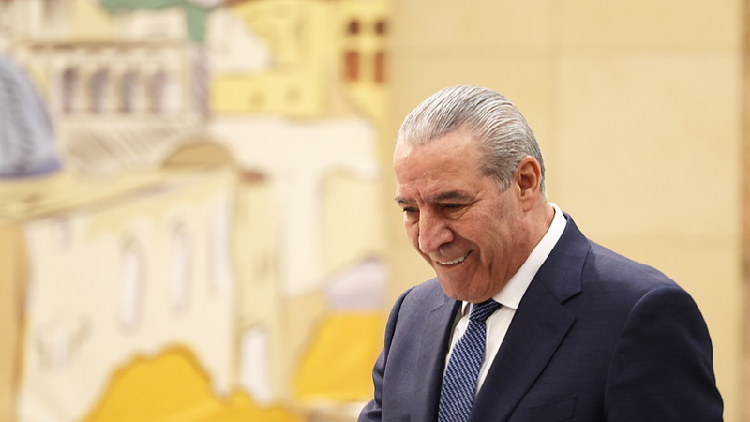
Chinese Vice President Han Zheng on Thursday met with members of a U.S. delegation attending the China-U.S. Senior-Level Track Two Dialogue in Beijing.

Han noted that the China-U.S. relationship is among the most important bilateral relations in the world today, which is at a crucial juncture and of historic significance.

Mutual respect, peaceful coexistence and win-win cooperation between China and the United States are not only beneficial to the two countries, but also to world peace and development, Han said.

China hopes that the China-U.S. Senior-Level Track Two Dialogue will gather insightful views of people from both countries, enhance understanding and knowledge of China across all sectors in the United States, and contribute to the stable, healthy and sustainable development of China-U.S. relations, Han said.

According to the U.S. delegation, the dialogue is helpful for both sides to better understand each other and provide more beneficial ideas for the development of bilateral relations.

They said that the two countries should enhance dialogue and cooperation in areas such as trade and investment.

China says ready to help promote Pakistan-Afghanistan ties

No Comments

<img src='https://news.cgtn.com/news/2025-06-04/China-says-ready-to-help-promote-Pakistan-Afghanistan-ties-1DVX7vxYMwM/img/5556bf0004d74469aba4e531d2817c63/5556bf0004d74469aba4e531d2817c63.png' alt='Chinese Foreign Ministry spokesperson Lin Jian at a daily press conference in Beijing, China, June 4, 2025. /Chinese Foreign Ministry'

China welcomes the recent upgrade of diplomatic relations between Pakistan and Afghanistan from the level of chargé d’affaires to ambassadorial, a Chinese Foreign Ministry spokesperson said on Wednesday.

Spokesperson Lin Jian made the remarks at a regular press briefing in response to a related question, adding that China stands ready to continue playing a constructive role in promoting the improvement and development of relations between these two countries.

Noting that the move is conducive to enhancing mutual trust and strengthening cooperation between Pakistan and Afghanistan and jointly maintaining peace and stability in the region, Lin said that this is also an important and positive measure for Pakistan and Afghanistan to implement the outcomes of the informal meeting of foreign ministers of China, Afghanistan and Pakistan in May this year.

China is willing to work with regional countries, including Pakistan and Afghanistan, to jointly maintain peace, stability and development in the region and is committed to building a community with a shared future with neighboring countries, he added.

Americans are spending less due to Trump tariffs: report

No Comments

<img src='https://news.cgtn.com/news/2025-06-04/Americans-are-spending-less-due-to-Trump-tariffs-report-1DVPjv8IXjW/img/8d2bc2834d434bac8d7c8cdfe25824e5/8d2bc2834d434bac8d7c8cdfe25824e5.png' alt='A local shops in a supermarket in Arlington, Virginia, U.S., April 30, 2025. /VCG'

Americans are planning to spend less money this summer due to the impact of U.S. President Donald Trump’s trade tariffs, The Independent has said, citing polling, surveys and media reports.

In a survey by personal finance company WalletHub, 45 percent of respondents said tariffs are affecting their travel plans. Meanwhile, nearly two in three said they plan to spend less this summer than they did last year, the British daily said in a Tuesday online report.

A survey of 1,516 U.S. consumers conducted by the accounting giant KPMG in April found that 50 percent are cutting back on spending due to tariffs, and more than 70 percent expect a recession within the next 12 months.

“The tariffs are making high prices even more unreasonably high, to the point where … what you’re charging is not even close to what this is worth,” freelance copy editor Raina Becker was quoted as saying by NBC News.

Brad Russell, a Philadelphia father of two, told Bloomberg that his family will be taking more modest vacations this summer because they expect costs to rise and taking weekend car trips to nearby attractions rather than weeklong stays at major resorts, such as Disney.

Since retaking power this January, Trump has used emergency powers to impose steep new taxes on a wide range of imported goods.

(With input from agencies)

China rejects U.S. claims that it violates Geneva talks consensus

No Comments

Chinese Foreign Ministry spokesperson Lin Jian on Tuesday rejected the repeated U.S. claims that China is violating the consensus reached during the China-U.S. economic and trade talks in Geneva, urging the United States to stop spreading disinformation.

China has acted responsibly, taking the consensus reached in the Geneva talks seriously and implementing it rigorously, Lin stated at a regular press briefing.

The United States has seriously undermined the consensus by successively introducing multiple discriminatory restrictive measures against China, including issuing guidance on AI chip export controls, halting sales of chip design software to China, and announcing the revocation of visas for Chinese students, Lin said.

The U.S. move has harmed China’s legitimate rights and interests, and China firmly opposes this and has lodged stern representations, the spokesperson said.

Stressing that pressure and coercion are not the correct ways to deal with China, he urged the United States to respect the facts, stop spreading disinformation, correct its own mistakes and take concrete actions to safeguard the consensus reached during the Geneva talks.

U.S. tariffs to trigger energy crisis amid global economic uncertainty

No Comments

<img src='https://news.cgtn.com/news/2025-06-03/U-S-tariffs-to-trigger-energy-crisis-amid-global-economic-uncertainty-1DU9QgnfpXq/img/faded805cdb5435c841376a7584d6f85/faded805cdb5435c841376a7584d6f85.png' alt='U.S. President Donald Trump speaks during a news conference inside the Oval Office at the White House in Washington, D.C., May 30, 2025. /VCG '

The sweeping U.S. tariffs imposed by the Donald Trump administration are inflicting severe damage across the country’s energy sector, from oil production to renewable power development, a new analysis revealed.

The Trump administration’s tariff policies are backfiring spectacularly on the U.S. energy sector, with new research by Wood Mackenzie (WoodMac), a leading energy and natural resource analytics consulting firm, showing that trade wars could erode projected growth in oil demand, hinder renewable energy investment and force the country into high-cost energy isolation that undermines its global competitiveness.

The research, released in late May, said President Trump’s “Liberation Day” tariff announcement on April 2 represents “arguably the most pivotal moment for the world economy since China’s 2001 entry into the World Trade Organization.”

However, unlike China’s entry, which significantly boosted global growth, the sweeping U.S. tariffs and international retaliation threaten to devastate established trading relationships and accelerate the retreat from globalization, according to the firm.

WoodMac developed three scenarios to assess the impact of Trump’s trade policies, with the most severe “trade war” scenario projecting U.S. effective tariff rates exceeding 30 percent. Under this scenario, global GDP is projected to contract by 2.9 percent by 2030, according to its analysis.

The oil industry, a cornerstone of U.S. energy independence, faces particularly severe consequences under Trump’s tariff regime. In the worst scenario, global oil demand would experience an “outright fall” in 2026. Demand growth would resume from 2027, but overall demand by 2030 would still be 2.5 million barrels per day lower than under the most optimistic scenario.

Oil prices would plummet to an average of $50 per barrel in 2026, dealing a devastating blow to U.S. shale producers, as WoodMac’s research demonstrates that “the economics of Lower 48 drilling won’t support production growth with crude at $50 per barrel, despite corporate ambitions to keep pushing down breakeven.”

The price collapse would force significant reductions in investment and lead to lower U.S. oil production through 2030. Supply growth outside the United States would also suffer from reduced budgets for upstream projects, with delays expected in developments not yet under construction.

In the power sector, the added costs and uncertainty created by the tariffs build barriers to investment and make it more difficult to increase supply.

“In a business with a five-to-10-year planning cycle, not knowing what a project will cost next year or the year after is extraordinarily disruptive,” the WoodMac report said. The consultancy noted that many companies had already reported adjustments to their strategy and business plans, including deferrals of investments.

The tariff barriers effectively cement the U.S. position as a high-cost location for renewable energy and storage.

The Trump administration had promoted tariffs as a tool to encourage manufacturing reshoring and reduce dependence on foreign supply chains. However, the analysis suggested these policies are achieving the opposite effect in critical energy sectors.

The metals and mining sector, essential for energy infrastructure, will suffer particularly severe impacts. Aluminum demand falls by almost 4 million tonnes in 2026, with copper down by 1.2 million tonnes, compared to baseline projections. Steel demand drops by a projected 90 million tonnes and lithium demand by 70,000 tonnes.

The analysis said companies in the energy and natural resources industries must now “reckon with uncertainty over tariffs persisting for months, and probably years, to come.” The firm warned that riskier investments would be pared back and strategies that create increased flexibility would be prioritized, fundamentally altering the trajectory of U.S. energy development for years to come.

Former senior Chinese military official Xu Qiliang passes away

No Comments

Former senior Chinese military official Xu Qiliang died of illness at the age of 75 in Beijing at 12:12 p.m. on Monday, according to an official statement.

Xu had served as a member of the Political Bureau of the 18th and 19th Central Committees of the Communist Party of China (CPC) and as vice chairman of the Central Military Commission. He was praised in the statement as an excellent CPC member, a time-tested and loyal communist soldier, a proletarian military strategist and an outstanding leader of the People’s Liberation Army (PLA).

Xu joined the PLA in July 1966, became a CPC member in July 1967, and was awarded the rank of Air Force General in June 2007.

Russian investigator classifies bridge collapses as 'terrorist attack'

No Comments

<img src='https://news.cgtn.com/news/2025-06-01/Russian-investigator-classifies-bridge-collapses-as-terrorist-attack–1DR1uImKGg8/img/d9123152593f4a8db7c043dbb49868e9/d9123152593f4a8db7c043dbb49868e9.png' alt='A view of a damaged bridge after the crash of a freight train in Russia's Kursk region, which borders Ukraine, June 1, 2025. /VCG'

The Russian Investigative Committee on Sunday classified the bridge collapses in its border regions of Bryansk and Kursk as terrorist attacks.

“The Main Investigative Directorate, on the instructions of the chairman of the Investigative Committee, has initiated criminal cases regarding the explosions on the railway lines in the Bryansk and Kursk Regions. These incidents have been classified as acts of terrorism,” said Svetlana Petrenko, the committee spokesperson.

The committee said earlier that two explosions occurred overnight in the two regions, both resulting in bridge collapses and leading to the derailment of passenger trains and causing fatalities.

“On May 31, 2025, at 10:50 p.m. (0750 GMT), on the Vygonichi-Pilshino railway section in the Bryansk region, an explosion caused the collapse of a road bridge structure,” the committee said in a statement.

The explosion caused a passenger train carrying 388 people to derail, resulting in the deaths of seven people and injuries of 66 others, Bryansk Governor Alexander Bogomaz said.

Meanwhile, another blast on a railway bridge in the Kursk region led to a passing train falling onto the road, injuring the driver and two assistants, said the committee.

Singaporean minister: Resolving Taiwan question up to Chinese people

No Comments

<img src='https://news.cgtn.com/news/2025-06-01/Singaporean-minister-Resolving-Taiwan-question-up-to-Chinese-people-1DR1l3kBs8E/img/9182ca746f7a48cd8661fc4948b9608e/9182ca746f7a48cd8661fc4948b9608e.png' alt='Singaporean Defense Minister Chan Chun Sing speaks during a press conference at the 22nd Shangri-La Dialogue in Singapore, June 1, 2025. /VCG'

Singaporean Defense Minister Chan Chun Sing said on Sunday that the Taiwan question will have to be determined by the Chinese people.

Speaking at the final session of the 22nd Shangri-La Dialogue, Chan stressed the importance of understanding the historical context of the Taiwan question.

“How this issue is going to be resolved, if not managed, will have to be determined by the Chinese people,” he said.

Chan warned against “simplistic” explanations of the question as “a conflict between democracy and autocracy,” or comparing it with the Ukraine situation. He said hearing such attempts “scares” him.

Poll | 'American dream' broken for many as Trump targets universities

No Comments

<img src='https://news.cgtn.com/news/2025-05-31/Poll-American-dream-broken-for-many-as-Trump-targets-universities-1DPqTIryqvS/img/1a363f4d21ab44a4a75a248e7a6a0df5/1a363f4d21ab44a4a75a248e7a6a0df5.png' alt='Harvard banners in front Widener Library during the 374th Harvard Commencement in Harvard Yard in Cambridge, Massachusetts, May 29, 2025. /VCG'

The U.S. government’s series of executive orders targeting the admission of international students by universities continues to cause a strong stir in international public opinion. A survey conducted by CGTN shows that 82.1 percent of respondents strongly condemned the U.S. for its serious violation of academic freedom. Nearly 90 percent of respondents voiced concern that these actions have shattered the “American dream” for countless international students.

The U.S. government has ordered its embassies and consulates abroad to suspend student visa interviews and is considering monitoring international students’ social media accounts. A total of 81.3 percent of respondents strongly oppose this, viewing it as a serious violation of students’ personal privacy, filled with prejudice and discrimination against international students. In addition, the U.S. has also arbitrarily canceled Chinese students’ visas under the pretext of so-called ideological differences and national security, prompting widespread criticism. According to the survey, 83 percent of respondents believe this move seriously harms the legitimate rights of Chinese students and creates unjust barriers to people-to-people exchanges between the two countries.

In fact, the current U.S. administration has repeatedly wielded the “political stick” against university campuses. It previously launched investigations into more than 60 universities and suspended their federal funding. Since March, it has demanded that Harvard University shut down its diversity, equity and inclusion programs, reduce the authority of its administrators, and reform its admissions standards. After Harvard refused to comply, the government froze $2.2 billion in funding and $60 million in contract payments.

In the survey, 82.5 percent of respondents criticized the Trump administration for abusing state power to exert extreme pressure and retaliate against social institutions; 82.5 percent of respondents stated that these executive orders have severely shaken the foundation of the U.S. higher education system, undermining the independence, academic freedom and freedom of speech; and 88.9 percent supported the idea that American universities should use legal means to protect their own and their students’ legitimate rights.

The U.S. government’s political crackdown on universities has left hundreds of thousands of international students feeling helpless, anxious and unsettled. Some students and their parents have started turning to countries such as the UK, France, Canada, Australia, Singapore, and the Hong Kong region of China. A professional international education consultant stated that many families are genuinely concerned about their children’s safety in the U.S. and even more worried about whether their children will continue to be welcomed there.

In the survey, 86.7 percent of respondents believed that the U.S. government’s policies and statements targeting universities and international students have seriously damaged the reputation of American higher education institutions and their appeal to international students, inevitably weakening the United States’ global competitiveness in science and education. A total of 88.5 percent of respondents believe that the U.S. restrictions are driven by obvious political motives and run counter to its proclaimed values of “freedom and openness.” They argue that those actions have severely damaged the U.S.’s international image and credibility, shattering the “American dream” for countless international students.

The survey was published on CGTN’s English, Spanish, French, Arabic and Russian platforms, with 6886 overseas netizens participating and sharing their views within 24 hours.

Shangri-La Dialogue: China says it rejects unilateralism, bullying

No Comments

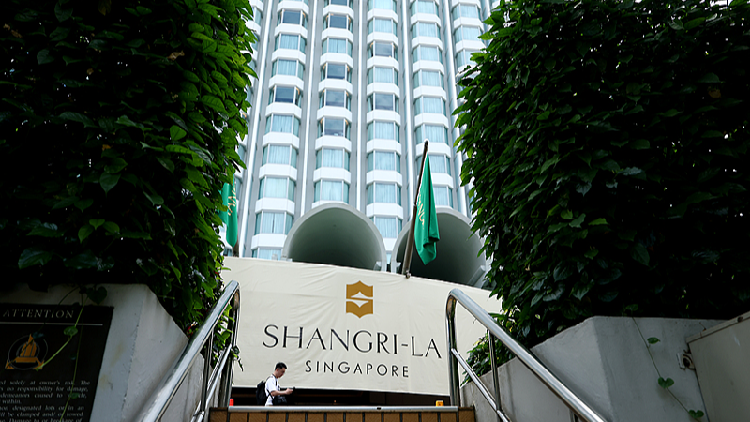
<img src='https://news.cgtn.com/news/2025-05-31/Shangri-La-Dialogue-China-says-it-rejects-unilateralism-bullying-1DPhVYOwzFC/img/2c66a79b6769470b86acd4f39286455c/2c66a79b6769470b86acd4f39286455c.png' alt='The facade of the Shangri-La Hotel during the 22nd IISS Shangri-La Dialogue in Singapore, May 30, 2025. /VCG'

China’s delegation to the 22nd Shangri-La Dialogue on Saturday reaffirmed its rejection of practices of unilateralism and bullying.

Speaking at a special session titled “Cooperative Maritime Security in the Asia-Pacific,” Hu Gangfeng, vice president of the National Defense University of the Chinese People’s Liberation Army, said China will uphold its three global initiatives on development, security, and civilization and actively implement the vision of a maritime community with a shared future.

China will work with others to build a sea of peace, friendship and cooperation in Asia Pacific, said Hu. He stressed that China proposes the practice of multilateralism, sincere dialogue and consultation, and equal exchanges and mutual learning to secure that goal.

Hosted by the International Institute for Strategic Studies, Shangri-La Dialogue, widely seen as Asia’s leading defense summit, convenes from Friday to Sunday in Singapore, with more than 550 delegates from over 40 countries and regions attending.

As the global security landscape fractures and the multilateral system faces unprecedented strain, all eyes are on China’s stance.

“We need China to take a more active role in the discussion, as it can help alleviate the conflict that affects the global community,” said Nuriyeni Kartika Bintarsari, head of international relations at Jenderal Soedirman University, according to Xinhua.

‘China building up security of region through growth’

China’s active role in global security governance has been increasingly acknowledged. In 2022, China introduced the Global Security Initiative. As of the end of 2024, with the support of 119 countries and international and regional organizations, the initiative has been written into 123 bilateral and multilateral cooperation documents.

At a central conference on work related to neighboring countries in April, China, for the first time, proposed an Asian security model that features sharing weal and woe, seeking common ground while shelving differences, and prioritizing dialogue and consultation.

In a white paper on China’s national security in the new era, released on May 12, China makes it clear that it advocates common security, emphasizing that all nations have equal security interests and the legitimate security concerns of every country deserve due attention and proper resolution.

In addition, China also attaches great importance to the coordination of development and security, following the Chinese philosophy that sustainable development lays the foundation for lasting peace and stability.

In an exclusive interview with CGTN host Xu Qinduo, Chan Heng Chee, ambassador-at-large with Singapore’s Ministry of Foreign Affairs, noted China’s contributions to regional development through the Belt and Road Initiative and the Asian Infrastructure Investment Bank, emphasizing that economic security is as vital as military security.

“China is building up the security of the region by contributing to its growth and institutionalization and the strengthening of the countries’ economies,” said Chan, referring to the Asia-Pacific region and Southeast Asia in particular. “And that is appreciated very much in the region.”

China urges U.S. to halt weapons sales to Taiwan region

No Comments

<img src='https://news.cgtn.com/news/2025-05-30/China-urges-U-S-to-halt-weapons-sales-to-Taiwan-region-1DNAi7cQtRS/img/820c19d6f06341f8863048950144ccdc/820c19d6f06341f8863048950144ccdc.png' alt='File photo: Chinese Foreign Ministry spokesperson Lin Jian speaks at a press conference in Beijing. /VCG'

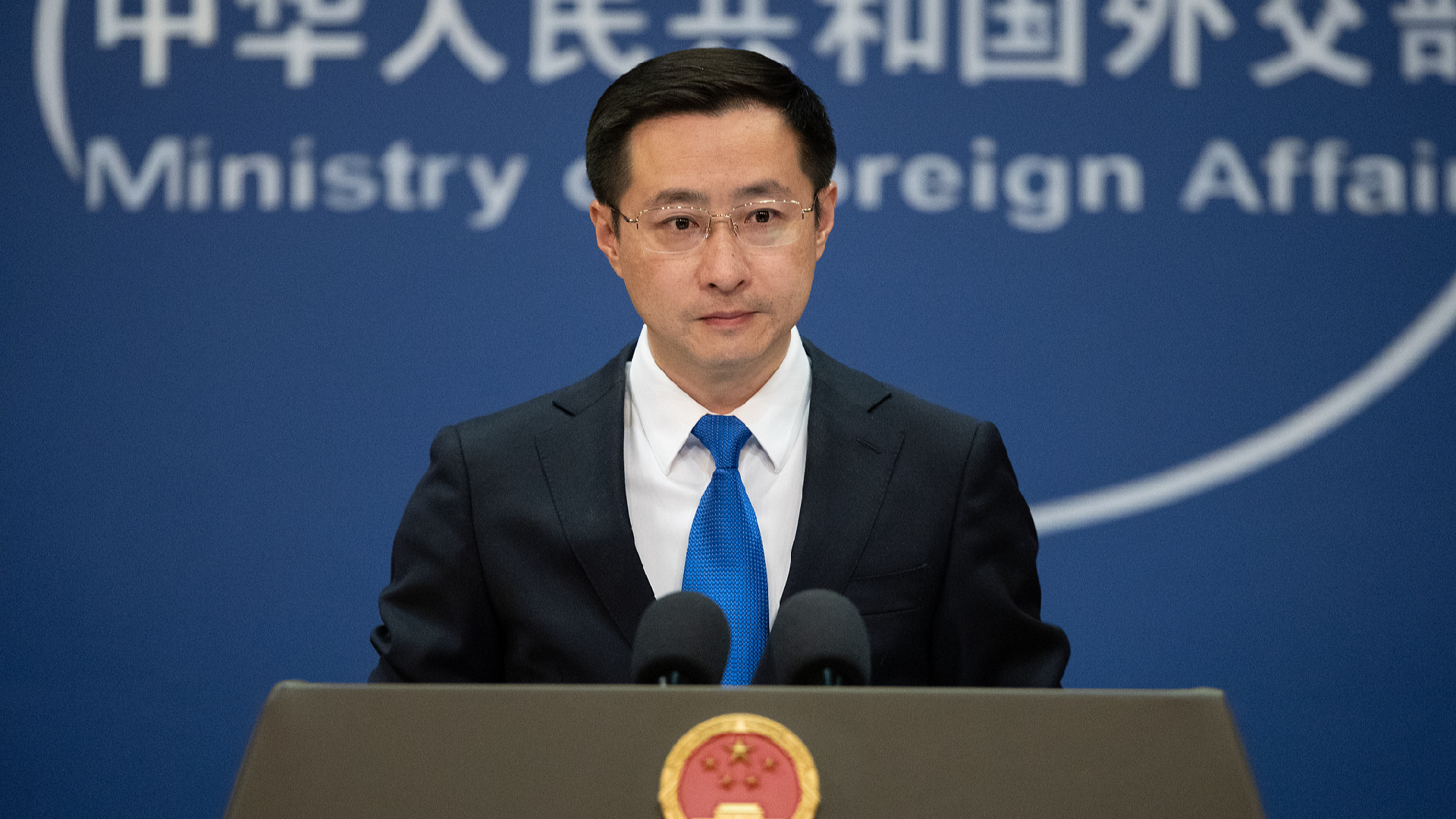
The Taiwan question represents the core of China’s core interests and constitutes the first and foremost red line that must not be crossed in China-U.S. relations, Chinese Foreign Ministry spokesperson Lin Jian said on Friday.

Lin’s remarks came after media reports about the U.S.’s plan to ramp up weapons sales to the Taiwan region.

China firmly opposes U.S. arms sales to China’s Taiwan region, Lin said. He urged the U.S. to strictly abide by the one-China principle and the provisions of the three China-U.S. joint communiques, particularly the August 17 Communique, cease arms sales to Taiwan and refrain from creating factors that escalate tensions across the Taiwan Straits.

China’s resolve to safeguard its national sovereignty and territorial integrity remains unwavering, Lin said.

Why China helped set up International Organization for Mediation

No Comments

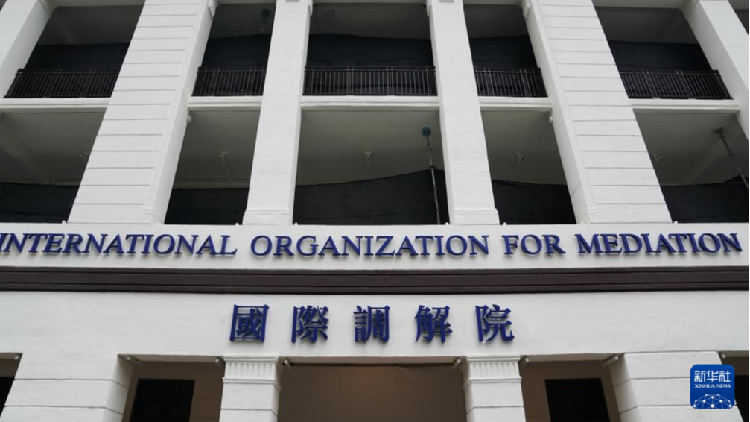
<img src='https://news.cgtn.com/news/2025-05-30/Why-China-helped-set-up-International-Organization-for-Mediation-1DNEMicySJi/img/06c0fde52c9b41c895c0f01ea959ec72/06c0fde52c9b41c895c0f01ea959ec72.png' alt='The building of the International Organization for Mediation, south China's Hong Kong SAR, May 30, 2025. /Xinhua'

China’s Hong Kong Special Administrative Region (HKSAR) on Friday witnessed a signing ceremony of the Convention on the Establishment of the International Organization for Mediation (IOMed).

In his speech at the ceremony, Chinese Foreign Minister Wang Yi hailed the establishment of IOMed as an “innovative step in international rule of law” with “great significance in the history of international relations.”

Experts said this milestone is more than a ceremonial launch of a new international institution, terming it a significant step in global governance that fills a crucial gap in international dispute resolution.

They said it also reflects China’s philosophy of “harmony,” promoting dialogue and win-win solutions while moving away from zero-sum thinking. It offers a fairer, more accessible alternative to Western-dominated dispute mechanisms, opening new avenues for all nations, particularly developing countries, to resolve conflicts peacefully and equitably.

Representatives from 32 countries signed the convention, officially becoming founding member states of IOMed. High-level representatives from over 50 countries and nearly 20 international organizations attended the ceremony.

Practicing purposes and principles of UN Charter

The IOMed was founded to mediate disputes between states, or between a state and foreign investors, and international commercial disputes based on the will of relevant parties. Notably, it is the first organization of its kind to facilitate international disputes through mediation, filling an institutional gap in international mediation.

Article 33 of the UN Charter clearly states mediation as one of the first means that should be tried in seeking peaceful solutions to international disputes. However, there didn’t exist an intergovernmental legal organization in this field. By establishing IOMed, China has helped filled this gap, providing an essential public good in the realm of global governance and the rule of law.

Xu Ying, a Beijing-based international affairs expert, said that the creation of IOMed also represents a necessary evolution in global dispute resolution. 

According to Xu, existing dispute settlement bodies, like the World Trade Organization, were shaped by the interests of a few dominant powers. Today, these mechanisms struggle under the weight of global realities and often disadvantage developing nations. IOMed, therefore, serves as a complementary institution, offering a fairer and more credible alternative for dispute resolution.

Promoting peaceful resolution of disputes

Resolving conflicts through dialogue and mediating disputes through consultation is a common value and aspiration of all major civilizations in the world. Wang said that the birth of the IOMed can help transcend the “you-lose-I-win” zero-sum mentality, promote the amicable resolution of international disputes and foster more harmonious international relations.

Harmony-based conflict resolution principles are long embedded in Eastern traditions. In China, there is a well-known saying, “Harmony is precious,” which aligns with the concept of mediation as emphasizing mutual respect, compromise and the pursuit of win-win outcomes as the foundation for peacefully resolving disputes.

In addition to its peaceful nature, IOMed offers a more flexible, cost-effective and efficient approach to dispute resolution for all parties, especially for developing countries. It will complement existing international dispute mechanisms like litigation and arbitration.

“The IOMed addresses one of the key criticisms of current mechanisms: that they are often inaccessible, expensive and tilted in favor of wealthier nations. This new court is explicitly designed to be different. Its procedures are accessible. Its emphasis on neutrality and non-coerciveness ensures fairness,” said Xu.

Bridging East and West via Hong Kong

The IOMed will be headquartered in HKSAR. Wang said that Hong Kong’s handover is itself a success story of peaceful settlement of international disputes.

He also listed the advantages of Hong Kong, saying the city enjoys exceptional advantages in international mediation. He noted, for instance, its affinity to the motherland and connection to the world, its enabling business environment, its highly developed legal system, and its strength in both common law and civil law.

Recently, three international rating agencies – S&P, Moody’s and Fitch – affirmed Hong Kong’s “stable” rating outlook. Beyond its long-standing role as a global hub for finance and commerce, the city also boasts a strong common law tradition and a world-class legal services ecosystem, including a mature judiciary, multilingual professionals and extensive experience in cross-border mediation. It also has deep ties with both East and West, which further solidifies its position as an ideal location for IOMed.

China, Micronesia vow to deepen comprehensive strategic partnership

No Comments

<img src='https://news.cgtn.com/news/2025-05-29/China-Micronesia-vow-to-deepen-comprehensive-strategic-partnership-1DLQu7ehVuw/img/9d1dce60c0ad4d17be02c7314fe1e250/9d1dce60c0ad4d17be02c7314fe1e250.jpeg' alt='Chinese Foreign Minister Wang Yi (R), also a member of the Political Bureau of the Communist Party of China Central Committee, meets with Secretary of Foreign Affairs Lorin S. Robert of Federated States of Micronesia in Xiamen, southeast China's Fujian Province, May 29, 2025. /Chinese Foreign Ministry'

Chinese Foreign Minister Wang Yi on Thursday met with Secretary of Foreign Affairs Lorin S. Robert of Federated States of Micronesia (FSM) in Xiamen, with the two sides pledging to advance China-FSM comprehensive strategic partnership.

Robert, is in China to attend the Third China-Pacific Island Countries Foreign Ministers’ Meeting.

Wang, also a member of the Political Bureau of the Communist Party of China Central Committee, noted that with the concerted efforts of the FSM and other participating countries, the meeting produced a joint statement that injects fresh momentum into relations between China and Pacific Island nations.

Wang highlighted the steady progress in China-FSM relations since the establishment of diplomatic ties, noting that it has brought tangible benefits to the people of the FSM.

He said the Chinese side commended the FSM Congress for passing a resolution reaffirming its commitment to the one-China principle and expressed confidence that the FSM will continue to firmly support China’s just position on the Taiwan question.

Noting that the handover of the China-assisted FSM National Convention Center marks a milestone in bilateral ties, Wang said China stands ready to work with the FSM to advance Belt and Road cooperation.

Looking ahead, Wang proposed expanding cooperation in key areas, such as infrastructure, climate change response, and marine scientific research. He also urged efforts to deepen exchanges in education, youth, and local governance to further advance the China-FSM comprehensive strategic partnership.

<img src='https://news.cgtn.com/news/2025-05-29/China-Micronesia-vow-to-deepen-comprehensive-strategic-partnership-1DLQu7ehVuw/img/1c48fe6d8fb143869bb249afdf6c12fb/1c48fe6d8fb143869bb249afdf6c12fb.jpeg' alt='Wang Yi holds talks with Lorin S. Robert in Xiamen, Fujian Province, May 29, 2025. /Chinese Foreign Ministry'

Robert extended his congratulations on the conclusion of the Third China-Pacific Island Countries Foreign Ministers’ Meeting and praised the fruitful and respectful cooperation between the two countries since the establishment of diplomatic ties.

He acknowledged China’s vital support for his country’s development, describing the National Convention Center as a testament to the growing bilateral relationship.

Robert reiterated the FSM government’s firm adherence to the one-China principle, affirming that Taiwan is an inalienable part of China.

He described China not only as a close development partner but also as a global leader championing sustainable development and fairness for the Global South.

The FSM is committed to further strengthening its comprehensive strategic partnership with China, Robert said.

China, PNG pledge to enhance bilateral practical cooperation

No Comments

<img src='https://news.cgtn.com/news/2025-05-29/China-PNG-pledge-to-enhance-bilateral-practical-cooperation-1DLTVLnSkOQ/img/54ac2349c8b34d0daec198c23f1598df/54ac2349c8b34d0daec198c23f1598df.jpeg' alt='Chinese Foreign Minister Wang Yi (R), also a member of the Political Bureau of the Communist Party of China Central Committee, meets with Minister for Foreign Affairs Justin Tkatchenko of Papua New Guinea in Xiamen, southeast China's Fujian Province, May 29, 2025. /Chinese Foreign Ministry'

Chinese Foreign Minister Wang Yi on Thursday met with Minister for Foreign Affairs Justin Tkatchenko of Papua New Guinea (PNG) in Xiamen, who is in China to attend the Third China-Pacific Island Countries Foreign Ministers’ Meeting.

Wang Yi hailed the enduring friendship between China and PNG, describing it as a valuable asset forged across mountains and seas and tested by time.

Guided by generations of leadership from both nations, China and PNG have become trusted friends, reliable partners in development, and close brothers in international affairs, he added.

Congratulating PNG on the 50th anniversary of its independence, Wang noted that next year will mark 50 years since the establishment of diplomatic relations between the two countries.

Wang called on the two sides to summarize the successful experiences in promoting bilateral relations and jointly chart the course for the next five decades.

To further deepen cooperation, Wang called for the early launch of negotiations on a bilateral free trade agreement and urged full implementation of the consensus reached by the two countries’ leaders.

The Chinese foreign minister pointed out that the Third China-Pacific Island Countries Foreign Ministers’ Meeting reached new consensus on building a community with a shared future between China and Pacific Island countries.

He highlighted PNG’s unique role as a major country in the South Pacific and a gateway to Asia, and expressed China’s readiness to work with PNG and other island nations to implement the meeting’s outcomes and contribute to regional peace and development.

<img src='https://news.cgtn.com/news/2025-05-29/China-PNG-pledge-to-enhance-bilateral-practical-cooperation-1DLTVLnSkOQ/img/53f6ce8ed26547049cd43a466f314757/53f6ce8ed26547049cd43a466f314757.jpeg' alt='Wang Yi holds talks with Justin Tkatchenko in Xiamen, Fujian Province, May 29, 2025. /Chinese Foreign Ministry'

Minister Tkatchenko reaffirmed the critical importance of China-PNG relations, noting that the PNG government remains firmly committed to the one-China policy and supports China’s efforts to safeguard its sovereignty and territorial integrity.

He expressed the desire to enhance Belt and Road cooperation and deepen bilateral practical collaboration in areas such as agriculture, education, telecommunications, energy, and local development, in support of PNG’s long-term sustainable growth.

Wang commended PNG’s consistent adherence to the one-China principle. Stressing Xiamen lies just across the water from Taiwan’s Kinmen Island, Wang said that “no one longs for peace and stability across the Taiwan Straits more earnestly than we do.”

“The two sides of the Straits belong to one China – this is not only historical fact but present reality,” he said.

Wang also emphasized that realizing national reunification is the long-cherished aspiration of the Chinese nation and an unstoppable historical trend.

He firmly denounced “Taiwan independence” separatist activities, calling them unconstitutional, contrary to the purposes of the UN Charter, and in defiance of the global consensus on the one-China principle.

“Taiwan independence” separatists’ actions will be opposed by the international community, he added.

China-PICs roundtable on rural revitalization held in East China

No Comments

<img src='https://news.cgtn.com/news/2025-05-28/China-PICs-roundtable-on-rural-revitalization-held-in-East-China-1DKnbelcdYk/img/5edf0ec9580a4680952a03537990b6c0/5edf0ec9580a4680952a03537990b6c0.png' alt='Official release of the China-Pacific Island Countries International Friendship Cities Association during a roundtable in Liaocheng City, east China's Shandong Province, May 28, 2025. /CGTN'

The China (Shandong)-Pacific Island Countries (PICs) roundtable on rural revitalization cooperation and exchange, also the third anniversary celebration of the China-Pacific Island Countries Climate Action Cooperation Center, was held in Liaocheng City, east China’s Shandong Province, on Wednesday.

More than 120 people attended the event, including government officials, experts, scholars and business representatives from China and nine Pacific Island Countries.

Participants at the roundtable vowed to further deepen friendship and exchanges between the PICs and China, especially with China’s Liaocheng City and Shandong Province. They said they will continue to deepen practical cooperation in various fields, explore the establishment of new cooperative relations and promote sustainable development.

Chinese mainland affirms commitment to cross-Straits exchanges

No Comments

<img src='https://news.cgtn.com/news/2025-05-28/Chinese-mainland-affirms-commitment-to-cross-Straits-exchanges-1DKqVWdJ7eo/img/c74f9bee9bf141fa8c9bc4a115a65d3c/c74f9bee9bf141fa8c9bc4a115a65d3c.png' alt='Taiwan youths take a selfie at Xiangshan Park in Beijing, China, April 13, 2024. /VCG'

The Chinese mainland will continue to actively promote exchanges and cooperation across the Taiwan Straits to benefit compatriots on both sides, a mainland spokesperson said on Wednesday.

Chen Binhua, a spokesperson for the State Council Taiwan Affairs Office, emphasized that the mainstream public opinion in Taiwan, which advocates for peace, development, enhanced exchanges and cooperation, cannot be ignored. “The desire of people across the Straits to strengthen bonds and the enthusiasm of Taiwan compatriots to participate in events like the Straits Forum cannot be suppressed,” he told a regular press briefing.

Authorities are accelerating preparations for the 17th Straits Forum, with details to be announced soon, Chen added. Since its inception in 2009, the forum has served as a vital platform for fostering extensive cross-Straits interactions and cooperation.

Chen criticized Taiwan’s Democratic Progressive Party authorities for imposing restrictions on people from Taiwan attending the forum, calling it another attempt to obstruct cross-Straits exchanges. “This once again exposes their malicious intent to suppress people-to-people exchanges and proves that Lai Ching-te’s claims of willingness to engage with the mainland are nothing but empty words,” he said.

Regarding the resumption of direct cross-Straits sea passenger routes, Chen said that full restoration would significantly facilitate travel and exchanges.

“There are no obstacles from the mainland side,” Chen said, noting that the mainland has made all necessary preparations.

He urged the island to heed public and industry demands and promptly resume services.

Xi congratulates Chinese Young Pioneers on 9th national congress

No Comments

<img src='https://news.cgtn.com/news/2025-05-27/Xi-congratulates-Chinese-Young-Pioneers-on-9th-national-congress-1DIhwUcWPJu/img/944fed623e774b8892dcc5575de87c0e/944fed623e774b8892dcc5575de87c0e.png' alt='The ninth national congress of the Chinese Young Pioneers opens in Beijing, China, May 27, 2025. /Xinhua'

Chinese President Xi Jinping has sent a congratulatory letter to the ninth national congress of the Chinese Young Pioneers (CYP), a national organization for children. The congress opened on Tuesday in Beijing.

Xi, also general secretary of the Communist Party of China (CPC) Central Committee and chairman of the Central Military Commission, stressed in the letter that the CYP should follow the Party and cultivate qualified builders for the cause of socialism with Chinese characteristics.

As International Children’s Day is approaching, Xi also extended greetings to children across the country. He said children represent the future force in building a strong nation and rejuvenating the Chinese nation.

He urged the CYP to educate and guide its members to become exemplary young people of the new era who love the Party and the country, are diligent in their studies and well-rounded in their development.

Xi called for creating a favorable environment for children’s healthy growth.

Cai Qi, a member of the Standing Committee of the Political Bureau of the CPC Central Committee and a member of the Secretariat of the CPC Central Committee, attended the opening meeting of the congress.

Shi Taifeng, a member of the Political Bureau of the CPC Central Committee and head of the CPC Central Committee’s Organization Department, read Xi’s letter at the meeting and delivered a speech on behalf of the CPC Central Committee. He urged CYP members to keep Xi’s teachings in mind and stay prepared to contribute to the great cause of building a strong nation and revitalizing the Chinese nation.

Approximately 3,000 people attended the meeting.

Premier Li calls for forging example of openness with ASEAN, GCC

No Comments

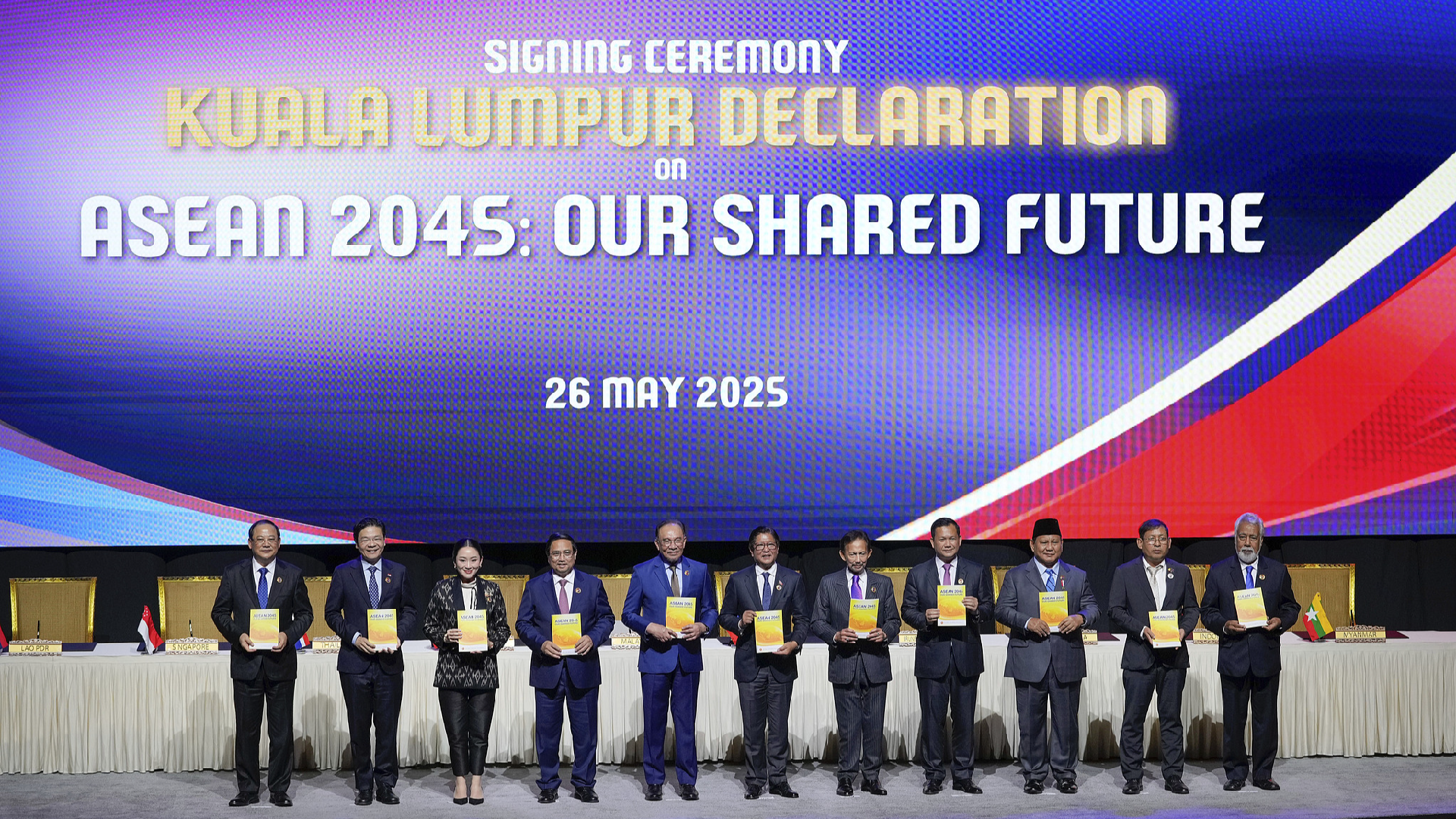
<img src='https://news.cgtn.com/news/2025-05-27/Premier-Li-China-seeks-deeper-strategic-alignment-with-ASEAN-GCC-1DIyURcAV4A/img/c55e0a65c6774a18bad03d7df2410458/c55e0a65c6774a18bad03d7df2410458.png' alt='A view of the 46th ASEAN Summit in Kuala Lumpur, Malaysia, May 26, 2025. /VCG'

Chinese Premier Li Qiang on Tuesday called on China, the Association of Southeast Asian Nations (ASEAN) and the Gulf Cooperation Council (GCC) countries to jointly forge an example in openness, development cooperation and cross-civilization integration.

He made the remarks while addressing the inaugural ASEAN-China-GCC Summit held in Kuala Lumpur, the capital of Malaysia.

Li called on the three sides to create a model of cross-region openness, noting that the population and economic aggregate of China as well as the ASEAN and the GCC countries account for approximately one quarter of the world’s total.

A full connection of the three markets will surely give rise to a much larger space for development and a more significant scale effect, he noted.

China and the ASEAN have fully completed the negotiations on the upgrade of the Version 3.0 China-ASEAN Free Trade Area, Li said, adding that an early completion of talks on the free trade area agreement between the GCC and various parties is expected to elevate trilateral trade levels.

He urged the three sides to unswervingly expand regional opening-up, and build the related regions into a large shared market where resources, technologies and talents flow more efficiently, and trade and investment enjoy greater freedom and convenience, so as to fully unleash the powerful effect of open development.

Li also called on the three sides to forge a model of cooperation across different development stages, saying that although the three sides are at different stages of development, their differences are not obstacles to cooperation but complements to each other’s strengths.

He expressed China’s readiness to deepen strategic alignment with the ASEAN and the GCC on the basis of mutual respect and equal treatment, enhance coordination of macroeconomic policies and strengthen collaboration in industrial specialization.

“We should strive to turn our own strengths into those of everyone, and at the same time help each other tackle new challenges emerging in development, create new ways of international industrial economic cooperation, and promote a coordinated development in which their abilities can be fully explored, and benefits can be doubled and shared,” he said.

The Chinese premier urged the three sides to create a model of cross-civilization integration, noting that the three sides are home to vibrant civilizations and share Asian values of peace, cooperation, openness and inclusiveness.

Emphasizing the need for deeper cultural and people-to-people exchanges and a stronger foundation of mutual trust, Li called on the three sides to effectively manage differences through mutual understanding, foster mutually beneficial cooperation through the exchange of ideas, and explore a new path for the inclusive advancement of diverse civilizations.

China, he said, actively supports the initiative of Confucian-Islamic civilizational dialogue proposed by Malaysian Prime Minister Anwar Ibrahim.

China is ready to work with the ASEAN and the GCC to implement the Global Civilization Initiative, promote mutual learning among civilizations and build greater consensus and momentum towards peace and development, the premier concluded.

Premier Li: China ready to join Kuwait for steady development of ties

No Comments

Chinese Premier Li Qiang said Monday that China is ready to work with Kuwait to further advance the steady development of bilateral ties.

Li made the remarks during his meeting with Sheikh Sabah Al-Khaled Al-Hamad Al-Sabah, crown prince of Kuwait, in Kuala Lumpur. 

The Chinese premier arrived in Kuala Lumpur on Monday to attend the ASEAN (the Association of Southeast Asian Nations)-GCC (the Gulf Cooperation Council)-China Summit. 

Highlighting the strong economic complementarity and broad prospects for cooperation between the two countries, Li said that China stands ready to work with Kuwait to strengthen the synergy between the Belt and Road Initiative and Kuwait Vision 2035. He called for expanded cooperation in key areas such as energy, investment, the green and digital economies and artificial intelligence to unlock new avenues for mutual benefit.

Li said both sides should enhance cultural and people-to-people exchanges and cooperation in education, tourism and other sectors, further facilitating personnel exchanges and promoting the friendship between the two nations.

Amid rising unilateralism and protectionism, Li stressed that China is committed to enhancing communication and coordination with Kuwait on multilateral platforms such as the United Nations and the China-GCC Summit to promote fairer global governance and contribute to world harmony, stability, development and prosperity.

For his part, Al-Sabah expressed gratitude for China’s support in upholding Kuwait’s sovereignty and territorial integrity, reaffirming Kuwait’s firm adherence to the one-China principle and supporting China’s position on issues concerning its core interests.

Noting Kuwait attaches great importance to developing relations with China, Al-Sabah said Kuwait is willing to explore untapped bilateral cooperation potential, expand and deepen mutually beneficial cooperation and strengthen people-to-people ties and cultural exchanges.

Al-Sabah voiced Kuwait’s willingness to work with China to advance GCC-China cooperation, enhance communication and coordination on regional and multilateral affairs, and push bilateral relations to a higher level.

(With input from Xinhua)

Russia, Ukraine wrap up largest prisoner swap

No Comments

<img src='https://news.cgtn.com/news/2025-05-25/news-1DFjnQ5E9lS/img/7244df60c65e440b8ae61ba6cc1629d2/7244df60c65e440b8ae61ba6cc1629d2.jpeg' alt='Russian prisoners ride in a bus following an exchange at an undisclosed location in Belarus, May 25, 2025. /VCG'

Russia and Ukraine each exchanged 303 prisoners on Sunday, completing the largest prisoner exchange under an agreement reached during their recent talks in Istanbul, Türkiye.

The Russian Defense Ministry said that 303 Russian servicemen have “returned from Kyiv-controlled territory,” while an equivalent number of Ukrainian prisoners have also been freed.

Among those released were personnel from the Ukrainian Armed Forces, the National Guard, the State Border Guard Service, and the State Special Transport Service, Ukrainian President Volodymyr Zelenskyy said on X.

The freed Russian prisoners are on the territory of the Republic of Belarus, where they are being provided with necessary psychological and medical assistance, said the Russian Defense Ministry.

Following their direct negotiations in Istanbul on May 16, Russia and Ukraine agreed to exchange 1,000 prisoners each, marking the largest prisoner swap since the start of the conflict in 2022.

On Friday, both sides exchanged 270 soldiers and 120 civilians, followed by a 307-for-307 swap of military personnel on Saturday.

The three-day exchange of prisoners was the 65th swap of captives between the two sides since the start of the conflict and the sixth of its kind this year, according to Ukraine’s Coordinating Headquarters for the Treatment of Prisoners of War.

International expo in western China draws over 3,000 companies

No Comments

<img src='https://news.cgtn.com/news/2025-05-25/International-expo-in-western-China-draws-over-3-000-companies-1DFvzyF1wsM/img/3cb1e5d0f1824766b92d6159d86195c6/3cb1e5d0f1824766b92d6159d86195c6.png' alt='The opening ceremony of the 20th Western China International Fair is held in Chengdu, southwest China's Sichuan Province, May 25, 2025. /VCG'

The 20th Western China International Fair (WCIF) opened on Sunday in Chengdu, the capital of southwest China’s Sichuan Province, showcasing cutting-edge technologies and diverse products, and attracting more than 3,000 companies from 62 countries and regions.

For the first time, this year’s event has two guest countries of honor: Laos and Hungary. Laos’ pavilion is spotlighting tea, coffee, furniture and handicrafts, while Hungary’s is presenting 17 firms specializing in wine, medical devices and eco-friendly water treatment technology.

<img src='https://news.cgtn.com/news/2025-05-25/International-expo-in-western-China-draws-over-3-000-companies-1DFvzyF1wsM/img/2fe306899e76440c90c73eca66782d92/2fe306899e76440c90c73eca66782d92.jpeg' alt='People visit the pavilion of Hungary at the 20th Western China International Fair in Chengdu, southwest China's Sichuan Province, May 25, 2025. /VCG'

The fair provides valuable opportunities for business matchmaking, investment cooperation and information sharing for enterprises from Laos and other countries, effectively enhancing connectivity and integration in regional commodity markets, Lao Deputy Prime Minister Kikeo Khaykhamphithoune said at the opening ceremony.

Making her first appearance at the fair, Indonesian exhibitor Fransisca Pauline Tjandra is showcasing handmade accessories. And by running a workshop on manual handicrafts such as shell necklaces, she expects that more Chinese people will learn about Indonesian handicrafts through the event.

<img src='https://news.cgtn.com/news/2025-05-25/International-expo-in-western-China-draws-over-3-000-companies-1DFvzyF1wsM/img/2c6bdda8c784419e8148071ed57d60eb/2c6bdda8c784419e8148071ed57d60eb.jpeg' alt='High-tech products displayed at the pavilion of Chengdu at the 20th Western China International Fair in Chengdu, southwest China's Sichuan Province, May 25, 2025. /VCG'

“To attend the fair, I even learned some basic Chinese, like ‘nihao’ (hello), ‘xiexie’ (thanks) and ‘Duoshaoqian?’ (How much?),” she said.

Hosted by the Sichuan provincial government, the fair will run until Thursday.

China steps up support for social participation of seniors

No Comments

<img src='https://news.cgtn.com/news/2025-05-24/China-steps-up-support-for-social-participation-of-seniors-1DDNGBL3Q52/img/6d4d2062b7fb4eb19b9f37a8bd51a58f/6d4d2062b7fb4eb19b9f37a8bd51a58f.png' alt='Volunteers and elderly residents make rice dumplings together at a community in Lianyungang, east China's Jiangsu Province, May 21, 2025. /VCG'

From promoting volunteer service and expanding lifelong learning opportunities to developing senior-friendly tourism offerings, China is taking proactive steps to enhance social engagement among the elderly and support their pursuit of active, meaningful lives.

These measures, laid out in a guideline released recently by 19 government departments, came as the country grapples with a rapidly aging population.

Home to the world’s largest elderly demographic, China had over 310 million people aged 60 and above by the end of 2024, which accounted for more than one-fifth of its total population. Both the number and proportion are expected to continue rising in the years ahead.

“The guideline is not only crucial for addressing the immediate challenges of an aging population, but also for laying a solid foundation for sustainable social development in the decades ahead,” said Wang Yongchun, an expert member of the national working commission on aging.

Volunteer service is one of the key ways for elderly people in China to participate in social activities. In 2003, China launched “Silver Age Action,” an initiative encouraging seniors to participate in voluntary activities to assist in the development of underdeveloped regions.

To date, elderly volunteers across the country have participated in relevant activities over 7 million times, engaging in more than 4,000 aid programs and helping 400 million people.

The guideline further advances this initiative by emphasizing the need to diversify volunteer service offerings, innovate service delivery models, and improve insurance products and services tailored to elderly volunteers.

The guideline also stresses the importance of creating diverse and personalized employment opportunities for the elderly while encouraging public training centers and vocational institutions to offer skill-upgrading programs for seniors in need.

“We need to emphasize that seniors are a social asset, not a burden,” said Yuan Xin, vice president of the China Population Association and a professor at Nankai University in north China’s Tianjin Municipality.

Enabling seniors willing to continue contributing to society throughout their lives not only helps them realize their self-worth, but also supports the broader goal of advancing Chinese modernization, he added.

In response to seniors’ growing desire for a more enriched and joyful life, the guideline calls for expanding the national network of senior universities, supporting the development of travel-based elder care services and organizing sports events tailored to older adults.

“With more and more activities available, I spend less time at home glued to my phone and more time getting out and connecting with society,” said Chen Ying, a 65-year-old resident of Beijing.

Yang Hong, 71, a retired doctor from northeast China’s Liaoning Province, is now a regular student of music and traditional Chinese medicine at a senior university. “Attending a senior university isn’t just about gaining knowledge,” she said. “It’s also about embracing a more positive lifestyle and mindset.”

Yang is one of over 20 million students enrolled in China’s 76,000 senior universities and schools, forming the world’s largest community of elderly learners.

“Turning 60 doesn’t mean you’re getting old. It means you’re stepping into a new chapter of life, one where you can pursue the life you truly love and enjoy what matters most.” This recent social media post struck a chord with many people and raked in massive engagement.

With economic growth, improved living standards and longer life expectancy, China is reshaping the narrative around aging, focusing not only on care but also on a sense of fulfillment and meaningful contributions well into later life, according to experts.

Amid this trend, the country has rolled out additional policy measures – such as gradually raising the statutory retirement age – to give older adults more flexibility and choice in how they spend their later years.

“In an era of accelerating population aging, the greater the challenge, the more we must seek opportunities,” said Yuan, adding that the release of this guideline will help foster a positive view of aging across society.

Iran condemns fresh U.S. sanctions ahead of 5th round of nuclear talks

No Comments

<img src='https://news.cgtn.com/news/2025-05-23/Iran-condemns-fresh-U-S-sanctions-ahead-of-5th-round-of-nuclear-talks-1DC9fg4JGHm/img/374d626c24d74c4396fc14d15ae95b85/374d626c24d74c4396fc14d15ae95b85.png' alt='The flags of Iran and the United States are displayed in Muscat, Oman, April 25, 2025. /VCG'

Iran’s Foreign Ministry spokesman Esmaeil Baghaei on Friday strongly condemned the United States for slapping new sanctions on individuals or entities providing Iran with certain construction-related materials.

He made the remarks in a post on social media platform X after the U.S. Department of State claimed in a statement on Wednesday that it had found out that Iran’s construction sector was being controlled “directly or indirectly” by the country’s Islamic Revolution Guards Corps, and identified “10 additional strategic materials that Iran is using in connection with its nuclear, military, or ballistic missile programs.”

According to the U.S. State Department, the newly identified materials include austenitic nickel-chromium alloy, magnesium ingots, sodium perchlorate, tungsten copper, and certain aluminum sheets and tubes.

Baghaei called the U.S. move “outrageous, unlawful and inhuman,” stressing, “The U.S. multi-layered sanctions and coercive measures against Iran have all been calibrated to deprive each and every Iranian citizen of their basic human rights, and as such, these sanctions are no less than crimes against humanity.”

He added the sanctions, which were announced ahead of the fifth round of indirect nuclear talks between Iran and the United States, cast further doubts on the U.S. willingness and seriousness for pursuing diplomacy.

Baghaei emphasized that the Iranian nation was determined to remain “steadfast and strong in the face of such absurd animosity.”

The new sanctions come as Iran and the United States have held four rounds of talks on Tehran’s nuclear program and the lifting of U.S. sanctions since April, with the fifth round scheduled to be held in Rome on Friday.

Commenting on the fifth round of talks in another post on the Iranian Foreign Ministry’s account on X, Baghaei announced the arrival of the Iranian negotiating team in Rome for the talks.

China warns U.S. against using the Philippines to stir trouble

No Comments

<img src='https://news.cgtn.com/news/2025-05-23/China-warns-U-S-against-using-the-Philippines-to-stir-trouble-1DC9CtipxgA/img/554174a126674f868ca42d37c686146a/554174a126674f868ca42d37c686146a.png' alt='Chinese Foreign Ministry spokesperson Mao Ning at a regular press conference in Beijing, China, May 23, 2025. /VCG'

China urges the United States not to use the Philippines to stir trouble in the South China Sea, a Chinese Foreign Ministry spokesperson said on Friday, noting that the Philippine side should immediately cease its provocations and violations on Tiexian Jiao in China’s Nansha Qundao island group.

Spokesperson Mao Ning made the remarks in response to a media query about a post from the U.S. ambassador to the Philippines on X, which was related to recent law enforcement operations of Chinese coast guard vessels against Philippine fishing boats near Tiexian Jiao.

The Philippines has repeatedly dispatched personnel to land illegally on Tiexian Jiao, seriously infringing upon China’s sovereignty and violating the Declaration on the Conduct of Parties in the South China Sea, Mao said, noting that China’s countermeasures are legitimate and legal.

China urges the U.S. side to stop using the Philippines to stir trouble in the South China Sea and to cease undermining peace and tranquility there, Mao said.

“The Philippine side should immediately cease its provocations and violations on Tiexian Jiao in China’s Nansha Qundao, or China will respond resolutely,” she added.

Israel condemns killing of embassy staff in U.S. as antisemitic attack

No Comments

<img src='https://news.cgtn.com/news/2025-05-22/Israel-condemns-killing-of-embassy-staff-in-U-S-as-antisemitic-attack-1DAow8EGLGE/img/833a5cfaaecd42d5a1a98b343f28feba/833a5cfaaecd42d5a1a98b343f28feba.jpeg' alt='U.S. law enforcement officers at the scene where two Israeli embassy staff members were shot and killed outside the Capital Jewish Museum in Washington, D.C., May 22, 2025. /VCG'

Israeli Prime Minister Benjamin Netanyahu on Wednesday expressed deep shock and outrage over the killing of two employees at the Israeli embassy in Washington, D.C., in what he described as an “antisemitic attack.”

According to a statement from the Prime Minister’s office, Netanyahu held a phone conversation with Israeli Ambassador to the United States Yechiel Leiter, who briefed him on the details of the incident. The prime minister extended his support to the ambassador and staff members at the embassy.

Two staff members from the Israeli embassy in the United States were killed in a shooting Wednesday evening near the Capital Jewish Museum in Washington, D.C., U.S. Secretary of Homeland Security Kristi Noem said.

“We are witnessing the horrific consequences of antisemitism and incitement against the State of Israel,” Netanyahu said in the statement. “Blood libels come at a bloody cost and must be combated with full force. My heart goes out to the families of the young victims, whose lives were tragically cut short.”

The prime minister added that he had instructed Israeli security authorities to increase protective measures at Israeli diplomatic missions worldwide.

Chinese Foreign Minister Wang Yi meets his Dutch counterpart

No Comments

<img src='https://news.cgtn.com/news/2025-05-22/Chinese-Foreign-Minister-Wang-Yi-meets-his-Dutch-counterpart-1DAuGY2fyta/img/6328f1b85a4b4a838b8ba2c0311dfda9/6328f1b85a4b4a838b8ba2c0311dfda9.jpeg' alt='Chinese Foreign Minister Wang Yi (R) shakes hands with Foreign Minister of the Netherlands Caspar Veldkam in Beijing, capital of China, May 22, 2025. /VCG'

Chinese Foreign Minister Wang Yi held talks with Foreign Minister of the Netherlands Caspar Veldkamp in Beijing, capital of China, on Thursday.

Wang, also a member of the Political Bureau of the Communist Party of China Central Committee, said that the Netherlands has always been a supporter of free trade and has always upheld multilateralism on the international stage. 

Although China and the Netherlands have different systems and civilizations, the people of both countries share a spirit of pioneering innovation, unwavering perseverance, and the courage to be trailblazers, he said.

Since the establishment of diplomatic relations between the two countries, despite the changes in the world, the two sides have always adhered to the spirit of openness and pragmatism, and the cooperation between the two countries has long been at the forefront of China-Europe cooperation, Wang noted.

Veldkamp expressed respect for China, the Chinese people and culture, and praised the remarkable progress China has achieved in its development.

He noted that the Netherlands has always regarded its relationship with China as one of its most important bilateral partnerships.

Israeli army fires 'warning shots' at EU diplomats visiting West Bank

No Comments

<img src='https://news.cgtn.com/news/2025-05-21/Israeli-army-fires-warning-shots-at-EU-diplomats-visiting-West-Bank-1DyS5cXzg1G/img/595d4bfeea914b38bd6eac2f5b907b74/595d4bfeea914b38bd6eac2f5b907b74.png' alt='Members of a international diplomatic delegation stand by a gate at the eastern entrance of the Jenin camp during a visit to the city of Jenin, May 21, 2025. /VCG'

Israel’s military troops fired “warning shots” at a group of diplomats from the European Union who visited the West Bank city of Jenin on Wednesday.

The Israel Defense Forces (IDF) said the group did not follow the route agreed upon when the tour was coordinated with the army.

“The delegation deviated from the approved route and entered an area where they were not authorized to be,” and “soldiers operating in the area fired warning shots,” a military statement said.

The Israeli statement said no injuries were reported, adding that the army “regrets the inconvenience caused.”

<img src='https://news.cgtn.com/news/2025-05-21/Israeli-army-fires-warning-shots-at-EU-diplomats-visiting-West-Bank-1DyS5cXzg1G/img/6f4ba8506ad44e0c8f880f6a5594a49a/6f4ba8506ad44e0c8f880f6a5594a49a.jpeg' alt='Members of a international diplomatic delegation leave in a rush after shots were fired as they gathered at the eastern entrance of Jenin camp during a visit to the city of Jenin, May 21, 2025. /VCG'

The Palestinian Authority condemned the “live fire,” saying the unlawful act constitutes a “blatant and grave breach” of international law and of the fundamental principles of diplomatic relations as enshrined in the 1961 Vienna Convention on Diplomatic Relations.

The Ministry of Foreign Affairs and Expatriates of Palestine said such acts will not pass without accountability and called upon the international community to take a clear stance against Israeli assaults and protect the Palestinian people and diplomatic personnel operating in Palestine.

The incident sparked condemnations from several European capitals on Wednesday.

Italian Foreign Minister Antonio Tajani slammed the firing of shots on diplomats and called on Israel to “immediately clarify” its actions.

“I have just spoken to Alessandro Tutino, the Deputy Consul General of Italy in Jerusalem, who is well and who was among the diplomats who were apparently shot at near the Jenin refugee camp,” Tajani said on X.

“We call on the government of Israel to immediately clarify what happened. Threats against diplomats are unacceptable,” he said.

EU foreign policy chief Kaja Kallas called on Israel to investigate the incident and hold those responsible “accountable.”

“Any threats on diplomats’ lives are unacceptable,” Kallas told journalists in Brussels.

Spain “strongly” condemned the incident, foreign ministry sources told AFP.

“There was a Spaniard in the group of diplomats who is well. We are in contact with other affected countries to jointly co-ordinate a response to what happened, which we strongly condemn,” the sources said.

(With input from AFP)

Wang Yi to chair 3rd China-PICs foreign ministers' meeting in Xiamen

No Comments

<img src='https://news.cgtn.com/news/2025-05-21/Wang-Yi-to-chair-3rd-China-PICs-foreign-ministers-meeting-in-Xiamen-1DySDoXAcak/img/6a2410b15ff245abb614d7baf70f348b/6a2410b15ff245abb614d7baf70f348b.png' alt='A file photo of Chinese Foreign Minister Wang Yi, also a member of the Political Bureau of the Communist Party of China Central Committee. /VCG'

Chinese Foreign Minister Wang Yi, also a member of the Political Bureau of the Communist Party of China Central Committee, will chair the Third China-Pacific Island Countries (PICs) Foreign Ministers’ Meeting in Xiamen, Fujian Province from May 28 to 29, a Chinese Foreign Ministry spokesperson announced on Wednesday.

Foreign ministers or representatives from 11 island countries having diplomatic relations with China, namely President and Foreign Minister Taneti Maamau of Kiribati, Premier and Foreign Minister Dalton Tagelagi of Niue, Crown Prince and Minister for Foreign Affairs Tupouto’a ‘Ulukalala of Tonga, Minister for Foreign Affairs and Trade Lionel Rouwen Aingimea of Nauru, Secretary of Foreign Affairs Lorin S. Robert of Federated States of Micronesia, Minister for Foreign Affairs and External Trade Peter Shanel Agovaka of Solomon Islands, Minister of Foreign Affairs, International Cooperation and External Trade Marc Ati of Vanuatu, Minister for Foreign Affairs Justin Tkatchenko of Papua New Guinea, Minister for Foreign Affairs and Immigration Tingika Elikana of the Cook Islands, Assistant Minister for Foreign Affairs and Deputy Speaker of the Parliament Lenora Qereqeretabua of Fiji, representative of the government of Samoa and Ambassador of Samoa to China Luamanuvae A. Mariner, and Deputy Secretary General of the Pacific Islands Forum Esala Nayasi will attend the meeting upon invitation, according to the spokesperson.

Spokesperson Mao Ning told a regular press conference that China and PICs are comprehensive strategic partners committed to mutual respect and common development. She added that the two sides have deepened and advanced friendly ties and cooperation in recent years.

Noting that it is the first time the meeting will be held in person in China, Mao added that there will be an in-depth exchange of views on interactions and cooperation between China and PICs in all aspects, as well as international and regional issues of mutual interest.

China highly values its ties with PICs and hopes the meeting will help drive the implementation of the important common understandings reached between leaders of the two sides, enhance solidarity and coordination, unite efforts for development and prosperity, and galvanize an even closer community with a shared future between China and PICs, Mao said.

When should severance pay be given?

No Comments

severance pay

Severance pay is a form of compensation provided to employees when their employment is terminated, usually involuntarily. One common question that arises for both employers and employees is: when should Severance Pay be given? Understanding the appropriate timing for severance pay is crucial because it affects legal compliance, employee satisfaction, and the smooth transition of former workers into new roles or phases of their lives.

Typically, severance pay should be given at the time of termination or shortly thereafter. The rationale is that severance pay is meant to assist employees financially during the immediate period after losing their job, helping to cover expenses while they search for new employment. Providing severance pay promptly shows respect for the employee’s service and can help reduce the stress and uncertainty that often accompany job loss.

In many cases, severance pay is provided as a lump sum payment on or near the employee’s last working day. This allows the departing employee to have funds available right away, which can be crucial for managing bills, rent, or mortgage payments. Some companies may also offer severance pay in installments, spreading out payments over weeks or months. However, lump sum payments are often preferred by employees because they offer greater financial flexibility and security.

When should severance pay be given?

Severance pay should generally be given when an employee is laid off or terminated without cause. In such situations, the employer decides to end the employment relationship for reasons unrelated to the employee’s performance, such as restructuring, downsizing, or company closure. It is during these times that severance pay is most appropriate because the employee did not choose to leave, and the payment acts as a financial buffer.

If severance pay is part of an employment contract, collective bargaining agreement, or company policy, employers must adhere to the stipulated timing and conditions for payment. Sometimes, the contract specifies that severance pay is due immediately upon termination, while other times it may require payment within a certain number of days. Employers need to follow these agreements closely to avoid legal disputes or penalties.

In cases where severance pay is negotiated as part of a separation agreement, it is usually given after the employee signs a release form or waiver. This release often waives the employee’s right to sue the employer for wrongful termination or other claims. Employers may withhold Factors influencing severance for short-service executives until this legal paperwork is completed, making the timing dependent on the agreement’s terms. Employees should carefully review these agreements to understand when they can expect payment.

Severance pay should not be delayed unnecessarily. Any delay beyond agreed-upon or legally mandated timeframes can cause financial hardship for employees and may expose employers to legal risks. Labor laws in some jurisdictions impose specific deadlines for severance payments, and failure to comply can lead to penalties or legal action.

Employees should receive clear communication regarding when they will receive severance pay, including the amount and method of payment. Transparency helps reduce confusion and maintains goodwill during what can be a difficult period. For employers, providing severance pay promptly also helps maintain a positive reputation and can reduce the likelihood of disputes.

In summary, severance pay should be given at or shortly after the time of involuntary termination, typically as a lump sum on the employee’s last day or within a legally or contractually defined timeframe. Prompt payment helps support employees financially during the transition and fosters a respectful and fair separation process. Both employers and employees benefit from understanding and adhering to appropriate timing for severance pay to ensure a smooth and compliant exit from employment.

New Legislation Empowering Dreams in China

No Comments

China’s private sector has long been the engine of innovation and employment, driving nearly 60% of the nation’s GDP. Despite its critical role, entrepreneurs have faced systemic barriers—unequal access to financing, market restrictions, and policy hurdles. Now, a landmark new law aims to change that.  

The Private Economy Promotion Law, taking effect on May 20th 2025, is China’s first comprehensive legislation to empower private businesses, ensuring fair competition, stronger protections, and a level playing field. From veteran entrepreneurs who weathered decades of market shifts to startups battling skepticism, this legal framework is expected to unlock their full potential.  

CGTN reporter Zhang Wan talks to business owners, legal experts, and policymakers on how this law could reshape China’s economic landscape—and the challenges that remain.

President Xi stresses firm confidence in high-quality development

No Comments

<img src='https://news.cgtn.com/news/2025-05-20/President-Xi-stresses-firm-confidence-in-high-quality-development–1DwPtyUUQc8/img/e9daf296c2b744b7aa9059cefa78063e/e9daf296c2b744b7aa9059cefa78063e.png' alt='Chinese President Xi Jinping, also general secretary of the Communist Party of China Central Committee and chairman of the Central Military Commission, visits Luoyang Bearing Group Co., Ltd. in Luoyang, central China's Henan Province, May 19, 2025. /Xinhua'

President Xi Jinping has underscored unwavering confidence in boosting high-quality development and enhancing governance efficiency while urging central China’s Henan Province to write a new chapter in advancing Chinese modernization.

Xi, also general secretary of the Communist Party of China Central Committee and chairman of the Central Military Commission, made the remarks during his inspection tour of the cities of Luoyang and Zhengzhou in the province on Monday and Tuesday.

He said Henan should focus on building a modern industrial system and strengthening its agricultural capacity, improving people’s well-being and social governance, enhancing ecological and environmental protection, and promoting cultural prosperity.

On Monday afternoon, Xi visited Luoyang Bearing Group Co., Ltd. Its predecessor was a factory established during China’s inaugural Five-Year Plan (1953-1957). The Five-Year Plan laid the industrial foundation via concentrated efforts to build New China’s first steel production base and first auto manufacturer.

It is imperative to maintain a robust and reasonable share of manufacturing, a key pillar of the national economy, in the process of advancing Chinese modernization, Xi said.

“Modern manufacturing relies on sci-tech empowerment,” Xi said, calling for greater efforts in the quest for core technological breakthroughs and pursuing a path of independent innovation.

Xi then visited the White Horse Temple, originally built during the Eastern Han Dynasty (25-220), where he learned about adapting Buddhism to the Chinese context and local efforts to preserve cultural relics.

At the Longmen Grottoes, an over 1,500-year-old UNESCO World Heritage site representing the pinnacle of Chinese stone carving art, Xi underlined the importance of preserving, inheriting and promoting these treasures of Chinese culture.

Xi said that the integration of culture and tourism holds great potential, requiring efforts to promote the high-quality development of the sector and turn it into a pillar industry that benefits the people and enriches their lives.

China-CEEC cooperation bears fruitful results, enhances connectivity

No Comments

<img src='https://news.cgtn.com/news/2025-05-19/China-CEEC-cooperation-bears-fruitful-results-enhances-connectivity–1Dv9PXjFFiU/img/1dcf707e2d3d4048905f6939c66114c2/1dcf707e2d3d4048905f6939c66114c2.png' alt='A view of Ningbo-Zhoushan Port in Ningbo City, east China's Zhejiang Province, April 15, 2025. /VCG'

As the country’s first demonstration zone for economic and trade cooperation between China and the Central and Eastern European Countries (CEEC), Ningbo in east China’s Zhejiang Province is continuously deepening and expanding pragmatic cooperation with the CEEC.

The city has built China’s largest distribution center for CEEC goods, with a total area of ​​32,000 square meters. Combining online and offline services, the center uses multiple ways, such as livestreaming and stockroom-style shopping, to help the CEEC explore the Chinese market.

Since the launch of the demonstration zone in 2018, the average annual growth rate for trade between Ningbo and the CEEC has reached 18.3 percent.

The 4th China-CEEC Expo & International Consumer Goods Fair will be held in Ningbo from May 22 to May 25. The event is expected to be one of the main platforms for showcasing products from the CEEC, expanding imports from the CEEC, and promoting mutual investment between China and the CEEC.

<img src='https://news.cgtn.com/news/2025-05-19/China-CEEC-cooperation-bears-fruitful-results-enhances-connectivity–1Dv9PXjFFiU/img/8db5573f26014301bfe101dc8717e9fa/8db5573f26014301bfe101dc8717e9fa.jpeg' alt='Signage outside the 3rd China-CEEC Expo & International Consumer Goods Fair in Ningbo, east China's Zhejiang Province, May 18, 2023. /VCG'

Fruitful cooperation

Since establishing the cooperation mechanism between China and the CEEC 13 years ago, the two sides have jointly promoted the continuous development of the mechanism, achieved positive results, and set a model of trans-regional cooperation in the context of globalization.

The two sides have established more than 50 cooperation platforms, introducing over 500 practical cooperation measures in areas such as transportation infrastructure, innovation, energy, culture, tourism, education, media, quarantine and health.

Economic and trade relations between China and the CEEC have developed healthily and stably, presenting great opportunities for future cooperation.

China’s trade with the CEEC has grown at an average annual rate of 8.8 percent since 2012. Meanwhile, its imports from the countries have grown at an average annual rate of 7.4 percent, according to the Ministry of Commerce. China has become one of the important trading partners and sources of imports for the CEEC.

In 2024, the country’s trade with the CEEC increased by 6.3 percent year on year, reaching a record high of $142.3 billion, the ministry said.

The two sides also saw more and more robust investment activities. China’s investment in the countries has exceeded $24 billion so far, according to incomplete statistics.

A new highlight of China-CEEC investment cooperation has emerged in recent years as Chinese enterprises from the industrial chains for electric vehicles and power batteries intensified their investigation and investment in the CEEC.

China is ready to work with the CEEC to expand cooperation and tap the potential to create a mutually beneficial and win-win economic and trade cooperation pattern, said Yu Yuantang, director of the European Department of the Chinese Ministry of Commerce, at a press conference on May 9.

<img src='https://news.cgtn.com/news/2025-05-19/China-CEEC-cooperation-bears-fruitful-results-enhances-connectivity–1Dv9PXjFFiU/img/63c5f53dd1d94aa0966a154c3c53e0e6/63c5f53dd1d94aa0966a154c3c53e0e6.jpeg' alt='Chinese workers walk by a new electric high-speed train for the Belgrade-Budapest railway, which was reconstructed by China, at the Zemun station in Belgrade, Serbia, June 7, 2024. /VCG'

Enhanced connectivity

Over the years, China has also continued to help the CEEC enhance their connectivity, with the two sides cooperating on more than 20 projects, including the Budapest-Belgrade railway, Greece’s Piraeus Port, and the Ivovik wind power project in Bosnia and Herzegovina.

Once on the brink of bankruptcy, the Piraeus Port has transformed into one of Europe’s largest container and ferry terminals. In 2024, the port posted record-high revenues and profits, with total revenue reaching 230.9 million euros (around $249.82 million), a five-percent increase from 2023.

Meanwhile, China and the CEEC have also seen rapid development in strengthening exchanges. China has launched a package of visa facilitation measures and a unilateral visa exemption policy for several countries in the region, aiming to deepen cultural exchanges and cooperation between the two sides.

Currently, there are more than 50 direct passenger and cargo flights between China and the CEEC every week. The number of people traveling between the two sides in 2024 increased by 56 percent compared with 2021.

In the future, there will be important opportunities for China-CEEC cooperation, with China’s efforts to comprehensively deepen high-level opening-up, as well as the establishment of various economic and trade platforms safeguarding bilateral cooperation, Yan Dong, deputy head of China’s Ministry of Commerce, said during a press conference on May 9.

The complementarity between China and the CEEC in the industry and trade of goods and services sectors also provides a new space for cooperation, Yan said.

Wang Yi calls on China, Germany to oppose unilateralism, protectionism

No Comments

China and Germany should jointly oppose unilateralism and protectionism, Chinese Foreign Minister Wang Yi said on Monday.

Wang, also a member of the Political Bureau of the Communist Party of China Central Committee, made the remarks during his phone call with German Foreign Minister Johann Wadephul.

Congratulating Wadephul on taking up his new post, Wang said the significance of China-Germany relations goes beyond the bilateral scope and has a significant impact on world economic development and strategic stability.

Noting that the Taiwan question is China’s core interests, Wang expressed his belief that Germany will firmly adhere to the one-China principle.

He called on the two countries to prevent the undermining of normal bilateral cooperation in the name of so-called “de-risking.” 

As this year marks the 50th anniversary of the establishment of diplomatic relations between China and the European Union (EU), Wang said he hopes Germany will play an active role to inject new impetus into the development of China-EU ties through high-quality China-Germany cooperation.

China expects that the EU will work together with Beijing in the same direction and properly resolve the anti-subsidy case involving Chinese-made electric vehicles (EVs) at an early date, said the Chinese foreign minister.

He called on both countries to advocate and uphold free trade, maintain the security and stability of global industrial and supply chains, practice true multilateralism, and safeguard the international system with the United Nations at its core.

Wadephul said the new German federal government attaches great importance to its relations with China, and is willing to pursue an active and proactive policy toward China.

Germany plays a leading role in the EU, he said, adding that his country is ready to resolve differences through dialogue and consultation, and support EU-China negotiations to resolve issues such as Chinese-made EVs.

The two sides also exchanged views on the Ukraine crisis. Wang reiterated that China remains committed to promoting peace talks and supports reaching a fair, lasting and binding peace deal through direct dialogue.

Wadephul expressed his hope that China will exert its influence to promote a ceasefire and end the crisis at an early date.

(Cover via VCG.)

International Museum Day: Tech brings China's relics to life

No Comments

<img src='https://news.cgtn.com/news/2025-05-18/International-Museum-Day-Tech-brings-China-s-relics-to-life-1DtwzkbkqSQ/img/12bf9a10c4d74d21bed93a23f9fd40c2/12bf9a10c4d74d21bed93a23f9fd40c2.png' alt='Cultural relics at Liaoning Museum in Shenyang City, northeast China's Liaoning Province, May 15, 2025. /VCG'

As the world celebrates International Museum Day on May 18, China demonstrates how technology can breathe new life into ancient treasures – transforming traditional museums into immersive cultural experiences that engage the public in powerful new ways.

At the Liaoning Provincial Museum in northeast China’s Shenyang City, visitors are stepping into a digital dreamscape where white cranes soar above Xuande Gate – the ceremonial entrance to Bianjing, capital of the Northern Song Dynasty (960-1127). The breathtaking visual isn’t from a film studio, but from an immersive exhibition titled “Elegance of the Tang and Song Dynasties: An Artistic World in Digital Scrolls.”

Drawing from precious masterpieces in its collection, the museum has used advanced digital rendering to recreate these iconic paintings as living, interactive artworks. The result is a virtual journey through the heart of classical Chinese aesthetics, where visitors feel as though they’ve stepped into the paintings themselves.

<img src='https://news.cgtn.com/news/2025-05-18/International-Museum-Day-Tech-brings-China-s-relics-to-life-1DtwzkbkqSQ/img/d527bf6d235e4e12afa2bbe5de5578fa/d527bf6d235e4e12afa2bbe5de5578fa.png' alt='Students marvel at the cultural relics at a museum in Yongzhou City, central China's Hunan Province, May 18, 2025. /VCG'

Museum fever sweeps China

“Museums, which are important places that protect and pass on human civilizations, as well as bridges that link the past, the present, and the future, play a special role in promoting the exchanges and mutual learning of the world’s civilizations,” Chinese President Xi Jinping said in a letter to the UNESCO High Level Forum on Museums in 2016.

His words resonate strongly with the theme of this year’s International Museum Day – “The future of museums in rapidly changing communities” – as China is embracing innovation to reimagine the role of museums in a rapidly changing society.

With rising living standards and increasing demand for cultural experiences, museum fever is sweeping China with museum visits becoming a popular leisure activity and a barometer of public interest in heritage.

For example, during this year’s May Day holiday alone, the Liaoning Provincial Museum welcomed a record 32,261 visitors in a single day – a 76 percent year-on-year increase.

Since relocating to its current location in 2015, annual attendance at the museum has skyrocketed from 483,000 to over 3.3 million in 2024 – nearly a sevenfold increase. The surge reflects not only the growing appeal of traditional culture but also the museum’s dedication to curating dynamic exhibitions and engaging programming.

“The Chinese culture is rich and profound, and every museum is a big school. We must protect and manage cultural relics that embody the essence of traditional Chinese culture, strengthen research and utilization, and ensure history and cultural artifacts speak for themselves,” Xi said during a museum visit in 2015.

<img src='https://news.cgtn.com/news/2025-05-18/International-Museum-Day-Tech-brings-China-s-relics-to-life-1DtwzkbkqSQ/img/74e5b1fa3b064e41afec5629d9f7fc53/74e5b1fa3b064e41afec5629d9f7fc53.png' alt='A visitor uses VR equipment to visit the Mogao Grottoes in Dunhuang, northwest China's Gansu Province, July 22, 2024. /Xinhua'

When high-tech meets history

Across China, from virtual reality and interactive displays to role-playing games and hands-on workshops, museums are embracing technology to make history tangible and fun, ensuring cultural relics can “speak for themselves.”

At Dunhuang’s Mogao Grottoes, for example, the once-inaccessible Cave 285 has been digitally reimagined. Now, visitors with VR headsets find themselves “flying” through a richly illustrated cave ceiling, where mythical ancestors of the Chinese nation like Fuxi and Nvwa appear in stunning detail. With handheld controllers, visitors can strike virtual drums to the sound of ancient Dunhuang music and even download a customized video of their virtual experience to take home.

“In the past, limited lighting and access made it difficult for visitors to appreciate the murals,” said Lei Zhengguang, head of cultural promotion at the Dunhuang Academy. “Now, through digital scanning, 3D reconstruction, and spatial computing, we’ve brought these silent relics back to life.”

At the China Grand Canal Museum in east China’s Yangzhou City, visitors can participate in escape room challenges, where they role-play as historical characters to uncover stories behind the canal’s development.

Nowadays, exhibitions in museums have gone far beyond simply showing what an artifact is – they ask visitors to consider why it matters. With immersive activities, museums have been transformed from “look-but-don’t-touch” spaces into interactive, narrative-driven environments, deepening visitors’ emotional connections and understanding.

During the recent May Day holiday, over 60 million visits were recorded at museums across China, a 17 percent increase over last year and an all-time high. Many travelers even planned trips around specific museums. National archaeological parks also saw a surge in visitors, with 55 parks receiving more than 3.3 million visits.

“Artifacts in museums may seem frozen in time, but they are never truly still,” said Su Bomin, director of the Dunhuang Academy. “We must be aware: no matter how well preserved, relics continue to age. Only by combining advanced technology with compelling storytelling and scholarly research can we ensure they remain alive and relevant for future generations.”

How China contributes to building a clean and beautiful world

No Comments

Standing in northern Kazakhstan’s Akmola region, over 40 wind turbines convert the abundant wind energy resources, brought by cold air from Siberia, into clean electricity.

As the new achievements of the high-quality Belt and Road cooperation between China and Kazakhstan, these units deliver more than 800 million kilowatt-hours of clean electricity annually, reducing carbon dioxide emissions by 650,000 tonnes.

China has become a leader in areas such as photovoltaic and wind power generation, taking concrete actions to address a series of global challenges such as climate change, said Almas Chukin, a prominent Kazakh economist.

“Seeing a number of wind turbines standing on the land of Kazakhstan, I believe that in the future, humans will live on a cleaner planet where the sky is bluer and the water is clearer,” Chukin said.

Connecting its own development with global development and linking the future of mankind with the vast life on Earth, China has always advocated the building of an open, inclusive, clean and beautiful world that enjoys lasting peace, common security and common prosperity.

<img src='https://news.cgtn.com/news/2025-05-18/How-China-contributes-to-building-a-clean-and-beautiful-world-1Dttx4AXkpW/img/4c1d6a1aca124a03963ab6c44cef499e/4c1d6a1aca124a03963ab6c44cef499e.png' alt='A view of Kunming Dianchi International Convention and Exhibition Center in Kunming, southwest China's Yunnan Province, October 31, 2021. /VCG'

Supporter for sustainable development

Bearing fruitful achievements domestically, China has been cooperating with other countries in achieving green growth and strengthening their adaptation capacity for climate change.

For years, China has continued to provide support to other developing countries, especially small island countries, least developed countries and African countries, in addressing climate change through building clean energy and environmental protection projects, organizing scientific research exchanges and training seminars, and carrying out practical cooperation.

Besides Kazakhstan, clean energy stations with Chinese investments have also taken off in Mali. The Gouina Hydropower Station in Mali has transformed West Africa’s energy landscape since its 2022 launch.

Generating 687 million kWh annually, the hydropower plant provides enough power for 1 million residents across Mali, Senegal and Mauritania, replacing 240,000 tonnes of coal and reducing carbon emissions by 630,000 tonnes yearly.

Decades ago, due to issues including overfishing and water quality deterioration, fishing became increasingly difficult in Lake Victoria in Tanzania. However, since 2013, Chinese scientific research institutions have cooperated with the local fishery research institutes to provide water quality monitoring equipment, gradually restoring the lake’s ecosystem, and teaching local fishermen scientific fishing methods to help increase their incomes.

China’s solution has brought long-term benefits to African countries and people, said Laison S. Kaganga, a Tanzanian scholar focusing on the protection of Lake Victoria.

By November 2024, China, an active participant in South-South cooperation, had signed 54 memorandum of understandings on South-South cooperation addressing climate change with 42 developing countries, and had rolled out over 300 capacity-building programs in climate-related fields and provided training opportunities for over 10,000 participants from more than 120 developing countries.

<img src='https://news.cgtn.com/news/2025-05-18/How-China-contributes-to-building-a-clean-and-beautiful-world-1Dttx4AXkpW/img/3e2a7ba70f574b238ecdc73d3ac1329d/3e2a7ba70f574b238ecdc73d3ac1329d.jpeg' alt='The second phase of the 15th meeting of the Conference of the Parties to the UN Convention on Biological Diversity opens in Montreal, Canada, December 7, 2022. /VCG'

Promoter for climate governance

Over the years, China has been active in promoting a fair and more equitable global climate governance system.

With climate change and green development listed among its key areas, the Global Development Initiative proposed by China has won the support of an increasing number of countries and regions around the world. It has established more than 30 cooperation platforms, with over 1,100 projects launched, covering all 17 of the UN’s sustainable development goals.

Meanwhile, the country is spearheading international efforts to foster maritime peace, economic growth and sustainable development, championing the vision of a maritime community with a shared future through concrete actions and partnerships.

Promoting the implementation of international treaties related to the sea such as the UN Convention on the Law of the Sea, China actively implements voluntary fishing moratoriums on the high seas and participates in the UN regular assessment of the state of the global marine environment, advancing the building of a more just and reasonable global ocean governance system.

As one of the first signatories and ratifiers of the Convention on Biological Diversity, China has promoted the adoption of the historic Kunming-Montreal Global Biodiversity Framework, leading the way in reversing global biodiversity loss.

“Upholding multilateralism, promoting just transitions and sharing green innovations are essential for a safe and prosperous future,” said Nanda Kumar Janardhanan, deputy director for climate and energy at the Institute for Global Environmental Strategies.

Read more:

Green is gold: China’s efforts to build a clean, green country

Putin to host first Russia-Arab summit in October: Russian media

No Comments

<img src='https://news.cgtn.com/news/2025-05-17/Putin-to-host-first-Russia-Arab-summit-in-October-Russian-media-1Ds0E3DI664/img/766c644f859b41b1bfc6b60057cec721/766c644f859b41b1bfc6b60057cec721.png' alt='Russian President Vladimir Putin holds a meeting in Moscow, May 14, 2025. /VCG'

Russian President Vladimir Putin has invited all leaders and the secretary general of the Arab League for the first Russia-Arab summit on October 15, Russia’s news agencies reported on Saturday, citing a statement from the Kremlin.

“I am confident that this meeting will contribute to the further strengthening of mutually beneficial, multifaceted cooperation between our countries and will help in finding ways to ensure peace, security, and stability in the Middle East and North Africa,” Interfax agency cited Putin as saying in the statement.

The Arab League, a regional organization of Arab states in the Middle East and parts of Africa, has 22 member states who have pledged, among others, to cooperate on political, economic and military affairs in the region.

The reports came following a four-day trip by U.S. President Donald Trump through the Gulf region this week, during which Washington said it had secured several deals, including a $600 billion commitment by Saudi Arabia to invest in the U.S., $142 billion in arms sales to the kingdom and an AI partnership with the United Arab Emirates.

Russians and Ukrainians meet in Istanbul for first talks in 3 years

No Comments

Russian and Ukrainian negotiators met in Istanbul on Friday at their first direct peace talks in more than three years.

Live television showed Turkish Foreign Minister Hakan Fidan addressing Russian and Ukrainian negotiators at the lavish Dolmabahce Palace on the Bosphorus. Half of the Ukrainian delegation wore camouflage military fatigues, sitting at a table directly facing their Russian counterparts, who were in suits.

Fidan said it was critical to achieve a ceasefire as soon as possible. He said he was happy to see the will of both sides to open a new window of opportunity for peace, and it was important that the Istanbul talks form the basis for a meeting between leaders of the two countries.

“There are two paths ahead of us: one road will take us on a process that will lead to peace, while the other will lead to more destruction and death. The sides will decide on their own, with their own will, which path they choose,” Fidan said.

The two sides had not met face-to-face since March 2022, the month after the start of the ongoing conflict.

The head of Ukraine’s delegation, setting out Kyiv’s priorities, said peace was only possible if Russia agreed to a 30-day ceasefire, the return of Ukrainian children that it accuses Russia of abducting, and an exchange of all prisoners of the conflict.

Russia says it wants to end the conflict by diplomatic means and is ready to discuss a ceasefire. It has, however, raised a list of questions and concerns, saying Ukraine could use a pause to rest its forces, mobilize extra troops and acquire more Western weapons.

Ukraine and its allies accuse Putin of stalling and say he is not serious about wanting peace.

It was Putin who proposed the direct talks in Türkiye, but he spurned a challenge from Ukrainian President Volodymyr Zelenskyy to meet him there in person, instead sending a team of mid-level officials. Ukraine responded by naming negotiators of similar rank.

U.S. Secretary of State Marco Rubio and Trump’s Ukraine envoy Keith Kellogg were also in Istanbul, where a flurry of separate diplomatic contacts took place earlier on Friday.

Rubio told reporters on Thursday night that, based on the level of the negotiating teams, a major breakthrough was unlikely.

“I hope I’m wrong. I hope I’m 100 percent wrong. I hope tomorrow the news says they’ve agreed to a ceasefire; they’ve agreed to enter serious negotiations. But I’m just giving you my assessment, honestly,” he said.

(With input from Reuters)

Xi extends condolences to Uruguayan president over Mujica's death

No Comments

<img src='https://news.cgtn.com/news/2025-05-16/Xi-extends-condolences-to-Uruguayan-president-over-Mujica-s-death-1DqqUVItPMs/img/1c6d87620b5f49c89cf1278acec518ce/1c6d87620b5f49c89cf1278acec518ce.png' alt='Supporters of former Uruguayan President Jose Mujica bid farewell as his coffin is carried out of the Legislative Palace in Montevideo, Uruguay, May 15, 2025. /VCG'

Chinese President Xi Jinping on Friday extended condolences to Uruguayan President Yamandu Orsi over the death of former president Jose Mujica.

He stated that throughout Mujica’s life, he was committed to advancing China-Uruguay relations and made positive contributions to the friendship between the two nations. 

President Xi expressed his willingness to work with President Orsi to further advance the comprehensive strategic partnership between China and Uruguay.

Zelenskyy meets Erdogan in Ankara ahead of peace talks with Russia

No Comments

<img src='https://news.cgtn.com/news/2025-05-15/news-1DoI238zEJO/img/c9406acca2914276a0d0d9dc20acb5ed/c9406acca2914276a0d0d9dc20acb5ed.png' alt='Turkish President Recep Tayyip Erdogan (R) shakes hands with his Ukrainian counterpart Volodymyr Zelenskyy during their meeting at the Presidential palace in Ankara, May 15, 2025. /VCG'

Ukrainian and Russian delegations were expected to meet for peace talks on Thursday, as Ukrainian President Volodymyr Zelenskyy prepared for a meeting with Turkish President Recep Tayyip Erdogan in Ankara.

Upon arriving in Ankara, Zelenskyy told reporters that Ukraine’s delegation included top-level representatives from the Foreign Ministry, Defense Ministry, military and intelligence agencies.

“We have a top-level delegation,” he said, although he noted that the composition of the Russian delegation had not yet been officially communicated.

Zelenskyy also emphasized that decisions on the next steps in the negotiation process would be made after his discussions with Erdogan. “We need to understand what level of the Russian delegation (we’re dealing with) and what mandate they have,” he said.

The talks followed a proposal from Russian President Vladimir Putin on Sunday to resume direct negotiations with Ukraine in Istanbul on May 15. Zelenskyy confirmed his participation and expressed hope of meeting with Putin, but the Russian leader has yet to show up.

The Kremlin earlier announced that Putin will not be joining the Russian delegation for the talks in Istanbul on Thursday, and Russia will be represented by presidential aide Vladimir Medinsky.

While speaking at the NATO informal meeting in Antalya, Turkish Foreign Minister Hakan Fidan said, “The talks to be held in Istanbul will hopefully lead us to open a new page.”

Meanwhile, U.S. President Donald Trump, speaking in Doha, Qatar, on Thursday, said he might attend the talks in Istanbul on Friday. “If something (a development) happens and it’s appropriate, I might go on Friday,” he said.

U.S. Secretary of State Marco Rubio, who was in Antalya for a NATO foreign ministers’ meeting, said Trump supports any initiative that could bring about a just peace.

“There is no military solution to the Russia-Ukraine conflict,” Rubio said. “We want to see progress made in the coming days.”

The last direct talks between Ukraine and Russia took place in Istanbul in March 2022, where the two sides failed to agree to halt the fighting.

(With input from Xinhua)

China urges U.S. to end Section 232 tariffs, criticizes export control

No Comments

<img src='https://news.cgtn.com/news/2025-05-15/China-urges-U-S-to-end-Section-232-tariffs-criticizes-export-control-1DoEq1UK4fu/img/0261ddbcdad64cd69eefc23f4b6c173c/0261ddbcdad64cd69eefc23f4b6c173c.png' alt='Cars are ready to be loaded onto vessels for export, Wuhu City, east China's Anhui Province, May 14, 2025. /VCG'

China’s Commerce Ministry on Thursday called on the United States to immediately halt its Section 232 tariff measures and engage in equal-footed dialogue to address mutual concerns.

Speaking at a press conference, He Yongqian, spokesperson for the Commerce Ministry, criticized the U.S. tariffs on imported automobiles, steel, and aluminum, as well as a Section 232 investigation into imported pharmaceuticals, as “typical acts of unilateralism and protectionism.”

The spokesperson emphasized that these measures not only infringe upon the legitimate rights of other countries and undermine the rules-based multilateral trading system, but also harm the development of U.S. industries.

She also responded to a recent notice from the U.S. Bureau of Industry and Security, which declared that the use of Huawei’s Ascend chips anywhere in the world would violate U.S. export control regulations.

She criticized the move, saying the U.S. is abusing its export control mechanisms for Chinese-made chips, which seriously harms the legitimate interests of Chinese enterprises, threatens the stability of the global semiconductor supply chain, and disrupts market rules and international trade order.

“Such actions are detrimental to long-term, mutually beneficial and sustainable cooperation between businesses on both sides,” the spokesperson said. “China urges the U.S. to immediately correct its wrongful practices and will take resolute measures to safeguard the legitimate rights and interests of Chinese companies.”

Mainland spokesperson slams Lai Ching-te for distorting WWII history

No Comments

<img src='https://news.cgtn.com/news/2025-05-14/Mainland-spokesperson-slams-Lai-Ching-te-for-distorting-WWII-history-1Dn9hVGgnN6/img/23f89be67f1e4607a52568c21da03882/23f89be67f1e4607a52568c21da03882.png' alt='Chen Binhua, a spokesperson for the State Council Taiwan Affairs Office, at a press conference in Beijing, China, May 14, 2025. /CFP'

A Chinese mainland spokesperson on Wednesday slammed Lai Ching-te for distorting World War II history in his recent remarks and attempting to equate the just history of anti-fascism and anti-aggression in World War II with the evil deeds of the Democratic Progressive Party seeking to split the country.

Chen Binhua, a spokesperson for the State Council Taiwan Affairs Office, made the remarks at a press conference, denouncing Lai for confusing the people in Taiwan and misleading international public opinion with his false narratives, and secretly promoting his “Taiwan independence” proposition.

Chen said that as the main battlefield in Asia during World War II, China made a huge national sacrifice of 35 million military and civilian casualties, and achieved victory in the Chinese People’s War of Resistance Against Japanese Aggression and the World Anti-Fascist War.

Taiwan’s return to China is an important part of the victory of World War II and the post-war international order, he noted.

This year marks the 80th anniversary of the victory of the Chinese People’s War of Resistance Against Japanese Aggression and the World Anti-Fascist War, as well as the 80th anniversary of Taiwan’s recovery, Chen said.

Eighty years ago, China was able to defeat Japanese invaders and bring Taiwan back into its territory. Today, the prosperous Chinese nation is even less likely to allow Taiwan to split from China, he said, adding that there will be no good ending for those who engage in Taiwan secessionists.

No matter how Lai distorts history, he cannot change the fact that Taiwan is a part of China, nor can he change the historical trend of the inevitable reunification of the motherland, Chen said.

He called on Taiwan compatriots to recognize the serious harm caused by Lai’s authorities in promoting Taiwan secessionists, and to advance national rejuvenation and reunification of the motherland together with compatriots on the mainland.

Tariff retreat: A breakthrough born of necessity

No Comments

<img src='https://news.cgtn.com/news/2025-05-14/Tariff-retreat-A-breakthrough-born-of-necessity-1DnbHRP3tBu/img/2d4ab1b6d4314267adb92631f6870c2e/2d4ab1b6d4314267adb92631f6870c2e.png' alt='A press briefing held by the Chinese side following the China-U.S. high-level meeting on economic and trade affairs in Geneva, Switzerland, May 11, 2025. /Xinhua'

Editor’s Note: Sun Taiyi is an associate professor of political science at Christopher Newport University, United States. He is also the executive editor of the Global Forum of Chinese Political Scientists’ main publication, Global China. The article reflects the author’s opinions and not necessarily those of CGTN.

The joint statement released by China and the U.S. in Switzerland to significantly scale back tariffs – by approximately 115 percentage points from each other’s rates – is a major breakthrough, far exceeding the expectations of elites in both Beijing and Washington. Yet in hindsight, it may have been the only feasible outcome all along. A smaller reduction – say, to the 80 percent level previously floated by President Donald Trump via social media – would have been entirely unrealistic from Beijing’s perspective. Tariffs at 80 percent or higher are effectively tantamount to a trade embargo and would not have represented a meaningful shift in practice. On the other hand, cutting tariffs below the agreed-upon level would likely have triggered a backlash from many of America’s allies and failed to satisfy the China hawks in Washington. After all, if the U.S. positions itself as being in strategic competition with China, it would be diplomatically awkward – if not politically damaging – for Beijing to face lower tariffs than some of America’s closest partners.

Markets responded with overwhelming positivity. Major stock indexes rose roughly three percent on the day of the announcement. Particularly notable was U.S. Treasury Secretary Scott Bessent’s comment that neither side wanted decoupling a very real possibility had the China-U.S. joint statement not materialized. The establishment of a bilateral mechanism, with clearly identified representatives on both sides to discuss trade and economic issues, also lays a foundation for sustained engagement and progress.

Still, despite these encouraging developments, the joint statement released by China and the U.S. remains insufficient. Trade barriers between the two countries were already high before Trump’s second term, and the Biden administration left most of the initial tariffs intact – fearing that any reduction might carry political costs. In effect, the current situation mirrors the Trump administration imposing a 30 percent additional tariff on China, with the possibility of another 24 percent increase in 90 days if further progress is not made. If 20 percent of that figure is attributed solely to fentanyl-related concerns, then China’s current position resembles that of other nations that have yet to reach any trade deal with the U.S. Had this approach been announced on April 2, markets would likely have reacted negatively; it is only by comparison to the much worse alternative that the current China-U.S. joint statement appears reasonable.

Moreover, resolving the fentanyl issue will be difficult. The U.S. has thus far refused to acknowledge the measures China has already taken, while continuing to place the blame squarely on Beijing. At the same time, many in China see the opioid crisis as fundamentally an American problem, and do not feel obligated to contribute further resources. This divergence in views further complicates the path forward. The latest U.S. demands regarding fentanyl cooperation are widely regarded in Beijing as neither feasible nor realistic. Thus, even though counter-narcotics remains an area of potential collaboration, real progress is likely to remain elusive for the foreseeable future.

The Trump administration’s original goals for launching the global tariff war were threefold: to enhance U.S. bargaining power by creating new leverage, to incentivize the return of manufacturing to the United States, and to help balance the federal budget. When tariffs are set at prohibitively high levels, they become ineffective as a source of revenue. But when tariffs are reduced – while still remaining substantial – they can generate a more consistent revenue stream. In this sense, the recent policy adjustment may reflect a shift in prioritization toward revenue collection rather than a fundamental change in strategy, even if the actual revenue generated remains negligible in the context of the overall U.S. budget.

Furthermore, the Trump administration may only be inclined to demonstrate goodwill during moments of economic vulnerability – when inflation is rising, store shelves are thinning out, and instability in the stock, bond and currency markets is undermining investor confidence. In such conditions, the U.S. becomes a less attractive destination for capital, the dollar’s global status is weakened, and borrowing costs rise, particularly with a substantial volume of government bonds set to mature.

This is precisely why the progress achieved thus far must be built upon – so that it does not become merely a flash in the pan. Nominal trade barriers remain high, and core demands from both sides are still unresolved. A 90-day window is hardly sufficient to address the complexity of the China-U.S. economic relationship.

Nevertheless, this moment should be recognized for what it is: a significant step forward. The world may have narrowly avoided a recession. China-U.S. relations appear to be returning to a more constructive trajectory, and economic tensions have – so far – not spilled into more dangerous geopolitical domains.

Fingers crossed.

China, Brazil issue joint statement on bilateral ties, global issues

No Comments

<img src='https://news.cgtn.com/news/2025-05-13/China-Brazil-issue-joint-statement-on-bilateral-ties-global-issues-1DlxgjIDAnS/img/629f838173c64abd9236df641ca754ea/629f838173c64abd9236df641ca754ea.png' alt='Chinese President Xi Jinping holds talks with Brazilian President Luiz Inacio Lula da Silva at the Great Hall of the People, Beijing, capital of China, May 13, 2025. /Xinhua'

China and Brazil on Tuesday issued a joint statement on strengthening the building of a China-Brazil community with a shared future for a more just world and a more sustainable planet and jointly upholding multilateralism.

At the invitation of Chinese President Xi Jinping, Brazilian President Luiz Inacio Lula da Silva paid a state visit to China from May 10 to 14 and attended the fourth ministerial meeting of the China-CELAC (the Community of Latin American and Caribbean States) Forum in Beijing.

Wang Yi calls for deeper China-LAC cooperation and mutual support

No Comments

<img src='https://news.cgtn.com/news/2025-05-13/Wang-Yi-calls-for-deeper-China-LAC-cooperation-and-mutual-support-1DluPQsaEow/img/716afb50642845a6b01791c71aa7ef01/716afb50642845a6b01791c71aa7ef01.png' alt='A file photo of Chinese Foreign Minister Wang Yi, also a member of the Political Bureau of the Communist Party of China Central Committee. /VCG'

Chinese Foreign Minister Wang Yi on Tuesday called on China and Latin American and Caribbean (LAC) countries to firmly support each other’s core interests, continue to deepen practical cooperation, advance exchanges and mutual learning among civilizations, and safeguard international fairness and justice.

Wang, also a member of the Political Bureau of the Communist Party of China Central Committee, made the remarks while attending the fourth ministerial meeting of the China-CELAC (Community of Latin American and Caribbean States) Forum in Beijing.

Rejecting camp confrontation and advocating openness and win-win cooperation, China-LAC cooperation has set a new example for building a new type of international relations and provided new impetus for cooperation in the Global South, Wang said.

He called on both sides, as members of the Global South, to jointly safeguard their legitimate rights and interests.

Wang called for supporting each other’s core interests. China firmly supports LAC countries in maintaining their independence and self-reliance and exploring paths of modernization suited to their national conditions, he said, urging efforts to oppose power politics and interference in internal affairs.

He expressed his belief that LAC countries will continue to adhere to the one-China principle and support China’s just positions.

The foreign minister also called for deepening practical economic and trade cooperation and conducting security cooperation with LAC countries. 

China is ready to maintain close cooperation in various fields with LAC countries within frameworks like the Belt and Road Initiative and the Global Development Initiative, elevate the level of connectivity and maintain the stability of industrial and supply chains, Wang said.

He also pledged to jointly combat all forms of terrorism and deepen exchanges and dialogues in the field of cybersecurity with LAC countries.

China will continue to enhance the dialogue of civilizations between the two sides and expand cultural and people-to-people exchanges to consolidate the public opinion foundation for China-LAC friendship, said Wang.

The Chinese foreign minister said China will practice true multilateralism with LAC countries and jointly safeguard the international system with the United Nations at its core and the international order based on international law.

Commending the vital role of the forum and achievements made over the past decade, foreign ministers of LAC countries attending the forum said they look forward to making full use of this important platform to seize new opportunities for China’s high-quality development and expand all-round cooperation to achieve mutual benefit and win-win results.

LAC countries will firmly uphold the one-China principle, uphold the basic norms governing international relations, adhere to multilateralism and work together to build a peaceful, just, green, inclusive and sustainable future, they said.

China, Cuba hail deep friendship as two FMs meet in Beijing

No Comments

<img src='https://news.cgtn.com/news/2025-05-12/China-Cuba-hail-deep-friendship-as-two-FMs-meet-in-Beijing-1DjOXSYb6ak/img/4e7b6d07846f46e990775f9857c90fff/4e7b6d07846f46e990775f9857c90fff.jpeg' alt='Chinese Foreign Minister Wang Yi, also a member of the Political Bureau of the Communist Party of China Central Committee, meets with Cuban Foreign Minister Bruno Rodriguez in Beijing, China, May 12, 2025. /Chinese Foreign Ministry'

Chinese Foreign Minister Wang Yi, also a member of the Political Bureau of the Communist Party of China Central Committee, on Monday met with Cuban Foreign Minister Bruno Rodriguez in Beijing, welcoming him to the fourth ministerial meeting of the China-CELAC (Community of Latin American and Caribbean States) Forum, which will be held in Beijing on Tuesday.

Emphasizing the deep friendship between China and Cuba despite geographical distance, Wang said over the past 65 years since establishing diplomatic relations, China and Cuba have remained trusted partners and strong supporters of one another, serving as a model for socialist countries and the Global South.

He reaffirmed China’s commitment to strengthening bilateral friendship, supporting Cuba’s sovereignty and opposition to sanctions, and building a China-Cuba community with a shared future.

<img src='https://news.cgtn.com/news/2025-05-12/China-Cuba-hail-deep-friendship-as-two-FMs-meet-in-Beijing-1DjOXSYb6ak/img/ce16fbc936a04555a75f374b996297bf/ce16fbc936a04555a75f374b996297bf.jpeg' alt='Chinese Foreign Minister Wang Yi, also a member of the Political Bureau of the Communist Party of China Central Committee, holds talks with Cuban Foreign Minister Bruno Rodriguez in Beijing, China, May 12, 2025. /Chinese Foreign Ministry'

The top Chinese diplomat also expressed confidence in the success of the ministerial meeting with Cuba’s support.

Rodriguez praised the strategic nature of the Cuba-China relationship and thanked China for its steadfast support against sanctions and assistance during Cuba’s economic challenges.

He emphasized Cuba’s enduring commitment to the one-China principle and pledged to jointly implement the outcomes of the recent presidential meeting.

China-U.S. trade tensions eased, broader issues to be discussed

No Comments

China and the United States on Monday pledged to remove or suspend the bulk of tariffs they had recently imposed on each other, marking a significant step toward defusing trade tensions and paving the way for broader discussions between the world’s two largest economies.

The joint announcement came after a two-day high-level economic and trade meeting in Geneva, where both sides acknowledged over the weekend the vital importance of their bilateral commerce for the health of their economies and the global market.

The reason the talks could achieve progress in such a short time is because both countries are feeling the immediate and tangible effects of the high tariffs, Luo Zhenxing, an associate research fellow at the Chinese Academy of Social Sciences’ Institute of American Studies, told China Media Group (CMG).

“The U.S. imposed extremely high tariffs on Chinese goods, prompting China to respond firmly to protect its own interests, and as a result, both sides quickly escalated tariffs to prohibitive levels,” he noted.

Trade frictions that began last month, when U.S. President Donald Trump raised tariffs on Chinese goods to as high as 125 percent, have brought trade between the two countries to an almost complete standstill. On Friday morning, officials told CNN that in the previous 12 hours, not a single cargo vessel had departed from China bound for major West Coast ports.

Another reason, Luo said, is that having already endured a prior round of trade disputes, both countries now have more experience and a clearer understanding of each other’s core concerns.

In Monday’s joint statement, the U.S. has committed to rolling back 91 percent of the additional duties it imposed on Chinese products under two executive orders issued in April. It further pledged to modify 34 percent of the reciprocal tariffs enacted on April 2 by suspending 24 percent for an initial 90-day period, while leaving the remaining 10 percent in place.

China, in response, will lift 91 percent of its counter-tariffs on American goods. For the 34 percent of counter-tariffs corresponding to the U.S. measures, it will suspend 24 percent for 90 days and maintain the other 10 percent. The country also intends to suspend or remove corresponding non-tariff restrictions against U.S. products.

The primary goal of the high-level meeting in Geneva is to restore bilateral trade first, and then to explore broader issues on that foundation, Gong Jiong, a professor of economics at the University of International Business and Economics, told CMG.

In their joint statement, both sides committed to implementing these tariff adjustments by May 14 and underscored the need to cultivate a durable, long-term, and mutually beneficial economic partnership. They also agreed to establish a mechanism for continued dialogue on their trade and economic relations.

This mechanism, according to Yuyuan Tantian, a social media account affiliated with China Media Group, will be co-chaired by the heads of the two countries’ respective teams, who will engage in both regular and ad hoc communications on bilateral trade issues. Future dates and venues for these meetings will be decided jointly by both sides.

“At the same time, broadening the cooperation agenda and enlarging the ‘cooperation pie’ is also one of the tasks of the mechanism, thereby fostering new advances in Sino-U.S. economic and trade relations,” Gong said.

“There is considerable room for collaboration between China and the U.S. in manufacturing, emerging technologies, and other fields – though, of course, the extent of that cooperation will depend on how the U.S. views these opportunities,” he added.

(Cover: /VCG)

Mother's Day: How Xi Jinping lives up to his mother's heart

No Comments

They say a mother is a kid’s first teacher. 

Chinese President Xi Jinping once said that he would never forget the story of Yue Fei, as told by his mother, Qi Xin, when he was a child. 

Yue Fei was a patriotic military commander from the 12th century whose mother tattooed “serve the country with the utmost devotion,” a phrase that embodies “zhong” or loyalty, in Confucian philosophy, on his back. 

“I bear the sentence in mind till this day, and it’s also a goal I’ve pursued my whole life,” Xi said. 

Xi and his mother

In 1939, Qi joined the Communist Party of China (CPC) and became a staunch supporter of the CPC’s values and beliefs. She kept the overall situation in mind and insisted on working at the grassroots level, working hard in various positions.

Qi took her husband’s words, “Work well, study well, and handle everything well,” as her motto and used her words and deeds to influence her children.

<img src='https://news.cgtn.com/news/2025-05-11/Mother-s-Day-How-Xi-Jinping-lives-up-to-his-mother-s-heart-1DhVWWiBOA8/img/4bc05bfef9f449e3bfc6745ab11fcb99/4bc05bfef9f449e3bfc6745ab11fcb99.png' alt='Xi Jinping walks with his mother. /CMG'

Over the years, Xi has emphasized the importance of family, family education and virtues on many occasions.

During a meeting with representatives to the first National Conference of Model Families in 2016, Xi said parents should instruct their children through words and deeds, give them both knowledge and virtues as well as practice what they teach. “They should help their children button the first button in their lifetime and take the first step on the ladder of life.”

In his adolescence, Xi was given a simple sewing kit by his mother, a gift that would give him the courage to weather a difficult time and make “the first step of life.”

Qi used red threads to stitch the words “niang de xin (mother’s heart)” on the coarse cloth of the kit bag.

‘The greatest filial piety’

As a filial son, Xi has always tried to spend time with his mother when possible. However, with more work duties calling, Xi could not always be with his mother. 

“Doing your job well is the greatest filial piety to your father and mother,” Qi told her son.

Xi took that to heart, serving the public with the goal of achieving a good life for Chinese families.

As Xi said at the closing meeting of the first session of the 14th National People’s Congress, the people’s trust is the biggest motivation that drives him to march on and is a great responsibility he shoulders.

From cherries to FTAs: China and LAC economic ties boom

No Comments

<img src='https://news.cgtn.com/news/2025-05-11/From-cherries-to-FTAs-China-and-LAC-economic-ties-boom-1DhWblYXfYQ/img/77f6665b37a349129d7ac5f0154281f8/77f6665b37a349129d7ac5f0154281f8.png' alt='Chilean cherries are on display at a store in Dongguan City, south China's Guangdong Province, January 22, 2025. /VCG'

Chinese consumers have been enjoying unexpected “cherry freedom” this season, as prices for the premium fruit have dropped by half compared to last year – thanks to a steady influx of Chilean cherry shipments crossing the Pacific since December.

China has remained Chile’s largest cherry export market for seven consecutive years, with over 92 percent of Chile’s cherry production destined for Chinese tables, according to reports.

Beyond cherries, a growing variety of Latin American specialty products – such as Ecuadorian bananas, Nicaraguan honey, Peruvian blueberries, and Honduran whiteleg shrimp – are increasingly appearing on Chinese tables. These imports are expanding consumer choices while deepening trade ties between China and the region.

Since 2012, China has been Latin America and the Caribbean’s second-largest trading partner, and it now ranks as the top trade partner for Chile, Brazil, and Peru.

As of 2024, bilateral trade between China and LAC countries had reached $500 billion, representing a nearly 40-fold increase since 2000; China’s cumulative direct investment in the region had hit $600 billion, with its annual investment surpassing that of the United States for the first time in 2024, said Chinese Ambassador to Panama Xu Xueyuan last month.

China has inked free trade agreements (FTA) with five LAC countries – Peru, Chile, Costa Rica, Ecuador and Nicaragua. Since 2024, China has signed an early harvest arrangement of free trade agreement with Honduras and concluded substantial negotiations to upgrade the free trade agreement with Peru.

<img src='https://news.cgtn.com/news/2025-05-11/From-cherries-to-FTAs-China-and-LAC-economic-ties-boom-1DhWblYXfYQ/img/29fe105b26394403ad01bffe5cd2ca84/29fe105b26394403ad01bffe5cd2ca84.png' alt='A file photo of the Port of Guangzhou in Guangzhou City, south China's Guangdong Province. /VCG'

Belt and Road cooperation

The Port of Guangzhou, a key shipping hub in south China, opened a direct route service to Chancay Port in Peru on April 29, in a move that will cut transit to 30 days with 20 percent cost savings.

Chancay Port, South America’s first smart and green port that was inaugurated in November 2024, stands as a model of win-win cooperation between China and Peru and a new flagship project under the Belt and Road Initiative (BRI).

To date, a total of 23 LAC countries have signed BRI memorandum of understanding with China, according to the Chinese ambassador to Panama.

Through grants, concessional loans, and contracted projects, China has implemented over 200 infrastructure projects across the region, including building thousands of kilometers of roads, railways and light rail, more than 100 schools, hospitals and sports stadiums, nearly 100 bridges and tunnels, dozens of airports and ports, and more than 30 power plants and electrical facilities, Xu said, adding that these projects have helped create nearly 1 million local jobs.

Pavel Aleman, associate professor of the Department of Philosophy and History at the University of Havana, said cooperation between China and LAC countries features mutual benefit, win-win cooperation, and pragmatism.

He noted that the partnership is mutually beneficial – China’s economic dynamism provides vital momentum for Latin America’s development, while the region offers crucial support for China’s sustained growth.

Amid a rapidly changing global landscape, the strategic significance of LAC-China cooperation continues to grow, Aleman said, adding that deepening pragmatic collaboration between the two sides helps mitigate the adverse effects of US tariff policies and effectively counters global risks.

Qiu Xiaoqi, special representative of the Chinese government on Latin American affairs, said this year marks the 10th anniversary of the official launch of the Forum of China and Community of Latin American and Caribbean States (CELAC), noting that China will announce major initiatives to advance bilateral relations.

During an interview with China Media Group, Qiu said China and LAC countries account for one quarter of global GDP, representing one of the world’s most dynamic and growth-potential regions.

Miao Deyu, a Chinese assistant foreign minister, said on Sunday that the fourth ministerial meeting of the China-CELAC Forum, which is set to be held in Beijing on Tuesday, will adopt two documents, including a joint action plan.

The plan will outline bilateral cooperation in tech innovation, trade, investment, finance, infrastructure development, agricultural and food, industrial digitalization, energy, and concrete measures under the BRI cooperation, said Miao.

India, Pakistan attack each other with drones, missiles

No Comments

<img src='https://news.cgtn.com/news/2025-05-10/India-Pakistan-attack-each-other-with-drones-missiles-1DgliEEwWU8/img/a98f3c7ba72e43169127820261c5132a/a98f3c7ba72e43169127820261c5132a.png' alt='Indian people gather around a damaged vehicle after cross-border shelling from Pakistan, at Jammu town in Jammu, May 10, 2025. /VCG'

Militaries of India and Pakistan on Saturday targeted each other with drones and missiles as the situation escalated between the two neighbors.

The Indian government, in its media briefing, blamed Pakistan for “continued provocations” along India’s western border and on the Line of Control (LoC) in Kashmir, by using unmanned combat aerial vehicles, long-range weapons, loitering munitions and fighter jets to target civilian areas and military infrastructure.

“Pakistan military also resorted to air intrusions using drones and firing of heavy calibre weapons along the LoC. Along the international border and the LoC, air intrusions and several harassment attacks were also attempted from Srinagar till Naliya at more than 26 locations,” Wing Commander Vyomika Singh told media during the briefing.

“There were also several high-speed missile attacks noticed subsequently after 0140 hours (local time) in the night at several air bases in Punjab,” said the commander.

Singh admitted that Indian forces carried out precision airstrikes on Pakistan Air Force bases.

Reports said debris of missiles, drones and other munitions was recovered from several areas of Rajasthan, Punjab, Gujarat and the Indian-controlled Kashmir.

Residents in Srinagar and Jammu in the Indian-controlled Kashmir said they heard loud explosions during the night and early Saturday morning. Similar reports are pouring in from Punjab, Rajasthan and Gujarat.

<img src='https://news.cgtn.com/news/2025-05-10/India-Pakistan-attack-each-other-with-drones-missiles-1DgliEEwWU8/img/6b7caa6aa4f7434ba14d7b23f656cdb6/6b7caa6aa4f7434ba14d7b23f656cdb6.jpeg' alt='Pakistani police officers remove vehicles and people from the main entry of Nur Khan airbase following an Indian missile strike in Rawalpindi, Pakistan, May 10, 2025. /VCG'

Authorities enforced a blackout Friday night across multiple cities near border areas due to anticipated aerial attacks. There was a power outage all night.

A local newspaper, The Tribune, on Saturday said a senior local government official and a toddler were among the five killed in overnight shelling.

The fresh deaths have taken the civilian death toll to 22 and over 50 others wounded in the Indian-controlled Kashmir. Many houses have also been damaged.

A military standoff between New Delhi and Islamabad erupted following India’s deadly airstrikes on targets in Pakistan and the Pakistan-controlled Kashmir on Wednesday.

India said the strikes were in response to last month’s killing of 26 people by gunmen in the Indian-controlled Kashmir.

New Delhi blames Islamabad for supporting the gunmen behind the attack, a charge denied by Islamabad.

<img src='https://news.cgtn.com/news/2025-05-10/India-Pakistan-attack-each-other-with-drones-missiles-1DgliEEwWU8/img/633fedba526e4cbdad07e9a07471c6d7/633fedba526e4cbdad07e9a07471c6d7.jpeg' alt='Migrants wait to board a train at the Jammu Tawi railway station in Jammu, May 10, 2025. /VCG'

Pakistan’s airspace will remain closed for all types of flights until 12 p.m. (0700 GMT) on May 11, the Pakistan Civil Aviation Authority announced on Saturday.

The airspace was initially closed at around 3:15 a.m. on Saturday (GMT 2215 Friday) and was scheduled to reopen by Saturday noon time.

However, the authority extended the closure in a fresh statement issued just before the deadline.

The decision was taken in view of the current security situation, though no specific details were provided in the official announcement.

The suspension affects both domestic and international flights, with airlines advised to make necessary schedule adjustments.

Authorities said the situation is being closely monitored and further updates will be issued as needed.

The closure comes amid rising regional tensions after Pakistan launched a military operation in response to Indian missile strikes on its air force bases.

<img src='https://news.cgtn.com/news/2025-05-10/India-Pakistan-attack-each-other-with-drones-missiles-1DgliEEwWU8/img/b1eaf503f08e4f789398cadbf073fa30/b1eaf503f08e4f789398cadbf073fa30.jpeg' alt='Indian paramilitary personnel stand guard along a street leading to the international airport in Srinagar, May 10, 2025. /VCG'

Singh and the Indian Foreign Ministry on Saturday both denied that Pakistani strikes have caused any damage to military infrastructure in India.

“Pakistan has also attempted to execute a continued malicious misinformation campaign, with claims of destruction of the Indian S-400 system at Adampur, destruction of airfields at Surat and Sirsa, Brahmos space at Nagrota, artillery gun positions in Derangyari and Chandigarh ammunitions depot, with heavy damage to other military stations being propagated on social media,” Singh said.

“India unequivocally rejects these false claims being spread by Pakistan,” the commander said.

(With input from agencies)

China says EU parliament spreading false information about Xizang

No Comments

<img src='https://news.cgtn.com/news/2025-05-09/China-says-EU-parliament-spreading-false-information-about-Xizang-1DeAJhB2lq0/img/54895ecce8d74e9f81c7c42856cbec1f/54895ecce8d74e9f81c7c42856cbec1f.png' alt='People gather at Potala Palace Square to commemorate the 66th anniversary of the democratic reform that ended feudal serfdom in Xizang, Lhasa, southwest China's Xizang Autonomous Region, March 28, 2025. /VCG
'

A spokesperson for the Chinese Mission to the European Union expressed strong dissatisfaction on Friday over a resolution passed by the European Parliament concerning Xizang, lodging a formal protest with the EU side.

The spokesperson condemned the resolution, saying it disregards facts and spreads false information on Xizang-related issues, maliciously smearing China’s image and grossly interfering in China’s internal affairs.

“We urge the European Parliament to face the facts, fully recognize the importance and sensitivity of Xizang-related issues, and truly respect China’s core interests and major concerns,” the spokesperson said, adding the EU side must stop using human rights as a pretext to interfere in China’s internal affairs and cease sending wrong signals to anti-China separatist forces.

“Concrete actions should be taken to safeguard the overall sound and stable development of China-EU relations,” said the spokesperson.

MOFA: Chinese President Xi reached a lot of consensus with Putin

No Comments

<img src='https://news.cgtn.com/news/2025-05-09/MOFA-Chinese-President-Xi-reached-a-lot-of-consensus-with-Putin-1DeOt0KGuQw/img/909a5fb3f0bb43e993f93f4d6a16df53/909a5fb3f0bb43e993f93f4d6a16df53.png' alt='Chinese President Xi Jinping shakes hands with Russian President Vladimir Putin at the Kremlin in Moscow, Russia, May 8, 2025. /Xinhua'

Chinese President Xi Jinping and Russian President Vladimir Putin have reached a lot of important new consensus during Xi’s state visit to Russia, a spokesperson of China’s Foreign Ministry said on Friday.

Spokesperson Lin Jian told reporters that the two leaders held “in-depth, friendly, and productive” talks in Moscow, exchanging views on bilateral ties and international and regional issues.

At Putin’s invitation, Xi is visiting Russia from May 7 to 10. During the trip, he attended the celebrations marking the 80th anniversary of the victory of the Soviet Union’s Great Patriotic War. The visit is Xi’s 11th trip to Russia, more than to any other country since becoming president.

Xi, Putin sign joint statement on further deepening China-Russia ties

No Comments

<img src='https://news.cgtn.com/news/2025-05-08/Xi-Putin-sign-joint-statement-on-further-deepening-China-Russia-ties-1Dd9CjSlppS/img/cdfede42cc5f4c338e8ff8fe6c749c03/cdfede42cc5f4c338e8ff8fe6c749c03.png' alt='The national flags of China and Russia. /VCG'

Chinese President Xi Jinping and Russian President Vladimir Putin on Thursday signed a joint statement on further deepening the China-Russia comprehensive strategic partnership of coordination for a new era. 

Cultural exchanges inject new impetus into China-Russia friendship

No Comments

In September 1938, Soviet cameraman Roman Lazarevich Karmen was dispatched to China by the Soviet government to document the Chinese People’s War of Resistance Against Japanese Aggression. Karmen captured the courageous and determined efforts of Chinese soldiers and civilians, as well as the support provided by the Soviet volunteer air force during the war.

Eighty-seven years later, Karmen’s grandson took part in a cultural exchange event held on Wednesday to commemorate the 80th anniversary of the victory in both the Chinese People’s War of Resistance Against Japanese Aggression and the Soviet Union’s Great Patriotic War. During the event, he shared stories of his family’s deep-rooted connection with China.

Hosted by China Media Group (CMG) and the All-Russia State Television and Radio Broadcasting Company (VGTRK), the event also featured the producer and main creative team behind the China-Russia co-produced film “Red Silk,” which premiered in Russia on February 20 and is scheduled for release in Chinese theaters this September.

The 2025 China Film Festival in Russia was officially launched during the event. Additionally, CMG and VGTRK announced a peace-themed initiative aimed at collecting historical relics, documentary images, and other memorabilia from citizens of both countries to jointly portray a vision of peace and shared future.

On the same day, filming began on the China-Russia co-produced documentary, “The Great Victory – China’s War of Resistance Against Japanese Aggression Through the Lens of a Soviet Photographer,” which explores the experiences of Soviet photojournalist Roman Kalman in China and the powerful images he captured during the war.

Shen Haixiong, vice minister of the Publicity Department of the Communist Party of China (CPC) Central Committee and president of CMG, and Oleg Dobrodeev, CEO of the VGTRK, highlighted the fruitful achievements of past cooperation between the two media organizations.

They expressed a shared commitment to further strengthening collaboration in content exchange, technological innovation, and personnel development, thereby deepening public support for the China-Russia friendship and contributing to cultural understanding between the two nations.

Chinese President Xi Jinping sent a congratulatory message to the event, noting that 80 years ago, the peoples of China and Russia jointly made indelible historical contributions to the victory in the World Anti-Fascist War and forged an unbreakable, great friendship with blood, laying a solid foundation for the high-level development of bilateral relations.

He emphasized that strengthening people-to-people and cultural exchanges is of great and far-reaching significance for enhancing mutual understanding, promoting good-neighborliness and friendship, and consolidating the social and popular support for the development of bilateral ties.

On the same day, Russian President Vladimir Putin also sent a congratulatory message to the event.

As agreed by President Xi and President Putin in 2023, the years 2024 and 2025 have been designated the China-Russia Years of Culture. Since the beginning of 2024, both countries have actively engaged in a vibrant series of cultural initiatives as part of this shared celebration.

(Cover: A picture taken from a cultural exchange event held by China Media Group and the All-Russia State Television and Radio Broadcasting Company in Moscow, Russia, May 7, 2025. /CMG)

Full text of President Xi's signed article in Russian media

No Comments

Chinese President Xi Jinping on Wednesday published a signed article titled “Learning from History to Build Together a Brighter Future” in the Russian Gazette newspaper ahead of his arrival in Russia for a state visit and attendance at the celebrations marking the 80th anniversary of the Victory in the Soviet Union’s Great Patriotic War.

The following is the full text of the article:

Learning from History to Build Together a Brighter Future

H.E. Xi Jinping

President of the People’s Republic of China

This year marks the 80th anniversary of the victory of the Chinese People’s War of Resistance Against Japanese Aggression, the Soviet Union’s Great Patriotic War, and the World Anti-Fascist War. It also marks the 80th anniversary of the founding of the United Nations (UN). In this season when “apple and pear trees are blossoming,” I will soon pay a state visit to Russia and attend the celebrations marking the 80th anniversary of the victory of the Soviet Union’s Great Patriotic War, joining the heroic Russian people in honoring the history and the fallen heroes.

Ten years ago around this time, I came to Russia to celebrate the 70th anniversary of the victory. During that visit, I made a special arrangement to meet with 18 representatives of Russian veterans who endured the blood and fire of battlefields during the Soviet Union’s Great Patriotic War and the Chinese People’s War of Resistance Against Japanese Aggression. Their unyielding resolve and indomitable bearing left an indelible impression on me. In the past few years, General M. Gareyev, Major General T. Shchudlo and other veterans passed away. I pay my deepest tribute to them and to all veterans – from generals to the rank and file – for their extraordinary service and heroic feats in securing the victory over fascists around the world. We will never forget them. Heroes never perish; their noble spirit lives forever.

During the World Anti-Fascist War, the Chinese and Russian peoples fought shoulder to shoulder and supported each other. In the darkest hours of the Chinese People’s War of Resistance Against Japanese Aggression, the Soviet Volunteer Group, which was part of the Soviet Air Force, came to Nanjing, Wuhan and Chongqing to fight alongside the Chinese people, bravely engaging Japanese invaders in aerial combat – many sacrificing their precious lives. At the critical juncture of the Soviet Union’s Great Patriotic War, Yan Baohang, a legendary intelligence agent of the Communist Party of China (CPC) who was hailed as the “Richard Sorge of the East,” provided the Soviet Union with primary-source intelligence. In the crucible of the war-torn years, the Soviet Union provided China with large quantities of weapons and equipment. China, for its part, shipped much-needed strategic supplies to the Soviet Union. The two countries jointly established a supply line spanning the treacherous Gobi Desert. It was an international lifeline, vital for our mutual support in fighting fascists. The strong camaraderie between our two nations, forged in blood and sacrifice, surges onward unceasingly, mighty as the Yellow River and the Volga. It is an eternal wellspring nourishing our everlasting friendship.

Eighty years ago, the forces of justice around the world, including China and the Soviet Union, united in courageous battles against their common foes and defeated the overbearing fascist powers. Eighty years later today, however, unilateralism, hegemonism, bullying, and coercive practices are severely undermining our world. Again humankind has come to a crossroads of unity or division, dialogue or confrontation, win-win cooperation or zero-sum games. In War and Peace, the great writer Leo Tolstoy observed, “History is the life of nations and of humanity.” Indeed, historical memory and truth will not fade with the passage of time. They serve as inspirations that mirror the present and illuminate the future. We must learn from history, especially the hard lessons of the Second World War. We must draw wisdom and strength from the great victory of the World Anti-Fascist War, and resolutely resist all forms of hegemonism and power politics. We must work together to build a brighter future for humanity.

— We must uphold a correct historical perspective on WWII. China and the Soviet Union were the principal theaters of that war in Asia and Europe respectively. The two countries served as the mainstay of resistance against Japanese militarism and German Nazism, making pivotal contribution to the victory of the World Anti-Fascist War. The Chinese People’s War of Resistance Against Japanese Aggression began the earliest and lasted the longest. United as one under the banner of the Chinese united front against Japanese aggression, which was advocated and established by the CPC, the Chinese people launched a relentless struggle against and defeated the brutal Japanese militarists. With immense sacrifice, they carved out an immortal epic of heroic resistance and ultimate victory against Japanese aggression. In the European theater, the Soviet Red Army advanced like an iron tide with unwavering fortitude and valor, crushed Nazi Germany’s ambitions and liberated millions from its brutal occupation, writing an epic of victory in the Soviet Union’s Great Patriotic War.

History teaches us that light will always overcome darkness, and that justice will ultimately prevail over evil. The International Military Tribunal at Nuremberg and the International Military Tribunal for the Far East condemned the convicted war criminals to perpetual infamy. The justice and integrity of the two landmark trials, their historic significance, and their contemporary relevance stand beyond challenge. Any attempt to distort the historical truth of WWII, deny its victorious outcome, or defame the historic contribution of China and the Soviet Union is doomed to fail. Neither of our two nations will tolerate any act to reverse the course of history-nor will the people of the whole world.

— We must resolutely uphold the postwar international order. The most significant decision by the international community around the end of WWII was to establish the UN. China and the Soviet Union were among the first to sign the UN Charter. Our permanent membership in the UN Security Council is a product of history, earned through blood and sacrifice. The more turbulent and complex the international situation becomes, the more we must uphold and defend the authority of the UN, firmly uphold the UN-centered international system, the international order underpinned by international law, and the basic norms of international relations based on the purposes and principles of the UN Charter, and steadily promote an equal and orderly multipolar world and a universally beneficial and inclusive economic globalization.

This year also marks the 80th anniversary of the restoration of Taiwan. Taiwan’s restoration to China is a victorious outcome of WWII and an integral part of the postwar international order. A series of instruments with legal effect under international law, including the Cairo Declaration and the Potsdam Proclamation, have all affirmed China’s sovereignty over Taiwan. The historical and legal fact therein brooks no challenge. And the authority of UN General Assembly Resolution 2758 brooks no challenge. No matter how the situation on the Taiwan island evolves or what troubles external forces may make, the historical trend toward China’s ultimate and inevitable reunification is unstoppable.

China and Russia have all along firmly supported each other on issues bearing on our respective core interests or major concerns. Russia has reiterated on many occasions that it strictly adheres to the one-China principle, Taiwan is an inalienable part of China’s territory, it opposes any form of “Taiwan independence,” and it firmly supports all measures of the Chinese government and the Chinese people to achieve national reunification. China highly commends Russia’s consistent position.

— We must firmly defend international fairness and justice. Now, the global deficits in peace, development, security and governance continue to widen unabated. To address these deficits, I have proposed to build a community with a shared future for mankind and put forward the Global Development Initiative, the Global Security Initiative, and the Global Civilization Initiative as a way forward to steer the reform of the global governance system toward greater fairness and justice.

The world needs justice, not hegemonism. History and reality have proven that to meet global challenges, it is important to uphold the vision of global governance featuring extensive consultation and joint contribution for shared benefit. It is also important to choose dialogue over confrontation, build partnerships over alliances, and pursue win-win cooperation over zero-sum games. It is equally important to practice true multilateralism, accommodate the legitimate concerns of all parties, and safeguard international norms and order. We firmly believe that people around the world will choose to stand on the right side of history and the side of fairness and justice.

China and Russia are both major countries with significant influence in the world. The two nations are constructive forces for maintaining global strategic stability and for improving global governance. Our bilateral relationship is founded upon a clear historical logic, sustained by strong internal drive, and rooted in profound cultural heritage. Our relationship is neither directed against nor swayed by any third party. Together we must foil all schemes to disrupt or undermine our bonds of amity and trust, and we must not be baffled by transient matters or unsettled by formidable challenges. We must leverage the certainty and resilience of our partnership of strategic coordination to jointly accelerate the shift toward a multipolar world and build a community with a shared future for mankind.

China and Russia are both great nations with splendid civilizations. The Chinese and Russian peoples are both great peoples defined by heroic legacies. Eighty years ago, our peoples won the anti-fascist war through heroic struggles. Eight decades later today, we must take all necessary measures to resolutely safeguard our sovereignty, security, and development interests. We should be guardians of historical memory, partners in national development and rejuvenation, and champions of global fairness and justice, and work together to forge a brighter future for humanity.

(Cover via VCG)

What messages are the upcoming first China-U.S. trade talks sending?

No Comments

<img src='https://news.cgtn.com/news/2025-05-07/What-messages-are-the-upcoming-first-China-U-S-trade-talks-sending–1DboqH9JsOI/img/1cb90b1bd75e4e2188f31a63a27eab1c/1cb90b1bd75e4e2188f31a63a27eab1c.png' alt='A file photo of national flags of China and the United States. /VCG'

Almost one month after the so-called “reciprocal tariffs” imposed on Chinese imports by the U.S. took effect on April 9, China and the United States said that they will hold the first high-level economic and trade meeting in Switzerland.

During his visit to Switzerland from May 9 to 12, Chinese Vice Premier He Lifeng, also the Chinese lead person for China-U.S. economic and trade affairs, will have a meeting with U.S. Treasury Secretary Scott Bessent, announced the Chinese Foreign Ministry on Wednesday.

The United States has repeatedly expressed its desire to hold negotiations with China in recent days, and the upcoming meeting in Switzerland will take place at the request of the U.S. side, said Lin Jian, a spokesperson for the Chinese Foreign Ministry.

Sun Chenghao, an assistant researcher at the Center for International Security and Strategy (CISS) at Tsinghua University, said the choice of Switzerland as the meeting location demonstrates China’s willingness to have equal dialogue with the U.S. in a relatively neutral environment, free from excessive geopolitical pressure.

As a renowned neutral state and a symbolic hub for multilateral diplomacy – hosting numerous agencies of the United Nations – this venue selection of Switzerland underscores China’s commitment to multilateralism and respect for international rules, Sun told CGTN.

In comments on the meeting between the Chinese and U.S. senior officials, a spokesperson for the Chinese Commerce Ministry said that after taking into account global expectations, national interests, and calls from the American industry and consumers, China has decided to engage with the U.S. side.

Sun said China’s agreement on engagement demonstrates Beijing’s recognition of the international community’s expectations for a stable China-U.S. relation, as well as their concerns over the ongoing trade and tariff disputes between the world’s two largest economies.

It also reflects Beijing’s awareness of growing unease among U.S. businesses and consumers regarding the negative impacts of the high tariffs, he said.

By holding the talks, China aims to push the U.S. government to return to a rational approach, thereby mitigating disruptions to the global economy, he added.

The International Monetary Fund (IMF) on April 22 downgraded global growth forecast in 2025 to 2.8 percent, a hefty 0.5 percentage point decrease from its January projection, citing “near-universal” U.S. reciprocal tariffs “not seen in a century” announced on April 2.

News of the meeting between China and the U.S. sent U.S. equity index futures higher, and Asian stock markets, including those of the Chinese mainland and Hong Kong, also rose.

China’s cards

The spokesperson for the Chinese Foreign Ministry on Wednesday also rejected recent U.S. claims that China cannot withstand the “pressure” of additional high tariffs.

No external shocks can alter the fundamental strengths of China’s economy – its stability, multiple advantages, strong resilience and vast potential, Lin said. “Nor can they disrupt the steady momentum of China’s high-quality development.”

Sun also analyzed China’s negotiating leverage and strategic advantages over the U.S.

First, China has implemented well-calibrated countermeasures, including reciprocal tariffs on U.S. goods and export controls on critical materials like rare earths and rare metals, he said. These measures have exerted tangible pressure on U.S. industries like the high-tech sector, he added.

Second, China’s vast domestic market and strong purchasing power serve as compelling leverage to incentivize U.S. concessions on tariff issues, Sun continued.

Moreover, at the global level, China’s extensive multilateral cooperation network – reinforced by recent diplomatic outreach with the European Union, Association of Southeast Asian Nations, and other partners – effectively hedges against U.S. tariff impacts through diversified economic partnerships, he said.

Commenting on ongoing negotiations between the U.S. and other economies, the spokesperson for the Chinese Commerce Ministry said appeasement will not bring peace, nor will compromise earn respect.

“This sends a message to other economies: When negotiating with the U.S., you can’t count on securing temporary peace by sacrificing your own interests. And we are also reminding them of not undermining China’s legitimate interests in their bilateral talks with the U.S.,” said Sun.

This also exerts pressure on the U.S. to return to fair negotiations within a multilateral framework, he said.

Australia vows to fight against U.S. film tariffs after Labor wins

No Comments

<img src='https://news.cgtn.com/news/2025-05-06/Australia-vows-to-fight-against-U-S-film-tariffs-after-Labor-wins-1D9GJkmVFNC/img/258e1ee66dca463eb405e9901d218f77/258e1ee66dca463eb405e9901d218f77.png' alt='Australian Prime Minister Anthony Albanese speaks during a press conference at Parliament House in Canberra, Australia, May 5, 2025. /VCG'

Australia’s re-elected Labor Party government will make the case that U.S. tariffs on foreign-made films are “unjustified,” a senior minister has said.

Amanda Rishworth, the minister for social services, said on Tuesday that the government’s “whole team,” including Prime Minister Anthony Albanese, would present a “very strong case” to the United States against the new tariffs following Labor’s landslide victory in Saturday’s election for the 48th parliament.

“These are just unjustified tariffs,” said Rishworth, who was a member of Albanese’s cabinet in the 47th parliament but whose role in the 48th has not yet been announced, in an interview with Nine Network television.

U.S. President Donald Trump announced a 100 percent tariff on films produced outside the United States on Monday.

Addressing reporters in Canberra on Monday, Albanese said he had spoken to Trump following the election and that they had discussed tariffs.

Minister for Foreign Affairs Penny Wong said on Tuesday that the U.S. administration would be made aware of the re-elected government’s opposition to the film tariffs.

“We obviously will be pressing views about this to the U.S. administration,” said Wong, who is set to continue in the foreign affairs portfolio, in an interview with Nine.

In a separate interview on Tuesday morning, Wong told Australian Broadcasting Corporation radio that restarting talks with the European Union on a free trade deal would be an “important part” of Australia’s trade diversification.

“If we’re a trading nation, we don’t want to be part of trade barriers, because it’s not good for us. It’s an act of economic self-harm, so of course, we’ll engage with the EU and others,” she said.

Negotiations on the trade agreement with the EU collapsed in 2023 when both sides failed to reach an agreement on Australian agricultural exporters’ access to the European market.

Labor said in April that it would reopen talks with the EU if victorious at the election.

News Corp Australia newspapers reported on Tuesday that Albanese is prepared to abolish Australia’s tax on luxury car imports from the EU in return for better access for agricultural exports.

Florists in U.S. struggle with prices due to soaring tariffs

No Comments

<img src='https://news.cgtn.com/news/2025-05-06/Florists-in-U-S-struggle-with-prices-due-to-soaring-tariffs-1D9V8kMhlWE/img/26179b7496c843cdb8d994a2d82a96e8/26179b7496c843cdb8d994a2d82a96e8.png' alt=''

Americans traditionally gift flowers to loved ones on special occasions such as Mother’s Day and the upcoming graduation and wedding seasons. However, florists are now struggling with increasing prices due to soaring tariffs.

Flowers in the U.S. are mostly imported from Colombia, Ecuador, Canada, the Netherlands and Mexico, while most of the packages used are from China, according to the United States Census Bureau and the White House.

Shop owners now face a dilemma. If they maintain current prices, they will make very low profits. If they raise prices, they could lose loyal customers who have been buying their flowers for years.

Canton Fair shows how Chinese firms are breaking U.S. tariff barriers

No Comments

<img src='https://news.cgtn.com/news/2025-05-05/Canton-Fair-shows-how-Chinese-firms-are-breaking-U-S-tariff-barriers-1D7T3HCehOg/img/877225dd97a447ff805fbb8e2e9fd9c6/877225dd97a447ff805fbb8e2e9fd9c6.png' alt='Visitors gather at the service robots display zone at the 137th China Import and Export Fair in Guangzhou City, south China's Guangdong Province, April 19, 2025. /VCG'

As the U.S. escalates its global tariff offensive, the 137th China Import and Export Fair – also known as the Canton Fair – demonstrates how Chinese companies are responding to protectionist trends through resilience and innovation.

Held in three phases from April 15 to May 5, the fair drew over 224,000 overseas buyers from 219 countries and regions by the end of the second phase, marking a record high for the same period.

Diversifying markets to weather U.S. tariffs

Facing mounting tariffs, many Chinese firms are shifting away from overreliance on the American market. Yongjia Garments Co., which exports primarily to the U.S., admitted that while export volume to the U.S. has increased this year, prices have fallen due to tariff pressures. The company is now capping single-market exposure at 30 percent, cutting costs with suppliers and building its own brand to boost value.

Industry veterans are similarly recalibrating. Liang Yu, a senior trader in the lighting sector, said his firm has expanded along Belt and Road markets in South America, the Middle East and Southeast Asia. “Tariffs may cause short-term disruption, but the long-term impact is limited,” he noted.

Since 2018, larger firms in China have been setting up overseas factories to offset trade-war risks, and some companies began to gradually scale down U.S. exports in favor of domestic sales and markets in Southeast Asia, Canada and the Europe. Li Wei, a foreign trade practitioner told CMG that Chinese products have strong competitiveness globally and the ongoing tariff battles are likely to accelerate the development of overseas Chinese industrial chains. He called for faster government approvals for outbound investment and clearer guidance on overseas processing applications.

Official data shows that the U.S. share of China’s total exports has declined significantly – from 19.2 percent in 2018 to 14.7 percent in 2024. By contrast, since 2018, the share of China’s exports going to ASEAN has risen from 12.8 percent to 16.4 percent, while exports to Belt and Road countries have jumped from 38.7 percent to 47.8 percent. These markets continue to see strong growth.

<img src='https://news.cgtn.com/news/2025-05-05/Canton-Fair-shows-how-Chinese-firms-are-breaking-U-S-tariff-barriers-1D7T3HCehOg/img/21fe8ab05a41456fb9a568050a14fca8/21fe8ab05a41456fb9a568050a14fca8.gif' alt=''

“Smart” Made-in-China products go global

This year’s fair also showcased the growing tech edge of Chinese manufacturing. Innovation and intelligent design were everywhere – from AI-powered plush toys and robot baristas to delivery bots and 3D printers.

One robotic coffee kiosk, which brews a cup in just 50 seconds, drew long lines and racked up over 10 million yuan ($1.39 million) in orders within just two days. It’s now sold in more than 40 countries. “When your technology is essential to the world, tariffs don’t matter,” said the company’s founder.

A delivery robot firm also secured nearly $1 million in orders on day one, including from American buyers. To spotlight such advancements, the Canton Fair debuted a dedicated service robot zone featuring 46 companies across 4,200 square meters.

In the first phase of the event, more than 3,700 firms showcased innovations in smart manufacturing, AI and new-energy technologies. Notable highlights included an AI lawn mower capable of autonomously trimming 2,000 square meters daily, and a 3D ceramic printer that can produce intricate vases in under an hour – eliminating the need for molds and significantly shortening production cycles.

These breakthroughs reflect broader momentum. In 2024, China ranked 11th in the Global Innovation Index, with R&D spending second only to the U.S. and over 460,000 high-tech firms nationwide. As more high-value Chinese products gain global traction, “Made in China” is no longer just cost-effective – it also represents cutting-edge innovation.

<img src='https://news.cgtn.com/news/2025-05-05/Canton-Fair-shows-how-Chinese-firms-are-breaking-U-S-tariff-barriers-1D7T3HCehOg/img/9346d99760b347ac9d09e9c18e56450a/9346d99760b347ac9d09e9c18e56450a.gif' alt=''

A strong supply chain underpins global confidence

Beyond innovation, the fair highlighted China’s deep industrial strength and dependable supply chains. These advantages continue to attract global buyers and underpin China’s export resilience.

At the fair, a Guangzhou-based luggage exporter unveiled more than 200 models, with fresh designs making up over half the lineup. The company secured deals exceeding 4.5 million yuan, up 12 percent from the last session. Many exhibitors hailed from Shiling Town, a major leather goods hub that produces 700 million bags annually for 140 countries.

China’s industrial clusters allow for rapid customization and efficient procurement. Buyers often visit nearby factories after spotting products at the fair, enabling faster decision-making and deeper collaboration. For example, one Greek buyer, captivated by glittering, diamond-like embroidery artwork at the fair, visited a Yiwu factory, hoping to bring the product to Europe.

An American buyer told China Media Group that China’s manufacturing reliability remains its biggest draw. “If we need a capacitor, we can get it the same day. We’ve built long-term partnerships here. You can’t just replace that overnight,” he said, adding, “I hope the Trump administration rethinks its tariff policy so we can collaborate more freely.”

China has been the world’s largest manufacturing nation for 15 consecutive years, with the most complete industrial system globally. In the first quarter of 2024, China’s trade volume hit 10.3 trillion yuan – up 1.3 percent year-on-year and marking the eighth straight quarter above the 10 trillion mark.

EU accelerates strategic pivot, pursues autonomy amid Trump tariffs

No Comments

<img src='https://news.cgtn.com/news/2025-05-05/EU-accelerates-strategic-pivot-pursues-autonomy-amid-Trump-tariffs-1D80FBDJmZW/img/df3e6d9e05a84620b8c80bacf2a1cf7f/df3e6d9e05a84620b8c80bacf2a1cf7f.png' alt='A view of the headquarters of the European Union in Brussels. /VCG'

The European Union has begun to reshape its global strategy, deepening ties with Asia and other regions while asserting greater strategic autonomy in response to sweeping U.S. tariffs imposed under President Donald Trump.

The Trump administration’s imposition of broad tariffs on European exports has prompted Brussels to accelerate its pivot to Asia, with European Commission President Ursula von der Leyen announcing plans to deepen political and trade ties with key Asian economies to offset U.S. market barriers. At the same time, the EU is engaging with China on a mechanism to set minimum sale prices for imported electric vehicles, in exchange for suspending its duties, which were increased to as much as 45.3 percent.

Talks began in early April after EU member states approved the tariffs last October, disrupting the expansion strategies of Chinese manufacturers like BYD and Nio. Both companies have seen their market shares in Europe decline this year amid the new duties. To stay competitive, they have adopted differentiated pricing models, with BYD also planning to launch local production in Hungary to bypass levies.

Europe’s carmakers and auto-industry associations, notably Germany’s VDA, have voiced support for the price-commitment talks as a means to preserve market access and consumer choice. “Regardless of current global developments, it must also be discussed here how to reduce obstacles and distortions in international trade, rather than building new hurdles,” VDA said in a statement.

Apart from the willingness to negotiate a deal acceptable to China, the EU has also signaled that it will not decouple from the Chinese economy as a precondition for reaching a trade agreement with the United States, stressing that its trade talks with Washington and its relations with Beijing remain separate policy tracks. This came after reports suggesting that Trump might force other countries to choose between Washington and Beijing in trade negotiations.

The U.S. and the EU “are discussing what are the elements where a win-win outcome can be reached,” said Arianna Podesta, the European Commission’s deputy chief spokesperson.

“This is distinct from our relations with China,” she said.

Amid these trade realignments, a broader awakening to strategic autonomy has taken hold among EU capitals. Germany’s incoming Chancellor Friedrich Merz has publicly declared that his “absolute priority” is to strengthen European defense capabilities and gradually achieve independence from the United States in security matters, citing Trump’s unpredictable policies as a catalyst for rethinking Europe’s reliance on Washington. His coalition deal includes a €500 billion special fund exempting defense spending from debt limits, demonstrating a decisive pivot to European-led security.

In conjunction with defense and trade shifts, France is positioning itself as a refuge for U.S. researchers affected by Washington’s cuts to federal science budgets. President Emmanuel Macron has launched the “Choose France for Science” initiative, offering co-funding and visa facilitation to scientists facing funding uncertainty in the United States. European Commission President von der Leyen joined the overture, hosting events to underline Europe’s commitment to academic freedom and innovation in contrast to U.S. policy turbulence.

Reflecting on these developments, EU High Representative Josep Borrell has argued that if there is any upside to Trump’s disruptive tariffs and isolationist stance, it is the impetus they provide for Europe to expand its global footprint from Asia through Africa and into Latin America. The EU has already earmarked a €4.7 billion investment package for South Africa, framing it as a strategic opportunity to solidify ties in regions feeling neglected by the United States. Likewise, talks to conclude a long-stalled Mercosur trade accord with Latin America have gained fresh momentum as Brussels seeks to diversify beyond U.S. markets.

Post-war institutions in a new era: Resilience and rebalancing

No Comments

<img src='https://news.cgtn.com/news/2025-05-04/Post-war-institutions-in-a-new-era-Resilience-and-rebalancing-1D6pbBM99Ek/img/e72d90bf836740f5beeb59ef14615bc0/e72d90bf836740f5beeb59ef14615bc0.png' alt='A view of the United Nations building on March 14, 2025 in New York City. /VCG'

Post-World War II international institutions, forged through unprecedented collaboration, continue to shape global governance amid evolving challenges to peace and multilateralism.

The United Nations, established in 1945, marked a watershed in global cooperation by embedding collective security and development into international relations. Emerging from the ashes of war, its Charter enshrined principles of sovereign equality, peaceful dispute resolution and multilateral action—values tested yet upheld through crises spanning the Cold War to the fight against COVID-19.

The UN’s specialized agencies further institutionalized transnational collaboration. The World Health Organization (WHO), for instance, built on the groundwork of its predecessor—the League of Nations Health Organization (LNHO)—which standardized disease surveillance, coordinated epidemic responses and directed aid to vulnerable regions during the interwar years.

Key initiatives, such as the Far-Eastern Epidemiological Intelligence Bureau in Singapore—tasked with monitoring outbreaks across Asia and Africa—were later integrated into the WHO’s global health architecture, cementing a legacy of resilience.

Trials of Adaptation

Decades later, this system faces fresh pressures. The World Trade Organization (WTO), a pillar of the post-war economic order, grapples with existential challenges as geopolitical rivalries and unilateral trade measures erode its dispute-resolution mechanisms. China, now a vocal advocate for WTO reform, has addressed modern issues like agricultural subsidies and digital trade rules while pushing to preserve special treatment for developing economies. In 2018, China partnered with the EU to salvage the WTO’s Appellate Body, countering U.S. obstruction of judge appointments.

<img src='https://news.cgtn.com/news/2025-05-04/Post-war-institutions-in-a-new-era-Resilience-and-rebalancing-1D6pbBM99Ek/img/69e97757474642cdb9183f5eedfe4a4a/69e97757474642cdb9183f5eedfe4a4a.png' alt='The entrance of the World Trade Organization (WTO) headquarters in Geneva, Switzerland, April 3, 2025. /VCG'

Meanwhile, the China-proposed Belt and Road Initiative (BRI) has strategically aligned with existing multilateral frameworks. In Africa, BRI projects such as the Addis Ababa-Djibouti Railway and Mombasa-Nairobi Standard Gauge Railway dovetail with the African Union’s Agenda 2063, which prioritizes continental infrastructure integration. Similarly, the China-Laos Railway exemplifies BRI’s alignment with ASEAN’s Master Plan on Connectivity 2025, illustrating how new initiatives complement, rather than replace, post-war institutional goals.

A System in Flux: Interdependence and Innovation

The interdependence enshrined in these institutions has been starkly highlighted by recent crises. During COVID-19, China accelerated aid to Africa, deploying personal protective equipment (PPE) donations, debt suspensions and hybrid medical missions—a response blending historical ties with pragmatic adaptation.

By October 2020, over 46 percent of China’s pandemic-related aid targeted African nations, where pre-existing Chinese-built hospitals became critical treatment hubs. This effort built on decades of malaria-focused cooperation, particularly in high-incidence countries like Tanzania and Zambia.

<img src='https://news.cgtn.com/news/2025-05-04/Post-war-institutions-in-a-new-era-Resilience-and-rebalancing-1D6pbBM99Ek/img/081b30a20b23417c8380c67728df6a74/081b30a20b23417c8380c67728df6a74.jpeg' alt='A parent walks his child to school on day one of re-opening following an almost two-year closure of learning institutions as part of government measures to curb the spread of COVID-19 in Kampala, Uganda on January 10, 2022. /VCG'

Meanwhile, innovations in security governance reveal how post-war frameworks evolve without abandoning their core ethos. The UN Security Council’s collective security model, for instance, has found renewed relevance through influential trans-regional mechanisms like the Shanghai Cooperation Organization (SCO), which merges counterterrorism drills with public health coordination. China’s Global Security Initiative, advocating the concept of indivisible security, mirrors the UN Charter’s principles, pledging to address disputes through dialogue rather than confrontation.

These adaptations underscore a broader rebalancing within the global order. While critics warn of fragmentation due to power shifts and institutional inertia, the surge in South-South cooperation and mechanisms like BRICS reflects not a rupture but a recalibration. 

“Over the past 80 years, the United Nations has grown from 51 member states to 193, yet it, too, must adapt to the changing world,” Wang Yiwei, director of the Institute of International Affairs at Renmin University of China, noted in a CGTN op-ed.

Chinese premier congratulates new PM of Trinidad and Tobago

No Comments

Chinese Premier Li Qiang on Saturday sent a congratulatory message to Kamla Persad-Bissessar on her assuming office as prime minister of Trinidad and Tobago.

Trinidad and Tobago is an important partner of China in the Caribbean region, said Li in the message, adding that since the establishment of diplomatic ties 51 years ago, the two countries have enjoyed a sound and steady development of bilateral relations, with their cooperation yielding fruitful results across various fields and traditional friendship deepening between the two peoples.

Li spoke highly of Persad-Bissessar’s role as a key participant in and promoter of the development of China-Trinidad and Tobago ties.

China places great importance on the development of bilateral relations, Li said, adding that he is ready to work with Persad-Bissessar to seize the opportunity presented by high-quality Belt and Road cooperation to elevate the comprehensive cooperative partnership between China and Trinidad and Tobago to new heights and bring more benefits to the two peoples. 

PM Albanese's Labor Party wins Australian election

No Comments

<img src='https://news.cgtn.com/news/2025-05-03/news-1D4M5fNAXw4/img/7acca880272f4a1f8d9c67ccb76d724d/7acca880272f4a1f8d9c67ccb76d724d.jpeg' alt='Australian Prime Minister Anthony Albanese arrives onstage after winning the general election at the Labor Party election night event in Sydney, May 3, 2025. /VCG'

Australia’s center-left Labor Party, led by Prime Minister Anthony Albanese, has won a second term in Saturday’s federal election.

Albanese said his Labor Party had won a majority in the election, vowing to steer the nation through a rough patch of global uncertainty.

“Thank you to the people of Australia for the chance to continue to serve the best nation on Earth,” the Labor leader told a jubilant crowd at a campaign party in Sydney on Saturday.

Australia’s right-leaning opposition leader Peter Dutton conceded defeat in a general election Saturday, saying he had spoken to Prime Minister Anthony Albanese.

(With input from AFP)

President Xi urges youth to contribute to Chinese modernization

No Comments

<img src='https://news.cgtn.com/news/2025-05-03/President-Xi-urges-youth-to-contribute-to-Chinese-modernization-1D4FL7d0LCw/img/c02efacbbfd240d7936e63fcbc7ae459/c02efacbbfd240d7936e63fcbc7ae459.jpeg' alt='A volunteer teacher works at a primary school in Tacheng, northwest China's Xinjiang Uygur Autonomous Region. /VCG'

President Xi Jinping has called on Chinese youth to dedicate themselves to the country’s modernization drive by serving where the nation needs them most.

Xi, also general secretary of the Communist Party of China Central Committee and chairman of the Central Military Commission, made the remarks in a reply letter to a group of volunteer teachers working in a remote border school in northwest China’s Xinjiang Uygur Autonomous Region.

On the occasion of China’s Youth Day that falls on May 4, Xi extended festive greetings to young people across the country and expressed high expectations for their contributions in the letter.

He commended the volunteers who are serving at the primary school in Karajol Township, Artux City, Kizilsu Kirgiz Autonomous Prefecture. The village school is located just 47 km from China’s border.

“You have responded to the Party’s call by teaching in the western border areas, where your efforts have not only promoted local education and ethnic unity but also contributed to prosperity and stability along the border,” Xi said.

Xi noted that more young people have chosen to serve as volunteers in the country’s western regions and rural areas over the years, demonstrating their spirit of dedication and sense of responsibility.

He urged the young people to stand firm in their ideals and convictions, cultivate patriotism, develop outstanding skills, and work hard to contribute to Chinese modernization.

Recently, the volunteers wrote to Xi to share their experiences and reaffirm their commitment to serving in China’s border areas. 

Australian PM, opposition leader make final pitch to voters

No Comments

<img src='https://news.cgtn.com/news/2025-05-02/Australian-PM-opposition-leader-make-final-pitch-to-voters-1D3esFZkjg4/img/3d460ed155b84b939deac43214d89a0c/3d460ed155b84b939deac43214d89a0c.png' alt='Voters queue to receive their ballots from Australian Electoral Commission volunteers at a pre-polling center inside the Brisbane City Hall in Brisbane, Australia, May 2, 2025. /VCG'

Australia’s prime ministerial candidates have delivered their final pitch to voters on the eve of the country’s general election.

Prior to election day on Saturday, incumbent Prime Minister Anthony Albanese, leader of the governing Labor Party, and opposition Coalition leader Peter Dutton both campaigned across the country on Friday in a bid to secure the support of voters.

Albanese visited the states of Queensland, Victoria and Tasmania as he aims to become the first leader of either major party to win consecutive elections since 2004.

Speaking at a press conference in Brisbane on Friday morning, Albanese said that the Coalition’s campaign has shown that the conservative party is “just not ready” to form government.

“Australia deserves better and I’ll give them better,” he said.

Opinion polls unanimously predict that Labor will win a second term in power, although projections vary on whether the party will win a clear majority of the 150 seats in the lower house of parliament or if it will need to rely on the support of minor parties and independents to form a minority government.

Despite trailing in the polls, Dutton, who on Friday campaigned in South Australia and Western Australia, said he remains confident that he can win the election, invoking the 2019 election when the Coalition defied opinion polls to retain power.

“I think there will be some big surprises on election night,” he told Australian Broadcasting Corporation radio.

In his final pitch to voters, Dutton pledged at a press conference in Western Australia that life would be “cheaper” for Australians under a Coalition government.

If neither Labor nor the Coalition wins a clear majority in the lower house where the government is formed, the left-wing Greens, Australia’s third-largest political party, could hold the balance of power. The Greens enter the election holding four lower house seats.

According to data published by the Australian Electoral Commission on Friday, 5.6 million of Australia’s 18 million registered voters had already cast their ballots at pre-poll locations across the country as of Thursday and an additional 1.5 million had returned postal ballots.

It marks the highest number of early votes cast at pre-poll locations in Australian history, surpassing the previous record set in 2022, with data for Friday, traditionally the biggest day for early voting, still to come.

Data released by the ABC on Friday from its ongoing Vote Compass survey revealed that respondents identified cost of living, the economy, government operations, climate change and housing as the most important election issues.

Over 90 percent of respondents agreed that it is more difficult for current young Australians to buy a home than it was for previous generations, and 49 percent said that Australia should accept many or somewhat fewer migrants, with 16 percent wanting a higher migrant intake.

The same survey in the lead-up to the 2022 election found that 49 percent of Australians said that the country should welcome many or somewhat more immigrants.

Youth power drives China's rural revitalization push

No Comments

<img src='https://news.cgtn.com/news/2025-05-02/Youth-power-drives-China-s-rural-revitalization-push-1D2Tv923LXi/img/15f4124de056475183c9d3e3552b2f5b/15f4124de056475183c9d3e3552b2f5b.jpeg' alt=''

Editor’s note: Chinese President Xi Jinping urged young people to take the lead in key areas including scientific and technological innovation, rural revitalization, green development and social services in a recent article published in Qiushi Journal. As China celebrates Youth Day on May 4, CGTN presents a three-part series recounting the stories of young individuals contributing to the country’s modernization across various sectors.

While most graduates flock to cities chasing dreams, Wang Lingli, a 1990s-born college graduate, defied expectations. In 2015, she turned her back on urban opportunities and returned to her rural hometown in southwest China – not as a visitor, but as a determined farm manager.

Her journey began with a daunting challenge: managing a 3,000-mu (200-hectare) cooperative in Chongzhou City, Sichuan Province, while facing skepticism from locals. “You went to university just to come back and farm?” villagers questioned. Others dismissed her: “This city-educated girl won’t last a season.”

But Wang didn’t just persevere – she revolutionized. Introducing advanced machinery and smart farming techniques, she transformed productivity: yields surged, farmers’ incomes jumped, and soon, she was overseeing multiple cooperatives.

In 2023, her operations spanned 7,000 mu (467 hectares), producing over 6,000 tonnes of wheat and rice, benefiting over 2,000 households. During peak farming periods, average yields per mu rose by 25 kilograms, farmers earned more than 5,000 yuan (around $688) per month, and machinery operators could make 300 to 400 yuan a day.

In recognition of Wang’s contributions to local rural revitalization, she was honored as a national role model worker in Beijing on Monday, ahead of International Labor Day. It’s the first time someone from her hometown has received this distinction.

Wang is part of a new generation of “farm managers,” often called “new farmers.” These well-educated young people bring fresh ideas and skills to rural communities, choosing to pursue opportunities in the countryside instead of urban careers.

These “new farmers” are becoming a key driving force in China’s rural revitalization, using innovative solutions to tackle longstanding challenges. According to Han Wenxiu, executive deputy director of the Office of the Central Committee for Financial and Economic Affairs, more than 12 million people have relocated to rural areas to start businesses – marking a major trend in rural development.

<img src='https://news.cgtn.com/news/2025-05-02/Youth-power-drives-China-s-rural-revitalization-push-1D2Tv923LXi/img/6f1b49d7b63c46f0b1a46776cfdcc1b0/6f1b49d7b63c46f0b1a46776cfdcc1b0.png' alt='Young farmers operate a drone on farmland in Yichang City, central China's Hubei Province, April 16, 2025. /VCG'

Chinese President Xi Jinping has long emphasized the vital role of youth in China’s modernization efforts. 

“A nation will prosper only when its young people thrive. For China to develop further, our young people must step forward and take on their responsibilities,” President Xi said in his 2023 New Year Address.

In a 2023 letter to students from China Agricultural University participating in a rural work-study program, Xi encouraged them to integrate textbook knowledge with hands-on practice in the countryside and dedicate their youth and energy to accelerating rural and agricultural modernization.

The government has introduced a range of policies to support young people eager to contribute as China’s rural development strategy enters a new phase of comprehensive revitalization.

In 2017, China released the Youth Development Plan for 2016–2025, its first state-level initiative focused specifically on youth. The plan aims to narrow educational disparities and increase investment in less-developed western regions. By 2023, China’s gross enrollment ratio for higher education had reached 60.2 percent, according to the Ministry of Education.

The government has also rolled out initiatives to support young people and other groups, such as migrant workers, in returning to their hometowns to start businesses. These measures include guaranteed loans, financial subsidies and professional training programs.

In 2022, 1.95 million young people received government-subsidized entrepreneurship training, helping them start businesses in their local communities.

China's inbound tourism trips for May Day holiday surge to 173%

No Comments

<img src='https://news.cgtn.com/news/2025-05-01/China-s-inbound-tourism-trips-for-May-Day-holiday-surge-to-173–1D1ob0hGola/img/3757590efdac48d7b8d2e6f0e9a6d8ec/3757590efdac48d7b8d2e6f0e9a6d8ec.png' alt='Foreign tourists at Nanjing Road pedestrian street in east China's Shanghai, April 28, 2025. /VCG'

Driven by China’s departure tax refund policy, the number of inbound tourism orders for China’s five-day May Day holiday period has surged to 173 percent year on year, according to Trip.com Group, a leading online travel agency in China.

As one of the popular destinations for inbound tourism, east China’s Shanghai has further optimized the departure tax refund consumption environment during the holiday to allow foreign tourists to enjoy more convenient services.

Since China launched a series of new visa-free entry and transit policies, the number of foreign tourists entering Shanghai has increased significantly. In the first quarter of this year, the city received 1.743 million international tourists, a year-on-year increase of 37.1 percent.

China has updated its tax refund policy for foreign tourists, moving from a refund-upon-departure to a refund-upon-purchase model. This change comes as more international visitors travel to China for shopping, purchasing items such as food, clothing, handicrafts, mobile phones, and computers.

Recently, the country has introduced a series of new measures to optimize payment convenience for foreign tourists. Under the new policy, the minimum purchase threshold for departure tax refunds has been reduced to 200 yuan (about $27.8) from 500 yuan.

As one of the pilot cities for the “refund-upon-purchase” policy, Shanghai currently has 587 tax refund stores, of which 284 shops offer the policy.

“In recent years, Shanghai’s departure tax refund sales have always been among the highest in the country,” said Liu Min, deputy director of the Shanghai Municipal Commission of Commerce, noting that the city’s tax refund stores issued 86,000 tax refund forms to foreign tourists, with sales of tax refunded goods reaching 2.37 billion yuan, a year-on-year increase of 86.6 percent.

<img src='https://news.cgtn.com/news/2025-05-01/China-s-inbound-tourism-trips-for-May-Day-holiday-surge-to-173–1D1ob0hGola/img/02e68009b9804f5c88dcc67285a4b4bc/02e68009b9804f5c88dcc67285a4b4bc.jpeg' alt='Tourists visit an ancient street area in Handan, north China's Hebei Province, May 1, 2025. /VCG'

According to Bloomberg, the World Tourism and Travel Council predicted that Chinese tourists’ domestic travel spending is expected to reach $968 billion this year, up nearly 19 percent from 2024.

Virginia Messina, vice president of the council, said China’s tourism industry recovered strongly last year, and the outlook is quite optimistic.

Meanwhile, a series of measures launched by China such as visa-free policies to attract foreign tourists will also be effective, Bloomberg noted. It is estimated that international tourists’ consumption in China this year will reach 1.04 trillion yuan, an increase of 13 percent over 2019.

According to the Travel And Tour World magazine, China is beating the United States in global tourism by offering visa-free and simplified entry policies alongside convenient transportation and warm hospitality, which all make traveling to China more convenient and attractive for international tourists.

'Right on time': Experts welcome China's landmark private sector law

No Comments

<img src='https://news.cgtn.com/news/2025-05-01/-Right-on-time-Experts-welcome-China-s-landmark-private-sector-law-1D1AiFKS1nq/img/7d9d7c588da045c2b91417c7c634e969/7d9d7c588da045c2b91417c7c634e969.png' alt='A production line of the Nio Inc. Onvo L60 electric vehicle at the company's factory in Hefei, central China's Anhui Province, April 25, 2025. /VCG'

The passage of China’s first national law dedicated to protecting and promoting the private sector marks a historic milestone, providing a powerful legal guarantee for the sector’s development and delivering a significant confidence boost to the vast community, according to experts and entrepreneurs.

They highlight that amid global economic upheaval and trade tensions, the new law comes at a critical juncture to empower China’s private enterprises – one of the key drivers of domestic employment, consumption, and innovation to boost growth.

The private sector promotion law was passed on Wednesday at a session of the Standing Committee of the National People’s Congress, China’s top legislature, following more than a year of legislative deliberations. It will come into effect on May 20, 2025.

The law stipulates that the promotion of the sustainable, healthy and high-quality development of the private economy is a significant and long-term policy of China.

From ensuring fair market access and financing support to enhancing services and protection of innovation, the 78-article law cements efforts to encourage, support and guide the growth of the private sector.

A milestone

The private sector has thrived under China’s reform and opening-up policy, with authorities providing consistent support over the past decades.

At a high-level symposium in February, the top Chinese leadership reaffirmed its steadfast support for the private sector and urged private firms to unswervingly pursue high-quality development.

China has taken institutional measures to bolster private sector development by establishing a dedicated bureau under the National Development and Reform Commission (NDRC) specifically tasked with coordinating support for private enterprises.

The newly passed private sector promotion law highlights the importance of protecting the legitimate rights and interests of private enterprises.

Unlike previous policy-based protections, the new law elevates the safeguarding of private enterprises’ rights to a statutory level, said Li Hongjuan, deputy director of the Private Economy Office at the Economic System and Management Research Institute of the NDRC.

This represents a crucial milestone in the development of China’s private economy, whether viewed from a historical perspective or considered at the current critical juncture of China’s development, Li told China Media Group (CMG).

Industry insiders have noted that private enterprises continue to face significant challenges. Issues such as discriminatory enforcement, limited market access, and financing barriers have previously contributed to a slowdown in private investment.

The new law has offered robust solutions to address the most pressing challenges facing private enterprises, demonstrating China’s unwavering commitment to supporting the private sector’s development, said Li.

For instance, the law explicitly prohibits the abuse of administrative or criminal measures to interfere in economic disputes, and standardize cross-jurisdictional law enforcement, she noted, adding that these represent a strengthened legal framework with binding constraints that directly respond to the private sector’s most urgent demands.

<img src='https://news.cgtn.com/news/2025-05-01/-Right-on-time-Experts-welcome-China-s-landmark-private-sector-law-1D1AiFKS1nq/img/13716bc4621c423abd6537a51087cffb/13716bc4621c423abd6537a51087cffb.jpeg' alt='A humanoid robot by tech firm Noetix Robotics during the world's first humanoid robot half marathon in Beijing, China, April 19, 2025. /VCG'

‘Right on time’

Private enterprises have long served as a key driving force behind China’s economic rise, with their impact clearly reflected in key national indicators. 

Officially registered private enterprises in China have surpassed 57 million, accounting for 92.3 percent of all Chinese businesses. The sector contributes more than 50 percent of national tax revenue, more than 60 percent of China’s GDP, over 70 percent of technological innovations, and more than 80 percent of urban employment opportunities.

Wang Xiaoye, a researcher at the Chinese Academy of Social Sciences, emphasized the private sector’s triple role in China’s economic strategy.

Private enterprise development is essential for maintaining employment stability, stimulating consumer demand, and creating an integrated domestic market – all critical factors for China’s economic resilience, Wang told Caixin, a financial magazine.

With the global landscape undergoing significant transformation and tariff wars looming over the world economy, she noted domestic demand has become increasingly important for China’s growth.

In this context, the private sector promotion law, which institutionalizes support for precisely those private enterprises that will power China’s domestic demand engine, comes right on time, according to Wang.

One of the attendees of the February symposium on private enterprises, Qi Xiangdong, chairman of cybersecurity firm Qi-Anxin, shared the same belief.

“The private economy promotion law is truly timely – it gives everyone a major boost of confidence and reinvigorates our drive to push forward,” Qi told CMG.

North Macedonian envoy on strengthening ties with China to aid growth

No Comments

This year marks the 50th anniversary of diplomatic ties between China and the European Union. Sashko Nasev, North Macedonia’s ambassador to China, recently sat down with CGTN’s Cui Yingjie in Beijing for an exclusive interview.

In 2024, North Macedonia’s total trade with China reached $1.22 billion, making China its fourth-largest trading partner. Ambassador Nasev emphasized his country’s efforts to tap into China’s full-industry-chain expertise and innovation-driven model, while actively seeking Chinese investment to inject new momentum into the Balkans’ industrialization. He noted that over the past five decades, China and the EU have achieved fruitful cooperation, and he looks forward to both sides writing the next chapter of mutual benefit.

China willing to work with Brazil to address common challenges: FM

No Comments

Chinese Foreign Minister Wang Yi on Tuesday said China is willing to work with Brazil to safeguard the legitimate rights and interests of developing countries and jointly address common challenges.

He made the remarks while meeting with Celso Amorim, special advisor to the president of Brazil, in Brasilia.

Wang, also a member of the Political Bureau of the Communist Party of China Central Committee, said China is willing to work with Brazil in fulfilling BRICS’ role as the Global South’s “first echelon” to jointly safeguard the legitimate rights and interests of developing countries and to jointly address common challenges.

Amid uncertainty and instability in the global landscape, China and Brazil, both as major developing countries and representatives of emerging economies, should unite and cooperate in a joint commitment to the cause of peace and development of humanity, said Wang.

For his part, Amorim said that China’s adoption of resolute and hefty countermeasures against the U.S. “reciprocal tariffs” has won the understanding and admiration of the affected parties, especially Global South countries.

In the face of the rampant unilateral protectionism, BRICS countries should take active actions, adhere to multilateralism and jointly safeguard the multilateral trading system, Amorim added.

During the meeting, the two sides also exchanged views on the Ukraine crisis and held strategic communication on hotspot issues, including the Middle East situation and the Iranian nuclear issue.

Xi Jinping extends condolences to Iranian president over deadly blast

No Comments

<img src='https://news.cgtn.com/news/2025-04-29/Xi-Jinping-extends-condolences-to-Iranian-president-over-deadly-blast-1CY8d0oSvHa/img/6e2568d909b148c9b8257fa68487b6a4/6e2568d909b148c9b8257fa68487b6a4.png' alt='Rescuers at the scene of an explosion at the Shahid Rajaee port dock in the Iranian province of Hormozgan, April 28, 2025. /VCG'

Chinese President Xi Jinping on Tuesday extended condolences to Iranian President Masoud Pezeshkian over the deadly explosion at a port in the country.

How China speeds up AI development, advances Global South cooperation

No Comments

<img src='https://news.cgtn.com/news/2025-04-29/How-China-speeds-up-AI-development-advances-Global-South-cooperation-1CY5Xuxjp7O/img/5be47dd0e91a4eecb0a431007d68b0ef/5be47dd0e91a4eecb0a431007d68b0ef.png' alt='Chinese President Xi Jinping visits an AI incubator in east China's Shanghai, April 29, 2025. /Xinhua'

An artificial intelligence ecosystem platform, dubbed an “AI supermarket,” made its debut in Shanghai in February, providing one-stop access to AI resources such as DeepSeek models, government-subsidized computing power and high-quality corpus.

The initiative marks the latest advancement by the Shanghai Foundation Model Innovation Center – a large model incubator home to over 100 enterprises.

Spanning over 60,000 square meters, the incubator provides developers with resources for ecosystem growth, including 18 support policies such as computing subsidies, fundraising networks and open data platforms.

Visiting the incubator on Tuesday as part of his inspection tour in Shanghai, Chinese President Xi Jinping called on the city to take the lead in AI development and governance, and accelerate the building of a highland of scientific and technological innovation with global influence.

The inspection trip came four days after China’s leadership convened a dedicated AI study session, where President Xi called for gaining a head start in this strategic sector.

<img src='https://news.cgtn.com/news/2025-04-29/How-China-speeds-up-AI-development-advances-Global-South-cooperation-1CY5Xuxjp7O/img/01ceb877e593414fa5da638737f41c04/01ceb877e593414fa5da638737f41c04.png' alt='Chinese President Xi Jinping visits an AI incubator in east China's Shanghai, April 29, 2025. /Xinhua'

Highland of tech innovation

Officially unveiled in 2023, the center stands as one of China’s first dedicated incubators and accelerators for large-scale AI models. It aims to fortify Shanghai’s pursuit of establishing a world-class, globally competitive AI industry cluster.

To solidify the foundation for resident enterprises, the center has established five major functional platforms on computing power dispatching, open data, evaluation service, financial service and comprehensive service, supporting companies in terms of text corpus and computer resources, investment funds and filing guidance.

Meanwhile, it also extends top-priority policy support to accelerate the world premieres of various small vertical scenario models across consumer, entertainment, finance, and other major application domains, expediting large model innovations’ integration into diverse industries.

“AI technology is evolving rapidly and entering a phase of explosive growth,” Xi said, urging the city to sum up successful experiences in incubating the AI industry, and take the lead in AI development and governance.

Within a single building, enterprises from across the foundation model industry chain converge, creating an ideal environment for collaboration. Companies choosing to establish themselves here include foundational technology providers, application developers, scene designers, computing power supporters, and product marketers.

In response to the rapid development of resident enterprises to meet the center’s need for more talents, Shanghai’s Xuhui District has unveiled a global recruitment plan for AI talent and launched the West Bund International Talent Hub to bring talents to enterprises.

The talent hub has also housed the Shanghai Emerging Industry Young Entrepreneurs Association, further supporting young entrepreneurial talents to pioneer innovation.

“AI is a nascent industry, and it’s also an industry that belongs to young people,” Xi said while joining a salon with young innovators, urging them to continue to show their talents and skills to advance Chinese modernization.

<img src='https://news.cgtn.com/news/2025-04-29/How-China-speeds-up-AI-development-advances-Global-South-cooperation-1CY5Xuxjp7O/img/16489c5eb8244563bd54be090a014154/16489c5eb8244563bd54be090a014154.jpeg' alt='Chinese President Xi Jinping visits the New Development Bank and meets with Dilma Rousseff, president of the institution, in east China's Shanghai, April 29, 2025. /Xinhua'

High-quality development of Global South

On the same day, President Xi also visited the New Development Bank (NDB) and met with Dilma Rousseff, president of the institution.

Noting that broader BRICS cooperation has entered a stage of high-quality development, he said the bank is set to embark on its second golden decade of high-quality development.

As a multilateral development bank founded by the BRICS nations, the NDB has approved over 100 projects in all member countries for approximately $35 billion by the end of 2023, safeguarding the economic development of member countries and contributing to the improvement of the global economic governance system.

From urban railway projects in India and green wind power projects in Brazil to highway projects in China, the bank, with its efficient and pragmatic cooperation model, has enriched the practice of South-South cooperation, setting an example for multilateral cooperation.

Calling the bank “a pioneering initiative for the unity and self-improvement of the Global South,” Xi called on the NDB to consider the development needs of the Global South, and provide more high-quality, low-cost and sustainable infrastructure financing.

Unilateralism and protectionism undermine the stability of industrial and supply chains, Rousseff stressed, adding that the bank will continue to contribute to the development of developing countries and emerging markets.

China welcomes appointment of Palestinian vice president

No Comments

<img src='https://news.cgtn.com/news/2025-04-28/China-welcomes-appointment-of-Palestinian-vice-president-1CWB8m7BEHK/img/45e2a710ab3e478b93c18a5136e93799/45e2a710ab3e478b93c18a5136e93799.png' alt='A file photo of Hussein al-Sheikh, deputy chairman of the executive committee of the Palestine Liberation Organization (PLO) and vice president of the State of Palestine. /VCG'

The Chinese Foreign Ministry on Monday welcomed the appointment of Hussein al-Sheikh as deputy chairman of the executive committee of the Palestine Liberation Organization (PLO) and vice president of the State of Palestine.

China firmly supports the just cause of the Palestinian people in restoring their legitimate national rights, said Guo Jiakun, spokesperson for the Chinese Foreign Ministry.

“We supports all Palestinian factions in increasing solidarity, and supports the Palestinian Authority in enhancing its authority, improving governance, and effectively controlling all of Palestine’s territory, including the Gaza Strip and the West Bank,” he said.

The PLO Central Council decided last Thursday to create the position of vice president of the State of Palestine. Al-Sheikh’s appointment marks the first time such a position has been established since the PLO’s founding.

China's move on Tiexian Jiao aims to stop Philippines' infringements

No Comments

<img src='https://news.cgtn.com/news/2025-04-28/China-s-move-on-Tiexian-Jiao-aims-to-stop-Philippines-infringements-1CWCYGRlKg0/img/87ae61ac893d4f9693a6dfb4974c9a03/87ae61ac893d4f9693a6dfb4974c9a03.png' alt='A file photo of China Coast Guard officers showing the Five-star Red Flag on Tiexian Jiao of China's Nansha Qundao in the South China Sea in April 2025. /CMG'

China’s law enforcement activities on Tiexian Jiao are aimed at countering the Philippines’ illegal landing and other infringement and provocations activities, said Guo Jiakun, a spokesperson for the Chinese Foreign Ministry, on Monday.

Noting that Tiexian Jiao is part of China’s Nansha Qundao and it is uninhabited, Guo said China conducts law enforcement activities to firmly uphold its national territorial sovereignty, ensure Tiexian Jiao’s state of hosting no personnel or facilities, and firmly uphold the sanctity of the Declaration on the Conduct of Parties in the South China Sea.

China Coast Guard (CCG) on Sunday warned the Philippines to stop infringements, as six individuals from the Philippines illegally landed on Tiexian Jiao. The CCG officers then boarded the reef to conduct on-site verification and enforcement measures in line with the law.

Hong Kong-Zhuhai-Macao Bridge sees surge in foreign passengers

No Comments

<img src='https://news.cgtn.com/news/2025-04-27/Hong-Kong-Zhuhai-Macao-Bridge-sees-surge-in-foreign-passengers-1CUYlqyLX2M/img/15732c8c9d764412ac365a5299bdfe9f/15732c8c9d764412ac365a5299bdfe9f.jpeg' alt='The Zhuhai land port of the Hong Kong-Zhuhai-Macao Bridge in south China's Guangdong Province, April 19, 2025. /VCG'

Foreign passenger traffic through the Zhuhai land port of the Hong Kong-Zhuhai-Macao Bridge has skyrocketed by 70 percent year on year, with over 172,000 international passenger trips recorded across the mega bridge as of Sunday, according to official data.

The rising figures are largely attributed to China’s expansion of visa-free policies, with the Zhuhai land port of the bridge serving as the only land port on the Chinese mainland offering direct road access to Hong Kong International Airport.

As of Sunday, overall passenger trips across the bridge had risen 18.9 percent year on year to exceed 10 million, reaching the milestone 25 days earlier than in 2024.

Trips made by mainland residents across the bridge rose 30.3 percent to 4.18 million, while cross-border trips through the Zhuhai land port by Hong Kong and Macao-registered vehicles jumped 32.4 percent to nearly 1.2 million so far this year, with the daily average surpassing 10,000, according to the bridge’s border inspection station.

The 55-kilometer bridge links China’s Hong Kong Special Administrative Region (SAR), the city of Zhuhai in Guangdong Province, and the Macao SAR. It is the world’s longest bridge-and-tunnel sea crossing.

China's draft law revision reviewed to boost oversight in arbitration

No Comments

A draft revision to China’s Law on Arbitration, which aims to curb fraudulent arbitration and strengthen international cooperation, was submitted for a second reading Sunday.

The bill was submitted to the ongoing session of the Standing Committee of the National People’s Congress (NPC) after the first reading in November 2024.

The draft proposes stricter oversight of arbitration practices, requiring tribunals to reject arbitration claims by parties if they are found to have fabricated evidence or colluded maliciously in an attempt to harm national interests, public interests or the legitimate rights and interests of others through arbitration.

It also aims to further improve the foreign-related arbitration system and actively align with international common rules to enhance the credibility and international competitiveness of arbitration.

Key revisions include provisions to bolster exchanges and cooperation between Chinese arbitration agencies and overseas arbitration institutions and relevant international organizations, as well as participation in the formulation of international arbitration rules.

Additionally, the draft added stipulations for recognizing and enforcing foreign arbitration awards in China. Applications for recognition and enforcement of foreign arbitration awards can be filed with intermediate people’s courts in places where people subject to enforcement reside or their property is located, or at a place that has an appropriate connection with the dispute adjudicated. Courts shall handle such cases in accordance with relevant international treaties or the principle of reciprocity.

Over 560 injured in huge explosion at fuel tank in Iran's Bandar Abbas

No Comments

Over 560 people were injured in a huge explosion at a port in Iran’s southern province of Hormozgan on Saturday, the semi-official Mehr news agency reported. Four people died.

The blast occurred as Iran began a third round of nuclear talks with the United States in Oman. 

“The cause of this incident was the explosion of several containers stored in the Shahid Rajaee Port wharf area. We are currently evacuating and transferring the injured to medical centers,” a local crisis management official told state TV.

The wounded have been transferred to nearby medical centers, said Babak Yektaparast, spokesman for Iran’s Emergency Medical Services Organization.

The blast, which occurred at a gas tank in the Port of Shahid Rajaee, sent a huge column of smoke into the sky and caused extensive damage to nearby buildings and cars.

The port, covering over 4,800 hectares (operational area and hinterland), is one of the largest container terminals in the country with a loading/unloading capacity of 90 million tonnes, according to 2021 data from Mehr news agency. Over 85 percent of Iran’s containers are handled in Shahid Rajaee Complex.

Wang Yi: China's counter-tariff measures to uphold fairness, justice

No Comments

China’s top diplomat Wang Yi called China’s countermeasures against the tariff policy of the Trump administration “necessary” to defend its own legitimate rights and interests, and also a means to “uphold international rules and order, fairness and justice.”

Wang, member of the Political Bureau of the Central Committee of the Communist Party of China and Minister of Foreign Affairs, made the remarks at the sixth China-Central Asia Foreign Ministers’ Meeting on Saturday in Almaty, Kazakhstan.

Wang slammed Trump’s tariff policy, saying the unilateral move has breached World Trade Organization rules, undermined the rules-based multilateral trading system, and destabilized the global economy.

As the world’s second-largest economy and a responsible major country, China, he affirmed, will unwaveringly pursue high-level opening up, seek shared development with its neighbors, and create opportunities for the world, regardless of how the international landscape may shift. 

China will also continue to shoulder its due international responsibilities and fulfill its global obligations, Wang said. 

(Cover: A view of the sixth China-Central Asia Foreign Ministers’ Meeting held in Almaty, Kazakhstan, April 26, 2025. /Chinese Foreign Ministry)

China, Vietnam coast guards complete joint patrol in Beibu Gulf

No Comments

<img src='https://news.cgtn.com/news/2025-04-25/China-Vietnam-coast-guards-complete-joint-patrol-in-Beibu-Gulf-1CRl6EQcWek/img/7b963f7aa80745069e433c6d3de884de/7b963f7aa80745069e433c6d3de884de.png' alt='Chinese and Vietnamese coast guards complete their first joint patrol in the Beibu Gulf for 2025. /CMG'

Chinese and Vietnamese coast guards have completed their first joint patrol for 2025 in the Beibu Gulf, the 29th joint patrol conducted by the two countries’ maritime law enforcement agencies since 2006, the China Coast Guard (CCG) said  Friday.

The three-day joint patrol wrapped up on Thursday, during which Chinese and Vietnamese coast guard ships observed and inspected fishing boats from both countries while patrolling along planned routes in the waters.

The two sides also carried out a joint maritime search and rescue exercise, enhancing bilateral coordination and emergency response capabilities, the CCG said.

Conducted twice a year, the joint patrols by the Chinese and Vietnamese coast guards in the Beibu Gulf have become a model for maritime law enforcement cooperation in the South China Sea, the CCG noted.

They have played a constructive role in conserving fishery resources, maintaining order in fishing activities, combating maritime crime, and promoting regional security and stability.

China: Philippines' provocations violate regional countries' interests

No Comments

<img src='https://news.cgtn.com/news/2025-04-24/China-Philippines-provocations-violate-regional-countries-interests-1CPGMLvBGE0/img/f05df752798e4b5789d969276780abbc/f05df752798e4b5789d969276780abbc.png' alt='The opening ceremony of the annual U.S.-Philippines joint military exercise at camp Aguinaldo in Manila, the Philippines, April 21, 2025. /VCG'

China’s Ministry of National Defense on Thursday said the Philippines has been catering to the United States and other non-regional countries in its provocations, conducting so-called joint exercises and cruises, which has seriously violated the common interests of regional countries.

Zhang Xiaogang, spokesperson for the ministry, made the remarks at a regular press briefing in response to a question about the U.S. and the Philippines recently holding a joint military exercise.

Military cooperation between countries should not target any third party or harm a third party’s interests, nor endanger regional peace and stability, Zhang said.

The South China Sea should be a sea of ​​peace, cooperation and friendship, he added.

China opposes any country using the Taiwan question as an excuse to strengthen regional military deployment and provoke tension and confrontation, Zhang emphasized, adding that China will always safeguard its territorial sovereignty and maritime rights and interests, and maintain regional peace and stability.

Peng Liyuan chats over tea with wife of Kenyan president

No Comments

<img src='https://news.cgtn.com/news/2025-04-24/Peng-Liyuan-chats-over-tea-with-wife-of-Kenyan-president-1CPYh2nlDoc/img/0ece587d132347fb884147737407c8de/0ece587d132347fb884147737407c8de.png' alt='Peng Liyuan (R), wife of Chinese President Xi Jinping, meets with Rachel Ruto, wife of Kenyan President William Ruto, in Beijing, China, April 24, 2025. /Xinhua'

Peng Liyuan, wife of Chinese President Xi Jinping, chatted over tea with Rachel Ruto, wife of Kenyan President William Ruto, in Beijing on Thursday.

Hailing the longstanding friendship between China and Kenya, Peng said the two countries have had good cooperation in education, sports, agriculture and other fields, expressing her expectations for closer exchanges and a stronger friendship between the two peoples.

Peng introduced China’s achievements in targeted poverty alleviation and expressed appreciation for Rachel’s long-term dedication to social welfare and consistent focus on women’s education and empowerment.

Peng said she hopes the two sides will share their experience to jointly promote poverty alleviation and the cause of women and children in both countries.

Rachel, who is accompanying President Ruto on a state visit to China, introduced the work she has done over the years in empowering women and supporting women’s entrepreneurship.

She praised Peng’s long-term contribution to promoting the development of the cause of women and children in African countries, including Kenya.

She said she will continue to contribute to strengthening cultural and people-to-people exchanges and deepening traditional friendship between the two countries.

Israeli airstrikes kill 10 in school housing displaced families

No Comments

<img src='https://news.cgtn.com/news/2025-04-23/Israeli-airstrikes-kill-10-in-school-housing-displaced-families-1COgWrlXfTq/img/b814d242dc5c4ba1b784ed2398658c17/b814d242dc5c4ba1b784ed2398658c17.jpeg' alt='A view of the destruction caused by the Israeli army's attack on Yafa School, where displaced Palestinians have taken shelter, in Gaza City, Gaza, Palestine, April 23, 2025. /VCG'

An Israeli airstrike on a school sheltering displaced families in northern Gaza killed at least 10 people, while another hit a children’s hospital, local health authorities said, taking Wednesday’s death toll to 20.

Medics said the airstrike on the Yafa School in the Tuffah area of Gaza City set fire to tents and classrooms. There has been no Israeli comment on the school attack.

Some furniture was still in flames several hours after the strike as people sifted through blackened classrooms and the schoolyard in search of their belongings.

An eyewitness said that the whole school was on fire, and people were shouting. Medics said at least 10 other people were killed in separate Israeli strikes across the enclave.

Since a January ceasefire collapsed on March 18, Israeli attacks have killed more than 1,600 Palestinians, according to the Gaza health authorities, and hundreds of thousands have been forced from their homes.

On Wednesday, the Gaza-based Health Ministry said an Israeli missile also hit the upper building of the Durra Children’s Hospital in Gaza City, damaging the intensive care unit and destroying the solar panel system that feeds the facility with power. No one was killed in the hospital strike.

Gaza’s healthcare system is close to collapse due to an Israeli blockade on all supplies to Gaza, including fuel and electricity, since the beginning of March, when it relaunched military operations.

It says the blockade is aimed at pressuring the Hamas militants who run Gaza to release 59 remaining Israeli hostages captured in the October 2023 attacks that precipitated the war. Hamas says it is prepared to free them but only as part of a deal that ends the war.

The ministry said many Palestinian victims of Israeli military strikes remained trapped under rubble and on the roads, with rescue teams unable to reach them because of ongoing bombardments. The attacks have also hit dozens of bulldozers and machinery used to clear roads, remove debris and carry out rescue operations.

The Israeli military said on Tuesday it had hit 40 “engineering vehicles” that were used for “terrorist actions,” including Hamas’ October 7, 2023, attack on Israel.

Some of those heavy vehicles were parked on the road and others inside the garages of municipalities.

Hamas’ October 7, 2023, attack on southern Israel resulted in 1,200 deaths and 251 hostages taken to Gaza, according to Israeli records.

Since then, local health authorities have reported that over 51,000 Palestinians have been killed in the Israeli offensive.

(With input from Reuters)

China prolongs policies to keep job market stable, enhance skills

No Comments

<img src='https://news.cgtn.com/news/2025-04-22/China-prolongs-policies-to-keep-job-market-stable-enhance-skills-1CMBmybiUHm/img/2d7678e5d36f4b66bf945a040b32fee0/2d7678e5d36f4b66bf945a040b32fee0.jpeg' alt='A job fair in Beijing, China, April 19, 2025. /VCG'

China will extend key unemployment insurance policies through 2025 to help companies retain jobs and support workers in enhancing their skills, authorities announced Tuesday.

The announcement was made through a circular jointly issued by the Ministry of Human Resources and Social Security, the Ministry of Finance, and the State Taxation Administration, outlining measures to help enterprises maintain stable employment.

Until the end of 2025, companies that do not lay off employees or minimize layoffs will continue to receive refunds of a certain percentage of unemployment insurance premiums paid in the previous year, according to the policy.

To help workers improve their skills, the extended policy relaxes eligibility requirements and expands coverage for skills-upgrading subsidies.

These measures also ensure continued provision of basic living allowances, including unemployment benefits, basic medical insurance coverage and support for older unemployed individuals.

China has set a target of maintaining the surveyed urban unemployment rate at around 5.5 percent in 2025 while aiming to create over 12 million new urban jobs this year. The average surveyed urban unemployment rate stood at 5.3 percent in the first quarter of 2025.

China, Indonesia vow higher-level ties, deepened security cooperation

No Comments

<img src='https://news.cgtn.com/news/2025-04-21/China-Indonesia-vow-higher-level-ties-deepened-security-cooperation-1CKSWPnMZlC/img/9c241dc5dc354984945186c7e6b409b8/9c241dc5dc354984945186c7e6b409b8.png' alt='Chinese Foreign Minister Wang Yi (2nd R) and Defense Minister Dong Jun (R) co-chair the First Ministerial Meeting of China-Indonesia Joint Foreign and Defense Ministerial Dialogue with Indonesia's Foreign Minister Sugiono (2nd L) and Defense Minister Sjafrie Sjamsoeddin (L), in Beijing, China, April 21, 2025. /Chinese Foreign Ministry'

Chinese Foreign Minister Wang Yi and Defense Minister Dong Jun on Monday co-chaired the First Ministerial Meeting of China-Indonesia Joint Foreign and Defense Ministerial Dialogue with Indonesia’s Foreign Minister Sugiono and Defense Minister Sjafrie Sjamsoeddin.

The two sides vowed to deepen strategic mutual trust, maintain close high-level exchanges, enhance cooperation in fields such as defense and security and jointly safeguard regional peace and stability.

Noting the great significance of the dialogue mechanism, Wang, also a member of the Political Bureau of the Communist Party of China Central Committee, said it fully demonstrates the high strategic mutual trust between the two countries and enriches the connotation of the China-Indonesia community with a shared future.

China is ready to build the mechanism into a primary platform for enhancing the political, security and defense cooperation between the two countries, and push bilateral mutual trust and strategic cooperation to a higher level, he said.

Wang called on the two sides to uphold strategic independence, support each other’s core interests, strengthen high-level exchanges, enhance dialogue in various fields, enhance law enforcement and security cooperation, and build solid strategic mutual trust.

The two sides should advance high-quality Belt and Road cooperation, set more benchmarks for cooperation in emerging fields, give play to the complementary advantages of resources and production capacity, and build a safe and stable cross-border industrial and supply chains.

China is willing to strengthen communication and cooperation on platforms such as the United Nations, BRICS and the G20 with Indonesia to serve as a just force for maintaining world peace and stability, a progressive force for safeguarding international fairness and justice, and a constructive force for promoting global development and cooperation, he said.

Dong said amid the current international situation, the deepening of defense and security cooperation between China and Indonesia will provide strong support for the building of a China-Indonesia community with a shared future with regional and global influence, and contribute to regional and world peace and stability.

China is willing to work with Indonesia to strive to build a new framework of defense and security cooperation with deeper strategic mutual trust and more coordinated mechanism building, Dong said.

He called for carrying out multi-field and in-depth practical cooperation, and elevate bilateral relations to a new and higher level.

<img src='https://news.cgtn.com/news/2025-04-21/China-Indonesia-vow-higher-level-ties-deepened-security-cooperation-1CKSWPnMZlC/img/884ed689739f4a04ac84e04051d7a489/884ed689739f4a04ac84e04051d7a489.png' alt='The First Ministerial Meeting of China-Indonesia Joint Foreign and Defense Ministerial Dialogue is held in Beijing, China, April 21, 2025. /Chinese Foreign Ministry'

Sugiono said the dialogue mechanism demonstrates the comprehensive, high-level and strategic nature of Indonesia’s relations with China.

Indonesia will work with China to deepen mutually beneficial cooperation in fields including economy and trade, agriculture and fisheries, energy, medical care and digital economy, enhance communication and cooperation, he said.

Noting that Indonesia and China’s military relations are developing in a sound momentum, Sjafrie called for strengthening strategic dialogue, and enhancing cooperation in defense, maritime security and other fields to jointly respond to global challenges.

The two sides also had in-depth communication on international and regional issues of common concern, such as the situation in the Middle East, and reached broad consensus.

After the meeting, Wang and Sugiono jointly signed a memorandum of understanding on establishing a comprehensive strategic dialogue mechanism. The two sides also signed cooperation documents in areas such as maritime security cooperation during the meeting.

China, UAE to enhance investment cooperation

No Comments

<img src='https://news.cgtn.com/news/2025-04-21/China-UAE-to-enhance-investment-cooperation-1CL4MtrSGZO/img/c1dd22e58a5b4ba18081b0d4a47c7d9e/c1dd22e58a5b4ba18081b0d4a47c7d9e.png' alt='Chinese Vice Premier Ding Xuexiang (R) and Vice President of the United Arab Emirates Sheikh Mansour bin Zayed Al Nahyan virtually co-chair the first meeting of a high-level committee for China-UAE investment cooperation, April 21, 2025. /Xinhua'

Chinese Vice Premier Ding Xuexiang and Vice President of the United Arab Emirates (UAE) Sheikh Mansour bin Zayed Al Nahyan virtually co-chaired the first meeting of a high-level committee for China-UAE investment cooperation on Monday.

Ding, also a member of the Standing Committee of the Political Bureau of the Communist Party of China Central Committee, praised the role of the committee in helping yield more results in bilateral cooperation.

He said China will work with the UAE to deliver on the common understandings between the two heads of state, and boost the efficiency and scale of investment cooperation to advance the two countries’ comprehensive strategic partnership.

Ding proposed that the two sides should give full play to the steering role of the committee, plan major projects under the Belt and Road Initiative, and encourage enterprises to expand the fields of cooperation between the two countries and innovate their methods of cooperation.

Sheikh Mansour said that the UAE commends the bilateral relations and is confident of China’s economy. He said the UAE will enhance its investment cooperation with China in order to leverage their complementary advantages and promote shared prosperity.

Are microplastics causing the fertility crisis?

No Comments

<img src='https://newseu.cgtn.com/news/2025-04-20/Are-microplastics-causing-the-fertility-crisis–1CJkgVe5Kc8/img/e4b26151231640d1bf789cc3303b446f/e4b26151231640d1bf789cc3303b446f.jpeg' alt='Prime Minister Giorgia Meloni has made tackling the demographic crisis one of her government's top priorities. /Reuters'

Italy is battling one of the worst fertility crises in Europe. Last year, the number of babies born dropped by 2.6 per cent—marking the sixteenth consecutive year of decline. Births have now fallen to the lowest level since the country’s unification in 1861.

Much has been said of the potential causes: the so-called ‘brain drain’, stagnant economic growth, and a lack of reproductive incentives, to name a few.

Prime Minister Giorgia Meloni has made tackling the demographic crisis one of her government’s top priorities. Her administration has rolled out tax breaks for mothers with at least two children and increased both maternity and paternity leave allowances.

But in the picturesque coastal town of Salerno, a different picture may be emerging.

At a local fertility clinic, 18 women sought assisted reproductive treatment. Researchers there took the unusual step of analysing their ovarian follicular fluid for the presence of microplastics.

In 14 of the women, microplastics were found. 

Ovarian follicular fluid plays a vital role in the reproductive process. It surrounds and nourishes developing eggs, helping regulate their maturation and readiness for fertilisation.

Luigi Montano, the lead author of the study, described the results as “very alarming.” Published in the journal Ecotoxicology and Environmental Safety, his paper concludes that the findings should serve as an “important warning signal about the invasiveness of these emerging contaminants in the female reproductive system.”

The paper only highlights a “possible presence of correlation between the concentration of microplastics” and women’s reproductive health—so further research is definitely needed.

But it’s already well-established that microplastics often carry harmful compounds such as PFAS, bisphenol, and phthalates—chemicals that have been linked to cancer and hormone disruption.

Montano, whose study is part of a wider research project on human fertility, suspects microplastics may also be contributing to declining sperm counts.

Xiaozhong Yu, a microplastics researcher at the University of New Mexico, echoed the importance of the findings in his response to the study. “This is the work in the next phase—we need to quantify,” he said.

The fertility crisis is a hot topic in both Italian, and indeed global, politics. Yet much of the discourse centres around economic and social causes.

But there’s growing evidence that Italy’s fertility crisis exists within a much larger, global backdrop. A recent World Health Organization report estimates that 17.5 per cent of couples worldwide experience infertility. 

Could the problem lie even deeper?

Russia, Ukraine accuse each other of breaking Easter ceasefire

No Comments

<img src='https://newseu.cgtn.com/news/2025-04-20/Russia-Ukraine-accuse-each-other-of-breaking-Easter-ceasefire–1CJnlaJvwe4/img/16bc32990b7e4bd688cc1f554ad9bcf5/16bc32990b7e4bd688cc1f554ad9bcf5.png' alt='Ukrainian President Volodymyr Zelenskyy said Russian forces had launched 26 attacks since the ceasefire began. /Reuters'

An Easter ceasefire declared by Russian President Vladimir Putin fell apart within hours on Sunday, as both Moscow and Kyiv accused each other of violating the brief pause in fighting.

The pause in hostilities was announced by Putin ahead of Orthodox Easter. But by midday, Ukrainian President Volodymyr Zelenskyy said Russian forces had launched 26 attacks since the ceasefire began.

“Russia is only pretending to observe the ceasefire,” Zelenskyy wrote on social media. “Either Putin doesn’t control his military, or he’s only interested in positive PR—not peace.”

<img src='https://newseu.cgtn.com/news/2025-04-20/Russia-Ukraine-accuse-each-other-of-breaking-Easter-ceasefire–1CJnlaJvwe4/img/3553b99d8e6b40f098b68a33d9e0595e/3553b99d8e6b40f098b68a33d9e0595e.jpeg' alt='An Easter ceasefire declared by Russian President Vladimir Putin fell apart within hours on Sunday. /Reuters'

Russia’s Defence Ministry responded by claiming Ukraine had broken the ceasefire more than 1,000 times. They said Ukrainian forces launched 444 attacks on Russian positions and carried out over 900 drone strikes, including in Crimea and Russia’s border regions.

Both sides reported damage and civilian casualties, but neither claim has been independently verified. Ukrainian military officials said activity on the front line had decreased overall, and some Russian military bloggers reported the same.

The failed ceasefire adds another complication to U.S. President Donald Trump’s push to broker a peace deal. Trump and Secretary of State Marco Rubio said Friday that the U.S. may walk away from mediation efforts unless progress is seen soon.

Trump recently backed a 30-day ceasefire proposal, which Ukraine has conditionally accepted. Putin cited unresolved verification issues and ordered Russian forces to be ready to respond if Ukraine violated the truce.

While both sides previously agreed to avoid targeting energy infrastructure and maritime routes, accusations of violations continue.

U.S. will abandon Ukraine peace push if no progress soon, says Trump

No Comments

<img src='https://news.cgtn.com/news/2025-04-19/U-S-will-abandon-Ukraine-peace-push-if-no-progress-soon-says-Trump-1CH0cZV9Jja/img/6baac50ae9f7483abd2cc0257849934f/6baac50ae9f7483abd2cc0257849934f.png' alt='U.S. President Donald Trump at the Oval Office of the White House in Washington, D.C., U.S., April 18, 2025. /VCG'

The United States will walk away from efforts to broker a Russia-Ukraine peace deal unless there are clear signs of progress soon, U.S. President Donald Trump said on Friday, echoing warnings from his top diplomat.

“Quickly, we want to get it done,” Trump told reporters at the White House. “Now if for some reason one of the two parties makes it very difficult, we’re just going to say, ‘you’re foolish, you’re fools, you’re horrible people, and we’re going to just take a pass. But hopefully we won’t have to do that.”

Trump’s comments followed remarks by U.S. Secretary of State Marco Rubio, who said the two sides had just days to show progress or Washington would walk away.

“We’re not going to continue with this endeavor for weeks and months on end. So we need to determine very quickly now, and I’m talking about a matter of days, whether or not this is doable in the next few weeks,” Rubio said in Paris after meeting European and Ukrainian leaders.

“If it’s not possible, if we’re so far apart that this is not going to happen, then I think the president is probably at a point where he’s going to say, ‘well, we’re done’.”

Trump, when asked, declined to set a specific deadline for how long he was willing to wait.

“Marco’s right in saying … we want to see it end,” Trump said. Asked if Russian President Vladimir Putin was stalling, Trump replied: “I hope not.”

Trump has been trying to broker a fast Russia-Ukraine peace deal, but the efforts have yielded no breakthrough so far.

On March 18, Trump proposed that both sides refrain from striking energy infrastructure facilities for 30 days. Russia and Ukraine then agreed.

However, Russia said on Friday Ukrainian forces have still been launching strikes on energy infrastructure in 15 Russian areas. Ukraine has said a recent Russian ballistic missile attack on the northeastern Ukrainian city of Sumy killed 35 people.

<img src='https://news.cgtn.com/news/2025-04-19/U-S-will-abandon-Ukraine-peace-push-if-no-progress-soon-says-Trump-1CH0cZV9Jja/img/d10fb798afeb49b892440359ef4211ad/d10fb798afeb49b892440359ef4211ad.png' alt='A damaged building at Dnipro, Ukraine, April 17, 2025. /VCG'

Growing frustrations as peace deal proves elusive

Over the past few weeks, Trump administration officials have acknowledged privately that the chances of a quick peace deal in Ukraine have grown elusive. Rubio’s comments in Paris, three European diplomats said, reflected growing frustration in the White House over what they said are Russian intransigence to end the war.

Kremlin spokesman Dmitry Peskov said on Friday that some progress on a peace settlement had already been made, but that contacts with Washington were difficult. He said Russia was striving to resolve the conflict while ensuring its own interests. Moscow remained open to dialogue with the United States, he added.

Peskov said the negotiation process remains extremely complicated. He said Russia observes no substantive calls for peace from European Union countries regarding Ukraine. Instead, the EU persists in promoting militarization – both for itself and Ukraine – rather than pursuing peaceful resolution, he added.

The talks in Paris on Thursday were the first substantive, high-level and in-person talks on Trump’s peace push that have included European powers. Rubio said a U.S. peace framework he presented received an “encouraging reception.” Zelenskyy’s office called the talks constructive and positive. Rubio said he spoke with Russian Foreign Minister Sergei Lavrov after the Paris talks and briefed him on elements of the U.S. peace framework.

A U.S. official said the sides would re-engage in London next week, giving Ukraine time to agree fully to a “term sheet” presented by Washington. Kyiv was ready for a comprehensive ceasefire over sea, land and air for at least 30 days or longer, the official said.

Trump promised during his election campaign to end the war in Ukraine within his first 24 hours in the White House. He moderated that claim on taking office, suggesting a deal by April or May as obstacles mounted. He has pressured both sides to come to the negotiating table, threatening tougher sanctions on Russia or an end to billions of dollars in U.S. military support for Kyiv.

Both Ukraine and Russia showed up for U.S.-brokered talks in Saudi Arabia, which resulted in a partial ceasefire, but nothing more.

A source familiar with internal deliberations said Trump had made it clear to his team that he was questioning whether it was worthwhile sticking with the talks to break the impasse. The first U.S. official said Rubio’s comments were reflecting Trump’s frustration with the issue and a concern that this will soon be “Trump’s war.”

Bloomberg reported on Friday that Washington was prepared to recognize Russian control of Crimea, seized by Moscow in 2014, as part of a broader peace agreement between Moscow and Kyiv. Bloomberg cited sources as saying the U.S. has not yet made a final decision on the matter.

Zelenskyy on Thursday reiterated his government’s red line on territorial issues.

“Today, we are discussing an unconditional ceasefire, and until that happens, we are not discussing territory. You know my position and our red lines – we will never recognize any of our temporarily occupied territories as Russian,” he told reporters.

<img src='https://news.cgtn.com/news/2025-04-19/U-S-will-abandon-Ukraine-peace-push-if-no-progress-soon-says-Trump-1CH0cZV9Jja/img/50ee70ab63914614a4f136af5170195d/50ee70ab63914614a4f136af5170195d.png' alt='Servicemen of the Russian Pacific Fleet's 155th Guards Naval Infantry Brigade with the Sever (North) Group of Forces take part in a combat training in Kursk region, Russia, April 17, 2025. /VCG'

Ukraine minerals deal ‘may not buy peace’

The latest U.S. warning of walking away from a Russia-Ukraine peace deal comes after Kyiv and Washington signed a memorandum on minerals deal on Thursday.

In a Facebook post, Ukraine’s First Deputy Prime Minister and Economy Minister Yulia Svyrydenko said the document was signed by himself in Kyiv and U.S. Treasury Secretary Scott Bessent in Washington.

Svyrydenko said the two countries will finalize the text of the minerals agreement and sign it in the near future, adding that the agreement will be subject to “ratification by parliaments.”

Earlier on Thursday, Trump said he expected to sign a minerals deal with Kyiv next week, after an attempt in February fell apart following Zelenskyy’s Oval Office clash with Vance and the Republican president.

However, a minerals deal between Ukraine and U.S. may not buy peace after the latest threat from the White House, according to a BBC analysis.

“Despite the U.S. and Ukraine stepping closer to this mineral deal, the Trump administration’s threat leaves it looking more like a business venture,” it wrote.

(With input from agencies)

70 years on, Bandung Spirit charts course for Global South development

No Comments

<img src='https://news.cgtn.com/news/2025-04-19/70-years-on-Bandung-Spirit-charts-course-for-Global-South-development-1CH6Kh9EqVq/img/c3bcf8d3815248d187f24727aa0192c1/c3bcf8d3815248d187f24727aa0192c1.png' alt='The Asian-African Conference Museum in Bandung, Indonesia, March 18, 2025. /VCG'

The Asian-African Conference marks its 70th anniversary this year. Also known as the Bandung Conference, it was held in Bandung, Indonesia, on April 18, 1955. This landmark event marked the first time that countries from the Global South united to oppose imperialism and colonialism, defending their sovereign rights and advocating for a more equitable world.

Leaders and representatives from 29 Asian and African countries proposed the Bandung Spirit, with “solidarity, friendship and cooperation” at its core.

Seven decades later, the Bandung Spirit continues to inspire countries in the Global South to pursue a new path of common development through win-win cooperation, under the framework of the Belt and Road Initiative and other platforms.

At the opening ceremony of the Asian-African Conference, Sukarno, Indonesia’s first president, called for awakening on behalf of the Southern countries.

“Wherever, whenever and however it appears, colonialism is an evil thing, and it must be eradicated from the earth,” Sukarno stated in his speech.

“I hope that it will give evidence of the fact that we Asian and African leaders understand that Asia and Africa can prosper only when they are united, and that even the safety of the world at large cannot be safeguarded without a united Asia-Africa,” he added.

Chinese Premier Zhou Enlai, who led a Chinese delegation to the conference, proposed making the Five Principles of Peaceful Coexistence the foundation for establishing friendly cooperation among developing countries.

These principles, first proposed by Zhou during a meeting with an Indian government delegation on December 31, 1953, and later incorporated into joint statements issued by China with India and Myanmar in 1954, became a vital part of the Bandung Spirit. They were later accepted by the vast majority of countries worldwide as the basic norms of international relations and the core principles of international law.

<img src='https://news.cgtn.com/news/2025-04-19/70-years-on-Bandung-Spirit-charts-course-for-Global-South-development-1CH6Kh9EqVq/img/58bf925a13d14e6a813048b8c4e4fcb9/58bf925a13d14e6a813048b8c4e4fcb9.jpeg' alt='A view of Bandung, Indonesia, March 18, 2025. /VCG'

On Tuesday (April 15), a conference commemorating the 70th anniversary of the Bandung Conference was held in Beijing, bringing together diplomats, scholars and policymakers from across Asia and Africa.

The event explored the enduring relevance of the Bandung Spirit and its role in shaping a more inclusive global order in the 21st century.

“Over the past 70 years, both the Five Principles of Peaceful Coexistence and the Bandung Spirit have been incorporated into a number of key international documents, gaining broad recognition and adherence across the global community,” said Zhao Zhimin, secretary-general of the Chinese Academy of Social Sciences.

Indonesian Ambassador to China Djauhari Oratmangun stated that the Bandung Conference’s call for a more just and equitable international order gave strong momentum to the decolonization movement and the rise of the Non-Aligned Movement across Asia and Africa.

“Although the world has changed significantly, the original call for a fairer international order remains highly relevant,” he added, emphasizing the importance of strengthening South-South cooperation in areas such as digital transformation, regional connectivity, food and energy security, and global governance reform.

The Bandung Spirit’s emphasis on respecting differences, embracing coexistence, and prioritizing consultation offers valuable insights for addressing today’s governance challenges,” said Zhai Kun, deputy director of the Institute of Area Studies at Peking University.

For decades, China has upheld, inherited, and advanced the Bandung Spirit.

From the Five Principles of Peaceful Coexistence and the concept of building a community with a shared future for mankind to the three global initiatives – namely, the Global Development Initiative, the Global Security Initiative and the Global Civilization Initiative – the diplomatic concepts and governance solutions proposed by China align with the Bandung Spirit.

In a written speech to a roundtable on carrying forward the Bandung Spirit held on Thursday, Chinese Foreign Minister Wang Yi called for inheriting and carrying forward the Bandung Spirit to build a common home of peace, tranquility, prosperity, beauty and friendship.

Noting that China is committed to building a community with a shared future for mankind, he said it will provide new opportunities, create new space, and inject new impetus for the development of the Global South and other countries around the world.

China, Cambodia reaffirm commitment to multilateral trading system

No Comments

China and Cambodia on Friday expressed strong opposition to trade protectionism and reaffirmed their commitment to a multilateral trading system centered on the World Trade Organization (WTO).

The commitment was underscored in a joint statement issued when Chinese President Xi Jinping wrapped up his state visit to Cambodia, where the two countries highlighted their mutual goal of building an all-weather China-Cambodia community with a shared future in the new era and implementing three China-proposed global initiatives.

The statement emphasized their dedication to maintaining a trading system that is predictable, rules-based, transparent, non-discriminatory, open and inclusive.

The two sides are of one mind that trade and investment restrictions pose a threat to economic security and the international trade order, it added.

The statement noted that both sides recognize the WTO’s importance as a platform for trade rule-making, review, and dialogue and cooperation and acknowledge its crucial role in promoting trade and investment liberalization and facilitation.

The two countries also vowed to defend the legitimate rights and interests of all WTO members and pledged to work together towards the reform of the organization.

They also pledged to push for practical outcomes at the organization’s 14th ministerial conference and advance economic globalization towards a more open, inclusive, universally beneficial, balanced and win-win direction.

On regional security, China and Cambodia reiterated the importance of maintaining peace and stability in the Asia-Pacific region, voicing opposition to the formation of exclusive “small circles” and camp-based confrontation, as well as the proliferation of nuclear weapons and the deployment of missiles. They warned that such actions could trigger an arms race and jeopardize regional peace and stability.

The two sides agreed to promote the building of an Asia-Pacific community with a shared future and to contribute more to the region’s stability and prosperity.

China's trade exhibitions see strong participation of global firms

No Comments

<img src='https://news.cgtn.com/news/2025-04-18/China-s-trade-exhibitions-see-strong-participation-of-global-firms-1CG3LRgQ67S/img/bad346a530354b6ca72a53cfa15a9248/bad346a530354b6ca72a53cfa15a9248.jpeg' alt='A view of the 5th China International Consumer Products Expo in Haikou, south China's Hainan Province, April 17, 2025. /VCG'

In spite of intensified trade protectionism and geopolitical tensions, China’s products and market are still appealing to foreign businesspeople.

A record-breaking 65 Fortune Global 500 companies and industry leaders are participating in the ongoing fifth China International Consumer Products Expo (CICPE) in the tropical island province of Hainan in south China.

Meanwhile, the Canton Fair, which kicked off on Tuesday in Guangzhou, south China, drew 64,530 overseas buyers on its opening day, an 8.9 percent year-on-year increase and a record high for the first day. This event in Guangdong Province features major international retailers, including Walmart and Target from the United States, Carrefour from France, Tesco and Kingfisher from the UK, and Germany’s Metro.

According to Niu Huayong, a professor at the International Business School of Beijing Foreign Studies University, the success of this year’s CICPE and Canton Fair highlights that trade and cooperation remain key drivers of global development. All countries benefit from globalization, he said.

Amid current global trade turbulence, international buyers attending the Canton Fair still consider Chinese products highly attractive and even irreplaceable.

Dinova, a retail company headquartered in France that finds most of its suppliers at the Canton Fair, has made China the core of its global sourcing strategy, according to Sonia Ben Behe, its general manager.

“We have explored alternative countries, but no other region matches China’s maturity for our product category. That’s why, as part of a global sourcing strategy, China remains at the core,” she said.

According to Chris Arthan, an exhibitor from the United States, despite the impact of tariffs, China’s role in the global supply chain remains crucial and widely respected.

In addition to the strong appeal of Chinese products to global buyers, international brands also have confidence in China’s consumer market. For this year’s CICPE, top producers from around the world eagerly flocked to Hainan.

The UK, as the guest country of honor at the 2025 event, is occupying an exhibition area of more than 1,300 square meters, displaying 53 brands across the fashion, beauty, homeware, health and jewelry industries, and doubling its 2024 presence.

“I have seen the tremendous innovation and growth taking place within China’s economy in recent years, not least in digital technologies, life sciences and green energy,” said Douglas Alexander, minister of state of the British Department for Business and Trade, while also emphasizing the UK’s commitment to deepening economic ties with China.

Notably, the expo has managed to draw an array of top-tier global luxury brands. Richemont’s TimeVallée debuted as an independent exhibitor, while LVMH and Kering Group brands made appearances – reflecting confidence in China’s premium consumption growth.

“Luxury consumers in China are significantly younger than those in many overseas markets, and that presents a major opportunity for us,” said Nancy Liu, president of luxury travel retailer DFS China. The company has introduced tailored services to cater to the expectations of emerging consumer groups.

Global trade uncertainties and growing supply chain disruptions have not prevented foreign investors from remaining optimistic about the Chinese market. China’s market size, rising consumer demand and supportive policies continue to offer unique and strong appeal, helping to retain investor confidence.

According to Yao Zhenguo, global senior vice president of Siemens Energy, the development of the Hainan Free Trade Port is unlocking new opportunities for openness. He noted that Siemens will continue to strengthen collaboration across the full industrial chain, drive innovation and support Hainan Free Trade Port’s international, green and law-based growth.

Yao said Siemens has deeply felt the momentum of China’s reform and opening up, a view echoed by many exhibitors. They believe that amid a challenging global economic climate and rising trade protectionism, China’s firm commitment to high-standard opening up delivers much-needed stability and certainty, injecting confidence into the world economy.

China’s total goods imports and exports in yuan-denominated terms expanded 1.3 percent year on year in the first quarter of 2025, demonstrating stable growth and strong resilience despite external headwinds, customs data showed.

U.S. tariff increases on Chinese products will exert some pressure on China’s trade and economy in the short term but won’t alter the Chinese economy’s long-term positive trajectory, said Sheng Laiyun, deputy director of the National Bureau of Statistics.

Zhang Yansheng, an economist with the Academy of Macroeconomic Research, told Xinhua that based on the trade events in Guangzhou and Hainan, the resilience of China’s foreign trade against the backdrop of growing protectionism in the world is evident. “We can see that foreign businesspeople continue to seek opportunities in China.”

“China is a country with a large population, a big economy and a huge scale of opening up,” he continued. “At a time when the sentiment of anti-globalization grows, China will stick to the path of opening up at a high level and promote economic globalization, as well as trade and investment liberalization.”

China: U.S. has weaponized tariffs to irrational level

No Comments

<img src='https://news.cgtn.com/news/2025-04-16/China-U-S-has-weaponized-tariffs-to-irrational-level-1CCL59GUyWI/img/20cece369ad14d639d1b26afa85c3eef/20cece369ad14d639d1b26afa85c3eef.png' alt='China's Ministry of Commerce in Beijing, China. /VCG'

China’s Ministry of Commerce said on Wednesday that the U.S. has weaponized tariffs to an irrational level, and China will ignore the meaningless tariff numbers game played by the U.S. side.

In response to a query about Chinese exports to the U.S. facing tariffs of up to 245 percent, a spokesperson for the ministry said China has previously stated its position on the unilateral tariff imposed by the United States multiple times. 

“The U.S. has weaponized tariffs to an irrational level,” the spokesperson said, adding that China will resolutely take countermeasures and fight to the end if the U.S. insists on continuing to infringe upon China’s rights and interests.

Graphics: China's foreign trade grows in Q1 on strong ties with ASEAN

No Comments

China’s foreign trade in goods in yuan-denominated terms expanded 1.3 percent year on year to 10.3 trillion yuan ($1.41 trillion) in the first quarter of this year, data from the General Administration of Customs (GAC) showed on Monday.

China’s export volume stood at 6.13 trillion yuan, increasing 6.9 percent compared to a year ago. Despite growing external headwinds, “the sky won’t fall” for China’s export, a top official from GAC told a press conference on the same day.

ASEAN remained China’s largest trading partner in the first quarter, with total trade growing 7.1 percent to 1.71 trillion yuan, accounting for 16.6 percent of China’s total foreign trade volume. Vietnam was China’s largest trading partner within ASEAN.

<img src='https://news.cgtn.com/news/2025-04-14/Graphics-China-s-foreign-trade-grows-in-Q1-on-strong-ties-with-ASEAN-1Cz8OdJY31C/img/a5911fc039f34417a3cc90a05b4b09b2/a5911fc039f34417a3cc90a05b4b09b2.jpeg' alt=''

The custom official emphasized that China’s vast domestic market remains a strong backup for the economy, adding that China will turn domestic certainty into a buffer against global volatility. 

CGTN analyzed how China’s foreign trade in goods performed in the first quarter, and how Chinese companies unite to help exporters transition to domestic trade in the following graphics.

<img src='https://news.cgtn.com/news/2025-04-14/Graphics-China-s-foreign-trade-grows-in-Q1-on-strong-ties-with-ASEAN-1Cz8OdJY31C/img/de837380dc2a4b49af6bae709c8704e3/de837380dc2a4b49af6bae709c8704e3.jpeg' alt=''

China to impose reciprocal visa limits on U.S. personnel over Xizang

No Comments

<img src='https://news.cgtn.com/news/2025-04-14/China-to-impose-reciprocal-visa-limits-on-U-S-personnel-over-Xizang-1CzrsO3kiAM/img/54422dd9294a4b23b9e8eef2706b1665/54422dd9294a4b23b9e8eef2706b1665.png' alt='Chinese Foreign Ministry spokesperson Lin Jian at a regular press briefing in Beijing, China, April 14, 2025. /Chinese Foreign Ministry'

China has decided to impose reciprocal visa restrictions on U.S. personnel who behave badly on Xizang-related issues, Chinese Foreign Ministry spokesperson Lin Jian said on Monday.

Lin made the remarks at a regular news briefing when asked for details on China’s countermeasures to U.S. visa restrictions on Chinese officials over Xizang-related issues.

Lin said Xizang-related issues are China’s internal affairs, noting that the U.S.’ abuse of visa restrictions on Chinese officials severely violates international law and basic norms governing international relations.

“Xizang is open. China welcomes foreign friends to visit, travel and do business in Xizang,” Lin said, adding that China opposes the interference of any country or person in Xizang affairs under the pretext of human rights, religion and culture.

Do they offer weekend or evening appointments?

No Comments

offer weekend or evening appointments

When searching for legal representation, especially for employment-related issues, one of the key considerations is the lawyer’s availability. Employment matters often arise unexpectedly, and clients may need to meet with their lawyer outside of regular office hours. For individuals facing urgent legal situations, having the option for weekend or evening appointments can make a significant difference. A lawyer who offers flexible hours is likely to be more accommodating and responsive to the needs of their clients, making the process of dealing with legal challenges much less stressful.

For those looking for the best employment lawyer in Toronto, the ability to schedule appointments outside of standard working hours is an important factor. Many individuals facing employment disputes, such as wrongful termination, workplace harassment, or disputes over employee rights, have busy schedules themselves. Whether due to work commitments or personal responsibilities, clients may find it difficult to meet during regular weekday office hours. A lawyer who understands this and offers evening or weekend appointments shows a level of client-oriented service that can be particularly valuable during such stressful times.

One of the key benefits of evening or weekend appointments is convenience. Legal issues related to employment law often require urgent attention, especially when an individual is facing potential job loss or other significant career impacts. For example, an employee who has been wrongfully terminated or is dealing with workplace discrimination may need to consult with a lawyer quickly to understand their rights and the next steps to take. A lawyer who offers flexible appointment times is more likely to be able to accommodate these urgent needs. This level of flexibility helps ensure that clients can receive the legal guidance they need without unnecessary delays, which can be crucial in a time-sensitive case.

Do they offer weekend or evening appointments?

Additionally, offering weekend or evening appointments may indicate that the lawyer is deeply committed to providing the best service possible. This willingness to go the extra mile to accommodate clients’ schedules demonstrates a strong client-focused approach, which can be a significant factor when selecting the best employment lawyer in toronto. Lawyers who are available after regular office hours often display a level of dedication and accessibility that goes beyond traditional office hours. They understand that their clients may be dealing with personal, work-related, or financial stress and are willing to provide support when it is most convenient for the client.

Another consideration is the nature of employment law cases, which can sometimes require extensive communication between the client and their lawyer. Whether it’s preparing for a deposition, reviewing documentation, or simply discussing the details of a case, the ability to schedule meetings during the evenings or on weekends ensures that clients can maintain progress on their case without having to take time off work. This is particularly important for those who are employed full-time and cannot afford to miss hours during the workweek.

In conclusion, when seeking the best employment lawyer in Toronto, considering whether a lawyer offers weekend or evening appointments can be an essential factor. Flexible scheduling reflects a lawyer’s commitment to providing excellent client service, understanding the demands of their clients’ lives, and ensuring that legal matters can be handled in a timely manner. The ability to meet outside of regular hours offers significant convenience, especially in urgent or time-sensitive cases, and helps to build trust between the lawyer and their client. For anyone facing employment-related legal issues, finding a lawyer who is willing to accommodate their schedule can be a key factor in obtaining effective and efficient legal representation.

China, Indonesia mark 75 years with stronger trade, cultural ties

No Comments

<img src='https://news.cgtn.com/news/2025-04-13/China-Indonesia-mark-75-years-with-stronger-trade-cultural-ties-1Cxo5nZAM5W/img/581db468f9a6427ebc4f58a5edf646f9/581db468f9a6427ebc4f58a5edf646f9.png' alt='A train runs on the Jakarta-Bandung High-Speed Railway in Indonesia, September 12, 2023. /VCG'

Leaders from China and Indonesia exchanged congratulations on Sunday over the 75th anniversary of diplomatic ties between the two countries.

Just a day before the milestone, the first batch of 200 kilograms of fresh coconuts imported from Indonesia arrived in Fuzhou, Fujian Province. The shipment marks a new step forward in the two countries’ expanding economic and trade cooperation.

“China’s vast market provides significant export opportunities for Indonesian coconuts,” said Song Jing, an official from Fuzhou Customs. “This not only supports the growth of Indonesia’s coconut industry but also boosts related sectors in China, such as processing and logistics.”

The arrival of the coconuts is one of many developments reflecting the strengthening ties between the two countries. According to Chinese customs authorities, bilateral trade reached nearly $148 billion in 2024. In the first two months of 2025 alone, trade volume totaled 172.57 billion yuan (roughly $24 billion), representing a 4.7 percent year-on-year increase.

Chinese investments in Indonesia now span infrastructure, manufacturing, industrial parks, and energy. A standout example is the Jakarta-Bandung High-Speed Railway, Southeast Asia’s first high-speed rail project and a flagship of the China-proposed Belt and Road Initiative. Completed in 2023, the railway has transported over eight million passengers as of mid-February 2025, significantly reducing travel time and boosting economic development along its route.

Beyond economics, the partnership has grown into a comprehensive strategic cooperation. As two major developing nations in Asia, China and Indonesia have built strong political mutual trust and deepened people-to-people exchanges.

Education and culture are thriving aspects of this relationship. Thousands of Indonesian students are currently studying in China, supported by scholarships and a growing range of academic programs. Chinese Ambassador to Indonesia Wang Lutong highlighted the rise in two-way student exchanges in a signed article in the People’s Daily newspaper.

Cultural ties have also blossomed. Chinese cuisine, martial arts and festivals like the Spring Festival have gained popularity in Indonesia, which has recognized the Spring Festival as a national celebration. Tourism continues to grow, aided by visa-free access for Chinese travelers to Indonesian destinations like Bali and a growing number of direct flights, including new routes such as Guangzhou to Surabaya.

Indonesian Ambassador to China Djauhari Oratmangun said Indonesia aims to attract 2 million Chinese tourists in 2025, underscoring tourism as a pillar of bilateral cooperation.

In the congratulatory message to Indonesian President Prabowo Subianto, Chinese President Xi Jinping praised the enduring friendship and achievements of the past 75 years. He expressed readiness to use the anniversary as a springboard for deeper cooperation, calling for both countries to continue setting an example for common development and South-South cooperation.

“As close neighbors across the sea and good partners sharing a common future, China and Indonesia have stood together through thick and thin,” President Xi said, pledging to continue working with President Prabowo to advance the bilateral comprehensive strategic partnership.

Farmer who voted for Trump begs him to end trade war

No Comments

<img src='https://news.cgtn.com/news/2025-04-13/Farmer-who-voted-for-Trump-begs-him-to-end-trade-war-1Cxudaqy6OY/img/1f48456b47574d84b40e9d29dab81bc1/1f48456b47574d84b40e9d29dab81bc1.png' alt='A farmer operates a combine during soybean harvesting on the Voss farm near Palo, Iowa, U.S., October 2, 2024. /VCG'

Caleb Ragland, a Kentucky farmer who is the president of the American Soybean Association, pleaded with U.S. President Donald Trump to end the trade war in an article published on Wednesday in The Free Press, according to the Newsweek.

“I am one of the 500,000 soybean farmers in America who feels the pain. I rely on my own farm for 100 percent of the income for my family and the families of our three full-time workers,” he was quoted as writing.

Ragland described the trade war as a “gamble with American livelihoods, especially for farmers” and called on Trump to “please make a deal with China now” to end it.

“The longer the stalemate continues, the likelier China is to take its business elsewhere, like Brazil,” he warned.

On Wednesday, “Trump ratcheted up U.S. tariffs on China as he initiated a pause on ‘reciprocal’ tariffs that he had imposed on other countries. The reprieve offers little relief for farmers who are concerned that a protracted trade war with China will cut off ties with their largest export market,” the New York Times reported on Thursday.

“The loss of China as an export market will deal a particularly hard economic blow to agricultural workers in many red states, hitting many of the voters who helped Mr Trump win the presidential election,” it pointed out, adding that Soybean producers warn that “farms could go under as the Trump administration hits China with new tariffs of 145 percent.” 

“If this lasts long term, we’re going to have a significant number of farmers going out of business,” Ragland was quoted as saying by the New York Times, adding that “We still bear scars from the last trade war.”

“The longer that uncertainty exists, the more concerned we become that our growers could harvest billions of bushels of corn for which they will not have reliable markets,” Kenneth Hartman Jr., president of the National Corn Growers Association, was quoted as saying. “Our farmers want certainty that our customers at home and abroad will buy our products in the months and years ahead.”

“Chinese soybean crushers scooped up an unusually large amount of Brazilian beans this week as the escalating trade war makes purchases of U.S. crops unviable. Importers bought at least 40 cargoes from Brazil in the first half of this week,” Bloomberg reported on Thursday.

“The shipments are mostly for delivery in May, June and July, and are equivalent to at least 2.4 million tonnes, almost one-third of the average volume China typically crushes in a month,” Bloomberg said.

Opening ceremony of World Expo 2025 held in Japan's Osaka Saturday

No Comments

The opening ceremony of World Expo 2025 was held in Yumeshima, an artificial island in Osaka, Japan, on Saturday. Themed “Designing Future Society of Our Lives,” the event will last from April 13 to October 13, 2025.

An estimated 158 countries and regions, along with seven international organizations, will take part in the event, according to the expo’s organizer.

The venue of the expo, divided into three zones, demonstrates three sub-themes of saving lives, empowering lives and connecting lives, highlighting topics such as work utilizing AI and robots as well as cross-cultural understanding.

A signature ring-shaped structure named “the Grand Roof” will be featured at the venue, which represents the philosophy of unity in diversity as a symbol of the expo, according to its organizer.

(Cover: The opening ceremony of World Expo 2025 is held in Osaka, Japan, April 12, 2025. /CMG)

Israeli forces have completed encirclement of Gaza's Rafah: military

No Comments

Israeli forces have completed the encirclement of Gaza’s Rafah, the military said on Saturday, part of an announced plan to seize more areas of the enclave, accompanied by large-scale evacuations of the population.

The military has issued repeated evacuation warnings to hundreds of thousands of Palestinians across Rafah since it resumed operations in Gaza on March 18, forcing them into a diminishing space limited by the sea.

Israel said on April 2 that troops had begun seizing an area it called the Morag Axis – a reference to a former Israeli settlement once located between the cities of Rafah and Khan Younis in southern Gaza.

Hundreds of thousands of Palestinians have since fled Rafah, a 60 square kilometers area that borders Egypt to the south.

<img src='https://news.cgtn.com/news/2025-04-12/news-1CvYK3gpoSQ/img/f44db6608cf44cc9b17331a744991ea8/f44db6608cf44cc9b17331a744991ea8.jpeg' alt='Displaced 12-year-old kid takes cover from the sun after arriving from Rafah following an evacuation warning from the Israeli military, in Khan Younis, southern Gaza Strip, April 3, 2025. /VCG'

“Over the past 24 hours, the 36th Division’s troops completed the establishment of the Morag route, separating Rafah and Khan Younis,” the military said on Saturday.

The Israeli offensive in Gaza was launched after Palestinian militant group Hamas attacked southern Israel on October 7, 2023, killing some 1,200 people and taking 251 hostage, according to Israeli tallies.

More than 50,000 Palestinians have since been killed in the offensive, according to health authorities in the Hamas-run enclave. Most of the population has been displaced and much of Gaza is left in ruins.

Israel restarted the offensive in March after effectively abandoning a ceasefire in place since January. The campaign will continue, it says, until the remaining 59 hostages are freed and Hamas is stamped out of Gaza.

Hamas says it will free hostages only as part of a deal that will end the war and has rejected demands to lay down its weapons. A Hamas delegation was expected in Cairo over the weekend to discuss new truce proposals, according to a source in the group.

American Tariff Story: Why they don't work from 3 cautionary tales

No Comments

<img src='https://news.cgtn.com/news/2025-04-11/American-Tariff-Story-Why-they-don-t-work-from-3-cautionary-tales-1CtZXgjq6SQ/img/6baf060268644509925f5fbfda99f127/6baf060268644509925f5fbfda99f127.png' alt='People stand on a breadline, early victims of the Great Depression, as they wait for food at New York's Lower East Side, 1930.'

Tariffs are bad, for everyone. That was the prevailing sentiment from the world following Trump’s announcement of imposing a baseline 10 percent tariff on all imports coming into the U.S. earlier this month.

While many previous economic and trade models have tried to understand the full impact of Trump’s tariffs on the U.S. economy, they could have underestimated the damage, according to the latest findings from University of Pennsylvania’s Penn Wharton Budget Model.

It projects Trump’s latest tariffs would reduce U.S. GDP by about 8 percent and wages by 7 percent. A middle-income household faces a lifetime loss of $58,000. Most notably, these losses are twice as large as a revenue-equivalent corporate tax increase from 21 percent to 36 percent, according to PWBM.

To better understand the full implications of Trump’s proposed tariffs, it helps to revisit three historic episodes when the U.S. dramatically altered its trade strategy: the Smoot-Hawley Tariff of 1930, the McKinley Tariff of 1890, and the Nixon Shock of 1971. While each episode reflects different political climates and economic theories, they all offer valuable lessons about the potential fallout of using tariffs as a central tool of economic policy.

The Smoot-Hawley tariffs: When retaliation trumps protection

Passed in 1930 at the dawn of the Great Depression, the Smoot-Hawley Tariff Act raised U.S. duties on over 20,000 imported goods. Intended to shield American farmers and manufacturers from foreign competition, it quickly became a symbol of economic nationalism. The global backlash was swift and brutal: countries retaliated with their own tariffs, trade volumes collapsed, and international cooperation frayed.

Trump’s tariffs share key similarities with Smoot-Hawley, according to Professor Diao Daming at the School of International Studies at Renmin University of China in Beijing.

The key takeaway from Smoot-Hawley isn’t just that tariffs can spark retaliatory trade wars – it’s that such wars tend to hurt everyone, particularly consumers and exporters. In Trump’s case, a global tit-for-tat could depress exports from U.S. agriculture and manufacturing, while driving up prices on imported goods like electronics, cars, and clothing. Historically, low-income households – which spend a larger portion of income on essentials – bear the brunt of such inflation.

Moreover, Smoot-Hawley illustrates how trade protection can exacerbate a downturn. While the Trump tariffs might not coincide with a crisis like the Great Depression, the risk is that in a fragile economy, broad-based tariffs could tip the balance toward stagnation or even recession.

The McKinley Tariff: A political gamble on high protectionism

Signed into law in 1890, the McKinley Tariff Act was one of the highest in U.S. history, raising duties on imported goods to an average of nearly 50 percent.

It was designed to protect industrial giants during the Gilded Age – a period marked by extreme wealth gap – and was followed by a dramatic political backlash. The Republican Party suffered massive defeats in the 1890 midterm elections, and by 1894, Democrats had regained control of Congress.

While the McKinley Tariff boosted profits for some domestic manufacturers, it also raised consumer prices and deepened resentment among farmers and working-class voters – many of whom faced higher costs without seeing the promised job gains.

In a modern context, Trump’s tariffs could further strain an already polarized electorate. While some Rust Belt industries might benefit in the short term, the broader electorate – particularly urban and coastal consumers – may feel the pinch in their grocery bills and consumer goods. That, in turn, could widen the perception of economic unfairness, if corporations pocket the difference.

The Nixon Shock: A currency play with global ripples

In August 1971, President Richard Nixon unveiled a series of economic measures known as the “Nixon Shock,” which ended the U.S. dollar’s convertibility into gold and triggered the collapse of the Bretton Woods system since the end of World War II.

While not a tariff, the move was deeply protectionist in nature – it aimed to address America’s trade deficit and inflation by weakening the dollar and making U.S. exports more competitive.

Nixon’s decision underscores how seemingly technical trade or monetary policies can have profound domestic and global consequences. The immediate effect of his policy was a sharp depreciation of the dollar, which helped exporters but drove up import prices – a situation that stoked inflation throughout the 1970s.

If Trump’s reciprocal tariffs lead to reduced global trade or economic decoupling from China, similar inflationary pressures could return, especially given the current fragility in supply chains and labor markets. Moreover, the Nixon Shock highlights a broader strategic risk: when the U.S. acts unilaterally in global markets, it often strains relationships with all countries, including traditional allies such as the UK, Canada and Japan.

While Trump’s reciprocal tariffs might appeal to voters favoring a hardline stance on trade, the historical record suggests caution – protectionism has a habit of hurting those it promises to help.

“You would think American policymakers should be aware of history, yet they choose to ignore it and continue to move in this direction,” said Diao. “It should be said that the possibility of a further decline in the U.S., or the relatively low-level of economic development it experiences this year, is indeed more evident than ever before.”

Fifth China International Consumer Products Expo to kick off in Hainan

No Comments

<img src='https://news.cgtn.com/news/2025-04-11/Fifth-China-International-Consumer-Products-Expo-to-kick-off-in-Hainan-1Cu4xuB7g4M/img/b07671853c5e46dd8754fc1072a8a3c9/b07671853c5e46dd8754fc1072a8a3c9.jpeg' alt='Main venue of the fifth China International Consumer Products Expo in Haikou, south China's Hainan Province, April 8, 2025. /VCG'

The fifth China International Consumer Products Expo (CICPE), a key platform for global trade and consumption trends, will take place in Haikou, the capital city of south China’s Hainan Province, from April 13 to 18.

The expo has drawn the participation of over 4,100 brands from 71 countries and regions. Co-hosted by China’s Ministry of Commerce and the Hainan provincial government, the expo will feature expanded international participation and first-time innovations.

Aligning with China’s innovation priorities, the expo will highlight sectors such as artificial intelligence, low-altitude aviation, smart vehicles and digital health. Tech leaders like Huawei, iFLYTEK and Tesla will showcase cutting-edge solutions.

The main venue remains the Hainan International Convention and Exhibition Center this year, with additional duty-free shopping zones in international duty-free complexes in Haikou and Sanya. A yacht exhibition will also be held in Sanya.

Domestic exhibitors will present premium and local products, and a section of the expo will be dedicated to connecting foreign buyers with Chinese manufacturers through tailored investment matchmaking.

The United Kingdom will serve as the guest of honor with 53 brands across sectors like fashion, beauty, home goods, health and jewelry, Vice Commerce Minister Sheng Qiuping said at a press conference held ahead of the expo.

France, Switzerland and Ireland will again send high-quality consumer companies and products to this year’s fair. Newcomers to the event will include delegations from Slovakia, Brazil and Singapore. Multinational giants such as U.S.-based Estée Lauder and Germany’s Volkswagen will also be among this year’s exhibitors.

A highlight of this year’s expo is its expanded global reach, with 65 companies from the global top 500 and industry leaders set to be present, Sheng noted.

The CICPE is China’s only national-level exhibition featuring consumer products, and it is the largest consumer expo in the Asia-Pacific region.

This year’s expo will be the largest to date, demonstrating the confidence of all parties in China’s economic development, according to Gu Gang, vice governor of Hainan Province.

China’s retail sales of consumer goods, a major indicator of the country’s consumption strength, climbed 4 percent year on year in the first two months of 2025, according to official data.

The growth rate is 0.5 percentage points higher than that in 2024, according to the National Bureau of Statistics (NBS).

Total retail sales of consumer goods reached over 8.37 trillion yuan (about $1.17 trillion) from January to February. Excluding automobiles, the figure was 7.68 trillion yuan, registering year-on-year growth of 4.8 percent.

“Markets are the scarcest resource. With a population of over 1.4 billion and a per capita GDP of over $13,000, China offers a market with huge potential, broad space and great development opportunities,” NBS spokesperson Fu Linghui said at another press conference on March 17.

(With input from agencies)

China adds 12 U.S. entities to export control list

No Comments

<img src='https://news.cgtn.com/news/2025-04-09/China-adds-12-U-S-entities-to-export-control-list-1Cr2FKfCJkQ/img/f11bb9ce976747bbaad6ee49751144fc/f11bb9ce976747bbaad6ee49751144fc.png' alt='The Chinese Ministry of Commerce. /VCG'

China announced on Wednesday that it has decided to add 12 U.S. entities to its export control list.

From 12:01 p.m. on April 10, the export of dual-use items to these 12 firms – including American Photonics, Novotech, Inc. and Echodyne – will be prohibited, while any ongoing related export activities must be stopped immediately, a spokesperson for the Ministry of Commerce said in a statement.

The other nine entities are Marvin Engeering Company, Inc., Exovera, Teledyne Brown Engineering, Inc., BRINC Drones, Inc., SYNEXXUS, Inc., Firestorm Labs, Inc., Kratos Unmanned Aerial Systems, Inc., Domo Tactical Communications and Insitu, Inc.

The ministry added that in special cases where export is deemed necessary, the exporter must apply for approval.

The decision was made in accordance with Chinese laws and regulations, the spokesperson said, stressing that no exporter will be allowed to violate these control measures.

(With input from Xinhua)

China files lawsuit with WTO following latest U.S. tariff hikes

No Comments

China has filed a lawsuit with the World Trade Organization’s (WTO) dispute settlement mechanism following the U.S. decision to raise the “reciprocal tariffs” on Chinese imports from 34 percent to 84 percent, a spokesperson for China’s Ministry of Commerce said on Wednesday.

The U.S. tariff move gravely violates WTO rules, and the additional 50 percent tariff compounds its mistake and further exposes its nature of unilateral bullying, the spokesperson added.

China will resolutely safeguard its legitimate rights and interests in accordance with WTO rules and defend the multilateral trading system and the international economic and trade order.

Expert: Trump's tariffs to ignite inflation, recession

No Comments

<img src='https://news.cgtn.com/news/2025-04-08/Expert-Trump-s-tariffs-to-ignite-inflation-recession-1CpqzgKBpTi/img/bd96cdbd707c412faf20038227dd233d/bd96cdbd707c412faf20038227dd233d.jpeg' alt='U.S. President Donald Trump holds paperwork he signed during a meeting at the White House in Washington, D.C., March 25, 2025. /VCG '

If inflation is the fuel for recession, the tariffs imposed by U.S. President Donald Trump are the matches that will ignite it, Croatian economic analyst Petar Vuskovic said in an interview with the local N1 Television on Tuesday.

“It is not a question of whether the economic Armageddon will hit us because it has already hit us. We can see it from the collapse of the stock markets. Investors are scared; it is not known what will happen next. This is a situation that definitely marks a new period, which is the period of recession,” Vuskovic was quoted as saying.

On Monday, European stocks sank for a fourth straight session, and the S&P 500 extended its losses for a third day, fuelled by concerns over U.S. tariffs.

Companies are already laying off workers, and the situation is “practically worse” than during the COVID-19 pandemic. “All stakeholders are at risk, from state budget revenues, investors, company owners, employees, he said. “Simply put, the economic situation is bad.”

As to Croatia, Vuskovic said the value of Croatian exports to the United States is 587 million euros ($642 million) a year, less than 10 percent of Europe’s total exports to the U.S. market. However, for Croatian citizens, tariffs will bring further price increases for imported goods such as computer components.

“Production costs will increase through the growth of raw material imports, and exports will be more expensive, and the biggest losers will be companies that export wines, oils, medicines, sardines, pharmaceutical products, machinery, wood products,” he said, adding that, “For the Croatian economy, customs duties could also mean a drop in budget revenues, especially if the exporter segment is severely affected.”

Amid widespread opposition, Trump signed an executive order last week on the so-called reciprocal tariffs, imposing a 10-percent “minimum baseline tariff” on all imports and higher rates on certain trading partners.

“I do not think that this protectionist economic policy is good. Trump will protect the richest with tariffs, and will make his citizens poorer,” Vuskovic noted.

China says U.S. 'reciprocal tariffs' deprives others' developing right

No Comments

The unilateral imposition of “reciprocal tariffs” by the United States effectively deprives countries, particularly those in the Global South, of their right to development, and is certain to face widespread opposition from the international community, a Chinese Foreign Ministry spokesperson said on Monday.

Recently, the United States imposed tariffs on all its trading partners, affecting over 180 countries and regions worldwide, including several classified as least developed countries by the United Nations. Analysts warn that these steep tariffs could have an unprecedented and severe impact on vulnerable nations with limited economic diversification and heavy reliance on exports.

In response to a related query, spokesperson Lin Jian said at a daily news briefing that the United States, under the guise of “reciprocity,” acted in a manner that prioritizes its own interests at the expense of other nations’ legitimate benefits. This approach places “America First” above international rules, exemplifying unilateralism, protectionism, and economic bullying.

Lin added that the Chinese government has made its stance on opposing U.S. abuse of tariffs clear.

Data analysis from the World Trade Organization indicates that, amid economic disparities and unequal power dynamics, U.S. tariff policies will exacerbate the wealth gap among nations, with less developed countries facing particularly severe repercussions. This trend poses a significant threat to the efforts intended to achieve the United Nations 2030 Agenda for Sustainable Development, Lin said.

The United States’ imposition of differentiated tax rates violates the World Trade Organization’s principle of non-discrimination, severely undermining the normal international economic and trade order, as well as the security and stability of global industrial and supply chains, Lin said, adding that this action significantly damages the multilateral trading system, poses a severe threat to the global economic recovery process, and is bound to meet widespread backlash from the international community.

Openness and cooperation are a historical trend, and mutual benefit and win-win outcomes are the aspirations of people. Development is a universal right of all countries, not the privilege of a few, said Lin.

He emphasized that all countries should uphold the principles of extensive consultation, joint contribution, and shared benefits, while adhering to genuine multilateralism. He called for a united stance against all forms of unilateralism and protectionism and for safeguarding the international system with the United Nations at its core, along with the multilateral trading system centered on the World Trade Organization.

China's top political advisor meets Finnish parliament speaker

No Comments

<img src='https://news.cgtn.com/news/2025-04-07/China-s-top-political-advisor-meets-Finnish-parliament-speaker-1CnNpzX0aIw/img/f346c16927494a4cbc48dada8bb54ee9/f346c16927494a4cbc48dada8bb54ee9.jpeg' alt='Wang Huning, chairman of the National Committee of the Chinese People's Political Consultative Conference, meets the speaker of the Finnish parliament Jussi Halla-aho in Beijing, China, April 7, 2025. /CCTV'

China’s top political advisor, Wang Huning, met with the speaker of the Finnish parliament, Jussi Halla-aho, on Monday.

Wang, chairman of the National Committee of the Chinese People’s Political Consultative Conference (CPPCC), said China-Finland relations have enjoyed steady and sound development over 75 years of diplomatic ties.

China is ready to work with Finland to follow the guidance of the two heads of state, consolidate political mutual trust, expand practical cooperation, and deepen people-to-people exchanges to enrich the future-oriented new-type cooperative partnership between the two countries, Wang said, adding that the CPPCC National Committee will contribute to the development of bilateral ties.

Halla-aho said China is one of the most dynamic major economies in the world and that Finland is willing to enhance cooperation with China to boost bilateral relations and Europe-China relations. 

Book of Xi's discourses on Chinese modernization published in Spanish

No Comments

A compilation of excerpts from discourses on Chinese modernization by Xi Jinping, general secretary of the Communist Party of China (CPC) Central Committee, has been published in Spanish by the Central Compilation and Translation Press.

Compiled by the Institute of Party History and Literature of the CPC Central Committee, the book collects a series of important discourses by Xi on Chinese modernization.

The book has previously been published in English, French, Russian, Arabic and Japanese.

According to an official statement, the foreign-language versions of the book are conducive to helping overseas readers gain deep insights into the theoretical system of Chinese modernization.

The book also helps foster a common understanding of the need to enhance international collaboration in pursuing a global modernization characterized by peaceful development, mutually beneficial cooperation, and shared prosperity, the statement said.

(Cover via CMG)

Full text: China states its position on opposing U.S. abuse of tariffs

No Comments

<img src='https://news.cgtn.com/news/2025-04-06/Full-text-China-states-its-position-on-opposing-U-S-abuse-of-tariffs-1Cm7FMPYFSU/img/322bababb1f74da29c9a655c9c93db85/322bababb1f74da29c9a655c9c93db85.png' alt='A file photo of Qingdao Port, east China's Shandong Province. /VCG'

The Chinese government’s position on opposing U.S. abuse of tariffs was released on Saturday, with the full text as follows:

Recently, the United States has imposed tariffs on all its trading partners, including China, under various pretexts. This severely infringes upon the legitimate rights and interests of all countries, severely violates World Trade Organization (WTO) rules, severely undermines the rules-based multilateral trading system, and severely disrupts the global economic order. The Chinese government strongly condemns and resolutely opposes such move.

By taking such action, the United States defies the fundamental laws of economics and market principles, disregards the balanced outcomes achieved through multilateral trade negotiations, ignores the fact that the U.S. has long benefited substantially from international trade, and weaponizes tariffs to exert maximum pressure for selfish interests. This is a typical act of unilateralism, protectionism and economic bullying. Under the guise of “reciprocity” and “fairness,” the United States is playing a zero-sum game to pursue, in essence, “America First” and “American exceptionalism.” It attempts to exploit tariffs to subvert the existing international economic and trade order, put U.S. interests above the common good of the international community, and advance U.S. hegemonic ambitions at the cost of the legitimate interests of all countries. Such action will inevitably face widespread opposition from the international community.

China is an ancient civilization and a land of propriety and righteousness. The Chinese people value sincerity and good faith. We do not provoke trouble, nor are we intimidated by it. Pressuring and threatening are not the right way in dealing with China. China has taken and will continue to take resolute measures to safeguard its sovereignty, security, and development interests. China-U.S. economic relations should be mutually beneficial and win-win in nature. The United States should go along with the shared aspiration of the peoples of the two countries and the world, and, minding the fundamental interests of the two countries, stop using tariffs as a weapon to suppress China economically, and stop undermining the legitimate development rights of the Chinese people.

As the second largest economy and second largest market for consumer goods, China is committed to opening ever wider to the world, no matter how the international situation changes. We will continue to advance high-standard opening up. We will steadily expand institutional opening up in rules, regulations, management, and standards. We will implement high-standard policies for trade and investment liberalization and facilitation. We will foster a first-class market-oriented, law-based, and internationalized business environment. And we will share our development opportunities with the world to achieve mutual benefits.

Economic globalization is the only way to human progress. The WTO-centered, rules-based multilateral trading system has been critical in promoting global trade, economic growth and sustainable development. Openness and cooperation are a historical trend. The world will not, and should not, return to mutual isolation or fragmentation. The whole world aspires for win-win cooperation. Economic bullying that shifts risks onto others will ultimately backfire. Making economic globalization more open, inclusive, balanced and beneficial to all is a shared responsibility of the international community.

Development is an inalienable right of all countries, not the exclusive privilege of a few. International affairs should be addressed through consultation, and the future of the world should be decided by all countries. There are no winners in trade or tariff wars. Protectionism is a dead end. All countries should uphold the principles of extensive consultation, joint contribution and shared benefit. They should practice true multilateralism, jointly oppose all forms of unilateralism and protectionism, and defend the UN-centered international system and the WTO-centered multilateral trading system. We are confident that the vast majority of countries, committed to fairness and justice, will stand on the right side of history and act in their best interests. The world must embrace fairness and reject hegemonism!

U.S. immigration agency mistakenly tells Ukrainian refugees to leave

No Comments

<img src='https://news.cgtn.com/news/2025-04-05/U-S-immigration-agency-mistakenly-tells-Ukrainian-refugees-to-leave-1CkbETwcFWg/img/c6413129625e47da9a2bb0d5a5e2091d/c6413129625e47da9a2bb0d5a5e2091d.png' alt='In this photo illustration, the logo of the U.S. Department of Homeland Security is seen displayed on a smartphone with the U.S. national flag in the background. /VCG'

Multiple Ukrainians legally in the United States under a humanitarian program received an email this week, telling them their status had been revoked and they had seven days to leave the country or the “federal government will find you.”

A Department of Homeland Security (DHS) spokesperson said on Friday the email had been sent in error and that the Ukrainian parole program, launched following the start of the Russia-Ukraine conflict, had not been terminated. It was not clear how many Ukrainians received the email.

Reuters reported last month that the Trump administration was planning to revoke temporary legal status for some 240,000 Ukrainians who fled the conflict. Such a move would be a reversal of the welcome Ukrainians received under former president Joe Biden’s administration.

“If you do not depart the United States immediately you will be subject to potential law enforcement actions that will result in your removal from the United States,” the Thursday email read. “Again, DHS is terminating your parole. Do not attempt to remain in the United States.”

The Department of Homeland Security sent a follow-up note on Friday, informing them that the order was in error and that “the terms of your parole as originally issued remain unchanged at this time.”

One Ukrainian parolee, who asked that her name not be used for fear of retribution from the U.S. government, said she “couldn’t breathe normally and was uncontrollably crying” upon receiving the email.

The woman said she had renewed her immigration status last August and had been told that it was valid for another two years, and she racked her brain trying to figure out what she had done wrong to be booted from the U.S. She could think of no reason, saying, “I don’t have as much as a parking ticket, don’t post on social media.”

(With input from Reuters)

Chinese government slams U.S. tariff abuses, vows to protect interests

No Comments

<img src='https://news.cgtn.com/news/2025-04-05/Chinese-government-slams-U-S-tariff-abuses-vows-to-protect-interests-1CkozixYKeQ/img/c7a23575f814446ba69eb57acf629443/c7a23575f814446ba69eb57acf629443.png' alt='A file photo of the Longtan Container Terminal of Nanjing Port in Nanjing, east China's Jiangsu province. /VCG'

The Chinese government on Saturday expressed strong condemnation of and firm opposition to the imposition of “reciprocal tariffs” by the United States.

In a statement over its position on opposing U.S. abuse of tariffs, it slammed the U.S. move as a typical act of unilateralism, protectionism and economic bullying.

Under the guise of pursuing “reciprocity” and “fairness,” the U.S. is engaging in zero-sum games, essentially seeking “America First” and “American exceptionalism” in essence, it said.

The U.S. is exploiting tariffs to subvert the existing international economic and trade order, prioritizing U.S. interests above the global common good and sacrificing the legitimate interests of countries worldwide to serve America’s hegemonic agenda, said the statement.

“Such actions will inevitably face widespread opposition from the international community,” it added.

U.S. President Donald Trump on Wednesday announced a new set of levies, imposing 10 percent baseline tariffs on imports from all trading partners and higher rates on certain ones. Those “reciprocal tariffs” will take effect on April 5 and 9 respectively.

Following the U.S. move, China on Friday announced that it will impose additional 34 percent tariffs on all products imported from the U.S. starting from April 10, matching the rate of the U.S. “reciprocal tariffs” on Chinese imports.

China has taken and will continue to take resolute measures to safeguard its sovereignty, security, and development interests, said the Chinese government in Saturday’s statement.

It urged the U.S. to stop using tariffs as a weapon to suppress China’s economic growth, and stop undermining the legitimate development rights of the Chinese people.

China vows wider openness, better business environment

In the statement, the Chinese government also said, as the world’s second largest economy and second largest consumer goods market, China will only open its doors wider to the world, no matter how the international landscape changes.

China will continue to advance high-level opening up, steadily expand institutional openness in rules, regulations, management and standards, implement high-level trade and investment liberalization and facilitation policies, foster a first-class business environment that is market-oriented, law-based, and internationalized so as to share development opportunities with the world to achieve mutual benefit and win-win outcomes, it said.

It noted that economic globalization is an inevitable path for human development.

The rules-based multilateral trading system, with the World Trade Organization (WTO) at its core, has made significant contributions to advancing global trade, fostering economic growth and promoting sustainable development, it added.

Open cooperation represents the trend of history, and the world must not and should never revert to isolation and fragmentation, stressed the statement.

Mutual benefit and win-win cooperation reflect the shared aspirations while “beggar-thy-neighbor” economic bullying will ultimately backfire, it said.

It is the collective responsibility of the international community to steer economic globalization toward greater openness, inclusiveness, balanced benefits and equitable outcomes, according to the statement.

‘No winner in trade or tariff war’

The Chinese government said in the statement that development is a universal right of all countries, not a privilege reserved for only a few.

International affairs should be addressed through collective consultation, and the future of the world must be shaped by all countries together, it added.

“There are no winners in trade wars or tariff wars, and protectionism offers no way forward,” read the statement.

All nations should uphold the principles of extensive consultation, joint contribution, and shared benefits, adhere to true multilateralism, jointly oppose all forms of unilateralism and protectionism, safeguard the international system with the United Nations at its core, and preserve the WTO-centered multilateral trading order, it said.

“We are confident that the overwhelming majority of countries that believe in fairness and justice will stand on the right side of history and make choices aligned with their own interests,” said the Chinese government. “What we need in today’s world is justice, not hegemony.”

China adds 11 U.S. firms to unreliable entity list

No Comments

China on Friday announced that it has added 11 U.S. companies, including drone manufacturer Skydio, to the unreliable entity list.

In recent years, companies including Skydio and BRINC Drones have disregarded China’s strong opposition and engaged in so-called military technology cooperation with the island of Taiwan, seriously undermining China’s national sovereignty, security and development interests, a statement released by China’s Ministry of Commerce noted.

Based on relevant laws, China has held these companies legally accountable for their unlawful actions, the ministry said.

The 11 U.S. firms are Skydio Inc., BRINC Drones, Inc., Red Six Solutions, SYNEXXUS, Inc., Firestorm Labs, Inc., Kratos Unmanned Aerial Systems, Inc., HavocAI, Neros Technologies, Domo Tactical Communications, Rapid Flight LLC and Insitu, Inc.

According to the statement, those companies are prohibited from engaging in import and export activities related to China and prohibited from making new investments within China.

The ministry noted that China has always exercised prudence in addressing issues related to the unreliable entity list, only targeting a very small number of foreign entities that harm China’s national security.

“Honest and law-abiding foreign entities have nothing to worry about,” it added.

The Chinese government continues to welcome companies from around the world to invest and operate in China and remains committed to providing a stable, fair and predictable business environment for law-abiding foreign enterprises operating in the country, said the ministry.

Experts on Trump's tariff policy: U.S. is stoking international panic

No Comments

<img src='https://news.cgtn.com/news/2025-04-04/Experts-on-Trump-s-tariff-policy-U-S-is-stoking-international-panic-1CiBCcUkL0A/img/08fad95de86547c3a472117b163931ba/08fad95de86547c3a472117b163931ba.jpeg' alt='A view of a Pasha Hawaii container ship arriving in the Port of Long Beach near a Cosco Shipping container ship in Long Beach, California, U.S., April 3, 2025. /VCG'

After U.S. President Donald Trump’s announcement on sweeping tariffs, experts expressed concern over Trump’s latest move, warning it could possibly drive up inflation, backfire on the U.S. economy and incite international panic.

Read more:

Trump announces 10% tariff on all imports, with higher rates for some countries

Experts: U.S. ‘will shoot itself in the foot’ due to tariff obsession

Why Trump’s tariff tantrums will fail: Lessons from primate politics

Experts on Trump’s tariff policy: U.S. is against the world

Speaking with China Media Group (CMG), Peter Baur, a South African economics professor at the University of Johannesburg, noted that the new U.S. tariff policy poses a huge challenge to South Africa’s economy and also has negative impacts on the U.S. public and economy.

“This is a huge concern for us, especially for our steel producers, aluminum production and our motor car exports. This is going to have an impact of course in terms of job creation. It’s going to impact our economic growth,” said Baur.

From the point of view of the American public, the professor pointed out that the U.S. public may face higher inflation and a possible slowdown in the growth of the U.S. economy. He noticed that the impact of the new tariff policy on the U.S. dollar, which is showing a depreciation against the euro.

The U.S. also announced on Wednesday that it would impose “reciprocal tariffs” on imports from Venezuela, as well as “secondary tariffs” of 25 percent on imports of Venezuelan oil and natural gas, a move that triggered strong opposition from Mexico, Venezuela and other countries.

Daniel Paez, a Venezuelan expert on oil issues, told CGTN that the “secondary tariffs” is a new form of U.S. sanctions, which is detrimental to the development of international oil trade.

“They are most likely trying to build an international strategy of fear or panic. But such a strategy, in fact, would not benefit international oil trade under any circumstances,” he said.

Recently, the U.S. also revoked the licenses of several foreign companies operating in Venezuela.The Venezuelan government has issued a stern statement, refusing to acknowledge any extraterritorial jurisdiction, and stated that the U.S. unilateral sanctions seriously hinder the normal development of international energy trade.

The Venezuelan expert pointed out that by using restrictive policies to push out international competitors, the U.S. is essentially seeking to gain market advantage for its domestic companies.

Europe hits out at Trump tariffs, warns it will hurt the world economy

No Comments

<img src='https://news.cgtn.com/news/2025-04-03/Europe-hits-out-at-Trump-tariffs-warns-it-will-hurt-the-world-economy-1CgUqpzlWWA/img/5d15128b14db4d9ab88efd7f5cc15f8c/5d15128b14db4d9ab88efd7f5cc15f8c.jpeg' alt='European Commission President Ursula von der Leyen holds a press conference in Samarkand, April 3, 2025. /VCG'

European leaders on Thursday hit out against sweeping new U.S. tariffs, with the EU saying it was ready to respond with countermeasures while opening the door for last-ditch negotiations.

On Wednesday, U.S. President Donald Trump announced a 20 percent tariff for the European Union as part of sweeping charges on imports that have sparked fears of a global trade war.

Trump had previously imposed tariffs on European steel and aluminum imports as well as cars and auto parts.

The 27-member bloc’s chief Ursula von der Leyen called the levies a “major blow to the world economy” and said Brussels was “preparing for further countermeasures.”

“I deeply regret this choice,” von der Leyen said on a visit to Uzbekistan.

“There seems to be no order in the disorder. No clear path through the complexity and chaos that is being created as all U.S. trading partners are hit.”

But she said it was “not too late to address concerns through negotiations,” calling for a cool-headed response to the tariff threat facing the bloc.

Germany backed the efforts for a “negotiated solution,” but economy minister Robert Habeck said the EU is prepared to give a “balanced, clear and determined response” if the talks fail.

In France, President Emmanuel Macron is due to meet heads of sectors hit by the tariffs, and government spokeswoman Sophie Primas said the bloc was “ready for a trade war” and plans to “attack online services.”

Although no longer an EU member, Britain said it hoped an economic deal would “mitigate” the impact of the 10 percent tariff Trump is imposing on the UK.

“Last night the president of the United States acted for his country, and that is his mandate. Today, I will act in Britain’s interests with mine,” UK Prime Minister Keir Starmer told business chiefs at his Downing Street office on Thursday, adding that trade negotiations would continue with Trump’s administration and that “we will fight for the best deal for Britain.”

Stressing that “nobody wins in a trade war,” Starmer vowed to respond with “pragmatism, cool and calm heads.”

Prime Minister Keir Starmer told business leaders that “clearly there would be an economic impact” but that the government would “fight for the best deal.”

Italy’s Prime Minister Giorgia Meloni called the new tariffs “wrong” and said the bloc would do all it can “to work for a deal with the United States, aiming to prevent a trade war that would inevitably weaken the West in favor of other global actors.”

Her foreign minister, Antonio Tajani, said he would meet with EU trade chief Maros Sefcovic in Brussels on Thursday to discuss a response “based on a pragmatic approach, based on dialogue.”

After Switzerland was hit with 31 percent tariffs, President Karin Keller-Sutter said the government would quickly decide on the next steps, adding that respect for international law and free trade were “fundamental.”

Polish Prime Minister Donald Tusk said friendship with the United States meant partnership; therefore, “really and truly reciprocal tariffs” would be necessary.

There are also concerns in Europe that Trump’s higher customs duties will lead to a flood of cheap goods from other countries.

Bernd Lange, who leads the EU parliament’s trade committee, slammed Trump’s “unjustified, illegal and disproportionate measures.”

European industry groups called Trump’s move counterproductive for nations and customers alike.

The German Automotive Industry Association said the tariffs would “only create losers” and urged the EU to act “with necessary force while continuing to signal its willingness to negotiate.”

The Association of the German Chemical Industry called on the EU to “keep a cool head,” warning that “a spiral of escalation would only increase the damage.”

The EU had already been hit by several U.S. tariff announcements since Trump returned to office in January, including a 25 percent levy on auto imports that came into force on Thursday.

The bloc’s producers were also affected by a 25 percent U.S. tariff on steel and aluminum from around the world, to which Brussels has already promised countermeasures to begin in mid-April.

U.S. Treasury Secretary Scott Bessent warned countries not to retaliate.

“Sit back, take it in,” he told Fox News. “Because if you retaliate, there will be escalation.”

(With input from agencies)

President Xi stresses pooling strength to build 'Beautiful China'

No Comments

<img src='https://news.cgtn.com/news/2025-04-03/President-Xi-stresses-pooling-strength-to-build-Beautiful-China–1Ch1iL7Qrni/img/9cdfd8e9cce0445b9620bb454240b52b/9cdfd8e9cce0445b9620bb454240b52b.jpeg' alt='Chinese President Xi Jinping, also general secretary of the Communist Party of China Central Committee and chairman of the Central Military Commission, attends a voluntary tree planting activity in Beijing, China, April 3, 2025. /Xinhua'

Chinese President Xi Jinping has called for pooling strength in building a “Beautiful China” and making the country even greener through afforestation efforts.

President Xi, also general secretary of the Communist Party of China Central Committee and chairman of the Central Military Commission, made the remarks while attending a voluntary tree planting activity in Beijing on Thursday.

Why realizing 'Dragon-Elephant Tango' is right choice for China, India

No Comments

<img src='https://news.cgtn.com/news/2025-04-02/Why-realizing-Dragon-Elephant-Tango-is-right-choice-for-China-India-1Cf7KsMpJiU/img/c93c658928b34ddea359c6e0849653fb/c93c658928b34ddea359c6e0849653fb.png' alt='Photos of Chinese and Indian national flags. /VCG'

China and India celebrated the 75th anniversary of the establishment of diplomatic relations on Tuesday with mutual congratulatory messages from their leaders.

In his message to Indian President Droupadi Murmu, Chinese President Xi Jinping described China-India ties as the “Dragon-Elephant Tango,” symbolizing a harmonious partnership between the countries’ emblematic animals. He noted that realizing the “Dragon-Elephant Tango” is the right choice for the two sides, as it serves the fundamental interests of both countries and their peoples.

China-India relations have made positive strides over the past year. Last October, President Xi and Indian Prime Minister Narendra Modi met in Kazan, Russia, signaling a new phase of engagement. Since then, both sides have worked to implement the important consensus reached by the two leaders, strengthening exchanges at various levels and achieving a series of positive outcomes.

‘Partners of mutual achievement’

Noting that China and India, as ancient civilizations, major developing countries and important members of the Global South, are both at a critical stage of their respective modernization efforts, Xi called on the two sides to be partners of mutual achievement.

In an interview with CGTN, Harsh Pant, vice president for Studies and Foreign Policy at the leading Indian think tank Observer Research Foundation, pointed out that the two major economies should engage with each other much more substantively on economic matters amid simmering global trade tensions.

“If they continue to work according to the principles of free and open global trade, I think that can inspire other countries to do the same,” he noted.

He added the cooperation between the two sides could bring long-term sustainability to the current global economic order.

China reclaimed its position as India’s top trading partner last year, surpassing the United States after a two-year gap, according to the latest report from the Global Trade Research Initiative. Bilateral trade between the two Asian giants reached $118.4 billion in 2024, reflecting a four-percent increase from $113.8 billion in 2023.

Both countries have leveraged their strengths in technology and production. While China remains a vital supplier of industrial goods such as electronics, machinery and chemicals, it imports pharmaceuticals, agricultural products and software services from India.

Beyond trade, cultural exchanges have also played a vital role in strengthening ties. In January, China and India agreed to resume direct passenger flights and take steps to facilitate travel and journalist exchanges.

In the first quarter of this year, around 70,000 visas were issued, representing about a 15-percent year-on-year increase, according to Chinese Ambassador to India Xu Feihong.

‘Sound, steady development’ of ties

President Xi called on both sides to enhance strategic mutual trust, strengthen exchanges and cooperation in various fields, deepen communication and coordination in major international affairs, jointly safeguard peace and tranquility in the China-India border area, promote a sound and steady development of bilateral relations, and contribute to world peace and prosperity.

In a recent interview, Modi emphasized the need to strengthen ties with China despite past tensions, advocating dialogue over discord and cooperation over conflict.

Recent months saw frequent exchanges between the two sides at all levels. Chinese Foreign Minister Wang Yi and Indian External Affairs Minister Subrahmanyam Jaishankar met several times at multilateral events. The two countries held the 23rd meeting of Special Representatives for China-India Boundary Question in Beijing in December, 2024, as well as China-India Vice Foreign Minister-Foreign Secretary Dialogue in January, reaching broad consensus on bilateral relations, practical cooperation, and boundary issues.

Ambassador Xu noted that such frequent and constructive interactions have been rare in recent years, signaling that China-India relations are at a crucial stage of improvement and development. Moving forward, both sides will need to further overcome obstacles, remove disruptions, and take proactive steps to sustain and build on this positive momentum, he said.

Chinese vice president meets HSBC Group chairman

No Comments

<img src='https://news.cgtn.com/news/2025-04-02/Chinese-vice-president-meets-HSBC-Group-chairman-1Cfuekiftpm/img/8aa5c9888d454d7fb04b5cc5b2298770/8aa5c9888d454d7fb04b5cc5b2298770.png' alt='Chinese Vice President Han Zheng (R) shakes hands with HSBC Group Chairman Mark Tucker in Beijing, China, April 2, 2025. /Xinhua'

Chinese Vice President Han Zheng met with HSBC Group Chairman Mark Tucker in Beijing on Wednesday.

In a world full of uncertainties, China is committed to high-standard opening up and firmly supports multilateralism, Han said.

He noted that the sound and steady development of China-Britain relations not only benefits both sides, but also provides certainty for the world.

The vice president expressed the hope that the HSBC Group will continue to tap into the Chinese market and contribute to the development of China-Britain and China-Europe relations.

Tucker said the HSBC Group has full confidence in the prospects of China’s economic development and is ready to promote the long-term and steady development of Britain-China relations.

Poll: Over 50% of Ukrainians fear Trump may lead to unjust peace

No Comments

<img src='https://news.cgtn.com/news/2025-04-01/Poll-Over-50-of-Ukrainians-fear-Trump-may-lead-to-unjust-peace-1CdPz7H9Is0/img/de9daa9d59f14aa5aff890d4db53c7e0/de9daa9d59f14aa5aff890d4db53c7e0.png' alt='U.S. President Donald Trump (R) and Ukrainian President Volodymyr Zelenskyy meet at the White House in Washington, D.C., February 28, 2025. /VCG'

More than 50 percent of Ukrainians are critical of U.S. President Donald Trump’s peace efforts, fearing they are likely to lead to a partly unjust or completely unfair end to the Russia-Ukraine conflict, a Ukrainian pollster said on Tuesday.

Trump has promised to bring about a quick end to the three-year-old war. After taking office, he has once laid blame on Kyiv for the conflict. He also temporarily suspended military aid and intelligence sharing with Ukraine.

The Kyiv International Institute of Sociology (KIIS) said it based its findings on a survey of 1,326 people on Ukrainian-held territory from March 12-22.

It said that 32 percent of respondents expected “rather an unjust peace, although with the fulfilment of some of Ukraine’s demands,” while 22 percent expected a “totally unjust peace.”

Only 3 percent said they believed Trump could bring about a just peace, with 15 percent expecting a “rather just peace, although with some concessions to Russia,” it added.

The figures suggest Ukrainians have grown less optimistic about Trump’s efforts since he took office in January.

In December, 20 percent had said they expected a “rather unjust peace,” with 11 percent expecting a totally unjust outcome, KIIS reported of its surveys.

“Even before 2025, there was some disappointment with the U.S. actions in Ukraine, and the Trump administration is quite decisively cementing the disapproval of the U.S.,” KIIS’s executive director, Anton Hrushetskyi, said in a statement.

Separately, 67 percent of Ukrainians believe the U.S. is getting tired of Ukraine and trying to press it to accept concessions, KIIS said.

(With input from Reuters)

Innovation thrives in N China's 'city of the future'

No Comments

<img src='https://news.cgtn.com/news/2025-04-01/Innovation-thrives-in-N-China-s-city-of-the-future–1CdBOPF7m80/img/e31e9ca8bf4a49ba88b4f6e501e7dcaa/e31e9ca8bf4a49ba88b4f6e501e7dcaa.jpeg' alt='A view of the Xiong'an New Area in north China's Hebei Province, September 5, 2024. /VCG'

Stepping into the exhibition hall of Mech-Mind Robotics, a Chinese unicorn company, visitors are captivated by a robotic arm that responds to voice commands and precisely grasps intricate workpieces.

With its expertise in equipping traditional robotic arms with “eyes” and “brains,” Mech-Mind Robotics has become one of the leading enterprises in its field, exporting products to over 50 countries and regions.

Last year, the company relocated its headquarters from Beijing to the Xiong’an New Area in north China’s Hebei Province, aiming to thrive in this “city of the future.”

“Our company has evolved from 0 to 1 and from 1 to 10, and we believe Xiong’an is a good place for us to advance from 10 to 100, or even 10,000,” said Zhang Dan, head of the president’s office at Mech-Mind Robotics.

In April 2017, China decided to establish the Xiong’an New Area as part of a strategy to promote the coordinated development of the Beijing-Tianjin-Hebei region. Xiong’an was designed to be a smart and livable city that is innovative, green and free from “urban ills.”

This futuristic city, with an urban landscape that has gradually taken shape since April 2017, has a strong appeal for high-tech companies like Mech-Mind Robotics, with many opting to locate themselves in Xiong’an New Area Zhongguancun Science Park.

Founded less than two years ago, the science park has already attracted more than 140 companies. Carrying forward the innovative spirit of Beijing’s Zhongguancun, once known as “China’s Silicon Valley,” it is striving to become a paradise for businesses of all sizes seeking to break new ground.

One such startup is Xiong’an Xingyuan Technology Co., Ltd., which has quickly made its mark in this burgeoning science park. Since launching a year ago, the company has been developing advanced technologies, including metaverse, large-scale virtual reality (VR) and artificial intelligence (AI).

Gong Wentong, CEO of Xiong’an Xingyuan, has been impressed by the business-friendly environment encountered at this location since his company’s inception. He recalled obtaining his business license on the same day the company was registered, and noted that the science park facilitates networking events linking startups and established local enterprises, thereby helping entrepreneurs like him access potential business opportunities.

Through such interactions, Xiong’an Xingyuan has developed cooperative relationships with enterprises in need of technological support. “We plan to cooperate with an elderly care service company, using our VR technology to help senior citizens enjoy immersive travel experiences and social activities,” said Gong.

Gong’s satisfaction was echoed by Wang Ling, deputy general manager of Zhijue Intelligent, a small company focusing on the application of LiDAR technology.

In an interview, Wang not only referred to multiple opportunities to communicate with her peers in the science park, but also spoke highly of the favorable policies issued by local authorities.

In recent years, Xiong’an has responded to the national call for innovation-driven development through a raft of incentive measures to pool talent from various sectors – especially those involved in aerospace information, AI, new materials, and other cutting-edge industries – aiming to build a high-standard platform for innovators.

As part of these efforts to foster entrepreneurship, competitions have regularly been held to support outstanding innovation projects. Wang’s team won one such competition, receiving housing subsidies, workspace allowances and extra bonuses as a reward.

There was a time when living conditions in Xiong’an were a great concern for Wang, but the rapid development of the city has since dispelled her doubts and worries. With a batch of public facilities, including schools and hospitals, gradually opening up, people like Wang are now able to relocate their entire families to this city – thus embarking together on a new life journey.

“We feel that we are being pushed forward by the surrounding opportunities here,” Wang said, adding that she even introduced her friends to new possibilities in this area.

Wang’s experience epitomizes the dynamics of innovation shaped by collaboration between government and market entities – a process that delivers benefits to all stakeholders, with companies thriving, talent converging and all citizens enjoying the fruits of innovative development.

“This year, we will step up efforts to build an industrial cluster featuring AI and robotics,” said Liu Jingjing, general manager of the science park. He noted that more companies are expected to arrive in Xiong’an and contribute to its scientific and technological innovation.

(With input from Xinhua)

China releases new national standards for residential buildings

No Comments

<img src='https://news.cgtn.com/news/2025-03-31/China-releases-new-national-standards-for-residential-buildings-1Cc6Cnd52sE/img/259c3ecc1c4e4268896a5bf25efd30f0/259c3ecc1c4e4268896a5bf25efd30f0.png' alt='Residential buildings along the Chun'an Lake in Hangzhou, east China's Zhejiang Province, May 9, 2024. /VCG'

China’s Ministry of Housing and Urban-Rural Development on Monday released new national standards for residential projects, aiming to meet the people’s demand for improved living quality.

The new standards, targeting residential projects as a whole, emphasize safety, comfort, green practices and smart design while specifying requirements for construction, use and maintenance in terms of scale, layout, functionality, performance and key technical measures.

The new standards, effective May 1, cover seven aspects that include general principles, basic regulations, living environment, building space, structure, indoor environment, and building equipment.

Key provisions include a minimum ceiling height of three meters for new residential buildings, mandatory elevators for structures with four or more floors, and enhanced sound insulation standards for walls and floors.

According to China’s existing home design standards, in effect since 2012, the ceiling height requirement is 2.8 meters.

An official from the ministry said that rapid economic and social development, coupled with improvements in living standards and construction technology, have raised expectations for housing quality.

The new standards, formulated through extensive consultation and research, will further support the high-quality development of urban housing, the official added.

China reiterates opposition to economic coercion, hegemonism

No Comments

China on Monday reaffirmed its resolute opposition to moves that infringe upon and undermine other countries’ legitimate rights and interests through economic coercion, hegemonic practices, or bullying.

Foreign Ministry spokesperson Guo Jiakun made the remarks in response to a media query related to CK Hutchison Holdings Limited’s planned sale of its certain port assets to a BlackRock-led group.

“We have taken note of relevant reports,” Guo said at a regular press briefing, adding that “the State Administration for Market Regulation is aware of the deal and will conduct a review in accordance with the law to ensure fair market competition and protect public interests.”

Guo emphasized that China has always firmly opposed the use of economic coercion and bullying to infringe upon and undermine the legitimate rights and interests of other countries.

Netanyahu says Hamas leaders in Gaza 'will be allowed to leave'

No Comments

<img src='https://news.cgtn.com/news/2025-03-30/news-1CalSXpVQw8/img/416982449ab344508d10034560f9f969/416982449ab344508d10034560f9f969.png' alt='Israel's Prime Minister Benjamin Netanyahu delivers a speech in Jerusalem, March 27, 2025. /VCG'

Israeli Prime Minister Benjamin Netanyahu declared on Sunday that Israel is prepared to negotiate an end to the conflict in Gaza, but only if Hamas surrenders its weapons and relinquishes control of the besieged enclave.

Speaking at the start of a weekly cabinet meeting, Netanyahu said Israel is ready to discuss a final resolution under which “Hamas leaders will be allowed to leave, we will ensure general security in the Gaza Strip, and we will enable the implementation of the Trump plan for voluntary immigration.”

According to him, military pressure on Hamas was proving effective, weakening the group’s military and governance capabilities while creating conditions for the release of Israeli hostages.

Netanyahu said the security cabinet had decided overnight to escalate military pressure, adding that “we are negotiating under fire, and therefore it is effective. We see that there are suddenly cracks.”

Denying allegations that the government is not prioritizing the hostages’ return, Netanyahu said, “We are working and intend to bring them back. So far, the combination of military and political pressure has been the only factor securing the release of hostages.”

Speaking of Lebanon, he said the Israeli military was enforcing the ceasefire “firmly and optimally” and called on Beirut to prevent attacks from its territory.

Netanyahu also expressed support for U.S. military action against Yemen’s Houthis, saying, “We have an alliance with the greatest power in the world, and it stands behind us there and in other arenas without reservation.”

Israeli forces resumed strikes in Gaza on March 18, effectively ending a ceasefire with Hamas that had been in place since January 19.

On Friday, Israel carried out an air strike on Beirut, its first since signing a ceasefire with Hezbollah in November.

The escalation has raised concerns of wider regional instability, prompting the international community to condemn the violence and call for restraint.

Regional aid mobilized following devastating quake in Myanmar

No Comments

<img src='https://news.cgtn.com/news/2025-03-30/Regional-aid-mobilized-following-devastating-quake-in-Myanmar-1CagJezgpfa/img/a90d1040591a4cedbbe0f5aed165959b/a90d1040591a4cedbbe0f5aed165959b.png' alt='Rescuers work at an earthquake-affected area in Mandalay, Myanmar, March 29, 2025. /VCG'

As Myanmar’s earthquake death toll mounts, China and neighboring countries have swiftly mobilized critical aid and dispatched rescue teams to the worst-hit areas.

The death toll has risen to 1,700 with over 3,400 injured in the powerful earthquake, according to Myanmar’s Information Team of the State Administration Council.

The magnitude-7.7 earthquake hit the southeast Asian country on Friday, with Mandalay, Bago, Magway, the northeastern Shan state, Sagaing and Nay Pyi Taw among the hardest-hit regions.

China’s first 37-member rescue team from Yunnan Province arrived at Yangon International Airport on Saturday morning, bringing life detectors, earthquake early warning systems and drones. During their rescue operation, an elderly man was found alive early Sunday in the capital Nay Pyi Taw.

Another 82-strong Chinese rescue team also arrived in Yangon on Saturday afternoon to assist their Myanmar counterparts in carrying out relief works.

The Red Cross Society of China has sent emergency humanitarian aid to Myanmar. Emergency relief supplies, to be distributed through the Myanmar Red Cross Society, include 300 tents, 2,000 blankets, 600 folding beds and relief kits for 2,000 affected households.

China has decided to provide Myanmar with 100 million yuan (approximately $13.9 million) in emergency humanitarian aid to support earthquake relief efforts, a spokesperson for the China International Development Cooperation Agency said.

Read more:

China’s rescue team saves Myanmar quake victim near epicenter

<img src='https://news.cgtn.com/news/2025-03-30/Regional-aid-mobilized-following-devastating-quake-in-Myanmar-1CagJezgpfa/img/5db4f75c902a4736a00e705beba3d5d7/5db4f75c902a4736a00e705beba3d5d7.jpeg' alt='A Chinese rescue team works to save people trapped under rubble in Mandalay, the city closest to the epicenter of the magnitude-7.7 quake that struck Myanmar, March 30, 2025. /CGTN'

The Association of Southeast Asian Nations (ASEAN) said in a foreign ministers’ statement that it further recognizes the urgent need for humanitarian assistance and stands ready to support relief and recovery efforts.

“ASEAN affirms its solidarity and will work closely to coordinate humanitarian assistance, support and facilitate relief operations, and ensure timely and effective humanitarian response,” the statement read.

Malaysia’s national disaster management agency said the country will deploy a 50-member humanitarian assistance and disaster relief team to Yangon on Sunday.

“Malaysia remains steadfast in its commitment to regional cooperation and will continue to contribute meaningfully to humanitarian relief and disaster management efforts across ASEAN,” the agency said.

Vietnam will deploy a 79-member military task force to assist with earthquake search and rescue operations and post-disaster recovery efforts in Myanmar, Vietnam News Agency reported.

The team, organized by the Department of Rescue and Relief under the Ministry of Defense, is scheduled to depart for Myanmar on Sunday.

India’s defense ministry said in a statement on Saturday that it will deploy a medical task force to earthquake-hit Myanmar.

“A 118-member team from the elite Shatrujeet Brigade Medical Responders is set to take off to Myanmar shortly along with essential medical equipment and supplies,” said the statement.

Singapore has deployed an 80-member contingent from its civil defense force to assist in disaster rescue efforts. The contingent, which departed on Saturday, includes specialists in rescue operations, medical support, search and rescue, and hazardous material management. It is also accompanied by four search dogs.

New Zealand said it will donate 2 million New Zealand dollars ($1.14 million) through the International Red Cross to support emergency response in Myanmar.

On Friday, the United Nations allocated $5 million in aid to Myanmar, said Stephane Dujarric, spokesman for the UN secretary-general. “The UN is mobilizing teams and support.”

(With input from Xinhua)

Documentary "The Legacies of War: Deadly Dust"

No Comments

Is it possible ever to understand the true cost of war? Today in Serbia and across the Balkans, lives are still being impacted by NATO’s use of depleted uranium munitions in its bombing campaign 26 years ago. The evidence is mounting not only in the Balkans, but also in Iraq, that these weapons cause cancer and other deadly diseases, and that they are continuing to kill long after they were used on the battlefield. This is a story of suffering that has for too long gone untold.

Denmark criticizes 'tone' of JD Vance's Greenland comments

No Comments

<img src='https://news.cgtn.com/news/2025-03-29/Denmark-criticizes-tone-of-JD-Vance-s-Greenland-comments-1C8KgQmnc2I/img/1792aaa7d9b942f78e4e4631cb0c8ab6/1792aaa7d9b942f78e4e4631cb0c8ab6.png' alt='U.S. Vice President JD Vance, left, and his wife Usha Vance, board Air Force Two as they depart after touring Pituffik Space Base in Greenland, March 28, 2025. /VCG'

Denmark on Saturday said it did not like the “tone” of U.S. Vice President JD Vance’s comments that Copenhagen had not done enough for Greenland during a visit to the strategically placed, resource-rich Danish territory coveted by U.S. President Donald Trump.

“We are open to criticisms, but let me be completely honest, we do not appreciate the tone in which it’s being delivered,” Danish Foreign Minister Lars Lokke Rasmussen said on X.

“This is not how you speak to your close allies, and I still consider Denmark and the United States to be close allies,” he said.

Vance made his comments during a trip to the Pituffik Space Base in northwestern Greenland, viewed by both Copenhagen and Nuuk as a provocation.

“Our message to Denmark is very simple: You have not done a good job by the people of Greenland,” Vance told a press conference.

“You have under-invested in the people of Greenland and you have under-invested in the security architecture of this incredible, beautiful landmass,” he added.

Trump argues that the United States needs the vast Arctic island for national and international security and has refused to rule out the use of force to secure it.

“We are not talking about peace for the United States. We are talking about world peace. We are talking about international security,” Trump claimed to reporters at the White House on Friday.

Asked about the potential use of force, Vance stressed the U.S. administration did not think that “is ever going to be necessary.”

“We think this makes sense and because we think the people of Greenland are rational and good, we think we’re going to be able to cut a deal, Donald Trump-style, to ensure the security of this territory but also the United States of America,” Vance said.

Denmark’s Prime Minister Mette Frederiksen also hit back at Vance in a statement.

“For many years, we have stood by the Americans in very difficult situations,” she said, referring to Danish combat deployments alongside American troops in Iraq and Afghanistan.

“The Vice President’s reference to Denmark is not accurate,” she said.

Vance was accompanied by his wife Usha, National Security Advisor Mike Waltz, Energy Secretary Chris Wright, Utah Senator Mike Lee and former Homeland Security Advisor Julia Nesheiwat, who is Waltz’s wife.

President Xi Jinping's key quotes on Xizang

No Comments

Friday marked the 66th anniversary of the democratic reform that ended feudal serfdom in southwest China’s Xizang Autonomous Region, with multiple grand celebrations and commemorative activities held across the region.

On March 28, 1959, feudal serfdom was abolished as part of the democratic reform in Xizang and approximately one million serfs were emancipated. In 2009, the regional people’s congress announced March 28 as the day to commemorate the emancipation of the 1 million serfs.

CGTN takes a look at Chinese President Xi Jinping’s key quotes on Xizang over the years.

<img src='https://news.cgtn.com/news/2025-03-28/President-Xi-Jinping-s-key-quotes-on-Xizang-1C77rtKnTQ4/img/a23c4f055d1d49949bd491d5fde8cb6a/a23c4f055d1d49949bd491d5fde8cb6a.jpeg' alt=''<img src='https://news.cgtn.com/news/2025-03-28/President-Xi-Jinping-s-key-quotes-on-Xizang-1C77rtKnTQ4/img/a31e85c274984d069ac68894b4c022c6/a31e85c274984d069ac68894b4c022c6.jpeg' alt=''<img src='https://news.cgtn.com/news/2025-03-28/President-Xi-Jinping-s-key-quotes-on-Xizang-1C77rtKnTQ4/img/b973103e050c446dadc5902e2c52a5a4/b973103e050c446dadc5902e2c52a5a4.jpeg' alt=''<img src='https://news.cgtn.com/news/2025-03-28/President-Xi-Jinping-s-key-quotes-on-Xizang-1C77rtKnTQ4/img/15aebc36bfd2415a9ae443a14f8b5614/15aebc36bfd2415a9ae443a14f8b5614.jpeg' alt=''

China boosts global supply chain via openness, regional connectivity

No Comments

<img src='https://news.cgtn.com/news/2025-03-28/China-boosts-global-supply-chain-via-openness-regional-connectivity-1C7dXKYntKw/img/d1b1c457b43a4f8bb91f0a74a03f021b/d1b1c457b43a4f8bb91f0a74a03f021b.jpeg' alt='A sub-forum during the Boao Forum for Asia 2025 Annual Conference in Boao, south China's Hainan Province, March 27, 2025. /VCG'

Through ongoing efforts to enhance regional connectivity and promote opening up, China is increasingly seen as a stabilizing force for the fragile global supply chain, amid threats posed by rising protectionism and unilateralism, experts said.

Attendees at the Boao Forum for Asia (BFA) Annual Conference 2025 in south China’s Hainan Province, highlighted that with global supply chains at an inflection point in terms of restructuring, the need for stronger connectivity among countries, especially in the Global South, has never been more urgent due to the need to fend off tariff impacts.

Akylbek Zhaparov, former chairman of the Cabinet of Ministers of the Kyrgyz Republic, emphasized the importance of supply chain stability amid a volatile global landscape. “In a world filled with uncertainty, maintaining stable supply chains is crucial,” he said during a sub-forum at the BFA.

While expounding on the role of infrastructure investment in global supply chains, Zhaparov cited the China-Kyrgyzstan-Uzbekistan railway project as a prime example. As a flagship Belt and Road Initiative (BRI) project, this transport corridor is expected to offer landlocked Central Asian nations access to the sea by connecting to the railway network in China once operational.

“This project will significantly reduce our reliance on traditional trade routes, allowing us to better mitigate potential disruptions in global supply chains,” Zhaparov remarked.

In the eyes of Yasiru Bandara Ranaraja, founding director of Belt & Road Initiative Sri Lanka (BRISL), the most glorious time for Asia was the first Belt and Road Forum for International Cooperation in Beijing in 2017, when leaders from dozens of countries came together to discuss building a cohesive regional network for trade.

After years of efforts, countries under the BRI framework have successfully decentralized trade routes coming in and out of Asia and developed several key trade routes linking the most important trade hubs in the region, Ranaraja said.

Data confirm the outcomes of Asia’s deepened integration. According to a report released at the BFA, Asia is still at the heart of global value chains, while China continues to be the center of gravity of global manufacturing value chains. In 2023, Asia contributed 41.17 percent to global trade in intermediate goods, which was far more than the 25.5 percent share stemming from the European Union, the report noted.

This achievement is a testament to China’s unwavering opening-up commitment. The country has implemented a series of measures to open its door wider – creating substantial opportunities for the rest of the world.

Since last year, China has introduced measures to expand opening up in sectors such as value-added telecommunications and healthcare, completely removed foreign investment access restrictions in manufacturing, and reduced nationwide foreign investment access restrictions from 31 to 29 items.

As of January 2025, China had inked 23 free trade agreements with 30 countries or regions, while continuously expanding and enhancing the content and quality of these agreements.

In addition, China has been working to push forward the implementation of the Regional Comprehensive Economic Partnership, a mega-trade pact covering about 2.3 billion people. It is now seen as an important anchor for global free trade.

Temir Porras, managing director of Global Sovereign Advisory, said in an interview that China offers the world a free trade promotion framework, one that stands in stark contrast to the stance of certain countries, which are threatening the stability of the global economy by starting trade wars and introducing or raising tariffs.

China is offering the rest of the world a stable framework that allows emerging economies and fragile economies to rely on a solid partnership, and one which does not seek to dictate terms, he said.

These efforts have made China an attractive destination for foreign enterprises, many of which continue to expand their presence in the country.

“It’s natural for us to build factories and conduct production in China,” said Ueda Toshihiro, executive officer of Japanese material manufacturer AGC Inc.

“With its vast global customer base, China is a key manufacturing hub where our company has seen significant growth and opportunity,” Toshihiro added.

Similarly, Marc Horn, executive vice president of Merck and president of Merck China, expressed confidence in China’s long-term prospects and vowed to continue engagement with the country. The German tech giant plans to further tap into the country’s vast talent pool and explore and leverage local innovation, he noted.

As China solidifies its position in the global supply chain, conference participants also called for further evolution. Denis Depoux, global managing director of Roland Berger, said China should transition from a “Made in China” to a “Designed in China” model.

With Chinese companies gaining international recognition, Depoux suggested they should focus more on investing abroad and cooperating with host countries, thereby establishing themselves as true multinational corporations with global competitiveness.

(With input from Xinhua)

Spokesperson: PLA military drill around Taiwan legitimate, necessary

No Comments

A Chinese military spokesperson said on Thursday that the recent military exercise conducted by the Chinese People’s Liberation Army (PLA) around the island of Taiwan is entirely legitimate and necessary.

The leader of the Taiwan region, Lai Ching-te, recently made separatist remarks claiming that the two sides across the Taiwan Straits are “not subordinate to each other” and called the mainland a “foreign hostile force.” In mid-March, the PLA conducted a military exercise near Taiwan. Some said the exercise was a countermeasure against Lai’s separatist rhetoric and recent collusion between Taiwan and the U.S.

When responding to a media query regarding the military drill, Wu Qian, a spokesperson for the Ministry of National Defense, said naval and air troops of the PLA Eastern Theater Command conducted readiness patrols and joint exercises in areas around Taiwan to test and enhance their war-fighting capabilities.

Wu said it serves as an effective punishment and deterrence against the “Taiwan independence” separatists and a stern warning against external interfering forces, adding that “it is fully legitimate and necessary.”

The spokesperson said that the PLA will resolutely implement the Party’s overall strategy for resolving the Taiwan question in the new era. 

“We will remain ready and able to fight and win at all times and will take resolute measures to defeat any separatist attempt for ‘Taiwan independence,'” Wu said.

Chinese vice premier calls for win-win global sci-tech cooperation

No Comments

<img src='https://news.cgtn.com/news/2025-03-27/Chinese-vice-premier-calls-for-win-win-global-sci-tech-cooperation-1C5yIAiSHuw/img/024d70bbceb9443e9d53dce542be0adb/024d70bbceb9443e9d53dce542be0adb.png' alt='The 2025 Zhongguancun Forum Annual Conference opens in Beijing, China, March 27, 2025. /VCG'

Chinese Vice Premier Zhang Guoqing said on Thursday that China is willing to work with other countries to explore new models of mutually beneficial and win-win sci-tech cooperation to drive the development of new quality productive forces amid the deepening new round of sci-tech revolution and industrial transformation.

Zhang, also a member of the Political Bureau of the Communist Party of China Central Committee, made the remarks at the opening ceremony of the 2025 Zhongguancun Forum Annual Conference in Beijing.

China has been implementing an in-depth innovation-driven development strategy, achieving fruitful results in integrating sci-tech and industrial innovation while continuously strengthening the momentum of new industrialization and steadily developing new quality productive forces, Zhang noted.

He expressed China’s willingness to work with other countries to explore new mutually beneficial and win-win global sci-tech cooperation models. The vice premier also called for joint efforts to leverage sci-tech innovation to lead the development of new quality productive forces, address global challenges such as climate change, and promote mutual benefit and win-win cooperation among nations.

The 2025 Zhongguancun Forum Annual Conference is themed “New Quality Productive Forces and Global Technology Cooperation.”

China strongly opposes U.S. export restrictions: FM

No Comments

<img src='https://news.cgtn.com/news/2025-03-26/China-strongly-opposes-U-S-export-restrictions-FM-1C3zpjZ5NPq/img/d77a8bb2feb44620aec65488dbd1e5c8/d77a8bb2feb44620aec65488dbd1e5c8.png' alt='Chinese Foreign Ministry spokesperson Guo Jiakun. /CMG'

The U.S. decision to add dozens of Chinese entities to its export restrictions list is a typical act of hegemony, and China will take necessary measures to safeguard the legitimate rights and interests of its enterprises, a spokesperson for the Chinese Foreign Ministry said at a press conference on Wednesday. 

Spokesperson Guo Jiakun criticized the U.S. for abusing its entity list and other export control tools under the pretext of national security and foreign policy concerns. 

He called the move an illegal unilateral sanction, which seriously violates international law and fundamental norms governing international relations, harms the legitimate rights of businesses, and disrupts the stability and security of global industrial and supply chains.

“China firmly opposes and strongly condemns such actions,” he stated. 

Guo urged the U.S. to stop overstretching the concept of national security, and politicizing and weaponizing economic, trade, and technological issues. He called on Washington to cease its arbitrary use of sanctions lists to suppress Chinese companies.

China will take necessary measures to resolutely defend the legitimate rights of Chinese enterprises, he concluded.

Chinese vice president meets Italy's Senate president

No Comments

Chinese Vice President Han Zheng met with Italy’s Senate President Ignazio La Russa in Beijing on Tuesday.

Han said that last year, the two countries’ leaders held successful meetings and reached important consensus, pointing out the direction for the development of China-Italy relations.

Noting that this year marks the 55th anniversary of the establishment of diplomatic ties between the two countries, Han said China is ready to work with Italy to develop a more mature, stable, open and mutually beneficial relationship with a strategic and long-term perspective to bring more benefits to the two peoples.

China is willing to deepen cooperation with Italy in such fields as economy, trade, tourism, culture, education, and sports and push for more tangible results, Han added.

La Russa said that through this visit, he could fully feel the vitality and achievements of China’s development. Italy is willing to strengthen all-round friendly cooperation with China so that the two ancient civilizations can make new contributions to world peace and development, he said.

(Cover: Chinese Vice President Han Zheng (R) meets with Italy’s Senate President Ignazio La Russa in Beijing, China, March 25, 2025. /Xinhua)

Fujian coast guard conducts routine patrol of waters near Kinmen

No Comments

<img src='https://news.cgtn.com/news/2025-03-25/Fujian-coast-guard-conducts-routine-patrol-of-waters-near-Kinmen-1C2cfKxbD7W/img/353de0aa0ff04ea2805a91d455bb8596/353de0aa0ff04ea2805a91d455bb8596.png' alt='A file photo of Kinmen. /VCG'

The Fujian coast guard on Tuesday conducted a routine law enforcement patrol in the waters near Kinmen in accordance with the law, according to Zhu Anqing, spokesperson for a regional bureau of the China Coast Guard.

Since March, a Fujian coast guard fleet has been deployed to conduct continuous law enforcement patrols in the waters near Kinmen, enhancing maritime management, said Zhu.

The operation aims to safeguard the legitimate rights, interests and safety of Chinese fisherfolk, including those from Taiwan region, while ensuring the order of navigation and operations in Xiamen-Kinmen waters, Zhu added.

(With input from Xinhua)

Feature program on President Xi's economic thought begins broadcasting

No Comments

A feature program on the economic thought of President Xi Jinping began broadcasting on Monday evening.

Jointly produced by China Media Group (CMG) and the National Development and Reform Commission, the 14-episode program is the first television feature program that systematically expounds on Xi’s economic thought.

The program systematically sorts out the historic achievements and changes that have taken place in China’s economic development in the new era under the guidance of the theory. 

Combining more than 100 grassroots practice cases and the interpretation of more than 40 observers, the program explains the core, rich connotations and practical requirements of Xi’s economic thought.

China stresses multilateralism and central role of United Nations

No Comments

<img src='https://news.cgtn.com/news/2025-03-24/China-stresses-multilateralism-and-central-role-of-United-Nations-1C0C8yTCQSs/img/cdb0f2837fe84b348fa89735e13331ae/cdb0f2837fe84b348fa89735e13331ae.png' alt='A file photo of United Nations headquarters in New York. /VCG'

China will continue to work with all parties to practice true multilateralism, safeguard the central role of the United Nations, and promote global governance that is based on extensive consultation, joint contribution and shared benefit, Chinese Foreign Minister Wang Yi said on Monday.

Wang, also a member of the Political Bureau of the Communist Party of China Central Committee, made the remarks in a written message for the international symposium themed “Strengthen the Role of the United Nations and Promote Multilateralism” hosted by the Chinese Foreign Ministry in Beijing.

The successful convening of the UN Summit of the Future last year reflected the common aspiration of the international community for supporting and promoting multilateralism, strengthening the role of the United Nations, and improving global governance, Wang said.

This year marks the 80th anniversary of the victory of the World Anti-Fascist War and the founding of the United Nations, and the international community hopes to see all countries work in solidarity and coordination to uphold what is right, defend fairness and justice, safeguard world peace and stability, and promote global development and prosperity, Wang said.

As a founding member of the United Nations and a permanent member of the UN Security Council, China will continue to work with all sides to practice true multilateralism, safeguard the central role of the United Nations, and promote global governance that is based on extensive consultation, joint contribution and shared benefit, Wang said.

“Together, we will bring stability to a changing and turbulent world, inject positive energy in building a more just and equitable global governance system, and work toward the vision of a community with a shared future for mankind,” Wang noted.

More than 100 people, including representatives from nearly 50 countries, international organizations and regional organizations in China, UN officials, representatives from relevant departments, experts and scholars, attended the symposium.

Wang Yi meets Japan's national security advisor Masataka Okano

No Comments

Wang Yi, a member of the Political Bureau of the Communist Party of China Central Committee and director of the Office of the Foreign Affairs Commission, on Sunday met with Masataka Okano, secretary general of Japan’s National Security Secretariat.

The two sides engaged in in-depth discussions on jointly implementing the important consensus reached by the leaders of the two countries, alongside comprehensively promoting the healthy and stable development of the mutually beneficial China-Japan strategic relations.

They agreed to continue communication through the China-Japan high-level political dialogue mechanism.

Istanbul mayor arrested over corruption: state media

No Comments

<img src='https://news.cgtn.com/news/2025-03-23/Istanbul-mayor-arrested-over-corruption-state-media-1BYPO7z4VWw/img/1e5d39aca5b04cd5a9e5cf8da1baa7b8/1e5d39aca5b04cd5a9e5cf8da1baa7b8.png' alt='A billboard of Ekrem Imamoglu, mayor of Istanbul, in Istanbul, Türkiye, March 20, 2025. /VCG'

Istanbul Mayor Ekrem Imamoglu was officially arrested Sunday on corruption charges, the Turkish state-run Anadolu news agency reported.

Imamoglu faced accusations of “bribery, corruption, qualified fraud, illegally obtaining personal data for profit and tampering with a tender,” according to the agency.

Imamoglu had been under interrogation in police custody at the Istanbul Police Headquarters since his detention on Wednesday, in connection with two investigations related to terrorism and corruption.

Upon completing his interrogation at the police station, he was escorted to the main courthouse at around 7 p.m. local time (1600 GMT) on Saturday under heavy police presence for further legal proceedings. The mayor denied all the accusations against him.

Imamoglu was released under judicial control in connection with the terrorism investigation, in which he is accused of aiding and assisting the outlawed Kurdistan Workers’ Party, which is designated as a terrorist organization by Türkiye, the European Union and the United States.

In February, Imamoglu applied to the Republican People’s Party (CHP) to become a presidential candidate for the 2028 elections.

The CHP is expected to officially declare Imamoglu as its presidential candidate following a vote by party members, which began at 8 a.m. local time (0500 GMT) and is set to end at 5 p.m. local time (1400 GMT) on Sunday.

Imamoglu was re-elected for a second term as mayor of Istanbul, Türkiye’s largest city, after his decisive victory in the local elections held in 2024, over his rival Murat Kurum, a candidate from the ruling Justice and Development Party.

Vice premier to U.S. senator: China opposes weaponization of trade

No Comments

China firmly opposes the politicization and weaponization of economic and trade issues, or using them as a tool, Chinese Vice Premier He Lifeng told visiting U.S. Senator Steve Daines in Beijing on Saturday.

China is willing to engage in candid dialogue with the United States on the basis of mutual respect, equality and mutual benefit, He said.

Noting that there are extensive common interests and vast potential for cooperation between the two sides, he said China and the United States can become partners and friends and achieve mutual success and shared prosperity to benefit both countries and the world at large, he added.

Daines, for his part, said U.S.-China relations are of great importance, and both sides should enhance dialogue. He expressed his willingness to contribute more tangible efforts in the regard.

The U.S. Republican senator reportedly arrived in Beijing on Thursday.

Chinese Deputy Foreign Minister Ma Zhaoxu met with Daines on Friday. The two sides held in-depth exchanges on China-U.S. relations and issues of mutual concern, according to the Chinese Foreign Ministry.

At a daily press briefing on Friday, Chinese Foreign Ministry spokesperson Mao Ning said China welcomes the visit by individuals from all sectors of the United States, including members of Congress.

China consistently believes that the stable, healthy and sustainable development of China-U.S. relations serves the common interests of the two peoples and meets the universal expectation of the international community, said Mao.

Chinese vice premier meets with chairman of Temasek Holdings

No Comments

Chinese Vice Premier He Lifeng met with Lim Boon Heng, chairman of Singapore’s Temasek Holdings, in Beijing on Saturday.

He, also a member of the Political Bureau of the Communist Party of China Central Committee, said that since the beginning of this year, China’s economy has maintained good recovery momentum.

China will open its doors wider to the outside world, and its business environment will get better and better, He said, noting that there will be broad space for deepened cooperation between China and Singapore.

“We welcome Temasek and other international investors to invest in China and share the huge market and development opportunities here,” He said.

For his part, Lim said that Temasek is as optimistic about China’s development prospects as always, and will continue to deepen its work in the Chinese market.

China an engine of economic development in Asia, says FM spokesperson

No Comments

<img src='https://news.cgtn.com/news/2025-03-21/China-an-engine-of-economic-development-in-Asia-says-FM-spokesperson-1BVq8gErdle/img/46f3d5cd7ca3404c940e23f81fca7ab7/46f3d5cd7ca3404c940e23f81fca7ab7.png' alt='A freight train bound for Tashkent, Uzbekistan, departs from Beijing at about 10 a.m. on March 19, 2025, marking the official launch of the first Beijing-Central Asia freight train service. /CMG'

China has become an engine of economic development in Asia, said a Chinese Foreign Ministry spokesperson in comments regarding the launch of the first Beijing-Central Asia freight train service.

A freight train bound for Tashkent, Uzbekistan, departed from Beijing on Wednesday, marking the official launch of the first freight train service between the Chinese capital and Central Asia.

“Today’s China is an anchor of stability, engine of economic development, and pillar of regional security in Asia,” said Mao Ning, spokesperson for the Chinese Foreign Ministry.

Mao noted that much progress has been made in China’s connectivity with its neighboring countries.

New train service was launched from China to Central Asia, the China-Kyrgyzstan-Uzbekistan railway project ran into operation, and the land-sea corridor train service has run over 10,000 trips in the whole year, she said.

“In our neighborhood, we have signed Belt and Road cooperation agreements with 25 neighboring countries, and remained the largest trading partner of 18 countries,” she added.

China’s prosperity cannot be possible without Asia, and Asia’s development cannot be possible without China, said Mao.

“We will continue to follow the principle of amity, sincerity, mutual benefit and inclusiveness on neighborhood diplomacy, stick to the goal of building a community with a shared future, and share opportunities with our neighbors for common development,” said the spokesperson.

The first freight train between Beijing and Central Asia is loaded with 90 standard containers of auto parts, medicines and other goods from the Beijing-Tianjin-Hebei region, and is set to exit China through Horgos Port in Xinjiang before arriving in the Uzbek capital in about 14 days, according to China Railway Beijing Group.

The freight train service provides a new platform for Beijing to better integrate into the high-quality, coordinated development of the Belt and Road Initiative, said China Railway Beijing Group.

Chinese vice president meets Fiji's speaker of parliament

No Comments

<img src='https://news.cgtn.com/news/2025-03-21/Chinese-vice-president-meets-Fiji-s-speaker-of-parliament-1BVzSwwTAe4/img/a0b02e51381043c8b50159def3c85c51/a0b02e51381043c8b50159def3c85c51.png' alt='Chinese Vice President Han Zheng (R) shakes hands with Filimone Jitoko, speaker of Parliament of the Republic of Fiji, in Beijing, China, March 21, 2025. /Xinhua'

Chinese Vice President Han Zheng met with Filimone Jitoko, speaker of Parliament of the Republic of Fiji, in Beijing on Friday.

Noting Fiji was one of the first Pacific Island countries to establish diplomatic relations with New China, Han said their bilateral relationship had stood the test of the changing international landscape, and the two countries had forged a comprehensive strategic partnership featuring mutual respect and common development.

Han said China was willing to work with Fiji to earnestly implement the important consensus reached by the leaders of the two countries, carry forward the traditional friendship and jointly celebrate the 50th anniversary of the establishment of diplomatic ties.

China is ready to work with Fiji to deepen political mutual trust and firmly support each other’s core interests and major concerns, Han said.

He also called for more cooperation outcomes to promote the sustained and healthy development of China-Fiji relations.

Jitoko said adhering to the one-China principle is the cornerstone of Fiji-China relations. Fiji highly appreciates the major initiatives and ideas put forward by China and is willing to continuously enhance political mutual trust with China, promote cooperation in such fields as infrastructure, poverty reduction and tourism, and deepen exchanges between legislative bodies and governments of the two countries.

Xi Jinping urges opening new ground for development in Yunnan

No Comments

<img src='https://news.cgtn.com/news/2025-03-20/Xi-Jinping-urges-opening-new-ground-for-development-in-Yunnan-1BTKuJhtoAw/img/940099fcfafe4b6b8126d6e96ba36fdd/940099fcfafe4b6b8126d6e96ba36fdd.png' alt='Xi Jinping, general secretary of the Communist Party of China Central Committee, inspects the city of Lijiang, southwest China's Yunnan Province, March 19, 2025. /Xinhua'

Chinese President Xi Jinping has called on southwest China’s Yunnan Province to break new ground for its development in the pursuit of Chinese modernization.

Xi, also general secretary of the Communist Party of China Central Committee and chairman of the Central Military Commission, made the remarks during his inspection tour in the province on Wednesday and Thursday.

China urges Canada not to interfere in its judicial sovereignty

No Comments

China on Thursday urged Canada to respect the spirit of the rule of law and stop interfering in China’s judiciary sovereignty.

Foreign Ministry spokesperson Mao Ning made the remarks at a regular news conference, after reports quoted Canadian Foreign Minister Melanie Joly as saying that China had executed four Canadian citizens in recent months on drug-related charges.

Combating drug-related crimes is the responsibility of all countries, Mao pointed out.

Stressing that the law treats everyone the same regardless of nationality, Mao said the Chinese judicial authorities handle those cases justly in strict accordance with the law.  

The lawful rights of the defendants and the consular rights of the Canadian side are fully protected as stipulated by the law, she added.

Zelenskyy, Trump to hold phone talks Wednesday: Ukrainian media

No Comments

<img src='https://news.cgtn.com/news/2025-03-19/Zelenskyy-Trump-to-hold-phone-talks-Wednesday-Ukrainian-media-1BScLBXefja/img/0fe96ec183f0457cb7c3a6b77a40551d/0fe96ec183f0457cb7c3a6b77a40551d.png' alt='This combination of pictures created on February 19, 2025, shows Ukrainian President Volodymyr Zelenskyy (L) in Brussels, December 19, 2024, and U.S. President Donald Trump in Washington, D.C., February 10, 2025. /VCG'

Ukrainian President Volodymyr Zelenskyy said he will hold phone talks with U.S. President Donald Trump on Wednesday, the Interfax-Ukraine news agency reported.

“I will be in contact with President Trump today. We will discuss the details with him today, including … the details of the next steps,” he said.

Zelenskyy said he hopes that Trump would share details of his recent phone conversation with Russian President Vladimir Putin.

On Tuesday, Trump and Putin agreed that the movement to peace in Ukraine “will begin with an energy and infrastructure ceasefire, as well as technical negotiations on the implementation of a maritime ceasefire in the Black Sea, full ceasefire and permanent peace,” the White House said in a statement.

Trump administration releases Kennedy assassination documents

No Comments

<img src='https://news.cgtn.com/news/2025-03-19/Trump-administration-releases-Kennedy-assassination-documents-1BSfXVTsl9e/img/e8277a52cb9f485d897b3362fe575c53/e8277a52cb9f485d897b3362fe575c53.png' alt='John F. Kennedy, the 35th president of the United States, First Lady Jacqueline Kennedy, Texas Governor John Connally and his wife Nellie Connally ride together in a convertible limousine in Dallas, Texas, U.S., November 22, 1963. Several stops later, JFK and Connally were shot in the limousine. /VCG'

Unredacted documents related to the assassination of former U.S. President John F. Kennedy (JFK) were released by the Donald Trump administration on Tuesday.

About 2,200 files consisting of over 63,000 pages were posted on the U.S. National Archives and Records Administration website.

The vast majority of the National Archives’ collection of over 6 million pages of records, photographs, motion pictures, sound recordings and artifacts related to the assassination had previously been released.

Trump told reporters on Monday that the release was coming, though he estimated it at about 80,000 pages. “We have a tremendous amount of paper. You’ve got a lot of reading,” he said while visiting the John F. Kennedy Center for the Performing Arts in Washington.

He said people have been waiting for decades for the release.

JFK, the 35th president of the United States, was assassinated on November 22, 1963, in Dallas, Texas, while riding in a motorcade. Lee Harvey Oswald was arrested for the murder, yet numerous conspiracy theories about the circumstances of Oswald’s dramatic death two days after the assassination remain prevalent even today.

On January 23, Trump signed an executive order to declassify any remaining files from the assassinations of JFK, his brother Robert F. Kennedy and civil rights leader Martin Luther King Jr. 

China unveils new measures to bolster fair market competition

No Comments

<img src='https://news.cgtn.com/news/2025-03-18/China-unveils-new-measures-to-bolster-fair-market-competition-1BQpNDSRgK4/img/01088543dd60400993bf34672fcd4d8a/01088543dd60400993bf34672fcd4d8a.jpeg' alt='The State Administration for Market Regulation holds a press briefing in Beijing, capital of China, March 18, 2025. /CMG'

China has introduced a set of measures to enhance the implementation of its fair competition review regulations in an effort to ensure a level playing field for all market players and build a unified national market free from regional protectionist practices.

Due to take effect on April 20, the 48-article measures detail the overall review requirements, departmental responsibilities, review standards, mechanisms and procedures, and supervisory measures, the State Administration for Market Regulation said on Tuesday.

The regulations on fair competition review were enacted last year to prevent the authorities from rolling out measures that exclude or restrict market competition.

When formulating laws, rules, and policies related to business activities, the authorities will be required to review aspects, including market entry or exit, the free flow of goods, and business operation costs and practices, according to the regulations.

The administration also announced plans on Tuesday to launch initiatives aimed at enhancing its fair competition review capabilities, seeking to eliminate practices that undermine a unified national market and fair competition.

U.S. official links S. Korea's watchlist status to lab data misstep

No Comments

<img src='https://news.cgtn.com/news/2025-03-18/U-S-official-links-S-Korea-s-watchlist-status-to-lab-data-misstep-1BQrBDLMDS0/img/87ac39c9ace14dcba3c0e7fa64d47708/87ac39c9ace14dcba3c0e7fa64d47708.png' alt='Acting U.S. Ambassador to South Korea Joseph Yun attends a meeting of officials of the American business body in Seoul, South Korea, March 18, 2025. /VCG'

The U.S. Department of Energy put South Korea on a watchlist because visitors to its laboratories mishandled sensitive information, Joseph Yun, the acting U.S. ambassador to South Korea, said on Tuesday.

The designation, which relegated the U.S. ally to the lowest tier of a list, sparked controversy and debate in Seoul, which said it had not been notified by Washington.

“South Korea was put on this list because there was some mishandling of sensitive information,” Yun said in remarks to the American Chamber of Commerce in Korea.

He did not elaborate on the issue but said more than 2,000 South Korean students, researchers, and government officials visited U.S. labs last year.

Yun said that the designation was limited to the department’s facilities and did not have wider implications for cooperation between the allies.

“It is not a big deal,” he added. “There were some incidents because there were so many South Koreans going there.”

This week, the U.S. Department of Energy confirmed that it had designated South Korea a “sensitive” country in January but did not explain why.

Chinese Foreign Ministry: Complete reunification of China inevitable

No Comments

<img src='https://news.cgtn.com/news/2025-03-17/Chinese-Foreign-Ministry-Complete-reunification-of-China-inevitable-1BOXmgmVVMA/img/78f3788b5f2345d881b25bb0fce551a7/78f3788b5f2345d881b25bb0fce551a7.png' alt='A file photo of Taipei's 101 skyscraper in Taipei, southeast China's Taiwan region. /VCG'

The complete reunification of China is inevitable, and seeking “Taiwan independence” through foreign support is doomed to failure, Chinese Foreign Ministry spokesperson Mao Ning said on Monday.

The spokesperson made the remarks at a daily press briefing when asked to comment on Taiwan’s Democratic Progressive Party (DPP) authorities’ plan to promote the establishment of new institutions in certain countries and use “Taiwan” instead of “Taipei” to name these institutions.

Mao said that the one-China principle is a universally recognized norm governing international relations and a consensus in the international community, and it serves as China’s political foundation to establish and develop relations with other countries.

“The government of the People’s Republic of China is the only legitimate government representing the whole of China. Taiwan has never been a country. It never was, and never will be,” the spokesperson said.

For some time, under the guise of exchange and cooperation in the fields of economy, trade, science, technology, culture and education, DPP authorities have been trying to break the international community’s adherence to the one-China principle and expand the so-called international space by attempting to establish new institutions in certain countries or rename existing ones, she said.

Mao warned the DPP authorities that the complete reunification of the country is inevitable and that seeking “Taiwan independence” through foreign support is doomed to failure.

“China always firmly opposes any form of official exchange between Taiwan authorities and any country that has diplomatic relations with China,” Mao said.

China urges G7 to do more things conducive to int'l cooperation

No Comments

<img src='https://news.cgtn.com/news/2025-03-17/China-urges-G7-to-do-more-things-conducive-to-int-l-cooperation-1BOYEPswbTy/img/aa105d474191496bbdf15d8f9cb5dc55/aa105d474191496bbdf15d8f9cb5dc55.png' alt='Chinese Foreign Ministry spokesperson Mao Ning at a regular press briefing in Beijing, China, March 17, 2025. /Chinese Foreign Ministry'

China urged the G7 to stop undermining China’s sovereignty and interfering in China’s internal affairs, and do more things conducive to international solidarity and cooperation, Chinese Foreign Ministry spokesperson Mao Ning said on Monday.

Mao made the remarks when asked to comment on the Statement of the G7 Foreign Ministers’ Meeting and the G7 Foreign Ministers Declaration on Maritime Security and Prosperity, which made irresponsible remarks on the Taiwan question and maritime issues, and expressed concerns over alleged provision of weapons and dual-use components to Russia by China, China’s so-called overcapacity and military build-up, etc.

The joint statement of the G7 Foreign Ministers’ meeting and their declaration are a deliberate mischaracterization of the facts and truth, which seek to vilify China and interfere in China’s internal affairs, Mao said, noting that China strongly deplores and firmly rejects them and has lodged serious protests with relevant countries.

“The Taiwan question is at the core of China’s core interests, which brooks no external interference. The situation in the South China Sea is generally stable. Freedom of navigation and overflight in the South China Sea has never been an issue,” said Mao, noting the G7 should stop sowing discord and provoking disputes.

China has all along been promoting talks for peace on the Ukraine issue, never provided lethal weapons to any party of the conflict, and exercised strict export control over dual-use articles, she said, adding that China absolutely rejects the G7’s blame-shifting.

Mao said that China always maintains its nuclear forces at the minimum level required for national security, and China’s defense spending is necessary to safeguard national sovereignty, security and development interests, which are open, transparent, reasonable and appropriate.

It is out-and-out double standards for the G7 to say nothing about the U.S.’s responsibility in disarmament and the risks of nuclear proliferation posed by AUKUS, and choose to direct the issue at China instead, Mao said.

The so-called “Chinese overcapacity” narrative has been proven to be a false proposition, said Mao, urging G7 members to stop politicizing and weaponizing trade and economic ties and stop undermining the international economic order and destabilizing global industrial and supply chains.

China calls on the G7 to see the trend of history, discard the Cold War mentality and ideological bias, stop undermining China’s sovereignty and interfering in China’s internal affairs and stop stoking antagonism and bloc confrontation, Mao said.

Instead, she said, the G7 needs to focus on major issues, including addressing global challenges and promoting global development, and do more things that are conducive to international solidarity and cooperation.

Trump narrows Keith Kellogg's role to special envoy to Ukraine

No Comments

<img src='https://news.cgtn.com/news/2025-03-16/Trump-narrows-Keith-Kellogg-s-role-to-special-envoy-to-Ukraine-1BNdIM6OPkc/img/673394d7153f468c869894b2696af17c/673394d7153f468c869894b2696af17c.jpeg' alt='U.S. envoy to Ukraine Keith Kellogg during a meeting in Warsaw, Poland, February 18, 2025. /VCG'

U.S. President Donald Trump announced on Saturday that retired lieutenant general Keith Kellogg, who was appointed as his special envoy for Ukraine and Russia in late November, will shift his focus to Ukraine.

“General Kellogg, a Highly Respected Military Expert, will deal directly with President (Volodymyr) Zelenskyy and Ukrainian leadership,” Trump posted on social media platform Truth Social, adding: “He knows them well, and they have a very good working relationship together.”

Kellogg did not appear in recent peace talks held in Saudi Arabia, neither with the Russian delegation in the capital of Riyadh in February and nor with the Ukrainian delegation in the port city of Jeddah earlier this month.

The 80-year-old retired general once served as the national security advisor to then Vice President Mike Pence, and as the executive secretary and chief of staff of the National Security Council in the first Trump administration.

VOA staff put on leave, Trump ally says agency 'not salvageable'

No Comments

<img src='https://news.cgtn.com/news/2025-03-16/VOA-staff-put-on-leave-Trump-ally-says-agency-not-salvageable–1BN34ISDt5K/img/e1fb24bcc5fa4220bedd696abe38b36e/e1fb24bcc5fa4220bedd696abe38b36e.jpeg' alt='The Voice of America headquarters in Washington, D.C., U.S., March 15, 2025. /VCG'

Hundreds of staffers at Voice of America (VOA), Radio Free Asia, Radio Free Europe and other outlets received a weekend email that they will be barred from their offices and should surrender press passes and equipment, local media reported Saturday.

The cuts followed an executive order by U.S. President Donald Trump on Friday, which listed U.S. Agency for Global Media (USAGM) as part of “unnecessary” federal bureaucracy.

USAGM, VOA’s parent agency, employs about 3,500 staff and has an $886 million budget for 2024, according to its latest report to Congress.

The agency has severed all contracts for the privately incorporated international broadcasters it funds, including Radio Free Europe and Radio Free Asia, local media reported.

More than 1,300 Voice of America employees were reportedly placed on administrative leave on Saturday.

Kari Lake, the former news anchor and Trump loyalist nominated to be director of VOA, issued a statement describing USAGM as “a giant rot and burden to the American taxpayer,” adding that it was “not salvageable.” Lake said she would shrink the agency to a minimum possible size under the law.

Meanwhile, some Republicans have accused VOA and other publicly funded media outlets of being biased against conservatives, and have called for them to be shuttered as part of the efforts by tech billionaire Elon Musk and his Department of Government Efficiency (DOGE) to shrink the government.

So far, Musk’s DOGE has cut more than 100,000 jobs across the 2.3 million-member federal civilian workforce, frozen foreign aid and cancelled thousands of programs and contracts.

In addition to USAGM, Trump’s order also targeted the Federal Mediation and Conciliation Service, the Woodrow Wilson International Center for Scholars, the Institute of Museum and Library Services, the U.S. Interagency Council on Homelessness, the Community Development Financial Institutions Fund, and the Minority Business Development Agency for cuts that would limit them to “the minimum presence and function required by law.”

In a statement, the White House said his executive orders “will ensure that taxpayers are no longer on the hook for radical propaganda,” before listing various criticisms of VOA, including allegations of left-wing bias.

However, reports indicate that the decision is expected to face challenges, as Congress, not the president, has the constitutional power of the purse.

(With input from agencies)

Xi Jinping's article on public, non-public sectors to be published

No Comments

<img src='https://news.cgtn.com/news/2025-03-15/Xi-Jinping-s-article-on-public-non-public-sectors-to-be-published-1BLn8ok0ikw/img/18ad7598822841d3a7e233d6a6d297b2/18ad7598822841d3a7e233d6a6d297b2.png' alt='Workers make yarn on an intelligent yarn manufacturing line at a private textile enterprise in Yichun, east China's Jiangxi Province, February 18, 2025. /VCG'

An article by Xi Jinping, general secretary of the Communist Party of China (CPC) Central Committee, on unswervingly consolidating and developing the public sector and unswervingly encouraging, supporting and guiding the development of the non-public sector will be published on Sunday.

The article by Xi, also Chinese president and chairman of the Central Military Commission, will be published in this year’s sixth issue of Qiushi Journal, the flagship magazine of the CPC Central Committee.

The article stressed that China’s basic economic system, which has been incorporated into the Constitution of the People’s Republic of China and the Party Constitution, will not and cannot be changed.

The Party and the country ensure that economic entities under all forms of ownership have equal access to factors of production in accordance with the law, can compete on a level playing field and are protected by the law as equals. This enables them to complement each other and develop side by side, facilitating the healthy development of the non-public sector and those working in it, according to the article.

The article emphasized that state-owned enterprises are a pillar supporting the Party in the governance and rejuvenation of China. It highlighted that these enterprises have made historic contributions to China’s economic and social development, the advancement of science and technology, the development of the national defense and the improvement of people’s livelihood.

For a long time, the rapid expansion of China’s private sector has played an important role in stabilizing growth, powering innovation, increasing employment, and raising living standards.

When private enterprises and private entrepreneurs encounter difficulties, the Party and the country give them support, and when confusion arises, guidance is offered, the article said.

Both the public and non-public sectors are important components of the socialist market economy, and an important basis for China’s economic and social development. The two sectors should complement each other and develop in tandem, it noted.

Based on the fact that China is still in the primary stage of socialism, the country should continue reforms to develop the socialist market economy, and unswervingly consolidate and develop the public sector and unswervingly encourage, support and guide the development of the non-public sector, according to the article.

Is Fentanyl crisis a justifiable reason for U.S. to impose tariffs?

No Comments

<img src='https://news.cgtn.com/news/2025-03-15/Is-Fentanyl-crisis-a-justifiable-reason-for-U-S-to-impose-tariffs–1BLcL79dUXe/img/a77a8261cd9f425ba47558c5fb0d9c51/a77a8261cd9f425ba47558c5fb0d9c51.jpeg' alt='Homeless people live in a tent encampment on South Hampton St. in the Newmarket section, which has has long been the site of open drug dealing, over doses and violence, Boston, Massachusetts, United States, October 19, 2021. /VCG
'

The United States has imposed tariffs on China and other countries including Canada and Mexico. The primary reason for the U.S. to target China is the fentanyl crisis. However, is the fentanyl issue truly a justification for these tariffs?

The Chinese Ministry of Foreign Affairs and numerous experts argue that the root of the U.S. fentanyl crisis lies in its own massive drug abuse issue and government regulatory failures. They also note that by using its fentanyl crisis as a pretext to impose tariffs, the U.S. government is shifting blame rather than addressing the issue.

According to the International Narcotics Control Board, the U.S. is the world’s largest producer and consumer of fentanyl-related substances, consuming 80 percent of the global opioid supply despite having only five percent of the world’s population. Data from the U.S. Drug Enforcement Administration (DEA) shows that fentanyl overdoses have become one of the U.S. biggest killers. More than 1,500 Americans per week die from taking some type of opioid, making the drug by far the leading cause of fatal overdoses in the country.

While the U.S. condemned countries including Canada, China and Mexico for its fentanyl crisis, analysts pointed out that the deeper issue lies in the growing social inequalities, wealth disparities, and systemic racism in the U.S., which have left many young people disillusioned and turning to drugs as a coping mechanism. 

As one U.S. netizen said on social media, “Fentanyl is not the cause, but the result. Disheartened and helpless people doing disheartened and helpless things,” highlighting the underlying social and governance crises in the U.S.

Moreover, the influence of pharmaceutical companies on U.S. policymakers and weak government oversight have exacerbated the fentanyl crisis.

The Guardian revealed that U.S. drug manufacturers have spent heavily on lobbying Congress, with approximately 90 percent of House representatives and nearly all Senators receiving campaign donations from pharmaceutical companies. Despite bipartisan recognition of the severity of the fentanyl crisis, political infighting has hindered effective solutions. For instance, in May 2023, the Republican-controlled House voted on the “Halt All Lethal Trafficking of Fentanyl Act,” but 133 representatives, including 132 Democrats, opposed the bill.

A Gallup survey published in November 2023 found that 52 percent of U.S. adults believe the country has lost ground in addressing the illegal drug problem.

<img src='https://news.cgtn.com/news/2025-03-15/Is-Fentanyl-crisis-a-justifiable-reason-for-U-S-to-impose-tariffs–1BLcL79dUXe/img/c2148092f5854544895cc091102c0400/c2148092f5854544895cc091102c0400.jpeg' alt=''

Unlike the U.S., China actively fulfills its obligations as a contracting state to UN’s Single Convention on Narcotic Drugs of 1961 and the Convention on Psychotropic Substances of 1971, according to the whitepaper titled “Controlling Fentanyl-Related Substances – China’s Contribution,” which was released by China’s State Council Information Office early March.

In accordance with relevant provisions of its Regulations on Administration of Narcotic Drugs and Psychotropic Substances and Measures on the Control of Nonmedical Narcotic Drugs and Psychotropic Substances, China expands its list of controlled substances in line with the United Nations control list in a timely manner, said the whitepaper. 

In 2019, China became the first country to impose comprehensive control over fentanyl-related substances, effective from May 1, 2019. Since then, China’s Ministry of Public Security has launched annual campaigns to combat the illegal manufacturing and trafficking of fentanyl and other new drugs. In 2023, China intensified its efforts by collaborating with customs authorities to inspect exports at key ports, particularly those bound for high-risk countries.

China has also established a comprehensive regulatory system covering the entire lifecycle of fentanyl, from production to distribution and import/export. Any export of fentanyl-related precursors requires approval from the National Medical Products Administration and is tracked under the United Nations’ “Globally Harmonized System of Classification and Labelling of Chemicals.”

In March 2022, the U.S. State Department’s International Narcotics Control Strategy Report acknowledged that since China’s wide control of fentanyl-related substances in 2019, U.S. authorities have detected or seized almost no shipments of fentanyl or fentanyl analogues coming from China. Additionally, China has actively cooperated with Mexico on anti-drug enforcement, and Mexican authorities have never seized precursor chemicals originating from China.

Despite these efforts, the U.S. continues to disregard China’s achievements in drug control and its stringent fentanyl regulations, using the crisis as a pretext to impose tariffs on China and Canada. Professor Li Haidong from the China Foreign Affairs University told CMG that the Trump administration’s decision to impose tariffs on China, shortly after taking office, was driven by political calculations.

He argued that the U.S. is fully aware of the difficulty in fundamentally solving the fentanyl crisis and is instead shifting blame to China to bolster domestic support and justify its tariff policies.

China’s Commerce Minister Wang Wentao criticized the U.S. for using the fentanyl issue as an unjustified excuse to impose tariffs, calling it a baseless move. He stated that the U.S. tariff policy is a unilateral and bullying action that runs counter to global trends and is a “classic case of harming others without benefiting itself.”

China's top legislator vows firm action against separatist activities

No Comments

<img src='https://news.cgtn.com/news/2025-03-14/China-s-top-legislator-vows-firm-action-against-separatist-activities-1BJygpvsck8/img/a7f09b1768874341a0e750b2a67ffe25/a7f09b1768874341a0e750b2a67ffe25.png' alt='Zhao Leji (3rd L), a member of the Standing Committee of the Political Bureau of the Communist Party of China Central Committee and chairman of the National People's Congress Standing Committee, addresses a symposium marking the 20th anniversary of the enforcement of the Anti-Secession Law in Beijing, China, March 14, 2025. /Xinhua'

China’s top legislator Zhao Leji on Friday emphasized resolutely combating “Taiwan independence” separatist activities and curbing interference from external forces.

Zhao, chairman of the National People’s Congress (NPC) Standing Committee, made the remarks at a symposium in Beijing marking the 20th anniversary of the enforcement of the Anti-Secession Law.

Zhao, also a member of the Standing Committee of the Political Bureau of the Communist Party of China (CPC) Central Committee, stressed the importance of unswervingly advancing the cause of national reunification.

Over the past 20 years, especially since the 18th CPC National Congress, the country has further enriched the legal framework for punishing “Taiwan independence” separatist activities, resolutely fought against separatism and countered interference, while improving systems and policies that contribute to the well-being of Taiwan compatriots, he noted.

These efforts have effectively upheld the one-China principle and made continuous progress in opposing “Taiwan independence” and promoting reunification, Zhao said.

“Resolving the Taiwan question and realizing China’s complete reunification is a shared aspiration of all the sons and daughters of the Chinese nation and a natural requirement for realizing the rejuvenation of the Chinese nation,” Zhao added.

Zhao emphasized the need to strengthen confidence and determination in advancing national reunification.

This includes resolutely safeguarding national sovereignty and territorial integrity to protect the shared homeland of the Chinese nation, facilitating cross-Straits exchanges and cooperation to jointly foster lasting prosperity of the Chinese nation, and promoting Chinese culture to forge a strong sense of community for the Chinese nation, he stated.

Speakers at Friday’s symposium included the director of the Taiwan Work Office of the CPC Central Committee and the Taiwan Affairs Office of the State Council, the head of the NPC Constitution and Law Committee, the commander of the Eastern Theater Command of the People’s Liberation Army, and a representative of Taiwan compatriots.

Joint Statement of the Beijing Meeting between China, Russia and Iran

No Comments

<img src='https://news.cgtn.com/news/2025-03-14/Joint-Statement-of-the-Beijing-Meeting-between-China-Russia-and-Iran-1BJR0Zgm8Rq/img/9fe3fded876e4df2abc758f04ac01210/9fe3fded876e4df2abc758f04ac01210.png' alt='L-R: Russia's Deputy Foreign Minister Sergei Ryabkov, China's Executive Vice Minister of Foreign Affairs Ma Zhaoxu, and Iran's Deputy Foreign Minister Kazem Gharibabadi hold a press conference after their meeting at Diaoyutai State Guesthouse in Beijing, March 14, 2025. /CFP'

China, Russia and Iran on Friday issued a joint statement following their trilateral meeting on the Iranian nuclear issue in Beijing.

The following is the full text of the statement.

Joint Statement of the Beijing Meeting between China, Russia and Iran

The Beijing Meeting between China, Russia and Iran was successfully held on March 14, 2025. The Beijing Meeting was chaired by Deputy Foreign Minister Ma Zhaoxu of the People’s Republic of China, with participation of Deputy Foreign Minister Ryabkov Sergey Alexeevich of the Russian Federation and Deputy Foreign Minister Kazem Gharibabadi of the Islamic Republic of Iran.

China, Russia and Iran engaged in in-depth discussions on the latest state of play with regard to nuclear issue and sanctions lifting. The three countries emphasized on the necessity of terminating all unlawful unilateral sanctions.

The three countries reiterated that political and diplomatic engagement and dialogue based on the principle of mutual respect remains the only viable and practical option in this regard.

The three countries emphasized that relevant parties should be committed to addressing the root cause of the current situation and abandoning sanction, pressure, or threat of force.

The three countries stressed the importance of the UNSC Resolution 2231, including its timeframes, and called for relevant parties to refrain from any action that may escalate the situation, so as to create a favourable atmosphere and conditions for diplomatic efforts.

The three countries reiterated the importance of upholding the Treaty on the Non-proliferation of Nuclear Weapons (NPT) as the cornerstone of international non-proliferation regime. China and Russia welcomed Iran’s reiteration that its nuclear programme is exclusively for peaceful purposes, and not for development of nuclear weapons, and also welcomed Iran’s commitment to full compliance with its obligations under the NPT and Comprehensive Safeguard Agreement, supported Iran’s policy to continue cooperation with the International Atomic Energy Agency (IAEA), and stressed the need to fully respect Iran’s right to peaceful uses of nuclear energy as a State Party to the NPT. The three countries stressed the necessity for all States to refrain from any action that undermines the technical, objective and impartial work of the IAEA.

Iran and Russia commended China for its constructive role and hosting the Beijing meeting. The three countries agreed to continue their close consultation and cooperation in the future.

The three countries also exchanged views on regional and international issues of common interest, and agreed to maintain and strengthen their coordination in international organizations and multilateral arrangements such as BRICS and the Shanghai Cooperation Organization.

Truth about Ren'ai Jiao: An integral part of China's Nansha Qundao

No Comments

<img src='https://news.cgtn.com/news/2025-03-13/Truth-about-Ren-ai-Jiao-An-integral-part-of-China-s-Nansha-Qundao-1BIcvKNmvBK/img/7e16b4f8ae6f41dfb268a6b761188142/7e16b4f8ae6f41dfb268a6b761188142.png' alt='The Philippines dispatched two coast guard vessels and one supply ship to intrude into the waters adjacent to China's Ren'ai Jiao, South China Sea, March 23, 2024. /VCG'

Since August 2023, the Philippines has repeatedly provoked and disrupted the peace in the South China Sea by exploiting a dilapidated military vessel illegally grounded at Ren’ai Jiao in the Nansha Qundao for over 20 years.

Who owns Ren’ai Jiao? Who is changing the status quo of it? Why has a rusted-out World War II Philippine warship been “grounded” there for over 20 years? And, what are the intentions of the Philippines? 

CGTN here presents the facts and truth about Ren’ai Jiao.

Who owns Ren’ai Jiao?

Ren’ai Jiao is a submerged reef lying in the southeast of China’s Nansha Qundao. It’s about 16 kilometers long and 5 kilometers wide. China has indisputable sovereignty over Nansha Qundao, including Ren’ai Jiao, which is solidly grounded in history and law.

History records show that the Chinese people’s activities in the South China Sea date back more than 2,000 years. China is the first to have discovered, named and exploited the South China Sea Islands and relevant waters, and the first to have continuously, peacefully and effectively exercised sovereignty and jurisdiction over them.

After World War II, China recovered the South China Sea Islands illegally occupied by Japan. In 1948, China published an official map, reaffirming China’s sovereignty over the South China Sea Islands and their adjacent waters. In the 1950s and 1960s, the U.S. repeatedly filed applications to China for surveying there, which implied U.S. acknowledgement of China’s governing authority over the South China Sea Islands. Official maps published by Japan and other countries also marked the South China Sea Islands as belonging to China.

Ren’ai Jiao is neither “terra nullius,” nor Philippine territory, nor is it within the Philippine exclusive economic zone and continental shelf. The territorial boundaries of the Philippines were established by a series of international treaties, and the Nansha Qundao, including Ren’ai Jiao, fall outside of this scope. The so-called “contiguity or proximity” is not a valid reason for asserting sovereignty. 

Ren’ai Jiao and a warship

The Philippines first stirred up issues regarding Ren’ai Jiao in 1999. That year, a Philippine military vessel, the BRP Sierra Madre, under the excuse that it got “stranded,” illegally ran aground on it. 

Since then, a contingent of more than a dozen Philippine Marines and sailors has been stationed on the dilapidated warship, which has become a symbol of the Philippine outpost in the offshore islands.

The presence of the Sierra Madre prompted immediate and serious representations from China. At the time, then-Philippine President Joseph Estrada promised to tow away the warship, blaming the grounding on a “malfunction.” President Gloria Macapagal-Arroyo also pledged in 2003 not to “construct [new] facilities.”

Nevertheless, moves by the Philippines in recent years have shown that the country has reneged on its pledge to remove the grounded warship from Ren’ai Jiao.

Since 2011, there had been increasing signs that Manila hoped to consolidate the deteriorating shipwreck into a more permanent installation. It had been delivering not only food, water, fuel and other supplies to the ship, but transporting constructing materials to repair and reinforce it.

And after receiving the support gesture from the U.S., the Philippines, in March 2014, for the first time publicly acknowledged that it deliberately “placed” the warship on the shoal in 1999 to “serve as a permanent Philippine government installation.”

<img src='https://news.cgtn.com/news/2025-03-13/Truth-about-Ren-ai-Jiao-An-integral-part-of-China-s-Nansha-Qundao-1BIcvKNmvBK/img/e6968b27603244a29f35461bb759154c/e6968b27603244a29f35461bb759154c.png' alt='A rusted-out World War II Philippine warship has "grounded" on Ren'ai Jiao for over 20 years. /Xinhua'

Who is changing the status quo?

With U.S. support, the Philippines, in 2014, brought up an arbitration against China over South China Sea Islands’ sovereign issues. Two years later, the South China Sea Arbitration Tribunal issued an award and denied China’s territorial sovereignty and its maritime rights and interests there.

The Chinese government immediately rejected the arbitration, saying the award was “illegal, null and void” as it ignored historical facts, violated principles of international law and was manipulated by the U.S.

It’s known that the United Nations Convention on the Law of the Sea (UNCLOS) has no jurisdiction over sovereignty and territorial disputes, so the Philippines’ unilateral initiation of arbitration on the basis of UNCLOS violated the international law and the arbitral tribunal exercising jurisdiction based on the UNCLOS went beyond its powers.

Besides, territorial sovereignty is a prerequisite for claiming maritime rights, and to deny territorial sovereignty based on maritime rights is to reverse cause and effect. The Philippines’ denial of China’s territorial sovereignty over Ren’ai Jiao, based on the invalid and illegal ruling of the South China Sea arbitration, violates the ancient yet enduring principle of “the land dominates the sea” in international law and is fundamentally untenable.

Furthermore, the 2002 Declaration on the Conduct of Parties in the South China Sea (DOC) signed by China and ASEAN countries, including the Philippines, stipulated bilateral negotiations as the means of resolving border and other disputes. Clearly, the Philippines violated the rules.

“China doesn’t accept or recognize the award, nor does it accept any claim or action based on the award,” China’s foreign ministry has said, and it also urged the Philippines to immediately remove the warship from Ren’ai Jiao and restore it to its unoccupied state. 

U.S. role behind the scenes

The U.S. is deeply involved in the Philippines’ infringement and provocation activities at Ren’ai Jiao, instigating and supporting the Philippines in repairing and reinforcing the illegal “grounded” warship, and sending military aircraft and warships to the scene to coordinate with the Philippines. 

The U.S. government even openly voiced support for the Philippines’ provocative actions. For example, the U.S.-Philippines Mutual Defense Treaty has boosted the confidence of the Philippines in its maritime provocations.

American media and think tanks are also hyping up the issue of Ren’ai Jiao by attacking and accusing China. One typical example is Project Myoushu. The project is mainly operated by members with backgrounds in the U.S. military, and its leader Ray Powell, served in the U.S. Air Force for 35 years. The project uses social media platforms to disseminate false information, constantly attacking and smearing the normal activities of Chinese ships in the South China Sea, mainly through speculation, baseless fabrication, manipulation of public opinion, exaggeration of the “Chinese threat” theory, and incitement of regional division. 

Data shows China remains top destination for foreign investment

No Comments

Official data has shown that China remains a top destination for transnational investment, and China welcomes foreign firms to invest in the country, Chinese Foreign Ministry spokesperson Mao Ning said at a regular news briefing on Thursday.

According to Mao, the number of foreign-funded companies in China had grown to nearly 1.24 million by 2024, with actual utilized foreign investment amounting to 20.6 trillion yuan ($2.87 trillion).

Some 60,000 foreign-invested companies were established in China in 2024 alone, a 9.9-percent year-on-year increase. The return rate of FDI in China has remained at approximately 9 percent over the past five years, ranking among the highest around the world, she said.

This year’s government work report notes that China will encourage foreign investors to increase their reinvestment in the country, and it will ensure equal treatment for foreign-funded enterprises in fields such as production factor access, license applications, standards setting and government procurement.

“No matter how the external environment changes, China has always fulfilled its commitment to high-level opening up. China welcomes foreign companies to invest and deepen their presence in China to share its dividends and achieve common development,” Mao said.

Beijing to host China-Russia-Iran meeting on Iranian nuclear issue

No Comments

China will hold a trilateral meeting featuring itself, Russia and Iran on the Iranian nuclear issue on March 14, a Chinese Foreign Ministry spokesperson announced on Wednesday.

Chinese Vice Foreign Minister Ma Zhaoxu will chair the meeting, and Russian Deputy Foreign Minister Ryabkov Sergey Alexeevich and Iranian Deputy Foreign Minister Kazem Gharibabadi will attend the meeting in Beijing, the spokesperson said, adding that the three parties will exchange views on the Iranian nuclear issue and other issues of mutual interest.

Japan says U.S. tariffs risk impacting their bilateral economic ties

No Comments

<img src='https://news.cgtn.com/news/2025-03-12/Japan-says-U-S-tariffs-risk-impacting-their-bilateral-economic-ties-1BGlkV0B7YA/img/468141be4ca644d8a5ed4f6421c6296f/468141be4ca644d8a5ed4f6421c6296f.png' alt='Japanese Chief Cabinet Secretary Yoshimasa Hayashi holds a press conference at the prime minister's office on March 5, 2025. /VCG'

Japan said on Wednesday it was “regrettable” that the country had not been granted an exemption from U.S. President Donald Trump’s steel and aluminum tariffs of 25 percent.

Asked if Japan was considering retaliatory measures, top government spokesperson Yoshimasa Hayashi said the two nations would continue to discuss details of the duties, which came into force at midnight U.S. time (0400 GMT Wednesday).

“Widespread measures to limit trade risk having a significant impact on the Japan-U.S. economic relationship as well as the world economy and multilateral trade system,” Hayashi told reporters.

“That Japan was not excluded from the imposition of additional tariffs is regrettable,” he said.

Japan exported 31.4 million tonnes of steel in 2024, of which 1.1 million tonnes went to the United States.

That corresponds to around four percent of U.S. steel imports, according to Washington.

“Imports of Japanese steel and aluminum products won’t harm U.S. national security, but rather, our high-quality products are difficult to replace and essential to strengthening the competitiveness of the U.S. manufacturing industry,” Hayashi added.

Japan’s products “are also contributing greatly to U.S. industry and employment,” he said.

Economy, Trade and Industry Minister Yoji Muto said in Washington this week he had asked U.S. officials to exempt Japan from metal and upcoming vehicle tariffs.

“During Minister Muto’s U.S. trip, Washington expressed its position that it considers its relationships with Japan a priority and that Japan’s investment in the United States as well as the role it plays in the U.S. economy, such as through employment, are valued,” Hayashi said.

Japan is home to the world’s top-selling carmaker, Toyota, and the health of the auto industry impacts many of its industrial sectors, from parts manufacturing to steel and microchips.

Of its 21.3 trillion yen ($145 billion) of U.S.-bound exports in 2024, cars and other vehicles accounted for roughly a third.

U.S., Ukraine begin talks on Ukraine crisis in Saudi Arabia

No Comments

<img src='https://news.cgtn.com/news/2025-03-11/U-S-Ukraine-begin-talks-on-Ukraine-crisis-in-Saudi-Arabia-1BEOjkPKf3a/img/29ffa65468e24843a7654345b943adba/29ffa65468e24843a7654345b943adba.png' alt='Ukrainian President Volodymyr Zelenskyy (L) meets with Saudi's Crown Prince Mohammed bin Salman at the Royal Palace, Riyadh, Saudi Arabia, March 10, 2025. /VCG'

A high-level delegation from the United States and Ukraine began talks on resolving the Ukraine crisis in Jeddah, Saudi Arabia, on Tuesday.

The two sides are expected to discuss the framework for a peace agreement, a preliminary ceasefire, and issues related to a U.S.-Ukraine critical minerals deal.

The U.S. delegation includes Secretary of State Marco Rubio, National Security Advisor Michael Waltz, and U.S. Middle East Envoy Steve Witkoff. The Ukrainian delegation comprises Head of the Presidential Office Andriy Yermak, Foreign Minister Dmytro Kuleba, and Defense Minister Rustem Umerov.

Ahead of the talks, U.S. Middle East Envoy Steve Witkoff expressed optimism about the negotiations. On Monday, he stated that the U.S. anticipates substantial progress in the discussions and hopes that a deal on critical minerals is signed.

“I think that we’re going over there with an expectation that we’re going to make substantial progress,” Witkoff said in an interview with Fox News.

When asked if Ukrainian President Volodymyr Zelenskyy might visit the U.S. to sign a minerals deal this week, Witkoff said, “I am really hopeful. All the signs are very, very positive.”

Witkoff added that key agenda items would include security protocols for Ukraine and territorial issues.

In preparation for the talks, Saudi Crown Prince Mohammed bin Salman met with both Zelenskyy and Rubio on Monday. The Crown Prince reaffirmed the Kingdom’s commitment to supporting all international efforts to resolve the crisis and achieve peace.

Zelenskyy expressed gratitude for Saudi Arabia’s efforts, emphasizing the Kingdom’s pivotal role in the Middle East and beyond. He arrived in Saudi Arabia earlier on Monday, ahead of the U.S.-Ukraine negotiations.

Meanwhile, UK Prime Minister Keir Starmer spoke with U.S. President Donald Trump by phone ahead of the talks. Starmer expressed hope that the discussions in Saudi Arabia would yield positive outcomes, enabling Washington to lift its pause on aid and intelligence support to Ukraine.

Starmer also noted that British officials had been in contact with Ukrainian counterparts over the weekend and confirmed that “they remained committed to a lasting peace.”

China denounces disinformation campaigns by anti-China institute

No Comments

<img src='https://news.cgtn.com/news/2025-03-11/China-denounces-disinformation-campaigns-by-anti-China-institute-1BEZHvhWPvi/img/765f63f82ff04567a1b6aa68d4e021e3/765f63f82ff04567a1b6aa68d4e021e3.jpeg' alt='Chinese Foreign Ministry spokesperson Mao Ning speaks at a regular press conference in Beijing, China, March 11, 2025. /Chinese Foreign Ministry'

China calls on all sectors of Australia and the international community to join voices denouncing and resisting the fabrication and spread of disinformation by a so-called research institute in Australia, a Chinese Foreign Ministry spokesperson said on Tuesday.

Spokesperson Mao Ning made the remarks at a regular press briefing in response to reports that the head of the Australian Strategic Policy Institute (ASPI) posted on social media about the institute’s lack of anti-China materials due to U.S. funding cuts, urging the U.S. or other organizations to immediately fund relevant anti-China agenda.

Mao said that the so-called research institute in Australia has long been funded by the U.S. defense and diplomatic agencies, as well as arms dealers. She emphasized that it serves the interests of its donors and has propagated a long list of lies against China, with its so-called “research findings” lacking basic factual grounds and having repeatedly been proved as disinformation, which clearly violates the professional ethics of academic research. “There is no credibility to speak of for this so-called research institute.”

What the head of the institute revealed on social media further exposes its hypocritical nature of creating falsehoods and spreading disinformation to vilify China under U.S. funding, Mao said, expressing hope that people in Australia and the international community would recognize ASPI’s true nature and join in denouncing and resisting its disinformation campaigns.

DPRK condemns large-scale U.S.-S.Korea joint military exercises

No Comments

<img src='https://news.cgtn.com/news/2025-03-10/DPRK-condemns-large-scale-U-S-S-Korea-joint-military-exercises-1BDeT7INsmA/img/e18f2084e7504b5d8cc9a0ca80a9bdc7/e18f2084e7504b5d8cc9a0ca80a9bdc7.png' alt='U.S. Army soldiers prepare to cross the Hantan river at a training field in Yeoncheon, South Korea, March 10, 2025. /VCG'

The Democratic People’s Republic of Korea (DPRK) on Sunday denounced the large-scale joint military exercises conducted by the United States and South Korea, the official Korean Central News Agency (KCNA) reported on Monday.

Despite the DPRK’s repeated warnings, the United States and South Korea are persistently staging the large-scale joint military exercises, which are “a dangerous provocative act of leading the acute situation on the Korean peninsula,” KCNA said, citing a press statement released by the Department of Press and Information of the DPRK Foreign Ministry.

The DPRK-U.S. political and military confrontation “has been closer to the threshold of explosion due to the frantic U.S. war saber-rattling directly aiming at the DPRK,” with the pattern of confrontation growing increasingly dangerous, said the statement.

According to Yonhap news agency, South Korea and the United States kicked off the annual joint military exercise “Freedom Shield” on Monday. The 11-day drills feature computer-simulated drills and on-field training to strengthen interoperability between the allies.

Moscow, Washington yet to begin tackling problems in ties, says Lavrov

No Comments

<img src='https://news.cgtn.com/news/2025-03-10/Moscow-Washington-yet-to-begin-tackling-problems-in-ties-says-Lavrov-1BDkKvOHXRm/img/5549f57dcfc0413b8c3b903d664a4890/5549f57dcfc0413b8c3b903d664a4890.png' alt='A file photo of Russian Foreign Minister Sergei Lavrov in Moscow, Russia, March 6, 2025. /VCG'

Moscow and Washington have not yet begun to work on addressing existing problems in bilateral relations, Russian Foreign Minister Sergei Lavrov said on Monday.

In an interview with the press, Lavrov said that while it may be too soon to draw conclusions from statements made by the new U.S. administration, they are still promising.

Russian Foreign Ministry spokesperson Maria Zakharova confirmed on Monday that Russia and the United States are not expected to hold talks in Saudi Arabia this week.

Delegations from both countries previously met in Riyadh, Saudi Arabia, on February 18 and in Istanbul, Türkiye, on February 27 to discuss bilateral ties and the Ukraine crisis, among other issues.

Minister: China to step up resources, funding to support employment

No Comments

<img src='https://news.cgtn.com/news/2025-03-09/Minister-China-to-step-up-resources-funding-to-support-employment-1BBjrAQrlHq/img/a8479387f1f9481e8b3c7c62db6820b8/a8479387f1f9481e8b3c7c62db6820b8.jpeg' alt='A job fair for 2025 graduates takes place at Tianjin Medical University in Tianjin, north China, March 8, 2025. /VCG'

China will step up resources and funding to support employment in 2025, and strive to build an employment-friendly development model, Minister of Human Resources and Social Security Wang Xiaoping said on Sunday.

Wang made the remarks during a press conference on people’s livelihood held by the third session of the 14th National People’s Congress in Beijing.

This year’s government work report arranges and implements more proactive macroeconomic policies, and promotes more financial resources to “invest in people,” which will provide stronger support to economic growth and employment, she stated.

Along with the steady advancement of China’s high-quality development, a large number of new technologies, products and scenarios are being applied, diversifying a differentiated consumption potential and effectively stimulating the vitality of various business entities and innovative entrepreneurship. All of these have laid a solid foundation for stabilizing and expanding employment, Wang said, adding that China’s employment has got off to a good start this year, as data from the first two months of this year reveals.

In 2025, there will be 12.22 million college graduates, while the number of people lifted out of poverty needs to be maintained above 30 million, Wang said, adding that a large number of rural migrant workers need to achieve stable employment.

Wang urged efforts to build an employment-friendly development model, organize and implement employment support programs, and effectively improve the efficiency of matching people with jobs.

Calling for driving employment through promoting entrepreneurship, she said China will focus on supporting young people’s innovative entrepreneurship, and migrant workers returning to their hometowns to start businesses, so as to better unleash the multiplier effect of entrepreneurship in driving employment.

China will roll out a new round of policies this year to support the employment of young people, including college graduates, Wang said, adding that the country will strengthen service training and support for elder migrant workers to promote employment and increase their income.

Minister: China will resolutely stabilize real estate market

No Comments

China will resolutely restore stability in the real estate market, with efforts to provide strong financing support for eligible housing projects and ensure timely delivery of homes to buyers, Minister of Housing and Urban-Rural Development Ni Hong said on Sunday.

Ni made the remarks at a press conference on people’s livelihood held by the third session of the 14th National People’s Congress in Beijing.

According to this year’s government work report, it is imperative to stabilize the property sector, Ni said, pledging to work with relevant departments to achieve that end.

He called for fully unleashing the effects of policies such as interest rate cuts, loan increases, and tax cuts to benefit more people, along with providing strong financing support to guarantee project construction and delivery.

Ramping up efforts to renovate urban villages and dilapidated houses, the ministry will continue to expand the scale of renovation based on the one million units added last year, he said.

The renovation of dilapidated houses should be accelerated through various methods such as reconstruction on the original site, renovation and expansion, and earthquake-resistant reinforcement, so as to eliminate safety hazards as soon as possible and improve the living environment, Ni said.

Ni also said the country will speed up the construction of a new model of real estate development to meet the people’s needs for high-quality housing, promote the construction of safe, comfortable, green and smart houses, and promote the stable and healthy development of the real estate market.

(Cover: Dozens of residential buildings are under construction in Jinan, east China’s Shandong Province, January 23, 2025. /VCG)

Foreign journalists on China's global impact

No Comments

Foreign journalists share their quick-fire views with CGTN multimedia reporter Yang Xinmeng on China’s global role, discussing topics such as diplomacy, economic influence and technological advancements during China’s 2025 Two Sessions. Their responses offer diverse perspectives, highlighting China’s growing impact on the world stage.

France, Germany, Italy, Britain back Arab plan for Gaza reconstruction

No Comments

<img src='https://news.cgtn.com/news/2025-03-08/news-1BzT7fguG8U/img/b8e478695873450e9b764ebb7f8d12a1/b8e478695873450e9b764ebb7f8d12a1.png' alt='Palestinians walk amid the rubble of destroyed buildings in the Zeitoun neighborhood of Gaza City, March 7, 2025. /VCG'

The foreign ministers of France, Germany, Italy and Britain said on Saturday they supported an Arab backed plan for the reconstruction of Gaza that would cost $53 billion and avoid displacing Palestinians from the enclave.

“The plan shows a realistic path to the reconstruction of Gaza and promises – if implemented – swift and sustainable improvement of the catastrophic living conditions for the Palestinians living in Gaza,” the ministers said in a joint statement.

The plan, which was drawn up by Egypt and adopted by Arab leaders on Tuesday, has been rejected by Israel and by U.S. President Donald Trump, who has presented his own vision to turn the Gaza Strip into a “Middle East Riviera.”

The Egyptian proposal envisages the creation of an administrative committee of independent, professional Palestinian technocrats entrusted with the governance of Gaza after the end of the war in Gaza between Israel and Hamas.

The committee would be responsible for the oversight of humanitarian aid and managing the Strip’s affairs for a temporary period under the supervision of the Palestinian Authority.

The statement issued by the four European countries on Saturday said they were “committed to working with the Arab initiative,” and they appreciated the “important signal” the Arab states had sent by developing it.

The statement said Hamas “must neither govern Gaza nor be a threat to Israel any more” and that the four countries “support the central role for the Palestinian Authority and the implementation of its reform agenda.”

Embassy of Iceland in Beijing celebrates its 30th anniversary

No Comments

<img src='https://news.cgtn.com/news/2025-03-07/Embassy-of-Iceland-in-Beijing-celebrates-its-30th-anniversary–1ByhX2Gtk88/img/d161504beded4153b623507122827b85/d161504beded4153b623507122827b85.jpeg' alt='Icelandic Ambassador to China Thorir Ibsen delivers a speech at the event, March 6, 2025. /CGTN'

The Embassy of Iceland in China and the Center for China and Globalization (CCG) hosted a well-attended event on March 6, 2025, focusing on advancing gender equality and renewable energy, further highlighting cooperation between China and Iceland. 

The event, which celebrated the 30th anniversary of the establishment of the embassy in Beijing, brought together leaders, experts, and advocates to explore the vital role women play in the renewable energy sector and the shared commitment of both nations to sustainable development.

<img src='https://news.cgtn.com/news/2025-03-07/Embassy-of-Iceland-in-Beijing-celebrates-its-30th-anniversary–1ByhX2Gtk88/img/d39338e37af342a08e36e32e034cc9c8/d39338e37af342a08e36e32e034cc9c8.jpeg' alt='María Mjöll Jónsdóttir, director general of the Political Directorate of the Icelandic Ministry for Foreign Affairs, addresses the event, March 6, 2025. /CGTN'

The event commenced with opening remarks by the Icelandic Ambassador Thorir Ibsen and Song Li, a member of the Secretariat of the All-China Women Federation, setting the tone for meaningful discussions on the intersection of gender equality and green energy.

The keynote session featured insights from leading figures in renewable energy and gender equality advocacy. María Mjöll Jónsdóttir, director general of the Political Directorate of the Icelandic Ministry for Foreign Affairs, Beate Tranmann, UNDP Resident Representative, Xin Charlotte Zhao, CEO of Arctic Green Energy China and other guests engaged in thought-provoking conversations on the challenges and opportunities women face in the renewable energy sector.

<img src='https://news.cgtn.com/news/2025-03-07/Embassy-of-Iceland-in-Beijing-celebrates-its-30th-anniversary–1ByhX2Gtk88/img/d948b57aec7d488f942103874a1b473b/d948b57aec7d488f942103874a1b473b.jpeg' alt='Beate Tranmann, UNDP Resident Representative in the event, March 6, 2025. /CGTN'

The event underscored the shared commitment of Iceland and China to achieving gender equality and advancing renewable energy and to furthering gender inclusivity and green energy innovation, advancing the global effort to achieve the United Nations’ Sustainable Development Goals.

China's economy soars past editorial cynics into brave new world

No Comments

<img src='https://news.cgtn.com/news/2025-03-07/China-s-economy-soars-past-editorial-cynics-into-brave-new-world-1BydyeinnSE/img/430f435369464f7c870b3245aac5b76e/430f435369464f7c870b3245aac5b76e.jpeg' alt='Foreign as well as domestic tourists click selfies and savor the vibrant Shanghai skyline on September 30, 2024. /VCG'

Editor’s note: Ankit Prasad is a CGTN biz commentator. The article reflects the author’s views and not necessarily those of CGTN.

‘China’s Economy is Obviously Soaring. The Problem is Economists.’ Thus spake a Forbes article on January 22, 2025, days after the Trump inauguration. It offered a scathing counter-view to the Washington Post’s ‘How (not) to deal with China’ op-ed that had come out a week earlier. The Post had contended that the (developed) world was worried about Chinese exports flooding its markets and that China’s economy remains in the doldrums. With the benefit of hindsight, even if it’s less than two months later, one could argue that one side’s hypothesis hasn’t aged too well, and perhaps wasn’t very strong to begin with.

The main reason for the relatively quick verdict is that a lot has happened since mid-January. As the saying goes, a week is a long time in politics (and geopolitics), and seven weeks may as well be an eternity. For one, three days after the ‘economy in doldrums’ declaration, China revealed its economy had expanded at a 5 percent annual pace in 2024. It turned out that the fiscal stimulus the Washington Post had decried had sparked a 5.4 percent Q4 revival. Of course, the Post’s ‘Editorial Board’, left red-faced and shorn of the chance to say ‘I told you so’, questioned the numbers without a single meaningful counter-statistic but plenty of innuendo.  

Fast-forward to the first half of March, an ever-growing list of remarkable developments has flipped the switch in Chinese economic discourse. Almost as collateral damage, it also renders hollow much else of what the Post’s prophets of cynicism and disbelief had claimed. As of the start of China’s annual Two Sessions and the submission of the government’s work report to the NPC for deliberation, new buzzwords have stolen the limelight. 

<img src='https://news.cgtn.com/news/2025-03-07/China-s-economy-soars-past-editorial-cynics-into-brave-new-world-1BydyeinnSE/img/94f2239aa51c4d03a93fbd3e85f02875/94f2239aa51c4d03a93fbd3e85f02875.jpeg' alt='(Clockwise from top-left) The third session of the 14th CPPCC National Committee begins in the Great Hall of the People in Beijing on March 4, 2025. A humanoid robot made by Unitree Robotics shakes a human's hand. The logo of Chinese AI model Deepseek. A chip schematic of Chinese superconducting quantum computing prototype "Zuchongzhi 3.0" ./VCG'

The chatter in economic corridors and TV news reports is no longer of exports and manufacturing and production, which have been subsumed into the gamechanging paradigm of ‘new quality productive forces’. Instead, everybody is discussing Deepseek, Ne Zha 2, Hangzhou’s Six Little Dragons, Intangible Cultural Heritage-edition Chinese New Year, humanoid robots, Gazelle companies, quantum computing, sci-tech bonds and embodied AI. Few of these would have registered strongly before January, but now they’re on the tips of everyone’s tongues.

In his counter to the Post, Forbes commentator John Tamny had argued at a fundamental level how imports enable us to specialize to a greater extent in doing the work that most associates with our unique skills and intelligence. The idea here is that commoditized manufacturing is not an avenue for labour to show off their skills or talent. On the other hand, making a world-beating film like “Ne Zha 2” or an industry-shaking AI model like Deepseek (or writing a Washington Post takedown-piece) undoubtedly benefit from that very talent. Is that the kind of innovation the developed world would like to eschew in an effort to demonize and then compete with China or anyone else’s manufacturing?

Another rather strange line of alarmism deployed against China was in the climate space. The Post article spoke in hushed and dark tones about Chinese electric vehicles and solar panels flooding Europe while simultaneously arguing later in the piece that it is essential to cooperate with China in climate change mitigation. In fact, the Post routinely writes about China’s world-leading renewable energy prowess. This Dr Jekyll and Mr Hyde-esque contradiction within the space of a few paragraphs is as mystifying as it is counter-productive. In similar more recent news reported by Politico, a German government-commissioned think tank aroused speculative suspicion about Chinese windmills on data privacy grounds, leading the Global Times to equate the paranoia with Don Quixote tilting at windmills. Clearly, some economist-columnists need to decide whether they want sustainable and inclusive economic well being, or they want to go around in circles confusing everyone including and especially themselves.

<img src='https://news.cgtn.com/news/2025-03-07/China-s-economy-soars-past-editorial-cynics-into-brave-new-world-1BydyeinnSE/img/0d16c346d13a4711b7b9de77430af525/0d16c346d13a4711b7b9de77430af525.jpeg' alt='A vast line of wind turbines dot the countryside and fields at the Jiangzhou Wind Farm in Chaisang District, Jiujiang City, Jiangxi Province, on September 9, 2024. By the end of 2024, China's renewable energy installed capacity reached 1.89 TW, the highest in the world. In comparison, the US's renewable energy installed capacity at the end of 2023 stood at less than 1 TW. /VCG'

Coming back to China’s 2025 plan, the time for consumption has indeed come in earnest. As per Reuters, Chinese Premier Li Qiang mentioned consumption 31 times in his speech submitting the government’s work report to the NPC, up from 21 times last year. To enable this, existing and new tools are to be applied, including an expansion of the trade-in-scheme via 300 billion yuan ($41.3 billion) in ultra-long-term special treasury bonds, efforts to boost household income, relaxed market access, a refined vacation system, improved duty-free shop policies, development of International consumption centre cities and strengthening of commercial infrastructure in county-level regions. As per the work report, the government will also enhance the full-caliber consumption statistics system and strengthen consumer rights protection. 

Every indication is that China’s economy is in the midst of a pivot from exports, investment, construction and old-school manufacturing to innovation, new quality productive forces and consumption. Evidence suggests foundations for this pivot predate the arrival of any specific administration in the White House or, I daresay, any Washington Post editorial. From the press conference on economy on the sidelines of the NPC, it is clear China will deploy a veritable arsenal of tools to supplement this transition. Given the size of the economy this is bound to take time, but which economy isn’t trying to transform these days? 

<img src='https://news.cgtn.com/news/2025-03-07/China-s-economy-soars-past-editorial-cynics-into-brave-new-world-1BydyeinnSE/img/91eec5d10e8a46c28a035da2e4a6574d/91eec5d10e8a46c28a035da2e4a6574d.jpeg' alt='Zheng Shanjie, chairman of the National Development and Reform Commission, Lan Fo'an, Minister of Finance, Wang Wentao, Minister of Commerce, Pan Gongsheng, governor of the People's Bank of China, and Wu Qing, chairman of the China Securities Regulatory Commission, address a press conference on economic issues on the sidelines of the two sessions in Beijing on March 6, 2025 ./VCP'

Additionally, Beijing has used the last month to send out a clear signal both domestically and internationally that it stands behind both private enterprises and foreign-invested enterprises, and also welcomes foreign investment. Meanwhile, the US appears to be intent on deploying radical and confrontational new tools for tariff negotiations that’ll help it squeeze space further down the value chain, all while re-starting production of conventional engine cars and adopting a ‘drill baby drill’ strategy for fossil fuels. This has left its old ally Europe looking hither and tither to spark its own economy back to life. 

It’s clearly a brave and ever-changing new world in 2025. In light of all this, perhaps it’s time for economist-columnists to kindle some new quality humility forces, accept we’re in uncharted waters, put on their thinking caps, and get back to the drawing board.  

China to introduce interest subsidy policies to boost consumption

No Comments

<img src='https://news.cgtn.com/news/2025-03-06/China-to-introduce-interest-subsidy-policies-to-boost-consumption-1BwAjm6jjxK/img/a0628f3ce7444ee7be07efea8134d9cd/a0628f3ce7444ee7be07efea8134d9cd.png' alt='Consumers consult about subsidy policies for digital products in a store in Hefei, east China's Anhui Province, March 1, 2025. /VCG'

China will roll out new interest subsidy policies on certain loans to ease financial burdens on individuals and businesses to stimulate consumption, Chinese Minister of Finance Lan Fo’an said Thursday.

The fiscal interest subsidies will be provided to personal consumer loans in key sectors and business loans in industries closely related to daily life, such as catering, hospitality, healthcare, elderly care, childcare, and domestic services, Lan said at a press conference on the sidelines of the third session of the 14th National People’s Congress.

Lan stated that the policies will reduce financial pressure on consumers and lower the financing costs for businesses.

China to cut RRRs, interest rates in 2025, says central bank governor

No Comments

China will cut reserve requirement ratios (RRRs) and interest rates when appropriate this year in line with domestic and international economic and financial conditions as well as the performance of financial markets, the country’s central bank governor said Thursday.

The average RRR for China’s financial institutions now stands at 6.6 percent, and there is still room for further reduction, Pan Gongsheng, governor of the People’s Bank of China, said at a press conference on the sidelines of the third session of the 14th National People’s Congress.

Pan said there is also room for lowering the rates of funds that the central bank provides to commercial banks via structural monetary policy instruments.

He said the central bank will use a variety of monetary policy tools, including open market operations, medium-term lending facilities, re-lending and rediscounts, as well as policy rates, to maintain ample liquidity in the market, reduce banks’ liability costs, and further drive down the overall costs of social financing.

The central bank will also study and introduce new structural monetary policy instruments to support investment and financing in the area of sci-tech innovation, boost consumption and stabilize foreign trade, Pan said.

(Cover: Pan Gongsheng, governor of the People’s Bank of China, speaks during a press conference on the sidelines of the third session of the 14th National People’s Congress. /Xinhua)

Who are China's political advisors. What are they concerned about?

No Comments

The Two Sessions, known as one of the most significant events in China’s annual political calendar, is ongoing in Beijing right now. China’s top political advisory body, the Chinese People’s Political Consultative Conference (CPPCC) National Committee, opened its annual session on Tuesday afternoon.

CGTN’s Li Zhao was at the opening meeting and spoke to some of the members there. Take a look!

Trump touts start to term in Congress, drawing catcalls from Democrats

No Comments

<img src='https://news.cgtn.com/news/2025-03-05/Trump-touts-start-to-term-in-Congress-drawing-catcalls-from-Democrats-1BuRSMSXU2s/img/cf5024463ef14427b2f8ce9c2eb232c7/cf5024463ef14427b2f8ce9c2eb232c7.png' alt='President Donald Trump delivers his address to a joint session of Congress in the U.S. Capitol on March 4, 2025. /VCG'

A triumphant U.S. President Donald Trump told Congress on Tuesday that “America is back” after he reshaped U.S. foreign policy, ignited a trade war and ousted tens of thousands of government workers in six tumultuous weeks since returning to power, drawing jeers from some Democrats who walked out in protest.

The prime time speech, his first to Congress since taking office on January 20, followed a second day of market turmoil after he imposed sweeping new tariffs against Mexico, Canada and China.

Trump devoted only a few minutes of his speech to foreign policy. He signaled a willingness to press ahead with a minerals deal with Ukraine that was set aside after last week’s disastrous White House meeting.

“Simultaneously, we’ve had serious discussions with Russia and have received strong signals that they are ready for peace,” Trump said. “Wouldn’t that be beautiful?”

And he repeated his promises – though without adding detail – to bring peace to the Middle East and expand the Abraham Accords, deals signed during his first term that established relations between Israel and some of its Arab neighbors.

Trump vowed to balance the federal budget, even as he urged lawmakers to enact a sweeping tax cut agenda that analysts say could add more than $5 trillion to the federal government’s $36 trillion debt load. Congress needs to raise the nation’s debt ceiling later this year or risk a devastating default.

The speech shared some of the hallmarks of Trump’s campaign rallies. Trump repeatedly assailed his Democratic predecessor Joe Biden, attacked immigrant criminals as “savages” and promised to ban what he called “transgender ideology,” all while peppering his remarks with exaggerated or false claims.

Democratic protests

“To my fellow citizens, America is back,” Trump began to a standing ovation from fellow Republicans. “Our country is on the verge of a comeback the likes of which the world has never witnessed, and perhaps will never witness again.”

Democrats held up signs with messages like “No King!” and “This Is NOT Normal,” and about half the Democrats had walked out by the end of the speech.

One Texas congressman, Al Green, was ordered removed after he refused to sit down.

Trump, a political brawler by nature, reveled in the disagreements.

“I look at the Democrats in front of me, and I realize there is absolutely nothing I can say to make them happy or to make them stand or smile or applaud,” he said after Green’s ejection.

The speech took place in the House of Representatives, where lawmakers huddled in fear for their lives four years ago while a mob of Trump supporters ransacked the Capitol in an unsuccessful effort to overturn Biden’s 2020 victory over the then-incumbent Trump.

The Democrats chose to give their rebuttal speech to moderate U.S. Senator Elissa Slotkin who invoked an iconic Republican president in criticizing Trump.

“As a Cold War kid, I’m thankful it was Reagan and not Trump in office in the 1980s. Trump would have lost us the Cold War,” Slotkin, a former CIA analyst who won election in Michigan in November even as Trump carried her state, said, referring to President Ronald Reagan. “Donald Trump’s actions suggest that, in his heart, he doesn’t believe we are an exceptional nation.”

The CPPCC National Committee deepens international exchanges

No Comments

Based on the conditions of the Chinese People’s Political Consultative Conference (CPPCC) National Committee, the CPPCC National Committee has coordinated different activities of public, people-to-people and think-tank diplomacy by convening major international events, such as the Summit of the Forum on China-Africa Cooperation, Wang Huning, chairman of the CPPCC National Committee, said on Tuesday.

The CPPCC National Committee and its affiliated organizations carried out 221 international exchange events with 2,600 foreigners from 140 countries and 11 international and regional organizations participating in those activities, Wang said.

The CPPCC National Committee opened its annual session on Tuesday in Beijing. Wang delivered a work report on behalf of the Standing Committee of the CPPCC National Committee.

The CPPCC National Committee has deepened international exchanges and better served the big picture of the Party and the nation, the chairman noted.

Inclusive innovation of China's sci-tech hailed amid Two Sessions

No Comments

<img src='https://news.cgtn.com/news/2025-03-04/Inclusive-innovation-of-China-s-sci-tech-hailed-amid-Two-Sessions-1BtiwIxkFe8/img/b72ce035dc774851acdec32ab9e49084/b72ce035dc774851acdec32ab9e49084.jpeg' alt='The opening of the 14th National Committee of the Chinese People's Political Consultative Conference (CPPCC) on March 4, 2025 /VCG'

Editor’s note: Ankit Prasad is a CGTN biz commentator. The article reflects the author’s views and not necessarily those of CGTN.

The lead-up to the annual two sessions has witnessed tremendous buzz around China’s technological capabilities, with noteworthy developments taking place at an exhilarating pace. Now, as the third session of the 14th National People’s Congress and the third session of the Chinese People’s Political Consultative Conference (CPPCC) National Committee begin, a little more light is being shed on how this explosion of innovation ties in with holistic progress, not only for China but for everyone.

Just as the world acknowledged the market-shaking emergence of DeepSeek’s AI reasoning model, Chinese film “Ne Zha 2” shattered global box office records and confirmed China’s animation prowess before the world’s eyes. Simultaneously, humanoid robots made by Unitree Robotics took center stage at the China Media Group Spring Festival gala, going viral and bringing focus to how Hangzhou has emerged as an incubator for some of the most exciting new-gen tech startups in the world.

For many, just these headline achievements would imply sufficient advances to make it a successful year. But the reality is that the momentum is only building, with new successes continuing to emerge from China, marking somewhat of a coming-of-age.

<img src='https://news.cgtn.com/news/2025-03-04/Inclusive-innovation-of-China-s-sci-tech-hailed-amid-Two-Sessions-1BtiwIxkFe8/img/21219a218b6949c4a3313bab374f716c/21219a218b6949c4a3313bab374f716c.gif' alt='Humanoid robots perform the Yanko dance alongside human dancers, January 28, 2025. /CGTN'

The latest, and perhaps most exciting breakthrough in the long run, is in the realm of quantum computing. Chinese scientists have unveiled a 105-qubit superconducting quantum computer prototype named Zuchongzhi 3. Its developers tell Xinhua that it processes some tasks at speeds a quadrillion times faster than the world’s most powerful supercomputer and a million times faster than Google’s latest published results.

Just like how DeepSeek’s reasoning model followed hot on the heels of a similar but costlier offering from ChatGPT, Zuchongzhi 3 comes just a week after another US company – Microsoft – announced an almost literal ‘quantum leap’ with its Majorana 1 quantum chip. This and other developments indicate that China is showing signs of matching the US innovation-for-innovation, and even surpassing it in some areas. However, unlike in America’s case, the trait of protectionism and being ‘closed’ doesn’t typify China’s progress.

<img src='https://news.cgtn.com/news/2025-03-04/Inclusive-innovation-of-China-s-sci-tech-hailed-amid-Two-Sessions-1BtiwIxkFe8/img/890cedfa03ec453996c2b1aabc8c38de/890cedfa03ec453996c2b1aabc8c38de.jpeg' alt='(Top) A schematic diagram provided by the University of Science and Technology of China on March 4, 2025, shows the chip of superconducting quantum computing prototype "Zuchongzhi 3.0" /Xinhua
(Bottom) Microsoft's Majorana 1 quantum computing chip is unveiled on February 19, 2025. /Microsoft '

For instance, while the US has been imposing curbs on high-tech exports to China in an effort to stem AI progress, China has adopted an inclusive approach, sharing its innovations and capabilities with the world. Lou Qinjian, spokesperson for the third session of the 14th National People’s Congress (NPC), highlighted this during the pre-session press conference at the Great Hall of the People in Beijing on Tuesday. Answering a question on DeepSeek, he said, “DeepSeek follows an open source technological path. Such an open source approach has facilitated the wider application of AI technologies worldwide and contributed to China’s wisdom to the world. Through DeepSeek one can see China’s innovative and inclusive approach in sci-tech development.”

DeepSeek is but one important item in a pattern of encouraging wider and more inclusive adoption of pathbreaking technologies. China’s systematic pursuit of new quality productive forces in various sectors has now even made its way to agriculture, emphasized in the ‘No.1 central document’ of 2025 released on Feb 23. The successful integration of AI, drones, robots and genetics in farming would present models and use cases for numerous countries, particularly in the Global South.

Speaking before the CPPCC National Committee session, member Zhao Hong, Chief Physician of the Cancer Institute and Hospitals, CAMS, spoke about innovation in the pharma space. “A recent headline is about an unknown enterprise in China beating the most popular drug in the world in beating cancer. It’s one example showing how more therapies from China are exported overseas. We are catching up with the others and we gradually innovate to lead the way,” he said. The therapy he’s speaking of is Ivonescimab, made by Chinese biotech company Akeso, which beat US pharma giant Merck’s bestselling Cancer treatment drug Keytruda in a trial, as per CNN. A success of this type could easily have a global scope.

<img src='https://news.cgtn.com/news/2025-03-04/Inclusive-innovation-of-China-s-sci-tech-hailed-amid-Two-Sessions-1BtiwIxkFe8/img/760624fd352c42d3a1c08bea270dc16a/760624fd352c42d3a1c08bea270dc16a.jpeg'
Lou Qinjian, spokesperson for the third session of the 14th National People’s Congress, addresses a press conference a day before the session begins, on March 4, 2025 /VCG

Even in space, the formula is one of inclusion. Not satisfied with achieving the significant feat of continuously operating a space station in orbit, China is set to pave the way for developing countries to send their astronauts aboard the Tiangong space station, even signing an agreement to this effect recently.

Furthermore, there is an effort to appreciate accomplishments irrespective of origin. For instance, the Chinese Academy of Sciences (CAS) and Chinese Academy of Engineering (CAE) last week unveiled separate lists of the top 10 Global and Chinese sci-tech achievements of 2024.

<img src='https://news.cgtn.com/news/2025-03-04/Inclusive-innovation-of-China-s-sci-tech-hailed-amid-Two-Sessions-1BtiwIxkFe8/img/84152c67f19943aa911ad688c1d74cb2/84152c67f19943aa911ad688c1d74cb2.jpeg' alt='A scale model of the Tiangong space station at the China Science and Technology Museum's China Aerospace Technology Exhibition in Beijing, on February 4, 2025. /VCG'

The idea that force-multipliers like science and technology should strike a balance between national aspirations and global inclusivity is a powerful one, and has the potential to being about tangible social change transcending borders. As the world’s second largest economy, China’s increasing competence combined with its capability to take up large and ambitious endeavors presents a great opportunity for all-round progress. 

CPPCC spokesperson: China's economy made steady progress in 2024

No Comments

China’s economy made steady progress in 2024, and high-quality development has been solidly promoted, Liu Jieyi, spokesperson for the third session of the 14th Chinese People’s Political Consultative Conference (CPPCC) National Committee, said on Monday.

The CPPCC National Committee, China’s top political advisory body, held a press conference on Monday, one day before its annual session. Liu made the remarks while briefing the press on the session.

In 2024, China’s gross domestic product (GDP) reached a record 134 trillion yuan (about $18.38 trillion), marking a 5-percent year-on-year increase, ranking the country as one of the best among major economies in the world, Liu said.

New industries and new business formats keep emerging. Smart manufacturing and smart products are advancing on a monthly or daily basis, and green productivity is booming, he continued, adding that China is leading the world in wind power, photovoltaics and new energy vehicles.

China’s consumption has been showing strong momentum during the Spring Festival holiday, the spokesperson said, adding that the household appliance and audiovisual equipment sales revenues surged 166.4 percent from last year’s figure, with sales revenues from tourism-related services increasing 37.5 percent.

China’s economy is moving steadily along the path of high-quality development, the spokesperson noted.

CPPCC spokesperson applauds Spring Festival's consumption boom

No Comments

Liu Jieyi, spokesperson for the third session of the 14th Chinese People’s Political Consultative Conference (CPPCC) National Committee, on Monday gave a thumbs up to China’s booming consumption market during the Spring Festival.

Liu made the remarks when briefing the press as the CPPCC is set to open its annual session on Tuesday.

Noting that the year 2025 marks the first Spring Festival since its inclusion in the UNESCO Representative List of the Intangible Cultural Heritage of Humanity, Liu highlighted the record-high box office revenue and moviegoer count and praised the integration of traditional culture and tech.

Fueled by the upgraded visa-free policy, inbound arrivals during this year’s Spring Festival hit a record high, with a 150 percent year-on-year leap, Liu pointed out.

With the successful inscription of the Spring Festival, China now boasts 44 cultural elements or practices, the most of their kind worldwide, on the UNESCO Intangible Cultural Heritage list, he said, adding it demonstrated the great charm of China’s outstanding traditional culture.

Last year, CPPCC members went to Shandong, Shanxi, Henan and other places to carry out thematic investigations, to talk and exchange views with front-line cultural and museum workers, and to learn in detail about the progress of important projects, such as those to trace the origins of Chinese civilization, and to put forward suggestions, he added.

To guide the whole society to establish a correct view of the history of the Chinese nation, the CPPCC also published “100 Facts on History and Culture of Community for the Chinese Nation,” a book elaborating the extensive exchanges and integration among various ethnic groups in China through 100 topics, he added.

The spokesperson also said the CPPCC will continue to devote itself to the promotion of the excellent traditional Chinese culture, to constantly strengthen the people’s spiritual power, and to help build the cultural foundation for the construction of the strength and rejuvenation of the nation.

Peaceful coexistence of China, U.S. an obligation and a must: Xie Feng

No Comments

<img src='https://news.cgtn.com/news/2025-03-02/Peaceful-coexistence-of-China-U-S-an-obligation-and-a-must-Xie-Feng-1BpPABTiUmc/img/57eb1d055c8c4f0aa743fe8eefdd00f1/57eb1d055c8c4f0aa743fe8eefdd00f1.png' alt='Chinese Ambassador to the United States Xie Feng delivers a speech via video at the 2025 Duke-UNC China Leadership Summit, February 28, 2025. /Chinese Embassy in the U.S.'

Chinese Ambassador to the United States Xie Feng on Friday stated that as two major global powers, China and the U.S. have an obligation to achieve long-term peaceful coexistence on this planet.  

Xie made the remarks while delivering a speech via video at the 2025 Duke-UNC China Leadership Summit.

Xie called on the U.S. to adopt a correct perception of China, saying “If we see each other as a rival and engage in a race to the bottom, neither of us would be a winner, and the world would suffer. If we choose to be each other’s partner and help one another succeed, we can prosper together, with the whole world benefiting from it.”

He stressed that the pressing priority is for the U.S. to earnestly abide by the one-China principle, properly handle the Taiwan question in accordance with the three China-U.S. Joint Communiqués, resolutely oppose “Taiwan independence”, stop upgrading its substantive relations with Taiwan, and cease efforts in helping Taiwan expand its so-called “international space.”  

Trying to “use Taiwan to contain China” would only invite trouble for oneself, Xie added.

The Chinese ambassador pointed out that bilateral trade between China and the U.S. last year exceeded $680 billion, with around 73,000 American companies investing in China. He cautioned that any attempt to decouple and disrupt supply chains would cause a heavy blow, and any trade war or tariff war would inflict greater harm on those who initiate it.

Xie reiterated that as early as in 2019, China became the first country in the world to officially schedule fentanyl-related substances as a controlled category. “The progress in China-U.S. counternarcotics cooperation in recent years has also been widely recognized. Wielding the baton of tariffs on the pretext of the fentanyl issue would only be counterproductive.”

Noting the emerging global challenges and the flaring up of hotspot issues, Xie urged both countries to live up to their responsibility as major powers by upholding peace, development and cooperation, while rejecting hegemonism, unilateralism and protectionism.

Life on organic farm: Embracing farmland, inspiring creativity

No Comments

China’s organic farmland area has shown steady growth, positioning the country as the fourth-largest organic farming nation globally.

As consumer demand for food safety, variety, and quality continues to rise, organic agricultural products are gaining increasing popularity.

Labels such as pollution-free, green, and organic have become popular for vegetable sales, and many entrepreneurs use organic agriculture as an entry point to start a business.

However, for Wang Jing, running an organic farm goes beyond business. Through supporting local farmers, her farm promotes the development of the local rural economy while enriching the cultural life of local communities.

Proposed agenda for top political advisory body session unveiled

No Comments

<img src='https://news.cgtn.com/news/2025-03-01/Proposed-agenda-for-top-political-advisory-body-session-unveiled-1Bo4Odpxde0/img/aac77cf2743840f389247a48b78a4a07/aac77cf2743840f389247a48b78a4a07.png' alt='The Great Hall of the People in Beijing, China. /VCG'

The main agenda proposed for the upcoming third session of the 14th National Committee of the Chinese People’s Political Consultative Conference (CPPCC), China’s top political advisory body, was unveiled Saturday.

The third session of the 14th National Committee of the CPPCC will open on March 4 in Beijing, according to a decision made at a meeting of the Standing Committee of the CPPCC National Committee on Saturday.

The proposed agenda for the session includes hearing and deliberating a work report of the Standing Committee of the CPPCC National Committee and a report on how the proposals from political advisors have been handled since the previous session of the CPPCC National Committee.

Members of the CPPCC National Committee will sit in on the third session of the 14th National People’s Congress to hear and discuss documents including the government work report, according to the proposed agenda.

How did China lay a good foundation for 2025 economic development?

No Comments

<img src='https://news.cgtn.com/news/2025-03-01/How-did-China-lay-a-good-foundation-for-2025-economic-development–1BnOlAz4mti/img/39f3cff3d86a4722999f6c4da9eb470b/39f3cff3d86a4722999f6c4da9eb470b.png' alt='A view of Hangzhou, China, January 3, 2025. /VCG'

China’s economy has shown a remarkable surge since September last year, with multiple data, such as a strong GDP performance in the fourth quarter, indicating a robust start for 2025.

This momentum, extending through the Chinese New Year, was driven by a series of stimulus measures and top-tier policy designs that aimed at tackling the structural challenges within the Chinese economy and creating new engines for economic growth.

However, it unfolds against a backdrop of intensifying headwinds, as a shifting global landscape amplifies pressures on China’s economic stability.

As adverse impacts from the changing external environment intensify, China’s economic operation still faces difficulties and challenges, Chinese President Xi Jinping wrote in an article.

At the same time, the Chinese economy is underpinned by a stable foundation, abundant strengths, strong resilience and vast potential, and the supporting conditions and fundamental trend for long-term growth have not changed, according to the article, published on Qiushi Journal on Saturday.

Navigating these dual realities — balancing external risks with domestic opportunities — lies at the heart of China’s 2025 strategy, especially as this year not only marks the culmination of the 14th Five-Year Plan (2021–2025) — a strategic blueprint that has guided the nation’s efforts to achieve high-quality development, advance technological innovation, and foster sustainable economic reforms — but also sets the stage for the launch of the 15th Five-Year Plan (2026-2030), which will shape China’s next phase of growth amid evolving global and domestic challenges.

Harmonizing market efficiency with proactive governance

In his article, Xi stressed that it is essential to coordinate the relationship between an efficient market and a well-functioning government, and the government must act decisively when necessary while also knowing when to refrain from intervention.

China’s recent policy moves have exemplified this focus. In January, the National Development and Reform Commission (NDRC), China’s top economic planner, released a guideline for building a unified national market, aiming to encourage all localities and government departments to accelerate their integration into the unified national market and actively support its development.

This guideline is expected to help lower market transaction costs, create a favorable market environment for technological innovation and business development, and strengthen competitive advantages.

Such structural reforms align with a growing consensus among economists that China’s economic evolution hinges on fostering innovation and productivity over short-term fixes — a shift exemplified by the unified market initiative’s focus on systemic efficiency.

“Deregulating key industries, encouraging private sector participation and attracting foreign investment in high-tech and green energy sectors will be instrumental in driving this transformation,” Matteo Giovannini, a finance professional at the Industrial and Commercial Bank of China and a Non-Resident Associate Fellow at the Center for China and Globalization, wrote in an op-ed published on CGTN. 

“Restoring confidence among private enterprises will also be critical, as these firms are key engines of job creation, technological advancement and economic dynamism.”

‘Resilient and adaptable’

Xi’s article on Qiushi also addressed other key points, including the relationship between total supply and demand to ensure smooth economic circulation, which to a large extent reflected the main tasks outlined by the tone-setting Central Economic Work Conference held in December last year.

Those tasks, apart from driving a dramatic rebound for the Chinese economy, also laid a positive foundation for its 2025 trajectory. Experts have pointed out the adaptability and resilience rooted in China’s economy, expressing optimism following the Central Economic Work Conference.

Amid current challenges facing the global economy, it is rare for an economy like China’s, which is already in a stage of high-quality development, to sustain an annual GDP growth that meets the target, said Michael Borchmann, former head of the European and International Affairs Department of the federal German state of Hesse.

Official data shows China’s GDP in 2024 increased by 5 percent from 2023, topping 134.9 trillion yuan ($18.77 trillion).

“This not only shows that the Chinese economy is extremely resilient and adaptable, but also reflects the steady expansion of domestic demand and the results of industrial transformation.” he said.