Category: Pets

Mexican Hairless Cat Breed: Info, Pictures, Care, & Facts

No Comments

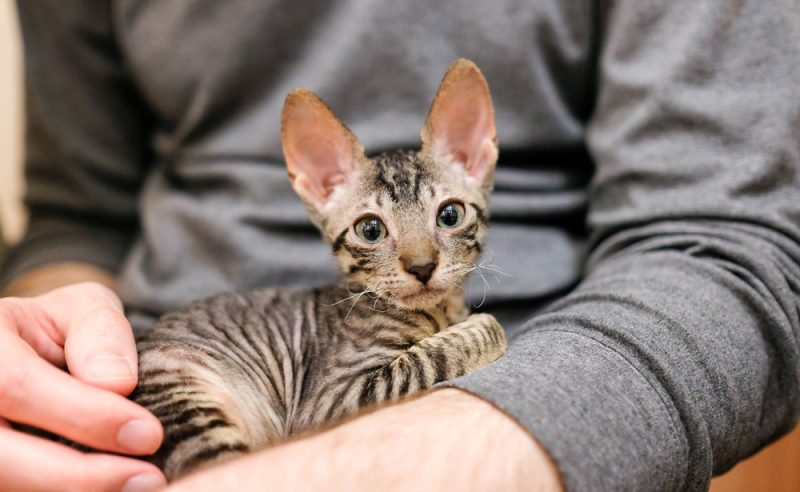
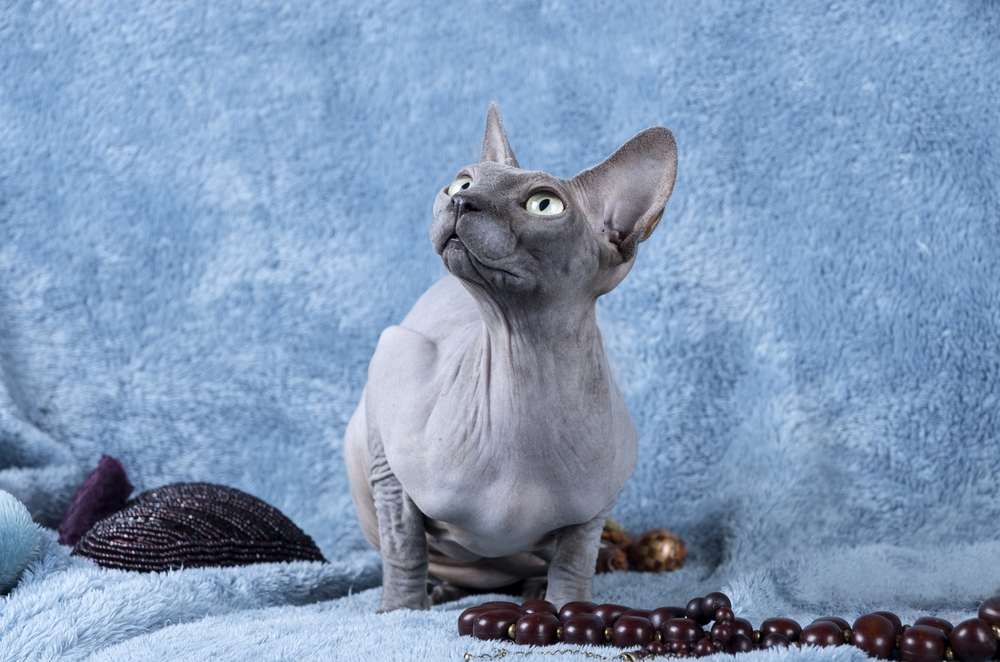
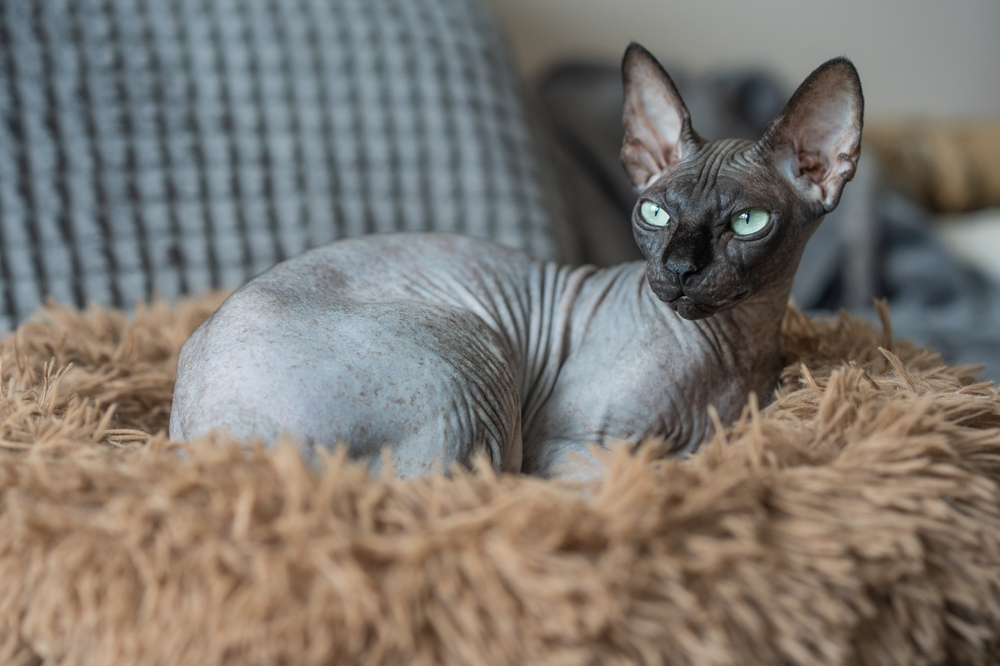
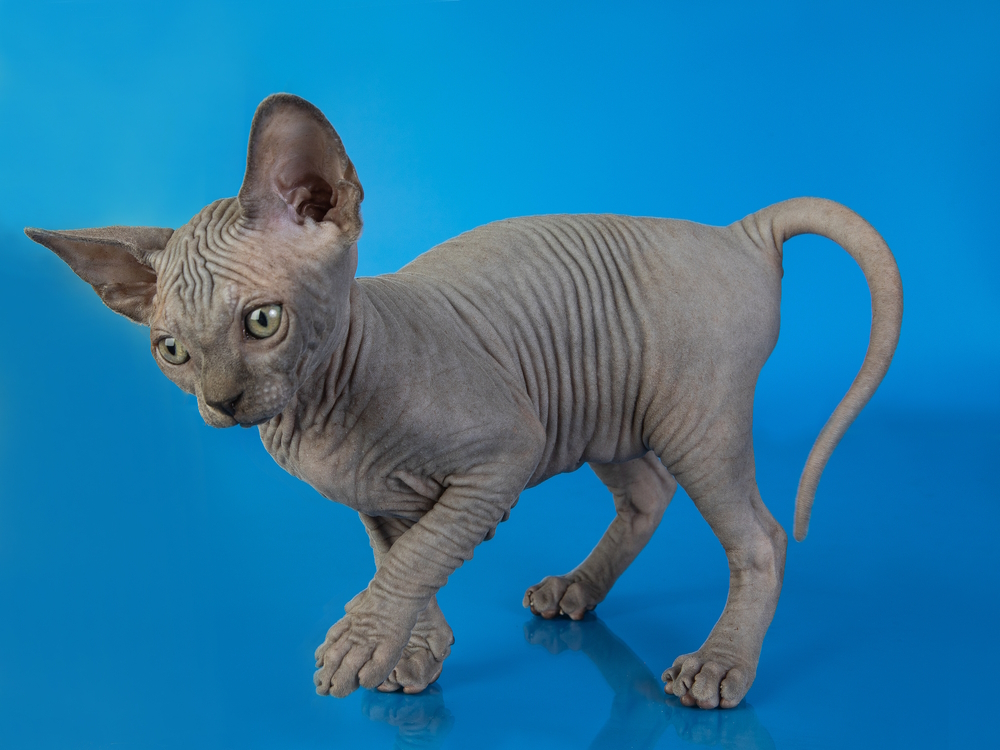
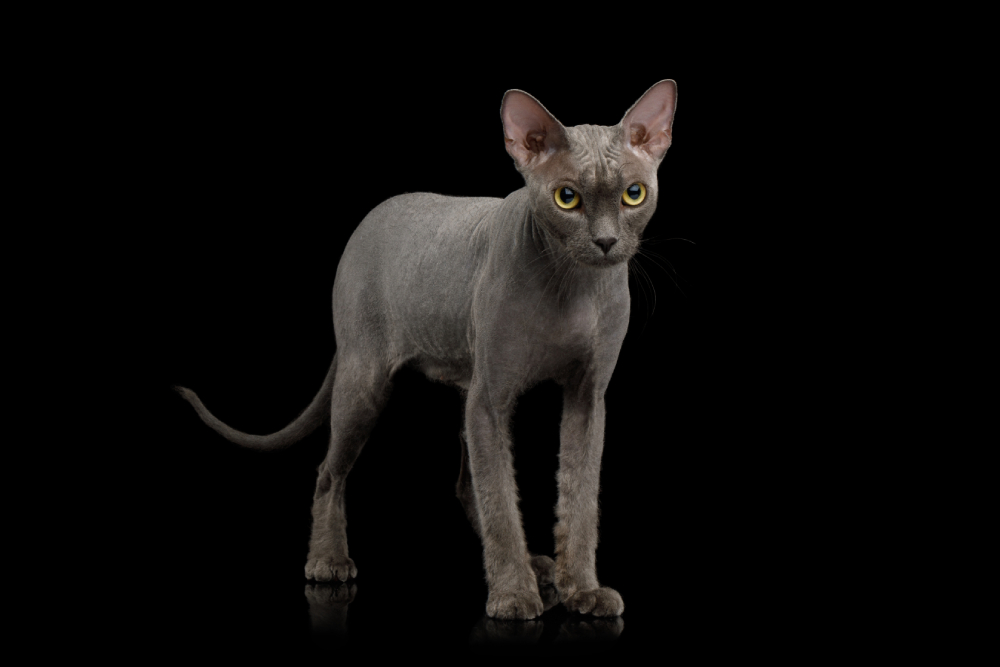
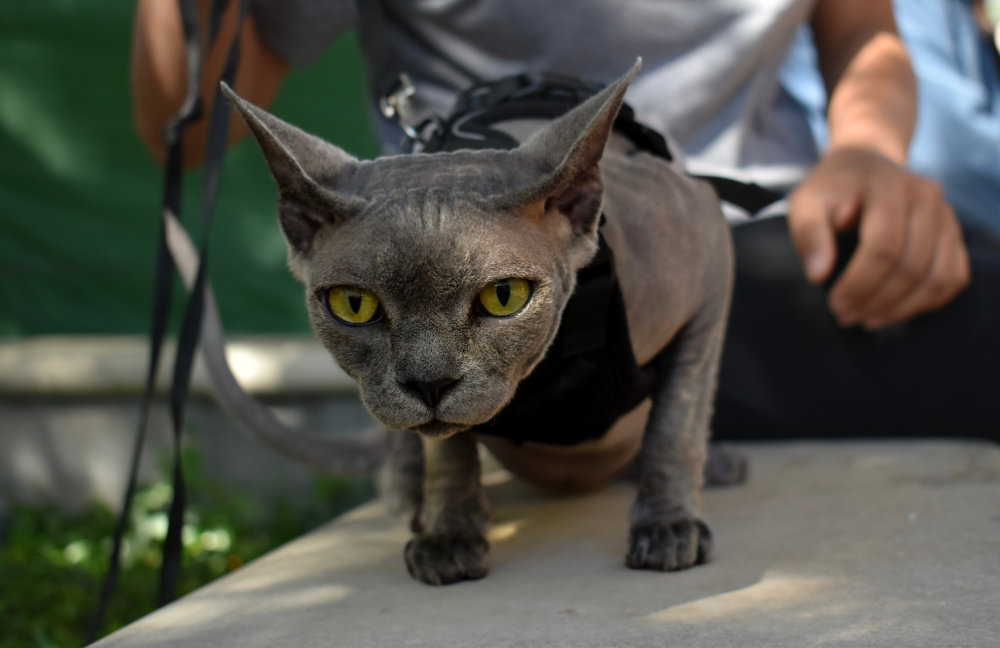
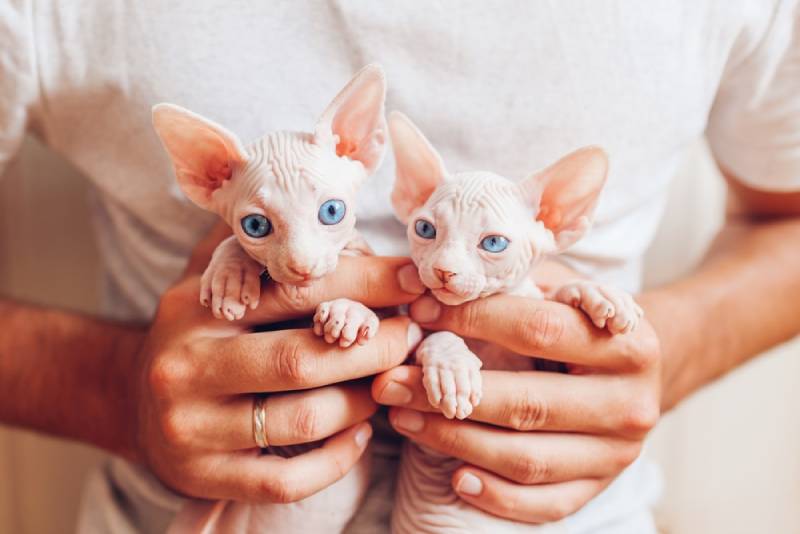
We’ve all heard of the Sphynx, yes? You know, the classic hairless cat that steals the show everywhere they go? But did you know that there is another hairless cat breed that is thought to precede the Sphynx?

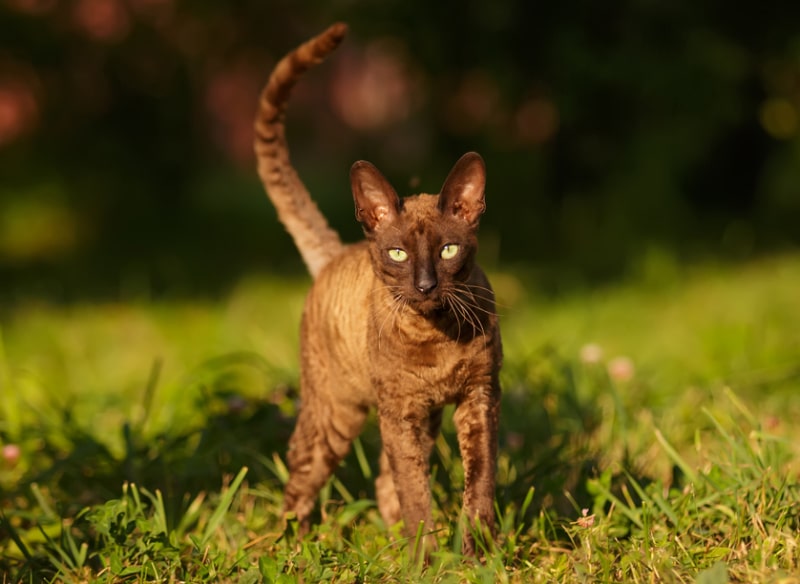
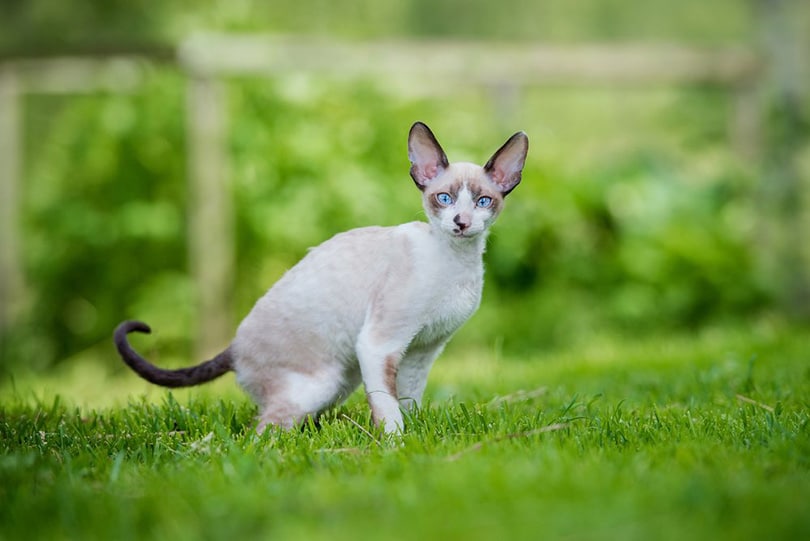
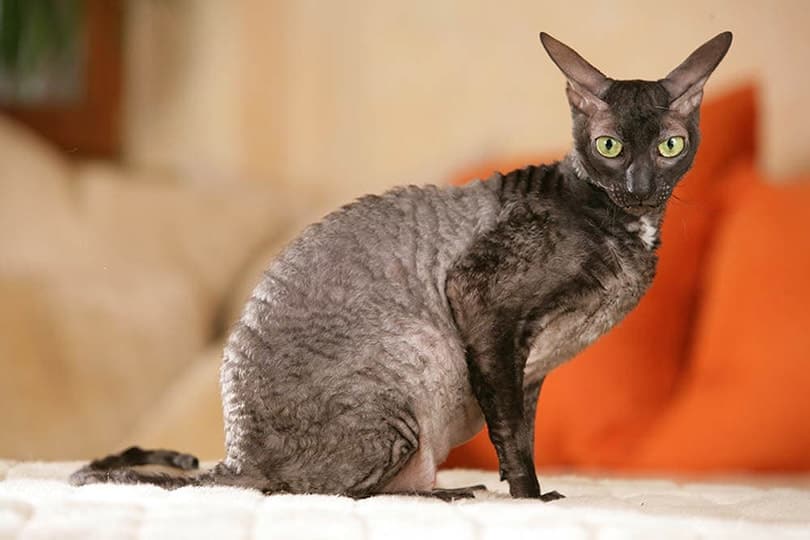
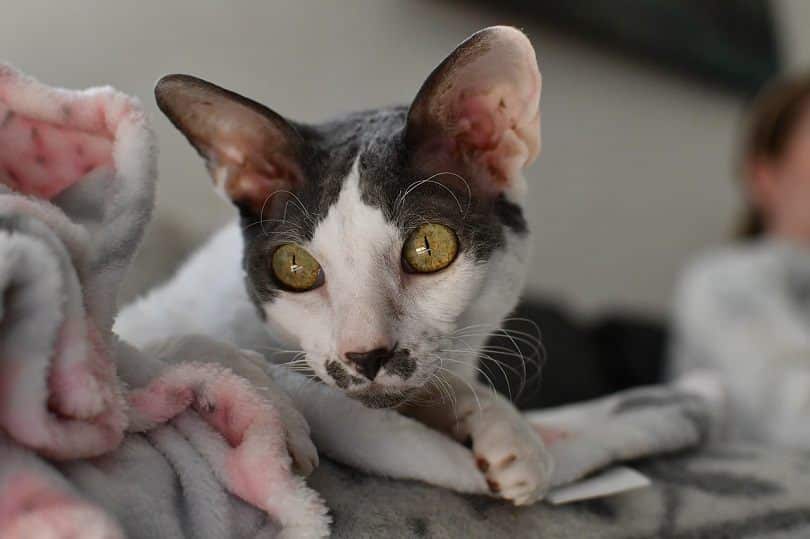
The breed is known as the Mexican Hairless Cat. Although, this cat is actually extinct (if it even existed at all), so note that the height, weight, etc., is just speculation based on similar breeds such as the Sphynx that still exist today.

Breed Overview

Colors:

Cream/brown/gray skin (hairless)

Suitable for:

Active families, homes with multiple pets or children

Temperament:

Affectionate, curious, intelligent, friendly, energetic

The Mexican Hairless Cat is also known as the Aztec Cat or the New Mexican Hairless Cat. While rumors are flying of possibly revamping of the breed—they are all just whispers in the wind. Here’s what we know and think about the Mexican Hairless Cat in this article.

Mexican Hairless Cat Characteristics

Energy

+

A high-energy cat needs a lot of physical and mental stimulation to keep healthy and happy, while a low-energy cat needs minimal physical activity, but still needs mental stimulation. When choosing a cat, It’s important to ensure their energy levels match your lifestyle.

Trainability

+

Cats that are easy-to-train are more willing and skilled at quickly learning prompts and actions with minimal training. Harder-to-train cats are usually more stubborn or aloof and require a bit more patience and practice.

Health

+

Certain cat breeds are more prone to various genetic health problems, and some more than others. This doesn’t mean that every cat in those breeds will have these issues, but they do have an increased risk, so it’s important to understand and prepare for any additional needs they may require.

Lifespan

+

Due to their size or potential genetic health issues of a specific breed, some cats have shorter lifespans than others. Proper nutrition, exercise, mental stimulation, and hygiene also play an important role in your cat’s lifespan and quality of life.

Sociability

+

Some cat breeds are more social than others, both towards humans and other cats and animals. Cats that are more social have a tendency to rub up on strangers for scratches or jump on laps for cuddles, while cats that are less social shy away, hide, are more cautious, and even potentially aggressive. No matter the breed or gender, it’s important to socialize your cat and expose them to many different situations.


The Earliest Records of Mexican Hairless Cats in History

The Mexican Hairless Cat was first documented in 1902 by Mr. E.J. Shinick, who owned a pair of hairless cats, a male and a female. Mr. Shinick lived in New Mexico, and he supposedly got the cats from local Native Americans of the Pueblo tribe and was told that they were the last remaining ancient cats of the Aztecs.

Although these weren’t the only hairless cats in America at the time, they were well known because of their origins and the mystery surrounding them.

How Mexican Hairless Cats Gained Popularity

The Mexican Hairless Cat gained popularity after word got out that these cats were the last of a hairless Aztec breed. The press got wind of the cats, and since hairless cats were an oddity at the time and the cats didn’t have a pedigree, they quickly became a curiosity among the general public.

They were called Mexican Hairless Cats, New Mexican Hairless Cats, and Aztec Cats due to their mysterious origins. However, it is unclear whether these cats really were the last of an Aztec breed, or if that was a story that was told in order to make them seem more exotic when they were really just the result of a random genetic mutation like other hairless cats.

Unfortunately, Mr. Shinick never bred his two cats, and the cats had both passed by 1908. So, if these really were an Aztec breed, that was the last of them.

However, other hairless cats were born due to a natural genetic mutation, and eventually hairless cats were bred intentionally, with the Sphynx breed originating in 1966 due to selectively breeding a natural-born hairless cat with a domestic shorthair, and then breeding that offspring with other hairless cats to ensure more genetic diversity in the breed. Hairless cats are still super popular today, even if they aren’t Mexican Hairless Cats.

Attempts to Revive the Mexican Hairless Cat

Although there are rumors around the web that people are trying to revitalize the Mexican Hairless cat, no solid evidence has really come up that this was even a distinct breed. Some cat fanciers may have tried to revitalize or recreate the breed, but nothing has been openly successful, and any attempts to revive it are mostly just speculation.

The Mexican Hairless Cat might not be around these days, but they certainly paved the way for the other hairless cuties we know and love. Breeds like the Sphynx, Bambino, and Peterbald allow you to have a similar breed to the Mexican Hairless Cat, and these breeds have been well-researched and genetically tested to ensure that they will be around for a long time.

divider 2 cats

Top 3 Unique Facts About Hairless Cats

1. They Require Special Skin Care

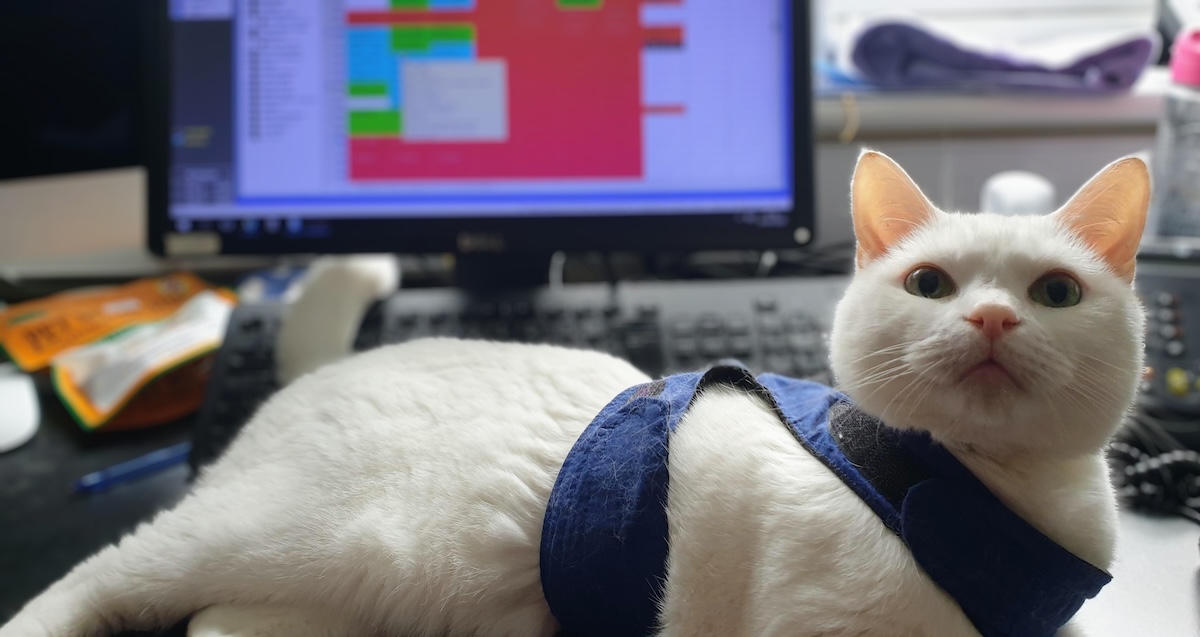
It makes sense when you think about it, since these cats don’t have a coat of fur to protect them. As such, you have to keep a sweater or some other kind of sun protection on them to prevent sunburn as well as keep their skin wiped down to keep it clean and moisturized. If you’re interested in owning one of these cats, speak to your vet about how to care for their skin, and never use human sunscreen on a cat.


2. Some Actually Have a Thin Coat of Hair

Even though they are called hairless cats, some of them actually have a very thin layer of light-colored hair, or “fuzz.” This layer will often be white or gray in color. But they still require special care for their skin even if they have a thin coat of hair.


3. They Are Not 100% Hypoallergenic

Hairless cats are often marketed as being better for people with allergies due to the fact that they don’t shed. However, cat allergies are due to a protein found in a cat’s dander, saliva, and urine, so a cat can still trigger allergies even if they don’t have fur, and no cat is 100% hypoallergenic. But a hairless cat is still a good choice if you don’t want cat hair everywhere.

divider 1 paws

Is a Hairless Cat Breed Right for You?

Owning a hairless cat might be very different from the regular felines you’re used to. You might not have ever even met someone who owns a hairless cat, and it’s simply the idea of them that piques your interest. We don’t blame you!

Hairless cats certainly are unique specimens. However, there are two sides to everything and there are downfalls to owning a hairless cat just as there are benefits. Here are some of them now, but we definitely recommend that you read up on different hairless cat breeds before committing to make sure you are well-informed.

Positives of Hairless Cats

Hairless cats are pretty cool, if we do say so ourselves. They have a one of the kind appearance and definitely put a new spin on cat ownership.

Hairless cats tend to be very friendly and outgoing. They make the best candidates for people who have frequent visitors. Inquisitive and eager to learn, most hairless cats are the life of the party. They are real brainiacs capable of learning simple to complex concepts. They can be leash and command trained.

Hairless cats make amazing companion animals to almost any living situation. They get along very well with cats and dogs—as long as they are socialized properly. With mannerly kids, hairless cats also quite enjoy the company and exuberance of children—they love to play!

Downfalls of Hairless Cats

Hairless cats are known for their numerous health issues. A majority of cases involved some type of gastrointestinal upset, as these cats are notoriously sensitive.

If you’ve ever seen the price of hairless cats, you know it’s definitely not a cheap number! These cats are pricey! A Sphynx alone can cost upwards of $6,000 for a healthy bloodline. If you get a specialized cat like the Munchkin Sphynx mix, also known as the Bambino, you might even pay more than that!

divider 2 cats

Conclusion

Now you understand that the Mexican Hairless Cat is a breed that was thought to stem from ancient Aztec cats. However, the breed simply didn’t survive through the years and is thought to be extinct. Instead, we have other hairless cats today that have totally stolen the show.

Of all the things you learned about hairless cats, what fact was your favorite?


Featured Image Credit: Anthony Aldum, Shutterstock

Tortoiseshell Cat: Info, Pictures, Care & Facts

No Comments

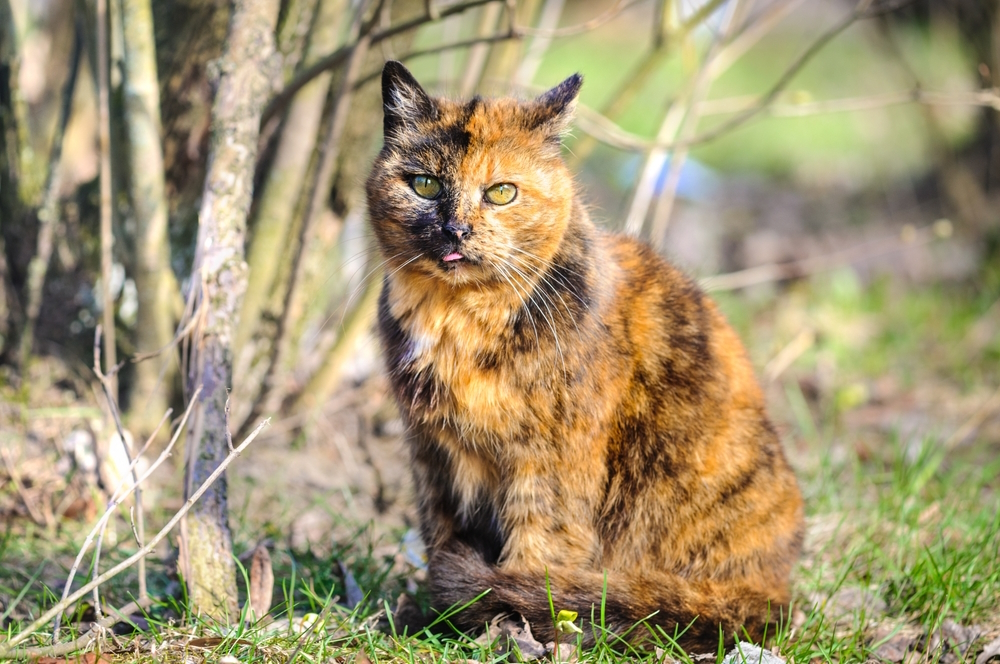
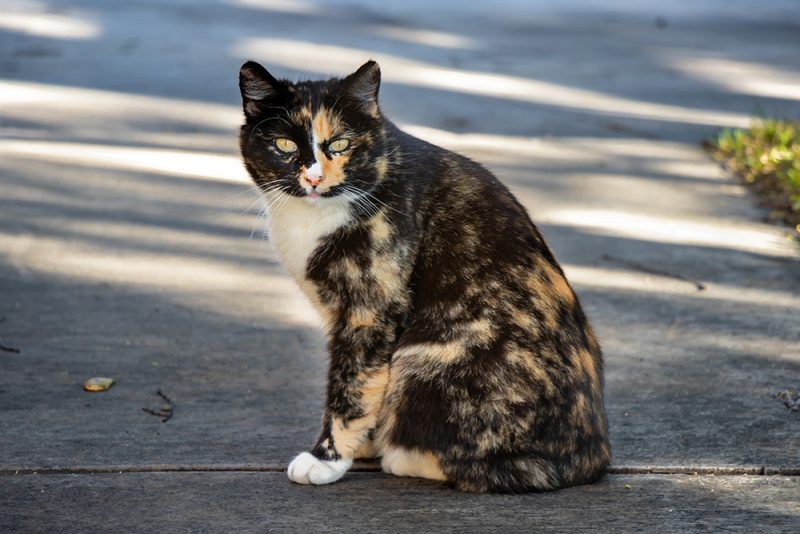
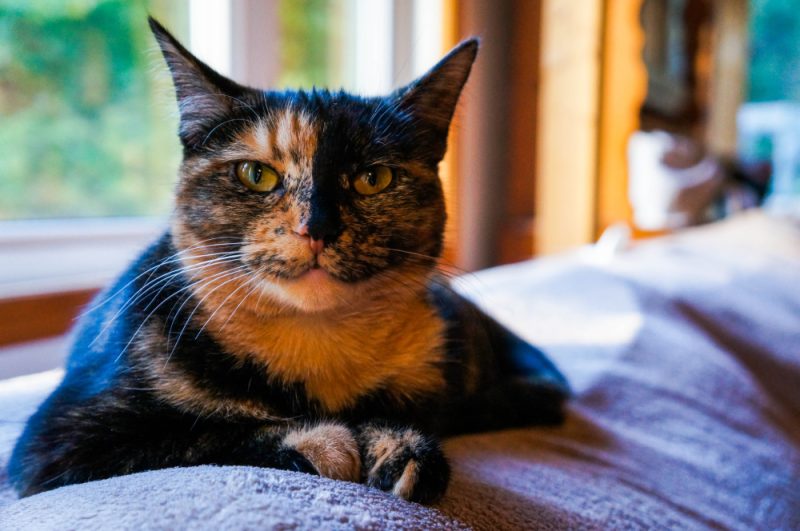
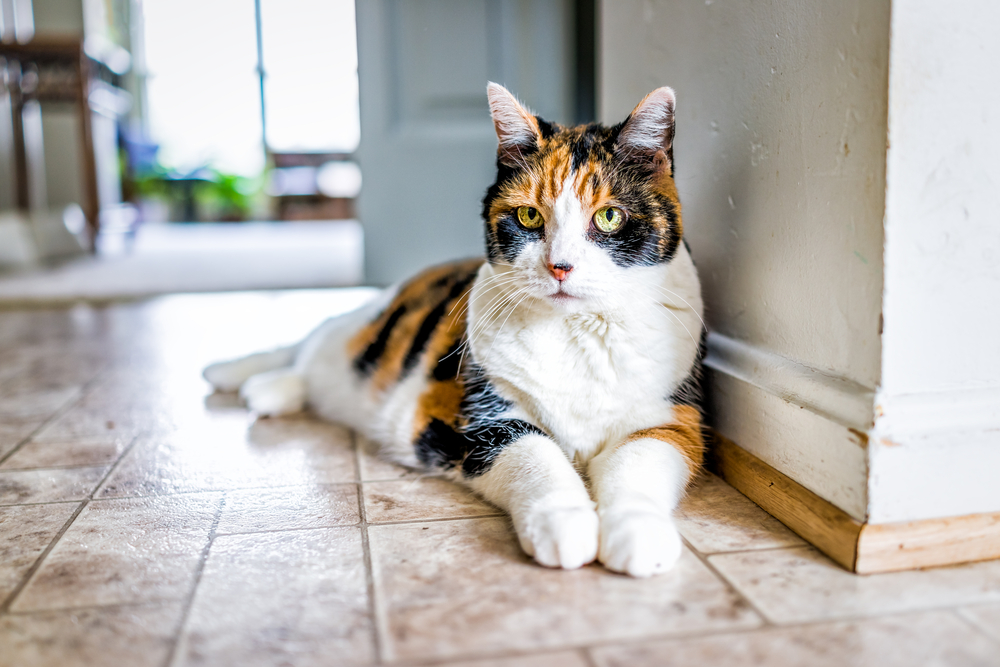
It’s hard not to notice a tortoiseshell cat. Their appearance is striking, with their uniquely colored fur. No two felines are the same, and genetics control the variations. The vast majority are also female, adding to their mystique. The pattern is more prevalent in some breeds, but the tortoiseshell is not a breed; it merely describes the color pattern.

The term describes animals with a mottled patchwork of orange and non-orange hues. They can be black or some variation, from ginger to chocolate to cream. Calicos are similarly colored, with the addition of white, making them a tri-colored variant of the tortoiseshell cat. However, the Tortoiseshell Cat only has black and orange markings.

The Earliest Records of the Tortoiseshell Cat in History

It’s unclear when the first tortoiseshell cat appeared, but ancient records suggest they were mentioned by the Celts and Khmers of Southeast Asia. When the tortoiseshell variant occurs in female cats, it’s simply a manifestation of a dominant, sex-linked trait.

The gene controlling its physical expression is located on the X chromosome. Each parent contributes a copy or an allele of the two they possess to each of their offspring. A kitten must only inherit one copy of the trait to be visually present.

A recessive trait only appears if both alleles are the same copy. For example, if the alleles an offspring receives from their parents are OO or Oo, the dominant trait is present. The capital O is shorthand for the dominant tortoiseshell variant, and the small letter is the recessive. The only way for the tortoiseshell not to be visible is if both alleles are oo, making the cat brown or black and not orange.

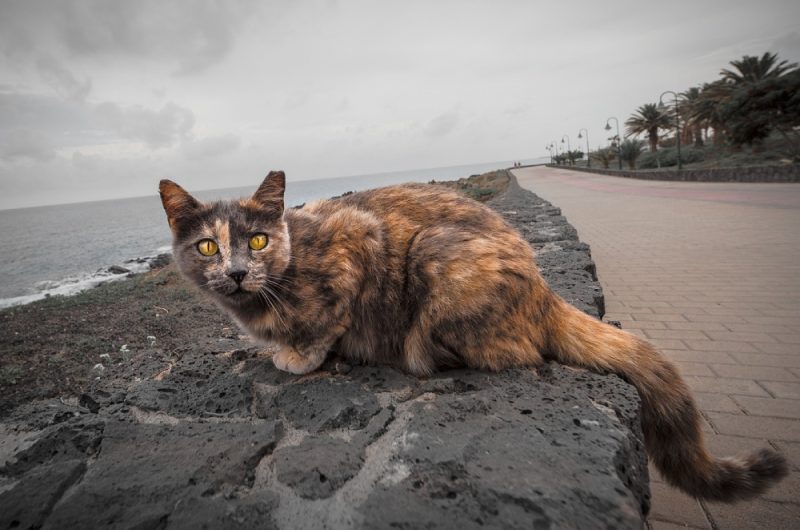
tortoiseshell cat with yellow eyes on the beach
Image Credit: Derks24, Pixabay

A Genetic Explanation

However, that fact raises another question. If this color characteristic is dominant, why don’t all female tortoiseshell cats have the orange color? If she is OO or Oo for the trait, you’d expect the cat to be orange without any black coloration. The answer lies in evolution’s role in survival.

Interestingly, researchers have identified over 1,000 genes on the X chromosomes. The Y chromosome of males doesn’t have nearly as many. Nevertheless, that doesn’t mean the X-linked traits are viable or necessary for survival. Some are harmful and potentially fatal. How did evolution deal with this conflict?

Natural selection prevents the expression of some X-linked characteristics through a process known as X-chromosome inactivation (XCI). That means some O alleles are suppressed, leading to the mottled patchwork we call tortoiseshell, with orange and black present. XCI doesn’t happen in male cats. If the animal inherits a single O dominant allele, the feline is orange or black, not both.

The incidence of the tortoiseshell male cat has another genetic twist. Early scientists deduced it must be sex-linked simply because of the inheritance pattern and the animal’s sex.1 The only way a male animal could have this pattern is if they had two X chromosomes, allowing the orange and black to be visible, making them XXY. It can occur if the cat has inherited the Klinefelter syndrome.2

This condition also exists in humans. It’s not surprising since we share 90% of our DNA with cats.3 Sadly, Klinefelter’s syndrome has many risks, including an increased risk of cardiovascular disease, some cancers, and autism. This random genetic mutation also causes sterility in males. That explains its rarity among male cats and its prevalence in females.

female-vet-using-microscope
Image Credit: JG Fotografia, Shutterstock

Why the Tortoiseshell Color Appeared in the First Place

The domestic cat is a descendant of the African Wild Cat (Felis silvestris lybica). This feline is notably sand-colored to match their arid habitat and provide camouflage. Why do our pets come in so many color variations, like tortoiseshells? An animal with this pelage would stand out and probably won’t survive. The answer lies with domestication.

Charles Darwin theorized that selective breeding profoundly impacted animals’ genetics and phenotype or physical appearance. Scientists later observed relative depigmentation and other traits associated with breeding animals to be tame. The term domestication syndrome describes these changes people induced in the animals they domesticated.

The pleasing coloration, like tortoiseshell and other characteristics we prefer, results from human efforts for selective breeding. This process occurs much faster than natural selection. What would take Nature thousands of years occurs in a handful of generations with human intervention. Of course, evolution also had a say.

How the Tortoiseshell Cat Gained Popularity

While the earliest records are unclear, the tortoiseshell likely has been in the domestic cat’s gene pool since ancient times. The folklore of many cultures contains accounts of this beautiful but mysterious feline, with explanations of the animal’s appearance and supposed meaning. Stories exist from the United Kingdom to Japan and the United States about the tortoiseshell’s unique coat.

The beauty of the tortoiseshell pattern is undoubtedly a factor in its popularity. The animal’s appearance is unique, often with eye-catching markings. Remember that formal cat breeds are a relatively recent phenomenon. Enthusiasts may have tried selectively breeding felines to increase their prevalence. The occurrence in males is random, with no guarantee of tortoiseshell offspring.

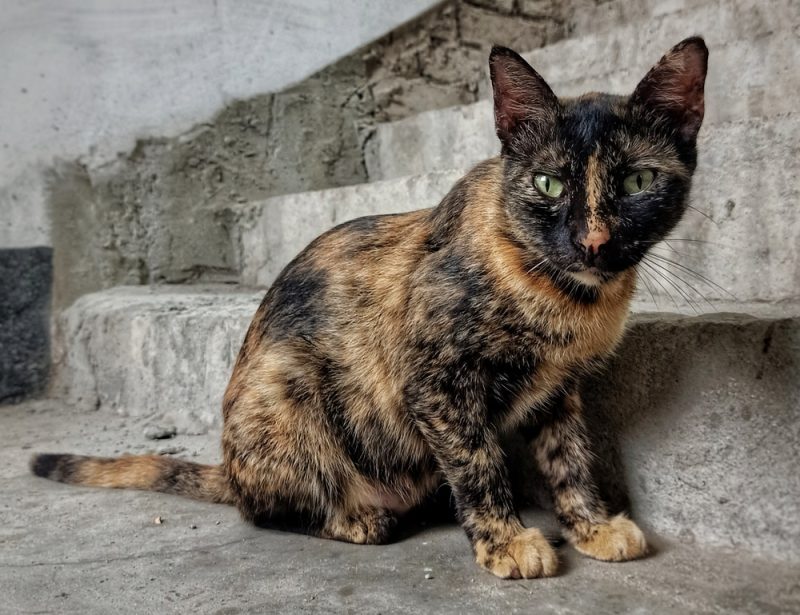
tortoiseshell cat sitting near stairs
Image Credit: Nafia Haseen, Shutterstock

Formal Recognition of the Tortoiseshell Cat

Formal recognition of the tortoiseshell cat rests with the breeds in which it is a permitted color. The Persian is an ancient breed, with tortoiseshell among its many accepted colors. Other breeds with similar standards include the following:

The tortoiseshell color is not allowed in breed standards where the appearance is integral to the animal’s conformation. The Chartreux and Russian Blue are two classic examples, with only a single color and its variants allowed. Remember that parent clubs that approve tortoiseshells also include calico by its very definition, with the latter being tri-colored versus the bi-colored tortoiseshell.

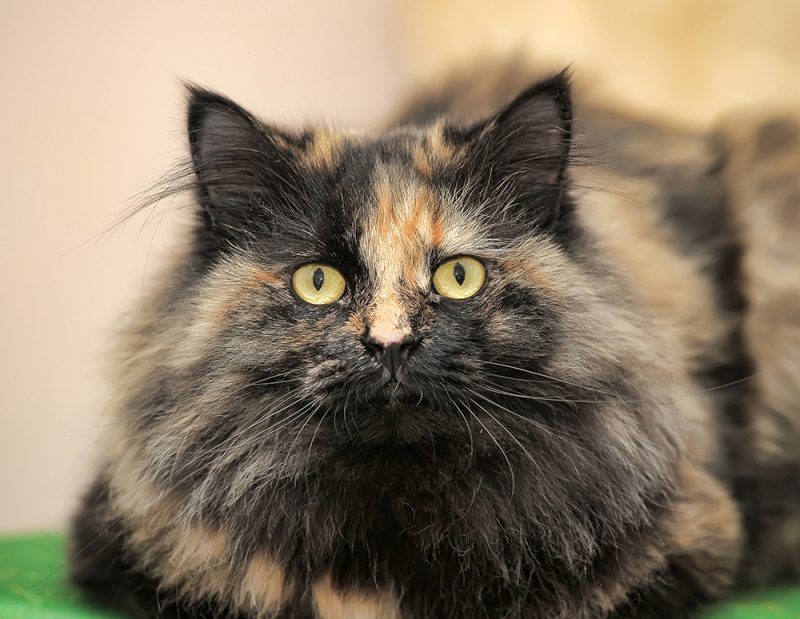
fluffy cat domestic longhair tortoiseshell cat
Image Credit: Anna Krivitskaya, Shutterstock

divider 2 cats

Top 4 Unique Facts About the Tortoiseshell Cat

1. The Tortoiseshell Variation Is a Rare Occurrence.

Scientists estimate that it only occurs in an estimated 1 in 3,000 male cats. The prevalence of sterility in these animals is a mitigating factor in its scarcity.


2. Variations of the Tortoiseshell Pattern Exist.

While each cat is different, some noted variations of the tortoiseshell coloration exist, including the tortoiseshell tabby and bridled cat.

tortoiseshell Manx cat
Image Credit: PradaBrown, Shutterstock

3. A Small Study Hypothesized Gene Stability as an Explanation for the Tortoiseshell Color.

The researchers identified two fertile males with this color variant. The animals had the usual 38 chromosomes without the XXY in felines with Klinefelter’s syndrome. They determined that all things being equal, gene stability was the only explanation for the cats’ coloration and fertility.


4. Another Explanation That’s Even More Fantastical and Rare Involves Chimerism.

Chimerism defines an organism with cells from two sources. In this case, the second organism is the reabsorbed DNA of a deceased twin embryo. Scientists identified what they believed was the first case of a fertile tortoiseshell male cat displaying chimerism.

divider 2 cats

Does a Tortoiseshell Cat Make a Good Pet?

The tortoiseshell will make a delightful pet, regardless of the breed. Much depends on the animal’s rearing and care. We suspect the kitty’s unique appearance may garner more attention and pampering. One of the most critical considerations is providing adequate mental stimulation and enrichment for your pet.

Felines are intelligent and need stimulation for their mental health. You can satisfy this need with regular interaction with your pet and interactive toys that challenge them. Understanding the financial and time commitment of inviting a cat into your life is imperative for their welfare and well-being.

Tortoiseshell cat resting on a sofa
Image Credit: David Boutin, Shutterstock

divider 2 cats

Conclusion

The tortoiseshell cat isn’t a breed but a recognized color variation accepted by many parent clubs. Its appearance is the result of eons of evolution that have shaped the animal’s DNA and improved their fitness for survival. The trait picked up many enthusiasts who marveled at the cat’s beauty along the way. The tortoiseshell pattern is also a genetics lesson since it’s an X-linked characteristic.


Featured Image Credit: Tinka Mach, Shutterstock

Grey Persian Cat Breed: Info, Pictures, Care & Facts

No Comments

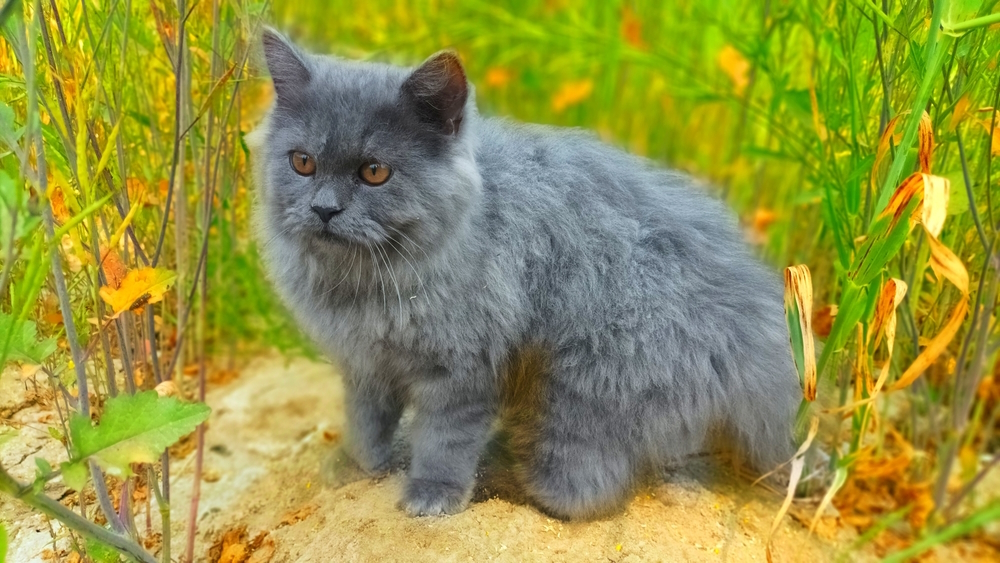
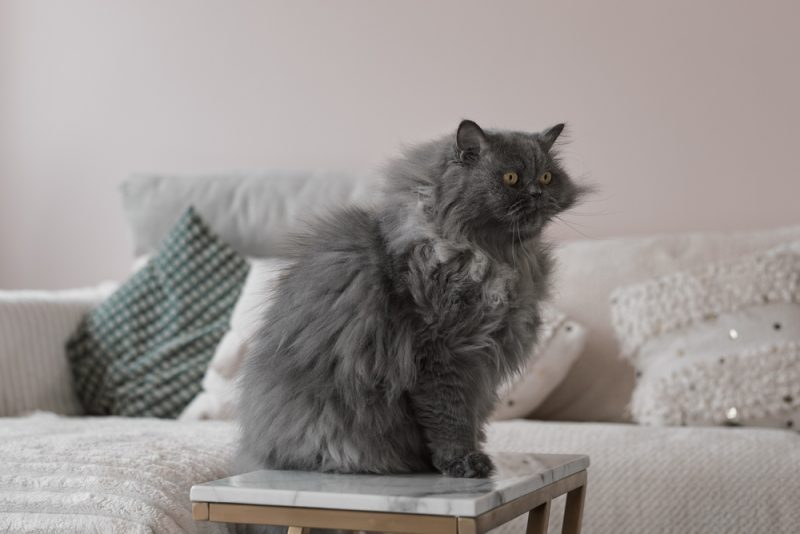
The Grey Persian is a popular color of Persian cat, officially known as a Blue Persian. The grey color can range from a very light, almost dusty color, to a much darker, slate grey. Although white and black are more common, grey is still commonly found, which means it is a relatively easy breed for potential owners to get hold of and because it is officially recognized by fancier associations, it can be shown in most exhibitions and competitions.

As well as being popular in competitions, the Grey Persian also makes a good choice for a family pet, although they can be shy around strangers and are sensitive to loud noises and surprises.

Breed Overview

Suitable for:

Owners with quiet homes, looking for dedicated companions

Temperament:

Loving, affectionate, playful, sensitive

The Persian is one of the most popular cat breeds in the world, known for its beautiful thick coat as well as its squashed, rounded face. They are a popular companion breed and remain popular for showing at competitions and exhibitions.

They are medium-sized cats and their coats can vary from light to dark grey. As a pet, the Grey Persian is a sweet and affectionate companion but can be sensitive, which means it is not the best pet for families with young children and it may not get along in homes with other animals, especially playful dogs.

Grey Persian Cat Breed Characteristics

Energy

+

A high-energy cat needs a lot of physical and mental stimulation to keep healthy and happy, while a low-energy cat needs minimal physical activity, but still needs mental stimulation. When choosing a cat, It’s important to ensure their energy levels match your lifestyle.

Trainability

+

Cats that are easy-to-train are more willing and skilled at quickly learning prompts and actions with minimal training. Harder-to-train cats are usually more stubborn or aloof and require a bit more patience and practice.

Health

+

Certain cat breeds are more prone to various genetic health problems, and some more than others. This doesn’t mean that every cat in those breeds will have these issues, but they do have an increased risk, so it’s important to understand and prepare for any additional needs they may require.

Lifespan

+

Due to their size or potential genetic health issues of a specific breed, some cats have shorter lifespans than others. Proper nutrition, exercise, mental stimulation, and hygiene also play an important role in your cat’s lifespan and quality of life.

Sociability

+

Some cat breeds are more social than others, both towards humans and other cats and animals. Cats that are more social have a tendency to rub up on strangers for scratches or jump on laps for cuddles, while cats that are less social shy away, hide, are more cautious, and even potentially aggressive. No matter the breed or gender, it’s important to socialize your cat and expose them to many different situations.

The Earliest Records of Grey Persian Cats in History

There is some debate over the exact history of the Persian cat. There are written records dating back to the 17th Century that detail what we know today as the Persian cat breed. Theories suggest that these cats were brought to Europe by noblemen, sailors, merchants, or travelers, but it is clear that they soon became popular. However, DNA tests actually suggest they have a very similar genetic background to other breeds that originated in Western Europe.

Yet another theory suggests that ancient hieroglyphs depict cats that look very similar to the modern Persian breed, suggesting that their ancestors could have been around thousands of years ago.

Whatever the origin, the Persian became very popular in Europe and the first Persian was shipped to America in the late 19th century, where it enjoyed similar levels of popularity.

grey-persian-cat-sitting-in-a-living-room
Image Credit: VeronikaSmirnaya, Shutterstock

How The Grey Persian Gained Popularity

As is the case with a lot of older breeds, it was royalty and nobility that helped spread the popularity of the Persian cat breed. In particular, Queen Victoria of England was known to have kept several Persians throughout her life. Florence Nightingale also favored Persians.

Later, the breed’s appearance would see it become a regular on big and silver screens. Blofeld’s cat was a Persian in the James Bond films, and so too was Mr. Bigglesworth in Austin Powers. Mr Tinkles from the 2001 comedy film Cats & Dogs was also a Persian.

At the same time, the breed’s long coat and attractive face made it popular at cat shows and animal exhibitions, and the Persian would win the first-ever official cat show.

Formal Recognition of Grey Persian Cats

Such was the popularity of the Persian cat that having found its way to the U.S. in the late 19th century, it became one of the founding breeds of the Cat Fanciers’ Association just a few years later in 1906. It is also formally recognized by all major fancier associations and is one of the most widely shown and recognized breeds.

The first ever cat show was held in London in 1871, and it was a Persian cat that took the main prize at the inaugural event, further cementing its place in the books of domesticated cat history. The Grey Persian is a naturally occurring color and one of the most common color variants of the Persian, and it is considered a standard color.

grey-persian-cat-sitting-on-sofa
Image Credit: VeronikaSmirnaya, Shutterstock

divider 2 cats

Top 4 Unique Facts About Grey Persian Cats

1. They Are Show Winners

From the first cat show to some of the most recent, Persian Cats are winners. They are popular for their thick coats and attractive faces. However, potential owners need to be aware that that coat does take some management to ensure it stays in top condition.


2. Persians Can Be Expensive

The breed’s popularity at shows, combined with its popularity as a companion pet, means that the Persian can be expensive to buy. For a Persian with pedigree, you can expect to pay thousands of dollars to get your hands on one.


3. They Are Not the Most Athletic Felines

Persians are medium-sized cats, but they have stocky, quite heavy bodies. This means that the breed is not known for its athleticism, and it can struggle to jump up to high levels. They shouldn’t have any problem getting up on furniture or your lap but will struggle with anything much higher


4. They Can Be Sensitive

Persians are docile and tend to be very loving with their humans, but they are also known for being sensitive cats. Loud noises and too much activity can cause them stress, and you will need to take any introductions to other pets very slowly to avoid causing distress.

grey-persian-cat-resting-indoor
Image Credit: Nida69, Shutterstock

divider 2 cats

Does the Grey Persian Make a Good Pet?

The Grey Persian cat is commonly seen at shows, but it also makes a great companion pet for the right owner. Its sensitivity means that the Persian might not be best suited to life with a young family. Small children can be too rowdy and too physical for this breed. It also takes a careful, gradual introduction, when integrating a Persian into a house with existing pets. And, that coat does need regular grooming.

However, they are worth the effort, as the Persian is a sweet and gentle-natured cat that will give lots of love and affection to its favorite humans.  While the breed does enjoy and require affection, it isn’t an overly needy breed.

divider 2 cats

Conclusion

The Grey Persian cat, more commonly known as the Blue Persian cat, is a grey-colored Persian. It has a long, thick coat, and a rounded, squashed face. The breed was one of the founding breeds of the Cat Fanciers’ Association and has remained a very popular inclusion in cat shows and exhibitions ever since.

It does make a great companion but can be sensitive, so isn’t ideal for all families and homes.


Featured Image Credit: Abbasi7060, Shutterstock

10 Best Cat Deodorizing Sprays in 2024 – Reviews & Top Picks

No Comments

Cats are very good at self-grooming and staying clean. However, they can get dirty and smelly when covering their waste in the litter box, and some cats are better about grooming than others.

Cats with bowel or bladder problems can also emit a smell, and those with mobility issues might not be able to clean themselves properly. Whatever the cause of the aroma, a bad-smelling cat is concerning, but repeated bathing can do more harm than good. You can’t use human products because they aren’t suitable for sensitive felines.

Cat deodorizing sprays are a great alternative to regular washing. They need to be effective but also sensitive. Below, you’ll find reviews of 10 of the best cat deodorizing sprays for your companion.

A Quick Comparison of Our Favorites in 2024

The 10 Best Cat Deodorizing Sprays

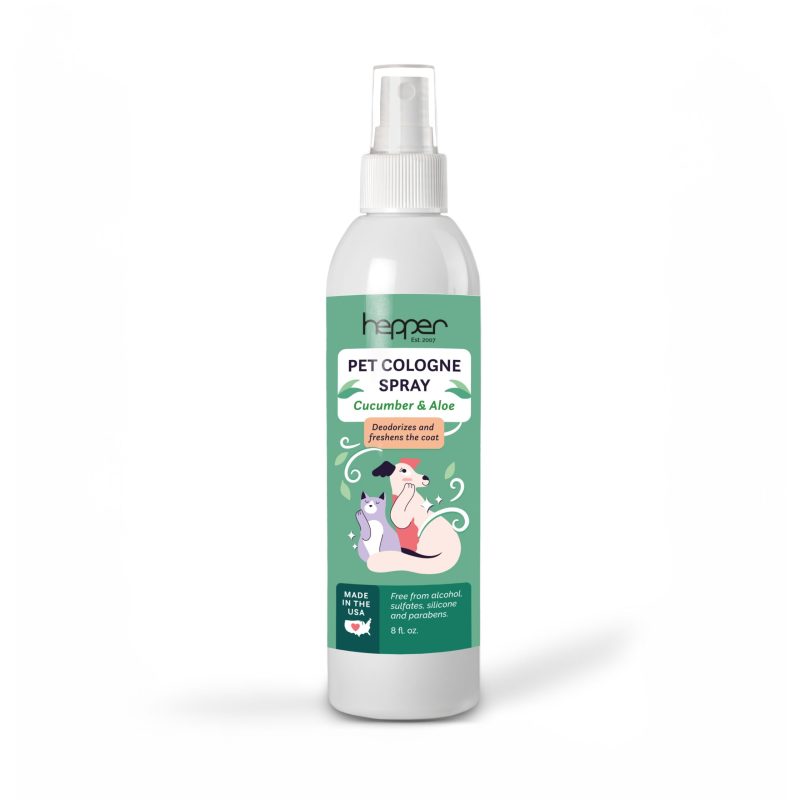
1. Hepper Pet Cologne – Best Overall

Hepper Pet Cologne

Volume: 8 Ounces
Scent: Cucumber & Aloe

Hepper Pet Cologne is a water-based cologne spray that is suitable for dogs and cats. It dries quickly and has a non-greasy formula, and it can be used regularly without fear of damaging your cat’s coat or causing streaky messes.

The gentle formula, which is free from sulfates, silicone, paraben, and alcohol, means it is safe for use on cats with sensitive skin. The cucumber and aloe scent leaves a natural but pleasant smell that will overcome all the harshest odors.

In addition to helping eliminate foul odors, the Hepper Pet Cologne reduces static build-up and even makes it easier to smooth and brush the coat to keep it tidy. Thanks to its sensitive, water-based formula and pleasant smell, we believe Hepper Pet Cologne is the best overall cat deodorizing spray.

However, there is only one choice of aroma, so if you don’t like the smell of cucumber and aloe or want a stronger fragrance, it won’t be suitable for your cat.

Pros

  • Sulfate, paraben, alcohol, and silicone-free
  • Water-based and suitable for sensitive skin and coats
  • Doesn’t leave a sticky residue

Cons

  • Only one natural fragrance

At Catster, we’ve admired Hepper for many years and decided to take a controlling ownership interest so that we could benefit from the outstanding designs of this cool cat company!


2. Best Shot One Shot Dog & Cat Deodorizing Spray – Budget Buy

Best Shot ONE SHOT Deodorizing Spray

Volume: 32 Ounces
Scent: Herbal Mint

The Best Shot One Shot Dog & Cat Deodorizing Spray is a water-based solution that comes in a 32-ounce spray bottle. It neutralizes foul odors and is suitable for cats and dogs; it can also be used on fabric, including carpets, rugs, and furniture. It is strong enough to get rid of the smell of cat litter boxes, urine and poop, and even skunk smells.
Formulated with peppermint and spearmint botanical oils, the Best Shot One Shot Dog & Cat Deodorizing Spray leaves a pleasant, natural mint essence after just one or two sprays.
The large bottle, low price, and pleasant herbal mint smell make this the best cat deodorizing spray for the money, but the bottle itself could use a redesign. Once you get to the last quarter or so, it is difficult to get the liquid to spray, and you might be left with some remnants in the bottom.

Pros

  • Has a pleasant herbal mint smell
  • Comes in a large bottle
  • Cheap

Cons

  • Difficult to get the last quarter out of the bottle

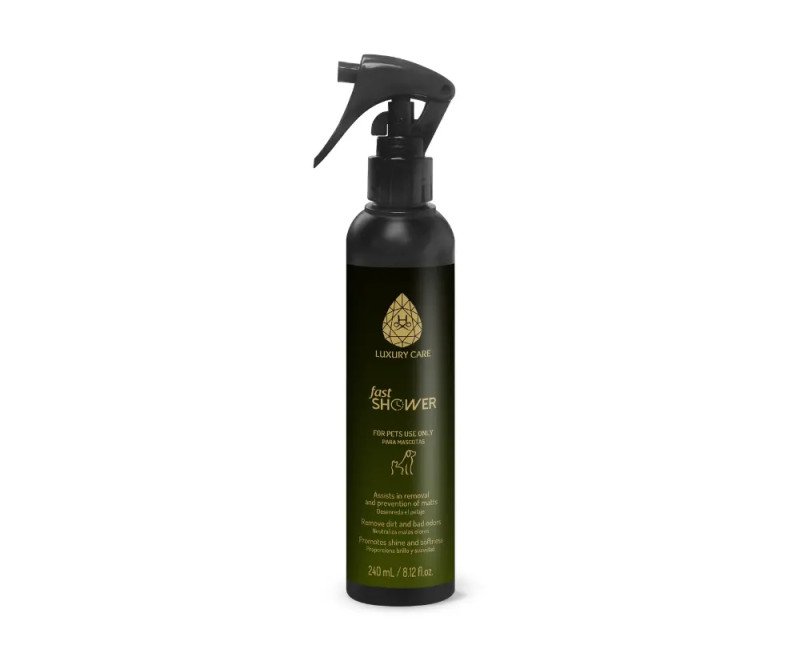
3. Hydra Luxury Care Fast Shower Cat & Dog Deodorizer Spray

Hydra Luxury Care Fast Shower Cat

Volume: 8.12 Ounces
Scent: Natural

Hydra Luxury Care Fast Shower Cat & Dog Deodorizer Spray is a waterless shampoo spray that also deodorizes your cat or dog. Because it’s a shampoo, it helps remove mud, litter, and other dirt that causes bad smells. The formula contains probiotics and D-panthenol, which help retain moisture and ensure a smooth coat. Its conditioning qualities also reduce static and prevent frizz, making it easier to brush and prevent matting.

Hydra’s deodorizer is ideal for keeping your cat clean and smelling fresh between full baths, and it can also be used to clean up after they’ve enjoyed some outdoor activity or litter digging. It also has a fresh smell, deodorizes, and cleans, but it is an expensive formula compared to some of the other deodorizers on the list.

Pros

  • Cleans, as well as deodorizes
  • Prevents static
  • Helps the coat retain moisture

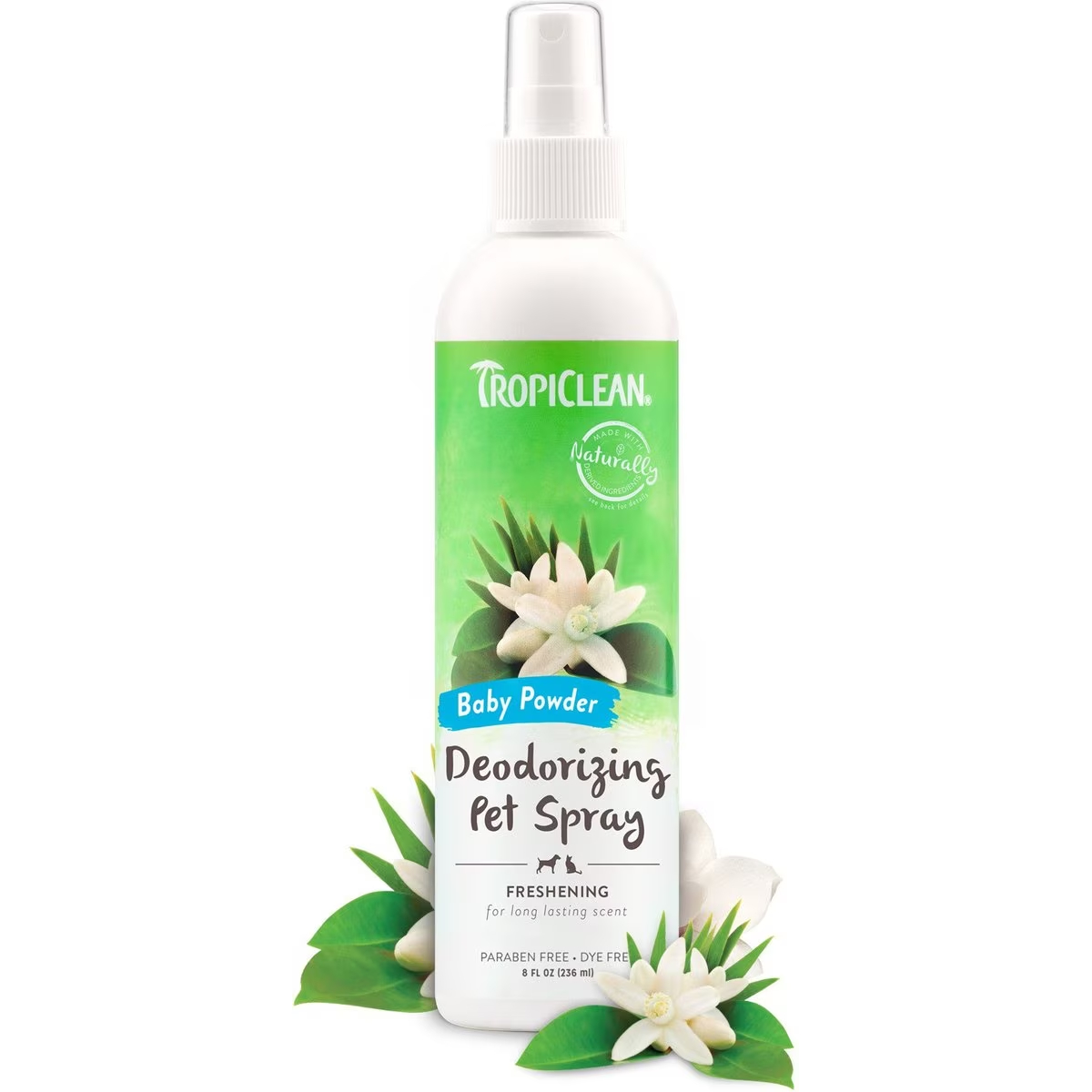
4. TropiClean Baby Powder Deodorizing & Odor Elimination Dog & Cat Spray – Best for Kittens

TropiClean Baby Powder Deodorizing & Odor Eliminating Dog & Cat Spray

Volume: 8 Ounces
Scent: Baby Powder

Kittens tend to be more adventurous than adult cats, which means they can get messier when playing outside and using the litter box. However, you need to take extra care of what you use to get them clean and smelling fresh again.

TropiClean’s Baby Powder Deodorizing & Odor Elimination Dog & Cat Spray uses natural ingredients like colloidal oatmeal and chamomile extract. It is free from parabens, dyes, and soap, so it shouldn’t dry your cat’s skin or cause any irritation.

The spray breaks down smells at the cause, rather than masking them, but it also has an additional baby powder scent that will leave your little one smelling great for days. The oatmeal and other ingredients also help condition the coat.

The TropiClean deodorizing spray is reasonably priced, suitable for kittens over 12 weeks old, and gentle on sensitive skin and coats. However, the baby powder scent is very mild, and it doesn’t last long after the spray is applied.

Pros

  • Uses natural ingredients, including oatmeal and chamomile
  • Decent price
  • Suitable for kittens over 12 week old

Cons

  • Baby powder scent is mild and short-lived

5. Pet MD Deodorizing Japanese Cherry Blossom Cat & Dog Body Spray

Pet MD Body Spray for Dogs & Cats

Volume: 8 Ounces
Scent: Japanese Cherry Blossom

Pet MD’s Deodorizing Japanese Cherry Blossom Cat & Dog Body Spray is a water-based formula with a natural Japanese cherry blossom scent that gives your cat a floral, pleasant odor. It is gentle enough to be used every day and is suitable for cats aged 12 weeks or older.

The deodorizing spray’s ingredients help reduce static, eliminate knots, and make brushing and grooming easier for your cat and you. It is reasonably priced, and its scent will last a while after being applied, which also means you don’t have to overdo the amount you use.

However, it contains castor oil, which can make a greasy coat even slicker and heavier.

Pros

  • Natural Japanese cherry blossom scent
  • Affordable
  • The fragrance lasts a long time

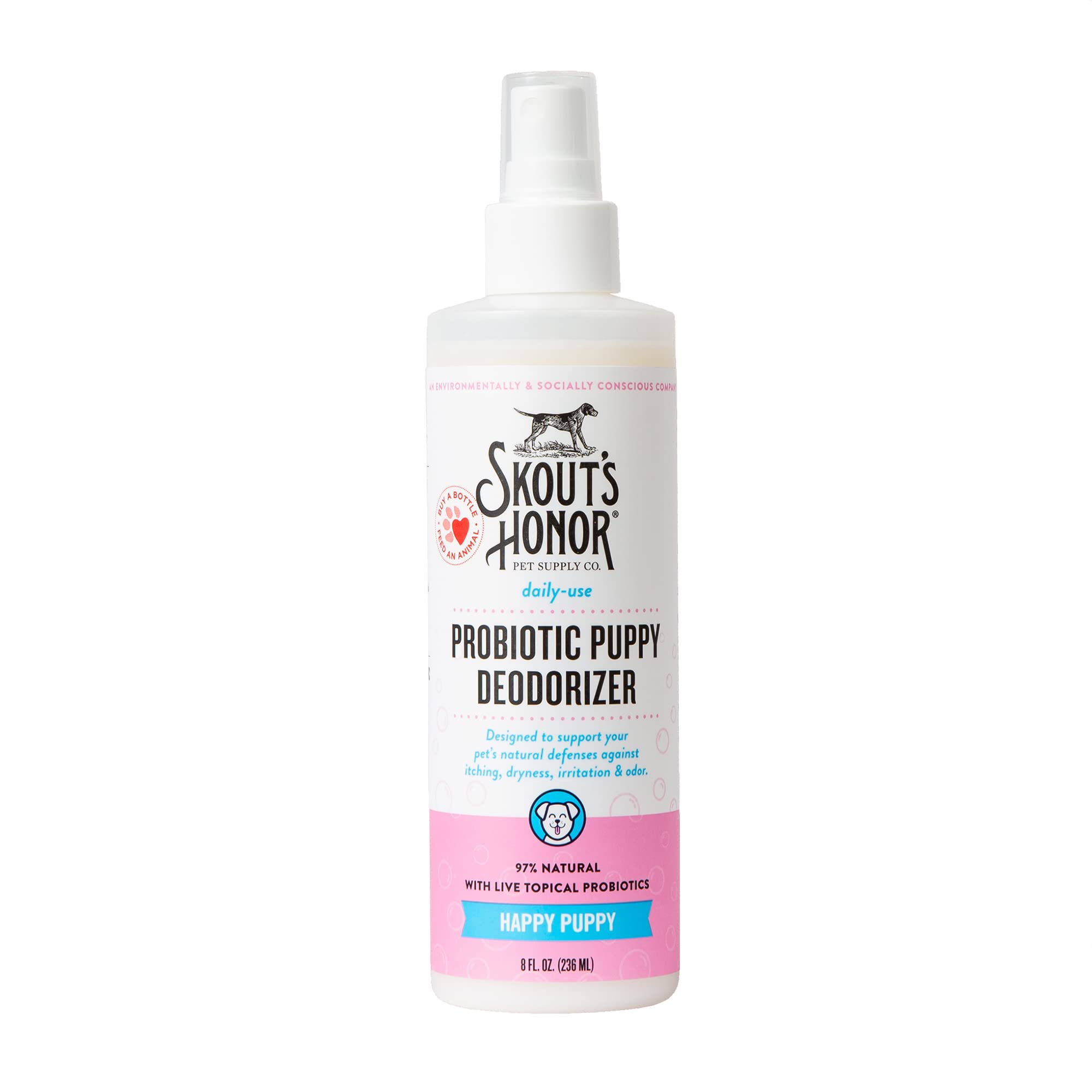
6. Skout’s Honor Happy Puppy Probiotic Daily Use Cat & Dog Deodorizing Spray

Skout’s Honor Happy Puppy Probiotic Daily Use Cat & Dog Deodorizing Spray

Volume: 8 Ounces
Scent: Floral

Skout’s Honor Happy Puppy Probiotic Daily Use Cat & Dog Deodorizing Spray uses probiotics, which are good bacteria. They attack the bad bacteria causing the smell, essentially consuming them and using them to multiply. Eventually, the good bacteria overtake the bad bacteria, and the smell and stain are gone.

Rather than masking the smell, Skout’s Honor Happy Puppy Probiotic Daily Use Cat & Dog Deodorizing Spray gets rid of bad odors at the source and has a mild, floral smell. Unfortunately, the floral scent doesn’t last long.

Pros

  • Probiotics kill bad-smelling bacteria
  • Has a mild floral aroma
  • Can help combat a host of coat and skin problems

Cons

  • The scent doesn’t last long

7. Pet Head Feelin’ Good Spray Vegan Cat Deodorizer

Pet Head Feelin’ Good Spray Vegan Cat Deodorizer

Volume: 10.1 Ounces
Scent: Lemonberry

The Pet Head Feelin’ Good Spray Vegan Cat Deodorizer is a natural cat deodorizer that is entirely vegan and has a lemon berry scent to leave your cat smelling fresh. Strawberry and lemon seed oil give the deodorizer its scent. Safflower conditions the coat, leaving it smooth and easy to manage.

Aloe vera and vegetable protein help promote a healthy coat and skin, making it suitable for cats with sensitive skin. The Pet Head Feelin’ Good Spray Vegan Cat Deodorizer is affordable since it comes in a slightly larger bottle than most alternatives, but the scent won’t last long, which means you may end up using more of it to get the desired result.

Pros

  • Vegan and cruelty-free formula
  • Soothes irritated skin
  • Pleasant lemon berry scent

Cons

  • The fragrance doesn’t last long

8. Mr. Groom Cologne & Deodorant Dog & Cat Odor Spray

Mr. Groom Cologne & Deodorant Dog & Cat Odor Spray

Volume: 6 Ounces
Scent: Floral

Mr. Groom’s Cologne & Deodorant Dog & Cat Odor Spray is an alcohol-based spray with a long-lasting fragrance. The spray is inexpensive, and the push-top makes it easy to apply. The manufacturer describes the fragrance as floral, although others have said it is more of a powdery scent.

Because it is alcohol-based and contains some chemicals, it isn’t suitable for cats with sensitive skin, but the fragrance is a little strong and may last longer. It can also be used on furniture and upholstery, so it might be a good choice if your cat’s smell has transferred to the rest of the house.

Pros

  • Cheap
  • Easy to apply
  • Can be used on furniture and carpets, as well as the cat

Cons

  • Alcohol-based formula
  • Not suitable for cats with sensitive skin

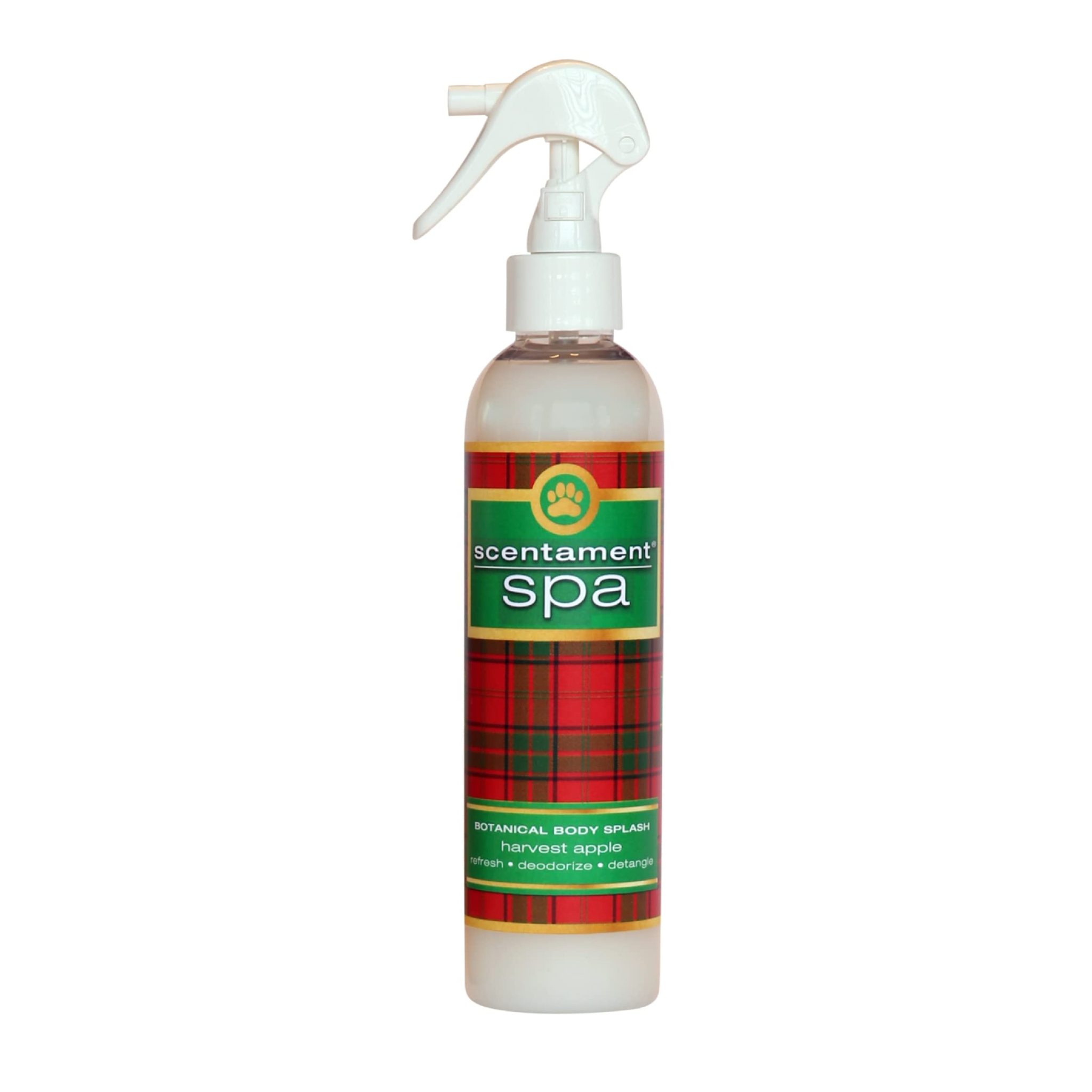
9. Best Shot Scentament Spa Botanical Body Splash Harvest Apple Dog & Cat Deodorize & Detangle Spray

Best Shot Scentament Spa Botanical Body Splash Harvest Apple Dog & Cat Deodorize & Detangle Spray

Volume: 8 Ounces
Scent: Harvest Apple

The Best Shot Scentament Spa Botanical Body Splash Harvest Apple Dog & Cat Deodorize & Detangle Spray is an alcohol-free deodorizer for cats and dogs. It not only deodorizes but also helps detangle your pet’s fur, making it a great product for use between baths or while you’re waiting for your next groomer appointment.

It is also fabric-safe, so it can be used to help eliminate smells from the cat’s bed and household furniture. It is inexpensive and has a pleasant seasonal apple smell that is an improvement over urine and feces, but the smell doesn’t last long before it needs refreshing. While it is alcohol-free, Best Shot’s Scentament can leave a residue on your cat’s coat.

Pros

  • Cheap
  • Pleasant seasonal aroma
  • Alcohol-free formula

Cons

  • The fragrance doesn’t last long
  • Can leave a thick residue

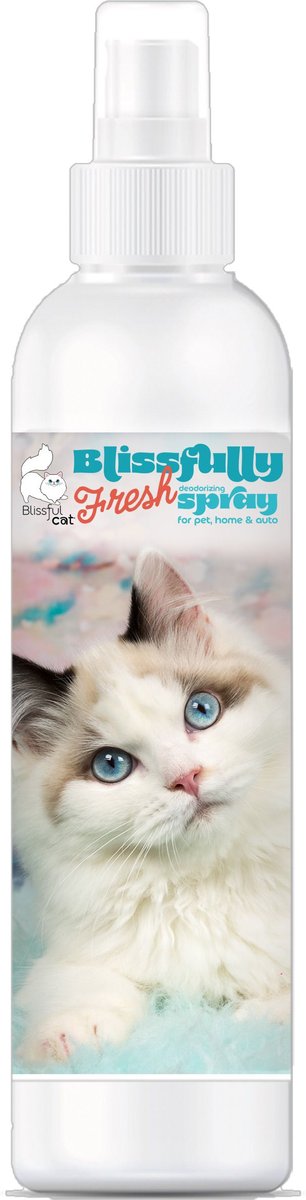
10. Blissful Dog Simply Everything Fresh Deodorizing Refresher Cat Spray

The Blissful Dog Simply Everything Fresh Deodorizing Refresher Cat Spray

B07GBHF3WK

Volume: 4 Ounces
Scent: Ruby Grapefruit

Blissful Dog’s Simply Everything Fresh Deodorizing Refresher Cat Spray is a deodorizer designed for cats and dogs that can also improve the smell of the house, car, or any other location that might need it. Although it is said to be safe on most fabrics, it shouldn’t be used on leather, suede, silk, or near reptiles or birds.
The ruby grapefruit scent is pleasant, and the spray is water-based but expensive. The bottle is small, and you’ll need to replace it more often than with other brands.

Pros

  • Pleasant ruby grapefruit aroma
  • Can be used on most furniture and surfaces
  • Suitable for kittens and adult cats

Cons

  • Expensive
  • Small bottles that will need replacing often

divider 3 paws

Buyer’s Guide: Choosing the Best Cat Deodorizing Spray

Whether it’s because of poor litter habits, a proclivity to roll in wild animal feces, or because of anal gland seepage, some cats retain foul aromas. However, you can’t bathe a cat every day. You can, however, get cat deodorizers that are safe for daily use.

Tabby green eyed cat being pet
Image Credit: Ashley Swanson, Shutterstock

Causes Of Cat Smells

Some cats have a pleasant, natural feline smell. Others can develop funky smells for several reasons:

Litter Box Litter

The individual bits of litter get stuck in between paws, and they can stick to fur. If they are wet with urine or sticky with feces, it becomes an even bigger problem.
While most cats will do their business, cover it up, and then leave, some cats play in the litter tray and even lay in it, which massively increases the chance of a smelly feline. Check your cat’s paws as well as its coat, and pay particular attention to the rear end and the belly of your cat.

Infections

Infections can produce foul odors, but deodorizers won’t eliminate the smell. If your cat’s ears or mouth have a foul odor, take them to the veterinarian. They will likely need antibiotics, and your vet will want to determine the cause of the infection.

Anal Gland Leakage

Anal glands secrete a small amount of liquid when your cat has a poop. However, the glands can become irritated or even infected. Anal gland leakage can have a really bad smell, especially if the liquid gets caught in the fur rather than being left in the litter box.
If the leakage is caused by an infection, the glands will need to be expressed, and the vet will likely prescribe antibiotics to help clear up the infection.

Rolled In Something

Cats are inquisitive animals, and sometimes, when they smell something interesting, they like to roll around in it. Fox poop is of particular interest to a lot of cats.
Deodorizer alone is unlikely to remove the foul odor, and you will, at the very least, need to bathe your cat.

Buying Cat Deodorizer

There are many cat deodorizers on the market, and it may take a few attempts to find one that offers the odor elimination and scent you want. When comparing, consider the following factors.

Type

Deodorizers need a base liquid, usually water or alcohol. Water-based deodorants tend to be gentler, which means they suit cats with sensitive skin. Water is also better as a base for deodorizers that you use on furniture, carpets, and other upholstery.

Scent

The deodorizer aroma shouldn’t be too strong, or it could be offensive to your cat’s delicate nose. You might also want to avoid those that boast citrus aromas because a lot of cats dislike the smell of citrus. Otherwise, natural scents are the better option because they won’t cause harsh reactions from you or your cat.

Volume

A good deodorizer only needs one or two squirts to have the desired effect, but some are designed for daily use. If you use the deodorizer daily, you will benefit from a larger supply. Buying a bigger bottle is more economical than buying a smaller one.

spraying on cat
Image Credit: Vaillery, Shutterstock

How To Use Cat Deodorizer

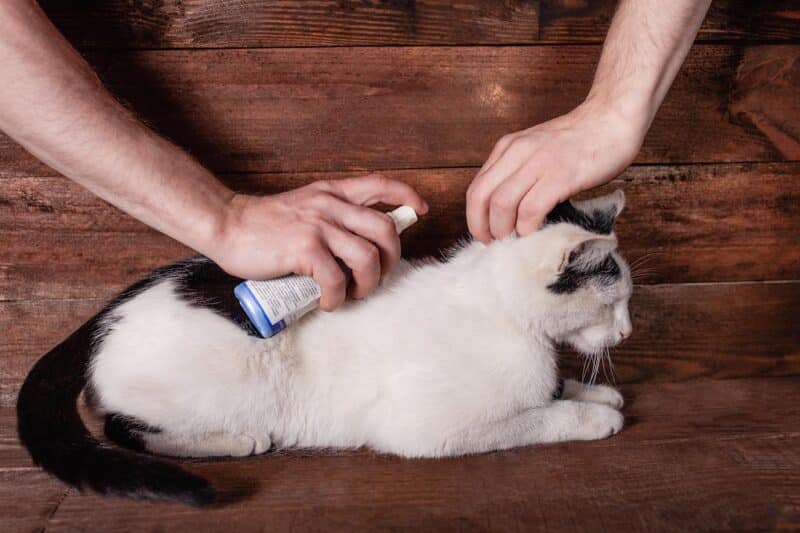
Always follow the instructions on the bottle when using a cat deodorizer. If there are no instructions, the general process is to spray your cat’s coat a few inches away, ensuring you avoid the face but get the rest of the cat’s body. Leave the spray dry naturally, then brush the cat from head to toe, as you normally would when grooming.

How To Get Rid Of Cat Odors

In addition to bathing your pet and using deodorizer, you will need to clean the areas where your cat spends a lot of time. Put the cat beds in the wash regularly, vacuum areas where your cat sleeps, and wash any clothes they like to rest on. Use good-quality litter that traps odors and a litter deodorizer to help eliminate the cat litter smell.

If you’re dealing with stubborn smells in your litter box or elsewhere in your house, a good cat litter deodorizer can work wonders.


Hepper Advanced Bio-Enzyme Cat Litter Deodorizer Powder

  • Bio Enzymatic Cat Litter Freshener – Smart formulation uses natural ingredients eliminating cat…
  • Save Money – Stuff for cats isn’t the cheapest. With this litter box odor eliminator, you’ll…
  • Every Litter, Every Surface – Are you afraid this additive won’t work on your litter? Fear not!…

We recommend Hepper’s Advanced Bio-Enzyme Cat Litter Deodorizer, an all-natural litter additive that fights odors using bio-enzymes. This effective deodorizer is fragrance-free and works on all types of cat litter. It’s also effective anywhere you have lingering odors, including diaper pails, garbage cans, and kennels!

At Catster, we’ve admired Hepper for many years and decided to take a controlling ownership interest so that we could benefit from the outstanding designs of this cool cat company!

How Often Can You Use Deodorizers?

Most deodorizers say they are safe for daily use, but using an alcohol-based spray could cause skin issues. Follow the instructions on the label and, ideally, only use the spray when you notice your cat’s smell.

Can Illness Make Cats Smell Bad?

If your cat has stomach or bladder problems, they might urinate and poop in their sleep or when relaxed. If this gets into the fur, it will start to smell and leave a foul odor behind. Ear and dental infections can also emit odors, and they require prompt veterinary assistance to ensure they don’t worsen.
Finally, cats with mobility issues can struggle to groom themselves. If you think illness might be causing your cat to smell, check for signs of infection and other signs of illness. Then, make an appointment with the vet.

divider 2 catsConclusion

Cats are generally clean animals that spend a lot of time grooming themselves. Whether it’s because of illness, age, or because your cat has been rolling in something outdoors, self-grooming isn’t always enough to control those odors. Cat deodorizer sprays are a great way to eliminate odors between baths or professional grooming appointments.

We discussed several products, but Hepper’s Pet Cologne is our favorite. It has a pleasant smell, and a little goes a long way. It is also suitable for cats with sensitive skin. Best Shot’s One Shot Dog & Cat Deodorizing

Spray comes in a large bottle but has a small price tag, making it a great option for those on a budget. We hope our reviews help you find the ideal deodorizer for your favorite feline!


Featured Image Credit: Axel Bueckert, Shutterstock

Cat Vaccination: How I Balance the Risks & Benefits

No Comments

The information is current and up-to-date in accordance with the latest veterinarian research.

Learn more »

Hi, I’m Dr. Karyn! Read my introduction to learn more about me and meet my five hilarious cats: Clutch, Cyril, Alex, Zelda, and Zazzles.

You might assume that as a vet, I have a pretty rigid stance on vaccination, but just like you, I want to make sure that the choices I make are based on facts and science, and are right for my cats, and my situation.

In veterinary practice, our recommendations need to be in keeping with the manufacturer guidelines; it simply isn’t practical to have a multitude of different options for a multitude of different scenarios. With that in mind, there are three messages I would like all cat owners to take home:

  1. Vaccination ABSOLUTELY saves lives.
  2. YOU have the final say on how often and what your cats are vaccinated against (with the exception of rabies).
  3. Your decisions about vaccination should be based on FACTS, not FEARMONGERING.

I often get asked “Is vaccination safe?” and the honest answer is that introducing a foreign agent into the body to elicit an immune response is not 100% safe, but it is much safer than leaving your pet exposed to the risks of contracting deadly viruses. So you might want to know:

Do I vaccinate my cats? Yes.

Do I strictly adhere to the manufacturer guidelines? Not completely.

Am I aware that I am taking a risk by deviating from those guidelines? Yes, but I base my decision on the risk factors for my specific situation.

If you’d like to know what influences my decisions about vaccinating my cats, we’ll need to get some of the nitty gritty stuff out of the way. Trust me, you’ll come away feeling a lot more confident about making the right choices for your cats with a bit more knowledge under your belt.

Cyril contemplates the risks that lie beyond the window.

How Does Vaccination Work – In a Nutshell

The practice of exposing humans, and later, animals, to a small dose of an infectious agent to trigger an immune response dates back to at least the mid 15th century, possibly even earlier than that. When Smallpox was busy wiping out hundreds of millions of people around the world, a process called variolation emerged, where a small amount of the fluid from a smallpox lesion was injected into a healthy human. This was a risky procedure as the chances of developing a fulminant case of smallpox were extremely high, but it did start to prove that a small dose of the virus could create enough of an immune response to render the patient immune.

But it wasn’t until a man named Dr Edward Jenner (honestly, you can’t go anywhere without hearing about a Jenner these days!) discovered that the same immune response could be achieved by using cowpox – a related but much safer poxvirus.

How does it work?

When a virus enters the body, it triggers the immune system to release pathogen-fighting cells like neutrophils, monocytes, and lymphocytes (T cells and B cells). After a while, the body starts producing lymphocytes that are more specifically adapted to fighting the viral particles, resulting in a faster, stronger attack.

If the virus is successfully killed, the bone marrow keeps producing cells that can target that particular virus, called memory B and T cells. These memory cells may last for months, a few years, or a lifetime, depending on the virus and the individual.

The problem with relying on our natural immune response to a virus is that it’s a game of chance. We only develop a natural immunity if we survive, and we may end up with long term or permanent health consequences from the infection.

This is where vaccination comes in.

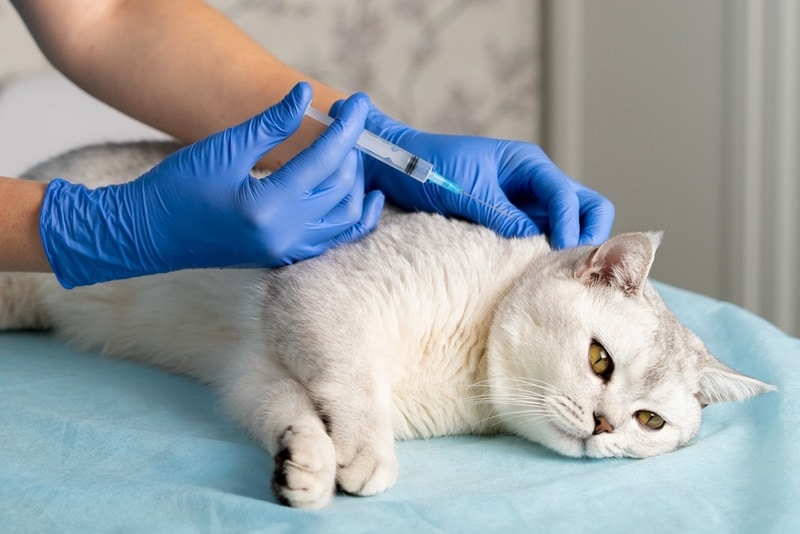
A vaccine uses an inactive version of the virus to ‘trick’ the immune system into producing an immune reaction and creating memory cells, without causing the actual infection. This often results in the patient feeling unwell or showing some mild symptoms of the virus, but this is simply a sign of the immune system responding.

Here’s where it gets a bit more technical.

In order to trigger a good enough response to the inactivated virus, most vaccines contain something called an adjuvant. This adjuvant is what really fires up the immune system, making sure it gets to the stage of making memory cells, and it is the body’s response to this adjuvant that usually creates the majority of side effects. But, the more powerfully the body responds, the more likely it is to create a good supply of memory cells, so that the next time the body encounters the virus, it can fight it off quickly and efficiently.

Zelda staying safe indoors

The Biggest Issue With Feline Vaccination

Just like with humans, cats often suffer from various side effects of vaccination, including lethargy, fever, or swelling. It might be unpleasant for a day or two, but it is an expected reaction. True adverse vaccine reactions, where the injection triggers an extreme allergic or systemic reaction, are very rare.

The worst potential side effect to vaccination in cats is something called an injection site sarcoma – a type of malignant tumor that can form where a vaccination has been given. This nasty tumor requires aggressive treatment, including surgical removal of the mass.

Feline vaccines are traditionally given in the scruff, because there is lots of loose skin, so it is much easier to inject, as well as more comfortable and less stressful for the cat. But if an injection site sarcoma grows in this location, it is difficult, if not impossible, to completely remove the tumor as it often extends to the spine.

To combat this, it has been recommended that cats be vaccinated over a limb, as this would allow amputation if needed to completely remove the cancer. But, the lower down the limb we go, the less loose skin there is, and the more painful and stressful the injection becomes, so it can be a bit of a case of weighing up the risks and benefits, as well as finding other ways to reduce the chance of this effect.

Studies have found that the Feline Leukemia Virus Vaccine appears to have a higher risk of inducing a sarcoma, possibly due to the fact that the virus itself attacks the bone marrow and immune system.

One method to reduce risk is giving leukemia vaccines every 3 years, rather than annually.

One company has created a non-adjuvanted vaccine, in the hopes that this will result in less intense side effects, but this vaccine does not give a long-lasting protection as ones that contain an adjuvant, so it is supposed to be given annually.

Risk/Benefit Analysis

This is where your decision-making comes into play. You need to be aware, and honest, about the sort of risks your cats face, and talk to your vet about how to make sure they stay protected.

Cats in breeding colonies, shelter conditions, or that live outdoors with a higher risk of interacting with other cats, should be vaccinated against leukemia virus according to the manufacturer recommendation.

For cats living indoors, once they have received a complete primary vaccination course, and I generally recommend that they have their kitten course, plus one a year after, you may want to think about whether or not they need to continue with this particular vaccination. While viruses like cat flu can be transmitted through the air and on surfaces, the leukemia virus requires direct cat-to-cat contact.

If you do decide to go down the route of not vaccinating against leukemia virus, it is vital that you ensure any new cats entering your home have had either a complete vaccination course, or have been tested for the virus before coming into contact with your cat.

My cats are 100% indoor, and are no longer vaccinated against leukemia virus – they have zero risk of exposure. I do, however, vaccinate them against the cat flu viruses every three years.

You might be wondering, Why risk using the leukemia vaccine at all? 

When a cat becomes infected with feline leukemia, there is a window of time where, if the virus is successfully eliminated, the cat will survive and have gained natural immunity – Yay!

BUT, we don’t know exactly how long that immunity lasts, AND if the virus is not eliminated within that window of time, the cat will develop feline leukemia, a debilitating disease that often leads to suffering and death.

A few statistics:

  • Around 3% of cats in the United States and Canada are infected with feline leukemia.
  • Feline leukemia is fatal in 80-90% of cases.
  • The incidence of injection site sarcoma is between 1 in 1000 and 1 in 30,000 (0.1 to 0.003%).
Clutch sleeping on a log
Protecting our pets has to be priority #1.

Are vaccines safe?

Of course they’re not completely safe – we are manipulating the immune system with an artificially altered version of a virus. Does that sound safe to you? But it’s a hell of a lot safer than taking our chances of surviving the actual virus.

The fact is, if we are putting something into the body to elicit a reaction, side effects are inevitable. If a drug or vaccine claims to have zero side effects, it probably doesn’t have any therapeutic effects either.

I hate that we live in a world where big pharmaceutical companies profit from disease, and I think that we’re right to do our own research and ask questions.

BUT, the fact that big pharma makes money from vaccination, does not mean that vaccination is bad.

Is it really crappy that there are people that stand to make billions from every viral outbreak? Absolutely! But that shouldn’t mean that we stop protecting our pets.

Natural immunity might work, but it only works if your cat survives.

Dr Karyn signature

Tiger Cat: Facts, History & Origin (With Pictures)

No Comments

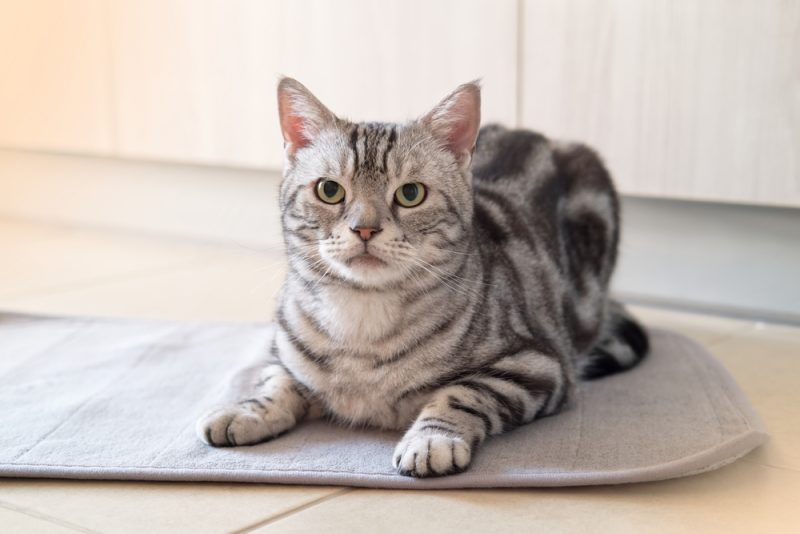
Tiger cats, also known as tabby cats, are one of the most recognizable kitties in the feline world. However, they’re also very misunderstood. Contrary to popular belief, tabbies aren’t a cat breed at all but rather a pattern variation. Read on to learn more about cats with this amazing coat pattern.

Breed Overview

Colors:

Brown, gray, orange, black, silver, red, etc.

Suitable for:

Families with or without children, seniors, folks living in apartments

Temperament:

Varies depending on breed

Tiger cats come in many different colors and patterns. Though most people know them by the distinct M-shaped marking on their foreheads, there are actually several other pattern styles commonly seen in cats with tabby coats.

Tiger Cat Breed Characteristics

Energy

+

A high-energy cat needs a lot of physical and mental stimulation to keep healthy and happy, while a low-energy cat needs minimal physical activity, but still needs mental stimulation. When choosing a cat, It’s important to ensure their energy levels match your lifestyle.

Trainability

+

Cats that are easy-to-train are more willing and skilled at quickly learning prompts and actions with minimal training. Harder-to-train cats are usually more stubborn or aloof and require a bit more patience and practice.

Health

+

Certain cat breeds are more prone to various genetic health problems, and some more than others. This doesn’t mean that every cat in those breeds will have these issues, but they do have an increased risk, so it’s important to understand and prepare for any additional needs they may require.

Lifespan

+

Due to their size or potential genetic health issues of a specific breed, some cats have shorter lifespans than others. Proper nutrition, exercise, mental stimulation, and hygiene also play an important role in your cat’s lifespan and quality of life.

Sociability

+

Some cat breeds are more social than others, both towards humans and other cats and animals. Cats that are more social have a tendency to rub up on strangers for scratches or jump on laps for cuddles, while cats that are less social shy away, hide, are more cautious, and even potentially aggressive. No matter the breed or gender, it’s important to socialize your cat and expose them to many different situations.

The Earliest Records of Tiger Cats in History

The tiger cat pattern dates back to domestic cats in the Middle Ages.

The genetic mutation responsible for producing the blotched tabby pattern emerged during the Ottoman Empire. This empire, also known as the Turkish Empire, spanned most of Southeast Europe, West Asia, and North Africa between the 14th and early 20th centuries. The tiger cat pattern, which is seen in nearly 80% of modern-day cats, slowly became more common throughout Southwest Asia, Africa, and Europe. However, the tabby pattern didn’t become commonplace until around the 18th century.

tabby cat lying on conrete ground
Image Credit: Burhan Oral GUDU, Shutterstock

How Tiger Cats Gained Popularity

In ancient Egypt, cats were held in very high esteem. These early tiger cats are likely ancestors of the modern tabbies we adore today and were loved and celebrated for their excellent hunting skills. They kept granaries, ships, and households free from disease-carrying vermin.

As mentioned, the tabby cat pattern didn’t become commonplace worldwide until the 18th century. Towards the end of the 19th century, more North Americans began to keep cats not only for their utility (rat hunting) but also for their company. By the end of World War I, cats had rightfully earned their place as household pets in the U.S. and Canada.

Formal Recognition of Tiger Cats

Since tiger cats are not a separate breed but instead a pattern seen in many different cat breeds, there’s no formal recognition available for it. However, many cat breed standards set by The International Cat Association (TICA) and Cat Fanciers Association (CFA) do contain “tabby” as a pattern.

For example, the TICA standard for Bengals includes brown tabby, silver tabby, seal sepia tabby, and seal mink tabby. The CFA breed standard for Maine Coons includes many tabby colors and patterns, including (but not limited to) classic, mackerel, and ticked tabby patterns and brown, silver, red, and blue-silver colors.

blue tabby maine coon cat next to conifer tree in the back yard
Image Credit: Nils Jacobi, Shutterstock

divider 3 paws

Top 3 Unique Facts About Tiger Cats

1. There are many distinct tiger cat patterns.

When most people think about tabby cats, they think of the distinct “M” marking on the forehead. While this is absolutely one of the tabby patterns, there are actually several others.

  • Classic tabby: The coat consists of whorls that create a target-like shape on the cat’s side.
  • Mackerel tabby: The coat has rings around the tails and legs and bands of stripes (solid or broken) around the rest of the body.
  • Spotted tabby: In lieu of stripes, this pattern consists of bands of spots varying in size.
  • Ticked tabby: The coat consists of even fields of agouti hairs (each individual hair has two or more bands of pigmentation) that break up the pattern into a salt-and-pepper-like appearance.
  • Patched tabby: The coat consists of patches of different colored markings (e.g., calico or tortoiseshell) with patches of the traditional tabby coat.

2. The word “tabby” has a fascinating history.

The “tabby” pattern title is believed to have originated in the “Attabiy” district of Baghdad, where fine silk and striped cloths were produced. Over time, the Middle French term “tabis,” became “tabis,” before giving rise to our modern English word, “tabby.”

tabby with green eyes laying on a rug
Image Credit: PippiLongstocking, Shutterstock

3. People believed the distinct “M” marking had a meaning.

There are many stories as to how and why tiger cats developed their trademark “M” on their foreheads.

Some believe the “M” stands for “Mau”, the Egyptian word for “cat.”

According to Christian folklore, after Jesus’s birth, a tabby cat showed up to comfort and keep him warm. Mary, ever-grateful for the cat’s presence, stroked the cat’s head, leaving the “M” mark on the forehead.

An Islamic legend suggests that a tabby named Muezza saved his master, Prophet Mohammed, from a snake. To express his gratitude toward the cat, Mohammed gifted them the ability to land on their feet. When Mohammed petted the kitty to thank him for saving his life, the “M” marking appeared and remained.

divider 3 paws

Do Tiger Cats Make a Good Pet?

Tabbies absolutely can make fantastic pets simply because they’re cats, and we believe all cats can be good pets. It’s important to remember that tiger cats aren’t a specific breed, but instead, a pattern that naturally occurs in many different cat breeds, so we can’t say for sure what you should expect personality-wise as we don’t know your kitty’s DNA. For example, a Siamese tabby can have an entirely different personality than a Maine Coon with tabby patterning.

To get a better idea of what your cat’s personality will be like, try searching their breed (not their patterning) using the search function on our site. We have hundreds of blogs about countless different cat breeds, which should shed some light on what to expect personality-wise and the care requirements necessary for your pet’s specific breed.

young blue tabby maine coon cat lying on wooden floor next to hooded cat litter box
Image Credit: Nils Jacobi, Shutterstock

divider 3 paws

Conclusion

Tiger cats aren’t a separate breed but a coat pattern commonly seen in several cat breeds. While the tabby pattern is available in many different colors and five distinct styles, there’s certainly no denying how beautiful this patterning can be.


Featured Image Credit: Esin Deniz, Shutterstock

Penguin CBD Cat Supplement Review 2024: A Detailed Look

No Comments
 

Our Final Verdict

We give Penguin CBD brand an overall rating of 4.8 out of 5 stars.

Ingredients: 4.8/5

Effectiveness: 4.7/5

Ease of Use: 5/5

Value: 4.8/5

Whether your kitty is anxious, overstimulated, or just keeping you up at night, CBD can help. This natural compound is purr-fect for helping cats chill. But how do you find a safe, effective, and easy-to-use CBD supplement for your cat?

Penguin, a premium CBD company, has the answer. This CBD brand prides itself on bringing pure CBD products to the whole family. And that includes spoiled kitties everywhere.

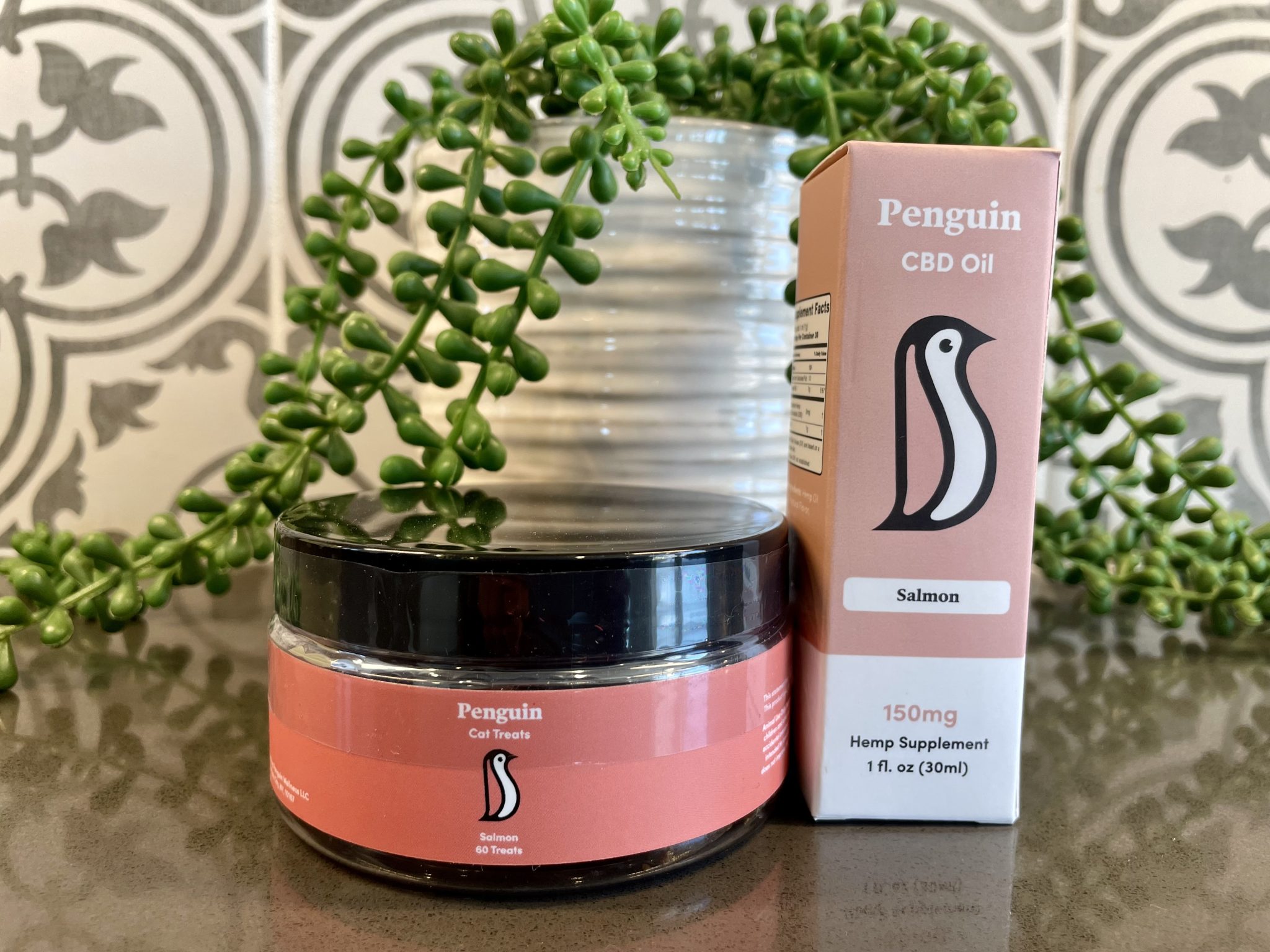
Their salmon-flavored CBD oil makes it easy to add a little chill to your cat’s every day. And their CBD Cat Treats are the perfect, tasty way to take the fear out of your feline during those stressful events.

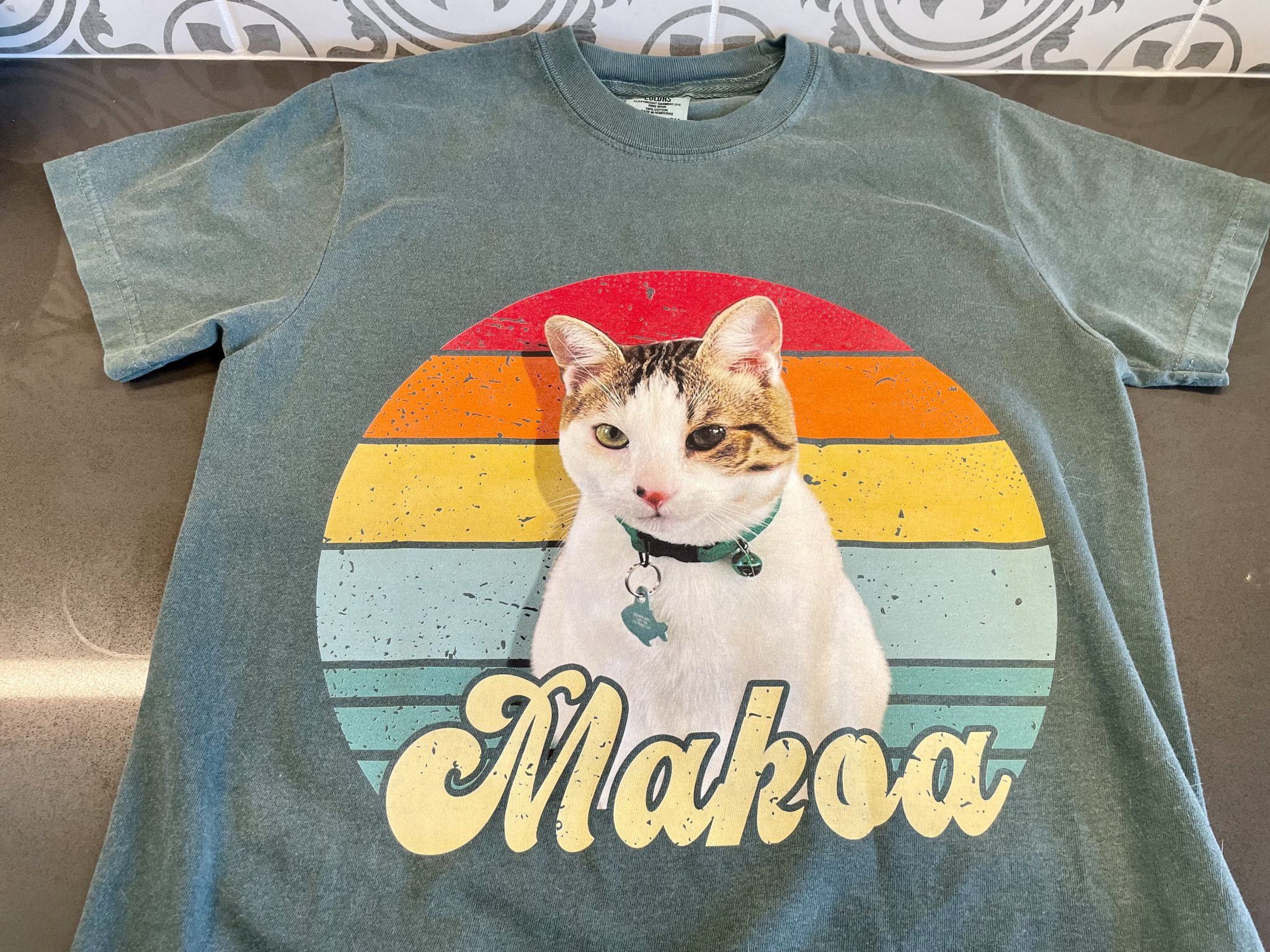
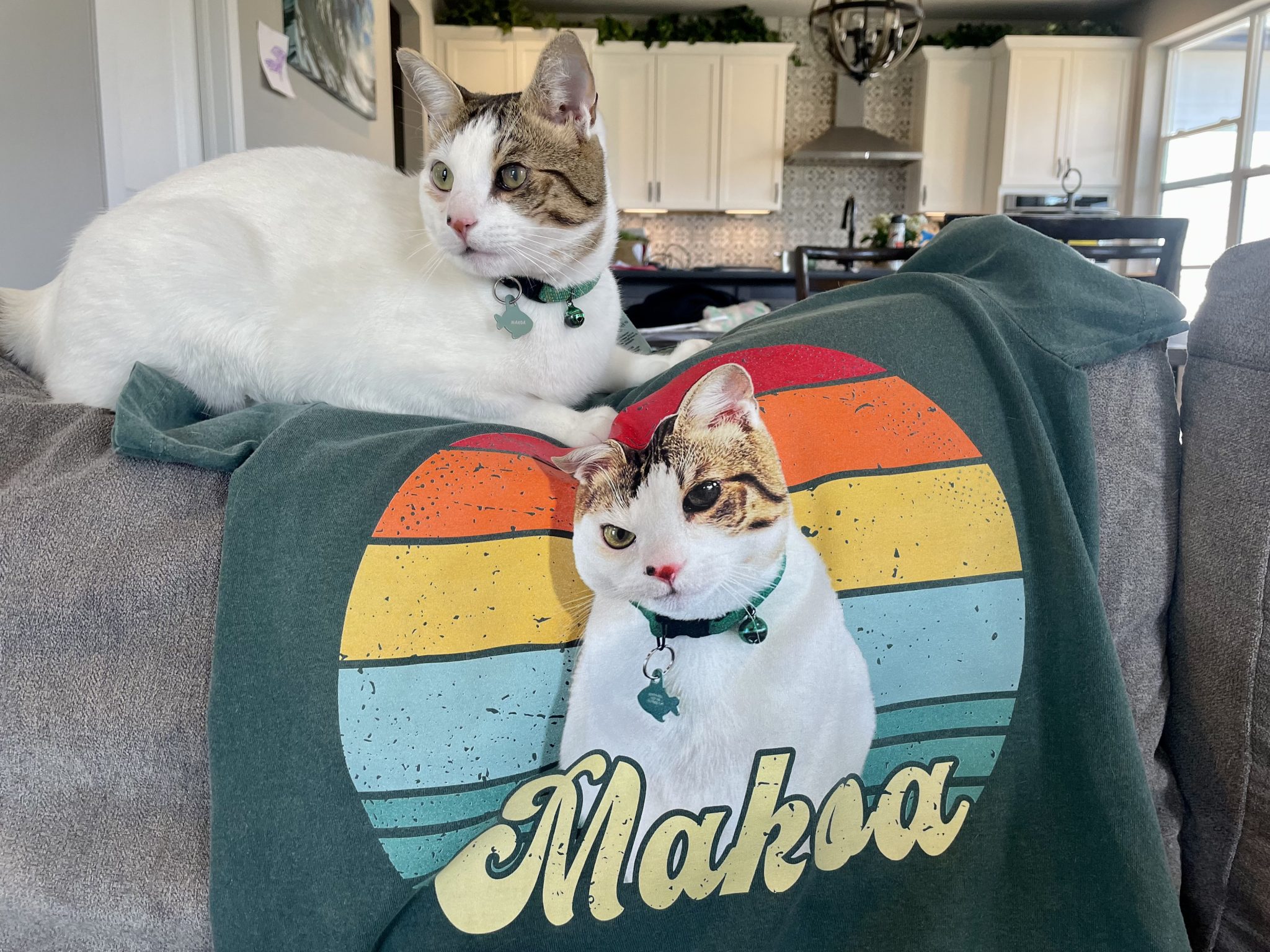
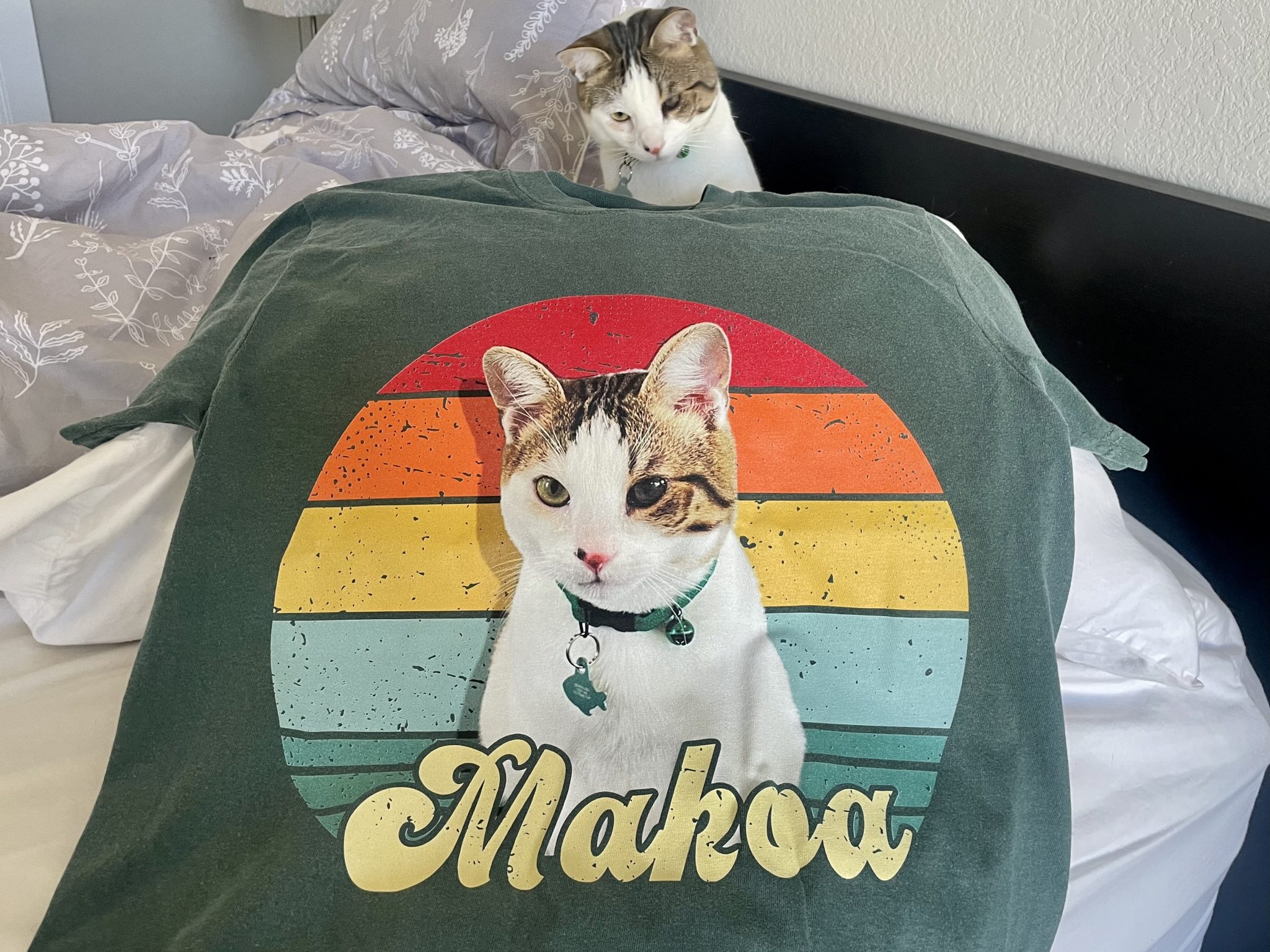
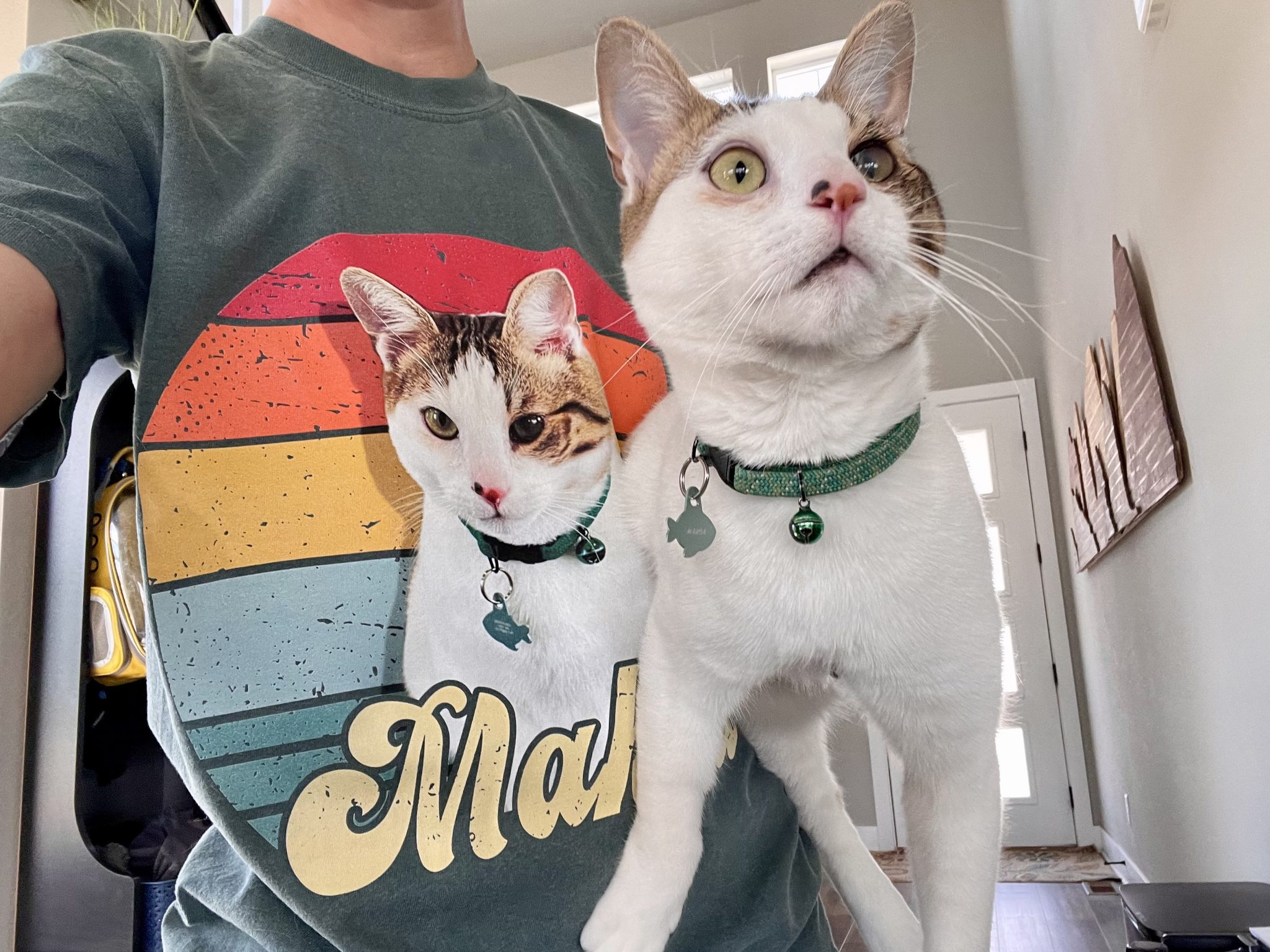
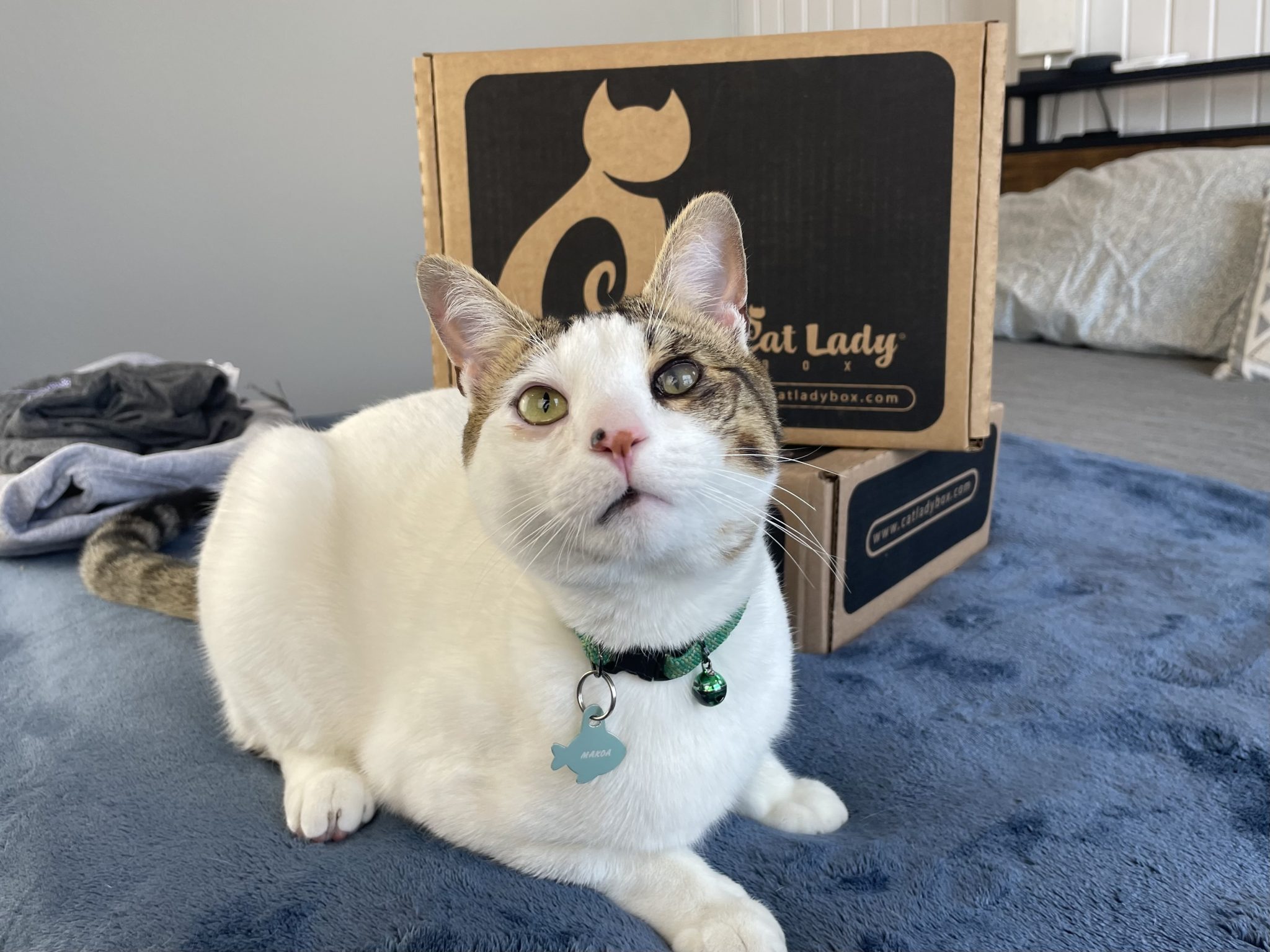
I had a chance to try both of Penguin’s cat CBD products on my rambunctious one-year-old Domestic Shorthair, Makoa. They worked wonderfully to help him get through a week-long boarding stay without incident and have done wonders to create calmer nights in our household.

Find out what else these products have to offer in my full Penguin CBD brand review, below.

At a Glance: What We Recieved

divider 2 cats

About Penguin

Penguin CBD Products

Penguin CBD took its name from the flightless birds we all love, the ones who “keep their cool under pressure.” Their mission is to make quality CBD products at an affordable price so all people and pets can find the same chill penguins possess.

Who Makes Penguin CBD and Where is it Produced?

Penguin gets all of their hemp from Oregon. It is non-GMO and sustainably grown without pesticides. Once harvested, the hemp is CO2 extracted in the company’s labs and mixed with other pure ingredients to make a variety of products from oils to gummies to pet treats.

Which Types of Cats Is Penguin Best Suited For?

CBD is a multi-talented compound. Studies have shown that it can help with a variety of issues from anxiety and depression to cancer, pain, and epilepsy.

Any cat suffering from these issues is likely to benefit from Penguin’s cat products. Their treats are an especially great option for quick and easy dosing on an as-needed basis. The oil, on the other hand, is great for daily maintenance and is made to be added to meals.

Both these products feature broad-spectrum hemp extract without THC. This makes them extra-safe for pretty much all cats over the age of six months.

divider 2 cats

Key Features

Penguin CBD Products

Here is a quick overview of Penguin’s CBD cat products. We’ll look at the ingredients, CBD content, how to administer them, and what to expect.

Ingredients

Both of Penguin’s CBD cat products start with broad-spectrum hemp extract. This oil is gently extracted from the aerial parts of the plant using CO2 extraction, which helps to preserve the natural terpenes, cannabidiols, and flavonoids. All of these extra compounds help CBD work more effectively once it’s in the body.

The Salmon CBD Oil also contains hemp oil, MCT oil, natural flavors, and added terpenes. The treats contain many natural ingredients, including chicken powder, flax oil, and brewer’s yeast. They also have some added valerian root to help cats relax even more.

CBD Content

Most vets recommend giving your cat 1 to 5 mg of CBD per 10 pounds of body weight. Penguin certainly had this dose recommendation in mind when they created both of these products.

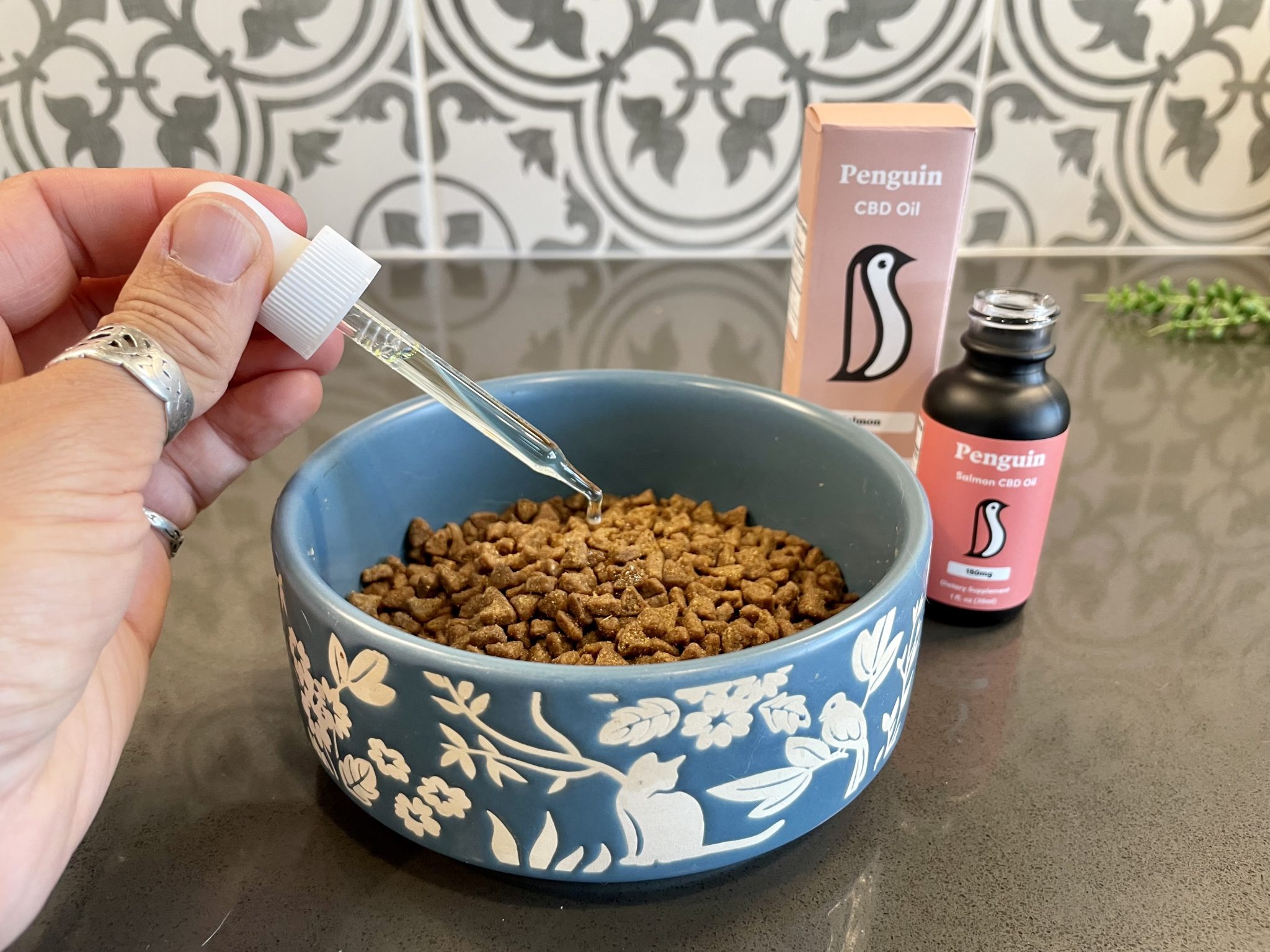
The oil contains 5mg of CBD per ml (dropper). Since the average cat weighs about 10 pounds, this makes it super simple to figure out the right dose for your kitty.

For those in need of a therapeutic dose for pain, extreme anxiety, or chronic issues, one dropper full is going to be about perfect. For those who need just a dash of CBD to promote calm or for general maintenance, 4 drops of the oil will deliver 1 mg of CBD.

For the treats, each of these soft chews contains 3.3mg of CBD. For most cats, this is going to be a good amount for targeting stressful situations, such as trips to the vet.

How to Administer

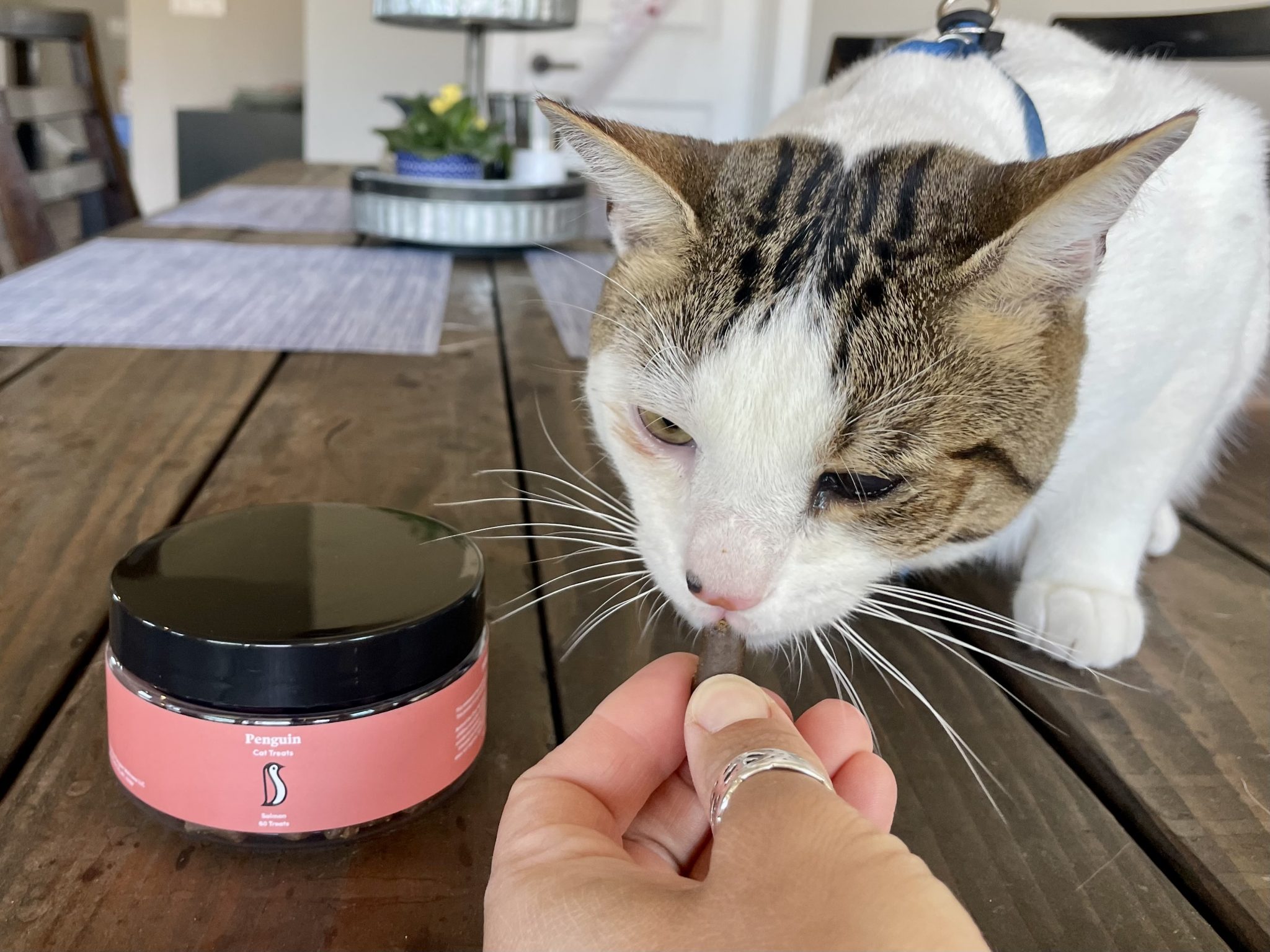
With plenty of flavor from chicken and salmon and a delectable texture, the CBD Cat Treats from Penguin are easy enough to administer. Most cats will happily eat them straight.

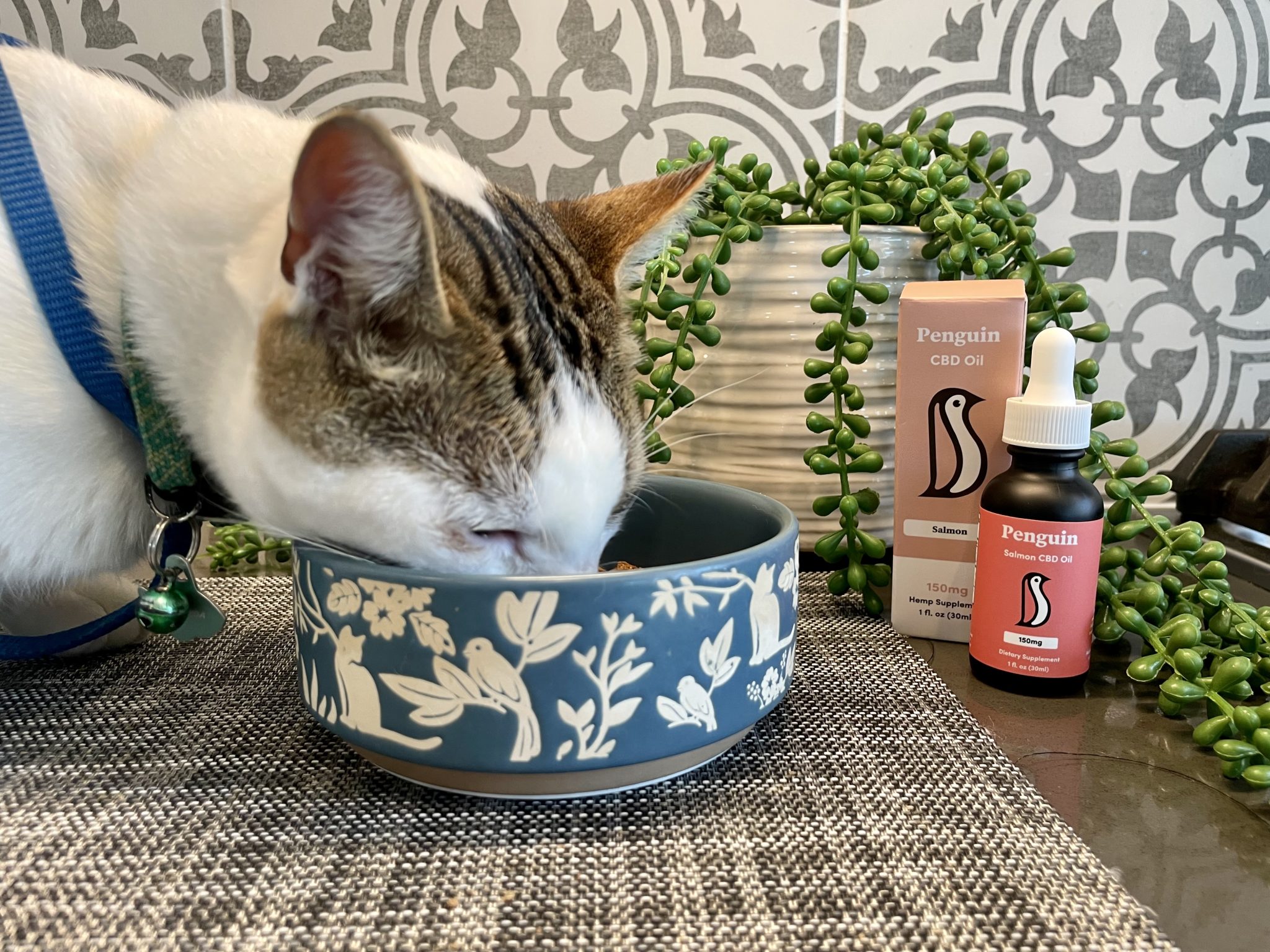
For the oil, the easiest way to use it is to add the dose to your cat’s meal once or twice daily. The added salmon flavor makes it palatable enough that most cats won’t mind this addition.

Alternatively, you can administer the oil straight into your cat’s mouth. Just be careful that they don’t chomp on the glass pipette during the process.

Penguin CBD Products

What to Expect

CBD typically has a quick effect on cats. You should notice a change in their behavior about 30 to 45 minutes after administering it.

But the real magic CBD offers comes with consistent use. This compound works naturally with your cat’s endocannabinoid system to help balance and revitalize the body. But it takes time for this compound to build up enough to have lasting effects.

For specific stressful situations, dosing as needed will work. But for chronic or severe issues, giving your cat CBD every day will yield the best results. Typically, you can expect to see a noticeable effect after about three weeks of daily use.

Other than making your cat noticeably more chill, CBD does not typically have any side effects.

divider 2 cats

Penguin CBD Cat Product Reviews

1. Salmon CBD Oil

Penguin CBD Products

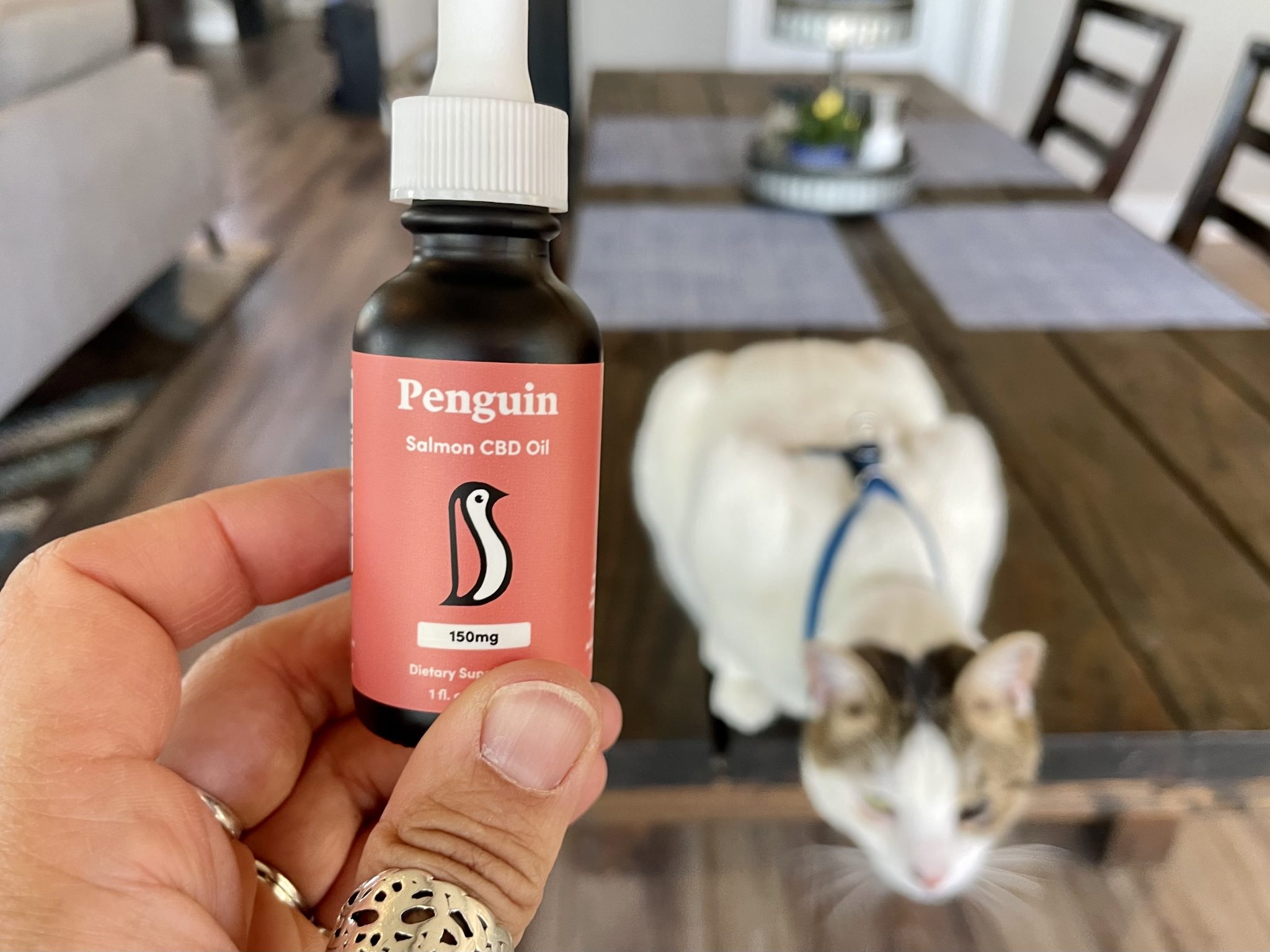
If you’re looking for a daily CBD supplement for your cat, the Salmon CBD Oil from Penguin is a great option. With broad-spectrum, THC-free hemp oil and 5mg of CBD per ml, this oil was made for the sensitive systems of cats.

Each bottle contains 150mg of CBD as well as healthy MCT oil, natural flavors, and added terpenes. Despite the name, this tincture does not contain salmon oil. Rather, the MCT carrier oil is enhanced with natural flavors to be more appealing to cats.

The broad-spectrum oil is refined to ensure no impurities or other potentially harmful compounds are present. This refining yields a fairly clear product with fewer flavonoids and terpenes than raw oil. To help make up for this without compromising the purity that makes it such a great option for cats, Penguin adds pure terpenes back to the final product.

This oil is a great option for older cats dealing with pain, sleep issues, or chronic anxiety. It might also be helpful for epilepsy and certain types of cancer.

The recommended dose is one dropperful daily, to be adjusted as needed to meet your cat’s needs.

Pros

  • 5mg CBD per ml
  • Broad spectrum hemp extract
  • THC-free
  • Added terpenes and MCT oil
  • Enticing salmon flavor

Cons

  • Measurement markers on pipette are difficult to see
  • Refined oil contains fewer beneficial compounds

2. CBD Cat Treats

Penguin CBD Products

If your cat only needs extra help chilling out on occasion, the CBD Cat Treats from Penguin are an excellent option.

These treats have a pleasing, chewy texture and salmon-chicken flavor that most cats love. This makes them super easy to administer, even in stressful situations.

Unlike most CBD cat treats you’ll find, these ones also have a fairly high concentration of CBD per treat, which means it takes fewer treats to get desirable results. Each soft chew—which is about the size of your typical cat treat—contains 3.3mg of CBD. This equates to a moderate dose for a 10-pound cat.

If your cat needs less, they are very easy to split in half.

The other thing I love about these treats is that they aren’t loaded with artificial or questionable ingredients. The flavors used are all natural and all the ingredients are recognizable. Some of them, like flax oil and brewer’s yeast, even come with their own health benefits.

In addition to CBD, these treats also contain valerian root. This natural herb stimulates production of GABA in the brain, which has a calming effect on the nervous system.

Pros

  • 3mg of CBD per treat
  • Soft and chewy
  • Appealing flavor
  • Contains natural ingredients
  • Added calming compounds

Cons

  • Take a little time to have an effect

divider 2 cats

Our Experience With Penguin CBD

Penguin CBD Products

I am lucky that my cat doesn’t deal with a lot of anxiety. He’s also young and fairly healthy without chronic issues. But what he does have is an excess of energy.

This is problematic on a daily (and nightly) basis. But I was worried it would be especially bad during his one-week boarding stay over the Fourth of July. I couldn’t imagine crazy Makoa locked up in a cage for seven days without losing his mind.

To help with this, I purchased both of Penguin’s CBD cat products. My hope was that by using the oil every day leading up to the boarding stay, I could help him chill out in general. And then I could bring the treats to be used as needed for those moments when being caged caused too much stress.

I started adding the oil to Makoa’s breakfast about two weeks before the boarding stay. He had no issues slurping it up along with the rest of his food. He also showed no digestive upset or other side effects after starting it.

After about a week, I noticed he was sleeping better overnight (and much of the afternoon) and was more affectionate in general. Other than that, he was just as happy as usual.

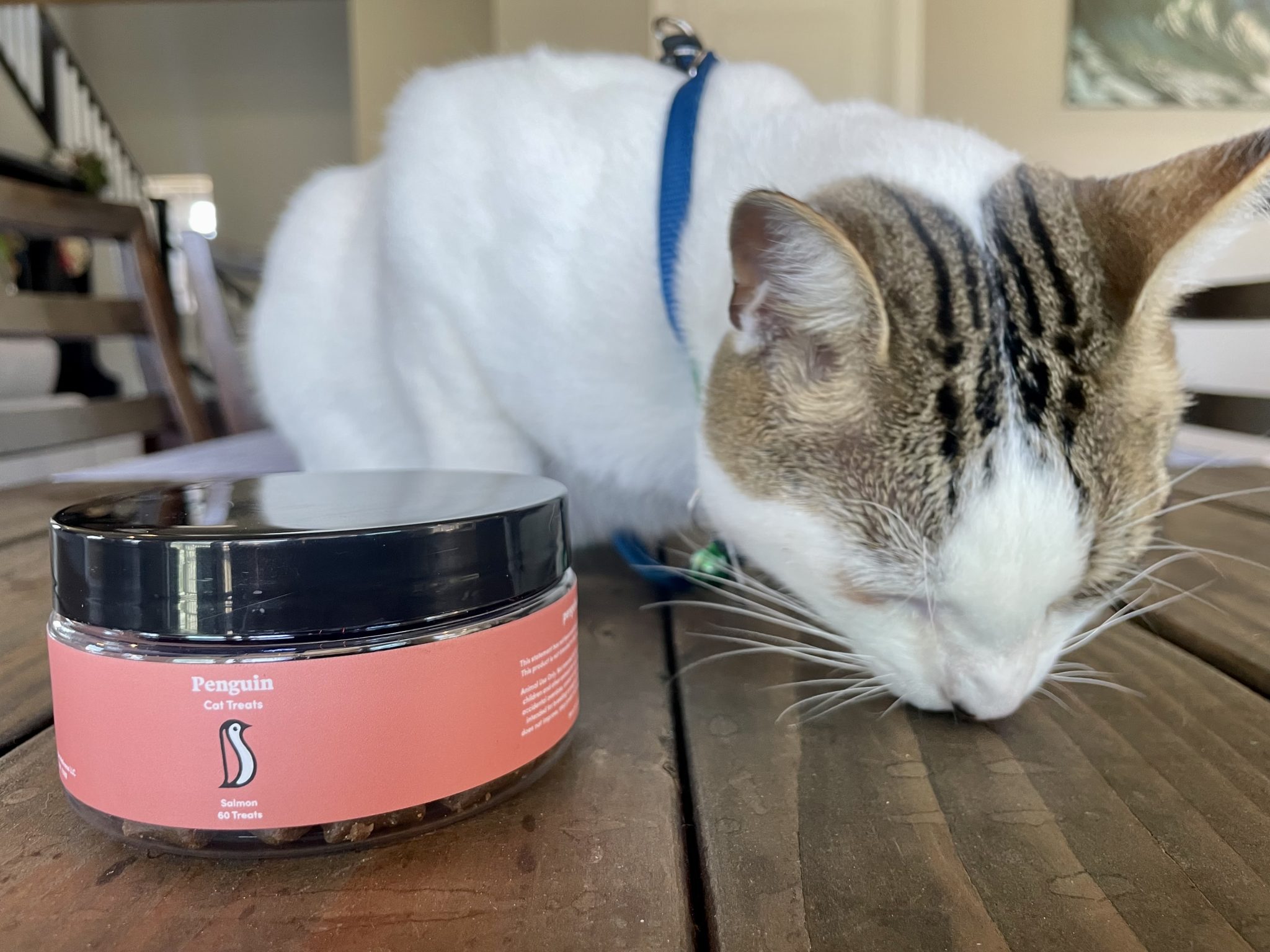
I also tested the treats out before his boarding stay by giving him one each night before bedtime. After the first night, he’d come running every time I grabbed the jar and would happily eat the treat and beg for more. The addition of the treats before bedtime did seem to help him stay calmer overnight (that is, he never woke me up these nights).

But the real test came when I dropped him off for boarding (I, of course, packed both CBD products with him). While his cage was well-sized, it was still a cage and Makoa is a cat who spends his days prowling around the yard and running zoomies up and down the stairs.

Because of this, I was shocked when the boarding techs referred to him as “affectionate” and “so sweet” the first time I checked in on him. This trend continued throughout his boarding stay. And when I picked him up, the workers only had the sweetest things to say about him.

Since bringing him back from the kennel, I have continued to use the oil in the mornings and give him one CBD treat before bedtime. The combination seems to really help him relax in between his energetic spells.

For my part, I love how easy both these products are to dose and that I can feel confident using them daily given the quality ingredients and cat-specific formulations.


divider 2 cats

Conclusion

If you’re looking for a safe and effective CBD product for your cat, I highly recommend checking out both of these products from Penguin.

The Cat CBD Treats are so easy to use and perfect for those moments when kitty anxiety gets the better of our furry friends. The chewy texture and quality ingredients are hard for any cat to deny and make them easy to dose.

The Salmon CBD Oil is a great option for cats who need daily CBD to help treat chronic pain, anxiety, and more. With 5mg of CBD per dropper and added salmon flavor, this is another Penguin product that most cats and owners will love.


Blue Persian Cat Breed: Info, Pictures, Care & Facts

No Comments

The Blue Persian is a gorgeous feline. Like all Persian Cats, the Blue is a medium-sized cat with a large face and a beautiful flowing coat. They are affectionate and calm, but their coat requires extra care. Persian cats are believed to be thousands of years old, originated from Persia, and were some of the first cats to be shown. They were featured in the London cat show of 1871.

Breed Overview

Suitable for:

Loving owners with quiet homes and warm laps

Temperament:

Loyal, affectionate, playful, chatty, gentle

Persian cats come in various colors, but white, black, and blue are among the most commonly seen. The Blue Persian is a gray color, which can vary from light gray to dark slate gray. Other than the color, they share the same physical characteristics as other Persians, so they have a long, luscious coat, as well as a somewhat squashed face.
Since they’re sensitive to loud noises, the Blue Persian may not be the best companion for families with young children or other pets.

Blue Persian Cat Breed Characteristics

Blue Persian cat is lying on the sofa
Image Credit: VeronikaSmirnaya, Shutterstock

Energy

+

A high-energy cat needs a lot of physical and mental stimulation to keep healthy and happy, while a low-energy cat needs minimal physical activity, but still needs mental stimulation. When choosing a cat, It’s important to ensure their energy levels match your lifestyle.

Trainability

+

Cats that are easy-to-train are more willing and skilled at quickly learning prompts and actions with minimal training. Harder-to-train cats are usually more stubborn or aloof and require a bit more patience and practice.

Health

+

Certain cat breeds are more prone to various genetic health problems, and some more than others. This doesn’t mean that every cat in those breeds will have these issues, but they do have an increased risk, so it’s important to understand and prepare for any additional needs they may require.

Lifespan

+

Due to their size or potential genetic health issues of a specific breed, some cats have shorter lifespans than others. Proper nutrition, exercise, mental stimulation, and hygiene also play an important role in your cat’s lifespan and quality of life.

Sociability

+

Some cat breeds are more social than others, both towards humans and other cats and animals. Cats that are more social have a tendency to rub up on strangers for scratches or jump on laps for cuddles, while cats that are less social shy away, hide, are more cautious, and even potentially aggressive. No matter the breed or gender, it’s important to socialize your cat and expose them to many different situations.

The Earliest Records of Blue Persian Cats in History

Although their origin is somewhat disputed, the Persian Cat is an ancient breed. There is evidence of hieroglyphs depicting long-haired cats with a strong resemblance to the breed, suggesting their early ancestors could be thousands of years old.

Early written records from the 16th Century specifically mention the Persian Cat, and what would become the modern Persian Cat was shown at the first-ever cat show in London in 1871.

How The Blue Persian Cat Gained Popularity

After appearing at the London cat show, the Persian became very popular with cat lovers in the UK. Queen Victoria was known to be a fan and kept several Persians throughout her life. This popularity with royalty also saw the breed become increasingly popular with the upper classes and helped them become beloved in other European countries.

By the late 19th Century, Persians had made their way to the U.S., where owners became equally enamored with the breed. Due to their appealing personality and adaptability, they became beloved pet cats.

blue persian kitten on hands
Image Credit: Igor Leonov, Shutterstock

Formal Recognition of Blue Persian Cats

The Persian’s appearance at the first-ever cat show, Queen Victoria’s love of the breed, and their rising popularity with the upper classes meant that the Persian was not only recognized by formal cat fanciers’ associations but was one of the foundation breeds of the Cat Fanciers’ Association in 1906.

Since then, most associations worldwide have recognized them, and a range of colors has been accepted as standard. Along with white and black, blue is one of the more common and easily located colors. The breed’s longevity and popularity have seen it become one of the most widely pedigreed cats in the world and the U.S.


divider 1 paws

Top 5 Unique Facts About Blue Persian Cats

1. They Didn’t Always Have a Flat Face

One of the most recognizable traits of Persians is their flat faces. However, the breed hasn’t always had this distinctive feature. In the 1950s, a cat was born with a genetic condition that caused a flat face. Breeders took to this feature and bred it into the Persian line. Today, it is considered part of the breed standard.


2. They Are High-Maintenance Cats

The Persian cat requires extensive grooming to stay healthy. Owners need to brush them daily and wipe tears away from their eyes using wipes. Brushing will prevent the coat from becoming matted and uncomfortable.

Blue Persian cat lying on the floor
Image Credit: Oneone, Shutterstock

3. They Make Great Lap Cats

The Persian is known for being loyal and loving, as well as for being sweet and gentle-natured. They love being in warm areas, which is why they make great lap cats. Owners can expect their Blue Persian to curl up on their lap whenever they sit to watch TV.


4. Persians Are Not Great for Young Children

Although they’re affectionate to humans, they don’t like loud noises or too much activity. This means the Persian is not the best choice for families with young children. They can also struggle in houses with other pets, especially if they are dogs that want to play and chase the cat.


5. They’re Not the Most Athletic Cats

Stocky bodies and somewhat short legs mean that the Persian isn’t great at making the big jumps that cats are renowned for. They certainly don’t struggle to jump up on their owners’ laps, but they are unlikely to be found on top of counters or shelves.

Blue Persian cat
Image Credit: Nature lapse, Shutterstock

divider 2 catsDoes The Blue Persian Cat Make a Good Pet?

The Blue Persian can make an excellent pet for the right owner. They are loyal, loving, and gentle. They adore humans and enjoy curling up on their laps. However, they’re not tolerant of loud noises, energetic pets, or wild children.
They are also better kept indoors rather than outdoors, especially in cold climates, and their beautiful long coats require quite a lot of care and maintenance. As long as you have a quiet home and the time to dedicate to regular grooming, the Blue Persian makes an excellent pet.

divider 1 paws
Conclusion

The Blue Persian is one of more than a dozen available Persian Cat colors. The gray color can range from light to much darker, but regardless of hue, the breed is recognized for their beautiful coat, large eyes, and flat face.

Persians are ancient felines and one of the foundation breeds of the Cat Fanciers’ Association. They became popular first in the UK, then the rest of Europe, and finally in the U.S. If you have the time to groom them and prefer calm felines, they make excellent pets and companions.


Featured Image Credit: Nature lapse, Shutterstock

Having a (Not So) Blast on the Fourth of July: Dr. Lauren’s Tips

No Comments

The information is current and up-to-date in accordance with the latest veterinarian research.

Learn more »

Hi, I’m Dr. Lauren! Read my introduction to learn more about me and my two adventurous cats, Pancake and Tiller.

When the 4th of July holiday rolls around, it’s a good time to remember that not all of us enjoy these celebrations that include loud noises and aerial explosions. In recent years, as various municipalities attempt to schedule 4th of July celebrations on appropriate weekend evenings, it is more common that fireworks now span two, three or even four weeks. Which means what was once one day of unexpected fireworks, now becomes many.

Therefore, it’s important to remember that our cats are not immune to the effects of fireworks, and what you can do as a cat owner to help your furry family.

Pancake will sleep through pretty much anything. In fact, I’m pretty sure she once slept through a local power transformer that exploded, sounding a bit like a bomb had gone off in the backyard. Tiller, on the other hand, runs off the second anything seems amiss.

For instance, we bought a new tennis racket the other day, and Tiller still won’t go near the closet where it is kept. Why? I have absolutely no idea. And if you get the racket out of the closet, you won’t see her for at least an hour. She’s been with me pretty much since the day she was found under a bush with a bad eye, she’s never had any run-ins with tennis or rackets or any other odd inanimate objects, but there you go. And fireworks are even worse- one bang, and she’s hiding for the rest of the night.

Pancake under the blankets
Pancake doesn’t hide as much as Tiller does, but she can still sometimes be found under the blankets.

Cat Safety Tips for the Fourth of July

So, what steps can you take to help keep your cats safe on the 4th? There are a number of easy options:

  • Keep cats indoors during times of fireworks or other outdoor activities.
  • Ensure your cat is microchipped, and that the information is up to date
  • Consider using feline pheromone diffusers that can help enforce calm and reassurance in a cat’s environment. Try to plug the diffusers in for a few days prior to the festivities, for best effect
  • Close windows and doors, if possible, to help block outside noise. If they are left open, ensure screens are in place, to prevent your cat from accidentally escaping
  • Play white noise, or similar masking sounds, to help diminish background noise
  • If your cat is extra nervous, speak with your vet and see if any medical therapies might be useful, such as a medication to calm or sedate your cat for a few hours around the festivities
  • Give your cat a space to feel secure in the house- maybe a nice box with some blankets and toys, or their bed placed into a closet where they might want to hide. Also shut off access to parts of the house they don’t use, so that you can monitor their whereabouts, occasionally, and won’t have to tear apart the house to find them
  • If there are specific things that give your cat comfort- a stuffed toy, a certain shirt from their favorite human, a blanket fort in the laundry closet that you’re always trying to keep them out of, try to find a way to provide that little bit extra on these stressful days

As we recognize more and more the impact that celebrations such as the 4th of July can have on native animals, as well as our own beloved pets, hopefully the future will still be bright but also a little bit less noisy! In the meantime, some simple steps above can help to keep things a bit calmer for our feline friends.

How to Get Rid of Cat Spray Smell: 6 Tips & Home Remedies

No Comments

Cat spray smell is a common problem for many pet owners, as our feline friends can develop a bad habit of urinating outside the box when they’re sick, stressed, or threatened. After all, misery loves company, and the extra-pungent odor is a surefire way to ensure everyone in the home is equally uncomfortable.

Since it’s more persistent than most everyday odors, cat spray is impossible to tolerate and extra challenging to eliminate. If the smell makes you feel unwelcome in your own house, we’ll provide six tips and home remedies to get rid of the smell quickly, easily, and effectively.

How to Get Rid of Cat Spray Smell

1. Search for Spray with a Blacklight

The first step in eliminating cat spray odors is finding the sprayed areas. Cats will re-spray in places bearing their urine smell, so if you don’t remove it, you’ll have a recurring cleaning job to manage.

Cats often spray around doors or windows if there’s an outdoor stressor or on new items that bring unfamiliar smells into the home. After localizing the odor to a particular room, use a blacklight to pinpoint the spray. The phosphorus in dried urine causes it to glow neon yellow or green under UV light.

Darken the room and sweep the light over the floors, walls, and baseboard to reveal spray patterns. Cats are sneaky, and you may have to check behind furniture, in closets, or among piles of clothes. When you find the spray, mark the perimeter to outline where to clean.

urine spot on the carpet as seen using UV light
Image Credit: In The Light Photography, Shutterstock

2. Use an Enzyme Cleaner on the Spray Marks

Enzyme cleaners are the most effective solutions to remove cat spray smells. While many cleaners only mask the scent, enzymatic formulas have active enzymes that target and break down odor-causing compounds. The smell goes away for good, and your cat won’t pick up the scent to drive them to re-spray.

Enzyme cleaners like Hepper’s Advanced Bio-Enzyme Pet Stain & Odor Eliminator Sprays are easy to use, non-toxic, and biodegradable. Shake the bottle and saturate the spot. The smell will gradually dissipate after you let the cleaner sit for at least 10–15 minutes. Severe stains may require multiple applications to remove all the urine.


3. Sprinkle Baking Soda on the Stain

Baking soda won’t completely clean pee stains, but it’s one of the simplest home remedies for removing cat spray smells. The powder absorbs odors and moisture, making it a handy solution for soaking up fresh urine and keeping old stains from stinking.

After blotting the spray stain with paper towels to soak up as much urine as possible, sprinkle baking soda on the spot. Let it sit for 30 minutes or until the area is dry. Once the area is odor-free, suck up the baking soda with a wet-dry vac with a HEPA filter, as the fine powder can potentially damage a standard carpet vacuum.

baking soda on wooden table
Image Credit: New Africa, Shutterstock

4. Air Out the House

The fastest solution for quick relief from cat spray is simply opening the windows. While it won’t have a lasting impact, airing out the house with a cross-breeze will make it much more tolerable while you find a more permanent solution. After opening the windows, turn on the fans to move the air and push the cat urine smell out of the house.


5. Spray With Vinegar and Water

Vinegar is a versatile kitchen staple that can make a marked difference in a hurry for urine on walls, hard floors, and the carpet.

First, blot the stain with a paper towel to remove as much cat urine as possible. In a spray bottle, mix one part distilled white vinegar with one part water. Shake the bottle and saturate the spray mark. Let it sit for a few minutes, blot with a paper towel, and allow it to air dry.

Spray bottle filled with pure water and vinegar
Image Credit: Ana Portal, Shutterstock

6. Set Up a Spray Station

Sometimes, you can reduce spraying but not eliminate it. If your cat won’t stop spraying, you can make life less frustrating by setting up an easy-to-clean spray station. With this arrangement, your cat will spray into a litter box covering their normal spraying area.

Using two litter boxes, nest one inside the other at a 90-degree angle to create an L shape. Fill the bottom section with litter, and set the vertical section against the wall where your cat sprays. As your cat gets used to using the station, you can often move it to a more out-of-the-way location. Though it won’t fix the issue, a spray station will make cleanup easier.

divider 1 paws

Stop the Smell at the Source: How to Get Your Cat to Stop Spraying

Even with the most powerful cleaning solutions, you can’t expect to get rid of the cat spray smell for long if you don’t root out the reason for your pet’s behavior.

Common causes of spraying include:

  • Physical issues, such as hormonal disorders or kidney disease
  • Stressful stimuli, including resident or neighborhood cats
  • Changes in routines or new additions to the family
  • Poor litter box management

Intact cats are more likely to spray because they use it to advertise for mates. Spaying and neutering can help reduce the problem, as it removes much, if not all, of the sex drive that motivates cats to mark. Yet, spraying can persist even in desexed cats if they feel stressed enough.

cat standing next to the refrigerator
Image Credit: Evgeny Haritonov, Shutterstock

divider 3 paws

How to Keep Your Cat from Spraying

Keep the Litter Box Clean

Scoop the waste daily and change the litter weekly to keep the litter box clean and appealing to your cat. Make sure litter boxes are easily accessible and that there are enough to accommodate every cat in the house. Ideally, you should have one litter box for each cat plus an extra, all positioned in convenient, secure places.

You can also try a different litter, such as switching from clumping to clay or paper litter, as some cats prefer certain materials. If the box is the right size, accessible, and clean, and the litter is comfortable, your cat should have no reason to avoid it.

Manage Outdoor Stimuli

Block other animals from accessing your home and property if they bother your cat. You can also close the blinds or remove access to certain rooms to prevent your cat from noticing outdoor stressors and supervise your cat’s outdoor time to keep them safe.

Maintain the Environment

New additions to the family or changes in the environment can upset the home’s look, smell, and sounds, often making cats feel uncertain and insecure. Changes should occur slowly to prevent spraying, and you should explore ways to minimize their effect on your cat.

For example, items that might upset your home’s scent profile, such as strollers or sweaty running shoes, can stay in the garage. If you’re changing furniture or remodeling, you can do it bit by bit to maintain familiar areas. You can also give your cat a safe spot where they can retreat. You may have to wait to make significant changes until you fix the spraying behavior.

siberian cat sitting on the jute wicker rug
Image Credit: evrymmnt, Shutterstock

Provide Attention, Enrichment, and a Routine

Enhancing your relationship with your cat and providing more enrichment can make them feel content and secure, hopefully leading to less spraying. Supply a rotation of toys and devices like cat trees, scratching posts, and shelves. Strategically placed items will give your cat ways to stay active and places to retreat if they feel stressed.

Maintain a consistent routine with your cat. Grooming, feeding, and playtime should occur at scheduled times so your cat can find comfort in the predictability. Give them as much interaction as possible to fortify your bond, using rewards and avoiding punishment to minimize their stress.

Using treats, toys, attention, and other rewards to make positive associations with changes to the home can also put your cat at ease. When you take an upbeat approach and give your cat the care they deserve, family additions like pets or babies become less threatening and less likely to ignite new spraying behavior.

Talk to Your Vet

Talking with your vet is wise if you don’t know why your cat is spraying or if they show other signs, such as behavior changes, weight fluctuations, or illness. Your vet can perform various tests and assess environmental factors contributing to spraying. Then, they’ll offer insights, advice, and treatment, which may include medications.

divider 1 paws

Final Thoughts

Cat spray is rarely an issue you can put off until later. Urine odors fill the house fast and only become trickier to remove the longer you let them sit, and your cat will be tempted to keep spraying as the scent persists. Enzyme cleaners are the best way to make odors disappear long-term, but when the smell becomes more than you can bear, following these easy tips and home remedies will give you the immediate relief you need to reclaim your space.


Featured Image Credit: Sorapop Udomsri, Shutterstock

Polydactyl Maine Coon Cat Breed: Info, Pictures, Care & Facts

No Comments

The Maine Coon already gets your attention without even looking at the cat’s feet and their polydactyly or extra toes. This trait can add extra digits to their paws. Polydactyl felines in general have an aura about them, no doubt, because of their association with author Ernest Hemingway. The Ernest Hemingway Home and Museum houses an estimated 60 cats, although they’re not Maine Coons. However, this breed specifically is known for carrying the polydactyl trait. Let’s learn more about these unique felines with extra digits.

Breed Overview

Colors:

All colors and patterns except pointed

Suitable for:

Active families looking for an outgoing cat with dog-like qualities

Temperament:

Playful, intelligent, hardy, friendly

The Maine Coon is an all-American cat breed, with their origin being right in the breed name. The state of Maine even has made them their state cat. It’s fitting, given the feline’s hardiness and muscular bodies. They can handle whatever the Maine climate sends them. It’s not just about the kitty’s large size. Their coat is weather-resistant, which gives them an edge during the harsh winters.

The Maine Coon is almost dog-like in their behavior. It’s one thing that attracts enthusiasts to the breed. Legends exist regarding the cat and their origins. The stories seem to match the large size of the feline. Most interestingly, their polydactyly is symbolic of the breed’s acceptance in cat registries and adds another interesting layer to the pet’s story.

Polydactyl Maine Coon Characteristics

Young polydactyl tortie Maine Coon cat kitten
Image Credit: Nynke van Holten, Shutterstock

Energy

+

A high-energy cat needs a lot of physical and mental stimulation to keep healthy and happy, while a low-energy cat needs minimal physical activity, but still needs mental stimulation. When choosing a cat, It’s important to ensure their energy levels match your lifestyle.

Trainability

+

Cats that are easy-to-train are more willing and skilled at quickly learning prompts and actions with minimal training. Harder-to-train cats are usually more stubborn or aloof and require a bit more patience and practice.

Health

+

Certain cat breeds are more prone to various genetic health problems, and some more than others. This doesn’t mean that every cat in those breeds will have these issues, but they do have an increased risk, so it’s important to understand and prepare for any additional needs they may require.

Lifespan

+

Due to their size or potential genetic health issues of a specific breed, some cats have shorter lifespans than others. Proper nutrition, exercise, mental stimulation, and hygiene also play an important role in your cat’s lifespan and quality of life.

Sociability

+

Some cat breeds are more social than others, both towards humans and other cats and animals. Cats that are more social have a tendency to rub up on strangers for scratches or jump on laps for cuddles, while cats that are less social shy away, hide, are more cautious, and even potentially aggressive. No matter the breed or gender, it’s important to socialize your cat and expose them to many different situations.

divider 2 cats

The Earliest Records of the Polydactyl Maine Coon in History

We know that the Maine Coon is one of the oldest breeds in North America. That probably explains its fascination among enthusiasts. The precise origins of polydactyly are unclear, but it begins with the cat. Some tales link the breed with the Vikings. Others credit Marie Antoinette with the feline’s origin. The truth is probably less romantic, involving seafarers traveling to the New World with their cats.

The Maine Coon’s story probably follows a similar path as early feline domestication in the Fertile Crescent roughly 12,000 years ago. Cats proved themselves useful as pest control on ships. Hardiness was another desirable trait under these challenging conditions. However, their known history goes back to the 19th century.

How the Polydactyl Maine Coon Gained Popularity

Pest control undoubtedly helped propel the feline’s popularity. Their hardiness and adaptability to the harsh climate were points in their favor. Their size and dog-like manners also endeared them to fans of this breed. This job nurtured the intelligence and temperament of the breed. Animals assigned to perform pest control have an independent streak, which is helpful for this job.

However, the polydactyl Maine Coon is also a friendly cat. This animal doesn’t hide when things are happening in the household. They want to know what’s going on in most cases. They are very people-oriented, which endeared them to cat lovers. It also helps that they get along with other household members, whether kids or dogs. They’re relatively tolerant and easygoing overall.

Polydactyl Maine Coon Cat
Image Credit: Kutikova Ekaterina, Shutterstock

Formal Recognition of the Polydactyl Maine Coon

The Cat Fanciers’ Association (CFA) recognized the Maine Coon in 1976. The International Cat Association (TICA) followed in 1979. The polydactyl Maine Coon received its separate designation from the TICA in 2015. It’s worth noting, however, that the CFA considers this trait worth withholding the animal from the show ring.

divider 1 paws

Top 4 Unique Facts About the Polydactyl Maine Coon

1. Polydactyly Is a Dominant Trait

Only one parent has to contribute a copy or allele of this trait for it to present visually, making it a dominant trait.


2. No Preference for the Degree of Polydactyly Exists With the TICA Breed Standard

TICA seems to reward the polydactyly trait no matter how it appears in Maine Coon cats. The importance lies in its presence in the felines. On the other hand, the CFA doesn’t view it with merit.

Portrait of Playful Red Maine Coon Cat catching toy his polydactyl paws
Image Credit: Seregraff, Shutterstock

3. The Polydactyl Maine Coon Is a Late Bloomer

Like big dogs, the Maine Coon is slow to mature, reaching their full size at 3 to 4 years. Keep this fact in mind when getting a kitten. The parents should be at least this age before breeding. A reputable seller will ensure this is the case. We suggest asking about the adults’ history to ensure you get a healthy pet.


4. The Polydactyl Maine Coon Isn’t the Only Animal With Extra Toes

Scientists have identified this trait in a few dog breeds, including the Great Pyrenees, Yorkshire Terrier, and Shetland Sheepdog.

divider 2 cats

Does the Polydactyl Maine Coon Make a Good Pet?

There’s a lot to be said for a hardy cat that is tolerant of many things. That describes the polydactyl Maine Coon, extra toes aside. They are hardy and relatively healthy. They are playful and agreeable with most pets and people, including kids. They are intelligent but need enrichment. That’s true of any animal to prevent boredom, though, as a bored pet is a destructive one.

The polydactyl Maine Coon loves people, so they thrive best with pet owners who interact with their cats often. These felines need this attention. They are good pets if they get the love and mental stimulation they need. You should groom your pet regularly, checking their ears and trimming their nails to keep them used to this handling.

The polydactyl Maine Coon loves attention, but they aren’t cuddlers. They like to observe and interact on their own terms. Nevertheless, these cats are sweethearts if you want a pet that stays involved with the household.

Health concerns with the Maine Coon are minimal, and the effects of being polydactyl are minimal. The cats adapt to their differences without any problems.

divider 1 paws

Conclusion

People often describe the polydactyl Maine Coon as a gentle giant because of the animal’s relatively large size compared to other cats. They have big mitts to match their large bodies. While the CFA doesn’t recognize this variation, the TICA embraces them with their own designation. Many find this trait endearing and unique. Nonetheless, this cat couldn’t be friendlier or more playful.


Featured Image Credit: Kutikova Ekaterina, Shutterstock

Why Does My Cat Put His Paw on My Mouth? 6 Possible Reasons

No Comments

When your cat is interacting with you—things are going to get weird from time to time. Whether they are taking their time getting really up close to sniff you or they are invading your space by bunting and rolling all over your body, they aren’t much for personal space.

So, if you have noticed that every time you get close to your cat, they stick their little murder mitten on your mouth, you might wonder what gives. Why do these critters constantly behave in the weirdest of ways? We may have an answer for you.

The 6 Possible Reasons Why Your Cat Puts Their Paw on Your Mouth

1. Affection

One of the most obvious reasons your cat might be putting their paw on your face is to show you affection. Our cats don’t know a lot about personal space, and some of them will invade you and get as close to your body as humanly possible.

When they do, they might place their paws on your face, mouth, chest, or anywhere else they feel like getting closer to you. You use your mouth to speak to them as well, so it might even be a little paw of acknowledgment.

Cat pushing away owner clawing
Image Credit: ChocoPie, Shutterstock

2. Attention

If you aren’t giving your cat enough attention, they might put their paw where your mouth is! After all, maybe you need to be quiet and listen to their request.

Whether they have an empty food bowl or they just want to cuddle up and take a nap, it might be a way for them to really put all the attention on themselves. After all, you weren’t listening otherwise!


3. Communication

Our cats try to communicate with us in a variety of ways. Although body language is the number one way a cat communicates, they also use a series of vocalizations and actions to deliver messages to us.

If a cat is putting a paw on your mouth, they might simply be trying to tell you something. Be sure to pay attention to other bodily cues and see if you can figure out the underlying message. Haven’t you always wanted to decode cat language?

Cat Paw in Owners Mouth
Image Credit: Nataliabiruk, Shutterstock

4. Playfulness

Your cat might be feeling a little frisky. They might crawl up on you and put their paw on your mouth as a way to entice you to play. If so, you might notice other body language, like their tail whipping, eyes dilating, or their body tensing.

It might be time to grab the feather teaser to give them a romp around the house so they can burn some energy.


5. Trust

If your cat puts their paw on your mouth, this is obviously a very intimate action. Then being that close to you really demonstrates how much they trust you.

After all, they wouldn’t climb on top of a stranger and get up in their face, unless you have a particularly social and needy feline. So, you may conclude that they simply adore you and trust you with their entire being. Aren’t you lucky?

male owner holding his devon rex cat
Image Credit: Veera, Shutterstock

6. Comfort

Your cat might be nestling up your chest, pawing you in the mouth. This might be a general sign of comfort, especially if it’s accompanied by other actions like purring.divider 2 cats

Why Should You Not Let Paws on Your Mouth?

Even though a cat putting its paw on your mouth is a super adorable action, they probably really shouldn’t be doing that.

Realistically, your mouth is an entryway to your internal organs, so it can transmit all kinds of bacteria, fungi, viruses, and other undesirable things into your digestive system.

Our cats are pretty clean most of the time. But in reality, they track bacteria through their litter boxes, often coming in contact with their own urine and feces. This can be very problematic and not the most sanitary things to have on your face.

After all, you wouldn’t want your cat walking on your food plate, so you probably wouldn’t want them putting their little tiny toe beans on your face.

Chinchilla Persian Cat licking its paw
Image Credit: catinsyrup, Shutterstock

Germ Transmission

Realistically, even though most viruses and illnesses that a cat can get can only be transmitted from the same species, there are zoonotic diseases. So, if your cat is putting their paw on your mouth and they came in contact with their urine or feces, they can transmit a number of things to you, including:

Salmonella

Salmonella is a bacterium that causes extreme gastrointestinal distress and humans. It can range from mild to severe and you often pick it up on surfaces or ingest it through the food you eat. If your cat’s waste or anything that they have walked on has a salmonella bacterium, they can easily transmit it to you by putting their paw on your mouth.

Coli

Coli, like salmonella, is a bacterium that can upset the gastrointestinal tract. It can be transmitted from urine, feces, and other surfaces.

Parasites

The last thing we want to think about is getting parasites from our pets. However, if you don’t keep up with routine deworming and other parasite prevention, we can come in contact with some pretty nasty things.

If your cat is putting their paws on your mouth, tiny eggs can transmit into your system and actually cause an infection for you. To prevent this entirely, it is very important to keep up with routine parasite prevention.

Even if you do, it’s always best to err on the side of caution and prevent your pet from touching your face.

Close up to a ginger cat paws and claws scratching carpet
Image Credit: Maliflower73, Shutterstock

divider 2 catsConclusion

Sometimes, cats can just be weird creatures and there’s not really any rhyme or reason to the things that they do. However, you know your cat better than anybody so you likely can get a pretty good idea based on body language alone.

Remember, even though it’s very cute for your cat to gently place their paw on your mouth, it can cause a ton of different issues in the long run. It is extremely easy for your cat to transmit germs, bacteria, and other problematic issues to you through your mouth.

In any case, to each their own, we just think it’s important for you to know the risks!


Featured Image Credit: Nataliabiruk, Shutterstock

Antifreeze Poisoning in Cats: Keeping Olga Safe From Toxic Chemicals

No Comments

Hi, I’m Christopher! Read my introduction to learn more about me and my silly Russian Blue cat, Olga.

Antifreeze and other chemicals containing ethylene glycol, such as hydraulic fluid, de-icing products, motor oil, paints, solvents, and wood stains, are toxic to cats and other animals. A small spoonful of antifreeze can kill a cat, and most felines don’t survive unless they’re treated within 6 hours.

Antifreeze Poisoning

The initial signs of antifreeze poisoning include vomiting, lethargy, incoordination, excessive urination, hypothermia, excessive thirst, and seizures. Unfortunately, the cat’s condition seems to improve after 12 hours, which can cause an owner to think they have recovered.

They can become dehydrated and breathe faster, but kidney damage, comas, and death are more likely after 12 hours.

Keeping Olga Safe

I don’t let Olga outside or allow her to explore my garage, where most of my toxic chemicals are stored, so she is less likely to be exposed to ethylene glycol than an outdoor cat. However, I’m always careful about where I store household cleaners and other hazardous products.

Olga can open doors and cabinets, and I don’t keep anything toxic in the bathrooms since she likes to open the cabinets occasionally. Although cats dislike sweet food, they’re attracted to antifreeze’s aroma.

They can get sick from licking their paws after walking through an antifreeze spill in the garage or sipping from a container with ethylene glycol. It’s difficult to understand why someone would intentionally poison a cat, but it happens more often than you think.

When I sit next to the fridge, it means I’m hungry!

Punishing a Cat Murderer

Several years ago, I was visiting a friend when I heard people screaming outside. When we went outside to investigate, we learned that one of the neighbors had left a tray of antifreeze outside to kill a stray cat.

Some of the apartment’s residents had become attached to the cat and frequently fed him, and they wanted to murder, or at least mortally wound, the man who had killed him. They pounded on the murderer’s door and yelled, but he was either in class or hiding inside.

He was never injured or killed by the angry mob, but one of the cat lovers contacted the local university’s editor-in-chief. The cat killer was a journalist until he murdered the cat, and I’m glad the editor decided that unethical employees don’t make the best writers. I understand that stray cats annoy people and kill wildlife, but several humane deterrents can keep them away.

That bug doesn't stand a chance.
That bug doesn’t stand a chance.

Animal Cruelty Laws

In the United States, killing a cat is a felony and can result in fines of up to $5,000 or 2 years in prison. Each state imposes different penalties, but some legislatures are trying to establish an animal cruelty registry that is modeled after sex offender lists.

Increasing the fines and prison terms for offenders may decrease the number of antifreeze deaths, but they won’t convince me to allow Olga to explore the outdoors. I’m paranoid enough about dropping a chunk of onion or garlic on the floor when I’m making dinner, and I don’t want to worry about another person injuring or killing my cat.

Keeping your cat indoors may seem selfish since they cannot explore the environment and hunt small animals, but it protects them from poisons, parasites, automobiles, and cruel humans.

My Cats Are Addicts…And I Am Their Dealer

No Comments

The information is current and up-to-date in accordance with the latest veterinarian research.

Learn more »

Hi, I’m Dr. Karyn! Read my introduction to learn more about me and meet my five hilarious cats: Clutch, Cyril, Alex, Zelda, and Zazzles.

With five cats ruling my house, I have very little doubt about my role. Timely provision of food, water, and entertainment is expected, but there are times that I feel a little bit like their dealer, with catnip being their drug of choice.

Statistically, only around 60% of cats respond to the intoxicating effects of catnip, and that figure is reflected in my household, with Alex, Cyril, and Zelda being both attracted to and affected by catnip; Clutch and Zazzles have no interest in the stuff. Zelda, in particular, will start meowing aggressively if it’s been several days since her last ‘fix’, and the sound of opening the catnip tub is met with equal, if not greater, enthusiasm than the sound of the food container.

Recently, I was tasked with making some homemade cat toys, and the catnip crew were only too happy to help test them out.

But as I watch the wide-eyed antics of my intoxicated felines, I can’t help wondering – am I enabling an addiction?

Nothing to see here...
Nothing to see here…

The Ins and Outs of Catnip

Catnip, also known by its scientific name, Nepeta cataria, is a member of the mint family. These plants produce the chemical nepetalactone which repels insects, but appeals to many of the feline persuasion. This chemical works its way into your cat’s pleasure center by way of a particularly sensitive olfactory organ located in the roof of their mouth, called the vomeronasal organ (VMO for short). If you’ve ever noticed your cat pulling a comical grimace when they are sniffing something, this is called the Flehmen response – or as we used to call it in my house, “stinky face” – whereby they draw scents and pheromones into the VMO. From here, your cat can glean an absolute mass of information about the world around them.

One of the more important pieces of information processed by the VMO is to do with sex, like the presence of competition or the receptiveness of females. So the messages reaching your cat’s brain appear to be similar to arousal, which certainly explains the blissful response! It’s just a shame that only 60% of the cat population gets to enjoy it.

Cyril is really feeling those catnip vibes.

Can Cats OD on Catnip?

The catnip plant is not toxic to cats, but if they ingest a huge amount they may develop some unpleasant gastrointestinal side effects. I’ve never seen this in my cats.

I usually bulk buy my catnip in a 1-ounce tub, which might not sound like much, but is the equivalent of 3-4 herb jars, and it usually lasts for several months…unless the cats manage to break into the container.

Thus far, the only downside my cats have experienced to this treat is some occasional eye irritation, a consequence of rubbing their face too aggressively against the carpet!

No more catnip?
No more catnip?

Am I Enabling Addicts?

I don’t think so. Although their ears prick up when I open the drawer containing this intoxicating treat, and the opening of the tub brings 60% of my cats to swarm excitedly around my feet, they do not spend the rest of their time looking for more, in a desperate search for their next ‘fix’. Although Zelda does get a tad demanding if she feels it’s been too long since her last dose, she is not completely consumed by her need for the ‘nip.

And if I can provide some extra amusement and enrichment in their lives, I’m absolutely going to do it. I just wish there was a way for Clutch and Zazzles to experience the same bliss I see in Zelda, Alex, and Cyril’s glassy, dilated pupils!

Dr Karyn signature

Truly Free Cleaning Products Review 2024: A Detailed Look

No Comments

Our Final Verdict

We give Truly Free cleaning products an overall rating of 4.8 out of 5 stars.

Variety: 5/5

Efficacy: 4.5/5

Ingredients: 5/5

Packaging: 4.5/5

Value: 5/5

Our pets often make messes which require more than water to clean. But most cleaning products contain chemicals that leave harmful toxins around our households. Humans and animals alike can experience acute reactions to these toxins, but more serious health issues can arise with long-term exposure. Babies and household pets often prove much less resilient to toxin exposure, and as their trusted caregivers, it is our responsibility to provide them with the cleanest, safest environment possible. This is exactly the reason Truly Free was created.

Truly Free CEO Stephen Ezell was horrified when his 3-week-old newborn developed a horrendous skin rash. After consulting with the pediatrician and being offered only powerful medications to combat the symptoms, Ezell began to consider that it might be a reaction to something in his baby’s environment. He started to look at the chemicals being used in his household, namely their laundry detergent. His family experimented by making their own laundry soap, and miraculously, the rash vanished. This experience opened Ezell’s eyes to the invisible toxins in our homes, and ultimately led him to develop a line of non-toxic cleaning products that are safer for us, our pets, and the environment.

At a Glance: What We Received

divider 3 paws

About Truly Free

trulyfree Cleaning Products

Who Makes Truly Free and Where is it Produced?

The origins of this Michigan-based company can be traced back to 1982 when laundromat employee Ruth Smith began making her own hypoallergenic laundry wash to protect her family’s skin. After 25 years of using it in her own home, Smith decided to market her product to the public under the name Selestial Soap. When Truly Free CEO Stephen Ezell discovered her booth in 2008 at a farmer’s market, the meeting would influence a whole new direction for Smith’s company.

Ezell had previously experienced the benefits of using homemade laundry wash after his newborn developed a skin rash from harsh store-bought detergent. When he learned about Smith’s product, he realized there was a greater need for safer household cleaning supplies in America, and he and Smith would ultimately collaborate to develop Truly Free’s predecessor, My Green Fills. This online-only subscription-based company supplied a single reusable jug to customers, followed by regular concentrate refills of Smith’s non-toxic laundry soap shipped directly to their homes. The product line expanded over time and was rebranded as Truly Free to better represent their mission to “FREE over 10,000,000 homes from harmful toxic chemicals and excess plastic waste.”

Which Types of Pet Owners is Truly Free Best Suited For?

All pet owners with indoor animal companions are wise to consider non-toxic cleaning supplies for their homes. Some animals, like birds, are especially prone to ill effects, including death, from airborne chemicals released by deodorizing room sprays. Dogs will readily lick up toxic residue left by mop water, especially if they’re licking up some tasty crumbs they dropped. And cats will happily lap up pooled water from a freshly bleached tub or sink, then go lounge in a sunny spot to continue ingesting trace amounts of these harsh chemicals while casually grooming their paws. With the three root causes of cancer in our furry family members being genetics, age, and environment, why wouldn’t you want to make healthy changes in the only area you have control over? By using products around our pets that are free of toxins, we improve their environment and thereby their lives, helping them to feel better and hopefully live longer.

divider 3 paws

Key Features

trulyfree Cleaning Products

Truly Free’s line of household cleaning products was developed to be safe for every living being in your home, including adults, children, infants, and pets. But this company has made it their mission to use their platform to do as much good as possible. While this starts with your family, it has grown to envelop the health of our oceans, empowerment of women, creation of new ministries, and so much more. Truly Free is a brand that is truly servicing humanity across the globe, so know that when you spend your dollars with Truly Free, you’re supporting a better world for everyone.

Ingredients

The ingredients used in Truly Free products are what sets them apart from other cleaning supplies on the market. By choosing effective ingredients with high safety ratings from the Environmental Working Group (EWG) in Washington, DC, this brand has consistently put out a product line that tackles the worst messes without compromising the user’s health. Truly Free avoids synthetic chemicals and instead focuses on sustainable plant-based ingredients that are eco-friendly and non-toxic to humans and animals alike. The brand also offers full transparency by maintaining a complete and detailed list of product ingredients on their website that explains what each ingredient does, tells what product it’s in, and includes its EWG rating.

How to Order

Although one-time purchases are available through Truly Clean’s website, the most cost-effective way to order products is to build your subscribe-and-save box, which gets you free shipping, up to 40%-off product discounts, and can earn you free items. You choose what products you want and how often you need them delivered. You also have the option every cycle to modify your product selection and shipping frequency. You can cancel anytime. Truly Free also has their own Amazon store, which has a subscribe-and-save option, and offers free shipping on orders over $35.

What to Expect

Upon receiving your very first order from Truly Free, you will receive some empty reusable bottles and your chosen selection of liquid concentrate refill packets. Your products will be packaged snugly in an appropriately sized cardboard box. When you get your products, just follow the instructions to combine each concentrate with water, give the bottle a shake, and you’re ready to start cleaning! If you have any questions about a product, each item has an informative video on Truly Free’s website regarding usage. When your next order arrives, you will only receive the refill packets, so make sure to keep those bottles and keep plastic waste out of our landfills and oceans!

Efficacy

Despite the absence of harsh synthetic chemicals in Truly Free’s line of cleaning products, these products WORK. Every product undergoes rigorous evaluation and reevaluation by the brand’s chemists and formulators to ensure these products are not only safe but effective. If a safer alternative for any ingredient is determined, this brand is happy to update the formula to make sure Truly Free continues to live up to not only their own mission, but also the expectations of their customers.

trulyfree Everyday Cleaner

Quantity Discounts

Not only does Truly Free offer free shipping, but they also offer quantity discounts. The biggest bang for your buck is building a box with five or more products to be auto-shipped in whatever time interval you choose. The discount breakdown is as follows:

  • Subscribe to 1-2 items and get 10% off, plus free shipping
  • Subscribe to 3-4 items and not only get 20% off and free shipping, but also one FREE item
  • Subscribe to 5 or more items, get a whopping 40% off, free shipping, and TWO FREE items!

Auto-ship subscriptions can be modified or canceled at any time, so there’s no risk, and all reward!

divider 3 paws

Reviews of the Truly Free Cleaning Products We Received

Before I break down each product that I tested, here are key features you’ll find throughout Truly Free’s line of formulated cleaning products:

  • Made in the USA
  • Eco-friendly
  • Dye-free
  • Fragrance-free
  • Cruelty-free

1. Space Freshener

trulyfree Space Freshener

This delightful room spray uses three kinds of citrus oils with rose bouquet essential oil to bring freshness to any room of the house. No harsh chemicals to inhale and no toxic residues left on surfaces. It has a variety of uses and is great to have on hand anywhere unpleasant odors may arise. This product can be used safely in place of deodorizing wall plugs, scented wax burners and candles, and harsh air freshening sprays that contain chemicals linked to cancer, hormone disruption, and nervous system damage. This spray is absolutely essential to anyone with stinky pet beds in their home, as a trip through the wash doesn’t always eliminate odors on these items. And for expensive cat trees that can’t be laundered, Truly Free Space Freshener tackles that dingy fabric covering without introducing harmful toxins to your cat’s favorite napping spot.

Pros

  • Essential oils instead of synthetic fragrances
  • Pleasant but gentle scent
  • Inhibits bacterial and fungal growth
  • Can be used on fabrics or room air
  • Can be sprayed directly in kitchen garbage cans
  • Great for freshening car interiors
  • Effective with only 1-2 spritzes

Cons

  • Initial scent is short-lived
  • Only comes with one refill pack (other products come with two)

2. Aloe Hand Soap

trulyfree Cleaning Products

Packed with all-natural aloe vera, this gentle, foaming hand cleanser is not only great for everyday use, but also ideal for frequent hand washers. Suitable to use in bathrooms, kitchens, or anywhere you have a sink, the non-drying formula softens hands with each use, and is even safe for baby fingers and toes. No more red, raw, flaky skin – just smooth, moisturized hands. And no need to worry about what chemicals you’re washing down the drain either – this hand soap is completely eco-friendly.

Pros

  • Free of harsh chemicals
  • Softens hands
  • Non-drying
  • Gentle on sensitive skin
  • Safe for frequent handwashing
  • One pump is all you need

3. Everyday Cleaner

trulyfree Cleaning Products

This clear liquid spray is tough on grimy messes, yet gentle on our skin, eyes, and airways. Other brands’ cleaning sprays contain harsh chemicals which can release fumes that irritate eyes, noses, and throats, and are also harmful to skin. With Truly Free’s Everyday Cleaner, there are no harmful solvents, fragrances, or dyes added, and no need to gear-up with protective equipment just to wipe down a countertop. This product is safe, and suitable for a variety of surfaces including counters, appliances, stainless steel, sinks and tubs, door handles, kids’ toys, pet bowls, and litter boxes, just to name a few.

Pros

  • Suitable for a variety of hard surfaces
  • Works on tough messes
  • Safe to use on baby and kid items
  • Dog and cat safe
  • No harsh fumes or residues
  • Non-irritating for sensitive skin
  • No lingering odors
  • Non-bleaching

Cons

  • Not suitable to use on unsealed wood
  • Not recommended for glass

4. Floor Cleaner

trulyfree Floor Cleaner

Typical big-brand floor cleaners tend to be some of the most toxic cleaning products on the market, because floors tend to be some of the dirtiest surfaces in our homes. Most of these solutions are formulated with sulfates, chlorine, and ammonia, which are harsh on skin, eyes, and lungs. But the floor that every member of our household walks on needs to be safe. To put it simply, we can’t avoid touching the floor, so this is one area of the home that we must apply only non-toxic products to.

That’s where Truly Free’s Floor Cleaner saves the day. Engineered with ZERO toxic chemicals, this product’s plant-powered formula is tough on dirt and grime and leaves behind only a pleasant citrus scent delivered by way of an all-natural citrus extract. No need to worry about walking barefoot on your laminate flooring. No need to rush your crawling baby to safety when you spot them on your freshly mopped marble. And no need to cringe when you see your cat or dog licking up some kitchen crumbs from the linoleum. It’s also helpful that it can be applied in three ways – spray directly on flooring, squirt onto a mop head, or pour the solution into a steam mop reservoir.

Pros

  • Suitable for a variety of hard flooring
  • Multiple applications
  • Clean citrus scent
  • No harsh chemicals
  • No harmful fumes
  • No toxic residue
  • Non-bleaching
  • Streak-free shine

Cons

  • Not suitable for unsealed wood or stone

5. Odor & Stain Eliminator

trulyfree Odor & Stain Eliminator

This non-toxic spray uses beneficial bacteria to break down organic stains, removing the unsightly mess but also neutralizing any odors that may have come along with it. It works great on pet stains and is safe to use on carpet or furniture, but can also be used to clean trash cans, deodorize gym bags, pre-treat laundry stains, and even clean car upholstery. There are no harsh chemicals in this spray and no overpowering synthetic fragrances. Because it works so well, there’s no need to scrub the stain after spraying. And since this product is safe to use around kids and pets, there’s no need to rinse either – just spray and let air dry.

Pros

  • Powerful stain remover
  • Eliminates odors at the source
  • Works on pet stains
  • Suitable for fabrics and hard surfaces
  • Safe on carpet
  • Non-bleaching
  • Can be used as a laundry pre-treat
  • No need to scrub
  • Pet and baby safe

Cons

  • Not designed for use on inorganic stains

6. Enzyme Stain Remover

trulyfree Enzyme Stain Remover

This packet of water-activated enzymatic powder is tiny but mighty! To spot-treat stains on clothing, bed sheets, or pet beds, it only takes one impossibly small scoop mixed with a small amount of water (it’s so safe, you can mix it with your fingers) to apply to organic stains like blood, vomit, feces, etc. And when you have dogs and cats, you are going to encounter these types of stains, whether you like it or not. Just apply the slightly drippy paste to the stain, rub the treated portion of the fabric together to activate and soak the material, and let sit for 5-10 minutes. If the item you’re cleaning is small enough to throw in the wash, just add the pre-treated blanket, pet bed, or clothing to the machine and run it through a normal cycle with the rest of your laundry. When it comes out, it will look good as new. For items too big to launder, you can use a damp cloth to wipe away the excess paste, but the stain should already be gone.

Pros

  • Water-activated enzymes
  • Minimal ingredients
  • Works on tough organic stains
  • Non-bleaching
  • 1 tiny scoop treats up to 45 loads of laundry
  • Can make a paste for direct application
  • Fabric safe
  • Skin safe
  • No unpleasant odors

Cons

  • May require rubbing to fully remove stain
  • Direct application is messy

7. Cleaning Cloths

trulyfree Reusable Cleaning Cloths

Although one of Truly Free’s missions is to reduce plastic waste, they didn’t forget about paper. According to the EPA, paper makes up the largest portion of waste coming out of people’s homes. Of course, paper is normally biodegradable, but that doesn’t make it eco-friendly. In addition to the millions of trees cut down annually for single-use products like paper towels, there can also be toxins in paper towels. In fact, most paper towels on the market contain both chlorine and formaldehyde, which can transfer to our skin and household surfaces with use, and have harmful, sometimes devastating effects on human health with prolonged exposure.

As part of Truly Free’s line of non-toxic, eco-friendly cleaning products, they have included reusable cleaning cloths made of sustainable viscose, a fabric blend of rayon and wood pulp. These cloths are a nice size for cleaning purposes, and washable so they can be used again and again, rather than discarded after one use. Each absorbent cloth can be used alongside any of Truly Free’s spray cleaners, on the end of a dust mop, or as a hand duster.

Pros

  • Multi-purpose
  • Plastic-free
  • Durable
  • Washable
  • Sustainable
  • Holds up to 15x its weight in liquid
  • One cloth replaces up to 1200 sheets of paper towels

divider 3 paws

Frequently Asked Questions (FAQ)

Are Truly Free cleaning products effective?

Yes! These products are just as effective as any of their competitors, without the added harsh chemicals.

Are Truly Free cleaning products safe?

Yes! Truly Free’s guiding principle is “safe without sacrifice”, and to live up to this notion, they have avoided harsh chemicals in their product formulations, using instead eco-friendly, plant-powered technology that is safe for humans and pets alike.

How affordable are these products?

Truly Free has taken a two-tier approach to keeping their products affordable. On one hand, they have kept their shipping costs at a minimum by selling only product concentrates, thereby eliminating heavy water weight that would increase shipping charges. And because the refill packets are so compact, they’ve also been able to offer incredible quantity discounts to customers. The more products in that shipping box, the greater the savings passed on to you!

Can I get free shipping?

Yes! Subscription members always get free shipping from the Truly Free website. The brand also has a store on Amazon, which offers free shipping on orders over $35.

What charities does Truly Free work with?

Truly Free has assisted a variety of important causes around the world, including the Caribbean Christian Centre for the Deaf in Jamaica, the Texas-based Cleaning For a Reason which provides cleaning products to people with cancer, and they have worked to free and empower women in sex slavery in Haiti, the Dominican Republic, and Mexico. To learn more about the groups that Truly Free has helped, visit the About page on their website.

divider 3 paws

Our Experience With Truly Free Cleaning Products

trulyfree Cleaning Products

I recently ordered a group of products from Truly Free to test out in our guest bathroom, which we refer to as “the cat’s bathroom” because it houses Luna’s food, water, and litter boxes. it tends to need frequent cleaning, but I worry about her walking through cleaning residue and licking it off her feet. That’s why I decided to give Truly Free a try. The products I chose from Truly Free were the Everyday Cleaner, Floor Cleaner, Odor & Stain Eliminator, Space Freshener, and Aloe Hand Soap. Since I ordered 5 products, I qualified for 2 extra products free, so I also got Cleaning Cloths and the Enzyme Stain Remover. I was pleasantly surprised by the results from all these products!

  • Everyday Cleaner: was used on her water bowl, the bathtub where her water bowl sits, the door handles, light switches, and the painted baseboards.
  • Floor Cleaner: was used to spot-clean around her litter box and food bowl.
  • Odor & Stain Eliminator: flawlessly dissolved some unknown stains from the cloth shower curtain. I will also be using it to thoroughly clean her litter pan when I do a full litter change.
  • Space Freshener: was used in the bathroom, on my pet beds, Luna’s cat tree, and my couch. I also sprayed it on my car’s backseat upholstery where the dogs ride. I wish the scent lasted longer.
  • Aloe Hand Soap: was placed by the bathroom sink, and I love how non-drying it is! I am hyper-aware of germ transfer, so whenever I am cleaning areas like the bathroom, I am constantly washing my hands. Some soaps dry out your skin with frequent washing, but not this one!
  • Cleaning Cloths: were used to wipe the areas I sprayed with my products, and what most impressed me was their absorbability. I hate when cloths or paper towels leave liquid behind or become so wet that they drip. These cloths just keep on absorbing – no smears or drippage!
  • Enzyme Stain Remover: worked like magic on one of my dog’s mats where a torn toenail had left a small bloodstain. The bed had been washed and dried several times already, and I did not have much hope that this product would be effective on the stain, but how wrong I was!

I am officially a fan of these products! Not only do they work, but I can rest easy knowing I’m not spreading toxic chemicals all over by using them. There are just two areas that I feel could use improvement. One is that the Space Freshener, while initially providing a pleasant scent, is not long-lasting. Within a few hours, the scent is gone. However, there is an ingredient in it that inhibits bacterial and fungal growth, so I like that it’s invisibly working to keep my home cleaner. The other is the refill packets – since you have to cut the top of the packet, the product occasionally drizzles in an unintended direction when filling your bottle. A built-in pour spout would improve this.

divider 3 paws

Conclusion

Truly Free has gone above and beyond to not only create safe and effective cleaning supplies for every type of home, but they also created an ingenious business model that keeps these products affordable while minimizing harm to the environment. The fact that they work closely with multiple charitable organizations is icing on the cake, and just one more reason to spend your money with Truly Free. There’s a saying that you can create the world you want to live in by voting with your dollar, and by purchasing your cleaning supplies from Truly Free, you are creating a safer, cleaner world that supports a healthy planet, healthy people, and healthy pets. That’s a world I want to live in – how about you?

Catlog Smart Cat Collar Review 2024: A Detailed Look

No Comments

Our Final Verdict

We give the Catlog Smart Cat Collar a rating of 4.75 out of 5 stars.

Design: 4.8/5

Functionality: 4.8/5

Phone App: 4.6/5

Value: 4.7/5

Ever wonder what your cat is up to when you’re not around? Or maybe you’re concerned about their eating habits or changes in behavior. Whatever has you curious about what your kitty is doing when you’re not looking, Catlog has your answers.

This cat tracking collar is more than a step counter. It uses advanced AI algorithms to detect when your cat eats, sleeps, grooms, drinks, and more. It takes this information and breaks it out into various formats that allow you to get an in-depth look at your cat’s day so you can keep better track of their health and wellbeing.

As the owner of a very mischievous, disaster-prone kitty, I was excited to try this smart collar out. After a few weeks, I can say it has done what I hoped it would do while offering a lot more than I expected. Find out what I loved about this collar and where it fell a little short in my full Catlog Smart Collar review, below.

About Catlog

Catlog Smart Cat Collar

Catlog, which is owned by RABO Inc, is a Japanese company started by Yukiko Iyo. In Japan, cats are almost as popular as dogs as pets, making it a fitting setting for this cat-centric company. Iyo started Catlog with a mission to help cat owners everywhere gain a better understanding of their felines so that they can live longer, happier lives.

Where Are Catlog Products Produced?

Catlog products are designed at RABO headquarters in Tokyo. The company makes two products, the Smart Collar and the Litter Box Monitor. Both are made in Japan.

At the moment, only the Catlog collar is available in the USA.

Which Types of Cat Is the Catlog Smart Cat Collar Best Suited For?

Catlog is a great option for indoor cats over the age of six months. Because it requires a constant wifi connection to transmit data, it is not a good choice for outdoor or indoor/outdoor cats. While kittens could wear the collar, the AI algorithms and collar sizes are made for cats who have reached or are nearing their full body size.

While all indoor cats can take advantage of the many features of this product, it is an especially great option for owners who want to keep an extra close eye on their kitty. Whether your cat has behavioral issues or health concerns, Catlog will warn of changes in activity, sleep, and eating patterns that may signal something is wrong. It can also help you determine the right amount of food for your kitty based on their activity, making it a great option for obese and overly skinny cats.

divider 2 cats

Smart Cat Collar Overview

Catlog Smart Cat Collar

Here is an overview of the Catlog Smart Collar by RABO Inc. We’ll look at how this collar works, its many features, the phone app, and the cost.

How It Works

Each Catlog Smart Collar kit comes with a base station and a collar. This station acts as both the charging dock and the connection between the collar and your phone.

To get started, you first need to download the app, then follow the prompts to connect the base station and add the collar pendant. To connect the base to wifi you need to ensure your router is running on 2.4GHz and does not use WPA3 security measures.

Once the app is set up, you can add a profile for your cat, including their age, weight, sex, and a photo of them. Once the collar is on them, the app will begin recording data about their activities throughout the day and night.

The collar uses intelligent AI algorithms to interpret your cat’s movements to determine what they are up to.

Each base station can connect to up to four collars.

Features

This intelligent collar has more features than many human fitness trackers.

In terms of basic functions, it detects and records different activities your cat engages in throughout the day and night, including:

  • Eating
  • Drinking
  • Walking
  • Running
  • Grooming
  • Resting
  • Sleeping

In the app, you can see what your cat is up to at the moment and also access the “diary” page to see what they’ve been up to.

You can also take an in-depth look at each specific activity to see how your cat’s habits compare day to day, week to week, and month to month. Once you get enough data on each activity, the app will even tell you how your cat’s habits compare to other cats of similar sizes and ages.

Another great feature of this collar is the ability to compare how much your cat eats versus how many calories they expend each day. To activate this feature, you first must add your cat’s calorie intake.

The app makes this easy by allowing you to choose your food brand and recipe type to add preloaded calorie content. From there, you just need to measure how much you feed in grams and enter it into the app.

Catlog will then compare this number to how many calories your cat burns throughout the day based on its calculations.

One of the most important features this product provides is warning you when there is a change in behavior or activity, such as if your cat’s activity levels suddenly drop off or if they are not eating as often as they usually do.

Catlog Smart Cat Collar

The Phone App

All of the information Catlog provides is accessed through the phone app. This app is highly intuitive and has a lot of great features.

At the top of the home screen, it displays what your cat is doing right now. This data has about a two-minute lag time, assuming your cat is within range of the home base.

All of the data is recorded chronologically in the diary page, so you can easily look back on your cat’s day or even reference a day from weeks or months ago.

The app also reports the ambient temperature for the collar at any given time. This is a handy feature if your cat is home alone or out in their catio and you’re concerned they may be getting too hot or cold.

The app works smoothly, though gaps in data are common. I’ve also noticed that push notifications do not always go through, which can leave you with a dead battery you didn’t know about.

Cost

The Catlog Smart Collar system is available on Amazon for about $99. This includes the home base, pendant, and collar band of your choice. You can choose from red with a gold pendant or blue with a white pendant.

Collars are available in extra small, small, medium, large, and extra large.

In addition to the upfront cost, you must also purchase a monthly subscription in order to connect and use the Catlog collar. This runs about $14 per month per cat.

At the moment, there is no free trial period and no discount for a yearly rate.

Pros & Cons

Pros

  • Provides data on multiple activity types
  • Warns of changes in activity
  • Diary tracks months’ worth of data
  • Tracks calorie intake and calories burned
  • Provides ambient temperature readings

Cons

  • Collar must be within range of base station to work
  • Gaps in data are common
  • Push notifications don’t always come through

divider 2 cats

Key Features

Catlog Smart Cat Collar

Easily Check In With Your kitty From Anywhere

With this intelligent collar, you can check in on what your cat is up to from anywhere. Whether you’re at work and worried kitty might be bored or you just woke up to a crash and want to see if kitty is downstairs playing, all you need to do is open the app. From here, you can see what your cat has been doing since the last time you checked on them.

Track Changes In Behavior

Catlog provides warnings of changes in behavior long before you are likely to notice them. It does this by comparing your cat’s typical activity, eating, sleeping, and grooming habits day after day. Any sudden changes trigger a warning in the app, giving you an opportunity to intervene before things become more serious.

Get Your kitty In Perfect Shape

This collar makes it easier than ever to figure out exactly how much food your cat needs to be healthy and happy. By inputting your feeding amounts and food type in the app, it will calculate how many calories your cat eats per day. It can then calculate how many calories they burn on average based on their daily activity numbers and tell you exactly how much you are over or underfeeding.

divider 2 cats

Is The Catlog Smart Cat Collar a Good Value?

Catlog Smart Cat Collar

Catlog is one of very few cat collars on the market made to track activity and behavior. Most options like it are focused more on GPS tracking than recording activity metrics. Truly comparable products range from slightly less than this one to almost twice as expensive.

While the system itself is a good value, keep in mind that you must also pay a monthly subscription fee. While all the features Catlog has make this fee worth it, it is not a small amount of money in the long term. Plus, it comes with no free trial period even with the purchase of a full system.

divider 2 cats

Frequently Asked Questions

Can I use this collar outside of the house?

In order to send data, the collar must be within range of the base station and the base must have a wifi connection. While it is possible to set it up at other people’s homes, it will not work outdoors or at boarding kennels or vets unless you have access to their wifi.

How long does the battery last?

The battery lasts about 10 days and takes about 1 hour to charge.

Is there a warranty?

Each Catlog product comes with a 1-year warranty.

divider 2 cats

Our Experience With the Catlog Smart Collar

Catlog Smart Cat Collar

Anyone who has read my reviews before is probably familiar with my crazy rescue cat, Makoa. Among the many unique things about this Domestic Shorthair is his propensity for eating things he shouldn’t. Thanks to this condition, known as pica, he has already had two surgeries for intestinal obstruction in his short life.

While we do everything we can now to keep certain items away from him, the surest method to keep him from going under the knife is to watch his behavior carefully. If he eats something he shouldn’t and we catch it in time, the vet can typically get him to throw it up before surgery becomes a necessity.

This is where I was hoping the Catlog Smart Collar could help us out.

Since this innovative collar detects changes in activity and eating habits, I was hopeful it could help us intervene early if Makoa started to feel off for any reason.

The collar is small, super lightweight, and seems comfortable enough. It does not have a ring for a tag or bell but does have a breakaway clip, just in case. Makoa had no issues transitioning to this collar from his old standard kitty collar.

Unfortunately, getting this product set up proved to be more difficult than I expected, largely because of my internet settings. While I have never had issues with other wifi enabled pet products, this one has very specific requirements. Luckily, the customer support team was helpful and I was able to get the base station and collar hooked up so I could start using the system.

As soon as I signed in, I could see what Makoa was up to and review his activity on the diary page. This diary view is super helpful. It summarizes his activity at the end of each day, including how many times he ate and drank, and how many hours he spent sleeping, resting, and moving around.

From there, I can scroll down and get an hourly summary of his activities. From what I have seen, they are fairly accurate in reflecting his true movements and behaviors.

While Catlog provides some great insight into his activity, it is not comprehensive. Most hours throughout the day are missing an average of 30 minutes of data. This is true despite the fact that the Catlog home is centrally located and in an area where Makoa normally hangs out.

Despite these data gaps, I am able to get a good day-to-day comparison of his habits and activity levels. This means it’s easy to see changes that might indicate a problem.

After using the collar for about three weeks, I have yet to see any dramatic changes and the app has not reported any concerns. I have recently inputted his food amounts and am very excited to get information back about his food-to-activity level so I can better manage his hunger without overfeeding.

Overall, I have been very impressed with the accuracy of this collar and how many activities it is able to track. I also appreciate the many features, including the warnings about changes in activity and the calorie tracking.

Where I have been less impressed is with the large, unexplainable gaps in data throughout the day and night. But I am hopeful, given that this is a newer product for the US market, that these inconsistencies will be alleviated through software updates in the near future.

For now, I am eager to keep using this collar to help keep a better eye on my mischievous kitty.

divider 2 cats

Conclusion

For cat owners who want more insight into their kitty’s daily routine, the Catlog Smart Collar is a great option.

This intelligent, lightweight collar records your cat’s activities in real time (plus or minus two minutes) so you can see what they’re up to no matter where you are. And the activity comparison functions and daily diaries help you and the app identify behavior behavior changes that might be indicative of a problem.

While you can expect some data gaps and have to pay extra for a monthly subscription for this product, I think it is well worth the downsides given all it offers. This is especially true for cat owners like me who have a good reason to watch their kitty more closely.

Orange Persian Cat Breed: Info, Pictures & Facts

No Comments

A Persian is one of the oldest and most interesting cat breeds. Once gracing the lap of royalty, these cats have continued to flourish and become popular throughout the years. Orange is one of the many colors that a Persian cat can possess.

In this article, we aim to explore a little more about the Persian breed itself, as orange is simply a color of the breed.

Breed Overview

Colors:

Orange, and virtually any other color

Suitable for:

Any cat-loving home

Temperament:

Affectionate, easygoing, calm, curious

Furry and elegant, the Persian is one breathtaking cat. Along with their beautiful appearance, they are also highly easygoing, relaxed cats with a reputation for having extremely sound temperaments. Persians acclimate into almost any lifestyle.

So, if you’re a person who loves the orange Persian, chances are, they will fit right in with you and your family.

Energy

+

A high-energy cat needs a lot of physical and mental stimulation to keep healthy and happy, while a low-energy cat needs minimal physical activity, but still needs mental stimulation. When choosing a cat, It’s important to ensure their energy levels match your lifestyle.

Trainability

+

Cats that are easy-to-train are more willing and skilled at quickly learning prompts and actions with minimal training. Harder-to-train cats are usually more stubborn or aloof and require a bit more patience and practice.

Health

+

Certain cat breeds are more prone to various genetic health problems, and some more than others. This doesn’t mean that every cat in those breeds will have these issues, but they do have an increased risk, so it’s important to understand and prepare for any additional needs they may require.

Lifespan

+

Due to their size or potential genetic health issues of a specific breed, some cats have shorter lifespans than others. Proper nutrition, exercise, mental stimulation, and hygiene also play an important role in your cat’s lifespan and quality of life.

Sociability

+

Some cat breeds are more social than others, both towards humans and other cats and animals. Cats that are more social have a tendency to rub up on strangers for scratches or jump on laps for cuddles, while cats that are less social shy away, hide, are more cautious, and even potentially aggressive. No matter the breed or gender, it’s important to socialize your cat and expose them to many different situations.

The Earliest Records of Orange Persian in History

The Persian cat has a long history with humans, but some of their history is unknown. We do know that these cats originated in Iran (formerly Persia) and it is thought they arrived in Europe via spice caravans during the spice trade in the 1800s, where they grew in popularity. Since orange has always been one of the possible colors of the Persian breed, it is safe to say that this color combo has likely been around for hundreds of years.

How Orange Persians Gained Popularity

Persian cats started to gain popularity because they were favored by Queen Victoria, who owned several of them. These regal, poised cats gained popularity for the same reasons they are still popular today. They are extraordinarily beautiful, touting long, thick coats and penetrating eyes. Their coats look fabulous in a variety of colors.

Many of the oldest Persians were depicted as red in color, and these were likely the orange Persians we know today. Modern Persians seem to have a phylogeographical signature. They are bred with influences from British Shorthair, Chartreux, and American Shorthair cats.

Persians became widely sought after because of their beauty and overall temperament. Angora cats were nearly equally popular at this time. Due to their similar appearance and personalities, the two breeds were often confused.

Image Credit: Zanna Pesnina, Shutterstock

Formal Recognition of Persians

The Cat Fanciers’ Association was one of the first cat organizations to recognize the Persian cat, doing so in 1906 as a foundation breed. Today, all of the main cat organizations, including the CFA and The International Cat Association (TICA) accept orange Persian cats as just one of the many recognized coat colors.

divider 2 cats

Top 5 Unique Facts About Persians

1. Orange Cats Are Mostly Boys

What is really interesting is that orange cats as a whole share a common theme, despite their breed. Up to 80% of all orange cats are actually male. That leaves a whopping 20% that are females.

It all comes down to chromosomes. For an orange female cat to come into the world, the parents have to have a matching pair of the chromosomes responsible for the color orange. If they do not, they will be male by default. So, not only are Persians more expensive due to being purebred, but you will also likely pay more for a female because of their rarity.


2. Orange Persians Can Come in a Variety of Patterns

Orange cats are generally considered tabby cats, although there are distinct patterns under the tabby category. First, you have your classic tabby. These cats have slightly swirled coats. Next, you have the mackerel tabby, which resembles a wild tiger.

Spotted tabbies are exactly what they sound like, tabbies with spots! Next, is the ticked tabby which gives the illusion that they are solid color until you take a closer look at their legs and face. Then, you will notice the dark line undertones of the tabby in their coat.

Your orange Persian could be any of these.

persian cat eating dry food
Image Credit: Patrick Foto, Shutterstock

3. Garfield Was an Orange Persian Tabby Cat

At one point in time, Garfield was everyone’s favorite cat! It’s very obvious that he is an orange cat, but what you might not know is that he was modeled after a Persian. That’s right! Garfield is an orange-striped Persian cat.


4. Persian Cats are Brachycephalic

One of the most interesting things about a Persian’s appearance is their cute little pug-like nose. This is a structural anomaly that they share with many common dog breeds, including a Boxer, Pug, Bulldog, and more!

This structure gives them a rounded, shortened skull, creating a smashed look and large, circular eyes. However, this was not an original trait of the breed. A modern Persian’s ancestors actually resemble the Angora with a notably normal nasal bridge.


6. Persians Can Be Virtually Any Color

Persians are highly versatile and can realistically be any color in the feline lineup. So, if you see another kitty color in the litter when you’re searching for an orange Persian, you just might find that it strikes your fancy more.

orange persian cat
Image Credit: JulieK2, Shutterstock

Do Persians Make a Good Pet?

Persians can make excellent pets! They could fit into virtually any lifestyle or situation, from apartment living to mansions! They acclimate well with children, other pets, and strangers just fine. These docile cats love to play and cuddle all the same.

No matter what mood, they’re generally easy going and good-natured. While every cat has a different personality, the Persian tends to be very affectionate toward its owners. They can be very trainable, often easily picking up on basic concepts.

divider 2 catsConclusion

Now that you’ve gotten to know the Persian breed a little better, with a focus on the orange color, how do you feel? Is the breed a match for you? As we mentioned, Persians are incredibly versatile cats that fit into several situations.

So, if an orange Persian sounds like a solid pet and you want to know more, we encourage you to find licensed, reputable Persian breeders in your area.


Featured Image Credit: Marcelino Pozo Ruiz, Shutterstock

How Many Hours Does a Cat Sleep? Vet-Reviewed Facts & FAQ

No Comments

The information is current and up-to-date in accordance with the latest veterinarian research.

Learn more »

If it seems like your cat sleeps a lot, it’s probably because it’s true. Cats love nothing more than having a few cat naps throughout their day. The average number of hours a cat sleeps a day will vary depending on several different factors, including their age and breed. However, healthy adult cats can sleep from anywhere between 12 to 16 hours a day.1

Cats have different sleeping habits than humans, and it can take new cat owners some time to get used to them. Getting enough sleep is vital to a cat’s health and well-being. So, if you’re ever concerned about your cat’s sleeping schedule, consult your veterinarian to determine if your cat’s getting just the right amount of sleep.

divider 3 paws

Average Hours of Sleep for Kittens and Cats

The amount of sleep a cat gets in a day can vary depending on their age. In general, young kittens tend to sleep more than adult cats. They can sleep for about 20 hours a day.2 During the hours they’re awake, they’re usually extremely active, curious, and playful.

By the time a kitten reaches young adulthood, they require less sleep and will sleep between 12 to 16 hours. The number of hours they sleep will increase again when they start to reach their senior life stage. Senior cats tend to sleep more and move around less, especially as they start to experience mobility loss and other age-related health issues.

It’s important to note that cats don’t sleep for multiple consecutive hours at a time throughout the day. They usually sleep for a little over an hour and will engage in some sort of activity before taking another nap. Their sleep is broken up at various parts of their day, and the cumulative amount of sleep they get per day adds up to about 12 to 16 hours.

orange twin cats sleeping
Image Credit: Tucker Horan Media, Shutterstock

Why Do Cats Sleep So Much?

Cats and humans have different sleep patterns. Most humans are monophasic sleepers, which means that we’ll sleep for one long period, typically at night. In contrast, cats are polyphasic sleepers. This means that they sleep for shorter periods of time throughout the day and night.

It’s believed that polyphasic sleeping is beneficial for survival because it enables cats to get rest without falling into deep sleep and being easy prey for natural predators. In the wild, cats will also consume a lot of energy during their waking hours because they’re usually hunting for prey. They have to engage in strenuous activities, like climbing trees and pouncing. So, it’s important for them to get enough rest in between to be able to have enough energy for their next hunt.

You may also notice that your cat is most active during sunrise and sunset. This is because they’re crepuscular animals, and these times of day are when they naturally feel energized and ready to hunt and explore.

Cat sleeping curled up by the window
Image Credit: rai106, Shutterstock

When to Be Concerned

Since sleep is essential to your cat’s well-being, it’s important to familiarize yourself with your cat’s sleep patterns. While cats do sleep a lot more than most humans, sometimes they may sleep too much. Sometimes, cats will oversleep if they’re bored and under-stimulated. Boredom is a significant wellness issue, as bored cats are susceptible to developing behavioral issues, including destruction, over-grooming, and depression. It’s important for cats to get plenty of exercise, mental stimulation, and social interaction every day to keep them happy and healthy.

Sometimes, increased sleep can indicate an underlying health issue or an injury. Injured cats may sleep or rest more to recuperate from their injury and because they’ve lost some mobility. Many health issues, such as hyperthyroidism, diabetes, cancer, kidney disease, heart disease, and liver disease, can also cause increased sleep or changes in sleep patterns.

If you notice any sudden changes in your cat’s sleep patterns, it’s best to consult your veterinarian. Your veterinarian can complete a physical exam on your cat and run additional diagnostic tests to diagnose any underlying health issues that may be causing sleep. They can also let you know if the increased sleep is simply due to aging.

divider 2 cats

Conclusion

Cats spend about half their day napping or sleeping. Their sleep is usually distributed at various parts of the day, and it’s common for them to nap after they’ve expended their energy from exercising or playing. Since sleep patterns can help you keep track of your cat’s health, make sure to keep an eye on your cat’s sleeping habits. This will help you to act as quickly as possible if they need veterinary care.


Featured Image Credit: Garna Zarina, Shutterstock

White Persian Cat: Facts, History & Origin (With Pictures)

No Comments

Persian Cats come in a variety of colors, and each coat type has unique charm and appeal. White Persian Cats are some of the most popular. They are known for having a luxurious appearance, and many cat lovers are attracted to their fluffy, long coats.

Along with their adorable appearance, white Persian Cats have sweet personalities and love giving and receiving affection. This combination of traits has made them one of the most popular and recognized cat breeds.

Breed Overview

Suitable for:

Families with children, seniors, families with multiple pets

Temperament:

Affectionate, easygoing, sociable

Other than appearance, there are no definitive traits that differentiate white Persian Cats from Persian Cats with other coat colors. White Persian Cats are charming pets that break many negative cat stereotypes. They’re known to be extremely friendly, and many aren’t shy around strangers. These sweet cats also have easygoing and good-natured personalities, so it’s no surprise that they’re popular pets.

White Persian Cat Characteristics

Energy

+

A high-energy cat needs a lot of physical and mental stimulation to keep healthy and happy, while a low-energy cat needs minimal physical activity, but still needs mental stimulation. When choosing a cat, It’s important to ensure their energy levels match your lifestyle.

Trainability

+

Cats that are easy-to-train are more willing and skilled at quickly learning prompts and actions with minimal training. Harder-to-train cats are usually more stubborn or aloof and require a bit more patience and practice.

Health

+

Certain cat breeds are more prone to various genetic health problems, and some more than others. This doesn’t mean that every cat in those breeds will have these issues, but they do have an increased risk, so it’s important to understand and prepare for any additional needs they may require.

Lifespan

+

Due to their size or potential genetic health issues of a specific breed, some cats have shorter lifespans than others. Proper nutrition, exercise, mental stimulation, and hygiene also play an important role in your cat’s lifespan and quality of life.

Sociability

+

Some cat breeds are more social than others, both towards humans and other cats and animals. Cats that are more social have a tendency to rub up on strangers for scratches or jump on laps for cuddles, while cats that are less social shy away, hide, are more cautious, and even potentially aggressive. No matter the breed or gender, it’s important to socialize your cat and expose them to many different situations.

The Earliest Records of White Persian Cat in History

It’s not clear when the first white Persian Cat appeared. However, Persian Cats are generally recognized as an old cat breed that came into existence around the 1600s. They originate from Persia, which is now modern-day Iran, and were introduced to Europe sometime in the 1800s when it is thought that they came over on spice caravans during the spice trade.

White Persian Cats eventually made their way to the US in the late 1800s. White Persian Cats were also involved in breeding new cat breeds. Exotic Shorthairs and Himalayan Cats are both examples of cat breeds that involved white Persian Cats in their development.

White Persian Cat sitting on a blue background
Image Credit: Oleksandr Volchanskyi, Shutterstock

How White Persian Cats Gained Popularity

It almost seems like white Persian Cats were always popular. But they became exceptionally popular after they earned the favor of Queen Victoria, who owned several Persian Cats. They were also exhibited at the world’s first organized cat show.1 This cat show took place at the Crystal Palace in London in 1871, and a Persian Cat took the crown for “Best in Show.”

It’s possible that white Persian Cats continued to remain popular due to the significant number of celebrities and public figures being fans of Persian Cats. Elizabeth Taylor, Freddie Mercury, and Martha Stewart are just a few celebrities who are known to have loved Persian Cats or owned one.

In 2008, Persian Cats were the most popular cat breed in the US. The breed continues to be among the most popular cat breeds, with the white Persian Cat being the most recognizable among Persian Cats.

Formal Recognition of White Persian Cats

White Persian Cats are recognized by many cat clubs and associations around the world. They were formally recognized by the Cat Fanciers’ Association (CFA) in 1906 and The International Cat Association (TICA) in 1979.

While most organizations recognize Persian Cats as a distinct breed, their categorizations differ for Himalayan Cats and Exotic Shorthairs. Some organizations classify these breeds as variations of Persian Cats, while others recognize them as distinct breeds. For example, TICA categorizes Himalayan Cats and Exotic Shorthairs as Persian Cat variants. Meanwhile, the World Cat Federation (WCF) recognizes Persian Cats and Exotic Shorthairs as distinct breeds.

white Persian cat sitting in on owner lap hand
Image Credit: Stella_E, Shutterstock

divider 2 cats

Top 3 Unique Facts About White Persian Cats

1. White Persian Cats didn’t always have flat faces.

The look of white Persian Cats changed sometime in the 1950s. Kittens in a litter of Persian Cats had a gene mutation that gave them flat faces. This look became favorable, and more Persian Cats with flat faces appeared through selective breeding. This appearance is eventually what became accepted and included in the breed’s official standards.


2. White Persian Cats may be more susceptible to sunburn.

White Persian Cats may have a higher risk of getting sunburn than other types of Persian Cats. This is because animals with white hair and pink skin produce less melanin than animals with darker skin color.

White persian cat walking on green grass
Image Credit: ANURAK PONGPATIMET, Shutterstock

3. White Persian Cats are included in the world’s largest cat painting.

“My Wife’s Lovers” by Austrian artist Carl Kahler holds the record for the largest cat painting in the world. The painting depicts 42 cats and has a mix of Persian Cats and Turkish Angoras. You’ll find many white Persian Cats painted in various poses all across the canvas. Prior to this painting, Kahler had never painted a cat. So, he studied cats’ poses and habits for 3 years before starting this masterpiece.

divider 1 paws

Does a White Persian Cat Make a Good Pet?

white persian cat sitting on the senior woman's lap
Image Credit: masary78, Shutterstock

White Persian Cats make wonderful companion pets, and they can be a good choice for novice cat owners, the elderly, and apartment living. White Persian Cats have gentle and easygoing temperaments. They’re not the most active or playful cats, and they’re not known to climb very high. They much prefer cuddling and being lap cats.

While white Persian Cats aren’t aggressive, they may not always be a good fit for families with particularly young children. They don’t like loud noises and activities, and things like kids running around the house can stress them out. Therefore, children must learn how to be respectful of the cat’s boundaries because too much noise or activity can stress out white Persian Cats.

divider 3 paws

Conclusion

It seems like white Persian Cats have been popular ever since they were first bred. This comes as no surprise as they’re very charming and gentle cats. They enjoy human companionship, but they’re not extremely needy or demanding. They just like being around their favorite people and will give as much love and attention as they receive from their family members.


Featured Image Credit: Suriyawut Suriya, Shutterstock

Sleep Shaming or Bio-Hacking: The Science of Feline Polyphasic Sleep

No Comments

The information is current and up-to-date in accordance with the latest veterinarian research.

Learn more »

Hi, I’m Dr. Lauren! Read my introduction to learn more about me and my two adventurous cats, Pancake and Tiller.

OK, I admit it. I sleep shame Pancake. If you’ve read my previous articles, you’ve likely seen multiple comments about how often she can be found… sleeping. To the point that some days I actually wonder if she does ever leave the sofa during the day, while I’m at work.

A recent podcast by the Huberman Lab, however, made me question if I needed to rethink her hours of time whiled away sleeping.

When we are born, as babies we enter the world as polyphasic sleepers. So what happens, and what is polyphasic sleep?

According to the sleep foundation, polyphasic sleep is sleeping marked by multiple intervals of sleep and wakefulness throughout the 24-hour day.1 Apparently there are even further schedules such as the Uberman, the Everyman, and the Triphasic, if you want to get really nitty gritty.

Pancake under the covers

The Benefits of Polyphasic Sleep

In newborns, our brains lack the capability to discern day and night signals that indicate sleep and wakefulness patterns in adulthood. But adult cats don’t; they are diurnal creatures, so they obviously understand such signals. So why do animals such as cats retain this sleep pattern as they age? In fact, even fire ants participate in polyphasic sleep. So, what are we humans missing?

Some initial studies theorized that predation risk may have meant an evolutionary tendency towards polyphasic sleep. Basically, you were probably less likely to be a larger someone’s snack if you weren’t caught snoozing for 8 hours straight.

But a more recent study refuted this idea, suggesting that predation risk did not correlate with polyphasic sleep; instead they theorized that small animals may simply need more frequent feeding and therefore their sleep schedule evolved to mimic their appetite and energy needs. (No one has yet done a study on whether, given the option of a memory foam mattress, and endless take out deliveries, if cats might elect to change to a monophasic sleep schedule!)

Pancake under the blankets

The Drawbacks of Polyphasic Sleep

When done in a human context of using polyphasic sleep to limit non-waking periods to two hours today, at least one review study found no benefits, and actually detrimental effects in physical and mental wellbeing, as well as productivity levels.

But cats aren’t limiting their sleep to two hours, attempting to squeeze every last drop of productivity into their day. Perhaps, a smarter approach would be to take a page from their book: relax more, sleep more, schedule less, and slow down. Unless it’s a red dot, or a feather toy, or a particularly tasty bug, in which case, all bets are off!

How Big Do Tabby Cats Get? Average Size & Growth Chart

No Comments

Tabby cats are commonly mistaken for being a specific cat breed. However, the word “tabby” refers to a cat’s coat pattern, and most cat breeds can have the tabby pattern. With that being said, tabby cats can grow to be different sizes. The best way to get an accurate estimate of your tabby cat’s growth is by determining their breed and following the breed’s growth and development rate.

Tabby Cat Growth Charts

There are significant benefits to charting a kitten’s growth throughout the first year of their life. Since the growth rate and size of tabby cats will vary depending on their breed, we’ve created charts of the average growth rates of different-sized cat breeds. These charts will help you get a better picture of how you can expect your tabby cat to grow.

Tabby Cornish rex kitten sitting on owners lap
Image Credit: Elena Loginova, Shutterstock

Small Cat Breed (Like a Cornish Rex)

Age Weight
1 month 12.3 – 15.9 ounces
2 months 1.7 pounds
3 months 3 – 3.5 pounds
4 Months 4 – 4.5 pounds
5 months 5 – 5.5 pounds
6 months 6 – 6.5 pounds
1 year 6 – 10 pounds
American shorthair male cat tabby
Image Credit: Apisit Hrpp, Shutterstock

Medium Cat Breed (Like an American Shorthair)

Age Weight
1 month 1 – 1.5 pounds
2 months 1.5 – 2 pounds
3 months 2 – 4 pounds
4 Months 4 – 5.5 pounds
5 months 5 – 6 pounds
6 months 6 – 6.5 pounds
1 year 7 – 15 pounds
blue tabby maine coon cat running fast
Image Credit: Nils Jacobi, Shutterstock

Large Cat Breed (Like a Maine Coon)

Age Weight
1 month 1.2 – 1.8 pounds
2 months 2.2 – 3.5 pounds
3 months 3 – 6 pounds
4 Months 5 – 8.5 pounds
5 months 6 – 12 pounds
6 months 7 – 13.2 pounds
1 year 10 – 20 pounds

divider 2 cats

What Affects a Tabby Cat’s Growth

Several other factors besides breed will affect your tabby cat’s growth. Genetics plays a strong role, and it’s common for tabby cats to grow to a size that is similar to their parents. Female tabby cats also tend to be smaller than male tabby cats.

Environmental factors also play an essential role in a kitten’s growth and development. Kittens have specific nutritional needs that are different from the nutrients an adult cat needs. If these nutritional needs aren’t met, kittens will face abnormal growth or become malnourished. Malnourished kittens tend to be smaller and are at risk of delayed growth and development and long-term health issues, including kidney disease, muscle weakness, and skin and coat issues.

Kittens must also engage in enough exercise every day. Exercise promotes the healthy development of muscles, bones, and joints. Healthy play also helps develop a cat’s eye-paw coordination, balance, and agility.

tabby cat eating from a bowl outside
Image Credit: meineresterampe, Pixabay

The Importance of Tracking Your Tabby Cat’s Growth

Tracking your tabby cat’s growth throughout the first year of their life can help immensely with ensuring your kitten is on a healthy growth and development track. Regularly measuring their weight will enable you to know if your kitten is underweight and needs more food or if they’re overweight and need to cut down on food portions.

Drastic changes or fluctuations in weight can also indicate underlying health issues. Keeping track of your kitten’s weight will enable you to record and notice these changes more quickly. This will significantly increase the chances of you getting your cat to your veterinarian as soon as possible for examination and treatment.

How to Track Your Tabby Cat’s Growth

You can easily track your tabby cat’s growth by using a pet scale and keeping all your records in a notebook. Since kittens often have difficulty sitting still, it’s often easier to weigh them if you enlist the help of another person. Another person can guide and keep your kitten on the scale while you record their weight.

Since kittens tend to grow rapidly during their first 6 months of life, it’s best to record their weight daily or every other day during this period. As their growth tapers, you can track their weight every few days or every week until they reach adulthood.

domestic mackerel tabby cat lying on a chair
Image Credit: Ana Iacob Photography, Shutterstock

divider 1 paws

Conclusion

Knowing your tabby cat’s breed can help immensely with tracking their growth, as all cat breeds can have the tabby coat pattern. Regularly recording your tabby cat’s weight will help you catch abnormal weight changes and provide medical attention more quickly. Your records can also provide helpful information to your veterinarian and ensure your tabby cat experiences a healthy growth and development phase.


Featured Image Credit: Burhan Oral GUDU, Shutterstock

Blue Scottish Fold: Pictures, Info, Care & More

No Comments

With their unmistakable look and charmingly sweet temperaments, it’s difficult not to fall in love with the Scottish Fold. The breed appears in numerous colors but is perhaps most attractive in a blue coat, a gorgeous contrast to the large golden eyes that make them stand out even more.

An easygoing nature makes this Scotland original a splendid addition to any home or family arrangement. Discover whether you’ve found the perfect pet as we discuss the blue Scottish Fold’s personality, background, and care.

Breed Overview

Suitable for:

First-time owners, owners with a mellow home life

Temperament:

Calm, playful, affectionate, sweet, intelligent

Blue Scottish Folds distinguish themselves with their bluish-gray hair, with lighter shades being the preferred variety of this coat color. Blue is an attractive hue, and it is a rare tone for the Scottish Fold, as it is a recessive diluted variation of black. Coat color aside, the blue Scottish Fold retains the adorable, rounded features and affectionate, endearing personality that define the breed.

Blue Scottish Fold Characteristics

Energy

+

A high-energy cat needs a lot of physical and mental stimulation to keep healthy and happy, while a low-energy cat needs minimal physical activity, but still needs mental stimulation. When choosing a cat, It’s important to ensure their energy levels match your lifestyle.

Trainability

+

Cats that are easy-to-train are more willing and skilled at quickly learning prompts and actions with minimal training. Harder-to-train cats are usually more stubborn or aloof and require a bit more patience and practice.

Health

+

Certain cat breeds are more prone to various genetic health problems, and some more than others. This doesn’t mean that every cat in those breeds will have these issues, but they do have an increased risk, so it’s important to understand and prepare for any additional needs they may require.

Lifespan

+

Due to their size or potential genetic health issues of a specific breed, some cats have shorter lifespans than others. Proper nutrition, exercise, mental stimulation, and hygiene also play an important role in your cat’s lifespan and quality of life.

Sociability

+

Some cat breeds are more social than others, both towards humans and other cats and animals. Cats that are more social have a tendency to rub up on strangers for scratches or jump on laps for cuddles, while cats that are less social shy away, hide, are more cautious, and even potentially aggressive. No matter the breed or gender, it’s important to socialize your cat and expose them to many different situations.

The Earliest Records of Blue Scottish Folds in History

Scottish Folds first appeared in Scotland in 1961. Sporting a spontaneous mutation causing her ears to fold in the middle, a farm cat named Susie captured the attention of breeders who would develop the breed into the modern-day Scottish Fold. Today’s Scottish Folds all supposedly share some relation to Susie.

The exact point at which the blue variety appeared isn’t clear. Susie was a white cat and only bore two folded-ear kittens. One of those cats, a white female named Snooks, would go on to have additional litters. Crosses with farm cats and British Shorthairs refined the cat’s signature look and allowed diverse color and pattern possibilities.

blue Scottish fold cat lounging on the cat tree
Image Credit: supatsanasit, Shutterstock

How Blue Scottish Folds Gained Popularity

Scottish Folds quickly garnered interest in Britain and the United States once they found their way to the country in 1970. The UK’s Governing Council of the Cat Fancy first registered the breed in 1966, while the Cat Fanciers’ Association in America welcomed them to the club in 1974.

In the early 1970s, controversy emerged around the breed’s susceptibility to skeletal issues related to the folded ears. Britain and much of Europe subsequently changed direction and rescinded registrations for the breed as an animal welfare measure.

The breed’s popularity in North America, however, continued to expand. Breeders justified their practices with the low prevalence of significant disorders, mixing in American and British Shorthairs to reduce the likelihood of severe issues. Additional selective breeding exaggerated the folded ears. Today, blue Scottish Folds may have double- or triple-folded ears that lay tighter to the head, which is the desired look in show cats.

Formal Recognition of Blue Scottish Fold

Though the Scottish Fold lost recognition with the GCCF and the European Cat Fanciers’ Association in 1971, all major American and Canadian registries accept the breed. Scottish Folds gained registration status with the CFA in 1974 and championship status four years later.

As long-haired varieties gained popularity in the 1980s, clubs eventually began recognizing them in the late ‘80s and early ‘90s.

divider 2 cats

Top 3 Unique Facts About Blue Scottish Folds

1. The Folded Ear Gene Causes Bone and Cartilage Issues

The controversy around breeding Scottish Folds stems from their unique susceptibility to osteochondrodysplasia. The genetic disorder affects the entire body, causing shortened and malformed bones. The tail and lower leg bones commonly thicken, stiffen, and become arthritic, resulting in discomfort and limited movement. Unfortunately, there is no cure, though pain and anti-inflammatory medications can help manage signs.

Researchers discovered the connection to osteochondrodysplasia in the early 1970s, causing many registries to halt new registrations. The defect is an incomplete dominant variant in the TRPV4 gene, meaning only one copy of the mutation is needed for signs of osteochondrodysplasia to appear. Recognizing the risks, countries including Austria, Belgium, and the Netherlands banned Scottish Fold breeding in recent years.


2. Scottish Folds Don’t Always Have Folded Ears

To reduce the likelihood of health issues, Scottish Fold breeders cross them with other short-haired cats. In doing so, only one mutated gene passes to the offspring. With that also comes the chance that some kittens won’t receive the gene. In these cases, cats have upright ears with rounded tips.

Cats with these features are CFA-accepted, and they are named “Scottish Shorthair” or “Scottish Straight” to distinguish them from their lop-eared siblings.

blue scottish fold cat sitting on the carpet
Image Credit: Ivanova Ksenia, Shutterstock

3. Scottish Folds Are One of America’s Most Popular Breeds

Though the coat is rare, Scottish Folds have become easier to find in recent decades due to the breed’s growing celebrity. It all started in the late 2000s with Maru, a Scottish Straight from Japan who became a YouTube superstar, accruing hundreds of millions of views for videos of his at-home antics.

In recent years, the Scottish Fold has stayed in the public view as an adored pet of global celebrities, including Taylor Swift and Ed Sheeran.

divider 3 paws

Does the Blue Scottish Fold Make a Good Pet?

blue scottish fold kitten playing with rope
Image Credit: luckat, Shutterstock

The blue Scottish Fold is an exceptional pet for nearly any family arrangement, whether you have kids, pets, or neither. They are outgoing, playful, and loving, and though they aren’t loud, they may keep a conversation with a collection of light vocalizations. They’re curious and intelligent and can be relatively easy to train but also mischievous as they learn their way around the home.

The easygoing Scottish Fold only needs daily enrichment to stay content and docile. Grooming is straightforward with short-haired blue Scottish Folds. Long-haired varieties need more frequent brushing to reduce mats and tangles. Being careful with the tail and limbs is crucial, as they tend to develop stiffness and discomfort.

Finding a reputable breeder can have the most substantial impact on your ownership experience. Due to the breed’s various health problems, breeders must perform comprehensive testing for common issues like PKD, osteochondrodysplasia, and hypertrophic cardiomyopathy.

divider 1 paws

Conclusion

The Scottish Fold is ideal for first-time cat owners and longtime pet parents alike, and they provide many years of laidback and loving companionship for a devoted family. Vetting reputable breeders is the most challenging and crucial part of ownership due to the potential health issues in the breed.

You can find responsibly bred cats with thorough research and conversations with fanciers. Though any well-raised Scottish Fold can be a joy to own, the blue coat is a beautiful finishing touch for this delightful feline companion.


Featured Image Credit: Inna photographer, Shutterstock

Can Cats Drink Coconut Water? Vet-Verified Nutrition Facts & FAQ

No Comments

The information is current and up-to-date in accordance with the latest veterinarian research.

Learn more »

Coconut water is the clear liquid that is found inside young coconuts. It is packed with electrolytes and is known to offer benefits to humans when consumed. Coconut water is not toxic to cats but can cause digestive upset. It’s not natural for cats to drink, and they can’t appreciate the sweet taste. So while you can offer a small amount of coconut water, we don’t think it’s worth doing this.

If your cat has consumed a small amount, it likely isn’t anything to worry about, but if they have consumed too much, you will need to call your vet and monitor for signs of gastrointestinal upset. Some cats may be more sensitive to coconut water than others.

divider 1 paws

About Coconut Water

Coconut water is the liquid found inside young coconuts. As the coconut gets older, the moisture inside is replaced by flesh. The water is rich in carbohydrates and contains electrolytes like magnesium and potassium. People are encouraged to consume coconut water because it can help combat high blood pressure and is also a good source of hydration and electrolytes after exercise.

Coconut water is different from coconut milk which is made by mashing the flesh of the fruit with water. It is also not the same as coconut oil which is the oil extracted from coconut milk.

Benefits Of Giving Coconut Water to Cats

Coconut water is non-toxic to cats, so if your cat has consumed a small amount, there should be nothing to worry about. Watch for signs of diarrhea and vomiting, and speak to your vet, if your cat does suffer gastrointestinal upset.

If your cat can stomach small amounts of coconut water, it could help your cat combat dehydration by providing fluids and electrolytes.

Kitten drinking coconut water from shell
Image Credit: Fajrin Zulkifli, Shutterstock

Can Cats Have Coconut Water? Potential Risks

However, while a small amount of coconut water can be beneficial, it doesn’t agree with all cats, and there are some risks associated with giving too much of this ingredient.

Digestive Issues

As mentioned earlier, the most common issue after drinking coconut water is gastrointestinal upset, especially if large amounts are consumed. If you’re offering coconut water to boost their hydration, you might end up making them more dehydrated if they lose fluid due to vomiting and diarrhea.

High In Sugar

Natural coconut water is lower in sugar than some other drinks, but it still contains a lot more than water. Commercial coconut water is often sweetened with sugar. Cats can’t taste sweet flavors so the benefit is lost on them anyway. Over time, too much sugar can lead to weight gain and obesity which increases your cat’s risk of diabetes, urinary issues, and joint problems. While the artificial sweetener xylitol is more toxic to dogs, it’s still not something we recommend giving your cat.

Fresh coconut water in a glass
Image Credit: Rimma Bondarenko, Shutterstock

High Potassium Levels

Potassium is an essential mineral that is found in a lot of ingredients and food sources. Your cat needs potassium because it helps in many bodily processes. Healthy cats can tolerate lots of potassium as their kidneys will remove any excess. However, if they have certain kidney or urinary tract problems, excess potassium could build up.

A high concentration of potassium leads to a condition called hyperkalemia which can prevent the heart from operating properly and may lead to paralysis, an arrhythmic heartbeat, and general weakness.

Sensitivities and Allergies

Although rare, some cats are allergic to coconut water. This can lead to signs of allergic reaction like itching, swelling, and redness. It can also cause stomach upsets and may lead to lethargy and other problems.

divider 2 cats

The 5 Tips to Help Encourage Your Cat to Drink

One of the reasons that some owners consider giving coconut water to their cats is as a form of hydration. While some cats will drink water from a bowl, many refuse, and even the liquid in wet cat food may not be enough to ensure they are properly hydrated.

Rather than offering coconut water, there are steps you can take to help encourage your cat to drink.

Kitten drinking from a water bowl
Image Credit: PicksArt, Shutterstock

1. Ensure Proper Water Bowl Placement

Cats are sensitive creatures, and can easily be deterred from an area. As such, the water bowl needs to be placed appropriately to encourage a cat to drink from it.

Don’t put the bowl near the cat litter and keep it away from loud areas. It is fairly common for owners to put food and water bowls next to each other, but not only does this potentially lead to food contaminating the water, but anecdotally cats don’t drink water from near their food source.


2. Make Sure the Water Is Fresh

Cats prefer fresh water to stale water, just like people do. Refill the bowl when it gets empty but also get into the habit of changing out the old water and replacing it with fresh water once or twice daily. It is good practice to do this in the morning and at night.

Close up to a grey and white kitten drinking water at the pet drinking fountain
Image Credit: Patcharida, Shutterstock

3. Try a Different Bowl

Cats can be quite picky, and they have certain standards that need to be upheld. This isn’t just true of their food or toys; it can also be true of their bowls. If your cat is refusing to drink water, try a different bowl.

Small bowls could potentially cause discomfort if a cat’s whiskers touch the bowl when they drink. Therefore, most cats prefer wide, shallow bowls compared to narrow, deep ones. Some cats may prefer metal, glass, and ceramic bowls over plastic ones.


4. Try a Water Fountain

Cats prefer running water. A water fountain designed for cat use not only freshens the water and gets the attention of your cat, thanks to its constant movement, but it also lets the cat know that the water is fresh.


5. Add Some Flavor

The aim of a water bowl is to ensure your cat is getting enough water but adding a few drops of something tasty won’t do any harm and may help ensure they are consuming enough fluids. Consider using plain spring water tuna juice or another fish oil. Add a few drops and see if this encourages your cat to drink the water.

cat drinking from cat water fountain
Image Credit: Vershinin89, Shutterstock

divider 1 paws

Conclusion

Cats can be picky eaters and can be especially finicky over what they drink, which leads lots of owners to look for alternative sources of hydration to water. Coconut water is not toxic but can cause gastric upset, although small amounts are likely to be fine. However, given too often or in too large volumes, it can cause diarrhea and weight gain.


Featured Image Credit: Photoongraphy, Shutterstock

Why People Love to Talk About Their Cats: Olga’s Entertaining Nature

No Comments

Hi, I’m Christopher! Read my introduction to learn more about me and my silly Russian Blue cat, Olga.

I try not to bore my dog-loving friends with too many cat stories, but it’s challenging since I live with an amusing goofball who never ceases to surprise me. Cats are fascinating subjects, and I doubt I’ll ever have trouble writing about Olga’s antics. Although, like most cats, she dislikes change and enjoys following a routine, she can be unpredictable.

I can count on her to glare at me and whine when dinnertime is a few hours away, but she doesn’t initiate the begging process at the same time every day. After several naps, she’s glued to the window and can’t keep her eyes off the birds and squirrels in my yard. She spends more time there since the temperature has increased and a new visitor caught her attention.

Window Watching

A field mouse, or more likely several field mice, has been hopping across the lawn in the late afternoon. I understand that mice spread disease and carry parasites, but I’m glad to see the rodents as long as they do not inhabit my house or take over my backyard. They distract Olga and allow me to spend my last hours of work in a calmer state.

I’m sorry; it’s time for me to interrupt your work.

She gets so excited that she attacks the blinds and scratches the windowpanes. I don’t get upset since she’s taking her frustration out on inanimate objects instead of my legs or back. When she’s not distracted by the wildlife and thinks I’m waiting too long to serve dinner, she usually finds something else to attack before becoming violent.

Hunger Attacks

I haven’t trained her to practice restraint when handling her afternoon hunger, but she seems more patient than a year ago, when she would chew on my shoelaces, dive on my back, or claw up my legs. However, she still attacks me occasionally or runs to the other side of my house and howls in the laundry room.

I'm impatiently awaiting my supper.
I’m impatiently awaiting my supper.

Some people hate cats because of their unusual or unpredictable behavior. They’re worried about a surprise attack, but I look forward to them. When Olga runs up to me after hiding behind the couch, paws me in the back of the leg, and fluffs up her fur to look more menacing, it cracks me up.

Demonic Behavior

I keep the door closed when I’m in the shower so that she can’t tear into the shower curtain, but besides that, I’m pretty tolerant when she morphs into a demon. I like watching her run laps around my house and leap from the couch to the recliner. Her eyes are dilated, and she looks like a cat possessed. I have a rocking recliner, and when Olga dives on it, the back slams into the drywall.

Stop saying I look demented.

It sounds like someone hit the wall with the sledgehammer, and the first time she did it, the noise scared her, but now, it doesn’t phase her. She ignores it and continues to run at full speed until she slows down a bit and attempts to climb the wall molding in the hallway. Sometimes, she scratches my antique desk or tears into the headboard of my bed. I tell her to stop or chase her away, but it’s hard for me to get mad at her. She’s an amusing little creep, and that’s why I think some pet owners love talking and writing about their insane felines.

What Do Cats Think of Humans? Inside the Mind of Cats

No Comments

Cats are curious and mischievous little creatures. Has yours ever stared at the wall with such voracity that you’re confident they’re seeing something you can’t? Or how about when they activate their turbo boosters and peel out of the litter box at top speed, scattering litter particles throughout your home? While we can’t know for sure the driving forces behind such behaviors, experts can make a guess, which is what they often do when it comes to feline behaviors and emotions.

If you’re like most cat owners, you’ve probably wondered what your kitty thinks about you. Do they love you as strongly as you love them? Do they think of you as their servant? While experts cannot say for sure what your cat thinks of you, they can make educated guesses, and the consensus is that cats look to their human caregivers as family members. Read on to learn more about what science has to say about the inner workings of a cat’s mind.

What Does My Cat Think of Me?

Experts in feline behavior have differing opinions about what our cats think of humans.

Cats Don’t Treat Us Differently

John Bradshaw, the author of Cat Sense, recently shared with National Geographic that no research currently shows that cats have a separate box they put us in when they communicate with us 1. Dogs, on the other hand, have been thoroughly examined, with research showing they view humans differently than they do themselves. When dogs see a human, their behavior changes right away. The way they play with their owners is very different from the way they play with other dogs.

Bradshaw says that cats know we’re bigger than them, but they don’t change their behaviors much when they socialize with us compared to communicating with other cats. For example, the behaviors they engage in with us—walking with an upright tail, rubbing at our legs, and grooming us—are the same things cats do to one another.

Conclusions can then be drawn that cats look at us like they do other cats. This may mean they consider us an extension of their furry feline family members.

Gray-cat-rubbing-against-womans-leg
Image Credit: Gordana Sermek, Shutterstock

Cats Develop Mother/Baby Attachments With Their Caregivers

A 2019 study found that cats can form attachments to their humans the same way that human babies do to their mothers. Researchers found that cats show a similar capacity for creating secure and insecure attachments toward their humans, which was previously demonstrated in children and dogs.

Cats Love Their Caregivers

Cats naturally feel affection toward their human caregivers, who feed, look after, and play with them. They let us know this in their own subtle (and not-so-subtle) ways. They have their own way of communicating, and if you know what to look for, you’ll be able to tell when they’re trying to tell you they love and appreciate you.

Signs your cat loves you include:

  • Following you around
  • Grooming you
  • Head bunts
  • Kneading you
  • Purring
  • Showing the belly
  • Slow blinking at you
  • Tail held high
Soft cuddly tabby cat lying in its owner's lap enjoying and purring while the owner is reading a book
Image Credit: Impact Photography, Shutterstock

divider 1 paws

What Do Cats Think About?

While cats may not be as intelligent as their canine counterparts, their intelligence is nothing to scoff at.

The World Around Them

Perhaps one of the most interesting aspects of feline intelligence is their capacity for object permanence. This refers to a cat’s ability to understand that when something (or someone) isn’t in their direct view, it still exists. This was an essential skill for your cat’s wild ancestors, who relied on their hunting skills for survival. Giving up on the hunt because the prey disappeared would certainly not have been very beneficial.

Beautiful bombay black cat outdoors in nature
Image Credit: Viktor Sergeevich, Shutterstock

Their Humans

While your spoiled kitty likely doesn’t have to hunt for their next meal, their capacity for object permanence will come into play when you’re away from home. They’re, therefore, likely to think about you and even miss you when you’re not physically with them.

The Past

Studies show that cats have a pretty impressive memory. Their short-term memories aren’t particularly useful for long (10 to 30 seconds), though their capacity for long-term memories appears to have repeat value for the future. For example, this study found that a cat’s short-term memory fades within 10 to 30 seconds, and their ability to find hidden objects disappears entirely after one minute.

However, cats can recall their long-term memories to help them navigate certain situations. For example, they may remember a scary encounter with a dog to help them with similar situations in the future.

beautiful cat is lying on the couch and rests. Nice Silver spotted Bengal cat at home
Image Credit: Valeri Pavljuk, Shutterstock

The Very Near Future

While it’s generally believed that cats live in the present and not in the future, they can still predict what may happen…to an extent.

Cats are creatures of habit, so they sometimes know when certain events will occur based on specific cues. For example, if you have your pet’s food in a particular drawer, they’ll know it’s almost food time when they hear you open the drawer. This is why cats often come running as soon as they hear a can opening; they associate the noise of the lid being peeled back with their meal.

Your cat likely also knows when you leave for work and may also have a rough idea of when you’ll be home.

divider 1 paws

Why Do We Know So Little About Cat’s Brains?

Dogs are relatively simple to study as they can be toted to a laboratory and remain content being the subject of research. Cats, however, are highly territorial creatures. Their behavior can be modified extensively by the environment they’re in. For example, your kitty may have an entirely different personality at home than they do at the veterinary clinic. The same applies if you move a test subject to a lab—the behavior you’ll see isn’t typically reflective of their normal behaviors.

Additionally, cats are under-researched due to the stigma surrounding them. Cats have been unfairly vilified throughout human history. For example, they were feared and thought to indicate the presence of evil during the 16th century.

Other potential reasons why there are so few cats in research include:

  • Biases due to the perceived nature of cats (e.g., aloofness, independence)
  • Perceived “untrainable” nature
  • Not as many cat breeds as dog breeds (making it more challenging to study inherited diseases)

divider 2 cats

Final Thoughts

So, what do cats think about humans? They greet and treat us the same way they do other cats, so it appears as if they consider us to be a bigger, less furry part of their feline family. Not only do they look at us as family members, but some look at us as if we’re their mothers. They form attachments with their caregivers as strongly as babies do with their mothers.


Featured Image Credit: evrymmnt, Shutterstock

10 Best Cat Colognes in 2024 – Reviews & Top Picks

No Comments

Even if you bathe your cat, there are times when your kitty just doesn’t smell their best. If they’re in between baths (or if you don’t bathe them) and your cat is stinky, you may be at a loss as to how to get them smelling better. That’s where cat colognes come in! These deodorizing sprays help freshen up your pet’s coat and typically do a multitude of other things, like make coats shinier, moisturize, detangle, and more.

How do you know which cat cologne to get for your beloved feline? If you’re unsure where to start your hunt for a great cat cologne, you’re in the right place! We have reviews, pros, and cons of the 10 best cat colognes currently available. Whether you’re looking for a subtle or noticeable scent, you’ll find what you need on the list below!

A Quick Comparison of Our Favorites in 2024

The 10 Best Cat Colognes

1. Hepper Pet Cologne – Best Overall

Hepper Pet Cologne

Size: 8 oz
Features: Quick dry, deodorizing, detangles
Product Form: Liquid, spray

When you want the best overall cat cologne for your favorite feline, look no further than Hepper Pet Cologne. This lightly scented aloe and cucumber cologne offers a long-lasting fragrance that isn’t overwhelming for your pet. Hepper’s cologne is quick to dry and non-greasy, so it won’t leave any kind of film behind on your kitty’s fur. It also helps to detangle fur and make it shine, so not only will your pet smell fantastic, but they’ll also look their best!

Despite being lightly scented, one reviewer said the scent of this fragrance was quite strong (they added that meant a little goes a long way). A little going a long way is a good thing because this cologne is on the pricier side (although it isn’t the most expensive cologne on this list).

Pros

  • Long-lasting
  • Quick to dry
  • Detangles and makes kitty’s fur shine

Cons

  • Scent may be stronger than advertised
  • A bit pricier than other cat colognes

2. EZ Groom Filthy Beast Scent Dog & Cat Cologne – Budget Buy

EZ Groom Filthy Beast Scent Dog & Cat Cologne

Size: 2 oz
Features: Environmentally friendly, deodorizing, quick dry
Product Form: Liquid, spray

If you’re looking for the best cat cologne for the money, we suggest EZ Groom Filthy Beast cologne. This fragrance has a zesty and sweet tangerine scent that will have your cat smelling great in no time. Because this cologne is water- and oil-based, it works to moisturize your pet’s skin and coat on top of making them smell wonderful. You’ll also find this cologne is quick to dry as it’s released in a fine mist that gently settles onto your pet’s coat and skin. Plus, this fragrance is environmentally friendly!

The only complaint pet parents had about this cologne was that they didn’t like the smell. One person simply didn’t like it at all, while another said it didn’t really smell like tangerine but more like sunscreen.

Pros

  • Affordable
  • Environmentally friendly
  • Moisturizing

Cons

  • Some didn’t like the smell
  • One person said it didn’t smell like tangerine

3. Ikaria Comfort Sandalwood Vanilla & Basmati Scent Coat Mist Dog & Cat Conditioner

Ikaria Coat mist scented conditioner spray for pets

Size: 8 oz
Features: Plant-based, deodorizing, natural, conditioning
Product Form: Liquid

Are you searching for a premium cat cologne for your kitty? The Ikaria Comfort Sandalwood Vanilla & Basmati conditioner is technically a leave-in conditioner, but it does much more than just soften and condition your cat’s fur. This spray-in conditioner also neutralizes odors, leaving behind a sandalwood, vanilla, and basmati scent that will remind you of your favorite spa. It also contains many good-for-kitty ingredients, such as rose hips, silk proteins, and pro-vitamin B, that will leave your cat’s coat looking amazing.

A few people said the scent wasn’t very strong, though, so you may find there’s only a whiff of sandalwood, vanilla, and basmati. There were also a handful of complaints about this product smelling fantastic, but the scent did not last very long.

Pros

  • Conditioner and cologne
  • Contains ingredients that are great for your cat’s coat
  • Smells wonderful

Cons

  • Scent may be very light
  • Some said the scent wasn’t long-lasting

4. TropiClean Baby Powder Deodorizing & Odor Eliminating Dog & Cat Spray

TropiClean Baby Powder Deodorizing & Odor Eliminating Dog & Cat Spray

Size: 8 oz
Features: Cruelty-free, deodorizing, natural, plant-based
Product Form: Spray

Want your kitty to smell baby fresh? Then this cologne by TropiClean is just the product for you. This baby powder and chamomile-scented deodorizing spray not only freshens up your pet’s coat but also works to eliminate odors, so it isn’t simply covering up bad smells. Made from natural ingredients, it moisturizes your cat’s fur, leaving it shiny and silky. And if baby powder isn’t your thing, this product comes in several other scents, including pure plum, berry breeze, papaya mist, kiwi blossom, and coconut and lime!

This cologne wasn’t without complaints, though. A couple of people said the scent wasn’t very strong and could barely be smelled. Another person said this spray made their pet itchy, while another said it dried out their pet’s skin, leaving dander behind.

Pros

  • Comes in several scents
  • Eliminates bad odors
  • Freshens your cat’s coat

Cons

  • Smell may be very light
  • Cologne may cause itchiness in some pets
  • Cologne may cause dryness and dander

5. TropiClean Spa Renew Dog Cologne Spray, Luscious Sweet Plum & Peaches Scent

TropiClean Spa Renew Dog Cologne Spray, Luscious Sweet Plum & Peaches Scent

Size: 8 oz
Features: Deodorizing, natural, cruelty-free, plant-based
Product Form: Liquid, spray

This TropiClean cologne has a juicy scent mixed with a floral musk that leaves your cat smelling delicious! It doesn’t only freshen the kitty’s coat and eliminate bad odors at the source, though. This cologne contains Vitamin E and oatmeal, so it moisturizes your cat’s coat, leaving it silky smooth. Even better than that, though, this product provides protection to your cat’s fur to prevent damage from UV rays! That means your pet’s fur will look its best for even longer.

There weren’t many complaints about this cologne, either. A handful of people thought the scent wasn’t strong enough; a few others thought it just didn’t smell very good. There were also mentions of the product getting everywhere when sprayed, so watch out for that.

Pros

  • Neutralizes odors and freshens kitty’s coat
  • Moisturizes
  • Protects against UV rays

Cons

  • May have a light smell
  • Some didn’t enjoy the smell
  • Product may get messy when sprayed

6. TropiClean Spa Fresh Dog Cologne Spray, Luxurious Oatmeal & Cucumber Scent

TropiClean Spa Fresh Dog Cologne Spray, Luxurious Oatmeal & Cucumber Scent

Size: 8 oz
Features: Hydrating, plant-based, deodorizing, natural, cruelty-free
Product Form: Liquid, spray

This may technically be a cologne for canines, but it will work just as well on felines. TropiClean has a good variety of colognes for pets, as you can see, and with this one, you get a clean and refreshing scent for your kitty that will have them smelling wonderful in no time. Like the TropiClean Spa Renew, this cologne comes imbued with moisturizing ingredients, like oatmeal and Vitamin E, and protects against UV rays, so your kitty’s coat looks and feels fabulous.

The major complaint about this product was that some pets seemed incredibly sensitive to the scent and didn’t enjoy it at all. Unfortunately, this only comes in oatmeal and cucumber, so if your kitty isn’t a fan, you’ll have to go with a different cologne.

Pros

  • Has a clean, refreshing scent
  • Contains moisturizing ingredients
  • Protects against UV rays

Cons

  • Some cats may be sensitive to the smell

7. Pet Silk French Vanilla Dog & Cat Cologne

Pet Silk French Vanilla Dog & Cat Cologne

Size: 4 oz, 11.6 oz
Features: Quick-dry, deodorizing, detangles
Product Form: Liquid

If you want a simple and classic scent for your favorite feline, this French vanilla pet cologne by Pet Silk could be your new favorite thing. This cologne doesn’t just make your kitty smell wonderful by masking bad odors; it also neutralizes odors at the source, so they’re done away with for good. The mist on this cologne is ultra-fine and leaves no residue on your cat’s fur. It also helps to eliminate tangles and mats if you brush the kitty out after using it on them.

A few people (and pets) found the scent of this overwhelming, so if you or your cat are sensitive to scents, you may want to pass on this one. There were also complaints about the sprayer not working correctly, so watch for that.

Pros

  • Classic scent
  • Won’t leave a residue on fur
  • Doubles as a detangler

Cons

  • Some found the scent overwhelming
  • Complaints about the sprayer not working correctly

8. Best Shot Scentament Spa Botanical Body Splash Warm Vanilla & Sugar Dog & Cat Spray

Best Shot Scentament Spa Botanical Body Splash Warm Vanilla & Sugar Dog & Cat Spray

Size: 8 oz
Features: Deodorizing, cruelty-free
Product Form: Spray

This body spray has a fabulously sweet scent that’s sure to please any kitty and their humans. Made with vanilla essence, organic chamomile, sage extract, ginseng, rose hips, and rosemary, this fragrance’s scent is designed to deodorize with a light and pleasing aroma. It also gently conditions your cat’s coat, leaving them feeling and looking great, as well as aids in eliminating static. If warm vanilla and sugar don’t sound like a scent you’d enjoy, you can pick from eleven other scents!

People were rather torn about the scent of this cat cologne, though. Some felt it was too much like perfume, while others thought it didn’t have much of a smell at all. There were also complaints that the scent didn’t last more than a few hours.

Pros

  • Light and pleasing scent
  • Conditions coat and eliminates static
  • Comes in 12 scents total

Cons

  • Some thought it was too “perfumey”
  • A few thought the fragrance was too light
  • Complaints of the scent not being long-lasting

9. Pet MD Deodorizing Cucumber Melon Cat & Dog Body Spray

Pet MD Deodorizing Cucumber Melon Cat & Dog Body Spray

Size: 8 oz
Features: All-natural, deodorizing
Product Form: Spray

Pet MD’s deodorizing spray is made in the United States and has a fresh cucumber melon scent designed to leave your kitty smelling fresh. This fragrance claims to last a long while and is particularly useful for hard-to-reach areas like the undercoat or skin folds. This kitty cologne also helps to reduce static, so your pet is no longer at risk of static shock. Plus, this deodorizing spray can be used on cats with sensitive skin.

Not everybody was impressed with how this fragrance smelled, though. Several people said it didn’t really smell like anything at all. There were also complaints about needing to spray a pet more than once to smell any kind of scent. Other than that, some pet parents weren’t thrilled that this cologne wasn’t very long-lasting at all, as it lasted only an hour or two.

Pros

  • Good for hard-to-reach areas
  • Can be used on kitties with sensitive skin
  • Helps reduce static

Cons

  • Some claimed the cologne didn’t smell like anything
  • Several complaints about needing to spray pets multiple times
  • Not as long-lasting as advertised

10. RELIQ Aroma SPA Botanical Mist Pomegranate Dog & Cat Spray

RELIQ Aroma SPA Botanical Mist Pomegranate Dog & Cat Spray

Size: 4 oz
Features: Soothing, deodorizing
Product Form: Spray

Help your kitty smell absolutely fabulous with this pomegranate-scented cat cologne! This fruity scent is subtle, so it won’t be overwhelming for those with sensitive noses. You’ll also find it to be exceptionally soothing for kitty’s skin and moisturizing for their coat as it contains natural ingredients like matricaria flower, honey, and aloe extract. Best of all, this cologne is suitable for use on sensitive skin and can even help get rid of itchiness from skin issues.

Really, the only complaint about this fragrance was that it was super light, so it was difficult to smell. Besides that, this product is a bit pricey considering its size.

Pros

  • Subtle scent
  • Moisturizing and soothing
  • Suitable for sensitive and itchy skin

Cons

  • Scent might be too subtle
  • A bit pricey considering the size

divider 3 paws

Buyer’s Guide: Choosing the Best Cat Cologne

What sort of things should you be looking for in a cat cologne? There are several factors to consider, which we’ll cover here.

Scent

The first consideration when choosing a cat cologne for your pet is the cologne’s scent. Most colognes for pets will be very subtle and stick to somewhat bland scents (like vanilla or baby powder). Other colognes will stay subtle but have more enticing scents, like pomegranate or wild lotus. Deciding what sort of scent you enjoy will be easy; determining what kind of scent your cat doesn’t mind lingering on them will be a test of trial and error. Once you’ve found a cologne your cat tolerates, though, you’ll have your perfect scent!

Long-Lasting

Most pet colognes will claim to be long-lasting, but read the reviews, and you’ll find that many don’t last as long as they say they will. You want a cologne you don’t have to constantly re-apply every five minutes, so be sure to read reviews of any pet cologne you’re considering to get an idea of just how long it actually lasts.

cat distracting owner from working
Image Credit: Africa Studio, Shutterstock

Features

Unlike human colognes, which only make you smell nice, cat colognes typically do a lot more. Many of these deodorizing products will not only make your cat smell better but also detangle fur, reduce static, and moisturize skin. Decide what other features you want from a pet cologne and narrow your search to include the ones that have what you’re looking for.

Price

The majority of pet colognes are affordable, but some are surprisingly pricy, considering their size. The good news is if you find a product with a scent and features you like but feel it’s a bit more expensive than you want, you can probably find another product that’s the same or similar for a lesser price.

Hand of lady that applying alcohol spray
Image Credit: TY Lim, Shutterstock

Reviews

Reviews from other cat parents who have used the product you’re considering are key. Just because a cologne says it smells like baby powder doesn’t mean it actually does, and you won’t have a good idea of how it smells before buying it unless you look at reviews. Reviews can also give you a head-up on how long-lasting a cologne is, how its other features work, and whether any felines had allergic reactions to it.

divider 2 cats

Conclusion

Now that we’ve reviewed the 10 best cat colognes on the market, here’s a quick look back at our top three picks!

When you want the best cat cologne for your pet, we recommend Hepper Pet Cologne, as it smells fantastic, is quick to dry, and helps detangle kitty’s fur.

If you’re looking for the best cat cologne for the money, check out EZ Groom Filthy Beast Scent Dog & Cat Cologne. This one is affordable, deodorizes and moisturizes, and is environmentally friendly.

Finally, if you want your cat to smell their best, check out a premium option like Ikaria Comfort Sandalwood Vanilla & Basmati Scent Coat Mist Dog & Cat Conditioner, which features excellent ingredients and a fantastic scent.


Featured Image Credit: Vaillery, Shutterstock

Blue Maine Coon Cat: Facts, Origin & History (with Pictures)

No Comments

If you’ve ever seen a Maine Coon in person, it might immediately take your breath away. These are massive, gorgeously stunning creatures. It is no wonder that you’re attracted to them in general, but the blue color is something spectacular!

If you have just witnessed one for the first time, you probably want to learn all you can about this feline. Here are all the details about this lovely blue and all the perks of the breed itself.

Breed Overview

Colors:

Blue, but also a wide range of other colors

Suitable for:

Virtually any cat-loving home

Temperament:

Docile, gentle, adaptable

The blue color in the Maine Coon is a diluted gene that produces a smoky lavender-gray color. Against their penetrating pair of eyes, you can imagine how the contrast could make the coat truly pop.

In this article, we’re not only going to be discussing the blue color, as it is not a breed itself, but merely one of the potential coat colors. We will also be exploring the Maine Coon breed entirely.

Blue Maine Coon Characteristics

Energy

+

A high-energy cat needs a lot of physical and mental stimulation to keep healthy and happy, while a low-energy cat needs minimal physical activity, but still needs mental stimulation. When choosing a cat, It’s important to ensure their energy levels match your lifestyle.

Trainability

+

Cats that are easy-to-train are more willing and skilled at quickly learning prompts and actions with minimal training. Harder-to-train cats are usually more stubborn or aloof and require a bit more patience and practice.

Health

+

Certain cat breeds are more prone to various genetic health problems, and some more than others. This doesn’t mean that every cat in those breeds will have these issues, but they do have an increased risk, so it’s important to understand and prepare for any additional needs they may require.

Lifespan

+

Due to their size or potential genetic health issues of a specific breed, some cats have shorter lifespans than others. Proper nutrition, exercise, mental stimulation, and hygiene also play an important role in your cat’s lifespan and quality of life.

Sociability

+

Some cat breeds are more social than others, both towards humans and other cats and animals. Cats that are more social have a tendency to rub up on strangers for scratches or jump on laps for cuddles, while cats that are less social shy away, hide, are more cautious, and even potentially aggressive. No matter the breed or gender, it’s important to socialize your cat and expose them to many different situations.

The Earliest Records of Blue Maine Coon in History

Maine Coons were said to have originated in the mid-19th century. You may be able to tell by the name alone that the Maine Coon originated in the state of Maine. These hardy cats were capable of withstanding even the most frigid temperatures of Maine winters.

These cats not only survived, but they also thrived, proving to be a versatile and adaptable animal. These kitties are naturally occurring, meaning no one really put effort into creating them.

The creation of the Maine Coon was a spontaneous one. Researchers seem to believe that the Maine Coon originated from long-haired Angoras that came overseas with travelers. Those cats mixed with domestic cats here, resulting in a massive, fiercely incredible breed.

Because of their size, it has often been rumored that these cats are mixed with some type of wildcat. Because of their pointy ears, size, and markings, they greatly resemble the North American bobcat. It has been long since rumored that the Maine Coon has true bobcat DNA.

Researchers definitively disagree with this ideology. However, it would be pretty cool to know that these massive beasts had wild lineage to match their overall appearance.

Young Blue Tabby Maine Coon Cat Sits in Green Grass
Image Credit: Nikola Cedikova, Shutterstock

How Blue Maine Coon Gained Popularity

How could you look at a beautiful blue Maine Coon and not think they would be the most popular pick around? These stunning animals are one of a kind with large bodies, tufted ears, and a presence that beats all others.

It is no wonder that Maine Coon cats are incredibly popular today. People are very attracted to their robust size, extremely calm, demeanor, and overall presence. The Maine Coon is an incredibly hardy cat, which means they adapt to many different types of environments. This helps the breed thrive and eliminate a lot of potential issues.

Formal Recognition of Blue Maine Coons

The American Cat Breeders Association recognized the Maine Coon cat breed in 1976. On the other hand, the Cat Fanciers’ Association informally recognized the Maine Coon in 1975, and then officially recognized them in 1976. Blue is one of the many recognized colors of Maine Coons according to the breed standard.

Since then, the breed standards have grown tremendously, creating the overall visual of the ideal Maine Coon we know and love today. There are breeders all across the United States, and even in some other parts of the world now. They are a favorite for many reasons, and it is no wonder that these associations took an interest in this self-developed breed.

male blue tabby maine coon cat
Image Credit: pix-l passion, Shutterstock

divider 3 paws

The Top 6 Unique Facts About Maine Coons

So, what would you like most about Maine Coons? Let’s find out. 

1. Maine Coons Hold a Record for Being the Longest Cat in the World

We already know that Maine Coons are a massive size. An adult Maine Coon can weigh as much as 25 pounds. On top of that, however, they have gotten actual awards for being the longest-domesticated cats in the world.

side view of a cute blue tabby white maine coon cat running outdoors in garden
Image Credit: Nils Jacobi, Shutterstock

2. Maine Coons Are Widely Revered as Gentle Giants

They are widely known for their incredible and gentle demeanors. These cats are exceptional animals, being the Newfoundland dog of the cat world.


3. A Maine Coon Has a Waterproof Coat

One really interesting thing about a Maine Coon is that they have a waterproof coat. This feature protects them from inclement weather. Since these cats were developed to withstand the frigid environments of Maine winters, their coat helps them adapt accordingly.

Blue adult Maine Coon Cat in the Garden
Image Credit: Heidi Bollich, Shutterstock

4. Most Maine Coons Have Interesting Paws

Most Maine Coon cats are polydactyl, meaning they have extra toes.


5. There Are Over 75 Colors of Maine Coon Cat

When it comes to a Maine Coon, blue is certainly not the only variety. There are over 75 colors and patterns that exist in the Maine Coon breed alone.

blue tabby maine coon cat next to conifer tree in the back yard
Image Credit: Nils Jacobi, Shutterstock

6. Maine Coons Take a Long Time to Mature

What is interesting about this particular cat is that they take longer to grow than any other feline. A Maine Coon does not completely fully develop until they are at least 3 to 5 years of age. After the first year of life, growth does slow down significantly, but they continue to add length and weight over time.

divider 3 paws

Does a Blue Maine Coon Make a Good Pet?

A blue Maine Coon, or any Maine Coon, for that matter, would make a tremendous pet for virtually any lifestyle. These cats are highly adaptable and extremely agreeable in almost any setting. They can easily make friends with children, seniors, folks with disabilities, other cats, and even dogs!

Granted, you should never leave your Maine Coon alone around your gerbil because they are vicious predators. But when it comes to your average everyday household, these cats fit the mold perfectly.

Something to consider is that the Maine Coon does have an overabundance of hair. This can cause an uptick in shedding, which can trigger even folks with mild allergies. So, even if you’re highly attracted to the breed itself, it might be extremely irritating if you suffer from cat allergies.

A Maine Coon tends to be an adventurer and loves exploring the outdoors. So, if you thought about getting a cat you’re able to leash train, these cats would be ideal candidates. Their protective coats also keep them insulated in extreme temperatures. We never recommend keeping your cat outdoors full time.

divider 2 cats

Conclusion

Now you know a little bit more about the Maine Coon breed. The blue color is absolutely exceptional, but certainly not the only one that exists. If the Maine Coon sounds like a cat that’s right up your alley, you can look for local breeders in your area.

Keep in mind that rescues and shelters also get purebred cats or mixes thereof. You could always check in to see if you could find a beautiful blue kitty to call your own.


Featured Image Credit: Nils Jacobi, Shutterstock

Neakasa M1 Open Top Self-Cleaning Litter Box Review 2024: A Detailed Look

No Comments

Our Final Verdict

We give Neakasa M1 Open Top Self-Cleaning Litter Box a rating of 4.9 out of 5 stars.

Quality: 5/5

Functionality: 4.9/5

Ease of Use: 4.9/5

Value: 4.8/5

There are so many joys that come with owning a cat, including plenty of free cuddles and lots and lots of silliness. There are also some downsides, most specifically, the dreaded litter box.

If you loathe cleaning the cat box, I have a product for you. The Neakasa M1 Open Top Self-Cleaning Litter Box was made to handle stinky litter so you don’t have to. But it does much more than that, including reporting your cat’s potty habits, tracking the box’s litter levels, and notifying you when the waste bin is full.

There is no doubt that this automatic litter box is talented, but is it worth the money?

I had a chance to test the Neakasa self-cleaning litter box with the help of my one-year-old kitty, Makoa. As an auto-cleaning litter box newbie, I wasn’t quite sure what to expect. Now, after having this talented gadget in my home for a couple of weeks, I’m not sure how I ever lived without it!

About Neakasa

Neakasa Cat Litter Box - makoa standing on the box

Neakasa got their start in 2017 with a line of highly innovative automated cleaning products for the home. Since then, they have expanded their lineup to include everything from kitchen composters to pet grooming vacuums. And they do it all in the name of simplifying and elevating people’s lives with smart cleaning solutions.

Who Makes Neakasa Cat Boxes and Where Are They Produced?

Neakasa is a global company that serves over 60 countries. They have offices located in the US, China, and Hong Kong. Most of their products are made in China.

Which Type of Cat is the M1 Open Top Self-Cleaning Box Best Suited For?

This Neakasa self-cleaning litter box is a great option for cats of all ages. The open-top design makes it more appealing to cats used to a traditional litter box, but even those who desire more privacy are likely to acclimate well to this setup.

This cat box is fairly high off the ground so it may not be the best option for cats with mobility issues. The weight sensors can detect cats who weigh between 2.2 and 33 pounds. For kittens lighter than this, it does have a “kitten setting” that ensures pint-sized users stay safe.

divider 1 paws

M1 Open Top Self-Cleaning Litter Box Overview

Neakasa Cat Litter Box - charging the product

Here is an overview of the many features and functions of the M1 self-cleaning litter box. We’ll take a look at the setup, settings, safety features, phone app, and specifications.

Setup

The Neakasa M1 Open Top Self-Cleaning Litter Box consists of three main parts that work together to keep your cat’s litter box clean.

At the bottom of this intelligent machine, you’ll find a collapsable silicon waste bin. This 11-liter bin can hold up to 14 days’ worth of waste. The included waste bags fit perfectly inside and are easy to close, tie, and toss for hassle-free cleaning.

The base of the litter box consists of four tall legs, an intuitive control panel, and a motor that makes all the magic happen.

Tucked into this base is the ingenious, half-cylinder litter box. When ready for use, this rounded box sits at a slight angle, allowing cats to use the litter just as they would in a traditional litter box.

Once they’ve finished their business, the box cleans itself by slowly rotating and dumping the clean litter into a screened compartment. The box continues to turn, dropping the clumped waste into the bin underneath. Once it completes the rotation, the remaining litter is released back into the box and leveled so it’s ready for the next use.

General Settings

This Neakasa cat box comes with many different settings so you can customize it to your cat’s needs.

You can choose to have the unit clean automatically after each use, cyclically after a set number of hours, or only when started manually. You can also choose to turn on automatic coverage (to fully cover any poo in cat litter) and auto-leveling (to level whenever new cat litter is added).

You also have the option to set do-not-disturb periods and reminders for cleaning, litter ordering, and more.

Neakasa Cat Litter Box - buttons on the product

Safety Features

Each of these litter boxes features five infrared laser sensors and four weight sensors to help keep your cat safe. The box will not engage in cleaning if your cat is inside or next to the box.

Even when cleaning has already begun, if any of these sensors are triggered, cleaning will pause and the litter box will stop moving. This prevents cats from getting stuck or pinched as the litter box rotates.

My inquisitive cat tested these safety features thoroughly by trying to jump inside the litter box every time it moved for the first few days. Each time, the box would freeze and patiently wait for him to move on to something else.

Phone App

While the basic premise behind this auto litter box is pretty neat, it’s the phone app and wifi connectivity that elevates it above other self-cleaning options.

Once connected to wifi, Neakasa will record every time your cat uses the litter box, including how long they were there and the time of day they entered. If you have multiple cats, you can create separate profiles for each and the box will track them separately based on weight.

With the app, you can also track how much litter is in the box, how full the waste bin is, and look back on the cleaning record from previous days. You can also kick off cleaning from the app, level the litter, and shop for accessories.

Neakasa Cat Litter Box - mobile app interface

Specifications

This litter box is a bit on the chonky side compared to your typical self-clean box. It’s just over 20 inches tall, 23 inches wide, and 20 inches from front to back. The litter box itself is about 17 inches wide and 15 inches across.

This is plenty of room for even big cats to get in. But do note that the size of the litter area is a bit smaller than the opening.

When empty, this hoss weighs about 23 pounds but does have carrying handles, which makes it easy enough to move around.

The phone app is compatible with both iOS and Android.

The starter kit for this litter box comes with two rolls of waste bin bags and a very effective litter mat.

In Summary

Pros

  • Hands-off cleaning
  • Holds up to 14 days of waste
  • Tracks usage for multiple cats
  • Tracks litter amount
  • Multiple cleaning settings
  • 9 sensors to ensure safe operation

Cons

  • Large footprint
  • Fairly high off the ground
  • Pricey

divider 1 paws

Key Features

Neakasa Cat Litter Box - opening calibration

Self Cleaning Options

With this intelligent self-cleaning solution, you can choose the right cleaning settings for your cat and lifestyle. The “smart clean” mode automatically cleans the litter 5 minutes after your cat leaves the box. Or you can choose to have it clean every set number of hours or only when you tell it to.

You can also set do-not-disturb periods that will prevent the cat box from cleaning itself during the night or other times of the day.

Tracks Potty Habits for Multiple Cats

This smart litter box tracks how often your cat uses the potty throughout the day and night. It records not only when they entered, but also how long they stayed and their weight at the time of using the bathroom.

If you have multiple cats, you can set up different profiles for each. Using each individual cat’s weight, the Neakasa will differentiate between who uses the potty each time.

Intelligent Phone App

In addition to helping you keep track of your cat’s potty habits, the connected phone app also gives you full control of all the features of this box. You can scroll through previous usage records, set cleaning preferences, auto-clean with the touch of a button, track how much litter is inside, and set reminders for manual cleaning, refilling, and more.

divider 1 paws

Is the Neakasa M1 Open Top Self-Cleaning Litter Box a Good Value?

The average self-cleaning litter box costs around $200. But if you want one with wifi connectivity like the Neakasa, you have to up your budget to between $400 and $750.

With a list price of $600, the Neakasa M1 sits comfortably within this average range. Considering its unique open-top design and many extra features, I would say it is well worth that price.

Neakasa Cat Litter Box - unboxing

divider 1 paws

Frequently Asked Questions (FAQ)

Do you need a special litter for this self-cleaning box?

No, any standard clumping, scoopable litter with pieces smaller than 3mm in diameter and 10mm in length will work. Non-clumping, loosely clumping, and nontraditional (such as wood grain) litters will not work with this box.

Do cats take to this litter box easily?

Yes, in general, cats have no issue transitioning to this litter box, especially if you use litter they are already accustomed to. For scaredy cats, it can be helpful to turn off auto-cleaning until they are readily using the box.

How often do I need to empty the waste bin?

The large waste bin of this litter box typically lasts 2 weeks before it gets filled up. However, you may want to clean it more often than this to avoid odor or if you have multiple cats.

Is this litter box safe?

Yes, this self-cleaning box features 9 different sensors to ensure it only cleans when your cat is well out of the way. If your cat comes near it during cleaning, the box will stop moving and wait until they leave to continue cleaning.

Neakasa Cat Litter Box.jpg - makoa checking out the product

divider 1 paws

Our Experience With Neakasa M1 Open Top Self-Cleaning Litter Box

I’m not averse to cleaning the litter box (I’ve been doing it since it landed on my chore list at the age of eight), but finding the time to get it done is a challenge. That’s one of many reasons why I was excited to try out this intelligent self-cleaning box from Neakasa.

Right off the bat, I was impressed with the litter and waste capacity of this thing. I was a little less impressed with how big it was as a whole, though. I ended up having to rearrange my entire laundry room to get it to fit.

On the plus side, it was super easy to unbox and get set up.

I wasn’t worried at all about my cat, Makoa, using this new contraption—he will happily relieve himself in anything that holds a litter-like substance. But just to be sure, I added the clean litter from his old litter box to the unit.

Makoa spent quite a while exploring the new box and was especially taken with the fact that it moved on its own. In fact, he interrupted the first cleaning cycle about thirty times. Luckily, all the safety features of this litter box ensured that no matter how often he tried to crawl inside while it was working, he never once got pinched or stuck.

Getting the box connected to wifi and the app set up was also exceptionally easy. Once this was done, I added Makoa’s profile and set my cleaning preferences.

One feature that I really appreciate is the do-not-disturb setting. Because Makoa has pica and can’t be trusted to roam freely throughout the house at night, he sleeps in the laundry room where the litter box is.

I was worried that the box would never be able to complete a cleaning if he was locked up with it. Him constantly bugging it could lead to the box getting stuck upside down for hours, leaving him no place to potty. Luckily, with the do-not-disturb setting, I’m able to turn off auto cleaning at night and have it resume in the morning.

The other really great thing about this cat box is how it tracks your cat’s usage. The first sign Makoa has eaten something he shouldn’t is a disturbance in his normal bathroom routine. By looking through his potty log on the app each day, I can be sure everything is running smoothly.

I can even tell when he sleeps in the litter box!

This smart box also does a pretty decent job of sealing in odors. I typically clean the cat box twice a week. But with the Neakasa, I don’t notice any smells until about seven days have passed (and this is when using fragrance-free clay litter without any odor absorbers).

As an automatic litter box newbie, I am more than impressed with how easy the Neakasa M1 has made litter box cleaning. But what really sets this option apart from others is the smart app, unique open-top design, and the many customizable options.

Neakasa Cat Litter Box - makoa using the product

divider 1 paws

Conclusion

Whether you have one cat or a whole pride of them, cleaning the litter box is a chore better left to the robots. If you’re considering a self-cleaning option, I highly recommend the Neakasa M1 Open Top Self-Cleaning Litter Box.

Not only does this intelligent system take all the hassle out of cleaning up after your cat, but it also helps you track their health. The in-depth usage logs tell you when your cat uses the box and for how long. For multi-cat households, it can even differentiate between different users.

This functionality combined with an extra-large waste bin, open-top design, and customizable cleaning options puts this auto-cleaning litter box high above the competition.

Black Persian Cat: Facts, Origin & History (with Pictures)

No Comments

The Persian cat has long impressed onlookers with its regal appearance and stunning coat. They are one of the oldest cat breeds to exist, coming in a variety of colors, including black. When exactly did the black Persian become a thing? Since the very beginning, it is still a pretty rare color compared to colors like gray and white!

In this article, we’re going to go over the Persian breed, how they came to be, and where they are today! Maybe you will get to the end of the article and decide it’s time for you to bring home one of your very own.

Breed Overview

Colors:

Black, but they also come in any other color you can think of

Suitable for:

Apartment living, multi-pet households, homes with children

Temperament:

Gentle, agreeable, good-natured

Docile, gentle, and good-natured, the Persian will definitely steal anyone’s heart. These floppy cats are cephalic, they have short, pus and snout and shallow globes. This gives way to the classic appearance, appearing much like the pug version of the cat!

They are interesting. They are what draws people in, and their personality is what makes people stay. When a Persian comes in the stunning black color, it looks absolutely gorgeous against their vibrant eyes!

Black Persian Characteristics

Energy

+

A high-energy cat needs a lot of physical and mental stimulation to keep healthy and happy, while a low-energy cat needs minimal physical activity, but still needs mental stimulation. When choosing a cat, It’s important to ensure their energy levels match your lifestyle.

Trainability

+

Cats that are easy-to-train are more willing and skilled at quickly learning prompts and actions with minimal training. Harder-to-train cats are usually more stubborn or aloof and require a bit more patience and practice.

Health

+

Certain cat breeds are more prone to various genetic health problems, and some more than others. This doesn’t mean that every cat in those breeds will have these issues, but they do have an increased risk, so it’s important to understand and prepare for any additional needs they may require.

Lifespan

+

Due to their size or potential genetic health issues of a specific breed, some cats have shorter lifespans than others. Proper nutrition, exercise, mental stimulation, and hygiene also play an important role in your cat’s lifespan and quality of life.

Sociability

+

Some cat breeds are more social than others, both towards humans and other cats and animals. Cats that are more social have a tendency to rub up on strangers for scratches or jump on laps for cuddles, while cats that are less social shy away, hide, are more cautious, and even potentially aggressive. No matter the breed or gender, it’s important to socialize your cat and expose them to many different situations.

The Earliest Records of Black Persians in History

You would think that if you hear the name Persian, you would assume that they came from Persia (present-day Iran). While that is the most popular theory, the truth is that the exact origins aren’t known.

Persian cats are also thought to be the result of breeding Turkish Angoras and other long-haired cats. The modern-day version of the Persian cat began to be established in the 1800s. But recently, research has found that modern-day Persian cats are more genetically related to Western European cat breeds, such as British Shorthairs and Chartreux, which makes sense when you look at their similar facial structure.

Black has always been one of the standard colors of Persians. It isn’t its own particular breed, but rather just a color scheme in the Persian’s versatile lineup.

How Persians Gained Popularity

It is thought that Persian cats eventually made their way to Europe through the spice trade in spice caravans. And what better way to gain popularity than to be favored by the queen? That’s right! Queen Victoria favored the Persian, giving way to its increasing popularity over the years. The breed has encountered decreases in population at certain points throughout history, but they’ve always maintained fairly decent prevalence.

Today, many cat lovers welcome Persians into their homes. Other people go gaga for these kitties, and they’re taking the internet by storm. Since they are ranked in the top 5 most popular cat breeds, you can imagine how abundant the breed is today.

close up of black persian cat at home
Image Credit: Yardfon Tipbumrung, Shutterstock

Formal Recognition of Black Persian

The Cat Fanciers’ Association was the first to formally recognize this ancient breed in 1906. Since then, the Persian has made the registry with a list of criteria for the breed standard. The International Cat Association (TICA) also recognizes the breed, as do other prominent cat organizations.

divider 2 cats

The Top 5 Unique Facts About Persian Cats

Persians are terrific for several reasons—no matter the color. These cats are one of the oldest breeds in kitty history, so it’s no wonder they have so many interesting facts! Here we go!

1. Persians are brachycephalic.

One of the things you like most about the Persian is likely their interesting appearance. On top of having a beautiful long coat, Persians also have slightly pushed-in noses. This gives the Pug-nose appearance people adore, but it means that they are brachycephalic.

Unfortunately, this may lead to these cats having breathing issues associated with the breed itself. It might even put a cat at a greater risk for other health issues.

So, even though it’s not necessarily positive, it is certainly a characteristic of the breed that most people adore.

Black Persian cat on blurred background
Image Credit: Maheshprasad K R, Shutterstock

2. Persians are stars on the set.

While the color black doesn’t really lend to any specific star Persian on TV, many Persians in general have made their appearance in movies and TV. A gray Persian played the role of Duchess in the hit movie Babe. The new hit movie Lyle, Lyle Crocodile also features a beautiful silver Persian named Loretta.

But that’s not all! There are several other Persian cats that have been in films throughout history.


3. Persians can have health issues attributed to their appearance.

As mentioned previously, Persians are prone to several health issues. A study showed that 64.9% of Persian cats had at least one health issue.  Kidney disease was the most common cause of death, while a coat disorder was the most common specific issue. Dental problems were also common. Persian cats can also suffer from breathing and eye problems due to their facial shape.

close up of black persian cat
Image Credit: Eric Isselee, Shutterstock

4. Persian cats are very chill.

One of the things that many people seem to love about the Persian breed is their easy-going, relaxed nature. These cats tend to be extremely agreeable and get along with all sorts of creatures, like dogs and animals of their same size. These cats tend to be extremely good with children and make awesome pets for seniors, since they are so easy to make happy.


5. Persians require extensive grooming.

A Persian is not the kind of cat you can have if you expect them to take care of all of their grooming needs a hundred percent of the time. In fact, in order for your Persian to stay mat-free, they will require regular brushing.

divider 1 paws

Does a Persian Make a Good Pet?

A Persian can make an absolutely extraordinary pet! If you’re a cat lover, you can appreciate their wonderful nature and enjoy brushing their long coats to avoid having shed hair all over your things!

These cats are wonderful additions to bring to virtually any situation. They make great apartment cats, companions for multi-pet situations, and they can make one heck of a good emotional support animal.

If you are thinking about getting a Persian cat, you can find them from local breeders or rescues and shelters. Because this is a decently popular purebred cat, you shouldn’t have a lot of trouble locating one in your state. Definitely look around for different options and don’t be afraid to check to see if kitty needs a second chance at a beautiful life.

divider 3 paws

Conclusion

Now you understand a little bit more about the black Persian. You know that coat color does not determine anything about personality and it is up to the individual breed to display the traits. Black is among the most beautiful of all Persian colors, and relatively rare to find.

If you want a black Persian in particular, you can reach out to a local reputable breeder to see availability of upcoming kittens. Remember, purebreds end up in shelters too! You can always check local rescues and shelters, or sites like Petfinder, to find the cat of your dreams.


Featured Image Credit: Eric Isselee, Shutterstock

How to Give Your Cat Medication: Dr. Karyn’s Tips (with Video)

No Comments

The information is current and up-to-date in accordance with the latest veterinarian research.

Learn more »

Hi, I’m Dr. Karyn! Read my introduction to learn more about me and meet my five hilarious cats: Clutch, Cyril, Alex, Zelda, and Zazzles.

Whether it’s a worming tablet, flea treatment, or a course of antibiotics, trying to medicate your cat is not always easy, and when I set out to create this guide, I thought I’d have the ideal model in my easygoing feline, Clutch. Boy, was I wrong! On the plus side, however, he did provide us with some great examples of how to cope with an uncooperative patient!

Some things I have learned about medicating cats, both my own, and my patients:

  • Trim claws first – at least if they do object, they’re doing it with short talons!
  • Make them feel comfortable and secure – choose a location they feel happy in and place a towel or non-slip mat underneath them.
  • Cats aren’t stupid – if the medication tastes awful, they won’t eat it in their food.
  • 4 hands are better than 2 – if possible, get someone to help you.
  • Confident handling is essential – check out my previous post on How To Safely Restrain Your Cat for more tips and tricks.

Eye Drops

Zazzles being very cooperative for her eye drops

The trick with giving eye drops is to come from behind the head rather than front on – this is much less confrontational for your cat. Use the heel of the hand holding the drops to pull the lower eyelid down whilst using the other hand to steady the back of the head.

Clutch really let the team down on this one! He, like many cats, was not tolerant of eye drops at all. But, it gave me the chance to use the technique I developed for my Chihuahua, Ned. I use a tiny bit of cotton wool and wet it with the eye drops, enough to ensure that the drops will drip into the eye as I wipe the cotton wool over the eyelids. Clutch may not have loved this either, but it allows you to get the drops right into the eye rather than trying to ‘point and shoot’. Just be aware that you will go through your eye drops more quickly with this technique.

Spot-ons

Alex's ginger fur is 'spot-on'!
Alex’s ginger fur is ‘spot-on’!

A lot of people get preoccupied with parting the fur and making sure they can see the skin before applying flea products. Yes, it is important that the product be applied to the skin, but as long as you get the nozzle through the fur to the skin, you can be quite sure it’s reaching the right place. You will always get some of the liquid on the fur, so be aware that this stuff can leave permanent oily marks on clothes, walls, and furniture!

Liquids and Pastes

Though I am loath to use towel wrapping on cats, Clutch once again proved to be the most difficult patient! Although he keeps his claws sheathed, he is very good at pushing me away and wriggling free, so he became our towel-demo boy.

When giving liquids and pastes to your cat, you need to tip the head back as far as you can, as this takes a lot of the strength away from the lower jaw. You need to direct the syringe towards the back of the tongue, but don’t shoot the liquid out too quickly.

Tablets

*Groan*

We all hate giving our cats tablets. Even the ones that claim to be palatable, rarely are. Here are my hot tips for giving tablets:

  • If they taste awful, food is probably not going to hide them, and crushing them into food will only make them reject a larger amount of food.
  • Hiding medication in food only works if the tablets are flavorless or not bitter.
  • Gelatine capsules (vegan alternatives are available) are a great way to turn multiple tablets into a single medication, and come in a range of different sizes.
  • Pill givers and pill putty are lifesavers!
Pill givers are a lifesaver!

If you need to get a tablet down your cat’s throat, you need to get it over the back of the tongue. I can guarantee that anything short of that will result in a failure, even if you don’t realize it at the time. Holding their mouth closed or rubbing their throat will just mean that the tablet that gets spat out later is more sticky.

Here’s The Real Tip

If you really struggle with medicating your cat, speak to your veterinary practice. You’ll be amazed at how helpful they can be, from showing you different ways to get those medications in, looking for alternative formulations, or even giving your cat the medication for you.

Don’t be shy – we’re here to help!

To see these tips in action – along with Clutch making me look foolish – check out the video.

Dr Karyn signature

Boxiecat Litter Review 2024: A Detailed Look

No Comments

Our Final Verdict

We give the Boxiecat litters an overall rating of 5 out of 5 stars.

Variety: 5/5

Cleanliness: 5/5

Cat Appeal: 5/5

Value: 5/5

Boxiecat is a revolutionary cat litter brand started in 2009 by cat lover Josh Wiesenfeld. Wanting a better litter box experience for both himself and his cat, Josh had an idea to improve the typical dusty litters that offer poor odor control while also exposing their users to harsh chemicals. Those typical litters, Josh knew, could not only have a negative impact on a cat’s health over time, but could also discourage kitties from using the litter box, resulting in frustrating behavioral problems that are often hard to rectify.

So, Josh started with the basics, creating a litter with absorbent clay and a proprietary blend of probiotics that effectively eliminate odor-causing bacteria in the litter box. But he didn’t stop there – Boxiecat’s founder also designed a litter with UV crystals, invisible to the human eye, but extremely inviting to kitties, helping prevent litter box aversion. Today, the Boxiecat line of cat litters consists of a variety of options to meet every cat’s and human’s needs, but the Boxie Pro and Boxie Glo lines continue to excel at what cat owners need most – a clean fuss-free litter that kitties like using.

At a Glance: What We Reviewed

divider 2 cats

About Boxiecat

Boxie Cat Litter

Where is Boxiecat made and what is their mission?

This California-based business set out with a mission to “be a force for good – for animals, people and the planet,” and did so by creating not only a cleaner litter for the house and the planet, but also one that would attract cats to use it when all else had failed. All products by Boxiecat are manufactured in the United States and utilize natural ingredients like bentonite clay, silica gel, corn, and wheat, with no added perfumes or dyes. This makes their line of cat litters eco-friendly, pet-friendly, and people-friendly. Furthermore, this small family-owned business led by founder and CEO Josh Wiesenfeld is committed to doing its part to help homeless animals and does so by regularly donating litter to shelters.

Which Types of Cats is Boxiecat Best Suited For?

Every indoor cat can benefit from using Boxiecat litters. Because it is designed to be almost 100% dust-free, it is unlikely to be irritating to the cat’s (or cat guardian’s) respiratory system. And because it does not contain any harsh chemicals that could be inhaled or ingested, it is a safe product for long-term use. Where this line of cat litter really shines though is the instances when it’s used to introduce former outdoor cats to the litter box, or as a reintroduction to appropriate litter usage by cats that have become litter box avoidant. This is due to the revolutionary Glo segment of the brand, which is designed to appeal to three of the cat’s major senses – vision, smell, and feel.

divider 2 cats

Key Features

Boxie Cat Litter

When it comes to cat litter, there really is no “one-size-fits-all.” Every cat owner knows how particular kitties can be, not to mention, cats view the world very differently than we do. Something that may seem appealing to us can be utterly revolting to our whiskered friends. For example, consider a covered litter box. To us, it may look cozy for the cat, and we enjoy that it prevents us from seeing a messy mound in the litter box. But a cat may very well view that covered box like we view a porta-potty – YUCK! That’s why Boxiecat has provided us pet parents with so many options, all of which are extremely affordable. Now we can find the right litter to make us and our cats happy.

Scent-free Clumping Clay with Probiotics

Clay cat litter, specifically, the clumping kind, is the gold standard of cat litter. Most clay litters do a good job at absorbing moisture and clumping into one solid lump that can easily be removed from the litter box. But most clay litters also have added perfumes to mask the scent of urine and feces, which can irritate a cat’s nasal passages, resulting in respiratory issues, and even dissuade the cat from visiting the litter box as often as they need to, if at all. This litter box avoidance can in turn cause urinary tract infections or result in urination/defecation on inappropriate surfaces in the house.

Boxie Pro clay clumping litters are different. Formulated with naturally absorbent bentonite clay and a proprietary blend of probiotics to eliminate odors, not mask them, there is no need for harsh chemicals or added scents in these litters. And they are nearly completely dust-free, meaning almost no airborne particles to be inhaled by you or your cat.

Clumping Clay with Cat Attractants

The Boxie Glo version of Boxiecat’s basic clay clumping litter takes bentonite clay and makes it extra attractive to fussy kitties in three ways:

  • Glo Light Attractant – UV sparkles similar in appearance to urine proteins that tell Kitty “this is the place to go
  • Glo Outdoor Attractant – a mild scent reminiscent of the great outdoors, therefore especially useful for cats previously accustomed to living outdoors
  • Glo Paw Feel Attractant – special granules designed to feel like desert sand from where our domestic house cats originated in Africa

Boxie Glo clumping clay litter has proven vastly effective in redirecting litter-avoidant kitties back to the litter box and is great for introducing feral or outdoor cats to the litter box for the first time.

Boxie Cat Litter

Clump-free Scent-free Crystals with Probiotics

Although clay clumping litter is generally the most popular litter of any brand, there are legitimate reasons why it may not be the ideal litter for your household. Sometimes, lightweight, clump-free crystal litter is the way to go. This unusual-looking litter is generally white in color and made of silica beads derived from quartz sand. It works by absorbing and evaporating liquids and dehydrating solid waste, and does not clump, meaning the cat owner only has to scoop solid waste from the box. This can be a benefit for a disabled person, or a person that is away from home a lot and unable to scoop the box frequently. Crystal litters are also lightweight, which some cats prefer, particularly those with arthritis. And finally, crystal litters are naturally very low dust, contributing to a cleaner litter box experience.

Boxie Pro crystal litter provides all the usual crystal litter benefits but goes the extra mile by featuring probiotics to ensure odors and bacteria are eliminated from the litter box after the cat has used it.

Clump-free Crystals with Cat Attractants

Cats that have never used crystal litter before may not immediately recognize it as an acceptable litter box substrate. That’s where Boxiecat’s magical sensory attractants come into play again. The Boxie Glo version of Boxiecat’s crystal litter has the typical low-dust silica beads which absorb and evaporate moisture and eliminate odors, with the added benefit of the same sight, smell, and feel attractants found in the Glo clay litter.

Clumping Barley with Probiotics

Another great option for picky kitties is the 99.9% dust-free Boxie Pro Air litter, a probiotic-rich, plant-based clumping litter derived from barley and especially great for cats with arthritis that may find digging in heavy litter painful. It’s also great for declawed cats, which often experience long-term pain or tenderness around their missing toe tips. Boxiecat’s lightweight barley litter is likely to produce more tracking outside the litter box, but this is easily addressed by using a litter mat. Barley litter is also biodegradable and made from a renewable resource, making it more eco-friendly than clay litter.

Clumping Corn with Cat Attractants

Another eco-friendly, biodegradable cat litter, Boxie Glo Clumping Corn litter is a great choice for people concerned for our planet’s future. It is also 99% dust free and great at stopping odors. And because it is part of the Glo line of Boxiecat products, it of course contains the three proprietary cat attractants that address sight, smell, and feel to help guide kitties to the litter box. Corn litter is also considered one of the safest litters for humans and cats alike.

Boxie Cat Litter

divider 2 cats

Frequently Asked Questions (FAQ)

What are probiotics and how do they work?

Probiotics are harmless living microorganisms that digest bacteria and eliminate odors. By adding these probiotics to their litters, Boxiecat has ensured their Pro line of products provides chemical-free deodorization of the litter box 24/7.

I read bentonite clay sometimes contains heavy metals like arsenic, lead, and mercury. Are there heavy metals in Boxiecat clay litters?

Bentonite clay is a natural product from our environment, and as such, can naturally contain some levels of these heavy metals. It is important to note that this is a potential concern in virtually all clay cat litters, of any brand, and just one important reason why we must reduce toxins where we can. The Boxiecat brand has avoided adding harmful chemicals and fragrances to their clay litters for exactly this purpose. It’s also the reason they offer other types of litter besides clay, so that every cat guardian can choose the right litter for their household.

Do the Boxiecat crystal litters contain harmful silica dust?

Crystal litters are naturally very low dust, but furthermore, Boxiecat crystal litters do not contain harmful crystalline silica, which is a carcinogen. Instead, their litters are formulated with silica gel, which is generally safe for humans and animals.

How expensive are Boxiecat litters?

Not expensive at all! In general, a 30-day supply of any litter from their website costs between $20 and $26. Keep in mind that this is for one cat – a multi-cat household will obviously go through a bag of litter quicker.

What if my cat doesn’t like the Boxiecat litter that I choose?

Boxiecat provides a 100% Satisfaction Guarantee on all their cat litters and will replace or refund one bag purchased through their website. If your purchase was made through a 3rd party retailer, and that retailer will not refund or replace the bag, Boxiecat will provide a replacement item, but is unable to accommodate cash refunds.

Do make sure, however, that you are following best practices when attempting to switch your existing cat litter to Boxiecat. Some cats will not appreciate a sudden change, and may need a transitional period, during which a layer of the new litter is applied to the bottom of the box and covered by an inch or two of their old litter. This gradual approach should help your cat accept the change without difficulty.

divider 2 cats

Reviews of Boxiecat’s Pro and Glo Clay Litters

1. Boxie Pro Clumping Clay Litter

Boxie Cat Litter

This bentonite clay litter features a proprietary blend of probiotics formulated to eliminate bacteria from the litter box. Bacteria tracked from the litter box by your kitty could end up on other surfaces that your cat comes into contact with, so the fact that this litter is essentially self-cleaning is a big step towards a cleaner household, not just a cleaner litter box. Bacteria are also responsible for odors in and around the litter box, making this probiotic-rich litter great at minimizing or eliminating these smells at the source. Since the probiotics are handling the dirty work, there’s no need for harmful added sanitizing or deodorizing chemicals. And Boxie Pro’s clay litter transforms urine into solid clumps that are easily scooped and removed from the litter box.

Pros

  • Natural bentonite clay
  • Hard clumping
  • Self-cleaning
  • 40-day odor control
  • Tracking resistant
  • 9% dust free
  • No added fragrance
  • No cheap fillers

Cons

  • Heavy litter
  • Not biodegradable

2. Boxie Glo Clumping Clay Litter

Boxie Cat Litter

This cat litter takes hard-clumping bentonite clay and adds something special – three special things in fact, which can be found in the ingredient list on the back of the bag. The first is silica gel, which comprises the special silica bead granules engineered to feel like desert sand on Kitty’s feet. The second is an olfactory attractant, which is great for attracting cats to the box as it replicates the smell of the outdoors where cats instinctually want to do their business. And the third is a special UV coating which creates sparkles only your cat can see. Why are special kitty sparkles important? Because something else that sparkles are urine proteins. So when your cat sees the UV sparkles in the box, it thinks, “Yep, this is where I go to the bathroom.”

Pros

  • Available in 16 and 28 lb bags
  • Affordable
  • Autoship available
  • Available through Chewy and Petsmart
  • 100% Satisfaction Guarantee

Cons

  • Potentially harmful if swallowed
  • Airborne particles may irritate airways
  • May naturally contain trace heavy metals

divider 2 cats

Litter Genie Easy Roll Pail Review 2024: Our Expert’s Opinion

No Comments

Our Final Verdict

We give the Litter Genie Easy Roll Pail a rating of 4.95 out of 5 stars.

Quality: 5/5

Ease of Setup: 4.9/5

Ease of Use: 4.9/5

Value: 5/5

When my nephew was born in the ‘90s, I was amazed the first time I saw my sister change his diaper. It wasn’t because I had never seen a diaper changed – it was because of the Diaper Genie. That unassuming-looking pail next to the changing table that the dirty diaper disappeared into. Out of sight, out of mind! Never would I have guessed that one day I would be enjoying that same technology next to the litter box. But thanks to a long line of innovators, the Litter Genie is now a real option for cat owners everywhere. The story of today’s Litter Genie surprisingly started in the UK with a similar product for baby diapers, the precursor to today’s Diaper Genie. In 1999, American brand Playtex purchased Diaper Genie, and would later collaborate with baby-centric Canadian brand Angelcare to bring a similar product for cat litter to market, naming it, appropriately, the Litter Genie.

So why would brands normally focused on women and children start making pet products? Well, to put it simply, it would be pretty silly to keep that Diaper Genie technology out of the rest of the home. In fact, Angelcare recently introduced the Compost Genie for the kitchen, and the Pet Genie for disposing of dog waste inside or outdoors. Angelcare is now selling their Genie line of self-contained disposal systems globally to make household dirty jobs a breeze. Anyone wanting a cleaner home with less effort should be adopting these air-tight, odor-locking pails into their lives.

About the Litter Genie

Litter Genie Cat Litter Pail

Litter Genie’s owner, the Quebec-based Angelcare, got its start way back in 1997 with new father Maurice Pinsonnault. His first product was a baby monitor, and the company only grew from there. In 2012, Angelcare teamed up with Diaper Genie’s manufacturer Playtex to introduce the kitty waste disposal pail known as the Litter Genie. Made in North America, the Litter Genie is available for purchase through multiple retail websites globally, as well as many brick-and-mortar locations. Today, the Genie brands are all owned by Angelcare, and the Litter Genie line features six convenient styles depending on your needs, including two extra-large versions for homes with multiple cats.

Every pail is neutral in color and small enough to fit in a corner or under a countertop, making them unobtrusive and convenient to use. This innovative pet product is a must-have for cat owners everywhere, whether you have one sweet kitty or several. The simple yet genius design traps smelly waste products inside an odor-locking interior liner, while a sliding insert at the top seals the bag from the room air. No more searching for a plastic bag when it’s time to scoop the litter. No more frequent trips to the garbage can outside. And no more unpleasant odors around the litter box either. Whenever you see a lump in your cat’s litter: scoop, dump, and seal – you’re done!

divider 1 paws

Easy Roll Pail Overview

Litter Genie Cat Litter Pail

Pricing

The cost of any model of Litter Genie, as well as the bag refill cartridges, is shockingly affordable. Of course, prices will vary depending on which retailer you purchase from, but in general, a pail can be purchased for less than $40, and a refill insert is less than $20. There is certainly nothing cost-prohibitive about these products, further proof that every cat owner should have one. In fact, if you have litter boxes in multiple areas of your home, there’s no reason you can’t have a Litter Genie sitting next to each one. The current Amazon price as of June 2024 for the Litter Genie Easy Roll pail is $34.98, with its appropriate refill (which should last a single-cat household 6 months) costing just $18.10.

Contents

When you receive your Litter Genie Easy Roll Pail, you will not only receive the main canister, but also a litter scoop with a convenient holder that mounts to either side of the pail. Also included is a single roll of perforated liners, 24 bags in all, that is estimated by Litter Genie to last a single cat up to six months. And to help get you started, you will find an informational booklet with thorough instructions of how to assemble and use your new Litter Genie. There are detailed photos to go along with each step, but if you have difficulty with any part of the process, check out the brand’s official YouTube channel for easy-to-follow instruction videos.

Warranty

Litter Genie offers a 1-year warranty on all their pails, refills, and accessories. If you have an issue with any of their products within one year of purchase, click the HELP button on the brand’s website and submit your information for review. If the Litter Genie team accepts your warranty claim, they will issue a replacement part or product. This warranty only applies to items used under normal conditions and according to the manufacturer’s guidelines. It is also only applicable to customers in the USA and Canada. Replacement items will only be protected under the original warranty from the initial purchase date.

Litter Genie Cat Litter Pail

Pros & Cons

Pros

  • Convenient size
  • Neutral color
  • Affordable
  • Air-tight
  • 99% recycled plastic
  • Attached litter scoop holder
  • Odor-locking liner
  • Easy bag removal
  • Perforated liner refills
  • One bag lasts up to 8 days
  • One refill roll lasts up to 6 months
  • 1-year warranty

Cons

  • No carry handle
  • No wheels on bottom
  • Limited color options
  • Warranted only in USA and Canada

divider 1 paws

Key Features

Litter Genie Cat Litter Pail

Air-tight pail: On the front of this plastic pail is a sliding handle that pulls out to allow waste to fall into the interior plastic liner, then slides shut to effectively seal the bag from the room air. A hard plastic lid closes on top to further seal in any odors produced by the bag’s contents.

Perforated, Odor-locking liner: The multi-layer interior liner bag is not only sturdy enough to resist rips and tears, but also incredible at locking in odors. The Easy Roll refill also has an important feature not available in Litter Genie’s other refill rolls – perforated segments. No more cutting, twisting, and tying when it comes time to replace the bag. Just tear at the perforated line and you’re good to go.

Attached litter scoop holder: The Easy Roll Pail, like all Litter Genie models, comes with its own litter scoop, as well as a handy scoop holder that attaches to either side of the pail. This feature further ensures the cleanliness of the litter box area, as the dirty end of the scoop never has to touch anything besides the litter box contents and the inside of the scoop holder.

Convenient size: The small size of the Easy Roll Pail makes it easy to store anywhere, even in tight spaces. At right about 17.5” tall, this pail can slide under a desk or countertop, or sit next to the litter box or in a corner without getting in the way. Whether you live in a large house or a small apartment, this Litter Genie pail is sure to be a perfect fit.

Over 1-week waste capacity: For single-cat households, one Easy Roll bag should be able to hold up to eight days of waste, locking in odors for the duration. This makes the entire process of cleaning the litter box a breeze. You can scoop the litter box every time you notice a clump without worrying about what you’re going to do with the bag. Waste is stored until you’re ready to dispose of it. The 8-day timeline means you can address disposal whenever your normal cleaning day is for that area, whether it’s on your day off from work or on the weekend.

divider 1 paws

Is the Litter Genie Easy Roll Pail a Good Value?

At less than $40 to get started, and up to six months before a refill purchase is needed, the Litter Genie Easy Roll Pail is an incredible value. This time-saving litter disposal system not only makes litter box cleaning a much easier process for the human in the room, but it also encourages daily scooping compliance, meaning a cleaner box for your cat. Kitty will thank you for your investment!

Litter Genie Cat Litter Pail

divider 1 paws

Frequently Asked Questions (FAQ)

How easy is the Litter Genie Easy Roll Pail to use?

Very easy! The Easy Roll Pail comes with a detailed instruction booklet, but if you have any initial difficulty with the setup process, daily use, or learning how to remove the bagged waste from the pail, Litter Genie’s YouTube channel has a great instructional video. Once you’re all set up, just scoop the litter box, drop the soiled litter in the pail opening on top, and pull the handle on the front of the pail to let the waste fall into the bag. Pushing the handle back seals the bag until next time. When it comes time to change the bag, simply open the top to access the mouth of the bag, pull the bag out, and tear at the perforation underneath. Once you secure the new bag to the lip around the top of the open pail, you’re all set for the next eight days.

Does it really lock in odors?

Yes! The multi-layer plastic liner does a great job of locking in odors, but on top of this, the pail itself has an airtight design. No smells are getting out once the sliding handle seals the bag off and the outer lid is closed.

How difficult is removal of the waste bag once full?

Not difficult at all. Simply press the button on the front of the lid to open the pail and access the bag, then loosen the mouth of the bag from the lip of the pail opening and pull the full bag straight up. Once you remove the bag, the next bag is attached at the bottom via a perforated line – just tear it off and secure the mouth of the next bag to the lip of the pail.

divider 1 paws

Our Experience With the Litter Genie Easy Roll Pail

Litter Genie Cat Litter Pail

A Litter Genie is the cat accessory I never knew I needed, and now can’t imagine living without. For the last 20 years, I’ve been using plastic grocery bags for my soiled kitty litter. Find a bag, inspect for holes, discard two or three bags before finding one with no tears, then on to the litter box. Once scooped, I find myself with a bag full of stinky clumps, and there’s no letting that sit around, so now I’m headed outside to the garbage can – something else that’s very stinky because it already has a pile of grocery bags inside it that are each full of a day’s worth of kitty clumps.

Since getting the Litter Genie Easy Roll Pail, life has been different for both me and my cat, Luna! Instead of a cabinet full of crumpled plastic grocery bags, I now have a convenient way to keep the litter box clean – a sleek, unassuming contraption that sits next to Luna’s litter box in my guest bathroom. Setup was pretty straightforward using the included instruction manual. It took me a moment to correctly load my first refill cartridge of liners in the underside of the pail, as the rectangular box has to be positioned a certain way to be able to close the compartment. I also wasn’t initially attaching my scoop holder correctly to the side, so every time I opened the top of the pail, the holder fell off. I thought this was a design flaw until I watched Litter Genie’s YouTube video about the Easy Roll Pail – now I have the scoop holder attached correctly and it does not fall off at any time. The one missing feature I feel would improve the Easy Roll Pail would be wheels on the bottom or a convenient carrying handle for when I want to move the pail to a different location.

Not only is the entire process of scooping the litter box super simple for me now as a kitty caretaker, but my cat Luna gets to enjoy a spotless litter box nearly 24/7. Every time I walk in the bathroom and see a clump in the box, or my cat’s footprints in the litter, I grab my Litter Genie scoop off the side of the pail and get to scooping! There’s no searching for a plastic bag, I just dump the soiled litter in the opening on top of the Litter Genie and pull out the sliding handle. Once the clumps drop into the bag, I slide the handle back to seal it off, and then close the lid. It really could not be any easier! And I love that I don’t have to immediately take the bag of my cat’s soiled waste outside. Old grocery bags do not lock in odors, but the Litter Genie Easy Roll Pail does. Now I can wait to take the full bag of soiled litter out to the garbage when I am doing my normal weekly cleaning of the bathroom.

divider 1 paws

Conclusion

The Litter Genie Easy Roll Pail makes human and cat lives better by ensuring cleanliness in and around the litter box. Not only does this clever waste disposal system save kitty guardians time and effort, but it is also reducing plastic waste around the planet. The pail is made of 99% recycled plastics, and the Easy Roll refill produces less plastic waste than other Litter Genie refills, an estimated 80% less! So the next time you go to the grocery store, make sure to take your reusable cloth grocery bags because you won’t need those plastic bags anymore.

Microchip Now: To Prevent Apocalypse Now

No Comments

The information is current and up-to-date in accordance with the latest veterinarian research.

Learn more »

Hi, I’m Dr. Lauren! Read my introduction to learn more about me and my two adventurous cats, Pancake and Tiller.

As a veterinarian, I tell people that one of the most important things you can do for a cat, is to ensure that they are microchipped. In fact, one of my cats once escaped while in the wilds of Alaska, and the only way I got her back, months later, was via her microchip. Miles away, cities away- the chip was her saving grace. She’d navigated the rugged Alaskan wilderness on her own, and without the microchip (or chip, as we often refer to it), would have had no way to communicate who she was, or where she belonged.

These days, many shelters won’t adopt cats out until they are spayed/neutered and microchipped. But those that come by cats through other means, such as finding a stray or adopting a kitten from a friend, know that chips are a key part of pet ownership. And with modern technology, they can now have multiple uses. Let’s take a look.

Microchips: What, How & Why?

Microchips are generally placed in the scruff of a cat, under the skin, but not in muscle. Arguably the best time to do this is under sedation or general anesthesia during the time they are being de-sexed, as the needle gauge (size) is rather large, and can be uncomfortable. The microchip itself is about the size and shape of a grain of rice, and often cannot be felt once implanted.

Microchips work passively: a handheld, battery-powered reader can scan a chip within a few inches of the chip, and read out a several-digit number. This number is then linked via a database to the cat owner’s information.

Cats may simply thank you for cleaning the litterbox but in reality, it provides a wealth of health information (Pancake and Tiller agree!)
Microchips help keep cats like Pancake and Tiller safe

In clinics, I’ve had many stray cats brought in, with finders desperately wanting to reunite the stray cat with its family. The majority of these cats don’t have microchips, and those that do, often have chips that haven’t been registered, or the contact information is out of date. So, if you do get a cat with a chip, always remember to complete the additional registration steps, to link the microchip number to your contact information. And if you move or change any of your contact information, don’t forget to update the microchip, as well.

And, if you ever need to look up a chip, know that there are various databases that the chip can be registered with- it’s not like a car where each car is registered to a single state. Rather, it’s like deciding to order a pizza: multiple different restaurants, each with their own menu. The American Animal Hospital Association is making things easier, as they’ve compiled a database of all the microchip registries, which is a good starting point.

Legally, microchips are becoming compulsory, or required, in many places, which is a good turn of law. Recently, all of England now requires cats to be microchipped and gives owners a 30-day window to adhere. For the cats out there that cannot speak for themselves, I think this type of legislation speaks volumes: microchip your cat, so they can find their way home.

How to Make Catnip Tea for Cats: 6 Vet-Reviewed Easy Recipes

No Comments

The information is current and up-to-date in accordance with the latest veterinarian research.

Learn more »

Important Note:

Cats must always have access to fresh water. Catnip tea should only be offered as an occasional treat if your cat enjoys it, larger amounts can cause digestive upset. Seek advice from your veterinarian before offering your cat new foods and treats, as they may not be appropriate or safe for all cats depending on their age, underlying health or any medication they are on.

Sometimes, you want to spice up your kitty’s diet. After all, eating and drinking the same thing day in and day out must be boring, right? But you know you shouldn’t give your cat a ton of treats, and you know people food is definitely out of the question. So, how can you give your pet a nice change of pace when it comes to what they eat or drink?

With catnip tea! Wait, tea for cats? Yep. This tea is made with catnip (which we know most kitties adore) and offers your cat a refreshing alternative to plain, boring water (which should entice them to drink more). You can make catnip tea in a variety of ways (not all of them are exactly tea), but no matter how you make it, your cat should be thrilled with the drink.

divider 1 paws

The 6 Easy Recipes for Catnip Tea for Cats

1. Catster Recipe – Simple Catnip Tea

Simple Catnip Tea

As the name of this recipe indicates, this is the simplest, most basic form of catnip tea that you can make. It only involves two ingredients and only takes a few minutes to complete! When it comes to the catnip, it’s advisable to start with a small pinch first to see if your cat likes the tea. If they do, you can add another pinch next time.

Prep Time 2 minutes

Cook Time 5 minutes

Total Time 7 minutes

Course Anytime

Cuisine Drinks

  • Pot or kettle

  • Mug or bowl for serving

  • 1 cup Water
  • 1 pinch Dried or fresh catnip
  • Boil water

  • Add catnip to a mug or bowl

  • Once the water has boiled, pour it over the catnip

  • Let the tea steep for 3 minutes

  • Let the tea cool, then serve to the cat


2. Honey, The Cat’s Dipped The Nip Again (Catnip Tea)

clear glass bottle pouring red liquid on clear drinking glass
Image Credit: Benyamin Bohlouli, Unsplash

This fun recipe spices up the original catnip tea recipe above with the addition of chicken broth. Catnip tea alone might make your kitty go wild, but add some tasty chicken broth, and you’ve got a drink sure to delight even the pickiest of felines. Choose chicken broth that is specifically made for cats.

Calories: 0 kcal.
Number of Servings: 4
Difficulty Level: Easy

Ingredients:

  • 1 cup warm water
  • 3 tsp dried or fresh catnip
  • 1/4 tsp instant powdered cat-safe chicken broth (no or low sodium, no onions or garlic)

Instructions:

  1. Place the water in the container.
  2. Add the other ingredients.
  3. Shake until broth is dissolved and catnip has tinted the water green.
  4. Serve 1/4 cup to your cat.
  5. Refrigerate the leftovers.
  6. Warm the leftovers just a touch before serving.

3. Iced Catnip Tea

Iced Tea
Image Credit: StockSnap, Shutterstock

Iced catnip tea is essentially the original recipe, just with ice. Or rather tea that has been strained over ice, in this case. Going with iced catnip tea saves you waiting for the tea to cool down and ensures your kitty doesn’t burn their tongue!

Calories: 0 kcal.
Number of Servings: 4
Difficulty Level: Easy

Ingredients:

  • 17 oz water
  • 2–3 tsp organic catnip
  • Ice

Instructions:

  1. Boil water, then remove from heat.
  2. Add catnip and let brew for 5 minutes.
  3. Strain the tea over ice using the sieve.
  4. Serve the tea to your cat.

4. Catnip Tea Ice Cubes

Ice cubes in a glass
Image Credit: cottonbro, pexels

If your kitty isn’t digging catnip tea in a bowl, or you just want to make things more fun for them, you can make catnip tea ice cubes! These fun frozen treats are perfect for hot days and are a great way to add extra water to your cat’s day.

Calories: 0 kcal.
Number of Servings: 12
Difficulty Level: Easy

Ingredients:

  • Amount of hot water your ice cube tray will hold
  • 1 tsp dried catnip for every 8 oz of water used

Instructions:

  1. Measure how much water your ice cube tray will hold, then boil it.
  2. Add 1 teaspoon of catnip for every 8 ounces of water and stir.
  3. Let the tea cool.
  4. Pour into an ice cube tray and freeze.
  5. Serve to kitty.

5. Catnip Ginger Tea

Fresh Ginger Roots and Powder
Image credit: Pixabay

Is your cat suffering from an upset stomach? Then, this catnip ginger tea may help soothe their tummy. Ginger has been used traditionally to help with vomiting and nausea, although too much ginger and catnip can have the opposite effects.

Calories: 0 kcal.
Number of Servings: 12
Difficulty Level: Easy

Ingredients:

  • 1 tsp dried catnip
  • 1 tsp goat milk (or Cat Milk)
  • 1/2 cup hot boiling water
  • Dash of ginger (roughly 1/2 cm of ginger root)

Instructions:

  1. Take the ginger root and cut roughly 1/2 centimeters off.
  2. Slice ginger into tiny pieces.
  3. Place ginger pieces and catnip into a tea diffuser.
  4. Place the diffuser into hot water and wait about 6 minutes.
  5. Add a dash of goat milk or Cat Milk, let cool to room temperature, and serve to your cat.

6. Champagne Tastes Catnip Tea

catnip
Image Credit: Nennieinszweidrei, Pexels

This catnip tea recipe is supposed to be for humans, but with a couple of mild tweaks, you can easily make it cat-friendly. Simply leave out the sugar and honey and ditch the lemon. Then, for the herbal variation, add a cat-friendly herb, such as basil!

Calories: 0 kcal.
Number of Servings: 4
Difficulty Level: Easy

Ingredients:

  • Few pinches of fresh or dry catnip
  • 2 cups water
  • A couple of basil leaves or other cat-friendly herbs

Instructions:

  1. Rinse the catnip and herbs.
  2. Boil the water.
  3. Add the catnip to the pot and muddle with the back of the wooden spoon.
  4. Add the herbs.
  5. Steep for 10 to 15 minutes.
  6. Strain using a sieve.
  7. Let cool and serve to the cat.

divider 1 paws

Conclusion

Making catnip tea for your cat is a fun way to get them to drink more and let them enjoy the “high” of catnip. Making this kind of tea is incredibly simple and only takes a few minutes to complete; plus, you can make tons of variations to the most basic catnip tea recipe! So, if your kitty is a big catnip fan, try one of these recipes and see how much they enjoy it.


Featured Image Credit: TarasBeletskiy, Shutterstock

Blue Sphynx Cat: Pictures, History, Facts & More

No Comments

You can’t help but notice the Sphynx Cat. They are so different from what we may usually think about how these animals should look. While they appear hairless, they’re not. Their coats are more like a short and soft down. The breed standard allows all colors and patterns. Hence, we have the blue Sphynx Cat. This cat may be a solid color or other variations like tortoiseshell or tabby. Let’s learn a bit more about them down below.

Breed Overview

Colors:

Blue, cream, brown, black, white, gray

Suitable for:

Active families looking for a low-shedding cat

Temperament:

Loving, intelligent, affectionate, outgoing

Other noticeable traits include the cat’s large ears and lemon-shaped eyes. Their skin has a wrinkled appearance, which makes them seem even more exotic. The breed is relatively new compared to others, such as the ancient Egyptian Mau. The blue Sphynx is an outgoing and vocal animal, and this kitty will thrive in an active household.

Blue Sphynx Cat Characteristics

Energy

+

A high-energy cat needs a lot of physical and mental stimulation to keep healthy and happy, while a low-energy cat needs minimal physical activity, but still needs mental stimulation. When choosing a cat, It’s important to ensure their energy levels match your lifestyle.

Trainability

+

Cats that are easy-to-train are more willing and skilled at quickly learning prompts and actions with minimal training. Harder-to-train cats are usually more stubborn or aloof and require a bit more patience and practice.

Health

+

Certain cat breeds are more prone to various genetic health problems, and some more than others. This doesn’t mean that every cat in those breeds will have these issues, but they do have an increased risk, so it’s important to understand and prepare for any additional needs they may require.

Lifespan

+

Due to their size or potential genetic health issues of a specific breed, some cats have shorter lifespans than others. Proper nutrition, exercise, mental stimulation, and hygiene also play an important role in your cat’s lifespan and quality of life.

Sociability

+

Some cat breeds are more social than others, both towards humans and other cats and animals. Cats that are more social have a tendency to rub up on strangers for scratches or jump on laps for cuddles, while cats that are less social shy away, hide, are more cautious, and even potentially aggressive. No matter the breed or gender, it’s important to socialize your cat and expose them to many different situations.

The Earliest Records of the Blue Sphynx Cat in History

Accounts of hairless cats have existed since the early 1800s. However, these weren’t the cats that we now know as the blue Sphynx. The breed’s history begins later in the 1960s in Ontario, Canada. A genetic mutation resulted in a hairless feline. Early enthusiasts soon discovered the inheritance pattern.

Domestic cats have 38 chromosomes, one of which is the sex pair. The others determine different features of the animal. Each parent contributes one copy or allele to each gene. If the trait is dominant, only one of the two causes the characteristic to be present in the offspring. The shorthand is AA for two dominant alleles and Aa for one dominant and the other recessive. For a recessive trait to manifest, each parent must contribute the “a” version of the gene, making it aa.

Hairlessness is an aa characteristic. Mendelian genetics tells us that 25% of the offspring would be AA. Another 50% would be Aa, with aa making up the last 25%. Since it’s dominant, 75% of the young would have hair. Only 25% of the kittens would be hairless. That’s the bottleneck that affected the proliferation of the blue Sphynx.

Enthusiasts bred the hairless cats with other ones, including the Devon Rex. This breed has the dominant version of the hairless trait, and it took several generations to develop the Sphynx. Infertility is a problem that can occur with hairlessness, further complicating the breed’s start.

How the Blue Sphynx Cat Gained Popularity

Cats differ from dogs by the many jobs the latter filled. Canines served functional roles at first before selective breeding, which led to diversification in the work the animals did and the conformation of desirable standards. You can probably guess the Sphynx became a sensation even in the days before social media and viral videos.

The development of the breed was a joint effort between North American and European breeders. The goal was to build a diverse gene pool to reduce the chances of harmful hereditary and congenital conditions passing on to subsequent generations. That was imperative to earn formal recognition and to propel the popularity of the breed.

Formal Recognition of the Blue Sphynx Cat

The Cat Fanciers’ Association (CFA) and Fédération Internationale Féline (FIFe) formally recognized this breed in 2002. The International Cat Association (TICA) recognition came later in 2005. Formal recognition meant the creation of standards for the breed to give judges a framework for evaluating the cats in the show ring.

The CFA faults cats that can’t be handled or have hair. The FIFe has specific color groups. TICA disqualifies aggressive animals and those that are too small. The Sphynx is a sleek yet muscular animal. The cat is also known for their engaging personality, which is written into the breed standard of all organizations.

blue-sphynx-cat-resting
Image Credit: Tomas Salac, Shutterstock

divider 2 cats

Top 3 Unique Facts About the Blue Sphynx Cat

1. The Blue Sphynx Cat Is Not Egyptian

Although the animals look like their namesake, the original breeding stock is from Canada and Minnesota.


2. The Sphynx Is the CFA 10th Most Popular Breed

Pet owners have fallen head over heels in love with the Sphynx. This honor isn’t a surprise to those who know this kitty.


3. Research Has Shown the Blue Sphynx Prefers the Company of People to Other Cats

Personality has a genetic factor. Researchers found that the Sphynx wasn’t particularly sociable with other cats. Instead, they prefer to be with people. It’s one of the most endearing traits.

blue-sphynx-kitten-on-blue-background
Image Credit: Alla_Che, Shutterstock

divider 2 cats

Does the Blue Sphynx Cat Make a Good Pet?

The blue Sphynx is the epitome of a people-oriented cat. They love attention and will make an excellent choice for an individual or family who wants their kitty to be part of the household. We don’t recommend this breed for anyone who can’t give them the interaction they need. That’s true of any intelligent cat. They must have mental stimulation and enrichment for their well-being.

The other consideration involves the Sphynx’s health. The animal has a heightened risk of cardiovascular disease. Therefore, you should only get a pet from a seller who conducts the recommended pre-breeding screening of their stock. DNA testing is available for some conditions. You must also monitor your pet’s heart health since problems can develop later in life.

The blue Sphnyx is a playful and energetic feline. This kitty will welcome visitors, but they may also get into trouble if they’re bored. These animals are a commitment on several fronts. Understanding your responsibility is imperative with this cat or any pet.

divider 1 paws

Conclusion

The blue Sphnyx is a striking animal with a larger-than-life personality. These cats love people and want to be a part of the action. Pet owners must understand that this cat breaks the mold for what you may think of these felines. They are curious and intelligent, making mental stimulation vital for their overall well-being, but you will have a very fulfilling relationship with your kitty if you can provide it.


Featured Image Credit: Joanna Zaleska, Shutterstock

9 Cat-Themed Cocktail Recipes For Feline Loving Party Guests

No Comments

If you’re hosting a cat-themed cocktail party soon, you’ll need some tasty beverage recipes to serve at your gathering. Why not stick with the feline motif and serve your adult party guests some cat-themed drinks? Read on to find nine delicious and memorable cocktails you should absolutely be whipping up for your cat-loving guests.

The 9 Cat-Themed Cocktail Recipes

1. Catster Recipe – Strawberry Moscow Mew

moscow mule on a copper mug

Catster Recipe – Strawberry Moscow Mew

The Moscow Mule is a classic cocktail featuring vodka, ginger beer, and lime juice. Despite its name, it actually originated in America in the 1940s and not Russia. It’s traditionally served in a copper mug as copper conducts temperature, taking on the beverage’s temperature as it’s poured into the glass. The mug keeps it cold and frosty while also simultaneously enhancing the flavor of the vodka.
Our Moscow Mew recipe takes the traditional cocktail and adds some fresh strawberries for a delicious, fruity twist purr-fect for summertime.

  • 2 ounces vodka
  • 4 ounces ginger beer
  • 5 fresh strawberries
  • ½ pc lime juiced
  • Ice
  • Cut off the stems of your strawberries, and then wash and dry them.

  • Add the berries and the juice from half of a lime to your copper mug.

  • Using your muddler, firmly press and twist the fruit and the juice together.

  • Pour in the vodka.

  • Top with ice and ginger beer.

Image Credit: VDB Photos, Shutterstock


2. Tom Cat Old Fashioned

Recipe_The Tom Cat by Food52
Image Credit: Food52

This Tom Cat Old Fashioned recipe is the most complicated (and time-consuming) one on our list, but the end result is a fantastic vintage cocktail. Originally developed in the 1800s, the Old Fashioned is a classic drink all bartenders need to know how to craft.

This particular recipe requires you to make house bitters, which is a two-week process, so give yourself plenty of time before your cat-themed party to prepare it.

Number of Servings: 2
Difficulty Level: Advanced

Ingredients

  • 2 ounces gin
  • 2 ounces mezcal
  • 1 ½ ounces dry sherry
  • 1 ½ ounces sweet vermouth
  • 8 drops of house bitters
  • Dehydrated grapefruit slices
  • 3 orange, 1 lemon, and 2 grapefruit peels
  • 2 ½ cups overproof rum
  • 2 cinnamon sticks
  • 1 star anise pod
  • 4 cardamom pods
  • ¼ tsp nutmeg
  • Ice

Equipment

  • Cocktail shaker
  • Coupe glasses
  • Oven
  • Baking sheet
  • Parchment paper
  • Sterilized glass jar
  • Pot
  • Fine-mesh sieve
  • Cheesecloth
  • Funnel
  • Small bottle with an eye dropper

Instructions:

To make the house bitters:

  • Preheat your oven to 225°F. Line your baking sheet with parchment paper and arrange two-thirds of the orange peels and all prepared grapefruit peels onto the sheet.
  • Bake until fully dehydrated, approximately 30 minutes, and allow to cool to room temperature.
  • In your sterilized glass jar, combine the dehydrated peels with the rum, lemon peels, cinnamon sticks, star anise pods, cardamom pods, and fresh nutmeg. Put on a tight lid and shake the mixture vigorously.
  • Store in a warm place near a window for up to 2 ½ weeks (or until the desired flavor is achieved).
  • Transfer the contents of the jar to a pot and simmer over medium heat for five minutes. Allow to cool to room temperature, and then strain the liquid through a sieve with two layers of cheesecloth.
  • Transfer the liquid to a small bottle with an eye dropper and keep it in a cool, dry place.

To make the cocktail:

  • Combine the sherry, vermouth, bitters, and gin in your cocktail shake. Fill with enough ice to reach the lip of the shaker and shake vigorously.
  • Put a few ice cubes into your coupe glasses.
  • Strain the shaker contents into the glasses and garnish with grapefruit slices.

3. Meowgarita

a glass of meowgarita
Image Credit: Victor Moussa, Shutterstock

Margaritas—oh, sorry, meowgaritas—are a versatile drink with a history shrouded in mystery. No one knows for sure where the cocktail originated, though it’s most likely to be a product of the United States-Mexico border region.

Classic margs are made with tequila, triple sec, and lime juice, so that’s exactly what you’re going to find in this recipe. However, you can jazz up your cocktail by adding some frozen berries to the blender.

Number of Servings: 4
Difficulty Level: Easy

Ingredients

  • Crushed ice
  • 1 ½ ounces tequila
  • Juice from two limes
  • Splash of Triple-Sec
  • 1 tbsp sugar
  • 5 ounces strawberry puree

Instructions:

  • Combine all of your ingredients in the blender and puree until smooth.
  • Divide the drink between four glasses.

4. The Tipsy Cat

Recipe_The Tipsy Cat cocktail by The Beachhouse Kitchen
Image Credit: The Beachhouse Kitchen

The Tipsy Cat cocktail may not have the cult-like following of the old-fashioned or the margarita, but this refreshing martini beverage shouldn’t be passed by so quickly. Cathead Honeysuckle vodka adds a sweet and delicate flavor, while the elderflower liqueur adds a fresh, fruity taste with notes of pear, peach, and grapefruit.

Number of Servings: 1
Difficulty Level: Easy

Ingredients

  • 1 ½ ounces Cathead Honeysuckle vodka
  • ¾ ounce elderflower liqueur
  • 3 slices of fresh cucumbers
  • 2 slices of fresh lemon
  • Club soda

Equipment

  • Muddler
  • Cocktail shaker
  • Martini glass

Instructions:

  • Add the elderflower liqueur, cucumber, and lemon slices to your cocktail shaker and muddle them together.
  • Pour in the vodka and double-strain the mixture into your martini glass.
  • Splash in some club soda and garnish with a cucumber and lemon slice.

5. Cheshire Cat Cocktail

Recipe_Chesire Inspired Cocktail by Our Wabi Sabi Life
Image Credit: Our Wabi Sabi Life

The Cheshire Cat from Alice in Wonderland is one of the most instantly recognizable feline-inspired characters. Mischievous and unpredictable, the Cheshire Cat acts as a guide for young Alice as she adventures through Wonderland. This cocktail takes the fun, stripy color scheme of the Cheshire Cat and adds some adult flair with cherry and strawberry vodka, as well as blue Curaçao.

Number of Servings: 1
Difficulty Level: Easy

Ingredients

  • 1-ounce cherry vodka
  • ½ ounce strawberry vodka
  • 1-ounce blue Curaçao
  • ½ ounce grenadine
  • 2 ounces Sprite or 7-Up
  • Purple sanding sugar
  • Lemon
  • Ice

Equipment

  • Small plate or bowl
  • Large serving spoon
  • Shaker
  • Glass

Instructions:

  • Prep your glass by rubbing a lemon wedge along the rim. Pour your sanding sugar onto a small plate or in a bowl, and dip your glass in the sugar.
  • Add your cherry and strawberry vodkas with the grenadine to a bartender shake with a few ice cubes. Shake well.
  • Fill your prepped glass ¾ full with ice, and top with the vodka mixture.
  • Rinse out your shaker.
  • Add the blue Curaçao and Sprite or 7-Up, and shake well to combine.
  • Hold your large serving spoon upside down above your vodka-filled glass and slowly begin pouring your 7-Up/blue Curaçao mix on top. If you do this slowly enough, the two colors will not mix, giving you that Cheshire cat-inspired color scheme.

6. Black Cat Cocktail

Black Cat cocktails
Image Credit: 5PH, Shutterstock

This Black Cat Cocktail offers a sweet and fizzy combination of vodka, lemon-lime soda, blackcurrant juice, and blue Curaçao. It’s super simple to whip up, and its unique and tasty flavor profile is something you have to try yourself to believe.

Number of Servings: 1
Difficulty Level: Easy

Ingredients

  • 3 ounces 7-Up or Sprite
  • 1 ½ ounces vodka
  • 1-ounce blue Curaçao
  • 1-ounce blackcurrant juice
  • 1 tbsp of fresh lime juice
  • Blackberries or lime wedge

Equipment

  • Martini shaker
  • Spoon
  • Martini glass

Instructions:

  • Combine soda, vodka, blue Curaçao, and juice into a martini shake.
  • Stir to combine the ingredients.
  • Pour liquid into a martini glass and garnish with a few blackberries or a lime wedge.

7. Tom & Jerry

Recipe_Tom and Jerry Batter by AllRecipes
Image Credit: AllRecipes.com

The Tom & Jerry is a classic holiday cocktail with origins dating back to the early 1800s. It may not be named after the cartoon cat-and-mouse duo, as it appears as if it is the drink that inspired the name of the cartoon.

This cocktail certainly involves some preparation, but the result is a rich, decadent, and comforting beverage, perfect for sipping around the fire on Christmas.

Number of Servings: 12
Difficulty Level: Advanced

Ingredients

  • 6 eggs, separated into whites and yolks
  • ½ tsp cream of tartar
  • 4 tbsp butter
  • ½ cup powdered sugar
  • ½ tsp ground nutmeg
  • ¼ tsp ground cloves
  • 1 tsp ground cinnamon
  • 1 tsp vanilla extract
  • 1-ounce dark rum
  • 1-ounce cognac
  • Hot milk

Equipment

  • Stand mixer
  • Bowl
  • Spatula
  • Glass or mug
  • Whisk

Instructions:

To make the Tom & Jerry batter:

  • Whip the egg whites and cream of tartar in your stand mixer until stiff peaks form.
  • In a separate bowl, whisk the egg yolks and butter until combined.
  • With the spatula, fold the yolk mix into the egg white. Be careful so as not to knock out the air. Add in the vanilla extract, nutmeg, cloves, and cinnamon, and fold gently to incorporate.
  • Cover and refrigerate the batter until ready to serve.

To make the beverage:

  • Place a heaping tablespoon of the batter into each mug.
  • Add in the rum and cognac.
  • Top with hot milk, whisking carefully while pouring.
  • The resulting drink should be foamy and well-combined.
  • Garnish with freshly grated nutmeg if desired.

8. The Cat’s Meow

Recipe_Cat's Meow Cocktail by Food
Image Credit: Food.com

This cocktail is similar to White Russians in ingredients, though the proportions and consistency differ a bit. Not to mention the adorable drawn-on chocolate syrup and cherry cat face, which is what sets The Cat’s Meow apart from a White Russian.

Number of Servings: 1
Difficulty Level: Easy

Ingredients

  • 1 ½ ounces Kahlua
  • 1 ½ ounces Stolichnaya vodka
  • 3 ounces whipping cream
  • Ice
  • Chocolate syrup
  • ½ maraschino cherry

Instructions:

  • Pour the Kahlua, vodka, and ice into your blender and blend until thickened.
  • Pour liquid into your martini glass.
  • Place your half maraschino cherry in the middle of the glass to act as a nose, and draw on the whiskers with your chocolate syrup.
  • Note: If you’re watching your caloric intake, replace the whipping cream with skim milk.

9. Calico Cat

Recipe_Calico Cat Cocktail by Cointreau
Image Credit: Cointreau

This delicious, creamy, cold brew-containing concoction from Cointreau was apparently inspired by the 2019 film Cats. It comes together quickly, and the bitter and sweet orangey mixture of the Cointreau offers a bright, crisp, and citrusy taste that pairs nicely with the cold brew.

Number of Servings: 1
Difficulty Level: Easy

Ingredients

  • ¾ ounce Cointreau
  • 4 ounces cold brew
  • ½ ounce heavy cream
  • 5 ounces mezcal
  • ¼ ounce simple syrup
  • 1 dash cinnamon
  • Orange sugar, for rimmer
  • Orange twist

Instructions:

  • Add the liquid ingredients and dash of cinnamon into a shake tin filled with ice.
  • Shake vigorously and strain into an orange sugar-rimmed highball glass.
  • Top your beverage off with an orange “cat tail” twist.

divider 1 paws

Final Thoughts

A cat cocktail party is a fun and memorable theme your party guests will be talking about for a long time. Any (or all) of the nine cat-themed cocktail recipes above will certainly make your soiree an event worth remembering.


Featured Image Credit: Vershinin89, Shutterstock

Selkirk Rex Longhair: Pictures, Care, Traits & Info

No Comments

The Selkirk Rex Longhair is a charming, medium-sized cat most known for their curly coat and friendly personality. These cats break the negative stereotype of cats being aloof and distant. They love being around people and are quick to form strong bonds with their family members.

Selkirk Rex Longhairs make wonderful companion pets and can be well-suited for first-time cat owners and families with children or other pets. Here’s everything you need to know if you’re interested in caring for a Selkirk Rex and want to find out if this breed is the right fit for you.

Breed Overview

Colors:

Black, blue, chocolate, cinnamon, cream, cream-tabby, fawn, lavender, red, red tabby, white

Suitable for:

Families with children, multi-pet homes, elderly

Temperament:

Easygoing, gentle, friendly, affectionate

Selkirk Rexes come in longhaired and shorthaired varieties. The most notable difference with Selkirk Rex Longhairs is that they tend to have bushier tails and fluffier faces than their shorthaired counterparts. They really look like stuffed animals with the softest coats, and it’s nearly impossible to resist petting them. Fortunately, these cats love to cuddle with their favorite people and don’t mind getting plenty of pets.

Selkirk Rex Longhair Characteristics

Energy

+

A high-energy cat needs a lot of physical and mental stimulation to keep healthy and happy, while a low-energy cat needs minimal physical activity, but still needs mental stimulation. When choosing a cat, It’s important to ensure their energy levels match your lifestyle.

Trainability

+

Cats that are easy-to-train are more willing and skilled at quickly learning prompts and actions with minimal training. Harder-to-train cats are usually more stubborn or aloof and require a bit more patience and practice.

Health

+

Certain cat breeds are more prone to various genetic health problems, and some more than others. This doesn’t mean that every cat in those breeds will have these issues, but they do have an increased risk, so it’s important to understand and prepare for any additional needs they may require.

Lifespan

+

Due to their size or potential genetic health issues of a specific breed, some cats have shorter lifespans than others. Proper nutrition, exercise, mental stimulation, and hygiene also play an important role in your cat’s lifespan and quality of life.

Sociability

+

Some cat breeds are more social than others, both towards humans and other cats and animals. Cats that are more social have a tendency to rub up on strangers for scratches or jump on laps for cuddles, while cats that are less social shy away, hide, are more cautious, and even potentially aggressive. No matter the breed or gender, it’s important to socialize your cat and expose them to many different situations.

Selkirk Rex Longhair Kittens

Selkirk-Rex-kitten-on-wooden-table
Image Credit: Jaroslaw Kurek, Shutterstock

Selkirk Rex Longhairs are rarely found in animal adoption centers. They’re most commonly found through a breeder. One of the best ways to find reputable Selkirk Rex breeders is by searching through The International Cat Association (TICA) breeder registry. It can be challenging to find a Selkirk Rex breeder, as there aren’t very many located in the US. So, it’s best to be prepared to get put on a waitlist and make travel plans if you want to purchase a Selkirk Rex Longhair.

As kittens, Selkirk Rex Longhairs are quite playful and affectionate. They’ll like having a rotation of different toys that they can play with without getting bored. They’ll most likely prefer toys that they can play with you, such as wand toys.

Selkirk Rex Longhairs aren’t the most energetic breed, but you can still expect kittens to have spurts of energy. Some may even wake up in the middle of the night to run around and expend pent-up energy before going back to bed.

Selkirk Rex Longhair Origin & History

Selkirk Rexes are a relatively new cat breed, with the first Selkirk Rex kitten appearing in Montana in 1987. She was an accidental discovery and wasn’t developed from intentional, selective breeding. This kitten was the only one in her litter to have a curly coat, and she was eventually adopted by breeder Jeri Newman and was named Miss DiPesto. Miss DiPesto became the foundation cat for Selkirk Rexes, and all Selkirk Rexes can be traced back to her.

Selkirk Rexes have been developed by breeding American Shorthairs, Persians, Himalayans, Exotic Shorthairs, and British Shorthairs as their outcrosses. The breed was officially recognized by TICA in 1992 and the American Cat Fanciers Association in 1998.

divider 2 cats

Temperament & Intelligence of the Selkirk Rex Longhair

Selkirk Rex Longhairs are known for their easygoing and gentle temperaments. They’re medium-energy cats that enjoy playing with their family members and cuddling afterward. They’re not needy, but they do prefer human companionship over being alone. It’s common for Selkirk Rex Longhairs to be napping or lounging in the same room as their owners while they work or do chores. If you work from home, it’s best to set up a cat bed near your workstation so that your Selkirk Rex Longhair can keep you company.

Since Selkirk Rex Longhairs are social, they do best in homes where they won’t be left home alone for long hours at a time. They’re also more likely than other cat breeds to enjoy living with another feline companion or other pets in the home.

Selkirk Rex Longhairs are intelligent, but they’re not the most enthusiastic learners. Their interests won’t be in learning new tricks or games. They really just prefer being with people and are more interested in showing and receiving affection.

Red-Selkirk-Rex-Cat-at-home
Image Credit: Heidi Bollich, Shutterstock

Are These Cats Good for Families?👪

The Selkirk Rex Longhair is a considerable breed for families with children. These cats are friendly and social, and they often have patience for young children. Early socialization will also help Selkirk Rex Longhair kittens grow confident around children.

While Selkirk Rex Longhairs are typically good with children, it’s still important to teach children how to interact appropriately and respectfully around cats. Children must learn to avoid touching cats’ faces, paws, and other sensitive areas and know when a cat wants to be left alone.

Does This Breed Get Along With Other Pets?

Selkirk Rex Longhairs aren’t known to be temperamental and aren’t likely to be picky about their housemates. They won’t mind being the only pet in the home, but they can learn to live harmoniously with other cats and dogs in the home. Just make sure to introduce them to other pets gradually so that they can get used to each other at a comfortable pace.

divider 1 paws

Things to Know When Owning a Selkirk Rex Longhair:

Food & Diet Requirements

Selkirk Rex Longhairs are generally healthy cats who don’t typically require specialized diets. They usually do just fine eating high-quality cat food. You can ask your cat’s breeder or your veterinarian for food recommendations. Keeping up with your Selkirk Rex Longhair’s veterinary appointments will also help you ensure you’re feeding them the correct portion sizes.

When feeding your Selkirk Rex Longhair, it’s best to schedule two to three meal times a day rather than free-feeding them. Scheduled meals will help you keep better track of how much food your cat’s eating, and it can prevent overfeeding and underfeeding.

Exercise🐈

Selkirk Rex Longhairs will benefit from about 30 minutes of exercise per day. As a social breed, it’s natural for their favorite form of exercise to be playing with people. They’re not the most energetic cats, so it’s best to exercise them when they have bursts of energy, which typically occur in the morning and evening. If you’re having a challenging time engaging your Selkirk Rex Longhair, you can try using a treat dispenser toy to entice and encourage them to get moving.

Even though Selkirk Rex Longhairs aren’t very active, it’s still important to make sure they get enough exercise every day. Selkirk Rex Longhairs that don’t get enough exercise are at higher risk of excessive weight gain, diabetes, and heart disease.

Training🧶

Selkirk Rex Longhairs are mellow cats that won’t really get themselves into too much trouble. They also learn how to use a litter box rather quickly and without much assistance.

Because Selkirk Rex Longhairs enjoy engaging with people, they can develop a hobby of learning new tricks. They’ll also benefit from learning to play with treat-dispensing toys and puzzles. Adding enrichment activities to your Selkirk Rex Longhair’s daily schedule can help prevent behavioral issues, including boredom, depression, and separation anxiety.

Grooming✂️

Selkirk Rex Longhairs have moderate grooming needs due to their uniquely curly hair. They shed moderately, but their hair tends to get trapped in their coat rather than fall out. Therefore, they must be brushed regularly to ensure their coat doesn’t get tangled or matted. It’s best to use a wide-tooth comb to pick up loose hair and brush through their coat without messing up their curls.

Selkirk Rex Longhairs can benefit from getting bathed occasionally to remove dead hairs and freshen up their coats. Make sure to use high-quality shampoo that’s free of harsh chemicals. Shampoo with a gentle formula will prevent your Selkirk Rex Longhair’s skin and coat from drying out and causing itchiness and irritation. You can also schedule grooming appointments to keep their coats clean and healthy.

Health and Conditions🏥

Selkirk Rex Longhairs are generally healthy cats, but as with any purebred cat, they can be predisposed to certain genetic conditions.

Minor Conditions

  • Excessive weight gain
  • Hip dysplasia

Serious Conditions

  • Polycystic kidney disease
  • Progressive retinal atrophy
  • Hypertrophic cardiomyopathy

Male vs Female

Male Selkirk Rex Longhairs may grow to be slightly larger than females. The sex of the cat doesn’t determine distinct personality traits, as both males and females tend to be mellow, affectionate, and gentle.

You may notice more differences with cats that have been spayed or neutered versus intact cats. Intact cats will engage in mating behaviors and are more likely to urine mark, become territorial, and try to roam. It’s highly recommended to spay or neuter your cat if you don’t intend to breed them, as this will help reduce stray cat populations.

divider 2 cats

3 Little-Known Facts About the Selkirk Rex Longhair

1. Some Selkirk Rex Longhairs won’t have curly hair.

Not all Selkirk Rex Longhairs have curly hair. While thorough breeding has increased the number of kittens that develop curly hair, there’s still a slim chance that some Selkirk Rex Longhairs will end up with straight hair. Sometimes, Selkirk Rex Longhair kittens will develop curls when they get older.


2. The best way to tell if a Selkirk Rex Longhair kitten will have curly hair is by looking at their whiskers.

Selkirk Rex Longhair kittens can be born with straight hair and have their curls develop as they grow older. One of the best ways to predict if a kitten will have curly hair is to examine their whiskers. Selkirk Rex Longhairs have both curly hair and whiskers, and their whiskers tend to curl before the rest of their coat. So, it’s possible for a kitten to have a straight coat and curly whiskers, and the coat will eventually start to curl as they grow into adults.


3. Selkirk Rex Longhairs are the only cat breed named after a person.

Many cat breeds are named after locations and cultures, such as Siamese Cats, Balinese Cats, and Abyssinian Cats. The Selkirk Rex Longhair is the only cat breed named after a specific person. Selkirk Rexes were named after Jeri Newman’s stepfather.

Selkirk-rex-longhair-cat
Image Credit: fotata, Shutterstock

divider 2 cats

Final Thoughts

Selkirk Rex Longhairs are friendly and playful cats that enjoy human companionship. They’re relatively easy to care for and are a good breed for first-time cat owners. The only particular need to be mindful of is coat maintenance. These cats do have more extensive grooming needs and require regular brushing and maintenance to keep their coats free of mats and tangles.

Overall, Selkirk Rex Longhairs are a good fit for people who work from home or don’t have reasons to be consistently outside of the house. Selkirk Rex Longhairs don’t like being home alone for extended periods of time. They’re affectionate companions with a lot of love to give and will enjoy keeping you company at any time of day.


Featured Image Credit: Sue Thatcher, Shutterstock

Do You Have a Guard Cat? How Olga Guards Her Territory

No Comments

Hi, I’m Christopher! Read my introduction to learn more about me and my silly Russian Blue cat, Olga.

Aggressive cats sometimes guard their resources when they live in multi-pet homes, and they can prevent other felines from using the litter box or eating their meals. Although resource guarding and other undesirable behaviors can be addressed with training and veterinary assistance, some cats are protective over more than just their food, toilet area, and toys.

The Canine Advantage

Using dogs as reliable protectors is an ancient practice that still exists today, but can we rely on our housecats to protect our families and property? In most cases, I would say, “No!” If humans had been more involved in selectively breeding cats with desirable traits thousands of years ago, we could rely on larger felines to attack burglars, recover illegal drugs, rescue lost humans, and remove explosives.

Dogs are easier to train for those tasks because they’re more eager to please humans, and working breeds have a long history of serving them. Most cats are more likely to hide when their owners are threatened, but there are exceptions; some risk their lives to save other animals and humans.

I’m the new efficiency expert; work harder!

Life-Saving Kitties

You may have seen videos of cats protecting small dogs from coyotes or drawing enraged dogs away from their owners so they can get to safety. I prefer those clips to the ones of cats playing the piano, and they make me wonder whether Olga would protect me in a life-or-death situation. She’s a guard cat in some ways, but her idea of protection is much different than mine.

I don’t expect her to repel a home invasion or chase a porch pirate into oncoming traffic, but she protects me from pests. A flying insect’s life expectancy plummets when it enters my home because of the gray panther prowling around.

I'm impatiently awaiting my supper.
I’m impatiently awaiting my supper.

Pest Control

Like most healthy cats, Olga is a light sleeper. She springs to action if she hears or senses a housefly or other bug in her territory. Her impressive eye-to-paw coordination allows her to catch flies in midair, sometimes using two paws.

I don’t think she’s protecting me exactly; most felines enjoy hunting insects and other small creatures because of their instincts but not out of their love for their owners. However, flies and other insects carry diseases, and when fewer pests inhabit your home, you’re less likely to have an infestation or get sick.

Olga the Watch Cat

Sometimes, Olga alerts me with a grunt when someone pulls into the driveway. If she’s sleeping, she may not react until there’s a knock on the door, but she usually comes to me if someone or something approaches my house. When she hears a helicopter in the distance, she jumps up and runs to the window.

Do you think the helicopter will land on our house?

Unlike fireworks, she’s not afraid of helicopters, but the sound irritates her, and instead of running away, she stares at the sky and paws at the windowpanes. Our cats protect us in some ways, even if they aren’t as skilled as dogs. I’m confident that Olga, like Sam the Shetland Sheepdog in Lethal Weapon 2, will alert me in time to escape a helicopter attack.

Seal Point Siamese: Pictures, Info, Origin & More

No Comments

The Seal Point Siamese is considered the standard color point of Siamese cats and until the early to mid-20th Century, virtually all Siamese had seal brown points and fawn-colored bodies. Only since then have the chocolate Siamese and Blue Siamese gained in popularity.

Even today, it is Seal Point that is the one most of us picture when we think of the Siamese cat breed. As well as the brown seal points, the Siamese is known for its large ears, muscular frame, and blue eyes. They are also said to be dignified, elegant, and even regal. They make good pets, although they do have a somewhat high price tag, which may put a lot of owners off.

Breed Overview

Suitable for:

Cat lovers looking for an independent feline companion

Temperament:

Intelligent, affectionate, sensitive, playful

The Seal Point Siamese is the most common color point of Siamese cats with a fawn to cream body and brown seal points. The nose and pads will also be dark brown. The brown points can be very dark and may appear chocolate, but they should be a little lighter than this in color.

Seal Point was once the only recognized color of Siamese, but other markings have become acceptable in recent decades.

Seal Point Siamese Breed Characteristics

Image Credit: Altsva, Shutterstock

Energy

+

A high-energy cat needs a lot of physical and mental stimulation to keep healthy and happy, while a low-energy cat needs minimal physical activity, but still needs mental stimulation. When choosing a cat, It’s important to ensure their energy levels match your lifestyle.

Trainability

+

Cats that are easy-to-train are more willing and skilled at quickly learning prompts and actions with minimal training. Harder-to-train cats are usually more stubborn or aloof and require a bit more patience and practice.

Health

+

Certain cat breeds are more prone to various genetic health problems, and some more than others. This doesn’t mean that every cat in those breeds will have these issues, but they do have an increased risk, so it’s important to understand and prepare for any additional needs they may require.

Lifespan

+

Due to their size or potential genetic health issues of a specific breed, some cats have shorter lifespans than others. Proper nutrition, exercise, mental stimulation, and hygiene also play an important role in your cat’s lifespan and quality of life.

Sociability

+

Some cat breeds are more social than others, both towards humans and other cats and animals. Cats that are more social have a tendency to rub up on strangers for scratches or jump on laps for cuddles, while cats that are less social shy away, hide, are more cautious, and even potentially aggressive. No matter the breed or gender, it’s important to socialize your cat and expose them to many different situations.

divider 2 cats

The Earliest Records of Seal Point Siamese in History

The Siamese is native to Thailand, which was formerly known as Siam. This is an old breed, with the first records of the breed in Thailand originating between the 14th and 18th Centuries, although the breed likely existed before that date.

The Siamese was taken to Burma in the 18th Century, which is how the Burmese cat got its start, and by the turn of the 20th Century, the Siamese’s popularity had spread to England and other parts of Europe.

The Siamese Cat Club was established in England in 1901 and the breed was officially recognized by the Cat Fanciers’ Association in 1906.

The first Siamese in the U.S. actually predates those in England by nearly 20 years, having been first introduced in 1878. At that time, the Seal Point Siamese was the only officially recognized coloring of the Siamese, though several other colors are now officially recognized.

How Seal Point Siamese Cats Gained Popularity

The breed’s popularity really took off with its introduction to England. In 1885, a year after the first breeding pair were taken to the country by the British Consul-General, Edward Blencowe Gould, the breeding pair and their three offspring were shown at the Crystal Palace Show in London.

Their unusual physical appearance, and their friendly behavior, meant they were popular at the exhibition, and this started the country’s fascination with this Asian breed. More Siamese were taken to the UK and bred. While some described them as being an unnatural nightmare of a cat, others called them the Royal Cat of Siam and their popularity grew.

However, they were still quite difficult to obtain, but their recognition by the Cat Fanciers’ Association 20 years later shows that they had gained popularity by then.

seal point siamese cat standing on scratching barrel meowing
Image Credit: Nils Jacobi, Shutterstock

Formal Recognition of Seal Point Siamese

The Siamese has become one of the most widely recognized cat breeds in the world, and it is a popular pet and show cat in many countries. Despite only finding its way outside Asia in the 19th Century, it gained recognition quickly. The Cat Fanciers’ Club, in the UK, recognized the breed in 1902 and it was then recognized by the Cat Fanciers’ Association in the U.S. in 1906.

As the original color of the breed, the Seal Point is recognized by those clubs and associations that do recognize the breed, although many have opened their books further to allow for other color points.

divider 3 paws

Top 5 Unique Facts About Seal Point Siamese

1. The Seal Point Coloring Develops as the Cats Age

Siamese cats are born with a creamy white coat and pink pads and noses. As they age, the points and pads change color and darken, until they take on the deep brown hue that we know as Seal Point.


2. They Are Prone to Being Overweight

seal point siamese cat eating food from bowl at home
Image Credit: Pixel Shot, Shutterstock

Siamese Cats have big frames and are muscular cats. They also grow quickly, and, without a good diet and regular exercise, they can put on a lot of weight in a relatively short time. Owners need to keep an eye on their weight to ensure they don’t become overweight or obese.


3. Seal Point Siamese Cats Can Be Easy to Train

Siamese Cats are known to be very intelligent, which means they can be easy to train. A lot of owners have taught their Siamese to play fetch and perform some other tricks and commands. However, they can be quite independent, so while a Siamese might know what commands mean, it won’t necessarily perform that command to order, every time.


4. Seal Point Is 1 of More Than 30 Color Variations

seal-point siamese cat
Image Credit: Pixabay

Seal Point is the original color marking of the Siamese breed. It has a tan or creamy-colored body with deep brown markings around the nose and cheeks, on the ears, feet, and tail. It also has dark brown nose leather and pads. However, while this was once the only recognized color, fanciers’ associations now recognize more than 30 different colors.


5. They Don’t Have the Best Eyesight

One of the physical features that Siamese are known for is their blue eyes. But the same gene that gives them these blue eyes also causes poor eyesight. At least compared to other cats. They can struggle to see in the dark. And they can find it difficult to differentiate colors.

divider 3 paws

Does The Seal Point Siamese Cat Make a Good Pet?

The Seal Point Siamese Cat can make a wonderful pet. They are known for being loving and affectionate and are also playful and can be quite mischievous, which makes them a fun cat to have around. Their intelligence means that the breed can also be trained, although their independence means they won’t necessarily respond to commands every time.

The Siamese is known to be a vocal cat, and it isn’t afraid to use its voice to get the attention of its human owner. Some owners like this conversational attribute, but it also deters other potential keepers.

divider 2 cats

Conclusion

The Seal Point Siamese Cat is a muscular, strong cat that is intelligent, playful, and loving, although it can have an independent streak. They are vocal and the Siamese will use its voice to get the attention of its owner, which it craves and thrives on.

While other colors and markings are recognized, the Seal Point markings are considered the original color for this particular breed. And while the brown areas can get very dark and almost look chocolatey in color, they should not be that deep of a brown when you get up close.


Featured Image Credit: slowmotiongli, Shutterstock

Why Do Cats Stretch When They See You? 5 Common Reasons

No Comments

Picture this. Walking in your front door after a long, grueling day at work. The house is quiet, but then you hear it in the distance: a sweet chirrup that announces your cat’s presence. They come around the corner, stretching toward you and meowing their approval of your return. It’s a truly heartwarming sight, but why does your cat stretch whenever they see you?
Read on to find five common reasons behind your cat’s stretching behaviors.

The 5 Common Reasons Cats Stretch When They See You

1. They’re Trying to Communicate With You

Perhaps the most likely reason your cat is stretching when they see you is because they’re trying to communicate with you. This subtle form of communication allows your cat to announce their presence while also greeting you when you come home. It tells you that they’re ready to interact with you and receive your attention.

Your cat may also stretch when they see you as a way of inviting you to play with them, so grab their favorite feather wand and get to it!

Fluffy domestic cat stretching on the sofa
Image Credit: Magdanatka, Shutterstock

2. They Need More Mobility

It’s certainly no secret that cats enjoy their naps; they spend up to 16 hours of their day asleep, after all. When you get home from work or running errands, you’re probably interrupting one of your cat’s many daily naps. When they come to welcome you home in their still sleepy stupor, they’ll need to recover some muscle flexibility from their extended snoozefest. Stretching allows them to get their blood circulating again and regain control of their bodies.


3. They’re Preparing to Play

You already know that cats sometimes stretch to prepare their bodies for mobility, but they may be doing so as a way to prepare themselves for play. Your cat may interpret your presence as an opportunity for play, so when they’re stretching when they see you, it’s their way of priming their body and getting their muscles ready for the play that’s about to take place.


4. They Feel Secure Around You

When your cat does a really big stretch, they let their guard down, making them unprepared for incoming attacks and unable to flee on a dime if a predator were to show up. So when your kitty stretches out in front of you to show, they’re showing you just how secure and comfortable they are in your presence.


5. They’re Marking Their Territory

Don’t let the domestic cat’s small size fool you; they’re very territorial beings. Your cat has many ways of marking their territory. You’re probably familiar with some of the most common territorial behaviors, such as head bunting, kneading, and face rubbing, but stretching is another technique cats employ to mark objects (and people) as their property. They have scent glands in their paws, so when they stretch, they’re leaving their scent behind and establishing their territory.

cat stretching
Image Credit: AntonMaltsev, Shutterstock

divider 2 cats

Why Are Cats So Flexible?

If you’ve ever watched your cat stretch, you’ve probably seen them contort themselves in bizarre, seemingly impossible ways. Cats sometimes twist their bodies in directions that shouldn’t be possible, given the fact that they have spines. How can their backs twist into pretzel-esque shapes? It is actually the design of their spines (well, their vertebrae, more precisely) that gives them this flexibility.

A cat’s vertebrae are connected flexibly with elastic cushioning disks between each. This limber spine is what allows them to perform the graceful acrobatic feats they’re so well-known for.

Additionally, their shoulder blades attach to the rest of their body by muscles and not bone, allowing for unparalleled freedom to move.

divider 1 paws

Final Thoughts

Cats engage in many enigmatic behaviors, including stretching. Stretching toward you is most often a sign of openness to play, security in your presence, and a way to greet you when you arrive home after work. However, some cats may simply be stretching in your direction as they wake up from a nap and try to get their blood flowing again, or it could be your pet’s way of marking their territory.


Featured Image Credit: svetkor, Shutterstock

20 Benefits of Having a Cat in Your Life

No Comments

You probably don’t have to tell any of the 37 million American households with at least one cat that there are benefits to having one. To them, it’s self-evident. Their feline companions bring joy and unconditional love into their lives, and the animals get food, water, and shelter critical for survival in return.

Our relationship with cats goes back about 12,000 years. Interestingly, scientists aren’t sure why cats became our pets. Humans didn’t do much for them other than provide the grain that attracted rodents. Some suggest felines chose to live alongside us instead of us reaching out to them. Nevertheless, our cats have provided many apparent and not-so-obvious benefits.

The 20 Benefits of Having a Cat in Your Life

1. Stress Relief

Few things are more calming than curling up with a sleeping kitty. Their quiet purring is almost like white noise with its soothing sound. Many pet owners find welcome stress relief in cuddling with their cats. Many cats are easygoing, making it easy to feed off of their calm demeanor. It’s probably one of the best benefits of having a cat in your life. When you need to relax, your kitty is there to help.

cat rubbing its head to owner's head
Image Credit: Kristi Blokhin, Shutterstock

2. Good Listeners

This benefit applies to cats and dogs. Both animals are excellent and non-judgmental listeners. They’ll listen to your litany of complaints about work, and they won’t snicker if your singing is off-key. That makes kitties great companions for people who live alone. You’d be surprised at what a presence they have. You surely won’t be so lonely anymore with a cat in your home.


3. Low-Maintenance Companions

One of the best things about owning a cat is the fact they are low-maintenance. You don’t have to take them outside to do their business, you can go out with your co-workers without worrying about having to rush to get home, and they keep themselves relatively clean thanks to long self-grooming sessions. None of this means that felines prefer to be alone, because they usually don’t. However, you have the freedom to be a bit more spontaneous and lax, which you wouldn’t have with a dog.


4. Pest Control

Pests attracted wild felines to places where humans developed agriculture because it was easy pickings for them. Cats are still very much in touch with their wild side. That includes hunting for rodents and other pests. Many people find the occasional mouse in their home during the winter, so you won’t have any major problems with a cat on patrol.


5. Relatively Long-Lived Pets

Cats are relatively long-lived. Their sleeping habits and the safety of indoor living are what make it possible for our feline companions. Many cats live 15 or more years. Pet owners understand the tremendous grief of losing an animal companion. While none of us get out of here alive, some may find comfort in having a pet that can provide many years of joy.

cat distracting owner from working
Image Credit: Africa Studio, Shutterstock

6. Independent Lifestyle

Dogs are like toddlers in many ways. While some can entertain themselves, others need constant attention to keep them out of mischief. Cats are a different story. After all, they sleep roughly 16 hours daily. They’ll probably adjust their schedule to meet yours, and they’ll happily spend time looking out the window at birds and other wildlife, making their independence a gift.


7. Quiet Animals

Dogs can be loud despite how lovable they are. A pup barking near your ear can put the sound in the harmful category at around 110 dB. That’s about the same level as a leaf blower. Cats are nowhere near as noisy. That makes kitties a suitable choice for apartment dwellers since it’s unlikely your pet will disturb your neighbors. Purring and meowing surely won’t bother anyone.


8. Entertaining Companion

There’s a good reason why people share cat videos. They’re so darn entertaining! Kittens and adults are sure to make you smile and laugh. Felines are naturally curious. Some take it to the next level and make anything a toy. We marvel at their energy and ability to make the most mundane things fun. They are an excellent reminder to enjoy the little things in life!


9. Teaching Children Responsibility

Inviting a cat into your home offers a great way to teach children the responsibility and commitment of owning a pet. Your child can help with feeding your kitty, all while turning it into a math lesson about measuring out their food. You should also teach them to be gentle with your pet and have respect for animals. However, we recommend supervising playtime with the little ones and ensuring they know to give the cat their space.


10. Improved Mental Health

Pet ownership can offer profound mental health benefits. It can help alleviate depression and stress. The overall effect is an improved sense of well-being. The benefits exist with both dogs and cats. These findings are truly valuable, especially given the consequences of lockdowns and social isolation during the 2020 pandemic.

grey and white cat playing with yarn and smiling woman
Image credit: LightField Studio, Shutterstock

11. Better Sleep Quality

Many pets sleep with their owners. After all, a bed is warmer and more comfortable than lying on the floor. A survey by CPAP.com found that 66% of respondents were satisfied with their sleep when accompanied by their pets. Nearly one-third would prefer sharing their bed with their pets versus their partner. Your kitty probably doesn’t snore too loud, after all, and they are also less likely to hog the blankets.


12. A More Affordable Pet

The annual and lifetime costs of owning a cat are considerably cheaper than those of a dog. The former averages $1,270 to $2,803, whereas the latter runs between $961 and $2,487. These figures translate into a 15-year total of $19,893 to $55,132 and $15,055 to $45,790, respectively.


13. Intelligence Boost

One of the greatest debates since humans started owning pets rests with the difference between dog and cat owners. People naturally gravitate toward animals that are similar to them. That makes these findings even more compelling. One study found that cat owners scored higher on intelligence tests than dog owners. We’ll leave it to you to figure out the basis for these results.


14. Litter Box

Most dog owners know that cleaning up after their pets is part of their responsibility to society and other pets. After all, a pup infected with internal parasites can pass eggs in their feces without showing outward signs of a problem. Cat caregivers have an easier and perhaps less unpleasant take on this task. A litter box definitely makes the job less distasteful than using waste bags, and you won’t have to wander around your yard for hours trying to find any messes they left behind.


15. Help for Autistic Children

You’re undoubtedly familiar with the benefits of therapy animals. One small study found that cats can help autistic children and their parents manage their condition better, particularly with their social skills. Having a cat in the home nurtured a strong relationship between family members and the pet. These parents are indeed grateful for the emotional support the animals provide.

Funny ginger kitten sitting on table where kid is writing
Image Credit: Sharomka, Shutterstock

16. Reduced Schizophrenia Risk in Infants

About 1% of Americans have schizophrenia. The disease has a high heritability rate. However, it’s unique to humans and not seen in animals. While research is ongoing, scientists have uncovered an unexpected benefit of exposure to cats and dogs by children under 3 years old. Statistical analysis shows it may reduce the risk of developing this chronic brain disorder later in life.


17. Reduced Cardiovascular Disease Risk

Heart disease is the leading cause of death, taking over 702,000 lives annually. One study examined the effects of owning a cat on this condition. The researchers found that pet ownership significantly reduced the risk of heart attacks, strokes, and other cardiovascular diseases among individuals who owned cats. Undoubtedly, stress reduction plays a role. It can reduce risk factors like high blood pressure.


18. Lower Allergy Risk

Roughly 50 million Americans deal with the bane of allergies. It can have profound effects on your quality of life. While hypoallergenic pets don’t exist, one avenue of research has explored the impact of early exposure on their prevalence. A baby’s first year of life is the critical period. One study found that exposure to dogs and cats during this time reduced the incidence in older children.


19. Grief Therapy

Many people consider their pets family members. It’s not a stretch to find that cats and dogs can provide emotional support during traumatic events, such as the loss of a loved one. Dealing with circumstances later in life is especially stressful. Research has shown that our animal companions may help us cope during these difficult times, complementing many of the benefits we’ve listed.


20. Companionship

Humans are social animals. Social isolation and loneliness are risk factors for early mortality. The scenario is common yet sobering. Many seniors find themselves alone after their spouse, and maybe many of their friends have passed. A cat offers a comforting way to relieve loneliness with a low-maintenance pet that can help fill this void in your life with unconditional love.

cat sleeping on owners lap
Image Credit: Karpova, Shutterstock

divider 2 cats
Conclusion

We call them “animal companions” for a good reason. While we may not be able to communicate verbally with our kitties, we still share a bond. We connect on a non-verbal level that is fulfilling for many people. Cats offer many benefits for those who open their homes and lives to these curious and loving pets.
Dogs often get the reputation for being our best friends, yet research has shown felines can become just as attached to their caregivers. In return, our kitties give us their unconditional love. They entertain us and cuddle with us on chilly nights, and they calm our stress and anxiety. Cats are our companions through grief and help sweep away loneliness and stress. The day felines entered our lives thousands of years ago was fortunate for both of us.


Featured Image Credit: evrymmnt, Shutterstock

Why Do Dogs Chase Cats? Myths, Possible Causes & Solutions

No Comments

Dogs most often chase cats because they have a natural prey instinct, which means they will chase any smaller animal that runs. It isn’t necessarily an aggressive move, and the dog may want to play, but it can cause panic and anxiety in the cat. If it happens outside the home, the cat can get into trouble running on the road. If it happens indoors, it can cause serious anxiety in the cat, who can become afraid to even walk around their own home.

Just because it is a natural instinct for dogs to chase cats, doesn’t mean you have to put up with it. There are steps you can take to help train this behavior out of a dog, ensuring cats are safe and comfortable wherever they are.

Why Do Dogs Chase Cats?

It is natural for some dogs to chase cats. Some breeds are more prone to chasing than others, and, unfortunately, once the cat is startled or defensive, it is likely to run hard and further. This further excites the dog, who will see the whole thing as a challenge, and it could potentially put them both at risk.

dog chasing a black kitten cat on the lawn
Image Credit: Oksana Shufrych, Shutterstock

Prey

Dogs are, by nature, hunters. In the wild, they would hunt small animals, typically resulting in them chasing the prey until they caught it. While domesticated dogs don’t need to hunt anything more than a bowl for most of their meals, the prey drive is still present in a lot of dogs.

So, when your dog sees a cat, they might see it as potential prey. If the cat then runs, this further heightens the prey-drive instinct in your dog, who will naturally run after the cat. Even if your dog is reacting to its prey drive, it doesn’t necessarily mean that they are being aggressive. But it likely does mean that the cat is scared and anxious.

If the cat and dog don’t know one another, the cat will likely make its way home and potentially avoid the area. If it happens in the home, the cat doesn’t really have the same escape possibilities. If it keeps, it can cause your cat to become anxious. And anxiety leads to a host of mental and physical health problems.

Play

Some dogs have high play drives, rather than prey drives. If your pup loves chasing a ball or any toy that you kick around, there’s a good chance it will also enjoy chasing cats. Your dog probably knows that chasing after the cat encourages them to run, and then it all becomes a fun game of chase. To your dog, anyway. Your cat will see it differently, and it will likely cause you upset and worry.

divider 2 cats

How To Stop Your Dog Chasing Cats

Dogs chasing cats might be natural, but it can be dangerous for the dog, the cat, and anybody who gets in between them. Stopping this behavior is important.

Dog and cat with together in bed
Image Credit: AJR_photo, Shutterstock

1. Supervision

If your dog is prone to chasing cats, ensure they are supervised around cats. This is true whether they’re at home or out of the house. If you’re around, you can identify the trigger, and spot when your dog is going to chase your cat. This way, you can take action to prevent it.

You should always be supervising your dog when out of the house, so this also allows you to take action before chasing becomes a problem.


2. Create a Safe Space

In the house, ensure your cat has safe spaces to escape to. Most cats are agile, and this means that yours will be able to hop up on surfaces out of the way of your dog. Consider putting cushions, blankets, and beds on top of drawers and cupboards.

If you’ve yet to introduce the dog and cat properly, consider a stairgate as a viable option.


3. Basic Commands

Every dog should learn basic commands. It will make both of your lives better, as well as those of the people and, in this case, cats around you. If you can get commands like sit, stay, and come, you will be able to use these to prevent your dog from chasing cats, in most cases.

This also helps establish a relationship between the two of you, where your dog listens to you and is more likely to do what you ask of them.

Golden Retriever outdoor training process
Image Credit: Soloviova Liudmyla, Shutterstock

4. Distraction

Distraction is useful during training and when trying to stop dogs chasing cats. Training your dog to sit in a peaceful, calm environment is one thing. Having them sit when a cat runs past is another thing entirely. Have members of the family walk past or call while you’re doing your daily basic training.

See whether your dog still responds to your commands. You can make the distractions progressively louder before trying it out with a cat in the vicinity.


5. Introductions

When you first bring the cat or dog home, it is important to make proper introductions. These should be slow and gradual, and typically on the cat’s terms. Use a crate or stair gate as a physical barrier initially. A cat will be able to jump over the gate or approach the crate without fear of being chased. And, over time, you can remove this barrier, but only when the two have gotten used to the smell of one another.


6. Positive Reinforcement

When your dog is near a cat, make a noise or use a trained command to get their attention. When they pay you attention, rather than the cat, reward them with a treat and lots of praise. This positive reaction reinforces the good behavior that you want, and, in time, your dog will perform the desired action because they know that’s what you want.

Golden Retriever and British Shorthair accompany their owner
Image Credit: Chendongshan, Shutterstock

7. Consult a Behaviorist

If you’re struggling to control your dog around cats, or if your cats are getting anxious because the dog keeps chasing them, it is worth speaking to an animal behaviorist. They will be able to give you specific techniques that will help prevent the chasing.

They can also help with any other behavioral problems you might have.

divider 3 paws

What To Do If Your Dog Attacks a Cat

If the unthinkable happens and your dog attacks a cat, whether it is yours or somebody else’s, you need to take action to stop the attack.

1. Separate Them

Don’t put yourself directly between the cat and dog or you could get seriously injured. Instead, use an object. Close a door between them or move a chair in the way. This should give the cat a chance to escape, and it will enable you to get control of the dog.

Cat and dog introduction through pet gate barrier
Image Credit: sophiecat, Shutterstock

2. Check for Injuries

Check the cat for injuries first. It is the most likely to have suffered a serious injury. If the cat is fine, check the dog. While a cat is less likely to cause serious harm to a dog, a scratch or bite in the eye could cause serious injury. And, if your dog has an open sore, there is a risk of it becoming infected.


3. Consult a Trainer

If your dog has attacked a cat, you need to get professional help. Speak to an animal trainer or behaviorist. There are different options, including in-house behaviorists who will come to you to work on the problem. They will be able to identify the cause of the action and work with you to help overcome it.


4. Reintroduce the Dog and Cat

If there has been a setback in the relationship between your cat and dog, you will need to reintroduce them. This means starting again and taking introductions as slowly as you would if you were just bringing the dog home for the first time.

introducing cat to dog
Image Credit: sophiecat, Shutterstock

divider 2 cats

Frequently Asked Questions

Do You Need to Stop Your Dog Chasing Cats?

For a cat, being chased by a dog is a stressful experience, if it happens outside the house. If it happens inside the home, the cat can feel trapped and might start to suffer from anxiety.

It could even cause your cat to become more likely to wander or exhibit unwanted behaviors around the house.

Is It a Breed Thing?

Some breeds are indeed more prone to chasing cats than others. Breeds that were originally raised to hunt small animals are, unsurprisingly, those that are most likely to give chase when they see cats.

However, the character and traits of the individual dog are more likely to determine whether it chases cats than its breed.

divider 1 paws

Conclusion

It is natural for some dogs to want to chase cats. It harks back to the days when dogs would hunt for their own meals, or when they were raised to chase off or even hunt down small animals. But just because it is instinctive, doesn’t mean it’s a desirable trait. Nor does it mean that it is a behavior you have to put up with.

Use gentle introductions, good training, and positive reinforcement to help discourage your dog from chasing after your cat. And, if you’re still struggling to control the behavior, or it becomes serious, speak to an animal behaviorist.


Featured Image Credit: Jaromir Chalabala, Shutterstock

How to Clean Your Cat’s Ears: Dr. Karyn’s Tips (with Video)

No Comments

The information is current and up-to-date in accordance with the latest veterinarian research.

Learn more »

Hi, I’m Dr. Karyn! Read my introduction to learn more about me and meet my five hilarious cats: Clutch, Cyril, Alex, Zelda, and Zazzles.

Fortunately for us, cats are pretty good at keeping themselves clean, rarely needing any major intervention from their humans, apart from some brushing and the occasional nail clip. However, some cats do suffer with waxy ears, or they may need to have their ears cleaned as part of treating an infection.

I’m lucky that only one of my cats, Clutch, needs regular aural attention. He has a couple of small polyps on the area outside his ear canals that make him a bit more prone to getting dirty ears, but fortunately don’t cause any other issues for him. He’s also a bit unusual for a cat in that he’s not quite as fastidious about his self-grooming as most other cats! Luckily, he’s quite cooperative with my efforts to keep him clean and tidy, including having his ears cleaned, and even having a bath!

So with his help, I’m going to talk you through cleaning cats’ ears, starting with why it might need to be done, and how to do it safely.

Do They Need To Be Cleaned?

For the most part, you won’t have to worry about cleaning your cat’s ears, but if you’ve noticed them looking dirty, crusty, smelly, or anything else unusual, the first thing you need to do is make an appointment with your vet.

Although, like with Clutch, some cats are just prone to waxy or dirty ears, in the majority of cases, if a cat’s ears need to be cleaned, there’s a medical reason. Ear mites, ear infections, polyps, and even certain types of cancer can result in discharge from the ears that might be creamy, crumbly, black, brown, or smelly, and different problems need different treatments. Part of that treatment may involve cleaning the ears or applying ear drops, or your cat may just need a regular cleaning regime.

The important point is that you should always seek veterinary advice before putting ANYTHING into your cat’s ears – the last thing you want to do is make anything worse.

Clutch's ear polyp
Clutch’s ear polyp

How to Clean Your Cat’s Ears

This is something that will require at least some level of restraint, so I recommend checking out my article and video about how to safely restrain your cat. I am really lucky in that Clutch allows me to do most things to him with minimal fuss, but not all cats will be quite so compliant. It’s important to be able to see what you’re doing, so you want to make sure you’re in a place and a position that allows you to examine the ears, and if possible, have a second set of hands to help you.

Always make sure you have everything you will or might need before you get started, because even the most tolerant cat will lose patience very quickly if you have to keep stopping and starting. Your equipment list should include:

Equipment:

  • Ear cleaning solution and/or ear drops
  • Cotton pads or cotton balls – reusable ones are fine
  • Cotton buds
  • A towel
  • Treats

→ make sure you are using ear cleaner and ear drops that your vet has prescribed or recommended

→ if you have been advised to clean the ears before applying ear drops, it’s a good idea to wait 10-15 minutes after cleaning before applying any medicated drops.

Step 1: Set a Calm Scene

Place a towel on the table or bench you’ll be working on, or on the floor if you prefer. This provides a nice non-slip surface and can be used to wrap your cat if it becomes necessary. Bring your cat to your chosen spot and give them a treat and a fuss. Provided their ears aren’t painful, give them a bit of a rub and a scratch as a way of easing into the ear clean.


Step 2: Identify the Anatomy

Before you start poking, prodding, or cleaning, take a good look at the ear and make sure you can identify the ear canal. Your vet can help you with this, and the photo below of Cyril’s ear shows the canal very clearly.

Cyril's lovely ear canal
Cyril’s lovely ear canal

Step 3: Clean Outside the Ear Canal

This is what the cotton buds are for. Although you should NEVER put cotton buds into the ear canal, they are perfect for getting wax from out of the nooks and crannies formed by the cartilage surrounding the ear canal.

Clean carefully using a cotton bud

Step 4: Clean Inside the Ear Canal

If your cat is particularly sensitive or painful, or if your vet has advised you not to put any cleaning solution into the ear canal, a good option is to pour a generous amount of ear cleaner onto your cotton pad/ball, and place this over your finger to clean as much of the ear canal as you can reach.

Because of the angle of the canal, you will not be able to hit the eardrum unless you start angling cotton buds into the ear.


Step 5: Apply Drops or Cleaning Solution Directly Into the Ear Canal

Don’t put any solution into the ear canal unless your cat has been examined by a vet.

Hold the pinna (ear flap) against the top of the head so you can see the ear canal. Insert the nozzle into the canal to apply the solution or drops as your vet has prescribed. Keep a firm hold of your cat’s head and ear to prevent them from shaking their head, causing the drops to fly out of the ear.

Applying Clutch's ear drops.

Firmly massage the cartilaginous base of the ear – most cats will enjoy this step, and it helps the medication or cleaning solution reach the deep part of the ear canal. If you are using an ear cleaner, use the cotton pad/ball to wipe any discharge and solution from around the ear canal. Repeat until you are not getting any more discharge out.

Now THIS is the good bit

Step 6: Part as Friends

Be sure to give your cat a fuss, a treat, and an extra ear rub to make sure you end on a positive note.

Your cat will likely flap their ears and shake their head for some time after their ear clean, but if this persists more than 4-6 hours, a vet check is advisable. If your cat develops a head tilt that lasts more than 4-6 hours after a clean/treatment, phone your vet.

Minimize Restraint = Minimize Stress

I find that cats are much more likely to stress and fight back when we wrap them tightly or use excessive force to hold them still. If you can make ear cleaning a positive experience, there’s a good chance that you’ll be able to clean your cat’s ears on your own, using just some firm but well-placed hands, keeping their stress levels low. However, if your cat is really not tolerating their ear hygiene, you may find that a towel wrap may be the safest way for you to proceed.

Though not all cats are as insanely relaxed as Clutch is, in many cases ear cleaning can be quite a therapeutic, beneficial, and enjoyable procedure that your cat may come to not just tolerate, but enjoy.

Join us next week when my cats and I take on medication!

Dr Karyn signature

Bobcat Fever: Our Vet Discusses Signs, Causes & Treatment

No Comments

The information is current and up-to-date in accordance with the latest veterinarian research.

Learn more »

Bobcat Fever is a serious and life-threatening disease that causes anemia in feline species. While the name suggests that the wild bobcat is primarily affected, this is not the case. Bobcats appear to have good immunity and tend to become “carriers” of the parasite, without displaying any signs of disease. Domestic cats, however, are not so fortunate.

Bobcat Fever is predominantly found in the south central and south eastern areas of North America. The range of disease is believed to be spreading due to climate change and local weather changes. This article will explain how Bobcat Fever is transmitted, what causes it, and what can be done to treat cats suffering from this problematic disease.

divider 2 cats

What is Bobcat Fever?

There is a technical name for Bobcat Fever: Cytauxzoonosis. This is because Bobcat Fever is caused by a blood parasite called Cytauxzoon felis. The parasite is found in ticks (most commonly the Lone Star tick and American dog tick). When a tick carrying the C. felis parasite feeds on a cat, the parasite can be transmitted into the cat’s blood.

Once in the cat’s blood, the parasite undergoes several stages of division and replication. The parasite invades white blood cells (macrophages) and causes them to burst. They then infect red blood cells which are destroyed causing the cats to become anemic. Parasite clumps are also capable of occluding (blocking) blood vessels and disrupting oxygen distribution to tissues.

Sick cat in animal hospital
Image Credit: Kachalkina Veronika, Shutterstock

What Are the Signs of Bobcat Fever?

Signs of Bobcat Fever develop approximately 10 days from the time of the tick bite. The early signs can be vague or “non-specific”:

  • Lethargy
  • Loss of appetite
  • Labored breathing
  • Pale gums, or yellow discoloration of the gums
  • Vomiting
  • Fever
  • Increased heart rate

Later in the course of the disease, cats become extremely unwell. The lymph nodes, spleen, and liver may become enlarged. Cats will often become hypothermic (low body temperature), and then lapse into coma. Death occurs shortly after this around day 21 post infection.

What Are the Causes of Bobcat Fever?

Bobcat Fever is caused by the blood parasite Cytauxzoon felis. It is carried in an infected tick’s saliva and injected into the cat’s blood stream when the tick feeds. The tick replicates in blood cells (and other tissues in the body), causing destruction of red blood cells and anemia.

The disease is not caused by ingesting ticks. It is not caused by encountering bobcats or other infected cats.

Sick cat under blanket
Image Credit: Oporty786, Shutterstock

How Do I Care for a Cat with Bobcat Fever?

At home, there is no way of knowing if your cat has contracted Bobcat Fever, as this requires some diagnostic tests to be run. For this reason, if your cat has any of the early signs of being unwell, it’s best to get them checked by a veterinarian.

Previously, the fatality rate was believed to be very close to 100%. This meant that no cat suffering from Bobcat Fever was believed to survive. More recently, there has been some treatment success, though still minimal. Cats require hospitalization and aggressive treatment with intravenous fluids, specific injectable medications for the C. felis parasite, blood transfusions, and nutritional support (which may require the placement of a feeding tube). Cats that survive may spend upwards of one week in hospital and a further two weeks for full recovery.

In cats that are severely unwell, or where hospitalization and aggressive treatment are not possible, euthanasia may be the kindest option.

divider 3 paws

Frequently Asked Questions (FAQ)

1. How Is Bobcat Fever Diagnosed?

Bobcat Fever is diagnosed using a combination of blood tests. The C. felis parasite can often be seen in red blood cells when analyzing a blood film under the microscope. PCR (DNA) tests may be required to confirm the diagnosis. If the cause of anemia remains unclear after blood tests, imaging studies may be used to rule out other causes of anemia.


2. What Is the Prognosis for Cats with Bobcat Fever?

tired or sick cat
Image Credit: Kginger, Shutterstock

With prompt and aggressive treatment, it is believed that up to 60% of cats may survive. Without treatment, the mortality rate is close to 100%. It is not fully understood why some cats survive and others do not.


3. How Can Bobcat Fever Be Prevented?

The only way to ensure your cat is not at risk of Bobcat Fever is to keep them indoors, where they are not exposed to ticks. Tick prevention products in the form of spot-on treatments and collars can be used, but none are 100% effective. Speak to your veterinary team about the best tick prevention tactics in your area.

divider 2 cats

Conclusion

Bobcat Fever is a potentially fatal parasitic disease that causes anemia in domestic cats. The disease gets its name because bobcats are the reservoir host, meaning they are the natural animal in which the C. felis parasite resides. But while bobcats do not become unwell as a result of their infection, household cats do.

Treatment protocols exist but must be undertaken early. If you live in an area where cats are at risk of Bobcat Fever, it is best to keep them indoors. If this is not possible, ensure you are applying a tick preventative. If you have any concerns about your cat’s health, do not hesitate to contact your veterinarian.


Featured Image Credit: one photo, Shutterstock

Grey Sphynx Cat: Pictures, Care, Traits & Info

No Comments

Everything about the grey Sphynx cat screams for attention, starting with the animal’s hairless appearance. Relatively big ears and eyes also complete the look for this vocal feline. However, they aren’t hairless as their looks may suggest. Some refer to their fine down as “chamois leather” because of its texture and feel. While the breed standard recognizes all patterns and colors, grey is somewhat rare.

Breed Overview

Colors:

Grey, black, white, blue, cream, brown

Suitable for:

Active families looking for a people-oriented cat

Temperament:

Intelligent, affectionate, energetic, sweet

There’s much to love about the grey Sphynx. They love being around people and freely show their affection. It’s easy to see why the breed is the 10th most popular, according to the Cat Fanciers’ Association (CFA). The animal’s looks and personality are a winning combination with pet owners. This feline will make their presence known to everyone in or visiting the household.

Grey Sphynx Cat Characteristics

Energy

+

A high-energy cat needs a lot of physical and mental stimulation to keep healthy and happy, while a low-energy cat needs minimal physical activity, but still needs mental stimulation. When choosing a cat, It’s important to ensure their energy levels match your lifestyle.

Trainability

+

Cats that are easy-to-train are more willing and skilled at quickly learning prompts and actions with minimal training. Harder-to-train cats are usually more stubborn or aloof and require a bit more patience and practice.

Health

+

Certain cat breeds are more prone to various genetic health problems, and some more than others. This doesn’t mean that every cat in those breeds will have these issues, but they do have an increased risk, so it’s important to understand and prepare for any additional needs they may require.

Lifespan

+

Due to their size or potential genetic health issues of a specific breed, some cats have shorter lifespans than others. Proper nutrition, exercise, mental stimulation, and hygiene also play an important role in your cat’s lifespan and quality of life.

Sociability

+

Some cat breeds are more social than others, both towards humans and other cats and animals. Cats that are more social have a tendency to rub up on strangers for scratches or jump on laps for cuddles, while cats that are less social shy away, hide, are more cautious, and even potentially aggressive. No matter the breed or gender, it’s important to socialize your cat and expose them to many different situations.

The Earliest Records of the Grey Sphynx Cat in History

All hairless breeds didn’t begin or end with the grey Sphynx. Other unrelated cats exist, including Russia’s Don Sphynx. There are also other anecdotal accounts of earlier examples. The grey Sphynx’s story begins in Ontario, Canada, with a genetic mutation resulting in a hairless cat named Prune. It set the stage to breed cats with this trait.

This quest involved enthusiasts from Toronto and Minnesota. As word of this hairless feline spread, other breeders got involved, making it the goal of European and North American enthusiasts. Genetics added to the challenge. Hairlessness is a recessive trait. Each parent must contribute a copy or allele for it to present visually. If one parent doesn’t have it, the offspring have hair.

Infertility was another complication in developing the breed. Early mortality is another issue. A UK study found that the Sphynx had the shortest life expectancy of any cats tested.1 The dedication of the early enthusiasts was critical for the breed’s survival and subsequent popularity among pet owners. Breeders used Devon Rex cats as part of the breeding programs, making the two related.

How the Grey Sphynx Cat Gained Popularity

Cats have two main jobs: mouser and companion. The grey Sphynx undoubtedly has instincts of the former. However, the breed’s development also encouraged traits to complement the latter. The result is an ongoing animal with high intelligence and curiosity. Instead of running when someone knocks at the door, this kitty rushes to see who is visiting their home.

The Sphynx’s personality helped propel the kitty’s popularity. They are the antithesis of the aloof cat. This pet is quite people-oriented, which selective breeding encouraged. The breed has earned its place in the hearts of cat owners worldwide.

gray Sphynx kitten looking at the camera
Image Credit: Vital Hil, Shutterstock

Formal Recognition of the Grey Sphynx Cat

Official cat registries put the welfare of the animal above all else. That rests with the genetic diversity and viability. A small gene pool means a greater risk of undesirable traits or hereditary and congenital conditions passing on to the kittens. Developing the breed meant bringing new animals with the hairless trait into the mix. It also relied on the persistence of enthusiasts to continue their efforts.

Their efforts paid off, with formal recognition by the Cat Fanciers’ Association (CFA) and Fédération Internationale Féline (FIFe) in 2002. The International Cat Association (TICA) recognition soon followed in 2005. Each organization created breed standards, which further added development. Of course, seeing the grey Sphynx in the show ring earns more recognition and fans.

divider 3 paws

Top 3 Unique Facts About the Grey Sphynx Cat

1. Research Has Shown that the Sphynx Is One of the Least Fearful Cats

Some personality traits are heritable, and the grey Sphynx is living proof as one of the least fearful felines.


2. Scientists Have Found the Sphynx Has a Greater Risk of Cardiovascular Disease

Selective breeding sometimes comes with a price. For the Sphynx, there is a greater risk of hypertrophic cardiomyopathy (HCM) and mitral valve dysplasia (MVD).

gray Sphynx cat wearing a cat harness outdoors
Image Credit: SuJo Studios, Shutterstock

3. The Grey Sphynx Isn’t Hypoallergenic

Just because the cat doesn’t have hair doesn’t mean they are hypoallergenic. That’s true with the gray Sphynx and other felines. The offending allergen exists in the animal’s saliva, making it impossible to avoid.

divider 2 cats

Does the Grey Sphynx Cat Make a Good Pet?

The grey Sphynx is a sweetheart. These cats are affectionate, inquisitive, and intelligent, making them different from many feline breeds. They aren’t the independent cats many may think of these animals. They can entertain themselves, but they also thrive on human interaction. Note that separation anxiety is a concern for pets left alone a lot, so we don’t recommend this cat for individuals who aren’t home much.

All pets are a commitment, and this breed has some health issues that require monitoring. We recommend getting cats from reputable sellers who conduct pre-breeding screenings. DNA testing can identify some potential problems. You should also stick with breeders who offer a health guarantee to protect both you and the cat. Regular veterinary is imperative because of these heritable issues.

You may find it challenging to find a grey Sphynx because of their relative rarity. However, your search isn’t for naught. They are lovable animals worth the effort. Understanding your commitment as a pet owner is essential. These cats can become true family members, especially if they have things their way.

divider 1 paws

Conclusion

The grey Sphynx is a fascinating animal and the undying product of the dedication of enthusiasts. The breed has its issues, but they are nothing an engaged pet owner can’t handle. They have the energy and curiosity to make having one in your home one of the best decisions you’ll ever make. Just make sure you can keep up with the cat’s activity level and chattiness!


Featured Image Credit: Seregraff, Shutterstock

Pittsburgh Refrigerator Cat: The Myth Explained

No Comments

Have you ever heard of the Pittsburgh refrigerator cat? If not, you’re certainly not alone. We hadn’t heard about it either. Don’t feel as if you’ve been missing out on learning about an incredible cat breed, though. Despite the fact that the refrigerator cat has been repeated as a fact in many cat books throughout the decades, it isn’t a breed that ever existed at all. The story of the Pittsburgh refrigerator cat is an interesting one that dives deep into the phenomenon of urban legends and humanity’s fascination with animals.
Read on to learn more about the myth and how it spread so rampantly in the late 1800s and early 1900s

What Is the Pittsburgh Refrigerator Cat?

The Pittsburgh refrigerator cat is a mythical cat breed that was said to open fridge doors and slink inside to steal food or have a cozy nap in the cold comfort of a kitchen appliance. They were said to have whiskers of five to six inches in length due to their need to live in semi-darkness and dependence on their sense of touch.

It was believed that these cats would suffer from seizures or heat exhaustion if they were removed from their homes in the cold warehouses.

Cat looking at owner in the kitchen busy in the refrigerator
Image Credit: DimaBerlin, Shutterstock

The Origin of the Myth

In July 1984, the New York Times wrote a news story about a breed of thick-furred and short-tailed cats that had naturally arisen in the chilly storage warehouses of Pittsburgh. The report said that these cats were developed as a way of controlling the thick-furred rat populations that were commonly found in storage warehouses throughout Pittsburgh. The writers claimed the cats were “of great economic importance” as, without them, the cold storage rats would take over and destroy the perishable produce throughout all of Pittsburgh.

The tale of the refrigerator cat took on a life of its own when it started to get reprinted in other papers across the country. Some papers reported that the cats originated in Svalbard, an archipelago in the Arctic Ocean, which explained why they were able to adapt to the cold climate in the warehouses and why they were better equipped to handle the freezing temperatures than the rats running rampant in these storage units.

It wasn’t just the newspaper that perpetuated the myth of the refrigerator cat. Even respected English naturalist Richard Lydekker took the Pittsburgh refrigerator cat story at face value. It was, in fact, his monograph in one of the volumes of Allen’s Naturalist’s Library that coined the term “refrigerator cat.” In his later book, A Handbook to the Carnivora: Part 1, Lydekker went on to describe the conditions in which these cats lived, their appearance, and how they’d develop seizures if they roamed too close to a stove.

The First Time the Myth Is Debunked

The authenticity of the tale of the Pittsburgh refrigerator cat first came into question in the summer of 1895 by The American Naturalist, a monthly peer-reviewed scientific journal. In the article, the writer spoke about how Alice Bodington, a British-Canadian science writer, wrote a letter to the secretary of a cold storage company to make out the facts about the so-called refrigerator cat breed. She received a response that claimed there may be some “foundation” for the articles about the cats living in the warehouses, but they’re exaggerated.

The cold storage warehouse staff did indeed have a cat they took from the “ordinary atmosphere” of the building and moved her to the cold rooms to deal with the rats. While she was living there, she birthed a litter of kittens. Once they were old enough to care for themselves, the mother was taken out of cold storage to live back in her original quarters. However, she soon fell so sick that the staff became concerned for her well-being. They thought that the change in temperature may have negatively impacted her, so they returned her to the cold room, where she recovered. They found that it was impossible to keep her in good health in the warmer rooms of the warehouse, so they took this to mean that she had evolved in the refrigerated rooms to be a “cold storage cat.”

The secretary wrote that the whiskers were not five to six inches long but were instead regular whisker length. However, they did comment that the fur was thicker than an average cat’s fur.

The American Naturalist concluded that the cats living in the cold rooms grew thicker coats as a response to being in a colder climate. This isn’t anything new, as many animals’ coats will change naturally due to the changing of the seasons. They also concluded that the reason the mother cat fell ill when moved from the cold storage to rooms with warmer temperatures was because she was finding the sudden shifts in temperature uncomfortable.

Closeup portrait of old calico cat lying down by kitchen on tiled floor in home
Image Credit: Kristi Blokhin, Shutterstock

The Myth, Resuscitated

It would seem as if that would be the end of the Pittsburgh refrigerator cat myth, but the story received a new lease on life in 1901 when it was, once again, widely spread through newspapers. This resurrected story added new fictitious details and completely disregarded the previously debunked myth.

The Chicago Tribune published an article in February 1901 describing the refrigerator cat as a result of a deliberate breeding program. The offspring of the original pair were apparently able to withstand even the lowest temperature settings in the storage rooms. The paper also reported that these cats were born with whiskers like walrus bristles and that they had to be sent in ice-lined boxes when shipped to other cities; otherwise, they’d suffer in the heat.

The story then went quiet for several years until 1912, when the New York Mail published a report on cats that were employed by the government. Again, the story spread across the country, as it would periodically throughout the 20th century.

Finally, Debunked Once and for All

In 1949, a cat expert named Ida Mellen took it upon herself to investigate the refrigerator cat myth. According to her research, there had never been any cats in Pittsburgh cold storage warehouses, as there weren’t any rats there to begin with as the extreme cold temperatures kept them away.

Mellen found that there was, indeed, a cat that gave birth to and raised a litter of kittens in one of the cold storage warehouses. However, these kittens were far from the super-felines reported in newspapers around the country. They weren’t capable of withstanding frigid temperatures, nor were they distributed to other warehouses throughout the city. Quite the opposite, in fact, as these kittens did not thrive in the cold at all.

Mellen did uncover one interesting tidbit about these kittens living in the warehouse, however. The mother was a pink-eyed albino, as were all of her kittens. While the father’s eye color was unknown, it was assumed he was either a carrier of the albinism gene or also a pink-eyed albino. It’s entirely possible that the parents were also closely related. While the kittens and mother cat all had fantastic hearing, none of them were able to tolerate bright lights due to the nature of their unpigmented eyes.

white albino cat laying on couch
Image Credit: Elena Fedorowa, Shutterstock

divider 1 paws

Final Thoughts

As cute as a cat with thick, winter-hardy fur and six-inch-long walrus-like whiskers would be, there sadly was never a refrigerator cat breed. This myth, which evolved over decades, highlights the sensationalism of an urban legend as well as the fascination we, as a human race, have with animals.


Featured Image Credit: DimaBerlin, Shutterstock

Feline Fine: How Acupuncture Works, Part Three

No Comments

The information is current and up-to-date in accordance with the latest veterinarian research.

Learn more »

Hi, I’m Dr. Lauren! Read my introduction to learn more about me and my two adventurous cats, Pancake and Tiller.

Note: This is part three of a three-part series. Click here to read parts one and two:

In the final article in this series, we will take a more in depth look at how acupuncture is actually believed to work, in general, and in some of the specific conditions.

Although, at present, no one fully understands how acupuncture works, there is a fairly conclusive body of both Western and Eastern research to say, unequivocally, that it does! As with any treatment modality, there will always be patients who don’t respond as predictably as others, but that is nothing new in the world of medicine.

How Does Acupuncture Work?

Many theories exist as to how acupuncture works: modulation of the nervous system, stimulation of fascia, and all sorts of interesting theories abound. In fact, speaking of fascia for a moment, it wasn’t until I began studying acupuncture that I had a new appreciation for this incredible substance. In vet school, we were taught it was merely a connective tissue: basically lifeless, and functioning as nothing more than a wrap holding our innards together. Today, acupuncture and many other medical modalities take advantage of the intricate complexities of fascia.

Interestingly, though, and similar to general anesthesia, we simply don’t fully understand how acupuncture works: simply that it does.

Pancake none the worse for wear after after her acupuncture.

What Happens During an Acupuncture Session?

So, what actually happens during an acupuncture session?

  • First, you generally schedule an initial consult with a veterinary acupuncturist, to allow for your cat to be examined, and the issues for which you are seeking treatment
  • Next the acupuncturist will determine a treatment plan. Treatment plans are very individualized and can vary widely. Just as not all vets will have the exact same approach to, say, a vomiting cat or a kitten with a fever, so too do the options vary widely with acupuncture treatments. Often, an initial treatment for a cat will involve selecting a few main acupuncture points, to get the patient used to the treatment, and to also see what effects it will have.
  • An initial treatment may be done the same day, or a different day, from the visit. The acupuncture session itself will generally last around 20 minutes.
  • During the session, fine gauge needles are inserted into the selected acupuncture points, these needles are often imperceptible to the person (or pet) experiencing the treatment; other times their placement is described as warm, tingling, itchy, or a dull ache.
  • Some acupuncturists will simply insert, and leave, the needles. Others will use them for additional stimulation, either by rotating them, or even by using them to provide electroacpuncture
  • Treatments generally occur weekly, for a selected number of weeks, after which treatments are then scaled back as needed

I’ve used it quite successfully for emergency CPR in neonatal kittens, as well as for arthritis. I’ve treated one patient with a chronic limp that responded amazingly well after only a single session.

It is important to remember that acupuncture isn’t a substitute for other medical therapies, but is generally best approached as a co-therapeutic modality. But acupuncture opens the door to so many new options in the treatment of so many chronic diseases, not to mention acute ones, that it leaves a world of new veterinary medicine to explore. A world that is actually around 3,000 years old. These are exciting times, indeed.

14 Cat Overpopulation Statistics (2024 Update)

No Comments

Note: This article’s statistics come from third-party sources and do not represent the opinions of this website.

Cats are one of the most popular species of pets in the world, second only to dogs. They are considered good pets because they are independent and they don’t need walking, like dogs, but they can be highly affectionate and loving. They don’t need cleaning out like small animals in enclosures, although indoor cats will need their litter trays emptied, and they do need regular feeding and both physical exercise and mental stimulation.

While they make popular pets, however, there is a massive overpopulation problem, partially caused by the fact that they breed profusely. A single unspayed female cat, and her offspring, can theoretically produce as many as 350,000 kittens in just 7 years. While 80% to 90% of the U.S.’s pet cat population is spayed or neutered, this isn’t true of the stray and homeless cat population, which has led to an estimated 30 to 40 million homeless cats living in the U.S.

Although it is very difficult to determine the exact population of homeless, feral, and stray cats, we have found statistics related to this and other factors concerning the cat overpopulation crisis that is currently being faced.

The 14 Cat Overpopulation Statistics

  1. There are approximately 75 million pet cats in the U.S.
  2. Approximately 40% of pet cats are adopted.
  3. 80% to 90% of pet cats are spayed or neutered.
  4. 6–8 million dogs and cats are surrendered every year in the U.S.
  5. 2.6 million cats are adopted from U.S. shelters each year.
  6. There are more than 14,000 rescues and shelters in the U.S.
  7. There are nearly a million more pets in shelters now than in 2021.
  8. More cats enter shelters than dogs.
  9. 330,000 cats were euthanized in 2023.
  10. 15% more animals in shelters were euthanized in 2023 compared to 2022.
  11. 80% of animals euthanized in shelters are otherwise healthy.
  12. There are around 30 to 40 million stray and unhomed cats in the U.S.
  13. Only 10% of the homeless animal population makes it into shelters and rescues.
  14. A single unspayed female cat, and her offspring, can produce more than 350,000 kittens in 7 years.

divider 3 paws

Cat Ownership

1. There are approximately 75 million pet cats in the U.S.

(World Population Review)

Cats are the second most popular species of pets in the U.S. with a population of around 75 million. This includes moggies, which combine two or more breeds, as well as purebred breeds. The figure includes kittens and adult cats, as well as those that are bought from breeders and cats that have been adopted from shelters and rescues.

woman owner holding her ragdoll kitten
Image Credit: Tatyana Vyc, Shutterstock

2. Approximately 40% of pet cats are adopted.

(Humane Pro 1)

Of the pet cat population, 43% of pet cats were adopted from rescues and shelters while a further 24% were taken in as strays or were caught outside. 21% came from friends or relatives, with another 8% having been bought from pet stores and 4% bought directly from breeders. 7% were also said to be bred at home and 3% of the cat population were given as gifts to the pet owner.

In 2018, just 31% of cats were adopted, which means more people are adopting than before, but the number still needs to be higher to be able to control the cat population and manage the large number of cats that end up in shelters.


3. 80% to 90% of pet cats are spayed or neutered.

(Humane Pro 2)

When it comes to pet cats, owners generally have their cats neutered or spayed. Doing so can prolong the life expectancy of cats because it prevents male and female cats from developing certain cancers. It can also make the cats less likely to run away or stray from the house.

Between 80% and 90% of pet cats have been spayed or neutered, but this does mean there are still between 7.5 and 15 million intact pet cats. And the ratio of stray, feral, and homeless cats that are unaltered is likely to be much higher than this figure.

Orange tabby cat near a Spay and Neuter sign
Image Credit: Red Bow Tie Photo, Shutterstock

4. 6–8 million dogs and cats are surrendered every year in the U.S.

(Pride And Groom)

Owners surrender their pets for various reasons. Since 2021, more people are surrendering pets because they don’t have the time to spend with them anymore, while the cost-of-living crisis means that a lot of owners don’t have the money to be able to provide proper care.

Other reasons include changes in personal circumstances or home life, such as new pets not getting along with existing pets or the introduction of a new baby to the home. In total, between 6 and 8 million pet cats and dogs are surrendered every year.


5. 2.6 million cats are adopted from U.S. shelters each year.

(Shelter Animals Count)

Shelters are packed with cats looking for homes, even though an estimated 2.6 million cats are adopted from rescues and shelters. Shelters are centers that get government funding. Some of the staff are paid.

Rescues do not receive any funding and are typically staffed entirely by volunteers. They depend on adoption fees and donations from the public to survive.

hand of a woman petting a cat in cage in a shelter
Image Credit: GoodFocused, Shutterstock

divider 2 cats

Cats In Shelters

6. There are more than 14,000 rescues and shelters in the U.S.

(Shelter Animals Count)

Rescues and shelters perform invaluable services. They take in stray, feral, and homeless cats. They care for the cats while they are in their care, and they will look for new loving homes with adopters. Some shelters also send cats out to foster carers, who can help rehabilitate cats so they will settle into a new home better when they are given the opportunity.

Although there is not an official list or register of these types of services, there are estimated to be more than 13,000 across the U.S. This number is made up of 5,000 shelters, which receive government funding, and more than 9,000 rescues, which are not government funded.


7. There are nearly a million more pets in shelters now than in 2021.

(USA Today)

During COVID-19 and the lockdowns that were implemented in order to try and stop the spread of the pandemic, many existing and new owners took on pet cats. However, since lockdowns ended, owners have less time to spend looking after their cats as people have returned to work. This has led to a massive surge in the number of cats that have been surrendered to facilities.

Nearly a million more pets are in shelters and rescues today than in 2021, which represents a significant increase in the homeless cat population.

several cats in a shelter
Image Credit: Anna Krivitskaya, Shutterstock

8. More cats enter shelters than dogs.

(Shelter Animals Count)

Although the numbers are roughly similar, slightly more cats are surrendered than dogs, even though cats are said to be more independent.

Of the 6.5 million cats and dogs estimated to enter shelters, 3.3 million were cats and 3.2 million were dogs. This is higher than in 2022 and 2021 but represents a slight drop when compared to 2019, which was the last full year before Covid lockdowns occurred.


9. 330,000 cats were euthanized in 2023.

(Shelter Animals Count)

Unfortunately, with more cats entering shelters than being adopted from shelters, it means that some of the cats in shelters end up being euthanized. The alternative is that shelters refuse to take more cats in, which leads to an increase in the population of homeless and feral cats.

It’s a difficult decision for shelters and rescues to make and while some do have a no-kill policy, which means they won’t euthanize healthy animals, a total of 330,000 cats were euthanized because there wasn’t room for them in shelters, in 2023.

female hand petting sad calico maine coon cat
Image Credit: Kristi Blokhin, Shutterstock

10. 15% more animals in shelters were euthanized in 2023 compared to 2022.

(NBC Boston)

There are so many more pets being relinquished by owners today, compared to a few years ago, that there was a 15% increase in the number of cats and dogs euthanized in animal shelters last year, compared to 2022.

Although the ratio of cats being adopted continues to increase, the size of the cat population and the number of cats being handed over to rescues is increasing more quickly, which means that the number of euthanizations will continue to increase at a quicker rate.


11. 80% of animals euthanized in shelters are otherwise healthy.

(Kitten Coalition)

Some shelters and rescues have adopted a no-kill policy. This means they won’t euthanize any animal that is healthy and doesn’t suffer from severe behavioral problems. However, this policy means that the shelters fill up quickly and they cannot take in new animals.

Any abandoned or homeless animals are left to tend themselves, which means it is a tough call to make for the organizers. Despite this policy being adopted by some shelters, more than three-quarters of the animals that are euthanized at shelters are otherwise healthy.

cat behind the fence in animal shelter
Image Credit: encierro, Shutterstock

divider 3 paws

Homeless Cats

12. There are around 30 to 40 million stray and unhomed cats in the U.S.

(Humane Pro 1)

As well as cats in homes and those in rescues and shelters, there is a large population of cats that live in towns and cities with no homes. There are also feral cats that live in more urban areas.

It is very difficult to determine the exact population of these cats, but it is estimated between 30 and 40 million cats are living without homes. This means there are around half as many cats without homes as there are with homes. And there are 10 times as many cats living on the streets as entering shelters each yet.


13. Only 10% of the homeless animal population makes it into shelters and rescues.

(PETA)

Although life in a shelter is not ideal for a cat, it is better than living on the streets or in fields. Life on the streets is especially difficult, with cats being involved in traffic accidents, attacked by people, and being more likely to suffer ill health.

These cats are also unlikely to be spayed or neutered which means they are very likely to further increase the population of homeless cats. Only around 10% of the homeless animal population, which includes both cats and dogs, makes it into shelters to have a chance of finding a loving home.

cat-in-animal-shelter
Image Credit: JW Design, Shutterstock

14. A Single unspayed female cat, and her offspring, can produce more than 350,000 kittens in 7 years.

(PETA)

One of the reasons that there is such a big cat overpopulation problem is that cats are prolific breeders. Females can reach sexual maturity at just four months old and can continue breeding until they are eight years old. A typical litter contains between one and nine kittens, and a female can have up to four litters in one year.

This means that a single female cat can have as many as 36 kittens a year, or more than 250 in her life. If those kittens go on to have kittens of their own, it is easy to see how overpopulation occurs. A single female cat and the offspring she produces could, in theory, have 350,000 kittens in just 7 years.

divider 2 cats

Frequently Asked Questions (FAQ)

Is The Cat Population Increasing?

It’s impossible to give exact numbers, but the population of cats is increasing. This is especially true of stray and homeless cats, and there has also been a significant increase in the number of cats in rescues and shelters. However, the number of cats being kept as pets is significant.

multicoloured homeless stray cats in the street
Image Credit: Lea Rae, Shutterstock

Why Is the Cat Population So High?

Several factors have led to the increase in cat population. First, they are prolific breeders, and a single female cat can have hundreds of kittens in its lifetime. While the vast majority of pet cats are neutered or spayed, it only takes a small portion of the population to get pregnant and this leads to a big increase in cat numbers.

What’s more, stray and feral cats are less likely to have been altered, which means more cats being born on the streets. Finally, because shelters and rescues are packed, it means that more cats are being left homeless, further exacerbating the problem.

What Should You Do If You Find a Stray Cat?

Remember that some cats are outdoor cats. Just because you see one outdoors, doesn’t necessarily mean it is homeless. If you see the same cat and it is looking thinner, you can try leaving a note on its collar. If it is owned, the owner will hopefully report back to you.

If you do find a stray cat, and it lets you approach it, look for a collar or ID tag. Alternatively, contact a warden or have the cat scanned at a local vet to check for a microchip. Cats do wander, which means the stray cat you have seen may be lost.

Should All Cats Be Neutered or Spayed?

To help prevent further overpopulation, all cats should be spayed or neutered. What’s more, this doesn’t just help control the population problem. Intact cats are more likely to develop certain cancers and other diseases, which means having your cat spayed can help prolong its life and keep it healthier.

Altered cats are also less likely to wander, so there is less chance that your cat will go missing.

cat wearing e-collar after neutering
Image Credit: Koiee, Shutterstock

Does Neutering Harm Cats?

Neutering is the removal of the testes from male cats, while spaying is the removal of the ovaries and uterus from females. Both procedures can help prevent certain health issues and will prevent unwanted pregnancies and births. It can also calm a feisty cat, prevent it from roaming, and may even stop them from spraying in the house to mark territory.

divider 1 paws

Conclusion

Cats are popular pets. They can be very affectionate, don’t need to be taken on long walks every day, are fun, and offer companionship. However, they do need regular care and they do cost money throughout their lives.

Some owners that take cats on find they cannot afford to keep them or don’t have enough time to spend with them, and these eventualities can lead to cats being surrendered or abandoned. This leads to overpopulation, especially when the stray cats have not been neutered or spayed, and is one of the main reasons why there is a population of 30 to 40 million stray cats in the U.S. alone.


Featured Image Credit: Lea Rae, Shutterstock

32 Cat Dad Jokes for the Funny Feline Father in Your Life

No Comments

Dad jokes may not earn much appreciation from the audience, but few things give dads more pleasure than busting out a cleverly awful pun or one-liner. The only thing they enjoy more is when someone can throw a bad joke right back!

Silly and unpredictable as they are, cats are perfect fodder to make a solid dad joke for pet parents. If the father in your life loves his kitties as much as he loves to make the family groan, sigh, and roll their eyes with a corny quip, we have the purr-fect list of cat dad jokes to make him proud!

The 32 Funny Cat Dad Jokes

adorable fluffy cat laying down
Image Credit: Caroly, Shutterstock

1. Gamer Cat

Why do cats beat video games so easily?

Because they have nine lives!


2. In the Band

What’s a cat’s favorite type of musical instrument?

Purr-cussion!


3. Joking Around

What did the cat say when they made an off-color joke?

“I’m just kitten!”


4. Cat Rap

What is a cat dad’s favorite Black-Eyed Peas song?

“I Gotta Feline”

woman using her phone with her cat on her lap
Image Credit: PhotodriveStudio, Shutterstock

5. Pucker Up!

What do you call a cat in a bowl of lemons?

A sourpuss!


6. Fast Cat

What is a cat’s favorite sports car?

A Fur-rari


7. A Shot of Whisker

A cat walks into a bar and orders a whiskey. The bartender pours his drink and slides it over. The cat slowly pushes the glass off the bar and shouts, “Gimme another!”


8. Game Night

What games should you bring for game night with a cat?

Cat-an, Mono-paw-ly, and O-purr-ation

charcoal bengal cat lying on the floor
Image Credit: Smile19, Shutterstock

9. Cat Habits Explained

Why do cats lie down on computer keyboards?

To keep an eye on the mouse


10. Cats Playing Poker

Why did the jungle cat refuse to play cards with the other jungle cat?

Because he was a cheetah!


11. Cats Playing Poker Part 2

What did the jungle cat say when the other one called him a cheetah?

“You’re lion!”


12. Scaredy Cat

Why did the cat stay away from the tree?

He was scared of its bark


13. Top Pun

What was the cat’s favorite Tom Cruise movie?

Mission Im-paws-ible

gray cat standing in two feet
Image Credit: Marko Blažević, Unsplash

14. Crime and Pun-ishment

What is a cat’s favorite TV show?

Claw and Order


15. Quiet as a Cat

How do cats talk quietly?

They whis-purr


16. Pretty Kitty

Why do cat dads love keeping cats as pets?

They think they’re purr-dy!


17. Cat Power

If lights run on electricity and cars run on gas, what do cats run on?

Their paws!

close up of a cat paw
Image Credit: patthamapong, Shutterstock

18. Cat-titude

What do cats do when they’re angry?

They throw a hissy fit


19. Speech Im-pet-iment

A cat walks into a bar and says, “Give me a beer and a…shot of whiskey.” The bartender replies, “Why the small pause?”


20. The Missing Tail

Where do cats go when they lose their tail?

A re-tail store!


21. The Cat’s House

What’s the first thing the cat moved into his house?

His fur-niture!


22. Schrödinger’s Cat

Schrödinger’s cat walked into a bar. And didn’t.

cat, red hangover, cry
Image Credit: Studio32, Pixabay

23. The Talking Dog

A man brings his dog and cat into a bar. The bartender says, “What can I get you?” and the dog immediately replies, “Get me a beer.” Astounded, the bartender says, “A talking dog! I’m amazed!” With that, the man quickly responds, “Don’t be. The cat’s a ventriloquist.”


24. The Cat Owner

A Brit walks into a bar with a small cat wearing a tiny three-piece suit. The bartender says, “How cute. Where’d you get that?” The cat replies, “England. They’ve got a whole bunch over there.”


25. Fashion Faux Paw

Why didn’t the cat like wearing his coat?

It was a fleas-lined jacket


26. A Good Edu-cat-ion

What is a cat’s favorite school subject?

Hiss-tory

cat making crazy face playing with wand
Image Credit: Casey Elise Christopher, Shutterstock

27. Grammar Lessons

What’s the difference between a cat and a comma?

One has claws at the end of their paws, while the other indicates a pause at the end of a clause


28. Late Night

What’s a cat’s favorite comedy sketch show?

Caturday Night Live


29. Date Night

Why did the cats get dressed up?

They were going to the fur ball!

orange exotic shorthair cat
Image Credit: Sergey Nemirovsky, Shutterstock

30. Clever Cat

A woman was playing chess with a cat in the park. A passerby saw this and came up to investigate. After watching a few seconds, he said, “Wow! That’s the smartest cat I’ve ever seen!” The woman turned to the man and replied, “He’s not so smart. I’ve beaten him two games out of three so far!”


31. Artistic Kitties

What do cat artists like to paint?

Self paw-traits!


32. Feline Fishermen

Have you ever seen a catfish?

No. How would it hold the pole?

Cat sitting in bathtub after playing with water, front view
Image Credit: sophiecat, Shutterstock

divider 1 pawsConclusion

There’s no doubt that cats bring plenty of humor into our lives, and these quips and riddles are undeniable proof of that! Funny cat dad jokes (or even the bad ones) will surely bring a smile to the face of any hiss-terical feline father. Take inspiration from these funny and punny cat jokes to deliver the laughs perfectly for the pet parents in your life!

See Also:


Featured Image Credit: Catsense, Shutterstock

Is Your Cat an Old Soul? Olga’s Calm Nature

No Comments

Hi, I’m Christopher! Read my introduction to learn more about me and my silly Russian Blue cat, Olga.

Most kittens are wild and energetic, but they grow up fast, and some reach maturity much faster than others. Olga wasn’t incredibly affectionate as a kitten, but she liked to play and got irritated if I ignored her; even loners need attention. I didn’t consider her an “old soul” until she entered adulthood and became more independent. She still looks like a young cat but seems wiser than other cats her age.

Olga isn’t less energetic, at least not to any measurable degree, but she goes through phases where she spends more time alone in another room. I didn’t know cats sometimes preferred to be alone until I adopted Olga. My Siamese cat rarely left my side unless he was trying to escape to explore the outdoors or annoyed by an obnoxious guest.

Olga’s Stare

It may be unfair to compare him to Olga since he was a different cat in every way, but I’ve only had two cats, and I think most pet owners evaluate their pets’ behavior based on past experiences. Olga is more stoic than my Siamese and only complains when she’s hungry. Since she doesn’t constantly meow, her blank stare makes her seem more thoughtful and relaxed.

Her unblinking gaze can hypnotize you, and I think hypnotists would have better luck if they used a close-up image of Olga’s eyes to put people asleep. It is fascinating to see how fast her eyes change under different lighting and emotional states and how it alters her appearance.

I see a spider on the ceiling. Will you catch it and drop it on the floor, so I can play with it?

Windowsill Waiting

When she’s waiting impatiently on the windowsill for me to feed her in the afternoon, her pupils are tiny slivers because of the sunlight streaming into my room. It’s when she looks more like a wise old soul, and it would be the best time for an artist to sculpt a rendition.

She’s Russian, but when she’s perched on the windowsill, she favors the African wildcat of ancient Egypt. She can’t take her eyes off the birdfeeder earlier in the day, but she’s only focused on me in the late afternoon before supper.

Manipulation and Intelligence

Wisdom and intelligence are difficult to evaluate in a feline, but wildlife researchers suggest manipulation is a sign of intelligence in animals. When they studied squirrels’ foraging habits, they discovered that some pretend to hide nuts when they sense other squirrels are watching them.

Then, they dash off and hide their snack in another location. Because of their deceptive tactics, squirrels are now considered more intelligent than they once were. However, I think cats, like Olga, are more manipulative. She stares at me to motivate and irritate me, and as I’ve discussed in previous articles, she employs more drastic measures when the “hungry gaze” is ignored.

Are you ready for my close-up!
Are you ready for my close-up?

She hasn’t jumped on my back in a while but leaps into the bathtub and howls or slams the blinds against the window when I’m late (in her mind) serving dinner. When I tell her it’s time to eat, her pupils dilate, her ears flatten, and she whines.

She looks more frantic and doesn’t resemble the calm, wise cat she was a few minutes before. Olga can be manipulative to get her way, but I guess I should be happy that it’s an admirable quality associated with animal intelligence.

My Cat Coughing Sounds Like a Duck, What’s Wrong? Vet-Verified Facts

No Comments

The information is current and up-to-date in accordance with the latest veterinarian research.

Learn more »

If your cat has recently been coughing, you may wonder if something is going on that requires a veterinary examination, particularly if your companion’s cough sounds like they’re channeling a duck.

The sounds cats make when coughing can often be difficult to describe, and often confusing, due to a lack of standardization with regards to coughing vocabulary. Some people may further describe it as retching, or hacking, though these terms can mean different things to different people. Coughing can further be confusing due to colloquial terms such as “coughing up a hairball”, which is generally more accurately a description of vomiting.

This article will look at some of the more common causes of coughing in cats, and help you determine what to do if you notice your cat coughing.

divider 2 cats

What Are the Common Conditions That Can Cause Cats to Cough?

Various conditions can cause cats to cough, including asthma, cancer, foreign objects that have gotten stuck, and respiratory infections.

Asthma

Asthma is when a cat’s lungs and airways narrow and swell. Although the trigger isn’t always known, the result is an inflammatory reaction within the respiratory system. Signs of the condition are non-specific, and can include repeated coughing, and bouts (or paroxsysms) of coughing. If your cat is coughing but not having trouble breathing, consider contacting your veterinarian and explaining the situation to determine whether they need to be seen immediately or can wait for a regular appointment.  Cats with breathing problems should be seen immediately by an emergency veterinarian.

Treatment is usually geared towards controlling inflammation. Cats with asthma typically need anti-inflammatory medication to keep the situation under control long-term. Other conditions should be ruled out before a diagnosis of asthma is made.

tired or sick cat lying on bed
Image Credit: Prystai, Shutterstock

Cancer

Cats can develop benign and malignant tumors in their respiratory systems, including their larynxes, tracheas, and lungs. Laryngeal and tracheal tumors are rare in cats, as are primary lung tumors. Primary lung tumors are diagnosed far more frequently in older than younger cats. Cats can also develop malignant tumors when cancer metastasizes from other sites.

Signs of laryngeal and tracheal tumors may include difficulty breathing, coughing, or a change in voice. This may be where some people describe a cough as duck like, though it is not the only potential cause. The diagnosis of laryngeal and tracheal tumors usually involves examination of the suspected areas when possible, generally under sedation, along with imaging such as x-rays or endoscopy.

Respiratory Infections

Viral and bacterial infections can cause lower respiratory problems in cats. Fungi and parasites can also be responsible. Signs can include include coughing, fast or open mouth breathing, fever, lethargy, changes in appetite, and weight loss. Similar to other lower airway diseases, veterinary consultation, diagnostics, and treatment are the common next steps.

Cat choking or gagging from having an object stuck back of the mouth
Image Credit: sophiecat, Shutterstock

divider 2 catsConclusion

Cats can cough for several reasons, ranging from lower respiratory infections, to chronic conditions such as asthma and diseases like cancer. Coughing in cats should always be evaluated by a veterinarian. If your kitty sounds like a duck when they cough, contact your veterinarian for an examination.


Featured Image Credit: Suzanne Tucker, Shutterstock

Introducing PangoVet: Our New Telehealth Service

No Comments

As cat owners, we know how stressful it can be getting our cats to the vet. Telehealth services are gaining traction in the pet industry, making it easy to receive veterinary advice and consultations from your home and taking some of the stress out of vet visits for both your cat and you.

That’s why we at Catster are excited to announce the launch of our new telehealth service: PangoVet. With PangoVet, you can schedule a video consultation with one of our expert veterinarians, who can give you advice about your cat’s health or just answer any questions or concerns you may have in an affordable and convenient way.

Key Features of PangoVet

Besides taking the stress out of trying to get your cat to the vet, PangoVet gives you the advantage of flexible scheduling, so that you can make a telehealth appointment at your convenience.

Here are few key features of PangoVet:

  • Licensed veterinarians: Our veterinarians are licensed, experienced, and knowledgeable about cats (and dogs, too) so that you can feel confident in the advice you’re given.
  • Personalized advice: Our veterinarians understand what your pets mean to you, and they take the time to listen to your concerns to provide personalized advice regarding your cat’s specific needs.
  • Helpful resources: Through the resource center, you can access free articles written by our veterinarians that you can use to help answer your questions or follow up your consultation.

“The key is our personal approach to medicine,” says PangoVet’s Dr. Lauren Demos. “What you expected 20 years ago when everyone in the local veterinary clinic was a familiar face, and really connected with you and your pet. So much has changed in the veterinary industry, especially since Covid, and these wonderful relationships have been lost. Telehealth allows us to really focus on both healthcare and building back these relationships, for the better of all involved.”

woman using her phone with a cat on her lap
Image Credit: Prostock-studio, Shutterstock

How Does PangoVet Work?

It’s easy to make an appointment with PangoVet. All you have to do is fill out an online form about your cat and your reason for wanting a consultation, including any questions and concerns you have about your cat.

Once you pay the consultation fee, you will be scheduled for a 20-minute video consultation with one of our veterinarians. This gives you the opportunity and time to address any concerns more in-depth.

After the consultation, you’ll receive a report that summarizes your consultation. This report can be helpful for your personal records or in the event that you do need to follow up with a veterinarian in person.

What Specific Issues Can PangoVet Help With?

Although PangoVet can’t offer a diagnosis or prescribe medications, our vets can answer your questions and offer advice about:

Our veterinarians will also let you know if your pet needs to be seen by a veterinarian in person for further evaluation, diagnosis, and treatment and how soon they need to be seen. They can even help you find a vet in your area if necessary.

For more information about PangoVet and to see the answers to frequently asked questions, please visit the PangoVet website. We hope that you’ll find this service helpful for your cat, and convenient and affordable for you. We hope to revolutionize the way that you receive pet healthcare with this new service.


Featured Image Credit: Dmytro Zinkevych, Shutterstock

Feline Fine: Acupuncture in Cats, Part Two

No Comments

The information is current and up-to-date in accordance with the latest veterinarian research.

Learn more »

Hi, I’m Dr. Lauren! Read my introduction to learn more about me and my two adventurous cats, Pancake and Tiller.

I first encountered acupuncture in cats while working as a veterinary technician. One of the vets I worked with in Alaska used the technique on multiple species, to help with arthritis issues. I was interested, but never really delved into the process until much later. In vet school, we were very lucky to have the late Dr. Bruce Ferguson, a pioneer in veterinary acupuncture from Chi University in Florida, and I was privileged to spend time learning from him, in great detail.

This led to a few externships where I participated in feline acupuncture. I was amazed to find cats sitting in their bed, in the exam room at a clinic, calmly purring for an acupuncture session. And their owners sat, singing the praises, and how it improved their cat.

And that’s how I found myself, sitting with an acupuncture needle in my own foot at a veterinary conference a few weeks ago, wondering, could I help patients, too? What benefits did acupuncture have?

In this article, I’ll look specifically at that with regard to cats, and how it may help your favorite feline to feel fine (or feline fine, to play on the words!).

  • Missed part one? Click here to read the first article in this series!
Acupuncture needle in my foot- it helped!
Acupuncture needle in my foot – it helped!

The Use of Veterinary Acupuncture

Acupuncture has a history of originally being used in working or production animals—basically the animals that had a higher monetary value in society. So horses were a common acupuncture patient, far before cats and dogs. Today, things have changed, and even pet chickens have been known to receive acupuncture.

There are lots of reports and publications about the use of acupuncture in humans and animals, and you may be surprised at the variety of medical conditions in which acupuncture treatment may complement traditional Western medicine. They include but are not limited to:

  • Arthritis
  • Chronic skin issues
  • Acute respiratory collapse or CPR
  • Feline hyperesthesia
  • Gingivostomatitis
  • Rectal prolapse
  • Dental pain
  • Anesthesia
  • Osteochondrodysplasia
  • Fever
  • Cryptorchidism
  • Diabetes
  • Cancer adjunct
  • Inflammatory Bowel Disease
  • Urinary Incontinence
  • Constipation
  • Chronic otitis
Acupuncture needle (circled) compared to a pen for size.
These little needles can potentially make a big difference: Acupuncture needle vs pen for size comparison

So, if you sign your cat up for acupuncture, what can you expect?

  • Many acupuncture treatments are around 20 minutes or so, but can vary. Theoretically, even stimulating a point for a very short time may have marked benefits
  • Generally, expect a first visit to be longer, as it will include history, exam, and planning for the treatment. Treatment may or may not happen on the day.
  • Most acupuncturists recommend weekly treatments, less commonly twice weekly. Rarely would they occur more often
  • Expect to see full effects of the treatment after a month; don’t dismay if you don’t see anything immediately after the first one (though some patients will respond very impressively)
  • Many courses of treatment will enter a maintenance phase once the cat is doing well; this may mean acupuncture every 2-4 weeks, or less.
  • Check your country’s laws for who can perform veterinary acupuncture as well; I generally recommend using one of the professional organisations to find members that are certified or approved to practice on animals.

In the final article in this series, we will take a more in depth look on how acupuncture is actually believed to work, in general, and in some of the specific conditions.

Russian Blue Siamese Mix: Pictures, Care, Traits & Info

No Comments

The Russian Blue Siamese mix is a rare hybrid breed resulting from pairing a Russian Blue with a Siamese. These gorgeous cats are intelligent, affectionate, and loyal to their family members, but their appearance and remaining personality traits will depend entirely on which parent breed they favor. Read on to learn more about this interesting mixed breed to see if it’s right for you, your lifestyle, and your family.

Breed Overview

Colors:

Bluish gray, silver, slate, seal point, chocolate point, blue point, lilac point

Suitable for:

Families searching for a loving and intelligent cat

Temperament:

Affectionate, sensitive, intelligent, reserved, devoted, active

The Russian Blue Siamese mix is an interesting hybrid resulting from two very different breeds. While they do have some similarities, the parent breeds are very different in many ways. One thing is for sure: you’re going to receive a gorgeous cat, as both Russian Blues and Siamese cats are downright stunning.

However, their temperament will be a mixed bag. One kitten from the litter may be outgoing, extroverted, and vocal like their Siamese parent, while the next will be reserved, quiet, and shy like their Russian Blue parent.

Russian Blue Siamese Mix Characteristics

Energy

+

A high-energy cat needs a lot of physical and mental stimulation to keep healthy and happy, while a low-energy cat needs minimal physical activity, but still needs mental stimulation. When choosing a cat, It’s important to ensure their energy levels match your lifestyle.

Trainability

+

Cats that are easy-to-train are more willing and skilled at quickly learning prompts and actions with minimal training. Harder-to-train cats are usually more stubborn or aloof and require a bit more patience and practice.

Health

+

Certain cat breeds are more prone to various genetic health problems, and some more than others. This doesn’t mean that every cat in those breeds will have these issues, but they do have an increased risk, so it’s important to understand and prepare for any additional needs they may require.

Lifespan

+

Due to their size or potential genetic health issues of a specific breed, some cats have shorter lifespans than others. Proper nutrition, exercise, mental stimulation, and hygiene also play an important role in your cat’s lifespan and quality of life.

Sociability

+

Some cat breeds are more social than others, both towards humans and other cats and animals. Cats that are more social have a tendency to rub up on strangers for scratches or jump on laps for cuddles, while cats that are less social shy away, hide, are more cautious, and even potentially aggressive. No matter the breed or gender, it’s important to socialize your cat and expose them to many different situations.

Russian Blue Siamese Mix Kittens

While finding a breeder specializing in Siamese cats is relatively simple, the same cannot be said about Russian Blues. This is a relatively rare breed in North America, and folks with their hearts set on adopting one may need to wait quite some time before a kitten becomes available. That said, locating a breeder that specializes in mixing the two breeds will be even more challenging.

It is crucial, however, to do your due diligence if you do find a breeder focusing on the Russian Blue Siamese mix. We wouldn’t recommend adopting a kitten resulting from an accident litter, as proper genetic testing will not be done beforehand to ensure the health of the kittens.

Russian Blue Siamese Mix Origin & History

There is no origin story for the Russian Blue Siamese mix, though the history of the parent breeds is a lot easier to trace.

Russian Blues originated in the port of Arkhangelsk in Northern Russia, which is why they’re sometimes known as Archangel Blues. Sailors may have taken them from the Archangel Isles in Russia to Great Britain during the 1860s.

Siamese cats originated in Siam (modern-day Thailand). Legend says they were used to guard Buddhist temples and were therefore considered very sacred. Like the Russian Blue, the Siamese was transported to Great Britain in the late 1800s.

Parent Breed of Russian Blue Siamese Mix
Image Credit: Left: Russian Blue Cat (Djordje Vezilic, Shutterstock) , Right: Siamese Cat (webandi, Pixabay)

divider 1 paws

Temperament & Intelligence of the Russian Blue Siamese Mix 🧠

The Russian Blue Siamese mix may be a bit of a mixed bag when it comes to their personality, as it can depend on which parent breed they take after. The parents are precisely opposite in personality in many ways, so it’s impossible to know what to expect temperament-wise.

Russian Blues are known to be pretty reserved, especially around new people. They’re not particularly clingy or needy but are very sweet and gentle with their family members.

Siamese cats, however, are incredibly playful, social, and curious. They’re known for getting into mischief if they’re not given the enrichment they need to stay physically and mentally stimulated. They bond very closely with their humans and always want to be a part of the goings-on in the home.

Whereas a Russian Blue is content being on their own all day, a Siamese will be somewhat shadow-like toward their owner. Russian Blues are definitely introverts in the feline world, while the Siamese are, without a doubt, extroverts.

Are These Cats Good for Families? 👪

These cats can make fantastic family pets, especially if they take after their Siamese parent. Siamese cats are very gentle, playful, and friendly, making them terrific companions in homes with children. That’s not to say that Russian Blues wouldn’t make a good family pet, though. This breed is charming and can get along well with kids, though they’re not lap cats by default.

Both parent breeds tend to form a deep connection with one particular human family member.

Does This Breed Get Along With Other Pets?

The amiable and outgoing temperament of the Siamese DNA in this mixed breed’s blood makes them very compatible with other feline companions. But don’t be put off if your kitty takes after the other parent more. Russian Blues can also get along well with other cats, though they may need more time to learn to become familiar and friendly with a new face.

This mixed breed can also get along with well-socialized and trained dogs, provided they’re introduced properly.divider 1 paws

Things to Know When Owning a Russian Blue Siamese Mix:

Food & Diet Requirements 🐡

The best thing to feed a Russian Blue Siamese mix is a high-quality commercial diet approved by the Association of American Feed Control Officials (AAFCO) for their life stage (kitten, adult, or senior). Most vets also recommend feeding your pet a combination of wet and dry food to ensure your pet reaps the benefits of both types.

Free-feeding this breed is not recommended, as Russian Blues are prone to obesity. Try using a food puzzle or lick mat to banish boredom at mealtime and to slow down their eating speed.

Exercise 🐈

The Russian Blue Siamese cat can be a highly spirited and energetic kitty. They’ll need to be engaged in physical and mental stimulation regularly to stay happy, healthy, and out of trouble. Owners must provide opportunities for their agile cat to climb and perch. Offer plenty of cat trees, scratchers, toys, and window perches to encourage natural behaviors.

Training 🧶

This is a sensitive and gentle breed that responds best to positive reinforcement. They’re brilliant, so engaging them in activities and training is a great way to keep them stimulated and out of trouble. Some may be perfect candidates for harness and leash training, as well as other types of training, including tricks. However, please note that your cat may have a mind of their own, so it’s important to temper your expectations. The Russian Blue DNA in this breed’s blood can make them highly independent and even stubborn at times.

Grooming ✂️

This is a relatively easy breed in terms of grooming. They don’t have any requirements for routine washing, brushing, or combing, especially if they take after their Russian Blue parent in appearance. In fact, much fussing over their fur can actually ruin their double cat.

If they have the short, color-pointed coat of their Siamese parent, you should brush them once a week.

This breed has no specific eye, ear, or skin care requirements, either. However, if you notice them overgrooming or itching themselves, it’s best to check with a veterinarian to rule out any potential health conditions.

Health and Conditions 🏥

Both Russian Blues and Siamese cats have relatively long average lifespans of around 15 years. However, some Siamese cats have lived well into their 20s. While the mixed kitten resulting from these breeds may be healthier than their purebred parents, they still can be prone to the conditions often seen in their lineage.

Siamese cats are prone to pica (eating non-food items), asthma, amyloidosis, hypertrophic cardiomyopathy, mammary tumors, and hip dysplasia.

Russian Blues can be prone to obesity, diabetes mellitus, urinary tract diseases, and polycystic kidney disease.

As with all breeds, this mixed breed kitty can also develop dental issues and eye problems.

Minor Conditions

  • Dental issues
  • Eye problems

Serious Conditions

  • Mammary tumors
  • Hip dysplasia
  • Hypertrophic cardiomyopathy
  • Kidney disease
  • Urinary tract diseases
  • Asthma
  • Diabetes mellitus
  • Amyloidosis

divider 2 cats

Male vs Female

The only significant difference between male and female Russian Blue Siamese mixes is their sizes. Males are typically a little heavier and larger than their female counterparts.

Personality is not dependent upon sex, though it may play a small role in some cases. Unneutered male cats can develop aggressive behaviors, typically toward other intact males. They may also be more likely to spray inside the home than males who have been neutered.

divider 1 paws3 Little-Known Facts About the Russian Blue Siamese Mix

1. This mixed breed may be suitable for some folks with allergies.

While there is no 100% hypoallergenic cat breed, folks with allergies may find living alongside a Russian Blue Siamese mix a little more tolerable than other breeds. The best part is that it doesn’t matter which parent your kitty takes after more, as Siamese cats have short coats that aren’t prone to heavy shedding, and Russian Blues are also relatively light shedders.


2. Siamese cats and Russian Blues are considered natural breeds.

A natural breed occurs through natural rather than artificial selection. Siamese cats are natural as their coat pattern was the result of a genetic mutation. Russian Blues are a natural breed as they came to be without any help or selective breeding from humans.


3. Every Russian Blue Siamese mix will look different.

There are many visual differences between a Russian Blue and a Siamese cat, so it’s impossible to know for sure what the kittens will look like. They may have a coat that’s a dark slate gray or shimmery silver like their Russian Blue parent or a pointed pattern (pale body with darker extremities) as seen in their Siamese parent.divider 1 paws

Final Thoughts

The Russian Blue Siamese mix is a rather unpredictable hybrid cat breed, both in appearance and temperament. Kittens resulting from such pairings can be extroverted, playful, affectionate, and social like their Siamese parent, or they could be sensitive, intuitive, and reserved like their Russian Blue side. Regardless of which side they take after more, this kitty is certain to bond tightly with their family members, though they may prefer one human over the others in the household.

These kitties will need a fair amount of enrichment, both mentally and physically, to stay happy and healthy. They’re quite active and limber, so the more opportunities you have for climbing and perching, the better.

The Russian Blue Siamese mix will be an affectionate and intelligent companion with a lot of love to offer their human, feline, and even canine housemates.


Featured Image Credit: Left: Russian Blue Cat (Review News, Shutterstock) , Right: Siamese Cat (Andreas Lischka, Pixabay)

How to Give Your Cat a Bath: Dr. Karyn’s Tips (with Video)

No Comments

The information is current and up-to-date in accordance with the latest veterinarian research.

Learn more »

Hi, I’m Dr. Karyn! Read my introduction to learn more about me and meet my five hilarious cats: Clutch, Cyril, Alex, Zelda, and Zazzles.

Cats are known to be fastidious creatures, often devoting hours of their day to grooming, so it’s not often that we have to give them a bath. However, sometimes this unfortunate task cannot be avoided, and while there are some cats who actually enjoy getting wet, the majority would prefer to stay well clear of the bathtub or shower. Grime or grease show up more easily on Clutch’s snow-white fur, so he does receive the occasional bath, which, like most things, he takes in his stride with very little protest, making him an ideal model for a demonstration. Zelda, on the other hand, is a lot more flighty and doesn’t even like being brushed, so I was less enthusiastic about taking her for a dip, but the cat litter stuck to her long furry trousers has put her in the line of bathtime fire.

This does mean that I can show you how to bathe a cat, plus how to bathe a cat that is likely to put up a lot of resistance.

Preparation is Key

Cat bathing supplies: towels, shampoo, and a non-slip mat

Assume that your bathing session is going to be a disaster – by expecting the worst, you will hopefully be prepared for all eventualities. I have found that cats settle more quickly if you place them into a tub of water and get as much of them wet as possible – if they think they can escape without getting soaked, they will fight much harder to get away, so choose a deep sink or bathtub for your scene.

You should choose a small, enclosed room, with minimal jumping or hiding spots, so the bathroom tends to be the obvious choice. Move any bottles, jars, or other objects from shelves and surfaces where they could be knocked over in the event of a mad scramble, and make sure the window is secure.

I recommend trimming your cat’s claws before their bath to help minimize the damage they may inflict if the situation turns ugly. Make sure you have everything you’ll need within reach of the basin/tub, but you shouldn’t need much in the way of supplies.

  • a non-slip mat, towel, or bath mat to place in the bottom of the tub – the slippery surface can be almost as distressing as the water to your cat.
  • cat-friendly shampoo – eg. Hepper Oatmeal Shampoo
  • 2-3 large bath towels

Place one towel on the floor to soak up the water that will spill.

Have a ‘drying room’ ready for your cat to chill out in at the end – make sure it’s warm and free of draughts.

Zelda keeps her eye on the (closed) door.

Get The Water Temperature Right

Whether you’re using a hose attachment, faucet, or jug, it is vital to get the water temperature right. Remember that a cat’s body temperature is slightly higher than ours, so the water should feel warm, but not hot. Make sure you run the water long enough to know it won’t get hotter during the bath.

If you’re using a hose-type attachment, be careful. While Clutch had no problem with the hose, Zelda’s initial struggles caused a fumble that resulted in me squirting her with the shower hose. This did not enhance her experience!

Fill the tub so that it is deep enough to reach halfway up your cat’s body. This will allow you to immerse most of them in the water right away.

Prepare to Get Wet

Once you have checked you have everything you need, it’s go time.

Pick up your cat with confident hands, but do not cuddle them tightly against you. When they spot the water, they are likely to try to escape, usually by clambering up and over you. Use the secure hold I showed you in the How To Safely Restrain A Cat video; this will allow you to more easily maneuver them into the water without having to detach their claws from your clothes or skin!

Place them swiftly, but gently, into the water, being careful to keep their head and ears dry. This is when the worst of the struggling will occur, so be wary of teeth and claws, but try to maintain a confident, firm hold. Immobilizing the shoulders and guiding the hind legs to the towel or mat in the tub should enable you to keep them in the water.

Keep Everyone Safe

The aim here is to show your cat that you ‘mean business’ by being confident, without using excessive force – friendly but firm. If they think they can escape, they will, but if they believe you are in control, they are less likely to fight.

Although I try not to let my cats scramble free, if they become extremely stressed, panicked, or aggressive, do not persevere. No bath is worth emotional or physical trauma for either of you.

A firm, confident hold is vital for success.

The Easy Part

Once your cat has (hopefully) calmed down a bit and accepted that this bath is going to happen, use a jug or shower hose to wet them from the neck down, and lather up some shampoo. You can use your hand or a cloth to wipe over their face, but make sure no shampoo gets in their eyes, and no water goes into the ears.

Make sure you rinse them thoroughly and start to drain the water from the tub. Try to squeeze excess water from their fur, and either lift them onto the waiting towel, or bring the towel to them. Give them a vigorous drying off, a huge amount of praise, and take them to a warm room to recover.

Clutch, clean but unimpressed

They Will Forgive You

Every now and then, we all have to do things that our cats aren’t going to like, but if you’re patient, firm, and friendly, they will get over the trauma of getting wet. What causes more upset to our cats is when we shout, panic, get angry, or upset – this is what they will remember, so this is what you must avoid.

You will see in my video that Zelda did not have a great time, but in the end, she calmed down a lot, and I can’t tell you with complete honesty that she was on my lap later that night.

So be confident, be safe, and be prepared to get wet!

Dr Karyn signature

Why Cats Hide in Tiny Spaces: Olga Looks for Cover

No Comments

Hi, I’m Christopher! Read my introduction to learn more about me and my silly Russian Blue cat, Olga.

Domestic cats are talented climbers, leapers, and hunters, and although most love to view their environments from elevated positions, they also enjoy hiding in cramped spaces. Squeezing their bodies into small spaces is a skill most dogs probably envy, but it comes naturally to felines. They have an anatomical advantage; unlike humans, their shoulder blades and collarbones are connected to other body parts by muscles, not bones.

Fearful Hiding

When homes become too chaotic or noisy for cats, they usually run and hide. It doesn’t seem remarkable or out of the ordinary, but I’m impressed by how quickly Olga disappears when she’s scared or ready to play. If someone in my neighborhood sets off a bottle rocket, Roman candle, or firecracker, Olga breaks the sound barrier when she runs for cover.

Thunderstorms don’t faze her, but she’s miserable on the 4th of July. It’s the only time of year she spends hours hiding under the couch, and the terrified expression on her face makes me feel sorry for her.

Why did you turn on the lights? I was having a splendid nap on your clothes.

Hiding to Relax and Annoy Humans

However, she also hides every morning after eating breakfast when she’s content. Hiding because of fear isn’t unusual for cats, but I think they also enjoy it when they’re not stressed or frightened. Cramming themselves into tiny spaces may make them feel more secure, and some cats understand how hard it is for humans to find them, and they enjoy watching their owners trying to locate them.

Olga usually runs up to me if I call her name, but if she sees me packing my bags for a trip or hauling the cat carrier out of the closet, she finds an effective hiding spot and won’t respond to my calls. Her morning hiding spot is under the bed, but when she doesn’t want to be found, she hides in the bathroom or behind a cabinet in the living room.

Skillful Hiding

Sometimes, she hides in the bathtub, and once, after searching my house for 30 minutes, I found her behind the toilet. Discovering her hiding spot hurts her pride, and she lashes out when I try to pick her up. When she was a kitten, she was more violent and often used flatulence to convince me to put her down. Thankfully, she no longer uses that defense mechanism.

Christopher rarely looks in the bathtub when we're playing hide and seek.
Christopher rarely looks in the bathtub when we’re playing hide and seek.

It’s irritating when you can’t find a hidden cat, but Olga isn’t as difficult to locate as my last cat. My Siamese cat rarely kept his mouth closed unless he was eating, sleeping, or hiding, and he was a talented escape artist. He didn’t stay in one place but moved around as I searched for him.

He escaped when I took him to the coast to visit my friends several years ago. We searched for hours and even had the local Sheriff help after he questioned us about why we were creeping around a cemetery in the middle of the night.

At some point during the search, he ran back into the house, and I found him in the kitchen cupboard behind the canned goods. Olga isn’t as devious when she hides, and I’m lucky that she’s never tried to run outside.

When Cats Enjoy the Good Life: Olga’s Indoor Existence

No Comments

Hi, I’m Christopher! Read my introduction to learn more about me and my silly Russian Blue cat, Olga.

Although some of them were mummified and buried with their owners, cats in ancient Egypt generally led privileged lives. The pharaohs’ felines had servants to care for them, and some Egyptian deities, like Bastet, were cats. You probably don’t think of ancient Egyptian rulers as peaceful, but they would have been horrified by the ASPCA commercials with abused animals.

When I see skinny, feral cats eating garbage or a dead cat on the side of the road, I realize how lucky Olga is to be a house cat. She doesn’t have a cat tree made of Brazilian Rosewood, a silk cat bed, or a gold water bowl, but she has a good life.

Indoor Freedom

She doesn’t have to hunt for meals or hide food from predators, and she can scratch up her favorite chair as much as she likes. I won’t let her tear all my furniture to shreds, but I’m pretty tolerant of her wild behavior.

Besides the outside world, the kitchen counter is the only area off-limits to her. I thought about training her to use a leash and harness, but she wouldn’t be allowed to walk with me around the neighborhood.

This is my contemplative pose.

Canine Dominance

I feel guilty that she can’t roam outside or walk with me at dawn, but my neighborhood has more dogs than residents, and most of them are large pups. Some of them, like the Chow Chow, go into attack mode when they see me, and I’m lucky their owners can restrain them.

If I were walking with a little gray cat, everyone in the neighborhood would wake up from their dogs barking in the backyard. The dogs walking around with their owners would break free of their leashes and charge toward Olga and the only fool dumb enough to walk his cat. I support the cat-walking movement, but it’s not practical for me.

Exercising Indoors

Until she learns to walk on a harness in my fenced-in backyard, she has to find entertainment indoors. Preventing indoor cats from becoming overweight is difficult, but for now, Olga is healthy and seems content with her exercise program. She plays with her new silver vine stick every day and sleeps on it after enjoying the euphoric effects.

I'm going to pounce on that crumb you dropped on the floor.
I’m going to pounce on that crumb you dropped on the floor.

She also likes playing tag, but it’s not much fun for me in the summer when I’m not wearing long pants, and she carves up the back of my leg. However, I don’t get too upset. Since she’s a hunter without prey, she needs to attack something, and inanimate objects can only hold her attention for so long.

Olga’s happy with her dull, temperature-controlled life inside my house. She gets irritated if her dinner is late or I’m not paying attention to her when she’s energized, but she doesn’t try to escape when I open the door or care that she’s missing out on the Great Outdoors.

If you watch the video below of Olga kneading my couch, you’ll see her in her most relaxed state, and if you’re not careful, her large, unmoving eyes will put you in a trance.

Magical Disappearing Cats: Zazzles & Alex’s Vanishing Acts

No Comments

The information is current and up-to-date in accordance with the latest veterinarian research.

Learn more »

Hi, I’m Dr. Karyn! Read my introduction to learn more about me and meet my five hilarious cats: Clutch, Cyril, Alex, Zelda, and Zazzles.

I don’t know about you, but some of my cats are magic.

It’s one thing for cats that go outside to seem to vanish off the face of the earth from time to time, only to appear again in time for dinner, but when your completely indoor feline pulls off a vanishing act on a regular basis, you can’t help but suspect there are mystical forces at work.

Not long ago, we had some friends come to stay with us, and they were all too aware of how strict we are about letting our cats outside. One afternoon, I came home from work and the pair of them were sitting in our lounge room looking incredibly sheepish.

“What’s wrong?” I asked, wondering who’d broken what.

“We can’t find Alex,” came the reply.

“Oh! Is that all? You had me worried for a minute. Don’t stress, this is just what Alex does. He vanishes.”

Magic Alex

But they wouldn’t relax until I had proceeded to turn the house upside down in search of our ginger ninja. And just as I knew he would, Alex magically appeared in the middle of the kitchen floor at precisely the time we had finished searching every square inch of the house. There he sat, calmly licking his paws, pretending to be oblivious to the furniture that had been rearranged during our game of hide-and-seek.

“But where was he?” came the perplexed question.

“That” I said, “is for Alex to know, and us never to find out.”

Whilst Alex would give Mr Mistoffelees a run for his money, Zazzles has proven herself to be equally committed to hiding, but somewhat less skilled at vanishing completely. It has taken me several years, but I believe I have finally mapped out her favorite hiding spots, of which she has five, one of which we recently destroyed by swapping our ottoman bed for a regular slatted arrangement. Prior to this, Zazzles had a rather impressive technique of opening the drawers under the bed just enough to ooze inside, then somehow close it behind her. Or perhaps she had an accomplice; I never witnessed this for myself.

One of Zazzy's favorite spots; lurking among my clothes.
One of Zazzy’s favorite spots; lurking among my clothes.

Sully, the cat who joined me in the UK, all the way from Australia, was also skilled in the art of invisibility. Like Alex, she would always finish her disappearing act with a sudden, stealthy reappearance in the center of a room, looking as though she had been sitting there all along. And this is where the magic comes in.

Our house is of a reasonable size, but it is not enormous. We have systematically checked every drawer, cupboard, nook, cranny, basket, and bread bin. We have searched under sofas and checked above the fridge, and never come up with the goods. Although I am not a superstitious person, nor one who believes in the supernatural, the only conclusion I can reach is that I have a magical disappearing cat. Or, more correctly, a magical reappearing cat!

When I found Zazzy snoozing inside a pile of clean laundry.

Perhaps next time I’ll get one that can make my bills disappear.

Dr Karyn signature

Good Eaters: Why a Cat’s Big Appetite Can Mean a Big Problem

No Comments

The information is current and up-to-date in accordance with the latest veterinarian research.

Learn more »

Hi, I’m Dr. Lauren! Read my introduction to learn more about me and my two adventurous cats, Pancake and Tiller.

Pancake may be the queen of eating, but that’s generally always been the case. Cheese, roast chicken, dry food, treats, wet food, you name it. She’s not as bad as some cats I’ve met in my years of feline veterinary work- such as those who steal entire cucumbers or chow loaves of bread from the counter. I’ve even written about one of my favorites in a prior article, who was known to literally cat burgle the neighborhood, stealing bags of instant rice or even slices of pizza from the neighbors (much to the dismay of the husband that got the blame for losing the rice!)

However, be warned that being a good eater, or having a hearty appetite in a cat, isn’t always a normal thing. Let me explain.

Grazers vs Scarfers

Cats often seem to have developed eating preferences early in life. I tend to see two main types: grazers, and scarfers. Grazers are those that will pick at a bowl of food throughout the day; scarfers are the Pancakes- happy to eat any and everything you offer (and to steal it even when you don’t!).

Normally, these appetites don’t tend to change much throughout their life. A grazer doesn’t generally become a scarfer, and vice versa. And this is a key piece of information for any cat owner to know.

Pancake is always a big eater, though her faster sister Tiller (right) sometimes wins out.

Changes In Your Cat’s Appetite

One of the most frequent questions I ask when taking histories from clients, is how their cat’s appetite is. This is even more important in older cats. I want them to characterize the appetite, and often try to go into detail on the specifics. In turn, I expect people to respond with: it’s good, and maybe share some of the current eating habits of their cat. When they eat, how much, have they been eating the same food for a long time, etc.

What really piques my interest, however, is when an owner says something like, “He’s a great eater! There’s nothing wrong with him! Yesterday, he tried to steal the food off my plate, and that was after two extra cans of food for dinner the night before!”

You see, many diseases in cats can lead to changes in a cat’s appetite. However, what many people don’t know is that disease can cause both a decrease, or an increase in a cat’s appetite. Instead, most people tend to think of disease only leading to a drop in appetite, and poor eating, or becoming very picky about food.

Conversely, various diseases can also lead to the false observation that a cat has a good appetite, or is eating really well. In these instances, the disease is driving the appearance of a good appetite, but in reality, it can be extremely unhealthy for the cat.

Conditions That May Cause Increased Appetite in Cats

Examples of diseases that can cause increased appetites in cats:

Conditions That Can Cause Increased Appetite:

Pancake enjoying kibble
Eating normally is a good sign.

What To Do If Your Cat’s Appetite Suddenly Increases

If you do see an increased appetite in a cat, the steps to take include the following:

  • Contact your vet, and schedule an appointment. Beforehand, try to document the brand and flavors of foods that your cat is eating, as well as the amount that they eat on any given day. Include treats, as well, in this assessment.
  • If you have an accurate scale at home (e.g., a human baby scale), consider weighing your cat, and comparing this to their prior weights. This can help indicate if weight loss is present, as many diseases that cause polyphagia (increased appetite) also cause weight loss. If your cat has lost a significant amount of weight, this can add urgency to how quickly you want your cat to be seen.

In the end, it’s always desirable for your cat to have a healthy appetite, but don’t rely on a suddenly great appetite to equate to a necessarily healthy one. Pancake would concur, but I’m pretty sure she’s either eating her fourth meal of the day, or sleeping it off!

How Silver Vine Affects Cats: Olga’s Experience With Hallucinogens

No Comments

Hi, I’m Christopher! Read my introduction to learn more about me and my silly Russian Blue cat, Olga.

Indoor cats don’t live very exciting lives when their owners aren’t around to entertain them. They can play with toys and interactive games, tear up the furniture, and nibble on houseplants, but they prefer interacting with their owners to the alternatives. Although I work from home, Olga’s playtime schedule doesn’t always align with mine.

When I’m finished with work and dinner, she’s usually conked out on the couch and doesn’t want to chase a paper ball or run around the house. I don’t buy new treats or toys because I haven’t had much luck in the past, and Olga is an incredibly opinionated feline.

Catnip’s Effects

She likes catnip toys, but she gets tired of them quickly. She undoubtedly enjoys the euphoria of catnip, and I’m unsure why, but she prefers to roll around on the kitchen floor rather than the carpet when she’s hallucinating. Perhaps the vinyl comforts her when she sees colorful patterns and fantasizes about flightless birds.

I haven’t given her catnip in a while, but I did something out of character last week and bought her a bag of silver vine (Actinidia polygama) sticks. I was skeptical that they would affect her since she’s a freak of nature, and like most cat owners, I believe my cat is stranger than everyone else’s.

Why yes, I am strange!

Prepping the Silver Vine

The instructions on the silver vine bag said to remove the bark before giving it to your cat, which I thought was odd since every picture on the company’s website had cats chewing on sticks with bark. Removing the bark is supposed to make the silver vine more aromatic and appealing to cats, and I think they only kept the bark on because it looked better in the photos.

Silver vine has a dark brown bark, but the interior is lighter and less photogenic. I peeled the bark off with a potato peeler, and when I dumped it in the trash can, Olga ran over and started sniffing the floor around it. I called her over to the living room and held out the stick. She sniffed it for a few seconds and tried to knock it out of my hand.

Olga blissed out on silver vine
I do enjoy a good mystical journey

Olga’s Mystical Journey

When I threw it out in the hallway, she ran to it, and for the next 20 or 30 minutes, she rolled around on the floor, chewed on the stick, and acted like a happy drunk. Unlike catnip, the silver vine kept her glued to the floor. After she stretched out, she didn’t want to get up.

When I tossed the stick across the room, she scooted toward it by using her front legs as carpet paddles. I’ve never seen a lazy cat move so fast while lying down. Silver vine doesn’t affect all cats, and I was concerned Olga wouldn’t like it, but it turned her into a comical fool and allowed me to make an amusing film.

One Man’s Trash is Another Cat’s Treasure

No Comments

The information is current and up-to-date in accordance with the latest veterinarian research.

Learn more »

Hi, I’m Dr. Karyn! Read my introduction to learn more about me and meet my five hilarious cats: Clutch, Cyril, Alex, Zelda, and Zazzles.

There are certain sounds that cats cannot resist – peeling back the lid of a can, the shake of the kibble box, or the opening of a refrigerator door – for Alex, it’s the rustle of paper being screwed up into a ball. I can be anywhere in the house, at any time of the day, and as soon as my hand starts to close around that piece of paper…Boom! The ginger ninja is there, long whiskers twitching, eyes wide, waiting to pounce.

You might recall that I recently talked about indoor cats and whether they should be allowed to hunt. When I watch the waves of anticipation ripple over Alex’s back as he readies himself to pounce on the unsuspecting ball of paper that has been so carelessly (strategically) tossed aside, I can see that he is able to flex his predatory instincts in a way that is safe for him, and seems to provide him with plenty of satisfaction.

Alex keeps his eyes on the prize.

Fresh is Best

Alex is quite particular about the quality of his crinkly quarry – evidently this type of game only stays fresh for a short time, and he’s soon back on the prowl. You might think that events like Christmas would be Alex’s idea of heaven, but not so. Apparently, the attraction of the paper prey is significantly reduced when available in large numbers – sort of like ‘shooting fish in a barrel’. It’s only fun if he needs to hone his instincts and strike with the precision of his wild ancestors, and evidently, being surrounded by a flurry of discarded wrapping paper and ribbon doesn’t have the same appeal!

Do the other cats get in on the action? Strangely, no; this is just Alex’s arena. Cyril occasionally looks on curiously, his fuzzy little brow furrowed in concentration, trying to work out the game, losing interest when he realizes there is no food reward.

Hunting, indoor cat style.

When the hilarious duo, Ned & Fred, joined our household, there was suddenly competition. The tiny Chihuahuas are equally enamored of rustling wrappers, though they are usually motivated by the hope that there is something delicious contained within. Alex was initially put off by the Chihuahua’s energetic interference, but he now seems to enjoy the added difficulty level.

Zelda’s Stretch Appeal

Zelda is another of our hunters, but rather than engage in something as crass as chasing paper balls, her target requires something of a more stealthy approach. Hair ties and rubber bands are her quarry of choice, and she has a remarkable ability to sniff them out. Being that we would very much like to avoid these items lodging themselves in her intestines, this is something we try to prevent, but the fact that we actively deter and intercept her hunt seems to make it all the more satisfying for her.

Spoils of the Hunt
Spoils of the Hunt

On more than one occasion I have walked into the ensuite in the middle of the night to find Zelda precariously balanced on the shower door, trying to reach the hair tie I carelessly left hanging from the shower caddy. Just last night, she darted through the cat door that leads  to the catio outside, with a large rubber band clamped firmly between her tiny white teeth. Realizing she had been spotted, she moved like black lightning across the room, equal parts determined and gleeful, knowing I was close behind, wondering how on earth a large rubber band found its way into the catio in the first place. These springy objects are the only toys she has ever shown any interest in – unless you count the kitchen sponges she liked to shred into confetti as a kitten – and when I hear her jumping and galloping around upstairs, I know exactly what I will find.

Fortunately, Zelda has not suffered any gastrointestinal consequences from her choice of prey, and seems to lose interest as soon as she has succeeded in breaking through the band – evidently an elastic string lacks the appeal of the stretchy ring. But I am not willing to take my chances, and so we will continue our little ritual: Zelda, lurking in wait for the opportunity to sniff out an errant elastic band, me, ever alert to her strange little game.

Zelda awaiting the next elastic band...
Zelda awaiting the next elastic band…

My cats, just like yours, help us find joy in the simplest of things. Their affinity for discarded objects and trash often leaves me wondering how the cat toy industry stays afloat when most moggies are determined to make their own fun.

Dr Karyn signature

Neurological Disorders in Cats: Our Vet Explains Signs, Causes & Treatments

No Comments

The information is current and up-to-date in accordance with the latest veterinarian research.

Learn more »

It’s really scary when our pets become ill, particularly when they’re not acting like their normal selves. Often, one of the first signs that there’s something wrong with our cat is that they seem quiet, lethargic, or try to hide. These sorts of signs can occur with many different issues, from a fever to something more serious. But what if their personality changes, or they have difficulty walking, or even start having seizures? These can be signs of a neurological problem and need immediate veterinary attention.

There are several causes of neurological disease in cats: infection, trauma, congenital problems, and cancer, to name a few. Let’s take a closer look at the neurological disorders that affect cats to learn what signs to watch out for, and how these disorders can be treated.

divider 2 cats

Understanding Feline Neurological Disease

Cat sitting on a vet metal table
Image Credit: Tyler Olson, Shutterstock

As we know, the nervous system is extremely complex and is responsible for controlling every other aspect of biological function, from basic reflexes, movement and coordination, hormones, digestion, breathing, thinking—everything! So, when something goes wrong with this system, the results can be catastrophic.

Because there are so many different ways that a neurological disorder can present, a thorough history is vital, including what sort of signs you have noticed, how long they’ve been going on, and any other changes that have been seen. The location, type, and duration of clinical signs can give us a huge amount of information.

  • HOW the neurological system is being damaged can dictate what sort of signs we may see. For example, an infection may produce other clinical signs alongside those caused by the neurological disorder, such as discharge from the eyes, nose, or ears, whereas a condition such as epilepsy will only result in seizures.
  • WHERE in the body the problem is will determine what effects it will have. For example, an injury or tumor in the spine may cause weakness, incoordination, or paralysis in the limbs, but not affect brain function, whereas a problem in the brain can have an effect on any or all bodily functions.
  • Knowing WHEN the clinical signs started will help give us an idea of what sort of illness or disorder we are dealing with. For example, a cat with a congenital neurological disorder is likely to have been showing from a young age or since birth. Neurological changes due to infection may take days to weeks to appear, whereas signs caused by a tumor or age will tend to affect older cats, with signs appearing over weeks or months.

divider 1 paws

What Are the Most Common Forms of Neurological Disorders in Cats?

Now that we have a better understanding of how to approach neurological disease, let’s take a look at some examples of disorders in cats.

1. Feline Infectious Peritonitis (FIP)

You might be wondering how peritonitis fits into neurological disorders, and it is a misleading label. FIP is a viral infection caused by a strain of Feline Coronavirus, a family of viruses that cause a number of respiratory and gastrointestinal diseases in humans, including COVID-19, SARS, and MERS.

Feline coronavirus is relatively common amongst cats, particularly those living in high-density feline populations or multi-cat households. It is shed in the feces and easily picked up by other cats in a shared environment, and in the majority of cases, is asymptomatic. If a cat becomes unwell or immunocompromised, is infected by another virus (such as feline leukemia virus), or is generally in poor health and condition, the virus can mutate into an active form which, in almost all cases, is fatal.

The most common presentation of FIP in cats is one that produces fluid buildup in the body (effusion), particularly within the peritoneal cavity, or abdomen. This is also referred to as “wet” FIP, due to the effusions it causes. The second form creates little or no effusion, so is referred to as “dry” FIP, although both forms can occur simultaneously.

Dry FIP can affect numerous organ systems, most notably, the eyes and nervous system. The virus may cause painful inflammation, infection, and bleeding in the eyes. As it reaches the brain, this inflammation will cause depression, personality changes, seizures, ataxia (wobbly, unstable walking), coma, and death.

Most cases of active FIP are seen in cats under the age of 2 years old; however, the virus can remain dormant for years and be activated at any age. Clinical signs of the virus tend to progress rapidly, over the course of days/weeks.

Treatment:

Until as recently as 2022, FIP was invariably fatal. In the wake of Covid-19, the drug Remdesivir, has shown promising results in the effective treatment of feline coronavirus. However, price and availability are limiting its use in veterinary practice. Remdesivir is currently only available in Australia and the United Kingdom, with the average price of a treatment course being around £5,000 (US $6,250).

Prevention:

There is an FIP vaccine available in the US, but its effectiveness has not been proven, and its use is not recommended by the American Association of Feline Practitioners Feline Vaccine Advisory Panel.

Although it is virtually impossible to completely prevent infection with feline coronavirus, the most effective strategy against FIP is optimizing your cat’s immune system by feeding them a high-quality diet, keeping up to date with routine vaccination and parasite treatment, and maintaining good litter box hygiene.


2. Otitis

stray cat with infectious ear discharge
Image Credit: RJ22,Shutterstock

Ear infections can sometimes trigger reactions that look like neurological signs, but they can also cause true neurological disorders. If a cat has an infection to the outer part of the ear (otitis externa), they may tilt their head because of the pain and inflammation in the ear, but this is not a neurological head tilt.

If infection reaches the middle ear (otitis media) or inner ear (otitis interna), inflammation of the facial nerves, causes Horner’s Syndrome or disruption of the vestibular system. Signs of vestibular disease include ataxia, circling, head tilt, and a rapid flickering of the eyes, called nystagmus.

In severe cases, infection and inflammation can travel up the nerves toward the brain, which can cause more severe neurological signs like depression, behavioral changes, and seizures.

Neurological signs associated with otitis can appear over a matter of hours but will usually be preceded by signs of discomfort and irritation of the ear. Cats that have had repeated episodes of otitis externa are at a greater risk of developing otitis media or interna, as are cats that suffer from ear polyps.

Treatment:

Treatment of otitis may involve ear drops, oral antibiotics, and steroids. Your vet will likely take swabs of the infection for culture and sensitivity to ensure the right antibiotics are selected, and cases that do not respond to conservative treatment may need CT scans to further diagnose and treat the problem.

In most cases, the prognosis is favorable, provided that there is no permanent damage to the nerves.


3. Neoplasia (Cancer)

Brain and spinal cord tumors are, fortunately, not common in cats, and rarely seen in cats younger than 10 years old. The clinical signs produced by tumors affecting the brain and spinal cord will depend very much on where the tumor is located, the type of tumor, and how quickly it is growing.

Some tumors are benign, meaning that they may be growing for a long time (months to years) before any clinical signs are seen, whereas malignant tumors will invade other tissues. Malignant tumors in other parts of the body may also spread (metastasize) to the brain.

One of the most common clinical signs of brain tumors is seizures, with changes in personality, lethargy, depression, ataxia, head tilt, nystagmus, and inappetence also being common signs.

Tumors located in the spinal cord will most often result in weakness, tremors, or paralysis of limbs, and may also cause urinary or fecal incontinence.

Treatment:

Options for the treatment of brain or spinal tumors in cats are often limited, not only by the anatomy involved but the cost and side effects of that treatment. Depending on the type and location of the tumor, treatment may involve surgery, radiation therapy, or medical management of clinical signs, particularly where seizures are involved. Prognosis is therefore quite guarded.

In most cases, the prognosis is favorable, provided that there is no permanent damage to the nerves.


4. Epilepsy/Seizures

woman brought her maine coon cat to the vet
Image Credit: Gorodenkoff, Shutterstock

In cats, as with humans, seizures can generally placed in one of three categories:

  • Genetic/idiopathic seizures (AKA epilepsy)
  • Secondary (structural) seizures: caused by brain tumors, diseases directly affecting brain tissue (intracranial disease).
  • Reactive seizures: caused by inflammation, toxins, fever, etc. outside the brain (extracranial disease).

Epilepsy first appears in cats younger than 7 years old, and the cat is completely normal in between seizures. It is quite common for cats with epilepsy to have periods of several months between seizures, but the frequency tends to increase over time. Compared with dogs, cats are more likely to suffer from partial (focal) seizures, where parts of the body may exhibit seizure activity, without a loss of consciousness.

Accurate diagnosis of epilepsy requires a range of diagnostic tests to rule out extracranial and intracranial causes of seizures, such as bloodwork, ultrasound, and CT scans. It is not uncommon for epilepsy to be excluded as a diagnosis if the seizures emerge after the age of 10–12 years old, or are accompanied by any other neurological signs.

Treatment:

In the case of secondary or reactive seizures, treatment (and success of treatment) will depend on the underlying cause. The treatment of feline epilepsy will usually involve the use of anti-epileptic medication but may not be initiated unless/until the seizures are frequent and/or severe. The prognosis for cats with epilepsy is dependent on their response to therapeutic treatment.


5. Cerebellar Hypoplasia

Although there are a large number of congenital neurological disorders in cats, cerebellar hypoplasia is the most common one that may allow long-term survival. Sometimes referred to as “wobbly” or “clumsy,” kittens with cerebellar hypoplasia are affected from birth, with clinical signs becoming more noticeable as the kitten becomes more active.

If a female cat is infected with the Panleukopenia Virus (also known as feline distemper virus) during pregnancy, the virus can stunt the development of the cerebellum in the unborn kitten. The cerebellum is responsible for coordinating motor function with brain function, so cats with cerebellar hypoplasia will have varying levels of ataxia, incoordination, and balance problems, depending on the extent of the disorder.

Treatment

There is no treatment for the condition, and in many cases, the kittens are euthanized on humane grounds. However, with patience, perseverance, and support, it is possible for some kittens to overcome this dysfunction and enjoy a good quality of life.


6.  Trauma

domestic cat with bandage on its head
Image Credit: YuSafa, Shutterstock

Road traffic accidents are the most common cause of trauma-induced neurological dysfunction. The clinical signs seen will depend on the type, location, and severity of the injury sustained, and may be permanent or temporary.

The three most commonly encountered traumatic neurological disorders seen in veterinary practice involve:


7. Feline Cognitive Dysfunction Syndrome (CDS)

Also known as feline senile dementia, CDS is relatively common in geriatric cats. It presents in many different ways, including minor personality changes, inappropriate toileting, new/changed habits, or “vacant” behavior.

As many of these signs can also be linked to common geriatric problems, such as renal disease, cystitis, hyperthyroidism, or arthritis, it is vital to bring your cat in for a health check before dismissing any of these changes as just “old age.”

Treatment

Treatment for CDS is limited, just as it sadly is for humans. However, there are several supplements and medical treatments available to help improve cognitive function in cats, so talk to your vet if you think your elderly cat might need a helping hand in their twilight years.

divider 2 cats

Conclusion

As you can see, neurological disorders in cats are just about as numerous and complex as the nervous system itself. Being an integral part of all bodily functions, any damage, disease, or dysfunction of the neurological system can have effects anywhere in the body.

Cats are incredibly resilient creatures, which is why they are often said to have nine lives. However, they are still susceptible to infection, damage, and disease, and even minor problems can become catastrophic once the nervous system becomes involved.

If you notice any changes in your cat’s behavior, personality, movements, or posture, do not hesitate to get in touch with your veterinarian.


Featured Image Credit: Official, Shutterstock

Birdsbesafe Breakaway Collar & Cover Review 2024: A Detailed Look

No Comments

Our Final Verdict

We give Birdsbesafe products an overall rating of 4.8 out of 5 stars.

Quality: 4.5/5

Variety: 5/5

Value: 5/5

We’ve all watched National Geographic, which shows a lioness bolting from the brush to her unsuspecting prey. Such a cat’s agility, speed, timing, and precision is something to see. Which we do, albeit in a much smaller version; our domesticated companion, the house cat.

While they may be smaller and hunt different game than their Saharan counterparts, the damage they can do to the ecosystem is still notable (and now changeable).

Birdsbesafe decided to study the prey of cats, such as songbirds, and find a way to give them the leg (or wing) up in the game of predator vs. prey. They studied the eye anatomy of songbirds and discovered they have more rods and cones than the human eye. Songbirds see an array of colors we cannot, especially in low-light conditions.

What makes a cat easier to see at dawn and during the day? A vibrant, colorful collar cover, of course!

At a Glance: What We Reviewed

cat paw divider

About Birdsbesafe

Birdsbesafe Breakaway Collar & Collar Cover

Who Makes Birdsbesafe and Where Are They Produced?

It began with a cat named George. A ferocious hunter, George brought Ms.Brennan many songbirds from the Vermont woods surrounding their home. After sporting bells, with little success, Ms. Brennan fashioned a lively tube cover for the collar to alert songbirds to George’s presence. The test was a success! George no longer brought birds in through his cat door. In 2009, Birdsbesafe was launched, with scientific studies and backing recorded in 2015 and beyond.

Birdsbesafe products are made proudly in the USA. In 2023, Birdsbesafe was sold to The Power of Gratitude LLC with plans to continue and expand on this terrific product.

Which Types of Pets Is Birdsbesafe Best Suited For?

If you have an indoor-only cat, the extravagant collar cover may not best suit your needs (unless you’d like to use it as a fashion statement, of course). The collar cover is explicitly designed to reduce the success of predation on outdoor, native species of birds. The breakaway collars, however, are safe and useable for everyone with a feline friend, indoors or out.

cat paw divider

Birdsbesafe Product & Brand Features

Birdsbesafe Breakaway Collar & Collar Cover

The lively colors and safety features of Birdsbesafe colors have caught our attention (and that of songbirds), but to be sure, we added some FAQs and pertinent info for you to know before you buy.

Materials

The breakaway collars are made of Nylon with reflective thread or tape throughout. The option to have an easy breakaway clasp or a more traditional clasp requiring moderate pressure may be best suited for different types of cats. For example, the Full-Stretch breakaway collar may be better suited for cats who spend most of their time indoors or have a safe outdoor area like a catio.

Each Birdsbesafe collar cover is made of cotton, a very familiar material. If you’re wondering why the material is not waterproof, Birdsbesafe explains that waterproof fabric damages a cat’s whiskers—and we don’t want that for Floofy.

Shipping & Delivery

You can purchase Birdsbesafe collars and covers (and a few extra goodies like whisker-friendly cat bowls and pet shampoo bars) on their website, birdsbesafe.com, or Amazon.

The products come in a plastic bag with an interesting fact sheet on the Birdsbesafe design.

Quality

The collars are made of durable material with sturdy plastic clasps. The collar covers are stitched together in approximately 20” lengths, so they ruffle around the collar for better visibility.

If you’ve purchased cat collars before, some can be so flimsy they will not buckle after the first use. These collars have been on and off all cats multiple times, without fail.

How To Assemble & Wear

The collars fit together using either a side-release buckle or a quick-release clasp with a removable bell. Each collar should be fitted to allow for one finger width between it and your cat’s neck. The key is ensuring it is not so tight that it bothers your cat but not so loose that it could become snagged on something or catch a wayward paw.

The collar cover simply slides over the breakaway collar, with ample length for ruffling. The collar cover does not close in any way, meaning if the breakaway collar releases, the collar cover will as well.

cat paw divider

Reviews of the 3 Best Birdsbesafe Products

1. Birdsbesafe Collar Covers

https://www.birdsbesafe.com/collections/shop-all-products/products/crayon-birdsbesafe-collar-cover?variant=28115690848361

Each Birdsbesafe Collar Cover is made of cotton for quick drying and a lightweight design. The color patterns vary, but floral patterns are never included on the off chance they could encourage garden-friendly insects like bees and butterflies to approach the cat. The patterns make them hummingbird-safe, too!

The collar covers sport a reflective strip around the outside of the collar, so if your cat wears them outdoors overnight, you don’t have to sacrifice the reflective strip for vehicles or our sing-at-dawn songbirds.

The collar covers are long and wide enough (20” x 2”) that feeding the breakaway collar through the cover is simple, and placing it on the cat requires minimal extra effort than a breakaway collar alone.

On the Birdsbesafe website, you can purchase covers as a package deal, so if one cover is damp, you have a second cover to place on your cat before sending them back outside. With the lively color patterns, hanging them on a hook by the door makes them visible as a reminder to outfit your cat with one, and much harder to lose!

However, like all collars, the cover is subject to loss if your cat frequents scrubby or brush-filled areas with many collar-snag opportunities.

Pros

  • Lightweight design
  • Beneficial insect & hummingbird safe
  • Reflective strip around the outside of the collar
  • Easy to use

Cons

  • Could lose on densely forested property

2. Nylon Breakaway Collars

Nylon Breakaway Collar

The nylon material used in Birdsbesafe collars makes them durable and more likely usable even after the breakaway clasp opens.

The reflective band around the center of the collar is highly visible to songbirds and vehicles for nighttime dwellers.

The clasp, designed as a cute cat face, requires very little pressure to release, making it the perfect collar for outdoor-only cats, as the likelihood their collar gets snagged on something is greater.

The removable bell alerts songbirds of a cat’s presence, especially if they try to gain distance before pouncing. However, for indoor cats, the jingle may not be necessary. I take Annie’s off in the evenings as she enjoys nighttime rounds around the house, leading to tiny jingling steps into the wee hours of the morning.

The collars are easily adjustable to suit cats as they grow and come in various colors, including black, yellow, blue, green, red, and pink.

The thin band is, however, somewhat hard to see on a longer-haired cat.

Pros

  • Durable material
  • Reflective band increases visibility
  • Quick-release clasp
  • Removable bell
  • Adjustable

Cons

  • Hard to see on long-haired cat

3. Full-Stretch Breakaway Collar

Full-Stretch Breakaway Collar

The full-stretch breakaway collar is made of durable nylon, and the stretch material is also reflective for increased visibility on roadways.

The side release clip is easy to use and requires moderate pressure to release. Each collar is outfitted with a metal ring to attach a Cat ID, so if your furry friend gets too far away, they will be easily identified.

The collar adjusts from 8” to 12”, so it fits most cats.

The feedback does mention that, as with any breakaway collar, the likelihood of losing it is much greater than that of a regular collar. However, the breakaway design has likely saved countless cats from injury.

The thin design makes it harder to see longhaired cats.

Pros

  • High visibility collar
  • ID metal loop attached
  • Adjustable

Cons

  • Higher chance of losing collars with a breakaway clasp
  • More challenging to see on long-haired cats

cat paw divider

Our Experience With Birdsbesafe Breakaway Collars & Collar Covers

My two cats, Annie and Teal, have two very different personalities. We often laugh at the fact that our indoor/outdoor furry friend of 8 years, Annie, refuses to step paw outside in the winter months. To be fair, it’s cold here in the mountains of BC, Canada. However, come spring, as things dry up and the world sprouts anew, so does Annie from her warm basket by the fire; with this spring vigor comes the likelihood that birds return, fledglings leave their nest… and the hunting begins.

Some cats hunt to survive, but I can guarantee these two do not have the need; it just doesn’t stop them from trying (and, prior to sporting a Birdsbesafe collar cover, succeeding).

Annie never strays far from the house, but neither do the robins, black-capped chickadees, warblers, sparrows, swallows, finches, and more. They often perch in our honeysuckle, apple, and nectarine trees, and despite the added effort of removing brush underneath, Annie was still relatively successful in catching a bird occasionally.

I outfitted her with the collar cover and watched from the window as she attempted to stalk an unsuspecting chickadee in the honeysuckle. From approximately 4 feet away, the bird took flight. Annie, perplexed, stood from her stoop and tried again. Surely the robin wouldn’t see her coming, she thought, and again, within 5 feet, the bird took flight. I have not seen one bird (or feathers) on our front lawn since outfitting her and Teal with the collars.

Teal, on the other hand, though raised indoors (with many kids for cuddles and love), remains mostly outdoors and spans our entire 10 acres regularly, only returning for her bowl of food every day or two. More often than not, an excellent, agile, compact hunter, Teal evidenced her hunting prowess with mice, voles, and moles from the garden but would show up with a bird or two every few weeks. I sent her out using a Birdsbesafe collar and collar cover, and to my surprise, when she returned two days later from one of her many journeys, the cover was still in place, and she had nothing with her and has not since wearing one.

Interestingly, Teal had kittens a year ago. Many of the kittens found homes with our neighbors, and happily—they’re now interested in purchasing their own Birdsbesafe collars to soften Teal’s legacy of hunting and decimating our native bird populations.

Birdsbesafe - Collar and Cover

cat paw divider

Conclusion

Just as you have the responsibility to provide care, food, and love to your cats, it’s also important that we, as cat owners, own what our cats do when they’re not curled up in our laps.

An outdoor cat can, on average, kill 2-3 birds per month, if not more, and that doesn’t look great for native songbird numbers in our regions.

With Birdsbesafe’s collars and covers, outdoor cats can still enjoy the enrichment of the outdoors without playing a role in ruining it.

Birdsbesafe’s products are backed by multiple scientific studies worldwide, and they prove their effectiveness time and time again. The affordable, easy-to-use, and low-maintenance products are perfect for any cat owner in your life.

Why Is My Cat Throwing Up After Having Vaccines? 3 Possible Reasons (Vet Answer)

No Comments

The information is current and up-to-date in accordance with the latest veterinarian research.

Learn more »

Routine physical examinations are an integral part of preventative pet care. It is at these appointments that vaccinations are typically administered to our companion animals. But what does it mean if your cat begins throwing up after having vaccinations?

Unfortunately, vomiting following vaccination administration could be a sign of a serious vaccine reaction. Continue reading below to learn about possible causes of vomiting following vaccine administration.

divider 1 paws

The 3 Reasons Your Cat Is Throwing Up After Having Vaccines

1. Vaccine Reactions

A common reason a cat exhibits vomiting following vaccination is due to an allergic reaction. Although vaccinations are made as safe as possible, individual sensitivities may exist. Some minor vaccine reactions may result in local discomfort or swelling, whereas more significant vaccine reactions can cause vomiting and signs of shock.

cat getting a vaccine
Image Credit: VGstockstudio, Shutterstock

Typically, vomiting secondary to a vaccine reaction occurs quickly, usually within 30 minutes of the vaccine administration, although some responses may be delayed. If vomiting occurs in your recently vaccinated cat, your veterinarian should be contacted. If a vaccine reaction is suspected, interventions may be necessary, which could include the use of antihistamines, steroids, or even epinephrine.

Signs of Vaccine Reactions:

  • Vomiting
  • Diarrhea
  • Weakness
  • Respiratory distress
  • Swelling
  • Collapse

2. Anxiety

Although it doesn’t always occur, cats can vomit as a result of anxiety or stress. It is possible that your companion is experiencing anxiety secondary to the events of the day. Prior to future appointments, your veterinarian may recommend administering medication to help reduce your companion’s anxiety and fear. In cats, gabapentin is often used for this purpose. Taking steps to minimize appointment-related anxiety can be beneficial, including the use of pheromones and desensitization.


3. Motion Sickness

For most cats, a vet visit means a short road trip. Whereas some animals may handle this very well, other cats may be very sensitive to motion sickness. It is helpful to keep your pet in a carrier they are accustomed to and keep the car quiet and cool. If vomiting is due to motion sickness, your vet may recommend withholding food prior to the appointment, as well as recommend administering a medication like Cerenia®, an anti-nausea medication used for motion sickness.

cat vomiting
Image Credit: Nils Jacobi, Shutterstock

divider 3 paws

Differentiating the Cause of Vomiting

Determining the cause of vomiting may be difficult. It will be important to closely observe your companion for any other signs of illness and to note time frames in which vomiting has occurred. Be sure to seek veterinary care if any other signs of anaphylaxis are present, or if your cat vomits repeatedly. If you are unsure how to proceed with your pet, reach out to your local veterinarian or emergency veterinarian for guidance.

Pre-Treating Vaccine Reactions

In the future, prior to any other vaccinations, it will be important to mention to your veterinarian any previous vaccine reactions or suspected vaccine reactions that your pet has experienced. Animals who have had vaccine reactions previously may be pre-treated with medications to minimize the chance of a reaction occurring again and may be encouraged to allow their pet to stay at the veterinary office all day for observation.

Professional handsome male vet smiling joyfully talking to his female client after examining her cat
Image Credit: Nestor Rizhniak, Shutterstock

divider 2 cats

In Summary

Vomiting following vaccination should always be taken seriously. It will be critical to closely observe your feline companion for signs of their condition worsening, and be ready to seek veterinary care if needed. Although stress and motion sickness can both lead to vomiting, the possibility of a vaccine reaction is much more concerning. Veterinary care should be immediately sought out if there is a concern of possible anaphylaxis.


Featured Image Credit: Tom Wang, Shutterstock

Somebody to Lean On: Financial Help Resources for Cat (& Pet) Owners

No Comments

The information is current and up-to-date in accordance with the latest veterinarian research.

Learn more »

Hi, I’m Dr. Lauren! Read my introduction to learn more about me and my two adventurous cats, Pancake and Tiller.

We all need somebody to lean on, croons the famous earworm by Bill Withers. And it’s true—at some point, or at many points in life—we all need somebody to lean on.

If you turn on the TV or radio these days, common topics include the cost of living, which has now even been elevated by some news outlets to “The Cost of Living Crisis”. And it’s certainly undeniable that even the most basic of Maslow’s Hierarchy of Needs are becoming unattainable for many people, which makes achieving the upper strata such as happiness and self-actualization decidedly more difficult.

Pets, and the veterinary profession, are no exception to these present-day concerns. As vets, this often leaves us embedded in the struggle as well. There are few things we vets like less than having to discuss the financial costs of veterinary care and treatment, especially when our patients’ owners can sometimes barely afford to pay rent or for a car repair that month…or worse.

In vet school, we used to have scenarios discussing ethical dilemmas that we’d run across in practice, and in small groups, we’d try to come up with solutions.

One that has always stuck with me is the dilemma of a retiree or pensioner who was himself eating cat food, because it was cheap and what he could afford. The ethical dilemma was then presented to us as students: if he brought a sick cat into the clinic who needed treatment he couldn’t afford, how would we handle this situation, to achieve the best outcome for all involved? It was a tricky question, on many levels.

Cats may simply thank you for cleaning the litterbox but in reality, it provides a wealth of health information (Pancake and Tiller agree!)

Sick Pet and Limited Resources: What Can You Do?

In one of my earlier articles, I wrote about the benefits of health insurance for animals, and I still think it is a fantastic option—when it is an option. Sometimes, it simply isn’t: the cost may be too high for some pets, or simply not in the monthly household budget. In those cases, when a pet gets sick, what options do people have?

A recent reader question for Catster led me down the road to find out, but they are not the first or last reader to ask that same question, so I thought it was time to write the answer from a veterinarian’s perspective, and to make a practical resource for pets and owners who love them to best start the process of answering the question:

Where or how do you find help when you have a sick pet and limited financial resources?

Who can resist a furry family member like this?

Finding Help for a Pet in Need

As a vet, here’s the way I’d recommend approaching the question of what help and resources are available for a sick/injured pet.

  1. Start local. Do a web search to find out what public and private shelters and animal rescue groups are within the local area. It is becoming more common for many groups to have funding set aside for the treatment of sick or injured pets, with the aim of keeping them in the home with their owner.
    Previously, and less commonly these days, a group or shelter may require an owner to sign over ownership of their pet, and then treatment will occur, after which the pet will be rehomed. Even if a local group does not have funds themselves, they may know of other groups that do.
  2. Do a web search as well for breed-specific rescue groups, even though they may not be local. They may have other resources set aside specifically for these particular animals.
  3. Call local veterinary hospitals. They will often be well-placed to know what funding resources are available. Call multiple hospitals, as not all hospitals will have access to the same information. Individual clinics may also have their own benevolent-type funds, which may be available to certain pets in certain circumstances.
  4. National options may also be available, but they may take more time to obtain funding, and not be appropriate for urgent situations. In the US, the following are a few websites that list synopses of many such options, to help begin a search:

In no way are these all the websites, or options, that are available. They will vary country by country, certainly. Sometimes, being creative in your search, and finding a lesser-known option, may be in your benefit, as there will be less demand for the funds, and may make your attempts more likely to be successful! So get creative when searching, and ask friends and family to have a look, as well.

Pancake and Tiller often cohabitate without issues.

Other Options for Pets in Need

These are not always options for everyone, but can be worth considering, in some instances.

  1. Veterinary-specific credit cards: These can often be applied for in the clinic, and used at the same visit, for veterinary costs. Some come with a grace period, where if funds are paid back prior to the end of that period, no interest is added to the total amount paid.
  2. Payment plans: Some clinics offer payment plans, but this will vary depending on the practice.
  3. Crowdsourcing websites (e.g., GoFundMe, CoFundMyPet, etc.): I’ve seen people raise money for local community cats or friend’s cats in need. For instance, one client funded a cat’s major dental work, by posting on social media.
  4. Friends or family: Sometimes they might be able to lend a hand with the cost of care in a pinch.
  5. Local veterinary schools may run low-cost or no-cost spay/neuter clinics, or similar, for local animals. This allows training for the veterinary students, as well as helping to get animals needed medical care.
  6. Local veterinary clinic or vet school clinical studies: These generally require your pet to meet stringent conditions depending on the study topic. For instance, one study I was involved in required cats to have blood pressure and kidney values within a specific range, for entry in the study. However, once in the study, a pet received various different compensation methods, including free veterinary care, free labwork, and even compensation directly to owners. Each study will vary greatly on what is provided, so ask to get the specifics. Many clinics will use Facebook or other social media platforms to advertise these types of research opportunities. They can be hugely helpful, in the right circumstances!
  7. Ask the question on your own social media. Similar instances may have been encountered on local pet forums, or by friends and family. They may be able to alert you to other options.
  8. Seek support from forums of owners and pets with similar conditions. Don’t go through the struggle alone! Mental health can be hugely impacted when our pets struggle. You need to support your own well-being during tough times as much as your pets’, and talking about what you are going through with like-minded individuals can offer huge benefits.
    For instance, the feline FIP page on Facebook was hugely beneficial and supportive for many of my feline clients in the years prior to COVID-19, when we had far less access to coronavirus treatments, and as a vet, I learned a few things from the group, as well. It also gave owners who were struggling with grief and angst over their cat’s diagnosis a great outlet to share with others experiencing the same concerns.

Having a cat (or dog) in need can feel overwhelming, at times. Hopefully, this guide gives you more information on the options that are potentially available to make medical care more accessible. Working with cats, I’ve learned a lot of the ins and outs of the veterinary profession, things that we often forget that pet owners don’t always know. I hope this inside guide provides better resources to enable those in need to get their pets the help they need.

Unifury Personalized Pet Photo T-Shirt Review 2024: Our Expert’s Opinion

No Comments

Our Final Verdict

We give the Unifury Personalized Pet Photo T-Shirt a rating of 4.7 out of 5 stars.

Print Quality: 5/5

Options: 5/5

T-Shirt Comfort: 4/5

Value: 4.8/5

If you’re looking for a special gift for the cat lover in your life, nothing beats a customized creation. One company that offers a host of pet-centric gifts in this category is Unifury.

Unifury is most well-known for their hand-drawn family and pet compilations. These unique images can be printed on mugs, t-shirts, posters, pillows, and more. They also have many photo print products to choose from, including the fun, colorful, and stylish Personalized Pet Photo Retro T-Shirt.

This customized gift makes for a great way to surprise and celebrate the cat lovers in your life, whether it be for their birthday, Mother’s Day, or Christmas.

I had the opportunity to get a retro tee printed with my cat’s image. I thought it would be a fun product to check out and review. I had no idea how much I would love it!

To find out more about what makes this product so unique, why I liked it so much, and to see my full Unifury Personalized Pet Photo T-Shirt review, keep reading.

About Unifury

Unifury Personalized Pet Photo T-Shirt

Unifury was started in 2014 by entrepreneur and pet lover, Lya Meyers. After a decade in the IT industry, she set out to find a more fulfilling career path. That’s when she decided to combine her love of creative design with her passion for helping people connect, both with their each other and their pets.

Today, Unifury offers dozens of different gift options featuring customized images of people, dogs, and cats.

Where Are Unifury Products Produced?

Unifury has headquarters in California, Vietnam, and Singapore. Most of the printing for products sold in the US market is done at their US facility. The products themselves are sourced from around the world.

The T-shirt I received, for instance, was made in Honduras.

Who Is Unifury Best Suited For?

Unifury offers a wide variety of products, each of which features a customized print or drawing. These images can be of dogs, cats, or humans. This is to say that products from this company are a great choice for anyone who might enjoy clothing, a mug, a blanket, or similar items with the likeness of their favorite people or pets on them.

For cat lovers, Unifury offers many great options, from T-shirts that say “This Human Belongs to (your pet’s name here)” to hand-painted coffee mugs with your cat’s adorable face.

divider 3 paws

Overview

Unifury Personalized Pet Photo T-Shirt

Here is an overview of one of Unifury’s most popular items for cat owners, the Personalized Pet Photo T-Shirt. We’ll look at the options available in this product category, the print quality, the T-shirt quality, and the available customizations.

Product Options

Unifury has a number of different photo print T-shirt options available. I chose the Retro Comfort Colors tee for the bright, fun background image.

Other photo print T-shirt options include:

And many more!

The company also offers many special occasion T-shirts, including eclipse, Christmas, Mother’s Day, anniversaries, and more.

Print Quality

The print quality of Unifury’s shirts is exceptionally high. The colors are vivid and the details are clear. And, most importantly, the photo prints look exactly like the image you submit.

The cropping is also impressively well done. You’d never know the portrait image was pulled from a picture with a background. I also really enjoy that, on the retro shirt, a shadow is inserted behind the image to make it look like the cat is in front of the colorful background.

The print section itself is thick and seems like it will last. However, there are careful washing instructions that should be followed to ensure the color and integrity of the image stand the test of time.

The shirts need to be washed inside out on cold and dried on low.

Unifury Personalized Pet Photo T-Shirt

Shirt Quality

I was blown away by the print quality of this product, but less impressed with the quality of the shirt itself. Or, I should say, with the comfort of the shirt.

The shirt is thick and certainly well-made, but it’s far from the most comfy shirt I own. The fabric is a little stiff and the collar is pretty narrow. This is true even though the shirt itself is a bit long and wide for me.

I think the main issue here is that these shirts are unisex. They seem like they would be a much better fit for a man. For women, I recommend sizing down.

The shirts themselves are 100% cotton and do have a nice durable feel to them. I’m hopeful that after a few washes, mine will soften up a bit.

That said, I will still be wearing this shirt often because it’s just too dang awesome.

Customization Options

Most T-shirt products from Unifury come with plenty of options in terms of color and size. The retro shirt is no exception.

It’s available in 21 different colors including some classics like white, black, and gray. And some more unique hues, including mustard, blossom, and heliconia. I chose the blue spruce color.

Each shirt is available in seven sizes from small to 4XL. Unfortunately, there is no extra-small option, which probably would have been the best choice for me.

Pros & Cons

Pros

  • High-quality prints
  • Dozens of color options
  • 100% cotton shirts
  • Seven sizes to choose from
  • Easy to order

Cons

  • Shirts are unisex
  • No extra-small available
  • Fabric is a little stiff

divider 2 cats

Key Features

Unifury Personalized Pet Photo T-Shirt

High-Quality Prints

These aren’t the iron-on photo print shirts you used to make yourself in your parents’ basement. Each of Unifury’s custom print shirts features a high-quality digital print taken from the photograph you submit.

The colors are vivid and the details are clear. Thanks to the careful cropping, the portrait cutout looks natural against the background and features impressive attention to detail with fur and whiskers sticking out beyond the boundaries of the cat’s body.

Easy to Order

Unifury makes it super simple to order your custom T-shirt or gift. All you need to do is pick your shirt style, pick your color and size, and upload a photo of your kitty. Orders typically take 8 to 15 business days to arrive.

So Many Options

With 21 different color options, seven sizes, and an endless list of different T-Shirt products to choose from, it’s easy to find the perfect custom gift for you or a loved one. And that’s before you upload the photo of your favorite furry friend to be featured on the shirt.

divider 3 paws

Is Unifury’s Personalized Pet Photo T-Shirt a Good Value?

Unifury Personalized Pet Photo T-Shirt

There are a lot of companies that offer custom T-shirt printing but the quality can vary greatly as can the price. When comparing Unifury to the most popular photo printing service and their T-shirt options, I found Unifury to be slightly more expensive. However, the more popular print service does not do any cropping of the images you submit.

Considering the high print quality and the detail that goes into cropping the picture to put your kitty front and center, I’d say Unifury is a very good value.

divider 2 cats

Frequently Asked Questions (FAQ)

Can I see a proof of my order?

There is no pre-order proof option available for the Personalized Pet Photo T-Shirt, unfortunately. But many of the products do offer a proof image before your order is finalized. For products that don’t have a pre-order proof, you can request a proof be emailed before the item ships by going through the Contact Us tab.

How long will it take to receive my order?

On average, apparel prints take 3 to 5 days to create and an additional 5 to 10 days to ship, depending on the destination.

Can I upload pictures of multiple cats?

For the Personalized Pet Photo T-Shirt Retro Comfort Colors option, you can only upload one picture as the shirt only features one cat. However, many of Unifury’s shirts are meant to feature multiple cats.

divider 3 paws

Our Experience With Unifury’s Personalized Pet Photo T-Shirt

Unifury Personalized Pet Photo T-Shirt

When I learned I’d have the opportunity to get one of Unifury’s shirts for a review, I was excited—who doesn’t want a shirt with their cat’s photo on it!?

But I had no idea just how much I would like the final product.

The moment I opened the package and laid eyes on the shirt, I was giddy. There’s just something so fun about seeing your cat staring back at you from a piece of clothing.

What makes this specific product even more loveable are the bright retro colors in the background and the fun script that spells out the cat’s name along the bottom. It has such a fun look to it.

The print quality is exceptionally high and I love that Makoa’s whiskers stick out beyond the edge of his body. This combined with the shadow on the background really makes it look like the picture was taken in front of that fun retro backing.

As I mentioned above, this isn’t the most comfortable shirt I own. It has the stiff feel and tight neck of a T-shirt made for men. It’s thick and high quality and 100% cotton, though, which is nice.

And given how much I love the print of Makoa, I will still be wearing it quite often.

As much as I love this shirt, I can say with confidence that my daughter loves it even more. She cute-rages on it every time I wear it. I only wish Unifury made shirts in kids’ sizes so she could have her own!

I’m already planning to gift a Unifury shirt with one of my dogs on it to my husband for his birthday and will definitely be keeping this company in mind for future gift-giving occasions.

divider 2 cats

Conclusion

If there’s a cat lover in your life, I highly recommend checking out Unifury’s Personalized Pet Photo T-Shirts as a gift option.

These shirts feature high-quality prints with well-cropped portraits that perfectly capture the kitty’s likeness. The shirts are available in over twenty different colors and seven sizes. Plus, Unifury has dozens of different gift options so you can find the perfect one for your friend, loved one, or for yourself.

How Similar Housecats Are to Their Wild Ancestors: Olga’s Wild Streak

No Comments

Hi, I’m Christopher! Read my introduction to learn more about me and my silly Russian Blue cat, Olga.

The African Wildcat (Felis silvestris lybica) is the ancestor of domestic cats. Although they aren’t endangered, they’ve suffered from interbreeding with housecats. They can catch the same diseases as pet felines, and the healthiest populations live in arid, mountainous regions away from human settlements.

Olga doesn’t need to hunt for her food and cannot sit up as straight as an African Wildcat. African Wildcats have longer front legs, and when they’re in a sitting position, their poses resemble those depicted in drawings by ancient Egyptians. However, that’s where their differences end; she’s just as wild as Felis lybica, but she’s trapped in a suburban home.

Annie was right, Christopher. It’s a hard-knock life!

Feline and Canine Domestication

Cats seem wilder than dogs because humans haven’t selectively bred them for specific traits for very long. The farmers in the Fertile Crescent didn’t train their new friends to hunt rodents and had no need to manipulate their breeding pool.

They provided shelter, and the cats were happy to prowl around and eat rats. On the other hand, dogs have been with us since the Mesolithic Age when we were hunter-gatherers. We domesticated them before other mammals and trained them to be hunters, guardians, and companions.

This is called the Flehmen response, ladies and gentlemen.

Olga’s Wild Ways

Like most felines, Olga doesn’t want or need to perform a service that benefits humans. She’s an African Wildcat with a gray coat who loves attacking inanimate objects. It took years before she became comfortable sitting in my lap, and she still has a low tolerance for excessive petting.

She’s not as agile or athletic as my last cat, but she’s wilder.

I read a story on an exotic cat forum that reminded me of Olga. An owner of an African Wildcat mentioned that his cat wasn’t much different than a Domestic Shorthair, but he had scars on his legs and arms from her playful attacks. He also said that the cat was more affectionate in the daytime, and she became more aggressive when the sun went down.

After Olga has had her ninth or tenth nap of the day and enjoyed a healthy meal before dusk, she gets a boost of energy. It’s strange because she acts more like a hunter when her belly is full. She runs laps around my house and attacks the back of my legs if I get in her way.

Are you finished with that chicken marsala? I'm starving.
Are you finished with that chicken marsala? I’m starving.

An Owner’s Duties

If I ignore her, she slams my bedroom door and howls if she has trouble opening it. She wants me to participate in her hunting games but only from a distance. Besides being her caretaker, Olga also thinks I’m an estate manager or gamekeeper.

I’m in charge of keeping the property stocked with wildlife (toys), and if I fail in my duties, I don’t get fired like a manager of an English estate; I become the prey. I admire Olga’s wild nature and am glad she acts more like her ancestors than her cousins. Although I don’t have a rodent problem, I can always count on my blue panther to keep my home insect-free.

When the Wee! Isn’t So Fun: Feline Inappropriate Urination in My Patients

No Comments

The information is current and up-to-date in accordance with the latest veterinarian research.

Learn more »

Hi, I’m Dr. Lauren! Read my introduction to learn more about me and my two adventurous cats, Pancake and Tiller.

Putting aside Pancake and Tiller for this week, one of the most common reasons I see young cats in clinics as a veterinarian is for inappropriate urination. Called by various terms, which makes the issue even more confusing, such as Feline Lower Urinary Tract Disease (FLUTD), Feline Inappropriate Urination (FIE-U) and various others, it’s a bit of a minefield, at times.

Inappropriate urination refers to cats presenting for urination outside of the litter box, either on surfaces that are horizontal such as beds and floors, or for vertical surfaces such as walls. Some owners even see things such as blood or crystals in the urine. Too often, these cats are misdiagnosed, and pet parents and undoubtedly cats themselves, are left frustrated.

There are generally a few common reasons that a cat urinates outside the box, including but not limited to their sex and sexual status, medical causes, and behavioral reasons. A quick look at each might give you some better ideas of what is occurring. There are some more uncommon reasons, as well, but we’ll leave those out, for now!

Cats may simply thank you for cleaning the litterbox but in reality, it provides a wealth of health information (Pancake and Tiller agree!)
Understanding feline inappropriate urination is important (Pancake and Tiller agree!)

Common Reasons Cats Present For Inappropriate Urination

    1. Sex and sexual status: Intact (unneutered) male cats, and even male cats neutered late in life, are commonly brought into veterinarians for urinating around the house.
    2. Medical issues, such as urinary/bladder crystals, bladder stones, and urinary tract infections can cause a cat to urinate outside the litterbox. Sometimes these can be difficult to check for, so even multiple vet visits can miss them! In particular, struvite crystals can be common. In my experience as a vet, often found in young, overweight cats eating predominantly dry food. And diagnosing these is trickier than you’d think; often ultrasound and a trained eye is key to making the diagnosis! (Google twinkle artefact for fun info about the possible findings)
    3. Behavioral causes: We don’t fully understand how these develop, but believe that long standing medical issues, even once resolved, or other factors, can lead cats to urinate outside of appropriate spots in the house. The longer a behavior has been occuring, the more difficult it can be to change.
    4. Husbandry issues: Cats might not use the litter box if they don’t like the style of the box, or the litter, or the location, etc.
Pancake is definitely showing some grumpy face emotion here, after being awoken from a nap.
As all cat owners know, their behavior can sometimes be a mystery.

What to Do If Your Cat is Urinating Outside the Litterbox

As you probably already know, the first step is a vet visit. Even if your cat has been previously, or even multiple times previously!

As a vet, I certainly understand that it can be very frustrating to not get answers, and to have to bring your cat in for multiple visits. However, just as different people might fix cars in different ways, or cook lasagna with very different recipes, veterinary medicine can sometimes be as much of an art as a science! How you were trained, what school you went to, your veterinary mentors, and the equipment you have at your practice may all potentially influence how you approach any case.

So, if as a cat owner, you are frustrated and feeling like answers should exist when they don’t, it never hurts to request or seek a second opinion from a fresh set of eyes. As a vet, I promise that we don’t mind, and are happy to support your search for answers!

What to Ask Your Vet

In cases of inappropriate urination, useful things to ask for include an ultrasound of the bladder, and sterile urine sampling for culture and microscopic exam, if your vet thinks it may be medical in origin. (The microscopic exam ideally should be a dried and stained sample, if looking for bacteria, which is bacteria in the urine, in case the urine culture is a false negative).

Crystals can be easily missed if only a sterile urine sample is performed, so multiple sampling and imaging techniques of the bladder can be very important for some cats!

Providing your cat’s history including the results of all testing prior to the appointment can make it a more productive visit, and ultimately, more likely to get a resolution. Also, book the appointment as a second opinion for inappropriate urination, so that appropriate time can be scheduled for the exam. Diagnostics might need to happen at a separate visit, however.

If you can, find a vet that is cat-oriented, which can help! This can mean a feline specialist, or a feline-only clinic, or even a vet that simply has additional certifications in feline medicine. Especially as feline-only clinics are used to working with cats, they will have higher case numbers of similar issues, and this familiarity can sometimes help getting to the bottom of an issue! Googling “feline vets near me” is often a good starting point.

Other Things to Look For

Other considerations for inappropriate urination in cats and things you can look for at home:

  • Whether your cat is urinating on horizontal or vertical surfaces can be important. Horizontal surfaces more often mean underlying medical issues, whereas vertical surfaces can indicate territorial marking or behavioral intent.
  • Does the urine smell stronger or foul? This can be important, potentially indicating infections, dehydration, or other issues
  • Is observed urine bloody, or does it feel or look gritty?
  • Bringing a diagram of your house and litter boxes, or even better photos, may help detect any husbandry issues at play.

Be aware too of pseudo spraying or phantom spraying. This can look like true spraying, where a cat (male or female) backs up to a vertical surface, holds their tail upright, and essentially wiggles their tail. These cats are not actually spraying or urinating, but rather expressing pleasure, and happiness, often associated with you, their owner, being fed, or other pleasant experiences.

Pseudo spraying can appear like a cat backing up to a wall or door, with a tail held high, that is shaking, but no urine is released.

Final Thoughts

Hopefully, this gives you some more ideas about what might be occurring, and some options to pursue in getting some answers to the question of why a cat might be urinating outside the litterbox.

It can be frustrating, but also rewarding once answers are forthcoming. In my experience, most of these feline patients have a medical reason for doing so, therefore getting them seen by a veterinary professional is key; finding one that enjoys these types of issues in cats can also be important, as it can be a very subtle workup. You’re not alone, as it is a relatively common complaint for many cat owners. But, with proper help, it is often resolved.

AI & Pet Care According to Vets

No Comments

As AI continues to evolve and become more integrated with the pet health and care industry, we decided to put this new technology under the microscope and investigate. Can AI be a helping hand in the veterinary field and improve the lives of vets, pets, and pet parents, or are storm clouds of misuse, misinformation, and misdiagnosis brewing?

We spoke with several of the veterinarians on the Catster team about their insights into the opportunities, challenges, and ethical considerations linked with the integration of AI in veterinary practice. We also consulted different reports and studies on its current uses in the industry to get a better understanding of its impact on the future of animal care.

Where Is Artificial Intelligence Being Used in the Pet Care Industry Today?

Artificial intelligence is used across the pet care industry, with home pet care and veterinary care being the two primary drivers of the greater industry.

AI in the Home Pet Care Industry

AI is currently used in most areas of the manufacturing, marketing, and distribution of pet care products and services, with pet wearable technology being the fastest-growing AI niche in the industry.


Pet Wearable Technologies

Pet wearable technology includes GPS collars, RFID tags, and various sensors that track a pet’s whereabouts, level of activity, vital signs, hydration, bathroom habits, how they’re feeling, and more.

How popular are tech wearables with pet owners? 

  • In 2022, the pet wearable market in the United States was valued at USD $800 million. (Grandview Research)
  • By 2030, the pet wearable market in the United States is estimated to grow by 12.9%. (Grandview Research)
  • Part of the reason the demand for pet wearables has grown is people have more disposable income. In 2021, pet parents spent approximately USD $123.6 billion on pet products. (American Pets Products Association)
  • Demand for pet wearables that track a pet’s activity and health is increasing and is expected to have a compound annual growth of 15%. (Grandview Research)

Pet wearable technology gives the user more control and greater flexibility, allowing them to make smarter, quicker decisions when problems arise and provide peace of mind that a pet is safe and happy. They can alert potential health issues, and changes in pet behavior and normal routine, which gives pet parents the heads up early, so they can get veterinary care sooner, with higher chances of recovery.


AI in the Veterinary Industry

AI & Pet Care Inner Image
You are free to use this image, but please link back to Catster.com for attribution

Veterinarians are using artificial intelligence in hospitals, clinics, and research in various ways. Here are some recent statistics: 

  • In 2023, the largest regional market, when it came to AI in the veterinary industry, was North America, at 37.8%. (Market.us)
  • The companion animals segment makes up almost 74% of automated technology use. (Market.us) 
  • As of 2020, over 97% of vet professionals are using AI-based applications, products or services (Gitnux)
  • The number of pet owners who use AI-powered veterinary care has increased by 63% from 2019 to 2021 (Gitnux)
  • At this time, 39.2% of vets are using AI technologies in some way in their practices. (Digitail)
  • 26.5% of vets use artificial intelligence weekly or daily. (Digitail)
  • Data Management segment had the largest share of the AI in Veterinary market in 2020 at 40% (Gitnux)
  • In 2020, Image Scanning held the second-largest share in AI in veterinary market (Gitnux)

Detection, Diagnosis, and Treatment

Artificial intelligence (AI) is a valuable tool in veterinary medicine, particularly when aiding in diagnosis and treatment. However, most veterinarians (ours unanimously) agree that it cannot replace human veterinary care. 

“AI has its place [in veterinary care]; analyzing data sets, pattern recognition, and looking for potential drug applications are appropriate ways for it to be used. It may be useful as an additional resource for vets working up a case, but it should not be diagnosing or making treatment plans for pets. It should not become the sole source of information and decision-making for vets, and it should not be doing our thinking for us.”

Dr. Karyn Kanowski, BVSc MRCVS

Electronic communication and automated algorithms can be used by vets to assist in diagnosing and treating pet illnesses and injuries more swiftly and accurately than before. 

For instance, automated algorithms excel at analyzing medical images like CT scans, X-rays, and MRIs, aiding in the early detection of conditions such as canine hip dysplasia and cancerous tumors. 

Vets from UC Davis have developed an AI algorithm that analyzes blood work, accurately identifying complex patterns to detect diseases like leptospirosis and Addison’s in canines. 

AI microscopy, such as Heska’s Element AIM, automates disease detection in urine and fecal samples, making rapid diagnosis possible and facilitating informed treatment decisions. 

While AI enhances veterinary care by enabling faster disease detection, it is most effective when used as a supportive tool by human veterinarians, allowing pet parents to make timely decisions for their pets’ well-being.


Drug Discovery and Development

Artificial intelligence has become crucial in the discovery and development of medications for our pets. 

“One ability of AI that’s often overlooked, in my opinion, is that it makes traceability much easier. AI is an amazing tool for any part of veterinary medicine that does not involve analyzing a biological system but rather involves quick calculations.” 

Dr. Luqman Javed, DVM

AI’s ability to quickly sort and analyze large datasets from clinical trials, scientific literature, and health records has proven to be more efficient and accurate in identifying correlations, patterns, and potential therapeutic targets. 

In the past, researchers had to sort through vast datasets themselves. These traditional methods were prone to oversight and human error, but AI minimizes these and speeds up the screening process, leading to both cost and time savings.

Once data has been analyzed, this technology can help researchers develop predictive models and hold virtual screenings of drug compounds to identify potential drug candidates more efficiently. This brings veterinary medicine one step closer to finding the best treatments for pet illness and disease.

divider 2 cats

How Do Our Veterinarians Feel About AI in Pet Care?

We surveyed several vets on Catster’s team about their views on artificial intelligence in veterinary practice.

Opinions varied on many questions we asked, but six key points were unanimously agreed upon:

  1. Replacing humans with AI in medicine is dangerous, ineffective, and not possible.
  2. AI is extremely beneficial as veterinary support.
  3. It lacks the tailored vet care that humans provide.
  4. AI simplifies time-consuming or tedious tasks.
  5. AI lacks human empathy and reasoning skills.
  6. Vets support using AI in the pet care industry, but stress tech limitations and precautions.

Our veterinarians vary in their views on AI applications in vet practice, but most vets agree AI will play a part in pet care and is beneficial if used correctly.

“Resisting will only prove useless, and it’s best to figure out the ways we can use it to improve our current capacity.”

Dr. Paola Cuevas, MVZ, Behaviorist

In general, our vets see AI aiding in tasks like drug research and pattern recognition. While recognizing AI’s limitations, they emphasize its clear benefits. Vets stress that AI can’t replace humans entirely in diagnosis due to lacking essential human qualities. Despite potential challenges, they embrace AI’s role in improving patient care with more tools at their disposal.

AI & Pet Care Inner Image 2
You are free to use this image, but please link back to Catster.com for attribution

Do Vets Think AI Could Ever Replace Them?

All the vets we spoke to said artificial intelligence could not replace actual veterinarians (so you don’t need to worry about your cat or dog being seen and handled by a robot any time soon!). 

“Medicine is not an exact science. Each clinical case is different, each patient and each family has their own particularities, and all these variables are taken into account by the veterinarian in order to treat and improve the patients’ lives. There is no way AI could ever replace this. Studies have shown how empathy is essential to having a trusting relationship with the patient/pet parents and thus improving clinical outcomes.”

Dr. Marta Vidal-Abarca, BVSC GPCERT (OPHTHAL) MRCVS

Essentially, veterinarians agreed that people and animals cannot be entirely reduced to algorithms and data, and replacing vets with robotization would be detrimental to patients.

However, Dr. Kanowski said, “My concern is that, with large corporations buying veterinary practices and making decisions about how those practices are run, we will see more and more decisions based on profits rather than on patient care or staff development and well-being.”

divider 1 paws

Pros of AI in Pet Care According to Vets

AI brings significant advantages to veterinary care, like improving diagnostic accuracy through image analysis and enabling continuous patient monitoring. It also simplifies tasks such as checking drug databases and monitoring illnesses, contributing to better patient outcomes.

Pros of AI in veterinary medicine:

  • Providing tools for labs, pharmaceuticals, food formulation, etc.
  • Enhancing surgeons’ control, visibility, and precision, reducing complications
  • 24/7 patient monitoring
  • Aiding vets in identifying environmental management, prevention, diet, etc.
  • Rapidly checking drug databases and identifying interactions
  • Monitoring illnesses like diabetes
  • Creating personalized pet meal plans
  • Providing detailed sample and result analysis
  • Tracking subtle changes in farm animal behavior and performance
  • Offering accessible healthcare information for pet owners
  • Enhancing communication between veterinarians and pet parents

One widely agreed-upon benefit amongst our veterinarians is its ability to analyze large amounts of data and recognize patterns. 

“Analyzing large data sets to find solutions, patterns, and side effects, bringing together written resources, removing bias from decision making, and so on, will be an incredible research tool and will speed up tasks, reports, and analysis.”

Dr. Lorna Whittemore,  MRCVS

The sky’s the limit when it comes to the ways AI can benefit the veterinary field. However, that doesn’t mean there aren’t potential downsides to veterinarians using this advanced technology.

AI concept in finding lost cat
Image Credit: NMStudio789, Shutterstock

Cons of AI in Pet Care According to Vets

When considering the drawbacks of AI in veterinary medicine, several concerns arise.

Cons of AI in veterinary medicine:

  • Dependence on technology may reduce a vet’s clinical skills and judgment
  • Data bias and quality issues can lead to inaccurate predictions
  • Ethical concerns arise regarding accountability for errors
  • Privacy and security risks accompany access to sensitive data
  • Implementation costs may limit access to AI-driven care
  • Loss of personal connection between veterinarians and clients is possible
  • Robotization in veterinary care can create mistrust among pet parents

One con mentioned several times was the use of robotization, which could lead to mistrust from pet parents, especially those unfamiliar with AI. Relying on automation too much during diagnosis and treatment can make pet parents lose confidence in vets. If vets solely depend on the technology without double-checking, it could lead to significant errors, further eroding the trust.

Similar to human medicine, where humans prefer human doctors, pet owners may doubt AI’s ability to understand their pet’s unique needs. Depending too heavily on the technology, like strictly following a textbook for diagnosing and treating pets, may not recognize the nuances and subtleties of a pet’s condition, affecting the care.

Excessive reliance on AI may lead to vets losing certain skills, as some tasks become automated, potentially impacting overall care quality.

“We used to have a laboratory machine software that allowed automatic analysis and interpretation of urine sediment slides by recognizing various cell types and urinary crystals, and it allowed us to save some time not looking at the slides manually. As much as this helped manage our time more effectively, by just providing us with the printout of the final results, it has also led to the loss of a particular skill set and confidence when interpreting slides manually. Being able to recognize cell types, the presence of bacteria, crystals, or even artifacts, is crucial in establishing an accurate diagnosis, as sometimes machines break or are not available.”

Dr. Maja Platisa, DVM, MRCVS

Finally, AI in the pet care industry may discourage pet parents from seeing a vet until it’s too late. With more of this type of technology around, pet owners may think they can diagnose their pets on their own and treat them accordingly, and that would be disastrous. 

Dr. Whittemore says, “It may be that animal guardians delay seeking advice and hands-on care as they would rather follow advice from AI in the comfort of their home. Only to reach out for veterinarian help when the situation worsens.”

divider 2 cats

Where Will AI Be Used in the Pet Care Industry in the Future?

As you can see, AI is already prevalent in a few areas of the pet care industry, so you can imagine it will only be more so in the future. But what areas of the pet care industry will most likely see an influx of automatic technology?

Well, here’s what we know about it in the current market:

  • In 2022, machine-learning hardware (such as pet wearables) accounted for 63.40% of the revenue share for the market. (Grandview Research)
  • Artificial intelligence software (such as services and deep learning devices) is expected to grow the quickest, at 20% by 2030. (Grandview Research)
  • AI diagnostics in 2022 accounted for 50% of revenue share. (Grandview Research)
  • In 2023, pets accounted for 73.9% of the market share when it came to using AI. (Market.Us)

It seems that the software and diagnostics portions of the AI market will continue to grow rapidly, even as the hardware segment grows. 

concept of GPS tracking using artificial intelligence (AI)
Image Credit: NMStudio789, Shutterstock

How Are Vets Currently Making Use of AI in Their Clinics?

When asked about their current or prospective use of AI in veterinary practice, only Dr. Javed indicated he is currently using AI; his practice has incorporated it to help design custom meal plans for cats and dogs based on their needs.

Some vets had prior experience with advanced technologies, such as a veterinary radiology service with AI assistance with human oversight, and Dr. Platisa utilized AI for automated urine sediment analysis.

The veterinarians not currently using AI said they see its potential applications for research, data processing, analysis, or booking.

While AI appears limited among our surveyed vets, its presence in veterinary clinics, as attested by the 39.2% of vets utilizing it (Digitail), suggests diverse applications within the industry.

divider 3 paws

Final Thoughts

Our veterinary experts offer diverse perspectives on the integration of artificial intelligence (AI) in pet care. While some anticipate its potential to enhance veterinary practice and healthcare, others harbor concerns. 

Dr. Vidal-Abarca says, “AI is here to stay, but I hope it is regulated properly and does not flood our lives and jobs,” and emphasizes that the regulation should prevent AI from overshadowing the vital role of veterinary professionals.

Our veterinarians unanimously agree that AI should complement rather than replace human expertise, recognizing that biological systems are nuanced, highly individual, and complicated, which makes humans more capable of understanding them than artificial intelligence. 

Dr. Javed sums up, “Remember that veterinarians are not anti-AI. We are pro-animal care and welfare. When AI is used in an attempt to replace us, it tends to become anti-animal care and welfare. When it helps us, though, we, in turn, provide better care for all animals and people as well; after all, public health is a huge part of veterinary care as well.” 

Some vets worry that AI integration in vet clinics could accelerate corporatization, potentially diminishing empathy and personalized care. They fear that prioritizing profitability may lead to reduced staffing, as technology doesn’t require salaries. 

As Dr. Platisa says, “Like anything in life, it’s important to gather enough information and verified facts, and understand why and when certain technologies can be good in particular situations and what their limitations are, while understanding the importance of a human in the process.” 

Balancing the ethical considerations and practical implications of AI in pet care is crucial. While the future remains uncertain, ensuring artificial intelligence is used appropriately in the pet care industry will go a long way in boosting its usefulness

Austin Air HealthMate Review 2024: A Detailed Look

No Comments

Our Final Verdict

We give the Austin Air HealthMate a rating of 4.8 out of 5 stars.

Effectiveness: 5/5

Build Quality: 5/5

Options: 4/5

Value: 4.9/5

There’s nothing better than snuggling with your kitty after a long day. Unless, of course, you happen to be allergic to that loveable feline. 

For every cat owner out there whose love of kitties is at odds with their immune system’s disdain for cat hair and dander, I give you the Austin Air HealthMate.

This medical-grade air purifier was made for homeowners who are serious (and I mean SERIOUS) about clean air. And for cat owners who happen to be allergic to cats, it may just be the remedy you didn’t know you needed.

With a particulate prefilter, true medical HEPA filter, and carbon and zeolite biofilter, this purifier can handle more than cat hair. It’s also been proven to remove over 99% of all airborne particulates, including viruses, bacteria, allergens, and VOCs.

I, thankfully, am not allergic to my cat, but I do have an incredibly reactive respiratory system made worse by all the colds my daughter brings home and any impurities in the air. That’s why I wanted to try out the HealthMate. 

Keep reading to find out how this supercharged air purifier helped me and to see my full Austin Air HealthMate review.

About Austin Air

Austin Air HealthMate

Austin Air got its start decades ago when founder Richard Taylor set out to help his wife with her chronic respiratory symptoms. Drawing on the fact that his wife only felt relief when in her hospital room, Richard designed a home air purifier with the same medical-grade filters used in hospitals. 

Austin Air was born after Richard saw how much relief this home air purifier offered his wife. Now, over thirty years later, millions have benefited from these purifiers and half a dozen clinical studies have proved their effectiveness.

Where Are Austin Air Purifiers Manufactured?

Austin Air boasts the largest air purifier manufacturing facility in the world. Every one of their air purifiers is made in-house in their Buffalo, New York, facility. The company controls the manufacture of all parts of the units, including the filters and finish paint.

Who Will Benefit Most from Austin Air’s HealthMate?

Austin Air’s purifiers are the only clinically proven air purifiers available for home use. Their powerful filter is effective against 99% of airborne contaminants under 0.1 microns and even more effective against larger particles like cat hair and dander. 

All this is to say that this powerful machine is perfect for anyone who is dead-set on improving their air quality. Whether you have a cat you’re allergic to, want relief from chronic respiratory infections, or just want to vastly improve the air quality in your home, this unit is an excellent choice.

3 cat face divider

HealthMate Overview

Austin Air HealthMate

Here’s an overview of Austin Air’s most popular air purifier, the HealthMate. We’ll look at what’s inside this unit, the different settings, the technical specs, maintenance costs, and your ordering options.

The Filter

Each HealthMate unit contains a massive, cylindrical filter with three primary layers.

The first is a prefilter meant to capture any large particles that make it through the metal grate on the outside of the unit. This filter removes things such as cat hair, dander, dust, and any other visible particles in the air.

The second layer is made up of a mix of carbon and zeolite. These two biological materials actively capture and absorb gasses, odors, and chemicals in the air.

The innermost layer consists of a true medical-grade HEPA filter. This powerful filter captures 99.97% of particles over 0.3 microns and 99% of particles down to 0.1 microns. It effectively removes bacteria, viruses, and other microscopic allergens and pathogens in the air.

Austin Air’s filters have been clinically tested with some amazing results. For example, one trial done by the Cincinnati Children’s Hospital showed that using a HealthMate air purifier in the bedrooms of asthmatic children overnight reduced hospital visits by 20%.

Settings

To call the HealthMate “simple to operate” would be an understatement. This purifier has only four settings: high, medium, low, and off. 

The single dial on the front controls the speed of the motor. There are no auto settings, filter reminders, or other fancy settings you’re likely to find on other home purifiers. 

For those looking for a purifier that knows a lot of tricks, this is not the unit for you. But if you’re serious about cleaning your air, the downsides of the HealthMate’s simplicity are easily overshadowed by the air-cleaning power it delivers. 

Technical Specifications

The HealthMate is a beast among home air purifiers. It’s made entirely of powdered coated steel and weighs a hefty 47 pounds. It’s about as durable an air purifier as you’re likely to find.

At 14.5″ long by 14.5″ wide and 23″ tall, this is a sizable unit. But none of that space goes to waste. The intake vent extends over all four sides of the base and the filter inside is large enough to thoroughly clean every molecule of air that’s sucked inside.

The unit sits on four sturdy castors so it can easily be rolled around as needed. The high-efficiency motor is extremely powerful, a fact that is obvious the second you turn this beast on high.

Austin Air HealthMate

Maintenance Costs

One thing you must always consider before purchasing an air purifier is the maintenance costs associated with it. This means taking a hard look at both the cost of running the unit as well as the cost of replacing the filter.

I tested my unit using an electricity usage meter. Here are my readings and cost calculations (based on the national average cost of electricity):

Low Medium High
Watts 54.63 68.33 85.60
Cost to run 8 hours per day  $0.05 per day; $1.57 per month; $19.14 per year $0.07 per day; $1.97 per month; $23.94 per year $0.08 per day; $2.47 per month; $30 per year
Cost to run 24 hours per day $0.16 per day; $4.72 per month; $57.43 per year $0.20 per day; $5.90 per month; $71.83 per year $0.25 per day; $7.40 per month; $89.98 per year

The average air purifier costs about $10 a month or $120 per year to run 24/7. Considering this, the HealthMate is actually very cost-effective to use. This is true even if you crank it up to high and leave it running all day and night.

Another place where the HealthMate shines in terms of value is in the filter replacement department.

The massive cylindrical filter on this unit lasts 5 years. This kind of lifespan is unheard of in the air purifier world. Most filters for home use only last 3 to 9 months.

When it’s time to replace this filter, you will have to fork over some cash. The HealthMate series filters cost about $290 each. 

However, if you break this down by cost over time, you’d be paying less than $15 every three months. Considering the average cost of a three-month air purifier filter is about $30, this filter is actually fairly affordable.

Austin Air air purifier

Options

The HealthMate model is available in four colors: white, black, sandstone, and midnight blue. I opted for the midnight blue option and it matches the accents in my home perfectly. 

If you’re looking for a unit that’s a little smaller or one that has an even more powerful filter, Austin Air offers some additional options in other models. 

The HealthMate Plus model does everything the original does plus it better captures chemicals like formaldehyde thanks to the addition of potassium iodide. This option is a great choice for those affected by wildfires and airborne toxins.

For those with intense allergy issues, Austin Air’s Allergy Machine might be the best option. This unit improves upon the base design of the original with increased airflow to reduce airborne allergens in half the time. 

Lastly, Austin Air offers all of their HealthMate units in the “Junior” size. These purifiers are about 7 inches shorter and less than half as heavy as the originals. 

Pros & Cons

Pros

  • Clinically proven effectiveness
  • Powerful motor
  • Effectively removes large and small particles
  • Filter lasts five years
  • Cost-effective to run and maintain

Cons

  • Limited settings
  • Fairly large
  • Noisy

3 cat face divider

Key Features

Austin Air air purifier

Clinically Proven Air Cleaning Abilities

Many air purifier manufacturers claim their units are effective at cleaning the air, but only Austin Air has the clinical trials to prove it. 

Through six different clinical trials the HealthMate has been shown to reduce asthma and COPD symptoms, effectively clean air in homes with smokers, and reduce pollution associated with airplane traffic.

Simple Functionality

When allergies are ruining your life, you don’t have time for fancy settings and a long list of features. What you need is powerful filtration that works fast without all the glimmer and glam. And that’s what the HealthMate delivers.

With three speeds and no additional buttons, this machine was made to be turned on to quickly and effectively clean the air.

Cost Effective

Given how powerful this machine is (and, yes, you can hear that power the moment you turn it on), you might be surprised to find out it’s also impressively cost-effective to run and maintain.

Even on the highest setting, this unit only costs about 25 cents per day to run nonstop. On the lowest setting, it will only cost you 5 cents per day to run overnight. Just as impressive, the filter lasts five years and costs about half as much to replace as the average home air purifier filter, when you take lifespan into account.

3 cat face divider

Is the HealthMate a Good Value?

Austin Air air purifier

The HealthMate is a sizeable investment, with new units costing just over $700. However, if you compare it to the competition and consider the performance and power of this model, it’s an impressive value.

Not only does it deliver better performance than most purifiers in this price range, but the maintenance costs are much lower. Most competitor purifiers feature filters that last only 9 months or less and cost, on average, about $100 to replace each time. The HealthMate, by comparison, has a filter that lasts five years and costs only $290 to replace (this equates to about $44 every nine months).

3 cat face divider

Frequently Asked Questions (FAQ)

In general, the square footage rating of the HealthMate is about 1500. However, Austin Air doesn’t like to look at performance in terms of square footage or CADR since there are too many variables that affect these numbers. They suggest using the HealthMate in large bedrooms and spaces and the Junior model in small bedrooms and offices.

Does the HealthMate produce any harmful substances?

No, the HealthMate does not use any chemical or ionizing filters and therefore does not release any ozone, ions, or toxins.

How noisy is the HealthMate?

Short answer, fairly noisy. On high it produces a considerable amount of noise (about 60.5 decibels according to my measurements). On low, it has a nice white noise sound and puts out about 37 decibels. This level is not too noticeable but it is noisier than most home air purifiers set to the lowest setting.

3 cat face divider

Our Experience With Austin Air’s HealthMate

Austin Air air purifier

I have reviewed a lot of air purifiers throughout my career. I’ve tested everything from itty bitty countertop units to purifiers made to combat chemical warfare toxins.

One look at the HealthMate and I knew I was dealing with a unit closer to the latter end of the purifying spectrum.

This thing is a beast. The full-steel body and massive filter make clear this unit is built for powerful air purification. In my opinion, this is a good thing, though it did leave me wishing my bedroom was on the first floor!

While I don’t have any allergies to my cat, Makoa, or the other pets in my house, I do have chronic respiratory issues. I have something called “reactive airway,” a type of asthma with no clear cause. Mine seems to be most affected by viruses, but any irritant in the air can make my symptoms worse.

And that’s why it was worth it to haul my HealthMate up the stairs to my bedroom. 

This powerful purifier filters not just cat dander and other allergens, but also 99% of pathogens like viruses and bacteria. I hoped that the unit would help reduce my exposure to everything and hopefully improve my chronic cough and congestion.

I have been using the unit nightly for the last week and have already noticed improvement. Most specifically, I’ve woken up consistently with less stuffiness and have slept more soundly through the night with fewer cough attacks. 

I use the low setting most of the time. It has a pleasing, though not entirely quiet sound. My husband loves it and uses it in place of our white noise machine at night. 

The higher settings are loud enough that they make it hard to watch TV, but I rarely have to use these settings. I typically only crank the unit up after cleaning the cat box, vacuuming, or doing anything else that kicks up a lot of dust. After about fifteen minutes on high, the air quality noticeably improves.

As far as Makoa, my kitty, is concerned, this metal box is a mystery. However, he does seem to enjoy sticking his face in front of the air outlet and letting his whiskers blow in the breeze. For me, though, this purifier is life-changing. 

It has already helped reduce my respiratory symptoms and I’m hopeful it can help prevent me from catching every single virus my kindergartener brings home. I also really love the blue color!

3 cat face divider

Conclusion

Whether you’re allergic to your cat or just want your kitties and the rest of your family to enjoy better quality air, the HealthMate from Austin Air delivers. 

This powerful air purifier is clinically proven to reduce respiratory symptoms and clean household air of pathogens, pollutants, and allergens. It’s far more utilitarian than your average household purifier but also more effective while still being affordable to run and maintain. For anyone serious about seriously clean air, the HealthMate is worth a look.

Creating Outdoor Spaces for Indoor Cats: Dr Karyn’s Catio (with Video)

No Comments

The information is current and up-to-date in accordance with the latest veterinarian research.

Learn more »

Hi, I’m Dr. Karyn! Read my introduction to learn more about me and meet my five hilarious cats: Clutch, Cyril, Alex, Zelda, and Zazzles.

As you may be aware, I am originally from Australia, but have been living in the UK for just over a decade. Growing up in Australia, I always had cats, and when I was young, those cats always lived mostly outdoors. By the mid 1990s, it was becoming more and more evident just how devastating an impact cats were having on Australian wildlife. Cats were first introduced in the early 1800’s, into an ecosystem that did not previously contain a predator of their caliber. The feral cat population is estimated to fluctuate between one and four million, and kills around six million native animals per day, threatening the survival of over 100 animal species. And we’re not just talking about stray cats here; these are wild, compact killing machines.

By the time I was in my late teens, letting your cat roam outside, particularly at night, had become highly frowned upon, and there is legislation regarding cat curfews being implemented in most states of Australia. So for me, keeping my cats safely indoors became normal practice; I invested in an outdoor cat enclosure to allow my cats to safely have a taste of the great outdoors, protecting them from the hazards of life in suburban Queensland, whilst keeping the wildlife safe. My two cats grew up knowing that a harness and lead were just a normal part of going exploring, and it was easy to find a wide range of equipment and accessories to accommodate their restricted outdoor excursions.

My homemade catio: not a bad setup!

When I moved to the UK, I was therefore a bit taken aback when I was informed by many cat owners that keeping cats indoors was considered “cruel.” In England, cats have been part of the ecosystem for at least a millennia, if not longer, so the issues faced in Australia do not apply. Still, the number of injuries from dog attacks, cat fights, and road traffic accidents I saw in practice, not to mention the number of cats that don’t survive being hit by a car, was enough to convince me that an outdoor lifestyle in built up areas was not the safest option for my feline family members. When it comes to looking after cats, a large part of that responsibility is keeping them safe. A cat might want to go running to the field they can see from the window, but they are likely unaware of the busy roads, large dogs, and multitude of cats that stand between it and them.

In veterinary practice, I see many cats suffering from stress-induced Feline Lower Urinary Tract Disease (FLUTD), and I believe that feline population density is largely to blame. In crowded suburbs, you often have dozens of households with cats, all occupying a pretty small area, meaning there is a lot of competition for territory. This invariably leads to fighting and stress.

So despite it being unpopular in this country, I have elected to keep my five felines safely indoors, but that doesn’t mean that they don’t get to go outside…

Most cat lovers will be aware of the importance of environmental enrichment; providing scratching posts, cat trees etc to allow cats to jump, climb, and observe from on high, and there are plenty of those in my home. What was more difficult to find, however, were cat enclosures. Although there are plenty of people that share my view about keeping cats safely indoors, we are a minority enough that there are few items available to buy in the UK. And so, my husband and I stopped looking to buy a cat enclosure, and built one instead.

Using panels from a chicken pen, we have built an enclosure that runs down the side of our house, making use of an area that was otherwise a waste of space. There is a large secure door at one end, but the cats’ access is through a cat door strategically tucked behind one of the lounge chairs. The comings and goings through this feline portal was of great interest to our two chihuahuas initially, but they seem to have accepted the sound of the cat flap as part of the normal soundscape of home.

Clutch making use of the cat door.

Our catio has a translucent roof that keeps the rain out but allows sunshine in. There is a scratching post, access to cat grass, and a number of bedding options. I have hung a few little planters containing some Nepeta sp. (aka Catnip plant) and some Japanese Forest Grass (Hakonechloa sp.). This is a cat-safe grass that has soft green leaves that most cats will enjoy munching on. There are lots of different grasses you can offer your cats, but make sure you know which species you are using, and don’t let them over-indulge, as too much grass can cause stomach upset.

I have strategically placed the hanging pots at heights and locations that the cats can reach but not easily sit on – I don’t want them turning them into a toilet! The addition of some stones on top of the soil also helps with this, and makes them look pretty!

Clutch loves grass.
Clutch loves grass.

Initially, only Clutch was brave enough to explore the outdoor sanctuary, but over time, Zelda and Cyril have become regular visitors (though I was a bit worried for a moment that Cyril would struggle to fit through the tunnel), and Alex and Zazzles are becoming more and more interested in the magic portal behind the sofa. What surprised me most is how often Clutch and Zelda would spend time in the catio during winter, seemingly unperturbed by the chilly temperatures!

Even if you can’t find the perfect cat enclosure, there are lots of different ways to make the space you have, and the equipment you can find, work for you and your home. Whether you share your home with a feline or five, keeping them safe should be your top priority. But it’s nice to know that if you keep your cat indoors, they can still enjoy a taste of the outside world.

Dr Karyn signature

Why Is My Cat Throwing Up Pink Liquid? Our Vet Explains 10 Reasons

No Comments

The information is current and up-to-date in accordance with the latest veterinarian research.

Learn more »

It’s a noise that can’t be unheard. It will wake you up in the middle of the night and rattle your bones. Your cat is retching, and the noise is undeniable. As you race to comfort your cat and protect your carpet, you notice that the vomit is pink in color. What could have caused that? Does your cat need to be immediately seen by an emergency vet?

Occasionally, food dye or the food itself could lead to the pink coloration of vomit. However, more than likely, your cat’s vomit is pink in color due to the presence of blood somewhere in the upper gastrointestinal tract. The reasons blood may be seen in vomit are abundant, as pink vomit is more of a clinical sign of illness.

Continue reading below as we discuss some of the most common reasons pink coloration may be present in the vomit of cats.

divider 1 paws

The 10 Reasons Your Cat Is Throwing Up Pink Liquid

1. Food Coloration

Although most causes of pink-colored vomit are correlated to the presence of blood, there is an exception. Some foods colored with dye may cause vomit to appear pink. As food enters the stomach and mixes with stomach acid, the food begins breaking down. If vomiting occurs during this time, it is possible that the contents may have a pink hue present.


2. Swallowing of Blood

As mentioned previously, the ingestion of blood is the most common reason pink coloration is seen in vomit. This can occur due to swallowing blood that has come from the oral cavity, nasal cavity, and respiratory tract. Ingested blood will appear bright pink or red compared to that of digested blood occurring lower in the gastrointestinal tract, which is often described as appearing like coffee grounds.

blood is running from the cat's nose
Image Credit: Kamil Zajaczkowski, Shutterstock

3. Esophageal Trauma

Irritation of the esophagus can result in inflammation and blood. When this enters the stomach, blood can change the coloration of the gastric fluids. Esophagitis, or inflammation of the esophagus, is a common sequel to repetitive vomiting and can be seen with acid reflux. Additionally, foreign bodies lodged in the esophagus can behave similarly, leading to esophagitis.


4. Gastric Bleeding

Although stomach ulcers are more common in dogs, they can occasionally be seen in cats. Ulcerations are often very painful. Animals with stomach ulcers experience gastric bleeds. If a patient with an ulcer vomits, it is very likely blood will be seen. Ulcerations can be treated with gastroprotectants like sucralfate but can also improve with the use of omeprazole, a proton pump inhibitor.

Catster_Cat Vomit Color Chart_2
You are free to use this image but we do require you to link back to Catster.com for credit

5. Bleeding Disorders

Although relatively uncommon, some animals may battle bleeding disorders. These can occur from secondary poisonings, immune-mediated diseases, and genetic abnormalities. Unfortunately, these can be challenging to treat and may be life-threatening.


6. Foreign Bodies

Inappropriate foreign bodies, like sewing needles, plastic, bones, and more, can become lodged in the oral cavity or throughout the digestive tract. Blood that occurs secondary to foreign body trauma may lead to pink vomit.

Cat vomit with blood specks
Image Credit: josefotograf, Shutterstock

7. Cancer and Tumors

Cancer or tumors anywhere along the upper digestive tract, including the oral cavity, could bleed or cause irritation to normal tissue. Once this blood is ingested, fluids within the stomach mix resulting in a pink coloration that can be seen in vomit.


8. Infections

Some types of bacterial, viral, fungal, and parasitic infections can lead to vomiting. This is often the result of damage to the tissue lining the gastrointestinal tract.

Female vet holding a sick cat close-up
Image Credit: megaflopp Shutterstock

9. Shock

If your feline companion is severely ill and experiencing signs of shock, the digestive tract can suffer as a result of low blood pressure. When this happens, the lining of the digestive tract is affected and damaged. Vomiting may ensue and patients may require intravenous fluids and blood transfusions.


10. Chronic Vomiting

Disease processes causing recurrent vomiting, like kidney disease or liver disease, can be the underlying cause of pink vomitus. As previously mentioned, stomach acids can be irritating to the esophagus leading to inflammation and blood present in the vomit.

tired or sick cat
Image Credit: Kginger, Shutterstock

divider 3 paws

Signs That Your Pet May Need to See the Vet

Diagnostics

Your veterinarian will perform a physical examination on your cat to develop a better understanding of their overall condition. Then, based on the physical examination findings, your veterinarian will suggest diagnostic tests that can be performed that will better pinpoint the cause of vomiting. Common modalities used are radiographs, endoscopy, surgery, and ultrasound. Furthermore, blood work can be useful in recognizing bleeding disorders and infections.

cat ultrasound at the vet's clinic
Image Credit: Libre, Shutterstock

Treatment

Treatment of vomiting pink fluid will be heavily dependent on the underlying cause. Remember, vomiting is a sign of the problem, not the problem itself. For example, if vomiting is secondary to a foreign body, removal will be necessary. If vomiting is secondary to an ulcer, the ulcer will need resolution and the underlying cause addressed.

Symptomatic care can often be used to help reduce signs of illness and can be beneficial for a variety of disorders. Often, cats with pink-tinged vomit will benefit from off-label use of a medication like sucralfate or Carafate®. This medication helps coat areas of ulceration or irritation in the upper digestive tract.

Additionally, anti-vomit medications may be recommended depending on the suspected underlying disease process. Not every patient experiencing vomiting should be treated with anti-vomit medication. This is a treatment decision that will need to be made by your veterinarian.

Often, dietary changes may be recommended, and food may be temporarily withheld. Bland, wet diets are often preferable in animals struggling with gastrointestinal issues.

divider 2 cats

In Summary

Vomiting in cats deserves to be taken seriously. If your 4-legged companion appears in distress or if the vomiting is persistent, it is time to have them evaluated by a veterinarian. The cause of vomiting can vary, and as a result, treatment varies too. Your veterinarian will recommend different diagnostic tests and supportive interventions and will be prepared to intervene further if needed. Your cat should be closely observed following vomiting for signs of worsening in their condition. If ever in doubt, contact your veterinarian.


Featured Image Credit: Thiti H, Shutterstock

Taking Care of a Picky Cat: How Olga’s Eating Habits Have Changed

No Comments

Hi, I’m Christopher! Read my introduction to learn more about me and my silly Russian Blue cat, Olga.

When Olga was a kitten, she wasn’t as finicky and always ran to the kitchen when she smelled my cooking. I gave her dry food every day and wet food a few times a week, and I made the mistake of replicating my previous cat’s diet. Free feeding isn’t recommended for most pets, but my Siamese cat never became overweight when allowed to graze all day on kibble.

Free-Feeding Frenzy

I shouldn’t have free-fed Olga; her head was much larger than her body when she was young, and her belly was starting to catch up. When my veterinarian said she was a little heavy for a kitten, I changed her diet and only gave her dry food in the morning and wet food in the evening.

It took several months, and by the time she entered adulthood, she no longer had a bulging belly. She loves wet food but only eats formulas with chicken or turkey. I discovered early on that seafood and beef weren’t kind to her gut, and until recently, she liked dry food.

Keep your feet away. This ottoman belongs to me!

Kibble Conundrum

She stopped eating her kibble, and when I tried to introduce new brands gradually, she ate them for a few days until they made her vomit. I’ve tried limited-ingredient diets and too many brands to remember, but nothing seems to agree with her stomach. She only tolerates wet food, and I no longer give her treats.

I don’t know why, but she eats more when I’m in the same room. If I go outside to fill up the birdfeeders after leaving a bowl of food for her in the morning, she waits at the window until I return and then runs back to her bowl to eat.

She doesn’t like to eat alone, and sometimes, she leaves most of her food uneaten and walks away. If I call her back and tap on her bowl, she returns to her food and devours it. Some dogs and cats become irritated or aggressive if you stand too close to them or pet them on the back when they’re eating, but Olga prefers it. She eats all her food now, but I still have to encourage her.

I'll spot you 10, but you still owe me for losing last week.
I’ll spot you 10, but you still owe me for losing last week.

Picky and Proud

Living with a picky cat is annoying, but Olga is healthy. She doesn’t bother me when I’m eating and doesn’t consume foreign objects, plants, or toxic chemicals. Being selective and indecisive may be an advantage for her. Since she has such a sensitive stomach, she may be less likely to eat something harmful.

That’s not a statement from someone with veterinary expertise, but it applies to my stubborn cat. Before dinner, she stares at me and whines if I look at her. She acts like a starving animal and tries to intimidate me by slamming the closet door or knocking my pen off my desk.

Her begging is relentless, but as hungry as she appears, she doesn’t eat all her food unless I join her in the kitchen. Olga is a freak of nature, but she’s a good cat.

Salt Lamps and Seizures: Another Home-Grown Lesson from Clutch

No Comments

The information is current and up-to-date in accordance with the latest veterinarian research.

Learn more »

Hi, I’m Dr. Karyn! Read my introduction to learn more about me and meet my five hilarious cats: Clutch, Cyril, Alex, Zelda, and Zazzles.

You might already know that my buddy, Clutch, enriches my life with his quirky personality and unique habits. There are also some ways in which he contributes to my already significant amount of gray hair, and not too long ago, one of those was having a spate of neurological episodes.

One morning, as I was chasing the final dregs of cornflakes around my cereal bowl, I noticed movement out of the corner of my eye. Clutch was lurking under a chair with a perplexed look on his face, slowly reaching one leg in front of the other, seeming confused about where he was and what his limbs were doing. His head was wobbling ever-so-slightly, and he didn’t seem to be able to stand up. This odd behavior didn’t last very long, but long enough for me to grab my phone and take a short video clip. Not because I thought it would make an entertaining TikTok post, but because I knew how useful this sort of footage can be when trying to diagnose a problem.

Despite my initial instinct to PANIC!! I kept a close eye on Clutch over the next few days, looking for any other signs or aberrations, and apart from his wobbly episode, everything seemed to be completely normal. Just over a week later, he was at it again, earning himself a trip to work with me.

Running ALL The Tests

I was fortunate enough to be working at a veterinary hospital with a CT scanner on site, and given that Clutch was fully insured, I wanted to test for everything. We drew blood, performed a CT scan, and obtained a sample of his cerebrospinal fluid (CSF) from a spot just below the base of his skull. Apart from a slight change in one of his electrolytes, everything came back normal, which in many ways was a relief, but was also very frustrating.

Clutch's normal CT scan
Clutch’s normal CT scan

I even consulted a veterinary neurologist, only to be informed that Clutch’s clinical signs were “quite unusual.”

I’m sure you’ve had a similar experience, whether with your own pet, yourself, or a family member, where there was something wrong, but all the medical tests came back normal. It’s good news, but it doesn’t explain what the problem is! As a vet, I often have to deal with the frustration of running a barrage of tests, only to be able to provide worried owners with an extensive list of all the things it isn’t. This can be an important process of course, but it doesn’t alleviate the feelings of irritation and helplessness.

One possible explanation for Clutch’s neurological episodes was epilepsy, a diagnosis only supported by his otherwise normal test results. But these episodes weren’t consistent with the generalized seizures we would expect to see with epilepsy.

And Then There Were None

Apart from a marginally increased sodium level, Clutch’s test results were normal, and now, there were no more episodes either. This is great news, or at least it should be, right? He was healthy, no more neurological signs, and his blood tests, CSF analysis and CT results were normal – this should be good news. But an unsolved mystery does not sit well with me, and I was determined to get to the bottom of it.

A Decorative Design Flaw

It was now several months after Clutch’s health scare, and there had thankfully been no more incidents. We were preparing for the arrival of visiting family, and I was getting the spare room ready for guests. I put on fresh sheets, checked everything was clean and tidy, and that’s when it hit me: The salt lamp.

The suspect- my himalayan salt lamp
The suspect: my Himalayan salt lamp

Not literally of course, otherwise I might have been the one with a neurological problem, but the realization that this supposedly purifying lump of salt might have been our culprit lit up brighter than the lamp itself. Why had it not occurred to me before?

Mindful that not everyone is as tolerant of cat hair on their… everything, we always keep the spare room door closed, but there were a few weeks, earlier that year, when we had allowed the cats to access the room while we were doing some repairs. And you guessed it, those weeks were right around the time that Clutch started behaving strangely.

Why Blame the Salt Lamp?

For anyone that doesn’t know, consuming an excessive amount of salt causes a shift in our electrolyte balance, which affects how water moves in and out of our cells. Too much salt essentially dehydrates our cells, causing them to shrivel up like a wrinkled raisin. This makes us extremely thirsty, and if we drink too quickly, our little raisin brain cells become big juicy grapes too quickly, and this can cause temporary, even permanent, brain damage.

You might not think that a salt lamp would be all that appealing to a cat, but ask anyone who tries to put a bag of potato chips down once they’ve started munching, salt is pretty moreish!

So despite the fact that Clutch no longer had access to the lamp, I wasn’t taking any chances – it had to go! Don’t worry – it found a loving home in a new, pet-free home.

Clutch back to his weird normal self
Back to his weird normal self!

Yet Another Lesson Learned At Home

There are two positive outcomes to Clutch’s brief and frightening experience:

  1. Realizing that Clutch is fine!
  2. Highlighting the potential danger posed by salt lamps in the home, something that served me well when presented with a similar case in a dog, one year later.

It wasn’t something the dog’s owners had thought to mention, but because of Clutch, it is something I always remember to ask, proving once again that my cats provide me, not only with laughter, cuddles, and a lifetime supply of cat hair on everything, but with information and perspectives I might have otherwise overlooked.

Thanks, Clutch!

Dr Karyn signature

Lemonade Pet Insurance Review 2024: A Detailed Look

No Comments

Our Final Verdict

We give Lemonade Pet Insurance a rating of 4.8 out of 5 stars.

Lemonade is one of the most well-known pet insurance companies thanks to their viral advertising campaigns. They also happen to be one of the most affordable options out there.

This company offers a simple base plan that covers accidents and illness. On top of this, you can choose from several routine care packages and five add-on options to cover everything from office visits to acupuncture. This on top of Lemonade’s many customizable features within the base policy makes them one of the most versatile pet insurance options out there.


Lemonade Pet Insurance Review

Pros

  • One of the cheapest options
  • Quick enrollment process
  • Have many add-on options
  • 2-day accident waiting period
  • In some states there is no accident waiting period
  • Bundling discounts available

Cons

  • Broad definition of pre-existing conditions
  • Age restrictions on enrollment
  • Requires recent vet exam

About Lemonade

Lemonade pet insurance is made for pet owners who know where they tend to spend their money the most when it comes to their pet’s care. Like most pet insurance options, this one covers accidents and illnesses. But it also offers additional coverage options for all the other vet-related expenses pet owners experience.

If you have a young kitten who has just joined your family, for instance, you may want to add on Lemonade’s Kitten Preventative Care coverage. This optional plan covers expenses like checkups, vaccines, and spays/neuters.

On the other hand, if you have a 2-year-old kitty, you may want to add the Dental Illness plan or Physical Therapy option. The former covers treatments for dental disease while the latter covers chiropractic and acupuncture treatment related to accidents and illnesses.

Like most other pet insurances, Lemonade does not cover preexisting conditions. They also have some age restrictions that vary by breed and species.

On the plus side, this insurance is impressively affordable and widely available. The only states they do not serve are Alaska, Delaware, Hawaii, Idaho, Kansas, Kentucky, Louisiana, Maine, Minnesota, South Dakota, Vermont, West Virginia, and Wyoming.


Pricing & Plans (Updated in 2024)

Pet Insurance Cost Comparison

Company Sample Monthly Cost For Dogs Sample Monthly Cost For Cats Learn More
Lemonade $19.44 $11.00 Get Quote
Spot $36.54 $16.51 Get Quote
Wagmo $70.12 $30.88 Get Quote
Trupanion $29.70 $12.22 Get Quote
Fetch $26.89 $11.93 Get Quote

Base Policy

Lemonade’s base policy includes coverage for diagnostics, procedures, and medications related to new illness and injury.

You can expect routine and emergency tests to be covered, including urinalyses, blood work, fecals, x-rays, and scans. If your cat needs procedures such as emergency surgery, hospitalization, or outpatient care, these will be covered as well. Prescription medications and injections are also covered under the base policy.

Basically, this policy covers accidents and illness and anything associated with them. It does not cover routine care, vaccines, behavioral care, or physical therapy. It also doesn’t cover pre-existing conditions, even if they lead to emergency care or illness.


Customizations

If you want additional care coverage for your kitty beyond accidents and illnesses, you can add customizable plans. Here, Lemonade offers many different add-on options.

The example prices below of these add-ons are based on a 3-year-old domestic shorthair in Chicago. Prices may vary depending on the age, breed, and location of your cat.

Vet Visit Fees

You can opt to add on vet visit coverage. This add-on costs about $4.70 per month.

This add-on helps pay for the vet visit itself when your cat has an emergency or gets sick. It covers physical exams, office visits, emergency room visits, and additional check-ups.

This add-on does not cover routine vet visits or the care associated with them. It only covers approved expenses up to the annual limit dictated by your base plan.

Dental Illness

The dental illness add-on covers emergency dental care and dental disease care. This is a bit of a pricier add-on at about $13 per month.

This option covers dental diagnostics, crowns, extractions, root canals, and other dental surgeries related to dental illnesses like gingivitis and periodontal disease. It does not cover routine dental cleanings, though another add-on option from Lemonade does.

This coverage maxes out at $1,000 per year. It’s worth noting that cat dental surgery in many regions averages over $1,000 if extractions and other procedures are required.

Behavioral Conditions

For about $3.50 per month, you can add behavior condition coverage to your plan.

This add-on covers diagnostics, therapy sessions, and medications for behavioral issues. It does not cover training sessions or obedience classes, however. It also does not cover pre-existing behavioral conditions.

This add-on has a yearly maximum of $1,000.

Physical Therapy

Another add-on worth considering is Lemonade’s physical therapy plan, which costs about $1.30 for most cats.

This option covers physical therapy sessions, acupuncture, chiropractic care, laser therapy, and more. This coverage kicks in after your vet recommends physical therapy for an injury or illness.

The maximum coverage for this one is the same as the maximum for your base policy.

End of Life and Remembrance

This costs, on average, between $2.50 and $5, depending on the age and size of your cat.

This add-on covers the cost of euthanasia, cremation, and some remembrance items.

There is no deductible for this add-on. It will cover up to 100% of costs up to $500.

Preventative Care

If you want coverage for routine vet care, you can add one of three preventative care plans to your policy.

The standard Preventative Plan covers the most common care needed for adult cats. Per year, this includes:

  • 1 wellness exam
  • 1 parasite test
  • 3 vaccines
  • 1 heartworm or FeLV test

These plans start at around $11 per month for cats and come with single-item maximums for each service covered. For instance, the wellness exam reimbursement maxes out at $50 while the parasite test maxes out at $35 based on x% coinsurance.

Preventative Care Plus

For an additional cost, you can upgrade to the Preventative Care Plus plan which offers all of the above coverage plus a couple of extra items.

With this add-on, you’ll also get up to $65 back for flea, tick, and heartworm medications. You’ll also get up to $150 to cover dental cleanings.

The Plus plan, on average, costs about $10 more than the standard plan.

Kitten Preventative Care Plus

If you have a young kitty at home, you may want to consider adding the Kitten Preventative Plan to your policy.

This add-on covers everything that the basic plan does plus one extra vet visit and three extra vaccines. It also covers up to $65 in flea, tick, and heartworm medications. Most importantly, it covers up to $120 toward a spay or neuter and up to $40 for a microchip.

The cost of this add-on typically starts around $38 per month.


Lemonade Price Comparison for Cats

Domestic Shorthair Siamese
Male or Female Male Female
Age 1 7
Location Colorado California
Reimbursement Level 70% 90%
Annual Deductible $750 $100
Annual Max $5,000 $20,000
Price per month $11 $55.86
Breed Name Under 1 5 Years Old
Domestic Long Hair $11.51 $13.69
Bengal $12.28 $15.47
Himalayan $12.47 $14.84

Deductibles & Claims

Lemonade offers many ways to customize your base policy to tailor it to your needs.

For the deductible, you can choose between four options:

You can also customize how much of the cost Lemonade covers. The higher the percentage, the higher the premiums. Here, you have three choices:

Lastly, you can choose your annual coverage maximum. Your policy will only reimburse costs up to this amount per year. Lemonade offers five choices here:

  • $5,000
  • $10,000
  • $20,000
  • $50,000
  • $100,000

What Does Lemonade Cover?

The base accident and illness plan from Lemonade covers diagnostics, procedures, and medications related to new injuries, illness, and accidents.

For instance, if your cat were to be hit by a car, the plan would cover any blood tests, surgeries, medications, injections, hospitalizations, and aftercare they need. What the plan would not cover is the cost of the emergency room visit or office visit.

Similarly, if your cat started throwing up unexpectedly, your plan would cover the diagnostic to determine what was wrong, saline administration, anti-nausea meds, and any other treatment they needed to recover. Again, the office visit itself would not be covered.

Coverage kicks in after your annual deductible is met and costs are reimbursed at the percentage your plan covers. Once you hit your plan maximum for the year, you’ll receive no more reimbursements for the year.

Coverage Item Annual Limit
Surgery 5,000 to 100,000 (depends on plan max)
Emergency Blood Work 5,000 to 100,000 (depends on plan max)
Prescription Medications 5,000 to 100,000 (depends on plan max)
Wellness Exam $50 (based on 80% co-insurance) with Preventative Care Package
Heartworm Medication $65 (based on 80% co-insurance) with Preventative Care+ Package
Routine Fecal Test $35 (based on 80% co-insurance) with Preventative Care Package

Covered

  • Broken bones, sprains, fractures, elbow and hip dysplasia.
  • Poisoning, toxicity
  • Bite wounds, lacerations,
  • Allergies, diabetes, cancer
  • Bloodwork, ultrasounds, diagnostic urinalysis, diagnostic fecals, X-rays, MRIs, CT scans
  • Hospitalizations, outpatient care, emergency care
  • Injections, prescription medications

Not Covered

  • Pre-existing conditions
  • Elective surgeries
  • Non-traditional therapies
  • Dental issues and cleanings (coverage available with add-ons)
  • Vet visits fees related to accidents or illnesses (coverage available with add-ons)
  • Wellness visits, vaccines, routine diagnostics (coverage available with add-ons)
  • Spay and neutering (coverage available with add-ons)
  • Microchips (coverage available with add-ons)
  • Physical therapy (coverage available with add-ons)
  • Behavior therapies or behavioral medications (coverage available with add-ons)
  • Flea, tick, or heartworm meds (coverage available with add-ons)

Pre-Existing Conditions

Like most pet insurance policies, Lemonade does not cover medical issues that are considered pre-existing conditions. This term is applied to a much broader range of conditions in the pet insurance world than it is in the human healthcare world.

Any injury, illness, sign, symptom, or issue that has been treated by your vet before has the potential to be labeled a pre-existing condition. This can apply to something as simple as diarrhea or as costly as emergency bowel surgery.

For instance, if your cat has been treated for an ear infection in the past, it is considered a pre-existing condition even if it has fully healed and gone away. If your cat gets another ear infection, it may not be covered.

The caveat here is that conditions deemed “curable,” such as ear infections and parasites may be covered by Lemonade as long as your cat has gone over 12 months without symptoms.


Waiting Periods

Lemonade has some of the shortest waiting periods in the pet insurance world.

After signing up for your policy, you only need to wait 2 days before your cat is covered for accident claims. You must wait 14 days before they’ll be covered for injury claims. And you have to wait the industry-standard six months before they’ll be covered for cruciate ligaments. Depending on where you live, your waiting periods could be shorter.


Reviews from Customers

Overall, most customers who use Lemonade are happy with the service and results they see.

Compared to other pet insurance companies, this one has one of the quickest approval and enrollment processes. They use online underwriting technology that saves time and money compared to traditional manual underwriting. This means faster results for you as well as lower prices across the board.

Their customer service is also very tech-based, including AI tools and a remote team. This means faster answers but also that it can take longer to speak to an actual person.

Most customers are very satisfied with the speed with which their claims are processed and their reimbursements are made. They also note how affordable this option is compared to other pet insurance policies.

On the downside, some customers have been surprised by which conditions Lemonade labels preexisting. Many also note their disappointment that the vet visits themselves, even for illness and accidents, are not covered.


Frequently Asked Questions (FAQ)

Are there age limits for enrolling in Lemonade?

Yes, Lemonade does have pet age limits for coverage. They will not cover pets under 8 weeks old. They also will not cover pets above a certain age, but this varies by breed.

How soon can I use my Lemonade insurance?

You can start using Lemonade for accidents 2 days after enrolling. For illness, the waiting period is 14 days. If you opted for a preventative package, you can use those benefits as soon as the date your policy becomes effective. Depending on where you live, your policy could have different waiting periods. If your pet is already hurt or ill before you enroll, insurance will not cover their treatment.

How long does it take for a claim to be paid out?

Around 50% of claims are handled instantly, however some claims may take an average of  12 and 18 days to be processed. The first claim often takes longer while subsequent simple claims typically take less than a week. Actual reimbursement time can be dependent on your bank.

Does my pet need a diagnosis to have a preexisting condition?

No, preexisting conditions don’t require a formal diagnosis. Lemonade and other pet insurance companies consider any illness, injury, sign, symptom, or issue that has been treated before a preexisting condition. Even issues that came with no formal diagnosis may not be covered if they occur after the insurance policy is signed.


Our Verdict

If you’re looking for an affordable, highly customizable pet insurance option for your kitty, Lemonade is worth a look.

This is one of the cheapest pet insurance options out there. They also offer multiple add-on options to help you save money where you spend it most. In addition to the base policy that covers illnesses and accidents, you can opt for vet visits, preventative care, dental, behavioral, and/or physical therapy coverage.

In addition to these customizations, you can also choose from multiple deductibles, coverage percentages, and maximum coverage options. All of these choices give you the freedom to find the best plan to fit your cat’s needs and your budget.

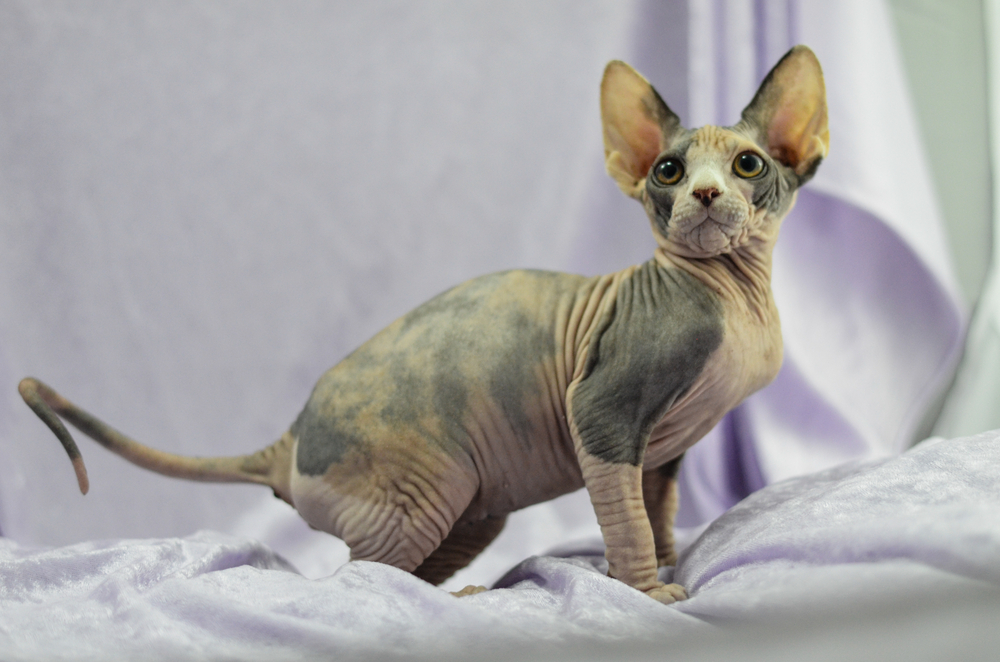
Molekule Air Mini+ Review 2024: A Detailed Look

No Comments

Our Final Verdict

We give the Air Mini+ a rating of 4.9 out of 5 stars.

Effectiveness: 5/5

Aesthetics: 5/5

Ease of Setup: 4.5/5

Ease of Maintenance: 5/5

Value: 5/5

Molekule, originally known as Transformair, was founded in 2014 by siblings Dilip Goswami and Jaya Rao. Their father, Dr. Yogi Gaswami, was a University of Florida professor who created the groundbreaking PECO technology, or photo-electrochemical oxidation. This new method of air purification proved more effective than typical photocatalytic oxidation for destroying common air pollutants left behind by HEPA and carbon filters. Dr. Goswami made it his life’s mission to create better air purification methods and did so through rigorous testing of his PECO method at both the University of Florida and the University of South Florida. Using their father’s research, Dilip and Jaya were able to manufacture and launch the first air purifier of its kind in 2016, featuring Dr. Goswami’s proven PECO technology.

Since then, Molekule has expanded on the success of their first air purifier, and recently merged with another time-tested company, Aeroclean Technologies, to continue Dr. Goswami’s mission to “address the adverse impacts of polluted air”. The air purifiers manufactured today by the Molekule Group have also been cleared by the FDA, signifying the research and testing reports of Molekule’s technology have been validated. Based on the myriad of adverse health effects that are scientifically proven to be caused or worsened by indoor air pollution, every person should be considering the use of an air purifier, and the Molekule brand checks all the boxes.

About Molekule

Molekule Air Mini+ Purifier - unboxing the product

The Molekule Air Mini purifier was launched in 2019, a smaller version of their existing Molekule Air, and soon followed by the Air Mini+, a beautifully sleek and compact purifier for room areas up to 250 sq ft. The Air Mini+ boasted the added feature of automatic particle detection adjustment, meaning the purifier would autonomously increase the fan speed if an increase in air particles were detected. Another added feature of the Air Mini+ was a stylish leather strap for ease of portability. This improved product from Molekule was rolled out as the perfect solution for anyone wanting to purify a smaller space, like an apartment or bedroom, using the same technology available in the larger Molekule Air model.

The Florida-based Molekule Group manufactures its air purifiers just outside of Tampa. Their products are available for purchase directly from their website, as well as such retailers as Amazon, Walmart, Target, and Home Depot, to name a few. In 2021, Madison Square Garden named Molekule their Official Air Purification Partner with the intent to install Molekule Air Mini devices throughout their facility. In the wake of the initial Covid-19 epidemic, this was a significant step on the part of the “World’s Most Famous Arena” to ensure the safety and wellbeing of its patrons. In fact, a press release published later that year revealed that third-party testing at the University of Nebraska confirmed the results: more than 99% of the SARS-CoV-2 virus responsible for Covid-19 was destroyed by the Air Mini+ in controlled air spaces.

With the introduction of the Air Mini+, Molekule provided a convenient way for people with smaller spaces to address air pollution. Through superior air purification technology, The Air Mini+ promises to bring improved health and peace of mind to customers everywhere – whether the concern is everyday dust, pollen, and pet dander, or more serious pollutants like smoke, gas fumes, and viruses. As a Class II medical device, this state-of-the-art air purifier will prove beneficial to anyone, whether they are suffering from existing health conditions or simply want to protect and promote future health. Molekule notes: no air purification device takes the place of PPE in situations where these extra precautions are indicated.

divider 2 cats

Overview

Molekule Air Mini+ Purifier - cat lying next to the product

Here is my overview of important things to know about the Molekule Air Mini+ purifier:

Technology

The Air Mini+ employs a 3-layer system for air purification: two standard filtration methods combined with Molekule’s own proprietary technology. This ensures that the Air Mini+ provides the most advanced air purification available on the market today, doing the most good for the most people. Every Air Mini+ purifier filters and cleans room air using the following proven systems:

  • HEPA filtration (High-Efficiency Particulate Air)
  • Carbon filtration
  • PECO (Photo-Electrochemical Oxidation)

Most air purifiers on the market use HEPA and carbon filters, but these methods of filtration only capture particles, which means harmful pollutants like bacteria, viruses, and mold, have the potential to be released back into the air when the filter becomes oversaturated. Molekule’s added PECO technology uses light to destroy organic pollutants on the surface of the filter by breaking them down into harmless water and carbon dioxide. According to Dr. Goswami’s research, the PECO method is even capable of destroying VOCs (Volatile Organic Compounds) such as those released by cleaning supplies, carpet, and air fresheners. VOCs are the most likely pollutant to be released back into room air by standard filtration methods and can cause headaches, trigger asthma symptoms, and even cause cancer.

Pricing

At well under $400 and with free US shipping from their website, the Air Mini+ from Molekule is very reasonably priced for the technology it employs. It has been proven to capture and destroy a wide spectrum of pollutants – bacteria, viruses, mold, gasses from smoke, and VOCs – faster and more completely than other devices, and has even been shown to kill over 99% of the SARS-CoV-2 virus within one hour. Although there are many air purifiers for small rooms on the market that are priced much less, it is important to know that these models are far inferior to the complete room air purification that the Air Mini+ provides. The Air Mini+ is also Alexa-compatible and comes with a free app to monitor and control your device. Filter replacements can be purchased for around $100, but there is an auto-delivery option through Molekule that reduces filter cost by 20%, as well as a membership for reward points that can help save money on future purchases.

Molekule Air Mini+ Purifier - cat lying on bed and the product on the bedside table

Contents

When you open the box that your Air Mini+ arrives in, the device is inside a drawstring sack with a bag of activated carbon on top to prevent your new air purifier from arriving with any odors or VOCs encountered in the shipping process. The filter is already inside the device but is sealed in plastic which must be removed prior to use. A large easy-to-read instruction card details a quick set-up with helpful images of the process on one side, and on the other side, brief information about the device’s touchscreen controls as well as the app features. A more detailed instruction manual is included as well, and a packet of supplemental instructions for users specifically targeting SARS-CoV-2.

Any other information desired by the user can be obtained by calling Molekule’s customer service, searching the online help pages, or reading the published reports on the performance of Molekule’s line of air purifiers (some of these are linked directly through the website, while other third-party testing reports are available online via other credible websites).

Maintenance

The Molekule Air Mini+ is a low-maintenance device. The plastic housing can be gently wiped down as needed, while the interior need not be accessed other than to replace the filter. The Molekule app, once paired with your device, will alert you when the filter should be changed, but the standard instructions from Molekule recommend replacing it every six months. Filters can be purchased through the brand’s website as well as their approved retailers. Molekule also offers an auto-delivery feature which not only ensures the user doesn’t forget the filter maintenance schedule, but also gives the customer a 20% discount on the filter cost. Depending on your environment, used filters may need to be disposed of in biohazard bags, which should be attainable from your local health department or healthcare provider.

Molekule Air Mini+ Purifier - filter of the product

Warranty

Molekule provides a 2-year limited warranty on all their air purifiers purchased through their website or an approved retailer. There is also an option at checkout to purchase a 1-, 2-, or 3-year extended protection plan to cover your device after the warranty runs out. Under an approved warranty claim, Molekule will either repair your purifier, or issue a replacement device, which may be new or refurbished. The replacement is then covered only under the remainder of the original warranty.

Purchases of new devices (not refurbished models) from Molekule’s website are allowed a 30-day home trial. If a customer is not satisfied with the Air Mini+, they can contact Molekule’s customer service to initiate a return and subsequently receive a refund. Purchasers of new devices from a retailer must contact that retailer to inquire about a refund.

In Summary

Pros

  • Captures and destroys more pollutants faster than other devices
  • Proven to capture and destroy VOCs as well as the SARS-CoV-2 and H1N1 viruses
  • Validated third-party testing
  • FDA-cleared Class II medical device
  • 3-layer filtration utilizing HEPA, carbon, and PECO technology
  • 360-degree air intake
  • Durable construction
  • Easy assembly
  • Highly portable
  • Five fan speeds
  • Auto-Protect feature to control fan speed
  • Fan speed controllable through app (iOS or android)
  • Compatible with Alexa
  • Low noise
  • In-device particle sensor with app-monitoring
  • App alerts when to replace filter
  • Auto-delivery of replacement filters available
  • Free shipping in the continental US
  • 30-day home trial
  • 2-year limited warranty
  • Member reward points club
  • New devices and filter replacements available at many approved retailer locations

Cons

  • Initial app pairing may be tricky for less tech-savvy customers
  • Higher fan speed noise may interfere with sleep if used in a bedroom
  • Only available in one color (white)

divider 2 cats

Key Features

Molekule Air Mini+ Purifier - product manual

Easy Setup

The Air Mini+ is ready to go as soon as you plug it in (make sure you remove the plastic from the filter first). It powers up as soon as connected to electricity, and has easy-to-use touchscreen controls on top of the unit. There is also an app available, for both Apple and Android users, that pairs with your device allowing remote fan speed adjustment and monitoring of current air particle levels. The app pairing can be a little tricky, but as long as the necessary permissions are enabled on your phone, there should not be an issue.

Superior Technology

Molekule added to existing HEPA and carbon filter technologies and brought improved air purification to its customers with the introduction of PECO, or photo-electrochemical oxidation. This new method of air pollutant destruction has proven superior to the more commonly implemented photocatalytic oxidation, and electrostatic filtration. Furthermore, this Class II medical device has been FDA-cleared, an achievement that indicates the testing reports submitted to the FDA for consideration were validated.

Auto Protect Mode

Although the Air Mini+ comes with five fan speeds, which can be controlled by the touchscreen on top of the unit or through the app, it also features a convenient Auto-protect mode. When this mode is activated, the unit will automatically adjust the fan speed as needed for the concentration of air particles detected by its on-board sensor. This convenient feature takes the guesswork out of running your Air Mini+ purifier – set it and forget it.

Low Maintenance

The Air Mini+ is low maintenance, with filter replacements indicated every six months, and no tools required for disassembly – just twist off the top to access the filter. There is also no need to open the unit to check the filter, as the app is monitoring this for you and will alert when replacement is needed. The plastic exterior is easily cleaned with a simple wipe down, although depending on the environment this device is being used in, some exterior disinfecting may be advised – just be sure not to spray any cleaners into the air intake or the particle sensor.

divider 2 cats

Is the Molekule Air Mini+ a Good Value?

The Air Mini+ brings proprietary technology to small spaces in an easy-to-use device. The manufacturer’s claim that their purifiers can capture and destroy more pollutants faster than the competitors is well-substantiated through rigorous third-party and internal testing. This FDA-cleared Class II medical device has even been implemented as the air purification method of Madison Square Garden through the widespread installation of the Molekule Air Mini. The cost of the Air Mini+, at around $350, may be more than many other purifiers for small spaces, but the value of this revolutionary device is irrefutable.

Molekule Air Mini+ Purifier - product on the night table

divider 2 cats

Frequently Asked Questions (FAQ)

What types of air pollutants can the Molekule Air Mini+ help eliminate?

Molekule’s air purifiers are effective against airborne bacteria, viruses, mold, pollen, smoke, pet dander, dust mites, and volatile organic chemicals like formaldehyde and acetone, which can be released into the air from carpet, furniture, and cleaning products. Some of these common pollutants found in our indoor air spaces can cause headaches, trigger asthma symptoms, aggravate allergies, or, in some cases, lead to infectious disease or cancer.

Can this purifier remove odors from my household?

The Molekule Air Mini+ captures and destroys odor-causing particles in the air. Whether these odors are from cooking, smoke, cleaning products, or paint, this device can help your small space smell fresher by removing these pollutants. If you have more than one room needing filtration simultaneously, you may want to purchase multiple Air Mini+ devices. However, this device is highly portable, so you can move it from room to room as needed – for example, use it in your living room or home office during the day and move it to your bedroom at night.

How noisy is the Air Mini+?

There are five fan speeds with increasing noise levels. The lowest fan setting produces a noise level similar to light rain. This sound is easily drowned out by normal conversation, a TV on normal volume, or even a ceiling fan. It is unlikely to be bothersome to anyone. The highest fan speed, on the other hand, is fairly noisy, and Molekule likens it to the sound of a small handheld vacuum. In a normal household, however, your unit is likely to run on the lowest fan speeds and should not create a noise issue. 

How often does the filter need to be replaced?

The Molekule app will alert you when it is time, but the website indicates filter replacement should occur every six months. 

Do I need the app in order to operate the air purifier?

The Air Mini+ will begin working independently from the app as soon as you plug it in. The app is available as a convenient method of controlling your unit, monitoring your particle levels, and receiving alerts when it’s time to replace the filter. Without the app, you can still operate your device via the touchscreen on top of the unit. If you choose to use the app, make sure all your phone’s permissions are enabled (including location), otherwise, you may have issues with the pairing process.

Molekule Air Mini+ Purifier - product mobile app interface

divider 2 cats

Our Experience With the Molekule Air Mini+

I recently received the Molekule Air Mini+ for use in my new home office. For years, this space has been a catch-all ‘junk room’, painted an unappealing matte brown and full of random furniture, photo albums, and paperwork needing filing. But also tucked in the corner was my laptop and printer.

Well, I finally did it. I cleared out the junk, filed away my important documents, and painted the walls pistachio green. I set up my laptop and printer in a way that I could use them without having to kick cardboard boxes out of the way first. I even got a gently-used bed from a relative to add to the room, so that the space could also serve as a guest room when needed. I finally had the room of my dreams, a clutter-free place where I could read, nap, or work on my computer.

There was just one problem – my new office did not smell so great. It smelled like paint – a smell that psychologically tricks you into thinking something’s clean, but there’s nothing clean about paint fumes. It also smelled like someone else’s house, thanks to the new-to-me mattress. And now the comforter on the bed was also covered with cat hair, as my kitty had started enjoying the room as well. I realized I had to do something.

I typed into my search bar “best air purifiers for paint fumes”, and scrolled down past the sponsored results until I reached a ‘Top 10’ list. Number 1 on that list read “Molekule Air Large Room Air Purifier – Best Overall”. I went straight to Molekule’s website to start shopping, and discovered the Air Mini+ for small rooms. At 160 sq ft, my home office was well beneath the 250 sq ft-capable Air Mini+, and I instantly adored the minimalistic design, which blends seamlessly with its surroundings. I read the product description, and placed my order.

I’ve been using my Air Mini+ purifier 24/7 for a week now, and I am thrilled to say my home office no longer smells like paint! My allergy symptoms from springtime pollen have improved. And I no longer notice the odor of the new bed. I also don’t mind that the cat is shedding all over the comforter, or that our new rescued dog spends all of her time in this room with me while I’m working on the computer. I know that the Air Mini+ is doing its job, sucking up all that pet dander, pollen, and harmful VOCs, making a safer space for me and my animals. The Air Mini+ promises to give you the cleanest room air possible, and that’s exactly what it’s done for me.

Molekule Air Mini+ Purifier - product on the table

divider 2 cats

Conclusion

The Molekule Air Mini+ is quiet, emits only a very dim blue light at night, and does what it promises by making your home’s air crisper and cleaner. Between pet dander, pollen, and paint fumes, the Air Mini+ has been a blessing in my household, and I would highly recommend this purifier to anyone. Its beautiful clean lines also look amazing in any decor, and with its twist-off top and an easy-to-use app, setup and maintenance are a breeze. If you have a small space you’d like to make healthier through clean air, the Air Mini+ is the right choice.

CatLadyBox Subscription Review 2024: A Detailed Look

No Comments

Our Final Verdict

We give CatLadyBox’s subscription box an overall rating of 4.8 out of 5 stars.

Item Quality: 4.5/5

Item Variety: 5/5

Value: 4.9/5

When I think of cat ladies, my mind immediately goes to the crazy cat lady on The Simpsons. That’s exactly the kind of stigma CatLadyBox is trying to do away with. And they’ve come up with a pretty fun way to accomplish that.

Of course, I’m talking about the CatLadyBox subscription. This subscription gift box service delivers fun, fashionable, and fabulous cat-related clothing, accessories, and household items straight to your door. These items are perfect for cat-loving ladies (and everyone else) who flirt with the line between obsessed and crazy but don’t necessarily want to cross it.

I’ve had cats my entire life and am as obsessed with them as I am with pretty much any animal I can cuddle up with. So, I was overjoyed at the opportunity to test out the CatLadyBox subscription for myself. My ever-playful cat, Makoa, insisted I upgrade to the CRAZY CatLadyBox (his words, not mine), so my boxes came with some extra gifties for kitties, as well.

Find out how much Makoa and I loved our subscription boxes and where we saw some room for improvement in my full CatLadyBox subscription review, below.

At a Glance: The CatLadyBox Products We Received

cat paw divider

About CatLadyBox

CatLadyBox subscription box

This kitty-lover subscription box company was born out of multiple cat-related endeavors by founder, Dorian Wagner.

It started with a blog dedicated to adorable cat videos. With the profits from the blog, Dorian started a toy and treat drive for shelter animals that eventually became a full-fledged volunteer network for transporting homeless kitties to no-kill shelters and new forever homes.

From those humble beginnings, CatLadyBox was born. With every subscription box purchased, CatLadyBox donates to a cat charity or rescue group.

Who Makes the CatLadyBox Products?

Each item that comes in your CatLadyBox is exclusive to the company and many are created by their in-house artists. This means you won’t find these items on the shelf at the store. It also means that every cat toy that arrives in your box will be a one-of-a-kind find.

Many of these products are made for CatLadyBox by outside companies with global manufacturing plants.

Which Types of Cats Is CatLadyBox Best Suited For?

The CRAZY CatLadyBox, which is an upgrade from the original box, contains two cat toys on top of the goodies for you. These toys differ each month, but most are play-focused, including plush kickers, wands, and catnip-filled chasers. With this in mind, these boxes are best for playful kittens and cats.

But I think the real question here is which types of owners is CatLadyBox best suited for. The answer to that is simple: Any cat-loving person who can appreciate adding more cat-centric stuff to their household and closet.

While the company is marketed largely to women, the shirts are all unisex and many of the items can be enjoyed by people of all genders.

cat paw divider

Key Features

CatLadyBox subscription box

CatLadyBox is unique because it’s the first gift box subscription service intended for cat owners, rather than just cats themselves. What this fun company offers can be broken down into four key features, which we’ll look at below.

The Box

CatLadyBox offers two subscription levels.

The first box, the Original CatLadyBox, is all about spoiling cat owners. This box contains three to four items each month. A shirt or clothing item is always included along with a variety of personal accessories, household decorations, kitchen items, blankets, outdoor decorations, and more.

The CRAZY CatLadyBox includes the same three or four owner items as the original plus two additional cat-specific items. These are typically toys and can range from simple plush stuffies to catnip-filled kickers to feathery wands.

The difference between the two boxes is only four dollars. So, if you have a cat, I’d suggest upgrading. Otherwise, they might find out you’ve been spoiling only yourself when you could have been spoiling them too!

The Subscription

Once you pick your box type, it’s time to decide how many subscription boxes you want. You can opt for one, three, or six. The more you get, the less you pay per box.

After you choose your number of boxes and checkout, you’ll be able to set your delivery preferences. For example, you could have your six boxes come once per month for six months. Or you could opt to have them come every other month for a year.

They also have an option to get one box every six months.

Spreading out your deliveries is a great way to spread out the joy. But on the downside, you might miss some really cool boxes.

That’s because each month has a different theme. The two boxes I’ve received so far have had the themes “Cats in Bloom” and “Hug All the Cats.” They also do special holiday-themed boxes throughout the year.

Luckily, you can always purchase past items individually or opt for a previous month’s box.

CatLadyBox subscription box

The Donations

Each purchase made at CatLadyBox helps fund cat rescues and other cat organizations thanks to the donations the company makes each month.

Some of the great organizations to receive donations from CatLadyBox include:

  • Chicagoland Animal Rescue
  • Pet Haven
  • Kitty Connection
  • Happy Tailz Cat Rescue
  • Louisiana SPCA

You can even nominate your favorite cat rescue organization to receive donations from the company.

Additionally, the company frequently donates boxes of toys to shelters across the country.

The Value

A standard CatLadyBox subscription ranges from $35 to $42 per box depending on which subscription size you choose. The CRAZY box ranges from $39 to $48.

The total value of the items in the box varies each month, but this number is always higher than what you would pay for them individually, sometimes exponentially so.

For instance, in my Cats In Bloom box, the five items had a total list value of $67. Even if you bought this as a single-box subscription, you’d still pay nearly $20 more if you were to buy the same items one at a time. And if you opted for the six-box option, you’d be saving nearly $30.

While you don’t know exactly what you’ll get each month or how much you’ll love each item, the overall value of this subscription service is apparent. Plus you can feel good that some of your money goes to helping kitties in need.

CatLadyBox subscription box

cat paw divider

Reviews of Our Favorite CatLadyBox Products

1. Paw-romise Ring

Paw-romise Ring

The smallest item in my boxes ended up being my favorite. This adorable little ring features tiny cat paw print cutouts that twirl around your finger.

Thanks to the gap in the ring, it’s slightly adjustable, making it more likely to fit one of your fingers well. Despite that malleability, this ring is impressively sturdy and appears to be made of silver.

The edges of the pattern are rounded and the ring itself is comfortable to wear.

This little accessory makes a great addition to the jewelry box and a fabulous way to remember your favorite kitty.

Pros

  • Adorable design
  • Sturdy and well-made
  • Appears to be silver
  • Adjustable size

2. Paw of Flowers T-Shirt

Paw of Flowers T-Shirt

This charcoal-gray tee shirt is one of the more understated patterns CatLadyBox has released. It features a tiny but adorable purple paw and flower emblem in the corner of the chest.

While it doesn’t scream, “I love cats!” it does make for a wonderfully subtle call out to your favorite animal. And the neutral design means you can wear it just about anywhere.

But what I really love about this shirt is how amazingly soft it is. It feels like a cloud against your skin (or a fluffy, well-groomed cat). The material, a blend of cotton, spandex, and polyester, is breathable and lightweight.

Whether you have a white kitty, a black cat, or something in between, the smart charcoal color of this shirt will help you hide those pesky pet hairs.

Pros

  • Comfy
  • Neutral but still cute
  • Versatile

Cons

  • Not 100% cotton
  • Unisex shape is not as flattering

3. Mewotivational Coasters

Meowtivational Coasters

If you’re in the market for a good set of coasters that are guaranteed to match your style, these simple but oh-so-fun cork coasters are the way to go.

Each of these 4-inch by 4-inch coasters features an inspirational, paw-sitive quote in simple black letters. Two of my favorites include:

  • “Every day is a new chance to pounce on happiness”
  • “When the path gets tough, remember you’ve got claws”

These lightweight coasters are great for coffee tables, desks, or the dinner table. You can even use them as mini trivets in the kitchen.

Pros

  • Neutral design
  • Fun and inspirational quotes
  • Can be used all around the house

Cons

  • Thin and not overly durable

4. Feline Fresh Spring Stackers

Feline Fresh Spring Stackers

Whether you’ve got leftover cat food to store or just want the cutest snack containers ever, these stackers have you covered.

Each piece of this three-set features a different fun, colorful, spring cat design. The bright red-orange kitties, green foliage, and orange flowers are as cheerful as a spring day.

Each of the containers comes with a twist-on lid (in springy bright green). The largest of the containers holds 34 ounces, the medium size holds 16 ounces, and the small size holds 8 ounces. These nest into each other, lids and all, for easy storage.

While these would be perfect for storing cat food and leftover canned food, I’m certain my daughter will claim them for her school snacks.

Pros

  • Fun designs and colors
  • Three useful sizes
  • Nest for storage

Cons

  • Lids can be tough to get off

cat paw divider

Our Experience With CatLadyBox

So far, I’ve received two of my CatLadyBox subscription boxes. Both were full of fun items for me and for my ten-month-old cat, Makoa.

I highlighted four of my most favorite items above, but there was little in this box not to like!

The only item I don’t see myself using is the trucker hat (though, I love the saying on it—”I live in the meow!”). Still, I can think of many people to gift it to, so it’s not a total loss.

In addition to the items I received in the boxes, I also got a mystery gift, which comes with all three and six box orders.

My mystery gift was a black metal cat yard decoration. This little kitty now has a home in the garden by my front door and makes me smile every time I come home.

Because I opted for the CRAZY CatLadyBox, each of my boxes also included two gifts for Makoa. He got a fuzzy plush “Cattitude journal,” a huggable plush kicker, a plush mushroom, and a dragonfly wand toy.

All three plush toys had catnip in them, which I imagine would be a big plus for most cats. Unfortunately, Makoa has little to no sense of smell thanks to a bad respiratory illness as a kitten. This means he doesn’t know the joy of catnip.

Still, he has had a blast playing with all of these toys. He especially likes the fun, hairy texture of the journal stuffy and is constantly grooming it.

Overall, I was very impressed with the items I received in my boxes. The cat toys aren’t the highest of quality in terms of material and durability and I didn’t have a use for every single item I got, but I have enjoyed most of them.

I will absolutely be keeping CatLadyBox in mind for Christmas this year. I think the subscription would make a great present for any cat lovers out there. And the fact that each purchase creates a donation for cats in need makes me all the more eager to find others to share this product with.

CatLadyBox subscription

cat paw divider

Conclusion

Whether you’re a cat lover in love with cat stuff or know someone who fits that description, CatLadyBox is worth checking out. This gift box subscription company delivers cat-centric fun straight to your door. And if you have a kitty, they can deliver fun for them too.

I loved the items I received in my gift boxes almost as much as my kitty loved his. The value of the fun accessories, clothes, and decorations definitely exceeds the cost of the box itself and each purchase helps raise donations for cat rescues and organizations. So, as far as I can tell, there’s no reason not to indulge your crazy cat lady side with CatLadyBox.

Moody Blues: Cats and Their Emotions

No Comments

The information is current and up-to-date in accordance with the latest veterinarian research.

Learn more »

Hi, I’m Dr. Lauren! Read my introduction to learn more about me and my two adventurous cats, Pancake and Tiller.

Cats, the effervescent cog in the otherwise somewhat bland wheelhouse of modern home life. Or, at least, that’s my opinion and I’m sticking to it. Cats are steadily creeping up to become one of the more popular household pets in many countries, but as I’ve written time and time again, we don’t really know all that much about them.

Do they get anxiety? Why are they so different from dogs? Can we typify the feline personality, or do cats that are more dog than cat actually exist? When does a healthy appetite actually mean something bad? Truly, they remain as much of a mystery, as a beloved household family addition.

Cats & Personality

One thing that has surprised me, again and again since graduating from vet school, is their personality. Stoically, we were repeatedly told as vet students that cats had no emotions. No research was given to support this, and yet none of us questioned this assertion. And yet, daily, in clinical practice, I am reminded of this supposed truism. And that, while I still have next to no research to back it up, cats almost certainly have emotions.

Last night, for example, was an exceptionally cold spring evening. Pancake has recently realized that Tiller has a favorite spot on a cardboard scratching post, that also happens to be near the main heating vent for the family room. And, therefore, Pancake has taken it upon herself to extricate Tiller from this spot…mainly by getting to the spot as soon as the heat goes on, much to Tiller’s dismay.

Last night, a number of bopping, punching, ear biting, and generally feline-tense moments ensued between the two, as they had a kerfuffle over who owned said hot spot. That is, until human intervention opened a can of wet food, and all grievances were quickly forgotten.

Pancake and Tiller often cohabitate without issues.

Pancake vs. Tiller

Pancake also gets inordinately grumpy if she doesn’t maintain her routine. That means breakfast by 6 am, second breakfast by 7 am, the sofa free by 8 am, and a prompt bedtime by 10 pm. I’ve actually seen her march upstairs, at 10 pm on the dot, in an attempt to lead people to bed. And I’ve seen her boycott the humans all night, if they don’t follow her lead. Further, houseguests be warned- if you try to pay her too much or too little attention, just know that, as the Klingons say “Heghlu’meH QaQ jajvam”.

Worse, is applying their flea treatments. Tiller is a bit more forgiving: once it’s done, it’s done. But with Pancake, a 3-month application of a flea and tick product, means that invariably for at least 1 month, but more than likely 2 months, I have to tiptoe every time I go anywhere near the back of her head, lest she turn around in sheer disbelief that I am again betraying her confidence, then run and hide for the next few hours. Don’t ask what it is like trying to give her pills! I’m pretty sure the neighbors would call the police if it was a common occurrence…and I refer again to the Klingon axiom written above.

Now, you may say that I am anthropomorphizing the cats. Sure, I live with them. I see their personalities. Tiller is athletic, aloof, intelligent, a bit high-strung, and a bit skeptical. Pancake is food motivated, constantly talking with whoever is around, grumpy when hungry (truly the definition of hangry!) and always happy to steal your chair or sofa the minute you get up to do something else. Without question, they have tiny brains, too much fur, and huge personalities.

Tiller sometimes shows evidence of jealousy when Pancake steals a prime sleeping spot.

What Does The Research Say?

Research on the subject of feline emotions is divided. Conversely, or perversely, we do discuss feline emotional health when talking about environmental enrichment in feline medicine, yet to what extent those emotions are experienced, or even acknowledged, is sparse, and just beginning to be investigated.

For instance, in a Japanese study (and others), pet owner attachment was directly related to the observation and assessment of pets’ emotions, with compassion and jealousy being the two most frequently observed emotions by owners. However, the jury remains out on just how accurately humans can interpret feline emotions in certain settings, especially when anthropomorphic tendencies have a role in the owner’s interaction with their pets.

Other, early data suggests that cats vocalize other than meowing in part for conveyance of positive emotions, but much remains to be elucidated on that front. One interesting paper even went so far to suggest that a feline left gaze and head turn may indicate low level fear, while a right gaze and head turn may indicate relaxation… feline emotional psychology indeed!

Essentially, the jury remains out on feline emotions, at present. At least officially. But when I walk into a clinic, and start a day of consulting, and cat after cat gets onto the exam table, looks at me, and sighs, it’s difficult not to feel their very real emotions. I’ve never gone so far as to see an eye roll, but I suspect it may yet happen. And if it does, Pancake will probably be first in line.

The Remarkable Russian Blue: Comparing Olga to the Breed Standard

No Comments

Hi, I’m Christopher! Read my introduction to learn more about me and my silly Russian Blue cat, Olga.

I didn’t know much about Russian Blues until I adopted one, but after watching Olga transform from a psychotic kitten to a friendly, mischievous, middle-aged lady, I’ve learned a lot. Her physical characteristics, like her blue coat, light green eyes, and 10.06-pound weight, seem to follow the breed standard.

Olga is a rescue cat; I’ve never had her DNA tested, and I’m not an expert at identifying felines, so she could be purebred or mixed. I think she has plenty of Russian Blue blood pumping in her veins and displays most of the behavioral traits that made the breed famous.

Russian Blue Behavior

She was aloof and violent as a young cat and affectionate without being clingy. She’s smarter and more coordinated than I initially gave her credit for and can open and close doors, catch paper balls like an outfielder, attack me when I sleep late, and detect when I’m having a bad day.

However, some Russian Blue folklore makes me laugh when I think about Olga. Even the nicknames Archangel Blue and Maltese Blue aren’t accurate representations of her. If anything, she’s more of an anti-Christ than an Archangel. Russian Blues supposedly have “Mona Lisa smiles” because of their upturned mouths, but Olga’s looks more devious and similar to Lizzie Borden’s.

This is your last chance; I’m jumping on that keyboard if you don’t have my dinner ready soon.

Archangel Folklore

There’s a myth that Russian Blues watched over babies while they slept and protected them from the 19th-century version of Freddy Kruger. If only the kids on Elm Street had a colony of felines, so many murders could have been prevented, as long as they didn’t have cats like Olga.

She’s no match for an evil spirit, poltergeist, dream assassin, or holographic vacuum cleaner. I can count on her to dispatch insects, but anything else, whether natural or metaphysical, causes her to sprint in fear. Olga is a stealthy runner and master at blending in with the shadows, and an intruder in my home wouldn’t know I have a cat unless they stumble over the litter box.

Olga the Brave (Meek)

She’s fierce when confronted by stuffed mice, paper balls, and flies but runs when she hears a helicopter flying over or a pyrotechnic explosion. Olga isn’t a guard cat and may not be the best babysitter for kids, but I like the idea that cats in northern Russia protected sleeping babies instead of stealing their breath or cursing them, as other superstitions suggest.

Olga’s ancestors traveled with sailors to other European countries after leaving Arkhangelsk, and it’s possible that their seafaring ways and tolerance of water were retained in Olga’s genes. She’s never been on a boat or seen the ocean, but she isn’t afraid to play in the shower water or attack me on the rare occasion I’m in the bathtub.

From this angle, my head really looks enormous, doesn't it?
From this angle, my head really looks enormous, doesn’t it?

Before I learned to keep the bathroom door locked, she tried to swat at me through the shower curtain, and a few years ago, when I was in the tub, she knocked a shampoo bottle into my head after casually taking a stroll on the slippery edge.

I remind guests to lock the door before they get in the shower because I don’t want my pint-sized Norman Bates to wander in and scare them. I’m proud of Olga for being clever and relieved she hasn’t learned how to handle a butcher knife.

Never Too Old To Travel: Sully’s Big Adventure

No Comments

The information is current and up-to-date in accordance with the latest veterinarian research.

Learn more »

Hi, I’m Dr. Karyn! Read my introduction to learn more about me and meet my five hilarious cats: Clutch, Cyril, Alex, Zelda, and Zazzles.

When I came to the UK in 2012, it was supposed to be for a year or two. I would pick up locum work and travel, and eventually return to Australia once the travel bug stopped biting. Well, as I write to you here from Cornwall, UK, you can probably tell that life had other ideas. The trouble with travel is that the more of the world you see, the more you want to explore, so I kept extending my departure. Along the way I picked up a stray cat (Clutch), a husband (Reece), and began accumulating cats and dogs. By 2016, my parents started to suspect that I wasn’t going to be coming home anytime soon, and, as they were looking to move into a ‘retirement resort’, they thought it was high time I took back my tabby cat, Sullivan (aka Sully).

Now, Sully was 14 years old at this point, so I wasn’t convinced that it was the best plan, but as I had unintentionally abandoned her for the past four years, I felt that I couldn’t say no. And so began the logistical nightmare of transporting a pet overseas. Fortunately, she was leaving Australia, not entering, as the land down under does not make it easy – just ask Johnny Depp!

Stunning Sullivan
Stunning Sullivan

A Stressful Journey (for me)

I was obviously quite worried about Sully’s move overseas; not only would she be spending 24 hours on a plane (with a comfort stop halfway), she would be moving into a house with 3 dogs and 3 other cats, having only ever lived with one other cat. It was going to be quite the upheaval.

Well, I needn’t have worried!

From the moment we returned home from collecting her from the airport, she sauntered out of her carrier towards a bowl of food and never looked back.

Okay, it took her a few weeks to get used to sharing a house with dogs, a species she had never encountered before, but with food as a shared interest, Sully soon realized that she and the Labradors had something in common!

Poppy and Sully share a meal.

New World, New Wildlife, New Weather

Despite being a predominantly indoor cat, I would occasionally take her to explore in the garden. One morning I was stunned to hear her “I’ve caught something” sound, previously reserved for when she carried around her favorite toy, Fishy. There she was, looking both proud and surprised, with a dead vole in her mouth. I wasn’t hugely thrilled that she had just killed a lovely little creature, but I also wasn’t entirely convinced that the lovely little creature was not already dead when Sully ‘caught’ it. However, I was delighted to see that my elderly, world-weary cat was clearly finding her way in her new home.

Having grown up in the tropical climate of Brisbane, Queensland, adjusting to the much cooler British weather was another hurdle that Sully sailed over. In early 2018, we were hit by “The Beast from The East”, with unprecedented levels of snow covering our world in a thick white blanket; something of a novelty for me as well as Sully. But out she went, tiptoeing through the winter wonderland our garden had been transformed into, as though it was any other day.

Sully’s triumphant journey showed me that we should never underestimate our feline friends, even if they are getting on in years.

What is this cold stuff!

A Memorable Life 

In July 2018, my parents were over for a visit – not looking nearly as spritely as Sully did after her plane trip I might add – and they were delighted to see how happy and healthy Sully looked, and how well she had settled into her new life. I knew they had felt anxious about sending her here, and it was lovely that they could see how well she was doing.

Two weeks after my parent’s visit, Sully passed away in her sleep.

She hadn’t been unwell, and had shown no sign of being sick or in pain. She had lived a wonderful life, including two years in a strange new home, and although I was devastated, I couldn’t help but feel relieved that she had been happy right to the end. She had been able to spend her final years with me, and that she’d been able to say goodbye to Mum and Dad before she went.

As life journeys go, hers was pretty damn good.

Dr Karyn signature

White Ragdoll Cat: Facts, History & Origin (With Pictures)

No Comments

Ragdoll cats are easily one of the most popular cat breeds in the world. These long-haired cats are social, loving, and great with people. This breed does well with children and even other pets like dogs. Ragdolls are beautiful kitties that are front and center of a bit of controversy. What controversy can cats be a part of, you may ask? Oddly enough, it all has to do with coloring.

Breed Overview

Suitable for:

Anyone who wants a cuddly cat!

Temperament:

Docile, cuddly, loyal

Since Ragdolls were formally recognized, certain traits and appearances have been the standard. When it comes to colors, the Ragdoll standard is a pointed cat. This means the body is meant to be lighter in color than the face. The only recognized Ragdoll colors are seal, chocolate, blue, flame, lilac, and cream. Unfortunately, white isn’t on the list. But does that mean white Ragdolls don’t exist? The answer is no one really knows. There are white cats that resemble and act like Ragdolls that some consider pure breeds, but there are societies and breeders who say no.

Characteristics

Energy

+

A high-energy cat needs a lot of physical and mental stimulation to keep healthy and happy, while a low-energy cat needs minimal physical activity, but still needs mental stimulation. When choosing a cat, It’s important to ensure their energy levels match your lifestyle.

Trainability

+

Cats that are easy-to-train are more willing and skilled at quickly learning prompts and actions with minimal training. Harder-to-train cats are usually more stubborn or aloof and require a bit more patience and practice.

Health

+

Certain cat breeds are more prone to various genetic health problems, and some more than others. This doesn’t mean that every cat in those breeds will have these issues, but they do have an increased risk, so it’s important to understand and prepare for any additional needs they may require.

Lifespan

+

Due to their size or potential genetic health issues of a specific breed, some cats have shorter lifespans than others. Proper nutrition, exercise, mental stimulation, and hygiene also play an important role in your cat’s lifespan and quality of life.

Sociability

+

Some cat breeds are more social than others, both towards humans and other cats and animals. Cats that are more social have a tendency to rub up on strangers for scratches or jump on laps for cuddles, while cats that are less social shy away, hide, are more cautious, and even potentially aggressive. No matter the breed or gender, it’s important to socialize your cat and expose them to many different situations.

The Earliest Records of White Ragdoll Cats in History

It’s difficult to pinpoint when the first white Ragdoll appeared in the breed’s history. What we do know is that the history surrounding Ragdolls is somewhat strange. There are at least two stories associated with this breed, with no one truly knowing which is true. What we do know for sure is that we can thank a woman named Ann Baker for the precious breed we know today.

In the early 1960s, Ann was a breeder of Persian cats who lived in Riverdale, California. One of Ann’s cats was named Josephine. Some stories claim Josephine, a white Angora cat, was a rescue in Ann’s care while others claim she and her offspring were borrowed as part of the breeding program. Either way, all Ragdolls can trace their heritage back to Josephine. It is believed that Josephine was bred with a Birman to produce the first Ragdoll kitties. Over the years, Ann worked to create the Ragdoll breed and enhance the traits she wanted to include.

How White Ragdoll Cats Gained Popularity

Ragdolls became extremely popular in society fairly quickly. The unique beauty and habit of falling limp like a ragdoll when being held made people want them as part of their families. White Ragdolls, however, were always viewed as a myth or fake Ragdolls by certain breeders and societies. Recently, the International Cat Association began accepting white Ragdolls as pure breeds. This has helped these rare kitties gain popularity ever since.

White Ragdoll kitten
Image Credit: Michal Bednarek, Shutterstock

Formal Recognition of White Ragdoll Cats

The Ragdoll breed was formally recognized by The Cat Fanciers Association in 1966 when Ann Baker officially registered her breed. When it comes to white Ragdolls, however, the CFA does not recognize them as purebred Ragdolls. However, in recent years, the International Cat Association has begun accepting white as a part of the Ragdoll breed standard.

cat paw divider

Top 3 Unique Facts About White Ragdoll Cats

1. An Accident Could be the Reason Ragdolls Got Their Name

There are several stories surrounding the origins of Ragdolls. One such story has to do with Josephine, the mother of the breed, and an accident. Is claimed that Ann Baker’s cat Josephine was injured in an accident where she was hit by a car. After the accident, the mother of the breed was unable to feel pain and would flop in her owner’s arms like a ragdoll when she was picked up.


2. All Ragdolls Are Born Without Color in Their Coat

With such a huge controversy over what colors are accepted as breed standards for the Ragdoll, it’s odd to realize kittens of this breed are born without any coloration. The pigment comes in as the cats’ age. Most Ragdolls don’t reach their true coloration until they are around 2 years old.


3. Cream Colored Ragdolls Are Ultra Rare

With white Ragdolls not being accepted by so many, that leaves cream Ragdolls as the rarest ones out there. Roughly 3% of Ragdoll owners are lucky enough to have one of these uniquely colored kitties in their home. A cream Ragdoll has a white body with ivory points around the face. Often, people confuse these cats with pure white Ragdolls.

cat paw divider

Does a White Ragdoll Cat Make a Good Pet?

Whether they are white, cream, or any accepted color, Ragdolls make excellent pets. These cats are very even-tempered, loving, and family oriented. Ragdolls enjoy spending time with their families and can even be taught tricks due to their high intelligence. Whether you have children or other pets, a Ragdoll can be the perfect kitty addition to any family.

White Ragdoll Cat
Image Credit: Liliya Kulianionak, Shutterstock

cat paw divider

Conclusion

With the controversy surrounding white Ragdoll cats, it’s difficult to say whether the coloration is real or not. Certain breeders and cat associations have opened their arms to the possibility of a solid-colored Ragdoll while others haven’t. Either way, you cannot deny the beauty and temperament of these amazing cats. If you have the chance to welcome one into your home, you definitely should.


Featured Image Credit: cataliniturca Shutterstock

Cat Dogs: Cats for People Who Think They Don’t Like Cats

No Comments

The information is current and up-to-date in accordance with the latest veterinarian research.

Learn more »

Hi, I’m Dr. Lauren! Read my introduction to learn more about me and my two adventurous cats, Pancake and Tiller.

Cats are not small dogs, we often say in veterinary medicine. And we use this statement to discuss why feline medicine is just so inherently different from its canine counterpart.

However, today, let’s take a diversion from science, and medicine, and delve into the more abstract world of human pet ownership. And pet personality theory. Ok, maybe we aren’t completely stepping away from science, but it’s a bit of an exploration, to be sure. In the process, we will attempt to answer the question of the mysterious cat dog.

Why Do We Have Pets?

So, pets. Why do we have them? Is it for the potential health benefits, as I discussed in a previous article? Or is there something else?

Pets certainly offer comfort, and possible health benefits such as improved mental health, and lowered blood pressure. Conversely, pets also offer potential zoonotic diseases, and bite and scratch wounds. When deciding on a pet, you also decide whether you are a glass-half-full or glass-half-empty sort of person, based on these factors. In fact, if you’re a glass-half-empty sort of person, you might smartly decide to avoid the risks of a pet altogether.

Prominent “M” markings on tabby cats are said to represent more than meets the eye.
Cats can offer many benefits, including comfort and even improved mental health!

Cats vs Dogs

But for those of us who take the plunge, how do we select the pets we do? And are cats truly different from dogs? If so, why? Interestingly, people that own dogs tend to score higher on personality traits such as warmth, and rule consciousness, amongst others. Cat people, on the other hand, tend to score higher on traits such as general intelligence and self-reliance.

This may reflect the general societal attitudes in the West that dogs are gregarious and man’s best friend, while cats are aloof, distant, and conniving.

Even Rudyard Kipling himself elocuted on the tale of how cats became domesticated, but only after canines, and only to an extent of their choice. Cats, the literature therefore tells us, are apart, distant, judging. And sadly, our society has generally embraced this.

In a similarly unhelpful way, most behavioral research in veterinary medicine has tended to focus on the behavioral problems of our pets, until recently, Thus, we know a fair amount about problematic personality issues such as anxiety, and aggression, but little about cat and dog personalities themselves. In fact, for a long time, it was argued that pets and animals didn’t have personalities, and the concept was dismissed.

Personality

Personality is defined as consistent individual behavior patterns, and only recently, has come to focus on pet cats. The implications of such research may have direct positive benefits, as management and welfare strategies may be better placed to target these specific personality traits based on such data. Therefore, a better understanding of our pets may lead to better lives, healthcare, and welfare for all.

And research is now emerging, that does speak to feline personalities and measurable traits within. Dubbed the “feline five”, five personality traits were investigated from a cohort of almost 3,000 pet cats in Australia and New Zealand. These factors included neuroticism, extraversion, dominance, impulsiveness, and agreeableness. Meanwhile, while our study of cat personality remains in its infancy, we are still apt to judge books, ahem cats, by their covers. One study found that people were more likely to attribute orange cats with being friendly, and tri-colored cats to having indifferent personalities; white cats were assessed as less bold and more calm than other coat colors. And this may be doing some cats a disservice. Especially those cats for whom research has not yet caught up with, and may never will: the elusive cat dog.

Unlike Pancake, Tiller is definitely a cat cat.

The Cat Dog

The cat dog is a cat, that is more dog than cat. They fetch. They play. They love attention. They are intertwined in all family affairs, and love every minute. Call your cat dog, and they come running. Go to bed, and your cat dog is already snuggled in waiting for you. Get sick or sad, and your cat dog is there to comfort you. These aren’t myths, but comments I hear time and again from some of the wonderful cats and cat owners that I have met in practice throughout the years: cat dogs are the cats that people who say they don’t like cats, need to meet.

They defy all feline expectations. They are gregarious, outgoing, funny, even. They chase dogs around the neighborhood, while still timing their afternoon to be waiting at the bus stop for the kids at 3 pm sharp. You might think I’m joking, but I’m not. These cats defy expectations. More well-known examples might include Casper or the Alaskan city mayor Mayor Stubbs (great cat, met him back in the day!).

As a vet, I’ve worked with many a dog that has given me the side eye, an eagle I wouldn’t have trusted in a dark room, and one really wiley Chihuahua that hated post-it notes with a penchant and 99.9% of people. I can say, definitively, that personality has far more to do with anything than the particular species. Just as people all don’t like the same movies, foods, or forms of relaxation, so too, are animals individuals.

In practice, the elusive cat dog is easy to spot. It is the confident, relaxed patient that comes to my clinic, happy to be anywhere, and rolling with the punches. They are adored by their owners, and fellow veterinarians. They are lovely cats — easy to get along with, happy to do what is needed, and always a boon to the family they live with. If you have been lucky enough to experience a cat dog, you will know exactly what I mean.

Pancake is especially fond of spending hours finding the best sunny spot on the bed.
In classic cat dog fashion, Pancake is always happy to be anywhere.

Final Thoughts

So, while, science may still be out, the jury is not. Dog cats and feline personalities are the next stop in our feline journey of knowledge, as we progress through the 21st century, and encounter new ways to look at and engage with our feline companions. Let’s celebrate these unique cats, the hearts they capture, and the joy they provide to our homes. Indeed, cats are not small dogs, and dog cats are a law unto themselves.

Here Comes the Sun: Is It Alright? Dangerous Things Cats Like

No Comments

The information is current and up-to-date in accordance with the latest veterinarian research.

Learn more »

Hi, I’m Dr. Lauren! Read my introduction to learn more about me and my two adventurous cats, Pancake and Tiller.

Cats get into all sorts of mischief. And that’s bad enough. But some of the seemingly normal things cats do, can also add complications to their lives. And, here comes the sun, so to speak.

We all love a sunbathing feline. They look so happy, so content. Sleeping, rolling, they even seem to be able to change position while half asleep to remain in the perfect sunbathing position following the rays around the house.

Pancake and Tiller both love a good sunbath. Because they spend little unsupervised time outdoors, they mostly do their sunbathing during the day, inside. And it doesn’t take them long to find the best spots to catch those seasonal rays…the bed, the hallway, and even sometimes (yes, I admit it) ever since the cats on counters photoshoot, Tiller finds a sunny spot on the kitchen table now and again.

What’s the Problem with Sunlight?

In many species, the sun has a physiological effect, to help bodily conversion of vitamin D. This vitamin is traditionally thought of as an important factor in bone health, but newer research shows that in multiple species, vitamin D receptors can be found in cells throughout the body, and that it may actually play important roles in regulating or preventing cancer, as well as decreasing the risks of cardiovascular disease, autoimmune issues, and infectious diseases. However, in cats, they acquire the majority of their vitamin D through dietary intake, considered an evolutionary adaptation as they ingest the vitamin D stored in the liver of their prey.

So, while cats may not need the vitamin D-boosting effects of the sun, they may derive other benefits. As their basal body temperature is higher than humans (anywhere from around 38.1-39.1 degrees Centigrade), they may simply benefit from the elevated levels of heat. And certainly, there may be multiple other factors that contribute to the feline love of a good sunbath.

Pancake is especially fond of spending hours finding the best sunny spot on the bed.

The Downsides of Sunbathing

But with the pros, come the cons. Even indoor sunbathing can increase the risks to the sunbather. The sun can irritate the skin, causing redness, drying and even scabbing in a condition called actinic (solar) dermatitis. Left unchecked, this can potentially progress to full blown skin cancer. This is most commonly seen in cats that have little pigmentation or hair on their ears and noses, where the disease commonly occurs. Older cats, especially those on medications such as corticosteroids, that commonly sunbathe, can also experience haircoat bronzing—where darker shades of the coat become lighter, or bronzed.

How to Mitigate the Risks

Now, this doesn’t necessarily mean you need to stop your cats’ sunbathing altogether. However, some options can help mitigate the risks and are fairly straightforward:

  • Consider a pet-safe sunscreen for your cat’s ears and nose, if they receive high levels of sun exposure.
  • Shut the blinds, or get a UV film application for the windows, to reduce the UV entering the house, which does most of the sun damage to skin
  • Limit the amount of time your cat can spend outside during the hours of most direct sunlight
  • Ensure you have regular vet checks for your cat, as if actinic dermatitis is caught early, it is much easier to address.

As those of us in the Northern Hemisphere approach the warmer months, it doesn’t mean that we have to curtail our cats’ sunbathing entirely. However, there is nothing wrong with playing it sun safe, and sun smart! Or, as the Aussies say: slip, slop, slap to prevent sun-induced cancer in their sun-loving human population. No reason not to take the same preventative measures with your own sun-loving feline, and find what works best for you.

Strange Places That Cats Hide: Olga’s Preferred Spots

No Comments

Hi, I’m Christopher! Read my introduction to learn more about me and my silly Russian Blue cat, Olga.

When your cat knows a trip to the veterinarian’s office is imminent, you may have trouble locating them. I’ve placed Olga’s carrier in the living room for a few days before her vet appointments to confuse her, but it doesn’t help. She knows when I’m taking her to the vet because her appointments are always early in the morning, and I don’t feed her breakfast.

If I head to the bathroom to take a shower instead of feeding her, she finds a place to hide. I don’t have a grand estate, and it doesn’t take long to find her, but she’s clever and moves around while I’m searching. Her dark gray fur blends in with the dark spaces under the furniture, and I have to turn on all the lights when I look under the chairs, couches, and beds.

Hiding and Relaxing

Olga has different spots for relaxing and hiding. She used to nap under a bed in the spare bedroom in the morning while I worked, and if I needed to pick her up, it wasn’t difficult. When Olga’s content, she’s easier to handle, even if she’s sleeping.

It’s much harder to grab and coax her into the carrier when she’s hiding from fear. She finds a spot under the couch or bed that’s difficult to reach, and when I crawl under it to reach her, she takes off and evades my grip. After 20 minutes of chasing her around, I’ll finally capture her with a towel and wedge her into the carrier.

Don’t hate me because I’m stunning.

Creative Hiding Spots

A few years ago, she created new hiding spaces by tearing holes in the lining on the bottom of my bed and couch. I’m unsure when she did it, but it was probably the night she heard fireworks for the first time. I was impressed that she found another way to make capturing her more challenging. When she crawls into the hole under the mattress box, I can see the fabric sag under her weight.

I try to push her toward the hole so I can get her out, but she screams and claws me through the fabric. She doesn’t do it as often now, but I have to wear gloves to protect my hands when she does. Hiding is instinctual for cats, and while it’s annoying to owners who struggle to locate their pets, it’s better than the alternative.

Please find another place to sleep. I claim this bed as my own.

Respecting Their Restraint

Cats can teach us a lot about the “fight or flight” response since they usually lean toward fleeing rather than fighting, at least when they live indoors with humans. The cat haters’ greatest fears would come true if they favored fighting. Instead of hiding from their owners when scared or stressed, they would attack them.

Although cats are skilled predators, they don’t leap into the air and pounce on our faces when we upset them. Lacerated eyeballs and severed arteries aren’t common injuries from cats, but they could be if they showed less restraint.

What’s That Sound? The Melodious Tones of the Feline Upchuck

No Comments

The information is current and up-to-date in accordance with the latest veterinarian research.

Learn more »

Hi, I’m Dr. Karyn! Read my introduction to learn more about me and meet my five hilarious cats: Clutch, Cyril, Alex, Zelda, and Zazzles.

Ask me what gets me leaping out of bed like a kid on Christmas morning:

It’s not the fire alarm, or a dog barking, and it sure as hell isn’t the alarm on my phone. No, the one thing that will have me – and any cat owner – on my feet and wide awake is the guttural urgings of a vomiting feline.

Now, I don’t know if it’s a female, pre-programmed maternal thing (I don’t have children), and cat Dads out there, please let me know if I’m wrong, but why is it that I can go from sound asleep to rushing my cat towards a hard surface in less time than it takes my husband to roll onto his other side and continue snoring? There was one near-miss situation where Zazzles, who prefers to haunt our bedroom in the night, decided to initiate her digestive evacuation sequence from a convenient location on top of our bedhead. Reece (the aforementioned husband) vociferously objected to being disturbed from his slumber, so I have promised that next time I will allow the cat to vomit on his sleeping head. Unfortunately, this specific situation has not yet repeated itself.

I’m sure you’ve all found yourself in similar situations, and would probably like to know

  • Why do cats vomit so often?
  • How often is too often? And….
  • When is a vomit not a vomit?

Please, join me on a little journey as we look at the ins and outs of feline emesis.

When Is a Vomit Not a Vomit?

Regurgitation, Vomiting, and Coughing Up a Hairball

One benefit of having five cats at my disposal is that, inevitably, one of them is going to exhibit one, more, or all of the weird and wonderful feline behaviors that we all know and tolerate. Clutch has mild inflammatory bowel disease (IBD), and will periodically favor us with his digestive pyrotechnics, mostly due to his habit of stealing food that is not part of his prescribed diet. If you check out my video, you might notice that his technique is slightly more subdued than the violent, noisy stomach heaving we often see our cats engage in, possibly because he’s quite well-practiced. But, he does still show us the classic abdominal contractions that exemplify vomiting.

Sadly, regurgitation is not so easy to capture on film, as we rarely get advanced notice that it’s going to happen (I say sadly because, in the absence of a feline model, I had to do the demonstration for the video). One of the main distinctions between vomiting and regurgitation is that abdominal involvement is absent, or very minimal, and what is produced closely resembles that which went in. So much so that many cats will happily have a second attempt at eating it, unless the dog gets there first. Regurgitation happens when the food (or object) swallowed is rejected before it enters the stomach, so it comes out in the tubular shape of the esophagus. In most cases, it is the result of eating too quickly, or due to an accumulation of hair (a ‘pre-hairball’) in the esophagus. There are some more serious causes of regurgitation, and if you want to know more, check out our article on Cat Regurgitation vs. Vomiting.

Classic feline regurgitation: I came, I saw, I ate too quickly.

Speaking of hairballs, when you watch Zelda on our video, you can see why it is often referred to as ‘coughing’ up a hairball. The neck outstretched and head held low, accompanied by the raspy, wheezing cough, certainly looks like a respiratory problem, but this posture is classic for trying to bring up a hairball. So why is it so different from vomiting or regurgitation?

If a hairball reaches the stomach, it is usually destined to continue on a one-way journey towards the exit. However, if the hairball gets stuck going into or out of the stomach, or in the intestines, we may get regurgitation, vomiting, or constipation as a consequence. The coughing happens when there is hair accumulating higher up in the esophagus, irritating the pharynx, which is where the oral cavity, nasal cavity, esophagus, and trachea converge. This triggers the classic hairball cough, but doesn’t always result in the ejection of a hairball, because there may not be one yet. Hairballs accumulate over time, much like hair in a shower drain. You don’t get a blockage after one shower, but over a period of time, the hair attracts more hair and other debris until you get a solid, slimy mass. When you see a classic hairball on your carpet or bed (which often alarmingly resembles a poop, especially if it is the raven-haired Zelda’s handiwork!), this hairball has usually been vomited up; the hairball cough is generally non-productive. So if your cat is doing the hairball cough, it’s a good time to be a bit more proactive about dealing with them before they become a more serious issue.

Zelda coughing up a hairball

Why Do Cats Vomit So Often?

There are lots of different reasons why cats vomit, and, although it may seem like it sometimes, it’s not to annoy us! Vomiting can be a sign of serious illness, so it’s not something to take lightly, but they do seem to do it more often than dogs, and some cats do it more often than others. I have had two “vomity” cats; one who died of old age several years ago, and Clutch. Both had extensive investigations (bloodwork, x-rays, ultrasound), and both had completely normal results. I was able to manage their conditions by keeping them on a food for sensitive stomachs, but they were still prone to the occasional flare-up, and Clutch vomits up hairballs more often than he seems to pass them in his poop.

Cats can also suffer from pancreatitis and a condition known as triaditis, which can cause gastrointestinal upset and vomiting. Research has shown that more cats likely suffer from this condition than we realize, but in many cases, the signs are mild enough that they either don’t end up at the vet, or they recover before more specific diagnostic tests are performed.

The hairball factor is also likely to be a major contributor to the vomity cat scenario, as these slimy little objects can cause temporary blockages and slow everything down, causing vomiting or regurgitation that resolves as quickly as it appeared.

How Often Is Too Often?

This is a tricky one to answer because I don’t want to tell you not to worry if your cat is vomiting. Technically speaking, any and all vomiting is a sign of a problem, and when in doubt, it’s always better to check it out. I can give you some tips as to what I would consider to be an acceptable vomiting/regurgitation/hairball situation, but do bear in mind that every cat is different, and what is considered ‘normal’ for one, may not be normal for another.

I’m Not Worried When

  • Clutch (who has IBD/sensitive stomach) vomits once a week or less, and is otherwise well and eating
  • The other cats vomit once a month or less, and are otherwise well and eating
  • Any of the cats are ‘coughing up hairballs’ once a week or less
  • Any of the cats regurgitate once or twice a month, and are otherwise well and eating

I Worry When

  • Clutch vomits more than once a week, or seems unwell
  • Any of the other cats vomits more than once a month, seems unwell, or goes off food
  • Any of the cats are coughing up hairballs more often than once or twice a week
  • Any of the cats regurgitate more than twice a month, seems unwell, or goes off food
  • Any of the cats, apart from Clutch, vomits or regurgitates consistently every month, even if it is only once
  • Any of the cats vomits or regurgitates more than twice in one day
Zazzles vehemently denies that she tried to vomit on us in bed.

Ways to Make Life Less Vomity

So now you know that life with cats is inevitably going to include a little bit of vomit now and then, but that doesn’t mean we should just sit idly by. If you’ve noticed an increase in your cat’s upchuck frequency or consistency, but they seem bright and well and are eating and drinking normally, there are a few things you can implement to improve their gastrointestinal performance:

  • Extra grooming to reduce how much hair they are ingesting.
  • Different food – if you think their current food isn’t agreeing with them, there are thousands of different options you can try – raw, fresh, hairball diets, sensitivity diets, freeze-dried foods…talk to your vet about what they suggest, and remember to always transition onto a new food gradually. You don’t want to make things worse!
  • There are pastes, oils, and supplements to help support a healthy digestive system and eliminate hairballs, some available over-the-counter or online, and some your vet can prescribe for your cat.

Do take comfort in knowing that it’s not unusual for the average cat to vomit, regurgitate, or bring up hairballs from time to time, but it is useful to be able to recognize which one it is. You know your cat better than anyone, and if you’re worried that something is wrong, you’re probably right, and it’s always better to seek veterinary advice.

In the meantime, I’m thinking about making an alarm clock that sounds like a vomiting cat – let me know if you want to invest!

Dr Karyn signature

Wee!!! More Things to Love About Cat Litter Boxes

No Comments

The information is current and up-to-date in accordance with the latest veterinarian research.

Learn more »

Hi, I’m Dr. Lauren! Read my introduction to learn more about me and my two adventurous cats, Pancake and Tiller.

Urine, pee, wee… it goes by many names. But, similar to an article I wrote a while back about stool in cats, urine can be equally informative for the owner of a furry feline. Not only does the amount of urine your cat is producing accurately represent the amount your cat is drinking, which can be a key indicator of kidney health and also a red flag for some diseases such as hyperthyroidism or diabetes (because, remember, what goes in, must come out!), but the urine itself can contain clues about your cat’s health. If examining poop wasn’t your thing until you read my last article, now we can double the usefulness of being a little box sleuth or a guano gumboot, to help you keep your cat as healthy as possible.

The Ins and Outs of Urine

Why is it called urine or wee?? Originating from the Greek word oûron, urine also means “water”, hence all things relating to the urinary tract such as ureters, the urethra, and urogenital all take some form of the root word.

What are the normals? Typically, metabolism within the body means that cats produce urine at a rate of 1-2 ml/kg/hr. Since what goes out must also be replaced, this is the same formula that vets use for calculating basal water intake requirements, when deciding on what rate for IV fluids to use in patients for surgery.

At home in the litterbox, what this means is that cats, on average, urinate 2-3 times daily, and generally a clump would be expected to be about the volume of their bladder, ranging from plum to orange-sized. A mild to stronger door of urine may be present, stronger yet if a cat is an intact male due to the influence of testosterone. Urine is generally yellow or golden in color. Owners tend to underestimate the frequency of urination in their cats, so don’t worry too much if your cat doesn’t seem to fit the above! Interestingly, the same above study found that healthy cats compared to abnormals spend more time in litter covering activities.

Pancake close up by the fire
Pancake must be VERY healthy, in that case! Especially at 4 am!

What Should You NOT Expect From Urine?

You’re in luck (urine- get it? Pardon the pun!), because if you know the normals, then picking up on any abnormalities with urine can be very easy. The following are things that might signal it’s time to speak with your vet, as they can indicate underlying health issues.

  • Color changes: A red tint can indicate blood; orangey tints can indicate liver issues.
  • Sticky urine: A feeling of stickiness in urine can potentially indicate the presence of sugar, which can be an indication of diabetes in some cats.
  • Sparkly urine: generally, crystalluria (or crystals that have formed in the urine) aren’t visible with the naked eye. However, sometimes when urine dries, if it contains a significant enough amount of crystals, it can appear sparkly, as the crystal facets reflect light, much like a diamond. I’ve had many clients bring their cat in for having sparkly urine, where we subsequently diagnose crystalluria.
  • Change in smell, or very strong smell: Some people seem to have uncanny sniffers. Genetically, some people can smell ketones which can indicate a serious complication in metabolic diseases such as diabetes. I’ve worked with other people in veterinary clinics that swear by an ability to detect urinary tract infections, from the smell of urine samples that are brought in. They might give some of the gluten, bomb, seizure sniffing dogs a run for their money- it was uncanny how accurate they often were, though much remains to be standardized and validated.

Other Urinary Things People See As Normal That Aren’t

  • Being a good drinker: This more often than not indicates your cat has an excessive or pathological need for water.
  • Urinating very small amounts, often. This can indicate an increased urgency to go- which may stem from issues such as urinary tract infections.
  • Crying while urinating. This may indicate pain, which can arise from infections, crystals, stones and blockages.
  • Going into the box to urinate, then leaving without producing urine. Just as you or I don’t go to the toilet and have a false alarm, neither do cats.
Pancake and tiller being goofs
Pancake and Tiller certainly appreciate a clean litter box!

In Conclusion

It may be affectionately known as liquid gold more as a joke, but in reality, urine can be a key indicator of the health of your cat. So next time you are scooping the box, and disparaging over yet another thankless task, try reframing it into a mini health checkup that you are providing your fluffy feline. They only visit their vet once or twice a year- whereas with the litterbox, and monitoring stool and urine output and characteristics, you have a daily opportunity to assess the health and happiness of your cat. Now that’s a  bargain! (As a pet owner myself, I’ve got to say that Pancake definitely approves of both a clean litter box, and a clean bill of health!)

Why Are Some People Afraid of Cats? How Olga Reacts to Other Humans

No Comments

Hi, I’m Christopher! Read my introduction to learn more about me and my silly Russian Blue cat, Olga.

Although I’ve owned cats since I was 21, I don’t consider myself a cat person. Olga is a remarkable feline, and I love her, but I also miss having a dog. I’ve never understood why some cat owners hate dogs and think they’re inferior to felines, but I’m more bothered by people, whether pet owners or not, who are terrified of cats.

They have sharp claws and teeth, but how many domestic cats maul their owners to death? Most of them weigh under 12 pounds, and how can you hate an animal that hunts rodents and insects? My Siamese cat kept water bugs from invading my home when I had a creek in my backyard, and Olga kills houseflies and alerts me when a stink bug wanders in after taking a break from destroying my garden.

I noticed that you don’t spend much on cat toys.

Origins of Cat Hating

Several cultures, ancient and present, admire cats, but Pope Gregory IX wasn’t too fond of them. His 1233 decree encouraged Catholic parishioners to murder cats because he believed they were servants of Satan. This undoubtedly influenced how people perceived cats and paved the way for another round of cat killings 459 years later during the Salem Witch Trials.

In some ways, the world is more hospitable to cats and humans than in the 17th century, but I know people who still believe cats can steal your soul when you’re sleeping. I’ve seen adults run when they encounter feral cats, and when the movers were bringing furniture into my house, one of them yelled at me for allowing Olga to roam free.

I dare you to turn the water on in the tub!


Olga’s Frightening Presence

He was terrified of her, and instead of comforting him and telling him she wasn’t a threat, I laughed and said something like, “You’re safe as long as you don’t stare at her, but it’s been a while since she sent anyone to the hospital.” Olga isn’t very friendly to strangers, but she’s not aggressive or violent; even if she was, she only weighs about 10 pounds.

She likes my parents and friends and isn’t jealous when I have a date over, but it takes her time to trust people, which is understandable. She’s unaware of how cruel humans have been to cats, but her first impression of strangers is that they don’t belong in her territory. She hides instead of attacking them but seems relieved when they leave.

When Olga finally warms up to someone new, she lets them pet her and is relatively affectionate. However, she has her limits, and my mom crossed them when she met Olga for the first time. She wasn’t petting her too much or in an off-limits area, but she got too close to Olga while staring at her, and the cat hit her in the face.

She didn’t have her claws out or injure my mom, but she gave her the love tap as a warning to back off. Telling that story to someone who dislikes cats isn’t likely to change their mind; it may make them hate felines more, but the hatred of cats may be cyclical.

The ancient Egyptians admired cats, and the Middle Agers hated them. Maybe we’ll like them again in a few thousand years and won’t run in fear when a tiny black cat crosses our path.

Pet Assure Insurance Mint Wellness Plan Review 2024: A Detailed Look

No Comments

Pet Assure is a veteran pet insurance alternative company that has been bringing pet owners discounted care for over 25 years. They entered the market with the first pet insurance employee benefits program. More recently, they have launched their Mint Wellness plan, a novel pet insurance alternative option for pet parents everywhere.

Rather than focusing on covering extraneous vet costs, Mint Wellness provides coverage and discounts for routine veterinary care. The plan is available at set rates to all types of pets, no matter their age or species. Best of all, no pet can be denied based on preexisting conditions.

Our Final Verdict

We give Pet Assure Mint Wellness Insurance a rating of 4.5 out of 5 stars.


Pet Assure Insurance Mint Wellness Plan Review

Pros

  • Rates don’t change based on age
  • All types of pets are accepted
  • No exclusions for preexisting conditions
  • No waiting period
  • Includes veterinary discounts

Cons

  • Low maximum reimbursements
  • Low caps per service type
  • No illness or emergency coverage

About Mint Wellness by Pet Assure

Mint Wellness is a pet wellness plan, not pet insurance. Where most dog and cat insurance plans focus on accident and illness coverage, Mint Wellness covers routine care.

Not only does it cover annual exams, preventative care, and routine blood work, but it also provides money back for grooming, dental, and more. This plan also includes enrollment in Pet Assure’s Veterinary Discount Plan. With this, you’ll receive up to 25% off veterinary services when you take your pet to a participating provider. These savings can be used on top of reimbursements for routine care.

Because Mint Wellness reduces the cost of expected veterinary care, it’s a great option for owners who may struggle to pay high bills but have the extra funds to pay a set amount for a pet wellness plan each month. It’s also a good option for owners of puppies, elderly pets, and those with pre-existing conditions. While it does not cover extraneous care for these pets, it will cover routine care to bring the overall financial burden of vet care down.

Mint Wellness is available in three plan types. The Basic option covers common routine care services, while the Essential and Premium plans cover additional care your pet may need throughout the year.

Depending on where you live and the cost of veterinary care there, the maximum reimbursement for each service type may or may not cover the full cost of care. Considering the monthly price, the maximum total reimbursement for each plan is on the lower side compared to illness and accident plans.

Mint Wellness is available for pets in all states and can be used by any veterinarian. However, the bonus Veterinary Discount coverage is only applicable to participating vets.


Pricing & Plans (Updated in 2024)

Pet Insurance Cost Comparison

Company Sample Monthly Cost For Dogs Sample Monthly Cost For Cats Learn More
Pet Assure Mint Wellness $18 $18 Get Quote
Lemonade $19.44 $11.00 Get Quote
Spot $36.54 $16.51 Get Quote
Wagmo $70.12 $30.88 Get Quote
Trupanion $29.70 $12.22 Get Quote
Fetch $26.89 $11.93 Get Quote

Base Policy

The base policy for Mint Wellness is their Basic Plan. This plan costs $18 per month regardless of pet type, age, and health status.

The Basic plan provides coverage for the most common annual veterinary expenses, including one wellness visit, two vaccinations, routine blood work, and a fecal test or urinalysis. The reimbursement for each procedure is capped at a set maximum. For instance, the annual veterinary exam will be covered up to $100.

The plan has a maximum reimbursement of $350. The Essential and Premium plans extend coverage to additional routine care items and each has a higher maximum yearly reimbursement.


Customizations

Pet Assure’s Mint Wellness Plans are designed to be uncomplicated. That means that the price for each tier option is the same for everyone. Whether you have an 18-year-old cat, an eight-week-old puppy, or a healthy adult chinchilla, you will pay just $18 for the basic option.


Plans

The $18 Basic Plan covers four routine veterinary services. It has a maximum annual reimbursement of $350.

The Essential Plan costs $34 per month and covers an additional three routine services. This plan also offers a higher reimbursement for vaccination. It has a maximum annual reimbursement of $650.

The Premium Plan costs $57 per month and covers all the same services as the Essential Plan, plus it will reimburse up to $100 for dental care. This plan also carries higher reimbursement maximums for many services, including grooming, wellness visits, and vaccinations. It has a maximum annual reimbursement of $1,100.

Plan Comparison

Basic Essential Premium
Monthly Cost $18 $34 $57
Annual Cost $216 $408 $680
Maximum Reimbursement $350 $650 $1,100
Services Covered 4 7 8
Veterinary Discount Plan Included Included Included
Annual Deductible None None None
Waiting Period None None None

Deductibles & Claims

Mint Wellness is a straight coverage plan. This means that there are no deductibles that need to be met before the plan will kick in. Rather, it can be used immediately to cover any routine care included in the plan type up to the given maximum.

Claims can be submitted immediately by uploading invoices to your account. Reimbursements are paid out quickly, typically within 5 business days.


What Does Mint Wellness by Pet Assure Cover?

The Mint Wellness plan covers only routine and expected veterinary costs. It does not cover illness, accident, or injury-related veterinary expenses. The plan can be used on its own or in conjunction with traditional pet insurance.

Each plan type covers a different number of routine services.

For a healthy adult cat, the Basic Plan might be the best option since routine vet care is likely to include only the bare minimum of services. For a young kitten, it may be worth opting for the Essential Plan to cover more vaccinations and early preventative care. And for a senior kitty, getting the Premium Plan may be worth it for that additional yearly wellness check and dental coverage.

Services Basic Essential Premium
Wellness Visit 1 up to $100 1 up to $100 2 up to $200
Vaccination 2 up to $100 3 up to $150 4 up to $200
Routine Blood Work 1 up to $100 1 up to $100 1 up to $100
Fecal Test 1 up to $50* 1 up to $50 1 up to $50
Urinalysis 1 up to $50* 1 up to $50 1 up to $50
Grooming X Up to $100 Up to $200
Preventatives X Up to $100 Up to $200
Dental X X 1 up to $100

*Basic Plan includes 1 fecal or urinalysis per year.

Covered

  • Wellness visits
  • Vaccinations
  • Routine blood work and screening
  • Grooming
  • Preventatives like flea, tick, and heartworm
  • Dentals

Not Covered

  • Illness
  • Injury
  • Emergencies
  • Spay/Neuter
  • Non-Preventative Medications

Pre-Existing Conditions

Because Mint Wellness covers only routine care, it does not reject pets based on pre-existing conditions or health status.

However, these conditions will not be covered by the pet wellness plan since they don’t fall into the category of “routine care.”

If you have a cat with a pre-existing condition, opting for a Mint Wellness plan can help you save money by covering routine care so you have more funds to put toward care for their condition.

Additionally, since Mint Wellness includes Pet Assure’s Veterinary Discount Plan, you have an opportunity to save on pre-existing condition care, as well. All you have to do is choose a participating veterinarian for your cat and you’ll receive up to 25% off all care, regardless of what it is for.


Waiting Periods

One great thing about Mint Wellness is there is no waiting period for coverage to start. That means you can sign your pet up in the morning and take them in for their wellness check that afternoon and still be covered.

Because these plans aren’t affected by health or age, you also don’t have to wait for medical records to be transferred or a health check for coverage to kick in.


Reviews from Customers

Customers cannot say enough about how easy it is to get reimbursements through their Mint Wellness plans. Most have no trouble uploading their invoices to their accounts and almost all experience very quick reimbursement rates—less than five days!

The majority of customers are happy with their coverage and reimbursement rates. However, this varies by location. Customers in regions that experience higher costs for veterinary care report that Mint Wellness’ maximum reimbursement does not always fully cover the cost of care. For example, my dog’s last dental cost about $1,400, which is much more than the Mint Wellness Premium plan’s maximum dental reimbursement.

Customers also have mixed reviews on the Veterinary Discount Plan portion of the coverage. Pet owners in highly populated areas appear to have an easier time finding participating vets than those in smaller cities and towns.

Overall, pet parents who used the most routine care services over the year seemed the most satisfied with their Mint Wellness plan. Those who only utilized some routine care services ended up paying more for their plan than they received in reimbursements.

Before you sign up for a pet insurance plan, or a wellness plan like this one, consider how much you typically spend on routine care each year. If it is a significant amount, odds are you’ll benefit from the coverage Mint Wellness offers.


Frequently Asked Questions (FAQ)

What kinds of pets are covered by the Mint Wellness Plan?

Mint Wellness covers any type of animal aside from humans. The cost is the same regardless of pet type, age, or gender.

Where can I use my Mint Wellness Plan?

You can use Mint Wellness at any veterinarian you choose. Once services are rendered and paid for, you simply submit the invoice for reimbursement from Pet Assure.

How are reimbursements paid out?

Reimbursements are paid out to the Venmo or Paypal account connected to your Mint Wellness account. Payments are typically received within five days of submitting.

What is the Veterinary Discount Plan?

The Veterinary Discount Plan is another insurance alternative offered by Pet Assure that is included in all Mint Wellness Plans. With this addition, you can receive instant discounts on vet services when you take your pet to a participating veterinary practice.


Our Verdict

Mint Wellness is an insurance alternative unlike most others out there. It covers only routine pet care to help you save money on veterinary costs you know you’ll encounter each year.

While this plan may not be worth the premiums for pets who only see the vet in emergencies, it is a good option for those who are prudent about preventative care. It is an especially cost-effective choice for kittens and senior cats who require extra face time with their vet and are often subject to more routine care services such as vaccinations, blood work, and dentals.

Mint Wellness comes in three plan types with various services covered under each. The price for every plan is set and does not change based on your pet’s breed, health status, age, gender, or preexisting conditions. Best of all, these plans do not have a deductible and are active the moment you sign up.

Not So Crappy! Reframing Poop to Not Hate Cleaning Cat Litter

No Comments

The information is current and up-to-date in accordance with the latest veterinarian research.

Learn more »

Hi, I’m Dr. Lauren! Read my introduction to learn more about me and my two adventurous cats, Pancake and Tiller.

Poop. We all might shudder a bit when the topic arises. But touching it? Looking at it? Quantifying and qualifying it? That’s a whole different level of “eww” for many of us.

But what if we reframed these negative connotations about poo, into a positive?

This week’s article aims to provide just that insight, and show you just how your cat’s stool can be useful for indicating your cat’s health, happiness, and beyond. We often think long and hard about what goes into our cats: e.g. food- is it healthy, tasty, how often and how much should we feed…but we often spend little to no time on what is coming out of our cats. Yet it can be equally important. Let’s change that.

Pancake enjoying kibble
We tend to focus on what cats eat, but not the other end of digestion.

Rethinking Cat Poop

So, what is poop? Essentially, it’s what is leftover from eating, that the body couldn’t digest, or wanted to eliminate. In humans, poop is around 76% water, the frequency of defecation is predominantly determined by the ingestion and amount of fiber, and the average number of stool productions is around 1.2 daily.1 Though published data is sparse, it’s likely fair to say that cats are similar. Additionally, just like people, one study in cats found that there is huge variation in the length of time it takes to digest food depending on the individual.2 (Importantly, this same study found as a side note that dry pilling your cat, e.g., giving your cat a pill without food or water– led to 3 out of 17 cats having the pill stuck in their esophagus for over an hour!) But now, back to poop!

Poop also reflects the overall health of the producer. Too firm, and there may be dehydration. Too wet, and the body isn’t absorbing all the water from the stool. (Note, this is not due to an excess of water! I have had many clients over the years that tell me they stop feeding their cat wet food because their cat’s stool was too soft, or their cat had diarrhea! Nope! The colon had an issue, and couldn’t absorb the water before the stool left the body. It wasn’t the amount of water itself! And canned food is great for cats, so please don’t fall into that trap of thinking canned food causes diarrhea by containing too much water!)

Poop also reflects the amount, type and distribution of bacteria living in the digestive tract, also referred to as the microbiome. This has become a buzzword area of medicine in recent years, looking at everything from how the microbiome contributes to gut health, but also brain, kidney and heart health, as well as the immune system. And new data is continually forthcoming! For instance, a recent publication found that certain probiotic strains may significantly reduce skin allergies in certain cats. Sounds like a big deal? It is. All of this is simple, easy, side-effect-free medicine that is cost-effective, and safe. What’s not to love?

Pancake the cat sprawling on a rug
Pancake sprawling

What Is a Fecal Transplant?

Did you know that in human and feline medicine we can use something called fecal transplants to help with chronic diarrhea or other conditions? I’ve met many people who have spoken about their positive experiences with FMT: fecal microbiota transplants.

As a vet, I’ve had some amazing results in my own patients, including my first FMT patient that I’ll call Jesse, who was a 16-year-old Domestic Shorthair diabetic with many years’ history of diarrhea. His owners were ready to euthanize him after trying years of medications aimed to improve his stool, and his quality of life was poor, but a fecal transplant bought him almost an extra year- with normal stool appearing within 24 hours of his transplant.

Basically, the process is similar to blood donation—just involving a different organ. A donor cat (healthy and screened for fecal parasites) provides stool, which is then liquified and used to populate the recipient cat’s fecal tract, therefore transplanting healthy bacteria. It’s an amazingly simple, and yet effective, process. It’s not always curative for patients, but it can be a good tool in the diarrhea arsenal. Medicine can be both functional and mind-aweing, at times! The gut, quite simply, is quite simply powerful.

Pancake and Tiller spend the majority of their day sleeping
Pancake and Tiller at rest

Rules of Thumb for Cat Poop

So, where does this all leave us? Cleaning the litter box may be a drag (or litter tray, for those so inclined), but the information it can provide is proverbial gold. Here are a few rules of thumb, when it comes to feline feces:

  • Overall consistency should be pliable, but firm. Since we all like food, using a Snickers bar analogy: you should be able to deform it, but the stool should still be firm. (Hopefully no one is eating lunch or dessert while reading this!)
  • Color: a light to dark brown. Black can indicate digested blood. I’ve also had clients start new foods that led to color changes in their cat’s feces. A whitish color can mean a lack of pancreatic enzymes, though this is uncommon in cats.
  • Smell: highly malodorous or smelly stool may indicate an issue, such as microbiome upset. But all stool will smell to some extent- that is normal!
  • If using probiotics, use one recommended by your veterinarian. Many probiotics do not meet label claims when tested, therefore using one that actually stands up to scrutiny is important. In one study, only 2 of 25 tested probiotics actually matched product labelling.  I personally tend to use Fortiflora to start, as many cats like the taste, and it’s easy to use, in addition to meeting label claims.
  • Middening is the term for cats defecating inappropriately. In indoor cats, this means outside the litter tray. It can indicate communication about stress, or even dislike of the litter box or litter. Speak with your vet, if this is occurring. Middening should not be confused with cats that go to the tray, but defecate over the edge, or miss the box.
  • Size: Most feline feces is around the diameter of the average human finger. If it’s extremely thin, say pencil diameter, this can indicate a narrowing or stricture of the intestinal tract, and should be investigated. If it’s very large, it can indicate intestinal motility issues, and should also be mentioned to your vet.
  • Never be afraid to take photos of your cat’s stool if something doesn’t look right. Similarly, a video of them in the box can help your vet to see and share any concerns you may have!

The old saying goes: it will all come out in the end. In this instance of poop, certainly, that is true. Health indicators, and gastrointestinal function, can all be assessed by looking at what your cat leaves behind. Hopefully, this sheds some new light on the daily cleaning of the box, and gives you something else to think about during the time you are cleaning, making cleaning the box both functional, and thought-provoking!

Is Best Western Pet Friendly? (2024 Guide)

No Comments

When you’re traveling but have pets, a whole new set of problems comes up. Perhaps the biggest and most important is what hotels to stay at because not all will accept pets. Even those that do typically charge an eye watering deposit or fee, making matters even worse. What about Best Western, you may ask? Do they allow pets?

Yes, most Best Western hotels are pet-friendly and gladly welcome your four-legged friends, feline or canine. Some even permit birds, snakes, and other pets, but the policy is subject to change. Managers of individual locations, for instance, may decide to not allow birds, cats, or dogs if they wish, even if the company policy is that pets are welcome at Best Western hotels.

If that seems a little confusing, it’s because it is. Most Best Westerns are cool with your beloved pets, but a few might not be. Your best bet is to get on the phone or your email and directly contact the Best Western you want to stay at before you book your stay and to specifically ask for pet-friendly accommodations.

Best Western Pet Policy, Fees, & Rules

Best Western Hotel Madison
Image Credit: Best Western Hotel Madison

Best Western has over 1,200 pet-friendly locations in North America, and you’ll have no problem finding one nearly anywhere you go in the US. Once you’ve confirmed that the hotel you’re staying at allows your pet, it would be a good time to get familiar with Best Western’s pet-related rules so you don’t accidentally step on any toes during your trip.

Best Western Pet Policy Rules:

  • $150 refundable pet deposit may be required upon check-in at management’s discretion
  • $30 per day flat pet fee per room to a weekly maximum of $150
  • Two domestic pets up to 80 pounds each allowed per room
  • Exotic animals like monkeys, snakes, birds, and more require approval from management and may not be allowed at all locations
  • Your pet may not be allowed free in your hotel room when you’re not present for the safety of housekeeping staff

What Other Hotel Chains Are Pet Friendly?

Best Western is pretty pet-friendly, but they’re far from the only hotel chain out there. Hotel chains typically enforce the same pet-related fees and policies at all locations, so it helps to know which are pet-friendly if you travel with your pet often or just ahead of a special trip. Let’s delve into which hotel chains are generally pet-friendly below.

Other Popular Pet-Friendly Hotel Chains:

  • IHG Hotels & Resorts: Including Marriott, Holiday Inn, Staybridge Suites, and more, most IHG-owned hotels are glad to welcome our furry friends.
  • Hilton: This upscale luxury hotel chain welcomes pets at nearly all locations with very few exceptions.
  • Red Roof Inn: All locations of this underrated hotel chain allow one pet per room for no charge or deposit.
  • Motel 6: This ubiquitous budget hotel franchise is proud to welcome pets at all their locations throughout the US with no pet fees.
  • Hampton Inn: Most Hampton Inns allow pets, but fees and policies may vary based on location, so make sure to call ahead and confirm!

3 cat face divider

Top 3 Travel Tips for Keeping Your Pet Safe

A lot of scary things can happen when you travel, from ordinary nerves to serious emergencies. No matter what happens on the road, it pays to keep a few key things in mind: packing smart, strategizing potty breaks, and locating pet-friendly recreation.

1. Pack Smart

cat owner in hotel lobby
Image Credit: Frau aus UA, Shutterstock

When traveling with a loved one, furry or not, you want to be prepared with all the essentials they need on a daily basis and emergency supplies just in case the unthinkable strikes when you’re traveling. Make sure you pack all the travel supplies below to stay ahead of the travel game.

Recommended Pet Travel Supplies:

  • ID tag with the pet’s name and your contact info
  • Photocopies of your pet’s documents, including vaccinations and other medications
  • Food and treats for the duration of your trip—you may not always be able to grab more on the go
  • Collapsible travel bowls for food and water
  • A favorite toy or two—anything that brings your pet comfort in stressful situations
  • Travel-approved pet carrier
  • Waste disposal bags

2. Strategize Potty Breaks

Traveling with a pet is a lot like traveling with a child in that potty breaks will suddenly become a much bigger issue than they normally are. Get into the habit of taking your cat potty before going anywhere, and we highly recommend trying to stay on your normal feeding and potty times so your pet stays on a comfortable routine.


3. Pet-Friendly Recreation

cat boarding in a pet hotel
Image Credit: Bussakorn Ewesakul, Shutterstock

Entertaining a bored cat can be nearly impossible in a cramped hotel room, but through trial and error, pet owners have figured out some life-saving tips for keeping pets busy when traveling in unfamiliar territory.

Pet Travel Recreation Tips:

  • Look up and write down pet parks and pet-friendly hiking trails near the places you’re going.
  • Make sure your pet knows essential commands before taking them on a trip.
  • Keep your cat confined to their travel carrier until you reach a pet-safe room where they can freak out a little bit without hurting themselves or destroying property.
  • Carve out dedicated chunks of time where you spend quality time with your cat, whether that’s performing tricks, puzzle toys, walks, or outdoor games.

divider-catclaw1

Conclusion

Traveling with a pet doesn’t have to be a harrowing experience, and many hotel chains across the country, like Best Western, are more than happy to welcome your weary pet on your next trip. Whether you’re going across town or cross-country, take care to note the pet-friendly hotels and critical travel tips mentioned above.


Featured Image Credit: Prystai, Shutterstock

Is Holiday Inn Pet Friendly? (2024 Guide)

No Comments

Holiday Inns are located all around the United States and are designed to accommodate families of all shapes and sizes, including those who like to bring pets along on their travels. Not all Holiday Inns allow pets on their properties, but hundreds of them do, so it shouldn’t be a problem finding a pet-friendly Holiday Inn that will accommodate you and your pet, wherever your destination happens to be.

If you’re interested in Holiday Inn’s pet policies, how to find a pet-friendly location, and what to expect while visiting a hotel with your pet, keep reading!

Holiday Inn Locations That Are Pet Friendly

Holiday Inns are located around the world, and many accept pets to accommodate the growing number of families that like to travel with their beloved cats, dogs, and other small animals. There is no official list of Holiday Inns that are pet friendly, but you can find locations by searching Holiday Inn’s parent company website. Just input your destination, and a list of pet-friendly locations should be generated along with links to the specific hotels so you can learn more about their pet policies and guidelines.

Holiday Inn’s Pet Policies

Holiday Inn strives to maintain a harmonious balance between accommodating people with pets and those who aren’t interested in having anything to do with animals. Therefore, each location has specific pet policies that must be followed by guests during their stay. These policies vary from location to location, so you’ll need to verify them with the specific Holiday Inn that you plan to stay at with your pet before you get there.

Most Holiday Inns that accept pets require an additional deposit that can range from anywhere between about $5 and $50 (or more) a night, which is to help pay for any damage that’s done to the room and/or additional cleaning services that are needed after check-out. Some locations refund all or part of the deposit if no damage is done or additional cleaning needed.

Pet-friendly Holiday Inn locations provide special signs to hang on the door if you leave your pet in your room alone so staff know not to enter the room. This helps keep your pet and humans safe during your stay for optimal peace of mind.

A bengal cat inside a carrier beside some suitcases
Image Credit: Svetlana Rey, Shutterstock

Pet Policy Examples

Researching the specific pet policies at a few Holiday Inn locations will help you understand how varied they can be. Here are the pet policies of three different Holiday Inn locations that you can use for reference when planning for your next vacation or business trip:

Pet Policies for Holiday Inn Express in San Diego, California — La Mesa

  • Service animals and pets are allowed.
  • The animal weight limit is 90 pounds.
  • A $250 deposit is required per stay.
  • Unattended pets must be crated in their rooms.

Pet Policies for Holiday Inn Tampa North, Florida

  • A maximum of two pets is allowed in each room.
  • There’s a $50 fee per pet, per night.
  • Pets may stay no longer than four consecutive nights.
  • There is no fee for service animals.

Pet Policies for Holiday Inn Express & Suites, Austin Texas

  • All pets are welcome.
  • There’s a $50 fee per pet, per night.
  • No deposit is required.
  • Designated walking area located onsite.

3 cat face divider

Stipulations to Consider

You may encounter location-specific stipulations at the Holiday Inn that you decide to visit.

It’s a good idea to ask the location where you’ll be staying to email you a detailed description of said stipulations. The ones that you might encounter include:

  • Outdoor Access for Pets: Most pet-friendly Holiday Inn locations designate specific sidewalks, paths, and locations on their properties where pets are and aren’t allowed, and it’s the responsibility of owners to follow those designations or otherwise risk losing their rooms.
  • Leash Rules: Any Holiday Inn that you decide to visit with your dog will require you to keep the animal leashed at all times while outdoors on their property. This is for the safety of everyone and all animals that are sharing the public spaces.
  • Room Supervision: Some Holiday Inns allow guests to leave their pets in their rooms while offsite, while others may require that guests stay onsite or take their pets with them while away. It depends on whether the possibility of excessive noise is a concern.
Woman and cat traveling with backpack carrier in the park
Image Credit: sofirinaja, Shutterstock

How to Be a Great Pet-Owning Guest During Your Holiday Inn Stay

There are a few things that you can do to make sure you don’t disturb other guests or become troublesome to management during your stay at a Holiday Inn with your pet. First, make sure your pet is housetrained. Dogs should know how to “hold it” until they can get outside for a potty break, and cats should be able and willing to use a litter box even in strange environments. Dogs should also be well-socialized to ensure that they behave in strange public settings.

Here are other tips to consider:

  • Don’t Leave Your Pet Alone for Long: Even if you don’t think that your pet will make much noise while you’re out of the room, you never know what will happen if you aren’t there to keep things under control. Therefore, it’s a good idea to stay with your pet as much as you can. Try to keep outings under about 15 minutes to minimize the risk of your pet disturbing neighboring guests.
  • Treat Your Pet for Fleas Beforehand: If the hotel discovers that your pet has left fleas behind, there is a chance that you’ll pay an extra fee for the treatment services that will be necessary before new guests can occupy the space.
  • Be Honest: It’s not worth risking your stay at any Holiday Inn by lying about things like your pet’s size or breed. If your pet is larger than the hotel’s policy allows for, don’t try to sneak them in, anyway. You’ll have to take them out for potty breaks, so chances are that you’ll get caught and kicked out of the hotel, scrambling to find other accommodations.

divider-catclaw1

Conclusion

Many Holiday Inns are pet-friendly, but policies vary between locations. Some allow all pets, while others only allow dogs. Some have weight restrictions and some have none. A few properties maintain designated dog parks and walking trails. Many require a deposit, a daily fee, or both for a pet’s stay. No matter the case, it is important to verify the pet policies before showing up to stay at any location with a pet of any kind.


Featured Image Credit: Michael Pettigrew, Shutterstock

10 Pet-Friendly Hotels in San Diego in 2024

No Comments

Packed with pet-friendly parks, beaches, hiking, and off-leash areas, San Diego, CA, might be your four-legged friend’s new favorite vacation spot. Of course, the city has plenty to offer human visitors, starting with near-perfect weather year-round. If you’re ready to experience it for yourself, here are 10 pet-friendly hotels in San Diego, including cat-friendly options.

The 10 Pet-Friendly Hotels in San Diego

1. Paradise Point

Paradise Point, San Diego
Image Credit: Instagram @paradisepointsd
  • Unique island resort with multiple grassy areas to walk your dog
  • Welcomes pets of all sizes and types
  • Rooms, suites, and bungalows are available
  • 14 miles of walking and biking paths
  • Resort amenities include pools, restaurants, a fitness center, and multiple outdoor activities

2. Kimpton Alma San Diego

Kimpton Alma San Diego
Image Credit: Instagram @stay.alma
  • A new hotel located in downtown San Diego
  • All pets are welcome; no weight restrictions
  • The closest grassy area is up the street
  • Pet beds, bowls, and treats are available
  • A rooftop pool, fitness center, restaurant, and complimentary bikes are available

3. Loews Coronado Bay Resort

Loews Coronado Bay Resort San Diego
Image Credit: Instagram @loewscoronado
  • Waterfront resort with beach access and grassy space
  • Limit of 2 pets per room
  • Water sport rentals, multiple pools, a spa, a fitness center, and dining are available
  • Easy access to walking paths
  • Paws in Paradise includes pet amenities and dining credit

4. Ocean Villa Inn

Ocean Villa Inn San Diego
Image Credit: Instagram @oceanvillainn
  • Oceanfront hotel located within walking distance of Dog Beach
  • Fenced off-leash run and grassy dog-walking areas on-site
  • Dog wash station and complimentary dog treats are available
  • Walk to dog-friendly dining and shopping
  • Ocean view pool

5. Hotel Indigo

Hotel Indigo San Diego
Image Credit: Instagram @hotelindigosd
  • Rooftop pet relief area
  • 2 pets allowed per room
  • Has water bowls, beds, and a pet-friendly rooftop bar
  • Located in a popular downtown San Diego neighborhood
  • Fitness center, outdoor dining, and beautiful skyline views for the humans

6. Empress Hotel La Jolla

Empress Hotel La Jolla San Diego
Image Credit: Instagram @wherewilltheystay
  • Located just north of San Diego in pet-friendly La Jolla
  • The closest park is a few blocks away
  • 65-pound weight limit
  • Offers complimentary treats and a pet bed
  • Daily breakfast buffet included

7. Hotel Republic San Diego

Hotel Republic San Diego
Image Credit: Instagram @heihotels
  • Smoke-free hotel in downtown San Diego
  • Limited dog walking space in the area
  • 2 pets per room, 50-pound weight limit
  • Has breed restrictions
  • Restaurant and fitness center on-site

8. Hilton San Diego Bayfront

Hilton San Diego Bayfront
Image Credit: Instagram @hiltonbayfront
  • Waterfront hotel with gorgeous views
  • Located next to Bayfront Park for easy dog walking
  • 75-pound weight limit
  • Pool, jogging track, and restaurant on-site

9. Westin San Diego Gaslamp Quarter

Westin San Diego Gaslamp Quarter
Image Credit: Instagram @westingaslampsd
  • Downtown San Diego hotel with limited grassy space blocks away
  • 1 dog per room, 50-pound weight limit
  • Dog bed and water bowl provided
  • Ask the front desk for dog-friendly dining and attractions nearby

10. The Dana on Mission Bay

The Dana on Mission Bay San Diego
Image Credit: Instagram @danamissionbay
  • Family-friendly resort with multiple walking paths and plenty of grassy space
  • Up to 2 dogs allowed per room, 80-pound weight limit
  • Treats, waste bags, and a water bowl are offered at check-in
  • The front desk can provide a list of local veterinarians and dog-friendly attractions
  • Dog-friendly outdoor dining on-site
  • Human amenities include pools, water sports, bike rentals, and social events

3 cat face divider

Conclusion

No matter where in the San Diego area you plan to stay, one of these pet-friendly hotels can accommodate you. Be sure to double-check pet policies when booking your stay and always pick up after your dog. Never leave your pet unattended in your room unless specifically allowed by the hotel. San Diego may be one of the most pet-friendly cities in the country, but it’s up to dog owners to be responsible visitors.


Featured Image Credit: Michael Pettigrew, Shutterstock

What’s Happening to the Veterinary Profession? Dr Karyn’s Cynical View

No Comments

The information is current and up-to-date in accordance with the latest veterinarian research.

Learn more »

Hi, I’m Dr. Karyn! Read my introduction to learn more about me and meet my five hilarious cats: Clutch, Cyril, Alex, Zelda, and Zazzles.

I recently talked to you about the importance of insurance when it comes to being able to provide for your beloved pet, and touched upon a worrying topic: the corporatization of veterinary practices. Like all vets (presumably), I love animals, and I chose this career so I could make a difference in their lives. It wasn’t always an easy or straightforward path, involving years of studying, holidays sacrificed to gain practical experience, and a sizable student loan to pay back. But to be fair, vet school was also one of the best times of my life. I met people who, almost twenty years later, are still some of my closest friends, and although we worked hard, we partied hard as well.

The Business of Being A Vet

I think all vet students enter the profession with wide eyes shielded by rose-colored glasses, imagining days of saving lives, healing the sick and fixing the broken, and there is a fair amount of that. But the reality for most general practice vets are days filled with vaccinations, itchy dogs, sneezing cats, and the pressure of meeting KPI targets. When you spend five or six years learning all there is to know about the anatomy, physiology, diseases, and treatments for a multitude of animal species, it’s easy to forget about the fact that most veterinary practices are businesses, and in order for us to have a nice building, decent equipment, good staff, and get paid, that business needs to make a profit.

I have always taken personal offense when I hear people accuse vets of being “in it for the money” or “overcharging for services”. I can’t tell you the number of times people have come to collect their pets after a major surgery, to which they consented after being provided with an estimate, only to say that they can’t pay until next week, or at all. Well madam, that wouldn’t exactly fly at the mechanic or the supermarket, would it? But because ours is an emotional profession, we are demonized for expecting to be paid for the service we provide. And believe me, we’re not all driving our brand-new Teslas back to our luxury mansions each night.

One thing I came to understand is that veterinarians do not always make the best business owners unless they remove themselves from the consulting rooms. By nature, vets are sympathetic, and want to be able to give every animal the best possible care, no matter the cost. When you are faced with a pet in need of help, with an owner who has no money, we all-too-often undervalue our services to make sure that animal receives the treatment it needs. I have worked with my share of practice owners who have berated me for ‘knocking a bit of the price’ to help out a client, only to turn round and do the very same thing themselves; we are just too soft!

So it became more and more common for practices to be run by vets who no longer did clinical work, or by non-veterinary practice managers, who could monitor the books and come down on us hard when we discounted our services. The fact is,  if we don’t charge correctly, we will soon be out of business, and won’t be able to help anyone. But this knowledge doesn’t make it any easier when you have a pet in need and the pleading eyes of their owner in front of you.

This bunch costs about $1400 per year in insurance
My bunch is fully insured at about $1400 per year

Vets = Big Investments

As veterinary practices have evolved from a simple enterprise based on simple medicine, into complex medical businesses, large corporations started to see their value. After all, the veterinary industry is one that is constantly growing and evolving; the investment opportunities are endless.

Over the past decade or so, I have seen dozens and dozens of small, independent veterinary practices give in to financial pressure and sell their business to larger veterinary chains like Vet Partners, VCA and IVC Evidensia. Often this happens very quietly, with no change to the practice name or branding, leaving pet owners none-the-wiser, but in the background, decisions about pricing, protocols, products, and payroll are all being made by people working in an office hundreds of miles away. Sure, they send a representative out every month or so to check up and put a human face to the company, but for the practice staff, it means that every decision needs to be run by someone at head office; even when you’re talking to your boss, you’re not talking to the person who can make the decisions.

Spot the Difference

Although corporate ownership does bring with it certain perks and opportunities, such as gym memberships, training opportunities, and better equipment, many vets feel that the perceived loss of control over their case management is not a worthwhile trade-off.

And for the paying client, it means that your money is not just going towards the cost of the veterinary practice, equipment, and staff, it must also generate enough profit to pay the office workers, managers, board members and shareholders of the parent company.

Over time, these large veterinary groups started to expand beyond just buying up veterinary practices, merging with drug companies and laboratories, even online veterinary pharmacies – it didn’t matter where your money was being spent, it was all going to the one place! Even Mars, one of the world’s largest conglomerates has taken a very large bite of the veterinary apple. Of course, it’s all for a good cause. According to Pamela Mars, they got into the veterinary business “because we love pets, not for financial gain.” That’s easy to say when your net worth is a little over $6.2 billion, Pam!

The Corporate Fallout

Recently in the UK, the Competitions and Market Authority (CMA) announced that there would be an investigation into veterinary fees and charging. The immediate backlash has been public outrage aimed at veterinary staff, rather than where it should be directed, and what the investigation will be focusing on: the impact that growing corporatization is having on dictating prices and controlling the competition. So much so that it is becoming almost impossible for small, independent practices to survive.

For many vets, myself included, the pressure to provide an excellent standard of care, whilst being mindful of client financial limitations, and making sure we were following the protocols and drug recommendations dictated by head office, has started to make our vocation feel like a job in sales. Not that there’s anything wrong with working in sales, it’s just not what I went to vet school for. It’s no secret that the veterinary industry is seeing an unprecedented number of vets leaving the profession, with poor work/life balance, mental health, and the surge in caseload since COVID listed as the main reasons for their decision. Not to mention the fact that the veterinary profession consistently has one of the highest suicide rates.

It's not always cuddles and smiles!
It’s not always cuddles and smiles!

How This Affects You and Your Cat

You might be wondering what significance this all has to the care of your cat. No matter what, your pet will get the best possible care, but as more vets walk away from clinical work, they take their expertise and experience with them. Which, from the perspective of veterinary groups hoping to streamline their services, is probably a good thing, as it is far easier to shape newly graduated vets into the practitioners they need, rather than butt heads with people like me, who take a little bit of pleasure at pushing back against decisions founded in bureaucracy and profit margins rather than patient and client interests.

Am I being a tad cynical? Absolutely.

But if you want to know that decisions about your cat’s veterinary care start and end at your veterinary practice, it’s worth looking around for an independently-owned vet and supporting them before they disappear forever.

Dr Karyn signature

10 Pet-Friendly Hotels in Santa Barbara (2024 Update)

No Comments

Whether you’re a Hollywood celebrity or a family traveling on a budget, Santa Barbara welcomes everyone looking for a laidback coastal California vacation. If you love to travel with your pets, Santa Barbara is a great option, too. Lodging that welcomes pets abounds in the area, including several cat-friendly hotels. Here are 10 pet-friendly hotels in Santa Barbara to consider.

The 10 Pet-Friendly Hotels in Santa Barbara

1. Kimpton Canary Hotel

Kimpton Canary Hotel Santa Barbara
Image Credit: Instagram @irotheburmese
  • Cat-friendly luxury hotel in downtown Santa Barbara
  • Must walk 3 blocks to take your pet out
  • A rooftop pool, on-site restaurant, and complimentary bikes are available
  • Pet sitting and dog walking services are available through the concierge
  • Multiple dog-friendly attractions and restaurants within walking distance

2. The Steward Santa Barbara

The Steward Santa Barbara
Image Credit: Instagram @thestewardsb
  • Small, boutique hotel convenient to the 101 freeway
  • Plenty of grassy and wooded areas to explore on the grounds
  • Pool, exercise equipment, complimentary bikes, and a restaurant are available
  • Near pet-friendly hiking

3. Motel 6 Santa Barbara – State St

Motel 6 Santa Barbara - State St
Image Credit: Instagram @binky_the_great
  • Family-friendly budget hotel near the Santa Barbara Zoo
  • Limited outdoor space for dog walking
  • Pool on-site
  • Pets may not be left alone in rooms

4. Hotel Milo

Hotel Milo Santa Barbara
Image Credit: Instagram @hotelmilosb
  • Located near West Beach
  • Close to parks and also has grassy space on-site for walking dogs
  • Two pools, a market, and complimentary loaner bikes are available
  • Inform the hotel you are bringing a pet when booking your stay
  • Offers welcome bags and treats for pet guests

5. San Ysidro Ranch

San Ysidro Ranch Santa Barbara
Image Credit: Instagram @sanysidroranch
  • Historic, 5-star mountain resort located just south of Santa Barbara
  • Features individual, private bungalows with no weight limit for dogs
  • 550-acre grounds and access to miles of hiking trails
  • Offers pet amenities such as complimentary beds and doggie room service menu
  • Pool, spa, restaurants, bar, wine tasting, and fitness studio are all available on-site

6. Blue Sands Inn

Blue Sands Inn Santa Barbara
Image Credit: Instagram @bluesandsinn
  • Centrally located, locally owned hotel
  • Allows 2 dogs per room in ground floor rooms only
  • Walking distance to the beach and restaurants
  • Grassy area for dog walking just across the street
  • Eco-friendly property

7. Marina Beach Motel

Marina Beach Motel Santa Barbara
Image Credit: Instagram @marinabeachmotel
  • Small, family-owned motel within walking distance of the beach
  • Bring your own crate, bed, and litter box
  • Designated dog walking spot on-site
  • Complimentary breakfast for the humans
  • Complimentary bikes and beach towels

8. Rosewood Miramar Hotel

Rosewood Miramar Hotel Santa Barbara
Image Credit: Instagram @rosewoodmiramarbeach
  • 5-star, beachfront hotel located just south of Santa Barbara
  • No weight limit for dogs
  • Grassy areas on the hotel grounds
  • Bike rentals, pools, multiple restaurants, fitness center, and a loaner Cadillac are available
  • Custom pet menu

9. Hotel Californian

Hotel Californian Santa Barbara
Image Credit: Instagram @hotelcalifornian
  • Limited dog walking space on site
  • Located a few blocks from a park
  • Complimentary pet beds and bowls
  • Walking distance to the pier
  • Spa, fitness center, and restaurants are available

10. Hilton Santa Barbara Beachfront Resort

Hilton Santa Barbara Beachfront Resort
Image Credit: Instagram @hiltonsantabarbararesort
  • 24-acre beachfront resort with plenty of grassy space
  • Dog-specific amenities include water stations, tennis balls and treats at check-in, dog menu, and dog “Yappy Hour” daily.
  • Limit of 2 pets per room, 75-pound weight limit
  • Human amenities include a spa, beach access, pool, bike rentals, restaurant, fitness center, and tennis courts

cat paw divider

Conclusion

Remember, hotel policies can change, so call to confirm all pet policies and rules before you book your stay at one of these 10 pet-friendly hotels in Santa Barbara. Also, make sure your cat or dog is current on all shots and parasite prevention. Many hotels charge extra if your pet damages the room. Be considerate of other hotel guests and keep your pet quiet, clean, and under control at all times.


Featured Image Credit: Michael Pettigrew, Shutterstock

Zumalka Pet Supplement Review 2024: A Detailed Look

No Comments

Our Final Verdict

We give Zumalka products an overall rating of 4.75 out of 5 stars.

Ingredients: 4.75/5

Variety: 5/5

Effectiveness: 4.75/5

Value: 4.5/5

Seeing your beloved pet struggle with illness is never easy, no matter how minor or severe the issue is. Often, we as pet parents are left to watch our pets suffer without an option to intervene.

That’s exactly the type of helplessness Zumalka set out to relieve when they created their extensive line of homeopathic pet products.

With dozens of products featuring science-backed, natural ingredients that target everything from ear infections to cancer, Zumalka gives pet owners the power to help their pets thrive. But do these products actually work?

I had the chance to try two different Zumalka products on my ten-month-old kitten, Makoa. After a rough start in life, we are still working to get Makoa back to health. I was hopeful Zumalka’a Piptopet and Probiopet could help. After a month on both products, I have seen some encouraging results.

Keep reading to find out how these products have helped Makoa, what I like and don’t like about them, and to see my full Zumalka product review.

At a Glance: What We Received

cat paw divider

About Zumalka

Zumalka Cat Supplement - products on the counter

Zumalka (formerly Animal Homeopathy) was co-founded by Suzie Cyrenne, a pet owner frustrated by the care her pets were receiving with traditional veterinary medicine.

Adamant that there must be a better way, Suzie started studying homeopathy. Eventually, she launched her own business to provide other pet parents with the same holistic approaches that were working for her furry family.

Where Are Zumalka Products Produced?

Zumalka products are created in the company’s lab located in Quebec, Canada. All products are approved by Health Canada, the country’s version of the FDA. All ingredients are sourced from suppliers who meet the company’s rigorous requirements for purity and safety.

Which Type of Pet is Zumalka Best Suited For?

Zumalka makes products for dogs and cats. Most of their lineup can be used for both cats and dogs and many are safe for use in smaller pets, such as parrots, hamsters, and guinea pigs.

The company’s long list of product offerings means there is likely at least one product to benefit every pet. For instance, they offer a wide range of homeopathic options to treat gut issues, as well as specific products for kidney health, allergies, heart health, and more.

They also sell many products meant to support overall health. These can be used in both sick and healthy animals to help them thrive and extend their active years.

cat paw divider

Key Features

Zumalka Cat Supplement - piptopet sprayed on water

Zumalka differs from your typical pet supplement company in many ways. For one, they focus on homeopathic ingredients that are backed by science. These ingredients are packaged in a way that makes them simple to administer and many offer focused uses for specific issues while others have wide-ranging effects.

Homeopathic Ingredients

Homeopathy is a system of medicine that focuses on the body’s ability to heal itself. Plant essences and natural compounds are used to stimulate certain responses in the body that are believed to help heal specific conditions.

Homeopathy often involves tinctures and extracts that contain small amounts of the target ingredients. These mixtures are diluted and given in very small amounts. This is because homeopaths believe it only takes a tiny amount of the target property to stimulate the desired response.

Zumalka carries many homeopathic tinctures that are meant to be sprayed in your pet’s water. They also carry capsules, pills, and powders that contain natural herbs, minerals, and compounds.

Backed by Science

While homeopathy and natural medicine in general are less popular in the US, these approaches are widely used in Europe, Asia, and many other parts of the world. In addition to anecdotal evidence supporting the use of many herbal remedies, there is also plenty of science to back it up.

When Zumalka creates its tinctures and supplements, they rely on hard science and data to help them decide which ingredients to include.

Fomitopsis betulina, the active ingredient in Piptopet, for instance, has been widely studied in animals and humans. It has been found to influence a number of pathways in the body and has many potential uses, from preventing cancer to fighting infection. Humans have been using this mushroom for thousands of years as a curative plant for many conditions, including intestinal worms.

Zumalka Cat Supplement - makoa eating cat food with probiopet

Easy Administration

All Zumalka’s supplements are made with easy administration in mind.

The sprays are meant to be added to your pet’s water bowl once or twice a day. The capsules can be opened and poured on your cat’s food and the tablets should be crushed and added to food.

Each product comes with an easy dose guide based on your pet’s weight. Many of the products are made to be used in conjunction with one another and most can be used for cats and dogs.

Focused and Wide-Ranging Uses

Because homeopathic medicines stimulate responses in the body rather than treating symptoms directly, many of them have a broad range of applications.

For instance, Piptopet can be used to support cats with cancer, promote a healthy immune system, and support general well-being.

Some products are more focused on their uses and effects. For example, Probiotpet is meant to support gut biome health and reduce gastric symptoms. But these effects have a broad range of effects from strengthening the immune system to allowing better digestion to promote a healthy coat.

For this reason, you’ll see many of Zumalka’s products included in multiple categories when you “Shop by Concern” on their website.

cat paw divider

Reviews of the Products We Received

1. Piptopet

Zumalka Cat Supplement - Piptopet

Piptopet is a homeopathic tincture made from Fomitopsis betulina mushrooms (formally known as Piptoporus betulinus). These medicinal mushrooms have a wide range of scientifically proven uses. Zumalka recommends this product for supporting overall health and improving immune health.

This tincture is especially useful for cats with malignant or benign masses. The unique properties of the mushroom help target these mutated cells in the bloodstream and neutralize them. It’s these same properties that improve immune function and general health in ill, aging, and healthy cats.

Whether your cat is picky or happy to eat anything, this product is easy to administer. Simply add 1 to 3 sprays, depending on body weight, to your cat’s water dish twice daily.

Because this product works naturally with your cat’s system to restore imbalances and target symptoms, it takes time to have an effect. But with consistent use, you should see noticeable improvement in about four to six weeks.

Pros

  • Contains powerful medicinal mushrooms
  • Wide-ranging health support
  • Effective immune system booster
  • Easy to administer
  • Easy to dose

Cons

  • Takes time to show an effect
  • Contains some alcohol
  • Pricey

2. Probiopet

Zumalka Cat Supplement - Probiopet

Probiopet is a powerful probiotic supplement meant to replenish the gut biome, support healthy digestion, and strengthen the immune system.

Each capsule contains 12 billion active cultures. These cultures come from 9 different strains of beneficial bacteria proven to support better health.

S. thermophilus, for instance, has been proven to reduce antibiotic-related diarrhea. Bacteria species in the Lactobacillus and Bifidobacterium genera, which are well represented in this supplement, have been proven to have positive effects on many gastrointestinal diseases, including colon cancer, as well as diabetes, allergies, and dermatitis.

This supplement comes in capsule form and is meant to be poured onto your cat’s food. The flavor is neutral and most cats have no problem eating it up. The dose varies from 1 to 3 capsules a day depending on your cat’s needs, though, this is not well explained on the packaging.

Pros

  • Contains 12 billion cultures
  • Has 9 different strains of beneficial bacteria
  • Strengthens the immune system and supports gut health
  • Easy to administer
  • Neutral flavor for improved palatability

Cons

  • Dosing instructions aren’t clear
  • Pricey

cat paw divider

Our Experience With Zumalka

I first found Zumalka while looking for a new probiotic for my cat, Makoa.

This mischievous little cat came into my life as a five-week-old orphan with the worst respiratory infection I’d ever seen. His lungs were filled with fluid, he couldn’t smell because his nose was so stuffy, and both his eyes were swollen shut.

After a lot of care and medications, he did eventually recover. But he still shows signs of his ordeal. His gut is wrecked from antibiotics, he has scar tissue in his eyes, and he gets recurrent respiratory infections anytime his immune system gets stressed.

After I reached out to Zumalka to inquire about Probiopet, they recommended using it in conjunction with Piptopet given Makoa’s history and recurrent infections.

I received both and started using them daily a little over a month ago.

I add Probiopet to Makoa’s breakfast each day. The capsules are coated to reduce oxidation and bacterial breakdown, which means the product doesn’t have to be kept in the fridge. It’s super easy to break the capsules open and mix them in with Makoa’s food.

For the Piptopet, I add this to my pet’s main water bowl each time I rinse it out, about twice a day. Makoa shares this bowl with my dogs, but they are both seniors with issues of their own, so I see having them share as a positive. You can also mix the spray with broth and feed it directly to your pet if you prefer.

The Probiopet seemed to have an effect very quickly. I started testing a variety of different cat food recipes for a different review shortly after starting him on it. This meant switching the proteins in Makoa’s food every day.

Normally, this would’ve caused some diarrhea issues. But with the help of Probiopet, Makoa handled the constant meal switching like a pro. He had no digestive issues and remained suspiciously non-gassy throughout the entire process.

Gauging the effectiveness of the Piptopet has been a little more difficult.

I can say that all my pets, including Makoa, readily drink the water after the tincture is added. And that Makoa has not dealt with any respiratory symptoms since I started him on the product.

One thing I have noticed is a change in the discharge from his damaged eyes. Only time will tell if this is a sign that his eyes are starting to heal.

Overall, I have been impressed with Zumalka’s products. Their ingredients are simple, powerful, and as far as I can tell, effective.

These supplements are a bit pricer than most. But they are also fairly unique in their formulations and uses, which makes it hard to compare them with other companies. What I will say is there are plenty of satisfied customers out there who are more than willing to pay the asking price for these products because they have seen real results.

Zumalka Cat Supplement - makoa with piptopet and water bowl

cat paw divider

Conclusion

Whether your cat is suffering from a touchy gut, tumors, or just needs a little help aging gracefully, I recommend taking a look at Zumalka’s product line.

This homeopathic pet company has a long list of quality products made with powerful, scientifically proven ingredients. They are easy to administer and have shown some amazing results.

I was very impressed with the effects Probiotpet had on my rescue kitty, Makoa. And I’m excited to see how Piptopet continues to work over the next couple of months. If the improvements I’ve seen continue, I’m more than willing to spend the money to keep using these products.

10 Pet-Friendly Hotels in Big Bear Lake, CA (2024 Update)

No Comments

Although just a few hours from Los Angeles, Big Bear Lake feels like a world away from that sprawling metropolis. The resort town is high in the San Bernadino mountains and offers year-round outdoor activities. If you’re eager to explore the trails with your pet, you’re probably wondering what your options are for lodging in the area. Here are pet-friendly hotels in Big Bear Lake, California.

The 10 Pet-Friendly Hotels in Big Bear Lake, CA

1. Holiday Inn Resort, The Lodge at Big Bear Lake

Holiday Inn Resort_The Lodge at Big Bear Lake
Image Credit: Instagram @rockermpb
  • Located within walking distance of Big Bear Village and the lake
  • No off-leash area but plenty of spots to walk your pet
  • 50-pound pet weight limit
  • Offers a free shuttle to the ski area
  • Pool, fitness center, and a restaurant are on-site

2. Hillcrest Suites and Cabins

Hillcrest Suites & Cabins
Image Credit: Instagram @hillcrestsuitescabins
  • A small boutique hotel that specializes in elopements
  • Located a block from hiking and biking trails
  • Suites and cabins are available, many with kitchens
  • Offers discounts for rescue dogs during October, Adopt-a-Shelter Dog month

3. Golden Bear Cottages

Golden Bear cottages
Image Credit: Instagram @goldenbearcottages
  • Features 25 furnished cabins of various sizes on a 5-acre resort
  • Many cabins are pet-friendly and include fenced yards
  • Walking distance to the lake and marina
  • Bike trails on-site
  • Has extended stay rates

4. Black Forest Lodge

Black Forest lodge
Image Credit: Instagram @blackforestlodgebigbearla
  • Bavarian-themed independent hotel
  • Allows “medium-sized” dogs
  • Just two blocks from the lake
  • Dog-walking space nearby or on the property
  • Pool, spa, basketball court, and Ping Pong tables are available

5. Sierra Blue Hotel and Swim Club

Sierra Blue Hotel and Swim club
Image Credit: Instagram @sierrabluehotel
  • Newly renovated, stylish hotel
  • One block from the lake and close to a picnic area with trails
  • Some dog walking space on the property with pet waste bags
  • Indoor pool and 24-hour concierge service
  • Tesla charging stations

6. Big Bear Lake Front Lodge

Big Bear Lake Front Lodge
Image Credit: Big Bear Lake Front Lodge
  • Rustic, family-friendly hotel located directly on the lake
  • Rooms and cabins, some of which are pet-friendly
  • Space to walk pets on the property
  • Fish or use watercraft directly off the hotel dock
  • Walk to the Village for shopping and restaurants

7. Big Bear Frontier

Big Bear frontier
Image Credit: Instagram @bigbearfrontier
  • Rooms and cabins on the lakefront
  • Lake access, trails, and plenty of space to walk dogs located on-site
  • Walk to dog-friendly dining and shopping
  • Pool, hot tub, board games, outdoor games, and complimentary coffee and tea are offered

8. Big Bear Village Cabins

Pine Knot Guest ranch
Image Credit: Instagram @bigbearvc
  • Rental cabins that welcome cats and dogs
  • Plenty of space to walk dogs on-site
  • Some cabins offer enclosed patios or porches
  • Beautiful mountain views
  • Resident llamas and bunnies to visit in the barn

9. Grey Squirrel Resort

Grey Squirrel resort
Image Credit: Instagram @greysquirrelresort
  • Rental cabins located on a 3-acre property
  • Green space to walk pets on-site
  • Not all cabins are pet-friendly
  • Pond and bird sanctuary on the property
  • Heated outdoor pool

10. Hotel Marina Riviera

Hotel Marina Riviera
Image Credit: Instagram @hotel_marinariviera
  • Boutique, beautifully decorated hotel with rental cabins available
  • Two pets maximum per room, no weight limit
  • Located on the lake shore with open space for walking dogs
  • Bar, restaurant, and other amenities are still under construction
  • Free shuttle to the ski area

3 cat divider

Conclusion

In addition to these 10 pet-friendly hotels in Big Bear Lake, you’ll also find countless private cabins, condos, and houses for rent in the area, many of which also welcome furry family members. No matter where you spend your California mountain vacation, be sure to follow all pet policies. Keep your pet on a leash unless otherwise indicated and pick up after your dog. Not all hiking trails in the area allow pets, so confirm the rules before you head out with your dog.


Featured Image Credit: Michael Pettigrew, Shutterstock

Is Holiday Inn Pet Friendly? (2024 Guide)

No Comments

Holiday Inns are located all around the United States and are designed to accommodate families of all shapes and sizes, including those who like to bring pets along on their travels. Not all Holiday Inns allow pets on their properties, but hundreds of them do, so it shouldn’t be a problem finding a pet-friendly Holiday Inn that will accommodate you and your pet, wherever your destination happens to be.

If you’re interested in Holiday Inn’s pet policies, how to find a pet-friendly location, and what to expect while visiting a hotel with your pet, keep reading!

Holiday Inn Locations That Are Pet Friendly

Holiday Inns are located around the world, and many accept pets to accommodate the growing number of families that like to travel with their beloved cats, dogs, and other small animals. There is no official list of Holiday Inns that are pet friendly, but you can find locations by searching Holiday Inn’s parent company website. Just input your destination, and a list of pet-friendly locations should be generated along with links to the specific hotels so you can learn more about their pet policies and guidelines.

Holiday Inn’s Pet Policies

Holiday Inn strives to maintain a harmonious balance between accommodating people with pets and those who aren’t interested in having anything to do with animals. Therefore, each location has specific pet policies that must be followed by guests during their stay. These policies vary from location to location, so you’ll need to verify them with the specific Holiday Inn that you plan to stay at with your pet before you get there.

Most Holiday Inns that accept pets require an additional deposit that can range from anywhere between about $5 and $50 (or more) a night, which is to help pay for any damage that’s done to the room and/or additional cleaning services that are needed after check-out. Some locations refund all or part of the deposit if no damage is done or additional cleaning needed.

Pet-friendly Holiday Inn locations provide special signs to hang on the door if you leave your pet in your room alone so staff know not to enter the room. This helps keep your pet and humans safe during your stay for optimal peace of mind.

cat sitting on bed in a hotel room
Image Credit: Pixel-Shot, Shutterstock

Pet Policy Examples

Researching the specific pet policies at a few Holiday Inn locations will help you understand how varied they can be. Here are the pet policies of three different Holiday Inn locations that you can use for reference when planning for your next vacation or business trip:

Pet Policies for Holiday Inn Express in San Diego, California — La Mesa

  • Service animals and pets are allowed.
  • The animal weight limit is 90 pounds.
  • A $250 deposit is required per stay.
  • Unattended pets must be crated in their rooms.

Pet Policies for Holiday Inn Tampa North, Florida

  • A maximum of two pets is allowed in each room.
  • There’s a $50 fee per pet, per night.
  • Pets may stay no longer than four consecutive nights.
  • There is no fee for service animals.

Pet Policies for Holiday Inn Express & Suites, Austin Texas

  • All pets are welcome.
  • There’s a $50 fee per pet, per night.
  • No deposit is required.
  • Designated walking area located onsite.

3 cat face divider

Stipulations to Consider

You may encounter location-specific stipulations at the Holiday Inn that you decide to visit.

It’s a good idea to ask the location where you’ll be staying to email you a detailed description of said stipulations. The ones that you might encounter include:

  • Outdoor Access for Pets: Most pet-friendly Holiday Inn locations designate specific sidewalks, paths, and locations on their properties where pets are and aren’t allowed, and it’s the responsibility of owners to follow those designations or otherwise risk losing their rooms.
  • Leash Rules: Any Holiday Inn that you decide to visit with your dog will require you to keep the animal leashed at all times while outdoors on their property. This is for the safety of everyone and all animals that are sharing the public spaces.
  • Room Supervision: Some Holiday Inns allow guests to leave their pets in their rooms while offsite, while others may require that guests stay onsite or take their pets with them while away. It depends on whether the possibility of excessive noise is a concern.
white cat lying on bed in a hotel room
Image Credit: Prystai, Shutterstock

How to Be a Great Pet-Owning Guest During Your Holiday Inn Stay

There are a few things that you can do to make sure you don’t disturb other guests or become troublesome to management during your stay at a Holiday Inn with your pet. First, make sure your pet is housetrained. Dogs should know how to “hold it” until they can get outside for a potty break, and cats should be able and willing to use a litter box even in strange environments. Dogs should also be well-socialized to ensure that they behave in strange public settings.

Here are other tips to consider:

  • Don’t Leave Your Pet Alone for Long: Even if you don’t think that your pet will make much noise while you’re out of the room, you never know what will happen if you aren’t there to keep things under control. Therefore, it’s a good idea to stay with your pet as much as you can. Try to keep outings under about 15 minutes to minimize the risk of your pet disturbing neighboring guests.
  • Treat Your Pet for Fleas Beforehand: If the hotel discovers that your pet has left fleas behind, there is a chance that you’ll pay an extra fee for the treatment services that will be necessary before new guests can occupy the space.
  • Be Honest: It’s not worth risking your stay at any Holiday Inn by lying about things like your pet’s size or breed. If your pet is larger than the hotel’s policy allows for, don’t try to sneak them in, anyway. You’ll have to take them out for potty breaks, so chances are that you’ll get caught and kicked out of the hotel, scrambling to find other accommodations.

divider-catclaw1

Conclusion

Many Holiday Inns are pet-friendly, but policies vary between locations. Some allow all pets, while others only allow dogs. Some have weight restrictions and some have none. A few properties maintain designated dog parks and walking trails. Many require a deposit, a daily fee, or both for a pet’s stay. No matter the case, it is important to verify the pet policies before showing up to stay at any location with a pet of any kind.


Featured Image Credit: AboutLife, Shutterstock

National Pet Travel Safety Day 2024: When Is It & Useful Tips

No Comments

National Pet Travel Safety Day comes around every year on January 2nd. It’s a time when pet lovers, veterinarians, and animal welfare organizations get the word out about safely traveling with pets, specifically the importance of restraining dogs and cats when riding in cars. When it comes to cats, travel safety is essential not just for getting your buddy to the veterinarian and back in one piece but also because some kitties enjoy getting out and about with their favorite people. Below, we’ll discuss how to keep your cat safe when they’re traveling with you.

Travel Safety Tips

1. Identification

Ensure your cat is easy to identify so your pet can be returned if they somehow escape, become scared, and get lost.


2. Microchipping

Microchip implant for cat
Image Credit: Ivonne Wierink, Shutterstock

If your cat doesn’t have a microchip, consider having one implanted before you hit the road; lost cats who are microchipped are far more likely to be returned than pets without a permanent means of identification. If your cat already has a microchip, consider contacting the registry to confirm that the contact information they have on file for you is complete and up to date.


3. ID Tags

Consider investing in an old-fashioned ID tag that you can place on your cat’s harness or collar. Physical IDs make it easy for people to contact you directly if your cat wanders off and is found. Cat rescuers can give you a call if they spot your companion instead of having to find a shelter or veterinarian who can read the microchip.


4. Tracking Collars

cat wearing gps collar
Image Credit: Nils Jacobi, Shutterstock

A tracking collar that allows you to locate your cat using your cell phone or a handheld receiver can provide peace of mind while on the road. Many systems provide precise location information.


5. Vaccinations and Other Paperwork

If you plan on traveling by plane, you may need to provide a health certificate or proof of vaccination to be allowed to board. If you’re planning to fly internationally, start investigating which documents may be required well ahead of time since there are special requirements that can take a bit of time to complete. Have a plan for finding veterinary help at each stage in your journey just in case your cat gets sick or is injured while you’re away from home.


6. Airline, Train, and Hotel Requirements

cat staying in a hotel
Image Credit: Victor Katikov, Shutterstock

Traveling with pets usually requires a high level of attention to detail. All airlines have rules and regulations regarding flying with pets. You must also ensure your cat is welcome at your destination if you’re staying in a hotel.


7. Airlines and Trains

Carriers servicing domestic routes have various rules regarding traveling with pets. Many have minimum age requirements, and most require all pets to be vaccinated. Some airlines won’t allow pets in cargo, and others only allow small pets to travel in the cabin.

Most carriers have fees that need to be paid ahead of time, and others restrict the total number of pets allowed on any given flight, so make sure you’re clear on the airline’s policies before buying a ticket. Regarding trains, Amtrak allows cats in carriers on many but not all routes, but it’s relatively common for pets to be welcome on trains throughout Europe.


8. Hotels and Other Places to Stay

Finding great places to stay while traveling with a cat is possible; it just takes research. A few hotel chains are pet friendly, including many Kimpton and Loew’s properties. However, not all pet-friendly hotels welcome cats.

It’s best to make reservations well ahead of time to increase the chance that things go smoothly once you reach your destination. Some hotels may have litter boxes for their feline guests; otherwise, remember to pack a portable option for your buddy. If you plan to spend a night or two under the stars with your cat, make sure your buddy will be welcome at any campsites you plan to visit. Pets aren’t permitted in some National Park backcountry areas, even in carriers.


9. Carriers

Woman holding a cat in a carrier, placing into car
Image Credit: New Africa, Shutterstock

No matter how you plan to travel with your cat, you’ll need a sturdy, secure carrier to keep your kitty safe. Carriers must be large enough for cats to stand up and turn around. Most cats prefer hanging out in carriers that offer just the right amount of cozy room.


1o. Air

If you plan to fly with your cat, spend some time reviewing the airline’s carrier requirements. Both hard and soft-sided carriers are usually okay for in-cabin travel. Most airlines require them to be leakproof and to have sufficient ventilation.

Carriers generally need to be small enough to fit under the seat in front of you. Some airlines have specific maximum dimensions for carriers. But not all airplanes have the same amount of under-seat room, and some have different maximum sizes for hard and soft carriers. A few airlines have total weight limits that include the carrier and whoever’s in there, which can make flying with hefty cats a bit more complicated. Various airplanes, such as Boeing ​​777-200s and 777-300s, don’t have sufficient room for carriers under business and first-class seats, so your cat probably won’t be allowed to come along for the ride.


11. Driving

Even cats that don’t mind car rides should travel in carriers. It prevents them from wandering about and creating dangerous distractions. They’ll also be safer if there’s an accident. You can use the seatbelt to secure the carrier so your cat will stay put if you suddenly stop.

Depending on how long you plan to drive every day, you can buy a portable litter box in case your cat needs a break. An absorbent pad at the bottom of the carrier can help keep things contained if your pet needs to use the bathroom before you reach your destination.

You can also purchase a harness and get your cat accustomed to wearing it before hitting the road. Cats should always be leashed when out and about, and harnesses are much safer and far more difficult for pets to escape from than collars.


12. Pack for Your Cat

cat sitting in suitcase travel
Image credit: Monika Wisniewska, Shutterstock

Pack enough food to keep your feline happy during your trip. Ensure you have your cat’s proof of vaccination on hand and any medication they regularly need to take. Don’t forget to pack a leash, food and water bowls, a litter box of some sort, litter, and a poop scoop if you’re not staying somewhere that provides them.

cat + line divider

Conclusion

January 2nd is National Pet Travel Safety Day, and veterinarians and animal welfare organizations celebrate the event by helping pet parents keep their companions safe while on the road. Traveling with cats doesn’t have to be stressful! However, planning ahead is essential to ensure you and your companion arrive at your destination safely.


Featured Image Credit: Lightspruch, Shutterstock

Should Cats Stay in the Cabin or Cargo of Planes? My Preference for Olga

No Comments

Hi, I’m Christopher! Read my introduction to learn more about me and my silly Russian Blue cat, Olga.

Flying the friendly skies is undoubtedly a cat’s preferred form of travel since they love high elevations, can see migrating flocks of birds in the distance if their owner lifts them up to the window, and can analyze several new scents coming from the happy passengers. Cats feel like they’re at home on airlines, like people.

Although my sarcasm for air travel knows no bounds, I still think it’s the safest way to travel, whether you have a cat tagging along or not. However, the idea of confining Olga to a noisy, frigid environment like the cargo area bothers me. It’s scary for anyone with a pet if they can imagine how it would feel and sound to endure the tight space for several hours.

How long did it take you to find me hiding here?

Olga in the Cabin

If I have to fly with Olga, she’ll join me in the cabin. She’s small enough to fit in an airline-approved carrier, and although every passenger aboard without headphones would despise me, I think I could handle the trip without going insane. The cargo area isn’t as dangerous as everyone assumes, but since I’m lucky enough to have a small cat, the cabin is the ideal choice.

Cargo Area Safety

I’ve read articles about cats and dogs dying in the cargo area and examined the statistics. Considering that 188,233 animals were transported by air in 2022, and only seven died, the cargo area seems safe. There was only one injury and one lost pet, but if you look closer, you’ll see that some airlines are safer than others.

If I had an overweight cat or large dog that had to travel in the cargo area, I wouldn’t put them on a Hawaiian Airlines or American Airlines flight. Because more incidents involving pets occur with those carriers, I probably wouldn’t fly with Olga in their cabins, either. Unfortunately, you have fewer options if you have a brachycephalic cat, like a Persian.

Did you say dinner will be late today? I need a new owner.

Brachycephalic Animals

Some airlines don’t allow you to travel with flat-faced cats or dogs, and others only allow you to keep them in the cabin. They have more trouble breathing in the cargo area, and they’re more likely to suffer injuries or death. If you have to travel around the world with an Exotic Shorthair or French Bulldog, your safest route is probably by sea.

It’s hard for me to imagine a long trip on the water with Olga, and although some felines are fond of marine life, she would be miserable because it would take her longer to get home. In an airline cabin, she would cry constantly and probably scream loudest when the food cart is wheeled her way. Her meows, like those when traveling to the vet, would not be sporadic but would keep time like a metronome.

The passengers beside me would request another seat and glare at me with hate in their eyes, but I would smile and say, “At least she’s not as annoying as a passenger who doesn’t know how to cover their mouth when they cough or handle their alcohol!”

Pet Insurance: Something to Pay For, But Hopefully Never Need

No Comments

The information is current and up-to-date in accordance with the latest veterinarian research.

Learn more »

Hi, I’m Dr. Karyn! Read my introduction to learn more about me and meet my five hilarious cats: Clutch, Cyril, Alex, Zelda, and Zazzles.

I want to let you in on a secret. The part of a veterinarian’s job that they hate the most isn’t euthanasia. It isn’t dealing with aggressive or overly boisterous, out-of-control dogs. It isn’t trying to examine a sharp-toothed, razor-clawed cat that would like nothing more than to scratch your eyes out and eat your entrails for dinner. It’s not even trying to communicate a complex surgical procedure or medical condition to an owner while their five children under four years old run screaming around the consulting room unrestrained and apparently unnoticed by their oblivious parent, though that last one comes a close second.

The part of a veterinarian’s job they hate the most is talking about money.

We all worked hard, studied hard, and spent hours and hours of our university holidays on practical placements because we love animals, and want to be able to help them any way we can. No vet gets into this job for the money, and if they did, they were clearly misled somewhere along the way! Veterinarians earn, on average, around USD $100,000 per year, putting us at number 86 in salary rankings.1 I’m not suggesting that $100K is a small sum, but considering the amount of technical knowledge, skill, and responsibility involved in the position, the fact that it takes around 8 years of study, with average university loans between $80-200K, believe me, we’re doing it for the love of the animals, not because we’re hoping to get rich!

Sparky shortly after he was brought in, after some pain relief
Sparky, who was brought into my clinic after being hit by a car, receiving some pain relief

Where Does My Money Go?

The majority of veterinary practices are businesses. We aren’t government-funded, and as you all know, healthcare is expensive. The equipment, consumables, drugs, support staff, buildings, utilities, and ongoing training to keep up to date with techniques and information, all cost money. And damn right, your vet deserves to be paid too!

Something that has impacted veterinary charging over the last decade or so is the rise of Veterinary Consolidators, like Mars, who have branched their interests from snacks and chocolate into the world of pet health care. This corporate giant now owns an astounding 3000 veterinary practices worldwide, 37 major pet food companies, including Royal Canin, Iams, Whiskas, and Sheba, 11 veterinary diagnostic companies, and has a controlling interest in major online veterinary pharmacies and suppliers.

What does that mean for pet owners? 

  • It means that your local independent veterinary practice can be bought out by a wealthy company without you knowing a thing about it, because they cleverly keep all the original branding and signage, so that their corporate ownership only appears in the fine print.
  • It means that on top of all the ordinary expenses faced by a veterinary practice, any profits have to funnel into the pockets of shareholders and board members, who now control the price of your pet’s veterinary care, leaving the vets and support staff to deal with the backlash from increasing prices.
  • It means that no matter how angry or frustrated you might feel when the cost of veterinary care increases, your vet, even the practice owner, has no control over the prices.

Why are veterinary practices selling to these corporations? Because the competition they have created in the market makes it almost impossible for independent practices to stay afloat.

Sparky after surgery

What’s This Got To Do With Insurance?

Yes – let’s get back on track. Along with everything else, the price of pet insurance has been steadily increasing, which has led many pet owners to make the difficult decision to cancel their policies or switch to a cheaper company, but here are the problems with that decision:

  • Many of the companies that offer lower premiums will
    • increase the cost of their cover each year, and whenever a claim is made.
    • only pay out for certain conditions, and may only pay out a very limited amount per condition.
    • only cover a condition for 12 months, which is fine if it is a one-off injury or illness, but if it is something that may come back later in life, or be a life-long condition, such as diabetes, a 12-month policy won’t be much help.
  • If you switch companies, any conditions noted in your pet’s history will not be covered. For example, if your cat had a painful knee when they were 2 years old and then needs surgery on that knee five years later, if you have changed companies in that time, you will not be covered for the surgery.
  • If you cancel your insurance policy because of affordability, there is very little chance that you will be able to pay for a treatment or surgery that might cost thousands of dollars.
    • Pet insurance companies typically have a minimum 14 day no-claim period, so if you’re thinking you can just take out a policy when you notice a problem with your pet, it won’t necessarily work.

As a vet, there are obviously some things that I can do for my own pets, although it’s not always easy to detach myself from them to actually do it! But all my pets are covered by pet insurance, because I know that the things that I can’t do are going to be expensive! As you may be aware, I have five cats (and five dogs), so pet insurance is a large expense each month, but it is something that we have committed to paying by taking in these pets. We have opted to not have any of the big television subscriptions, we are extremely frugal when it comes to grocery shopping, and we are regularly buying and selling on Facebook Marketplace (which is great from a sustainable standpoint too). I am very aware that we are in a much better financial situation than many people, but the point I want to make is that if you have a pet, I strongly urge you to see where you might be able to sacrifice a monthly expenditure to make room for pet insurance.

Our cats depend on us to look after them, and by taking them in, we are saying that we are able to provide them with the best care we can, and unfortunately, that care is becoming more expensive. Believe me, I know how frustrating it is to see your pet insurance premiums coming out of your bank account each month, when it’s something you (hopefully) won’t ever use; I estimate that we have spent over $15,000 in insurance for our current group of cats, and have never made a claim! But if something happens to your beloved cat, and you are looking at a veterinary bill of $3000 or more, you will be extremely grateful that you found that $15-20 per month for insurance.

When Sparky was brought into our clinic a couple of years ago after escaping and being hit by a car, we didn’t know if he was going to make it; he needed major surgery to repair his broken pelvis and jaw, with an estimated cost of around $4000. Fortunately, Sparky had a microchip and we were able to get in touch with his owners quickly, and they said the words every vet wants to hear in this situation: “go ahead, he’s insured.”

Sparky 48 hours after surgery - I want to go home!
Sparky 48 hours after surgery – I want to go home!

As vets, we don’t make money from insurance, and the one and only reason we so strongly recommend it to our clients is that, when the worst happens, we want to do everything we can to help get your cat healthy and back home to you. We know that prices are increasing, and we know how much stress that can add to an already difficult situation. Believe me, your vet hates having to talk about money when your cat is in trouble, but you know what we love to hear?

Don’t worry, we’ve got pet insurance.

We hope you never need it, but when something goes wrong, you’ll be glad you do.

Dr Karyn signature

The Cat and the Oven Mitt: Odd Items that Cats Love

No Comments

The information is current and up-to-date in accordance with the latest veterinarian research.

Learn more »

Hi, I’m Dr. Lauren! Read my introduction to learn more about me and my two adventurous cats, Pancake and Tiller.

The Cat Burglar may indeed be an apt description of certain feline propensities. Their ninja-like abilities to stalk, sneak, and silently pounce allow cats to get away with all sorts of mischief. Enter today’s topic: the odd things that cats like.

Growing up, we had a cat named Mr. Kitten. Or Kitten, for short. He started life with a much fancier and more creative name, but we also thought he started life as a girl. When we found out he was a boy, it was obvious he needed a new name, but we’d run out of steam, and names, and nothing stuck, so he became Kitten.

Kitten was a bit of an oddity, even as cats go: he liked to hop into the bathtub with me and walk around in the water, he loved pulling toilet paper from the bathroom and trailing it throughout the house, but his absolute favorite was the beloved oven mitt.

Mr. Kitten & The Oven Mitt

Go to remove something hot from the oven and no oven mitt in sight? Locate the cat, and you had better odds at also locating the mitt. Trying to wash an oven mitt was nigh impossible—he’d pull them out of the hamper, and burble while carrying them around the house. And if you did manage to successfully clean and dry one, chances are that he’d sneak into the basket before it made it back to the kitchen drawer, and he’d be off and running, oven mitt in tow.

But why do cats like these odd items? It’s a mystery. Some suggest that cats may have a certain attachment to such items and that they may experience a mothering instinct, treating these random objects like kittens, herding them throughout the house, and taking care of them.

Tiller's been fishing again!
Tiller’s been fishing again!

Tiller & Her Fish Toys

Tiller started life with a small slice of stuffed pizza and now has a series of stuffed fish toys that she routinely rounds up every night, to leave in various positions: grouped outside the bedroom; clustered at the bottom of the stairs, sometimes placed neatly in my shoes. It was a bit disconcerting the first few times, as I wondered if they were a vague cat threat (more food or you’ll be sleeping with the fishes!); so far, nothing seems to have come of it. Colloquially, when Tiller starts rounding up the fish in the house, we now say she is off “fishing” and leave it at that!

Pancake & Coins

Pancake, by contrast, used to really like coins. If a penny or a nickel fell on the floor, she was on it- batting it around until she could pick it up with her mouth. She’d then run around the house, carrying said coinage in her mouth. As a vet, all I could think was: foreign body! And quickly, that activity was curtailed!

Are There Risks Involved With These Behaviors?

Which leads to the downsides of this odd behavior:

There are some risks. Foreign bodies from ingesting these odd items cats seem to like is a real concern. Some of the more common foreign bodies that fit into this category include:

  • Hair ties
  • Coins
  • Rubber bands
  • Silicone (e.g. bottle tops, reusable straws)
  • Pieces of foam shoes (e.g. Crocs, flip flops)
  • String/yarn
  • Fishing flies/lures (especially with hooks, that represent a new level of danger!)

Another negative is a potential behavioral aspect. I remember once a colleague saying that even though her dog loved chasing the laser pointer, she refused to use it. Similarly, our university course on behavior echoed this concern. The thinking was that if the cat or dog could never actually catch the red dot, would that lead to ultimate feelings of unresolved frustration? For me, I just always think that the cats enjoy the experience as much as their much more frequent naps, but they burn far more calories in the game of chase, so I’m in the pro-red-dot camp.

Along those lines, I have heard discussion that allowing cats to partially act out these supposed mothering instincts (if that’s what they are doing), is similarly damaging to their psyche if the offspring aren’t actually completing their end of the bargain, and feeding back appropriate physical and emotional stimuli.

Even as a kitten Tiller was always looking for odd things to play with!
Even as a kitten, Tiller was always looking for odd things to play with.

The Story of the Cat Burglar

There’s also the rare risk of reprisal. Enter the discussion I had with a recent law-abiding cat owner, who truly had a cat burglar. I was examining her rather lovely short-haired cat, and complimenting her on what a great cat she was. Yes, said her owner…most of the time! But she’s been stealing things from the neighbors again…. The client went on to explain that her cat had now totaled various food items from the local street, including a few bags of microwavable rice, a few crusts of pizza, and a few days later, an entire slice of pizza.

Apparently, there had even been some neighborhood spousal accusations that some husband was throwing out various food items behind his wife’s back…when really, it was a neighbor’s cat thief at work! (Although I cannot condone illegal activities, I can certainly condone the cat’s choice in pizza!)

You might say that cats are truly odd, at heart, but isn’t that one of the reasons we love them all the more? Perhaps such odd behavior simply fits like a glove (or oven mitt). For me, I let Tiller have her fish, and try not to worry too much about the why as long as she seems happy. Pancake, however, is not allowed her coins. But that’s just my 0.02 on the matter…

Telepathic Communication With Your Cat: How Olga Anticipates My Actions

No Comments

Hi, I’m Christopher! Read my introduction to learn more about me and my silly Russian Blue cat, Olga.

Cats have a reputation for being more mysterious and spiritual than other animals, and while I’m amazed by their actions and respect their cunning minds, I don’t think they’re psychic or telepathic. I’m cynical about spiritualism, but I admit that cats and their owners engage in unspoken communication.

Felines aren’t telepathic in a science fiction sense; they can’t move objects with their minds or force birds to fly into brick walls, but they’re talented at anticipating our actions from our body language. If Olga were genuinely telepathic, I would lock up my cutlery and keep her food in a safe.

Sorry Christopher, these are my jeans now.

The Breakfast and Dinner Bells

When Olga is hungry, which is most of the time, she employs various methods to get my attention. In the morning, she’ll whine if I hit the snooze button on my alarm since she knows I’m delaying her breakfast. Then, she’ll jump on the bathroom sink and play hockey with my contact case, and if I’m still asleep, she’ll lick my head.

I don’t feed Olga until I finish working in the evening, but she sends psychic messages a few hours before dinnertime. She sits next to my desk, stares intently, and tries to look neglected. I’m unsure where she learned to use “puppy dog eyes” to beg for food, but she’s mastered it.

If I make eye contact, she grunts and walks toward the kitchen. I usually ignore her, but if I wait too long, she’ll scream and find something on the kitchen table to knock on the floor. She knows my routine when I’m signing off at work and listens for the sounds I make when turning off my computer and moving my squeaky chair.

If she hears this when she’s in the litter box, she’ll bolt out of it prematurely and return after she’s fed.

I can tear up the couch and the scratching pad at the same time. I'm gifted.
I can tear up the couch and the scratching pad at the same time. I’m gifted.

Playing Games

Sometimes, Olga will run over to me if I stare at her too long, and I guess she thinks my stare is an invitation to play. She’ll hunch up her back, fluff out her fur, and hop in my direction like an overgrown rabbit. If I approach her, she’ll hit me in the leg and run away. She wants me to chase her or throw a paper ball she can bat around.

She isn’t fond of playing alone and can tell when my attention isn’t focused on her during a game. Like many lazy owners, I’ve tried watching TV or reading while playing with her, but she walks away irritated and usually takes a nap.

Although cats aren’t psychic, they’re incredibly skilled at reading our faces and emotions. I feel safer knowing that Olga isn’t telepathic and is incapable of attacking me by moving sharp objects with her mind.

Cats like following a routine for several reasons, but one rarely discussed is that it helps them anticipate their owners’ actions. Olga listens for the sounds of me waking up or finishing work and knows I’m about to leave when I pick up my wallet and keys or change clothes.

Cat Logic: I’ll Sleep Anywhere But There (with Video)

No Comments

The information is current and up-to-date in accordance with the latest veterinarian research.

Learn more »

Hi, I’m Dr. Karyn! Read my introduction to learn more about me and meet my five hilarious cats: Clutch, Cyril, Alex, Zelda, and Zazzles.

We have a saying in our house: “Because, cat.”

Whenever one (or more) of the cats does something inexplicable or irritating, that doesn’t make sense, it’s always because, cat. Because despite what we know about feline intelligence, sometimes it seems like our cats enjoy defying logic, almost as though they get a real kick out of causing confusion and frustration in their human servants. And just when you decide to point out the error of their ways, they cast a withering stare in your direction and show us that they knew what they were doing all along.

Take Alex for example: he has recently taken to jumping on top of our fridge, obviously enjoying the view from up high. Sometimes he seems to fret, meowing tragically, seeming unable to get himself down, only to jump down as soon as we offer help. Having learned our lesson, we try to ignore him now, but he will frantically yell until we dutifully drag over the step ladder to bring him down. As soon as one of us steps onto the ladder, boom – he jumps down onto the table and off he goes. I am certain that if he could, he would be giggling all the way upstairs. Because, cat.

Alex, who is perfectly capable of getting off the fridge by himself.

Then there is the issue of cat beds, which I am sure many of you are familiar with. If you ever want to stop a cat from sleeping somewhere, put a bed there.

Sometimes I think that it’s infantile stubbornness; that it’s not a good idea unless it’s their idea. Other times it seems like they are annoyed that we have ruined their perfectly good, uncomfortable-looking sleeping spot with a nice, soft bed. As if to say, “If I wanted a comfortable bed, I would have found one. How dare you insult my intelligence.” Personally, I think they’re mad. These fluffy beds are super comfortable!

Furthermore, it seems that the more money you spend on a bed, the less likely they are to use it.

price of bed vs probability of cat using bed

Most people who live with cats will agree that our feline friends are easily offended, independent thinkers, who don’t take kindly to coddling or condescension. Perhaps accepting the kind offer of a cozy bed suggests weakness in their capabilities, or acknowledges that their human slaves may be more than just warm laps that can open tins of food.

Or perhaps we’re overthinking it. Perhaps the reason is just “because, cat.”

Getting the Upper Hand

Fortunately, we wiley humans are starting to work out how to undermine this situation, myself included, figuring out how to “trick” our cats into using the beds we work so hard to supply. I find that the trick is to treat the bed either like a discarded scrap, or like something that the cats are not supposed to sleep on. This works particularly well in the case of Clutch.

Clutch sleeping on a log
Clutch sleeping on a decorative log

Ordinarily, Clutch’s favorite sleeping places, in order of preference, are:

  1. My head
  2. Uncomfortable, hard objects (eg. fruit bowl, rubbish bin, decorative log etc)
  3. Newly washed clothing
  4. Newly washed black clothing
  5. Brand new clothing
  6. Brand new black clothing
  7. Brand new black clothing belonging to a visitor

brand new black clothing gif by Dr Karyn


So ‘tricking’ Clutch to enjoy the luxury of a new bed can be as simple as placing some clean laundry on it, and ejecting him from it a couple of times, giving him the impression that he’s not supposed to be there.

Clutch on some shopping
Clutch nestled on some shopping

The rest of the cats in the house can be tougher nuts to crack, and the first step is not placing the bed in the goal location, or in a spot they already sleep. I have found, through a process of trial and error, that my cats need to “find” a bed and claim it as their own, rather than accept it as a gift; it needs to be their idea. Once the bed has been accepted, I can relocate it to a more convenient spot, but this needs to be a covert operation. If the cats see me moving the beds, it’s game over.

And finally, Clutch using his radiator bed!

Who’s Tricking Who?

I’m sure that some of you are reading about the subterfuge involved in getting my cats to actually sleep in their new beds is a bit nuts. I’m also sure that some of you have engaged similar covert tactics to get your cats to accept a new bed.

Zazzles has 'found' this bed on my desk...
Zazzles has ‘found’ this bed on my desk…

And just as I’m feeling victorious, enjoying the sight of my cats snuggled into the nice warm beds, I start to wonder: have I successfully manipulated them, or are they sitting back and enjoying the convoluted antics of their human? Why must it always be so complex?

Because, cat.

Dr Karyn signature

Squamous Cell Carcinoma in Cats: Causes, Signs & Treatments (Vet Answer)

No Comments

Squamous cell carcinoma is a type of locally aggressive (malignant) cancer that grows and spreads rapidly in the neighboring tissues, including at the bone level.

This type of cancer often occurs as a result of sun exposure, especially in cats with light-colored fur. Cats typically present at the vet clinic with skin ulcers, especially around the ears, eyes, and nose. If surgery is performed in time, the chances of survival increase.

In this article, you will learn what squamous cell carcinoma is, the causes of its occurrence, the clinical signs, and what you can do if your cat has squamous cell carcinoma.

What Is Squamous Cell Carcinoma?

Squamous cell carcinoma is a malignant cancer, meaning it can spread throughout the affected tissues and can spread to other areas. It is an aggressive local cancer, which grows quickly and invades the neighboring tissues, including the bone.

The most commonly affected cats are those between 7 and 15 years old that have been exposed to the sun for a long time (outdoor or outdoor-indoor cats, especially those with light-colored fur). Squamous cell carcinoma commonly appears in non-pigmented areas exposed to the sun. White cats are 13 times more prone to this type of carcinoma compared to colored cats.1

This type of cancer is located in different areas of the head, such as:

  • Ear flaps (external pinna)
  • Eyelids
  • Skin of the nose
  • Inside the mouth (on the lips, under the tongue, mandible, tonsils, gums, etc.)

The diagnosis can easily be confused with benign ulcers, gingivitis, or other dental diseases, especially when accompanied by poor dental health.

If your cat has skin ulcers or bloody lesions, take them to the vet for a correct diagnosis and appropriate treatment. Tumors located on the nose or ears can be noticed more easily by the owner, which leads to earlier detection and more effective treatment.

Feline sublingual squamous cell carcinoma
Image Credit: MeowDr, Shutterstock

What Are the Signs of Squamous Cell Carcinoma in Cats?

The most common area where squamous cell carcinomas occur is the face, especially the ears. Other high-risk areas are those with maximum sun exposure.

Clinical signs of squamous cell carcinoma include:

  • Irritation of the area
  • Weeping sores
  • Crusts
  • Ulceration
  • Local bleeding

Signs of oral carcinoma may include:

  • Loss of appetite
  • Weight loss
  • Swallowing with difficulty
  • Bad breath
  • Excessive salivation (sometimes with blood)

In some cases, squamous cell carcinoma may appear as a raised, red area or cauliflower shape. It also has two stages:

  • Initial stage: Red-pink nodular lesions appear. They are firm in consistency, with raised edges. The carcinoma looks like a firm skin nodule.
  • Advanced stage: The tumor has a variable, irregular diameter and is ulcerated. The advanced phase is often associated with regional adenopathy (enlarged local lymph nodes).

Squamous cell carcinomas usually present as a solitary lesion (i.e., it occurs in a single area). However, there is a type of squamous cell carcinoma that is known as Bowenoid carcinoma or Bowen’s disease.2 This carcinoma is a multicentric squamous cell carcinoma and occurs in several areas of the body, but is not technically a metastatic cancer.

When affecting the ears, squamous cell carcinoma usually presents with dark, crusting lesions on the tips of the ears, which may bleed or cause irritation.

squamous cell carcinoma in cat
Image Credit: Berto Ordieres, Shutterstock

What Causes Squamous Cell Carcinoma in Cats?

Any type of tumor or cancer is the result of uncontrolled multiplication of cells. What causes this loss of control does vary and usually several changes have to happen to cells before they will result in the growth of a tumor. In most cases, the cause of squamous cell carcinoma in cats is the prolonged exposure of unprotected skin areas (unpigmented, hairless areas) to UV rays. The UV rays cause damage to the skin cells. Cats between the ages of 7 and 15 are most commonly affected by this type of cancer.

In the case of oral localization, squamous cell carcinoma represents approximately 80% of oral tumors reported in cats, affecting cats 12–13 years old. Compared to the cutaneous form, oral squamous cell carcinoma is more aggressive and malignant.

How Is Squamous Cell Carcinoma Diagnosed in Cats?

A thorough general examination will highlight the presence of skin lesions. If the vet suspects squamous cell carcinoma, they will recommend a cytological examination. Your cat will be put under local or general anesthesia, and tumoral cells will be collected through fine needle aspiration. However, for a definitive diagnosis, a biopsy may also be recommended. This means the vet will remove a piece of the tumor or excise it completely and send it to the lab for diagnosis.

Additional tests can also be recommended, such as blood tests (to assess the general state of health) and chest X-rays (to see if the tumor has spread to the lungs—i.e., if it has metastasized). Fortunately, metastasis is rare, but it can spread to the lungs, liver and kidneys.  In addition, the vet can also recommend a CT scan to determine the extent of the disease, especially in cases where the cancer occurs in the mouth.

veterinary-blood-test
Image Credit: PRESSLAB, Shutterstock

What Are the Treatment Options for Squamous Cell Carcinoma in Cats?

Depending on the severity of the tumor and how much it has spread to the surrounding tissues, the treatment options for squamous cell carcinoma can be the following.

  • Surgical intervention: In general, it is recommended that the excision of the tumor be done completely and widely because the recurrence rate for incomplete tumor resections is frequent. In the case of oral carcinoma, this is often extremely challenging due to the location of the tumor, and the fact that it has usually grown significantly by the time it is detected. Treatment for oral carcinoma may involve multiple modalities, but even so, the prognosis is often poor.
  • Radiation therapy: In cases where the tumor is incompletely removed, radiotherapy can help delay or prevent relapse. If the tumor has not been surgically removed, radiation therapy can help slow tumor growth.
  • Cryotherapy: Freezing the tumor or tumor margins can be a useful technique for masses that are difficult to access, particularly oral carcinoma.
  • Chemotherapy: This type of therapy has minimal or no benefits in treating squamous cell cancer in cats because this type of cancer is considered resistant to traditional chemotherapy. However, there has been some success with injecting chemotherapeutic drugs directly into the tumor itself.
  • Tyrosine-kinase inhibitors (toceranib phosphate, e.g., Palladia): This type of drug controls cellular functions like replication, growth, differentiation, etc. Studies have shown that cats with squamous cell carcinoma have a longer average survival time (123 days compared to 45 days in cats that have not been treated with toceranib).
  • Other medications: Certain medications, such as COX inhibitors (non-steroidal anti-inflammatories) or buprenorphine (synthetic opioid), can increase your cat’s comfort through the analgesic effect that they have. Oral antibiotics can also be prescribed if your cat has secondary infections.

How Do I Care for a Cat With Squamous Cell Carcinoma?

If your vet recommends surgical excision of your cat’s squamous cell carcinoma, time is of the essence. The earlier the mass is removed, the higher the chance of success. Once the tumor grows into deeper tissues, particularly if it affects the bone, prognosis is much less favorable.

If your cat has been diagnosed with oral squamous cell carcinoma, surgery may not be recommended, depending on the size and location of the mass. You may be referred to a veterinary oncologist to discuss the options. Even if you opt for palliative (end of life) treatment, which is very reasonable with this form of the cancer, it is always good to know your options.

The most important factor in caring for a cat with inoperable squamous cell carcinoma is monitoring their quality of life. Anti-inflammatories and antibiotics will help to keep them comfortable, but eventually, eating and swallowing will become difficult, and you will need to make a decision about euthanasia.

Sick sad cat lying on the bed
Image Credit: Zhuravlev Andrey, Shutterstock

cat + line divider

Frequently Asked Questions (FAQ)

What Triggers Cancer in Cats?

Several factors can trigger cancer in cats, including UV rays, chemicals, diet, etc. However, in most cases, the causes underlying the onset of cancer in pets are not known. To help reduce the risks of cancer and a range of other diseases, it is recommended to sterilize your cat, feed them a balanced diet, take them to periodic check-ups, and not expose them to chemicals like tobacco smoke. If you have a white cat, or one with white areas on their head, the best thing to do is protect them from the sun. Consider keeping them indoors, and treating windows with a UV-blocking film to reduce exposure to sun-loving cats.

How Do You Feed a Cat With Squamous Cell Carcinoma?

If your cat has been diagnosed with squamous cell carcinoma or any other type of cancer, it is best to feed them a diet that is low in carbs because they fuel the cancer cells. Your cat’s diet should be discussed with your veterinarian.

high angle view of hungry black and white cat getting fed with treats by young female pet owner
Image Credit: Nils Jacobi_Shutterstock

cat + line divider

Conclusion

Squamous cell carcinoma is an aggressive cancer that can spread quickly to the surrounding tissues. This form of cancer mainly affects the tips of the ears but also the lips, tongue, eyelids, gums, etc. The development of this type of cancer is usually triggered by sun exposure, with white and short-haired cats being especially affected. The typical age of appearance of squamous cell carcinoma is 7–15 years.

Initially, the disease can be overlooked because the skin lesions are superficial. After advancing, though, squamous cell carcinoma produces local bleeding, permanent crusting, necrosis, and secondary infections. If you notice any new lesions on your cat’s skin that aren’t going away after a week or two, take them to see your. If the tumor is able to be completely removed, the prognosis is usually quite good. However, in tumors that have invaded deeper tissues, or in the case of oral squamous cell carcinoma, the prognosis is generally poor, with cats surviving 2–5 months, on average, after diagnosis.


Featured Image Credit: M. Sam, Shutterstock

Cat Coin & Dog Dollar: The Changing Nature of Pet Terminology

No Comments

The information is current and up-to-date in accordance with the latest veterinarian research.

Learn more »

Hi, I’m Dr. Lauren! Read my introduction to learn more about me and my two adventurous cats, Pancake and Tiller.

A rose, by any other name, would smell as sweet, goes the famous quote. Stay with me, here, as it’s not all about Shakespeare today. But rather, about nomenclature. Specifically, the names we use to refer to our pets.

The poet TS Elliot wrote about the Naming of Cats, in what subsequently inspired a musical phenomenon. From him, we learned that cats have various names, and that each name takes much deliberation. As a poor example, Pancake is often P-Cake, Panda Cake, or just Cakes; if she’s whacked Tiller on the head she might simply be P!!!. But moreso, and in a vein of thought that doesn’t exactly exemplify what TS Elliot was referring to, what about the names we use when referring to our relationships with our cats? What am I to Pancake? Her owner? Her pet parent? Her mom? If you’ll forgive one final Shakespearean reference, therein lies the rub.

It’s a complicated question, which deserves some thought.

Pancake and tiller being goofs
Pancake and Tiller being goofs

Pet Terminology Through the Ages

Pets: domesticated around 15,000 years ago; unimaginable not to have our houses graced with them—muddy feet, stolen food, hair—always hair, and the occasional 3:00 am hairball found on the way to the bathroom. The word pet itself is believed to originate in the 1500s from a Scottish or Gaelic word peata, referring to loved, small ones, or pets.

Recent decades have seen huge changes, both in the medicine with which we provide our pets care, and the legality and welfare issues by which we round out their lives. For instance, we didn’t even know what hyperthyroidism was in cats until more recent decades, and it was only in the last few years that a viable treatment for the deadly feline disease of “feline infectious peritonitis” became available, thanks in large part to COVID-19.

Consumerism, too, likely factors in, as playing on the emotions of pet-owner consumers potentially influences their behaviors. In this way capitalism well, capitalizes, on the relationship between pet and owner, to make the relationship with our pets a tangible commodity. As one UK pet insurance company put it, some of the terminology is driven by the “pet pound”—where people are more likely to spend money on pets they humanize. In the US, maybe similarly applicable terminology might be the cat coin, or the dog dollar?

Simultaneously, people like Temple Grandin have opened our eyes in new ways, in recent years, to approach animal welfare; with this, and other advocates, come a plethora of new concerns about the ethics and legalities of pets. Rethinking the moral dilemmas and debates also means rethinking terms that imply the nature of the relationship between pet and human. This also helps to better define the law that is therefore applicable.

Who can resist a furry family member like this?

The Shifting Paradigm of Pet-Human Relationships

One study, unsurprisingly, found that the more owners of pets anthropomorphize their animals (view them as having human qualities), the more they received social support from their pet, and additionally, the more they in turn treated their pet as a cohort. With such anthropomorphic tendencies of pet ownership on the rise (consider the frequency with which you now see a dog outside in the rain without a jacket?), it’s no wonder that most younger pet owners view pets as family and not simply pets—often citing they love their cat or dog more than their own mother. With such strong bonds at play, it is no surprise that terminology such as “pet parent” rather than owner, has arisen to reflect the evolution of the pet-human relationship.

I’ll be honest that I’ve never really grown to love the term pet parent, or cat mom, even though, essentially, that’s exactly what I am. Both Tiller and Pancake rely on me for everything: food, water, shelter, healthcare. But equally, I no more own these cats than they own me. It’s a mutually beneficial relationship, with certainly a lot of emotion behind it. Pancake gets annoyed when she’s not fed precisely at 5:00 am, and again by 7:00 am, and she really dislikes being brushed, and having flea treatments applied, but loves cheese and a chin scratch. I know these things because I care greatly about her, but trying to pin that down into conventional words is a difficult one.

Perhaps the better way to look at the topic is to again borrow from TS Elliot: the naming of cats is a difficult matter…or as another famous poet once said: Let it be.

And if you’ll excuse me, on that note, I’m going to go cuddle Rum Tum Tigger.

If not fed on time, both cats resort to various forms of playing dead.

Postscript Tips

Regardless of terminology, things I recommend as a vet that you as a guardian/owner/pet parent/keeper can do to keep your cat healthy and happy:

  • Ensure your cat has an annual vet visit. For cats that don’t like travel, consider a housecall vet. Regardless, this is such an important relationship to have when your cat does get sick, and vets can help you detect early signs of disease before they begin.
  • Invest in pet insurance. As a vet, I wish all my patients had insurance.
  • Get your cat spayed or neutered. It is hugely beneficial for their health, in the long term.
  • Don’t feed trendy foods. Find tried and true brands, speak with your vet, and find what works out of those options for your cat. It’s easy to make bad food, and hard to make a good one. That’s why few companies can do so.
  • Enjoy the time with your pets. This may be the most important tip here. It may be hard to remember when you step on a hairball on the way to the bathroom, but pets are here for far less time than we are. It’s easy to forget just how much joy they bring, as they share all the intimate, everyday moments with us, from good to bad. Make the time to play, chill out, and cuddle them. You both deserve it!

How Cats Respond to Music: Does Olga Have a Favorite Tune?

No Comments

Hi, I’m Christopher! Read my introduction to learn more about me and my silly Russian Blue cat, Olga.

Some musicians produce songs and videos for cats, but do the cats appreciate them or secretly wish their owners would stop subjecting them to the noise? Pet owners probably hope their cats have similar tastes in music, but unless they can manipulate the stereo or phone controls, their cats don’t have a choice. Our music is also our cat’s; a polka fan’s pet listens to polka music, and a DJ’s feline is subjected to dance music and probably hard of hearing.

Your tastes change as you mature, and I’m glad my cat wasn’t around when I was an eighth grader who blasted Bad Brains or the Dead Kennedys at full volume in my room. If you examine studies or articles about which genres of music annoy cats, you’ll notice that heavy metal is more despised by cats than the others.

It’s disappointing for heavy metal fans, but it’s likely due to the music’s volume rather than composition. Most metal songs aren’t played at a low volume, and my mom never said, “Will you turn that up, son? You’re not playing Iron Maiden loud enough!

I think I’m in the mood for Otis Redding today.

Music She’s Unlikely to Hear

I don’t think Olga has a favorite song or genre of music, and like most cats, I don’t think she cares about the music as long as it isn’t too loud. However, she hasn’t heard EDM, modern country music, or today’s pop music unless it came from the television. Since I don’t allow guests to play songs I despise, Olga’s exposure to some genres is limited.

I haven’t experimented on her and don’t plan to since I would have to endure songs I dislike. Olga has listened to classic rock, jazz, blues, classical, heavy metal, punk (or new wave?), and accordion tunes from Hungary, and it all sounds the same to her.

Although she looked surprised the first time the MGM lion roared before a film, she isn’t very interested in wildlife programs, even the ones on birds.

Please dim the lights. It's naptime.
Please dim the lights. It’s naptime.

Keeping the Volume Low

Cats have sensitive hearing, but I didn’t consider that when I was younger and held parties with loud music. My Siamese cat usually hid in my room to escape the music, and Olga would probably do the same if I turned the volume to the max on my stereo.

I’ll always play music at home, but I don’t play it loud enough to rattle the walls or damage the cat’s hearing. I know cat owners my age who haven’t lost their love for blasting their music, and some think it’s amusing when their cats run to escape the noise. If they hide in another room away from the speakers, their hearing is probably safe, depending on the decibel level.

Olga only runs and hides when she hears fireworks and doesn’t react much to sounds from the television or stereo. She may like my music more than the silence, but until she objects to it, I’ll continue to entertain her with good tunes.

The Thrill of the Hunt: Do Cats Need It to Live a Good Life?

No Comments

The information is current and up-to-date in accordance with the latest veterinarian research.

Learn more »

Hi, I’m Dr. Karyn! Read my introduction to learn more about me and meet my five hilarious cats: Clutch, Cyril, Alex, Zelda, and Zazzles.

Cats have been sharing our lives for thousands of years, and in that time, they have evolved from being skillful, silent hunters that stalk and kill their prey with startling efficiency, to, well…this:

Cyril Faceplant
Cyril faceplanting…

Don’t get me wrong, the athletically challenged Cyril is not necessarily an accurate representation of all pet cats, but you get the idea! However, when you compare the behavioral and morphological changes that domestication has had on our canine companions, as demonstrated by my Chihuahua, Ned and his German Malinois, Kodah, our feline friends have retained much of their ancestors’ instincts and attributes.

Ned the Chihuahua and Kodah the German Malinois

And it is this fact that often makes it hard for us, their human caretakers, to decide how much of their natural ancestral behaviors we should be encouraging.

I previously talked about using toys and laser pointers to reach out to my cats’ hunting instincts and get them engaging in some cardio, which I believe is an important part of providing them with enrichment, exercise, and mental stimulation, but is it enough? Should we be encouraging our cats to be cats, and allow them to hunt prey with impunity? I’m not so sure, but I also think that this is a question that is open to a variety of interpretations.

Is it Cruel to Stop Cats From Hunting?

Back in the late 1970s, the Farm Animal Welfare Council of Great Britain formulated a set of rules that would become the cornerstone of virtually every law regarding keeping captive animals, not just livestock. Those rules were better known as The Five Freedoms, and they are:

  1. Freedom from hunger and thirst, by ready access to water and a diet to maintain health and vigor.
  2. Freedom from discomfort, by providing an appropriate environment.
  3. Freedom from pain, injury and disease, by prevention or rapid diagnosis and treatment.
  4. Freedom to express normal behavior, by providing sufficient space, proper facilities and appropriate company of the animal’s own kind.
  5. Freedom from fear and distress, by ensuring conditions and treatment, which avoid mental suffering.

More recently, these were re-examined with a view to expand on these basic provisions to not only prevent negative experiences, but to provide animals with A Life Worth Living. Now, I think that it’s fair to say that my cats have a life worth living; one that I myself would be quite content with, and the same can likely be said for the majority of cats that live with human families. I can also confidently say that most pet cats enjoy lives that are in keeping with at least four of the five freedoms. Where things get a bit less clear, however, is when we look at the 4th rule: Freedom to express normal behavior. Does this mean we should allow our cats to roam freely and hunt? Although some would argue yes, I don’t think it’s quite that simple.

Comfortable Clutch
Most pet cats, like comfortable Clutch, have lives worth living.

I live in the UK, where keeping cats indoors is largely frowned upon, though this is starting to change. When I lived in Australia, the rules regarding cat ownership were becoming more strict, with the introduction of mandatory microchipping and registration of pet cats, as well as the imposition of curfews. See, unlike the UK, where cats have been part of the landscape for over a millennia, Australia was devoid of feline predators until they were introduced by European colonists in the early 19th century. Since their introduction, a population of 3-4 million feral cats has emerged, which is responsible for killing six million native animals per day, and threatening over 100 million species with extinction. In this scenario, limiting the outdoor access and hunting of cats is undoubtedly necessary. But what about in parts of the world like the UK or US, where cats, in one form or another, are better tolerated within the ecosystem?

In my humble opinion, keeping cats indoors is part of being a responsible owner. In the majority of cases, we live with our cats in areas where there are lots of people, dogs, and cars. There are potentially deadly hazards like predators, toxins, parasites, and viruses, and the feline population density is far greater than would occur naturally, so making welfare judgments for our pets based on their wild origins starts to seem irrelevant.

If we were to look at it more objectively, taking into account the five freedoms, I would argue that the life of an entirely indoor cat is one that is:

  • Free from hunger and thirst
  • Free from discomfort
  • Free from pain, injury and disease
  • Free from fear and distress

And when we are able to provide our indoor felines with an environment that

  • is enriched with games and interactive toys,
  • allows them to explore the vertical world through cat trees and shelves,
  • challenges them by providing their food in interesting ways,
  • is filled with attention, love, and affection,

I believe that we not only allow them the freedom to express normal behaviors, we are also making sure that we give them a life worth living.

Zelda and Cyril enjoying some catnip on the scratching post
Zelda and Cyril enjoying some indoor enrichment: catnip on the scratching post

Is it Cruel to Allow or Encourage Cats to Hunt?

Cruelty is largely a human invention. In the animal kingdom, there are rarely instances where one animal causes pain or suffering to another purely for sport or enjoyment; hunting is a matter of survival. But is this still the case with our domestic pets?

Our pets still have a prey drive – that wild instinct that can turn even the most delicate fluffball into a killing machine – which is why some people believe that we should allow them to do what comes naturally – hunt. The way I look at it is that we can’t treat our cats as pets one minute, wild animals the next. Either we commit to their domestication, or we set them all free to whatever fate nature has in store for them (and I’m sure you know which one I’m in favor of!).

Cats may retain their hunting instincts, but most of them don’t need to hunt, and some of them seem to be unsure of what to do with their prey once they’ve caught it. The first time I ever heard Alex engage his ‘hunting chatter’ was when he spotted my husband eating a hotdog! Why would they go through the work of chewing through skin and fur when there’s a bowl of tender chunks back at home? So we either end up with a cat that is hunting and eating food it doesn’t need, with the risk of picking up various diseases in the process, or one that is catching prey to either kill or play with. I’m not suggesting that these cats are cruel, they are just following an instinct they no longer have a need for.

But I do wonder if knowingly allowing our cats to chase and kill wild animals when they don’t need to, is irresponsible, if not cruel.

Cyril, Clutch and Alex after a hunt

Giving Our Cats the Thrill of the Hunt

I think it’s important to remember where our cats have come from, and that they still have many of the urges and instincts of their wild counterparts, but that doesn’t mean we should ignore the fact that they aren’t wild anymore. Part of being responsible for the animals in our lives is keeping them safe, and given that allowing your cat to hunt comes with the additional risks of roads, predators, parasites, infections, and conflict with other cats, it seems to me that providing them with alternative ways to flex their predatory muscles is a much safer way to ensure their needs are being met.

And let’s face it, if my spoiled cats don’t have a life worth living, I don’t know who does!

Dr Karyn signature

It’s Hip to Be Square: A Brief Look at Cats & Boxes of All Kinds

No Comments

The information is current and up-to-date in accordance with the latest veterinarian research.

Learn more »

Hi, I’m Dr. Lauren! Read my introduction to learn more about me and my two adventurous cats, Pancake and Tiller.

It’s hip to be square, right?

But what about sitting in a square… is that also hip? Or potentially, even MORE hip?

Ask a cat, and the answer is likely to be a resounding YES.

But, why?

Social media loves a good post on the cat and the box. Compilations with such interesting titles include Cats vs Boxes…. Cats in Boxes Too Small, and even Big Cats Like Boxes Too, abound. The antics, the pure joy…but what is it that spurs this inexplicable behavior?

And as you dig deeper into trying to answer that question, you might also realize that cats aren’t just limited to boxes for fun. Cats that live indoors have a daily reliance on a box of a completely different type… and of course, there is the infamous Schroedinger’s cat and his infamous box. And for other cats, boxes provide a life-saving, stress-reducing receptacle.

So, just what is this feline fascination with the box? And how can you use a box to enrich your cat’s life?

Let’s take a deeper look.

Simple boxes can be a form of endless enrichment for cats, and entertainment for human companions.
Meanwhile, Tiller prefers a good game of hide and whack through holes in a shoe box.

Why Do Cats Love Boxes?

According to dictionary.com, a box is a container, case, or receptacle, that is usually rectangular, and made of various materials, often with a lid or removable cover.

So why do cats like boxes so much? Possibly, blame notable physicist Erwin Schröedinger, who inextricably linked cats with boxes, possibly perpetuating the mysterious link. Although modern science attests to the cat-box connection (a neat citizen science article found that cats will even sit in incomplete outlines of boxes), the jury still remains out on what the ultimate cause of said connection is. A fulfilment of the feline prey drive, allowing them to express hunting instincts is one theory. Another is that boxes provide support and a sense of safety.

For some cats, however, it doesn’t stop there. Litter boxes are both the godsend and the bane of many indoor cat owners. Unlike their cardboard brethren, these boxes often require careful selection (size is important! The bigger the better according to one study, though another found no significant preference in whether it was covered or uncovered, but rather just clean) and rumination on placement (not so simple as if it fits, I sits: litter boxes ideally should be in low-traffic areas of the house) culminating in either a tidy household or a headache worthy of veterinary attention and oodles of carpet cleaner. Yet, they are intricately linked to cats’ health.

For shelter cats, boxes can provide a significant reduction in stress levels, while they are awaiting adoption. Therefore, they are an invaluable, cost-effective tool for many shelter situations. Similarly, many veterinary practices also implement various box-like housing within their cat housing, to allow felines a more stress-free environment. (Tip: when looking for a new veterinary practice for your feline, look for add-ons like this in the boarding and hospital kennels for cats, and know that they are therefore more likely to be feline-focused!)

Make Your Cat Happy With Boxes!

How can you improve your box awareness, and enrich your own furry feline’s life through boxes? Here are a few tips:

  • A litter box generally should be 1.5 times the length of your cat from head to butt- though bigger might be even better. For many North American cats, finding such a large box is often no easy task! Therefore, an easy, do-it-yourself, large litter box option is to buy a plastic storage container from a hardware store, and cut a u-shaped entrance into one side. Use sandpaper to take any rough edges away, and voila!
  • Cardboard boxes of almost any size can make fantastic play zones for your cat. You can even order custom modular cat creations. Aldi (US supermarket) generally also puts out an inexpensive, holiday-themed cat cardboard house a few times a year, for the stylish feline in your life. Amazon and other delivery companies also often have boxes that are more than satisfactory for most felines. Just make sure to remove the tape or plastic (which is a foreign body hazard!) and any staples, prior to giving the box to your cat.
  • You can spice up play time by cutting a hole into one side of the box, or even simply flipping it onto its side, or upside down, giving your cat even more ways to investigate and interact with the cardboard creation.

However you decide to tackle boxes and your cats’ enrichment–don’t get boxed in, or weighed down too much, on the approach you take. The lovely thing about boxes is that they are readily available, generally cheap, and most cats are happy for any and all sorts of box offerings. So, try something new: make a newer bigger litter box, find a new style of play box, or simply try putting their favorite box in a new spot to spice things up. And, go ahead, order that Amazon item you’ve been eyeing up. Your cat will thank you!

Does Your Cat Like to Ride on Your Shoulders? Olga’s Reluctance

No Comments

Hi, I’m Christopher! Read my introduction to learn more about me and my silly Russian Blue cat, Olga.

Carrying your cat is challenging when they dislike being held or picked up, and when I adopted a Russian Blue kitten, she depleted my blood supply for a few months before allowing me to hold her on my shoulder. Sometimes, I couldn’t pick her up because, like a hedgehog, she would curl into a ball and attack my hands with claws and teeth.

Olga’s Tolerance of Me

I’m glad she doesn’t have quills, but that’s the only characteristic that distinguished Olga from Spiny Norman when she was young. I can carry her on my shoulder now, but I don’t attempt to when her eyes are dilated and she looks psychotic. If she’s energized and ready to play or running scared from an eventual trip to the vet, she’ll attack if I try to pick her up.

Although I sometimes make her sound like a maniac, she’s relatively well-behaved on shoulder trips if she’s calm. She rests her front legs on my right shoulder while I support her hind legs with my arm, but she doesn’t lay down across my soldiers like my Siamese cat. I encouraged Olga to try, but she responded by clawing my neck.

Please dim the lights. I’m trying to nap.

Shoulder Rides With My Siamese

Fripp the Siamese was more like a sentient stuffed animal than a feline; as soon as I picked him up, he purred, which was nice since it silenced his yowling. Traveling on my back kept him quiet and must have relaxed him since he fell asleep sometimes. He was an agile cat who rarely lost balance or scratched my shoulders when I walked around.

Olga doesn’t struggle to maintain balance, but her tolerance for shoulder trips and being held is much lower. She isn’t as happy when traveling on my shoulder unless it’s close to dinner time. I try not to feed her until I’m finished working, but she starts begging a few hours early, and if I look at her instead of ignoring her, she’ll grunt and try to jump in my lap.

Did I hear you say it's close to dinner time?
Did I hear you say it’s close to dinner time?

Shoulder Rides to the Kitchen

When she’s hungry, she tries to convince me to feed her early by rubbing her head under my chin and licking me, which is unusual since she’s generally not an overly affectionate cat. If I give in and carry her into the kitchen for dinner, she purrs the whole time, and it’s the only time she seems content on my shoulder.

However, I’m amazed at how much she’s matured and grown accustomed to being held. As a kitten and young adult, she was always in attack mode when I tried to pick her up, and I worried that I would need a butterfly net to capture her when she had to visit the veterinarian. She eventually calmed down, and I didn’t need to buy hydrogen peroxide as often to treat my wounds.

Some cats fall in love with you quickly, and others, like Olga, prefer to bite and scratch you for a few months or years before showing affection. Caring for a stubborn cat isn’t for everyone, but it’s not difficult if you’re patient and have a sense of humor.

Metronidazole for Cats: Our Vet Explains the Dosage, Uses, Side Effects

No Comments

The information is current and up-to-date in accordance with the latest veterinarian research.

Learn more »

Metronidazole is a common medication found on the shelves of veterinary hospitals and pharmacies. This antibiotic is used to treat several different disorders and has been very valuable to veterinary patients, although its use in dogs and cats is considered extra-label in the United States. So, continue reading below to learn about the dosages, uses, and potential side effects of this medication for cats specifically.

cat + line divider

What Is Metronidazole?

Metronidazole, or Flagyl, is an antimicrobial and antiprotozoal drug often used to treat conditions that cause diarrhea. This medication is advantageous against common protozoan parasites including Giardia and anaerobic bacteria. In addition to infectious causes, it has been helpful in controlling inflammatory bowel disease and hepatic encephalopathy. Metronidazole has anti-inflammatory effects.

Dosing recommendations vary depending on the illness being treated. Care should be taken to administer the medication as prescribed by the provider.

It is also important to follow storage information found on the medication packaging, as storage recommendations may differ between compounded products.

a small glass vial of metronidazole
Image Credit: luchschenF, Shutterstock

How Is Metronidazole Given?

Metronidazole can be given orally as either a liquid, capsule, or tablet. It is also available in an injection form for use within a hospital setting. Metronidazole is often bitter and can be difficult to disguise the taste, making it difficult to administer, especially to cats. Compounded metronidazole benzoate is more readily accepted by cats, as it is less bitter.

Generally, Metronidazole is given twice daily. Some conditions requiring long-term treatment with Metronidazole may do well with once-daily dosing. In the event of an accidental overdose, contact your veterinarian.

Potential Side Effects of Metronidazole

What Happens if You Miss a Dose?

If a dose of metronidazole is missed, you can give it when it is remembered, but then you must wait the recommended interval before the next dose is given. Do not double up on doses.

Risk of Metronidazole Toxicity

Some animals may experience neurotoxicity from metronidazole. This is most likely to occur in animals on high doses of the drug, following an accidental overdose, or those who receive Metronidazole for prolonged periods of time. Signs of neurotoxicity include nystagmus, seizures, and a head tilt, among other signs. If this is noted in your pet while on metronidazole, discontinue and reach out to your prescribing veterinarian.

Female veterinarian holds sick cat close-up
Image Credit: megaflopp, Shutterstock

Precautions

This medication should be used with caution in animals with liver disease. Animals with liver concerns should receive a reduced dose. Severe renal impairment patients may require a lower dose as well. Metronidazole administration should be avoided in pregnant animals.

Drug Interactions

Care should be taken if administering Metronidazole concurrently with the following drugs, and your veterinarian should be consulted:

  • Barbiturates (Phenobarbital)
  • Phenytoin
  • Warfarin
  • Cimetidine
  • Terfenadine
  • Vitamin K Antagonist
  • Lithium
  • Calcineurin inhibitors
  • Cyclosporine

yarn ball divider

Frequently Asked Questions

Is It Safe to Use Metronidazole in a Pregnant Cat?

No, it is not recommended to use Metronidazole in pregnant animals, as it can cause birth defects.

Should This Medication Be Given With Food?

This medication should be taken with food to minimize the risk of gastrointestinal upset.

If Neurotoxicity Occurs, Are the Signs Permanent?

Signs of neurotoxicity can resolve once the medication has been discontinued. This can take several days to weeks. Diazepam can help improve clinical signs quicker. Rarely is neurotoxicity from Metronidazole fatal.

3 cat face divider

In Summary

Metronidazole is a commonly utilized antibiotic/antiparasitic agent. The risk of neurotoxicity exists, but this is typically the result of prolonged dosing or the use of high doses. It is important to discuss any medications your pet is on with your prescribing veterinarian before starting Metronidazole or any other medication. Close observation of your pet is recommended while on Metronidazole to ensure improvements are being noted to clinical signs and to monitor for adverse effects.


Featured Image Credit: Sonis Photography, Shutterstock

What Is Apoquel for Cats Used For? Our Vet Explains

No Comments

The information is current and up-to-date in accordance with the latest veterinarian research.

Learn more »

Apoquel is a veterinary product labeled for use in dogs that helps reduce itchiness from allergies. Apoquel use in cats is considered extra-label but has been prescribed to cats struggling with relentless itch. So, is this product right for your cat? If so, what is the best way to go about using it? Continue reading below to learn more about Apoquel and how it is being used in feline companions.

cat + line divider

What Is Apoquel?

Apoquel (oclacitinib maleate) is a medication designed to help reduce itch in dogs struggling with pruritus associated with atopic dermatitis and allergic dermatitis. This is achieved through blocking certain factors, or cytokines, that are used to stimulate itch. Although a similar product has not yet been approved for cats, extra-label use of Apoquel has been tried in cats, especially cats who have not been able to obtain relief from other interventions.

How Is Apoquel Given?

Apoquel is available in several different-sized (3.6mg, 5.4mg, 16mg) tablets. The tablets are administered orally. The tablets should be stored at room temperature and kept out of direct light.

The labeled dosing recommends twice daily administration to dogs for no more than 14 days, then switching to once-daily dosing as maintenance. Similar recommendations have been used in cats, although the Merck Veterinary Manual suggests that a higher dose may be necessary to achieve similar blood concentrations to that of dogs.1

Apoquel can be given with or without food. If signs of gastrointestinal sensitivity are noted, the medication should be given with food. In the event of an accidental overdose, contact your prescribing veterinarian.

What Happens if You Miss a Dose?

If a dose of medication is missed, give the medication when it is remembered, and give the next dose at the next appropriate time (either 12 or 24 hours later, depending on your dosing regimen). Do not double the dose. If you ever have questions, make sure to give your vet a quick phone call for further advice.

Potential Side Effects of Apoquel

Safety studies have not been done evaluating the use of Apoquel in cats. The following side effects have been documented in canines, the species which the medication is intended for.

  • Gastrointestinal signs
  • Lethargy
  • Increased water intake
  • Pyoderma/skin infection
  • Skin masses
  • Mild leukopenia
  • Demodex infection
  • Increased aggression
  • Increased appetite

Important Apoquel Considerations

Apoquel is only labeled for use in dogs; therefore, use in cats is considered extra-label. Although there is documentation of successful use of Apoquel in cats, there have not been thorough studies evaluating its use off-label. Minimal information is known regarding safety, efficacy, and dosing in feline patients.

Apoquel should not be used in dogs less than 12 months of age, and it is likely that similar rules would be adapted to cats. Additionally, this product should not be used in pregnant animals. Its use should be avoided in animals with immune compromise or cancer. Although it doesn’t appear that Apoquel causes cancer, it may allow cancer to become less controlled.

Apoquel should not be used in Demodex infections. Avoiding the use of the product may be recommended in animals with previous demodex infections.

Blood work should be done in patients who will be routinely utilizing this product.

woman holding kitten talking to vet
Image Credit: Ground Picture, Shutterstock

yarn ball divider

Frequently Asked Questions

Why Is My Veterinarian Recommending Apoquel if Considered Off-Label Use?

Some veterinarians will recommend Apoquel to feline patients diagnosed with allergic skin disease who have not obtained relief through other standard modalities or who are unable to take certain medications due to concurrent conditions.

Does Apoquel Require a Written Prescription From My Veterinarian?

Yes, your veterinarian will need to provide you with a prescription to receive this medication, as it is not available over the counter.

Is Apoquel a Steroid?

No, Apoquel is not a steroid. For many, that is the appeal. Several of the undesirable side effects associated with steroid administration are avoided with Apoquel use in dogs.

3 cat face divider

In Summary

Apoquel use in cats is considered extra-label and several important parameters are unknown currently including safety. Careful consideration and discussion should occur between the prescriber and the patient’s owner prior to administration of the drug. Close monitoring and blood work should be performed to ensure the patient’s health remains stable during use. In cases where relief from itch has not been achieved through other avenues, Apoquel may be a reasonable option in cats.


Featured Image Credit: Veera, Shutterstock

Why I Allow Our Cats on the Countertops: Dr Karyn’s Perspective

No Comments

The information is current and up-to-date in accordance with the latest veterinarian research.

Learn more »

Hi, I’m Dr. Karyn! Read my introduction to learn more about me and meet my five hilarious cats: Clutch, Cyril, Alex, Zelda, and Zazzles.

Sharing your house with cats means that you sometimes need to adjust your expectations when it comes to your clothes, home, and furniture. I have always said that you can either have a really clean house, or you can have pets; it is pretty challenging to have both. And though I’m not speaking from personal experience, I imagine the same to be true for having children!

Now don’t get me wrong, I’m not saying that having pets means that your house is going to become some sort of cesspit, but there is a level of untidiness and mess that will invariably come with having pets indoors.

In my home, with my five cats and five dogs, cleaning is almost a full-time job, which, on top of our actual full-time jobs, can be a bit overwhelming, but we do manage to stay on top of it most of the time. Vacuum cleaning happens at least once a day, and regular brushing is a must. For me, keeping the house tidy is something I try to stay on top of, but keeping it clean is my main priority.

Cats and Dogs

If I were to put ink on the little toe beans of all my cats, I am pretty certain that the surface area covered in ink would be far greater than what isn’t, and I admit that our kitchen countertops would also be covered in little kitty footprints.

Many people maintain a strict ‘no cats on the countertops’ rule, and of course, I think it’s a good policy to have. After all, when a cat digs in their litter box, they don’t exactly clean their paws with antibacterial soap – not that I’m suggesting we start doing that! However, I am not just tolerant of our cats being on our countertops, but will actually make provisions for it, and the reason for this is these guys: the dogs.

Bailey, Kodah, Fred, Ned, and Poppy, who share our home with our cats
Bailey, Kodah, Fred, Ned, and Poppy, who share our home with our cats.

We are very fortunate that our cats and dogs live quite harmoniously, often happy to curl up next to each other and even have a bit of a play together. However, if things get a bit rough and rowdy, it is more important to me that my cats feel free to get away quickly, and that often means jumping onto a surface like the kitchen counter. For us, it comes down to what we can and can’t control, and how to ensure that all our pets feel comfortable in their home.

My husband and I have brought these wonderful animals into our homes, and it is important to us that they all feel safe, secure, and comfortable in their environment. If we cut off their escape route when they are feeling overwhelmed by the dogs, I believe this would create a stressful environment, and cause our cats to retreat to their upstairs retreat and never come out, and that is not what we want. This is their home, and they should feel confident about exploring all of it.

So this is what I mean when I talk about what I can and can’t control:

  • I can’t control how my cats and dogs will interact at all times, and I can’t, in all good conscience, stop my cats from being able to jump onto our counters.
  • I can control how clean those counters are, and keep the kitchen door closed when food preparation is going on.
They love Bailey, but sometimes you just need to get away.

Keeping it Clean

Just as we are fastidious about vacuuming our floors, we are just as dedicated to regularly disinfecting our kitchen. As our Dr Lauren points out, cat feet and cat butts on surfaces where we prepare our food is not ideal, and can open up a literal can of worms, and it can also pose a potential risk to the cats. Sharp knives, hot stoves, and inappropriate food items are all dangers that cats can come into contact with in the kitchen, and these dangers are another factor we need to consider in our house.

The fortunate consequence of adapting our habits to allow for feline counter surfing is that we have improved our kitchen hygiene and tidiness to a level that would likely score us 10/10 from any food safety authority! Dirty plates are always swiftly rinsed and placed in the dishwasher, leftovers sealed and secured, and cooking supplies and implements are tidied away as soon as we’re finished with them. If only I felt as motivated when it comes to cleaning the bathroom!

Keeping it Clean
Keeping it clean…

Should They Be Allowed on Countertops?

Am I saying that you should allow your cats to roam around your kitchen unchecked? Absolutely not. Their safety and your safety need to be the top priority. But what we also need to consider is that when we bring cats into our home, they need to feel comfortable. Depending on your household, that can mean that you stay strict and consistent about keeping them off the countertops from day one, so there is no confusion, or restricting their access to the kitchen altogether.

In our house, the most practical and workable solution was for US to adapt to THEM.

If you’re a germaphobe or a bit (or a lot) OCD about cleanliness, you might need to have a think about whether furry housemates are right for you, although, as you can see, keeping multiple pets actually keeps us more motivated to be strict about cleaning than if we had fewer or none (not that I can see that ever happening!).

The main thing to take away is that each household is different, and it’s important to establish boundaries and rules that work best for you, and allow your cats to feel safe and secure. If those rules are causing more stress, or just not working for you, decide what your priorities are and make a plan that addresses everyone’s needs.

Providing your cats with towers, shelves, and platforms are important to allow them to explore their world vertically, as well as horizontally, and give them places they can escape to when they need it. If that vertical world includes your kitchen, make sure that your health and their safety are taken seriously.

Dr Karyn signature

Who Moved My Cheese? Ways To Help A Cat Through Change

No Comments

The information is current and up-to-date in accordance with the latest veterinarian research.

Learn more »

Hi, I’m Dr. Lauren! Read my introduction to learn more about me and my two adventurous cats, Pancake and Tiller.

Cats and cheese. Two of my favorite things on the planet. Not necessarily together, as it usually ends with too much cat hair and too little cheese (as most of my cats also seem fond of the lactose-laden food).

When I think of cats and their personalities, one of the books that always encapsulates their personalities to me is the infamous Who Moved My Cheese? The international bestseller—nothing to do about the cheese movement—but really about dealing with change.

Unfortunately, all my cheese-loving cats still haven’t learned how to read in English, so that’s where today’s missive comes in: how can you help your cat deal with change?

Change is everywhere, and our pets are better equipped to deal with it in some regards, and worse in others. They don’t share our worry about the future, but at the same time, they therefore don’t get the opportunity to prepare for change.

Common Types Of Change That Cats Experience

  • New household additions, which can include anything from new people moving in, children being born, new pets being adopted…
  • Moving house, which results in both a change in place, smells, and often people as well.
  • New boyfriends or girlfriends that are stopping by.
  • The loss of a family member, whether a human or another pet, can greatly change a cat’s life. Over my career, one of the things I have learned to accept is that cats can grieve. We didn’t learn this in vet school, certainly. But cats grieve. Again, and again, I’ve had families of patients tell me about their cats, grieving for a lost cat, or dog… or even a person. Cats are complicated little furballs, in the best of ways. We have a long way to go to fully understand them!
  • Our schedules and the potential for major changes. Covid was a great example of just how our schedules can involve cats. Suddenly everyone was working remotely, at home… adopted pets… many never spent a day without their owner, until, suddenly, they had to go back to the office. Some schedules are still evolving, but this adds to household instability, at least from a cat’s point of view.
And other times cheese and change can trigger stress in even the best of cats, including Tiller.

What Happens When Stress Occurs?

Stress in cats can manifest as various behaviors, including, but not limited to:

  • Overgrooming (also called psychogenic alopecia if you want to sound wordy)
  • Urine or stool marking outside the box
  • Changes in appetite

And these are just some of the signs that are known to occur. If only cats spoke English!

Ideas to Help Change Be Feline-Friendly

So, how do we turn the tables, and keep the aged cheddar in its place, so to speak? Modern feline medicine has made leaps and bounds (or pounces, if you’re thinking like a cat) in terms of what we can do to help cats acclimate to change.

  • Feline pheromones. There are some fascinating studies on the various components of pheromones. Detected by a vomeronasal organ, which humans only retain in the most rudimentary sense, they allow detection of chemical messengers. Plug-in diffusers are now commonplace ways to help cats adapt to new situations that might be otherwise stressful. Note that most need to be started in advance of the stressful event!
  • Familiar scents aren’t simply related to pheromones. Blankets from home, or shirts from favorite people can all potentially help bring a sense of home into a clinic, or otherwise strange place. Or alternately bring a scent of someone that may be away from home back into the house.
  • Consider Facetiming your feline! It might sound odd, but pets often benefit from Facetime from a family member. If a former house member has gone off to college, a video call may help offer some routine back to a cat that is dealing with change.
  • Ensure that the accouterments of change, such as cat carriers, aren’t just foreign objects that come out just before a stressful event (like a vet visit).
  • Consider bringing tech into the scenario. Pet tech is making leaps and bounds, and can be fairly interesting for both you and your cat. A treat-dispensing camera that allows you to see and talk to your cat, and dispense food at will, might help alleviate some of the stress that comes with change- for both you and your cat!
  • Ensure your cat has a safe place at home – undisturbed, quiet, away from main areas of traffic, so they have a reliable, unchanging place in the home.
Pancake and Tiller having a snooze together
Having somewhere safe and calm to relax is important for cats.
  • Speak with your vet. Sometimes, medical help is needed, which can include behavioral consultations or behavior-modifying medication.
  • Embrace the change, yourself. If you are stressed, there’s a likelihood that your cat will pick up on your change, in addition to whatever else is occurring.

Let’s face it. Stress, is, by definition, stressful. But, with the right mindset and preparation… you can move someone’s cheese. Even a cat’s…

Ways I Irritate My Cat: What Olga Endures

No Comments

Hi, I’m Christopher! Read my introduction to learn more about me and my silly Russian Blue cat, Olga.

Living with a cat is rarely dull, and most healthy felines find several ways to annoy their owners. It’s cruel to punish an animal for their behavior, but I think it’s okay, to some extent, to tease or irritate your pet occasionally. They cannot comprehend the humor behind a practical joke or understand the complexities of improv comedy, which is okay since I’m in the same boat, but they probably notice when their owners are picking on them.

Before you own a cat, your impressions of them are based on what you’ve seen on TV and experiences with cats others own. They may seem stuck up or lacking anything close to a sense of humor because they’re not bonded to you and don’t feel comfortable acting like goofballs around you. Cats are sensitive, but I think most have a sense of humor and can tolerate teasing.

Did I hear you say chicken was tonight’s entree?

Olga’s Boundaries

Olga enjoys being petted on her neck, head, and behind her ears, but she doesn’t like you to touch her close to her tail, hind legs, or belly. When she walks by me while I’m reading or watching TV, I sometimes poke the side of her hind leg to see her reaction.

She grunts and stares at me disapprovingly but doesn’t attack like she used to when she was a kitten. I have a few scars on my hands and arms from where she used to retaliate and sink her claws and teeth into me.

She used to consider an unauthorized poke a capital offense, but after several years of living with me, she only thinks of it as a minor annoyance. If she’s in a feisty mood, she’ll hit me back and encourage me to play “tag.” This confirms that she isn’t a stuffy, entitled bore who can’t appreciate my ribbing or attempt at humor.

You're playing with fire, dude! Don't touch my leg.
You’re playing with fire, dude! Don’t touch my leg.

Necessary Irritation

Olga gets irritated when I sleep late on the weekends or ignore her gaze when she begs for food, but she doesn’t get angry. She tolerates it by finding ways to annoy me and get my attention, but she loses it if she’s confined to one room. I’ve never locked her in a room for being bad, but I had to when my air conditioner was replaced.

I locked the door since she could stand on her hind legs to open it, and when she realized it was locked, she screamed in a high pitch and tore into the carpet by the door. Her cries got louder the longer she was locked up, and she eventually resorted to ramming the door.

Staying in the room with her didn’t help; she didn’t calm down and continued to attack the door and carpet. She ran up to me and cried and rubbed her head against me, but she quickly returned to the locked door and resumed her assault.

It’s strange that she hates being confined since one of her favorite games is to slam doors and open them, but I’ve given up trying to read her mind. Annoying Olga isn’t always avoidable, but I don’t think she holds a grudge, even when I do it intentionally.

Cats Need Teeth, Don’t They? Dr. Karyn the Vet vs Pet Owner

No Comments

The information is current and up-to-date in accordance with the latest veterinarian research.

Learn more »

Hi, I’m Dr. Karyn! Read my introduction to learn more about me and meet my five hilarious cats: Clutch, Cyril, Alex, Zelda, and Zazzles.

That probably sounds like a stupid question, doesn’t it? Of course cats need teeth!

But, what would happen if they didn’t have any? Well, that was a question I was faced with about my special little man, Clutch, five years ago.

We don’t know anything about Clutch’s kittenhood; he was about a year old when he was brought into my veterinary practice, skinny, scabby, and in need of some TLC after fending for himself in a shopping center car park for several months. When no one came forward to claim him, I found myself falling in love with this confident, sassy, affectionate fellow. After I castrated and chipped him, he came home with me, where he has stayed for over nine years. Among the many things that were unique to Clutch was his little cheesy grin. His mouth sat open by just a few millimeters, just enough to get a peek at his little fangs and incisors, and it was adorable. There was no obvious cause of this gap, and he certainly had no trouble scarfing down food.

Clutch displaying his gap-mouthed cheesy grin

After about four years, I noticed that he started to seem a bit sad, and wasn’t eating with such enthusiasm, which led me to have a good look inside his mouth. What I found was that the gums around most of his teeth around the front of his mouth looked red and inflamed, and all four of his canine teeth (fangs) were a bit wobbly. It appeared that, over time, the constant exposure of his gums to the air had caused inflammation and weakening of the tooth roots.

Because of the way the gums had been affected, and because he was in pain, there was no other option than to get him in for a dental and extract all the affected teeth, which was most of them. This sounds really awful, I know, but it was a procedure I had performed dozens of times on cats with severe dental disease, and I knew how well they did after having their teeth out. I knew that Clutch would be able to eat without his teeth, I knew that he was fit and healthy, so there was minimal anesthetic risk, and I knew that it was the best way to treat his sore mouth.

I knew all this. I am a vet after all, a professional. So why did my partner find me in tears, completely inconsolable, at 11 pm the night before his surgery?

Creepy Clutch with his little gap

Dr Karyn the vet is a completely different person to Karyn, the pet owner.

The conversation went a little bit like this:

Reece: What’s wrong? I thought he was just having teeth out?

Me: He is.

Reece: But you do that all the time. He’ll be fine! He’ll be better with them out.

Me: I know that.

Reece: You know better than anyone that he’ll be okay.

Me: Yes, I know that too.

Reece: ?

Me: I don’t know! It’s just different when it’s your own! What if he’s not okay? What if he’s the rare case that doesn’t wake up from anesthetic? What if he can’t eat?

I found myself plagued by all of the worries and concerns that I am usually helping my clients deal with, unable to listen to my own advice.

I was completely unprepared for the rush of emotions that was hitting me, and I realized that, when it comes to treating my own pet, logic and objectivity are out the door and catching a bus to the next county. This is why doctors and vets should never operate on loved ones, and I was glad that I’d arranged for a colleague to perform Clutch’s dental.

As you can probably guess, Clutch’s surgery went flawlessly. His pre-anesthetic bloods were perfect, his anesthetic was smooth, and the problematic teeth came out with very little resistance, confirming that they really needed to be extracted. He was up and about very quickly, meowing loudly about his very empty stomach. Which brings me to our original question: Cats need teeth, don’t they?

Minus the gap, still gorgeous

Clutch’s New and Improved Toothless Appetite

One of the most common observations I hear from owners after their cat or dog has had a dental is how much better their pet is eating.

“We didn’t realize how much his teeth were affecting him,” is a frequent comment.

“She seems happier than she has in months!” is another.

This is because, most of the time, if an animal’s teeth are causing them pain or discomfort, it’s usually been going on for a lot longer than we realize. Cats in particular are very talented when it comes to masking pain; just getting on with it until it becomes too much for them to keep up the act. That doesn’t make us bad pet parents, but it does mean that if our cat starts to show signs of dental problems, we need to take it seriously. If it’s bad enough that they can’t disguise it, it’s usually bad enough to need surgery.

So when you remove the source of that pain, the results are often dramatic, and almost instant.

I had prepared a supply of Clutch’s favorite roast chicken as a recovery treat, cut into little pieces that could be swallowed whole. Many people think that mushy, liquidy food is best after a dental, but this is more likely to get stuck in the gaps left by the extracted tooth roots; soft chunks are the way to go. And boy, did they go!

I think if I’d filled his bowl to the brim with chicken, it would have been gone in an instant. Clutch attacked each piece I offered with the ferocity of a starving velociraptor, and I was grateful that he no longer had those sharp fangs! Within a few days, he was back to the sprightly, energetic character of six months ago. After a week, his gums had completely healed, and after two weeks, he had gained ten ounces. And, just like any other pet owner, I thought to myself: He’s happier than he’s been in months!

Clutch ❤️ Chicken (and just about everything else!)

Clutch had been a big fan of cooked chicken before his dental, but now he was obsessed. Gone were the tiny bite-sized pieces; he was grabbing great big chunks and chomping away until there was nothing left. He was eating dry kibble too – he still has a couple of molars at the back to chew with, but most of the time, cats swallow the pieces whole anyway. But it was the way that he was using his gums like teeth that was most impressive!

The other cats in our house, all in possession of full mouths of healthy teeth and gums, still refuse to eat chicken if it has not been shredded. Meanwhile, I am quite certain that, if given the opportunity, Clutch would sink his lack-of-teeth into an entire roast chicken. In fact, just the other night he tried to make off with a whole pork rib! He’s also been known to bite off the end of a pizza slice, munch on a dropped corn chip, and just the other day he managed to steal part of a pancake! We have learned to be extra vigilant when Clutch and food are in the same room, but I have to admit that his desperate attempts to snatch treats and climb into the fridge are quite entertaining.

Clutch munching with his gummy mouth

But, cats do need teeth, don’t they?

Of course they do, and dental health and hygiene is an essential part of looking after your feline companions. Being able to check your cat’s teeth, and watching how they pick up, chew, and swallow their food, are simple and effective ways that you can monitor their dental health. In addition to that, having your vet perform a dental check every six to twelve months can help identify and treat problems before they become severe.

However, there are certain conditions and situations where cats need to have multiple teeth removed; sometimes all of them. If you find yourself in that situation, it is completely normal to feel stressed, worried, and emotional – I’ve been there! But you should also know that if your cat’s teeth are bad enough that they need to come out, you can almost guarantee that they’re going to feel 100% better with them gone. And once the gums have healed and hardened, they can be just as effective as teeth, maybe even better – just ask Clutch!

Dr Karyn signature

Cognitive Dysfunction in Cats (CDS): Causes, Signs & Treatment (Vet Answer)

No Comments

The information is current and up-to-date in accordance with the latest veterinarian research.

Learn more »

Our cats are beloved members of our families, living longer and healthier lives than ever before. It’s important to realize that with longer lifespans, veterinarians and pet owners are seeing age-related changes in our feline family members, including cognitive changes.

3 cat face divider

What Is Cognitive Dysfunction in Cats?

Feline cognitive dysfunction is also referred to as kitty dementia. Cognitive dysfunction is a gradual change that happens over an extended period. Rapid changes may have a different underlying cause.

Typically, brain and cognitive changes occur in senior cats, with them often at least 10 to 15 years old. Cats of any breed can develop cognitive dysfunction.

What Are the Signs of Cognitive Dysfunction in Cats?

Signs of cognitive dysfunction vary between cats, with some showing only one or two signs that are difficult to detect and others with significantly more. Some of the signs to watch for include:

  • Increased vocalization, especially in the evening hours
  • Disoriented
  • Seeming lost even in a house they’ve lived in for years
  • Wandering off
  • Forgetting to eat or wanting to eat even if they just ate
  • Urinating or defecating outside of litter pans
  • Changes in behavior (e.g., being reactive or nervous)
  • Fluctuations in sleeping and wake cycles
  • Staring off into space for extended periods

There’s a process in pets and people with cognitive dysfunction that tends to be called sundowning. It refers to the fact that some animals and people show more signs of cognitive changes later in the day, like after the sun goes down.

abbyssinian cat meowing
Image Credit: New Africa, Shutterstock

What Are the Causes of Cognitive Dysfunction in Cats?

The main thought behind why cognitive dysfunction develops in cats is the presence of beta-amyloid plaques in the brain. The protein accumulates in the brain, eventually slowing blood flow to parts of the brain, which inevitably leads to neuronal cell death. Changes that we associate with cognitive dysfunction can also have a root in other health conditions.

Some examples include:

  • Cataracts leading to vision changes or even complete blindness
  • Arthritis leads to pain climbing in and out of the litter box, so the cat stops going into the litter box
  • Kidney failure or diabetes leading to excessive urination, which may occur outside of the litter pan
  • Hyperthyroid kitties are often more vocal in the evenings and may want to overeat during the day
  • Hypertension has been linked to vision loss in cats
  • Even dental disease can affect your cat: they might not want to eat with a painful mouth or act more withdrawn
cat with cataract
Image Credit: Meteoritka, Shutterstock

3 cat face divider

Diagnosing Cognitive Dysfunction in Cats

Diagnosing cognitive dysfunction is challenging in pets. In cats, your veterinarian will want to perform a thorough physical exam, checking for discomfort from dental pain or arthritis, ocular changes, and even skin changes that could suggest anxiety.

They will likely recommend several diagnostic tests because there are several things to rule out:

  • Blood work to check kidney values and other measurements
  • Urinalysis to rule out urinary tract infection
  • Radiographs to assess for arthritis
  • Thyroid panel to rule out hyperthyroidism
  • Blood pressure monitoring to check for hypertension

Your veterinarian may refer you to a neurologist to perform an MRI to look for brain changes. They’ll likely also perform a spinal tap to check for infections.

cat getting bloodwork done at the laboratory
Image Credit: Maria Sbytova, Shutterstock

How Do I Care for a Cat With Cognitive Dysfunction?

First things first, your vet will want to treat any underlying health conditions that could be contributing to the appearance of cognitive dysfunction. The veterinarian may recommend dental cleaning and extractions to treat diseased teeth. Hyperthyroidism can be treated with methimazole.

Consider a medication like Solensia as a monthly injection for arthritis pain in cats. Gabapentin is commonly prescribed for both anxiety and neurogenic pain.

You can also try different litter pans for your cat, such as ones with a lower lip, so they don’t have to step as high if they’re uncomfortable.

Diets high in vitamin E and antioxidants may have brain health benefits and slow the progression of cognitive dysfunction. Other supplements that might be beneficial include:

  • SAMe (s-adenosyl-methionine)
  • COq10
  • Omega-3 fatty acids

Talk to your veterinarian about melatonin to help your cat sleep at night.

Don’t make sudden changes within the house. If you have to move furniture, try to navigate your cat around the new locations so they learn where everything is, especially if they have vision changes.

Consider not bringing new pets into the environment, which could stress your cat more.

Enrichment is beneficial for these kitties. You can put food in a puzzle toy or treat dispenser so your cat can manipulate it to get the kibble out.

Pheromone products, like Feliway, help cats have less stress or anxiety. Your veterinarian may prescribe a behavioral modifying medication, such as fluoxetine or amitriptyline.

vet petting the cat and talking to the owner
Image Credit: Stock-Asso, Shutterstock

Frequently Asked Questions (FAQ)

How long does a cat live with dementia?

Cats can live several years with dementia, and it doesn’t have to impact their lifespan at all. The most significant issues are managing any underlying health problems to keep your cat comfortable and what you can handle. Some people have issues if a cat is waking them up all night. Significant disruptions within the human-animal bond could mean it’s time to consider euthanasia.

How can I improve my cat’s quality of life with dementia?

You can try a few things to keep your cat’s quality of life at an acceptable level:

  • Limit changes within the house
  • Don’t allow your cat outside unsupervised
  • Consider setting lights on timers to help clue your cat to different times of day
  • Limit stress but offer enrichment activities, such as puzzle toys or playtime
girl playing with her cat
Image Credit: Dora Zett, Shutterstock

cat paw divider

Conclusion

Cognitive dysfunction is a severe condition affecting cats that can drastically impact you and your cat’s quality of life. Work with your vet to try and pinpoint underlying causes that may be treatable, and above all, be patient with your kitty. This is scary for them as well, and they will need your support.


Featured Image Credit; 毛 祥, Unsplash

Can You Use Dog Nail Clippers on Cats? Care & Safety Tips

No Comments

All cat parents know that felines require regular maintenance to keep them looking clean and neat and most importantly, ensure that they’re healthy. While there are several important areas of cat grooming, one stands out in particular: nail care.

Taking care of your cat’s nails and regularly trimming them is essential for preventing overgrown nails, which could impact your cat’s ability to move.

However, cat owners can be hesitant about this process, especially if they don’t know which tool to use. There’s also a lingering question among many cat parents, especially those who also own dogs: Can you use dog nail clippers on cats?

The answer to this question is technically yes, you can use dog nail clippers on cats, but some versions are better than others for this task.

Let’s dig deeper into this topic, explaining the different types of pet nail clippers, why nail clipping is so important to cats, and how to choose suitable clippers for your feline!

Can You Use Dog Nail Clippers on Cats? Is It Safe?

You can use almost any type of dog nail clippers on a cat, but you should carefully think about the options to make the clipping process go smoothly and to prevent accidents.

Here’s what you need to know:

  • Scissor-style dog nail clippers are your best choice because they work the same as cat nail clippers; the only difference is that kitties can get this product in a real scissors shape. Still, these should enable you to do a decent job as long as you carefully cut around your cat’s quick areas.
  • Grinder trimers are as efficient as they are easy to use, and they don’t have any blades. However, they can often be loud, which may make some cats scared or nervous.
  • Guillotine-style dog nail clippers require you to put your pet’s nail through the guillotine opening, which can be unsuitable for cats. You may lose control over the cutting area and accidentally nip the quick.

If you live in households with multiple pets, each should have their own pair of nail clippers. However, if that’s something you currently can’t afford, you can use dog nail clippers on cats, but with caution.

Always disinfect the clippers before using them on another pet, and repeat the same process for every cutting session.

The 3 Different Types of Pet Nail Clippers

There are three different types of pet nail clippers that you can use for your furry companion.

1. Scissor-Style Clippers

Scissor-Style Pet Clippers
Image Credit: Volga, Shutterstock

These pet nail clippers have a design similar to scissors, with a tension spring that requires you to use your hand force to use it. It’s great for dogs because it can do the job quickly and efficiently without causing pain, especially if your dog’s nails are unusually thick.

When it comes to scissor-style clippers for cats, they can either have a similar design to the dog ones or literally look like human scissors, making them easier to handle.


2. Guillotine-Style Clippers

Guillotine-Style Pet Clippers
Image Credit: Jiggo_Putter Studio, Shutterstock

These pet nail clippers have a guillotine design that requires you to slip the pet’s nail through in order to clip it. They usually also function with a tension spring principle that requires you to use the force of your hand to clip the claw.

This type of nail clipper typically works better for dogs than for cats, as felines tend to have more sensitive nails; when clipping them, you have to be careful not to clip the quick area.


3. Grinder Trimmers

Pet Grinder Trimmers
Image Credit: yar-andy, Shutterstock

These electrical devices are entirely safe because instead of using blades, they rely on small grinders that trim the nails. These trimmers are efficient but can take time to get used to.

It will also produce a great deal of noise and vibration that may be upsetting, especially for small dogs and cats.

cat paw divider

Why Is It Important to Trim Your Cat’s Nails?

Unlike outdoor and stray cats that wear down their nails with activities like tree climbing and hunting for food, indoor cats typically don’t have these opportunities. Since a cat’s nails are constantly growing, you need to help your cat with proper nail care. Otherwise, your cat’s nails can become overgrown, leading to discomfort, pain, and possible infections. Felines with overgrown nails can also experience mobility problems; they may get stuck in carpets or similar surfaces or be unable to retract their claws.

If your cat likes scratching, scratching posts can come in handy to keep the claws at a proper length. However, some felines may also try to scratch your furniture and other possessions, which is why keeping their nails short can prevent or minimize the damage done to your home.

cat paw divider

Final Thoughts

You can use dog nail clippers on cats, as some types are identical to the ones for cats. Just know that some cats may be scared of grinder trimmers due to their noise and vibration, and remember to be careful if you’re using the guillotine-style nail clippers on your cat.

If you have multiple pets, it’s best to have a pair of clippers for each pet to promote healthy nail clipping. But if you have no other options, any type would be okay—as long as you get your feline’s approval, of course!


Featured Image Credit: GaiBru Photo, Shutterstock

Please Don’t Go! Separation Anxiety In Cats

No Comments

The information is current and up-to-date in accordance with the latest veterinarian research.

Learn more »

Hi, I’m Dr. Lauren! Read my introduction to learn more about me and my two adventurous cats, Pancake and Tiller.

The stereotypical image of a cat as aloof and uncaring is one that has been perpetuated throughout media, anecdotes, and writing, leading to a long-standing belief that dogs are man’s best friend, and cats simply don’t care.

Nothing could be farther from the truth. And the disservice this has done cats, is immense. Why, you ask?

Separation Anxiety in Cats: Is It Really a “Thing”?

Well, feline medicine has often taken a step back from canine medicine. For a long time, in fact, much of the veterinary profession’s lifetime, cats have been treated as dogs. But, we now know this is simply not true. Cats suffer their own unique diseases: hyperthyroidism, urinary blockages, feline hyperesthesia syndrome, and feline coronavirus, to name a few. Not to say that cats don’t also suffer from some of the same diseases as dogs (or maybe I should say dogs suffer from the same diseases as cats!).

In part, this inappropriate perception of aloofness is likely why separation anxiety in cats has been poorly recognized until recent years. And still isn’t well spoken about. Comparably, in dogs, and even humans, it’s a fairly well-known entity.

So, what is separation anxiety? To understand that, first you need to understand how attachment occurs in the first place. Attachment begins when the offspring stays close to its mother during early life. In part, this aids survival, though other functions are also possible, such as bonding, and socialization.

As veterinary students, we learned about separation anxiety in dogs, and the causes, the behavioural modification to correct it, and the medical treatments available. When it came to cats, as with most behaviors, we simply didn’t discuss it. Dogs were man’s best friends… cats were just… cats.

In practice, we still don’t often make the diagnosis of feline separation anxiety. I often joke about how Pancake sleeps 26 hours a day, but in truth, how do cats feel when owners leave? What about extremely bonded cats? Cats, more than dogs, are more likely to be raised as orphans, known as bottle babies, meaning that they sometimes form intense bonds with their early carers, in replacement of their mother.

If anything, you could say that Pancake and Tiller might be in need of a bit of separation!

Separation Anxiety In Theory vs Practice

I’ve certainly worked with many patients who are quick to be described as upset when their owner leaves for a trip, and behave differently upon return. My own cats are much like this—hiding when they see the travel bags come out, and not sleeping in their normal spots. Just as I’m heading out the door, Pancake is notorious for doing a “you can’t touch me” and sitting just under the kitchen table, just out of reach. Whereas Tiller retreats to under the bed. On a normal day, they’d simply be asleep on the sofa, and the bed, respectively. So, certainly, they exhibit some mild forms of anxiety, though not enough to be classed as pathological.

New technology has also helped to make the behavior of cats more apparent, as we now have cameras for in-home use, to track what cats are doing, when we are not around. Some even dispense treats.

What Behaviors Are Recognized For Cats With Separation Anxiety?

Minimal research has been done on the topic, but studies have looked at owner-based questionnaires, to define the issue. One study of 136 cats reported behaviors can be quite varied, including things such as the following:

  • Inappropriate urination and defecation
  • Excessive vocalization
  • Destructiveness
  • Psychogenic grooming

Some other interesting findings also came from this particular study: female cats were more likely than males to defecate outside the box and to partake in overgrooming, whereas males were more likely to perform destructive behaviors. Inappropriate urination 75% of the time was done on the owner’s bed.

Therefore, separation anxiety only occurs, by definition, when prolonged, inappropriate physical responses occur to the physical departure of the cat’s owner. If your cat sits at the window and cries when you leave for a minute or two, then goes back to bed, it’s not likely to be considered separation anxiety.

Pancake and Tiller spend the majority of their day sleeping

If You Suspect Separation Anxiety In Your Cat, What Are Your Options?

The first thing to try and do is to get a video or videos of the behavior. This can help your vet confirm the suspicions.

  • Home cameras can help to document this.
  • Be aware of other household changes as well, and note these for discussion with your vet
  • Schedule an appointment with your vet; know that for some behavioral issues, further referral to a feline behaviorist may be advised. When booking any behavioral appointment, ask if there is any additional paperwork to fill out, as many vets will have questionnaires to fill out ahead of time. And do mention the specific behavior that you are concerned about, as sometimes additional appointment time is needed for behavioral issues.
  • Know that bloodwork and other diagnostics may be done to rule out other concerns. For example, the hyperactivity, and sometimes overgrooming, that can occur with hyperthyroidism can sometimes mimic some components of other issues. Testing can help to rule this out.
  • Know that behavioral issues can be difficult to treat, and generally, the longer it has been occurring, the harder it can be to treat. Sometimes, issues cannot be fully resolved, though other times, they can.
  • Be realistic about your expectations: what do you want to happen to the behavior? Are you willing and able to medicate your cat daily? Twice daily? Follow up with routine bloodwork, if needed? Knowing this can help your vet or behaviorist to find the best options for you and your cat.
  • Have you tried anything already for the issue, such as pheromone diffusers?

In the end, cats are not small dogs—but that doesn’t mean they don’t have similar issues that crop up, either. As an owner, you are best able to recognize these issues, and advocate for your cat!

Veterinary TCM (Traditional Chinese Medicine): Our Vet Explains How It Helps Cats

No Comments

The information is current and up-to-date in accordance with the latest veterinarian research.

Learn more »

In the two centuries since Louis Pasteur and Joseph Lister revolutionized medical practice with vaccination, sterilization, aseptic surgical techniques, and other remarkable breakthroughs, the fields of human medicine and surgery have continued to advance, with veterinary science hot on their heels. A clear divide developed between what was recognized as modern Western medicine and the more traditional, natural methods of the East.

Traditional Chinese medicine, commonly referred to as TCM, was virtually rendered obsolete in most of the Western world. Those who practiced it were dismissed as superstitious witch doctors, and anyone wishing to explore TCM as an option was treated to a condescending smile and told to stick to science.

In an interesting twist of irony, many people are turning away from modern medicine and looking toward more natural, homeopathic ways to treat certain ailments and improve their overall health. Even doctors, nurses, and veterinarians are starting to recognize the potential benefits that TCM can offer, realizing that science and TCM can be used together, with promising results.

Let’s take a closer look at what traditional Chinese veterinary medicine is and how it can help your cat.

cat face divider 2

What Is TCM?

Traditional Chinese medicine has been around for over 3,000 years, and its foundation is in the flow of the vital life force, known as Qi (pronounced “chee”). Illness is believed to be the result of blocked or disrupted Qi, so the principle of TCM is in restoring its flow, which can take many forms, including:

  • Acupuncture
  • Acupressure
  • Moxibustion (burning herbal leaves on or near the body)
  • Cupping (using the vacuum created in a warm glass jar to suction points of the body)
  • Massage
  • Herbal remedies
  • Movement and concentration (e.g., tai chi and meditation)

What is interesting about most of these treatments is that there is very little in the way of dangerous risks or side effects; where the perceived danger lies is when treatments based on scientific evidence are discarded in favor of unproven methods.

Equally, the reverse is true, and TCM should not be dismissed without substantial evidence that it is ineffective or harmful. After all, there is a reason these remedies have been practiced for several millennia, and given that China has the third highest life expectancy in the world, perhaps we should be paying attention, no matter what your personal views may be.1

cat massage rub
Image Credit: Ekaterina Kuzovkova, Shutterstock

What TCM Is Not

It is quite common for alternative therapies to be all lumped together, and TCM is often thought of as synonymous with homeopathy, which it is not.

Homeopathy is based on the use of extremely diluted substances to treat a number of ailments, following the principle that “the more dilute the substance, the greater the effects.” Considering that some of the common ingredients used in homeopathic treatments include poison ivy, belladonna (deadly nightshade), arsenic, and stinging nettles, dilute would definitely be preferred! However, many studies have shown that, much of the time, the treatments are so diluted that they are essentially just water, and if not diluted enough, have the potential to cause more harm than good.

Homeopathy is generally not recognized or recommended by doctors or vets, whereas TCM is becoming increasingly used and prescribed.

Cat ball divider 1

How TCM Can Help Your Cat and Types of Treatments

You can probably guess that certain TCM techniques are not going to be appropriate for our feline friends. Cupping and moxibustion are both impractical and unsafe to be applied to cats, and although most cats appear to spend much of their time engaged in contemplative meditation, convincing them to engage in tai chi might be taking things a bit far!

You might, however, be surprised to learn that acupuncture, acupressure, massage, and certain herbal remedies can be used to help treat a number of feline illnesses, some with quite remarkable results.

Acupuncture

Cats are surprisingly tolerant of this needling treatment and are known to respond well to treatments, even more so than dogs. It is most commonly used to treat pain, but acupuncture has also been found to be effective in managing a number of conditions, including:

  • Soft tissue injuries
  • Neurological disorders
  • Healing wounds
  • Osteoarthritis
  • Respiratory disease (feline asthma, for example)
  • Gastrointestinal and urogenital problems
  • Stress and anxiety

One of the main advantages of using acupuncture in cats is that it can be used alongside most medications and health conditions and can be extremely beneficial in managing arthritis in elderly cats with kidney disease.

Veterinary holding acupuncture needle near cat's back
Image Credit: New Africa, Shutterstock

Acupressure

This is a technique that follows the same points and principles as acupuncture but uses pressure instead of needles. The benefit of this is that anyone can learn how to do it, so you can treat your cat at home while they sit on your lap!

Massage

Similar to acupressure but without targeting specific points, massage can help improve circulation, mobility, and lung capacity, and, if nothing else, can strengthen your bond with your cat!

Cat Massage
Image Credit: Gumpanat, Shutterstock

Herbal Remedies

There are plenty of supplements and remedies that can be safely used by humans but can be deadly for your cat, so this is an area that you really need to explore with your vet.

Herbal remedies are most commonly used to help manage feline stress, anxiety, and arthritis.

cat paw divider

What Are the Benefits of TCM for Cats?

One of the main benefits of incorporating TCM into your cat’s healthcare is that it is based on a “whole body” view, rather than on a specific disease or body part. TCM works on overall health by aiming to improve movement, exercise, digestive health, mental health, circulation, cardiac and respiratory health, and immunity, which is why the term “holistic treatments” is often used.

Another huge advantage of using TCM in cats is that it poses minimal risk to organ systems and can be used to replace or reduce the doses of drugs that can cause harmful side effects, such as non-steroidal anti-inflammatories for arthritis.

TCM for cats can only be delivered by a qualified veterinarian, which means that your cat will be receiving care from someone who is familiar with all aspects of veterinary medicine, which is not always the case with human TCM.

What Are the Problems Associated With TCM for Cats?

There are a number of potential downsides associated with using TCM in cats, including:

  • It is not a substitute for surgery
  • Some herbal remedies could be dangerous
  • Not all vets are happy to incorporate TCM into their treatments
  • Could be dangerous if owners stop using other treatments and only use TCM

3 cat face divider

The Takeaway on TCM and Cats

There is a certain amount of irony in the fact that modern medicine, having distanced itself from Chinese medicine in the past, is starting to embrace many aspects of TCM. This shift in perception is beneficial to us and our pets, as it has opened up an array of alternative treatments that had previously been rejected out of hand. While there are some health conditions for which TCM is not appropriate, many others could be improved by incorporating traditional methods into modern treatment plans.

We do not recommend taking an either/or position with regard to TCM, but we do recommend exploring different options with your vet. After all, if we can combine modern medicine, herbal remedies, and acupuncture to manage arthritis, inflammatory bowel, or feline asthma to give the greatest and safest results, why wouldn’t we?


Featured Image Credit: Ekaterina Kuzovkova, Shutterstock

Cat Reproduction and Mating: Vet-Approved Facts & Explanation

No Comments

The information is current and up-to-date in accordance with the latest veterinarian research.

Learn more »

Cat breeders and veterinarians aren’t the only ones who need to know about the feline reproductive system and mating behaviors. While the average cat owner doesn’t have to be an expert, having general knowledge can help you track their health and take care of your cat better. Knowing what’s normal and what’s abnormal is essential in making good judgment calls on your cat’s well-being and getting them professional help when needed.

There’s a lot to know about cat reproduction and mating. So, we’ll go over the basic information that’s helpful for cat owners and answer common questions that people have about them.

Cat ball divider 1

When Do Cats Reach Sexual Maturity?

Cats reach sexual maturity at a relatively early age. They usually become sexually mature and are able to reproduce before they become a year old. Most cats go through puberty at around 6 months old, but it’s possible for some female cats to go through their first heat cycle as soon as 4 months old.

tabby cats walking and twisting their tail to a heart shape
Image Credit: Bachkova Natalia, Shutterstock

Anatomy of Cat Reproductive System

Male and female cats have distinctive reproductive systems that function to produce eggs and sperm. While their reproductive systems share some similarities with human reproductive systems, you’ll notice a few significant differences in the stages of their reproductive cycles.

Male Cat Reproductive System

Here are the main parts of a male cat’s reproductive system:

  • Testes
  • Epididymis
  • Bulbourethral Glands
  • Prostate Gland
  • Ductus Deferens
  • Penis

Testes

The testes, or testicles, are situated in the scrotum and produce sperm. Testosterone is the hormone that influences sperm production, and it’s also produced in the testes.

Epididymis

The epididymis connects the testes to the ductus deferens. It’s a tube-like structure that plays a key role in sperm development, storage, and transportation. Sperm typically takes an extra 10 to 12 days to mature in the epididymis after being released from the testes.

brown cat licking grooming its genital
Image Credit: Wirestock Creators, Shutterstock

Bulbourethral Glands

The bulbourethral glands, more commonly known as Cowper’s gland, are a pair of glands that produce mucus that helps sperm travel. They’re accessory glands that are located near the prostate gland.

Prostate Gland

Its main function is to produce the main fluid that makes up a seminal fluid. This fluid is mixed with fluids from other glands and sperm from the testicles to create semen.

Ductus Deferens

The ductus deferens, or vas deferens, is a continuation of the epididymis. It transports seminal fluid from the epididymis to the urethra.

Penis

A male cat’s penis has papillae protruding from its surface. The papillae are little spines that function to stimulate ovulation in female cats. They disappear after a cat gets neutered.

Yellow cat licks his penis
Image Credit: nokchu, Shutterstock

Cat ball divider 1

Female Cat Reproductive System

Here are the main parts of a female cat’s reproductive system:

  • Ovaries
  • Fallopian Tubes
  • Uterus
  • Cervix
  • Vagina and Vulva
  • Mammary Glands
rear-part-of-a-female-cat
Image Credit: absolutimages, Shutterstock

Ovaries

The ovaries’ main function is to produce eggs and female sexual hormones, such as estrogen and progesterone. Estrogen aids in the development of eggs, while progesterone helps with getting the uterus ready for pregnancy.

Fallopian Tubes

The fallopian tubes, or oviducts, connect the ovaries and the uterus. It’s a passageway that transports fertilized eggs to the uterus.

Uterus

The uterus houses fertilized eggs and is the space where fetuses develop. It has three layers that function to protect the fetuses and help implant the placenta. They’re flexible and will expand as the fetuses grow, and they also contract when it’s time for the cat to give birth.

Female Cat Genital
Image Credit: Tosha Bu, Shutterstock

Cervix

The cervix connects the uterus to the vagina. It’s designed to prevent infections by staying closed. However, it will relax when a cat is ready to give birth.

Vagina and Vulva

The vagina is the passageway that sperm travel through, and it also provides safe passage for the kittens during birth. The vulva protects the vaginal opening.

Mammary Glands

Female cats have four pairs of mammary glands. They become active with pregnancy and work to produce milk for nursing kittens.

Cat ball divider 1

Feline Mating Season

Cats are polyestrous animals, which means that they go through multiple estrus cycles per year. The term “estrus” refers to a period of sexual receptivity and is also often referred to as a heat cycle or a mating cycle. On average, female cats can go through two to three heat cycles in one mating season and birth two to three litters of kittens per year.

two white cats rub faces on the grass, positive associations, bonding
Image Credit: Oleg Shishkunov, Shutterstock

Feline Breeding Behavior

In the northern hemisphere, it’s common for mating season to start in February and last through October. It seems that the increased length of daylight triggers estrous activity in cats. Female cats are ready to mate when they’re in the estrus stage of their heat cycle.

If a female cat in heat is near a male cat, the male cat will usually first take time to observe her behavior to determine if she’s ready to mate. If he sees her exhibiting mating behavior, he’ll start to approach her. The female cat will then get into the position of lordosis. She will lie down with her hindlimbs elevated and her tail up.

The male cat will then mount the female cat and will bite her neck to keep her in place. Once ejaculation occurs, he will release her and move away from her. This can last anywhere between 1 to 4 minutes.The female cat will usually exhibit a set of certain behaviors immediately afterward. She may roll around or rub herself on different objects. She can also lick the vulvar area. The male cat will typically stay nearby and observe her. Once she has settled down, the cats usually reengage and mate again, and cats can mate many times per day.

Cat ball divider 1Male Cat Behavior During Mating Season

Male cats have an established territory that they possess. Once the mating season begins and female cats in his territory are showing signs of being in heat, he usually starts to behave differently.

Male cat mating behavior consists of several activities. One of the most notable behavioral changes is the male cat mating call. This mating call is really loud and often sounds like the cat is yowling in pain.

Male cats can also start to increase urine marking and spraying to attract a mate. They often become restless and more active. It’s important to keep a close eye on pet cats during mating season because they’re much more likely to roam and escape from their homes to search for a mate.

Another thing you may notice from pet male cats is increased aggressiveness. They may pick fights with other cats or pets in the house as a means of protecting their territory.

tabby cat spraying outdoors to mark territory
Image Credit: Helen Liam, Shutterstock

Female Cat Behavior During Mating Season

Female cats can share certain behaviors that are similar to male cats when they’re in heat. Like male cats, they can become more vocal to attract a mate, become more active, and are likely to roam. Some female cats may urinate more frequently, and it’s believed that they do this to let male cats know that they’re ready to mate.

Female cats that are in heat often start to raise their hindquarters in the air and swish their tails from side to side. Some female cats may act more affectionate and attention-seeking. They might ask for more pets and will rub themselves against you. They can also have bursts of aggression, and it’s common for them to go back and forth between being affectionate and irritated.

It’s important to note that female cats go through menstruation cycles, but it’s not common for them to bleed. So, if you notice any spotting or bleeding, it’s best to contact your veterinarian right away. While light spotting may not pose a problem, bleeding can still indicate an underlying medical issue, like a urinary tract infection.

gray-cat-peeing-on-cement-floor-on-the-edge-of-side-walk
Image Credit: SOMRERK-WITTHAYANANT, Shutterstock

Cat ball divider 1Is It Possible to Calm Down Cats While They’re in Heat?

Cat behavior during their mating season can test the patience of many cat owners. Your cat is likely to become louder and more demanding. Some cats also become more aggressive. You’ll have to keep a closer eye on your cat because they’ll try to escape and go outside to find a mate.

There are some things you can do to calm down a cat in heat. First, it’s important to keep male cats apart to prevent aggressive behaviors and fights. Some cats will appreciate having a heating pad or hot water bottle. Make sure to play with your cat to help them expend some of their energy. Some cats may also calm down if you give them catnip.

It’s important to remember that even if you do all these things, your cat may not calm down during the mating season. At the end of the day, these behaviors are normal, and your cat can’t help but engage in them. It’s important not to show frustration, anger, or annoyance toward your cat during mating season.

Spaying or neutering your cat can help reduce these behaviors, as cats no longer feel the need to mate. So, if you’re not planning to breed your cats, it’s best to have them spayed or neutered. Female Heat Cycle and Pregnancy

A female cat’s heat cycle from mating to birthing kittens consists of six stages:

  • Proestrus
  • Estrus
  • Interestrus
  • Diestrus
  • Anestrus
  • Gestation

The proestrus phase lasts between 1 to 2 days and is the period that prepares cats to go into the estrus stage. The estrus stage is more commonly known as when cats go into heat. You’ll notice behavioral changes in cats during this stage, and they’ll be receptive to mating. The estrus stage can last anywhere between 2 to 19 days.

If the female cat doesn’t mate, she’ll go into the interestrus stage, which can last between 13 to 18 days. After the end of this stage, she’ll go through another estrus stage. If a female cat does mate during the estrus stage, she’ll enter the diestrus stage. This stage occurs when the female cat has ovulated.

ginger tabby cat looking up meowing
Image Credit: savitskaya iryna, Shutterstock

The anestrus stage simply refers to the timespan of when cats are not going through a heat cycle. If a cat does enter the diestrus stage, she will then enter the gestation period. Gestation usually lasts between 63 to 65 days until the cat gives birth to her litter. Female cats can be ready to mate again 8 weeks after giving birth to kittens.Cat ball divider 1

Conclusion

It’s generally recommended for pet cats to be neutered or spayed because of the challenges that come with cat mating seasons. These procedures also help reduce the stray cat population and overcrowding in animal shelters.

If you choose to care for cats that have not been spayed or neutered, it’s essential to understand the feline reproductive system and mating behaviors so that you’re prepared to act if something is wrong. Because a cat’s reproductive system plays a significant role in their health and well-being, make sure to contact your veterinarian if you notice anything strange or abnormal.


Featured Image Credit: Magui RF, Shutterstock

Cheerble Wicked Snail Review 2024: Our Expert’s Opinion

No Comments

Our Final Verdict

We give Cheerble Wicked Snail a rating of 4.75 out of 5 stars.

Entertainment: 5/5

Durability: 5/5

Battery: 4.5/5

Value: 4.5/5

Keeping an active kitten or juvenile cat entertained is a full-time job. But who in this day and age has the time to wave a feather wand around twenty-four-seven?

That’s where Cheerble comes in. This innovative pet toy company has set out to bring cheer to cats and dogs around the world by creating smart interactive toys. And by “smart interactive,” I mean toys that will wear your cat out so you don’t have to!

The newest toy to the Cheerble line-up is Wicked Snail. This self-powered chase toy is similar to the company’s flagship Cheerble Ball. But this awesome product has an adorable snail-head with light-up antennas and improved maneuvering to keep your cat entertained longer.

I had the chance to try the Cheerble Wicked Snail on my inexhaustible eight-month-old kitten, Makoa. This rescue cat has more energy than my six-year-old daughter. And gets himself into way more trouble.

After a week of using Wicked Snail to entertain Makoa, I can now confidently say it is possible to wear this kitty out. Keep reading to find out why I might love this smart toy even more than my cat and to see my full Cheerble Wicked Snail review.

About Cheerble

Cheerble Wicked Snail - product box

Cheerble was founded by a group of pet parents who wanted to bring more tech to the pet toy industry. With innovative toys like the phone-controlled Wickedbone and KiTiDot laser pointer collar, they have done just that.

Where Are Cheerble Products Produced?

Like many innovative home tech companies out there today, Cheerble is based out of Shenzhen, China. Unlike so many of these companies, Cheerble is proud to be operating out of one of the fastest-growing tech hot spots in the world and is happy to put their faces behind their products.

There are many stellar reviews calling attention to Cheerble’s excellent customer service. The quality of the toys themselves also says a lot about the pride that goes into these products.

Which Type of Cats Are Cheerble Products Best For?

When it comes to toys, Cheerble products are definitely best suited for playful kitties. These interactive toys are especially good for cats who like to chase, pounce, and stalk.

Cheerble doesn’t just make toys. They also have water fountains, brushes, litter scoopers, and deodorizers that just about any cat owner can appreciate.

cat paw divider

Overview

Cheerble Wicked Snail

Here is an overview of Wicked Snail, the newest addition to the Cheerble lineup, and the toy I had the opportunity to test on my kitty. Here, we’ll look at how it works, what it does, and the important tech specs.

How It Works

The Wicked Snail is made of three main parts.

In the center, the snail’s body acts as the weight to keep the toy upright. The LED antennas change color during startup to express what mode the snail is in and rapidly change color during operation to entice kitties.

Two half shells, one on each side of the body, spin both forward and backward to move the snail around the floor. If the snail gets knocked over, the curved surface of the shell spins and wobbles until the snail finds its feet again.

This unique design means the snail will keep moving no matter how hard your cat bops it around.

What It Does

Wicked Snail has two modes, gentle and normal.

In gentle mode, the snail moves around the house at a somewhat quick pace. In normal mode, it moves even faster. In both modes, the snail bounces off of furniture and walls, thrashes around on its side, and does everything else it can to get your kitty’s attention.

The snail will run for ten minutes straight. After that, it will only move when your cat touches it.

Cheerble Wicked Snail - makoa looking at the toy

Technical Specs

Wicked Snail only works on hard flooring and flat (very, very low pile) carpets and rugs. None of the carpets in my house were low enough to allow it to move around. But it worked very well on my vinyl plank floors.

Many users note that, with the automatic “still” function, Wicked Snail can provide a full day of fun without running out of battery. Since my cat prefers to play with it nonstop, I can confidently say the battery only lasts about one and a half hours if played with consistently.

The snail is made of safe PVC and is highly durable.

In Summary

Pros

  • Quick movements to get the cat’s attention
  • Prey-like thrashing/spinning motions
  • Gets itself unstuck easily
  • Durable
  • Noise-free entertainment

Cons

  • Short battery life
  • Can’t move over carpet
  • Only slight difference between modes

cat paw divider

Key Features

Cheerble Wicked Snail - toy moving on the floor

Enticing Movement

The unique design of this chase toy allows it not just to move forward and backward, but to thrash and spin, too. When it tips onto its side, the spinning curved shell causes it to jostle around quite violently. The noise and movement of this grab the kitty’s attention even more so than the fast linear movement many chase toys are restricted to.

Doesn’t Get Stuck

When working on hard surfaces, it takes a lot for this toy to get stranded. Because it can thrash and move forward and backward, it usually gets itself unstuck quickly, whether it goes under furniture, hops onto the sliding door track, or backs itself into a corner. This means more uninterrupted play time for kitty and more quiet time for you.

Easy to Add Variation

The problem with most interactive cat toys is that they can quickly lose your cat’s interest due to repetitive motion. Not only does this toy display a wider variety of movements, but you can easily switch things up by changing the environment in which you’re using it.

By placing my Wicked Snail inside a box, in a large paper bag, and under a thin sheet, I created new games that held my cat’s interest for days.

cat paw divider

Is the Wicked Snail a Good Value?

Compared to some products in the self-propelled cat toy category, Wicked Snail is a touch expensive. But considering the durability of the materials used and the extra attention that went into designing its features, I think it’s well worth the extra investment.

Had my cat gotten sick of it after only a few days (as he has with previous chase toys I’ve tried), I might not think that’s the case. But the unique motions this snail employs and the simple design that makes it easy to use in different situations has kept my cat engaged. For this reason alone, I’d pay top dollar for this product.

Cheerble Wicked Snail - makoa got curios of the toy

cat paw divider

FAQ

Does Wicked Snail come with a warranty?

Yes, it comes with a 1-year warranty. And, like all Cheerble products, Wicked Snail can be returned within thirty days for a full refund, no questions asked.

How long does shipping take?

Most US orders are fulfilled from Cheerble’s US shipping center and take only 5 to 7 days to arrive.

How do you turn Wicked Snail on?

Turn Wicked Snail on by holding down the button on the back of the body. To change modes, short-press the button immediately after the light turns on. The power button is made to be long-pressed with a firm finger to avoid your cat accidentally hitting it during play.

Cheerble Wicked Snail - makoa enjoying the new toy

cat paw divider

Our Experience With Wicked Snail

Anyone who has ever raised a kitten knows that the juvenile years between four months and one year are often the most difficult. This has been especially true for my rescue kitten, Makoa.

I found him wandering the street alone at just five weeks old. A combination of traumatic weaning and being raised as a solo kitty with only dogs to play with has created a teenage monster cat who loves to bite during play.

To help redirect this problematic behavior, I’ve been trying all types of toys. Since Makoa has more time to play than I have time to play with him, I have been especially interested in autonomous interactive toys. That’s one reason I was very excited about the opportunity to try Wicked Snail.

Other self-propelled toys have proven too boring to hold his attention for more than the first few days. But not Wicked Snail. I have been using this to tire out my rambunctious teenage cat at least twice a day for well over a week.

And he still loves it!

Every time he hears that telltale scuffle of the snail rolling over the floor, he comes running. He does just about as much watching as he does actual wrestling and chasing, but still, it holds his attention for hours.

I attribute much of Wicked Snail’s hypnotic power to its unique motions and super-fast movement.

The other thing I love about this toy is that its simple design makes it easy to vary its use. One of Makoa’s favorite things is when I put the snail inside a large box so he can stalk it from outside the cardboard walls. He also loves it when I put it in a paper grocery sack and seal the end and when I let it run around under a thin sheet.

By occasionally using these variations, I have effectively kept him in love with this toy. And since it’s not cheap, this kind of ongoing fascination is key to the value I see in Wicked Snail.

In terms of the more technical aspects of the toy, I have also been impressed.

It’s very durable, for one. My orally fixated cat has yet to damage the antennas. And when my kiddo “accidentally” chucked it across the room, the shell half came off but was completely undamaged and snapped right back on.

The battery allows for about an hour and a half of continuous play. For Makoa, this often means he plays with it right up until it dies. But it recharges fairly quickly and he typically gets two to three full play sessions a day.

My only major issue with this toy is it doesn’t roll well across carpets and it gets completely stuck on the shag rug in the middle of my main floor. This means I have to rescue it multiple times per play session to keep the fun going.

Overall though, I could not be more happy with how much Makoa loves playing with Wicked Snail. It easily keeps his attention for long periods and usually has him napping for even longer afterward.

Cheerble Wicked Snail - makoa playing with the toy

cat paw divider

Conclusion

If you have an extra-playful kitty who craves stimulation that you can’t always give, the Cheerble Wicked Snail is here to deliver. This self-propelled snail-shaped roller combines fast forward and backward movement with thrashing about to keep your kitty enthralled. And because all you have to do is turn it on and let it go, it’s a great way to keep your kitty busy while you’re busy.

Wicked Snail is easily my cat’s favorite toy and provides him some much-needed stimulation multiple times each day. This smart toy costs a little more than the competition, but the thoughtful and effective design and durable materials used make it well worth the investment for playful cats everywhere.

What’s Your Take on Cat Strollers? Why Olga Isn’t the Ideal Candidate

No Comments

Hi, I’m Christopher! Read my introduction to learn more about me and my silly Russian Blue cat, Olga.

Most of the pet owners in my neighborhood have dogs, and although I’ve seen a few cats roaming around outside, I haven’t been fortunate enough to meet anyone who uses a cat stroller. Walking cats with harnesses have become more accepted, but some owners may be self-conscious about carting their felines around in a stroller.

Since it’s unusual, some may be unwilling to be labeled as “the strange neighbor who pampers their cat like a baby.” I don’t have a problem with the practice, but it’s unlikely to catch on. I don’t know many cats, including Olga, who could sit calmly in a baby stroller during a long walk. Unlike babies, they can leap out of it and escape.

Cats With Mobility Issues

Energetic cats aren’t the best test subjects for baby strollers, but those with mobility issues or other health conditions would probably love a ride around the neighborhood. When I was treating my Siamese cat for kidney disease, I didn’t let him go outside by himself, but he would’ve enjoyed a walk in the stroller if I had been courageous enough to attempt it. When he was healthy, however, he would have jumped out and run away.

Olga fresh from a nap.

Olga’s View of the Great Outdoors

Olga isn’t as hyper as my Siamese, but she’s no couch potato. She enjoys running around the house, tearing up the blinds, jumping on the back of my chair to surprise me, and dribbling her paper soccer balls.

She’s never tried to venture outside because she fears the unknown. She loves watching the birds and lizards in my backyard but backs away if I open the door. I’ve carried her in my arms and walked outside before, and she cried and scratched me.

I took her outside once when it snowed, which is rare in my area, and it terrified her. She jumped out of my arms into the snow, ran to the back door, and screamed. She wasn’t fascinated by the snow or happy to be away from her comfort zone. Before I adopted her, I assumed most cats wanted to be outside and hated being confined indoors.

No more petting!
She does enjoy sitting by the window.

The Guilt From Keeping Cats Indoors

I still feel guilty that I didn’t let my other cat roam free, but I stayed in a busy area, and he may not have lived for over 19 years if he had been an outdoor cat. I have a fenced-in yard and live in a quiet neighborhood now, but Olga isn’t ready to play outside.

I’ve read about owners training their older indoor cats to use a harness for walks, and I’d like to try it with Olga at some point. I’m not worried about her getting enough exercise inside, but she needs to experience the fresh air and all the sights, sounds, and odors other animals take for granted.

Getting her to wear a harness will probably require several months of training and plenty of antiseptic to treat my wounds. I’m willing to go through it to make her happy, but I’m not ready to become the neighborhood oddball who shows off his cat in a baby stroller.

Do Lasers Encourage Play or Trigger Obsessive Behavior? How Different Cats React

No Comments

The information is current and up-to-date in accordance with the latest veterinarian research.

Learn more »

Hi, I’m Dr. Karyn! Read my introduction to learn more about me and meet my five hilarious cats: Clutch, Cyril, Alex, Zelda, and Zazzles.

One of the more challenging aspects of looking after indoor cats is making sure they get enough exercise, enrichment, and excitement in their lives. It’s easy enough to grab a lead and take the dogs out to the beach or the park, but not all cats are amenable to the harness lifestyle. One popular choice is the laser pointer, and it’s easy to appreciate why.

With very minimal effort on my part, I’ve got the cats running upstairs, downstairs, over the bed, and off the walls. Even Cyril, who is famous for his dedication to a life lived horizontally, cannot resist the flickering allure of that elusive red dot. But after reading about how lasers can negatively affect dogs, I started to become worried about my ginger ninja, Alex.

Why Do Cats Love Laser Toys?

Although most of our domestic cats these days are less focused on hunting creatures and more interested in creature comforts, they aren’t that far removed from their wild or free-roaming relatives. Buried deep within that lazy exterior are the hunting instincts and prey drive of a lion, just waiting to be triggered by some fast-moving beastie. When our cats see the twitching movement of that laser, instincts take over, and they soon find themselves unable to resist the chase.

What is strange about this particular game of cat and …dot, is that they never get to catch it, so you would think they would eventually grow bored. However, as most cat parents (myself included) will tell you, each time the laser is retrieved from its draw, cats appear to be just as interested as the time before, and the dozens of times before that. Zelda, in particular, sheds her regal and poised demeanor and turns into a playful, energetic kitten if she so much as hears the telltale sound of the laser being taken from its hiding place. Are they hoping that this time they will finally catch their prey? Or do they simply enjoy the chase?

Unfortunately, this is something only a cat can tell us, so for now, we must use what we know to decide if laser toys are just an engaging way to encourage our cats to play and burn calories, or if they are a potential source of frustration, anxiety, and unhealthy obsession.

A Note on Laser Safety:

Never point a laser directly at the face or into the eyes. This applies to cats and all other animal species, including humans. For more information on laser pointer safety, click here.

Laser eyes Alex
Laser eyes Alex

When the Game Becomes Obsession

Laser Pointer Syndrome’ is an obsessive-compulsive disorder that has been recognized in our canine friends, with dogs becoming so fixated by the rapid movement of laser toys that they are unable to relax. Their inability to complete the chase leaves them on edge, constantly on alert for ‘the one that got away’. This has always been something that didn’t exactly worry me, but it did make me wonder, when I was playing with my cats. It wasn’t until Alex joined our fellowship of cats that I started to become concerned.

In the beginning, just like all the other cats, Alex loved the fast-paced game of chasing the laser pointer, darting frantically around the house, following it up and down the stairs, and over the cat tree. Then I started to notice him becoming fixated on anything with a reflective surface that flickered on a wall or door – watches, cutlery, even the reflection from our metal door handle. Every night, Alex sits poised outside our bedroom, waiting for the moment that the light from the bathroom hits our door handle just right, sending a shimmer across the wall of the landing. This flash of light lasts moments, one or two seconds at most, but he waits for it, every night. That’s when I started to get worried.

How Do I Fix It?

The obvious solution was to just throw the laser away, give it up cold turkey, which is exactly what I did. However, this didn’t stop Alex’s light chasing behavior; he was just as obsessed with flickering lights and shiny surfaces as ever before. I had opened Pandora’s sparkling box and now I didn’t know how to close it.

Don’t get me wrong, Alex was okay. He wasn’t stressed or permanently locked in a state of tense anticipation, but it did worry me that he was spending at least an hour or two every night just waiting for a fleeting glimpse of a quarry he would never catch; a hunt that couldn’t ever end in the satisfaction of capture. Or could it?

A plan began to take shape in my mind, and I came up with a possible way to bring closure to Alex’s unfinished business. I didn’t know if it would work, but it was worth a try.

Step 1 – Buy a new laser toy

It might seem a bit like buying booze for an alcoholic, but seeing as cold turkey hadn’t worked, I wanted to try weaning him off.

Step 2 – Introduce a new toy that he can actually play with

Interestingly enough, the laser toy I purchased came with a bonus feathery mouse!

Step 3 – Start with the laser, end with the toy

My plan was to end the game with a physical reward, so that all the effort of chasing concluded with Alex capturing something he could actually grasp, kick, and chew.

I had to get the timing right, making sure that I switched off the laser at the moment he grabs the toy, but I felt up to the challenge! But would it work?

The Re-education of Master Alex

Sometimes it’s about trial and error, and it turned out that Alex wasn’t as excited about the new toy as I’d hoped! His best buddy Cyril, on the other hand, was very interested. It turned out that Alex was more food-motivated, so instead of a toy, I directed the laser towards a small pile of his favorite treats, and voila! His attention immediately zeroed in on the food, and the laser was quickly forgotten.

I was quite pleased to see that in both instances, Alex and Cyril, once they were focussed on the treat at the end of the laser game, didn’t start looking around for the elusive little dot, whereas normally, they would remain on high alert, waiting for it to move again. I don’t expect that this will completely eradicate Alex’s fascination with all things shiny, but the first attempt went better than I thought, so I am optimistic that we will be able to change how he views the laser.

Alex doesn't need to hunt for his food.
Alex doesn’t need to hunt for his food…

Are Laser Toys a Bad Idea?

Not necessarily, and in many cases, they can actually be one of the best ways to turn a sedentary cat into a fast & furious feline by providing an outlet for their seldom-used hunting instincts. But I think that, in the same way some humans can’t drink, gamble, or shop without becoming addicted, certain cats are predisposed to laser pointer syndrome, something that researchers have started to explore. In a suggestion similar to my method, others have suggested combining laser play with clicker training, giving cats a tangible reward at the end of the game.

Early surveys suggest that laser toy obsession is more likely to occur in cats under two years old, which fits with Alex’s situation. Obviously, I wish I had known about this potential hazard when I first introduced him to the laser four years ago, but even as a vet, I am constantly learning.

And hopefully, my experience with Alex can help some of you avoid the same issue. If you’re going to introduce your cat to the thrill of chasing a laser, make sure that you can give that chase a satisfying conclusion.

Dr Karyn signature

Is Your Cat an Old Soul? Feline Myths 

No Comments

The post Is Your Cat an Old Soul? Feline Myths  by Dr. Lauren Demos DVM (Veterinarian) appeared first on Catster. Copying over entire articles infringes on copyright laws. You may not be aware of it, but all of these articles were assigned, contracted and paid for, so they aren’t considered public domain. However, we appreciate that you like the article and would love it if you continued sharing just the first paragraph of an article, then linking out to the rest of the piece on Catster.com.

Hi, I’m Dr. Lauren! Read my introduction to learn more about me and my two adventurous cats, Pancake and Tiller.

This week’s topic is a light-hearted look at the myths about cats, and what makes them old souls. Cats at home are stoic, steadfast creatures. Sometimes to their own detriment.

As a vet, I’ve seen cats in great pain, accomplish great things. From dental disease, where people might find it difficult to comprehend that their cat is in pain due to how well they are still eating (top pointer: cats can eat just fine, even when they have some horrible dental issues!), to patients that have been hit by cars in sub-zero temperatures, crawled home without being able to use their back legs, and lived to tell the tale. (Of course, it took a few weeks’ of hospitalization, and a lot of TLC, as well). Or the cat who just showed up with 60% of her abdomen covered in third degree burns: like nothing had happened. No one even knew how she’d gotten them! (She also survived, with over a month of bandage changes, and intensive surgeries to clean the wound, removing dead tissue after every few days and slowly closing the wound back upon itself).

Such heroic stoicism might mean that cats are perceived as old souls. Is there merit in this belief?

Pancake pondering the world from the deck of my sailboat.

What Is An Old Soul?

An old soul is defined as someone who demonstrates a maturity, understanding, or seriousness that is typical of someone much older.1

Some consider old souls to be synonymous with past lives. Cats are certainly believed to have 9 lives, but can cats be old souls? (And for what it’s worth, we don’t actually seem to know where the myth that cats have 9 lives comes from, though it may be linked to Ancient Egypt…)

Cats are believed to have begun living with humans around 10,000 years ago, based on a mutual need for food and vermin control. A wonderful Just-So story by Rudyard Kipling, author of the Jungle Book, puts a semi-lighthearted take on the matter, describing how dog became man’s best friend, while the cat remained useful, but aloof, preferring his independence to a life of certainty. Entitled The Cat That Walked By Himself, it is an allegorical tale on many levels, and well worth a read if you’re a cat fan.

Closer to home, one apocryphal tale was told to me, unexpectedly, on a Friday night.

Some say they were sent for us…suggesting they are indeed old souls with a purpose.

I was driving to my sailboat on a Friday after work. Both Tiller and Pancake were with me, and as we stopped briefly at the last grocery store en route, I bought a few cans of cat food and some fresh chicken as treats for them during the weekend ahead.

Tiller sitting on the edge of the kitchen table
Tiller is always ready for a chicken treat.

The cashier looked knowingly at my cat food and enquired about my cats. We had a brief conversation about the two and their antics, which included plans to go sailing with me that weekend. To which she asked me a question that I would never forget.

Are they tabby cats?

Yes, they are, I replied.

She smiled knowingly and told me I was indeed a lucky person. Tabbies, she went on to explain, were sent to people for very specific reasons, by the powers that be. The M mark on their forehead was proof.

Her story went like this: When Jesus was a baby in a manger, at the night in the barn that fateful Christmas, he was cold, despite all attempts to keep him warm. The cat jumped up to sleep next to him, purring to comfort him, and keeping him warm. As a result, Mary marked all cats with a M on their forehead, to thank and bless them for what they had done. Thereafter, any cat sent with a special purpose came marked with the tabby M.

It’s stuck with me, ever since.

Either way, the tabby markings, and indeed cats in general, make for some great legends.

Pancake and Tiller spend the majority of their day sleeping

Are Cats Old Souls?

I read once that seagulls are actually the souls of dead sailors, come back to rest at the seaside, never truly to be parted from the ocean that will always call to them. I’d like to think that cats are not that far off. Whether they’ve lived some of their 9 lives, or are a tabby that’s been sent back for some greater purpose, they certainly are more than meets the eye.

The post Is Your Cat an Old Soul? Feline Myths  by Dr. Lauren Demos DVM (Veterinarian) appeared first on Catster. Copying over entire articles infringes on copyright laws. You may not be aware of it, but all of these articles were assigned, contracted and paid for, so they aren’t considered public domain. However, we appreciate that you like the article and would love it if you continued sharing just the first paragraph of an article, then linking out to the rest of the piece on Catster.com.

The Vocal Talents of Cats: Olga’s Repertoire of Sounds

No Comments

Hi, I’m Christopher! Read my introduction to learn more about me and my silly Russian Blue cat, Olga.

I cared for a Siamese cat for nearly 20 years and grew accustomed to his constant chatter and howling. Unlike Olga, he never stopped talking unless I was petting him or he was sleeping. I wasn’t used to having a quiet pet when I adopted Olga, and when she was a kitten, she sounded more like a mouse than a cat because her meows sounded like squeaks.

She’s more talkative now, especially in the morning before breakfast, and her vocal range is more expansive. Olga doesn’t have the chops of my Siamese, but she’s much louder and harder to ignore than when she was a few years ago. She didn’t make a sound in her carrier when I adopted her, but after her first trip to the vet, she became more vocal during car rides.

Watch out! Your hand looks tasty.

The Carrier Meow

Convincing Olga to get into her carrier is a struggle. Since her veterinary appointments are always early in the morning, she knows she’s heading to the vet’s office if I don’t feed her breakfast. She hides from me and runs away until I finally catch her and put her in the carrier.

She doesn’t stop whining until I take her out of the carrier in the examination room. Her meows in the carrier are repetitive and sound sadder than the ones she uses to beg for food. They’re so repetitive that I’m surprised she has time to take a breath, and although I’m always patient with her, the constant meow, meow, meow is difficult to endure. Luckily, it’s only a 30-minute trip.

The Olga Grunt

Without opening her mouth, Olga grunts if I look at her when she’s hungry. She sits next to my chair and stares at me when it’s close to dinnertime, but sometimes, the staring begins a few hours early. I ignore her stare to discourage her from begging too early, which doesn’t help, but she’s quiet unless I make eye contact. She also makes the grunt if I pet her when she’s trying to sleep or show her a toy or paper ball I’m about to throw.

This is how I strut!

The Howl at Dawn

I usually get up before dawn, and even on the weekend, I can’t sleep very late because my Russian Blue turns into a feline alarm clock without a snooze button. She’s loudest in the morning, and the longer I try to sleep, the louder she gets.

I didn’t think she was capable of howling until recently, but now she’s nearly as skilled at it as my Siamese cat. She runs around the house, screams, and usually jumps into the bathtub so the sound echoes and carries farther. It’s a warning that if I don’t feed her soon, she’ll find something to destroy or bat around in the house.

When I finally wake up and walk to the kitchen to feed her, she’ll whine if I’m not moving fast enough. I’m happy she’s no longer a squeaker and is more talkative, even when the pleas for food become obnoxious.

Omlet Cardboard Cat Scratching Post Review 2024: A Detailed Look

No Comments

Our Final Verdict

We give Omlet Cardboard Cat Scratching Post a rating of 5 out of 5 stars.

Quality: 5/5

Durability: 5/5

Variety: 5/5

Value: 5/5

As a devoted cat owner, I am always seeking the perfect solution to satisfy my pets’ natural scratching instincts while minimizing damage to furniture and décor. From the moment it arrived at our home, it became clear that this scratching post was not just another accessory, but a great addition to our cats’ lives and our household dynamics.

With its sturdy construction, eco-friendly materials, and undeniable appeal to our feline companions, the Omlet Cardboard Cat Scratching Post has exceeded all my expectations. earning its place as an indispensable staple in our feline-friendly abode. Allow me to share my firsthand experience and glowing praise for this exceptional product.

About Omlet

Omlet Cardboard Cat Scratching Post - product packaging

Omlet started when four college men enrolled in a design school in London and realized their passion for pet products. Their mindset for creating new pet products would be to spark the question “Why hasn’t it always been done this way?”. When the Cardboard Cat Scratching Post was designed, practicality and sustainability were top priorities. The team at Omlet wanted to create a cat scratcher that was engaging, but also eco-friendly. With most cat scratchers, once our feline friends have done their work, the entire cat scratcher has to be thrown away. With this product, only the portion that gets scratched needs to be replaced. The bamboo base and steel pole will stand the test of time. The cardboard can be recycled and a refill can be ordered easily. With Omlet’s Cardboard Scratching Post, your kitties can get their needed mental stimulation, while you contribute to a greener planet. It’s a win-win!

cat paw divider

Overview

Omlet Cardboard Cat Scratching Post - top view of the product

Pricing

Depending on the option you choose, the Omlet Cardboard Cat Scratching Post ranges from $49-$99. The most affordable option is the wall-mounted post while the tall version is the most expensive. My first thought was that this seemed expensive for a cat-scratching post. However, this design is meant to be refillable. Many, cheaper posts become so worn down that the entire product has to be thrown away. However, with Omlet’s scratching post, you can purchase new cardboard to replace the old stack that will be beaten up over time. This serves as a great investment and makes more sense financially. The bulk of the price value comes from the durable bamboo base and steel frame.

Contents

Everything you need comes in one box. The bamboo base, steel pole, cardboard stacks, hardware, and simple instruction packet all come packaged and ready to go. If you’re more of a visual learner, Omlet provides a “how-to-build” video on their website.

Specs

Cardboard Scratching Post – Tall 31.5 x 15.75 x 15.75in
Cardboard Scratching Post – Short 21.22 x 15.75 x 15.75in
Cardboard Scratcher – Wall Mounted 19.84 x 5.43 x 4.88in

In Summary

Pros

  • Refillable
  • Recycled materials
  • Bamboo base provides stability
  • Steel pole gives strong support
  • Options for different sizes/mounts

cat paw divider

Key Features

Omlet Cardboard Cat Scratching Post - cat enjoying the product

Durability

I have 4 cats whose favorite pastime is scratching up my furniture. My first thought was, “This cardboard doesn’t stand a chance.” To my surprise, it holds up very well! My cats will constantly scratch and even bite the cardboard post and it still looks practically brand new. Plus, I was afraid there would be cardboard pieces scattered throughout the house, but I have yet to see any evidence.

Quality

Now, I know I made a comment about how this scratching post is on the expensive side. Also, I feel like “quality” and “cardboard” are rarely intertwined. However, once the product arrives at your door, the scratching post’s quality justifies its price point. A solid, bamboo frame paired with a steel pole means your cats can climb, jump, and claw as much as they want and it won’t budge.

cat paw divider

Is the Cardboard Cat Scratching Post a Good Value?

Absolutely! The decrease in the wear and tear of our furniture alone makes this product a great addition to our home. As a veterinary technician, I also understand the importance of mental stimulation for pets. Scratching posts allow our cats to exercise their minds and release endorphins. The durable cardboard is great for scratching and rubbing their faces to mark their territory. I often find my cats sleeping right on the bamboo base because they are tired from interacting with it. Preservation of expensive furniture combined with healthy pet stimulation is a win in my book!

Omlet Cardboard Cat Scratching Post - tabby cat sniffing the product

cat paw divider

FAQ

How often should you replace the cardboard?

This depends on several factors such as how many cats you have and how often it is utilized. Omelt’s official recommendation is around every 3-6 months.

Is Omlet’s Cardboard Scratching Post environmentally friendly?

Definitely! Omlet’s Cardboard Cat Scratching Post is eco-friendly. It’s made from recyclable materials, making it a sustainable choice for environmentally conscious pet owners. Plus, when it’s time to replace the scratching post cardboard, you can recycle it rather than adding it to the landfill.

How do I encourage my cat to use the scratching post?

Cats are naturally drawn to scratchable surfaces, but you can encourage them to use the Omlet scratching post by placing it in a prominent and accessible location. You can also use catnip spray or sprinkle some catnip on the scratching post to attract your cat’s attention. Rewarding your cat with treats or praise when they use the scratching post can also reinforce the behavior.

What sizes does the Omlet Cardboard Scratching Post come in?

This scratching post has 3 different options. Tall, short, and wall-mounted.

Omlet Cardboard Cat Scratching Post - cats sitting next to the product

cat paw divider

Our Experience With Omlet

My husband and I run a small zoo with 4 cats and 3 dogs. Needless to say, our furniture has seen better days. The items in our home get put through the wringer daily. For whatever reason, we were lucky enough to adopt 4 cats who spend nearly every waking moment sharpening their claws on our couch, carpet, and banisters.

I was eager to see if Omlet’s scratching post would be of interest to them. I feared that my cats would think, “We have so much fun tearing up Mom’s furniture, why change our habits?”.

Thankfully, the exact opposite happened. As soon as the box arrived, my cats became curious. I took out the materials to begin assembly, and even before putting the post together, my cats were rubbing their faces along the cardboard. Great start! Assembly was straightforward. Although, I did peak at the directions to ensure I wouldn’t mess anything up. The cardboard comes in two separate wrapped stacks. The instructions advised you not to remove the wrapping until the end. However, when I went to slide the cardboard stacks onto the pole, I found it difficult as some of the sleeves had shifted so it wasn’t perfectly aligned. I ended up removing the wrapping and grabbing several sleeves at a time to slide down the poll.

Once everything was put together, it took all of about 5 seconds for my cats to investigate.

Almost instantly, two of my cats, Cheddar and Cornelius, started scratching the post. I felt instant relief and realized we would be able to get another year or two out of our furniture before having to replace it. It had gotten to a point where our dog, Annie, was unintentionally trained to correct the cats when scratching the couch. My husband or I would go to correct our cats and Annie would beat us to it. Our cats utilize Omlet’s scratching post so frequently, that we have had to “un-train” Annie and assure her that this product is ok to destroy. We are very happy with how stimulating this product is for our cats. They all interact with it and it is now the center of their playtime together.

Omlet Cardboard Cat Scratching Post - cat scratching the post

cat paw divider

Conclusion

The Omlet Cardboard Cat Scratching Post has been an excellent addition to our home. Its durable construction and eco-friendly design have not only provided our cats with an outlet for their natural scratching instincts but have also contributed to a cleaner and more sustainable household environment. Its triangle, 3-sided design means it can accommodate multiple cats at once. The sturdy, bamboo base allows the cats to rough house as much as they want without the concern of it falling over. This is not the first product I have had the pleasure of testing from Omlet and I am impressed every time! My husband and I (and furniture) are happier. My cats are happier. Mission accomplished. Thanks, Omlet!

Why I Love to Talk About My Cats: Dr. Karyn Tells Us More

No Comments

The information is current and up-to-date in accordance with the latest veterinarian research.

Learn more »

Hi, I’m Dr. Karyn! Read my introduction to learn more about me and meet my five hilarious cats: Clutch, Cyril, Alex, Zelda, and Zazzles.

Anyone who knows me knows not to ask me about my pets unless they have an hour or two to spare. Between stories about my five cats, five dogs, and how my five cats interact with my five dogs, there’s a lot to talk about!

There’s Clutch, the vacuum-loving former stray who seems to identify as a dog, stealing food from the chihuahuas, curling up with a labrador or two, and acting terribly put out when he gets rounded up with the other cats.

Alex and Cyril, who we lovingly think of as Scully & Hitchcock from Brooklyn Nine-Nine, with their unfailing love of food and naps. Zelda the princess, who shamelessly throws herself at Bailey the lab, and finally Zazzles, who most people think we’ve made up, as she only appears between the hours of midnight and 7am. With this many pets living under one roof, there are always stories to tell, with the most interesting thing being that they all get along, most of the time.

Zelda, Zazzles, and Cyril, working hard

Having been a practising veterinary surgeon for over thirteen years, there’s not a lot I haven’t seen, but I think that the things I have learned from my own cats have given me more insight, knowledge, and experience than any course, conference, or lecture could provide. Seeing firsthand how hard it is to keep a cat quiet after surgery, how to help a new cat join an existing group, and witnessing all the little idiosyncrasies that are unique to each individual, has done so much more than just entertaining me and making me happy. It has made me a better vet.

Being able to talk about my own cats; my stories, my frustrations, my successes, and my failures, means that I can understand my patients better, and advise their owners from a place of personal experience. As vets, we all learn the theory, but not all of us get to live it.

Clutch and Poppy
Clutch and Poppy

I have to admit that it also made things harder sometimes, seeing my own pets reflected in my patients, being able to picture myself in their owner’s shoes, especially when it comes to the tough cases, the sad outcomes, and the difficult decisions. But something happens to a person’s face when you ask them to talk about their pets, and I know it happens to mine as well.

One of my favorite parts of my work happens during one of the saddest parts of my work. It’s when a memory, a story, or funny anecdote pops up, like a ray of sunshine in the darkness, and seeing tears turn to a smile, even just for a moment, that shows just how powerful our stories are, and that we should keep on telling them.

Naptime with Cyril and Ned
Nap time with Cyril and Ned

I feel so lucky to be able to share my home and my life with these fascinating furry characters. Their antics improve my world, my mental health, and my daily life, and the more I learn about them, the more I am able to share with all of you. And I will continue to share them with you, and I hope you’ll share your stories with me.

Dr Karyn signature

A Cat Owner’s Manual: Dr. Lauren Explains Cat Carriers

No Comments

The information is current and up-to-date in accordance with the latest veterinarian research.

Learn more »

Hi, I’m Dr. Lauren! Read my introduction to learn more about me and my two adventurous cats, Pancake and Tiller.

OK, I’m just going to say it. Size matters.

When it comes to cat carriers, that is.

Cat carriers are the bane of many cat owners’ existence…and one of the most common reasons people miss their vet appointments (“I couldn’t get her into the carrier! She scratched me and then ran off”). I’ve literally had people chase their cat around the house for hours before an appointment, and I promise, no one is benefiting from that situation!

Imagine for a moment: you’re having your morning coffee, maybe your bran flakes…and whoosh! Someone runs into the kitchen, throws you into a giant box, tumbles you around, takes you into something that smells terrible and makes lots of loud noise and you can’t stand up because it’s constantly moving and you feel sick, you hear strange people talking, dogs barking…and suddenly you’re dumped out of this box, and standing in wait are your gynecologist, your internist, your cardiologist, your dentist, your urologist, your gastroenterologist, your proctologist, your podiatrist, your dermatologist… and you’re at their mercy. You might be a tad grumpy to have had your coffee ritual interrupted, too.

Remember, it’s not all that different for a cat. It may make a strong point, but it’s not dissimilar.

Cats like going into boxes... when it's their idea!
Cats like going into boxes… when it’s their idea!

What Can You Do About It?

Glad you asked!

There are a number of general rules of thumb when it comes to cat carriers. And remember, these are simply rules of thumb. If a carrier is to a cat as a car is to a human: remember that all humans don’t like the same style of car. Neither should cats.

Rules of Thumb For Cat Carriers

  • Most cats prefer a size big enough for them to stand, turn around easily, and sit comfortably upright
  • It should be hard-sided, or able to maintain its shape (e.g. not collapse) when the door is opened
  • Speaking of doors, at least 2 entry/exit points. So a door and the top easily comes off, or a door and the top unzips, or a front and top door
  • At least one, ideally both, entry points need to be larger than your cat. This prevents shoulders and feet from easily getting stuck, and therefore getting cats in and out of carriers from becoming a nightmare
  • Beds that are carriers (the convertibles of the cat carrier world!) are improving exponentially- and many cats really like them. Some are even crash-tested, as the one linked here.
  • Bubble backpacks get a lot of flack, of late. On one hand, they are trendy…but behaviorists think cats hate them. I’ve yet to get a cat to give me a definitive answer, but I’ve seen feline practice in big European cities… where most people walk their cats to appointments from their homes, anywhere from a few blocks to many blocks. In instances like that, the cat is up high, they are a bit more soundproof, the cat has some visibility but can still hide… Not saying these carriers are perfect, but they are probably better than a traditional carrier at dog level, with lots of noise and smells wafting right in.
  • Dog crates can be good for big breeds like Maine Coons and Bengals. Though, you may want to add wheels. I’ve even seen them come in on red flyer wagons before!
  • When all else fails: pillowcases make a great emergency carrier for a cat!

Using the Carrier

One of the trickiest parts about a carrier is its usage. Such a simple thing, that can become so complicated when you add one single ingredient: the cat.

I’ll be honest, rarely does putting your cat headfirst into a carrier work. They are masters at wriggling out. If you do go this route, do it confidently, and don’t hesitate. You generally get one chance to get it right.

I prefer the tip method:

  1. Tip the carrier on its end, and have someone hold it for stability.
  2. Cup your cat’s butt, and slide them butt first into the carrier.
  3. Generally, this is done before your cat knows what is happening, and far less stress than trying to stuff an unwilling cat headfirst into the carrier.
  4. When it doesn’t work, the most common reason is that the door of the carrier is too narrow: their butt and shoulders almost touch the sides, so it’s easy for these to become stuck as you are trying to place the cat inside.
cute tortie cat sitting in cozy carrier while at the vet
A cute Tortie cat sitting in a cozy carrier while at the vet

Final Thoughts On Cat Carriers

Teach cats at a young age to see the carrier as a commonplace item. Allow them treats in the carrier, and leave it out for them to sleep in on a regular basis- even if you simply take off the front door to allow easy access. Don’t simply get it out the day you want to use it!

Keep the carrier clean, when not in use. Cats can vomit, urinate, defecate, and shed inside the carrier during travel- clean it out after use. Would you want to be shoved into a car with months’ old dirt, and expect that to be a fun journey? Pheromone sprays and wipes can also be used to further reduce travel stress. Put some treats, and a favorite toy or blanket, in, as well.

Treat carriers a bit like your car, because, essentially, to a cat, that’s what they are. If they are broken, fix them. Keep them clean, tidy, and ready for daily use. Sometimes, the new fancy ones have some bells and whistles that work really well, and look very stylish. And sometimes, the old-fashioned ones do it best. Regardless, a carrier is essential for cat ownership—just go with what works for you, and your cat.

Zelda Loves Bailey, But HATES Being Brushed

No Comments

The information is current and up-to-date in accordance with the latest veterinarian research.

Learn more »

Hi, I’m Dr. Karyn! Read my introduction to learn more about me and meet my five hilarious cats: Clutch, Cyril, Alex, Zelda, and Zazzles.

By now, you might be familiar with “da boyz” in my home, Clutch, Cyril, and Alex, but we haven’t seen a lot of my female felines, Zazzles and Zelda. They are definitely more shy than the lads, sometimes proving to be downright elusive, particularly if there is a brush or nail clippers within ten miles. Being a shorthaired cat, Zazzles rarely needs anything more than a vigorous stroking to help keep her coat looking healthy, but Zelda has luscious long fur that she enjoys leaving in clumps around the house. Not only is this a nightmare to keep on top of cleaning-wise, it leads to many a hairball being unceremoniously ejected on the carpet, bed, computer keyboard…you name it! Even worse, one of my “always up to something” chihuahuas has developed something of an appetite for Zelda’s hairy offerings, meaning that I now have twice-vomited hairballs to contend with!

Now the only way to get rid of cat hair altogether, apart from taking in one of those naked breeds, is to get rid of the cat – which is obviously NOT an option! But regular grooming can help limit the amount of hair being left all over your clothes and furniture, as well as reduce the formation of hairballs. But what do you do if your cat HATES grooming?

Zelda the black cat in her Zelda sized bed
Zelda in her Zelda-sized bed

The Trouble With Zelda

Zelda is one of those cats that has a very limited window of tolerance when it comes to contact and affection; happy for a pat or a smooch, but it’s always very much on her terms.  My husband and I can usually manage to clip her claws with little or no bloodshed, but for some reason, she seems to think that brushing will cause her grievous bodily harm.

I have, on occasion, used chemical restraint in order to give her a full body brush and trim, but I would like to be able to groom her without the aid of sedation.

At this point, you’re probably wondering who Bailey is, and where she fits into my grooming predicament.

Zelda and Bailey hanging out together

What’s a Dog Got To Do With Grooming a Cat?

Bailey is our 10-year-old Labrador, on whom Zelda has quite the crush. Sadly, hers is an unrequited love. Our raven-haired beauty regularly embarrasses herself with her wanton displays of affection, showering the nonplussed Bailey with head bumps and body rubs, even curling up against her when she falls asleep, but the yellow lab remains indifferent to her shameless advances. But that doesn’t stop me from using the situation to my advantage.

In an attempt to minimize stress and maximize my chances of success, I have gathered some of Zelda’s favorite things – catnip, treats, and Bailey.

Interesting Factoid: Only around 60% of cats react to catnip, a statistic that is reflected in my own home. Zelda, Cyril and Alex are all obsessed with it, whilst Clutch and Zazzles treat it with the same level of indifference that Bailey shows to Zelda.

Having created a calming environment, the trick is to groom sneakily, but not scarily. This is decidedly difficult when you’re dealing with the world’s most suspicious cat. The other ace up my sleeve is my new brush. For many years, I have used a FURminator style grooming tool because, well, they work. But Zelda knows exactly what it looks like, and I think that the harder comb surface could be part of why she hates it so much. So I am enlisting the help of the Hepper Deshedding Cat Brush, which is much lighter, a different shape, and, as a bonus, way cheaper than my previous brush! The bristles feel strong but soft, and the angle of the bristles should help gather up all the dead hair.

Keeping It Short and Sweet

One of the most important aspects of dealing with a nervous cat and their least favorite activity, is knowing when to call it quits. Sure, I could hold her down and get more brushing done, but that’s only going to traumatize her, and make the next attempt that much more difficult. Fortunately, she didn’t seem to mind the feel of the new brush, and I’m pretty chuffed with it too!

Because I’m trying to recalibrate the way Zelda feels about grooming, I need to accept that success may be weeks, even months down the road, and if the first session is just me, Zelda, and Bailey calmly sharing space with a brush, then that’s our starting point. And every time we finish on a positive note, we get one step closer to a longer session. Who knows, maybe she’ll start to enjoy grooming “Clutch style”…but probably not!

Dr Karyn signature

8 Pet Friendly Hotels in Gatlinburg, TN (2024 Update)

No Comments

Gatlinburg is a very popular tourist destination. As you might guess, there are many different hotels in the city, and many of these are open to both dogs and cats. In total, there are about eight pet-friendly hotels in Gatlinburg, TN, that we would recommend.

We’ll take a look at these hotels below, including information about each one. You should be able to decide which hotel is best for you and your furry friend after reading this article.

Top 8 Pet Friendly Hotels in Gatlinburg, TN

1. The ParkVista DoubleTree by Hilton

The ParkVista DoubleTree by Hilton
Image Credit: The ParkVista DoubleTree by Hilton
  • Allows up to two pets per room
  • Dogs and cats both allowed
  • Maximum weight limit of 75 pounds
  • Only designated rooms are pet-friendly

2. Quality Inn & Suites Gatlinburg

Quality Inn & Suites Gatlinburg
Image Credit: Quality Inn & Suites Gatlinburg, choicehotels.com
  • Pets may not be left unattended in hotel rooms
  • Accepts both cats and dogs
  • Weight limit of up to 30 pounds
  • Very low pet fee per room

3. Mountain Shadow Resort

Mountain Shadow Resort
Image Credit: Mountain Shadow Resort
  • Up to three pets per hotel room
  • First pet is $75 per stay; each subsequent pet is $50 per stay
  • Pets must be crated if left in room
  • No weight maximum

4. River Terrace Resort & Convention Center

River Terrace Resort & Convention Center
Image Credit: River Terrace Resort & Convention Center
  • Combined weight limit of 60 pounds
  • Disallows a range of breeds, including Huskies, German Shepherds, and Alaskan Malamutes
  • Absolutely no cats allowed
  • Very high pet fee

5. Sidney James Mountain Lodge

Sidney James Mountain Lodge
Image Credit: Instagram sidneyjamesmtn
  • Weight limit of 35 pounds per pet
  • Allows both cats and dogs
  • Pets cannot be left in room unattended
  • City park is next door

6. Motel 6 Gatlinburg Smoky Mountains

Motel 6 Gatlinburg Smoky Mountains
Image Credit: Motel 6 Gatlinburg Smoky Mountains
  • Small grassy areas around the property
  • Close to good restaurants and shopping
  • Not as clean as other hotels
  • Rundown and dated

7. Quality Inn Creekside Downtown Gatlinburg

Quality Inn Creekside Downtown Gatlinburg
Image Credit: Quality Inn Creekside Downtown Gatlinburg, choicehotels.com
  • Weight limit of 75 pounds
  • Up to four pets allowed in designated rooms
  • Fairly low pet fee
  • No cats allowed

8. Super 8 Downtown Gatlinburg

Super 8 Downtown Gatlinburg
Image Credit: Super 8 Downtown Gatlinburg
  • Up to 50-pound weight max
  • Allows both cats and dogs
  • Very little room for dogs to roam
  • Not as well kept as other options

3 cat face divider

Conclusion

Surprisingly, there are tons of good hotels to stay in in Gatlinburg, Tennessee. While there is only so much room snuggled in the mountains, many hotels in the area do allow both cats and dogs. However, finding somewhere for larger dogs to stay can be a challenge. Plus, pet fees can be very expensive, with some hotels charging as much as $100.

We highly recommend calling ahead and ensuring that the hotel you choose has a pet-friendly room available. Most only allow dogs in certain rooms, so it’s important that one of these rooms is available when you check in.

See Also:


Featured Image Credit: Kashaeva Irina, Shutterstock

Feline Leukemia Day 2024: What It Is & How To Participate

No Comments

There are many wonderful pet holidays every year, such as Walk Your Pet Day and Cuddly Kitten Day. These holidays can be fun and help us bond with our pets. However, few of these holidays are as important as Feline Leukemia Day, which occurs every year on July 15. If you have never heard about it, keep reading as we explain what this event hopes to accomplish and how you can get involved.

What Is Feline Leukemia Day?

Feline Leukemia Day is relatively new, with no records pointing to a specific origin. However, it’s becoming more popular each year as people realize the importance of raising awareness about feline leukemia. It’s on July 15 each year, and there may be events held in your area. There are also online events that you can attend, like the Community Cats Podcast, which will have informative speakers who will share the latest information on feline leukemia and other topics.

What Is Feline Leukemia?

Feline leukemia virus (FeLV) is a contagious virus that affects cats1. It is one of the leading causes of illness and death in domestic cats. It usually spreads through close contact, such as via grooming, biting, and sharing food and water bowls. Kittens can contract the virus from an infected mother during birth or through nursing. It’s a retrovirus that can suppress a cat’s immune system, making them susceptible to various infections and diseases.

Cats infected with FeLV may not show signs immediately. Over time, however, the virus can lead to various health problems, including anemia, weight loss, poor coat condition, and a weakened immune system. FeLV-infected cats are also more prone to developing certain types of cancer. The prognosis for cats with FeLV varies. Some cats may live for many years without showing severe signs, while others may succumb to the illness more quickly. Early detection and appropriate management can help improve a cat’s quality of life.

vet checking bengal cat
Image Credit: Pressmaster, Shutterstock

yarn ball divider

The 6 Ways to Participate in Feline Leukemia Day

1. Advertise on Social Media

Taking part in Feline Leukemia Day is not difficult. One of the best things that you can do is spread awareness by sharing information about the holiday on social media. You can link to events, post facts about the disease, or inform people that the holiday is occurring.


2. Advertise in Your Area

You can help spread the word about Feline Leukemia Day by posting notes on local billboards that you can often find in banks, supermarkets, and other locations. You can also contact your local news and radio stations, as they might be interested and inform the public for you.


3. Teach Others

Besides posting facts about feline leukemia on your social media accounts, you can teach others about the disease by writing a blog post, holding a video seminar, or even teaching a class in your local area.

sick tabby cat lying on the bed
Image Credit: Zhuravlev Andrey, Shutterstock

4. Attend Events

You can search online or in your local news publications for Feline Leukemia Day events in your area. Attend them to help provide support and make it more likely that the events will occur again in the future.


5. Support Research for Feline Leukemia

A great way to participate in Feline Leukemia Day is to donate to an institution researching feline leukemia, like FelineLeukemia.org. These organizations are working to eradicate the disease, but they require financial support from the public, which is why they often hold events like this.


6. Ensure That Your Pets Are Vaccinated

One of the best things that you can do on Feline Leukemia Day is look over your pet’s health records to ensure that they have the feline leukemia vaccine, so your cat won’t be infected if they get out of the house.

cat paw divider

Frequently Asked Questions

How Is Feline Leukemia Diagnosed?

Veterinarians can diagnose FeLV through blood tests. Regular testing is recommended, especially for cats at a higher risk of exposure.

Is There a Cure for Feline Leukemia?

Currently, there is no cure for feline leukemia. Treatment focuses on managing signs and supporting the cat’s overall health. Prevention and early detection are crucial to stopping the spread.

veterinarian doctor holds cat
Image Credit: H_Ko, Shutterstock

Can Feline Leukemia Be Prevented?

There is a vaccine available for FeLV, but it may not be suitable for all cats. Preventing the spread of the virus involves keeping infected cats separated from uninfected cats and avoiding situations that could lead to transmission.

Should I Adopt a Cat With Feline Leukemia?

Adopting a cat with FeLV requires careful consideration. It’s important to understand the challenges and commit to providing the necessary care before allowing the adoption to go through.

3 cat face divider

Summary

Feline Leukemia Day occurs on July 15, and it hopes to raise awareness about the deadly feline leukemia disease and the importance of getting your pet vaccinated. You can participate by spreading news of the holiday and any events that might be occurring on social media and in your local area. Attend any events in your area to help provide support, and donate to an organization researching feline leukemia if your budget allows.


Featured Image Credit: brodtcast, Shutterstock

Cat Pedicures: What’s Involved? Vet-Approved Facts & Explanation

No Comments

The post Cat Pedicures: What’s Involved? Vet-Approved Facts & Explanation by Ashley Bates appeared first on Catster. Copying over entire articles infringes on copyright laws. You may not be aware of it, but all of these articles were assigned, contracted and paid for, so they aren’t considered public domain. However, we appreciate that you like the article and would love it if you continued sharing just the first paragraph of an article, then linking out to the rest of the piece on Catster.com.

Our kitties might need a little extra love in the nail department. These lethal murder mittens can do quite a lot of damage. If you’ve shared your home with a feline, you know just how much it can impact your belongings—and yourself!  Too long claws can also cause pain and other issues for your cat.

So, in terms of pet pampering, what’s a pedicure like for cats? Does a cat pedicure involve the same things it does for humans? Or is it just a process where the claws become duller and less equipped for damage? Let’s find out what a cat pedicure entails!

Overview of a Cat’s Nails

If you closely examine your cat’s claws, you will notice that the tip is translucent, and the “quick” portion is visible as you look down the nail toward the toe.

The nail is a translucent portion that is the upper 1/3 of the claws, roughly. The quick is the darker or pink portion of the nail—which contains blood vessels and nerves. That is why it will bleed vigorously at the quick if you clip too far down.

It is crucial that you have solid knowledge of where the quick ends—especially if there is trimming involved.

What Do Cat Claws Do?

Cat claws are an incredibly important feature anatomically. They serve many purposes that benefit your cat’s everyday living.

Cat claws can help with:
  • Climbing
  • Scratching
  • Balance
  • Walking
  • Digging
  • Covering waste

So, you can see how they play a major role.

claws of a red cat lying outdoor
Image Credit: Naturell, Pixabay

yarn ball divider

What Is a Pedicure for Cats?

You might be imagining your cat sitting upright with their feet in a soak tub and head wrapped up in a towel, wearing their best bathrobe. But of course, this isn’t the case.

A pedicure (or manicure) for cats is simply a fancy nail trim. Some people choose or need to trim their cat’s claws regularly, while others let this go untended. If you take your cat to the groomer, the nails are likely an area on the body that will get attention.

How Are Pedicures on Cats Performed?

A pedicure for cats is carried out carefully by trained professionals. It’s all part of the grooming process! The groomer (or groomers) will make your cat comfortable before trimming so it alarms them as little as possible.

With luck, the groomer can snip, snip, snip—and be done. For more rambunctious cats, the process might take a little longer.

Who Gives Cats Pedicures?

Professional groomers are usually the ones responsible for giving cats pedicures. However, you can perform a basic nail trim at home if you learn what to do and how to do it correctly. If you plan to do it yourself, have a helper, and be sure to ask your vet or a professional groomer to show you how.

3 cat face divider

Benefits of Pedicures for Cats

If you have a young, active kitty, and they have plenty of scratching posts, they may not need regular pedicures. However, senior and less active cats, especially those with issues like arthritis, will need regular nail trims to help keep their claws in tip top health.

If your cat’s nails get too long they may get caught on carpets and blankets. They can also start to curve and grow round into their paw pads causing a lot of pain for your cat. Of course pedicures mean your cat’s nails are less sharp as well so they do less damage around the home and if they accidentally catch you during an intense play session!

Downfalls of Pedicures for Cats

Just like any upside, there will be some cons to consider. First, pedicures can be very stressful for your cat. You might be counting down the minutes until you can relax by getting your toes and nails done. However, cats will not feel the same way.

After a few trips, your cat can acclimate (like going to the vet) and it’s always best to get them used to having their paws handled from a young age. However, cat pedicures can be very tough to handle, as an unfamiliar person is touching a sensitive part of the cat’s body. Plus, what cat actually likes being restrained and staying still?

Groomer using nail file on cat claws
Image Credit: Lapina, Shutterstock

Can You Give Your Cat a Pedicure at Home?

If you feel confident enough to accomplish the task, you can freely give your cat a pedi from the comfort of your own home. In fact, some anxious or uncomfortable felines might prefer your skills over a trained professional based on comfort alone.

First, you should get your cat a suitable sized, pet-specific type of nail clippers. Pet nail clippers are designed to put pressure on all parts of the nail, creating a clean cut.

Before you even start the trim, have a person help to gently restrain your kitty so they don’t hurt themselves or you—especially if it’s your first time.

Is Nail Trimming Really Necessary?

Your cats can file their nails naturally. In the wild a cat would wear down their nails by running, hunting, climbing and scratching. Scratching might be an easily overlooked part of cat behavior, but it’s one that is so instinctual for them. They require scratching for nail sharpening, shedding, and muscle-building. Cats also scent mark when they scratch. Indoor and older cats are more likely to have longer claws and require nail trimming.

On average, it’s recommended to check your cat’s nails once every 2 to 3 weeks and trim them if necessary.

But there are also other ways to help keep your cat’s nails as healthy as possible, as well as protecting your home from cat claws!

Cat ball divider 1

How to Protect Homes from Cat Claws

Protecting your home means giving your cat appropriate outlets for their natural scratching behavior, as well as keeping their nails in good shape.

1. Proper Scratching Materials

Purchasing scratching materials is an essential part of being a cat owner. It is part of your cat’s natural instinct to scratch and claw at materials.

Some cats want to claw more than others, so if you have a multi-cat household, make sure to offer a variety of materials to keep them happy. The most common materials on the market include sisal rope, sisal fabric, cardboard, and carpet.

Each one has its benefits, and you might find that your cat prefers one to the other. Some cats like vertical scratching posts and others prefer horizontal.

cute pet sharpening claws on cat tree at home
Image Credit: New Africa, Shutterstock

2. Pheromone sprays

Using pheromone sprays can encourage your cat to use a scratching post rather than furniture and carpets.

3. Keep Them Active

The more your cat plays and runs, the more likely they are to stay in shape and naturally wear down the tips of their claws without the need for such regular nail trims. If your cat is older and struggling with mobility, consult with your vet for advice.

4. Claw Covers

Claw covers are available, these are lightweight caps which are glued over your cat’s claws and are used as a way to stop your cat scratching furniture. Although a much more humane option than declawing, they are not without issues. They can be difficult to apply properly, often don’t stay in place and require regular monitoring and reapplication every 4-6 weeks. Many cats do not like them, meaning they cause stress and anxiety. Some can prevent a cat from retracting their nails properly and they can cause damage to the nail if left on for too long. They should never be used in cats that go outside and we recommend speaking to your vet if you are considering them to make sure they are a good choice for your cat.

cat paw divider

Should You Declaw Your Cat?

Declawing is still a huge debate. Even throughout the 1990s, this practice was pretty commonplace in the US. In many other countries declawing is either banned or considered unethical. It’s a surgical process by which the claw is removed by amputating the last bone of each toe on a cat’s paw. While this might seem like a sensible solution to the problem, it’s actually very damaging for several reasons.

Declawing is an incredibly invasive procedure. It is comparable to you getting your fingers cut off at the last knuckles. This surgery is unnecessary, costly, and, many would argue, inhumane.

First, your cat’s natural instinct is to claw. When you remove the claws, they will still want to need or scratch, but they will be unable to do so. This couldn’t cause some confusion and might even make your cat unhappy.

Declawing can be painful years after the surgery is complete. Unfortunately, studies have revealed that a large percentage of declawed cats experience some level of pain intermittently or constantly and this can affect their behavior with increased incidence of aggression and inappropriate elimination.

Many vets will no longer perform this surgery as an elective procedure and the American Veterinary Medical Association discourages the elective declawing of cats and encourages the use of alternatives.

cat claw
Image Credit: Jupri, Pixabay

3 cat face divider

Conclusion

So, now you know exactly how to give your cat a pedicure—or what it means if a groomer does it. What do you think? Does it sound like a good plan to totally pamper your kitty on the next trip to the groomer, or will you leave the murder mittens alone?


Featured Image Credit: 135pixels, Shutterstock

The post Cat Pedicures: What’s Involved? Vet-Approved Facts & Explanation by Ashley Bates appeared first on Catster. Copying over entire articles infringes on copyright laws. You may not be aware of it, but all of these articles were assigned, contracted and paid for, so they aren’t considered public domain. However, we appreciate that you like the article and would love it if you continued sharing just the first paragraph of an article, then linking out to the rest of the piece on Catster.com.

Toxoplasmosis Symptoms in Cats: Our Vet Explains the Causes, Signs & Treatments

No Comments

The information is current and up-to-date in accordance with the latest veterinarian research.

Learn more »

Toxoplasmosis is a disease impacting cats that can be picked up from the environment. Toxoplasmosis is commonly discussed in households due to the risk it poses to pregnant women. But what exactly is toxoplasmosis, and how does it impact cats? Continue reading below to learn more about this pathogen.

yarn ball divider

What Is Toxoplasmosis?

Toxoplasmosis is a disease caused by a single-cell protozoan parasite, Toxoplasma gondii. Cats become infected with toxoplasma when the infected stage is ingested, typically through the consumption of an intermediate host or accidental consumption of fecal matter.

Toxoplasma gondii has only one definitive host: the cat. A definitive host is a host in which the parasite reproduces and creates eggs. However, this protozoan can impact most warm-blooded animals, including humans. An intermediate host is an animal in which the parasite can multiply in a cyst form, but the parasite is unable to complete its life cycle. A cat becomes infected with Toxoplasma gondii when an intermediate host housing a cyst is ingested or when an oocyst from the environment is consumed.

Definitive Host

Once the cystic stage or infective oocyst is ingested by a cat, the protozoan is released into the gastrointestinal tract where it begins to form eggs, called oocysts. The oocysts are then deposited into the environment through defecation.

Alternatively, some Toxoplasma gondii protozoans leave the gastrointestinal tract and encyst in other tissue, often muscle or brain matter.

Intermediate Host

Other animals can become infected with Toxoplasma gondii when oocysts are ingested, or if meat containing a cyst is ingested. Once ingested by the intermediate host, the protozoan escapes the oocyst and invades other cells, eventually forming a cyst. Here, the parasite waits to be consumed by a cat in order to complete its life cycle.

man petting a sick siberian cat
Image Credit: Olesya_Alexandrova, Shutterstock

cat paw divider

What Are the Signs of Toxoplasmosis in Cats?

Cats infected with Toxoplasma gondii may not exhibit signs, as their immune system is effective at limiting the parasite. Unfortunately, cats with compromised immune systems are more likely to develop clinical signs associated with toxoplasmosis. Examples include cats that are very young, FIV positive, or have feline leukemia.

Possible signs of toxoplasmosis include:

  • Fever
  • Lethargy
  • Seizures or other neurologic abnormalities, including head pressing, circling, and impaired vision
  • Jaundice (if protozoan has reached the live)
  • Pneumonia (if protozoan has reached the lungs)

Diagnosing and Treating Toxoplasmosis in Cats

Toxoplasmosis is typically diagnosed through evaluation of history and laboratory tests that evaluate antibody levels to Toxoplasma gondii. In other scenarios, infection can be diagnosed through tissue or spinal fluid evaluation.

Fortunately, toxoplasmosis is treatable with antibiotics. Clindamycin is commonly administered for 2–4 weeks to affected cats.

blood sample for toxoplasmosis test
Image Credit: luchschenF, Shutterstock

How to Care for a Cat With Toxoplasmosis

If your cat has been diagnosed with toxoplasmosis, it is important to closely follow instructions provided to you by your veterinarian.

The litter box should be cleaned as soon as possible after defecation has occurred, and the stool should be properly disposed of. Fresh feces contaminated with Toxoplasma gondii are not infectious for at least 24 hours after it is deposited in the environment, as the oocyst needs time to mature.

Ensure that any immunocompromised cats are kept indoors to limit their exposure to infectious agents in their environment.

Zoonotic Potential

Zoonotic diseases are diseases that can be passed from animals to humans. Toxoplasmosis is zoonotic and can cause abortions in pregnant women. Women who are infected with Toxoplasma gondii may go on to pass the infection onto their child in utero, which may lead to blindness or developmental delays. Women who are pregnant or may become pregnant should exercise caution when cleaning the litter box, or better yet, should avoid that responsibility.

Often, people infected with Toxoplasma gondii do not experience clinical signs. Immunocompromised individuals are more likely to develop clinical signs of illness from toxoplasmosis. Signs of infection can include flu-like symptoms, seizures, and confusion.

Care should be taken to thoroughly wash your hands before preparing or consuming food. Ensure that meat is not consumed raw. Additionally, because oocysts can survive in the environment for long periods of time, gloves should be used when gardening.

vet holding cat in the clinic
Image Credit: megaflopp, Shutterstock

cat paw divider

Frequently Asked Questions

Can My Cat Pass Toxoplasmosis to My Dog?

Yes, your cat may be able to pass Toxoplasma gondii to your dog if your dog consumes infected feces. Most often, healthy dogs do not exhibit clinical signs of infection; however, immunocompromised individuals may experience fever, seizures, and potentially death.


My Cat Has Been Diagnosed With Toxoplasmosis. What Is Their Prognosis?

Overall prognosis varies depending on the organs impacted by the infection. Most infected cats remain symptom-free. If the infection impacts the liver or lungs, the prognosis is less favorable. Response to treatment is also telling regarding prognosis.

cat paw divider

Conclusion

Toxoplasmosis is a disease caused by Toxoplasma gondii. Although infections with this protozoan can cause serious signs, like seizures, the definitive and intermediate hosts often do not experience clinical signs. Immunocompromised hosts are more likely to develop signs of illness. However, with appropriate treatment, recovery is possible depending on organ involvement.

Zoonotic potential exists, so caution must be taken by people cleaning the litter box, and all meat should be fully cooked before consumption. If you suspect that your cat has signs related to an infection with Toxoplasma gondii, you should schedule an appointment with your veterinarian.


Featured Image Credit: 4 PM production, Shutterstock

Harlequin Cat: Pictures, Rarity & History

No Comments

A harlequin cat has a specific coat coloration that sets them apart from other felines. They’re primarily white, with only around 25% of another color. They tend to have large, irregular patches of another color, though this other color can be anything at all. Sometimes, harlequin cats even have tabby markings in their colored patches.

This coloration solely refers to a cat’s coat color. It is not a particular breed, though this color does only occur in certain breeds.

Because harlequin cats do not belong to a specific breed, their size, and temperament are completely up in the air. You cannot tell how large a cat will grow or what they will act like based on their coloration. Luckily, unlike harlequin dogs, these cats don’t have more health problems than other felines. Furthermore, harlequin cats are much more common than harlequin dogs.

Let’s learn more about this unique cat color.

Earliest Records of the Harlequin Cat in History

Cats have had a decent amount of white in their coat since the beginning of their domestication. We don’t know exactly when these felines appeared, as people did not keep records of cat coloration thousands of years ago.

You can often find cats with over 50% of their coat white in your local shelter, though not all breeds will exhibit this coat coloration. In some specific breeds, it may also be rare. It largely depends on the exact breed we’re discussing.

We do have pictures of cats with over 50% of their coats white, dating to the 10th century in Europe. Therefore, these cats have existed since at least then. That said, they were probably around much earlier than that.

Harlequin cat
Image Credit: akirEVarga, Pixabay

How the Harlequin Cat Gained Popularity

The harlequin cat is a striking, unique pattern that many people are drawn to. However, it isn’t more common than other coat types.

These cats probably developed pretty naturally throughout the years. Because these cats aren’t rare, it’s likely that they didn’t need to be particularly chosen by humans. They weren’t selectively bred for their traits like certain cat breeds. Instead, harlequin cats probably just become more common over time through natural breeding.

Formal Recognition of Harlequin Cats

Harlequin cats are recognized by practically every cat fancy club out there. However, the exact specification and name used to identify this coloration varies.

For instance, the Governing Council of Cat Fancy defines harlequin cats as having more white than bi-colored cats but not as much white as the van pattern. As you might guess, there is a lot of personal preference at play here, and the lines can get smudged. You cannot measure the exact proportion of white on a cat’s coat very successfully, after all.

That said, they do say that the cat should be predominately white. In other words, a cat should be at least 60% white to be considered in this category. These standards only recognize certain cats as coming in this coloration, as well. Snowshoe and oriental shorthairs are two of the breeds that do.

cat face divider 2

Top 3 Unique Facts About Harlequin Cats

These cats may not be very rare, but there are some facts that you may not know about them:

1. These cats are all unique.

No two Harlequin cats are the same. They each have a different pattern, which can vary quite a bit. Preferably, each spot should be larger than a thumbprint, but that’s all that the standard says about this coloration’s specific pattern.


2. The genetics behind this color aren’t fully understood.

Each cat is unique largely because there are many genetics at play. We don’t understand exactly how these genes work, so breeders cannot breed for specific patterns. The piebald gene that leads to this pattern has several variations in itself, and there are several additional genes that play a role, too. Therefore, the intensity and pattern range widely from cat to cat.


3. What counts as a harlequin cat depends on who you ask.

Typically, a harlequin cat is between a bicolor cat (which is a feline with about 50% white) and a van cat (which is a cat that’s almost completely white). However, these specific proportions are hard to measure on a cat, which leads to some cats being identified as having several different colorations. In many cases, it may depend on who you ask.

a harlequin cat outdoors wearing a collar with a bell
Image Credit: MR.WICHAI THONGTAPE, Shutterstock

yarn ball divider

Does a Harlequin Cat Make a Good Pet?

We don’t recommend basing your adoption decision on a cat’s coat color. Despite some common misconceptions, coat colors do not typically have an effect on a cat’s temperament or health. Harlequin cats may look unique, but that doesn’t necessarily mean that every harlequin cat is suitable for your home. The cat’s health and temperament are far bigger factors than what the cat looks like.

If you’re adopting from a shelter, take time to get to know the cat and ask those who work there about the feline’s temperament. If possible, get information about the cat’s past life and health records, too. Most rescue organizations will give the feline all the healthcare they need, but it is always good to check!

If you’re purchasing a kitten, be sure that the breeder isn’t marking up their cats due to the “rarity” of the harlequin coloration. Even if the breeder doesn’t mark up their kittens, ensure that they breed for temperament and health—not just coat color. Perform all of the usual steps you would take to ensure that a breeder is producing quality kittens.

3 cat face divider

Conclusion

Harlequin cats aren’t a particular breed, and exactly what counts as a harlequin cat can vary.

Luckily, these cats don’t seem to have extra health problems, as is true for harlequin dogs. You can expect a harlequin cat to be just as healthy as any other cat without any added chance of deafness or vision problems.

While we don’t typically recommend harlequin dogs to the average owner, we can recommend harlequin cats wholeheartedly.


Featured Image Credit: doypui, Shutterstock

Cornish Rex Price: What They Cost in 2024

No Comments

The Cornish Rex is a domestic breed of cat that has unusual fur. Instead of an outer coat, a middle layer, and an undercoat, like most other cat breeds, they have only a “down” or undercoat that is extremely fine and short. Sometimes, their undercoat is curly. This cat breed is popular among those who want a more “sophisticated” or “high-end” pet. However, these cats are suitable for households of (almost) all types.

Bringing Home a New Cornish Rex: One-Time Costs

The cost of bringing home a new Cornish Rex for the first time will depend on where you source the feline. If you have the time and inclination to work with a rescue group or the humane society, you may be able to score one of these cats for free. There is also the possibility of adoption and buying from a breeder. Here is a breakdown.

Free

If you are lucky, you can find a purebred Cornish Rex that someone must rehome for some reason, in which case, you may not have to pay anything at all for the cat themselves. Some people ask for a rehoming fee in an attempt to make sure only people who intend to care for the animal are considered. They may waive the fee in exchange for a home visit, just to check out where the cat will live. Others might not have any requirements for taking ownership of the Cornish Rex that they are rehoming.

Bi-color Cornish Rex
Image Credit: Jenni Ferreira, Shutterstock

Adoption

Adoption might be an option to consider if you can find a Cornish Rex at the humane society or another rescue organization. Adoption typically is not free, though, as these organizations must cover the costs of caring for animals that they rescue as they try to find new homes for them. Therefore, a cat can cost anywhere between $10 and $100 (give or take) depending on things like the type of organization you’re working with, your location, and the cost of veterinarian care that the cat received.

Breeder

Getting a Cornish Rex from a breeder is the best way to ensure that you’re getting a purebred kitty, but there are a few downsides. First, the cost of this breed is quite high compared to most other breeds and can range between $1,500 and $2,000. You might get lucky and find a breeder selling for less, depending on the situation.

Second, supporting breeders tends to lead to the production of cats that are ultimately unwanted, mistreated, or abandoned. With so many cats in the rescue system as it is, unnecessary breeding, or breeding for profit, exacerbates the situation.

Initial Setup and Supplies

There are many things that you will need to purchase to ensure that your new Cornish Rex is safe, happy, and healthy while living with you. The cost of most supplies that you’ll need, like a collar, spaying or neutering, and bedding, can vary depending on the type, quality, and brand that you choose. Therefore, the initial setup and supply cost may be (approximately) anywhere between $200 and $600.

List of Cornish Rex Care Supplies and Costs

ID Tag and Collar $20 – $30
Spay/Neuter $50 – $150
Microchip $25 – $50
Bedding $10 – $30
Nail Clippers $5 – $30
Brush/Comb $5 – $25
Litter Box $15 – $50
Litter Scoop $5 – $10
Cat Scratchers/Posts $20 – $100
Toys $15 – $30
Carrier $20 – $75
Food and Water Bowls $10 – $20

3 cat face divider

How Much Does a Cornish Rex Cost Per Month?

Several things must be purchased weekly or monthly to properly care for your Cornish Rex. Some things, like healthcare costs, may not be necessary every month. Other things, like food, will certainly be required. Here’s what to consider.

cornish rex cat walking on grass
Image Credit: Natalia Fedosova, Shutterstock

Health Care

Healthcare costs can widely vary from month to month, depending on what happens as time goes on. Some months, you won’t spend any money on healthcare, while others, you might spend several thousands of dollars to pay for surgery due to an illness or accident. It’s a good idea to set up a savings account and put a certain amount of money in that account each month (even if it’s just $5), so it can be used to help pay for emergency services that don’t fit into your budget.

Food

Food is another cost that can vary depending on the brand and type that you choose to invest in. Store-brand foods are usually less expensive, but they may not provide as high-quality nutrients as more expensive brands.

Wet Dry Cat Food
Image Credit: Jiri Hera, Shutterstock

Medications and Vet Visits

If you are living with a happy and healthy Cornish Rex, you likely won’t spend money on medications and/or vet visits every month. You will still have to pay for regular checkups throughout the year, but it won’t be a monthly expenditure. The same thing goes for medications, as occasional illnesses are bound to happen and accidents are always possible. Therefore, you might spend nothing in a month for medications and vet visits, while you might spend up to $250 (estimated) in another month for such services.

Pet Insurance

There are many companies out there that offer pet insurance to help cover the costs of unexpected veterinarian expenses. Pet insurance is not mandatory like vehicle insurance is, so if you do not want to invest in it, you don’t have to. If you do decide to buy pet insurance, you might spend anywhere from $10 to $50 each month on your chosen policy.

Cornish Rex
Image Credit: Grigorita Ko, Shutterstock

Environment Maintenance

There are a few things that you must do as a Cornish Rex owner to help keep the environment safe and healthy. For instance, you have to make sure dirty cat litter is carefully disposed of. There are other things that you might decide to utilize to help keep your environment pleasant while minimizing your household’s carbon footprint along the way. Here are examples:

Litter box liners $10/month
Deodorizing spray or granules $20/month
Cardboard scratcher $10 – $20/month

Entertainment

When it comes to entertainment for your new Cornish Rex, you can be as “cheap” or “extravagant” as you want to be. Cats in general don’t care how budget friendly or high-end their entertainment (or belongings, for that matter) happen to be. Many cats are happy to play with paper bags that have been emptied after coming home from the store. Still, if you’re like most people, you will want to spend at least some money on entertaining your Cornish Rex as time goes on.

You may want to make your own toys or utilize those you’ve already purchased for multiple months to keep your kitty entertained, in which case, you won’t spend any money on entertainment. However, you might choose to buy a new toy or cat scratcher to enrich your cat’s environment and increase their mental and physical stimulation.

You might even want to invest in a monthly cat subscription box that will provide all the entertainment that your cat will need throughout their lifetime. Here are popular options to consider:

  • MeowBox, $29.95/month: This subscription service offers themed monthly entertainment boxes that include unique toys and tasty treats, and the box itself is a bonus piece of “playground equipment.” Each box contains five to six exciting items.
  • KitNipBox, $19.99–$29.99/month: Your kitty is sure to enjoy a variety of different toys, catnip products, and treats every month when you invest in a KitNipBox subscription. There are two plans to choose from, each of which offers free shipping and a no-questions-asked cancellation policy.
  • BoxCat, $23–$34/month or $37/quarterly: This subscription service offers the opportunity to purchase large monthly boxes that include not only the toys and treats that other services provide but also bedding, scratchers, and larger gear that can be costly when purchased separately in stores. BoxCat offers both monthly and quarterly subscription options.

The truth is that you can spend as little or as much money as you want on entertainment for your cat. Even felines that rely on homemade toys and old clothes for bedding can lead a happy and high quality of life.

yarn ball divider

Total Monthly Cost of Owning a Cornish Rex

The total monthly cost of owning a Cornish Rex can vary from owner to owner depending on things like lifestyle, budget, and preferences. Some things are not avoidable, like veterinarian care. However, no expense is likely to be the same each and every month aside from food and maybe a cat subscription box. So, it’s up to you to determine what your budget is and how you want to allocate that budget throughout the year to make sure your kitty is well cared for and as happy as can be.

cornish rex sitting on bed
Image Credit: absolutimages, Shutterstock

Additional Costs to Factor In

There are additional costs that you are likely to have to factor in at one point during your Cornish Rex’s life. Some instances will be unavoidable, while others will be entirely voluntary. Here’s what to consider:

  • Pet Sitting, $10–$50/hour: If you want to go on vacation or must go on a business trip, your cat could fend for themselves. However, it’s always a good idea to hire a pet sitter or take advantage of a boarding facility to ensure that your Cornish Rex is safe, well-fed, and cared for in case of an emergency while you are away.
  • Travel Gear, $20–$300: If you want to take your Cornish Rex with you while traveling by vehicle or plane, you’ll need to get gear, such as a travel kennel, a harness and leash, and weatherproof bedding, to make the trip as comfortable and safe as possible.
  • Emergency Treatments, $100–$5,000: There is no way to maintain control over what happens when an emergency arises, and the same goes for controlling the cost of emergency cat care. Therefore, it’s best to invest in pet insurance or save as much as possible for emergencies to alleviate the pain of facing unexpected treatment expenses.
  • Household Damage, $10–$250: All cats can get rambunctious occasionally, especially when they become bored or do not get enough exercise or mental stimulation. So, they might accidentally break a dish, rip a curtain, or ruin a book during their shenanigans. Every cat owner should expect to replace something occasionally due to accidents or rambunctiousness.

Budgeting a certain amount of money each month to put away in anticipation of expenses like these can help ensure that you don’t end up facing a financial hardship that puts undue stress on your household.

3 cat divider

Owning a Cornish Rex on a Budget

If you are looking to own a cat on a budget, the Cornish Rex is probably not the best breed choice for you. The cost of buying one of these cats alone is hefty. A rescue cat from the humane society could be a better choice. However, it is important to keep in mind that all cats can become ill or injured and require costly veterinarian care. So, owning any cat might end up being anything but budget friendly.

Cornish Rex Cat Breed
Image Credit: duodenum82, Pixabay

Saving Money on Cornish Rex Care

There are a few things that you can do to save money when it comes to Cornish Rex care expenses. For starters, look at all the rescue centers in your area to see if you can find a purebred Cornish Rex that needs a new home. Other things that you can do include:

  • Invest in High-Quality Food: While the less expensive commercial cat foods out there can help save you money initially, these are usually of lesser quality than the higher-priced options on the market. The lower the quality of the food, the higher the chance that your Cornish Rex develops health problems that are expensive to treat and/or manage. Spending more money on cat food up front can help you avoid costly vet care and save you money overall.
  • Recruit Family Help: Instead of paying for a pet sitter when you go out of town, consider asking a family member to care for your kitty in exchange for room and board while you’re away. Let them have free rein of your home and access to your fridge and cupboards, and don’t worry about hourly service expenses.
  • Create Homemade Toys: Commercial cat toys can be expensive, and many are likely to get ignored by your cat when all is said and done. However, simple things like paper bags, boxes, and even toilet paper rolls tend to easily get the attention of a cat that wants to explore or play. So, get creative, and use old materials at home to create new toys and save yourself money over the years.

divider-catclaw1

Conclusion

A Cornish Rex can cost as much as about $1,900 to acquire in the first place. There are also all the supplies and accessories that are necessary for proper care, which can initially cost you anywhere from about $200 to $600. Monthly expenses can dramatically range. Some months might have you looking at only about $20, while others might produce emergencies that end up costing you thousands of dollars.

Now that you have an idea of what to expect, you can properly budget for the care of your new Cornish Rex and avoid financial issues later.


Featured Image Credit: Imageman, Shutterstock

How My Cat Helped Me Find Love: Dr. Karyn’s Valentine

No Comments

The information is current and up-to-date in accordance with the latest veterinarian research.

Learn more »

Hi, I’m Dr. Karyn! Read my introduction to learn more about me and meet my five hilarious cats: Clutch, Cyril, Alex, Zelda, and Zazzles.

Hopefully, you’ll be familiar with my handsome cat, Clutch. Well, before I met my husband, and our house filled up with a multitude of cats and dogs (five of each, to be exact), it was just me and Clutch. Karyn and Clutch, living large and loving life. We would go for walks on the seafront, watch TV together, and even go to work together. Being the chillest of cats, he even started to come with me when I started seeing my (now) husband, Reece.

Clutch on a seaside walk

Reece already had two Labradors, an Irish Wolfhound, and two cats (Zazzles and Zelda), so he was obviously an animal lover. And Clutch, being Clutch, just moseyed on into this different house without so much as a raised whisker. His laidback manner has always been contagious, and the other pets just took their lead from him, treating him like he’d always been there.

As time went by and things progressed, Clutch and I started spending more and more time at Reece’s place, until it became a permanent arrangement.

Now, this is where I have to make a confession: I had never been in love. So I found myself wondering the same thing that I’m sure many of you have at one time or another; how do I know when it’s love?

Reece, Bailey and Clutch
Reece, Bailey and Clutch hanging out

For Me, The Answer Came in the Form of Chicken

Yes, chicken.

Clutch was never a fussy cat, nor was he particularly greedy. That is unless there is chicken. He loves it, goes mad for it, will climb mountains and swim seas for it. Okay, that last bit might be a slight exaggeration, but the rest is true.

So as a special treat, I would occasionally pick up a packet of plain roasted chicken pieces, and Clutch came to recognize the packaging. Whenever I came home with any shopping, he would scrutinize the unpacking process, watching for that telltale plastic pack. And when he knows there’s chicken in the house, the gentle, affectionate Clutch I know is replaced by a single-minded, snatching, plotting, chicken-hunting machine.

You can’t open the fridge without first doing a basic sweep of the surrounding area in case of surprise aerial attacks, clawed ground assaults, or the sneaky grasp through the door gap.

He Should Have Been Called Toothless

At this point, it’s worth telling you about another thing that is special about Clutch: he has very few teeth, and no canine teeth at all. Due to a slight malocclusion of his jaw, the gums that held his fangs in place became weak, causing the roots of those teeth to become damaged, and I had to remove them when he was around four years old. Rest assured, this has not slowed him down. In fact, while the rest of our cats will nibble delicately at tiny shreds of chicken, Clutch is the only one who will snatch a large chunk and munch away.

Clutch and Zazzles_new friends
Clutch and Zazzles, new friends

What’s Love Got To Do With It?

At this point, you’re probably wondering what Clutch’s appetite for chicken has to do with my love life, but I promise, I’m getting there.

One evening, it might have been a Tuesday, or a Thursday – it doesn’t matter – Reece came home with some shopping. He was unpacking the bags and I was helping to put things away. Out comes a familiar package, and I look at Reece questioningly. He looks back at me as though he doesn’t understand my confusion.

“Chicken for Clutch” he said simply, and carried on unpacking.

This might not seem very significant. It was a simple gesture, and one that Reece had probably not given much thought, which was exactly why it meant so much. I hadn’t asked him to pick up chicken, but he knew how much Clutch liked it. Somehow, the fact that it was “chicken for Clutch”, not just “for the cats”, triggered this huge wave of affection, and I knew then that I loved this man.

He hadn’t done it to score points or impress me. It wasn’t some big romantic gesture or practiced words. It was a simple act of kindness that told me everything I needed to know.

So for those of you who are waiting for the big moment, the flashing sign, or dramatic scene, you might find yourself waiting a while. More often than not, love is in the small things, the tiny gestures, the daily routines. Find the person who does the equivalent of buying “chicken for Clutch”, whatever that is for you.

Dr Karyn Valentine signature

Pet Appreciation Week 2024: When & What Is It

No Comments

Pet Appreciation Week always occurs during the first full week in June. This celebratory week is not as widely known as National Pet Week, which occurs in May. However, it is a great opportunity to appreciate everything that our cats do for us.

Celebrations for this week are often small or non-existent. However, that doesn’t mean you can celebrate the week yourself by pampering your feline. Taking the time to make your cat homemade treats, planning an outing they would enjoy, or just setting aside time to cuddle can make this week special. Our cats often don’t need much to feel extra-loved.

Even if you don’t have a cat, you can celebrate by volunteering at a shelter or donating to a pet charity. Many rescues focus on cats specifically, and you may want to consider donating to one of these this week.

The 9 Ways to Celebrate Pet Appreciation Week with Your Cat

There are tons of ways you can celebrate this week with your feline. You’ll need to consider your cat’s specific preferences when planning a celebration. What one cat loves may completely terrify another feline.

Here’s a list of our favorite ideas:

1. Plan a toy huntHepper-Blue-Catnip-Stick-Toy-Domestic-Shorthair-Tortoiseshell-Cat-1024x598-2

Purchase some new toys (preferably with catnip) and hide them around the house. Your cat will have fun sniffing them out, especially if they love catnip. If your cat has a hard time, sprinkle some catnip in the area of the toy to give them a hint.


2. Gourmet food

Our cats are often stuck eating the same thing over and over again. Consider whipping up a special meal at some point during this week. You can either cook your cat some food yourself or purchase gourmet cat food from the store. You can find tons of cat-friendly cakes and similar recipes online.


3. Make a cardboard maze

Cardboard Maze
Image Credit: marekusz, Shutterstock

If your cat loves cardboard, save up your boxes over a few weeks. Then, spread them all over the floor in a huge cardboard maze. For some added fun, throw in some catnip and toys. A playful cat may stay entertained for hours with this setup.


4. Spoil with gifts

You can also consider purchasing a customized collar or other accessories for your feline. While your cat may not appreciate these as much as you do, it can be a great way to make the week special.


5. Donate unused toys

Volunteer preparing animal donation box for animal shelter
Image Credit: Veja, Shutterstock

If you decide to purchase new toys for your feline to celebrate this week, consider donating your old ones. Shelters and cat rescues are in constant need of new toys and will appreciate the thoughtfulness.


6. Design a photoshoot

If your cat will put up with it, you can set up a photoshoot and snap some pictures for your feline. Use props like hats and cardboard cutouts to make your photos stand out. You can then share them on social media, encouraging others to celebrate the day.


7. Get crafting

black scissors near brown pencils on top of white textile
Photo by Jess Bailey, Unsplash

There are tons of tutorials out there for DIY cat toys. Consider crafting a few new toys for your feline during the week and seeing how they like them. If your cat doesn’t typically get new toys, this can be a great week to change that.


8. Learn more about cats

You can only care for your cat as much as you’re knowledgeable about cats. You can’t do or change what you don’t know! Set aside some time this week to learn about cats. You’ll find tons of articles on our website aimed to help you do just that.


9. Invest in cat-friendly houseplants

potted zz plant on the shelf
Image Credit: t.sableaux, Shutterstock

There are many types of cat-safe plants that grow well inside, including catnip. Consider purchasing a few of these potted plants and bringing them inside for your cat to enjoy. The best herbs grow rather fast, allowing your cat to enjoy them without killing the whole plant.

cat + line divider

How Did Pet Appreciation Week Start?

The start of this week is less well-documented than other national weeks. However, it’s thought to have been started by a few small businesses online. From there, it grew as more businesses offered sales and initiatives during this week.

Today, it’s often confused with National Pet Week, which takes place in May. These two weeks are exceptionally similar, but they take place at different times. National Pet Week also has a larger following and larger organizations supporting it, while Pet Appreciation Week tends to be more of a grassroots movement.

What Are the Goals of Pet Appreciation Week?

As the name suggests, the main point of this week is to celebrate the impact cats (and other pets) have on our lives. Felines provide companionship and emotional support. However, they often don’t get the credit they deserve. Sadly, our cats aren’t with us very long, and they tend to be underappreciated while they’re here. This simple week reminds us to celebrate our cats while they are here.

You can also use this week as a way to strengthen your bond with your feline. There is always something we could be doing better with our cat’s care, and this week can be the kick we need to make the harder changes. Maybe we need to play with our cats more to help them lose a few pounds, for instance.

This appreciation week also promotes responsible cat ownership. As we stated above, you can only care for your cat if you know how. This week is a great time to raise awareness of proper cat care and get even more informed on your cat’s needs. You can also support local shelters and rescues who are trying to save cats from homelessness. Advocating for animal welfare is also important, as this helps ensure that cats everywhere are properly cared for.

If you know an ethical, quality cat breeder, you can use this week as an opportunity to reach out and tell them thanks! It’s only through great breeding that the next generation of cats is made healthier.

Final Thoughts

Pet Appreciation Week is a great opportunity to celebrate your feline. It’s a week to realize just how much your cat means to you and do something about it! We’ve listed plenty of ideas above, but you don’t have to do all of them. Even doing one thing can be a great way to celebrate. Don’t overwhelm you or your cat by trying to do too much.

On top of celebrating your cat, you can also donate to shelters and other organizations that help cats in need.


Featured Image Credit: Karolina Grabowska, Pexels

Do Cats Like When You Sing to Them? Fun Facts

No Comments

Even the shyest among us can feel confident belting out our favorite tunes in the comfort of home, and it’s even better when our cats are there to listen. As a perfect audience for our shameless rehearsals, cats listen on with judgment-free joy. But do cats genuinely enjoy our singing, or are they just being polite? We’ll explore the science and signs of whether cats like our singing and the kinds of music they’re more likely to prefer.

Do Cats Like When You Sing to Them?

Although there’s no scientific study on whether cats enjoy our singing, several owners swear their cats perk up when they start crooning. Many find their cats become more affectionate, seeking them out for cuddles and kisses. Some even feel their pets have favorite songs and often go to great lengths to write original tunes for them!

woman playing guitar with cat on her lap
Image Credit: PakulinSergei, Shutterstock

Is It Our Singing?

Despite the anecdotal evidence, we still can’t be sure cats act this way because they like our singing. Are they reacting to the sound of our voice, or is something else happening while we sing?

Cats use every environmental element alongside previous experience to motivate them. Maybe you give your cat treats, play time, or extra affection when you sing to them. Your singing may not make them come running but rather their knowledge that something good is coming their way.

Cats also understand human emotion. Due to adaptations from domestication, cats can react according to the emotional signals owners give off. They’ll search for escape when their owner acts fearful and seek closeness and attention when they’re happy. And who isn’t upbeat when they’re singing? Rather than responding to your music, your cat might react to your good mood.

Then there’s the question of whether cats even like music. We assume they enjoy the sound based on their actions, but they don’t provide any definitive feedback. Fortunately, scientists have answered some of these questions, and as it turns out, cats like music quite a bit! It’s just not what any of us might expect.

What Music Do Cats Like?

Multiple studies have fine-tuned our understanding of feline preferences and music’s emotional and physiological effects. Researchers investigated how different music genres affected a cat’s autonomic nervous system under anesthesia1.

Comparing pop, heavy metal, and classical music, they found cats differentiate rhythms and that the sounds affected ANS controls like respiration and pupil dilation. Classical music was associated with lower stress and more relaxation, and heavy metal to higher stress and anxiety.

An earlier study from 2015 looked at the effects of cat-specific music to see if cats would respond more to it than to music made for humans. The theory was that, like humans and many other animals, cats would prefer music that mirrored their species-specific frequency range, tempo, and other communication elements2.

As expected, cats were significantly more interested in their style, with older and younger cats showing the highest response. Another 2019 study looked at cat-specific music’s effects in stressful clinical settings3.

Cats listened to 10-minute samples of either classical music, cat music, or silence before an exam at the vet. Although classical music and silence had little effect, the cat-specific music led to reduced stress and more openness to handling.

man talking to her cat
Image Credit: TalyaPhoto, Shutterstock

What Is Cat Music?

With cat-specific music significantly impacting pets, you’re likely wondering what it sounds like. The music focuses on tones familiar to cats, using tempos and higher octaves that fit their natural communication patterns.

In the 2015 study on cat-specific music, researchers hypothesized that certain musical qualities that affect humans can affect other animals. They added elements like longer notes to be more calming and regular rhythms to induce positive states.

The researchers also layered in purring, suckling, and other rewarding sounds in feline vocalizations. Such noises are typical during nursing, which is a crucial period of emotional development for cats. The expectation was that the familiar sounds would evoke comforting feelings and a positive response from the cats.

The result is a collection of soothing, drawn-out, and often high-pitched tones. Violins, xylophones, pianos, and other classical instruments fill most of the ambient music while the low rumbling of a purring or suckling cat plays continuously in the background.

What Should You Sing to Your Cat?

Considering their general tastes, you can experiment with these affiliative vocalizations in your singing. It might take practice, but you can try integrating the low rumbling sounds of purring or the calming legato tones typical of cat music. Test different combinations to see if any have a better effect than others.

You can also cheat a little by singing your cat’s name. It might be easier (and more fun) to find creative ways to combine their name into top 40 hits than to belt out original cat music, and their reaction to it may be the same. Cats can discriminate their name among others. If they associate hearing their name with a reward like treats or playtime, they could come running when you sing a tribute to them.

young woman talking and stroking her cat
Image Credit: HarryKiiM Stock, Shutterstock

3 cat face divider

Final Thoughts

Maybe your cat loves your singing, or perhaps they’re showing interest because they know you’re happy. They won’t tell us for sure, but in the end, does it even matter? Your tunes have a positive meaning for your pets and make you happy in the meantime. Whatever your cat’s motivation, there’s no reason to hold back when you’re feeling a song in your heart.


Featured Image Credit: Gladskikh Tatiana, Shutterstock

Cats and Snow: A Study in Feline Enrichment

No Comments

Hi, I’m Dr. Lauren! Read my introduction to learn more about me and my two adventurous cats, Pancake and Tiller.

One of my favorite cat memes of all time is this zinger—a simple commentary on such a complicated creature: the cat.

This image is the property of Starecat.com. All rights reserved to the copyright owners.

Snow is cold, unpredictable, wet—all conditions that cats are categorically known to detest. We’re treated to a suggestion that the cat took one look at the white stuff, and marched back inside.

Seems simple, right? But like cats themselves, the subject is complicated below the surface.

Cats & Snow (Shovelling into Feline Enrichment)

This article is about cats and snow, but in reality, it is about a much bigger topic. Unless they are setting foot outside, you can’t specifically talk about snow and cats.

It calls for a deeper dig (or shovel, to stick with the snow theme) into the enrichment of the lives of cats, whether via snow, or other means. How do we, as cat owners, best answer the question: how do we best enrich the lives of creatures who so enrich ours?

Feline Enrichment: The Flurries Start

I’ve seen veterinary practice in many different countries, and there seems to be a very definite line when it comes to cats and their lifestyles. Interestingly, many countries in the world agree: it’s borderline barbaric to keep indoor-only cats. It’s a complicated discussion, and in no way to be solved in this forum, but this viewpoint is important to set the scene.

Feline medicine began to embrace feline behavior in the 2000s, a development driven by issues like Feline Environmental Enrichment (EE).

Though definitions vary, this source says:

Environmental Enrichment (EE): The addition of one or more ‘factors’ to a relatively impoverished environment in order to improve the physical/psychological welfare of the animal(s) involved.

As a vet, what I found interesting is that most of these tools (‘factors’) were meant to mimic the things that a cat would encounter in everyday life—if they were allowed to have outdoor access. The implication is that cats were kept solely in impoverished environments, to begin with.

Obviously, it’s not always a simple situation, for instance, enrichment can be hugely important for cats in shelter environments, overweight cats, and cats that must live indoors for medical reasons, to mention a few.

But sometimes, it seems that we overcomplicate things to end up right back where we started.

Simple boxes can be a form of endless enrichment for cats, and entertainment for human companions.
Simple boxes can be a form of endless enrichment for cats and entertainment for human companions.

Does EE Work?

Creative and engaging minds had excellent ideas about providing cats with all sorts of EE:

They were well-thought-out and crafted ideas. And showed great care and compassion for the well-being of our feline friends.

But little to no discussion was about having cats on leads and taking them outdoors… if anything, that seemed almost taboo. Instead, enrichment seemed focused on trying to bring the outdoors indoors.

But, being inside, no matter how enriched the environment, can never truly replicate the outdoors.

Let It Snow: The Weather Outside Is…Frightful? Really?

In humans, research touts improved mental states, decreased blood pressure, and other positive health effects from spending time in nature or breathing scents from certain plants known as volatile organic compounds. And birdsong has been touted as another positive mental health boost.

Though much remains to be studied and clarified, and obviously, these have not been studied in companion animals such as cats. However, the potential for similar medical benefits isn’t such a leap, as weren’t all creatures genetically derived from living outside, in a natural environment?

Furthering that supposition, studies suggest that the reward centers activated in birdsong are conserved across mammalian species, not just humans.

So, being outdoors seems to have positive, enriching effects. Not surprising, as if you spent your entire life in a house, never to set foot outside, or make new friends, never to eat meals with colleagues, go for a jog, lay out under the stars, or do a cold-water swim in a lake or the ocean, life might end up seeming pretty dull. And if that was the case, would having a PlayStation and latest cell phone along with the nicest furniture and most tech-savvy appliances really make it that much better?

Many Words For Snow

The dichotomy of how different societies view the best ways to enrich the lives of companion felines is also very interesting. And, I think, a bit like snow, in the sense that every society has a different viewpoint on the matter, just as many societies have varied terminology for different snow based on their geographic location and cultures. Which brings me back to the original topic of this week: snow.

Anything novel, in short bursts, can be entertaining. However, I would argue that anything inherent to one’s evolutionary behavior will have the most profound and lasting impact.

When I first adopted Pancake and Tiller, I had an “indoor-cat-only” mindset. Subsequently, they’ve been paddleboarding, sailing, outdoor walking…and they enjoy it. So I’ve seen both sides of the equation. A new term has also been bandied about for cats that enact such activities: Adventure Cats.

Dr. Lauren and Pancake on the sailboat
Pancake and I on the open seas

Snow & Cats: Whiteout Or Wonderland?

So, snow. The hazards are certainly real. Just like the neighborhood kids might whack you in the head with the soccer ball when you step foot outside…there are small, but potential concerns for leaving the house. But does that stop a kid from playing soccer? Should it? One of my veterinary mentors once said: deal with what is in front of you, not the possibilities of what may happen.

Potential Dangers Of Cats Being Exposed To Snow

  • Frostbite: Snow means freezing temperatures. Having worked in the Midwest for many years, I’ve seen frostbitten cats, firsthand. It tends to be paw pads and ears, though other extremities (and indeed, the whole body) are vulnerable to the cold. A simple rule of thumb: if it’s too cold for you, it’s probably too cold for your cat. Just as you might have a quick peek outside for a minute or two, then head back in, your cat should have the freedom to do the same.
  • Pawpad cuts: Cats, though more frequently dogs, can get cuts from walking on ice, which we tend to forget can be quite sharp, as we wear shoes.
  • De-icer: Even pet-safe deicers can cause issues for cats, but others can be worse. If your cat will be outside, avoid deicers in areas they will be.

Potential Benefits?

But are there benefits from being exposed to snow? While scientific data regarding cats is lacking, given the above benefits of being exposed to nature in general, I’d argue that the potential benefits should (generally) outweigh the concerns, given appropriate supervision.

I’d go further to argue that potentially novel stimulation, in the true outdoor environment, could be some of the best EE out there. Some might even say: the original EE. The smells, the sounds, maybe a bird or two, certainly must be equally, if not more, enriching than a plastic mouse and a shelf or two. Give me a good snowball fight, over the latest entertainment console, any day. Chasing friends, the feel of the cold (but not too cold) biting your face, the beauty of the snow as you run and the flakes fly…those things are priceless. They make you feel alive.

For humans, and for cats.

Charlie – National Kids and Pets Day 2024: When & What Is It?

No Comments

There are dozens of interesting holidays throughout the year that are dedicated to bringing attention to animals in one way or the other. One such holiday is called National Kids and Pets Day, which is observed every year on April 26. The name of the holiday gives an idea of what the day is all about, but let’s explore in more depth when and what this event actually is and how it can be celebrated!

What and When Exactly Is National Kids and Pets Day?

National Kids and Pets Day was created in 2005 by family and lifestyle expert Colleen Paige as a way to bring awareness to animals in shelters that need loving homes, to highlight the magic of creating bonds with animals, and to educate the public about child and pet safety. For example, the day offers a great opportunity to teach children how to properly handle cats so they can safely interact with their pets.

What’s the Importance of National Kids and Pets Day?

woman introducing dog to kids
Image Credit: gpointstudio, Shutterstock

National Kids Day is significant in various ways. It brings attention to the benefits of bonding with and caring for pets that children can enjoy for a lifetime. For instance, when a child bonds with a cat (or any other pet), they have a safe outlet for their secrets and the thoughts that they don’t feel comfortable communicating with humans. Bonding with and caring for pets also offers children the opportunity to learn responsibility and respect for other living beings.

Pets can teach kids various lessons about important things like compassion and patience. Another benefit of pet ownership for children is the ability for them to be more active and get rid of pent-up energy. Getting to know pet cats and dogs as a child helps ensure that animals are looked at in a caring way as adults, which can help reduce the instances of animal abuse, neglect, and abandonment.

This holiday is also important for bringing much-needed attention to the fact that countless cats and other animals are living in rescue centers and homeless shelters around the United States and the world. The more attention that is brought to these animals, the better chance they have of finding happy forever homes.

Parents can also benefit from observing National Kids and Pets Day because it’s a reminder of the responsibility that they have to teach their children how to properly care for and treat animals, whether they are pets or strays.

How Is National Kids and Pets Day Observed?

two kids petting a cat on the street
Image Credit: Luidmila Kot, Pixabay

There is no right or wrong way to observe National Kids and Pets Day. No official events are organized or promoted, so you can be creative and come up with a few things to celebrate. If you have pets, spend the day participating in activities with them. Consider gifting catnip to your cat before a play session or spending time reading about how cats give birth, for example.

If you do not have any pets, consider taking your children to the humane society and volunteering to care for kittens for the afternoon. Maybe a friend or family member needs a pet sitter, in which case your kids can take the opportunity to learn more about animal care throughout the day. Another option is to make art at home that highlights your kids’ favorite types of pets. The options are limited only to your imagination!

divider-catclaw1

A Quick Recap

National Kids and Pets Day offers an excellent opportunity to teach children about the beautiful world of pet ownership and the plight of needy animals. It’s also a day to learn about and reflect on the importance of bonding with pets. So, mark your calendar for April 26 and start brainstorming ideas about how to celebrate this exciting day!


Featured Image Credit: Bear Fotos, Shutterstock

The 6 Common Reasons Why Your Cat Guards Your Door

No Comments

Cats come with all kinds of cute quirks, including their guarding behaviors. As aloof or indifferent as our cats can often appear, it’s always amusing to find them standing sentry at our bathroom or bedroom door.

But why do cats guard our doors? Are they protective, possessive, or uncertain of what’s on the other side? We’ll help you understand your cat’s behavior with this look at six reasons your cat stands guard around your doorways.

The 6 Common Reasons Why Your Cat Guards Your Door

1. Your Cat Wants Your Attention

Although it may look like your cat is guarding the door, their persistent presence is often a simple call for attention. If your cat is meowing loudly or pawing at the opposite side of the door, it’s safe to assume they want you.

cat going outside using cat door
Image Credit: DextairPhotography, Shutterstock

2. Your Cat Is Curious

Cats are naturally inquisitive, a trait that helps them thrive in the wild. By understanding more about their world, they can take better stock of their resources, assess threats and safe spots, and feel certain in their space.

Closed doors are a mystery worth investigating. If your cat is trying to become acquainted with the room, they might linger outside a door until they can gain access. Outdoor cats, in particular, may have a stronger urge to explore when inside and could show more stress behaviors when they can’t get relief.


3. Your Cat Is Protecting You

Cats are often considered solitary creatures, but they’re perfectly willing and capable of cooperating with others when mutually beneficial. As part of a cohesive group, you have particular value to cats that they need to preserve.

Many owners feel their cats are protective, using their vocalizations as the primary sign of them being on the alert for intruders and other threats. Guarding your door could be your cat’s attempt at keeping you safe and maintaining their group of trusted companions.

an old cat at the front door
Image Credit: stock1000, Shutterstock

4. It’s a Habit

If your cat sits there long enough, they may grow accustomed to guarding your door. Using the bathroom at the same time every day or going to bed with the same ritual every night could cause your cat to develop a habit of staying outside the door.

Once it’s part of the routine, they’ll keep with it because they enjoy the familiarity and predictability.


5. Your Cat Is Attached to You

As with dogs, cats may develop affectional bonds with owners. Their attachment offers security and comfort. We often compare these relationships to an infant and its mother. The caregiver is a haven in times of danger and a secure base that allows their dependents to explore their world healthily.

A central facet of attachment styles is proximity, the desire to be close to the owner. As studies have shown, cat-owner relationships can be complex and somewhat dissimilar to dog-owner dynamics.

Depending on the owner’s emotional investment in the cat and the environment, cats may show more or less need to be close to their owner, which might explain why some tend to guard the door more than others.

blue tabby maine coon looking at the cat door
Image Credit: Nils Jacobi, Shutterstock

Although individual differences exist at a high level between cats, those with highly emotionally invested owners have a greater need to stay close to them and are less accepting of others. Relationships like these are generally co-dependent and involve less outdoor time and fewer individuals in the home.

As with dogs, cats could be less likely to stay close or show separation-related stress if they don’t view their person as a secure base. Their owner may be aloof or inconsistent in how they interact with their cat, causing the cat to either distrust them or not rely on them as a dependable source of comfort.

Thankfully, this doesn’t imply that your cat doesn’t trust you because they aren’t pining for you at the bedroom door every night. Cats with less need for proximity may also have “friendship” attachments to owners.

They often have more cats and people in the house with whom they can interact, and their owners, though present, aren’t engaged with them as often, particularly during play and feeding time. Cats in these situations can have positive relationships with their owners while still enjoying enough independence to shirk constant contact.


6. Your Cat Is Territorial

Cats are territorial creatures and exhibit aggressive behaviors when they feel threatened. Introducing new cats to the house can often trigger this, as they may create competition over resources.

In these instances, your cat may block access to food bowls, sleeping spots, or litter boxes. If there’s a door separating your cats from something they want, one might take up a habit of guarding it to keep others out.


Do I Need to Stop My Cat From Guarding My Door?

cats in front and behind the cat door
Image Credit: Monika Wisniewska, Shutterstock

If your cat isn’t hurting anyone or anything by guarding the door, there’s little reason to discourage the behavior. It may be part of the routine now, giving your cat comfort. When your cat is guarding the door because of separation stress, you can help them relax by providing cozy spots to rest and hide alongside a healthy assortment of toys and other enrichment devices.

As long as you aren’t keeping them from anything else, your cat can decide to spend their time as they want. Scratching at the door and destruction aren’t allowed, and you don’t want to risk someone walking out of the room and accidentally stepping on them. Otherwise, hanging out next to the door might be a harmless habit of a healthy cat.

A cat legitimately guarding the door to keep others away is one situation you’ll need to address. Resource guarding is damaging to the relationship between your pets and dangerous to the one that your cat is trying to keep out of the room. In these instances, providing plenty of additional litter boxes, cat trees, hiding spots, and other essential features around the home will help keep your cats from feeling territorial.

divider-catclaw1

Conclusion

Door-guarding arises from several places, but a few situational cues can reveal why your cat posts up outside the room. There could be conflict between cats, or your cat might be wondering what’s going on in this unexplored area. You may also be fostering their closeness with your attachment style.

Whatever the reason, a cat guarding the door is one of the many idiosyncrasies that make them fun to have in the home. Until it becomes problematic, you can embrace it as another reason to love your cat as an individual.


Featured Image Credit: PongsakA, Shutterstock

World Stray Animals Day 2024: When It Is & How to Participate

No Comments

April 4th, 2024 is World Stray Animals Day, a day dedicated to increased awareness of stray animals the world over and the problems they face.

World Stray Animals Day was inaugurated in 2010 by over 100 Dutch organizations convened at the Dutch National Stray Animals Conference. April 4 was selected due to it being exactly 6 months from World Animal Day. By consensus, “stray” animals are defined as pets who have been abandoned or lost, as opposed to domestic species born in the wild who are referred to as “feral” animals.

Helping Stray Animals Around the Globe

Last year, among many other events and initiatives around the globe, the work of global animal welfare organization FOUR PAWS was celebrated in Moldova, where a major sterilization project and enhanced veterinary care for stray animals were provided. The event accomplished the sterilization of close to 500 strays in partnership with Doctor Vet, a local non-profit specializing in meeting the needs of stray animals in Moldova, where over 20,000 stray animals live in the capital of Greater Chisinau alone.

Also, four Animal Welfare Groups in the Netherlands, where World Stray Animals Day was founded, specifically St Maarten Animal Welfare, SXM Paws, Island Puppy Rescue, and Animal Defenders, joined together this year to launch a week-long spay and neuter campaign in all Dutch side communities. Visiting veterinarians performed the procedures at no charge.

spaying cat
Image Credit: De Visu, Shutterstock

Observing World Stray Animals Day

The World Health Organization estimates that while 200 million stray dogs exist around the globe, as many as 480,000,000 stray cats are roaming the streets. Concerned individuals can, first, observe the day by attending and participating in any events that may be taking place locally. Of course, organizations everywhere are working hard year-round to alleviate the suffering of strays, and they can always use help since almost all exist largely or solely on donations and the effort of volunteers. They nearly always need help with feeding, fostering, and transporting animals, and you can distribute flyers, donate toys, blankets, food, and more. Even better, you can help organize a monthly donation drive and spay/neuter and/or vaccination campaigns locally.

As an individual, all year long, one of the first things you can do to help these animals is to sterilize your existing pets to prevent more animals from being born when so many are already in need of a home. The local shelter should be your first stop if you want to acquire a new pet, rather than buying. Finally, microchip your current pets, so they can be found easily if they wander off.

3 cat divider

Conclusion

World Stray Animals Day is an opportunity to raise awareness about the millions of these unfortunate animals, who are in desperate circumstances through no fault of their own. Strays are everywhere, from inner-city streets to rural villages and the countryside, and can include dogs, cats, or any animal that has been abandoned or lost.

World Stray Animals Day is one way we can all make a choice to make a difference.


Featured Image Credit: M.Pakats, Shutterstock

Mandalay Cat: Pictures, Care, Traits & Info

No Comments

The term Mandalay refers to a city in Myanmar (formerly Burma) that was once the ancient royal capital. The Mandalay cat pays homage to its deep connection to the Burmese cat, to whom it is closely related. However, the Mandalay cat did not originate in Myanmar or Mandalay. Instead, it came out of Oceania. Today, the Mandalay cat is very rare and represents one of the most interesting officially recognized breeds in the world. You will be hard pressed to find a Mandalay cat in the Western Hemisphere, but if you do, you are lucky.

Height: 9–13 inches
Weight: 7–14 pounds
Lifespan: 13–18 years
Colors: Typically black or brown (always solid colored)
Suitable for: Active singles, families with children, houses with large yards, farms/rural areas. People looking for a loving cat that always wants to be nearby
Temperament: Vocal, attention-seeking, affectionate, and playful

The Mandalay cat is a mixture of a Burmese cat and a domestic shorthair. The domestic shorthair must be a solid color in order to create a true Mandalay cat. Mandalay cats have great personalities and an exotic pedigree that make them intriguing to people. Mandalay cats are also prime family cats and get along well with humans and animals. All of these reasons make Mandalay cats sought after by cat lovers. Mandalay cats are fairly new and very rare, which only adds to their overall mystique.

Mandalay Cat Characteristics

Mandalay Kittens

There are official Mandalay cat breeders that are able to provide you with a Mandalay kitten, but they largely reside in New Zealand. Mandalay cats are most commonly found in New Zealand, and they are quite rare outside of the remote island nation. Still, New Zealand Cat Fancy Inc. keeps a running record of all of the official Mandalay cat breeders in the country, and many of them have contact information. If you are curious, you can browse the list and reach out to a breeder if you choose. You can see that list here1. Outside of reaching out to an official breeder, you are very unlikely to run into a Mandalay kitten on your own.

Temperament & Intelligence of the Mandalay Cat

Mandalay cats are very social, energetic, and affectionate. These cats like to have plenty of room to climb and roam and areas where they can look outside and see what is going on. Mandalay cats are very confident and often like to be in the heart of all of the action. These cats can be needy or demanding and will develop attention seeking behaviors. They are also very vocal and are not shy about voicing their pleasure or displeasure. If you give them the attention they seek, they will reward you with purring and a healthy dose of affection. These cats are easy to manage and require little in the way of special considerations. They are usually in a positive mood and are perfect for people who prefer affectionate cats to aloof cats.

Black Mandalay cat in the yard
Image Credit: Sebastian Schuster, Shutterstock

Are These Cats Good for Families?

Yes. Mandalay cats are great for families. Their affectionate personality, confidence, and energy levels are all great for family life. These cats are rarely aggressive, rarely shy, and like to be near people when they are in the house. These cats have also been labeled as good with kids by New Zealand Cat Fancy Inc., which is another point in favor of being an excellent family cat. In fact, these cats might do better with families than in small households due to their need for affection and attention from humans.

Does This Breed Get Along With Other Pets?

Yes. Mandalay cats are laid back and friendly. They get along great with other cats and should get along well with pets of other species and breeds. The only thing to consider is Mandalay cats can be competitive, meaning they will get jealous of other pets that spend time with you. They will also likely carve out a spot in the house that they consider to be their own. This might put them in conflict with other pets in certain situations and should be monitored, but overall, you should not have any issues.

3 cat face divider

Things to Know When Owning a Mandalay Cat:

Food & Diet Requirements

Mandalay cats do not have any special dietary requirements outside of the requirements common to domesticated cats. Mandalay cats are medium sized cats that will require one-half to two-thirds of a cup of food twice per day. These cats do best on a diet of well formulated dry food. It is recommended to tailor your cat’s diet to their lifestyle. For example, kittens should get kitten food. Seniors will benefit from senior food. If your cat has skin allergies, they might benefit from a food formula that targets food allergies. Outside of those basic considerations make sure that your cat has access to food and water every day and make sure that your cat is not overeating and becoming obese.

Mandalay cat sitting on the fence
Image Credit: Sebastian Schuster, Shutterstock

Exercise

Mandalay cats need a lot of room to roam around. If you do not have a lot of space, you should invest in some verticality such as cat trees and cat shelves to give your cats places where they can climb and jump. Mandalay cats do not need a ton of exercise outside of their normal routine, but they do need things to do inside that will stimulate their bodies and their minds. Mandalay cats love access to something like a porch, sunroom, or garage where they can explore, stretch their legs, and look around.

Training

Mandalay cats are not very trainable. While they are intelligent and affectionate, they don’t listen very well. Mandalay cats can learn basic things like how to use a litter box, know which areas they should spend the most time in, and they will learn your habits, patterns, and routines. However, they will not be learning complex tasks or commands. They won’t come when called and they might not come back if you let them outside.

Grooming

Mandalay cats do not need any special grooming considerations. The Mandalay cat has a short, silky coat that has a satin-like texture. Mandalay cats will groom themselves and keep themselves clean. You do not need to bathe them or really brush them unless something is wrong with your cat’s coat or skin. Your Mandalay cat might shed moderate amounts during autumn and spring as the coat switches from summer to winter and back again.

Mandalay cat lying on the carpet
Image Credit: Sebastian Schuster, Shutterstock

Health and Conditions

Overall, Mandalay cats are a fairly healthy breed. Since they are a mixed breed between two healthy breeds, they tend to avoid most genetic pitfalls that are common for other purebred cats. However, some genetic lines and colonies can be affected by congenital and genetic issues that can cause health issues. One major problem is diabetes, which can affect Mandalay cats from birth due to an insulin problem. Another issue that can appear in breeding lines is hypokalemic polymyopathy, which is persistent muscle weakness due to a potassium deficiency. A minor issue to look out for is pica, a condition where cats eat odd things, like wool. Another issue is flat chested kitten syndrome, which is a deformity of the rib cage and is most dangerous when cats are very young, but they quickly outgrow the issue as they gain weight. These issues are typically rare and only crop up in bad breeding lines.

Minor Conditions

  • Pica
  • Flat chested kitten syndrome

Serious Conditions

  • Diabetes mellitus
  • Hypokalemic polymyopathy
  • Feline orofacial pain syndrome

Male vs Female

Male Mandalay cats are slightly larger than females. Male Mandalay cats will stand one to two inches taller and weigh a couple of pounds more than females. Males can also have more stout bodies and robust forms than females, who tend to be slenderer. In terms of personality and overall appearance, both the male and female Mandalay cats are very similar and can often be indistinguishable.

yarn ball divider

3 Little-Known Facts About the Mandalay Cat

1. Mandalay Cats Are Closely Related to the Burmese Cat

Mandalay cats are offshoots of Burmese cats. Burmese cats are a domestic breed that originated in Burma and was bred and developed in the United States starting in the 1930s. The Mandalay cat was created by breeding Burmese cats into solid-colored domestic shorthaired cats. The result is an entirely new breed of cat that is closely related to the Burmese. In fact, many databases have major overlaps between the Burmese and the Mandalay cat when it comes to size, stature, and personality.

Mandalay cat smelling the flower
Image Credit: Sebastian Schuster, Shutterstock

2. Mandalay Cats Originated in New Zealand

The Mandalay cat is a New Zealand breed. It originated in the 1980s and is now recognized by New Zealand Cat Fancy Inc. as its own breed, separate from the Burmese cat. Mandalay cats are unique because they originate from New Zealand (while many cats originate from Europe or North America), and they are relatively new. Due to their Kiwi origins, most Mandalay cats remain in New Zealand, and there are not many outside of that part of the world.


3. Mandalay Cats Are Always Solid in Color

Unlike other cats, which can have a variety of colors and patterns due to their genetic makeup, Mandalay cats can only be one solid color. This makes it easy to distinguish them from other similar breeds, like the Burmese cat. If someone is advertising that they have a Mandalay cat and it has multiple colors or a coat pattern, then it is not a true Mandalay. Mandalays are all just one solid color, and usually, they are black.

Final Thoughts

The Mandalay cat is an exotic and rare breed that hails from New Zealand. It is a great family cat that will be perfect for anyone who wants an affectionate indoor cat that is playful, loving, and bright. Mandalay cats are generally healthy and have solid-colored coats. However, they can be needy and competitive, which can be off-putting for some people. These cats will make great family pets. They might not appeal to people who like independent cats or aloof cats. These cats need a lot of time and personal attention to keep them happy.


Featured Image Credit: Sebastian Schuster, Shutterstock

5 Snowshoe Cat Colors & Patterns (With Pictures)

No Comments

Snowshoe cats are not often talked about, but they are well-known by sight. These small to medium-sized cats weigh between 7 and 12 pounds and display muscular, agile builds that make them look bulky under their coats of hair. These cats enjoy hanging out on countertops, tables, chairs, and couches, especially when their human companions are nearby.

They happen to come in a few different colors and patterns, too. These cats are like Siamese cats in that they have point coloration. This means that their bodies are white, to begin with, but they have colored markings on their tails, legs, ears, and face. The markings can vary in size and color. The following colors may be seen on a Snowshoe cat:

The 5 Snowshoe Cat Colors

1. Seal Point

Seal Point Snow Shoe cats sitting on the floor
Image Credit: snowshoe, Shutterstock

Snowshoe cats can be seal-pointed, which means that they have light-colored bodies (like they all do) with dark brown legs, ears, and tails. The coloring is reminiscent of a seal, hence the name of the coloring. Instead of white paws and noses, they are dark brown on seal-point Snowshoes.


2. Blue Point

snow shoe cat sitting
Image Credit: Yuliya Alekseeva, Shutterstock

This type of coat displays as smokey “gray” due to the diluted black and brown markings on the cat. These darker markings are also on the legs, ears, and tails, like on seal point cats.


3. Chocolate

Seal Point Snow Shoe cats sitting on the floor
Image Credit: snowshoe, Shutterstock

As the name suggests, a Snowshoe cat with chocolate markings looks just like chocolate. The deep brown markings look good enough to be drunk on a cold winter day or night.


4. Lilac

Snowshoe kitten
Image Credit: Elena Kutepova, Shutterstock

No, a Snowshoe cat will not look purple when they have a lilac coat. However, they will display a light smokey hue that can look slightly purplish in the sunlight. Otherwise, the coat markings look light gray.


5. Red Point

Snowshoe cat lying on woven mat
Image Credit: Aleksandar Nalbantjan, Shutterstock

This coat color is more orange than red, but the contrast of the orange-tipped hair against the white body base is fiery. Therefore, this coat color is called red point–point blank.

3 cat face divider

Snowshoe Cat Patterns

According to The International Cat Association, the two recognized patterns for the Snowshoe cat are mitted and bicolor. Like the name “mitted” suggests, Snowshoe cats should have white gloves on all four feet. Bicolor means “a cat with sections or streaks of solid white fur within their coat”.

Frequently Asked Questions (FAQ)

Are Snowshoe Cats the Same as Siamese Cats?

Snowshoe cats are not the same as Siamese cats, although they have similar coats and markings. They are typically a little smaller and thicker than their Siamese counterparts.

Snowshoe Cat
Image Credit: Eric SonstroemFollow, Flickr

Are Snowshoe Cats Suitable for Snow Living?

Yes, these cats can live in snowy areas, but they should not live outside in the snow. They prefer warm spaces just like we humans do.

Can Snowshoe Cats Have Dark Base Colors?

Snowshoe cats do not have dark bodies. They are white all over, but they have darker markings on their bodies, as described in our color listings above.

divider-catclaw1

Conclusion

The Snowshoe cat is beautiful at first sight. They have snow-white paws and bodies and display darker markings that give them a dramatic look overall. While they may display one of many different colors, the coloring is only slightly different in tone, so it might not be possible to determine their exact color at a glance. Some inspection might be necessary.


Featured Image Credit: Anna Krivitskaya, Shutterstock

Black Abyssinian Cat: Pictures, Facts & History

No Comments

There are so many lovely purebred cats—each with their own special characteristics. If you have been researching lately, the Black Abyssinian may have caught your eye (and we can’t blame you!)

The Black Abyssinian is an old breed that brings so much personality into the home. If you love the comical antics of kitties, this breed will keep you entertained continually.

Height: 12–15 inches
Weight: 5–10 pounds
Lifespan: 9–15 years
Colors: Black silver, blue silver, fawn silver, sorrel silver, tortoiseshell, red, cream, chocolate, lilac
Suitable for: Active families, multi-pet households
Temperament: Friendly, curious, active

The ancient Abyssinian is known for several coat colors—including the delightful black variation. Let’s explore this coat color in more detail below.

Black Abyssinian Characteristics

The Earliest Records of Black Abyssinian in History

The Abyssinian is from Ethiopia (which was once called Abyssinia) and Southeast Asia. Their history remains very obscure—no one can quite agree or pinpoint when these cats popped into existence.

Geneticists have concluded that this breed most likely derives from the coast of the Indian Ocean. However, other rumors exist of Abyssinians coming to Great Britain from a wayward soldier. It’s hard to say. But one thing’s for sure—people love Abys!

It’s not quite clear when the black coat color for Abyssinians emerged either. However, the color has always been very rare and is still rare today.

How Black Abyssinian Gained Popularity

The Abysinnian gained popularity largely due to their unique appearance and personality quirks. These fine-boned cats greatly resemble wild cats in nature—particularly the Somali cat.

Their coats are very intriguing to onlookers because they usually have a sandy, solid-colored coat. Despite how solid it might look, they still fall into the tabby category.

Many love Abys because of their spry acrobatics and funny antics. It’s no wonder so many people bring the Aby into their homes.

Formal Recognition of Black Abyssinian

The Abyssinian was one of the oldest breeds of all domestic felines. It was also among the first formally recognized by TICA, or The International Cat Association. The official date of recognition was June 22nd, 1979.

However, Black Abyssinians are not among the recognized coat colors of this breed, since black is a rare coat color, so they cannot be registered.


cat + line divider

Top 5 Unique Facts About Black Abyssinian

1. Black is a rarer Abyssinian coat color.

It’s very common to see an Abyssinian with lots of brown colors. But black is actually a very rare Abyssinian color that is not recognized. Usually, the black coat will have red or silver-toned hair underneath. These kitties tend to look like sleek, wild panthers.

Black Abyssinian cat
Image Credit: Helena Lopes, Pexels

2. Abyssinians are technically tabbies with a “ticked” coat.

If you glance at an Abyssinian coat, it looks solid to the naked eye. Abyssinians have the trait of a ticked tabby pattern, given the illusion that it is solid. However, it is very faintly tabby upon extremely close examination. The real signal is the M shape on the forehead—you can’t hide a true tabby. So, this is very much the closest thing you will ever get to a truly “solid” coated Aby.


3. Abyssinians are acrobats at heart.

If you have an Abyssinian, you will quickly become accustomed to their climbing behavior. These cats love to be up, down, and all around. They benefit very greatly from having wall climbs, perches, and cat trees.

You will be greatly entertained, watching them bounce from one activity to the next. This is the kind of cat that will thrive in a home with laser pointers and interactive cat toys.


4. Abyssinians do not do well in confined spaces.

If you live in a tiny apartment or other small space, an Abyssinian is not going to be the right pet for you. Say you just rent a room at a college dorm. The Abyssinian will not be happy, locked in a singular space all day long.

They are explorers at heart and needed to have room to stretch their legs. These cats also do best when you can take them out on walks, and they can easily learn to walk on a Leash.


 5. Abyssinians tend to get along very well with dogs.

Abyssinians would love to have another cat of similar activity level in the home. However, this kitty makes a very good companion for a dog as well. They tend to like a dog’s play style, wanting to romp with the pooches.

Many folks specifically look for a cat that can mesh well into the family, which usually means one that gets along well with other pets and kids—so, ding, ding, ding—you have your winner! cat paw divider

Does the Black Abyssinian Make a Good Pet?

The black coat does not affect an Abyssinian’s personality at all! Abyssinians of any color can make an incredible companion for the right lifestyle. If you have a very relaxed, calm atmosphere, having an Abyssinian sitting around might make things a little chaotic. These cats will get bored in a home without a lot of activity.

For this reason, the Abyssinian is a great playmate for kids and growing families. They also do very well with a variety of other animals. However, always supervise any interactions the Abyssinian has with smaller pets, as they do have quite a high prey drive.

If you have a very active lifestyle and are obsessed with the great outdoors, you and an Aby will make a perfect match! They will easily learn to walk on a leash or to ride in a backpack. They will love seeing the different sites and smelling the different smells alongside you.


Cat ball divider 1

Conclusion

So, now you understand a little more about the Abyssinian breed as a whole. The black color isn’t an official coat standard, but it is still possible for them to have the shade, although it is rare. Typically, there is a different color for the undercoat, giving your kitty an even more interesting look.

Abys are one of the oldest domestic cat breeds in history. On top of that, they keep many of their primal instincts—like their desire to stalk prey and their high energy. This cat works best in homes that are busy, busy, busy.


Featured Image Credit: Dimdok, Shutterstock

How to Weigh Your Cat: 5 Vet-Approved Steps

No Comments

Though it may not be considered a necessary part of caring for cats, there are significant benefits to weighing your cat. Since cats can’t use words to tell us if they’re feeling sick, cat owners must be observant and look for potential warning signs of illness.

A cat’s weight and the rate of weight gain and loss can tell you a lot about a cat’s well-being and overall quality of life. For example, keeping track of a cat’s weight can ensure healthy weight loss for overweight cats or raise flags for underlying diseases that impact a cat’s weight.

Fortunately, weighing a cat is a straightforward process. Here are a few ways you can start weighing your cat and keeping track of their weight.

Before You Start

There are a few ways you can measure your cat’s weight. You can certainly place your cat on a pet scale and measure their weight, but this can be difficult if your cat doesn’t like to stay still. For this reason, many people opt to hold their cat and use a human scale to record their cat’s weight. If you choose this method, make sure that your cat’s already comfortable with being picked up and held.

1. Measure Your Own Weight

First, start by measuring your own weight. Check to ensure that your scale is on an even surface before stepping onto the scale. Record your weight, and make sure to write down the precise tenth of a pound. Since cats are much smaller and lighter than people, it’s worth paying attention to fluctuations that are less than a pound.

Measure your weight one or two more times to ensure your scale is giving accurate and consistent readings.

woman weighing herself on a scale
Image Credit: Andrey_Popov, Shutterstock

2. Pick Up Your Cat and Measure Combined Weight

Next, gently pick up and hold your cat. Then, step on the scale again and record your combined weight. You can do this a couple of times to ensure you’re getting consistent readings from your scale.


3. Subtract Your Body Weight from Your Combined Weight

Next, subtract your body weight from your combined weight. The remainder is your cat’s weight. For example, if your body weight is 150.5 pounds, and your combined weight with your cat is 157.2 pounds, your cat’s weight is 6.7 pounds.

Write down your cat’s weight in a log. You can measure your cat’s weight once a week at the most, and it’s recommended to measure your cat at least once a month if they’re on a weight loss plan. Keeping a log will help you to notice patterns of weight loss or weight gain much more quickly.

Cute tabby cat on a digital weighing scale
Image Credit: Lightspruch, Shutterstock

4. Use a Carrier if Your Cat Doesn’t Like Being Held

If your cat doesn’t sit still on a pet scale or really doesn’t like being held, you can try using a carrier to hold your cat while they’re being weighed. If you choose this method, it’s best to use a hanging scale for the most accurate measurements.

Hang the empty carrier on the scale’s hook and record its weight measurement. Then, place your cat inside and weigh the carrier again. Subtract the weight of the empty carrier from the combined weight of the carrier and your cat. The remainder will be your cat’s weight.


5. Make Sure to Reward Your Cat

Give your cat plenty of praise immediately after you measure their weight, every time. If they’re not needing to lose weight, give them a couple of their favorite treats, too. Rewarding your cat will eventually build a positive association with weigh-ins, and it’ll make this process much easier for both of you.

maine coon cat eat treat
Image Credit: Nikola Cedikova, Shutterstock

cat paw divider

Benefits of Weighing Your Cat

Your cat’s weight and weight fluctuations can tell you a lot about your cat. First, keeping track of your cat’s weight can help you determine if your cat’s eating too little or too much food.

Cats can also start to lose weight due to other health issues that are unrelated to not eating enough. Weight loss can be a sign of a greater underlying medical issue. Intestinal parasites, diabetes, hyperthyroidism, cancer, heart disease and kidney disease can all cause weight loss in cats. Recording your cat’s weight can help you detect potential health issues more quickly.

Significant or rapid weight gain can put your cat at high risk of developing health issues, and it’s fairly common for indoor cats to become overweight. Nearly 60% of pet cats are overweight.

Feline obesity can lower a cat’s quality of life significantly. It can shorten their life expectancy, and obese cats often have mobility issues that make it difficult for them to move around independently. Obesity increases the risk of cancer, diabetes, heart disease, and urinary bladder stones. It is also thought to weaken a cat’s ability to fight off infectious diseases.

Regularly weighing an overweight cat ensures that they’re losing weight at a healthy rate. In general, cats on weight loss plans should lose between 1-2% of their body weight every week. Anything more can be dangerous, and rapid weight loss of a previously obese cat can lead to a serious liver condition called hepatic lipidosis.

3 cat face divider

Conclusion

Weighing your cat regularly can give you peace of mind in knowing that your cat has healthy eating habits. Since weight loss and weight gain are often indicators of certain illnesses, weighing your cat can also help you detect health issues much more quickly.

There are several different methods for weighing cats. Once you find one that works, stick to it, and make sure to reward your cat after every weigh-in. Adding weigh-ins to your cat’s care routine is a simple way to keep your cat’s health in check, and it will help you respond more quickly to any potential health issues.


Featured Image Credit: svf74, Shutterstock

I Can’t Find My Cat Anywhere in the House: What to Do Next & Useful Tips

No Comments

Not being able to find your cat can be a scary experience, and it’s easy to slip into panic mode, but keeping a calm, cool head is essential when creating an effective plan to find your cat. The first step is to search your house again, systematically going through each room and checking in places like closets, under beds, in attics, and even in kitchen and bathroom cabinets.

Cats are skilled at hiding, so make sure to search the house well. The sound of a can opening or a whiff of tuna can sometimes bring cats out of hiding. If that doesn’t work, move on to searching the area outside your home and make sure to look in places like under porches and in sheds. Cats that manage to get outside seldom make it far from home, so extend your search to include nearby likely hiding places; cats are often found hiding in neighbors’ yards.

Tips for Searching for Cats

When it comes to finding lost cats, time is of the essence. Getting started with searching right away is one of the best ways to improve the chances of finding your buddy. Keep in mind that most indoor cats don’t make it terribly far when they manage to make a run for it.

Cats generally only travel about 1/3rd of a mile from home in these escapes, so it often pays to concentrate your initial search in the area close to your home. Keep reading for a few tips to help you organize your search.

1. Prepare a Toolkit

Before you head out to start looking for your cat, get a few essentials together. Make sure your phone is charged and you have a towel to wrap your cat in, and if it’s dark outside, grab a flashlight and consider wearing something reflective so drivers can see you.

Also, take a few treats and a can of your cat’s favorite wet food. Cats sometimes reveal their whereabouts relatively quickly when the proper inducements are offered.

Caramel and chocolate puffed rice treats
Image Credit: David Pimborough, Shutterstock

2. Knock on Doors

Cats are often found hanging out in neighbors’ yards and even homes, so consider knocking on your neighbors’ doors and asking if they’ve seen your kitty. If you feel comfortable, consider asking if you can look around their backyard to see if your cat is hiding anywhere. Leave your contact information and ask them to reach out if they see your companion hanging out in or around their home.


3. Reach Out to Shelters and Veterinarians

Lost cats are sometimes brought to shelters or local veterinarians’ offices, so consider contacting them to see if they have any information about a lost cat matching your companion’s description. Send a photo of your cat and information about when they went missing to make it easy for them to recognize your cat if someone brings them in. Don’t forget to provide your contact information.

vet-and-cat-owner-having-a-consultation-at-the-clinic_H_Ko_Shutterstock
Image Credit: H Ko, Shutterstock

4. Search at Different Times

Cats sometimes escape and then get a bit scared, and they often hide until things calm down and there are fewer people and cars around. Evenings and early mornings are frequently good times to search for lost cats since there’s often less outdoor activity that could scare cats and prevent them from coming out of hiding.


5. Keep Searching

Cats that aren’t used to being outside alone can become scared, hide out of fear, and end up too frightened to respond when you call. Some come out once they’ve had time to calm down and work up the courage to make a move, so make sure to keep walking around the neighborhood and calling your cat’s name for several days after they go missing. R

Remember that about 60% of lost cats make it home eventually, and about one-third make it home within 7 days of going missing.


6. Update Your Contact Information With the Microchip Registry

vet scanning microchip on tortoiseshell cat
Image Credit: Evgeniy Kalinovskiy, Shutterstock

If you’ve registered your cat’s microchip with the manufacturer’s registry, give them a call or go online and make sure they have your correct contact information and are aware your cat is missing.

If your cat is microchipped and you haven’t completed the registration process, contact your veterinarian to find the chip number and register it with the proper database as quickly as possible.


7. Get the Word Out

Letting as many people as possible know about your cat can increase their chances of returning home. Posters featuring your cat’s picture and ways to get in touch with you are great ways to get the word out. There are also social media groups dedicated to posting information about lost pets and providing assistance locating them.


8. Follow Up

After getting in touch with your neighbors and local shelters, regularly follow up to ensure your cat is still on the radar. Consider dropping by local shelters just to make sure your cat isn’t there, as microchips aren’t foolproof, and shelters are often so busy that it can be difficult to keep an eye out for specific pets.

3 cat face divider

Frequent Asked Questions

Are There Ways to Increase the Likelihood of Cats Being Returned if They Get Lost?

Yes. Microchipping is a great place to start, but the chip must be properly registered with the right database to work, and there’s always the chance that something can go wrong with a microchip reader. Outfitting cats with a collar featuring an ID tag that lets people know how to contact owners if they are found can make it easy for people to reach out if they find your cat.

Are There Other Ways to Search for Pets?

Yes. If your cat stays missing for more than a day or two, you may want to consider moving on to methods such as setting up a motion-activated camera in places you think your cat may be hiding. Some pet microchip registries offer assistance in finding lost pets as well, and there are also pet detectives who can provide help.

a young couple looking for their pet cat that is lost
Image Credit: StockMediaSeller, Shutterstock

Do Cats Need to Be Seen by a Veterinarian After They Come Home?

It depends on their condition and how long they’ve been gone. Healthy adult cats that have only been out and about for a few hours and don’t appear to have any injuries or wounds are probably fine.

Cats that have been gone for longer benefit from a quick check-up to make sure everything is okay and to address any injuries or other issues. Your veterinarian can give you an idea of whether your cat needs to be seen or if it’s okay for you just to keep an eye on them.

divider-catclaw1

Conclusion

The first thing to do if you can’t find your cat at home is to take a deep breath and relax. You can search your home again, paying close attention to places like closets, under beds, and in basements and attics. If you still can’t find your cat, move the search outside, and keep in mind that most cats don’t get too far during these escapes, so target the area close to your home.

Let your neighbors know you’re looking for your cat, and consider asking for help via social media. Share photos of your pet far and wide, and contact local shelters and veterinarians to let them know your kitty is missing if you can’t find them close to home.


Featured Image Credit: H_Ko, Shutterstock

Cat Owner’s Manual for Pain Part 2: Misconceptions and Treatments

No Comments

Hi, I’m Dr. Lauren! Read my introduction to learn more about me and my two adventurous cats, Pancake and Tiller.

In the continuation of this two-part series on Pain in Cats: an Owners’ Manual (you can read the first part on Recognizing Pain here), we look at the misconceptions of feline pain, which abound. As well, we can touch on the action items that can help you be the best advocate for pain in your cat, and resolving it. To recap, you are the best advocate (or advo-cat) for your feline, so the more knowledge you have, the better we as vets can help you address any concerns. So, let’s jump straight in.

Common Misconceptions About Cats In Pain

There are a lot of misconceptions about pain and how it shows in cats. In part, this is because they are fantastic at hiding pain. In large part, this is because they can be fairly subtle with their body language and the signals they send.

Misconception: Cats always show when they are in pain.

Truth: Actually, many don’t, or do so very subtly.


Misconception: A purring cat is a happy cat.

Truth: Cats purr when nervous, and in pain, as well as when they are happy.


Misconception: Because they are eating, they can’t have pain.

Truth: This is a very common misconception I discuss with clients. Cats will eat well in spite of some pretty terrible dental disease. So never use this as an indication that their dental health is fine, or that they don’t need dental care. Routine annual examinations are critical to detect these issues early! Some of the patients I see with the healthiest appetites have teeth literally falling out of their mouths!


Misconception: Pain is normal in certain situations.

Truth: Any pain should be investigated, even if your cat has recently had major surgery. Cats don’t need to be in pain, due to the many treatment options that are available in modern feline medicine. A painful cat is not necessary, and does not help the healing process (by keeping them quiet)—that’s a myth. In fact, research in humans shows that pain delays healing, and we believe this to be true in cats, as well.


Misconception: Using opioids prescribed for my cat can cause constipation or opioid addiction.

Truth: In clinical practice, opioids seem to almost never lead to constipation in the cats I’ve worked with. So, if your vet prescribes them, use them as directed. Similarly, many clients I’ve worked with are concerned about their cat developing an opioid addiction: it doesn’t work that way in cats.


Misconception: Human pain medications are OK for use in cats.

Truth: Without a doubt, they aren’t. Use what your vet prescribes, and nothing else.

Now that we’ve covered the common causes in feline pain at home, how to recognize them, and the misconceptions around pain, let’s get to the real crux of the matter. Once you identify pain in your cat, what do you do next? This is the critical part of the equation, as it allows your cat to receive the treatment they need.

Getting an appointment for pain in your cat:

  • Take video: a video is a great tool to capture the behavior you are seeing at home, which is often not replicated in a clinic!
  • Next, speak to your vet clinic, and book an appointment. Critical tip: Provide them with the video before an appointment (either via email, or a file-sharing service such as Gmail Drive) so they have the opportunity to see it before your cat’s appointment. Professional secret: we will often share such videos with colleagues in the clinic and view it together, which means you will often be getting second and third opinions on your video, which is all the better for your cat (and free of charge to you!)
  • Do research beforehand, on what your cat is displaying, and what tests or treatments might be available. Bring a written list of questions, so you don’t forget to ask them. Expect that bloodwork may be needed, as may additional imaging such as x-rays. Sometimes, this can not all be done at the same appointment.
  • Attend the appointment.
  • If you have concerns, and they aren’t addressed, it’s ok to ask for a second opinion! Seriously, I’ve never met a vet that minds. We want you, and your cat, to get the best care, and to be happy with the outcome. Sometimes you don’t bond well with a vet, or like their approach, or simply need things explained in a different way. Or you think you see something they don’t. Remember, you know your cat better than we do – so don’t hesitate to advocate for them.
Pancake enjoying kibble
Closely observing your cat before a vet appointment can help you identify any problems and get appropriate treatment.

Top Tips for Pain Treatments in Cats

Lastly, I wanted to share some tips from a veterinarian’s perspective, that can help you better manage pain in your cat. These are things that as a professional, I’d love for you to know, but often don’t have time to fully discuss in an appointment. Or, sometimes, we discuss it, but given the amount of information that cat owners have to process in any given appointment, I’m surprised anything is remembered!

  • Know that many feline medications come in a liquid, and a pill form – so decide if one will be easier for your cat. If in doubt, I recommend pills (aka tablets), as they can sometimes be put into food, which skips the need to pill your cat. (Churus are an amazing tool to hide pills for cats, by the way!) On the other hand, if you are giving liquid, the volumes are often fairly large, and if your cat spits it out, then you don’t know if you need to repeat the dose, and if so, how much.
  • Here is a good video for pilling your cat. This is the method I use myself—a cat facing away from me is easier to work with. Also, tilting their head up slightly opens their mouth naturally, making it easier to give the medication.
  • Transdermal patches are also an option for some medications, so are injections. For cats that hate having their mouths touched, these can be better alternatives!
  • Quick-dissolving tablets are another option for some medications, but I’ve not had good success as a professional getting cats to understand the theory of these! So, I often avoid these.
  • Not all pain meds work well for all cats. If your cat has been prescribed something, and you don’t feel it works, don’t hesitate to ask for a different option. Similarly, if a medication causes vomiting or diarrhea, speak with your veterinarian to find another option.
  • Generics vs Brand Name medications: Much as in people, there shouldn’t be much in the difference…. But sometimes, there is. We don’t fully understand why, as the active ingredients are the same. Sometimes, additional additives may be the culprit, sometimes not. But if you feel a brand name medication works better than a generic brand or vice versa, don’t hesitate to request the alternative form.

In the end, cats are lovely mysteries, and as cat owners, we want nothing but the best for them. I hope this Cat Owners Manual on Pain is informative, and allows you opportunities to best advocate for your feline.

How to Cat Proof a Toilet Paper Holder: Explanation & Tips

No Comments

Cats are notorious for unraveling and shredding toilet paper, driving many a cat parent to despair. If your cat is wreaking havoc in the bathroom, it’s time to start looking into how you can cat-proof your toilet paper holders and redirect your kitty’s impulses onto something more appropriate.

In this guide, we’ll walk you through your options and share some tips on understanding and preventing this behavior.

Methods for Cat-Proofing a Toilet Paper Holder

If it’s simply not possible to keep your cat out of the bathroom, you can either DIY your own toilet paper holder protector or buy one. Let’s take a closer look at both of these methods.

1. DIY Toilet Paper Holder

DIY Cat-Proof Toilet Paper Holder
Image Credit: hillspet.com

You can easily fashion a toilet paper holder protector out of a few bits and bobs you have around your home. Here’s an example of how to make a basic one, but feel free to get creative—there’s more than one way to do it.

What you’ll need:

  • A plastic, tube-shaped container (like a big soda bottle or wipe container)
  • Scissors/box cutter
  • Ruler
  • Decorative items (optional)

Steps

  1. Clean the plastic container and take off any labels.
  2. Cut off the bottom and top halves of the container to get a tube around 4 inches wide (the width of a toilet paper roll).
  3. Cut a line through the plastic tube so that it opens up, which will allow you to curl it around the toilet roll later.
  4. Trim one end of the plastic tube to make sure it’s smooth.
  5. Bend the trimmed end backward by half an inch or so to create the part where the toilet roll slides out when you pull.
  6. Curl up the tube with the bent end on the outside and hold it for a few moments to tighten it up. This allows it to fit more snugly over the toilet roll.
  7. Pop some stickers or other decorations on to brighten it up, if you like.
  8. Place your DIY protector over the toilet paper. Don’t worry if it slides a bit—it shouldn’t be so tight that you can’t pull the toilet paper out.

2. Commercial Toilet Roll Covers

hand pulling toilet paper roll in holder
Image Credit: Sorapop Udomsri, Shutterstock

If you’re not a fan of DIY at all, you can always buy a toilet roll protector. While researching, we even came across some that were designed specifically with cat-proofing in mind, and these types are often completely covered but with a flap at the front or bottom.

These may help prevent the cat from getting at the toilet paper from most angles, but they’re not always catproof. Cats are smart, and many will quickly learn how to lift the flap or attack the bottom where the toilet roll is hanging out.

As an alternative, you could look for a toilet roll holder box that allows you to pull the paper out from a hole in the top and simply cover this hole with something when not in use, or store your toilet roll in a covered container, only taking it out when necessary.

Cat ball divider 1

Why Do Cats Attack Toilet Roll?

The answer to this is very simple: It’s fun. Cats love playing with toilet paper rolls because of the movement when they unravel and how easy they are to shred, and this is all very tantalizing for an animal with hunting instincts. If your cat frequently engages in this behavior, they could be in need of more mental stimulation in the form of play sessions with you and interactive cat toys.

Try getting a selection of new toys like balls, chaser wands, catnip toys, puzzles, and treat-dispensing toys to redirect your cat’s energy onto. Don’t forget to play with your cat a few times a day, too, and give them enough attention so they don’t feel ignored.

Cats should also always have access to a scratching post, as scratching is an important behavior for them. You can even try placing one in your bathroom or outside the bathroom door if this is where your cat gets into the most mischief.

Unraveled roll of toilet paper.
Image Credit: VallarieE, Getty Images

3 cat face divider

Final Thoughts

Toilet paper is often among the first victims of a mischievous kitty, but with a few simple changes like those described in this guide, you can keep it safe from harm!

On a final note, bear in mind that while scratching at and unraveling toilet paper is typically just a form of play, chewing toilet paper may indicate that a cat is feeling unwell in some cases. Keep an eye out for signs of illness and contact your vet if you suspect something is amiss.


Featured Image Credit: New Africa, Shutterstock

Feline Intelligence: How Smart Is Olga?

No Comments

Hi, I’m Christopher! Read my introduction to learn more about me and my silly Russian Blue cat, Olga.

Cats are incredibly intelligent, and although they’re more difficult to train than dogs, their long-term memory and problem-solving skills are impressive. Their ability to sense your emotions and avoid situations that previously caused them harm or stress is also commendable, but sometimes, I’d prefer a dim cat to a smart one. I’ve read research articles on canine and feline intelligence, but this article will focus on my observations of Olga and how her intelligence amazes and annoys me.

Problem-Solving

Olga is a fast learner. It didn’t take her long to learn how to catch a paper ball with both paws and open a door from the inside. I have latches on the doors instead of knobs, but I think she would eventually determine how to open them, also. It’s easier for her to open a closed door from the outside since she can grab the latch and push forward, but holding it and pulling backward took her longer to learn.

When Olga feels neglected, she runs into a bedroom or bathroom, squeezes herself behind the door, gets on her hind legs, and pushes forward. If she’s riled up, she uses more force and slams the door. I’m used to hearing her slam the doors, and since I think it’s funny, I’ve never discouraged her from doing it. However, it can be irritating when she does it repeatedly.

I’m trapped in the bathroom, but I don’t feel like opening the door again…

Learning From Her Mistakes

When Olga was younger, she often jumped on the headboard of my bed and walked back and forth on the narrow wooden beam. One morning, she wasn’t as graceful on her balance beam, and her back leg slipped. I was half asleep below her, and I yelled when one of her back claws slashed my lip. The scream scared her, and she ran off and hid.

I’m not suggesting that yelling at your cat will help them learn or prevent them from injuring your face, but in my situation, it prevented her from jumping on my headboard again. She has learned other valuable lessons from getting hurt or stuck.

She doesn’t try to retrieve paper balls from underneath the refrigerator anymore after her claw got snagged and she couldn’t get it out. I helped her remove her paw, and another time, when I heard her screaming, I ran to find her dangling from one claw on the top of the blinds. After I helped her down, she stopped leaping from the chair to the blinds. She still charges the blinds occasionally and grabs onto them, but she’s more careful.

What's that doing here
What’s that doing here?

Admirable and Annoying

Olga can sense when I’m preparing for a trip, even if she doesn’t see the suitcases, and if I don’t feed her in the morning, she hides under the bed when I’m in the shower because she knows she’s heading to the vet’s office. I have to be stealthy when I grab her ear drops since she knows where I keep them and recognizes the bottle. Life would be much easier if I had an ignorant feline, but I’m glad that even though she’s a pain sometimes, she never ceases to amuse me.

4 Types of Cat Harnesses (With Pictures)

No Comments

While cats aren’t known to be leash walkers, many can learn to wear a harness and explore the outdoors. Going on walks with your cat is an excellent form of exercise, and it can reduce boredom for particularly active and curious cats.

Just like dogs wear different kinds of harnesses, you can find a few different styles of harnesses for cats. Each type of harness has its own set of advantages and disadvantages. We’ll go over each one to help you decide which type of cat harness is best for your cat.

How Are Cat Harnesses Classified?

Cat harnesses are typically classified into four different types:

  • H-style
  • Y-style
  • Vest-style
  • Jacket-style

You can also easily tell them apart because they have fairly distinct appearances. Each style has specific features and functions that suit different types of cats. In general, H-style and Y-style harnesses are the most common types of harnesses, and they’re good for leisurely walks and exploration. Vest-style and jacket-style harnesses are much more durable and often better suited for more active and athletic cats.

The 4 Types of Cat Harnesses

1.  H-Style

Lupine Reflective Cat and Small Pet H-Style Harness

Material: Nylon, leather
Best for: Docile cats, cats that don’t like restriction

The H-style harness is the most common type of harness. It got its name due to its frame looking like an “H.” It usually has two loops. One loop goes over a cat’s head and rests on their neck, while the other loop wraps around the chest.

H-style harnesses are less restrictive than other types of harnesses. So, they’re usually a popular choice for cats that are starting to wear harnesses. However, smaller and leaner cats are prone to escape from them. So, it’s important to purchase the correct size.


2. Y-Style

Material: Nylon, leather
Best for: Docile cats, cats that don’t like restriction

Y-style harnesses are also called minimalist harnesses. They look similar to H-style harnesses, but they don’t wrap around your cat’s neck. The leash connects to a loop located at the base of the shoulders, so it’s often more comfortable for cats that have a tendency to pull or leap.

Similar to H-style harnesses, the Y-style harness works well with cats that prefer less restriction. However, it’s another harness that’s also easy for nimble cats to escape from.


3. Vest-Style

Hepper Cat Harness and Leash Set

Material: Nylon, mesh
Best for: Active cats, escape artists

The vest-style harness has a more secure fit and is best suited for athletic cats and escape artists. It’s also usually more comfortable for cats to wear and is less likely than H-style and Y-style harnesses to cause chafing.

Since vest-style harnesses have a lot more coverage, some cats can feel restricted by them at first. So, it’s often best to get your cat used to wearing an H-style or Y-style harness before introducing your cat to a vest-style harness.


4. Jacket-Style

Kitty Holster Cat Harness

Material: Nylon, mesh, various materials
Best for: Cats living in colder climates

Jacket-style harnesses offer the most coverage, and they’re useful if you live in an area that has colder winters. If you don’t live in a colder climate, it’s often not necessary to use a jacket-style harness, as vest-style harnesses will usually suffice.

Jacket-style harnesses will feel the most restrictive for cats, so most cats that don’t normally enjoy wearing clothes also won’t like wearing a jacket-style harness. However, they do an excellent job of keeping your cat warm while they play outside during the colder months.

How to Measure Your Cat for a Harness

Getting proper measurements of your cat will greatly reduce the risk of injury and escaping from a harness. The measurement that must be accurately measured is your cat’s chest.

Wrap a tape measure around the widest part of your cat’s chest. If you have a long-haired cat, make sure the tape measure is wrapped securely around the chest and close to the skin.

Once you measure your cat’s chest, you can start to shop for harnesses. Most harnesses are adjustable, so look for a harness that has maximum and minimum adjustable sizes that fall just above and just below your cat’s chest measurement. This will ensure that you can change the size of the harness to be a perfect fit for your cat.

divider-catclaw1

Conclusion

Cats can explore the great outdoors by wearing several different harnesses. H-style and Y-style harnesses have minimalist designs that work well with more docile cats and cats that don’t like the feeling of wearing clothes. Vest-style harnesses are better for active cats because they provide a more secure fit and reduce chafing. If you live in a colder climate, look into getting a jacket-style harness for your cat so that they can still play outdoors when it starts to get cold.


Featured Image Credit: goldeneden, Shutterstock

Why Do Cats Drink Out of the Toilet? 6 Vet-Approved Reasons & Solutions

No Comments

Cats drinking out of toilets can be unpleasant, but it does happen. If you have a cat that loves to drink out of the toilet, you likely have questions, such as, “Why me?!”

We’re here to help. Here are the reasons that your cat is likely drinking toilet water and tips for stopping this behavior.

The 6 Vet-Approved Reasons Why Cats Drink Out of the Toilet

Let’s first discuss why cats drink out of toilets in the first place. It’s always best to understand the behavior before attempting to modify it. Here are six possible reasons:

1. They Don’t Think of it as a Toilet

Although some cats are savvy to the purpose of the giant water fountain in the bathroom, many cats will not necessarily equate our toilet to their litter box. Hence, the idea of drinking from this water supply seems perfectly reasonable.


2. Cooler Water

Toilets are typically made from porcelain, which works well at keeping the water cool. Many cat water bowls are made from plastic, glass, or ceramic, and these materials don’t keep the water as cool as porcelain.

cat playing with water in the toilet bowl
Image Credit: lomiso, Shutterstock

3. Fresh Water

To us, toilet water is as far from fresh as water gets, but for cats, it can be fresher than what they have in their water bowl.

The constant flushing causes water oxygenation, which helps freshen up the water supply, making it more appealing for pets.


4. Pure Fascination

We all know how curious cats are, so it’s no wonder that they can be fascinated by watching the water swirl down the drain.

If your cat seems interested in water (like playing with it in the bowl or when running from a faucet), they are likely interested in playing with toilet water too, which can lead to drinking it.

black and white cat sitting on the toilet bowl
Image Credit: New Africa, Shutterstock

5. Location, Location, Location

When cats are having a drink, they often feel quite exposed. Your toilet bowl may simply be in a nice, low traffic area where they can keep their back to the wall whilst enjoying a quiet drink. Take a look at the location of your cat’s food and water – if they’re in a busy location, or they might feel exposed while having a drink, it might be worth considering a new spot.


6. Health Issues

Polydipsia (excessive water drinking) may be a sign of a number of health conditions, including diabetes, kidney disease, infection, or hyperthyroidism. If your cat is constantly in search of water, the toilet bowl will be as good a place as any. Cats with polydipsia will often drink from anywhere they can find water; the toilet, dripping faucets, puddles, the shower, or drinking glasses.

If you suspect your cat might be polydipsic, make an appointment for a check up with the vet. They will likely want to run some blood and urine tests to see what is causing your cat’s increased thirst.

Vet ophthalmologist examining a cat_s eyes with a slit lamp
Image Credit: Lebedko Inna, Shutterstock

The 8 Ways to Stop Your Cat Drinking From the Toilet

1.  Figure Out the Water Temperature

Use a thermometer to measure the temperature of the water in your toilet – don’t forget to thoroughly disinfect it afterwards! You can then compare this temperature to that of your cat’s drinking water, and see whether you need to cool things down. The easiest way to achieve this is by using ceramic bowls placed in areas that stay shaded all day, and refresh the water at least once a day. In warm conditions, an ice cube or two can really make a difference.


2. Try a New Location

Consider the location of your cat’s water bowl – is it in a busy area? Is it right next to their food bowl? Do they feel vulnerable when drinking?

When cats are drinking and eating, they may feel exposed, so place their bowls in a quiet location where they are able to keep an eye on their surroundings.

Cats will also avoid water bowls kept right beside their food. This comes from their wild ancestry, where they would avoid water that may be contaminated by a carcass, so separate their water bowl from their food bowls by at least 2-3 feet.

siamese cat eating food from bowl at home
Image Credit: Pixel Shot, Shutterstock

3.  Offer Multiple Water Bowls

Royal Canin study found that cats preferred to drink from several different sources of water. This means you should place multiple bowls of water in various areas around the home.

This study additionally found that most cats gravitated to small drinking bowls of 6 inches or smaller. Either way, placing bowls in different locations will give your cat better options than the toilet.


4.  Keep the Bowls Clean

It’s essential to keep your cat’s water bowl(s) clean. This means washing the bowls every day and filling them to the brim with fresh, clean water. Cleaning them twice a day would be even better.

If the water is stagnant, your cat won’t want to drink it and will gravitate toward the toilet. Use unscented soap and give the bowls a thorough rinsing.

Washing-animal-food-bowls-under-the-tap-in-the-kitchen-sink
Image Credit: MargaPI_Shutterstock

5.  Purchase Porcelain Bowls

Since toilets are made of porcelain and do such a great job at keeping the water cold, consider getting a water bowl made out of porcelain for your cat. Be sure to clean it every day.

If this doesn’t seem to make much difference, try other bowls made with different materials; stainless steel, ceramic, or glass are all good options.


6.  Try a Water Fountain

Since cats are drawn to running water, a great option is to get a cat water fountain. The water will be in constant circulation, allowing for oxygenation. A fountain is an excellent option for cats that only want to drink from running faucets. It will also be easier than keeping multiple bowls that need multiple cleaning around your home. Get a sturdy, quiet fountain that is not easily knocked over.

grey-and-white-kitten-drinking-water-at-the-pet-drinking-fountain
Image Credit: Patcharida, Shutterstock

7.  Close the Lid

The simplest solution is to just keep the toilet lid closed. After all, most toilets have lids, which are meant to keep the water covered. In fact, it’s highly recommended that you always close the lid before you flush. Research shows that putting the toilet lid down before flushing reduces airborne particles by 50% . Make sure everyone in your home abides by the same rule. Put up a sign if necessary!


8.  Play With Your Cat

Your cat might be bored, so they decide to play in and drink from the toilet. If you play with your cat often and provide them with interactive toys, such as kicker toys and puzzle feeders, your cat might not be as drawn to the toilet.

woman playing with her cat
Image Credit: Kmpzzz, Shutterstock

What’s Wrong With Letting Your Cat Drink From the Toilet?

Bacteria and other pathogens can make your toilet bowl their home, most notably E. coli, Staphylococcus and Streptococcus, which can cause illness in your pet. In addition to harmful microorganisms, the products we use to clean our toilet bowls can be harmful as well. Bleach and other detergents can cause mild to severe reactions if ingested, and this is a particular risk with products that stay in the bowl, like bleach tablets or hanging toilet cleaners.

cat + line divider

Conclusion

Your best bet is to just close the lid of your toilet before you flush, every time. This will stop your cat from getting into the water, and you won’t be spreading germs and bacteria around. Remember to ensure that everyone who lives in the household does the same, which we know can be quite a battle in itself!

But if your cat seems more than a little interested in toilet water, it’s worth taking note and working out why. Water fountains are often the best way to keep your cat drinking their own water instead of dipping into your toilet bowl, but make sure you place it somewhere quiet, away from their food, and where they can keep one eye on their surroundings.

Otherwise, try using different bowls in multiple locations, and clean and refill them twice a day. One of these ideas is bound to work, and hopefully, you’ve seen your cat drink from the toilet for the last time!

If your cat seems to be drinking more than they used to, get in touch with your vet, as there may be a serious reason why.


Featured Image Credit: Vera Aksionava, Shutterstock

Is Argan Oil Safe for Cats: Vet-Reviewed Health Concerns

No Comments

Argan oil is often found in cosmetics, lotions, shampoos, and conditioners. It’s also commonly used as a carrier for essential oils. Some evidence suggests that it may benefit humans, including hydrating skin and hair, and even help reduce inflammation.

The oil can be used for cooking and even as a condiment, much like olive oil. Although studies have been carried out regarding the safety and effectiveness of argan oil when used by people, similar evidence is lacking regarding cats. To be safe, it’s probably best not to feed argan oil or use it topically on your cat.

Argan and Essential Oils

Argan oil is often used as a carrier for essential oils. Undiluted essential oils are often applied topically or inhaled in aromatherapy. They’re also regularly added to cleaning products and air fresheners. Essential oils contain distilled aromatic chemicals from plants.

It’s possible to find more than 90 types of essential oil, which have unique uses. Peppermint oil is often used to help digestive health, and tea tree oil is used to combat infections. However, regardless of the various benefits they provide humans, essential oils and argan oil are not safe for cats.

Essential Oils and Cats

Essential oils and cats are an extremely bad combination. Several popular oils are toxic to cats, including tea tree, peppermint, and pine oils. Cats don’t have the proper liver enzymes to break down some of the chemicals in essential oils efficiently. They can become quite ill from ingesting or absorbing the products through the skin.

Cats can consume essential oils after walking through spills and licking their paws clean. Signs of essential oil poisoning include drooling, vomiting, lethargy, and a lack of coordination. If your cat has managed to get essential oil on their fur or skin, use a bit of dishwashing detergent to remove it to limit absorption.

Contact your veterinarian immediately if you suspect your cat has come in contact with any essential oil. Make sure to have the product your cat was exposed to on hand so you can provide accurate information and write down a few key facts your veterinarian is likely to want to know, such as how long ago your cat was exposed and if you’ve seen any signs indicating your buddy may be suffering from toxin ingestion.

orange cat taking CBD oil
Image Credit: Velement, Shutterstock

Where Does Argan Oil Come From?

Argan oil comes from the argan tree, also known as Argania spinosa. The tree can be found in dry areas in parts of southern Morocco between the Sahara Desert and the Atlas Mountains. They can grow to heights of up to 25 feet and feature yellow flowers in spring.

Argan oil has a long and storied history in North Africa. The tree has been used for wood and oil since the 11th century or so, and it’s long been incorporated into Moroccan diets and beauty routines. Traditions surrounding the argan tree are on the United Nations’ list of the Intangible Cultural Heritage of Humanity, and part of the area where the trees grow natively has been named an International Biosphere Reserve by UNESCO.

cat paw divider

Frequent Asked Questions

What Are Some Common Skin Feline Skin Conditions?

General hair loss, dermatitis, itchy skin, sores, infections, tumors, and dandruff are just a few common feline skin issues. Because skin conditions share similar signs, it’s important to have dermatological problems evaluated by a veterinarian for accurate diagnosis to ensure proper treatment.

How Are Skin Problems in Cats Diagnosed?

Veterinarians usually rely on a physical examination along with answers to questions such as when the issue first showed up, what kind of food your cat is eating, and if anything has changed at home that may be stressing your pet. Needle aspirates and biopsies are sometimes used to narrow down the causes of potentially concerning growths.

Are There Ways to Help Keep Cats’ Coats and Skin Healthy?

High-quality food is essential for helping cats’ skin stay supple and well-nourished. When cats don’t get all the nutrients they need, their coats become malnourished. Keeping up with flea and tick prevention can also minimize several skin problems. Cats that are stressed sometimes groom themselves too much, but pheromone products can help manage anxiety.

argan oil being poured out
Image Credit: Luisa Puccini, Shutterstock

3 cat face divider

Conclusion

Many people swear by the health benefits of argan oil, and it’s commonly added to lotions, moisturizers, shampoos, and conditioners. It comes from a tree that grows in southern parts of Morocco, but the oil has become popular worldwide. Unfortunately, little evidence demonstrates the safety and effectiveness of using argan oil on cats. To keep your cat safe and healthy, avoid using argan oil or essential oils around your cat. If your cat has a skin condition or other health issue, your veterinarian can provide an effective treatment.


Featured Image Credit: vovidzha, Shutterstock

Can Cats and Raccoons Mate? Vet-Approved Facts & FAQ

No Comments

There’s an urban legend that says the majestic Maine Coon came from the cross of a Norwegian cat and a raccoon. This myth is likely due to the fact that the Maine Coon is a huge feline with distinctive markings that are somewhat reminiscent of a raccoon’s stripes. But while it’s true that cats and raccoons can sometimes cross paths, especially in urban and suburban areas, these encounters don’t end in tiny “cat-coon” or “rac-cat” babies. Cats and raccoons cannot mate and reproduce—no matter how adorable such offspring would be!

Let’s take a closer look at why some species can successfully interbreed and why this is not the case with cats and raccoons. There are also great tips on keeping your feline friend safe if they venture outside.

Can Two Different Species Mate?

It’s not that frequent in the wild, but two different but related species can indeed reproduce. This process is called hybridization, and it can happen in both animals and plants. When two different species mate successfully, their offspring is called a hybrid. Most of the time, hybrids are sterile, meaning they can’t have babies (though this isn’t always the case).

That said, scientists don’t all agree on how to define species. The “Biological Species Concept” is typically used to separate different animals and plants into various species. According to this principle, animals that cannot breed together or that can breed but produce sterile offspring are classified as different species.

Some scientists classify species based on notable physical and environmental differences—for example, differences in color, behavior, habitat, or geographic location. Other scientists use genetic differences, which are sections of DNA containing small differences called mutations. Typically, members of different species are unable to reproduce due to these genetic barriers. Indeed, this is the very definition of the term “species,” which comes back to the Biological Species Concept; two animals incapable of reproducing are classified as two different species.

a cat and a raccoon outdoors
Image Credit: Tony Campbell, Shutterstock

Are All Hybrids Sterile?

While it’s true that most hybrids are unable to reproduce, there are instances where hybrids can have babies. This occurs when a hybrid mates with another hybrid or with a member of the same species as one of its parents. For example, when a male lion and a female tiger hybridize, they produce a liger.  90% of male ligers are sterile but most of the female ligers are fertile and can be successfully bred back to a tiger or a lion.

Interestingly, according to the authors of an article published in the journal Frontiers, the existence of fertile hybrids poses a certain scientific challenge, as it contradicts a fundamental principle of the Biological Species Concept, which suggests that two distinct species should not be capable of mating and producing fertile babies. However, this does not imply that the parents of hybrids are not distinct species; rather, it highlights that the concept of ‘biological species’ may not apply to all species.

So, Why Can’t Cats and Raccoons Mate?

You may have heard that cats and raccoons can sometimes mate, but these claims are not supported by any credible evidence. Scientifically, there are no documented cases of successful interspecies breeding between these two animals.

Cats and raccoons belong to distinct families within the order Carnivora. Indeed, cats are part of the Felidae family, while raccoons are classified in the Procyonidae family. If we look at the liger, which has a tiger mother and a lion father, we can see that even though they are different species, they belong to the same genus, Panthera, which explains their interbreeding success. This is not the case for raccoons and cats.

divider-catclaw1

How to Keep Your Cat Safe Outdoors

bombay cat sitting on grass outdoor
Image Credit: Viktor Sergeevich, Shutterstock

Although cats and raccoons cannot mate, they do often cross paths in the wild, particularly in areas where human development encroaches upon natural habitats. These interactions can lead to a variety of outcomes, some of which can pose risks to your cat. Rabies, for example, is a significant concern, and raccoons are known carriers of this deadly virus. If your cat gets into a fight with a raccoon, there is a chance of disease transmission through bites or scratches.

Considering the potential risks posed by interactions with raccoons and other wildlife, it’s essential to take measures to ensure your cat’s safety when they venture outside.

Here are a few helpful tips:

  • Monitor their time spent outdoors. If possible, try to supervise your cat’s comings and goings. To keep them truly safe, build a secure outdoor enclosure, commonly called a catio, to provide a safe outdoor space for your cat without exposing them to the dangers of wildlife.
  • Keep your cat in your house at night. Since raccoons are primarily nocturnal creatures, it is best to keep your cat indoors in the evenings and at night.
  • Make sure your cat’s vaccinations are up to date. This is especially important for diseases like rabies.
  • Microchip your cat, and get them a collar with an identification tag. If they get lost or injured, this can increase the chances of their safe return.
  • Spay or neuter your cat. Besides the various health benefits of these procedures, spaying or neutering your pet will greatly reduce their desire to roam and get into trouble.  It will also reduce infections that are sexually transmitted such as Feline Immunodeficiency Virus (the cat version of HIV).

3 cat face divider

Bottom Line

Although interspecies breeding is technically possible and can even result in fertile hybrids like ligers, there is no scientific data proving that such a relationship can take place between a raccoon and a cat. That said, the risks linked to random encounters between these two species are very real, such as the transmission of contagious diseases or the risk of injury in the event of a fight.

Therefore, if you let your cat roam freely outside, make sure to monitor their comings and goings as much as possible, and above all, ensure that their vaccinations are up to date. Don’t try to attract raccoons to your home just because they seem adorable and harmless!


Featured Image Credit: Corina Muresan, Shutterstock

Can Cats Eat Veggie Straws? Vet-Approved Facts & FAQ

No Comments

One snack hailed as an ideal treat for humans is the Veggie Straw. It is claimed that these crispy snacks are a great way of upping our vegetable and nutritional intake, and who can blame us for wanting to consume healthy veggies in a super tasty way? It makes logical sense, if this is the case, that many pet parents would therefore want to offer these to their cat as a healthy treat also.

If you are a Veggie Straw fan, you may likely find your cat wanting to munch on these chips too, and find yourself wondering if it is safe to share these with your furry friend. With their incredible sense of smell, cats can easily sniff out something tasty they wish to eat, but sadly, and often to their disappointment, Veggie Straws are not a good option to give to your cat.

What Are Veggie Straws?

Veggie Straws are a type of chip and a widely available snack bought in packets from stores. These are marketed and pushed as a healthy snack or treat for humans due to being a fun and tasty way to add healthy vegetables into our diets, and a lower fat content than the average potato chip. When we look at the actual contents of these products, however, we can rightly assume that these claims are a little far-fetched.

Ingredients of “Sea Salt” Veggie Straws

  • Potato flour
  • Potato starch
  • Corn starch
  • Tomato paste
  • Spinach powder
  • Salt
  • Sugar
  • Beetroot powder
  • Turmeric
  • Sea salt
  • Oil (canola, sunflower, and/or safflower oil)

The sea salt flavor is the most basic flavor containing the fewest ingredients.  Other flavors on offer include Sour Cream and Onion, BBQ, Cheese, Zesty Ranch, Screamin’ Hot and Cinnamon Apple. Many of these other flavors contain onion and garlic powder, both of which are toxic to cats.  They also include cheese and milk, which many cats are intolerant to.

As we can see, Veggie Straws are far from packed with nutrition for our cats, and many flavors also contain toxic ingredients, so they should not be treated as a safe snack option for your cat.

If you have fed your cat a Veggie Straw, check the packet carefully to ensure there is no onion or garlic in the ingredients.  If either of these ingredients are listed, contact your veterinarian immediately for advice.

veggie straws in a wooden bowl
Image Credit: Brent Hofacker, Shutterstock

Can My Cat Eat Veggie Straws?

Veggie Straws are created from potatoes and are a form of potato chip. The Sea Salt and the Cinnamon Apple flavors contain no toxic ingredients, but they provide very little nutritional value or benefit either. All of the other flavors on offer do contain toxic ingredients, so regardless of how much your furry friend persists, they must not be offered to your cat. The milk and cheese contained in many of the flavors may cause gastro-intestinal upset as many cats are dairy intolerant.

These products are high in sodium (salt), starches, sugar, and oils. They also tend to be higher in fat and calories than many other feline-safe treats. Importantly, they contain less than 1g of protein per 28g serving, and cats require a protein-rich diet. All in all, the balance of nutrition in Veggie Straws is far from ideal for a cat and can cause problems for your cat’s weight and mobility if fed regularly over a long period of time.

It is perfectly fine and acceptable to want to give your cat a treat. This pleasant act helps to increase the bond between the two of you, so it’s a great thing to do as long as  you choose a safe food. However, there are far better, non-toxic and healthier food options to choose from than Veggie Straws, and given the choice of both ready-made feline treats plus the numerous options of safe human food, there is no need to give Veggie Straws to your cat. Choose an alternative instead!

divider-catclaw1

What Treats Can I Feed Instead of Veggie Straws?

There are many store-bought products on the market to give your cat as a treat, as well as plenty of human food that is both safe and healthy. Try a selection from the list below, although not all at once! Avoid any that your cat is allergic or intolerant to. Remember that treats for your cat should only make up around 10% of their daily calorie intake.

Always check with your veterinarian that the food you wish to offer is safe for your cat and their individual health status.

Safe Cat Treats

  • Treats bought from stores, marketed for cats
  • Plain grilled or cooked chicken
  • Plain cooked turkey
  • Cooked fish, especially salmon or oily fish
  • Canned tuna in water
  • Eggs
  • Bananas
  • Blueberries

What Is a Healthy Diet for Cats?

cat-eating-food-from-feeding-bowl
Image Credit: TarasBeletskiy, Shutterstock

Cats are known as obligate carnivores. This means they must get their protein from animal meat, rather than plant sources. They have a few extra nutritional requirements when compared to dogs, humans, and other species, which are:

  • Taurine – A particular type of essential amino acid found only in protein from animal meat.
  • Arachidonic Acid – An essential fatty acid derived from animal origin.
  • Arginine – An essential amino acid derived from animal meat.
  • Vitamins A, D and Niacin – Cats can’t sufficiently synthesize these vitamins so they must get them from animal tissues.

For this reason, cats must eat animal meat and cannot be fed a vegetarian or vegan diet. Nor can these extra necessary nutrients be added as a supplement. Failure to provide your cat with taurine, arginine and arachidonic acid results in serious health issues, potentially leading to their death.

Cats also require a much lower level of carbohydrates than humans and dogs and derive most of their energy from proteins and fats.

Their specific dietary requirements mean cats should be fed high-quality, age appropriate complete cat food to ensure they get all the nutrition they need to live long, healthy lives.

3 cat face divider

Conclusion

There are plenty of safe foods that cats can eat as an extra snack or treat on top of their daily diet. While the number of snacks offered needs to be limited, many tasty foods can still be enjoyed by your cat while still providing quality, safe and healthy options to them. Veggie Straws are not a safe or nutritious treat choice, so should be avoided.

If you have already been feeding your cat Veggie Straws and are concerned about the effects on their health, then have a chat with your veterinarian or veterinary nutritionist who can best advise on the next steps.


Featured Image Credit: Le Do, Shutterstock

Yamazaki Airtight Pet Container Review 2024: Our Expert’s Opinion

No Comments


Our Final Verdict

We give Yamazaki Airtight Pet Container a rating of 4.75 out of 5 stars.

Quality: 5/5

Variety: 4.5/5

Functionality: 5/5

Value: 4.5/5

Yamazaki Home is a brand that creates home goods and housewares that are inspired by Japanese design. Each Yamazaki Home product is designed with much thought and intentionality, and you’ll find that many of their items are made to be both beautiful and functional. Their clean and minimalist designs also make them fit in seamlessly with many different interior design styles.

One of the challenges of living with cats is designing living spaces with furniture and décor that work seamlessly with each other. Cat furniture can be bulky and stick out from the rest of your furniture and interior decoration. It can also be difficult to find good storage bins that also look nice. Yamazaki Home provides solutions to these interior design dilemmas with its line of pet products. It currently produces pet food bowls and a wide variety of storage containers and canisters.

With how well-known Yamazaki Home’s products are, I was ready to get my own Yamazaki Airtight Pet Container and see if it really lived up to its reputation. I have to admit that I was initially a bit hesitant when I saw how much it was priced. However, I was pleasantly surprised and overall satisfied with it. The Airtight Pet Container had a secure and airtight lid that kept cat food fresh, and it was a beautiful new addition to my home and kitchen décor. So, if you’re looking to improve your home’s interior design, keep reading to see how Yamazaki Home can help tidy up and organize your living spaces.

About Yamazaki Home

Yamazaki Airtight Pet Container - cat sitting behind the product

Yamazaki Home is a Japanese brand, and its headquarters is in Tokyo, Japan. It also has a US branch in Brooklyn, New York. All designs are developed in Japan, but all products ordered within the US are shipped from Indiana or Nevada.

The brand’s philosophy is to take everyday household items and elevate them with innovative and inspiring designs. The brand also focuses on making spaces look tidy, and its products are known for their signature clean, modern, and minimalist style.

Yamazaki Home mainly creates and designs home goods, furniture, and housewares. However, it does have a pet product line that contains many storage products.

cat paw divider

Yamazaki Airtight Pet Container Overview

Yamazaki Airtight Pet Container - opened container

Here’s an overview of what you’ll experience when you order a Yamazaki Airtight Pet Food Container.

Pricing

Yamazaki Home makes houseware with simple yet thoughtful designs, and you can always expect them to be made with high-quality materials. So, it’s no surprise that its products tend to be a bit pricier than their generic counterparts. However, Yamazaki Home’s products are known to be durable and long-lasting, and they have timeless designs. This combination ends up making them really good investments.

What To Expect

The best way to purchase a Yamazaki Airtight Pet Container is to order one through the Yamazaki Home website, as the company doesn’t have brick-and-mortar stores. You can find some home goods retailers selling Yamazaki Home products, but they typically sell just one or two collections rather than all the products.

Understandably, this can be challenging, as it’s often preferable to see the product with your own eyes to ensure its appearance and design match your home decor. However, Yamazaki Home has consistently reliable shipping and offers returns, refunds, and exchanges.

Most orders ship within 2 business days. Yamazaki Home has a flat shipping fee of $9 for all orders under $140 and ships within the contiguous US. Orders cannot be shipped to Alaska, Hawaii, or minor US outlying islands. Yamazaki Home also doesn’t ship to PO boxes or APO/FPO addresses.

Yamazaki Airtight Pet Container - cat sniffing the container

Contents

The Yamazaki Airtight Pet Container doesn’t require any assembly before use. Just make sure to clean it with mild dish detergent and warm water once you’ve unpacked it. Each container also comes with a convenient pet scoop.

You can purchase three different sizes of this container. The carrying capacity for the small size is about 3 pounds of dry cat food. The medium size can hold roughly 8 pounds of dry cat food, and the large size can hold about 15 pounds of dry cat food.

Specs

Dimensions: 11.02” W x 4.8” H x 6.5” L
Materials: Polypropylene, ABS resin, silicone
Weight: 1.23 pounds
Capacity: 0.8 gallons

In Summary

Pros

  • Stackable
  • Lid has a strong seal
  • Includes a measuring cup
  • Easy to clean

Cons

  • Difficult to find in brick-and-mortar stores

cat paw divider

Key Features

Yamazaki Airtight Pet Container - cat sniffing the treats in the container

Quality

The Yamazaki Airtight Pet Container is a beautifully designed container that doesn’t sacrifice functionality. It has a stackable design, and the lid is lined with silicone to create an airtight lock. It keeps dry cat food fresh and also does a great job of preventing food smells from seeping out.

Variety

You get some variety with the Yamazaki Airtight Pet Containers. You can choose either black or white, and the containers come in three different sizes. I’ve found that the small size is perfect for storing cat treats and canned food. The medium and large sizes would be more appropriate for storing dry cat food.

Versatility

The Yamazaki Airtight Pet Containers can be used in a variety of settings. The small size can fit inside your refrigerator and works well as a container for fresh, raw, or wet cat food. The containers also have a clean and sleek design, so you don’t have to stow them away in closed cabinets. They look beautiful sitting on open shelves. They’re also stackable, so your shelves will never look cluttered or messy.

cat paw divider

Is Yamazaki Airtight Pet Container a Good Value?

While the Yamazaki Airtight Pet Container may be more expensive than other cat food storage containers, you’re guaranteed to purchase a well-made, durable storage container. It’s built to last and has a lid that does a great job of keeping air out. In the long run, the Yamazaki Airtight Pet Container outperforms cheaply made cat food containers and can also reduce food waste by keeping cat food fresh for longer.

Yamazaki Airtight Pet Container - toys and treats in the container

cat paw divider

FAQ

Does Yamazaki Home send replacements for damaged Airtight Pet Containers?

In the rare cases where your product gets damaged during delivery, Yamazaki Home may be able to send replacement parts. You can use the contact form on the website to notify Yamazaki Home of the damaged product and if you’d like to have a replacement part sent to you.

Does Yamazaki Home sell replacement measuring cups?

Yamazaki Home does sell replacement parts for some of its products. However, as of now, it doesn’t sell replacements for the measuring cups included with the Airtight Pet Containers.

What discounts or savings opportunities does Yamazaki Home offer?

Yamazaki Home offers several savings opportunities when you shop through their website. First-time shoppers can receive a 10% discount on their first purchase. Yamazaki Home will also send updates for specific sales that take place throughout the year.

You can also sign up for Yamazaki Home’s Room for Rewards Loyalty Program. Members of this program will receive reward points whenever they purchase an item, and they can redeem these points to make savings on future purchases.

Yamazaki Airtight Pet Container - container on the table

cat paw divider

Our Experience With Yamazaki Airtight Pet Container

I live with two cats that can’t be any more different from each other. They eat different types of food, like different kinds of toys, and have polar opposite personalities. While it’s fun living with them, storage usually ends up being a significant issue. My cats don’t really have any shared items, so we can end up accumulating a lot of things quickly.

I was looking forward to trying out the Yamazaki Airtight Pet Container because I wanted to organize my cats’ food and toys while making my open shelving units look clean and tidy. When I first received the container, I noticed how sleek and modern its design was. I liked how it wasn’t too tall, and I would be able to stack two on top of each other on my shelves. I also liked how the body of the container was opaque so that it would completely conceal whatever contents were inside. This made my shelves look clean and uncluttered.

My favorite thing about the Yamazaki Airtight Pet Container was the lid. Since it was clear, I could see when the cat food was starting to run low and in need of a refill. The silicone lining did an excellent job of locking out air. The cat food didn’t dry out, and I also noticed that it contained the smell of the cat food really well. It didn’t have any smells leaking out of it.

Yamazaki Airtight Pet Container - tabby cat sniffing the treats in the container

cat paw divider

Conclusion

I would definitely recommend the Yamazaki Airtight Pet Container for any cat owners who are looking to organize and clean up the appearance of their shelves and storage spaces. One of the key things I appreciated was the performance of the airtight seal and how it kept cat food fresh. It also has a pleasing appearance that makes your storage space look clean and tidy.

So, if you’re looking to freshen and spruce up your home décor and interior design, make sure to check out Yamazaki Home’s pet products. The Airtight Pet Container won’t disappoint!

11 DIY Cat Halloween Decorations You Can Make Today (With Pictures)

No Comments

Nothing ushers in the spooky season more than black cat decorations. But let’s face it, decorations are expensive. Why not save some bucks and DIY your Halloween decorations this year? That way, you can have a fully decked-out Halloween home without breaking your budget.

The 11 DIY Cat Halloween Decorations

1. Cheap and Easy Glass Bottle Black Cat Decoration

DIY Halloween Black Cat Decoration
Image Credit: ginatepper.com
Materials: Empty glass bottles, 3.8” smooth Styrofoam ball, stiff black felt, thin white craft foam, green and blue glitter craft foam, wood skewer, black acrylic paint, black spray paint, permanent black marker, hot glue, free cat pattern provided
Tools: Hot glue gun, paintbrush or sponge, scissors
Difficulty Level: Easy

If you enjoy a bottle of beer or wine, this project is for you. No need to throw away those empty wine and beer bottles anymore. Now, you can turn them into adorable cat Halloween decorations. This project is super simple, only requiring a few cheap crafts and tools you may already have on hand.


2. DIY Black Cat Wood Cutout

DIY HALLOWEEN BLACK CAT WOOD CUTOUT
Image Credit: Jen Woodhouse
Materials: (1) 2’ x 4’ MDF or plywood (any thickness), black acrylic paint
Tools: Quilting ruler or yardstick, pencil, jigsaw, sander, paintbrush
Difficulty Level: Moderate

Don’t be intimidated by this project if you’ve never worked with wood. The project is easier than it seems and results in a department store-quality decor piece. If you don’t have a jigsaw, you’ll have to spend a little money on this project, but they come in handy for future DIY crafts.


3. Wickedly Fun Toilet Paper Roll Cat Decor

DIY Wickedly Fun Halloween Cat Decorations
Image Credit: apieceofrainbow.com
Materials: Toilet paper rolls, tissue box, glue
Tools: Scissors
Difficulty Level: Easy

Don’t throw away your toilet paper rolls! Save them for DIY projects. These fun Halloween cats can sit on any bookshelf or serve as a fun centerpiece. And the best part? They barely require any supplies.


4. DIY Halloween Cat House

DIY Halloween Cat House
Image Credit: Autodesk Instructables
Materials: 3mm wire, blue tape, 36” balloon, newspaper and paper bags, wood glue, total boat resin, orange and black spray paint, orange dye, ⅜” sisal rope, hot glue, hot water
Tools: Wire cutters, pliers, snips, hot glue gun, scissors, sharpie
Difficulty Level: Difficult

Looking for a challenge? This DIY project fits the bill. You can kill two birds with one stone by creating a scary Halloween piece that doubles as a cat bed.


5. Wooden Halloween Black Cats

DIY Black Cat Halloween Decorations
Image Credit: thriftynorthwestmom.com
Materials: 2 x 4 board, black paint, googly eyes, hot glue, raffia
Tools: Hot glue gun
Difficulty Level: Easy

These black wooden cats are more cute than scary, but they’re very simple to make and can be done in under 30 minutes. You don’t even need any tools except a hot glue gun.


6. Halloween Cat Pail

DIY Vintage Halloween Cat Pail
Image Credit: Halloween Head
Materials: Matte black spray paint, matte acrylic paint
Tools: Paintbrush
Difficulty Level: Easy

This simple DIY project is nothing short of scary. With just a paintbrush, some paint, and a simple Halloween pail, trick or treating is about to be serious business.


7. Retro Wooden Cat Decoration

DIY Halloween Cat Decoration
Image Credit: Saws on Skates
Materials: Wood (see plan), 1-½” wooden toy wheels, wood glue, #8 1-¼” wood screws, craft paint, white chalk paint, charcoal chalk paint, manilla folder (optional), spray adhesive (optional)
Tools: Paintbrush, tape measure, drill, miter saw, scroll saw, scissors
Difficulty Level: Moderate

The hardest part of this project isn’t the cutting—it’s the sanding. Still, it’s fairly simple and gives you a cute, homemade Halloween decoration to keep for yourself or to hand out as a gift.


8. Ombre Cats Halloween Decor

DIY Halloween Decor - Ombre Cats
Image Credit: craftcreatecook.com
Materials: 5.5” x 12” pallet board, (3) wood cat cutouts, black acrylic paint, white acrylic paint, hot glue
Tools: Paintbrush, hot glue gun
Difficulty Level: Easy

If you’d rather glue stuff together and be done, this project is for you. All you need is some wood, cute cat cutouts, and paint. You’ll have a new Halloween decoration in no time!


9. Easy DIY Black Cat Paper Luminarie

DIY BLACK CAT PAPER HALLOWEEN LUMINARIES
Image Credit: madewithhappy.com
Materials: Black cardstock paper or construction paper, colorful tissue paper
Tools: Pencil, scissors, ruler, glue, LED lights
Difficulty Level: Easy

Add a creepy glow to your Halloween night with this DIY project. Who knew you could create such a scary essence with cardstock and tissue paper?


10. Black Cat Halloween Wreath

DIY DOLLAR STORE BLACK CAT HALLOWEEN WREATH
Image Credit: madincrafts.com
Materials: Wire wreath, purple deco mesh, black cat shapes, black craft paint, dragonfly glaze, adhesive gems, rhinestones, hot glue
Tools: Paintbrush, hot glue gun
Difficulty Level: Easy

This project is for those who can’t get enough wreaths. Decorate your front door or walkway with this adorable cat Halloween wreath. Glue it all together then hang it up for all to see. It’s really that easy!


11. Black Cat Halloween Centerpiece

Materials: Tinsel-decorated cat decor, #6 black yarn, witch hat pick, white craft paint, purple glitter, black ribbon, purple bows, (1) wooden round, (1) bag crafters Spanish moss; small decorative bats, spiders, and pumpkins; additional crafts of your choice
Tools: Paintbrush or sponge, hot glue gun
Difficulty Level: Easy

This project will take some pulling apart and putting it back together, but that’s what makes it so fun. With the power of hot glue, you can turn an okay-looking Halloween decoration into something one of a kind.

3 cat face divider

Conclusion

What makes DIY projects so fun? You can turn something into whatever you want and save a few bucks while you’re doing it. Give your wallet a rest this Halloween season and try some fun cat Halloween DIY projects.

Related Reads: 


Featured Image Credit: Maya Kruchankova, Shutterstock

How Much Litter Should You Put in the Litter Box? Facts & FAQ

No Comments

In general, you should add about 2–3 inches of litter in your litter box. Of course, the exact amount will depend on the size of your litter box. You want to provide enough depth for your cat to dig and cover their waste. You may need to add non-clumping litter slightly deeper—around 3–4 inches.

However, there are some exceptions to this rule. Keep reading to find out when you may need to add more or less litter.

How Much Litter to Put in a Litter Box

You should maintain an adequate depth in your cat’s litter box. Typically, this means keeping the litter amount within 2–3 inches. However, some cats may prefer more or less. You may need to adjust the amount you add based on your cat’s needs.

Adding more litter does not reduce how often you need to clean your box. It will just lead to cat litter getting kicked out of the box. You’ll still need to scoop the litter daily to keep the box clean. As you scoop, add more litter to keep the necessary amount.

Ensure that the litter is properly distributed along the bottom of the box. The depth should be consistent, and your cat may mess with this consistency as they use the box. You may need to correct it as necessary.

Different types of cat litter have different densities and absorbency. We recommend reading the instructions on the package to figure out exactly how much litter you may need of that particular kind. When the package contradicts the 2–3 inches rule, follow the package instructions. You can always adjust later if it seems too much or too little.

woman cleaning her pet cat's litter box
Image Credit: sandyman, Shutterstock

Can You Put Too Much Litter in a Litter Box?

You can put too much litter in a litter box. Your cat won’t want to use a litter box that has too much litter in it, and they may show you by not using the litter box at all. Furthermore, even if your cat does use the box, they may kick a bunch of litter out of the box.

Having too much litter on the floor can also confuse your cat, as they may think that the floor is the litter box. Keep this in mind when determining how much litter to add to your box.

Adding too much litter can also make it harder to remove the soiled parts promptly. You may be unable to remove all of the soiled litter, forcing you to change the whole litter box and waste the excess. If you’re using clumping litter, too much litter can lead to a limit in the litter’s clumping ability.

How to Tell If You’re Using Too Much Litter?

You want the box filled with just enough litter. Figuring this out can be a challenge, though. In some cases, it can be easy to go overboard.

Luckily, there are several ways you can tell if you’re using too much litter in your litter box.

Here are some things to watch out for:

  • Your cat slips. If your feline is sliding around inside the litterbox, there is a very good chance that you’re using too much cat litter. The litter may be shifting too much as your cat walks, making it hard for them to keep their balance. This is especially problematic for older cats or those with physical challenges. These cats may actually need less litter than typically recommended.
  • You add litter all the time. If you despise the chore of cleaning the litter box, you may add litter slowly to avoid cleaning it. However, this can only make it harder to use, especially if you’re using clay litter. The clay litter can form hard, heavy clumps if used in excess.
  • Your cat doesn’t go all the way in. If there is too much litter, your cat may avoid going all the way in due to the slipping issue. They may try to use the litter box with only their front half inside. This kind of behavior can also occur if your litter box is too small. You’ll probably need to do a bit of trial and error to figure out the underlying problem.
  • Litter ends up everywhere. If there is too much litter inside the litter box, it will spill easier. Therefore, if you notice a lot of cat litter all over your floor, it may be that you’re using too much cat litter in your box.

If you notice any of these signs, you may want to reduce the amount of cat litter you use.

Should You Measure When Adding Cat Litter?

You don’t have to add exactly 2 inches—your cat isn’t that picky. However, if you’ve never used a particular litter box, you may want to measure it the first time to get an idea of how much litter 2 inches is.

Of course, if it makes it easier for you, you can absolutely measure it every time. You can also measure 2 inches and make a small mark on the inside of the litterbox to use after that.

Cleaning cat litter box
Image Credit: Zoran Photographer, Shutterstock

How Often Should You Scoop a Litter Box for One Cat?

Preferably, you should scoop out the litter box once a day, even if you only have one cat. A cleaner litter box prevents poor bathroom habits, which can make your job quite a bit easier. Furthermore, a dirty litter box can carry plenty of germs, making your cat or even you sick. Keep this in mind when you’re determining your scooping schedule.

If you have more than one cat, you may need to increase how often you scoop the litter box. However, the minimum is still once a day.

On top of scooping, don’t forget that you need to clean the litter box regularly and well. All the litter needs to be removed every other week or so, and you may want to consider scrubbing the actual box, too. The plastic itself can hold onto odors, so it’s important to use a disposable litter box or clean your litter box well.

cat paw divider

Conclusion

For the vast majority of situations, you’ll need to add 2–3 inches of cat litter to your litter box. For most cats and boxes, this is the perfect amount of litter. However, there may be times when you need to increase or decrease the amount of litter that you use. Older cats may need less litter, for instance.

Feel free to adjust the amount of cat litter you add to figure out exactly how much your feline needs.


Featured Image Credit: Mila Naumova, Shutteestock

Zyrtec for Cats: Dosage, Uses, Side Effects (Vet Answer)

No Comments

Allergies in cats can sometimes have the same symptoms as us – watery eyes and nose, mild congestion, and sometimes coughing. More frequently, allergies in cats will manifest as itchy skin, redness, and/or swelling of the skin.

The brand name Zyrtec may sound familiar to you. It’s a common over-the-counter (OTC) allergy medication that many of us have taken in the midst of pollen season. But can Zyrtec also be given to your cat? Yes, Zyrtec can be given to cats, but it’s important to consult your veterinarian before giving Zyrtec to your cat. In this article we’ll discuss what Zyrtec is, if and how you can give it to your cat, and potential side effects that your cat may experience.

What Is Zyrtec?

Zyrtec is the brand name for the drug Cetirizine HCL (Cetirizine Hydrochloride). Zyrtec is an antihistamine allergy medication. When your cat’s body reacts to an irritant and/or an allergen, the body will release histamine. This is a natural substance that occurs and can be released with no problems. With allergies and/or an allergic reaction, excessive histamine can cause itching, redness, and sometimes swelling. Antihistamines work by blocking histamine from attaching to certain cell receptors that then cause the effects listed above. Zyrtec is in the class of antihistamines that are classified as an H-1 blocker.

Vet giving deworming tablet to cat
Image Credit: David Herraez Calzada, Shutterstock

How Is Zyrtec Given to Cats?

Zyrtec is given orally. If your veterinarian recommends you give the OTC product, it comes as a tablet, chewable tablet, gelcap, or a children’s formula liquid. The gelcap will likely not be recommended due to the dosing your cat needs. If your cat is difficult to give medication to, your veterinarian may also have the medication compounded. This means that a compounding pharmacy will make the medication into different forms than what is available OTC and can also make it flavored.

Zyrtec can be given to cats every 12–24 hours, or once to twice a day. It does not have to be given with food, though giving a cat medication can be extremely difficult. Sometimes giving it in food can be much easier as your cat may eat it more easily in a snack such as tuna. Giving Zyrtec with or without food will not alter its effectiveness.

3 cat face divider

Zyrtec Dosage for Cats

It’s important that you know the current weight on your cat. Depending on the weight of your cat, the dosing for Cetirizine is 1 mg of Zyrtec per 1 kilogram of your cat’s body weight. Typically, this will be 2.5 mg to 5 mg total. However, make sure to check this with your veterinarian as they may recommend a different dose.

devon rex cat take medicine
Image Credit: Veera, Shutterstock

What Happens If You Miss a Dose?

The best part is that there are no serious side effects if a dose is not given, or if your cat just won’t allow you to give them the medication. Zyrtec is not a medication that has to be weaned up or down in order to be effective for your cat.

It’s worth noting that significant allergies in cats are often not affected by OTC antihistamine products. In other words, you will not notice any improvement in the allergy symptoms if your cat has significant allergies. If you are regularly giving your cat the recommended dose of Zyrtec, and both you and your veterinarian are not noticing an improvement in their allergy signs, it may not work for them. At that time, you should discuss other options with your veterinarian.

Potential Side Effects of Zyrtec in Cats

In general, cats can be very stubborn and dramatic when getting any medication. Zyrtec does not have any common side effects, but some cats will spit, drool, foam at the mouth, and be dramatic simply because they are being medicated.

Mild drowsiness is possible, especially with smaller cats, but does not always occur.

If your cat has underlying liver and/or kidney disease, your veterinarian may recommend a lower dose and/or a less frequent dose. This is because it may take your cat longer to process the medication if they have the existing conditions.

yarn ball divider

Frequently Asked Questions

Can I Give My Cat Zyrtec D?

No! This can be extremely harmful and potentially deadly for your cat. The “D” in the name stands for decongestion, and this formula contains the drug pseudoephedrine. Pseudoephedrine can be extremely harmful to dogs and cats, and can be highly fatal. Never give your cat or dog any medication containing pseudoephedrine unless explicitly prescribed by your veterinarian.

Is Zyrtec Effective?

Zyrtec can be effective for mild pruritus (itchiness) in your cat. However, for severe underlying allergies, OTC medications are often not enough. Your cat may need a new diet, appropriate flea preventative, prescription allergy medications, or steroids to completely stop itching.

divider-catclaw1

Conclusion

Allergies in cats are most frequently seen as itching skin. Over-the-counter antihistamines can sometimes be helpful in relieving some of the most common symptoms of allergies. Zyrtec is one of these common OTC medications that can be given. It comes in oral form and should be dosed based on your cat’s current weight and your veterinarian’s recommendations based on that weight.

Zyrtec is given as an oral medication either in tablet or liquid form, or your veterinarian may have a compounding pharmacy make the medication into a different form. There are very few side effects aside from occasional drowsiness. It’s important that you never give your cat Zyrtec-D, and you are aware that any OTC antihistamine may not be effective. Always work with your veterinarian for their best recommendations.


Featured Image Credit: David J Garcia, Shutterstock

My Cat Is Limping But Still Jumping and Running, What’s Wrong? Vet Approved Advice

No Comments

Disclaimer: This article has been fact-checked and reviewed by a qualified veterinarian using information available at the time of review. However, the purpose of this article is not to replace a veterinary examination and advice but rather provide a general guide to medical and behavioral conditions. Cat owners are urged to seek tailored advice for their pet from a veterinary professional. The views and opinions expressed in this article are those of the writer.

It is always a worrisome moment when we notice something wrong with our pets. We don’t like to think of our beloved feline friends being injured, hurt, or feeling unwell, especially as they can’t speak to us to inform us what may have happened or how they are feeling. Nor can they understand our offering of reassuring words to them in the same way a child or partner can.

If your cat has started limping yet they are still jumping and running around, you may be wondering what could be wrong with them. In fact, you might think nothing is really wrong at all since they are still darting around.

This is where different communication and understanding needs to come in. Your cat can’t tell you what is wrong, but limping is a sure sign that they need to get checked out by a vet, even if they are still running and jumping. Let’s look at some of the potential causes.

Why Is My Cat Limping but Not Showing Signs of Pain?

While cats are predatory animals and can often be considered to be quite ruthless creatures, they happily and fearlessly hunt mice, birds, and other small prey. However, despite this, they are also prey animals. Perhaps because of the danger of being another animal’s target, an instinct not to show or display pain (injury and illness) remains in cats, even though they are domesticated and not wild.

Cats won’t obviously express pain unless absolutely vital or the pain or illness has reached a point where they no longer have the option but to demonstrate their pain or vulnerability.

While there are many reasons for their limping, which we will look at next, do not assume your cat is not in pain or feeling stressed just because they are still jumping, running, etc. In general, your cat is shifting their weight because something is sore. Alternatively, there could be a nerve problem. There are subtle signs of pain you can watch out for, but any limp should be cause for concern.

red tabby cat in pain walking on grass outdoor
Image Credit: lagunabluemolly, Pixabay

Causes of Cat Limping

Cats do not limp for no reason, so if you see that they are lame either on their front leg or back leg, it needs investigating. The severity can range from a mild limp all the way to non-weight bearing. Commonly, it is just one limb, but not always. There are a multitude of causes behind the limping, and this will need to be looked at and diagnosed by your veterinarian.

Some of the most common causes of limping in cats include:

  • Fracture or dislocation
  • Sprain or strain
  • A foreign body, such as a thorn, stuck in the paw or paw pad
  • Broken or torn nail
  • Ingrown nail
  • Infection
  • Nerve damage
  • Arthritis
  • Tumor (anywhere on the affected limb, not just the paw)
  • Cat bite or abscess
  • Ligament or tendon injury
  • Bruising
  • Wound (cuts, lacerations, or grazes)
  • Burns (heat, cold, or chemical)
wounded paw of a cat
Image Credit: Phatara, Shutterstock

Signs Your Cat Is in Pain

As discussed, your cat will show more subtle signs of pain than obvious ones. These signs may become more apparent as the pain continues or increases, but learning how to read felines is a major benefit to their health. It means you can act quicker and your kitty receives help sooner instead of the problem worsening and their well-being declining.

  • Limping itself is a sign of pain and not the actual problem or cause
  • Reduced eating or not eating
  • Sleeping more/ less activity
  • Sleeping in a different area than normal
  • Behavioral changes
  • Aggression
  • Retreating or hiding
  • Being more vocal or louder
  • Not happy when you touch or stroke them
  • Pull the affected limb away from you if you try to touch or examine it
  • Licking painful area
cat lying on the floor hiding behind the curtain
Image Credit: Mantikorra, Shutterstock

Should I Go to the Vet?

Limping or any other sign of pain and discomfort is always worth a trip to your veterinarian or at least a phone call, especially if you can also see other signs of discomfort or if the lameness has continued for more than 12–24 hours. It’s better to err on the side of caution. While you are waiting for your consultation, keep your cat rested.

Treatment for a Limping Cat

To diagnose the cause of your cat’s limp, your vet will have to investigate the issue further. This can and likely will take a variety of routes and will be different for each cat. There are various examination tools and treatments available, but the ones your cat will receive will be dependent on the findings and the cause found.

Here are a few common examples of investigations and treatments your vet may prescribe. They may use one of these, all of them, or order extra tests and treatments not mentioned here.

  • Physical examination
  • Blood tests
  • Urine tests
  • X-Rays
  • Ultrasound scans or MRI
  • Further and more detailed examination under sedation or anesthesia
  • Surgery
  • Wound flushing and care
  • Bandage or dressing support
  • Medication (oral or injectable), such as antibiotics and painkillers
maine coon cat at the vet with owner
Image Credit: Gorodenkoff, Shutterstock

cat paw divider

Conclusion

Cats are complex and mysterious animals, and we love them for it. However, limping is a sure sign of pain and that something is wrong, even if they can still run around and jump onto the couch.

The instinct not to appear vulnerable is as strong today in domesticated cats as it was with their wild ancestors and fellow big cat friends. Don’t ignore a limp thinking they are okay just because they are moving a lot. Instead, have them checked over by a vet to prevent the situation from worsening and so that your cat can receive the correct treatment rather than be uncomfortable longer than necessary.


Featured Image Credit: Nils Jacobi, Shutterstock

Lyme Disease in Cats: Causes, Signs & Treatments (Vet Answer)

No Comments

Lyme disease is a bacterial infection caused by the bacteria Borrelia burgdorferi. Animals and humans become infected via the bite of a tick. It is a common misconception that Lyme disease is caused by ticks, as ticks merely spread the disease. Lyme disease is mainly spread by Ixodes ticks. These commonly feed off deer and other wildlife such as rabbits and foxes.

Lyme disease is very common in North America and affects all kinds of mammals, including humans. It is not very common in cats, but they can get infected too.

What Is Lyme Disease in Cats?

Lyme disease in cats is caused by Borrelia burgdorferi which is a bacterium and is transmitted by tick bites. Lyme disease is a debilitating disease that has effects on many different organs and systems in the body, including the joints, the nervous system, the heart, and the kidneys. There are at least four known types of tick that are believed to spread the disease. The most common of these ticks is the deer tick, also known as the black-legged tick.

Cats become infected when an infected tick bites the cat. When the tick becomes attached to the cat, it takes between 1 and 2 days for the bacteria to be transmitted. They pass the bacteria on through their saliva. This is why it is always advised to quickly remove ticks seen attached. The risk of infection is highest when the ticks are seeking hosts—this is springtime for nymphs and spring and fall for adults. Once a cat has been bitten by an infected tick, it can take months for clinical signs to develop, and some cats may never show any clinical signs.

tick on cat's skin
Image Credit: thka, Shutterstock

What Are the Signs of Lyme Disease in Cats?

It is actually very rare for cats to display clinical signs when they are infected with Lyme disease. Common signs are generalized and non-specific and may include:

  • Lameness
  • Lethargy
  • Increased sleeping time
  • Loss of appetite
  • Less interactive than usual
  • Fever
  • Stiffness of joints
  • Swelling of joints

If the disease has spread to organs in the body and has started to affect them, further clinical signs may be seen such as:

  • Vomiting
  • Diarrhea
  • Weight loss
  • Edema of the limbs
  • Tremors
  • Swollen abdomen

Unlike humans and dogs, cats tend not to react when they are bitten at the bite sight. Dogs and humans often get a characteristic “bull’s eye” rash, but this is not commonly reported in cats.

What Are the Causes of Lyme Disease in Cats?

The cause of Lyme disease in cats is being bitten by a tick infected with Borrelia Burgdorferi.

The tick must have latched onto the cat for 24–48 hours for the bacteria to be transmitted. The bacteria invade the body and replicate rapidly, migrating through the tissues and affecting multiple organs.

Due to the fact they groom themselves regularly, cats often remove ticks while they are licking themselves. This usually occurs before the bacteria has had a chance to be transmitted to the cat from the tick. This may explain why Lyme disease is a lot less common in cats compared to other animals such as dogs.

How Is Lyme Disease Diagnosed in Cats?

Diagnosis of Lyme disease is usually based on clinical signs and history. Your vet is likely to rule out other causes of any clinical signs present first, as Lyme disease is not very common in cats. Your vet will speak to you first to get a full history, including any relevant travel history and whether your cat goes outdoors or not. They will examine your cat from head to tail and they may then decide to carry out blood tests and urinalysis.

There is a specific blood test for Lyme disease that can be carried out, and other diagnostic tests can help your vet assess the severity of the disease. Frustratingly, cats may not test positive for Lyme disease for up to 8 weeks after a bite.

vet petting the cat and talking to the owner
Image Credit: Stock-Asso, Shutterstock

How Do I Care for a Cat with Lyme Disease

Cats that are diagnosed with Lyme disease should be given a course of antibiotics. The usual length of the course is 30 days, although some cats may require a long course of antibiotics—this depends on how severe the infection is. The antibiotic usually given to treat Lyme disease is doxycycline. This is very effective against the bacteria; however, it is not tolerated well by all cats. Some cats can develop esophageal strictures when given oral doxycycline as the tablet can get stuck. Your vet may offer your cat the liquid form or advise you to flush the tablet down your cat’s throat with water after giving them the tablet.

As well as antibiotics, your vet may prescribe pain relief such as non-steroidal anti-inflammatories. This can be helpful for joint pain. Depending on how severe the infection is, they may also administer supportive care, for example, intravenous fluid therapy, and nutritional support. This all depends on what organs have been affected.

vet giving injection to cat
Image Credit; Uryupina Nadezhda, Shutterstock

cat paw divider

Frequently Asked Questions

Can cats survive Lyme disease?

Lyme disease is very rare in cats. If your cat does become infected, and the infection is identified early, then the prognosis is good. Cats can make a full recovery with prompt administration of antibiotics if the disease is caught in the mild, early stages. If a cat gets the disease and for some reason, it goes unnoticed and untreated, then it will be more complicated to treat, and recovery will be longer.

How serious is Lyme disease in cats?

Lyme disease can be very serious in cats if it is left undiagnosed. If cats are infected, the disease can progress to cause lameness, lethargy, stiffness in limbs fatigue, breathing difficulties, and kidney problems amongst other things. On the other hand, some cats can be infected but show no clinical signs at all, so the severity of the disease does vary.

Can cats pass Lyme disease onto humans?

It is not possible for cats to pass Lyme disease directly onto humans. Your cat may, however, bring infected ticks into the home, and they can easily move from your cat to you. If they bite any humans in the house and they are infected with Borrelia burgdorferi, they will pass it on, and the humans can become infected. This is why it is so important to use tick prevention parasite treatment.

cat biting owner
Image Credit: Anna Kraynova, Shutterstock

cat paw divider

Conclusion

Lyme disease is relatively rare in cats. It is caused by bacteria and spread by ticks. If caught early, it is straightforward to treat, and the prognosis is good. If the disease has been allowed to progress, it can develop into a debilitating condition and the prognosis is poorer. Common complications include long-term kidney damage and arthritis.

It is a zoonotic disease so humans must be careful too. It is very important to keep up to date with tick prevention treatment, especially in areas where there are lots of ticks.


Featured Image Credit: anastasiya parfenyuk, Shutterstock

Abyssinian Cat Lifespan: How Long Do They Live? Vet-Approved Facts

No Comments

The Abyssinian, also known as the “Aby,” is a medium-sized cat with a short coat and a lean but muscular body. They’re known for being playful, incredibly active, and sociable. However, if you’re considering bringing one of these cats into your family, you might wonder how long they live. We’ll discuss the Abyssinian’s lifespan and everything that might affect their quality of life.

Abyssinian Cat Average Lifespan

The average lifespan of the Abyssinian is 9–15 years, but they have also been known to live longer than 15 years with proper care and attention. Of course, there are some factors that you won’t have any control over, such as inherited health problems. But there are many areas of a cat’s care you have total control over, such as their environment and nutrition.

Image Credit: Anton Akhmatov, Shutterstock

cat + line divider

How to Care for Your Abyssinian Cat for a Long Lifespan?

Abyssinians are one of the oldest cat breeds, potentially related to cats of ancient Egypt. Or they may have descended from eastern Asia. Whatever the real story, these cats clearly share a long history with humans. So, it probably doesn’t come as a big surprise that they’re pretty healthy cats as breeders have worked hard to choose the healthiest felines to pass on their genes.

It might seem like the average lifespan of the Aby has a large discrepancy, with some living for nine years while others surpass 15. So, let’s take a closer look at everything that can affect the lifespan of your Abyssinian.

Feeding & Diet

Feeding your Aby a proper diet will help ensure they have the right fuel to support them. Your Abyssinian will require a meat-based diet, which will provide them with the energy they need to play, chase, and climb to their heart’s content.

Ideally, their diet should be at least 26% protein and 20% fat 1. You’ll want to limit the number of excess calories that you feed as these can lead to weight gain and obesity, which can, in turn, can lead to various other health problems such as diabetes and joint issues. Serving a diet based on your cat’s specific needs, age, and activity level is also vital. If you are confused about where to start, contact your veterinarian.

abyssinian cat sitting on the couch
Image Credit: evrymmnt, Shutterstock

Environment

The Abyssinian is also known as the “Aby-silly-an” because they are incredibly energetic and always up to something. They love to be up high, so expect to see them sitting on a shelf or countertop. A smart purchase is the tallest cat tower you can find.

As an intelligent breed, investing in mentally stimulating games is also a good idea to keep them busy. This is particularly important if you plan to leave them alone for longer periods. Typically, they don’t do well with being alone, so hide some treats around the house for them to find or leave extra toys to play with. If your Abyssinian gets bored, they can become destructive.

Care

Abyssinians are relatively low-maintenance pets since they have short coats and tend to shed less than other breeds. A weekly brushing will help remove debris, dander, and loose hair. You should also check their ears weekly for debris, dirt, or any signs of infection. Never stick anything into your cat’s ears; use a soft cotton ball or cloth to remove dirt or waxy build-up.

As with any cat, looking after your Aby’s dental health is essential. Daily brushing is the most beneficial to prevent plaque and remove tartar. At a minimum, you should brush your cat’s teeth once a week and have regular veterinary dental checkups to help prevent dental disease. Additionally, you will need to trim their nails two to three times a month, but the timeframe for every cat differs.

Abyssinian
Image Credit: Pxhere

Training

Thanks to their intelligence and curiosity, Abyssinians are considered one of the most trainable breeds. You can even teach them to perform tricks or walk on a leash using positive reinforcement techniques.

They can be trained to solve puzzles, jump through a hoop, and run through agility courses. Training might seem unrelated to your cat’s lifespan, but keeping this smart kitty’s mind busy is important for their mental health.

Healthcare

Abyssinians are generally healthy, but there are some conditions they may be prone to. This doesn’t mean they are definitely going to get something on this list; it just means there may be a higher likelihood, so it’s important to be aware of them.

  • Patellar luxation: This hereditary condition results from the patella (kneecap) moving out or dislocating from its normal position (luxates).
  • Dental disease: It’s believed that over half of all cats over 3 years old have some form of dental disease which can affect a cat’s food consumption.
  • Progressive retinal atrophy: This is a degenerative eye disease that can result in blindness.

It’s essential to keep up to date with your scheduled vet visits, as the sooner a problem is caught, the better the outcome. Furthermore, if you are ever concerned about your cat’s health, speak to your vet.

cat + line divider

The Life Stages of an Abyssinian Cat

There are six life stages of the Abyssinian. Since they can live for over 15 years, there is a last stage that not all will reach but have the potential to. Knowing what to expect from each stage can give your Aby the longest, happiest life possible.

1. Kitten (Up to 1 Year)

Image Credit: tsapenkodg, Pixabay

Abyssinian kittens are full of energy and love to play. This combination can make them accident-prone, so ensure you supervise your kitten. Introduce a grooming routine and veterinary visits early so they are used to them and aren’t as anxious about both as an adult. This is also the best time to introduce them to children, other people, and pets.


2. Junior (Up to 2 Years)

A junior cat is like an adolescent human. They are still full of mischief and will test your boundaries at this age. Ensure you get in lots of playtime and invest in toys to keep their minds and bodies active.


3. Adult (Up to 6 Years)

You will notice your Abyssinian still retains some kitten-like qualities into adulthood. They will continue to be curious about their environment and need you to promote good behavior with positive reinforcement. Abys are incredibly agile, and with a need to please their owners and spend as much time with them as possible, they’ve been likened to small, agile dogs.

abyssinian cat lying outdoor
Image Credit: Kyselova Inna, Shutterstock

4. Mature Adult (Up to 10 Years)

You may notice your Abyssinian starts to slow down, and some minor health conditions might creep in. You might also notice changes to their behavior and weight, so encourage movement and be mindful about how much and what they’re eating.


5. Senior (Up to 15 Years)

They will be much less active and won’t want to play as much as they did, even if you tempt them with something they once loved to do.

This calls for a change in their environment and routines. You can adjust the portion sizes of their food, as they won’t be burning as much energy and switch them to a senior formulated diet. Additionally, provide comfortable spots for them to rest and ensure you keep up to date with your vet visits.


6. Geriatric (15 Years and Above)

Not all cats will reach this stage, and it’s truly an honor to love a cat for this long. They will sleep more and most likely be happiest when they’re with you because their love of being near you won’t disappear. Ensure your Aby eats and drinks enough and can access their litter box.

Abyssinian
Image Credit: tsapenkodg, Pixabay

cat + line divider

How to Tell Your Abyssinian Cat’s Age

If you have adopted your Abyssinian, you might need to take an educated guess at their age. Your vet may be able to provide you with a more accurate guess based on some behavioral and physical markers.

Ways to estimate a cat’s age include:

  • Eyes: Around the age of six or seven, you may notice some cloudiness. This will become much more obvious when the cat is around 10.
  • Grooming habits: Cats are meticulous about grooming, and you’ll notice younger cats will sport pristine coats while older cats may not do as thorough a job. This might be because they have put on weight as they get older or develop arthritis, so it’s trickier to reach the spots that were once easy to get to.
  • Teeth: Kittens have deciduous (baby) teeth that are replaced by adult teeth around the 6-month mark. An older cat’s teeth will also often show general wear and tear, such as tartar and plaque build-up.
  • Weight: As an incredibly active breed, the Aby will be the fittest when they’re in their prime. As they age, they may move less and be more prone to obesity.

3 cat divider

Conclusion

The Abyssinian typically lives 9 to 15 years, but some have been known to live for longer. The lifespan of a cat is affected by many factors, such as inherited health problems, lifestyle, nutrition, and environment. It’s important to keep up to date with scheduled vet visits, as your vet can catch many issues early. With the proper care and attention, you can ensure that your Aby will be with you for a long time!


Featured Image Credit: Darya Lavinskaya, Shutterstock

Cornish Rex Lifespan: How Long Do They Live? Vet-Reviewed Facts

No Comments

In 1950s England, a random genetic mutation produced a kitten with an unusual curly coat. From this single kitten, the Cornish Rex breed was born. Known for their distinctive soft coat, huge ears, and massive personalities, Cornish Rex cats make lovely family pets. Once you welcome a Cornish Rex cat into your home, you’ll probably wish they could stay with you always! Sadly, no pet can live forever, so you might be curious how long the average Cornish Rex’s lifespan is. You can expect a Cornish Rex cat to live 15–20 years on average. In this article, you’ll learn how long Cornish Rex cats live and how to keep your kitty healthy as long as possible.

Cornish Rex Average Lifespan

You can expect a Cornish Rex cat to live 15–20 years on average. They are small cats that are considered a relatively healthy breed overall. In the next section, you’ll find tips on caring for your Cornish Rex to help them enjoy a long lifespan.

Bi-color Cornish Rex
Image Credit: Jenni Ferreira, Shutterstock

Cat ball divider 1

How to Care for Your Cornish Rex for a Long Lifespan

Feeding & Diet

For small cats, Cornish Rexes are known for having big appetites. Fortunately, they tend to burn a lot of calories because they’re such active kitties. Keep your Cornish Rex healthy by feeding only as many calories as they need each day. Ask your vet to help you calculate this number based on your cat’s age, weight, and activity level.

Environment

The Cornish Rex cat’s signature coat is wonderfully soft to the touch but doesn’t provide them much protection or insulation. They don’t tolerate temperature extremes well and should always be indoor pets. In chilly weather, they may need to wear a sweater. Make sure they always have places to keep out of the heat or curl up warmly.

Cornish Rex Cat Breed
Image Credit: duodenum82, Pixabay

Care

Cornish Rex cats love to play, and it’s usually easy to ensure they get enough exercise and stay at a good weight. If you allow your Cornish Rex to spend supervised time outside in a safely confined space, apply a cat-safe sunscreen to unprotected skin, such as their ears.

Grooming

Cornish Rex cats shed but not as much as other cat breeds with long hair or layered coats. However, their coats and skin collect oil more quickly than other cats. Because of that, they need regular bathing to keep them healthy and help prevent skin infections. The Cornish Rex also needs frequent ear cleaning because they may be prone to wax buildup.

Breeding

Spaying or neutering your Cornish Rex may help them have a longer lifespan. Unneutered males are more at risk of escaping outside, fighting, or developing testicular problems. Intact females may develop mammary tumors or uterine infections. Pregnancy presents its own health risks for the cat as well.

Tortoiseshell Cornish Rex
Image Credit: natalean, Shutterstock

Healthcare

The Cornish Rex is more prone to inheriting polycystic kidney disease and an eye condition called progressive retinal atrophy. Both conditions can be detected by genetic testing. They may  also be prone to luxating patellas and a heart condition called hypertrophic cardiomyopathy.

When researching Cornish Rex breeders, look for one who has conducted genetic testing and health screenings on their cats. Starting with a healthy kitten will help increase the chances of your Cornish Rex living a long lifespan. Ensure your cat gets regular checkups at the vet and follow all recommendations for preventative healthcare.

cat + line divider

The Life Stages of a Cornish Rex

The five life stages of a Cornish Rex are kitten, adult, mature adult, senior, and geriatric.

  • Cornish Rex cats are usually considered kittens up until about 1 year of age. During the first year of life, support their growth and development with proper nutrition and preventative healthcare.
  • From 1–6 years old, the Cornish Rex is an adult and should receive regular checkups and a proper diet to support a healthy weight.
  • From 7–10 years, the Cornish Rex is considered a mature adult. At this stage, many vets recommend starting screening tests to catch any age-related health conditions early.
  • Cornish Rex cats reach the senior life stage at around 11 years old, where they may experience conditions like kidney disease, hyperthyroidism, and other age-related changes.
  • With their long average lifespan, Cornish Rex cats frequently reach the geriatric life stage, which is from 15–25 years old. Your vet can help you keep your pet as healthy as possible with increased checkups, diet changes, and medical management of chronic conditions.

cat face divider 2

How to Tell Your Cornish Rex Age

If you buy or adopt a Cornish Rex kitten, you’ll probably already have a good idea of their age. On average, kittens gain about a pound of weight per month, so your pet’s weight can give you an idea of how old they are if you don’t know. You can also check their teeth. Kittens begin losing their baby teeth at 3-4 months old and should have all their adult teeth by 7 months old.

Once they’re fully grown and have all their teeth, it’s much harder to tell how old a Cornish Rex cat is. Checking the wear and tartar on the cat’s teeth is not always reliable because some cats have worse dental health than others.

Mature adult Cornish Rex cats may start showing some age-related changes to the eyes that could help narrow down how old they are. Older cats may move slower due to joint pain, neglect their grooming, and display abnormal blood work results.

It can be hard to determine a Cornish Rex cat’s exact age in years if you don’t know it, but you can usually get an idea of their life stage. This knowledge can help you provide your cat with the proper diet and appropriate medical care. If you have questions about your cat’s age, speak to your vet.

Cornish Rex
Image Credit: Grigorita Ko, Shutterstock

3 cat divider

Conclusion

The charming, affectionate,  and playful Cornish Rex thrives in almost any home environment and gets along well with kids and other pets. Fortunately, they also have a long average lifespan, so you can usually expect to enjoy the company of your Cornish Rex for 15–20 years. By providing the right environment, diet, and preventative healthcare, you can help ensure your Cornish Rex lives a long, healthy life.


Featured Image Credit: Elena Loginova, Shutterstock

Take Your Cat to Work Day 2024: When & What Is It

No Comments

Cats can be incredibly affectionate. They rub their heads on our faces, make biscuits on our legs, and cheer us up after a long day at the office. But what if we could take our fur babies to work?

Well, there’s a perfect date for that: the Take Your Cat to Work Day! Celebrated on the third Monday of June, the TYCTWD recognizes cats’ impact on our lives.

No matter how stressful things may be at the office, felines can lift our spirits and boost our productivity. What can we do on this day to appreciate our kitties? Time to find out!

Who Came Up With “Take Your Cat to Work Day”?

It all started back in 1999 when the Take Your Dog to Work Day was first introduced to celebrate and recognize the pups. It always falls on the Friday right after Father’s Day, and we have Pet Sitters International (PSI) to thank for coming up with this holiday. Now, it’s been more than two decades since TYDTWD was created and a canine following its owners to work is a fairly common sight these days.

Feline owners felt left out, though, which is why in 2005, PSI officially established Take Your Cat to Work Day. Since it’s always celebrated on the third Monday of June, there’s plenty of time to party with the cat and still get ready for the big day for the dogs. If you own both animals, the whole week will be one big holiday!

a young woman or cat owner working in the office with cat
Image Credit: New Africa, Shutterstock

Is This a Popular Celebration? What’s It About?

This day was created to acknowledge just how amazing domestic cats are, promote adoption, and support local shelters and communities. With that, it’s a great opportunity to take the feline to work, introduce it to your colleagues, and shower the pet with love and care. Companies that support this idea often put together virtual events, letting employees celebrate their pets together.

Take Your Cat to Work Day has only been around since 2005 and a lot of people do not know about it. That’s partially because many cat owners don’t like to bother others by bringing their pets to an office building. The pandemic also took its toll on the popularity of this celebration. However, these days, Take Your Cat to Work Day is starting to get nationwide recognition.

divider-catclaw1

Why Does “Take Your Cat to Work Day” Matter?

Dogs have been in the spotlight for quite some time now with Take Your Dog to Work Day, so it’s only fair for cats to get recognized as well. Besides, if your furry bud loves nothing more than to try new things, taking it to work will be a wonderful experience for it. More importantly, this day offers a chance to do something nice for our fluffy companions.

Now, a feline knocking over stuff like folders, reports, and your favorite cup can be a bit stressful. This is especially true if the pawed troublemaker decides to mess up a colleague’s desktop. That said, the sight of a cat batting at a paperclip or potted plant can be amusing. Or if your pet is an exemplary feline citizen, it will just cozy up next to the lights or the heater and let you focus on work.

The biggest pros of bringing a cat to work include:

  • You won’t have to worry about the fur baby staying at home all alone
  • It will be good for the cat to interact with strangers and experience new things
  • There might be other felines at work for your pet to make friends with
  • It will present an opportunity to start a conversation with colleagues
  • Having a cat sitting next to you can provide comfort and relieve stress

cat + line divider

Bringing the Cat to Work: A Quick Guide

Before you put the fur baby into a carrier and hop on a trip to the office, talk it over with people at work. If you ask ahead and try to be convincing, chances are, they won’t mind you bringing a cat to work for one day. Start by bringing this to the superiors and then see what your co-workers have to say about it:

  • Speak with management. If the company that you work at has a strict policy against pets in the office, they won’t be very happy with your cat running around causing havoc. That said, ask politely and promise that the feline will behave, and they might just give you a pass. In any case, it’s always wise to ask first versus trying to sneak the pet in.
  • Ask your colleagues about it. Most people love having a cat around and may even want to pet or treat the feline with snacks. However, it could be that someone at work is allergic to cats. So, don’t forget to ask everyone that you work with if they’re okay with you bringing the pet in. Sometimes, allergic signs can be rather severe!
  • See if the cat is up for it. By nature, cats are inquisitive creatures and like to explore new surroundings. But if your kitty is a couch potato, it would probably prefer to say home by itself. Or it could be that a sudden change of scenery might cause stress and anxiety. Consult with a veterinarian if you’re not sure about your cat’s character.
  • Make sure the feline is comfy. Is the cat going to keep you company for several hours? Then it will need its bowls, litter box, and maybe also a toy or two to satisfy its basic needs. You might want to grab its bed as well. When the pet gets a bit restless, it will have the bed to go to and calm itself down.
  • Don’t force any interactions. We know it can be tempting to show the whole world just how great your cat is, but you shouldn’t be too forward with it. If there are cat people at the office, they’ll compliment the feline and ask permission to pet it. Having the kitty on a leash is another great idea.
  • Try to keep it short. You don’t necessarily have to keep the cat at your workplace for eight hours straight. If it’s an anxious pet or if it needs constant bathroom breaks, it would be best to take it back home after a quick introduction. This way, the feline won’t be stressed or turn into a nuisance for your colleagues.

yarn ball divider

Spoiling Your Feline on This Very Important Day

If folks at your workplace are ready to back you up, you should put together a photo booth at the office. Everybody can come together with their cats, take pictures, and create beautiful memories. You could also dress the pets up and maybe even put on a thematic costume yourself. Ready to take it up a notch? Then turn the office into a treasure hunt area by hiding tasty snacks and toys for the felines to find.

Back home, consider cooking something yummy for the four-legged bud, like a meat dish you know the little fellow enjoys. And if you have an extra buck or two, buying the cat a toy, pillow, or food dispenser will only cost $10–15 yet make it feel appreciated. Again, it doesn’t have to be a huge (or expensive) thing. Even a very small budget can make the cat’s day.

man brought his cat at work
Image Credit: one photo, Shutterstock

How Can Regular Cat Owners Help the Cause?

Raising awareness is the best way for any cat person to help take the Take Your Dog to Work Day to the next level. Use its hashtag on social media, tell your friends and co-workers about it, and help spread the word. And if you’re feeling like you can do more, volunteering at a local rescue center or animal shelter will be the perfect way to aid the cause.

cat paw divider

Conclusion

What can be better than cuddling with your cat after an exhausting nine-to-five? Taking the pet to work, of course! Now, while that might be frowned upon on a regular Monday, if you do it on Take Your Cat to Work Day, the two of you might just get away with it. Follow our guide, and you should be able to avoid trouble with management.

There’s a lot more to this celebration, though. It’s a wonderful opportunity for us to show our feline friends how much we love and cherish them. So, if the third Monday of June is right around the corner, make sure you’ve got something special planned for the furry family member!


Featured Image Credit: YAKOBCHUK VIACHESLAV, Shutterstock

250+ Mystical Cat Names for Supernatural Felines

No Comments

Throughout history, cats have been associated with the mystical and supernatural. In a world where the line between the ordinary and the extraordinary often blurs, the enchantment of feline companions is only heightened when they are given mystical names!

Our journey into the realm of mystical cat names for supernatural felines embarks on an exploration of nomenclature, weaving together elements of the paranormal, folklore, and the otherworldly. These names are more than just labels; they are keys to a secret world where cats become enigmatic beings!

Why Choose a Mystical Name for Your Cat?

Choosing a mystical name for your cat is a bewitching decision that transcends the ordinary. These names, steeped in ancient lore and the mysteries of the cosmos, transform your feline companion into a creature of enchantment that cats are known for.

With a mystical name, your cat becomes a living embodiment of mysticism, drawing upon the supernatural to weave a unique narrative of wonder into your everyday life. In choosing a mystical name, you welcome not just a cat into your life but a magical and mystical presence that adds an extra layer of enchantment to your world.

woman in hallowen costume holding cat
Image Credit: Konstantin Zibert, Shutterstock

cat face divider 2

Mystical Cat Names Inspired by Sorcery and Magic

Sorcery and magic are often associated with enchantment and mystery. These cat names take inspiration from the realm of spells, wizards, and magical artifacts, giving your cat a mystical and bewitching aura.

  • Alakazam
  • Alchemy
  • Arcane
  • Celestial
  • Chalice
  • Charm
  • Charmcaster
  • Charmed
  • Conjuration
  • Conjurer
  • Coven
  • Crystal
  • Divination
  • Elixir
  • Enchanted
  • Enchantra
  • Enchantress
  • Enigma
  • Hexen
  • Incant
  • Incantation
  • Magician
  • Merlin
  • Morgana
  • Mystic
  • Mysticat
  • Necromancer
  • Rune
  • Runestone
  • Sorcerer
  • Sorceress
  • Sorcery
  • Spellbound
  • Spellcaster
  • Starcaster
  • Talisman
  • Wand
  • Warlock
  • Wizard

cat paw divider

Mystical Cat Names Inspired by the Paranormal and Supernatural

The paranormal and supernatural have always intrigued and mystified people. These cat names come from the world of ghosts, spirits, witches, and other enigmatic phenomena, creating a sense of intrigue and curiosity.

  • Bewitch
  • Enchant
  • Esprit
  • Ghost
  • Grimoire
  • Gypsy
  • Hex
  • Hocus
  • Lycan
  • Magi
  • Occult
  • Omen
  • Oracle
  • Phantasm
  • Phantom
  • Pocus
  • Poltergeist
  • Potion
  • Raven
  • Runic
  • Salem
  • Seer
  • Seraph
  • Shadow
  • Specter
  • Spectral
  • Spirit
  • Supernova
  • Tarot
  • Voodoo
  • Willow
  • Wraith
cat with indian costume
Image Credit: Jay Ondreicka, Shutterstock

divider-catclaw1

Mystical Cat Names from Pop Culture

Pop culture, including movies, books, and TV shows, has introduced iconic characters. These names are inspired by some of the most beloved and legendary figures from the world of entertainment, adding a dose of mysticism and nostalgia to your cat’s identity.

  • Casper
  • Cedric Diggory
  • Dracula
  • Dumbledore
  • Elsa
  • Frodo
  • Gandalf
  • Genie
  • Grim
  • Hagrid
  • Harry Potter
  • Hela
  • Hermione
  • Jafar
  • Loki
  • Luna Lovegood
  • Maleficent
  • Morpheus
  • Mystique
  • Nosferatu
  • Ripley
  • Ron Weasley
  • Saruman
  • Severus Snape
  • Thor
  • Voldemort

3 cat face divider

Mystical Cat Names from Astrology

Astrology is a belief system that connects celestial bodies with human characteristics and destinies. Cat names in this list are inspired by zodiac signs, planets, and other celestial elements, making them a perfect choice for cats with celestial charm.

  • Altair
  • Andromeda
  • Aquarius
  • Aries
  • Calypso
  • Capricorn
  • Celeste
  • Gemini
  • Helios
  • Hesper
  • Leo
  • Libra
  • Luna
  • Lyric
  • Maia
  • Orion
  • Pandora
  • Perseus
  • Pisces
  • Pleiades
  • Pyxis
  • Sagittarius
  • Scorpio
  • Selene
  • Seraphim
  • Solaris
  • Solstice
  • Starbuck
  • Taurus
  • Vega
  • Virgo
  • Zephyr
cat in ghost costume bed sheet scary spooky
Image Credit: Kristina Sorokina, Shutterstock

Cat ball divider 1

Mystical Cat Names from Astronomy

Astronomy explores the wonders of the universe beyond Earth. These names are inspired by stars, planets, constellations, and other cosmic entities, creating a sense of mystery and wonder for your feline companion.

  • Artemis
  • Astra
  • Astraea
  • Astral
  • Astro
  • Atlas
  • Aurora
  • Cassini
  • Cassiopeia
  • Celestia
  • Ceres
  • Comet
  • Cygnus
  • Draco
  • Eclipse
  • Epsilon
  • Galaxy
  • Helix
  • Hubble
  • Hyperion
  • Lyra
  • Meteor
  • Nebula
  • Nova
  • Pluto
  • Polaris
  • Rigel
  • Saturn
  • Sirius
  • Starlight
  • Ursa

cat + line divider

Mystical Cat Names from Mythological Figures

Myths and legends from various cultures are filled with fascinating characters each with their own mystical embodiments and stories. These cat names are drawn from the rich tapestry of world mythology all around the world, offering a touch of mystique and storytelling to your pet’s identity.

  • Aine
  • Amaterasu
  • Anubis
  • Aphrodite
  • Apollo
  • Arthur
  • Athena
  • Bastet
  • Bran
  • Brigid
  • Cernunnos
  • Eros
  • Excalibur
  • Freyja
  • Freyr
  • Ganesh
  • Guinevere
  • Hades
  • Hera
  • Hermes
  • Horus
  • Izanami
  • Kali
  • Krishna
  • Lakshmi
  • Lancelot
  • Lugh
  • Morrigan
  • Nut
  • Nyx
  • Odin
  • Osiris
  • Persephone
  • Poseidon
  • Ra
  • Rama
  • Shiva
  • Skadi
  • Susanoo
  • Taliesin
  • Thorin
  • Vishnu
  • Zeus
cat in white costume
Image Credit: kuban_girl, Shutterstock

yarn ball divider

Mystical Cat Names from Mythical Creatures

Mythical creatures have captivated human imagination for centuries. Cats, being thought of as paranormal themselves, can easily draw energy from other mythical creatures. These cat names are inspired by legendary beings like dragons, unicorns, and more, giving your cat an air of enchantment and folklore.

  • Banshee
  • Basilisk
  • Centaur
  • Cerberus
  • Chimaera
  • Chimera
  • Cyclops
  • Djinn
  • Dragon
  • Faun
  • Fenghuang
  • Gargoyle
  • Gnome
  • Gorgon
  • Gremlin
  • Griffin
  • Harpy
  • Hippocampus
  • Hippogriff
  • Jabberwocky
  • Jackalope
  • Kappa
  • Kelpie
  • Kitsune
  • Kraken
  • Leviathan
  • Lycanthrope
  • Manticore
  • Medusa
  • Mermaid
  • Minotaur
  • Naga
  • Nymph
  • Pegasus
  • Phoenix
  • Qilin
  • Roc
  • Satyr
  • Selkie
  • Shapeshifter
  • Simurgh
  • Siren
  • Sphinx
  • Thunderbird
  • Unicorn
  • Valkyrie
  • Wendigo
  • Yeti

3 cat divider

Final Thoughts

The power of a name transcends mere identification, weaving a tale of wonder and magic that elevates the bond between human and feline to a higher plane. Through the intricacies of astrological symbolism, the allure of mythical creatures, and the resonance of supernatural lore, these mystical cat names bestow upon our feline companions an essence that embodies the mystique of the unknown.

With this list of mystical names for your cat, we recognize that these names are not just labels but gateways to a realm where the extraordinary and the mundane intertwine, creating a bond between us and our feline familiars that transcends the ordinary!


Featured Image Credit: 5 second Studio, Shutterstock

Do Cats Get Mad When You Leave? Feline Feelings Explained

No Comments

If you’ve come back from vacation and your cat is acting a bit strangely, you may be wondering if cats get upset when their human companions are gone for a few days. Cats become attached to their favorite people, not to mention invested in their schedules.

They’re creatures of habit that don’t react well when adjusting to new routines, such as not having breakfast at the regular time or dealing with new people in their space, like pet sitters. It’s not unusual for cats to express their discontent with these situations once their humans are back in town, so yes cats might get annoyed with you. Most return to their old selves relatively quickly, particularly when given extra love and attention.

How Do Cats Show Displeasure in These Situations?

Some cats ignore their human family members when they get back from vacation and are reluctant to engage and interact. Others become stressed, often due to anxiety caused by routine shifts.

Cats can become aggressive, sometimes hissing and swatting to keep people at bay until they become comfortable with things once again. Because cats largely understand the world through smell, they can become stressed when their favorite person comes home smelling differently than expected.

angry domestic cat growling
Image Credit: pixbull, Shutterstock

Are There Ways to Get Back in Cats’ Good Graces?

Cats usually return to their old selves relatively quickly, but there are a few things you can do to speed the process along. Allowing cats to take the lead is critical to returning to normal. Cats that hide or run off generally respond best when left alone and given time to readjust to your presence and smell.

When dealing with unwanted conduct such as aggression, ignoring unwanted behavior and rewarding what you want to see is often the easiest and fastest way to obtain cooperation from cats. Patience, paying attention to their body language, and the liberal use of treats and cuddles almost always resolve the situation.

divider-catclaw1

How Long Can Cats Generally Stay by Themselves?

Cats can tolerate being left alone for about a day or so without needing someone to come by, check on them, feed them, and give them attention. Cats that suffer from separation anxiety often become anxious when left for short periods and often benefit from having lots of activities, such as interactive games, to keep them busy when home alone.

Because cats are such creatures of routine, they often prefer staying at home, as the smells and sounds in even the most relaxing boarding facilities can sometimes be stressful for cats.

Having a pet sitter visit allows cats to stay in a familiar environment, which can go a long way toward keeping their stress under control while you’re gone. Pet sitters generally come by at least once daily to ensure everything is okay, dole out food, and play with the cats they care for.

3 cat face divider

Are There Ways to Make It Easier for My Cat When I Leave?

Yes. There are a few steps you can take to make your absence easier for your cat to deal with, including allowing them to get to know the pet sitter ahead of time and wearing clothes that smell like home when you return.

1. Introduce the Pet Sitter

Because cats sometimes take time to warm up to people, giving them time to become comfortable with pet sitters before being left in their care can go a long way toward helping cats stay comfortable when left alone during family vacations.

Simply having the pet sitter spend time getting to know your cat and playing with them while you’re around can often reduce their stress level once the vacation begins and they’re left to fend for themselves.

cat sitter petting a cat on her lap
Image Credit: Dora Zett, Shutterstock

2. Give Your Cat a Call

Cats become pretty attached to their humans and can develop bonds that resemble those formed between humans and babies. Studies suggest they can even recognize their humans’ voices. Asking the pet sitter to give you a ring so you can video chat with your cat is one option, but several cameras on the market allow pet parents to keep an eye on what their cats are up to and interact with them.

Many devices allow you to dispense treats remotely and pre-record messages to play while you’re away to let your cat know you love and miss them.


3. Work With Scent

Essential oil dripping from basil leaf into glass bottle
Image Credit: Sinfebeth, Shutterstock

Cats largely understand the world through their noses. When they rub against people, they’re leaving behind pheromones that carry scent molecules cats use to identify familiar people and places. These pheromones mix with their favorite person’s scent to create unique smells cats associate with comfort and home.

Consider taking an item of clothing you’ve worn at home with you on vacation. Slip it on before coming home so you smell familiar to your cat. Leaving something that smells like you in a place your cat loves to relax and hang out can comfort some cats as well.


4. Give Your Cat a Heads Up

While cats may not be able to enjoy Shakespeare, they can determine what’s going on around them through observation. Consider taking your luggage out a few days before you start packing to give your cat a chance to notice that something is different. Involve your cat in the packing process and make it fun so they begin to associate suitcases with good things and positive experiences.

divider-catclaw1

Conclusion

While some cats are okay when their human companions leave them alone, many get upset when left alone for extended periods. Cats dislike routine changes, so adjusting to not having meals and cuddles when expected can be tricky for some.

Because they rely so heavily on smell to identify people and places, they can find the way their favorite person smells after vacation confusing, which can lead to standoffish and aggressive behavior. Cats return to normal relatively quickly, given time, space, and love.


Featured Image Credit: stock1000, Shutterstock

Why Does My Cat Bite My Ear? 10 Possible Reasons

No Comments

Cats have long intrigued us with strange behaviors. One of the more unusual and often perplexing behaviors that some cats exhibit is the act of biting their owner’s ears. While cats are known for their enigmatic nature and instinctive habits, ear-biting can leave many wondering about the underlying reasons behind this particular behavior.

To feed your curiosity, we will look into the possible reasons that can drive a cat to nibble or bite an owner’s ears! Understanding the motivations behind ear-biting not only helps foster a deeper connection between cats and their human companions but also ensures the well-being and harmony of the feline-human relationship!

Is This Considered Normal Behavior?

Ear-biting behavior in cats is not typically considered normal, everyday behavior, but it’s also not inherently abnormal in all cases. The behavior can vary depending on the context, the cat’s personality, and the relationship between the cat and its owner.

It’s essential to evaluate the behavior in the context of your specific cat’s overall health and well-being and, if necessary, seek guidance from a veterinarian or animal behaviorist to address any potential problems.

cat on woman's shoulder by head bite hair
Image credit: lenina11only, Shutterstock


divider-catclaw1

The 10 Reasons Why Cats Might Bite Your Ear

1.  They Are Seeking Attention

Cats are incredibly skilled at getting our attention, and ear-biting might just be one of their tricks. It can be seen as a way of saying, “Hey, I’m here, and I need some love!” Whether it’s a gentle nip or a more persistent bite, this behavior can be their means of ensuring they’re the center of your world.

It may become more prevalent when they feel ignored, and it’s their way of pulling you back into their orbit, seeking the affection and interaction they crave.


2. Playtime!

woman playing with her cat on sofa
Image Credit: Kutuzova_Svetlana, Shutterstock

Cats are natural hunters, and their play behavior often involves stalking, pouncing, and yes, a bit of biting. Your ears can be an attractive target, especially when you’re moving or fidgeting, mimicking the movement of prey.

It’s essential to distinguish between playful bites and more aggressive behavior, as understanding their play signals can help maintain a positive and enjoyable playtime experience for both you and your feline friend.


3. Show of Affection

Believe it or not, some cats exhibit their love by gently nibbling on their owner’s ears. This is a sign of trust and comfort, where your cat might see you as an extension of their family or even as a potential mate. Though it may be an unusual display of affection, it’s their unique way of bonding with you and showing that they feel secure in your presence.


4. They Like the Smell of Earwax

Earwax
Image Credit:Phubes Juwattana, Shutterstock

Cats have an incredibly keen sense of smell, and they’re naturally drawn to scents and odors. The scent of earwax might be intriguing to them, and they may nibble your ears simply out of curiosity. It’s not necessarily a sign of affection or anything deeper; it’s just your cat’s way of exploring the world through their sense of smell.


5.  Grooming Behavior

Cats are meticulous self-groomers, and they may extend this behavior to their human companions. Biting your ears could be their way of mimicking their grooming routine or showing affection by ‘grooming’ you. This behavior is more common when they feel particularly comfortable and secure in your presence.


6. Hunger

close up of cat meowing
Image Credit: ClaraMD, Pixabay

Cats can be quite vocal about their needs, and ear-biting might serve as a communication method for conveying their hunger. If they’ve associated ear-nibbling with getting fed or receiving treats in the past, they may try this tactic to prompt you to provide them with food.


7. Establishing Territory

Cats are territorial animals, and some may use biting as a way to establish dominance or ownership over you. This is especially common in multi-cat households, where they may be asserting their dominance over you and other cats, marking you as their territory.


8. Stress and Anxiety

scared cat hiding behind the door
Image Credit: Maistet, Shutterstock

Believe it or not, cats are very susceptible to stress especially when there is change in their immediate environment. Like humans, cats can sometimes act out when they’re stressed or anxious. Biting, including ear-biting, can be an outlet for their anxiety, or it might be a way of expressing their discomfort. It can also be a sign of overstimulation during petting, a moment when they’re telling you that they need a break.


9. They Were Separated from Their Mother Too Early

Kittens learn crucial social behaviors from their mother and siblings, including bite inhibition. If a kitten is separated from their mother too early, they may not have learned how to control their bite. Consequently, they might exhibit inappropriate biting behaviors later in life, which can include ear-nibbling.


10. Underlying Medical Issues

Vet checking up on three-legged cat
Image Credit: Maria Sbytova, Shutterstock

When a cat exhibits unusual biting behavior, especially if it’s painful or aggressive, it’s essential to consider the possibility of underlying medical issues.

Pain or discomfort in their mouth due to dental problems or medical conditions could lead to this behavior as they attempt to alleviate their discomfort or communicate their pain. If your cat’s biting behavior is concerning, it’s advisable to consult a veterinarian to rule out any medical issues.

cat + line divider

When Should I Be Concerned?

You should be concerned about your cat’s ear-biting behavior when it becomes frequent, painful, or aggressive, or if it’s accompanied by other concerning signs. Frequent ear-biting, especially if it results in injury or pain, can indicate underlying issues such as stress, dental problems, or medical conditions.

If your cat becomes increasingly aggressive during ear-biting, it’s important to address the behavior promptly to ensure the safety of both you and your cat. If this behavior is a new development or is accompanied by other unusual or distressing behaviors, it may indicate an underlying problem that requires attention.

When in doubt, consulting with a veterinarian or a professional animal behaviorist can help identify the cause and provide guidance on how to address the issue, ensuring the well-being of your feline companion.

3 cat divider

Conclusion

We’ve explored the 10 possible reasons behind the peculiar behavior of cats biting your ear. It becomes evident that cats, much like humans, express themselves in a multitude of ways. As responsible cat parents, it’s crucial to familiarize ourselves with our cat’s unique personalities and typical behaviors.

While some ear-nibbling is an endearing sign of affection or a playful gesture, it’s essential to recognize when this behavior becomes excessive, painful, or aggressive, as it may signal underlying concerns such as stress, dental problems, or health issues.

Understanding the motivations behind ear-biting further strengthens the bond between humans and their furry friends. By being attuned to the subtleties of feline communication, we can ensure a harmonious and happy coexistence with these extraordinary animals!


Featured Image Credit: Olesya Kuznetsova, Shutterstock

Do Cats Hibernate? Important Facts & FAQ

No Comments

Cats have long captured the imagination of humans with their strange behaviors and elusive nature. From their graceful agility to their quirky expressions, these beloved feline companions have fascinated pet owners and enthusiasts for centuries.

However, one peculiar aspect that continues to pique curiosity is whether these seemingly aloof creatures hibernate during the cold winter months. In truth, while cats do experience changes in the colder seasons, they do not necessarily hibernate.

Expounding on this answer, we take a look at their evolutionary history and understand their instinctual behaviors!

Hibernation Explained

Hibernation is a biological phenomenon exhibited by certain animals, typically in response to adverse environmental conditions such as extreme cold or scarcity of food. During hibernation, these animals enter a state of dormancy, significantly reducing their metabolic rate, body temperature, and activity levels.

This energy-saving strategy allows them to endure harsh conditions, conserve their limited resources, and survive through periods when it’s difficult to find sustenance. While hibernation varies across species, the core principle remains the same: a temporary, energy-efficient “sleep” that helps animals endure the most challenging seasons and emerge relatively unscathed when conditions improve.

cat sleeping in the dark
Image Credit: Daronk Hordumrong, Shutterstock

divider-catclaw1

Cats’ Typical Sleeping Habits

While cats do not hibernate, they are known for their exceptional sleeping habits. On average, a healthy adult cat spends about 12 to 16 hours a day in slumber, with some cats reaching an astonishing 20 hours of sleep.

These feline siestas are typically distributed throughout the day and night, with cats being crepuscular, which means they are most active during dawn and dusk.

Cats are also light sleepers, capable of quick arousal, which stems from their ancestral hunting instincts. This allows them to be alert to potential threats or opportunities for hunting even while they rest. While the specifics of a cat’s sleep pattern may vary based on age, health, and individual temperament, their sleeping habits remain a charming and essential aspect of their nature.

cat sleeping in a half loaf position
Image Credit: InstagramFOTOGRAFIN, Pixabay

Why Do Cats Sleep So Much?

Cats sleep so much primarily because of their evolutionary heritage as skilled predators. This extensive slumber not only conserves energy but also supports their unique hunting behavior. Cats are crepuscular hunters, and their prey is often most active during dawn and dusk.

By resting for a significant portion of the day, cats can be well-rested and fully alert during the key hunting times. Additionally, deep sleep plays a crucial role in muscle and tissue repair, ensuring that a cat’s body is in prime condition for those bursts of intense activity during their hunting pursuits.

The abundant sleep also helps cats process and store information from their environment and experiences, contributing to their adaptability and survival skills.

cat + line divider

How Do the Colder Seasons Affect Cats?

The colder seasons can significantly affect cats in various ways. One of the most notable effects is their natural tendency to seek warmth and shelter to stay comfortable. Cats may develop a preference for cozy spots, sunlight, or snuggling to keep warm.

Their physical activity levels may also decrease as cold weather can deter outdoor exploration and play. Additionally, the drier air in the colder months might lead to skin and fur issues for some cats, requiring extra grooming and care.

Some cats may also experience seasonal fluctuations in appetite, while others may be more prone to weight gain due to reduced activity. Overall, cats tend to adapt to the cold by conserving energy, seeking warmth, and adjusting their behaviors to stay comfortable and safe during the colder seasons.

grey cat sleeping in bed beside a person's foot
Image Credit: Zhuravlev Andrey, Shutterstock

Cats’ Sleeping Habits During the Winter

During the winter, cats often adapt their sleeping habits to the colder and darker conditions. Much like in other seasons, cats will still sleep for a significant portion of the day.

However, the lower temperatures and reduced daylight can lead them to seek out warmer and cozier spots for their slumber. You may notice your cat favoring sunny patches of sunlight or snuggling into blankets, cozy corners, or even with their human companions to stay warm.

Cats may also sleep longer during the winter, as the extended darkness can trigger their natural instincts for conserving energy. This increased sleep can help them stay warm and reduce the need for frequent movement, especially if their outdoor activities are curtailed due to the cold weather. So, while their overall sleep patterns may remain consistent, you’ll likely observe a preference for warmer and more sheltered spots during the winter months.

Cats in the Wild

In the wild, the sleeping habits of cats, such as lions and tigers, are intricately linked to their roles as apex predators. These large felids are typically nocturnal hunters, with their hunting activities peaking during the night. Similar to their domestic counterparts, they also do not hibernate.

Consequently, their sleeping patterns during the day involve long and deep slumbers to conserve energy after expending significant effort on hunting and consuming prey.

In the wild, cats will often seek out secluded and hidden spots where they can rest undisturbed and protect themselves from potential threats. These behaviors are essential for maintaining their physical and mental readiness for hunting, as well as ensuring their survival in the challenging and competitive environments of the wild.

cat face divider 2

Cat Care Tips During the Colder Seasons

During the colder seasons, it’s crucial to provide extra care for your cat to ensure their comfort and well-being.

First and foremost, create a warm and cozy environment inside your home by offering soft bedding, blankets, or heated cat beds for your feline friend to snuggle in. Ensure they have access to sunny spots, as cats love basking in sunlight for warmth.

Keep your cat’s living space draft-free and sheltered from the cold. You may also consider adjusting their diet to accommodate potential changes in activity levels during the winter. Make sure your cat has access to fresh water, as indoor heating can dry the air, and they might need more hydration.

Regular grooming can help maintain their coat’s insulating properties and prevent skin issues caused by dry indoor air.

Lastly, if your cat goes outdoors, monitor their time outside, as extreme cold can be dangerous, and provide a warm and secure shelter. These measures will help keep your cat safe, comfortable, and healthy during the colder months.

tabby cat in the blanket on bed
Image Credit: Prystai, Shutterstock

3 cat divider

Final Thoughts

While cats do not hibernate, it is essential to understand your cat’s behaviors, whether it be their propensity for sleep, adaptation to colder seasons, or need for warmth and comfort.

Cats’ unique characteristics and instincts make them remarkably adaptable creatures, capable of thriving in various environments. By being attuned to their needs and providing a caring and nurturing home, we can ensure that our feline companions lead happy, healthy lives year-round, regardless of the challenges posed by changing seasons!


Featured Image Credit: CPM PHOTO, Shutterstock

What Can I Do With My Cat on Halloween? 7 Ways to Keep Them Safe

No Comments

In many areas, the cold season brings all our favorite holidays. With its tricks and treats, Halloween is one of the best times of the year for the entire family to enjoy. While many children and family dogs adore the spook-fest, cats might not appreciate all the strange costumes, the excitement, or the constantly ringing doorbell. Some cats are more than happy to greet new people at the door, but others might get scared and run away.

For their safety, you must make sure you celebrate Halloween in a way that makes the holiday as minimally stressful as possible. Whether you have an outgoing, friend-of-the-world kitty or a timid hide-under-the-bed feline, here are a few tips for keeping them safe.

Top 7 Ways to Keep Your Cat Safe on Halloween

1. Keep Them Indoors

With so many excited children running around in strange costumes, it’s easy for your cat to get frightened. Even if they’re used to being around people and wandering around outside, they might find themselves surrounded by too many people at once. Unfortunately, they might not choose to run home if they get frightened, especially if there are strangers on the front porch. If your cat does run off, they might get lost or try to make a break for it across a busy road.

Keeping your cat indoors during the Halloween festivities is the best way to keep them safe and stress free. You will have to make sure the windows and doors are shut too, especially if you have spooky guests.

Red and grey cat sitting on the window sill
Image Credit: Okssi, Shutterstock

2. Microchip Your Cat

If you like trick-or-treaters, the chances are that the doorbell will be going constantly for most of the evening. Since the door will likely spend a great deal of time open, there will be multiple opportunities for your cat to get out of the house, especially if they’re the sort to run for freedom whenever the door’s open.

Even if you try to keep your cat in another room when the doorbell rings, accidents are always possible. Just in case your cat does get out during all the excitement, make sure they’re microchipped and registered. This way, anyone who finds your cat will be able to help them return home as quickly as possible.


3. Use Cat-Friendly Decorations

Having decorations for the holidays is a common issue for cat owners. Always make sure your Halloween decorations are cat friendly and kept out of their reach. Try to avoid edible decorations that your cat might be tempted to chew on and accidentally ingest.

You need to be careful about jack-o-lanterns too, especially if you use real candles to give them that eerie glow. If your cat knocks one over, they risk getting burned or causing a fire due to the open flame. Leave your carved pumpkin masterpieces on the porch where your cat can’t reach them, place them in a window that’s inaccessible to your cat, or use battery-operated candles instead.

black cat with halloween pumpkin
Image Credit: Maya Kruchankova, Shutterstock

4. Don’t Dress Them Up

Halloween is the perfect night to dress up as your favorite movie or TV show character or a classic monster. It’s not just an activity limited to children, as adults and sometimes dogs can dress up too. If everyone else in the family is taking part, it can be incredibly tempting to grab a costume for your cat.

However, many cats are incredibly wary about clothing. This sometimes extends to dogs and other pets too. While certain clothing might be necessary, such as a surgical vest to protect stitches after an operation, Halloween costumes often cause unnecessary stress.

You need to pay close attention to how your cat reacts to clothes or accessories before you try to make them wear something. Wearing clothes isn’t a natural habit for cats or other pets, and it can be restrictive and scary. Let them say “no” about dressing up, and respect their decision.


5. Use a Cat-Proof Treat Bowl

Sweets and other treats are necessities on Halloween. Your cat might not be interested in the treats themselves, but those crinkly plastic wrappers could be irresistible to their hunting instincts. If you let your cat get into the treat bowl to play with all those shrink-wrapped sweets, they stand a chance of accidentally swallowing one.

Candy, chocolate, and other human treats aren’t designed for pets to eat. They contain ingredients that are toxic to animals and often pose a choking risk. The sugar content can be a problem too; even if it’s not outright toxic, it can still cause obesity and other health issues.

Never leave your cat unattended around any of the treats that you keep for trick-or-treaters. Use a cat-proof tin with a lid, and keep it out of reach. Make sure the kids know not to share their candy with the cat too.

woman holding halloween candy bowl
Image Credit: Longfin Media, Shutterstock

6. Provide a Safe Quiet Spot

When your cat gets overwhelmed, they’ll find somewhere to hide until all the stress is over. You can help them by providing them with a quiet spot somewhere away from all the activity in the house. This is even more important if you are hosting a Halloween party.

Keep your cat in your bedroom with plenty of water, their litter tray, and their favorite blanket. You’ll need to make sure all your guests know this room is off-limits to ensure that your cat has a safe spot where they can avoid everyone.


7. Keep an Eye on Them

With so many distractions and scary visitors, your cat might be stressed throughout Halloween. Even if you don’t partake in any traditions and prefer not to welcome trick-or-treaters, your cat might still be bothered by the noise outside or the parties going on in your neighborhood.

Check on your cat frequently throughout the evening. Don’t try to lure them out of their hiding spot if they’ve found one, but you can still check on them to make sure they’re comfortable and not freaking out too badly. This will also reassure you that they haven’t managed to get out through the front door if you do hand out candy.

cat rubbing its head against the owner's legs
Image Credit: Jaromir Chalabala, Shutterstock

divider-catclaw1

Are Cats in Danger on Halloween?

So much goes on during Halloween even if you don’t take part in the holiday yourself. Unfortunately, this means there are more risks facing your cat than there are during the rest of the year. Most of the issues come from how many stressful things your cat can encounter when they’re out and about.

Not only can your cat be frightened by all the excited children with sugar highs, but they can also be startled by the costumes or a reactive dog that’s tagging along on a trick-or-treating adventure. There’s also the potential for Halloween parties around the neighborhood that have loud music and screaming kids.

With all this going on, it’s best to keep your cat indoors where they’re safe rather than let them wander the streets. You also need to consider the dangers inside the house. Keep your cat well away from the front door, and make sure all the candy is locked away until you need to hand it out.

divider-catclaw1

How to Celebrate Halloween With Your Cat

Taking steps to protect your cat during Halloween doesn’t mean you can’t celebrate with them. There are all sorts of cat-friendly ways to celebrate Halloween, even if you prefer to keep the candy to yourself.

woman in hallowen costume holding cat
Image Credit: Konstantin Zibert, Shutterstock

Photoshoot

Even if they don’t feel comfortable dressing up, you can still add your cat to your Halloween photoshoot. After all, a witch’s familiar doesn’t necessarily need accessories of their own; they just need to be a loyal friend. If you’re a whiz with photo-editing software, you can always make your Halloween pics look the part later.

When all else fails, dress up as a character you love who has a cat familiar of their own. Your cat won’t need a costume, but they’ll still be an integral part of yours!

Scary Movies

Cats can take part in your scary movie marathon. Grab a fluffy, Halloween-themed blanket, dress up (or not), and settle in for an evening of spooks. Once your cat realizes how fluffy the blanket is, they’ll be purring on your lap in no time at all, especially if you entice them closer with their favorite treat.

Cat Treats

Since you’ve got your own bowl of candy, it’s only fair to keep a few cat-friendly treats nearby too. Stretch your budget to buy your cat’s favorite snacks from your local pet store, or find a recipe online for homemade cat treats. There’s also catnip if your cat reacts to it positively. Find a Halloween-themed toy, prepare a bit of dried catnip, and spend a few minutes playing with your pet.

woman positively training a cat with treats
Image Credit: Andriy Blokhin, Shutterstock

cat paw divider

Conclusion

Like most holidays, Halloween is fun for some but a nightmare for others. Overexcited kids, loud noises, and costumes often frighten cats. While you might find all this to be thrilling, your cat won’t understand what’s going on and might get hurt or worse. Follow these tips to keep your cat safe this Halloween yet still have fun, whether you welcome trick-or-treating, host a party, or prefer to celebrate by yourself.


Featured Image Credit: Pixel-Shot, Shutterstock

Can Cats Eat Turkey Bacon? Vet-Approved Risks & FAQ

No Comments

Disclaimer

This article has been reviewed for factual accuracy by a qualified veterinarian, using information available at the time of publishing. Cat owners are urged to consult with their veterinarian when making dietary decisions for their pet. This article is designed to provide general information but it does not take into account your pet’s health status or circumstances.

Turkey and bacon are two legitimate meats in their own right, and each of these meats is popular with both humans and pets alike—even if our pets shouldn’t be eating them. Cats are known as obligate carnivores, meaning they must eat meat and cannot be vegetarian or vegan. Turkey is a healthy and lean poultry meat that has been used in feline diets and snacks for decades. Turkey is also cheaper than some other meats, contains good levels of protein, and is often gentler and easier for the gastrointestinal system to digest.

Traditional bacon, on the other hand, is a much-loved food and treat, with no signs of its popularity decreasing. Really, who can resist the distinct smell while it’s cooking? So, when turkey bacon came along, it’s understandable to think that one has the best of both worlds. But is that true? And can your cat eat turkey bacon? Unfortunately, turkey bacon is one of those gray areas. While it isn’t toxic to cats, it ultimately is best to avoid feeding it to your cat for several reasons.

What Is Turkey Bacon?

Turkey bacon is a widely available processed meat made up of light and dark turkey meats, which are then seasoned like bacon and pressed into bacon form. Turkey bacon is thought to be a healthier option than pork and pork bacon due to the lower calorie and fat content. Furthermore, not only is it a very processed food containing added sugar and preservatives, but this meat is also very high in sodium (salt).

sliced turkey bacon
Image Credit: Toasted Pictures, Shutterstock

Can Cats Eat Turkey Bacon?

Regular turkey meat is a great and healthy meat to offer your cat as a treat (as long as they are not allergic to it) or as the flavor of the main diet—turkey bacon, not so much.

Turkey bacon might be desired by your kitty, and it’s true that it isn’t toxic or poisonous to cats. However, the problem with it is that turkey bacon is an unhealthy snack and meat to give to them.

Turkey bacon is known for its salty taste; in fact 100g of turkey bacon contains 714 mg of sodium. Potentially, and especially if it is fed regularly or in abundance, feeding your cat this processed meat can lead to some dehydration due to all the salt. While it takes a lot of salt to cause health concerns in a healthy cat, cats with kidney disease may not be able to tolerate all the salt. Cats get enough salt in their cat food, so any extra is usually excreted as waste.

Sodium nitrite is a preservative contained in turkey bacon, it is used in pet food in low concentrations determined by law and Association of American Feed Control Officials (AAFCO) guidelines. While the amount in turkey bacon is regulated to human standards, cats are small and the exact amount you are feeding your cat is hard to determine, but could be around 0.012% 1. Sodium nitrite has been linked to the death of three cats, so it’s best to exercise caution with human products containing nitrites 2.

Cat vomiting
Image Credit: Nils Jacobi, Shutterstock

The calories, fat and sugar in turkey bacon could lead to unwanted weight gain over time. Overweight cats are more likely to suffer with joint disease, diabetes, urinary issues, heart disease, hypertension and even cancer.

Due to the associated disadvantages with turkey bacon, it is best not to feed it to cats and to opt for one of the many other alternatives instead, even though trying to ignore your cat’s longing face and paw taps for a piece of the tasty meat might be hard to resist!

If your cat has eaten or is eating turkey bacon and displays any of the following signs, stop feeding the meat and contact your veterinarian for advice.

  • Diarrhea
  • Vomiting
  • Nausea
  • Pain/discomfort
  • Bloating
  • Gas
  • Gurgling guts/extra noisy tummy

yarn ball divider

Why Is Turkey a Good Meat for Cats?

Turkey, when compared to turkey bacon, is a great food to give to your cat. This healthy food is a white meat belonging to the poultry family and is often enjoyed by plenty of cats worldwide. It is a common core ingredient of many of the complete feline diets you’d buy at your local store.

Turkey needs to be fed cooked (warm or cold), but it is low in fat, high in protein (and all the necessary amino acids), and packed with other nutrients, such as the vitamin B complex, magnesium, potassium, zinc, and selenium.

All in all, this meat helps to maintain a healthy body and, in particular, the digestive system. For most cats, it is easy for them to digest turkey and absorb all its nutrients. Turkey is commonly the meat of choice for those cats with allergies to other meats, or for those kitties with tummy and bowel problems.

Despite the goodness of plain turkey meat, be sure to check with your vet that this human food is suitable to feed to your particular cat, in case of underlying health issues. Also, be aware that any extra treats or food offerings outside of their normal diet should not make up more than 10% of their recommended daily calorie intake.

cat-eating-food-from-feeding-bowl
Image Credit: TarasBeletskiy, Shutterstock

cat paw divider

Conclusion

Turkey bacon at face value may be a firm favorite in your home, but it is one best avoided by your cat. The calorie and salt levels are simply too high and can cause more harm than good, especially when its enjoyment is short-lived. It is not toxic to them, but given that there are many other better options available to offer, it is preferable to exercise caution and opt for the healthier alternatives.


Featured Image Credit: Elena Veselova, Shutterstock

Why Does My Cat Hate Other Cats? 7 Possible Reasons

No Comments

Cats thrive in various environments and can live happily with others in feral colonies, with one or two companions, or on their own. However, domestic cats are, by nature, solitary creatures who hunt on their own and are territorial. They’re programmed to avoid encroaching on other’s space to avoid massive resource competition and conflict. If your cat dislikes other felines, they may not have spent much time with unrelated cats when they were kittens.

Territoriality, Conflict Resolution, and Change

Cats are most comfortable when they have territories of their own to command, and they may not be well suited to conflict resolution since they didn’t develop in social groups. Unrelated cats living with each other can create stress, as these situations often trigger cats’ territorial instincts, particularly if there’s resource competition.

Some cats, particularly those who have lived with others since kittenhood, enjoy the presence of other cats, while those who have spent lots of time on their own are often less than thrilled when asked to share space.

Introducing a new feline to the home brings changes, which can be particularly difficult for adult cats who have lived their entire lives as singletons to adjust to, which can lead to stress and aggressive behavior along with problems such as spraying and excessive grooming. Other common signs of feline stress include stomach issues, excessive scratching, withdrawal, and lack of appetite.

tabby cat spraying outdoors to mark territory
Image Credit: Helen Liam, Shutterstock

The 7 Factors That Cause Cats to Dislike Being Around Other Cats

Whether a cat gets along well with other cats has a great deal to do with their age, background, and personality, but other factors can also play a role, such as how they were socialized and whether your cat’s personality meshes well with that of the other cat.

1. Lack of Socialization

Cats that don’t receive sufficient socialization while young sometimes have difficulty understanding how to interact with other cats. Socialization involves exposing kittens to different situations and animals to allow them to become comfortable navigating unfamiliar situations, being handled by people, and interacting with other pets.

Kittens are most open to the process between 2 and 7 weeks old. Cats that never really learned how to play well with others sometimes exhibit behavior that’s not appreciated by other cats and can easily be interpreted as aggression.


2. Only Cat Preferences

Cats that grow up alone after moving to their forever homes sometimes don’t enjoy the company of other cats. Those accustomed to living alone may not react well if asked to share space with another cat, even temporarily.

Grieving cats that recently lost a feline companion can sometimes find the presence of new cats or dogs in the home to be stressful, which can lead to less-than-welcoming behavior.

cats fighting
Image Credit; Vshivkova, Shutterstock

3. Routine Disruption

Most cats enjoy routine; it’s part of how they understand the passage of time. Since cats can’t rely on clocks to determine how late it is and what activity should come next, they typically rely on external clues from regular activities to tell them what to expect next during the day.

Significant disruptions, such as introducing another cat to the home, can create stress for some cats. They have an easier time accepting other cats when the introductions are taken slowly, and both pets have time to become used to the other. Cats that are feuding can calm down if given enough time apart and reintroduced to each other slowly.


4. Territoriality

Cats are territorial creatures that are often not interested in sharing their space with others. Cats use pheromones to mark their territory and let others know to stay away. They have scent glands around their chins and whiskers and in between their paw pads.

Cats also use urine to mark their territory, and those who aren’t used to living with others can sometimes go into territorial overdrive when triggered by the presence of a new cat. Spaying and neutering can reduce problems with their territory and other behavioral issues.

cat fight
Image Credit: Tatiana Kovaleva, Shutterstock

5. Resource Competition

Pets in multi-cat households can fight over resources if asked to share things such as scratching posts and cat trees. One resource per cat, plus an extra, is a good guideline for keeping things calm in multi-pet homes.

Having at least three water bowls for two cats, placed well apart from each other, for instance, can prevent aggressive cats from blocking the other’s access to resources. Put food, water bowls, and litter boxes in various to make it easy for pets to meet their basic needs without engaging in unwanted interactions. You can provide several scratching posts, beds, toys, and cat trees so the cats don’t have to share.


6. Maternal Instincts

Queens who have just given birth can sometimes lash out aggressively to keep other cats at a distance, particularly when their kittens are young. Mother cats strongly prefer to give birth and spend the first few weeks after delivering kittens in calm, quiet environments.

They’ll often move kittens from one place to another if they’re concerned about the level of activity. Queens who are actively trying to keep a cat away from her kittens may hiss, growl, or even bite the intruder to encourage them to keep moving. These issues usually resolve once kittens are a bit stronger and able to get around on their own.

mother cat with kittens
Image Credit: Karen Hogan, Shutterstock

7. Differing Personalities

Some cats don’t get along perfectly well with one cat but have zero interest in hanging out with others. Confident and spunky cats may not mesh well with timid pets, and two assertive, unrelated, unneutered male cats of the same age may have difficulty being around each other without aggression making an appearance. Older cats may be more inclined to accept kittens, but senior cats may not enjoy dealing with energetic felines.

divider-catclaw1

Are There Ways to Help Cats Get Along?

In addition to having sufficient resources to minimize competition between pets, there are also other steps you can take to encourage peace, such as ensuring cats have lots of time to adjust to the other’s presence and making sure they have safe ways to get away from each other when situations become too heated.

Hiding Places and Perches

You can install several high perches to provide places for cats to escape when feeling stressed. Cozy hiding places where they can rest in peace can also go a long way towards defusing conflict.

Distraction

Once patterns of aggression get started, they’re often hard to stop, so putting an end to conflicts before they progress is important to maintaining a calm environment. Distracting cats with loud noises or toys often convince them to engage in other activities.

Training

Cats generally respond well to positive reinforcement; punishment can increase stress levels and make things worse. Rewarding cooperative behavior and giving worked-up cats time to relax alone can sometimes lead to fewer household fireworks. Separating cats and giving them time to get to know each other (again) slowly under controlled circumstances may also help, and behavioral therapists can provide expert guidance as well.

himalayan cat eating treat
Image Credit: Piqsels

cat paw divider

Conclusion

Cats share many behaviors with their wild relatives, and they haven’t been domesticated for very long. Cats in the wild prefer living and hunting independently, but they can live in groups or pairs.

Cats are territorial; they like to live and hunt in spaces largely off-limits to other cats. When they live in groups, the members are often related, and there’s usually little resource competition. Unrelated companion cats can become stressed when asked to share space largely due to their innate territoriality, but how cats react to others also has to do with factors such as personality type and level of socialization.


Featured Image Credit: Konstantin Dem, Shutterstock

Is Vaping Around Cats Bad? Vet-Reviewed Health Dangers & Concerns

No Comments

If you use vape devices, also known as e-cigarettes, you may wonder if vaping around your cat is safe. Even though vape devices are not actual cigarettes, are they safe to use around your cat? While vape devices are potentially not quite as harmful to bystanders as actual cigarettes, they are unsafe to use around your cat. Vape devices contain nicotine and other toxic chemicals, such as formaldehyde, which are severe dangers to your precious feline.

If you use vaping devices or know someone who does, read on to learn more about the dangers of vaping if pets are nearby.

What Is Vaping?

Vape devices are battery-operated and work by creating an aerosol that looks similar to water vapor but contains nicotine, flavorings, and other chemicals. For people who smoke or are trying to quit cigarettes, vaping can help kick the habit for good, while others feel vaping is not as harmful as cigarettes and would rather vape than smoke an actual cigarette. While the jury is still out on the long term effects of vaping, e-cigarettes certainly contain harmful chemicals that are toxic to you and your cat.

Vaping devices operate by using cartridges filled with liquid nicotine, with nicotine levels equivalent to two to three cigarettes. Yikes! Nicotine is extremely toxic to cats, and needless to say, if your cat ingests some (some cats are attracted to the scent), the event can cause catastrophic health issues for your cat.

vape device in mans hand
Image Credit: DedMityay, Shutterstock

Is Secondhand Vape Smoke Harmful to Cats and Other Pets?

While using vaping devices may seem less harmful than actual cigarettes, they are not without dangers. Nicotine in itself is not a danger to humans; it is the chemicals used in cigarettes and vape devices that cause health issues, and the way they deliver nicotine to the body. However, nicotine is highly toxic for pets, even in small doses.

If your cat inhales secondhand smoke from cigarettes, you expose your kitty to harmful toxins that can make your cat sick. As for vaping devices, smoke inhalation isn’t the only hazard; aerosolized vape juices can land on your cat’s fur when you exhale, which can be ingested when your cat grooms itself, and this is a real danger to cats. One must treat vaping devices with the same cautions as cigarettes if you choose to use them.

What Negative Signs Can Cats Experience When Exposed to Secondhand Smoke?

If your cat is exposed to secondhand smoke, an array of signs could arise, at which time you should seek veterinary treatment immediately. Signs to look for are:

  • Coughing
  • Vomiting
  • Diarrhea
  • Drooling
  • Depression
  • Tremors
  • Seizures
Cat vomiting
Image Credit: Tunatura, Shutterstock

Are THC Vape Devices Harmful to Cats?

Nicotine isn’t the only chemical used in vape devices; people also use them to smoke marijuana, which has a psychoactive compound known as tetrahydrocannabinol (THC) that gives you the “high.”  However, the dangers are the same, and you should use the same caution while smoking vapes with THC.

Further, if your cat ingests a THC cartridge, don’t wait for signs of toxicity before seeing a veterinarian, which can involve:

Tips for Preventing Pet Exposure to Vaping

According to the U.S. Surgeon General, smoking, whether cigarettes or vape devices, is hazardous to your health. However, if you choose to smoke and you have a cat, it’s imperative to take steps to minimize your cat’s exposure. Some extra precautions to exercise are:

  • Store all vaping devices and accessories (cartridges, liquids, batteries, etc.) in a place your cat and other pets cannot gain access.
  • Dispose of used batteries and containers safely.
  • Charge your vape pin in a place unreachable from your cat and other pets.
  • Smoke your vape device outdoors, away from your cat and other animals.
  • Clean vaping accessories thoroughly to keep your cat from investigating due to the smells.
  • Keep your guests’ items, such as purses, coats, etc., out of reach of your cat and other pets if they use vapes.
  • If you have guests over who vape, kindly ask them to smoke outdoors and keep their vape devices put away and out of reach.
woman vaping outdoor
Image Credit: Oleggg, Shutterstock

cat paw divider

Final Thoughts

As a pet owner, it’s your responsibility to take care of your pets, regardless of what pet you have, and part of being a responsible pet owner is to keep harmful items away from your pets, such as vaping devices. Smoke inhalation and droplets of liquids from these devices are a real threat to cats, especially if the droplets land on the fur or if your cat gets a hold of a cartridge. By implementing the safety tips mentioned above, you can keep your cat from being exposed to harmful substances from vape devices.


Featured Image Credit: DedMityay, Shutterstock

Hang Ten: Counter Surfing in Cats

No Comments

Hi, I’m Dr. Lauren! Read my introduction to learn more about me and my two adventurous cats, Pancake and Tiller.

Do you have a Kelly Slater at home? A feline Kelly Slater?

Cats on counters. It’s such a common occurrence in the feline world that it’s even garnered its own term: counter surfing. And it’s apparently so appealing, that even some dogs are joining in on the fun

If you own a cat, counter-surfing is often all too common. Cats, after all, are still considered recently domesticated, and retain many of their natural instincts. These instincts include retreating to different heights for sleeping and playing, which can provide a sense of security, while also allowing a better vantage point, and increasing active behaviors.

Studies on preference for scratching posts show that cats prefer vertical posts to horizontal scratch pads.1 And current trends in environmental enrichment promote vertical spaces, as they effectively increase a cat’s territory, especially within limited spaces, such as for pet cats that are housed predominantly indoors.2 This can include elevated beds, shelves, ropes, cat trees, and climbing poles.

But, such feline behavior isn’t necessarily congruent with our modern lifestyles, when it comes to co-existing. For instance, neither of my cats is allowed on the kitchen counters or kitchen table, which emanates from early training when they were kittens. (It truly took me a week and a lot of coaxing to get a photo of Tiller on the table specifically for this article- possibly why she looks so annoyed!) So, what’s the deal on why it’s not advisable, and where is the happy medium?

Tiller is not pleased to be sitting on the table…

Counter Surfing: Why Not?

I’m personally a strong believer that (1) cats will be cats and you can’t change their inherent nature; (2) regardless, cats should not put their feet anywhere I don’t put mine; (3) cats definitely should not put their butt where I wouldn’t put my feet (e.g. my breakfast toast).

It may sound pedantic, but as much as I love cats, I don’t want ANYONE’s butt on my breakfast toast. And, there are zoonotic risks. Zoonoses are diseases that people can catch from animals, just as reverse zoonoses are diseases that animals can catch from people.

For humans, parasitic diseases such as tapeworms, cryptosporidium, and salmonella are all potential concerns from things tracked onto the counter from well-intentioned cats. True, counter surfing is not a well-known form of zoonotic transmission. But the risks don’t end there.

Cats, themselves, are at risk of dangers on countertops. Hot stoves, that curious cats step on, can lead to severe paw pad burns, with subsequent ulcerations and significant pain. I see it at least a few times a year, when working in clinics. Cats jump onto a stove, burn two or four feet, and are in pain for a few weeks, afterwards, requiring treatment. Similarly candles on counters often attract heat-seeking felines, and lead to melted whiskers, hair, or even burns. If it’s a cooking surface, sharp items like knives and breakables like glasses can also be unsafe for curious kitties.

Tiller jumping off the table
Luckily, there are other ways to hang ten!

Alternative Ways for Cats to Hang Ten

So how do you keep a cat off a counter? Or stop them from Kelly Slater-ing?

Tips to keep cats off the counter:

  • Start young! Don’t wait until your cat is an adult to enforce cat-free areas, and give them alternative places to replace what they seek. Kittens are most pliable for learning boundaries and good (and bad!) habits, especially before 1 year of age
  • Teach your cat the “No” command and be consistent with it
  • Add vertical spaces to your house: cat shelves, cat trees, cardboard towers
  • Noise aversion techniques DON’T work on cats (e.g. clapping, key shaking, coins in a tin can)
  • Squirting water is also a behavioral no-no!
  • I’ve personally found smells to be a good deterrent: spicy items wafted under the nose of a wayward cat (e.g. chilli flakes, or Frank’s Red Hot) immediately after they jump up can help enforce a no-go zone
  • Substrates (such as tinfoil or double-sided tape) can also deter some cats from stepping onto places they aren’t welcome
  • Give them their own dedicated outdoor viewing space to enrich their environment: a window suction bed, chair by a window, etc. Many counter surfers are simply interested in a better vantage point- not so much the counter itself!
  • Adding vertical shelves or cat trees for active play and jumping behaviors, to replace jumping onto a table or countertop
  • Don’t leave tasty food items out on the counter, which can encourage curious cats to investigate

So, it’s entirely possible to hang out with your cat, while providing them with alternatives to “hanging ten”. Tiller and Pancake are living proof! Even though those toe beans are adorable, they belong anywhere but the table or countertop!

10 Historical Facts About Cats in Ancient Egypt

No Comments

The ancient Egyptian era is associated with very distinct historical phenomena. It was the time of mummies, pharaohs, pyramids, Cleopatra, and cats. It is widely believed that the ancient Egyptians revered cats to such an extent that they worshipped them. As it turns out, that’s not exactly true, and we’ll clarify this misconception in due course.

Ancient Egypt’s impressive epoch spanned over 3,000 years, ending in 30 BC when the region was captured and annexed to Rome. It is a time marked by an advanced civilization and remarkable technological, mechanical, and agricultural innovations, some of which continue to baffle scholars.

The regal cat featured strongly in ancient Egyptian civilization is reverently represented in many religious and social contexts. In this article, we’ll discuss 10 facts about cats in ancient Egypt that will cause you to look at our feline friends in a different light!

The 10 Facts About Cats in Ancient Egypt

Cats occupied a notable role in ancient Egyptian civilization. They were considered superior to most other animals and featured significantly in important contexts.

1. Cats Feature Prominently in Ancient Egyptian Art

Cats are abundantly represented in ancient Egyptian art. Various pieces, including murals, statues, amulets, hieroglyphics, and sculptures, have been found that date back to before the 30th century BC.

Some of these celebrate deities with feline characteristics. Others depict wild cats such as cheetahs and lions and some give a rough idea of the domestic cat’s role in the lives of the ancient Egyptians. The latter depicts scenes of cats protecting their owners from snakes and scorpions, hunting birds with people, and providing companionship.

cat statues
Image Credit: Nejron Photo, Shutterstock

2. The Ancient Egyptians Did Not Worship Cats or Any Animals

It is mistakenly believed that the ancient Egyptians were cat-worshippers, which is untrue. Rather, they used the likeness of cats to represent several of their deities. They revered cats for their effective vermin control and protection of their food stores.

Many ancient Egyptians also believed they had a special connection to the gods. This probably resulted in them considering them near god-like and a worthy likeness of the gods.

The truth is that the ancient Egyptians did not worship cats or any other animals.


3. Feline Relationships were Continued into the Afterlife

The ancient Egyptians so adored their cats that they desired that they join them in the afterlife. This is apparent in depictions on the wall of tombs, showing how cats were an intricate part of the family unit.

Mummified cats have been found in the tombs of what were presumably their owners. There was also a belief that if you were buried with a cat, you could occupy their body in the afterlife.

tomb of nefertari
Image Credit: Randa G, Shutterstock

4. Cats Were Mummified

As well as the mummified pet cats that have been discovered in the tombs of individuals, there are also other situations where mummified cats have been found. It is thought that the practice of mummifying cats may have spurred an entire industry where cats were bred specifically to be burial mates of humans.

It is a somewhat perplexing contradiction since, at the time, the killing of cats was strictly illegal and punishable by death, except for this particular sacrificial purpose. This provides insight into how vital the afterlife was to the ancient Egyptians.


5. Ancient Egyptian Nobility Popularized Keeping Cats as Pets

The Pharaohs and other royals were most probably responsible for popularizing the keeping of cats as pets. This phenomenon is observed in many ancient and modern cultures where the nobility is seen as trendsetters whose actions are copied by the commoners.

The nobility would dress their cats up in gold and jewels and allow them free rein, even letting them eat food off their plates. Of course, the commoners were in no position to do the same, but they made jewelry depicting cats for themselves.

cat sitting in street of Cairo Egypt
Image Credit: i_moppet, Shutterstock

6. The Ancient Egyptian Word for Cat Is “Miu”

In a piece of beautiful synchronicity, it is believed that the ancient Egyptian word for cat was “miu” or “mau.” When spelled out phonetically, it sounds almost exactly like a cat’s meow.

Maybe it’s not so synchronous after all—perhaps the ancient Egyptians knew precisely what they were doing when they named the little carnivore!


7. Ancient Egyptians Would Shave Their Eyebrows in Mourning the Passing of a Beloved Pet Cat

Cats occupied such an esteemed position in ancient Egyptian households that their owners would enter a mourning phase when they passed. To mark their mourning, they would shave off their eyebrows. The mourning period would only be over when their eyebrows had grown back.

shaving eyebrows
Image Credit: vipubadee, Shutterstock

8. Ancient Egyptian Cats Wore Beautiful, Ornate Collars

Since humans began having relationships with and domesticating animals, they have fitted harnesses and collars of various descriptions on them.

The cats of ancient Egypt were no different, but since they occupied such a privileged ranking in society, their collars were appropriately embellished. Egyptian cats’ collars were stunning and valuable artifacts adorned with precious metals, gems, stones, and beads.


9. The Ancient Egyptians are Credited for the Establishment of the First Pet Cemetery

In 2011, archaeologists discovered what is believed to be the earliest pet cemetery in Berenice. They had been excavating an area believed to be an ancient Egyptian dump when they came across the remains of 100s of small animals.

They noticed that the animals had all been in good condition, having lived comfortable lives, and mostly died naturally rather than in cruel or unfortunate ways. The animals had all been carefully and considerately buried in makeshift coffins, leaves, blankets, or between bowls.

This led them to conclude that these animals, the majority of which were cats, had been cherished pets, and they had stumbled upon an ancient pet cemetery.

cat skeleton in the sand
Image Credit: Maximillian cabinet, Shutterstock

10. The Sphinx of Giza Is an Enduring Testament to the Ancient Egyptians’ Veneration of Cats

The Great Sphinx of Giza is perhaps the most famous representation of a cat from ancient Egyptian times. It is one of the world’s largest sculptures at 66 feet high and an impressive 240 feet long.

It is thought to date back to the reign of King Khafre, whose face it depicts, complete with regal headwear. The body is that of a lion. There is, however, speculation about the Sphinx’s origins and representation. It is impossible to know for sure since no definitive records exist.

It was carved out of one block of limestone around 2,575 to 2,465 BC, and it is thought that the entire sculpture was painted at that time. Historians estimate it could have taken 100 sculptors about three years to complete.

cat paw divider

Conclusion

The role that cats played in ancient Egyptian society is perhaps one of the most intriguing aspects of the animal’s history. It is no wonder our modern-day cats retain a regal attitude even today. Veneration runs in their bloodlines. We may even be thankful, in large part, to the Ancient Egyptians for the no less important role that our beloved cats play in our lives today.


Featured Image Credit: Be Seen and Bloom, Shutterstock

Can Cats Eat Yams? Vet-Approved Nutrition Facts

No Comments

Yams are a big part of meals in autumn and winter. As you prepare for holiday dishes, you may be wondering if you can share some of your yams with your cat. Or, if your cat likes to sample food from the counter, if it’s safe to eat yams?

Yes, cats can eat cooked, plain yams, but there are disadvantages for some cats.  You also have to be cautious about the other ingredients that are often included in these recipes.

What Are Yams?

Yams are a variety of plant species belonging to the genus Dioscorea. Yams are a type of tuber vegetable that’s native to Africa, though they’re cultivated in temperate and tropical regions of South America, the Caribbean, Asia, and Oceania.

Though yams and sweet potatoes are used interchangeably, they’re not quite the same thing. Yams are darker than sweet potatoes and have a bark-like skin with white, purple, or reddish flesh. When cooked, yams are creamier than potatoes and have a flavor closer to yucca.

In addition, true yams should not be consumed raw. They contain phytic acid and oxalates. Sweet potatoes may not be a pleasant experience to eat raw, but cats will likely just get an upset stomach if they do so.

yams on the table
Image Credit: HUIZENG, Shutterstock

Can Cats Eat Yams?

Fortunately, cats can eat both true yams and sweet potatoes—as long as they’re cooked. As mentioned, true yams are toxic when raw. Phytic acid is considered an anti-nutrient as it binds to minerals and stops their absorption. While a small amount is not likely to harm your cat, large amounts over time may cause a problem. Phytic acid content can be reduced by soaking followed by cooking. Oxalates increase your cat’s risk of developing urinary stones formed from oxalate such as calcium oxalate. Oxalate content is reduced by boiling but not other cooking methods. Sweet potatoes should also be cooked before feeding because they can cause some mild digestive upset, but they aren’t toxic in their raw form.

Too much plant based food is likely to cause cats to have an upset stomach, as they are not designed to digest this well. Yams and sweet potatoes also need to be plain to give to your cat. Common recipes contain ingredients that aren’t healthy or may even be poisonous.

For example, candied yams (sweet potatoes) are popular for holiday get-togethers. Traditionally, this meal is made of yams or sweet potatoes with brown sugar, marshmallows, and a lot of butter. Eating this much sugar can lead to an upset stomach and over time weight gain which will make your cat susceptible to joint problems, diabetes and urinary issues.

You may feel bad denying your cat these treats that we enjoy, but keep in mind that it appears that cats can’t even taste sweets. So, all that sugary goodness is lost on your cat anyway.

fat Blue British Shorthair cat is resting on a wooden table
Image Credit: truenos86, Shutterstock

Should I Feed Yams to My Cat?

Cats are obligate carnivores and need meat to survive and thrive. Though they need some carbohydrates, they get everything they need in the perfect balance from their high-quality commercial cat food. Yams are great for humans but pose some problems to cats. A small amount of cooked yam is unlikely to hurt most cats. If your cat is on a urinary diet or is prone to urinary issues it is best to stay away from yams altogether.

Make sure yams or sweet potatoes are completely plain and cooked with no seasoning, sugar, sauces, fats, or any other ingredients.

cat paw divider

Conclusion

Yams and sweet potatoes are safe for most cats when they’re plain, peeled, and completely cooked. If you want to give your cat a little bit of yam, you can offer a teaspoon or two on occasion, but it’s better to stick to commercial treats for your cat to avoid disrupting their complete diet. In addition if your cat has urinary problems avoid yams altogether.


Featured Image Credit: Adao, Shutterstock

Ovarian Remnant Syndrome in Cats: Causes, Signs & Treatments (Vet Answer)

No Comments

You adopted your cat from a shelter, and she was already spayed. Now, several years later, she yowls and acts like she could be in heat, but that couldn’t be possible, right?

You bring it up to your vet during your cat’s semi-annual physical exam, and they suggest that your cat could have ovarian remnant syndrome. Let’s dive into what that could mean and what to do for your cat.

Click Below to Jump Ahead:

What Is Ovarian Remnant Syndrome?

Ovarian remnant syndrome is a condition where there is still some ovarian tissue left in the abdomen after a vet has spayed your cat. This condition can also occur in dogs.

You might notice that your cat is showing signs consistent with being in heat or estrus. While they can’t get pregnant, affected cats may be attracted to males. Your veterinarian will examine your cat and suggest specific tests to confirm a diagnosis of a retained ovarian remnant.

Typically, this condition occurs because a piece or an entire ovary is left within your cat’s abdomen during the spay procedure. Some cats can have ectopic ovarian tissue, which is ovarian tissue in an abnormal place within the body.

cat meowing and wanting to go out
Image Credit: Chan Deshpong, Shutterstock

What Are the Signs of Ovarian Remnant Syndrome in Cats?

Because cats with retained ovarian tissue experience hormone cycles, they will show signs similar to an unspayed female. Interestingly, it can take years for a cat to show signs of a retained ovarian remnant. According to the Animal Surgical Center of Michigan, affected cats will show signs of a heat cycle an average of 15.5 months after spaying. In addition, roughly 17% of spay complications involve ovarian remnants.

Common signs of a retained ovary are bloody discharge from your cat’s vulva and an enlarged or swollen vulva. Because cats are avid groomers, you may not see either of these signs in your cat.

Another sign of estrus in cats is increased vocalization. Your ordinarily quiet cat may yowl continuously. They can also be increasingly restless. If you have an intact, unneutered male cat, your female may allow or encourage copulation, but they will not be able to get pregnant.

Secondary to hormone changes, your cat’s mammary glands and nipples may enlarge.

What Are the Causes of Ovarian Remnant Syndrome in Cats?

The most common cause of ovarian remnant syndrome in pets is surgical error. The surgeon leaves a portion of the ovary remaining after surgical removal of the ovaries during a spay. This complication may be a little more common in cats than dogs because it can be harder to visualize the whole ovary as it’s harder to break down the proper ligament in cats than in dogs.

Another potential cause is ectopic ovarian tissue. This cause relates to ovarian tissue not being located in a normal position in your cat’s abdomen. Instead of its usual location within the ovary, some ectopic tissue can be found in places like the broad ligament. If your veterinarian doesn’t detect this ectopic tissue during surgery, it gets left behind and becomes an ovarian remnant.

The remaining tissue becomes hypertrophied after a while and continues to secrete reproductive hormones, leading to signs of estrus.

You do need to be careful about certain medications because they can also mimic your cat having an ovarian remnant. If you use a topical estrogen cream and your cat can touch or lick it off, they can present like your cat is having a heat cycle.

cat spaying procedure
Image Credit: De Visu, Shutterstock

Diagnosing Ovarian Remnant Syndrome in Cats

Your veterinarian may have a strong suspicion that your cat has ovarian remnant syndrome, but it should be confirmed through testing before any intervention.

First, ensure there’s no chance that anyone has exposed your cat to topical estrogen or progesterone.

Your veterinarian may perform vaginal cytology to look for cellular changes consistent with a heat cycle, most notably cornified vaginal epithelial cells.

The best support for ovarian remnant syndrome is using two hormone tests.

  • Progesterone levels should be lower in a spayed female.
  • Anti-müllerian hormone levels should be checked. A positive test indicates that ovarian tissue is in the cat, while a negative test means it isn’t.

How Do I Care for a Cat With Ovarian Remnant Syndrome?

Unfortunately, if your cat has ovarian remnant syndrome, they’ll need surgery to remove the remaining ovarian tissue. Some veterinarians can perform this surgery laparoscopically, where your vet will make a series of small incisions and use a camera to identify the tissue.

Sometimes, your veterinarian will perform an exploratory surgery to identify the retained tissue. The procedure is done the same way as your cat’s initial spay.

After surgery comes the hard part: keeping your cat quiet and calm for about 10 days. If you have a very active kitty, your veterinarian might prescribe sedatives to keep them calm.

Gabapentin may be used as a pain medication and a mild sedative. They’ll also generally receive pain-relieving anti-inflammatory medication, such as Onsior (robenacoxib).

As hard as it might be, your cat should wear an Elizabethan collar (e-collar, for short). This usually rigid “cone of shame” can help keep your cat from licking or chewing at their incision, which could cause it to become inflamed, infected, or even reopen. Some cats do well with a bodysuit, so talk to your vet about what option might work best for your cat.

cat abdominal surgery at veterinary clinic
Image Credit: ARVD73, Shutterstock

cat paw divider

Frequently Asked Questions (FAQ)

How common is ovarian remnant syndrome in cats?

Ovarian remnant syndrome is not a common occurrence after a spay, but it does appear to be more common in cats than dogs. Of post-ovariohysterectomy complications, less than 20% are retained in ovarian tissue.

One study looked at pre-surgical variables to see if anything was common to reviewed cases. The age of the pet and its breed were not significant factors. Interestingly, even obesity did not increase the risk of a cat having ovarian tissue left behind.

Can ovarian remnants become cancerous?

Ovarian remnants have the potential to become cancerous, at least in humans. We do know that, in pets, retained ovarian tissue can be linked to several cancers developing outside of the ovaries, such as mammary cancer (such as mammary gland adenocarcinoma) and vaginal cancer

Your cat is also at a higher risk for developing a uterine stump pyometra, an infection within the remaining portion of the uterus.

cat paw divider

Conclusion

Ovarian remnant syndrome can occur in cats as a result of poor surgical technique, trouble exposing the ovaries during an ovariohysterectomy, or even extra ovarian tissue in an abnormal place within your cat’s body. Your veterinarian will partner with you on surgery or refer you to a facility for laparoscopic surgery.


Featured Image Credit: megaflopp, Shutterstock

Do Abyssinian Cats Shed a Lot? Important Care Facts

No Comments

Compared to many other cat breeds, the Abyssinian cat does not shed much. They have a short, dense coat, and if you brush them out about once a week, you should be able to keep their shedding in check.

However, it is important to note that even though the Abyssinian cat might not shed much, that doesn’t mean they’re hypoallergenic. You still need to keep up with a regular grooming routine.

The 3 Tips to Help Control Pet Allergies

Just because the Abyssinian cat doesn’t shed much doesn’t mean they’re hypoallergenic. In fact, there is no such thing as a hypoallergenic cat. However, there are a few things you can do to help control pet allergies if you have them and want an Abyssinian cat as a pet.

1. Brush Them Out

You only need to brush out an Abyssinian cat about once a week to control their shedding, but it’s important that you do this. In fact, if you brush them out a little more often, you can catch even more hairs before they shed, which can go a long way in controlling your allergies.

groomer brushing abyssinian cat
Image Credit: Roman Zaiets, Shutterstock

2. Feed Them a High-Quality Diet

Low-quality diets can lead to excessive shedding, which can drive your allergies crazy. Switching to a high-quality diet leads to healthier hair that lasts longer, which reduces shedding and helps you keep your allergies in check.


3. Vacuum/Clean Often

No matter what you do, your cat will shed a little bit, which can cause an allergic flare-up. But to keep those hairs out of your respiratory tract where they can aggravate your allergies, you need to clean them up! Dust often, keep up with laundry, and vacuum as much as you can. If you can clean up the hairs before you have a chance to breathe them in, it can keep you from developing an allergic reaction.

woman vacuum cleaning the carpet
Image Credit: Gorodenkoff, Shutterstock

cat paw divider

Other 3 Fun Facts About Abyssinian Cats

1. They Have Lots of Energy

If you want a low-energy cat, the Abyssinian cat is not the way to go. They’re known as the energizer bunnies of cats and have loads of energy that can be hard to burn through. They’re always looking for something to do, and because of this, it’s best to have plenty of toys on hand to help keep them stimulated.


2. They Can Be Goofballs

With quirky personalities, you can expect an Abyssinian cat to go above and beyond at times to get your attention. They’re extremely curious and want to figure out everything they encounter, and when you pair this with their outgoing personalities, you can expect plenty of laughs when these cats are around.


3. They’re Very Smart

Cats are well-known for their intelligence, and the Abyssinian cat is really no exception. You can train them to perform all sorts of tricks, walk on a leash, or even run agility courses. They are reward-driven, though, so ensure you have plenty of treats on hand when training them.

abyssinian cat jumping and playing around
Image Credit: Anastasija Kru, Shutterstock

cat paw divider

Final Thoughts

While an Abyssinian cat doesn’t shed much, if you do suffer from cat allergies, they still might cause problems. There are a few things you can do to mitigate the risk, but we highly recommend reaching out to your doctor before bringing one home.


Featured Image Credit: Alla Lla, Shutterstock

10 Good Reasons to Adopt a Cat

No Comments

Adopting a cat is an extremely rewarding experience that will not only enrich your own life but save the life of an animal in need, too. If you’re debating whether you should adopt a kitty or buy one from a breeder, we can help. Read on to find ten compelling reasons to visit your local animal shelter or rescue today.

The 10 Reasons to Adopt a Cat

1. Adopting Saves Lives

According to statistics from the ASPCA, approximately 3.2 million cats enter animal shelters in the United States annually.1 What’s more, 530,000 of the cats in shelters across America will be euthanized this year. While these numbers appear to be on the decline, they’re still staggering. When you adopt a kitty, you’re saving it from inevitable euthanasia and freeing up space for other cats in need until they can be welcomed into their forever homes.


2. You Know What You’re Getting

Many of the cats waiting for their forever homes in shelters are older, meaning their personalities are fully developed. When you choose to adopt an older kitty, you’ll know what you’re getting yourself into behavior-wise. When adopting a kitten, you never really know what their personality will be like when they’re old. Choosing to adopt from a shelter means you get to nitpick what traits you want your kitty to have. Do you want a companion that’s a bit more relaxed and snuggly or one with infinite energy? The shelter can provide insight into each cat’s unique personality traits and make suggestions about which will suit your needs best.

calico cat in the arms of a woman
Image Credit: Mirahybrid, Shutterstock

3. Your Cat Will Be Trained

Most adoptables are on the older side, meaning they’ve already been trained to use the litter box and have had time to develop good behaviors. You won’t need to worry about teaching your kitty the ins and outs of litter box usage or fret about them having accidents throughout your home when they already know the basics.


4. Adopting Is Financially Responsible

Adopting a cat from a rescue or shelter comes with a much lower price tag than acquiring a kitty from a breeder would. Adoption fees typically include spaying, neutering, and vaccinations, which can add up to the hundreds if you were to be on the hook for them. Some rescues also include the cost of microchipping and will even send you home with toys and bags of food to help ease the transition.

red haired cat in litter box
Image Credit: Tiplyashina Evgeniya, Shutterstock

5. Your Cat Will Have a Clean Bill of Health

Responsible shelters ensure that their animals are taken to the veterinarian before being put up for adoption. When you adopt from a rescue, you get a guaranteed clean bill of health, so you know your new pet is healthy and ready to go to their forever home.


6. You’re Supporting Your Local Shelter

By adopting from your local shelter or rescue, you’re supporting an integral partner in your community. Your adoption fees will go toward helping more homeless animals find their forever homes. When these organizations have proper funding, they can spay and neuter more animals, thus lowering the number of strays on the street and reducing overpopulation.

Veterinary examination of the cat
Image Credit: lev.studio, Shutterstock

7. Rescued Pets Are Often Healthier

Most of the cats you’ll find at your local rescue for adoption are not purebred but instead domestic crossbreeds. While purebred cats are highly sought-after for their beauty, they are often unhealthier than their non-purebred counterparts.

Breeders are in the business of creating purebred cats for big money. These cats often cost thousands of dollars and may be at a higher risk of developing certain diseases. One study shows that purebred cats are more likely than their domestic crossbred counterparts to develop conditions like reproductive issues, lower respiratory tract infections, immunological disorders, surgical complications, and heart disease.


8. You’ll Have a Lot to Choose From

There is certainly no shortage of shelter cats anywhere in the world. You’ll have plenty to choose from if you’re searching for a cat with a particular appearance, age, or personality trait. We recommend using a website like PetFinder to start narrowing down your choices. This site acts as a database of available adoptables all over North America. Use their handy search engine to filter your results as it allows you to filter by breed, color, coat length, gender, age, whether the animal in question is good with kids/other animals, and how many days they’ve been waiting for their forever home.

shelter cat resting in the cage
Image Credit: Melissa Sue, Shutterstock

9. Cats Improve Your Mental Health

Countless studies exist touting the mental health benefits of cat ownership. One study from Australia shows that cat people have better psychological health than people without pets. Cat owners claim to have lower levels of psychiatric disturbances, feel happier, and are better equipped to face problems in their lives.

Cat owners are more likely than dog owners to say that their furry family members provide companionship and a calming presence in their home. They’re also more likely to say their pets reduce stress and anxiety.


10. Cats Can Improve Physical Health

Cats can decrease stress levels, making their owners less susceptible to certain health conditions such as cardiovascular disease.

Additionally, children raised in households with cats may be less likely to develop allergic diseases as they age.

gorgeous ginger cat lying on owners belly
Image Credit: SeventyFour, Shutterstock

3 cat face divider

Final Thoughts

Adopting a cat is a great way to save a life while helping your local shelters and rescues continue to bring in more strays off the street to help them find their forever homes. Adopted cats are generally healthier than their purebred counterparts, and you get to pick which cat you want, so you’ll know exactly what they look like fully grown and what their personality is like.

Adopting is a rewarding experience that we recommend for every soon-to-be cat owner.


Featured Image Credit: Evgeniy Medvedev, Shutterstock

Littermate Syndrome in Cats: Vet-Reviewed Signs, Causes & Care

No Comments

If you want to add a new cat to your family, you might wonder whether two kitties are better than one. When adopting kittens, for example, it’s often suggested that taking home a pair of baby cats is ideal. However, you might be concerned that related cats will develop a behavioral condition known as littermate syndrome.

In this article, you’ll learn what littermate syndrome is, including the signs of the condition. We’ll also cover the causes of littermate syndrome, why it’s not recognized in cats, and other issues that may look similar in sibling kittens.

Click Below to Jump Ahead:

What Is Littermate Syndrome?

The term littermate syndrome is used to describe problematic behaviors that generally occur in two dogs who are raised together from a young age. It is also known as littermate dependency, but the two animals don’t have to be related for it to occur. Any pair of young animals raised together can develop littermate syndrome.

Pets with littermate syndrome are believed to bond more closely with each other than with the humans in their lives, leading to behavioral problems in adulthood. For example, they may develop anxiety if separated from each other or have trouble learning independently.

Veterinary behaviorists agree that littermate syndrome doesn’t automatically occur when two young dogs are raised together. Instead, they believe that the difficulty and challenges of owners trying to pull double duty when training and socializing the animals lead to inappropriate behaviors associated with littermate syndrome.

The good news for cat owners is that littermate syndrome isn’t currently recognized to occur in cats. Cats are naturally more independent than dogs and typically don’t have problems with socializing or bonding as pairs of puppies do.

In fact, adopting a pair of kittens can sometimes make your life easier since the energetic animals can keep themselves entertained and exercised.

two kittens playing outdoor
Image Credit: CebotariN, Shutterstock

What Are the Signs of Littermate Syndrome?

Pets with littermate syndrome may display a variety of behavioral signs. They are often extremely attached to each other, ignoring other humans or animals when the other is around. This attachment can cause them to have a hard time bonding with people and lead to poor socialization and training challenges.

Poorly socialized animals can have problems with aggression or fear because they never learned how to respond appropriately to unfamiliar situations. Littermate syndrome can also lead to separation anxiety in adult animals.

What Are the Causes of Littermate Syndrome?

As we mentioned, experts believe that it’s not simply the act of two pets being raised together that causes littermate syndrome, but specific experiences and challenges that go along with it. For example, because it’s so time-consuming to train and socialize a puppy, owners with two puppies may try to work with both animals at the same time.

However, because animals are individuals, the same socialization and training methods may not work for both puppies. In addition, the puppies may not get the time they need to process and develop at their own pace. Housetraining can be frustrating because the most effective methods rely on routines and positive reinforcement, which can be hard to accomplish with two dogs.

Behaviors like chewing, scratching, or play-biting are doubly frustrating when trying to redirect two animals. You may miss chances to reward the behavior you’re trying to encourage or accidentally reinforce those you aren’t.

To sum up, young animals who don’t get the chance to experience training and socialization as individuals are more likely to develop behaviors associated with littermate syndrome. Again, these issues typically occur in dogs rather than cats.

Image Credit: Kutikova Ekaterina, Shuterstock

cat paw divider

Frequently Asked Questions (FAQ)

Is It Better to Adopt Two Kittens?

As we discussed, two kittens raised together are unlikely to develop the behavior problems summed up as littermate syndrome like puppies do. Adopting two kittens at once certainly has benefits. Kittens often form a strong bond and get along well together, though this is not always the case.

Kittens can help tire each other out by playing together rather than pestering you or another pet for attention. Interestingly, research suggests that owners who adopt two kittens from a litter are more likely to keep them long-term. However, kittens don’t necessarily need to be adopted together to thrive.

Adopting two kittens is a good option if you have the space and money, but it’s not always necessary. With attention and proper environmental enrichment, one kitten can be perfectly happy at home with their humans.

My Cat Seems Lonely. Should I Get a Second Cat?

 Unrelated adult cats don’t always have the easiest time bonding with each other. Before getting a second cat, consider the personality of your existing pet. Calm, friendly cats may be fine with a new friend, while shy cats may think the world is ending.

As we discussed, cats can fill their social and emotional needs by other means, such as human attention or even a dog friend. If you want a second cat, you may have better luck introducing a kitten into the house than another adult.

Plan to introduce the new cat gradually, and don’t be surprised if it takes months for the animals to get along. There’s also a chance that they never will.

man holding two cute canadian sphynx kittens
Image Credit: Mariia Boiko, Shutterstock

cat paw divider

Conclusion

Because cats generally aren’t recognized to get littermate syndrome, the question of whether to adopt two kittens will depend on other factors. Remember, two cats require twice as much food, supplies, and veterinary care. They also need more time and attention than a single animal. Consider your budget and downtime when deciding whether to adopt more than one kitten. For the cat’s sake, don’t feel pressure to take on more pets than you can afford or care for successfully.


Featured Image Credit: ANURAK PONGPATIMET, Shutterstock

Anal Sac Disease in Cats: Causes, Signs & Treatments (Vet Answer)

No Comments

Some of our readers may be familiar with anal sacs as a common source of irritation in dogs, but did you know that cats can suffer from anal gland problems as well? Excessive licking, smelly discharge, a sore bottom, and scooting are common signs that your cat may be experiencing anal gland issues.

In the following article, we’re going to take a closer look at how to recognize and treat anal sac disease in cats, as well as some common problems that might also give our feline friends a real pain in the behind.

Click Below to Jump Ahead:

What Are Anal Sacs?

The terms “anal sac” and “anal gland” are often used interchangeably, but this is not technically accurate. The anal sacs, which are small, blind-ending structures that sit on either side of the anus, are lined with anal glands, which produce the fluid that you might be familiar with. This fluid, similar to that produced by skunks, can sometimes smell fishy, fetid, or foul to us, but to our pets, it is actually filled with information.

Have you ever wondered why cats and dogs seem to be so interested in having a good sniff of each other’s bottoms, as well as what comes out of them? What they’re actually sniffing is the fluid produced by the anal glands. The glands lining the anal sac are a type of modified sebaceous (sweat) gland that produces a fluid that is packed with pheromones—the olfactory equivalent of a social media profile.

When your cat passes feces, these sacs are squeezed, releasing a small amount of this fluid onto their poop. Other cats that smell this can get an idea of the reproductive status, social standing, and health of the feline in question, and there may be many other messages that this fluid can relay.

close up of cat's anus or butt
Image Credit: Pashu Ta Studio, Shutterstock

What Causes Anal Sac Disease?

The main cause of anal sac disease, also known as anal sacculitis, is impaction. This can occur if the duct that drains the sac is too narrow to allow fluid to exit, which is a more common issue in dogs. In cats, diet is the usual culprit, with soft stools leading to incomplete emptying of the glands. Over time, the fluid accumulates, dries out, and becomes even more difficult to express. The result is a large, firm gland that makes pooping more difficult, as well as making sitting quite uncomfortable.

If your cat has had a bout of diarrhea or tends to produce small, soft stools, they may be at risk of developing impacted anal sacs, as there needs to be pressure generated while defecating in order to naturally empty them.

Cats that are stressed or surrounded by a lot of cats, whether they are sharing their home or in the area outside, can often end up producing an excessive amount of anal gland fluid as their body tries to send a passive-aggressive message to the other felines in the area. This can also make them more likely to experience an anal sac impaction.

Anal sacs can also become infected, with abscesses forming within the glandular tissue. This can occur as a result of impaction but can also occur on its own. Although rare in cats, anal sac tumors can also occur.

How Is Anal Sac Disease Treated?

In the case of anal sac impaction, your veterinarian will manually empty the sacs by squeezing them with their fingers. This can be a rather unpleasant experience, but one that is usually over with quickly. If your cat is in pain or particularly uncooperative, they may need to be sedated.

If the sac is infected, your cat will need to take antibiotics, and the sac or abscess may need to be flushed under a general anesthetic. They will also be given anti-inflammatory pain relief as they recover.

If your vet suspects a tumor, they will need to take a fine needle biopsy to confirm the diagnosis. Tumors can be surgically removed, and if done so early, removal is often curative.

cat examined by a vet
Image Credit: Helen-HD, Shutterstock

What Are the Signs of Anal Sac Disease?

The main signs of anal sac disease are:

  • Excessive licking of and around the anus.
  • Very smelly bottom or fluid. You might notice this in an area where your cat has been sitting and sleeping.
  • Painful bottom. Sometimes cats will jump up as if they have been bitten, yowl when going to the toilet, or be grumpy or aggressive, particularly when touched near the back end
  • This is less common in cats than in dogs and is the classic dragging of the bottom along the floor in an attempt to get relief from the pressure inside the sacs

Impaction, Infection, or Tumor?

Only your vet can properly diagnose anal sac disease in your cat, but as a basic rule of thumb:

  • Anal sac impaction is usually bilateral, with minimal external signs.
  • Anal sac infection is usually unilateral, and you can often see redness or swelling next to the anus on one side. The abscess may rupture, causing a sinus or hole in the skin that blood and pus drain out of. Anal sac infection is often quite painful but usually feels better once the abscess has ruptured.
  • Anal sac tumors tend to be less painful, but you may be able to see some swelling beside the bottom. They will also be unilateral.

Because cat bottoms are usually quite fluffy, it can be difficult to tell the difference, so you should always make an appointment with your vet if your cat starts showing signs of bottom discomfort or pain.

How Can I Prevent Anal Sacculitis?

Being that the leading cause of anal sacculitis is impaction or blockage, the most important way to avoid this situation is by having well-formed, firm stools. Small, soft feces will not exert pressure on the sacs, leading to the accumulation and drying of the fluid, which, as we know, is how these sacs become blocked.

Cats on a high-quality diet rarely experience issues with their anal sacs, as their stools tend to be of good quality. Cats fed lower-quality foods, or those that suffer from sensitive digestive systems, are more likely to suffer from anal sacculitis.

The most important thing we can do to help our cats avoid this painful problem is to:

  • Talk to your vet about what might be causing your cat’s anal sac issues.
  • Feed your cat a high-quality diet that results in nice, firm stools.
  • Consider adding fiber into the diet to help improve the quality of their stools, especially if your cat is prone to anal sac disease or inflammatory bowel issues. Small amounts of pumpkin can be a tasty way to achieve this, or there are a number of different types of high-fiber foods or supplements that can help keep your kitty regular, as well as reduce the formation of hairballs.

3 cat face divider

Frequently Asked Questions (FAQs)

Do Cats Need Their Anal Sacs Emptied Regularly?

No. Unless your cat is showing signs of anal sac problems, they are best left alone. Cats that have a history of anal sac issues will benefit from regular checkups to see if they need emptying, but this should be done by your vet.

Can Cats Have Their Anal Sacs Removed?

Surgical removal of the sacs, or anal sacculectomy, is a procedure only used when absolutely necessary (i.e., in the case of tumors), or when recurrent anal sac problems are negatively impacting their quality of life. Because the anal sacs are located very close to the muscles and nerves that control the anal sphincter, damage to these structures could result in fecal incontinence. Surgical removal of the feline anal sacs also poses a risk of damaging the wall of the rectum.

cat wearing e-collar after surgery
Image Credit: amilciar, Shutterstock

What Are Some Other Conditions of the Feline Bottom?

If your cat is spending an unusual amount of time tending to their bottom area, there are a few other conditions that you should be aware of.

  • Rectal strictures: Formed by scar tissue or membrane adhesions in the rectal lining, these can create narrowed areas within the rectum. Most of the time, they are fairly harmless, but you might notice some fresh blood on your cat’s poop occasionally. In more serious cases, defecation can become painful. These cases are usually managed with diet modification and pain relief.
  • Urinary tract disease: Infection or inflammation of the bladder or urethra can result in excessive licking and grooming of the genital area, as well as increased visits to the litter box, straining, or toileting outside the box.
  • Rectal prolapse: Usually caused by excessive straining, this can result from chronic diarrhea, constipation, intestinal worms, or neoplasia (cancer). The action of straining causes swelling of the rectal lining and eventually leads to the most distal part of the rectal tissue being pushed out the anus. This is an emergency and, even with prompt treatment, can become a recurrent problem.

3 cat face divider

Final Thoughts

While cats are usually fastidious about being clean, spending an unusual amount of time focused on the behind could be a sign of anal sac disease. Your cat should be examined by a vet if they are showing any of the above signs of bottom discomfort. In most cases, a squeeze of the anal sacs will solve the issue, but often, a change in diet is in order. There are some more serious issues that can cause your feline to focus on their behind, all of which need help from your vet.

Fortunately, more sinister types of anal sac disease are relatively rare in cats. If your cat suffers from anal sac issues, talk to your vet about what you can do to improve the situation. A high-quality diet with a healthy fiber source to promote firm, formed feces is the best way to avoid issues with these scent glands and stop your feline from suffering from pain in their bottom.


Featured Image Credit: Dina Photo Stories, Shutterstock

Cat Food: Why It Pays to Get It Right

No Comments

Hi, I’m Dr. Karyn! Read my introduction to learn more about me and meet my five hilarious cats: Clutch, Cyril, Alex, Zelda, and Zazzles.

One of the most common questions I get asked by pet owners is: What Is The Best Food For My Cat? The honest answer is that there is no one food that is the best. The best food for your cat might be the worst option for the cat living next door.

There are literally hundreds of different pet food brands and varieties because every cat is different, every household is different, and every budget is different. So, how do you make the right choice for your cat?

The first thing to know is that I would rarely classify any cat food as “bad”, but some are definitely better than others. Provided that you are purchasing FDA and AAFCO-compliant cat food from a reputable source, you are purchasing a product that has been tested as safe for cats. But just like with human food, being “safe to eat” does not necessarily equate to “good for you.”

The overriding benefit of feeding your cat a commercial diet over a home-prepared food is that they have undergone analysis to ensure they contain the appropriate balance of fats, protein, amino acids, vitamins, and minerals. This can be achieved with homemade foods, but it does require a lot more planning. So today, I’m just going to focus on commercial, aka store-bought, cat food.

Classic dry food has its advantages…

There Are So Many Options – How Do I Choose?

One of the simplest pieces of advice for choosing the best food for your cat is to select the highest quality food you can afford. This obviously implies that the better the quality, the higher the price, but I don’t necessarily agree that the most expensive food is always the best food, and it certainly might not be the best food for your cat.

So how do we know which food to choose? I like to ask a few questions to narrow down our choices.

  • What life stage is your cat? Kitten, young adult, mature adult, or senior?
  • How active is your cat?
  • Is your cat overweight or underweight?
  • Does your cat have any health conditions or potential health issues due to their breed or genetics?
  • Does your cat have any allergies?
  • Does your cat go outdoors or are they strictly an indoor cat?
  • Do you have a preference for wet food or dry food?
  • How concerned are you about litter box odor?
  • What is your budget?

Wet vs. Dry

Which is best? Again, it depends on your cat. Some argue that wet food is better for hydration and kidney health, while others recommend dry food for dental health. Both and neither is right.

Dry food is only good for teeth if it is a large-size kibble designed to get cats chewing the food, otherwise there is actually very little chewing involved with dry food.

Wet food is usually around 80% moisture, so it can be a good way to boost your cat’s hydration, but the flipside is that cats that eat dry food tend to drink more water, whereas cats on a wet food diet rarely visit the water bowl unless there is a problem.

Some cats prefer wet food over dry, some seem to vomit or regurgitate dry food, others don’t tolerate wet food too well. So the decision to feed wet or dry, or a combination of the two, is one for you and your cat to decide.

Alex orange cat trying scatter feeding with dry food
Alex enjoying his scatter-fed dry food

Raw Feeding

This is something that has gained popularity over recent years, and there is a right and wrong way to do it. Cats fed a raw diet are at a higher risk of being infected with internal parasites and pathogens, but this risk is minimized with appropriate preparation and storage.

Again, the best way to make sure your cat’s raw diet contains the right balance of nutrients is to source it from a reputable pet food provider. Just feeding your cat raw meat alone will lead to serious nutrient deficiencies and can be dangerous.

Why Does Price Matter?

What this comes down to is the quality of the protein (meat) used, how much “other” ingredients are included, and how mass produced the product is.

As you can imagine, a cat food made from high quality veal, with minimal additives, which is produced in smaller batches to allow for stricter quality control procedures, is going to cost a lot more than foods that are based primarily on meat meal and carbohydrates, and mass-produced in large batches. Again, these foods are safe, they’re just not as good.

Another thing to watch out for are foods that look appealing. When commercial cat food is prepared, it usually undergoes heat treatment to eliminate any potential pathogens, and this process leeches most of the natural pigments from food. This is why you’ll often notice that premium and veterinary diets are a sea of brown and beige. If you see bright oranges, reds, or greens in your cat’s food, it’s because of artificial coloring, and that’s done to appeal to us, not to our cats.

To give you an example, here’s a comparison between two dry cat foods.

The one on the right is a premium brand often recommended by vets (it is also one that I feed my own cats).

On the left is a popular brand stocked by pet stores and supermarkets. Both are certified as safe for cats, and there is no danger in feeding your cat the food on the left, unless they don’t tolerate it well. But it does give you an idea of what you’re paying for.

Food comparison table

Budget Dry Food Ingredients Premium Dry Food Ingredients
Ground Yellow Corn, Corn Gluten Meal, Poultry By-Product Meal, Soybean Meal, Animal Fat Preserved With Mixed-Tocopherols, Liver Flavor, Meat And Bone Meal, Ocean Fish Meal, Phosphoric Acid, Calcium Carbonate, Potassium Chloride, Salt, Choline Chloride, Salmon Meal, Tuna Meal, Shrimp Meal, Dehydrated Seaweed Meal, Taurine, Minerals (Zinc Sulfate, Ferrous Sulfate, Manganese Sulfate, Copper Sulfate, Calcium Iodate, Sodium Selenite), Vitamins [Vitamin E Supplement, Niacin (Vitamin B-3), Vitamin A Supplement, Calcium Pantothenate (Vitamin B-5), Thiamine Mononitrate (Vitamin B-1), Riboflavin Supplement (Vitamin B-2), Vitamin B-12 Supplement, Pyridoxine Hydrochloride (Vitamin B-6), Folic Acid (Vitamin B-9), Vitamin D-3 Supplement, Biotin (Vitamin B-7), Menadione Sodium Bisulfite Complex (Vitamin K)], Yellow 5, Dl-Methionine, L-Tryptophan, Red 40, Blue 2. Dehydrated poultry protein, rice, maize, vegetable fibers, wheat, vegetable protein isolate*, animal fats, hydrolysed animal proteins, maize gluten, beet pulp, yeasts and parts thereof, minerals, soya oil, fructo-oligo-saccharides, fish oil, psyllium husks and seeds (0.5%).

Vitamin A: 14000 IU, Vitamin D3: 700 IU, E1 (Iron): 33 mg, E2 (Iodine): 3.3 mg, E4 (Copper): 10 mg, E5 (Manganese): 43 mg, E6 (Zinc): 129 mg, E8 (Selenium): 0.07 mg

This Isn’t a Guilt Trip!

Let me be clear: I am not trying to make you feel guilty if your cats are on a lower budget food. You are not putting them in danger, you are not a bad cat parent. And if your cat is happy and healthy and thriving, then there is no reason to fix something that isn’t broken.

But I see a lot of otherwise healthy cats that are always hungry, and passing a lot of loose and smelly poops, and most of the time, this can be addressed with a change in diet. That doesn’t mean you need to start buying the most expensive food in the shop, but you may want to spend just a little bit more.

It All Comes Out in the Box

The litter box, that is. Just like with us, when our cats eat foods that contain a lot of additives and ingredients that are surplus to requirement, we see the results at the other end. If your cat farts a lot, poops more than once or twice a day, and clears a room when they use the litter box, it’s a sign that they aren’t digesting their food well. This could mean that they have a health problem, or it may just be a sign that they aren’t eating the right food for them.

My home office doubles as our cat room, and the litter boxes are right beside my desk. With five cats, litter box odor and hygiene are a priority for me. Because of the type of food my cats eat, and the type of litter we use, their poop only smells for a minute or two. So if I’m not in the room at the moment they go, I don’t notice any smell—and I have quite the sensitive nose.

So I do spend a bit more on food and litter, but if you’re not spending the day sitting next to a litter box, you can probably get away with spending a little less.

Price vs. Value

One major consideration when choosing the right food for your cat is price. Obviously, the higher quality foods cost more, BUT most of the time, you also feed a lot less.

If you take the food examples we looked at earlier, the amount of the budget food needed to feed a 10-pound cat is around ¾ to 1 cup per day. The same sized cat would need ½ to ¾ of a cup per day of the premium brand. It will still cost you more, but each pound of food will last twice as long.

If you saw my video on Scatter Feeding, you might have noticed that I took one scoop of food from the bag. That scoop measures just over 1 cup, and that is for all five cats. Yes, a single cup for five cats, twice a day, which works out to about half a cup per cat per day. They don’t go hungry, and they’re all in good body condition. With the exception of Cyril; he really skews the figures!

Hey Dr Karyn – what’s the best food for my cat?

Sorry folks, there is no right answer. But hopefully, this will help guide you to find the right food for your cat and your budget. Consider your cat’s age, health, and preferences. Work out what features are important to you, spend some time looking over the ingredients, and find the best product within your budget that your cat enjoys eating.

Talk to your vet and make sure there aren’t any other specific needs you should be addressing for your cat, and use tools like body condition scoring to ensure that your cat is on the right amount of food too – overfeeding leads to overspending, and overweight cats.

Next time, I’ll talk to you about how to choose the right cat litter, another feature that is important for me in my office/cat latrine!

Dr Karyn signature

Can a Feral Cat Be Domesticated? Read Before You Bring One Home

No Comments

It’s difficult for an animal lover to walk or drive down the street only to find homeless cats roaming around. In some neighborhoods, entire populations of cats are fending for themselves and have since they were born. These cats born without a home are known as feral cats. These cats have never had a bed to cuddle in or an owner to dote on them. When seeing these cats wandering around the neighborhood or down the street, you may ask yourself, can a feral cat be domesticated?

Unfortunately, the answer to that question is a bit tricky. You’ll find experts out there who say domesticating an adult feral cat isn’t possible and to only try this with kittens. But you’ll hear stories of people claiming they’ve done it. Is the cat that’s been tamed truly feral or was it an abandoned cat that needed a bit of coaxing? What’s the difference? That’s what we’re here to learn. Let’s take a deeper look at feral cats, what they truly are, and whether they can ever be domesticated.

What Is a Feral Cat?

Not every cat you see that runs when you approach it is a feral cat. Unfortunately, this world is full of cruel people who do heartless things. Often, animals are the ones who suffer at the hands of these types of people. You’ll see cats wandering around, trying to find a meal, but they aren’t truly feral cats. In some cases, these cats have been abandoned or lost. While these cats may be scared of you, thanks to the situation they find themselves in, that doesn’t mean they are truly feral.

As we already mentioned, true feral cats are born in the wild and have never been domesticated. Abandoned and lost cats have, at some point, been domesticated and in some instances, loved. A true feral cat hasn’t had human interaction. They know nothing but the fight to survive and are not very open to changing that outlook.

feral cat surrounded with fallen leaves
Image Credit: Shino, Unsplash

Can a Feral Cat Be Domesticated?

If you think about it, our lazy cats lying on the sofa had wild ancestors. They weren’t always pets. So, how did those cats find their way to humans? They were domesticated. Knowing this makes people with big hearts want to try when it comes to feral cats. If there isn’t at least an attempt, we know the likely outcome. This hope of helping is why the question of whether feral cats can be domesticated comes up. Unfortunately, not every feral cat out there can be domesticated. That doesn’t mean there aren’t some that can be saved. Ultimately, you won’t know, especially when it comes to adult feral cats, until you try.

One of the biggest reasons for large feral cat populations is out-of-control breeding. Feral cats have no owners to get them spayed or neutered. Instead, when a female cat goes through her heat cycle, all the males in her vicinity are going to be chasing her down. While many experts and organizations may tell you to steer clear of adult feral cats, they do seem okay with telling people feral kittens have a chance at being domesticated. Of course, the younger the kitten, the better. Saving a feral kitten from the street is a great thing. However, you should be prepared as they aren’t instantly going to take to life in a home. Even though they are young, human interaction is still new to them and they will need time to adjust.

grey cat near litter box indoors
Image Credit: New Africa, Shutterstock

Tips for Taming a Feral Cat

If you want to throw caution to the wind and try to convince the beautiful feral cat in your neighborhood to become your friend, there are a few things you can try. As humans, we do have a few tricks up our sleeves. One of those tricks is something that all feral cats want: food. The life of a feral cat consists of nothing more than seeking out food, shelter, and safety. If you offer a bit of food, it may be hard for them to deny the easy meal. Don’t think this means they’ll jump right in your lap. You’ll need to set out food each day, allowing the cat to see you when you do it. This will help them associate you with something good. In the beginning, stay back and give the cats ample room to enjoy their meal. Every few days, however, move a little closer until eventually, the feral cat will allow you into its space.

If you’re consistent and win over the cat in question, attempting to pet it is the next step. This is often where most fear sets in. Feral cats have never felt love or human touch. It’s natural for them to be afraid. Take it slow and allow them to sniff your hand if they’re willing. A cat may even allow touch and then run, leaving you to start the process all over again. Persistence is the key. Unfortunately, however, this isn’t always going to work, but if you’re determined, it’s worth trying.

If the cat finally comes around and allows you close, never attempt to take the cat inside your home. Any feral, stray, or unknown cat should be seen by a veterinarian before you attempt to share your living space with it. Finally, if you succeed and the cat is given a clean bill of health, taking it into your home doesn’t mean it’s domesticated. Yes, they will be safer, but there will always be a bit of wildness in the cat. They may be friendly to you and avoid everyone else. The kitty may spend most of its time hiding. Be prepared for any scenario if you decide a feral cat is the right friend for you.

a hungry feral cat eating at an outdoor feeding station
Image Credit: Joseph M. Arseneau, Shutterstock

How You Can Help

With domesticating feral cats being so hit or miss, and in some cases dangerous, you may want to help in other ways. Some cats simply aren’t tamable. If this is the situation you find yourself in, offering a bit of assistance to the kitties is your only option. This can be food, shelter you set up in the community to keep them out of the cold, or contacting trapping and releasing groups. These are programs where feral cats are caught, spayed, or neutered, then returned to the area they frequent.

While this isn’t giving the cats a proper home, it does help control the population. Unfortunately, the life span for many feral cats is very short. These programs help stop kittens from going through the same cycle and suffering a sad fate. You can also help by donating to these trap-and-release programs so they can continue helping the feral cats in your area.

3 cat divider

Final Thoughts

For cat lovers, it’s difficult to imagine that there are so many out there without a home. While some feral cats can be domesticated, not all of them can. You must remember this and not get discouraged. Instead of simply giving up if the cat you’re wanting to help doesn’t come around, think outside the box and do other things to help them live a better life.


Featured Image Credit: dimitrisvetsikas1969, Pixabay

National Cook for Your Pets Day 2024: When It Is & How to Celebrate

No Comments

The calendar is filled with unique and interesting days. Most days on the calendar contain a number of holidays that can be used to learn something new, support a cause, or change your perspective. One such day is National Cook for Your Pets Day, which takes place every year on November 1st. The holiday supports education about pet food and the bond between animal and owner. Every year, people are encouraged to find recipes and learn how to cook fresh food for their pets. Here is everything you need to know about National Cook for Your Pets Day this year and beyond.

How to Celebrate National Cook for Your Pets Day

As the name suggests, the best way to celebrate National Cook for Your Pets Day is to cook food for your cat. This activity will help foster a stronger bond between you and your cat. You can also explore healthy, fresh, and alternative foods for your beloved furry friends. You can cook a single meal for your cat on November 1st to participate, or you can use it as a chance to learn about cooking fresh food for cats and other pets and continue the trend into the future.

You can also use the day to look up safe and healthy recipes for your cat. Healthy and safe recipes can be saved and stored for future use. National Cook for Your Pets Day is the perfect excuse to stock up on recipes for your cat. Recipes don’t go bad so save some every year to build your very own pet cookbook.

Before cooking for your cat, there are some important things that need to be considered.

woman cutting boiled chicken breast
Image Credit: Tagwaran, Shutterstock

Tips for Cooking for Your Cat

  • Avoid any seasoning or flavorings.
  • Avoid salt and oils.
  • Only feed foods that are safe for your cat.
  • Do not feed any raw food.
  • Boiling or baking is the best way to cook for your cat.
  • Do not fry food for your cat.
  • Some foods need to be softened or prepared to be digestible by your cat.
  • Maintain proper portions. Do not overfeed your cat.
  • Do not feed pre-prepared foods. Only feed fresh foods that you have cooked yourself.
  • If you attempt to use any packaged or prepared foods, be sure to read the labels and ingredients to avoid accidentally feeding your animal something toxic.

Consult Your Veterinarian Before Cooking for Your Cat

For the best results, you should consult your veterinarian before cooking food for your cat. That way, your vet can give you tips and advice on what you should and should not cook for your animal. For example, for cats, you should ask your vet about how to prepare something like fish or chicken for them. You should only lightly bake or boil meats for your cat and ensure that you do not add any seasoning, salt, or oil.

Cook for your pet at your own peril if you do not ask your veterinarian for information beforehand. Cooking for a pet is not as simple or straightforward as people might imagine. If you have never cooked for your pet before, make sure to do adequate research before starting. National Cook for Your Pets Day is a great way to learn how to cook for your pet safely.

veterinarian doctor holds cat
Image Credit: H_Ko, Shutterstock

cat paw divider

Conclusion

National Cook for Your Pets Day is one of the more obscure but interesting holidays on the calendar. It takes place every year on November 1st. Before participating, be sure to do your research, consult your vet, and stock up on recipes. National Cook for Your Pets Day can be used as a springboard into new information and bonding between you and your pets.


Featured Image Credit: Vova Shevchuk, Shutterstock

National Microchipping Month 2024: When & What It Is

No Comments

The facts of lost pets tell a sad tale. Roughly 15% of cat owners will lose their pet within a 5-year timespan. Outdoor felines often travel about 1 mile farther from home, complicating returning the animals to their families. That’s where microchipping comes into play. This ID system can help reunite pets with their owner and avoid the tragic endings of these incidents.

Some people were skeptical about these devices, with much misinformation floating around the internet. That’s what makes National Microchipping Month every May or June (depending on where you live) such an essential public information campaign. Its goal is to educate people about their benefits and address their concerns. Unfortunately, many myths exist that make this awareness campaign necessary.
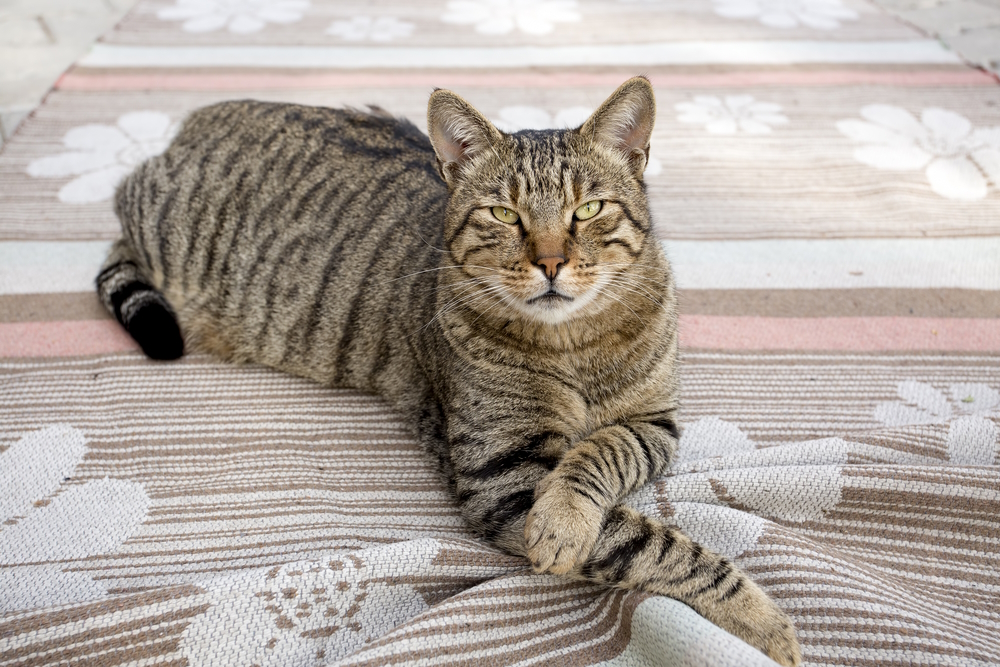
Microchipping 101

Microchips came on the scene in the mid-1980s. It revolutionized wildlife tracking and pet tracking. The premise is to implant an electronic device under an animal’s skin that would provide permanent identification with a unique tracking code that identifies the owner. The device is relatively small and implanted under the scruff of the neck. Veterinarians often microchip pets when they are fixed.

Its value is a permanent form of ID. If your pet gets lost, vet clinics and shelters routinely scan for a device. Manufacturers producing these products include HomeAgain, Avid Identification Systems, BuddyID, and AKC Reunite. The cost is typically under $100. Some pet insurers may cover this expense. Once implanted, you must register it with the company.

The costs are minimal after your initial purchase. Some may charge you a one-time fee; others have annual plans. Many offer additional services to expedite reuniting you with your pet if they get lost, such as alerting organizations or flyers to distribute in your neighborhood. Any expenses you incur are negligible compared to reuniting you with your animal companion.

You only need to have it done once since the typical chip lasts up to 25 years. Contrary to popular belief, a microchip is not a GPS tracker. It doesn’t raise privacy concerns on this score. Its sole purpose is identification. However, it doesn’t replace a collar and ID tag since individuals who may find a pet may not have access to a scanner. You can think of a microchip as insurance.

microchipping cat
Image Credit: LightField Studios, Shutterstock

National Microchipping Month in May — AKC Reunite

AKC Reunite is the non-profit arm of the American Kennel Club (AKC). Since its founding in 1995, the organization has reunited more than 600,000 pets. Their success stories are a moving testament to getting your animal companion microchipped. They also work with pet disaster relief and K9 rescue operations.

May is the organization’s official National Microchipping Month. It’s the AKC’s way to give back to the pet owner community with knowledge and awareness about its importance. They work closely with veterinarians and animal shelters to promote microchipping and address any concerns pet owners may have about the process.

National Microchipping Month in June — The Kennel Club

The Royal Kennel Club conducts a similar campaign in June in the United Kingdom. The goals of the national holiday are the same. It also helps pet owners stay compliant with legislation that requires registration with a government-compliant database such as Petlog. It’s worth noting that microchipping is compulsory for cats beginning June 10, 2024. Failure to do so will result in a hefty fine.

Therefore, that makes National Microchipping Month a PSA for pet owners to ensure they’re following the law. Cat owners in the United Kingdom are more likely to let their pets outdoors than Americans. This measure seems fitting, given this fact.
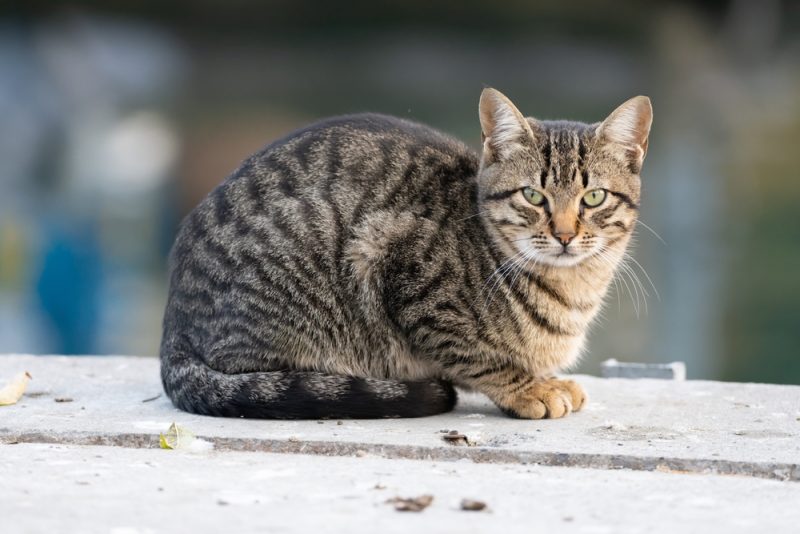
Microchiping sphinx cat in vet clinic
Image Credit: Evgeniy Kalinovskiy, Shutterstock

National Check the Chip Day — The American Veterinary Medical Association (AVMA)

It’s all well and good to get your pet microchipped. However, it helps little if you fail to keep your contact information up to date. A study conducted by the AVMA found that 41.9% of lost pets turned into animal shelters were not registered with the microchip’s manufacturer. Roughly 35.4% had incorrect contact information. That makes the organization’s decision to create their awareness day so fitting.
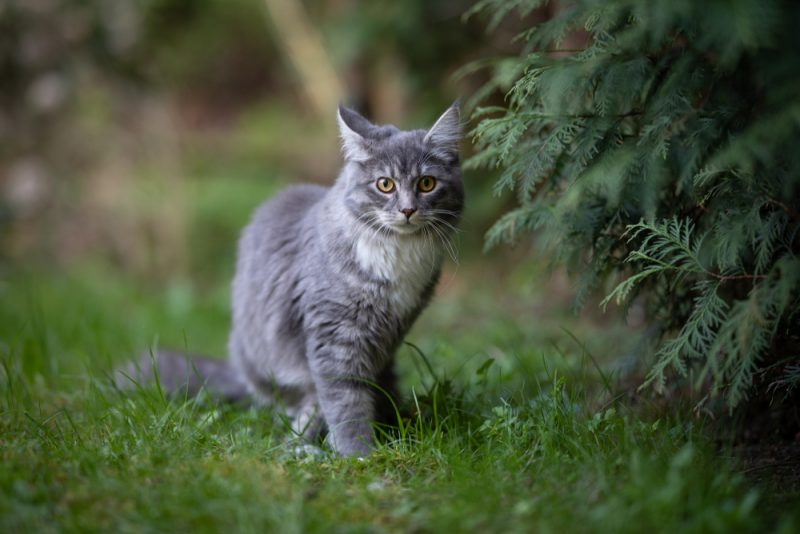
August 15 is National Check the Chip Day. Many companies allow free updates to your registration information. Things change. People move. Cell phones get lost. This day is an excellent reminder to ensure everything is current. Hopefully, you’ll never need to put it to the test.

3 cat face divider

Final Thoughts

National Microchipping Month and National Check the Chip Day are effective ways to reduce the number of pets ending up in shelters, separated from their human families. It’s added insurance that you’ll be reunited with your animal companion if they slip a collar or harness. It’s not an expensive procedure, but the results, if you have to use it, are priceless.


Featured Image Credit: LightField Studios, Shutterstock

Miliary Dermatitis in Cats: Causes, Signs & Treatments (Vet Answer)

No Comments

Miliary dermatitis, also called feline miliary dermatitis, may sound like an unusual name for a medical condition, but it is a common malady that affects our feline friends. Surprisingly, it is not a specific diagnosis or disease but rather a descriptive term used to characterize a distinct skin reaction pattern seen in cats. In this article, we’ll discuss what miliary dermatitis looks like, the various causes that could bring this lesion about, and the respective treatments that could be an option for your cat should they exhibit this condition.

What Is Miliary Dermatitis?

Other names for miliary dermatitis could include scabby cat disease, papulo crusting dermatitis, or miliary eczema. To break down the terminology of the full medical term, feline miliary dermatitis means:

  • “Feline” is another name for a cat.
  • “Miliary” is from the Latin word “milium” which translates to “millet.” This references millet seeds, which resemble the small, tiny bumps that describe what the skin reaction pattern can look like.
  • “Dermatitis” means inflammation of the skin.

Together, these terms describe not a diagnosis, but rather, a secondary skin reaction pattern that can be observed in cats. Feline miliary dermatitis is an inflammatory reaction pattern on the skin that can be present due to many different causes which will be discussed shortly.

The best way to describe it physically would be a pimply rash, often with crusts and variable degrees of redness and hair loss. Depending on the cause, it can occur in specific areas or throughout the body but is most commonly found on the lower back or sides of the abdomen, at the base of the tail, or on the head, neck, or ears.

Cat Rashes Allergy
Image Credit: RATT_ANARACH, Shutterstock

What Are the Signs of Miliary Dermatitis?

  • Small, pimple-like bumps called papules, usually around 1–2 mm in size
  • Papules may ooze or have a crust
  • Crusting on or around the lesion
  • Usually present in a cluster or as a large group
  • Itching often present
  • Affected cat may exhibit licking, gnawing, or scratching
  • Redness of the lesion and the skin around it
  • Hair loss (alopecia) may be present
  • Sometimes, papule lesions are felt rather than seen (unless closely inspecting skin), or they may be more visible in areas with less hair present

What Are the Causes of Miliary Dermatitis?

Because miliary dermatitis is a secondary skin reaction in response to a primary medical condition, when miliary dermatitis is seen, it is always in response to a primary cause. This reaction pattern most often manifests in the case of a reaction to an allergy, infestation by parasites, or an infection. But with that being said, there is a long laundry list of possible causes for feline miliary dermatitis. Some of these include:

  • Flea bite hypersensitivity (flea allergy)—this is the most common cause of miliary dermatitis cases
  • Reaction to other external parasites may include ear mites, skin mites, lice, ticks, mosquitoes, etc.
  • Adverse food reaction
  • Environmental allergies (such as pollen, molds, dust mites, etc.)
  • Bacterial infection of the skin
  • Fungal disease
  • Intestinal parasite hypersensitivity
  • Autoimmune skin condition such as pemphigus foliaceus
  • Adverse reaction to a drug
  • Cat affected by FIV (feline immunodeficiency virus)
Cat Allergy Skin Problem Dermatitis
Image Credit: Zhuravlev Andrey, Shutterstock

How Do I Care for a Cat With Miliary Dermatitis?

If your cat appears to exhibit miliary dermatitis, it’s a clue that there is an underlying medical condition going on that is affecting your cat. Having them seen by their veterinarian will help get to the primary cause, which will then enable you to treat the problem (which subsequently will resolve the lesions). A veterinary visit will start with a thorough history and a complete physical exam.

Next, some common actions or tests that may be needed to get to the cause of the lesion could include insect control trial, cytology and skin scrapings for analysis under the microscope, fungal culture, a food trial or elimination diet, fecal analysis, bloodwork, as well as a skin biopsy or even allergy testing. Lab work may be implemented in a stepwise fashion, ruling one or two causes out at a time before moving on to the next, if need be. It’s important to know that patience and vigilance will pay off as you seek the needed answers to help your feline friend.

The specific treatment will be tailored to treating the primary cause of the miliary dermatitis. Removing the allergen or problem causing the signs will allow healing of the lesions and eventually cure the miliary dermatitis. Once the cause has been determined, following the recommended long-term treatment protocols your cat’s veterinarian recommends is important to help the recovery process happen as quickly as possible and prevent relapses.

For example, if your cat has or is suspected to have flea allergy dermatitis, comprehensive flea control and preventatives will need to be implemented. This may include topical and/or oral medical control, as well as treating other animal members of the household and the environment at home. Bacterial infections are treated with antibiotics while fungal infections are treated with antifungals.

For a cat with a food allergy (or to rule one out), a strict food trial will be discussed in detail by your veterinarian. Corticosteroids or other medications to help reduce severe itching may be needed in some cases to help your cat be more comfortable as they heal with the primary treatment taking effect. Additionally, depending on the specific cause, other medications that may be utilized could include antihistamines, cyclosporine (Atopica), topical sprays, medicated shampoos, and fatty acid supplements, among others.

close up cat scratching ear
Image Credit: Lubo Ivanko, Shutterstock

cat + line divider

Frequently Asked Questions (FAQs)

Is Miliary Dermatitis Contagious?

Because this is a skin condition that results from a primary cause, the miliary dermatitis itself is not contagious, but the cause for the skin condition in the first place could be. For example, causes like food or environmental allergies are not contagious, but parasites such as a fungal infection could be. Fleas, another common underlying cause of miliary dermatitis, can very easily travel and readily spread from one animal to another.

What Is Flea Allergy Dermatitis and How Is It Related to Miliary Dermatitis?

As mentioned, this is the most common cause of miliary dermatitis in cats. Even if you don’t ever actually see a flea or flea dirt on your cat, this can still be the cause. Our feline friends can be very attentive and meticulous groomers, which can provide the evidence we are looking for. In some cats, all that is needed to cause a flare-up is one flea bite due to the irritating substances in the flea’s saliva. Cats with flea allergy dermatitis are often very itchy and can have lesions, such as military dermatitis, in specific areas, such as the top back region just above their tail.

Even without direct evidence, a trial treatment may be implemented to ensure and rule out that the most common cause for miliary dermatitis is not coming into play. Flea control may also be helpful for other pets in the household, and the environment should be treated to help stop the cycle from propagating. Your veterinarian will be able to discuss their recommendations for this in more detail, as well as the safety precautions that come with ensuring the correct flea treatment is used on the correct size and species type.

What’s My Cat’s Long-Term Prognosis?

Good news: This is a treatable condition and tends to have a great prognosis if the inciting factor is removed! So, if your cat’s cause of the miliary dermatitis is treated/removed, the miliary dermatitis should also resolve.

cat scratching ear
Image Credit: fotovictoria, Shutterstock

cat + line divider

Conclusion

Feline miliary dermatitis is an inflammatory skin reaction pattern that could be due to many things. When seen, it often signifies an allergy, most commonly due to flea bites, but there are many other possible causes. With proper treatment of the underlying cause, these lesions will resolve and be but a distant memory in your and your cat’s memory!


Featured Image Credit: MeowDr, Shutterstock

11 Senseless Cat Owner Sins According To Vets

No Comments

Cat ownership can be hard sometimes. To our dismay, cats don’t talk, and every animal has unique, individual wants, needs, and preferences. Thank the feline gods we have vets!

Catster’s vet team came together and put forth the 11 senseless cat owner sins to outline some things that cat owners should never do, attempt, or even think about doing. No matter what social media or your neighborhood cat lady says! These acts are dangerous and could cause harm to your cat or, in rare cases, lead to death.

Click to skip ahead:

First up, meet our team of global vets!

Dr. Paola Cuevas – Catster’s Senior In-house Veterinarian

Dr. Paola Cuevas


Dr. Amanda Charles – Catster Veterinarian Editor

Dr. Amanda Charles


Dr. Karyn Kanowski – Catster Veterinarian Editor

Dr. Karyn Kanowski


Dr. Lorna Whittemore –  Catster’s Senior Veterinarian Editor

Dr. Lorna Whittemore


Dr. Luqman Javed – Catster In-House Veterinarian

Dr. Luqman Javed


Dr. Maja Platisa – Catster In-House Veterinarian

Dr. Maja Platisa


Dr. Marta Vidal-Abarca- Catster In-House Veterinarian

Dr. Marta Vidal-Abarca

cat paw divider

The 11 Senseless Cat Owner Sins

Senseless Cat Owner Sins Infographic
You are free to use this image but we do require you to link back to Catster.com for credit.

The 11 Senseless Cat Owner Sins With Safer Alternatives

1. NEVER give your cat any human or other pet medications.

Giving medicines not prescribed to your cat by your veterinarian can be dangerous and even deadly.

INSTEAD:

  • Speak to your veterinarian if your cat is not well.
  • Only use the medicines your vet prescribes for the cat’s particular health issue.
  • Follow the dosage, frequency, and route of administration carefully.
  • Maja Platisa, DVM MRCVS CertAVP
vet giving medicine to white kitten
Image Credit: Elnur, Shutterstock

2. NEVER clip your cat’s teeth

Clipping a cat’s teeth is not the same as trimming their claws. Clipping teeth can cause permanent damage and be very painful for them.

INSTEAD:

  • If you are concerned about your kitten’s teeth being misaligned, visit your veterinarian, who will assess their teeth and give professional advice and help.
  • If your cat is biting, get a check-up with your vet to rule out health problems, and they can direct you to a qualified behaviorist.
  • Lorna Whittemore, BVMS, MRCVS, GPcertFELP

3. NEVER let your cat have access to lilies

Lilies, among other plants, are toxic to cats. Cats are curious and might chew on this plant if you have it in your home.

INSTEAD:

  • Research cat-safe plants and flowers to brighten up your home and garden.
  • Know that all parts of lilies, including the pollen and vase water, are toxic to cats.
  • Contact your vet immediately if your cat has eaten or come into contact with lilies.
  • Amanda Charles, BVSc MRCVS GPcertDerm


4. NEVER make your cat go vegan or vegetarian

Realize that cats are obligate carnivores, and you must cater to their nutritional needs. Feeding them a vegan or vegetarian diet is unhealthy and puts their life at risk.

INSTEAD:

  • Adopt a herbivorous pet if you’re keen on having a pet that follows such a dietary restriction.
  • Contact your veterinarian for more information about your cat’s nutritional needs and acceptable foods for them.

5. NEVER play rough with your kitten

It might be cute when they’re little, but it teaches them that scratching and biting is okay. Plus, you are much larger than a kitten, so you could hurt them.

INSTEAD:

  • Stock up on chaser toys, interactive toys, and wand-type toys.
  • Two is better than one! Two kittens will get all their rough play, skirmishes, and mock fighting out of their system with each other, leaving cuddle time for you.
  • If your cat starts to play rough with you, just get up and walk away.
  • Karyn Kanowski, MRCVS, BVSc, BSc (Zoology)
kitten looking up
Image Credit: Kyryk Ivan, Shutterstock

6. NEVER dress your cat in costumes

It might make a great photo, but with very few exceptions, they hate it and will resent you. Some costumes might be uncomfortable for them.

INSTEAD:

  • Use Photoshop to add some flare to a photo.
  • Create fun props and dioramas for them to play in and get naturally posed memories.
  • Karyn Kanowski, MRCVS, BVSc, BSc (Zoology)

7. NEVER place your cat in a carrier you have not properly checked

The risk of your cat running away or getting lost is very high. This scenario would be a nightmare for both you and your cat.

INSTEAD:

  • Before using the carrier, check that the zippers work and all locks are in place.
  • Check that the lid and the base of the carrier fit properly.
  • Purchase a carrier that is safe and fit for your cat.
  • Marta Vidal-Abarca, BVSc MRCVS GPCertOphthal
woman holding a pet carrier
Image Credit: NDanko, Shutterstock

8. NEVER ignore your cat’s change in their urinating habits

No matter how subtle, changes in urination could mean health issues.

INSTEAD:

  • Watch your cat closely if you notice any abnormality around their toileting behavior, such as not using the litter box at all, frequent trips to the litter box, spending more time than usual in their litter box, urinating small amounts, or vocalizing while urinating.
  • Be familiar with your cat’s routine and know how they show signs of illness.
  • Contact your veterinarian when you notice any changes in their toileting habits.
  • Marta Vidal-Abarca, BVSc MRCVS GPCertOphthal

9. NEVER feed your cat ONLY dry food

Hydration is extremely important for cats, and an exclusively dry food diet does not offer enough moisture to help them be healthy.

INSTEAD:

  • Offer your cat a moisture-rich diet, such as a complete and balanced fresh or wet food diet. If your cat prefers dry food, offer at least a 50/50 mix.
  • Ensure your cat’s diet has enough proteins and moisture to mimic their natural food.
  • Offer your cat a water fountain and think about creative ways to entice them to ingest enough water.
  • Paola Cuevas, MVZ, Behaviorist
cat eating food from feeding bowl
Image Credit: TarasBeletskiy, Shutterstock

10. NEVER put your cat on a sudden extreme calorie-restricted diet

Restricting your cat’s caloric intake overnight can be very dangerous. Cats can develop hepatic lipidosis, known as fatty liver syndrome.

INSTEAD:

  • If your cat needs to lose weight, start by reducing only 10% to 20% of their daily calorie intake. Weight in and recalculate every couple of weeks.
  • A slow but consistent diet plan is preferred. Get your veterinarian involved.
  • Feed a healthy, balanced diet and increase your cat’s physical activity with daily interactions.
  • Paola Cuevas, MVZ, Behaviorist

11. NEVER leave your hair ties around the house

Ingestion of hair ties is a common occurrence in playful cats. Unaware cat owners usually only find out after emergency surgery.

INSTEAD:

  • Keep your hair ties safe and away from the reach of your cats.
  • If you buy a packet of hair ties, please only use one at a time so you do not leave it around the house where your cat can grab it.
  • Never allow your cat to play with them or objects that are small and stringy, which they can ingest.
  • Paola Cuevas, MVZ, Behaviorist
bows, scrunchies, and headbands organized in a drawer
Image Credit: Charise Wilson, Shutterstock

cat paw dividerSumming It All Up

Responsible pet owners never want to put their pets in danger intentionally. And some of these sins can seem harmless—but that is far from the truth. Our vet team hopes they have shed light on some practices that people might do to or with their pets, whether it involves their diet, safety around the home, or playing with them. Now that you know about these sins, you can take steps to avoid them.


Featured Image Credit: masary78, Shutterstock

Bengal Siamese Mix: Pictures, Care, Traits & Info

No Comments

The Bengal and the Siamese are two iconic breeds beloved by feline enthusiasts for their stunning looks and exceptional dispositions. If you are among the large group of people who love both cats, you should check out the Bengal Siamese mix. As the name suggests, this cat is a mix of the leopard-like Bengal and the sleek Siamese. The result is a stunning feline that displays the best qualities of each parent.

Height: 8–10 inches
Weight: 10–15 pounds
Lifespan: 12–20 years
Colors: Spotted, brown, tan, black, white
Suitable for: Active families, experienced cat owners, social cat lovers, people with mild allergies, multi-pet households
Temperament: Energetic, curious, clever, talkative, and playful

Bengal Siamese mixes are a unique mixed breed, as they are made by crossing the rare Bengal with the popular Siamese. Not everyone can get their hands on such a special mixed breed, making the Bengal Siamese mix a coveted cat for many.

The Bengal Siamese mix’s relative rarity is not their only notable feature. They are often described as energetic, intelligent, and playful. To learn more about this special cat, keep reading below.

Bengal Siamese Mix Breed Characteristics

  • Energy: 5/5 stars
  • Trainability: 3.5/5 stars
  • Health: 4/5 stars
  • Lifespan: 5/5 stars
  • Sociability: 5/5 stars

Bengal Siamese Mix Breed Kittens

Siamese cats are popular and fairly easy to find, whereas Bengal cats are rare. Therefore, finding a Bengal Siamese mix may be a challenge. You can reach out to your local animal shelters and ask if they have a Bengal Siamese mix in their care, but chances are that they won’t. Your best chance at finding a Bengal Siamese mix will be to work with a breeder specializing in the mixed breed.

When searching for a breeder, ensure you only work with reputable, responsible breeders. Unethical breeders may produce as many kittens as possible without concern for the mother or the litter’s health. Later on, you may discover that a kitten from an unethical breeder has several health concerns. Therefore, it is best to avoid shady breeders and search for one that cares for their cats.

The Bengal Siamese kitten will be a chatty, hyperactive kitten. Before bringing them home, you will want to kitten-proof your house. Don’t underestimate how much trouble your Bengal Siamese mix can get into; Bengals have a knack for exploring and getting into mischief.

Parent Breeds of the Bengal Siamese Mix
Image Credit: Left: (Bengal Cat) Shvaygert Ekaterina, Shutterstock, Right (Siamese Cat) Stockorm, Shutterstock

cat + line divider

Temperament & Intelligence of the Bengal Siamese Mix

Your Bengal Siamese mix may take after one parent more than the other. Still, their personality should stay essentially the same: spunky and talkative. The Siamese is often described as a spirited, vocal cat that will meow, chirp, or trill to get their owner’s attention. The Bengal is active, curious, and constantly in need of enrichment. And like the Siamese, the Bengal isn’t afraid to be vocal to get what they want.

If you want a lap cat, the Bengal Siamese mix may or may not fill that role. Siamese cats don’t mind curling up and snuggling, but Bengal cats are usually too full of energy to bother. They prefer to explore than to cuddle.

Despite their energetic nature, the Bengal Siamese mix can live in a small apartment just as well as a large house as long as they have plenty of entertainment. Provide interactive toys, puzzles, and vertical climbing spaces to ensure your Bengal Siamese mix has plenty to do. Otherwise, they may resort to destructive behaviors to entertain themselves.

Are These Cats Good for Families? 👪

The Bengal Siamese mix is a great family cat. Both parents thrive on social interaction, and the Bengal Siamese mix does best when surrounded by their favorite people. When they aren’t playing with their owners, you will likely find them perched on a vertical space where they can observe the whole family.

They are good with children, but like many cats, they have personal space boundaries that must be observed. Children who understand and respect the boundaries of the Bengal Siamese can form strong relationships with them. Younger children who have not yet learned when to give the Bengal Siamese space should be supervised when interacting with the cat.

Does This Breed Get Along With Other Pets?

Bengal Siamese mixes get along with other pets, but they are unsuitable for all pets. Cats and dogs are typically fine companions for the Bengal Siamese mix, but large dogs should be supervised carefully to ensure they don’t accidentally trample the Bengal Siamese.

Likewise, a large dog with a high prey drive may see the Bengal Siamese mix as prey to chase, creating a poor living situation for your cat. Therefore, consider each animal in your home carefully before adding a new addition.

The Bengal Siamese mix is not recommended when it comes to smaller animals such as birds, mice, or hamsters. The Bengal has a high prey drive and sees smaller animals as potential food sources. Housing a small animal with the Bengal Siamese is a recipe for disaster, so it is best to avoid it altogether.

cat + line divider

Things to Know When Owning a Bengal Siamese Mix

Before deciding to bring home a Bengal Siamese mix, there are a few critical care requirements that you should know about. Responsible pet owners should ensure they can provide quality care regarding food, exercise, training, grooming, and healthcare.

Food & Diet Requirements 🐡

Your Bengal Siamese mix will need high-quality, AAFCO-certified cat food to guarantee that they are receiving sufficient nutrition that will keep them healthy. As long as your cat is eating food with the AAFCO’s stamp of approval, they shouldn’t need added supplements in their diet; however, if your vet recommends it, you can add supplements as necessary.

It is recommended that you do not free-feed your Bengal Siamese mix. Instead, feed them a healthy amount of food at the same time each day to get your cat into an eating routine. Your vet can help you determine how many calories are appropriate for your cat so that you know you are feeding them the proper amount.

Another note: if you hear your Bengal Siamese mix growl while they eat, don’t worry. It is typical for Bengal cats to growl when they eat, so it may be a quirk that your Bengal Siamese mix inherits.

Exercise 🐈

Exercise is essential for the Bengal Siamese mix since they have a lot of energy they need to burn off. Otherwise, they can misbehave.

Establishing a regular exercise time with your Bengal Siamese mix is a great way to ensure that they stay active. Engaging with your cat can keep them moving and build your bond, so make sure you have a rotation of interactive toys on hand so you can play with your pet.

When you are away from home, leave out toys so that your Bengal Siamese mix can play on their own. Having vertical climbing spaces can also keep your cat moving throughout the day.

Training 🧶

Both Bengals and Siamese cats are highly intelligent and capable of learning tricks. Teaching new tricks to your Bengal Siamese mix can be a great way to bond and keep them mentally enriched, and for the most part, your Bengal Siamese mix will be cooperative and eager to please. Their attention span may be short, so keep training sessions under 15 minutes.

Positive reinforcement is the best way to train your Bengal Siamese mix. The Bengal Siamese can be sensitive, and harsh correction methods will only scare them or damage their trust in you. By focusing on reward-based training, you will see better results quicker and build a better bond with your pet.

Grooming ✂️

Typically, the Bengal Siamese mix doesn’t require high-maintenance grooming. Weekly brushing should reduce shedding, prevent tangles, and keep their coat looking good. They shouldn’t need regular baths, but they may beg for one. The Bengal loves water, and your Bengal Siamese mix may be more than happy to jump in the tub whenever possible.

Other ways to care for your Bengal Siamese’s grooming needs include checking their ears, trimming their nails, and brushing their teeth.

Health and Conditions 🏥

The Bengal Siamese is typically a healthy cat. Both parents are known to have long life spans, and it is possible that your Bengal Siamese mix could live as long as or longer than 20 years.

A key area to pay attention to is your cat’s eyes. Both the Bengal and the Siamese are known to have issues with their eyes, including progressive retinal atrophy and hereditary retinal degeneration. Annual vet visits are a great way to ensure your cat stays healthy.

Other conditions to watch for include patellar luxation and dental disease, which are common in the Bengal Siamese mix.

Minor Conditions

  • Luxating patella
  • Dental disease

Serious Conditions

  • Progressive Retinal Atrophy (PRA)
  • Hereditary Retinal Degeneration

Male vs Female

The behavioral differences between a fixed male and female Bengal Siamese mix will likely be minimal. Instead, the biggest influences on your cat’s temperament will be which parent they take after the most, as well as their personality quirks. However, unfixed cats may display significant behavioral differences depending on their sex.

cat + line divider

3 Little-Known Facts About the Bengal Siamese Mix

1. Bengals Are True Cat Burglars.

If you have personal items you want to keep your Bengal Siamese away from, you’ll need to get creative. The Bengal is a true cat burglar that steals things they like and stores them away for later.


2. Siamese Cats Have Lived in the White House During Three Presidencies.

The Siamese cat is more than just popular—they’re presidential. Siamese cats have taken residence in the White House as presidential family pets during the terms of Rutherford B. Hayes, Gerald Ford, and Jimmy Carter.


3. Bengal Siamese Mixes Are Chatty.

You’ll have a talkative companion if you bring the Bengal Siamese mix home. Both Bengal cats and Siamese cats are known for being vocal, so prepare yourself for a chatty cat!

cat + line divider

Final Thoughts

The Bengal Siamese mix is truly a special feline. Not many cat owners will have the privilege of owning such a unique mixed breed due to the Bengal’s rarity, but those who can welcome one into the family will have a lively, vocal companion. There is never a dull moment with the playful Bengal Siamese mix, especially when they start exploring and getting into mischief.

Due to the Bengal’s active and adventurous spirit, first-time cat owners may find the Bengal Siamese to be a handful. Experienced cat owners who are confident in their training abilities will find that the Bengal Siamese is an entertaining companion with an excellent disposition.

If you think that the Bengal Siamese is the right pet for you, start by visiting local animal shelters. Plenty of cats need a home, and if you can find a Bengal Siamese mix at the shelter, you can bring home a wonderful pet and provide them with the loving family they need.


Featured Image Credit: Left: (Bengal Cat) EZvereva, Shutterstock, Right (Siamese Cat) Altsva, Shutterstock

Can Cats Eat Graham Crackers? Vet-Approved Facts & Alternatives

No Comments

Cats are known for their picky eating habits, but they can sometimes surprise us by nibbling on unexpected treats. One strange item that seems to get many cats’ attention is graham crackers, but are they safe for cats to eat? Fortunately, graham crackers are fine for felines in small amounts, but are not suitable to add to the diet as they are lacking in all the nutrients your little carnivore needs.

What Are Graham Crackers?

Graham crackers were created in the United States in the late 1800s, inspired by preacher Sylvester Graham. He introduced the first graham product that used coarsely ground flour (graham flour) as part of a vegetarian diet. Several companies began mass-producing them and they are still a popular food item today, often sweetened with honey or cinnamon. They are also an ingredient in many desserts, like pie crusts and s’mores.

Graham crackers contain enriched flour, whole grain wheat flour, sugar, canola or soybean oil, preservatives, molasses, honey, baking soda, calcium phosphatase, salt, dextrose, cinnamon, soy lecithin, natural cinnamon flavor and sodium sulfite.

Graham cracker photo shot close up
Image Credit: Duntrune Studios, Shutterstock

cat + line divider

Problems With Graham Crackers

Flour

Graham crackers are primarily coarsely ground wheat flour. While cats can technically digest small amounts of carbohydrates, their digestive systems are not well-suited for processing large quantities of wheat or grains, and eating too much might lead to digestive upset. Graham crackers also lack the essential nutrients that cats need for a balanced diet.

Sugar and Fats

Graham crackers often contain added sugar, fats and oils, which is not suitable for cats. Cats are not even able to experience sweet tastes. Too much sugar or fat over time will lead to weight gain, which puts your feline at risk for diabetes and joint problems.

Honey

Some graham cracker varieties contain honey. While honey is natural, it is still high in sugar and could cause weight gain over time.

honey
Image Credit: Steve Buissinne, Pixabay

Cinnamon

Cinnamon is a common spice used in graham crackers. While small amounts of cinnamon are generally safe for cats, large quantities can lead to digestive upset, mouth sores or even toxicity. Although ingestion of enough cinnamon to cause a problem is unlikely in cats.

Salt

Some graham crackers may contain added salt, which can harm cats in very large doses. Although again, ingestion of enough to cause a problem is unlikely.

Potential Allergies

Some cats may have allergies or sensitivities to certain ingredients found in graham crackers, such as wheat. Signs of an allergic reaction can include continuous itching, scratching, overgrooming, and biting.

3 cat face divider

Benefits of Feeding Graham Crackers to Cats

Unfortunately, there is no real benefit to feeding graham crackers to your cat, as they don’t contain any meat, which is what cats require in their diets. However, a graham cracker shouldn’t cause any harm if your cat nibbles on a tiny piece you dropped on the floor.

tabby cat eating cat food out of bowl inside
Image Credit:

cat face divider 2

Alternatives to Graham Crackers for Cats

Cat Treats

Commercial cat treats are great options and help meet feline dietary requirements. They come in various flavors and textures, so with a bit of experimentation, you will surely find something that your cat enjoys.

Cooked Meat

Cats love meat, and small amounts of cooked chicken, turkey, or fish can be tasty and safe treats for your furry friend. Boil the meat without spices, let it cool, and cut it into small pieces before serving.

Catnip

Catnip is a natural herb that many cats enjoy. You can sprinkle it on a scratching post or use catnip-infused toys to provide entertainment. It’s also a fragrant, attractive, and easy-to-grow plant that you can keep indoors or outside.

Dental Chews

Dental chews are similar to commercial cat treats but have special ingredients to help cats maintain their oral health. Check out the Veterinary Oral Health Council (VOHC) approved list of dental products.

cat is chewing on a treat
Image Credit: Marinka-Buronka,Shutterstock

3 cat divider

Health Guidelines for Cats

  • Schedule annual check-ups with your veterinarian. Regular vet visits can help catch and prevent health issues early.
  • Ensure that your cat receives the appropriate vaccinations to protect against common feline diseases.
  • Provide balanced, high-quality cat food appropriate for your cat’s age and health, and follow the portion sizes recommended on the package.
  • Always provide fresh, clean water. Some cats prefer running water, so a water fountain can help.
  • Continuously monitor your cat’s weight and body condition. Obesity is a common issue in cats and can lead to health problems. Consult your vet for weight management strategies if you struggle to keep your cat at an appropriate weight.
  • Promote dental health with regular teeth brushing, dental treats, and toys designed for oral hygiene. Always use pet-safe toothpaste, as human toothpaste can contain dangerous ingredients.
  • Use the flea-and-tick control measures that your vet recommends, and administer deworming treatments as necessary, as these insects can transmit several harmful diseases to your pet, including Lyme disease and heartworm.
  • Keep the litter box clean, and change the litter once or twice a day to keep it hygienic. .
  • Provide toys, scratching posts, and treat-dispensing puzzles to keep your cat physically and mentally active. Spend at least 20 minutes daily engaging your cat in activities and games.
  • Regularly brush your cat’s coat to prevent matting and reduce shedding. Long-haired breeds may require more frequent grooming and trimming.
  • Spaying and neutering can help prevent unwanted litters and reduce certain health and behavior issues.
  • Consider microchipping your cat, and have them wear a collar with an ID tag with your contact information.
  • Cats can be sensitive to changes in their routine. Minimize stress by providing a stable and comfortable living environment.
  • Watch for changes in behavior, appetite, and litter box habits or signs of discomfort, and contact the vet immediately if you notice any.
  • Have a plan in case of emergencies. Know the phone number and address of the nearest 24-hour veterinary clinic.

cat paw divider

Conclusion

If your cat ate a graham cracker without your approval, they will probably be fine, but it is a good idea to watch them closely for several hours for signs of digestive upset and call the vet if there are any problems. Graham crackers contain no nutritional benefits for cats, and many of the ingredients, like flour and sugar, can be harmful in large amounts. Choosing a more suitable food, like a commercial cat treat or plain cooked meat, is better for your cat.


Featured Image Credit: Brent Hofacker, Shutterstock

Osteosarcoma in Cats: Signs, Causes & Treatment (Vet Answer)

No Comments

Osteosarcoma is a type of bone tumor that occurs in cats, and it can occur in any bone in a cat’s body. It is a very aggressive type of cancer and can spread to other parts of the body rapidly. Osteosarcoma is the most common type of bone tumor in cats, however, it is relatively rare compared to other cancers. Tumors can be primary, meaning cancer has started in one of the bones, or secondary where it has spread from a distant site.

Osteosarcoma causes a considerable amount of pain for cats, so it is important to have it identified and treated as soon as possible. They are usually found in the limbs of cats, or in the bones that connect to the spine such as the rib cage bones, the skull, and the pelvis. There are some treatment options for cats with osteosarcomas, however, the prognosis is generally poor.

Click Below to Jump Ahead:

What Is Osteosarcoma in Cats?

Osteosarcoma is an extremely aggressive cancer that affects the bones of cats. It is a malignant tumor that can spread rapidly and have devastating effects.

Osteosarcoma arises from the bone itself. It starts with an abnormal production of the cells in bones that make and break down the bone. The overproduction of bone-making cells and bone-destroying cells causes proliferative and destructive patterns in the bone. The tumor penetrates and then begins to destroy the cortex of the bone. It is also capable of moving into the surrounding tissues. In cats, there are two types, grouped depending on their location.

Axial osteosarcoma affects the spine, neck, and head. Appendicular osteosarcoma affects the pelvis, limbs, paws, and shoulders. The long bones in the legs of the cat are the most commonly affected, however, the tumor can affect any bone in the body. Over time, due to the malignant nature of the tumor, a phenomenon in cats called extraskeletal osteosarcoma can occur.1 This is where the tumor invades non-bony tissue such as the liver, kidneys, spleen, and mammary glands.

Osteosarcoma causes severe pain, inflammation, and can even cause pathological fractures. This is where the bone breaks despite no force or impact being applied. Instead, the underlying disease process of the tumor leaves the bones brittle and weak, so they often snap on their own. Osteosarcoma affects cats of all ages, although it is relatively rare in cats and is not quite as aggressive in cats as it is in dogs. Metastatic lesions are less common.

Sick-cat-on-operating-table-in-veterinary-office
Image Credit: megaflopp,Shutterstock

What Are the Signs of Osteosarcoma in Cats?

Often the first clinical signs owners notice is a swelling over one of the bones. Osteosarcoma is an extremely painful condition, so another early sign is lameness (if the osteosarcoma is affecting one of the limbs) or other signs of pain if the location is elsewhere. Depending on what stage the tumor is at and how fast it is progressing, other systemic signs may be witnessed as well.

Common clinical signs seen can include:

  • Lameness
  • Reluctance to be stroked
  • Behavioral changes such as increased aggression
  • Swelling present on limbs or over bones
  • Lethargy
  • Loss of appetite
  • Drinking more than usual
  • Coughing
  • Fractures

A lot of the signs will depend on the exact location of the primary tumor, and where it has spread to. For example, if the tumor has spread to the lungs your cat may have a cough. Some tumors spread to the bones of the jaw. This causes excessive swelling and leads to difficulty eating and swallowing.

sad looking cat lying on bed
Image Credit: Yaya Photos, Shutterstock

What Are the Causes of Osteosarcoma in Cats?

The causes of osteosarcoma are thought to be a complex mixture of different factors. These can include:

  • Genetics
  • DNA mutations
  • Hereditary traits
  • Environmental risk factors
  • Lifestyle of cats
  • Age
  • Toxin exposure
  • Trauma

Cancers can occur for many reasons and the truth is currently they are not very well understood. There are usually a few different factors that trigger the development of cancer. This is the same for osteosarcoma.

Diagnosis of Osteosarcoma in Cats

Your vet will start by examining your cat and taking a full clinical history of their health. If they are suspicious of an osteosarcoma, they will be paying special attention to your cat’s bones. They will feel along your cat’s spine and up and down their legs and over their skull. They will be looking for any lumps or masses over or around the bones.

Your vet is likely to take some blood tests and a urine test to assess the health of your cat and check if there are any issues with blood cell counts and organ function. Your vet will attempt to take some X-rays of your cat to look at the bones. Normally on X-rays, bone tumors have a classic “moth-eaten” appearance as some of the bone tissue is lost due to the action of the bone-destroying cells. Fractures may be obvious near the tumor too.

Your vet is also likely to take samples of any masses present and swollen or enlarged lymph nodes. This can be done by cytology using a small needle and biopsy using a larger needle or scalpel blade. If osteosarcoma is diagnosed your vet will assess the spread to local and distant lymph nodes and organs in the chest and abdomen.

Further imaging may be used such as CT, MRI, ultrasound, and nuclear scintigraphy depending on the lesions noted and the location. Because the tumor has the potential to be aggressive, it is important to check for metastatic disease in other areas of the body.

Abyssinian cat check-by vet
Image Credit: Nataly-Mayak, Shutterstock

How Do I Care for a Cat with Osteosarcoma?

If the tumor has spread from the bone to other places in the body, this carries a very poor prognosis. If there is no sign of metastatic disease, your vet will attempt to control the primary tumor and prevent it from growing and spreading.

If the tumor involves one of the bones of the limbs, this often requires amputation of the affected limb. This sounds very dramatic and lots of owners are extremely upset by this suggestion when discussing options with their vet. However, cats cope very well with three limbs. If the tumor is in the bones of the jaw, mandibulectomy or maxillectomy are performed—these operations involve removing parts of the jaw.

Depending on whether metastatic disease is present, chemotherapy and/or radiotherapy can also be used. Radiation can help improve a patient’s quality of life. Chemotherapy is often used if surgery is not an option, for example, if the cat is not a suitable candidate for a general anesthetic.

Your vet will also always use pain relief when an osteosarcoma has been diagnosed. It is a very uncomfortable condition and strong pain relief is required. Your vet will often refer you to a specialist veterinary oncologist to tailor a treatment plan for your cat.

cat + line divider

Frequently Asked Questions (FAQ)

How common is bone cancer in cats?

Bone cancer is not particularly common in cats. Although osteosarcoma is by far the most common type of bone cancer witnessed in cats.

How long do cats live with osteosarcoma?

Once the diagnosis has been made, the prognosis is generally poor. Cats that have the primary tumor amputated seem to do slightly better, with average survival rates of 4 years reported. Cats with appendicular osteosarcomas have an average survival rate of around 12 months. Cats with axial osteosarcomas have an average survival rate of only 6 months.

Are osteosarcoma tumors painful in cats?

Similar to any other species, osteosarcoma tumors are extremely painful for cats. This is partly due to the nature of the tumor and the way the structure of the bone is destroyed at the location of the tumor. Pathological fractures are commonly seen with osteosarcomas, and they are excruciatingly painful.

cat examined by a vet
Image Credit: Dina Photo Stories, Shutterstock

cat + line divider

Conclusion

Osteosarcomas are a relatively rare occurrence in cats. They can be aggressive and destructive and can cause your cat a great deal of pain. Diagnosis is straightforward, usually based on clinical signs, findings on X-rays, and biopsies. Treatment options can vary depending on the owner and their pet’s situation.

Whether or not treatment is given, prognosis is fairly poor with life expectancy ranging from 6 months to 4 years depending on the progression of the disease and treatment given. If you see any clinical signs or have any suspicions your cat may be suffering from osteosarcoma, it is important you get in contact with your vet as soon as possible.


Featured Image Credit: Olesya Alexandrova, Shutterstock

Can Cats Understand Multiple Languages? Dr. Lauren’s Perspective

No Comments

Happy New Year, everyone! Sorry for the delay on this one – Pancake and I were busy celebrating…

Cats have lived with humans for over 10,000 years by various estimates, being present throughout the modern world in varied contexts of societies worldwide.1 The scope of which cats thrive in various cultures, ranging from beloved pets to demigods, means that they are adaptable, and intelligent beings. Therefore, it would seem logical that we find ourselves wondering just how much they comprehend the human world around them. Specifically, can cats understand multiple languages? Let us delve into this linguistic labyrinth.

Scientific data directly pertinent or supportive of the subject of feline language comprehension is sparse. Cats themselves are described as having a minimum of 21 varied forms of vocalizations, though in reality this is suspected to be higher.2 So, you’ll hopefully forgive me when I rely on a lot of ailurophilic anecdotal experience, to say that yes, as a vet with over a decade working in feline-exclusive practice, cats can and do understand multiple languages.

For instance, a bit like the Inuits, with the various words for snow, I suspect Pancake has about 21 vocalizations just for various forms of “feed me”. They include feline phrases such as: where’s the food, why didn’t you feed me more, can’t you feed me again it’s been five minutes, can’t you feed me again, it’s now been 10 minutes, why did you feed me this, and so on, and so forth. Each with a distinctively unique meow.

A number of years back, now, some inventors in Japan came up with a gadget that supposedly translated what cats were saying. It wasn’t super slick compared to modern tech, but it did suggest that cats were attempting to communicate with their owners. Nowadays, you can carry the translator in the form of an App called MeowTalk, so that at any time, you can translate what your cat is saying to you. (When I trialed it on Pancake, it suggested that she was repeatedly saying “I love you”, so it must be highly accurate… that or the designers were highly smart…) And we’ve all seen the pet buttons and associated videos on YouTube. In fact, there is a whole channel dedicated to a cat named Billi who (quite fluently, at times) uses the buttons to communicate in English with her owner. (Billi’s favorite word is mad, in case you were wondering…)

So all this anecdotal work suggests some attempts to communicate in a language other than their own. But taking it a step further, can cats be multilingual?

While cats may not be fluent polyglots in the human sense, they certainly respond to multiple languages. Many feline patients I’ve worked with in the past come from multilingual homes, speaking two or more languages. These have included English, Russian, French, Portuguese, Spanish, German, Dutch, and many others. In the exam room, these cats certainly respond to various spoken words in these multiple languages. And owners are quick to assure me it’s no different at home.

Remember, too, that your cat responds to non-verbal communication. Whether that be clicker training (an amazing group of Circus Cats in the US epitomizes what clicker training can accomplish), or your facial expression, cognition is closely tied to various non-verbal cues. Slow blinking, too, encouraged cats to approach people, in one study. So add another tick to the language box, and rest assured that the feline lexicon is indeed large. Whether you speak English, Mandarin or Spanish, a cat is constantly discerning your mood through the nuances of non-verbal communication.

In short, it’s fair to say that cats have demonstrated multiple times in my career (and the four times I’ve seen the Circus Cats in Chicago) that they understand multiple layers of language, both verbal and nonverbal. This allows them, in part, to develop the deep bonds they do with people worldwide. So, whether you communicate with your cat in English, French, or Afrikaans, rest assured they appreciate the communication and what you convey. And, as a fallback, there is always the universal language of food. Dreamies or Chupa Chups, anyone?

My Cat Ate Ibuprofen: Is it Dangerous & What to Do? (Vet Answer)

No Comments

Ibuprofen is a commonly used non-steroidal anti-inflammatory in humans. It can be purchased over the counter and is often used to treat fever, pain, head colds, swelling, and menstrual discomfort. Unfortunately, ibuprofen is very harmful to cats. It should never be given as a pain relief medication, and if you suspect your cat has managed to eat ibuprofen, prompt veterinary attention should be sought.

This article will explain and examine ibuprofen toxicity in cats, including why it is so dangerous, what can be done if your cat has eaten it, and what signs you should be watching for.

Click Below to Jump Ahead:

What is a Non-Steroidal Anti-Inflammatory Drug (NSAID)?

Ibuprofen belongs to a class of medications known as non-steroidal anti-inflammatory drugs (NSAIDs). This medication blocks some of the pathways in the body that produce inflammatory mediators. However, these same pathways are also responsible for many normal body functions, including regulation of the digestive tract, kidneys, liver, and blood clotting factors. As a result of this, an overdose of an NSAID can cause ulceration of the stomach, impaired kidney function, damage to the liver, and an inability to clot blood.

Ibuprofen Tablets Spilled From a Bottle
Image Credit: Michelle Lee Photography, Shutterstock

Why Is Ibuprofen Harmful to Cats?

Ibuprofen is extremely dangerous in cats. For the average-sized cat, as little as one standard ibuprofen tablet (200mg) can be harmful.

The simple answer here is that cats are not people. They are, of course, much smaller in size. Additionally, their ability to metabolize, or break down, various drugs, including ibuprofen, is significantly reduced compared to people. When pharmaceutical companies test medications such as ibuprofen, they test the medication on people. This establishes a safety margin—in other words, how much of the medication can be consumed without causing any negative effects. This safety margin does not transfer across species. Indeed, the safety margin for ibuprofen is much smaller in cats than it is in humans.

Why Do Cats Eat Ibuprofen?

The short answer is, we don’t know. Veterinary clinics and The Animal Poisons Hotline receive many calls every year in regard to cats that have eaten ibuprofen. In some of these cases, owners may have given their cat ibuprofen to help with a painful condition without knowing the potential toxicity it can cause. In other situations, owners have found a packet of ibuprofen that has been chewed up.

Some ibuprofen capsules or tablet preparations may have a sweet-smelling coating that appeals to cats. Other times, it may just be the cat’s inquisitive nature that leads them to try some ibuprofen.

Sad sick young gray cat
Image Credit: Ro_ksy, Shutterstock

Signs of Ibuprofen Toxicity in Cats

Most ibuprofen toxicities in cats cause irritation and ulceration of the gastrointestinal tract. Owners may notice:

  • Reduced appetite
  • Vomiting
  • Diarrhea
  • Pale gums
  • Dark tarry stools (as a result of digested blood)
  • Abdominal pain

More severe cases of ibuprofen toxicity lead to acute kidney disease, liver disease, and, in extreme cases, neurological disease. Owners may notice:

  • Increased thirst and urination
  • Decreased thirst and urination
  • Yellow discoloration of the gums, skin, and whites of the eyes
  • Tremoring and seizures (rarely)
sick tabby cat lying on the bed
Image Credit: Zhuravlev Andrey, Shutterstock

Treatment of Ibuprofen Toxicity in Cats

There are three main ways vets will treat ibuprofen toxicity in cats:

  • Decontamination. This is the technical term for making a cat vomit. This can be attempted within 2–3 hours of ibuprofen ingestion to empty the stomach. Some “rapid-release” ibuprofen formulations may already be absorbed by the time vomiting is induced. Don’t induce vomiting in your cat without supervision by a vet.
  • Supportive medications. Activated charcoal is often given to help “mop up” any undigested ibuprofen before it has a chance to be absorbed into the bloodstream. Other medications, similar to antacids, are used to protect the lining of the stomach from ulceration. Pain relief and anti-nausea medications may be warranted.
  • Fluid therapy. Fluids may be given under the skin or intravenously depending on a cat’s needs. Some cats may require hospitalization for fluid therapy and continuous monitoring.  If kidney damage occurs, ongoing fluid therapy at home (given under the skin) may be recommended.

Blood and urine tests are often used by veterinarians to assess the toxicity initially or to gather a baseline database. These same tests can also be used as a guide 2–3 days later to ensure no further injury to organs has occurred.

Prognosis for Cats After Ibuprofen Ingestion

The prognosis for cats with ibuprofen ingestion is variable. It depends on the size and health status of your cat, the amount of ibuprofen ingested, the time at which ingestion was detected, and the treatment regimen undertaken.

Having said that, most cats that eat ibuprofen are able to make a full recovery with appropriate care.

vet nurse checking the cat
Image Credit: Prostock-studio, Shutterstock

cat + line divider

Conclusion

Ibuprofen is a common household medication that is extremely harmful to cats. While its use is generally considered very safe for people, a single tablet can cause problems for our feline friends. Gastrointestinal and kidney injury are most common, and treatment for these problems may require admission to a veterinary hospital.

If you have accidentally given your cat ibuprofen, or suspect that your cat has gotten into ibuprofen, contact your veterinarian or nearest vet emergency center promptly.


Featured Image Credit: luchschenF, Shutterstock

PortraitFlip Pet Portrait Review 2024: Our Expert’s Opinion

No Comments

Our Final Verdict

We give PortraitFlip Pet Portrait a rating of 4.9 out of 5 stars.

Quality: 5/5

Options: 5/5

Value: 4.75/5

Today, most people have hundreds (if not thousands) of photos of their pets. It’s not hard to get those photos turned into prints to decorate your home. But what if you could get those pictures turned into hand-painted pieces of art, instead?

That’s the idea behind PortraitFlip.

This company takes photos and transforms them into real paintings done by real people. You can choose from seven different mediums and even combine pictures to get all your pets in one beautiful scene. And because these pieces are created by real people with real paint brushes, you can customize them any way you want.

I had the opportunity to get a PortraitFlip painting done of my cat, Makoa. I chose the acrylic medium because I loved how much the examples looked like real works of art. While I had an idea that this was a product I would enjoy, I had no idea just how much I would love it!

Find out what sets PortraitFlip apart from other photo-to-painting companies and why I’m so happy with my awesome piece of pet art by reading my full Pet Portrait review, below.

About ProtraitFlip

PortraitFlip - close up of the portrait

PortraitFlip got its start in 2018. Back then, the company was just a few market executives, customer care associates, and a handful of artists. Today, the company has bloomed to over 250 artists and a team of professionals responsible for ensuring every customer gets exactly what they order.

The company is based out of Newark, Delaware, but its team comprises hundreds of talented artists from across the globe.

What Products Can You Get From PortraitFlip?

PortraitFlip offers a long list of photo-to-painting options. They specialize in recreating pictures with an artistic bend, especially portraits of people and pets.

The paintings can be direct recreations of single photos or compilations that bring together individuals from multiple photos into a single piece of art. You can choose up to 15 pets (or 15 people) to include in a single painting.

These paintings are available in a number of different mediums, including:

  • Oil
  • Pencil
  • Charcoal
  • Watercolor
  • Colored pencil
  • Acrylic
  • Pastel

I chose the acrylic option for Makoa’s painting because I liked how much the example pieces actually looked like paintings rather than a simple recreation of the photo.

Some options look more painting-like while others are more realistic looking with very fine details. All these options make it easy to find exactly what you want.

For each medium, you can choose from nine size options for the final painting, running from 12” by 12” to ” 48” by 72”.

What Pets Does PortraitFlip Paint?

As far as I can tell, there are no limits to what kinds of pets PortraitFlip will turn into gorgeous paintings. As long as you have a photo, they can transform it into art.

For me, I chose a photo of my cat from when he was an adorable little kitten because I wanted a way to remember those days. This service is great for making memories last and is a wonderful option for memorializing pets that have passed on.

Of course, it is also great for celebrating pets that are still with us. And, because you can combine multiple pets from multiple pictures, it is the perfect way to get that furry family photo without having to train all your pets to sit next to each other.

cat paw divider

Overview

PortraitFlip - side by side of makoa's portrait and picture

Here is an overview of what to expect when getting a custom piece of art done through PortraitFlip. We’ll look at how the process works, how long it takes to receive your order, and their customer satisfaction guarantee.

How It Works

To get started with PortraitFlip, you first need to decide what medium you want and how big you want the portrait to be. Next, you’ll upload your photo (or photos) of your pet (or pets) and add any notes you want the artist to incorporate.

After you’ve ordered your painting, you’ll receive an email with the digital customization proof attached. This proof will be cropped to the correct size and adjusted digitally based on your notes. Basically, this acts as the reference for the artist so they know what to paint.

Once you’ve approved the proof, your artist will get to work on the actual painting. After this is complete, you’ll receive another email with a photo of the completed project. Once approved, your painting will ship.

PortraitFlip gives you multiple opportunities to make adjustments to your painting so you can be sure it is exactly what you expect when it finally arrives.

Processing Times

For standard pictures, it can take up to 15 days for the artist to complete the painting. Once approved, shipping takes up to an additional eight days.

If you’re in a hurry, you can opt for expedited processing. With this more expensive option, the painting will be completed within 10 days and express shipped to arrive within four days.

I opted for the standard processing time and received my painting within 18 days of ordering it. This was pretty impressive since I placed my order the week after Black Friday.

PortraitFlip - makoa lying in front of his portrait

Guarantee

Pet Portrait has a 100% customer satisfaction guarantee. If you don’t love your portrait when it arrives or if there are any issues with the product, you can return it for a 100% refund within 7 days of receipt.

The company goes out of its way to ensure this doesn’t happen by giving you multiple opportunities to review the photo proof and final painting before shipping.

In Summary

Pros

  • True hand-painted pieces
  • Highly customizable
  • Can combine photos
  • Multiple mediums and sizes
  • 100% satisfaction guarantee

Cons

  • Expensive
  • Quality can vary by artist
  • Not a quick turnaround

cat paw divider

Key Features

PortraitFlip - makoa's portrait hanging by the stairs

Truly Hand-Painted

There are a lot of companies out there that turn your photos into “works of art.” But most of these rely on digital filters to make your picture look like it has been painted or drawn. But a real artist never actually touches the print.

That is not the case with PortraitFlip. Each of their products is completely recreated from scratch using paint brushes, pencils, or charcoal wielded by a real-life person. The result is a true piece of art, not a print, that you will want to show off to all your houseguests.

So Many Options

PortraitFlip has 7 different medium options to choose from so you can pick the right one to match your decor and preferences. Each medium has something a little different to offer and each has a different feel to match your pet’s personality.

You also get to choose from 9 different size options to ensure the painting fits your house perfectly.

Satisfaction Guaranteed

From the moment you start the process with PortraitFlip, you have many opportunities to make sure you get exactly what you want.

To start, you can add notes to your order that go straight to the artist.

Once the digital proof is done, you have a chance to make changes to how the photo is cropped as well as what is left in and out of the scene. Because these are real artists, you can even give more specific directions about how to complete the painting.

Once the portrait is complete, you’ll receive a final proof. If there is anything you don’t like about the painting, you can ask the painter to fix it before the product is shipped.

cat paw divider

Are PortraitFlip Pet Portraits a Good Value?

If you look at the prices of PortraitFlip paintings and compare them to other photo-to-painting sites, you might think their prices are high. But remember, most of these other companies do not actually deliver real paintings. Rather, they create digital prints that have been put through artistic filters to make them look like paintings.

If you were to commission a portrait from an artist in a one-to-one exchange, you would likely be paying a minimum of a thousand dollars and potentially up to tens of thousands of dollars. Hand-painted portraits on PortraitFlip start at just $89, which is impressively cheap when you think about what you’re actually getting.

PortraitFlip - makoa's portrait on the cabinet

cat paw divider

FAQ

Who are PortraitFlip’s artists?

PortraitFlip employs over 250 artists from around the globe. They hail from the US, Canada, India, China, and Indonesia. Each is a master in at least one painting medium.

You can’t choose your artist, which means there is some variation in quality between different paintings you might receive. But you can feel confident that the company’s hiring policies and quality assurance practices will provide products you’ll love.

What material are the paintings painted on?

This will depend on the medium you choose. Oil and acrylic are painted on high-quality canvas, while pencil, charcoal, watercolor, and others are painted on paper.

How do I know my product was hand-painted and not printed?

You can tell! My acrylic painting not only smelled like paint when I unwrapped it, but I could see the paint texture clearly. And, while it looks very much like my proof photo, it is not an exact copy.

PortraitFlip - makoa's portrait on a counter

cat paw divider

Our Experience With PortraitFlip

I have ordered pet portraits from a few other photo-to-print sites before, but never from one that claims to hand paint the portraits. So, I was really excited to get this product and see if that fact made a difference.

I chose a picture of my rescue cat, Makoa, from when he was just a kitten. He is only six months old now, but he already looks full-grown. I was excited to have his cute little kitten stage memorialized in a piece of art.

One of the first things I noticed as I unwrapped my new portrait, was that the box did not smell like printer ink. My previous pet portraits all had a subtle yet distinct ink smell since they were prints. This one smelled, without a doubt, like paint!

As soon as I unwrapped it from its protective coat of bubble wrap, shrink wrap, and corner protectors, I could immediately see the difference. Each brush stroke was evident. And the paint had a texture to it that you just don’t get from prints.

The painting is absolutely gorgeous. It looks just like the photo but with some key differences that really elevate it and transform it from picture to art.

For one, it has more highlights, which really makes Makoa pop off the canvas. And the background was given a little more character and texture which makes the whole piece look more interesting.

I was also happy to see that the artist captured Makoa’s damaged eye without drawing too much attention to it. He wouldn’t be “Makoa-Jack pirate cat” without that eye. But that doesn’t mean I want it to be the focal point of his portrait.

Overall, I am extremely happy with this painting. It now hangs in my daughter’s bathroom (because Makoa is her true love) and looks absolutely stunning. I get comments on it every time we have a guest over.

PortraitFlip - makoa standing on the cabinet with his portrait

cat paw divider

Conclusion

If you want to turn your pet into a work of art, don’t settle for print shops that use filters to digitize photos. Instead, I highly recommend looking at PortraitFlip. You will pay more for their services, but you just can’t beat the value or beauty of a hand-painted piece of art.

My acrylic painting of Makoa has truly brightened my house and brings a smile to my face every time I see it. Whether you’re looking to memorialize a lost pet or celebrate a furry family member, you won’t regret paying a little extra to get their likeness in a true masterpiece.

Scottish Fold Ragdoll Mix: Pictures, Info, Temperament & Traits

No Comments

This interesting mix is not a true breed of cat but is rather a crossbreed: a mix between the loveable Ragdoll and the interesting Scottish Fold. This is a seldom-seen mix, which can be called a Ragafold or a Scottish Doll.

Height: 8–11 inches
Weight: 6–20 pounds
Lifespan: 12–15 years
Colors: Point: seal, chocolate, blue, silver, red, cream, lilac, tortoiseshell mixed colors, all colors (from Scottish Fold parent)
Suitable for: Families with children, seniors, single people who work from home, homebodies
Temperament: Kind-natured, laid back, affectionate, “dog-like”, gets along with other pets

The Scottish Fold originated in the UK, and it’s thought that all Scottish Folds come from one cat! The Ragdoll, on the other hand, was bred in America by one breeder in the 1960s. These two cats are distinct in nature but mix to produce a kitten with a wonderful temperament, but that’s unfortunately often plagued with many (sometimes serious) health issues.

Scottish Fold Ragdoll Mix Characteristics

  • Energy: 3/5 stars
  • Trainability: 4/5 stars
  • Health: 1/5 stars
  • Lifespan: 2/5 stars
  • Sociability: 4/5 stars

Scottish Fold Ragdoll Mix Kittens

As you can probably imagine, this feline hybrid results in an adorably fun, fluffy and unique kitten. With any mixed breed, the physical characteristics will vary from kitten to kitten depending on which parents features are more dominant. You can expect to see any combination of the Ragolls fluffy coat and the signature folded ears of the Scottish Fold but some of these traits may not be apparent until the kittens mature.

If you are looking for a gentle and affectionate breed, the Scottish Fold Ragdoll Mix is just that! They are inherently curious and make lovable and extremely social pets.

The Parent Breed of Scottish Fold Ragdoll Mix
Image Credit: Left (Scottish Fold) dien, Shutterstock; Right (Ragdoll) Serita Vossen, Shutterstock

cat + line divider

Temperament & Intelligence of the Scottish Fold Ragdoll Mix

Are These Cats Good for Families? 👪

These cats are gentle, kind, and very tolerant of children and other pets. This makes them very good cats for families, especially since they’re homebodies who want to be part of the scene. They are soft and well-mannered if socialized well at an early age and are known to be just as good with single people and seniors (loving a lap to sleep on) as they are with families.

Does This Breed Get Along With Other Pets?

The Scottish Fold Ragdoll mix is good with other pets if they are socialized during kittenhood (as all cats should be). Because cats are a solitary species, they don’t necessarily need the company of another cat and can sometimes get stressed if there aren’t enough resources available to them both. However, if they live with other cats, they can form very close bonds and join the family unit. In temperament, the Scottish Fold Ragdoll mix is generally regarded as tolerant and accepting of other cats and dogs.

cat + line divider

Things to Know When Owning a Scottish Fold Ragdoll Mix

Food & Diet Requirements 🐡

These cats can be stocky and prone to obesity, so they need a portion-controlled protein-rich diet to ensure they get all the nutrition they need without putting on too much weight. In addition, a well-balanced diet rich in taurine is required, as taurine is an essential additive for cats as they can’t produce it on their own.

Following the portion directions on your cat’s food to ensure they’re getting enough, and varying their diet with different protein sources (if they don’t have allergies) can help to keep them interested in the food while providing well-rounded nutrition.

Because of their parent breeds, the Scottish Fold Ragdoll mix may have heart and joint problems, meaning they need a diet tailored to heart and joint health. A diet high in omega-3 and 6 is essential for these cats, as these amino acids help to keep the heart and joints healthy. In addition, glucosamine and chondroitin supplements (usually used more in older animals) can benefit these cats, as Scottish Folds almost always suffer from a painful joint disease that can benefit from these supplements.

Exercise 🐈

Exercise and human interaction are very important to this crossbreed. Both the Ragdoll and the Scottish Fold love to be around their humans and involve them in play, so stimulation in the form of interactive exercise is essential to keep them happy and healthy. Care must be taken, however, as this crossbreed is likely to suffer from joint problems that can be painful. Gentle, regular exercise is the key, with around 30 minutes a day of interactive play being the best amount for these homebody cats.

Training 🧶

The Scottish Fold Ragdoll mix isn’t the most intelligent cat on the scale, but it’s fairly smart and easy to train thanks to its inherited intelligence from its Scottish Fold parent. Scottish Folds are generally considered one of the most intelligent cat breeds, giving the crossbreed a good amount of trainability despite the potential for intelligence being reduced thanks to the Ragdoll side. The Scottish Fold Ragdoll crossbreed is still easily rained to even perform tricks like sit and give paw thanks to the addition of the Ragdoll’s easygoing and eager nature.

Grooming ✂️

Both parent cats have very different grooming needs thanks to the variety of coat types they can inherit. The Ragdoll has a long, thick coat that requires daily grooming to keep it tangle-free and comfortable, and they shed a lot. On the other hand, the Scottish Fold usually has a short and dense coat, but long-haired varieties are known. The Scottish Fold Ragdoll mix can have either of these coat types but is likely to have a semi-long hair coat that’s silky and thick.

This crossbreed should be groomed twice a week using a gentle brush to tease out any knots in the coat that might be forming and to help strip out any shed hair to prevent hairballs. This will help keep your cat comfortable; any excess grooming shouldn’t be needed, save for emergency grooms when they get into something they shouldn’t.

Health and Conditions 🏥

The reason the Scottish Fold Ragdoll mix is uncommon is likely due to the many health conditions they may suffer from (despite most crossbreeds being more healthy than pure breeds). Some of these issues are, unfortunately, life-limiting. Because of the danger of this mix inheriting health problems from potentially both parents, thorough testing of the parents should be carried out before any breeding is commenced.

Minor Conditions

  • Ear mites
  • Wax build-up
  • Ear Infections

Serious Conditions

  • Osteochondrodysplasia
  • Hypertrophic Cardiomyopathy (HCM)

cat paw divider

Male vs Female

Male cats are generally bigger and bulkier than their female counterparts, and this is also true for the Scottish Fold Ragdoll mix. They will grow for longer, reaching maturity at around five months, although males and females will finish growing completely around the two-year mark.

Both male and female cats will need to be spayed and neutered, and this procedure is much less involved for male cats. For example, if a male Scottish Fold Ragdoll cat isn’t neutered, he will grow big cheeks (or “jowls”) due to the testosterone coursing through his body and will likely try to roam or have other inappropriate behaviors (like aggression or humping) until he is neutered.

3 Little-Known Facts About Scottish Fold Ragdoll Mix

1. Some Scottish Fold-Ragdoll mixes will have partially folded ears.

Because the Ragdoll cat’s ears are straight and the Scottish Folds ears are sometimes not folded, it’s possible that the mix can end up with partially folded ears.


2. They come in many color variations.

Ragdoll cats come in a very distinctive color and pattern: color point. The most common of these is seal, however, because the Scottish Fold can come in any color or pattern variation, the kittens born as crossbreeds of these two breeds can be any color or pattern too.


3. The Ragdoll-Scottish Fold mix is a rare crossbreed.

This mix of breeds is seldom seen, despite both breeds being around for a long time. This is probably due to both breeds having substantial health problems on their own, mainly the Scottish Fold. A combination of these breeds can produce kittens that have potentially devastating health problems.

cat paw divider

Final Thoughts

Despite this cat being a sweet, gentle, and loving family cat who adores being around its people, this crossbreed should not be bred. The serious health problems of the Scottish Fold have even led to the breed being banned outright in some countries, such as Belgium because it’s seen as cruel to continue to breed them. The same can be said for any crossbreeds of the Scottish fold, as only one copy of the faulty gene that causes Osteochondrodysplasia is needed to be inherited by the kitten to cause lots of pain and suffering.

The Ragdoll also has its own health problems, which are also inherited, which could be why this loving crossbreed isn’t easy to find. The heartbreak of losing a loved, adored feline member of the family early to a painful illness is terrible and shouldn’t be suffered by anyone, which is why this crossbreed would be better off not being bred at all.


Featured Image Credit: Left (Scottish Fold) Alexander Sobol, Shutterstock; Right (Ragdoll) Peredniankina, Shutterstock

How Cats Improve Your Mood: Olga’s Ways of Relieving My Stress

No Comments

Researchers have studied how cats and dogs improve their owners’ lives, and although I’m glad the subject is receiving more attention, I don’t need to see the studies to confirm that my cat helps me handle stress. For most of us, life isn’t easy, and for me, it’s hard to imagine it without Olga. Sometimes, when I’m in a bad mood, she’ll do something so ridiculous that it makes me laugh and remember to take life less seriously.

The Morning Routine

Although I’m more of a morning person now, rising before dawn and preparing for work aren’t my favorite activities. Like most crepuscular pets, Olga is pretty energetic before 6:00 AM, and her enthusiasm for a new day does not gel with my zombie-like brain until I make it to the coffee maker.

Good morning!

After I put her food in the bowl, she’ll eat for a few minutes and then walk over to the window to watch the birds at the feeder. She’ll walk back and forth a few times before finishing her food, and after grooming, she finds ways to annoy and entertain me before work. It usually involves laying on her back and wiggling around with her claws attached to the bottom of the recliner I’m sitting in.

If I stare at her when she’s scratching the chair, she’ll give me a funny look, with her pupils dilated, and try to claw her way up the chair to hit me. Most of the time, she chickens out halfway up, drops to the ground, and runs into the spare bedroom. It always cracks me up and puts me in a good mood, but I’m also jealous of her because she gets to go wild and run around while I have to go to work.

Olga the cat lying on lap
She also gets to nap while I work…

What the Researchers Leave Out

Cats purr loudly and rub their heads on your legs or arms to show affection, and most cats can recognize their owners from a large group of people. Research shows cats are more affectionate than aloof, and nearly every cat owner agrees. However, the studies don’t mention the other minor ways felines enrich our lives.

Whenever I leave the house and return a few hours later, Olga waits by the door to greet me. If I’m not paying attention to her when she wants to play, she’ll pull a paper ball from under the couch and hit it in my direction or leap on the windowsill and bat the blinds around. When I walk by her favorite scratching chair, and she’s in a wild mood, she’ll climb around it like a Lemur and play hide and seek by ducking her head behind the chair and popping it out.

Olga popping her head over the chair
Hi, Dad!

When you frequently see your cat act like a clown, it’s hard to let stress ruin your day. Olga’s antics keep me entertained and make me realize that cats are more complicated than we give them credit. They love us and follow us around because we feed them and keep them safe, but they want us to be happy, and they don’t mind acting like goofballs to put a smile on our faces.

My Cat Ate Dental Floss: Is It Dangerous? Our Vet Explains What to Do

No Comments

There is no denying that cats are curious creatures. We find them getting themselves into all sorts of mischief, from playing with snakes to rummaging through garbage cans. Trash can often be viewed as an enticing toy or a tasty snack to a cat. So, what happens if your cat has managed to get into the garbage and consumes dental floss? Is this dangerous?

The answer is, unfortunately, yes. The ingestion of dental floss could lead to a linear foreign body in your cat, one of the more dire types of foreign body ingestions. Continue reading to learn more about the risks associated with dental floss ingestion and linear foreign bodies.

Linear Foreign Bodies in Cats

Long, thin objects that are inappropriately consumed are called linear foreign bodies. String, rope, dental floss, cloth, and ribbon are examples of potential linear foreign bodies. What typically occurs in linear foreign body ingestion, or in this case, floss ingestion, is that the foreign object becomes embedded or stuck within the gastrointestinal tract. The natural movements of the intestines through peristalsis will attempt to propel the foreign object through the digestive tract. Intestinal bunching ends up occurring, leading to intense pain and intestinal damage. As damage occurs to the intestines and tension on the object increases, there is a risk of perforation of the gastrointestinal tract.

In some cases of linear foreign bodies, the object may be seen wrapped around the base of the tongue or seen exiting the rectum. It is important to never attempt to remove the string without the help of a veterinarian.

veterinarian doctor holds cat
Image Credit: H_Ko, Shutterstock

My Cat Just Ate Floss, What Should I Do?

The first thing to do after your cat has ingested floss or another type of linear foreign object is to call your veterinarian. Your veterinarian will likely ask several questions to help develop a plan for your pet.

In some cases, your veterinarian may recommend close monitoring at home, whereas in other situations, your veterinarian may recommend you bring your cat to the clinic. Cats are notoriously harder to induce vomiting in, and as a result, your veterinarian may recommend endoscopy to retrieve the object from the stomach, especially if ingestion just occurred.

Signs of a Linear Foreign Body

Signs can vary amongst patients, and owners sometimes are not aware that ingestion of a foreign object has occurred.

Signs that can be seen with linear foreign bodies include:

  • Reduced appetite
  • Vomiting
  • Lethargy
  • Discomfort
  • Constipation

Diagnosing a Linear Foreign Body

If your pet has experienced signs associated with a foreign body, or if there is a recent history of ingestion of a foreign body like floss, radiographs will be recommended. Unfortunately, things like dental floss can be difficult to identify on radiographs, as the foreign object itself is usually not visible. The appearance of the intestines will be closely evaluated by the veterinarian to better determine if intestinal bunching has occurred, which is commonly seen with linear foreign bodies.

If there is a high suspicion of a linear foreign body but radiographs do not provide a definitive diagnosis, an ultrasound or exploratory surgery may be recommended to evaluate the gastrointestinal tract.

cat-having-an-ultrasound-in-vet-clinic
Image Credit: Libre,Shutterstock

Treatment of a Linear Foreign Body

In some cases, linear foreign bodies can pass through the intestinal tract without causing havoc. The problem is that there is no way to determine which patients will be able to pass the string or floss without complications.

Linear foreign bodies can occasionally be removed through the induction of vomiting and endoscopic retrieval if recent consumption of the string has occurred.

If problems arise from ingestion of floss or another type of linear foreign object, surgery will likely be recommended. As with most foreign body surgeries, the sooner the surgery can occur after the patient has been stabilized, the better. Following foreign body surgery, your cat will need to be kept inactive and treated with appropriate medications. Additionally, a temporary diet change may be necessary.

How Can I Prevent Ingestion of Floss or Other Linear Foreign Objects?

Unfortunately, the chances are high that your cat will ingest something they shouldn’t at some point in their lives. Setting them up for success is imperative to their safety. What exactly does that mean?

Try making it very difficult for your cat to have access to potentially harmful items like floss by disposing of them properly in a trash can with a lid. Alternatively, it would be worthwhile to avoid linear floss altogether and try using a floss pick instead. Removing access to bathrooms is helpful by keeping doors closed. Before leaving the house, performing a quick check of the house is helpful in identifying potential hazards.

cat + line divider

In Summary

If your cat has ingested dental floss, there is a risk of developing gastrointestinal complications. If possible, schedule an appointment with your veterinarian to evaluate your cat and to check for floss that may be wrapped around the base of the tongue. Unfortunately, some cats do require surgery after the consumption of a linear foreign object like dental floss. The prognosis is dependent on the duration of clinical signs and the damage endured to the intestinal tract. Try avoiding using potentially harmful things like dental floss in your home to minimize the chances of ingestion by a curious cat.


Featured Image Credit: Anastassiya Bezhekeneva, Shutterstock

Why Is My Cat Gagging? 7 Vet-Reviewed Reasons

No Comments

If you’ve recently seen your cat gagging, you may wonder what causes it and whether you should be concerned. Gagging is a confusing term, as it can mean different things to different people. Short of boring you with medical definitions, the various things that people might be referring to when talking of gagging can encompass a variety of different diseases, including true gagging (choking), unproductive vomiting, and coughing, to name a few.

Occasional gagging is potentially nothing serious, but cats that are doing so should still be seen by a veterinarian. Keep reading to learn more about seven common reasons your cat could be gagging.

The 7 Reasons WHy Your Cat Might be Gagging

1. Speedy Eating

Cats that eat their food a bit too quickly sometimes end up gagging. Speedy eating can also cause cats to regurgitate what they just gobbled down. It’s usually pretty easy to identify this sort of gagging, as it happens right after cats eat, and if they vomit, it usually contains undigested kibble.

The situation sometimes occurs in homes with more than one cat where there’s resource competition occurring. Feeding the cats in different locations can cut down on conflict and tension that can cause some pets to resort to speedy eating.

Interactive and slow feeders can assist solo cats that tend to get carried away at mealtime. Not only do they slow cats down, but they also provide mental stimulation that’s critical for their overall well-being.

tabby cat eating cat food out of bowl inside
Image Credit: Africa Studio, Shutterstock

2. Hairballs

Cats can vomit up hairballs, and some people consider this to be “gagging”, however it is actually vomiting. Hairballs form when cats groom themselves and ingest too much hair, which then doesn’t pass through the digestive tract. When enough fur accumulates, cats attempt to vomit it up, and successful attempts usually produce fur and a bit of liquid. Unsuccessful attempts may sound to the untrained ear like gagging.

While occasional hairballs are usually nothing to worry about, cats that regularly struggle with them should be seen by a veterinarian, as the situation could be linked to health issues such as parasites, gastrointestinal disease, or even allergies.


3. Upset Stomach

Nausea can sometimes lead to unproductive vomiting that some people incorrectly call gagging, but other causes are more common. Common signs of nausea include producing lots of saliva, excessive tiredness, overgrooming, a lack of appetite, or lethargy.

Cats can throw up after eating something that doesn’t agree with them. New cat food can also be problematic. Conditions such as food allergies, inflammatory bowel disease, and kidney disease can also upset feline stomachs.

cat hairball
Image Credit: Montakan Wannasri, Shutterstock

4. Respiratory Conditions

Cats cough when suffering from respiratory conditions, which can often be mistaken for gagging. Bacteria and viruses can both cause upper respiratory infections, which result in inflammation, sneezing, and excessive mucous production.

Feline herpes virus and feline calicivirus are behind most upper respiratory infections in cats. However, conditions such as pneumonia and pleural effusions can also cause cats to cough.

Cancers of the respiratory tract can lead to the development of signs that can resemble gagging in cats. The occasional cough is usually nothing to worry about, particularly in happy and healthy cats, but a veterinarian should see pets that have  coughs that don’t resolve.


5. Foreign Objects

Cats are well known for nibbling on odd things, which they sometimes end up consuming. Some foreign objects can make it through their digestive tracts without incident, but occasionally, the material gets stuck, which can lead to vomiting and even the development of abdominal obstructions. Toys, plants, and buttons are just a few of the things cats are fond of eating. In these instances, people may again confuse unproductive vomiting with gagging.

String and yarn are particularly dangerous since they can cause intestinal damage and lead to infections such as peritonitis. Signs of foreign body ingestion include lethargy, pain in the abdominal area, lack of appetite, and vomiting.

Call your veterinarian immediately if you suspect your cat has eaten something harmful. If you see anything hanging from your cat’s bottom or a bit of string wrapped around their tongue, leave everything as it is and take your companion in for professional help.

Cat vomiting
Image Credit: Nils Jacobi, Shutterstock

6. Toxins and Irritants

Vomiting and coughing can be signs that a cat has been exposed to a toxic product or something irritating their airways. Particularly sensitive cats can react to litter dust and fragrances.

Essential oils dispersed through diffusers can make breathing difficult for cats. Droplets from diffusers can land on cats’ fur, where they can be ingested during grooming, which has the potential to make them quite ill. Several essential oils are highly toxic to cats.

Other common items that can cause problems include bleach, rodenticides, deicing salts, as well as plants such as amaryllis and chrysanthemums. Reach out to your veterinarian if your cat consumes anything toxic.

It’s vital to let them know what your cat got into, how much they were exposed to when they ingested the substance, and if your cat is showing any signs such as coughing, lack of interest in eating, bruising, fast breathing, or pale gums.


7. Asthma

Cats with asthma often have dry, unproductive coughs that can sometimes sound like gags. Cats with asthma experience pulmonary inflammation after breathing in dust mites, cat litter particulates, and other allergens. Strongly scented products such as air fresheners and potpourri can cause some cats to react.

Persistent coughs should be evaluated sooner rather than later by a veterinarian. Diagnosis usually involves blood tests, X-rays, and parasite testing, as heartworm disease can sometimes cause similar signs in cats.

Treatment is aimed at managing the condition and usually involves long-term use of anti-inflammatory medication. Inhalers are often prescribed, but other modalities, such as pills and injections, are also available. Most cats diagnosed with the condition need to continue taking the medication even when they do not have difficulty breathing.

vet checking bengal cat
Image Credit: Pressmaster, Shutterstock

cat paw divider

Conclusion

Gagging is easily confused with coughing or non-productive vomiting in cats. Various conditions can therefore be described as gagging by owners, when in reality, true gagging is relatively uncommon in cats. The occasional gag (or cough, or vomit) is usually not a huge deal, but a veterinarian should see cats if the problem persists.


Featured Image Credit: Nils Jacobi, Shutterstock

My Cat Has a Limp Tail, What’s Wrong? 5 Vet-Reviewed Possible Issues

No Comments

Cats are expressive creatures, especially through their body language. Felines give many clues about their feelings and communicate widely using various parts and positions of their bodies. Their tails, for example, are used to display their mood. An upright tail is often one of a happy and confident cat. They also use their tails to rub against you when you arrive home after an absence or to communicate a need or want with you. On the other hand, if they are feeling threatened, the hair on the tail will fluff out and stand on end.

So, if your cat’s tail is limp, does this mean something is wrong? Potentially, but not always.

Is a Limp Tail Serious?

Physically being unable or unwilling to use or lift their tail needs investigation by your veterinarian as soon as you notice it to begin treatment. Below are five common explanations or scenarios for a floppy tail, some of which are more serious than others. But in any event, all require treatment and are a cause for concern.

kurilian bobtail cat sitting on the bathtub
Image Credit: Asasirov, Shutterstock


The 5 Likely Reasons Your Cat Has a Limp Tail

1. Trauma

“Trauma” is a broad umbrella term covering many things, but trauma to the tail is one of the most common explanations for your cat not using this part of their spine.

Examples of trauma include:

  • It is possible for cats to injure their tail by accidentally wafting past hot stoves, saucepans with hot food in them, boiling water, or spitting fat. Open fireplaces and bonfires are other risks, as are fireworks.
  • The tail is trapped or slammed in a door or window. It is not unusual, and usually it is accidental, but a cat’s tail can become trapped in a building, garage, house or car door, and any type of window.
  • The tail being run overby a child’s toy, a vehicle, or even stepped on by an adult.
  • Grazes and cuts occur for a plethora of reasons. Some of the above will cause minor to major wounds, for example. Wounds are uncomfortable and may cause pain and interfere with movement.
  • This may be due to an injury or wound, as described above, or referred pain, meaning an issue is ongoing elsewhere in the body but the pain is referred to the tail area.
  • Avulsion injuries.An example of this would be a young child pulling or yanking the cat’s tail or another animal grabbing at it. Cats can also self-inflict this injury by constantly trying to pull their tail out from something (or a situation), like under a wheel or between branches if they are caught in a tree.
  • Full anal glands.While not direct trauma, it is indirect, as the uncomfortableness of full or impacted anal glands is distressing. It will cause your kitty to exhibit limp tail behavior until their glands are emptied by your veterinarian.

Have a look at your cat’s tail and examine it for any wounds, markings, or odd positioning of bones and tissues. Apply first aid only if you are comfortable and knowledgeable in doing so, and then take your feline friend to the vet for assessment and treatment.


2. Fracture

Some of the reasons cited under trauma may indeed fracture (break) the tail. The tail is a continuation of the spine and forms part of the cat’s backbone. Lots of muscles and tendons are in this area too that can be damaged. An injury to the tail part of the spine, or the spine higher up, can cause your cat not to use their tail and for it to become limp. Your veterinarian will need to perform X-rays and further tests to assess the damage, begin the correct line of treatment, and find out if the use of the tail will return.

vet doctor examining cat in x-ray room
Image Credit: PRESSLAB, Shutterstock

3. Dislocation

Dislocation of the vertebrae joints in the tail can happen in road traffic accidents as well as in yanking and pulling injuries. The force doesn’t break or crack the bone but separates one or more of the joints instead, causing pain, swelling, or lack of use.


4. Nerve Damage

Nerve damage created from fractures, dislocation, or avulsion injuries can all result in one or a few of the nerves being affected. Alternatively, nerve-related issues may occur due to other underlying health problems, causing the tail to be limp with a loss of sensation. Many nerves exist in the spinal area, and it is a complicated subject to investigate. The nerve damage may be temporary, meaning the use of the tail will return, or it may be permanent.

Image Credit: Sergey Nivens, Shutterstock

5. Abscess

These are exceptionally common in the feline community that spend time outside. They usually occur during fighting or in a standoff when one cat tries to run away from an aggressive cat or a bullying cat. The aggressor bites the tail or tail base of the runner, and due to the bacteria cats have in their mouths, an abscess can form.

This happens because the bacteria are left in the skin of the unfortunate party when the aggressor sinks their teeth into their skin. An abscess forms in response and will require treatment including antibiotics. A swollen, softish, painful area can usually be seen with puncture marks of the teeth. It may also be hot and oozing pus.

3 cat divider

Conclusion

Tail injuries are very common in cats, and they will need to be looked at by a veterinarian in almost all cases. The severity of the injury and its effects, as you can appreciate, is vast, and the treatment and outlook will depend on the originating cause, the degree of damage subsequently caused, and the health status of your cat in general. Some cats will only require rest and medication, while others may require amputation, so always check in with your vet to be on the safe side!


Featured Image Credit: YULIYA Shustik, Shutterstock

Cat Bunting: What Is It? Feline Behavior Explained

No Comments

Cats are curious creatures that have many behaviors that we must study to understand, as they are not natural human ones. One such behavior is something called cat bunting. In short, cat bunting is when a cat places or butts their head on a human, object, or other animal. They often finish the behavior by rubbing their forehead and cheeks on the bunting subject.

So, what exactly is cat bunting, and why do cats participate in such behavior? These are great questions that we aim to answer for you here. Read on!

What Exactly Is Cat Bunting?

Cat bunting is a common action among all cat breeds. You know when your cat is “bunting” if they press their forehead against your body (usually your own head) and then carefully rub their forehead and cheeks against you. Cats are also known to bunt other cats and dogs in their household as well as things like furniture and walls. There are a few different reasons for this behavior, all of which have everything to do with nature and instincts.

Now for a little anatomy lesson. Cats have scent glands on various parts of their body, including the top of their head, cheeks, lips, and tail. These scent glands secrete pheromones which are natural messengers to other cats and animals. Pheromones can be used to create a calming sensation, convey identification information, and claim territory or individuals. These scent glands are one of the main components behind cat bunting.

cat butt stuck in the hole of a scratching post
Image Credit: Lightspruch, Shutterstock

cat face divider 2

Reasons Why Cats Practice Head Bunting

There are multiple reasons that cats “bunt” their heads and rub their cheeks against people, animals, and objects. None of them are harmful or aggressive. Instead, the reasons are interesting and even endearing.

1. Bonding

Cats will engage in bunting behavior to bond with their companions. This is more so a behavior that is intended to let you know that you have been accepted as part of your cat’s group or “feline family.” It’s bonding in a sense but it goes further than that. Once you have become part of the trusted family, you have a responsibility to participate in the various behaviors that are natural in the feline kingdom—or at least, your cat thinks that you do!

cat on woman's shoulder by head bite hair
Image credit: lenina11only, Shutterstock

2. Social Ranking

Cats tend to bunt those in their group as a way of creating a social hierarchy. The dominant cat of the group will bunt the other cats to spread their pheromones to the whole group. This helps create a group scent, so any other animals around know that all the cats in the group belong, work, and protect together. Bunting also makes sure all the cats in the group know who the “boss” is. Other cats in the group may bunt each other to help create a functional social ranking that helps keep the peace and stave off serious confrontations.


3. Marking Behavior

Another reason that a cat might engage in bunting is to mark territory. They typically do this to objects like furniture and clothing. They’re trying to make sure other animals know that they have been there and are indicating to cats and humans in their group that the area is safe. It’s not so much to territorially mark objects, but it’s more like leaving behind “news” that the cat doing the bunting has been there. It’s a way of spreading their pheromones and making sure others catch wind of said pheromones whenever they get close.

a tabby cat licking it's owner's head
Image Credit: Caterina Trimarchi, Shutterstock

4. Scent Sharing

Cats will bunt their human and animal companions to share their scent. They hope that their scent will be spread and shared with other beings in the surrounding area. It helps create a sense of community and balance for all group members involved and helps stave off other groups that could be trying to encroach on their territory. Scent sharing is common in households with multiple cats living in them and communal places like boarding centers and humane societies.

cat + line divider

How Should You Respond to Your Cat’s Head Bunting?

You can respond to your cat’s head bunting in various ways, but you should never do so negatively. You may gently “bunt” your kitty back, give them a few pets, or pick them up and cuddle with them. Maybe playing a game is the response that your kitty is looking for. Whatever your chosen response, pay attention to how your kitty responds in return.

Once you figure out what responses your cat likes the best, you can respond in those ways whenever bunting comes into play. Always pay attention to how other animals react to a cat’s bunting, especially when dogs are the subject of such behavior. If aggression is the response, it is important to take steps to train the animals in how to interact with each other or separate the animals if necessary, especially when they are not being supervised.

3 cat divider

Conclusion

Cat bunting is not usually a harmful or aggressive behavior. If your cat bunts you, chances are that they’re just letting you know that you are accepted as a part of their group, or they are trying to communicate with you. Whatever the reason for your cat’s bunting behavior, there should be no reason to worry unless it causes problems with other animals in your home.


Featured Image Credit: Sari ONeal, Shutterstock

Do Cat Paw Pads Change Color? Vet-Approved Facts & FAQ

No Comments

Lovingly referred to as toe beans by many people, a cat’s paw pads tend to be one of the most endearing features of a feline. They are soft, supple, and super cute when a cat stretches them out after a cozy nap.

Paw pads come in different colors. Some are pink, others are black, and some are gray or even spotted. However, once a kitty is born, the color of their pads will not normally change; they will stay the same for the rest of their life. If the appearance of your cat’s paw pads changes, there is likely a reason for it that must be addressed. Here’s what you should know.

What Exactly Are Paw Pads?

We know what paw pads look like, but what are they for? A cat’s paw pads are like the bottoms of our own feet. They are cushions of thick tissue that are tough to help withstand abrasions from the surfaces a cat walks on. Paw pads act as a shield between the harsh environment and the soft, delicate tissue of a cat’s paw.

Every cat paw consists of separate digital pads, four on the back paws and five on the front (typically). They also have a bigger metacarpal/metatarsal pad that sits just behind the digital pads. Each pad is situated to help support the weight of a cat when they move around and provide cushioning and shock absorption. The front legs also have a carpal pad higher up the leg that is responsible for traction, assists with safe jumping, and aids in slowing down skidding motions. Paw pads are covered in skin that is pigmented in different colors, including white, pink, black, gray, and spotted.

white cat wave his paws
Image Credit: Orhan Cam, Shutterstock

What Purposes Do Cat Paw Pads Serve?

Besides shock absorption and protection, a cat’s paw pads serve many purposes. Another important job that they do is to help insulate the feet so a cat can withstand moderately hot and cold temperatures when outdoors. This is not to say that a cat’s paw pads cannot get burned or frostbitten, but the paw pads can withstand extreme weather conditions much better than the skin on the rest of the feet.

Paw pads also provide tactile information to cats so they can sense vibrations that could mean a predator or enemy is approaching and where they are approaching from. The pads also provide a cat with everything that they need to know about the surfaces that they are walking on. If a surface is sharp, hot or cold, or painful, a cat will avoid that surface and move elsewhere.

cat + line divider

Why Would a Cat’s Paw Pads Change Color?

A cat’s paw pads should not change color during their life unless there is an underlying problem that forces the change. Here are the common reasons that a cat’s paw pads might change color and what can be done about it.

red tabby cat showing its paw pads
Image Credit: Kevin Bidwell, Pexels

1. Injuries

Injuries can cause a cat’s paw pad color to change. These color changes usually come in the form of darker pink, red,  purple, and black colors. Insect and animal bites, overgrown claws, and cuts from sharp objects and rough surfaces can all contribute to injuries that might change the color of a cat’s paw pads.

Sometimes, other signs of injury, such as limping and excessive licking of the paw or foot, are present. The treatment depends on the type of injury affecting the paw pad. If you suspect that your cat has injured their foot and/or paw, it’s important to schedule a checkup with your veterinarian as soon as possible.


2. Anemia

Anemia is a condition in which red blood cells in the body are insufficient either due to increased loss or decreased production. Red blood cells carry much-needed oxygen to all the tissues in the body. When a cat has anemia, their tongue and gums might become lighter or even white. They are likely to become lethargic, weak, and disinterested in food. Once your veterinarian determines the cause of anemia, they can develop and prescribe a treatment plan.

Another potential sign your cat is suffering from anemia is lightening of the paw pads. Pink pads can turn white, for example. Cats with naturally white paw pads that have anemia won’t be as visibly noticeable in the paw pads.

A cat reaching his paw out, claw close up.
Image Credits: Nynke van Holten, Getty Images

3. Vitiligo

Like humans, cats can develop vitiligo in their adult years, which is a rare yet harmless condition that’s considered to be hereditary.  Vitiligo is the depigmentation of the skin, which includes the skin on cat paw pads. It’s thought that it develops when an animal’s body cannot properly produce melanin cells. Once it develops, it is not contagious.

Vitiligo can make a cat with black paw pads develop lilac, pink, or even white pads. The point is that dark-colored paw pads could turn lighter in color if the cat has vitiligo. Fortunately, this condition produces no pain or health problems and is simply cosmetic. Therefore, there is no need to worry about treating the condition.


4. Plasma Cell Pododermatitis

This rare condition is when the paw pads become inflamed with plasma cells, a regular component of the immune system. These plasma cells normally produce antibodies to fight infections. However, with plasma cell pododermatitis, plasma cells flood the foot pads often without a known infectious cause.

Signs of plasma cell pododermatitis include mushy, swollen paw pads and a pillowy pad shape. They may also change to a purplish color and be lame on that foot.  Veterinarian-prescribed antibiotics are typically necessary for several months to help rid a cat of this potentially painful condition.

Polydactyl cat paw close up.
Image Credit: Ed-Ni-Photo, Thinkstock

5. Cancers

Some types of cancer can affect the foot and paw pads. The most common types are melanoma and squamous cell carcinoma. These may appear as raised, colored masses on the paw pads or other parts of the foot. Cats may limp or lick the foot excessively. If you notice any changes to your cat’s paw pad color or texture, see your veterinarian as soon as possible.

3 cat divider

Final Thoughts

While a cat’s paw pads should stay the same color throughout their life, there are a few reasons that color changes might happen at some point. It is always a good idea to consult with a veterinarian to determine the cause of the color changes so it can be effectively and properly addressed. Sometimes, the changes can be reversible. Other times, the color changes indicate and can help diagnose health problems that may not have been noticed otherwise.


Featured Image Credit: Jumnong, Shutterstock

Scatter Feeding Cats – Making Mealtimes More Interesting & Longer Lasting

No Comments

You may already be aware that I share my home with a few cats. Five to be exact. Each one with their own personalities, eccentricities, and quirks. They also have differing levels of greed, but, with the exception of squidgy Cyril, they all maintain quite a good body condition for indoor cats, and there is never any fighting over food.

One concern about keeping indoor cats is making sure they are entertained, enriched, and appropriately fed. It’s not always easy to exercise a cat, so one of the ways I try to make feeding time a little more interesting, and at the same time reduce the chances of Cyril eating everyone’s share, is by scatter feeding.

What Is Scatter Feeding?

Well, it’s exactly what it sounds like. When it comes to feeding my cats their dry food, I don’t use bowls. Instead, I measure the amount of food required for all five cats, and scatter this across the floor, on chairs, or on their scratching platforms. Not only does this encourage them to explore and search for their food, it also turns feeding time from a five-minute frenzy into a leisurely half-hour feast.

Scatter feeding gives everyone a chance to eat their fill, it also hugely reduces the amount of regurgitation I used to see when they would eat their food quickly. And, if there are ever any leftovers, Ned the Chihuahua is always happy to help out.

Ned is always happy to help with cleanup…

What About Wet Food?

So obviously scatter feeding wet food is a bit trickier, especially when carpets are involved! It makes me think of a carpet ad from many eons ago in Australia. But it doesn’t mean you can’t adapt the same principle.

My cats primarily eat dry food – I use Royal Canin Gastrointestinal Hairball – perfect for Clutch’s sensitive tummy, and Zelda’s long coat. It also keeps their litter box deposits small with minimal odor, which is ideal when their bathroom doubles as my office! For a bit of a treat, they occasionally get some Gastrointestinal wet food, and my alternative to scattering is to spread this food over a large baking tray.

No, I’m not just trying to get out of washing cat dishes – that just happens to be a nice little bonus!

Why Scatter Feed?

This method is particularly useful when you have multiple cats, even more so if you have greedy cats. Regurgitation is a really common complaint in cats, and the majority of the time it’s the result of eating too fast. When cats feel like they are competing for food, they are more likely to eat quickly, making them more likely to bring that food straight back up.

Although domestication may have softened their instincts, our cats are still the descendants of some of the most adept hunters in the world, so having their meals served twice daily in a bowl can get a bit tedious. By spreading their food across a wider area, we are engaging their hunting instincts, as well as physically stopping them from eating too quickly.

Alex and Clutch cats scatter feeding on couch
Alex and Clutch showing off their hunting skills

It Can Also Help Prevent Obesity

One of the most common problems I see with my patients is cats that have food left down all day becoming overweight. I call this “the cheesecake in the fridge” phenomenon**.

Let’s say I have a slice of cheesecake. Okay, it might be a big slice of cheesecake, but that’s my serving; no more cheesecake for me. But I know there’s more cheesecake in the fridge. So I have another small slice a couple of hours later. And another before dinner. Then there’s dessert…you see where I’m going with this. If there wasn’t any more cheesecake in the fridge, then I wouldn’t eat any more, which is good – I certainly don’t need it!

The same applies to cats with bowls full of food. We should be measuring out the appropriate amount for each meal, and anything that’s left after 20 minutes should be taken up – don’t worry, your cat will soon learn to eat their fill at mealtimes! But if we fill their bowl and leave it down, they will graze throughout the day and eat a lot more than they should.

When I scatter feed, I stick to a measured amount, but it takes the cats much longer to find and eat all the food, meaning that they feel fuller for longer. And for the most part, they don’t come asking for more food until it’s time for their next meal.

**Do any other Catsters out there think of this when they hear the word phenomenon?

Alex the cat looking up from eating scattered food

Are There Other Ways To Keep Mealtimes Interesting?

Absolutely. There are a whole slew of food puzzles for cats (and dogs) that provide a more challenging way to deliver their kibble, engaging their brain and extending feeding time. Back in the days that it was just me and Clutch, I used several different types of puzzles to keep him occupied while I was at work.

The challenge with using these in a multi-cat household is that I found that some cats were more motivated than others to work for their food, while others were either not so interested, or couldn’t work them out!

So if you’re looking for ways to keep your cats occupied while you’re out, stop the greedy cats from hogging the food bowls, and slow down the ones that like to inhale their food, you can always try scatter feeding – just be careful not to scatter it under low furniture, and I don’t recommend throwing wet cat food around the house!

Dr Karyn signature